FM 3-04.126 Attack Reconnaissance Helicopter Operations (February 2007) - page 3
Employment
Choose a Course of Action
3-89. Team action. Once the enemy situation has been developed, the team leader determines the best
COA within the commander’s intent, concept of the operation, and team’s capabilities. Resuming the
mission as soon as possible is normally the main criteria for COA selection. The possible COA may be—
z Hasty attack. The team leader can conduct a hasty attack if the target meets the engagement
criteria for the mission, and the team possesses sufficient combat power to defeat the threat
quickly. In most cases, the team does not have the capability to defeat a threat in prepared
positions and is normally under specific instructions not to become decisively engaged.
z Bypass. If the team chooses to remain undetected and continue the reconnaissance mission, the
team may maneuver to bypass the enemy. The team leader must receive the commander’s
permission (either verbally or as stated in the OPORD) to bypass any elements.
z Hasty screen. If the team cannot conduct a hasty attack and cannot bypass, it establishes a hasty
screen and maintains contact through observation. The team concentrates on maintaining contact
with the threat by fixing it in place with indirect, or possibly direct, fire until additional support
comes from the company or other unit.
z Support by another team. The team in contact may conduct a BHO for a hasty attack by
another team, if available.
Recommend or Execute a Course of Action
3-90. The commander, depending on the situation, must approve or disapprove the recommended COA
based on its effect on the mission. The overriding considerations in selecting a COA are the intent of the
higher commander and the unit’s ability to complete the mission with minimum losses. The decision to
conduct a hasty attack requires the commander and/or team leader to conduct hasty attack planning. This
planning can consist of the following:
z Select an ABF or SBF position, if applicable.
z Define the EA.
z Define the target.
z Determine the method of engagement.
z Establish criteria for success.
z Establish a trigger point.
z Divide the EA for company and/or team level fire coordination establishing control measures for
direct and/or indirect fire planning.
z Coordinate for CAS, JAAT, and artillery.
z Deconflict direct and indirect fires with ground units.
z Plan the BHO.
z Coordinate the change to sustainment requirements (for example, adjust weapons loads and
adjust relief-on-station rotation).
3-91. This type of hasty planning should be incorporated into unit SOPs and battle drills.
CAPABILITIES
3-92. The ARB’s tactical mobility, observation, and independent combined arms capability provides
relevant and fresh information on the threat, terrain, and infrastructure as needed to conduct full spectrum
operations. At the tactical level, combat information is often sufficient and more desirable than analyzed
intelligence under time-sensitive close combat situations. The ARCs will always be responsive to the
commander to shape the battle, answer CCIR, protect the main body, support TA and secure rear areas or
LOCs, or fight for critical information. They can fight for information or perform reconnaissance missions.
In addition, they facilitate their commander’s battle rhythm and tempo, and provide combat information
and support to close combat in real time.
16 February 2007
FM 3-04.126
3-19
Chapter 3
3-93. The ARC’s ability to conduct reconnaissance is a function of the enemy situation (especially enemy
AD and direct fire systems), terrain in the AO, weather conditions, and the logistics support availability.
3-94. Without augmentation, a company has the capability to reconnoiter up to two routes continuously or
three routes simultaneously for limited periods. It can conduct a zone reconnaissance, terrain dependent, of
an 8 to 10 kilometer-wide zone at an average rate of 10 kilometers per hour. The rate depends on route
complexity and desired detail.
RECONNIASSANCE METHODS
3-95. The three reconnaissance methods at the ARC level are aerial, reconnaissance-by-fire, and
dismounted. The company commander and/or team leader may use any method or combination of methods
to accomplish the reconnaissance mission under the considerations of METT-TC, and the higher
commander’s intent and guidance. Aerial reconnaissance may also include conducting coordinated
reconnaissance forward of a ground element. When conducting reconnaissance forward of ground troops,
coordination must take place to prevent fratricide. Refer to FM 17-95 for more information.
AERIAL RECONNAISSANCE
3-96. The ARC uses this method in most of its reconnaissance efforts. It is characterized by—
z The need for rapid reconnaissance.
z The use of aircraft systems to acquire targets or reconnaissance objectives at maximum standoff
distance.
z Use of onboard video imagery to acquire the combat information.
z Low probability of enemy air defense artillery (ADA) threat.
z The integration of aerial reconnaissance assets and sensors with forward ground elements to
accelerate reconnaissance tempo and movement.
z The requirement to maintain reconnaissance over extended distances.
3-97. The advantages of aerial reconnaissance are available firepower, maneuverability, advanced optics,
navigational aids (NAVAIDs), and communication capabilities. The disadvantages are the larger overall
signature and exposure of aircraft.
3-98. Aerial reconnaissance tasks include—
z Conduct as part of integrated air-ground (and eventually manned/unmanned) team to-
Avoid meeting engagement.
Develop the situation out of contact.
Identify HPTs.
Enable freedom of maneuver.
Enhance force protection.
z Orchestrate employing off-board and on-board R&S assets along with man-in-loop observation
to see first and understand first.
z Apply fundamentals of reconnaissance.
z Execute actions on contact to fix, destroy, or disengage as required.
RECONNAISSANCE-BY-FIRE
3-99. Reconnaissance-by-fire is a method employed to find specific threat locations. When conducting
reconnaissance-by-fire, the ARC places direct and/or indirect fire on suspected threat positions. The intent
of reconnaissance-by-fire is to cause the threat to move or return fire, thus to disclose its exact location.
This technique is appropriate when time is critical and stealthy maneuver to further develop the situation is
not possible. The fires may be either direct, indirect, or a combination. The advantages of indirect fire are it
does not give away friendly locations and usually causes the threat to displace from the impact area. An
integrated J-SEAD plan around flight routes and BPs is a primary example of indirect reconnaissance-by-
3-20
FM 3-04.126
16 February 2007
Employment
fire. The disadvantages are it effects obscure observation and should not be used in close proximity to
friendly units, structures of tactical or political importance, and noncombatants. Reconnaissance by fire
may not cause a seasoned or prepared threat force to react. Reconnaissance by fire is always characterized
as aggressive.
3-100. The commander may use reconnaissance by fire when—
z Situation meets liberal engagement criteria.
z Time is critical.
z A threat position is suspected.
Natural or manmade obstacles.
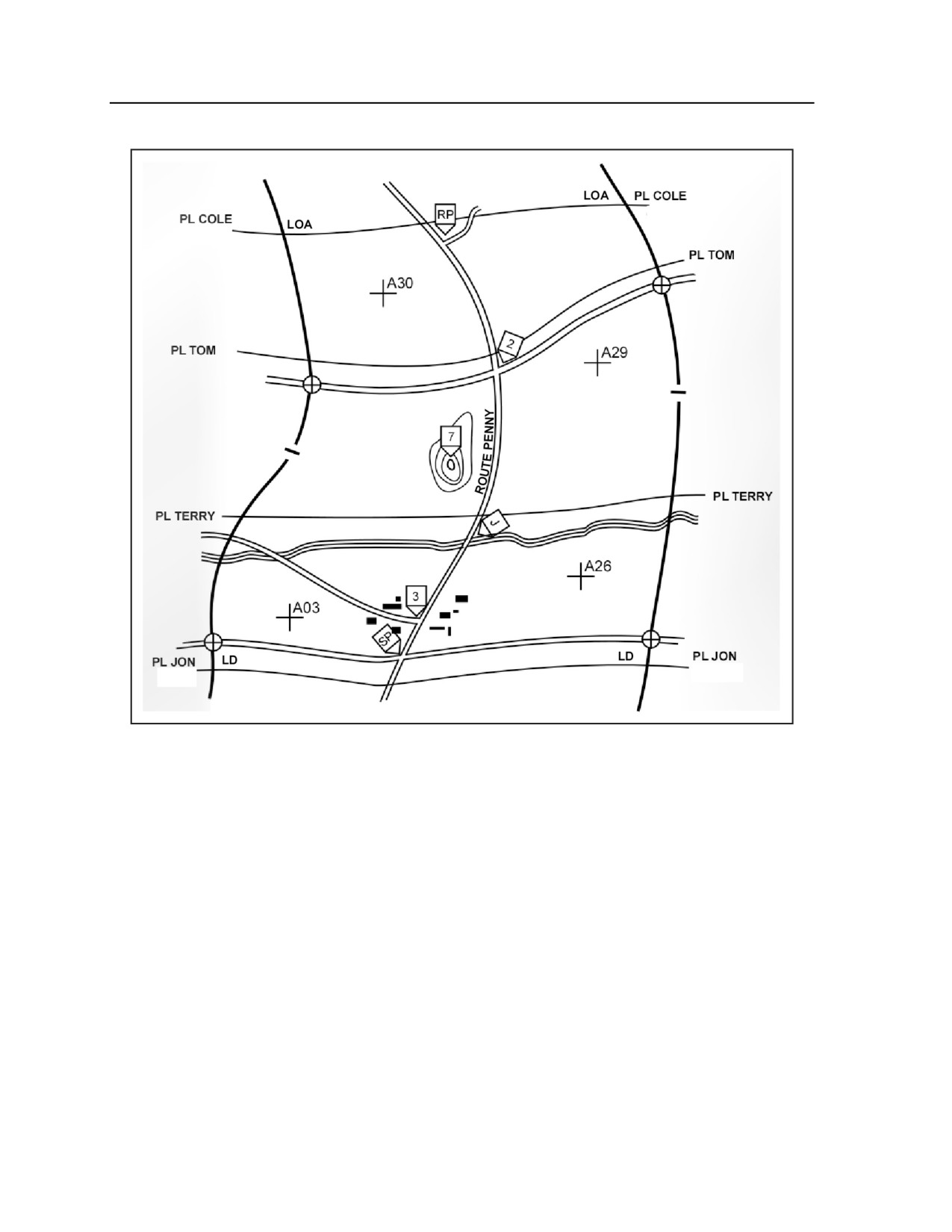
Obvious kill zone.
Signs of recent enemy activity.
Future friendly positions (BP/ABF/SBF/AA/HA) prior to occupation.
z Threat locations are known.
3-101. The reconnaissance by fire technique has other advantages and disadvantages. It is more
advantageous with a poorly disciplined threat that will likely react when engaged. The disadvantages of
reconnaissance-by-fire are the obvious loss of surprise, exposing the location of the firing element, and the
possibility of becoming decisively engaged. When the ARC employs this technique, the available weapons
are normally used in the following priority:
z Indirect fire.
z Machine gun and/or rockets.
z
(Hellfire) missiles last.
In such circumstances, the ARC’s limited organic firepower normally requires employing indirect fire as
the primary means of engagement.
DISMOUNTED RECONNAISSANCE
3-102. Under extreme circumstances, the ARC commander may direct aircrews to conduct dismounted
reconnaissance when information is required on a specific reconnaissance objective (close reconnaissance
of obstacles, evaluation of bridges, and/or evaluation of ford or crossing sites). This method is time
intensive, can place the aircraft in a vulnerable position, and does not make the best use of aircraft systems.
3-103. The commander may direct or expect aircrews to execute dismounted reconnaissance when—
z Time is available.
z Detailed information is required.
z Organic or supporting ISR sensors have already gained initial contact.
z Bypass criteria is restrictive.
z Low probability of enemy contact.
FORMS OF RECONNAISSANCE
3-104. The commander uses one of four forms of reconnaissance to further refine the scope of specified
tasks and give the company mission spatial relationship. The four forms of reconnaissance are route, zone,
area, and surveillance.
ROUTE RECONNAISSANCE
3-105. A route reconnaissance is conducted to obtain information about a specific route and all adjacent
terrain from which the threat could influence movement along the route. The reconnaissance may be
oriented on a road, axis, air route, specific LOC, railway, cross-country mobility corridor, or general
direction of advance or attack. It provides new or updated information on route conditions such as
obstacles and bridge classifications and threat and civilian activity along the route. The route
reconnaissance may be performed as part of an area or zone reconnaissance.
16 February 2007
FM 3-04.126
3-21
Chapter 3
3-106. The mission is best accomplished by the company employing attack reconnaissance teams with
ground elements. Augmenting the attack reconnaissance team with UH-60s to transport infantry, ground
scouts, or engineers can speed the reconnaissance effort. These elements gather information about the
designated route and all adjacent terrain from which a threat could engage friendly forces with direct fires.
The air teams begin the operation and reconnoiter to the front, flanks, and rear providing early warning,
uncovering ambushes, and providing overwatch so the ground elements can concentrate on conducting a
reconnaissance of the route. An air team element may periodically be required to dismount and physically
inspect key terrain, if the situation allows. A route may be too long for the company to reconnoiter without
rotating teams through a FARP. When the commander does so, at least one team is maintained in zone. The
ground force, if available, commands the route reconnaissance.
Critical Tasks
3-107. The following are critical tasks for a route reconnaissance:
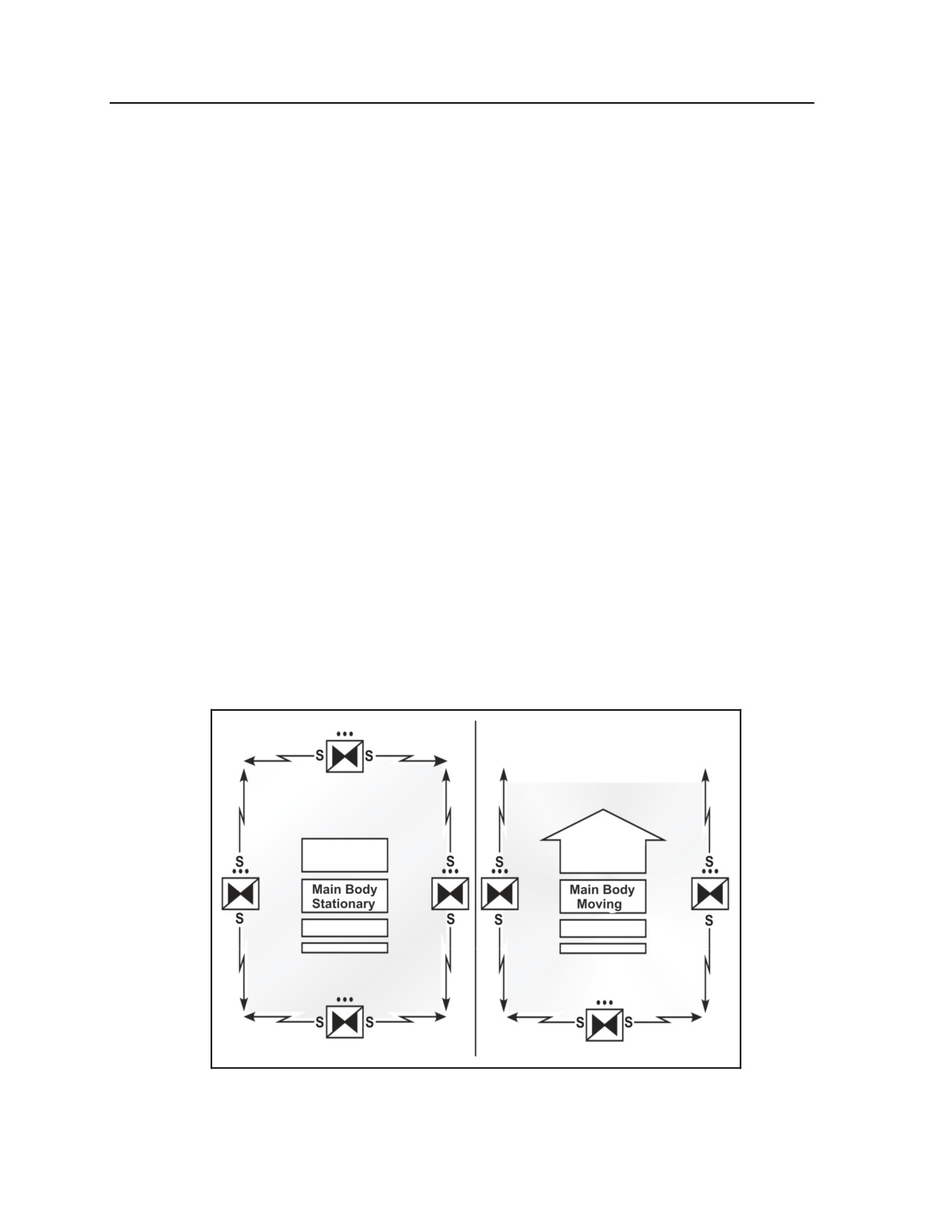
z Reconnoiter all terrain the threat can use to dominate movement along the route.
z Overwatch ground elements, especially in built-up areas.
z Access trafficability of the route.
z Locate sites for constructing hasty obstacles to impede threat movement.
z Reconnoiter all defiles along the route for possible ambush sites and locate a bypass.
z Locate a bypass around built-up areas, mines, obstacles, barriers, and contaminated areas.
z Locate suitable landing sites and zones and hazards to flight (suspected enemy AD locations,
mountainous areas, wires, large bodies of water, open terrain, and other natural and manmade
features).
z Find and report all threats that can influence movement along the route.
z Identify suspicious items along the route (IEDs, VBIEDs, or ambush sites).
z Identify existing or potential civilian use of route.
z Identify threat’s ability to deny use of route through use of civilian interference.
z Identify and classify all bridges, overpasses, underpasses, and culverts that might restrict access.
z Locate fords and crossing sites in proximity to the route.
z Report route information, to include providing a sketch map or a route overlay.
Premission Planning
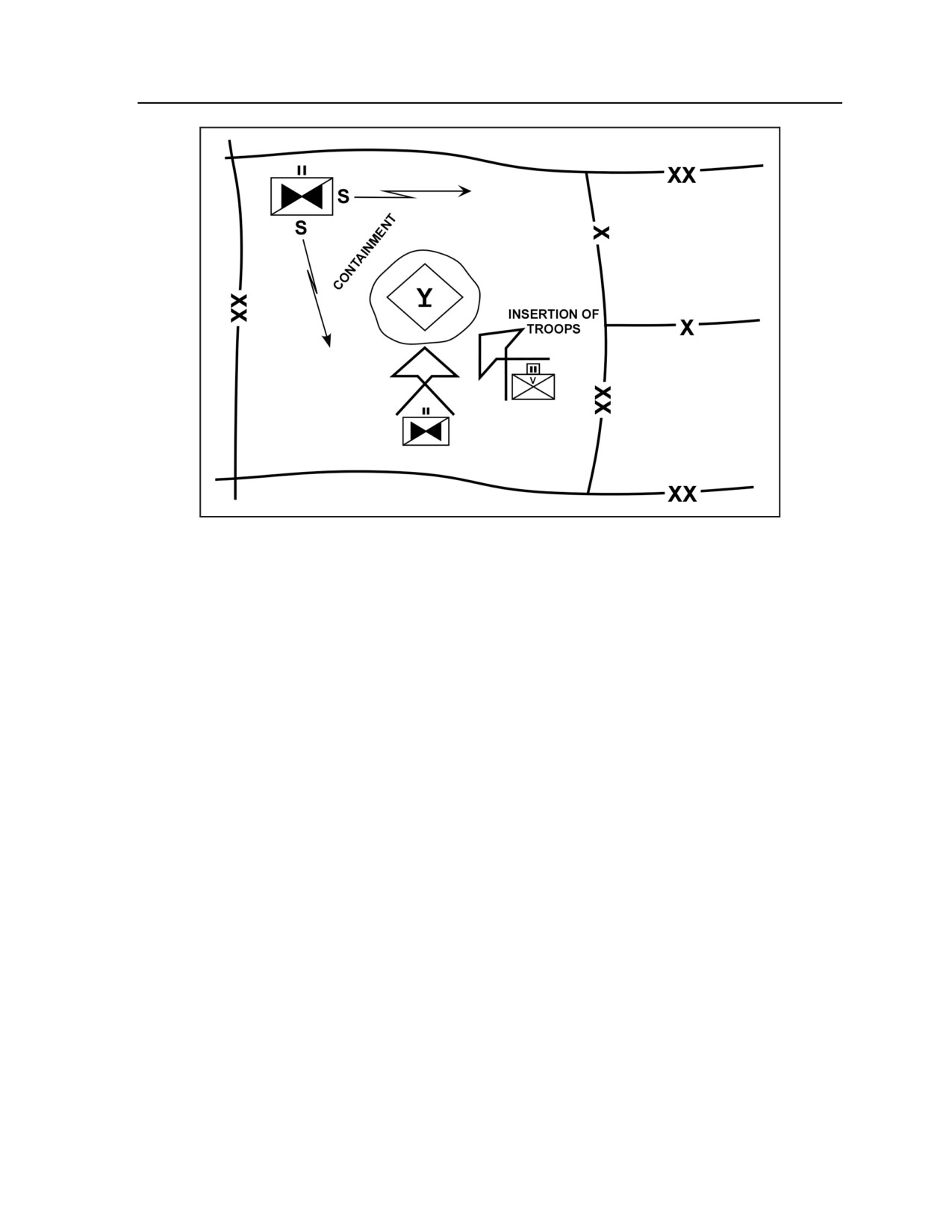
3-108. Before conducting a route reconnaissance, the ARC must know certain information about the
route. This information includes—
z Critical tasks to be accomplished by air reconnaissance teams and ground elements, when used.
Any tasks that may be deleted during the reconnaissance are identified.
z Task organization. Any reinforcements, especially engineers, and their relationship to the
company are identified. Supporting artillery relationships are also defined.
z Start point, RP, and designation of the route.
z Mission to be performed to the start point and after reaching the RP.
z Time the mission is to start and, if required, to be completed.
z Critical points along the route identified as checkpoints.
z IPB information on the route and threat situation.
z Any constraints or restrictions.
z Expected weather conditions for the time of movement.
z Type of unit or vehicles expected to use the route, if applicable.
z Time of day or night the route is expected to be used, if applicable.
3-22
FM 3-04.126
16 February 2007
Employment
Control Measures
3-109. Control measures for a route reconnaissance create an AO for the air reconnaissance teams
conducting the reconnaissance. Typical company boundaries include—
z Lateral boundaries. Placed on both sides of the route, far enough out to allow reconnaissance of
all terrain from which the threat could dominate the route.
z Line of departure (LD). Placed perpendicular to the route short of the start point. This allows
adequate space for the teams conducting the reconnaissance to deploy into the chosen movement
technique prior to the start point. The LD creates the rear boundary of the AO.
z Limit of advance. The LOA is placed far enough beyond the route’s RP to include any terrain
from which the threat could dominate the route. The LOA also provides greater depth and takes
advantage of the aircraft’s elevated observation platform and long range acquisition capability.
z Coordination points or contact points. Coordination points or contact points are included to
enable proper flank coordination. The start point and a RP define that section of the route where
the teams collect detailed information.
z Phase lines (PLs) and checkpoints. Added to maintain coordinated reconnaissance, control
movement, or to designate critical points.
z Additional fire distribution and FS coordinating measures. Included to coordinate indirect
and direct fire as necessary.
3-110. All of the above graphic control measures are placed along or on recognizable terrain features and,
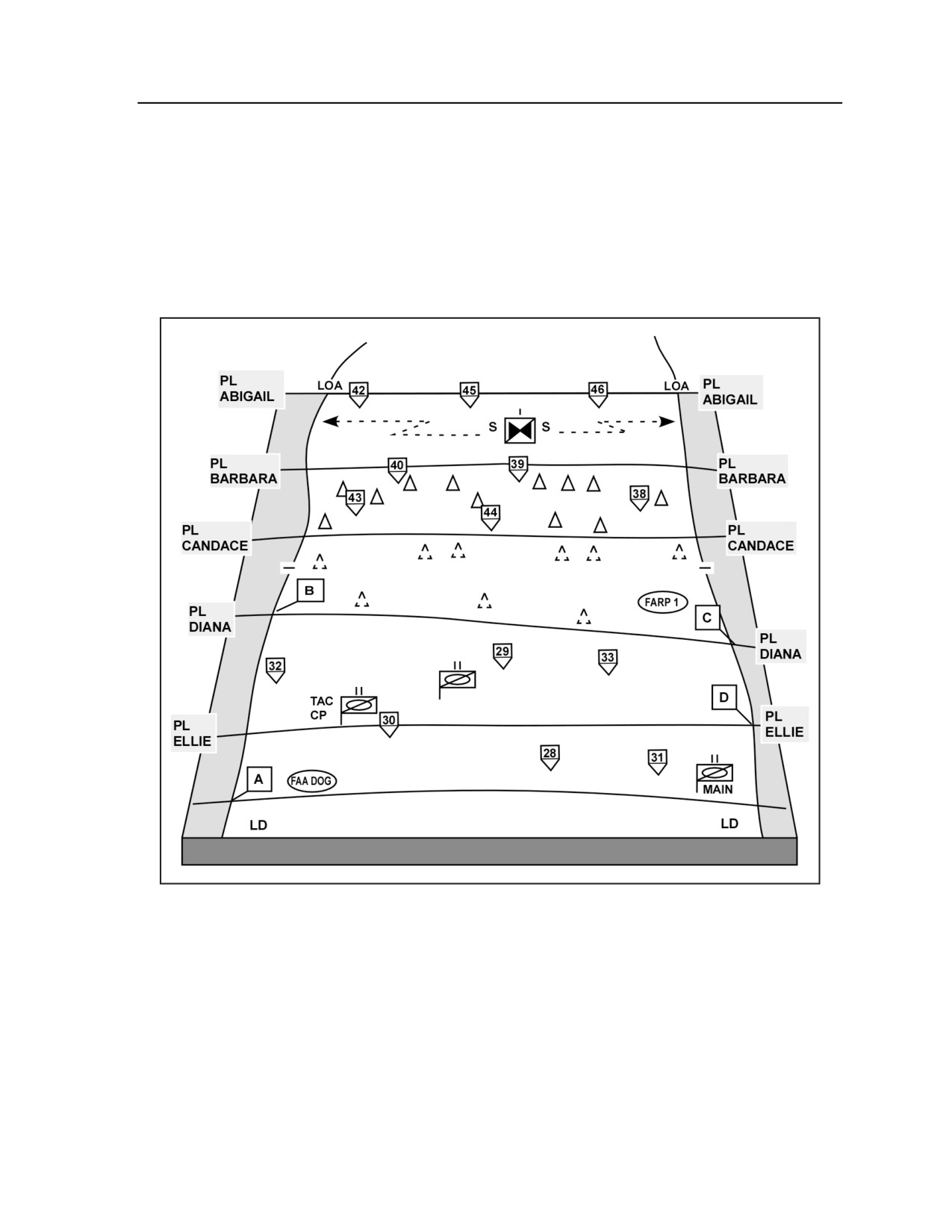
if possible, are identifiable from both the ground and air to assist in air-ground coordination. Figure 3-6,
page 3-24, shows an example of a typical company’s route reconnaissance graphics.
3-111. When time is not available, ground assets are not available, or the mission does not require
detailed information, air reconnaissance teams may conduct a hasty route reconnaissance. In this case,
information gathering is limited to the type of route (X—unlimited or all weather, Y—limited or fair
weather, or Z—poor weather) and obstacle limitations
(maximum weight, height, and width). The
commander may also identify certain additional information to be gathered.
3-112. ARCs should keep records on all routes reconnoitered. Several methods are acceptable for
recording this information. One method is to assign each key terrain feature (bridge, fording site, bypass
site) a number on the map and detail the intelligence information on a separate work sheet. This method
ensures completeness and simplicity and reduces map clutter.
3-113. The use of the video recorders to document areas of interest along the route provides superior
combat information to the requesting headquarters. If the video/data recorder is used, planning must be
conducted to return the video/data to the requesting headquarters, and crews must use a standardized video
reconnaissance technique to clearly associate terrain with the targets portrayed on the video image. A plan
must be developed to transmit images and data to the requesting headquarters.
Air Route Reconnaissance
3-114. The principles of an air route reconnaissance are the same as for a ground route, but the areas of
interest are different. Aviation forces moving along an air route are primarily concerned with the location
of enemy forces, ease of navigation, suitable landing sites and zones, and hazards to flight. Hazards to
flight include suspected enemy AD locations, mountainous areas, wires, large bodies of water, open
terrain, and other natural and manmade features.
16 February 2007
FM 3-04.126
3-23
Chapter 3
Figure 3-6. Example of company route reconnaissance graphics
ZONE RECONNAISSANCE
3-115. A zone reconnaissance is a directed effort to obtain information concerning all routes, obstacles
(to include CBRN), terrain, and enemy forces within a zone defined by boundaries. The boundaries of a
zone are restrictive, unlike those of an area reconnaissance, which are permissive. ARCs require
permission from the ground commander to extend their reconnaissance outside of the zone’s boundaries. It
is the most time-consuming of the reconnaissance missions, so the company must allow for adequate time
to plan and execute. A zone reconnaissance is frequently conducted over an extended distance, which
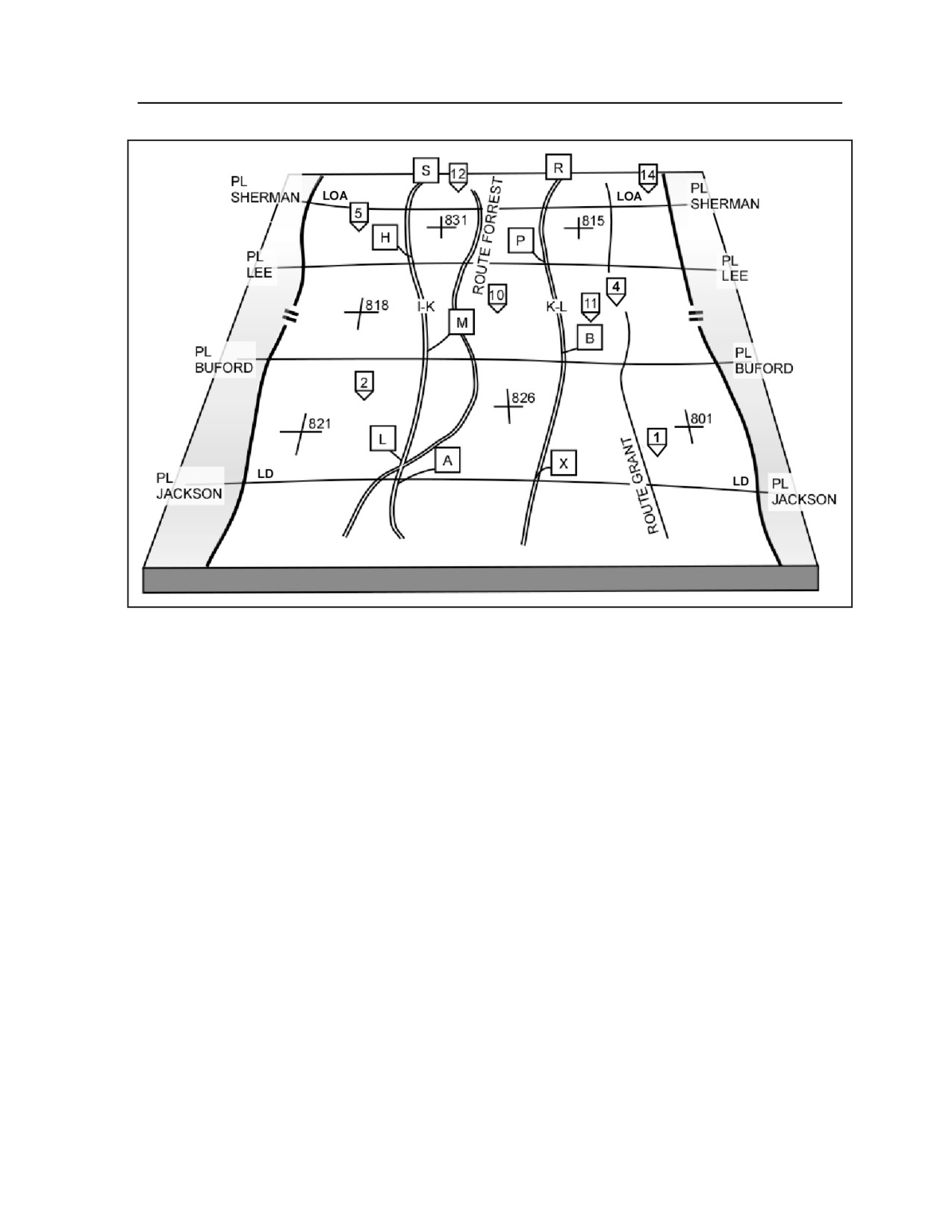
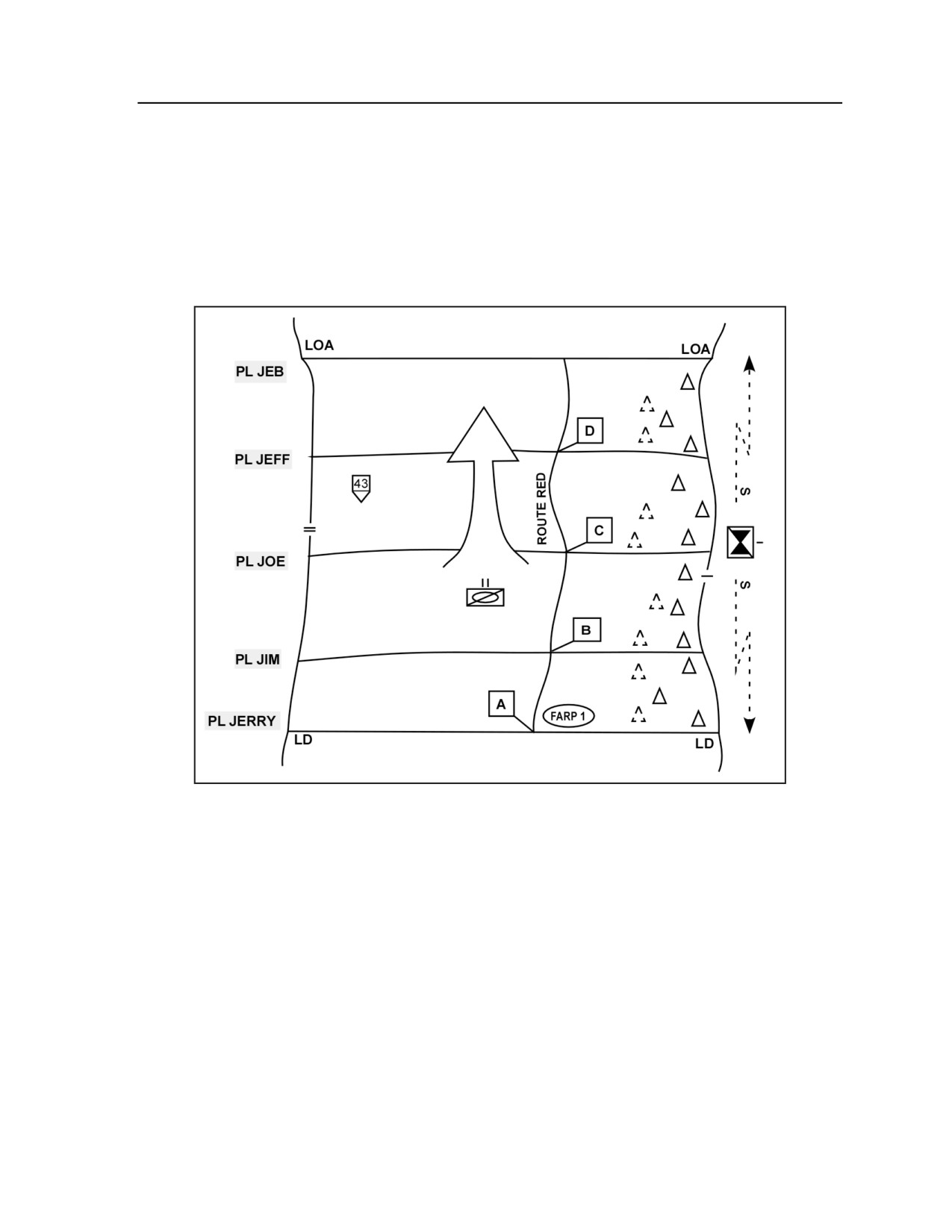
dictates special considerations for team employment (example, FARP rotations). Figure 3-7, page 3-25,
provides an example of company zone reconnaissance graphics.
3-24
FM 3-04.126
16 February 2007
Employment
Figure 3-7. Example of company zone reconnaissance graphics
3-116. The purpose may be to find the enemy or suitable avenues of approach for the main body. A zone
reconnaissance is normally conducted when existing knowledge of the terrain is limited, combat operations
have altered the terrain, or when the enemy situation is vague. Obstacles encountered during a zone
reconnaissance may include manmade obstacles (both existing and reinforcing), terrain obstacles, bridges
and fords, and obstacles created by CBRN contamination. Every route within the zone must be
reconnoitered unless otherwise directed. The zone to be reconnoitered is defined by lateral boundaries, a
LD, and an objective or LOA.
3-117. Considerations for organizing a zone reconnaissance are the same as for organizing a route
reconnaissance except that multiple teams operate abreast during the zone reconnaissance. The company
may be tasked to conduct the zone reconnaissance alone or in conjunction with ground forces. Generally,
when working with ground forces, the ARC performs a well coordinated zone reconnaissance forward of
the ground forces and reconnoiters terrain not assessable to the ground elements. If time is critical, the
ARC performs the reconnaissance alone with the understanding that the combat information obtained will
be less detailed. If the company expects significant threat forces to be found within the zone, then the
company must plan for dedicated FS assets and be prepared to conduct a BHO with ground forces.
Critical Tasks
3-118. The ARC conducting a zone reconnaissance performs the following tasks in accordance with its
capabilities and limitations. If a company does not have the time or resources to complete all of these tasks,
it must inform the commander assigning the mission. The higher commander will then issue further
guidance concerning tasks the company must complete or the priority of tasks. The priority of tasks is
usually consistent with the reconnaissance objective. If the company discovers during execution of the
reconnaissance it cannot complete an assigned task, it must report and await further instructions.
16 February 2007
FM 3-04.126
3-25
Chapter 3
3-119. Zone reconnaissance tasks are—
z Find and report all threat forces within the zone.
z Clear all threat forces in the designated AO within the company’s capability.
z Find suitable covered and concealed ground or air avenues of approach.
z Reconnoiter terrain within the zone.
z Determine the trafficability of all terrain within the zone, including built-up areas.
z Locate and determine the extent of all contaminated areas in the zone, to include bypasses.
z Identify and classify all bridges, defiles, overpasses, underpasses, and culverts in the zone.
z Locate any fords, crossing sites, or bypasses for existing and reinforcing obstacles (including
built-up areas) in the zone.
z Determine the presence of significant adverse weather.
z Overwatch ground elements during obstacle clearance operations.
z Report the above information to the commander directing the zone reconnaissance, to include
providing a sketch map or overlay.
Premission Planning
3-120. Before departing on the mission, the team leader and aircrews select checkpoints and plan routes
between checkpoints, using terrain and vegetation to conceal aircraft movement. The team leader also
coordinates to ensure specific tasks for support of the ground force commander are integrated into the
reconnaissance plan. Specific tasks assigned to attack reconnaissance teams working with ground forces
include—
z Reconnoitering terrain not easily accessible to ground vehicles.
z Checking key points in zone (NAIs developed by higher and at company level).
z Locating and reporting the flanks of encountered enemy forces.
z Locating, reporting, and bypassing obstacles.
z Locating, reporting, and bypassing enemy positions.
z Providing security on the far side of obstacles while ground forces reconnoiter and clear them.
3-121. When a company conducts a zone reconnaissance in nonrestrictive terrain, it can operate up to 10
kilometers forward of ground forces due to the quality of communications, TA capability of onboard
systems, and the aircraft’s armament. Close coordination and continuous communication between forces is
critical to reduce the risk of fratricide.
Control Measures
3-122. The company commander assigns boundaries between platoons/teams to specify sectors of
responsibility. After establishing sectors, the company develops other control measures to include—
z Designating a LD and specifies a crossing time.
z Designating PLs as needed to control and coordinate forward movement. Failure to keep
company elements abreast may result in the bypass of enemy elements, envelopment of
supported ground forces by enemy forces, or engagement of friendly forces. Like boundaries,
PLs should follow features easy to recognize, particularly for night operations or periods of
limited visibility (smoke, haze, and fog).
z Establishing contact points, coordination points, and checkpoints to ease essential coordination
between adjacent platoons. Contact points are designated on boundaries to ensure physical
coordination between adjacent teams. Contact points are designated at―
Points that ensure proper coverage of the zone.
Critical points (such as a route crossing from one sector into another).
Points that ease movement, lateral coordination of fires or positions, passage of lines, or
logistics support.
3-26
FM 3-04.126
16 February 2007
Employment
3-123. Platoons are assigned the responsibility of planning for the reconnaissance within the platoon
sectors. Teams select the method of reconnaissance, mode of terrain flight, and movement technique based
on the IPB with specific emphasis on hazards to navigation and threat ADA. Starting with the LD, the
teams reconnoiter each sector in a systematic manner based on terrain, number of aircraft in the team, and
the width of the sector. The teams reconnoiter from the LD to the objective or LOA.
3-124. Air reconnaissance teams report reaching PLs and continue in zone as directed. Once the operation
begins, the enemy may be alerted to the movement of friendly forces. Forward momentum should be
continued to gain and maintain enemy contact and to keep the enemy off balance.
AREA RECONNAISSANCE
3-125. The purpose of an area reconnaissance is to gather intelligence or conduct surveillance of a
specified area. The area may be key terrain, a farm, bridge, ridgeline, wooded area, proposed AA, LZ, or
other features that will be critical to an operation. The specified area to be reconnoitered is designated by
boundary lines enclosing the area. METT-TC determines the movement technique the air reconnaissance
team uses to reach the area and the method by which the area is systematically reconnoitered. The air
reconnaissance team also reconnoiters dominant terrain outside the specified area from which the threat
can influence friendly operations.
3-126. The company commander may divide the area into platoon zones with designated objectives for
each platoon. The flanks of the overall objective area are secured first; reconnaissance efforts may then be
focused inward. The air reconnaissance teams may establish a screen on the flank to provide security for
the ground reconnaissance forces, if used. The air reconnaissance teams may have to dismount and
physically reconnoiter a specific area.
Critical Tasks
3-127. During an area reconnaissance, the following critical tasks may apply:
z Reconnoiter specific terrain within the area and dominant terrain outside the specific area from
which the threat can influence friendly operations.
z Find and report all threat within the area.
z Find suitable cover and concealed ground or air avenues of approach.
z Reconnoiter all terrain within the area and assist ground forces with built-up areas.
z Determine significant adverse weather.
z Locate a bypass around built-up areas, obstacles, and contaminated areas.
z Inspect and classify all bridges, overpasses, underpasses, and culverts within the area.
z Locate fords and crossing sites near all bridges in the area.
z Locate all mines, obstacles, and barriers in the area within its capability and overwatch ground
units in their clearance.
Premission Planning
3-128. The commander first considers the factors of METT-TC. Rapid movement to the objective is
important, but the main consideration usually is security. Avoidance of known threat locations and threat
surveillance elements is imperative. Primary and alternate routes to the objective area are selected based on
security and speed. Terrain flight techniques are used to move to the area. Upon completion of the
reconnaissance, the air reconnaissance team departs the area on a different route.
Control Measures
3-129. The commander directing an area reconnaissance mission specifies the area for reconnaissance
with a single continuous line to enclose the area to reconnoiter. Alternatively, he may designate the area by
marking lateral boundaries, LD, and LOA. An area reconnaissance mission always specifies the route to
take in moving to the area. The company conducting the area reconnaissance mission can use control
16 February 2007
FM 3-04.126
3-27
Chapter 3
measures for a zone reconnaissance within the AO to control the operation of the air reconnaissance teams.
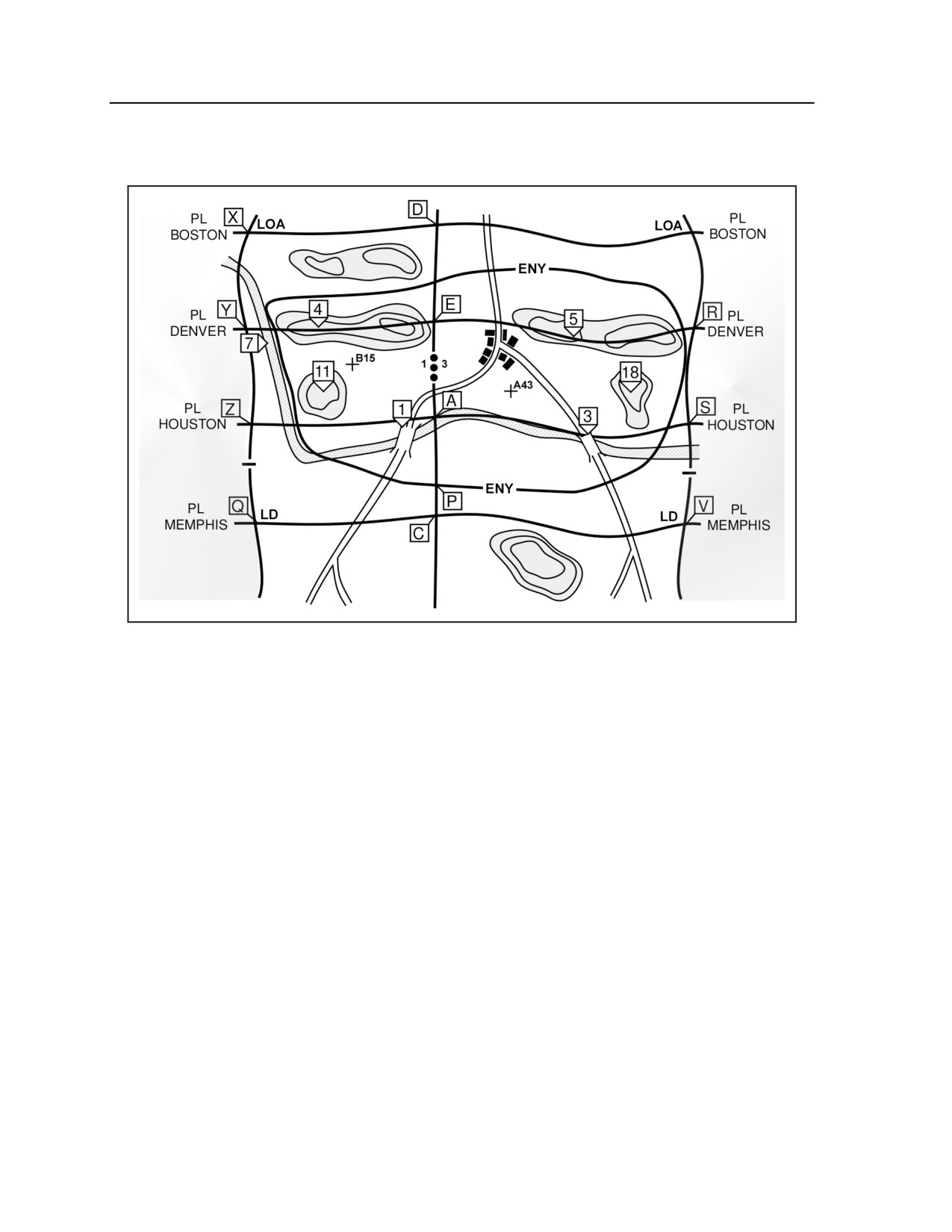
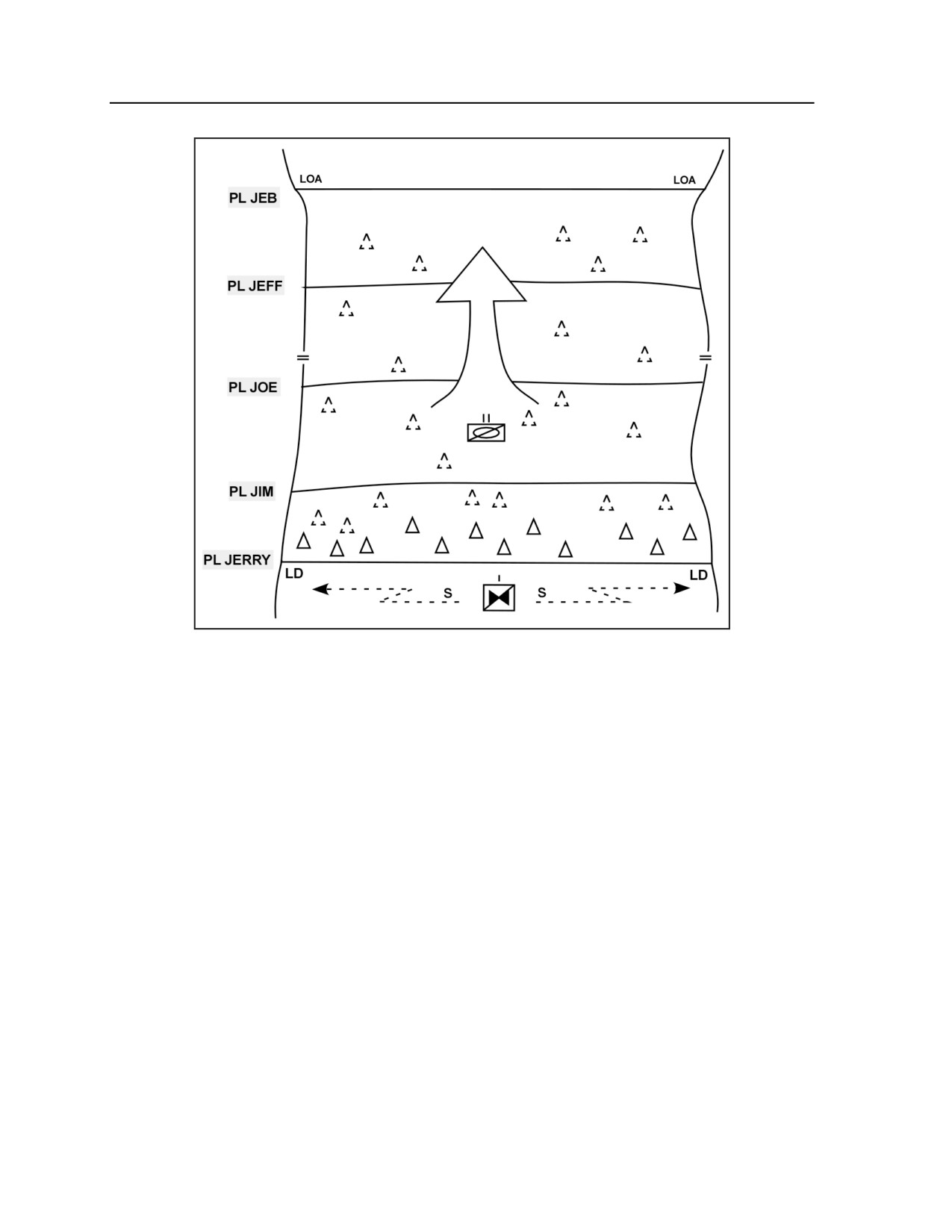
Figure 3-8, page 3-28, is an example of company graphics for an area reconnaissance.
Figure 3-8. Example of company area reconnaissance graphics
3-130. The primary difference between a zone and an area reconnaissance is the nature (restrictive versus
permissive) of the boundaries. A zone reconnaissance has restrictive boundaries that define the company’s
mission area. Because of this, a zone reconnaissance does not have an implied task to reconnoiter
dominating terrain outside of the zone. The boundaries of an area reconnaissance are permissive and allow
the air reconnaissance team greater freedom in selecting their ingress and egress routes. The company may
move to and reconnoiter one large area or several small, dispersed areas. An area reconnaissance may be
performed behind friendly lines or deep behind enemy lines. Emphasis is normally placed on reaching the
objective area quickly.
Landing Zone or Pickup Zone Reconnaissance
3-131. LZ/PZ reconnaissance is a type of area reconnaissance performed to determine the suitability for
air assault operations. Principal concerns are determining if threat forces are present and can bring direct
fires on the LZ/PZ and evaluating the physical characteristics of the area. LZ/PZ reconnaissance looks for
predetermined, specific intelligence requirements. The company should receive, at a minimum, information
on the ground force’s objective, planned actions after landing, the time of the air assault or air movement,
and number and type aircraft in each lift. The air reconnaissance team evaluating the LZ/ PZ should
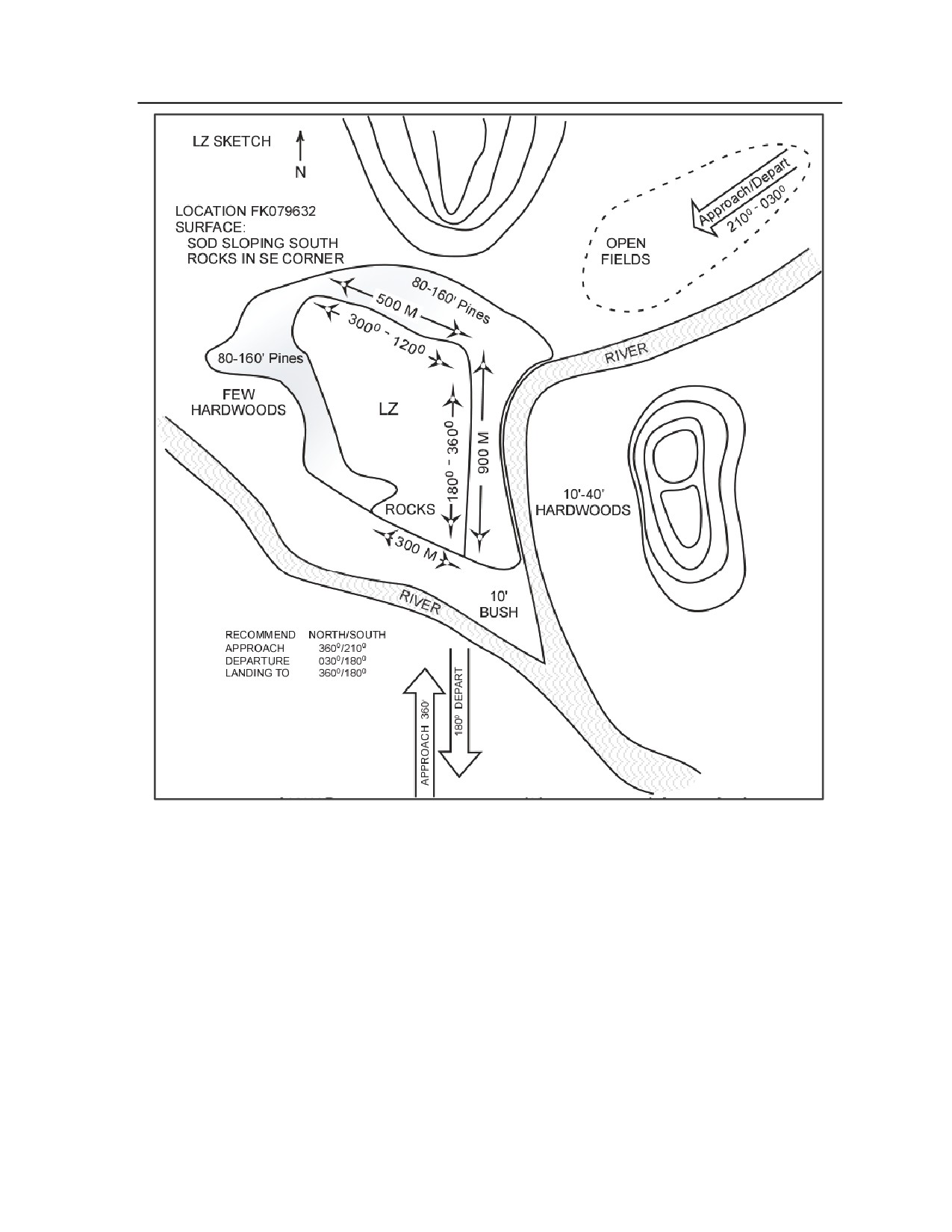
conduct a survey and create a sketch of the area with pertinent information (figure 3-9, page 3-29). The air
reconnaissance team should also include video and/or digital pictures, if possible.
3-28
FM 3-04.126
16 February 2007
Employment
Figure 3-9. Example of landing zone or pickup zone sketch
Critical Tasks
3-132. Air reconnaissance teams evaluate and make recommendations of the following tactical
considerations:
z Mission. Whether the LZ/PZ will facilitate the supported unit’s ability to accomplish the
mission.
z Location. Whether the LZ/PZ meets the commander’s intent for distance from the objective.
z Security. The force required to provide security during the assault.
3-133. Technical characteristics of the LZ/PZ include—
z Landing formations.
z Obstacles and hazards in the landing area and vicinity.
z Number and type of aircraft the LZ/PZ can support.
16 February 2007
FM 3-04.126
3-29
Chapter 3
z Ground slope of the landing area.
z Load suitability.
z Approach and departure directions.
z Size of the available landing area.
z Surface condition, including brown-out or white-out characteristics, of the landing area.
z Vulnerability.
3-134. If meteorological conditions observed during the reconnaissance are expected to be present during
the air assault, reconnaissance elements assess the impact of―
z Ceiling and visibility.
z Density altitude.
z Winds.
Premission Planning
3-135. When conducting premission planning for a LZ/PZ reconnaissance, the company uses the same
planning considerations as with the area reconnaissance—rapid movement to the objective is important,
but the main consideration is security. Primary and alternate routes to the objective area are selected based
on security and speed. Terrain flight techniques are used to move to the area. Upon completion of
reconnaissance, reconnaissance elements depart the area on a different route.
3-136. Long range observation should be used whenever possible to reduce the threat’s ability to
determine the reconnaissance objective. If a flyover is required in a hostile environment, crews must be
able to collect the desired information rapidly while flying over an area only once, if possible, but never
from the same direction twice.
AERIAL SURVEILLANCE
3-137. Although primarily a mission for UAS, the ARC may be tasked with conducting surveillance.
Aerial surveillance is defined as systematic observation to obtain detailed information of a specific target
or area. The focus of surveillance is generally a point target such as a house, car, section of road, or any
other defined area with specific threat indicators to trigger PIRs. ARCs use the same fundamentals to
conduct surveillance as with any reconnaissance mission. When performed by the ARC, surveillance is
normally overt in nature with the purpose of deterring enemy movement or activity.
SECTION IV - SECURITY OPERATIONS
3-138. Security includes all measures taken by a command to protect itself from surprise, provocation,
espionage, sabotage, or observation by the threat. Security operations provide the protected force early and
accurate warning of threat operations and develop the situation to provide time and maneuver space within
which to effectively use the protected force to exploit or react to threat actions.
3-139. Security operations are characterized by reconnaissance to reduce terrain and threat unknowns,
gaining and maintaining contact with the threat to ensure continuous information flow, and providing early
and accurate reporting of information to the protected force. Security missions include screen, guard,
cover, and area security missions. Security operations are defined by both the degree of protection offered
to the main body and the physical characteristics of the operation. The battalion is capable of conducting
and/or supporting all security missions; however, it normally participates in guard and covering force
operations as part of a larger force.
3-140. The ARB commonly executes offensive tasks to provide security to its higher headquarters, and
may conduct security operations to the front, flanks, rear, around, or between protected forces, sustainment
or LOCs. The main difference between security and reconnaissance operations is security operations orient
on the force, area, or facility being protected while reconnaissance orients on threat and/or terrain.
3-30
FM 3-04.126
16 February 2007
Employment
3-141. The fundamental purposes of the ARB in security operations are—
z Providing near real-time terrain and enemy information based on the commander's guidance and
PIR.
z Providing reaction time and maneuver space for the main body.
z Preserving combat power.
z Facilitating C2.
z Facilitating movement.
z Performing rear area operations.
z Acting as a ready reaction force.
3-142. These roles are not necessarily missions themselves but are translated into mission statements by
the battalion commander. Attack reconnaissance participates in these roles as a team with ground forces or
as an independent force.
3-143. Security operations are conducted in all types of terrain, to include a complex variety of natural
and manmade features and urban environments. Primarily considered shaping operations, ARC security
operations can be an economy of force to control essentials such as key terrain over dispersed operations or
provide more combat power for decisive operations. ARC security missions in support of urban operations
include—
z Screening the flanks of forces—
Encircling to isolate an urban area.
Approaching to secure a foothold or conduct decisive operations within the urban area.
z Participating in guard to develop the situation or secure a foothold in urban terrain.
z Securing area of combat support or sustainment areas, critical infrastructure, facilities, or high-
value assets.
z Filling the gap between operations being conducted within or between urban areas or behind lead
combat forces.
z Protecting LOCs by securing routes and conducting convoy security to ensure uninterrupted
supply of forward elements.
3-144. Considerations for security operations include—
z Orchestrating sensors to develop the situation.
z Maneuvering to positions of advantage increasing agility and mobility of the force.
z Developing and share the COP with all members of the air-ground team.
z Applying principles of reconnaissance through gaining and maintaining contact.
z Conducting actions on contact to fix, isolate, provide reinforcing fires, or destroy threat forces.
z Synchronizing fires, maneuver, and tactical assault as required.
z Maintaining communications with all members of the air-ground team.
FUNDAMENTALS
3-145. The ARB performs security missions to preserve the combat power and freedom of maneuver of
friendly forces while providing information about the threat and terrain. ARCs provide security by
providing information to and preventing threat observation and direct fires upon the protected force.
Successful security operations are planned and executed by applying the following five fundamentals:
z Maintain threat contact.
z Orient on the force or facility to be secured.
z Provide early and accurate warning.
z Provide reaction time and maneuver space.
z Perform continuous reconnaissance.
16 February 2007
FM 3-04.126
3-31
Chapter 3
MAINTAIN THREAT CONTACT
3-146. Once the ARC gains contact, it does not break contact unless directed to do so by its higher
headquarters. This requires continuous visual contact, use of direct and indirect fires, freedom to maneuver,
and depth in space and time. The key is to maintain mobility superiority over the threat forces. The ARC
ensures a continuous flow of combat information and prevents the threat from endangering friendly forces.
ORIENT ON THE FORCE OR FACILITY TO BE SECURED
3-147. A security force operates between the main body and known or suspected threat units. The ARC
commander maneuvers the company to positions to provide screening support to the main body
commander’s scheme of maneuver. The screen should be positioned to remain between the main body and
the threat force. The distance is based on the relative vulnerability of the main body and expected threat
rate of advance. As a general rule, the main body's required preparation time is multiplied by the expected
threat rate of advance in kilometers per hour. This equals the minimum distance to emplace security. If this
distance cannot be achieved, additional combat power and a more robust obstacle plan may be required.
3-148. The ARC operates at the prescribed distance and focuses all its actions on providing early warning
and protecting the protected force, facility, or infrastructure. All aircrews must understand that the value of
any terrain within their AO hinges on the advantages it provides in protecting the force or facility. The
ARC orients on and, if necessary, moves with the protected force. The ARC commander and his
subordinate elements must know the protected force’s scheme of maneuver or defensive plan, and use their
mobility and endurance differential to maintain security for the protected force or facility.
PROVIDE EARLY AND ACCURATE WARNING
3-149. Early warning of threat activity includes accurate reports regarding threat—
z Size.
z Current disposition.
z Composition.
z Location.
z Direction of movement.
z Rate of advance.
z Special equipment.
3-150. This gives the main body commander the time and information needed to seize or retain the
tactical initiative and concentrate overwhelming combat power at the right time and place to engage the
enemy.
PROVIDE REACTION TIME AND MANEUVER SPACE
3-151. Early and accurate warning, security purpose, and operating distances combine to provide the
protected force time and space to effectively exploit or respond to threat actions. The higher commander
specifies the ARC’s security purpose and operating distance, or AO, enabling him to choose the time and
place to concentrate against the threat from an advantageous position. Based on the security purpose, the
ARC executes offensive or defensive tasks to fix, contain, delay, or disrupt threat tempo and cohesion,
providing time and/or space to the protected force. At a minimum, the ARC operates at a distance from the
protected force to prevent threat ground forces from observing or engaging the protected force or facility
with direct fire. Operating distances will vary based on the operational environment, for example from 10
kilometers in rural terrain to a city block in urban operations.
3-152. The main body commander thinks and plans in terms of time and space required for maneuver and
concentration of subordinate units against enemy weaknesses. Reconnoitering or performing security
operations well forward or to the flanks of the main body, the ARC develops the situation and prevents the
commander from fighting at a disadvantage. The ARC provides time for the commander to assess the
situation, determine a COA, issue orders, and maneuver. The ARC also provides space to maneuver,
3-32
FM 3-04.126
16 February 2007
Employment
creating flexibility for the commander to respond to unanticipated threat initiatives. The amount of time
and space provided may be determined by the higher commander's intent, but generally the mission defines
it.
PERFORM CONTINUOUS RECONNAISSANCE
3-153. A security force performs continuous reconnaissance to gain all possible information about the
enemy force and terrain within the assigned AO. Accurate, timely information provides security; the
ultimate goal is to answer the commander’s PIRs and enable timely decisions by the protected force
commander to influence the operation.
PLANNING CONSIDERATIONS
3-154. The ARC must receive additional critical information beyond just the security mission. The
following critical items of information are needed to facilitate planning:
z Dimensions of the security mission (normally depicted on graphic overlay).
z Minimum reaction time required. This allows the ARC commander to determine if the depth of
the security zone is sufficient to accomplish the mission and determines how long the security
force must delay before falling back to successive PLs.
z Minimum sized threat force that must be detected. This allows the ARC to determine required
density of the screen.
3-155. The ARC follows general planning principles in preparing for a security mission and determines
the number of teams required to perform the mission. The company specifies the area of the security and
time the security must be effectively established with battalion-size avenues of approach into the identified
area. The depth of the area should provide enough distance for the main body to react in minimal time. The
company must not establish its initial security too close to the main body, but within range of the main
body artillery. The initial screen also follows advantageous terrain for observation of avenues of approach.
It is delineated by a PL and located behind critical control measures such as CFLs and fire support
coordination lines (FSCLs). PPs and routes through stationary units are also coordinated.
3-156. Consideration must be given when assigning the ARC its own terrain. ASE and/or EW
considerations must be part of the mission planning process to minimize risks while accomplishing the
mission. Limited visibility conditions and weather may affect the ARC’s ability to cover a zone and/or
sector. Conversely, there are times when ground units are limited by mobility, terrain, vegetation, or time,
and the ARC is the only asset capable of conducting the mission.
3-157. The company commander, in conjunction with the protected force commander, must determine the
width and depth of the security and establish a rear boundary between the main body and security force.
The company may initially assume responsibility for the area between the main body and security force.
The company may conduct a zone reconnaissance from the main body to the initial screen line and then
maintain surveillance between the security force and screen line. The main body may be required to
conduct patrols or establish OPs near their positions. The ARC must carefully plan and coordinate its
subsequent rearward movement and passage of lines.
3-158. Fires are planned, and emplacement of manmade obstacles is coordinated to impede the threat's
advance. The combination of fires and natural and man-made obstacles allows the company to impede
threat lead elements, maintain contact, and avoid decisive engagement. The company may also continue
reconnaissance forward to identify threat second echelon and follow-on forces. Upon contact, the company
focuses its effort on the destruction of threat reconnaissance elements by direct and indirect fires before the
threat can penetrate the initial screen line.
CAPABILITIES
3-159. Commanders consider METT-TC when employing their company in a security role. A screen or
area security may normally be assigned to the company; fill the gap, LOC security, and guard may be
assigned to the company but requires augmentation. However, depending on METT-TC, the company may
16 February 2007
FM 3-04.126
3-33
Chapter 3
not be fully capable to conduct the associated tactical tasks within the operational environment without
augmentation.
3-160. ARCs execute security operations as independent operations or in a supporting role to the ground
maneuver commander. The higher commander’s intent and purpose for security, combined with the
mission’s duration within the operational environment, determines the required augmentation.
Requirements to conduct sustained operations, defeat or destroy threat forces, or accept decisive
engagement may require task organization to include mechanized or light infantry, tank, DS or reinforcing
artillery, intelligence systems, UAS, EW assets, and communication nodes. Urban operations and other
stability operations may require military police, PSYOPS, and CA augmentation.
3-161. An ARC, operating independently, normally maintains an 8 to 10 kilometers front based on
METT-TC. Using its organic firepower, it screens or fights within range of the main body artillery. This
maximizes its ability to provide reaction time and maneuver space for the main body commander to
concentrate combat power. During cover operations, forces forward may be out of the main body's artillery
range.
TYPES OF SECURITY OPERATIONS
3-162. The four types of security missions the ARC is expected to conduct and participate in are screen,
guard, cover, and area security.
SCREEN
3-163. The primary purpose of a screen is to provide early warning to the main body through the
communication of real-time combat information. This gives the protected force reaction time and maneuver
space to orient to meet the threat. The screen provides the protected force with the least protection of any
security mission. The ARC screens forward and to the flanks or rear of a stationary main body and to the
flanks or rear of a moving main body. Screening operations are not performed forward of a moving force
because that would be an advance guard or zone reconnaissance. Based on the higher commander’s intent,
the ARC may be required to impede and harass the enemy with supporting fires and, within its capabilities,
destroy or repel enemy reconnaissance elements without becoming decisively engaged. Otherwise, the
ARC fights only in self-defense. See figure 3-10 for screen locations.
Figure 3-10. Screen locations
3-34
FM 3-04.126
16 February 2007
Employment
3-164. Screen missions are defensive in nature, largely accomplished by establishing a series of OPs to
ensure adequate surveillance of the assigned sector. Although defensive in nature, a screen is active in
execution. Stationary screens may be conducted around or between any force, while moving screens are
conducted everywhere except in advance of a moving force The higher commander should not place a time
duration for the screen, as that may force the ARC to accept decisive engagement.
3-165. A screen is most appropriate when—
z Operations have created extended flanks.
z Gaps exist between ground commands that cannot be secured in force.
z Early warning is required over an area not considered critical enough for greater security
(economy of force).
Critical Tasks
3-166. The following are critical tasks for conducting screen operations:
z Provide early warning of threat approach.
z Maintain contact with the protected force.
z Maintain continuous surveillance of all avenues of approach larger than a designated size into the
sector.
z Maintain contact with threat forces, not allowing threat ground elements to pass through the
sector undetected and unreported.
z Destroy, repel, or suppress threat reconnaissance and impede or disrupt threat forces (within
capabilities) in accordance with guidance without becoming decisively engaged.
z Impede and harass the enemy with indirect fires while displacing.
z Guide reaction forces.
z Locate threat security forces and the main body to determine their direction of movement,
composition, and intent, if applicable.
Premission Planning
3-167. The ARC commander plans his concept using the following critical considerations:
z Aircraft rotation. The commander determines the method of rotating aircraft to sustain an aerial
screen. The ARC commander must consider all aspects of the mission-time required for the
mission, aircraft availability, and expected relief on station.
z Organization. The commander organizes the screen based on higher commander’s guidance,
likelihood of threat contact, size of assigned sector, duration of the mission, and aircraft
availability. If large frontages or several avenues of approach need to be covered, the company
may deploy in teams instead of platoons.
z Coordination. The ARC ensures the location of FARPs, supporting fires, and forward assembly
areas (FAAs) are known by all aircrews. The commander coordinates his concept closely with
the higher commander. The ARC must pay particular attention to OP locations, artillery
positions, and the ground scheme of maneuver. Coordinating the air passage of lines when
operating forward of ground units is essential.
z Concealment. The company situates the screen to maximize the ARC’s ability to maintain
concealment while observing the operational environment. Teams work together, ensuring fields
of observation overlap and preventing the threat from passing undetected. Air routes to and from
succeeding screen lines should provide adequate cover and concealment. Cover may be difficult
to obtain along a route, but concealment is critical. During movement, teams ensure visual
contact with the threat is continuously maintained.
z OP emplacement. The most forward OP is positioned abeam the leading ground unit, while the
subsequent OPs are arrayed in depth along the length of the main body toward the rear. OP
selection should be based on fields of observation into NAIs. Movement along the flank screen
line may be controlled using one of three methods—successive bounds (similar to bounding
16 February 2007
FM 3-04.126
3-35

Chapter 3
overwatch), alternate bounds
(similar to traveling overwatch), or continuous
(similar to
traveling). The most secure technique is one in which aircrews move from the trail OP to the
most forward OP. This works best when the main body is moving slowly. A less secure
technique may be used when the main body is moving faster. It involves all OPs moving
forward simultaneously on command to the next OP. The screening force may also move
continuously, but this is the least secure and least preferred method. Table 3-3 provides a list of
movement methods.
z
Enemy aircraft. Part of the screen mission may be to alert friendly forces of approaching enemy
aircraft. The teams maintain surveillance of air avenues of approach the same way they maintain
surveillance of ground avenues of approach. Reports of incoming aircraft alert all assets in the
area to take appropriate action. Linking the company to the AD warning system provides
aircrews the SA needed to maintain an effective aerial screen.
z
Displacement. The ARC must identify the criteria for displacing to a subsequent screen line. As
the threat situation threatens the security of the screening force, the company reports and
requests movement to the next screen line. Staggered movement of the screen line allows the
company to identify the flanks and rear of attacking threat forces. The ARC commander usually
decides when to move from a screen line; however, the higher commander decides when the
company may move behind the rear boundary PL. Prompt, accurate reporting is essential to
prevent decisive engagement. Maximum use is made of onboard aircraft sensors.
z
Command and control. The ARC commander chooses the best position to control the screen
line. Normally, this is at a vantage point from which he can move freely, maintain
communications with both higher and subordinate elements, and best influence the operation.
Table 3-3. Flank security movement methods
Method
Characteristics
Advantages
Disadvantages
Successive
•
Main body is
•
Most secure
•
Execution takes
Bounds
moving slowly.
method.
the most time.
•
Conducted by
•
Maintains
•
Unit is less secure
platoon or
maximum
when all elements
company.
surveillance.
are moving
•
Contact is
•
Maintains unit
simultaneously.
possible.
integrity.
•
Simultaneous
•
Conducted
movement may
simultaneously or
leave temporary
in succession.
gaps.
Alternate
•
Main body moves
•
Maintains good
•
Execution takes
Bounds
faster.
surveillance
time.
over the security
•
Conducted by
•
Disrupts unit
platoon or
area.
integrity.
company.
•
Secure, but
•
May leave
•
Contact is
faster than
temporary gaps in
possible.
successive.
coverage.
•
Conducted from
rear to front.
Continuous
•
Main body is
•
OPs displace
•
Least secure
moving relatively
quickly.
method.
quickly.
•
Maintains unit
•
Performed as a
integrity.
route
reconnaissance.
•
Threat contact is
not likely.
3-36
FM 3-04.126
16 February 2007
Employment
TYPES OF SCREENS
3-168. The ARC conducts two types of screen missions-stationary and moving.
Stationary Screen
3-169. The ARC conducts a screen for a stationary force when the main body commander is preparing for
future TACOPs. During reconstitution activities or planning and preparation phases, the main body
commander may remain stationary. The ARC may be assigned screen operations when ground forces are
preparing for defensive or offensive operations before actual movement begins. Initial occupation of a unit
BP may also require screening activities. Figure 3-11 illustrates a company stationary screen.
Figure 3-11. Stationary screen
3-170. The ARC commander occupies the assigned sector and establishes OPs with overlapping fields of
observation, and in depth when at all possible. Teams are positioned to take advantage of established links
with higher echelon collection assets and sensors. Ground forces reconnoiter areas that cannot be observed
by OPs, and the TF reserve is positioned to react in accordance with its planning priorities and for flexible
response to unforeseen contingencies.
3-171. The ARC uses fires to destroy threat reconnaissance and HPTs, and disrupts movement of other
forces based on its TA requirements and ROE. OPs engage at maximum ranges with indirect fire only,
directing ground units to engage with direct fire if available. The company commander determines when to
move to subsequent screen lines; however, during linear operations the protected force commander decides
16 February 2007
FM 3-04.126
3-37
Chapter 3
when the ARC can move behind the screen line (PL) designating its rear boundary. Displacement to
subsequent screen line or OP positions is normally event driven, but the company commander may direct a
displacement if the company’s security is threatened even if the criteria has not been met. Teams displace
using alternate or successive movement, but must maintain contact with threat forces unless it conducts a
BHO with another unit.
3-172. If the ARC requires relief on station or BHO from another unit, the battalion/TF staff coordinates
with the relieving unit to determine the requirements. Reconnaissance elements relieve each other by
aircraft, team, or company as briefed. In each case, the ARC flight lead links up with the incoming leader
and communicates the current friendly positions, enemy situation, and plan for relief or handover. When
the AMPS is used to maintain a SA net, the relieving force should arrive with updated graphics, reducing
the time needed to conduct the relief or handover.
Initial screen line
3-173. The most secure method of establishing an initial screen line is conducting a force oriented zone
reconnaissance to the initial screen line. When the teams reach the general trace of the screen line, they
reconnoiter and refine it. Positions are also selected for good observation and fields of fire. The teams seek
to remain undetected while reporting threat activity and engaging threat forces with indirect fires at
maximum range. A combination of obstacles and coordinated fires allows teams to impede threat lead
elements, maintain contact, and avoid decisive engagement. This gives the main body reaction time and
maneuver space to engage the threat effectively. The company may continue reconnaissance forward to
identify threat second echelon and follow-on forces. Upon contact, the teams focus efforts on the
destruction of threat reconnaissance elements by direct and indirect fires before the threat can penetrate the
initial screen line.
Successive screen line
3-174. Successive screen lines, located one behind the other, provide the ARC with maneuver space. As
threat pressure compromises the security of the ARC, or the movement of the main body dictates, the
company reports and requests to move to the next screen line. Teams rapidly move from a screen line while
maintaining visual contact with the threat. Staggered movement off the screen line ensures that gaps
occurring during movement are quickly closed. The procedure is repeated as necessary. The main body
commander decides when the ARC is no longer necessary as a screen force and allows it to conduct
follow-on missions. Maximum use is made of the aircraft’s onboard sensors.
MOVING SCREEN
3-175. When the main body is moving, the ARC conducts a moving screen and determines the technique
of screening based on METT-TC, the maneuver force commander’s intent, and the company’s orientation.
The commander assigning the screening mission provides the parameters of the screen and times and
locations of the establishment of the screen. The higher commander also identifies the unit or units to be
screened and provides the operations overlay and control measures.
3-176. The emphasis of a moving screen may vary from a stationary screen, as it is not normally
performed to the front of a moving force but to the flanks or rear of the protected force. A moving rear
screen is executed similar to a front stationary screen. As the protected force moves, the company occupies
a series of successive screen lines behind the protected force. Movement is regulated to maintain the
protected force’s commander’s desired time and distance factors. For a moving screen, the width of the AO
is not as important as the length of the protected force.
3-177. The three types of moving screens are flank, rear, and rear area incursion.
Moving flank screen
3-178. The moving flank screen is the most difficult screening mission. ARC elements move on a route
parallel to the movement axis of the main body. The higher commander defines the initial area to be
3-38
FM 3-04.126
16 February 2007
Employment
screened, subsequent screen lines, and the rear boundary. ARC teams occupy a series of OPs on the screen
line. The forward team(s) maintains contact on the near flank of the main body as the lead elements move
on the axis of advance. The main body and ARC must maintain contact at all times. When working with
ground units in a moving flank screen mission, ARCs are well-suited to maintain contact with the main
body and perform reconnaissance forward of the ground units. An ARC screening to the flank of a moving
unit plans a line of OPs and prepares to occupy each, in turn, as the main body advances. If possible, the
ARC reconnoiters out to the maximum range of supporting fires. Except for these procedures, the mission
is planned and conducted the same as a stationary screen. While maintaining contact with the main body,
the teams must be aware of the distance of the ground units from the main body to prevent over-extension
of the screen. Figure 3-12 provides an example of a company conducting a moving flank screen.
Figure 3-12. Moving flank screen
Moving rear screen
3-179. Screening the rear of a moving force is essentially the same as screening a stationary force. As the
protected force moves, the ARC occupies a series of successive screen lines. Movement is regulated by the
requirement to maintain the time and distance factors desired by the main body commander. Sectors and
responsibilities are assigned as in the stationary screen. In a rear screen, a company may move to
subsequent screen lines without threat pressure as long as it remains within friendly artillery range and can
effectively screen the rear. If threat contact is made, the teams execute actions on contact the same as a
stationary screen. Figure 3-13, page 3-40, provides an example of a company conducting a moving rear
screen.
16 February 2007
FM 3-04.126
3-39
Chapter 3
Figure 3-13. Moving rear screen
Rear area incursion screen
3-180. During rear area enemy incursions, the ARC responds and conducts both attack and security
operations. The purpose is to gain and maintain contact, and destroy threat forces in conjunction with
ground reaction forces. Aircrews guide friendly QRFs or assist in the attack and destruction of the threat
force. Figure 3-14, page 3-41, shows the ARC's role in a rear area incursion operation.
GUARD
3-181. A guard force accomplishes all the tasks of a screening force. A guard operation protects the main
body from enemy ground observation, direct fire, and surprise attack. A guard may be performed for a
stationary or moving force, and to the front, flank, or rear of the main body. The guard force reconnoiters
attacks, defends, and delays as necessary to destroy enemy reconnaissance elements and disrupt the
deployment of enemy first echelon forces. The guard force normally operates within the range of main
body indirect-fire weapons. The main body commander assigns the guard mission when contact is expected
or there is an exposed flank that requires greater protection than a screen provides.
3-182. The ARC cannot perform a guard mission independently and without augmentation of ground
forces. Normally, the ARC performs zone reconnaissance, screen operations, hasty attacks, and CCA in
support of the BCT or ground maneuver TF conducting the guard operation.
3-40
FM 3-04.126
16 February 2007
Employment
Figure 3-14. Rear area incursion screen
Critical Tasks
3-183. When operating as an element of a guard force, the ARC conducts the following critical tasks for
the ground maneuver commander:
z Performs reconnaissance along the main body’s axis of advance.
z Performs reconnaissance between the main body and guard force BPs.
z Maintains continuous surveillance of threat avenues of approach larger than a designated size
into the AO.
z Maintains contact with threat forces, not allowing threat ground elements to pass through the AO
undetected and unreported.
z Maintains contact with the lead combat element of the main body.
z Destroys or repels threat reconnaissance and security forces and impedes or disrupts threat forces
in accordance with guidance and capabilities.
z Defeats, repels, or fixes threat ground forces before it engages the main body with direct fire.
z Locates and causes the threat main body to deploy, determining its composition and direction of
travel, if applicable.
Premission Planning
3-184. The commander assigning the guard mission must indicate the type and level of protection
required, and the time the guard is to be established. Expected duration of the guard mission should also be
given. Because guard forces are expected to force and disrupt enemy deployment, the ARC operates on a
narrower front than when conducting a screen. A commander directing a guard mission must consider the
requirement to clear the area between the main body and the unit’s guard-designated positions. The ARC
may need additional assets to clear the area while keeping adequate combat power forward to protect the
main body. The ARC may have FA in DS or priority of fires. This assistance depends on artillery support
available and type and level of protection required by the commander who assigns the guard mission.
Normally, guard units occupy BPs across the most likely avenues of approach. The units do not withdraw
16 February 2007
FM 3-04.126
3-41
Chapter 3
to successive positions without the permission of the main body commander. Elements within the guard
force often have different missions.
Example: The ARC may screen a less vulnerable zone while the remaining ground elements
guard an area with critical avenues of approach. The ARC commander utilizes the same
planning factors for a screen to support the guard operation. The ARC may also be designated as
the TF reserve or QRF and positioned to support the ground guard force with hasty attacks and
CCA.
TYPES OF GUARD OPERATIONS
3-185. The ARC supports two types of guard missions—stationary and moving.
Stationary Guard
3-186. A stationary guard is performed when the main body is not moving. It may be conducted to the
front (advance), rear, or flanks of the main body but is normally conducted to the front. As part of a
stationary guard, the ARC deploys forward of a designated PL, usually within friendly artillery range, and
conducts reconnaissance and screening operations. The main guard force does not displace behind the
designated PL without the permission of the main body commander. A PL designating the rear of the
ARC's area is farther from the main body than the effective range of threat direct fire weapons. The ARC
conducts a zone reconnaissance from the rear to the BPs or OPs, reconnoiters the BPs or OPs, and
establishes a screen line. It provides reaction time for the main guard force and, consequently, the main
body. The ARC determines the threat's disposition, destroys threat reconnaissance elements, and assists the
main guard unit in forcing the threat to deploy. It also disrupts the threat's forced deployment and guides
main body reaction forces for the counterattack.
Advance guard
3-187. An advance guard for a stationary force deploys forward and defends. Once contact is made, the
ARC continues to defend in sector or delay consistent with the commander’s intent. An advance guard for
a moving force is offensive in nature, finding and defeating threat units along the axis of advance. The
ARC usually participates as part of an advance guard providing uninterrupted movement of the protected
force and prevents surprise and premature deployment of the main body. If the ARC encounters threat
forces beyond its capability, it defends, continues close reconnaissance and prepares to pass elements of
the main body forward.
3-188. As units of the advance guard identify targets of opportunity, the ARC can expect to conduct hasty
attacks to destroy or disrupt those targets. The rapid mobility of the ARC allows the advanced guard
commander to quickly attack, destroy, and move through located threat forces; bypass threat forces to look
deeper; or to quickly develop the situation and await the arrival of the main body. The advance guard
commander may task the ARC to reconnoiter forward of ground units or screen along exposed flanks.
3-189. When tasked with this mission, the ARC conducts the following tasks in addition to the critical
tasks associated with a screen:
z Determines the trafficability of high-speed routes within the zone.
z Inspects and classify bridges, culverts, overpasses, and underpasses along high-speed routes.
z Identifies all bypasses and fords able to support rapid movement of heavy equipment.
z Identifies obstacles, choke points, and likely ambush areas and determines possible bypass
routes.
z Finds and report all enemy forces within the zone and determine size, composition, and activity.
3-42
FM 3-04.126
16 February 2007
Employment
Flank guard
3-190. Flank guards are reconnaissance oriented, concentrating on threat battalion-sized avenues of
approach to protect an exposed flank of the main body. In performing this mission, the ARC operates
beyond the assigned zone or sector of the protected force. Normally, the ARC’s responsibility begins at the
trail element of the advance guard or the lead combat element in the main body, and ends at the rear of the
protected force or lead element of the rear guard. The protected force commander clarifies this
responsibility as necessary. A flank guard is similar to a flank screen except that defensive positions are
planned for in addition to OPs.
3-191. ARCs can be integrated as part of the guard force by screening between and in front of BPs as
they are established. The ARC may also be used to reconnoiter the area between the guard force and main
body, maintaining contact with both elements and freeing the ground flank guard force to concentrate on
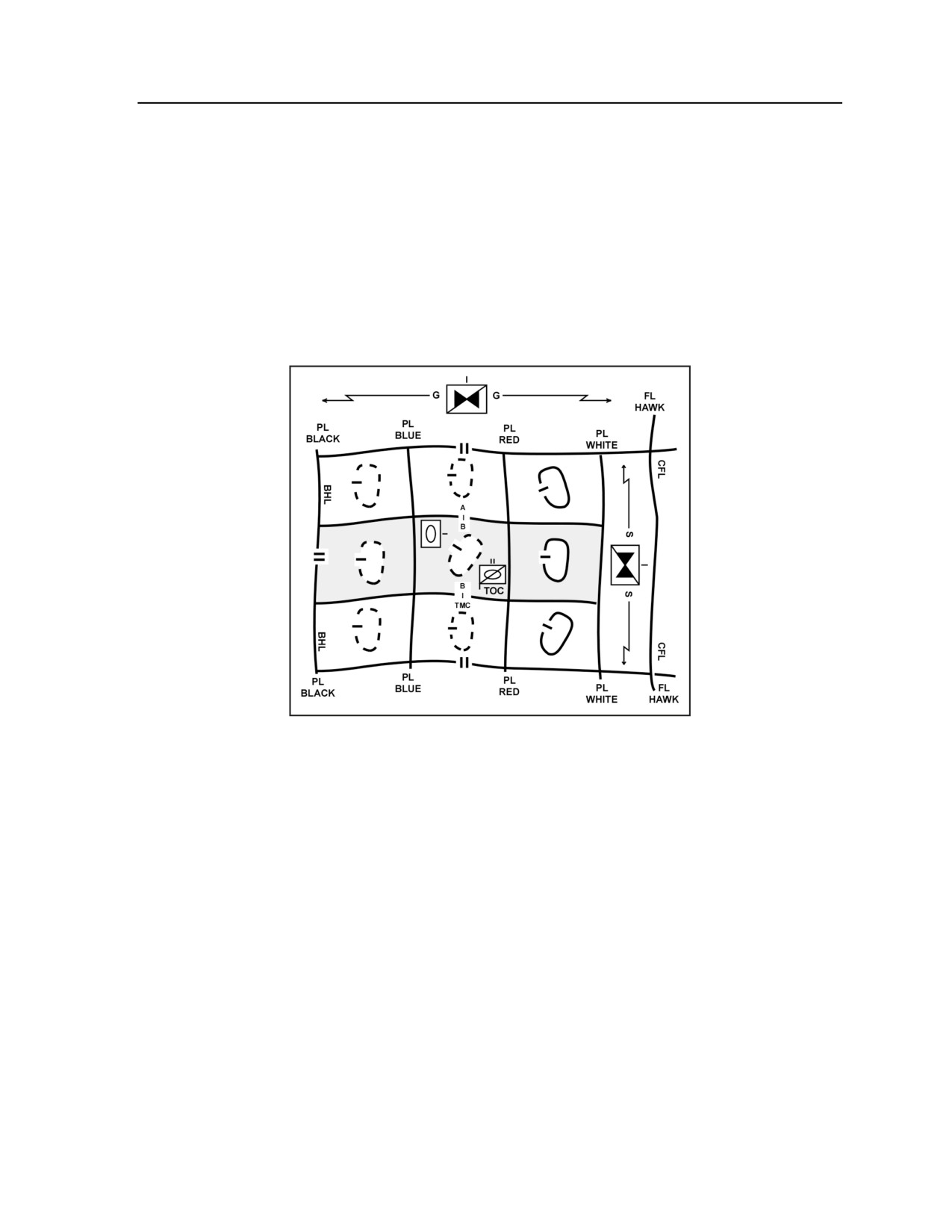
its BP tasks. Figure 3-15 shows a company conducting a stationary flank guard.
Figure 3-15. Stationary flank guard
Rear guard
3-192. A rear guard protects the exposed rear of a stationary main body. The critical tasks listed for the
stationary flank guard apply for rear guard. Establishing the rear guard during retrograde operations may
be done in two ways. The ARC may relieve other units in place along the FLOT as they move to the rear;
or the ARC may establish a position in depth behind the main body and pass those forces through.
Moving Guard
3-193. Moving guard operations may be conducted to the front (advance), flank, and rear of the main
body.
Advance guard
3-194. An advance guard for a moving force is offensive in nature. When serving as the advance guard
for a moving force, the ARC develops the situation to the front along specific routes or axes to prevent
surprise or premature deployment of the main body. Planning is conducted as in a zone or route
reconnaissance but will usually have a more lenient engagement criterion. The ARC must have artillery
coverage. The main body is normally in a movement to contact. The ARC develops the threat situation by
fighting to gain intelligence. The ARC is expected to plan its part of the mission the same way it would a
16 February 2007
FM 3-04.126
3-43
Chapter 3
zone reconnaissance. Primary emphasis is on early development of the threat situation in the area of the
main body’s route or axis of advance.
3-195. The protected force commander determines the interval maintained between the ARC advance
guard and the main body. The ARC provides reconnaissance pull, enabling decisive operations to take
advantage of any opportunities. The ARC gains contact by maneuvering as necessary to develop the
situation and enable the ground force commander to make a decision whether to attack, defend, or delay
based on METT-TC.
3-196. The ARC may conduct a hasty attack to defeat or destroy threat forces, but does not normally
conduct frontal assaults against prepared positions. The ARC may also attack to fix or contain a threat
force if such actions are within the protected force commander’s intent and security guidance.
3-197. If the ARC encounters threat forces beyond its capabilities for offensive operations, it then
defends, continues reconnaissance, and facilitates deployment of the protected force. It coordinates and
prepares passage of elements from the protected force forward. The ARC may also delay threat forces
within the depth of its AO to avoid decisive engagement while still protecting the main body. The
protected force commander may even visualize the delay as a shaping operation that protects his force,
while enabling it to maneuver to an advantageous position.
Flank guard
3-198. As a moving flank guard, the ARC performs the same tasks for a moving force as for a stationary
force. A flank guard for a moving force advances systematically to a series of BPs or OPs parallel to the
main body’s axis of advance and clears the area between its route and the main body as the main body
advances. Flank guards are primarily reconnaissance oriented. During a flank guard, the ARC can be used
to screen between the guard force and main body. It can also be used to screen forward of the guard force
during the movement to BPs. In both situations, the ARC uses a zone reconnaissance moving to successive
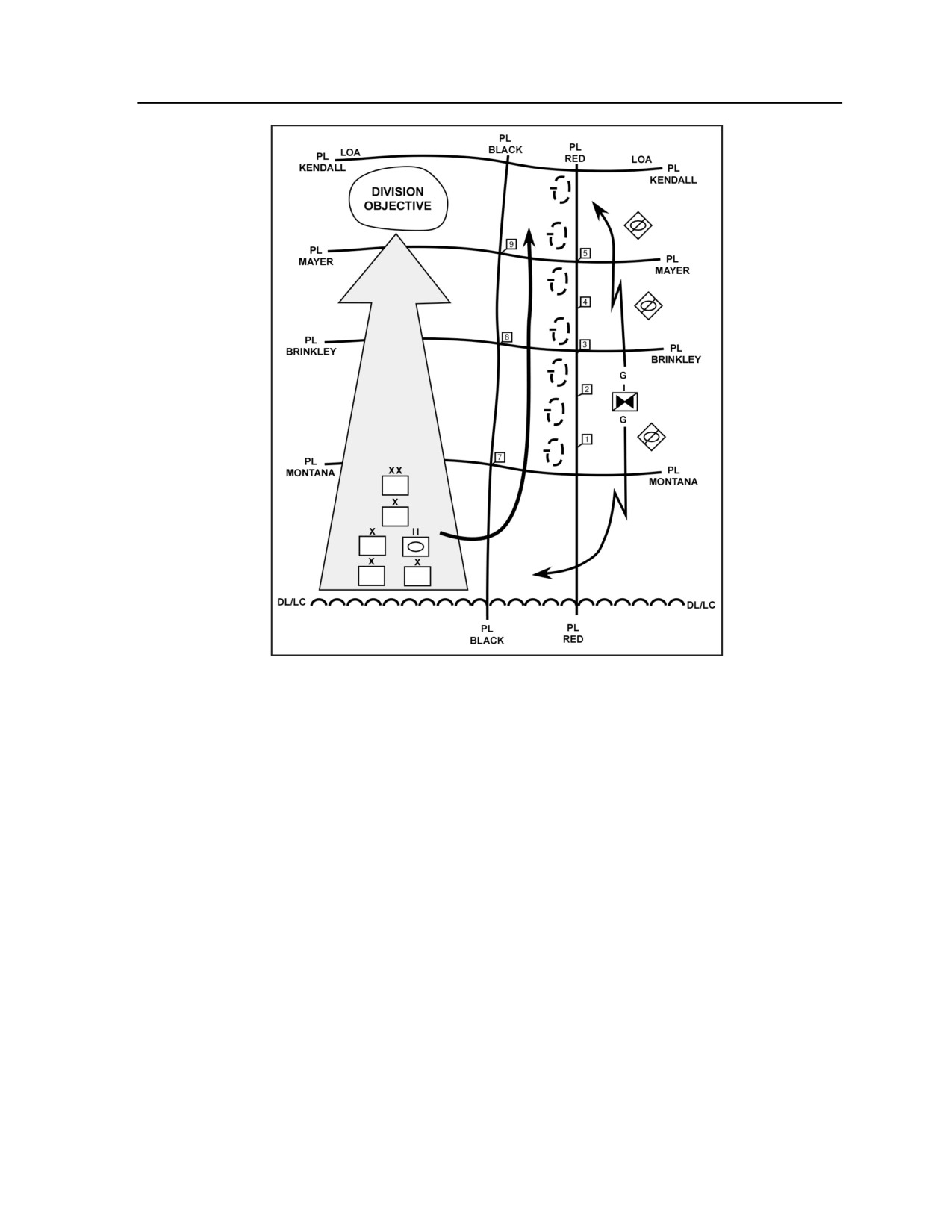
screen lines forward of a moving force. Figure 3-16, page 3-45, shows a company conducting a flank guard
for a moving force.
COVER
3-199. A covering force accomplishes all the tasks of screening and guard forces. Additionally, a
covering force operates apart from the main body to develop the situation early and deceives, disorganizes,
and destroys threat forces. Unlike screening or guard forces, a covering force is tactically self-contained
and capable of operating independently of the main body. The ARB participates in covering force
operations as part of a larger force; the ARB cannot conduct covering operations independently. Covering
force operations are not typical for an ARB. See FM 17-95 for more information on cover operations.
AREA SECURITY OPERATIONS
3-200. Area security includes reconnaissance and security of designated personnel, airfields, unit
convoys, facilities, main supply routes (MSRs), forward operating bases, equipment, and critical points. An
area security force neutralizes or defeats threat operations in a specified area. Area security operations
focus on the threat, force being protected, or a combination of the two.
3-201. This mission is used extensively in stability operations and for operations in the noncontiguous
operational environment. It is also assigned around an airhead or lodgment areas following airborne, air
assault, or forced entry operations. Area security may also be used to provide early warning to an isolated
force that cannot tie its flanks to a friendly unit.
3-202. As an area security force, the ARC performs reconnaissance, screens, and conducts CCA to
protect forces within a specified area utilizing the same methods and procedures discussed earlier. The
headquarters assigning the area security mission defines the area.
3-44
FM 3-04.126
16 February 2007
Employment
Figure 3-16. Moving flank guard
Critical Tasks
3-203. All-around security during operations is essential; however, commanders balance the level of
security measures with the type and level of threat posed in the specific area. Depending of the mission, the
ARC executes the following critical tasks within its capabilities to include—
z Maintain surveillance of all avenues of approach larger than a designated size into the AO.
z Maintain contact with threat or belligerent forces, not allowing threat ground elements to enter or
exit the AO undetected and unreported.
z Defend the protected force or facility.
z Deter or destroy enemy forces conducting mortar, rocket, or ambush attacks.
z Protect MSRs and convoys.
z Prevent threat forces from acting against friendly forces in adjacent or noncontiguous AOs.
z Support presence operations including show of force demonstrations.
z React to civil disturbances.
Cordon and Search
3-204. Cordon and search is executed against a specific target within a given area. Frequently directed by
higher headquarters or the ground component commander, it utilizes both air and ground forces to recon
and secure an objective for search. The ground force establishes inner and outer cordon, referred to as
rings, along with traffic control points (TCPs) and blocking positions on avenues of approach.
16 February 2007
FM 3-04.126
3-45
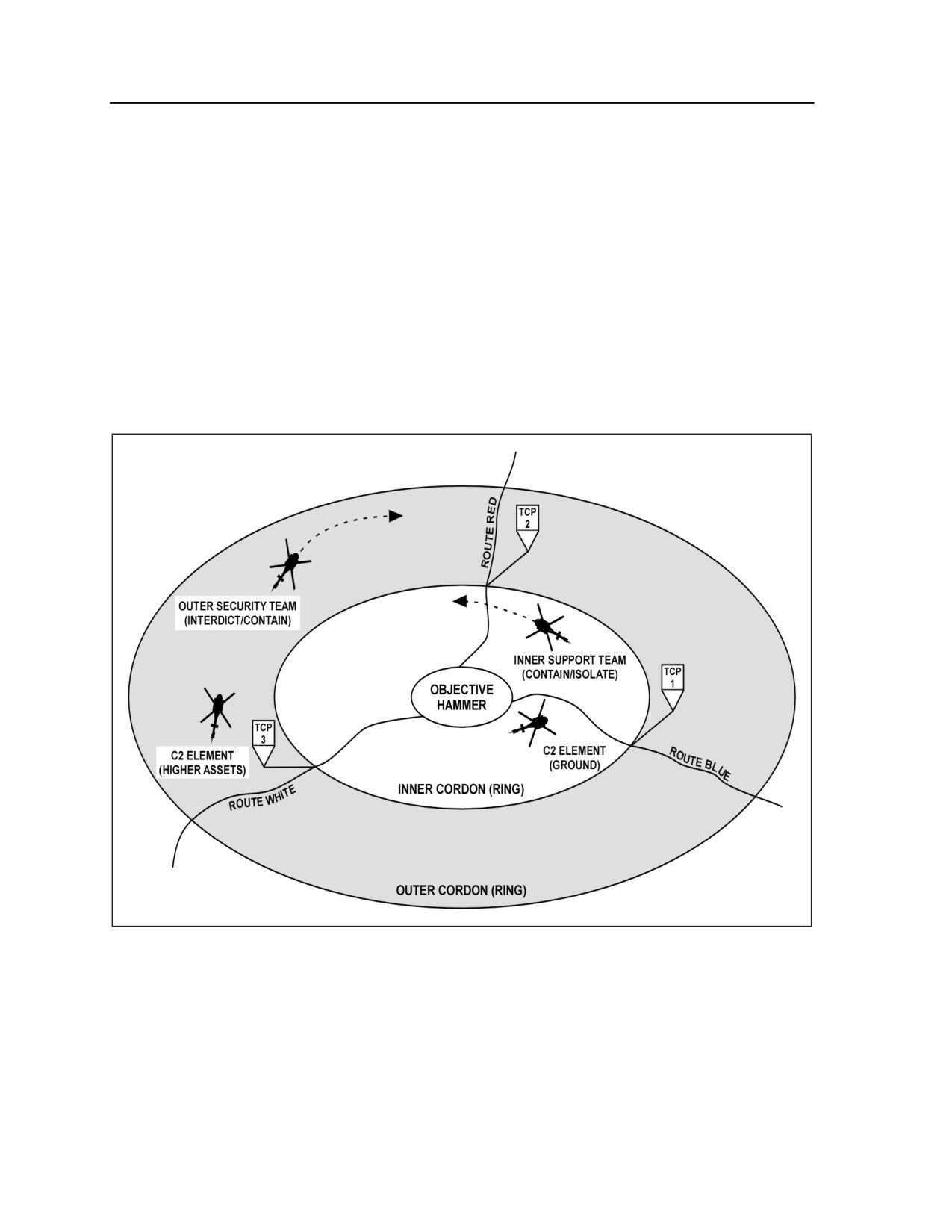
Chapter 3
3-205. As applied to the cordon and search mission, the ARC provides essential capabilities to the ground
force conducting the operation. The aircraft normally conduct route reconnaissance in support of ground
movement to the objective with an initial observation and assessment of the situation within each objective.
The ARC ensures initial observations are focused according to specific intelligence requirements. These
observations might be the situation around the target building, location of a specific vehicle, or detection of
anything attempting to exit the objective prior to establishment of the outer cordon. Aircraft utilize onboard
sensors/video to gather requested information without alerting the search area.
3-206. Once the ground cordon is set, ARC teams provide area security outside the inner cordon and
mostly beyond the outer cordon. This task keeps the ARC teams focused “out,” away from the objective
searching for elements attempting to influence the ground commander’s mission. The ground commander
can accept risk beyond the outer cordon refocusing ARC teams “in,” searching for snipers or other
observation tasks inside the inner cordon and objective area. Once inner situations reach resolution,
aircrews may return to the initial area security mission (focus out). If more than one team is in support of
the cordon and search, then both tasks are executed simultaneously (figure 3-17). Once the ground element
completes the mission within the objective, the ARC conducts route reconnaissance and/or convoy security
along the egress route.
Figure 3-17. Attack reconnaissance company support of cordon and search
Premission Planning
3-207. To enhance support of the ground force commander, the ARC must fully understand the ground
maneuver plan. The ARC uses a cordon and search checklist to ensure all pertinent information is provided
for the mission. The ground mission commander must provide the ARC the following planning
information:
z Mission objective (specific area, structure, or entity).
3-46
FM 3-04.126
16 February 2007
Employment
z Objective size and location (if known) with sketch.
z Imagery of objective area (if available).
z Target list worksheet.
z No fire areas (NFAs)/restricted fire areas (RFAs).
z Clearance of fires procedures.
z ROE.
z Attack reconnaissance mission focus during cordon and search phases.
z Ground commander PIR.
z Control measures and graphics (includes common numbering system of all buildings and key
structures). Positions of road blocks, support positions, and outer cordon should be included.
z Friendly marking techniques.
z PR plan.
z Mission timeline and expected duration.
z C2 plan (frequencies and call signs).
z Number and type of vehicles used in ground element.
3-208. The aviation commander in turn relays to the ground commander—
z Available assets, including ordnance available.
z Time windows of aviation coverage.
z Necessary gaps for rearm/refuel, maintenance, and fighter management.
3-209. All cordon and search missions are not planned. The ARC may receive a FRAGO to conduct a
hasty cordon and search. The initial team check-in with ground elements sets the tone for the success of the
mission. The attack reconnaissance teams transmit the following minimal essential information to the
ground commander—
z Call signs.
z Total number of aircraft.
z Current location and ETA.
z Ordnance available.
z Available time on station (initial fuel status and necessary gaps for rearm/refuel).
3-210. The ground commander should immediately provide the aircrews with a current SITREP along
with any critical updates or changes to the initial plan (if a preplanned mission).
Route Security
3-211. The ARC prevents a threat from attacking, destroying, seizing, containing, impeding, or harassing
traffic along a specified route. They also prevent the threat from interdicting traffic by emplacing obstacles
on or destroying portions of the route. Tasks are normally independently executed but mutually supportive.
Unless the higher or area commander directs otherwise, the ARC executes critical tasks within its
capabilities and limitations to include—
z Conduct continuous reconnaissance on and to the flanks of the route.
z Establish overwatch around choke points or critical points such as bridges, defiles, intersections,
and roadway fills.
z Establish OPs along the route and lateral routes to monitor civilian traffic entering or traveling on
the route. Instead of static OPs, teams may move continuously along the route to maintain
observation.
z Conduct reconnaissance along the route to search for suspected threat positions.
z Report movement of refugees or dislocated civilians.
3-212. The ARC conducts route reconnaissance at irregular intervals to avoid developing a pattern the
threat may exploit. Teams reconnoiter the route to include a zone reconnaissance to either flank. Teams
16 February 2007
FM 3-04.126
3-47
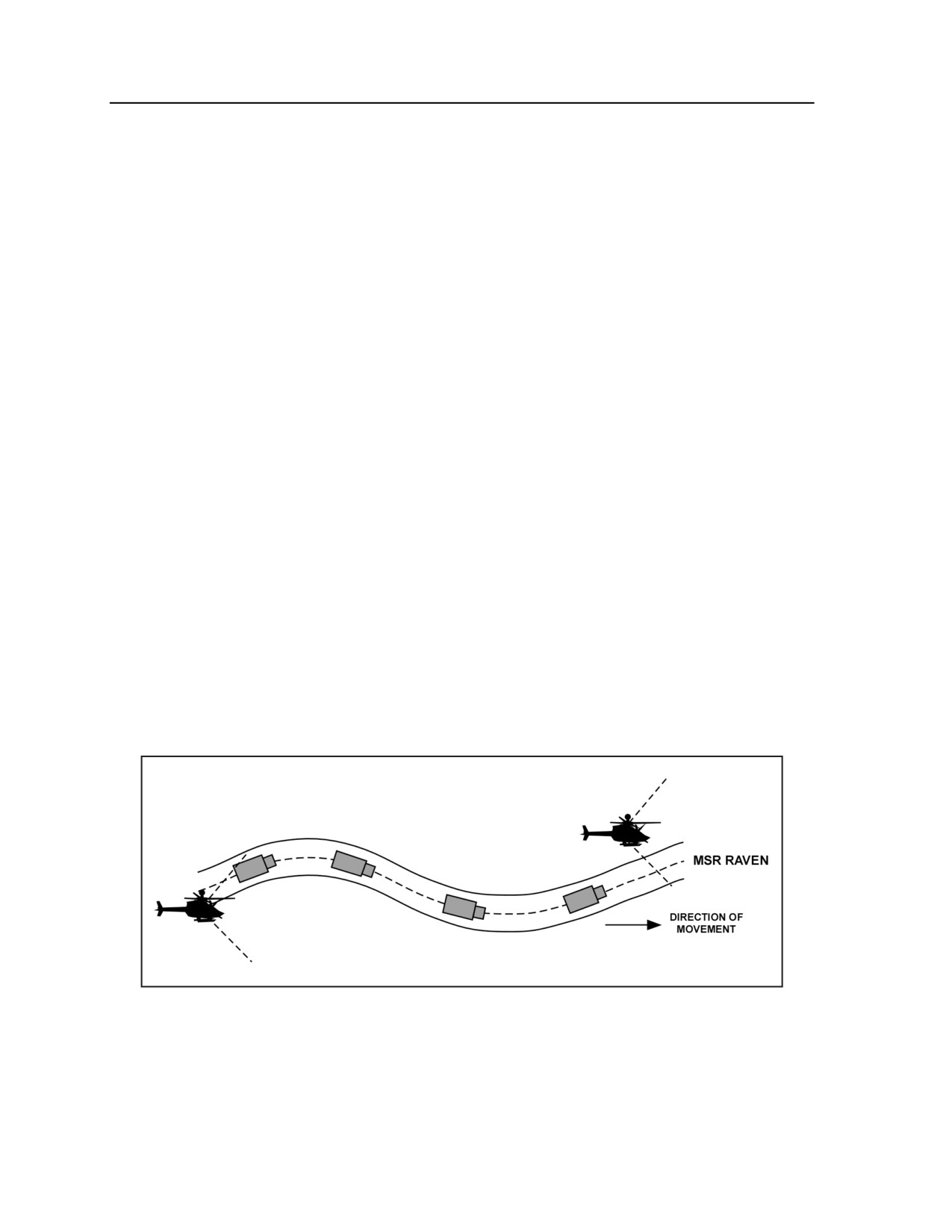
Chapter 3
may reconnoiter in advance of ground forces or assist in screening the flanks. Planning factors and critical
tasks remain the same as with a route reconnaissance.
Convoy Security
3-213. The purpose of this operation is to safeguard convoys by locating enemy forces before they can
attack the convoy. The SWT conducts CCA to suppress, neutralize, or destroy ambushing enemy forces.
Often the mere presence of a SWT will prevent the enemy from attacking a convoy. The SWT determines
the maximum lateral distance from the route to be cleared based on enemy weapons range. The two basic
methods for conducting convoy security are detached and attached.
Detached
3-214. The purpose of detached escort is to provide the ground convoy commander with real time SA of
the route with sufficient time and maneuver space for him to make decisions. During detached escort the
SWT is not anchored to the ground convoy, rather they conduct reconnaissance ahead of the convoy, and
are focused on finding any enemy forces that can attack or influence the convoy route. The amount of time
that the SWT precedes the convoy along the route is METT-TC dependent but should not leave sufficient
time to allow the enemy to set up positions in previously cleared areas. The SWT searches for ambush
sites, IEDs and triggermen, and report on route trafficability and bypass capability. In urban environments
this can include traffic jams, road debris, and personnel on rooftops. While the detached escort may
provide early warning to the convoy commander, its major disadvantages are lack of deterrence and
inability to provide immediate firepower to the convoy.
Attached
3-215. The primary purpose of the attached escort is to deter enemy attack and provide immediate CCA
support if the convoy is engaged. The SWT maintains freedom to maneuver but generally flies within LOS
of the convoy.
3-216. Convoy security operations involve the lead aircraft or team conducting route reconnaissance in
front of the convoy and the trail aircraft or team conducting security for the convoy. The purpose of the
operation is to provide early warning to the convoy commander of approaching threat forces or possible
ambush sites and conduct CCAs in support of the convoy commander. The convoy is escorted from the
start point to the RP and reports to its higher headquarters upon the completion of the mission. Figure 3-18
and figure 3-19, page 3-49, illustrate two examples of a SWT performing a convoy security.
Figure 3-18. Standard convoy security technique
3-48
FM 3-04.126
16 February 2007
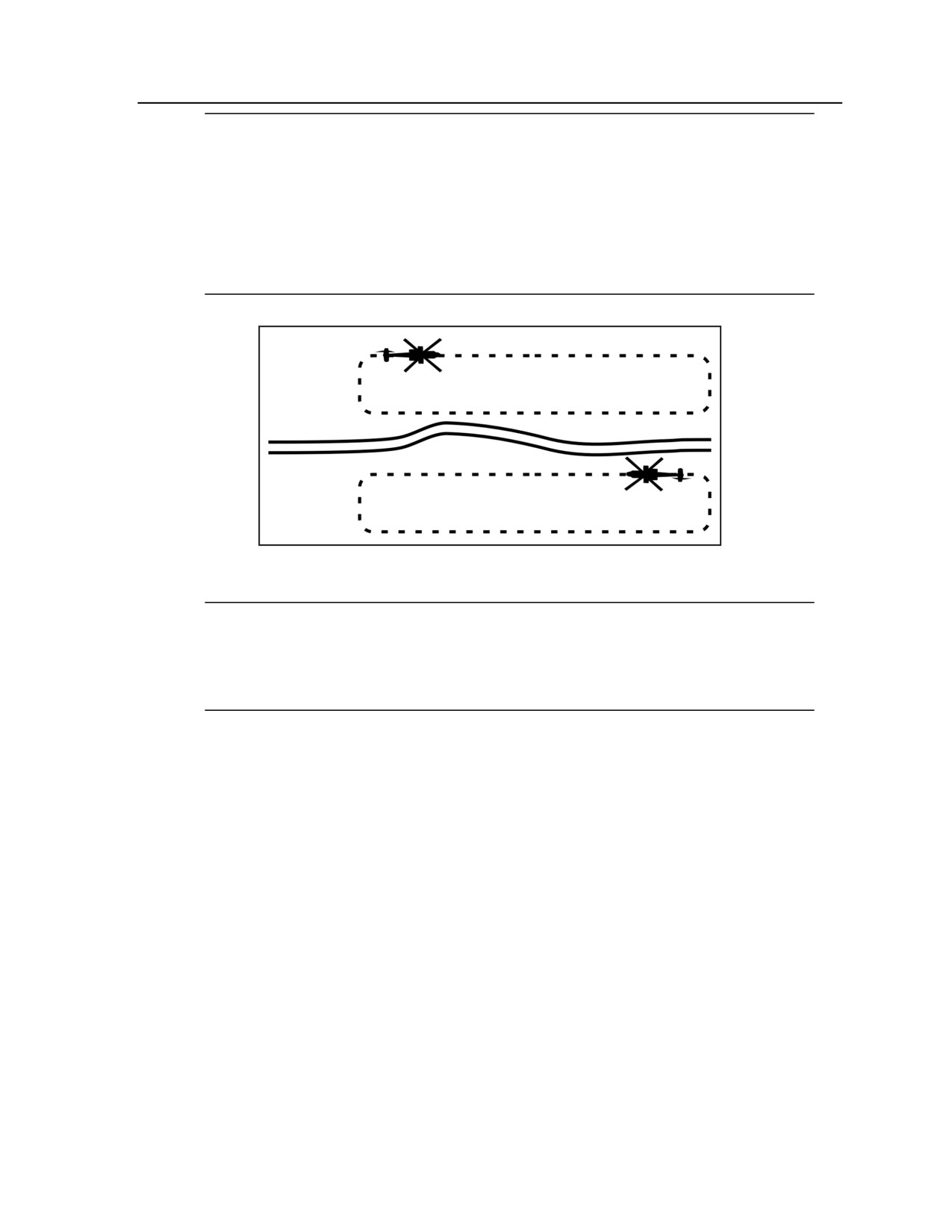
Employment
Note: This technique is the basic method for a SWT or section conducting convoy security and
should be modified as necessary to provide maximum security and SWT survivability. Lead
flies up to 1 kilometer ahead of the convoy to provide early warning of enemy or obstacles. The
trail team member flies behind or over the convoy to provide security, facilitate C2, and
maintain overwatch of the forward team member. Each team member’s flight path is based on
METT-TC (including convoy speed, terrain, and expected threat). Advantages of this technique
include freedom of maneuver, unpredictability, and, to a limited extent, the early warning
capabilities of the detached escort. The primary disadvantage is the increased vulnerability of
the SWT based on the inability to provide continuous mutual overwatch.
Figure 3-19. Butterfly pattern convoy security technique
Note: When utilizing this technique each team member flies continuous racetrack patterns on
opposite sides of the route. The distance flown from the route and the convoy is METT-TC
dependent. Patterns are flown so that the SWT maintains continuous LOS with each other. This
technique provides increased deterrence from enemy attack against the SWT in addition to the
convoy. Primary disadvantages are reduced freedom of movement and increased predictability.
3-217. Based on planning and/or coordination time available, the ground mission commander must
provide the ARC with the following planning information:
z Call signs and frequencies.
z Convoy route (designation, limits, alternate routes, and time of day to be used).
z Composition and disposition of convoy (number and type of vehicles, crew-served weapons
available).
z Actions on contact (what the convoy will do if ambushed).
z Graphic control measures.
z Ground commanders scheme of maneuver with task and purpose.
z Provide a SITREP when the teams arrive on station, to include—
Current situation.
Threat forces to include paramilitary and criminal organizations.
Threat trends and recent activities.
Potential ambush sites.
Civilian traffic to include refugees and potential congested areas.
Communications to include visual signals.
16 February 2007
FM 3-04.126
3-49
Chapter 3
3-218. The ARC commander, in turn, provides the ground commander with the following information:
z Available assets (number of aircraft and ordinance available).
z Time windows of aviation coverage.
z Necessary gaps for rearm/refuel, maintenance, and crew rest.
z Determines critical areas; such as danger areas, defiles, choke points, PLs.
z Identify secondary routes and bypasses to the convoy commander if necessary.
z Assist convoy commander in maintaining C2 of the convoy (rate of march, interval, security, and
communications).
Aerial Escort
3-219. Aerial escort missions are flown to protect helicopters conducting air assault,
MEDEVAC/CASEVAC, or air movement missions. Escorted formations may range from a single aircraft
to a large air assault formation. The purpose of this mission for the SWT is to protect the escorted
formation by locating the enemy before they can affect the flight or by deterring enemy fire. If the escorted
flight is engaged the SWT must react quickly to destroy, neutralize, or suppress the enemy before effective
fire can be directed against escorted aircraft. Upon reaching the objective area, the SWT immediately
transitions to area security operations. There are two basic aerial escort techniques—detached and attached.
Detached
3-220. Detached escort involves flying air route reconnaissance ahead of the escorted aircraft. The goal is
to locate all enemy forces along the route. For air assault security, the SWT task is to locate all enemy
forces that can influence the PZ, route, LZ, and objective area. Once located the enemy can be engaged or
reported and bypassed according to METT-TC. The position of the enemy is passed to the escorted
formation to facilitate a change in mission timeline or flight route as necessary. If the escorted formation is
already on the route the AMC must decide to hold along the route, continue an alternate route, or return to
base. The gap between the SWT and the escorted formation is primarily a function of the time required by
the SWT to conduct reconnaissance along the route. The complexity of the terrain, amount of concealment
available for the enemy, speed of the escorted formation, and SWT station time are all factors in
determining route reconnaissance time. The time between flights should be keep to a minimum to prevent
the enemy from establishing positions along previously reconnoitered portions of the route.
3-221. The primary advantage of the detached escort is additional freedom of movement and time
available for the SWT to locate enemy along the route. The major disadvantage of this technique is a lack
of deterrence or ability to provide immediate firepower in response to threats against the escorted
formation. Other disadvantages are communication problems that may arise between the SWT and the
escorted formation due to distance and/or terrain and loosing the element of surprise.
3-222. The detached escort is best employed against a route/threat combination where personnel and
equipment can be readily distinguished as enemy. Unconventional enemy forces along the route, especially
in urban environments, may be difficult or impossible for the detached escort to locate and the SWT’s
presence along the route may tip off the enemy to the follow-on formation. In any case, lack of enemy
contact does not ensure the absence of enemy along the route.
Attached
3-223. Attached escort involves the SWT flying with the escorted formation as a single flight. The
primary purpose of the attached escort is to deter enemy fire or conduct hasty attack in reaction to enemy
contact or engagement. The primary position for the SWT is to the rear of the escorted formation. This
allows the SWT to scan the flanks of the formation and provide immediate suppressive fire if necessary. If
available a second SWT should fly in the front of the formation to locate threats and provide additional
deterrence. If necessary according to METT-TC, a single SWT may split up to fly in the front and rear of
the supported formation; however this is not the preferred technique because it prevents the SWT from
providing mutual support. While the SWT AMC is free to configure and maneuver his team as necessary to
accomplish the mission, the standard escort formation for a single SWT is the “inverted Y” formation
3-50
FM 3-04.126
16 February 2007
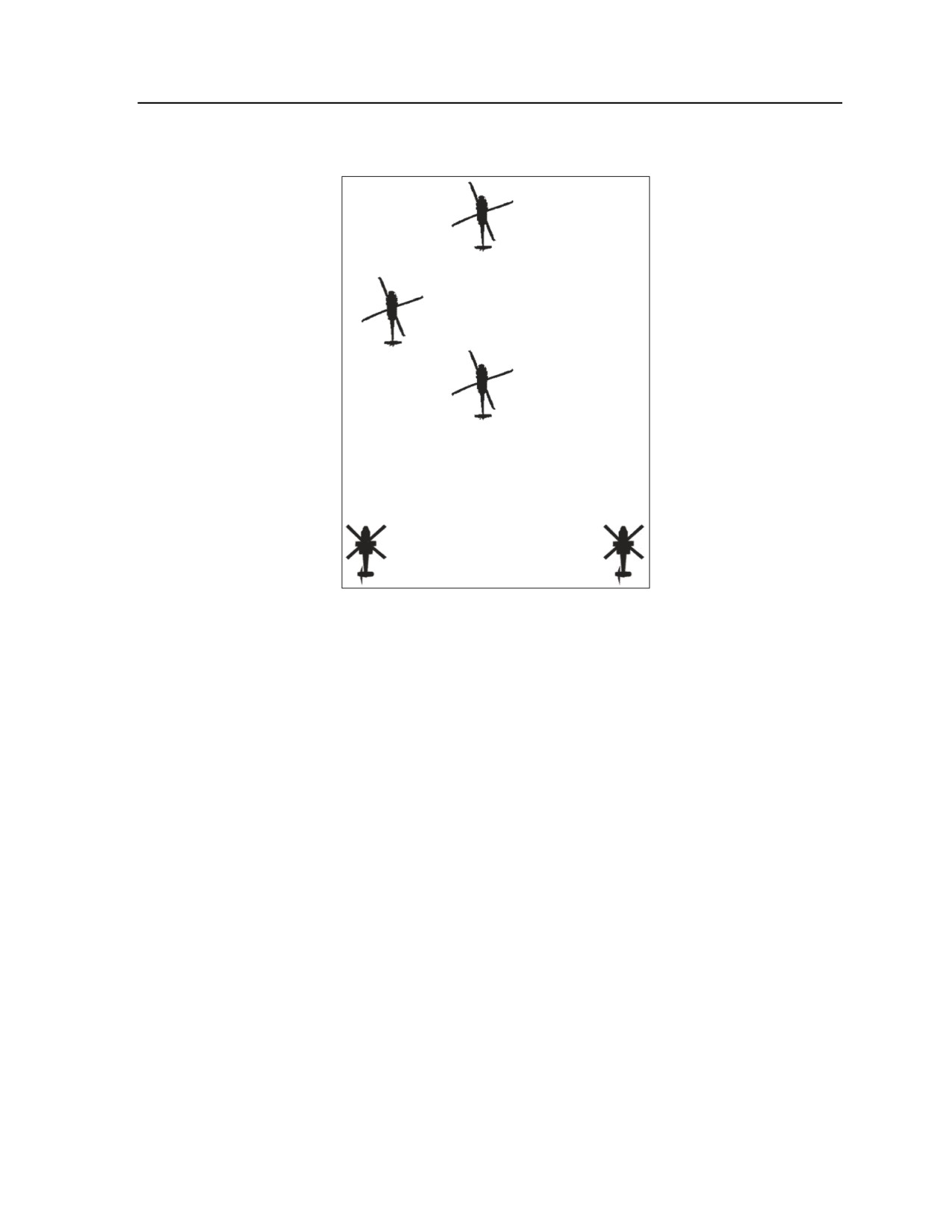
Employment
(figure 3-20, page 3-51). The SWT flies a combat spread formation off of the last aircraft in the escorted
formation. Each escort aircraft is primarily responsible for scanning forward and on the flank of its side of
the escorted formation.
Figure 3-20. Inverted “Y” aerial escort formation
3-224. Reaction to enemy contact is METT-TC dependent. The aircraft on the same side as the enemy
fire normally assumes tactical lead to conduct BCMs and initiate the attack. When supporting VIP
missions, the SWT team leader should be briefed on the location of the principle and maneuvers his to
team to provide maximum security for that aircraft. The primary responsibility is to protect the flight (or
principle) rather than becoming decisively engaged. However, the SWT should make every effort to
destroy the enemy force when it can do so and still remain in a position to complete the primary mission.
This is especially true in counterinsurgency operations. Each engagement that the enemy survives,
successful or not, may serve to bolster support for their cause and further develop enemy TTPs.
3-225. Mission planning should include the SWT and escorted formation conducting a face to face air
mission brief. The briefing covers topics including formation, communication plan, aircraft lighting and
NVDs, contingencies, actions on contact, and rally procedures. Possible fratricide from door gunner fire on
the SWT should be briefed. Formation airspeed is another important planning factor especially during high
altitude operations. The airspeed should be slow enough to allow the SWT freedom to maneuver, orient on
suspected threats, and maintain position near the flight without exceeding operating limits. When
supported by the OH-58D the only choice for the escorted formation is to fly a reduced airspeed or select
the detached escort.
3-226. The primary advantage of the attached escort is the combination of deterrence and ability to
provide immediate suppressive fires. The primary disadvantage is the reactive rather than proactive nature
of the SWT’s actions. The attached escort is equally applicable against conventional and unconventional
forces.
Combined
3-227. The combined escort is a combination of the detached and attached escort techniques. The primary
advantage is the increased security and combat power. The primary disadvantages are complexity of
planning and coordination and the amount of SWT assets needed to perform the mission.
16 February 2007
FM 3-04.126
3-51
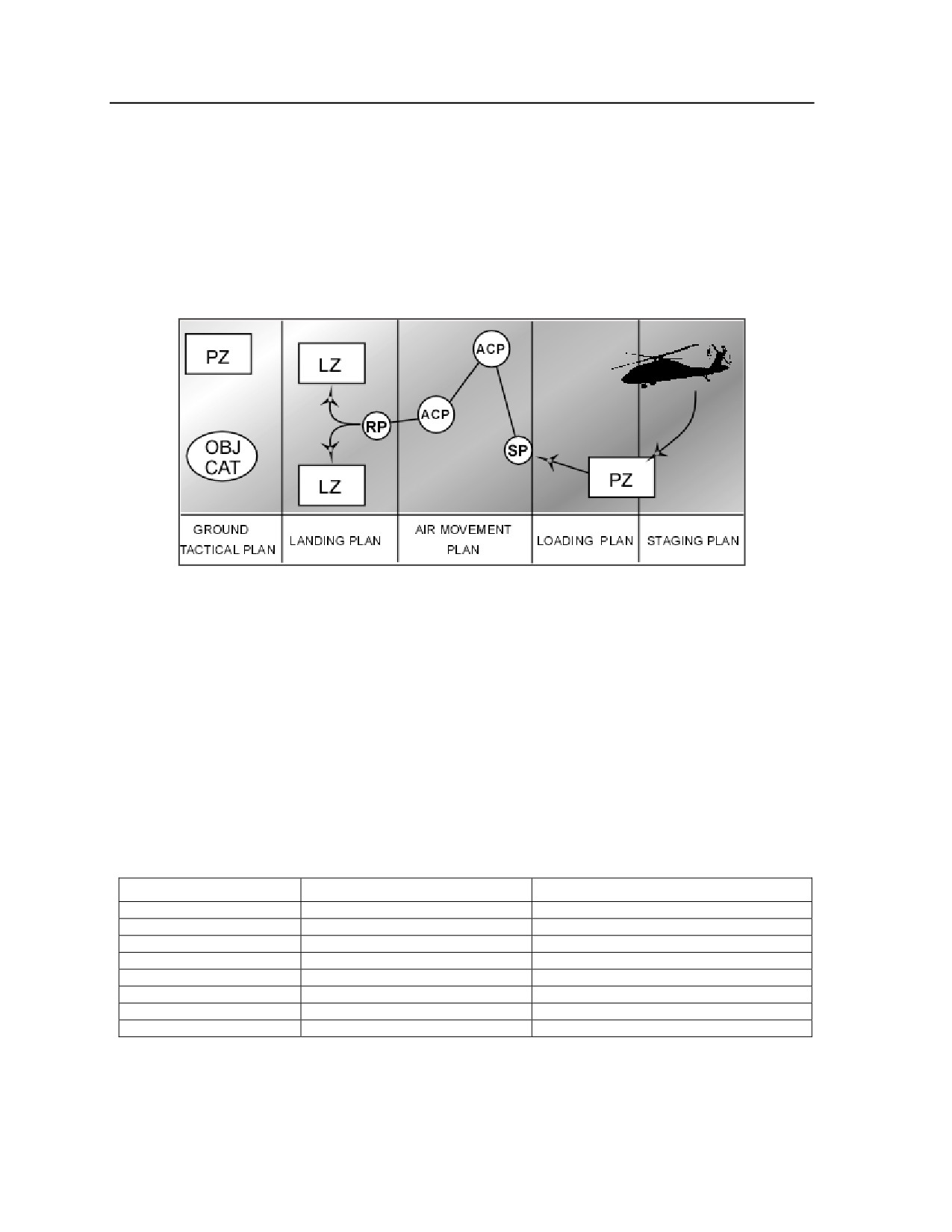
Chapter 3
Air Assault Security
3-228. The ARC integrates into the scheme of maneuver for the conduct of reconnaissance, security, or
overwatch operations during all phases of the air assault and/or air movement. The successful execution of
the operation is based upon a careful analysis of the factors of METT-TC and a detailed, precise, reverse
planning sequence. Planning begins with the ground tactical plan and works backwards to the staging plan
as indicated in figure 3-21. Reverse planning is imperative, as each successive planning step impacts the
phase that precedes it. The landing plan, for example, helps air assault planners determine the sequence and
composition of lifts during the air movement phase. ARC aircrews should review the air assault landing
plan for discussion and decision on the best schemes of maneuver to optimize lift asset protection.
Figure 3-21. Air assault planning stages
Staging plan
3-229. The ARC may conduct PZ reconnaissance and screening operations to provide early warning and
limited security while friendly companies form on or near the PZs. If threat forces are close by or contact is
likely, the ARC conducts area security and CCA with ground maneuver forces to increase its ability to
repel threat forces.
Loading plan
3-230. The ARC conducts PZ reconnaissance before the arrival of assault helicopters. Once the PZ is
cleared, the ARC may screen a vulnerable flank or likely avenues of approach. Table 3-4 provides
examples of PZ markings for security elements to reference.
Table 3-4.Example marking techniques for pickup zones
Position in PZ
Daylight Marking
Night Marking
PZ entry
Guide and sign
Guide with 2 blue chemical lights
PZ control
M998 and VS17 panel
2 green chemical lights on antenna
Aid station
M997
Steiner device
Chalk stage points
PZ control party guides/signs
Guide/blue chemical light per chalk
Lead touchdown point
VS 17 panel, smoke
Inverted Y, IR flashlight
Chalk touchdown points
Soldier on knees with raised rifle
IR chemical light per aircraft
Obstacles
Notify pilots on radio
Red chemical light ring around obstacle
Loads to be picked up
Hook up team on loads
Swinging IR chemical light per load
Air movement plan
3-231. A SWT may precede the air assault element along the air route by performing a detached escort
followed by area reconnaissance of the LZs and the objective, depending on the factors of METT-TC.
3-52
FM 3-04.126
16 February 2007
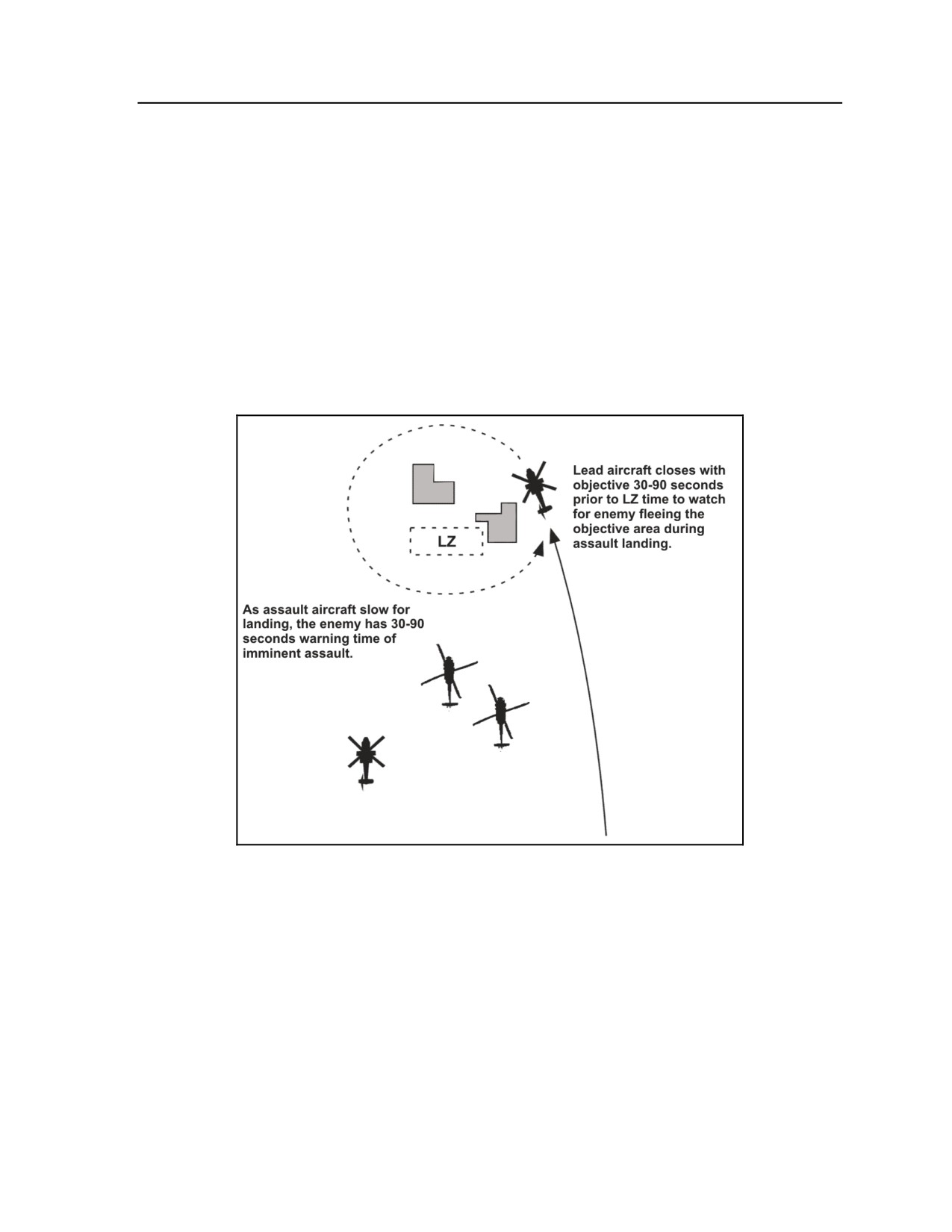
Employment
Along the route, they locate any previously unknown enemy AD weapons and radar, and suppress those
systems or develop a bypass route for the air assault element. ARC elements may also provide pertinent
information on threats to flight, including natural and manmade obstacles. Depending on the threat, teams
may be tasked with performing an attached escort during the air movement phase.
3-232. ARC elements can also provide early warning of the threat’s approach and can engage the threat
with organic weapon systems or indirect fires. They may also be assigned responsibility for coordinating
the recovery of downed aircrews with other elements of the TF.
Landing plan
3-233. The ARC conducts area reconnaissance of the objective area prior to the assault landing and then
transitions to area security and CCA as needed. During low threat scenarios when surprise is paramount,
the SWT arrives on the objective to coincide with the sound of the approaching assault aircraft (30 to 180
seconds out). This technique can be utilized by prior coordination and timing or from the attached escort
formation (figure
3-22). The SWT’s primary focus when utilizing this technique is locating and/or
destroying enemy personnel attempting to leave the objective area.
Figure 3-22. Attached escort landing zone reconnaissance
3-234. A SWT gives final go/no go for landing in the LZ based on conditions and, most importantly,
enemy situation. The SWT must ensure they are deconflicted with the assault elements and are in position
to provide covering fires. The SWT may also (METT-TC dependant) drop aids, such as chemical lights, to
mark landing sites.
Ground tactical plan
3-235. As the ground force moves forward and seizes its objective, the ARC may again be tasked to
conduct reconnaissance, security, and attack operations. ARC teams can rapidly reconnoiter the ground
route to the objective as well as the objective itself from standoff ranges. The ARC screens the ground
force’s movement and provides CCA on the objective. The company also provides overwatch during the
extraction of ground elements.
16 February 2007
FM 3-04.126
3-53
Chapter 3
Fire Support
3-236. FS is an important consideration the ARC must take into account during all phases of the air
assault. Planned fires along the route of flight protect aircraft against known or suspected enemy positions.
These fires may be intense and of a duration that destroys or suppresses enemy forces but does not interfere
with aircraft as they fly past specific locations. They are planned on areas and fired on a time schedule or
on call. Fire plans cover PZs, LZs, flight routes, and suspected enemy avenues of approach to LZs. FS
plans include lethal and nonlethal J-SEAD, CAS, and smoke. The ARC commander works with the TF to
ensure the friendly FS elements do not use ordnance that obscures aircrew vision, especially during NVD
missions.
TIME AND SPACE CONSIDERATIONS FOR RECONNAISSANCE
AND SECURITY MISSIONS
3-237. Reconnaissance and security missions require detailed planning which includes calculating the
area an ARC can screen or reconnoiter. The size of the area depends on METT-TC, mission duration, and
aircraft/aircrew availability. While every mission and situation is different, this section discusses the
general methods of calculating this area of coverage and screen line planning. With modification, the
method applies to other reconnaissance and security missions by ground or other assets like UAS.
3-238. The area a company can screen extends from a width of 3 to 5 kilometers (what a single air-
reconnaissance team can see from one OP) to a maximum of 30 kilometers. Under the optimum conditions
of wide-open terrain, excellent visibility, and all available aircraft screening and rotating through the
FARP, a company can screen along 30 kilometers for 8 to 12 hours. However, wide-open terrain and good
visibility are not the norm, and lightly-armed attack reconnaissance aircraft often require the commitment
of at least two of six available helicopters as a reserve to destroy or repel enemy reconnaissance teams.
3-239. A series of aircraft teams, rather than the entire unit, conduct reconnaissance and security missions
in several NAIs over a wide geographic area. Teams may not have a well-developed picture of the enemy
situation before initiating the mission. Ammunition loads and weapons mix are determined by METT-TC.
The team also uses artillery to help develop the situation and discover the enemy's disposition.
3-240. As a general rule, a company screens with one team of two aircraft on the screen line; one team of
two aircraft moving to, in, and from the FARP; and two aircraft in reserve. This gives the commander the
flexibility to reinforce the screen line with an additional team if necessary. With this force disposition and
the optimum conditions of wide-open terrain and excellent visibility, the ARC can cover 15 kilometers.
The area screened could be as small as the area observed from a single OP (3 to 5 kilometers).
SCREEN PLANNING EXAMPLES (8-12 HOURS)
3-241. Figure
3-23 depicts a single air-reconnaissance team screening from OP
2. The terrain is
constricted and the avenue of approach follows a valley. The standoff area is about 3 kilometers and the
observable area is 5 kilometers. The next avenue of approach is in the next valley, 10 kilometers away.
Concealed air route availability prevents the air-reconnaissance team from moving to the next valley and
back again before the enemy can pass through the observable area. This requires the air-reconnaissance
team to maintain continuous observation from OP 2. Because it is mountainous terrain and the aircraft
munitions load is too small to repel expected enemy reconnaissance forces, a rapid reaction team is on
standby to repel or destroy enemy reconnaissance forces. Team 1 observes while team 2 moves to, in, and
from the FARP. Team 3 positions itself where it can react to any enemy force observations. Alternate kill
zones are selected south of the observed area in case the enemy moves faster than expected through the
observable area.
3-54
FM 3-04.126
16 February 2007
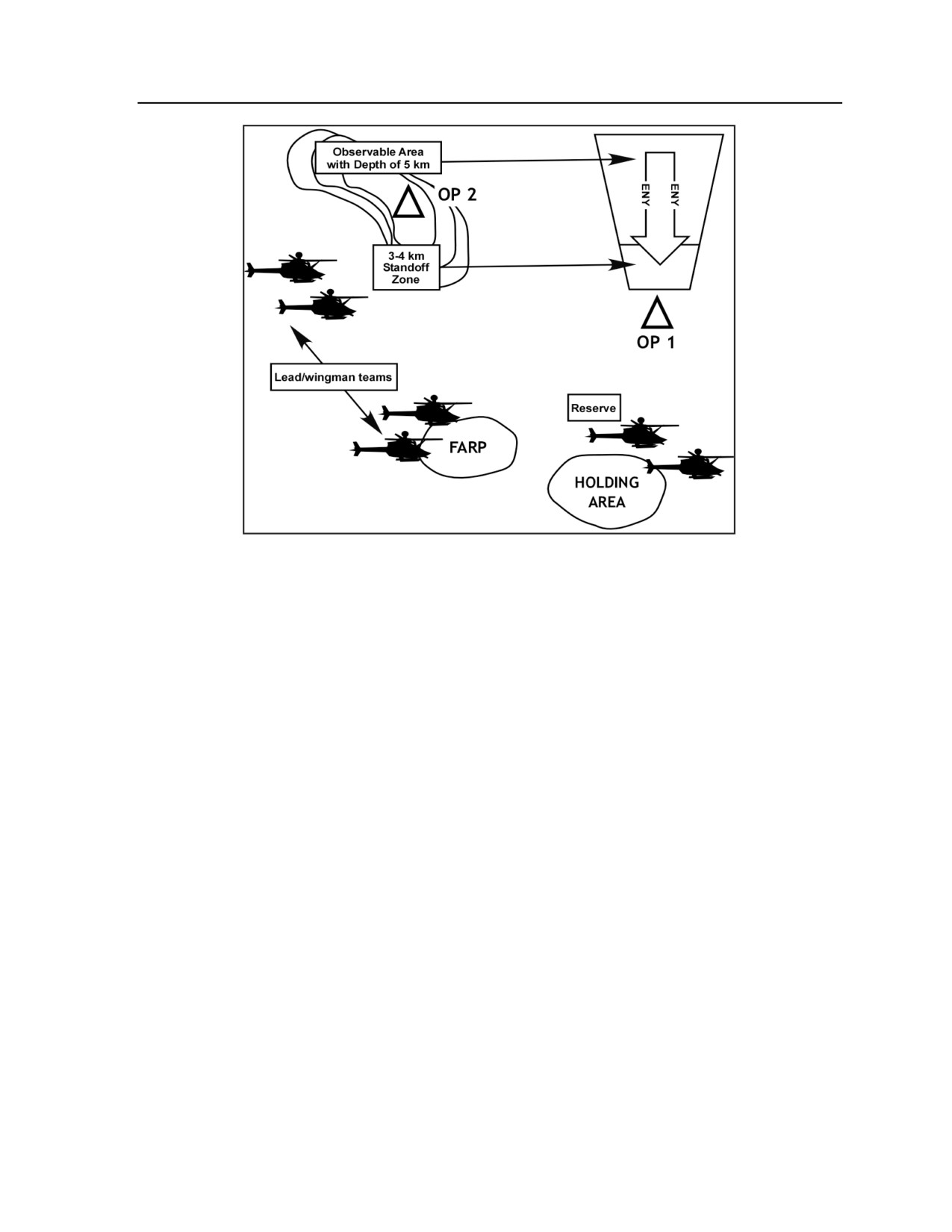
Employment
Figure 3-23. Screen with rapid response team
3-242. Figure 3-24, page 3-56, reflects two teams screening along OPs 1 to 4. The open terrain allows
excellent standoff and observable areas. The standoff area is about 3 kilometers and the observable area is
about 5 kilometers along each avenue of approach. The distance between OPs is 15 kilometers. An attack
reconnaissance team from the squadron provides the reserve. The air-reconnaissance teams rotate through
the screen areas and FARP. Team A moves to the area defined by OPs 1 and 2, team B moves to the area
defined by OPs 3 and 4. They observe for 40 minutes and then team A is relieved by team C, team B is
relieved by team A, and team B moves to the FARP. This rotation continues until the ART is relieved by
another ground or air unit, contact is made, the mission is terminated, or until crew endurance requires the
ART to move to the AA.
16 February 2007
FM 3-04.126
3-55
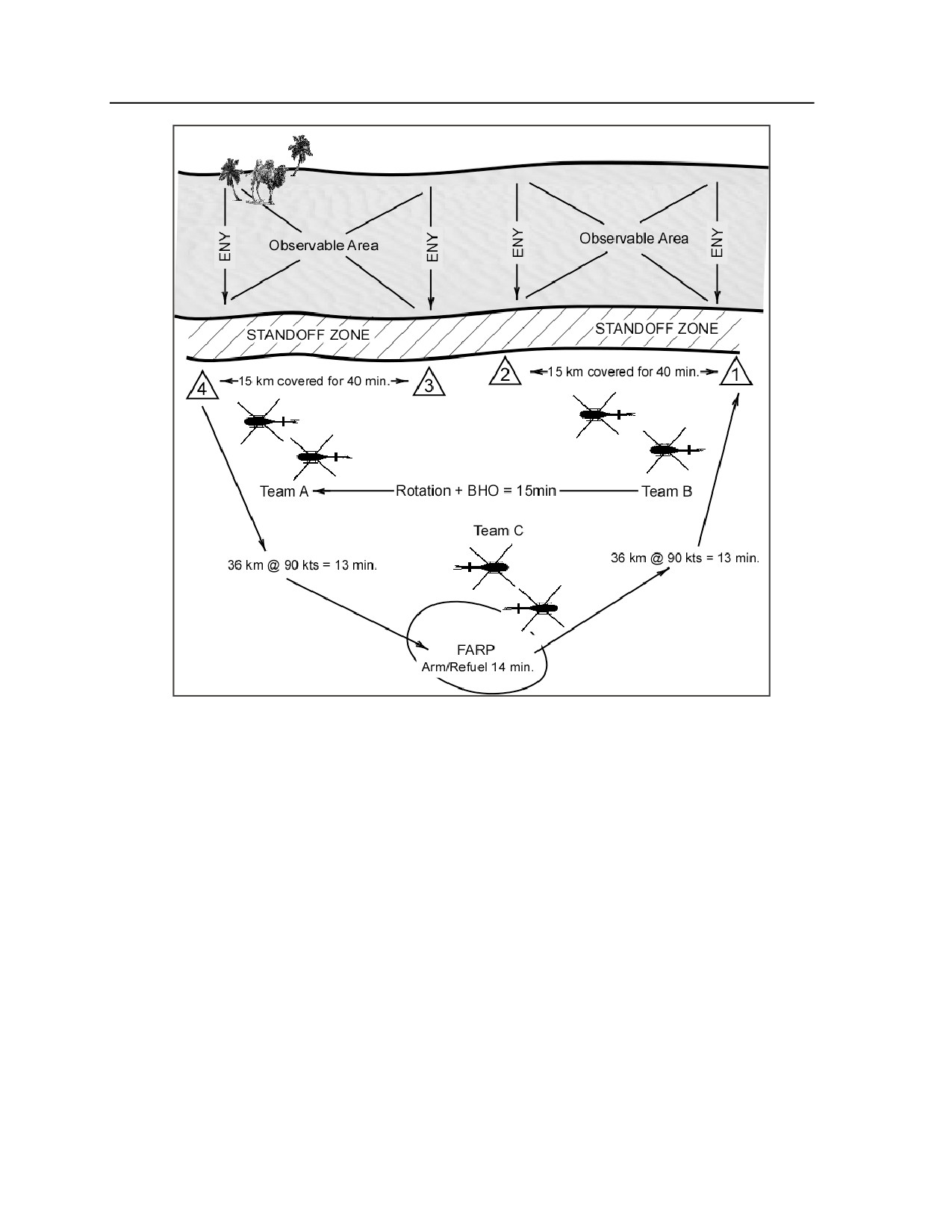
Chapter 3
Figure 3-24. Maximum screen line option
SCREEN PLANNING CALCULATIONS (8-12 HOURS)
3-243. The observable area and enemy’s assumed movement speeds determine friendly forces
observation criteria for selected OPs. Air speed and OP occupation times determine the time it will take to
move between OPs and into position. Each requires knowledge of the enemy, careful planning, and
adherence to schedules. The challenge is to achieve the optimum screen line size that can be adequately
observed.
3-244. In the scenario depicted in figure 3-24, teams A, B, and C rotate between OPs 1 and 2, OPs 3 and
4, and the FARP. Each team will man the screen line for a total of 55 minutes while the third team travels
to the FARP (13 minutes), rearms and refuels (14 minutes), returns to the OP (13 minutes), and teams
execute BHO/rotation (15 minutes).
3-245. Each team can cover two OPs, because each team can travel from its first OP to the second,
observe, and then return to the first OP before the enemy can traverse the observable area. Those
calculations are as follows:
z An enemy force moving 20 kilometers per hour will require
15 minutes to traverse the
observable area.
z The air-reconnaissance team requires about seven to eight minutes at 60 knots to travel between
each OP and about one to five minutes moving into the OP, unmasking, observing, masking, and
3-56
FM 3-04.126
16 February 2007
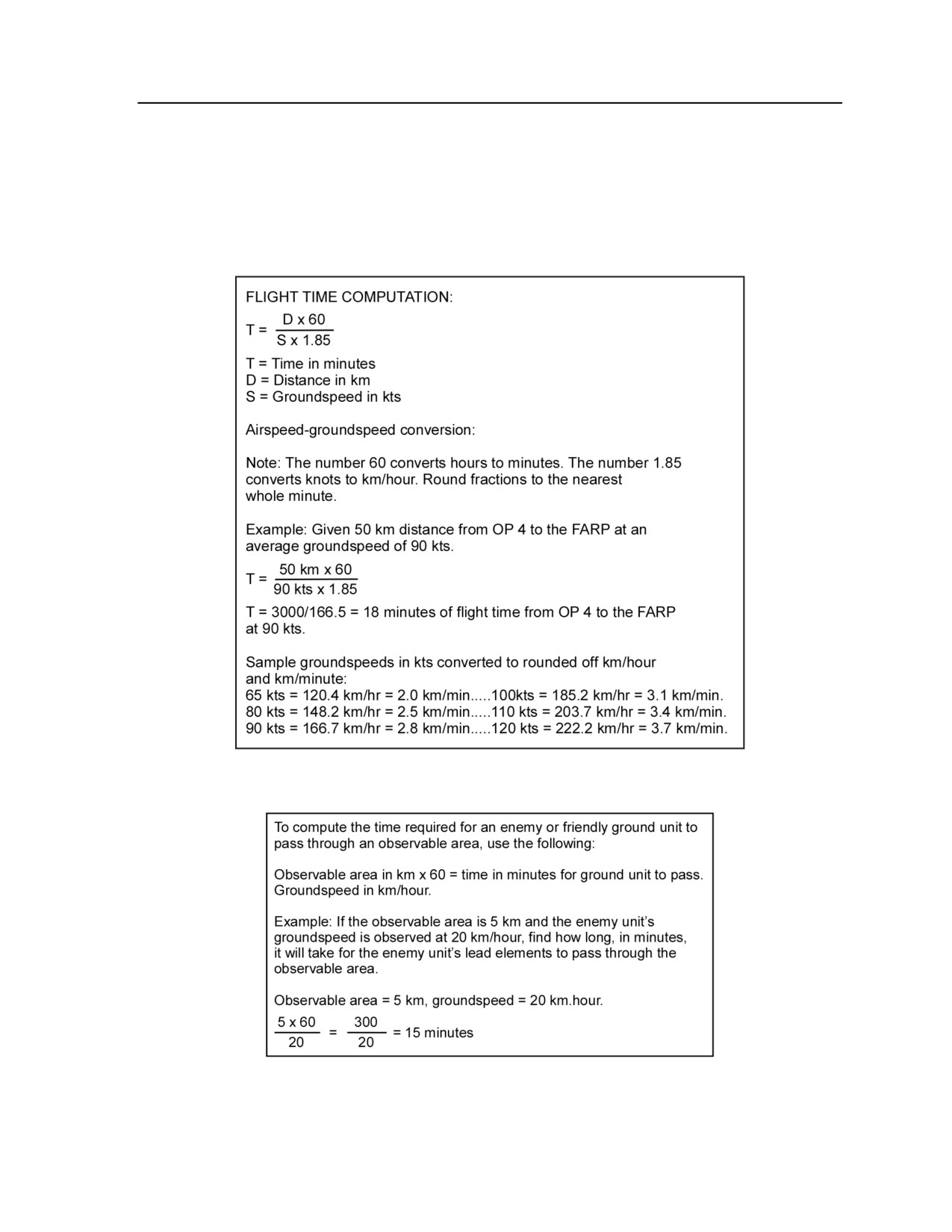
Employment
moving out of the OP, providing a two minute time buffer for the air-reconnaissance team to
move between OPs.
3-246. In the scenario depicted in figure 3-24, page 3-56 a reaction force is required and the time required
to travel between OPs is too long to cover more than one at a time, requiring the entire reconnaissance
team to cover that single approach.
3-247. The formula for planning times is outlined in figure 3-25. The formula for planning ground unit
speed is in figure 3-26.
Figure 3-25. Computing en route time
Figure 3-26. Computing ground unit movement time
16 February 2007
FM 3-04.126
3-57
Chapter 3
SECTION V - ATTACK OPERATIONS
3-248. An attack is an offensive operation that destroys or defeats enemy forces, seizes and secures
terrain, or both. When the commander decides to attack or the opportunity to attack occurs during combat
operations, the execution of that attack must mass the effects of overwhelming combat power against
selected portions of the enemy force with a tempo and intensity that cannot be matched by the enemy. The
resulting combat should not be a contest between near equals. The attacker must be determined to seek
decision on the ground of his choosing through the deliberate synchronization and employment of his
combined arms team (FM 3-90).
3-249. Attack reconnaissance battalions conduct attack operations during both offensive and defensive
operations. The battalion contributes to shaping the operational environment by assisting in finding, fixing,
and engaging the enemy. During meeting engagements, attack reconnaissance units fight for intelligence
and develop the situation. The battalion supports friendly ground forces in contact through CCAs.
ATTACK FORMS
3-250. The amount of planning time available determines which form of attack the battalion executes.
HASTY ATTACK
3-251. A hasty attack is an attack launched with the forces at hand and with minimal preparation to
maintain the momentum or take advantage of the enemy situation. The objectives are to overwhelm the
enemy quickly and seize the initiative. Speed is paramount; if momentum is lost, the hasty attack can fail.
An attack with speed, audacity, and boldness can offset the lack of thorough preparation. The hasty attack
depends on timely and accurate information as well as speed. When contact is made, commanders must
immediately evaluate their chances of success. Attacking rapidly before the threat can react often brings
success even when the threat possesses local combat superiority.
3-252. Hasty attacks often result from unexpected enemy contact. Unexpected contacts occur most often
during reconnaissance, security, movement to contact, and in response to an enemy attack. In all cases, the
SWT conducts hasty attacks to rapidly develop the situation or overwhelm the enemy before it can
adequately prepare. SWTs normally conduct hasty attacks without knowledge of the attack time, location,
and threat until shortly before the mission or until making enemy contact. SOPs, battle drills, and
contingency planning based on probable enemy actions and IPB improve the success or hasty attacks.
3-253. When contact is made, the AMC/ARC commander must evaluate the chances of success in
conducting a hasty attack and possible alternative COAs including maintaining contact and conducting a
BHO with a more capable force or bypassing the enemy force. Units pass SA information to higher
headquarters to determine whether the hasty attack will be reinforced.
3-254. When the attack begins, SWTs develop the situation quickly and employ direct and/or indirect
fires, to include joint fires. These actions also provide suppressive fires for maneuvering ground elements.
Air reconnaissance provides operational environment information and situational updates on which the
commander can base immediate decisions concerning the attack. The battalion facilitates the sequencing of
supporting assets into the attack. If CAS assets are available, an immediate JAAT may be executed.
Critical Tasks
3-255. The ARC conducts a hasty attack to maintain momentum for current and future operations. This
momentum relies on the ARC’s ability to destroy or force the threat to withdraw while maintaining combat
power. The ARC accomplishes critical tasks to ensure the success of the hasty attack. These tasks may
include―
z Performing actions on contact.
z Establishing weapons delivery technique.
z Designating security responsibilities.
3-58
FM 3-04.126
16 February 2007