FM 3-04.126 Attack Reconnaissance Helicopter Operations (February 2007) - page 1
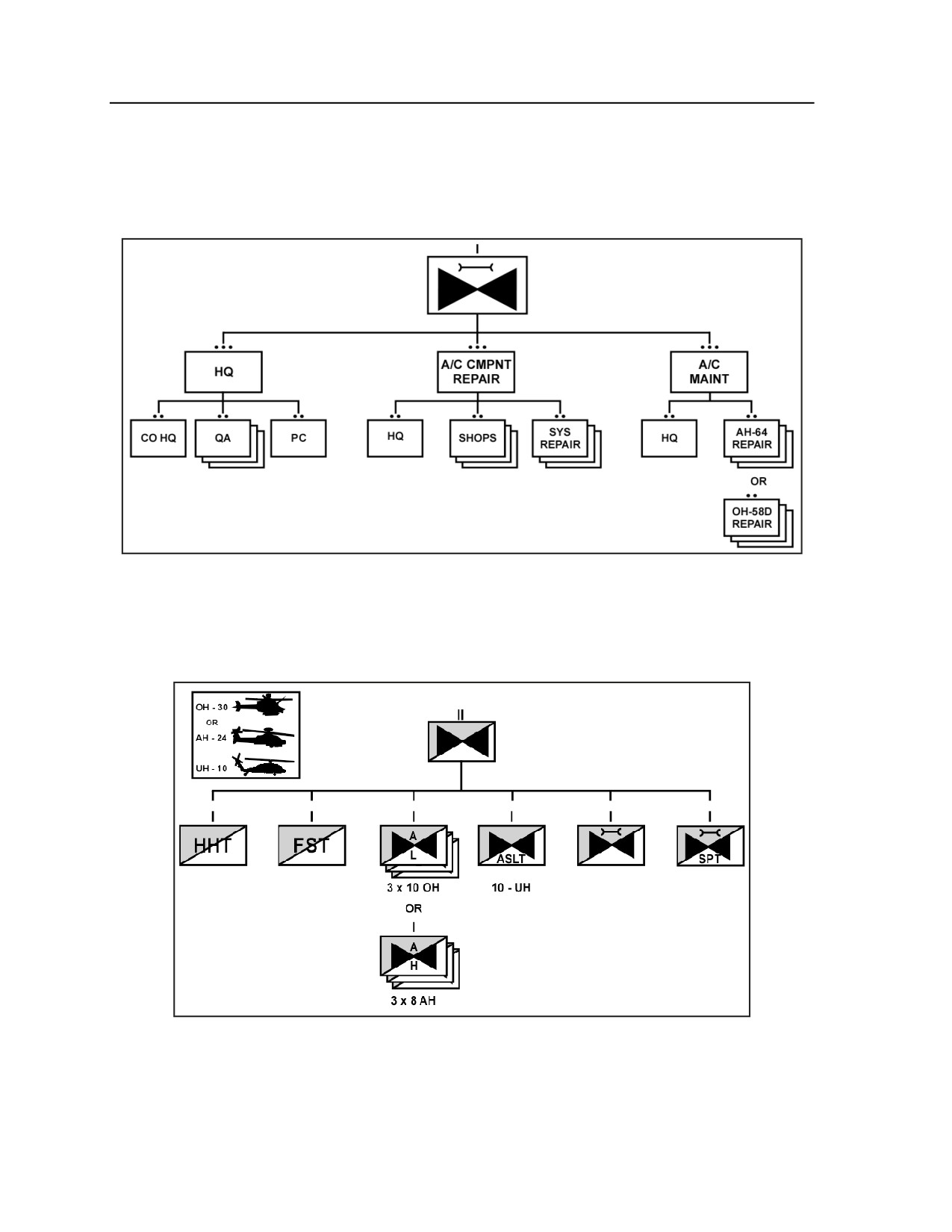
FM 3-04.126
February 2007
Attack Reconnaissance Helicopter Operations
DISTRIBUTION RESTRICTION: Approved for public release; distribution is unlimited.
Headquarters, Department of the Army
Field Manual
Headquarters
Department of the Army
No. 3-04.126
Washington, D.C. , 16 February 2007
Attack Reconnaissance Helicopter Operations
Contents
Page
Preface
vii
Chapter 1
Missions and Organization
1-1
Section I - Overview
1-1
Combined Arms
1-1
Fundamentals
1-2
Section II - Missions
1-4
Attack Reconnaissance Battalion
1-4
Air Cavalry Squadron
1-4
Section III - Organization
1-5
Attack Reconnaissance Battalion
1-5
Air Cavalry Squadron
1-9
Chapter 2
Command and Control
2-1
Section I - Command and Control
2-1
Command
2-1
Control
2-1
Command and Control Systems
2-2
Communications
2-2
Battalion Communication Nets
2-3
Section II - Battalion Command and Control
2-5
Battalion Command Group
2-5
Tactical Command Post
2-14
Main Command Post
2-15
Battalion Planning Considerations
2-21
Section III - Company Command and Control
2-26
Company Command Post
2-26
Company Planning Considerations
2-30
Section IV - Meetings and Briefings
2-34
Operations Order Brief
2-34
Air Mission Brief
2-34
Team Brief
2-35
Crew Mission Brief
2-35
Section V - Rehearsals
2-35
Rehearsal Sequence and Attendance
2-36
Rehearsal Question Resolution
2-37
Conflict Resolution at the Rehearsal
2-38
Distribution Restriction: Approved for public release; distribution is unlimited.
*This publication supersedes FM 1-112, 2 April 1997, and FM 1-114, 1 February 2000.
16 February 200
FM 3-04.126
i
Contents
Additional Rehearsals
2-38
Rehearsal Completion
2-38
Section VI - End of Mission Debriefing and After-Action Review
2-38
Debriefs
2-38
After-Action Review
2-40
Chapter 3
Employment
3-1
Section I - Introduction
3-1
Section II - Team Employment
3-2
Scout Weapons Team Employment
3-2
Flight Modes and Movement Techniques
3-6
Section III — Reconnaissance Operations
3-10
Fundamentals
3-11
Planning Considerations
3-13
Capabilities
3-19
Reconniassance Methods
3-20
Forms of Reconnaissance
3-21
Section IV - Security Operations
3-30
Fundamentals
3-31
Planning Considerations
3-33
Types of Security Operations
3-34
Time and Space Considerations for Reconnaissance and Security Missions .3-54
Screen Planning Examples (8-12 Hours)
3-54
Screen Planning Calculations (8-12 Hours)
3-56
Section V - Attack Operations
3-58
Attack Forms
3-58
Attack Missions
3-59
Attack Employment Methods
3-64
Engagement Area Development
3-71
Holding Area Operations
3-84
Attack By Fire/Battle Position Operations
3-85
Section VI - Movement To Contact
3-87
Search and Attack
3-87
Section VII - Personnel Recovery Operations
3-88
Section VIII - Stability and Civil Support Operations
3-95
Overview
3-95
Planning Considerations
3-96
Special Considerations
3-97
Rules of Engagement
3-98
Rules of Interaction
3-98
Section iX - Urban Operations
3-98
Planning Considerations
3-99
Operational Phases
3-109
Aircrew Urban Threat Considerations
3-111
Reconnaissance Operations
3-112
Employment of Lasers
3-113
Section X - Quick Reaction Force Operations
3-114
Quick Reaction Force
3-114
Section XI - Passage of Lines and Battle Handover
3-116
Passage of Lines
3-116
Battle Handover
3-118
Section XII - Air Combat Operations
3-120
General
3-120
ii
FM 3-04.126
16 February 2007
Contents
Planning Considerations
3-120
Section XIII - Deception Operations
3-120
Feint
3-120
Demonstration
3-121
Chapter 4
Sustainment Operations
4-1
Section I - Introduction
4-1
Section II - Logistics Fundamentals
4-1
Logistics Characteristics
4-1
Methods of Distribution
4-2
Supply Operations
4-2
Sustainment During Combat Operations
4-5
Section III - Maintenance
4-6
Principles
4-6
Aviation Maintenance Operations
4-7
Vehicle and Ground Equipment Maintenance and Recovery Operations
4-11
Section IV - Battalion Sustainment Units
4-11
Flight Company
4-11
Aviation Maintenance Company
4-12
Forward Support Company
4-13
Headquarters and Headquarters Company
4-16
Aviation Support Battalion
4-17
Section V - Standard Army Management Information Systems
4-20
Standard Army Maintenance System
4-20
Standard Army Retail Supply System
4-23
Integrated Logistics Analysis Program
4-24
Defense Automatic Addressing System
4-25
Aviation Life Support System
4-25
Appendix A
Aircraft Survivability
A-1
Appendix B
Army Aviation Air-Ground Integration
B-1
Appendix C
Joint Air Attack Team Operations
C-1
Appendix D
Briefings, Reports, and Formats
D-1
Appendix E
Aircraft Characteristics
E-1
Appendix F
Reference Library
F-1
Glossary
............................................................................................................... Glossary-1
References
...........................................................................................................References-1
Index
..................................................................................................................... Index-1
16 February 2007
FM 3-04.126
iii
Contents
Figures
Figure 1-1. Attack reconnaissance battalion/attack reconnaissance squadron
organization
1-6
Figure 1-2. Attack reconnaissance battalion headquarters and headquarters
company organization
1-6
Figure 1-3. Attack reconnaissance battalion/attack reconnaissance squadron
staff organization
1-7
Figure
1-4. Attack reconnaissance company/attack reconnaissance troop
1-8
Figure
1-5. Attack reconnaissance battalion forward support company
1-9
Figure
1-6. Attack reconnaissance battalion aviation maintenance company .1-10
Figure
1-7. Air cavalry squadron
1-10
Figure
2-1. Military decisionmaking process
2-23
Figure
2-2. Troop leading procedures and key planning tasks
2-31
Figure
3-1 Formation separation
3-4
Figure
3-2. Combat cruise
3-5
Figure
3-3. Combat cruise right (depicted)
3-5
Figure
3-4. Combat spread
3-6
Figure
3-5. Inner/Outer Drill
3-18
Figure
3-6. Example of company route reconnaissance graphics
3-24
Figure
3-7. Example of company zone reconnaissance graphics
3-25
Figure
3-8. Example of company area reconnaissance graphics
3-28
Figure
3-9. Example of landing zone or pickup zone sketch
3-29
Figure
3-10. Screen locations
3-34
Figure
3-11. Stationary screen
3-37
Figure
3-12. Moving flank screen
3-39
Figure
3-13. Moving rear screen
3-40
Figure
3-14. Rear area incursion screen
3-41
Figure
3-15. Stationary flank guard
3-43
Figure
3-16. Moving flank guard
3-45
Figure
3-17. Attack reconnaissance company support of cordon and search .3-46
Figure
3-18. Standard convoy security technique
3-48
Figure
3-19. Butterfly pattern convoy security technique
3-49
Figure
3-20. Inverted “Y” aerial escort formation
3-51
Figure
3-21. Air assault planning stages
3-52
Figure
3-22. Attached escort landing zone reconnaissance
3-53
Figure
3-23. Screen with rapid response team
3-55
Figure
3-24. Maximum screen line option
3-56
Figure
3-25. Computing en route time
3-57
Figure
3-26. Computing ground unit movement time
3-57
Figure
3-27. Example of simultaneous and continuous attacks
3-65
Figure
3-28. Example of a 45-degree simultaneous attack
3-66
Figure
3-29. Racetrack pattern
3-67
Figure
3-30. Example of a cloverleaf pattern
3-67
Figure
3-31. Example of an L-attack pattern
3-68
Figure
3-32. Example of a static attack pattern
3-69
Figure
3-33. Low-level attack
3-70
Figure
3-34. Bump attack
3-70
Figure
3-35. High attack
3-71
Figure
3-36. Engagement area development steps one and two
3-73
Figure
3-37. Engagement area development step three (part 1)
3-74
Figure
3-38. Engagement area development step three (part 2)
3-74
Figure
3-39. Engagement area development step three (part 3)
3-75
Figure
3-40. Techniques of fire distribution
3-77
Figure
3-41. Engagement area development step four (part 1)
3-79
iv
FM 3-04.126
16 February 2007
Contents
Figure 3-42. Engagement area development step four (part 2)
3-80
Figure 3-43. Holding area occupation
3-85
Figure 3-44. Example of a standard set
3-86
Figure 3-45. Example of a nonstandard set
3-86
Figure 3-46. Example of an area sketch
3-101
Figure 3-47. Example of a network “spider web” route structure
3-102
Figure 3-48. Example of running fire technique
3-103
Figure 3-49. Example of hovering fire technique
3-104
Figure 3-50. Example of urban targeting grid system
3-105
Figure 3-51. Example of objective area reference grid system
3-105
Figure 3-52. Example of target reference points technique
3-106
Figure 3-53. Example of building numbering convention
3-107
Figure 3-54. Example of floor and window lettering convention
3-108
Figure 4-1. Two-level aviation maintenance and sustainment
4-7
Figure 4-2. Aviation support battalion
4-18
Figure 4-3. Standard army management information system architecture
4-21
Figure A-1. Roles and functions
A-3
Figure A-2. Example aircraft survivability equipment/electronic warfare
mission brief format
A-6
Figure B-1. Mission planning through execution cycle
B-9
Figure B-2. Fratricide risk factors
B-12
Figure B-2. Fratricide risk factors (continued)
B-13
Figure B-3. Risk reduction and/or fratricide prevention measures
B-14
Figure B-4. Maneuver brigade combat teams
B-15
Figure C-1. Lateral/geographic separation
C-9
Figure C-2. Altitude separation
C-10
Figure C-3. Time separation
C-11
Figure C-4. CAS check-in briefing
C-12
Figure C-5. CAS briefing format
C-13
Figure C-6. Example of combined attack
C-15
Figure C-7. Example of a sectored attack
C-16
Figure C-8. Night JAAT and associated control measures
C-19
Figure E-1. OH-58D weapons loading
Error! Bookmark not defined.
16 February 2007
FM 3-04.126
v
Contents
Tables
Table 1-1. Attack reconnaissance battalion’s role in Army warfighting
functions
1-2
Table 2-1. Battalion internal radio networks
2-4
Table 2-2. Battalion external radio networks
2-4
Table 2-3. Example of main command post occupation timeline
2-21
Table 2-4. Munitions selection
2-25
Table 2-5. Example cell assignments matrix
2-32
Table 2-6. Sample mission debrief
2-39
Table 3-1. Team tasks
3-2
Table 3-2. OH-58D/AH-64 Scout weapons team tasks
3-3
Table 3-3. Flank security movement methods
3-36
Table 3-4.Example marking techniques for pickup zones
3-52
Table 3-5. Close combat attack checklist for ground commander
3-60
Table 3-6. Attack reconnaissance team response
3-62
Table 3-7. Engagement area checklist
3-76
Table 3-8. Personnel recovery terms
3-89
Table 3-9. Types of escort
3-92
Table 3-10. Voice battle handover information
3-119
Table 3-11. AH-64D Digital battle handover information
3-119
Table 4-1. Classes of supply
4-3
Table B-1. Individual actions on the detect, identify, decide, engage, and
assess process
B-1
Table B-2. Methods of marking friendly and enemy positions
B-5
Table B-3. Brevity list
B-7
Table C-1. Joint air attack planning guideline
C-6
Table C-2. Comparison of firepower timing options
C-14
Table C-3. Laser operations example radio calls
C-20
Table D-1. Example for predeployment and pretemporary duty
D-1
Table D-2. Example for convoy precombat inspection
D-2
Table D-3. Example for precombat inspections
D-4
Table D-4. Example for personnel recovery planning
D-4
Table D-5. Example for cordon and search
D-7
Table D-6. Example rescue mission brief
D-8
Table D-7. Example landing zone survey
D-9
Table D-8, Example spot report
D-9
Table D-9. Example convoy status report
D-10
Table D-10. Example weather advisory/watch report
D-10
Table D-11. Example rail load status report
D-11
Table D-12. Example closure report
D-11
Table D-13. Example aircraft slant report
D-11
Table D-14. Example personnel daily summary report
D-12
Table D-15. Example meaconing, intrusion, jamming, interference report
D-12
Table D-16. Example medical evacuation nine-line report
D-13
Table D-17. Example unexploded ordinance report
D-14
Table D-18. Example of a company warning order
D-14
Table D-19. Example company/troop operation order
D-15
Table D-20. Example of flounder report
D-18
Table E-1. OH-58D characteristics
E-1
Table E-2. Typical OH-58D helicopter ordnance loads
E-3
Table E-3. Comparison of Apache specifications
E-4
Table E-4. AH-64D characteristics
E-5
Table E-5. AH-64D weapons loads, weights, and radius
E-7
Table E-6. Armed reconnaissance helicopter characteristics
E-8
vi
FM 3-04.126
16 February 2007
Preface
Field manual (FM) 3-04.126, is intended for use by commanders, staffs, and United States military personnel
expecting to operate and employ Army aviation attack reconnaissance units.
This FM is the Army’s doctrine for how to fight and sustain attack reconnaissance helicopter battalions,
squadrons, companies and troops. The operational concepts described in this manual are based on Army
doctrine as established in FM 1, FM 3-0, and FM 3-04.111. Emphasis is placed on modular force structure and
the enhanced operational capability provided by Army aviation transformation.
FM 3-04.126 applies to the Active Army, the Army National Guard/Army National Guard of the United States,
the United States Army Reserve, and Army civilian employees across the spectrum of conflict, unless otherwise
stated. It builds on collective knowledge and experience gained through recent operations, numerous exercises,
and the deliberate process of informed reasoning. This publication is rooted in time-tested principles and
fundamentals, while accommodating new technologies, and evolving responses to the diverse threats to our
national security. This manual will also assist Army proponent schools in teaching attack reconnaissance
helicopter operations.
FM 3-04.126 describes attack reconnaissance organizations, missions, command and control (C2), tactical
employment and sustainment. It describes the responsibilities and duties of essential personnel during training,
operations and combat. This manual is authoritative but not considered inflexible. Each situation in combat
must be resolved by an intelligent interpretation and application of the doctrine set forth herein. Standardized
battalion, squadron, company and troop operations are necessary for the effective employment of aviation
battalion task forces. To this end, like companies and troops should follow similar operational and employment
procedures. Appendixes A through D provide supplemental information on aircraft survivability, Army aviation
air-ground integration, joint air attack team operations, and aircraft characteristics. A reference library is
provided in Appendix E.
FM 3-04.126 furnishes a foundation for attack reconnaissance helicopter doctrine, force design, materiel
acquisition, professional education, and individual and unit training.
The proponent of this publication is Headquarters, United States Army Training and Doctrine Command
(TRADOC). Send comments and recommendations on Department of the Army
(DA) Form
2028
(Recommended Changes to
publications
and
Blank
Forms)
or
automated
link
to Commander, United States Army Aviation
Warfighting Center (USAAWC), ATTN: ATZQ-TD-D, Fort Rucker, Alabama 36362-5263. Comments may be
e-mailed to the Directorate of Training and Doctrine (DOTD) at av.doctrine@us.army.mil. Other doctrinal
information can be found on the Internet at Army Knowledge Online (AKO) or call defense switch network
(DSN) 558-3551 or (334) 255-3551.
Unless this publication states otherwise, masculine nouns and pronouns do not refer exclusively to men.
This publication has been reviewed for operations security considerations.
16 February 2007
FM 3-04.126
vii
Chapter 1
Missions and Organization
The attack reconnaissance battalion
(ARB) and attack reconnaissance squadron
(ARS) are organized and equipped to support joint, interagency, multinational and
Army operations. These units conduct continuous combat operations throughout the
depth and breadth of the operational environment. Although their organization and
missions differ by parent division, their principal focus is similar. Each unit focuses
on time-tested fundamentals to achieve success. This chapter discusses these
fundamentals and outlines basic organization, principal mission focus, and
capabilities of the ARB. The organization description for each unit is based on the
official table of organization and equipment
(TOE). Operationally, all units are
resourced according to the modified table of organization and equipment (MTOE), so
actual organizations may look different from the TOEs described in this FM.
Note: Throughout this manual, for readability, the term company includes troop, and battalion
includes squadron. The terms troop and squadron may be used when specifically discussing air
cavalry squadrons (ACSs) or their respective subordinate units.
SECTION I - OVERVIEW
COMBINED ARMS
1-1. Combined arms is the synchronized and
Contents
simultaneous application of the warfighting
functions (WFFs) to achieve an effect that is greater
Section I - Overview
1-1
than if each arm were used in sequence. It is the full
Section II - Missions
1-4
integration of different capabilities in such a way
Section III - Organization
1-5
that, to counteract one, the enemy must become
more vulnerable to another. Combined arms employ
all the WFFs and their supporting systems. Combined arms multiply the effectiveness of Army forces in all
operations.
1-2. Employing combined arms is simple in concept. However, it requires highly trained Soldiers, skilled
leadership, effective staff work, and integrated information systems. Combined arms operations must be
synchronized so the effects of combat power occur simultaneously. Synchronization is the arrangement of
military actions in time, space, and purpose to produce maximum relative combat power at a decisive place
and time. (FM 1-02) Through synchronization, commanders arrange WFFs to mass the effects of combat
power at the chosen place and time to overwhelm an enemy or dominate the situation.
1-3. Combined arms are achieved through organizational design (standing organizations) and temporary
reorganization (tailored and task-organized units). For example, units organic to brigade combat teams
(BCTs) perform all WFFs. However, the BCT does not organically include Army aviation. When required,
the capabilities are added through tailoring and task-organizing, temporarily subordinating elements of
different units under one commander.
1-4. Aviation battalions plan, coordinate, and execute operations. They create opportunities for
commanders to disrupt the enemy's decision-making process, forcing them to make decisions that disrupt
16 February 2007
FM 3-04.126
1-1

Chapter 1
initial plans. The battalion-through coordination, liaison, C2, situational awareness (SA), and situational
understanding (SU)—helps set conditions for the force's success.
1-5. The ARB conducts full spectrum operations (FM 3-90) in support of their higher headquarters. The
ARB supports offensive and defensive operations (reconnaissance, security, and attack) against armored or
mechanized equipped threat forces, and against lighter equipped or insurgent forces. The ARB is less
suited for stability and civil support operations based on organization, but can support these operations by
providing security (area, route, and convoy) and quick reaction force (QRF) capability and reconnaissance
through the supported unit’s intelligence, surveillance, and reconnaissance (ISR) operations.
FUNDAMENTALS
1-6. All battalions should be able to—
z Plan and conduct strategic deployment.
z Conduct administrative and tactical movements.
z Coordinate with supported maneuver units.
z Develop and maintain intelligence preparation of the battlefield (IPB).
z Use the full spectrum of communications means to satisfy internal and external requirements for
combat information.
z Act as a battalion task force (TF) headquarters.
z Conduct multiple simultaneous operations.
z Plan multiple future operations.
z Conduct liaison with adjacent and supported units.
z Protect and sustain their forces.
z Conduct air-ground intergration.
ARMY WARFIGHTING FUNCTIONS
1-7. Battalion commanders and staffs must be fully aware of the six Army WFFs (see field manual
interim [FMI] 5-0.1). Table 1-1 gives examples of tasks the ARB may perform in support of each WFF.
Table 1-1. Attack reconnaissance battalion’s role in Army warfighting functions
Army
Warfightin
g Function
ARB’s Role
Movement &
• Engage enemy forces decisively through attack operations.
Maneuver
• Shape the operational environment through aggressive IAs, reconnaissance, and security
operations.
Intelligence
• Assist commander and staff in conducting IPB.
• Provide higher headquarters SA.
• Confirm or deny elements of the ISR plan and priority intelligence requirements.
• Conduct reconnaissance to allow commander to make informed decisions, delegate
authority, and synchronize the WFFs.
• Conduct reconnaissance to find bypasses, adequate sites and routes, and provide
overwatch for ground operations.
Fire Support
• Designate for laser-guided artillery or other service munitions.
(FS)
• Conduct counterbattery fires to find and target enemy mortars and artillery.
• Synchronize indirect fires to delay, disrupt, or destroy enemy forces, systems, and
facilities.
Sustainment
• Generate combat power in support of ground operations.
• Perform reconnaissance to identify routes and provide pickup zone (PZ), landing zone
(LZ), or convoy security.
• Provide security for air movement of personnel, supplies, and equipment in support of
1-2
FM 3-04.126
16 February 2007
Missions and Organization
Table 1-1. Attack reconnaissance battalion’s role in Army warfighting functions
Army
Warfightin
g Function
ARB’s Role
ground forces, refugees, or disaster victims.
C2
• Provide backup radio communications with supported forces.
Protection
• Provide direct fires and/or call for indirect fires to cover obstacles.
• Provide security for ground movement, assembly area (AA), and fixed based operations.
DECISIVE, SHAPING, AND SUSTAINING OPERATIONS
1-8. The ARB may operate over a dispersed area of operations (AO) supporting their higher headquarters
through decisive, shaping, and sustaining operations (FM 3-0).
Decisive Operations
1-9. The battalion participates in decisive operations to find, fix, and destroy enemy forces (especially
moving forces), and to confirm intelligence. Decisive operations do not require the presence of
overwhelming forces; they simply require the ability to mass overwhelming firepower and other effects at
the time and place where the enemy’s assets and strengths are most vulnerable. The battalion may be
tasked to perform movement to contact or attack operations including close combat attack
(CCA),
interdiction attack (IA), or a raid. ARBs also support decisive operations by conducting reconnaissance to
confirm intelligence.
Shaping Operations
1-10. Shaping operations establish conditions for success of the decisive operation by setting the
battlefield to our advantage. Shaping includes lethal and nonlethal operations that make the enemy
vulnerable to attack, impede or divert its attempts to maneuver, provide combat support to facilitate the
maneuver of friendly forces, enhance deception, or otherwise dictate the time and place for decisive battle.
Through shaping, commanders gain the initiative, preserve momentum, and control the tempo of combat.
Shaping operations may occur with, before, or after initiation of decisive operations and may involve any
combination of forces.
1-11. Some shaping operations, especially those that occur simultaneously with the decisive operation, are
economy of force actions. If the available force does not permit simultaneous decisive and shaping
operations, the commander sequences shaping operations around the decisive operation. A shaping
operation may become the decisive operation if circumstances or opportunities dictate. In that case, the
commander weighs the new decisive operation at the expense of other shaping operations.
1-12. In addition to finding, fixing, and destroying enemy forces and confirming intelligence, the battalion
can facilitate shaping operations by—
z Conducting reconnaissance and surveillance (R&S) operations to complement other maneuver
forces.
z Orchestrating joint air attack team (JAAT) operations.
z Providing security for air assault and air movement operations.
z Conducting feint and/or demonstration operations.
Sustaining Operations
1-13. Sustaining operations generate and maintain combat power. Failure to sustain normally results in
failure of the overall effort. Sustaining operations at any echelon are those that assist the decisive and
shaping operations by ensuring freedom of action and continuity of operations. Sustaining operations
include base security, maintenance, sustainment, movement control, terrain management, and protection of
lines of communications (LOCs) and headquarters.
16 February 2007
FM 3-04.126
1-3
Chapter 1
1-14. The ARB elements are excellent for protecting sustainment forces as they move from one location to
another, or in their AAs. The battalion also participates as an element in larger sustainment operations by
providing R&S missions for LOCs and QRFs for sustainment areas.
SECTION II - MISSIONS
1-15. The primary missions of attack reconnaissance helicopter units are—
z Reconnaissance.
z Security.
z Attack.
z Movement to contact.
1-16. Reconnaissance operations are conducted to obtain information about the enemy and/or terrain to
assist in building and sharing the common operational picture (COP), and/or to focus combat power at the
decisive point and time.
1-17. Security operations provide reaction time, maneuver space, and protection to air-ground maneuver.
1-18. Attack operations destroy or defeat enemy forces in order to seize, retain, or exploit the initiative.
Attack/reconnaissance units conduct two basic types of attack—CCA and IA.
z
Close combat attack. A hasty or deliberate attack by Army aircraft providing air-to-ground
fires for friendly units engaged in close combat. Due to the close proximity of friendly forces,
detailed integration is required.
z
Interdiction attack. A hasty or deliberate attack by Army aircraft to divert, disrupt, delay,
degrade, or destroy the enemy before they can be used effectively against friendly forces. IA is
conducted at such a distance from friendly forces that detailed integration with ground forces is
not required.
1-19. Movement to contact operations are designed to develop the situation and to establish or regain
contact. The commander conducts a movement to contact (MTC) when the enemy situation is vague or not
specific enough to conduct an attack. A search and attack is a specialized technique of conducting a
movement to contact in an environment of noncontiguous AOs.
ATTACK RECONNAISSANCE BATTALION
1-20. ARBs are often the division’s primary reconnaissance asset during both offensive and defensive
operations and complement the armor and lethality of forces in close combat. They have decisive
advantages in maneuverability and lethality over other divisional resources for many mission applications.
They can easily bypass obstacles and maneuver rapidly to positions of advantage, while exploiting the
greater range of Hellfire missiles maintaining standoff against enemy armor and other hardened targets.
1-21. During a ground force’s defense or attack against a known enemy force, aircraft may locate to the
rear of the friendly force providing the ground commander SA of both friendly and enemy locations. Other
attack reconnaissance aircraft, forming lead-wingman teams, may locate forward on both flanks to provide
designation for Hellfire missiles in the close combat environment.
1-22. ARBs support ground force movement to contact, air assaults, and actions on contact through CCA.
The reduced speed of a light infantry force's movement to contact, coupled with the need to maintain a low
profile, may preclude escort by battalion aircraft. Instead, a company may operate over the supported unit
or move to positions to overwatch and attack with supporting fires on one or both forward flanks.
1-23. The availability of multiple ARBs permits 24-hour operations, simultaneous attack of multiple
engagement areas (EAs), or massed attack of multiple targets at a critical time and place.
AIR CAVALRY SQUADRON
1-24. The ACS performs the following missions in support of BCTs:
1-4
FM 3-04.126
16 February 2007
Missions and Organization
z Reconnaissance.
z Security.
z Air assault.
z Air movement
z Attack.
z Movement to contact.
z C2.
z Casualty evacuation (CASEVAC).
1-25. The ACS gathers information about enemy and terrain, maintains surveillance, and provides early
warning of enemy contact. It provides reconnaissance, surveillance, and security of LOCs to enhance C2
and target acquisition (TA).
1-26. ACS assets have decisive advantages over other intelligence resources, as they can fight through and
counter enemy deception efforts better than any sensor system.
1-27. The ACS, with its organic air cavalry troops (ACTs) and assault helicopter troop (AHT) helicopters,
is an excellent force for developing the situation. As such, the ACS is often given its own sector and
missions. Although ground forces extend the ACS's ability for continuous operations over time, the ACS is
fully capable of conducting all reconnaissance missions, screens, and limited guard and cover operations.
Attachment of ground forces enables the ACS to conduct guard and cover missions. The ACS also has
organic utility aircraft that can insert surveillance teams at observation posts (OPs) and dismounted patrols.
1-28. The ACS generally conducts attacks as part of actions on contact to develop the situation further.
The ACS may also conduct attacks to force the enemy to reveal information or continue the security
mission. When the squadron can easily penetrate enemy defenses, it can more rapidly resume the advance
or flank guard or screen mission. Such actions save time and maintain momentum.
SECTION III - ORGANIZATION
ATTACK RECONNAISSANCE BATTALION
1-29. Each heavy division combat aviation brigade (CAB) has two ARBs consisting of attack helicopter
(AH)-64Ds only. Each light division CAB has two ARSs consisting of observation helicopter (OH)-58Ds
only. Medium CABs, however, consist of one ARB (AH-64D) and one ARS (OH-58D). See FM 3-04.111
for more information on CAB’s organization.
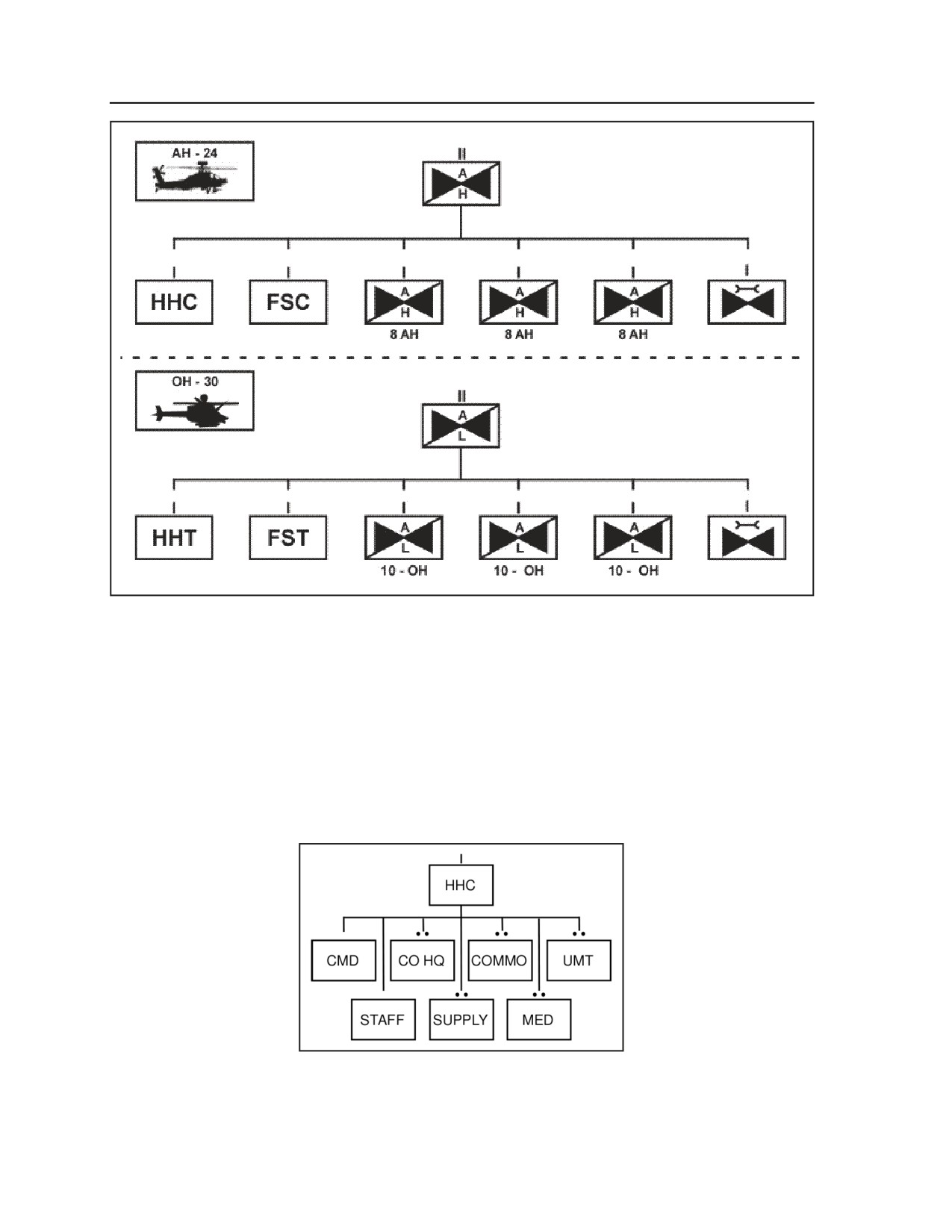
1-30. Each ARB (figure 1-1, page 1-6) has a headquarters and headquarters company (HHC), a forward
support company (FSC), three attack reconnaissance companies (ARCs), and an aviation maintenance
company. The distinction between ARCs and attack reconnaissance troops (ARTs) is an ARC consists of
eight AH-64Ds, whereas, an ART consists of ten OH-58Ds. The ARB receives maintenance support from
the CAB’s aviation support battalion (ASB).
16 February 2007
FM 3-04.126
1-5
Chapter 1
Figure 1-1. Attack reconnaissance battalion/attack reconnaissance squadron organization
1-31. The battalion is dependent upon the CAB or division for Army airspace command and control
(A2C2), FS, weather, and specific personnel and administrative services.
HEADQUARTERS AND HEADQUARTERS COMPANY
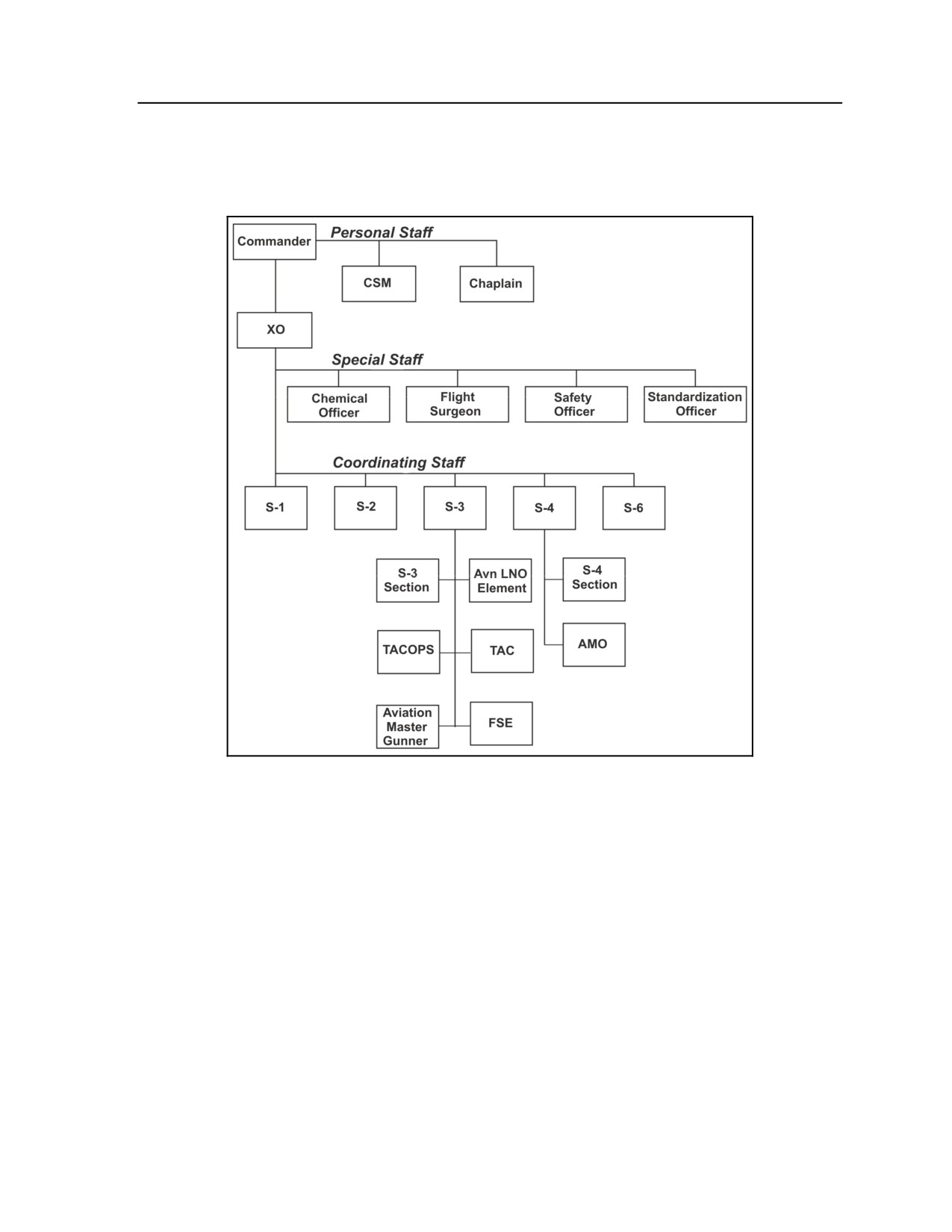
1-32. The ARB HHC (figure 1-2) consists of the command group, staff, company headquarters section,
supply section, communications/automation section, medical treatment squad, and unit ministry team
(UMT). The HHC provides personnel and equipment for C2 functions of the battalion, and security and
defense of the command post (CP). The HHC also provides the following types of support—unit-level
personnel service, UMT, logistics, medical, and chemical, biological, radiological, and nuclear (CBRN).
See chapter 4 for additional information.
Figure 1-2. Attack reconnaissance battalion headquarters and headquarters company
organization
1-6
FM 3-04.126
16 February 2007
Missions and Organization
Battalion Staff Organization
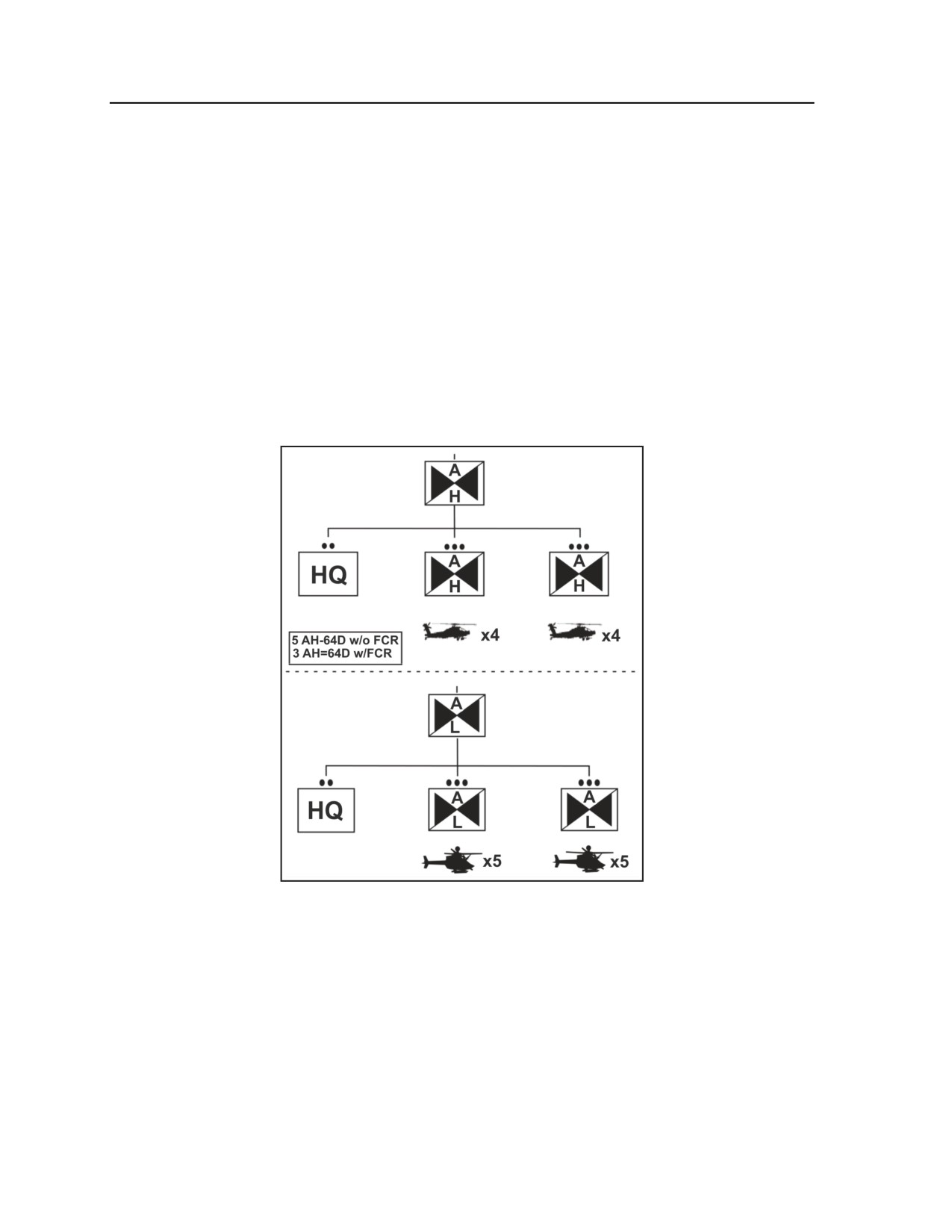
1-33. As described in FM 6-0, the battalion staff (figure 1-3) is organized into personal staff, coordinating
staff, and special staff. The following paragraphs provide brief descriptions of essential battalion staff
elements. Where necessary and appropriate, further discussion is contained in chapter 2.
Figure 1-3. Attack reconnaissance battalion/attack reconnaissance squadron staff
organization
1-34. The battalion staff consists of officers and enlisted personnel who plan, supervise, and synchronize
operations according to the battalion commander's concept and intent. Except in scope, duties and
responsibilities, the battalion staff is similar to those of higher echelon staff. Essential personnel must be
positioned on the battlefield where they can carry out their duties. See chapter 2 for more information on
staff duties and responsibilities.
Personal staff
1-35. The personal staff works under the commander’s immediate control, but may work through the
executive officer (XO) or a specific coordinating staff officer for coordination and control purposes.
Members of the personal staff normally have a direct line of communications (LOC) to the commander due
to the confidential nature and broad scope of their assigned duties.
16 February 2007
FM 3-04.126
1-7
Chapter 1
Special staff
1-36. Special staff officers help the battalion commander and other staff members perform their functional
responsibilities.
Coordinating staff
1-37. The coordinating staff is composed of the commander’s principal assistants responsible for one or a
combination of broad fields of interest
(personnel, intelligence, operations, logistics, planning, and
communications). Coordinating staff members help the commander coordinate and supervise execution of
plans, operations, and activities. Collectively, through the XO, they are accountable for the commander’s
entire field of responsibility.
ATTACK RECONNAISSANCE COMPANY
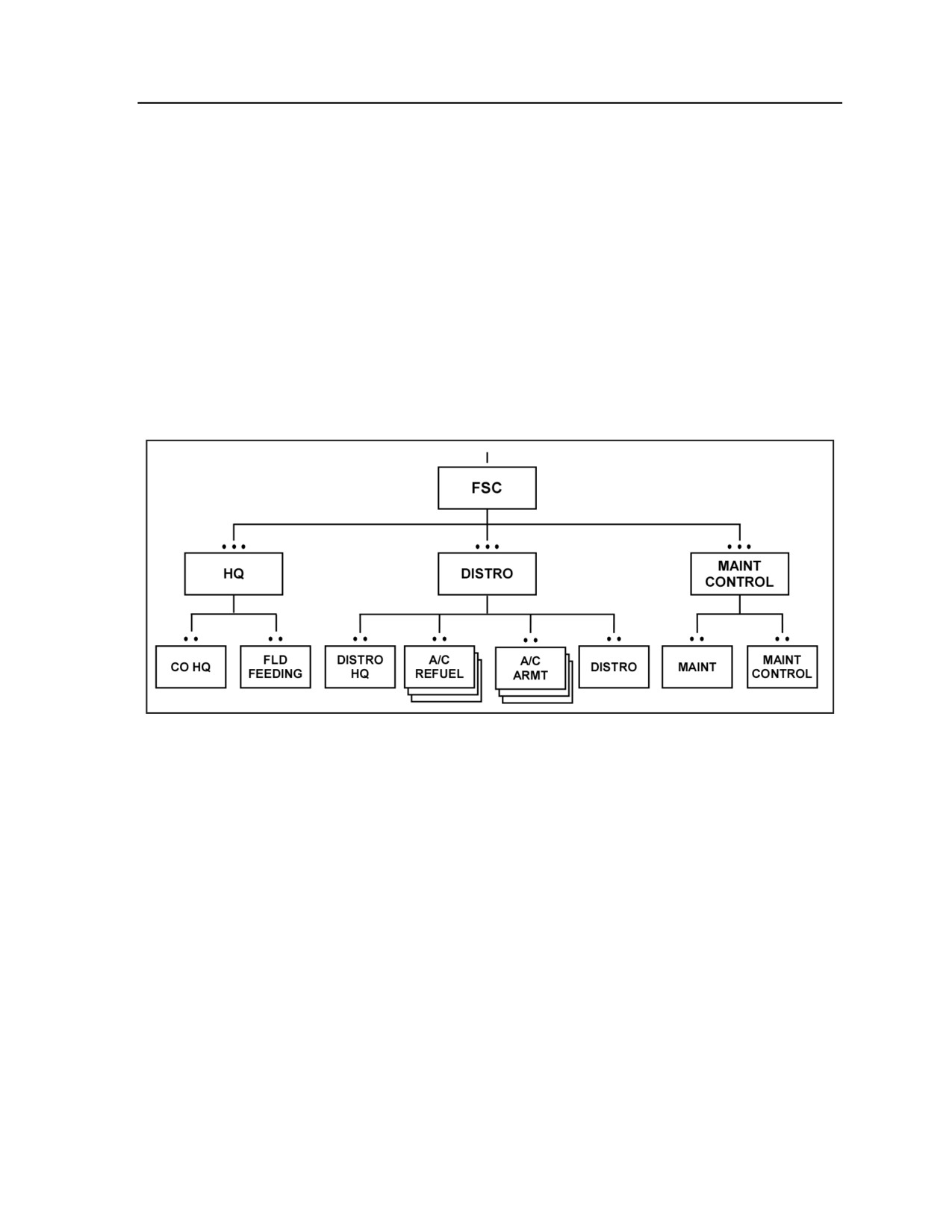
1-38. The ARC (figure 1-4) consists of a company headquarters and two attack reconnaissance platoons
with four AH-64D aircraft each. The ART consists of a headquarters element and two attack
reconnaissance platoons of five OH-58D aircraft each.
Figure 1-4. Attack reconnaissance company/attack reconnaissance troop
Headquarters Section
1-39. The company’s headquarters section embodies the senior leadership of the company and is
responsible for leading, training, and caring for all Soldiers assigned to the company. Each member of the
headquarters section must maintain proper communications between each element regarding company
readiness. This communication is used to understand the company’s proficiency in individual through
company tasks and allows development of the company’s training requirements. The commander,
standardization instructor pilot (SP), safety officer (SO), and tactical operations (TACOPs) officer assigned
to the headquarters section are part of the company’s aircrew structure.
1-8
FM 3-04.126
16 February 2007
Missions and Organization
The Attack Reconnaissance Platoons
1-40. ARC has two attack reconnaissance platoons consisting of four AH-64D aircraft. One attack
reconnaissance platoon is organized with three AH-64D non-fire control radar (FCR) aircraft and one AH-
64D FCR aircraft. The second attack reconnaissance platoon is organized with two AH-64D non-FCR
aircraft and two AH-64D FCR aircraft. Each platoon utilizes two headquarters section aviators to employ
all assigned aircraft.
1-41. The ART has two attack reconnaissance platoons consisting of five OH-58D aircraft. As with the
ARC, each platoon utilizes headquarters section aviators to employ all assigned aircraft.
FORWARD SUPPORT COMPANY
1-42. The ARB FSC (figure 1-5) has a company headquarters, a field feeding section, a distribution
platoon, and a ground maintenance platoon. The FSC provides field feeding, transportation, refueling,
ground maintenance support, and coordinates with the ASB for additional support as required. See chapter
4 for additional information.
Figure 1-5. Attack reconnaissance battalion forward support company
AVIATION MAINTENANCE COMPANY
1-43. The aviation maintenance company (figure 1-6, page 1-10) consists of a company headquarters,
production control and quality assurance (QA) sections, aircraft maintenance platoon, and an aircraft
component repair platoon (CRP). The aviation maintenance company also provides necessary maneuver
sustainment to operate autonomously throughout division operational environment. See chapter 4 for
additional information.
AIR CAVALRY SQUADRON
1-44. The ACS augments and extends capabilities of the BCTs. The ACS contains a headquarters and
headquarters troop (HHT), forward support troop (FST), three ACTs, one AHT, one aviation support
troop, and one aviation maintenance troop. The ACS (figure 1-7, page 1-10) is equipped with 24 AH-64s
or 30 OH-58Ds, and 10 utility helicopters (UH)-60s.
1-45. The squadron is dependent upon the Stryker brigade combat team (SBCT), division, or higher for
A2C2, weather, legal, finance, and sustainment functions.
16 February 2007
FM 3-04.126
1-9
Chapter 1
HEADQUARTERS AND HEADQUARTERS TROOP
1-46. The HHT provides personnel and equipment for battle command functions of the squadron, and
security and defense of the CP. The HHT also provides UMT, logistics, and CBRN, and unit-level
personnel service support.
Figure 1-6. Attack reconnaissance battalion aviation maintenance company
Figure 1-7. Air cavalry squadron
1-10
FM 3-04.126
16 February 2007
Missions and Organization
FORWARD SUPPORT TROOP
1-47. The FST has a headquarters platoon, distribution platoon, and ground maintenance platoon. The FST
provides field feeding, transportation, refueling, and ground maintenance support and coordinates with the
SBCT brigade support battalion for additional support as required.
AIR CAVALRY TROOP
1-48. The ACT consists of a headquarters section and two platoons of five OH-58D or four AH-64 aircraft
each.
ASSAULT HELICOPTER TROOP
1-49. The AHT consists of a headquarters section and two flight platoons with five UH-60 aircraft each.
AVIATION MAINTENANCE TROOP
1-50. The aviation maintenance troop consists of a troop headquarters, production control and QA
sections, aircraft maintenance platoon, and aircraft CRP. The aviation maintenance troop also provides
necessary maneuver sustainment to operate autonomously throughout division operational environment.
AVIATION SUPPORT TROOP
1-51. The aviation support troop consists of a headquarters platoon, airframe repair platoon (ARP), and
CRP. The aviation support troop performs intermediate maintenance and provides back-up unit
maintenance in support of the aviation maintenance troop. The aviation support troop also performs
production control and QA, conducts maintenance management, provides maintenance test pilot (MP)
functions, and provides aviation and ground equipment maintenance for the squadron. See chapter 4 for
more information.
16 February 2007
FM 3-04.126
1-11
Chapter 2
Command and Control
C2 is the exercise of authority and direction by a properly designated commander of
assigned and attached forces. Command includes both the authority and
responsibility for effectively using available resources to accomplish missions. To
control is to regulate forces and functions to execute the commander's intent.
SECTION I - COMMAND AND CONTROL
COMMAND
2-1. Command at all levels is the art of motivating
and directing people and organizations to
Contents
accomplish missions. Command requires visualizing
Section I - Command and Control
2-1
the current state of friendly and enemy forces, future
state of those forces existing to accomplish the
Section II - Battalion Command and
mission, and formulating concepts of operations to
Control
2-5
achieve success. The commander influences the
Section III - Company Command and
Control
2-26
outcome of operations by—
Section IV - Meetings and Briefings
2-34
z Defining his intent.
Section V - Rehearsals
2-35
z Assigning missions.
Section VI - End of Mission Debriefing
z Designating priority efforts.
and After-Action Review
2-38
z Prioritizing and allocating combat support
and sustainment.
z Deciding what level of risk to accept.
z Placing reserves.
z Assessing needs of subordinates and seniors.
z Changing task organization.
z Changing allocation of combat support.
z Changing priority of sustainment.
z Changing boundaries.
z Allocating time.
z Guiding and motivating the organization toward the desired end.
CONTROL
2-2. Control of forces and functions helps commanders and staffs compute requirements, allocate means,
and integrate efforts. Control is necessary to determine status of organizational effectiveness, identify
variance from set standards, and correct deviations from these standards. Control permits commanders to
acquire and apply means to accomplish their intent and develop specific instructions from general
guidance. Ultimately, it provides commanders a means to measure, report, and correct performance.
Control allows commanders freedom to operate, delegate authority, place themselves in the best position to
lead, and synchronize actions throughout the operational area.
16 February 2007
FM 3-04.126
2-1
Chapter 2
2-3. While C2 may be discussed separately for understanding, in practice, it is an entity. The commander
cannot command effectively without control, and cannot exercise control without command. The
commander uses C2 to make effective decisions, manage uncertainty of combat, employ forces efficiently,
and direct successful execution of military operations. The goal of C2 is mission accomplishment, while
the object of C2 is force effectiveness. The staff is the commander's most important resource to exercise C2
when he is unable to exercise it by himself. Commanders exercise authority and direction through and with
assistance of a C2 system.
COMMAND AND CONTROL SYSTEMS
2-4. The C2 system is defined as the facilities, equipment, communications, procedures, and personnel
essential to a commander for planning, directing, and controlling operations of assigned forces.
2-5. The Army battle command system (ABCS) provides unit commanders with electronic architecture to
build SA. Signal planning increases the commander's options by providing the requisite signal support
systems for varying operational tempos. These systems pass critical information at decisive times; thus,
they leverage and exploit tactical success and make future operations easier. FM 3-04.111 has additional
information on ABCS. The three levels of ABCS are—
z Global Command and Control System-Army.
z Army Tactical Command and Control System (ATCCS).
z Force XXI battle command—brigade and below (FBCB2).
2-6. C2 for the ARB is simplified by the capabilities of their advanced aircraft. Multiple frequency
modulated (FM) radios, improved data modem (IDM), satellite communication (SATCOM)/high frequency
(HF) (excluding OH-58D) capability, if so equipped, simplify communication and information reporting.
As battalions field emerging SA digital systems, the C2 and subsequent responsiveness and lethality of the
force will multiply.
COMMUNICATIONS
2-7. Fundamental to combat operations is combat information reporting and exploiting that information.
This information and the opportunities it presents are of interest to other maneuver units and higher
headquarters’ staffs. Combat information reporting requires wide and rapid dissemination. Battalion
elements frequently operate over long distances, wide fronts, and extended depths from their controlling
headquarters. Communications must be redundant and long range to meet internal and external
requirements. Long-range communications can be augmented through signal support. The answer is to
have the systems in place before they are needed.
2-8. Operations at extended distances beyond friendly lines may require cellular, HF, tactical satellite, or
retransmission
(RETRANS) to maintain communications. UH-60 airborne C2 aircraft should be
operational control (OPCON) to the battalion for all battalion-level and long-range operations. The aviation
mission planning system (AMPS) provides a means of transferring information between echelons within
the battalion and with the CAB. Brigade aviation elements (BAEs) are also AMPS and tactical airspace
integration system airspace workstation-equipped to permit supported ground unit input.
COMMUNICATION RESPONSIBILITIES
2-9. All levels of command gain and maintain communications with necessary headquarters and
personnel. Communications methods and procedures should be established in unit standing operating
procedures (SOPs) and practiced during battle drills and flight operations.
2-10. Regardless of establishment responsibility, all units must take prompt action to establish or restore
lost communications. Methods of restoring communications should be established in the unit SOP and
practiced during battle drills and daily flight operations.
2-2
FM 3-04.126
16 February 2007
Command and Control
COMMUNICATIONS DISRUPTION
2-11. Communications, particularly electromagnetic, are subject to disruption in even the best conditions.
Disruption may result from unintentional friendly interference, intentional enemy action, equipment failure,
atmospheric conditions, electromagnetic pulse, or terrain interference. To compensate for intermittent
communications, the commander should—
z Provide for redundancy in means of communication.
z Ensure subordinates understand commander's intent so they know what to do during
communications interruptions.
z Avoid overloading communications systems.
z Minimize use of radio.
z Ensure personnel follow signal and communications security (COMSEC) practices.
OPERATIONS SECURITY
2-12. Operations security (OPSEC) includes measures taken to deny the enemy information about friendly
forces and operations. OPSEC consists of physical security, information security, signal security,
deception, and countersurveillance. Because these categories are interrelated, the commander normally
chooses to employ multiple techniques to counter a threat. Commanders analyze hostile intelligence efforts
and vulnerabilities, execute OPSEC countermeasures, and survey the effectiveness of countermeasures.
Commanders can then counter specific hostile intelligence efforts.
BATTALION COMMUNICATION NETS
BATTALION INTERNAL RADIO NETS
2-13. The battalion establishes the following internal radio nets to organize and control information passed
via each net:
z Command net. An FM secure command net, controlled by the operations staff officer (S-3), is
used for battalion C2. As a rule only commanders, XOs, or S-3s communicate on the net. The
command net is used by commanders for sending and receiving critical information on current
operations.
z Operations and intelligence net. The intelligence staff officer (S-2) controls the operations and
intelligence (O&I) net. Routine operations and intelligence reports (INTREPs) are sent on this
net; it functions as a surveillance net when required. Brigade or subordinate commanders do not
normally monitor O&I. This net is used for details and discussion leading to analysis. That
analysis, when completed, is relayed to the appropriate commander. The unit XO, operating in
the main CP, ensures analysis is done and relayed in a timely manner by appropriate means.
When used, the rear CP monitors the O&I net allowing anticipation of critical support
requirements and problems.
z Administrative and logistics net. This net is controlled by the personnel staff officer (S-1) and
logistics staff officer (S-4) and is used for administrative and logistics (A&L) traffic. Battalion
or subordinate commanders do not normally monitor the A&L net.
2-14. The battalion commander communicates with his company commanders on the battalion command
net, which is FM secure. Very high frequency (VHF) and ultra high frequency (UHF) secure radios may be
used as backups for the FM secure radio. The main CP may use the FM secure radio to communicate with
the battalion trains and forward arming and refueling point (FARP) elements through the battalion A&L
net. Battalion elements may also communicate with the FARP on the command net; at a minimum, FARPs
should monitor the command net. If the A&L net is not active, the O&I network is an alternative to
communicate A&L requirements. Table 2-1, page 2-4, illustrates typical internal radio nets.
16 February 2007
FM 3-04.126
2-3

Chapter 2
Table 2-1. Battalion internal radio networks
NETWORK
BATTALION/SQUADRON
ARTILLERY
COMPANY
STATION
CMD
CMD
O&I
A/L
AVN
FS
FS (DIG)
UHF/VHF/F
FM
HF
FM
FM
UHF
FM
M
(AM)
Command
X
A
A
X
X
Group
TAC CP
N
X
X
Battalion
X
X
X
X
X
Detachments
Co CPs
X
X
O/A
O/A
N
Platoons
A
A
ISG
X
A
FARP
X
X
N—Network control station
X—Enter network
A—Enter network as required
O—Monitor
BATTALION EXTERNAL RADIO NETS
2-15. The battalion main CP is responsible for maintaining communications with higher, adjacent, and
subordinate units. When deployed, the battalion tactical command post (TAC CP) may communicate
directly with these units. If the situation or terrain prohibits direct contact by the TAC CP, the main CP
may act as a communications relay. When airborne, the battalion commander may communicate directly
with higher headquarters, adjacent units, and subordinate elements via FM secure radio. The main CP and
TAC CP, if deployed, operate the battalion command and O&I nets. These elements also maintain
communication with higher headquarters on their command O&I, and A&L nets.
2-16. Because of distance factors involved, HF radios or SATCOM are often used to maintain contact with
higher headquarters. Other external radio nets may be established through supporting elements such as the
field artillery (FA) tactical fire direction system (TACFIRE), A2C2, and forces participating in JAAT
operations. Table 2-2 illustrates typical external radio networks for the battalion.
Table 2-2. Battalion external radio networks
Division Control
Station/Network
DIV CM
DIV REAR
DIV CMD
DIV O&I
DIV Area
DIV A2C2
FM
CMD FM
AM
FM
Common
FM
User
Command Group*
X
X1
X
X3
TAC CP 1*
X2
X2
X
X2
X3
X3
Brigade Control
Station/Network
BDE CMD
BDE O&I
BDE A/L FM
DIV Area Common
AVN BDE
FM
User
UHF
Command Group*
X
O/A
A
X
X
TAC CP*
X2
X
X—Enter network
A—Enter network as required
O—Monitor
1—When performing rear area operations
2—When deployed; otherwise, main CP
3—Always active
4—Network of brigade providing area support
5—Division command FM is normally an on-call network
*—Enter A2C2 network as required
2-4
FM 3-04.126
16 February 2007
Command and Control
SECTION II - BATTALION COMMAND AND CONTROL
2-17. CPs serve the C2 needs of the commander and staff. The dynamics of the operational environment
require the highest level of organizational and operational efficiency within every CP. Battalion C2
elements and facilities are positioned according to the situation and include—
z Command group.
z Main CP.
z TAC CP.
BATTALION COMMAND GROUP
2-18. The battalion command group consists of the battalion commander and representatives from
battalion staff and supporting units the commander chooses. At a minimum, this includes the S-3, an S-2
representative, fire support officer (FSO), and air liaison officer (ALO), if available. The command group
may operate from ground vehicles or an aircraft. It is not a command facility per se, but a grouping of
critical decision makers that may operate separately from the main CP or the TAC CP periodically. The
command group may deploy when personal observation or presence is necessary to accomplish the
mission.
COMMANDER
2-19. The commander’s main concerns are accomplishing the mission and taking care of Soldiers. The
commander delegates authority and fosters an organizational climate of mutual trust, cooperation, and
teamwork. The commander leads the battalion, mentors, guides, trains, and inspires leaders and Soldiers.
Commanders must also have an in-depth knowledge of enemy forces and how they fight, and possess the
ability to use terrain to their advantage. The commander must maintain the highest level of proficiency in
the aircraft and should be a pilot in command (PC).
2-20. The battalion commander must understand the impact of the unit's actions and the actions of the
Soldiers on the modern battlefield. The battalion commander relies on staff and subordinate commanders to
advise and assist in planning and supervising operations. The commander must understand the staff's
capabilities and limitations and must train them to execute operational concepts during his absence. The
commander focuses on essential aspects of employing the ARB to include—
z Commands the organization through the tenants of mission command.
z Positions to best see and influence the operational environment and gain SA.
z Provides planning guidance and commander’s intent in accordance with his operational
environment visualization.
z Makes recommendations to the supported commander on best employment of the ARB.
z Establishes the tempo, focus, and engagement criteria for attacks, reconnaissance and security.
z Determines acceptable risk for mission accomplishment and risk levels delegated to subordinates
through the composite risk management process.
z Institutes necessary training for Soldiers in media operations, rules of engagement
(ROE),
personnel recovery (PR), and survival, escape, rescue, and evasion.
Commander's Location
2-21. When not in battle, the battalion commander normally operates from the vicinity of the main CP.
During battle, the commander moves to a position to best make decisions necessary for influencing the
outcome of the fight. The commander must be in a position to affect operations while maintaining
communications with higher, lower, and adjacent units. The best location for the commander may be the
main CP, the TAC CP, or forward with the battle. This decision is based on mission, enemy, terrain and
weather, troops and support available, time available, civil considerations
(METT-TCs) as well as
16 February 2007
FM 3-04.126
2-5
Chapter 2
commander’s assessment of personal presence essential to mission accomplishment. Even as digital
linkages improve the ability to see the battle, at times there may be no option better than personal presence.
EXECUTIVE OFFICER
2-22. The XO is second in command and the principal assistant to the commander. The scope of XO duties
are often tailored by requirements of the commander; however, in general, the XO directs, supervises, and
ensures coordination of staff work and logistics except in those specific areas reserved by the battalion
commander. During combat operations, the XO is generally positioned in the main CP directing and
coordinating the staff. The XO remains current on tactical and logistics situations and is always prepared to
assume command.
2-23. As staff coordinator and supervisor, the XO—
z Is responsible for execution of staff tasks and coordinates efforts of staff members for the orders
process.
z Monitors unit status and mission execution to ensure conformity to the commander’s intent and
scheme of maneuver.
z Assesses/understands timely information updates and disseminates decisions early and
instantaneously.
z Transmits the commander's decisions to the staff and subordinate commanders, when applicable.
Staff members can deal directly with the commander; however, they are obligated to inform the
XO of the commander's instructions or requirements.
z Establishes and monitors liaison and liaison activities.
z Is responsible for the command information program.
z Directs main CPs operations.
z Is responsible for planning and integrating logistics into the operational plan (OPLAN). The XO
normally delegates responsibility for planning to the battalion S-4.
z Supervises maintenance operations.
z Oversees protection measures in fixed-base operations.
z Serves as the materiel readiness officer.
COMMAND SERGEANT MAJOR
2-24. The command sergeant major (CSM) is the commander's primary advisor concerning enlisted
Soldiers and acts in the name of the commander in other duties as directed. The CSM focuses attention on
functions critical to success of the operation. The CSM assists the commander in the following ways:
z Monitors food service and other logistics operations.
z Conducts informal investigations.
z Assists in controlling battalion movements.
z May lead battalion advance or quartering party during a major movement in coordination with
the HHC commander.
z Establishes ground QRF guidelines for AA security.
z Monitors subordinate unit morale.
z Provides recommendations and expedites procurement and preparation of enlisted replacements
for subordinate units.
STAFF RESPONSIBILITIES
Reduction of Demands on the Commander's Time
2-25. The staff reduces demands on the commander's time by—
z Obtaining, analyzing, and providing information.
2-6
FM 3-04.126
16 February 2007
Command and Control
z Anticipating the situation.
z Making recommendations. The staff does not ask the commander for solutions. It presents issues,
offers courses of action (COAs), and recommends one of those COAs.
z Preparing plans and orders.
z Supervising the execution of orders.
z Coordinating the operation.
Maintains the Common Operational Picture
2-26. The staff provides the commander with an accurate picture of the AO. Delays in receiving or
disseminating critical information adversely affect the entire operation. The staff must identify primary
indicators and push for quick and accurate reports from both subordinate and higher headquarters.
Information flow—both horizontally and vertically—must be on a priority basis. Operational conditions
dictate priorities.
Running Estimates
2-27. Running estimates may be informal at battalion level and below; however, they must address
operational environment activity, project COAs, and predict results. Careful IPB, selection of the most
important enemy indicators, and development of contingency plans facilitate estimates and allow for timely
response. The main person in this process is the XO, who ensures the staff maintains a proper perspective.
2-28. A running estimate is continuously updated based on new information as the operation proceeds (see
FM 6-0). It is a staff technique that supports commander’s visualization and decision making. Staffs
continuously update their conclusions and recommendations based on the impact of new facts. Staff
sections provide these updated conclusions and recommendations to the commander, as required, either by
the situation or the commander (see FM 5-0). Normally, the coordinating staff provides running estimates
during the conduct of operations using the personnel estimate, the intelligence estimate, the operations
estimate, and the logistics estimate.
Staff Communications with the Commander
2-29. Information flow is critical. For some information, the commander must be informed immediately. It
is essential the commander provide the staff with guidance on types of information he considers critical,
typically through commander’s critical information requirements (CCIRs). Many commanders emphasize
the CCIRs by posting them in the main CP and disseminating to all Soldiers.
2-30. Staff members must provide the commander with critical, concise, accurate information and
coordinate with higher and lateral units to provide the commander with their running estimates. The XO is
essential in establishing guidance that ensures briefs do just that and not burden the commander with time-
consuming, lengthy, or meandering discussions. Critical information is communicated to the commander
on a priority basis set by command guidance. Established briefings to the commander are open and frank,
but follow a set agenda.
Human Resource Section
2-31. The S-1 has coordinating responsibility for finance, religious activities, public affairs, and legal
services support for the unit. The S-1 is normally collocated with the S-4 in the main CP. The S-1 and S-4
must cross train enabling them to conduct continuous operations.
2-32. The S-1 is responsible for all matters concerning human resources including personnel readiness and
services. The S-1 also—
z Manages personnel strength and replacement.
z Works with the flight surgeon to plan health services.
z Coordinates morale support activities and legal, financial, and postal services.
z Maintains the awards program.
16 February 2007
FM 3-04.126
2-7
Chapter 2
z Oversees the administration of discipline, law, and order with the provost marshal (if present)
and brigade judge advocate.
z Provides casualty operations management.
Personnel estimate
2-33. The personnel estimate is prepared by the S-1 and focuses on critical personnel aspects to include—
z Personnel readiness.
z Leave, school, and temporary duty status.
z Casualty status.
z Medical estimate (including level I, II, and III locations).
z Personnel replacement status.
Chaplain
2-34. The chaplain provides religious support to all personnel assigned or attached to the battalion. The
chaplain advises the commander on religious, morale, and Soldier welfare issues, and establishes liaison
with UMTs of higher and adjacent units. The chaplain and chaplain's assistant compose the UMT, which
usually operates from the same location as the S-1.
Flight surgeon
2-35. The flight surgeon advises and assists commanders on matters concerning the medical condition of
the command, to include preventive, curative, and restorative care. The flight surgeon periodically flies
with aircrews to monitor medical and environmental factors affecting crew readiness. The flight surgeon is
responsible for conducting flight physicals for unit personnel. The flight surgeon determines requirements
for requisition, procurement, storage, maintenance, distribution, management, and documentation of
medical equipment and supplies and operates the battalion aid station (BAS), usually in the AA.
Intelligence Section
2-36. The S-2 assists the S-3 for matters concerning ISR. The S-2 provides current information and
analyzed intelligence of tactical value concerning terrain, weather, and the enemy. This intelligence helps
to facilitate planning and execution of combat operations.
2-37. The S-2 section staff provides combat intelligence, which includes collecting and processing
information. The S-2 section staff prepares intelligence collection plans; receives and analyzes operational
environment information; disseminates intelligence products; and provides up-to-date intelligence
information assisting in planning for and coordinating close and rear battle operations.
Intelligence estimate
2-38. The intelligence estimate is prepared by the S-2 and may focus on critical intelligence elements to
include—
z Terrain analysis/hazards map/digital photographs.
z Composition and disposition of enemy forces.
z Enemy capabilities and limitations.
z Incident overlays, significant activities, and or spot reports (SPOTREP).
z Pattern analysis of enemy activity to include direct fire engagements, indirect fire engagements,
or improvised explosive devices (IEDs).
z Event templates based on enemy patterns.
z Populace and town assessments.
z Key dates and holidays that may impact or influence operations.
z Intelligence requirements.
2-8
FM 3-04.126
16 February 2007
Command and Control
z Status of collection assets.
z Battle damage assessment (BDA).
2-39. The S-2 section staff also performs the following functions:
z Facilitates the IPB process.
z Participates in development of the decision support template (DST).
z Coordinates intelligence collection activities.
z Updates the commander and staff frequently on enemy situation and trends.
z Maintains isolated personnel reports (ISOPREPs).
z Works closely with commander and S-3 ensuring updated intelligence information is used to
plan battalion operations.
z Develops the ISR plan with the S-3.
z Performs terrain analysis.
Operations Section
Operations officer
2-40. The S-3 is responsible for matters pertaining to operational employment, training, and mission
execution of battalion and supporting elements. The S-3 section staff produces orders for battalion
operations, including recovery of personnel. The S-3 monitors the battle, ensures necessary assets are in
place when and where required, develops the ISR plan, and anticipates developing situations.
Operations section
2-41. The S-3 section staff maintains routine reporting, coordinates activities of liaison personnel, and is
always planning ahead. The S-3 ensures procedures are in place to resolve complexities posed by different
communications systems, ATCCS, and connectivity with aircraft. The S-3 maintains close coordination
with the S-4 and S-1 for logistics and personnel statuses.
Operations estimate
2-42. The operations estimate focuses on key aspects affecting current or future operations. It is prepared
by the S-3 and may include—
z Task organization of internal and supported units.
z Graphic control measures.
z Locations and graphic control measures of supported units.
z Combat power/projections.
z Supported unit’s significant activities.
z Future operations of supported units.
z ISR plan.
z Mission statement and commander’s intent (two levels up and lateral supported units).
z Battle rhythm/fighter management cycles.
z Synchronization matrix.
z Liaison officer (LNO) status/reports.
Flight operations officer
2-43. Although not a TOE position, the commander may designate a battalion flight operations officer.
NCOs and flight operations specialists assist the flight operations officer. The flight operations officer’s
responsibilities include the following:
z Monitoring and briefing applicable portions of special instructions (SPINS) and air tasking order
(ATO) relevant to operations.
16 February 2007
FM 3-04.126
2-9
Chapter 2
z Providing relevant A2C2 control measures to mission aircrews.
z Maintaining A2C2 overlay.
z Establishing and maintaining flight following net (air traffic control network) for unit aircraft,
when required.
z Coordinating air traffic services (ATS) requirements.
z Maintaining the aircrew information reading file.
z Maintaining the flying hour program and individual flight record folders.
Tactical operations officer
2-44. The TACOPS officer advises the battalion commander and staff on appropriate aircraft survivability
equipment (ASE) techniques and procedures for each mission. He can serve as the other crew member for
the battalion commander or S-3, as well as a principal trainer and peer leader for the company TACOPS
officers. Other responsibilities include, but are not limited to—
z Conducting the ASE/electronic warfare (EW) portion of the risk management process.
z Integrating the unit's OPLAN into the theater airspace structure.
z Assisting with development of unit tactics, techniques, and procedures (TTP).
z Managing the organization's PR program.
z Assisting in military decisionmaking process
(MDMP), close air support
(CAS), and FS
planning.
z Operating of the battalion AMPS.
Aviation liaison element
2-45. Liaison teams from the S-3’s liaison element represent the battalion at the headquarters of another
unit to facilitate coordination and communication between the two units. Much of the air-ground
coordination at BCT level is handled by the BAE at the respective BCT headquarters. The liaison team and
BAE are not synonymous and perform two unique and different functions. For more information on BAE
operations see the training circular (TC) 1-400.
2-46. Teams are headed by the LNO who must be well versed in all aspects of aviation operations. The
team is expected to act as a cell in planning and battle tracking so operations can continue in the absence of
the LNO. Liaison teams should be certified by the battalion through a standard process before deploying to
a supported unit.
2-47. LNOs participate in the supported unit’s MDMP ensuring aviation is effectively integrated into
planning. LNOs ensure supportability of the COA and relay a clear task and purpose to the parent unit.
Battalion commanders must empower LNOs to act on their behalf and ensure liaison teams are fully
supported. In return, commanders expect LNOs to maintain positive two-way communication and not
commit assets or approve changes to a plan without coordinating with the battalion S-3 or commander.
2-48. LNOs provide the supported unit with the following:
z Capabilities, limitations, and tactical employment of aviation and ATS assets.
z Assistance in preparing aviation estimates, plans, orders, and reports.
z Assistance in planning aviation missions.
z Coordination with airspace users and the higher A2C2 element for airspace management.
z The operational status of aviation assets and its effects on the supported unit’s mission.
z Informing appropriate aviation units of current and possible future operations.
z Continuous communications with aviation units supporting the ground unit.
2-49. Liaison teams must have access to current battalion status information to provide the most accurate
picture of aviation capabilities. Constant communication with the parent unit is essential for updates on
aircraft, maintenance, aircrew, and FARP status.
2-10
FM 3-04.126
16 February 2007
Command and Control
2-50. Liaison teams must be properly equipped and manned to support 24-hour operations. Minimum
equipment includes―
z Compatible automation equipment to provide connectivity between supported unit and battalion
headquarters.
z Necessary vehicles and equipment required to operate on the move.
z Two single channel air-ground radio system
(SINCGARS) radios and supporting
antennas/equipment to monitor command nets and communicate with aviation units.
z Map of the AO with supporting battle-tracking tools and equipment.
z Aviation FMs, SOPs, charts (equipment weights), and checklists (movement tables) to assist in
aviation planning and integration.
Fire support officer
2-51. The primary duty of the FSO is supporting the scheme of maneuver with fires. This is accomplished,
in close coordination, with the battalion S-3 and commander. The FSO plans, controls, and synchronizes
all lethal and nonlethal FS operations and coordinates joint suppression of enemy air defenses (J-SEAD).
The FSO integrates offensive information operations into FS planning and integrates aviation in the
counter fire fight. He works with the tactical operations center (TOC) and the A2C2 element regarding FA
firing unit locations, changes to fire support coordination measures (FSCMs) and airspace coordinating
measures (ACMs). The FSO maintains digital and voice communications to supporting artillery. In the
absence of a supporting FSO, the S-3 section staff ensures FSO tasks are accomplished.
Safety officer
2-52. The SO is the commander's principal assistant during the risk management process and monitors all
battalion missions to identify and address potential hazards; the SO has a direct LOC with the commander.
The SO recommends actions allowing mission accomplishment in the safest manner possible. The SO can
serve as the other crew member for the battalion commander or S-3. The SO is responsible to the flight
operations officer for safety contents of the reading files.
Standardization instructor pilot
2-53. The SP is a primary advisor to the commander for the standardization program. The SP develops,
integrates, implements, monitors, and manages the aircrew training and standardization programs. He also
advises, as required, on crew selection process, employment of aircraft systems, sensors, and weapons. The
SP acts as coordinating staff officer for standardization of reading files. He is also a principal trainer and
peer leader for subordinate unit instructor pilots (IPs). The SP may serve as the other crew member for the
battalion commander or S-3.
Master gunner
2-54. The battalion master gunner manages helicopter gunnery training and sustainment while deployed in
theater. He also assists the TACOPS in selection of weapons and employment techniques during the
mission planning process. In addition, the battalion master gunner is a primary advisor to the commander
for the gunnery training program. He assists the S-3 in forecasting and allocating ammunition and monitors
gunnery training device usage. He also develops gunnery training to include realistic target arrays and
coordinates scheduling with local range-control officials. During training events, the master gunner serves
as the primary scorer/evaluator on unit live-fire ranges. The master gunner works with the armament
officer ensuring the readiness of the unit's helicopter armament.
Chemical officer
2-55. The chemical officer advises the commander on CBRN operations, decontamination, smoke,
obscurants, and flame. The chemical officer works directly for the S-3 and is responsible for integrating
CBRN into all aspects of operations. The chemical officer may have other S-3 section responsibilities, and
can act as an assistant S-3 or battle captain when directed.
16 February 2007
FM 3-04.126
2-11
Chapter 2
Logistics Section
Logistics officer
2-56. The battalion S-4, as the battalion's logistics planner, coordinates with companies concerning the
status of maintenance, equipment, and supplies. The S-4 coordinates with supporting units and higher
headquarters staffs ensuring logistics support is continuous.
Logistics section
2-57. The S-4 section staff provides supervision and coordination of food service, supply, transportation,
and maintenance support for the battalion. The battalion S-4 is responsible for the logistics estimate. The
FSC and aviation maintenance company commander assist the S-4 in development of key information to
include—
z Maintenance status (aircraft, vehicles, unmanned aircraft system [UAS], and equipment).
z Classes of supply status and forecasts.
z Logistics synchronization matrix.
z Resupply schedule.
z FARP status and locations.
Aviation materiel officer
2-58. The aviation materiel officer
(AMO) works with the S-4 and is an advisor to the battalion
commander and staff for aviation materiel issues. The AMO reviews reports and makes recommendations
on aviation logistics and maintenance issues. The AMO ensures close coordination with the aviation
maintenance company and supporting ASB commanders. The AMO is usually a maintenance test flight
examiner and serves as a trainer and peer leader for the subordinate unit aviation maintenance officers. The
AMO is responsible to the flight operations officer for aviation maintenance contents of the reading files.
Signal Officer
2-59. The command, control, communications, and computer operations (C4 Ops) officer (S-6) advises the
commander on signal matters, CP location, signal facilities, and best use of signal assets. The S-6 section
staff plans for, coordinates, and oversees employment of communications systems and performs unit-level
maintenance on ground radio and field wire communications equipment. It installs, operates, and maintains
the battalion's radio RETRANS site. The S-6 monitors the maintenance status of battalion signal
equipment, coordinates the preparation and distribution of the signal operation instructions (SOIs), and
supervises COMSEC accounting activities. Included in the above signal responsibilities are supervision of
electronic mail on both classified and unclassified nets and the unit local area network (LAN).
HEADQUARTERS AND HEADQUARTERS COMPANY HEADQUARTERS ELEMENT
2-60. The company command section consists of the commander and first sergeant (1SG). They are
responsible for providing control and supervision of operations within the support area, and providing
support for battalion staff and organic operational elements.
Commander
2-61. The commander’s responsibilities include leadership, discipline, tactical employment training,
administration, personnel management, supply, and communications activities. These responsibilities
require the commander to understand the capabilities of the unit’s Soldiers and equipment and know how
to employ them to the best tactical advantage. At the same time, the commander must be well versed in
threat organizations and doctrine.
2-62. The commander’s mission involves more than company support; he is instrumental in providing
support for the entire organization. Ultimately; he must know how to exercise the art and science of battle
2-12
FM 3-04.126
16 February 2007
Command and Control
command effectively and decisively. The commander must be flexible, using sound judgment to make
correct decisions quickly and timely, based upon the higher commander’s intent and the tactical situation.
He must be able to visualize the operational environment, describe situations and operations, and direct
subordinate leaders by using clear and complete combat orders.
First Sergeant
2-63. The 1SG is the company senior noncommissioned officer (NCO) and usually its most experienced
Soldier. He is the commander’s primary tactical advisor and an expert in individual and NCO skills. The
1SG enforces unit discipline and is the company’s primary sustainment operator. He helps the commander
plan, coordinate, and supervise all logistics activities supporting the tactical mission. The 1SG operates
where the commander directs him or his duties require him. The 1SG also assists the commander in the
following ways:
z Executes and supervises routine operations. This may include—
Enforcing tactical standing operating procedures (TACSOPs).
Coordinating and reporting personnel and administrative actions.
Supervising supply, maintenance, communications, and field hygiene operations.
z Implements the local security plan.
z Supervises, inspects, and/or observes all matters designated by the commander.
z Plans, rehearses, and supervises key logistics actions supporting the tactical mission. These
activities include—
Resupplying classes I, III, and V products and materials.
Maintenance and recovery.
Medical treatment and evacuation.
Processing replacement/return to duty (RTD).
z Provides recommendations and expedites procurement and preparation of enlisted replacements
for the company.
z Serves as quartering party NCOIC, as necessary.
z Monitors NCO development, promotions, and assignments. This includes assessment of the
company’s battle focused Soldier and NCO leader training programs.
z Identifies, plans, and assesses Soldier performance on training tasks supporting collective (unit)
tasks on the mission essential task list (METL).
Supply Sergeant
2-64. The supply sergeant coordinates all supply requirements and actions with the 1SG and S-4. He
requests, receives, issues, stores, maintains, and turns in supplies and equipment for the company. Usually,
the supply sergeant’s position is located with the HHC CP or near the ASB support area. The supply
sergeant communicates with the HHC using TF A&L radio net or the FBCB2. The supply sergeant’s
specific responsibilities include—
z Managing the HHC cargo truck(s) and water trailer, and supervising the supply clerk/armorer.
z Monitoring unit activities and/or the tactical situation.
z Anticipating and reporting logistics requirements.
z Coordinating unit logistics requests and monitoring their status.
z Coordinating and supervising organization of the HHC logistics package (LOGPAC).
Human Resources Specialist
2-65. The human resources specialist performs personnel and administrative functions in support of the
company. He advises the commander and members of the unit on personnel matters. He also prepares
military and nonmilitary correspondence, messages, recurring and special reports, requisition forms,
regulations, directives, SOPs, and similar materiel.
16 February 2007
FM 3-04.126
2-13
Chapter 2
Chemical, Biological, Radiological and Nuclear Noncommissioned Officer
2-66. The CBRN NCO assists and advises the HHC commander in planning for and conducting operations
in a CBRN environment. He is usually located with the HHC CP. The CBRN NCO plans, conducts, and/or
supervises CBRN defense training, covering such areas as decontamination procedures and use and
maintenance of CBRN-related equipment. The CBRN NCO’s specific duties include—
z Assisting the commander in developing HHC operational exposure guidance in accordance with
higher headquarters guidance.
z Making recommendations to the commander on CBRN surveys and/or monitoring,
decontamination, and smoke support requirements.
z Requisitioning CBRN-specific equipment and supply items.
z Assisting the commander in developing and implementing the unit CBRN training program.
z Inspecting HHC elements to ensure CBRN preparedness.
z Processing and disseminating information on threat and friendly CBRN capabilities and activities
including attacks.
z Advising the commander on contamination avoidance measures.
z Coordinating, monitoring, and supervising decontamination operations.
z Providing recommendations to the commander on mission-oriented protective posture (MOPP)
levels.
Armorer
2-67. The armorer performs organizational maintenance on HHC small arms. He is also responsible for
evacuating weapons to the direct support (DS) maintenance unit as needed. In addition, he usually assists
the supply sergeant.
TACTICAL COMMAND POST
2-68. The TAC CP is established as a temporary C2 organization that directly assists the commander in
controlling current operations. It must be able to communicate with higher headquarters, adjacent units,
employed subordinate units, and the main CP. The TAC CP is equipped with communications equipment
and ABCS that support the WFFs, including intelligence, movement and maneuver, and FS. It monitors the
battalion command and O&I nets and the higher headquarters command and O&I nets. The TAC CP assists
the commander in controlling current operations by—
z Maintaining the COP and assisting in developing SU.
z Developing combat intelligence of immediate interest to the commander.
z Maneuvering forces.
z Controlling and coordinating FS.
z Coordinating with adjacent units and forward air defense (AD) elements.
z Serve as the main CP in the event the main CP is destroyed or unable to function.
z Monitoring and communicating sustainment requirements, primarily classes III and V, to the
main CP.
2-69. The TAC CP is small in size and electronic signature to facilitate security and rapid, frequent
displacement. Its organization layout, personnel, and equipment must be in the unit SOP. The TAC CP
section must be augmented to operate on a continuous basis.
2-70. The TAC CP is composed of designated personnel from the appropriate staff sections, and is the
responsibility of the S-3 section. TAC CP personnel may also include—
z SP, TACOPS officer, and SO.
z S-2, FSO, ALO, engineer, and civil-military officer, if available.
z Representatives from the logistics cell.
2-14
FM 3-04.126
16 February 2007
Command and Control
2-71. METT-TC may dictate that an effective TAC CP will operate from a C2-equipped UH-60. In this
situation, the number of personnel must be reduced.
MAIN COMMAND POST
2-72. The main CP is a C2 facility that contains the portion of the battalion headquarters in which the
majority of planning, analysis, and coordination occurs (FMI 5-0.1). It serves as the synchronization point
for the entire operation. The main CP has a broader and more future-oriented focus than the TAC CP. Led
by the XO, the main CP focuses on controlling and synchronizing ongoing shaping operations, assisting
the commander and TAC CP in the execution of the decisive operation, and planning future operations. It
maintains the COP by receiving information from the TAC CP and from higher, lower, and adjacent units.
The main CP controls current operations when the TAC CP is not employed. The main CP consists of the
personal, coordinating, and special staff. These may include the S-2, S-3, S-4, and S-6. It may also include
the UMT, flight surgeon with medical treatment teams, battalion SO, battalion standardization officer, and
HHC headquarters elements. Additionally, FSC personnel locate in the main CP as required to facilitate
FARP and other logistic requirements.
2-73. The commander operates from the main CP when not operating from the TAC CP, command
vehicle, or an aircraft. The main CP is usually organized into two groups, the operations cell and plans cell.
The operations cell usually operates in shifts ensuring 24-hour ability; the plans cell may or may not
operate on a 24-hour cycle.
OPERATIONS CELL
2-74. The operations cell includes the following functional positions:
z
Battle captain. The battle captain is usually the most experienced operations officer other than
the S-3. He continuously monitors operations ensuring proper personnel are available for the
mission at hand. He does not command the battle, but performs battle tracking and makes
operational decisions within assigned responsibilities. Each operations cell must have two to
three battle captains to maintain 24-hour operations.
z
Noncommissioned officer-in-charge. The operations NCO is normally the noncommissioned
officer in charge (NCOIC) and is responsible for—
Movement, setting up, and maintaining the physical functioning of the main CP.
Shift schedules and organization within the main CP.
Other functions as assigned.
z
Operations noncommissioned officers. S-3 NCOs and other assigned personnel assist the
NCOIC in support of main CP functions. Other areas of responsibility may include—
Maintaining unit status.
Receiving and processing reports.
Keeping the unit's journal.
z
Intelligence personnel. The S-2, S-2 NCO, and intelligence analysts are responsible for all
intelligence functions to include—
Alerting the commander, XO, or S-3 to situations meeting established CCIR.
Receiving incoming tactical reports.
Processing intelligence information.
Assisting in moving, setting up, and maintaining the physical functioning of the CP.
z
Logistics personnel. The logistics cell is composed mostly of the S-1 and S-4 sections, and
representatives from attached sustainment elements. The logistics cell—
Monitors and assists in C2 of sustainment assets by maintaining contact and coordination
with higher and adjacent units, while continuously updating the personnel and logistics
situation.
16 February 2007
FM 3-04.126
2-15
Chapter 2
Maintains SA and SU ensuring sustainment elements are not adversely affected by enemy
actions, friendly movements, or ongoing operations.
Analyzes and disseminates sustainment information, maintains the sustainment situation
map, and requests and synchronizes sustainment as required.
Ensures reports are submitted and received on time.
Plans for future operations in synchronization with the plans cell to ensure sustainment is
integrated into the mission effort.
z Fire support personnel. The FSO and FS NCO, as part of the fire support element (FSE), are
responsible for FS. Responsibilities include—
Expediting clearing fires.
Coordinating for responsive fires.
Assisting in moving, setting up, and maintaining the physical functioning of the main CP.
z Radio telephone operators. Radio telephone operators (RTOs) are critical links in the C2
structure. They often use radio headsets, answer telephones, and operate computer consoles. As
such, they may be the only people who hear transmissions or see a critical piece of information.
They must be well aware of the operation so they can alert the leadership of any situation that
might require their attention. RTOs cannot assume all calls, information, and reports they
monitor are also monitored or seen by the main CP at large.
PLANS CELL
2-75. The plans cell, due to its personnel-intensive nature, is activated as required. Normally the plans cell
chief is the senior S-3 representative. It consists of the following personnel required to adequately plan for
operations:
z Primary staff.
z FSO.
z TACOPS) officer.
z Attached unit representatives.
MAIN COMMAND POST FUNCTIONS
2-76. The main CP coordinates, directs, and controls operations and accomplishes planning for future
operations. The main CP—
z Maintains communications with subordinate, higher, and adjacent units.
z Provides information and assistance to the commander and subordinate commanders.
z Operates on a 24-hour basis.
z Conducts future planning continuously.
z Maintains a continuous estimate of the situation.
z Maintains SA across Army WFFs.
z Maintains the status of the reserve.
z Receives, evaluates, and processes tactical information from subordinate units and higher
headquarters.
z Maintains maps graphically depicting friendly, enemy, and noncombatant situations.
z Maintains journals.
z Validates and evaluates intelligence of interest to the commander.
z Controls all immediate FS, including CAS for units under ARB C2 (may also be done by TAC
CP).
z Coordinates airspace C2 and AD operations.
z Relays instructions to subordinate units.
z Coordinates maneuver, combat support, and sustainment requirements.
2-16
FM 3-04.126
16 February 2007
Command and Control
z Coordinates terrain management for C2 facilities.
z Maintains aircraft, combat support, and sustainment capabilities and status.
z Tracks and logs combat losses.
z Submits reports to higher headquarters.
z Makes recommendations to the commander.
z Prepares and issues fragmentary orders (FRAGOs), operating orders (OPORDs), OPLANs,
intelligence summaries, INTREPs, and situational reports (SITREPs).
MAIN COMMAND POST SITE SELECTION
2-77. The most important considerations for selecting any CP site are security and communications with
higher, subordinate, and adjacent headquarters. Range of enemy artillery, accessibility to adequate entry
and departure routes, cover, concealment, drainage, and space for dispersing are other considerations. An
adequate LZ should be nearby. The S-3 selects the general location of the CP. The HHC commander and
communications officer normally select the exact location. When selecting the general location of the CP,
the S-3 should also select at least one alternate site should the primary site prove inadequate.
2-78. The HHC commander, along with his organic assets, has various weapons systems to integrate into
the security plan based on the task organization. Given the number of personnel and vehicles in an area, the
HHC commander must understand command relationships and plan accordingly for their support. It is
important for attached elements to understand their relationship to the HHC. The element or staff section
may work for the battalion commander or S-3 when DS or attached; however, they also assist the HHC
commander in support and defense of the area. Generally, these elements coordinate with the commander
for integration into the security plan, positioning, and sustainment. They must keep the HHC 1SG informed
of their administrative/personnel status at all times
Offensive Operations
2-79. During offensive operations, the main CP should be well forward. In fast-moving operations, the
main CP may have to operate on the move. Staff coordination and communications are usually degraded
when CPs are moving, thus, CPs must train to operate while moving.
Defensive Operations
2-80. During defensive operations, the main CP normally locates farther to the rear minimizing its
vulnerability. The exact location depends on the enemy, terrain, road network, and ability to communicate.
Urban Operations
2-81. The main CP may set up in built-up areas for urban operations. Barns, garages, and warehouses
minimize the need for detailed camouflage. Basements offer protection from enemy fires. Built-up areas
also reduce infrared (IR) and electromagnetic signatures.
Reverse Slopes
2-82. Reverse slopes cover and conceal CPs from direct observation and fires. Reverse slopes can degrade
the enemy's ability to collect, monitor, and jam electronic transmissions. Electronic profiles reviewed by
the S-6 provide information for determining the ability to transmit and receive. Analysis of those profiles
by the S-2 provides information for determining the enemy's ability to degrade CP capabilities or intercept
traffic.
Prominent Terrain Features
2-83. Units should avoid establishing CPs on prominent terrain or major road junctions. Such features are
often enemy preplanned artillery and air targets.
16 February 2007
FM 3-04.126
2-17
Chapter 2
MAIN COMMAND POST MOVEMENT
Displacing the Command Post
2-84. The main CP displaces in either a single or phased move. The method selected depends on METT-
TC, distance to be moved, and communications requirements. Movement degrades communication on all
nets; however, the higher headquarters, battalion, and subordinate command nets must be maintained. An
administrative move may entail both the main CP and TAC CP moving simultaneously to a new AO.
Maintaining contact with higher headquarters may require alternate communications means, such as
aircraft or vehicle mounted systems. When operations are ongoing, moving the main CP is accomplished in
a phased move requiring displacement of the TAC CP. Critical aspects of C2, such as contact with higher
headquarters and subordinate units, must be maintained during displacement. Displacements are planned to
ensure the main CP is stationary during critical phases of the battle.
2-85. Usually, the main CP hands the battle over to the TAC CP and displaces by echelon using the
following techniques:
z The main CP conducts a battle update briefing (BUB) for the TAC CP and transfers the battle.
z The first echelon eavesdrops while moving to the new location.
z The second echelon continues to execute CP responsibilities.
z The first echelon establishes itself at the new location and updates its SU with information it
receives from the second echelon.
z The first echelon assumes responsibility for CP operations and the second echelon displaces.
z During movement, the number of messages to the CP should be minimal. This may require
reconfiguration of auto-send and auto-forward functions to route traffic to the TAC CP during
main CP displacement.
z Once the second echelon is established, the TAC CP conducts a BUB for the main CP.
2-86. The small unmanned aircraft system (SUAS) influences the decision to move the main CP. When the
SUAS is conducting surveillance, the ground control station controlling the SUAS cannot move. Also, the
security of the SUAS landing area is another important consideration.
Displacement Steps
2-87. The battalion XO/S-3 issues a warning order (WARNO) for the movement of the main CP. Leaders
usually identify more than one site and route for the new main CP location. The site is not finalized until it
has been reconnoitered. The HHC commander uses the overall tactical movement planning, preparation,
and execution considerations discussed in appendix A. Subsequent paragraphs include discussions about
the main CP movement.
2-88. The S-3 establishes the general area for the new CP. The HHC commander, signal officer, CSM (or
senior NCO), and a CBRN team conduct detailed reconnaissance. The following are steps for
displacement:
z The reconnaissance party identifies possible routes and sites. Locations must provide effective
communications and accommodate all required aircraft, vehicles, and equipment. Several
possible site locations must be identified, reconnoitered, and planned to provide flexibility and
alternate sites.
z The reconnaissance party makes route and site sketch maps showing the exact element locations
within the new CP location.
z The SO surveys the site for aircraft parking suitability.
z The S-3 or commander approves the primary and alternate sites.
z A ground/air movement order is published with decision points (DPs) and a security plan.
z Security personnel and guides are dispatched. The security force ensures the area is clear of
enemy and contamination, and the guides prevent wrong turns and assist elements in occupation.
Signals are especially important for low visibility and night displacements.
2-18
FM 3-04.126
16 February 2007
///////////////////////////////////////