FM 3-04.203 Fundamentals of Flight (May 2007) - page 9
Fixed-Wing Aerodynamics and Performance
Maintaining Aerodynamic Balance
7-237. As aircraft size increases, larger control surfaces are required. Therefore, as aircraft speed and size
increase, control forces become unmanageable. The control system contains many levers and bell cranks
that give the aviator a mechanical advantage over the hinge moments developed by the large control areas
and dynamic pressures. However, the magnitude of the control force is still too large to overcome. This led
to the development of aerodynamic control surface balancing. To achieve this balance, aerodynamic forces
aid in deflecting the control surface. Aerodynamic balancing uses the airstream dynamic pressure to reduce
the hinge moments of a control surface. One or more of the devices covered below are used.
TYPES OF DEVICES
Horn
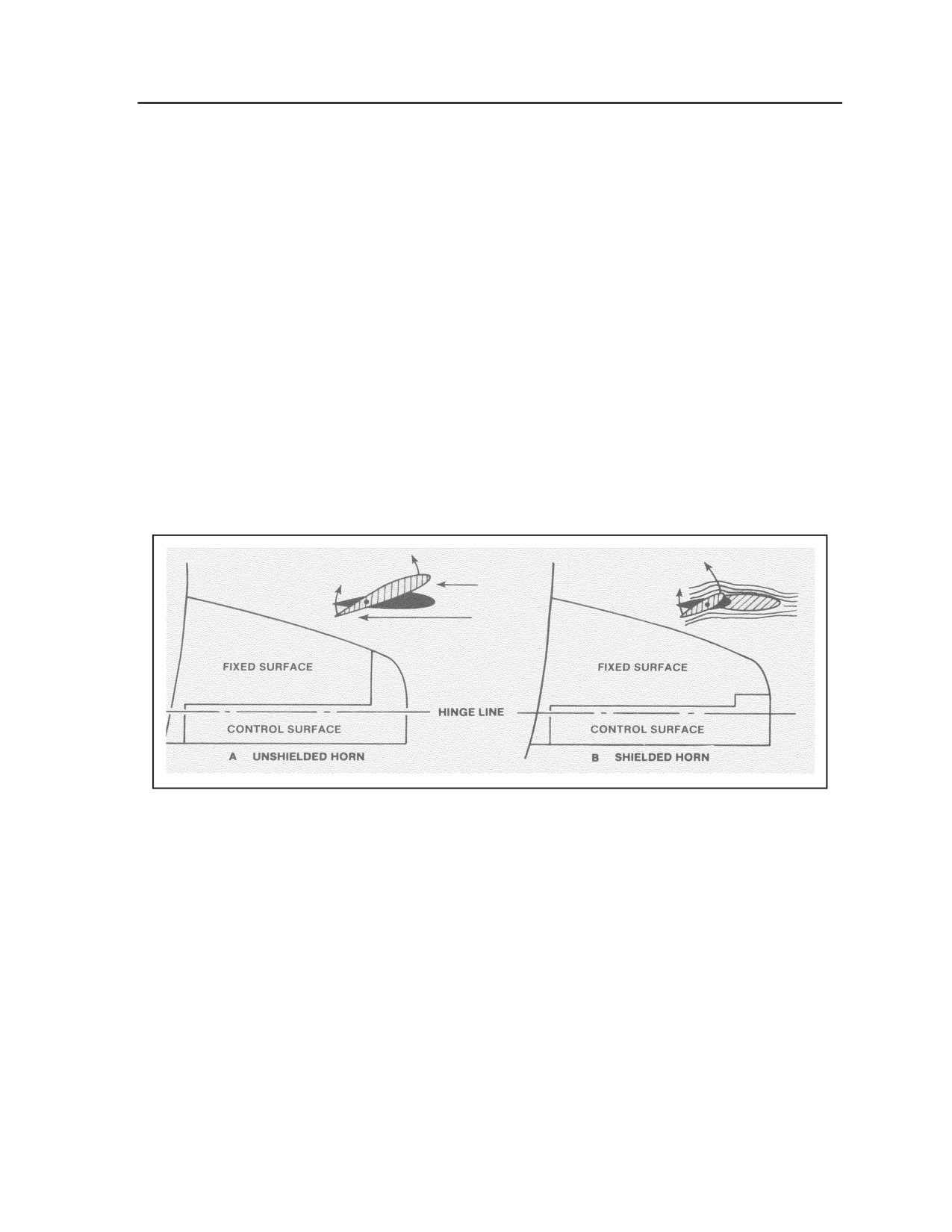
7-238. The horn is one the first types of aerodynamic balancing developed. It is an area located ahead of
the hinge line. This area creates a moment that opposes the hinge moment developed by the control surface
area behind the hinge. The moment developed by the horn is in the same direction as the moment
developed by the aviator and aids in displacing the control surface. It decreases the hinge moment the
aviator must overcome. The horn can either be exposed (unshielded) or hidden (shielded), depending on
the control surface design requirements (figure 7-53 parts A and B). An unshielded horn is normally more
effective than the shielded horn; however, it is seldom used in modern high-performance aircraft due to
drag considerations.
Figure 7-53. Aerodynamic balancing using horns
Balance Board
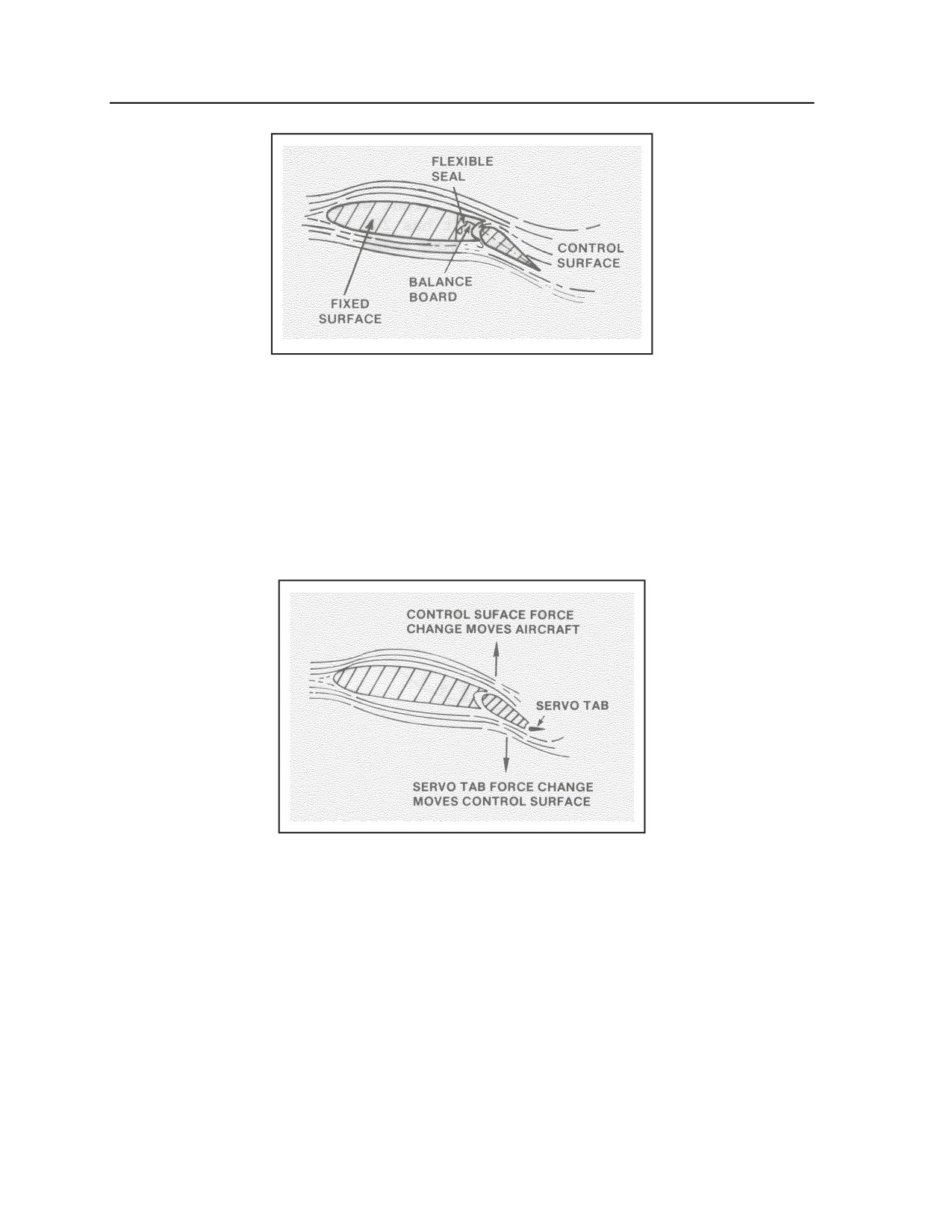
7-239. Another type of aerodynamic balance is internal balance. With internal balance, a balance board is
contained in the fixed portion of the airfoil ahead of the control surface (figure 7-54, page 7-56). A flexible
seal separates the balance panel from the wall of the plenum chamber where the balance board is located.
Thus, the plenum chamber is divided into two compartments. A slot is located between the control surface
and fixed portion of the airfoil. When the control surface is deflected, as shown, the increased velocity
caused by the increased camber over the top slot develops a lower static pressure in the compartment at the
top of the plenum chamber rather than in the lower compartment. A pressure differential develops across
the balance panel moving the panel upward. This assists in deflecting the control surface downward. The
decreased pressure over the slot on the top of the airfoil decreases static pressure, which then decreases the
hinge moments of the control surface. Therefore, this becomes a form of aerodynamic balancing.
7 May 2007
FM 3-04.203
7-55
Chapter 7
Figure 7-54. Aerodynamic balancing using a balance board
Servo Tabs
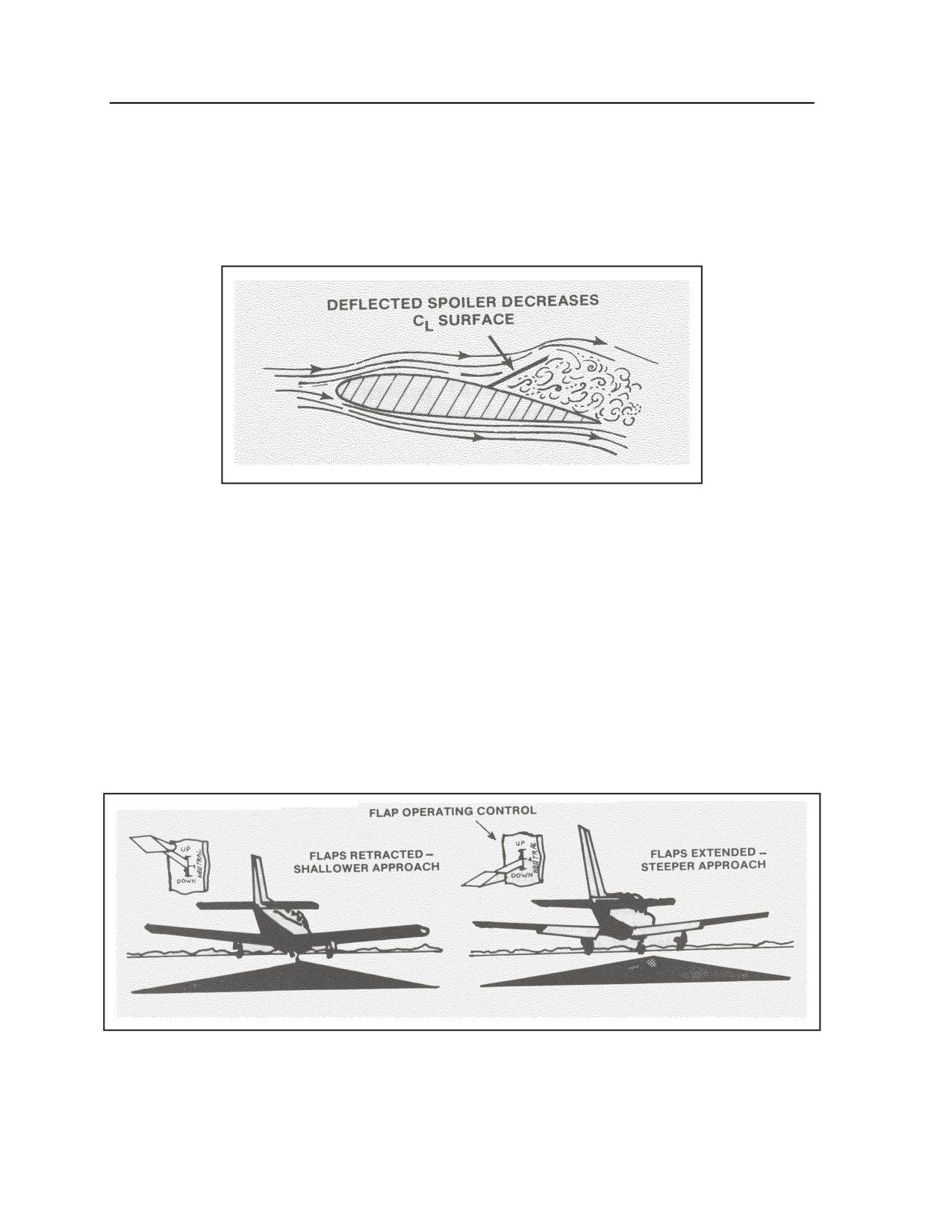
7-240. Servo tabs can be considered flaps on flaps (figure 7-55). When it is deflected, the servo tab
produces a small aerodynamic force behind the control surface hinge. This small force deflects the control
surface, which then moves the aircraft. The servo tab itself does not move the aircraft; it only moves the
control surface. The control force required to move a small tab is much less than the force required to move
the entire control surface. Servo tabs enable the aviator to use the aerodynamic qualities of the airstream to
reduce hinge moments. Jet airliners have servo tabs on many control surfaces.
Figure 7-55. Aerodynamic balancing using a servo tab
Balance Tabs
7-241. Another device used to assist with control forces is the balance tab. This small flap is similar to the
servo tab shown in figure 7-55. The balance tab moves in the opposite direction of the control flap. If the
elevator moves up, the balance tab automatically moves down due to the linkage mechanism controlling its
movement. This downward movement produces a moment that assists the movement of the control surface.
Sometimes these systems incorporate springs in the linkage, referred to as spring tabs.
Trim Tabs
7-242. Trim tabs are identical in appearance and operation to servo tabs. Trim tabs are connected to trim
controls in the cockpit. They are used to trim the aircraft for different weights, airspeeds, and power
7-56
FM 3-04.203
7 May 2007
Fixed-Wing Aerodynamics and Performance
conditions (for example, when an aircraft has 200 pounds more fuel in one wing than in the other). For the
aircraft to remain wings level, the lift force on the heavier wing must be increased to hold up the added
weight. This is accomplished by deflecting the ailerons, which requires the aviator to hold the ailerons in
that position. To decrease the aviator’s workload, trim tabs can be deflected to hold the ailerons.
MASS BALANCING
7-243. Mass balancing of the control surface is important in making the aircraft dynamically stable. If the
CG of the elevator is behind the hinge line, a sudden gust of wind moving the aircraft’s tail upward causes
the elevator to be deflected downward. This downward elevator movement increases tail lift, thereby
increasing the upward movement of the tail. If, however, the CG of the elevator is ahead of the hinge line,
the pitch-up caused by the air gust deflects the elevator upward, which dampens the upward motion by
developing a negative tail lift.
CONTROL SYSTEMS
7-244. Only a few of the various control systems and components are discussed in this section. However,
all fall under the categories of conventional, power-boosted, stability-augmenter, full power, flap, or
landing gear.
CONVENTIONAL
7-245. The control system discussed in this section is the conventional, mechanical, and reversible control
system. Conventional refers to the type of control system employing a rudder, aileron, and elevator.
Mechanical refers to the method used in the control system to deflect control surfaces such as cables,
pushrods, and bell cranks. Reversible means the control system has feedback. When the aviator moves the
stick/wheel, the surface moves; when the surface moves, the stick/wheel moves. The aviator must feel air-
loads on control surfaces; it eliminates the aviator’s tendency to over control the aircraft, which can
produce overstress.
POWER BOOSTED
7-246. As aircraft continue to be designed for travel faster, air loads or hinge moments created on control
surfaces become so large, aerodynamic balancing is not effective without creating large increases in drag.
Therefore, a new form of control system called the power-boosted conventional, reversible control system
was developed. This system is similar to power steering. The aviator supplies part of the control force
through a mechanical linkage with the control surface. However, a power system in parallel also supplies
part of the force to overcome hinge moments. Usually, a power boosted system is about a 20:1 or 30:1
ratio. If the aviator puts 1 pound of force in the control system, the power system supplies 20 or 30 pounds
of force. Normally, the power system is hydraulic, but pneumatic and electrical devices have been used.
This type of system is reversible, and the aviator can still feel air loads through the mechanical system. If
the power system fails, the aviator controls the aircraft through the mechanical system; however needed
control force is greatly increased.
STABILITY AUGMENTER
7-247. When disturbed from equilibrium, an aircraft exhibiting positive static stability naturally oscillates
due to the moment of inertia caused by the disturbance. A damping force causes the oscillation to be
convergent to equilibrium. In some cases, the aircraft’s aerodynamic damping is insufficient to reestablish
equilibrium in the desired time. If so, an artificial means of damping must be used. The stability augmenter
system is an auxiliary system designed explicitly for this purpose. Pitch and yaw augmenters are common
on high performance aircraft. Damping forces are overridden when controls for maneuvering are used, and
roll augmenters are normally unnecessary. Most Army aircraft utilize a yaw damper for the yaw axis.
7 May 2007
FM 3-04.203
7-57
Chapter 7
FULL POWER
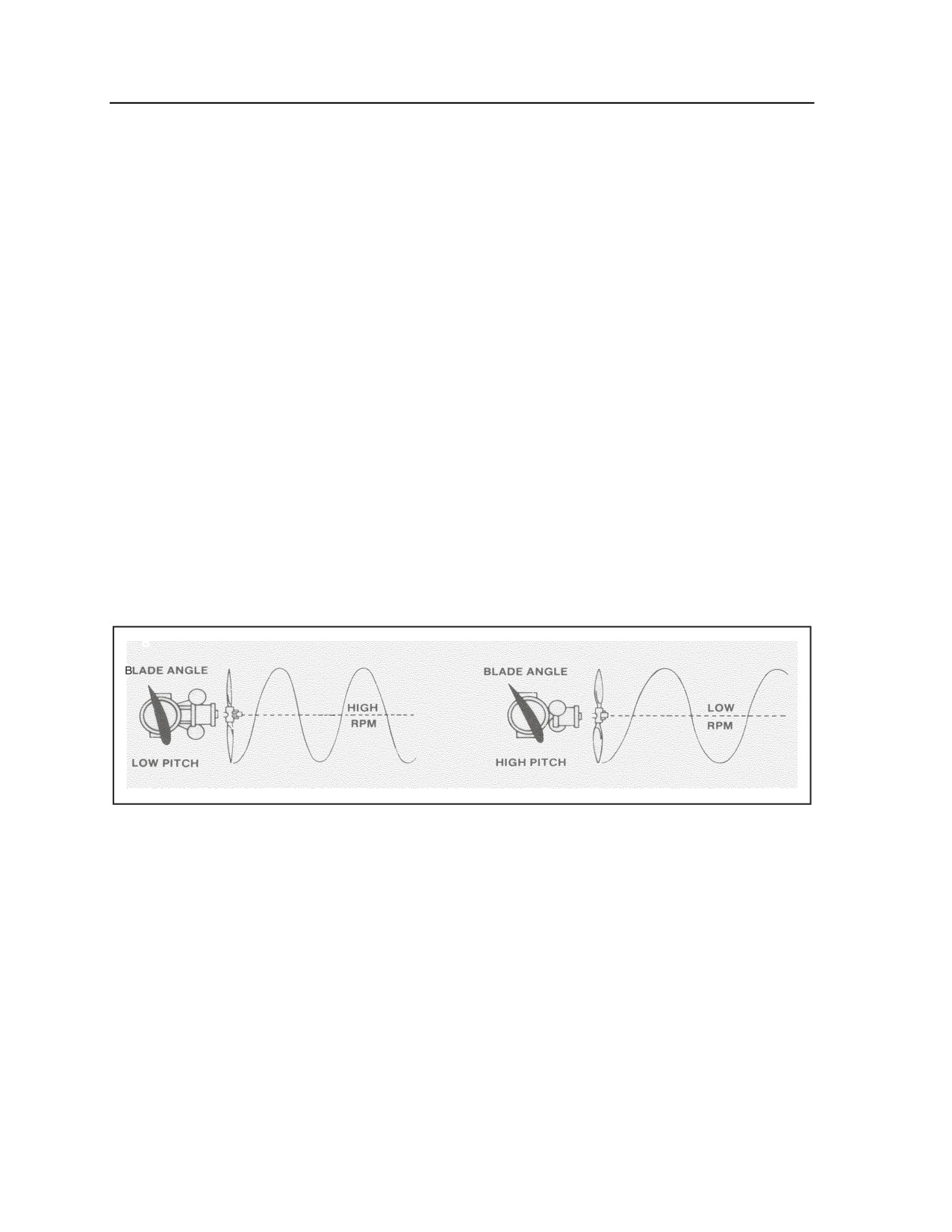
7-248. A full-power control system is used on supersonic aircraft when the requirement is to deflect large
surfaces against extremely high dynamic pressures. This type of system is not necessarily conventional; it
can use spoilers rather than ailerons and slab tails instead of elevators or rudders. A control surface of this
type is much more effective at supersonic velocities than is a flap control surface (figure 7-56). This system
is not employed on Army aircraft.
Figure 7-56. Spoiler used as control surface
FLAP
7-249. The wing flap is a movable panel on the inboard trailing edge of the wing. The flap is hinged so it
can be extended downward into the airflow beneath the wing to increase lift and drag. The wing flap
permits a slower airspeed and steeper descent angle during a landing approach. In some cases, wing flaps
are also used to shorten takeoff distance.
7-250. The flap operating control may be an electrical or hydraulic control on the instrument panel or a
lever located on the floor or pedestal of the aircraft. The control can be placed in the up position, which
raises the flaps if they are in an extended position; neutral position, which allows the flaps to remain in an
intermediate position; and down position, which lowers the flaps if they are in the retracted or intermediate
position (figure 7-57). In addition to the flap operating control, an indicator usually shows the actual
position of the flaps. On most Army aircraft, the maximum extent of flap travel is about 43 to 45 degrees.
Figure 7-57. Wing flap control
7-58
FM 3-04.203
7 May 2007
Fixed-Wing Aerodynamics and Performance
7-251. Performance of an aircraft is noticeably affected by extending and retracting the flaps. For an
aircraft with a constant power setting in level flight, airspeed is lower with flaps extended because of the
drag created. If power is adjusted to maintain a constant airspeed in level flight, the aircraft’s pitch attitude
is usually lower with flaps extended.
7-252. When flaps are extended, airspeed must be at or below the aircraft’s maximum flap-extended
speed (VFE). If flaps are extended above this airspeed, the force exerted by the airflow can damage them. If
airspeed limitations are exceeded unintentionally with flaps extended, they must be retracted immediately,
regardless of airspeed.
7-253. On the instrument panel, flap control often has the shape of an airfoil. It must be correctly
identified before flaps are raised or lowered. This prevents inadvertently operating the landing-gear control
and retracting the gear instead of the flaps, particularly when the aircraft is on or near the ground.
LANDING GEAR
7-254. Most all Army aircraft have a retractable landing-gear control. Since the landing gear’s only
purpose is to support the aircraft on the ground, it becomes excess weight and drag during flight. Although
the weight of the gear cannot be reduced during flight, the landing gear can be retracted into the aircraft
structure and out of the airflow. This eliminates unnecessary drag.
7-255. The control for operating the landing gear is a switch or lever, often in the shape of a wheel, which
differentiates it from the flap control on the instrument panel. When this control is moved to the down
position, the gear extends; when moved to the up position, the gear retracts. In addition to the operating
control, an indicator or warning light on the instrument panel shows the landing gear’s present position.
7-256. The landing gear should be operated only when the airspeed is at or below the aircraft’s maximum
landing-gear operating speed (VLO); operation at a higher airspeed can damage the operating mechanism.
When the gear is down and locked, the aircraft should not be operated above the aircraft’s maximum
landing-gear extended speed (VLE).
7-257. The landing gear control must be correctly identified before it is raised or lowered. This prevents
inadvertently operating the flap control and retracting the flaps instead of the landing gear.
PROPELLERS
OPERATION
7-258. An aircraft propeller converts the power plant shaft horsepower into propulsive horsepower. It
provides thrust to propel the aircraft through the air. The propeller consists of two or more blades and the
central hub to which the blades are attached. Each propeller blade is an airfoil; therefore, the propeller is a
rotating wing.
7-259. The engine furnishes the power to rotate the propeller blades. On high-horsepower turbine
engines, the propeller shaft is usually geared to the engine power turbine shaft. The engine rotates the
airfoils of the blades through the air at a relatively high velocity. The propeller then transforms the engine’s
rotary power into thrust.
7-260. Many different factors govern the efficiency of a propeller. Generally, a large-diameter propeller
favors a high-propeller efficiency from the standpoint of a large mass flow. However, compressibility
affects propeller efficiency, while high-tip speeds adversely affect it. Small diameter propellers favor low-
tip speeds. The propeller and power plant must be matched for compatibility of both output and operating
efficiency.
7 May 2007
FM 3-04.203
7-59
Chapter 7
TYPES OF PROPELLERS
Fixed Pitch
7-261. A fixed-pitch propeller has blade pitch (blade angle) built into the propeller. Thus, the pitch angle
cannot be changed by the aviator as it can be on controllable-pitch propellers. Generally, the fixed-pitch
propeller is constructed of aluminum alloy.
7-262. Fixed-pitch propellers are designed for best efficiency at one rotational and forward speed. They
fit a specific set of conditions involving both engine rotational speed and forward speed of the aircraft. Any
change reduces the efficiency of the propeller and engine.
Constant Speed
7-263. In automatically controllable-pitch propeller systems, a control device adjusts the blade angle to
maintain a specific preset engine RPM without the aviator’s constant attention. If engine RPM increases as
a result of a decreased load on the engine, the system automatically increases the propeller’s blade angle.
This increases the air load until RPMs return to a preset speed. An automatic control system responds to
such small variations in RPM that a constant RPM is usually maintained. These automatic propellers are
termed constant-speed propellers.
7-264. An automatic system has a governor unit controlling the blade pitch angle so engine speed remains
constant. With cockpit controls, the aviator regulates the propeller governor. Thus, the desired blade angle
setting
(within its limits) and engine operating RPM can be obtained. This increases the aircraft’s
operational efficiency in various flight conditions. A low-pitch, high-RPM setting obtains maximum power
for takeoff. After the aircraft becomes airborne, a higher pitch and lower RPM setting provide adequate
thrust for maintaining proper airspeed (figure 7-58). This can be compared to using low gear in a vehicle to
accelerate until high speed is attained and then shifting into high gear for cruising speed.
Figure 7-58. Blade angle affected by revolutions per minute
PROPELLER FEATHERING
7-265. If a power plant malfunctions or fails on an aircraft with two or more engines, propeller blades
must be streamlined to reduce drag. Flight can then continue on remaining operating engines. This is
accomplished by feathering propeller blades, which stops rotation and reduces drag on the inoperative
engine. When the propeller blade angle is in a feathered position, parasite drag is at a minimum. On most
multiengine aircraft, the added parasite drag from a single feathered propeller adds relatively little to total
drag.
7-266. At smaller blade angles near flat-pitch position, the propeller windmilling at a high RPM adds a
large amount of drag to the aircraft and may cause the aircraft to become uncontrollable. The propeller
windmilling at high speed in the low range of blade angles can produce an increase in parasite drag as great
as the parasite drag felt on the rest of the aircraft. An indication of this drag is best shown by an
autorotating helicopter. A windmilling rotor can produce autorotation rates of descent approaching that of a
7-60
FM 3-04.203
7 May 2007
Fixed-Wing Aerodynamics and Performance
parachute canopy with identical disk-area loading. The propeller windmilling at a high speed and small
blade angle produces an effective drag coefficient of the disk area that compares to a parachute canopy of
the same size. The drag and yawing moments caused by loss of power at high airspeeds are considerable,
and the transient yawing displacement of the aircraft may produce critical loads on the vertical tail. For this
reason, automatic feathering may be a necessity rather than a luxury.
REVERSE THRUST
7-267. The large amount of drag produced by a rotating propeller can improve the aircraft’s stopping
performance. Propeller blade rotation to small positive or even negative attack angle values with applied
power produces a large amount of drag or reverse thrust. Due to the propeller’s high thrust capability at
low speeds, reverse thrust alone produces high deceleration.
LIMITATIONS
7-268. Operating limitations of the propeller are closely associated with those of the power plant. Due to
the large centrifugal loads and blade twisting moments produced by an excessive rotative speed, overspeed
conditions are critical. In addition, propeller blades have various vibratory modes. Certain operating
limitations may be necessary to prevent resonance.
SECTION VII - MULTIENGINE OPERATIONS
7-269. Several types and models of twin-engine aircraft are used in performing Army training and
operational missions. Primarily, this chapter explains the most prominent flight characteristics of twin-
engine, FW aircraft. The appropriate aircraft operator’s manual should be consulted for FW, multiengine
operations.
TWIN-ENGINE AIRCRAFT PERFORMANCE
7-270. The term twin-engine is used to define Army propeller-driven aircraft having a maximum certified
gross weight of more than 12,500 pounds and one engine mounted on each wing. The basic difference
between a twin-engine and single-engine aircraft is the potential failure of one of the twin engines.
PERFORMANCE AND OPERATING SPEEDS
7-271. Certain aircraft performance operating limitations are based on airspeed. These airspeeds are
called V speeds, (a listing of V speeds is found in the glossary). In addition to performance and operating
speeds common to single-engine and twin-engine aircraft, the multiengine aircraft aviator must become
familiar with some additional V speeds, defined in the following paragraphs.
Velocity Minimum Control
7-272. Velocity minimum control (VMC) is the minimum airspeed an aircraft is able to be controlled when
the critical engine suddenly becomes inoperative and the remaining engine must produce takeoff power.
The Federal Aviation Regulation (FAR) (under which the aircraft was certified) states at velocity minimum
control, the certificating test pilot must be able to stop the turn that results when the critical engine
suddenly becomes inoperative. Using maximum rudder deflection and no more than a 5-degree bank into
the operative engine, the test pilot must stop the turn within 20 degrees of the original heading. The FAR
also states that after recovery, the certificating test pilot must maintain the aircraft in straight flight with not
more than a 5-degree bank (wing lowered toward the operating engine). This means the aircraft must
maintain a heading, not that it must be able to climb or hold altitude. The principle displayed here is that at
airspeeds less than velocity minimum control, air flowing along the rudder is such that application of the
rudder cannot overcome the combined effects of asymmetrical yawing caused by takeoff power on one
engine and a powerless windmilling propeller on the other engine.
7 May 2007
FM 3-04.203
7-61
Chapter 7
Maximum (Best) Angle of Climb Velocity and Maximum (Best) Single-Engine Angle of Climb
Velocity
7-273. VX is the speed providing the best angle of climb. At this speed, the aircraft gains the greatest
height for a given distance. VX is used for obstacle clearance when all engines are operating. However,
when one engine is inoperative, VX is referred to as best single-engine angle of climb velocity (VXSE).
Maximum (Best) Rate of Climb Velocity and Maximum (Best) Single-Engine Rate of Climb
Velocity
7-274. VY is the speed providing the best rate of climb. This speed provides the maximum altitude gain
for a given period when all engines are operating. When one engine is inoperative, VY is referred to as best
single-engine rate-of-climb velocity (VYSE).
SINGLE-ENGINE OPERATION
7-275. Many aviators erroneously believe a twin-engine aircraft will continue to perform at least half as
well when only one of its engines is operating. Part 23 of the FAR that governs the certification of twin-
engine aircraft does not require that aircraft maintain altitude while in the takeoff configuration with one
engine inoperative. In fact, some civilian light twin-engine aircraft are not required to maintain altitude
with one engine inoperative in any configuration, even at sea level.
CLIMB PERFORMANCE
7-276. When one of the twin engines fails, aircraft performance is reduced by 80 percent or more. The
loss of performance is more than 50 percent because the aircraft’s climb performance is a function of thrust
horsepower, which is available power in excess of that required for level flight. When more power is added
to the engines than needed for straight and level flight, the aircraft climbs. The rate of climb depends on the
amount of excess power added, which is power above that required for level flight. When one engine fails,
power is lost and drag increased due to asymmetric thrust. The operating engine must carry the full burden
by producing 75 percent or more of its rated power. This leaves the engine with very little excess power for
climb performance. When one of its engines fails, an aircraft with an all engine climb rate of 1,860 FPM
and a single-engine climb rate of 190 FPM loses almost 90 percent of its climb performance. During
straight and level flight, the twin offers obvious safety advantages over the single-engine aircraft.
However, the aviator must know the options offered by the second engine in the takeoff and approach
phases of flight.
ASYMMETRIC THRUST
7-277. The asymmetric thrust, or unequal engine thrust, in multiengine aircraft is the principal flight
characteristic that must be counteracted. To achieve the desired stability during power changes,
manufacturers position most single-engine aircraft engines so the thrust line passes through or near the CG.
In conventional twin-engine aircraft, only the resultant thrust of both engines provides this stability. When
both engines are not operating at equal power, asymmetric thrust results and causes movement about the
vertical axis or yaw. The rudder is used to prevent this movement. If yaw occurs, the aircraft may also roll
or bank. To regain level flight, the aviator must apply both the rudder and aileron.
CRITICAL ENGINE
PROPELLER FACTOR
7-278. P-factor, or asymmetric propeller thrust, is present in twin aircraft just as in single-engine aircraft.
It is caused by dissimilar thrust of the rotating propeller blades during certain flight conditions. The P-
factor occurs when relative wind striking the blades is not aligned with the thrust line, as it is with a nose
7-62
FM 3-04.203
7 May 2007
Fixed-Wing Aerodynamics and Performance
high attitude. Therefore, the downward-moving blade has a greater attack angle than the upward moving
blade.
PROPELLER THRUST
7-279. In Army twin-engine aircraft, both engines rotate clockwise when viewed from the rear and both
engines develop equal thrust. With a positive attack angle, low airspeed, and high-power conditions, the
downward-moving propeller blade of each engine develops more thrust than the upward-moving blade. In
part, this explains why conventional FW aircraft pull to the left on takeoff. The center of thrust of the
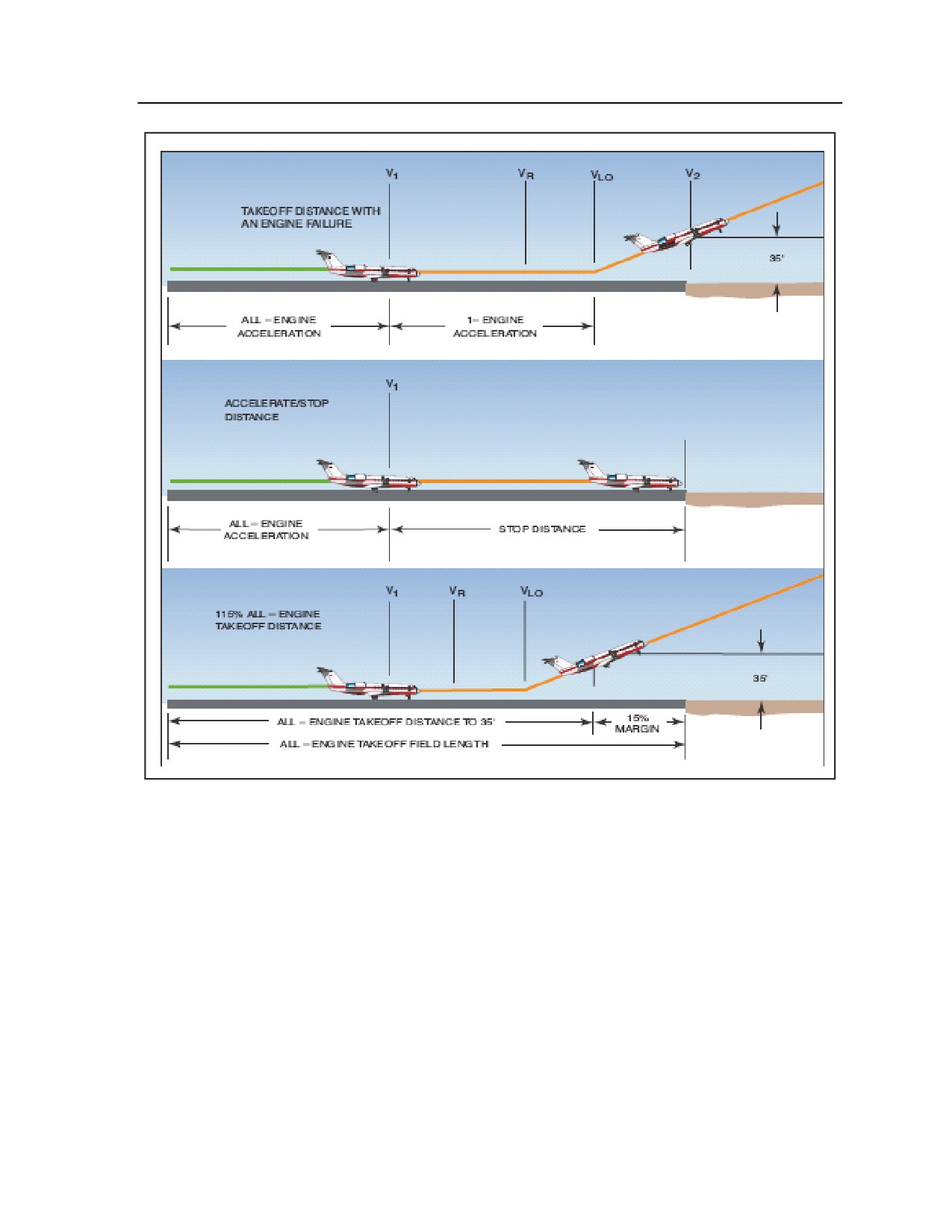
propeller disk shifts to one side when the thrust line is tilted upward.
ENGINE YAWING THRUST
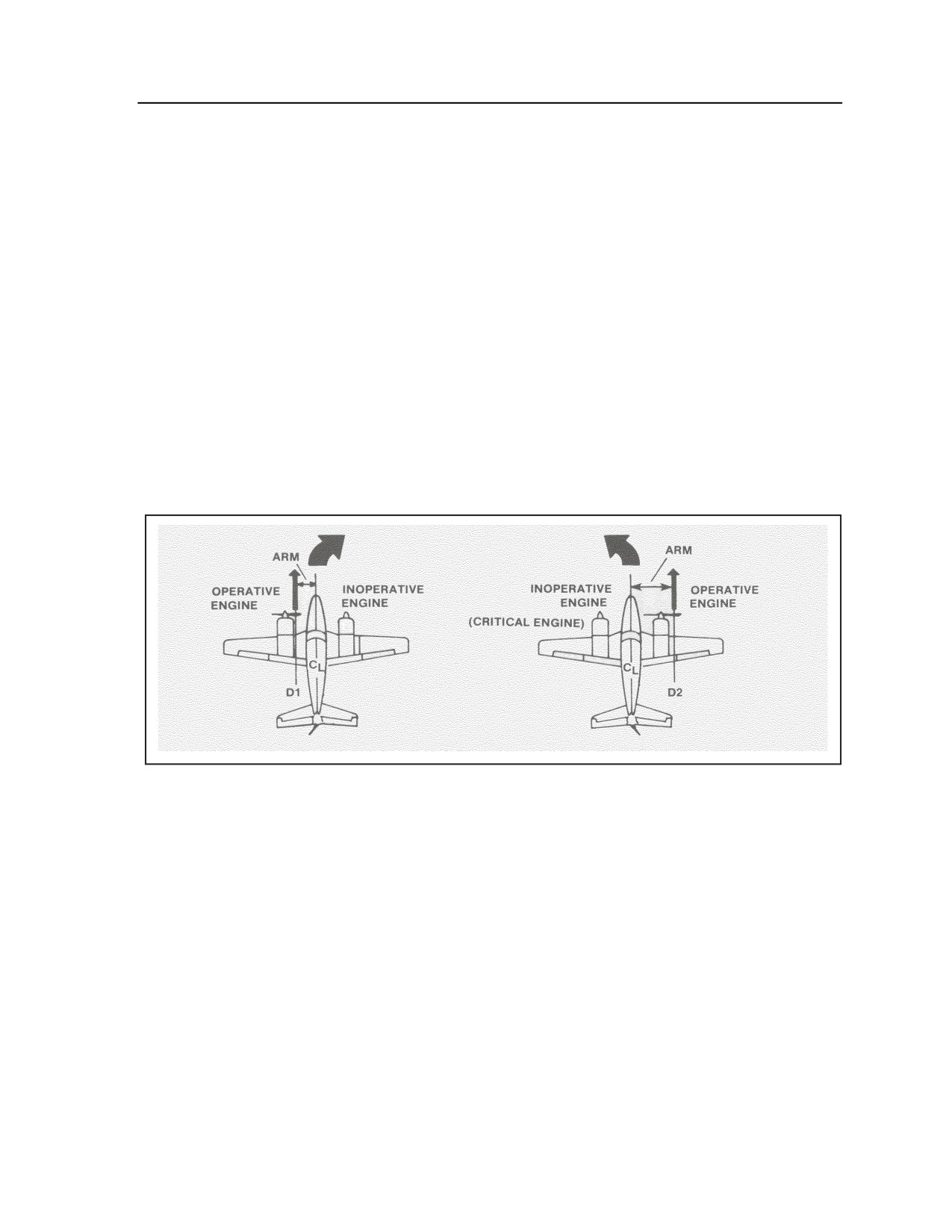
7-280. As indicated by lines D1 and D2 in figure 7-59 the P-factor results in a center of thrust at the right
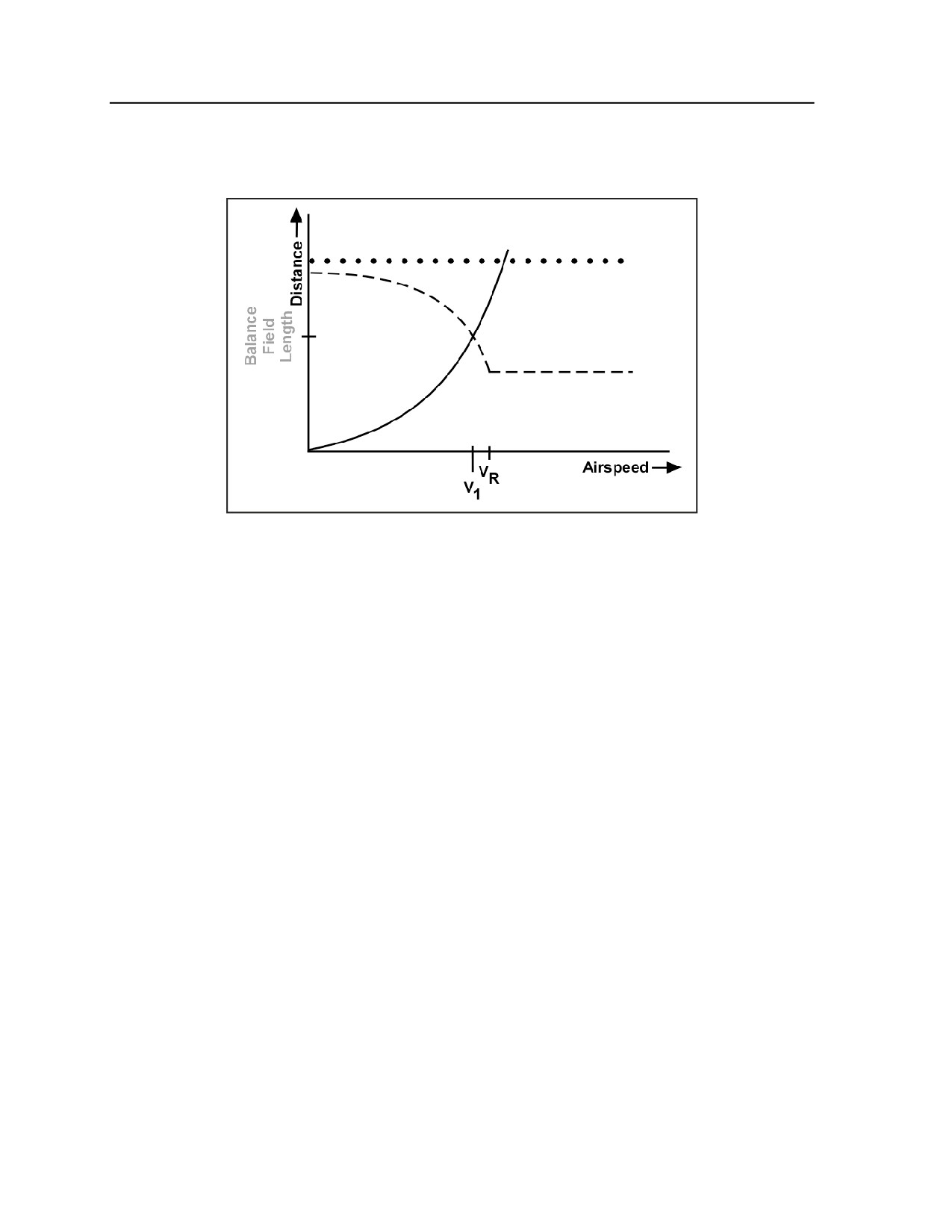
side of each engine. The yawing force of the right engine is greater than that of the left engine. As
indicated by line D2, the center of thrust of the right engine has a longer lever arm and is farther away from
the centerline of the fuselage. Therefore, when the right engine is operative and the left engine is
inoperative, the yawing force is greater than it is when the left engine is operative and the right engine is
inoperative. In an engine-out situation, the greatest demand on the rudder is made when the operative
engine is the one on which the downward-moving blade is farther from the fuselage (the right engine).
Therefore, the left engine is the critical engine; its loss presents the greatest controllability problem.
Figure 7-59. Forces created during single-engine operation
MINIMUM SINGLE-ENGINE CONTROL SPEED
ASYMMETRIC THRUST CONTROL
7-281. Maximum asymmetric thrust is created when the critical engine, usually the left engine on Army
aircraft, is inoperative and the other engine is operating at takeoff power. If adequate airspeed is
maintained, yaw can be prevented by applying rudder. Below this airspeed, directional control can only be
maintained by reducing power. Each aircraft’s critical airspeed is identified as VMC. When the critical
engine is rendered inoperative and the aircraft is in the most unfavorable flight configuration, VMC ensures
the aviator can stop the turn and maintain the new heading. VMC applies only to control of asymmetric
thrust; it does not ensure altitude can be maintained or a climb can be accomplished. To achieve as low a
VMC as possible, a 5-degree bank is always used in flight testing. To determine VMC, the test pilot arrives at
an airspeed low enough so that when an engine is cut an immediate bank into the operative engine is
required. Full rudder deflection and the 5-degree bank provide the necessary control to keep the aircraft
7 May 2007
FM 3-04.203
7-63
Chapter 7
from turning more than 20 degrees into the dead engine. Aviators should refer to the appropriate ATM to
practice flight at VMC.
VELOCITY AT MINIMUM CONTROL CERTIFICATION
7-282. The following configuration is required to obtaining a manufacturer’s VMC certification:
Landing gear retracted.
Aircraft trimmed for takeoff.
Flaps set to takeoff position.
Takeoff or maximum available power attainable.
Rearmost allowable CG exists.
Maximum sea level takeoff weight maintained.
Cowl flaps on piston-engine aircraft are in the position normally used for takeoff.
Propeller windmilling or feathered if aircraft has an autofeather system on the inoperative
engine and full power exists on the other engine.
In addition, rudder control force required to maintain control must not exceed 150 pounds.
BANK ANGLE
7-283. If the aircraft’s wings are in a position less than a 5-degree bank angle, VMC is substantially higher
than the value shown in the flight manual. On most Army twin-engine aircraft, the difference in VMC
between the 5-degree bank condition and wings-level condition may be as high as 15 knots. The complex
reasons for this large increase in VMC with varying bank angles are discussed below.
7-284. The effect of bank reduces the amount of rudder power required to overcome the asymmetric
thrust condition. As the wings are brought to a level position, more rudder is necessary. At a given rudder
deflection, or rudder-pedal force, a higher airspeed is required. Although this characteristic applies to all
twin-engine aircraft, it is accentuated in the latest designs due to the amount of power or TA for takeoff. In
addition, the thrust lines of the engines are located farther out on the wingspan, which increases the turning
moment caused by the unbalanced thrust condition.
7-285. To achieve the best performance when an engine fails during takeoff, climb, or any other flight
condition when high power is required, the aviator must keep the aircraft in a 5-degree bank attitude with
the inoperative engine on the high side. The normal takeoff procedure ensures the airspeed will be above
VMC when the most critical engine is inoperative. However, this is true only if the 5-degree bank angle is
maintained.
CONTROL PROBLEMS
7-286. The following paragraphs discuss control problems associated with engine failure. Aviators must
be aware of these problems and learn proper procedures to correct them.
7-287. When an engine stops, many aviators instinctively try to center the ball, not understanding how a
twin functions with asymmetric thrust.
7-288. Drag normally acts around a point along the centerline of the aircraft fuselage. When the propeller
is windmilling or feathered, the center of drag moves toward the dead engine. The operative engine exerts
its pull along a line several feet to the side of the center of drag. This causes the aircraft to rotate toward the
inoperative engine. The aviator can prevent this rotation in one of two ways—
The aviator can cut the power on the operative engine and quickly regain control of the aircraft
as it is in a symmetrical power-off glide. Unless the aircraft is about to be out of control, this is
not a desirable option immediately following takeoff or during low-altitude flight.
The aviator uses as much power from the operative engine as possible to maintain a safe single-
engine flying speed. This requires stopping the rotational movement with the rudder, causing the
7-64
FM 3-04.203
7 May 2007
Fixed-Wing Aerodynamics and Performance
aircraft to skid toward the inoperative engine. To correct the skid, the aviator must bank into the
good engine to maintain the longitudinal axis parallel to the relative wind.
7-289. A variety of rudder and aileron combinations can be used to maintain heading. Most aviators try to
center the ball in a wings-level attitude by raising the aileron on the aircraft’s operative engine side. This
compensates for additional lift produced by the propeller slipstream passing over that wing. When it is
viewed from outside the aircraft, however, the fuselage is not aligned with the direction of flight or relative
wind; it is yawed toward the operative engine.
7-290. Many aviators believe during coordinated flight their aircraft flies straight through the air without
slipping or skidding. This may be true in a single-engine aircraft or a twin with equal power on both sides.
However, when one engine stops and power is off-center, this is not true.
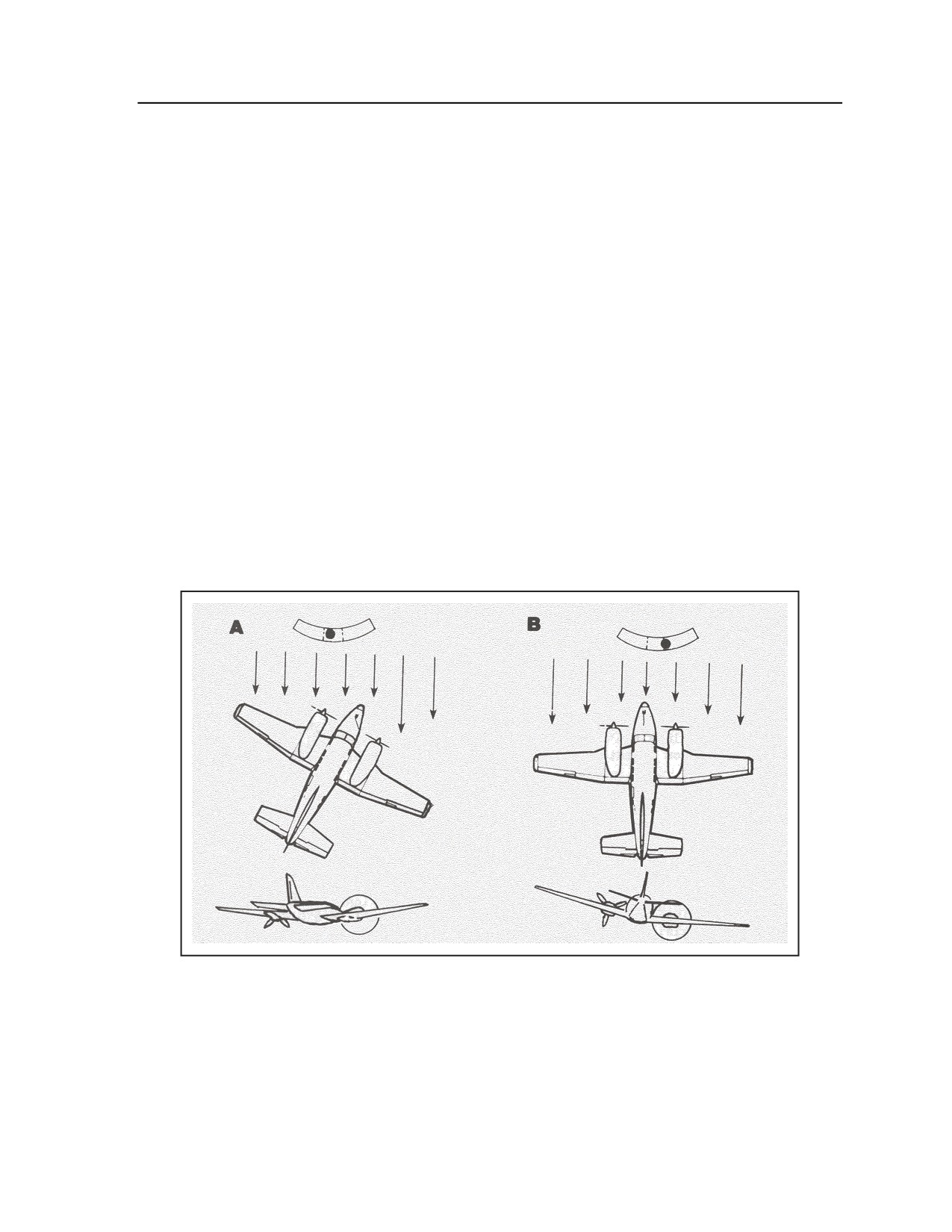
7-291. When the ball is precisely centered during wings-level coordinated flight, a twin-engine aircraft
with one engine out will fly with a large sideslip (figure 7-60 part A). If a piece of string were taped to the
aircraft’s nose or windshield, the string would lean toward the operative engine. Single-engine rate of
climb declines or disappears and VMC increases.
7-292. When manufacturers run a performance test, they use precise sideslip indicating instruments to
assure zero sideslip and maximum performance. Without these instruments, the aviator has no way of
knowing the sideslip angle. Most aviators mistakenly assume zero sideslip occurs when the wings are level
and ball is centered.
7-293. Zero sideslip occurs in most twins when the aircraft is banked about 3 to 5 degrees into the
operative engine (figure 7-60 part B). Although it is disturbing to many aviators, the ball will be off-center
toward the good engine. A yaw string shows, however, airflow is straight along the nose, which is the
proper airflow for minimum drag and maximum performance.
Figure 7-60. Sideslip
7 May 2007
FM 3-04.203
7-65
Chapter 7
SINGLE-ENGINE CLIMBS
CLIMB SPEEDS
7-294. Climbs are made with reserve or excess power. Reserve power is the power available not required
to maintain level flight. With one engine shut down, a twin-engine aircraft will not have an abundance of
reserve power under the most favorable circumstances. If there are any changes in the best rate speed and
angle-of-climb speed which occur above or below the best single engine climb speed, then climb
performance can be rapidly decreased. The operator’s manual establishes the best angle and rate-of-climb
speeds.
DRAG REDUCTION
7-295. To provide adequate power for single-engine climbs, drag should be reduced to a minimum. Drag
can be reduced by retracting the landing gear, raising the flaps, and feathering the propeller of the
inoperative engine. Single-engine best rate-of-climb speed is the most efficient single engine operating, or
VYSE, speed. If altitude cannot be gained at this speed, more power must be obtained, or drag or weight
must be reduced.
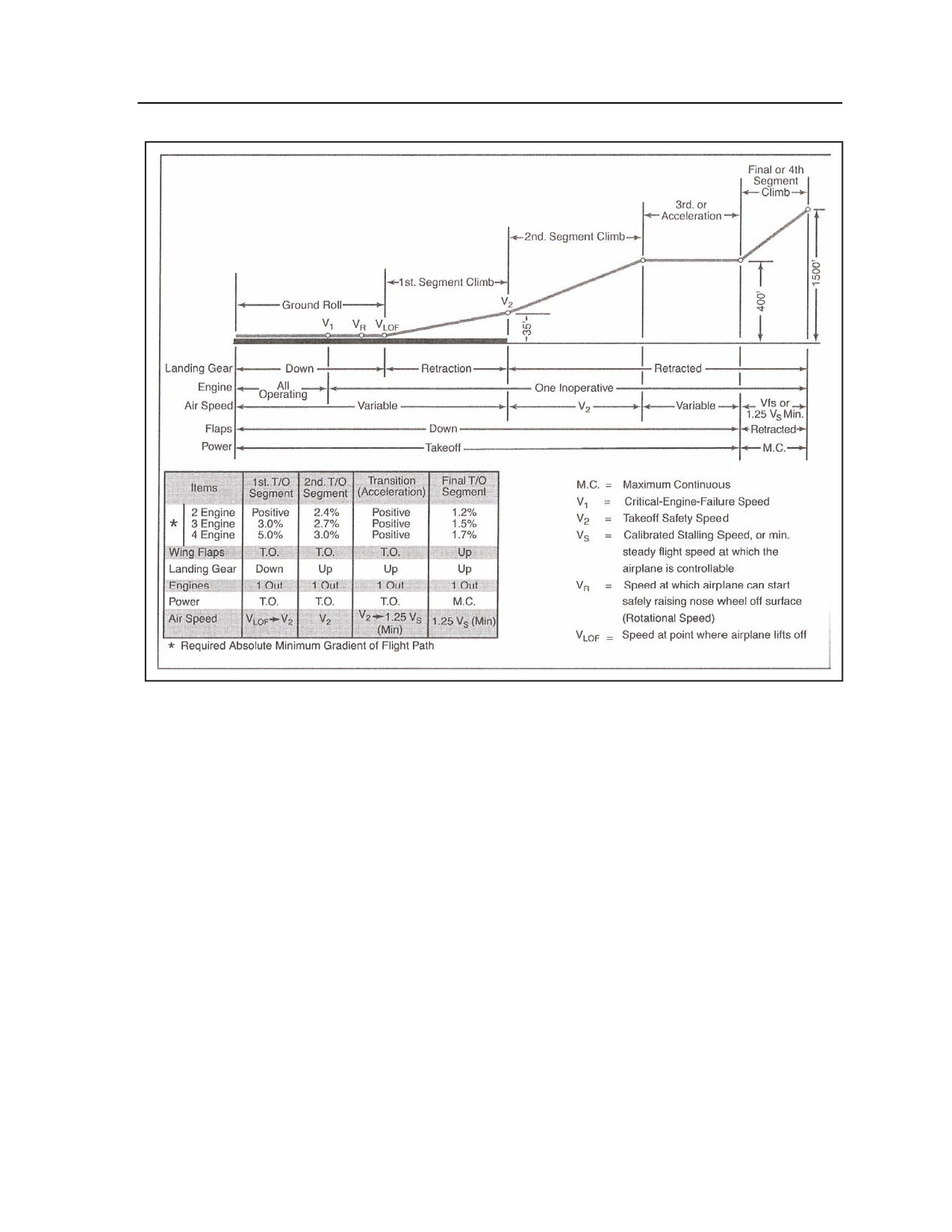
7-296. After the aircraft reaches the 35-foot height with one engine inoperative, it is required to climb at a
specified climb gradient, known as the takeoff flight path requirement. The aircraft’s performance must be
considered based on a one-engine inoperative climb up to 1,500 feet above the ground. The takeoff flight
path profile with required gradients of climb for various segments and configurations is shown in figure 7
61.
7-66
FM 3-04.203
7 May 2007
Fixed-Wing Aerodynamics and Performance
Figure 7-61. One-engine inoperative flight path
First Segment
7-297. This segment is included in takeoff runway required charts and measured from the point at which
the aircraft becomes airborne until it reaches the 35-foot height at the end of the runway distance required.
Speed initially is VLO and must be at takeoff safety speed (V2) at the 35-foot height.
Second Segment
7-298. This is the most critical segment of the profile. The second segment is the climb from the 35-foot
height to 400 feet AGL. The climb is done at full takeoff power on the operating engine(s), at V2 speed,
and with flaps in the takeoff configuration. The required climb gradient in this segment is 2.4 percent for
two-engine aircraft, 2.7 percent for three-engine aircraft, and 3.0 percent for four-engine aircraft.
Second Segment Climb Limitations
7-299. The second segment climb requirements, from 35 to 400 feet, are the most restrictive of the climb
segments. The aviator must determine the second segment climb is met for each takeoff. To achieve this
performance at higher density altitude conditions, it may be necessary to limit the aircraft’s takeoff weight.
7-300. Regardless of the actual available length of the takeoff runway, takeoff weight must be adjusted so
second segment climb requirements can be met. The aircraft may well be capable of lifting off with one
engine inoperative, but it must then be able to climb and clear obstacles. Although second segment climb
7 May 2007
FM 3-04.203
7-67
Chapter 7
may not present much of a problem at lower altitudes, at higher altitude airports and higher temperatures,
the second segment climb chart must be consulted to determine effects on maximum takeoff weights before
figuring takeoff runway distance required.
Third or Acceleration Segment
7-301. During this segment, the aircraft is considered to be maintaining 400 feet AGL and accelerating
from the V2 speed to velocity final segment (VFS) speed before the climb profile is continued. Flaps are
raised at the beginning of the acceleration segment and power is maintained at the takeoff setting as long as
possible (5 minutes maximum).
Fourth or Final Segment
7-302. This segment is from 400 to 1,500-foot AGL altitude with power set at maximum continuous. The
required climb in this segment is a gradient of 1.2 percent for two-engine aircraft, 1.55 for three-engine
aircraft, and 1.7 percent for four-engine aircraft.
SINGLE-ENGINE LEVEL FLIGHT
LEVEL FLIGHT
7-303. Maintaining level flight with one engine inoperative is possible only below the single-engine
absolute ceiling. This ceiling is based on standard atmosphere at sea-level conditions. The operating engine
must be at maximum continuous power, while the aircraft is at maximum gross weight. Gear and flaps are
up, and the inoperative propeller is feathered. In addition, the aircraft must be at a zero sideslip angle.
High-density altitude or failure of the propeller to feather reduces the ceiling. Airspeed is also a factor in
maintaining level flight; the best single-engine rate-of-climb speed provides maximum efficiency. The
operator’s manual contains power settings and ceilings for both normal and single-engine cruise flight.
POWER CHARTS
7-304. Power charts normally provide cruise information for aircraft operating at 45 to 75 percent power.
To supply the necessary power for continued flight, one engine may be required to operate above
recommended cruise range. The loss of one engine creates an emergency; therefore, flight should not be
continued beyond the nearest suitable airfield. Normally, trim controls relieve control pressures when the
aircraft is operating with a single engine. Some operator’s manuals recommend a bank of no more than 5
degrees toward the operating engine during straight flight. Bank reduces the amount of rudder required to
counter drag and asymmetric thrust and reduce sideslip. The degree of bank should be confined to
recommended amounts.
SINGLE-ENGINE DESCENTS
7-305. Usually, descent in aircraft powered by reciprocating engines is performed at a specified power
setting and airspeed. Correct power setting and airspeed help retain minimum engine operating temperature
and reduce plug fouling or engine loading. Aviators should avoid making descents at idle power for
prolonged periods. One inch of manifold pressure for each 100 RPM is the general rule for descent power.
Due to the low power requirements involved, en route descents with one engine inoperative are not a
problem. However, descent for landing is more involved and requires caution. The engine power charts in
the operator’s manual contain more specific information.
SINGLE-ENGINE APPROACH AND LANDING
7-306. When both engines are operating normally, no special technique or skill is required to perform an
approach and landing. However, performing the approach and landing with one engine inoperative
demands more skill and judgment. When possible, normal patterns and speeds should be used for single
7-68
FM 3-04.203
7 May 2007
Fixed-Wing Aerodynamics and Performance
engine approaches. To preclude loss of directional control and provide for the best rate of climb, speeds
above VYSE should be maintained during an approach until landing is assured or during a go-around.
Approach and landing speeds vary according to aircraft configuration and type of approach. The operator’s
manual supplies this information.
PROPELLER FEATHERING
FAILED ENGINE
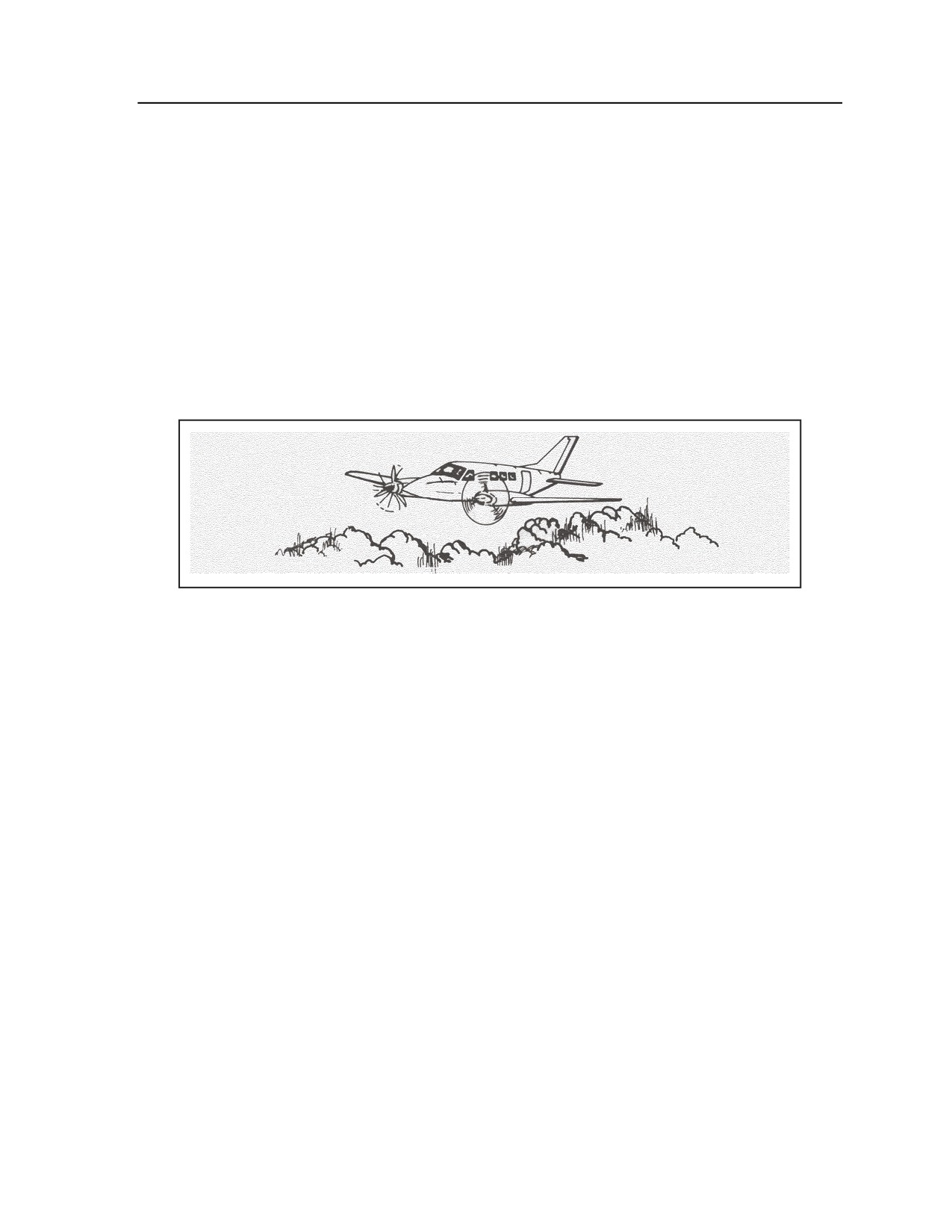
7-307. When an engine fails in flight, the aircraft’s movement through the air keeps the propeller rotating.
The failed engine no longer delivers power to the propeller, which produces thrust. Now the propeller is
absorbing energy to overcome friction and compression of the engine. The drag of the windmilling
propeller is significant. Drag of the windmilling propeller causes the aircraft to yaw toward the failed
engine (figure 7-62). To minimize the yawing tendency, all Army multiengine aircraft are equipped with
full-feathering propellers.
Figure 7-62. Windmilling propeller creating drag
PROPELLER FEATHERING
7-308. The aviator can position the blades of a feathering propeller to such a high angle they are
streamlined in the direction of flight. In this feathered position, blades are streamlined with the relative
wind and thus, stop turning. This significantly reduces drag on the aircraft. A feathered propeller creates
the least possible drag on the aircraft and reduces its yawing tendency. Therefore, multiengine aircraft are
easier to control in flight when the propeller of the inoperative engine is feathered. In addition, a feathered
propeller causes less damage to the engine. Feathering a propeller should be demonstrated and practiced in
all aircraft equipped with propellers that can be safely feathered and unfeathered during flight.
ACCELERATE-STOP DISTANCE
CRITICAL TIME
7-309. During the 2 or 3 seconds immediately following the takeoff roll, an aircraft accelerates to a safe
engine-failure speed. This is the most critical time for a twin-engine aircraft should an engine-out condition
occur. Army twin-engine aircraft are controllable at a speed close to engine-out minimum control speed.
However, their performance is often so far below optimum, continued flight following the takeoff may be
marginal or impossible. A more suitable and recommended speed, which some aircraft manufacturers call
minimum safe single-engine speed, is the speed at which altitude can be maintained while landing gear is
being retracted and propeller feathered.
ENGINE FAILURE AFTER CRITICAL TIME
7-310. When one engine on a twin-engine aircraft fails on takeoff after having reached the safe single-
engine speed, it loses about 80 percent of its normal power. The twin-engine aviator, however, has an
7 May 2007
FM 3-04.203
7-69
Chapter 7
advantage over the single engine aviator. If the twin-engine aircraft has single engine climb capability at
the existing gross weight and density altitude, the aviator can either stop or continue the takeoff. The single
engine aviator has only one choice; land the aircraft.
ENGINE FAILURE AFTER TAKEOFF SAFETY SPEED
7-311. If one engine fails before the aircraft reaches critical engine failure recognition speed (V1), the
aviator’s only choice is to close both throttles and bring the aircraft to a stop. If engine failure occurs after
the aircraft becomes airborne, the aviator must immediately decide whether to land or continue the takeoff.
If the aviator decides to continue the takeoff, the aircraft must be capable of gaining altitude with one
engine inoperative. If no obstacles are involved, the aviator must accelerate to VYSE. If obstacles are a
factor, the aviator must accelerate the aircraft to VXSE.
ABORT CONSIDERATIONS
7-312. To make a correct decision in this type of emergency, the aviator must consider runway length,
field elevation, density altitude, obstruction height, head wind, and the aircraft’s gross weight. For
simplicity, runway contaminants-such as water, ice, snow, and runway slope-are not discussed here. The
flight paths in figure 7-63, page 7-71, indicate the area of decision is bounded by V1 and VLO. An engine
failure in this area demands an immediate decision. If engine failure occurs beyond this decision area, the
aircraft can usually be maneuvered back to a landing at the departure airport if it is within the limitations of
engine-out climb performance.
ACCELERATION DISTANCE
7-313. The accelerate-stop distance and accelerate-after-lift-off distance are based on the assumption an
engine fails at the instant V1 is attained. The accelerate-stop distance is the total distance required to
accelerate the twin-engine aircraft to V1 and bring it to a stop on the remaining runway.
7-70
FM 3-04.203
7 May 2007
Fixed-Wing Aerodynamics and Performance
Figure 7-63. Required takeoff runway lengths
ACCELERATE-GO DISTANCE
7-314. The accelerate-go distance is the distance required to accelerate to V1 with all engines at takeoff
power, experience an engine failure at V1, and continue the takeoff on the remaining engine(s). The
runway required includes the distance required to climb to 35 feet by which time V2 speed must be
attained. This distance has the same considerations as accelerate-stop, but primary consideration is a safe
single-engine takeoff.
BALANCED FIELD LENGTH
7-315. For any given takeoff condition
(gross weight, elevation, and temperature), the controlling
accelerate-stop distance or accelerate-go distance is shortest when V1 is chosen so these two distances are
equal (balanced). This is a more sophisticated stop-versus-go decision requiring a bit more preflight
planning.
7 May 2007
FM 3-04.203
7-71
Chapter 7
7-316. The solid line in figure 7-64, represents accelerate-stop distance. It is plotted as a function of the
speed at which the decision is made. Faster speeds require more runway to stop. The curve beyond VR
represents the decision to abort and land straight ahead.
Figure 7-64. Balanced field length
7-317. The dashed line represents accelerate-go distance. The curve has two parts—
Where it runs horizontally after rotation speed (VR) represents runway usage in a normal
takeoff.
The curved portion shows increased runway requirement during takeoff roll if engine failure
occurs due to acceleration impairment.
7-318. If V1 is chosen at the intersection of accelerate-stop and accelerate-go, this is balanced field length.
If an engine failure occurs at this V1, either option is acceptable.
7-72
FM 3-04.203
7 May 2007
Chapter 8
Fixed-Wing Environmental Flight
This chapter addresses the FW peculiar environmental affects on aircraft
performance/mission accomplishment and supplements chapter 3. This overview
helps prepare aircrews for mission execution. It does not replace available
information; rather, it should supplement unit SOPs and the knowledge of units
assigned to and performing missions in these locations. Units tasked to deploy to one
of these environments should, in addition to reviewing appropriate FMs and TMs,
contact the appropriate units to seek guidance and necessary information to train and
prepare. Units operating in these various environments have established training
programs and 3000-series tasks not included in individual ATMs yet essential to
mission accomplishment. Copies of these tasks and programs should be acquired to
train aircrews for operations in unique environments.
SECTION I - COLD WEATHER/ICING OPERATIONS
ENVIRONMENTAL FACTORS
ICING
8-1. One of the hazards to flight is aircraft icing.
Contents
Pilots should be aware of conditions conducive to
Section I - Cold Weather/Icing
icing, types of icing, effects of icing on aircraft
Operations
8-1
control and performance, and use and limitations of
Section II - Mountain Operations
8-16
aircraft deice and anti-ice equipment.
Section III - Overwater Operations
8-17
Section IV - Thunderstorm Operations
8-22
Forms of Icing
8-2. Aircraft icing in flight is usually classified as
being either structural or induction icing. Structural icing refers to ice forming on aircraft surfaces and
components, and induction icing refers to ice in the engine’s induction system.
Structural Icing
8-3. Ice forms on aircraft structures and surfaces when super cooled droplets impinge on them and freeze.
Small and/or narrow objects are the best collectors of droplets and ice up rapidly. This is why a small
protuberance within sight of the pilot can be used as an “ice evidence probe.” It will generally be one of the
first parts of the aircraft on which an appreciable amount of ice will form. An aircraft’s tailplane will be a
better collector than its wings, because the tailplane presents a thinner surface to the airstream.
8-4. The type of ice that forms can be classified as rime, clear, or mixed, based on structure and
appearance of the ice. The type of ice that forms varies depending on the atmospheric and flight conditions
in which it develops. The three types of ice are defined as—
Rime. A rough, milky, opaque ice formed by instantaneous or very rapid freezing of super
cooled droplets as they strike the aircraft. Rapid freezing results in the formation of air pockets
in the ice, giving it an opaque appearance and making it porous and brittle. Low temperatures,
7 May 2007
FM 3-04.203
8-1
Chapter 8
lesser amounts of liquid water, low velocities, and small droplets favor formation of rime ice.
This type of ice usually forms on areas such as leading edges of wings or struts.
Clear. A glossy, transparent ice formed by relatively slow freezing of super cooled water. This
ice forms from larger water droplets or freezing rain spreading over a surface. This type of ice is
denser, harder, and sometimes more transparent than rime ice. Temperatures close to the
freezing point, large amounts of liquid water, high aircraft velocities, and large droplets are
conducive to formation of clear ice. This is the most dangerous type of ice since it is clear, hard
to see, and can change the shape of the airfoil.
Mixed. This is a mixture of rime and clear ice. It has the bad characteristics of both types and
can form rapidly. Ice particles become imbedded in clear ice, building a very rough
accumulation.
Table 8-1 lists temperatures at which types of ice will form.
Table 8-1. Temperature ranges for ice formation
Outside Air Temperature
Icing Type
0°C to -10°C
Clear
-10°C to -15°C
Rime, Clear, and Mixed
-15°C to -20°C
Rime
Induction Icing
8-5. In turbojet aircraft, air drawn into the engines creates an area of reduced pressure at the inlet, which
lowers the temperature below that of the surrounding air. In marginal icing conditions, this reduction in
temperature may be sufficient to cause ice to form on the engine inlet, disrupting airflow into the engine.
Another hazard occurs when ice breaks off and is ingested into a running engine, which can cause damage
to fan blades, engine compressor stall, or combustor flameout. When anti-icing systems are used, runback
water also can refreeze on unprotected surfaces of the inlet and, if excessive, reduce airflow into the engine
or distort the airflow pattern causing compressor or fan blades to vibrate, possibly damaging the engine.
Another problem in turbine engines is the icing of engine probes used to set power levels (engine inlet
temperature or engine pressure ratio [EPR] probes), which can lead to erroneous readings of engine
instrumentation.
8-6. Ice may accumulate on both the engine inlet section and first or second stage of the engine’s low-
pressure compressor stages. This normally is not a concern with pitot-style engine airflow inlets (straight
LOS inlet design). However, on turboprop engines including an inlet section with sharp turns or bird-
catchers, ice can accumulate in aerodynamic stagnation points at bends in the inlet duct. If ice does
accumulate in these areas, it can shed into the engine, possibly resulting in engine operational difficulties
or total power loss. Therefore, with these types of engine configurations, use of anti-icing or deicing
systems per the manual is very important.
Intensity
8-7. Ice accumulation is graded at four levels of intensity. Each level is described as—
Trace. Ice becomes perceptible. Rate of accumulation is slightly greater than rate of
sublimation. It is not hazardous even though deicing/anti-icing equipment is not used, unless
encountered for an extended period of time (over one hour).
Light. The rate of accumulation may create a problem if flight is prolonged in this environment
(over one hour). Occasional use of deicing/anti-icing equipment removes/prevents
accumulation. It does not present a problem if deicing/anti-icing equipment is used.
Moderate. The rate of accumulation is such that even short encounters become potentially
hazardous and use of deicing/anti-icing equipment or diversion is necessary.
8-2
FM 3-04.203
7 May 2007
Fixed-Wing Environmental Flight
Severe. The rate of accumulation is such that deicing/anti-icing equipment fails to reduce or
control the hazard. Immediate diversion is necessary.
Effects
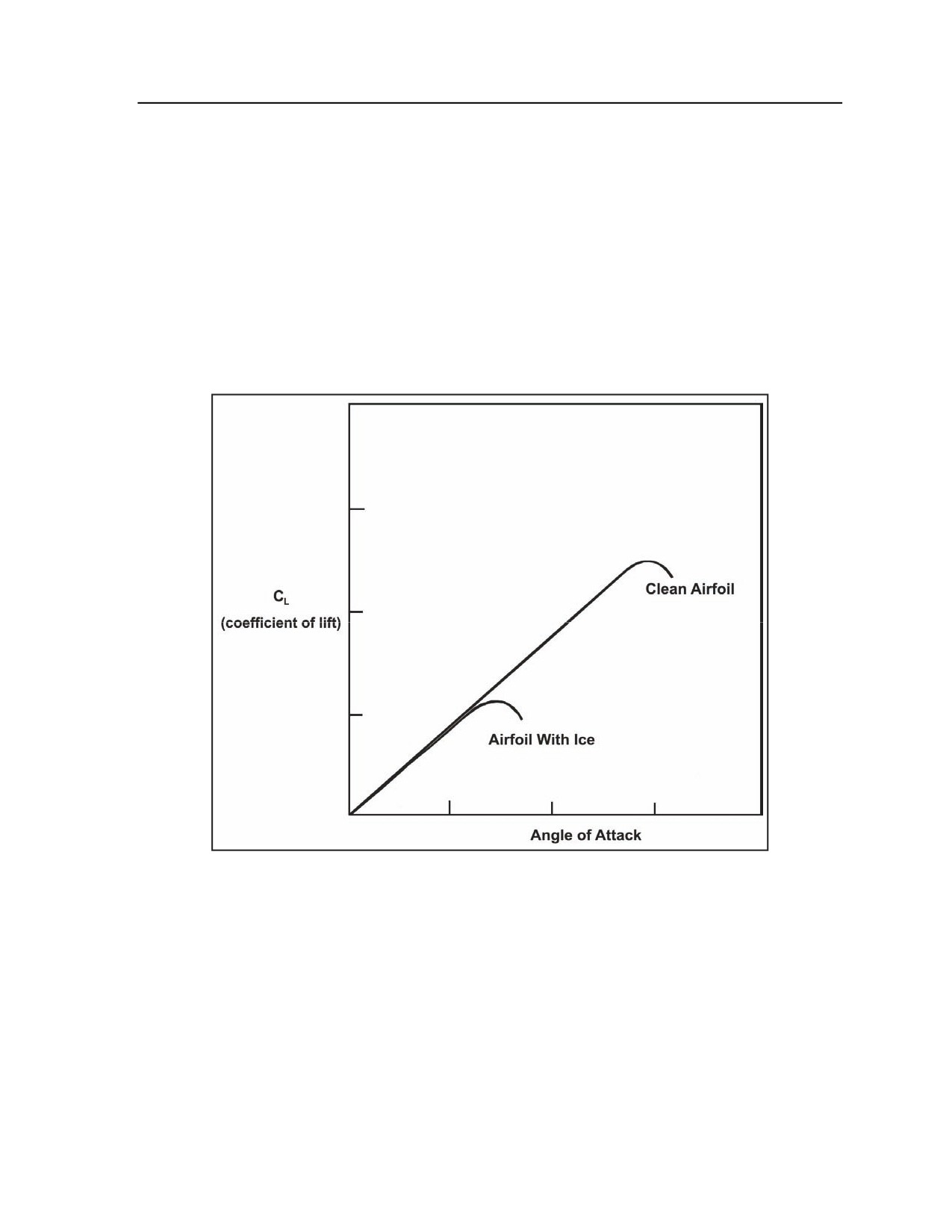
8-8. The most hazardous aspect of structural icing is its aerodynamic effects. Figure 8-1 shows how ice
often affects the coefficient of lift for an airfoil. At very low angles of attack, there may be little or no
effect of the ice on the coefficient of lift. Thus, when cruising at a low AOA, ice on the wing may have
little effect on the lift. However, the CLmax is significantly reduced by ice, and the AOA at which it occurs
(the stall angle) is much lower. Thus, when slowing down and increasing the AOA for approach, a pilot
may find ice on the wing, having had little effect on lift in cruise, causes stall to occur at a lower AOA and
higher speed. Even a thin layer of ice at the leading edge of a wing, especially if it is rough, can have a
significant effect in increasing stall speed. Lift may also be reduced at a lower AOA due to large ice
shapes.
Figure 8-1. Lift curve
8-9. A significant reduction in CLmax and the AOA where stall occurs can result from a relatively small
ice accretion. A reduction of CLmax by 30 percent is not unusual, and a large ice accretion can result in
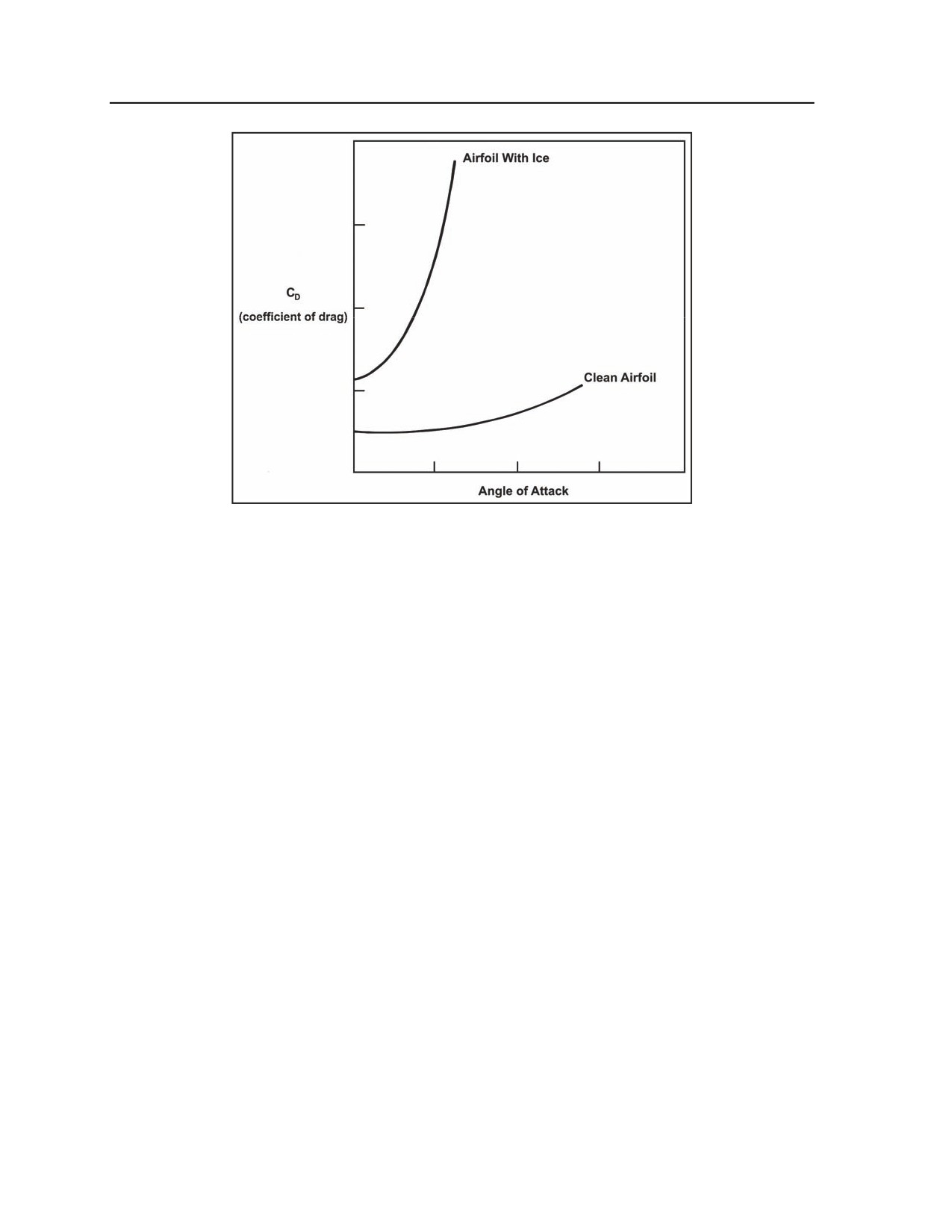
reductions of 40 percent to 50 percent. Drag tends to increase steadily as ice accretes (figure 8-2, page 8-4).
An airfoil drag increase of 100 percent is not unusual, and, for large ice accretions, increase can even be
200 percent or higher. Drag effect is significant even at very small AOAs.
8-10. Due to drag, Title 14, Code of Federal Regulations (14 CFR), prohibits takeoff when snow, ice, or
frost is adhering to wings, propellers, or control surfaces of an aircraft. This clean aircraft concept is
essential to safe flight operations.
7 May 2007
FM 3-04.203
8-3
Chapter 8
Figure 8-2. Drag curve
Wings
8-11. The effect of icing on a wing depends on whether the wing is protected and the type and extent of
protection provided. The are three types of wings are unprotected, deiced, and anti-iced.
8-12. An aircraft with a completely unprotected wing will not be certificated for flight in icing conditions,
but may inadvertently encounter icing conditions. Aircraft certificated for flight in icing would be
unprotected if the ice protection system fails. Since a cross-section of a wing is an airfoil, the remarks
above on airfoils apply to a wing with ice along its span. The ice, on the wings and other parts of the
aircraft, causes increase in drag, which the pilot detects as loss in airspeed. Increase in power is required to
maintain the same airspeed. The longer the encounter, the greater the drag increase; even with increased
power it may not be possible to maintain airspeed. Ice on the wing also causes a decrease in CLmax,
possibly on the order of 30 percent, for an extended encounter. The rule of thumb is the percentage
increase in stall speed is approximately half the decrease in CLmax, so the stall speed may go up by about
15 percent. If the aircraft has relatively limited power (as is the case with many aircraft with no ice
protection), it may soon approach stall speed and a very dangerous situation.
8-13. The FAA recommends the deicing system be activated at the first indication of icing. Between and
after system activations, some residual ice continues to adhere. Therefore, the wing is never entirely clean.
However, if the system is operated properly, the ice buildup on the wing is limited, and drag increase from
this buildup should be limited as well. At the AOA typical of cruise, intercycle or residual ice may have
very little effect on lift. At the higher AOA characteristic of approach and landing, decrease in CLmax
translates into an increase in stall speed. Thus the pilot should consider continuing activation of the deicing
system for a period time after exiting icing conditions so the wing will be as clean as possible and any
effect on stall speed minimized. If icing conditions cannot be exited until late in the approach or significant
icing appears to remain on the wing after activating the system, an increase in the aircraft’s stall speed is a
possibility and adjustment of the approach speed may be appropriate. Consult the aircraft’s manual for
guidance.
8-14. An anti-icing system is designed to keep a surface entirely free of ice throughout an icing encounter.
Anti-icing protection for wings is normally provided by ducting hot bleed air from engines into the inner
8-4
FM 3-04.203
7 May 2007
Fixed-Wing Environmental Flight
surface of the wing’s leading edge and thus is found mainly on transport turbojets and business jets, but not
on turbopropeller or piston aircraft. Even on transport and business jets, there are often sections along the
wing span not protected. An important part of icing certification for these planes is checking the protected
sections are extensive enough and properly chosen so ice on unprotected areas will not affect the safety of
flight.
Roll Control
8-15. Ice on the wings forward of the ailerons can affect roll control. The ailerons are generally close to
the wing tip, and wings are designed so stall begins near the root of the wing and progresses outward. In
this way, onset of stall does not interfere with roll control of the ailerons. However, the tips are usually
thinner than the rest of the wing, so they efficiently collect ice which can lead to a partial stall of the wings
at the tips, affecting the ailerons and thus roll control.
8-16. Ice accumulating in a ridge aft of the boots but forward of the ailerons, possibly due to flight in
super-cooled large drop conditions, affects airflow and interferes with proper functioning of the ailerons,
even without a partial wing stall at the tip. There are two ways in which the ailerons might be affected by
ice in front of them. One has been termed “aileron snatch,” in which an imbalance of forces at the aileron is
felt by the pilot of an aircraft without powered controls as a sudden change in the aileron control force.
Provided the pilot is able to adjust for the unusual forces, the ailerons may still be substantially effective
when deflected. The other is ailerons may be affected in a substantial degradation in control effectiveness,
although without need for excessive control forces.
7 May 2007
FM 3-04.203
8-5
Chapter 8
American Eagle ATR-72
Of the recent air carrier accidents, the one with arguably the most significant implications regarding in-
flight icing is the October 31, 1994, crash of an ATR-72 turbo propeller transport aircraft. The aircraft
was on a flight from Indianapolis, Indiana, to Chicago’s O’Hare International Airport, flying with
autopilot engaged and in a holding pattern, descending to 8,000 feet through super cooled clouds and
super-cooled large drops. Later analysis by the National Transportation Safety Board
(NTSB)
estimated the super-cooled drops in the area ranged between 0.1 mm and 2 mm in size.
Before the aircraft entered the hold, its engine RPM increased to 86 percent as called for in the ATR-
72’s aircraft flight manual (AFM) for flight in icing conditions (specified as true air temperature of
less than 7 degrees C in the presence of visible moisture). As the aircraft began holding, the flaps
were extended to 15 degrees to lower the aircraft’s AOA, and the engine RPM was reduced to 77
percent, presumably because the crew determined they were no longer flying in icing conditions. After
holding for over half an hour, the aircraft was cleared to descend to 8,000 feet, and the crew retracted
the flaps to avoid a flap overspeed warning.
According to the NTSB, the encounter with the icing conditions in the hold resulted in a ridge of ice
accreting aft of the aircraft’s wing deicing boots and in front of the aircraft’s unpowered ailerons. As
the aircraft descended to its cleared altitude, its AOA increased and airflow began to separate in the
area of the right aileron. This resulted in a sudden and unexpected aileron hinge reversal exceeding
the autopilot’s ability to control the aircraft, and it disconnected. This left the flight crew in a full right-
wing-down position within a quarter of a second, which was followed by a series of unsuccessful
attempts to correct the aircraft’s attitude, resulting in a descent that at times reached 24,000 FPM and
precipitated the structural failure of the aircraft’s elevators. The aircraft then impacted a soybean field
at high speed resulting in the deaths of all 68 passengers and crew.
The NTSB’s investigation resulted in several findings, but ultimately, the most important regarding the
effects of icing conditions on aircraft was the degree to which conditions affected a properly
certificated aircraft and the limited information available to the flight crew with respect to the severity
of the conditions they were experiencing.
Tailplane Icing
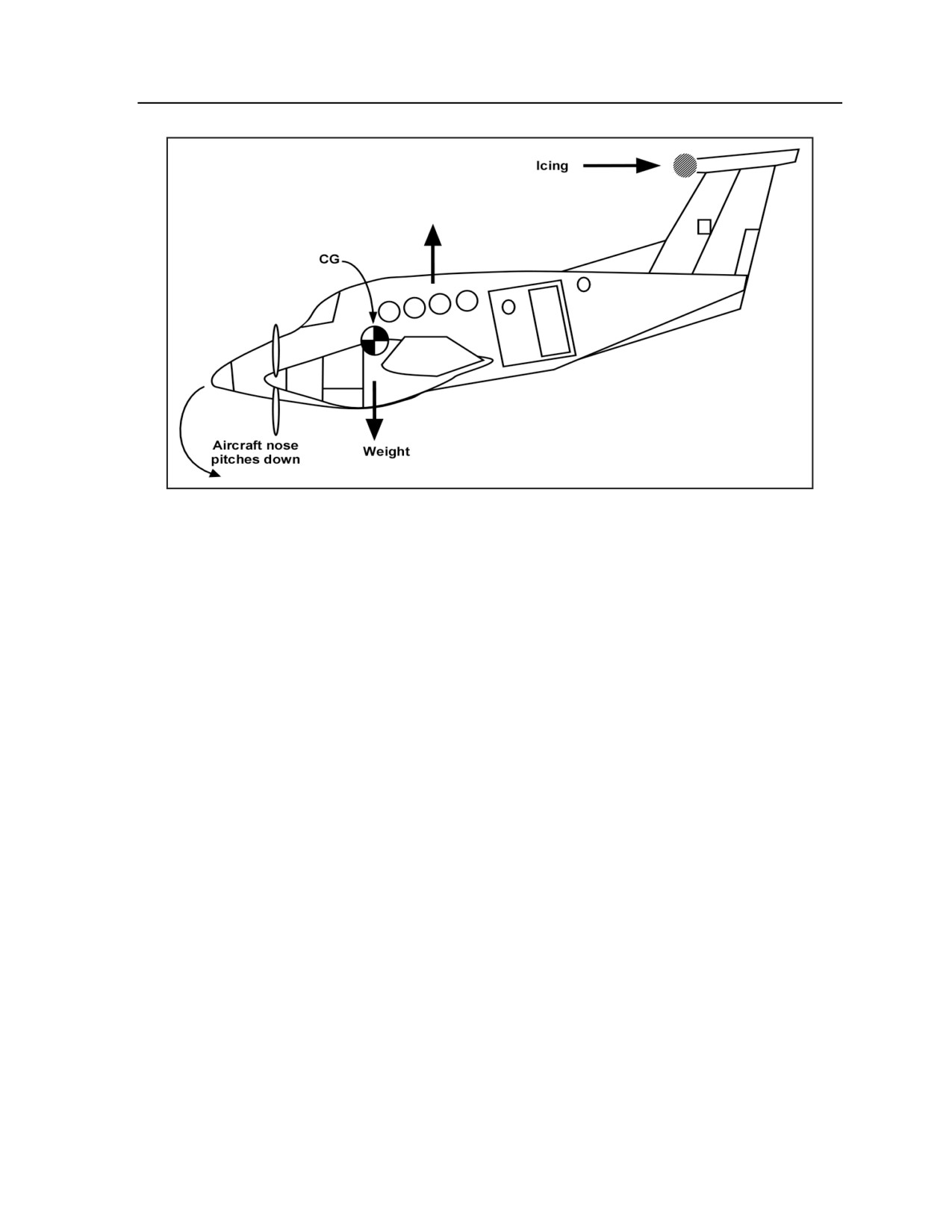
8-17. Most aircraft have a nose-down pitching moment from the wings because the CG is ahead of the
center of pressure. It is the role of the tailplane to counteract this moment by providing “downward” lift.
The result of this configuration is CL actions moving the wing away from stall, such as deployment of
flaps or increasing speed, may increase the negative AOA of the tail. With ice on the tailplane, it may stall
after full or partial deployment of flaps (figure 8-3).
8-6
FM 3-04.203
7 May 2007
Fixed-Wing Environmental Flight
Figure 8-3. Tail stall pitchover
8-18. Since the tailplane is ordinarily thinner than the wing, it is a more efficient collector of ice. On most
aircraft the tailplane is not visible to the pilot, who therefore cannot observe how well it has been cleared of
ice by any deicing system. Thus it is important the pilot be alert to the possibility of tailplane stall,
particularly on approach and landing. For more information, see ice-contaminated tailplane stall (ICTS)
later in this chapter.
Propeller Icing
8-19. Ice buildup on propeller blades reduces thrust for the same aerodynamic reasons wings tend to lose
lift and increase drag when ice accumulates on them. The greatest quantity of ice collects on the spinner
and inner radius of the propeller. Propeller areas on which ice may accumulate and be ingested into the
engine normally are anti-iced rather than deiced to reduce the probability of ice being shed into the engine.
Antenna Icing
8-20. Due to their small size and shape, antennas that do not lay flush with the aircraft’s skin tend to
accumulate ice rapidly. Furthermore, they often are devoid of internal anti-icing or deicing capability for
protection. During flight in icing conditions, ice accumulations on an antenna may cause it to begin
vibrating or radio signals to become distorted. Besides the distraction caused by vibration (pilots who have
experienced the vibration describe it as a “howl”), the antenna may be damaged. If a frozen antenna breaks
off, it can damage other areas of the aircraft, and may cause a communication or navigation system failure.
Pitot Tube
8-21. The pitot tube is particularly vulnerable to icing because even light icing can block the entry hole
where ram air enters the system. This affects the airspeed indicator and is the reason most aircraft are
equipped with a pitot heating system. The pitot heater usually consists of coiled wire heating elements
wrapped around the air entry tube. If the pitot tube becomes blocked, the airspeed indicator would still
function; however, it would be inaccurate. At altitudes above where the pitot tube became blocked, the
airspeed indicator would display a higher-than-actual airspeed. At lower altitudes, the airspeed indicator
would display a lower-than-actual airspeed.
7 May 2007
FM 3-04.203
8-7
Chapter 8
Static Port
8-22. Many aircraft also have a heating system protecting the static ports to ensure the entire pitot-static
system is clear of ice. If the static port becomes blocked, the airspeed indicator still functions; however, it
would be inaccurate. At altitudes above where the static port became blocked, the airspeed indicator would
indicate a lower-than-actual airspeed. At lower altitudes, the airspeed indicator would display a higher-
than-actual airspeed. The trapped air in the static system would cause the altimeter to remain at the altitude
where the blockage occurred. The vertical speed indicator (VSI) would remain at zero. On some aircraft,
an alternate static air source valve is used for emergencies. If the alternate source is vented inside the
aircraft, where static pressure is usually lower than outside static pressure, selection of the alternate source
may result in the following erroneous instrument indications:
The altimeter reads higher than normal.
Indicated airspeed reads greater than normal.
VSI momentarily shows a climb.
Stall Warning Systems
8-23. Stall warning systems provide essential information to pilots. A loss of these systems can exacerbate
an already hazardous situation. These systems range from a sophisticated stall warning vane to a simple
stall warning switch. The stall warning vane (also called an AOA sensor since it is a part of the stall
warning system) can be found on many aircraft. The AOA provides flight crews with a display or feeds
data to computers interpreting this information and providing stall warning to the crew when the AOA
becomes excessive. These devices consist of a vane, which is wedge-like in shape and has freedom to
rotate about a horizontal axis, and are connected to a transducer that converts the vane’s movements into
electrical signals transmitted to the aircraft’s flight data computer. Normally, the vane is heated electrically
to prevent ice formation. The transducer is also heated to prevent moisture from condensing on it when the
vane heater is operating. If the vane collects ice, it may send erroneous signals to such equipment as stick
shakers or stall warning devices. Aircraft using a stall horn may not give any indication of stall if the stall
indicator opening or switch becomes frozen. Even when an aircraft’s stall warning system is operational, it
may be ineffective as the wing will stall at a lower AOA due to ice on the airfoil.
Windshields
8-24. Generally, anti-icing is provided to enable the flight crew to see outside the aircraft in case icing is
encountered in flight. On high-performance aircraft requiring complex windshields to protect against bird
strikes and withstand pressurization loads, the heating element often is a layer of conductive film or thin
wire strands through which electric current is run to heat the windshield and prevent ice from forming.
8-25. Aircraft operating at lower altitudes and speeds have other systems of window anti-icing/deicing.
One system consists of an electrically heated plate installed onto the aircraft’s windshield to give the pilot a
narrow band of clear visibility. Another system uses a bar at the lower end of the windshield to spray
deicing fluid onto it and prevent ice from forming.
AIRCRAFT EQUIPMENT
ICE CONTROL SYSTEMS
8-26. Ice control systems installed on aircraft consist of anti-ice and deice equipment. Anti-icing
equipment is designed to prevent the formation of ice, while deicing equipment is designed to remove ice
once it has formed. Ice control systems protect the leading edge of wing and tail surfaces, pitot and static
port openings, fuel tank vents, stall warning devices, windshields, and propeller blades. Ice detection
lighting may also be installed on some aircraft to determine the extent of structural icing during night
flights. Since aircraft configurations are different, refer to operator’s manual, AFM, or pilot’s operating
handbook (POH) for details.
8-8
FM 3-04.203
7 May 2007
Fixed-Wing Environmental Flight
8-27. Operation of aircraft anti-icing and deicing systems should be checked prior to encountering icing
conditions. Encounters with structural ice require immediate remedial action. Anti-icing and deicing
equipment is not intended to sustain long-term flight in icing conditions.
Airfoil Ice Control
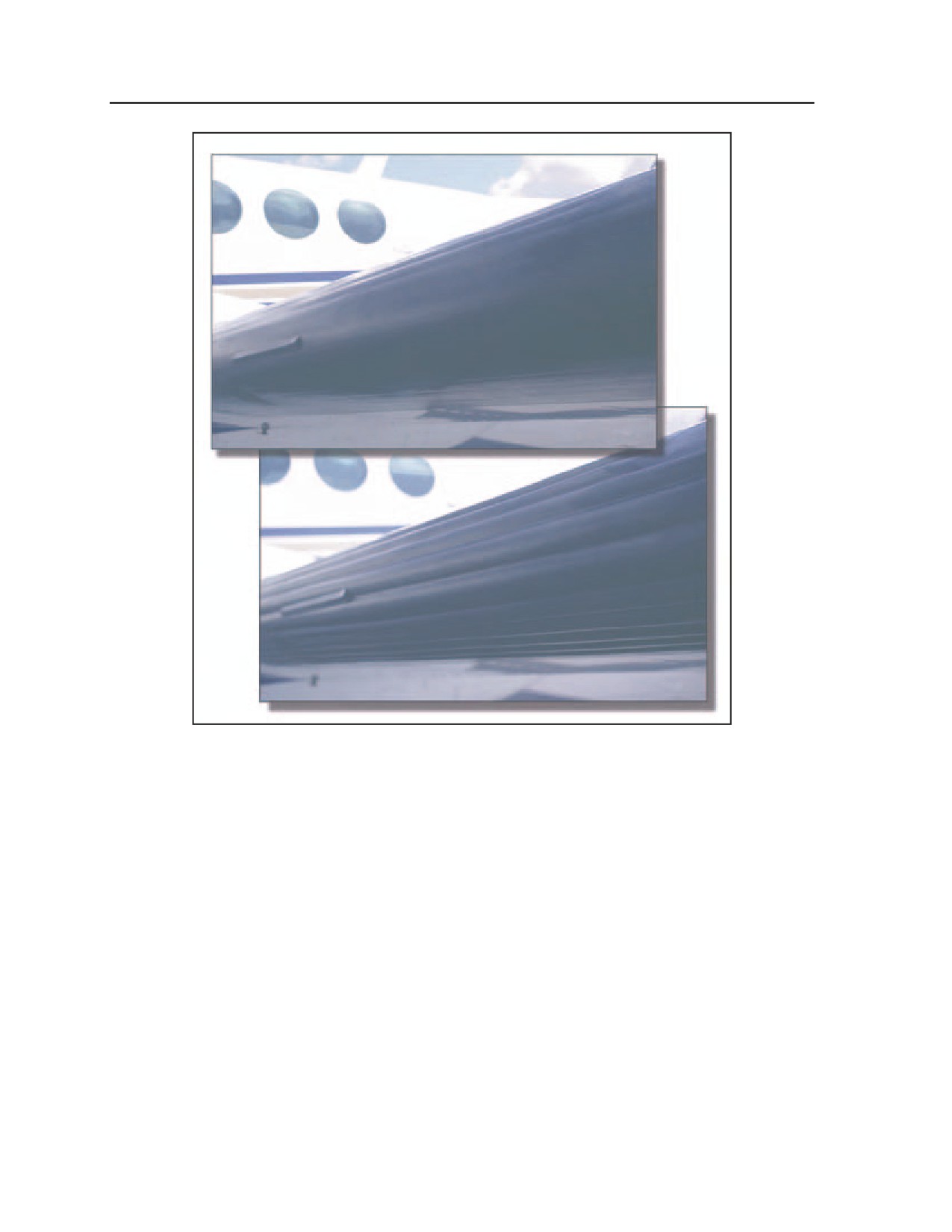
8-28. Inflatable deicing boots consist of a rubber sheet bonded to the leading edge of the airfoil. When ice
builds up on the leading edge, an engine-driven pneumatic pump inflates the rubber boots (figure 8-4, page
8-9). Some turboprop aircraft divert engine bleed air to the wing to inflate the rubber boots. Upon inflation,
the ice is cracked and should fall off the leading edge of the wing. Deicing boots are controlled from the
cockpit by a switch and can be operated in a single cycle or allowed to cycle at automatic, timed intervals.
It is important deicing boots are used in accordance with manufacturer’s recommendations. If they are
allowed to cycle too often, ice can form over the contour of the boot and render them ineffective.
8-29. Many deicing boot systems use the instrument system suction gauge and a pneumatic pressure gauge
to indicate proper boot operation. These gauges have range markings indicating the operating limits for
boot operation. Some systems may also incorporate an annunciator light to indicate proper boot operation.
Proper maintenance, care, and preflight inspection of deicing boots are important for continued operation
of this system. Another type of leading edge protection is the thermal anti-ice system installed on aircraft
with turbine engines. This system is designed to prevent the buildup of ice by directing hot air from the
compressor section of the engine to the leading edge surfaces. This system is activated prior to entering
icing conditions. The hot air heats the leading edge sufficiently preventing the formation of ice.
8-30. An uncommon alternate type of leading edge protection a weeping wing. The weeping-wing design
uses small holes located in the leading edge of the wing. A chemical mixture is pumped to the leading edge
and weeps out through the holes to prevent formation and buildup of ice.
Windscreen Ice Control
8-31. There are two main types of windscreen anti-ice systems. The first system directs a flow of alcohol
to the windscreen. By using it early enough, alcohol will prevent ice buildup on the windshield. The rate of
alcohol flow can be controlled by a dial in the cockpit according to procedures recommended by the
aircraft manufacturer.
8-32. Another method is the electric heating method. Small wires or other conductive material is imbedded
in the windscreen. The heater can be turned on by a switch in the cockpit, at which time electrical current is
passed across the shield through the wires to provide sufficient heat to prevent the formation of ice on the
windscreen. The electrical current can cause compass deviation errors; in some cases, as much as 40
degrees. The heated windscreen should only be used during flight. Do not leave it on during ground
operations, as it can overheat and damage to the windscreen.
7 May 2007
FM 3-04.203
8-9
Chapter 8
Figure 8-4. Pneumatic boots
Propeller Ice Control
8-33. Propellers are protected from icing by use of alcohol or electrically heated elements. Some propellers
are equipped with a discharge nozzle pointed toward the root of the blade. Alcohol is discharged from the
nozzles, and centrifugal force makes it flow down the leading edge of the blade preventing ice from
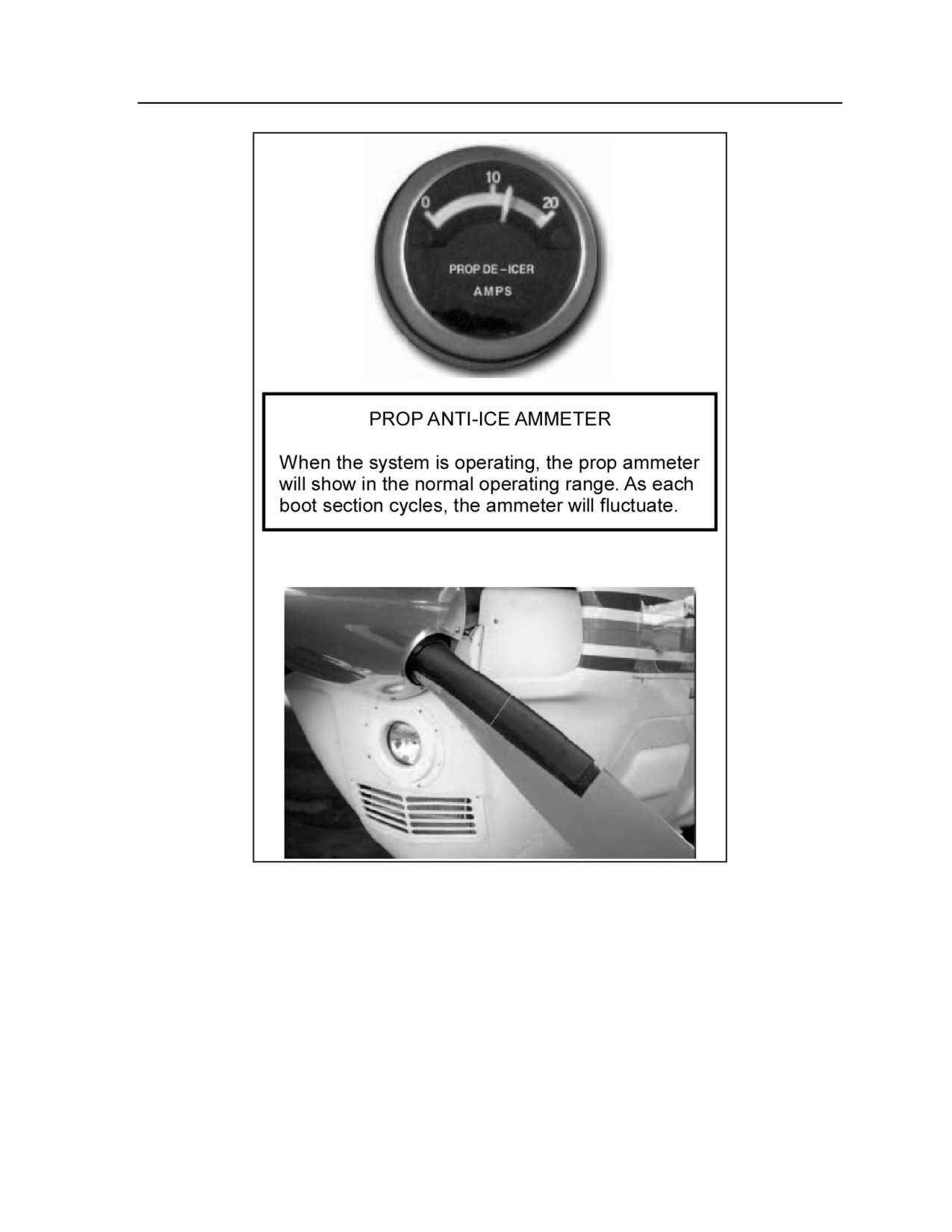
forming. Propellers can also be fitted with propeller anti-ice boots (figure 8-5, page 8-10). The propeller
boot is divided into inboard and outboard sections. The boots are grooved to help direct the flow of
alcohol, and they are also imbedded with electrical wires carrying current to heat the propeller. The prop
anti-ice system can be monitored for proper operation by monitoring the prop anti-ice ammeter. During the
preflight inspection, check the propeller boots for proper operation. If a boot fails to heat one blade, an
unequal blade loading can result, and may cause severe propeller vibration.
Other Ice Control Systems
8-34. Pitot and static ports, fuel vents, stall warning sensors, and other optional equipment may be heated
by electrical elements. Operational checks of the electrically heated systems are to be checked in
accordance with the operator’s manual.
8-10
FM 3-04.203
7 May 2007
Fixed-Wing Environmental Flight
Figure 8-5. Propeller ice control
FLYING TECHNIQUES
FLAT LIGHT
8-35. In flat light conditions it may be possible to depart but not return to a site. During takeoff, there must
be a reference point until a departure reference point is in view. If the departure reference does not come
into view, return to the takeoff reference point may be required.
8-36. Flat light is common to snow skiers. One way to compensate for the lack of visual contrast and
depth-of-field loss is to wear amber tinted lenses (blue blockers). Eyewear is not ideal for every pilot,
7 May 2007
FM 3-04.203
8-11
Chapter 8
personal factors, such as age, light sensitivity, and ambient lighting conditions (LITECON), should be
considered. If all visual references are lost—
Above all, fly the aircraft.
Trust the cockpit instruments.
Execute a 180-degree turnaround and start looking for outside references.
Landings
8-37. Pilots look for features around the airport or approach path to determine depth perception. Buildings,
towers, vehicles, or other aircraft serve well for this measurement. Something that provides a sense of
height above the ground, in addition to orienting the runway, should be used.
8-38. Pilots must be cautious of snowdrifts, snow banks, or anything falsely distinguishing the edge of the
runway. Look for subtle changes in snow texture or shading to identify ridges or changes in snow depth.
ICING
8-39. Because icing is unpredictable in nature, pilots may find themselves in icing conditions even though
they have done everything to avoid it. To stay alert to this possibility while operating in visible moisture,
they should monitor the OAT.
8-40. Proper utilization of the anti-icing/deicing equipment is critical to the safety of flight. If the anti-
icing/deicing equipment is used before sufficient ice has accumulated, it may not be able to remove all ice
accumulation. The operator’s manual should be referenced for proper use of anti-icing/deicing equipment.
8-41. Prior to entering visible moisture with temperatures at 4 degrees F or cooler, the appropriate anti-
icing/deicing equipment is activated in anticipation of ice accumulation-early ice detection is critical. This
may be particularly difficult during night flight. Ice lights or a flashlight is used to check for ice
accumulation on the wings.
8-42. At the first indication of ice accumulation, pilots must act to get out of icing conditions. The
following are four options for action once ice has begun to accumulate on the aircraft:
Move to an altitude with significantly colder temperatures.
Move to an altitude with temperatures that are above freezing.
Fly to an area clear of visible moisture.
Change heading and fly to an area of known nonicing conditions.
8-43. Because icing conditions in stratiform clouds often are confined to a relatively thin layer, either
climbing or descending may be effective in exiting the icing conditions within the clouds. A climb may
take the aircraft into a colder section of cloud consisting exclusively of ice particles. These generally
constitute little threat of structural icing as it is unlikely the ice particles will adhere to unheated surfaces.
The climb also may take the aircraft out of the cloud altogether to an altitude where ice will gradually
sublimate or shed from the airframe depending on conditions. A descent may take the aircraft into air with
temperatures above freezing, within or below the cloud, where ice can melt.
8-44. Hazardous icing conditions can occur in cumulus clouds, sometimes having very high water content.
Therefore, it is not advisable to fly through a series of such clouds, or to execute holds within them.
However, as these clouds normally do not extend very far horizontally, any icing encountered in such a
cloud may be of limited duration, and it may be possible to deviate around the cloud.
8-45. Freezing rain forms when rain becomes super cooled by falling through a subfreezing layer of air.
Thus, it may be possible to exit the freezing rain by climbing into the warm layer.
8-46. Because freezing drizzle often forms by the collision-coalescence process, a pilot must not assume a
warm layer of air exists above the aircraft. A pilot encountering freezing drizzle should exit the conditions
as quickly as possible, either vertically or horizontally. Three possible actions are ascend to an altitude
where the freezing drizzle event is less intense; descend to an area of warmer air; or make a level turn to
emerge from the area of freezing drizzle.
8-12
FM 3-04.203
7 May 2007
Fixed-Wing Environmental Flight
8-47. If none of these options are available, consideration must be given to immediately land at the nearest
suitable airport. Anti-icing and deicing equipment is not designed to allow aircraft to operate in icing
conditions indefinitely, but provides more time to exit these conditions.
Cruise
8-48. An aircraft certificated for flight in icing conditions whose ice protection system is operating
properly will be able to cruise for some time in most icing conditions. However, if it is possible to exit the
icing conditions by a change in altitude or a minor change in flight path, it is advisable. During any icing
encounter, the behavior of the aircraft should be carefully monitored by the pilot. The aircraft will have
some unprotected areas that will collect ice. Although ice in such areas should not compromise the safety
of flight, it may cause enough increase in drag to require the pilot to apply more power to maintain flight
speed. Residual or intercycle ice on deiced areas can have a similar effect. Typically, adding power is the
recommended action, since reduction in flight speed is associated with an increase in AOA, which on many
aircraft will expose larger unprotected areas on the underside of the aircraft to the collection of ice. If for
any reason the point is reached where it is no longer possible to maintain airspeed through addition of
power, the pilot should exit icing conditions immediately. On an aircraft equipped with in-flight deicing
systems, there will at all times be residual or some stage of intercycle ice on the wings.
8-49. Airspeed in cruise can have a significant effect on the nature of an icing encounter. An aircraft
cruising at a fast airspeed will increase the rate of ice accumulation. However, if airspeed is sufficiently
fast, the ram air heat may begin to increase skin temperatures sufficiently to melt some of the ice and
prevent accumulation in those areas. Generally, only very high-performance aircraft can attain such speeds.
During the flight, pilots periodically verify all anti-icing and deicing systems are working. During the en
route portion of the flight, a regularly reevaluated exit plan is necessary.
8-50. Even if the encounter is short and icing is not heavy, the pilot must exercise particular awareness of
the behavior of the aircraft. Configuration changes following cruise in icing conditions, such as spoiler/flap
deployment, should be made with care. This is because ice on the aircraft which had little effect in cruise
may have a much different and potentially more hazardous effect in other configurations. Remember for
normal cruise configurations and speeds, both the wing and tailplane are ordinarily at moderate AOAs,
making wing or tailplane stall unlikely. After configuration changes and in maneuvering flight, wings or
tailplane (especially after flap deployment) may be at more extreme AOAs, and even residual or intercycle
ice may cause stall to occur at a less extreme angle than on a clean aircraft.
8-51. Care should be exercised when using the autopilot in icing conditions, whether in cruise or other
phases of flight. When autopilot is engaged, it can mask changes in handling characteristics due to
aerodynamic effects of icing normally detected by the pilot if the aircraft were being hand flown. In an
aircraft relying on aerodynamic balance for trim, autopilot may mask control anomalies otherwise detected
at an early stage. If the aircraft has nonboosted controls, a situation may develop in which autopilot servo-
control power is exceeded, autopilot disconnects abruptly, and the pilot is suddenly confronted by an
unexpected control deflection. Pilots may consider periodically disengaging the autopilot and manually fly
the aircraft when operating in icing conditions. If this is not desirable because of cockpit workload levels,
pilots should monitor the autopilot closely for abnormal trim, trim rate, or aircraft attitude.
Descent
8-52. Pilots should try to stay on top of a cloud layer as long as possible before descending. This may not
be possible for an aircraft using bleed air for anti-icing systems because an increase in thrust may be
required to provide sufficient bleed air. This increased thrust may reduce the descent rate of high-
performance aircraft whose high-lift attributes already make descents lengthy without use of aerodynamic
speed brakes or other such devices. The result may be a gradual descent, extending the aircraft’s exposure
to icing conditions.
8-53. If configuration changes are made during this phase of flight, they should be made with care in icing
conditions, noting the behavior of the aircraft.
7 May 2007
FM 3-04.203
8-13
Chapter 8
Approach and Landing
8-54. During or after flight in icing conditions, when configuring the aircraft for landing, the pilot must be
alert for sudden aircraft movements. Often ice is picked up in cruise, when the aircraft’s wing and tailplane
are likely at a moderate AOA, making a relatively ice-tolerant configuration. If effects in cruise are minor,
the pilot may feel comfortable the aircraft can handle the ice it has acquired. Extension of landing gear may
create excessive amounts of drag when coupled with ice. Flaps and slats should be deployed in stages,
carefully noting the aircraft’s behavior at each stage. If anomalies occur, it is best not to increase the
amount of flaps or slats and perhaps even to retract them depending on how much the aircraft is deviating
from normal performance. Additionally, before beginning the approach, deicing boots should be cycled as
they may increase stall speed and it is preferable not to use these systems while landing.
8-55. Once on the runway, pilots also should be prepared for possible loss of directional control caused by
ice buildup on landing gear.
8-56. Another concern during approach and landing may be forward visibility. Windshield anti-icing and
deicing systems can be overwhelmed by some icing encounters or may malfunction. Pilots have been
known to look through side windows or, on small aircraft, attempt to remove ice accumulations with some
type of tool (plotter, credit card). Pilot workload can be heavy during approach and landing phases.
Autopilots help reduce this load. Advantages of a reduced workload must be balanced against risks
associated with using an autopilot during or after flight in icing conditions. An unexpected autopilot
disconnect because of icing is especially hazardous in this phase of flight due to the aircraft being flown at
a low altitude.
8-57. Accident statistics reveal the majority of icing-related accidents occur in the final phases of flight.
Contributing factors are configuration changes, low altitude, higher flight crew workload, and reduced
power settings. Loss of control of the aircraft is often a factor. The ice contamination may lead to wing
stall, ICTS, or roll upset. Wing stall and roll upset may occur in all phases of flight. However, available
statistics indicate ICTS rarely occurs until approach and landing. If an aircraft has accumulated ice on the
wings and tailplane, it may be best to perform a no-flap landing at a higher than normal approach speed.
However, due to the higher approach speed, longer runways may be needed for this procedure.
Ice-Contaminated Tailplane Stall
8-58. ICTS occurs when a tailplane with accumulated ice is placed at a sufficiently negative AOA and
stalls. This angle would not be expected to be reached without at least partial deployment of the flaps.
There are few, if any, known incidents of ICTS in cruise (when flaps would not ordinarily be deployed).
However, when flaps are deployed, tailplane ice which previously had little effect other than a minor
contribution to drag now can put the tailplane at or dangerously close to stall.
8-59. As the pilot prepares for deployment of flaps after or during flight in icing, he carefully assesses the
aircraft’s behavior for buffet or any other signs of wing stall. The initial deployment of flaps is only partial.
Vibration or buffeting following deployment is much more likely to be due to incipient tailplane stall than
wing stall if there was no vibration buffet before deployment. The reason is after deploying the flaps, the
wing will be at a less positive angle, farther from stall, while the tailplane will be at a more negative angle,
closer to stall.
8-60. There are a number of specific cues associated with ICTS to which a pilot should be sensitive,
particularly during this phase of flight. Most of these cues are less readily detected with the autopilot
engaged.
Elevator control pulsing, oscillations, or vibrations.
Abnormal nose-down trim change.
Any other unusual or abnormal pitch anomalies (possibly resulting in pilot-induced oscillations).
Reduction or loss of elevator effectiveness.
Sudden change in elevator force (control would move nose down if unrestrained).
Sudden uncommanded nose-down pitch.
8-14
FM 3-04.203
7 May 2007
Fixed-Wing Environmental Flight
8-61. Pilots observe the following guidelines for action if these cues are encountered:
Flaps tend to alter airflow reaching the tailplane and must be retracted immediately to the
previous setting. Appropriate nose-up elevator pressure must be applied.
Airspeed is increased appropriately for the reduced flap extension setting.
Sufficient power is applied for the aircraft’s configuration and conditions. High engine power
settings may adversely affect the response to ICTS conditions at high airspeed in some aircraft
designs. Recommendations in the operator’s manual, AFM or POH must be observed regarding
power settings.
Nose-down pitch changes must be made slowly, even in gusting conditions, if circumstances
allow.
If a pneumatic deicing system is used, the system is cycled several times to clear the tailplane of
ice.
8-62. Some measures for ICTS recovery are the opposite of those for wing stall recovery. Distinguishing
between the two is very important. If for any reason there is a large or rough ice accretion on the wing and
tailplane, approach and landing must be managed with great care. Deployment of flaps permits the aircraft
to be flown with wings at a less positive attack, decreasing probability of wing stall. However, the AOA at
the tailplane is more negative, putting it closer to stall. Similarly, at any particular flap setting, lower
speeds put the aircraft closer to wing stall and higher speeds put it closer to tailplane stall. Thus there is a
restricted operating window with respect to use of the flaps and airspeed. Pilots must be familiar with
guidance provided in the operator’s manual.
8-63. When ICTS or wing stall is a possibility, uncoordinated flight such as side or forward slips must be
avoided and, to the extent possible, crosswind landings restricted because of their adverse effect on pitch
control and the possibility of reduced directional control. Landing with a tailwind component may result in
more abrupt nose-down control inputs and should be avoided.
8-64. If an aircraft has ice on the wings and tail, the pilot may be wise to exercise limited or no deployment
of flaps, which will likely result in a higher than normal approach speed. Because of the higher speed
approach, longer runways may be needed for this procedure.
Roll Upsets
8-65. Roll upsets caused by ice accumulations forward of the ailerons also are possible during an icing
encounter, particularly in SLD conditions. During slow speeds associated with approach and landing, such
control anomalies can become increasingly problematic. Pilots can remedy roll upsets using the following
guidelines:
Reduce the AOA by increasing airspeed or extending wing flaps to the first setting if at or below
VFE (maximum flap extension speed). If in a turn, the wings should be rolled level.
Set the appropriate power, and monitor airspeed and AOA.
If flaps are extended, do not retract them unless it can be determined the upper surface of the
airfoil is clear of ice. Retracting flaps will increase the AOA at a given airspeed.
Verify the wing ice protection is functioning normally and symmetrically through visual
observation of each wing. If there is a malfunction, follow the manufacturer’s instructions.
8-66. These procedures are similar to those for wing stall recovery, and in some respects opposite from
those for ICTS recovery. Application of the incorrect procedure during an event can seriously compound
the upset. Correct identification and application of the proper procedure is imperative. It is extremely
important the pilot maintains awareness of all possibilities during or following flight in icing.
TRAINING
8-67. Units qualifying aviators in cold weather/icing operations are responsible for conducting a well-
organized training program. Training programs should be geared to instill confidence and develop skills in
all areas. IPs and supervisory maintenance personnel must be highly qualified and skilled.
7 May 2007
FM 3-04.203
8-15
Chapter 8
8-68. Emphasis must be placed on safety and avoidance. Avoiding hazards is the best course and a smart
aviator uses all resources at his disposal. If hazards are encountered, the crew is prepared to handle them.
The professional judgment of the instructor to discontinue training due to unsafe conditions must be
accepted and not criticized.
8-69. The flight training program allows each aviator to advance at an individual rate. Initial training is
conducted under less challenging conditions. As an aviator's proficiency increases, conditions become
more demanding until the most challenging mission can be performed.
RECOMMENDED PROGRAM OF INSTRUCTION
8-70. A recommended program of instruction for qualifying aviators is provided. Additional academic
subjects may be required, based on specific mission and location of the unit.
Academics
8-71. Suggested topics include—
Human factors associated with cold weather/icing flying.
Environmental factors affecting cold weather/icing operations.
Planning data available on cold weather/icing.
In-flight equipment and resources to detect, avoid, and continue in these hazards.
Aircraft operational procedures in cold weather/icing.
Flight
8-72. Flight training may be limited by conditions at the unit’s home station as there may not be areas able
to replicate conditions adequately. Instructors can demonstrate techniques and procedures to some extent.
Crews should be evaluated on these procedures during their APART or no-notice evaluations. Flight
simulators are also a great device in training for this environment.
8-73. Suggested maneuvers include—
Flight (takeoff, en route, and landing) techniques.
Stall recovery maneuvers.
Aircraft equipment usage.
Research Materials
8-74. To prepare to train for or operate in a cold weather/icing environment, the following materials are
suggested:
Local SOPs.
Aircraft operator’s manual.
FAA site, http://www.faa.gov/.
FAA safety site, http://www.faasafety.gov/.
FAA “General Aviation Pilot’s Guide to Preflight Weather Planning, Weather Self-Briefings,
and Weather Decision Making.”
Aviation Weather Center: http://adds.aviationweather.noaa.gov/.
FM 1-230.
FM 3-04.301.
AKO file search.
8-16
FM 3-04.203
7 May 2007
Fixed-Wing Environmental Flight
SECTION II - MOUNTAIN OPERATIONS
ENVIRONMENTAL FACTORS
MOUNTAIN WAVE
8-75. Mountain waves occur when air is being blown over a mountain range or even the ridge of a sharp
bluff area at 15 knots or better at an intersection angle of not less than 30 degrees. As the air hits the
upwind side of the range, it starts to climb, thus creating what is generally a smooth updraft which turns
into a turbulent downdraft as the air passes the crest of the ridge. From this point, for many miles
downwind, there will be a series of downdrafts and updrafts. Satellite photos of the Rockies have shown
mountain waves extending as far as 700 miles downwind of the range. Along the east coast area, such
photos of the Appalachian chain have picked up the mountain wave phenomenon over a hundred miles
eastward.
8-76. To avoid dangerous situations, pilots must understand mountain waves. When approaching a
mountain range from the upwind side (generally west), there will usually be a smooth updraft; therefore, it
is not quite as dangerous an area as the lee of the range. From the leeward side, it is always a good idea to
add an extra thousand feet or so of altitude because downdrafts can exceed the climb capability of the
aircraft. Never expect an updraft when approaching a mountain chain from the leeward, and always be
prepared to cope with downdraft and turbulence.
MOUNTAIN OBSCURATION
8-77. Mountain obscuration (MTOS) describes a visibility condition distinguished from IFR because
ceilings, by definition, are described as AGL. In mountainous terrain clouds can form at altitudes
significantly higher than the weather reporting station and at the same time nearby mountaintops may be
obscured by low visibility. In these areas, ground level can also vary greatly over a small area. Caution
must be used when and if operating VFR-on-top. It is possible to be operating closer to the terrain than
thought, as the tops of mountains are hidden in a cloud deck below. MTOS areas are identified daily by the
Aviation Weather Center located at www.awcíkc.noaa.gov, under Official Forecast Products, airman’s
meteorological information (AIRMETs) (WA), IFR/MTOS.
DENSITY ALTITUDE
8-78. Performance figures in the aircraft owner’s handbook are generally based on standard atmosphere
conditions (59 degrees F [15 degrees C], pressure 29.92 inches of mercury) at sea level. However, pilots
may run into trouble when encountering a different set of conditions. This is particularly true in hot
weather and at higher elevations. Aircraft operations at altitudes above sea level and higher than standard
temperatures are commonplace in mountainous areas. Such operations quite often result in a drastic
reduction of aircraft performance capabilities due to changing air density. Density altitude is a measure of
air density and is not to be confused with PA, true altitude, or absolute altitude. It is not a height reference,
but determines criteria in the performance capability of an aircraft. Air density decreases with altitude. As
air density decreases, density altitude increases. The further effects of high temperature and high humidity
are cumulative, resulting in an increasing high density altitude condition. High density altitude reduces all
aircraft performance parameters. To a pilot, this means normal horsepower output is reduced, propeller
efficiency is reduced, and a higher TAS is required to sustain the aircraft throughout its operating
parameters. It also means an increase in runway length requirements for takeoff and landings, and a
decreased rate of climb. An average small aircraft, for example, requiring 1,000 feet for takeoff at sea level
under standard atmospheric conditions will require a takeoff run of approximately 2,000 feet at an
operational altitude of 5,000 feet.
7 May 2007
FM 3-04.203
8-17
Chapter 8
Density Altitude Advisories
8-79. At airports with elevations of 2,000 feet and higher, control towers and flight service stations (FSSs)
will broadcast the advisory “check density altitude” when the temperature reaches a predetermined level.
These advisories will be broadcast on appropriate tower frequencies or, where available, automated
terminal information service (ATIS). FSSs will broadcast these advisories as a part of a local airport
advisory, and on transcribed weather en route broadcast.
8-80. These advisories are provided by air traffic facilities as reminders to pilots that high temperatures
and field elevations cause significant changes in aircraft characteristics. Pilots retain the responsibility of
computing density altitude, when appropriate, as part of preflight duties.
FLYING TECHNIQUES
8-81. Proper planning and awareness of potential hazards are a must in mountain-terrain flight. Flat, level
fields for forced landings are practically nonexistent. Abrupt changes in wind direction and velocity occur.
Severe updrafts and downdrafts are common, particularly near or above abrupt changes of terrain such as
cliffs or rugged areas. Clouds even look different and can buildup rapidly. Mountain flight guidelines are
the following:
Plan the route to avoid topography preventing a safe forced landing. The route should be over
populated areas and well-known mountain passes. Sufficient altitude must be maintained to
permit gliding to a safe landing in the event of engine failure.
Do not fly a light aircraft when the wind aloft, at your proposed altitude, exceeds 35 MPH.
Expect winds to be of much greater velocity over mountain passes than reported a few miles
from them. Approach mountain passes with as much altitude as possible. Downdrafts from
1,500 to 2,000 FPM are not uncommon on the leeward side.
Do not fly near or above abrupt changes in terrain. Severe turbulence can be expected,
especially in high wind conditions.
Do not fly too far up a canyon; ensure a 180-degree turn is possible.
Approach a ridge at approximately a 45-degree angle to the horizontal direction. This permits a
safer retreat from the ridge with less stress on the aircraft should severe turbulence and
downdraft be experienced. If severe turbulence is encountered, simultaneously reduce power
and adjust pitch until aircraft approaches maneuvering speed, then adjust power and trim to
maintain maneuvering speed and fly away from the turbulent area.
Use the same indicated airspeed used at low elevation fields, when landing at a high altitude
field. Due to the less dense air at altitude, this same indicated airspeed actually results in higher
TAS, a faster landing speed, and more important, a longer landing distance. During gusty wind
conditions which often prevail at high altitude fields, a power approach and landing is
recommended. Additionally, due to faster groundspeed, takeoff distance will increase
considerably over that required at low altitudes.
SECTION III - OVERWATER OPERATIONS
OCEANOGRAPHIC TERMINOLOGY
8-82. Table 8-2 defines oceanographic terms used in overwater operations.
Table 8-2. Oceanographic terminology
Term
Definition
Sea
Condition of the surface resulting from waves and swells.
Wave/Chop
Condition of the surface caused by local winds.
8-18
FM 3-04.203
7 May 2007
Fixed-Wing Environmental Flight
Table 8-2. Oceanographic terminology
Term
Definition
Swell
Condition of the surface caused by a distance disturbance.
Swell Face
Side of the swell toward the observer. This definition applies regardless of the
direction of swell movement.
Backside
Side of the swell away from the observer. This definition applies regardless of the
direction of swell movement.
Primary Swell
Swell system having the greatest height from trough to crest.
Secondary Swell
Swell systems of less height than the primary swell.
Fetch
Distance waves have been driven by a wind blowing in a constant direction, without
obstruction.
Swell Period
Time interval between passage of two successive crests at the same spot in the
water, measured in seconds.
Swell Velocity
Speed and direction of the swell with relation to a fixed reference point, measured in
knots. There is little horizontal movement of water. Swells move primarily in a vertical
motion, similar to motion observed when shaking out a carpet.
Swell Direction
Direction from which a swell is moving. This direction is not necessarily the result of
the wind present at the scene. The swell may be moving into or across the local wind.
Swells, once set in motion, tend to maintain their original direction for as long as they
continue in deep water, regardless of changes in wind direction.
Swell Height
Height between crest and trough, measured in feet. The vast majority of ocean swells
are not more than 12-15 feet; swells over 25 feet are uncommon. Successive swells
may differ considerably in height.
DITCHING
8-83. Successful aircraft ditching is dependent on three primary factors. In order of importance, they are—
Sea conditions and wind.
Type of aircraft.
Skill and technique of pilot.
PROCEDURES AND TECHNIQUES
8-84. To select a good heading when ditching an aircraft, a basic evaluation of the sea is required.
Selection of a good ditching heading may well minimize damage and could save your life. It can be
extremely dangerous to land into the wind without regard to sea conditions; the swell system, or systems,
must be taken into consideration. Remember one axiom—avoid the face of a swell.
Swell Touchdown
8-85. In ditching parallel to the swell, it makes little difference whether touchdown is on the top of the
crest or in the trough. It is preferable, however, to land on the top or back side of the swell, if possible.
After determining which heading (and its reciprocal) will parallel the swell, select the heading with the
most into the wind component (figure 8-6, page 8-19).
7 May 2007
FM 3-04.203
8-19
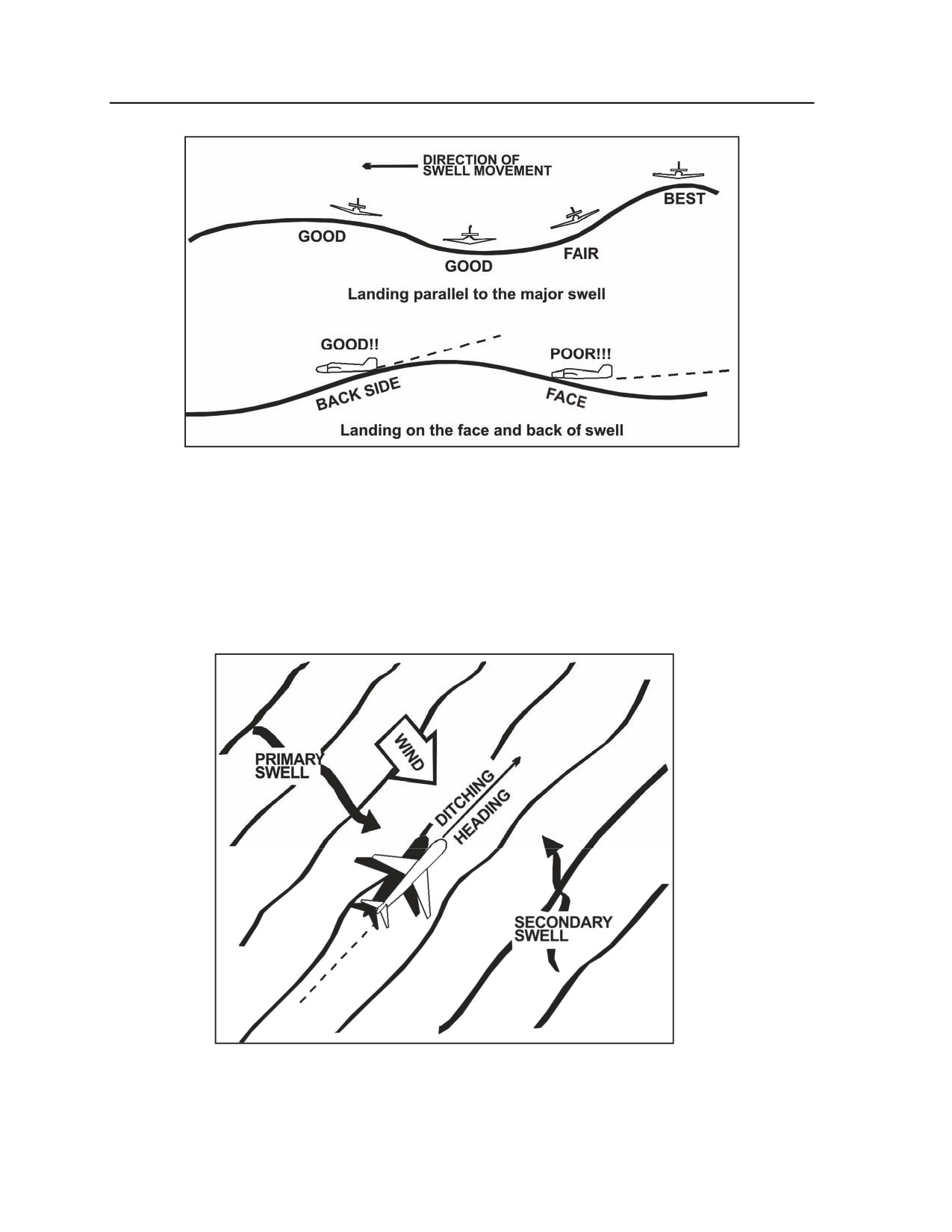
Chapter 8
Figure 8-6. Wind swell ditch heading
8-86. If only one swell system exists, the problem is relatively simple even with a high, fast system (figure
8-7). Unfortunately, most cases involve two or more swell systems running in different directions. With
more than one system present, the sea presents a confused appearance. One of the most difficult situations
occurs when two swell systems are at right angles. For example, if one system is eight feet high and the
other is three feet high, plan to land parallel to the primary system (figure 8-8, page 8-20), and on the down
swell of the secondary system. If both systems are of equal height, a compromise may be advisable. Select
an intermediate heading at 45 degrees down swell to both systems (figure 8-9, page 8-20). When landing
down a secondary swell, attempt to touch down on the back side, not on the face of the swell.
Figure 8-7. Single swell
8-20
FM 3-04.203
7 May 2007
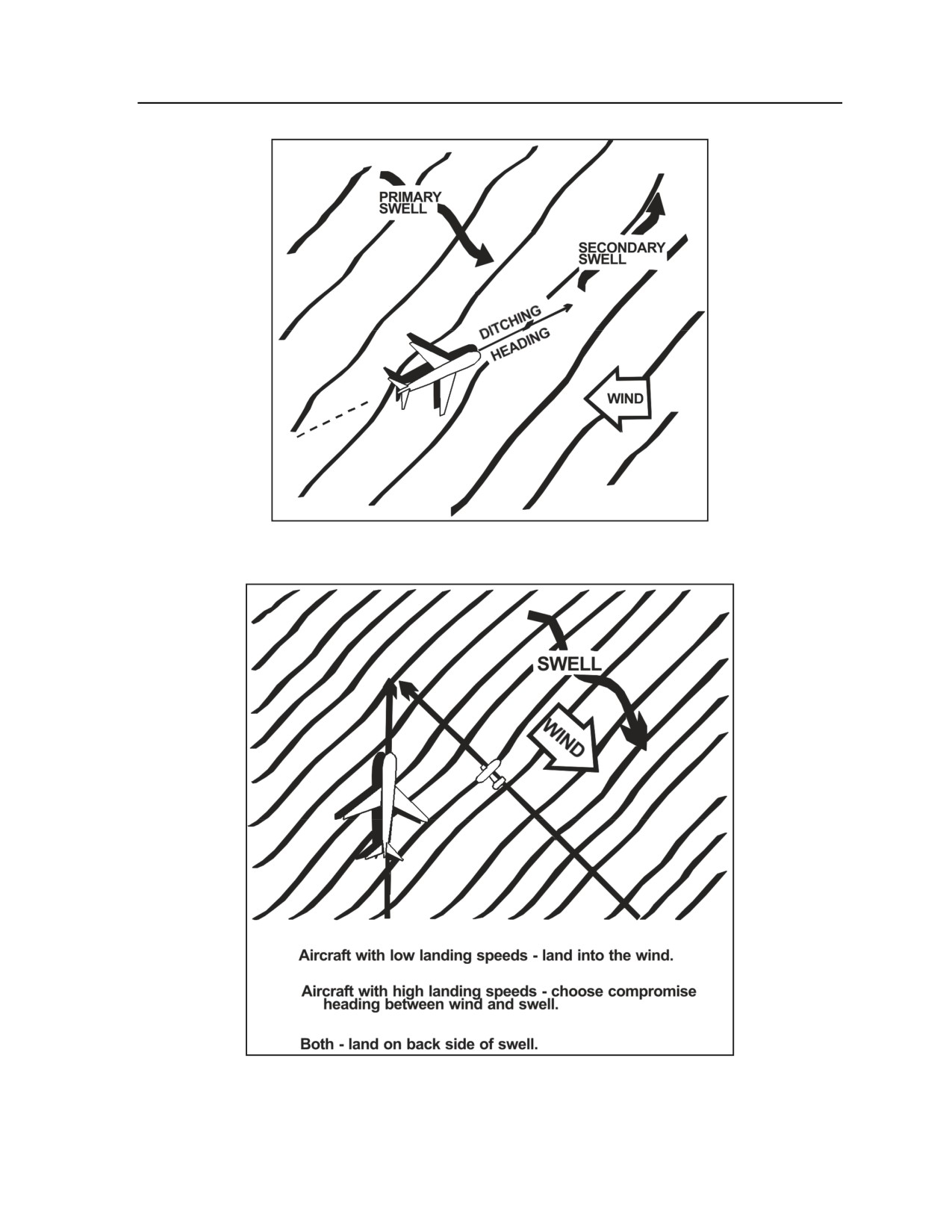
Fixed-Wing Environmental Flight
Figure 8-8. Double swell (15 knot wind)
Figure 8-9. Double swell (30 knot wind)
7 May 2007
FM 3-04.203
8-21
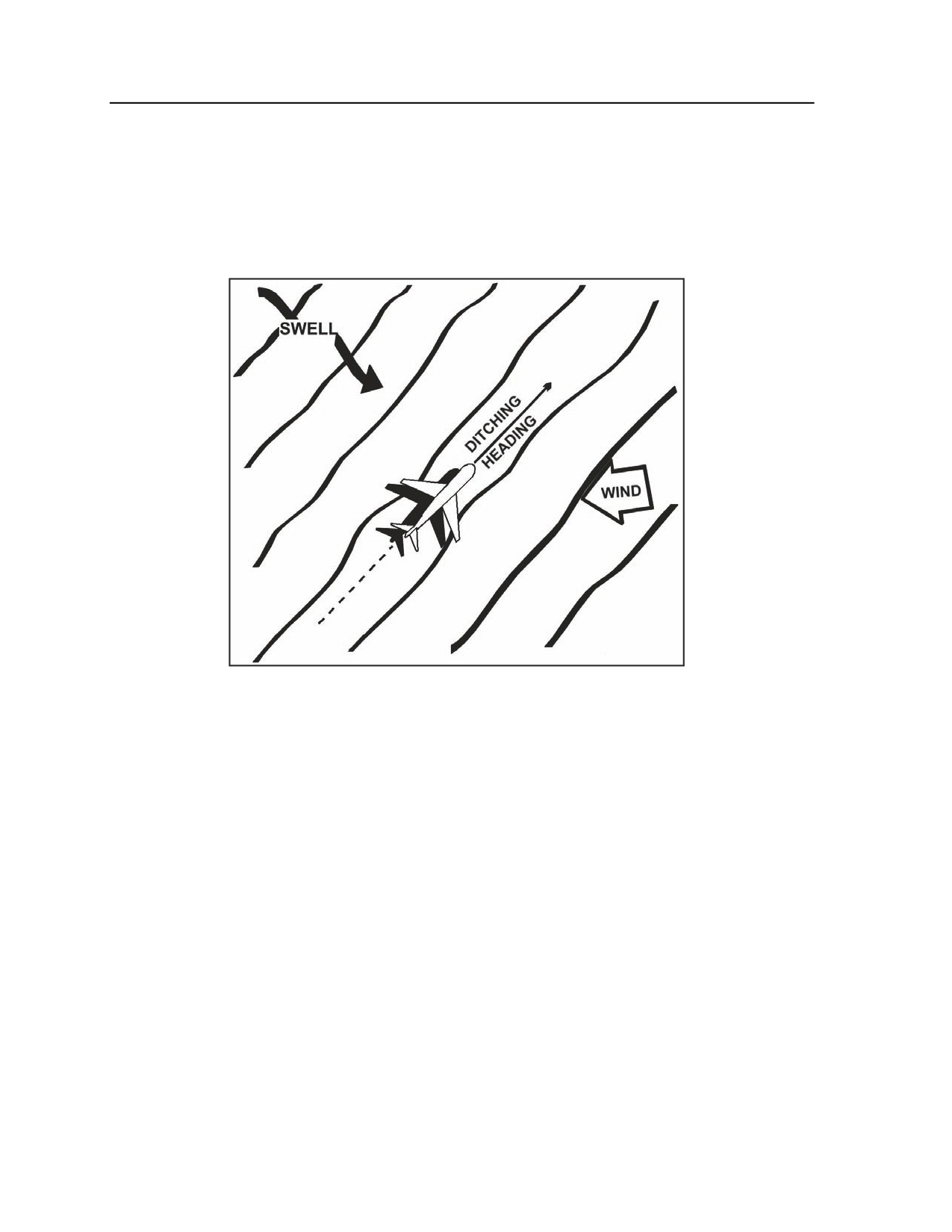
Chapter 8
8-87. If the swell system is formidable, it is considered advisable, in landplanes, to accept more crosswind
to avoid landing directly into the swell.
8-88. The secondary swell system is often from the same direction as the wind. Here, the landing may be
made parallel to the primary system, with the wind and secondary system at an angle. There is a choice of
two directions paralleling the primary system. One direction is downwind and down the secondary swell,
and the other is into the wind and into the secondary swell. The choice will depend on the velocity of the
wind versus the velocity and height of the secondary swell (figure 8-10).
Figure 8-10. Swell (50 knot wind)
Wind Considerations
8-89. The simplest method of estimating wind direction and velocity is to examine windstreaks on the
water. These appear as long streaks up and down wind. There may be difficulty determining wind direction
after seeing the streaks on the water. Whitecaps fall forward with the wind but are overrun by the waves,
this produces the illusion the foam is sliding backward. Knowing this, and by observing the direction of the
streaks, wind direction is determined. Wind velocity can be estimated by noting the appearance of
whitecaps, foam, and wind streaks.
Water Landing
8-90. Aircraft behavior, on making contact with the water, will vary within wide limits according to the
state of the sea. If landed parallel to a single swell system, aircraft behavior may approximate that to be
expected on a smooth sea. If landed into a heavy swell or into a confused sea, deceleration forces may be
extremely great resulting in breaking up of the aircraft. Within certain limits, a pilot is able to minimize
these forces by proper sea evaluation and selection of ditching heading.
8-91. When on final approach a pilot looks ahead and observes the surface of the sea. There may be
shadows and whitecaps, signs of large seas. Shadows and whitecaps close together indicate short and rough
seas; touchdown in these areas is to be avoided. A pilot selects and touches down in an area (only about
500 feet is needed) where shadows and whitecaps are not as numerous.
8-22
FM 3-04.203
7 May 2007