FM 3-04.203 Fundamentals of Flight (May 2007) - page 10
Fixed-Wing Environmental Flight
8-92. Touchdown is accomplished at the lowest speed and rate of descent permitting safe handling and
optimum nose up attitude on impact. Once first impact has been made, there is often little a pilot can do to
control a landplane.
8-93. Once preditching preparations are completed, the pilot turns to the ditching heading and commence
let-down. The aircraft should be flown low over the water, and slowed down until ten knots or so above
stall. At this point, additional power is used to overcome increased drag caused by the nose up attitude.
When a smooth stretch of water appears ahead, cut power, and touchdown at the best recommended speed
as fully stalled as possible. By cutting power when approaching a relatively smooth area, a pilot will
prevent overshooting and touch down with less chance of planning off into a second uncontrolled landing.
Most experienced seaplane pilots prefer to make contact with the water in a semi-stalled attitude, cutting
power as the tail makes contact. This technique eliminates the chance of misjudging altitude with a
resultant heavy drop in a fully stalled condition. Care must be taken to not drop the aircraft from too high
altitude or to balloon due to excessive speed.
8-94. The altitude above water depends on the aircraft. Over glassy smooth water or at night without
sufficient light, it is very easy to misjudge altitude by 50 feet or more. Under such conditions, a pilot must
carry enough power to maintain 9 to 12 degrees nose up attitude, and 10 to 20 percent over stalling speed,
until contact is made with the water. The proper use of power on the approach is of great importance. If
power is available on one side only, a little power will be used to flatten the approach; however, the engine
must not be used to such an extent the aircraft cannot be turned against the good engines right down to the
stall with a margin of rudder movement available. When near stall, sudden application of excessive
unbalanced power may result in loss of directional control. If power is available on one side only, a slightly
higher than normal glide approach speed will be used. This ensures good control and some margin of speed
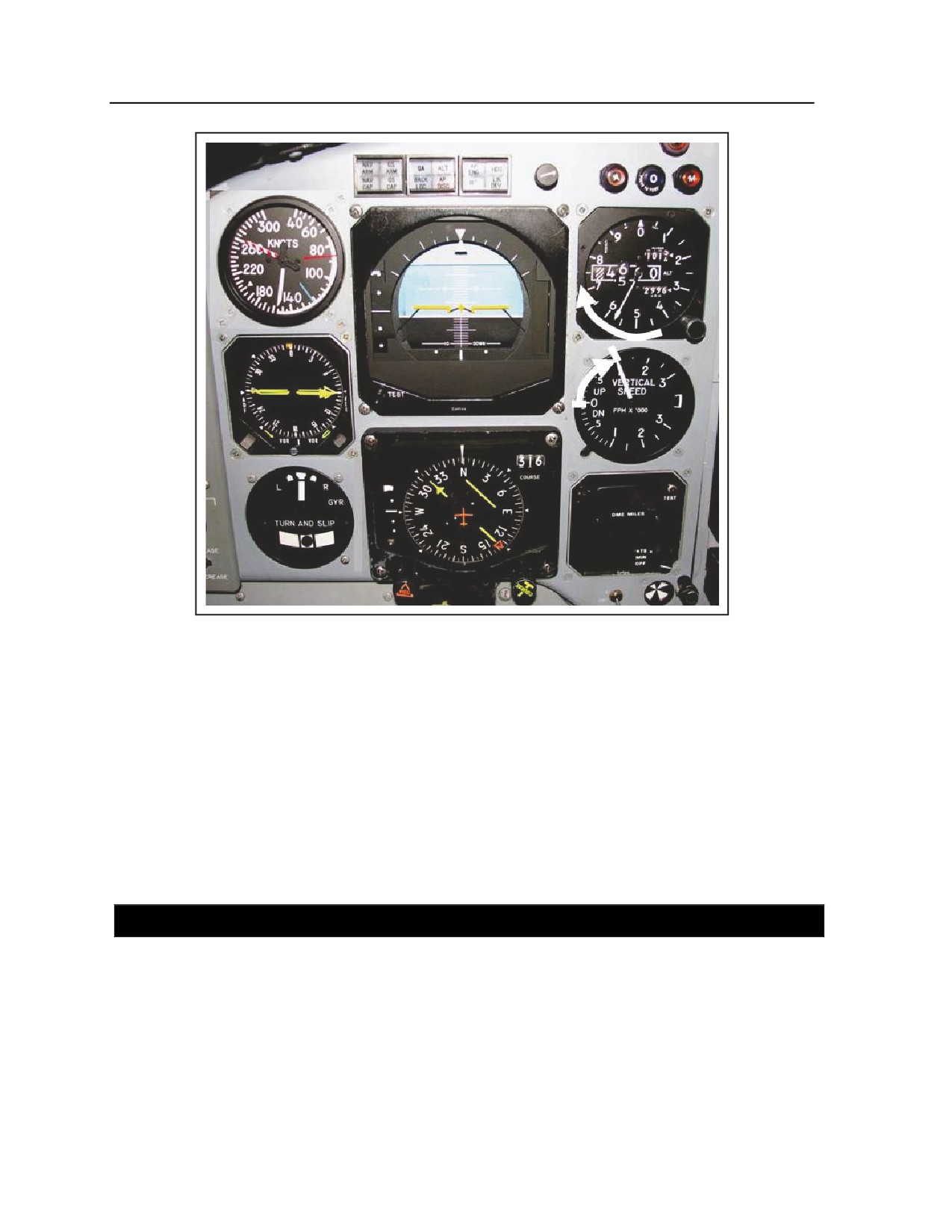
after leveling off without excessive use of power. The use of power in ditching is so important that when it
is certain the coast cannot be reached, the pilot should, and if possible, ditch before fuel is exhausted. Use
of power in night or instrument ditching is far more essential than under daylight contact conditions.
8-95. If no power is available, a greater than normal approach speed should be used down to the flare-out.
This speed margin will allow the glide to be broken early and more gradually, thereby giving the pilot time
and distance to feel for the surfaceídecreasing the possibility of stalling high or flying into the water.
When landing parallel to a swell system, little difference is noted between landing on top of a crest or in
the trough. If the wings of aircraft are trimmed to the surface of the sea rather than the horizon, there is
little need to worry about a wing hitting a swell crest. The actual slope of a swell is very gradual. If forced
to land into a swell, touchdown should be made just after passage of the crest. If contact is made on the
face of the swell, the aircraft may be swamped or thrown violently into the air, dropping heavily into the
next swell. If control surfaces remain intact, the pilot should attempt to maintain the proper nose above the
horizon attitude by rapid and positive use of the controls.
After Touchdown
8-96. In most cases drift, caused by crosswind can be ignored. Forces acting on the aircraft after
touchdown are of such magnitudes that drift will be only a secondary consideration. If the aircraft is under
good control, the “crab” may be kicked out with rudder just prior to touchdown. This is more important
with high wing aircraft, as they are laterally unstable on the water in a crosswind and may roll to the side in
ditching.
SECTION IV - THUNDERSTORM OPERATIONS
8-97. Turbulence, hail, rain, snow, lightning, sustained updrafts and downdrafts, and icing conditions are
all present in thunderstorms. While there is some evidence maximum turbulence exists at the middle level
of a thunderstorm, recent studies show little variation of turbulence intensity with altitude.
7 May 2007
FM 3-04.203
8-23
Chapter 8
ENVIRONMENTAL FACTORS
8-98. There is no useful correlation between the external visual appearance of thunderstorms and the
severity, amount of turbulence, or hail within them. The visible thunderstorm cloud is only a portion of a
turbulent system whose updrafts and downdrafts often extend far beyond the visible storm cloud. Severe
turbulence can be expected up to 20 miles from severe thunderstorms and decreases to about 10 miles in
less severe storms.
WIND SHEAR
8-99. One of the more deadly factors associated with thunderstorms is wind shear and has been identified
as the cause of many major aircraft accidents and deaths. Wind shear is a sudden, drastic change in wind
speed and/or direction over a very small area. Wind shear can subject an aircraft to violent updrafts and
downdrafts as well as abrupt changes to horizontal movement of the aircraft. While wind shear can occur at
any altitude, low-level wind shear is especially hazardous due to proximity of an aircraft to the ground.
Directional wind changes of 180 degrees and speed changes of 50 knots or more are associated with low-
level wind shear. Low-level wind shear is also commonly associated with passing frontal systems and
temperature inversions with strong upper level winds (greater than 25 knots).
8-100. Wind shear is dangerous to an aircraft for several reasons. The rapid changes in wind direction
and velocity alter the wind’s relation to the aircraft and disrupt the normal flight attitude and performance
of the aircraft. During a wind shear situation, effects can be subtle or very dramatic depending on wind
speed and direction of change. For example, a tailwind quickly changing to a headwind will cause an
increase in airspeed and performance. Conversely, when a headwind changes to a tailwind, airspeed will
rapidly decrease and there will be a corresponding decrease in performance. In either case, a pilot must be
prepared to react immediately to maintain aircraft control.
8-101. In general, the most severe type of low-level wind shear is associated with convective precipitation
or rain from thunderstorms. One critical type of shear associated with convective precipitation is known as
a microburst. A typical microburst occurs in a space of less than 1 mile horizontally and within 1,000 feet
vertically. The lifespan of a microburst is about 15 minutes, during which it can produce downdrafts of up
to 6,000 FPM. It can also produce a hazardous wind direction change of 45 knots or more, in a matter of
seconds. When encountered close to the ground, these excessive downdrafts and rapid changes in wind
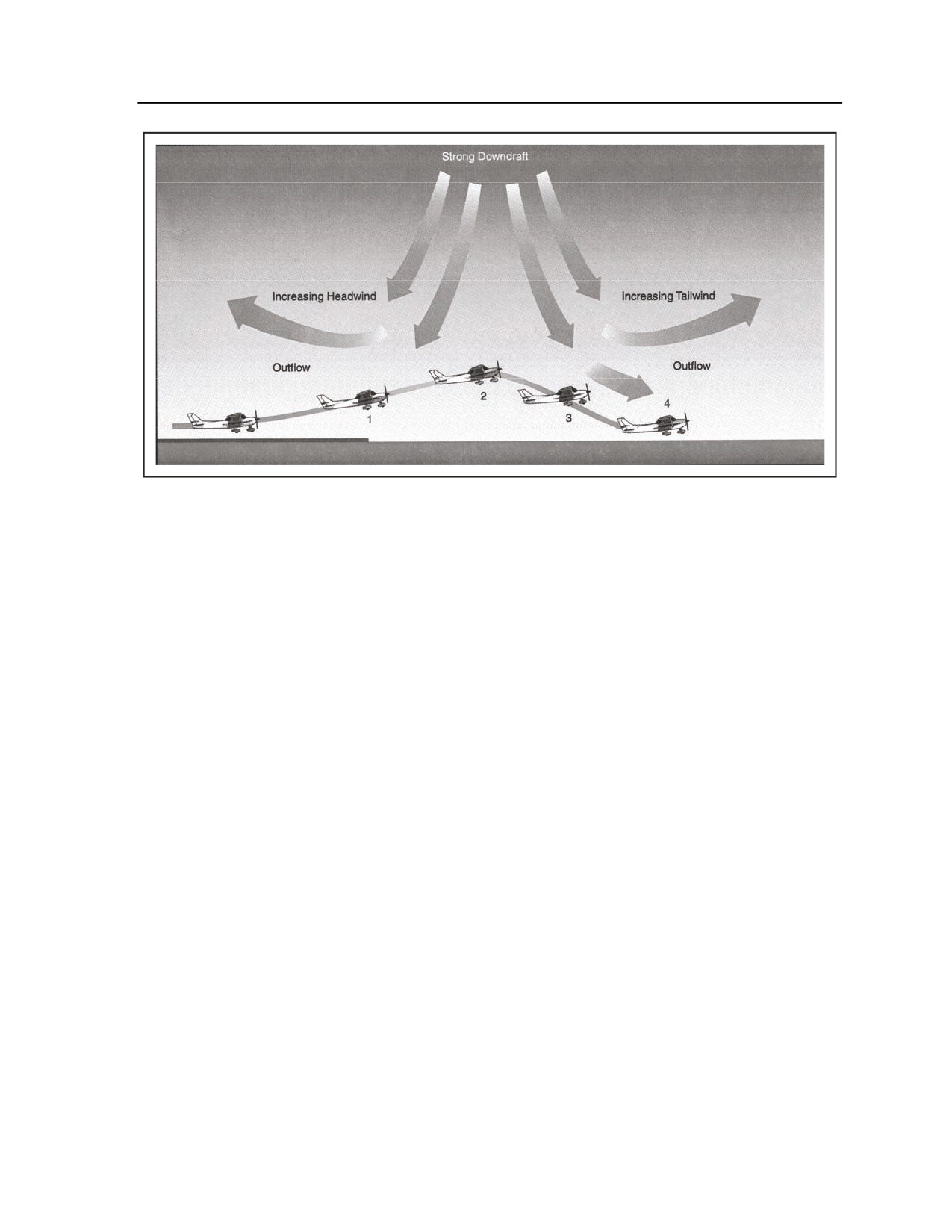
direction can produce a situation in which it is difficult to control the aircraft (figure 8-11, page 8-24).
During an inadvertent takeoff into a microburst, the aircraft experiences a performance-increasing
headwind, followed by performance-decreasing downdrafts. The wind then rapidly shears to a tailwind and
can result in terrain impact or flight dangerously close to the ground.
8-24
FM 3-04.203
7 May 2007
Fixed-Wing Environmental Flight
Figure 8-11. Effect of microburst
8-102. Microbursts are often difficult to detect because they occur in a relatively confined area. In an
effort to warn pilots of low-level wind shear, alert systems have been installed at several airports around
the country. A series of anemometers, placed around the airport, form a net to detect changes in wind
speeds. When wind speeds differ by more than 15 knots, a warning for wind shear is given to pilots. This
system is known as the low-level wind shear alert system.
8-103. Wind shear can affect any flight and any pilot at any altitude. While wind shear may be reported, it
often remains undetected and is a silent danger to aviation. A pilot must always be alert to the possibility of
wind shear, especially when flying in and around thunderstorms and frontal systems.
FLYING TECHNIQUES
8-104. Thunderstorms must never be taken lightly, even when radar observers report echoes of light
intensity. Avoiding thunderstorms is the best policy. The following are a few guidelines for avoiding
thunderstorms:
Do not land or takeoff in the face of an approaching thunderstorm. A sudden gust front of low
level turbulence could cause loss of control.
Do not attempt to fly under a thunderstorm even with clear visibility through to the other side.
Turbulence and wind shear under the storm could be disastrous.
Do not fly without airborne radar into a cloud mass containing scattered embedded
thunderstorms. Scattered thunderstorms not embedded usually can be visually circumnavigated.
Do not trust visual appearance to be a reliable indicator of turbulence inside a thunderstorm.
Avoid (by at least 20 miles) any thunderstorm identified as severe or giving an intense radar
echo. This is especially true under the anvil of a large cumulonimbus cloud.
Clear the top of a known or suspected severe thunderstorm by at least 1,000 feet altitude for
each 10 knots of wind speed at the cloud top. This should exceed the altitude capability of most
aircraft.
Circumnavigate the entire area if the thunderstorm coverage is—
More than 45 percent (DD Form 175-1 [Flight Weather Briefing]).
Six-tenths or greater (FAA).
Remember vivid and frequent lightning indicates probability of a strong thunderstorm.
7 May 2007
FM 3-04.203
8-25
Chapter 8
Regard as any thunderstorm with 35,000 feet or higher tops as extremely hazardous, whether the
top is visually sighted or determined by radar.
8-105.
If you cannot avoid penetrating a thunderstorm, the following guidelines are provided:
Tighten the safety belt, put on the shoulder harness if one exists, and secure all loose objects.
Plan and hold course to get through the storm in minimum time.
Establish a penetration altitude below freezing level or above -15 degrees C, to avoid the critical
icing.
Verify pitot heat is on and turn on carburetor heat or jet engine anti-ice. Icing can be rapid at any
altitude and cause almost instantaneous power failure and/or loss of airspeed indication.
Establish power settings for turbulence penetration airspeed recommended in the AFM.
Turn up cockpit lights to highest intensity to lessen temporary blindness from lightning.
If using automatic pilot, disengage altitude hold and speed hold modes. The automatic altitude
and speed controls will increase maneuvers of the aircraft thus increasing structural stress.
If using airborne radar, tilt the antenna up and down occasionally. This will permit detection of
any thunderstorm activity at altitudes other than the one being flown.
Keep visual of the aircraft’s instruments. Looking outside the cockpit can increase danger of
temporary blindness from lightning.
Do not change power settings; maintain settings for the recommended turbulence penetration
airspeed.
Do not attempt to maintain constant altitude; let the aircraft ride the waves.
Do not turn back once in the thunderstorm. A straight course through the storm most likely will
get a pilot out of the hazards most quickly. In addition, turning maneuvers increase stress on the
aircraft.
WIND SHEAR RECOVERY TECHNIQUE
8-106. The primary recovery technique objective is to keep the aircraft flying as long as possible in hope
of exiting the shear. A wide variety of techniques were considered to establish the one best meeting this
objective. The best results were achieved by pitching toward an initial target attitude while using necessary
thrust. Several factors were considered in developing this technique.
8-107. Studies show wind shear encounters occur infrequently and only a few seconds are available to
initiate a successful recovery. Additionally, during high stress situations, pilot instrument scan typically
becomes very limited. In extreme cases, this scan may be limited to only one instrument. Lastly, recovery
skills will not be exercised on a day-to-day basis. These factors dictated the recovery technique must not
only be effective, but simple, easily recalled, and have general applicability.
8-108. Extensive analysis and pilot evaluations were conducted. Although a range of recovery attitudes
(including 15 degrees and the range of all-engine initial climb attitudes) provides good recovery capability
for a wide variety of wind shears, 15 degrees was chosen as the initial target pitch attitude for both takeoff
and approach. Additional advantages of 15-degree initial target pitch attitude are it is easily recalled in
emergency situations and prominently displayed on attitude director indicators.
8-109. While other more complex techniques may make slightly better use of aircraft performance, these
techniques do not meet simplicity and ease of recall requirements. Evaluations showed the recommended
technique provides a simple, effective means of recovering from a wind shear encounter. Proficiency in the
techniques for each specific aircraft is critical to wind shear recovery.
OPERATIONAL PROCEDURES
8-110. Weather radar, airborne or ground based, will normally reflect areas of moderate to heavy
precipitation
(radar does not detect turbulence). The frequency and severity of turbulence generally
increases with radar reflectivity which is closely associated with areas of highest liquid water content of the
8-26
FM 3-04.203
7 May 2007
Fixed-Wing Environmental Flight
storm. No flight path through an area of strong or very strong radar echoes separated by 20 to 30 miles or
less may be considered free of severe turbulence.
8-111. Turbulence beneath a thunderstorm must not be minimized. This is especially true when relative
humidity is low in any layer between the surface and 15,000 feet. Then, the lower altitudes may be
characterized by strong out flowing winds and severe turbulence.
8-112. The probability of lightning striking an aircraft is greatest when operating at altitudes where
temperatures are -5 degrees C to 5 degrees C. Lightning can strike aircraft flying in the clear within the
vicinity of a thunderstorm.
8-113. Meteorological terminal aviation reports do not include a descriptor for severe thunderstorms.
However, by understanding severe thunderstorm criteria, information is available in the report to know one
is occurring.
8-114. NWS radar systems are able to objectively determine radar weather echo intensity levels by use of
video integrator processor equipment. These thunderstorm intensity levels are on a scale of one to six.
TRAINING
8-115. Units qualifying aviators in thunderstorm operations are responsible for conducting a well-
organized training program. Training programs should be geared to instill confidence and develop skills in
all areas. IPs and supervisory maintenance personnel must be highly qualified and skilled.
8-116. Emphasis must be placed on safety and avoidance; avoiding thunderstorms and all their hazards.
The flight training program allows each aviator to advance at an individual rate. Initial training is
conducted under less challenging conditions. As an aviator's proficiency increases, conditions become
more demanding until the most challenging mission can be performed.
RECOMMENDED PROGRAM OF INSTRUCTION
8-117. A recommended program of instruction for qualifying aviators for thunderstorm operations is
provided. Additional academic subjects may be required, based on the specific mission and location of the
unit.
Academics
8-118. Suggested topics include—
Human factors associated with thunderstorm flying.
Environmental factors affecting thunderstorm operations.
Planning data available on thunderstorms.
In-flight equipment and resources detecting and avoiding hazards.
Aircraft operational procedures in thunderstorms.
Flight
8-119. Flight training may be limited by conditions at the unit’s home station as there may not be areas
able to replicate conditions adequately. Instructors can demonstrate techniques and procedures to some
extent. Crews should be evaluated on these procedures during their APART or no-notice evaluations.
Flight simulators are also a great device in training for this environment.
8-120. Suggested maneuvers include—
En route flight techniques.
Wind shear recovery maneuvers.
Use of aircraft equipment for avoidance.
7 May 2007
FM 3-04.203
8-27
Chapter 8
Research Materials
8-121. To prepare to train for or operate in a thunderstorm environment, the following materials are
suggested:
Local SOPs.
Aircraft operator’s manual.
FAA site, http://www.faa.gov/.
FAA safety site, http://www.faasafety.gov/.
FAA “General Aviation Pilot’s Guide to Preflight Weather Planning, Weather Self-Briefings,
and Weather Decision Making.”
Aviation Weather Center: http://adds.aviationweather.noaa.gov/.
FM 1-230.
FM 3-04.301.
AKO file search.
8-28
FM 3-04.203
7 May 2007
Chapter 9
Fixed-Wing Night Flight
Night flight is important in training FW aviators. This chapter briefly discusses night
flight considerations, takeoffs, and landings. This chapter supplements chapter 4 with
information specific to FW operations.
SECTION I - PREPARATION AND PREFLIGHT
9-1. Crewmembers should be familiar with the
aircraft, lighting system, and emergency equipment.
Contents
A thorough preflight of the aircraft and a review of
aircraft systems and emergency procedures are
Section I - Preparation and Preflight
9-1
important for night operations. The following
Section II - Taxi, Takeoff, and
information supplements, but does not replace, the
Departure Climb
9-3
aircraft checklist.
Section III - Orientation and Navigation
9-4
Section IV - Approaches and Landings
9-5
EQUIPMENT
Section V - Night Emergencies
9-9
9-2. Before beginning a night flight, aviators must
carefully consider personal equipment needed during a flight. At least one reliable flashlight is required
(AR 95-1) as standard equipment on all night flights. A D-cell size flashlight with a bulb switching
mechanism used to select white or red light along with a spare set of batteries is preferable. The white light
should be used while performing preflight visual inspection of the airplane, and the red light is used when
performing cockpit operations. Since the red light is nonglaring, it will not impair night vision. Some
aviators prefer two flashlights, a white light for preflight, and a penlight with red light. The latter can be
suspended around the neck by a string, ensuring the light is always readily available. If a red light is used
for reading an aeronautical chart, red features of the chart will not show up.
9-3. Aeronautical charts are essential for night cross-country flight and, if intended course is near the
edge of the chart, the adjacent chart should also be available. The lights of cities and towns can be seen
from surprising distances at night. Therefore, if the adjacent chart is not available to identify those
landmarks, confusion could result. Regardless of equipment used, organization of the cockpit eases the
burden on the aviator and enhances safety.
LIGHTING
AIRCRAFT
9-4. Aviators turn on and check aircraft lights for proper operation. They check position lights for loose
connections by tapping the light fixture while the light is on. If the light operation is intermittent, the
aviator must determine the cause and correct the deficiency.
9-5. Aviators adjust cockpit lights before takeoff. They adjust the lights to the dimmest level allowing
them to read instruments and identify switches without hindering their vision outside the cockpit. Dimming
the cockpit lights also eliminates light reflections on the windscreen and windows. Aviators should turn on
position and anti-collision lights before starting the engines. These lights remain on during engine
operation.
7 May 2007
FM 3-04.203
9-1
Chapter 9
AIRPORT AND NAVIGATION LIGHTING AIDS
9-6. The lighting systems used for airports, runways, obstructions, and other visual aids at night are
another important aspects of night flight.
9-7. Lighted airports located away from congested areas can be identified readily at night by lights
outlining runways. Airports located near or within large cities are often difficult to identify in the maze of
lights. It is important not only to know the exact location of an airport relative to the city, but also to be
able to identify these airports by characteristics of their lighting pattern.
9-8. Aeronautical lights are designed and installed in a variety of colors and configurations, each having
its own purpose. Although some lights are used only during low ceiling and visibility conditions, this
discussion includes only lights fundamental to VFR night operation.
9-9. Prior to a night flight, particularly a cross-country night flight, the aviator checks the availability and
status of lighting systems at the destination airport. This information is found on aeronautical charts and in
the airport/facility directory. The status of each facility is determined by reviewing pertinent notices to
airmen.
9-10. A rotating beacon is used to indicate the location of most airports. The beacon rotates at a constant
speed, thus producing what appears to be a series of light flashes at regular intervals. These flashes may be
one or two different colors used to identify various types of landing areas. The following are examples:
Lighted civilian land airports-alternating white and green.
Lighted civilian water airports-alternating white and yellow.
Lighted military airports-alternating white and green, but are differentiated from civil airports
by dual peaked (two quick) white flashes, then green.
9-11. Beacons producing red flashes indicate obstructions or areas considered hazardous to aerial
navigation. Steady burning red lights are used to mark obstructions on or near airports and sometimes to
supplement flashing lights on en route obstructions. High intensity flashing white lights are used to mark
some supporting structures of overhead transmission lines stretching across rivers, chasms, and gorges.
These high intensity lights are also used to identify tall structures, such as chimneys and towers.
9-12. As a result of technological advancements in aviation, runway lighting systems have become
sophisticated in accommodating takeoffs and landings in various weather conditions. Aviators need to be
concerned with following the basic lighting system of runways and taxiways.
9-13. This lighting system consists of two straight parallel lines of runway-edge lights defining the lateral
limits of the runway. These lights are aviation white, although aviation yellow may be substituted for a
distance of 2,000 feet from the far end of the runway to indicate a caution zone. At some airports, the
intensity of runway-edge lights can be adjusted to satisfy individual needs of the aviator. The length limits
of the runway are defined by straight lines of lights across runway ends. At some airports, runway
threshold lights are aviation green, and runway end lights are aviation red.
9-14. At many airports, taxiways are also lighted. A taxiway-edge lighting system consists of blue lights
outlining usable limits of taxi paths.
PARKING RAMP CHECK
9-15. Aviators inspect the parking ramp before entering the aircraft. Stepladders, chuckholes, and other
obstacles are difficult to see at night. A thorough check of the area can prevent taxiing mishaps.
PREFLIGHT
9-16. Planning for a night flight includes a thorough review of available weather reports and forecasts with
particular attention given to temperature/dew point spread. A narrow temperature/dew point spread may
indicate possibility of ground fog. Emphasis should also be placed on wind direction and speed, as its
effect on the airplane cannot be as easily detected at night as during the day.
9-2
FM 3-04.203
7 May 2007
Fixed-Wing Night Flight
9-17. On night cross-country flights, appropriate aeronautical charts are selected, including appropriate
adjacent charts. Course lines are drawn in black to be more distinguishable.
9-18. Prominently lighted CPs along the prepared course are noted. Rotating beacons at airports, lighted
obstructions, lights of cities or towns, and lights from major highway traffic all provide excellent visual
CPs. The use of radio NAVAIDs and communication facilities add significantly to safety and efficiency of
night flight.
SECTION II - TAXI, TAKEOFF, AND DEPARTURE CLIMB
9-19. Fewer outside visual references are available during night flight. Aviators rely on flight instruments
at night for attitude control. This is particularly true for night takeoffs and departure climbs.
TAXI
LIGHTS
9-20. Aviators perform night taxiing slowly and with extreme care. Landing lights can easily disturb the
vision of others and overheat due to inadequate airflow to carry heat away. An aviator uses taxi lights
whenever possible and the landing light only as necessary.
OTHER AIRCRAFT
9-21. Aviators use extreme caution when taxiing onto an active runway for takeoff. Even at controlled
airports, aviators must check the final approach course for approaching aircraft. At uncontrolled airports,
aviators execute slow 360-degree turns in the same direction as the flow of air traffic. This will assist in
identifying other aircraft in the traffic pattern or the vicinity.
TAKEOFF AND CLIMB
9-22. Night flight is very different from day flying and demands more of the aviator’s attention. Flight
instruments are used to a greater degree in controlling the airplane. This is particularly true on night
takeoffs and climbs.
9-23. After ensuring the final approach and runway are clear of other air traffic, or when cleared for
takeoff by the tower, landing lights and taxi lights are turned on and the airplane lined up with the
centerline of the runway. If the runway does not have centerline lighting, use the painted centerline and
runway-edge lights. After the airplane is aligned, the heading indicator is noted or set to correspond to the
known runway direction. To begin takeoff, the brakes are released and the throttle smoothly advanced to
maximum allowable power. As the airplane accelerates, it continues moving straight ahead between and
parallel to the runway-edge lights.
9-24. The procedure for night takeoffs is the same as normal daytime takeoffs except many of the runway
visual cues are not available. Therefore, flight instruments are checked frequently during takeoff ensuring
proper pitch attitude, heading, and airspeed are being attained. As airspeed reaches normal lift-off speed,
pitch attitude is adjusted to establish a normal climb. This is accomplished by referring to both outside
visual references, such as lights, and flight instruments (figure 9-1, page 9-4).
7 May 2007
FM 3-04.203
9-3
Chapter 9
Figure 9-1. Positive climb
9-25. After becoming airborne, the darkness of night often makes it difficult to note whether the airplane is
getting closer to or farther from the surface. To ensure the airplane is continuing a positive climb, verify
that climb is indicated on the attitude indicator, VSI, and altimeter. It is also important that airspeed is at
best climb speed.
9-26. Necessary pitch and bank adjustments are made by referencing attitude and heading indicators. It is
recommended turns not be made until reaching a safe maneuvering altitude.
9-27. Although the use of landing lights provides help during takeoff, they become ineffective after the
airplane has climbed to an altitude where the light beam no longer extends to the surface. The light can
cause distortion when reflected by haze, smoke, or fog existing in the climb. Therefore, when the landing
light is used for takeoff, it may be turned off after climb is well established provided other traffic in the
area does not require its use for collision avoidance.
SECTION III - ORIENTATION AND NAVIGATION
9-28. During night flight, aircrew members must be alert for other aircraft. The relative position of other
aircraft is determined by color, position, and movement direction of their position lights.
VISIBILITY
9-29. Clouds and visibility restrictions may be difficult to see. This is more pronounced during periods of
low moon illumination or overcast sky conditions. While flying VFR, aviators must avoid flying into
clouds or a fog layer. Usually, the first indication of restricted visibility is the gradual disappearance of
ground lights. If a halo appears surrounding the lights, aviators avoid further flight in that direction. If
9-4
FM 3-04.203
7 May 2007
Fixed-Wing Night Flight
descent through fog, smoke, or haze is necessary, horizontal visibility is considerably less than vertical
visibility. Aviators must avoid night VFR flight during poor or marginal weather conditions.
MANEUVERS
9-30. Night maneuvers are practiced in designated areas or at least in an area known to be comparatively
free of other air traffic. Aviators practice and acquire competency in straight-and-level flight, climbs and
descents, level turns, climbing and descending turns, and steep turns. Recovery from unusual attitudes is
practiced, but only as covered in the appropriate ATM. They must also practice these maneuvers with all
cockpit lights turned off. This blackout training is necessary if aviators experience an electrical or
instrument light failure. Training also includes use of navigation equipment and local NAVAIDs.
DISORIENTATION AND REORIENTATION
9-31. Disorientation can happen to the most experienced aviator. An orderly plan for reorientation must be
developed in advance. Thorough knowledge of the area, current navigation charts, identified radio
NAVAIDS, and assistance from ATC agencies and other aircraft may be used for reorientation.
CROSS-COUNTRY FLIGHTS
9-32. Cross-country night flights do not present unusual problems if aircrew members complete adequate
preplanning. NAVAIDs, if available, are used to assist in monitoring en route progress.
OVERWATER FLIGHTS
9-33. Crossing large bodies of water during night flights is potentially hazardous. Emergency procedures,
such as ditching, are primary hazards and briefed to aviators. Aircraft control is also a potential problem
that must be prepared for. The horizon may be difficult to see under certain atmospheric conditions and can
essentially disappear, creating conditions conducive to spatial disorientation. On clear low-moon
illumination nights, stars can reflect on the water’s surface leading to a variation of the visual illusion
called ground light misinterpretation.
ILLUSIONS
9-34. Lighted runways, buildings, or other objects may cause illusions when seen from different altitudes.
At an altitude of 2,000 feet, an aviator may see a group of lights individually. At 5,000 feet or higher, the
same lights may appear to be one solid mass of light. These illusions may become acute with altitude
changes and could cause problems when an aviator approaches a lighted runway.
SECTION IV - APPROACHES AND LANDINGS
DISTANCE
9-35. Distance may be difficult to judge at night. This is due to limited lighting, lack of visual references
on the ground, and an aviator’s inability to compare size and location of ground objects. Altitude and
airspeed are also difficult to estimate at night. Therefore, the aircrew must closely monitor flight
instruments, particularly the altimeter and airspeed indicator.
AIRSPEED
9-36. Inexperienced aviators often tend to make night approaches and landings at excessive airspeeds. A
night approach uses the same techniques as a day approach; however, it is important to frequently
crosscheck the flight instruments with particular attention to the altimeter and airspeed indicator.
7 May 2007
FM 3-04.203
9-5
Chapter 9
DEPTH PERCEPTION
9-37. Even the most experienced aviators make mistakes in depth perception. Using power during the
landing flare reduces rate of descent and assists in maintaining a safe airspeed before touchdown. The use
of power is essential during landings to unlighted airfields when the surface is not visible. This is also an
effective technique in preventing errors in judgment and perception on lighted airfields. An effective night
technique is maintaining a slight amount of power and airspeed above stall until the wheels make ground
contact.
APPROACHING AIRPORTS
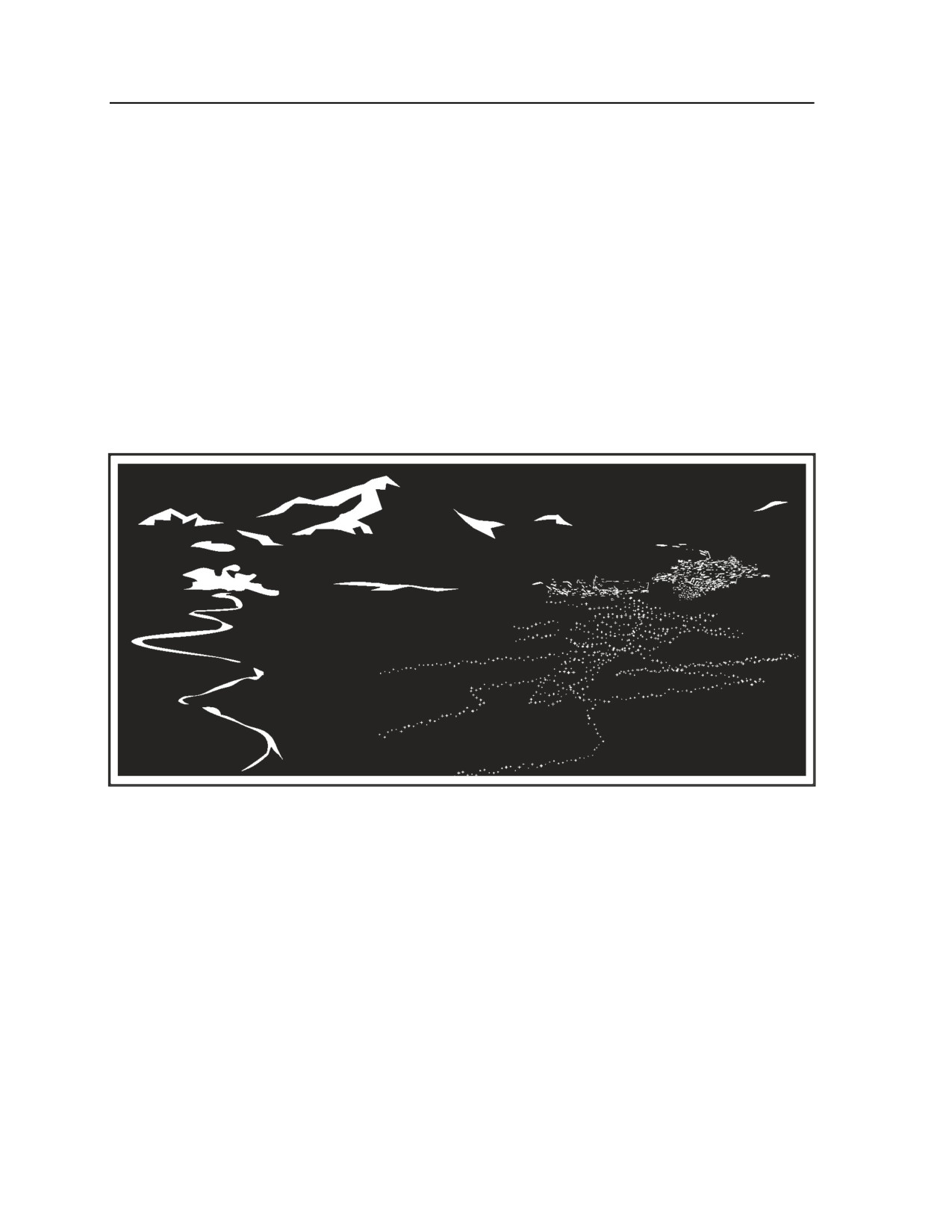
9-38. When approaching an airport, an aviator must identify runway lights and other airport lighting as
soon as possible. If aircrew members are unfamiliar with the airport, they may have difficulty sighting the
runway because of light congestion in the area. Figure 9-2 illustrates the difficulty of sighting a runway
surrounded by lights. Because airport beacons are hard to see when directly overhead, aircrew members
identify the airport through beacon identification while at a distance. Once identified, the aircrew continues
to fly toward the beacon until they can identify the runway lights and environment.
Figure 9-2. Typical light pattern for airport identification
ENTERING TRAFFIC
9-39. When aircrew members identify runway lights, they keep the approach threshold lights-including a
visual approach slope indicator (VASI), if available-in sight throughout the traffic pattern and approach.
FINAL APPROACH
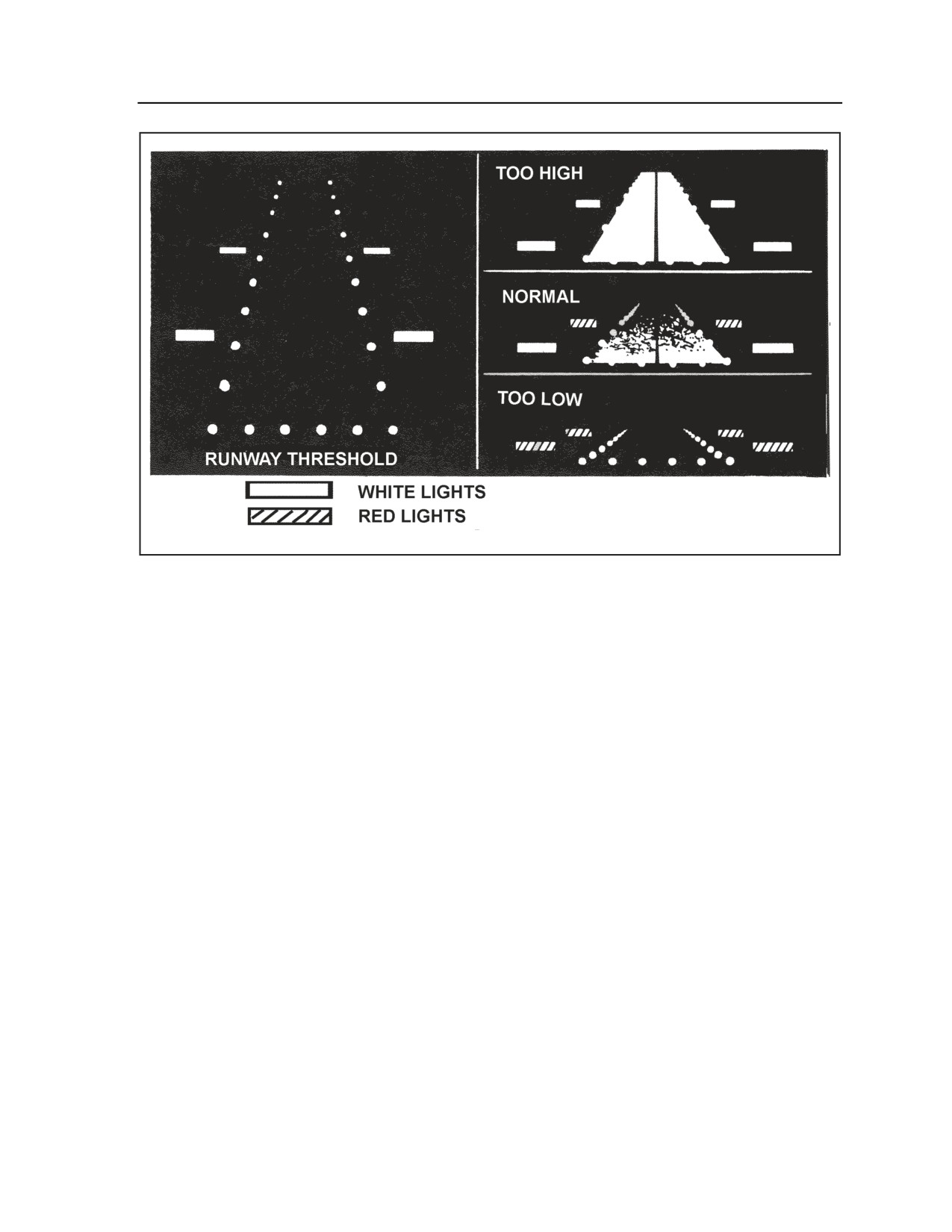
9-40. After turning onto the final approach leg, all available lighting, including a VASI or precision
approach path indicator, are used to maintain a proper approach angle. Obstruction or runway lights also
assist in judging the proper approach angle, especially when the runway environment is on level ground
and lights are spaced at a known interval. Uneven terrain or nonstandard light spacing makes the angular
reference unreliable. In such cases, an aviator takes advantage of other reference points near the approach
area. Figure 9-3, page 9-7, depicts a VASI.
9-6
FM 3-04.203
7 May 2007
Fixed-Wing Night Flight
Figure 9-3. Visual approach slope indicator
EXECUTING ROUNDOUT
9-41. Inexperienced aviators may tend to roundout too high until they become familiar with the apparent
height for the correct roundout position. To aid in determining the proper roundout point, an aviator
continues a constant approach descent until the landing light reflects off the runway and tire marks or
expansion joints on the runway can be clearly seen. He then smoothly starts the roundout for touchdown
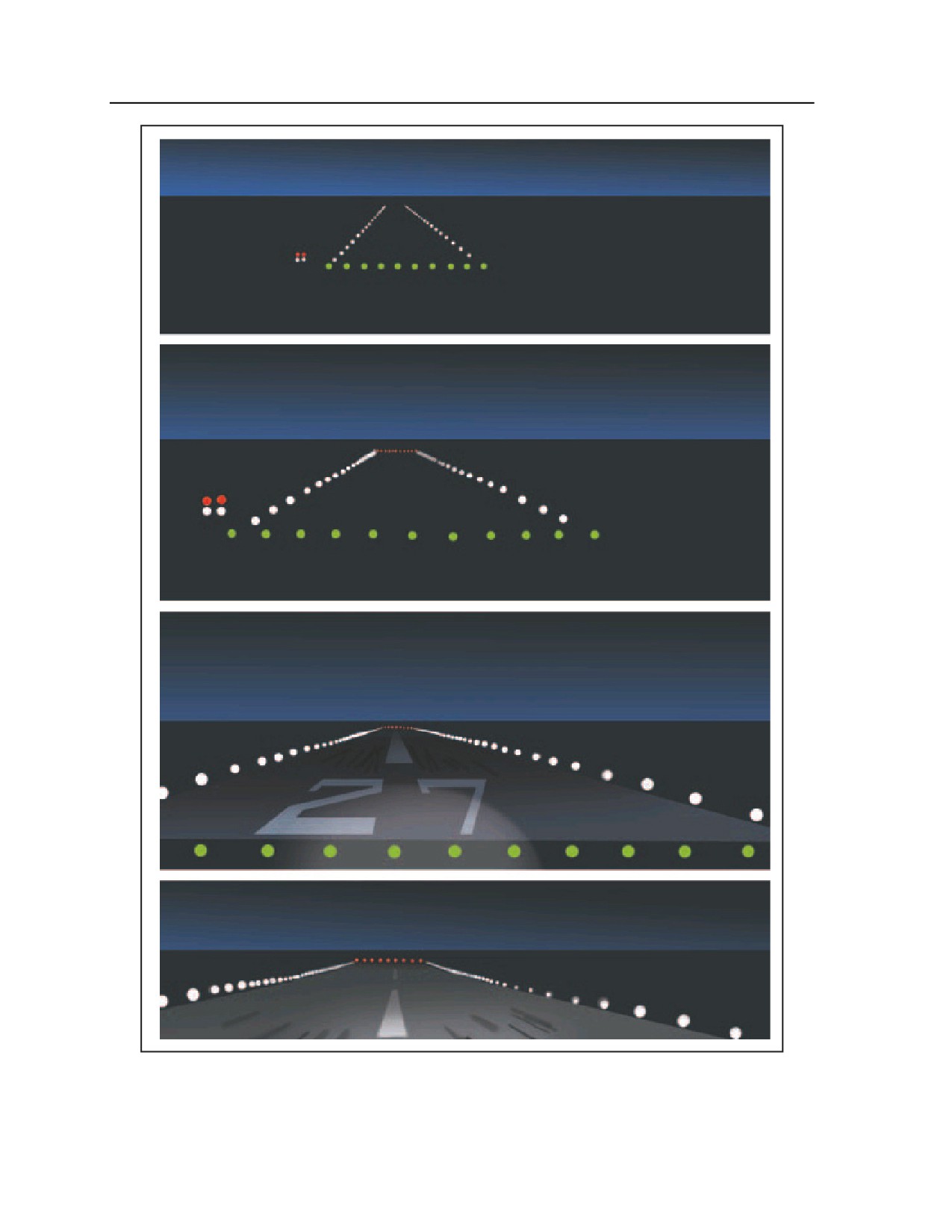
and continues to apply standard daytime procedures outlined in the appropriate ATM. Figure 9-4, page 9-8,
illustrates the proper roundout point. During landings without landing lights or where marks on the runway
are not visible, an aviator starts the roundout when runway lights at the far end of the runway first appear
to be rising higher than the aircraft. This demands a smooth and timely roundout and requires an aviator to
feel the runway surface using necessary power and pitch changes to settle the aircraft softly onto the
runway.
7 May 2007
FM 3-04.203
9-7
Chapter 9
Figure 9-4. Roundout (when tire marks are visible)
9-8
FM 3-04.203
7 May 2007
Fixed-Wing Night Flight
SECTION V - NIGHT EMERGENCIES
9-42. An aviator’s greatest concern about night flight is the possibility of an emergency and the subsequent
landing. This is a legitimate concern, even though continuing flight into adverse weather and poor aviator
judgment account for most serious accidents.
9-43. If an emergency occurs at night, keep the following important procedures and considerations to keep
in mind:
Focus on flying. If an aviator gets distracted by the emergency, a flyable aircraft could crash.
Dual engine failure or unable to maintain single engine flight. Maintain positive control of the
airplane and establish the best glide configuration and airspeed. Turn the airplane toward an
airport or away from congested areas. If possible, maintain orientation with the wind to avoid a
downwind landing.
Check to determine the cause of malfunction, such as position of fuel selectors, switch, or circuit
breaker. If possible, the cause of malfunction must be corrected immediately.
Announce the emergency situation to ATC or universal integrated communication. If already in
radio contact with a facility, do not change frequencies, unless instructed.
Forced landing. If the condition of the nearby terrain is known turn towards an unlighted portion
of the area. Plan an emergency approach to an unlighted portion.
Consider an emergency landing area close to public access if possible. This may facilitate rescue
or help, if needed.
Complete the before-landing checklist. Check landing lights for operation at altitude and turn on
in sufficient time to illuminate terrain or obstacles along the flight path. Complete the landing in
the normal landing attitude at the slowest possible airspeed. If landing lights are unusable and
outside visual references are not available, the airplane must be held in level-landing attitude
until ground is contacted.
7 May 2007
FM 3-04.203
9-9
This page intentionally left blank.
Glossary
AAA
antiaircraft artillery
AATF
air assault task force
AATFC
air assault task force commander
ABC
automatic brightness control
ACL
allowable cargo load
ACO
airspace control order
ACP
air control point
ADA
air defense artillery
ADSS
ANVIS display symbology system
AFM
aircraft flight manual
AGL
above ground level
AH
attack helicopter
AHO
above highest obstacle
AIM
Aeronautical Information Manual
AIRMET
airman's meteorological information
AKO
Army Knowledge Online
ALSE
aviation life support equipment
AMC
air mission commander
AMPS
aviation mission planning system
ANVIS
aviator’s night vision imaging system
AO
area of operations
AOA
angle of attack
APART
annual proficiency and readiness test
AR
Army regulation
ASE
aircraft survivability equipment
ATA
actual time of arrival
ATC
air traffic control
ATIS
automated terminal information service
ATM
aircrew training manual
AWS
area weapons system
BCM
basic combat manuver
BLC
boundary-layer control
BMCT
begin morning civil twilight
BMNT
begin morning nautical twilight
BP
battle position
BSP
bright source protection
CAS
close air support
CASEVAC
casualty evacuation
7 May 2007
FM 3-04.203
Glossary-1
Glossary
CG
center of gravity
CH
cargo helicopter
CHUM
chart update manual
CP
checkpoint
CONUS
continental United States
CRT
cathode ray tube
DA
density altitude
DA Form
Department of the Army form
DC
direct current
DD Form
Department of Defense form
DEP
design eye point
DOD
Department of Defense
DOD FLIP
Department of Defense Flight Information Publication
DP
departure point
DSN
defense switch network
DTS
data transfer system
EECT
end evening civil twilight
EENT
end evening nautical twight
EPR
engine pressure ratio
ETA
estimated time of arrival
ETE
estimated time en route
ETL
effective translational lift
FAA
Federal Aviation Administration
FAR
Federal Aviation Regulation
FARP
forward arming and refueling point
FLIP
Flight Information Publication
FLIR
Forward-looking infrared
FM
field manual
FOD
foreign object damage
FOV
field of view
FPM
feet per minute
FSS
flight service station
FW
Fixed-wing
G
gravitational
GPS
global positioning system
HAATS
High Altitude Aviation Training Site
HDU
helmet display unit
Hg
mercury
HUD
heads-up display
I2
image intensifier
Glossary-2
FM 3-04.203
7 May 2007
Glossary
IATA
International Air Transport Association
ICTS
ice-contaminated tailplane stall
IFR
instrument flight rules
IGE
in ground effect
IIMC
inadvertent instrument meteorological conditions
IMC
instrument meteorological conditions
IP
instructor pilot
IR
infrared
ITO
instrument takeoff
JCDB
joint common data base
JOG
joint operations graphic
JP
joint publication
KIAS
knots indicated airspeed
LCU
lightweight computer unit
LED
light emitting diode
LITECON
lighting conditions
LOS
line-of-sight
LZ
landing zone
MAC
mean aerodynamic chord
MCP
microchannel plate
METT-TC
mission, enemy, terrain and weather, troops and support available,
time available, civil considerations
MPH
miles per hour
MRT
minimum resolvable temperature
MSL
mean sea level
MTOS
mountain obscuration
MTRA
maximum torque rate attenuator
NATO
North Atlantic Treaty Organization
NAVAID
navigational aid
NCM
nonrated crewmember
NM
nautical miles
NOE
nap-of-the-earth
NTSB
National Transportation Safety Board
NVD
night vision device
NVG
night vision goggle
NVS
night vision system
NWS
National Weather Service
OAT
outside air temperature
OGE
out of ground effect
OH
observation helicopter
OPORD
operations order
7 May 2007
FM 3-04.203
Glossary-3
Glossary
OPSEC
operations security
P
pilot not on the controls
P*
pilot on the controls
PA
pressure altitude
PC
pilot in command
P-factor
propeller factor
PNVS
pilot night vision system
POH
pilot’s operating handbook
PPC
performance planning card
PZ
pickup zone
RCR
runway condition reading
RP
release point
RPM
revolutions per minute
SA
situational awareness
SLS
sea level standard (+15 degrees C and 0 feet PA)
SOP
standing operating procedures
SP
start point
STANAG
standardization agreement
TA
thrust available
TADS
target acquisition device system
TAF
total aerodynamic force
TAS
true airspeed
TC
training circular
TIS
thermal imaging system
TM
technical manual
TPC
tactical pilotage chart
TR
thrust required
TTP
tactics, techniques, and procedures
U.S.
United States
UH
utility helicopter
USN
United States Navy
UTM
universal transverse mercator
VASI
visual approach slope indicator
VFR
visual flight rules
VMC
visual meterological conditions
VSI
verticle speed indicator
SYMBOLS
C1
coefficient of the rolling moment
CD
coefficient of drag
CL
coefficient of lift
Glossary-4
FM 3-04.203
7 May 2007
Glossary
CL-MAX
maximum value of the coefficient of lift
CM
coefficient of pitching moment
CN
coefficient of yawing moment
L/D
lift over drag
L/DMAX
minimum drag speed
N
north
ρ
rho - density of the air
V1
takeoff decision speed (same as VR)
V2
takeoff safety speed
VA
design maneuvering speed
VAPP
approach speed (VREF + xx)
VB
design speed for maximum gust intensity or turbulence penetration
VC
design cruising speed
VD
design diving speed
VEF
the speed at which the critical engine is assumed to fail during
takeoff
VF
design flap speed
VFC
maximum speed for stability characteristics
VFE
maximum flap extended speed
VFS
final segment climb speed
VH
maximum speed in level flight with maximum continuous power
VLE
maximum landing gear extended speed
VLO
maximum landing gear operating speed
VLOF
lift-off speed (VR + 3 knots)
VMC
minimum control speed with the critical engine inoperative
VMO
maximum operating limit speed
VMU
minimum unstick speed
VNE
never-exceed speed
VNO
maximum structural cruising speed
VR
rotation speed (same as V1 in most C-12 aircraft)
VREF
reference landing approach speed (usually 1.3 x VSO)
VS
stalling speed or the minimum steady flight speed at which the
airplane is controllable
VS1
stalling speed or the minimum steady flight speed obtained in a
specific configuration
VSO
stalling speed or the minimum steady flight speed in the landing
configuration
VTOSS
takeoff safety speed for Category A rotorcraft
VX
speed for best angle of climb
VXSE
speed for best single engine angle of climb
VY
speed for b est rate of climb
7 May 2007
FM 3-04.203
Glossary-5
Glossary
VYSE
speed for best single engine rate of climb
β
beta - sideslip angle
Glossary-6
FM 3-04.203
7 May 2007
References
This reference lists FMs by new number followed by old number. These publications
are sources for additional information on the topics in this FM. Find most JPs at
http://www.dtic.mil/doctrine/jel/. Most Army doctrinal publications are found online
at http://155.217.58.58/atdls.htm. Most FAA publications are found online at
http://www.faa.gov/regulations_policies/. Aeronautical information manual can be
found at http://www.faa.gov/ATpubs/AIM/.
SOURCES USED
These are the sources quoted or paraphrased in this publication.
JOINT AND MULTI-SERVICE PUBLICATIONS
JP 1-02. Department of Defense Dictionary of Military and Associated Terms. 12 April 2001 updated
31 August 2005.
JP 3-04.1. Joint Tactics, Techniques, and Procedures for Shipboard Helicopter Operations. 10
December 1997.
STANAG 3854 (Edition 2). Policies and Procedures Governing the Air Transportation of Dangerous
Cargo. 15 February 1988.
ARMY PUBLICATIONS
AR 50-6. Nuclear and Chemical Weapons and Materiel, Chemical Surety. 26 June 2001.
AR 95-1. Flight Regulations. 3 February 2006.
AR 95-2. Air Traffic Control, Airspace, Airfields, Flight Activities, and Navigational Aids. 10 August
1990.
AR 95-27. Operational Procedures for Aircraft Carrying Hazardous Materials. 11 November 1994.
AR 700-68. Storage and Handling of Compressed Gases and Gas Liquids in Cylinders, and of
Cylinders. 16 January 1990.
DOD FLIP. Planning and En Route Publications.
FM 1-02. Operational Terms and Graphics. 21 September 2004.
FM 1-202. Environmental Flight. 23 February 1983.
FM 1-230. Meteorology for Army Aviators. 30 September 1982.
FM 1-564. Shipboard Operations. 29 June 1997.
FM 3-04.111. Aviation Brigades. 21 August 2003.
FM 3-04.301. Aeromedical Training for Flight Personnel. 29 September 2000.
FM 3-05.70. Survival. 17 May 2002.
FM 3-50.3. Multi-Service Procedures for Survival, Evasion, and Recovery. 19 March 2003.
FM 3-97.6. Mountain Operations. 28 November 2000.
FM 31-70. Basic Cold Weather Manual. 12 April 1968.
FM 38-701. Packing of Material for Packing. 1 December 1999.
FM 4-20.197(FM 10-450-3). Multi-Service Helicopter Sling Loa: Basic Operations and Equipment.
20 July 2006.
FM 90-3. Desert Operations. 24 August 1993.
FM 90-5. Jungle Operations. 16 August 1982.
7 May 2007
FM 3-04.203
References-1
References
TC 1-201. Tactical Flight Procedures. 20 January 1984.
TC 1-204. Night Flight Techniques and Procedures. 27 December 1988.
TC 1-210. Aircrew Training Program Commander’s Guide to Individual, Crew, and Collective
Training. 20 June 2006.
TC 21-3. Soldier’s Handbook for Individual Operations and Survival in Cold Weather Areas. 17
March 1986.
TM 9-1300-214. Military Explosives. 20 September 1984.
TM 38-250. Preparing Hazardous Materials for Military Air Shipments. 1 March 1997.
NONMILITARY PUBLICATIONS
AIM. Aeronautical Information Manual. 16 February 2006.
FAR Federal Aviation Regulation Part 23.
DOCUMENTS NEEDED
These documents must be available to the intended users of this publication.
DA Form 2028. Recommended Changes to Publications and Blank Forms.
DD Form 365-3. Chart C-Basic Weight and Balance Record.
DD Form 365-4. Weight and Balance Clearance Form F-Transport/Tactical.
DD Form 175-1. Flight Weather Briefing.
READINGS RECOMMENDED
These readings contain relevant supplemental information.
AR 40-8. Temporary Flying Restrictions Due to Exogenous Factors. 17 August 1976.
DA Pam 25-30. Consolidated Index of Army Publications and Blank Forms. 1 January 2007.
FAA Rotorcraft Flying Handbook. 6 July 2006.
FAA-H-8083-25. Pilot’s Handbook of Aeronautical Knowledge. 2003.
FAA-H-8083-3A. Airplane Flying Handbook. 2004.
Flight Information Handbook.
FM 3-04.140(FM 1-140). Helicopter Gunnery. 14 July 2003.
FM 5-19(FM 100-14). Composite Risk Management. 21 August 2006.
FM 38-701. Packaging of Material: Packing. 1 December 1999.
FM 55-450-2. Army Helicopter Internal Load Operations. 5 June 1992.
TC 1-211. Aircrew Training Manual for Utility Helicopter, UH-1. 15 March 2005.
TC 1-218. Aircrew Training Manual, Utility Airplane C-12. 13 September 2005.
TC 1-228. Aircrew Training Manual, OH-58A Kiowa Helicopter. 13 June 2006.
TC 1-237. Aircrew Training Manual, Utility Helicopter, H-60 Series. 27 September 2005.
TC 1-238. Aircrew Training Manual, Attack Helicopter, AH-64A. 23 September 2005.
TC 1-240. Aircrew Training Manual, Cargo Helicopter, CH-47D. 12 September 2005.
TC 1-248. Aircrew Training Manual, OH-58D, Kiowa Warrior. 12 September 2005.
TC 1-251. Aircrew Training Manual, Attack Helicopter, AH-64D. 14 September 2005.
TM 11-5855-263-10. Operator's Manual for Aviator's Night Vision Imaging System (ANVIS) AN/AVS-
6(V). 1 February 2004.
TM 55-1500-342-23. Army Aviation Maintenance Engineering Manual for Weight and Balance. 29
August 1986.
References-2
FM 3-04.203
7 May 2007
Index
climb, 7-32
bank angle, 1-50, 4-19, 6-8, 7
A
critical, 1-62
39, 7-64
absolute ceiling, 7-34, 7-35, 7
dihedral, 7-13
Bernoulli’s Principle, 1-1
37, 7-67
moon, 4-10
of attack, 1-6, 1-10, 1-14, 1
blade
acceleration, 1-1, 1-31, 7-45, 7
40
actions, 1-11, 1-12
67, 7-69
of bank, 1-53, 7-64
pitch, 1-40, 7-60
action-reaction, 1-1, 1-3
of climb, 1-59, 7-33, 7-34, 7
span, 1-6
adverse yaw, 7-15, 7-42, 7-53
62
speed, 1-11
of descent, 1-61, 7-44
twist, 1-7
aerodynamic
angle, 1-10
of incidence, 1-6, 1-10, 7-27
C
balance, 7-55, 7-56
offset, 4-26
sideslip, 7-10, 7-12, 7-14
centrifugal
braking, 7-44, 7-47
force, 1-22
center, 1-7, 1-71, 7-5, 7-6,
angular acceleration, 1-52
7-8, 7-9, 7-11, 7-49
climbing, 7-33, 7-35
antitorque rotor, 1-29
force, 1-1, 1-3, 1-6, 1-7, 1-9,
flight, 7-31
approach
1-11, 1-28, 1-44, 7-32
performance, 7-32, 7-35
from a hover, 3-8, 3-19
load, 2-22
stall speed, 7-33
icing, 8-13
properties, 1-6
climbs, 1-55, 3-35, 6-12, 7-32,
mountain, 3-40
stall, 7-11, 7-24, 7-25, 7-27
9-5
paths, 3-40
twist, 7-27
single-engine, 7-65
procedure, 2-23
ailerons, 7-15, 7-50, 7-54, 8-5
single engine, 7-68
coefficient
aircraft, 1-17
terrain flight, 3-46
of drag, 1-26, 8-3
component, 3-11, 3-20, 3
to a T, 4-35
of lift, 1-26, 7-5, 7-14, 7-18,
25, 7-10
to a Y, 4-33
7-52, 8-3
design, 4-2
to the ground, 3-8, 3-19
of rolling moment, 7-12
equipment, 8-7
yawing moment, 7-10
arm, 2-3, 2-4, 2-24, 7-63
lighting, 4-19, 4-29, 9-1
collective, 1-10, 1-12, 1-17, 1
asymmetric
reaction, 1-17
32, 1-46, 1-47, 1-48, 1-51, 1
station, 2-3
loading, 7-16
63, 1-66, 3-7
thrust, 7-62, 7-63
towing, 3-12
compressibility, 1-69, 1-71, 7
attitude
airflow, 1-1, 1-3, 1-8, 1-11, 1
59
fuselage, 1-22, 1-23
32, 1-33, 1-36, 1-43, 1-60, 1
indicator, 3-11, 9-4
coning, 1-28, 1-51
68, 1-71, 3-29, 7-27, 8-2
landing, 7-53
conservation
airfoil
shift, 1-25
of angular momentum, 1-14,
airflow, 1-3
takeoff, 7-44
1-52
characteristics, 1-6
autorotation, 1-43, 1-44
of energy, 1-1
terminology, 1-6
blade regions, 1-44
control, 1-16, 1-17, 1-18, 1-21,
types, 1-7, 7-27
phases, 1-46
1-24, 1-30, 1-62, 3-12, 3-21,
airspeed, 1-59
spin, 7-29
4-22, 4-23, 6-33, 7-41, 7-42,
best angle of climb, 7-34, 7
7-47, 7-49, 7-50, 7-51, 7-54,
62
B
7-55, 7-56, 7-57, 7-58, 7-59,
best rate of climb/maximum
balance, 2-1, 2-2
7-64
endurance, 1-50
angular, 1-68
bucket, 1-50
Coriolis, 1-14, 1-52
calculation, 2-6
differential, 1-11
crest, 3-28, 8-18
definitions, 2-3
drag relationship, 1-27
lateral, 2-3
critical
forward, 1-37
of forces, 1-31
engine, 7-61, 7-62
ambient, 3-5, 4-2, 4-3, 4-5, 4-9,
point, 2-14
mach, 1-71
4-12, 5-1, 5-15
tab, 7-56
rate, 1-61
angle
time, 7-69
balanced field length, 7-70
anhedral, 7-13, 7-14
crossover, 4-24, 4-27, 6-16
approach, 4-33, 4-35, 6-8
7 May 2007
FM 3-04.203
Index-1
Index
crosswind, 3-37, 3-40, 6-33, 7
friction, 7-45, 7-47
leading-edge, 1-6, 7-23
49
frise ailerons, 7-15
lift, 1-31, 6-32
crown, 3-33
equation, 1-26
fuselage, 1-24, 7-8, 7-9, 7-10
force, 7-18
cyclic, 1-12
G
pattern, 1-66
feathering, 1-40
pitch, 1-19
g
linear, 5-7, 7-5
force, 1-55, 2-18
motion, 1-1
D
load, 7-39
load factor, 7-4, 7-31, 7-39
damping, 7-3, 7-57
loading, 1-52
longitudinal, 1-23, 1-25, 2-3, 7
maneuver, 1-51
deceleration, 1-1, 1-47
1, 7-5, 7-8
glide, 7-43, 9-9
demarcation, 3-28, 3-40
control, 7-52
go-around, 1-65, 3-9, 3-41, 3
density, 1-56, 1-57, 2-24, 8-16
M
46, 6-9
descent, 7-42, 8-12
maneuvering, 1-50, 1-55, 6-7,
ground effect, 1-33, 1-34, 7-45,
rate, 1-48
6-19, 7-38, 7-41
7-53
dihedral, 7-13, 7-14
map, 5-8, 5-9, 5-10
gyroscopic precession, 1-16, 1
dissymmetry of lift, 1-12, 1-38,
19
mass, 1-52, 1-69, 7-57
1-40
maximum
divergence, 7-16
H
endurance, 1-50
downwash, 1-9, 1-41, 1-51, 7
heading control, 1-30
glide, 1-48
53
high-lift, 7-18, 7-21, 7-47
mean
drag, 1-25, 1-26, 1-47, 7-42, 7
hinge, 1-12, 7-54
camber line, 1-6
66
horn, 7-55, 8-7
mean aerodynamic chord, 7-52
driven region, 1-43
pitch-change, 1-21
minimum
driving region, 1-44
hovering, 1-11, 1-33, 1-40, 1
control speed, 7-34, 7-41, 7
Dutch roll, 7-16
59, 3-6
61
drag speed, 7-42
dynamic
humidity, 1-57, 3-23, 8-16
resolvable temperature, 4
pressure, 1-2, 7-58
hydroplaning, 7-48
22
rollover, 1-62
turn radius, 7-39
stability, 7-3, 7-5
I
moment, 2-3, 2-5, 7-1, 7-5, 7
induced
E
12, 7-16
drag, 1-27, 7-15, 7-39
effective translational lift, 1-42
flow, 1-6, 1-9, 1-33, 1-39, 1
N
elevator, 1-14, 1-25, 7-30, 7
60
Newton’s Laws, 1-1
38, 7-50
roll, 6-33
no-lift, 1-37, 1-66
emergency, 2-23, 3-41, 4-37,
inertia, 1-1
7-69, 9-5
in-ground effect, 1-34
nonoscillatory, 7-3
engine failure, 1-46, 7-54, 7-69
inverted, 4-33
nonsymmetrical, 1-7
equilibrium, 7-2, 7-3, 7-33
O
J
F
join-up, 6-13
obstacle
clearance, 4-27
feathering, 1-12, 7-60, 7-68
K
detection ability, 5-16
flapping, 1-12, 1-14, 1-39
kinetic energy, 1-43, 7-31, 7-46
obstructions, 4-19, 9-2
flaps, 7-21, 7-23, 8-13
operations
L
flow, 1-2, 1-3
external load, 2-9
compressible, 1-69
landing, 3-8, 3-9, 3-18, 3-25, 3
slope, 1-62
incompressible, 1-69
40, 4-33, 7-24, 7-46, 8-13, 9
oscillatory, 7-3
supersonic, 1-71
5
transonic, 1-71
formation, 6-8
out-of-ground effect, 1-34, 7-53
gear, 7-59
overcontrolling, 1-24
fog, 3-2, 3-27, 4-5, 4-10, 4-20,
light, 4-29, 4-31
4-24, 5-5, 9-4
velocity, 7-47
P
force, 1-1, 7-54, 7-57
water, 8-19
parallelogram method, 1-3
centrifugal, 1-28, 7-30
lateral, 1-63, 2-3, 7-12, 7-14
parasite drag, 1-27, 1-32, 7-44,
centripetal, 7-38
damping, 7-4
lead and lag, 1-14
7-45
Index-2
FM 3-04.203
7 May 2007
Index
pendular action, 1-24
relative wind, 1-6, 1-8, 1-39, 7
stall, 1-7, 1-52, 1-67, 7-24, 7
10, 7-15
25, 7-31, 7-41, 8-4, 8-5
performance, 1-56, 1-58, 7-35,
negative, 1-37
7-48, 7-61
resonance, 1-67
recovery, 7-29
charts, 1-59
restraint, 2-9, 2-18, 2-19
region, 1-44
climb, 1-59, 7-31, 7-62
resultant relative wind, 1-6, 1-9
speed, 7-18
FLIR, 4-23
retreating blade stall, 1-65
strip, 7-28
hovering, 1-59
tailplane, 8-13
limits, 7-39
reverse flow, 1-37
warning, 7-27, 7-28, 8-7
planning, 2-22
ridge, 3-30, 3-31, 3-36, 3-43, 5
slow flight, 7-42
static
7, 8-17
terrain flight, 5-16
electricity, 2-9
roll
turns, 7-37
eletricity, 3-5
control, 8-5
weight, 2-2
equilibrium, 2-5
landing, 7-47
leaks, 3-11
P-factor, 7-17, 7-62, 7-63
rate, 7-54
port, 8-7
phase lag, 1-20
stability, 7-12
pressure, 1-69
photocathode, 4-16
takeoff, 7-45
rollover angle, 1-62
upsets, 8-14
pinnacle, 3-33, 3-41
stability, 7-2
rolling
steady-state
pitch
friction, 7-45
angle, 1-6, 1-9, 1-21, 1-34,
climb, 7-32
motion, 1-62
1-40
descent, 1-47
change, 1-19
rotational
strain, 7-30
control, 1-17, 1-21
relative wind, 1-8
structural
cyclic, 1-19
rotor
components, 2-11
stability, 7-4
blade actions, 1-11
failure, 1-67, 1-71
variation, 1-21
blade angles, 1-10
icing, 8-1
polar diagram, 7-35
clouds, 3-30
supersonic, 1-69
head control, 1-17
polygon method, 1-4
streaming, 3-30
switch, 7-28, 7-59, 8-8
positive
system, 1-28, 1-36
symmetrical, 1-7, 7-8, 7-27
cambered, 7-8
rotor efficiency, 1-34
dynamic stability, 7-3
T
lift, 1-37
roundout, 9-7
tab, 7-56
stall, 1-37
route, 3-4, 3-35, 3-43, 5-6, 5-7,
tail, 1-29, 1-39
static stability, 7-2
5-8, 5-10, 5-12, 8-17
takeoff, 1-58, 1-63, 2-2, 2-23,
pressure
rudder, 7-17, 7-38, 7-53
3-7, 3-18, 3-35, 3-42, 4-31,
altitude, 1-56
runway, 4-33, 6-34, 7-45, 7-46,
6-7, 6-36, 7-34, 7-44, 7-52,
atmospheric, 1-56
7-47, 7-49, 7-69, 9-3
7-67, 9-3
center of, 1-6
contact, 2-11
S
taxiing, 3-6, 3-18, 3-25, 4-37, 9
differential, 1-25, 6-32, 7-18,
3
safety, 2-2, 2-23, 2-27, 3-18, 4
7-25
37, 5-18, 6-31, 7-69
terrain, 3-4, 3-9, 3-15, 3-23, 3
formulas, 2-12
31, 4-10
scalars, 1-3
propeller, 7-59
flight, 3-7, 3-18, 3-25, 3-42,
factor, 7-62
settling with power, 1-59
4-27, 5-1
feathering, 7-60, 7-68
shoring, 2-9, 2-11
interpretation, 4-5
icing, 8-6
sideslip, 7-10, 7-65
thrust, 1-31, 1-35, 7-9, 7-53, 7
region, 1-43
61, 7-63
single-engine
proverse roll, 7-16
climb, 7-66
torque, 1-29, 1-50, 1-51, 1-54,
flight, 7-67
1-55
R
operation, 7-62
total aerodynamic force, 1-25,
rate
skidding, 7-65
1-43, 1-54
of accumulation, 8-2
of climb, 7-35
sling, 2-22, 2-23
traffic, 3-41, 6-36, 9-3, 9-6
of closure, 3-41, 4-32, 6-8
slipstream, 7-16, 7-41
trailing, 1-71, 6-7, 6-33, 7-21,
of sublimation, 8-2
7-22, 7-26
spin, 7-29, 7-53
reconnaissance, 3-2, 3-37, 3
translating, 1-22, 1-35
stability, 7-2
38, 3-41
augmenter, 7-57
translational, 1-40, 1-43, 1-58,
6-7
7 May 2007
FM 3-04.203
Index-3
Index
transverse, 1-42
wires, 3-44, 4-19, 5-7, 5-15, 8-8
trim, 1-55, 7-5, 7-6, 7-56
Y
trunnion, 1-22
yaw, 7-29
turbulence, 1-40, 3-29, 3-36, 3
46, 6-7, 6-32, 8-17, 8-23, 8
26
turns, 1-55, 7-37
formation, 6-8
tactical, 6-25
twist, 7-27
U
unbalanced
forces, 7-37
V
vector, 1-3, 1-4, 7-32
velocity, 1-1, 1-6, 1-36, 1-52, 7
46
Venturi, 1-2, 3-31
vertical, 1-19, 1-43, 1-44, 6-6,
6-16, 6-29, 7-9, 7-11
visual, 1-65, 3-5, 3-8, 3-36, 3
42, 4-1, 4-4, 4-5, 4-10, 4-27,
4-33, 4-35, 6-14
vortex, 1-33, 1-59, 6-32, 6-34,
6-35, 7-19
W
weight, 1-57, 2-1, 2-3, 2-5, 2
11, 4-17, 7-33, 7-34, 7-46, 7
48
windmilling, 7-43, 7-60, 7-64, 7
68
Index-4
FM 3-04.203
7 May 2007
This page intentionally left blank.