FM 3-04.203 Fundamentals of Flight (May 2007) - page 8
Fixed-Wing Aerodynamics and Performance
ADVERSE YAW
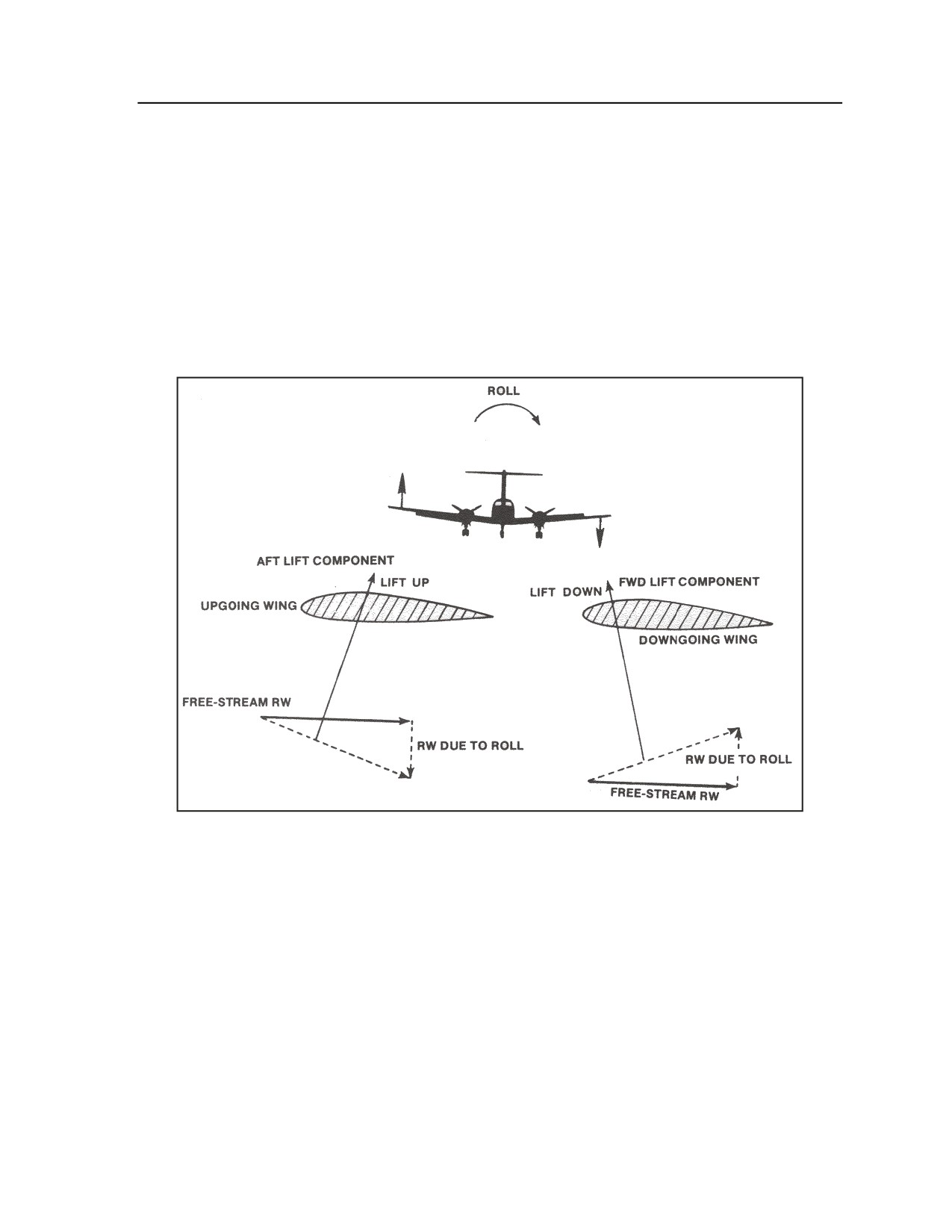
7-57. Adverse yaw is produced by rolling the aircraft with the ailerons, sometimes called adverse aileron
yaw. The aircraft in figure 7-20 has its right aileron down and left aileron up. This generates a differential
in the lift force acting on each wing and produces a left roll. The right wing has a higher coefficient of lift
because the down aileron causes increased camber. Therefore, the induced drag is greater on the right wing
than the left wing. This increased drag causes the aircraft to yaw toward the right about the CG. As the
aircraft rolls, the relative wind resulting from the roll on the down-going wing is upward (opposite its
direction of movement). This relative wind, when added vectorially to the free stream relative wind,
resolves into an inclined relative-wind vector. Because the lift force produced by the down-going wing is
perpendicular to its relative wind, the lift force acts forward. The opposite relative wind must occur on the
up-going wing; therefore, its lift vector acts in a rearward direction. The different directions of the lift
forces produce a condition adding to the adverse yaw caused by the drag differential.
Figure 7-20. Adverse yaw
7-58. Modern aircraft subject to adverse yaw have controls to overcome this problem. They may be
equipped with spoilers extending on the down-going wing. They spoil some lift and add drag to counter
adverse yaw. Differential ailerons are also used to control adverse yaw. The down-going wing aileron
extends up more than the up-going wing aileron extends down. This produces more drag on the down-
going wing and counters effects of adverse yaw. Frise ailerons add drag to the down-going wing. They
extend the part of the aileron forward of the hinge line and down into the airstream while the half of the
aileron behind the hinge line extends up into the airstream. Without these or other similar devices, aircraft
using only ailerons for lateral control tend to yaw to the right when they roll left and vice versa. Even with
compensating devices, adverse yaw is present during flight and is usually corrected with a coordinated
application of rudder.
7 May 2007
FM 3-04.203
7-15
Chapter 7
PROVERSE ROLL
7-59. Proverse roll is encountered when an aircraft yaws. In this case, an aircraft is put in a right yaw when
the aviator applies right rudder. This creates a left sideslip angle. Because a negative sideslip angle
produces a positive rolling moment, the aircraft rolls to the right. Because an aircraft wing cannot
determine whether it is level, it responds to a negative sideslip with a positive roll. Another factor
contributing to proverse roll is the difference in velocities of each wing. In the example above, the left
wing has a greater velocity than the right wing due to the yawing motion about the aircraft CG. Increased
velocity increases the lift force on the left wing, which causes a positive roll as long as the aircraft is
yawing.
DIRECTIONAL DIVERGENT STABILITY
7-60. The degree of directional stability compared with degree of lateral stability of an aircraft can produce
three conditions. These conditions are directional divergence, spiral divergence, and Dutch roll.
Directional Divergence
7-61. Directional divergence results from negative directional stability. This cannot be tolerated because
directional divergence allows the aircraft to increase its yaw after only a slight yaw has occurred. This
continues until the aircraft turns broadside to the flight path or until it breaks up from the high pressure
load imposed on the side of the aircraft.
Spiral Divergence
7-62. Spiral divergence results if static directional stability is strong when compared with the dihedral
effect. If an aircraft with strong directional stability has its right wing down, a positive sideslip angle is
produced. As a result of strong directional stability, the aircraft tries to correct directionally before the
dihedral effect can correct laterally. The aircraft chases the relative wind, and the resulting flight path is a
descending spiral. To correct this condition, the aviator only needs to raise the wing with the lateral control
surfaces, and the spiral stops immediately.
Dutch Roll
7-63. A Dutch roll results from a compromise of directional and spiral divergence, occurring somewhere
between the two. In this case, lateral stability of the aircraft is stronger than directional stability.
Directional tendencies of the aircraft have been reduced from the condition leading to spiral divergence.
7-64. If the aircraft has the right wing down, the positive sideslip angle corrects the wing position laterally
before the nose of the aircraft tries to line up with the relative wind. As the wing corrects, a lateral
directional oscillation starts. Therefore, the nose makes a figure-eight pattern on the horizon. The rolling
and yawing oscillation frequencies are the same, but they are out of phase.
SLIPSTREAM ROTATION AND PROPELLER-FACTOR
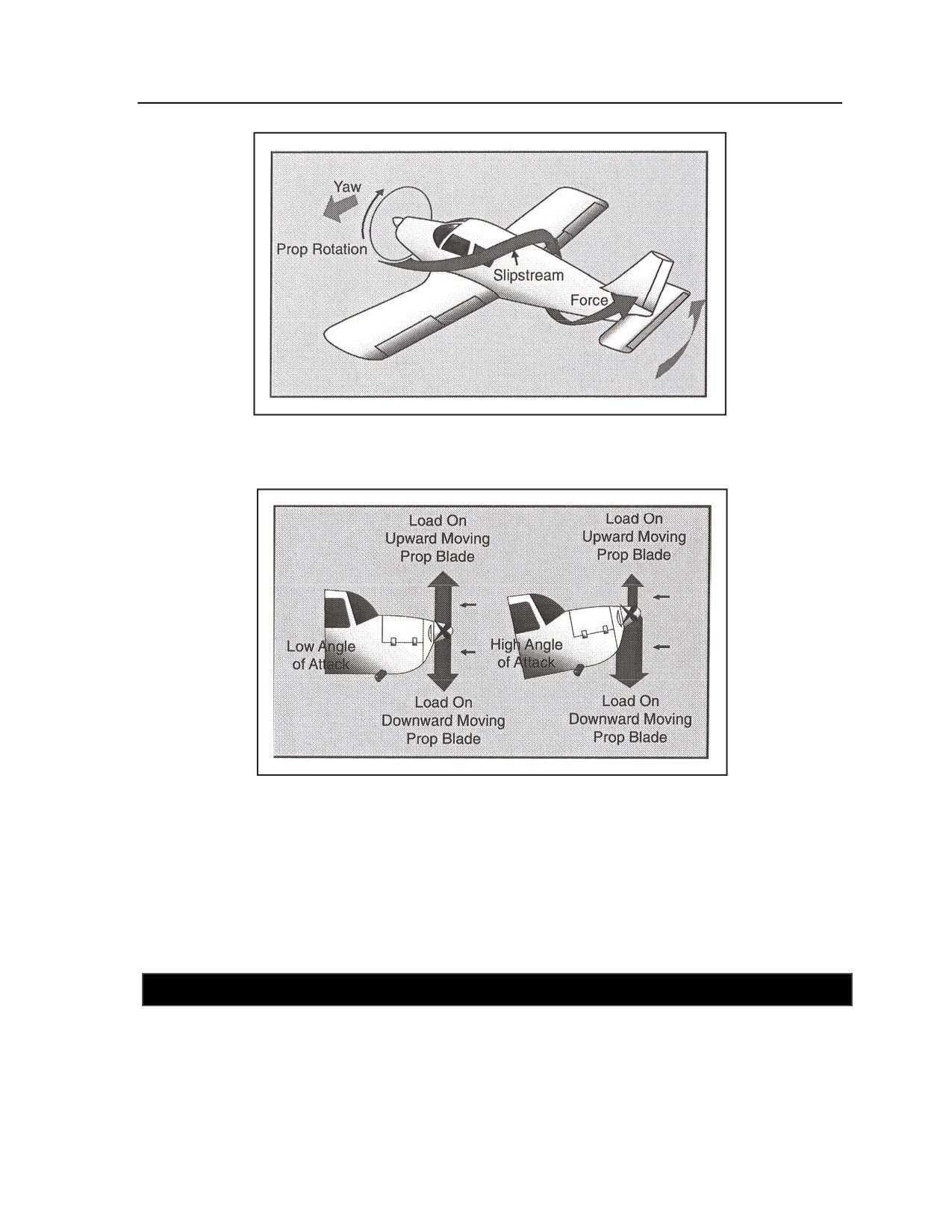
7-65. Most aircraft engines rotate the propeller clockwise, as viewed from the cockpit. This induces a
clockwise airflow about the fuselage striking the left side of the vertical stabilizer. Therefore, the vertical
stabilizer is subjected to a negative sideslip angle, while the rest of the aircraft is not. As shown in figure 7
21, page 7-17, this negative sideslip produces a negative yawing moment and tends to move the nose of the
aircraft to the left. The propeller can also develop a negative yawing moment when the aircraft is at a high
AOA (figure 7-22, page 7-17). Because the propeller disk is inclined to the flight path, the down going
blade (right side) has a greater AOA and velocity than the up going blade (left side). Therefore, the down
going blade produces a larger thrust than the up-going blade, which produces a negative yawing moment
added to the slipstream yawing moment. The propeller disk asymmetric loading is called the propeller-
factor (P-factor).
7-16
FM 3-04.203
7 May 2007
Fixed-Wing Aerodynamics and Performance
Figure 7-21. Slipstream and yaw
Figure 7-22. Asymmetric loading (propeller-factor)
7-66. The directional requirement resulting from slipstream rotation and P-factor is important to propeller-
driven aircraft performance. The rudder must be able to overcome the negative yawing moments of both
the P-factor and slipstream rotation. It must also be able to maintain directional control. The adverse
moments created by slipstream rotation and the P-factor at high angles of attack are increased as the
aircraft slows. However, the rudder moment used to counteract the adverse yawing moments decreases as
velocity decreases. Therefore, the rudder must be deflected even more. This can also be a critical control
requirement.
SECTION II - HIGH-LIFT DEVICES
PURPOSE
7-67. Low-speed characteristics of an aircraft can be as important as high-speed performance, if not more
so. Army aviators spend much of their time in the air below 3,000 feet and at airspeeds of less than 150
7 May 2007
FM 3-04.203
7-17
Chapter 7
knots as takeoffs and landings are made at relatively low altitudes and primarily involve low speeds. For
this reason, aircraft designers must turn to high-lift devices, which increase the CLmax by various means.
LIFT FORCE
7-68. A high-lift device is not used to increase lift but to obtain a required lift force at lower velocities. For
example, an aircraft flying at 250 knots is developing 10,000 pounds of lift. When landing, the aircraft still
requires 10,000 pounds of lift; however, it might now be flying at 100 knots.
STALL SPEED
7-69. The slowest velocity an aircraft can fly depends on the maximum value of CL attainable. This is
shown in the stall-speed equation. The stall speed is inversely proportional to the square root of the value
of CLmax. If this value is increased, then the stall speed is lowered or a greater weight can be supported
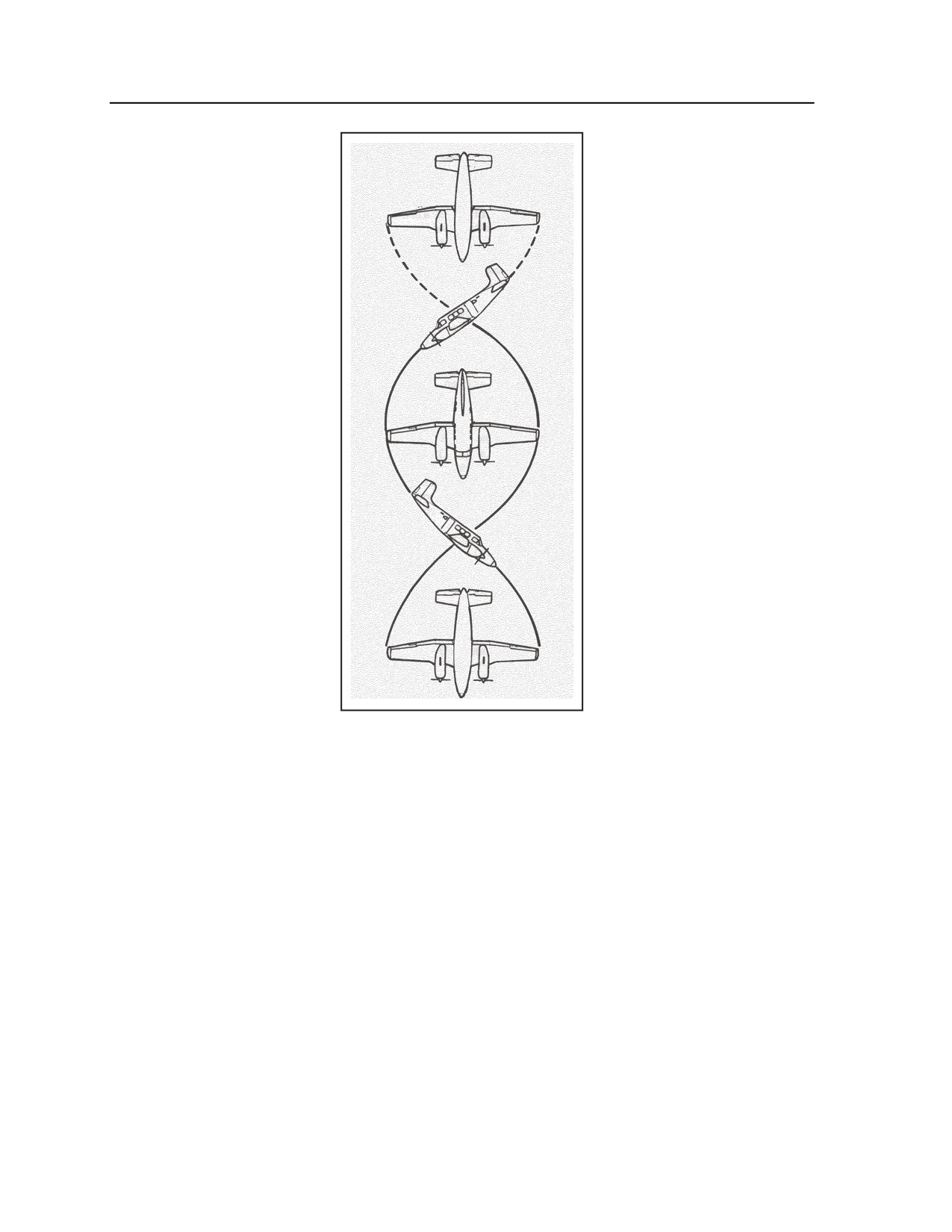
with the same stall speed. Increasing the payload of an aircraft is another example of when high-lift devices
are required. All high-lift devices increase the value of CLmax. The two most common ways to increase the
value of CLmax are by increasing the camber of the airfoil or delaying the boundary-layer separation.
INCREASING THE COEFFICIENT OF LIFT
INCREASING CAMBER
7-70. Of the two usual methods of increasing CLmax, increasing the camber of the airfoil is most often
used.
7-71. A wing with more camber has a greater velocity differential between the wing’s top and bottom
surfaces. This greater velocity differential creates a large pressure differential across the wing. The
pressure differential has been previously related to the value of CL for a given AOA. Therefore, by
increasing the camber of an airfoil, the value of CL is increased.
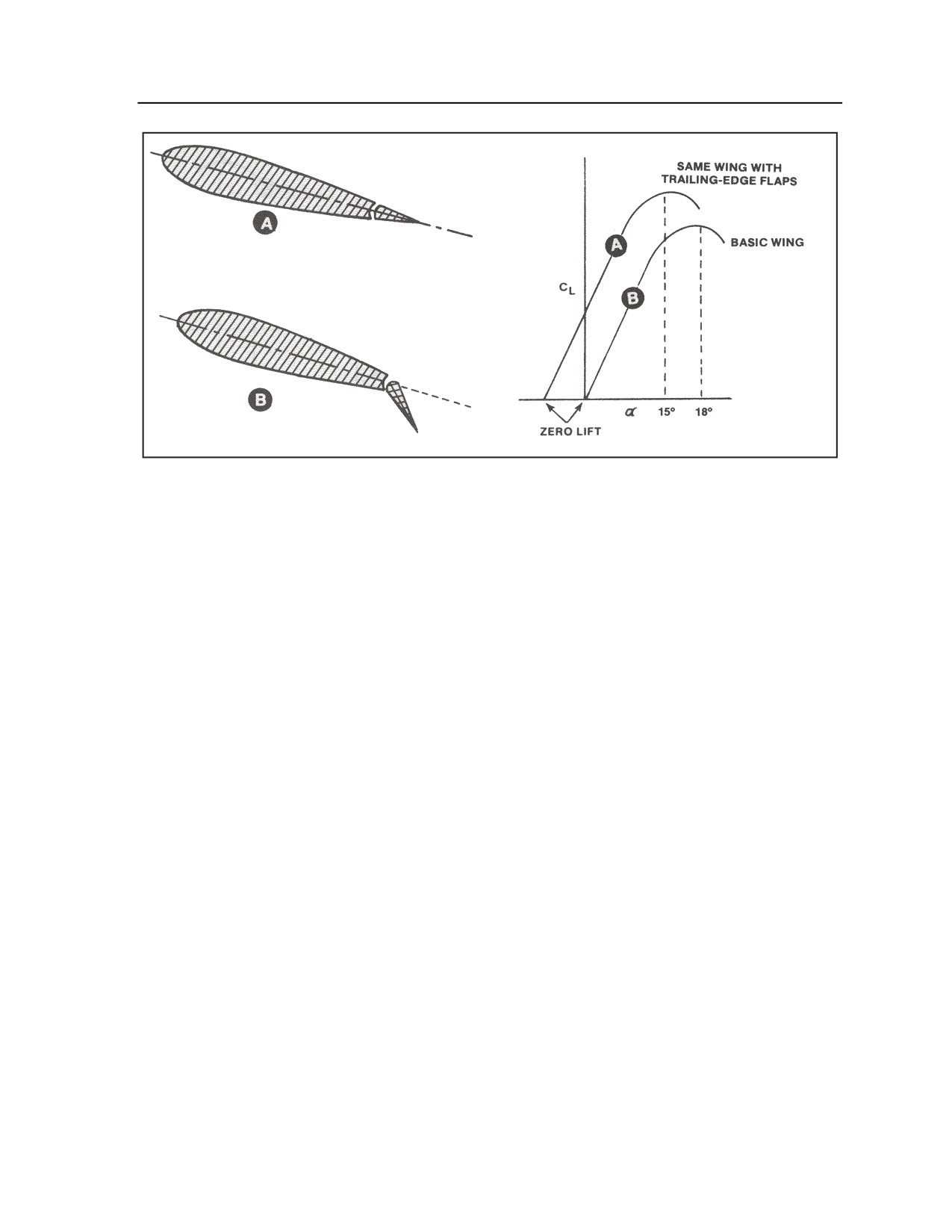
7-72. Figure 7-23, page 7-19, shows use of trailing-edge flaps as the usual method of increasing the
camber. This CL curve is shown for flaps up and flaps down. The basic airfoil is a symmetrical airfoil; the
wing has a zero-lift point at an AOA of zero degrees. With the flap extended, the airfoil now has a positive
camber, and the zero-lift point has shifted to the left. The value of CLmax has increased, and the curve of
the basic wing has shifted up and to the left as the flaps lowered. In this manner, all high-lift devices
increasing camber affect an increase in the value of CLmax. The AOA at which the wing will stall has been
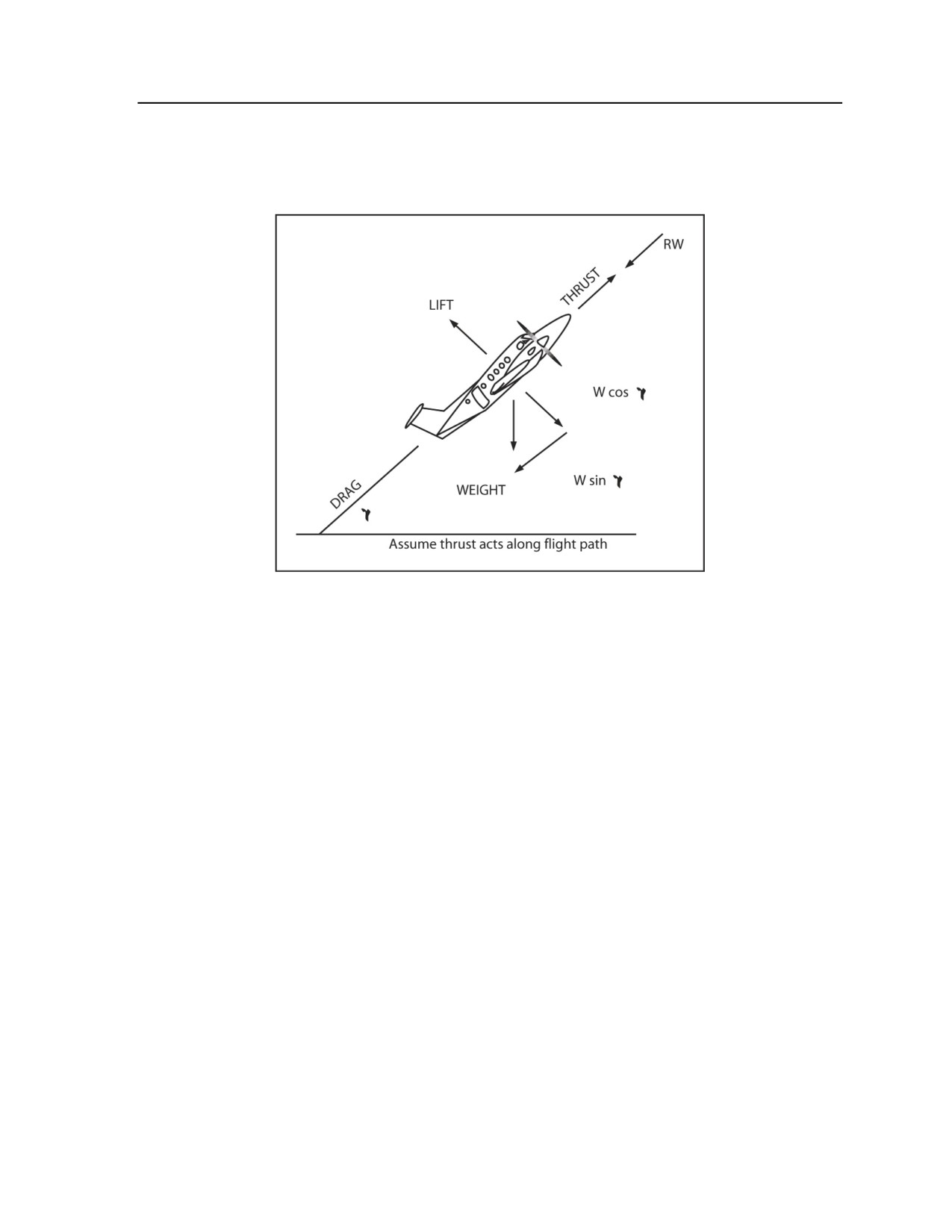
decreased. The basic wing stalled at an AOA of about 18 degrees; with increased camber, it stalls at 15
degrees. However, the value of CLmax at 15 degrees (flaps down) is greater than at 18 degrees on the basic
wing.
7-18
FM 3-04.203
7 May 2007
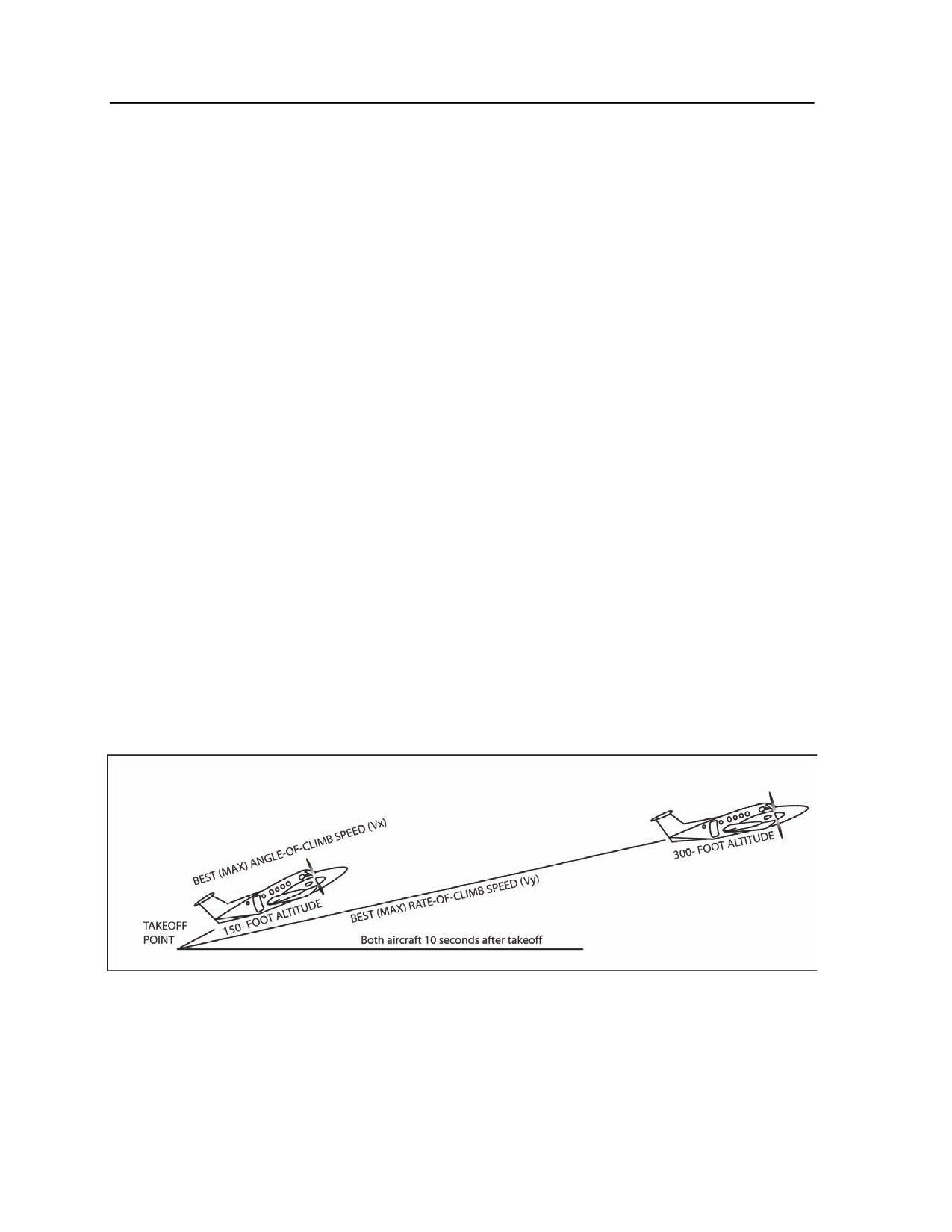
Fixed-Wing Aerodynamics and Performance
Figure 7-23. Increasing camber with trailing-edge flap
DELAYING BOUNDARY-LAYER SEPARATION
7-73. The other common method of increasing the CLmax value is by delaying boundary-layer separation.
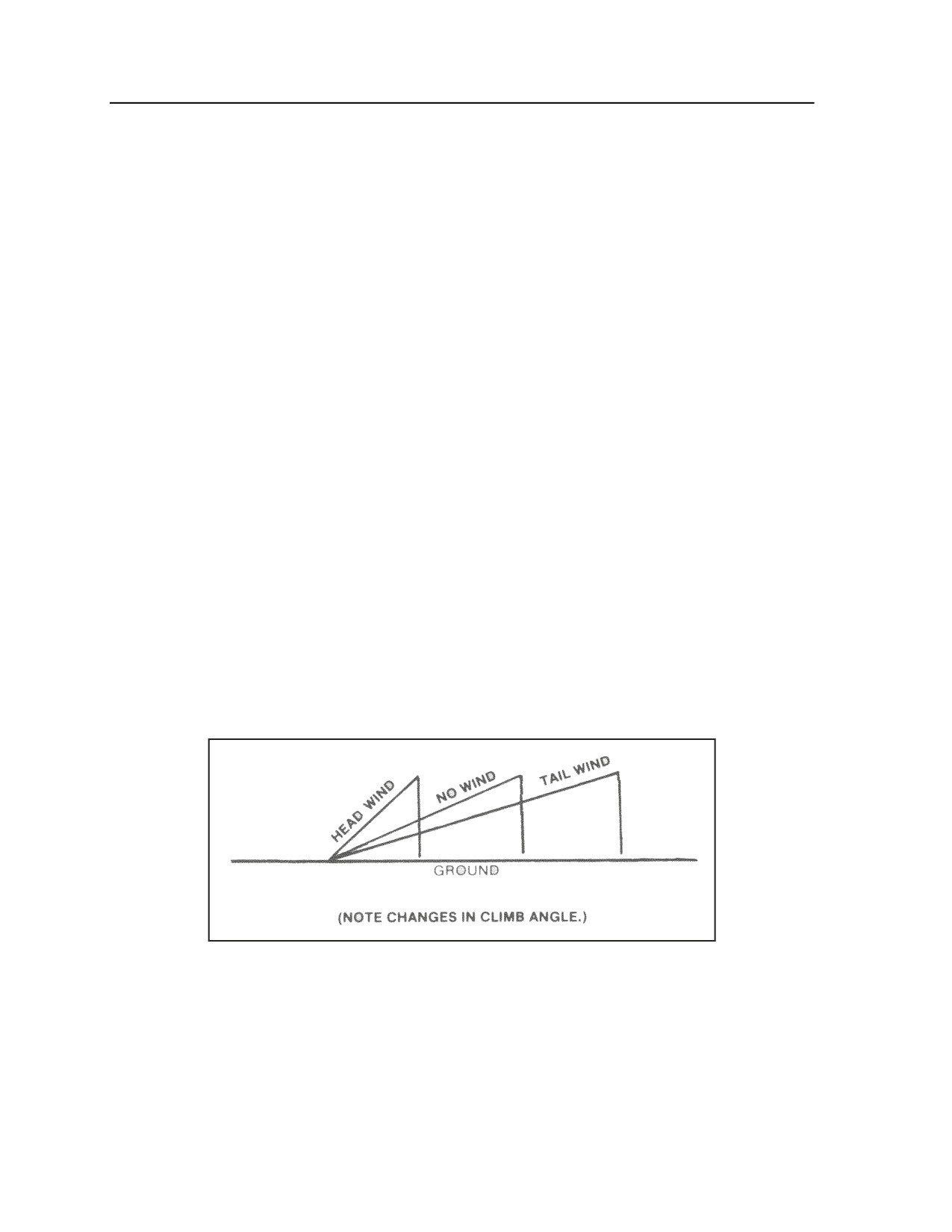
The maximum value of CL is limited by boundary-layer separation. The basic wing mentioned before
stalled at an 18-degree AOA. If the energy level of the boundary layer over the wing is increased, then the
wing rotates to higher angles of attack before a stall occurs. This technique uses boundary-layer control
(BLC) to increase the value of CLmax. The energy level of the boundary layer can be increased by suction
or blowing BLCs or vortex generators. Figures 7-24 through 7-26 show these methods of boundary layer
control. Figures 7-24 and 7-25 also include CL curves with the results of BLC. This manual does not
consider the slight difference between suction and blowing BLCs due to airflow changes on the wing’s
surface.
Suction Boundary-Layer Control
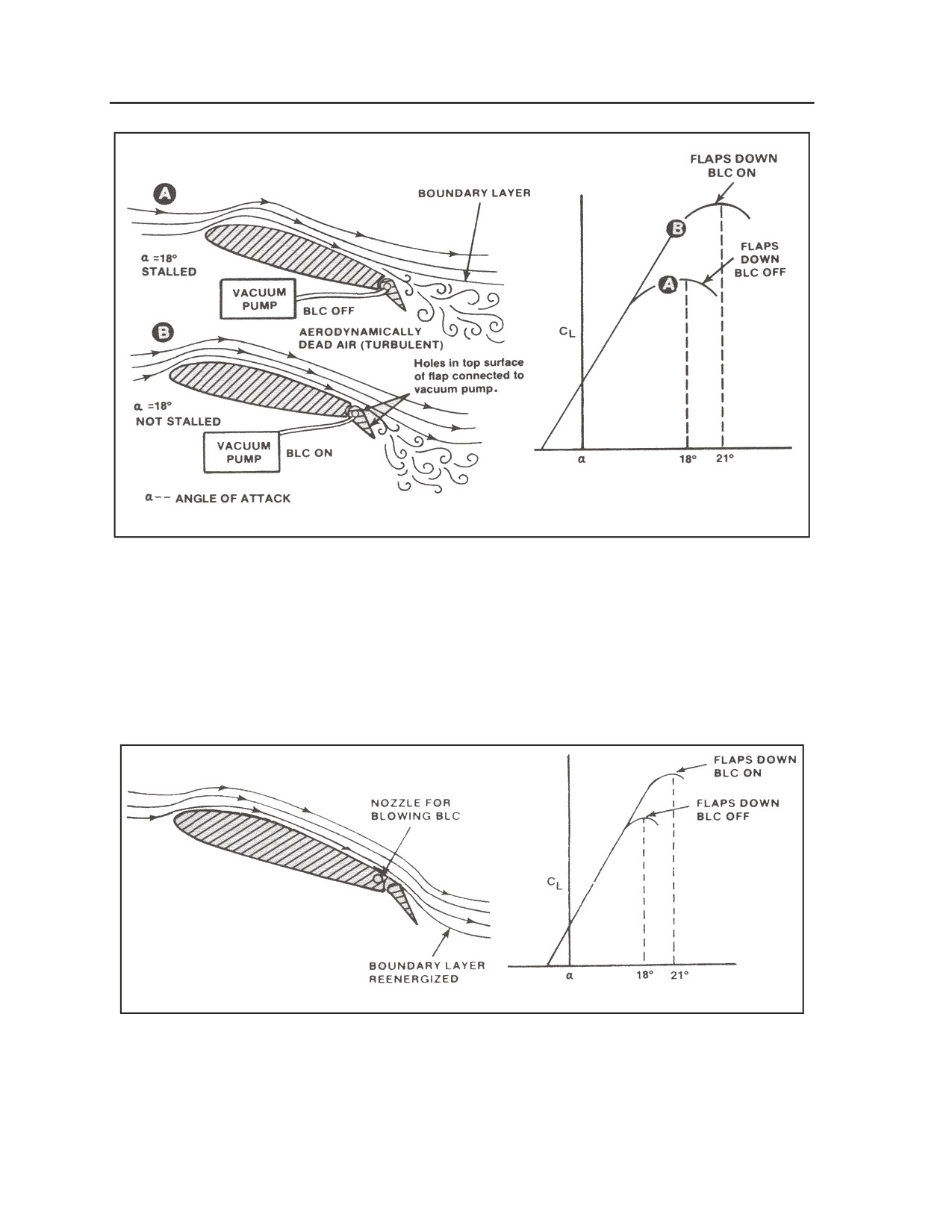
7-74. The suction BLC in figure 7-24, page 7-20, draws off the low-energy, aerodynamically dead and
turbulent air below the boundary layer, causing the higher energy layers above to be lowered closer to the
airfoil surface. This makes the airfoil effective at angles of attack where it previously stalled. Part A shows
boundary-layer separation when the airfoil is stalled at an 18-degree AOA with BLC off. In part B, the
airfoil is also at an 18-degree AOA. With suction BLC on, however, boundary-layer separation no longer
occurs. Suction BLC is rather inefficient; it requires a heavy vacuum pump or turbine to handle the large
volume of air being drawn off the airfoil. This increases the weight of the aircraft; the extra weight
partially offsets the advantages gained by the increased value of CLmax.
7 May 2007
FM 3-04.203
7-19
Chapter 7
Figure 7-24. Suction boundary-layer control
Blowing Boundary-Layer Control
7-75. Blowing BLC (figure 7-25) increases the energy level of the boundary layer by introducing high-
energy air through a nozzle, usually mounted ahead of the flap. This method can be thought of as blowing
the turbulent air from the top surface of the airfoil. Blowing BLC is more commonly used than suction
BLC because it is more efficient. The compressor section of a turbine engine can be used to supply the
high energy air needed. Therefore, aircraft weight does not increase.
Figure 7-25. Blowing boundary-layer control
7-20
FM 3-04.203
7 May 2007
Fixed-Wing Aerodynamics and Performance
Boundary-Layer Control by Vortex Generators
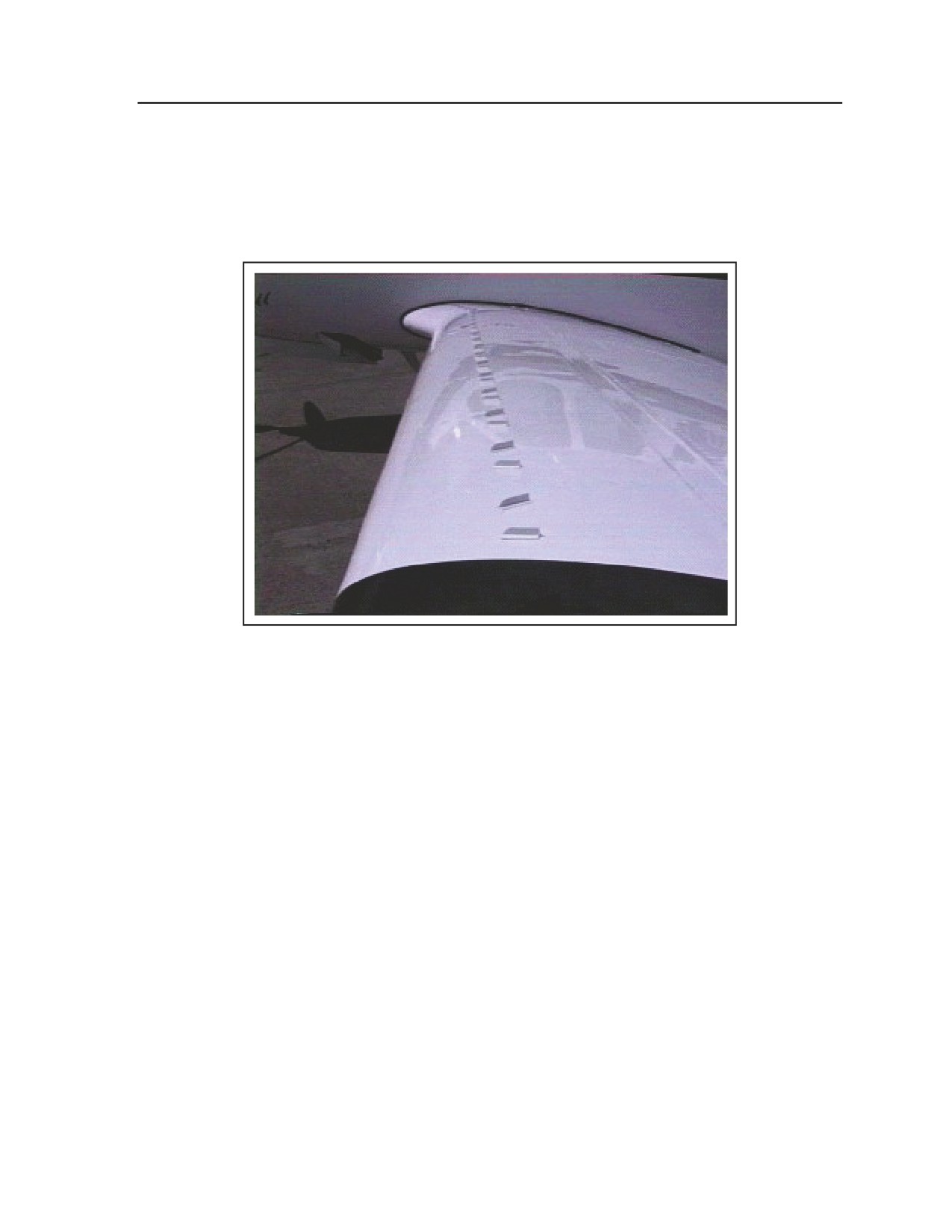
7-76. Figure 7-26 shows another method of reenergizing the boundary layer using vortex generators.
These small strips of metal are placed along the wing, usually in front of the control surfaces or near the
wing tips. The turbulence caused by these strips mixes high-energy air from outside the boundary layer
with boundary-layer air. The effect of the vortex generators on the lift curve is similar to other BLC
devices.
Figure 7-26. Vortex generators
TYPES OF HIGH-LIFT DEVICES
7-77. The following paragraphs cover various types of high-lift devices. These devices increase either the
camber of the airfoil or the energy of the boundary layer.
TRAILING-EDGE FLAPS
7-78. Trailing-edge flaps are the most common type of high-lift device. These flaps have advantages and
disadvantages. A trailing-edge flap increases the camber of the wing, thereby increasing the value of
CLmax. However, in so doing, it moves the lift force toward the trailing edge of the wing, resulting in a
negative, or nose-down, pitching moment. This moment limits the use of flaps to aircraft having horizontal
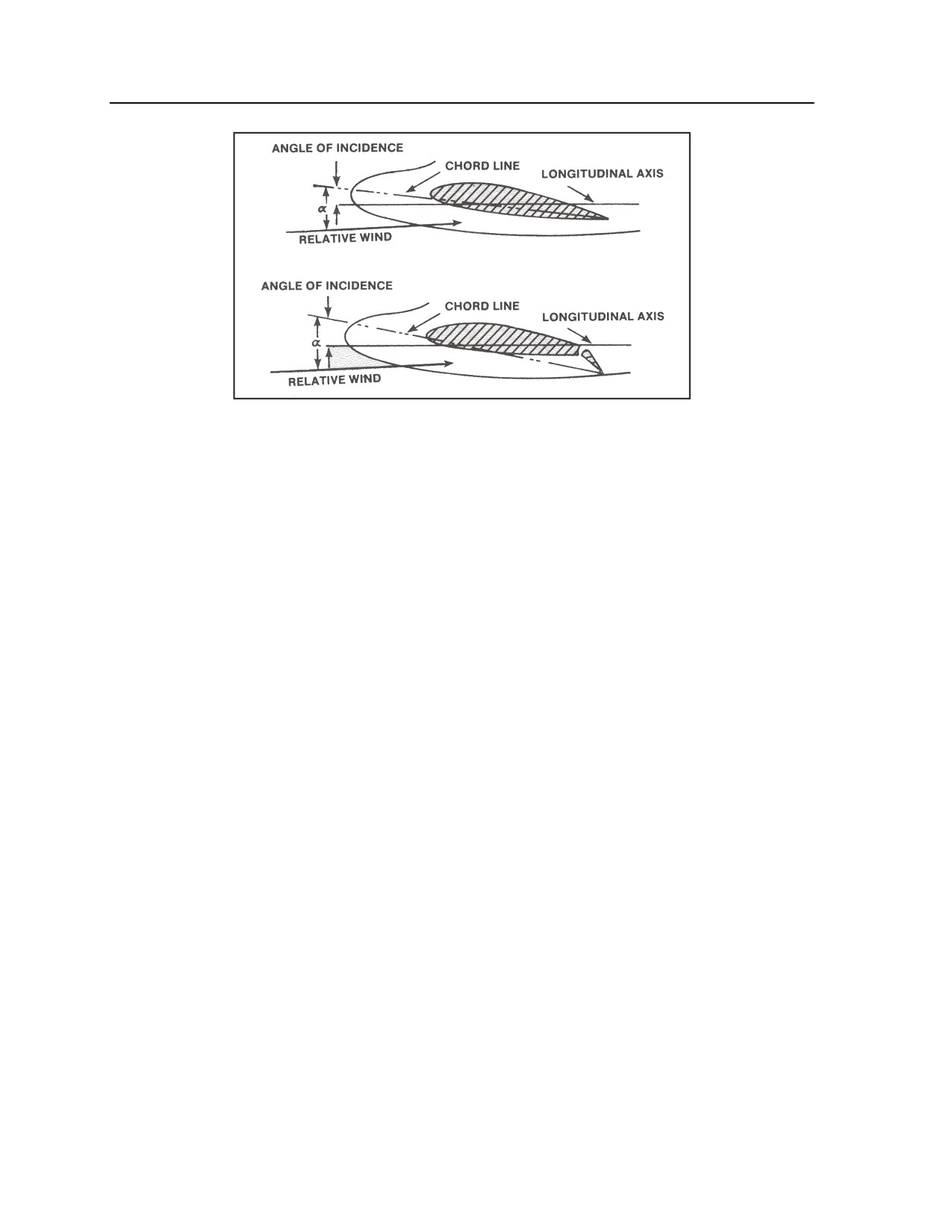
stabilizers and elevators. When a trailing edge flap is extended, the angle of incidence is increased as the
chord line of the airfoil changes. Figure 7-24, page 7-20 shows how the change in angle of incidence
changes the zero lift line. The nose-down pitching moment on the fuselage results in better forward
visibility during landings and takeoffs (figure 7-27, page 7-22). Flaps also increase drag on the aircraft.
This is useful in landing; the aircraft can make a steeper approach without increasing airspeed. However,
this drag increase is not desired on takeoff. Most aircraft having large and effective trailing-edge flaps use
only partial flaps on takeoff; thus they have the benefit of increased CL without a large increase in drag.
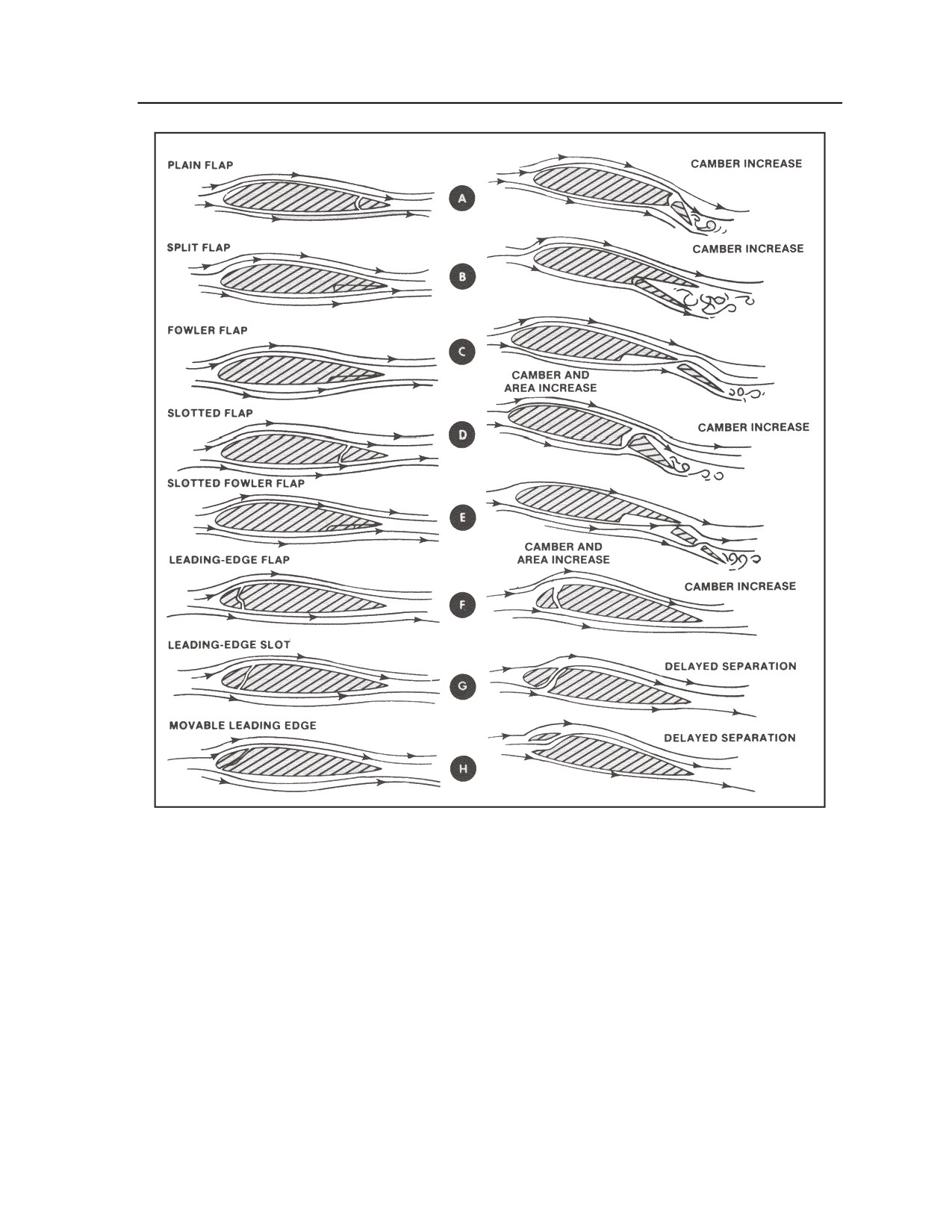
Some of the common types include the plain flap, split flap, Fowler flap, slotted flap, and slotted Fowler
flap. Figure 7-28, page 7-23, parts A through E show the types of high-lift devices.
7 May 2007
FM 3-04.203
7-21
Chapter 7
Figure 7-27. Angle of incidence change with flap deflection
Plain and Split Flaps
7-79. Figure 7-28, page 7-23, parts A and B, shows these two basic flaps. Both increase the camber of the
airfoil. The split flap does not produce as large a nose-down pitching moment as the plain flap. The split
flap also creates a greater drag force due to the low-pressure, high-turbulence area between the wing
trailing edge and flap trailing edge.
Fowler Flap
7-80. On aircraft that lift heavy loads from short fields, such as jet transports, the Fowler flap (figure 7-28
part C) is often used. When extended, this type of flap moves rearward as well as down. This increases
CLmax because of an increase in camber and wing area. The Fowler flap then reduces stall speed (VS) by
increasing CLmax and wing area. Although aerodynamically the Fowler flap is the most efficient flap, it
has disadvantages. With the huge surface extending so far behind the wing, a large twisting moment is set
up in the wing. Therefore, the wing must be strong enough to withstand the load. The increased structural
strength and more complicated actuating mechanisms account for large increases in weight and internal
wing volume. The Fowler flap cannot be used on thin, high-speed airfoils.
Slotted Flap
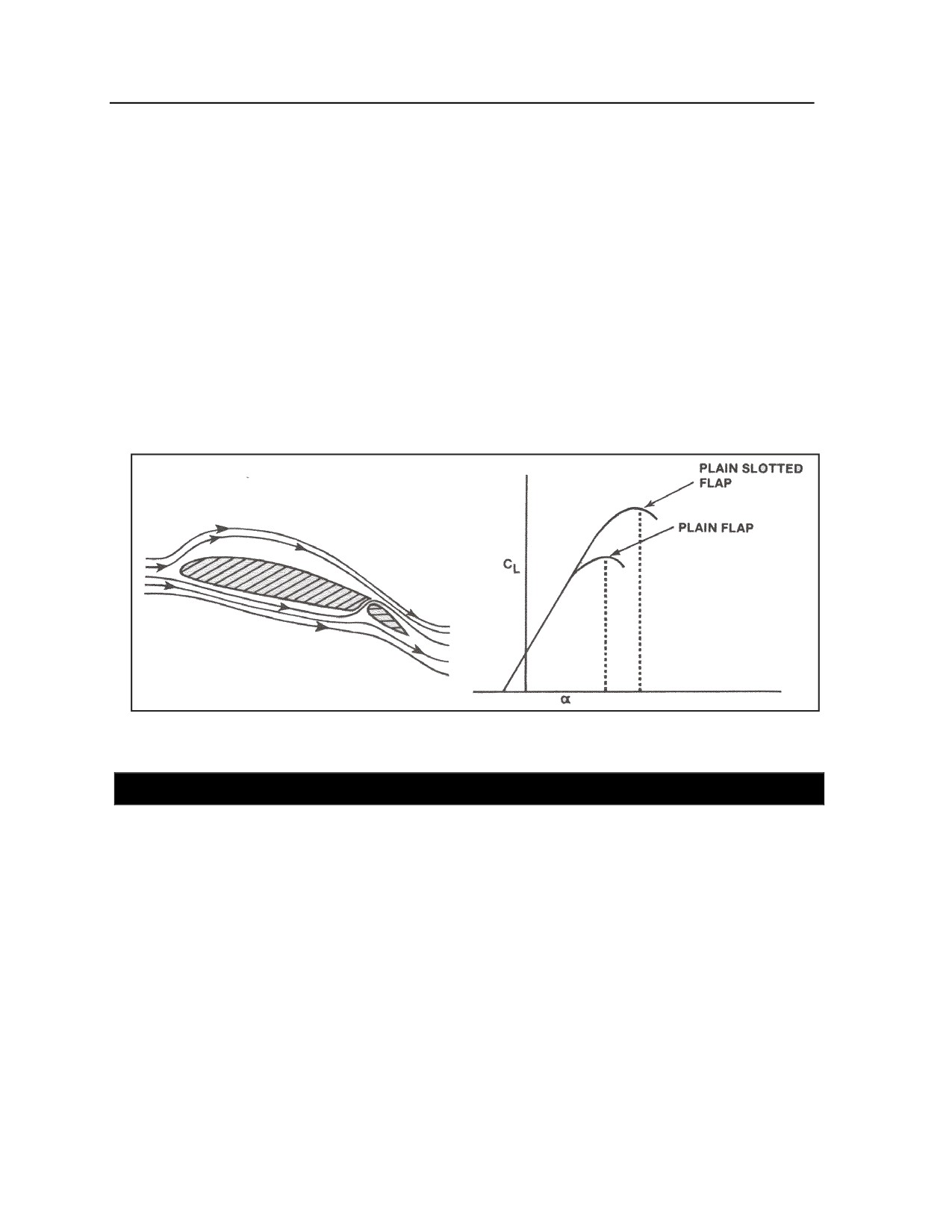
7-81. To increase efficiency, most flaps can be slotted. Using slotted flaps combines the principle of BLC
with a camber change. Together, the effects are cumulative. A plain flap curve is added before and after the
slot (figure 7-29). After adding the slot, separation over the flap area is delayed so the wing can be rotated
to a higher AOA. The increased energy required to delay the boundary-layer separation comes from the
low-velocity and high-pressure air under the flap. The air is directed through the slot over the top surface
of the flap. This increases the energy of the boundary layer over the flap. A slotted Fowler flap is even
more efficient. A slotted Fowler flap increases both camber and wing area. In fact, the CLmax value of a
multiple-slotted Fowler flap may be twice that of the basic wing (figure 7-28 part E).
7-22
FM 3-04.203
7 May 2007
Fixed-Wing Aerodynamics and Performance
Figure 7-28. Types of high-lift devices
LEADING-EDGE DEVICES
7-82. Figure 7-28, parts F through H, depicts leading-edge devices to include the leading-edge flap,
leading-edge slot, and movable leading edge.
Leading-Edge Flap
7-83. Some aircraft use leading-edge flaps, (figure 7-28 part P). These increase the camber of the airfoil to
increase CLmax. Unlike a trailing edge flap, the leading-edge flap does not produce a negative pitching
moment. However, it may create a slight positive
(nose-up) pitching moment, depending on its
effectiveness.
7 May 2007
FM 3-04.203
7-23
Chapter 7
Slots and Slats
7-84. BLC devices have both advantages and disadvantages. They are usually used with camber-changing
devices because BLC alone is not as effective as camber change. Suction and blowing BLC devices and
vortex generators have already been mentioned; however, the leading-edge and movable leading-edge slots
are also forms of BLC (figure 7-28 parts G and H).
7-85. The slot through the wing (part G) will vent high-pressure air from the underside of the wing over
the top surface. This delays a stall when the wing is at a high AOA. Because the slot is not exposed to the
airstream, drag does not increase much.
7-86. Most modern carrier aircraft have movable leading-edge slats (figure 7-29). This is simply a slot that
can be opened and closed. When opened at high angles of attack, the slat moves forward (some also move
downward), increasing the camber and area. This occurs when the AOA is high, whether at low or high
speeds, during high-G maneuvers. A BLC device does not create any pitching moment; therefore, aircraft
without horizontal stabilizers use this type of device as it allows aircraft to rotate to higher angles of attack.
However, aircraft can be rotated to such a high degree the aviator has difficulty seeing the landing area.
This limits effective use of devices delaying boundary-layer separation.
Figure 7-29. CLmax increase with slotted flap
SECTION III - STALLS
7-87. In the early years of aviation, the advice was to fly low and slow. Because this condition affords a
minimum distance to fall, it seemed to be sound reasoning. Actually, it is probably one of the most
dangerous conditions of flight. To produce required lift at slow airspeeds, aviators must fly at a high
AOA—near the AOA for the aerodynamic stall. When this stall occurs, lift decreases and drag increases,
and there is usually a loss of altitude. In addition, there can also be a loss of control. Under these
conditions, the aircraft can enter a spin. A considerable loss of altitude is possible before control of the
aircraft can be regained.
7-88. Takeoffs and landings involve a combination of low airspeeds and altitudes making them hazardous
phases of flight. One of the most frequent causes of takeoff and landing accidents is stall. When a stall
occurs, there is usually insufficient altitude for recovery. During takeoff and landing, an aviator must be
prepared to operate the aircraft at slow speeds and high angles of attack, a potentially hazardous
configuration. Knowing this, aviators must thoroughly understand stall characteristics. This section defines
stall and discusses its causes, warnings, and characteristics.
7-24
FM 3-04.203
7 May 2007
Fixed-Wing Aerodynamics and Performance
AERODYNAMIC STALL
7-89. An aerodynamic stall occurs when an increase in the AOA results in a decrease in lift coefficient.
This is due to separation of the boundary layer (a thin layer of air near the surface of the wing) from the
upper surface of the wing. When this boundary layer separates, turbulence occurs between the boundary
layer and wing’s surface. This causes static pressure on the upper surface of the wing to increase. The
definition of stall does not refer to airspeed. The only condition that can cause a stall is an excessive AOA.
STALL ANGLE OF ATTACK
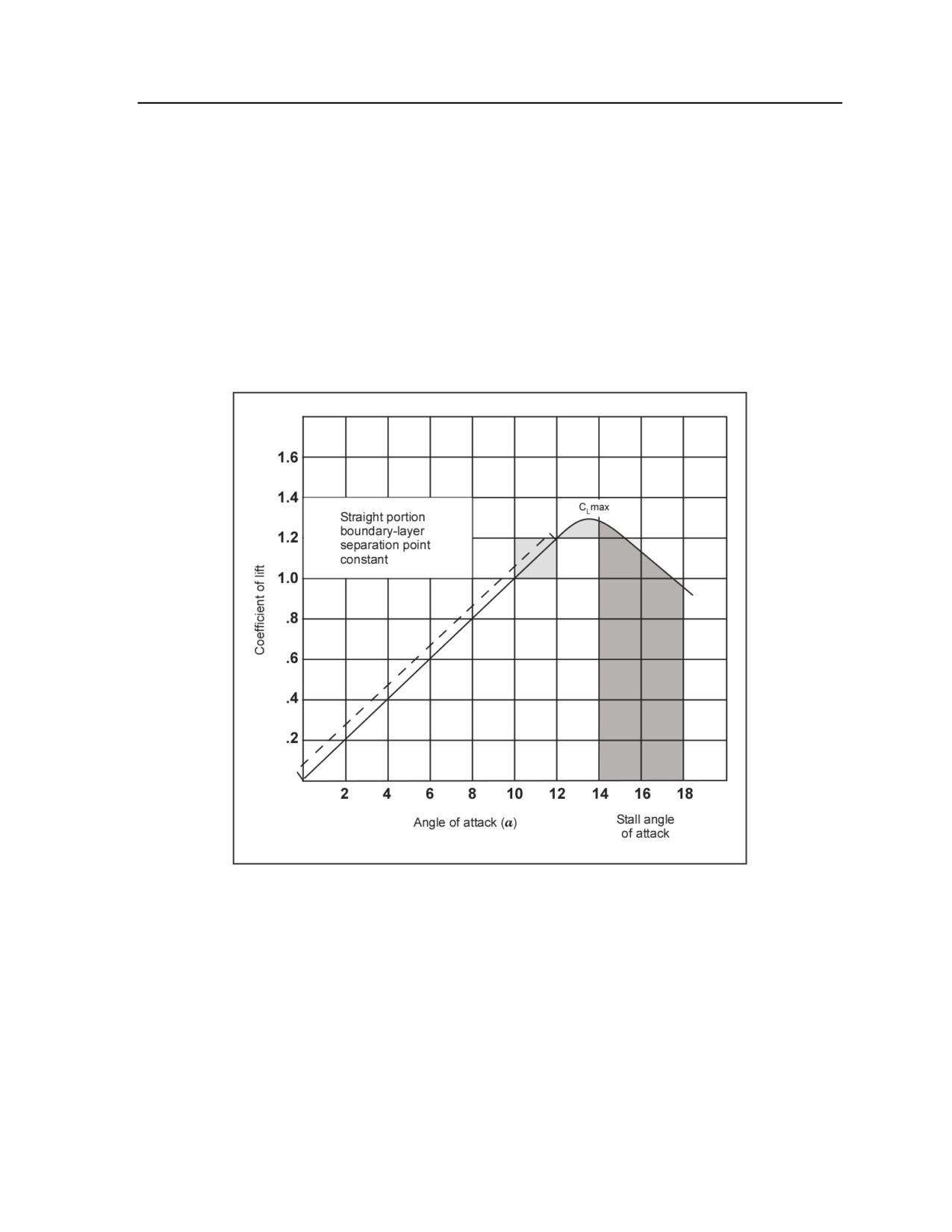
7-90. In figure 7-30, all angles of attack greater than the AOA for maximum lift coefficient fit the
definition of stall. An increase in the AOA beyond the AOA for CLmax (14 degrees) decreases the value of
CL. The crosshatched area is called stall region. When the aircraft operates at an AOA within this region, it
is stalled, whether its airspeed is 60 or 160 knots.
Figure 7-30. Coefficient of lift curve
CAUSES OF STALL
7-91. The cause of a stall is relatively easy to understand. The wing or airfoil is designed with a certain
camber to give a definite pressure differential between the top and bottom surfaces. As the AOA increases,
the CL increases due to an increased pressure differential. At all angles of attack corresponding to the
straight portion of the CL curve to the left of the stall region, the airflow follows the curvature of the top
surface until it almost reaches the trailing edge. At that location, the boundary layer breaks away and a
small turbulent wake is formed (figure 7-31, page 7-26).
7 May 2007
FM 3-04.203
7-25
Chapter 7
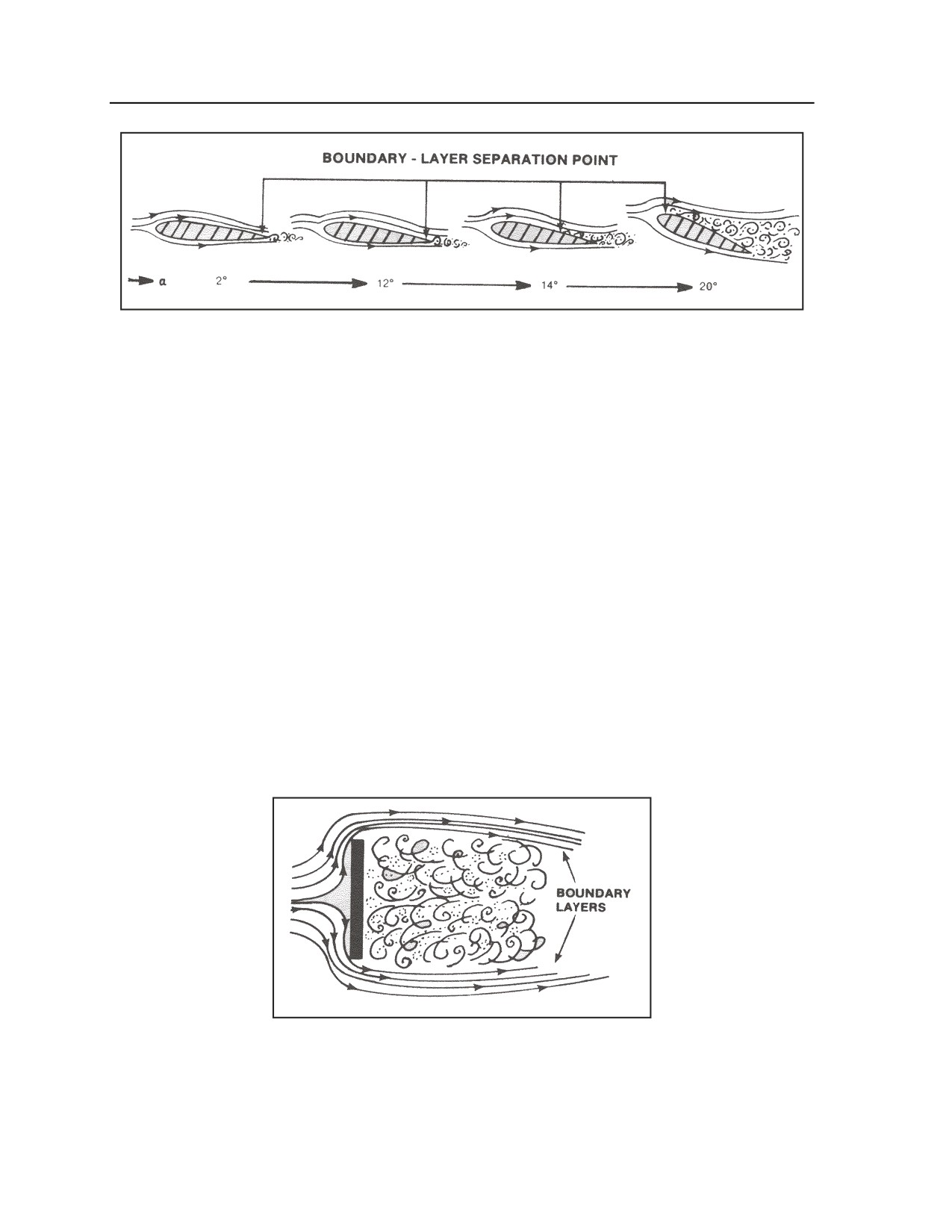
Figure 7-31. Various airfoil angles of attack
7-92. The point where the boundary layer separates from the airfoil stays essentially constant so long as
the AOA is of a value where the CL curve is a straight line. If the AOA increases beyond the straight
portion of the CL curve, the point of boundary-layer separation moves forward. This actually decreases the
top surface area of the wing producing lift. The airflow under the boundary layer is turbulent; therefore, in
that area, static pressure is increased, compared to the area where no separation occurs. The increase in the
AOA increases the pressure differential on the portion of the wing where no separation exists. This
increase in pressure differential is partially offset by the loss of some of the effective area of the wing. This
results in a smaller increase in the CL for each degree increase in AOA. The slope of the CL curve
decreases and continues to decrease. As the AOA increases, the separation point of the boundary layer
continues to move forward. Finally, a further increase in the AOA results in a decrease in the value of the
CL. The point where the boundary layer separates has now moved too far forward; the loss of the effective
area of the wing is too large to be offset by any increase in the pressure differential that may occur. This is
the AOA defined as the stalling AOA. At the AOA for CLmax, the slope of the CL curve has reached zero.
Any further increase in the AOA develops a negative slope to the curve-CL decreases as AOA increases.
7-93. Figure 7-31 shows airfoils that can be compared to the CL curve in figure 7-30. At an AOA of 12
degrees, the curve slope starts to decrease and boundary-layer separation starts. Separation results when the
boundary layer lacks the energy to adhere to the surface of the wing all the way to the trailing edge. In
other words, the airflow cannot conform to the sharp bend. When placed at 90 degrees to the airstream, the
flat plate shown in figure 7-32 has a turbulent flow behind it. Therefore, the boundary layer will not remain
on the back surface of the plate. The same is true of the wing at high angles of attack. There is a limit
where the boundary layer no longer remains on the surface of the wing. That limit is the point of boundary-
layer separation.
Figure 7-32. Boundary-layer separation
7-26
FM 3-04.203
7 May 2007
Fixed-Wing Aerodynamics and Performance
STALL WARNING AND STALL WARNING DEVICES
AERODYNAMIC STALL WARNING
7-94. The turbulent airflow generated when the boundary layer separates is a sign of an impending stall.
As this turbulence flows over part of the aircraft, it causes buffeting, which is normally felt in the controls.
This notifies the aviator of an approaching stall. Some turbulent flow is generated before the stall actually
occurs. Therefore, buffeting, which can occur before the aircraft actually stalls, is a warning.
7-95. Part of the aircraft behind the wing is the horizontal stabilizer. The turbulent flow can pass over it to
give the warning. The span of the horizontal stabilizer is less than the wingspan. Therefore, any turbulent
flow coming from the wing tips or outer portions of the wing would not flow over the stabilizer. This is
one reason to design the wing so the root section stalls before the tip section. The turbulent airflow then
creates the aircraft buffet warning before the entire wing is stalled. In addition, when one part of the wing
stalls before the other, the stall is not as abrupt as the entire wing stalling at once. Aviators have better
lateral control of an approaching stall if the stall progresses from the root of the wing to the tip on aircraft
with ailerons located toward the wing tips.
7-96. Although a root-to-tip stall pattern is desirable, it is not always possible to achieve. A rectangular or
slightly tapered wing normally stalls root first. However, highly tapered, swept, or delta wings exhibit a
strong tendency to stall tip first. Several design techniques can make the root stall before the tip.
Geometric Twist
7-97. One method of causing the root to stall is geometric twist (washout); that is, building a twisted wing.
The root section angle of incidence is greater than the tip section; the twist is about 3 degrees. If an airfoil
section has a stalling AOA of 18 degrees, the root section is at an 18-degree AOA when it stalls. However,
the tip section is still at about a 15-degree AOA and is not stalled. Even if there is aerodynamic buffeting
from turbulent air around the root section, the aviator can use ailerons for lateral control during recovery.
Aerodynamic Twist
7-98. Another method of stalling the root section before the tip section is aerodynamic twist. A wing with
aerodynamic twist is not really twisted as with geometric twist. However, the wing reacts in the same
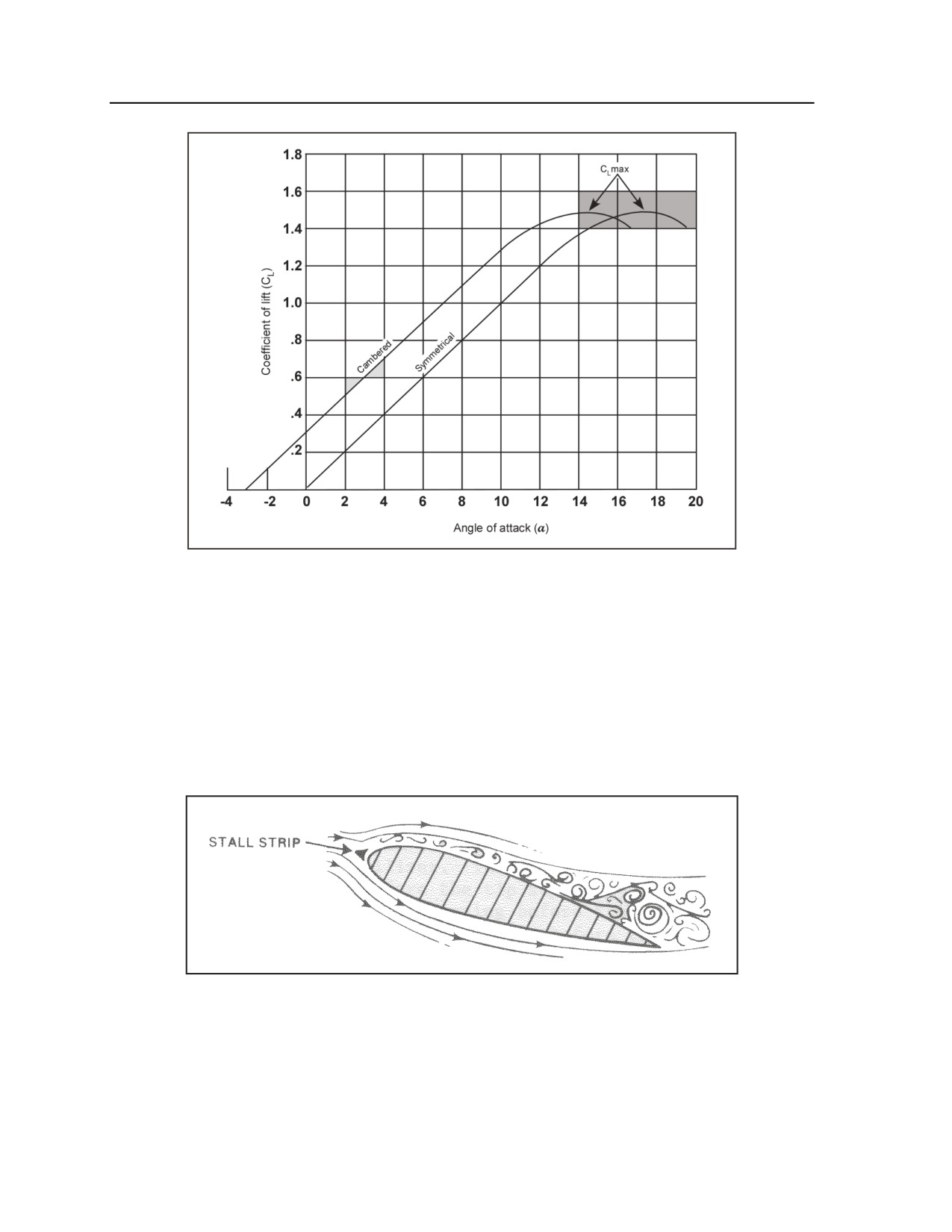
manner and is said to be twisted. In this case, the aircraft designer uses two more types of airfoils. In figure
7-33, the CL curve for the cambered airfoil and the CL curve for the symmetrical airfoil have about the
same value of CLmax; but the AOA at which they attain their CLmax is different. In this case, the root
section is a cambered airfoil; toward the tip, the wing will gradually transform into a symmetrical airfoil.
The angle of incidence is the same for both sections. Therefore, there is no geometric twist to this type of
wing. The stall progression from root to tip is controlled aerodynamically by using different types of
airfoils. If a wing is constructed with the airfoil sections plotted (figure 7-33, page 7-28) the root will stall
at a 15-degree AOA. The tip would not stall until an 18-degree AOA is reached, as indicated by the curves.
7 May 2007
FM 3-04.203
7-27
Chapter 7
Figure 7-33. CL curves for cambered and symmetrical airfoils
Stall Strip
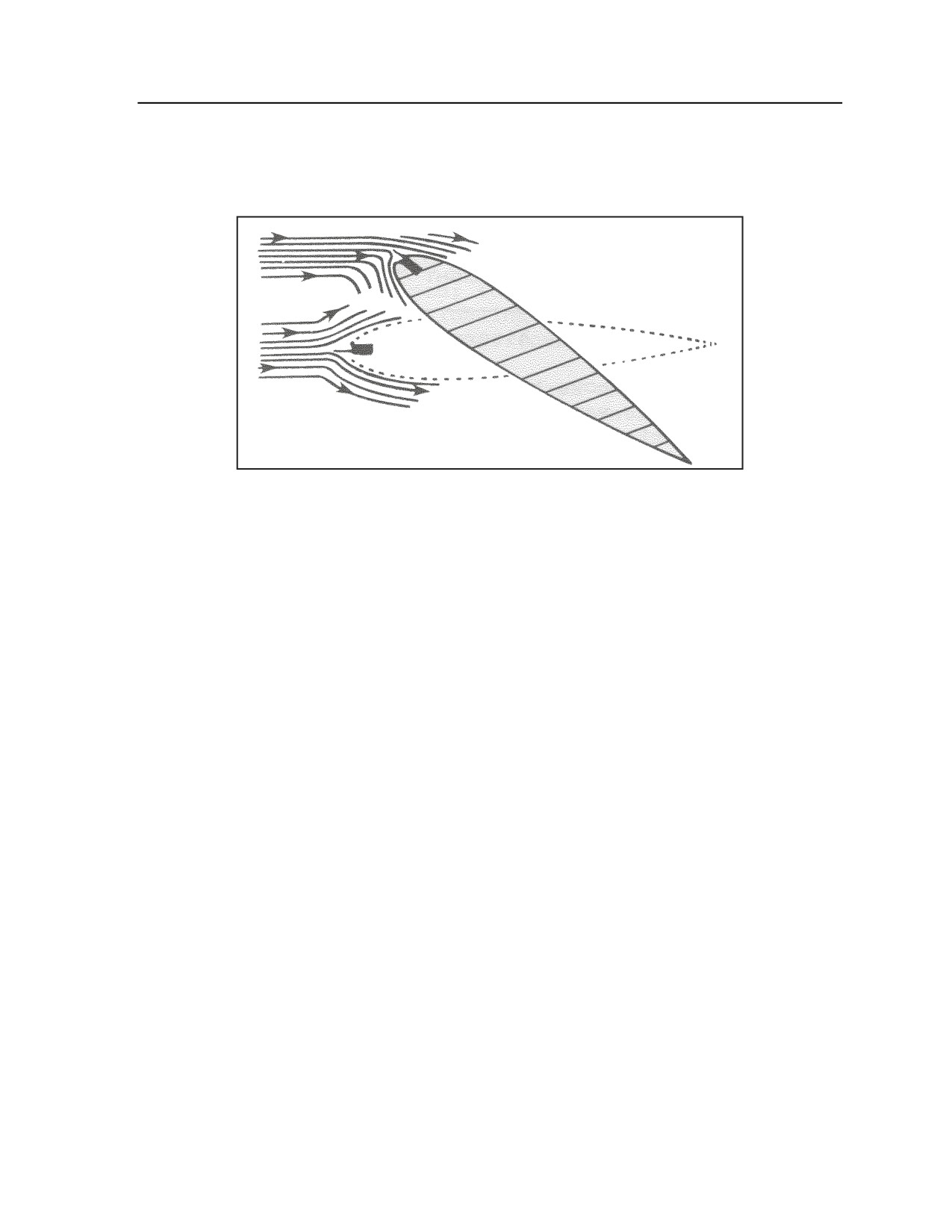
7-99. A third method for stalling root sections first, or at least creating a buffet on the aircraft, is to use a
stall strip on the wing’s leading edge (figure 7-34). This causes the boundary layer to break away from the
airfoil at an AOA lower than the stalling AOA for that airfoil. The cruise speed, design load, and general
performance requirements of an aircraft determine the airfoil section to be used. These design
considerations may preclude the use of twist methods for smooth stall progression. A stall strip, located in
the root section, detaches the boundary layer to ensure this section stalls first. This gives adequate warning
to allow for a safe recovery with a minimum loss of altitude.
Figure 7-34. Stall strip
MECHANICAL STALL WARNING
7-100. Some aircraft do not have horizontal stabilizers or, as in the C-12, are designed so the horizontal
stabilizer is not in the turbulent wake path generated by the wing as it is stalling. These aircraft are usually
7-28
FM 3-04.203
7 May 2007
Fixed-Wing Aerodynamics and Performance
equipped with a mechanical stall warning. The simplest mechanical stall warning is a flapper switch
mounted on the wing’s leading edge (figure 7-35). As the wing approaches a stall, the relative wind pushes
the flapper up, closing a switch. This, in turn, activates the device to warn the aviator of an impending stall.
The flapper can be positioned to vary the attack angle at which the stall warning occurs.
Figure 7-35. Flapper switch
7-101. Some aircraft have AOA sensors on the aircraft that detect when the AOA approaches an attitude
known to result in a stall and will activate devices like the stick shaker to warn the aviator.
STALL RECOVERY
7-102. When a stall warning is received, recovery must be immediate. To recover, the aviator corrects the
cause, which is a too high attack angle. The only action the aviator must take is to decrease the attack
angle. This breaks the stall, stopping the stall warning immediately.
SPINS
7-103. A spin is described is an aggravated stall resulting in what is termed autorotation. In autorotation,
the aircraft follows a spiral path in a downward direction. The wings produce some lift, but the aircraft is
forced downward by gravity. The aircraft wallows and yaws in this spiral path (figure 7-36, page 7-30). It
is assumed many factors contribute to a spin. In fact, the spin is not suited for theoretical analysis.
MISHANDLING
7-104. Many aircraft have to be forced to spin; considerable judgment and technique are required to start
a spin in these aircraft. However, aircraft forced to spin may accidentally be put into a spin when the
aviator mishandles the controls in turns and stalls, and in flight at minimum controllable airspeeds.
YAW
7-105. Once a wing is allowed to drop at the beginning of a stall, the nose attempts to move (yaw) in the
direction of the low wing, and the aircraft begins to slip in the direction of the lowered wing. As it does, air
meeting the fuselage side, vertical fin, and other vertical surfaces tends to turn the aircraft into the relative
wind. This accounts for the continuous yaw present in a spin.
7 May 2007
FM 3-04.203
7-29
Chapter 7
Figure 7-36. Spins
7-106. At the same time, rolling is also occurring about the aircraft’s longitudinal axis. This is caused by
the lowered wing having an increasingly greater attack angle due to the relative wind’s upward motion
against its surfaces. This wing is then well beyond the stalling attack angle and, accordingly, has an
extreme loss of lift. Because relative wind is striking the lowered wing at a smaller angle, the rising wing
has a smaller attack angle. Thus, the rising wing has more lift than the lowered wing, and the aircraft
begins to rotate about its longitudinal axis. This rotation, combined with the effects of centrifugal force and
different amount of drag on the two wings, then becomes a spin. The aircraft descends vertically, rolling
and yawing until recovery is effected.
7-107. The first corrective action taken during any power-on spin is to close the throttles. Power
aggravates spin characteristics, causing an abnormal altitude loss in the recovery. As power is reduced, full
opposite rudder is applied. Brisk, positive, straight, forward movement of the elevator control (forward of
the neutral position) is then applied. Ailerons should be neutral, and controls should be held firmly in this
position. The forceful elevator movement decreases the excessive attack angle and breaks the stall. When
the stall is broken, spinning stops. This straight, forward position should be maintained, and the rudder
neutralized as the spin rotation stops.
7-108. If the rudder is not neutralized at the proper time, the ensuing increased airspeed acting on the
fully deflected rudder causes an excessive and unfavorable yawing effect. This yawing effect places
tremendous strain on the aircraft. It can cause a secondary spin in the opposite direction.
7-30
FM 3-04.203
7 May 2007
Fixed-Wing Aerodynamics and Performance
7-109. Slow and overly cautious control movements during spin recovery must be avoided. In certain
cases, such movements have caused the aircraft to continue spinning indefinitely even when full opposite
controls have been applied. Brisk and confident operation results in a more positive recovery.
7-110. After the spin rotation has stopped and the rudder has been neutralized, back elevator pressure is
applied to raise the nose to level flight. Aviators must be careful not to apply excessive back pressure after
rotation stops. To do so causes a secondary stall and may result in another spin that is more violent than the
first.
ACCIDENTAL STALLS AND SPINS
7-111. Accidental stalls and spins can result from improperly executed steep turns or increases in the load
factor and stalling speed caused by an increase in bank. When the aircraft is close to stalling speed, a slight
application of rudder may cause an aircraft to spin. If top (outside) rudder is applied, the aircraft will spin
opposite the direction of the turn (over-the-top spin). If bottom (inside) rudder is applied, it will spin in the
direction of the turn (under-the-bottom spin).
7-112. Probably the most disastrous of all inadvertent spins occurs when the aviator turns from base to
final leg of the traffic pattern. Being close to the ground, the aviator may be dubious about using a steep
bank to accomplish the necessary turn rate to align with the runway. The aviator may try to tighten the turn
with the bottom rudder without increasing the bank causing a skidding turn that leads to a violent under-
the-bottom spin. Conversely, if outside rudder is used to decrease the turn rate, a slip results. If a stall
occurs during this slip, an over-the-top spin can result. To conduct a safe turn, airspeed must be kept well
above stalling, and controls must be coordinated at all times.
Note. Accidental stalls and spins are not limited to turning situations; they may occur in any
flight attitude.
SPIN RECOVERY
7-113. Anytime a spin is encountered, regardless of conditions, the normal spin recovery sequence is as
follows:
Retard power.
Apply opposite rudder to slow rotation.
Apply positive forward-elevator movement to break the stall.
Neutralize the rudder as spinning stops.
Return to level flight.
Do not use power.
SECTION IV - MANEUVERING FLIGHT
CLIMBING FLIGHT
7-114. Knowledge of climbing performance is essential as climb is encountered in every flight. The type
of climb performance used for a certain mission is the aviator’s decision. How the desired performance is
obtained depends on aviator knowledge of the aircraft and its climb performance. An aircraft in a climb is
increasing potential energy by increasing its altitude
(potential energy equals weight times height).
Generally, potential energy is increased for an aircraft by an expenditure of kinetic energy (airspeed) or
chemical energy (propulsion power).
7 May 2007
FM 3-04.203
7-31
Chapter 7
CLIMB POWER
7-115. Like a car going uphill, an aircraft climbs at the cruise power setting with a sacrifice of speed. It
can also, within certain limits, climb with added power and no sacrifice in speed. A definite relationship
exists among power, attitude, and airspeed.
Available Power
7-116. The amount of excess power available, which is defined as the power available above that required
for straight-and-level flight, is the factor most affecting the aircraft’s ability to climb. During the climb, lift
operates perpendicular to the flight path; it does not directly oppose gravity to support the aircraft’s weight.
With the flight path inclined, lift acts partially rearward, increasing induced drag; thus adding to total drag.
Because weight always acts perpendicular to the earth’s surface and drag acts in a direction opposite the
aircraft’s flight path during a climb, thrust must overcome drag and gravity.
Zoom Climb
7-117. The exchange of kinetic for potential energy is called zoom climb. This is accomplished by flying
straight and level to obtain a high airspeed, then increasing pitch to a climbing attitude. Velocity is
dissipated as altitude is gained.
Steady-State Climb (Normal Climb)
7-118. The exchange of chemical energy or propulsion power for potential energy produces a steady-state
climb, which can then be sustained. This type of climb is used most often.
Sustained Climb
7-119. During a sustained climb, two climbing performance factors concern aviators—the angle and rate
of climb. These two factors are discussed later in this section.
Aerodynamic Forces During Climbing Flight
7-120. All forces acting on the aircraft are resolved into components either perpendicular or parallel to
relative wind. In climbing flight, weight is not perpendicular to relative wind. Therefore, weight must be
resolved into its two components, one parallel and the other perpendicular, to relative wind (figure 7-37).
Figure 7-37. Climb angle and rate
7-121. A vector diagram is necessary to understand action of four basic forces (lift, thrust, weight, and
drag) that act on the aircraft during a stabilized, steady-state climb (figure 7-38, page 7-33). Lift force is
less than the weight in a climb. The steeper the climb angle, the less lift required to maintain balanced
flight; thrust force supports the portion of the weight not supported by lift. If the aircraft could climb
straight up, lift would be zero and thrust would support the entire aircraft weight and overcome drag.
7-32
FM 3-04.203
7 May 2007
Fixed-Wing Aerodynamics and Performance
Certain assumptions made are the aircraft is climbing at a constant velocity (constant TAS and straight
flight path), and thrust force is considered to be acting along the flight path. Using these assumptions,
Newton’s first law of motion prevails. The aircraft is in equilibrium; the sum of the forces acting about the
aircraft CG equals zero.
Figure 7-38. Force-vector diagram for climbing flight
TRANSITION TO CLIMB
7-122. Forces acting on an aircraft go through definite changes when the aircraft makes the transition
from level flight to a climb. The first change-an increase in lift-occurs when pressure is applied to the
elevator control. This initial change is a result of the increase in the attack angle, which occurs when the
aircraft’s pitch attitude is raised. This results in a climbing attitude. When the inclined flight path and climb
speed are established, the attack angle and corresponding lift again stabilize.
NOSE-DOWN TENDENCY
7-123. As airspeed decreases to climb speed, air striking the horizontal stabilizer is reduced. This creates
a longitudinally unbalanced condition; the aircraft tends to pitch nose down. To overcome this tendency
and maintain a constant climb attitude, additional pressure must be applied to the elevator control.
CLIMBING STALL SPEED
7-124. When an aircraft is in a climb, it will stall at a lower speed. Stalling speed depends on the amount
of lift a wing produces. Reducing the amount of lift required of the wing also reduces the aircraft’s stalling
speed. When an aircraft is in climbing flight, the lift required of the wing is not equal to the weight but
only to a portion of the weight. This is due to the vertical component of thrust. No lift force is required
when an aircraft is in vertical flight. Therefore, an aircraft cannot aerodynamically stall in vertical flight.
ANGLE OF CLIMB
7-125. The angle of climb (Ȗ) is the angle between the flight path and horizontal plane. The maximum, or
best, angle of climb may be required to clear an obstacle after takeoff.
7 May 2007
FM 3-04.203
7-33
Chapter 7
7-126. The amount of excess thrust available (TA) determines the angle of climb that can be maintained.
Flight at maximum (best) angle-of-climb speed (VX) is usually just above stall speed or below minimum
control speed in multiengine aircraft. This places the aircraft at a critical flight speed; any increase in attack
angle or a loss of power on one engine could result in a stall or loss of control. The recommended airspeed
for a maximum climb angle-such as obstacle-clearance airspeed listed in some operator’s manuals-is not a
true VX but a safe best angle-of-climb speed. This airspeed is greater than true maximum angle-of-climb
speed. It places the aircraft in a safer flight envelope while only slightly sacrificing climb performance.
During takeoff when obstacle clearance is primary concern, VX should be used; the most altitude is gained
for the horizontal distance covered.
EFFECTS
7-127. Altitude, weight, and wind each affect angle of climb and are discussed below.
Altitude
7-128. As an aircraft gains altitude, thrust developed by the engine normally decreases. This is true for
both turbine and reciprocating engines. The angle of climb must also decrease as a decrease in TA causes a
decrease in excess thrust. Thrust required (TR) remains about constant at all altitudes. As a result, aircraft
angle of climb decreases to zero degrees when reaching its absolute ceiling where TA equals TR.
Weight
7-129. A weight increase adversely affects angle-of-climb performance in two ways; it increases both
weight and TR. This means there is more weight to be raised with less excess thrust, resulting in a
shallower angle of climb.
Wind
7-130. When obstacle clearance is of primary concern, the best angle-of-climb speed for the aircraft must
be used. The best angle of climb gains the most altitude for the distance covered. Wind must be considered
as it affects the horizontal distance covered to clear an obstacle. With the aircraft climbing at VX (figure 7
39), the horizontal distance covered across the ground in a head wind is less than the horizontal distance
covered with no wind or a tail wind. This affects the angle the aircraft climbs over the ground.
Figure 7-39. Wind effect on maximum climb angle
ATTACK ANGLE FOR BEST ANGLE OF CLIMB
7-131. To determine angle of climb performance for a propeller aircraft, a TR and TA curve must be
constructed. The thrust-required curve is simply the drag curve for the aircraft. As a propeller aircraft
increases velocity, thrust force coming from the propeller decreases. The attack angle for a propeller
7-34
FM 3-04.203
7 May 2007
Fixed-Wing Aerodynamics and Performance
aircraft when it is climbing at its best angle of climb is higher than the attack angle for minimum drag
speed (L/Dmax).
7-132. This high attack angle required of a propeller aircraft is near its takeoff attack angle. If a propeller
aircraft must make an obstacle clearance takeoff, it continues to climb at an airspeed close to its takeoff
airspeed.
RATE OF CLIMB
7-133. Rate-of-climb performance is the feet-per-minute gain in altitude
(vertical velocity). The
maximum, or best, rate-of-climb speed (VY) is flown at a lower climb angle and higher airspeed than VX.
Though the aircraft is flown at a lower climb angle, higher velocity produces a higher rate of climb than
could be obtained during a maximum angle of climb (figure 7-37, page 7-32).
EFFECTS
7-134. Altitude and weight affect rate of climb and are discussed below. Since the horizontal and vertical
velocities are within the air mass (TAS), wind has no effect on the rate of climb.
Altitude
7-135. Altitude affects engine performance. As with angle of climb, an increase in altitude decreases the
rate of climb. The rate of climb at the absolute ceiling of an aircraft is zero. At this altitude, there is no
excess power. At the altitude called the service ceiling, an aircraft can maintain a 100-feet-per-minute rate
of climb. When operating on a single engine, the aircraft can maintain a 50 feet-per-minute rate of climb.
Weight
7-136. As with angle of climb, weight also affects climbing performance. As weight increases,
horsepower required increases. Therefore, a decrease in excess horsepower and increase in weight
decreases the rate of climb. As an aircraft burns fuel, its weight decreases. Due to this weight decrease,
more excess horsepower is available toward the end of a flight.
ANGLE OF ATTACK FOR BEST RATE OF CLIMB
7-137. The velocity where a propeller aircraft can obtain its best rate of climb is close to the velocity for
L/Dmax. This point is determined from horsepower curves. Measurements are made on those curves; they
are not calculated. Maximum excess power produces the best rate of climb.
AIRCRAFT PERFORMANCE IN A CLIMB OR DIVE
PERFORMANCE CAPABILITIES
7-138. The full-power aircraft performance capabilities in a climb or dive can be visualized with a full-
power polar diagram. The diagram is plotted as if weight, altitude, and power or thrust are held constant.
Note. If any of the three factors mentioned above change, then curve and performance change.
TYPICAL POLAR DIAGRAM
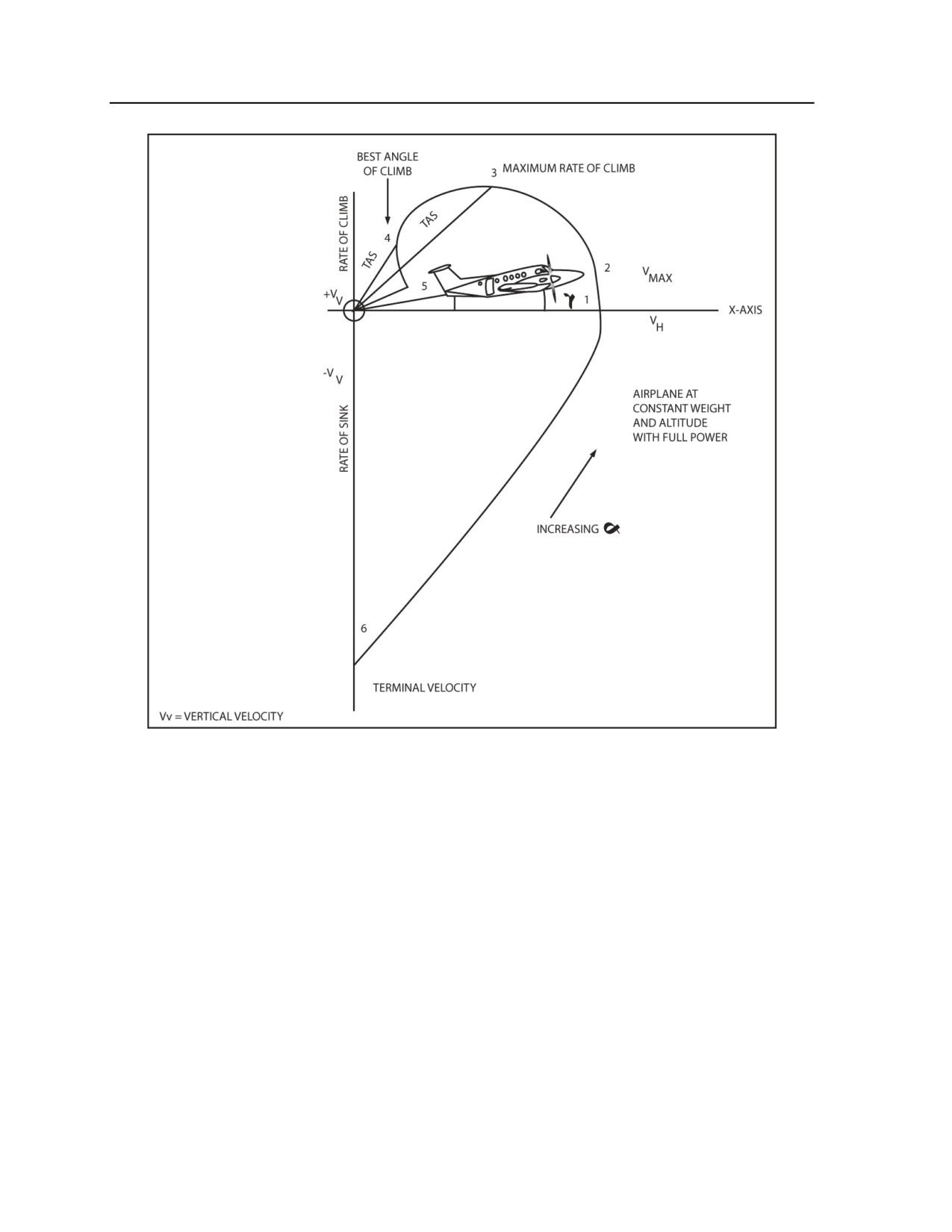
7-139. Figure 7-40, page 7-36, shows the typical polar diagram for full-power operation at 5,000 feet.
This curve represents the plot of vertical and horizontal velocities obtained by the aircraft at full power
with different climb and dive angles. Point 1 on the curve represents the maximum aircraft velocity in
straight-and-level flight (at full power).
7 May 2007
FM 3-04.203
7-35
Chapter 7
Figure 7-40. Full-power polar diagram
7-140. As the aircraft starts to climb, velocity decreases; the aircraft gains altitude and has a vertical
velocity, as shown at point 2. The vertical velocity (rate of climb) can be read on the scale at the left. The
angle between the flight path and horizontal velocity line is the angle of climb (Ȗ).
7-141. Point 3 shows the maximum rate of climb (VY). The curve indicates the maximum vertical velocity
obtainable by the aircraft. A line drawn from the origin to the top point of the curve shows the climb angle
and TAS when the aircraft is climbing at a maximum rate.
7-142. A line drawn from the origin tangent to the curve indicates the maximum angle of climb (VX) for
the aircraft at point 4. At full power, the aircraft performs somewhere on this curve; there cannot be any
steeper climb angle for this aircraft. The TAS and climb angle can be obtained by drawing a line from the
origin tangent to the curve.
7-143. If an aircraft stalls with excess power at its stall speed in level flight, then it is in climbing flight
when it stalls at full power. Full-power stalling speed is shown at point 5. The climb angle the aircraft is
able to attain at its stalling speed can be read from the graph.
7-144. Point 6 is the vertical velocity the aircraft attains if it were diving straight down with full power.
Many aircraft would break up before reaching this velocity due to their structural limitations. This point is
shown for information purposes only and to complete the curve.
7-36
FM 3-04.203
7 May 2007
Fixed-Wing Aerodynamics and Performance
POLAR CURVE
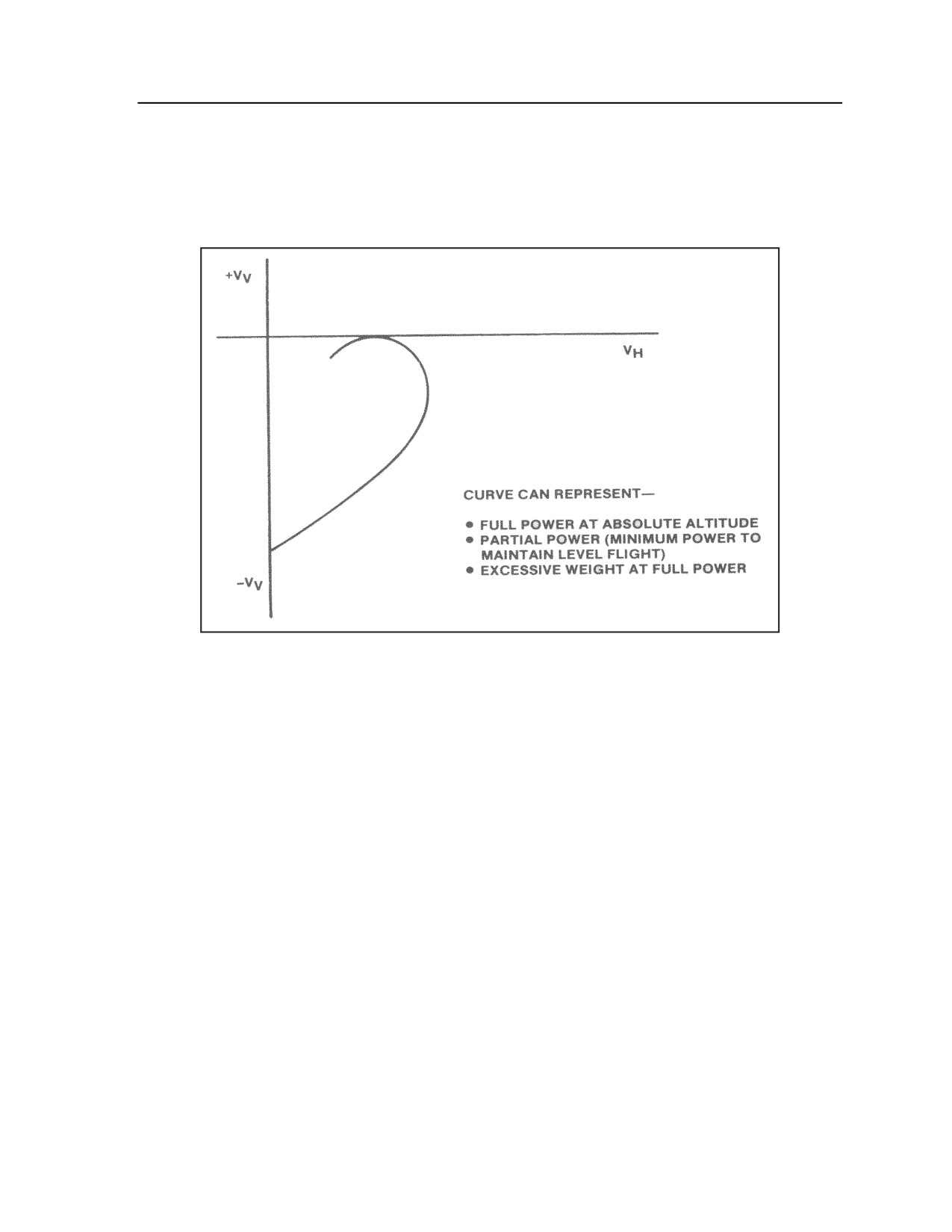
7-145. Any change in altitude, weight, or power setting affects aircraft performance and produces
changes in the full-power polar. Curves drawn showing these changes are called the family of polar curves.
Figure 7-41 could be the aircraft’s polar curve at its absolute ceiling, partial thrust polar, or even sea-level
polar in which the aircraft’s weight would not allow the aircraft to climb.
Figure 7-41. Polar curve
7-146. At the absolute ceiling polar, the aircraft cannot climb. Therefore, the full power the power plant
can produce at maximum altitude is only adequate to maintain the aircraft in straight-and-level flight.
7-147. Figure 7-41 shows a curve that could also represent partial power. In this case, the aircraft is
operating with minimum power to maintain level flight. The aircraft encounters this condition when
operating at maximum endurance.
7-148. The third case would show with full power in an overweight condition no climb is possible.
TURNS
PERFORMANCE
7-149. Unlike automobiles or other ground vehicles, an aircraft can rotate about three axes; therefore, it
has six degrees of motion. The aircraft can pitch up or down, yaw left or right, and roll left or right. Due to
this freedom of motion, an aircraft can perform many maneuvers. All these maneuvers use vertical turns,
horizontal turns, or both. This section discusses vertical and horizontal turns separately, as well as the
limits imposed on these turns.
7-150. When an aircraft turns, it is not in static equilibrium. Forces must be unbalanced to produce
acceleration for turning. When properly performed, the turn does not produce any sideward force pulling
the aviator inward or outward from the turn. The net resulting force (lift) acts toward the center of the turn.
This turn is called a coordinated turn. The term level turn may be confusing as it refers to a constant-
altitude turn, not a wings-level turn; normally, an aircraft is never turned with the wings level. Forces
acting on the aircraft must be unbalanced for a turn to occur; this does not happen if wings are level.
7 May 2007
FM 3-04.203
7-37
Chapter 7
Incorrect banking during uncoordinated turns causes slips or skids; this is uncomfortable for the crew and
passengers. During uncoordinated turns at slow airspeeds, control can inadvertently be lost.
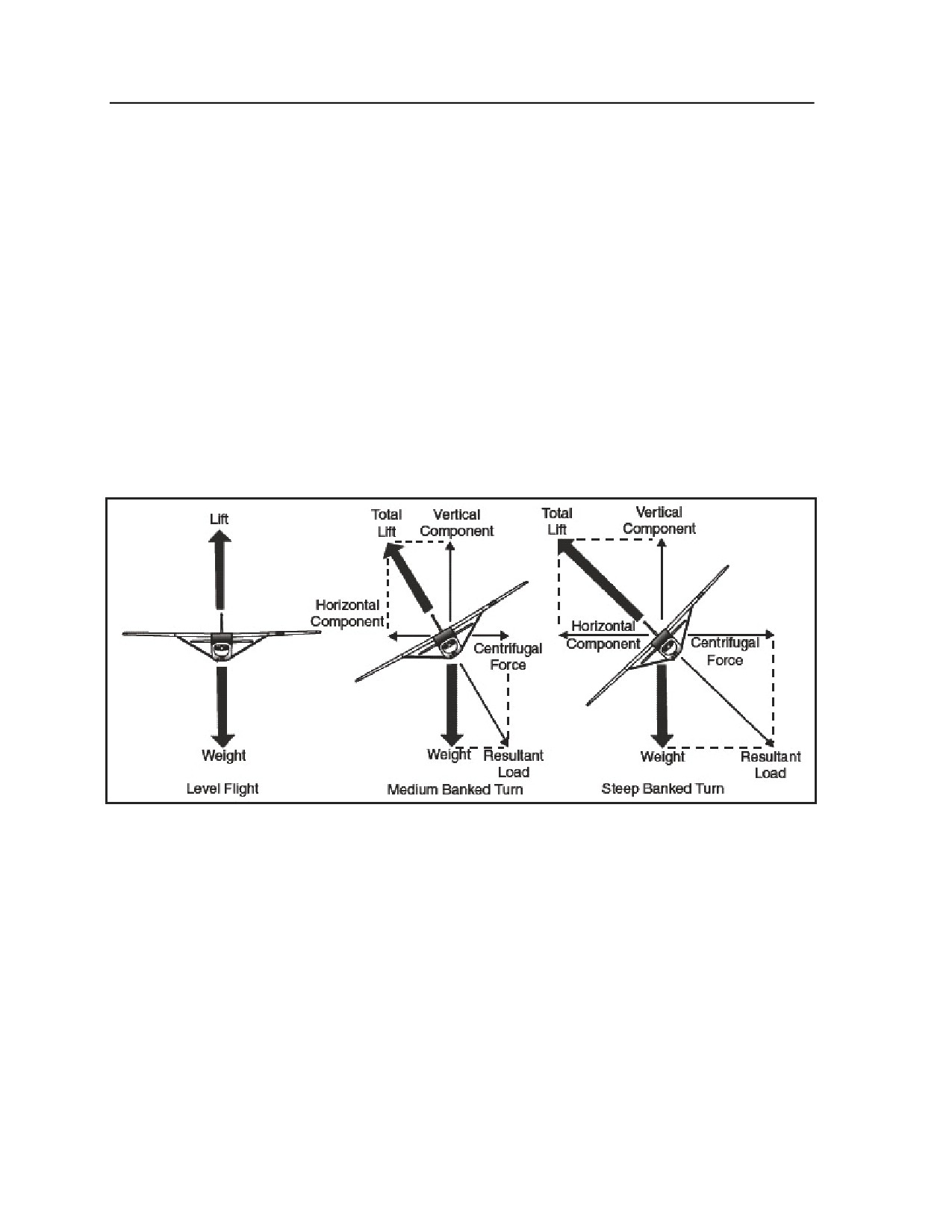
7-151. The force actually turning the aircraft is lift force. The horizontal component of lift is the force
that accelerates the aircraft toward the center of the turn. The rudder counteracts adverse aileron effect
(yaw). The elevator increases the attack angle to produce the added lift required due to the loss of the
vertical lift component and an apparent increase in weight, which is produced by centrifugal force.
Turning Flight
7-152. An aircraft, like any moving object, requires a sideward force to make a turn. In a normal turn, this
force is supplied by banking the aircraft so lift is exerted inward as well as upward. The force of lift is then
separated into two components at right angles to each other. The lift acting upward combined with
opposing weight is called the vertical-lift component. The horizontal-lift component (centripetal force) is
the lift acting horizontally combined with opposing inertia or centrifugal force (figure 7-42). Therefore, the
horizontal-lift component is the sideward force that forces the aircraft from straight flight, causing it to
turn. If an aircraft is not banked, no force is present to make the turn unless rudder application causes the
aircraft to skid in the turn. Likewise, if an aircraft is banked, it turns unless it is held on a constant heading
with the opposite rudder. Proper control technique assumes an aircraft is turned by banking and that in a
banking attitude it should be turning.
Figure 7-42. Effect of turning flight
Turn Radius
7-153. The aircraft turn radius varies directly with the square of its velocity (TAS) and inversely with the
bank angle. Therefore, any two aircraft flying at the same velocity and bank angle can fly in formation,
regardless of their weights. However, certain aerodynamic considerations-weight, altitude, load factor,
attack angle, and wing area-affect the velocity and also indirectly affect the turn radius. All of these
aerodynamic considerations play a part in the lift force produced. To turn an aircraft in the smallest
possible radius, an aviator flies at the slowest possible speed and highest possible bank angle. Limits on
turn radius performance are aerodynamic, structural, and power limits. The aviator must be constantly
aware of these limits while maneuvering the aircraft at or near its design limits.
7-38
FM 3-04.203
7 May 2007
Fixed-Wing Aerodynamics and Performance
Aerodynamic Limit of Performance
7-154. Since the horizontal component of lift is the force turning the aircraft, a FW aircraft reaches its
aerodynamic turn radius limit when the aircraft turns at its stall velocity. The airspeed at which the
minimum turn radius occurs is the stalling speed where maximum Gs can be pulled without exceeding the
design load-limit factor. This is maneuvering airspeed. An increase in weight or altitude or a decrease in
CLmax requires an increase in velocity, which increases the turn radius.
Structural Limit of Performance
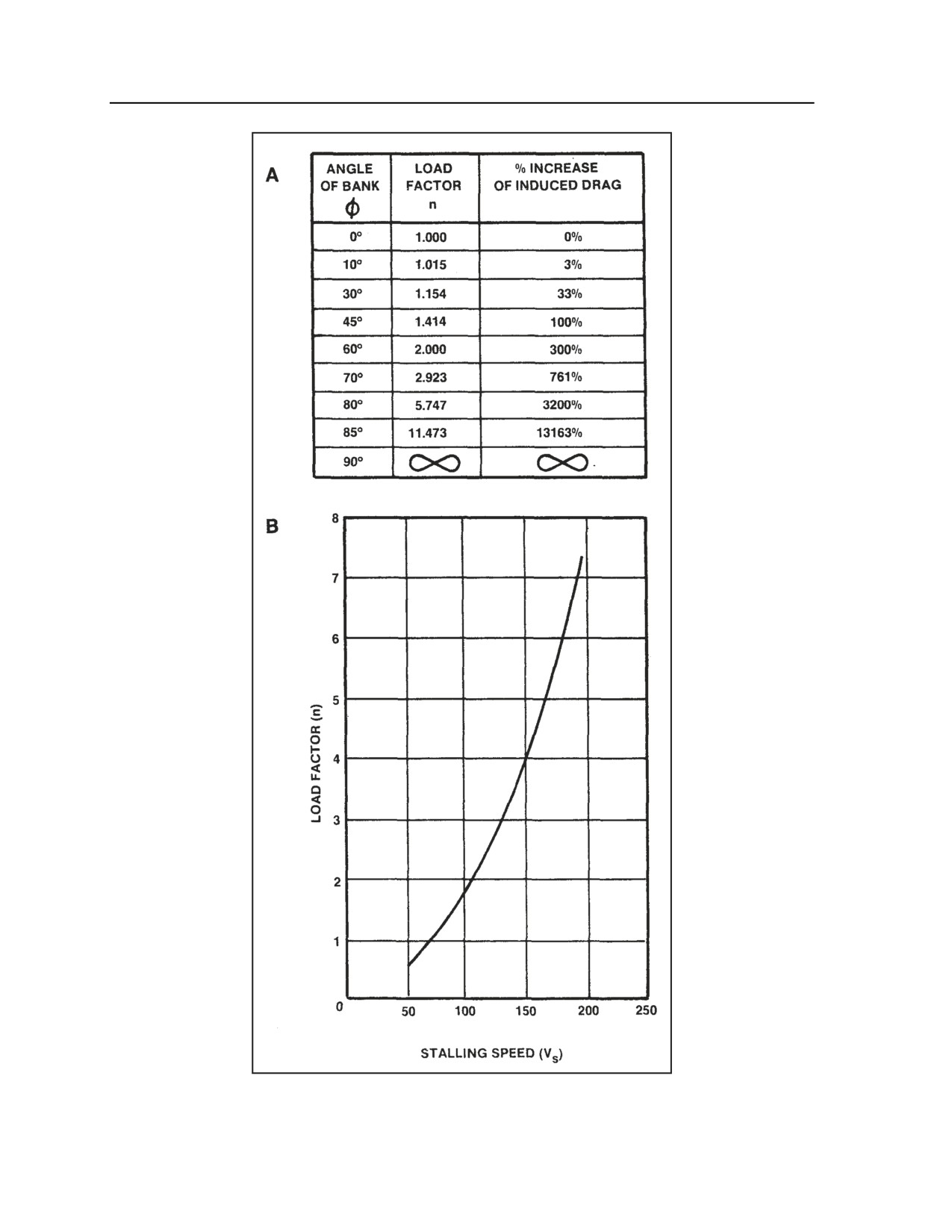
7-155. The load factor is purely a function of the bank angle; the aircraft’s weight does not affect the G-
load imposed on the aircraft. Both the C-12 and C-23 accelerate 2 Gs in a 60-degree bank. The table in
figure 7-43 part A shows the load factor at various bank angles. The graph in part B depicts how the
increasing load factor affects the aircraft’s stalling speed. In the first 60 degrees of bank, the load factor
increases by only one. However, in the next 10 degrees (60 to 70 degrees), the load factor increases almost
another one (figure 7-43 part A). At higher bank angles, the load factor and stalling speed increase rapidly.
A steep turn immediately after takeoff is extremely dangerous due to the load factor imposed and low
aircraft velocity.
7-156. The stall speed increases as the bank angle increases. Therefore, a compromise between the bank
angle and stalling speed must be made to obtain the minimum aircraft turn radius. Minimum turn radius is
found by considering the aircraft’s design strength. An aircraft pulling 3 Gs develops a lift force three
times its weight. Aircraft are designed to take certain loads; if these load limits are exceeded, the aircraft
becomes overstressed. Load limits are published in the appropriate operator's manual. If an aircraft has a
load limit of 3 Gs, the minimum turn radius is at its 3-G stalling speed. This occurs at a bank angle of about
73 degrees (figure 7-43 part A, page 7-40). The aircraft’s maneuvering speed is the velocity at which the
minimum turning radius can be performed at a given altitude without exceeding the load limit.
Power Limit of Performance
7-157. The third limit imposed on the turning performance is the power or thrust limit. The amount of
induced drag developed at high-load factors can become quite large. Induced drag is directly proportional
to lift squared. In a 73-degree bank, three times more lift is produced than in level flight; therefore, induced
drag is nine times that of a level flight at the same velocity. This is a tremendous amount of drag to
overcome. The power available from the power plant is the limiting factor.
SLOW FLIGHT
7-158. In aviator training and testing, slow flight is broken down into two distinct elements—
The establishment, maintenance, and maneuvering of the aircraft at airspeeds and in
configurations appropriate to takeoffs, climbs, descents, landing approaches and go-arounds.
Maneuvering at the slowest airspeed the aircraft is capable of maintaining controlled flight
without indications of a stall-usually 3 to 5 knots above stalling speed.
7 May 2007
FM 3-04.203
7-39
Chapter 7
Figure 7-43. Effect of load factor on stalling speed
7-40
FM 3-04.203
7 May 2007
Fixed-Wing Aerodynamics and Performance
FLIGHT AT LESS THAN CRUISE AIRSPEEDS
7-159. Maneuvering during slow flight demonstrates aircraft flight characteristics and the degree of
controllability at less than cruise speeds. The ability to determine characteristic control responses at lower
airspeeds appropriate to takeoffs, departures, and landing approaches is a critical factor in stall awareness.
7-160. As airspeed decreases, control effectiveness decreases disproportionately. For instance, there may
be a certain loss of effectiveness when airspeed is reduced from 30 to 20 miles per hour above stalling
speed, but normally there is a much greater loss as the airspeed is further reduced to 10 miles per hour
above stalling speed. The objective of maneuvering during slow flight is to increase aviator confidence and
develop their ability to use the controls correctly, thereby improving proficiency in performing maneuvers
requiring slow airspeeds.
7-161. Maneuvering during slow flight should be performed using both instrument indications and
outside visual reference. Slow flight should be practiced from straight glides, straight-and-level flight, and
medium banked gliding and level flight turns. Slow flight at approach speeds should include slowing the
aircraft smoothly and promptly from cruising to approach speeds without changes in altitude or heading,
and determining and using appropriate power and trim settings. Slow flight at approach speed should also
include configuration changes, such as landing gear and flaps, while maintaining heading and altitude.
FLIGHT AT MINIMUM CONTROLLABLE AIRSPEED
7-162. This maneuver demonstrates aircraft flight characteristics and degree of controllability at its
minimum flying speed. By definition, the term flight at minimum controllable airspeed means a speed at
which any further increase in attack angle, load factor, or reduction in power causes an immediate stall.
Instruction in flight at minimum controllable airspeed should be introduced at reduced power settings, with
the airspeed sufficiently above the stall to permit maneuvering but close enough to sense flight
characteristics at very low airspeed-which are sloppy controls, ragged response to control inputs, and
difficulty maintaining altitude. Maneuvering at minimum controllable airspeed should be performed using
both instrument indications and outside visual reference. It is important aviators form the habit of frequent
reference to flight instruments, especially the airspeed indicator, while flying at very low airspeeds.
However, a feel for the aircraft at very low airspeeds must be developed to avoid inadvertent stalls and
operate the aircraft with precision.
7-163. This maneuver is performed in the region of reversed command. The FAA definition is a flight
regime in which flight at a higher airspeed requires a lower power setting and flight at a lower airspeed
requires a higher power setting to maintain altitude. A better description is in normal flight pitch used for
altitude control and power for airspeed. In reversed command, pitch controls airspeed and power controls
altitude.
7-164. To begin the maneuver, the throttle is gradually reduced from cruising position. While the airspeed
is decreasing, the nose position in relation to the horizon should be noted and raised as necessary to
maintain altitude.
7-165. When the airspeed reaches the maximum allowable for landing gear operation, the landing gear (if
equipped with retractable gear) must be extended and all-gear-down checks performed. As the airspeed
reaches the maximum allowable for flap operation, full flaps must be lowered and the pitch attitude
adjusted to maintain altitude. Additional power is required as the speed further decreases to maintain
airspeed just above a stall. As speed decreases further, the aviator notes the feel of the flight controls,
especially the elevator. The aviator also notes the sound of the airflow as it falls off in tone level.
7-166. As airspeed is reduced, flight controls become less effective and normal nose-down tendency is
reduced. The elevators become less responsive and coarse control movements become necessary to retain
control of the aircraft. The slipstream effect produces a strong yaw so application of rudder is required to
maintain coordinated flight. The secondary effect of applied rudder is to induce a roll, so aileron is required
to keep the wings level. This can result in flying with crossed controls.
7 May 2007
FM 3-04.203
7-41
Chapter 7
7-167. During these changing flight conditions, it is important to retrim the aircraft as often as necessary
to compensate for changes in control pressures. If the aircraft has been trimmed for cruising speed, heavy
aft control pressure is needed on the elevators making precise control impossible. If too much speed is lost
or too little power is used, further back pressure on the elevator control may result in a loss of altitude or a
stall. When the desired pitch attitude and minimum control airspeed have been established, it is important
to continually cross-check the attitude indicator, altimeter, and airspeed indicator, as well as outside
references to ensure accurate control is maintained.
7-168. The aviator should understand when flying slower than minimum drag speed (L/Dmax), the aircraft
exhibits a characteristic known as speed instability. If the aircraft is disturbed by even the slightest
turbulence, the airspeed decreases. As airspeed decreases, total drag also increases resulting in a further
loss in airspeed. Total drag continues to rise and speed continues to fall. Unless more power is applied
and/or the nose is lowered, speed continues to decay down to the stall. This is an extremely important
factor in the performance of slow flight. The aviator must understand at speeds less than minimum drag
speed, airspeed is unstable and will continue to decay if allowed to do so.
7-169. When the attitude, airspeed, and power have been stabilized in straight flight, turns should be
practiced to determine the aircraft’s controllability characteristics at this minimum speed. During turns,
power and pitch attitude may need to be increased to maintain the airspeed and altitude. The objective is to
acquaint the aviator with the lack of maneuverability at minimum speeds, danger of incipient stalls, and the
tendency of the aircraft to stall as the bank is increased. A stall may also occur as a result of abrupt or
rough control movements when flying at this critical airspeed.
7-170. Abruptly raising the flaps while at minimum controllable airspeed results in lift suddenly being
lost causing the aircraft to lose altitude or perhaps stall.
7-171. Once flight at a minimum controllable airspeed is properly obtained for level flight, a descent or
climb at the minimum controllable airspeed can be established by adjusting the power as necessary to
establish the desired rate of descent or climb. The inexperienced aviator should note the increased yawing
tendency at the minimum control airspeed during high power settings with flaps fully extended. In some
aircraft, an attempt to climb at such a slow airspeed may result in a loss of altitude, even with maximum
power applied.
7-172. Common errors in performance of slow flight are—
Failure to adequately clear the area.
Inadequate back-elevator pressure as power is reduced, resulting in altitude loss.
Excessive back-elevator pressure as power is reduced, resulting in a climb, followed by a rapid
reduction in airspeed and mushing.
Inadequate compensation for adverse yaw during turns.
Fixation on the airspeed indicator.
Failure to anticipate changes in lift as flaps are extended or retracted.
Inadequate power management.
Inability to adequately divide attention between aircraft control and orientation.
DESCENTS
7-173. When an aircraft enters a descent, its flight path changes from level to an inclined plane. It is
important the aviator know the power settings and pitch attitudes that produce conditions of descent.
PARTIAL POWER DESCENT
7-174. The normal method of losing altitude is to descend with partial power. This is often termed cruise
or en route descent. The airspeed and power setting recommended by the aircraft manufacturer for
prolonged descent should be used. The target descent rate should be 400 to 500 FPM. The airspeed may
vary from cruise airspeed to that used on the downwind leg of the landing pattern. But the wide range of
7-42
FM 3-04.203
7 May 2007
Fixed-Wing Aerodynamics and Performance
possible airspeeds should not be interpreted to permit erratic pitch changes. The desired airspeed, pitch
attitude, and power combination should be preselected and kept constant.
DESCENT AT MINIMUM SAFE AIRSPEED
7-175. A minimum safe airspeed descent is a nose-high, power assisted descent condition principally
used for clearing obstacles during a landing approach to a short runway. The airspeed used for this descent
condition is recommended by the aircraft manufacturer and is normally no greater than 1.3 minimum
steady flight spread in the landing configuration (VSO). Some characteristics of minimum safe airspeed
descent are a steeper than normal descent angle, and the excessive power required to produce acceleration
at low airspeed should mushing and/or an excessive descent rate be allowed to develop.
GLIDES
7-176. A glide is a basic maneuver in which the aircraft loses altitude in a controlled descent with little or
no engine power; forward motion is maintained by gravity pulling the aircraft along an inclined path, and
the descent rate is controlled by the aviator balancing the forces of gravity and lift.
7-177. Although glides are directly related to the practice of power-off accuracy landings, they have a
specific operational purpose in normal landing approaches and forced landings after engine failure.
Therefore, it is necessary they be performed more subconsciously than other maneuvers as most of the time
during their execution the aviator is giving full attention to details other than the mechanics of performing
the maneuver. Since glides are usually performed relatively close to the ground, accuracy of their execution
and formation of proper technique and habits are of special importance.
7-178. Since the application of controls is somewhat different in glides than in power-on descents, gliding
maneuvers require the perfection of a technique somewhat different from that required for ordinary power-
on maneuvers. This control difference is caused primarily by two factors—absence of the usual propeller
slipstream and difference in the relative effectiveness of various control surfaces at slow speeds.
7-179. The glide ratio of an aircraft is the distance the aircraft will, with power off, travel forward in
relation to the altitude it loses. For instance, if an aircraft travels 10,000 feet forward while descending
1,000 feet, its glide ratio is said to be 10:1.
7-180. The glide ratio is affected by all four fundamental forces acting on an aircraft (weight, lift, drag,
and thrust). If all factors affecting the aircraft are constant, the glide ratio is constant. Although the effect
of wind is not covered in this section, it is a prominent force acting on the aircraft’s gliding distance in
relationship to its movement over the ground. With a tailwind, the aircraft glides farther because of the
higher groundspeed; with a headwind, the aircraft does not glide as far because of the slower groundspeed.
7-181. Variations in weight do not affect the glide angle provided the aviator uses the correct airspeed.
Since it is the lift over drag (L/D) ratio that determines the distance the aircraft can glide, weight does not
affect the distance. The glide ratio is based only on the relationship of the aerodynamic forces acting on the
aircraft. The only effect weight has is to vary the time the aircraft glides. The heavier the aircraft the higher
the airspeed must be to obtain the same glide ratio. For example, if two aircraft having the same L/D ratio,
but different weights, start a glide from the same altitude, the heavier aircraft gliding at a higher airspeed
arrives at the same touchdown point in a shorter time. Both aircraft cover the same distance, but the lighter
aircraft takes a longer time.
7-182. Under various flight conditions, the drag factor may change through the operation of the landing
gear and/or flaps. When the landing gear or the flaps are extended, drag increases and airspeed decreases
unless the pitch attitude is lowered. As pitch is lowered, the glide path becomes steeper and reduces the
distance traveled. With the power off, a windmilling propeller also creates considerable drag, thereby
retarding the aircraft’s forward movement.
7-183. Although the aircraft’s propeller thrust is normally dependent on the engine’s power output, the
throttle is placed in the closed position during a glide so thrust is constant. Since power is not used during a
7 May 2007
FM 3-04.203
7-43
Chapter 7
glide or power-off approach, the pitch attitude must be adjusted as necessary to maintain a constant
airspeed.
7-184. The best speed for the glide is one at which the aircraft travels the greatest forward distance for a
given loss of altitude in still air. This best glide speed corresponds to an attack angle resulting in the least
drag on the aircraft and giving the best lift-to-drag ratio (L/Dmax).
7-185. Any change in gliding airspeed results in a proportionate change in glide ratio. Any speed, other
than the best glide speed, results in more drag. Therefore, as glide airspeed is reduced or increased from
optimum or best glide speed, glide ratio is also changed. When descending at a speed below best glide
speed, induced drag increases. When descending at a speed above best glide speed, parasite drag increases.
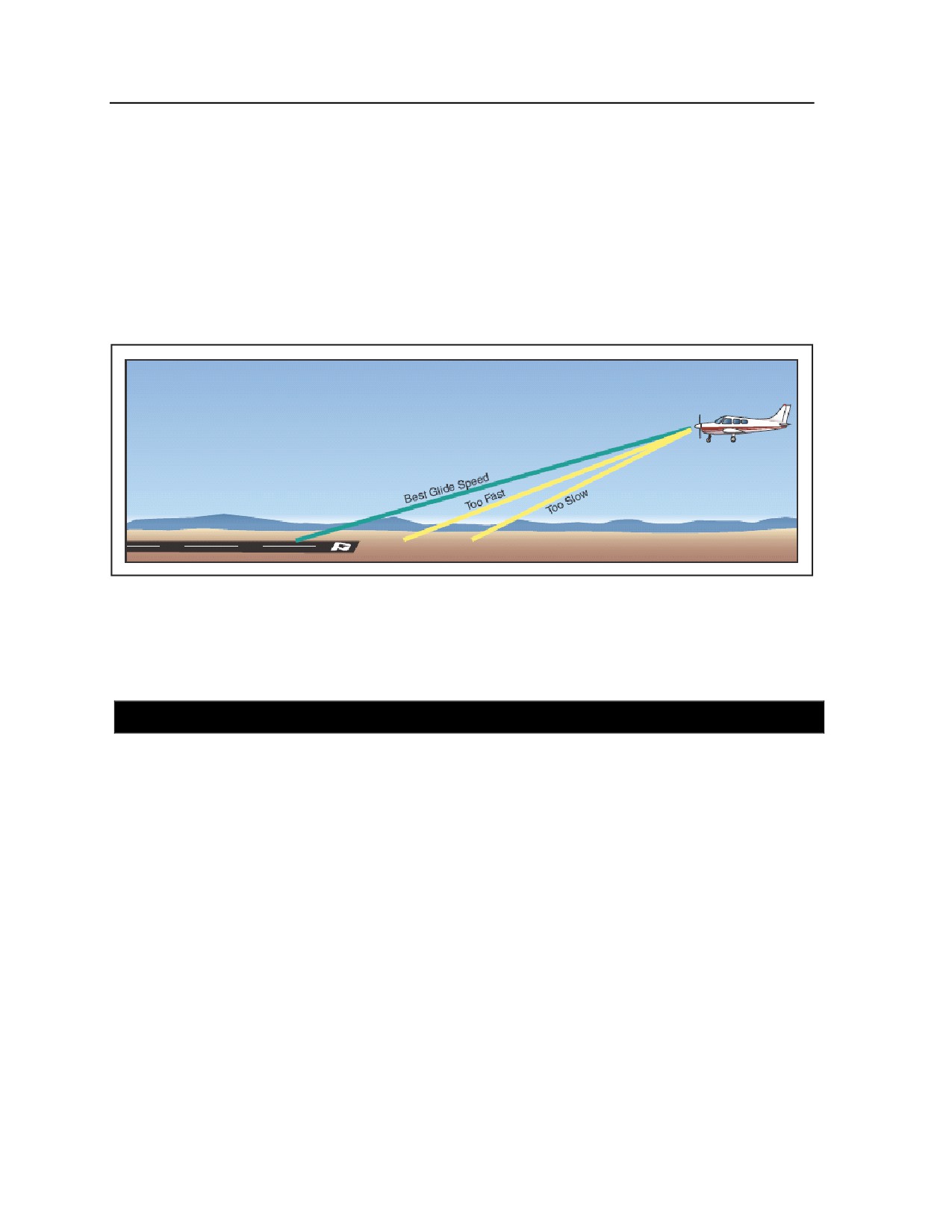
In either case, the rate of descent increases (figure 7-44).
Figure 7-44. Best glide speed
7-186. The aviator must never attempt to stretch a glide by applying back-elevator pressure and reducing
airspeed below the aircraft’s recommended best glide speed. Attempts to stretch a glide invariably result in
an increase in the rate and angle of descent and may precipitate an inadvertent stall.
SECTION V - TAKEOFF AND LANDING PERFORMANCE
PROCEDURES AND TECHNIQUES
7-187. Techniques used in older aircraft during the takeoff and landing phases of flight were essentially
the same for each type of aircraft. Because of design differences in today’s aircraft, however, procedures
and techniques differ from aircraft to aircraft. Some aircraft rotate to their takeoff attitude early in the
takeoff roll. Some aircraft make a constant attack angle approach and hold it until landing; others flare just
before touchdown, which decreases the rate of sink. Aerodynamic braking is effective in some aircraft
during a landing roll. In other aircraft, aerodynamic braking is dangerous.
7-188. The design characteristics of an aircraft determine its takeoff and landing performance. However,
a detailed discussion of various aircraft is beyond the scope of this section. This section is concerned
primarily with the aerodynamic and physical considerations determining the runway length needed for a
successful takeoff or landing.
TAKEOFF
7-189. Takeoff is an acceleration and transition maneuver. During a takeoff run, the aircraft makes the
transition from a ground-supported to an air-supported vehicle. At the start of the takeoff roll, the entire
aircraft’s weight is supported by the wheels. As the aircraft gains velocity, the wing begins to support more
7-44
FM 3-04.203
7 May 2007
Fixed-Wing Aerodynamics and Performance
of the weight. By the time the aircraft reaches its takeoff velocity, the wing supports the entire aircraft. The
aircraft has then completed the transition from ground to air support.
ACCELERATION FORCES
7-190. According to Newton’s second law of motion, a body accelerates only if there is an unbalanced
force acting on that body. The acceleration takes place in the direction of the unbalanced force. For the
aircraft to accelerate during the takeoff run, the sum of the horizontal forces acting on the aircraft must
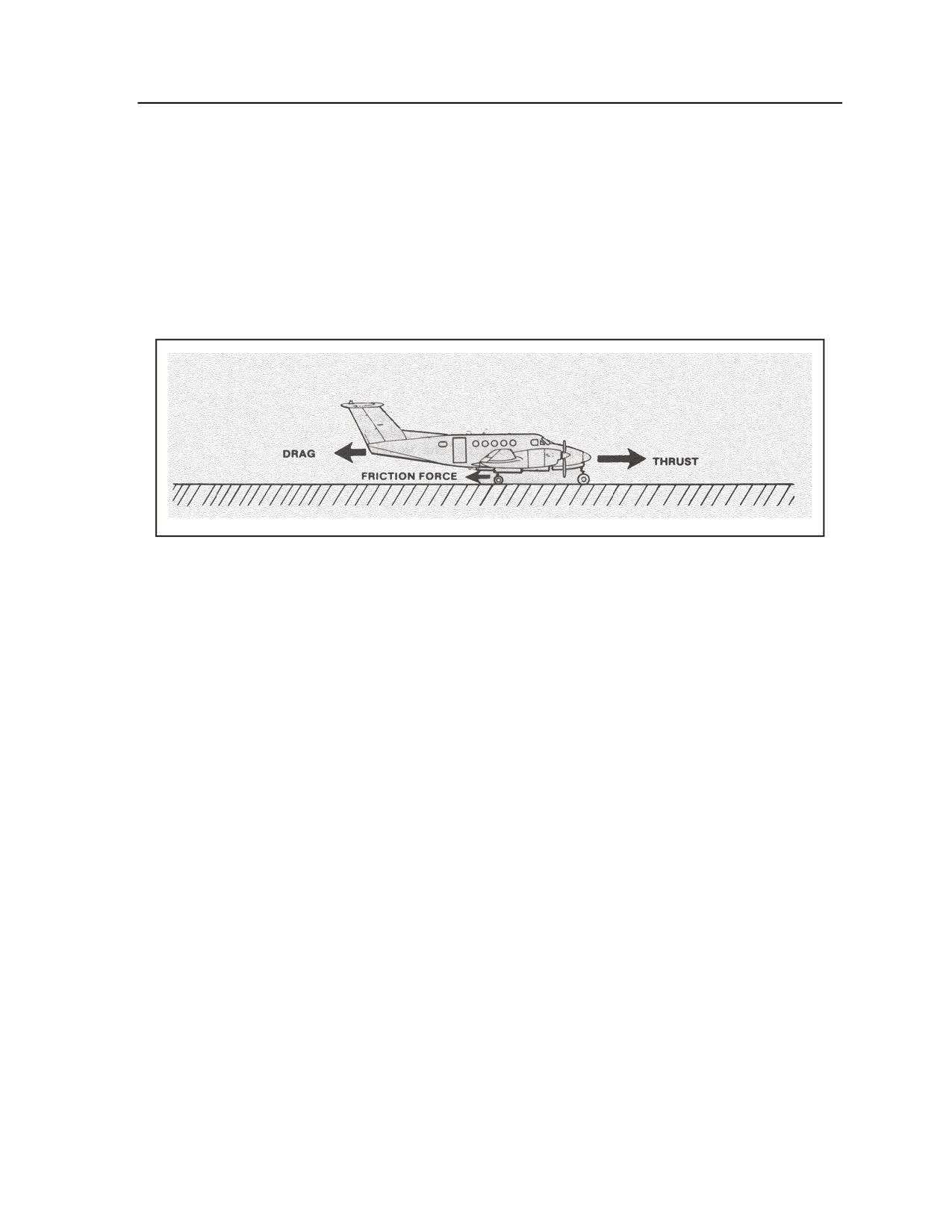
yield an unbalanced force in the thrust direction. Figure 7-45 shows horizontal forces that determine the net
accelerating force on the aircraft during its takeoff roll. For a given altitude and RPM, thrust from a
propeller-driven aircraft decays as velocity increases during the takeoff roll.
Figure 7-45. Net accelerating force
7-191. The aircraft’s wing is close to the ground during the takeoff run. This reduces or cancels out the
downwash and wingtip vortexes behind the wing. Reduction of downwash also reduces induced drag. This
phenomenon is known as ground effect. It normally reduces induced drag about 1.4 percent at one
wingspan, 23.5 percent at one-fourth wingspan, and 47.6 percent at one-tenth wingspan. Parasite drag is
directly proportional to the square of the velocity, so this drag force increases as aircraft velocity increases.
7-192. Figure 7-45, which shows friction force, is called rolling friction. It results from the rolling action
of the tires against the runway. Like any friction force, this rolling friction is equal to the product of the
coefficient of rolling friction and a normal (perpendicular) force. The coefficient of rolling friction varies
from 0.02 to 0.3, depending on the runway surface and type of tire. In this case, the normal force is the
aircraft weight not supported by the wing. As mentioned before, as the aircraft gains speed during the
takeoff roll, the wing supports more of the weight. This weight reduction on the wheels reduces the rolling
friction force as the aircraft accelerates. When the aircraft reaches takeoff velocity, the friction force is zero
since the normal force is zero.
TAKEOFF DISTANCE
7-193. Takeoff distance is directly proportional to takeoff velocity squared. Because velocity is squared,
its effect on takeoff distance is significant. The takeoff velocity is a function of the aircraft’s stalling speed
and usually 1.1 to 1.25 times the power-off stalling speed. Some aircraft use high-lift devices to lower the
stalling speed, which decreases takeoff velocity and, thus, takeoff distance. These high-lift devices are used
only to increase CL.
Altitude
7-194. An aircraft taking off from a field at a 5,000-foot elevation requires a longer takeoff run than the
same aircraft taking off at sea level; as altitude increases, air density decreases. This requires an increase in
TAS to develop the required amount of lift. This increase in airspeed increases the takeoff distance. Engine
performance is also affected as elevation is increased. Increases in altitude decrease the thrust output.
7 May 2007
FM 3-04.203
7-45
Chapter 7
Therefore, the net accelerating force decreases at a higher elevation, and takeoff distance increases because
of this thrust loss.
Weight
7-195. Weight changes, as well as air density changes, have a compounding effect on the aircraft’s
takeoff distance. If an aircraft could double its takeoff weight, it might be assumed takeoff distance would
double. If weight had no effect on the takeoff velocity, this assumption would be correct. However,
doubling the weight doubles the value of the square of takeoff velocity. This value, when combined with
the increased value of the weight, yields a takeoff four times the original distance. Another factor is also
affected by weight increase-rolling friction force. The increased weight increases normal force and,
therefore, rolling friction force. This results in a decrease in net accelerating force, which adds additional
distance to the takeoff run.
Wind
Wind Component
7-196. Until now, the discussion of takeoff distance has assumed a no-wind condition; however, wind can
be used to decrease the takeoff distance. For example, an aircraft is assumed to be taking off into a head
wind equal to its takeoff velocity. While the aircraft is sitting at the end of the runway, the wind velocity
over the wing is enough to support the aircraft. The aviator does not need to accelerate because the aircraft
does not require a takeoff run or distance. The aircraft’s ground speed is zero even if the TAS is equal to
the takeoff velocity.
Runway Direction
7-197. Most runways are built in the direction of the local prevailing winds. If a runway must be used that
has a tail-wind component, the value of the tail wind must be added to the takeoff velocity, and then the
sum of the two must be squared. Thus, a large increase in takeoff distance is necessary.
TAKEOFF PERFORMANCE SUMMARY
7-198. Various factors influence takeoff performance and distance. The interplay between some of these
factors makes accurate takeoff distance requirements difficult to predict. In addition, acceleration is
assumed to be constant during the takeoff roll. This is not necessarily true, however. The aviator can
determine the actual takeoff distance required from the aircraft operator’s manual, which has charts that
include effects of temperature, PA, aircraft weight, winds, and runway slope. These charts, taken from
flight tests, show the expected performance of each aircraft.
LANDING
7-199. In a landing roll, the aircraft must decelerate, not accelerate. As velocity decreases and lift force
decays, weight shifts from the aircraft wings to the wheels. This is the reverse of the transition and
acceleration scenario mentioned previously.
DISTANCE
7-200. During a landing, the aviator is primarily concerned with dissipating the aircraft’s kinetic energy.
Any factor affecting the aircraft’s mass or velocity must be considered in computing the landing distance.
Because velocity is a squared term in the kinetic energy equation, the final approach is always flown at the
lowest velocity possible. This condition requires careful planning and execution by the aviator.
Net Decelerating Force
7-201. Compared to takeoff, forces that compose the net accelerating force of the landing are reversed.
The acceleration force is now in the direction of the drag and friction forces; therefore, the aircraft slows.
7-46
FM 3-04.203
7 May 2007
Fixed-Wing Aerodynamics and Performance
For this net decelerating force to develop, drag and friction must be greater than thrust force. However,
thrust force must still be considered even if the engine is usually at idle. A residual thrust force must be
overcome by drag and friction if the aircraft is to decrease its velocity. Some aircraft are equipped with
propellers that can reverse their pitch. Therefore, the propeller can also develop a thrust force in the
direction of the retarding forces. This thrust increases the retarding force and decreases the required
landing distance.
7-202. The net decelerating force can be increased on some aircraft by aerodynamic braking-increasing
the drag on the aircraft during the landing roll. The drag force is proportional to the square of the velocity.
Therefore, aerodynamic braking is effective only during the initial landing roll, when the aircraft is at
higher velocities.
7-203. If a short landing roll is required, it is possible to increase the friction force far above any
aerodynamic force that could be applied to the aircraft. This increase in friction force is done with the
wheel brakes. Brakes must not be applied too early. During the initial landing roll, most of the aircraft
weight is supported by the wings. Using brakes at this time is not effective as the normal force on the
wheels is low and the resulting friction force developed is small. Also, the wheels may lock and tires may
blow out if the brakes are applied too hard at this time. Velocity should be decreased so enough weight is
transferred to the wheels for the brakes to be effective. Some aircraft have wing spoilers used to destroy the
lift on the wings. Weight is then transferred to the tires, allowing brakes to be applied earlier in the landing
run. Retracting the flaps on some aircraft also reduces lift developed by the wings.
7-204. The condition of the runway surface also affects the aircraft’s required stopping distance. On wet
or icy runways, the coefficient of friction is small, resulting in a small decelerating force. Therefore, a
longer stopping distance is required. A runway condition reading
(RCR) is determined by using a
decelerometer. The RCR is given in the remarks section of weather sequence reports, which are supplied
by the pilot-to-forecaster service and ATC facility. The RCR should always be considered during a landing
on a slick runway. The landing distance required may exceed the available runway length.
Deceleration Speed along Landing Roll
7-205. Figure 7-46, page 7-48, shows the speed at various distances from touchdown to a full stop.
Again, this assumes a constant deceleration, which is not necessarily true but is easy to visualize. For
example, if the total landing distance requires 4,500 feet and touchdown speed is 130 knots, the speed is
higher than half the touchdown speed at half the landing distance. With this in mind, the aviator can avoid
over-braking.
Landing Velocity
7-206. The final approach airspeed of an aircraft is about 1.3 times its stalling speed. Therefore, any high-
lift device that decreases stalling speed also decreases landing speed. A decreased landing velocity
decreases both the kinetic energy and required landing distance. Longer landing distances are necessary for
landings made at high altitudes as these higher altitudes result in faster TASs for final approaches.
Wind
7-207. A head wind results in a lower final-approach speed and slower touchdown velocities (ground
speed). Reduced kinetic energy, with respect to the ground, decreases landing distance.
7 May 2007
FM 3-04.203
7-47
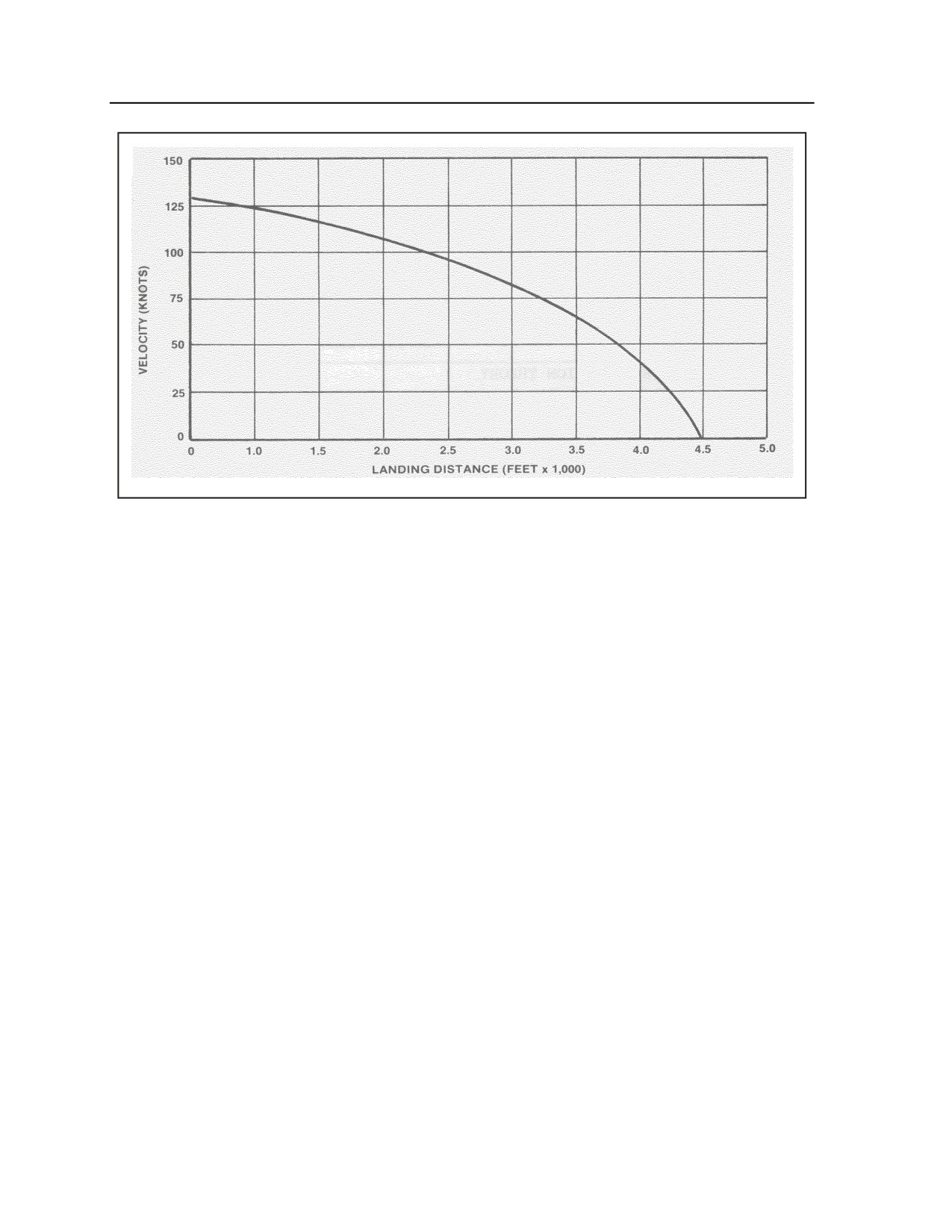
Chapter 7
Figure 7-46. Landing roll velocity
Weight
7-208. The aircraft’s weight affects landing distance the same as it does takeoff distance. Decreased
weight requires less runway, whether an aircraft is landing or taking off.
PERFORMANCE SUMMARY
7-209. As with takeoff performance, landing performance is difficult to predict. Each aircraft operator’s
manual has landing distance charts, which show results of flight tests conducted under differing conditions.
These charts consider the factors affecting landing distance.
Hydroplaning
7-210. Wet or slippery runways can lead to hydroplaning. The hydroplaning aircraft rides on a film of
water; tires have little or no contact with the runway surface. The aircraft is supported by a hydrodynamic
lift force much like a water skier is supported by skis. The aviator must be aware of conditions that cause
hydroplaning and understand how to avoid them.
7-211. For a simplified explanation of hydroplaning, an aircraft can again be compared to a water skier.
To support the skier, a hydrodynamic lift force develops that depends on speed. Below speeds where
aerodynamic forces dominate, the faster the speed, the easier it is to hydroplane. In the same way, there is a
minimum speed at which hydroplaning occurs. Below a certain speed, however, drag is so great and
hydrodynamic lift force so small, the skier sinks. Likewise, below the speed where hydroplaning occurs,
the tires directly contact the runway.
7-212. The velocity at which total hydroplaning occurs depends on the square root of the tire inflation
pressure. Partial hydroplaning may occur at slower speeds. Under-inflated tires can hydroplane at even
slower speeds.
7-213. An assumption that heavier aircraft must move at faster speeds than lighter aircraft before
hydroplaning occurs is not accurate as experiments and classical hydrodynamic theory show the speed at
which hydroplaning occurs is independent of weight. Weight only determines the footprint size the tire
makes, however; the ratio of weight per square inch of footprint area is the same. Weight has an indirect
7-48
FM 3-04.203
7 May 2007
Fixed-Wing Aerodynamics and Performance
effect because a heavier aircraft must fly at a faster approach and touchdown speed. Thus, the possibility of
hydroplaning is greater in heavier aircraft.
7-214. Other factors affecting hydroplaning cannot be quantitatively described in a formula. For example,
how deep the water must be on a runway before hydroplaning develops is not well defined. Tire tread
depth and pattern—as well as the runway surface itself—are also factors. A smooth tire can hydroplane in
as little as .15 inches of water on the runway. A tire with deep tread has channels for the water to escape
while part of the tire contacts the runway. This tire may need as much as 2 inches of water before
hydroplaning occurs. Puddles on the runway can also cause intermittent hydroplaning. A smooth runway
surface, in contrast to a coarse surface, may result in earlier hydroplaning.
7-215. Hydroplaning can occur with any aircraft. Tires must be checked during preflight for proper
inflation and tread condition. The aviator should avoid crosswind landings when possible and fly at
minimum airspeeds when landing on wet or slippery runways. A rule of thumb for determining
hydroplaning speeds is to multiply the square root of the tire pressure by nine.
CROSSWIND OPERATIONS
7-216. An aircraft taking off or landing in a crosswind must have a track over the ground parallel to the
runway heading. If the aircraft is going to make the desired track over the ground, it must sideslip through
the air mass moving across the runway. The rudder produces the required sideslip so landing or takeoff can
be made in the direction of the runway heading. The aircraft is traveling at low airspeeds during these
phases of flight. Therefore, the directional control problem is again amplified by the lack of high dynamic
pressure.
7-217. As mentioned during the directional control requirements discussion, an aircraft must sideslip
through the air mass during a crosswind landing or takeoff. Because of the dihedral effect, a sideslip angle
produces a roll away from the sideslip. The stronger the dihedral effect of the aircraft (positive lateral
stability), the greater the lateral control required during this condition of flight.
SECTION VI - FLIGHT CONTROL
DEVELOPMENT
7-218. After early aircraft designers built surfaces that would yield enough lift to support an aircraft, the
greatest problem still remaining was how to gain adequate and positive control of the airborne aircraft.
Early gliders flown at the end of the last century were controlled by shifting the CG location in relation to
the aerodynamic center. To do this, aviators shifted their body weight. This method of control not only
proved inadequate but often was also disastrous. The Wright brothers’ greatest contribution was the
development of an adequate control system. They developed a method of warping the wings for lateral
control. They also added a rudder for use with each wing. Others had already developed the elevator for
gliders. This section discusses the theory of control surface operation and control requirements. Also
covered are the types of control systems in use.
CONTROL SURFACE AND OPERATION THEORY
CAMBER
7-219. The Wright brothers’ method of warping the wings changed the value of the lift coefficient on
each wing. In effect, they changed the camber of the airfoils. Today, flaps are used to vary the camber of
the airfoils, which varies the lift coefficient. If a flap is deflected downward (figure 7-47, page 7-50) the
camber of the airfoil is increased. This results in a higher lift coefficient.
7 May 2007
FM 3-04.203
7-49
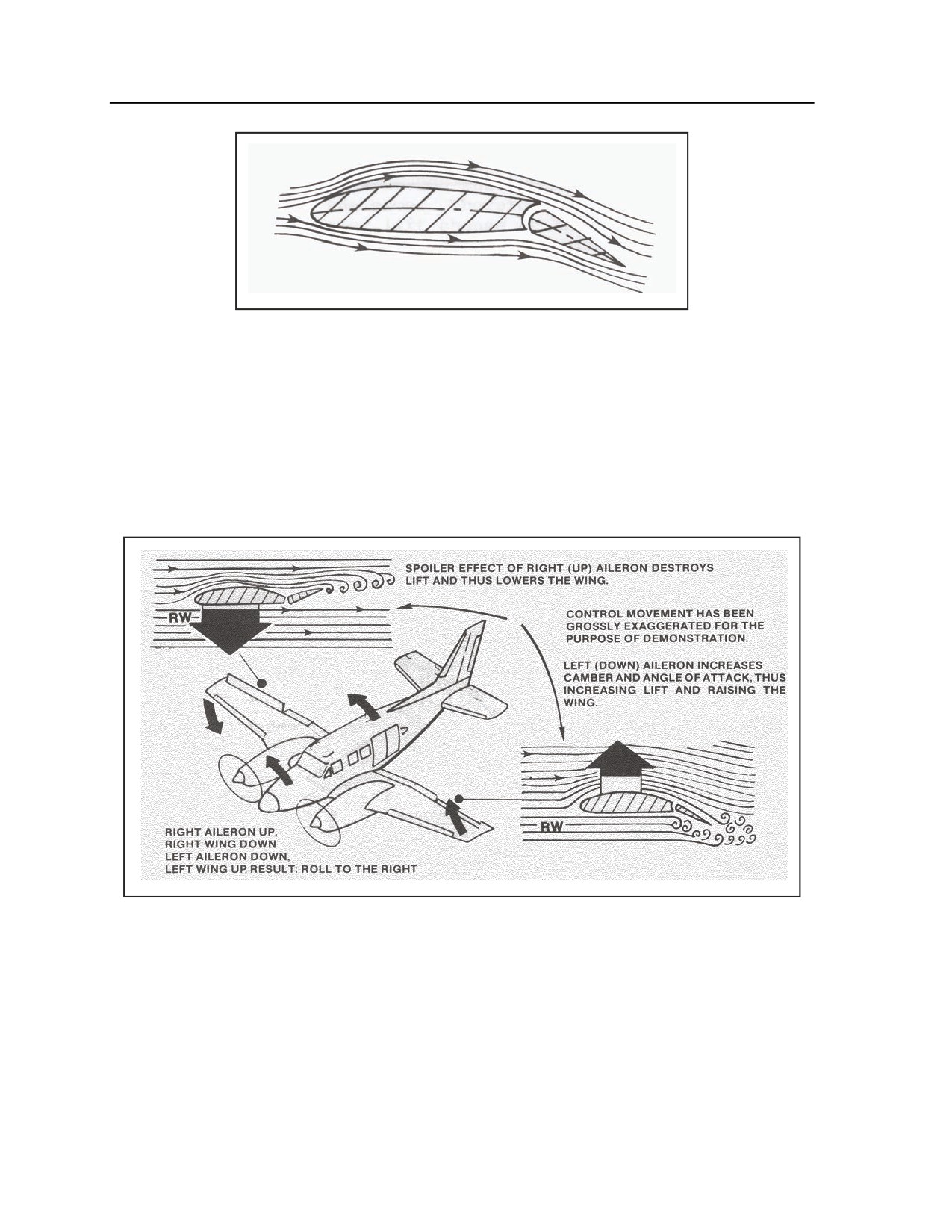
Chapter 7
Figure 7-47. Using flaps to increase camber
AILERONS
7-220. Ailerons on a conventional aircraft operate in opposite directions. To bank an aircraft to the right
(figure 7-48), the left aileron is lowered while the right aileron is raised. This increases the camber of the
left wing and decreases the camber of the right wing. With increased CL as compared to the right wing, the
left wing has a greater lift force; this is assuming both wings are at equal or nearly equal velocity. This
unbalanced lift force between the two wings results in a rolling moment about the longitudinal axis.
Therefore, the aircraft rolls to the right.
Figure 7-48. Operation of aileron in a turn
ELEVATORS
7-221. The elevators attached to the horizontal stabilizer and the rudder attached to the vertical stabilizer
work in the same manner to develop pitching and yawing moments (figure 7-49 parts A and B, page 7-51).
The stabilizers are normally symmetrical airfoils. Deflecting the control surface changes the airfoil to either
a positive or negative cambered airfoil, depending on direction of the surface movement.
7-50
FM 3-04.203
7 May 2007
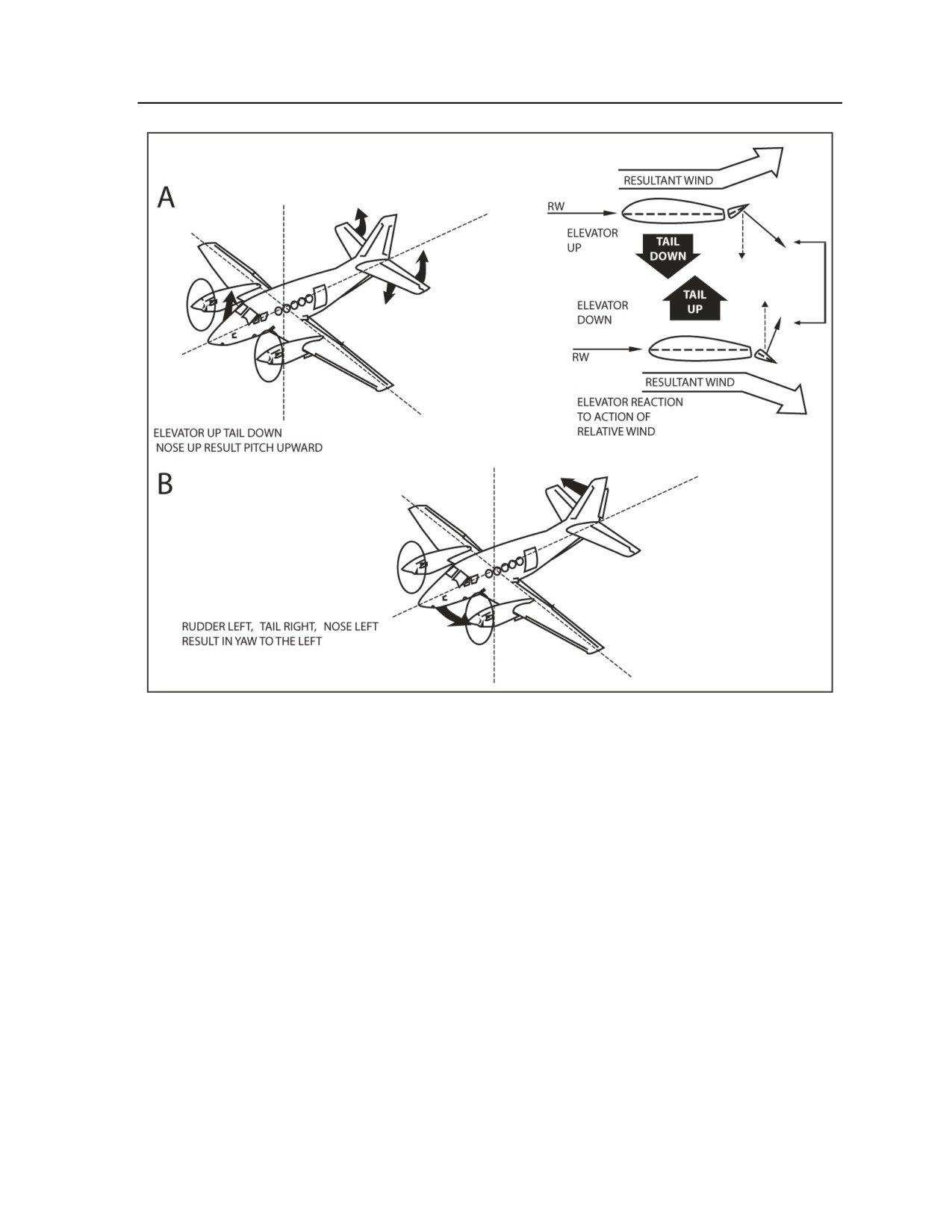
Fixed-Wing Aerodynamics and Performance
Figure 7-49. Effect of elevator and rudder on moments
CONTROL EFFECTIVENESS
7-222. Control effectiveness is the term used when discussing aircraft control systems. It refers to the
amount of change in the lift coefficient for each degree of control-surface deflection rather than the ability
of the control surface to maneuver the aircraft. Control effectiveness refers to the change in lift coefficient
and not to the amount of lift change produced by deflecting the control surface. Because the lift formula
applies to control surfaces, the amount of lift depends not only on the value of CL but also on velocity,
surface area, and air density.
LIFT COEFFICIENT CHANGE
7-223. A control surface deflected 10 degrees produces a greater change in the lift force at 200 knots than
at
100 knots. At both airspeeds, the CL change is the same; therefore, control effectiveness does not
change. However, the greater lift change at higher airspeed represents better control response. This should
indicate if a definite moment is desired. The control surface deflection must be increased as velocity is
decreased.
7 May 2007
FM 3-04.203
7-51
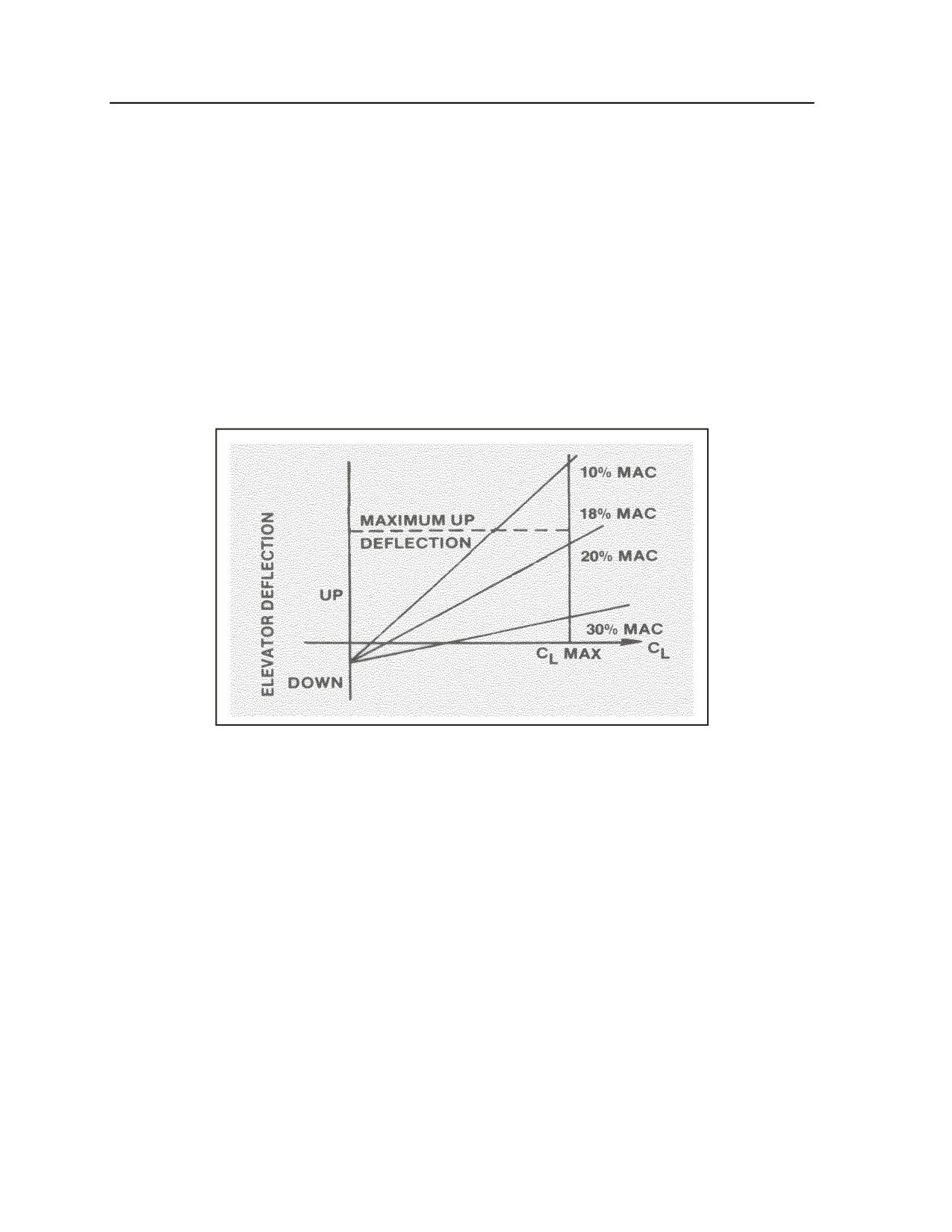
Chapter 7
LONGITUDINAL CONTROL
7-224. All Army aircraft can attain CLmax. They can fly at any value of lift coefficient designed into the
aircraft. Army aircraft can also obtain the maximum lift the airfoil can produce for a given airspeed and
altitude.
7-225. Figure 7-50 shows the effect of CG location upon the longitudinal maneuvering capability of an
aircraft. The slanted lines represent different locations of aircraft CG. The 30-percent mean aerodynamic
chord (MAC) denotes CG is located 30 percent of the MAC length back from the leading edge of the
airfoil. The MAC is the chord of a rectangular wing that has the same pitching moments as the wing under
consideration. The lower the percentage, the farther forward CG is located. More elevator deflection is
required to obtain a certain value of CL as the CG is moved forward. This increases longitudinal stability
and, therefore, would be unsuitable for most military requirements. To correct this situation, the CG must
be moved aft or the elevator must be designed so it can produce a larger moment.
Figure 7-50. Effect of center of gravity location on longitudinal control
TAKEOFF REQUIREMENT
7-226. An aircraft should be able to rotate to takeoff attitude before reaching takeoff velocity. This
rotation occurs about the main landing gear wheels. This is an essential and demanding requirement.
Normally, it attains takeoff attitude at about 0.9 VS. Figure 7-51, page 7-53, represents an aircraft rolling
down a runway and shows the forces producing adverse moments. These adverse moments try to pitch the
aircraft’s nose down. They must be overcome by the elevator control surface as it causes the aircraft’s nose
to pitch up.
7-227. First, a rolling friction force is generated at the wheels. This force is located below the CG and
produces a negative pitching moment. In an aircraft with a tricycle landing gear, the CG must be located
ahead of the main wheels. Therefore, if the aircraft is to rotate about the main wheels as it achieves takeoff
attitude, this CG location produces an adverse pitching moment that must be overcome. If the lift force of
the wing is ahead of the wheels, the lift force assists the elevator in pitching the aircraft’s nose up.
7-228. Another condition not evident in figure 7-51, page 7-53, is ground effect or the decrease in
downwash as the aircraft is close to the runway. When downwash is decreased, lifting surfaces become
more effective and usually more beneficial. In this case, however, the elevator tries to increase the negative
lift force of the horizontal stabilizer. The ground effect makes the horizontal stabilizer less effective in
7-52
FM 3-04.203
7 May 2007
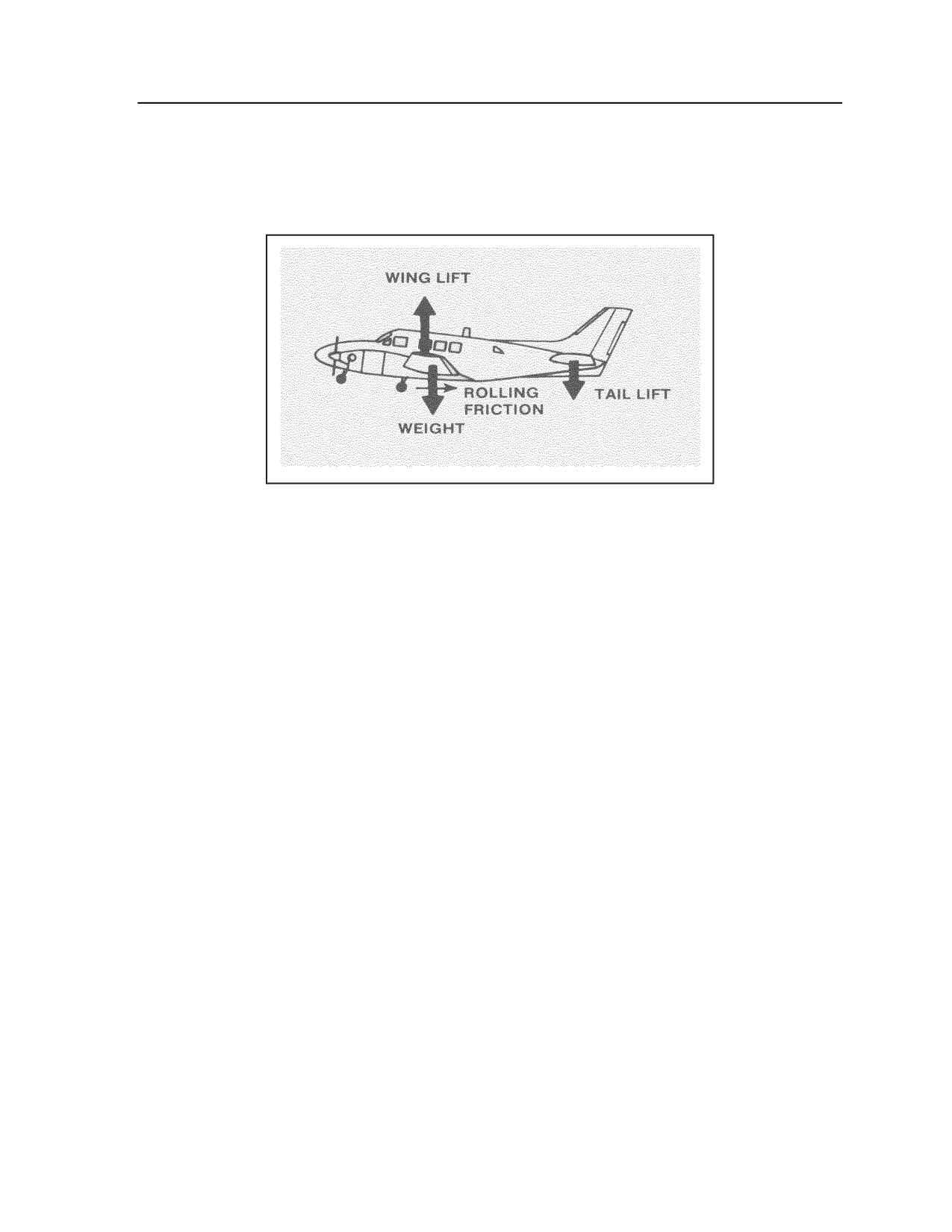
Fixed-Wing Aerodynamics and Performance
producing negative lift. Therefore, greater elevator deflection is necessary when the aircraft is being
operated in-ground effect than when it is being operated OGE. Aircraft using flaps during the takeoff run
can produce a downwash that may benefit the horizontal stabilizer and decrease the elevator control
deflection. However, trailing-edge flaps also generate a negative pitching moment. The net result might be
a greater elevator-deflection requirement.
Figure 7-51. Adverse moments during takeoff
7-229. The elevator must be designed to produce a positive pitching moment-below the aircraft flight
speed-that can overcome all adverse pitching moments created by some or all of the above mentioned
conditions.
LANDING CONTROL REQUIREMENT
7-230. The landing-control requirement is essentially a ground-effect problem. The aircraft should have
enough elevator control to maintain a landing attitude to the touchdown point. The elevator must overcome
ground effect when the aircraft approaches the runway surface. If an aircraft is able to take off
satisfactorily, it usually has enough elevator control to land.
DIRECTIONAL CONTROL
ADVERSE YAW
7-231. Adverse aileron yaw, described previously as yaw, develops when an aircraft is rolled using
ailerons. The rudder must develop enough yawing moments to overcome adverse yaw created by an aileron
roll. The rudder is used to keep relative wind on the aircraft’s nose so a coordinated turn can be performed.
SPIN RECOVERY
7-232. An aircraft has a large sideslip angle as it is spinning. The rudder must be used on all Army FW
aircraft to decrease the sideslip angle before the aircraft can recover from a spin. This requirement can be
critical in some aircraft.
ASYMMETRICAL THRUST
7-233. A multiengine aircraft has an additional directional-control requirement not required on a single-
engine aircraft. This is the yawing moment caused by asymmetrical thrust, which results from a difference
in power on each wing. The difference in thrust force developed on each wing produces a yawing moment
about the aircraft’s CG away from the thrust. This yawing moment must be counteracted by an opposite
7 May 2007
FM 3-04.203
7-53
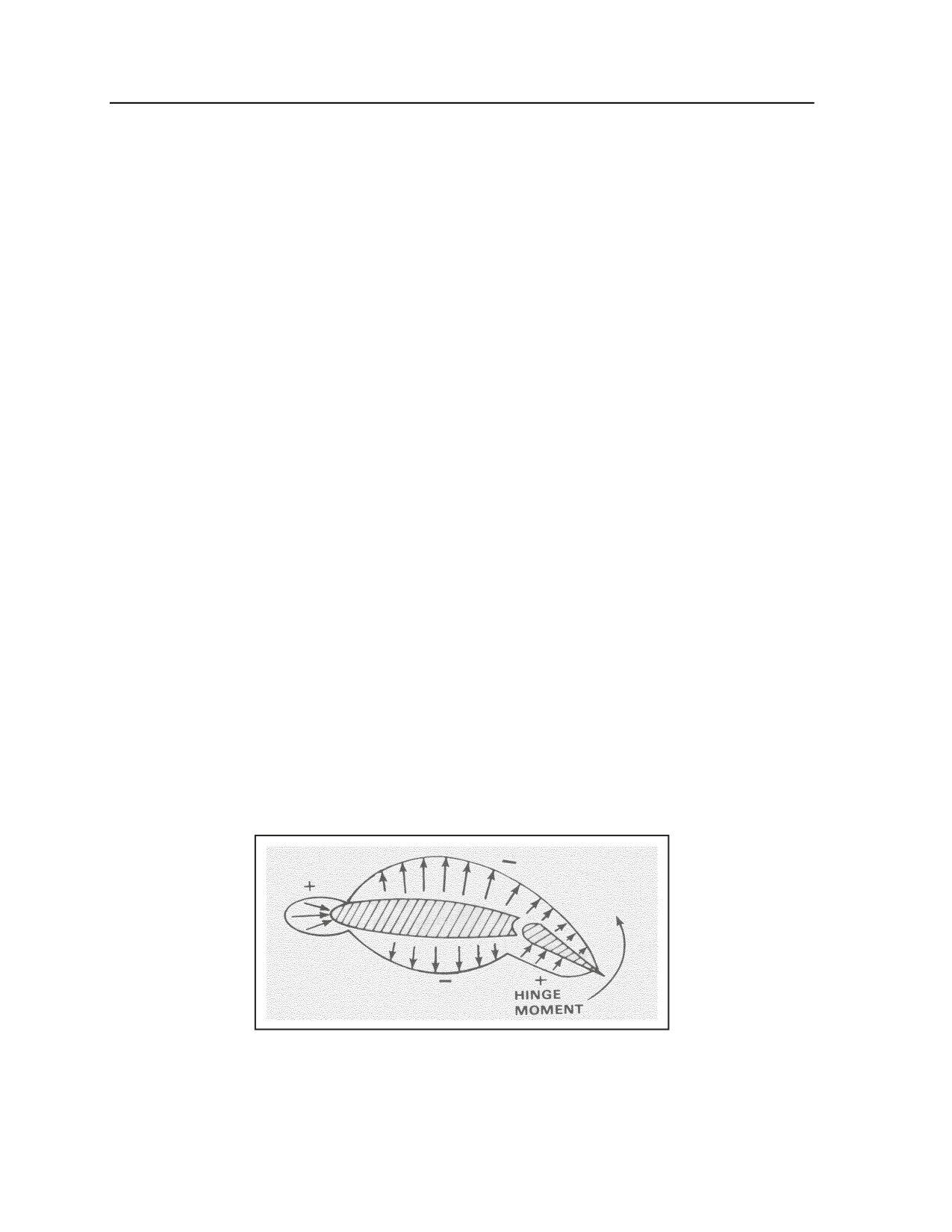
Chapter 7
moment from the rudder. While an engine failure on the critical engine would develop the greatest amount
of asymmetrical thrust, it is present any time one engine produces more power than the other.
LATERAL CONTROL
ROLL RATE
7-234. Each aircraft is designed to perform specific types of missions. These designs require different roll
rates. A fighter, which is more maneuverable than a transport, must have a fairly high roll rate to perform
its mission. To initiate a roll, the aviator deflects the ailerons. One aileron moves up, decreasing the CL and
lift on that wing. The other aileron moves down, increasing the CL and lift on that wing. This difference in
lift between the two wings causes the aircraft to roll toward the wing producing less lift. As the aircraft
begins to roll, the attack angle on the down-going wing increases while the up-going wing decreases. This
is caused by the component of airflow moving opposite the direction of wing movement. This difference in
the attack angle between the two wings produces a rolling moment counter to the rolling moment
developed by the ailerons. As the roll rate increases, the counterrolling moment increases. When the
counterrolling moment produced by the roll equals the rolling moment produced by aileron deflection, a
steady-state roll is reached. The roll rate is at maximum for that given aileron deflection. This steady-state
roll rate must be rapid enough to be compatible with the mission requirements of the aircraft.
CONTROL FORCES
7-235. Control forces refer to the forces the aviator exerts on the control column to maneuver the aircraft.
These forces must be logical and manageable. A logical force means the force must increase as the control
surface is deflected or as the speed of the aircraft is increased. Manageable means the magnitude of the
control force must be within the comfortable physical capabilities of the aviator.
REQUIRED CONTROL
Overcoming Hinge Moments
7-236. When a control surface is deflected, the pressure differential developed across the control surface
creates a force that tends to streamline the control surface (figure 7-52, page 7-55). This force creates a
moment about the control surface hinge, which is referred to as the hinge moment. This moment must be
overcome by the force applied by the aviator to the control column. The hinge moment is directly
proportional to takeoff safety speed (V2) and the control surface area. If the airspeed is doubled, the hinge
moment for a given deflection increases four times. Therefore, the aviator must exert four times the control
force on the control column to overcome that hinge moment.
Figure 7-52. Hinge moment
7-54
FM 3-04.203
7 May 2007