FM 3-04.203 Fundamentals of Flight (May 2007) - page 7
Multi-Aircraft Operations
BREAKUP INTO ELEMENTS
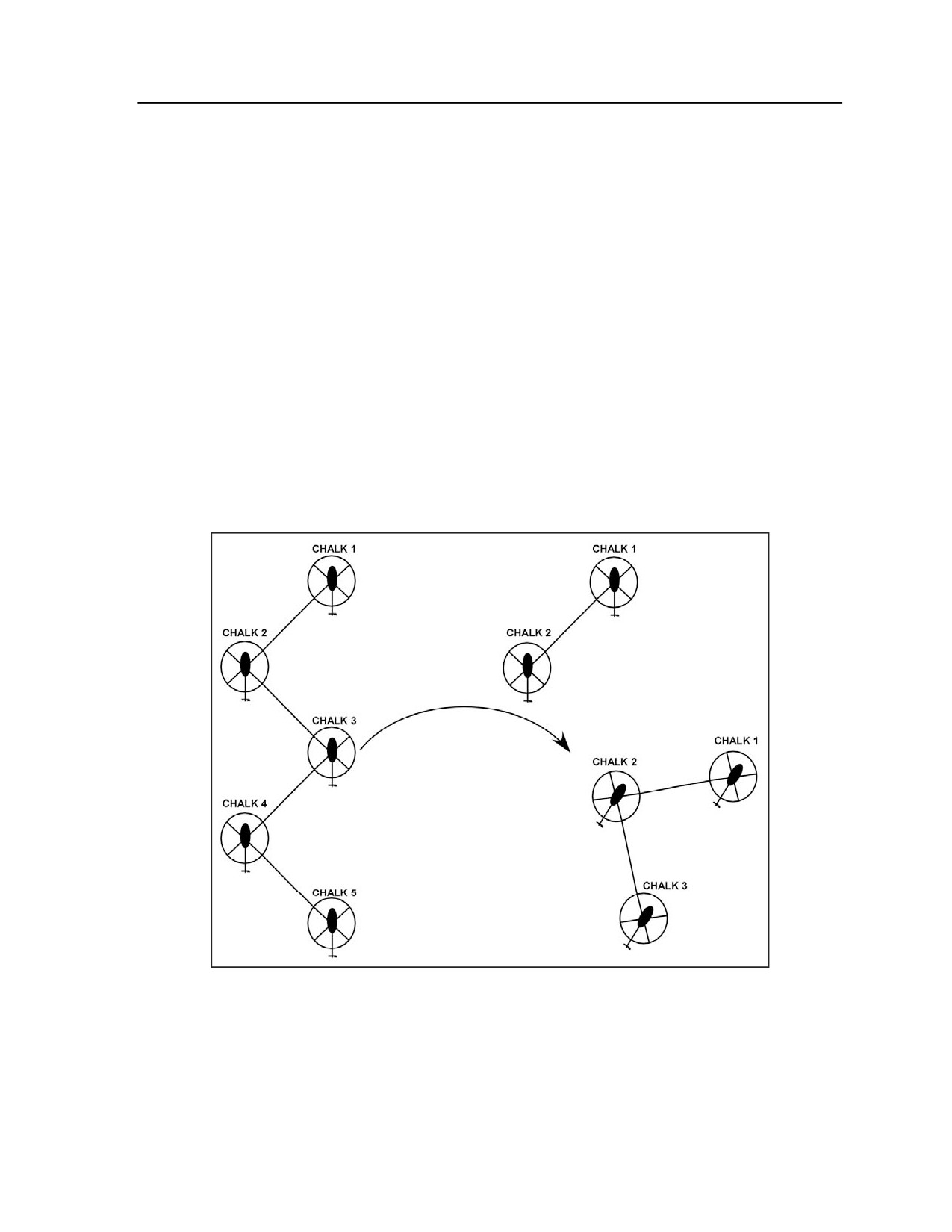
6-46. Aviators execute this maneuver from the staggered formation and breakup into elements of two or
more aircraft as required. Lead announces the time interval between elements and receives an
acknowledgment from each aircraft if not briefed. After lead has issued the command to execute, the first
element aircraft continues on course. The remaining aircraft slow or turn by elements until each attains the
desired separation. Aviators adjust exterior lighting and avionics as necessary. Figure 6-5, page 6-11,
shows a flight of five becoming an element of two and three.
INADVERTENT INSTRUMENT METEOROLOGICAL CONDITIONS BREAKUP PLANNING
6-47. Helicopter flight crews must be trained to cope with marginal weather conditions they may
encounter during formation flight. All multihelicopter operation mission briefs must include a planned
response for encountering IIMC. As well as being an established part of an SOP, IIMC must be planned
and briefed for all phases of the mission. During the breakup procedure, all aircraft should remain in
contact with the lead aircraft and also contact ATC in chalk order for further guidance. Communication is
key to a safe execution of this procedure. Aviators should perform all turns, airspeeds, and climbs at a
predetermined standard rate. They should maintain prescribed headings and altitudes for each aircraft at
least
30 seconds after breakup to gain separation before executing any additional procedures. The
following procedures are guidelines for units to further develop their own procedures, based on mission,
terrain, weather, and enemy situation.
Figure 6-5. Breakup into two elements
Breakup Procedure
6-48. It is unlikely more than two or three aircraft will enter IIMC before the situation is recognized and
remaining aircraft take prebriefed evasive action. Vigilance, communication, and SA are important factors
in avoiding IIMC. If any aircraft encounters IIMC, they will notify the rest of the flight via the radio using
7 May 2007
FM 3-04.203
6-11
Chapter 6
a prebriefed code word or plain language. An example call would be “Lead is IMC, executing breakup
procedure, heading 090”. The lead aircraft heading is important as the other aircraft will plan their
headings accordingly. A good heading choice is 10 degrees times chalk position from lead’s announced
heading to the clear side of the formation. Upon hearing this message, the formation begins the breakup
procedure (if unable to remain VMC) according to the prearranged plan. When aviators initiate IIMC
recovery, the following procedures-for a staggered formation-are suggested. The following information
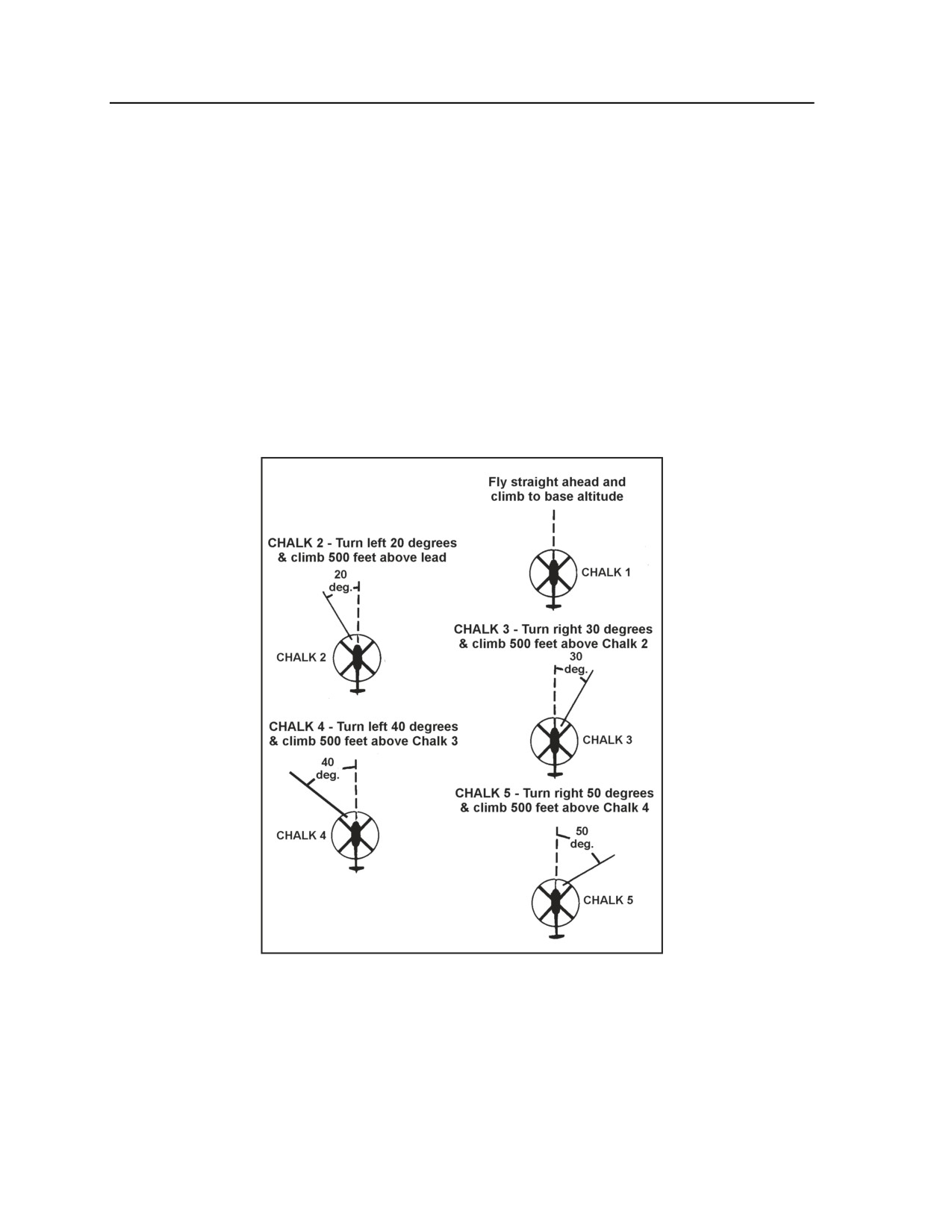
relates to figure 6-6, page 6-12.
Flight lead continues straight ahead and reports the magnetic heading and altitude he will climb
to and maintain.
Chalk 2 executes a 20-degree turn away from the flight (if staggered left, chalk 2 would turn
left) and climbs 500 feet higher than the lead aircraft.
Chalk 3 executes a 30-degree turn away from the flight (if staggered left, chalk 3 would turn
right) and climbs 500 feet higher than chalk 2 (1,000 feet higher than lead).
Chalk 4 executes a 40-degree turn away from the flight (if staggered left, chalk 4 would turn
left) and climbs 500 feet higher than chalk 3 (1,500 feet higher than lead).
Chalk 5 executes a 50-degree turn away from the flight (if staggered left, chalk 5 would turn
right) and climbs 500 feet higher than chalk 4 (2,000 feet higher than lead).
Figure 6-6. Formation breakup-inadvertent instrument meteorological conditions
6-49. There are many variations to this technique (lead climbs to highest and others stack down 500 feet);
however it offers the simplicity of correlating chalk number to the number of degrees turning. In addition,
the direction of turn is simplified by stating, in staggered left formation as an example, even-numbered
chalk positions turn left and odd-numbered chalk positions turn right. While an additional 500 feet might
seem excessive for each chalk number to climb above the previous chalk number, this technique offers an
additional safety margin. Considerations for IIMC procedures include the following:
6-12
FM 3-04.203
7 May 2007
Multi-Aircraft Operations
Enemy ADA capabilities.
Terrain elevation and relief.
Emergency minimum safe operating altitude.
Availability of location of recovery airfields.
Fuel considerations.
ACO requirements.
Turns should not exceed standard rate.
When flying near hostile borders and prohibited or restricted areas, consideration must be given
to avoid flying into these areas.
IIMC should be briefed when forecasted weather conditions are less than 1,000/3.
Mountainous terrain requires detailed IIMC and innovative planning.
THREAT BREAKUP
6-50. Threat breakup is executed to evade an observed enemy engagement threatening the flight. Since
combat cruise uses the two-ship section as its basic building block, large formations can easily be broken
down and dispersed if attacked. Premission planning should include an evasive action plan and procedures
for rejoining the formation and continuing the mission.
6-51. Standard threat terms listed in the appropriate ATMs should be used to identify threats. Codes such
as “bandit break” for an air threat or “enemy break” for a ground threat are used to execute a threat
breakup procedure. This breakup should be a last response to the enemy taking action against the
formation. Formations with an odd number of aircraft could have lead, chalk 2, and chalk 3 break to the
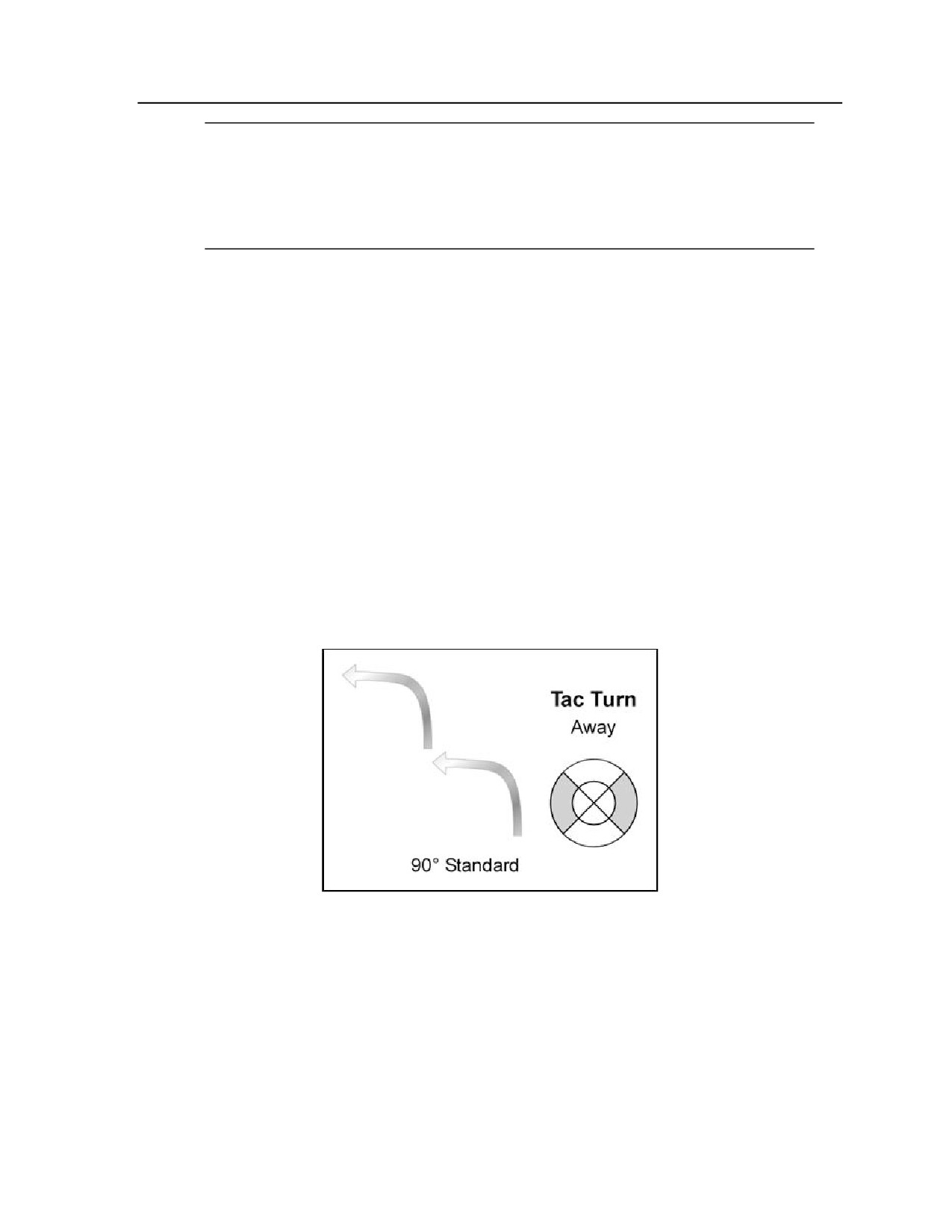
clear side of the formation and remaining pairs break in opposite directions. Aircrews must remain oriented
with the other aircraft executing a threat turn in the same direction. Aircrews should descend to cover and
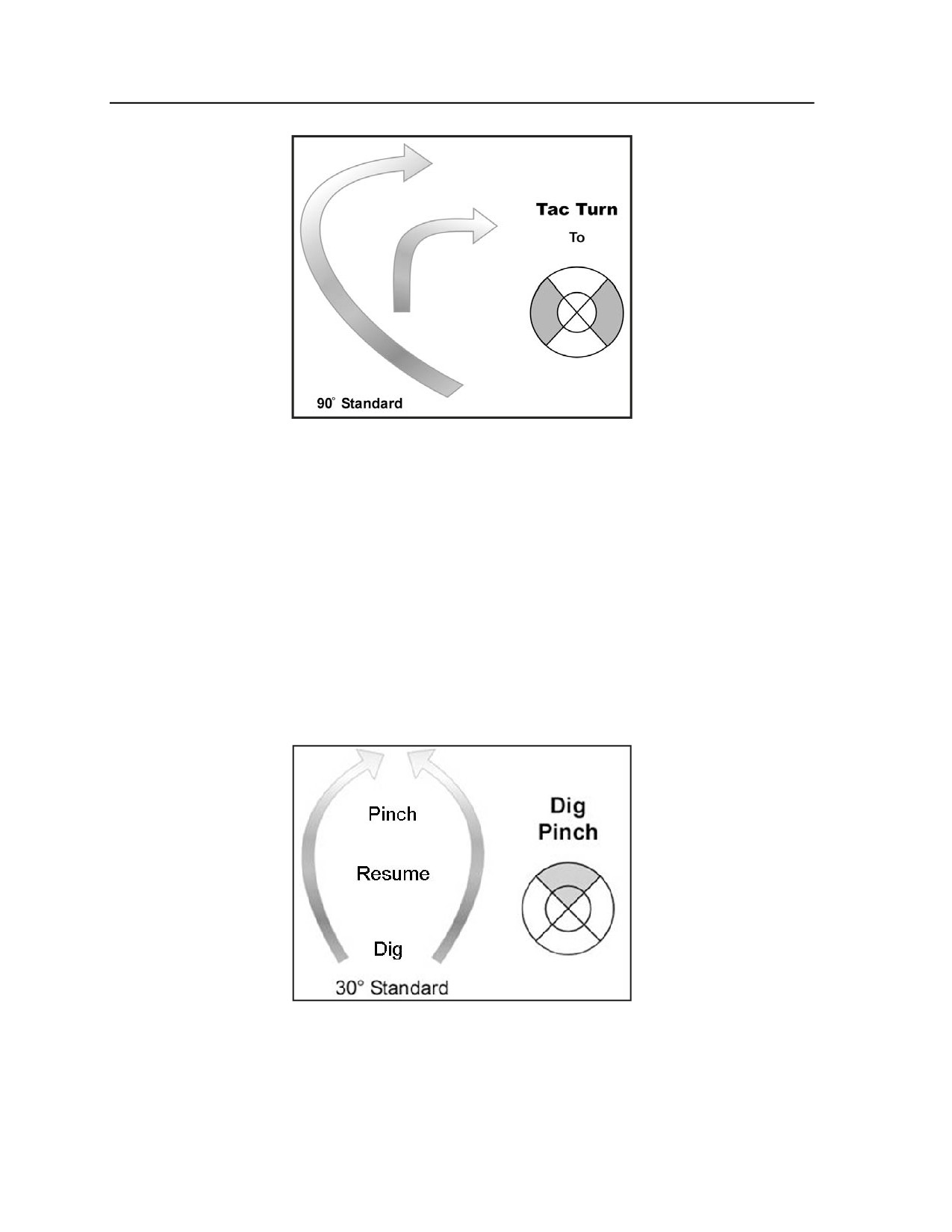
dispense chaff or flares if equipped. PCs determine if external loads are to be jettisoned.
RENDEZVOUS AND JOIN-UP PROCEDURES
6-52. Rendezvous and join-up procedures are inherently difficult and dangerous maneuvers whether
executed at day or night. The difficulty comes with identifying joining aircraft and judging airspeeds and
rates of closure. When the tactical situation permits, rendezvous and join-up should be executed on the
ground to reduce hazards.
GROUND
6-53. Aircraft conducting rendezvous and join-up should arrive at the rally point as briefed. Once all
aircraft are on the ground, they are organized into formation to continue the mission.
IN FLIGHT
Rendezvous
6-54. Rendezvous is definitely the more dangerous maneuver, especially at night with multiple aircraft
joining within minutes. Vigilance is key with aircrew coordination both within the aircraft and the flight. If
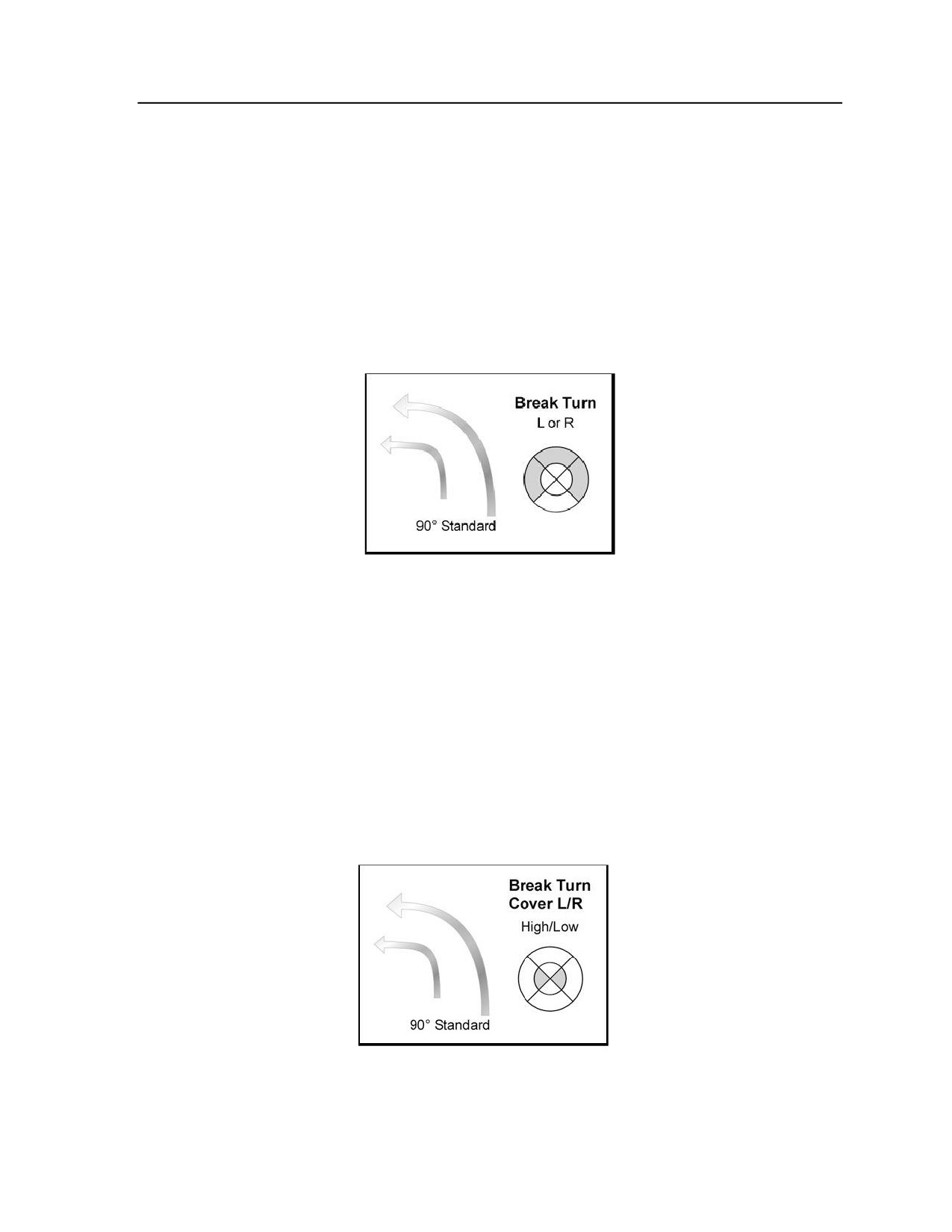
an airborne rendezvous is necessary, the flight lead approaches the rendezvous point at the preplanned time
and altitude. After arrival at the rendezvous point, lead enters an orbit in the prebriefed direction using a
standard rate (or less) turn and airspeed of 70 KIAS or as briefed. Aircraft joining the flight should
approach the lead aircraft by entering its orbit at the assigned airspeed. Aviators adjust airspeed and
heading to enter the formation in the prebriefed position. For join-up, a safe rate of closure is essential as it
is easy to overrun the aircraft ahead. It is important to brief and maintain planned airspeeds for both the
flight and closing aircraft. Each aircrew must exercise extreme caution to avoid overrunning the aircraft
directly to the front as aircrew members cannot see the silhouette of an aircraft at night except at a close
distance.
7 May 2007
FM 3-04.203
6-13
Chapter 6
Join-Up
6-55. This procedure is normally required when aircraft are not in a position to observe other aircraft
departing individually or during brownout/whiteout conditions. Aircraft will depart in chalk order when
ready and will display appropriate single ship lighting until established in the formation. Lead will
accelerate to the appropriate briefed airspeed, normally 70 KIAS. Subsequent chalks will accelerate to no
more than 10 knots greater than the briefed airspeed. Once all aircraft have completed the in-flight join-up,
lead will accelerate to the en route airspeed.
LOST VISUAL CONTACT PROCEDURES
6-56. In the event an aircraft in the flight loses visual contact with the aircraft they are following, they will
immediately make a radio call to lead. Lead will announce heading, altitude, airspeed, and distance to next
waypoint if available. The aircraft that has lost visual contact with the flight will immediately assume flight
lead’s heading and airspeed and attempt to regain visual contact. Lead must maintain this heading, altitude,
and airspeed until all aircraft have rejoined the flight. The flight will begin reorientation procedures. The
most important consideration when an aircraft has lost visual contact with the flight is reorientation. Except
for enemy contact, all mission requirements are subordinate to this action.
6-57. Unit SOPs should provide procedures for reestablishing contact with the flight. Considerations
should include, but are not limited to, rallying to a known point, use of covert/overt lighting, and ground
rally. METT-TC, power available, and ambient light will influence how contact is reestablished. When a
flight rallies to a known point, the point may be an ACP along the route, a present position report or
waypoint sent by lead, or a terrain feature. Situations may occur when an aircraft rejoins the flight in
another position than briefed. Mission commanders may use altitude, a target reference point/priority fire
zone, cardinal direction, or other method to maintain separation. Only after the entire flight is formed can
the mission commander proceed with the mission.
COMMUNICATION DURING FORMATION FLIGHT
6-58. Radio communications during formation flight must be efficient and brief. The need for radio
communications can be greatly reduced through use of visual signals, established procedures in the unit
SOP, and a thorough mission brief covering all contingencies. The ability to execute multi-aircraft radio-
silence missions requires proficiency aircrew members achieve only through training and practice. Radio-
silence missions should be used with discretion, with safety being the priority. The following situations are
examples of formation flight without radio communication.
Forming of flight. Aviators maneuver the helicopters into position for the formation takeoff. At
this point, the anti-collision light should be on. The pilots will then turn off the anti-collision
light when their aircraft is ready for takeoff and after the preceding aircraft’s anti-collision light
is off. When the trail aircraft is ready for takeoff and the preceding aircraft’s anti-collision light
is off, it will announce to lead the flight is ready using a codeword or plain language. Trail will
leave its anti-collision light on for the flight. The flight will then depart after the codeword, ATC
call, and/or on time as per the mission briefing.
Formation landing. Upon landing, all aircraft will immediately turn their anti-collision light
back on. Whenever their aircraft is ready for takeoff and the preceding aircraft’s anti-collision
light is off, the aviator will turn off the anti-collision light. When trail aircraft is ready for
takeoff and the preceding aircraft’s anti-collision light is off, they will announce to lead the
flight is ready using the code word or plain language. Again, the trail aircraft will leave its anti
collision light on for the flight. The flight will then depart as briefed.
SECTION II - FORMATION TYPES
6-59. Common formations used during multi-aircraft operations include fixed formations (such as echelon,
staggered, or trail) and maneuvering formations (including combat cruise and combat spread). Army
aviators should be familiar with basic formations and maneuvers described in the following paragraphs. All
6-14
FM 3-04.203
7 May 2007
Multi-Aircraft Operations
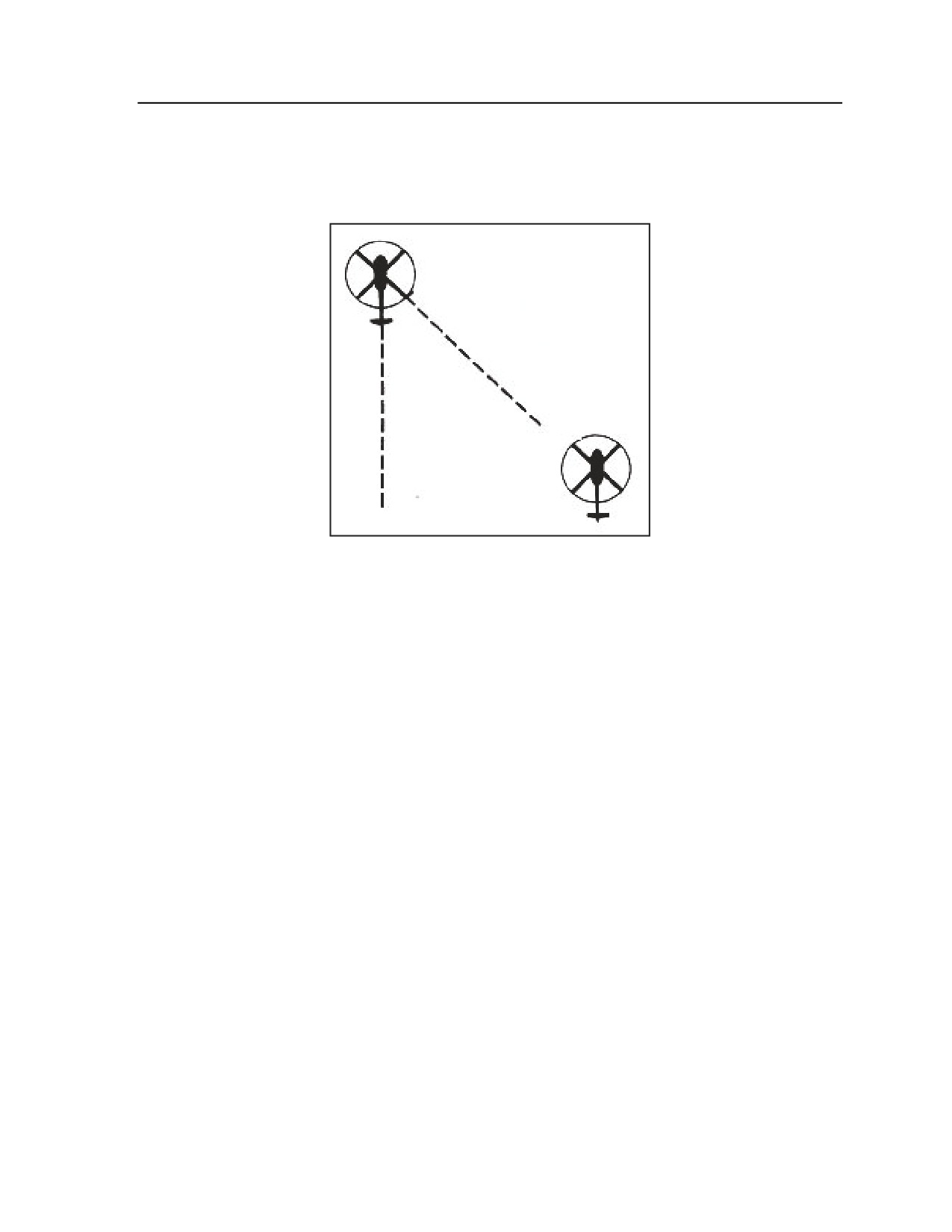
angles and distances can be modified based on aircraft and mission. The two helicopter team/section is the
building block for all formations from which can be built upon to create platoon- and company-sized
formations (figure 6-7, page 6-15). The intent is to allow aircraft to be able to fly together using common
terminology and techniques. The only authorized formations for night/NVG flight at 80 feet AHO and
below are combat cruise formations in conjunction with techniques of movement according to TC 1-210.
Figure 6-7. Two-helicopter section/element
TWO-HELICOPTER TEAM
6-60. A team usually consists of two helicopters flying as lead and wingman. The wingman may fly to the
left or right rear of the lead aircraft. When flying to lead’s left rear, the wingman is flying in echelon or
staggered left. When flying to the lead’s right rear, the wingman is flying in echelon or staggered right. The
correct angular location is approximately 45 degrees with consideration given to aircraft limitations.
FIXED FORMATIONS
6-61. These formations are used when more control is required. The flight acts as one aircraft regardless of
the number of aircraft in the flight, and the movements of lead are mirrored throughout the flight. Fixed
formations are useful for departure and arrival at LZs, airfields, administratively transiting airspace,
deployment, and when environmental conditions do not allow or require tactical separation. When lead
locks the wingman into these fixed formations, lead must consider the wingman’s obstacle clearance and
provide appropriate horizontal and vertical clearance. Wingmen, as well as lead, must consider the
reduction in altitude wingmen have when flying on the inside of turns and ensure adequate obstacle/terrain
clearance. Spacing and separation must be considered during changes in altitude and headings.
STAGGERED
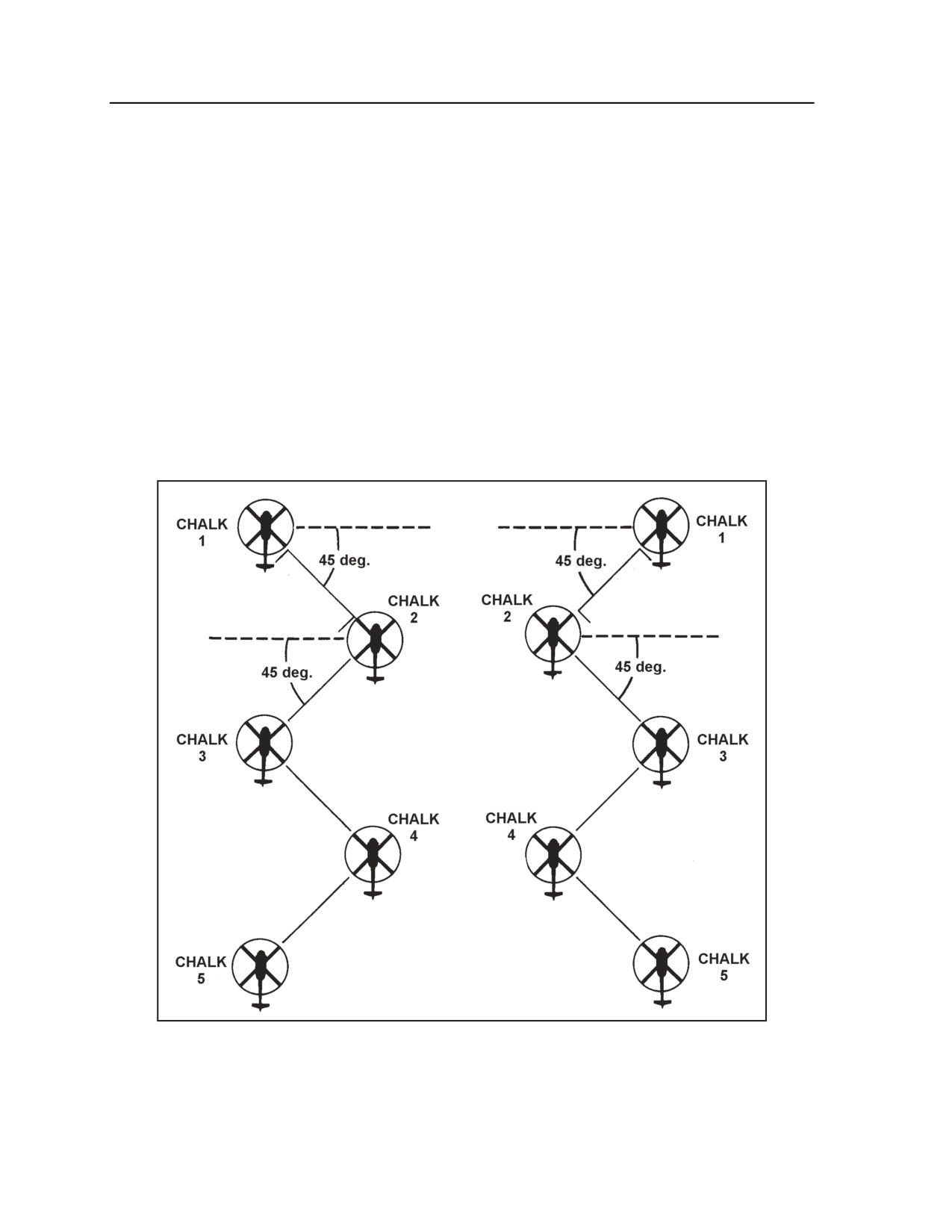
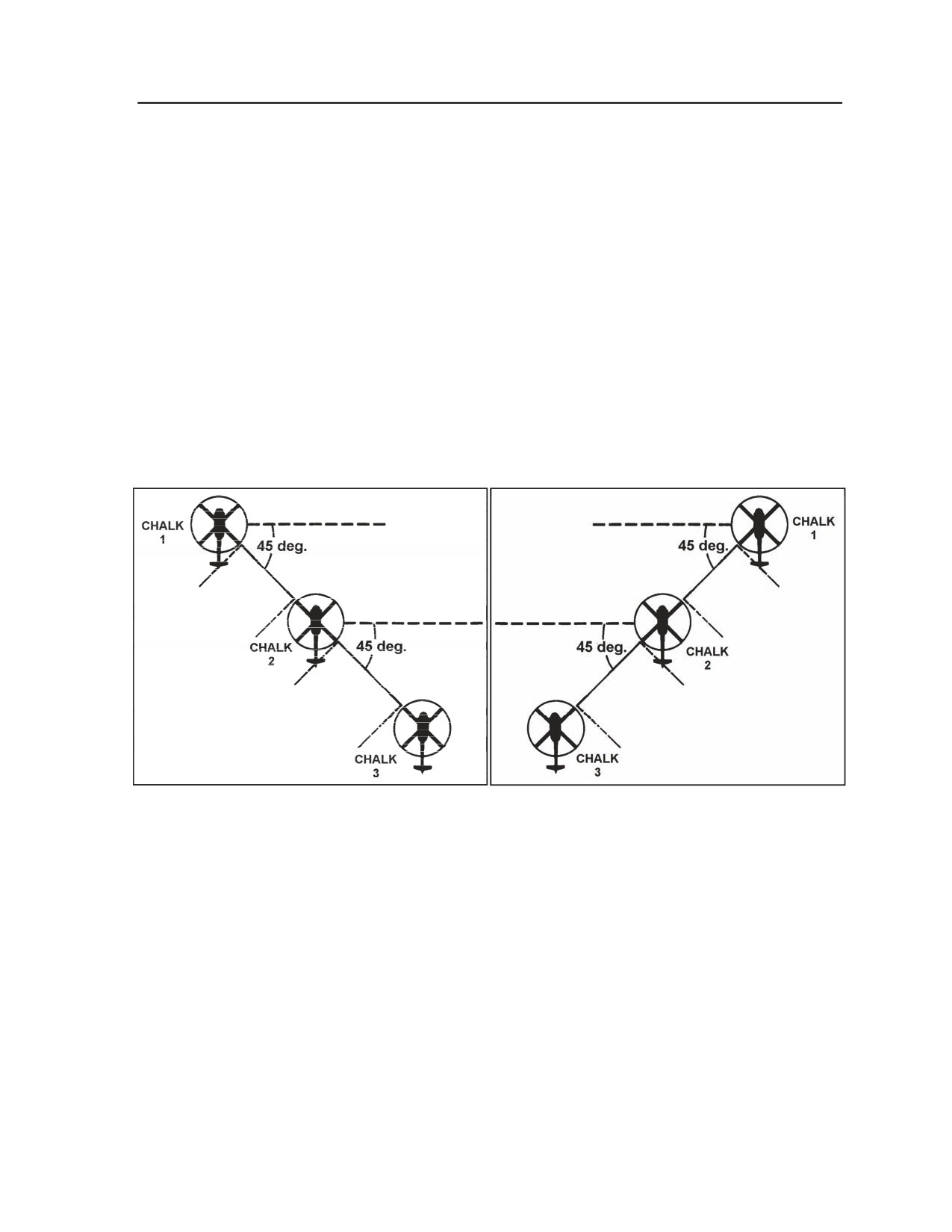
6-62. This is one of the most commonly used formations in Army aviation and is flown as a staggered
right or staggered left (figure 6-8, page 6-16). Each aircraft of the formation holds a position approximately
45 degrees astern of the aircraft to its front, alternating left and right. Chalk 2’s position determines if the
formation is staggered right or staggered left. Chalk 3 (and any other odd-numbered wingmen) flies in trail
directly behind lead. A staggered formation is essentially a continuous, alternating series of the basic two-
helicopter section/element. This formation is not limited to any prescribed number of aircraft. The mission
requirement dictates its size. This formation gives wingmen the ability to estimate distance and rates of
closure and allows some flexibility in relation to adjacent aircraft while affording lead control of the flight.
7 May 2007
FM 3-04.203
6-15
Chapter 6
Staggered formations are common formations used through congested airspace, for large formations in a
low-threat area, for air assault approaches and takeoffs, or for traveling through narrow canyons.
Formation changes between a left and right staggered formation are directed by lead. During the crossover,
wingmen maintain appropriate clearance. Chalk 2 should use a heading change of approximately 5 to 10
degrees to cross from one side to the other. Chalk 3 maintains position behind lead. A slight vertical
stacking is recommended during the crossover to avoid rotor wash. Staggered formation has the following
advantages and disadvantages:
Advantages:
Fixes position of wingmen.
Allows lead maneuverability.
Simplifies prepositioning of loads.
Allows rapid deployment of troops for all-round security.
Disadvantages:
Increases pilot workload to maintain relative position to the aircraft in front of it when
flying tight or close.
Requires a relatively long and wide landing area.
Places some restriction on suppressive fire by door gunners.
Figure 6-8. Staggered right and left formation
6-16
FM 3-04.203
7 May 2007
Multi-Aircraft Operations
ECHELON
6-63. This formation (figure 6-9, page 6-17) is flown as either echelon right or echelon left. Wingmen fly a
fixed position on an approximate 30- to 45-degree offset from lead’s 6 o’clock position. All formation
aircraft are positioned on the same side of lead at briefed horizontal and vertical distances. There is no
requirement for wingmen to maintain a level plane when turning. This is especially true for turns toward
the wingmen; wingmen may stack slightly low as required to keep the preceding aircraft in sight. Echelon
formation has the following advantages and disadvantages:
Advantages:
Provides ease in maintaining view of the entire formation.
Allows rapid deployment of troops to the flank.
Allows nearly unrestricted suppressive fire by door gunners.
Provides excellent formation for dust/sand/snow takeoffs and landings.
Disadvantages:
Severely limits flight maneuverability of the flight. The lack of maneuvering room makes
aircraft more vulnerable during a threat engagement.
Requires a relatively long and wide landing area.
Presents some difficulty in prepositioning loads.
Figure 6-9. Echelon right and left formation
TRAIL FORMATION
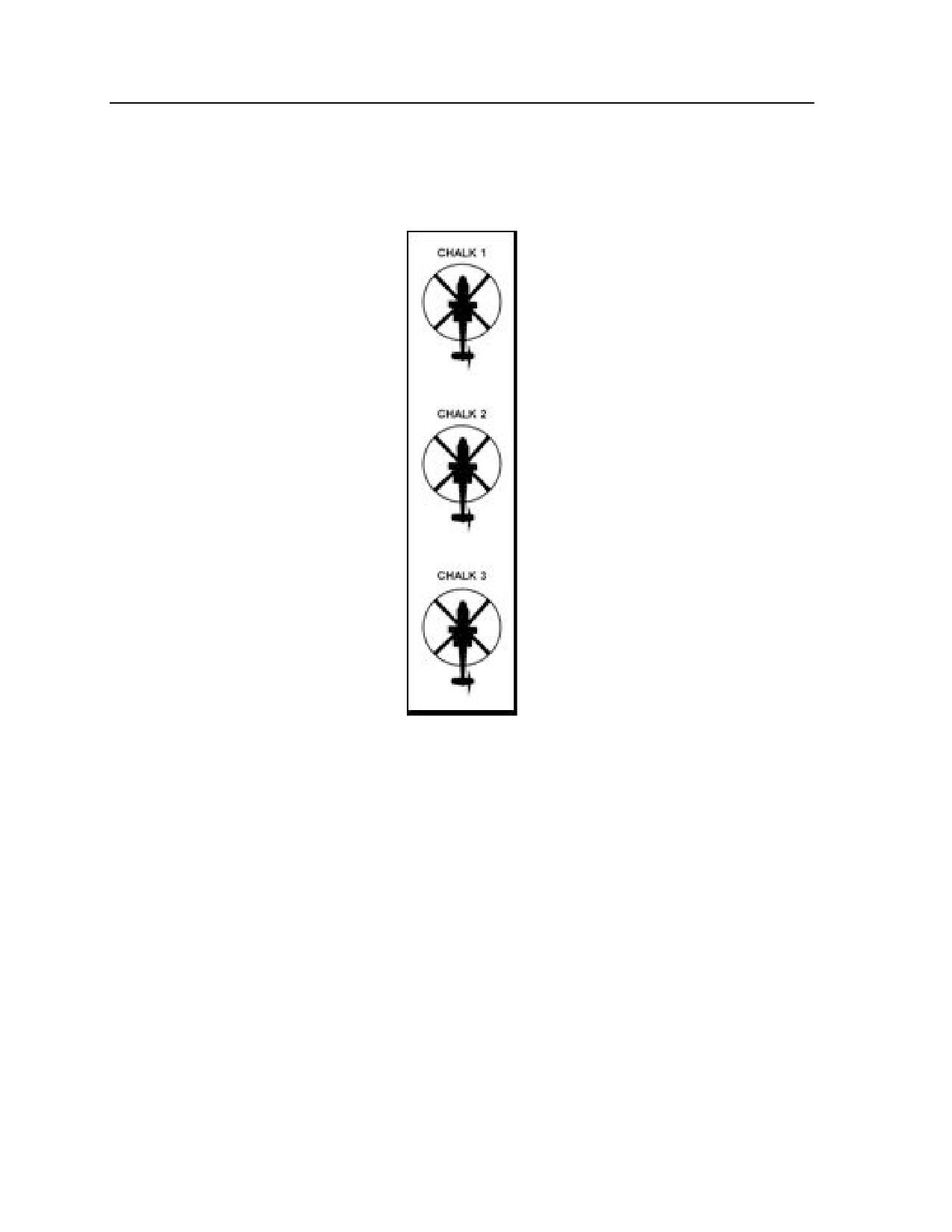
6-64. The trail formation is the most difficult of the fixed formations (figure 6-10, page 6-18). Each
wingman/chalk follows leads movement within 10 degrees of the preceding aircraft. Trail formation can be
used for landings and takeoffs and as a transition during formation changes. Trail formations should not be
flown for extended periods of time as distances and rates of closure between aircraft are difficult to
determine. It is important to note flight at the 6 o’clock position makes it very difficult for the preceding
aircraft to scan for wingmen and can degrade SA in the flight. Trail formation has the following advantages
and disadvantages:
Advantages.
Simplifies prepositioning of loads.
Allows nearly unrestricted suppressive fire by door gunners.
Allows rapid deployment of troops to the flanks.
Disadvantages.
7 May 2007
FM 3-04.203
6-17
Chapter 6
Creates difficulty in interpreting aircraft spacing and relative motion while in flight,
especially during night flight-aided or unaided.
Presents a poor choice during dust/sand/snow takeoffs and landings. Aircraft can be
engulfed by the cloud of the preceding aircraft.
Requires a relatively long landing area.
Figure 6-10. Trail formation
V-FORMATION
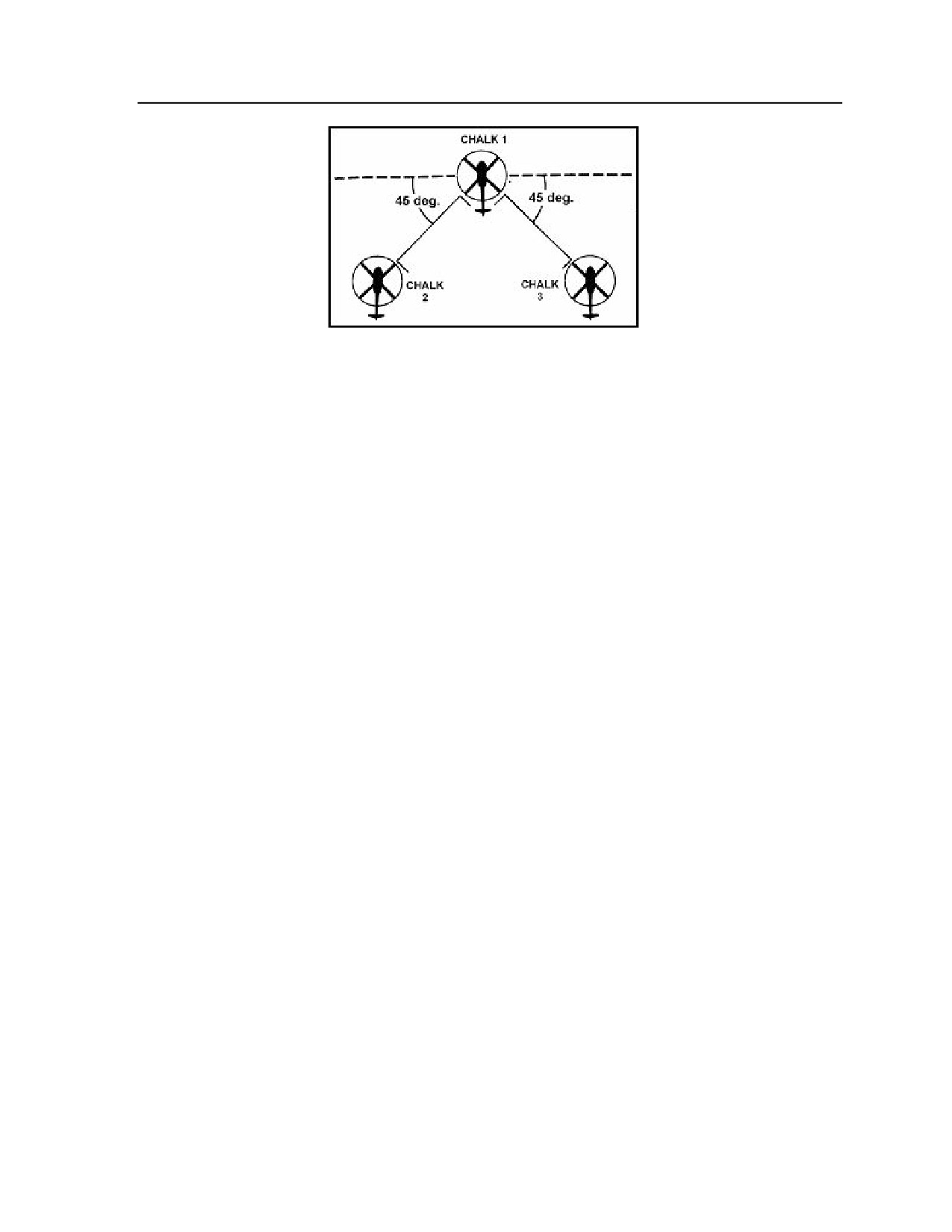
6-65. This formation consists of a leader and two wingmen, each in echelon, left and right (figure 6-11,
page 6-19). The wingmen hold a position approximately 45 degrees astern of the leader, both left and right.
Aviators must scan for both aircraft to maintain proper position in the formation. V-formation has the
following advantages and disadvantages:
Advantages:
Allows rapid deployment of troops for all-around security.
Requires a relatively small landing area.
For dust/sand/snow condition takeoffs and landings, small V-formations can be used with
light wind conditions. Increased rotor disk separation prevents being engulfed in the cloud
from the preceding aircraft.
Disadvantages: Restricts suppressive fire from inboard door gunners.
6-18
FM 3-04.203
7 May 2007
Multi-Aircraft Operations
Figure 6-11. V-formation
MANEUVERING FORMATIONS
6-66. Maneuverability is the prime consideration for formations flying in tactical situations. The following
formations provide the basis for team maneuvering flight and are used to provide maximum
maneuverability, flexibility, and survivability due to greater separation between aircraft. They also promote
security by providing overlapping fields of view and fields of fire. These formations allow lead to maintain
formation integrity, yet maneuver the formation with few restrictions. Wingmen must maintain a position
that will not hamper the preceding aircraft's ability to maneuver. Wingmen must also understand that due to
their authority to maneuver, lead is free to maneuver near terrain, expecting wingmen to provide their own
horizontal and vertical clearance.
6-67. The positions and distances described in this document are guidelines and can be modified as the
situation dictates. Over open terrain or during high illumination, greater spacing is used to increase
survivability and flexibility. Formation spacing should be tighter in rough terrain or reduced
illumination/visibility. Formation positions nearer the abeam make scanning more difficult in keeping the
preceding aircraft, as well as approaching terrain, in sight. Many wingmen move to the outside of turns to
more easily keep lead and approaching terrain in sight, while maintaining altitude (or stacking high).
Conversely, wingmen must be extremely vigilant if assuming a position on the inside of turns, as a rapid
scan is required to maintain SA on lead and approaching terrain. This is especially critical when stacking
low in the turn. It is important to avoid flying the entire formation over the same spot on the ground.
Variations in flight path between teams should be the rule.
6-68. The mission will dictate aircraft separation and team separation. Aircraft and team separation may
range from three to five rotor disks to 1 kilometer or more. Primary concern when establishing separation
is METT-TC and the ability to provide mutual support. Basic team formations are combat cruise, combat
cruise left/right, combat trail, and combat spread. They can be enlarged to accommodate multiple teams,
platoon size, and larger formations.
COMBAT CRUISE OR COMBAT CRUISE TEAMS IN TRAIL
6-69. Combat cruise replaces the term free cruise to incorporate joint terminology. Combat cruise is the
basic formation utilized by a team and provides maximum flexibility and adequate mutual support. Lead
retains the freedom to maneuver and engage targets without affecting his wingman’s flight path unless
aircraft are flying in tight formation. Observation sectors must be divided between lead and wing to
provide overlapping observation and fire. The wingman should inform lead when changing from one side
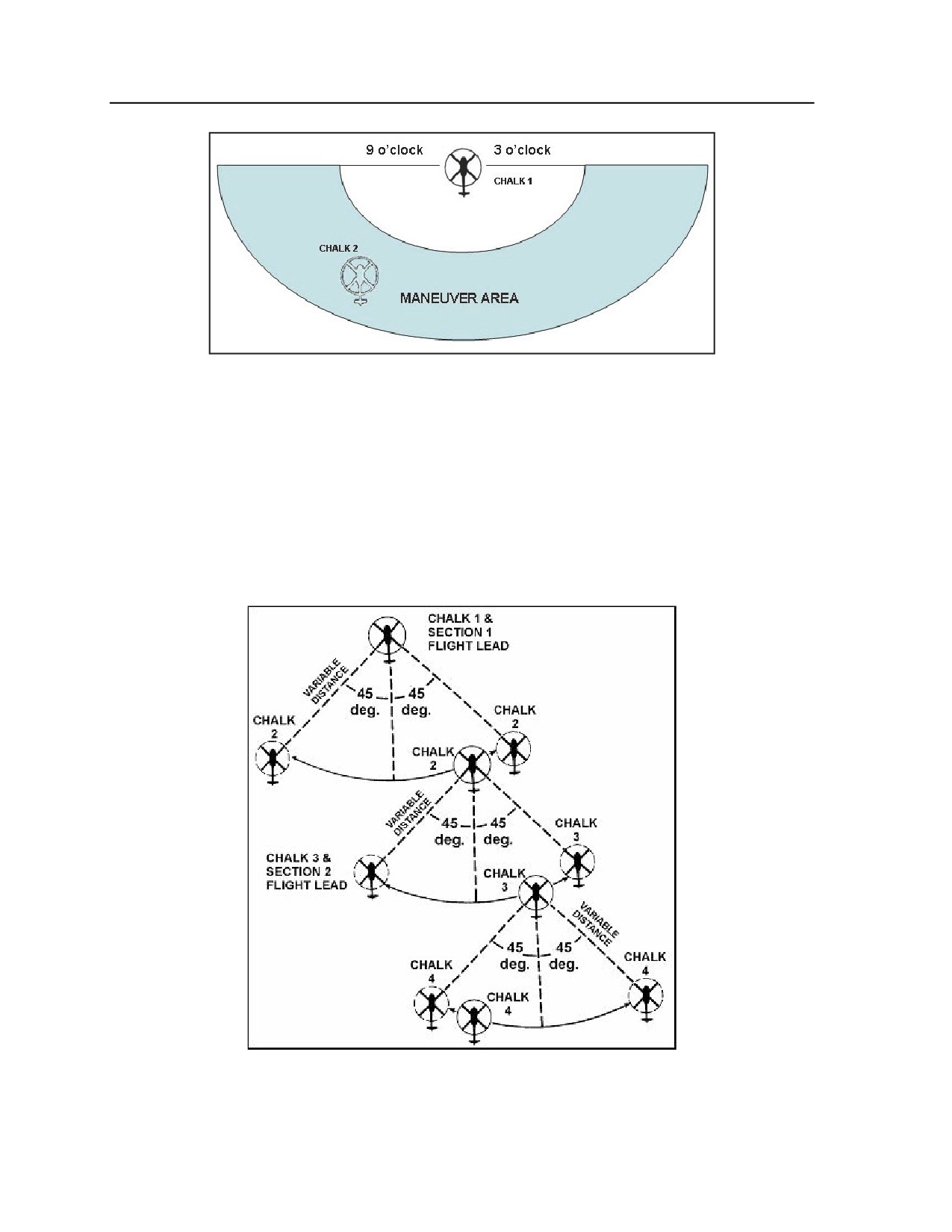
to the other if this information is required for SA. The wingman is allowed to vary separation and angle
anywhere in the maneuver area from approximately 3 to 9 o’clock (figure 6-12, page 6-20). Since the
formation does not require an absolute position, flight crews can concentrate on navigation, terrain
masking, and enemy detection/avoidance. Wingmen position themselves where they can best visually
cover lead (optimum position is 45 degrees) and should be prepared to deliver ordinance in support of lead.
7 May 2007
FM 3-04.203
6-19
Chapter 6
Figure 6-12. Team combat cruise
6-70. In rough terrain, the formation is normally tighter than in open terrain. When lead initiates a turn,
wingmen maintain longitudinal clearance on the aircraft directly ahead by sliding and utilizing the radius of
the turn created by lead. As soon as lead rolls level, positions are resumed. Since the position in combat
cruise varies, the wingman should avoid presenting a linear target during break turns. Extended flight in
lead’s 6 o’clock is not recommended.
6-71. Formations of more than two aircraft can utilize combat cruise. Figure 6-13 shows a flight of four in
combat cruise with the maneuver area limited to 45 degrees. Each subsequent aircraft flies a relative
position off the preceding aircraft. To maintain team integrity for attack/recon scout weapons teams, the
term combat cruise teams in trail can be used and spacing between teams are extended slightly.
Figure 6-13. Flight combat cruise
6-20
FM 3-04.203
7 May 2007
Multi-Aircraft Operations
COMBAT CRUISE LEFT/RIGHT
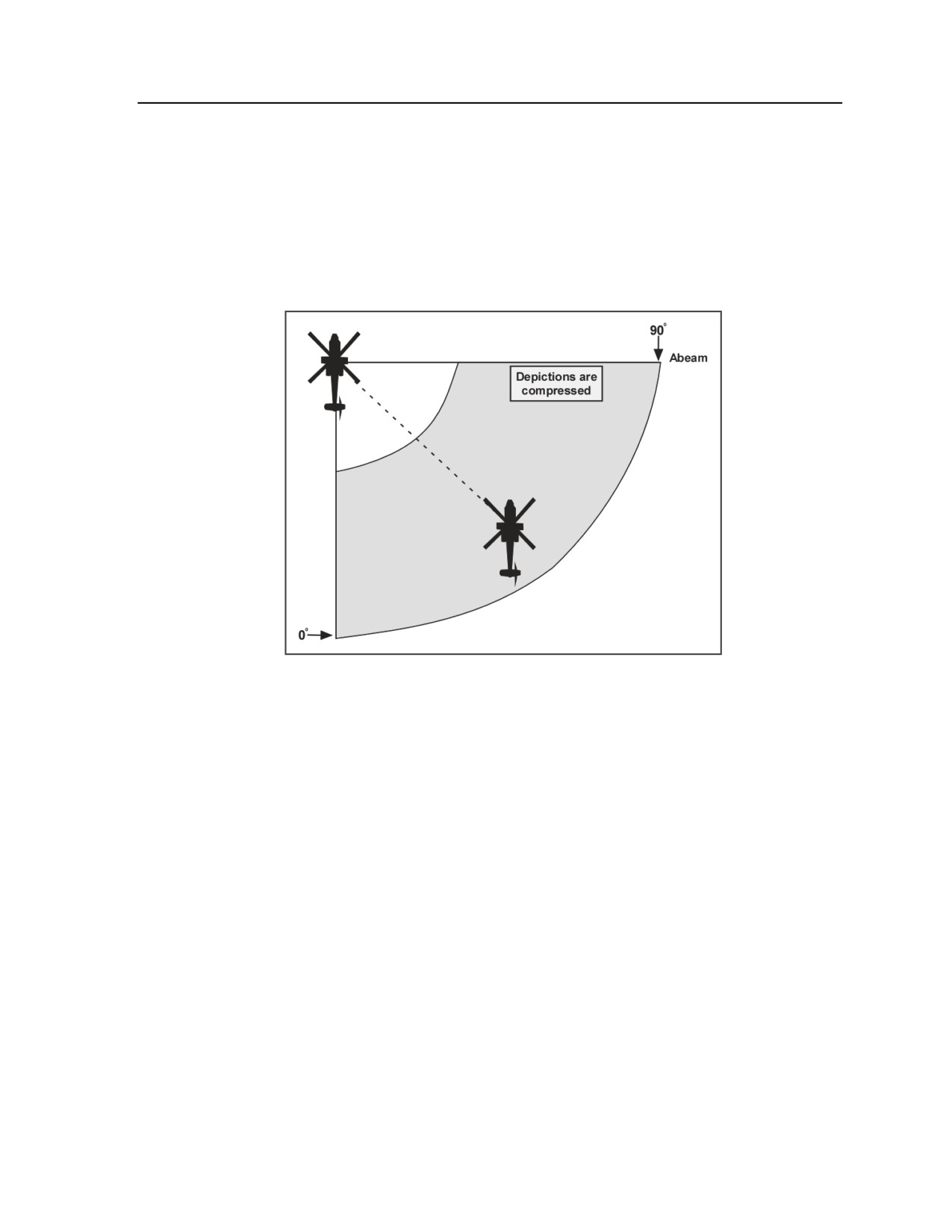
6-72. Another formation used by flight lead to limit maneuverability is combat cruise left/right (figure 6
14). Combat cruise left/right is a modified staggered formation which allows for tactical maneuverability
and spacing yet maintains some predictability. Subsequent aircraft will remain in either right or left cruise
and change sides only after briefed by flight lead. Using combat cruise left/right, the wingman remains in
an arc 0 degrees aft to 90 degrees abeam of lead to the left or right side. Optimum position is 45 degrees.
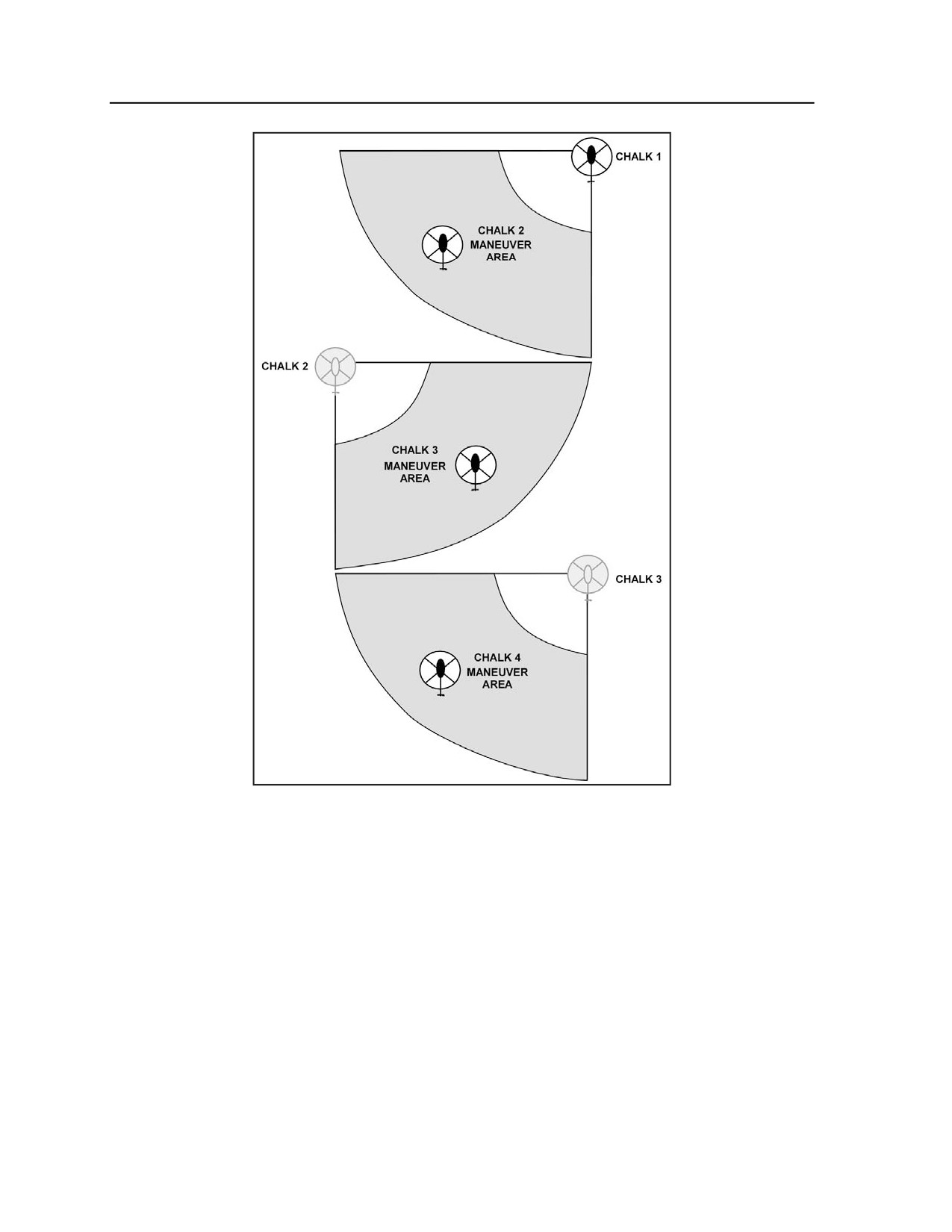
Observation sectors are divided between lead and wing providing overlapping observation and fire. Figure
6-15, page 6-21, illustrates combat cruise left for more than two aircraft.
Figure 6-14. Combat cruise right
7 May 2007
FM 3-04.203
6-21
Chapter 6
Figure 6-15. Combat cruise left
COMBAT TRAIL
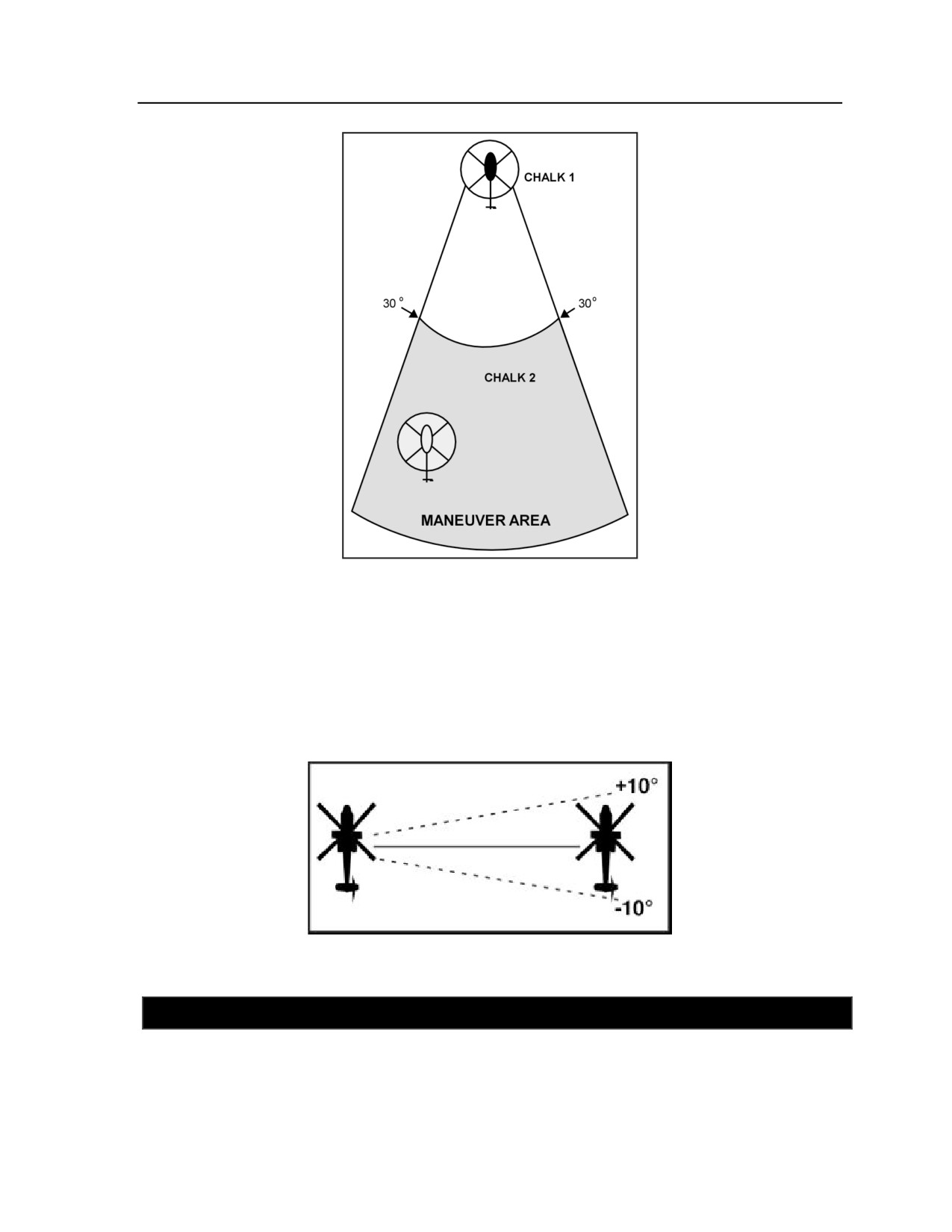
6-73. While combat cruise allows wingmen maximum flexibility, there may be instances where flight lead
requires more control of the flight and must restrict some maneuverability. Combat trail can be used to
limit wingmen’s movement to plus or minus 30 degrees from the preceding aircraft (figure 6-16, page 6
23). This formation is useful for negotiating narrow terrain or landing in narrow LZs. It should not be
flown for extended periods of time or at night due to the difficulty of determining rates of closure for
preceding aircraft.
6-22
FM 3-04.203
7 May 2007
Multi-Aircraft Operations
Figure 6-16. Combat trail
COMBAT SPREAD
6-74. Combat spread is a formation used when maximum observation to the front is desired or an attempt
to limit package exposure time over open areas is made. When flight lead announces combat spread, he
includes the command right or left. Wingmen should move toward that abeam position, either lead’s 3 or 9
o’clock position (figure 6-17). Flying in combat spread requires a rapid scan to maintain SA on the other
aircraft and approaching terrain. This requires even more vigilance at night.
Figure 6-17. Combat spread
SECTION III - BASIC COMBAT MANEUVERS
6-75. Basic combat maneuvers (BCMs) are essential elements for successful multi-aircraft operations.
Team maneuvering flight relies on standardized maneuvers and terminology to defend against deliberate or
chance encounters with enemy forces occurring throughout the battlefield. Each team member must be able
to communicate and understand each maneuver to enhance mutual support within the team and flight while
7 May 2007
FM 3-04.203
6-23
Chapter 6
performing various missions. These missions include attack, reconnaissance, assault, and lift conducted by
one or more teams or during missions involving dissimilar aircraft such as rescue escort, casualty
evacuation (CASEVAC), and personnel recovery.
MANEUVERING FLIGHT COMMUNICATIONS
6-76. It is essential every crewmember understand the maneuver to be performed. Communication is an
integral part of training for lead and wing. It provides a basis and the control measures required to practice
maneuvering team flight. As a team gains proficiency, the communication between lead and wing may
evolve to a more abbreviated form but the basics should remain. The more abbreviated form of
communication does not constrain the use of these maneuvers in application. During training, each pilot
should acknowledge the maneuver and respond with the command of execution (for example, Lead: Team
one, Break left, Ready; Wing: Team one, Break left, Go). Several maneuvers have standard turn changes.
This may be modified in the communication prior to executing the turn (for example, Team one, Break left
270, Ready; Wing: Team one, Break left 270, Go). Engagement criteria and target identification may also
be added for clarity (for example, Team one, Cross turn and cover high engage; Wing: Team one, Cross
turn and cover low, tally target).
BASIC COMBAT MANEUVERS
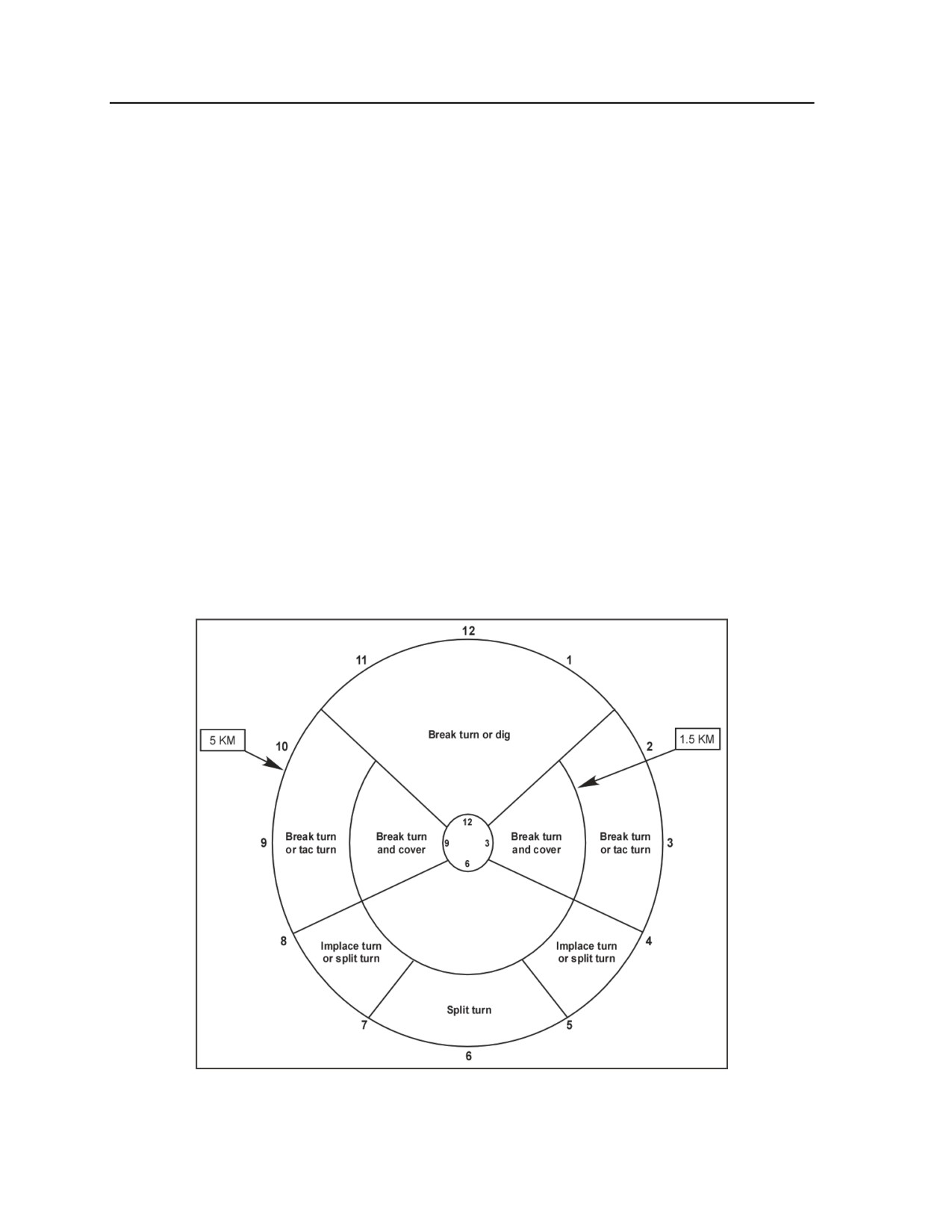
6-77. BCMs provide the team with a “toolbox” of maneuvers to choose from when encountering threats
during tactical flight (figure 6-18). These maneuvers facilitate the suppression of enemy fire destruction of
targets, command and control, and the reorganization of the flight following the encounter. Maneuvers are
divided into two categories to include maneuvers required to engage—
Close in threats, less than 1.5 kilometers inside area weapons system (AWS) ranges.
And/or bypass threats outside weapons ranges, 1.5 to 5 kilometers outside area weapons ranges.
Figure 6-18. Basic combat maneuver circle
6-24
FM 3-04.203
7 May 2007
Multi-Aircraft Operations
Note. Unless an engagement forces the tactical lead to change from one aircraft to another, flight
lead will not change during any of these maneuvers. Rather, the wingman should delay initiating
the turn or vary the angle of bank or airspeed to assume an appropriate position once the
maneuver is completed. For example, a split turn initiated while a team is in combat cruise
formation will require the wingman delay initiating his turn or vary the angle of bank so not to
roll out of the turn in front of the tactical lead.
TACTICAL TURNS
6-78. The tactical turn is used to maneuver the flight, maintain observation sectors, and allow mutual
support. These maneuvers are used to change the direction of the formation (usually approximately 60 to
120 degrees) and change wingman side. tactical turns also enable aircrews to turn the formation in a
smaller area by eliminating the need for the wingman to fly the outside arc of lead’s turn. All tactical turns
follow three basic principles—
The aircraft on the outside of the turn always turns first.
The wingman always changes sides in the formation.
The wingman is always responsible for separation.
A turn of 90 degrees is understood, if not stated. If a smaller or larger heading change is desired, lead may
specify a magnitude of heading change (for example, Team 1, tactical left to heading 270).
Tactical Turn (Away from Wingman)
6-79. From combat cruise or combat spread, lead maintains heading, and wing turns immediately to the
new heading. When wing passes the 5 or 7 o’clock position, lead turns to the new heading and formation
change is understood. A vertical component (cover) may be added by stating “Cover high” or “Cover low”.
Figure 6-19 depicts a tactical turn away.
Figure 6-19. Tactical turn away
Tactical Turn (Toward the Wingman)
6-80. From combat cruise or combat spread, on acknowledgement, lead immediately turns to the new
heading and passes in front of the wingman. The wingman maintains heading (or alters slightly to lead’s
tail) until lead passes 2 o’clock. Wing then turns to the new heading. If separation is not adequate for lead
to cross the wing position, wing may initiate a turn in the opposite direction to facilitate lead’s turn.
Maneuver reverses each aircraft’s relative position (combat cruise right will now be combat cruise left).
Formation change is understood. A vertical component (cover) may be added by stating “Cover high” or
“Cover low”. Figure 6-20, page 6-26, shows a tactical turn to wingman.
7 May 2007
FM 3-04.203
6-25
Chapter 6
Figure 6-20. Tactical turn to
DIG, RESUME, AND PINCH
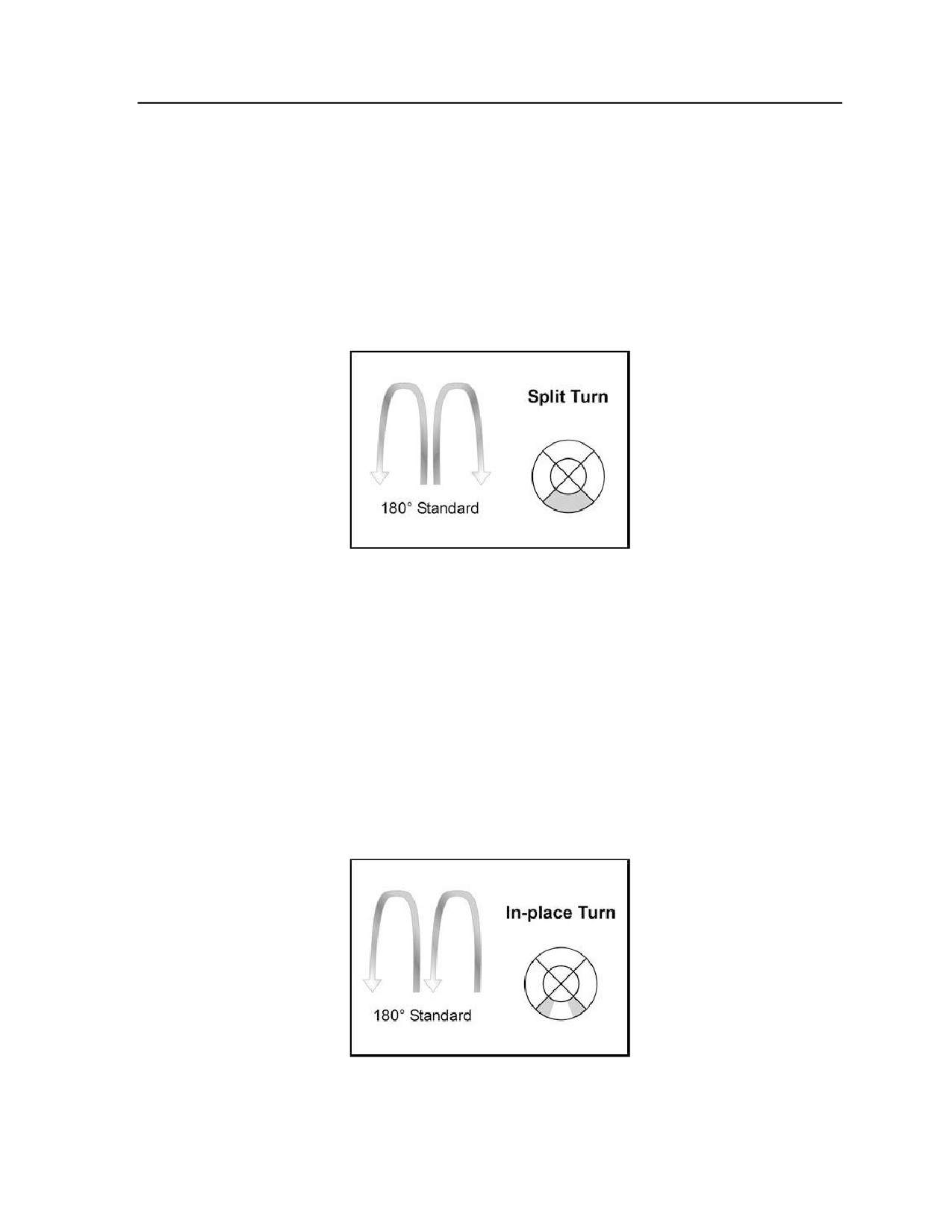
6-81. Dig and pinch may be used in combination or separately to react to a threat or hazard in the forward
quadrant. These maneuvers allows for rapid dispersion and incremental control of the formation with short,
precise commands from lead. If a threat is discovered in the forward quadrant, little or no time may be
available to engage the target. In formation, a dig will split the lead team to enable a follow-on team to
engage a forward quadrant threat.
6-82. From combat cruise or combat spread, aircraft simultaneously turn 30 to 45 degrees away from each
other. When desired lateral separation is attained, the tactical leader calls “resume”. To decrease lateral
separation, the tactical leader calls “pinch”. Both aircraft simultaneously turn 30 to 45 degrees toward the
inside. Aircraft will decrease lateral separation until they return to the previous formation and separation or
until a “resume” call is made. Resume is defined as a “return to mission heading and maintain current
separation”. Figure 6-21 illustrates the dig and pinch maneuvers.
Figure 6-21. Dig and pinch maneuvers
6-26
FM 3-04.203
7 May 2007
Multi-Aircraft Operations
SPLIT TURN
6-83. This maneuver rapidly reverses team direction to engage or bypass an enemy located at 5 and 7
o’clock, outside weapons range. When aircraft within the formation are in combat cruise and rapid
dispersion of the team is desired, a split turn is the preferred method. This maneuver forces the threat to
either bypass or commit earlier to the lead or wingman.
6-84. A split turn changes a formation’s heading from 120 to 240 degrees. Both aircraft will execute a left
and right turn to the new heading. If no heading is given, a turn of 180 degrees is understood. Angle of
bank and power must be maintained so the aircraft should be tail to tail at the apex of the turn. When the
maneuver is complete, lead and wingman will have reversed relative positions. Figure 6-22 depicts a split
turn.
Figure 6-22. Split turn maneuver
IN-PLACE TURN
6-85. An in-place turn (reversal) (figure 6-23) rapidly reverses team direction to engage or bypass an
enemy located at 5 and 7 o’clock, outside weapons range. This maneuver allows the wingman to keep the
lead aircraft in sight at all times. An in-place turn may also be used to egress a static BP.
6-86. On acknowledgement, both aircraft will execute a left or right turn to new heading. An in-place turn
may be used for both small (30 degrees or less) and large heading changes (120 to 240 degrees). If a
specific heading is not given, a heading change of 180 degrees is understood. To initiate small heading
changes, both aircraft turn to the new heading and relative position is maintained. To initiate large heading
changes both aircraft turn in the specified direction. Angle of bank and power must be maintained so
aircraft are in trail at the apex of the turn. As the team continues its turn to the new heading, the wingman
switches relative position (combat cruise right is now combat cruise left).
Figure 6-23. In-place turn
7 May 2007
FM 3-04.203
6-27
Chapter 6
CROSS TURN
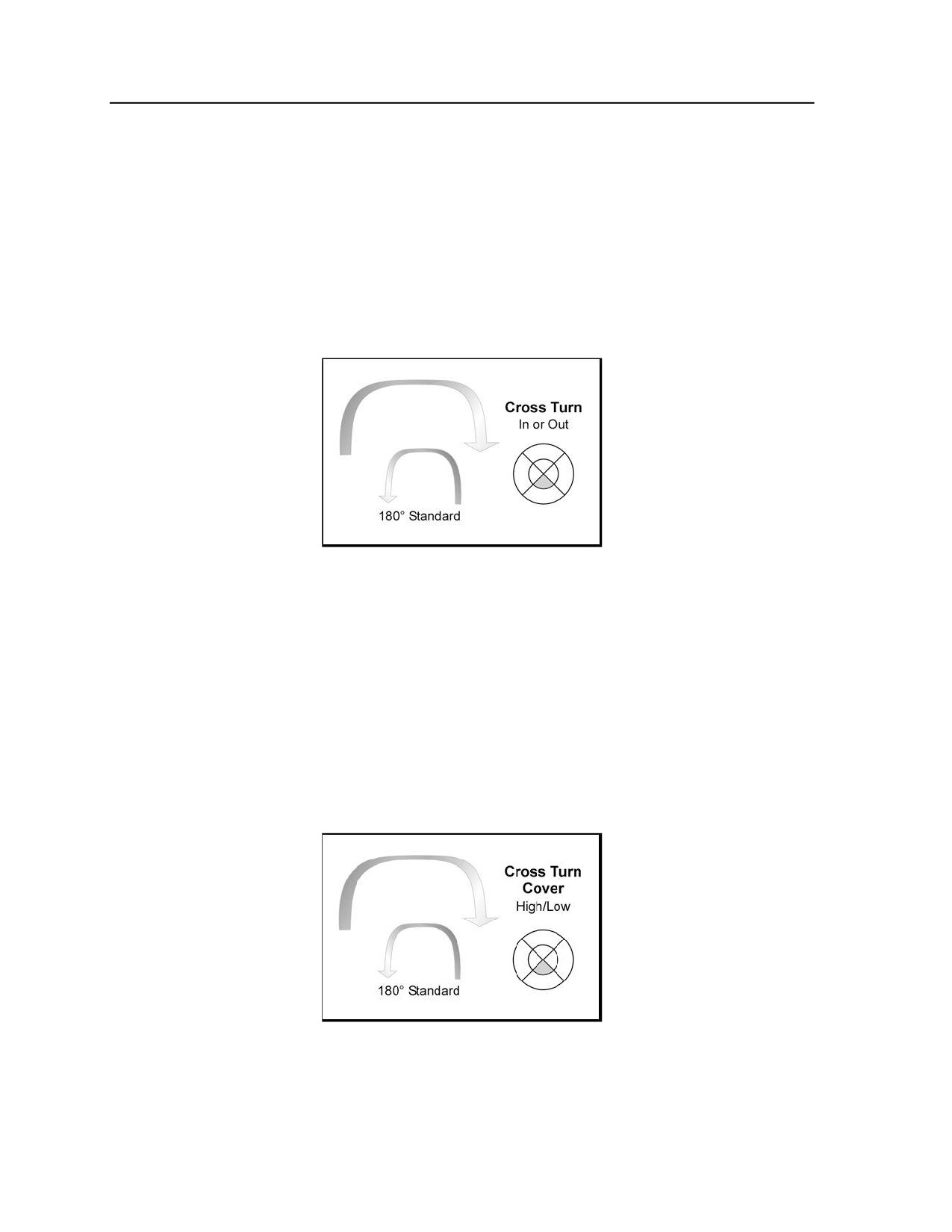
6-87. A cross turn (figure 6-24) is used to rapidly orient the team on an engaging threat from the rear
quadrant. This turn may also be used to reverse the flight’s heading in channelized terrain. Cross turns
change a formation’s heading approximately 120 to 240 degrees. If a specific heading is not given, a
heading change of 180 degrees is understood. Cross turns may be performed from either combat cruise or
combat spread. Unless specified, lead should fly the outside turn allowing wing to turn inside. The aircrew
initiating the turn may specify whether they will be flying the outside turn or the inside turn by stating
“cross turn inside” or “cross turn outside”, especially during execution from a combat spread formation.
Initial separation determines the angle of bank needed. Angle of bank must be adjusted to maintain
position in the flight. The cross turn should not be used in situations where an enemy might deliver
ordnance at the apex of the turn, since both helicopters are closely aligned at this point.
Figure 6-24. Cross turn in or out
CROSS TURN AND COVER
6-88. The cross turn and cover maneuver (figure 6-25) provides for vertical separation as well as lateral
separation between lead and wing. It is also a variation of the cross turn. This maneuver is initially used as
a defensive maneuver to orient the team on the enemy while confusing the enemy. Once oriented, the team
then engages targets within weapons range.
6-89. This maneuver reverses the flight’s direction and provides split-phase, split-plane engagement of
targets. It may be initiated from combat cruise or combat spread. The aircrew sighting the enemy first
initiates the maneuver, calls “cross turn cover high” or “cross turn cover low”, and executes the “high” or
“low” altitude. The high aircraft maneuvers to a lookdown position on the enemy. The low aircraft turns to
face the enemy and maneuvers to provide mutual support.
Figure 6-25. Cross turn cover (high/low)
6-28
FM 3-04.203
7 May 2007
Multi-Aircraft Operations
BREAK TURN
6-90. Break turns are maximum aircraft performance maneuvers that may be used to orient the flight
toward an enemy aircraft that has penetrated within weapons engagement parameters, break away from
hostile ground fire or bring weapons to bear immediately on a target.
6-91. Break turns are used as an initial formation response when a member of the formation has spotted a
threat outside the AWS range. Flight lead further develops the situation into a drill once the flight is
properly oriented to/from the threat.
6-92. On acknowledgment, both aircraft will execute a left or right turn to the new heading (figure 6-26).
If a specific heading is not given, a heading change of 90 degrees is understood. To maintain the same
relative position, an adjustment of speed may be required to compensate for steeper turns. Break turns may
be executed to the left or right.
Figure 6-26. Break turn left/right
BREAK TURN AND COVER
6-93. The break turn and cover provides an immediate break with vertical separation of aircraft to engage a
target. This is an immediate action maneuver used when enemy is spotted abeam (2 to 4 o’clock or 8 to 10
o’clock) within weapons range. Described simply, it is a break turn with vertical separation to engage a
common threat.
6-94. After the execution call and acknowledgment, the aircraft closest to the enemy initiates the
maneuver. The aircraft closest to the enemy begins an immediate climb while simultaneously turning to
confront the enemy. As aircraft closest to the enemy begins to climb, the wingman turns to an angle-off
flight path and maneuvers to provide mutual support. This maneuver achieves maximum vertical separation
and should force the enemy to choose between two possible targets maneuvering to engage. Figure 6-27
depicts a break turn and cover.
Figure 6-27. Break turn left/right (high/low)
7 May 2007
FM 3-04.203
6-29
Chapter 6
SHACKLE TURN
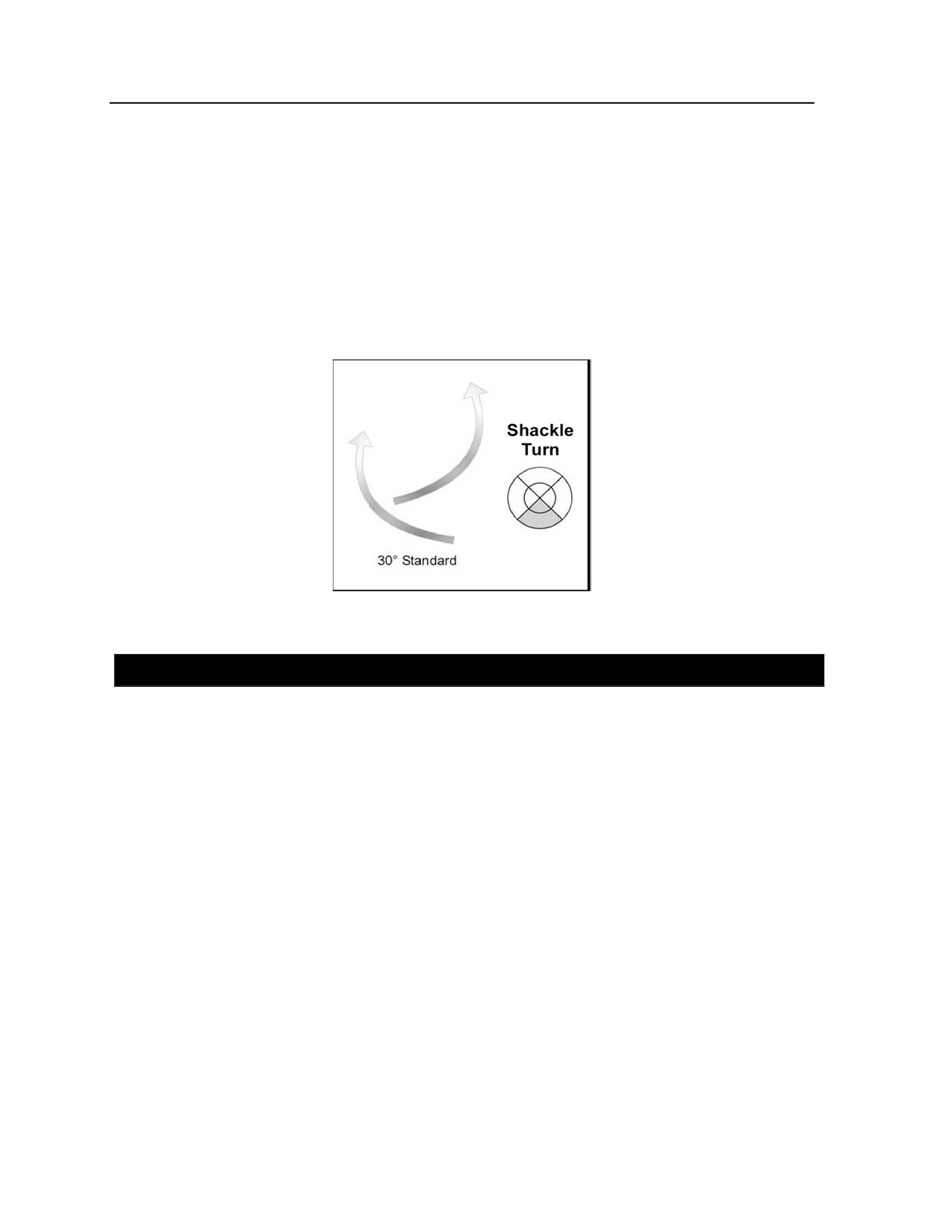
6-95. This maneuver allows aircraft to thoroughly observe the 6 o’clock position of the flight. If the
section consists of three aircraft, only the last two aircraft should perform the maneuver. If a flight consists
of two or more sections, the same applies. Only the last two aircraft will check rear security for the flight.
6-96. Shackle turns (figure 6-28) can be executed from both combat cruise and combat spread. The
command for the shackle turn is
“shackle turn” followed by the execution command
“go” and
acknowledgement. Lead maintains his heading, while wingman initiates a 30-degree turn toward the lead.
Lead verifies the wingman has initiated a turn. Lead then initiates a 30-degree turn in the opposite
direction. As wing passes the 6 o’clock position, lead returns to original heading. If performed at night, a
greater off-angle may be required based on sensor limits. The off-angle continues until lead calls “resume”.
At the completion of this maneuver, lead and wing have changed relative position.
Figure 6-28. Shackle turn
SECTION IV - PLANNING CONSIDERATIONS AND RESPONSIBILITIES
PLANNING CONSIDERATIONS
6-97. The factors considered in determining the best formation, or sequence of formations, are as follows:
Mission requirements include the mission of the supported unit and aviation unit.
Enemy considerations include current enemy situation, enemy ADA capability and placement,
and accessibility to enemy visual/electronic surveillance.
Fire support plan considerations include artillery support available, LZ preparation planning, air
support availability and requirements, and naval gunfire-including planned types of ordnance
and any en route suppression of enemy air defense.
Terrain and weather considerations include configuration of en route obstacles and/or corridors,
LZ characteristics, obstacles in/or affecting approaches to the LZ, ceiling and visibility, wind
and turbulence, and ambient light levels throughout the mission.
Formation maneuver and flexibility considerations include possible changes in the mission or
situation and evasive tactics to be used.
Armed aerial escort considerations include the number and type of armed escort aircraft required
and available.
Formation control considerations include the degree of control required and method of control
such as radio, visual signals, and prearranged timing.
Other considerations include type of aircraft, type of NVDs used, OPSEC and safety measures
required, level of crew training and experience, and aircraft capabilities.
6-30
FM 3-04.203
7 May 2007
Multi-Aircraft Operations
When different types of aircraft operate in a formation, external lighting capability of the
various aircraft types must be evaluated. In addition, when aircraft types are mixed at night,
differences between NVGs and FLIR must be identified and considered in planning.
Installed aircraft survivability equipment (ASE) and the impact different formations have on it
versus threat.
PLANNING RESPONSIBILITIES
6-98. Supported ground unit commanders should brief the supporting aviation unit on the following items:
Fire and EW support plans.
Frequencies and call signs.
Details of friendly troops including location, numbers, and unit identification.
Number of troops to be airlifted.
Description, amount, size, and weight of cargo.
Location, details, control provided, and specific landing points for primary and alternate PZs.
Safe routes to and from the LZ based on available intelligence.
Desired arrival time in the LZ.
Location, details, control provided, and specific landing points for primary and alternate LZs.
Location of the ground unit commander, if airborne.
6-99. The air mission or flight commander is responsible for effecting liaison with the supported ground
unit and supporting aviation units. The aviation brief to the supported ground unit should include the
following:
Safety requirements.
Use of aircraft lights providing aircraft identification means to the supported unit.
Frequencies, call signs, and troop commander seat assignment including availability of aircraft
headset and communication capability.
Probable en route and landing formations.
Aircraft troop and cargo load capability and identification of aircraft carrying both.
Downed crew pickup points and downed aircraft procedures.
PZ/LZ lighting requirements and aircraft separation requirements.
Thorough passenger briefing, including appropriate warnings regarding aircraft ingress and
egress, and approach/departure paths to/from the aircraft. This briefing must include seat belt
availability, placement of personal equipment, and emergency procedures.
6-100.
The mission brief to the aviation unit should include the following:
Route of flight.
Rules of engagement.
Time schedule.
Details of the PZ and LZ.
Number of aircraft required for the mission.
Troop load (including aircraft ACL) and cargo load.
Formations to be used.
Numbering system (identification) for aircraft; for example, in case of a formation change,
starting with lead or chalk 1 continuing backwards through the flight; lead departs the flight,
then chalk 2 becomes lead, chalk 3 becomes chalk 2, and so on.
Assigned duties for each chalk number.
Horizontal distance and vertical separation.
Use of aircraft lights.
Signal requirements including lights and communication.
7 May 2007
FM 3-04.203
6-31
Chapter 6
IIMC procedures.
Emergency breakup procedures (threat response).
Method of changing formation.
Rendezvous and join-up procedures.
Available intelligence regarding routes and PZs/LZs.
Lost communication procedures.
Downed aircrew pickup points and downed aircraft procedures.
Status of armed escort aircraft.
Refueling and rearming instructions, including FARP locations.
Emergency medical procedures.
Location of AMC and aviation unit commander.
SECTION V - WAKE TURBULENCE
6-101. Information on wake turbulence is placed in this chapter as aviators are likely to experience
turbulent conditions while operating around other aircraft. Successful aviators understand and recognize
conditions conducive to wake turbulence and take appropriate countermeasures. Larger aircraft create more
turbulence and are greater hazards.
IN-FLIGHT HAZARD
6-102. Every aircraft in flight generates wake turbulence. This disturbance is caused by a pair of counter-
rotating vortices trailing from the wing tips. It is possible the wake of another aircraft can impose rolling
moments exceeding the control authority of the aircraft. Additionally, if encountered at close range, wake
turbulence can damage the aircraft and/or cause personal injury to the occupants. It is important to imagine
the location of the vortex wake generated by other aircraft and adjust the flight path accordingly.
GROUND HAZARD
6-103. Hazardous turbulence is not only encountered in the air. During ground operations and takeoff, jet
engine blast (thrust stream turbulence) and rotorwash can cause damage and disturbance if encountered at
close range. Exhaust velocity versus distance studies at various thrust levels have shown a need for light
aircraft and helicopters to maintain an adequate separation behind large turbojet aircraft.
VORTEX GENERATION
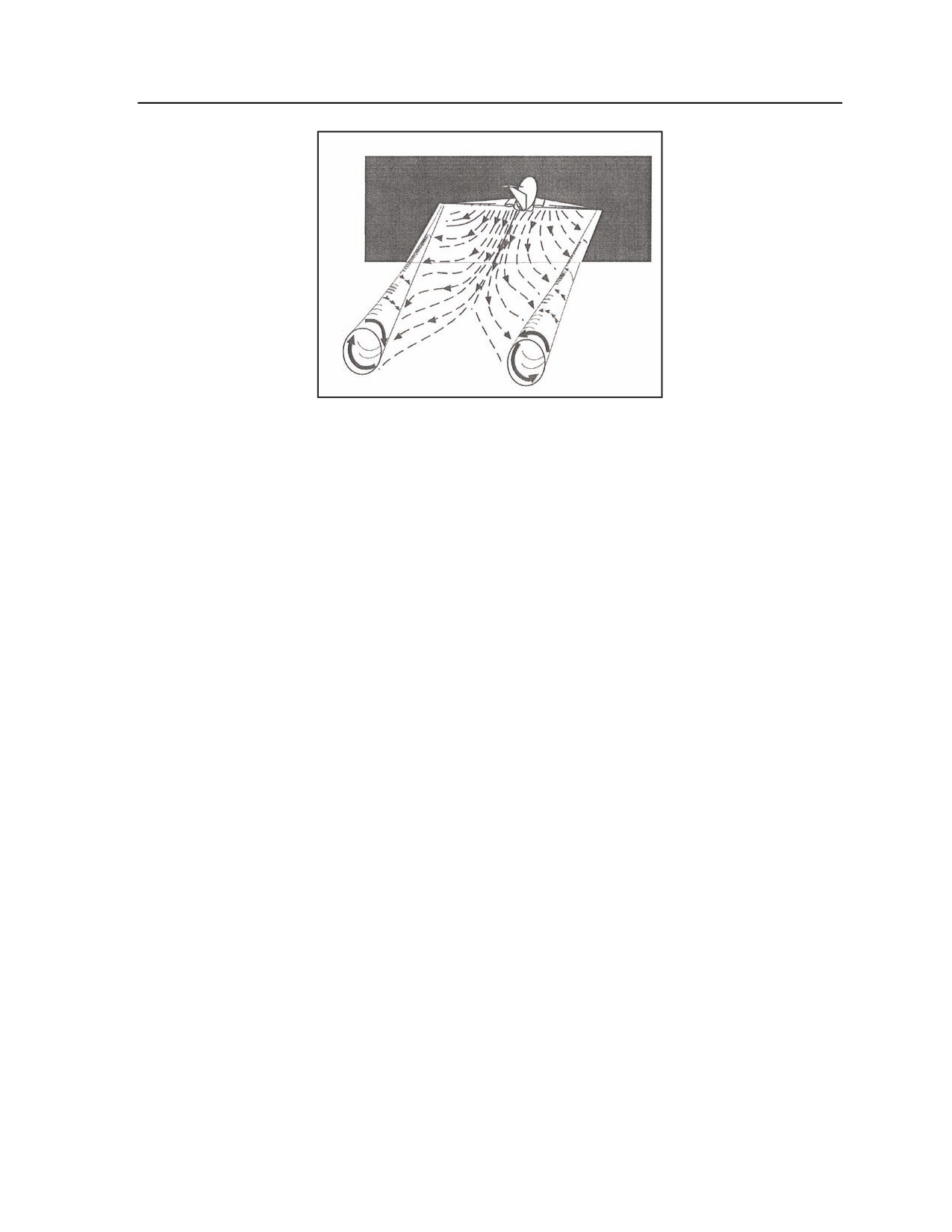
6-104. Lift is generated by the creation of a pressure differential over the wing surfaces. This pressure
differential triggers rollup of airflow aft of the wing resulting in swirling air masses trailing downstream of
the wingtips (figure 6-29, page 6-33). After rollup is completed, the wake consists of two counter-rotating
cylindrical vortices. Most of the energy is within a few feet of the center of each vortex; however pilots
must avoid the region within approximately 100 feet of the vortex core.
STRENGTH
6-105. Vortex strength is governed by the weight, speed, and shape of the generating aircraft’s wing. The
basic factor is weight; vortex strength increases proportionately with an increase in aircraft operating
weight. Peak vortex speeds up to almost 300 feet per second have been recorded. The greatest vortex
strength occurs when the generating aircraft is heavy, clean, and slow.
6-32
FM 3-04.203
7 May 2007
Multi-Aircraft Operations
Figure 6-29. Wake vortex generation
BEHAVIOR
6-106. Trailing vortices have certain behavioral characteristics which can help aviators visualize wake
location and take avoidance precautions.
Vortices are generated from the moment an aircraft leaves the ground because trailing vortices
are a by-product of wing lift. Prior to takeoff or landing, pilots should note the rotation or
touchdown point of the preceding aircraft.
Vortex circulation is outward, upward, and around the wing tips when viewed either ahead or
behind the aircraft. If persistent vortex turbulence is encountered, a slight change of altitude and
lateral position (preferably upwind) should provide a flight path clear of the turbulence.
Flight tests have shown vortices from aircraft sink at a rate of up to several hundred FPM,
slowing their descent and diminishing in strength with time and distance behind the generating
aircraft. Atmospheric turbulence hastens breakup. Aviators should fly at or above the preceding
aircraft’s flight path, altering their course as necessary to avoid the area behind and below the
generating aircraft.
A crosswind will decrease lateral movement of the upwind vortex and increase movement of the
downwind vortex. This results in the upwind vortex remaining in the touchdown zone for a
period of time and increases drift of the downwind vortex toward another runway.
INDUCED ROLL AND COUNTER CONTROL
INDUCED ROLL
6-107. In rare instances, a wake encounter can cause in-flight structural damage of catastrophic
proportions. The most common hazard is associated with induced rolling moments which can exceed the
roll control capability of the encountering aircraft. During flight tests, aircraft have been intentionally
flown directly up trailing vortex cores of larger aircraft. These tests prove the capability of an aircraft to
counteract the roll imposed by the wake vortex primarily depends on wing span and counter control
responsiveness of the encountering aircraft.
COUNTER CONTROL
6-108. Counter control is usually effective and induced roll is minimal in cases where the encountering
aircraft extends outside the affected area of the vortex. It is more difficult for aircraft smaller than the
aircraft generating the vortex to counter the imposed roll induced by vortex flow. Although aviators of
7 May 2007
FM 3-04.203
6-33
Chapter 6
short span aircraft and helicopters must be especially alert to vortex encounters, the wake of larger aircraft
requires the respect of all aviators.
OPERATIONAL PROBLEM AREAS
6-109. Wake turbulence encounters can be one or more jolts with varying severity depending upon
direction of the encounter, weight of the generating aircraft, size of the encountering aircraft, distance from
the generating aircraft, and point of vortex encounter. The probability of induced roll increases when the
encountering aircraft’s heading is generally aligned or parallel with the flight path of the generating
aircraft.
Avoid the area below and behind the preceding aircraft especially at low altitude where even a
momentary wake encounter could be hazardous.
Aviators must be particularly alert in calm wind conditions and maneuvering situations in the
vicinity of the airfield where the vortices could—
Remain in touchdown area.
Drift from aircraft operating on a nearby runway.
Sink into takeoff or landing path from crossing runway.
Sink into traffic patterns from other airport operations.
Sink into flight path of aircraft operating VFR.
6-110. Aviators should visualize the location of the vortex trail behind a larger aircraft/helicopter and use
proper vortex avoidance procedures to achieve safe operation. It is equally important aviators of a larger
aircraft/helicopter plan or adjust their flight paths, whenever possible, minimizing vortex exposure to other
aircraft.
HELICOPTERS
6-111. In a slow hover taxi or stationary hover near the surface, helicopter main rotor systems generate
downwash producing high velocity outwash vortices to a distance approximately three times the diameter
of the rotor. When rotor downwash hits the surface, the resulting outwash vortices have behavioral
characteristics similar to wing tip vortices produced by FW aircraft. However, vortex circulation is
outward, upward, around, and away from the main rotor(s) in all directions. Aviators should avoid
operating within three rotor diameters of any helicopter in a slow hover taxi or stationary hover. In forward
flight, departing or landing helicopters produce a pair of strong, high speed trailing vortices similar to wing
tip vortices of larger FW aircraft. Aviators must use caution when operating or crossing behind landing and
departing helicopters.
JET ENGINE EXHAUST
6-112. Engine exhaust velocities, generated by larger jet aircraft during ground operations and initial
takeoff roll, dictate the desirability of lighter aircraft awaiting takeoff to hold well back of the runway edge
at the taxiway hold line. It is also desirable to align the aircraft to face any possible jet engine blast effects.
6-113. The FAA has established standards for the location of runway hold lines. For example, runway
intersection hold short lines are established 250 feet from the runway centerline for precision approach
runways served by approach category C and D aircraft. For runways served by aircraft with wingspans
over 171 feet, such as the C-5, taxiway hold lines are 280 feet from the centerline of precision approach
runways. These hold line distances increase slightly with an increase in field elevation.
VORTEX AVOIDANCE TECHNIQUES
6-114. Under certain conditions, airport traffic controllers apply procedures for separating aircraft
operating under instrument flight rules (IFR). The controllers also provide VFR aircraft with the position,
altitude, and direction of larger aircraft followed by the phrase “caution-wake turbulence.” Whether or not
6-34
FM 3-04.203
7 May 2007
Multi-Aircraft Operations
a warning has been given, aviators are expected to adjust their operations and flight path(s) as necessary to
avoid serious wake encounters.
6-115.
The following vortex avoidance procedures are recommended:
Landing behind a larger aircraft on the same runway. Stay at or above the larger aircraft's final
approach flight path, note the touchdown point, and land beyond it.
Landing behind and offset from a larger aircraft landing on a parallel runway that is closer than
2,500 feet. Consider possible vortex drift onto your runway, stay at or above the larger aircraft's
final approach flight path, note its touchdown point, and land beyond it.
Landing behind a larger aircraft on a crossing runway. Cross above the larger aircraft's flight
path.
Landing behind a departing larger aircraft on the same runway. Note the larger aircraft's rotation
point and land well prior to rotation point.
Landing behind a departing larger aircraft on a crossing runway. Note the larger aircraft's
rotation point. If past the intersection, continue the approach and land prior to the intersection. If
prior to the intersection, abandon the approach unless a landing is assured well before reaching
the intersection and avoid flight below the larger aircraft's flight path.
If departing behind a larger aircraft, note the larger aircraft's rotation point and rotate prior, and
then continue to climb above the larger aircraft's climb path until turning clear of its wake.
Avoid subsequent headings crossing below and behind a larger aircraft. Be alert for any critical
takeoff situation possibly leading to a vortex encounter.
For intersection takeoffs on the same runway, remain alert for adjacent large aircraft operations
particularly upwind of the runway. Avoid headings crossing below a larger aircraft's path.
When departing or landing after a larger aircraft executing a low approach, missed approach or
touch-and-go landing, because vortices settle and move laterally near the ground, the vortex
hazard may exist along the runway and in the flight path after a larger aircraft has executed a
low approach, missed approach or a touch-and-go landing, particularly in light quartering wind
conditions. Ensure an interval of at least two minutes has elapsed before takeoff or landing.
When en route VFR, avoid flight below and behind a larger aircraft's path. If a larger aircraft is
observed above on the same track (meeting or overtaking), adjust position laterally, preferably
upwind.
AVIATOR RESPONSIBILITY
6-116. Government and industry groups are making concerted efforts to minimize or eliminate hazards of
trailing vortices; however, the flight discipline necessary to ensure vortex avoidance during VFR
operations must be exercised by the aviator. Vortex visualization and avoidance procedures are exercised
by the aviator using the same degree of concern as in collision avoidance.
6-117. Aviators are reminded in operations conducted behind all aircraft, acceptance of instructions from
ATC in the following situations is an acknowledgement that the aviator ensures safe takeoff and landing
intervals and accepts responsibility for providing wake turbulence separation:
Traffic information.
Instructions to follow an aircraft.
Acceptance of a visual approach clearance.
For operations conducted behind heavy aircraft, ATC specifies the word “heavy” when this information is
known.
6-118. For VFR departures behind heavy aircraft, air traffic controllers are required to use at least a 2
minute separation interval unless an aviator has initiated a request to deviate from the 2-minute interval and
indicated acceptance of responsibility for maneuvering the aircraft, thereby avoiding wake turbulence
hazard.
7 May 2007
FM 3-04.203
6-35
Chapter 6
AIR TRAFFIC CONTROL WAKE TURBULENCE SEPARATION
Required Separation
Behind Heavy Jets
6-119. Due to possible effects of wake turbulence, controllers are required to apply no less than specified
minimum separation for aircraft operating behind a heavy jet and, in certain instances, behind large non-
heavy aircraft.
6-120. Separation is applied to aircraft operating directly behind a heavy jet at the same altitude or less
than 1,000 feet below—
Heavy jet behind heavy jet—4 miles.
Small/large aircraft behind heavy jet—5 miles.
6-121. Also, separation, measured at the time the preceding aircraft is over the landing threshold, is
provided to small aircraft—
Small aircraft landing behind heavy jet—6 miles.
Small aircraft landing behind large aircraft—4 miles.
6-122. Additionally, departing aircraft will be separated by either two minutes or the appropriate 4 or 5
mile radar separation when takeoff behind a heavy jet will be—
From the same threshold.
On a crossing runway and projected flight paths will cross.
From the threshold of a parallel runway when staggered ahead of the adjacent runway by less
than 500 feet and when runways are separated by less than 2,500 feet.
6-123. Aviators, after considering possible wake turbulence effects, may specifically request a waiver of
the 2-minute interval. Controllers may acknowledge this statement as aviator acceptance of responsibility
for wake turbulence separation and, if traffic permits, issue takeoff clearance.
Behind Larger Aircraft
6-124. A 3-minute interval will be provided when a small aircraft will takeoff—
From an intersection on the same runway (same or opposite direction) behind a departing large
aircraft.
In the opposite direction on the same runway behind a large aircraft takeoff or low/missed
approach.
This 3-minute interval may be waived upon specific aviator request.
6-125. Controllers may not reduce or waive the 3-minute interval if the preceding aircraft is a heavy jet
and operations are on either the same runway or parallel runways separated by less than 2,500 feet.
6-126. Aviators may request additional separation, that is, two minutes instead of 4 or 5 miles for wake
turbulence avoidance. This request is made as soon as practical on ground control and at least before
taxiing onto the runway.
6-127. Controllers may anticipate separation and need not withhold a takeoff clearance for an aircraft
departing behind a large/heavy aircraft if there is reasonable assurance the required separation will exist
when the departing aircraft starts takeoff roll.
6-36
FM 3-04.203
7 May 2007
Chapter 7
Fixed-Wing Aerodynamics and Performance
This chapter presents aerodynamic fundamentals for FW flight and should be used
with information found in chapter 1 that applies to FW flight.
SECTION I - FIXED-WING STABILITY
MOTION SIGN PRINCIPLES
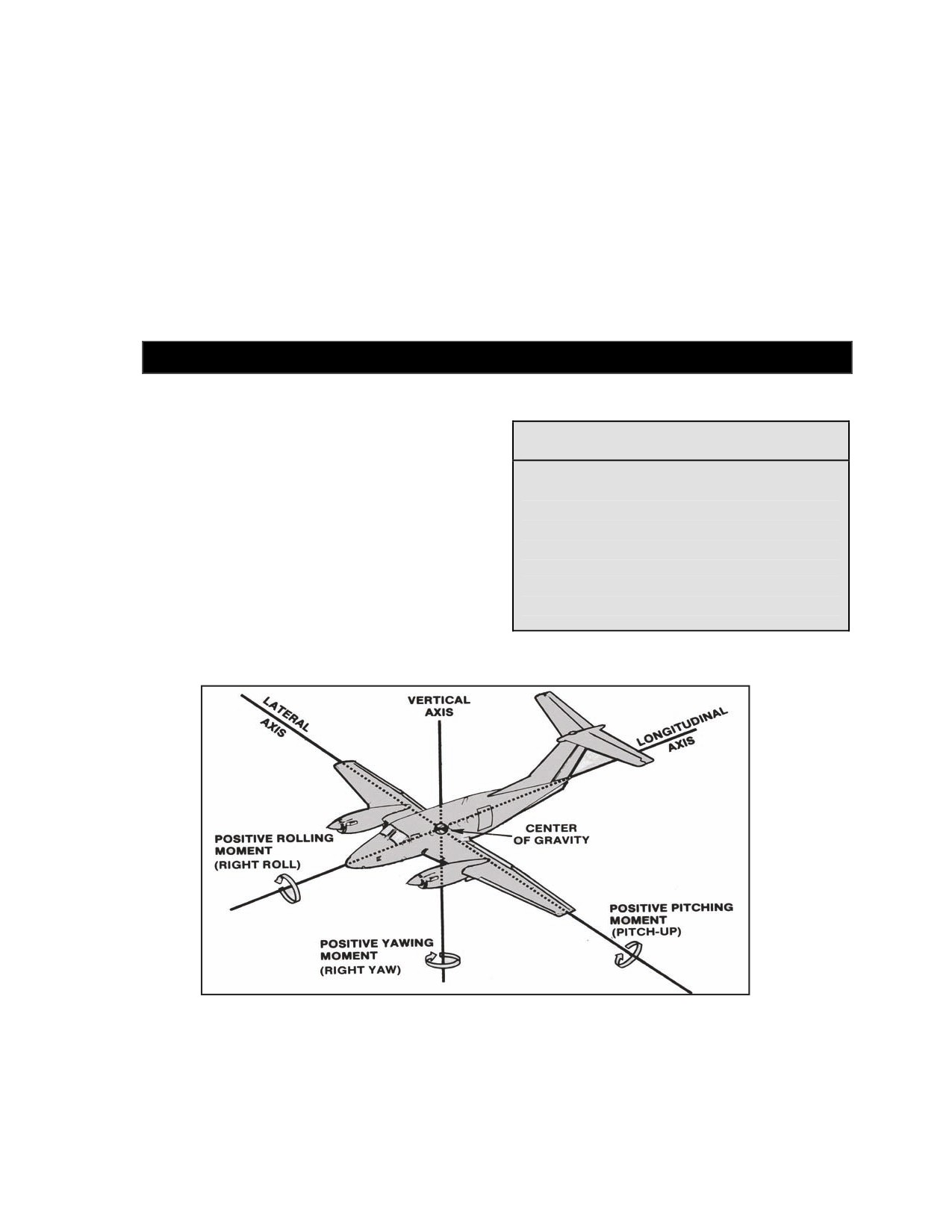
7-1. An aircraft has six directions of motion
Contents
around three mutually perpendicular axes (figure 7
1). These three axes are vertical, lateral, and
Section I - Fixed-Wing Stability
7-1
longitudinal.
Section II - High-Lift Devices
7-17
Vertical axis about which the aircraft
Section III - Stalls
7-24
yaws.
Section IV - Maneuvering Flight
7-31
Lateral axis about which the aircraft
Section V - Takeoff and Landing
pitches.
Performance
7-44
Section VI - Flight Control
7-49
Longitudinal axis about which the
airframe rolls.
Section VII - Multiengine Operations
7-61
Figure 7-1. Stability nomenclature
7-2. Sign principles are assigned to each motion. The right-hand rule can be applied to remember the
signs. A right roll, right yaw, and pitch-up are all positive. For example, a positive rolling moment rolls the
aircraft right and a negative rolling moment rolls the aircraft left.
7 May 2007
FM 3-04.203
7-1
Chapter 7
STATIC STABILITY
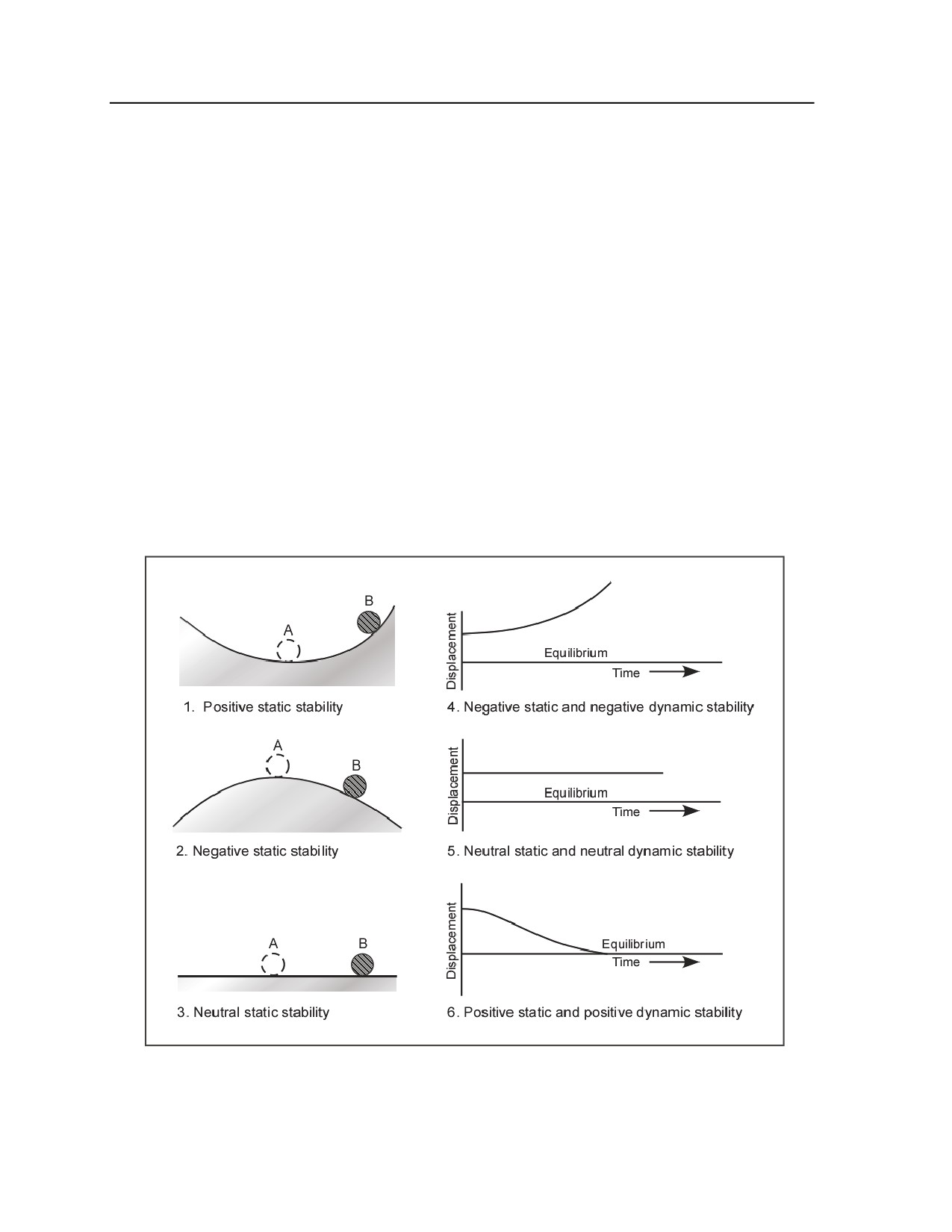
7-3. Static stability is the tendency an object possesses after it has been displaced from its equilibrium.
Newton’s first law of motion implies if the sum of the forces and moments about the CG of an object are
equal to zero, then no acceleration will take place. This state is called equilibrium.
POSITIVE STATIC STABILITY
7-4. If an object possesses positive static stability, it tends to return to its equilibrium position after
having been moved. In figure 7-2, part 1, point A shows the ball in equilibrium. If the ball is moved to
point B, it tends to roll back toward point A. This tendency demonstrates positive static stability. The ball
may not actually return to point A, but it does tend to return. Therefore, it has positive static stability.
NEGATIVE STATIC STABILITY
7-5. In part 2 of figure 7-2, the bowl has been inverted. Point A is the equilibrium position. The ball has
been moved to point B and tends to roll away from point A. This tendency toward movement away from
the equilibrium position demonstrates negative static stability. The ball may or may not roll away from
point A, but it tends to roll away. Therefore, it has negative static stability.
NEUTRAL STATIC STABILITY
7-6. In part 3 of figure 7-2, the ball has been placed on a flat surface. When the ball is moved to point B,
it neither tends to return to nor roll away from point A. This demonstrates neutral static stability.
Figure 7-2. Nonoscillatory motion
7-2
FM 3-04.203
7 May 2007
Fixed-Wing Aerodynamics and Performance
DYNAMIC STABILITY
7-7. The word dynamic implies motion, while dynamic stability refers to movement of an object with
respect to time. When dynamic stability of an object is considered, static stability of the object must also be
considered.
NONOSCILLATORY MOTION
Negative Static and Negative Dynamic Stability
7-8. An object possessing negative static stability tends to move away from its equilibrium position.
Figure 7-2, part 4 reflects nonoscillatory dynamic stability.
Neutral Static and Neutral Dynamic Stability
7-9. If an object has nonoscillatory neutral dynamic stability if it has been displaced and does not move
toward or away from its equilibrium position (figure 7-2, part 5).
Positive Static and Positive Dynamic Stability
7-10. An object with a positive static stability and strong positive dynamic stability results in
nonoscillatory positive dynamic stability (figure 7-2, part 6). This is called deadbeat damping. Dynamic
stability is particularly stressful on an aircraft structure and could eventually cause material failure.
OSCILLATORY MOTION
7-11. To have oscillatory motion, an object must possess positive static stability. Following is a discussion
of various types of dynamic stability coupled with positive static stability.
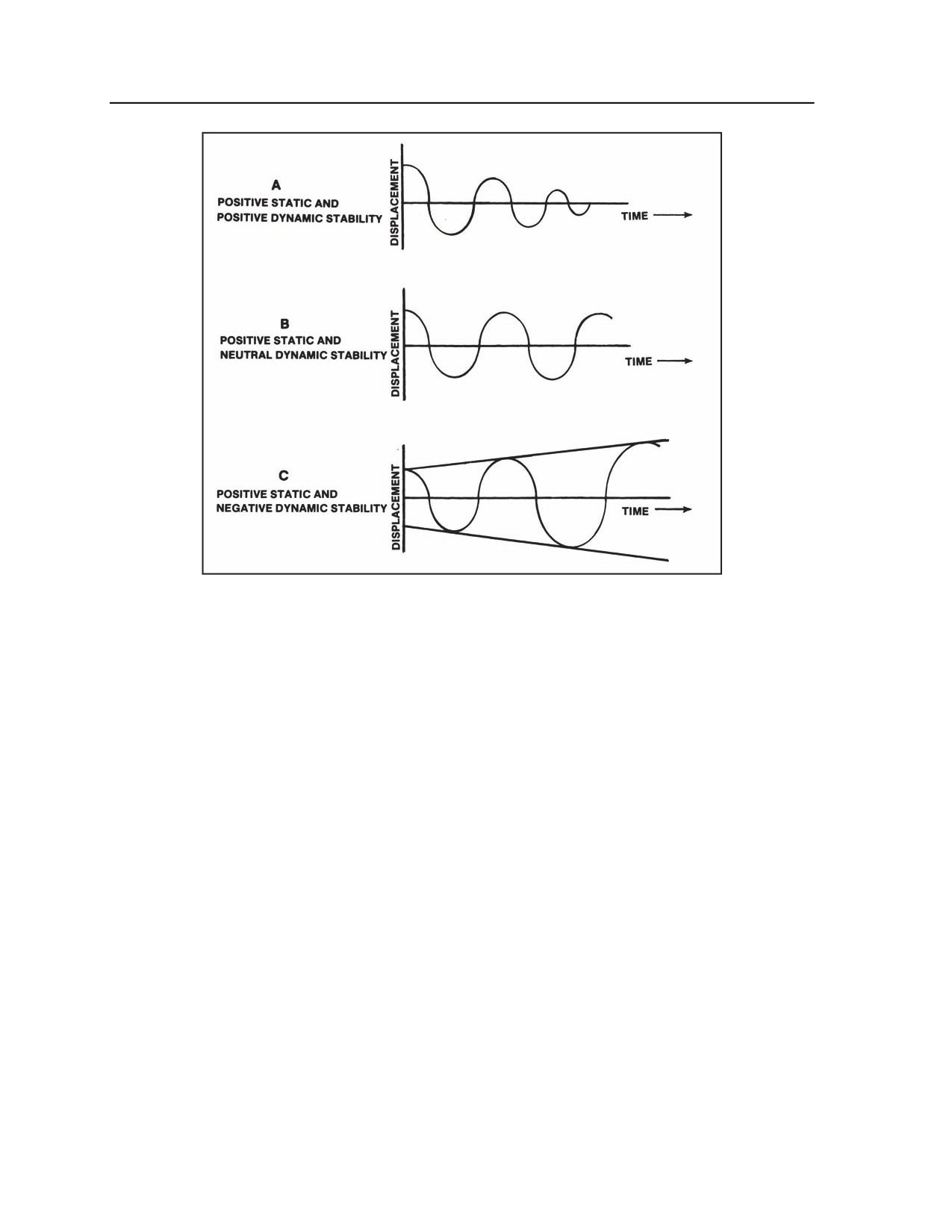
Positive Static and Positive Dynamic Stability
7-12. An object has positive static stability if it is displaced and tends to return to its equilibrium position.
As indicated by the elapsed time shown in figure 7-3, page 7-4, the object at part A moves toward its
equilibrium position. This motion continues but diminishes until the object comes to rest at its equilibrium
position. A decrease in the amplitude of the oscillations indicates the object has positive dynamic stability
and will eventually come to rest in an equilibrium position.
Positive Static and Neutral Dynamic Stability
7-13. Figure 7-3 part B, shows that elapsed time indicates neutral dynamic stability. An object displaced
moves toward equilibrium and overshoots it. Positive static stability makes the object move back toward
the equilibrium position. Again, the object overshoots the equilibrium position with its oscillations equal to
the oscillations in the first displacement. As time passes, the amplitude of the oscillations is the same on
both sides of the equilibrium position and never comes to rest. Because the oscillation amplitude does not
increase or decrease, the object has neutral dynamic stability.
Positive Static and Negative Dynamic Stability
7-14. In figure 7-3 part C, positive static stability makes the object oscillate, as in the first two examples.
However, the increasing amplitude of the oscillations as time passes indicates negative dynamic stability.
Lines drawn tangent to the top and bottom of each oscillation diverge.
7 May 2007
FM 3-04.203
7-3
Chapter 7
Figure 7-3. Oscillatory motion
PITCH STABILITY
7-15. Pitch, or longitudinal, stability is longitudinal axis stability about the lateral axis of the aircraft.
OSCILLATORY PITCHING MOTION
7-16. An aircraft is a well-designed, complex mass in motion. When moved from its equilibrium position,
it develops a moment of inertia. If it has positive static stability, the aircraft becomes oscillatory unless a
damping force prevents the motion. Moderate damping forces cause the oscillation to converge with
equilibrium. The oscillation period is a function of the inertia moment and damping force.
7-17. The oscillation period varies depending on aircraft characteristics at a given airspeed. A long-term
oscillation
(more than 5 seconds) is called phugoid motion (pronounced foogoid). Because the pitch
attitude change is slight, gain or loss in altitude and forward movement of the aircraft result in the motion
occurring at a relatively constant AOA. An aviator makes subconscious pitch-attitude corrections. Because
AOA is essentially constant, the phugoid motion is relatively unimportant for aircraft stability.
7-18. A buzz is a short-term oscillation (0.3 to 0.5 second) and occurs so quickly the stability of the
aircraft dampens out the motion before the aviator can respond.
7-19. A medium-term oscillation (1.5 to 5 seconds) lasts about as long as the aviator’s response time. This
can lead to a sudden and violent divergence in pitch attitude, resulting in large positive and negative load
factors aggravated when the aviator attempts to control the oscillation. This is called pilot-induced
oscillation. During the landing sequence, it is called porpoising.
7-4
FM 3-04.203
7 May 2007
Fixed-Wing Aerodynamics and Performance
PITCHING MOMENTS ABOUT THE CENTER OF GRAVITY
7-20. A controllable aircraft has positive static longitudinal stability and positive dynamic longitudinal
stability. Dynamic stability involving motion with respect to time is not fully covered in this manual. This
section primarily covers static stability. By considering the pitching moments about the aircraft CG, the
aviator can analyze any tendency the aircraft has when it is displaced from its equilibrium position.
7-21. The coefficient of pitching moment (CM) comes from the pitching moment equation. The sign of the
pitching moment coefficient indicates whether a pitching moment will pitch the nose of the aircraft up (+)
or down (-). This section of the manual discusses direction of the pitching moments created by various
components of the aircraft. It does not discuss magnitude of the pitching moment; therefore, the pitching
moment equation will not be explained further in this section.
7-22. Pitching moments about the aircraft CG are caused by changes in total lift as it is distributed between
the wings, fuselage, and tail surfaces. Total lift acts through the aerodynamic center of the entire aircraft; it
is called the neutral point. To simplify discussion, drag changes and compressibility effects are omitted. If
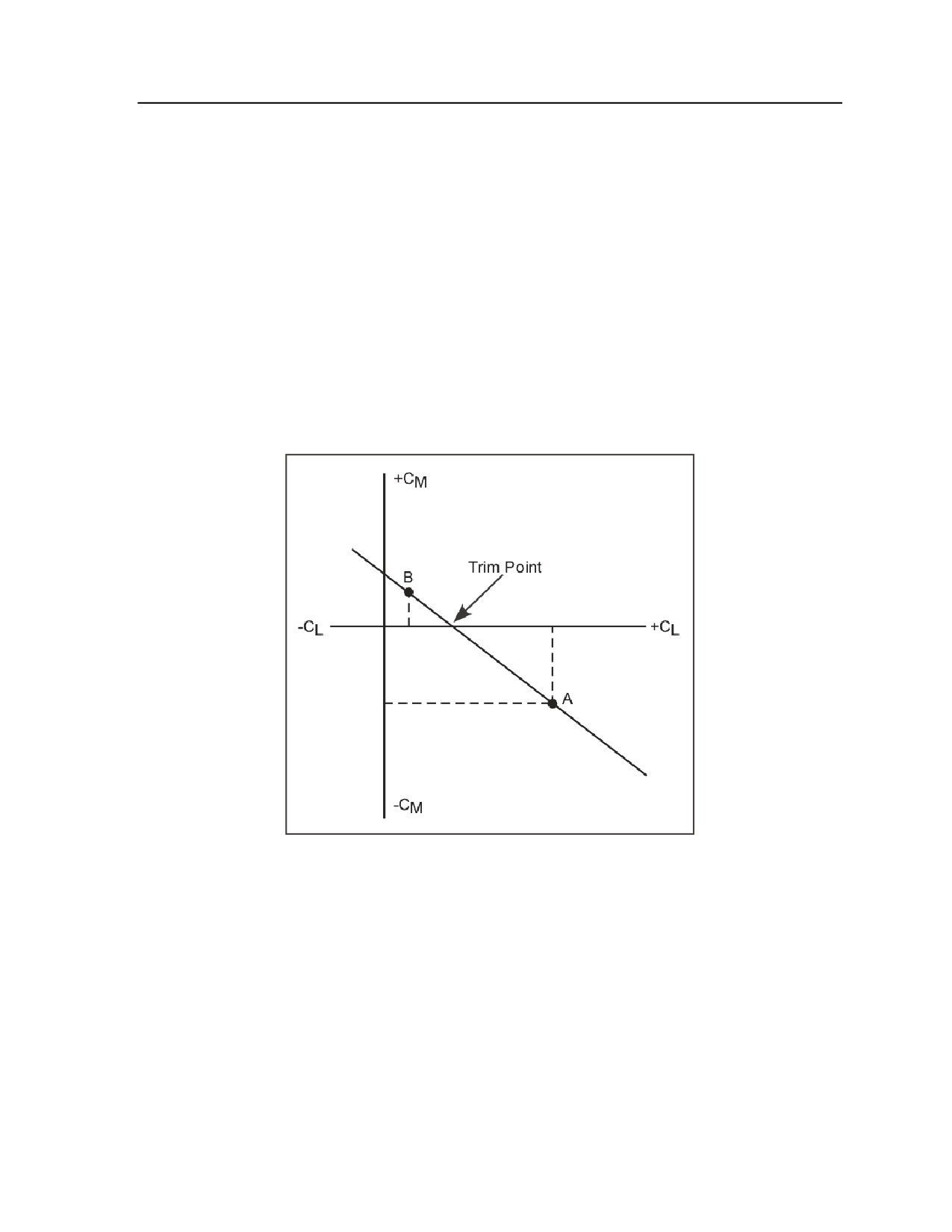
controls are fixed at the trim position, a constant AOA results and a zero pitching moment exists. Figure 7
4 shows this trim point.
Figure 7-4. CM versus CL
7-23. Figure 7-4 also shows the variation of CM with respect to changes in CL. The CL can be used instead
of AOA as their relationship is linear, except as maximum value of the coefficient of lift (CLmax) is
approached. At any AOA above CLmax, the airfoil begins to stall. At the value of CL where the curve
crosses the horizontal axis, the pitching moments are zero. At this AOA
(trim point), stability
considerations are made.
7-24. If the AOA is increased to a higher value of CL than indicated at the trim point, a negative pitching
moment must be present to return the aircraft to the trim AOA. Figure 7-4, point A reflects this. The
opposite is also true. If the AOA decreases from the trim point, a positive pitching moment must be created
that tends to return the aircraft to the trim point. Figure 7-4, point B shows this. For an aircraft to exhibit
positive longitudinal stability, the slope of CM versus the CL curve must be negative. The degree of the
slope indicates the degree of stability. A steeper slope shows stronger pitching moments with changes in
CL so greater stability exists.
7 May 2007
FM 3-04.203
7-5
Chapter 7
7-25. The trim point location is important in aircraft design. The trim point must occur at some usable
AOA, between zero lift and the stalling AOA. To satisfy the preceding requirements, the neutral point, or
aerodynamic center of the aircraft, must be aft of the CG of the aircraft (figure 7-5). If a sudden gust
pitches the aircraft to a higher AOA, the increase in overall lift of the aircraft, acting through the
aerodynamic center, creates a negative pitching moment. This tends to return the aircraft to its equilibrium
position. A gust pitching the aircraft nose down causes a decrease in the AOA and an overall net decrease
in lift forces. This results in a pitching moment about the aircraft CG and tends to return the aircraft to
equilibrium.
Figure 7-5. Fixed-wing aircraft center of gravity and aerodynamic center
WING CONTRIBUTION
7-26. Overall static stability of the aircraft depends on the CG’s position in relation to the aerodynamic
center of the aircraft. All parts of the aircraft contribute to its static stability. The moments contributed by
the wing or other parts depend on the location of the wing’s aerodynamic center or the other aircraft parts
being considered in relation to the CG. Together, these moments determine where the neutral point is
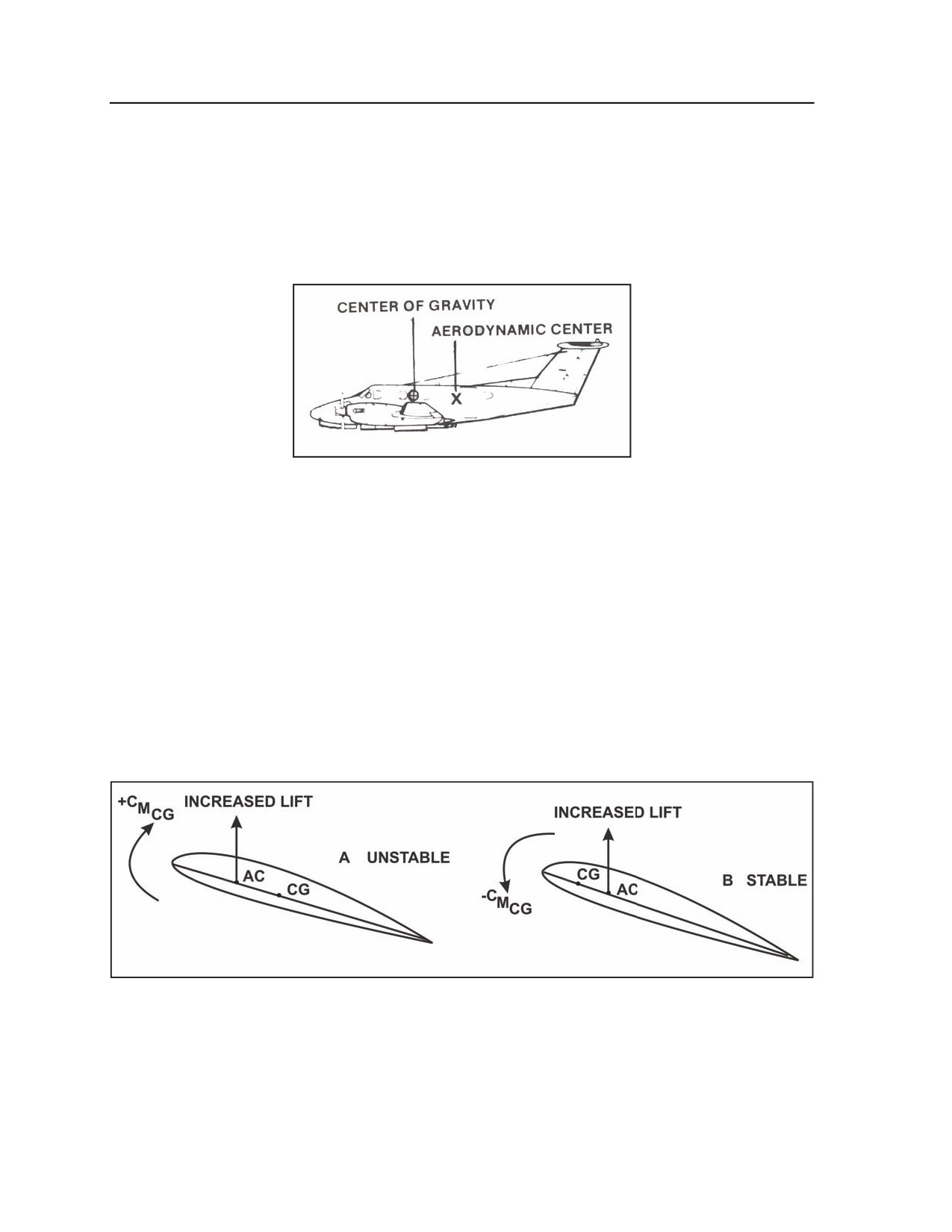
located. If airflow is incompressible, the wing’s aerodynamic center is about the 25 percent chord of the
wing. In figure 7-6, part A, the aircraft CG is behind the wing’s aerodynamic center. An external
disturbance pitching the wing to a higher AOA increases the pitching moment toward the stalling AOA.
This additional increase in AOA also increases the lift and pitching moment. Unless another force counters
the effect, the aircraft will pitch upward repeatedly. As figure 7-6, part B shows, when the wing’s
aerodynamic center is aft of the aircraft CG, longitudinal stability is enhanced. Likewise, if the aircraft CG
and wing’s aerodynamic center coincide, the wing contributes neutral stability to the aircraft.
Figure 7-6. Wing contribution to longitudinal stability
7-27. It is accepted that lift normally acts through the aerodynamic center of an airfoil, when actually, the
aerodynamic force, of which lift is a component, acts through the center of pressure. As angles of attack
change, the center of pressure moves back and forth on the airfoil. Unequal pressure distribution on the
wing creates a moment. The moment about the wing’s aerodynamic center should not be confused with the
moment about the aircraft CG (figure 7-7).
7-6
FM 3-04.203
7 May 2007
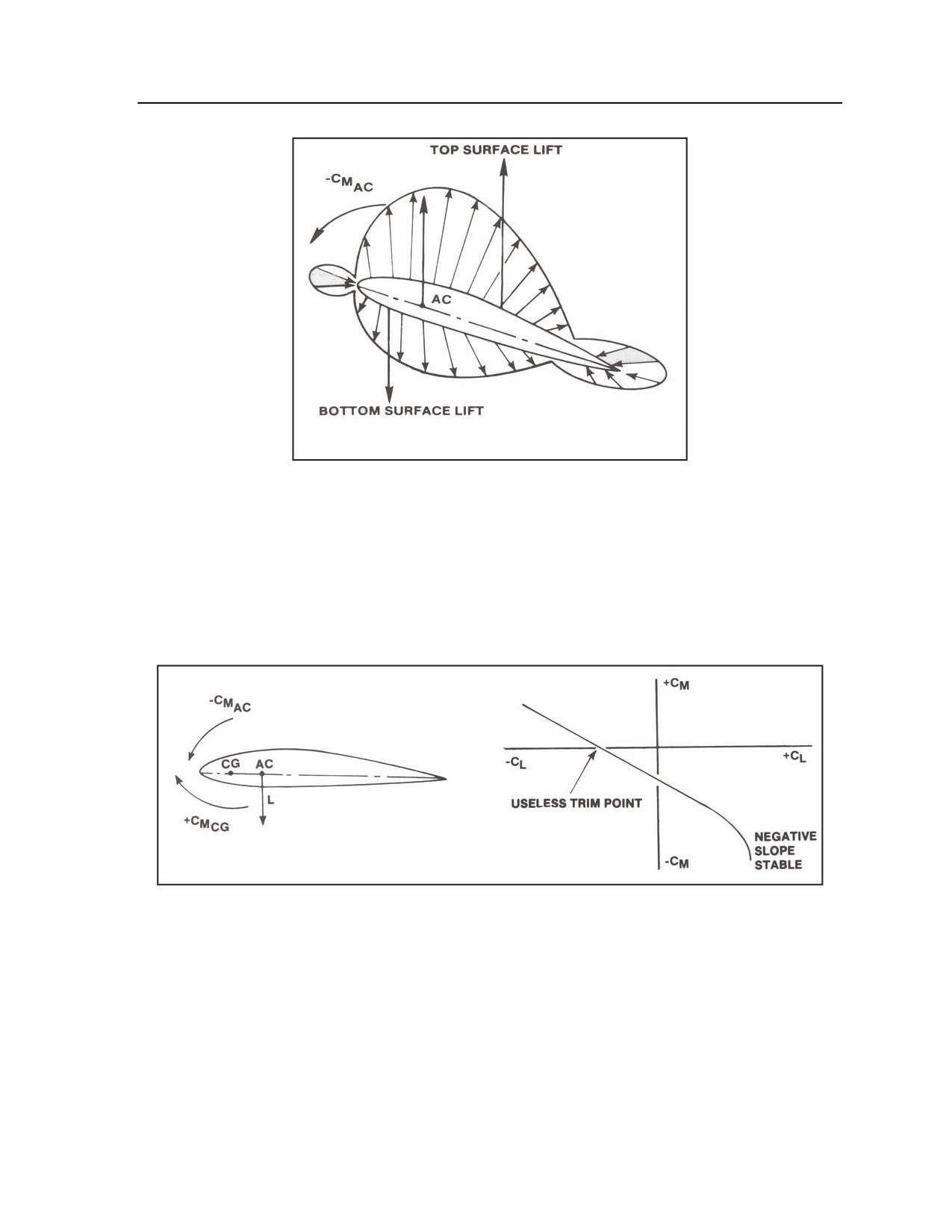
Fixed-Wing Aerodynamics and Performance
Figure 7-7. Negative pitching moment about the aerodynamic center of a positive-cambered
airfoil
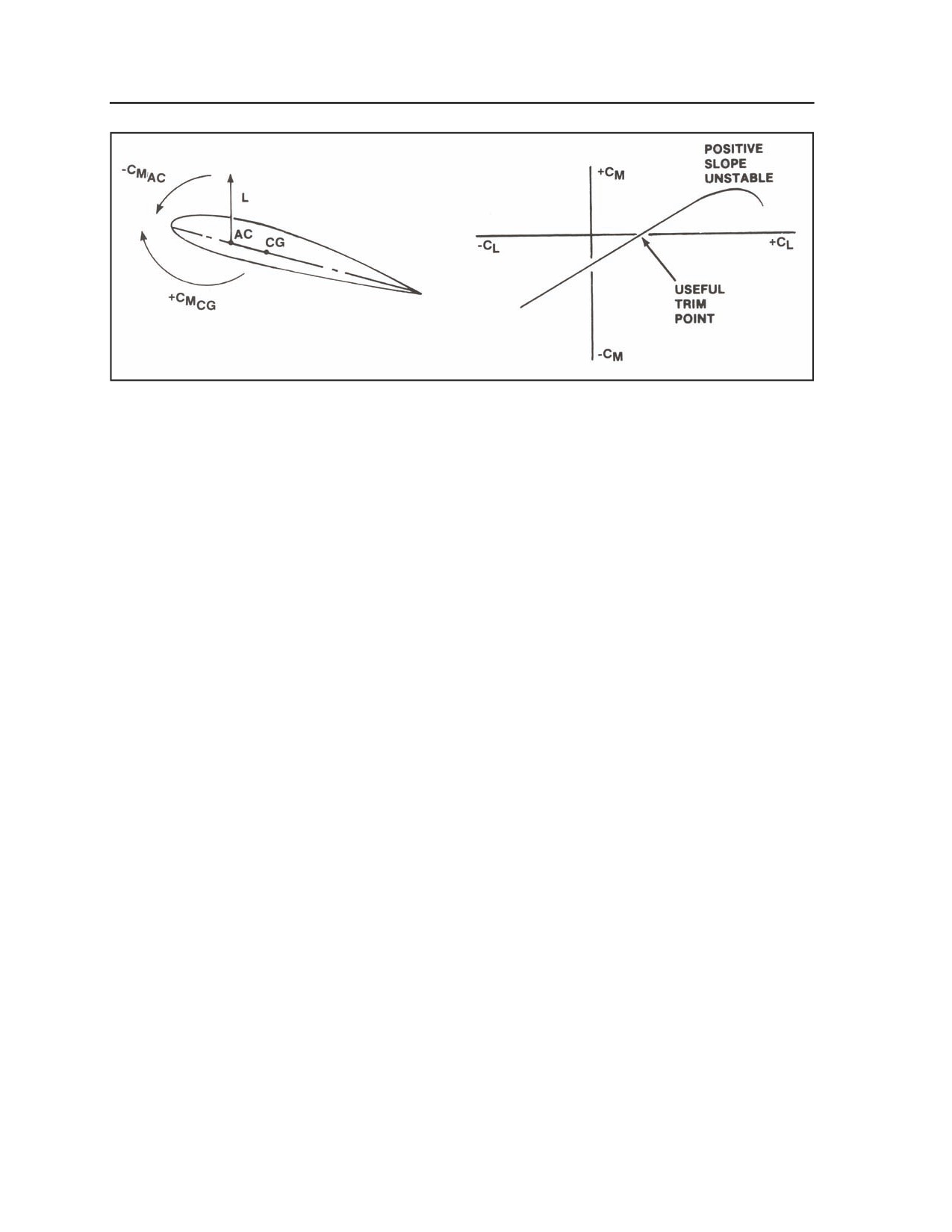
7-28. An aircraft with a positive-cambered airfoil and a CG forward of its aerodynamic center cannot be
trimmed unless the negative moment is balanced by a positive moment about the CG. This balance can be
accomplished only when the value of CL is negative. At any greater value of CL, the net result of the
moments will be negative (figure 7-8). For a positive-cambered wing to contribute positive stability to the
aircraft, it must be trimmed at an unusable AOA. The negative moment can be overcome by a positive
moment from the horizontal tail.
Figure 7-8. Positive longitudinal stability of a positive-cambered airfoil
7-29. If this same wing has the aircraft CG located behind its aerodynamic center, then a positive lift force
at the aerodynamic center creates a positive pitching moment. This positive pitching moment balances the
negative moment about the aerodynamic center present in cambered airfoils. The wing can be trimmed at
an AOA above CL=0 and below the stalling AOA (figure 7-9, page 7-8). The wing, however, contributes
negatively to the stability of the aircraft. This can also be overcome by the horizontal tail.
7 May 2007
FM 3-04.203
7-7
Chapter 7
Figure 7-9. Negative longitudinal stability of a positive-cambered airfoil
7-30. When the aircraft CG is forward of the wing’s aerodynamic center, a positive-cambered airfoil
contributes positively to stability. The aircraft, however, can only be flown in the usable flight mode if a
horizontal tail balances the moments. If the CG is aft of the wing’s aerodynamic center, the CG contributes
negatively to the stability of the aircraft. The aircraft, however, can be balanced by a horizontal tail.
FUSELAGE AND ENGINE NACELLE CONTRIBUTION
7-31. A symmetrical body in a perfect fluid at a positive angle develops pressure distributions, but no
resultant force exists. A streamlined fuselage is a good example. The airstream is not a perfect fluid, and
the fuselage is not perfectly symmetrical. The fuselage produces positive pitching moments at negative
angles of attack. Induced flow from the wing (upwash ahead of the wing and downwash behind the wing)
adds to unstable contributions of the fuselage. An engine nacelle located on the wing’s leading edge is also
influenced by wing upwash and adds to longitudinal instability. The fuselage-engine combination has an
aerodynamic center at about 25 percent of the fuselage length rearward from the fuselage nose. Normally,
no fuselage resultant force exists. The fuselage-engine aerodynamic center is placed in a position relative
to the aircraft aerodynamic center so it makes a negative contribution to aircraft longitudinal stability. This
negative contribution is corrected by using the horizontal stabilizer.
HORIZONTAL STABILIZER CONTRIBUTION
7-32. The horizontal stabilizer, which is usually a symmetrical airfoil, is located well aft of the aircraft CG.
Because the airfoil is symmetrical, it can produce either positive or negative lift, depending on AOA. The
entire horizontal stabilizer is located behind the CG so its aerodynamic center is aft of the CG, creating a
stable relationship.
7-33. The stabilizing moment created by the horizontal stabilizer can be controlled in two ways. The
distance (moment arm) can be increased between the CG and horizontal stabilizer’s aerodynamic center, or
the stabilizer’s surface area can be increased. Because the stabilizer is an airfoil, it produces lift as the
stabilizing force. An increase in the tail area or the distance between the CG and stabilizer’s aerodynamic
center increases the tail force and stabilizing moment.
7-34. If the aircraft pitches up to an AOA higher than the trim AOA, the increased AOA on the horizontal
stabilizer increases the positive lift of the tail (figure 7-10, page 7-9). This produces a negative pitching
moment and returns the aircraft toward the equilibrium trim point. If the aircraft AOA decreases, the
horizontal stabilizer AOA also decreases and produces less, or even negative, lift. This creates a positive
pitching moment about the CG and returns the aircraft to equilibrium.
7-8
FM 3-04.203
7 May 2007
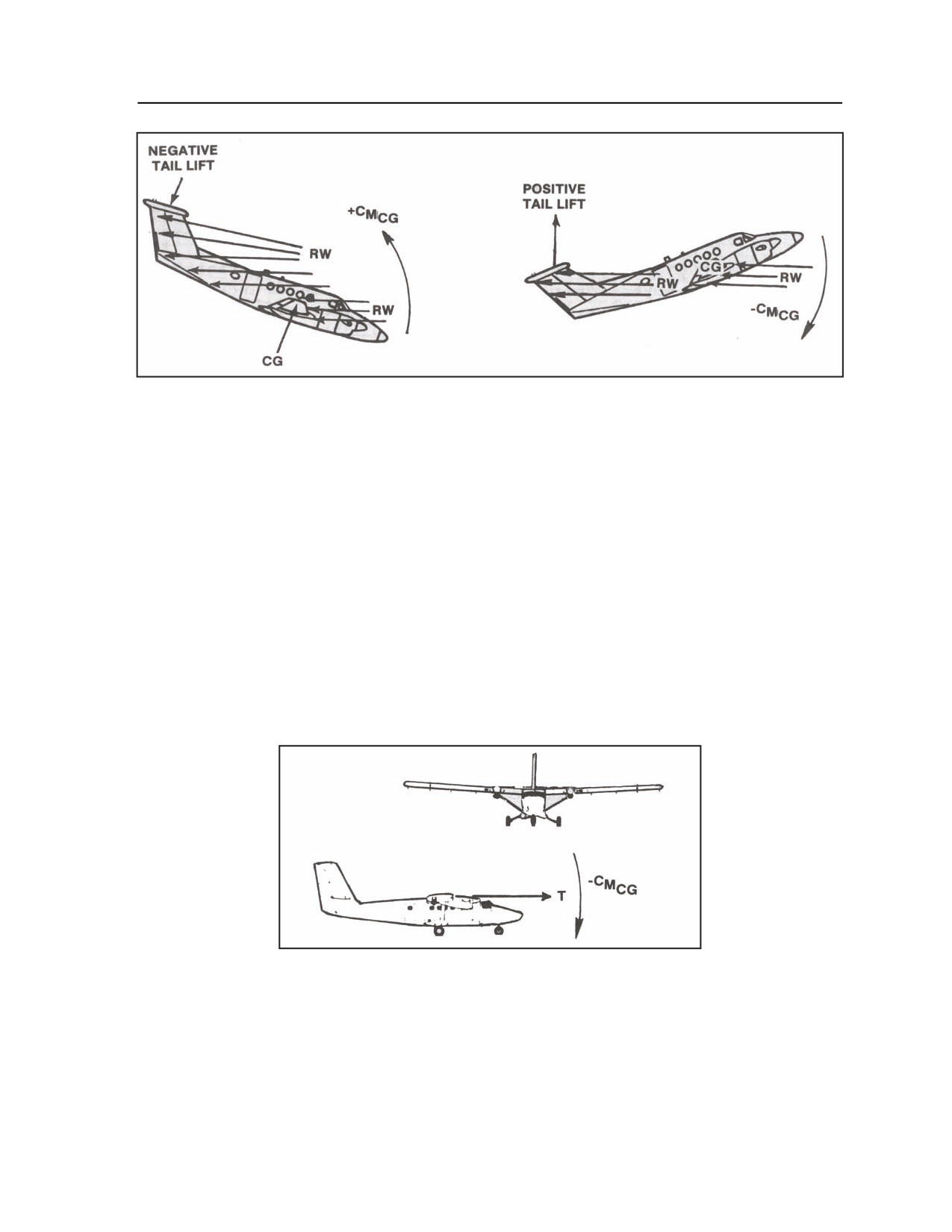
Fixed-Wing Aerodynamics and Performance
Figure 7-10. Lift as a stabilizing moment to the horizontal stabilizer
WING, FUSELAGE, AND HORIZONTAL STABILIZER COMBINATION
7-35. Depending on the location of the aircraft CG relative to the wing’s aerodynamic center, the wing
may stabilize or destabilize to the entire aircraft. The horizontal stabilizer is used to overcome the trim
problem of a stabilizing wing (CG ahead of the wing’s aerodynamic center). The horizontal stabilizer also
provides the stability needed with an unstable wing (CG aft of the wing’s aerodynamic center). Because
the fuselage is destabilizing to the entire aircraft, the horizontal stabilizer is also used to solve this negative
contribution. To create positive static stability, the aerodynamic center of the entire aircraft must be located
aft of the aircraft CG.
THRUST AXIS CONTRIBUTION
7-36. The line along the thrust force vector is called the thrust axis. If the thrust axis is located above the
aircraft CG, an increase in thrust creates a negative pitching moment (figure
7-11). The horizontal
stabilizer must also balance this moment. The aviator must be able to trim the aircraft at any power setting.
If thrust is located below the CG, opposite pitching moments are created when thrust is increased.
Figure 7-11. Thrust axis about center of gravity
DIRECTIONAL STABILITY
7-37. Directional stability involves motion of the aircraft about the vertical axis, or the yawing motion of
the aircraft. Directional stability also involves sideslip and yawing moments produced about the CG due to
sideslip.
7 May 2007
FM 3-04.203
7-9
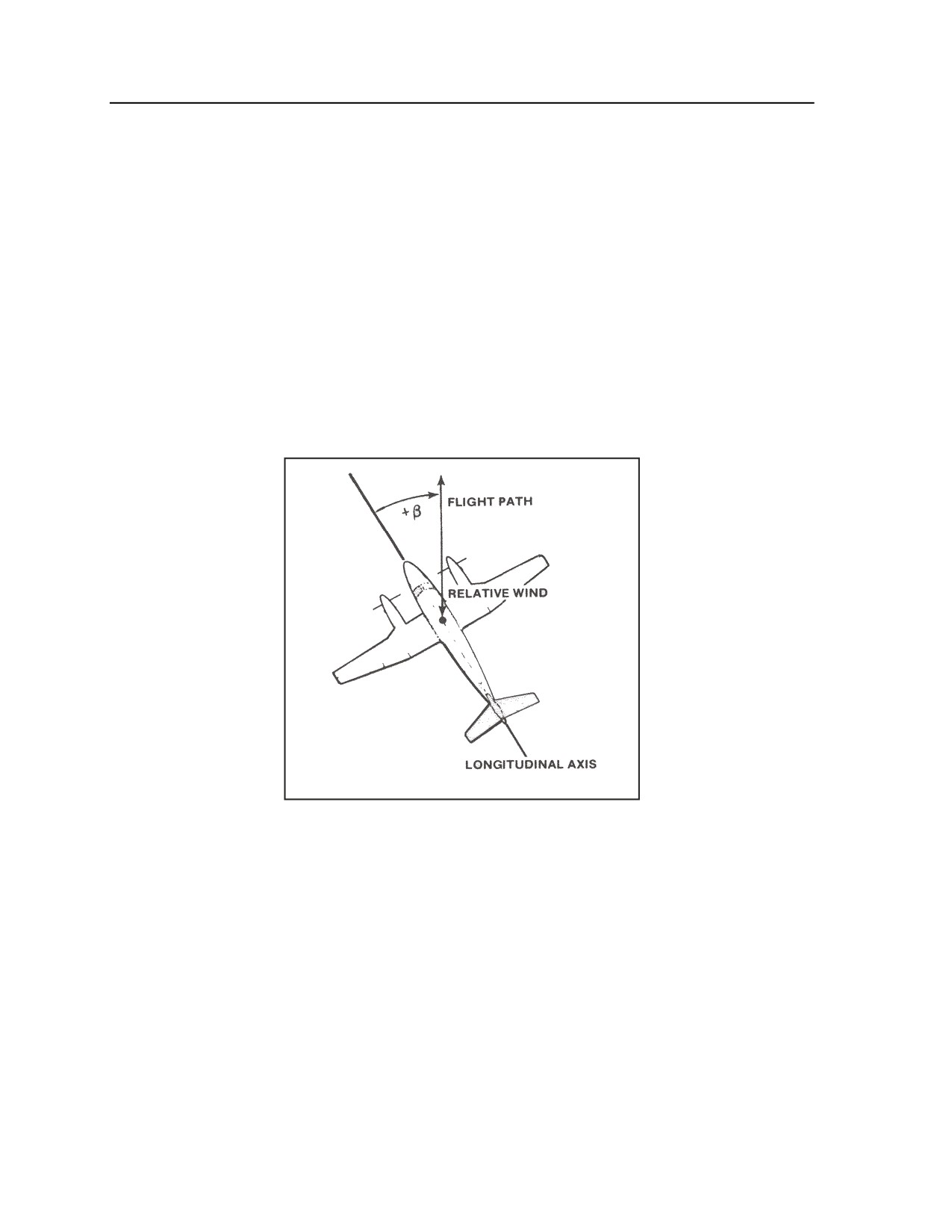
Chapter 7
SIDESLIP ANGLE
7-38. Sideslip angle, which is symbolized by using the Greek letter beta (ȕ), is the angle between relative
wind and the longitudinal axis of the aircraft. When relative wind is right of the aircraft’s nose, the sideslip
angle is positive. Figure 7-12 shows a positive sideslip angle.
YAWING MOMENTS VERSUS SIDESLIP ANGLE
7-39. This section covers the direction of the moments about the CG. The magnitude of these moments
will not be developed. The coefficient of a yawing moment (CN) denotes the direction of the yawing
moments developed by the various components of the aircraft. The negative (-) sign is used for left yawing
moment, and the positive (+) sign is used for right yawing moment.
7-40. The aircraft should be in directional equilibrium if the relative wind is parallel to the aircraft’s nose
or along the longitudinal axis. If no sideslip exists, no yawing moment exists. However, if the aircraft has a
positive sideslip angle (figure 7-12), a positive yawing moment is required for static directional stability. If
relative wind is coming from the right, the aircraft should tend to yaw toward the right. This yawing
motion to the right will return the relative wind to the aircraft’s nose and reestablish equilibrium.
Figure 7-12. Positive sideslip angle
AIRCRAFT COMPONENT CONTRIBUTIONS
Fuselage and Engine Nacelle
7-41. In considering longitudinal stability, the fuselage and engine nacelles are influenced by upwash and
downwash of the airstream as it passes over the wing. This adds to the instability created by the fuselage.
In directional stability, wing influences do not affect the yawing moments created by the fuselage and
engine nacelles. The only consideration is the side area of the fuselage and engine nacelles ahead of the CG
when that area is compared to the side area behind the CG. Most aircraft have a larger side area ahead of
the CG than behind it. Therefore, a relative wind striking the aircraft from either side causes a larger
yawing moment ahead of the CG than behind it. This creates an unstable directional condition as the
aircraft yaws away from the relative wind (figure 7-13, page 7-11). In other words, a positive (right)
sideslip angle on the fuselage produces a negative (left) yawing moment.
7-10
FM 3-04.203
7 May 2007
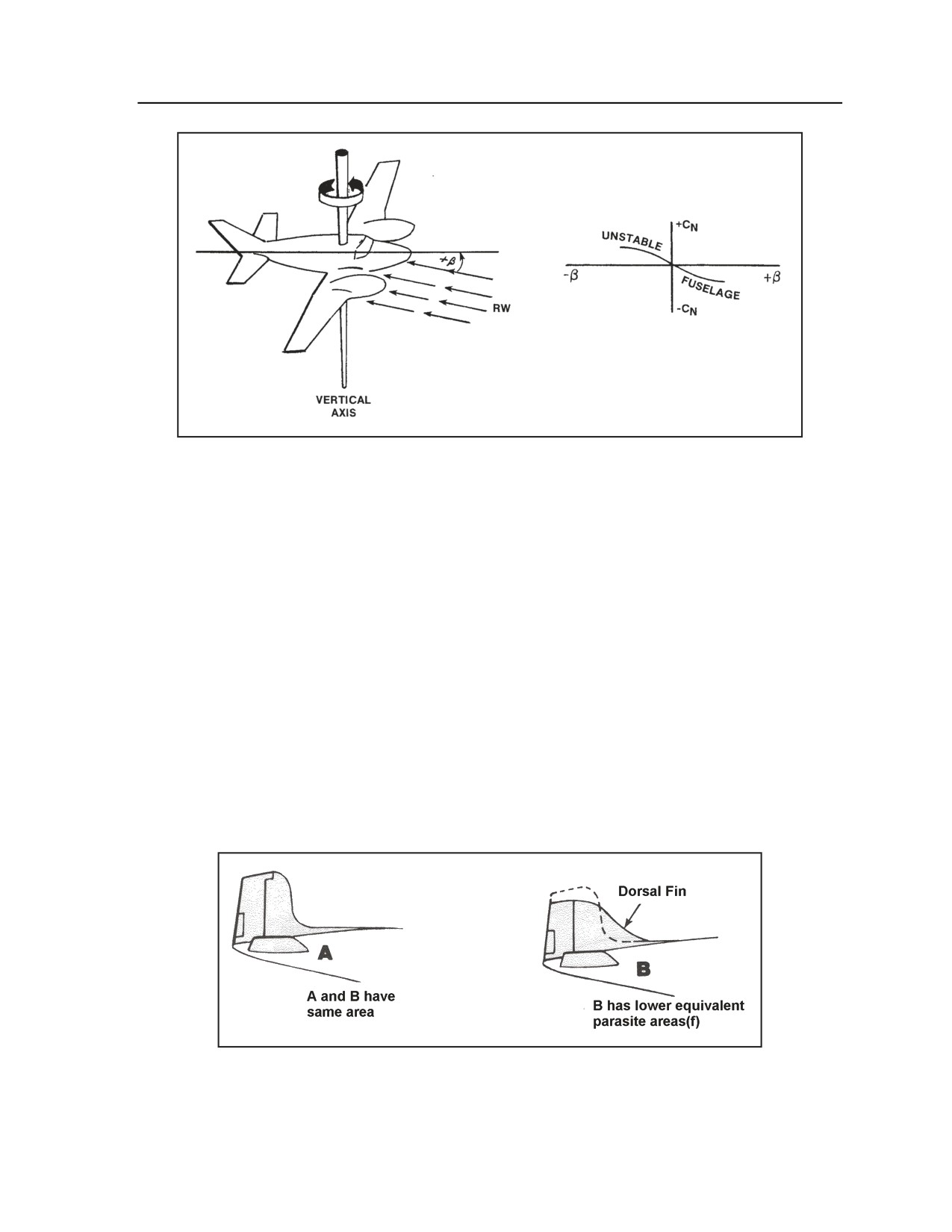
Fixed-Wing Aerodynamics and Performance
Figure 7-13. Directional stability (β versus CN)
7-42. To achieve directional stability, the side area of the aircraft must be larger behind the CG. Therefore,
a fin, or vertical stabilizer, must be added to the fuselage to increase the area, create a desirable yawing
moment, and produce positive directional stability.
Vertical Stabilizer
7-43. The vertical stabilizer is a symmetrical airfoil. Like the horizontal stabilizer, it is located behind the
aircraft CG. Therefore, the aerodynamic center of the vertical stabilizer is located in a position producing
positive static directional stability.
7-44. As with the horizontal stabilizer, the vertical stabilizer area, or distance from the CG, can be varied
to obtain desired stabilizing moments. However, increasing the vertical stabilizer area too much increases
the height of the tail, which increases the frontal area and drag. To decrease drag, the height of the tail is
often decreased and a dorsal fin added (figure 7-14). This also decreases the aspect ratio of the vertical
stabilizer, which makes the tail effective at higher angles of sideslip. Because the vertical stabilizer is an
airfoil, it is subject to aerodynamic stalls. Aerodynamic stalls can occur at high sideslip angles. Adding the
dorsal fin, which decreases the aspect ratio of the tail, increases the stalling AOA. The tail is then effective
at larger angles of sideslip. This is of particular importance to a multiengine aircraft subjected to large
sideslip angles due to asymmetrical power conditions; for example, an inoperative engine on one wing.
Figure 7-14. Dorsal fin decreases drag
7 May 2007
FM 3-04.203
7-11
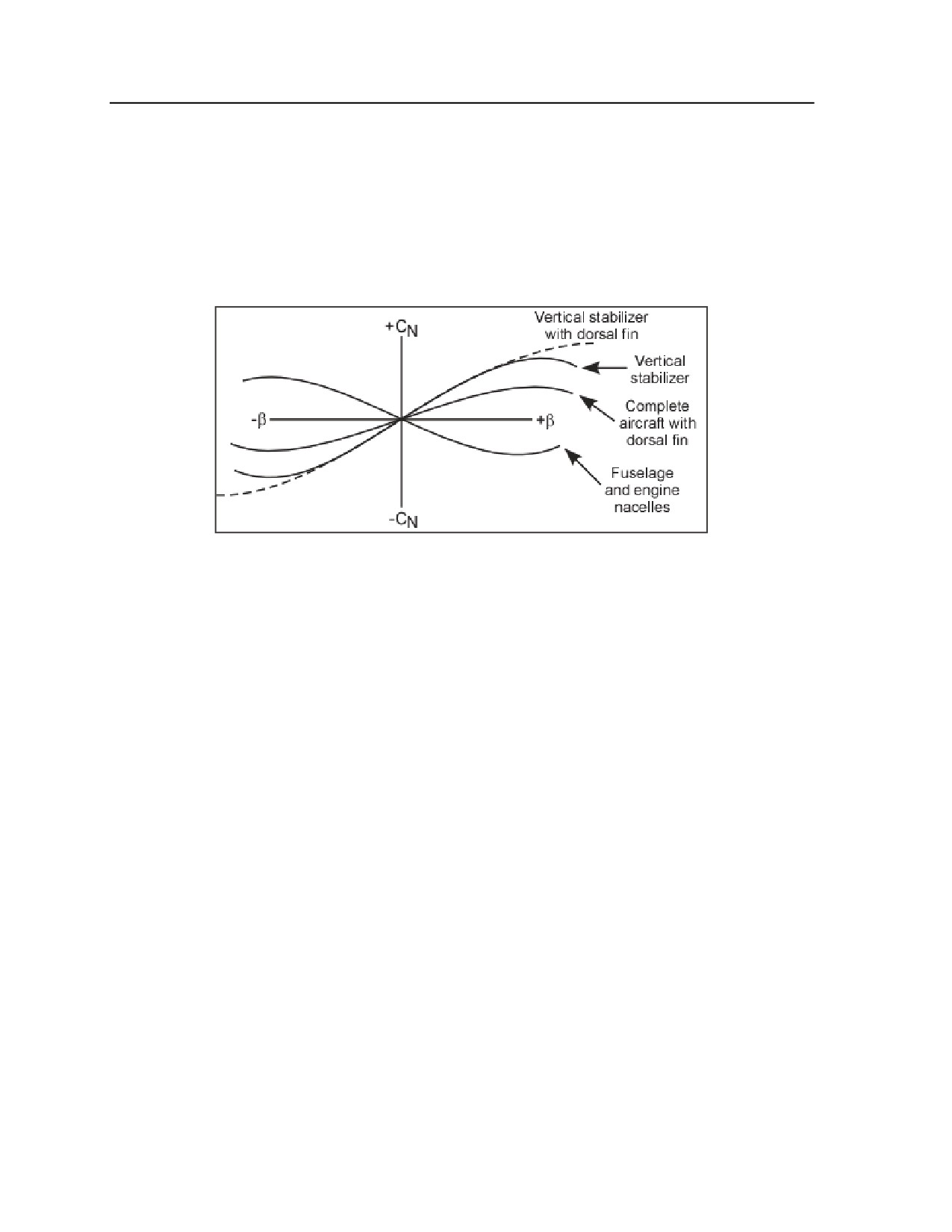
Chapter 7
Wing
7-45. Wing contribution to aircraft directional stability is small. However, it becomes greater with
increases in swept-back wing design. To be effective, this swept-back angle must be at least 30 degrees.
Final Configuration
7-46. Figure 7-15 shows aircraft final configuration. This aircraft configuration must have a positive slope
of the CN curve. Figure 7-15 also shows how the vertical stabilizer must produce a stabilizing moment
strong enough to overcome the destabilizing moments generated by the fuselage and engine nacelles.
Figure 7-15. Fixed-wing aircraft configuration positive yawing moment
LATERAL STABILITY
7-47. Lateral, or roll, stability involves lateral axis stability about the longitudinal axis. Motion about the
longitudinal axis is roll. A right roll is indicated with a positive sign; a left roll, with a negative sign. Wing
design is important to aircraft stability. It is the primary lift-producing and roll-stabilizing surface. As with
directional stability, the aircraft achieves its roll stability through the sideslip angle. With roll stability only,
stabilizing rolling moments are created by the sideslip acting on the wing.
SIDESLIP CAUSED BY WING DOWN
7-48. In figure 7-16, page 7-13, the aircraft has its right wing down. This tilts the wing’s lift vector to the
right so a horizontal component of lift acts to the right. Because there is no opposing force, this horizontal
force moves the aircraft to the right. This motion to the right, along with the forward motion of the aircraft,
produces a positive sideslip angle. With the right wing down and a positive sideslip angle generated, the
aircraft must develop a negative, or left, rolling moment for positive static lateral stability (the coefficient
of the rolling moment [C1] is not the coefficient of lift.). A curve of the rolling moment versus the sideslip
angle must have a negative slope to indicate positive static lateral stability (figure 7-17, page 7-13). The
curve must go through the origin as a rolling moment should not be generated when the aircraft wings are
level and the relative wind is on the nose. The degree of slope, as with other stabilizing curves, indicates
the degree of lateral static stability of the aircraft.
7-12
FM 3-04.203
7 May 2007
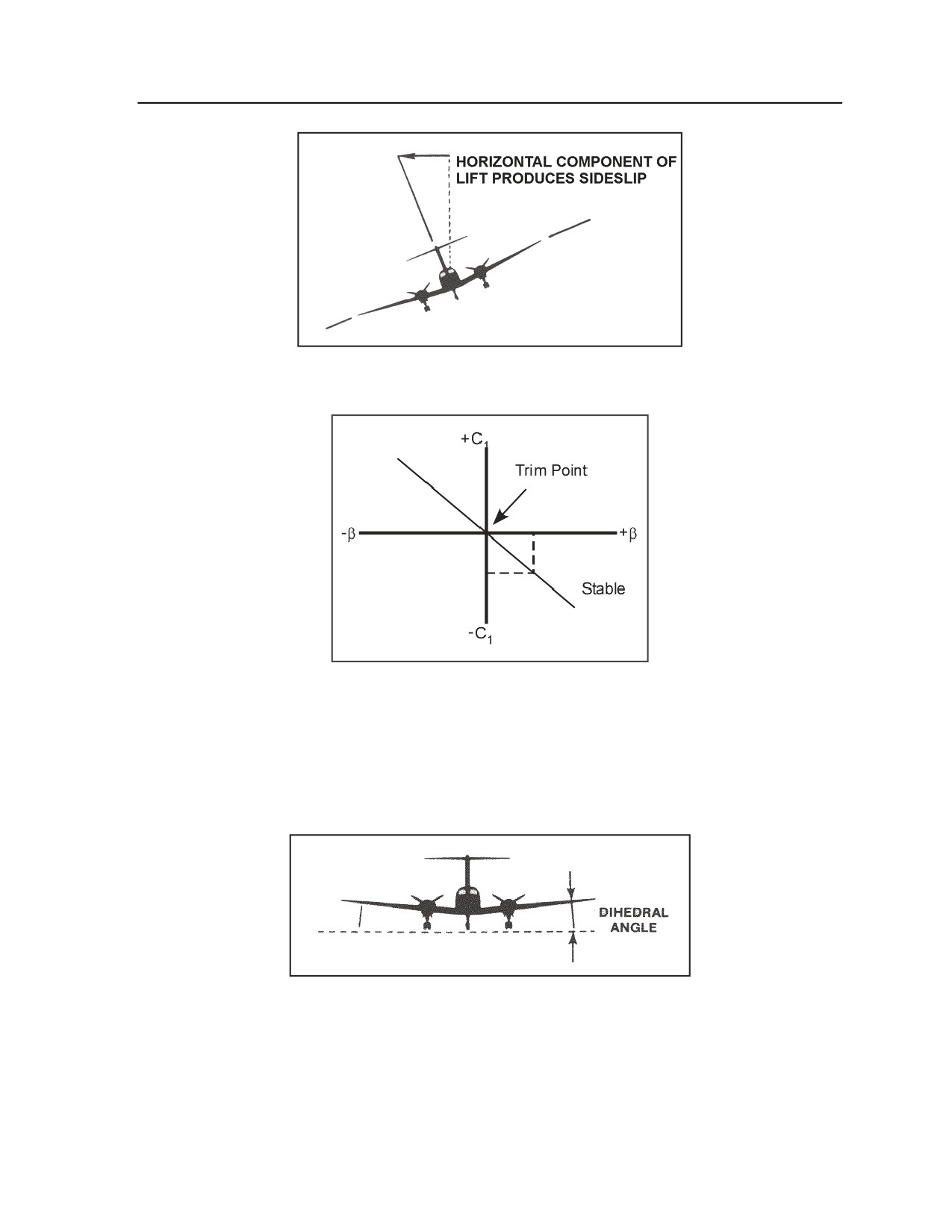
Fixed-Wing Aerodynamics and Performance
Figure 7-16. Horizontal lift component produces sideslip
Figure 7-17. Positive static lateral stability
DIHEDRAL
7-49. Dihedral of the wing is the angle between the wing and a plane parallel to the lateral axis (figure 7
18), creating a stabilizing moment. When the wings droop, they have an anhedral, a negative dihedral, or
cathedral angle. In other words, the wing produces a destabilizing rolling moment.
Figure 7-18. Dihedral angle
Stability
7-50. To understand how dihedral produces a stabilizing moment, a three-dimensional picture is required;
however, figure 7-19, page 7-14, shows the relative wind approaching the airfoil from the left side of the
7 May 2007
FM 3-04.203
7-13
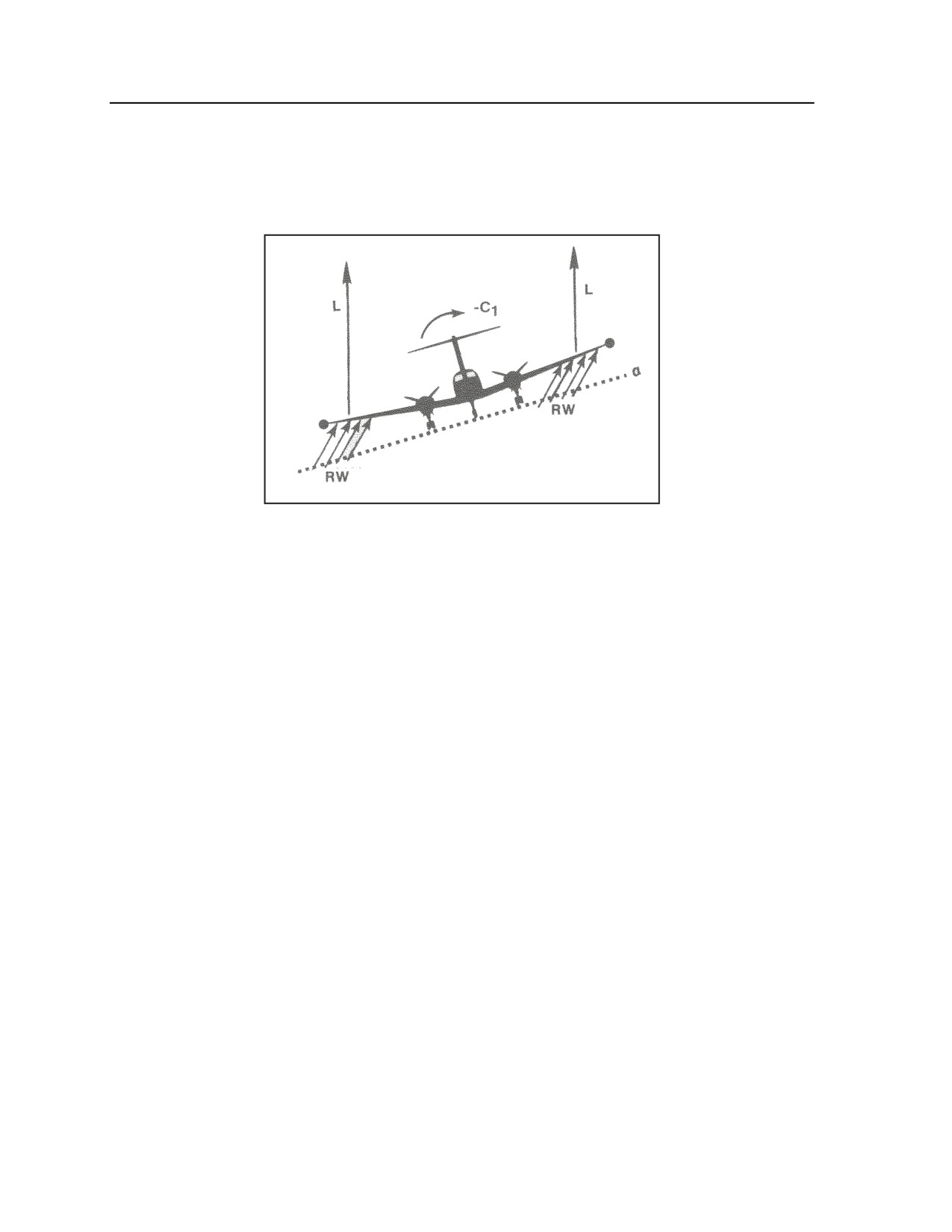
Chapter 7
figure. The aircraft is moving forward in a right sideslip. Therefore, the third dimension must be added to
the figure. The third dimension is the relative wind caused by the forward velocity of the aircraft. The low
wing has a higher AOA than the high wing. This higher AOA gives the lower wing a larger coefficient of
lift than the higher wing. The lower wing now creates more lift than the high wing. Therefore, a negative
rolling moment is created by the differential in lift forces between the two wings.
Figure 7-19. Dihedral stability
7-51. An anhedral angle produces the opposite reaction. The positive sideslip angle produces a positive
rolling moment. Anhedral laterally destabilizes the aircraft.
Effects
7-52. Dihedral was the first method used in the construction of aircraft to gain lateral stability. Factors
other than dihedral can contribute to lateral stability of the aircraft. Their contributions are called dihedral
effects. They can either stabilize or destabilize; therefore, their contributions are classified as either
positive or negative dihedral effects.
7-53. The vertical location of the wing in relation to the CG affects lateral stability. A high wing
contributes a positive dihedral effect; a low wing contributes a negative dihedral effect. Wing position has
a significant effect on lateral stability, causing the large dihedral angle normally used on aircraft with low
wings. Wings mounted near the CG have essentially no effect on the lateral stability of the aircraft.
7-54. The vertical stabilizer makes a slight, positive contribution to the lateral stability of the aircraft.
Because the vertical stabilizer is a large area above the aircraft CG, the sideward force caused by the
sideslip angle produces a favorable rolling moment and helps stabilize the aircraft laterally.
TOTAL AIRCRAFT AND POSITIVE STATIC LATERAL STABILITY
7-55. The total aircraft must demonstrate a tendency toward positive static lateral stability. Some
components might produce negative stabilizing moments. However, they must be overcome by stabilizing
moments from some other component of the aircraft so the total aircraft is laterally stable.
CROSS-EFFECTS AND STABILITY
7-56. The sideslip angle is the main factor used to achieve directional and lateral stability. Because yaws
and rolls both produce sideslips, cross-effects between directional and lateral stability exist. A sideslip
angle produces a yawing and a rolling moment at the same time. The magnitude of the moments and inertia
of the aircraft, or its resistance to react to the moments created, can produce certain cross-effects. Some of
these effects are desirable; some are not.
7-14
FM 3-04.203
7 May 2007