FM 3-04.203 Fundamentals of Flight (May 2007) - page 5
Rotary-Wing Environmental Flight
Ground Indicators
3-160. Ground indicators work well for each isolated location and are subject to change a short distance
away. Some examples are—
Bodies of water. Upwind part of a small body of water indicated by a smooth surface. The
downwind side indicates turbulence indicating an idea of the velocity. Whitecaps occur on an
unprotected body of water at 20 miles per hour (MPH).
Smoke. Indicator of wind and velocity. Rising smoke indicates a light wind while smoke
moving laterally indicates a stronger wind.
Leaves. Color of the leaves on a deciduous tree indicates wind direction. When leaves appear
lighter in color, the aviator is flying downwind. Leaves appear darker when the aviator is flying
upwind.
Tall grass. Indicates wind direction and velocity. Direction is indicated by the movement of the
grass and the frequency of that movement indicates wind velocity.
Manmade indicators. Provides wind information accurately. Some manmade indicators used
by aviators are wind socks or smoke grenades.
Aircraft Indicators
3-161. An experienced aviator can determine the wind by aircraft reaction and its apparent movement
over the ground. When the aircraft drifts from the desired ground track, it indicates a crosswind. A
difference between apparent ground speed and indicated airspeed suggests a headwind or tailwind. An
increase/decrease of power from a previous setting for airspeed indicates downdrafts/updrafts.
Before Beginning an Approach
3-162. Before beginning an approach, an LZ reconnaissance is conducted to evaluate conditions around
and on the proposed landing area. Aviators must assess subsequent takeoff conditions before landing in the
area. This reconnaissance consists of two phases—high reconnaissance and low reconnaissance.
High Reconnaissance
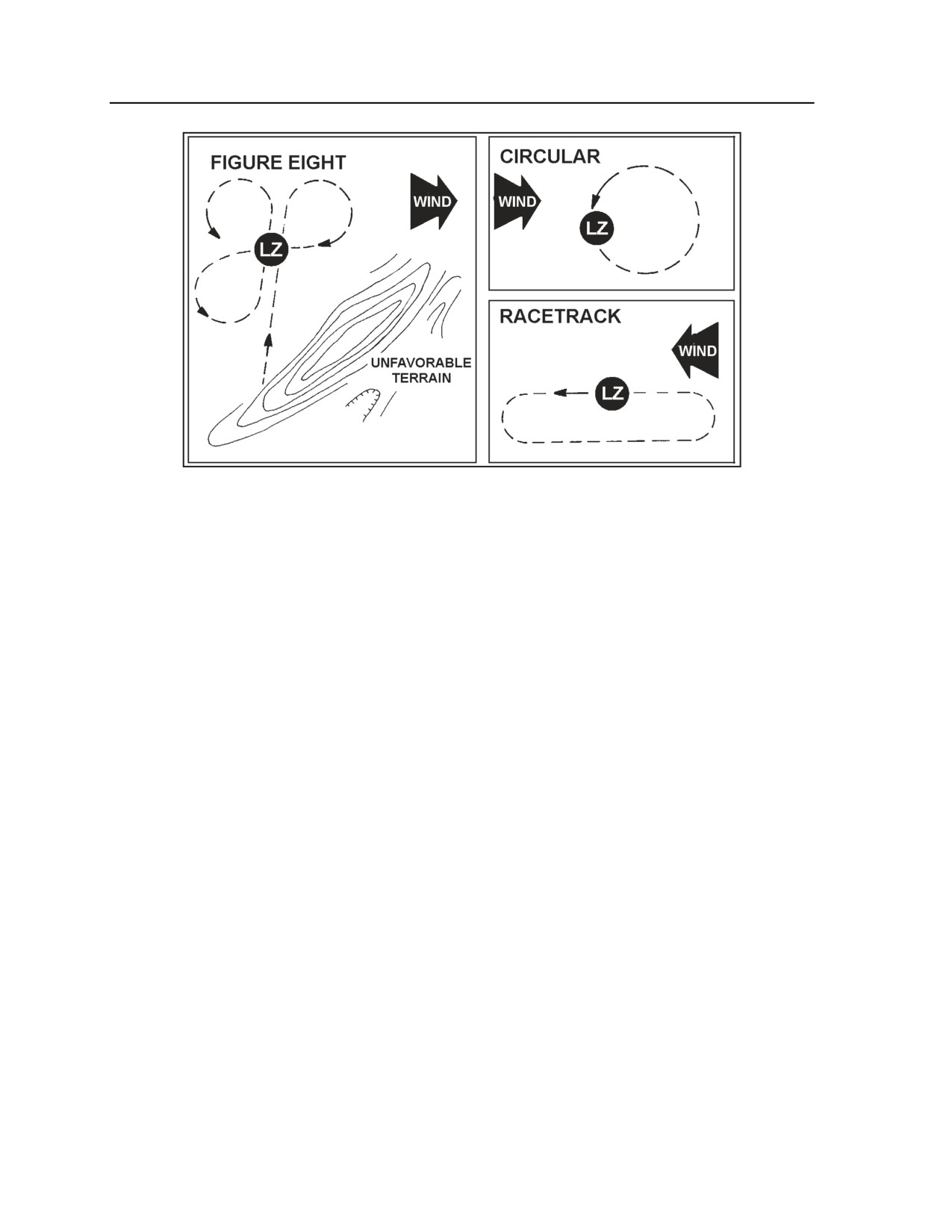
3-163. During high reconnaissance, consideration must be given to determining the approach path. The
three recommended flight patterns flown to conduct the high reconnaissance are figure eight, circular, and
racetrack (figure 3-22, page 3-38). Regardless of the type flown, the following techniques are used:
Flight altitude should be high enough to ensure safe operations in case a downdraft is
encountered. Wind speed and the nature of the terrain are considered when selecting an altitude.
Terrain should be observed while maintaining aircraft airspeed limitations.
Flight pattern should be maintained relatively close to the landing area; however, aircraft
maneuvers should be limited to bank angles of 30 degrees or less.
3-164. The high reconnaissance should assess the following:
Landing zone. Determine slope, shadowed area, obstacles in and around the LZ, and any
surface debris that could damage the aircraft.
Wind. Determine direction, speed, and location of the demarcation line and any other variables
of wind flow.
Takeoff route. Locate takeoff direction (into the wind) and lowest obstacles, and identify
escape routes and forced landing areas, if any.
7 May 2007
FM 3-04.203
3-37
Chapter 3
Figure 3-22. High reconnaissance flight patterns
Low Reconnaissance
3-165. Low reconnaissance may be performed to verify information gathered by high reconnaissance. If
the information from high reconnaissance was sufficient, then low reconnaissance can be combined with
the approach. Availability of power for approach and landing is determined from the PPC. When the
aircraft is directly over the touchdown point, altitudes (MSL and AGL) are noted for use during the landing
pattern. This knowledge aids aviators in establishing an appropriate traffic pattern altitude, especially when
initiating the final leg. In mountainous terrain, the tendency-without this actual LZ altitude information-is
to react to the surrounding terrain and fly the pattern too high or too low. If at any time during low
reconnaissance it is determined conditions around the LZ are unsafe, reconnaissance is discontinued and
the aircraft proceeds to an alternate LZ. The following specific conditions must be evaluated during low
reconnaissance:
Pinpoint wind direction and effects of the wind on surrounding terrain; wind indicators observed
away from the LZ should be ignored as wind may be different over the touchdown point.
Evaluate the touchdown point, size of the landing area, slope, type of surface, and any
obstructions.
Determine whether the approach should be terminated to the ground or to a hover.
Evaluate the approach path.
Identify escape routes.
Evaluate the takeoff path.
Determine air temperature and PA.
3-166. There are two recommended methods for conducting low reconnaissance and evaluating the wind
condition. When performing either method, aviators fly the aircraft at an altitude slightly above the landing
point. A portion of the flight path (for low reconnaissance) must be flown over the intended touchdown
point to adequately assess the wind.
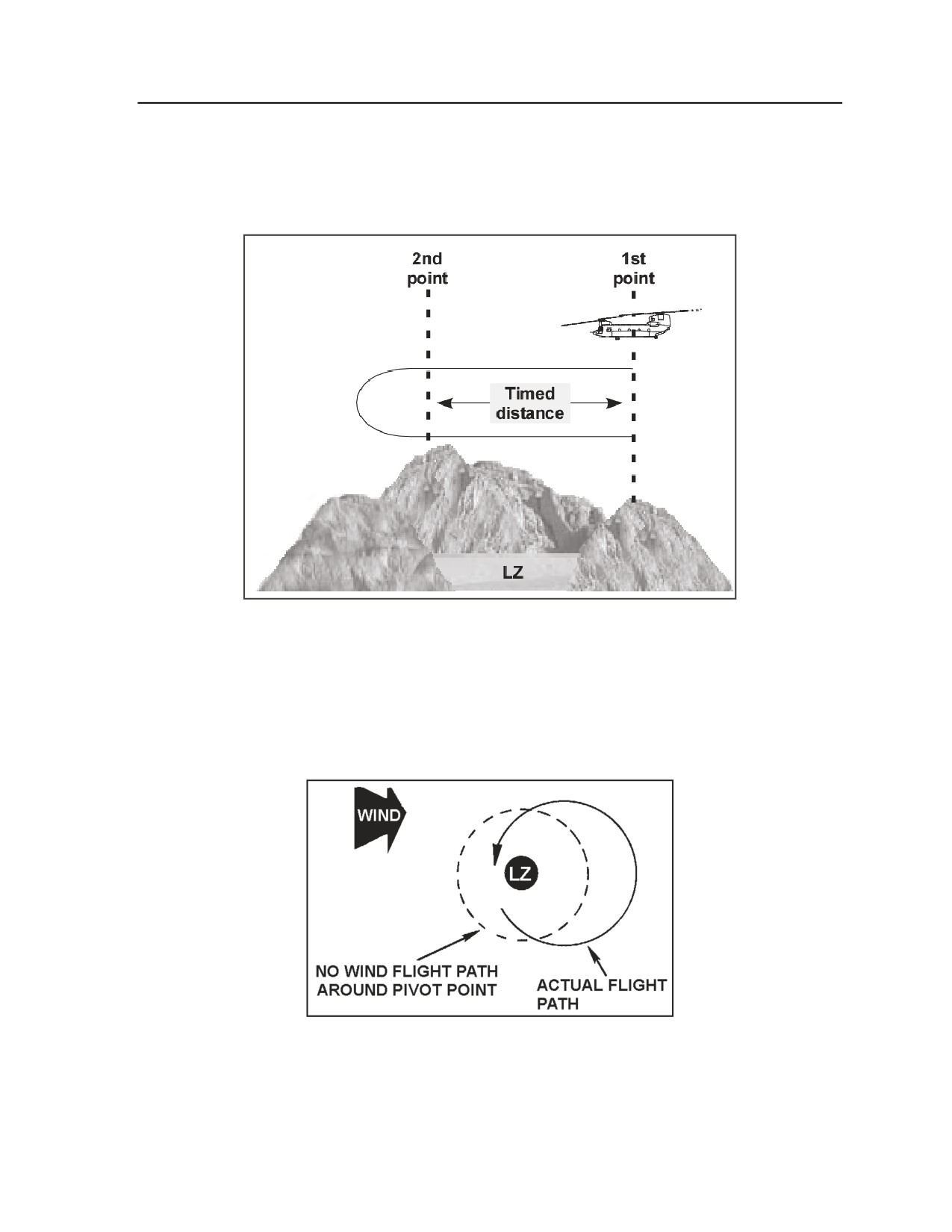
Time between two points (figure 3-23, page 3-39). Aviator selects two recognizable terrain
features (reference points) near the LZ. Separation between these points is approximately 300
meters and oriented in the same general direction as the wind. Constant airspeed is established
and flown throughout reconnaissance. As the aircraft passes over the first point, position is
noted and the clock started. When the aviator passes over the second point, time is noted in the
3-38
FM 3-04.203
7 May 2007
Rotary-Wing Environmental Flight
seconds required to travel the distance between the two points. The course is reversed and the
procedure repeated. Direction of flight requiring the shortest time indicates the approximate
wind direction. If a crab is required to maintain ground track, the direction of crab indicates a
more specific heading. Wind velocity is directly proportional to a larger time difference between
the two points or a larger crab angle.
Figure 3-23. Computing wind direction between two points
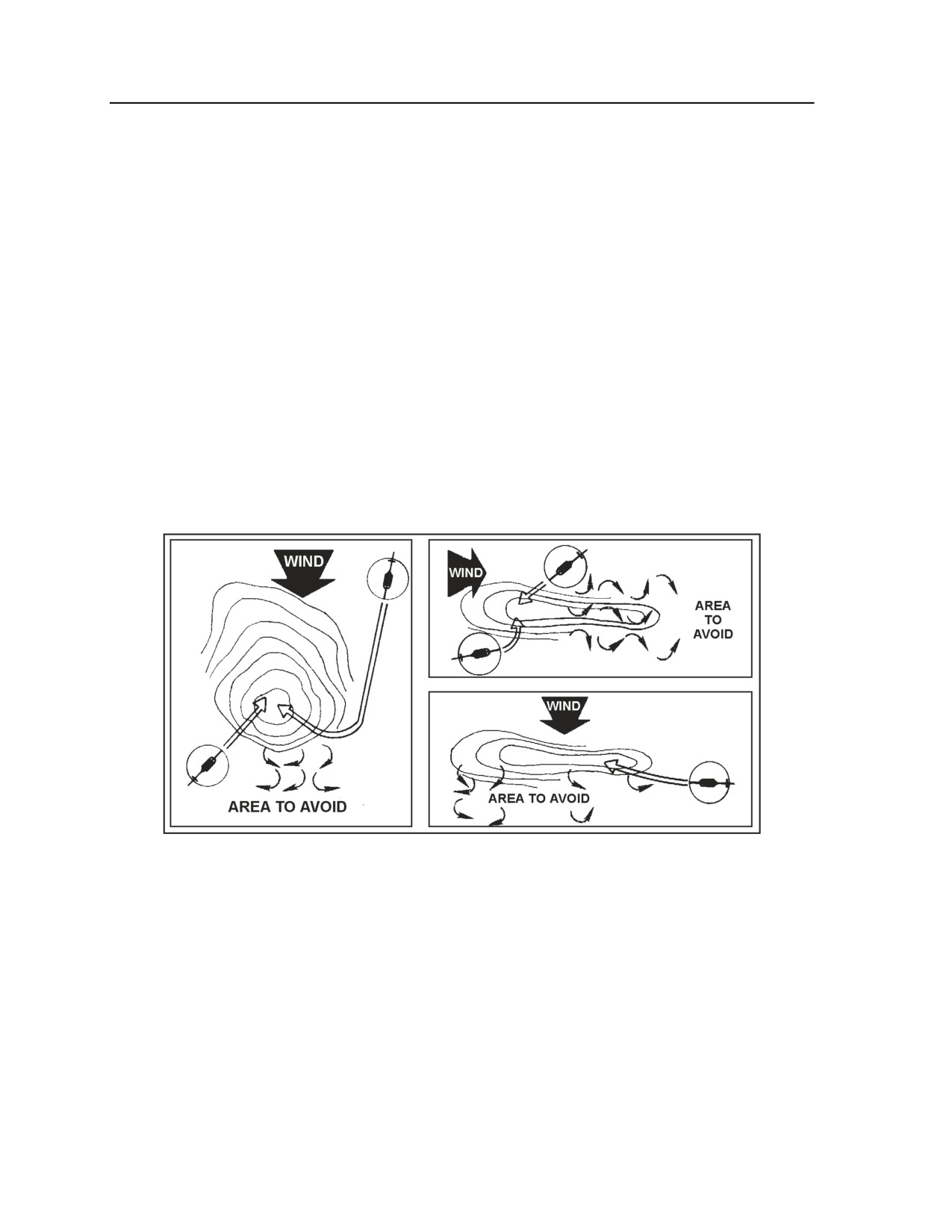
Circle (figure 3-24). The aviator selects a pivot point on the ground (LZ) around which a circle
will be flown and identifies a starting point about 200 meters from that pivot point. As the
aircraft passes over the starting point, the aviator notes the heading and stabilizes the airspeed.
He then starts a turn at the pivot point maintaining constant angle of bank and airspeed. As the
aircraft passes through the original heading, the aviator should look at the pivot point, which
indicates wind direction. Distance from the pivot point will indicate wind velocity.
Figure 3-24. Computing wind direction using the circle maneuver
7 May 2007
FM 3-04.203
3-39
Chapter 3
Approach Paths
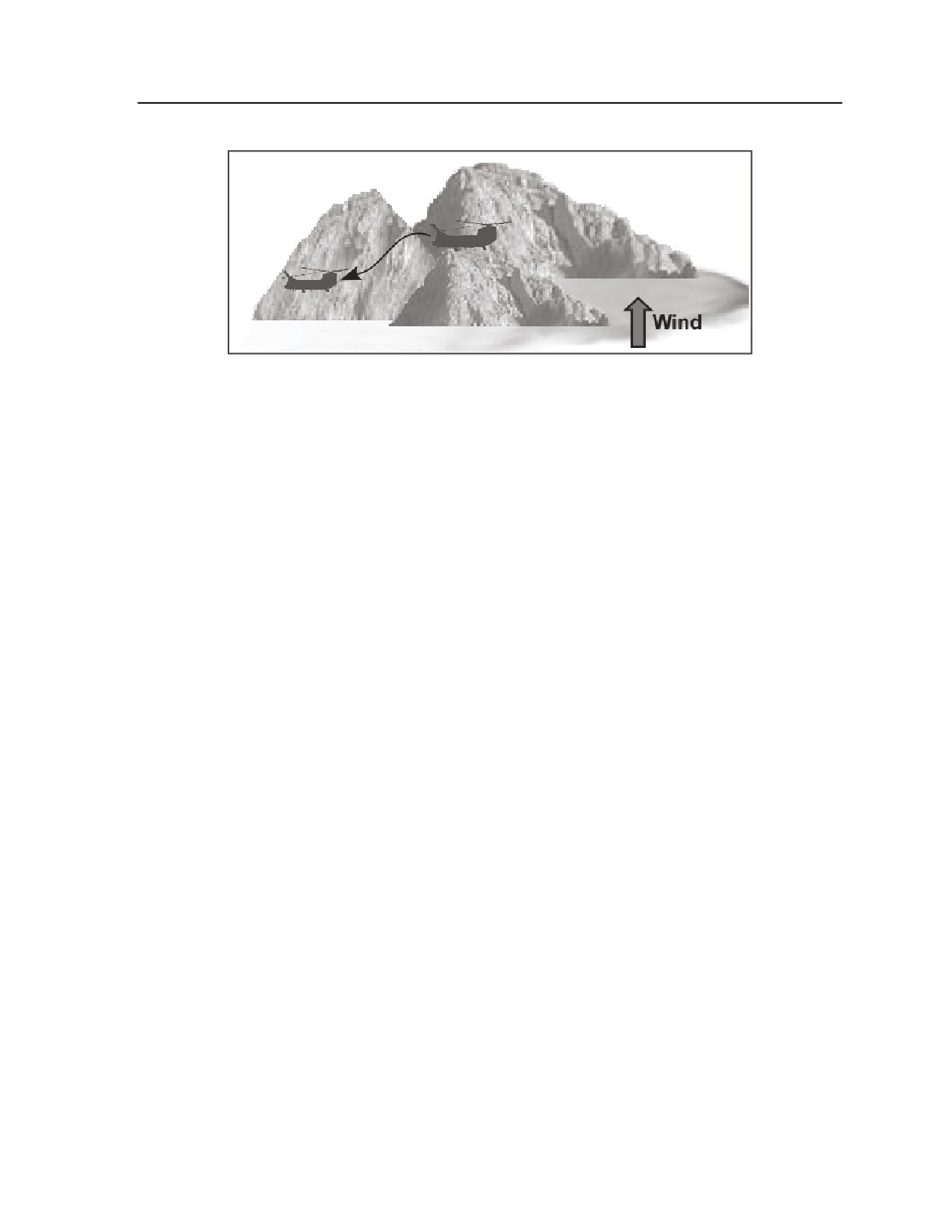
3-167. Approach paths are common to both high and low reconnaissance. Figure
3-25 illustrates
approach paths and areas to be avoided. The five basic factors to be considered for determining the
approach path are—
Wind direction and velocity. While it is desirable to land into the wind, the terrain and the
effects of the wind may dictate a crosswind landing be made. Because of torque reaction and
aircraft differences, the pilot should decide if a left/right crosswind landing should be made.
Vertical air currents. The severity of the updrafts or downdrafts encountered may be more
critical than landing into the wind and may require a downwind approach.
Escape routes. Assess the escape routes by identifying where altitude can be exchanged for
airspeed in case the aircraft experiences insufficient power or turbulence prevents a safe landing.
Terrain contour and obstacles. Terrain and obstacles along the approach path should be low
enough to permit a shallow approach angle into the LZ. When possible, select a landing point on
or near the highest terrain feature.
Position of the sun. Wind direction and nature of the terrain are the primary factors in selecting
an approach path. The aviator must also consider, however, the position of the sun in relation to
the approach path and the presence of shadows on the LZ. If the landing point is in the shadows,
then the approach path should also be in the shadows to eliminate changing light conditions
during the approach. An approach directly into the setting sun should be avoided because the
distraction will not allow the aviator to see all of the LZ details.
Figure 3-25. Approach paths and areas to avoid
APPROACH AND LANDING
3-168. There is no standard type of mountain approach. Ideally, it is made in a direction taking advantage
of the wind to provide maximum tail-rotor control. The following are guidelines for successful approach
and landing.
In a light wind or when the demarcation line is shallow, an aviator uses a relatively low angle of
descent or a flat approach. This type of approach requires less power; however, if downdrafts
are encountered, the aircraft may lack altitude to continue the approach.
As wind velocity increases and the demarcation line becomes steeper, the approach angle must
also be steeper. This type of approach requires less power due to updraft and provides more
terrain clearance if downdrafts are encountered.
3-40
FM 3-04.203
7 May 2007
Rotary-Wing Environmental Flight
If torque is insufficient to make a normal or shallow approach and the landing area is suitable, a
running landing may be performed. Before making this type of approach, alternate methods
should be pursued such as reducing gross weight by flying longer to consume fuel or returning
to the landing area after dropping off cargo or passengers. If insufficient power is available and
an approach is executed, there may be insufficient power available to execute a takeoff. A
running landing requires a smooth and long enough touchdown area. It is performed essentially
the same as in a nonmountainous area except ETL is maintained until the aircraft contacts the
ground.
During a mountain approach, be aware uneven terrain surrounding the LZ can provide poor
visual cues about the actual aircraft altitude (AGL) and rate of closure. When terrain slopes up
to the LZ, the visual illusion leads an aviator to believe the aircraft is too high and the rate of
closure too slow. When terrain slopes down to the LZ, the visual illusion leads an aviator to
believe the aircraft is too low and the rate of closure too fast. When the LZ is a pinnacle and the
surrounding terrain drops off sharply, it seems the aircraft is too high and the rate of closure
initially too slow. As the aircraft closes the distance to the LZ, the rate of closure will appear
excessive. These conflicting cues must be evaluated by cross-referencing visual cues with
information on the flight instruments. The aviator must make appropriate adjustments.
After low reconnaissance is completed, the aircraft is flown into a traffic pattern and the
approach initiated. Where terrain conditions permit, the traffic pattern should be standard. When
deviating from the standard pattern, an adequate distance on final approach is maintained to
avoid descents greater than 300 FPM. Pattern altitude, depending on the terrain, will not
normally be flown more than 500 feet above the LZ altitude. The pattern is flown over terrain
where minimum downdrafts exist.
The primary difference between the short final phase of a mountain approach and a flatland
approach begins when the aircraft is approximately 50 feet above touchdown. To begin losing
ETL, the aircraft slows but not to an OGE hover. Before reaching the near edge of the LZ,
descent is halted and airspeed reduced to a brisk walk. Torque is noted and a decision made to
continue the approach or to abort.
If it is determined the approach is unsafe in any way, the aviator initiates a go-around. Where
escape routes exist, the aircraft is turned away from the mountain and flown appropriately. This
normally consists of progressive acceleration, carefully-managed power (airspeed over altitude
takeoff, if possible), and minimal bank angles established. The point is to execute appropriate
control input predetermined on high and low reconnaissance, being careful to minimize control
input, with minimum power application and precise handling of the aircraft. As always, an
emergency may demand more aggressive action. Each situation is different and must be
evaluated separately. The aviator should take nothing for granted and be prepared for the worst
possible scenario, such as engine failure, loss of tail rotor effectiveness, and downdrafts.
Potential problems must be discussed ahead of time and proposed actions considered and
reviewed. In other words, the aviator should play the
“what-if” scenario throughout the
sequence, continuously considering and evaluating possible situations and reactions. During
termination of the approach, if heading control is lost and the aircraft begins an uncommanded
turn to the right (single-rotor helicopter), the collective must be lowered and the aircraft landed.
This possible reaction should be anticipated, especially at high altitude/high gross weights. The
most critical situation is when rotor RPM decreases and a go-around is not executed. In this
situation, heading and power must be maintained. Emergency procedures for a hovering
autorotation are followed if the aircraft is over open terrain. If the aircraft is over vegetation and
descent angle will not allow the aircraft to clear the obstacles, the aircraft is decelerated to
achieve minimum forward airspeed. Just before contact, full collective will be applied to
minimize vertical descent.
Mountain LZs are generally rough, small, and often sloped. To avoid possible aircraft damage,
touchdown must be executed with zero forward airspeed, if possible. A slope landing may be
required. After touching down in the LZ, the collective should be lowered gradually until it has
been determined the aircraft is securely positioned on the ground. Slight control input assists in
7 May 2007
FM 3-04.203
3-41
Chapter 3
determining if the aircraft is secure. If the aircraft is rocking or wobbling in that position, it
should be repositioned.
TERRAIN FLIGHT
3-169. Regardless of terrain, survival in a high-threat environment depends on flying missions at terrain
flight altitudes. Terrain flight in a mountainous environment, with its inherently dangerous surroundings,
should use the highest altitude flight mode possible—NOE, contour, or low level. Terrain flying in
mountains imposes additional stresses on an aircrew with specific considerations and techniques required.
Specific mountain regions may also present additional concerns. These are addressed in local SOPs. The
following list presents those considerations common to terrain flight in any mountainous region including
takeoff, en route, and approach flight techniques.
Terrain flight in mountains is extremely fatiguing to aircrews. Demands of mountain flight and
the level of attention it imposes cause most of the fatigue which is worsened by such conditions
as high altitude and severe weather.
Communications in a mountainous region are limited or restricted to varying degrees and must
be planned for. This plan includes provisions for factors such as flight following, tactical
communications, and search and rescue.
Terrain flight in mountains restricts use of close formation flight. When conducting
multihelicopter operations, free cruise, loose trail, or staggered trail formations are used for
flexibility. Aircraft spacing may need to be increased accommodating conditions such as tight
LZs, staggered landings, very steep terrain, and narrow valleys and crossings. It is common for a
mountain LZ to accommodate only one or two aircraft at a time. Alternate flight routes and LZs
should be planned. Each aircraft must prepare to assume flight lead during the mission.
Downdrafts or turbulence may be a hazard and major consideration in the mountains. Aviators
must be able to assess wind and evaluate its effect on flight at terrain flight altitudes. This
evaluation is achieved using a combination of visual cues, flight instrument information, and
experience in the environment. Emergency procedures must be well established and performed
in a minimum amount of time. Safe and successful mountain terrain flight is based on a
thorough working knowledge of terrain flight and mountain flight procedures.
Terrain Flight Takeoff
3-170. Because terrain is steeper around mountain LZs, gaining airspeed is usually more important than
gaining altitude. Airspeed over altitude takeoff is preferred whenever possible (figure 3-26, page 3-43).
Aviators must consider wind condition and terrain to determine takeoff direction. Takeoff
should be conducted into the wind and over the lowest obstacles and descending terrain.
Mountainous terrain usually demands a compromise between these factors. Takeoff checks must
include a hover power check and a thorough understanding of PPC information.
A mountain takeoff is usually initiated from the ground. After lifting off, the aviator applies
torque and change in pitch attitude to accelerate or climb as planned. Terrain flight often dictates
descent to an appropriate altitude after clearing the LZ, using necessary control inputs. When
terrain obstacles prevent airspeed over altitude takeoff, low level OGE takeoff should be
performed with appropriate airspeed and altitude selected for continuing flight.
Terrain Flight—En Route Flight Techniques
3-171. Any successful terrain flight includes detailed reconnaissance and a planned route with alternates.
It should be an accurate reflection of the actual flight. During mission execution, the crew may discover the
planned route does not offer the best concealment or terrain, or weather conditions prove the selected route
is inadequate. Therefore, an en route change to the plan is common. The mode of terrain flight is dictated
by the threat and terrain masking. The selected mode can be a hindrance in dealing with inherent hazards
of mountain flight. It may dictate other compromises such as reduced airspeed or spacing of
multihelicopter flights.
3-42
FM 3-04.203
7 May 2007
Rotary-Wing Environmental Flight
Figure 3-26. Nap-of-the-earth or contour takeoff (terrain flight)
Nap-Of-The-Earth and Contour Flight
3-172. For this discussion, NOE and contour flight will be reviewed together. These flight modes are
used when enemy detection is likely. Where noted, the following flight considerations apply:
Aviators conduct flight at the bottom of the valley providing cover and concealment. However,
this area may have a great deal of turbulence and more stable air might be found along the base
of the lifting side of the valley. If adequate cover is available, plan the route in this area.
If a downdraft is encountered, an aviator will apply maximum power to arrest any descent or
maintain altitude. A deceleration may assist in making more power available to prevent ground
contact while providing enough altitude to clear the tail rotor. If descent cannot be stopped and
it appears ground contact will be made, the aviator continues to decelerate the aircraft to
minimize forward airspeed at touchdown. Just prior to impact the aviator should establish a level
attitude.
If possible, aviators avoid flying close to abrupt changes in terrain where severe downdrafts may
exist. If this is unavoidable, airspeed is reduced minimizing the effects of any downdraft.
Aviators should avoid flying across the mouth of an adjacent valley where turbulence is often
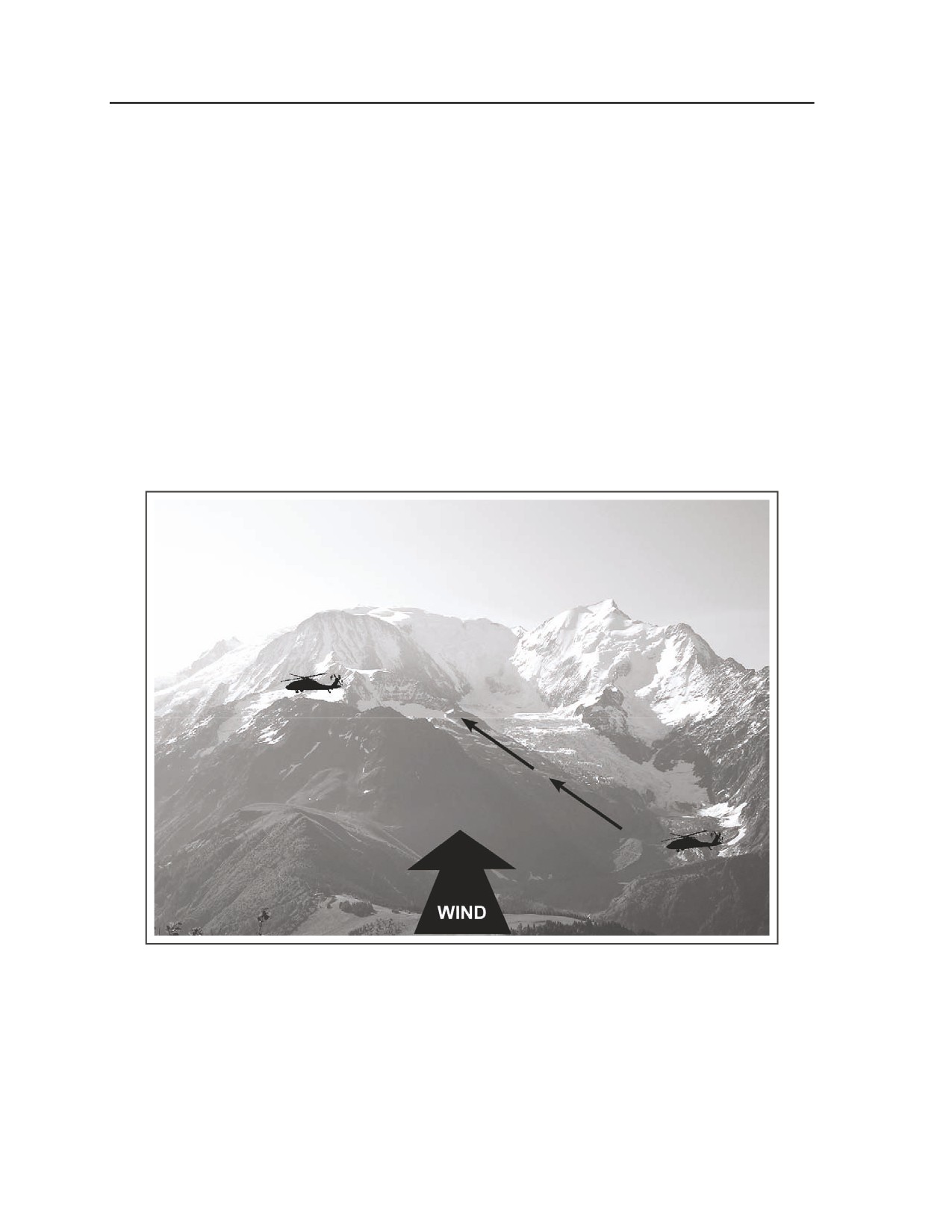
encountered. When crossing a ridge (figure 3-27, page 3-44), aviators fly a route over the lowest
point minimizing exposure. Aviators will adjust their heading to cross the ridge at a 45-degree
angle to ridge direction. This technique increases the opportunity to turn away from the ridgeline
in case of an emergency.
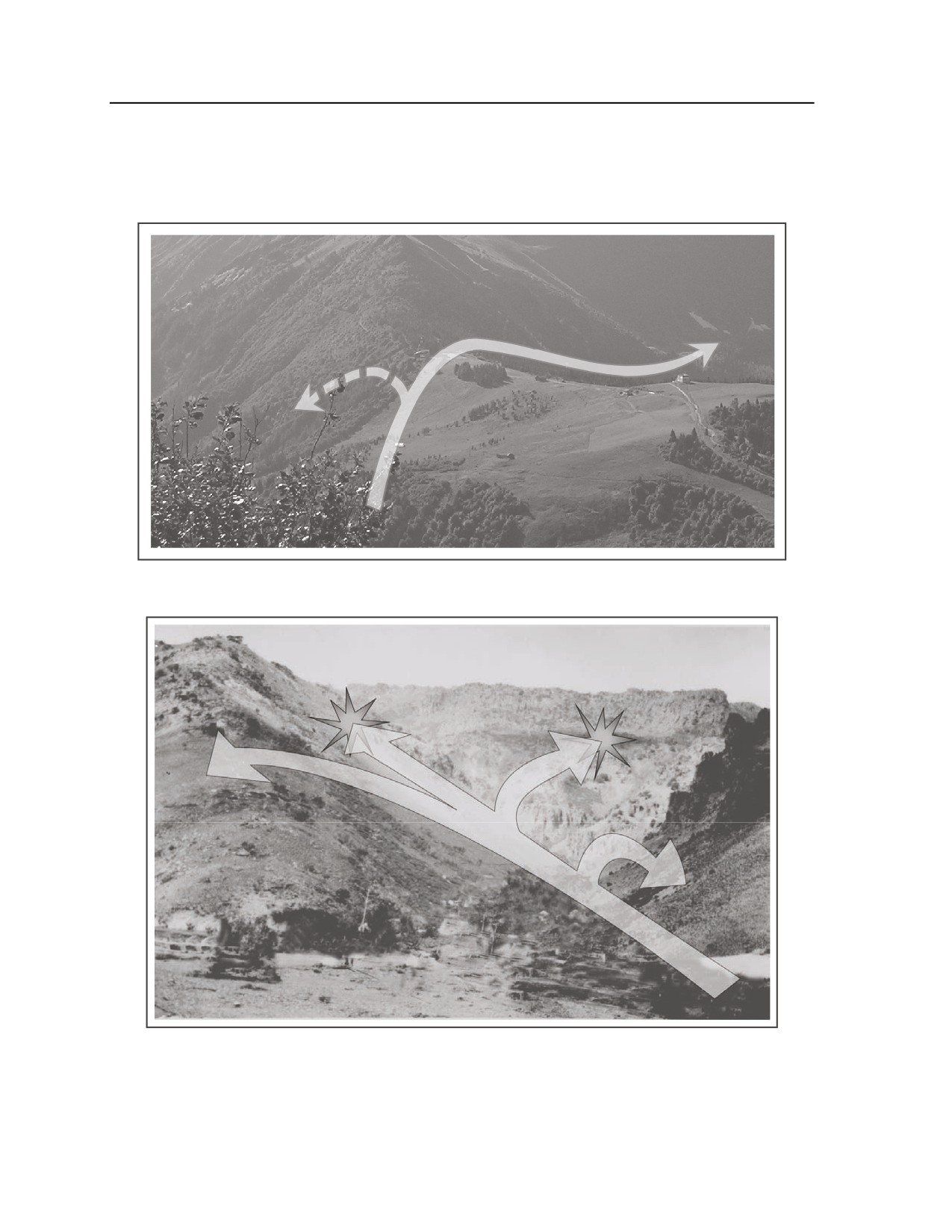
Aviators fly parallel to the lifting side of and as close to terrain features as possible when
climbing to a higher altitude for a ridge crossing or to approach an LZ. This allows the aircraft
to receive the benefit of any updraft while reducing the chance for enemy detection.
Aviators must avoid situations requiring rapid ascents from the valley. Climb should be initiated
with adequate time to clear terrain and obstacles.
Aviators must avoid making turns of more than a 30-degree angle of bank at low altitudes. A
reduced airspeed may be necessary to allow a turn to be executed within the space available
(figure 3-28, page 3-44). Extreme caution must be exercised if a turn is performed downwind
and airspeed is reduced below ETL. If the valley is very narrow, it may be necessary to stop the
aircraft and perform a pedal turn. If insufficient power prohibits this maneuver, a combination of
cyclic and pedal turn should be performed while maintaining minimum forward airspeed.
When approaching a terrain feature where terrain drops off rapidly on the reverse slope, aviators
reduce airspeed before crossing. This deceleration allows the aircraft to follow the terrain more
closely without silhouetting the aircraft against the skyline.
Aviators must watch for wires in narrow canyons. Wires are difficult to see and may be
stretched across the valley with no support in the middle.
Aviators reduce airspeed during periods of low visibility to increase required reaction time.
7 May 2007
FM 3-04.203
3-43
Chapter 3
During day multihelicopter operations, aircrews normally fly a free cruise or staggered
formation. Narrow corridors limit maneuver airspace and require all aircraft to follow essentially
the same ground track. One option is staggering aircraft at varying distances to reduce enemy
detection capabilities.
Figure 3-27. Ridge crossing at a 45-degree angle (terrain flight)
Figure 3-28. Steep turns or climbs at terrain flight altitudes
3-44
FM 3-04.203
7 May 2007
Rotary-Wing Environmental Flight
Low-Level Flight
3-173. Low-level flight is conducted where terrain features do not dictate lower altitudes in NOE/contour
flight because sufficient masking exists at a higher AGL. Many of the same en route flight techniques that
apply to NOE/contour flight also apply to low-level flight. Aviators should review these techniques in
addition to the following considerations.
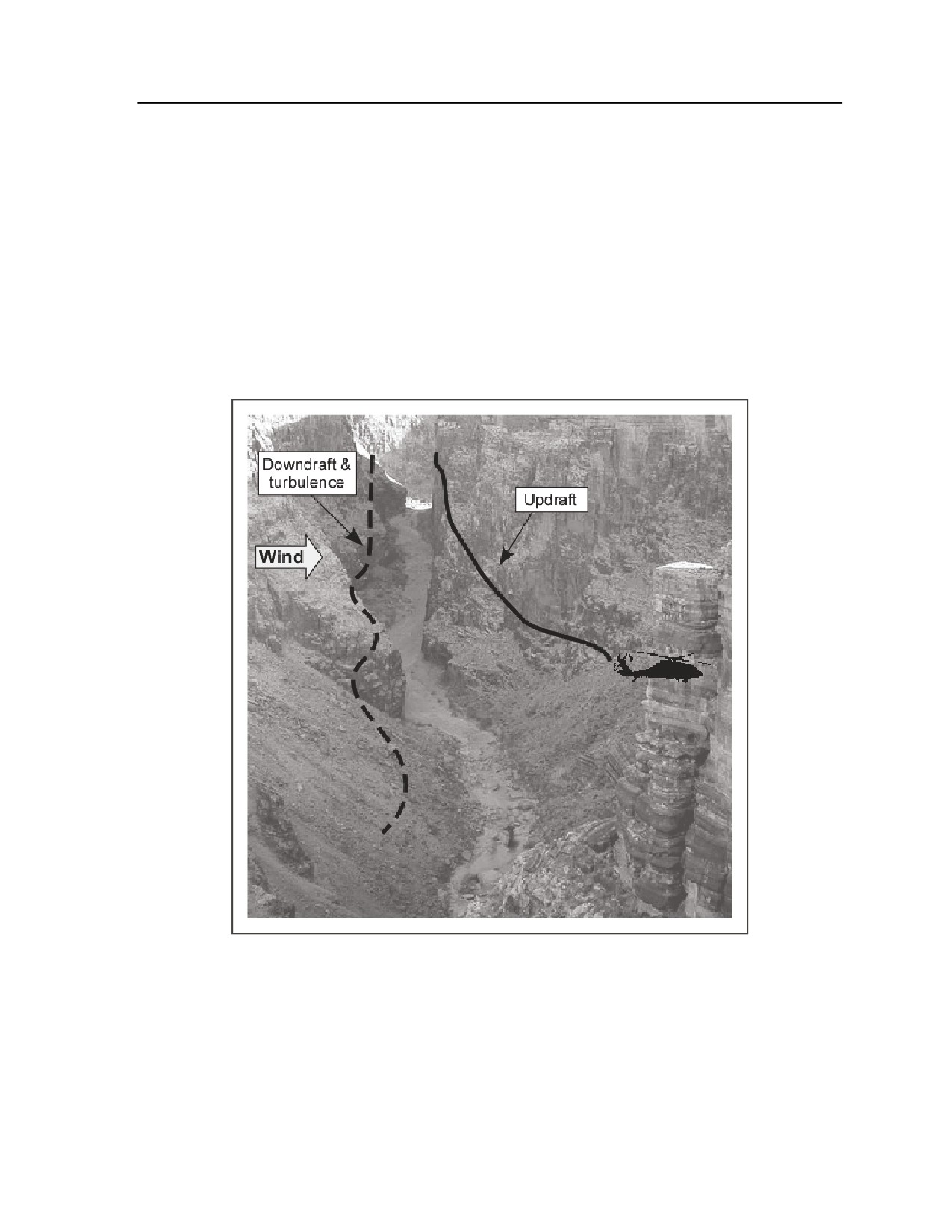
When flying in a valley, an aviator’s flight path should be as close to the lifting side of the
valley as possible (figure 3-29). This technique allows more room for turning and exposes the
aircraft to less turbulence while taking advantage of any updrafts.
Aviators avoid making turns over terrain requiring an increase in altitude.
A staggered-trail formation is normally flown for multihelicopter operations. Less separation is
required than for NOE/contour flight, while aircrews have greater freedom of maneuver and can
avoid the same ground track as the preceding aircraft.
Figure 3-29. Flight along a valley (terrain flight)
Terrain Flight-Approach Techniques
3-174. During basic mountain-flight training, aviators are taught to use a shallow- or normal-approach
angle, requiring the approach to be initiated from an altitude higher than the LZ. In terrain flight, this must
be altered to avoid enemy detection. A terrain flight approach may be initiated from a point below the LZ.
Additionally, traditional high and low reconnaissance cannot be performed due to threat of enemy
detection. A straight-in approach from the inbound course is the preferred method but presents limitations.
7 May 2007
FM 3-04.203
3-45
Chapter 3
If turbulence/strong downdrafts are encountered, it may be necessary to conduct a low pass over the LZ
confirming wind direction and velocity, turbulence, and any additional information. It also may be
necessary to maneuver some distance from the LZ and approach from another direction.
Nap-Of-The-Earth/Contour Approach
3-175. This approach is the most difficult and subjects the aircraft to mountain hazards for the longest
amount of time. Aviators must recognize if there is sufficient power, as any avenue of escape or
opportunity for a go-around will be severely limited. Figure 3-30 depicts an approach beginning from the
valley floor and terminating at an LZ on a ridgeline. As the approach is initiated, any downdrafts or
turbulence will determine if a straight-in approach is feasible. If a climb is required, it should be started
soon enough that a maximum 1,000-FPM climb and 40 knots indicated airspeed (KIAS) minimum allow
the aircraft to ascend on the approach path without exceeding either of those parameters. If this is not
possible, a go-around should be executed. As the aircraft approaches the LZ, the aviator selects a point
along the approach path about 100 meters short of the LZ. This is the initial decision point for continuing
the approach. The aircraft should be located about 50 feet above the highest terrain feature and at the
desired airspeed. The decision to continue should include the wind direction and velocity, availability of
sufficient power, and presence of any downdrafts forcing the aircraft into trees or the ground. A decision to
go-around should be made and the approach discontinued as soon as possible.
Figure 3-30. Nap-of-the-earth or contour approach (terrain flight)
Low-Level Approach
3-176. This approach combines techniques used for NOE/contour and nontactical approaches. A low-
level approach will normally be initiated from an altitude below the LZ, with the final leg of the approach
path begun at an altitude 100 to 200 AGL above the touchdown point. In other words, the aircraft will
initiate a climb from the en route altitude to an altitude appropriate for beginning the final leg of the
3-46
FM 3-04.203
7 May 2007
Rotary-Wing Environmental Flight
approach path. At a predetermined point, this climb is started and should not exceed a 1,000-FPM rate of
climb or be slower than 40 KIAS. As the aircraft approaches the LZ, the same considerations used for
NOE/contour approaches should be used. The decision to continue or execute a go-around should be made
as soon as possible.
MAINTENANCE
3-177. With power demands inherent to mountain operations, the focus will be engines and maintaining
maximum performance. In addition, the aircraft is subject to the demands of any environment the
mountainous region is located (for example, a cold weather region).
TRAINING
3-178. Units qualifying aviators in mountain operations are responsible for conducting a well-organized
training program. This training instills confidence and maintains the aviator’s interest. The IP should be
experienced in mountain flight and preferably, a High Altitude Army Aviation Training Site (HAATS)
graduate. He must be capable of initiating corrective action for any emergency that may occur.
3-179. Mountain flight is very hazardous; therefore, greater emphasis should be placed on preflight
planning. Wind velocity and the level of turbulence restricting flight training must be identified. The
judgment of the instructor to discontinue training due to unsafe conditions is accepted and not criticized.
3-180. The flight training program allows each aviator to advance at an individual rate. Initial training
should be conducted over less challenging terrain during non-turbulent conditions. As proficiency
increases, conditions should become more demanding until the most challenging mission can be
performed.
RECOMMENDED PROGRAM OF INSTRUCTION
3-181. The program starts with training occurring routinely while at home station as part of the normal
training cycle. This training includes academic and flight training, and defines the train-up of personnel
upon notification of deployment. Outside experts may be brought in to conduct training for the unit.
However, the best option is sending personnel to HAATS.
Academics
3-182. Suggested topics include—
Human factors associated with mountain flight.
Environmental factors affecting mountain operations.
Mountain weather patterns.
Aircraft operational procedures in mountainous areas.
Principal difficulties during mountain operations.
Mountain survival.
Performance planning.
Flight
3-183. Flight training may be limited by conditions at the unit’s home station. Some areas may not be
able to replicate conditions adequately for training. Instructors can demonstrate techniques and procedures
to some extent. Crews are evaluated on these procedures during their APART or no-notice evaluations.
Flight simulators are a great device in training for this environment.
3-184. Suggested maneuvers include—
Power management.
En route flight techniques.
7 May 2007
FM 3-04.203
3-47
Chapter 3
Mountain approaches and landings.
Go-around.
Power checks.
Mountain takeoffs.
IIMC.
Suggested Research Materials
3-185. To prepare to train for or operate in a mountainous environment, the following materials are
suggested:
Local SOPs.
Aircraft operator’s manual.
FM 3-97.6.
FM 1-230.
FM 3-04.301.
FM 3-50.3.
FM 3-05.70.
HAATS training materials.
AKO file search.
SECTION V - OVERWATER OPERATIONS
3-186. In nearly every major conflict and operation since World War II, Army aviation has been assigned
missions in maritime environments, either basing off naval vessels for land attack or operating from ships
for sustained overwater missions. Recently, the nature and complexity of those missions have changed
dramatically, dictating aviation units complete specialized preparatory and sustainment training. Recent
worldwide deployments have shown Army aviation has a versatile combination of equipment
sophistication, deployability, and personnel to accomplish specific strategic missions requiring operations
in the maritime environment.
ENVIRONMENTAL FACTORS
3-187. Army aviation units presently participate in many joint operations requiring proficiency in
shipboard and overwater operations. Individual training, aircraft modifications, development of SOPs, and
application of established policies are complex and necessary to ensure Army aviation can perform safely
and effectively in an overwater environment. FM
3-04.564 is the primary reference for overwater
operations and for working with the United States Navy (USN). It is imperative to reference this source
and contact units routinely involved in overwater operations before an aviator performs missions in this
environment.
CLIMATE AND WEATHER
3-188. Army aviators are accustomed to working in areas where a visible horizon exists with normal
ceiling and visibility during all flight operations. In an overwater environment, the horizon over the water
is the reference line for VFR attitude. The water and skyline often blend because of fog, rain, or other
obscurations, eliminating any visible horizon. Overwater winds are not affected as much by the surface of
the earth and generally remain steady and constant from a given direction. This can pose a challenge when
conducting shipboard landings and takeoffs based on limitations and capabilities of the aircraft. At times,
aircraft must depart and land with left or right crosswinds. Performance planning should be completed in-
depth ensuring adequate power margins. The surface of the water can also create the illusion that an
aircraft is higher than its actual altitude. In extreme calm seas with clear water, aviators can see through the
water and often believe they are at a higher altitude than they actually are. During night operations at
altitude, generally above 200 feet, waves blend and the actual surface becomes difficult to detect.
3-48
FM 3-04.203
7 May 2007
Rotary-Wing Environmental Flight
TERRAIN
3-189. Overwater flight is marked by a near-featureless surface.
FLYING TECHNIQUES
3-190. Conducting flight in overwater operations usually includes lack of visible horizon due to overcast
skies, restricted visibility, difficulty in detecting altitude above water, water spray coating the windscreen,
and the potential for spatial disorientation.
OPERATIONAL PROCEDURES
3-191. Individual training for aircrew members includes, but is not limited to—
Swim testing and proficiency in drown-proofing.
Dunker training.
Use of helicopter emergency egress device or other approved emergency breathing system.
Use of specific floatation devices.
Egress procedures specific to the aircraft.
Downed aircrew member extraction procedures.
Academic training including FM 3-04.564 and appropriate SOPs including theater operations or
unit SOP.
MAINTENANCE
3-192. The major concern in this environment is corrosion. TMs dictate special maintenance required for
salt-water operations.
TRAINING
3-193. Administering an overwater training program to qualify aviators is a unit responsibility. Training
in overwater operations instills confidence, develop skills, and emphasize safety. If operations are
conducted aboard USN vessels, then FM 3-04.564 describes training requirements necessary for shipboard
operations.
CREW/TEAM/SCENARIO TRAINING
3-194. Crew coordination training for overwater operations to ships needs to address several new areas
and be incorporated into academic training. The USN uses different terminology and procedures for
aviation operations. Cockpit communications require a thorough understanding of terminology to comply
with instructions from USN vessels. Teams operating overwater for landing or takeoff need to be familiar
with holding patterns and shipboard departure/arrival procedures. Units routinely flying overwater must
incorporate established procedures into unit SOPs. An example overwater SOP is located in FM 3-04.564.
It can be tailored to add specific unit capabilities and requirements. Overwater training scenarios can be
included in simulator training programs and might be used as part of the initial qualification and
sustainment program.
RECOMMENDED PROGRAM OF INSTRUCTION
3-195. The program starts with training done routinely while at home station as part of the normal
training cycle. This training includes academic and flight training and defines the train-up of personnel
upon notification of deployment. Outside experts may conduct training for the unit.
7 May 2007
FM 3-04.203
3-49
Chapter 3
Academics
3-196. Suggested topics include—
Human factors associated with overwater flying.
Environmental factors that affect overwater operations.
Principal difficulties during overwater operations.
Overwater aviation life support equipment (ALSE) requirements.
Water survival.
Flight
3-197. Flight training may be limited by conditions at the unit’s home station. Some areas may not be
able to replicate conditions adequately for training. Instructors can demonstrate techniques and procedures
to some extent. Crews are evaluated on these procedures during their APART or no-notice evaluations.
Flight simulators are also a great device in training for this environment.
Suggested Research Materials
3-198. To prepare to train for or operate in an overwater environment, the following materials are
suggested:
Local SOPs.
Aircraft operator’s manual.
FM 3-04.301.
FM 3-04.564.
FM 3-50.3.
FM 3-05.70.
Joint publication (JP) 3-04.1.
AKO file search.
3-50
FM 3-04.203
7 May 2007
Chapter 4
Rotary-Wing Night Flight
Vision is the most important sense used in flight. Day or night, instrument
meteorological conditions (IMC) or VMC, vision is the primary sense providing
crewmembers with awareness of aircraft position or SA. Eyes can rapidly identify
and interpret visual cues in daylight. During darkness, visual acuity decreases
proportionally as the level of illumination decreases. NVDs improve the capability of
the human eye to see at night. This chapter covers NVDs and provides a general
discussion of night vision and techniques for completing missions safely.
SECTION I - NIGHT VISION
NIGHT VISION CAPABILITY
4-1. Safe night flight depends on how well an
aircrew has been trained in night vision techniques.
Contents
Each crewmember is individually responsible for
understanding night vision techniques found in FM
Section I - Night Vision
4-1
3-04.301.
Section II - Hemispheric Illumination
and Meteorological Conditions
4-3
COMBAT VISUAL IMPAIRMENTS
Section III - Terrain Interpretation
4-5
4-2. An aviator’s eyes can be damaged during
Section IV - Night Vision Sensors
4-13
Army aviation missions. The following instances
Section V - Night Operations
4-28
should be considered and preparation made to
prevent such occurrences.
NIGHT LASER HAZARD
4-3. The eye is more vulnerable to laser damage at night as the iris of the eye opens more to
accommodate lower levels of illumination. Laser damage to the eyes includes flash blindness, minor and
major retinal burns, and impaired night vision. The effect of flash blinding is similar to the temporary
effect of a flashbulb and can last seconds to minutes, possibly leaving colored spots in the field of vision
that are distracting and potentially dangerous. Minor retinal burns can cause discomfort and interfere with
vision. The injuries may involve internal bleeding in the eye, immediate pain, and possible impaired or
permanent loss of vision. Night vision acuity may be lost due to undetected damage. Fovea damage may
affect vision sharpness and color interpretation. Normal cockpit tasks, obstacle avoidance, and use of
acquisition or targeting devices may become difficult or impossible. Aviation unit training must emphasize
aircrew use of the aviator’s helmet laser visor when performing missions in an anticipated or known laser
environment. To reduce chances of laser injury, aviation support personnel must be trained to wear laser
protective spectacles when performing aviation ground support functions.
NERVE AGENTS
4-4. Exposure of the eyes to minute amounts of nerve agents adversely affects night vision. When direct
contact occurs, pupils constrict (miosis) and do not dilate in low ambient light. The available automatic
chemical alarms are not sensitive enough to detect low concentrations of nerve agent vapor. The exposure
7 May 2007
FM 3-04.203
4-1
Chapter 4
time required to cause miosis depends on the concentration of the agent. Miosis may occur gradually as
eyes are exposed to low concentrations over a long time. Conversely, exposure to a high concentration may
cause miosis during the few seconds it takes to mask. Repeated exposure over a period of days is
cumulative. Symptoms range from minimal to severe, depending on amount of exposure. Severe miosis,
with reduced ability to see in low ambient light, persists for approximately 48 hours. The pupil gradually
returns to normal over the next several days with full recovery taking up to 20 days. The onset is insidious
as it is not always immediately painful, and personnel suffering from miosis may not realize they have
suffered the condition. Units exposed to nerve agents must assume damage has occurred and crewmembers
will suffer the described effects. Awareness and preparedness could prevent mishaps. Currently, no
effective drug is available to counteract the effects without causing side effects. Aviators showing the
effects of miosis may not be able to safely fly an aircraft. Aviators exposed to a nerve agent and exhibiting
symptoms must be cleared by the flight surgeon.
AIRCRAFT DESIGN
LIMITATIONS
Design Eye Point
4-5. The concept of design eye point (DEP) relates to how the cockpit layout design enhances the
aviator’s ability to acquire information easily and quickly. It is the point the crew station designer specifies
as where the aviator’s eyes would be. The design of Army aircraft-as it relates to crewmember positions-
may degrade the ability to see outside the aircraft or cause difficulty in seeing something inside the aircraft.
This is known as DEP violation. Many aircraft have various problems including difficult to read
instruments, inadequate lighting, and poorly positioned gauges.
4-6. Proper seat adjustment is required for DEP. The field expedient method of enhancing DEP is to
position a reference individual directly to the front of the seat position for which the DEP is being
determined. The reference individual should position themselves at a distance from the nose of the aircraft
as designated in table 4-1. The reference individual crouches down with fingers barely touching the ground
as the aviator adjusts the seat until the individual’s fingers touching the ground are visible. This seat
position maximizes the aviator’s position in the cockpit.
Table 4-1. Position distance
Aircraft
Distance from Nose
UH-1
12 feet
UH-60
12 feet
CH-47
20 feet
Structures
4-7. Windscreens and airframes reduce an aviator’s ability to see outside of the aircraft. Dirt, grease, and
bugs are removed ensuring the clearest view possible which includes cleaning the windscreen during
intermediate stops.
SOLUTIONS
Aircrew Coordination
4-8. Continued use of sound aircrew coordination is the safest and most effective solution to design
limitations. Interaction between crewmembers
(communication) and actions
(sequence or timing) is
necessary for aircrew members to perform flight tasks efficiently, effectively, and safely. If a particular
4-2
FM 3-04.203
7 May 2007
Rotary-Wing Night Flight
task is labor intensive and requires additional time from the aviator, other crewmembers must assist in
performing that task.
Additional Crewmembers
4-9. Additional crewmembers, when applicable, assist aviators by providing information on hazards,
obstacles, and unintentional drift or movement of the aircraft during tasks or maneuvers. No crewmember
should assume another crewmember sees or recognizes a potential danger.
Lighting
4-10. Aircraft instruments are easier to read under higher levels of interior illumination. However, this
need must be balanced with the ability to see outside and the hazard of interior lights reflecting off the
windows. Minimize lighting, whenever possible, without hindering reading of essential instruments.
Supplementary lighting guidelines should be implemented and included in the unit SOP.
4-11. Each unit’s SOP should cover exterior aircraft lighting guidelines, addressing such lighting effects
on the ability to see when using NVDs while remaining visible to other aircraft in the AO. Tactical need
must be balanced against the need to comply with Federal Aviation regulations (FARs) and local policy.
SECTION II - HEMISPHERIC ILLUMINATION AND METEOROLOGICAL
CONDITIONS
4-12. Ambient light is any atmospheric light, whether natural or artificial, providing useful illumination for
the aircrew. Sources of ambient light include the moon, background illumination, artificial light, and solar
light. Regardless of the ambient light source, meteorological conditions affect levels of light. Aviators can
conduct night aviation operations more easily when ambient light sources provide the greatest amount of
hemispherical illumination. The aviation unit operations officer, with assistance of supporting Air Force
weather personnel, can develop a light-level calendar to predict when optimum levels of ambient light will
exist. Computer programs can also be used for illumination and ambient light planning purposes. These
programs may be in some mission planning systems or found at the NVD Branch website
LIGHT SOURCES
NATURAL
4-13. The moon is the primary source of natural light at night. Sky glow is a term for the ambient light
produced by the sun when it is below the horizon. Stars provide some background illumination, especially
on clear nights.
Lunar Light
4-14. The moon angle changes about 15 degrees per hour (1 degree every 4 minutes). Ambient light level
changes as the moon angle changes. Light from the moon is brightest when at its highest point or zenith.
The time of moon’s rising and setting changes continually. Detailed planning is required to determine
ambient light levels during a particular night flight. The different phases of lunar light and illumination
include—
New moon. The new moon phase is completed in approximately eight days. Moonlight
increases toward the end of the phase when about 50 percent of the moon is illuminated.
First quarter. Nearly seven days are required to complete the first quarter phase. The
percentage of moon illumination at the beginning of the phase is close to 50 percent and
increases until slightly less than 100 percent of the apparent disk is illuminated.
Full moon. The full moon phase begins when 100 percent of the disk is illuminated. It ends
seven days later when almost 50 percent of the moon is visible.
7 May 2007
FM 3-04.203
4-3
Chapter 4
Third quarter. The duration of the last phase is about seven days. It begins when close to 50
percent of the moon is visible and ends when 2 percent or less is visible.
Solar Light
4-15. Ambient solar light is usable for a period following sunset and before sunrise. After sunset, the
amount of available solar light steadily decreases until the level of light is not usable to the unaided eye.
Solar ambient light becomes unusable when the sun is 12 degrees below the horizon or about 48 minutes
after sunset. This is end evening nautical twilight (EENT). Before sunrise, solar light becomes usable when
the rising sun is 12 degrees below the horizon or about 48 minutes before sunrise, which is begin morning
nautical twilight (BMNT). In addition, end evening civil twilight (EECT) occurs when the sun is 6 degrees
below the horizon, while begin morning civil twilight (BMCT) occurs when the sun is 6 degrees below the
horizon. Civilian and law-enforcement agencies commonly use civil twilight for BMCT and EECT.
Starlight
4-16. This light source provides limited background lighting. Stars provide about one-tenth the
illumination of a quarter moon. Night sky radiation from ions and atoms in the ionosphere provide about
40 percent of actual illumination on a moonless night.
ARTIFICIAL LIGHT
4-17. Lights from cities, automobiles, fires, and flares are normally sources of small amounts of
illumination. The lights of a large metropolitan area will increase the light level around the city. Artificial
light is most pronounced during overcast conditions. Tactical employment of flares or illumination rounds
may be used with either unaided vision or NVG operations. This increases apparent illumination contrasts
in the target area and denies the adversary use of NVGs in the immediate vicinity.
OTHER CONSIDERATIONS
METEOROLOGICAL EFFECTS
4-18. Because meteorological conditions vary, light levels cannot always be accurately predicted and
weather elements can change slowly or rapidly. A flight may begin with clear skies and unrestricted
visibility; however, these conditions could deteriorate rapidly within the span of one fuel load. In addition,
adverse weather is difficult to detect at night. Often the decrease in visual acuity and a gradual loss of
horizon are very subtle. As visual meteorological conditions deteriorate, aviators must decrease airspeed to
reduce risk of flying into IIMC. Heightened awareness of changing weather conditions better prepares the
aircrew to evaluate available ambient light.
CLOUDS
4-19. Clouds reduce hemispherical illumination to some extent. The exact amount of reflection or
absorption of light by different cloud types is highly variable; therefore, a common factor cannot be
applied to each condition of cloud coverage. Aviators consider the amount of cloud coverage and the
density, to subjectively evaluate light reduction. For planning purposes some illumination computer
programs also give reduction by cloud coverage. Obviously, a thick, overcast layer of clouds will reduce
ambient light to a greater degree than a thin, broken layer of clouds. Aviators can detect any reduction in
the ambient light level with some basic cues. The following cues and a continuing awareness of present
weather conditions are critical in avoiding IIMC or unsafe situations:
Aircrews continuously monitor the apparent light level, paying attention to any reduction, with
an accompanying reduction in visual acuity and terrain contrast.
Increasing cloud coverage obscures moon illumination/visible stars.
Shadows caused by clouds obscure the effects of moon illumination and should be observed by
the aircrew.
4-4
FM 3-04.203
7 May 2007
Rotary-Wing Night Flight
RESTRICTIONS TO VISIBILITY
4-20. Visibility restrictions (caused by fog, rain, dust, haze, or smoke) reduce the effects of hemispherical
illumination. The low altitudes used during terrain flight are especially susceptible to the effects of such
visibility restrictions. As the temperature-dew point spread narrows, fog is more likely to occur. NVDs
permit an aviator to see through some obscurations to an extent. Once an aviator realizes the severity of the
obscuration, it may be too late to do anything other than execute IIMC recovery. The following conditions
indicate restricted visibility:
Loss of celestial lights. For example, overcast cloud cover may cause the moon and stars to fade
or disappear.
Loss of ground lights. City or rural lights fade due to obscuration.
Reduced ambient light levels. Obscuration will reduce forecast light levels. The exact amount
of reduction varies with conditions.
Reduced visual acuity. Best-case visual acuity is based on high ambient night illumination,
high contrast, and clear visibility. Visual acuity may be reduced depending on the type and
amount of ambient light and obscuration.
The best resolution with aviator’s night vision imaging system (ANVIS) occurs somewhere
between 25 to 50 percent moon illumination for high contrast targets. Increasing light levels
above 50 percent moon illumination does not increase ANVIS resolution.
Scintillation. Low ambient light levels either naturally occurring or created by visibility
restrictions increase video noise. Image scintillation is this noise signal seen by the crewmember
as a sparkling effect.
LIGHTNING
4-21. Only one meteorological phenomenon increases illumination. Lightning flashes create the same
effect as a flare. The intensity depends on the nearness of the flash and strength of the storm. Night vision
may be temporarily impaired if the aircrew is too close to lightning activity.
SECTION III - TERRAIN INTERPRETATION
4-22. The ability to interpret terrain during night flight is determined by a combination of the flight method
employed, whether aided or unaided, ambient light level, and aircrew ability to effectively employ night
vision techniques. Different conditions affect visual presentation of natural and manmade features during
any mode of night flight. This section covers factors affecting night terrain interpretation and various
techniques used to compensate for limitations imposed by the terrain. Chapter 3 covers environmental
conditions affecting appearance and suitability of various types of terrain.
VISUAL RECOGNITION CUES
4-23. The ability to detect natural or manmade features at night depends primarily on an object’s size,
shape, and contrast as well as effective use of night vision scanning and viewing techniques.
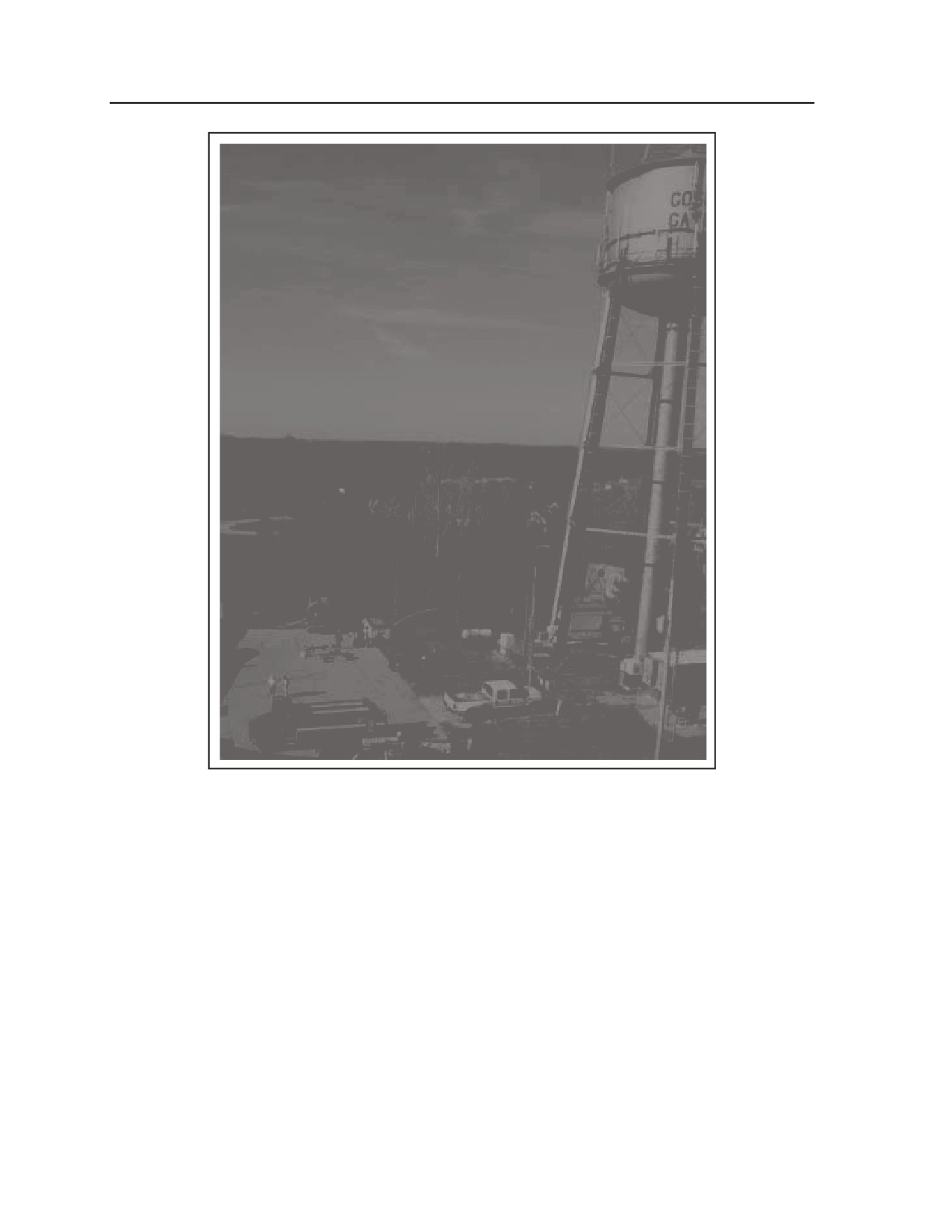
OBJECT SIZE
4-24. Large structures and terrain features, such as towers, are easier to recognize at night than small
objects. Small objects tend to get lost in the clutter of other objects (figure 4-1, page 4-6). To see and
recognize small features often requires crewmembers to view an area several times. A shorter viewing
distance also aids in visual recognition.
7 May 2007
FM 3-04.203
4-5
Chapter 4
Figure 4-1. Identification by object size
OBJECT SHAPE
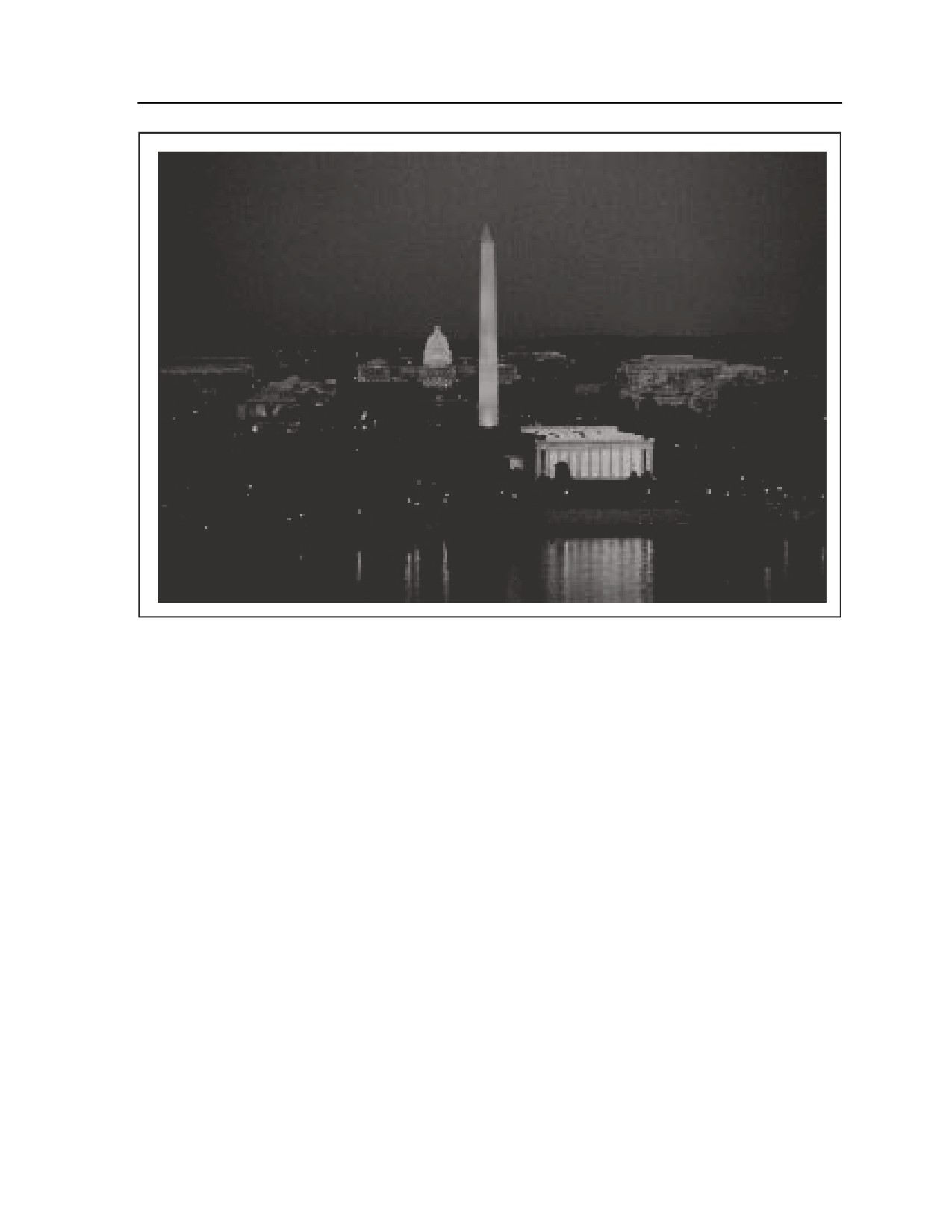
4-25. Aircrews can identify objects at night by their shapes/silhouettes (figure 4-2, page 4-7). Some
buildings are recognizable at night by their design. For example, a church may be marked by a steeple or
cross on top of the structure. Religious buildings of other faiths may look markedly different. Aviators
should consider these details in mission planning. Often, maps depict manmade features through
symbology which aid in navigation. Aviators may have to reposition aircraft to see objects from different
perspectives to recognize shape. A water storage tank/tower may be similar in shape to an oil storage tank
requiring the aircrew to seek other viewing angles or supporting information. For example, storage tanks
positioned in a group are likely oil tanks not water tanks. The shape of terrain features is also a means of
identification at night. Landmarks, such as a bend in the river or a prominent hilltop, provide distinct
shapes and assist in night terrain interpretation.
4-6
FM 3-04.203
7 May 2007
Rotary-Wing Night Flight
Figure 4-2. Identification by object shape
CONTRAST
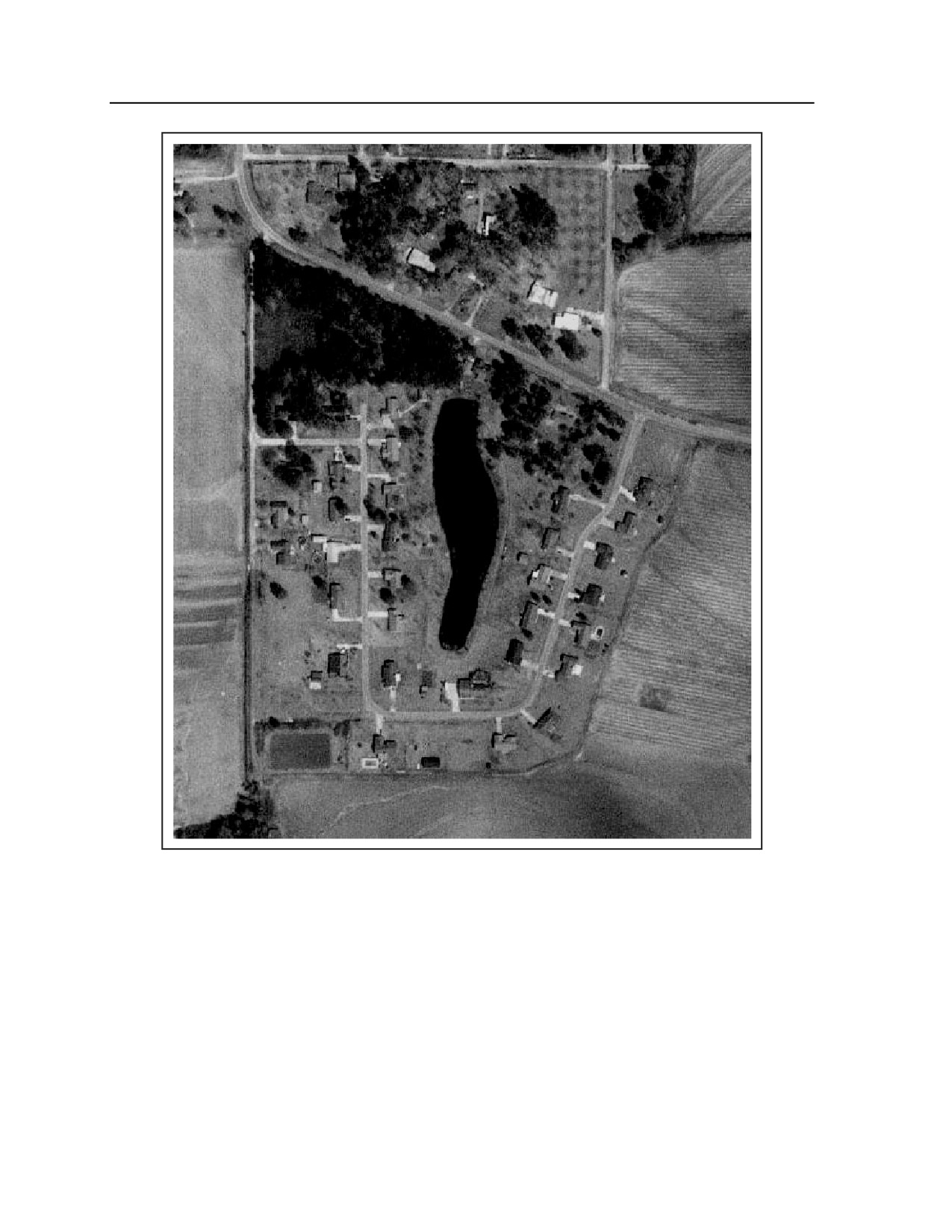
4-26. The contrast between an object and its background can aid in object identification (figure 4-3, page
4-8). The degree of contrast depends on the type and amount of ambient light, texture of the object,
background, and whether the object is illuminated. These items also serve as cues in identifying objects or
features.
7 May 2007
FM 3-04.203
4-7
Chapter 4
Figure 4-3. Identification by object contrast
Color, Texture, and Background
4-27. Color, texture, and background of a manmade or natural feature determine its reflective quality.
Various reflective qualities of objects in a FOV help determine degree of contrast. For example, an
unplowed field with no vegetation provides a good reflective surface. Conversely, an area covered with
water provides less overall reflection and appears darker than adjacent foliage with ANVIS. Dense
vegetation, however, actually provides very high reflectance of near-infrared (IR) radiation with ANVIS. A
crewmember familiar with the reflective quality of a feature may be able to identify it by contrast. This is
one advantage of knowing the local area and its features. Manmade and natural features most identifiable
by contrast include roads, water, open fields, forested areas, desert, and snow-covered terrain.
4-8
FM 3-04.203
7 May 2007
Rotary-Wing Night Flight
FACTORS
4-28. Factors affecting an aviator’s ability to use cues for terrain interpretation include ambient light,
viewing distance, flight altitude, moon angle, visibility restriction, terrain, seasons, and type of night vision
sensor used.
AMBIENT LIGHT
4-29. Reduced light levels at night decrease an aviator’s visual acuity. Thus, the distance at which an
aviator can identify an object is restricted. Terrain interpretation by size, shape, and contrast, becomes
more difficult as the light level decreases. Reduced airspeeds improve visual interpretation and increase
viewing and reaction time.
4-30. Ambient light level affects the perceived degree of contrast between objects. As more light is
reflected, shades/shadows are more pronounced. Higher light levels create greater contrast; however, the
actual measured contrast does not change with changes in ambient light. Objects with a poor reflective
surface appear black during low-light levels and dark gray during high-light levels. Objects or terrain
features with good reflective quality appear gray during low-light levels and become progressively lighter
as ambient light increases.
VIEWING DISTANCE
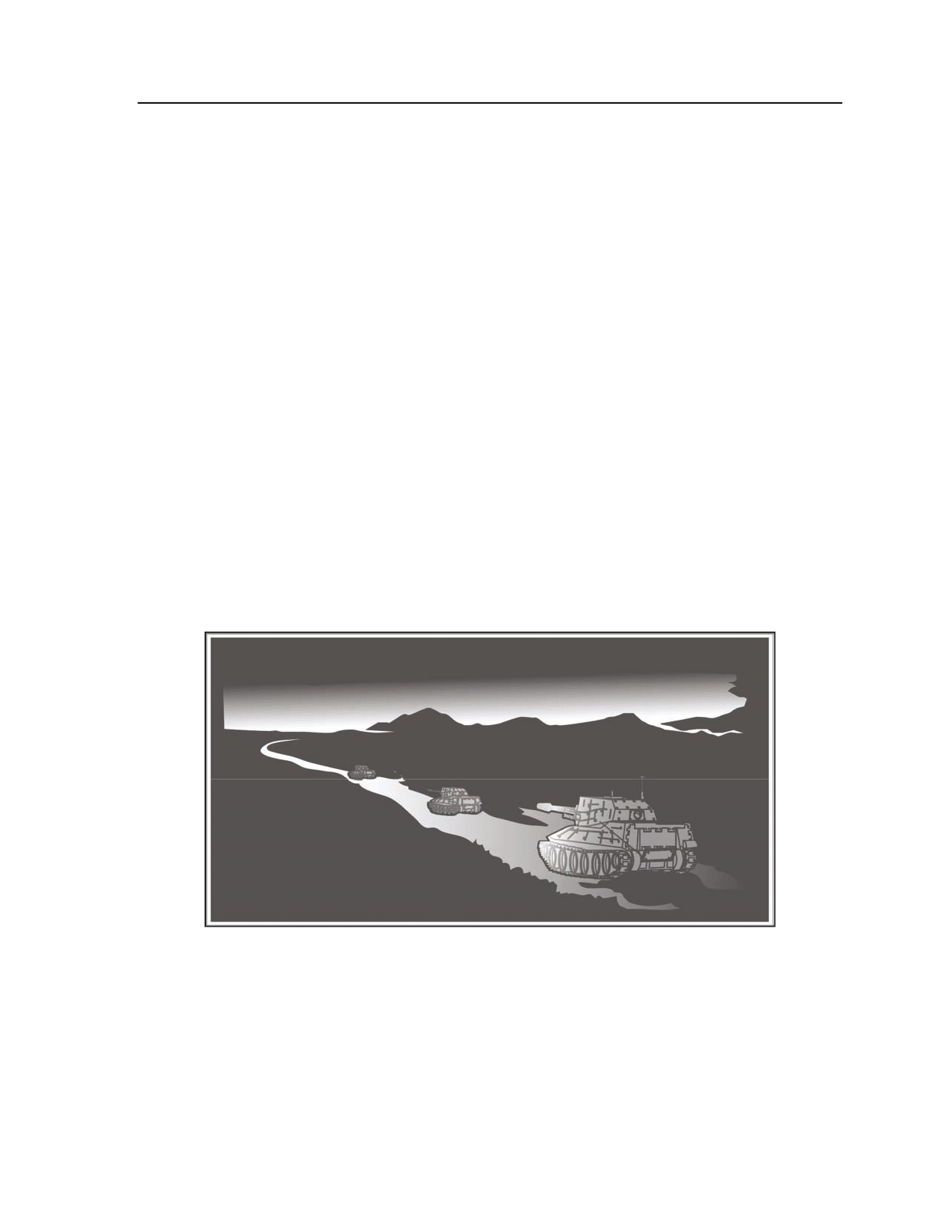
4-31. The viewing angle becomes smaller as the distance from the object increases (figure 4-4); therefore,
large and distinctly shaped objects viewed from a great distance at night may become unrecognizable.
Range is also difficult to estimate at night and can result in a miscalculation of object size. The distance at
which interpretation of an object becomes unreliable also depends on ambient light level. Aviators may be
able to identify an object by its shape and size at up to 1,500 meters during a high light condition; however,
they may not be able to recognize the object at 500 meters during a low light condition.
Figure 4-4. Identification by object viewing distance
FLIGHT ALTITUDE
4-32. The altitude AGL at which an aircraft is flown affects the aircrew’s ability to interpret terrain. The
effects of high- and low-altitude flights are discussed in the following paragraphs.
7 May 2007
FM 3-04.203
4-9
Chapter 4
High Altitude
4-33. Changes in viewing angle and distance at which an aviator is viewing an object will change the
apparent shape of that object. The ability to identify manmade or natural features progressively decreases
as flight altitude increases. This condition is affected at all levels of ambient light. When flight altitude
increases, contrast between features becomes less distinguishable and features tend to blend. As terrain
definition becomes less distinct, detection from altitude becomes difficult.
Low Altitude
4-34. Terrain becomes more clearly defined and contrast is greater when an aviator flies closer to the
ground. This allows manmade and natural features to be more easily recognized and permits increased
navigational capability. However, the viewable area of a crewmember at low altitudes is smaller than at
higher altitudes. With NOE/contour altitudes, that area is even smaller, sometimes requiring an aviator to
reduce airspeed to permit more accurate terrain interpretation. Objects can also be identified at low
altitudes by silhouetting them against the skyline.
MOON ANGLE
High Angle
4-35. Higher moon angles produce greater levels of illumination and reduce shadows that cause distortion
and loss of ambient light. This creates the best conditions for visual interpretation because increased
ambient light levels improve visual acuity and contrast.
Low Angle
4-36. Terrain interpretation is more difficult when the moon is low on the horizon. This is due to the lower
light level and the shadows caused by the low angle. If low-level flight is conducted toward the moon, with
the moon at a low angle, glare may bother the aircrew causing distorted vision and a loss of dark
adaptation. During aided flight, glare may also degrade NVD capability. However when the moon is low
on the horizon, terrain features or objects on the skyline are more recognizable.
Azimuth Angle
4-37. With ANVIS and high moon illumination, trees increase in apparent brightness. When the moon is
positioned behind an aviator, the contrast between the terrain and sky at the horizon may be reduced to a
zero value. However, when the moon is positioned within the frontal 180 degrees of the flight path, the
trees at the horizon will be shadowed, appearing darker, thereby increasing the contrast at the horizon.
VISIBILITY RESTRICTION
4-38. Weather conditions (dust, rain, fog, or snow) restrict visibility, reduce ambient light, and cause a loss
of visual acuity. These conditions normally cause visibility to decrease gradually, beginning with reduced
visual range, followed by loss of terrain definition. Eventually, the loss of visibility may impair night
vision to the extent that terrain flight is not safe and should be discontinued. These weather conditions also
complicate procedures such as hovering in a battle position (BP) and external load hook-up. Dust or snow
particles reflect light from a searchlight and can become a major distraction. In addition, the swirling dust
or snow can cause the illusion of relative motion when the aircraft is at a stable hover. A scan pattern
should reference vertical fixed points such as bushes, rocks, and trees.
TERRAIN
4-39. The nature of terrain determines the amount of light reflected from the surface of the earth. Deserts,
heavily vegetated rolling terrain, mountains, jungles, and arctic are terrain types that reflect light
differently.
4-10
FM 3-04.203
7 May 2007
Rotary-Wing Night Flight
Deserts
4-40. The texture and color of soil on the desert floor normally provides optimum reflection of available
ambient light and identification of objects by contrast. Manmade objects, in particular, stand out against
their background. Little vegetation normally exists; however vegetation may aid terrain interpretation by
providing good contrast with the soil. Aviators can encounter blowing dust or brownout in this
environment requiring a practiced technique to overcome. Lack of terrain features and reference points
makes terrain flight navigation and concealment more difficult. Aircrews must rely more on GPS and other
aids for navigation. Aviators must update maps to show such features as recognizable roads and trails.
Vegetated Rolling Terrain
4-41. Rivers and terrain features provide distinct changes in elevation from surrounding terrain and the
most recognizable natural landmarks for navigation. Dirt roads and farm structures provide the most
distinguishable manmade features. Contrast is also well defined between forested areas and open fields.
Mountains
4-42. Large, distinct terrain features and terrain silhouetting enhance terrain interpretation. Barren
mountains reflect ambient light well. With the moon near the horizon, large shadows severely restrict what
aviators can see in shadowed areas. Airspeed is normally slower in mountainous regions as rapidly
changing terrain requires nearly continuous altitude changes, while wind conditions may influence
selection of terrain flight modes. Additional hazards require aircrews to know how to operate in this
condition and apply appropriate flight techniques.
Jungle
4-43. Jungles are similar to heavily vegetated rolling terrain areas. The canopy obscures the view of most
features lacking significant vertical development. Precise terrain interpretation is more difficult as the
dense vegetation may also mask changes in elevation.
Arctic
4-44. The arctic is similar to desert regions when vegetation is covered by snow or not present. High
reflectivity causes glare that can hide details, while heavy snow can hide terrain features. Drifting or deep
snow may fill valleys or create hills making terrain interpretation difficult. Visible vegetation and dark
features provide good contrast. Blowing snow or whiteout conditions require aviator proficiency. An
aircrew’s depth perception may be impaired or lost in the presence of snow conditions. This loss or
impairment of depth perception can also occur with overcast conditions, when the visible horizon may
disappear. In addition, rotor wash creates a signature visible for great distances when flying terrain flight
altitudes in this environment, and low-level flight may create a visible path evident for hours, even when it
is snowing.
SEASONS
4-45. Seasons of the year affect the amount of ambient light reflected from the surface of the earth;
however, aviation focuses on two seasons—winter and summer. While significant differences are present
between the two seasons, which season is easier to interpret terrain and detect visual cues is determined by
that AO. Aviators must evaluate each location separately to avoid generalizations or assumptions.
Winter
4-46. Contrast improves during winter as many areas lack vegetation. Ground snow also improves contrast
by increasing total illumination as it reflects ambient or artificial light. The light color of snow, compared
with the dark color of structures and heavily forested areas, enhances visual interpretation.
7 May 2007
FM 3-04.203
4-11
Chapter 4
4-47. The loss of foliage on deciduous trees makes ground features, such as small streams, easier to
identify. Plants and grass in open fields change color and improve contrast between open fields and
coniferous trees. Barren trees, however, reflect less light and become more difficult to see often causing an
aviator to fly higher.
4-48. In winter, the orbital path of the moon is closer to the earth causing the ambient light level to be
higher than at other times of the year. This improves visual acuity and enhances terrain interpretation.
4-49. Cloud cover and restricted visibility occur more often during winter than summer. Both conditions
significantly reduce ambient light level, thereby decreasing visual acuity and making terrain interpretation
more difficult unless sources of artificial light are nearby.
4-50. Heavy buildup of snow may conceal manmade and natural terrain features. Snowdrifts may obscure
a road intersection normally used as a navigational checkpoint (CP). An aviator can still identify this
obscured CP by associating it with other objects or terrain features such as a power line, fence line, or cut
through a wooded area. In addition, heavy snow buildup combined with severe cold cause small rivers or
lakes to freeze over and become unrecognizable. Aviators must identify these landmarks by associating
them with a depression or tree line.
Summer
4-51. Identifying objects and terrain features by contrast in summer is less effective than during winter
months. The increased amount of vegetation and abundance of growth on deciduous trees makes it difficult
to recognize small rivers or streams and decreases the ability to recognize military targets when located in
or near forested areas. Concealment and camouflage are much easier during summer months.
NIGHT VISION SENSORS
4-52. Aviation night vision sensors are comprised of two types of systems—light amplification and
thermal-imaging. Each views terrain differently and will be covered in section IV.
OTHER CONSIDERATIONS
TERRAIN FEATURES
4-53. Analysis of terrain is the most reliable means of orientation. Features unique in shape or providing a
distinct change in elevation are excellent CPs.
Silhouetting
4-54. This cue is best described as sighting the darkened shape of an object when positioned against a
lighter background. Silhouetting is visually achieved during low-altitude flights. Aviators also use
silhouetting to locate terrain definition as well as manmade objects. High terrain can create shadows hiding
hazards or other important features.
VEGETATION
Vegetated Areas
4-55. Deciduous trees appear different when compared with coniferous trees. With ANVIS, heavily
forested areas reflect light well at the tops of the trees but may appear darker than open fields due to
shadows, viewing angle, and altitude. An open field stands out in forested areas due to good contrast.
Contrast, shape, and texture are cues as to which type of vegetation an aviator is viewing.
4-12
FM 3-04.203
7 May 2007
Rotary-Wing Night Flight
Fields
4-56. The amount of light reflected by a field depends on the season and amount and type of vegetation.
The type of vegetation or a harvested or plowed field may also provide highlights due to good contrast. In
addition, isolated fields make good CPs; however the surrounding trees may mask the field.
HYDROGRAPHIC FEATURES
4-57. Water generally provides little contrast unless wind disturbs the surface. Identification depends on
the amount of reflectivity (moonlight) and ambient light levels. Small ponds and lakes generally make poor
CPs; vegetation or terrain can easily hide them. Vegetation may also hide rivers and streams; however,
deciduous trees generally grow in wetter areas while coniferous trees grow on ridges which can assist an
aviator in locating rivers and streams.
CULTURAL FEATURES
4-58. Manmade features are excellent NVG navigational cues. Flight altitude is important for recognition
of these features. They include—
Roads. A dirt road may provide excellent contrast between the surrounding terrain, vegetation,
and its surface. Composition of the soil must be considered as it changes the degree of contrast
the road will provide in comparison to the surrounding terrain. In addition, roads cutting through
heavily forested areas are easily identifiable if visible through foliage. A concrete road is
generally more reflective than an asphalt road but may or may not be more visible through
NVGs due to surrounding background reflectance. Freshly paved asphalt roads appear dark
through NVGs; however, roads reflect more IR energy as they age and wear. An asphalt road is
usually difficult to identify as its dark surface reduces the contrast between it and the
surrounding terrain. The exceptions are if the asphalt road is located in a desert or snow-covered
environment or an area with open fields, which provides good contrast, making it easier to
recognize. Although roads are not good CPs, certain features can serve as orientation cues or
CPs. Roads normally make excellent barriers when associated with other CPs.
Intersections. Intersections accurately plotted on maps can serve as orientation cues or CPs.
Check the type of intersecting roads, road heading, and surrounding cues to ensure the correct
intersection has been located.
Bridges. Bridges can be good CPs if they have vertical development. A bridge is also a good CP
if the bridge surface contrasts with the road surface or surrounding vegetation.
Railroads. Aviators can easily identify railroads; however, surrounding vegetation or terrain
often hides them. The viewing angle is important for locating railroads. They make poor CPs
and barriers unless they are in open fields.
Buildings. Isolated, large, or light-colored buildings provide excellent contrast. Aviators should
not use small, dark-colored buildings as orientation cues.
Cemeteries. Most cemeteries have light-colored, polished headstones contrasting well against a
natural background and often reflecting a considerable amount of light.
SECTION IV - NIGHT VISION SENSORS
4-59. The purpose of using night vision sensors is twofold. First, night vision sensors enable friendly
forces to sustain around-the-clock operations. Second, night vision sensors allow the command to conduct
offensive and defensive operations against an enemy force with the element of surprise while increasing
survivability of an aircrew and aircraft.
4-60. Night vision sensors are described as either NVS or NVDs and can be either thermal imaging/FLIR
or image intensifier (I2) systems. NVSs are large and mounted to vehicles or aircraft. These are normally
thermal imaging systems (TISs) like those found on the AH-64, OH-58D, and on unmanned aircraft
systems. NVDs are small hand held or helmet mounted devices that aid in night vision. These are normally
7 May 2007
FM 3-04.203
4-13
Chapter 4
I2 and include devices such as the AN/AVS-6 and AN/PVS-14. See thermal imaging and I2 devices on
page 4-15.
ELECTROMAGNETIC SPECTRUM
4-61. The electromagnetic energy spectrum includes the range of wavelengths, such as gamma rays, X-
rays, ultraviolet, visible light, IR, microwaves, and radio waves, or frequencies of electromagnetic
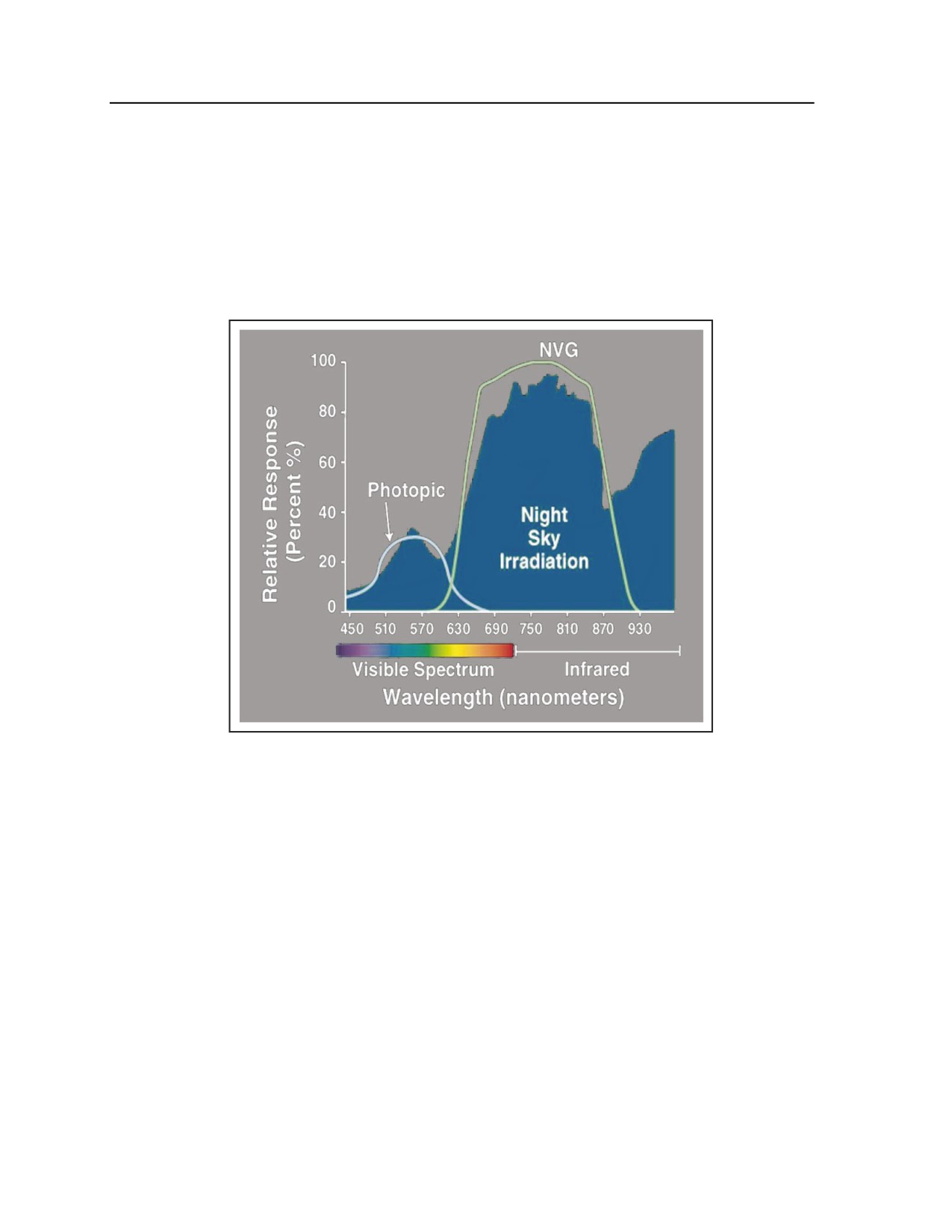
radiation. NVDs make use of visible light energy bands and IR energy bands. These bands make up a small
portion of the electromagnetic spectrum. Figure 4-5 highlights the portions of the electromagnetic spectrum
used by NVDs.
Figure 4-5. Electromagnetic Spectrum
VISIBLE LIGHT
4-62. The amount of reflected visible light determines what the human eye sees. The eye sees color due to
the reflective or nonreflective properties of the object being viewed. In other words, a leaf appears green
because it reflects mainly the green wavelength within the visible spectrum (0.52 to 0.57 micron) and
absorbs most of the remainder. For the leaf to reflect visible light energy, it must have energy in the
wavelengths between 0.4 to 0.7 micron incident upon it.
4-63. During daylight, the greatest source of visible light energy is the sun. The sun continuously emits
energy and permits the eye to discern form and color. When the sun sets, most naturally occurring visible
light energy is reduced and normal eye function makes the transition to scotopic vision decreasing visual
acuity. Scotopic vision requires either naturally occurring night light sources or artificial lights. I2 systems
amplify natural and artificial visible and near IR energy.
INFRARED RADIATION
4-64. The sun emits energy across the entire electromagnetic spectrum, not just the visible light spectrum.
As IR energy enters the atmosphere and penetrates to the surface, it is reflected or absorbed to produce
4-14
FM 3-04.203
7 May 2007
Rotary-Wing Night Flight
stimuli for NVDs. I2 devices can amplify reflected IR light. When IR light is absorbed, temperature
changes occur in those natural and manmade substances in the environment. As the sun sets, effects of this
solar heating remain. Thermal-imaging systems (TISs) are effective because they can detect this heat as the
environment radiates it. IR radiation exists due to molecular activity within elements of substances. As
molecules are stimulated, they vibrate, which radiates energy-including IR energy. The stimulus for
molecular activity is heat. The intensity of molecular activity is directly proportional to temperature. The
temperature of an object is caused by natural or artificial thermal sources or a combination. The amount of
IR energy radiated by an object depends on the exposure amount and how much thermal energy is
absorbed, reflected, or transmitted.
Infrared Energy
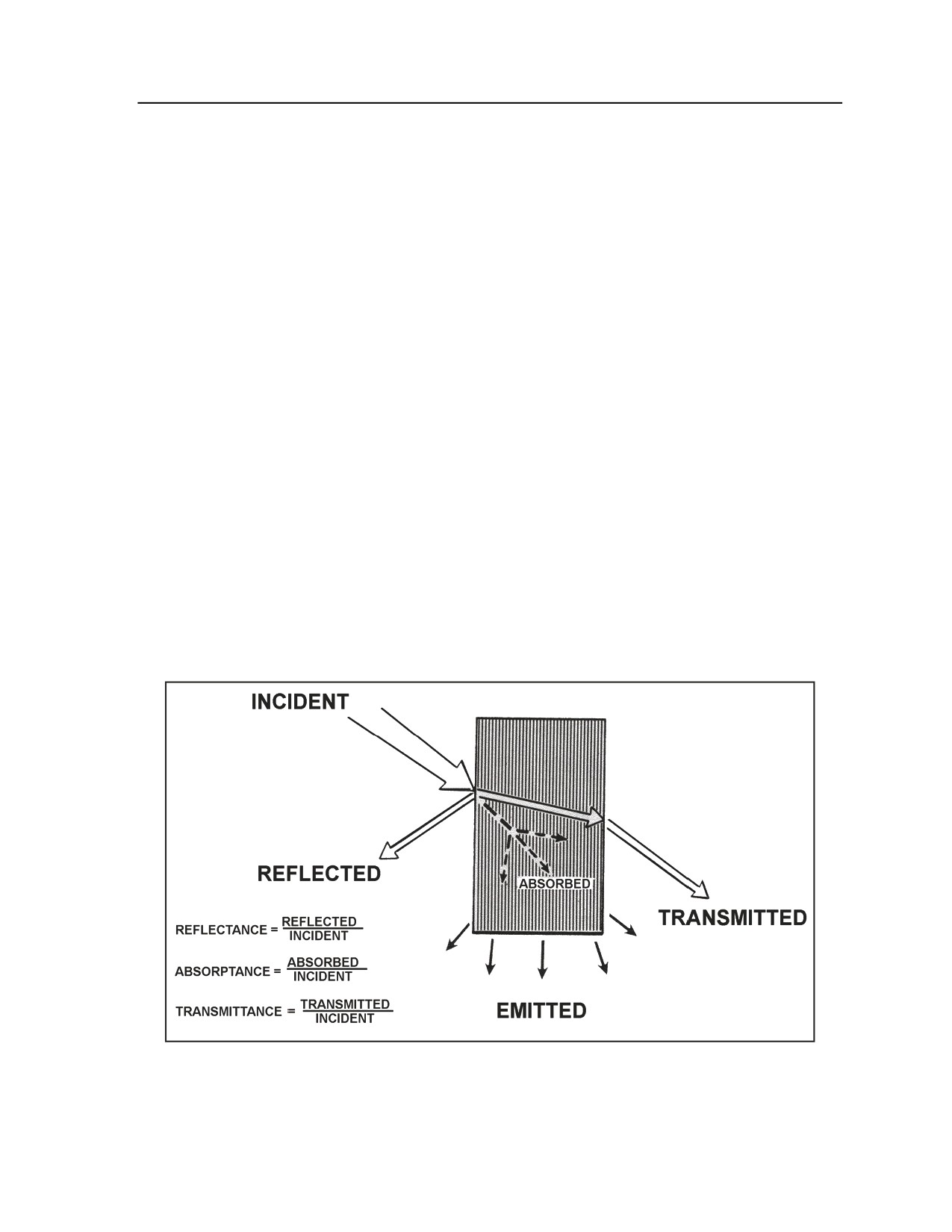
4-65. Reflectance, transmittance, absorptance, and emissivity determine the amount of IR energy an object
will radiate when exposed to “x” level of thermal energy for “x” amount of time. The total amount of IR
energy an object radiates is the sum of reflected, transmitted, and emitted energy (figure 4-6) which are
defined as—
Reflectance. The ratio of radiant energy reflected by a body to the radiant energy incident upon
it.
Transmittance. The ratio of radiant energy that, having entered a body, reaches its farther
boundary.
Absorptance. The ratio of radiant energy absorbed by a body to the radiant energy incident
upon it.
Emissivity. The relative power of a surface to emit heat by radiation. It is the ratio of radiant
energy emitted by a body (due to its temperature only) to that emitted by a reference body
(blackbody) at the same temperature.
This characteristic has considerable significance regarding object IR radiation. A blackbody
is an ideal body or surface that completely absorbs all radiant energy falling upon it with no
reflection making it the theoretical standard for laboratory comparison. A blackbody
absorbs 100 percent of IR energy acting upon it and emits 100 percent of its IR energy.
Figure 4-6. IR energy
7 May 2007
FM 3-04.203
4-15
Chapter 4
NIGHT VISION DEVICES
OPERATION
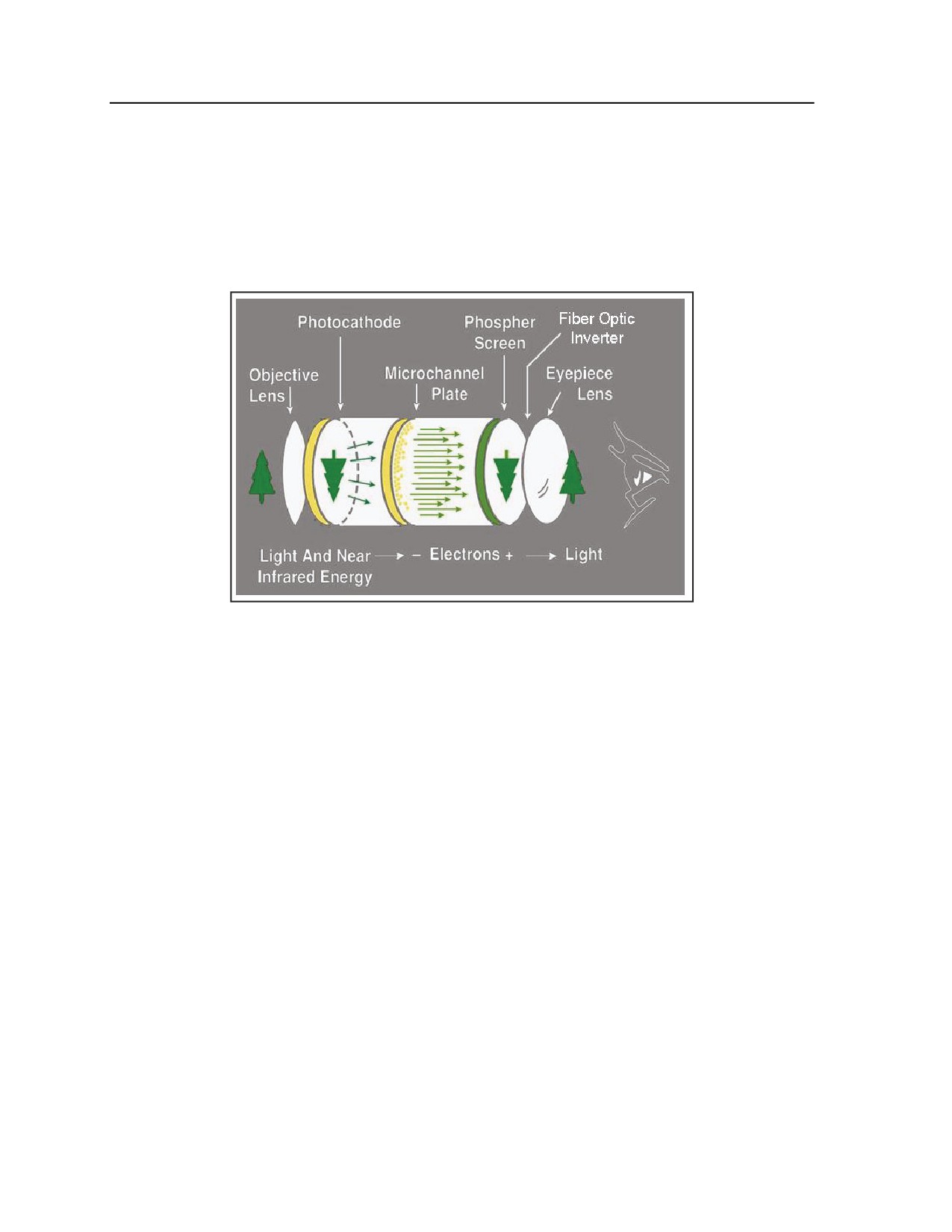
4-66. An I2 (figure 4-7) is an electronic device that amplifies light energy. Light energy, consisting of
photons, enters the objective lens, is inverted and focused onto a photocathode that is receptive to both
visible and near IR radiation. Photons striking the photocathode are then converted to a proportionate
number of electrons.
Figure 4-7. Image intensifier
4-67. Electrons are accelerated away from the photocathode to the microchannel plate (MCP) via an
electrical field produced by the power supply. The MCP is a thin wafer of tiny glass tubes that are tilted
about 8 degrees. Electrons enter these tubes and strike the walls, creating a reaction which exponentially
increases the amount of electrons. These increased numbers of electrons are then accelerated to the
phosphor screen. The phosphor screen emits an amount of photons proportional to the number and velocity
of the electrons striking it creating a lighted image. The image is then passed through a fiber-optic inverter
to rotate the image 180 degrees to correct the inverted image caused by the objective lens. The image is
then focused onto the viewer’s eye through an eyepiece lens. The power supply provides automatic
brightness control (ABC) that automatically adjusts MCP voltage to maintain image brightness at preset
levels by controlling the number of electrons that exit the MCP. Another feature is bright source protection
(BSP) which reduces the voltage to the photocathode when exposed to bright light sources. This feature
protects the I2 from damage and enhances its life; however, it lowers resolution. Exposure to bright light
sources could result in damage to the photocathode, MCP, or the operator’s eye.
AN/AVS-6
4-68. The AN/AVS-6 (figure 4-8, page 4-17) is a helmet-mounted, light-intensification device. This NVG
and its variants allow aircrews to conduct operations at terrain flight altitudes during low ambient light
levels, to include overcast conditions. It has a 40-degree FOV, which can enhance visual acuity from
normal unaided night acuity of about 20/200 to approximately 20/25 under optimum conditions. The
AN/AVS-6 amplifies light 2,000 to 3,000 times and provides sufficient imagery for pilotage from overcast
starlight to moonlight conditions. In practical application, when illumination is below quarter moonlight
conditions, artificial illumination (usually IR) may be required to light the flight path of the helicopter. The
AN/AVS-6 is powered by batteries or aircraft interface. The dual-battery pack has a low voltage warning
indicator on the visor mount consisting of a red light that flashes when the battery is at 2.4 volts or less.
4-16
FM 3-04.203
7 May 2007
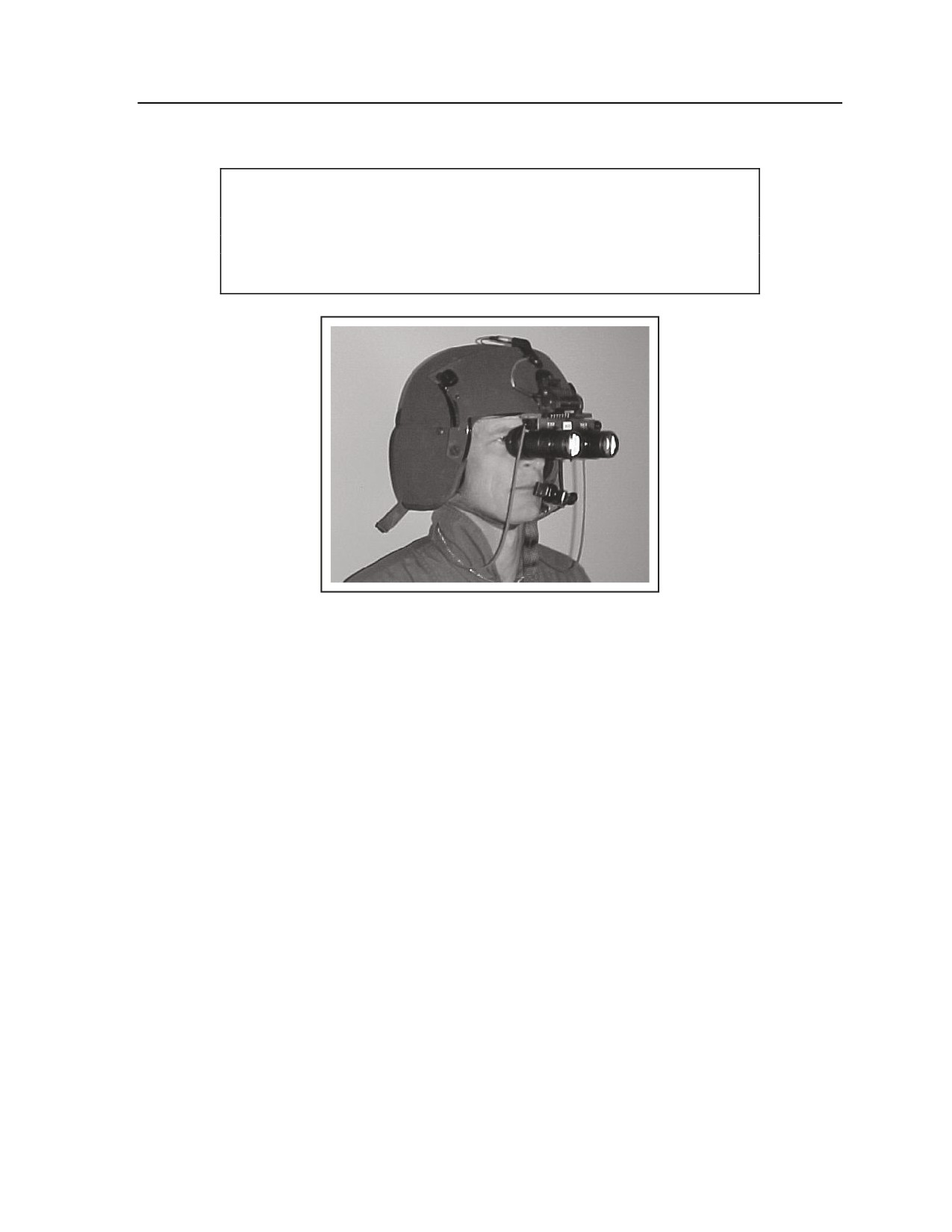
Rotary-Wing Night Flight
The AN/AVS-6 also incorporates a 10- to 15-G breakaway feature allowing the goggles to separate from
the attachment point on the helmet preventing injury to the aircrew member during an accident.
CAUTION
An aircrew member’s eyeglasses or protective masks can block the
warning light. The low-battery light is often detected first by the other
crewmember.
Figure 4-8. AN/AVS-6 in operational position
SYSTEM COUNTERWEIGHTS
4-69. The counterweight system consists of the weight bag and counterweights. The weight bag is locally
constructed and is the responsibility of the maintainer. Attachment of the weight bag should be low on the
back of the helmet with the battery pack mounted vertically above it. The recommended initial weight is 12
ounces; however, maximum allowable is 22 ounces. The aviator adds or removes weight, with the goggles
attached and flipped down, to achieve the best balance and comfort. A Velcro™ patch on the back of the
helmet is required to attach the counterweight system as well as the battery pack. The helmet can only be
modified with the Velcro™ patch by a qualified ALSE technician. Using tire weights and like materials
with sharp edges is discouraged as they can become missile hazards during a crash sequence. It is
recommended buckshot in zip-lock pouches or rolls of pennies be used, allowing the amount of weight to
be adjusted easily and the weight bag to conform to the contour of the helmet.
HEADS-UP DISPLAY
4-70. HUD systems are designed to display flight, navigation, aircraft and weapons system information
onto the NVG display. It enables an aviator to concentrate his vision outside the cockpit while maintaining
the ability to view critical information. Depending on the system, the aviator has the ability to determine
and display critical information and symbology into his FOV and is able to keep eyes outside the cockpit.
Currently the AN/AVS-7 (HUD) is fielded in UH-60 and CH-47 helicopters, while the ANVIS display
symbology system (ADSS) is used in the OH-58D, and the symbology display unit is used on AH-64.
Detailed information on HUDs and their operation can be found in the appropriate operators’ manual.
7 May 2007
FM 3-04.203
4-17
Chapter 4
OPERATIONAL CONSIDERATIONS
Magnification Versus Enhancement
4-71. NVG systems do not magnify an image; they enhance the illumination of an object. An object
viewed through an NVG system is the same size as if seen with the naked eye.
Lights and Lighting
4-72. Using NVGs, an aircrew member can detect light sources not visible to the unaided viewer.
Examples include certain lights on other aircraft, flashlights, chemical light sticks, cockpit supplementary
lighting, and even cigarettes. As ambient light level decreases, aircrews can more easily detect these light
sources; they will have greater difficulty correctly estimating distance. Performance of NVGs is directly
related to ambient light. During high light levels, resolution is improved and objects can be identified at
greater distances. Conversely, lights too bright, such as searchlights, street lights, or moonlight, can
adversely affect NVGs.
4-73. Fixed pattern noise (honeycomb) is usually evident at high light levels or when viewing bright lights.
Internal circuitry automatically adjusts output brightness to a preset level restricting peak display
luminance. When an area with bright lights is viewed, display luminance of the background decreases. In
addition to the halo effect around a bright light source, overall display luminance of the remaining scene
also dims. The brighter light sources dim the viewed scene. This same problem is usually evident when an
aviator is viewing in the direction of a full moon (usually at low angles above the horizon). The ability to
see objects within a lighted area depends on the intensity of the light and distance of the object from the
viewer. To prevent degrading NVG performance, a crewmember should minimize the time spent looking at
bright light sources within the 40-degree FOV. In addition, when flying with the landing light, searchlight,
or IR band-pass filter installed, an aircrew should avoid concentrating on the area illuminated by the light.
They should also scan the area not illuminated for hazards or obstacles.
4-74. The sky above the horizon tends to activate the ANVIS ABC level to dim objects below the horizon
when an aviator is flying in the direction of the setting sun before EENT or in the direction of the rising
sun after BMNT. The more the sky above the horizon fills the NVG’s FOV, the greater the dimming of the
image and details below the horizon. NVG training flights during these periods are not recommended.
Depth Perception and Distance Estimation
4-75. NVGs distort depth perception and distance estimation. The quality of depth perception in a given
situation depends on factors including available light, type and quality of NVGs, degree of contrast in the
FOV, and user experience. The aircrew must often rely on the monocular cues covered in FM 3-04.301.
Color Discrimination
4-76. Color discrimination is absent when a crewmember views scenes through NVGs. The picture viewed
is monochromatic (single color) and has a green hue due to the type of phosphor used on the screen. The
green hue may cause crewmembers to experience a pink, brown, or purple afterimage when they remove
NVGs. This is called monochromatic adaptation and is a normal physiological phenomenon. The length of
time the afterimage remains varies with each individual.
Scanning Techniques (Aided Flight)
4-77. The basic principles of scanning, flight techniques, and visual cues are the same for aided and
unaided flight; however, a few specific items are considered when conducting operations with NVGs.
NVGs use improves ground reference but significantly reduces FOV.
4-78. An NVG’s FOV significantly reduces peripheral vision as compared with unaided flight.
Crewmembers must use a continual scanning pattern to compensate for the loss. Moving the eyes will not
change the viewing perspective; the head must be turned. Rapid head movement, however, can induce
4-18
FM 3-04.203
7 May 2007
Rotary-Wing Night Flight
spatial disorientation. To view an area while using NVGs, a crewmember’s head and eyes must rotate
slowly and continuously. The length of time and frequency of the scanning pattern is based on the type of
terrain and obstacles, airspeed, and what is actually seen through the NVG. When scanning to the right,
crewmembers should move their eyes slowly from the left limit of vision inside the device to the right limit
while moving their head to the right. This enables a crewmember to cover a 70- to 80-degree FOV with
only 30 to 40 degrees of head movement, minimizing head rotation. The crewmember should scan back to
the left in reverse order avoiding rapid head movements. The crewmember must blend aided and unaided
vision techniques to view the scene. After a few NVG flights, head and eye movements for proper
scanning become intuitive and natural.
4-79. NVGs are the primary source for detailed visual information. The intensity, distance, or color of
illumination sources-such as aircraft position lights and ground lights-may not be accurately interpreted
when using NVGs. Unaided vision can provide this additional information. Inside the cockpit, an aviator
can look under or around the framework of NVGs. This technique is also used to view outside the cockpit
to detect the true color of position lights or possible obscuration, or any distorted observation by NVGs.
Initially, unaided peripheral vision may be distracting until the crewmember develops adequate experience
combining aided and unaided vision.
Obstruction Detection
4-80. Obstructions having poor reflective surfaces, such as wires and small tree limbs, are difficult to
detect. The best way to locate wires is by looking for the support structures. However, aviators should
review the most current hazard maps with known wire locations before NVG flights.
Spatial Disorientation
4-81. Maneuvers requiring large bank angles or rapid attitude changes tend to induce spatial disorientation.
An aviator should avoid making drastic changes in attitude/bank angles and use proper scanning and
viewing techniques.
Airspeed and Ground Speed Limitations
4-82. Aviators using NVGs tend to overfly their capability to see. To avoid obstacles, they must
understand the relationship between the NVG’s visual range, forward lighting capability, and airspeed.
This is especially true when flying in a terrain flight mode.
4-83. Different light levels affect the distance at which objects are identified and limit the ground speed
flown at terrain flight altitudes. Ground-speed guidance is not specified due to continuously changing
variables such as type of aircraft, supplemental lighting, visual obscuration, and ambient light conditions.
Aviators should reduce ground speed to allow enough reaction time for detection and obstacle avoidance,
especially during low ambient light levels or when visibility is poor.
4-84. Object acquisition and identification are related to ambient light levels, visibility, and contrast
between the object and its background. Light levels appropriate for training may need to be different from
operational conditions to ensure safe operation and reduce risk. Variables affecting the ability to see with
NVGs include—
Type, age, and condition of NVGs.
Cleanliness of aircraft windscreen or sensor window.
Moisture content in the air (humidity).
Individual and collective proficiency and capability.
Weather conditions (fog, rain, low clouds, or dust) and amount of ambient light.
7 May 2007
FM 3-04.203
4-19
Chapter 4
Aircraft Lighting
4-85. Exposure to various sources of lighting not compatible with NVGs, especially red, may degrade an
aircrew member’s ability to see. Adverse effects of lighting are greatest during low ambient light
conditions.
4-86. The AN/AVS-6 is designed to be operated with blue-green cockpit lighting. Red cockpit lighting is
not compatible and not authorized for use with NVGs. While blue-green cockpit lights will not degrade
system performance, the lights should be dimmed to a low readable level.
CAUTION
During tactical operations at night, cockpit lighting should be adjusted
to the absolute lowest usable levels and crewmembers should be
discrete in the use of supplemental lights to avoid detection by enemy
forces.
4-87. NVG operations are degraded by aircraft external lights unless properly modified. The lights should
be adjusted to the lowest level allowing detection by other aircraft or a control facility. Red navigation
lights (left side of aircraft) produce more usable light with NVGs than green lights. Aviators switching
seats should anticipate this, especially before hovering or performing external load work.
4-88. Other aircraft external lights such as position lights, formation lights, anti-collision lights, or
electroluminescent light panels should be turned off or subdued as appropriate for the operation.
Compliance with all local requirements and any appropriate Federal Aviation Administration (FAA)
exemptions must occur prior to conducting lights-out operations or modifying helicopters. Exterior lights
of other aircraft do not degrade the vision of an aircrew using NVGs if the lights are properly operated.
Consult other publications to determine if an IR search/landing light must be installed before conducting
NVG operations.
Weather
4-89. When using NVGs, aviators may fail to detect entry into or presence of IMC. NVGs enable
crewmembers to see through obscurations, such as fog, rain, haze, dust, and smoke, depending on density.
As density increases, aircrews can detect a gradual reduction in visual acuity as less light is available.
Certain visual cues are evident when restriction to visibility occurs. The apparent increase in size and
density of halos during bad weather is an illusion. The halos are due to the electron spread for bright light
sources; size remains the same. Any reduction in visibility decreases light intensity and reduces density of
the halo. While contrast decreases, video noise may increase. There may be a loss of celestial lights, while
the moon and stars may fade or disappear due to overcast conditions. When these conditions are present,
severity of the condition is evaluated and appropriate action taken. Actions include reducing airspeed,
increasing altitude, reversing course, aborting the mission, or landing. If visual flight cannot be maintained,
the crew must execute appropriate IMC recovery procedures.
4-90. Rain causes unusual effects when using NVGs. Specifically, rain will not be detected on the
windshield of an aircraft primarily because the NVG’s depth of focus makes the windshield out of focus.
Weapons
4-91. During Hellfire missile engagements, NVGs may momentarily shut down if the aviator looks directly
at the motor during ignition. When firing the 2.75 inch folding-fin aerial rocket, 20- or 30-millimeter
cannon, 7.62 millimeter, or .50-caliber machine guns, aircrews may briefly lose sight of the target.
Although the bright flash resulting from the rocket launch lasts only milliseconds, the muzzle flash from
the weapons may cause the aircrew to lose sight of the target throughout the entire firing burst. The
4-20
FM 3-04.203
7 May 2007
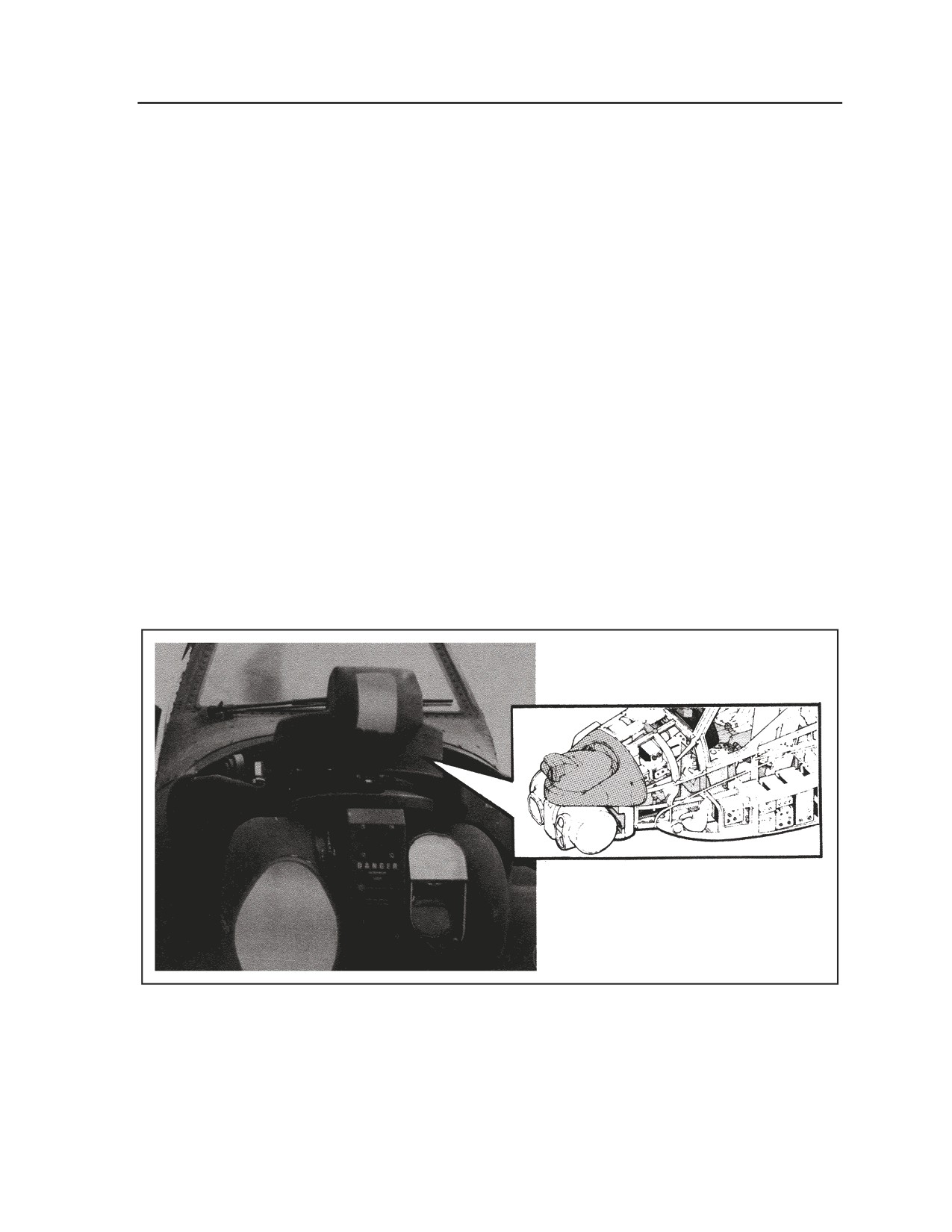
Rotary-Wing Night Flight
recovery from bright flash illumination is more rapid with NVGs than unaided. A greater concern is
observing impact due to flash signature momentarily degrading the NVG.
THERMAL-IMAGING SYSTEMS
4-92. The operation of TISs differs from NVG systems. Thermal systems operate passively without regard
to levels of visible light. These systems do not transmit energy; rather, they sense and display energy
radiated from objects. TISs provide aviators with an image of an IR scene. Thus, aviators can operate in
environments that could restrict or prohibit unaided operations. Increased effectiveness of a TIS occurs
when there is a large difference in detected IR radiation between an object and its background.
Effectiveness is also improved when atmospheric considerations, such as obscuration, are minimized
between the system and the object.
TYPES
4-93. Currently, Army attack and reconnaissance helicopters utilize thermal-imagining systems, or FLIR,
for target acquisitions during day and night operations. The OH-58D TIS and the AH-64 pilot night vision
system (PNVS), figure 4-9, and target acquisition device system (TADS), figure 4-10, page 4-22, are
passive systems which sense and display various levels of IR energy radiating from objects. This allows
operators to view objects regardless of visible light levels required for unaided and aided operations. The
effectiveness of a TIS depends on the difference in detected IR radiation between an object and its
background. Effectiveness also depends on atmospheric considerations, specifically, the degree of
obscuration present between the system and the object. Thermal systems are most effective when a large
difference in IR radiation exists between an object and its background and when obscuration is minimal.
The AH-64 PNVS is currently the only TIS designed for pilotage but crews may use the TADS as a backup
should PNVS fail. Aviators should consult the appropriate aircraft operator’s manual for specific operating
instructions.
Figure 4-9. Pilotage system
7 May 2007
FM 3-04.203
4-21
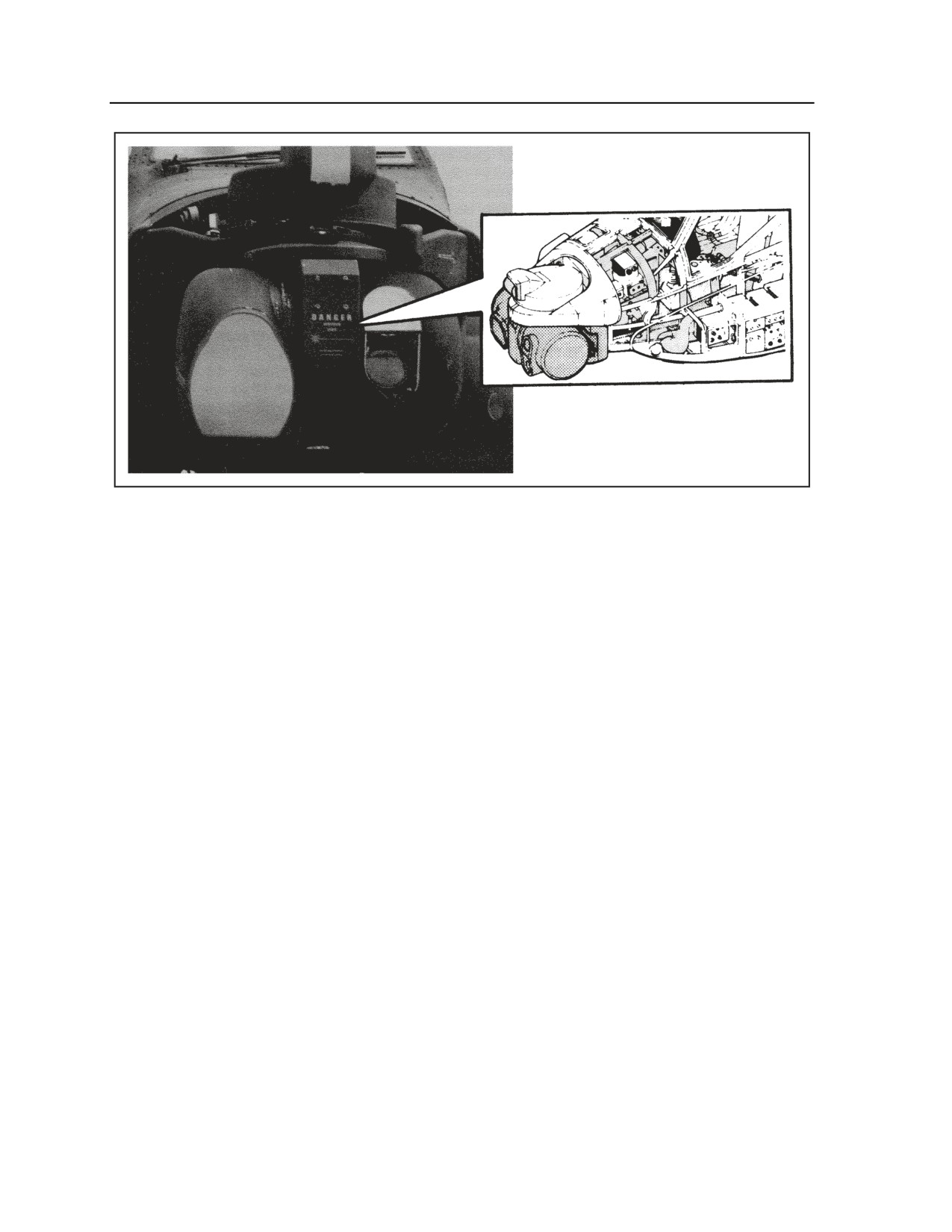
Chapter 4
Figure 4-10. Target acquisition system
OPERATIONAL CONSIDERATIONS
MINIMUM RESOLVABLE TEMPERATURE
4-94. TISs/FLIR operations depend on the ability of the system to detect temperature difference. These
differences are displayed in the cockpit by shading variations of the display screen. The lowest thermal
difference that can be resolved is called the minimum resolvable temperature (MRT). An operating tank
shows up well against a cool background, but a cold-soaked tank sitting out in a field with only a minor
temperature difference may not show up at all unless the difference in temperature is greater than the MRT
of that system. Typical Army FLIR systems have a MRT that allows discrimination of objects that are
within degrees of each other. A low MRT also provides more contrast and detail in the FLIR picture and
allows operations in a broad range of environmental conditions.
FORWARD-LOOKING INFRARED RADAR SENSOR OPTIMIZATION
4-95. Detailed procedures for optimizing are found in appropriate operators manuals. Generally FLIR
optimization is a combination of level and gain settings, which produces the most detail in the displayed
image. It is equivalent to the brightness control on a cathode ray tube (CRT). From these settings, an
adjustment of either control in either direction produces less detail and degrades the image quality of the
FLIR. The level and gain controls on the display control panel are used to adjust the FLIR sensor. Proper
adjustment of FLIR provides the highest possible resolution picture for the operating environment at time
of adjustment. If the FLIR is operating properly, scene content—such as terrain and metal buildings,
temperature, humidity, atmospheric conditions, and range to the viewed objects—will determine the image
quality.
4-96. The level control regulates overall intensity or brightness of the total light-emitting diode array. An
increase in level control uniformly increases intensity or brightness of the total light emitting diode (LED)
array. Conversely, a decrease in level control uniformly reduces intensity of the total LED array. This is
presented as a brightening or darkening of the total display. An aviator should increase or decrease level
control, as necessary, to bring significant object signals (whether hot or cold) within the dynamic range of
the LED array.
4-22
FM 3-04.203
7 May 2007
Rotary-Wing Night Flight
4-97. The gain control also affects intensity of the LED array but on an individual LED basis. It is
equivalent to contrast control on a CRT. Increasing the gain decreases the range of visible temperatures in
the scene, which allows detection of smaller temperature differences in the midrange. With excessive gain
adjustment, cooler and hotter temperatures will appear either black or saturated white with few visible gray
shades. With too little gain adjustment, overall contrast is reduced and small temperature differences are
less apparent. Gain control regulates the response of each LED to the electrical signal produced by the IR
detectors. Each IR detector in the detector array is electronically connected through preamplifiers and
postamplifiers to one LED within the LED array. An increase in the gain control increases amplitude of the
electrical signal, leaving the postamplifier to power an LED. Conversely, a decrease in gain control
decreases amplitude of the electrical signal. If gain control is increased, an LED will be brightened or
dimmed to a greater extent or degree than when gain is decreased. For example, an LED response to an IR
detector signal is increased with an increase in gain and decreased with a decrease in gain. This is
presented as a variation in intensity between the shades of gray within the total display. Aviators will
perceive a reduction in gain on the display as a softening or clouding of the image. Increases in gain reduce
the apparent cloudiness in the image until only black and white are visible with no shades of gray between
them.
4-98. Considerations for FLIR optimization are the following:
The FLIR should be allowed to cool to proper operating temperatures before optimizing.
The aviator selects a scene that is potentially rich in detail or best represents the planned flight
environment.
The aviator selects the desired polarity.
Only one control should be adjusted at a time; never simultaneously.
4-99. To accomplish FLIR optimization, the aviator fully decreases level and gain controls, which will
completely darken the display. Level control is increased until the display just begins to brighten, then gain
control is advanced until obvious variations in shading appear in the display and stop the advance. The
aviator then makes minute adjustments in level and gain controls to complete the optimization process.
4-100. FLIR optimization described above is appropriate only for the scene viewed and existing
atmospheric conditions at the time of the optimization. Generally, changes in atmospheric environment and
scene content will require only minor adjustments of level and gain controls after FLIR is initially
optimized. To ensure effectiveness of FLIR, aviators should continually optimize the FLIR image. Aviators
must clearly understand and effectively practice the principles of FLIR optimization.
ATMOSPHERIC EFFECTS
4-101. Atmospheric transmission pertains to signal reduction (attenuation) caused by the distance a signal
travels through a given air composition or density. IR signal attenuation is directly proportional to changes
in air composition or density. As moisture increases in the air, IR signal strength is attenuated. Condensing
moisture forms clouds that may form heavy overcast conditions. These overcast conditions, especially over
a period of days, prevent most solar thermal radiation from reaching the surface. The loss of thermal
energy reduces molecular activity in substances beneath the overcast conditions and subsequently reduces
IR radiation from those substances. Heavy concentrations of moisture between a FLIR sensor and the
objects viewed tend to attenuate IR radiation from those objects. These particles of moisture generate their
own molecular activity. In comparison, the radiation from these particles is very small. It may add,
however, to the overall interference in the IR signal transmission. Elements other than moisture, such as
dust, haze, or smoke, also affect the composition or density of the atmosphere and IR signal transmission.
FLIR penetration of these substances depends on the size and amount of particulates between the sensor
and the objects viewed.
4-102. FLIR performance for specific environments cannot be absolutely defined as they depend so much
on the intensity and relative unpredictability of atmospheric effects and conditions. The differences in total
radiation of objects relative to the existing backgrounds normally permit safe terrain flight operations.
FLIR exceeds the capability of the human eye to operate in visual obscurations or adverse weather
conditions and usually allows detection of any obscurations before penetration. This advance notice allows
7 May 2007
FM 3-04.203
4-23
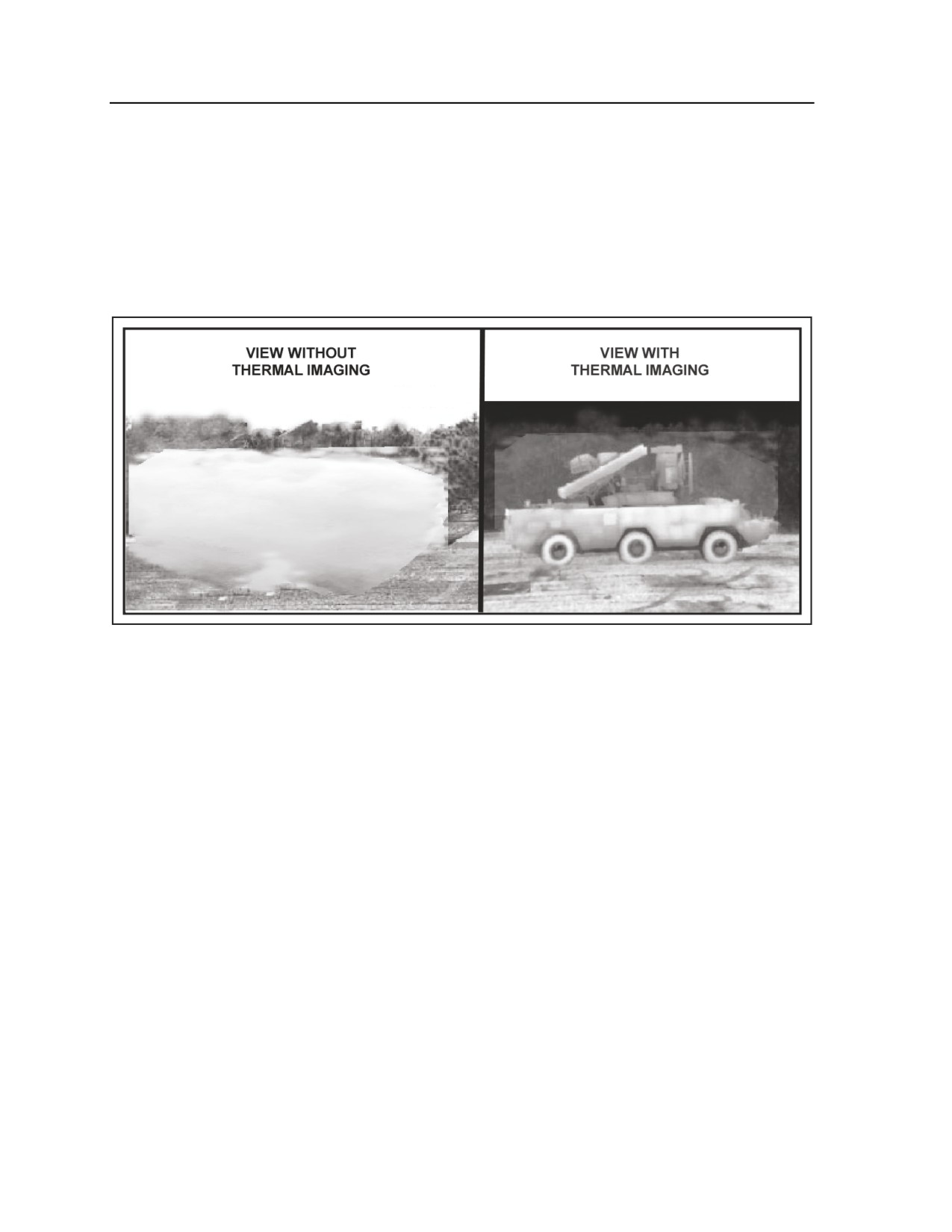
Chapter 4
the aircrew the option of circumnavigation or penetration. The effect of atmospheric obscurations on
thermal system performance varies in direct proportion to the quantity and density of the obscuration. The
distance between the sensor, viewed scene, and IR signature strength of the objects also affects the
performance level. A scene viewed with FLIR is rarely totally obscured.
4-103. Since 1979, PNVS has been subjected to flight operations in weather phenomena including heavy
rain, snow, sleet, fog, and haze. These conditions were encountered in various types of terrain including
deserts, mountains, and densely foliated swamps. Data gathered during these environmental tests proved
PNVS FLIR permits safe NOE flight operations most of the time. As visibility was degraded, airspeed was
reduced to avoid obstacles. Figure 4-11 illustrates atmospheric effects on IR radiation.
Figure 4-11. Atmospheric effects on IR radiation
INFRARED ENERGY CROSSOVER
4-104. IR energy crossover is the final factor affecting IR radiation. Figure 4-12, page 4-25, depicts a
specific location and shows temperature distributions of various substances during a 24-hour period. The
effects of solar thermal radiation can be observed by tracing any of the substance curves from 0600 hours
(assuming that to be sunrise) to 1400 hours. Point A depicts the time of day when soil, water, and concrete
cross over-when thermal radiation of each is nearly equal. The ability of FLIR to discriminate soil from
concrete or water would be based on MRT. The FLIR with the lowest MRT would experience the least
effect from IR energy crossover and would increase the amount of time when FLIR is unaffected by IR
energy crossover. Point B depicts the time of day when temperature differences among soil, water, and
concrete are greatest. If this were always the case, the MRT of FLIR could be much higher and still permit
scene definition. The temperature differences depicted in point B are generally the exception. The common
condition lies somewhere between points A and B.
4-105. Soil, concrete, and water cross over twice daily. However, soil and concrete do not cross over with
vegetation, while vegetation and water cross over twice daily. Figure 4-12 depicts conditions for a moment
in time at one location. Given the effects of weather, it is unlikely these same conditions will recur, even in
the same location. The variance occurs because changing weather patterns make the same day different
from one year to the next. Geographically, terrain exhibits vastly different temperatures over a period of
time. Crossover in the desert may occur several times in one day and not recur for several consecutive
days.
4-24
FM 3-04.203
7 May 2007
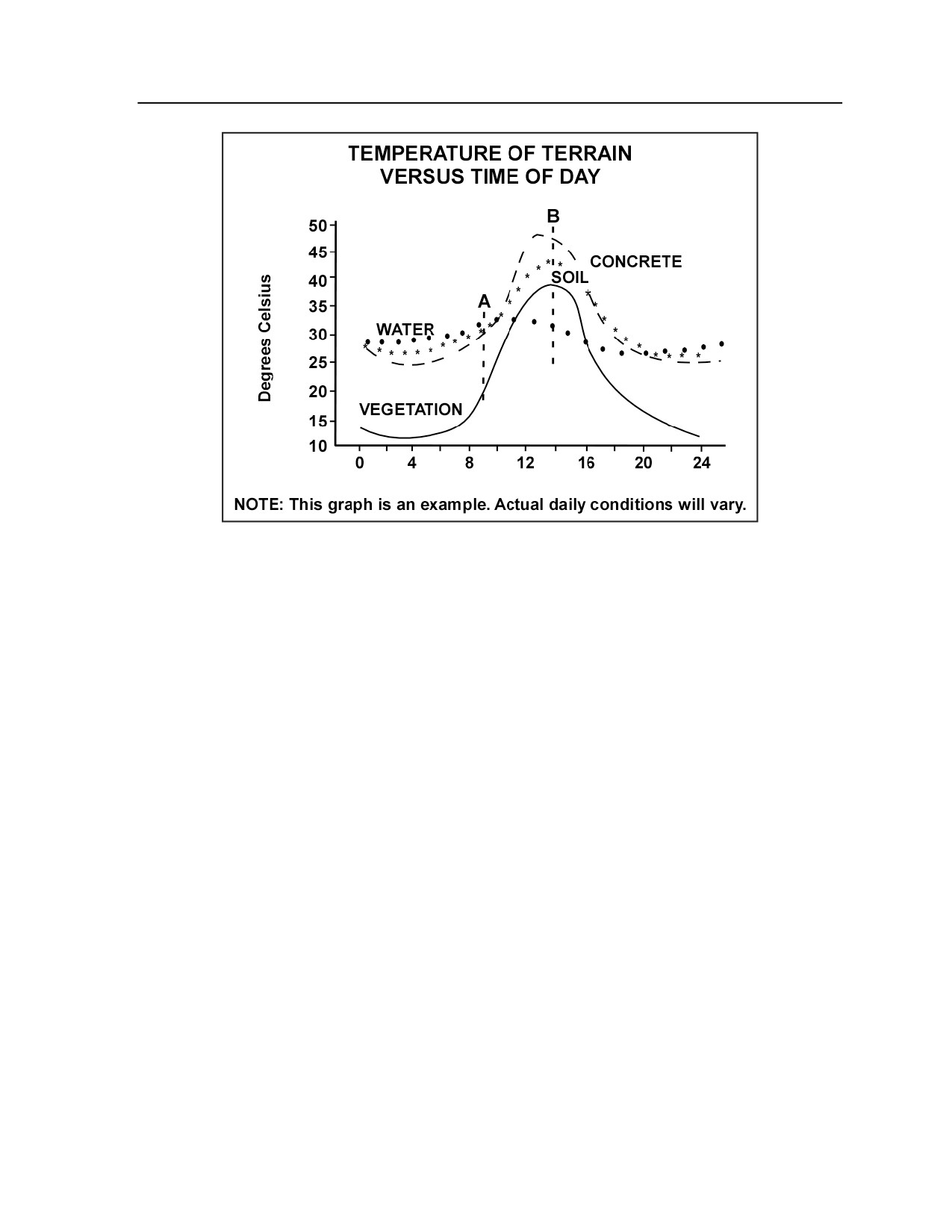
Rotary-Wing Night Flight
Figure 4-12. Infrared energy crossover
4-106. Predicting crossover is not an exact science. IR energy crossover has the greatest effect on FLIR
operations when it occurs with haze, fog, or some other weather phenomenon and results in a poor image
quality that cannot be predicted. An aviator must learn to contend with those conditions through
knowledge, understanding, and increasing operational proficiency.
LIGHTS
4-107. Lights visible to the unaided eye at night will not normally be visible through FLIR. Aviators can
compensate for this by looking for lights with the unaided eye.
DEPTH PERCEPTION AND DISTANCE ESTIMATION
4-108. The FLIR system greatly affects depth perception and distance estimation. To help overcome the
loss of peripheral vision cues and the two-dimensional image, flight information is symbolically
superimposed on the FLIR image. An aviator must rely on flight symbology and monocular cues for
accurate depth perception and distance estimation.
COLOR DISCRIMINATION
4-109. Color discrimination of objects is absent due to the operational properties of FLIR. Color is based
on energy which falls into the visible light spectrum. FLIR images are produced by detecting IR energy
radiating from objects and do not require visible light. FLIR displays are monochromatic and shading is
used to display different levels of detected energy. The unaided eye will be able to distinguish the color of
lights that are bright enough for photopic vision.
PARALLAX EFFECT
4-110. This occurs in a PNVS due to the relative distance between the FLIR sensor and the helmet
display unit (HDU). The FLIR sensor is contained within the PNVS turret located on the nose of the
aircraft, while the HDU is positioned in front of the aviator’s eye. The PNVS turret is located
7 May 2007
FM 3-04.203
4-25
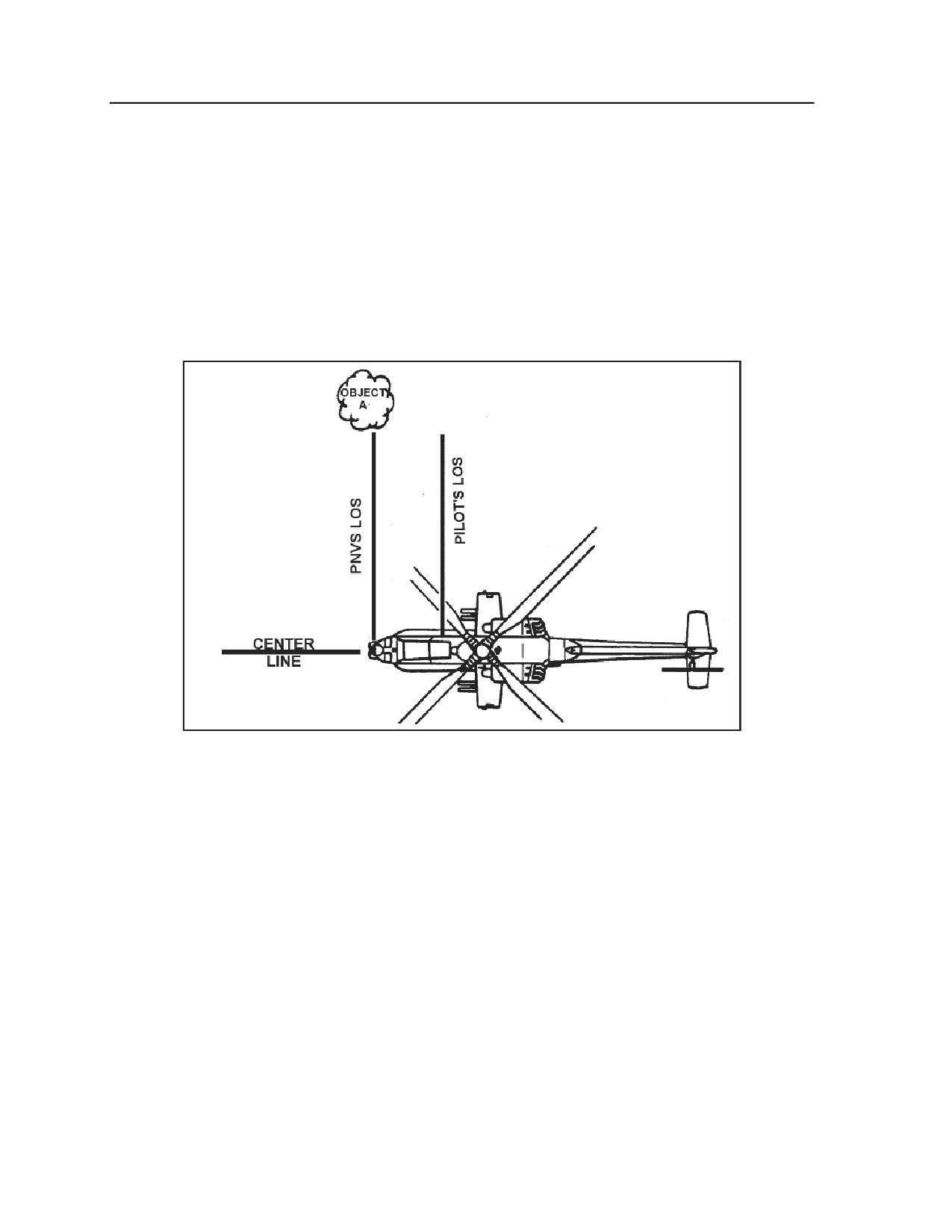
Chapter 4
approximately 10 feet forward and 3 feet below the aviator’s design-eye position. In both crewmember
positions, the thermal scene viewed on the HDU is obtained from the physical perspective point of the
FLIR sensor. The aviator flying with the PNVS views with the FLIR sensor, not with his unaided eye.
Attempts to correlate the thermal scene viewed through the HDU with the actual scene viewed using the
unaided eye can result in an apparent difference in the location of objects within the scene.
4-111. In figure 4-13, the aviator has turned his head 90 degrees to the right, and the PNVS turret is
pointed 90 degrees to the right. An object (tree) is located at A in the illustration. The FLIR sensor views
the tree in the center of the FOV along the line-of-sight (LOS); however, the aviator’s unaided eye would
not see the tree in the center of his FOV, rather slightly left of his FOV. The parallax effect increases with
the turret offset angle and the relative closeness of obstacles to the aircraft. The aviator must relate his view
of the PNVS scene between the origin of the image (PNVS turret) and his seating position.
Figure 4-13. Parallax effect
BINOCULAR RIVALRY
4-112. Binocular rivalry describes the competition between the PNVS aided eye and an unaided eye,
while an aviator is flying with monocular-equipped PNVS. This rivalry can be described as an undirected
attention shift of an aviator’s desired visual reference point (HDU display) to an undesired point or scene,
or vice versa. The frequency and length of these occurrences depend on several variables including HDU
luminance, ambient scene luminance, HDU scene complexity, ambient scene complexity, and to some
degree, eye dominance at early stages in training. Aviators are accustomed to using both eyes while
performing flight duties. The PNVS monocular display is positioned in front of only one eye (aided eye),
leaving the other eye unaided. Difficulty arises when an aviator is forced to manage the direction of both
eyes, while maintaining a high degree of concentration with the PNVS. This is coupled with the need to
absorb any information observed by the unaided eye such as caution lights or a flare outside the cockpit.
The goal is to prevent an uncommanded shift by either eye. To control or prevent binocular rivalry, an
aviator should select, through experimentation, one of three cockpit lighting configurations—floodlights
bright, dim, or off. During night flights, external light interferences are commonplace, so the aircrew
should plan its flights to eliminate disturbances from known light sources. A high degree of concentration
is required when managing visual perception with PNVS. Even experienced aviators are susceptible to
4-26
FM 3-04.203
7 May 2007