FM 3-04.203 Fundamentals of Flight (May 2007) - page 4
Weight, Balance, and Loads
Protective Equipment
2-85. Aircraft operators ensure appropriate equipment is available to protect aircrew and passengers when
transporting materials whose vapors are toxic, irritating, or corrosive. Aircraft must have a closed oxygen
system or protective mask for each person aboard. The shipper will provide any required special equipment
to meet unique cargo safety requirements. While the exact equipment required depends on the materials
being transported, the following are recommended minimums (or equivalent substitutions):
Two pairs of rubber gloves.
One pair of asbestos or leather (with wool inserts) gloves.
One plastic or rubber apron.
A 5-pound (2.3 kilogram) package of incombustible absorbent material.
Three large plastic bags.
One oxygen or protective mask.
2-86. Requirements of North Atlantic Treaty Organization
(NATO) Standardization Agreement
(STANAG) 3854 for carriage of ammunition and fuel as cargo by helicopter are outlined below. These
requirements are applicable to operational conditions during both peacetime and wartime.
Ammunition
2-87. Ammunition is classified as explosives by national regulations, STANAG 3854, or International Air
Transport Association (IATA) regulations, respectively.
2-88. Ammunition must be technically suitable and compatible for carriage by helicopter in accordance
with national regulations. If not packed in its original packing material, extra care must be given to the
labeling.
2-89. Ammunition shall not be considered cargo when needed by Soldiers on board immediately after
landing for fulfilling their combat mission. Also, ammunition is not considered cargo when it is part of the
equipment of the helicopter or crew.
2-90. When a helicopter is carrying ammunition, the landing place is classified as an in-transit storage
place. Therefore, it becomes a risk to vulnerable locations such as residential areas, public roads, barracks,
taxiways, parking lots, and aircraft parking areas. A helicopter loaded with ammunition is vulnerable to
accident, interference, or hostile action and needs to be protected.
2-91. The required safe distances are to be determined according to corresponding regulations of the
nation where the transfer of the load takes place.
Fuel
2-92. Fuel, petroleum, oils, and lubricants is classified as highly flammable liquid or flammable
compressed gas and labeled in accordance with STANAG 3854 or IATA regulations, respectively. Fuel is
to be carried only in approved containers or jerricans which meet regulations of the originating nation. The
content of the containers or jerricans must not exceed 90 percent, unless specifically cleared for a safe
higher content. The closure shall be leak proof. Carriage of fuel in gasoline containers of vehicles is
determined by IATA regulations, but stationary internal-combustion engines may hold a limited amount for
immediate operational requirements after off-loading. Types of carriage, such as internal or external load,
are governed by regulations of the nation providing the helicopters.
Helicopter Safety
2-93. There is no smoking either within 25 meters of the helicopter or aboard the helicopter when it is
carrying ammunition or fuel. The use of open flame light is prohibited within 25 meters of the helicopter or
in the cargo hold.
7 May 2007
FM 3-04.203
2-27
Chapter 2
2-94. Helicopters scheduled for carriage of ammunition or fuel should be refueled, if required, prior to
loading. Defueling of helicopters loaded with this cargo is prohibited.
2-95. Static electricity of the helicopter shall be discharged prior to loading and unloading, as well as,
pickup of sling-loads of ammunition and fuel. A non-conducting attaching device should be positioned
between the load and hook.
2-96. Where possible, all loading and unloading procedures must be carried out with equipment authorized
for this purpose and under supervision of qualified personnel. The cargo shall be loaded and lashed in such
a manner as to be stationary during flight and checked at regular intervals. The cargo shall not be loaded
near such potentially hazardous installations as heat conduits, heaters, or airborne electrical installations.
2-97. Prior to takeoff, helicopter crews in charge of transporting cargo are briefed by the supported unit on
special handling measures. The aircraft must be well ventilated at all times. Unauthorized persons are to be
kept away from helicopters carrying ammunition and fuel and nonessential personnel will not be
transported on the same aircraft.
2-98. Service and maintenance work constituting a fire hazard are not performed on helicopters loaded
with ammunition or fuel as cargo. This cargo must be off-loaded prior to such work being performed.
2-99. Whenever a helicopter loaded with ammunition and fuel as cargo takes off or lands at an airport, the
air traffic control (ATC) service of that airport shall be notified, by the pilot, of the quantity, type, and
classification of the cargo. If a fire breaks out in the cargo compartment during a flight, attempts to
extinguish it using aircraft fire extinguishers are made. A landing will then be conducted in the closest area
clear of obstructions. The cargo will be inspected before further flight is attempted. If during flight, or due
to an emergency situation, a sling load has to be jettisoned and/or if it is believed a large quantity of fuel
has leaked out, it is to be reported to the ATC service. In case of radio failure, the crew shall inform local
authorities at the first opportunity.
2-100. In peacetime, flying helicopters loaded with ammunition and fuel as cargo over residential areas is
prohibited. Whenever possible, avoid flying over houses, public means of transportation, or groups of
people.
2-101. Several factors shall be considered when helicopters carrying ammunition and/or fuel as cargo are
temporarily parked. Parking helicopters in aircraft hangars should be avoided. If they must be parked in a
hangar, they are to be properly grounded and other aircraft should be removed from the hangar.
Helicopters should be parked in the shade at a minimum safe distance of 275 meters from objects to be
protected. Helicopters must be properly grounded, and where necessary, the area secured by guards. The
minimum safe distance between parked helicopters is 25 meters between rotor disks.
HAZARDOUS LOAD STANDING OPERATING PROCEDURE
2-102. An SOP on hazardous loads is extremely useful in utility and cargo aircraft units. The SOP
normally is developed by examining unit mission requirements and referring to the publications discussed
in this chapter and local regulations to determine appropriate procedures. The SOP is tailored to the unit
and provides aviators with a one-source document to answer questions similar to the following:
Should filled 5-gallon gas cans be carried internally or externally?
Is it permissible to carry acid-filled automotive batteries inside an aircraft?
Must a protective mask be worn while carrying gas grenades?
Should mortar rounds and charges be carried on board the same aircraft?
Can radio batteries be carried on board the same aircraft with dynamite or blasting caps?
Must the aircraft be shut down while loading or unloading ammunition?
These are only a few questions aviators may have while performing routine resupply missions. The unit
SOP should answer these questions as well as others.
2-28
FM 3-04.203
7 May 2007
Weight, Balance, and Loads
LOADING AND STORAGE CHART
2-103. TM 38-250 shows which explosives and other hazardous articles must not be loaded, transported,
or stored together. TM 38-250 specifies items not accepted for air shipment and provides classification,
loading, and storage group codes and labeling and packaging requirements for most known hazardous
materials.
7 May 2007
FM 3-04.203
2-29
This page intentionally left blank.
Chapter 3
Rotary-Wing Environmental Flight
This chapter addresses unique environments affecting aircraft performance/mission
accomplishment. This overview helps prepare aircrews for mission execution. It does
not replace available information; rather, it should supplement unit SOPs and
enhance knowledge of units assigned to perform missions in these locations. Units
tasked to deploy to one of these environments should, in addition to reviewing
appropriate FMs and TMs, seek guidance and necessary information to train and
prepare their aircrew personnel by contacting appropriate units. Units with
experience operating in these various environments have established training
programs and 3000 series tasks not included in individual aircrew training manuals
(ATMs), which are essential to mission accomplishment. Copies of these tasks and
programs should be acquired to train aircrews for operations in unique environments.
SECTION I - COLD WEATHER OPERATIONS
ENVIRONMENTAL FACTORS
3-1. Aircrews may encounter cold weather flying
conditions in many parts of the world. Extreme
Contents
conditions vary according to latitude and season.
Extreme cold and blowing snow pose special
Section I - Cold Weather Operations
3-1
problems and difficulties in ground operations,
Section II - Desert Operations
3-13
preflight, and actual flight conditions.
Section III - Jungle Operations
3-22
Section IV - Mountain Operations
3-26
CLIMATE AND WEATHER
Section V - Overwater Operations
3-48
3-2. Rapidly changing weather is one of the
greatest hazards to cold weather operations and presents difficult flying for both inexperienced and
experienced aircrews. Various factors-such as temperature range, snow conditions, and icing potential-are
subject to rapid (within a fuel load) and dramatic changes and require crewmembers to be prepared at all
times.
Temperature
3-3. In the arctic, sub arctic, or any other region of the world subject to this type of weather, summer
temperatures above 18 degrees C are common. Winter temperatures can sometimes drop to -57 degrees C,
with typical temperatures as low as -40 degrees C without wind chill. Within the continental United States
(CONUS), these temperature ranges are common and should be expected and trained for. Aircrews should
not only prepare for these flying conditions but should also ensure they carry necessary survival gear and
aircraft maintenance equipment such as rotor head covers (maintenance concerns are covered later in this
section).
Precipitation
3-4. Many areas of the far north receive less rain and snow precipitation than the southwestern U.S. The
average annual precipitation in the arctic, except near seacoasts, is equal to 10 inches of rainfall.
7 May 2007
FM 3-04.203
3-1
Chapter 3
Snow
3-5. Like so many elements of winter weather, snow is most dangerous to the aircrews that rarely fly in it
and do not adequately prepare for its effects. Snow varies widely in its characteristics. It may range from
dry, fluffy flakes to a wet, heavy consistency clinging to every surface. The National Weather Service
(NWS) categories for visibility restriction caused by snow are somewhat misleading. For example, light
snow is defined as visibility greater than one-half statute mile or more. By this definition, light snow could
be a serious restriction to visibility. The effects of snow and its inherent dangers to flight operations are
covered in more detail later in this section.
Fog
3-6. Rapid temperature changes associated with winter are ideally suited to creation of fog. One form of
fog unique to cold regions of the world is ice fog. It is most common in the arctic and sub arctic. However,
it can occur whenever the temperature drops to about -25 degrees C or below. Ice fog consists of ice
crystals suspended in the air. It is more common around cities and airfields. When there is little or no wind,
it is possible for aircraft exhaust, combined with air disturbance caused by the rotor system, to create
enough ice fog to halt operations. Ice fog can also be caused by aircraft flying low over an area—such as
an LZ—for a low reconnaissance, leaving a trail of fog in the flight path. Ice fog is marked by near-zero
visibility up to an altitude of only a few hundred feet AGL with clear skies above.
Icing
3-7. The most hazardous condition associated with flying in cold weather (excluding aircraft preflight) is
aircraft structural icing. Icing accounts for loss of aircraft and personnel each year and must be a critical
consideration. Aviators must review AR 95-1 for specific rules concerning flight in icing conditions. Icing
is most common in temperatures ranging from 0 degrees C to -20 degrees C, accompanied by visible
moisture such as clouds, drizzle, rain, or wet snow. Icing rarely occurs in areas maintaining temperatures of
-20 degrees C or below. Icing typically exists at altitudes well above the surface but can occur at any
altitude all the way to the surface. Aviators must consider temperature inversions are common where
surface temperature is too low for icing. An altitude difference of only a few thousand feet can place the
aircraft into airspace where icing exists. Army helicopters equipped with anti-icing and deicing systems are
not continuously operated in icing conditions. Systems are used to allow transitions, approaches, and
departures.
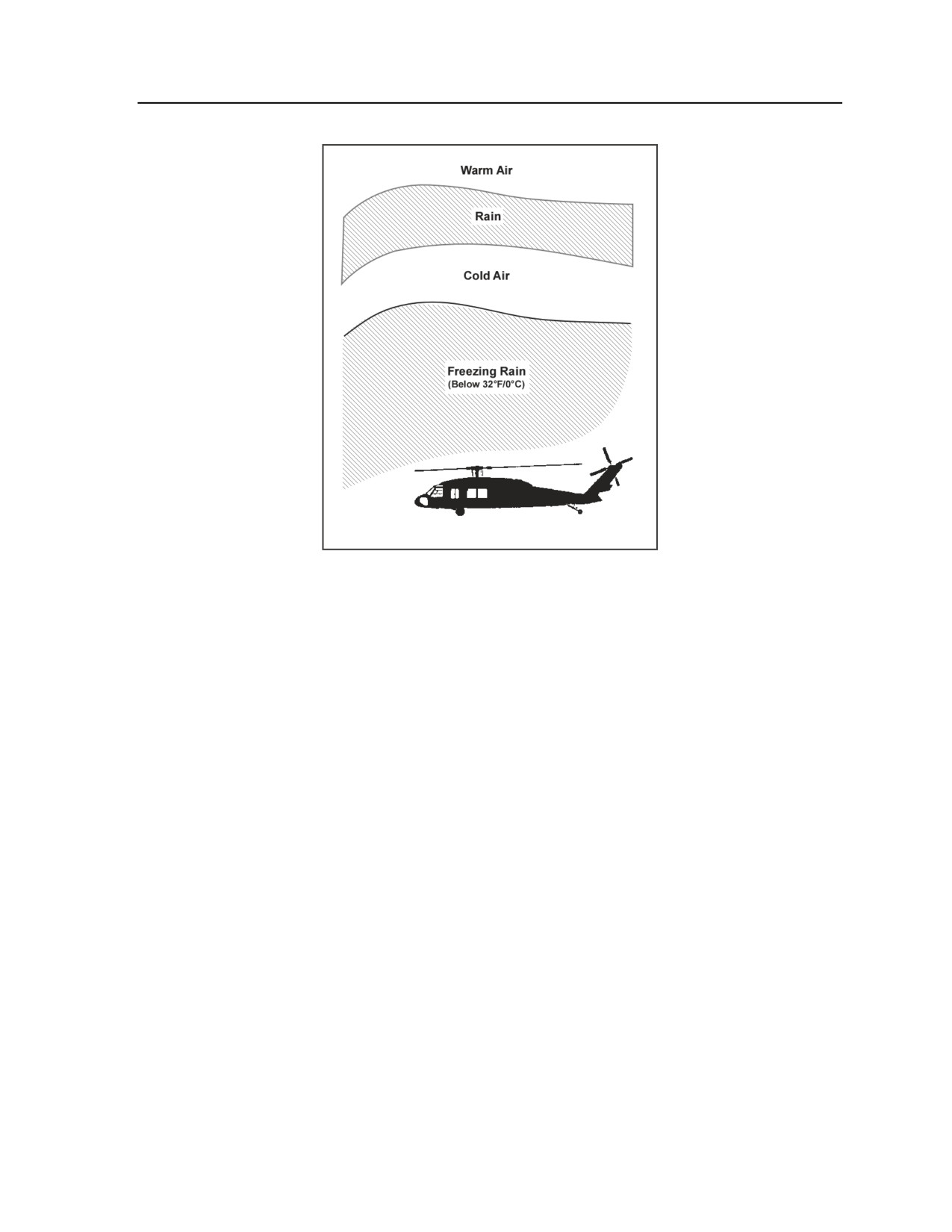
3-8. The following weather conditions normally cause icing (see figure 3-1, page 3-3):
Stratiform clouds indicate stable air in which minute water droplets/ice crystals are suspended.
Water droplets may become super cooled at or below freezing and still be in a liquid state.
Super-cooled droplets freeze on contact with aircraft and form layers of ice. The suspended ice
crystals are not hazardous to flight as they do not adhere to the aircraft.
Icing in cumuliform clouds with high moisture content can occur rapidly. Unstable air with
currents may carry large super-cooled droplets that spread before freezing, causing rapid
accumulation of ice.
Icing in mountainous terrain occurs mainly when moist air is lifted over high peaks. Ice-
producing areas usually occur on the windward side of peaks to about 4,000 feet above the peak
and possibly higher when the air is unstable.
Icing in frontal inversions also can be rapid. Although temperatures are normally colder at
higher altitudes, when air from a warm front rises above colder air, freezing rain may occur.
Rain falling from the upper (warmer) layer into a colder layer is cooled to a temperature below
freezing but remains a liquid. This liquid rain freezes upon contact with the aircraft and can
accumulate rapidly. This is the most hazardous type of icing.
3-2
FM 3-04.203
7 May 2007
Rotary-Wing Environmental Flight
Figure 3-1. Weather conditions conducive to icing
Weather Rules for Cold Weather Operations
3-9. The following weather rules apply to cold weather operations:
The aviator flies at altitudes below freezing level or clear of any visible moisture. Remain under
visual flight rules (VFR) and stay clear of clouds.
When flying near a warm front, the aviator determines; if temperatures in the cold air mass are
in the ice-producing range (0 degrees C to -20 degrees C) and altitude of the inversion layer.
These are critical elements for determining the potential conditions for icing.
Ice on the aircraft windscreen usually occurs first on the wiper blades and arms accumulating at
the edges of the windshield. Normally, the side windows do not ice over and usually provide
some visibility.
Rotor blade icing begins near the blade root. This ice buildup may cause loss of lift, which
requires additional engine power.
Asymmetrical ice shedding occurs when ice peels off the rotor blades in an uneven manner. This
leaves the rotor out of balance and causes the helicopter to experience severe vibration. Shaking
the cyclic or other control input intended to shed ice will not help the problem and could worsen
the condition. This shedding can also cause foreign object damage (FOD) from ice ingested into
the engine. When landing the aircraft, be wary of asymmetrical ice shedding. Park the aircraft a
safe distance away from other aircraft and ensure rotor blades are stopped before allowing
passengers to depart the aircraft.
When icing is encountered, aviators should descend or climb as appropriate to an altitude clear
of clouds or out of the temperature range for icing. If icing conditions exceed aircraft
limitations, the aviator must immediately exit these icing conditions and should land as soon as
possible. Autorotational capability may be lost in minutes if ice is allowed to form on the blades.
7 May 2007
FM 3-04.203
3-3
Chapter 3
In freezing rain, it is important to know the altitude of the inversion layer and the freezing level.
If the freezing level is at the surface, the best solution may be to climb through the inversion
layer to the warmer air above.
Aviators exercise great care when an obscuration (partial or full) is noted in a weather briefing.
Ceiling and visibility are measured by taking vertical and horizontal measurements. Aviators are
primarily concerned with slant range visibility, which cannot be accurately determined by a
weather forecaster. Visibility conditions may be worse than indicated by weather personnel.
As mentioned previously, snow visibility estimates and frequency/duration of snowstorms are
difficult to forecast. Therefore, flights are carefully planned and include an alternate route or
airfield whenever forecast accuracy is in question. Flight into snow conditions is very
disorienting and can easily lead to inadvertent instrument meteorological conditions (IIMC).
Ice and snow on runways or landing surfaces are dangerous for both fixed- and rotary-wing
aircraft. Snow is particularly slippery when temperatures are near freezing. Snow accumulation
is a hindrance to straight-line control when accelerating or decelerating.
Aviators ensure all necessary actions regarding aircraft operation have been completed.
According to the operator’s manual, for example, aviators may need to remove air inlet screens
and check the operational capability of the heater/defroster.
Aviators remove all snow and ice from the airframe before any operations. Such accumulation
adversely affects all aspects of flight performance in varying degrees. Before any flight
operations, aviators move all control surfaces to confirm full freedom of movement.
More detailed information on icing can be found in chapter 8 section I and the appropriate operator’s
manual.
CAUTION
Do not remove ice from an aircraft by striking the aircraft with blunt
objects (such as the hand or a hammer) or by using sharp-bladed
objects. These methods can cause external and internal damage to
certain aircraft components. The only effective way to remove ice is to
apply heat using such techniques as ambient temperature change or a
Herman Nelson heater. Care must be exercised in heat application as
damage could result. Deice fluids can also be hazardous to aircraft
components and the environment.
TERRAIN
3-10. Landscape varies widely in sub arctic and arctic lands and includes nearly every possible type of
terrain from mountain peaks to glaciers to plains. Nearly all surface types and conditions are found,
including tundra, bogs, hard, soft, wet, and dry. In winter, freezing conditions open many areas—such as
lakes and rivers—providing avenues of travel inaccessible during warmer months.
NAVIGATION
3-11. There is a marked difference in the way terrain appears in winter (with a snow covering) when
compared to summer. Even familiar terrain looks very different and can easily lead to disorientation.
Navigation in arctic regions may be hampered by rapidly changing and sometimes uncharted variation,
mountainous terrain, snow-covered landmarks, and a lack of navigational aids (NAVAIDs). Under these
circumstances, a combination of radio navigation, dead reckoning, and pilotage may have to be used to
navigate to the destination. Time should be allocated for aircrew members to train in the changing
conditions.
3-4
FM 3-04.203
7 May 2007
Rotary-Wing Environmental Flight
STATIC ELECTRICITY
3-12. During cold weather, especially when the air is very dry, static electricity creates serious problems. It
is generated by activities such as moving an aircraft through the air, brushing snow and ice from the
aircraft, and dragging steel ground cables over the snow. This is a particularly hazardous during refueling
and rearming operations. It can not be emphasized enough as to the importance of having aircraft properly
grounded and bonded to prevent injury and reduce the potential for an explosive reaction. In addition,
aircraft external load operations also present a serious potential for static electricity. Preparation should
include measures such as ensuring static probes are available for use and verifying personnel are properly
trained.
AMBIENT LIGHT CONDITIONS
3-13. Summer in the far north (above 55 degrees latitude) provides almost continuous daylight. At Fort
Wainwright, AK (64 degrees latitude), for example, there are no NVD operations from the second week of
May until the second week of August. During winter months, there are only 3 to 4 hours of daylight with
extended sunrise/sunset periods (up to 1 hour each) as transition times between day and night. This
presents some unique problems in such areas as mission planning and crew selection, and becomes a major
consideration when planning for operations in this area.
3-14. There is great terrain contrast when conducting night operations over snow-covered terrain. While it
can be much easier to see details of the terrain at night, certain aspects such as slope of terrain or landing
area obstacles are not easily seen. When flying in mountainous terrain, it is also very difficult to accurately
interpret details of terrain. Aircrews can easily lose visual reference or provide misleading information.
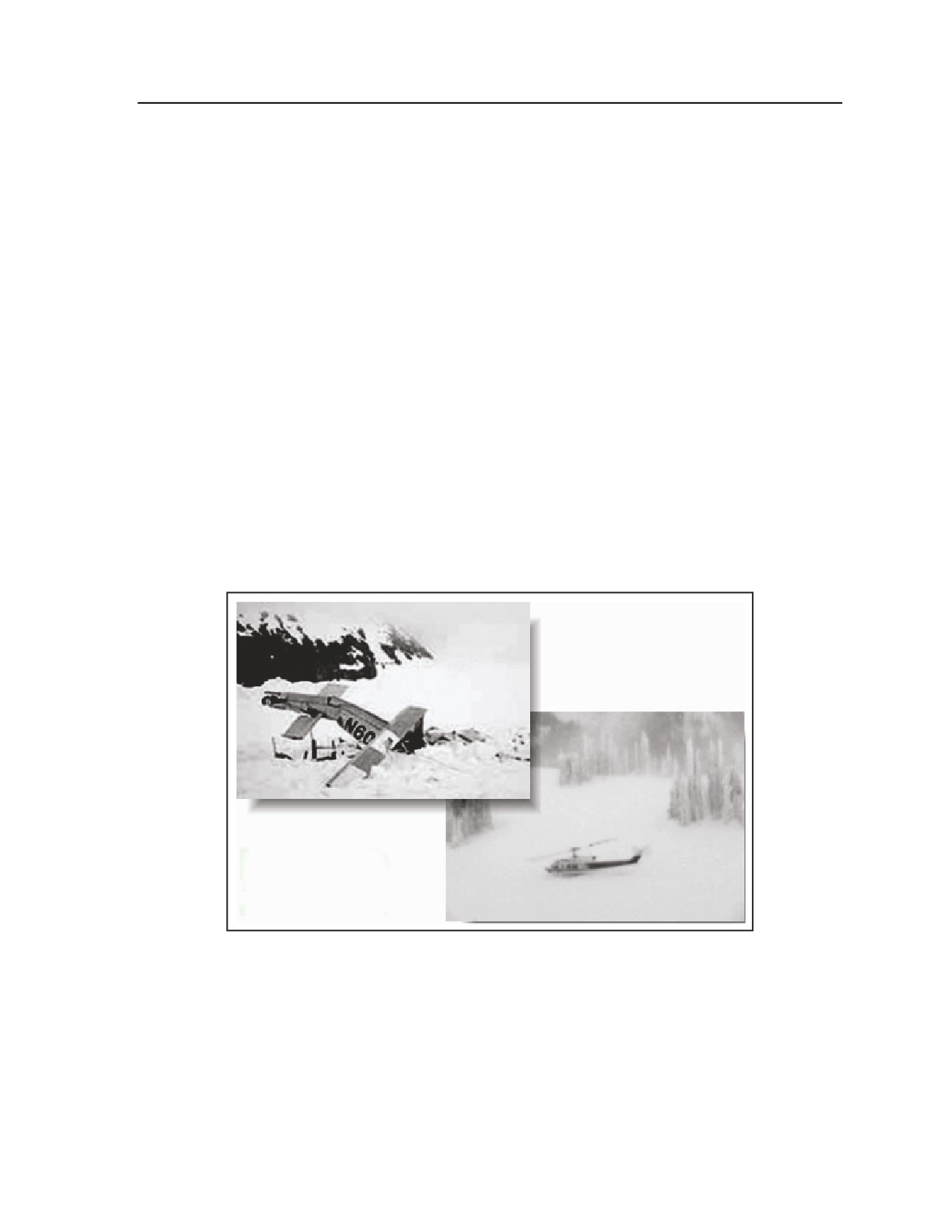
Prevailing ambient light presents unique problems most aircrew members are unaccustomed to; this leads
to frequent accidents or incidents (figure 3-2).
Figure 3-2. Ambient light conditions
Flat Light
3-15. Flat light is a variation of the height-depth illusion, also known as sector or partial whiteout. It is not
as severe as whiteout, but the condition causes crewmembers to lose their depth-of-field and contrast in
vision. Flat light conditions are usually accompanied by overcast skies inhibiting any visual clues. Such
conditions primarily occur in snow covered areas but can occur anywhere in the world (dust, sand, mud
flats, or glassy water). Flat light can completely obscure features of terrain, creating an inability to
7 May 2007
FM 3-04.203
3-5
Chapter 3
distinguish distances and closure rates. As a result of this reflected light, pilots may be given the illusion of
ascending or descending when they may actually be flying level. However, with good judgment and proper
training and planning, it is possible to safely operate an aircraft in flat light conditions.
Whiteout
3-16. As defined in meteorological terms, whiteout occurs when a person becomes engulfed in a uniformly
white glow. The glow is a result of being surrounded by blowing snow, dust, sand, or water. There are no
shadows, no horizon or clouds, and all depth-of-field and orientation are lost. A whiteout situation is severe
in that there are no visual references. Flying is not recommended in any whiteout situation. Flat light
conditions can lead to a whiteout environment quite rapidly. Both whiteout and flat light conditions are
insidious, occurring quickly as visual references slowly begin to disappear. Whiteout has been and
continues to be the cause of several aviation accidents.
FLYING TECHNIQUES
3-17. Conducting flight operations over snow-covered terrain is a difficult task, even for experienced
aircrew members. Certain specialized techniques must be applied to fly safely during cold weather
operations. Helicopter operations are emphasized because adverse effects of snow on rotary-wing aircraft
are more critical than on FW aircraft.
OPERATIONAL PROCEDURES
3-18. Problems occurring when operating in extreme cold are related to preparation for flight, ice and
snow, cold weather engine starts, taxiing, takeoff, en route, and landing. Problems presented by ice, snow,
or freezing rain are such that provisions must be incorporated into flight planning to eliminate or reduce
their effects.
3-19. A primary rule in any aircraft movement under winter conditions is to think before acting. This
environment demands a thoughtful approach to every task. For example, an aviator does not bring the
helicopter to a hover and then determine where to go. This will usually result in a whiteout, mandating an
instrument takeoff (ITO) type maneuver to climb above the snow cloud and return to visual meteorological
conditions (VMC). On an airfield, this results in traffic complication and a safety hazard. Each phase of
flight requires a plan, which is announced to the other crewmembers according to sound aircrew
coordination techniques. Crewmembers clearly establish and announce intentions before acting. The
airfield itself can be a troubling place for winter operations.
TAXIING AND TAKEOFF
GROUND TAXI
3-20. Helicopters produce the greatest amount of rotor wash when hovering; thus, it is best to ground taxi
whenever possible. This is more difficult with skid type aircraft. Ground taxiing is performed as a very
deliberate movement accompanied by ground guides, if needed, to ensure all appropriate clearances are
maintained. Loose snow conditions make this action much more difficult than first appearance as
conditions are slippery and stopping will require more distance than normal. It is easier for wheel-type
helicopters to ground taxi on a snow-covered airfield. However, this is often difficult or impossible due to
snow accumulation, and the aircraft may be forced to hover. This places the helicopter in a mode of flight
much more challenging in these weather conditions.
Pickup to a Hover or Takeoff
3-21. The execution of this task depends on snow conditions. If the snow is heavy (water saturated) or
packed, there is little difference between hovering in this environment and in a no-snow condition. If the
snow is dry and easily blown, this task can become extremely difficult requiring special techniques and
specific avoidance procedures. If there is minimal accumulation, this dry snow condition is a small
3-6
FM 3-04.203
7 May 2007
Rotary-Wing Environmental Flight
problem; however it is worsened by a larger accumulation or crusted snow conditions, where the crust can
shatter and reveal loose snow underneath. The rate of collective pitch application will vary for the same
reasons. Sometimes a slower, more methodical collective application results in a more controlled climb or
descent as opposed to the collective being adjusted rapidly in the belief it will alleviate the problem sooner.
Hovering in snow can quickly result in a complete and persistent whiteout requiring the aviator to execute
appropriate recovery procedures. The essential rule is to expect the worst when preparing to hover in snow
conditions. Always assume a whiteout will result from your actions. This mind-set coupled with proper
preparation will make for a safer flight. A takeoff should be performed into the wind as this will assist in
keeping any snow cloud to the rear of the aircraft.
Note. Aircrew members experienced in desert environment flight, with its sand and common
brownouts, have an advantage when confronted with snow conditions and whiteout. However,
the two environments neither are not exactly alike nor require exactly the same technique. For
example, snow crystals have a tendency to dissipate slower, which keeps the snow cloud
suspended for a longer period. Only experience, accompanied by a conservative approach,
ensures safe operations.
Hover Taxi
3-22. Aviators hover taxi the helicopter faster or higher than the existing snow cloud. This choice depends
upon snow conditions. When forward visibility is essentially unrestricted and the snow cloud is visibly
positioned aft of the cockpit, the hover taxi speed is correct. This requires continuous evaluation,
depending on factors such as snow and wind conditions, and task to be performed. No one airspeed or rate
of travel is correct as this procedure require evaluation of existing conditions each time. Air taxi is
preferred over hover taxi. Air taxi allows the aircraft to fly at an airspeed/altitude that will not generate a
snow cloud.
EN ROUTE
3-23. In a nontactical environment, aircraft are normally flown at an altitude and airspeed where rotor
wash will have no effect upon loose snow.
TERRAIN FLIGHT
3-24. With its inherent low altitudes, terrain flight in a snow-covered environment can create a signature
from the rotor wash. This signature can be seen on treetops in the disturbed snow path left by passing
helicopters. It can also be seen as a snow cloud hanging in the air in the wake of passing helicopters.
3-25. Maintain at least 40 knots of airspeed to minimize signature effects caused by the rotor wash. Avoid
flights at less than 40 knots over forested areas. Snow in the trees is more easily disturbed and may create a
visual obstruction to following aircraft (in multihelicopter operations) and/or a signature.
3-26. Avoid flying in close formation over snow. Depending on the nature of terrain and condition of the
snow, additional spacing will aid in reducing blowing snow as an obstruction to visibility. To prevent those
aircraft behind the lead aircraft from landing into near whiteout conditions, aircraft separation must be
increased before beginning final approach to landing. This increased distance between aircraft provides
additional time for the snow cloud to settle. This varies by aircraft type; for instance, a CH-47 creates a
substantial snow cloud, but an OH-58D creates a much smaller snow cloud.
3-27. Avoid flying through narrow valleys during multihelicopter operations, where aircraft must follow
the same ground track, requiring aircraft to fly through any existing snow cloud.
LANDING
3-28. When landing a helicopter in snow-covered terrain (including an established runway), expect to be
engulfed by a snow cloud unless a proper landing procedure is used. In loose snow conditions, there are
7 May 2007
FM 3-04.203
3-7
Chapter 3
essentially two types of approaches; to the ground or to a hover. Either type of approach should be
performed into the wind. This assists in keeping any snow cloud to the rear of the aircraft.
Approach to the Ground
With Forward Speed
3-29. This type of approach demands aviators maintain sufficient forward speed to keep their aircraft in
front of the snow cloud ensuring contact with the ground before being engulfed by blowing snow. While
this is often the preferred technique for landing, it is frequently avoided due to problems such as obstacles
or too little space in the landing area. Although no two approaches are the same and any approach
technique will vary by aircraft type, the basic technique remains the same. Because this approach involves
touching down with some forward speed, the crew must be familiar with the landing surface and any
potential obstacles that could damage the aircraft. The essential elements of this approach are the
following:
Sufficient forward airspeed is maintained to ensure the aircraft is traveling slightly ahead of the
snow cloud being created by the aircraft.
A shallow approach is generally used.
The entire crew is prepared to call out the position of the snow cloud; for example, “at the tail”
or “at the cabin.”
Both rate of closure and rate of descent are minimized ensuring the most controlled touchdown
possible.
This flight attitude is maintained until the aircraft contacts the ground and the collective is
reduced to flat pitch.
Note. The optimum approach is marked by aircraft touchdown just before any snow cloud
engulfs the cockpit. If the snow cloud engulfs the aircraft before contact is made with the
ground, the rate of closure was too slow. Conversely, if the aircraft is completely in contact with
the ground and sliding, and the snow cloud has not yet engulfed the cockpit, the aircraft was
traveling too fast; an unnecessarily fast rate of closure was maintained.
With No Forward Speed
3-30. This landing is similar to the termination to the surface with forward airspeed, except this
termination should be made to landing areas where slopes, obstacles, or unfamiliar terrain precludes a
landing with forward speed. It is not recommended when new or powder snow or fine dust is present
because whiteout conditions will occur. The termination is made directly to a reference point on the ground
with no forward speed. Both the angle should be slightly steeper and the approach speed faster than a
normal approach. After ground contact, slowly lower the collective to the full down position, neutralize the
flight controls, and apply brakes as necessary to ensure no forward movement.
Approach to the Ground from a Hover
3-31. This technique generally requires termination over the designated landing point at an OGE altitude.
This higher altitude is necessary due to the potential snow cloud and is an integral part of this approach
technique. The increase in altitude minimizes effects of the snow cloud. It also allows the crew to maintain
visual contact with the ground even while the snow cloud is dissipating. The crew can then begin descent
to the ground. Termination at a lower altitude (for example, 10 feet) will not permit this visual contact; the
crew will likely find itself in a whiteout. This technique works well and may be the only option in certain
cases; for example, in a confined area or landing beside a slingload for hook-up. Caution must be used with
this technique due to the snow cloud building under the aircraft.
3-8
FM 3-04.203
7 May 2007
Rotary-Wing Environmental Flight
LANDING SURFACE
Aviators should consider what is beneath the snow during all landings. While the
snow appears level, the ground beneath could be sloped or covered with rocks, logs,
holes, and other hazards. Treat all landings as possible slopes and be prepared if
one side or both breaks through the surface. Snow-covered frozen bodies of water
have the appearance of a good LZ.
Formation Landings
3-32. Formation landings pose special hazards when landing in this environment. An aircraft could easily
be engulfed in the snow cloud of another aircraft during the land sequence. Careful consideration must be
given to the appropriate landing formation. Landing distance separation must be increased. The essential
elements of formation landings are—
Increase rotor disk separation, especially for staggered formations. Trail formation is not
recommended.
If tactical and environmental conditions allow, echelon formations decrease the likelihood of
being engulfed in another aircraft’s snow cloud.
During the landing sequence, the flight lead should land into the wind that allows the snow
cloud to be blown away from the formation.
All aircraft in the formation should land at the same time.
Carefully plan go-arounds. If tactical and environmental conditions permit, one sound go-
around technique is the forward go-around. This prevents the aircraft from landing back into the
same snow cloud that was just departed.
DEPTH PERCEPTION
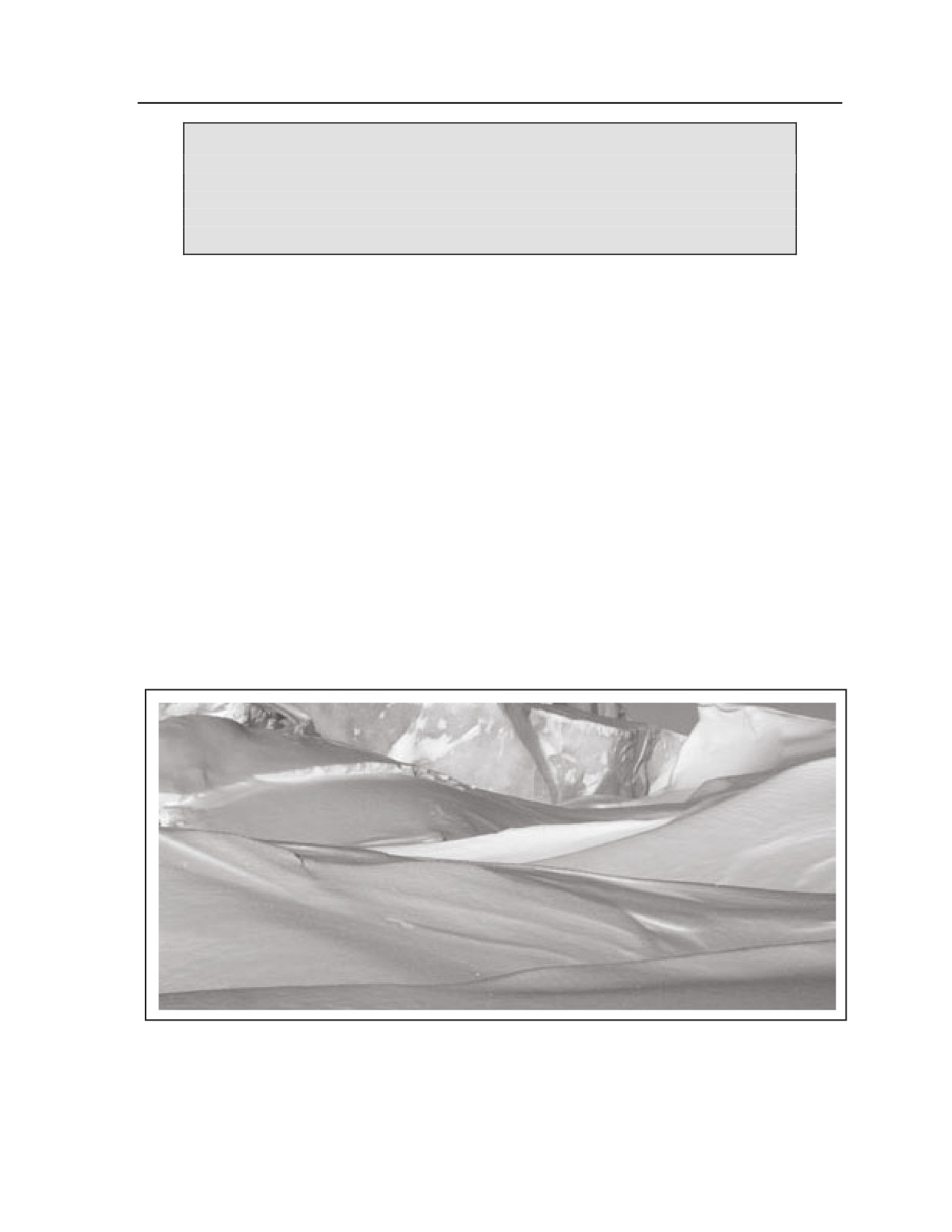
3-33. The ability to judge height and determine the contour of terrain is difficult when it is snow covered
(figure 3-3). The normal tendency of an aviator is to estimate altitude as being higher than it actually is and
view sloping terrain incorrectly.
Figure 3-3. Depth perception
7 May 2007
FM 3-04.203
3-9
Chapter 3
3-34. Aircrews can use the following procedures to overcome depth perception difficulties:
Use terrain features (trees, vegetation, and large rocks) as references. Knowing the approximate
dimensions of these features produces a more accurate estimate of height and distance.
Use a person, animal, or vehicle on the ground as a good reference.
Improve depth perception by viewing terrain through the side window and comparing this
perspective to the view through the windscreen. Maintaining a good scan pattern, similar to that
used in night flight, is essential.
Drop something on the landing surface to serve as a point for comparison when existing
landmarks or features cannot be used to determine altitude and distance. An example is a length
of pine bough or an item easily seen against the white background and not able to sink into the
soft snow.
Make frequent reference to flight instruments ensuring level flight, adequate altitude AGL, and
appropriate airspeed. The information is correlated with current visual information. This
continual process requires aviators to scan inside and outside the cockpit.
Use aircraft landing lights to assist in depth perception. Lights are adjusted to reduce reflection
off the snow.
MAINTENANCE
3-35. Not all maintenance functions will be performed within heated hangars. Units operating in remote
areas or in a tactical environment rarely have access to hangars. Although normal cold can be
uncomfortable, arctic cold can be extremely dangerous and difficult to work in. Contact frostbite (frostbite
caused by simply touching metal objects during very low temperatures) is a real possibility. Danger of such
conditions is continually present during winter months. Knowledge gained by those units working in such
environments is invaluable and should be sought by units deploying to a winter location.
Note. Refer to the appropriate aircraft operator’s manual or local directives for the requirements
to leave an aircraft parked outside during cold weather (below 0 degrees C).
AIRCRAFT COMPONENTS
Flight and Engine Instruments
3-36. Gyro-operated flight instruments, such as the directional gyro, turn-and-slip indicator, and attitude
indicator, may be unreliable due to increased bearing friction caused by cold, congealed lubricants. Cabin
heaters may be used to warm and keep these instruments at operating temperature. During engine start,
engine and transmission oil pressures may indicate near-maximum requiring the engine to run at idle until
the pressures are in the normal operating range. Transmissions are especially susceptible to cold and take
longer to warm up thoroughly. Transmission temperatures and pressures should be carefully monitored.
Plastics and Protective Covers
3-37. Plastics may become brittle and crack from sitting outside or when the aircraft is moved from a
warm hangar to the outside. Check for small cracks at the edge of mounting frames, bubbles, windscreens,
windows, and doors, as cracks may lead to disintegration in flight. Protective covers provide adequate
protection against rain, freezing rain, sleet, and snow when installed on a dry aircraft before precipitation.
An unsheltered aircraft cannot be completely covered. Those portions of the aircraft left exposed should be
carefully inspected/preflighted before operation of the aircraft occurs. In case of blowing snow, even the
covered portion of an aircraft can be penetrated by the elements; these aircraft deserve the same level of
attention. In addition, if an aircraft is pulled from the hangar with any accumulation of water, the water will
quickly freeze and cause possible catastrophic damage to parts such as drive shaft joints and internal
engine components. It is better to leave the aircraft outside unless it can be sheltered long enough to dry
completely.
3-10
FM 3-04.203
7 May 2007
Rotary-Wing Environmental Flight
Synthetic Rubber
3-38. Synthetic rubber, when used for oil and fuel lines or to coat electrical wiring, may become stiff and
easily broken. For example, the crew chief’s microphone cord should be coiled and kept in the warmth of
the helicopter until needed for the aircraft start or stop sequence. Lines and wiring should not be bent when
cold.
Tires
3-39. Cold weather can cause tires to stiffen, leaving a flat spot until the tire is sufficiently heated through
movement and friction from taxiing the aircraft. When beginning the taxi sequence, aviators should move
slowly and minimize side load or excessive tire turning. Tires and tire pressure require frequent attention
during these cold periods.
Hydraulic and Pneumatic Leaks
3-40. Leaks may appear more often due to contraction and expansion of fittings and lines during
temperature extremes. Cold weather aircraft starts are completed according to the operator’s manual and
current maintenance directives. Static leaks may tend to disappear with increasing temperature. A close
evaluation of the leak is completed to determine the aircraft’s flight safety. If a leak develops after warm-
up, it will not disappear and the aircraft will require maintenance. Hydraulic leaks may occur due to
deforming and contracting of seals. Before leaking hydraulic units are replaced, an aircraft is moved into a
heated hangar or external heat is applied to the component for approximately 1 hour. The temperature of
the hydraulic fluid will increase by operating the system.
PETROLEUM, OIL, AND LUBRICANTS
3-41. Aircraft are serviced with fuel upon landing to prevent condensation accumulating in the fuel tanks
(when moved into a heated hangar). However, tanks should not be topped off as subsequent parking in a
hangar will result in expansion and some fuel spillage. The fuel boost pump operation is checked before
flight due to possible freezing or damage. Defueling an aircraft in winter conditions may be difficult and
hazardous.
3-42. The viscosity of oil and grease used is very important in cold weather operation. Use only grades of
oil and grease specified by the manual. Oil levels must be checked after operational temperatures have
been reached (postflight is a good time), and any oil needed is preheated and added while the system is hot.
CONTROL CABLES
3-43. Adjust control cables to manufacturer’s specifications to allow for contraction and expansion caused
by temperature changes. Cables can freeze if moisture is allowed inside housing.
BATTERIES
3-44. Both dry and wet cell batteries require special consideration during cold weather.
Wet Cell
3-45. If the airplane must be parked outside, wet cell batteries should be kept fully charged or removed
from the aircraft to prevent loss of power caused by cold temperatures and guard against battery freezing.
Dry Cell
3-46. Dry cells are usually associated with aircraft in only two applications—emergency lights and
portable radios (including emergency locator transmitters). Manufacturer recommended batteries for this
type equipment are resistant to power loss by freezing.
7 May 2007
FM 3-04.203
3-11
Chapter 3
OPERATIONAL CHECKS
3-47. Short engine ground run-ups must be avoided. Engine run-ups must be long enough to bring the
engine to operating temperature. Any shorter period will cause water vapor to condense. This water could
freeze and split oil coolers, block oil lines, and increase possibility of engine failure.
AIRCRAFT TOWING
3-48. Aircraft are towed at a slow rate of speed since control is difficult while turning or stopping. If the
parking area is on an incline, aircraft will tend to push the towing vehicle. Caution must be used to avoid
turning too short when marshaling aircraft out of or into a parking area. A disproportionate number of
incidents occur due to aircraft damage resulting from sliding into a hangar doorway during towing
operations. Enough personnel must be positioned around aircraft to monitor the operation. For example, a
CH-47 is towed into the hangar with six personnel—one person in the cockpit manning the brakes, one
person manning the tow vehicle, and one person at each corner of the aircraft equipped with whistles to
alert the vehicle driver of potential collisions so the towing operation can be halted until clearance can be
ensured. While this seems excessive, hangar entrances are often icy with aircraft subject to sliding.
TRAINING
3-49. Units qualifying aviators in cold weather operations are responsible for conducting a well-organized
training program. Training programs are geared to instill confidence and develop skills in all areas of cold
weather operations. Instructor pilots (IPs) and supervisory maintenance personnel must be highly qualified
and skilled in all areas of cold weather operations.
3-50. Emphasis must be placed on safety. Snow conditions, wind velocity and direction, and aviator
proficiency levels are factors instructors must evaluate to determine if safe training can be conducted. The
professional judgment of the instructor to discontinue training due to unsafe conditions must be accepted
and not criticized.
3-51. The flight training program allows each aviator to advance at an individual rate. Initial training is
conducted under less challenging conditions. As aviator proficiency increases, conditions should be made
more demanding until the most challenging mission can be performed.
RECOMMENDED PROGRAM OF INSTRUCTION
3-52. A recommended program of instruction for qualifying aviators in cold weather operations is
provided in the following paragraphs. Additional academic subjects may be required, based on the specific
mission and location of the unit.
Academics
3-53. Suggested topics include—
Human factors associated with cold weather flying.
Environmental factors that affect cold weather operations.
Aircraft preparation for cold weather.
Aircraft operational procedures in cold weather.
Cold weather survival.
Techniques to improve depth perception and determine snow condition.
Flight
3-54. Flight training may be limited by conditions at the unit’s home station. Some areas may not be able
to replicate snow conditions adequately for training in whiteout conditions. Instructors can demonstrate
techniques and procedures to some extent. Crews are evaluated on these procedures during their annual
3-12
FM 3-04.203
7 May 2007
Rotary-Wing Environmental Flight
proficiency and readiness test (APART) or no-notice evaluations. Flight simulators are also a great device
in training for this environment.
3-55. Suggested maneuvers include—
Snow landings (most crucial).
Go-around procedures.
Taxiing over snow covered areas.
Snow takeoffs.
En route flight techniques.
Research Materials
3-56. To prepare for training or operating in a cold weather environment, the following materials are
suggested:
Local SOPs.
Aircraft operator’s manual.
TC 21-3.
FM 3-04.301.
FM 3-50.3.
FM 3-05.70.
FM 31-70.
AKO file search.
SECTION II - DESERT OPERATIONS
ENVIRONMENTAL FACTORS
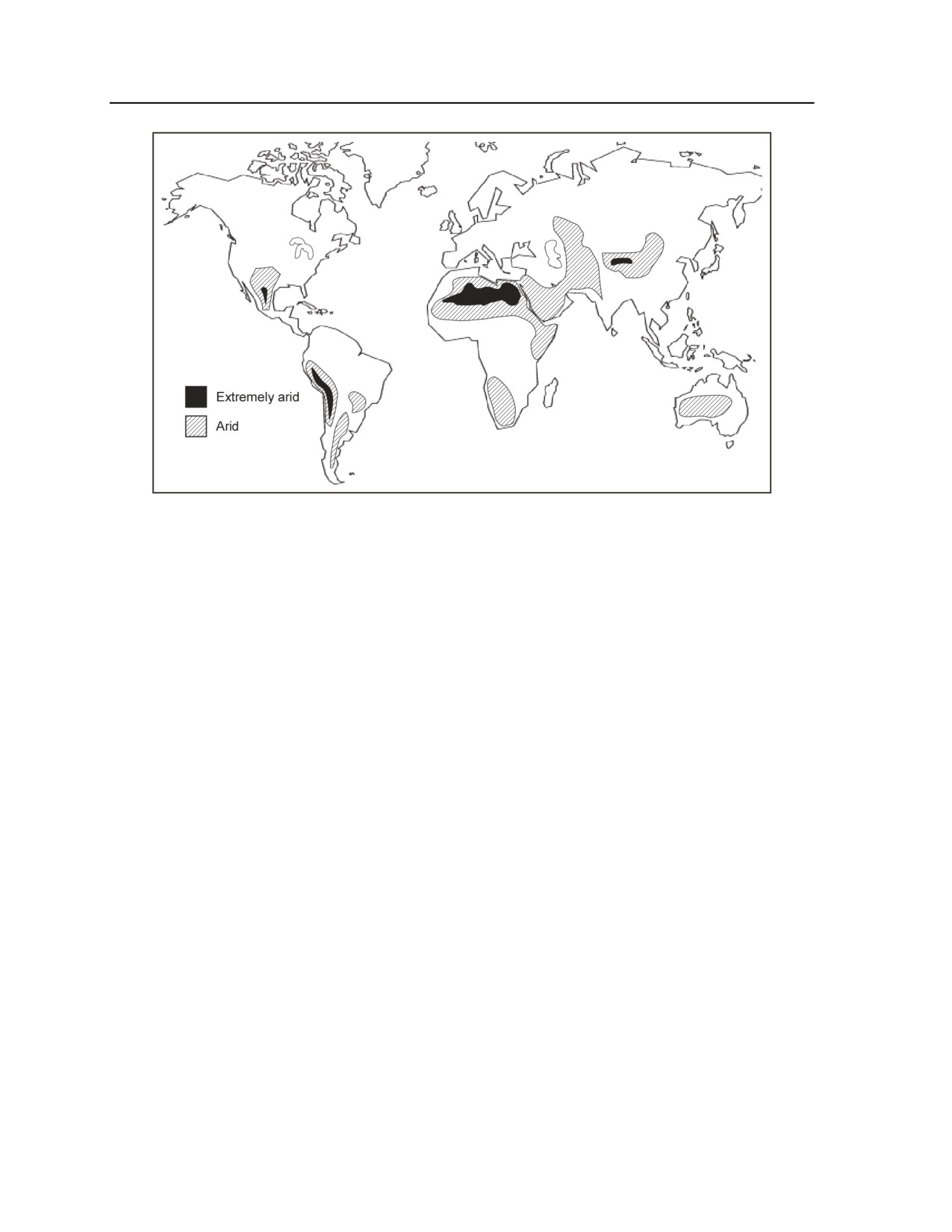
3-57. Figure 3-4, page 3-14, illustrates desert regions around the world. The typical desert region is a dry,
barren region, largely treeless, and sandy. A region of environmental extremes, it has violent and
unpredictable changes in weather and contains terrain not conforming to any particular model. While
frequent clear days offer unequaled visibility and flight conditions, a sandstorm can quickly halt all
operations. Therefore, desert operations require special training, acclimatization, and a high degree of self-
discipline. The lack of water makes this environment nearly inhospitable without a solid support structure.
The desert environment is one of the most severe environments in which Army aviation must operate.
Training and preparation are paramount.
CLIMATE AND WEATHER
3-58. At low altitudes, extremely high temperatures have been recorded in some desert areas. High
daytime temperatures severely restrict lift capabilities of aircraft. This restriction may be overcome by
conducting major operations during the cooler part of day or at night. High, violent winds are common to
desert regions; aviators must be thoroughly briefed and prepared for these conditions.
7 May 2007
FM 3-04.203
3-13
Chapter 3
Figure 3-4. Desert areas of the world
Temperatures
3-59. Desert heat creates serious problems for humans and equipment and requires special consideration.
Heat protective clothing is required when working on aircraft. Temperatures in Southwest Asia may
exceed 55 degrees C while temperatures in a closed aircraft or vehicle can be substantially higher. Severe
burns can result when bare skin touches any exposed metal parts. Extreme heat can cause electronic gear to
malfunction or cease functioning. High temperatures can also cause lubricants to break down and seals and
gaskets to distort, which may result in leaks or deadlined equipment. When these problems are
compounded by sand accumulation, equipment experiences more difficulty. High temperatures can also
cause softening of plastics, higher stress on pressurized containers, and shortened battery life.
Wind
3-60. Desert winds generally slow down around sundown and remain relatively calm until sunrise when
they begin to increase again. Winds can achieve near-hurricane force and vary almost consistently with no
distinct or predictable pattern. In all deserts, rapid temperature changes invariably follow strong winds.
Strong winds may raise towering dense clouds of dust and sand. This condition is more common in sandy
areas but can exist in any semiarid or arid region.
Precipitation
3-61. Annual rainfall varies between desert regions. Some regions in the world receive as much as 10
inches per year. The Sahara might receive 4 inches annually, with no rainfall for 8 to 10 months. When rain
comes, it may be in the form of a deluge, with mostly surface runoff, and supply little help to the
landscape.
Sunlight and Moonlight
3-62. Low cloud density results in bright conditions during the day and generally clear, moonlit nights.
However, when moon illumination is low or during the new-moon cycle, the desert presents a formidable
challenge to night flying. It is probably the most difficult environment in which to interpret terrain relief
3-14
FM 3-04.203
7 May 2007
Rotary-Wing Environmental Flight
and elevation, especially while using NVDs. Unaided night flight and operations are far more difficult and
not recommended.
TERRAIN
3-63. Large areas of open and relatively flat terrain create special flying problems. Distances and altitudes
are difficult to accurately estimate in desert environments. The lack of definable terrain features makes
navigation difficult, especially at night and over long distances. The likeness of the terrain can lead an
aviator toward inattentiveness. Low flight requires constant observation, attention, and concentration.
Desert terrain is also extremely rough with features such as rocks and gullies, which create problems and
delays with equipment. There are three primary types of deserts—sandy, rocky plateau, or mountainous.
Most deserts are rocky plateaus or mountainous, but some may be a combination of all three.
Sandy Desert Terrain
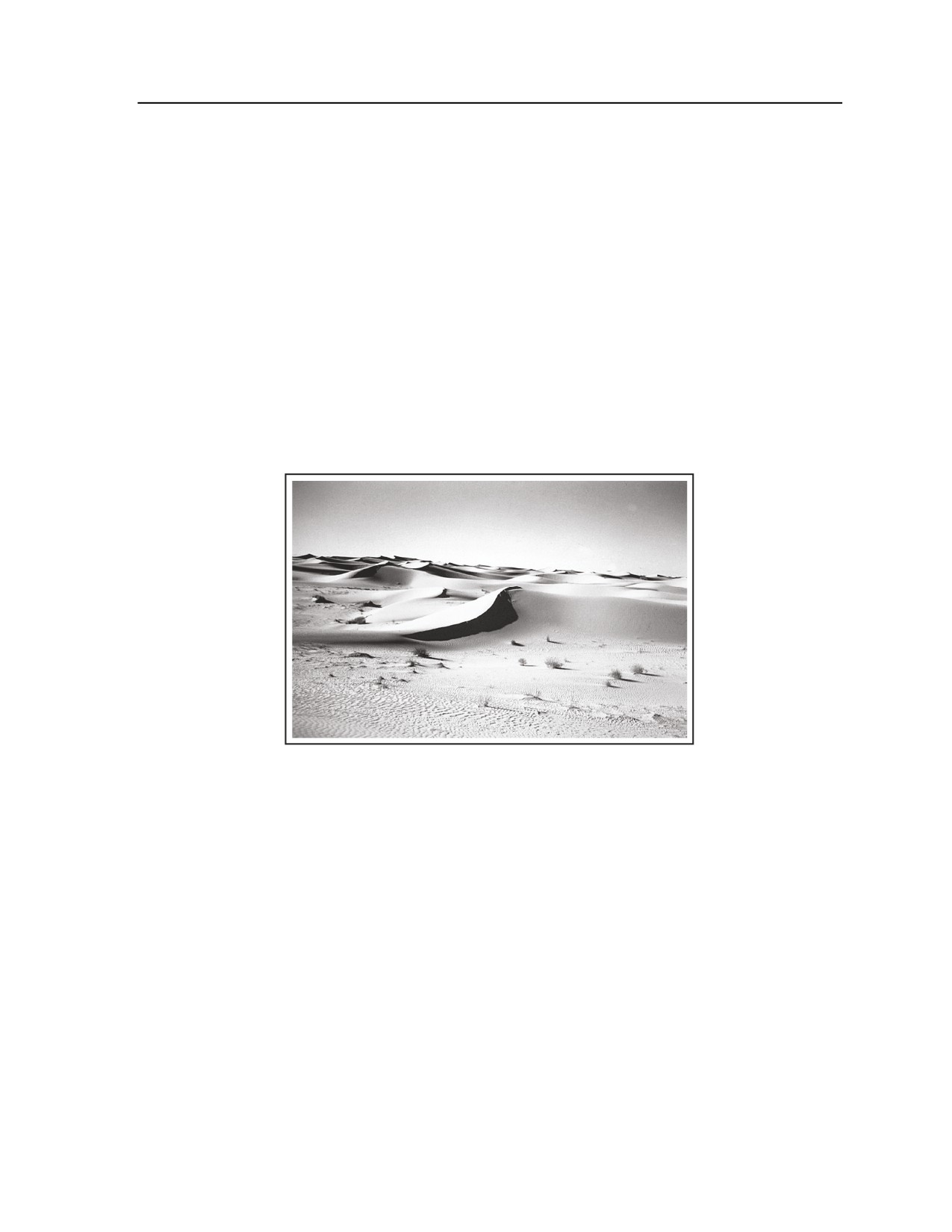
3-64. Sandy desert terrain (figure 3-5) consists of extensive basins completely filled with deep shifting
sand, largely the product of wind erosion. The most familiar example is found in Saudi Arabia, where
Desert Shield/Desert Storm operations occurred. This area and operation were marked by constantly
shifting terrain and talc-like sand that permeated the tightest seals and made maneuvering difficult.
Figure 3-5. Sandy desert terrain
Rocky Plateau Desert Terrain
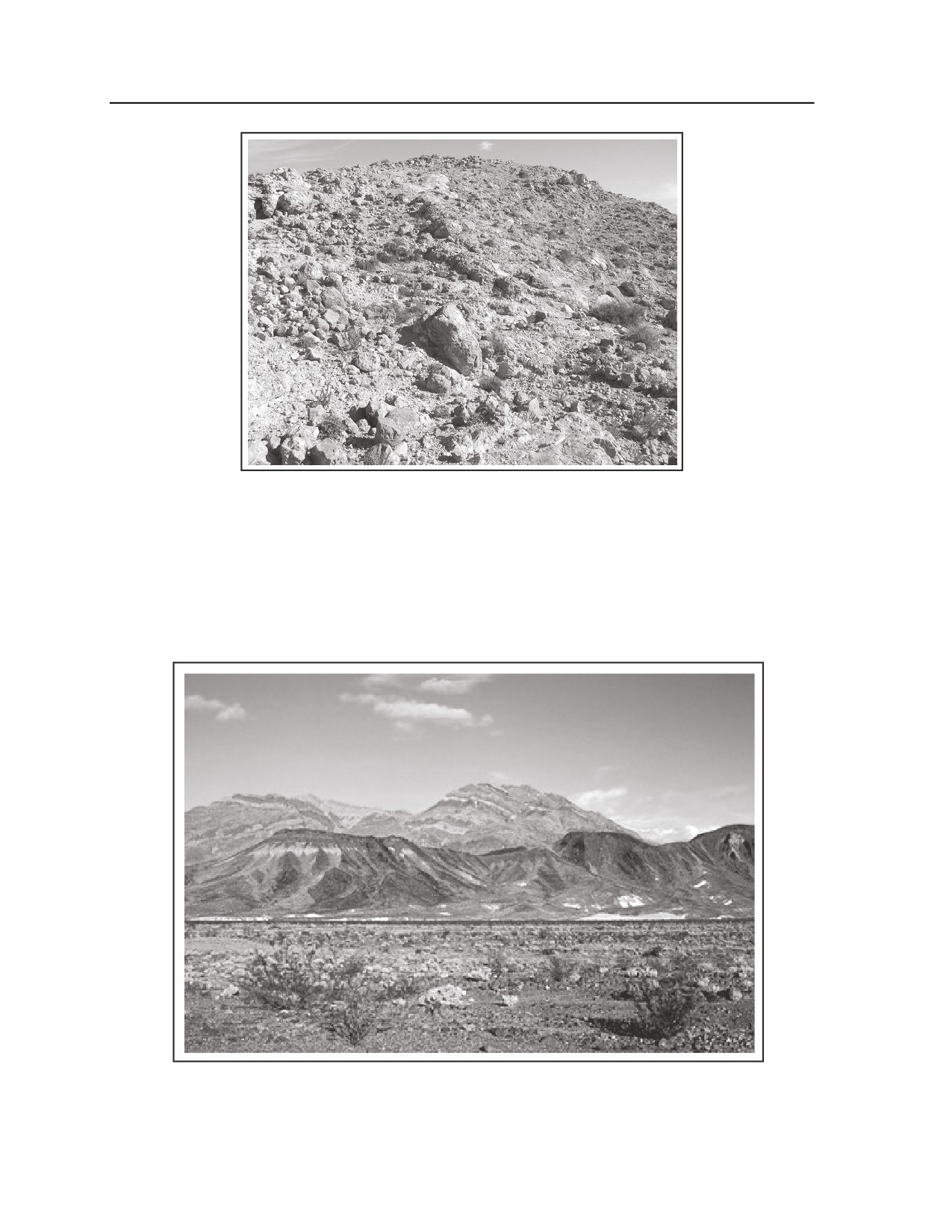
3-65. Rocky plateau desert terrain (figure 3-6, page 3-16) consists of relatively slight relief, interspersed
with extensive sand-filled basins. This plateau, due to recurring floods, is cut by dry, steep-walled valleys.
These valleys are filled with torrents of water during infrequent rains.
7 May 2007
FM 3-04.203
3-15
Chapter 3
Figure 3-6. Rocky plateau desert terrain
Mountain Desert Terrain
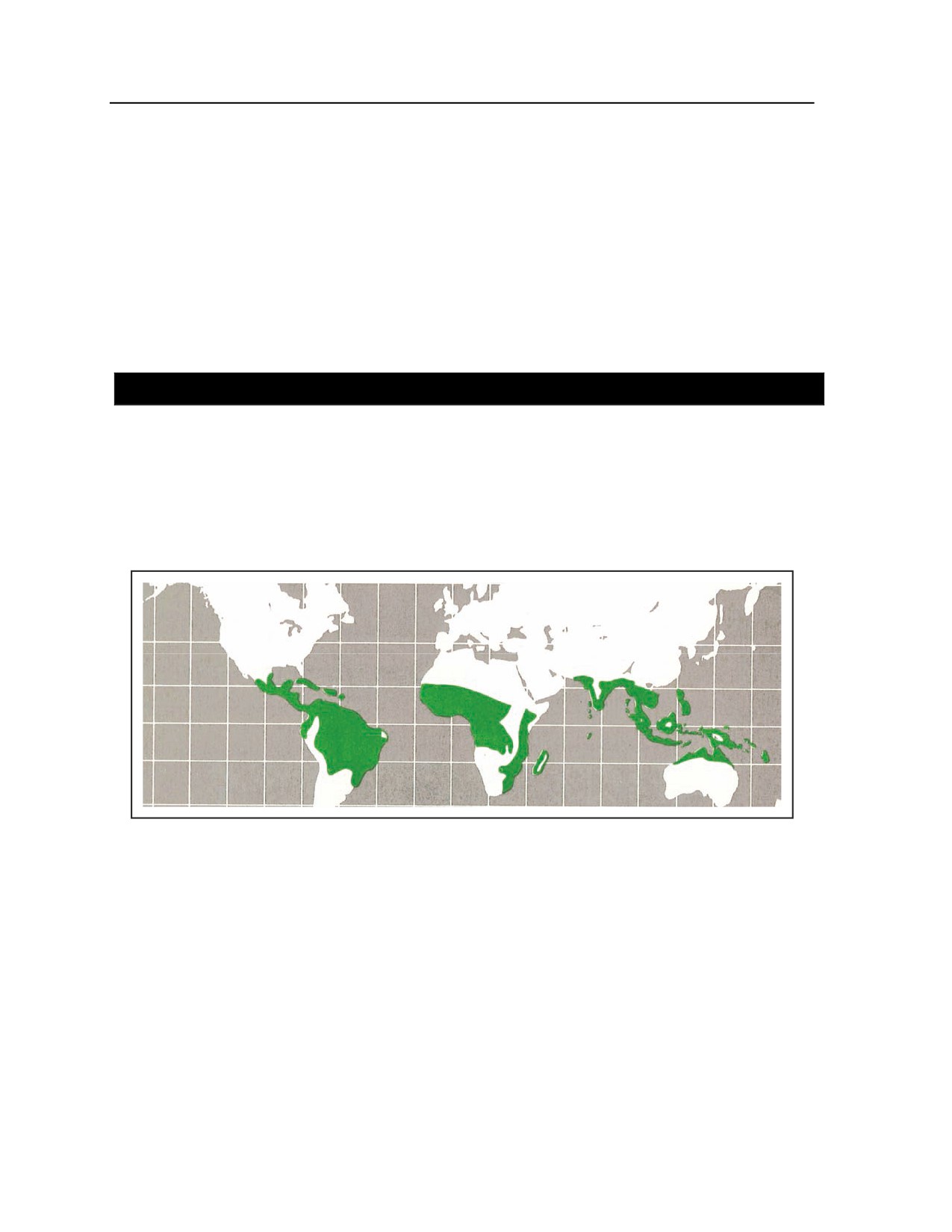
3-66. Mountain desert terrain (figure 3-7) consists of scattered ranges of barren hills or low mountains,
separated by dry basins. Some rainfall occurs in the highlands during violent showers. The water runs
rapidly over the surface and erodes deep ravines and gullies. Floodwaters rush from the mountains into the
basins where sand and gravel are deposited. Evaporation results in dry salt or salt marshes.
Figure 3-7. Mountain desert terrain
3-16
FM 3-04.203
7 May 2007
Rotary-Wing Environmental Flight
NAVIGATION
3-67. Lack of terrain features and poor reference points make navigation difficult. Aviators generally rely
on dead reckoning for navigation augmented by global positioning system (GPS)/Doppler equipment.
During Operation Desert Shield/Storm and Operation Enduring Freedom/Operation Iraq Freedom, maps
often proved to be of limited value due to ever-shifting sand dunes and constantly changing terrain. GPS
was an invaluable tool.
SAND AND DUST
3-68. No discussion of desert environmental influences would be complete without reviewing adverse
effects of sand and dust. The density, or consistency, of sand and dust vary throughout the world and even
within the same desert region. All have a drastic effect on the operation of aircraft, especially helicopters.
The large quantity of loose sand and dust creates serious erosion problems for rotor blades, turbine
compressors, and windscreens-any moving part or parts in contact with other components. The corrosive
effects of sand and dust in any desert region can cause severe damage to Army aviation equipment, as
documented during Desert Shield/Storm. This information should be carefully reviewed and incorporated
into training, planning, and preparation before any deployment. Hovering in loose sand and dust and NOE
flight continually expose the helicopter to the erosive effects of the desert. Even when parked, helicopters
are exposed to blowing sand and dust from wind, vehicles, and especially rotor wash from other
helicopters. Sand and dust particles collect on all exposed surfaces of the aircraft. These penetrate almost
any crack or crevice accumulating inside the helicopter making daily cleaning a necessity.
FLYING TECHNIQUES
3-69. Conducting flight operations over desert terrain is a difficult task, even for experienced aircrew
members. Certain specialized techniques must be applied to fly safely and effectively during desert
operations. Primary emphasis is given to helicopter operations due to effects of the desert environment are
more critical on rotary-wing than on FW aircraft. High temperatures, which cause inadequate engine
cooling and reduced payloads, also hamper desert operations. An obvious effect of the high temperatures is
the resulting performance degradation from high-density altitude conditions. This is compounded when the
operational area is at higher altitudes. The temperature variation within a day also presents unusual
problems in performance planning. This variation can often be 70 degrees F or more. FW aircraft
experience longer takeoff and landing rolls and overheating of brakes caused by the reduced air density.
Density altitude is a critical factor in desert flying techniques and mission capabilities.
OPERATIONAL PROCEDURES
3-70. Minimizing effects of sand and dust dictate, when possible, certain preventive measures. In this
environment, the preferred aircraft position is a hardstand or other area with minimal sand and dust. The
aircraft must be thoroughly inspected to remove as much sand as possible before flight. Aircraft
performance, especially during hot summer months, may be adversely affected by temperature and altitude.
This environment demands strict attention to PPCs and operator’s manual.
3-71. Aircraft should not depart into a sandstorm or dust storm. A primary rule in any aircraft movement in
desert conditions is to think before acting. For example, an aviator does not bring the helicopter to a hover
and then decide where to move. This usually results in a brownout, mandating an ITO type of maneuver to
exit the dust cloud by climbing above the dust to return to VMC. On a makeshift (soft-surface) airfield, this
results in traffic complications and a potential safety hazard. Each phase of flight requires a plan be
announced to the other crew members according to sound aircrew coordination techniques. As always,
absolute control of the aircraft is paramount. Any techniques that differ from normal operations should be
well-established procedures, backed up by a written task, condition, and standard. Such techniques will be
trained with an IP.
7 May 2007
FM 3-04.203
3-17
Chapter 3
TAXIING AND TAKEOFF
3-72. Avoid ground taxiing in areas with moderate to severe brownout conditions. Whenever possible, air
taxi to minimize dust. In well established areas or in areas with minimal dust, it may be possible to ground
taxi. Takeoff should always be made into the wind to minimize brownout conditions. A normal takeoff
utilizes an ITO technique. In prepared areas and operating near maximum performance, a running type
takeoff may be used to minimize sand ingestion. Caution should be used when making abrupt takeoffs due
to increased rotor thrust and the effects of sand and other debris. For formation flights in areas of heavy
dust, the preferred technique is for aircraft to depart single ship and conduct in-flight join ups.
EN ROUTE
3-73. Flying through sandstorms, dust storms, and dust devils must be avoided whenever possible. The en
route portion of a flight in a desert environment is especially dangerous over undulating terrain that shifts
daily due to wind. This is especially true when flying with night vision goggles (NVGs). Aerial perspective
is difficult, especially at night, creating high-depth perception illusions. Poles and wires are hard to see
even during the day; when covered with dust, these items blend into the background terrain.
TERRAIN FLIGHT
3-74. Terrain flight in a desert environment can leave a signature if the aircraft is flown too low and too
slow. This potential signature is a major consideration. The exact flight altitude and airspeed must be
carefully selected. With flight safety paramount, the crew must balance altitude, airspeed, and signature.
With difficult terrain interpretation, flying too low and/or too fast can easily result in a catastrophic
accident. Training to prevent this is crucial.
LANDING
3-75. When landing a helicopter in desert terrain, aviators should always expect severe brownout
condition to occur. Soil conditions can change rapidly. All landings should be into the wind to assist in
keeping any dust to the rear of the aircraft. The landing technique is mission, enemy, terrain and weather,
troops and support available, time available, civil considerations (METT-TC) dependent for each site. The
aviator should conduct high and low recon techniques to determine the best landing procedure. Hovering
and low-altitude, low-speed flight modes are avoided if possible. Removal of doors and windows may
increase visibility during the landing sequence. Aviators must expect dust and grit to enter the cockpit if
the doors/windows are removed. If installed, all doors and windows should be closed and vent blowers
turned off. Aircrew coordination is critical when landing. Crewmembers should call intensity and location
of the dust cloud.
APPROACH TO THE GROUND
With Forward Speed
3-76. The normal approach technique is a VMC approach to the ground. This usually involves establishing
aircraft in a landing attitude, with an appropriate and constant rate of closure and rate of descent fitting the
condition and state of the terrain. Usually, the approach angle is greater than normal to minimize effects of
the dust cloud. In each case, the aviator will have to determine several factors to achieve the proper rate of
closure and rate of descent. These factors include the amount of dust, wind direction, slope, and roughness
of the terrain
(including obstacles). The approach proceeds with this predetermined information,
intentionally touching down with some forward speed. The last portion of the approach, however, sees the
aircraft engulfed in the brownout but under a controlled descent and with the aviator watching for the
ground. When the aircraft contacts the ground, collective reduction and brakes, according to conditions,
will stop any forward motion.
3-18
FM 3-04.203
7 May 2007
Rotary-Wing Environmental Flight
With No Forward Speed
3-77. This termination should be made to landing areas where slopes, obstacles, or unfamiliar terrain
precludes a landing with forward speed. It is not recommended when fine dust is present because brownout
conditions will occur. The termination is made directly to a reference point on the ground with no forward
speed. The reference point is critical especially when utilizing NVGs. The landing involves establishing
aircraft in a landing attitude, with an appropriate rate of closure and rate of descent fitting the condition and
state of terrain to the reference point(s). The angle should be slightly steeper and the approach speed faster
than a normal approach. After ground contact, slowly lower the collective to the full down position,
neutralize the flight controls, and apply brakes as necessary to ensure no forward movement.
APPROACH TO THE GROUND FROM A HOVER
3-78. This technique generally requires termination over the designated landing point at an OGE altitude.
This higher altitude is necessary due to the potential dust cloud and is an integral part of this approach
technique. It also allows the crew to maintain visual contact with the ground even while the dust cloud is
dissipating. The crew can then begin the descent to the ground. Termination at a lower altitude, such as 10
feet, will not permit this visual contact, and the crew will likely find itself in a brownout. This technique
works well if there is a limited amount of sand to be dispersed. It may be the only option in certain cases;
for example, in a confined area or landing beside a slingload for hook-up.
DEPTH PERCEPTION
3-79. The nature of desert terrain with its open areas, relatively flat and without unique terrain features,
makes it difficult to judge distances and altitudes. Radar altimeters provide the most effective reference for
pilots to estimate altitude, day or night, over expanses of desert terrain-whether it is sandy, rocky plateau,
or mountain. However, be aware that the radar altimeter is not terrain following and therefore does not
guarantee terrain clearance when the aircraft is moving. Many aircraft have been lost due to inadvertent
flight into such hazards as sand dunes and ridges. This phenomenon must be trained ensuring aircrew
awareness. Systems, such as the heads-up display (HUD), greatly enhance SA and allow the aviator to
concentrate more fully outside the aircraft.
MAINTENANCE
3-80. Most maintenance is performed outdoors and in the elements; that is, in heat and in the midst of the
accumulating sand. This is a particularly hostile environment for equipment. It is made more difficult by
temperature extremes. With the dramatic cooling period at night, accumulating moisture becomes
condensation. This condensation, combined with accumulated sand, is a damaging mixture for equipment
and causes a dramatic shortage of its service life as discussed earlier in this section.
AIRCRAFT COMPONENTS
Instruments and Avionics
3-81. The service life of avionics and electronic components is usually reduced due to heat, especially with
windows and doors closed. If doors and windows are left open, however, the avionics’ service life is
reduced as a result of dust accumulation. This factor must be evaluated continuously to preserve the life of
all the components. Use covers along with more frequent cleaning.
Protective Covers
3-82. Any windscreen or window surface, especially plastic, is covered to prevent the effects of blowing
sand and minimize effects of the sun. Covers, such as canvas and condemned parachute canopies, are used.
The crew ensures the window surface and cover are as grit-free as possible minimizing any abrasive
elements between them. This accumulated grit can act like sandpaper as the cover moves around in the
wind.
7 May 2007
FM 3-04.203
3-19
Chapter 3
3-83. Aircraft are secured with the appropriate tie-down kit, supplemented by available tie-downs,
ensuring tie-down points are secured deep enough to be effective. This tie-down procedure should be a
daily function. Severe wind conditions occur in the desert with relatively little notice. Usually, the crew
does not have enough time to tie down the aircraft once a storm begins.
Tires
3-84. Desert landings can cause considerable damage to aircraft wheels/tires. Crews should supplement
stocking of these items prior to deployment.
Blades
3-85. Main and tail rotor blades and tip caps are subject to erosion. Anti-erosion kits should be installed on
aircraft prior to extended deployment to desert environments. Also, look at paint or other materials that can
be applied to blades between flights to extend their life.
Petroleum, Oil, and Lubricants
3-86. Oil should be changed more frequently to minimize internal component wear, including engines and
transmissions. Oil should be checked for signs of sand accumulation which can clog filters. Oil and
hydraulic fluid are added directly from their original unopened containers to help stop sand and dirt from
entering the systems. Partially used containers are disposed of properly, a critical element of preventive
maintenance, and helps preserve and extend the life of aircraft components in a desert environment.
3-87. Fuel contamination caused by sand/grit accumulation is a major consideration in proper maintenance
procedures. When transferring fuel, exercise great care to ensure filters and screens are continuously used
and changed frequently. Fuel tank caps and openings are closed whenever possible. Major damage from
ingestion of the elements can occur when a cap is left open and the wind blows, or another aircraft hovers
nearby.
3-88. During refueling and rearming operations, it is important to maintain a maximum aircraft separation
to minimize blowing sand. Use pressure or closed circuit refueling equipment to avoid contamination.
3-89. Excess grease is wiped off each time lubricant is applied. This ensures sand and dirt are not attracted,
forming a paste that can grind and wear lubricated parts.
Control Cables
3-90. Adjust control cables to manufacturer’s specifications to allow for contraction and expansion caused
by temperature changes.
Engines
3-91. During maintenance checks, engines are operated as little as possible. Sand ingestion increases
erosion on compressor blades and decreases engine performance. Engine flush and wash intervals are
reduced. As soon as the engine is shut down, appropriate covers are installed. Power checks may be
deferred to areas permitting operation without damage.
Other Considerations
3-92. Other maintenance considerations include—
Wipe clean exposed components during daily inspections and prior to flight. Sand collects on
nearly every surface of the aircraft and in dead spaces. This causes additional wear on exposed
actuators pistons, bearings, struts, and seals. Aircraft should also be washed frequently if water
is available.
To minimize pressure buildup in the system, do not set brakes when the temperature is expected
to rise dramatically.
3-20
FM 3-04.203
7 May 2007
Rotary-Wing Environmental Flight
Inspect filters more frequently than normal to ensure they are not clogged.
Clean optical equipment, such as forward-looking infrared (FLIR) optics, and cover and protect
these items when not in use. These items are subject to scratching or damage due to dust and grit
in the environment. The care of such equipment is paramount.
Weapons are particularly susceptible to accumulation of sand and dust. The light coat of
lubricant, often covering weapon parts, invites an accumulation of retained grit more able to
inflict damage and create jamming.
Replace damaged seals around doors, windows, and access panels.
Adjust aircraft prescribed load list to include additional supplies of filters, bearings, actuators,
windshields, or other parts subject to wear in a desert environment.
TRAINING
3-93. Administering a desert weather training program to qualify crewmembers is a unit responsibility.
The program outlined in this section is a suggested guide requiring modification by the commander to suit
specific situations. Basic preliminary needs should include emphasis on physical fitness and careful
maintenance to offset increased stresses and lowered efficiency of personnel and aircraft in the desert
environment.
RECOMMENDED PROGRAM OF INSTRUCTION
3-94. The program starts with training completed routinely while at home station as part of the normal
training cycle. This training includes academic and flight training, and defines the train-up of personnel
upon notification of deployment. Experts from outside the unit may conduct this training.
Academics
3-95. Suggested topics include—
Human factors associated with hot weather operations.
Environmental factors affecting desert operations.
Aircraft preparation for hot weather.
Aircraft operational procedures in hot weather.
Principal difficulties during desert operations.
Hot weather survival.
Performance planning.
NVD and night operations with zero illumination.
Flight
3-96. Flight training may be limited by conditions at the unit’s home station. Some areas may not be able
to replicate sand and dust conditions adequately for training in brownout conditions. Instructors can
demonstrate techniques and procedures to some extent. Crews are evaluated on these procedures during
their APART or no-notice evaluations. Flight simulators are also a great device in training for this
environment.
3-97. Suggested maneuvers include—
Sand/brownout landings (most crucial).
Power management.
Taxiing over sand covered areas.
Sand takeoffs.
En route flight techniques.
7 May 2007
FM 3-04.203
3-21
Chapter 3
Suggested Research Materials
3-98. To prepare for training or operating in a hot weather environment, the following materials are
suggested:
Local SOPs.
Aircraft operator’s manual.
FM 1-230.
FM 3-04.301.
FM 3-50.3.
FM 3-05.70.
FM 90-3.
AKO file search.
SECTION III - JUNGLE OPERATIONS
ENVIRONMENTAL FACTORS
3-99. Figure 3-8 illustrates jungle areas around the world. The jungle is an area located in the humid
tropics. In this area, land is covered with dense growth of trees and other types of vegetation. This dense
growth stifles military operations in many ways, such as restricting communication and travel. Jungle areas
are characterized by heat, humidity, monsoon seasons, and other weather phenomena imposing particular
restrictions on Army aviation. As with other environments, specific training and preparation are necessary.
Figure 3-8. Jungle areas of the world
CLIMATE AND WEATHER
3-100. Tropical weather environments, marked by extreme heat and humidity, pose unique problems for
aircrews.
Temperatures
3-101. Equatorial temperatures commonly reach the 35 degrees C to 40 degrees C temperature range.
These temperatures, combined with extreme humidity, create a formidable work environment. This
environment decreases human endurance due to the combination of heat and humidity. However,
equatorial temperatures rarely reach the range of temperatures experienced in desert environments.
3-22
FM 3-04.203
7 May 2007
Rotary-Wing Environmental Flight
Wind
3-102. Southeast trade winds are prevailing winds south of the equator. Northeast trade winds prevail
north of the equator. Doldrums, located along the equator, are marked by calms, squalls, and light and
shifting winds.
Precipitation
3-103. Generally, the most abundant and regular rainfall is found at the equator. This rainfall diminishes
progressively as distance (north or south) from the equator increases. Rainstorms can be brief and violent,
and are often accompanied by intense thunder and lightning.
Sunlight and Moonlight
3-104. Since jungle environments are positioned at or very close to the equator, the length of day and
night varies little throughout the year. This is markedly different from the arctic environment with its
wildly varying cycle of day and night. At the equator, the split between day and night remains essentially
12 hours of each day throughout the year. This eases planning considerations for mission performance.
Moonlight varies as it does throughout the world. Jungle terrain typically provides little reflective quality
for any light source. Flying above the jungle canopy provides little reference to aid in depth perception.
This makes terrain flight more dangerous with a greater chance for accidents such as tree strikes to occur.
TERRAIN
3-105. Jungle terrain is often rugged and swampy with deep valleys and steep ridges. Due to heavy
rainfall, streams and rivers are plentiful, and the soil is usually very soft. Foot travel, especially on steep
slopes, is frequently difficult. A steep slope may encourage rock or land slides. Trails tend to follow ridges,
detouring to avoid low ground and deep valleys. The jungle landscape consists mostly of the following
types of terrain.
Rain Forests
3-106. Rain forests consist of dense, high trees, often more than 100 feet high, with a rich undergrowth of
smaller trees and bushes covered in greenery and vines. The tree trunks are usually straight, slender, and
without branches for the first 50 feet but the undergrowth make travel difficult. Branches near the top of
the trees spread out and interlock to form the upper layer of the rain forest, commonly known as the
canopy. In some jungles, the canopy is composed of two or three successive levels of vegetation which are
generally filled with foliage. At a height of 20 to 40 feet above the ground, this thick canopy nearly blots
out the sun from the forest floor, which consequently, supports relatively little undergrowth. As with other
environments, the jungle environment varies considerably.
Mangrove Swamps
3-107. Mangrove swamps consist of dense forests of trees and shrubs from 10 to 30 feet high, supported
on tall, stilt like roots arching outward to anchor in murky water and mud.
Savannas
3-108. Savannas consist of vast areas of grass, shrubs, and isolated trees. Savannas range in size from
small areas of a few miles to vast regions encompassing several thousand square miles.
Palm Swamps
3-109. Palm swamps are found in salt and freshwater areas. Movement is limited to foot traffic and,
sometimes, small boats. Observation from air or ground is difficult.
7 May 2007
FM 3-04.203
3-23
Chapter 3
NAVIGATION
3-110. Navigation in jungle terrain is often difficult due to lack of significant terrain features. The top of
the jungle canopy is nearly devoid of distinguishing landmarks and makes determination of exact location
very difficult. Dead reckoning is combined with GPS and Doppler navigational systems to assist aviators.
FLYING TECHNIQUES
3-111. High temperatures affect jungle operations. In determining jungle-flight techniques, density
altitude becomes a major consideration. High-density altitude degrades aircraft performance.
OPERATIONAL PROCEDURES
3-112. Operations conducted in a jungle region will nearly always involve an exceptionally hot and
humid atmosphere. This high humidity often results in condensation throughout the aircraft including
fogging of instruments; rusting of steel parts; growing of fungus in tight, confined areas; and
malfunctioning of electrical equipment. When operations are conducted in predominately high temperature
conditions, engine operating temperatures must be closely monitored. As the ambient temperature
increases, engine efficiency decreases and power availability, especially at high altitude, becomes limited.
Performance planning is a critical factor for safe mission completion. Updates may be required as the day
progresses, especially if conditions worsen. Jungle operations demand a planned and efficient use of the
aircraft. In many situations-such as in high-altitude or high-density altitude conditions-the aircraft will be
operating near its maximum operating capability. Any circumstances should be optimized. The aviator
plans to terminate all approaches to the ground (conditions permitting), hovers as low as possible, and
assumes tall grass and other obstacles will worsen the situation forcing hover OGE. The worst scenario is
expected and performance planning calculated ensuring power is available for such situations. The aviator
recognizes (before attempting the maneuver) when to avoid certain aircraft maneuvers.
TAXIING AND TAKEOFF
3-113. In jungle regions, aviators make use of available wind, the long axis of the LZ, and ETL during
takeoff maneuvers. They select the most advantageous terrain, such as short grass or fewest obstacles, and
avoid multiple aircraft departing simultaneously when planning taxiing or takeoff. A flight of aircraft may
have to land and takeoff singly to avoid operating in the disturbed air of preceding aircraft and rejoin once
airborne.
EN ROUTE
3-114. The primary consideration during en route flight is the potential for navigation problems.
TERRAIN FLIGHT
3-115. Terrain flight in a jungle environment is not unique. As always, the primary concern is safety. Due
to the lack of a forced landing area, the need for safety of flight is emphasized. Jungle environments do not
have deciduous trees with bare limbs which are difficult to see or may damage the aircraft during flight.
LANDING
3-116. Due to high trees and small LZs, a threat to landing in a jungle environment is the potential lack of
power available for a steep-angle approach. Proper attention to PPC and available power helps prevent a
steep approach landing with insufficient power while surrounded by tall trees that block a go-around.
MAINTENANCE
3-117. In the jungle environment, all equipment is subject to damage caused by corrosion and fungus.
3-24
FM 3-04.203
7 May 2007
Rotary-Wing Environmental Flight
AIRCRAFT COMPONENTS
3-118. High humidity in a jungle environment can cause problems throughout the aircraft. Avionics and
electrical equipment malfunctions are common as humidity condensates in the equipment causing electrical
anomalies or even failures and should be inspected often. Electrical connectors and cannon plugs are more
susceptible to corrosion and require frequent cleaning. Fungus and mold are very common in the jungle
environment and grow rapidly on fabrics in the aircraft. All fabrics in the aircraft, to include sound
proofing panels, seat covers, and tie down straps, should be washed often and thoroughly dried to minimize
fungus growth. Mold and fungus grow rapidly on rubber covered items and require frequent cleaning.
PETROLEUM, OIL, AND LUBRICANTS
3-119. Petroleum, lubricants, and fluids in the aircraft may also become contaminated by water or
condensation. Condensation is minimized by keeping fuel tanks full, ensuring fuel samples are performed
daily, and draining all water from the fuel tank In addition, aircraft fuelers should conduct frequent testing
for moisture use and use water separators when servicing aircraft. Approved fungicides should be added to
fuel in accordance with the appropriate operator’s manual to inhibit fungi contamination. Hydraulic fluid
and oil should be tested frequently for moisture contamination. Contaminated oil and hydraulic fluid will
often have a milky appearance. Aircraft components contaminated with moisture should be drained,
flushed, and reserviced.
TRAINING
3-120. Administering a jungle training program to qualify aviators is a unit responsibility. Basic
preliminary needs must include emphasis on physical fitness and careful maintenance to offset increased
stresses and lowered personnel and aircraft efficiency in a jungle environment. Jungle-terrain training
instills confidence, develops skills, and emphasizes safety.
RECOMMENDED PROGRAM OF INSTRUCTION
3-121. The program starts with routine training completed at home station as part of the normal training
cycle. This training includes academic and flight training, and defines train-up of personnel upon
notification of deployment. Outside experts may conduct unit training.
Academics
3-122. Suggested topics include—
Human factors associated with jungle flight.
Environmental factors affecting jungle operations.
Aircraft preparation for jungle operations.
Principal difficulties during jungle operations.
Jungle survival.
Performance planning.
Flight
3-123. Flight training may be limited by conditions at the unit’s home station. Some areas may not be
able to replicate conditions adequately for training in jungle environments. Instructors can demonstrate
techniques and procedures to some extent. Crews are evaluated on these procedures during their APART
or no-notice evaluations. Flight simulators are also a great device for training in this environment.
3-124. Suggested maneuvers include—
Power management (Steep approaches and takeoffs).
En route flight techniques.
IIMC procedures.
7 May 2007
FM 3-04.203
3-25
Chapter 3
Suggested Research Materials
3-125. To prepare for training or operating in a jungle environment, the following materials are
suggested:
Local SOPs.
Aircraft operator’s manual.
FM 1-230.
FM 3-04.301.
FM 3-50.3.
FM 3-05.70.
FM 90-5.
AKO file search.
SECTION IV - MOUNTAIN OPERATIONS
CAUTION
This section should be trained, along with section I. Since mountain
operations usually involve cold weather and snow, sometimes
unexpectedly, this is the worst situation. Units should take additional
time and concurrently train for both environments.
ENVIRONMENTAL FACTORS
3-126. Mountains are generally characterized by rugged, divided terrain with steep slopes and few natural
or manmade lines of communication. Mountain weather is seasonal ranging from extreme cold, snow, and
ice during winter months to extreme heat during summer months. Some mountain regions have snow and
ice-including glaciers-throughout the year. Although these weather extremes are important planning
considerations, varying weather within a compressed time also influences operations.
CLIMATE AND WEATHER
3-127. Rapidly changing weather is one of the greatest hazards to mountain operations. It presents
difficult flight operations for experienced and inexperienced aircrews. Mountain flight affects aircraft
performance, accelerates crew fatigue, and requires special flight techniques.
Temperature
3-128. The range of temperatures is wide; within some areas it can vary from -40 degrees C (during
winter) to
+30 degrees C (during summer). Additionally, as with cold weather environments, the
temperature variant within a day or single flight can be significant. This must be expected and prepared for
with appropriate performance planning completed and proper survival equipment carried on the aircraft.
Precipitation
3-129. Precipitation in mountain regions increases with altitude. Both rain and snow can be expected in
these areas. Rain presents the same challenges as in lower altitudes, but snow drastically affects aviation
operations. Refer to section I for information regarding cold weather operations.
Snow and Icing
3-130. Refer to section I for information regarding environmental factors.
3-26
FM 3-04.203
7 May 2007
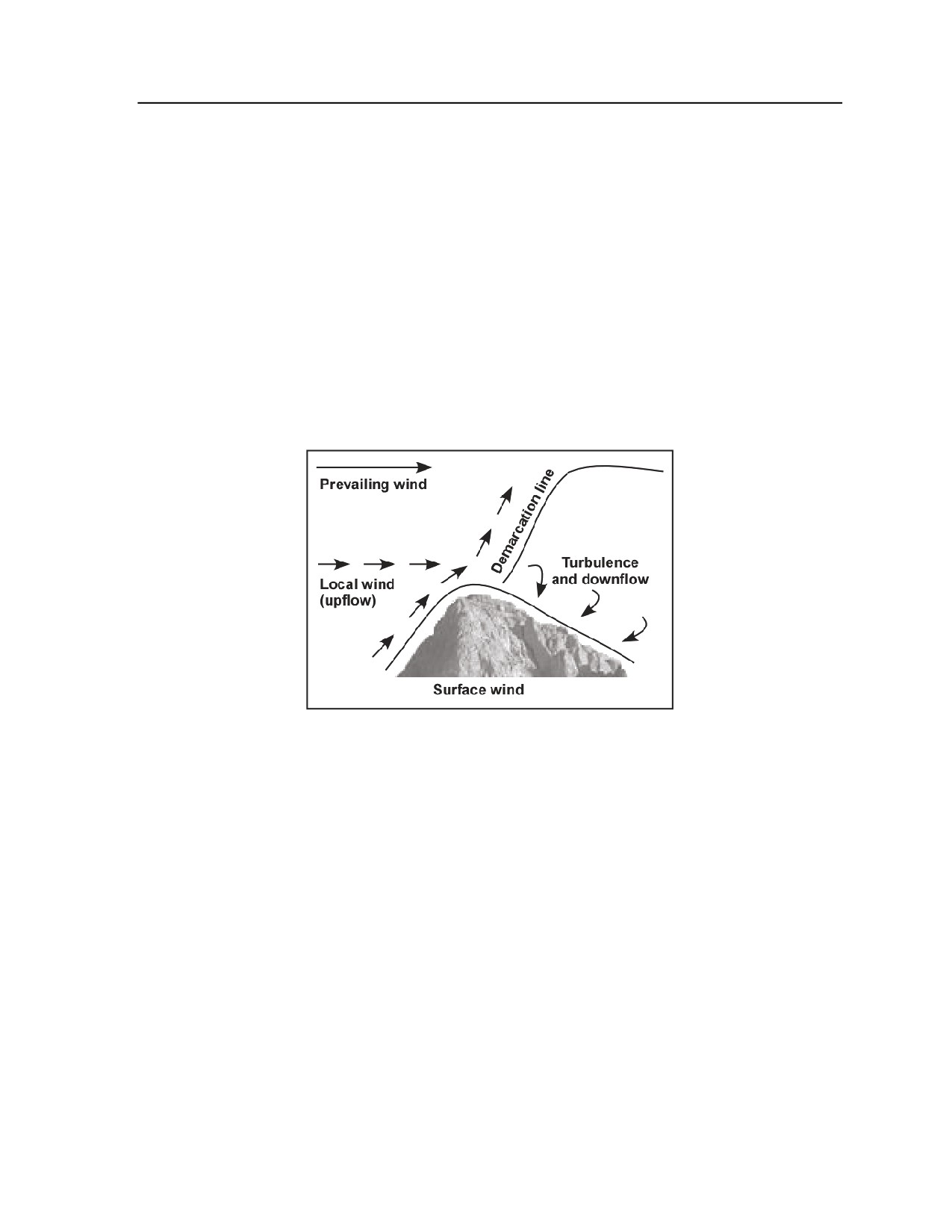
Rotary-Wing Environmental Flight
Fog
3-131. The effects of fog in the mountains are the same as for lower regions. The topography, however,
causes fog to occur more frequently in the mountains. Thus, fog becomes a more significant planning
consideration.
Wind
3-132. Wind associated with mountains can be broken down into the following three main categories
(figure 3-9):
Prevailing wind is the upper-level wind flowing predominantly from west to east in the
CONUS.
Local wind is also called valley wind and is created by convection heating and cooling. This
wind flows parallel to larger valleys. During the day, it tends to flow up the valley and flows
down the valley at night.
Surface wind is the layer of air lying close to the ground. It is less turbulent than prevailing and
local wind.
Figure 3-9. Types of wind
Demarcation Line
3-133. The demarcation line is the point separating upflow air from downflow air. It forms at the
mountain’s highest point and extends diagonally upward. The velocity of the wind and steepness of the
uplift slope determines the position of the demarcation line. Generally, the higher the wind speed and
steeper the terrain, the steeper the demarcation line. The effects of varying wind velocities on the
demarcation line are described in the following paragraphs.
Light Wind
3-134. A light wind (figure 3-10, page 3-28) is 1 to 10 knots. It accelerates slightly on the upslope, giving
rise to a gentle updraft. It follows the contour of the terrain feature over the crest. At some point over the
crest of the hill, it becomes a gentle downdraft.
7 May 2007
FM 3-04.203
3-27
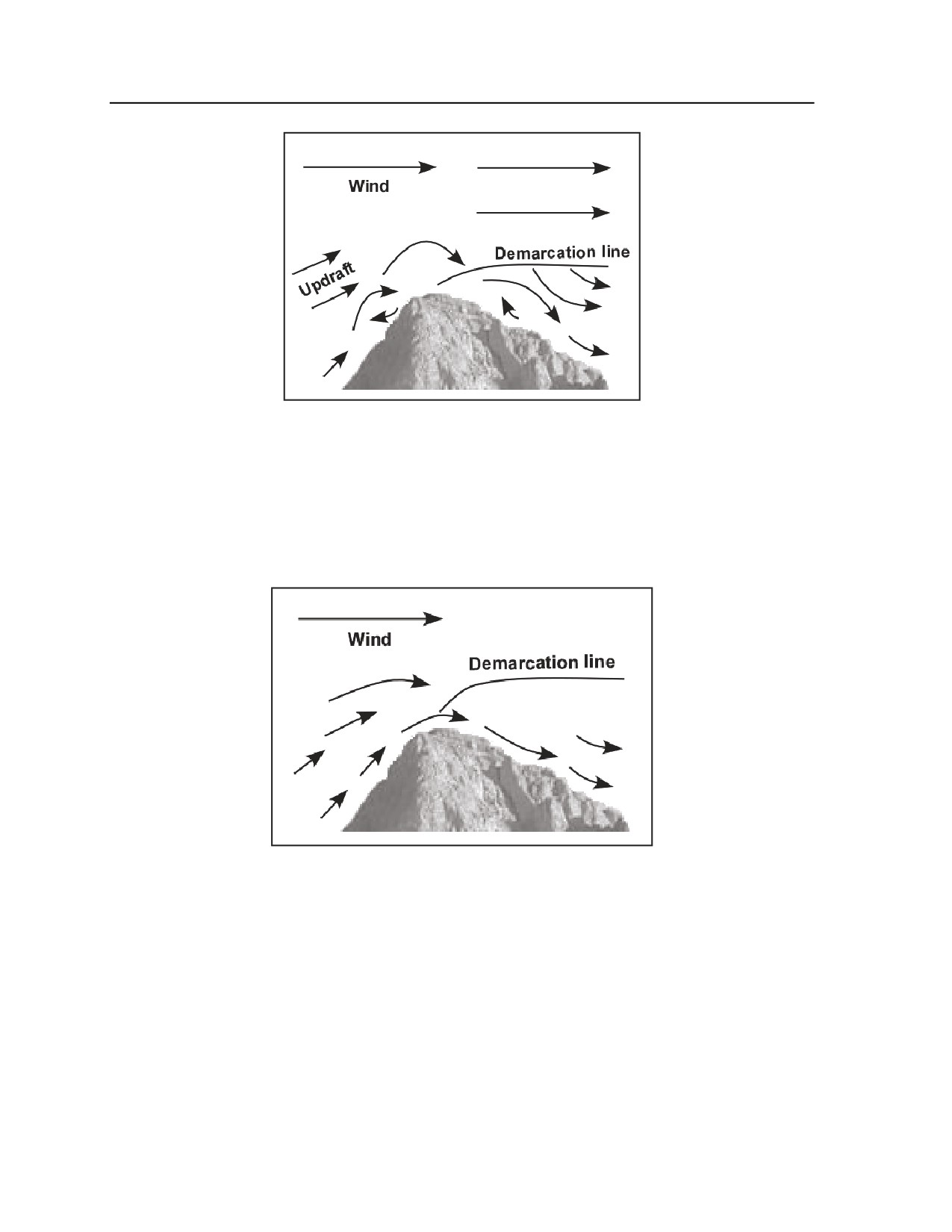
Chapter 3
Figure 3-10. Light wind
Moderate Wind
3-135. A moderate wind (figure 3-11) is 11 to 20 knots. It increases the strength of updrafts and
downdrafts and creates moderate turbulence. A downdraft will be experienced on the leeward side
(sheltered from the wind) near the mountain’s crest. The demarcation line forms closer to the crest and is
steeper.
Figure 3-11. Moderate wind
Strong Wind
3-136. As wind increases above 20 knots, the demarcation line moves forward to the crest’s leading edge
(figure 3-12, page 3-29). It then matches the slope’s steepness. The severity of updrafts, downdrafts, and
turbulence also increase. Under these conditions, the best landing spot is close to the forward edge
(windward side) of the terrain feature.
3-28
FM 3-04.203
7 May 2007
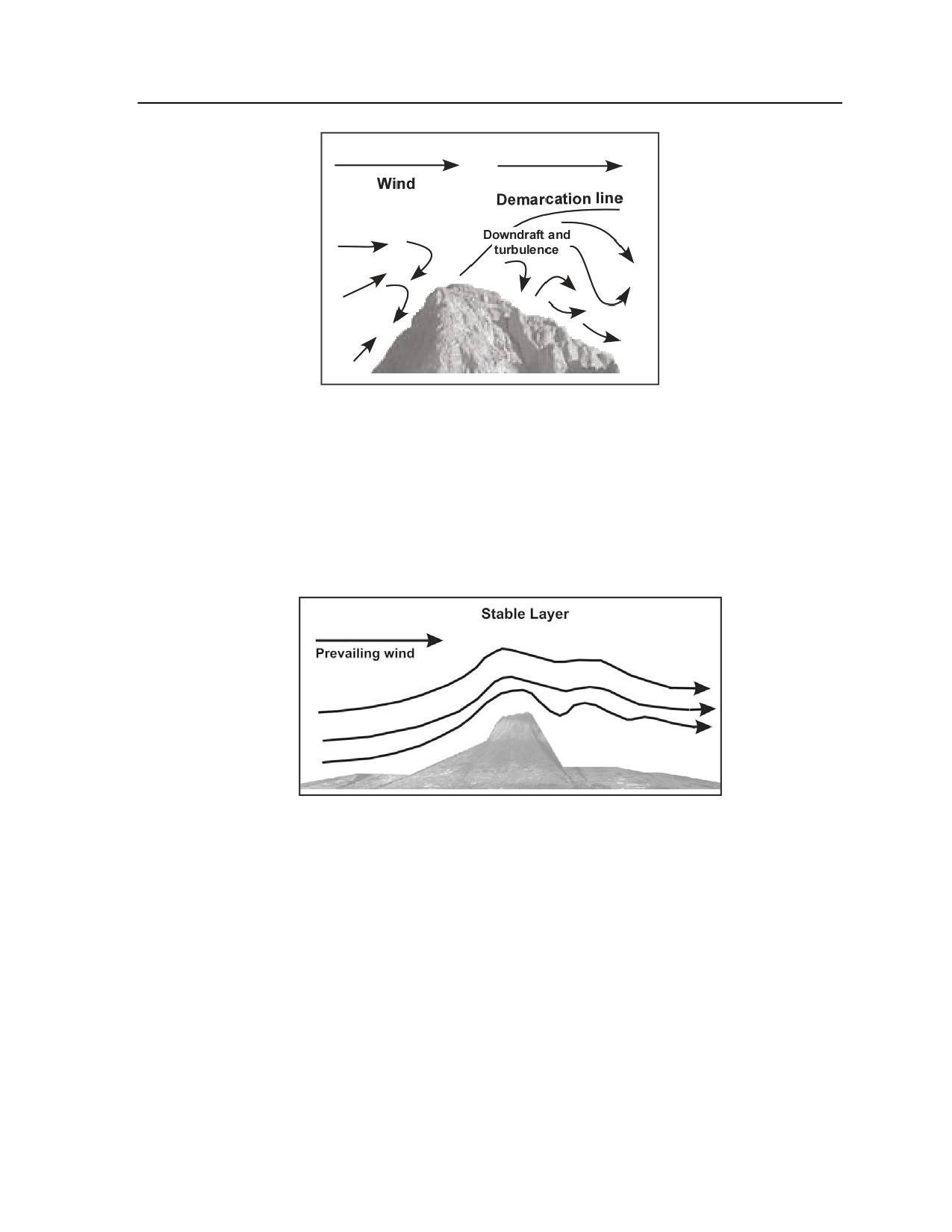
Rotary-Wing Environmental Flight
Figure 3-12. Strong wind
Mountain (Standing) Wave
3-137. A mountain, or standing, wave is a phenomenon occurring when airflow over mountainous terrain
meets certain criteria and causes a complex weather pattern (figure 3-13). That pattern creates relatively
smooth and strong, lifting winds on the windward side while progressing toward the leeward side very
abruptly (at the crest) and dramatically. It thrusts the aircraft into an area dominated by downdrafts having
sustained recorded values of at least 3,000 FPM.
Figure 3-13. Mountain (standing) wave
3-138. The resulting turbulence of a mountain wave is determined by the following:
Wind speed.
Stability of the air mass.
Degree of the slope.
Height of the mountain.
3-139. Mountain waves are likely to occur when the following conditions are present:
A low-level layer of unstable air.
A stable layer of air above the lower levels.
Wind direction fairly constant with altitude.
Wind speed increasing with altitude-a larger increase in wind speed produces a stronger wave.
A mountain or mountain range lying perpendicular to the airflow.
7 May 2007
FM 3-04.203
3-29
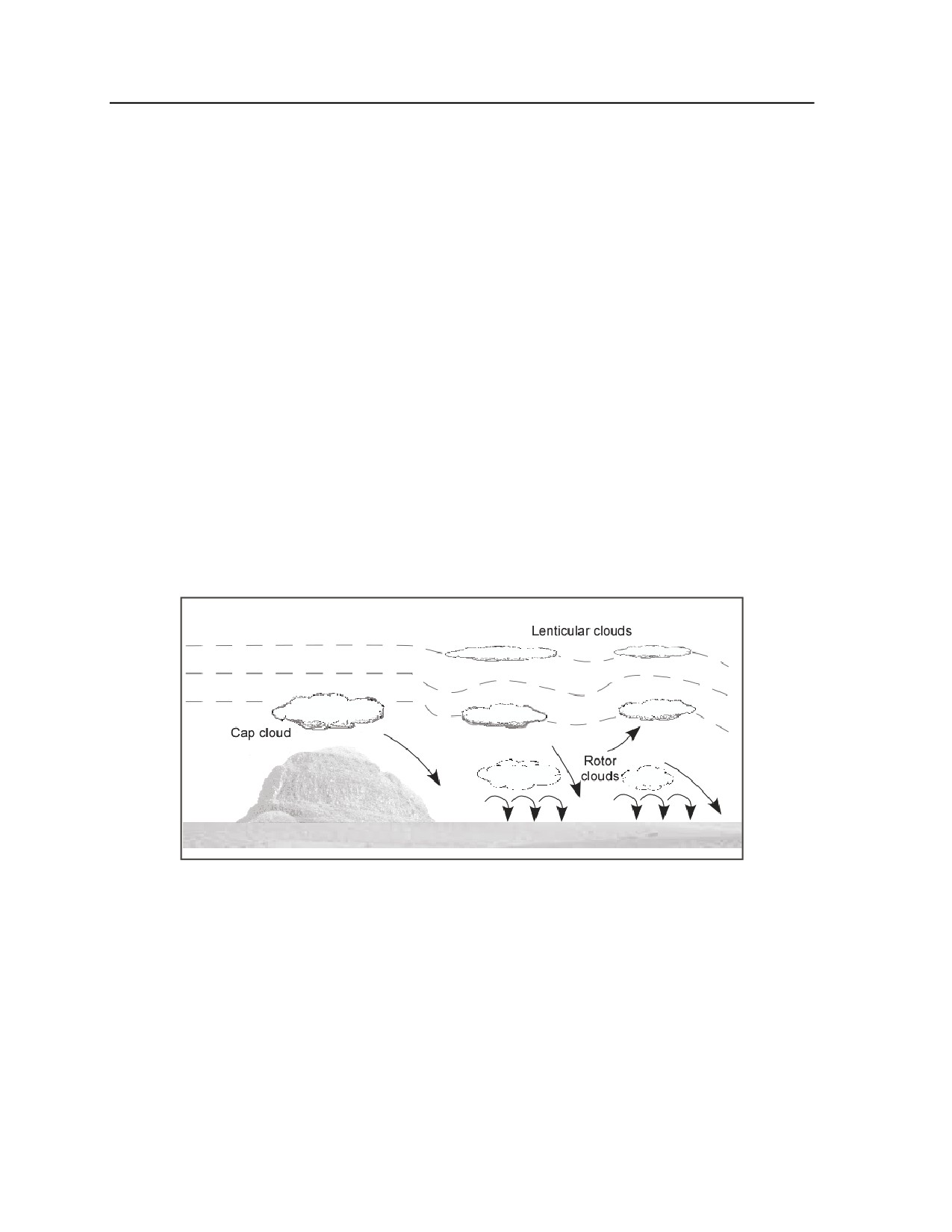
Chapter 3
3-140. Near a mountain wave, the following conditions can exist:
Vertical currents of 2,000 FPM are common, with more severe currents up to 5,000 FPM.
Turbulence varies from moderate to severe.
Wind gusts up to 22 knots per hour exist between waves. This condition is most severe near the
mountain where the waves are closer together.
Altimeter errors of as much as 1,000 feet may be experienced when penetrating a mountain
wave.
Icing can be expected in clouds when the temperature is below freezing.
3-141. When airflow meets the criteria for mountain waves, clouds form providing visible indications of
the existence of a mountain wave (figure 3-14). The three types of clouds that may form due to a mountain
wave are cap clouds, lenticular clouds, and rotor clouds.
Cap clouds consist primarily of vertical updrafts, yet they develop updrafts and downdrafts
passing over the mountain. The major part of the cloud extends upwind with finger-like
extensions running down the slope on the ridge’s downwind side.
Lenticular clouds are lens-shaped clouds found at high altitudes, normally 25,000 to 40,000
feet. They may form in bands or as single clouds, located above and slightly downwind from the
mountain’s ridge. A mountain wave may exist without formation of lenticular clouds. Although
airflow through the cloud is layered, aviators may encounter turbulence when flying under the
cloud.
Rotor clouds are located downwind from the ridge, sometimes in several rows lying parallel to
the ridge. The bases may be at or below ridge level. The tops sometimes extend to the base of
the lenticular cloud. They can produce updrafts and downdrafts of more than 5,000 FPM. Rotor
clouds are of short duration and tend to disappear as rapidly as they build.
Figure 3-14. Cloud formations associated with mountain wave
Rotor Streaming
3-142. Rotor streaming (figure 3-15, page 3-31) is a comparatively rare occurrence. However, it does
produce severe turbulence and has certain similarities to a standing wave. The conditions necessary for its
formation are as follows:
Unstable air in the lower level above ground.
A stable layer (isothermal layer of inversion) at two to three times the mountain barrier’s height.
A strong surface and gradient wind decreasing noticeably with height in and above the stable
layer.
A hill mass providing upward deviation of airflow.
3-30
FM 3-04.203
7 May 2007
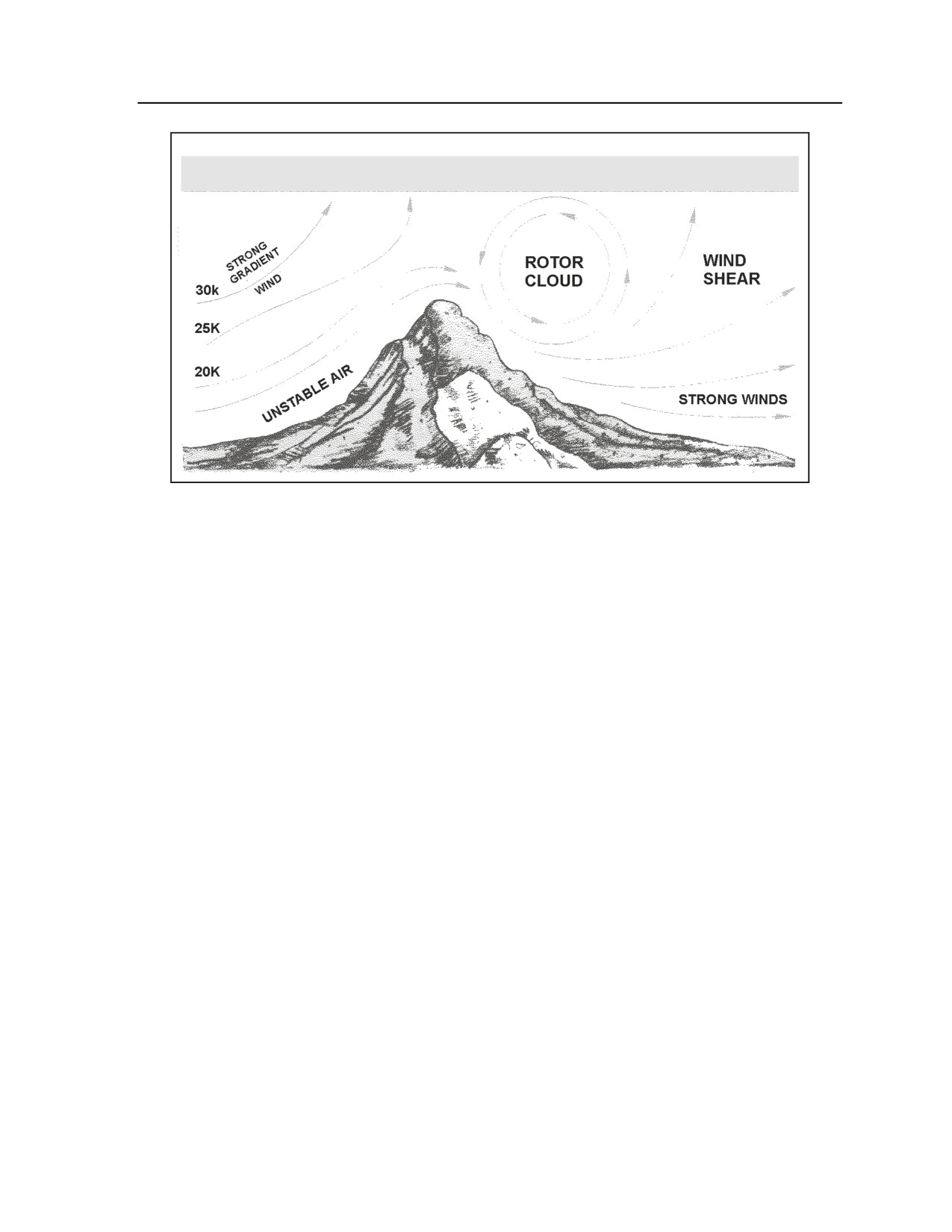
Rotary-Wing Environmental Flight
Slack Winds
Stable Layer
Figure 3-15. Rotor streaming turbulence
3-143. With these conditions, strong airflow begins to wave upward on the leeward side, meets the slack
wind, and shears back on itself forming a rotary circulation. The stable air above acts as a lid holding down
upward flow and assists circulation. This rotary circulation causes an increase in wind strength downwind
with violent updrafts, downdrafts, and severe turbulence. This turbulence can cover a wide area to the
leeward of the range and will lie in a roll downwind of the range. If enough moisture is available, a roll of
clouds-known as rotor clouds-can form through the circulation’s axis. The clouds will be rolling around
their axis and are typified by broken, straggling tendrils around their outer edges. They also have
pronounced vertical movement.
TERRAIN
3-144. When flying in mountainous regions, aviators will encounter many terrain variations. Each type
affects the flow of air in its own way. Aviators must understand the different types and their effects to
operate safely in a mountainous area. Mountain peaks are often warmer than the ground at the mountain’s
base due to the sun. This causes an uneven heating of air masses, triggering changing updrafts and
downdrafts, and varying wind velocities.
Ridgeline
3-145. When the flow of air is perpendicular to the ridgeline and the ridge is characterized by gentle
slopes, smooth air and updrafts will be experienced on the windward side of the ridge and downdrafts on
the leeward side. Updrafts will be more severe when the updraft slope is steeper and the wind velocity is
higher. If the air mass is unstable before the lifting action occurs or convection heating causes the air to
become unstable, turbulence will be encountered. As the air flows over the crest, a Venturi effect is
created; an area of low pressure develops on the leeward side of the mountain. When operating in this area,
the altimeter will read high. Where the ridgeline is irregular, air funnels through the gaps causing a mixing
of air on the leeward side. This condition tends to increase turbulence. Wind striking the ridge at less than
90 degrees produces fewer updrafts and downdrafts (figure 3-16, page 3-32).
7 May 2007
FM 3-04.203
3-31
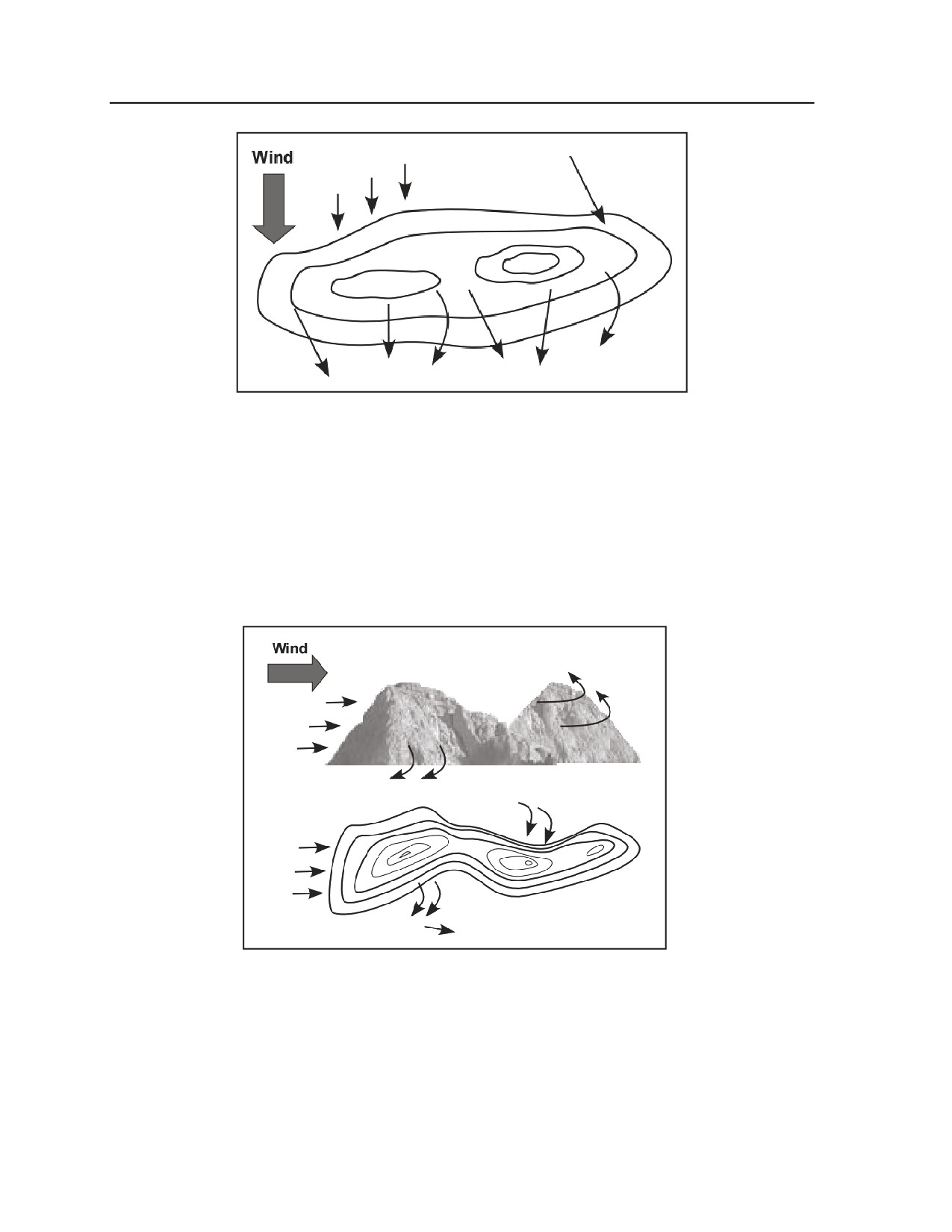
Chapter 3
Figure 3-16. Wind across a ridge
Snake Ridges or Multiridges
3-146. The characteristics of wind flow over a ridge apply to snake ridges or multiridges (figure 3-17).
However, downdrafts and turbulent air may be encountered on the windward slope of succeeding ridges.
The severity of these conditions will be determined by the distance between the ridges, depth of the valley,
and angle at which the wind strikes the slope. When the wind is perpendicular to the slope and the ridges
are closer together, updrafts and turbulence are more severe. Greater turbulence will be experienced on the
downdraft slope of succeeding ridges due to turbulent air flowing over the ridge.
Figure 3-17. Snake ridge
Saddles
3-147. Saddles are formed by erosion of soft rocks. The turbulence severity in and around a saddle is
determined by the saddle width and the slope’s angle. Deep saddles, where terrain rises rapidly on each
side, have the effect of a Venturi. The Venturi principle is when air is forced to flow through a constriction,
velocity increases, and static pressure is reduced. This pressure reduction creates an altimeter error, causing
3-32
FM 3-04.203
7 May 2007
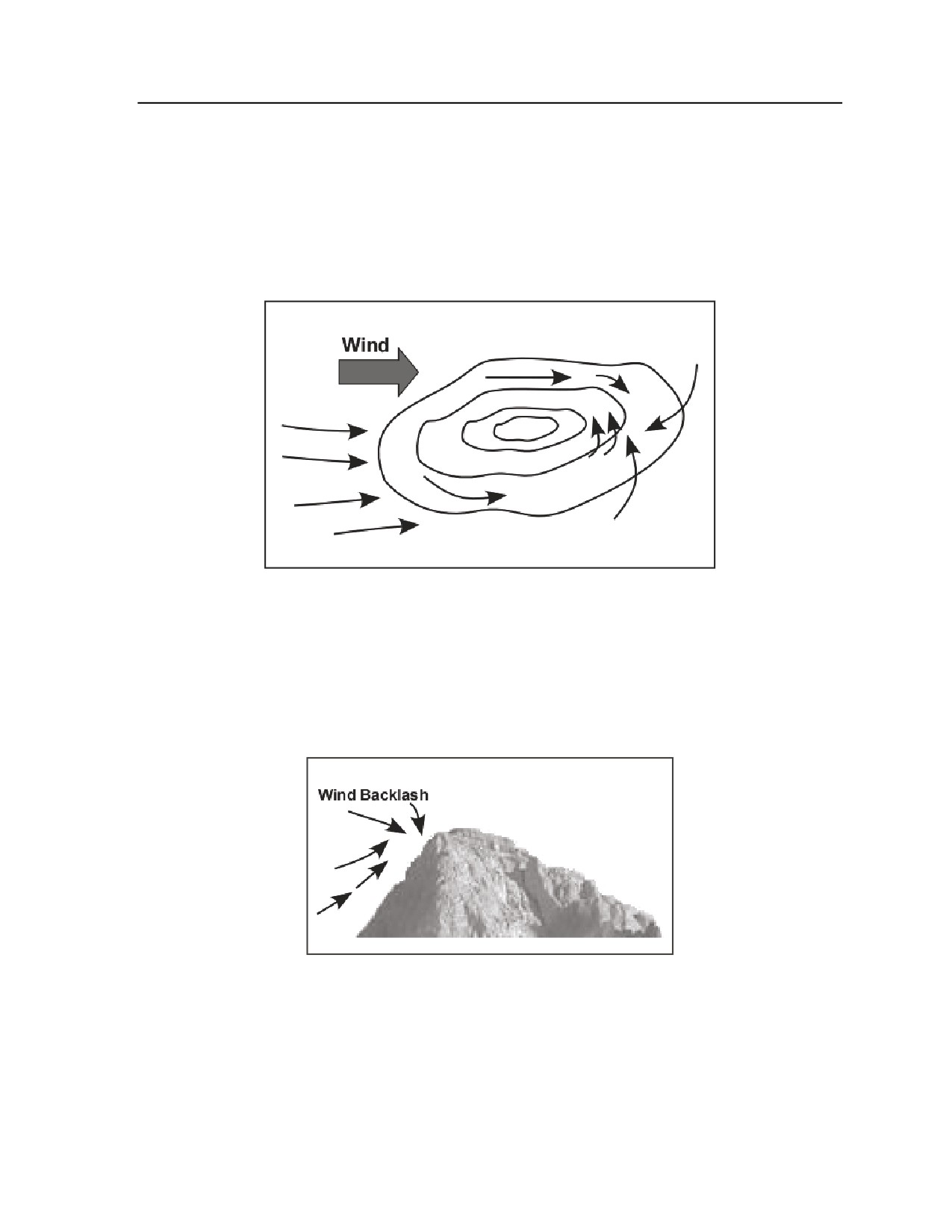
Rotary-Wing Environmental Flight
the altimeter to read higher than the aircraft actually is. The wind flow over a shallow saddle with gentle
slopes is much less severe.
Crown or Pinnacle
3-148. A crown or pinnacle is the highest point on a hill (figure 3-18). Because of its small size and
separation from other terrain features, the effect on the wind normally is less severe. Usually, airflow near
a crown is lateral around its outer edges and over the top. Turbulence will develop on the leeward side of
the hill but does not extend too far out from the crown.
Figure 3-18. Wind across a crown
Shoulders
3-149. Shoulders are terrain features coming off higher ground (figure 3-19). The higher ground may be
behind, in front of, or to the side of the shoulder. The airflow around a shoulder is extremely turbulent,
regardless of wind direction. Extreme downdrafts may be experienced if the shoulder is located on the
leeward side of the mountain. Rotary turbulence may be experienced on the uplift side of the shoulder.
Figure 3-19. Shoulder wind
Cliff (Bluff)
3-150. A cliff or bluff is a vertical or a near-vertical terrain feature. Extreme turbulence can be anticipated
in front of, above, and below the cliff. This is caused by wind striking the face of the cliff and rebounding
7 May 2007
FM 3-04.203
3-33
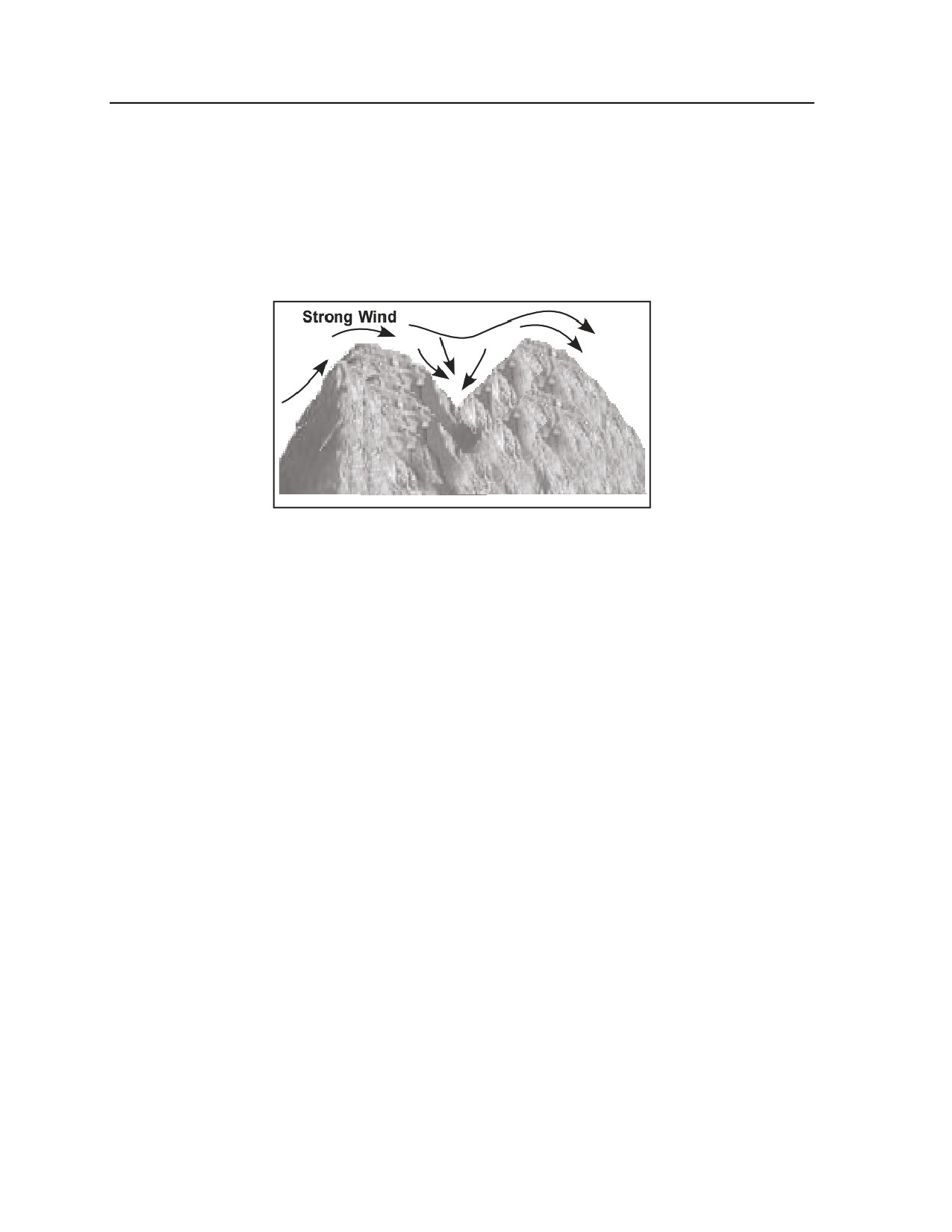
Chapter 3
rearward. Eddies of airflow form above and below the top of the cliff. The air on the leeward side of the
cliff is turbulent.
Canyons
3-151. Canyons are deep valleys with steep sides (figure 3-20) and enclosed on three sides. Usually, the
lower winds flow parallel to the canyon floor. The degree of turbulence in the low areas of a canyon
depends on the width and depth of the canyon and the wind speed. In a narrow canyon, the most severe
turbulence is in the low area. However, the low area in a wide canyon may be relatively free of turbulence.
Figure 3-20. Wind across a canyon
NAVIGATION
3-152. Dead reckoning is the primary means of navigation. Maps of mountainous regions are usually
easier to read because of greater relief, clearly defined features, and significant information from the
contour lines. There is, however, a transition period necessary for aviators, especially if they are normally
stationed in nonmountainous terrain. GPS and Doppler are extremely helpful and an invaluable part of the
aircraft’s avionics.
FLYING TECHNIQUES
3-153. Conducting flight operations over mountainous terrain is a difficult undertaking, even for an
experienced aviator. The mountain environment is probably the least forgiving environment in which
Army aviation operates. The following information, while extensive, is necessary and explains proven
techniques.
OPERATIONAL PROCEDURES
3-154. The mountain environment-combined with its effects on personnel and equipment-requires some
modification of techniques and procedures. Important physical characteristics influencing mountain
operations include peaks, steep ridges, deep ravines, valleys, limited communication capability, and
continuously changing weather. When flying in the mountains, an aviator’s senses are often unreliable. The
natural tendency is to judge airspeed as too slow and altitude as too high. In addition, aviators tend to
decelerate when flying upslope and accelerate when flying downslope. With constantly changing terrain
and visual input, flying in the mountains demands an aviator’s constant attention, which is divided between
the outside environment and the flight instruments. The incorporation of an instrument scan into VFR
flying assists aviators in maintaining appropriate airspeed, altitude (MSL and AGL), and rate of climb or
descent. This demanding environment requires extensive training and practice. Mountain flight is a
perishable skill. During high-altitude missions, one aviator should continually update the PPC to
compensate for changes in the mission profile such as gross weight changes, CG change, temperature, and
pressure-altitude change.
3-34
FM 3-04.203
7 May 2007
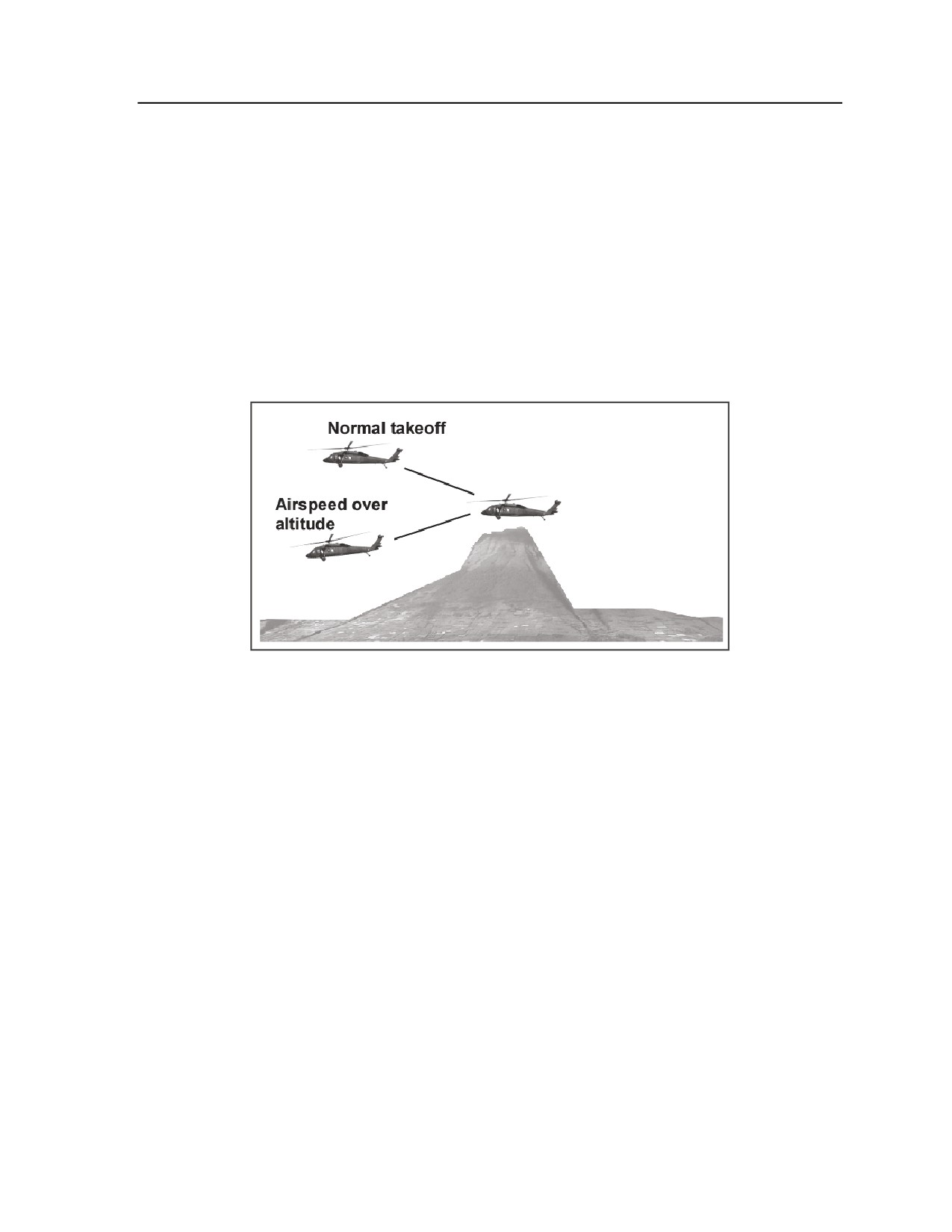
Rotary-Wing Environmental Flight
TAXIING AND TAKEOFF
3-155. Before takeoff, aviators conduct a hover power check. They obtain necessary information from the
PPC, tabular data, or operator’s manual including maximum torque available and go/no-go torque. These
essential elements are calculated and verified by aircraft performance before departing and attempting the
maneuver.
3-156. The primary difference between a mountain takeoff and a nonmountainous takeoff is the
importance of gaining airspeed instead of altitude (figure 3-21). A nonmountainous takeoff emphasizes a
combination of the two, accelerating as the aircraft climbs; mountainous takeoff emphasizes accelerating
instead of climbing. When performing a mountain takeoff, an aviator applies torque, as necessary, to gain
forward airspeed while maintaining sufficient altitude clearing any obstacles until climb airspeed is
reached. Where a drop-off is located, the aircraft may be maneuvered downslope to gain airspeed. If an
OGE takeoff is required to clear obstacles, angle of climb is minimized to conserve power. After clearing
the obstacle, the flight attitude is adjusted to gain forward airspeed.
Figure 3-21. Mountain takeoff
EN ROUTE
Takeoff
3-157. Before takeoff, aviators identify the route of flight on a map. Although flight route and altitudes
may change, the altitude for nontactical flight is generally considered to be at or above 500 feet AGL.
3-158. The following en route considerations apply to flight in mountainous terrain:
When flying in a valley, aviators fly the aircraft in smoother up-flowing air on the lifting side of
the valley. This technique requires less power and provides the aircraft a safer flight path. Wind
velocity dictates how far away from the valley walls to fly. Aviators avoid flying too close to the
valley walls during strong winds to avoid turbulence caused by irregular terrain. Under light
winds, the aircraft is flown closer to the valley walls to facilitate a 180-degree turn if the valley
is narrowing or there is rapidly rising terrain or a low cloud base.
Terrain clearance is increased when strong winds exist. It may be necessary, however, to
descend if flight is conducted below the rim of a large valley. Turbulence develops in the upper
levels of the valley but diminishes closer to the valley floor.
If a downdraft is encountered, full power is applied and best rate-of-climb airspeed (Vy)
maintained. If unable to stop descent, a turn away from terrain is made. A maneuver downhill
toward an area in the valley floor is attempted while maintaining airspeed. Near the valley
bottom, downdraft begins to decrease in severity. Aviators continue to maintain full power and
7 May 2007
FM 3-04.203
3-35
Chapter 3
turn into the wind. If it appears the helicopter will be forced into the ground, a flat landing area
is selected and an approach to the area planned. If the landing area is not level, land upslope.
Techniques for crossing ridges vary depending on wind strength and direction of crossing,
leeward to windward or vice versa. The basic rule is to cross the ridge diagonally. This
procedure facilitates turning away from the ridge should the helicopter be carried below the
crest by a downdraft. In strong winds, ample clearance is allowed above the top of the ridge
when crossing from leeward to windward side of the ridge. Crossing from windward to leeward
can lead to uncontrolled descents on the leeward side; this may require large applications of
power to remain above terrain at a safe altitude. The clearance itself will be assisted by updrafts,
but if a low cloud ceiling exists the aircraft may be carried up into the cloud even with minimum
power applied. If the crossing is made at terrain flight altitudes, turbulence may be encountered
on the ridge’s leeward side.
Maneuvering in narrow valley bottoms is easier at low airspeeds, thus reducing the requirement
for large power demands. Airspeeds should not be reduced below ETL. Turns will be flat and, if
possible, in the direction of torque reaction (right turn for U.S.-made helicopters).
Flight on the sunny side of the valley has more turbulence; however, turbulence caused by solar
heating is not as severe. An updraft is formed allowing the aircraft to fly with less power. On the
shady side of the valley, downdrafts may be present and cause a need for additional power.
As gross weight and altitude of the aircraft increase, the maximum allowable airspeed decreases.
Failing to reduce airspeed according to the PPC may result in blade stall or simply running out
of power.
When turbulence is anticipated, airspeed is reduced to the recommended turbulence penetration
airspeed for the type of aircraft being flown.
Due to danger of encountering downdrafts, descents to follow terrain will be executed at less
than 1,000 FPM. When following terrain in a descent, aviators often need to reduce airspeed
keeping the aircraft within operating limits.
When approaching a ridge, aviators will have trouble determining if the aircraft’s altitude is
sufficient to clear the ridge. When terrain beyond the ridge becomes progressively visible, the
aircraft will clear the ridge. If this is not the case (if the aviator is not high enough to see beyond
the ridge) then a climb must be established with a possible 360-degree turn made so the aircraft
clears the ridge.
When tactically possible, the flight is planned and flown using well-known routes facilitating a
quicker rescue.
When conducting multihelicopter operations during marginal weather operations, it is advisable
to have an aircraft precede the flight determining actual weather conditions and ensuring
satisfactory weather to accommodate the flight of aircraft. Mountainous terrain restricts
avoidance maneuvers when aircraft are flying in multihelicopter formations.
When conducting multihelicopter operations into a small LZ, aviators will use a greater than
normal separation to provide sufficient reaction time and avoid forcing successive aircraft into
the disturbed air of the preceding aircraft.
Determination of En Route Winds
3-159. While weather forecasters provide some information, it is impossible for them to know the exact
wind at each point. Visual cues assist the aircrew in determining the wind. These cues are divided into two
categories—ground indicators and aircraft indicators.
3-36
FM 3-04.203
7 May 2007