FM 3-04.203 Fundamentals of Flight (May 2007) - page 2
Theory of Flight
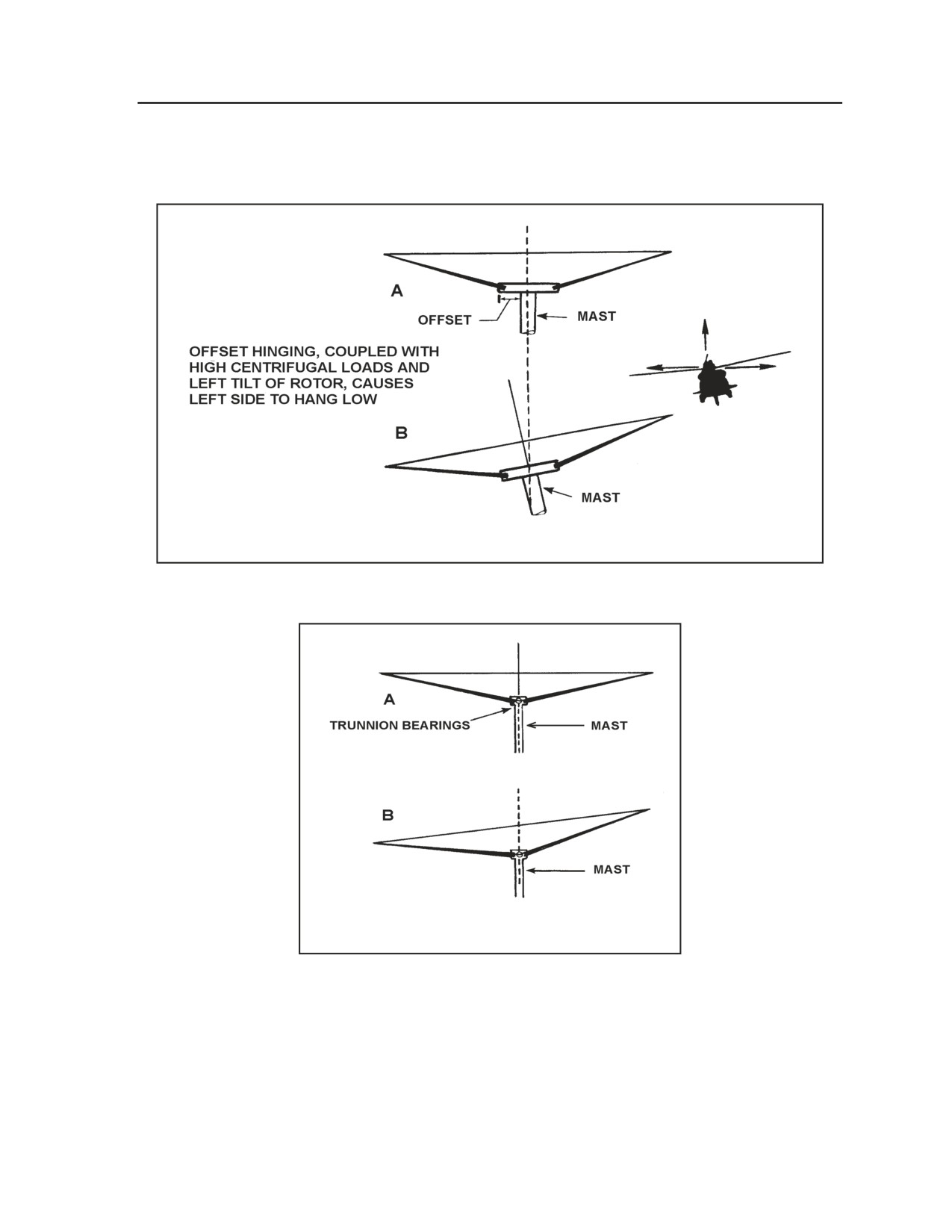
compensate for translating tendency (figure 1-35, B, page 1-23). Because the mast remains vertical,
the fuselage hangs level laterally unless other forces affect it.
Figure 1-34. Fully articulated rotor system
Figure 1-35. Semirigid rotor system
1-55. When there is forward tilt of the mast, the tail rotor gearbox is probably lower than the main rotor.
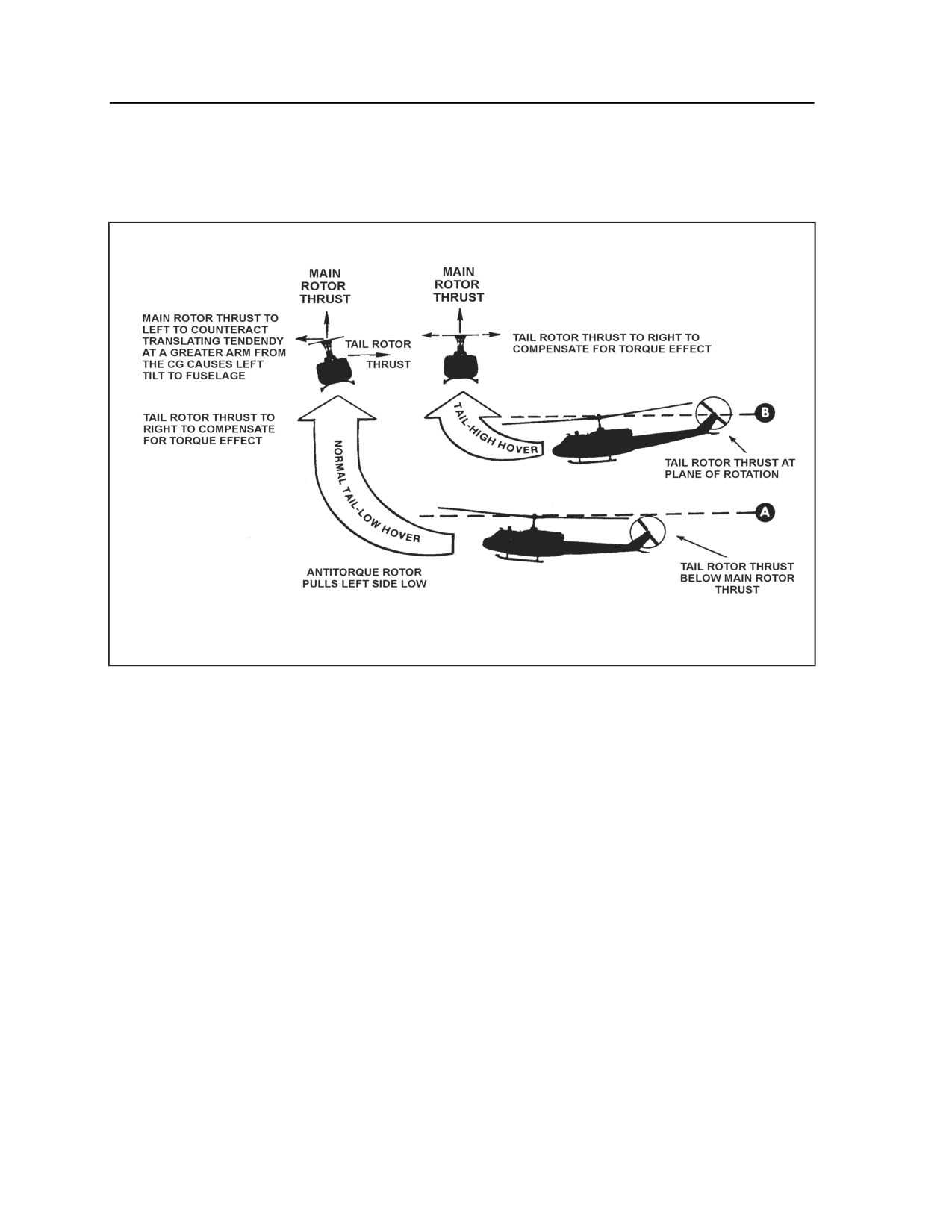
Main rotor thrust above tail rotor thrust to the right causes the fuselage to tilt laterally left (figure 1-36,
page 1-24). Although main rotor thrust to the left is equal to tail rotor thrust to the right, it acts at a
greater distance from the CG, creating a greater turning moment on the fuselage. This is more
pronounced in helicopters with semirigid rotor systems than those with fully articulated rotor systems.
Tail rotor thrust acting at the plane of rotation of the main rotor would not change the attitude of the
7 May 2007
FM 3-04.203
1-25
Chapter 1
fuselage. The main rotor mast in semirigid and fully articulated rotor systems may be designed with a
forward tilt relative to the fuselage. During forward flight, forward tilt provides a level longitudinal
fuselage attitude, resulting in reduced parasite drag; during hover, it results in a tail-low fuselage
attitude.
Figure 1-36. Effect of tail-low attitude on lateral hover attitude
Tandem-Rotor Helicopter
1-56. In tandem-rotor helicopters, the forward and aft rotor systems are tilted forward due to transmission
mounting design. This tilt helps decrease excessive nose-low attitudes in forward flight and allows the
aircraft to ground or water taxi forward. Most tandem-rotor helicopters hover at a nose-high attitude of
about 5 degrees. Some models automatically compensate for this nose-high attitude through automatic
programming of the rotor systems.
PENDULAR ACTION
1-57. The fuselage of the helicopter has considerable mass and is suspended from a single point (single-
rotor helicopters). It is free to oscillate laterally or longitudinally like a pendulum. Normally, the
fuselage follows rules governing pendulums, balance, and inertia. Rotor systems, however, follow
rules governing aerodynamics, dynamics, and gyroscopes. These two unrelated systems have been
designed to work well together, in spite of apparent conflict. Other factors, such as overcontrolling,
cyclic-control response, and shift of attitude, affect the relationship of the rotor system and fuselage.
Overcontrolling
1-58. Overcontrolling occurs when the aviator moves the cyclic control stick, causing rotor tip-path
changes not reflected in corresponding fuselage-attitude changes. Correct cyclic control movements
(free of overcontrol) cause the rotor tip-path and fuselage to move in unison.
1-26
FM 3-04.203
7 May 2007
Theory of Flight
Cyclic Control Response
1-59. The rotor response to cyclic control input on a single-rotor helicopter has no lag. Rotor blades
respond instantly to the slightest touch of cyclic control. The fuselage response to lateral cyclic is
noticeably different from the response to fore and aft cyclic applications. Normally, considerably more
fore and aft cyclic movement is required to achieve the same fuselage response as achieved from an
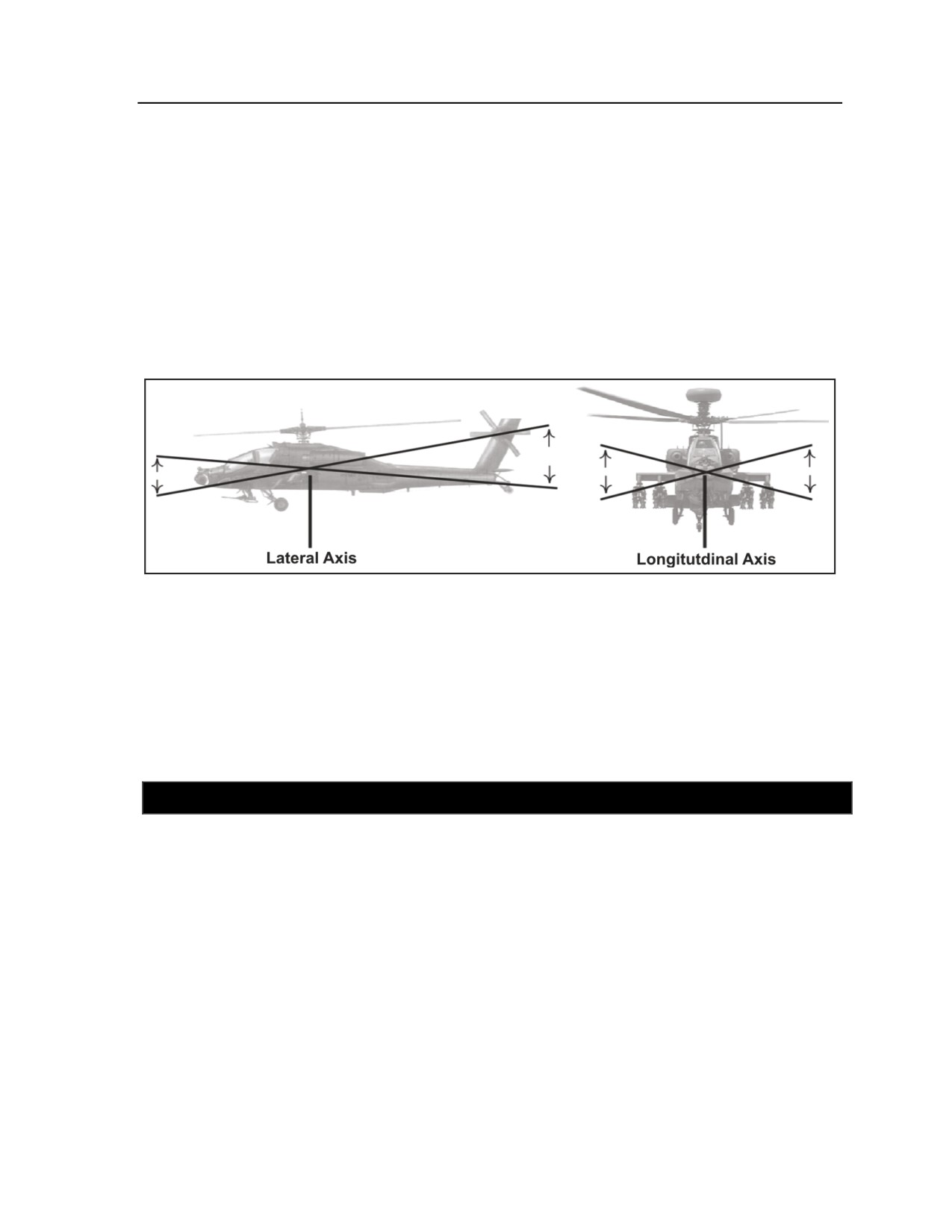
equal amount of lateral cyclic. This is not a lag in rotor response; rather as figure 1-37 shows, it is due
to more fuselage inertia around the lateral axis than around the longitudinal axis. For single-rotor
helicopters, the normal corrective device for the lateral axis is the addition of a synchronized elevator
or stabilator attached to the tail boom. This device produces lift forces keeping the fuselage of the
helicopter in proper alignment with the rotor at normal flight airspeed. This alignment helps reduce
blade flapping and extends the allowable CG range of the helicopter; however, it is ineffective at slow
airspeeds.
Figure 1-37. Cyclic control response around the lateral and longitudinal axes
Shift of Attitude
1-60. Fuel cells normally have a slight aft CG. As fuel is used, a slight shift to a more nose-low attitude
occurs. Because of fuel expenditure and lighter fuselage, cruise attitudes tend to shift slightly lower.
As fuel loads are reduced, drag affects the lighter fuselage more, resulting in a slight shift to a more
nose-down attitude during flight.
SECTION III - IN-FLIGHT FORCES
TOTAL AERODYNAMIC FORCE
1-61. As air flows around an airfoil, a pressure differential develops between the upper and lower surfaces.
The differential, combined with air resistance to passage of the airfoil, creates a force on the airfoil.
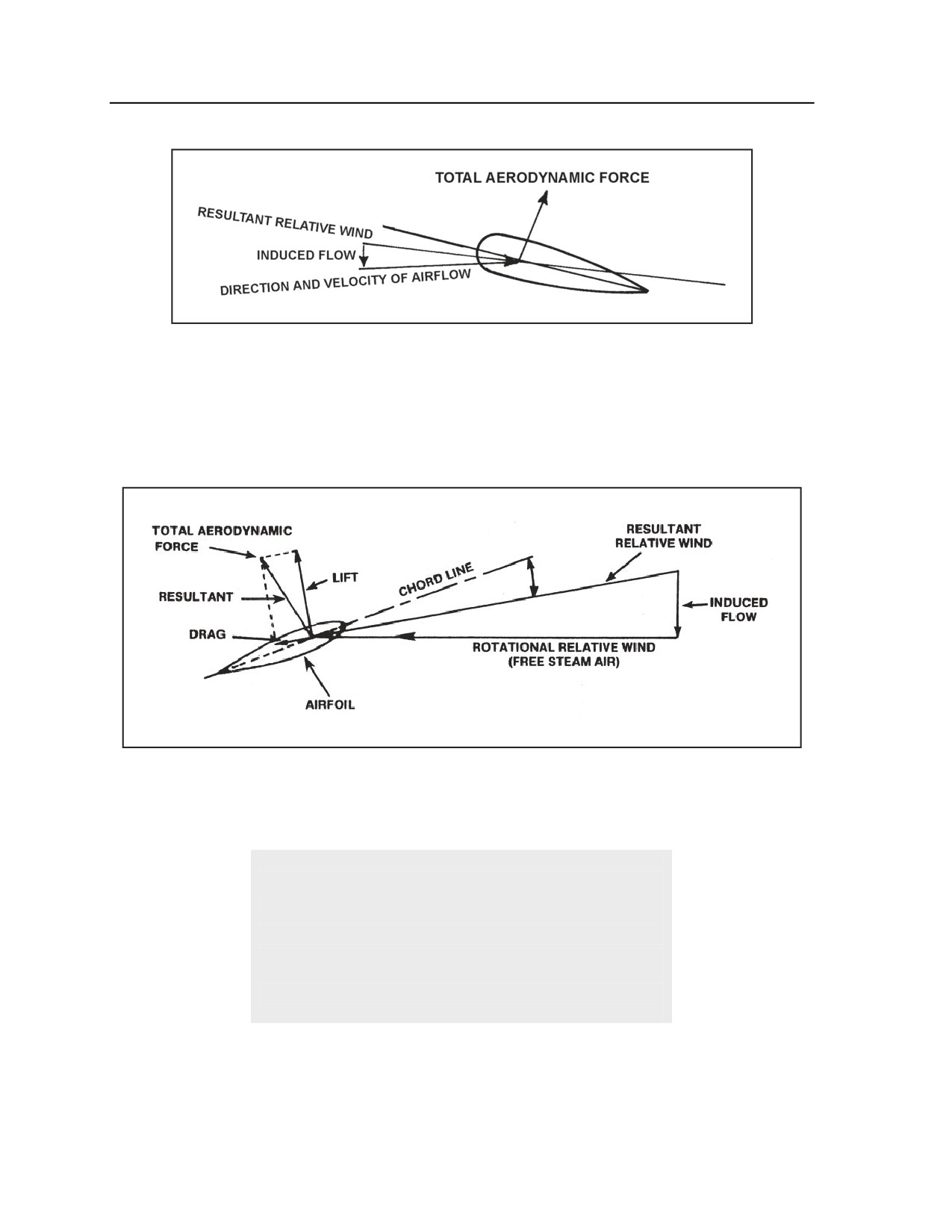
This is known as TAF (figure 1-38). TAF acts at the center of pressure on the airfoil and is normally
inclined up and rear. TAF, sometimes called resultant force, may be divided into two components, lift
and drag.
7 May 2007
FM 3-04.203
1-27
Chapter 1
Figure 1-38. Total aerodynamic force
LIFT AND LIFT EQUATION
1-62. Lift is the component of the airfoil’s TAF perpendicular to the resultant relative wind (figure 1-39,
page 1-26).
Figure 1-39. Forces acting on an airfoil
1-63. The illustration of the lift equation, accompanied by a simple explanation, helps understanding of
how lift is generated. The point is to understand what an aviator can or cannot change in the equation.
Lift Equation
L = CL x ρ /2 x S x V2
Where-
L = lift force
CL = coefficient of lift
ρ /2 = .5 x ρ (rho) = density of the air (in slugs per cubic foot)
S = surface area (in square feet)
V2 = airspeed (in feet per second)
1-64. The shape or design of the airfoil and AOA determine the coefficient of lift. Aviators have no
control over airfoil design. However, they do have direct control over AOA. The aviator cannot affect
ρ (rho) or S (surface area of the airfoil). With respect to V (relative wind velocity or airspeed), an
increase in rotor RPM has a greater effect on lift than an increase in airspeed.
1-28
FM 3-04.203
7 May 2007
Theory of Flight
DRAG
1-65. Drag is the component of the airfoil’s TAF parallel to the resultant relative wind (figure 1-39). Drag
is the force opposing the motion of an airfoil through the air.
DRAG EQUATION
1-66. The illustration of the drag equation accompanied by a simple explanation (in addition to the lift
equation) helps understanding of how drag is generated. The point is to understand what an aviator can
and cannot change.
Drag Equation
D = CD x ρ /2 x S x V2
Where-
D = drag force
CD = coefficient of drag
ρ /2 = .5 x ρ (rho) = density of the air (in slugs per cubic foot)
S = surface area (in square feet)
V2 = airspeed (in feet per second)
1-67. The shape or design of the airfoil and AOA largely determine the coefficient of drag. The aviator has
no control over airfoil design but has direct control over AOA. This is one of two elements of the drag
equation the aviator can change. However, an aviator cannot affect ρ (rho) which is density of the air.
S represents surface area of the airfoil, a design factor also unaffected by aviator input. Finally, V
represents relative wind velocity or airspeed and is the only other factor an aviator can change.
TYPES OF DRAG
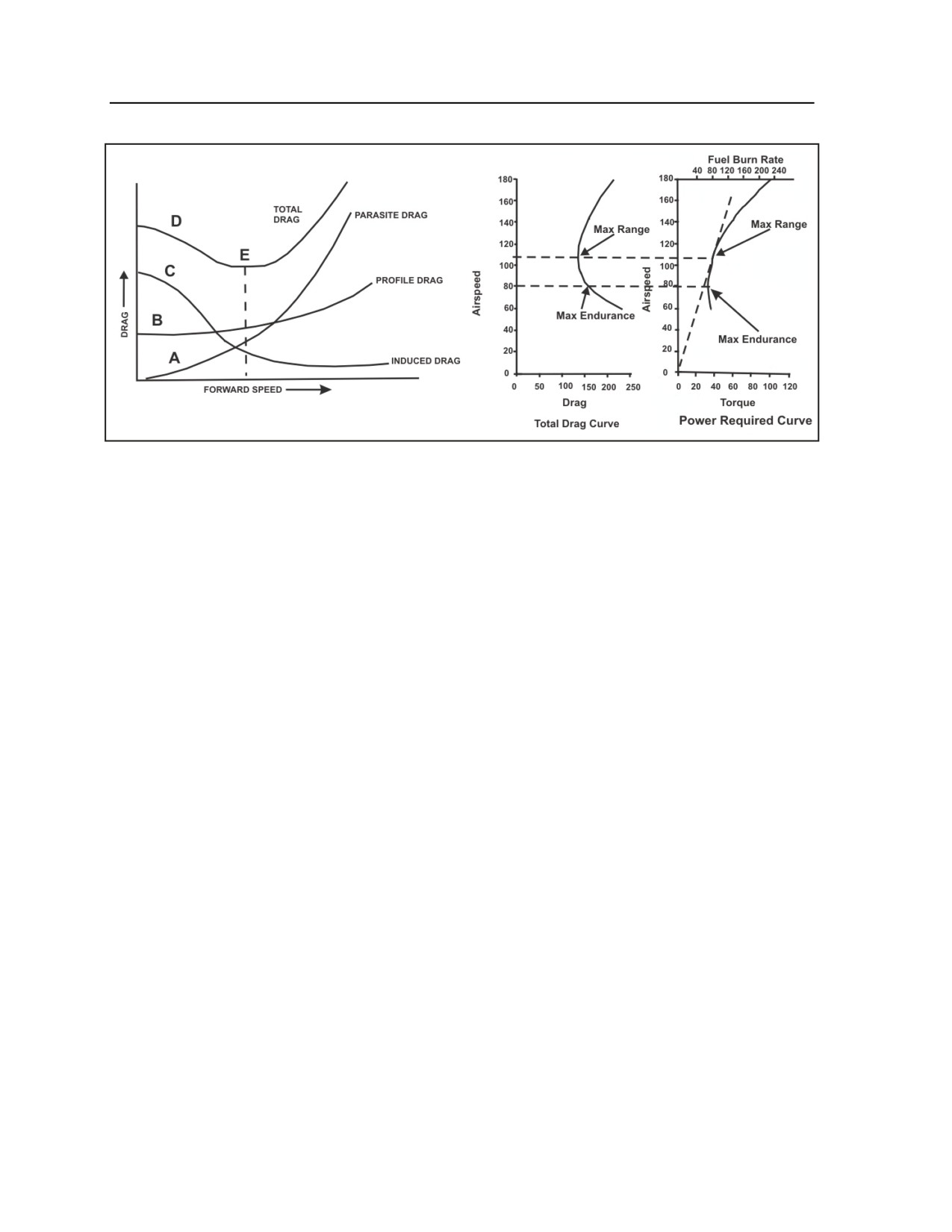
1-68. Total drag acting on a helicopter is the sum of the three types of drag—parasite, profile, and induced
drag. Curve D in figure 1-40 shows total drag and represents the sum of the other three curves.
Parasite Drag
1-69. Parasite drag is incurred from the nonlifting portions of the aircraft. It includes form drag, skin
friction, and interference drag associated with the fuselage, engine cowlings, mast and hub, landing
gear, wing stores, external load, and rough finish paint. Parasite drag increases with airspeed and is the
dominant type at high airspeeds. Curve A in figure 1-40 shows parasite drag.
Profile Drag
1-70. Profile drag is incurred from frictional resistance of the blades passing through the air. It does not
change significantly with AOA of the airfoil section but increases moderately at high airspeeds. At
high airspeeds, profile drag increases rapidly with onset of blade stall or compressibility. Curve B in
figure 1-40 shows profile drag.
Induced Drag
1-71. Induced drag is incurred as a result of production of lift. Higher angles of attack, which produce
more lift, also generate downward velocities and vortices that increase induced drag. In rotary-wing
aircraft, induced drag decreases with increased aircraft airspeed. Curve C in figure 1-40 shows induced
drag.
DRAG/POWER/AIRSPEED RELATIONSHIP
1-72. Figure 1-40 illustrates the relationship between drag, power, and airspeed.
7 May 2007
FM 3-04.203
1-29
Chapter 1
Figure 1-40. Drag and airspeed relationship
Aircraft Performance and Power Curves
1-73. Drag is a major component used in conjunction with flight testing and performance data to develop
performance planning charts found in operator manuals which explains the similar appearance in these
charts (figure 1-40, page 1-27). Performance planning charts allow aviators to compute expected
performance data based on various weather conditions, loading configurations, and airspeeds. This
data is required to determine predicted airspeeds, torques, and fuel flows during various mission
profiles. Key information required for performance planning includes maximum range airspeed,
maximum endurance airspeed, maximum rate-of-climb airspeed and the torques and fuel flows
associated with those airspeeds.
1-74. Maximum range airspeed is an airspeed that should allow the helicopter to fly the furthest distance. It
is determined by flying where airspeed intersects the lowest amount of total drag (point E on figure 1-
40, page 1-27). However, due to flight testing and aircraft performance, cruise charts are used to
determine torque and fuel flows required to maintain that airspeed. Because cruise charts are not drag
charts, it can be noted the lowest point of a drag chart does not necessarily match the lowest point of
the power required curve in a cruise chart.
1-75. Maximum Endurance airspeed is an airspeed that allows the helicopter to remain flying the most
amount of time. It can be found on the power required curve of the cruise chart where power required
is at its lowest and not necessarily where total drag is lowest on the drag chart.
1-76. Maximum rate-of-climb airspeed is maximum endurance airspeed combined with maximum torque
available to achieve the fastest rate of climb.
CENTRIFUGAL FORCE AND CONING
1-77. A helicopter rotor system depends primarily on rotation to produce relative wind, which develops the
aerodynamic force required for flight. This action subjects the rotor system to forces peculiar to all
rotating masses. One of the forces produced is centrifugal force. The apparent force tends to make
rotating bodies move away from the center of rotation. The rotating blades of a helicopter produce
very high centrifugal loads on the hub and blade attachment assemblies. In rotary-wing aircraft, this is
the dominant force affecting the rotor system; all other forces act to modify it. As a rotor system
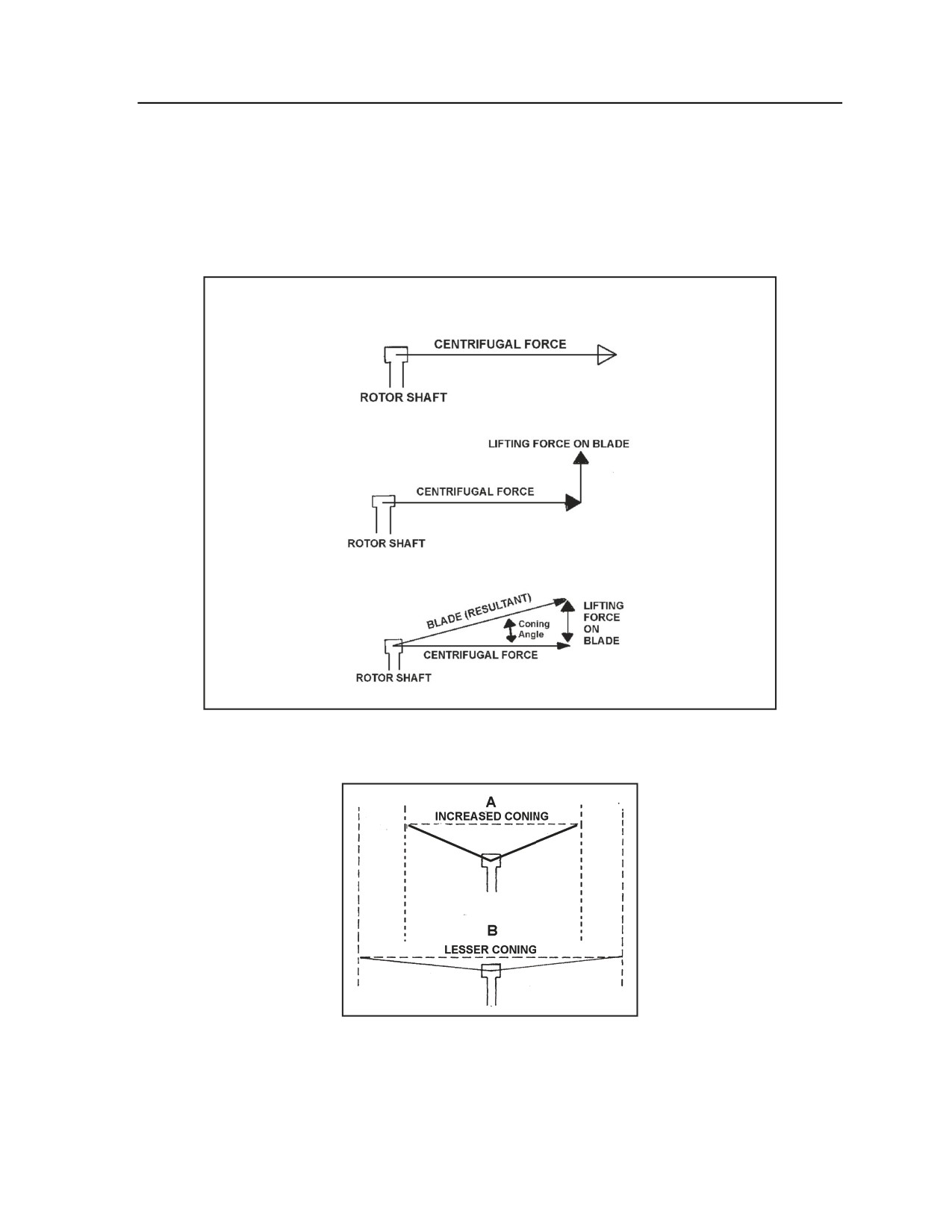
begins to turn, the blades begin to rise from the static position because of centrifugal force. At
operating speed, the blades extend straight out although the rotor system is at flat pitch (zero degree
angle of incidence) and are not producing lift. As the aircraft develops lift during takeoff and flight,
1-30
FM 3-04.203
7 May 2007
Theory of Flight
the blades rise above the straight-out position and assume a coned position. The amount of coning
depends on RPM, gross weight, and gravitational (G) forces experienced during flight. Figure 1-41,
page 1-28, illustrates the various positions of a rotor blade in the static position, at flat pitch, and when
generating lift. Excessive coning can occur if RPM is too low, gross weight is too high, an aircraft is
flying in turbulent air, or the G-forces experienced are too high. This excessive coning can cause
undesirable stresses on the components and a decrease in lift because of a decrease in effective disk
area (figure 1-42, page 1-28).
Figure 1-41. Effects of centrifugal force and lift
Figure 1-42. Decreased disk area (loss of lift caused by coning)
7 May 2007
FM 3-04.203
1-31
Chapter 1
TORQUE REACTION AND ANTITORQUE ROTOR (TAIL ROTOR)
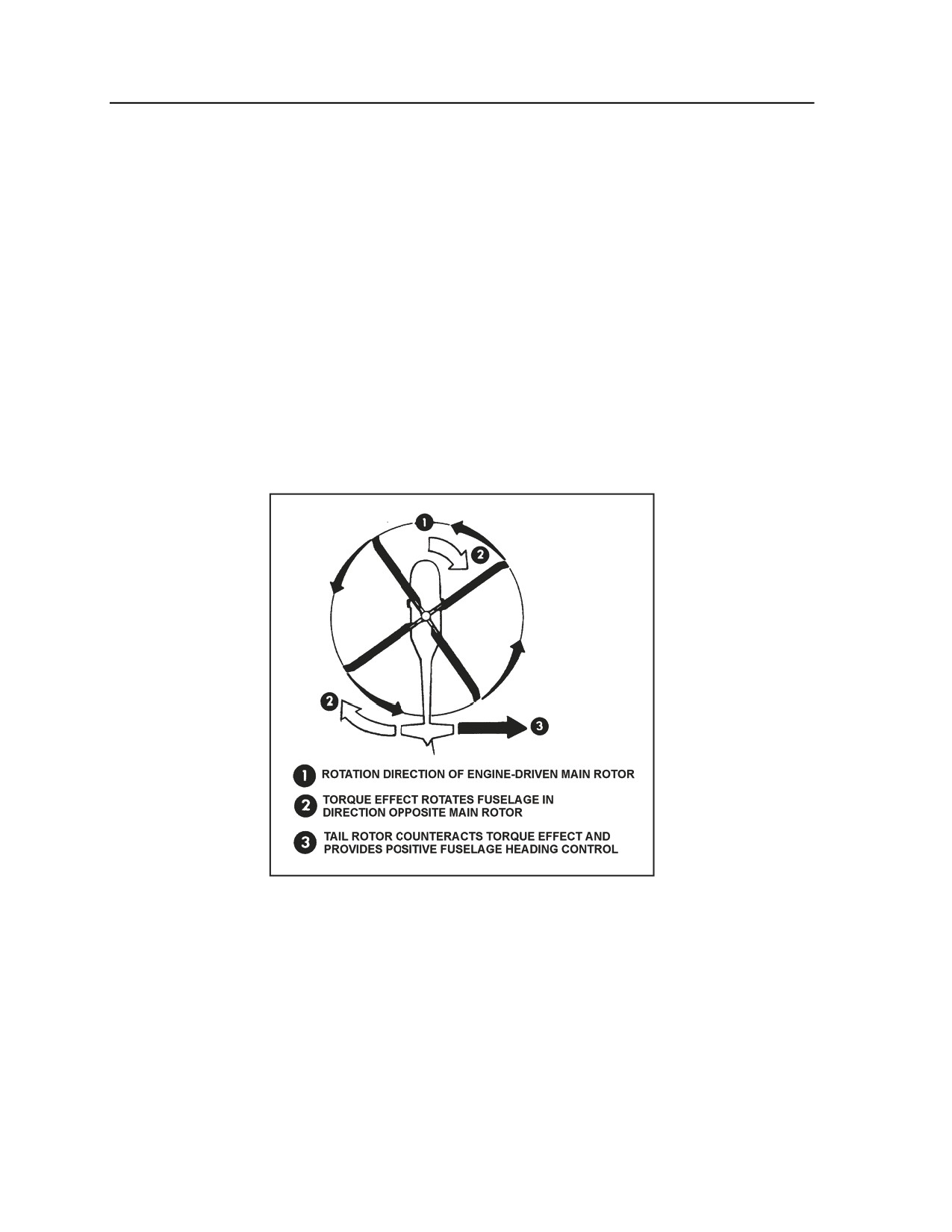
1-78. According to Newton’s law of action/reaction, action created by the turning rotor system will cause
the fuselage to react by turning in the opposite direction. The fuselage reaction to torque turning the
main rotor is torque effect. Torque must be counteracted to maintain control of the aircraft; the
antitorque rotor does this (figure 1-43, page 1-30). In the tandem rotor or coaxial helicopters, the two
rotor systems turn in opposite directions, effectively canceling the torque effect. Most rotary-wing
aircraft have a single main rotor and require a tail rotor or other means to counter the torque effect. As
the initial action is generated by engine power (torque) turning the main rotor system, this torque will
necessarily vary with power applied or the maneuver performed. The tail rotor is designed as a
variable-pitch, antitorque rotor to accommodate the varying effects of such a system. The tail rotor is
usually driven by the main transmission through a drive shaft arrangement leading to its position at the
end of the tailboom. The engine power required to motor and control the tail rotor can be significant.
The aviator must consider this during performance planning for varying conditions and situations. It is
easy to understand why various emergency procedures have been written to compensate for problems
such as loss of engine power, insufficient engine power, and tail rotor malfunction. Most American-
built single-rotor helicopters turn the main rotor in a counterclockwise direction; therefore, the
application of right pedal decreases pitch in the tail rotor and creates less thrust, allowing the nose of
the aircraft to turn right. The opposite is true for application of left pedal.
Figure 1-43. Torque reaction
HEADING CONTROL
Single-Rotor Helicopters
1-79. In addition to counteracting torque, the tail rotor and its control linkage allow the aviator to control
the helicopter heading during taxi, hover, and sideslip operations on takeoffs and approaches.
Applying more pedal than needed to counteract torque causes the nose of the helicopter to swing in the
direction of pedal movement (left pedal to the left). Applying less pedal than needed causes the
helicopter to turn in the direction of torque (nose swings to the right). Aviators must use the antitorque
1-32
FM 3-04.203
7 May 2007
Theory of Flight
pedals to maintain a constant heading at a hover or during a takeoff or an approach. They apply just
enough pitch on the tail rotor to neutralize torque and to hold a slip.
1-80. Heading control in forward trimmed flight is normally accomplished by cyclic control with a
coordinated bank and turn to the desired heading. The antitorque pedal must be applied when power
changes are made.
Tandem-Rotor Helicopters
1-81. Heading control is accomplished in tandem-rotor helicopters by differential lateral tilting of the rotor
disks. When the directional pedal (right or left) is applied, the forward rotor disk tilts in the same
direction and the aft rotor disk tilts in the opposite direction. The result is a hovering turn around a
vertical axis, midway between the rotors.
1-82. Heading control in forward flight is accomplished by coordinated use of lateral cyclic tilt on both
rotors for roll control and differential cyclic tilt on the rotors for yaw control. Only small changes in
pedal trim are required for changes in longitudinal speed trim or during descents, climbs, and
autorotations.
BALANCE OF FORCES
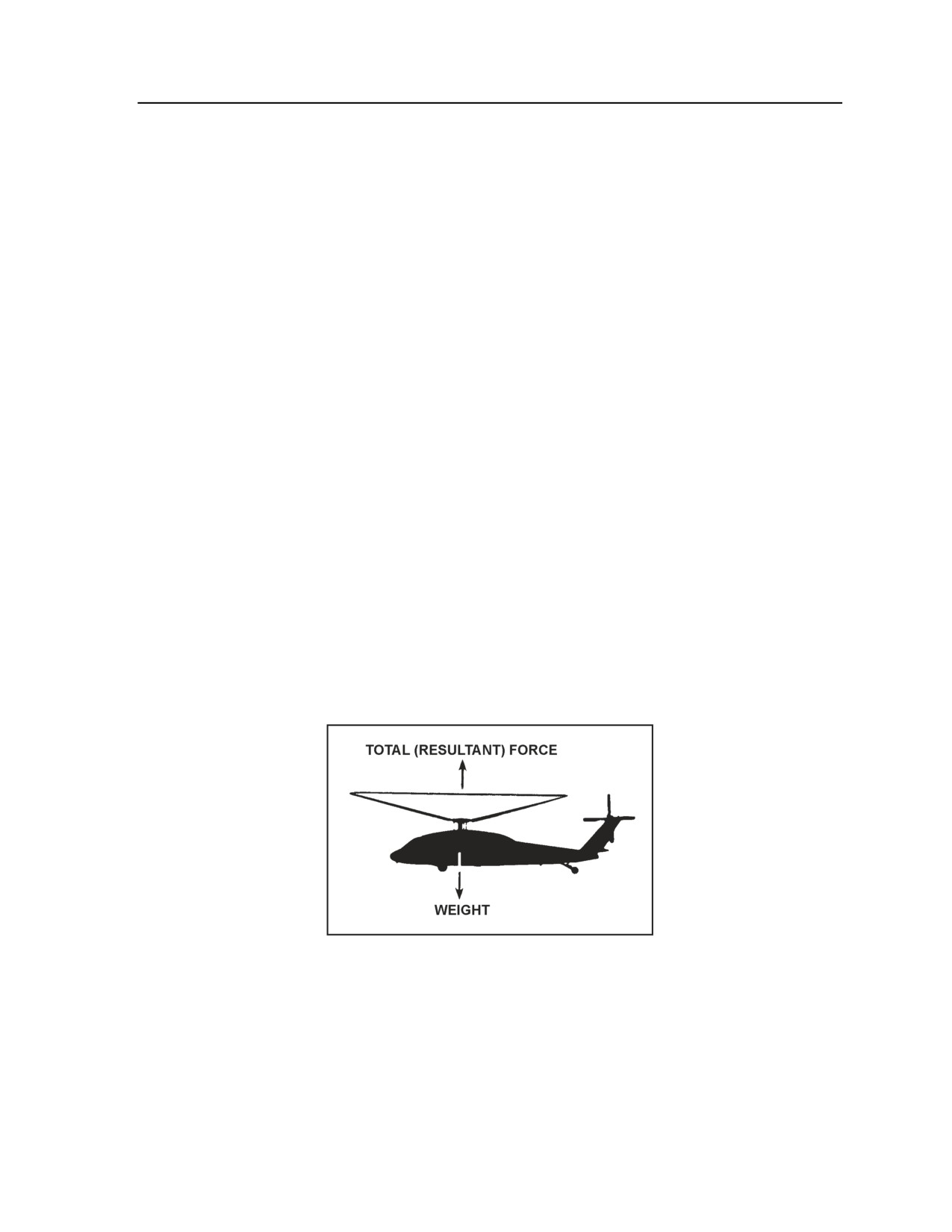
1-83. Newton’s law of acceleration states the force required to produce a change in motion of a body is
directly proportional to its mass and rate of change in its velocity. This means motion is started,
stopped, or changed when forces acting on the body become unbalanced. Rate of change (acceleration)
depends on the magnitude of the unbalanced force and on the mass of the body to which it is applied.
This principle is the basis for all helicopter flight—vertical, forward, rearward, sideward, or hovering.
In each case, total force generated by a rotor system is always perpendicular to the tip-path plane
(figure 1-44 through figure 1-48). For this discussion, this force is divided into two components, lift
and thrust. The lift component supports aircraft weight while the thrust component acts horizontally to
accelerate or decelerate the helicopter in the desired direction. Aviators direct thrust in a desired
direction by tilting the tip-path plane. At a hover in a no-wind condition, all opposing forces are in
balance; they are equal and opposite. Therefore, lift and weight are equal, resulting in the helicopter
remaining stationary (figure 1-44).
Figure 1-44. Balanced forces; hovering with no wind
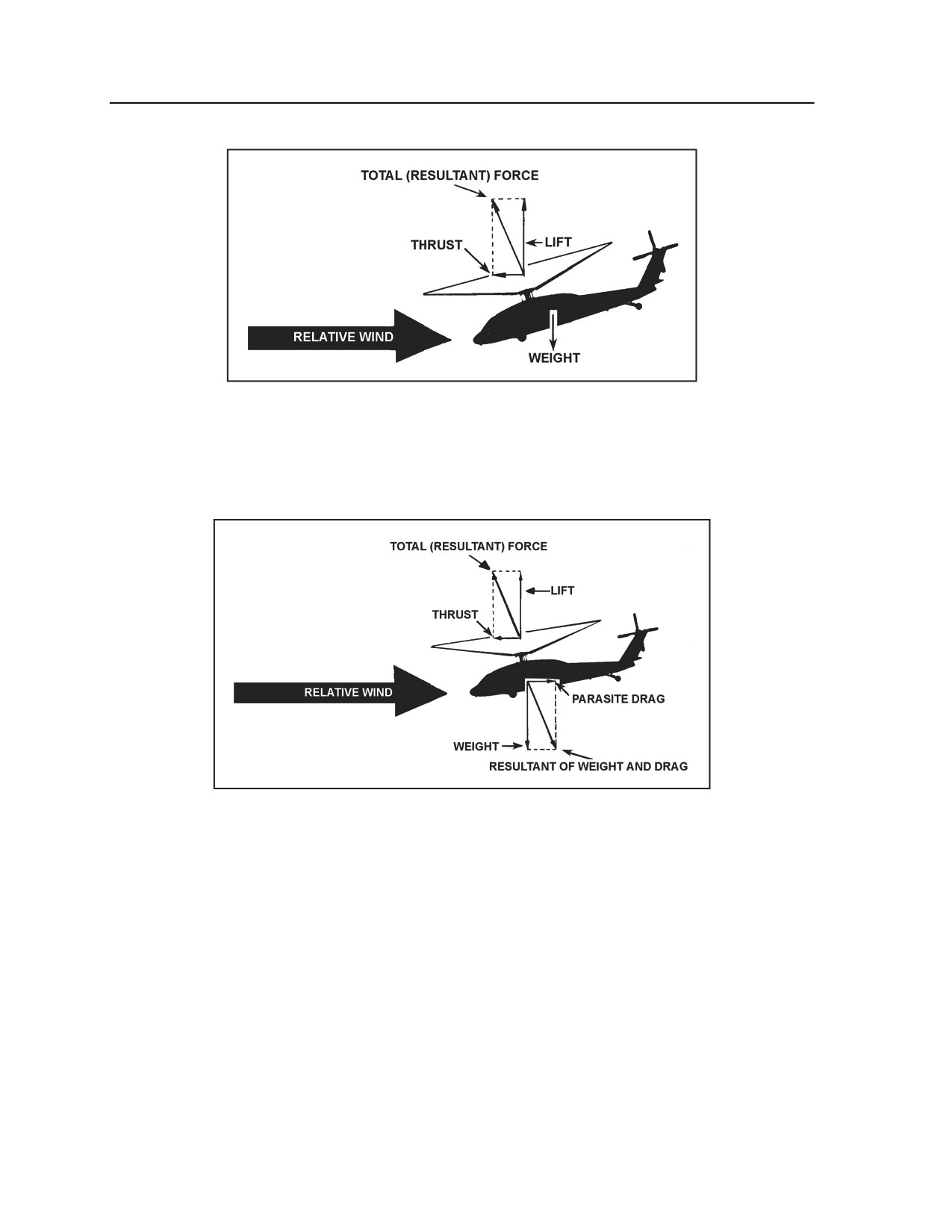
1-84. To make the helicopter move in some direction, a force must be applied to cause an unbalanced
condition. Figure 1-45 illustrates an unbalanced condition in which the aviator has changed the attitude
of the rotor disk creating a lift and thrust vector, resulting in a total force forward of the vertical. No
parasite drag is shown as the aircraft has not started to move forward.
7 May 2007
FM 3-04.203
1-33
Chapter 1
Figure 1-45. Unbalanced forces causing acceleration
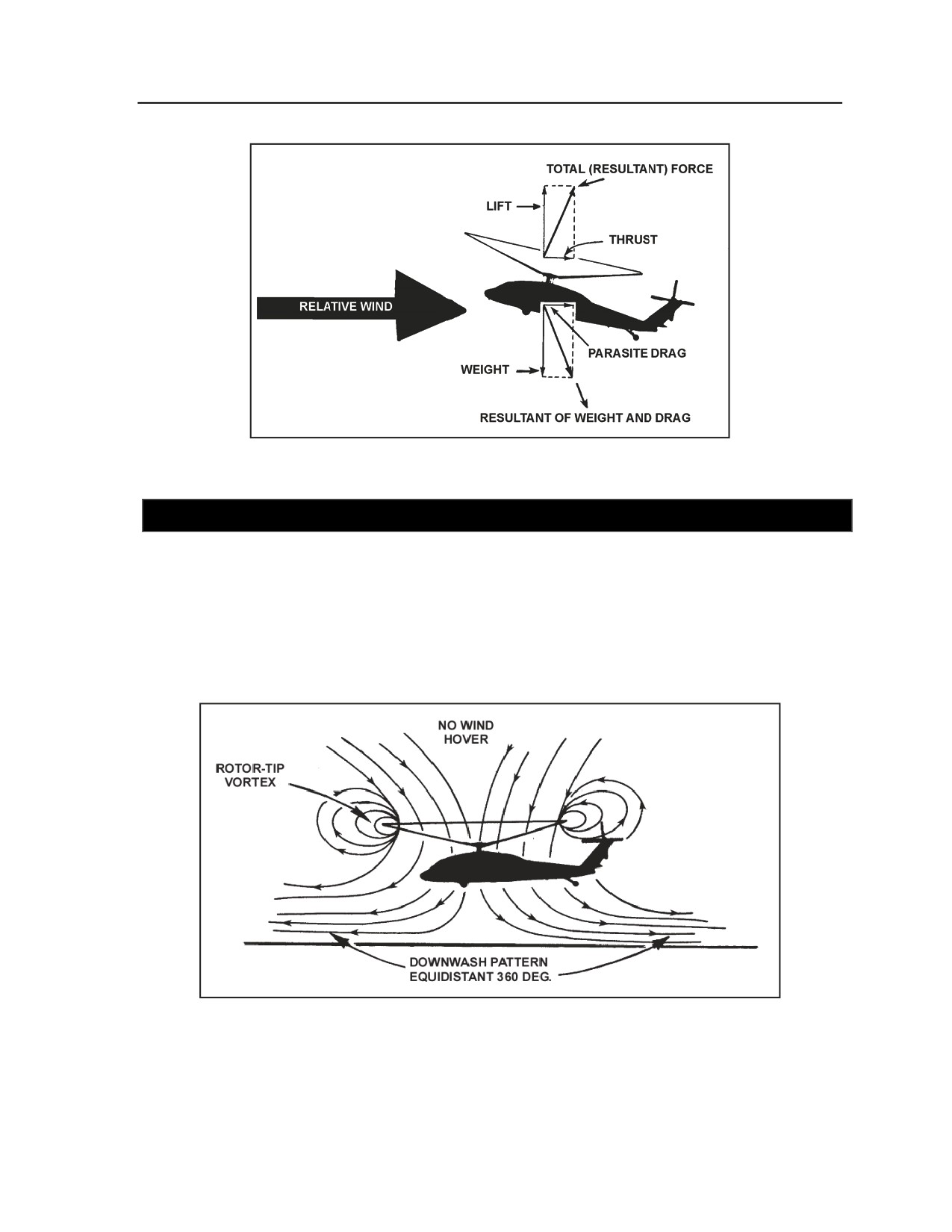
1-85. As the aircraft begins to accelerate in the direction of applied thrust, parasite drag develops. When
parasite drag increases to be equal to thrust, the aircraft no longer accelerates because the forces are
again in balance (figure 1-46) as the aircraft has achieved steady-state (unaccelerated) flight.
Figure 1-46. Balanced forces; steady-state flight
1-86. To return the aircraft to a hover, the aviator changes the disk attitude to unbalance the forces (figure
1-47). By tilting the rotor disk aft, the thrust force acts in the same direction as parasite drag and
airspeed decreases.
1-34
FM 3-04.203
7 May 2007
Theory of Flight
Figure 1-47. Unbalanced forces causing deceleration
SECTION IV - HOVERING
AIRFLOW IN HOVERING FLIGHT
1-87. An increase of blade pitch (through application of collective) that increases AOA, generates the
additional lift necessary to hover (figure 1-48, page 1-33). For a helicopter to hover, lift produced by
the rotor system must equal the total weight of the helicopter. In a no-wind condition, the tip-path
plane remains horizontal. As forces of lift and weight are in balance during stationery hover, those
forces must be altered—through application of collective—to either climb or descend vertically.
Figure 1-48. Airflow in hovering flight
1-88. At a hover, the rotor-tip vortex (air swirl at the tip of the rotor blades) reduces effectiveness of the
outer blade portions. Vortices of the preceding blade affect the lift of any other blade in the rotor
system. When maintaining a stationery hover, this continuous creation of vortices—combined with the
7 May 2007
FM 3-04.203
1-35
Chapter 1
ingestion of existing vortices—is the primary cause of high power requirements for hovering. Rotor-
tip vortices are part of the induced flow and increase induced drag.
1-89. During hover, rotor blades move large amounts of air through the rotor system in a downward
direction. This movement of air also introduces another element—induced flow—into relative wind,
which alters the AOA of the airfoil. If there is no induced flow, relative wind is opposite and parallel
to the flight path of the airfoil. With a downward airflow altering the relative wind, the AOA is
decreased so less aerodynamic force is produced. This change requires the aviator to increase
collective pitch to produce enough aerodynamic force to hover.
GROUND EFFECT
GROUND EFFECT EFFICIENCY
1-90. Ground effect is the increased efficiency of the rotor system caused by interference of the airflow
when near the ground. Ground effect permits relative wind to be more horizontal, lift vector to be
more vertical, and induced drag to be reduced. These allow the rotor system to be more efficient. The
aviator achieves maximum ground effect when hovering over smooth hard surfaces. When the aviator
hovers over such terrain as tall grass, trees, bushes, rough terrain, and water, maximum ground effect
is reduced. Two reasons for this phenomenon are induced flow and vortex generation.
Induced Flow
1-91. Proximity of the helicopter to the ground interrupts airflow under the helicopter by altering the
velocity of induced flow. Induced flow velocity is reduced when closer to the ground, which in turn,
increases AOA, reduces the amount of induced drag, allows a more vertical lift vector, and increases
rotor system efficiency.
Vortex Generation
1-92. When operating close enough to a surface for ground effect to exist, the downward and outward flow
of air tends to restrict vortex generation. The smaller vortexes result in the outboard portion of each
blade becoming more efficient and reduce overall system turbulence caused by ingestion and
recirculation of the vortex pattern.
CATEGORIES
1-93. Ground effect is categorized in two ways—in ground effect (IGE) and out of ground effect (OGE).
Both are critical elements on a rotary-wing performance planning card (PPC).
In-Ground Effect
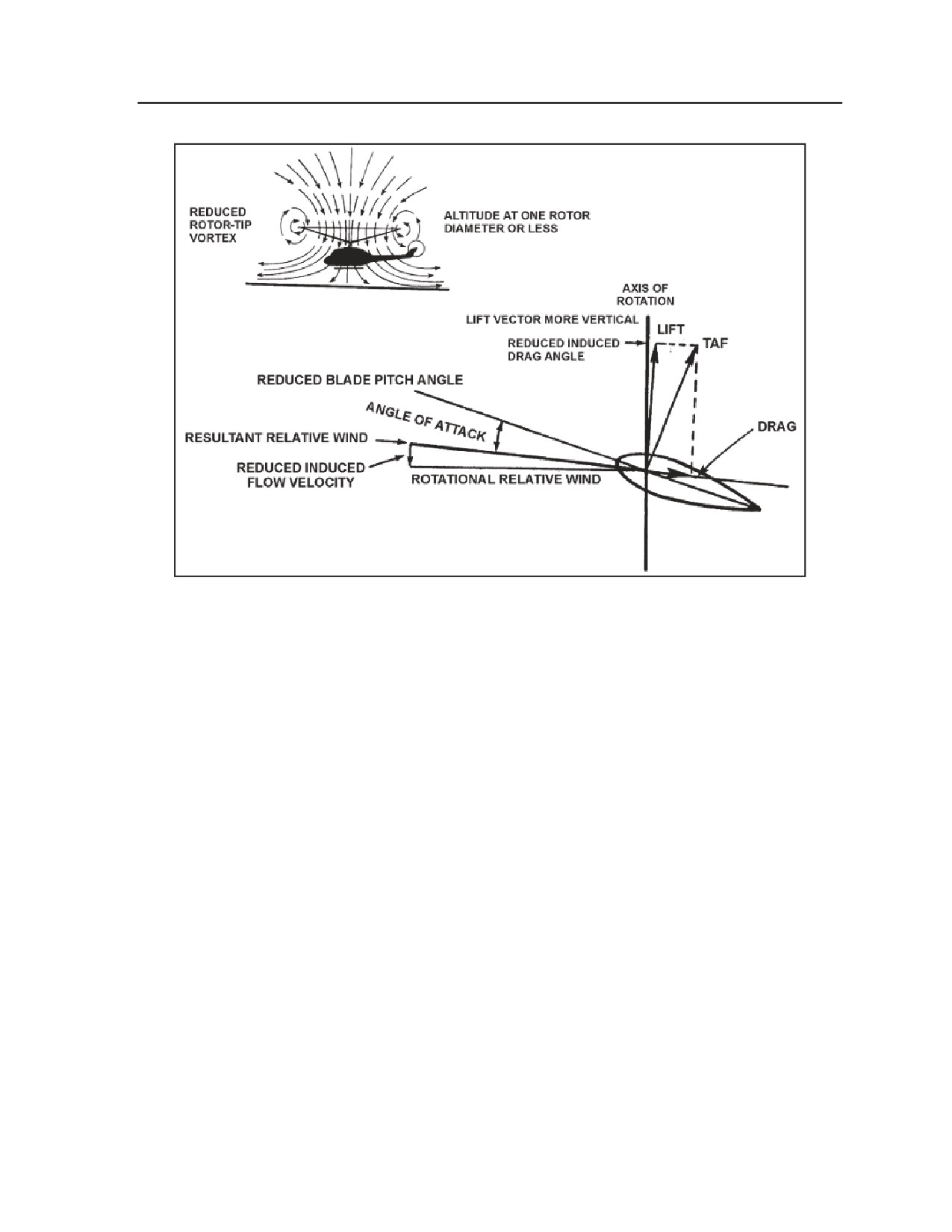
1-94. Rotor efficiency is increased by ground effect to a height of about one rotor diameter (measured
from the ground to the rotor disk) for most helicopters. Figure 1-49 shows IGE hover and induced
flow reduced. This increase in AOA requires a reduced blade pitch angle. This reduces the power
required to hover IGE.
1-36
FM 3-04.203
7 May 2007
Theory of Flight
Figure 1-49. In ground effect hover
Out-of-Ground Effect
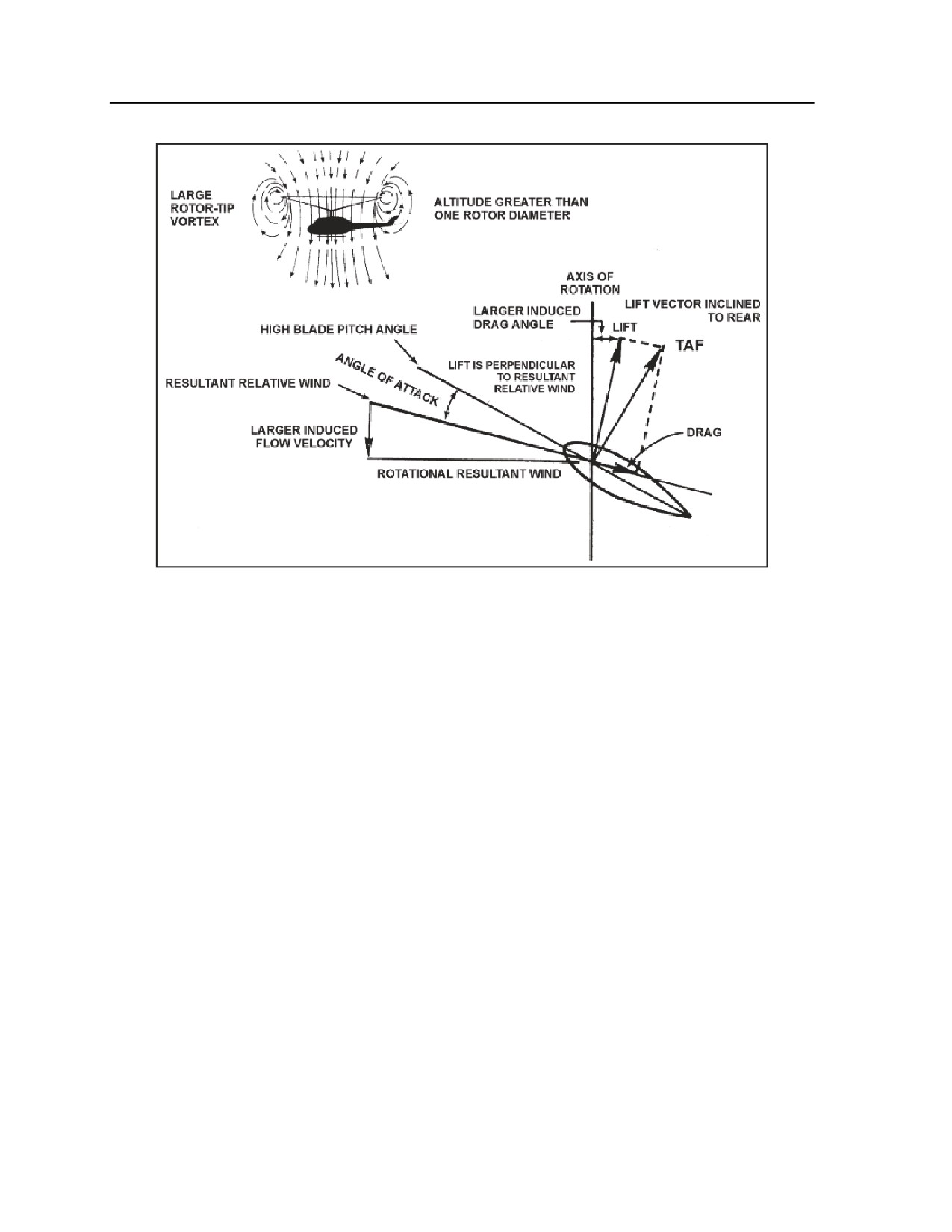
1-95. The benefit of placing the helicopter near the ground is lost above IGE altitude. Above this altitude,
the power required to hover remains nearly constant, given similar conditions (such as wind). Figure
1-50, page 1-35, shows OGE hover. Induced flow velocity is increased causing a decrease in AOA. A
higher blade pitch angle is required to maintain the same AOA as in IGE hover. The increased pitch
angle also creates more drag. More power to hover OGE than IGE is required by this increased pitch
angle and drag.
7 May 2007
FM 3-04.203
1-37
Chapter 1
Figure 1-50. Out of ground effect hover
TRANSLATING TENDENCY
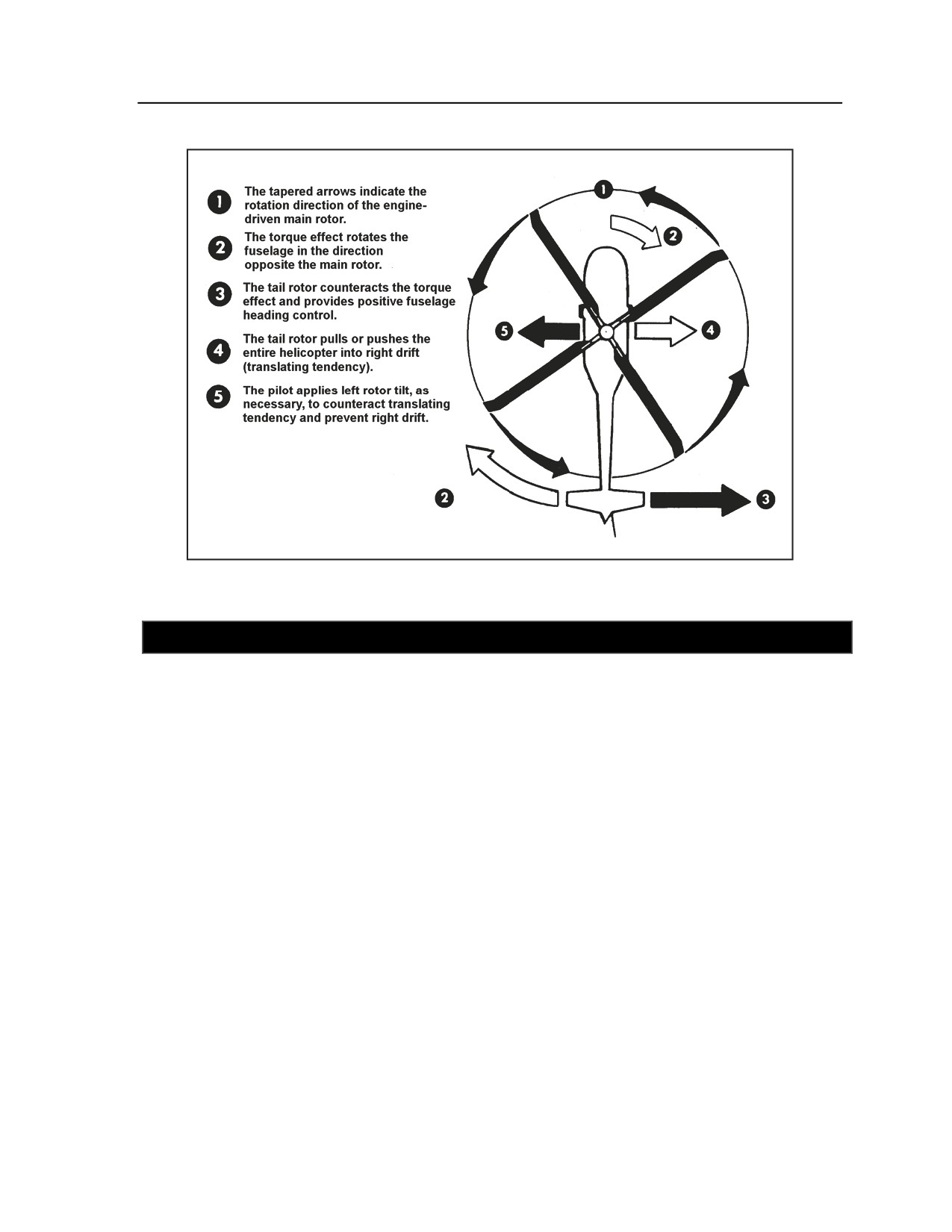
1-96. During hovering flight, the counterclockwise rotating, single-rotor helicopter has a tendency to drift
laterally to the right. The translating tendency (figure 1-51, page 1-36) results from right lateral tail-
rotor thrust exerted to compensate for main rotor torque (main rotor turning in a counterclockwise
direction). The aviator must compensate for this right translating tendency of the helicopter by tilting
the main rotor disk to the left. This lateral tilt creates a main rotor force to the left compensating for the
tail-rotor thrust to the right. Helicopter design usually includes one or more of the following features,
which help the aviator compensate for translating tendency:
Flight control rigging may be designed so the rotor disk is tilted slightly left when the cyclic
control is centered.
Transmission may be mounted so the mast is tilted slightly left when the helicopter fuselage is
laterally level.
The collective pitch control system may be designed so the rotor disk tilts slightly left as
collective pitch is increased.
Programmed mechanical inputs/automatic flight-control systems/stabilization augmentation
systems.
1-38
FM 3-04.203
7 May 2007
Theory of Flight
Figure 1-51. Translating tendency
SECTION V - ROTOR IN TRANSLATION
AIRFLOW IN FORWARD FLIGHT
1-97. Airflow across the rotor system in forward flight varies from airflow at a hover. In forward flight, air
flows opposite the aircraft’s flight path. The velocity of this air flow equals the helicopter’s forward
speed. Because the blades turn in a circular pattern, the velocity of airflow across a blade depends on
the position of the blade in the plane of rotation at a given instant, its rotational velocity, and airspeed
of the helicopter. Therefore, the airflow meeting each blade varies continuously as the blade rotates.
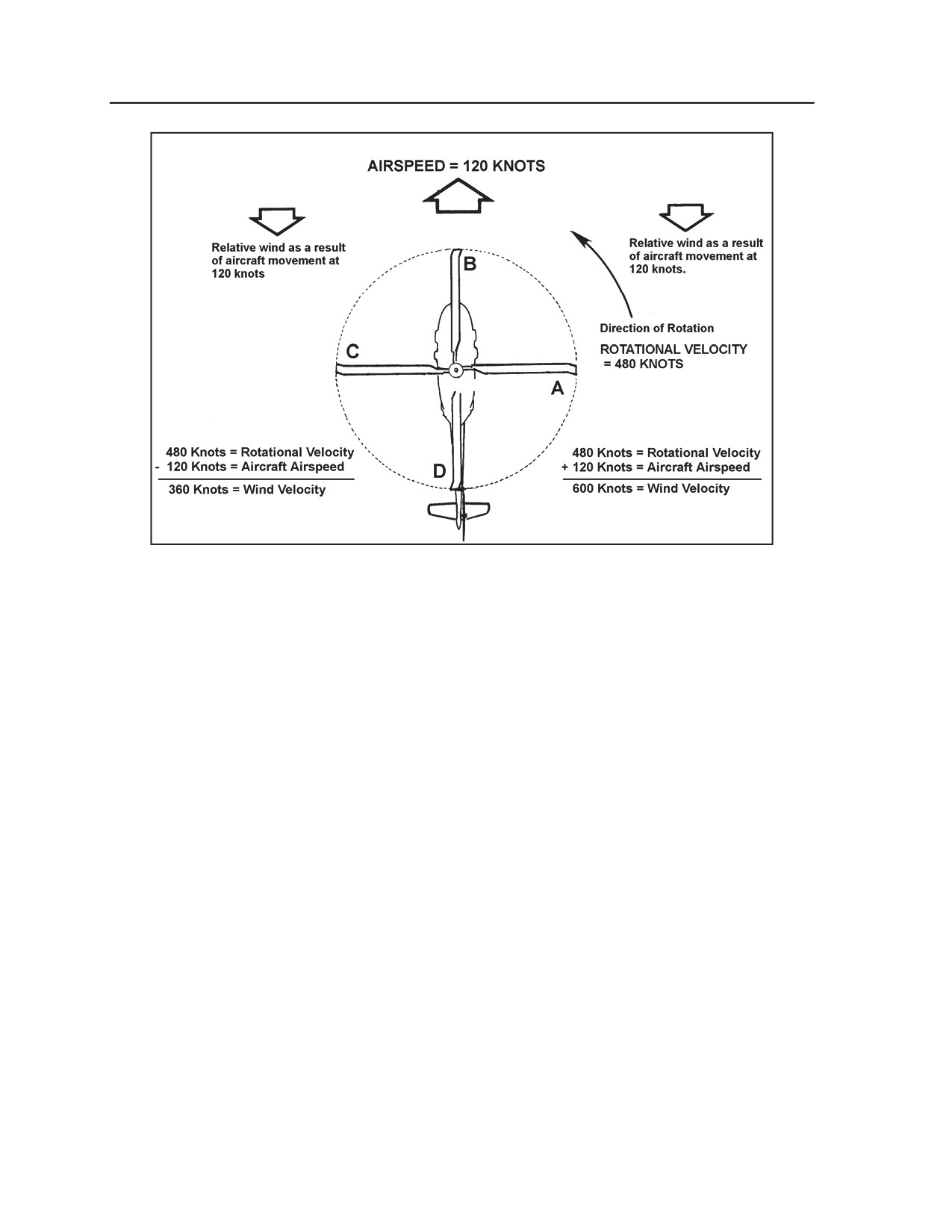
The highest velocity of airflow occurs over the right side (3 o’clock position) of the helicopter
(advancing blade in a rotor system that turns counterclockwise) and decreases to rotational velocity
over the nose. It continues to decrease until the lowest velocity of airflow occurs over the left side (9-
o’clock position) of the helicopter (retreating blade). As the blade continues to rotate, velocity of the
airflow then increases to rotational velocity over the tail. It continues to increase until the blade is back
at the 3 o’clock position.
1-98. The advancing blade (figure 1-52, blade A, page 1-37) moves in the same direction as the helicopter.
The velocity of the air meeting this blade equals rotational velocity of the blade plus wind velocity
resulting from forward airspeed. The retreating blade (blade C) moves in a flow of air moving in the
opposite direction of the helicopter. The velocity of airflow meeting this blade equals rotational
velocity of the blade minus wind velocity resulting from forward airspeed. The blades (B and D) over
the nose and tail move essentially at right angles to the airflow created by forward airspeed; the
velocity of airflow meeting these blades equals the rotational velocity. This results in a change to
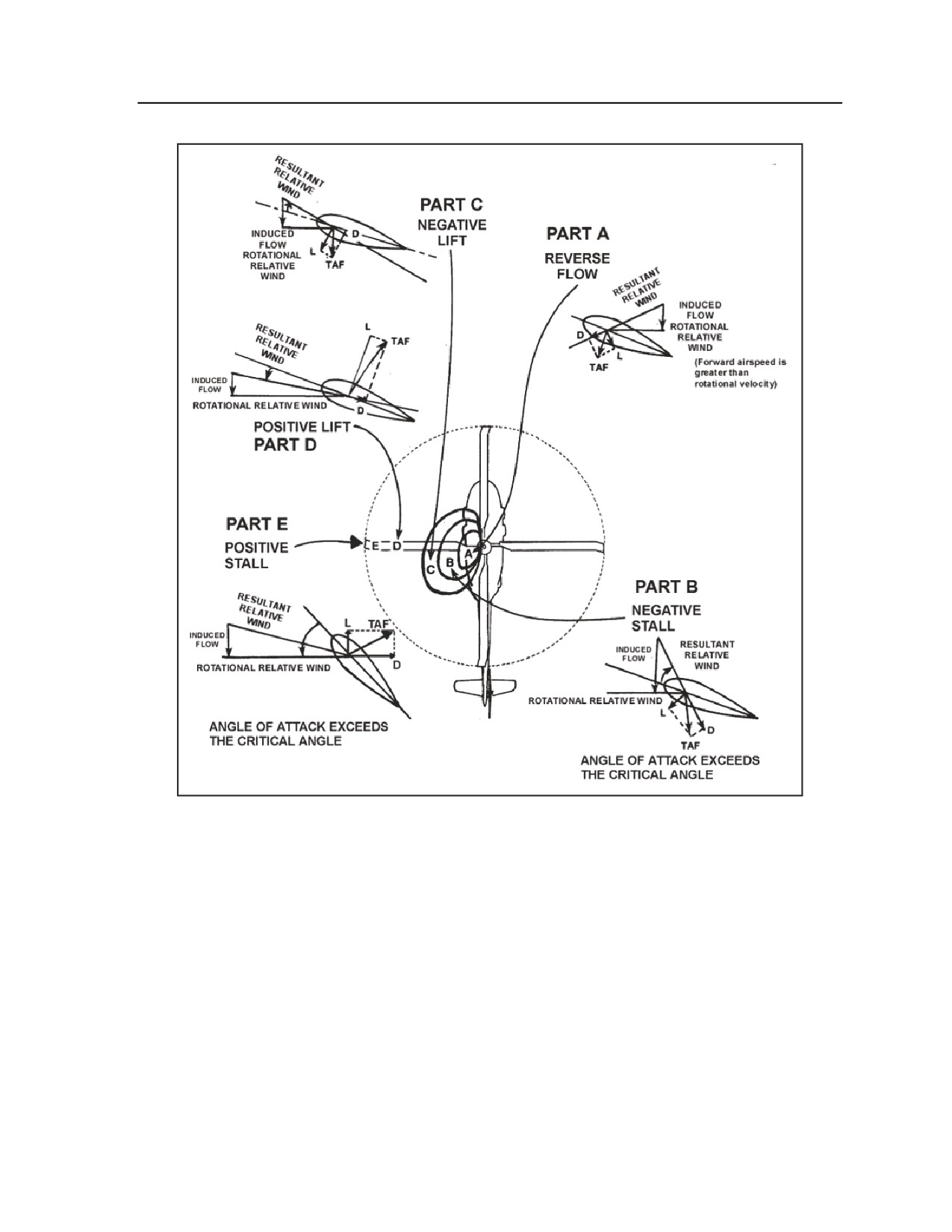
velocity of airflow all across the rotor disk and a change to the lift pattern of the rotor system. Figure
1-53, page 1-38, depicts force vectors acting on various blade areas in forward flight.
7 May 2007
FM 3-04.203
1-39
Chapter 1
Figure 1-52. Differential velocities on the rotor system caused by forward airspeed
NO-LIFT AREAS
1-99. The no-lift areas are reverse flow, negative stall, and negative lift.
Reverse Flow
1-100. Part A of figure 1-53, page 1-38 shows reverse flow. At the root of the retreating blade is an area
where the air flows backward from the trailing to the leading edge of the blade. This is due to wind
created by forward airspeed being greater than rotational velocity at this point on the blade.
Negative Stall
1-101. Part B of figure 1-53 shows negative stall. In the negative stall area, rotational velocity exceeds
forward flight velocity, causing resultant relative wind to move toward the leading edge. The resultant
relative wind is so far above the chord line, a negative AOA above the critical AOA results. The blade
stalls with a negative AOA.
Negative Lift
1-102. Part C of figure 1-53 shows negative lift. In the negative lift area, rotational velocity, induced
flow, and blade flapping combine to reduce the AOA from a negative stall to an AOA that causes the
blade to produce negative lift.
POSITIVE LIFT AND POSITIVE STALL
1-103. Figure 1-53, parts D and E, show positive lift and positive stall. That portion of the blade outboard
of the no-lift areas produces positive lift. In the positive lift area, the resultant relative wind produces a
positive AOA. Under certain conditions, it is possible to have a positive stall area near the blade tip.
Section VIII covers retreating blade stall.
1-40
FM 3-04.203
7 May 2007
Theory of Flight
Figure 1-53. Blade areas in forward flight
DISSYMMETRY OF LIFT
1-104. Dissymmetry of lift is the differential (unequal) lift between advancing and retreating halves of the
rotor disk caused by the different wind flow velocity across each half. This difference in lift would
cause the helicopter to be uncontrollable in any situation other than hovering in a calm wind. There
must be a means of compensating, correcting, or eliminating this unequal lift to attain symmetry of lift.
1-105. In forward flight, two factors in the lift equation, blade area and air density, are the same for the
advancing and retreating blades. Airfoil shape is fixed for a given blade, and air density cannot be
affected; the only remaining variables are blade speed and AOA. Rotor RPM controls blade speed.
Because rotor RPM must remain relatively constant, blade speed also remains relatively constant. This
leaves AOA as the one variable remaining that can compensate for dissymmetry of lift. This is
accomplished through blade flapping and/or cyclic feathering.
7 May 2007
FM 3-04.203
1-41
Chapter 1
Blade Flapping
1-106. When blade flapping compensates for dissymmetry of lift, the upward and downward flapping
motion changes induced flow velocity. This changes AOA on the advancing and retreating blades.
Advancing Blade
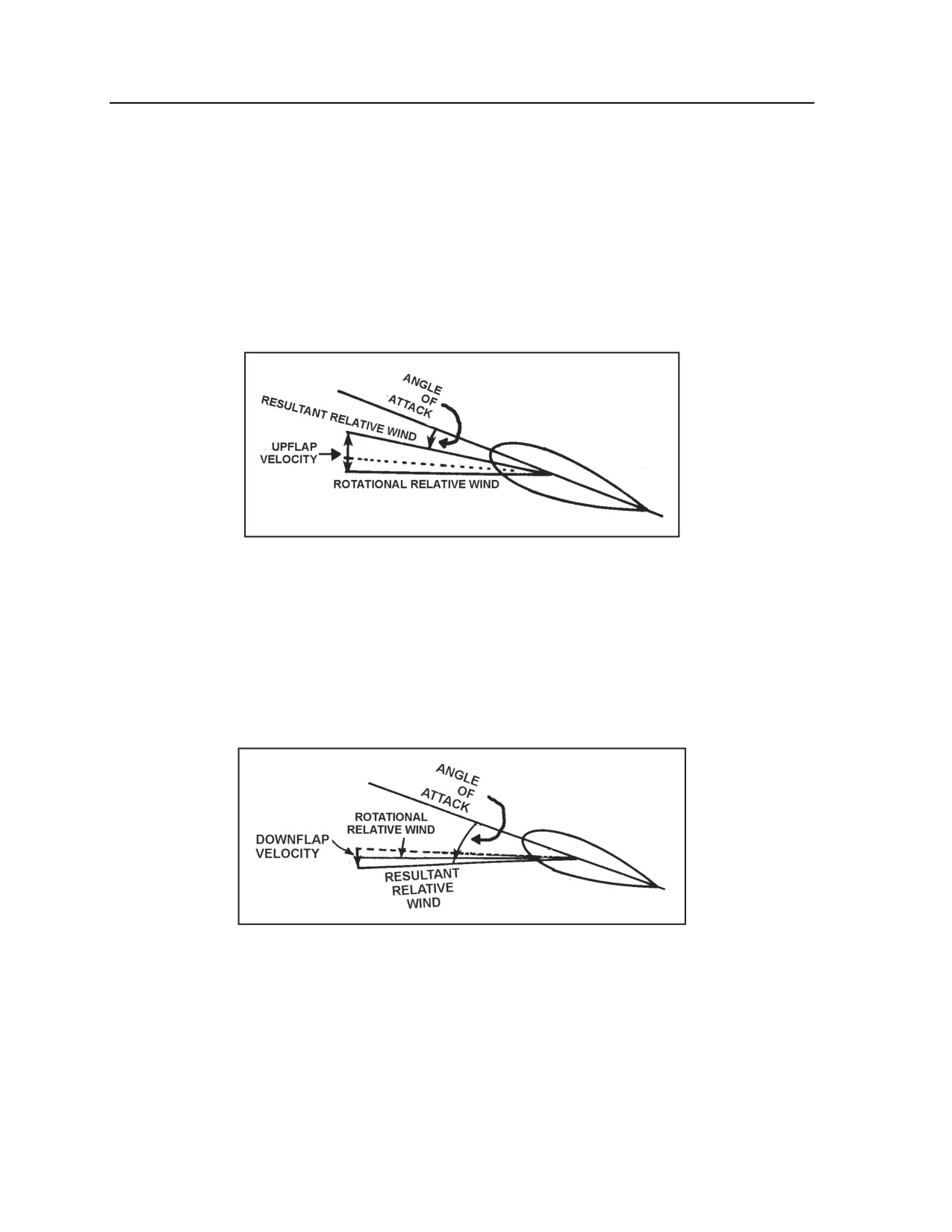
1-107. As the relative wind speed of the advancing blade increases, the blade gains lift and begins to flap
up (figure 1-54). It reaches its maximum upflap velocity at the 3-o’clock position, where the wind
velocity is the greatest. This upflap creates a downward flow of air and has the same effect as
increasing the induced flow velocity by imposing a downward vertical velocity vector to the relative
wind. This decreases the AOA.
Figure 1-54. Flapping (advancing blade, 3-o’clock position)
Retreating Blade
1-108. As relative wind speed of the retreating blade decreases, the blade loses lift and begins to flap
down (figure 1-55). It reaches its maximum downflap velocity at the 9 o’clock position, where wind
velocity is the least. This downflap creates an upward flow of air and has the same effect as decreasing
the induced flow velocity by imposing an upward velocity vertical vector to the relative wind. This
increases AOA.
Figure 1-55. Flapping (retreating blade, 9-o’clock position)
Over the Aircraft Nose and Tail
1-109. Blade flapping over the nose and tail of the helicopter are essentially equal. The net result is an
equalization, or symmetry, of lift across the rotor system. Up flapping and down flapping do not
change the total amount of lift produced by the rotor blades. When blade flapping has compensated for
dissymmetry of lift, the rotor disk is tilted to the rear, called blowback. The maximum upflap occurring
over the nose and the maximum downflap occurring over the tail cause blowback. This would cause
1-42
FM 3-04.203
7 May 2007
Theory of Flight
airspeed to decrease. The aviator uses cyclic feathering to compensate for dissymmetry of lift allowing
him to control the attitude of the rotor disk.
Cyclic Feathering
1-110. Cyclic feathering compensates for dissymmetry of lift (changes the AOA) in the following way.
At a hover, equal lift is produced around the rotor system with equal pitch and AOA on all the blades
and at all points in the rotor system (disregarding compensation for translating tendency). The rotor
disk is parallel to the horizon. To develop a thrust force, the rotor system must be tilted in the desired
direction of movement. Cyclic feathering changes the angle of incidence differentially around the rotor
system. Forward cyclic movements decrease the angle of incidence at one part on the rotor system
while increasing the angle in another part. Maximum down flapping of the blade over the nose and
maximum up flapping over the tail tilt the rotor disk and thrust vector forward. To prevent blowback
from occurring, the aviator must continually move the cyclic forward as velocity of the helicopter
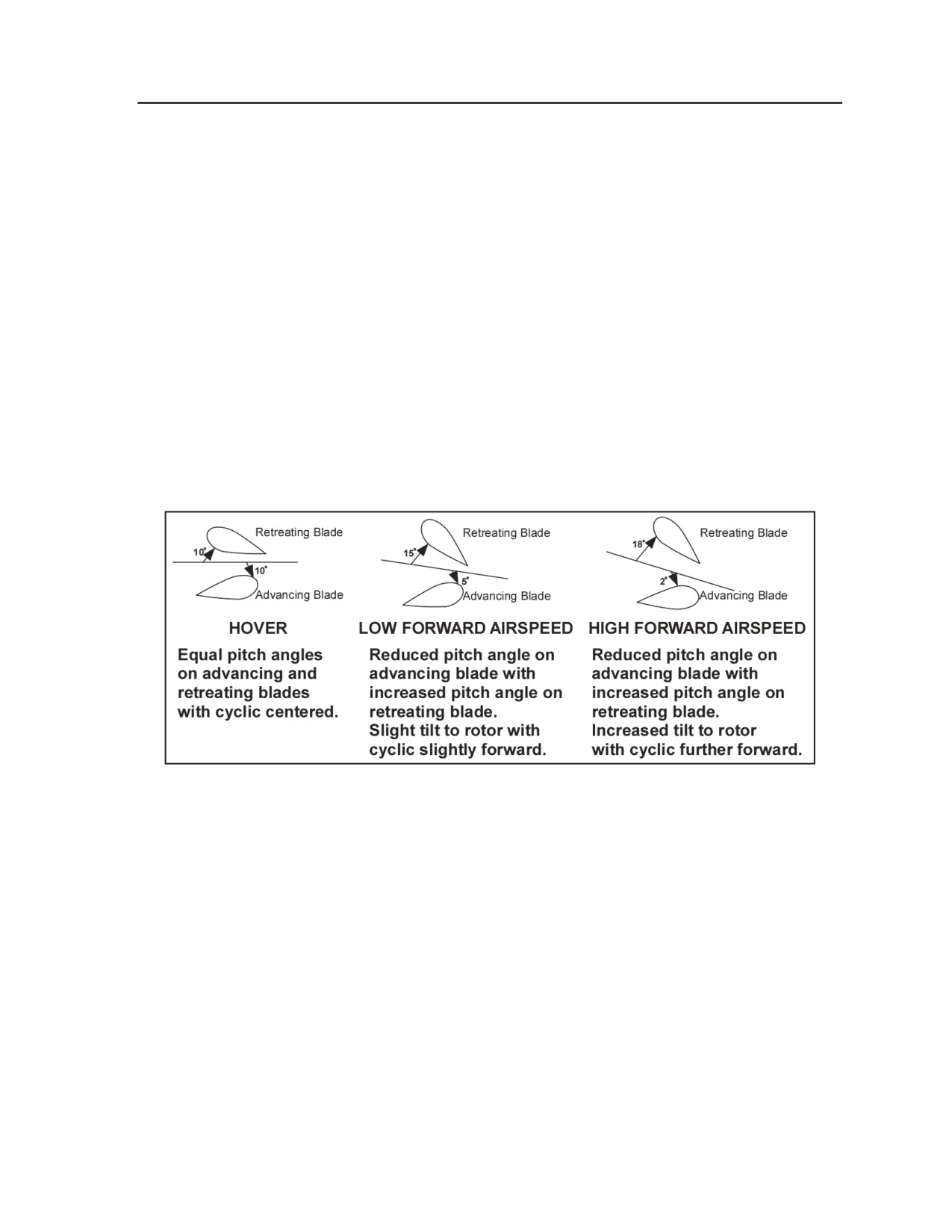
increases. Figure 1-56 illustrates the changes in pitch angle as the cyclic is moved forward at increased
airspeeds. At a hover, the cyclic is centered and the pitch angle on the advancing and retreating blades
is the same. At low forward speeds, moving the cyclic forward reduces pitch angle on the advancing
blade and increases pitch angle on the retreating blade. This causes a slight rotor tilt. At higher forward
speeds, the aviator must continue to move the cyclic forward. This further reduces pitch angle on the
advancing blade and further increases pitch angle on the retreating blade. As a result, there is even
more tilt to the rotor than at lower speeds.
Figure 1-56. Blade pitch angles
1-111. This horizontal lift component (thrust) generates higher helicopter airspeed. The higher airspeed
induces blade flapping to maintain symmetry of lift. The combination of flapping and cyclic feathering
maintains symmetry of lift and desired attitude on the rotor system and helicopter.
Tandem-Rotor Helicopter Dissymmetry of Lift
1-112. The biggest difference between single-rotor and tandem-rotor helicopters is the aviator does not
manually compensate for dissymmetry of lift when applying forward cyclic. Automatic cyclic-
feathering systems are installed on tandem-rotor helicopters. These systems are activated through
computer-generated commands at specified airspeeds, usually starting around
70 knots. At low
airspeeds, blade flapping compensates for dissymmetry of lift. As airspeed increases, these systems
program allowing a more level fuselage attitude and reduce stresses on the rotor driving mechanisms.
If the cyclic-feathering system fails to properly feather the rotor system at higher airspeeds, greater
blade-flapping angles and nose-low flight attitudes occur and induce increased stresses on the rotor-
driving mechanisms.
7 May 2007
FM 3-04.203
1-43
Chapter 1
TRANSLATIONAL LIFT
1-113. Improved rotor efficiency resulting from directional flight is translational lift. The efficiency of the
hovering rotor system is improved with each knot of incoming wind gained by horizontal movement
or surface wind. As the incoming wind enters the rotor system, turbulence and vortexes are left behind
and the flow of air becomes more horizontal. In addition, the tail rotor becomes more aerodynamically
efficient during the transition from hover to forward flight. As the tail rotor works in progressively less
turbulent air, this improved efficiency produces more thrust, causing the nose of the aircraft to yaw left
(with a main rotor turning counterclockwise) and forces the aviator to apply right pedal (decreasing the
AOA in the tail rotor blades) in response.
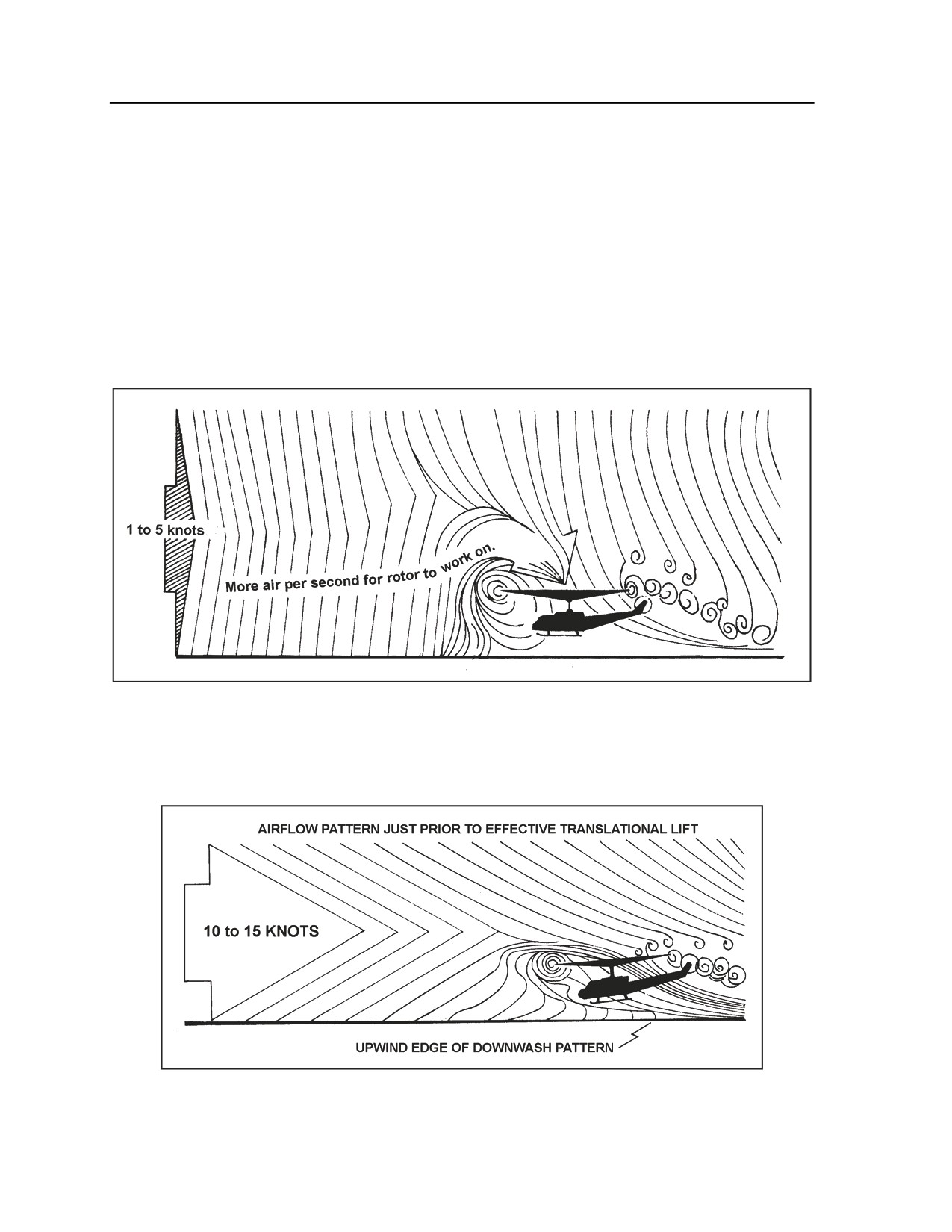
1-114. Figure 1-57 shows the airflow pattern for 1 to 5 knots of forward airspeed. Note how the
downwind vortex is beginning to dissipate and induced flow down through the rear of the rotor system
is more horizontal.
Figure 1-57. Translational lift (1 to 5 knots)
1-115. Figure 1-58 shows the airflow pattern at a speed of 10 to 15 knots. At this increased airspeed, the
airflow continues to become more horizontal. The leading edge of the downwash pattern is being
overrun and is well back under the nose of the helicopter.
Figure 1-58. Translational lift (10 to 15 knots)
1-44
FM 3-04.203
7 May 2007
Theory of Flight
TRANSVERSE FLOW EFFECT
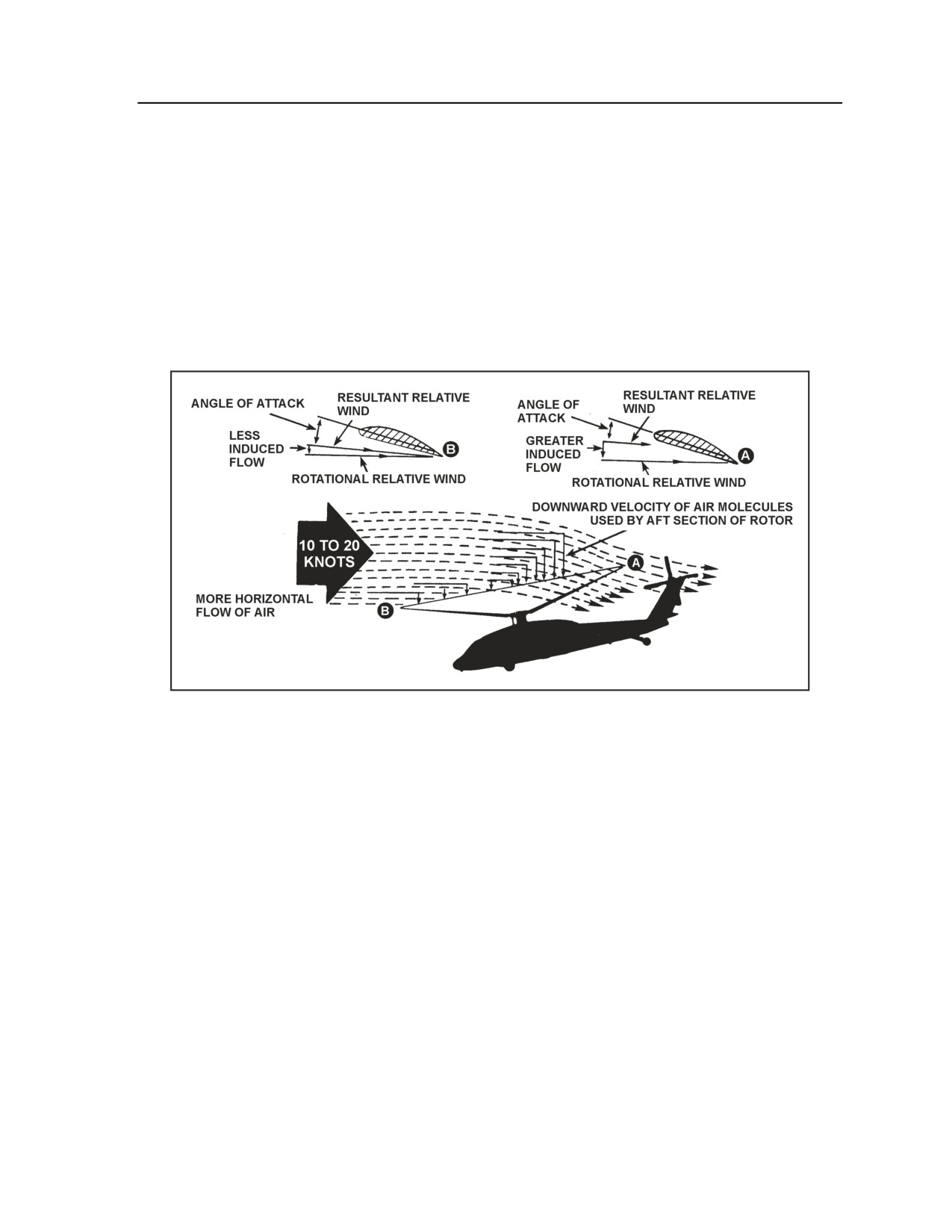
1-116. In forward flight, air passing through the rear portion of the rotor disk has a greater downwash
angle than air passing through the forward portion. This is due to the fact the greater the distance air
flows over the rotor disk, the longer the disk has to work on it and the greater the deflection on the aft
portion. Downward flow at the rear of the rotor disk causes a reduced AOA, resulting in less lift. The
front portion of the disk produces an increased AOA and more lift because airflow is more horizontal.
These differences in lift between the fore and aft portions of the rotor disk are called transverse flow
effect (figure 1-59). This effect causes unequal drag in the fore and aft portions of the rotor disk and
results in vibration easily recognizable by the aviator. It occurs between 10 and 20 knots. Transverse
flow effect is most noticeable during takeoff and, to a lesser degree, during deceleration for landing.
Gyroscopic precession causes the effects to be manifested 90 degrees in the direction of rotation,
resulting in a right rolling motion.
Figure 1-59. Transverse flow effect
EFFECTIVE TRANSLATIONAL LIFT
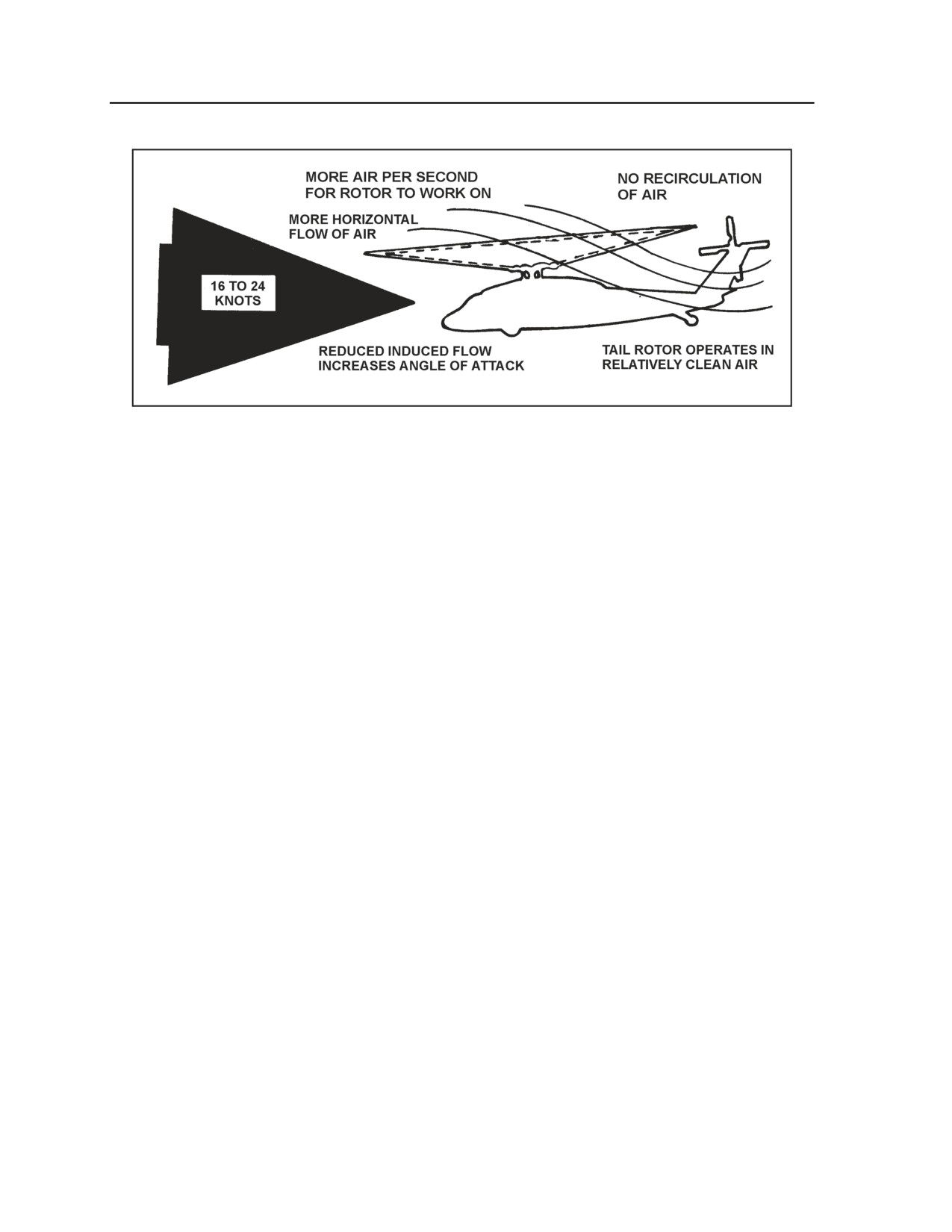
1-117. Effective translational lift (ETL) (figure 1-60) occurs with the helicopter at about 16 to 24 knots,
when the rotor—depending on size, blade area, and RPM of the rotor system—completely outruns the
recirculation of old vortexes and begins to work in relatively undisturbed air. The rotor no longer
pumps the air in a circular pattern but continually flies into undisturbed air. The flow of air through the
rotor system is more horizontal, therefore induced flow and induced drag are reduced. The AOA is
subsequently increased, which makes the rotor system operate more efficiently. This increased
efficiency continues with increased airspeed until the best climb airspeed is reached, when total drag is
at its’ lowest point. Greater airspeeds result in lower efficiency due to increased parasite drag.
7 May 2007
FM 3-04.203
1-45
Chapter 1
Figure 1-60. Effective translational lift
1-118. As single-rotor aircraft speed increases, translational lift becomes more effective, nose rises or
pitches up, and aircraft rolls to the right. The combined effects of dissymmetry of lift, gyroscopic
precession, and transverse flow effect cause this tendency. Aviators must correct with additional
forward and left lateral cyclic input to maintain a constant rotor-disk attitude.
AUTOROTATION
AERODYNAMICS OF VERTICAL AUTOROTATION
1-119. During powered flight, rotor drag is overcome with engine power. When the engine fails or is
deliberately disengaged from the rotor system, some other force must sustain rotor RPM so controlled
flight can be continued to the ground. Adjusting the collective pitch to allow a controlled descent
generates this force. Airflow during helicopter descent provides energy to overcome blade drag and
turn the rotor. When the helicopter descends in this manner, it is in a state of autorotation. In effect, the
aviator exchanges altitude at a controlled rate in return for energy to turn the rotor at a RPM that
provides aircraft control and a safe landing. Helicopters have potential energy based on their altitude
above the ground. As this altitude decreases, potential energy is converted into kinetic energy used in
turning the rotor. Aviators use this kinetic energy to slow the rate of descent to a controlled rate and
affect a smooth touchdown.
1-120. Most autorotations are performed with forward airspeed. For simplicity, the following
aerodynamic explanation is based on a vertical autorotative descent (no forward airspeed) in still air.
Under these conditions, forces that cause the blades to turn are similar for all blades, regardless of their
position in the plane of rotation. Therefore, dissymmetry of lift resulting from helicopter airspeed is
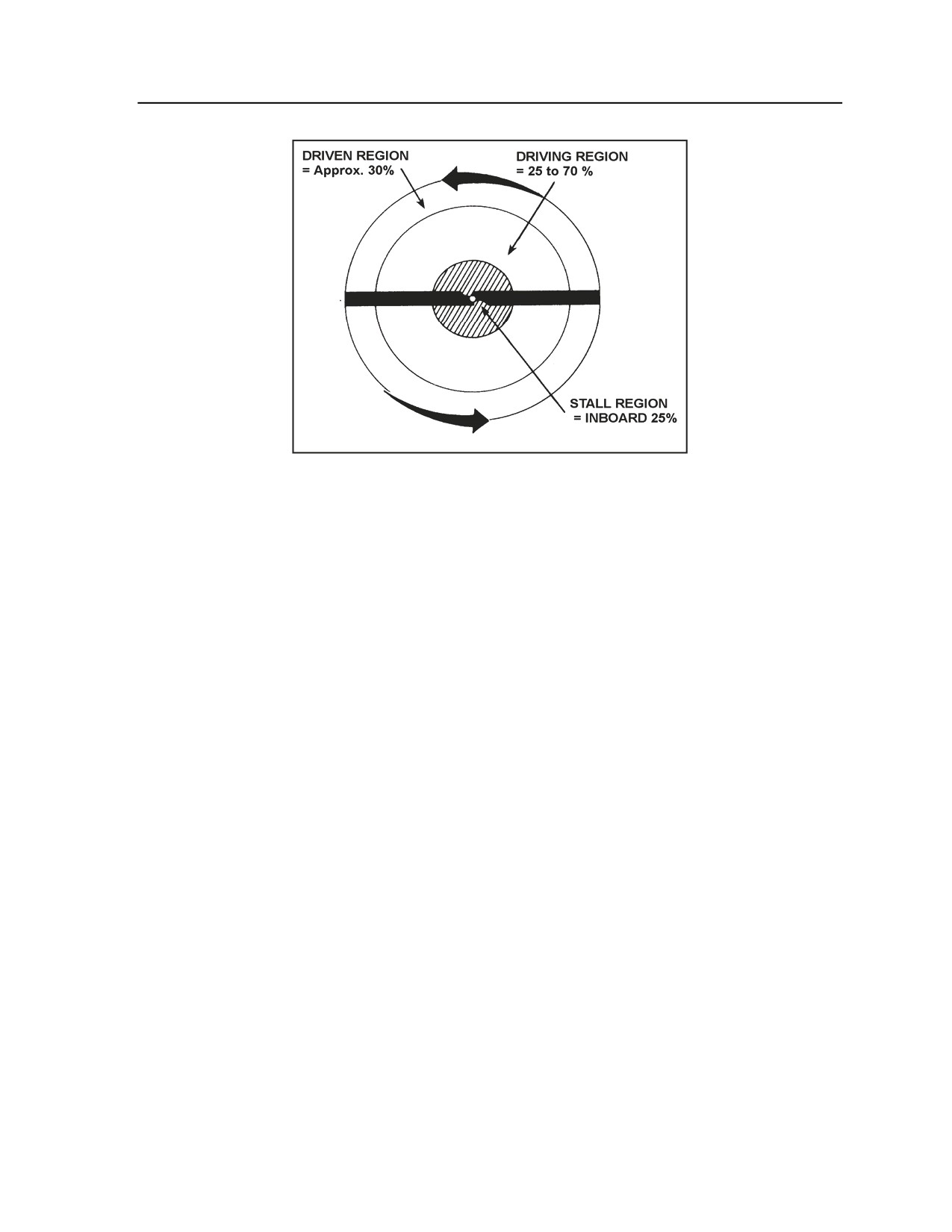
not a factor. During autorotation, the rotor disk is divided into three regions—driven, driving, and stall
(figure 1-61).
1-46
FM 3-04.203
7 May 2007
Theory of Flight
Figure 1-61. Blade regions in vertical autorotation descent
Driven Region
1-121. This region is also called the propeller region and nearest the blade tip. It normally consists of
about 30 percent of the disk radius. In the driven region, the TAF acts above the blade and behind the
axis of rotation. This region creates lift, which slows the rate of descent and drag, which slows rotation
of the blade. Region size varies with the blade pitch setting, rate of descent, and rotor RPM. Any
change of these factors also changes the size of the regions along the blade span.
Driving Region
1-122. This region extends from about the 25 to 70 percent radius of the blade. It lies between the driven
and stall regions. It can also be identified as the area of autorotative force because it is the region of
the blade that produces the force necessary to turn the blades during autorotation. TAF in the driving
region is inclined slightly forward of the axis of rotation and produces a continual acceleration force.
This direction of force supplies thrust, which tends to accelerate the rotation of the blade. The size of
the region varies with the blade pitch setting, rate of descent, and rotor RPM. Any change of these
factors also changes the size of the regions along the blade span.
Stall Region
1-123. This region includes the inboard 25 percent of the blade radius. It operates above the stall AOA
and causes drag, which tends to slow the rotation of the blade.
Blade Region Relationships
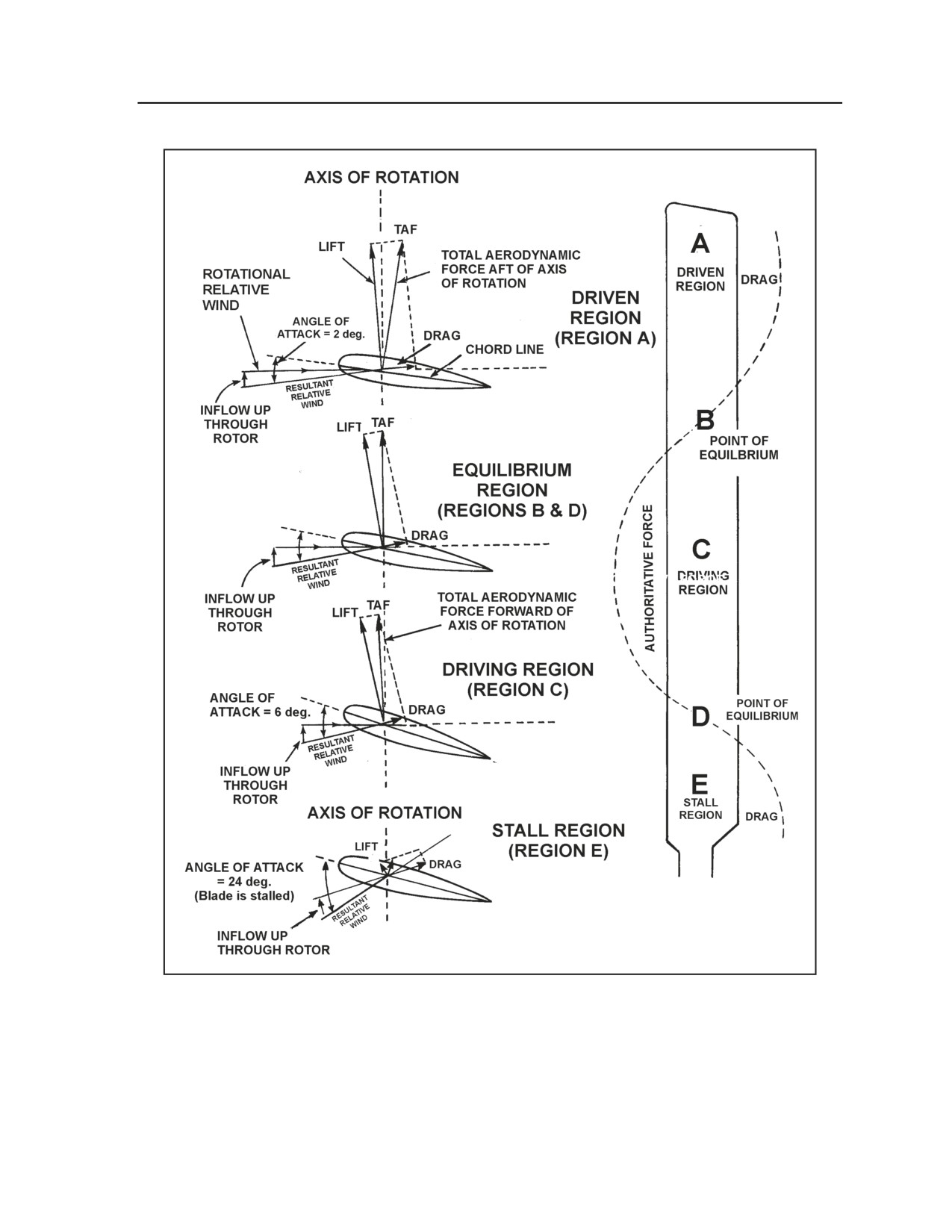
1-124. Figure 1-62, page 1-45, illustrates the three regions. Additional information in the figure pertains
to force vectors on those regions and two additional equilibrium points. This figure serves to locate
those regions/points on the blade span and depict the interplay of force vectors. Force vectors are
different in each region because rotational relative wind is slower near the blade root and increases
continually toward the blade tip. In addition, blade twist gives a more positive AOA in the driving
region than in the driven region. The combination of inflow up through the rotor with rotational
relative wind produces different combinations of aerodynamic force at every point along the blade.
1-125. There are two points of equilibrium on the blade (figure 1-62, page 1-45)—point B, between the
driven and driving regions, and point D, between the driving and stall regions. At this point, TAF is
7 May 2007
FM 3-04.203
1-47
Chapter 1
aligned with the axis of rotation. Lift and drag are produced, but overall, there is neither acceleration
nor deceleration force developed.
1-126. The aviator manipulates these regions to control all aspects of the autorotative descent. For
example, if the collective pitch is increased, the pitch angle increases in all regions. This causes point
of equilibrium B to move inboard and point of equilibrium D to move outboard along the blade span,
thus increasing the size of the driven and stall regions while reducing the driving region. The stall
region also becomes larger while the driving region is reduced in size. Reducing the size of the driving
region decreases acceleration force and rotor RPM. An aviator can achieve a constant rotor RPM by
adjusting the collective pitch so blade acceleration forces from the driving region are balanced with
deceleration forces from the driven and stall regions.
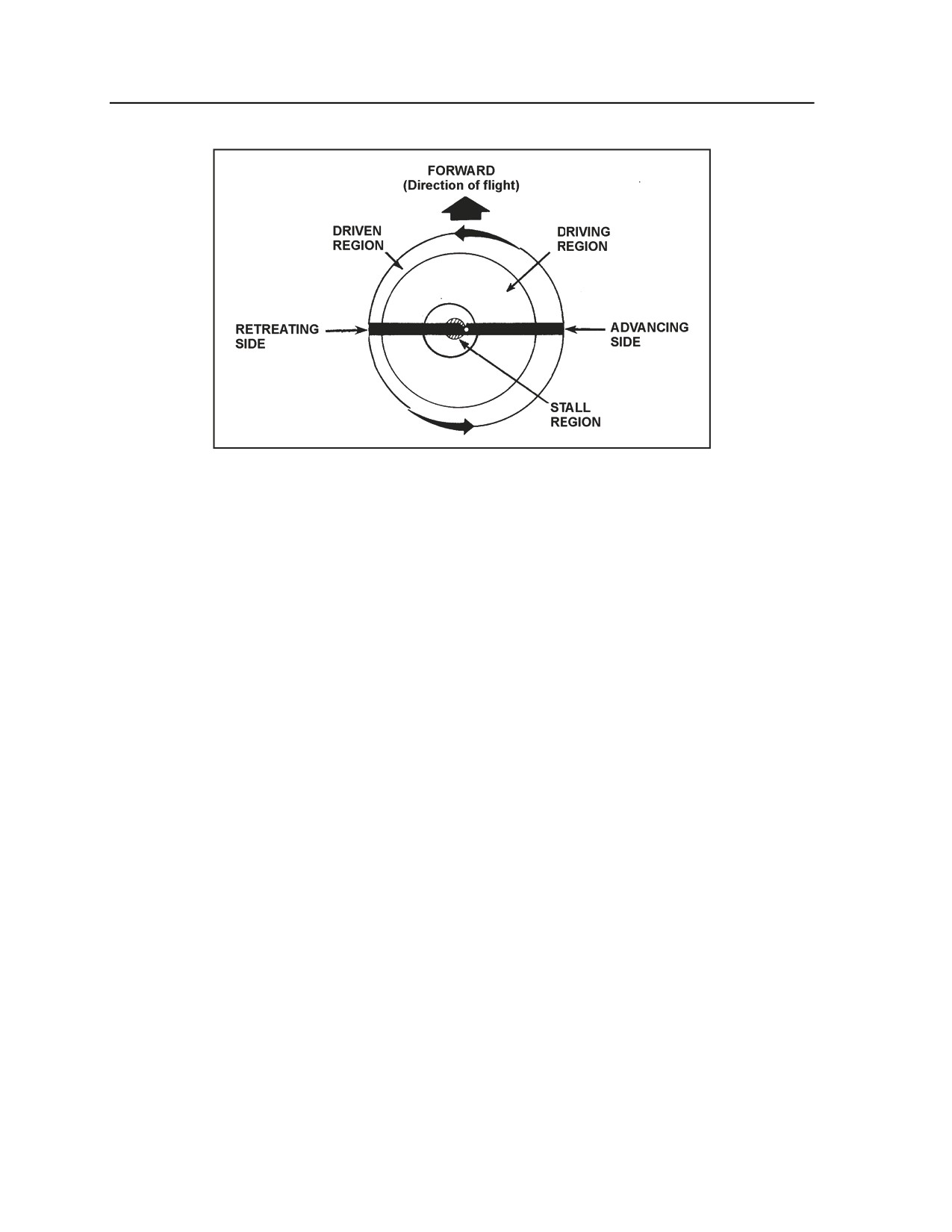
AERODYNAMICS OF AUTOROTATION IN FORWARD FLIGHT
1-127. Aerodynamic forces in forward flight (figure 1-63, page 1-46) are produced in exactly the same
manner as in vertical autorotation. However, because forward speed changes the inflow of air up
through the rotor disk, this changes the location and size of the regions on the retreating and advancing
sides of the rotor disk. Because the retreating side experiences an increased AOA, all three regions
move outboard along the blade span with the stall region growing larger and an area nearest the hub
experiencing a reversed flow. Because the advancing side experiences a decreased AOA, the driven
region takes up more of that blade span.
1-48
FM 3-04.203
7 May 2007
Theory of Flight
Figure 1-62. Force vectors in vertical autorotative descent
7 May 2007
FM 3-04.203
1-49
Chapter 1
Figure 1-63. Autorotative regions in forward flight
AUTOROTATIVE PHASES
1-128. Autorotations may be divided into three distinct phases—entry, steady-state descent, and
deceleration and touchdown. Each phase is aerodynamically different from the others.
Entry
1-129. This phase is entered after loss of engine power. The loss of engine power and rotor RPM is more
pronounced when the helicopter is at high gross weight, high forward speed, or in high-density altitude
conditions. Any of these conditions demand increased power (high collective position) and a more
abrupt reaction to loss of that power. In most helicopters, it takes only seconds for RPM decay to fall
into a minimum safe range requiring a quick collective response from the aviator. Entry is a
combination of figures 1-64 and 1-65.
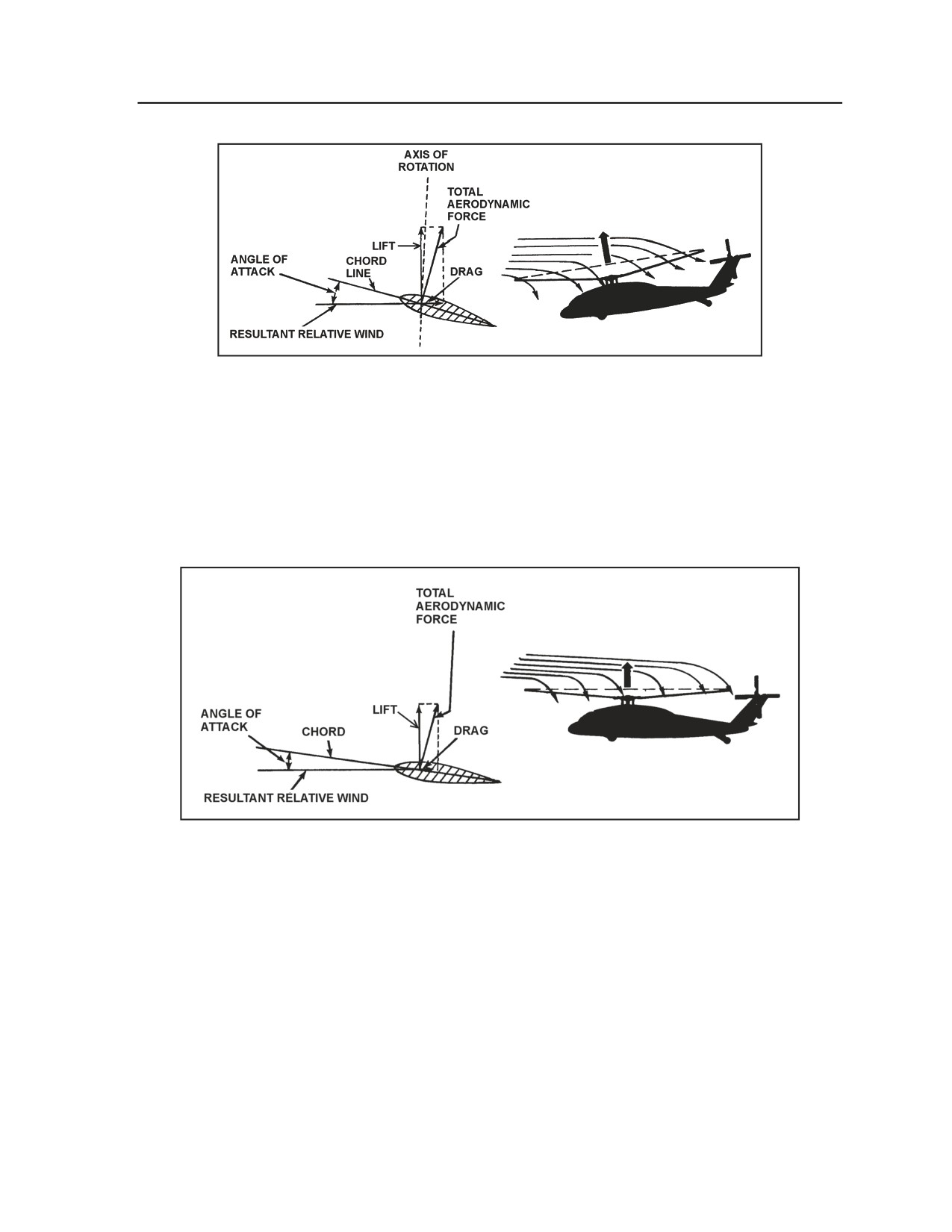
Level-Powered Flight at High Speed
1-130. Figure 1-64 shows the airflow and force vectors for a blade in this configuration. Lift and drag
vectors are large, and the TAF is inclined well to the rear of the axis of rotation. An engine failure in
this mode will cause rapid rotor RPM decay. To prevent this, an aviator must lower the collective
quickly, reducing drag and inclining the TAF vector forward, nearer the axis of rotation.
1-50
FM 3-04.203
7 May 2007
Theory of Flight
Figure 1-64. Force vectors in level-powered flight at high speed
Collective Pitch Reduction
1-131. Figure 1-65 shows airflow and force vectors for a blade immediately after power loss and
subsequent collective reduction, yet before the aircraft has begun to descend. Lift and drag are
reduced, with the TAF vector inclined further forward than it is in powered flight. As the helicopter
begins to descend, the airflow begins to flow upward and under the rotor system. This causes the TAF
to incline further forward until it reaches an equilibrium that maintains a safe operating RPM.
Figure 1-65. Force vectors after power loss-reduced collective
Steady-State Descent
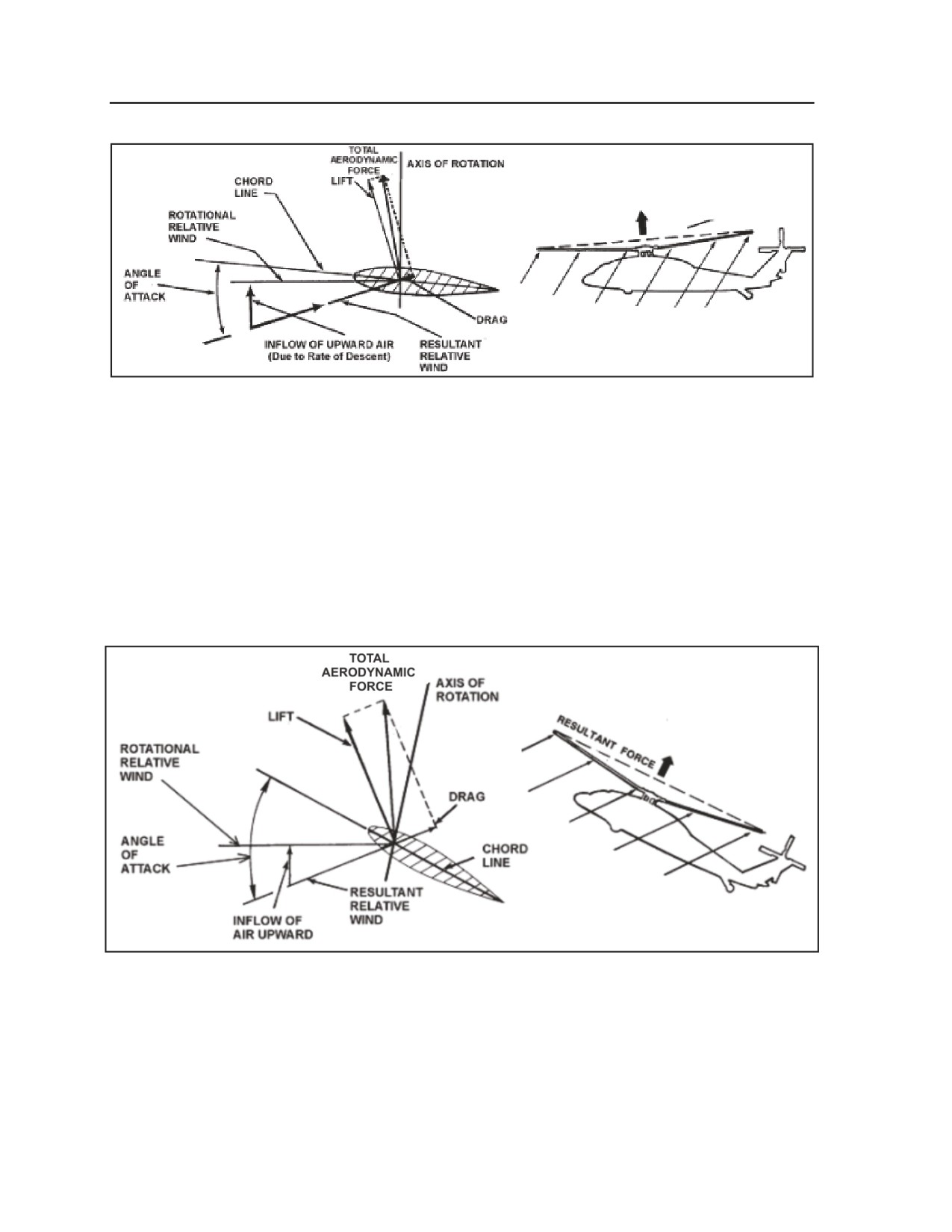
1-132. Figure 1-66 shows airflow and force vectors for a blade in steady-state autorotative descent.
Airflow is now upward through the rotor disk because of the descent. This inflow of air creates a
larger AOA although blade pitch angle has not changed since the descent began. TAF on the blade is
increased and inclined further forward until equilibrium is established, rate of descent and rotor RPM
are stabilized, and the helicopter is descending at a constant angle. Angle of descent is normally 17 to
20 degrees, depending on airspeed, density altitude, wind, and type of helicopter.
7 May 2007
FM 3-04.203
1-51
Chapter 1
Figure 1-66. Force vectors in autorotative steady-state descent
Deceleration and Touchdown
1-133. Figure 1-67, page 1-48, shows airflow and force vectors for a blade in autorotative deceleration.
To make an autorotative landing, aviators reduce airspeed and rate of descent just before touchdown.
They can partially accomplish both actions by applying aft cyclic, which changes the attitude of the
rotor disk in relation to the relative wind. This attitude change inclines the resultant lift of the rotor
system to the rear, slowing forward speed. It also increases AOA on all blades by changing direction
of airflow through the rotor system, thereby increasing rotor RPM. The lifting force of the rotor
system is increased and rate of descent is reduced. After an aviator reduces forward speed to a safe
landing speed, the helicopter is placed in a landing attitude while applying collective pitch to cushion
the touchdown.
Figure 1-67. Autorotative deceleration
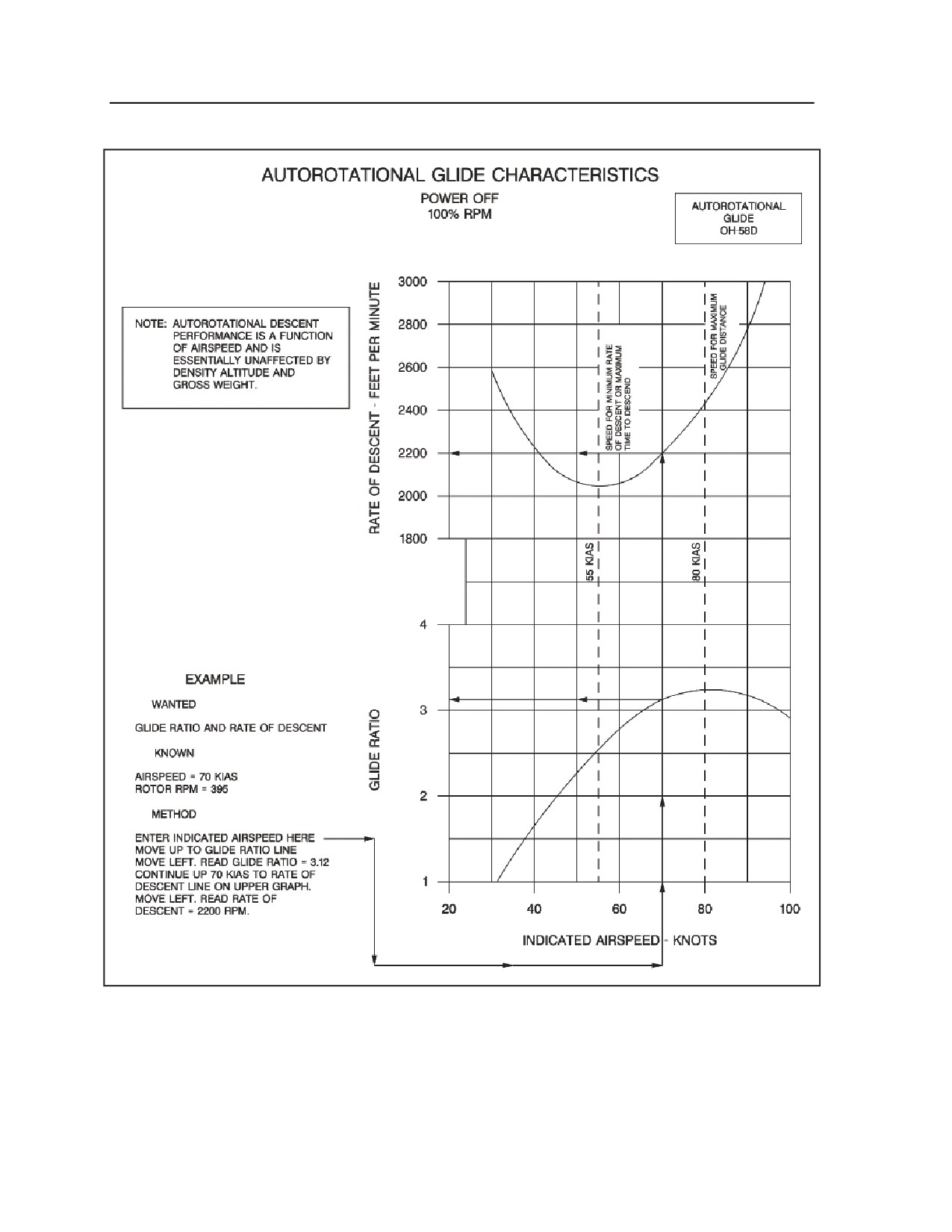
GLIDE AND RATE OF DESCENT IN AUTOROTATION
1-134. Helicopter airspeed and drag are significant factors affecting rate of descent in autorotation. The
rate of descent is high at very low airspeeds, decreases to a minimum at some intermediate speed and
increases again at faster speeds. Airspeeds for minimum rate of descent and maximum glide distance
vary by helicopter type and can be found in individual operator manuals (figure 1-68, page 1-49).
1-52
FM 3-04.203
7 May 2007
Theory of Flight
Circle of Action
1-135. The circle of action is a point on the ground that has no apparent movement in the pilot's field of
view (FOV) during a steady-state autorotation. The circle of action would be the point of impact if the
pilot applied no deceleration, initial pitch, or cushioning pitch during the last 100 feet of autorotation.
Depending on the amount of wind present and the rate and amount of deceleration and collective
application, the circle of action is usually two or three helicopter lengths short of the touchdown point.
Last 50 to 100 Feet
1-136. It can be assumed autorotation ends at 50 to 100 feet and landing procedures then begin. To
execute a power-off landing for rotary-wing aircraft, an aviator exchanges airspeed for lift by
decelerating the aircraft during the last 100 feet. When executed correctly, deceleration is applied and
timed so rate of descent and forward airspeed are minimized just before touchdown. At about 10 to 15
feet, this energy exchange is essentially complete. Initial pitch application occurs at 10 to 15 feet. This
is used to trade some of the rotor energy to slow the rate of descent prior to cushioning. The primary
remaining control input is application of collective pitch to cushion touchdown. Because all helicopter
types are slightly different, aviator experience in that particular aircraft is the most useful tool for
predicting useful energy exchange available at 100 feet and the appropriate amount of deceleration and
collective pitch needed to execute the exchange safely and land successfully.
7 May 2007
FM 3-04.203
1-53
Chapter 1
Figure 1-68. Drag and airspeed relationship
1-54
FM 3-04.203
7 May 2007
Theory of Flight
SECTION VI - MANEUVERING FLIGHT
AERODYNAMICS
1-137. There are several characteristics aviators must be aware of to successfully perform combat
maneuvers.
BEST RATE-OF-CLIMB/MAXIMUM ENDURANCE AIRSPEED
1-138. This airspeed has the following characteristics—
Total drag at the minimum.
Largest amount of excess power available.
Lowest fuel flow during powered flight.
Maximum single engine gross weight that can be carried (for dual engine aircraft).
1-139. Aviators should always be aware of their best rate-of-climb airspeed as it is where the aircraft will
turn and climb the best, maximize available power margin, and get the lowest fuel flow.
BUCKET SPEED
1-140. Bucket speed is the airspeed range providing the best power margin for maneuvering flight. Using
the cruise chart for current conditions, enter at 50 percent of maximum torque available, go up to gross
weight, over to the lowest and highest airspeed intersecting the aircraft gross weight, and note speeds
between which there is the greatest power margin for maneuvering flight. The most critical is lower
speed since at higher speeds airspeed energy may be traded to maintain altitude while maneuvering.
When below minimum bucket speed reduce bank angle. Otherwise, altitude loss may become
unavoidable.
TRANSIENT TORQUE
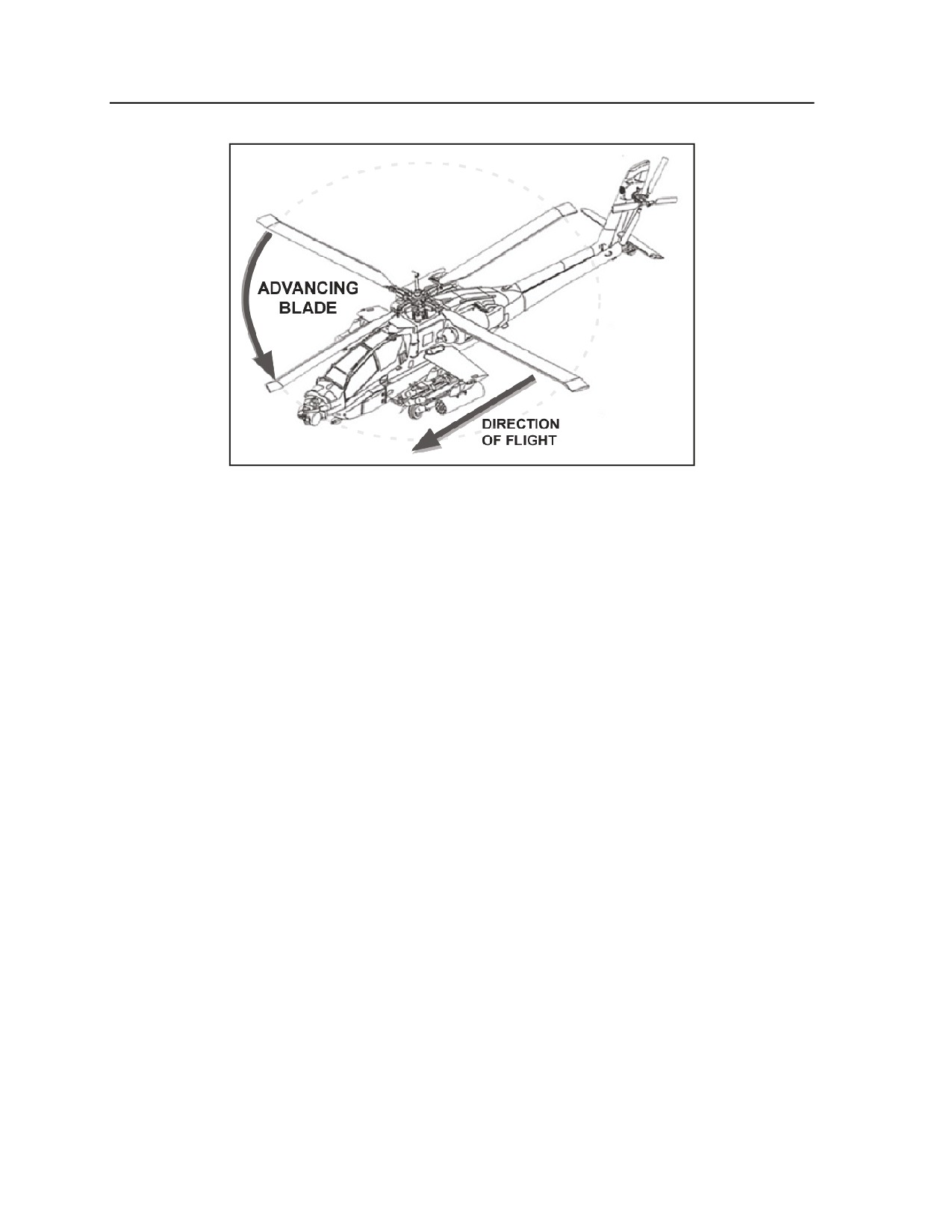
1-141. Transient torque is a phenomenon occurring in single-rotor helicopters when lateral cyclic is
applied and is caused by aerodynamic forces. For conventional American helicopters where the main
rotor turns counterclockwise, (figure 1-69) a left cyclic input causes a temporary rise in torque and a
right cyclic input causes a temporary drop in torque.
7 May 2007
FM 3-04.203
1-55
Chapter 1
Figure 1-69. Counterclockwise blade rotation
1-142. At the rear half of the rotor disk, downwash is greater than seen at the forward half of the rotor
disk. This effect is more pronounced for heavier aircraft which exhibit greater coning due to their
weight, causing even greater downwash at the rear of the rotor disk. If a left cyclic input is made by
the pilot, the following events occur leading to a temporary increase in torque:
The swashplate commands an increased blade AOA as each blade passes over the tail.
The increase in blade AOA causes the rotor disk to tilt left, which is felt as a left roll on the
aircraft.
With increased lift on the rotor blades passing over the tail, there is also increased drag (induced
drag).
The increased rotor drag due to the left turn will initially try to slow the rotor, but is sensed by
the applicable engine computer. The engine responds by delivering more torque to the rotor
system to maintain rotor speed.
1-143. The opposite holds true for right cyclic turns, but is less pronounced. Unlike the left hand turn, in
right turns blade pitch is being changed at the front of the rotor disk where induced downwash is
lower, so the drag penalty is lower. Transient torque is not as prevalent at slower airspeeds because the
induced downwash distribution is nearly uniform across the rotor disk.
1-144. Five factors affect how much torque change occurs during transient torque—
Torque transients are proportional with the amount of power applied. The higher the torque
setting when lateral cyclic inputs are made, the higher or lower the transient.
Rate of movement of the cyclic. The faster the rate of movement the higher resultant torque
spike.
Magnitude of cyclic displacement directly affects the torque transient. An example of worst-case
scenario occurs when a pilot initiates a rapid right roll, then due to an unexpected event breaks
left. The transition from right cyclic applied to left cyclic applied results in a large amount of
pitch change in the advancing blade, resulting in large torque transients.
Drag is increased or decreased by the factor of velocity squared. Thus, the higher the forward
airspeed, the higher the torque transient results.
High aircraft weight increases coning, which will make transient torque more pronounced.
1-56
FM 3-04.203
7 May 2007
Theory of Flight
1-145. Extreme caution must be used when maneuvering at near maximum torque available especially at
high airspeeds. It is not uncommon to experience as much as
50 percent torque changes in
uncompensated maneuvers with high power settings at high forward airspeeds. In these situations, the
pilot must ensure collective is reduced as left lateral cyclic is applied and increased for right cyclic
inputs. When recovering from these inputs, opposite collective inputs must be made so aircraft
limitations are not exceeded.
1-146. As a good basic technique, imagine a piece of string tied between the cyclic and collective (right
cyclic-collective increase/left cyclic-collective decrease). Also, inputs must be made to keep the
aircraft from descending due to torque reductions (when recovering from left cyclic inputs with
collective reduced).
Note. 701C equipped AH-64 helicopters employ maximum torque rate attenuator (MTRA)
which attempts to prevent transient torque related over-torques but may produce a rotor droop
and loss of roll rate. Once the pilot has gained confidence in the ability of the MTRA to prevent
over-torques resulting from transient torque, he can aggressively maneuver the aircraft without
closely monitoring engine torque.
MUSHING
1-147. Mushing is a temporary stall condition occurring in helicopters when rapid aft cyclic is applied at
high forward airspeeds. Normally associated with dive recoveries, which result in a significant loss of
altitude, this phenomenon can also occur in a steep turn resulting in an increased turn radius. Mushing
results during high G-maneuvers when at high forward airspeeds aft cyclic is abruptly applied. This
results in a change in the airflow pattern on the rotor exacerbated by total lift area reduction as a result
of rotor disc coning. Instead of an induced flow down through the rotor system, an upflow is
introduced which results in a stall condition on portions of the entire rotor system. While this is a
temporary condition (because in due time the upflow will dissipate and the stall will abate), the
situation may become critical during low altitude recoveries or when maneuvering engagements
require precise, tight turning radii. High aircraft gross weight and high density altitude are conditions
conducive to and can aggravate mushing.
1-148. Mushing can be recognized by the aircraft failing to respond immediately but continuing on the
same flight path as before the application of aft cyclic. Slight feedback and mushiness may be felt in
the controls. When mushing occurs, the tendency is to pull more aft cyclic which prolongs stall and
increases recovery times. Make a forward cyclic adjustment to recover from the mushing condition.
This reduces the induced flow, improves the resultant AOA, and reduces rotor disc coning which
increases the total lift area of the disc. The pilot will immediately feel a change in direction of the
aircraft and increased forward momentum as the cyclic is moved forward. To avoid mushing, the pilot
must use smooth and progressive application of the aft cyclic during high G-maneuvers such as dive
recoveries and tight turns.
CONSERVATION OF ANGULAR MOMENTUM
1-149. The law of conservation of angular momentum states the value of angular momentum of a rotating
body will not change unless external torques are applied. In other words, a rotating body will continue
to rotate with the same rotational velocity until some external force is applied to change the speed of
rotation. Angular momentum can be expressed as—
7 May 2007
FM 3-04.203
1-57
Chapter 1
Law of Conservation of Angular Momentum
Mass x Angular Velocity x Radius Squared
1-150. Changes in angular velocity, known as angular acceleration or deceleration, take place if the mass
of a rotating body is moved closer to or further from the axis of rotation. The speed of the rotating
mass will increase or decrease in proportion to the square of the radius.
1-151. An excellent example for this principle is when watching a figure skater on ice skates. The skater
begins a rotation on one foot, with the other leg and both arms extended. The rotation of the skater’s
body is relatively slow. When a skater draws both arms and one leg inward, the moment of inertia
(mass times radius squared) becomes much smaller and the body is rotating almost faster than the eye
can follow. Because the angular momentum must, by law of nature, remain the same (no external force
applied), the angular velocity must increase.
1-152. The mathematician, Coriolis, was concerned with forces generated by such radial movements of
mass on a rotating disc or plane. These forces cause acceleration and deceleration. It may be stated as a
mass moving radically—
Outward on a rotating disk will exert a force on its surroundings opposite to rotation.
Inward on a rotating disk will exert a force on its surroundings in the direction of rotation.
1-153. The major rotating elements in the system are the rotor blades. As the rotor begins to cone due to
G-loading maneuvers, the diameter of the disc shrinks. Due to conservation of angular momentum, the
blades continue to travel the same speed even though the blade tips have a shorter distance to travel
due to reduced disc diameter. This action results in an increase in rotor RPMs. Most pilots arrest this
increase with an increase in collective pitch.
1-154. Conversely, as G-loading subsides and the rotor disc flattens out from the loss of G-load induced
coning, the blade tips now have a longer distance to travel at the same tip speed. This action results in
a reduction of rotor RPMs. However, if this droop in rotor continues to the point it attempts to
decrease below normal operating RPM, the engine control system adds more fuel/power to maintain
the specified engine RPM. If the pilot does not reduce collective pitch as the disc unloads, the
combination of the engines compensating for the RPM slow down and the additional pitch added as G-
loading increased may result in exceeding the torque limitations or power the engines can produce.
This problem is exacerbated by effects of the TAF encountered during maneuvering flight.
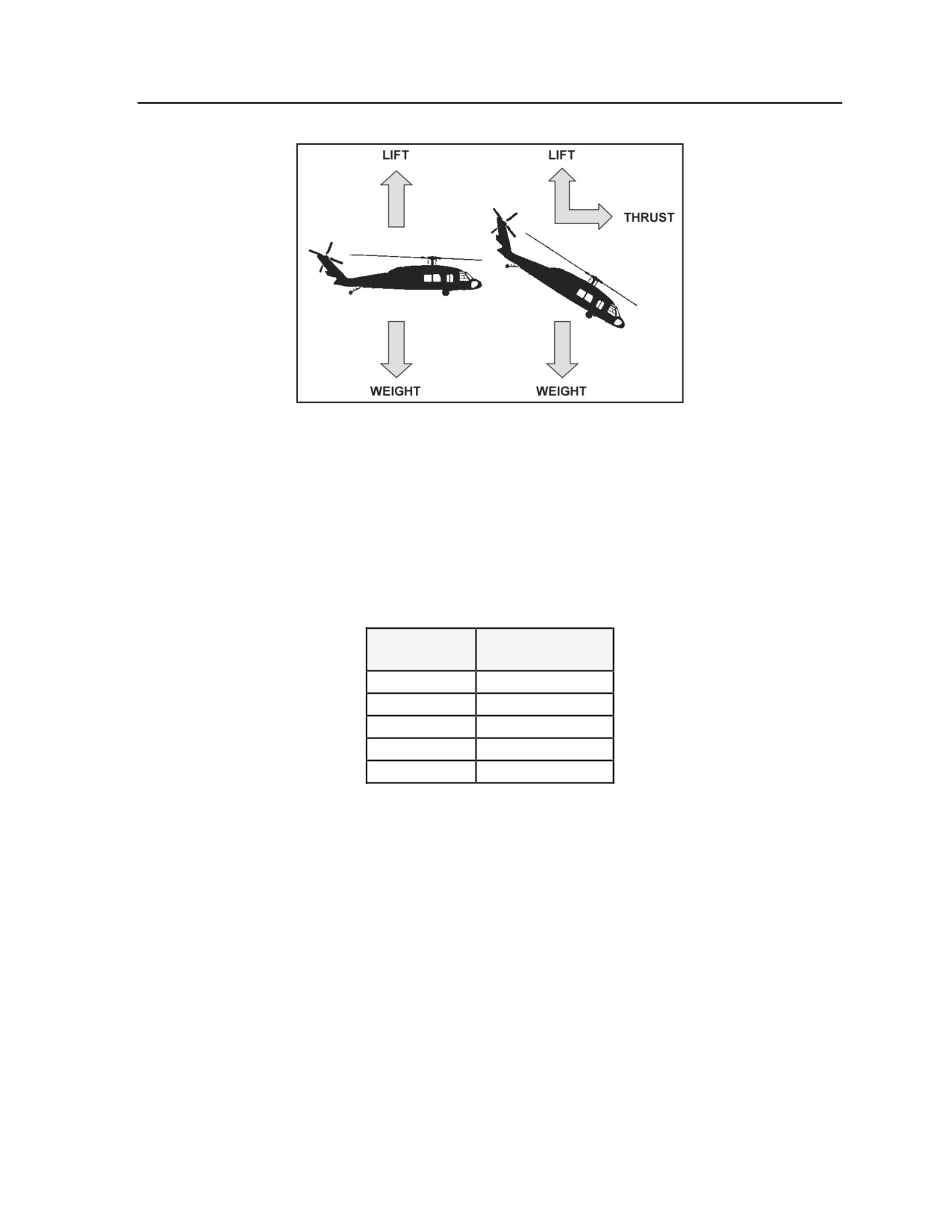
HIGH BANK ANGLE TURNS
1-155. As the angle of bank increases, the amount of lift opposite the vertical weight decreases (figure 1-
70). If adequate excess engine power is available, increasing collective pitch enables continued flight
while maintaining airspeed and altitude. If sufficient excess power is not available, the result is altitude
loss unless airspeed is traded (aft cyclic) to maintain altitude or altitude is traded to maintain airspeed.
1-58
FM 3-04.203
7 May 2007
Theory of Flight
Figure 1-70. Lift to weight
1-156. At some point (airspeed/angle of bank) sufficient excess power will not be available and the
aviator must apply aft cyclic to maintain altitude (table 1-3). The percentages shown are not a direct
torque percentage, but percentage of torque increase required based on aircraft torque to maintain
straight and level flight. If indicated cruise torque is 48 percent and a turn to 60 degrees is initiated, a
torque increase of 48 percent (96 percent torque indicated) is required to maintain airspeed and
altitude.
Table 1-3. Bank angle versus torque
Bank Angle
Increase in TR
- Degree
Percent
0
---
15
3.6
30
15.4
45
41.4
60
100.0
1-157. Additionally, rotor system capability may limit the maneuver as opposed to insufficient excess
power (engine) on advanced aircraft like AH-64s or UH-60s (the OH-58D may be limited by the rotor
as well). In high energy maneuvering, the rotor is normally a limiting factor. It is not unusual in these
types of aircraft for a reduction in collective to be required to achieve maximum performance when
maneuvering at increased G-loads, altitudes, or high weights.
1-158. Aviators must be familiar with this characteristic, anticipate cyclic input results, and apply
appropriate control inputs to successfully conduct combat maneuvers. Aviators unfamiliar with this
characteristic may be surprised at the rapid build of sink rates when turning the aircraft to bank angles
approaching 60 degrees. When flying heavy aircraft in a high hot environment, sufficient time and
altitude may not be available to arrest the resultant descent.
MANEUVERING FLIGHT AND TOTAL AERODYNAMIC FORCE
1-159. The cyclic inputs and associated rotor disc pitch changes required to accomplish successful
combat maneuvers have a substantial effect on TAF. Large aft cyclic inputs increase the inflow
through the rotor system. Since lift is perpendicular to the resultant relative wind, the TAF of each
rotor blade may move to a point aligned with or forward of the axis of rotation (much like the driving
7 May 2007
FM 3-04.203
1-59
Chapter 1
and driven region of a blade during autorotational flight). While the engine control system reduces fuel
flow to reduced load, the rotor system may still climb to transient ranges or attempt to overspeed.
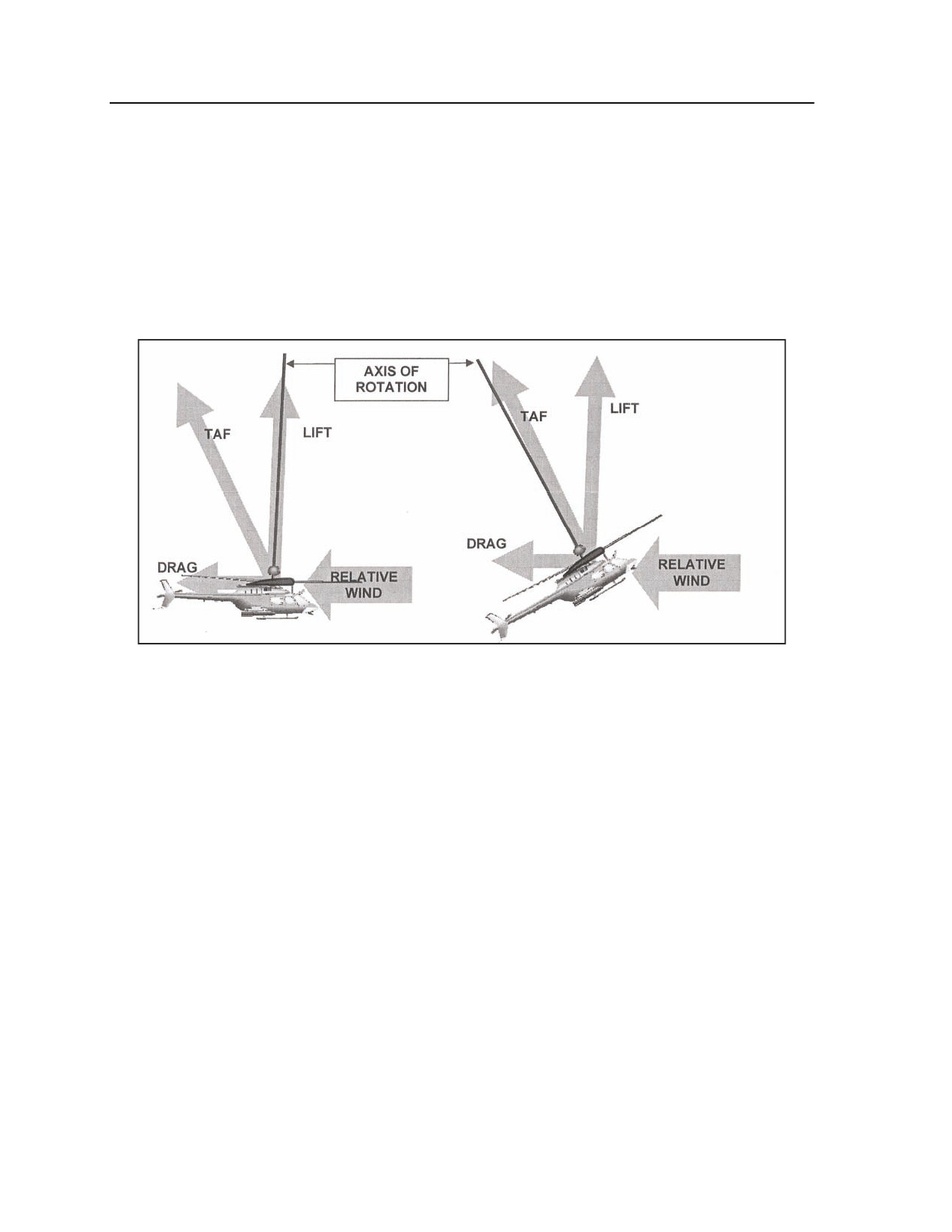
1-160. Conversely, when the cyclic is rapidly repositioned to a more forward position, the inflow through
the rotor is rapidly reduced resulting in the blade TAF moving aft of the axis of rotation and a slowing
of rotor RPM (figure 1-71). The engine control systems sense this and increase fuel flow to the
engines to maintain rotor RPM causing torque to increase. As a general rule, when traveling at
airspeeds above bucket speed, aft cyclic results in a reduction in torque and an increase in rotor RPMs.
Recovery from an aft cyclic input (pushover or high G-turn recovery) results in torque increase as the
engines compensate for the rotor system slow down. In aggressive maneuvers, this may result in an
overtorque or overspeed if appropriate collective input is not made to keep torque and rotor consistent.
Figure 1-71. Aft cyclic results
1-161. This phenomenon is exacerbated by high gross weight and also affected by ambient temperature
and density alititude. Typically, cold dry air results in more rapid rotor RPM increase during aft cyclic
input and a corresponding higher torque increase with a forward cyclic input. Hot temperatures and
higher DAs result in more collective input required to arrest a climbing rotor.
ANGULAR MOMENTUM AND TOTAL AERODYNAMIC FORCE COMBINED EFFECTS
1-162. Angular momentum and TAF combine during cyclic pitch changes. During aft cyclic or G-
loading, the rotor increases and torque goes down. During G-load recovery, torque increases as the
engine control systems work to maintain a rotor RPM attempting to decrease. Aviators must be able to
apply appropriate and timely collective inputs to maintain consistent torque and keep rotor RPM
within limits.
DIG-IN
1-163. While making large aft cyclic movements, the pilot must be aware of the helicopter’s tendency to
rapidly and unpredictably build G-forces. As the cyclic is moved aft, the rotor disk responds by tilting
aft, which tilts the thrust vector aft and ultimately causes the aircraft to pitch nose-up. This rapid pitch-
up also increases the length of the aircraft thrust vector, which will in turn increase the pitch-up rate.
The rapid onset of the pitch-up motion due to the tilting and then lengthening of the thrust vector is
considered destabilizing and countered by the helicopter’s horizontal tail or stabilizer, which will try to
drive the nose back down. For large pitch-up rates, the tendency of the main rotor to continue
1-60
FM 3-04.203
7 May 2007
Theory of Flight
pitching-up will overpower the horizontal tail/stabilizer and the aircraft will dig-in and slow down
rapidly. Dig-in is usually accompanied by airframe vibration and sometimes controls feedback.
1-164. Aft cyclic movements give predictable increases in G-load up to the dig-in point; however, the
dig-in occurs at different G-levels for each model of helicopter. The point at which dig-in occurs
depends on a number of factors, but most important is the size of the horizontal tail/stabilizer and
amount of rotor offset. For most helicopters, this point is between 1.5 and 2.0 Gs. Pilots should be
prepared for dig-in during aggressive aft cyclic inputs, especially during break turns.
GUIDELINES
1-165.
Below are good practices to follow during maneuvering flight:
Never move the cyclic faster than trim, torque, and rotor can be maintained. When entering a
maneuver and the trim, rotor, or torque reacts quicker than anticipated, pilot limitations have
been exceeded. If continued, an aircraft limitation will be exceeded. Perform the maneuver with
less intensity until all aspects of the machine can be controlled.
Anticipate changes in aircraft performance due to loading or environmental condition. The
normal collective increase to check rotor speed at sea level standard (SLS) may not be sufficient
at 4,000 feet pressure altitude (PA) and 95 degrees F (4K95).
Anticipate the following characteristics during aggressive maneuvering flight and adjust or lead
with collective as necessary to maintain trim and torque:
Left turns, torque increases.
Right turns, torque decreases.
Application of aft cyclic, torque decreases and rotor climbs.
Application of forward cyclic
(especially when immediately following aft cyclic
application), torque increases and rotor speed decreases.
Always leave a way out.
Know where the winds are.
Most engine malfunctions occur during power changes.
If combat maneuvers have not been performed in a while, start slowly to develop proficiency.
Crew coordination is critical. Everyone needs to be fully aware of what is going on and each
crewmember has a specific duty.
In steep turns the nose will drop. In most cases, energy (airspeed) must be traded to maintain
altitude as the required excess engine power may not be available (to maintain airspeed in a
2g/60 degree turn rotor thrust/engine power has to increase by 100 percent). Failure to anticipate
this at low altitude endangers the crew and passengers. The rate of pitch change is proportional
to gross weight and density altitude.
Many maneuvering flight over-torques occur as the aircraft unloads Gs. This is due to
insufficient collective reduction following the increase to maintain consistent torque and rotor as
G-loading increased (dive recovery or recovery from high G-turn to the right).
SECTION VII - PERFORMANCE
FACTORS AFFECTING PERFORMANCE
1-166. A helicopter’s performance is dependent upon the power output of the engine and lift production
of the rotors. Any factor affecting engine and rotor efficiency affects performance. The three major
factors affecting performance are density altitude, weight, and wind.
7 May 2007
FM 3-04.203
1-61
Chapter 1
DENSITY ALTITUDE
1-167. As air density increases, engine power output, rotor efficiency, and aerodynamic lift also increase.
Density altitude is the altitude above mean sea level (MSL) at which a given atmospheric density
occurs in the standard atmosphere. It can also be interpreted as PA corrected for nonstandard
temperature differences.
1-168. PA is displayed as the height above a standard datum plane, which in this case, is a theoretical
plane where air pressure is equal to 29.92 inches mercury (Hg). PA is the indicated height value when
the altimeter setting is adjusted to 29.92 inches Hg. PA, as opposed to true altitude, is an important
value for calculating performance as it more accurately represents the air content at a particular level.
The difference between true altitude and PA must be clearly understood. True altitude means the
vertical height above MSL and is displayed on the altimeter when the altimeter is correctly adjusted to
the local setting.
1-169. For example, if the local altimeter setting is 30.12 inches Hg and adjusted to this value, it indicates
exact height above sea level. However, this does not reflect conditions found at this height under
standard conditions. Since the altimeter setting is more than 29.92 inches Hg, the air in this example
has a higher pressure and is more compressed, indicative of air found at a lower altitude. Therefore,
the PA is lower than the actual height above MSL. To calculate PA without use of an altimeter,
remember pressure decreases approximately 1 inch of mercury for every 1,000-foot increase in
altitude. For example, if the current local altimeter setting at a 4,000 foot elevation is 30.42, the PA
would be 3,500 feet (30.42 - 29.92 = .50 inches Hg/.50 x 1,000 feet = 500 feet; subtracting 500 feet
from 4,000 equals 3,500 feet.). Four factors affecting density altitude most are atmospheric pressure,
altitude, temperature, and moisture content of the air.
Atmospheric Pressure
1-170. Due to changing weather conditions, atmospheric pressure at a given location changes from day to
day. If the pressure is lower, the air is less dense. This means a higher density altitude and less
helicopter performance.
Altitude
1-171. As altitude increases, air becomes thinner. This is because the atmospheric pressure acting on a
given volume of air is less, allowing air molecules to move further apart. Dense air contains air
molecules spaced closely together, while thin air contains air molecules spaced further apart. As
altitude increases, density altitude increases.
Temperature
1-172. As warm air expands the air molecules move further apart, creating less dense air. Since cool air
contracts, air molecules move closer together creating denser air. High temperatures cause even low
elevations to have high DAs.
Moisture (Humidity)
1-173. The water content of air also changes air density as water vapor weighs less than dry air.
Therefore, as the water content of the air increases, air becomes less dense, increasing density altitude
and decreasing performance.
1-174. Humidity, also called relative humidity, refers to the amount of water vapor contained in the
atmosphere and is expressed as a percentage of the maximum amount of water vapor air can hold. This
amount varies with temperature; warm air can hold more water vapor, while colder air holds less.
Perfectly dry air that contains no water vapor has a relative humidity of 0 percent, while saturated air
that cannot hold any more water vapor has a relative humidity of 100 percent.
1-62
FM 3-04.203
7 May 2007
Theory of Flight
1-175. Humidity alone is usually not considered an important factor in calculating density altitude and
helicopter performance however, it does contribute. There are no rules-of-thumb or charts used to
compute the effects of humidity on density altitude. Aviators should expect a decrease in hovering and
takeoff performance in high humidity conditions.
HIGH AND LOW DENSITY ALTITUDE CONDITIONS
1-176. A thorough understanding of the terms high density altitude and low density altitude are required.
In general, high density altitude refers to thin air, while low density altitude refers to dense air. Those
conditions resulting in a high density altitude (thin air) are high elevations, low atmospheric pressure,
high temperatures, high humidity, or some combination thereof. Lower elevations, high atmospheric
pressure, low temperatures, and low humidity are more indicative of low density altitude (dense air).
However, high density altitude s may be present at lower elevations on hot days, so it is important to
calculate density altitude and determine performance before a flight.
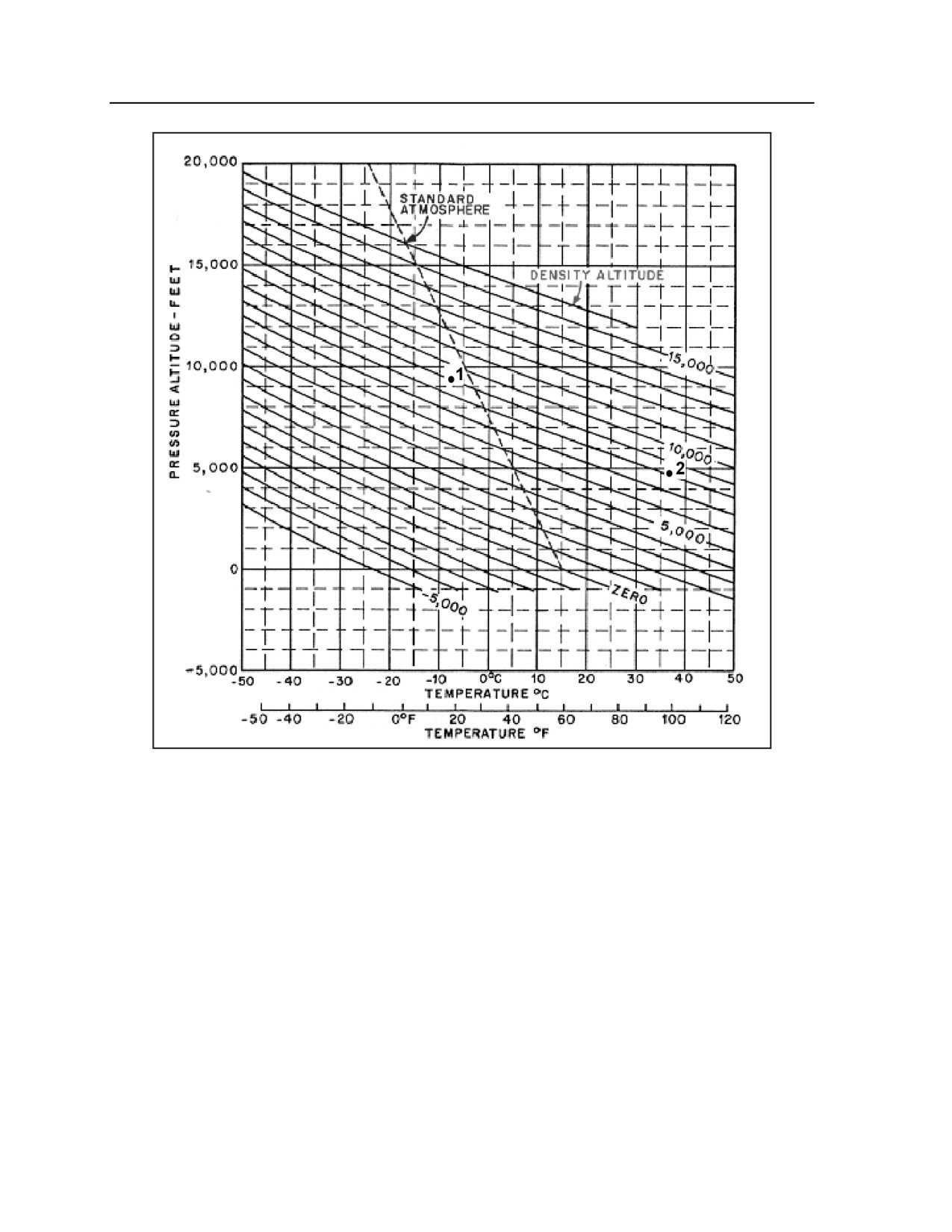
1-177. One of the ways density altitude can be determined (CPU-26A/P is another) is through use of
charts designed for that purpose (figure 1-72, page 1-58). The graph is used to find density altitude
either on the ground or aloft. Set altimeter at 29.92 inches to indicate PA. Read outside air temperature
(OAT). Enter the graph at that PA and move horizontally to the temperature. Read density altitude
from the sloping lines.
Example 1. Find density altitude in flight. PA is 9,500 feet and temperature is 18 degrees F.
Find 9,500 feet on the left of the graph and move across to 18 degrees F. density altitude is
9,000 feet (marked 1 on the graph).
Example 2. Find density altitude for takeoff. PA is 4,950 feet and temperature is 97 degrees F.
Enter the graph at 4,950 feet and move across to 97 degrees F. density altitude is 8,200 feet
(marked 2 on graph).
Note. In warm air, density altitude is considerably higher than PA.
1-178. Most performance charts do not require computation of density altitude. Instead, the computation
is built into the performance chart. All that remains is to enter the correct PA and temperature.
WEIGHT
1-179. Weight is the force opposing lift. As weight increases, power required to produce lift needed to
compensate for the added weight must also increase. Most performance charts include weight as one
of the variables. By reducing weight, the helicopter is able to safely takeoff or land at a location
otherwise impossible. However, if in doubt, delay takeoff until more favorable density altitude
conditions exists. If airborne, try to land at a location that has more favorable conditions, or one where
a landing can be made that does not require a hover.
1-180. In addition, at higher gross weights the increased power required to hover produces more torque,
which means more antitorque thrust is required. In some helicopters, during high altitude operations,
the maximum antitorque produced by the tail rotor during a hover may not be sufficient to overcome
torque even if the gross weight is within limits.
7 May 2007
FM 3-04.203
1-63
Chapter 1
Figure 1-72. Density altitude computation
WINDS
1-181. Wind direction and velocity also affect hovering, takeoff, and climb performance. Translational
lift occurs anytime there is relative airflow over the rotor disc. This occurs whether the relative airflow
is caused by helicopter movement or wind. As wind speed increases, translational lift increases,
resulting in less power required to hover.
1-182. Wind direction is also an important consideration. Headwinds are desirable as they contribute to
the most increase in performance. Strong crosswinds and tailwinds may require use of more tail rotor
thrust to maintain directional control. This increased tail rotor thrust absorbs power from the engine,
which means less power is available to the main rotor for production of lift. Some helicopters even
have a critical wind azimuth or maximum safe relative wind chart. Operating the helicopter beyond
these limits could cause loss of tail rotor effectiveness.
1-183. Takeoff and climb performance is greatly affected by wind. When taking off into a headwind ETL
is achieved earlier, resulting in more lift and a steeper climb angle. When taking off with a tailwind
more distance is required to accelerate through translation lift.
1-64
FM 3-04.203
7 May 2007