FM 3-04.203 Fundamentals of Flight (May 2007) - page 3
Theory of Flight
PERFORMANCE CHARTS
1-184. In developing performance charts, aircraft manufacturers make certain assumptions about the
condition of the helicopter and ability of the pilot. It is assumed the helicopter is in good operating
condition and the engine is developing its rated power. The pilot is assumed to be following normal
operating procedures and to have average flying abilities. Average means a pilot capable of doing each
of the required tasks correctly and at appropriate times.
1-185. Using these assumptions, the manufacturer develops performance data for the helicopter based on
actual flight tests. However, they do not test the helicopter under each and every condition shown on a
performance chart. Instead, they evaluate specific data and mathematically derive the remaining data.
HOVERING PERFORMANCE
1-186. Helicopter performance revolves around whether or not hover is possible. More power is required
during hover than in any other flight regime. Obstructions aside, if hover can be maintained, takeoff
can be made, especially with the additional benefit of translational lift. Charts are provided for IGE
and OGE under various conditions of gross weight, altitude, temperature, and power. The IGE hover
ceiling is higher than OGE hover ceiling due to the added lift benefit produced by ground effect.
1-187. As density altitude increases more power is required to hover. At some point, the power required
is equal to the power available. This establishes the hovering ceiling under existing conditions. Any
adjustment to gross weight by varying fuel, payload, or both, affects the hovering ceiling. The heavier
the gross weight, the lower the hovering ceiling. As gross weight is decreased, the hover ceiling
increases.
1-188. Being able to hover at the takeoff location with a certain gross weight does not ensure the same
performance at the landing point. If the destination point is at a higher density altitude because of
higher elevation, temperature, and/or relative humidity, more power is required to hover. You should
be able to predict whether hovering power will be available at the destination by knowing the
temperature and wind conditions, using performance charts in the helicopter flight manual, and
making certain power checks during hover and in flight prior to commencing the approach and
landing.
CLIMB PERFORMANCE
1-189. Most factors affecting hover and takeoff performance also affect climb performance. In addition,
turbulent air, pilot techniques, and overall condition of the helicopter can cause climb performance to
vary.
1-190. A helicopter flown at the best rate-of-climb speed obtains the greatest gain in altitude over a given
period of time. This speed is normally used during the climb after all obstacles have been cleared and
is usually maintained until reaching cruise altitude. Rate of climb must not be confused with angle of
climb. Angle of climb is a function of altitude gained over a given distance. The best rate-of-climb
speed results in the highest climb rate, but not the steepest climb angle and may not be sufficient to
clear obstructions. The best angle-of-climb speed depends upon power available. If there is a surplus
of power available the helicopter can climb vertically, so the best angle-of-climb speed is zero.
1-191. Wind direction and speed have an effect on climb performance, but it is often misunderstood.
Airspeed is the speed at which the helicopter is moving through the atmosphere and is unaffected by
wind. Atmospheric wind affects only the ground speed and ground track.
7 May 2007
FM 3-04.203
1-65
Chapter 1
SECTION VIII - EMERGENCIES
SETTLING WITH POWER
1-192. Settling with power (figures 1-73 through 1-75) is a condition of powered flight in which the
helicopter settles in its own downwash. This condition may also be referred to as vortex ring state.
Under certain conditions the helicopter may descend at a high rate which exceeds the normal
downward induced flow rate of the inner blade sections (inner section of the rotor disk). Therefore, the
airflow of the inner blade sections is upward relative to the disk. This produces a secondary vortex
ring in addition to the normal tip vortex system. The secondary vortex ring is generated about the point
on the blade where airflow changes from up to down. The result is an unsteady turbulent flow over a
large area of the disk which causes loss of rotor efficiency although engine power is still supplied to
the rotor system.
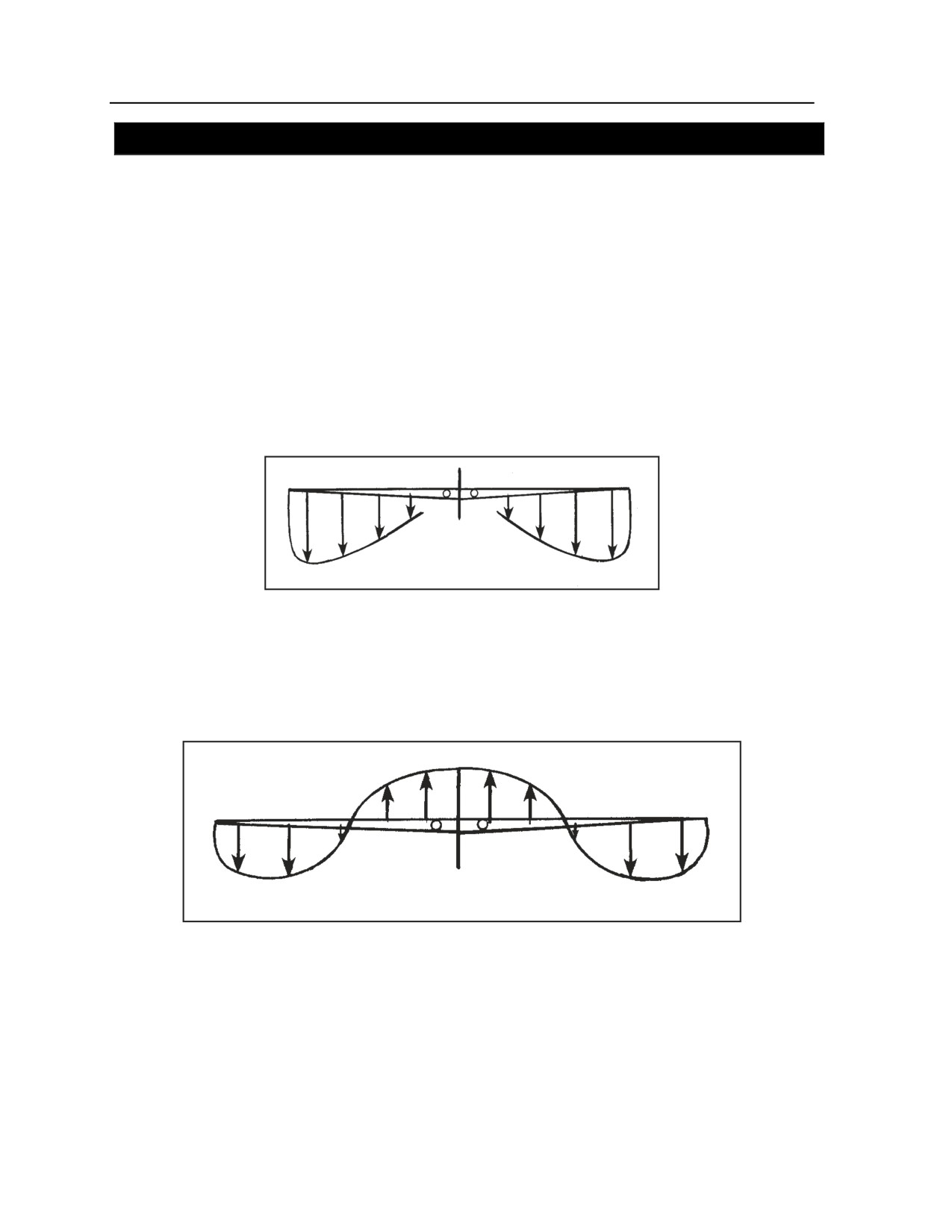
1-193. Figure 1-73 shows normal induced flow velocities along the blade span during hovering flight.
Downward velocity is highest at the blade tip where blade speed is highest. As blade speed decreases
nearer the center of the disk, downward velocity is less.
Figure 1-73. Induced flow velocity during hovering flight
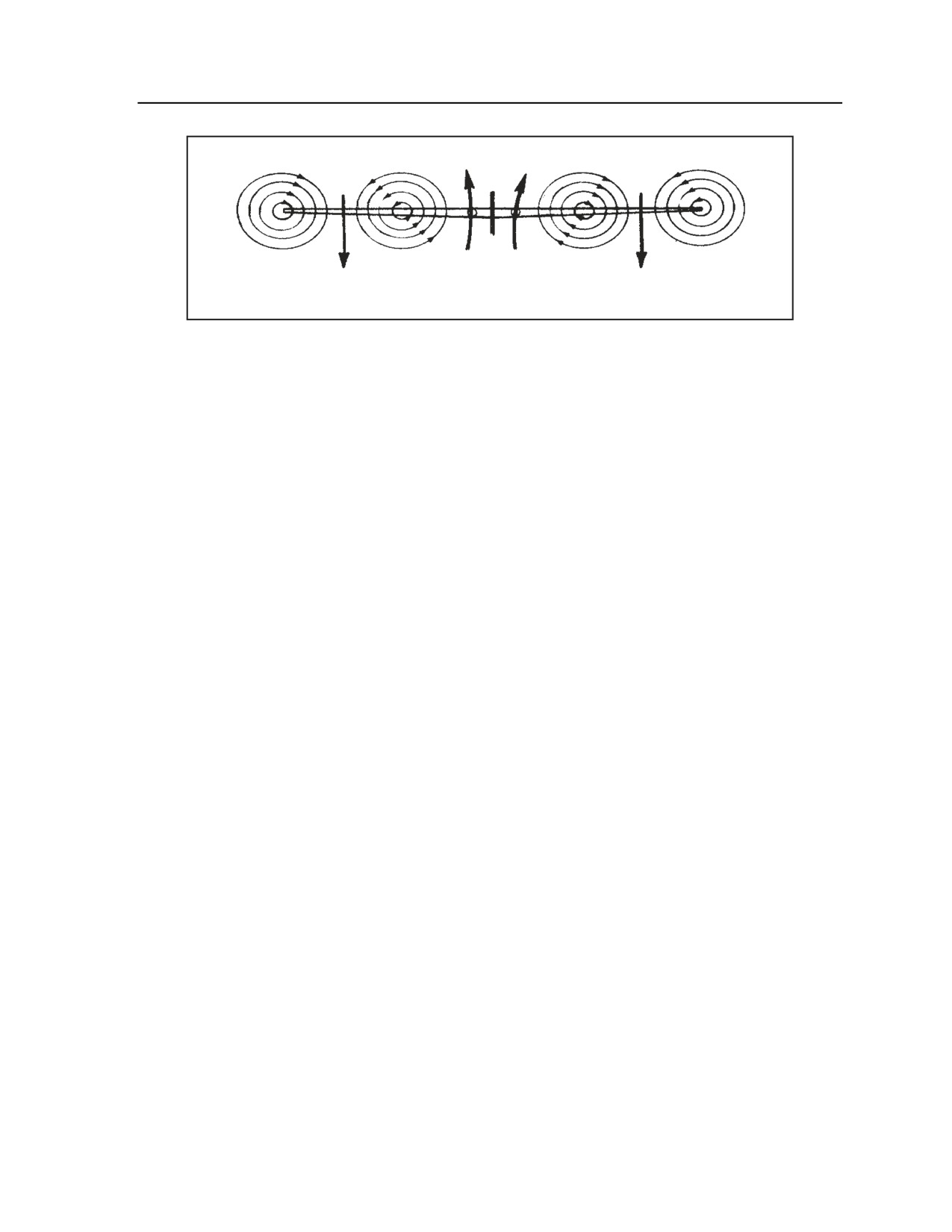
1-194. Figure 1-74 shows the induced airflow velocity pattern along the blade span during a descent
conducive to settling with power. The descent is so rapid, induced flow at the inner portion of the
blades is upward rather than downward. The upflow caused by the descent has overcome the
downflow produced by blade rotation and pitch angle.
Figure 1-74. Induced flow velocity before vortex ring state
1-195. If this rate of descent exists with insufficient power to slow or stop the descent, it will enter the
vortex ring state (figure 1-75). During this vortex ring state, roughness and loss of control occur due to
turbulent rotational flow on the blades and unsteady shifting of the flow along the blade span.
1-66
FM 3-04.203
7 May 2007
Theory of Flight
Figure 1-75. Vortex ring state
1-196. The following conditions must exist simultaneously for settling with power to occur:
A vertical or near-vertical descent of at least 300 feet per minute (FPM). Actual critical rate
depends on gross weight, rotor RPM, density altitude, and other pertinent factors.
Slow forward airspeed (less than ETL).
Rotor system must be using 20 to 100 percent of the available engine power with insufficient
power remaining to arrest the descent. Low rotor RPM could aggravate this.
1-197. The following flight conditions are conducive to settling with power:
Steep approach at a high rate of descent.
Downwind approach.
Formation flight approach
(where settling with power could be caused by turbulence of
preceding aircraft).
Hovering above the maximum hover ceiling.
Not maintaining constant altitude control during an OGE hover.
During masking/unmasking.
1-198. Recovery from settling with power may be affected by one, or a combination, of the following
ways:
During the initial stage (when a large amount of excess power is available), a large application
of collective pitch may arrest rapid descent. If done carelessly or too late, collective increase can
aggravate the situation resulting in more turbulence and an increased rate of descent.
In single-rotor helicopters, aviators can accomplish recovery by applying cyclic to gain airspeed
and arrest upward induced flow of air and/or by lowering the collective (altitude permitting).
Normally, gaining airspeed is the preferred method as less altitude is lost.
In tandem-rotor helicopters, fore and aft cyclic inputs aggravate the situation. By lowering thrust
(altitude permitting) and applying lateral cyclic input or pedal input to arrest this upward
induced flow of air, the aviator can accomplish recovery.
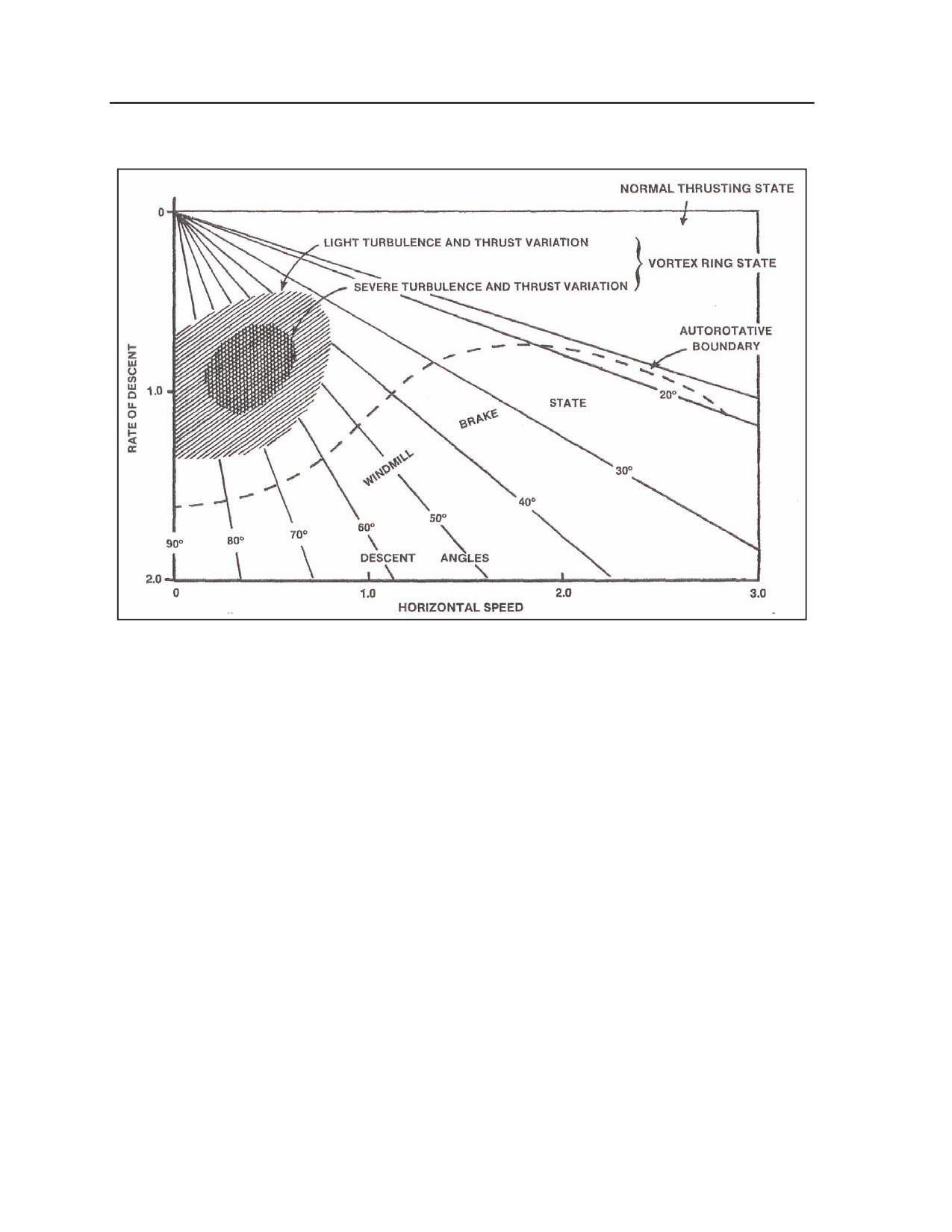
1-199. Several conclusions can be drawn from figure 1-76, page 1-62—
The vortex ring state can be completely avoided by descending on flight paths shallower than
about 30 degrees (at any speed).
For steeper approaches, the vortex ring state can be avoided by using rates of descent versus
horizontal velocity either faster or slower than those passing through the area of severe
turbulence and thrust variation.
At very shallow angles of descent, the vortex ring wake is dispersed behind the helicopter.
Forward airspeed coupled with induced-flow velocity prevents the upflow from materializing on
the rotor system.
At steep angles, the vortex ring wake is below the helicopter at slow rates of descent and above
the helicopter at high rates of descent. Low rates of descent prevent the upflow from exceeding
7 May 2007
FM 3-04.203
1-67
Chapter 1
the induced flow velocities. High rates of descent result in autorotation or the windmill brake
state.
Figure 1-76. Settling with power region
DYNAMIC ROLLOVER
1-200. A helicopter is susceptible to a lateral-rolling tendency called dynamic rollover. Dynamic rollover
can occur on level ground as well as during a slope or crosswind landing and takeoff. Three conditions
are required for dynamic rollover—pivot point, rolling motion, and exceed critical angle.
PIVOT POINT
1-201. Dynamic rollover begins when the helicopter starts to pivot around its skid, wheel, or any portion
of the aircraft in contact with the ground. When this happens, lateral cyclic control response is more
sluggish and less effective than for a free hovering helicopter. This can occur for a variety of reasons
including failure to remove a tiedown or skid securing device, the skid or wheel contacts a fixed object
while hovering sideward, or the gear is stuck in ice, soft asphalt, or mud. Dynamic rollover may also
occur if proper landing or takeoff technique is not used or while performing slope operations. If the
gear or skid becomes a pivot point, dynamic rollover is possible if proper corrective techniques are not
used.
ROLLING MOTION
1-202. The rate of rolling motion is vital. As the roll rate increases, the critical angle is reduced. In a fully
articulated rotor system, all three control inputs (collective, cyclic, and pedals) can contribute to the
rolling motion.
1-68
FM 3-04.203
7 May 2007
Theory of Flight
EXCEED CRITICAL ANGLE
1-203. To understand critical angle we must first discuss static rollover angle. Each helicopter has a static
rollover angle that, if exceeded, will cause the aircraft to rollover. The static angle is based on CG and
pivot point. This angle is described as being the point where the aircraft CG is located over the pivot
point.
1-204. When a rolling motion is present the dynamic rollover angle is introduced and is called the critical
angle. The dynamic angle varies based on the rate of the rolling motion of the helicopter. The greater
the rolling motion the earlier (less bank angle) the critical angle will be exceeded. If the dynamic
rollover angle is exceeded, momentum will carry the helicopter through the static rollover angle,
regardless of corrections by the aviator.
TYPES
1-205. Certain factors influence dynamic rollover including right skid down, left pedal inputs (single-
rotor aircraft), lateral loading (asymmetrical loading), crosswind, and high roll rates. Smooth and
moderate collective inputs are most effective in preventing dynamic rollover as it reduces the rate at
which lift/thrust is applied. A smooth and moderate collective reduction is recommended if the onset
of dynamic rollover is encountered. There are three main rollover types normally encountered—rolling
over on level ground (takeoff), rolling downslope (takeoff or landing) and rolling upslope (takeoff).
Rolling Over on Level Ground
1-206. A rollover condition can occur during takeoff from level ground if one skid or wheel is stuck on
the ground. As collective pitch is increased, the stuck skid or wheel becomes the pivot point which sets
dynamic rollover into motion. A smooth and moderate collective reduction is recommended lowering
the aircraft back to the ground until the stuck skid or wheel is free. Then the aircraft may be picked up
normally.
Rolling Downslope
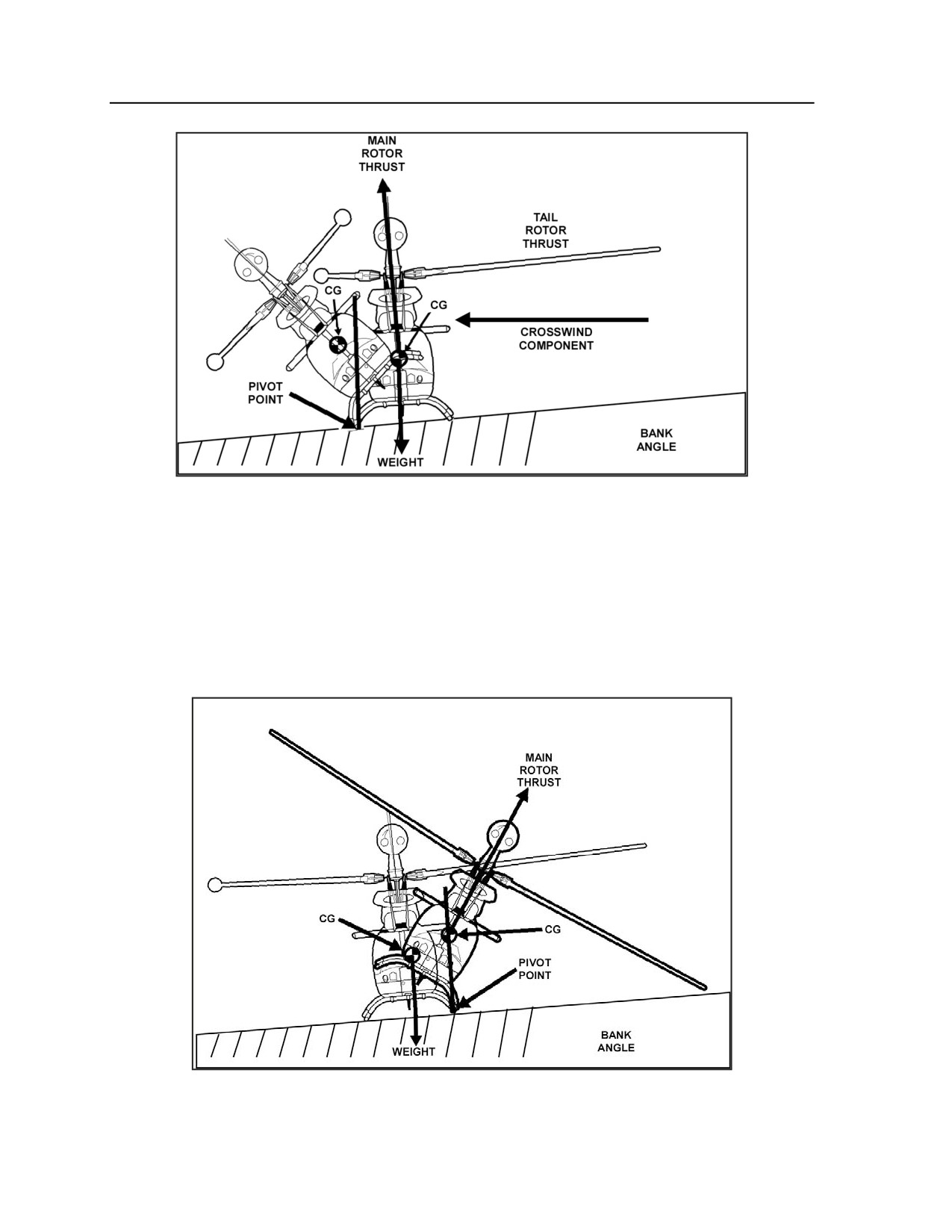
1-207. A downslope rollover during landing (figure 1-77, page 1-64) occurs when the steepness of the
slope causes the helicopter to tilt beyond the lateral cyclic control limits. If the steepness of the slope, a
crosswind component, or CG conditions exceeds lateral cyclic control limits, the mast forces the rotor
to tilt downslope. The resultant rotor vector has a downslope component even with full upslope cyclic
applied. To prevent downslope rollover during landing, the aviator slowly descends vertically until
ground contact with the upslope skid/wheel occurs. At this point, aircrew members can better assess
slope conditions. After stabilizing the helicopter in this position, the aviator smoothly reduces
collective until the downslope skid/wheel contacts the ground or cyclic nears lateral limits. If the
cyclic is near the lateral limit, the aviator must carefully evaluate remaining distance to ensure enough
cyclic travel remains to land without exceeding aircraft limits. If not enough travel remains the aviator
should abort the landing, return the aircraft to a hover, and select an area of lesser slope.
1-208. A downslope rollover during takeoff (figure 1-77, page 1-64) can occur when the aviator lands the
helicopter on too steep a slope, then attempts takeoff. If the upslope skid/wheel begins to rise first, the
aviator should lower the collective to prevent a downslope rollover condition. If, with full cyclic
applied, the resultant lift of the main rotor is not vertical or directed upslope enough to raise the
downslope gear first, and then further takeoff attempts result in the mast causing resultant rotor lift to
move further downslope and cause dynamic rollover. The aviator should consider some adjustments
before making additional takeoff attempts. These adjustments include awaiting different wind
conditions, changing the CG of the helicopter by moving/removing some of the internal load, or
contacting a recovery crew.
7 May 2007
FM 3-04.203
1-69
Chapter 1
Figure 1-77. Downslope rolling motion
Rolling Upslope
1-209. An upslope rollover during takeoff (figure 1-78) occurs when the aviator applies too much cyclic
into the slope to hold the skid/wheel firmly on the slope. If the aviator improperly applies collective,
the helicopter then rapidly pivots upslope around the upslope skid/wheel. To prevent this, the aviator
needs to cautiously apply collective while neutralizing the cyclic. When the cyclic is neutral and
upslope skid/wheel has no side pressure applied, the aviator performs a vertical lift-off to a hover, then
a normal takeoff.
Figure 1-78. Upslope rolling motion
1-70
FM 3-04.203
7 May 2007
Theory of Flight
PREVENTION
1-210. Dynamic rollover usually occurs due to a combination of physical and human factors. Physical
factors considered in the prevention of dynamic rollover include main rotor thrust, CG, tail-rotor
thrust, crosswind component, ground surface, sloped landing area, and in some aircraft, presence of a
low fuel condition which might cause the CG to move upward. The aviator can prevent dynamic
rollover by avoiding the physical factors causing it; however, human factors can interfere in the
avoidance process. Human factors considered in the prevention of dynamic rollover include—
Inattention. Dynamic rollover is more likely if the aviator at the controls is inattentive to
aircraft position and attitude when lifting off or touching down to the ground, effectively losing
situational awareness (SA).
Inexperience. Most dynamic rollover accidents occur while inexperienced aviators are at the
controls. The pilot in command (PC) must remain vigilant.
Failure to take timely corrective action. Timely action must be exercised before a roll rate
develops.
Inappropriate control input. Applying inappropriate or incorrect control input is the root
cause of nearly all dynamic rollovers. If the aviator applies appropriate control input smoothly
and carefully, dynamic rollover is avoidable.
Loss of visual reference. Loss of visual reference may allow the aircraft to drift unnoticed by
the crew. If the aircraft contacts the ground while drifting sideward, rollover can occur.
Therefore, if visual reference is lost while the aircraft nears the ground, the aviator should
execute a takeoff or go-around using instrument techniques if necessary.
COMMON ERRORS
1-211. The following are examples of common errors:
Aviator fails to detect the aircraft’s lateral motion across the ground before landing.
Aviator makes abrupt cyclic displacements (with or without thrust) in fully articulated rotor
systems.
Aviator makes large and/or uncoordinated antitorque pedal inputs.
Aviator performs slope landing/takeoff maneuvers while using rapidly increasing or decreasing
collective control applications.
RETREATING BLADE STALL
1-212. The retreating blade of a helicopter will eventually stall in forward flight (figures 1-79 through 1-
81). As the stall of an airplane wing limits the low speed of a FW aircraft, the stall of a rotor blade
limits the high speed of a rotary-wing aircraft. In forward flight, decreasing velocity of airflow on the
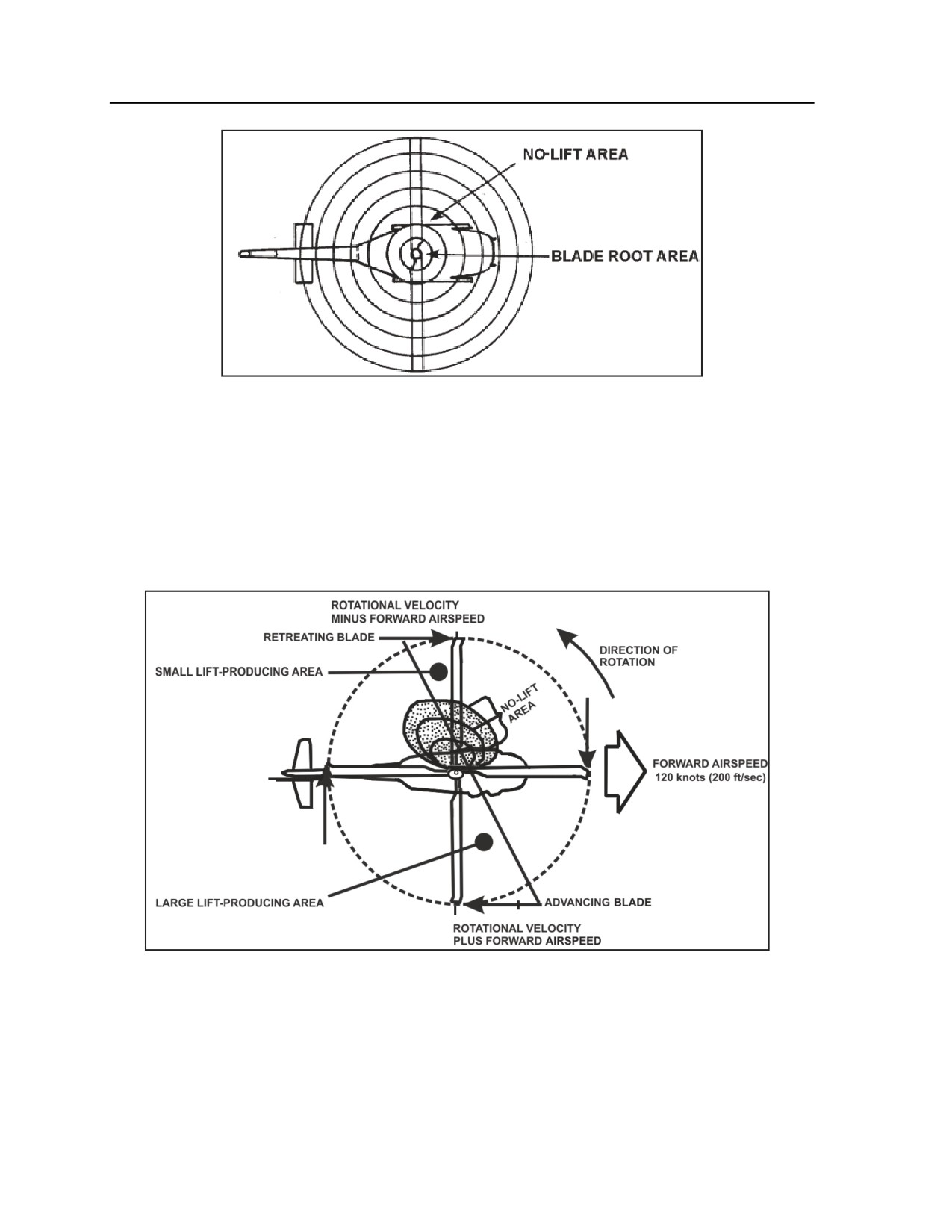
retreating blade demands a higher AOA to generate the same lift as the advancing blade. Figure 1-79,
page 1-66, illustrates the lift pattern at a normal hover with distribution/production of lift evenly
spread throughout the rotor disk.
7 May 2007
FM 3-04.203
1-71
Chapter 1
Figure 1-79. Retreating blade stall (normal hovering lift pattern)
1-213. Figure 1-80 illustrates the normal cruise lift pattern where the smaller area of the retreating blade,
with its high angles of attack, must still produce an amount of lift equal to the larger area of the
advancing blade with its lower angles of attack. This figure shows the advancing blade producing lift
throughout its span while the retreating blade is producing lift in only part of its span due to effects of
forward airspeed. When forward speed increases, the no-lift areas of the retreating blade grow larger,
placing an even greater demand for production of lift on a progressively smaller section of the
retreating blade. This smaller section of blade demands a higher AOA until the tip of the blade (area of
the highest AOA) stalls.
Figure 1-80. Retreating blade stall (normal cruise lift pattern)
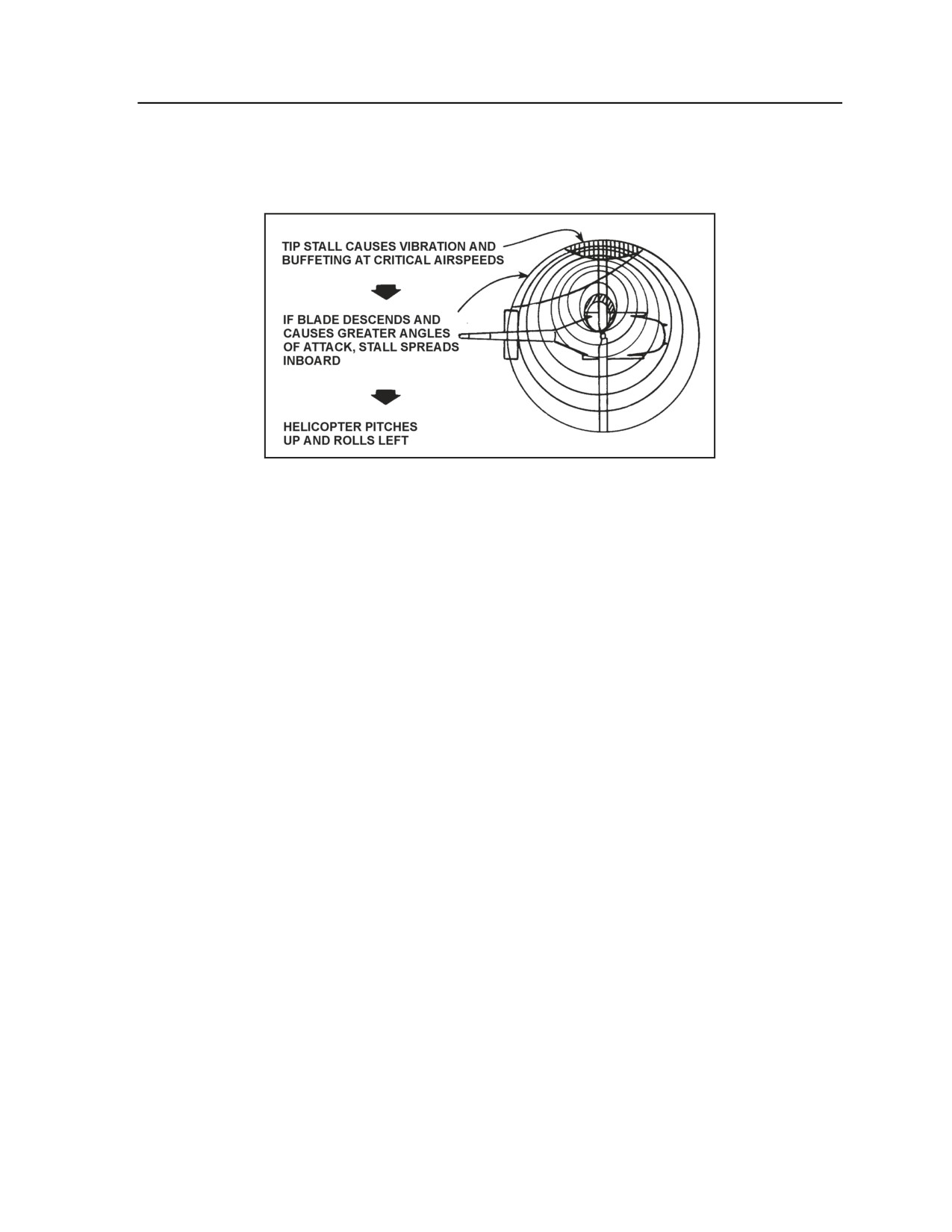
1-214. Figure 1-81, page 1-67, illustrates the same disk at a critical airspeed with the retreating blade
producing less than sufficient lift due to the no-lift area growing larger and effects of tip stall. Tip stall
causes vibration and buffeting which spread inboard and aggravate the situation while the aircraft may
roll left and nose pitches up. While this may be subtle, it will worsen if aft cyclic is not applied or
collective is reduced (altitude permitting). The effects of retreating blade stall in a tandem-rotor
helicopter create a different response. With the forward and aft rotor systems turning in opposite
1-72
FM 3-04.203
7 May 2007
Theory of Flight
directions, effects of retreating blade stall on the separate rotors tend to counteract themselves. The
pitch-up of the nose will be insignificant. Blade stall will probably occur on the aft system first as it
operates in the turbulent wake of the forward rotor system. The most likely effect will be an increasing
vibration which is easily reduced by slowing down and reducing collective pitch (thrust).
Figure 1-81. Retreating blade stall (lift pattern at critical airspeed-retreating blade stall)
CONDITIONS PRODUCING BLADE STALL
1-215. In operations at high forward speeds, the following conditions are most likely to produce blade
stall in either single- or tandem-rotor helicopters—
High blade loading (high gross weight).
Low rotor RPM.
High- density altitude.
High G-maneuvers.
Turbulent air.
RECOVERING FROM BLADE STALL
1-216. The following steps enable the aviator to recover from retreating blade stall—
Reduce collective.
Reduce airspeed.
Descend to a lower altitude (if possible).
Increase rotor RPM to normal limits.
Reduce the severity of the maneuver.
GROUND RESONANCE
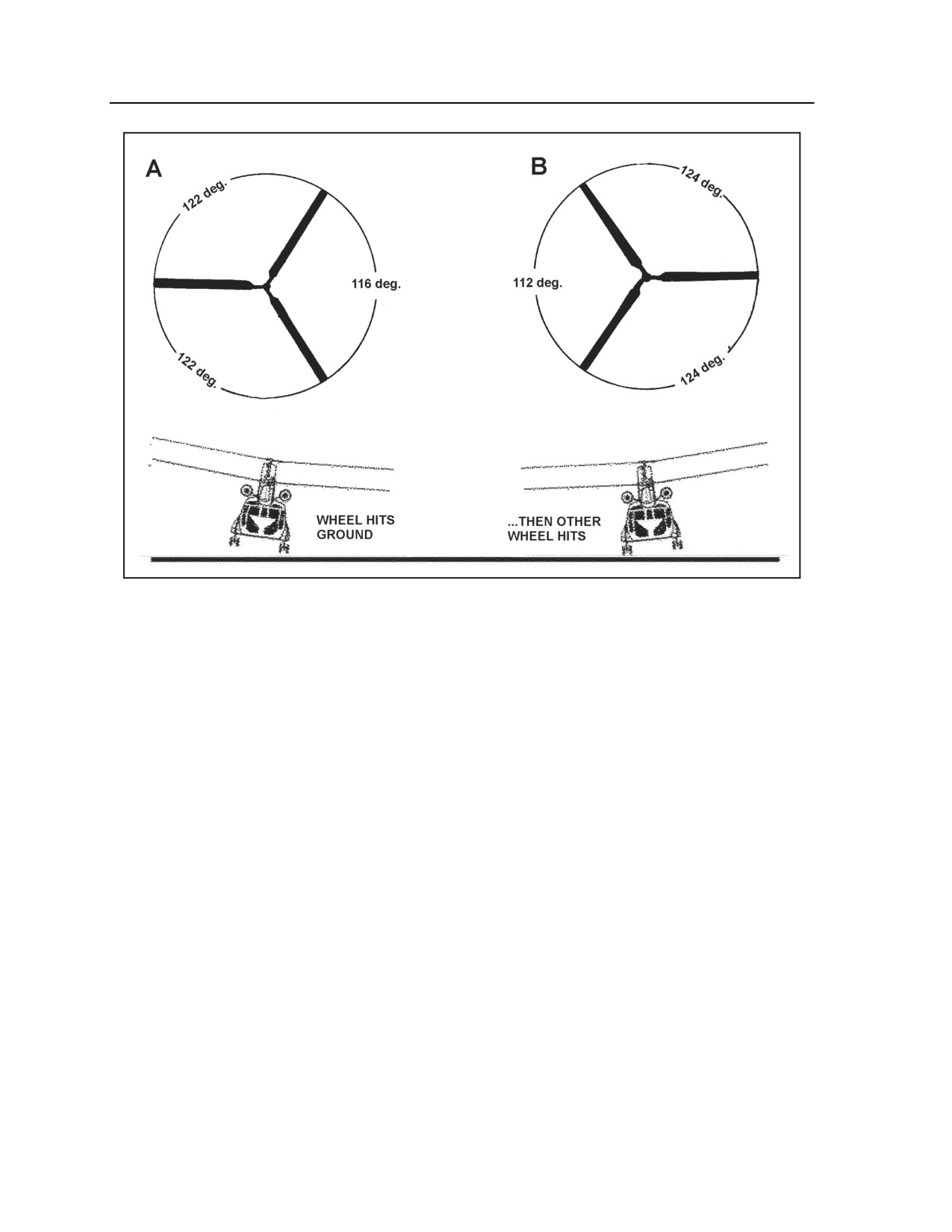
1-217. Ground resonance may develop in helicopters having fully articulated rotor systems when a series
of shocks causes the rotor blades in the system to become positioned in unbalanced displacement. If
this oscillating condition progresses, it can be self-energizing and extremely dangerous. It can easily
cause structural failure. It is most common to three-blade helicopters with landing wheels. The rotor
blades in a three-blade system are equally spaced (120 degrees), but are constructed to allow some
horizontal lead and lag action. Ground resonance occurs when the helicopter contacts the ground
during landing or takeoff (figure 1-82, page 1-68). If one wheel of the helicopter strikes the ground
ahead of the others, a shock is transmitted through the fuselage to the rotor. Another shock is
transmitted when the next wheel hits (figure 1-82).
7 May 2007
FM 3-04.203
1-73
Chapter 1
Figure 1-82. Ground resonance
The first shock causes the blades straddling the contact point to jolt out of angular balance. If repeated by
the next contact, resonance is established setting up a self-energizing oscillation of the fuselage. Severity of
the oscillation increases rapidly. The helicopter can quickly disintegrate without immediate corrective
action. Corrective action may consist of an immediate takeoff to a hover or a change in rotor RPM to
alleviate the condition and disrupt the pattern of oscillation. In the event takeoff is not an option, all
personnel should remain in the aircraft until main rotors have stopped. Ground resonance usually occurs
when the aircraft is nearly airborne (80 to 90 percent hover power applied).
1-218. The following conditions can cause ground resonance—
Defective drag dampers allowing excessive lead and lag and creating angular unbalance.
Improperly serviced or defective landing-gear struts.
Hard landings on one skid or wheel.
Ground taxiing over rough terrain.
Hesitant or bouncing landings.
COMPRESSIBILITY EFFECTS
COMPRESSIBLE AND INCOMPRESSIBLE FLOW
1-219. At low airspeeds, air is incompressible. Incompressible airflow is similar to the flow of water,
hydraulic fluid, or any other incompressible fluid. At low speeds, air experiences relatively small
changes in pressure with little change in density. However, at high speeds greater pressure changes
occur causing compression of air which results in significant changes to air density. This compressible
flow occurs when there is a transonic or supersonic flow of air across the airfoil. Because helicopters
are being flown at increasingly higher speeds, aviators must learn more about coping with effects of
compressible flow.
1-74
FM 3-04.203
7 May 2007
Theory of Flight
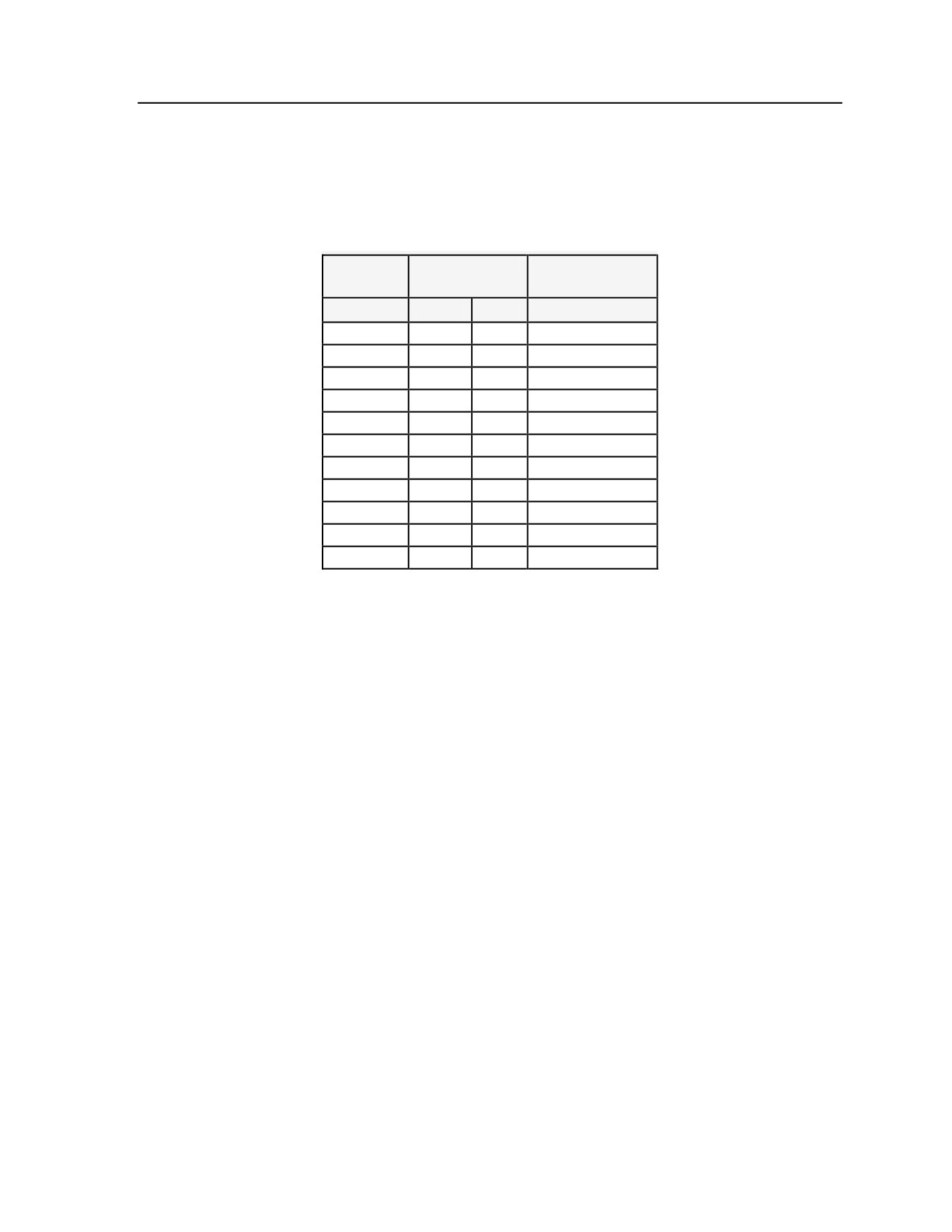
1-220. The major factor in high-speed airflow is the speed of sound. Speed of sound is the rate at which
small pressure disturbances move through the air. This propagation speed is solely a function of air
temperature. Table 1-4 shows the variation of speed of sound with temperature at various altitudes in
the standard atmosphere.
Table 1-4. Speed of sound variation with temperature and altitude
Altitude
Temperature
Speed of
Sound
Feet
ºF
ºC
Knots
Sea Level
59.0
15.0
661.7
5,000
41.2
5.1
650.3
10,000
23.3
-4.8
638.6
15,000
5.5
-14.7
626.7
20,000
-12.3
-24.6
614.6
25,000
-30.2
-34.5
602.2
30,000
-48.0
-44.4
589.6
35,000
-65.8
-54.3
576.6
40,000
-69.7
-56.5
573.8
50,000
-69.7
-56.5
573.8
60,000
-69.7
-56.5
573.8
1-221. Compressibility effects are not limited to blade speeds at and above the speed of sound. The
aerodynamic shape of an airfoil causes local flow velocities greater than blade speed. Thus a blade can
experience compressibility effects at speeds well below the speed of sound because both subsonic and
supersonic flows can exist on a blade.
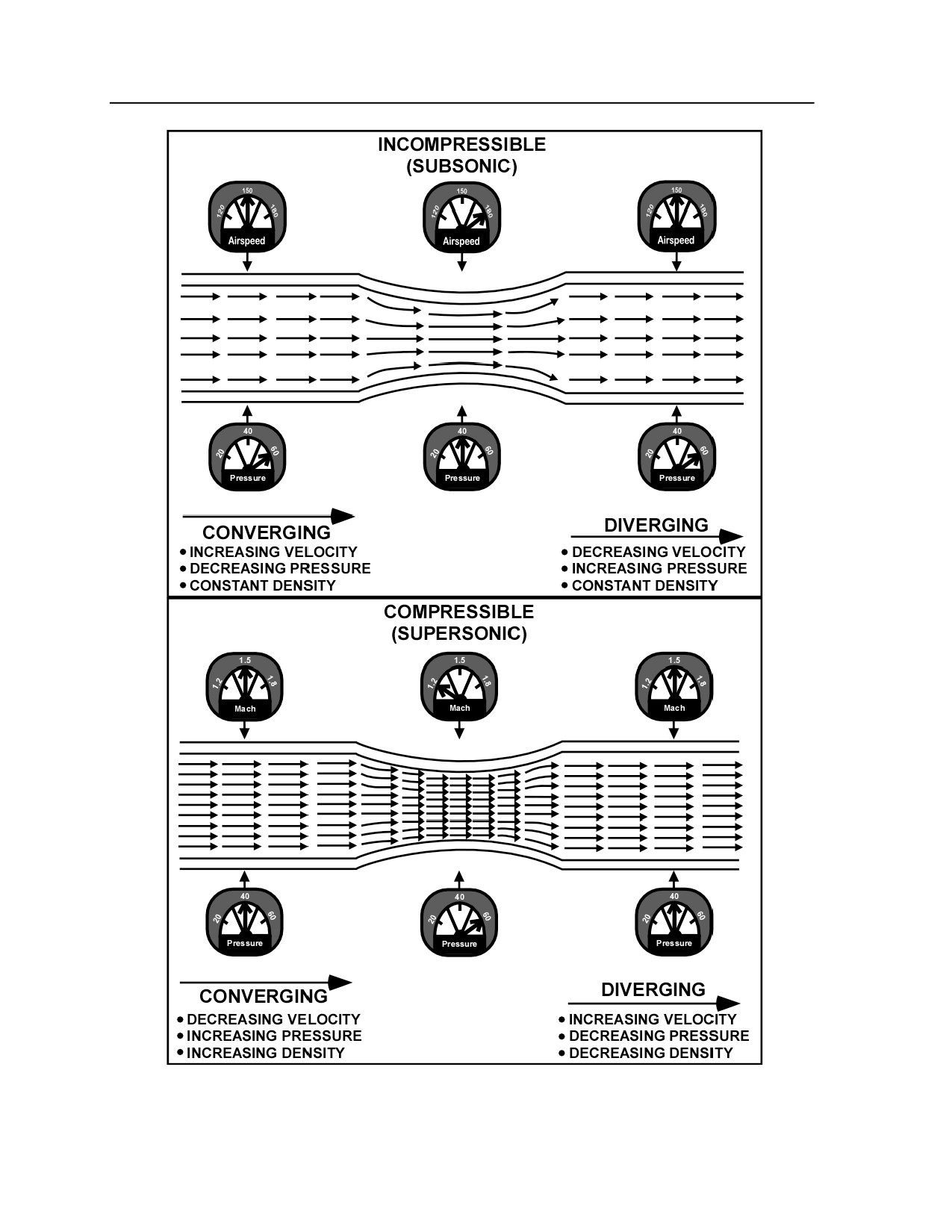
1-222. Differences between subsonic and supersonic flow are due to compressibility of supersonic flow.
Figure 1-83, page 1-70, compares incompressible and compressible flow through a closed tube. In this
example, the mass flow along the tube is constant.
Subsonic Incompressible Flow
1-223. The example of subsonic incompressible flow is simplified because density of flow is constant
throughout the tube. As the flow approaches a constriction and streamlines converge, velocity
increases as static pressure decreases. A convergence of the tube requires an increasing velocity to
accommodate the continuity of flow. Also, as the subsonic incompressible flow enters a diverging
section of the tube, velocity decreases and static pressure increases; density remains unchanged.
Supersonic Compressible Flow
1-224. The example of supersonic compressible flow is complicated because variations of flow density
are related to changes in velocity and static pressure. The behavior of supersonic compressible flow is
a convergence causing compression; a divergence causes expansion. Therefore, as the supersonic
compressible flow approaches a constriction and streamlines converge, velocity decreases and static
pressure increases. Continuity of mass flow is maintained by the increase in flow density
accompanying the decrease in velocity. As the supersonic compressible flow enters a diverging section
of the tube, velocity increases and static pressure decreases; density decreases to accommodate the
condition of continuity.
7 May 2007
FM 3-04.203
1-75
Chapter 1
Figure 1-83. Compressible and incompressible flow comparison
1-76
FM 3-04.203
7 May 2007
Theory of Flight
TRANSONIC FLOW PATTERNS
1-225. In subsonic flight, an airfoil producing lift has local velocities on the surface greater than the free
stream velocity. Compressibility effects can then be expected to occur at flight speeds less than the
speed of sound. Mixed subsonic and supersonic flow may be encountered in the transonic regime of
flight. The first significant effects of compressibility occur in this regime. Compressibility effects on
the helicopter increase the power required to maintain rotor RPM and cause rotor roughness, vibration,
cyclic shake, and an undesirable structural twisting of the blade.
1-226. Critical Mach number is the highest blade speed without supersonic airflow. As the critical Mach
number is exceeded, an area of supersonic airflow is created. A normal shock wave then forms the
boundary between supersonic and subsonic flow on the aft portion of the airfoil surface. The
acceleration of airflow from subsonic to supersonic is smooth and without shock waves if the surface
is smooth and transition gradual. However, transition of airflow from supersonic to subsonic is always
accompanied by a shock wave. When airflow direction does not change, the wave formed is a normal
shock wave.
1-227. The normal shock wave is detached from the leading edge of the airfoil and perpendicular to the
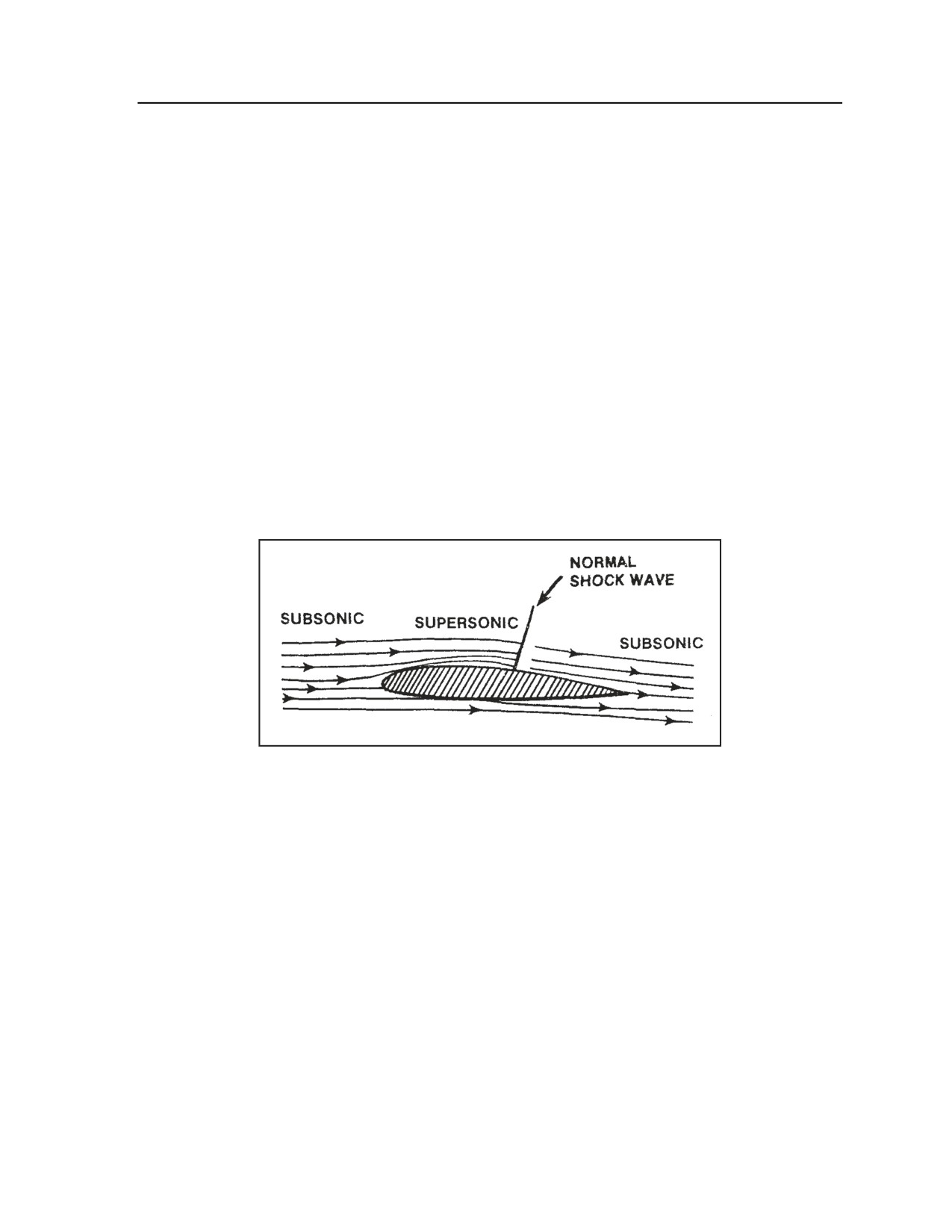
upstream flow. The flow immediately behind the wave is subsonic. Figure 1-84 illustrates how an
airfoil at high subsonic speeds has local supersonic flow velocities. As the local supersonic flow
moves aft, a normal shock wave forms slowing the flow to subsonic. As supersonic air passes through
shock wave, air density increases, heat is created, velocity of the air decreases, static pressure
increases, and boundary layer separation may occur.
Figure 1-84. Normal shock wave formation
1-228. As the shock waves move toward the trailing edge of the airfoil, the aerodynamic center begins to
move away from its normal location of 25 percent chord. By the time the shock wave has reached the
trailing edge of the airfoil, the aerodynamic center has retreated to the 50 percent chord. This causes
the leading edge of the airfoil to be deflected down, which may result in structural failure of the blade
(skin deformation or separation).
1-229. Because speed of the helicopter is added to the speed of rotation of the advancing blade, the
highest relative velocities occur at the tip of the advancing blade. When the Mach number of the
advancing blade tip section exceeds the critical Mach number for the rotor blade section,
compressibility effects result. The critical Mach number is the free stream Mach number producing the
first evidence of local sonic flow. The principal effects of compressibility are large increase in drag
and rearward shift of the airfoil aerodynamic center.
ADVERSE COMPRESSIBILITY CONDITIONS
1-230. The following operating conditions represent the most adverse compressibility conditions—
High airspeed.
7 May 2007
FM 3-04.203
1-77
Chapter 1
High rotor RPM.
High gross weight.
High- density altitude.
High G-maneuvers.
Low temperature. Speed of sound is proportional to the square root of the absolute temperature;
therefore, the aviator more easily obtains sonic velocity at low temperatures.
Turbulent air. Sharp gusts momentarily increase the blade AOA and thus, lower the critical
Mach number to the point where compressibility effects may be encountered on the blade.
CORRECTIVE ACTIONS
1-231. Corrective actions are any actions decreasing AOA or velocity of airflow that help the situation.
There are similarities in the critical conditions for compressibility and retreating blade stall, with
notable exceptions—compressibility occurs at high rotor RPM, and retreating blade stall occurs at low
rotor RPM. With the exception of RPM control, the recovery technique is identical for both. Such
techniques include decreasing—
Blade pitch by lowering collective, if possible.
Rotor RPM.
Severity of maneuver.
Airspeed.
1-78
FM 3-04.203
7 May 2007
Chapter 2
Weight, Balance, and Loads
Flight characteristics of aircraft are directly dependent upon conditions of weight and
balance. Gross weight and CG have bearing on performance, stability, and control of
the aircraft. Hazardous flight conditions and accidents can be prevented by adherence
to the principles of weight and balance set forth in this manual.
SECTION I - WEIGHT
2-1. Weight is one of the most important factors
considered from the time the aircraft is designed
Contents
until it is removed from service. It is of prime
importance to the manufacturer through all phases
Section I - Weight
2-1
of production and must remain foremost in the
Section II - Balance
2-2
pilot's mind when planning and performing
missions. Changes in basic aircraft design weight,
Section III - Weight and Balance
either in initial production or subsequent
Calculations
2-5
modifications by maintenance activities, have direct
Section IV - Loads
2-8
bearing on aircraft performance. Cargo/troop
loading and aircraft gross weight must be examined closely by the pilot as these factors may determine the
safety and success of a mission. Gross weight limitations have been established and are in applicable
operator's manuals.
WEIGHT DEFINITIONS
EMPTY WEIGHT
2-2. Empty weight is used for design purposes and usually does not affect service activities. Empty
weight includes aircraft structure weight plus-communications, control, electrical, hydraulic, instrument,
and power plant systems; furnishings; anti-icing equipment; auxiliary power plant; flotation landing gear;
and armament, anchor, and towing provisions.
BASIC WEIGHT
2-3. Basic weight of an aircraft is weight including all hydraulic and oil systems full, trapped and
unusable fuel, and all fixed equipment. From basic weight total, it is only necessary to add crew, fuel,
cargo, and ammunition (if carried) when determining the aircraft’s gross weight. Basic weight varies with
structural modifications and changes of fixed aircraft equipment.
OPERATING WEIGHT
2-4. Operating weight includes basic weight plus aircrew, aircrew's baggage, emergency gear, and other
equipment required. Operating weight does not include weight of fuel, ammunition, bombs, cargo, or
external auxiliary fuel tanks if such tanks are to be disposed of during flight.
7 May 2007
FM 3-04.203
2-1
Chapter 2
GROSS WEIGHT
2-5. Gross weight is total weight of an aircraft and its contents.
TAKEOFF GROSS WEIGHT
2-6. Takeoff gross weight includes operating weight plus fuel, cargo, ammunition, bombs, auxiliary fuel
tanks, and other material carried.
LANDING GROSS WEIGHT
2-7. Landing gross weight is takeoff gross weight minus items expended during flight.
USEFUL LOAD
2-8. Useful load is the difference between empty and gross weight and includes fuel, oil, crew,
passengers, cargo, and other material carried.
TOTAL AIRCRAFT WEIGHT
2-9. Total aircraft weight includes the sum of operating weight and weight of takeoff fuel.
WEIGHT VERSUS AIRCRAFT PERFORMANCE
2-10. Specific weight limitations of an aircraft cannot be exceeded without compromising safety.
Overloading an aircraft may cause structural failure or result in reduced engine and airframe life. An
increase in gross weight affects the aircraft’s performance as follows:
Increases takeoff distance.
Reduces hover performance.
Reduces rate of climb.
Reduces cruising speed.
Increases stalling speed (FW).
Decreases retreating blade stall speed (rotary-wing).
Reduces maneuverability.
Reduces ceiling.
Reduces range.
Increases landing distances.
Promotes instability.
SECTION II - BALANCE
2-11. Balance is of primary importance to aircraft stability. The CG is the point about which an aircraft
would balance if it were possible to support the aircraft at that point. An aircraft should never be flown if
the pilot is not satisfied with its loading and balance condition.
CENTER OF GRAVITY
2-12. The CG is defined as the theoretical point where all the aircraft’s weight is considered to be
concentrated. If an aircraft is suspended by a cable attached to the CG point, it balances like a teeter-totter.
For aircraft with a single main rotor, the CG is usually close to the main rotor mast. The CG is not
necessarily a fixed point; its location depends on distribution of items loaded in the aircraft. As variable
load items are shifted or expended, there is a resultant shift in CG location. If mass center of an aircraft is
displaced too far forward on the longitudinal axis, a nose heavy condition results. Conversely, if mass
center is displaced too far aft on the longitudinal axis, a tail heavy condition results. An unfavorable
2-2
FM 3-04.203
7 May 2007
Weight, Balance, and Loads
location of the CG could possibly produce such an unstable condition that the pilot could lose control of
the aircraft.
LATERAL BALANCE
2-13. Location of the CG with reference to the lateral axis is important. The design of an aircraft is such
that symmetry is assumed to exist about a vertical plane through the longitudinal axis. This means for each
item of weight existing to the left of the fuselage centerline there is generally an equal weight existing at a
corresponding location on the right. Lateral mass symmetry, however, may be easily upset due to
unbalanced lateral loading. Location of the lateral CG is not only important from the aspect of loading
rotary-wing aircraft, but is also extremely important when considering FW exterior drop loads. The
position of the lateral CG is not computed, but the crew must be aware adverse effects will arise as a result
of a laterally unbalanced condition.
BALANCE DEFINITIONS
2-14. Definitions of the more important terms pertaining to balance and its relationship to aircraft weight
distribution are as follows.
ARM
2-15. The arm is the horizontal distance from the datum to any component of the aircraft or any object
located within the aircraft. Another term used interchangeably with arm is station. If the component or
object is located rear of the datum, it is measured as a positive number and usually referred to as inches aft
the datum. Conversely, if the component or object is located forward of the datum, it is indicated as a
negative number and usually referred to as inches forward the datum.
MOMENT
2-16. If the weight of an object is multiplied by its arm the result is known as its moment. Moment is a
force resulting from an object’s weight acting at a distance. Moment is also referred to as tendency of an
object to rotate or pivot about a point. The farther an object is from a pivotal point, the greater its force.
REFERENCE DATUM
2-17. Reference datum is an imaginary plane perpendicular to the longitudinal axis of the aircraft and is
usually located at or near the nose of the aircraft to eliminate arms with a minus value. If a negative arm is
encountered, the corresponding moment will also be negative. Simplified moment is one which has been
reduced in magnitude through division by a constant. For example, 3,201 inch pounds/1,000 is the
simplified expression of 3,200,893 divided by 1,000 and rounded to the nearest whole number.
2-18. The advantage of simplification is seen in application when a column of moments is added.
Inaccuracies resulting from rounding figures to the nearest whole number tend to cancel.
AIRCRAFT STATION
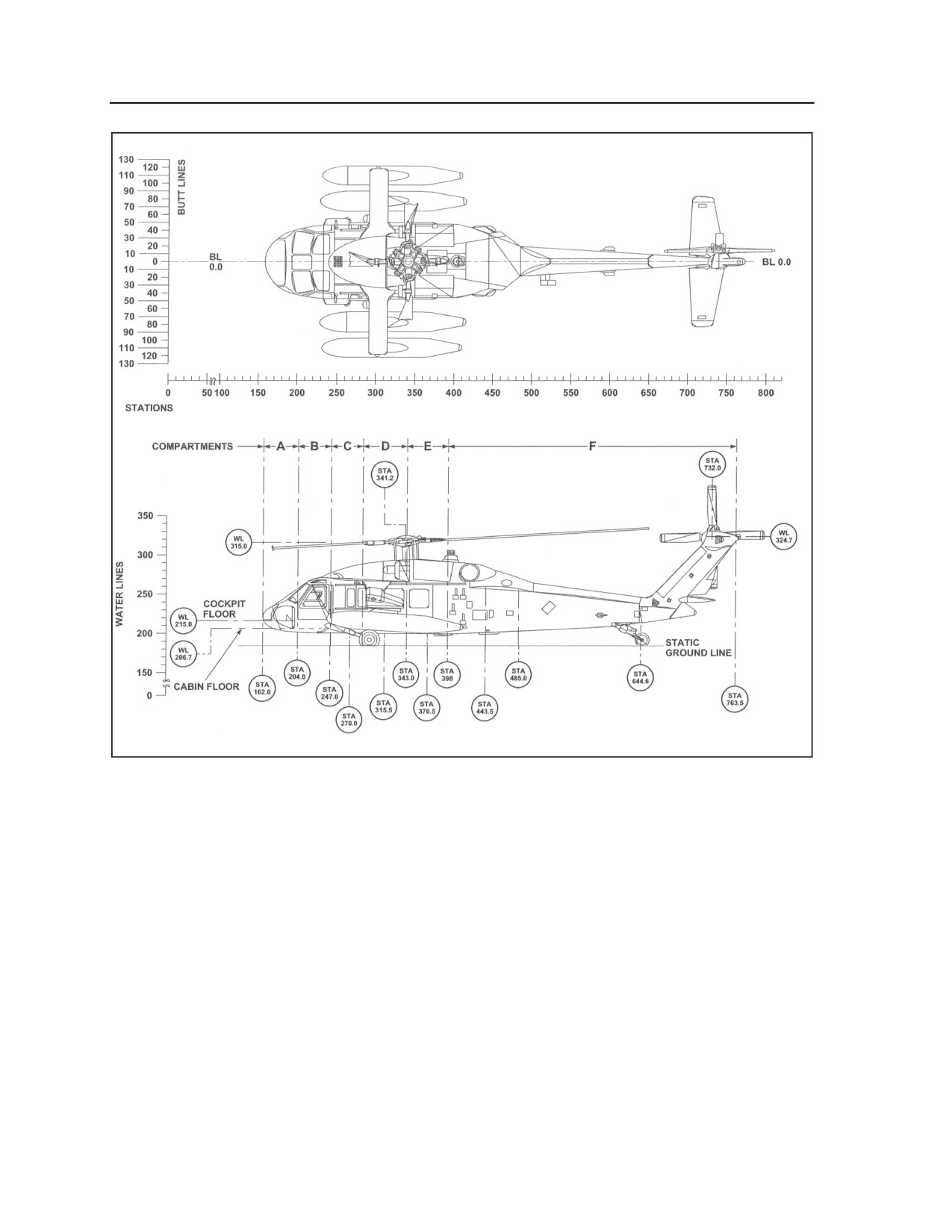
2-19. An aircraft station is a position defined by a plane perpendicular to the longitudinal aircraft axis. The
number designation of this station signifies its distance from the reference datum. A station forward of the
reference datum is negative, while a station aft of the reference datum is positive. Figure 2-1, page 2-4,
illustrates location of stations.
7 May 2007
FM 3-04.203
2-3
Chapter 2
Figure 2-1. Helicopter station diagram
GROSS WEIGHT MOMENT
2-20. Gross weight moment is the sum of moments of all items making up the aircraft in the gross weight
condition. Gross weight moment is the product of gross weight multiplied by gross weight arm.
BASIC ARM
2-21. Basic arm is the distance from the reference datum to the aircraft’s CG in basic condition. It is
obtained by dividing basic moment by basic weight.
GROSS WEIGHT ARM
2-22. Gross weight arm is the distance from reference datum to the aircraft CG in gross weight condition.
2-4
FM 3-04.203
7 May 2007
Weight, Balance, and Loads
Gross Weight Army
Gross weight arm (in) = Gross weight moments (in lb) divided by gross weight (lb)
PRINCIPLE OF MOMENTS
2-23. To understand balance, a working knowledge of the principle of moments is necessary. To calculate
a moment, force (or weight) and distance must be known. The distance is measured from some desired
known point (reference point or reference datum) to the point through which the force acts. A moment is
meaningless unless the reference point about which the moment was calculated is specified.
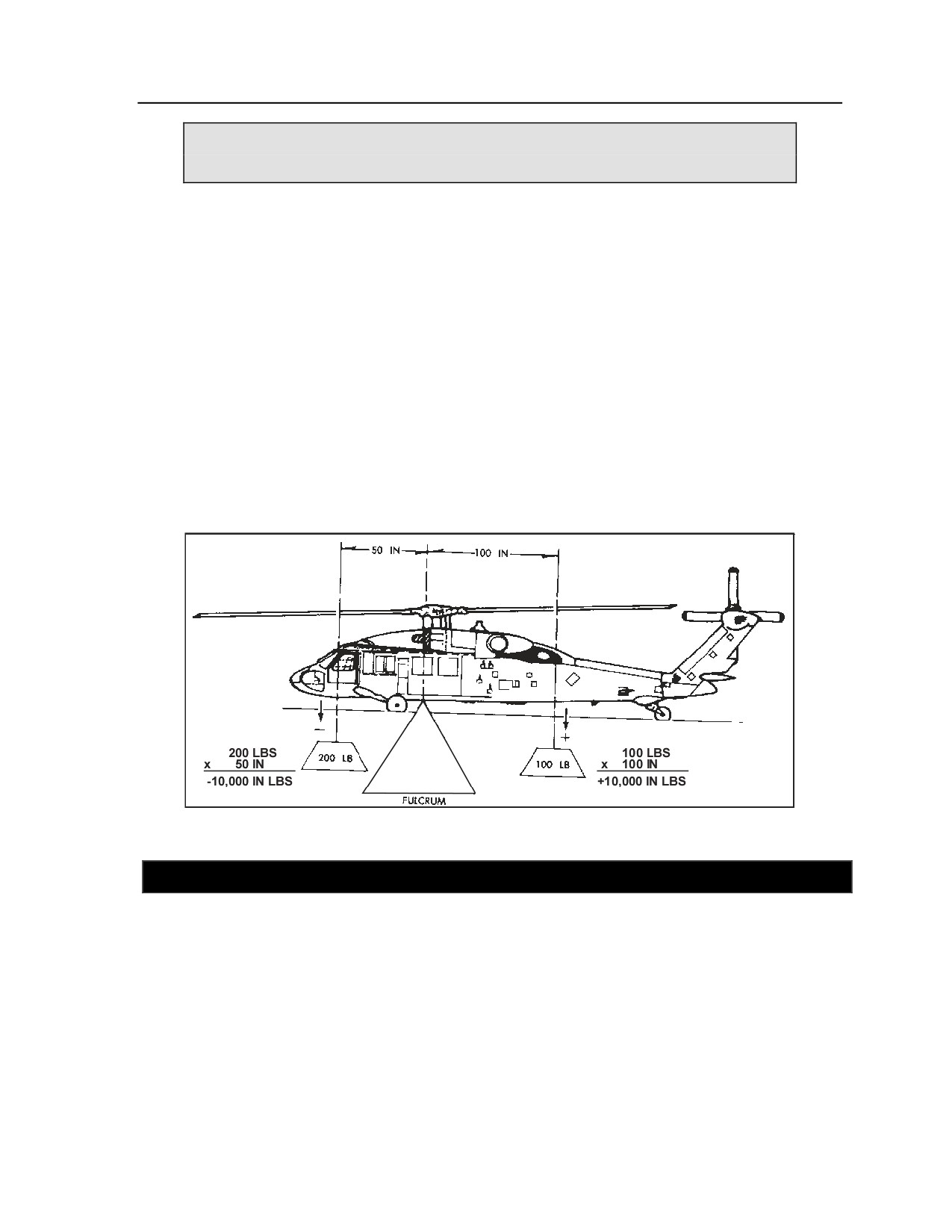
2-24. For the purpose of illustration, an aircraft may be compared to a seesaw with the sum of the moments
on each side of the balance point or fulcrum equal in magnitude (figure 2-2). The moment produced about
the fulcrum by the 200-pound weight is 200 pounds x -50 inches = -10,000 inch pounds counterclockwise.
The moment produced about the same reference point by the 100-pound weight is 100 pounds x 100 inches
= 10,000 inch pounds clockwise. In this case, the clockwise moment counterbalances the counterclockwise
moment and the system is in equilibrium. This example illustrates the principle of moments for a system to
be in static equilibrium, the sum of the moments about any point must equal zero.
2-25. The clockwise moment is arbitrarily given a positive sign while the counterclockwise moment is
given a negative sign. In determining balance of an aircraft, the fulcrum or CG is the unknown and must be
determined.
Figure 2-2. Aircraft balance point
SECTION III - WEIGHT AND BALANCE CALCULATIONS
2-26. When determining whether an aircraft is properly loaded, crews must answer two questions—
Is gross weight less than or equal to maximum allowable gross weight?
Is the CG within the allowable range and will it stay within that range as fuel is burned off?
2-27. To answer the first question, add the weight of the items comprising the useful load
(pilot,
passengers, fuel, oil [if applicable] cargo, and baggage) to the aircraft’s basic empty weight to determine
total weight does not exceed maximum allowable gross weight.
2-28. To answer the second question, use CG or moment information from loading charts, tables, or graphs
in the operator’s manual. Then, using one of the methods described below, calculate loaded moment and/or
loaded CG and verify it falls within allowable CG range.
7 May 2007
FM 3-04.203
2-5
Chapter 2
CENTER OF GRAVITY COMPUTATION
2-29. By totaling the weights and moments of all components and objects carried, crews can determine the
point where a loaded aircraft will balance. This point is known as the CG.
WEIGHT AND BALANCE METHODS
2-30. Since weight and balance are critical to safe operation of an aircraft, it is important to know how to
check this condition for each loading arrangement. Most aircraft manufacturers use one of two methods, or
a combination of these methods, to check weight and balance conditions.
Computational Method
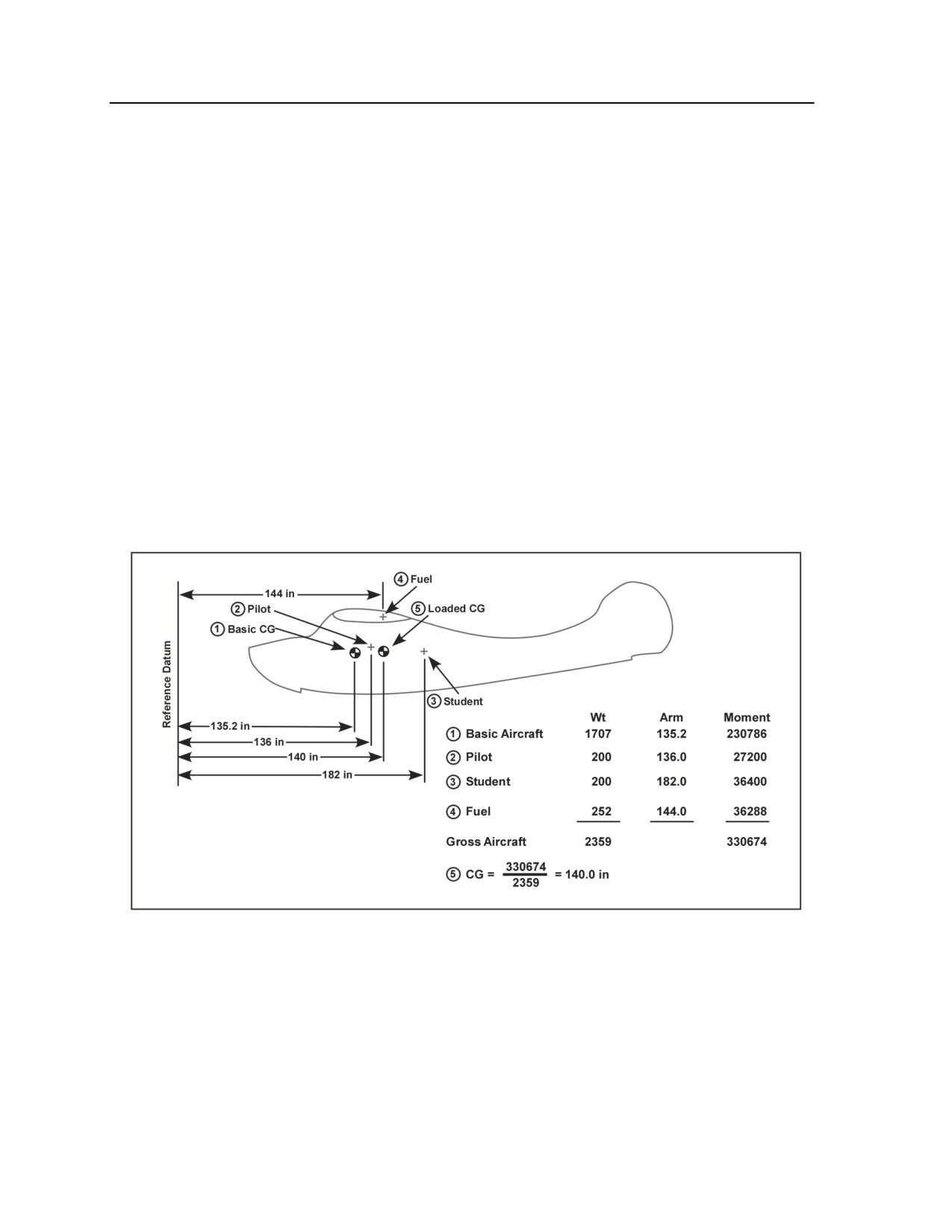
2-31. To determine CG (figure 2-3) location of a loaded aircraft—
Obtain the aircraft’s basic weight and moment from Department of Defense (DD) Form 365-3
(Chart C-Basic Weight and Balance Record) and DD Form 365-4 (Weight and Balance
Clearance Form F-Transport/Tactical).
Obtain gross weight by adding the weight of the items being loaded to the aircraft’s basic
weight.
Compute the moment of each load item by multiplying its weight by its arm.
Find gross weight moment by adding the basic aircraft moment and moments of the load items.
Determine the CG location by dividing gross weight moment by gross weight.
Figure 2-3. Locating aircraft center of gravity
Loading Chart Method
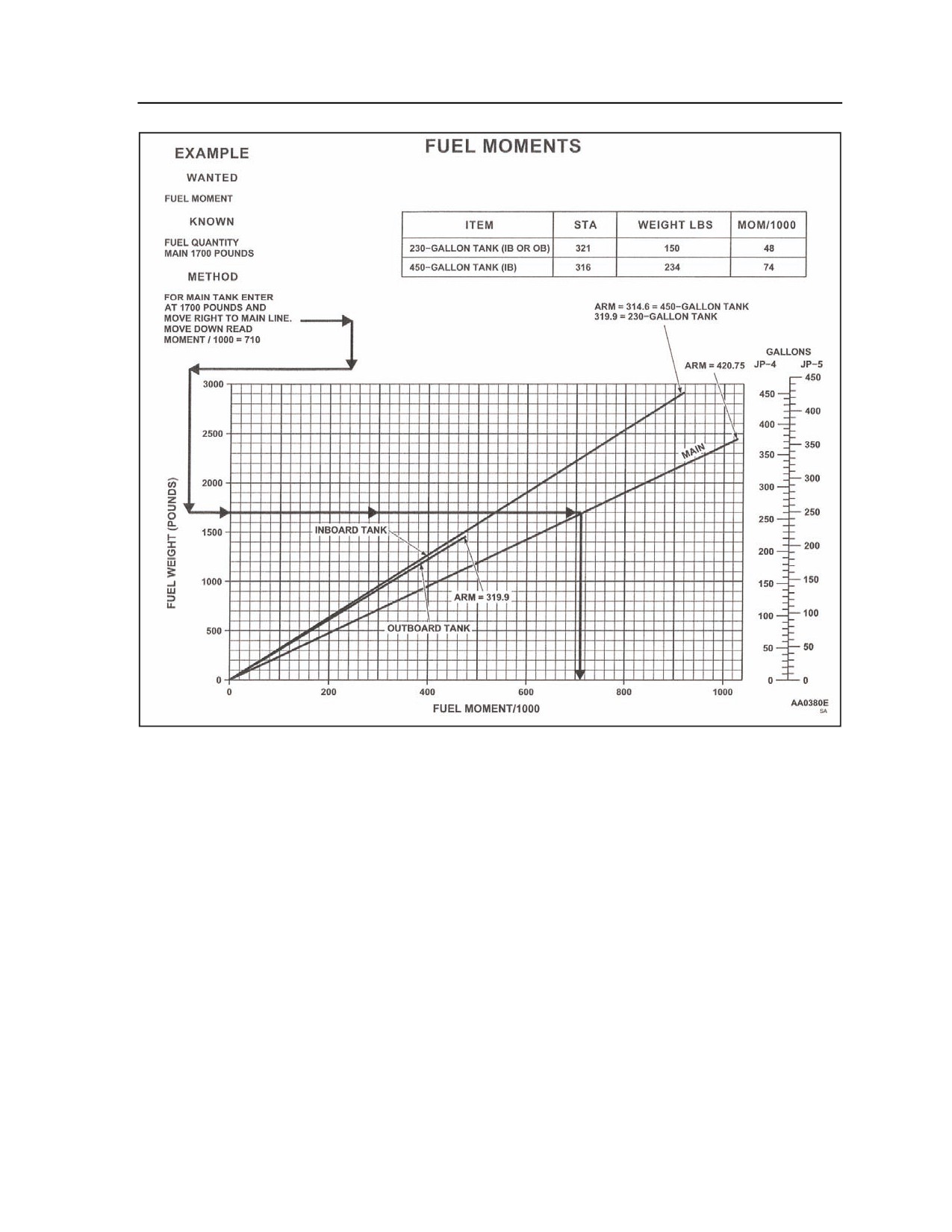
2-32. This method can use line tracing or table format to obtain moments. Figure 2-4, page 2-7, illustrates
the chart method of obtaining moments for calculation of CG.
2-6
FM 3-04.203
7 May 2007
Weight, Balance, and Loads
Figure 2-4. Fuel moments
CENTER OF GRAVITY LIMITS
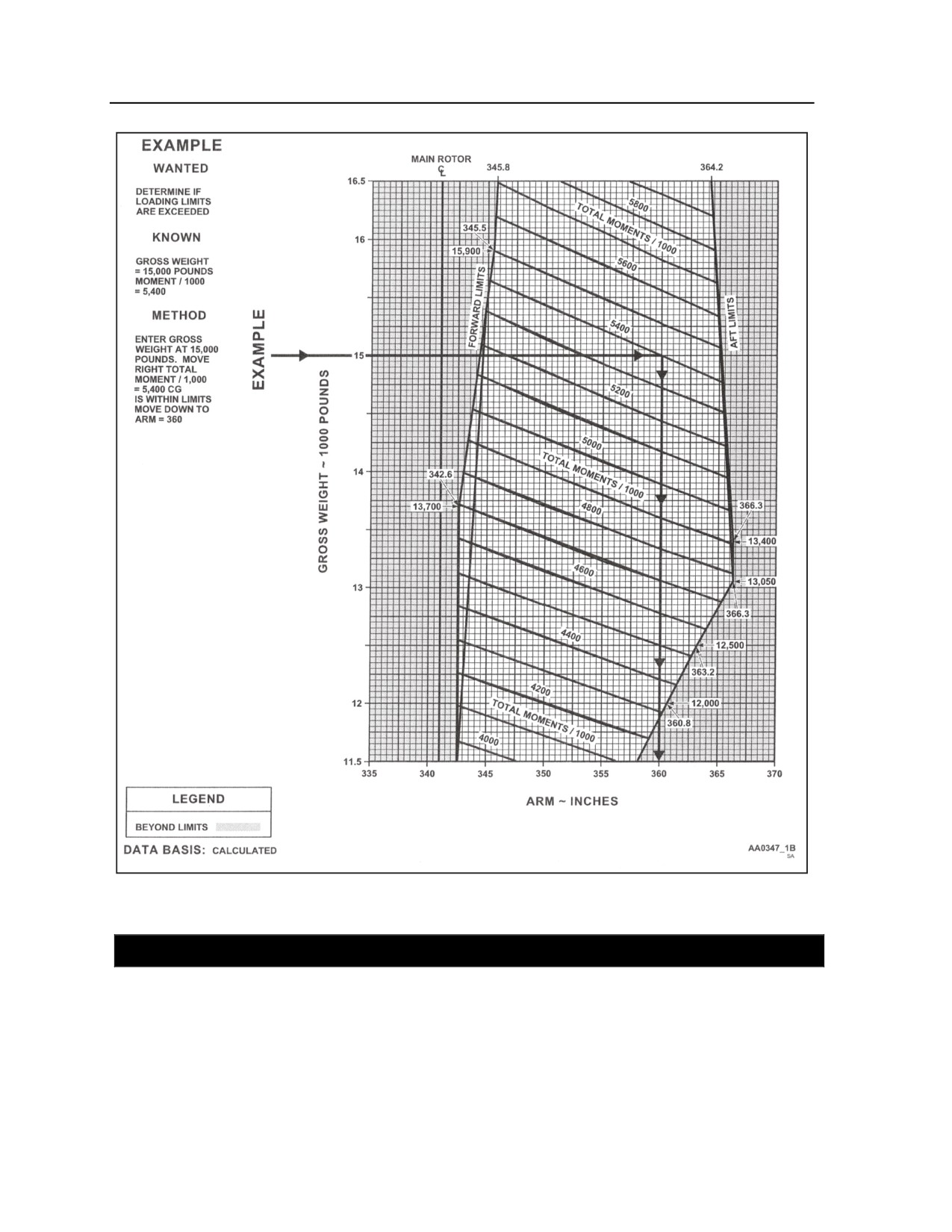
2-33. The CG limit chart (figure 2-5, page 2-8) allows the CG (inches) to be determined when total weight
and total moment are known. Individuals can also use this chart to determine allowable CG range by noting
the arm at the intersection of gross weight and forward/aft limits line.
7 May 2007
FM 3-04.203
2-7
Chapter 2
Figure 2-5. Center of gravity limits chart
SECTION IV - LOADS
PLANNING
SUPPORTED UNIT
2-34. The supported unit establishes liaison with the aviation unit to coordinate transport requirements. In
particular, the supported unit is responsible for the following—
Establishing priority for transport of cargo.
2-8
FM 3-04.203
7 May 2007
Weight, Balance, and Loads
Providing trained personnel, materiel, or handling equipment required to accomplish cargo
preparation, rigging, hook-up release, and derigging. This should include all equipment required
to contain or rig an external load enabling it to be attached to the helicopter hook (vehicles,
containers, pallets, slings, straps, and clevises).
Preparing internal cargo by aircraft load including shoring if required.
Preparing external cargo by aircraft loads. Crews should prepare and rig external loads
minimizing load oscillation during flight. Loads must not exceed allowable cargo weight
established by the helicopter unit.
Preparing dangerous cargo in accordance with appropriate regulations.
Providing the helicopter unit with information on cargo weight, CG, load density, dimensions,
axle weights of vehicles, and descriptions and quantities of all cargo. Whenever possible crews
will mark weight and load density on each cargo element and complete cargo load. When weight
and density of a load/element is not known, the supported unit provides the helicopter pilot with
an estimated weight and density.
Providing any static-electricity discharge probes or protective equipment and clothing required
for ground hook-up personnel during external-load operations.
Selecting and preparing pickup and release sites with technical advice provided as required by
the supporting helicopter unit.
SUPPORTING AVIATION UNIT
2-35. The helicopter unit is responsible for—
Providing liaison with the supported unit to coordinate planning. The helicopter unit provides
information and advice on aircraft availability, allowable cargo load (ACL), and special loading
instructions such as selection of internal or external load transport methods. It also provides
guidance on selection and preparation of pickup and release sites, safety and security
instructions, and procedures ensuring maximum recovery of all rigging equipment. In addition,
it ensures internal and external cargo is properly secured or rigged.
Supplying special equipment for internal and external loads not available to the supported unit,
such as lashings, tie-downs, and equipment organic to the helicopter unit required exclusively
for cargo transport and helicopter operations.
Supplying technical supervision to supported unit during loading, tie-down, and off-loading of
cargo.
Table 2-1 discusses remaining responsibilities.
Table 2-1. Responsibilities
Loading
Supported unit
Normally loads and restrains internal cargo under supervision of a helicopter
crew member.
Supporting avn
Large or heavy loads are rigged so the helicopter cargo hook position is as close
unit
to the load's CG as possible. The PC has final responsibility for accepting a load
to include distribution and restraint of internal cargo.
Unloading
Supported unit
Normally responsible for unloading internal cargo and recovering slings, nets,
and other equipment.
Supporting
May assist in recovery of slings, nets, and other equipment by arranging for
backloading in helicopters returning empty to the supported unit. The PC has final
aviation unit
responsibility for safe unloading or release of cargo.
Marshalling
Supported unit
Provides specially trained personnel to marshal (ground guide) helicopters to
landing points for pickup and release of external loads. Units equip these
7 May 2007
FM 3-04.203
2-9
Chapter 2
Table 2-1. Responsibilities
personnel with distinctively colored clothing such as fluorescent international
orange or yellow wherever practicable.
Restricts personnel in the danger area around helicopter to those directly
involved in marshalling, loading, hookup, release, or unloading of cargo.
Provides ground personnel with lighting devices when performing night
operations. Light intensity varies, depending on whether the aircrew is using
unaided vision or night vision devices (NVDs).
Provides additional reference lighting if requested by the helicopter unit to aid the
pilot in hookup of loads at night.
Supporting avn unit
If necessary, the helicopter unit may issue special instructions on hook-up
procedures.
INTERNAL LOADS
ADVANTAGES AND DISADVANTAGES
2-36. Helicopters are ideally suited for moving troops, supplies, weapons, ammunition, and equipment
rapidly across the battlefield. Internal and external loading are the two methods used to transport cargo.
Table 2-2 provides internal loading considerations.
Table 2-2. Internal loading considerations
Advantages
Flight can be conducted at nap-of-the-earth (NOE) altitudes.
Flight can be conducted at higher airspeeds.
Cargo is protected from weather.
Fragile equipment is afforded better protection.
Less power is required and aircraft endurance is increased.
Disadvantages
The helicopter must land to load and unload.
Pickup zones (PZs) and landing zones (LZs) may require some preparation.
Loading and unloading are time consuming.
Planning
Cargo to be transported must fit inside the aircraft.
Tie-down equipment must be available to properly secure cargo.
Care must be exercised to avoid damaging the aircraft while loading.
Personnel must be cautious of turning rotors.
Cargo must not block aircraft exits or access to emergency equipment.
Floor contact pressure of the cargo must not exceed floor loading limitations.
Items to be unloaded first must be loaded last.
Heavy or bulky items should be loaded on the floor, with lighter or more fragile items on
top to prevent damage.
Loading instructions provided on equipment, shipping containers (this side up), or in
equipment item technical manuals (TMs) should be observed.
Prior to loading, cargo CG should be determined.
2-10
FM 3-04.203
7 May 2007
Weight, Balance, and Loads
CARGO FLOOR CONTACT PRESSURE
2-37. Aircraft cargo floors are structural components of the aircraft, crews must place particular emphasis
on proper distribution of cargo weight as damage to them may weaken the airframe. Aircraft operator's
manuals provide either floor-loading limits or a plan view of the cargo floor, showing differences in floor
strength and weight concentration for various compartments. Exercise care during loading and unloading
ensuring the cargo floor is not damaged.
Shoring
2-38. Shoring is lumber, planking, or similar material used to spread highly concentrated loads over a
greater cargo floor area than occupied by the cargo alone and protects the floor from damage. In general,
shoring lumber should be 1 to 2 inches thick, 10 or 12 inches wide, and should not exceed 12 feet in
length. Plywood sheets of various thicknesses may also be used. Defects in shoring reduce its strength.
Split lumber will not transfer weight horizontally past a split. When used, shoring should extend at least a
distance equal to the thickness of the shoring beyond the base of the item being supported.
Weight-Spreading Effect of Shoring
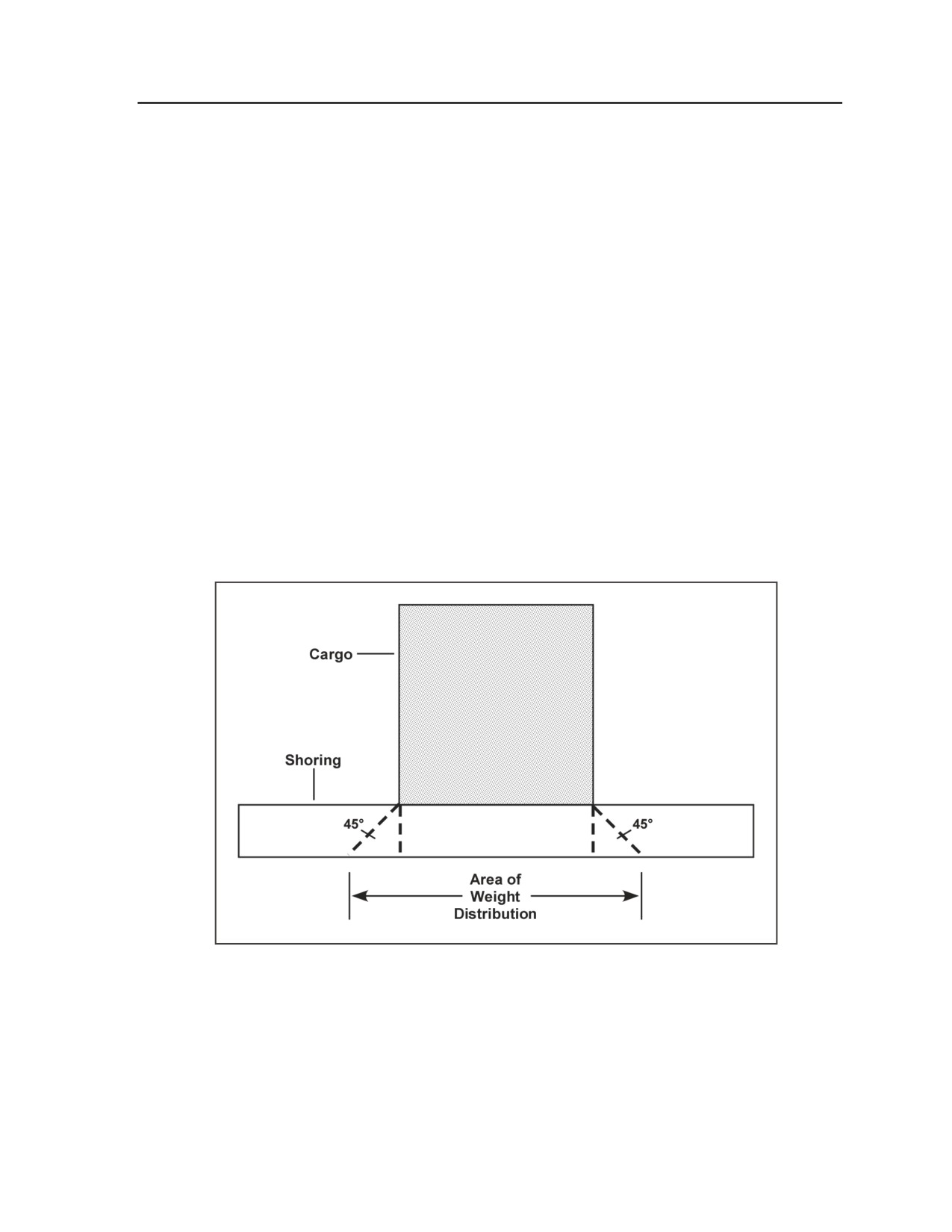
2-39. In figure 2-6, cargo weight resting on shoring does not extend over the entire shoring area in contact
with the cargo floor. In general, shoring only increases the area a load is distributed over to the area
developed. This area can be determined by extending a line drawn downward and outward from the outside
edge of the cargo’s base at a 45-degree angle until it meets the surface on which the shoring rests. When
shoring is used, the area the load is distributed is enlarged by a border equal to the thickness of the shoring
all around the cargo’s base.
Figure 2-6. Weight-spreading effect of shoring
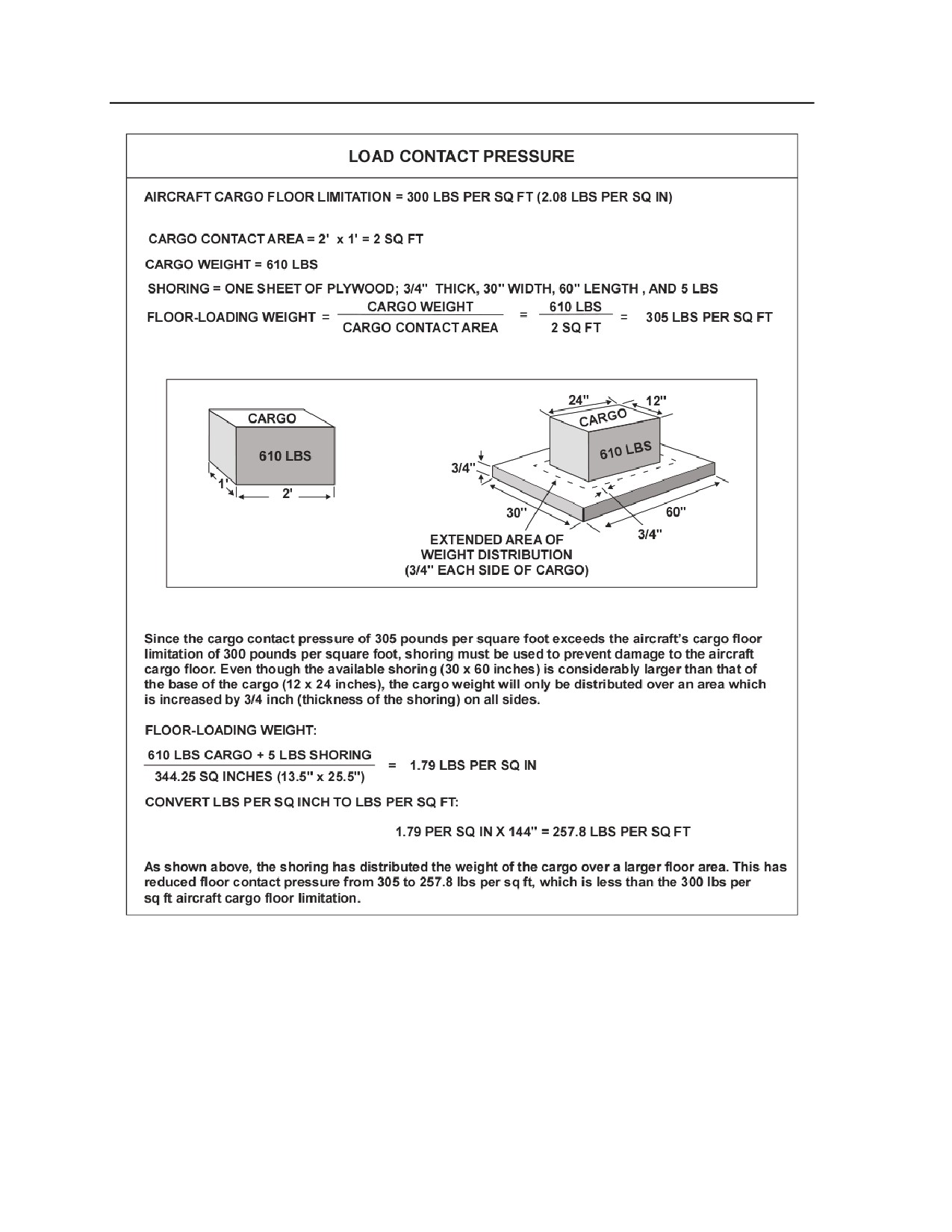
Load Contact Pressure
2-40. To determine the contact pressure of a load, divide its total weight by the area of contact to include
the extended weight distribution area gained by using shoring (figure 2-7, page 2-12).
7 May 2007
FM 3-04.203
2-11
Chapter 2
Figure 2-7. Load contact pressure
Load Pressure Formulas
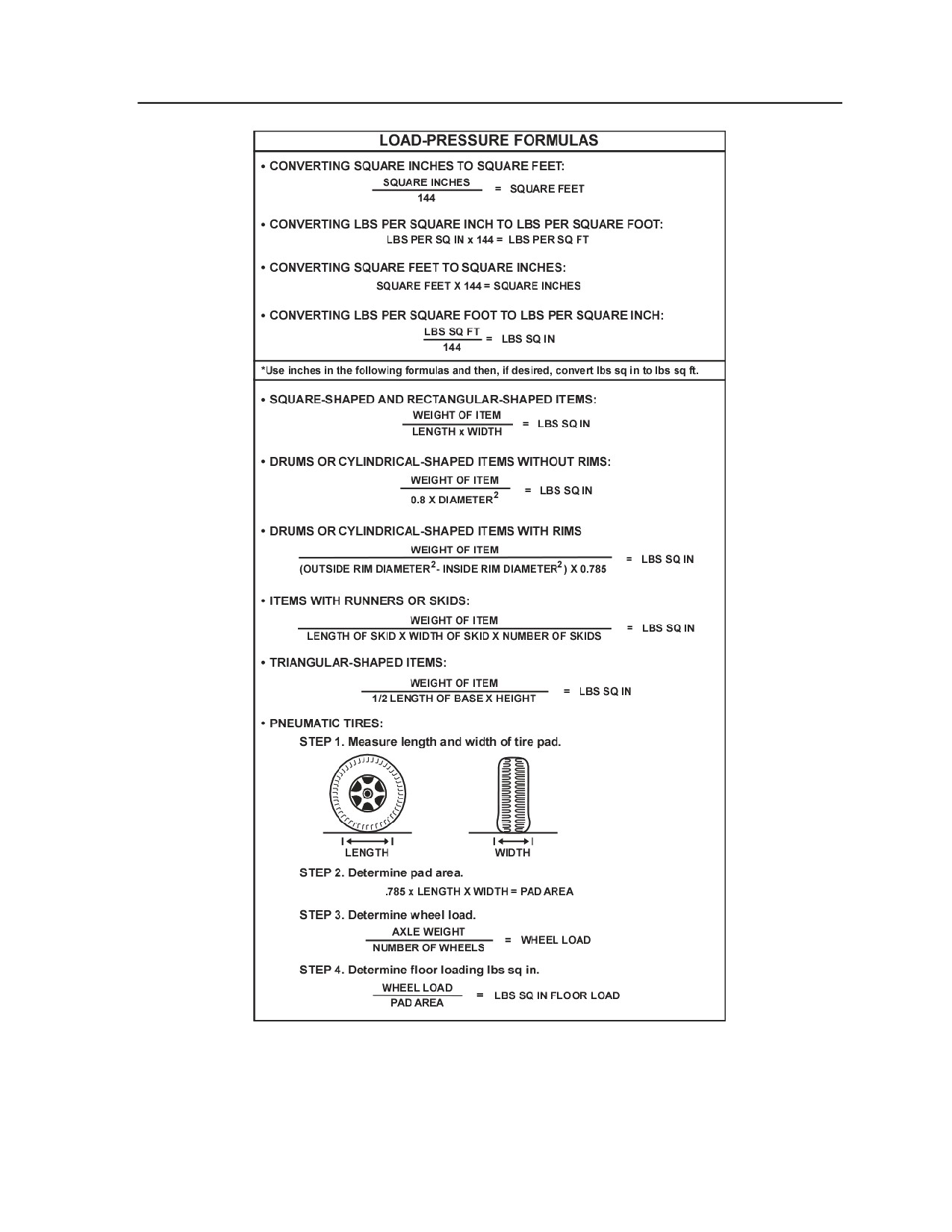
2-41. As stated earlier, surface contact pressure of an item is determined by dividing weight of the item by
the area in contact with the aircraft cargo floor. Figure 2-8, page 2-13, provides sample formulas used in
load-pressure calculations.
2-12
FM 3-04.203
7 May 2007
Weight, Balance, and Loads
Figure 2-8. Formulas for load pressure calculations
7 May 2007
FM 3-04.203
2-13
Chapter 2
DETERMINATION OF CARGO CENTER OF GRAVITY
2-42. Computing and marking the CG on cargo enables load crews to properly position cargo within an
aircraft and accurately compute the weight and balance condition of a loaded aircraft. Procedures for
determining the CG of general cargo and vehicles are provided below.
General Cargo
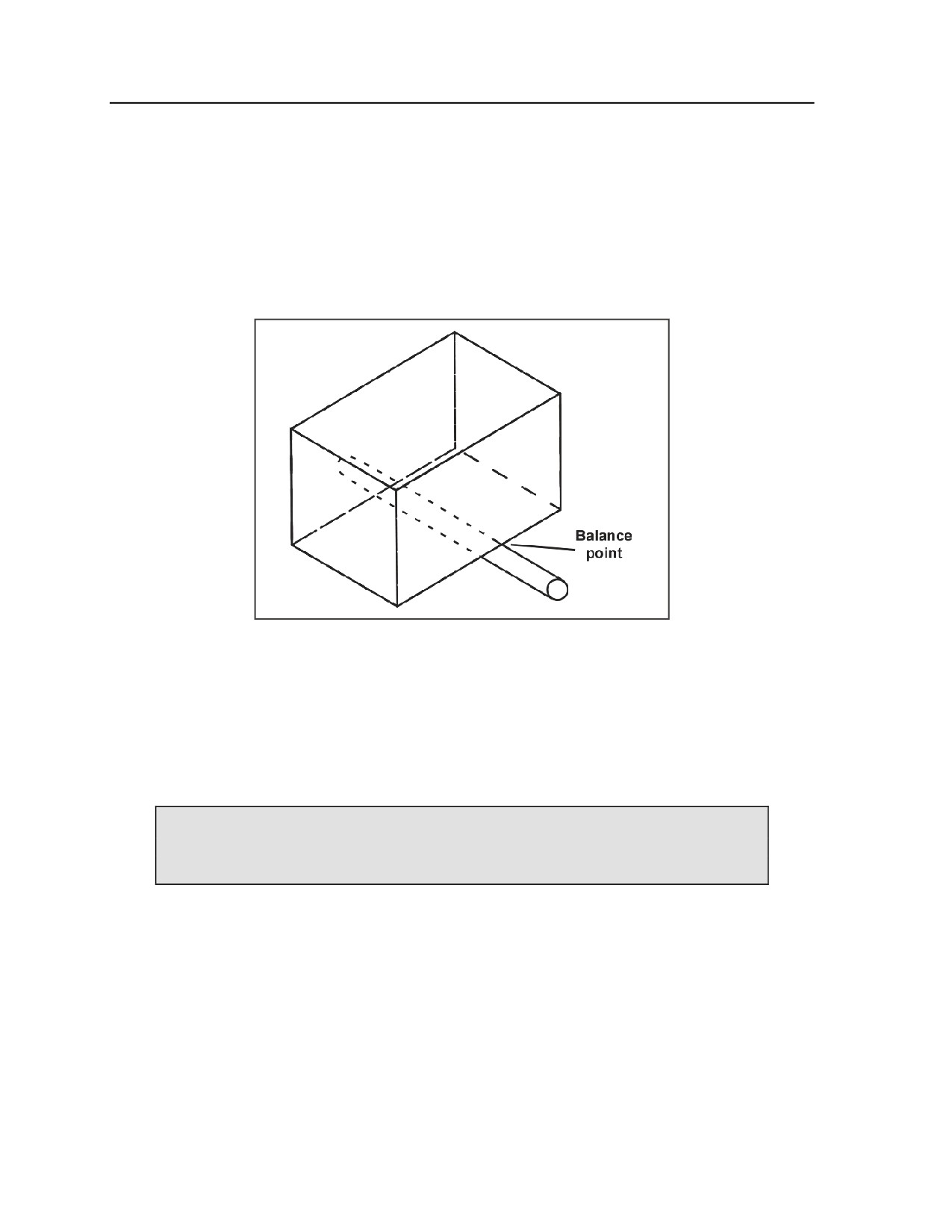
2-43. The CG of general cargo may be determined by balancing the item on a roller (figure 2-9) and then
marking the balance point.
Figure 2-9. Determining general cargo center of gravity
Wheeled Vehicles
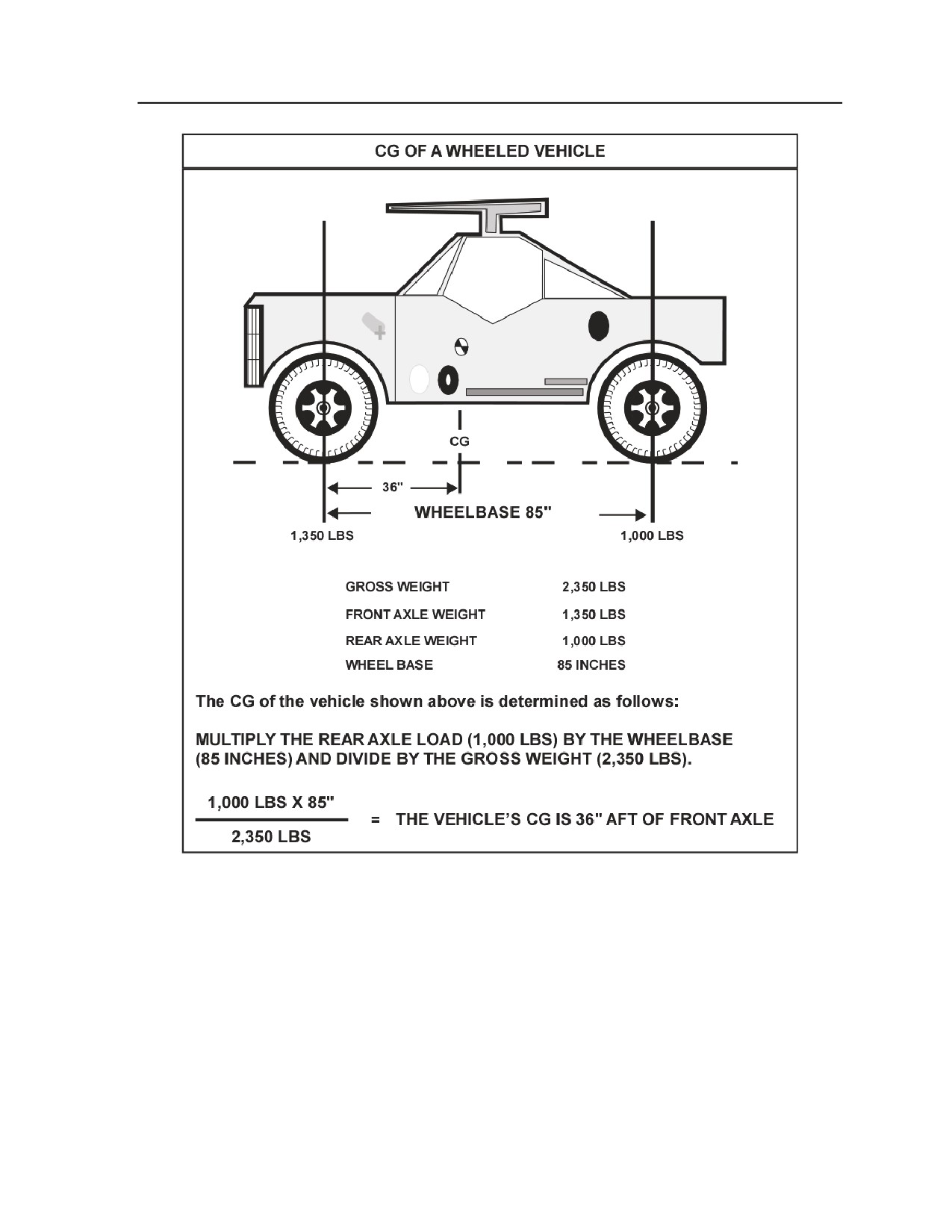
Individuals can determine the CG of a wheeled vehicle by finding the weight on each axle. Vehicle data
plates or applicable operator's manuals provide axle weights for empty vehicles, while axle weights of
loaded vehicles can be determined by running the wheels on a suitable scale (figure 2-10, page 2-15). The
CG is then determined using the following formula:
Wheeled Vehicle Center of Gravity Formula
(Rear Axle Load x Wheelbase) ÷ Vehicle Gross Weight = CG Location Aft of Front
Axle
Placement of Cargo
2-44. For weight and balance purposes, weight of an item is concentrated at the item's CG. CG markings
on cargo enable load crews to place cargo at precise locations or fuselage stations within the aircraft aiding
in accurately computing weight and balance of a loaded aircraft.
Cargo Load Center of Gravity
2-45. Compartment and station methods are used to compute the CG of a cargo load.
2-14
FM 3-04.203
7 May 2007
Weight, Balance, and Loads
Figure 2-10. Determining center of gravity of wheeled vehicle
Compartment Method
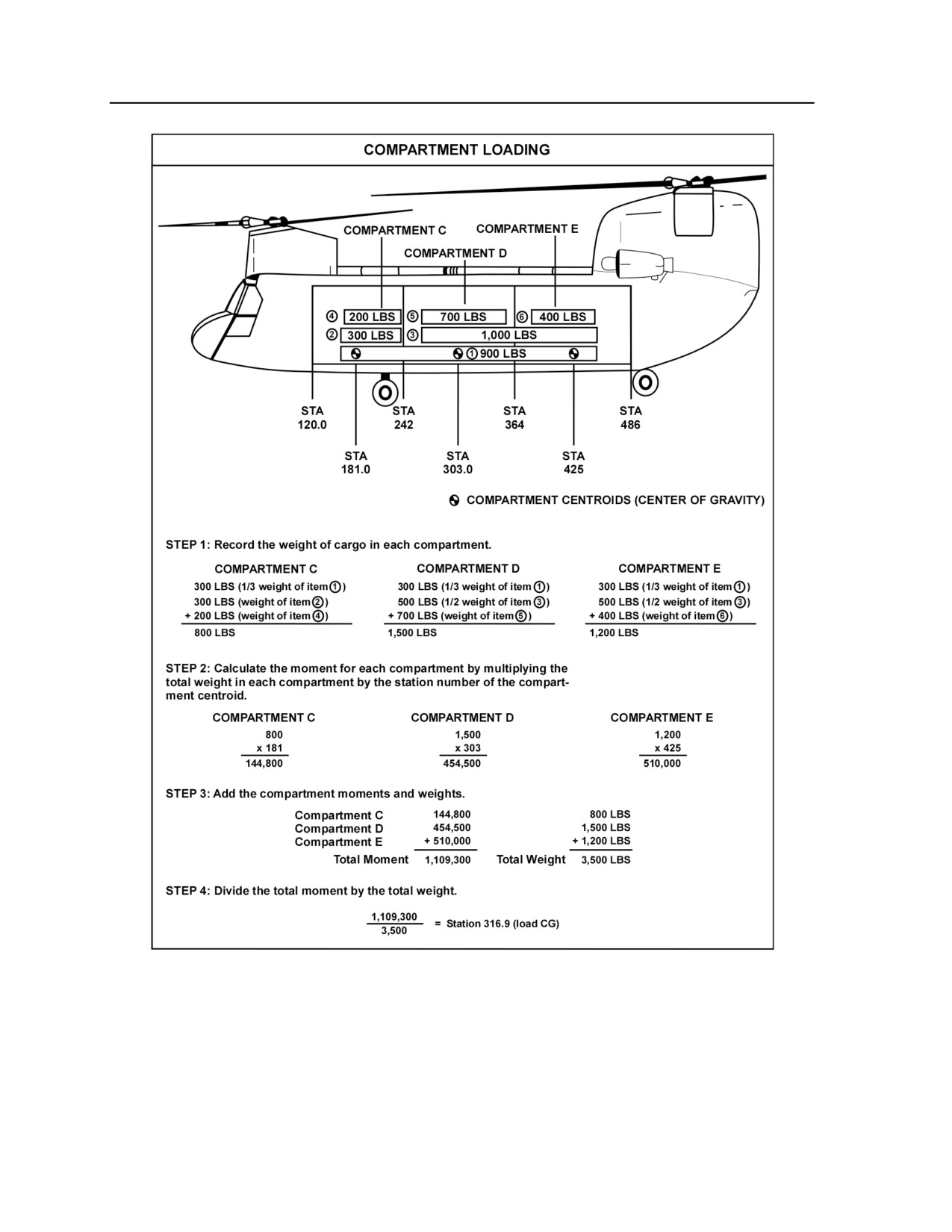
2-46. For cargo helicopters, loading by compartments provides a rapid means of computing the CG of a
load. This method can be used whenever a load consists of a number of items.
2-47. The CH-47 cargo area is divided into three compartments—C, D, and E. The centroid (also known
as center of gravity or CG) of each compartment is at stations 181, 303, and 425, respectively. When using
the compartment method, it is assumed the weight of all cargo in the compartment is concentrated at the
compartment’s CG. If an item extends into two or three compartments, the weight of the item should be
proportionately distributed in each compartment (figure 2-11, page 2-16).
7 May 2007
FM 3-04.203
2-15
Chapter 2
Figure 2-11. Compartment method steps
Station Method
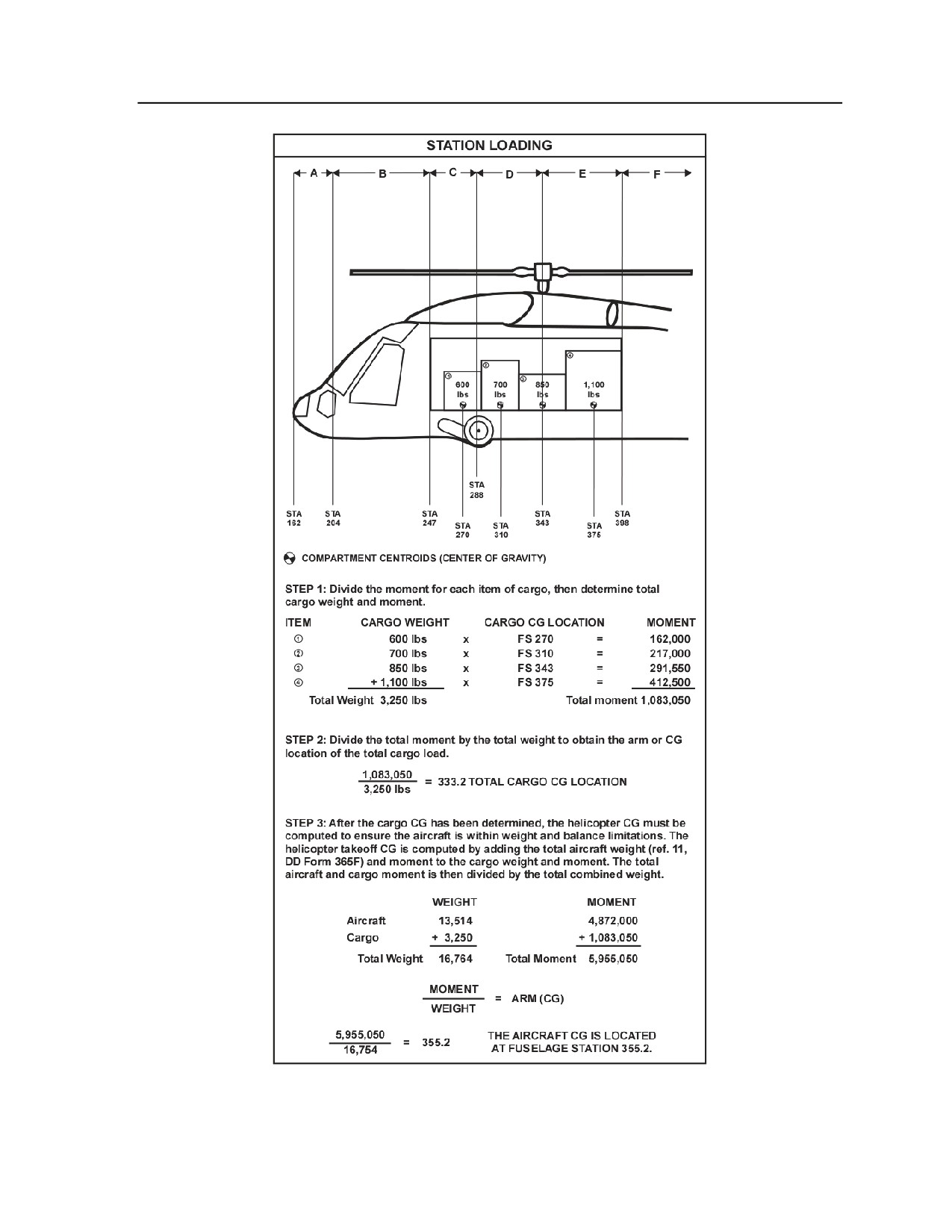
2-48. The station method is a more precise method of computing the CG of a load and should be used
whenever possible. To use this method, it is necessary to know the CG of each item of cargo. Station
loading requires the CG of each item of cargo be placed precisely on a specific fuselage station number.
Figure 2-12, page 2-17, provides a sample application of the station method for a UH-60 helicopter.
2-16
FM 3-04.203
7 May 2007
Weight, Balance, and Loads
Figure 2-12. Station method steps
7 May 2007
FM 3-04.203
2-17
Chapter 2
CARGO RESTRAINTS
Restraint Criteria
2-49. Aircraft are subjected to G-forces resulting from air turbulence, acceleration, rough or crash
landings, and aerial maneuvers. Since the cargo is moving at the same rate of speed as the aircraft, forward
movement is the strongest force likely to act on cargo if the aircraft is suddenly slowed or stopped. Other
forces which tend to shift cargo aft, laterally, or vertically will be less severe. Restraining or tie-down
devices prevent cargo movement that could result in injury to occupants, damage to the aircraft or cargo, or
cause the aircraft CG to move out of limits. The amount of restraint required to keep cargo from moving in
any direction is called restraint criteria and is expressed in Gs. The maximum force exerted by an item of
cargo is equal to its normal weight times the number of Gs specified in restraint criteria. Restraint criteria
are normally different for each type of aircraft and provided in the operator’s manual. To prevent cargo
movement, the amount of restraint applied should equal or exceed the amount of restraint required.
Restraint is referred to by the direction in which it keeps cargo from moving. For example, forward
restraint keeps cargo from moving forward and aft restraint keeps cargo from moving aft.
Cargo Classification
2-50. Cargo is generally classified as either prepared or miscellaneous. Prepared cargo is carried in
containers equipped with tie-down devices, or equipment with attached tie-down points. Miscellaneous
cargo is all other cargo, or cargo without tie-down provisions.
Restraint Devices
2-51. Restraint equipment includes cargo nets, chains, webbed-nylon straps, and various types of attaching
hooks and tightening devices.
APPLICATION OF TIE-DOWN DEVICES
2-52. Most aircraft operator's manuals provide specific instructions for use of tie-down devices. A tie-
down device will withstand a force equal to its rated strength only when the force is exerted parallel to the
length of the device. It is seldom possible to fasten a device in this manner. Instead, it is usually necessary
to fasten the device to the cargo at some point above the floor, resulting in a partial loss of restraint
strengths. The strength of restraint is reduced in ratio to the angles formed by the device with the floor and
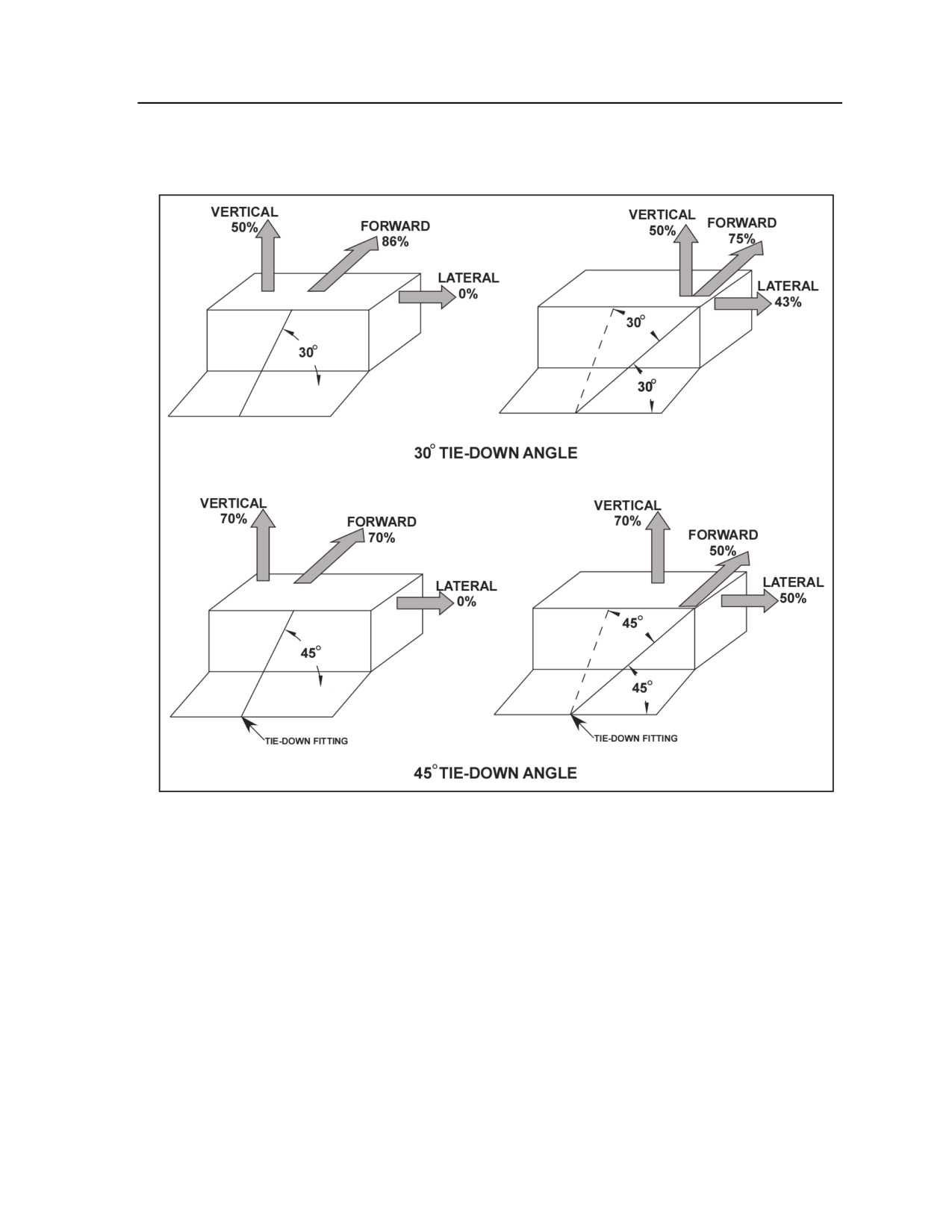
the axis of the aircraft. Based on calculations, a 30-degree angle of attachment in the intended restraint
direction causes a restraint loss of 25 percent in that direction and is the most desirable angle. While
causing a loss of restraint in one direction, angled tie-down devices furnish restraint in two other directions
so one device provides restraint in three directions simultaneously. The effective holding strength of
devices applicable at a 30-degree and 45-degree angle is illustrated in figure 2-13, page 2-19.
2-53. General rules for the application of tie-down devices are—
Fasten devices so they form, as nearly as possible, 30-degree angles with the cargo floor and
longitudinal axis of the aircraft.
Consider the strength of the aircraft tie-down fittings and the points of attachment on the load. A
tie-down device is no stronger than its weakest component. A 10,000-pound device attached to a
5,000-pound rated fitting will only provide 5,000 pounds of restraint. Axles, tow hooks, bumper
supports, and vehicle frames are good points of attachment for securing most vehicles. Since
general cargo items may not have points of attachment, the devices should be applied over or
across the cargo items. Additionally, cargo nets will aid in restraining items of miscellaneous
cargo.
For prepared cargo, it is desirable to use an even number of tie-downs of the same length and
attach them symmetrically in pairs.
When tie-down devices providing forward and aft restraint are crisscrossed over the cargo,
adequate restraint is automatically provided in the lateral and vertical directions. If devices
2-18
FM 3-04.203
7 May 2007
Weight, Balance, and Loads
providing forward and aft restraint are applied across the front and rear of the cargo, lateral and
vertical restraint will have to be provided. Vehicles will have sufficient lateral and vertical
restraint if forward and aft restraints are applied properly.
Figure 2-13. Effectiveness of tie-down devices
2-54. To calculate the number of tie-down devices required to restrain a load in any given direction, these
factors must be known—
Weight of cargo.
Restraint criteria. This data is normally found in aircraft operator's manuals.
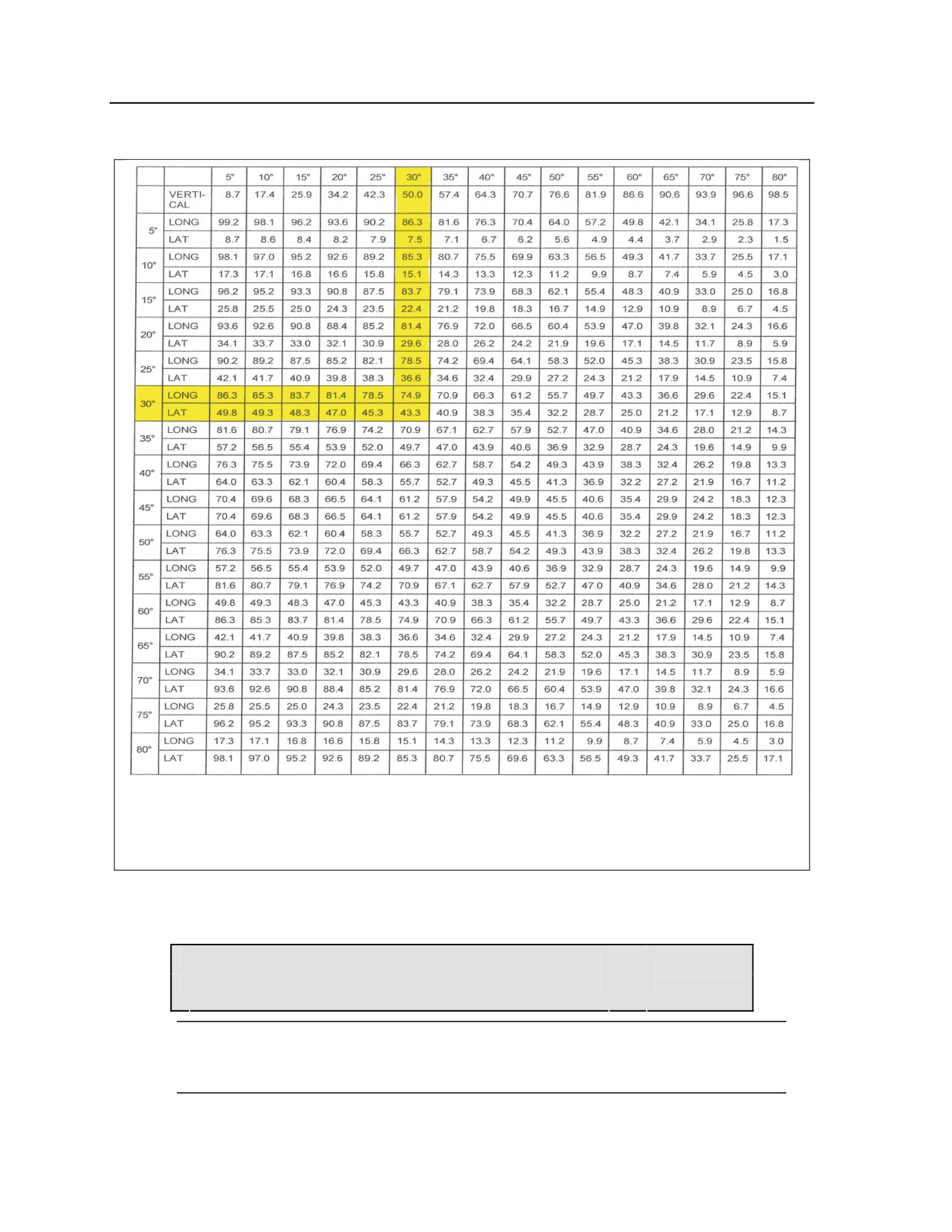
Angle of tie-down and percent effectiveness of a tie-down device. The effectiveness of a tie-
down device is determined from the percentage restraint chart (table 2-3, page 2-20).
Rated strength of weakest link or component of a tie-down.
7 May 2007
FM 3-04.203
2-19
Chapter 2
Table 2-3. Percentage restraint chart
(1) Angles across the top are those formed between the tie-down device and the cabin floor.
(2) Angles down the side are those formed between the tie-down device and the longitudinal axis of the aircraft.
(3) Vertical restraint is related only to the angle between the tie-down device and the cabin floor. The lateral angle has no
bearing on it.
(4) The shaded area indicates the “best compromise” position.
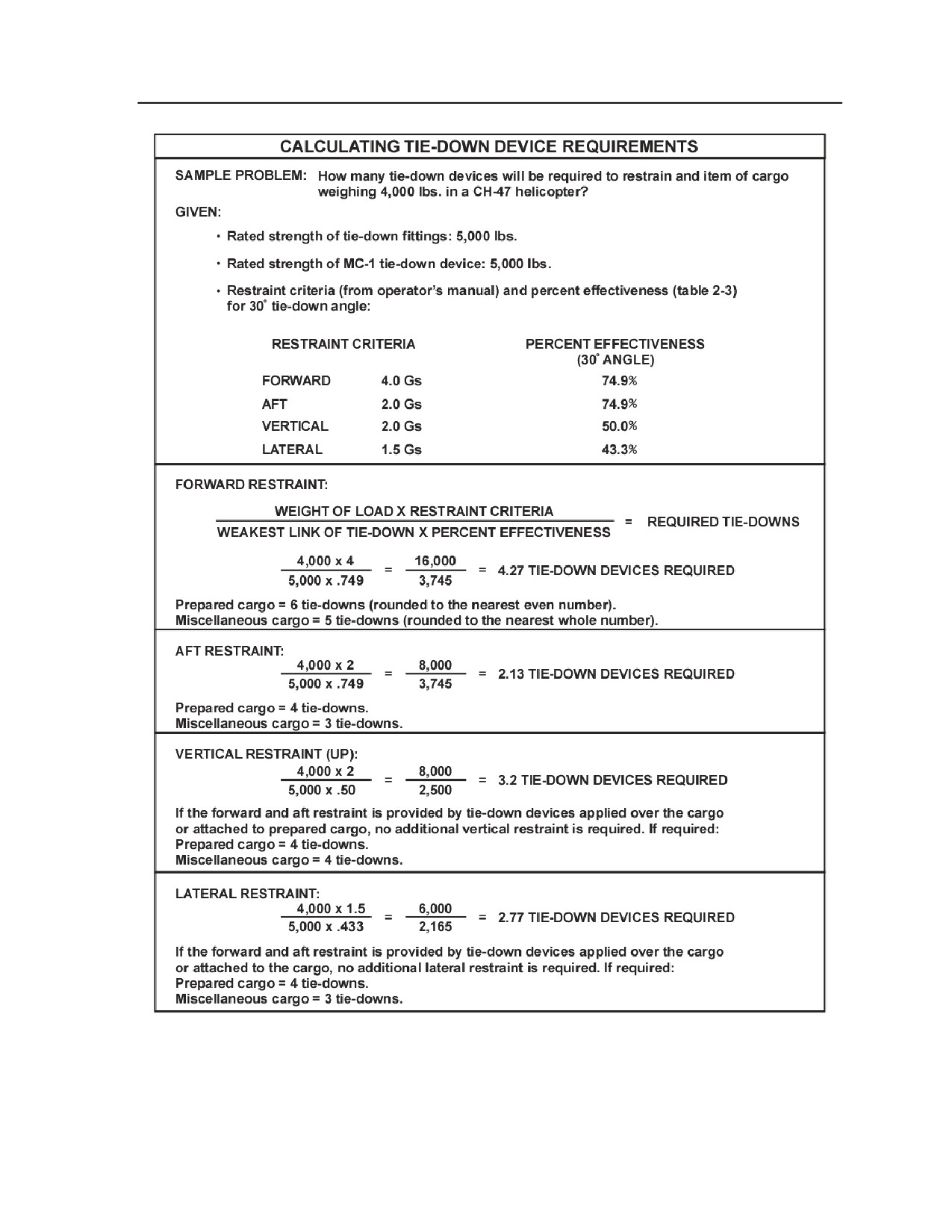
2-55. Figure 2-14, page 2-21, provides application for determining number of tie-down devices required to
restrain an item of cargo. The following formula is used to calculate the number of tie-down devices
required to restrain a load from moving in any direction:
Weight of Load x Restraint Criteria
Required
=
Weakest Link of Tie-Down x Percent Effectiveness
Tie-Downs
Note: If the formula yields fractional results, for miscellaneous cargo, the number will be
rounded up to the next whole number. For prepared cargo, the number is rounded up to the next
whole even number providing an even number of tie-down devices.
2-20
FM 3-04.203
7 May 2007
Weight, Balance, and Loads
Figure 2-14. Calculating tie-down requirements
7 May 2007
FM 3-04.203
2-21
Chapter 2
EXTERNAL LOADS
PLANNING CONSIDERATIONS
Application
2-56. Helicopters are frequently used to move cargo externally (sling loads) when heavy, outsized, or
needed-now items are required to be rapidly transported over untenable terrain. The following situations
favor the use of external loads:
Cargo compartment of the aircraft is too small.
Aircraft CG would be exceeded, due to the characteristics of the load, if loaded internally.
Loading and/or unloading must be accomplished in the shortest possible time.
PZ/LZ conditions prevent aircraft from touching down.
Nature of cargo is such that rapid cargo-jettison capability is desirable.
Load Categories
2-57. All external loads are divided into three basic categories—high-density, low-density, and
aerodynamic. Each exhibits different characteristics in flight. High-density load offers the best stability;
low-density load is the least stable. The aerodynamic load exhibits both instability and stability (instability
inherent until load streamlining occurs). An aviator must determine category, size, and weight of the load
during preflight.
Cargo Nets and Slings
2-58. Cargo nets and slings are an essential part of the external-load operation and must be given the same
attention during the preflight inspection as the cargo receives. Nets and slings with frayed or cut webbing
will not be used for external loads. Due to critical strength requirements, field sewing of nylon should not
be attempted, nor should nonstandard parts be substituted in assembling slings. The sling assembly must be
commensurate with load requirements and must meet requirements in the operator's manual.
Aircraft Performance and Operator’s Manual
2-59. It is imperative aviators consult the appropriate operator’s manual to ensure a successful operation.
Performance charts in this manual include gross-weight limitations, airspeed limitations, and endurance
charts. The gross-weight chart provides a rapid means of determining load-carrying capabilities within safe
operating limits. This performance planning data is crucial to successful sling-load operations.
2-60. The operator's manual also gives a complete operational explanation of sling-release systems. During
preflight, aviators must inspect emergency-release systems and make operational checks of all normal
release modes. Emergency procedures for any nonstandard occurrence experienced during external-load
operations are outlined in the operator's manual.
Coordination with Flight and Ground Personnel
2-61. Preflight is not complete until the aviator briefs the flight and ground crews on their duties and
mission to be performed. Essential criteria for a safe operation are predetermined prior to takeoff. Signaling
procedures, unit standing operating procedures (SOPs), and emergency procedures are in the brief.
EXTERNAL-LOAD PICKUP PROCEDURES
Pickup Techniques
2-62. Pickup technique varies according to the helicopter in use, type and weight of the external load,
terrain involved, and wind and weather conditions at time of pickup.
2-22
FM 3-04.203
7 May 2007
Weight, Balance, and Loads
Approach Procedure
2-63. The approach to hookup (also release) should be conducted into the wind, yielding best aircraft
stability and performance. Even if the load is light and there is excess power, the wind could be the critical
factor during emergencies. A slow forward hover allows the aviator to receive directions from flight crew
and ground personnel without jeopardizing the aircraft or hookup person’s safety. When directions are
received solely from ground personnel, a signalman must be in a plain view position of the aviator and give
appropriate visual signals throughout the operation. The cargo-release switch is placed in the arm position
as the aircraft approaches the load.
Hover Altitude
2-64. The appropriate hover altitude depends upon variables such as type of helicopter, terrain and ground
effect, size of load, and safety of the ground crewmen. Once an altitude is decided, it should be kept
constant to prevent false perception and possible load strike. To assist the pilot in maintaining a constant
position and hover altitude, references should be selected in the front and to the sides of the helicopter.
Hookup Procedure
2-65. Hookup commences with final positioning of the helicopter over the load. In cargo helicopters, this
normally is conducted through verbal coordination with a flight crewmember that is in a position to closely
observe the helicopter's movements over the load. In helicopters where flight crews are unable to observe
the helicopter's movements over the load, a signalman located on the ground and in plain view of the
aviator must be used. In all cases, the signals (verbal or visual) must be standardized among the persons
involved prior to the operation (see FM 4-20.197). The load is attached to the helicopter's cargo hook by
the hookup crew when the helicopter is stabilized over the load.
Emergency Actions
2-66. In the event an emergency condition occurs while hovering over the load and the helicopter must be
landed, the helicopter normally will land to the left of the load. Hook-up personnel must move in the
opposite direction (to the right of the helicopter) to avoid injury. The unit SOP establishes this procedure
and the aviator must brief all personnel before conducting external-load operations. The hookup man will
approach from the helicopter’s right and exit to the helicopter’s right. When possible, ground personnel
should not position themselves between the load and the helicopter during hookup. The load is to be
attached according to the appropriate operator's manual, FM
4-20.197, and the unit SOP. Hookup
personnel notify the pilot immediately when the load is attached to the cargo hook. Any emergency
procedure following attachment must include cargo release.
Takeoff Procedure
2-67. There are two distinct phases when taking off with an external load—lifting the load to a hover and
takeoff.
Lifting the Load to a Hover
2-68. Once the signalman indicates the load is hooked up and the hookup man is clear, the aviator initiates
a slow vertical ascent until the sling becomes taut and centered. The aviator, flight crew, and/or ground
crew closely coordinate ensuring the aircraft does not drift from over the load. The load is then slowly
lifted to an appropriate hover altitude (normally about 10 feet above the ground). While picking up the load
to a hover, the aviator must determine whether the helicopter has sufficient power to continue the
operation. Security and proper rigging of the load are also reconfirmed.
Takeoff
2-69. After receiving the takeoff signal from the signalman and if all criteria have been met for flight,
smooth acceleration and takeoff are initiated. Sufficient power (not to exceed maximum allowable) is
7 May 2007
FM 3-04.203
2-23
Chapter 2
applied on takeoff ensuring the load clears all obstacles by a safe altitude. Once established at a safe
altitude, power is adjusted to maintain safe airspeed and altitude. The cargo-release switch is placed in the
off or safe position after passing through above ground level (AGL) altitude as directed by the operator’s
manual and/or SOP. During flight below this altitude, the cargo-release switch is left in the on or arm
position. Aviators should avoid flight over populated areas.
Note. A safe climb altitude is the altitude wherein the load is unquestionably clear of the highest
barrier, usually 50 to 100 feet above the tallest immediate obstacle.
EN ROUTE PERFORMANCE
2-70. The weight and density of the load may determine airworthiness (steadiness in flight) and maximum
airspeed at which the helicopter may be safely flown. Low-density, light loads generally tend to shift
farther aft as airspeed is increased and may become unstable. When the load is of greater density, more
compact, and balanced, the ride is steadier and airspeed may be safely increased. Any unstable load may
jump, oscillate, or rotate resulting in loss of control and undue stress on the helicopter. This requires
reducing forward airspeed immediately, regaining control, and steadying the cargo load. If an external load
begins oscillating fore and aft, the helicopter should be flown into a shallow bank while decreasing
airspeed. This normally shifts the oscillation laterally which can easily be controlled by further decreasing
forward airspeed. At the first indication of a buildup in oscillation, it is mandatory to slow airspeed
immediately. The oscillation may endanger the helicopter and personnel. This situation may require
jettisoning the load. For a complete explanation of the cargo release system for the helicopter to be flown,
see the appropriate operator's manual.
TERMINATION-AND-RELEASE PROCEDURE
2-71. Termination and subsequent load release must include approach to the termination point, hovering to
the load-release point, and releasing the load.
Termination Point Approach
2-72. The approach to the termination point should not be initiated until the appropriate termination point
is identified. At the appropriate altitude, the cargo-release switch is placed in the arm position.
Load-Release Point Hovering
2-73. Procedure to the release point (RP) will be accomplished in the same manner as described earlier in
external load pickup procedures. The procedure, however, reverses over the RP.
Load Release
2-74. Stabilize the aircraft over the load and descend to allow slack in the sling. If possible, slide the
aircraft laterally to where the clevis will not fall on the load to prevent damage. When the aircraft is clear
of the load, open the cargo hook to release the load. Usually the cargo hook is opened through the normal
release modes of operation, in accordance with appropriate aircraft operator's manual. Manual and
emergency release methods will be used in accordance with the appropriate operator’s manual and the unit
SOP when normal modes fail to function properly. Ground personnel, in accordance with SOP and other
directives, may use any means necessary to free the load if the cargo cannot be released from the helicopter
by the flight crew. These methods might include use of knives, bayonets, or blade-like instruments to cut
nylon or rope components of the sling assembly. When metal components must be cut to free a load,
devices such as diagonal cutters, bolt cutters, pliers, or cable cutters are appropriate.
2-24
FM 3-04.203
7 May 2007
Weight, Balance, and Loads
HAZARDOUS MATERIALS
2-75. Aviators and aviation planners must be aware movement of hazardous material by aircraft has
different requirements. The following factors must be addressed when moving hazardous materials:
Compliance with special procedures.
Unique packaging and handling requirements exist for most items of hazardous cargo.
Some items cannot be carried in aircraft unless specially trained escort personnel are aboard and
particular security requirements have been met.
Some items cannot be carried with other types of hazardous cargo and certain items of
hazardous cargo may not be carried aboard the same aircraft with passengers.
Regulations also prescribe items of information which must be provided to en route and
destination airfields prior to an aircraft's departure.
To carry some items of hazardous cargo, aircrews must be provided with protective clothing and
special equipment.
Additionally, there are some hazardous materials which may not be accepted for air shipment.
Aviators must also be aware compliance with special in-flight emergency procedures may be
required for aircraft carrying dangerous materials.
Procedures, responsibilities, and guidance for handling, storage, and transportation of hazardous
material are discussed in regulations and TMs.
2-76. While it is impracticable to discuss procedures for transporting all types of hazardous loads in this
section, an overview of key publications is provided below. These publications should be reviewed to
develop hazardous load SOPs appropriate to the unit's mission.
DANGEROUS MATERIALS
2-77. Dangerous material is defined as any flammable, corrosive, oxidizing agent, explosive, toxic,
radioactive, nuclear, unduly magnetic, or biologically infective material. Dangerous material also includes
any other material that may endanger human life or property due to its quantity, properties, or packaging.
PUBLICATIONS
2-78. Following is a partial list of publications providing guidance for transportation of dangerous
materials aboard aircraft. The applicability of procedures to tactical wartime operations normally is
addressed in each publication.
Chemical Surety
2-79. Army Regulation (AR) 50-6 describes the Chemical Surety Program and provides guidance and
directives for safe, secure, and reliable life-cycle management of chemical agents and their associated
weapon systems. Included is guidance for transportation of chemical surety material by Army aircraft.
Flight Regulations
2-80. AR 95-1 prescribes procedures and rules governing command, control, and operation of Army
aircraft. The following portions of this regulation pertain to transportation of dangerous materials:
Procedures for packaging, handling, and air transportation of dangerous materials are described
in Army regulation (AR) 95-27 and FM 38-701. Aircrews assigned to move dangerous materials
in Army aircraft will comply with the requirements listed in these publications.
Aircraft must be grounded during refueling, arming, oxygen servicing, and loading or unloading
of flammable or explosive cargo.
7 May 2007
FM 3-04.203
2-25
Chapter 2
At least one pilot seated at the controls must wear a protective mask when fused items filled
with toxic chemicals are carried in aircraft. Other crewmembers will have protective masks
readily available.
When incapacitating or toxic chemicals with no arming or fusing systems are carried in an
aircraft, pilots need not wear a mask; however, it must be readily available.
All personnel aboard will wear a protective mask when incapacitating or toxic chemicals are
dispensed and until the chemical safety officer or other crewmember reports the aircraft “clear”
of the dispensed agent.
Personnel who are not essential to the mission will not be carried in an aircraft with
incapacitating or toxic chemicals on board.
Operational Procedures for Aircraft Carrying Hazardous Materials
2-81. AR 95-27 specifies special procedures applying to aircraft carrying nuclear, chemical, or biological
research materials. Actions to be taken by PCs, aircrew members, and technical escorts during in-flight
emergencies involving such materials are listed in this document. It applies to nuclear cargo, toxic
chemical ammunition, highly toxic substances, hazard division 1.1 through 1.3 explosives, and infectious
substances (including biological and etiological materials). In addition, it applies to Class VII (radioactive
materials), which require a yellow III label, inert materials, and all other hazard classes or divisions, except
Class IX and other regulated material-domestic, when shipped in quantities of 1,000 pounds or more
aggregate gross weight. The following are a few of the many PC responsibilities:
Brief crewmembers, couriers, and technical escorts on mission requirements, procedures
governing hazardous cargo, notification requirements, and emergency procedures.
Enter “hazardous cargo,” “inert devices” (or both), and mission number and prior permission
request number in the other information or remarks section of the flight plan unless prohibited
by directives governing the area of operations (AO).
Refuse to accept any clearance containing noise abatement procedures, in the PC’s judgment,
interfering with flight safety.
Ensure compliance with in-flight notification procedures given in AR 95-27.
Storage and Handling of Liquefied and Gaseous Compressed Gasses and Their Full and Empty
Cylinders
2-82. While AR 700-68 does not address transportation of gas cylinders by air, it provides excellent
information on storage, handling, and inspection of gas cylinders. Information provided in this regulation
should be reviewed by aircrews involved in air transport of gas cylinders.
Military Explosives
2-83. TM 9-1300-214 provides guidance for handling, storage, and transportation of ammunition and
explosives. It includes operating regulations for aircrews, aircraft loading and unloading procedures,
electrical-grounding requirements, quantity-distance standards, fire protection requirements, and
considerations for establishment of ammunition and explosive sling-load pickup areas at ammunition
resupply points.
Preparing Hazardous Materials for Military Shipments
2-84. TM 38-250 contains information useful to units preparing SOPs on hazardous loads. It provides
instructions for personnel who prepare hazardous material for air shipment, labeling requirements,
instructions for transporting passengers with hazardous materials, and instructions for notifying the PC of
hazardous materials on the aircraft. It also contains the protective-equipment requirement quoted below.
2-26
FM 3-04.203
7 May 2007