FM 3-04.203 Fundamentals of Flight (May 2007) - page 6
Rotary-Wing Night Flight
binocular rivalry. Adequate crew rest aids in overcoming this problem. Using a tinted visor periodically
also assists in reducing visual distractions. If all else fails, an aviator may have to close one eye until the
rivalry subsides.
SCANNING TECHNIQUES
4-113. Proper scanning techniques are essential during FLIR night flights. To overcome limited FOV (30
degrees by 40 degrees) and loss of peripheral cues, an aviator must use a continual scanning pattern during
terrain flight. With a moving aircraft, the scan is performed by looking left and right of the aircraft
centerline while maintaining reference with the symbolic head tracker. An aviator bases the length of time
and frequency of the scanning pattern on terrain type, obstacles, airspeed, and scene content quality of the
PNVS. Aviators use close cues to determine obstacle clearance altitude, airspeed, and closure rates, as well
as midrange and far cues to evaluate route trends and patterns such as direction, turns, and obstacles. Avoid
overflying close-in cues, maintain obstacle clearance, and use aided and unaided eyes to detect and avoid
obstacles.
4-114. An aviator can overcome the inability of FLIR to see lights by incorporating the unaided eye into
the scanning pattern. While scanning, periodically changing FLIR sensor polarity assists in distinguishing
obstacles such as aircraft, tree branches, and power poles. These may be difficult to detect because of direct
current (DC) restoration. DC restoration (horizon blooming) washes out the upper portion of the video
image during rolling maneuvers when the bank angle is increased.
4-115. Finally, an aviator needs practice and experience to obtain maximum visual information from both
the aided and unaided eyes. An aviator must learn to correctly interpret and use flight symbology for
aircraft control. Reliance on imagery alone or dependence on unaided vision is not enough and will result
in erratic aircraft control. Unaided peripheral vision in the aided eye may be distracting until an aviator
learns to use primarily FLIR cues and symbology, and disregard unwanted peripheral distractions.
SPATIAL DISORIENTATION
4-116. Aviators avoid maneuvers requiring large bank angles or rapid attitude changes. These maneuvers
tend to induce spatial disorientation. An aviator flying with PNVS may become disoriented and experience
an unusual attitude when he has visual reference with the surface of the earth with the FLIR sensor. This
also occurs when reference is lost due to FLIR image degradation or sensor failure. Proper scanning
techniques-using a slow, purposeful head movement and positive aircraft control with the proper
symbology mode-aids in preventing spatial disorientation. Adequate crew coordination should be
preplanned and prebriefed to assist aviators in recovering from spatial disorientation. Regardless of the
symbology mode being employed at the time of disorientation-hover, bob-up, transition, or cruise-the
initial recovery steps are the same. The crew orients the PNVS turret toward the aircraft nose and
minimizes head movement during the recovery. The head tracker should be located and cross-checked with
the LOS reticle. The crew can use the remaining flight symbology to complete reorientation and recovery.
AIRSPEED AND GROUND-SPEED LIMITATIONS
4-117. Aviators using TISs tend to overfly their capability to see. To avoid obstacles, aviators must
understand the relationship among the system’s visual range, atmospheric conditions, and airspeed. With
the limited visual range of TISs, aviators must exercise extreme care when using the systems during terrain
flight modes. With poor atmospheric conditions and subsequent poor thermal resolution, a reduction in
ground speed may be appropriate. Object acquisition and identification are related to atmospheric
conditions and thermal contrast. The variables affecting the ability to see with TISs include-
IR crossover.
FLIR sensor optimization.
MRT.
Aviator’s proficiency and capabilities.
Humidity.
7 May 2007
FM 3-04.203
4-27
Chapter 4
Obscurations such as, dust, smoke, or haze.
WEATHER
4-118. FLIR systems have the ability to see through most obscurations; however aviators flying with
PNVS should be aware they may fail to detect IMC. If the aircraft has entered IMC, an aviator must be
careful not to overfly FLIR capabilities and to continue slowing as conditions degrade. Increasing
graininess and reduction in scene quality indicate deteriorating weather such as a denser obscuration or
equalizing temperature in the viewed scene. When an aviator recognizes this restricted visibility,
reoptimizing the FLIR is attempted using level and gain controls. If this does not work, an aviator must
turn away from the weather conditions, land, or execute IIMC recovery procedures.
TARGET DETECTION
4-119. Detection of targets at night using the FLIR system is fairly easy; however, identification of those
targets is often difficult. To help alleviate this situation, the pilot can assist the copilot gunner in detection
by using PNVS. The primary duty, however, is to fly the aircraft. Because the PNVS has no magnification
capability, the maximum range an aviator can detect during optimum conditions is 1,500 to 2,000 meters.
4-120. The TADS FLIR is the primary night acquisition source for the AH-64. It is a passive night
viewing device with four different FOVs. The copilot gunner’s ability to optimize and operate the TADS
FLIR directly influences the capability to detect targets. The use of “white hot” polarity can normally best
be optimized for target detection.
WEAPONS
4-121. During rocket firing, the motor burn from the rocket illuminates the cockpit area letting the aviator
see some sparkling effect to the front of the aircraft. Other than this momentary distraction to the unaided
eye, the crew should not experience any adverse effects. When the aircrew member fires the 30-millimeter
cannon, the muzzle blast may distract the unaided eye if the gun is fired off axis. Crew coordination and
communication can minimize this temporary distraction. While firing Hellfire missiles, the crew will
experience a temporary illumination of the cockpit area similar to rocket firings. This temporary distraction
from the flight motor of the missile will not affect either crewmember’s aided eye, which is already
adapted to photopic vision.
SECTION V - NIGHT OPERATIONS
4-122. Flight operations at night use many of the same techniques as day flight; however night flight is
inherently more dangerous due to visual limitations which affect mission planning and execution for aided
and unaided flight.
PREMISSION PLANNING
MISSION BRIEFING AND DEBRIEFING
4-123. Aircrew mission briefings are conducted according to AR 95-1, appropriate regulations and
directives, and the unit SOP. All missions are briefed. At the end of a mission, a thorough debriefing
should be conducted and any postmission debriefing forms completed. The debriefing should include any
problems, issues, recommendations, and lessons learned with a plan to notify necessary personnel.
COMMON TERMINOLOGY
4-124. Common terminology must be established among aircrew members and any other participants.
Each aircraft ATM should identify standard terms used by aircrews during flight. Common terminology
needs to be specific in its meaning to prevent confusion.
4-28
FM 3-04.203
7 May 2007
Rotary-Wing Night Flight
PREFLIGHT INSPECTION
4-125. Aircraft preflight inspection is a critical aspect of mission safety. It must comply with the
appropriate aircraft operator’s manual. Preflight should be scheduled as early as possible in the mission
planning sequence, preferably during daylight hours, allowing time for maintenance assistance and
correction. If a night preflight is necessary, a flashlight with an unfiltered lens should be used to
supplement lighting. Oil and hydraulic fluid levels and leaks are difficult to detect with blue-green or red
lens. Windscreens are checked ensuring they are clean and relatively free of scratches. Slight scratches are
acceptable for day but may not be for night flight. The searchlight or landing light should be positioned for
the best possible illumination during an emergency descent.
AIRCRAFT LIGHTING
4-126. The use of aircraft lights should be standardized to reduce adverse effects on night vision. AR 95
1, ATM, aircraft operator’s manual, and the unit SOP will help define the standardization.
Cockpit Lights
4-127. During before-starting checks, cockpit lights are adjusted to the lowest usable intensity level. For
aided night flight, aircraft interiors must be tailored according to modification work orders. Interior
lighting, supplemental lighting, or flashlights assist in illuminating the cockpit and cabin area. If a
particular light is too bright or causes reflection, it is modified or turned off. As ambient level decreases
from twilight to darkness, intensity of the cockpit lights is reduced to a low, usable intensity level reducing
any glare or reflection off the windscreen. A flashlight, with appropriate lens filter, or map light can
supplement the available light in the cockpit. If an existing map/utility light is used, it should be hand-held
or remounted to a convenient location. A separate flashlight, not the aircraft map/utility light, is required
according to AR 95-1.
CAUTION
During tactical operations at night, cockpit lighting should be adjusted
to the absolute lowest usable levels and crewmembers should be
discrete in the use of supplemental lights to avoid detection by enemy
forces.
Anticollision Lights
4-128. In formation flight, anti-collision lights are turned off with the exception of trail aircraft. Operation
of anti-collision lights can be a major distraction to succeeding aircraft within the flight and may hamper
safe operation. Anti-collision lights are used according to AR 95-1, FAA directives, host country/theater
directives, and appropriate SOP guidance. In addition, with installation of two anti-collision lights on some
aircraft, the bottom light may be turned off eliminating vision restriction when conducting night or NVG
operations.
Landing Light or Searchlight
4-129. Use of landing lights or searchlights is determined by factors such as crewmember experience and
ambient light conditions as directed by ATC. Aviators who constantly rely on it might not develop
techniques to fly without it; however, a crew striving to never use it may put the aircraft at risk. The
landing light must be used with discretion and due consideration for other aircraft and safety. The use of
the landing light may reduce the ability to see under certain atmospheric conditions such as fog or blowing
snow. Each situation must be evaluated separately. During tactical operations, the landing light is only used
to prevent a hazardous situation from developing, with due consideration of enemy threat. The unfiltered
landing light can be used with NVGs under emergency/administrative conditions, but aircrews must direct
7 May 2007
FM 3-04.203
4-29
Chapter 4
their scan and the light to prevent dimming the NVGs and reducing their effectiveness. There are different
types of bulbs available for use in the IR searchlight, chose the best bulb for the conditions and
requirements of the mission.
Position and Navigation Lights
4-130. Inappropriate use of position and navigation lights can degrade night vision and increase the
possibility of detection by an existing threat. Aircraft in formation flight can be distracted by position and
navigation lights, thereby hampering safe operation. During formation flight, with the exception of trail
aircraft, position or navigation lights should be dimmed or turned off according to AR 95-1, FAA
directives, host nation/theater directives, and appropriate SOP guidance.
Supplemental Cockpit Lighting
4-131. Supplemental cockpit lighting is any light device not part of the aircraft lighting system. Examples
include finger lights, lip lights, flashlights, and chemical light sticks. Light sources must be compatible
with NVGs, and checked according to current directives for compatibility with NVGs.
4-132. The general procedure to conduct a light degradation check is as follows:
At night, in an aircraft located in an area of low ambient light (LZ), with interior lighting set for
NVG operations, and with ANVIS prepared for use, position a reflective material (map sheet,
note card, vinyl checklist) approximately 12 to 18 inches from the eyes.
Shine the supplemental light onto the material.
With the unaided eye, look at the resultant reflection cast on the windscreen.
Observe this same reflection through the ANVIS. An acceptable supplemental light source will
allow NVD aided vision through the reflection. The reflection may even disappear. If the
reflection, glare, or stray light interferes with the ANVIS aided vision of any crewmember the
light source is unacceptable.
The official
check
can
be
found
at
the
NVDs Branch website
AIRCREW PREPARATION
4-133. Preparation of aircraft and ground facilities before a night flight contributes to mission success;
however, crewmembers must be physically and mentally prepared to participate in the flight.
NIGHT FLIGHT TECHNIQUES
HOVER
4-134. Aviators may have difficulty hovering at night as visual ground references are not easily seen or
identified. The surface type surrounding a hovering helicopter affects an aviator’s ability to judge
movement. The technique used varies with surface type and any available lighting.
Asphalt or Concrete
4-135. Estimating hover height over asphalt or concrete is difficult due to lack of visual cues. An aviator
can use markings, such as taxiway lines or centerlines, to provide reference points. These surfaces lack
contrast; however, a distinct contrast exists where a hard surface adjoins a soft surface. An aviator must
continually scan to maximize detection of movement and avoid fixation.
Grass
4-136. Finding reference for precise hovering over grassy surfaces is difficult due to the lack of contrast
and absence of visual reference points. Tall grass worsens the effect, making it more difficult to hover
4-30
FM 3-04.203
7 May 2007
Rotary-Wing Night Flight
precisely creating an illusion of movement that may exaggerate or contradict actual aircraft movement. An
aviator also tends to hover higher than normal or is necessary.
Snow or Dust
4-137. These elements present a very difficult surface over which to hover. Chapter 3 contains further
information about these conditions.
Water
4-138. Water is the most difficult surface over which to hover as it is nearly absent of visual reference
points. If possible, the aircraft should be maneuvered near some object, such as a tree stump, chemlight, or
buoy, to provide a reference point. If waves are present, the aviator tends to move laterally with the waves.
Accurate height estimation requires use of a radar altimeter when hovering over water. Some operator’s
manuals contain directives mandating use of such equipment.
Lighting Types and Effects
Position Lights (Aided and Unaided Flight)
4-139. When hovering unaided with the help of position lights, aviators tend to stare at a single reference
point on the ground. Reference points should be selected to the front and side of the helicopter to assist in
scanning and detecting aircraft drift or movement. When hovering with position lights on “dim,” there is a
tendency to hover too low, especially with fewer visual reference points. To assist aircraft control, continue
to scan and use all available information such as taxiway lights or shadows. Position lights also assist the
aircrew when using NVGs, keeping in mind the effects of red and green lights on NVGs.
Landing Light or Searchlight (Aided or Unaided Flight)
4-140. When hovering unaided with the help of either of these lights, aircraft movement is easily
detected, but the tactical situation is compromised. The position of the landing light can be critical to the
aircrew’s night adaptation. If the light is viewed directly, a dark adaptation period will again be required
for the aircrew. If the light is positioned to provide adequate lighting without viewing the beam directly,
dark adaptation can be partially preserved. When hovering at night, references are generally limited to the
area illuminated by light.
TAKEOFF
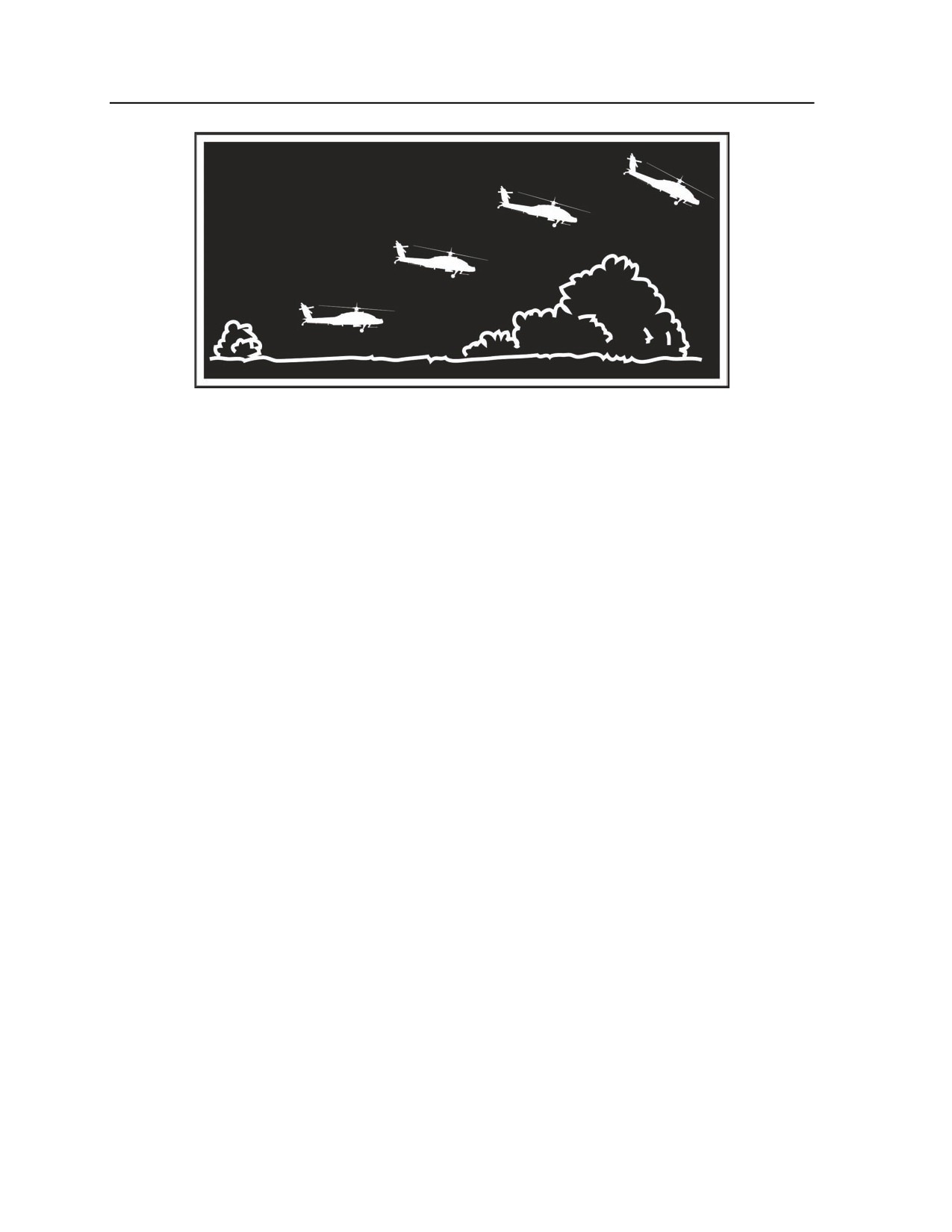
4-141. If enough illumination is available to view obstacles, the aviator can accomplish takeoff as a day
VMC takeoff. Figure 4-14, page 4-32, illustrates a night VMC takeoff. If illumination is insufficient, the
aviator should make an altitude-over-airspeed takeoff until the aircraft reaches an altitude that clears
obstacles. Takeoff may be performed from a hover or from the ground. The aircrew should treat visual
obstacles, such as shadows, the same as physical obstacles. If the aviator applies more than hover power
for the takeoff, that power setting should be maintained until about 10 knots before reaching the desired
climb airspeed. At that point, the aviator adjusts power establishing the desired rate of climb and airspeed.
The aviator not on the controls crosschecks the instruments. The lack of visual references during takeoff
and throughout the climb may make maintaining the desired ground track difficult. Using the known
surface wind direction and velocity assists in maintaining the ground track. Whenever possible, the takeoff
heading should be in the direction of the first leg on the flight route as this helps in initial orientation,
especially during low illumination. If the landing light is used during takeoff to detect obstacles, the
illuminated area increases in size as altitude increases. As soon as possible, the landing light is
extinguished to aid vision. When the landing light is turned off, the aircrew can expect some reduction in
night vision. Takeoffs in severe dust or snow conditions are extremely hazardous as ground references will
likely be obscured. The aviator performs an ITO until clear of the obscuration.
7 May 2007
FM 3-04.203
4-31
Chapter 4
Figure 4-14. Night visual meteorological conditions takeoff
EN ROUTE
Unaided
4-142. After reaching the desired flight altitude, aviators allow time to adjust to flight conditions. This
includes readjustment of instrument lights and orientation to outside references. During the adjustment
period, the aircrew’s night vision continues to improve until optimum night adaptation is achieved.
Aided
4-143. The viewing distance increases with altitude. However, depth perception and visual acuity
decrease significantly at higher flight altitudes.
Overwater
4-144. Long flights over water without a visible horizon should be avoided without a radar altimeter.
Before flying over water, check the barometric and radar altimeters for proper operation. Aviators should
set the radar altimeter low altitude indicator to the minimum acceptable altitudes. The aviator not on the
controls should maintain a cross-check of the flight instruments to prevent inadvertently flying into the
water. Trail aircraft monitors and advises the flight if any aircraft appears to be going below the briefed
altitude. The lower the visibility or ambient light, the higher the en route altitude should be over water.
LANDING
4-145. With reduced visual capability at night, night LZs should be larger than day LZs. Night LZs
should be relatively clear of obstacles on approach and takeoff paths. During an approach without aircraft
lights, aviators should observe the contrast between the dark trees and the lighter open area as this aids in
identification of obstacles along the LZ boundary. Forward and lateral limits of the open area appear darker
when contrasted with the open area.
4-146. Altitude, apparent ground speed, and rate of closure are difficult to estimate at night. Throughout
an approach, other crewmembers provide information to the aviator on obstacle avoidance, altitude,
airspeed, and approach angle. Maintaining a thorough scan, including the side windows, aids in estimating
such information as the rate of closure. If approach is made to tactical lights, lateral movement can be
detected by the relative position of the aircraft and lights. Except in blowing snow or dust, night
approaches to an unlighted area should be terminated at a hover and followed by a slow vertical descent to
the ground.
4-32
FM 3-04.203
7 May 2007
Rotary-Wing Night Flight
4-147. The approach can be made to the ground or terminated at a hover. Approaches to the ground
require the most skill and proficiency. Field LZ approaches are normally planned to terminate at a hover
because it is difficult to determine the surface condition. However, if the LZ surface can be adequately
assessed during approach, an aviator may continue to the ground. Each approach must be separately
evaluated. As the aircraft nears the ground, it is difficult to predict when ground contact will be made. To
avoid slowing the vertical descent excessively and over-controlling the aircraft while waiting for
touchdown, an aviator should reduce collective gradually and continuously.
4-148. An aviator executing a night landing to a field LZ must consider all aspects of the approach. The
touchdown point should be selected before reaching the entry point on approach. When landing on a
runway or taxiway, an aviator should select a specific group of lights or point on the runway while on the
downwind leg or base leg or, if on a straight-in landing, as soon as the area is in sight. This timely selection
aids the aircrew in determining entry point, approach angle, rate of descent, and rate of closure. The
apparent ground speed and rate of closure are difficult to judge during night operations. The last portion of
the night approach should be slower than during the day to avoid abrupt attitude changes at low altitudes
and slow airspeeds. To avoid reducing airspeed too soon or too high, the aviator should maintain an
instrument cross-check ensuring all indicators are within parameters. Abrupt recovery from slow airspeeds
may result in rapid loss of altitude when forward cyclic is applied. Coordinated control movement of both
cyclic and collective is required to fly the helicopter throughout the approach.
Ground Lighting Aids
4-149. A field lighting system provides fewer visual cues than a lighting system for a fixed landing site.
Approaches to a field LZ normally are made without a landing light. The type and arrangement of lighting
may vary considerably. Regardless of the lighting device, at least two lights should be used, separated by at
least 15 feet, to identify the touchdown point. An illusion of movement (autokinesis) may occur when a
single light source is viewed. When more than two lights are used to mark the LZ, spacing between the
lights can be reduced.
4-150. Two tactical field lighting configurations are used as landing aids for aircrews—the inverted Y
and the T. When operating with NATO aviation forces, aircrews should anticipate use of the T.
Inverted Y
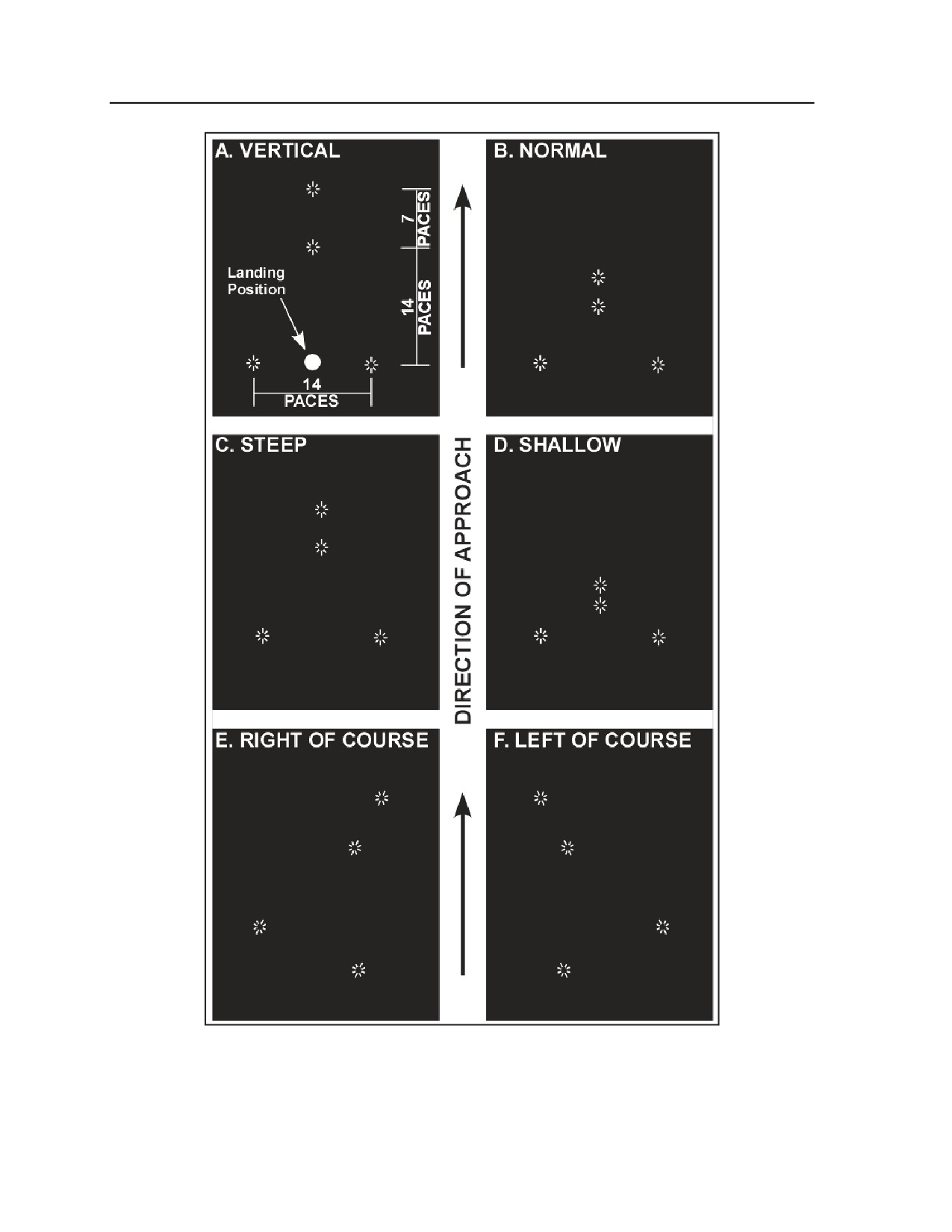
4-151. The inverted Y system is best used for an approach initiated from terrain flight altitudes. Figure 4
15 shows light cues for six different approach alignments. Part A of this figure depicts the proper setup of
the light system. Before the aircraft reaches the entry point for approach, lights in the stem will appear as a
single light. This sight picture will also indicate the helicopter is on approach and below the desired
approach angle (neither of these situations is depicted in figure 4-15, page 4-34). When the normal
approach angle is maintained, the Y appears normal (part B). If the distance between the lights appears to
increase, approach is too steep and the helicopter is above the desired approach angle (part C). If the
distance between the lights appears to decrease, approach is too shallow and the helicopter is below the
desired approach angle (part D). If the spacing between the front lights is uneven and the stem is shifted
right of the centerline, the aircraft is too far right and should correct left (part E). If the spacing between the
front lights is uneven and the stem is shifted left of the centerline, the aircraft is too far left and should
correct right (part F). The desired touchdown point is inside the Y with the fuselage aligned with the stem
lights. During the last 25 feet of the approach to a Y, aviators should divert their FOV away from the lights
and concentrate on acquiring ground references.
7 May 2007
FM 3-04.203
4-33
Chapter 4
Figure 4-15. Approach to a lighted inverted Y
4-34
FM 3-04.203
7 May 2007
Rotary-Wing Night Flight
T Shape
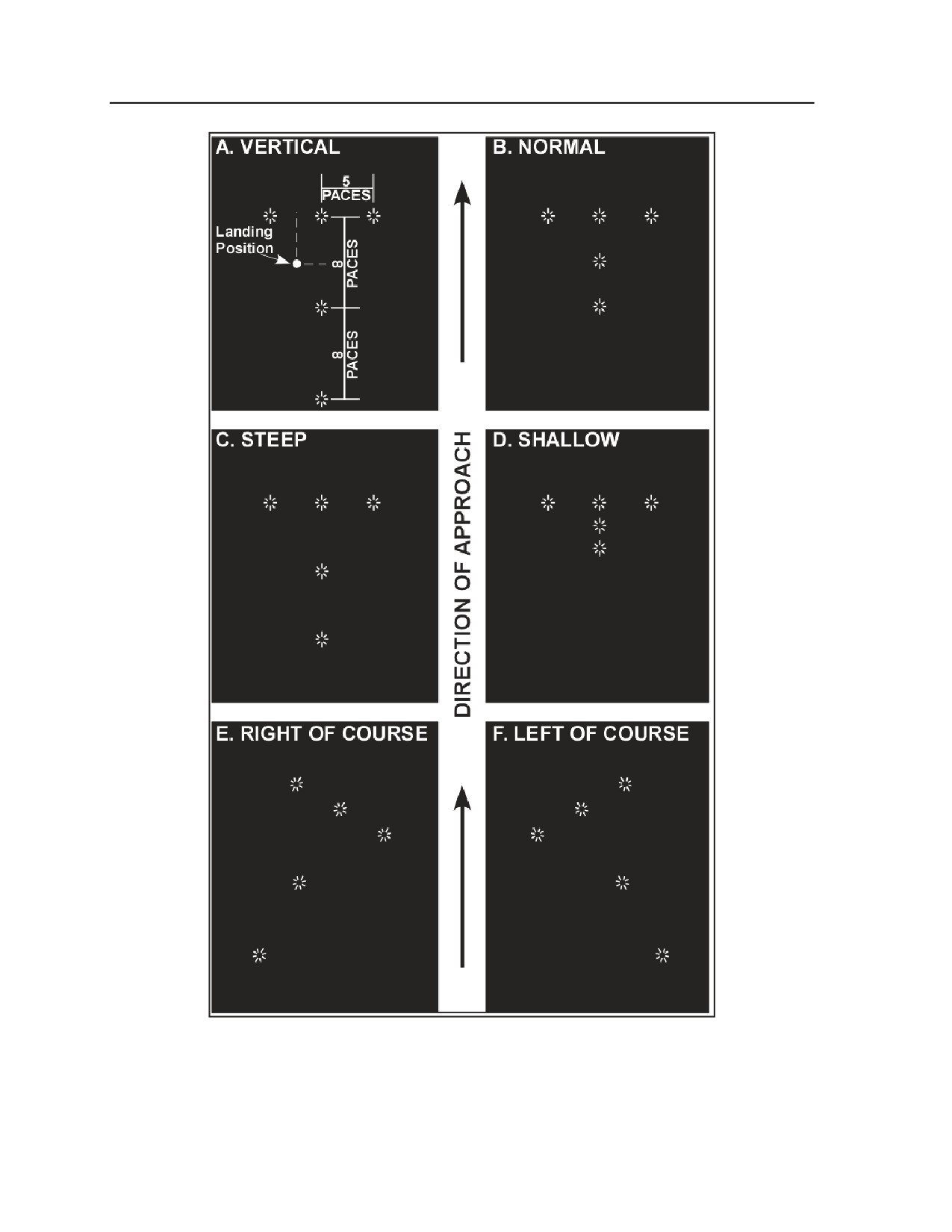
4-152. The T, while seldom used by U.S. forces, may be encountered when working with allied forces.
The T is best used for approaches initiated from an altitude above 500 feet AGL. Figure 4-16, page 4-36,
shows light cues for six different approach alignments. Part A depicts the proper setup of the light system.
The apparent distance between the lights in the stem of the T can be used as a reference for maintaining a
constant approach angle. A change in the spacing of the lights will occur as the approach angle changes.
Before the aircraft reaches the entry point to begin approach, the lights in the stem will appear as a single
light. This sight picture may also indicate the aircraft is below the desired approach angle (neither of these
situations is depicted in figure 4-16, page 4-36). After an approach angle is intercepted, the stem of the T
appears similar to part B. If the distance between the lights appears to increase, the approach angle is
becoming too steep and the helicopter is above the desired angle of descent (part C). If the distance
between the lights appears to decrease, approach is becoming too shallow and the helicopter is below the
desired approach angle (part D). If the stem of the T points left of the helicopter, the aircraft is too far right
of the course and should correct left (part E). If the stem points right of the helicopter, the aircraft is too far
left of the course and should correct right (part F). During the last 25 feet of approach to a T, aviators
should divert their FOV away from the lights and concentrate on acquiring ground references.
LIMITATIONS
4-153. Visual reference outside the aircraft is limited at night. Movement of the helicopter is difficult to
detect as night terrain features often blend into one solid background. Hover altitude and ground track are
also difficult to estimate. The degree of difficulty depends on ambient light level and aircraft altitude. This
is also true when flying with NVGs, although to a lesser degree.
4-154. Equipment, instruments, and control switches are easily located in a lighted cockpit; however,
aviators should be able to locate and use cockpit equipment associated with immediate action emergency
procedures without cockpit lighting ensuring the proper control switch can be identified. The use of
artificial lighting, flashlight, map light, NVG supplemental lighting, or even chemical lights is
recommended, time permitting. The location of items such as radios, mission equipment, and switches,
must be standardized to ease this process and provide a consistent reference base.
4-155. Visual references providing positive identification during the day may be difficult to see at night.
Objects that illuminate, such as airport beacons and towers with obstacle lights, are prominent night visual
NAVAIDs which are used with discretion. Visual flight is more demanding over sparsely inhabited areas
with few ground lights. As the altitude AGL increases, visual references are less effective and aircrew
members must rely more on instruments as a primary aid. Reduced visual references may cause
crewmembers to focus on a single light or a group of lights in a concentrated area. This can induce
illusions, most notably autokinesis. Even with NVGs, aircrew members will find it difficult to estimate
distance or altitude based on visual references.
4-156. When completely night adapted (if flying unaided), the eyes become extremely sensitive to light;
light exposure causes a partial or complete, but temporary, loss of night vision. Aircrew members should
avoid exposure to light sources, both outside and inside the aircraft, especially looking directly at or into a
high-intensity light. This same type of exposure during aided flight may have similar effects especially
when viewing unaided around the periphery of NVGs.
4-157. Night flight is inherently more stressful than day flight. Therefore, crew mental and physical
fatigue experienced while flying occurs sooner during night flight. Deteriorating performance and
efficiency causes poor coordination and slowed reaction time while reducing the ability to see. When
designing or using a training program, individual crewmember experience levels must be considered. AR
95-1 provides guidance regarding crew rest or fighter management.
7 May 2007
FM 3-04.203
4-35
Chapter 4
Figure 4-16. Approach to a lighted T
4-36
FM 3-04.203
7 May 2007
Rotary-Wing Night Flight
EMERGENCY AND SAFETY PROCEDURES
BASIC CONSIDERATIONS
4-158. Emergency procedures for day and night flight are the same. Responding to an emergency
situation usually takes longer at night. To minimize time delays in executing emergency procedures at
night, the aviator must be familiar with the location of all controls and switches and know all immediate
action emergency steps from the appropriate operator’s manual. Established safety procedures prevent
emergencies.
ELECTRICAL FAILURE
4-159. If a total or partial electrical failure occurs, the aircrew must execute appropriate emergency
procedures for the aircraft being flown. The aircraft may be difficult for other aircrews to see, so the
aircrew must avoid other aircraft, such as those in the same traffic pattern or formation. When on final
approach (if at an airfield), the aircrew must decide if approach can be continued without creating an
unsafe condition for other aircraft. During approach, the aircrew should watch the tower for light gun
signals. The Department of Defense (DOD) flight information publication (FLIP), Flight Information
Handbook, or the aeronautical information manual (AIM) contain information on ATC light signals.
EMERGENCY LANDING
With or Without Power
4-160. With power, descent to a lower altitude may aid the aircrew in locating and identifying a suitable
landing area. Depending in part on atmospheric conditions, when landing with or without power the
aircrew may turn on the landing light to assist in locating an LZ or identifying obstacles. An aviator must
exercise caution when fog, haze, or other obscurations are present as the landing light tends to degrade
night vision. Before landing, an aviator should attempt to advise the controlling agency of the situation and
location. The crew should, depending on the enemy threat, remain with the helicopter after landing and
identify its position by using appropriate signals.
GROUND SAFETY
4-161. During night operations, the number of support personnel, vehicles, and use of ground-handling
equipment on the flight line should be limited to minimum essential for mission accomplishment. Aircrew
members, support personnel, and other personnel should use lights when walking on the flight line to
identify obstacles, locate nearby aircraft, and to be seen especially by taxiing aircraft. The lights should be
equipped with an appropriate filter. During preflight inspection, aircrew members should pay particular
attention to the structural components of the aircraft. Before moving on or around the aircraft, flashlights
should be used to identify any obstacles or hazards. Serious injury can easily result if caution is not
exercised or proper procedures are not used. Climbing onto the aircraft at night can be especially
hazardous. Any surfaces should be checked for substances such as oil, hydraulic fluid, water, and frost.
AIR SAFETY
4-162. Aircrew members must be aware of the limitations of night vision and not overestimate their
ability to perform duties. After initial qualification or refresher training, aircrew members must train
continuously to remain proficient. If a long period has elapsed since the aviator’s last aided or unaided
night flight, a thorough review of basic tasks may be appropriate. Because flight attitude references are
limited at night, visual illusions, disorientation, or vertigo may be induced. Aviators must be aware of these
conditions and use flight instruments to assist in maintaining a normal flight attitude. When an unsafe
condition develops while hovering, the aviator may turn on the landing light if environmental conditions
permit. Continuous observation outside the helicopter is required so obstructions and other aircraft are
avoided and SA is maintained. This is particularly true during multihelicopter and terrain flight operations.
7 May 2007
FM 3-04.203
4-37
Chapter 4
AIRSPACE MANAGEMENT
4-163. Increased emphasis on night operations has resulted in a greater number of missions being flown
at night. Aviators flying at night unaided have difficulty in detecting other aircraft, especially when those
aircraft are “blacked out.” Aviators wearing NVGs also have difficulty in detecting other aircraft involved
in different, unrelated missions. This problem is compounded during field training exercises when multiple
aircraft or multihelicopter flights share the same airspace. The following help minimize the problem:
Sound operational planning and operating procedures must be developed and practiced to
prevent most airspace conflicts.
The area commander should establish priorities and guidelines for airspace usage; these should
be published in SOPs and operation orders (OPORDs) with subsequent changes disseminated as
necessary.
The commander or his designated representative should approve the use of airspace for
preplanned operations.
4-38
FM 3-04.203
7 May 2007
Chapter 5
Rotary-Wing Terrain Flight
To survive and accomplish the mission, combat aviation units must use tactics that
degrade an enemy’s capability to detect aircraft. Darkness protects aircrews from
visual and optical acquisition by the threat. Darkness will not, however, protect
aviation elements from electronic detection. Terrain flight is a tactic that uses terrain,
vegetation, and manmade objects to mask aircraft from visual, optical, thermal, and
electronic detection systems. This tactic involves a constant awareness of capabilities
and positions of enemy weapons and detection means in relation to masking terrain
features and flight routes. The most effective combination for detection avoidance is
flying terrain flight altitudes at night. The ability to perform night terrain flight
depends on ambient light level, flight proficiency, terrain familiarity, and effective
use of various NVDs. This chapter provides a description of tactics and terrain flight
planning considerations, flight techniques, guidance for establishing and conducting
day and night operations training programs, and the environment in which aviation
units will be required to operate.
SECTION I - TERRAIN FLIGHT OPERATIONS
MISSION PLANNING AND PREPARATION
5-1.
Using elements of METT-TC is essential to safe and successful accomplishment of missions at
terrain flight altitudes. As discussed earlier, various
factors dictate most decisions made in terrain flight
Contents
planning and preparation. Consistent with
Section I - Terrain Flight Operations
5-1
commander’s intent, flight routes, LZs, PZs, and
BPs will be determined and planned accordingly.
Section II - Training
5-17
5-2. Contingency planning is also a critical
element during this stage of the operation, including alternate flight routes, alternate LZs and PZs, and
suspected enemy positions. The entire planning sequence must be a methodical and thorough effort,
eliminating confusion and clarifying each step in the planned execution phase. This intensive level of
preparation also better prepares each aircrew to react to changes, unexpected events, and emergencies. This
planning phase must include appropriate personnel from the next lower level of operation ensuring
adequate dissemination of information and mission accomplishment. Historically, Army aviation has
witnessed many failures due to inappropriate exclusion of operations personnel and aircrews actually
flying the mission from the planning process.
5-3. Another key element is rapid dissemination of information allowing maximum planning and
familiarization time by aircrews, which also permits maximum time to brief the mission and addresses the
body of questions and inquiries that inevitably result. There must be a sense of urgency in expediting flow
of information to aircrews as quickly as possible. History reveals too many instances in which, to the
detriment of mission accomplishment, critical information has been unnecessarily delayed at a higher
operational level. Terrain flight planning and preparation also includes aircraft preparation ensuring aircraft
are configured, preflighted, and readied for the ensuing mission. This is most effectively accomplished
with a timely and continuous information flow from higher headquarters, such as through the battalion S-3,
to lower units.
7 May 2007
FM 3-04.203
5-1
Chapter 5
AVIATION MISSION PLANNING SYSTEM
5-4. The aviation mission planning system
(AMPS) is an automated mission planning and battle
synchronization tool designed specifically for aviation commanders. FM 3-04.111contains more detailed
information. AMPS functions include tactical planning, mission management, and mission rehearsal
capabilities. The tactical planning function includes all planning tasks performed, while the mission
management function can be associated with actions taking place during mission execution. The system is
also capable of mission briefing and rehearsal providing aircrews with the best possible preparation before
mission execution.
5-5. The main element of the system’s hardware is a lightweight computer unit (LCU) employed at each
aviation unit headquarters. Brigade and battalion headquarters have two LCU systems each. Companies
may also have one or more such units, depending on mission requirements. Additional peripherals include
a CD-ROM drive, magneto-optical drive, data transfer receptacle (loads data transfer cartridges), and an
uninterruptible power supply. The AMPS employs a menu-driven graphical user interface, allowing the
operator to enter and view critical mission planning data. The AMPS is subordinate to the maneuver
control system, with which it shares mission data and gains access to the joint common data base (JCDB).
It also provides the means to generate mission data for use in either hard copy or electronic format.
5-6. Information generated on the AMPS can be distributed in electronic format to other systems, which
rapidly reduces dissemination time and leaves aviation units with more time for mission planning and
preparation. It also transfers mission data directly to aircraft by means of the data transfer system (DTS).
TERRAIN FLIGHT LIMITATIONS
5-7. Terrain flight imposes additional factors on aircrews and units not encountered on missions flown at
higher altitudes. The following are considerations for missions at terrain flight altitudes:
Mountainous or uneven terrain that restricts use of LOS radios, making it difficult or sometimes
impossible to conduct normal communications.
Aircrews should predict and plan limits on communications when operating near enemy forces.
In terrain flight operations, control may be delegated to a lower level due to inherent problems.
Aircrews and platoon, section, or team leaders must be knowledgeable enough to execute the
mission using sound tactical judgment. This is a result of training and experience.
5-8. Such missions should be coordinated with higher headquarters ensuring appropriate airspace
management and acquiring the latest intelligence updates. Even in a training scenario, the plan to conduct
terrain flight operations must be disseminated ensuring safe use of the training area. The unit anticipates
increased maintenance as a result of increased demands placed on aircraft and components.
5-9. Demands on aircrews increase dramatically when terrain flight operations increase, especially NVD
terrain flight. Specifically, fighter management becomes a larger issue with an increase in psychological
and physiological stress. The factors increasing stress include—
Increased workloads (physical dexterity and mental processes).
Limited FOV when using NVDs.
Reduced visual acuity, viewing distances, and depth perception.
More complex aircrew coordination.
Frequent training, physical fitness, thorough flight planning, and preparation can minimize these factors.
TERRAIN FLIGHT MODES
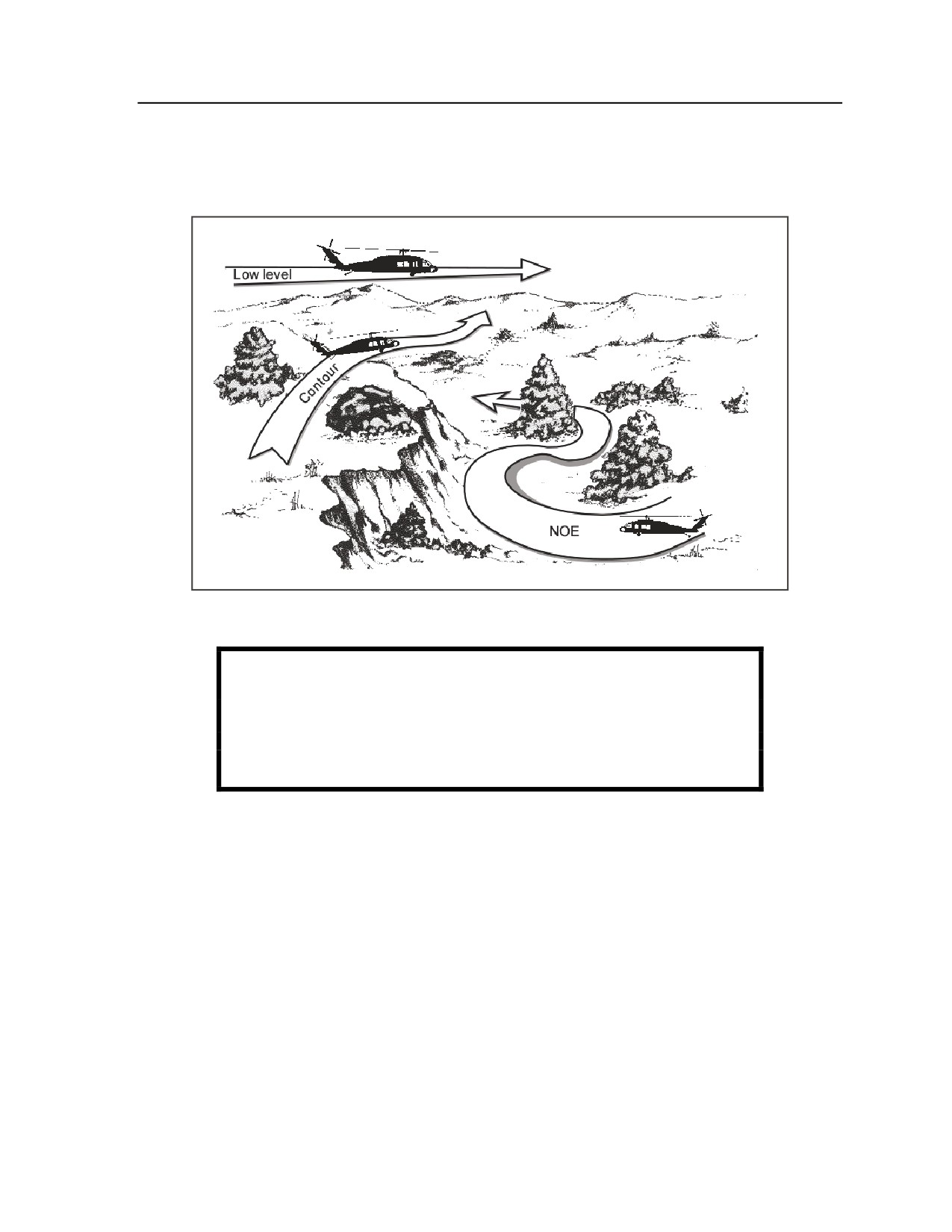
5-10. Terrain flight includes appropriate tactical application of low-level, contour, and NOE flight
techniques (figure 5-1, page 5-3), as appropriate, diminishing the enemy’s capability to acquire, track, and
engage aircraft. For NVD training, terrain flight is conducted at 200 feet or less above the highest obstacle.
Altitude and airspeed restrictions—for NVD flight training—are listed with the description of each mode.
Terrain flight requires aircrew proficiency in map reading, preparation, and terrain interpretation. It also
5-2
FM 3-04.203
7 May 2007
Rotary-Wing Terrain Flight
requires constant vigilance in identifying terrain features and hazards, and understanding effects of
surrounding terrain, ambient light, and seasonal changes in vegetation. Continuous NOE or contour flight
is unusual as terrain and vegetation vary. Normally, there is a transition from one mode to the other as the
situation dictates. Modes of terrain flight are defined below.
Figure 5-1. Modes of flight
WARNING
While unaided night flight at terrain flight altitudes is not
prohibited, it is unwise and would usually fall into the extremely
high risk category of the risk assessment process.
NAP-OF-THE-EARTH FLIGHT
5-11. NOE flight is conducted at varying airspeeds as close to the earth’s surface as vegetation and
obstacles permit. For NVG training, NOE flight is further defined as operating with the skids or wheels up
to 25 feet above trees and vegetation in the flight path. (For training, a safe airspeed is used based on
ambient light, flight visibility, terrain, winds, turbulence, obstacles, and crew proficiency.) Aviators should
decrease airspeed if weather and/or ambient light restrict visibility.
CONTOUR FLIGHT
5-12. Contour flight is conducted at low altitudes conforming to the earth’s contours. It is characterized by
relatively constant airspeeds and varying altitude as dictated by terrain and obstacles. For NVG training,
contour flight is further defined as operating with the skids or wheels between 25 and 80 feet above highest
obstacle (AHO). (For training, a safe airspeed is used based on ambient light, flight visibility, terrain,
winds, turbulence, obstacles, and crew proficiency.) Aviators should decrease airspeed if weather and/or
ambient light restrict visibility.
7 May 2007
FM 3-04.203
5-3

Chapter 5
LOW-LEVEL FLIGHT
5-13. Aviators perform low-level flight at constant altitude and airspeed, dictated by threat avoidance. For
NVG training, low-level flight is further defined as operating with the skids or wheels between 80 and 200
feet AHO at an airspeed commensurate with operational requirements and aircrew limitations. Aviators
should decrease airspeed if weather and/or ambient light restrict visibility.
SELECTION OF TERRAIN FLIGHT MODES
5-14. Aviators must determine which terrain flight mode to use in each segment of the planned route
during the mission planning sequence. This determination is based on METT-TC (table 5-1).
Table 5-1. Mission, enemy, terrain and weather, troops and support available, time
available, civil considerations and terrain flight modes
Mission
Influences selection of terrain flight techniques (especially if mission is performed at
night). Factors such as light levels and moon illumination complicate NVD flight at
terrain flight altitudes. The lack of visual acuity may demand a lower airspeed &/or
higher altitude.
Enemy
Threat weapons can detect & engage aircraft at low altitudes. Select the appropriate
terrain flight mode to avoid or minimize detection.
Terrain and
Vegetation and terrain features masking an aircraft from visual & electronic
detection significantly degrade the capability of threat weapons to detect an aircraft.
Weather*
Determine a maximum safe flight altitude by availability of terrain features and
vegetation. Use the highest terrain flight altitude for a specific condition. A higher
flight altitude reduces difficulty in navigation, permits a higher airspeed, reduces
hazards to terrain flight, and minimizes fatigue.
Periods of deteriorating weather with low ceilings/restricted visibility may make all
terrain flight modes extremely difficult or impossible. It also makes navigation more
difficult & increases potential for IIMC, especially when flying in formation or
operating in an unfamiliar environment.
Troop
Factors, such as aircrew availability, experience level, effects of the fighter
management program, and mission-oriented protective posture, may affect selection
of terrain flight techniques.
Time
Influences selection of the terrain flight mode. Whenever possible, the route should
be flown at the highest flight mode to permit the shortest completion time.
Civil
The selection of a particular mode must consider the safety of and potential threat
Considerations
from any civilian sector.
*See chapter 3 for more information
PICKUP ZONE/LANDING ZONE SELECTION
5-15. PZ/LZ selection is extremely important. Technical and tactical considerations must be analyzed
ensuring the best choice for mission success is made. A poor LZ can jeopardize the entire mission.
PICKUP ZONE SELECTION
5-16. The first step in the loading plan is selection of a suitable PZ or PZs. Primary and alternate PZs
should also be selected during this process. Multiple primary PZs may be necessary to facilitate a smooth
flow of personnel and equipment. The mission may require separate PZs for troops and equipment (heavy
and light PZs). The heavy PZ contains any external loads used for air assault, and the light PZ is where
troops will be lifted from. Selection of PZs is based on METT-TC, commander’s intent, location of assault
forces in relation to the PZ, and size and capability of available PZs. PZ selection should be based on the
considerations noted in table 5-2.
5-4
FM 3-04.203
7 May 2007

Rotary-Wing Terrain Flight
Table 5-2. Pickup zone selection considerations
Number
Multiple PZs may have an advantage over single PZs as they avoid concentrating the force
in one location. Multiple PZ operations require detailed & precise planning by the supported
& supporting units.
Size
Each PZ should accommodate all supporting aircraft at one time. Points to consider
include—
• Number and type aircraft. Minimum recommended landing point separation—
UH-1: 30 meters
UH-60/AH-64: 50 meters
OH-58: 25 meters
CH-47: 80 meters
• Unit proficiency.
• Nature of loads.
• Climatic conditions.
• Power management.
• Day or night operations.
Obstacles
Plan for a 10 to 1 ratio for arrival and departure ends of PZ.
Location
PZs should be selected close to the troops being lifted (so they do not have to travel long
distances) and accessible to vehicles moving support assets & infantry. However, locate PZs
in an area limiting traffic from vehicles or personnel not directly involved. Mask PZs by terrain
from enemy observation.
Conditions
Consider area surface conditions. Excessive slope, blowing dust or sand, blowing snow, &
natural (tree stumps, rocks) and manmade (wires, foxholes) obstacles create potential
hazards to PZ operations. Weather vulnerable, a perfect PZ could become unusable after a
hard rain or fog from a nearby river. Other considerations are—
• Blowing dust/sand/snow: increase separation between aircraft (as a general rule, by
50%).
• Ground slope: Should be level terrain. As a guide:
Land upslope for 0 to 6 degree slope
Land side slope for 7 to 15 degree slope
Wind
Orient into the wind especially if aircraft are operating near maximum capacity or if the PZ is
hazardous due to sand, dust, or snow.
Approach/
Analyze terrain surrounding a possible PZ for air traffic patterns. In a tactical situation, avoid
Departure
constantly approaching the PZ over the same ground track. Still, there are only so many
ways to approach an area. Ideally, there should be an obstruction-free approach and exit
Routes
path into the wind using the long axis. If required, mask routes from enemy detection.
LANDING ZONE SELECTION
5-17. Considerations for PZs apply to LZ selection. In coordination with the air mission commander
(AMC) and liaison officer, the air assault task force commander (AATFC) selects primary and alternate
LZs. The number and location of selected LZs is based upon ground scheme of maneuver and LZ
availability. Aviation planners advise the AATFC on LZ suitability. Table
5-3 provides additional
considerations for selecting a suitable LZ.
Table 5-3. Pickup zone selection considerations
Location
Locate the LZ in an area supporting the ground tactical plan of the AATFC. It may be
located on the objective, close by, or at a distance. Consider METT-TC factors when
selecting LZs. Select LZs within range of supporting fires (artillery, close air support
[CAS], naval gunfire) if required.
Capacity
LZ size determines how much combat power can be landed at one time. The selected
LZ must be large enough to support the number of aircraft required by the AATFC.
7 May 2007
FM 3-04.203
5-5

Chapter 5
Table 5-3. Pickup zone selection considerations
Squads must land intact in the LZ, and platoons must land in the same serial to ensure
fighting unit integrity during air assault. This consideration also determines the need for
additional LZs or separation between serials.
Alternates
An alternate LZ should be planned for each primary LZ to ensure flexibility.
Threat
The AMC considers enemy troop concentrations, air defense artillery (ADA) locations,
weapons ranges, and the enemy’s ability to reposition ground forces to react to the air
assault. LZ selection involves the air assault task force (AATF) S-3, AMC, and S-2s
from the AATF and aviation task force. S-2s provide intelligence affecting selection of
LZs.
Obstacles
LZ selection must include existing as well as reinforcing obstacles on the LZ. Which
side of the obstacles (away or same side as enemy) to use is determined by AATFC.
Identification
LZs should be easily identifiable from the air, if possible (more critical for the first lift).
Approach/
Approach and departure flight routes should avoid continued flank and visual exposure
Departure
of aircraft to the enemy.
Routes
Number
The decision to use a single or multiple LZs is based upon the ground tactical plan &
AATFC intent. Advantages to using a single LZ are—
• Make controlling operations easier.
• Require less planning and rehearsal time.
• Centralize any required resupply operations.
• Concentrate supporting fires on one location.
• Provide better security on subsequent lifts.
• Amass more combat power in a single location.
• Make detection of the air assault by enemy units more difficult as the air
assault operation is confined to a smaller area of the battlefield and there are
less flight routes
Advantages for multiple LZs include the following:
• Do not group the entire force in one location.
• Force the enemy to fight in multiple directions.
• Allow rapid dispersal of ground elements to accomplish tasks in separate
areas.
• Make determining size of the assault force difficult for the enemy.
• Reduces troop/aircraft congestion.
ROUTE-PLANNING CONSIDERATIONS
CRITERIA
5-18. The route to and from the objective area must be tactically sound and conducive to successful
navigation. Select routes with the final objective in mind. An aviator should base route selection, primarily,
on the enemy tactical situation and, secondarily, on ease of navigation. Before route selection, an aviator
should mark all known threat sites with weapons systems on the map. Criteria considerations using METT
TC are found in table 5-4, page 5-7.
5-6
FM 3-04.203
7 May 2007
Rotary-Wing Terrain Flight
Table 5-4. Route planning considerations
Mission
Supports the ground tactical plan.
Does not hinder fire support plan.
Avoids airspace control order (ACO) and special use airspace.
Whenever routes coexist, avoid flying on or designating choke points; these are potentially midair
collision points.
When establishing ingress and egress routes, try to make separate routes or, at a minimum, establish
different altitudes.
Enemy
Avoid being silhouetted when crossing ridge lines or by the moon on approach to objective areas.
Cross major hydrographic features, major roads, and railroads at wide angles (90 degrees) reducing
exposure time.
Plan alternate routes in case the primary route is blocked due to weather or the enemy.
Bypass known or anticipated enemy positions keeping a terrain mass or vegetation between the
enemy and aircraft.
When forced to plan a route near known or anticipated enemy positions, plan route at the edge of their
weapons maximum effective range.
Terrain and Weather
Provide cover when terrain permits, placing terrain and/or vegetation between enemy and the aircraft.
Negotiate large north-south valleys on the lighted side with respect to the position of the moon. This
will avoid shadows cast by the moon and will silhouette terrain features for navigation.
When the route direction is east to west (or west to east) in mountainous terrain, use narrow valleys or
passes to cross north/south ridge lines so flight in shadows is avoided and terrain is generally
silhouetted. Shadows do not aid in concealing aircraft but do make hazard identification and navigation
more difficult.
Avoid routes directly toward a low angle rising or setting moon. Alter the course, to include establishing
a zigzag course, if no other options exist.
Avoid paralleling linear features-roads or railways-associated with populated areas.
Anticipate wires associated with all roads, towers, & buildings in open fields.
When possible, avoid planning routes over large areas of low contrast such as large bodies of water,
large fields, and snow-covered terrain.
Evaluate potential weather problems in all areas (fog in river valleys, cloud covered ridge lines).
Troops
Extra troops ease navigation (day/night). For contingency planning, select air control points (ACPs)
that can be used for day/night.
Avoid planning route segments requiring heading changes of more than 60 degrees (especially critical
during formation flight).
Whenever possible, aviators plan en route altitudes at 200-500 ft AGL to reduce risk & avoid terrain
flight hazards.
Time
Make routes as short as possible to amass fire power to allow greater on station time and flexibility for
contingencies.
Civil
Avoid brightly lit areas and population centers. If not possible, reduce exposure time by maintaining
cruise airspeed.
Avoid NAVAIDs and airports due to hazards associated with other aviation operations and to prevent
detection by radar associated with these facilities.
7 May 2007
FM 3-04.203
5-7
Chapter 5
AERIAL CHECKPOINT SELECTION
5-19. Three main types of aerial CPs are—
Air control point. An easily identifiable point on the terrain or an electronic NAVAID used to
provide necessary control during air movement. Air control points
(ACPs) are generally
designated at each point where the flight route or air corridor makes a definite change in any
direction and at any other point deemed necessary for timing or control of the operation.
Communications check point. An ACP requiring serial leaders report either to the aviation
mission commander or terminal control facility.
Checkpoint. A CP is a predetermined point on the ground used to control movement, tactical
maneuver, and orientation. (DOD, NATO) A predetermined point on the surface of the Earth
used as a means of controlling movement, registration target for fire adjustment, or reference for
location. Geographical location on land or water above which the position of an aircraft in flight
may be determined by observation or electronic means.
5-20. After selecting flight routes, an aviator selects CPs using the following considerations:
Select points controlling movement along the route, after determining general routing.
Be detectable at a distance and not only visible when flying directly overhead.
Contrast with surrounding terrain; for example, paved roads are poor choices in heavily
vegetated terrain but are excellent in desert terrain. Another example is a small body of water,
which provides little contrast in vegetated terrain but contrasts well in desert terrain.
Avoid selecting points near towns that may have grown in size and can make detection difficult.
Avoid points near bright lights.
Avoid using manmade objects as primary points.
Confirm selections with prominent adjacent features.
Consider moon angle and effective illumination. Avoid selecting points within shadows cast by
other features.
ACPs should be 5 to 20 kilometers or nautical miles (NM) apart. As a general rule, select ACPs
5 to 20 kilometers apart when utilizing map scales of 1:100,000 and below, and use NM when
utilizing map scales of 1:250,000 and above. ACPs should be progressively closer as an aircraft
nears the objective, facilitating timing and navigation. Type of terrain, illumination, total route
distance, and accuracy of onboard navigation systems may allow selection of ACPs much
further apart.
Select prominent barriers near ACPs, particularly when planning significant turns. Use barriers
to alert navigators an ACP has been overflown or bypassed and to cue for planned turns. As an
ACP is passed, note actual time of arrival (ATA) and make necessary adjustment to the time
and/or speed. A more difficult CP with an excellent barrier is a better choice than a good ACP
without a barrier.
The start point (SP)/departure point (DP) and RP/initial point are important ACPs. Aviators use
easily identifiable terrain features even if they must alter their route slightly. These points should
be 3 to 8 kilometers or NM from the PZ/LZ to aid timing and navigation and should not involve
significant turning. Avoid final legs between CPs not having significant terrain features. The
lack of significant terrain features precludes correct positioning and time management.
Make note of MSL altitude of ground track and ACPs to aid in selecting an appropriate en route
altitude.
Select CPs between ACPs ensuring on-course navigation and time management. Use more
reference points in low ambient light.
The flight lead navigator/crew selects the final route and aerial CPs.
5-8
FM 3-04.203
7 May 2007
Rotary-Wing Terrain Flight
MAP SELECTION AND PREPARATION
5-21. While most of the following are techniques and suggestions for preparing maps used with NVDs,
these same techniques apply to daytime operations.
SELECTION
5-22. Aviators assemble as many different types of maps as possible of the AO. Imagery is recommended,
if available. Joint operations graphic (JOG) 1:250,000, tactical 1:100,000, 1:50,000 (or 25,000), and a
1:500,000 scale (tactical pilotage chart [TPC] or VFR sectional) are the primary maps used. When using a
larger scale map, it generally requires an aircrew to fly at a higher altitude. For example, altitudes from
surface to 200 feet AHO are easily navigated with a 1:50,000 map, while a 1:100,000 map works best from
200 feet AHO to 1,000 feet AHO.
5-23. The JOG should be the primary map for planning and flying the en route portion of a mission. The
map scale covers a large area which permits a relatively small map uncluttered with extraneous
information. It has latitude/longitude and universal transverse Mercator (UTM) features and is NVD
compatible when properly prepared. The VFR sectional/TPC may be more appropriate for long-range
navigation to the target area.
5-24. The tactical map should be used to accurately locate and confirm unique map features for transfer to
the JOG. It displays more detail in areas absent or difficult to interpret on the JOG. Because en route
landing and holding areas can be accurately plotted and studied on this map, aviators should use it during
objective phases of operations. An aviator uses the tactical map for all flights flown at tactical altitudes and
operations not less than 5 NM from the objective. Use caution when making the transition to different scale
maps in flight as aircraft movement relative to the map scale may change radically. Aviators update tactical
maps by using the chart update manual (CHUM) and current VFR sectional.
5-25. Aviators should consult the U.S. VFR sectional map which provides accurate information on major
towers, airports, beacons, power lines, and magnetic variation. It is updated frequently and includes
military training routes allowing aviators to bypass them.
PREPARATION
5-26. The following techniques prepare aviators to read a map in a near-dark cockpit with minimal lighting
and simplify the task of map reading.
CAUTION
Maps marked with classified information become classified and must
be handled and stored according to security regulations.
Use permanent ink pens or markers only. When preparing maps by hand, use fine or medium
black markers for routes, ACPs, and time distance heading data. If printing maps, utilize a line
color that contrasts with the background. Use red markers for hazards. Iridescent fine red/orange
hue markers may be substituted to highlight wires and towers. An iridescent yellow marker may
be used to highlight hydrographic features. Do not use blue markers as they cannot be seen
under the blue filters used in the cockpit. Recommended map preparation are—
Routes will be marked on the map with a solid line.
Corridor boundaries of a route will be marked on the map with alternating dashes and
periods (- . - . - . -)
Alternate routes will be marked with dashed lines (- - - - - - -)
NOE routes will be marked on the maps with periods (
)
7 May 2007
FM 3-04.203
5-9
Chapter 5
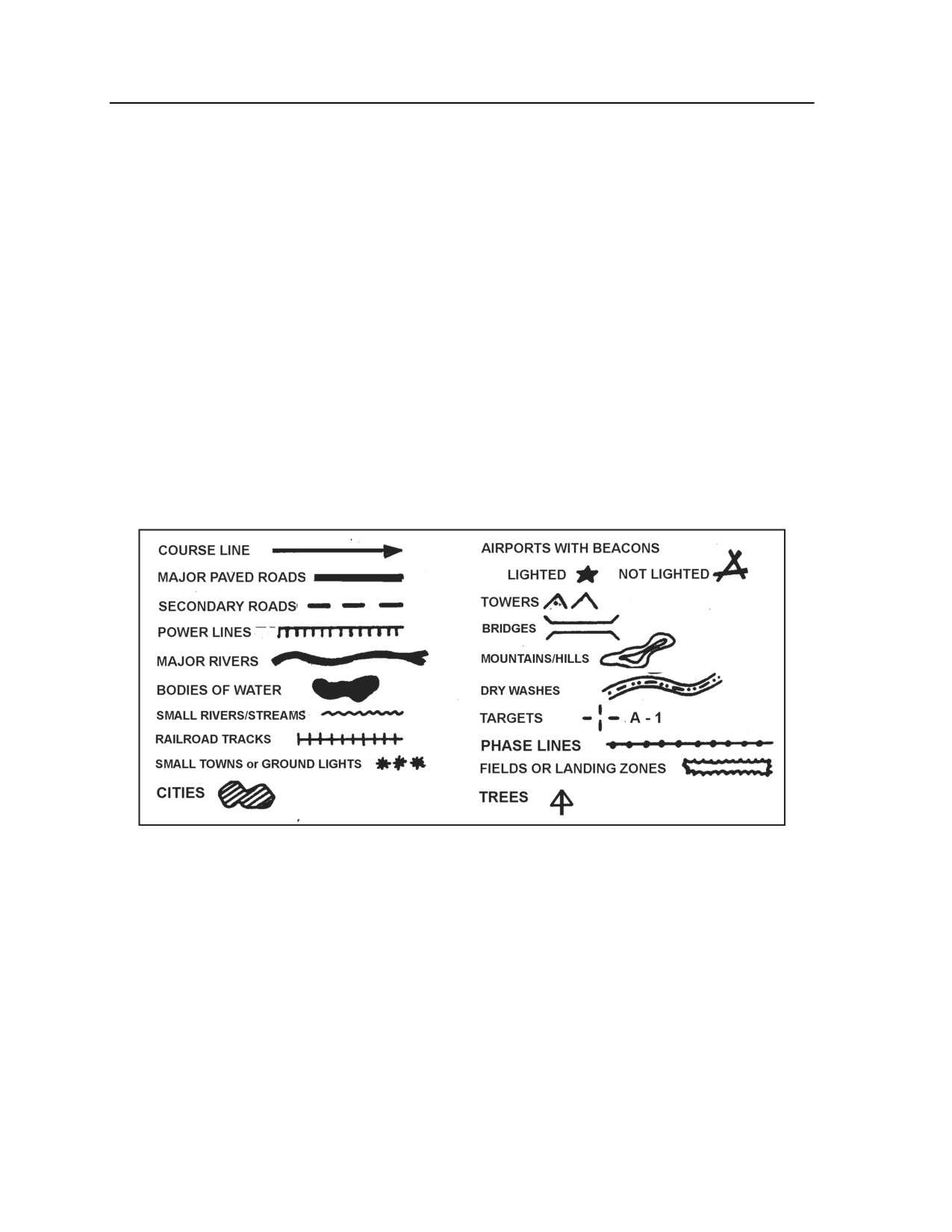
The map symbols used should include those indicated within this text, FM 1-02, JP 1-02, and
designated by unit SOP. The symbology for common features—such as railroads and power
lines—should replicate the legend information available on the map sheet or exaggerate existing
information printed on the map itself such as bodies of water. The concern is clarity, simplicity,
and immediate comprehension by any crewmember. Figure 5-2 depicts some typical route
planning map symbols.
Do not over exaggerate map features.
Orient notes and writing to direction of flight.
Do not over prepare maps. Aviators highlight those features they expect to see and ensure they
do not miss something important. Heavy vegetation or snow may prevent dirt roads, trails, and
creeks from being seen. Highlighting these clutters the map. In a desert environment, however,
if something shows on the map, it must be marked due to the lack of other cues in the desert.
Place ACO, threat sites, and weapon system overlays on the map first. Then select route and
ACPs.
Place a large north (N) symbol on each fold of the map for rapid orientation in flight.
Post all hazards not less than 10 NM on either side of the course line for safety during
intentional or unintentional deviation.
Highlight significant light sources, such as beacons and cities, out to a distance of at least 15
NM. Map sheets should not be trimmed until information, such as hazards and light sources, is
posted.
Figure 5-2. Route planning map symbols
Transfer key features and hazards from VFR sectionals, tactical maps, and CHUMS to the maps,
as necessary.
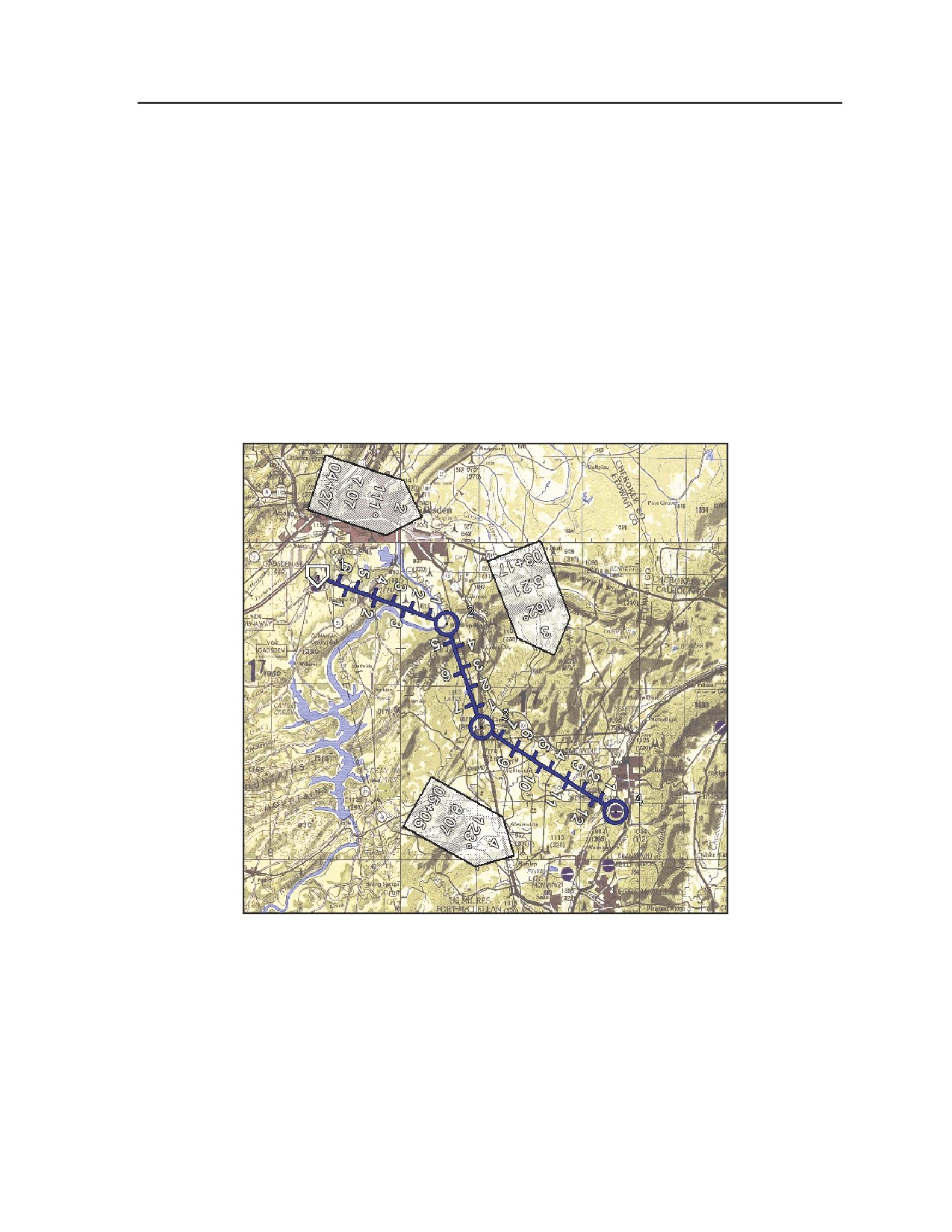
Identify ACPs with a circle centered on a dot placed on the feature. Name/number the point and
post planned arrival time to the side of the circle oriented in the direction of arrival.
Identify SP/DP/RP/initial points with graphics found in FM 1-02, JP 1-02, or unit SOP.
Mark course lines with tick marks on either side to indicate elapsed time and distance. The
information presented should always be in the same scale of measurement-for example, NM or
kilometers-to prevent confusion. Time and distances should have a set side of the course line for
standardization in a unit (for example time marks on the right side of course with distance
marked on the left).
5-10
FM 3-04.203
7 May 2007
Rotary-Wing Terrain Flight
Navigation information blocks (doghouses) provide crews with required navigational data from
present waypoint to the next. When they are used, the following order of information within the
block is suggested:
Designator of next waypoint.
Magnetic heading to next waypoint.
The distance to next waypoint identified with NM or kilometers.
Estimated time en route (ETE) to next waypoint.
PZ and LZ will be identified with a triangle centered over the objective area.
Individual aircraft/serial touchdown point will be identified by a “+” symbol.
Hard times will indicated by “00:00:00.” Used for time driven missions (H-hour).
Soft time will be indicated by “0000.” Use for missions that are not time sensitive.
Elapsed times will be indicated by “00+00+00.” Used for event driven missions.
Intermediate times may be used at ACPs as a tool to ensure the aircraft arrive on time. Will be
indicated by “00:00:00”.
Figure 5-3 depicts a map preparation sample.
Figure 5-3. Sample-joint operations graphic map preparation
CHARTS, PHOTOGRAPHS, AND OBJECTIVE CARDS
5-27. The following tips are used for preparing charts, photographs, and objective cards:
Post charts, photographs, and objective cards (not kneeboard) in the sequence of discussion
during the OPORD brief. Accurately construct charts and objective cards. Label charts and
objective cards not reproduced to scale as “not to scale.” Place required items on charts, and
refer to them, as necessary, during the mission brief.
7 May 2007
FM 3-04.203
5-11

Chapter 5
Prepare and orient charts and objective cards in the direction of approach, relating to magnetic
north or in the direction of landing/takeoff. Photos and overhead imagery should be oriented as
if viewed from the direction from which they were obtained.
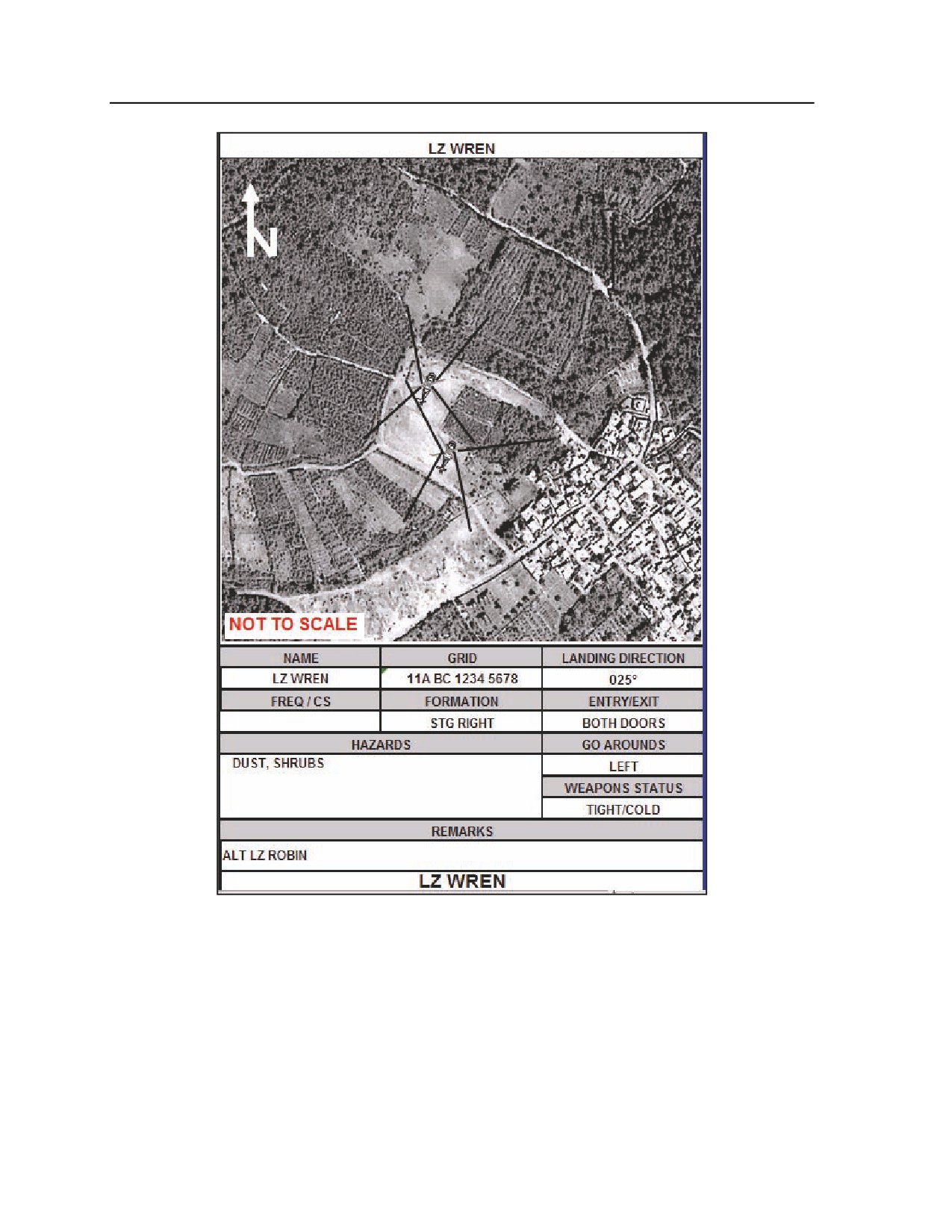
Include the following information on the objective card diagram:
Name of objective area.
Grid: military grid reference system or latitude/longitude.
Landing direction.
Landing formation.
Frequency and call sign.
Passenger entry/exit.
Go around direction.
Weapons control status/measures.
Fields of fire.
Hazards and markings.
Key terrain.
Alternate (if required).
ROUTE PLANNING CARD PREPARATION
5-28. Route planning (kneeboard) cards consist of navigation, en route, and objective cards. While used
mostly in an NVD cockpit, route planning cards are also useful during daylight. They are intended to be
easily viewed and lend organization to navigating and executing a mission. The following information
applies to all three card types.
Aviators should write data in black ink contrasting with the card background. They should use
letters and numerals at least ¼ inch in size and headings in degrees and nautical mile or
kilometer abbreviations to preclude confusion.
Time, distance, heading, and coordinates (UTM or latitude/longitude) will be triple-checked by
members of the planning cell/aircrews before posting cards for briefings. Aviators should
accomplish this check procedure using computers and manual measurements. Lead
aircraft/AMC/lead navigators should resolve discrepancies.
A completed card set is generated for each aviator and placed in plastic, transparent checklist
pages. The card set is then fixed to the kneeboard, preventing loss during flight.
NAVIGATION CARDS
5-29. Navigation cards come in a variety of styles with different configurations tailored to suit a unit’s
needs (table 5-5). This format can be modified for specific needs.
Table 5-5. Example of a navigation card
Location
Heading
Destination
Distance
Ground
ETE/ETA
Altitude
Remarks
nautical
Speed
*
AGL/MSL
mile
/kilometer
ACP 1
280°
CP 3
6 NM
100 kts
3+36
50 AGL
Bridge
*estimated time of arrival (ETA)
5-12
FM 3-04.203
7 May 2007
Rotary-Wing Terrain Flight
EN ROUTE CARDS
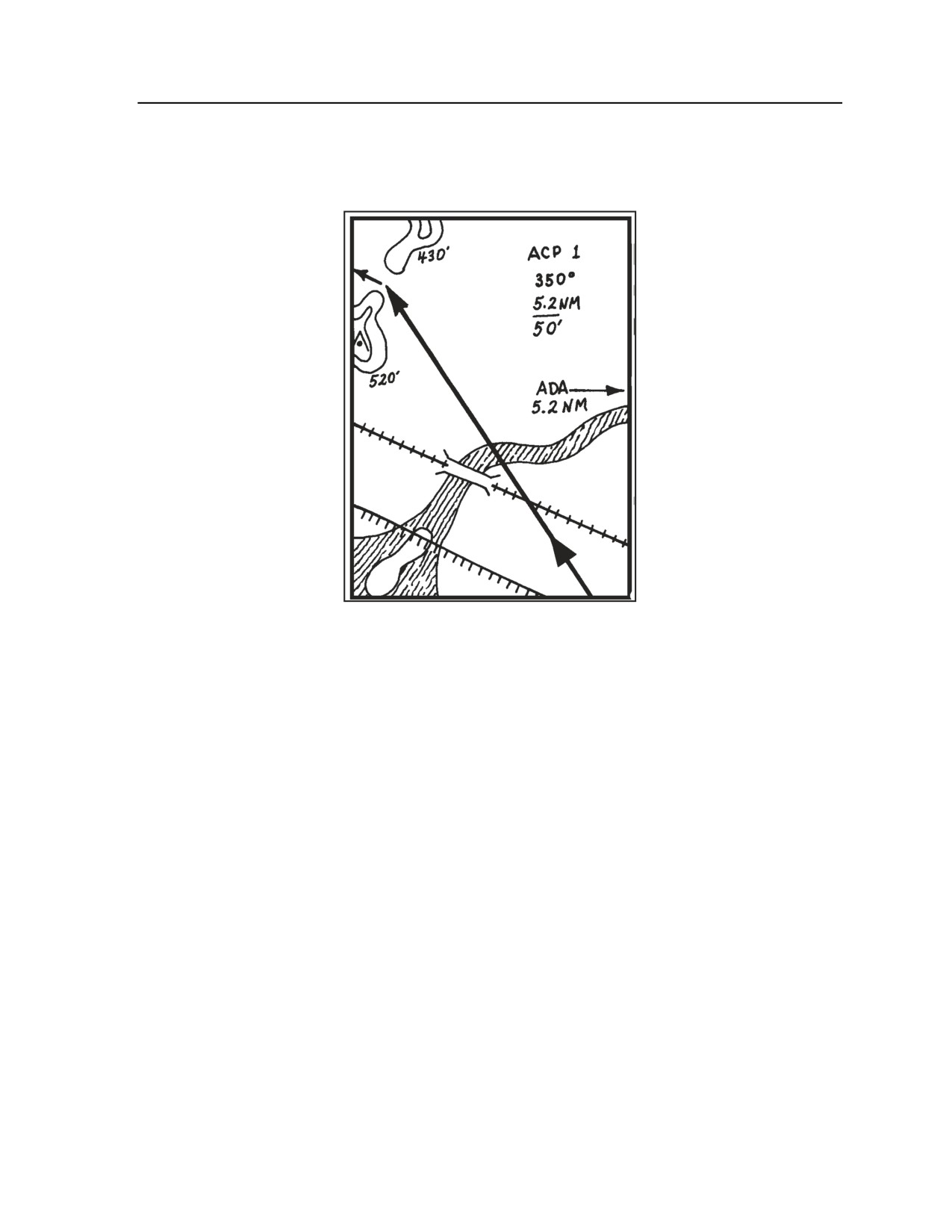
5-30. En route cards reinforce map reconnaissance and display essential information for each phase/leg of
flight (figure 5-4).
Figure 5-4. Example of an en route card
5-31. En route cards should be prepared with the following considerations:
An aircrew may prepare en route cards for each leg and area of intended landing (objective,
holding, or forward arming and refueling point [FARP]). An en route card may also highlight or
detail an ACP position or turning point. En route cards are made with various elements close to
scale giving attention to accuracy and detail. An aviator may refer to these cards instead of the
map for quick orientation and reference.
Xerographic copies of the JOG map cut to appropriate size, with route posted, serve as excellent
en route cards once details have been highlighted according to map preparation guidelines for
NVD use. This provides an en route card with an obvious accuracy advantage but must be
studied in detail ensuring familiarity with the information.
OBJECTIVE CARDS
5-32. Objective cards reinforce map reconnaissance and provide a graphic picture of the LZ, PZ, and/or
objective (figure 5-5, page 5-14). This card must be as accurate in detail as possible. It is important all
crewmembers have the same understanding of where hazards, landing points, and loading points are
located. Supported units may also receive a copy of the objective card so there is no doubt in positioning
equipment and troops. When preparing an objective card, an aircrew depicts map elements to scale, as
much as possible, reflecting relative sizes of each element.
7 May 2007
FM 3-04.203
5-13
Chapter 5
Figure 5-5. Example of an objective card
HAZARDS TO TERRAIN FLIGHT
5-33. Specific hazards to terrain flight safety include physical, weather, and human factors.
PHYSICAL HAZARDS
5-34. Physical hazards are objects that the aircraft can actually contact during flight. Physical hazards are
divided into two categories; manmade and natural.
5-14
FM 3-04.203
7 May 2007
Rotary-Wing Terrain Flight
Manmade Hazards
5-35. Manmade hazards are things made by man that pose a hazard to the aircraft. The list includes things
such as buildings, bridges, towers, other aircraft, and wires. Manmade hazards are sometimes identified on
maps but should be searched for continuously.
Wire Hazards
5-36. During terrain flight, regardless of location, aircrews continuously search for and expect wires.
Throughout the world, wires are common at all altitudes and are found in the most unlikely places. Wire
hazards consist of power lines, guy wires, communications wire, fences, missile-guidance wire, and wire
barriers erected by the enemy. Under flight of wires could be hazardous due to attacks on the electrical
power infrastructure. To minimize danger of wire strikes, aviators thoroughly review the AO before flight.
Reference and update the operations map with any new information as part of a flight debriefing. In an
unknown area, it may be necessary to reduce airspeed/increase altitude to provide increased reaction time.
Two specific cues for locating wires include a swath cut through vegetation and the presence of supporting
poles. Aviators may also detect these cues on aerial photos or a map—an essential reason for updating
maps from the CHUM. Always expect wires along roads and waterways and near towers or buildings. If an
aviator encounters wires, the safest way to cross them is overflying them at or near a pole. The aviator can
see the pole more easily than the wires. The pole also provides a visual cue for estimating height above the
wires. If forced to cross wires between poles, the aviator judges the necessary height by observing poles on
either side of the aircraft and ensuring the aircraft is flown at an altitude at least as high as the poles.
CAUTION
Wires are nearly impossible to see with NVDs. They are also difficult to
see during certain times of the day; for example, when an aviator is
flying into a setting sun. Wires and poles can become coated in dust
and snow making them even more difficult to identify. During any
mission briefing, an aviator must review the presence of wires and
identify the location and status of the wire-hazards map.
Natural Hazards
5-37. Natural hazards include trees, birds, and ambient light. Helicopters are particularly vulnerable to
blade strikes during terrain flight especially when flying contour or NOE, or during masking/unmasking
maneuvers. Trees are a problem during months when deciduous trees lose leaves or a tree is dead and
branches are difficult to see. When flying NVDs, exercise caution when transitioning from high ambient
light conditions to low ambient light conditions. In low ambient light, NVDs lose some resolution and
reduce sharpness and definition of terrain features. Bird strikes are common and cause significant damage
including penetrating the cockpit through the windscreen. Aviators should not try to avoid birds unless
they are in a large flock as birds generally dive as an aviator flies toward them. Aviators should maintain a
straight-ahead climb to clear birds. The best way to avoid either of these situations is through vigilance—
looking outside the cockpit and maintaining a continuous visual scan. Flying terrain flight with the helmet
visor lowered reduces potential eye damage resulting from tree or bird strikes.
WEATHER HAZARDS
Restricted Visibility
5-38. Weather can be a hazard if aviators do not exercise proper precautions. With reduced visibility,
airspeed may have to be reduced or altitude (above the obstacles) increased to provide additional reaction
time. When flying into a rising or setting sun, it is very difficult to detect obstacles ahead of the aircraft.
7 May 2007
FM 3-04.203
5-15
Chapter 5
Wind Conditions
5-39. Strong wind conditions may create unsafe operating conditions for terrain flight. Gusting winds may
create handling difficulties especially when using NVDs and with fewer visual cues present. Turbulence
and thermals can be extremely dangerous especially at terrain flight altitudes. Terrain flight with external
loads is especially dangerous under strong wind conditions.
HUMAN FACTORS
5-40. These factors include effects of fatigue and lack of ability to detect obstacles. The ability to
maneuver and handle the aircraft effectively and safely is paramount to mission accomplishment at terrain
flight altitudes. Each aircrew member must acknowledge his or her limitations and fly accordingly. These
limitations may be based on such factors as lack of experience/proficiency or lack of familiarization with a
particular environment. This information must be addressed during the crew brief to heighten crewmember
awareness and ensure maximum aircrew coordination.
Fatigue
5-41. Terrain flight places unusual demands on the aircrew and is an extremely unforgiving environment.
Fatigue is a difficult problem because it cannot be measured. Therefore, fatigue often goes unrecognized.
The most common sign of fatigue is deterioration of performance and judgment, which slows reaction time
and causes poor coordination and object fixation. The best way to combat fatigue is to establish and adhere
to a fighter management program maximizing aircrew effectiveness.
Obstacle Detection Ability
5-42. This learned ability allows aircrew members to fully use peripheral vision and learn how closely they
can maneuver an aircraft to an obstacle. Aviators use scanning techniques for accurate navigation and
object recognition during terrain flight. In addition, with this acquired ability, the aircrew member must
also understand how light, shadows, and seasons alter the appearance of terrain.
TERRAIN FLIGHT PERFORMANCE
5-43. The following considerations are important during any flight, especially during night flight-even
with advances in NVDs.
AIRCREW COORDINATION
5-44. Aircrew teamwork is an essential element for mission accomplishment especially at terrain flight
altitudes. One of the most important factors is crew station organization by each aircrew member. All
necessary equipment must be readily available—including maps, Department of Defense Flight
Information Publication (DOD FLIP), and flashlights (including NVD supplementary lighting). Aviators
should secure this equipment preventing it from sliding down to the pedal area or blowing out of a
window. There is little margin for carelessness or complacency. In this demanding environment, each
aircrew member must be continuously vigilant in searching for potential obstacles and dangers threatening
the safety of the aircraft. Regardless of duty position and rank, all aircrew members must contribute to safe
flight and be heard and responded to. Each crewmember has a variety of duties. The demands of terrain
flight complicate the normal performance of each crewmember’s responsibilities. Every crew briefing must
include assignment of duties, including scanning sectors. All crewmembers must completely understand
the extent of their duties and mission intent. Whenever performance of such duties is impaired, aircrew
members are obligated to inform other members. This allows adjustments to be made or changes
implemented to compensate for shortcomings. Failure to work together as a team is a major contributor to
aircraft mishaps and catastrophes.
5-16
FM 3-04.203
7 May 2007
Rotary-Wing Terrain Flight
NAVIGATION
5-45. Terrain flight navigation is difficult as the near-flat visual angle (low aircraft altitude) distorts shapes
compared to those depicted on a map. Vertical relief (such as mountains or tall structures) is used as the
primary means of identifying CPs. Accurate navigation requires proficiency in map interpretation and
terrain analysis. Aviators must visualize how terrain will appear from information provided on a map. This
ability to visualize three dimensionally, what appears two dimensionally on a map, and accurately identify
the position of the aircraft is an acquired skill requiring continuous practice. This is more difficult at night
as nearly all visual cues are less prominent making potential dangers harder to detect.
5-46. Navigation, conducted by an aviator, is augmented through information exchanged between aviators
and often assisted by nonrated crewmembers (NCM). Rally terms, such as “turn left, stop turn, increase
airspeed,” and the use of clock positions to identify directions, are typical terms used to guide an aviator on
the controls and aid in keeping his vision out of the cockpit. Aircrew members should agree on
standardized terms identifying terrain features and eliminating regional language variations. This will help
eliminate confusion and reduce unnecessary cockpit conversation. The navigating aviator must be able to
project far enough ahead of the aircraft to facilitate timely information flow to the flying aviator,
specifically, upcoming turns, airspeed and altitude changes, or expected terrain features he can assist in
identifying. When an aviator becomes disoriented, it should be immediately acknowledged, and the aviator
should start the reorientation process. The first step is to locate and identify a prominent feature in the
immediate area. If this is not possible or practical, the aviator should attempt to return to the last known
position. In a formation flight, if the lead aircraft becomes disoriented, the remaining aircraft should
provide assistance. This assistance may be in the form of code words to guide the aircraft back onto course
or, if necessary, by assuming the position and duties of lead aircraft. Aircrew members can use an
established set of code words to guide the lead aircraft before it becomes disoriented or appears to be
deviating off course. Chapter 4, section III contains additional information regarding navigation cues in
terrain flight.
DETECTING AND AVOIDING THREAT
5-47. Rules for detection avoidance and use of operation security (OPSEC) measures will aid the aircrew
in moving about the battlefield undetected, especially when searching for the enemy or if threat location is
unknown. The following are guidelines for detection avoidance:
Keep low and vary airspeed, altitude, and course to remain masked.
When crossing an unavoidable ridgeline exposing the aircraft, select the lowest crossing point
and move quickly down the forward slope to the nearest available concealment area.
When crossing open/flat areas, cross at the narrowest point and move quickly across the area;
try to use any available vegetation to mask the aircraft while following the lowest terrain.
When flying parallel to a vegetated area, fly below and near vegetation.
Fly as close to the ground as vegetation and manmade features will permit.
When flying over dense vegetation, follow the lowest contours of the vegetation rather than the
lowest contours of the earth.
Do not fly into a situation in which there is no maneuver room, in case of attack.
Always have an evasive maneuver planned in case of attack.
Use communications equipment only when necessary, and limit transmission time.
SECTION II - TRAINING
5-48. Terrain flight is an essential element of an Army aviation unit’s ability to accomplish the mission and
is the fundamental element for mission success in a high threat environment. A unit must achieve
maximum proficiency in executing missions at terrain flight altitudes, for day and NVD flight. The only
way to achieve such proficiency is through training. Each unit must be committed to training for this
demanding flight environment, maximizing every opportunity to practice terrain flight skills that can
degrade quickly.
7 May 2007
FM 3-04.203
5-17
Chapter 5
COMMAND RESPONSIBILITY
5-49. The commander has final authority for his unit’s capability to perform properly on a high threat
battlefield. The commander cannot delegate this authority and responsibility; rather, it must be exercised by
personal participation in training. Commanders must use a hands-on approach including full qualification
for all unit missions. This facilitates a depth of understanding and affords credibility with members of the
unit. The commander ensures the unit proceeds with training and mission accomplishment using crawl-
walk-run methodology to reach the needed level of proficiency. In addition, the Army’s risk-management
process must be consistently exercised along with elements of aircrew coordination.
IDENTIFICATION OF UNIT/INDIVIDUAL NEEDS
5-50. This is an ongoing assessment process with assigned personnel continuously changing and deploying
to unfamiliar terrain or areas. There must be ongoing communication between major elements of a
company/battalion; for example, commander, operations, standardization, safety, and maintenance. Each of
these elements has important information to convey including status, trends, historical perspective,
individual assessments, and progress towards proficiency in mission essential task list capability. The
effective unit regularly discusses this information to identify strengths and weaknesses ensuring SA and
continual progression.
TRAINING CONSIDERATIONS
5-51. The following references should be used to establish and maintain a training program:
TC 1-210.
The appropriate ATM for aircraft type.
Any appropriate exportable training package; for example, the NVD operations exportable
training package (NVD Branch, Fort Rucker, Alabama).
TRAINING SAFETY
5-52. Commanders may believe individual and unit terrain flying programs expose units to unacceptable
training risks. While terrain flying is inherently riskier than other modes of flight, it is critical to train now
prior to hostilities. Terrain flight training can be accomplished without neglecting controls and safeguards
needed to help prevent accidents. Commanders must strictly supervise and control training. Thus, they
ensure flight standardization procedures are strictly followed and training risks reduced.
5-18
FM 3-04.203
7 May 2007
Chapter 6
Multi-Aircraft Operations
Multi-aircraft operations involve two or more aircraft flying together in briefed
formations or while performing combat maneuvers. This chapter provides the basis
for flight techniques which allows multiple aircraft, including dissimilar aircraft, to
safely fly in close proximity to each other while providing aircrews with SA and
standardized maneuvers. These techniques assist aircrews to accomplish assigned
missions such as air assaults or attack/reconnaissance operations.
SECTION I - FORMATION FLIGHT
6-1. Formation flight allows effective employment
and control of two or more aircraft to accomplish a
Contents
mission. The strengths of formations include
control, predictability, flexibility, mutual support,
Section I - Formation Flight
6-1
and threat detection. These basic maneuvers and
Section II - Formation Types
6-14
formations work well for team operations and can
be enlarged to accommodate platoon size and larger
Section III - Basic Combat Maneuvers
6-23
formations. The following formations and
Section IV - Planning Considerations
maneuvers are building blocks that can be modified
and Responsibilities
6-30
to support unit specific missions. Joint terminology
Section V - Wake Turbulence
6-32
has been used to facilitate joint operations on
today’s battlefield.
FORMATION DISCIPLINE
6-2. Discipline is the most important element for successful formations. On an individual basis, it consists
of self-control, maturity, and judgment in a high-stress, emotionally-charged environment. Teamwork is an
integral part of discipline; each individual must evaluate their own actions and how these actions will affect
the flight and mission accomplishment. Discipline within a flight has a synergistic effect. If the flight lead
and wingmen know their respective duties, they will work together as a team. Experience and realistic
training leads to solid and professional air discipline.
CREW COORDINATION
6-3. The success and safety of multi-aircraft operations require all crew members in the flight to
understand and utilize approved crew coordination techniques and terminology. Positive communication in
and with each aircraft is necessary to maintain SA throughout the flight. Crew members should routinely
update each other, highlight and acknowledge changes, and announce any hazards.
CREW RESPONSIBILITIES
AIR MISSION COMMANDER
6-4. The AMC is responsible for planning, organizing, and briefing the mission; delegating tasks within
the flight; and ensuring flight integrity, flight discipline, and mission accomplishment. The AMC is in
charge of all flight resources and should be aware of the capabilities and limitations of each crewmember.
7 May 2007
FM 3-04.203
6-1
Chapter 6
The AMC develops mission objectives to the lowest common denominator and provides correction to
wingmen that are not performing their briefed responsibilities. Additionally, the AMC ensures all members
are challenged and provided an opportunity to learn and grow. An effective AMC must maintain a high
level of SA and ensure the information is provided to flight members. A good AMC must be able to control
the aircraft, monitor the environment, observe the performance of wingmen, and control flight execution.
Upon mission completion, the AMC must be able to mentally reconstruct the mission and make an accurate
evaluation during the debriefing.
6-5. Under normal operations, the AMC should never relinquish the responsibility of ensuring mission
accomplishment, flight safety, or air discipline. However, should the AMC be forced to leave a flight due
to an in-flight emergency or the situation requires his aircraft to return to base, the designated alternate
AMC assumes responsibilities.
6-6. An effective AMC is a leader and manager who conducts the mission in a decisive and highly
professional manner. He begins by establishing a logical order of priorities and formulating a plan. The
AMC will also—
Use all available resources to gather pertinent data for the mission.
Be assertive and communicate the plan and intentions.
Encourage open communication so each crewmember is comfortable expressing their views.
Listen carefully to inputs provided and consider them individually.
Make sound decisions based on all factors; however, be willing to modify his position if
someone advocates a better plan of action.
Resolve conflicts as they arise within the crew or flight, and seek mission accomplishment
through harmonious relations within the flight.
6-7. The AMC always evaluates and seeks information to ensure early detection of possible problems and
reduce the potential for mishaps. He continuously challenges information and beliefs, including his own,
with a firm leadership style.
FLIGHT LEAD (TEAM LEAD)
6-8. Flight (team) lead and wingman are roles flight members fulfill based upon their positions within the
flight. Team lead is used to denote the flight lead for two aircraft operating in teams. Flight lead is the
formation leader designated by the AMC and is generally the most proficient PC. Flight leads are selected
based on ability and demonstrated knowledge of missions and tactics, and local SOPs. The flight lead's
responsibilities include navigation, en route communication (between flight members, ATC, and supported
units), obstacle and threat avoidance, wingmen position awareness, and the energy states of all aircraft. The
AMC may delegate some of these duties throughout the flight. Chalk 2 should always be prepared to lead
the flight.
TACTICAL LEAD
6-9. The tactical lead is a role of the first crew member to identify a threat or obstacle regardless of their
position within the flight or aircraft. The tactical lead announces and selects an appropriate maneuver to
engage, suppress, or bypass the threat. For example, Chalk 2 might become tactical lead when directing a
break turn in response to enemy antiaircraft artillery (AAA) fire. tactical lead may change several times
during the conduct of a mission. Flight lead will assume control of the flight when the situation permits and
the threat is bypassed or neutralized.
WINGMEN
6-10. Wingmen (chalk 2, 3…) are assigned supporting roles in the flight. They help plan and organize the
mission. Formation wingmen fly their aircraft in positions relative to lead. Their responsibilities include
maintaining the desired formation and providing mutual support to the flight through lookout, navigation,
and firepower. They also focus on collision avoidance as well as obstacle and threat avoidance. Wingmen
are also responsible for accomplishing additional tasks assigned by the AMC and questioning lead any time
6-2
FM 3-04.203
7 May 2007
Multi-Aircraft Operations
a significant deviation occurs that jeopardizes mission accomplishment. Other duties include performing
communications and backup navigation. Wingmen must always be prepared to assume lead if needed.
Wingmen engage threats as briefed (or when directed by lead) and provide support during engagements. It
is essential for wingmen to understand their briefed responsibilities and execute them in a disciplined
manner.
INDIVIDUAL CREWMEMBERS
6-11. Each crewmember has the responsibility to provide security and mutual coverage for other aircraft in
the formation. Mutual coverage is especially important in a combat environment where the flight is
susceptible to an attack from enemy ground and airborne weapon systems.
Pilot on the Controls
6-12. The pilot on the controls (P*) has the primary responsibility of safely flying the aircraft to avoid all
hazards through correct power/energy management and by scanning. The P* must also fly the aircraft in
such a manner as to deny or minimize engagement by threats while maintaining a safe flight profile. The
P* coordinates maneuvers with the flight. The P* also communicates to the crew intended plans of action
to accomplish the mission or defend against a threat.
Pilot not on the Controls
6-13. The pilot not on the controls (P) monitors the flight profile of the aircraft, providing the P* with
information regarding altitude, power requirements, terrain avoidance, and airspeed. The P should
accomplish all tasks inside the cockpit such as changing radios or switch positions. The P is normally
tasked to navigate, communicate, and copy all clearances and reports. The P must be able to immediately
assume control of the aircraft any time the P* becomes incapacitated. He also must keep all crewmembers
updated on the progress of the mission to enhance their SA whenever possible.
Nonrated Crewmember
6-14. The NCM must maintain SA relative to the terrain, threats, and other formation members. NCMs are
also responsible for notifying the pilot of all changes in the relative position of other aircraft in the
formation. This can be extremely demanding in a combat environment, especially during defensive
maneuvering, where the crew is often required to direct the actions of the formation.
CONSIDERATIONS
6-15. In terrain flight, a greater number of aircraft can be more easily detected than a lesser number. In
addition, a larger group requires more terrain relief to remain concealed. If a large group is necessary for
the mission, dispersion can be achieved by using numerous routes with small flights instead of one large
flight. The enemy situation, however, may mandate the use of one route and mass concentration of troops,
which would require the larger flight. In a well-planned tactical formation flight, at terrain-flight altitudes,
individual aircraft within the flight move like individual infantrymen in a squad. Flight lead selects the
general direction of travel, but within those boundaries, each aircraft picks the exact piece of terrain to fly
over. The aviator of each aircraft must be careful not to maintain equal distances from preceding aircraft or
fly over exactly the same terrain as preceding aircraft, as this will aid enemy ADA or small-arms fire.
TECHNIQUES OF MOVEMENT
6-16. Multi-aircraft operations in a high-threat environment may require greater flexibility than is possible
with basic flight formations. The flexibility required to conduct multi-aircraft operations at lower terrain-
flight altitudes is best achieved by employing maneuvering formations in conjunction with techniques of
movement. The three methods of movement used when conducting multi-aircraft operations are traveling,
traveling overwatch, and bounding overwatch.
7 May 2007
FM 3-04.203
6-3
Chapter 6
Traveling
6-17. Traveling is used to move rapidly over the battlefield when enemy contact is unlikely, or the
situation requires speed for evading the enemy. All aircraft move at the same speed. This technique is the
fastest method for aircraft formation movement but provides the least amount of security. Units often
employ low-level and contour flight at high airspeeds using the traveling movement technique.
Traveling Overwatch
6-18. Traveling overwatch is used when speed is essential and enemy contact is possible. This technique is
normally associated with reconnaissance, security, and attack missions when threat and/or environmental
conditions preclude use of bounding overwatch. Lead aircraft or teams move constantly, and trail aircraft
or teams move as necessary maintaining overwatch of lead. Overwatching aircraft key their movement to
terrain and distance from the main element. It also remains ready to fire or maneuver, or both, providing
support to main elements. Units often employ contour or NOE flight with the traveling overwatch
technique using high and varying airspeeds depending on weather, ambient light, and threat.
Bounding Overwatch
6-19. Bounding overwatch is used when enemy contact is expected and the greatest degree of concealment
is required. It is the slowest movement technique; too slow for high-tempo operations and too vulnerable
for non-linear and/or urban operations. Individual aircraft or aircraft teams employ alternate or successive
bounds.
6-20. One element remains in position to observe, fire, or maneuver before the other element moves.
Overwatching elements cover the progress of bounding elements from a covered and concealed position,
which offers observation and fields of fire against potential enemy positions.
6-21. The length of the bound depends on terrain, visibility, and effective range of the overwatching
weapon system. Units normally employ contour and NOE flight with the bounding overwatch technique.
Airspeed during each bound is varied depending on availability of vegetation and terrain for concealment.
SIGHT PICTURE
6-22. Sight picture is a particular angle, based on particular components a trailing aircraft sees or cues on
when flying in formation on another aircraft. This is based on aircraft type and may cue on formation
lights-especially at night or with NVDs. An aviator must become proficient and comfortable with this sight
picture as it allows an aviator to judge attitude changes and relative position to the preceding aircraft.
FORMATION ANGLE
6-23. This is the angle relative to the aircraft being followed in formation flight. Zero degrees would be
directly behind and ninety degrees would be abeam. While the angle is traditionally 30 or 45 degrees
(figure 6-1, page 6-5), it may have to be different due to aircraft limitations. For example, at a 45-degree
viewing angle between aircraft, the UH-60 helicopter has windshield posts that obstruct the aviator’s
ability to see, mandating a slightly different angle to accommodate this design flaw.
FORMATION SEPARATION
6-24. The space between aircraft in any given formation represents a tradeoff between the previously
mentioned formation characteristics. The capability of all members of the flight to navigate and avoid
obstacles without the excessive concern of colliding with other flight members is a primary factor in
determining formation spacing. METT-TC considerations drive spacing between aircraft. For example, low
illumination nights usually require close spacing, while day flights can assume large separations, enhancing
lead’s ability to maneuver. In choosing a sound tactical formation, lead should consider the following
factors and how they affect the formation:
Threat.
6-4
FM 3-04.203
7 May 2007
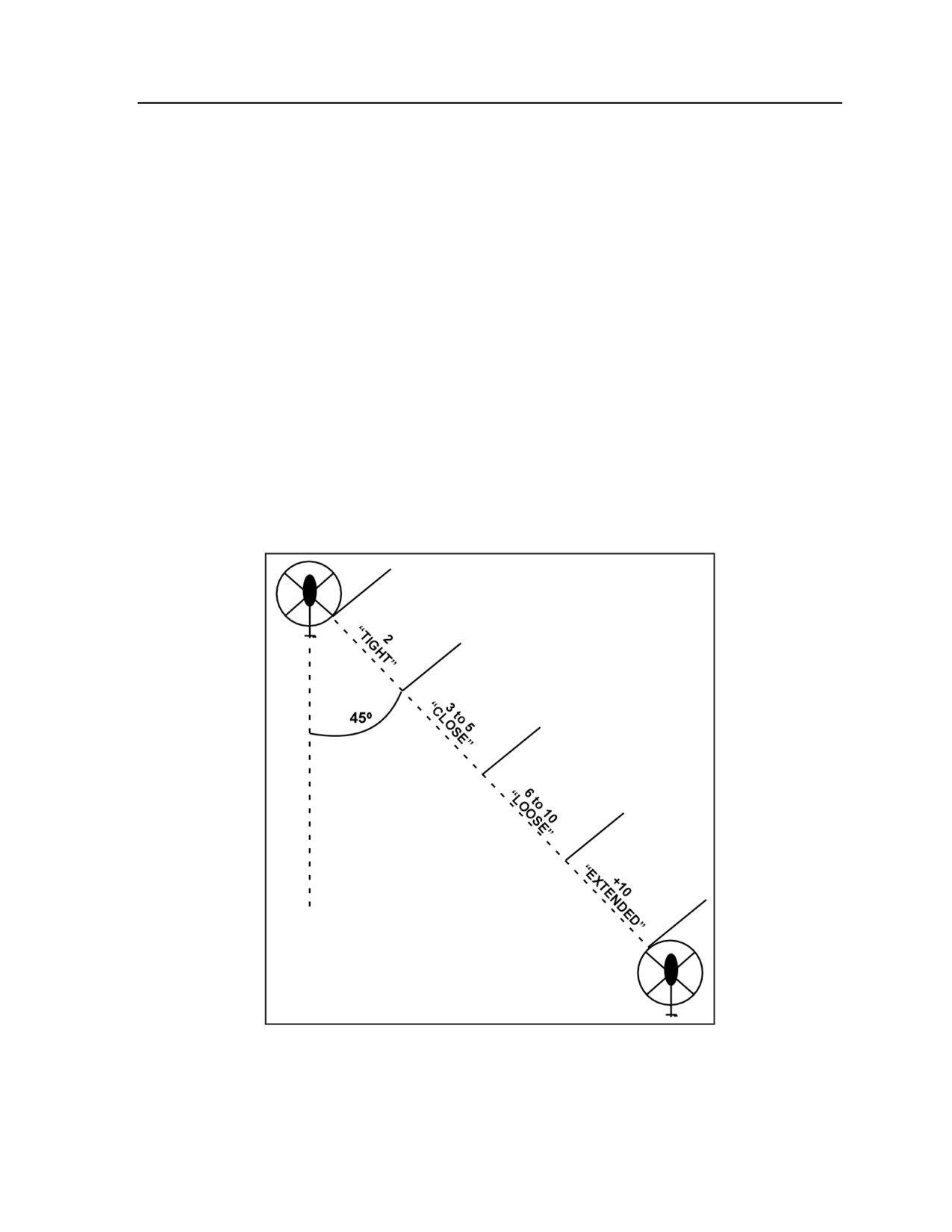
Multi-Aircraft Operations
Terrain.
Illumination,
Time of day.
Visibility.
Communications environment.
Capabilities of the crews and aircraft in the flight.
The wingman is ultimately responsible for maintaining adequate separation to prevent collision by anticipating
(and providing clearance for) maneuvering by lead.
HORIZONTAL DISTANCE
6-25. Formations are defined and expressed in rotor diameters (based on type of aircraft being flown)
between tip-path planes or the rearward edge of the disk on the leading aircraft and the forward edge of the
disk on the trailing aircraft. This distance is usually predetermined during the mission brief and established
by the chalk 2 aircraft in the flight. Aircraft after chalk 2 should follow the established pattern. Horizontal
distance is defined as (figure 6-1)—
Tight. The horizontal distance for tight is approximately two rotor disks.
Close. The horizontal distance for close is three to five rotor disks.
Loose. The horizontal distance for loose is six to ten rotor disks.
Extended. The horizontal distance for extended distance is more than ten rotor disks, as dictated
by tactical requirements.
Figure 6-1. Horizontal distance
7 May 2007
FM 3-04.203
6-5
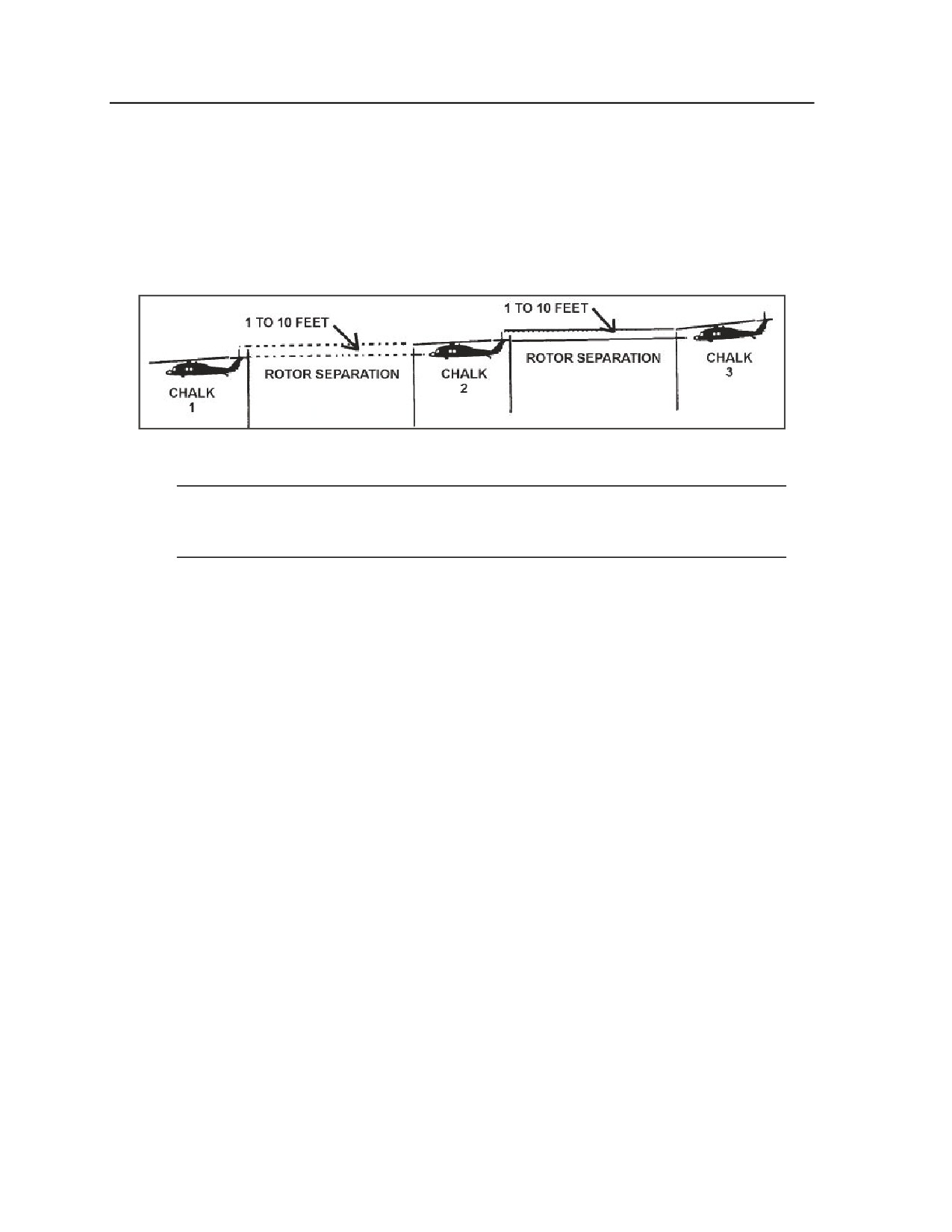
Chapter 6
Vertical Separation
6-26. Flat, stepped-up (figure 6-2), and stepped down are vertical separations.
Flat. All aircraft are flown at the same altitude.
Stepped-up. Vertical separation of
1 to 10 feet higher between lead, chalk
2, and each
successive aircraft.
Stepped-down. Vertical separation of 1 to 10 feet lower between lead, chalk 2, and each
successive aircraft.
Figure 6-2. Stepped-up vertical separation
Note. In stepped-down formation, trailing aircraft may experience wake turbulence. To avoid
this turbulence, they will need to adjust their relative position. Trailing aircraft require more
power to fly in this formation.
Flat Terrain
6-27. Generally, in flat terrain, formation separation should increase as such formations are more difficult
to detect. If the enemy detects the formation, it must choose one helicopter and potentially lose SA on the
second. This aircraft may pass completely unnoticed and provide mutual support. This is true for both air
and surface threats.
Rough Terrain
6-28. Rough terrain may require closer formation spacing. The tactical advantages of wide formations
must be balanced with the difficulty of controlling those formations in rough terrain. The formation
selected should enhance cover and concealment of all aircraft in the flight and the ability for each member
of the flight to select terrain and seek concealment while still maintaining SA on lead (visual contact is
desired but not required at all times).
MULTI-AIRCRAFT OPERATIONS BRIEFING
6-29. Regardless of the number of aircraft in the formation, the lead/wing concept should be applied.
During multi-aircraft operations, additional crew actions must be considered. All multi-aircraft operations
are briefed using a unit approved multi-aircraft/mission briefing checklist and should include the
following:
Formation type(s).
Altitudes.
Airspeeds.
Aircraft lighting.
Lead change procedures.
Loss of visual contact/in-flight link-up.
Loss communications procedures.
6-6
FM 3-04.203
7 May 2007

Multi-Aircraft Operations
IIMC procedures.
Actions on contact.
Downed aircraft procedures.
Separation.
LIGHTING FOR MULTI-AIRCRAFT OPERATIONS
6-30. AR 95-1, AR 95-2, aircraft design limitations, local regulations, and SOPs govern lighting for multi-
aircraft operations (table 6-1).
Table 6-1. Sample lighting conditions
Visible
Position
Covert IR
NAV
Formation
Pos.
LITECON
Description
Anticollision
Lights
Lights
Lights
1
FAA-Day
White
OFF
OFF
OFF
2
FAA-night
Red
Bright
Bright
ON
3
Night Form
OFF
Dim
Bright
ON
4
Covert
OFF/IR
OFF
Covert
ON
5
Total Blackout
OFF
OFF
OFF
OFF
FORMATION TAKEOFF
6-31. A formation takeoff is two or more aircraft leaving the ground simultaneously and then maintaining
a predesignated relative position during the takeoff. Most formation takeoffs are made from the ground and
liftoff simultaneously at a prearranged signal from the lead aircraft. The leading aircraft should accelerate
slightly faster than a VMC takeoff, allowing the following aircraft to gain translational lift; care must be
taken, however, to not accelerate too quickly and leave the flight scrambling to catch up. The initial rate of
climb must be enough to clear barriers with a safety margin. Trailing aircraft maneuver into the en route
formation and attain a stepped-up vertical separation as soon as possible permitting acceleration and climb
to undisturbed air. Once the flight is airborne and established, the lead aircraft can slowly and smoothly
accelerate to normal climb or cruise airspeed. Takeoffs should only be into the wind, especially for
dust/sand/snow conditions. For moderate to heavy dust/sand/snow conditions, aircraft should take-off
separately in chalk order and then conduct an in-flight join-up.
FORMATION FLIGHT—EN ROUTE
6-32. Formation flying is the maneuvering of aircraft according to established TTP. It includes rapid, but
controlled, change from a specific formation suitable for one set of conditions to another formation
meeting requirements of an entirely different set of conditions. Safe and orderly formation flight is the
result of extensive training, continuous practice, and a high degree of discipline.
6-33. The aviator flying each aircraft maneuvers with primary reference to only one other aircraft. The
constant vigilance necessary to fly, reference the other aircraft, avoid obstacles, and incorporate an
instrument scan precludes the P* from observing other aircraft. However, P can observe aircraft other than
the primary reference aircraft. In formation types requiring observation of two aircraft such as diamond or
staggered, the P* must do so with great care and precision while mainly viewing the primary aircraft.
6-34. Aviators must anticipate aerodynamic interference between aircraft during formation flight. Aviators
flying trailing aircraft may encounter wake turbulence (section V) if they permit their aircraft to go below
leading aircraft. Flight in turbulence may result in rapid attitude (pitch, roll, and yaw) changes.
7 May 2007
FM 3-04.203
6-7
Chapter 6
6-35. Distance between aircraft can be increased or decreased to fit the tactical situation. At terrain flight
altitudes, aircraft may spread out to take advantage of the terrain/tactical situation. In addition, it is less
fatiguing to fly loose or extended formations as opposed to tight or close formations.
6-36. All aircraft should have the P navigating in the event they must take over the lead position and assist
the flight with ensuring navigational accuracy to complete the mission.
6-37. Altitude and airspeed changes should be smooth and gradual especially during tight and close
formations. This allows all aircraft in the formation to act in unison. Abrupt changes in altitude and
airspeed by the lead aircraft may cause an “accordion” effect. This results when all remaining aircraft in the
formation make correspondingly abrupt altitude and airspeed changes to maintain their relative position,
and the effects are magnified as the flight progresses. When flown incorrectly, aircraft toward the rear of a
formation may experience excessive rates of closure as they attempt to maintain their relative positions.
FORMATION TURNS
6-38. The lead aircraft should make smooth constant rate turns and avoid angles of bank greater than 30
degrees. Turns at reduced bank angles require larger turning radiuses, particularly in the landing pattern,
and must be considered in planning. If a large turn is required, flight lead enters the turn as early as
possible to avoid excessive bank angles and subsequent recovery. This allows the flight to react in a timely
manner. During a turn, the inside aircraft must decelerate slightly and drop slightly lower than the leading
aircraft, while the outside aircraft must accelerate slightly and climb slightly to maintain its position in the
formation. Whenever possible, the aviator avoids turns in which aircraft are forced inside the lead aircraft’s
turning arc. This is usually addressed during the planning process and briefed accordingly. Aircrews
should avoid planning route segments requiring heading changes of more than 60 degrees.
FORMATION CHANGES DURING EN ROUTE FLIGHT
6-39. Formation changes en route require a high degree of proficiency and therefore are executed with
caution and only when necessary. Any changes to a formation are specifically briefed and understood by
all aircrews involved. As a technique, trail formation could be used as a transitional formation before
executing the next briefed formation.
LEAD CHANGES
6-40. Lead changes are inherently difficult, potentially dangerous, and should be executed on the ground,
whenever possible. A lead change is never initiated, day or night, by accelerating to overtake the lead
aircraft. Only the lead aircraft may give the signal to initiate lead changes. Flight lead initiates by a
prearranged signal, and the flight acknowledges beginning with chalk 2. The lead aircraft then makes a 30-
to 90-degree heading change in the prebriefed direction to depart the formation and establish separation
space. Lead maneuvers a minimum of eight rotor disks to the announced side and begins to parallel the
formation. When chalk 2 (the new lead) confirms and announces the former lead is clear of the flight, the
former lead will slow to 10 KIAS less than the en route airspeed. The former lead visually (and possibly
verbally) confirms each aircraft in the flight as it passes to prevent rejoining the flight prematurely causing
a midair collision. After the last aircraft (former trail) has passed by, the former lead aircraft will rejoin the
flight and assume the duties of the trail aircraft to include displaying appropriate lighting. The former trail
aircraft then reconfigures its lighting to conform to the rest of the formation.
FORMATION LANDING
6-41. All aircraft touch down at the same time while maintaining their relative positions within the flight.
The rate of closure throughout approach and landing is somewhat slower at night than during the day.
Flight lead should maintain straight-and-level flight until the desired approach angle is intercepted. Lead
then maintains a constant approach angle and, where terrain and obstacles permit, makes the approach to
the ground avoiding hovering turbulence and brownout or whiteout conditions. If the rate of closure is too
6-8
FM 3-04.203
7 May 2007
Multi-Aircraft Operations
fast, the aviator should avoid S-turns to lose airspeed. Instead, execute a go-around if unable to slow to the
appropriate airspeed, especially with heavily loaded aircraft.
6-42. Lead must plan to touch down far enough forward in the PZ/LZ to provide sufficient landing space
for the entire flight. When planning the touchdown, consideration should be given to obstacles and power
availability on the departure. If potential whiteout or brownout conditions exist, the flight may have to
spread out to the briefed landing disk separation before the approach is established facilitating safe landing
conditions. The AMC should consider, based on aviator experience and the environment, stacking down
and landing in reverse chalk order once flight lead initiates an approach. This reduces the possibility of
being caught in the cloud from the preceding aircraft and is especially true with CH-47s when executing
formation flight approaches to a snow field where potential exists for sliding after touchdown. Finally, if
safety is in doubt regarding landing or landing conditions, the flight lead should execute a go-around. The
go-around should be executed prior to descending below any obstacles or losing ETL to prevent sudden
high power demands on the other aircraft.
FORMATION BREAKUP
6-43. The following are four examples of formation breakup. These techniques can be adapted for use with
other formation types. In addition, a flight can be disbanded by simply landing somewhere and departing
separately, beginning with lead or trail aircraft and continuing in an orderly fashion.
BREAKUP INTO SINGLE AIRCRAFT
Method 1
6-44. Aviators may use this maneuver when an LZ is large enough for only one aircraft at a time. Figure
6-3 shows an echelon formation before breakup. Lead aircraft designates the interval (determined by
required ground time, 10 seconds in this example) between breaks. Lead issues the command to execute,
then turns 90 degrees away from the formation. Lead is followed 10 seconds later by chalk 2, then chalk 3,
and so on. When aviators use this maneuver for landing in a single-ship LZ, the formation ideally
approaches the LZ on the landing heading and starts the breakup over the LZ as shown in figure 6-4, page
6-10.
7 May 2007
FM 3-04.203
6-9
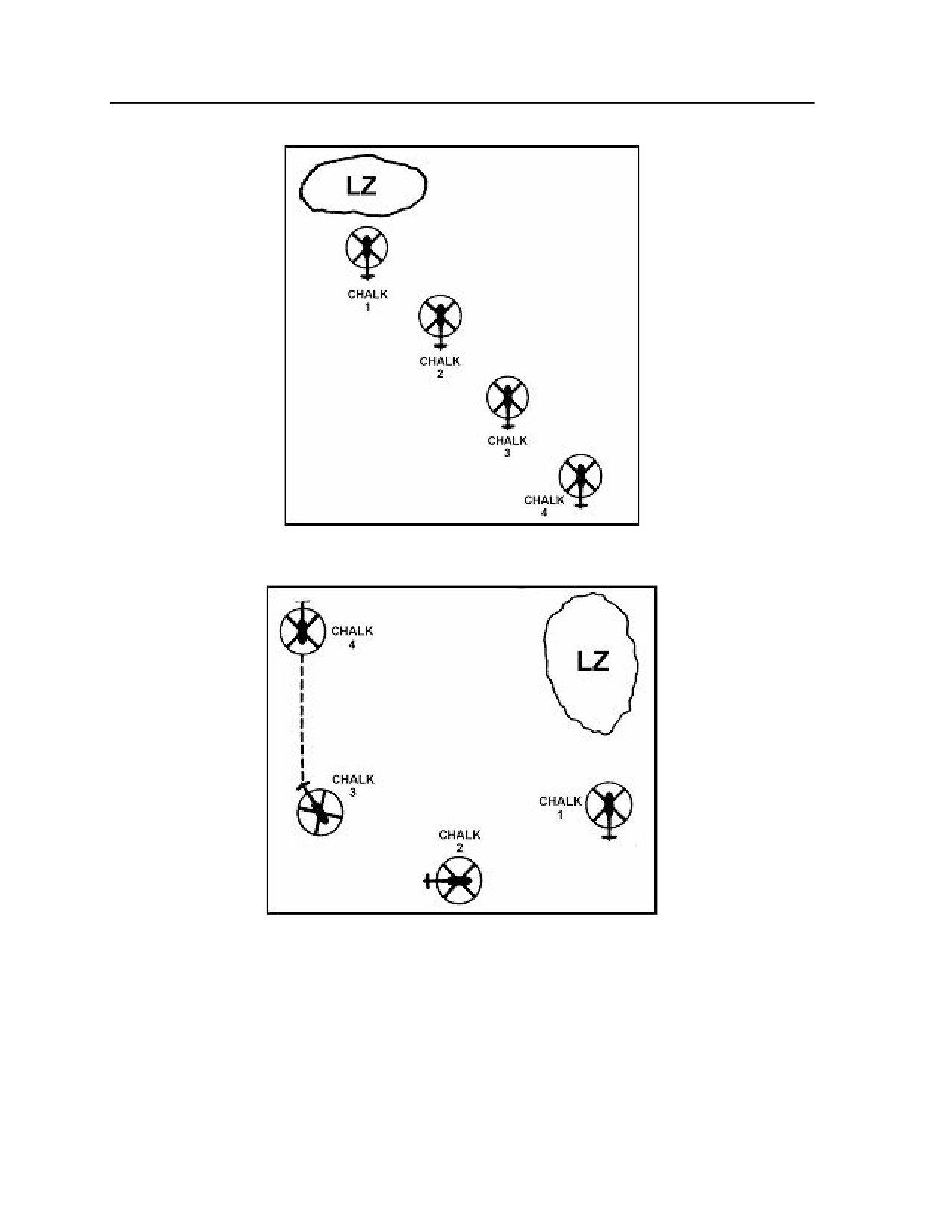
Chapter 6
Figure 6-3. Echelon formation before breakup
Figure 6-4. Left break with 10-second interval for landing
Method 2
6-45. This maneuver may be initiated anytime multihelicopter operations are terminated. Lead issues the
command to break up, and then the trail aircraft turns 30 to 90 degrees away from the formation to the clear
side. Once the trail aircraft is visually confirmed clear, the remaining aircraft, in reverse chalk order, turn
30 to 90 degrees away from the formation to the clear side. Once clear of the formation, each aircraft must
adjust lighting and avionics as appropriate.
6-10
FM 3-04.203
7 May 2007