3-22.1 (FM 23-1) BRADLEY GUNNERY (NOVEMBER 2003) - page 12
FM 3-22.1
E-6. TARGET ENGAGEMENT
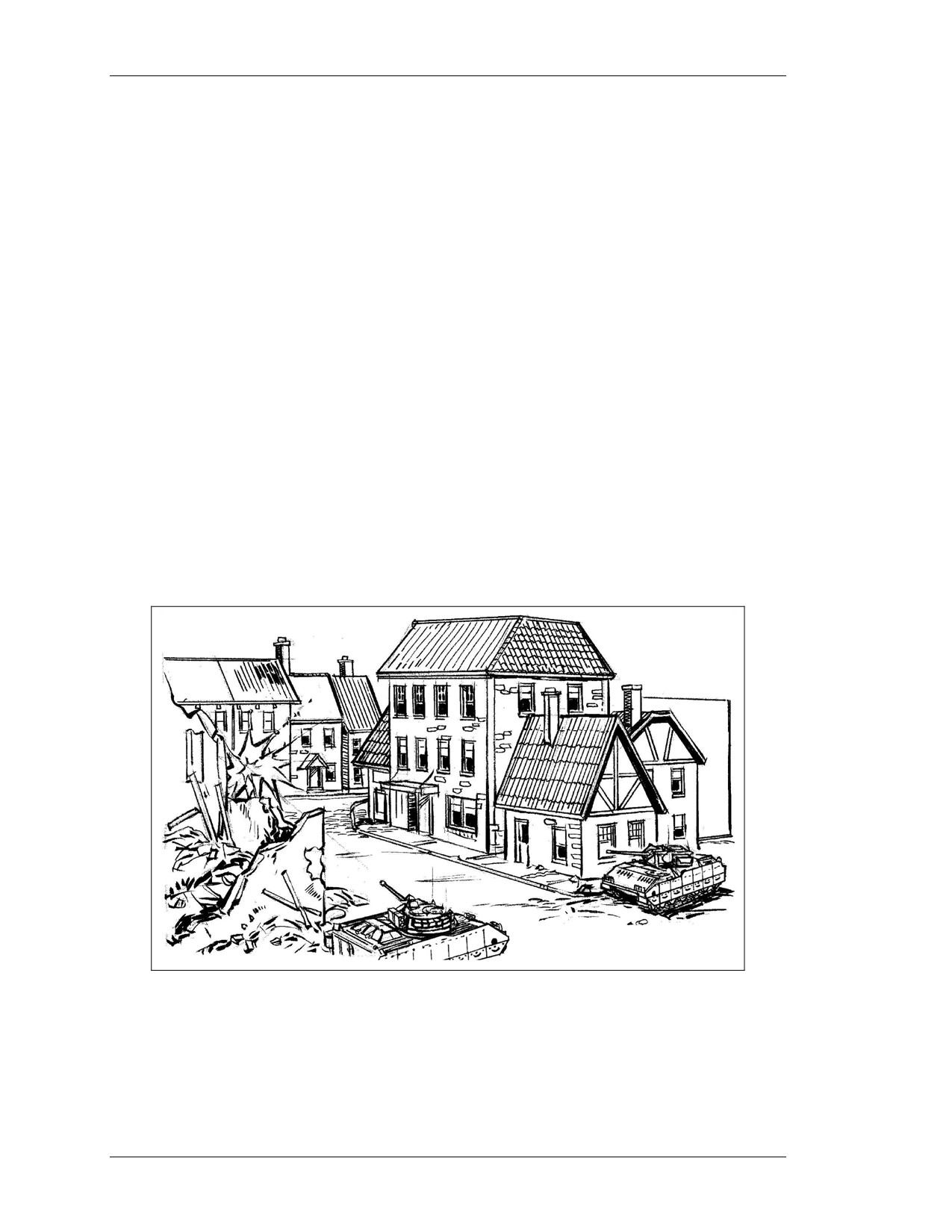
At ground level, structures and obscurants (smoke, dust, and airborne debris) reduce the
ranges of observation and fields of fire. Most urban engagements consist of close (within
100 meters), violent firefights. Victory, perhaps even survival, depends on correct
identification of friend and foe, strict fire control, precise fire, quick reflexes, and
impeccable teamwork. Short ranges restrict the use of TOWs. In most urban firefights,
"Danger close" is the norm for indirect fires.
NOTE: The laser range finders on ODS and A3 models require a range of at least
200 meters. However, the M2A3 crews can index 100 meters and the M2A2
ODS crews can index 0 or 200 meters. Then, if they happen to acquire a target
that exceeds the indexed range, they can always lase to the target.
E-7. MUTUAL SUPPORT IN THE OFFENSE
In UO, commanders can task-organize light infantry companies with the mechanized
infantry platoons. While the rifle squads provide local security for the BFVs, the BFVs
provide critical fire support to the dismounted element. In the M2A3-equipped unit, the
squad leader's display (SLD) gives the rifle squad excellent situational awareness before
they dismount the vehicle. For example, before they even leave the vehicle, they can
determine potential routes and entry points to buildings.
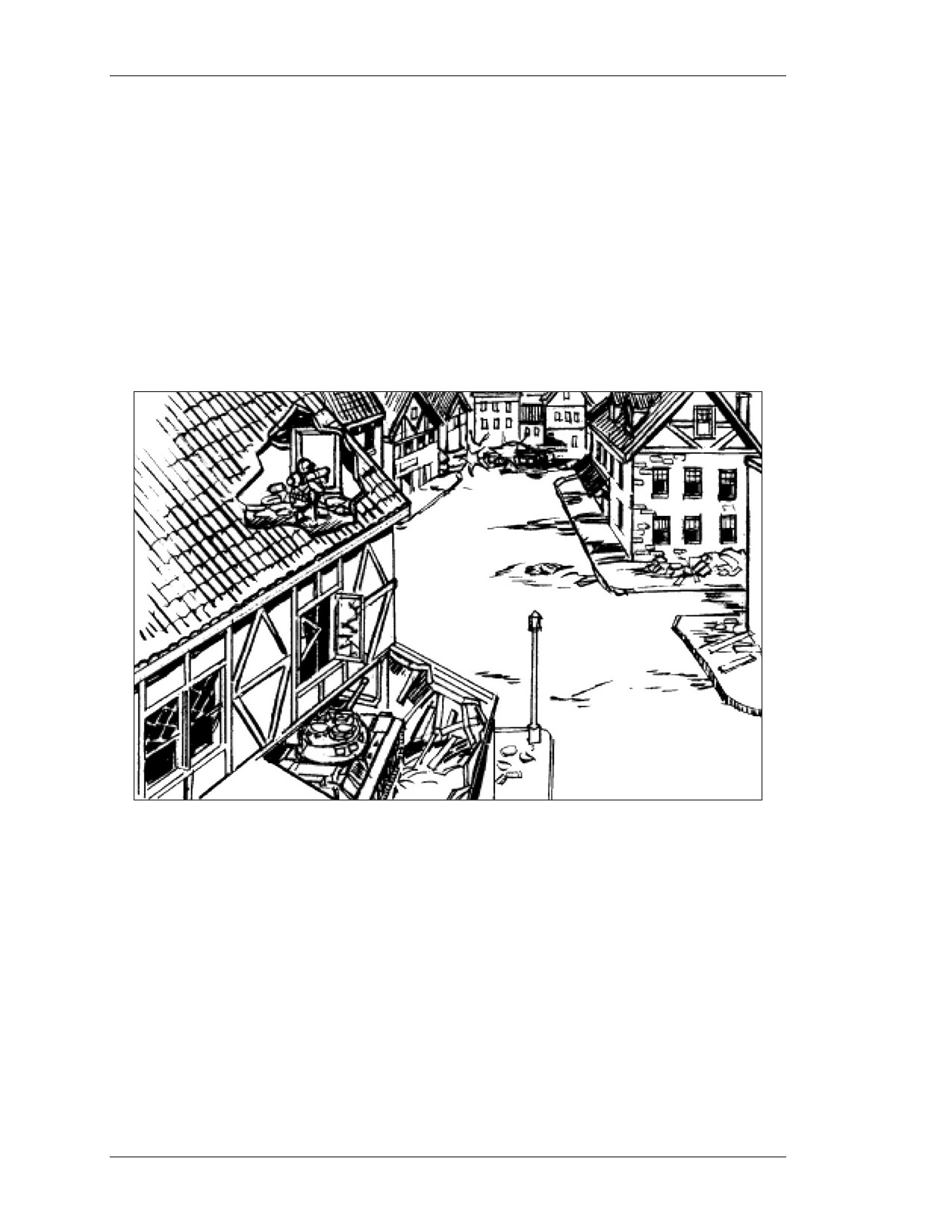
a. Killing Zones. Streets and alleys are natural firing lanes and killing zones.
Because of this, all vehicular traffic is greatly restricted and canalized, and subject to
ambush and short-range attack. The wide elevation ranges (about -10 to +60 degrees)
on the 25-mm gun and 7.62-mm coax machine gun give the BFV a target engagement
advantage over tanks.
b. Movement. When moving on a large enough street, each BFV remains buttoned
up, hugs the buildings on one side of the street, and covers the opposite side of the street.
With its IBAS, CIV, and second generation FLIR, the M2A3 BFV provides the excellent
fields of view needed in urban terrain. This helps the crew detect signals from the
dismounted element.
c. Elements and Missions. The BFV platoon has one mounted element and one
dismounted element. Based on the company commander’s guidance and the factors of
METT-TC, the BFV platoon leader determines how to deploy these elements. When
supporting a light infantry company, the dismounted element provides local security for
the mounted element.
d. Antitank Guided Missiles. The BFV lacks adequate armor protection to
withstand medium to heavy ATGM fire. Thus, it is normally employed after ATGM
positions have been cleared or on terrain that dominates the city. There it can provide
support or suppress enemy fires. In urban areas, LAWs, AT4s, Dragons, and Javelins
provide much of the BFV platoon’s short-range antiarmor fires; BFV TOWs provide
long-range antiarmor fires; and the BFV’s cannon (25-mm) and its machine guns provide
direct-fire support. Especially when ATGMs can engage BFVs from rooftops,
commanders must implement tactical control measures to increase BFV survivability.
e. Offensive Task Organization. During offensive operations, the BFV platoon
normally supports the light infantry company team. Because BFVs need dismounted
support, the company team commander generally keeps the dismounted and mounted
E-5
FM 3-22.1
elements together. If he needs the dismounted element for another task, he must leave
sufficient local security with the BFVs to protect them from an enemy counterattack or
antiarmor ambush.
(1) Assault Tasks. A light infantry company team commander can task the BFV
platoon to perform assault tasks. If so, he must again leave sufficient dismounted
personnel to protect them.
(2) Support Tasks. The tasks most likely assigned to a BFV platoon supporting a
light infantry company in UO are those assigned to the support element. When
supporting a light infantry company in the urban offense, the BFV platoon usually
provides direct-fire support and other aid as needed to support the assault element. When
leading the support element, the BFV platoon leader commands and controls his platoon
and other support element assets. Some of the platoon's support tasks follow:
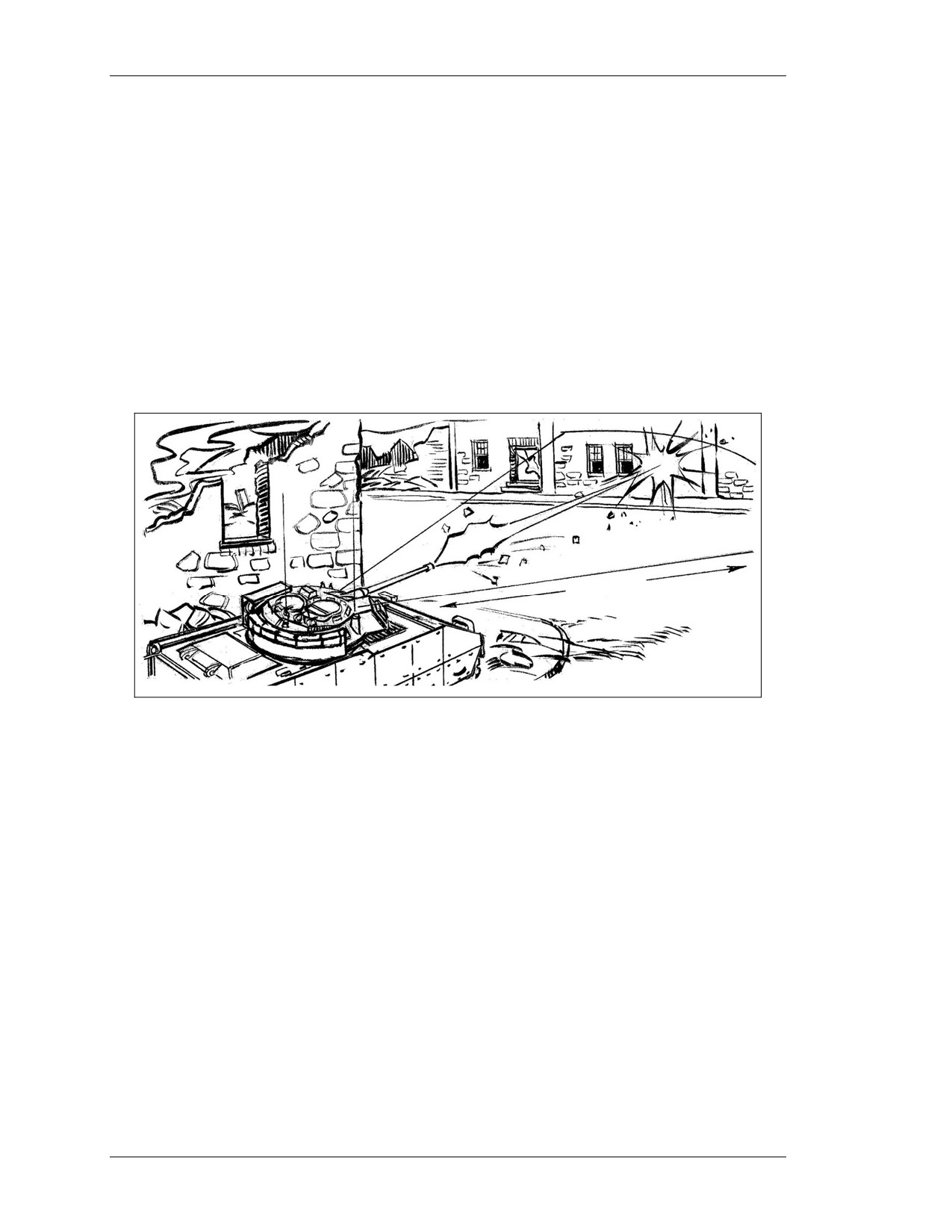
(a) Use the 25-mm gun, the 7.62-mm coax machine gun, and other dismounted
assets, suppress enemy gunners within the objective building(s) and adjacent structures.
(Figure E-3).
(b) Breach walls en route to and within the objective buildings.
(c) Use the 25-mm gun, the 7.62-mm coax machine gun to destroy enemy positions
within a building.
(d) Provide replacements for the assault element.
(e) Provide a mobile reserve for the company team.
(f) Resupply ammunition and explosives.
(g) Evacuate casualties, prisoners, and noncombatants.
Figure E-3. Suppressive fires of 25-mm gun.
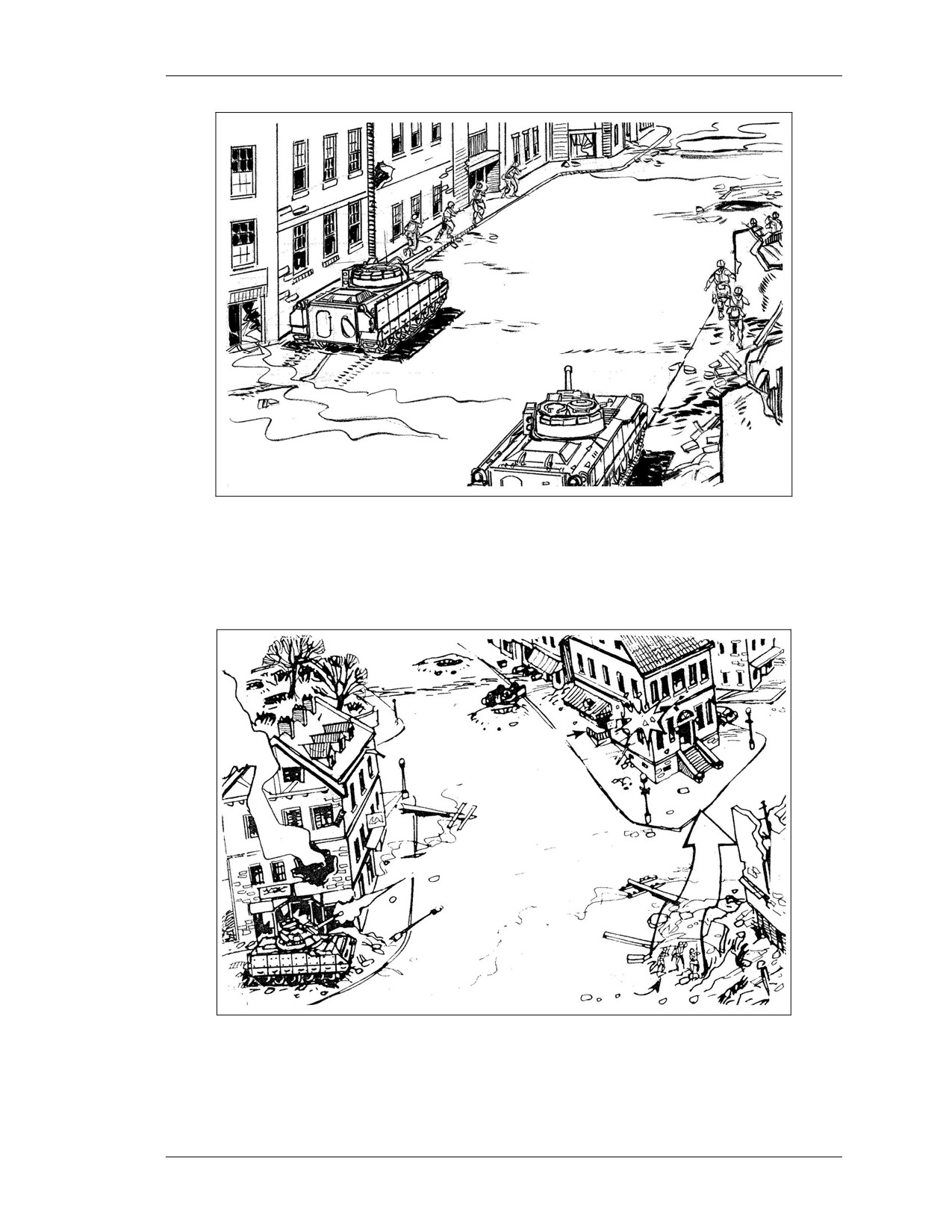
f. Direct-Fire Support. Ideally, BFVs provide direct-fire support to Infantry. The
BFVs move behind the Infantry, when required, and engage targets located by the rifle
squads (Figure E-4). The BFV's dash speed (acceleration) enables it to rapidly cross
streets, open areas, or alleys.
E-6
FM 3-22.1
Figure E-4. Movement with dismounted element.
(1) Weapons. The BFV's mounted element provides fire (with its 25-mm gun and
7.62-mm coax machine gun) for the dismounted element on the opposite side of the
street. The 25-mm gun is the most effective weapon on the BFV for UO (Figure E-5).
Figure E-5. Support by the 25-mm gun for the dismounted element.
(2) Safety. Using the
25-mm gun to support Infantry naturally requires BFV
personnel to observe certain safety considerations.
E-7
FM 3-22.1
(a) High-explosive
25-mm rounds arm
10 meters from the gun and explode
on contact.
(b) Because the APDS-T round discards plastic sabots to the front of the gun, the
25-mm has a 60-degree safety fan. This fan extends 30 degrees to each side of the gun-
target line and out 100 meters to the front of the gun (Figure E-6). Thus, when the gunner
or BC fires armor-piercing rounds, exposed soldiers must remain to the rear of the 25-
mm’s muzzle (outside the 60-degree arc) or at least 100 meters from the muzzle blast.
(c) To prevent fratricide, BFV-equipped units must develop SOPs to help Bradley
crews identify friendly dismounted soldiers. They can mark LBE, helmets, or uniforms
with reverse-polarity tape, thermal or chemical lights, and so on. However, use of such
measures must be weighed against enemy's thermal capabilities. For example, the
M2A3's IBAS allows the viewer to see helmet bands and LBEs marked with reverse
polarity tape.
Figure E-6. Safety fan for 25-mm gun.
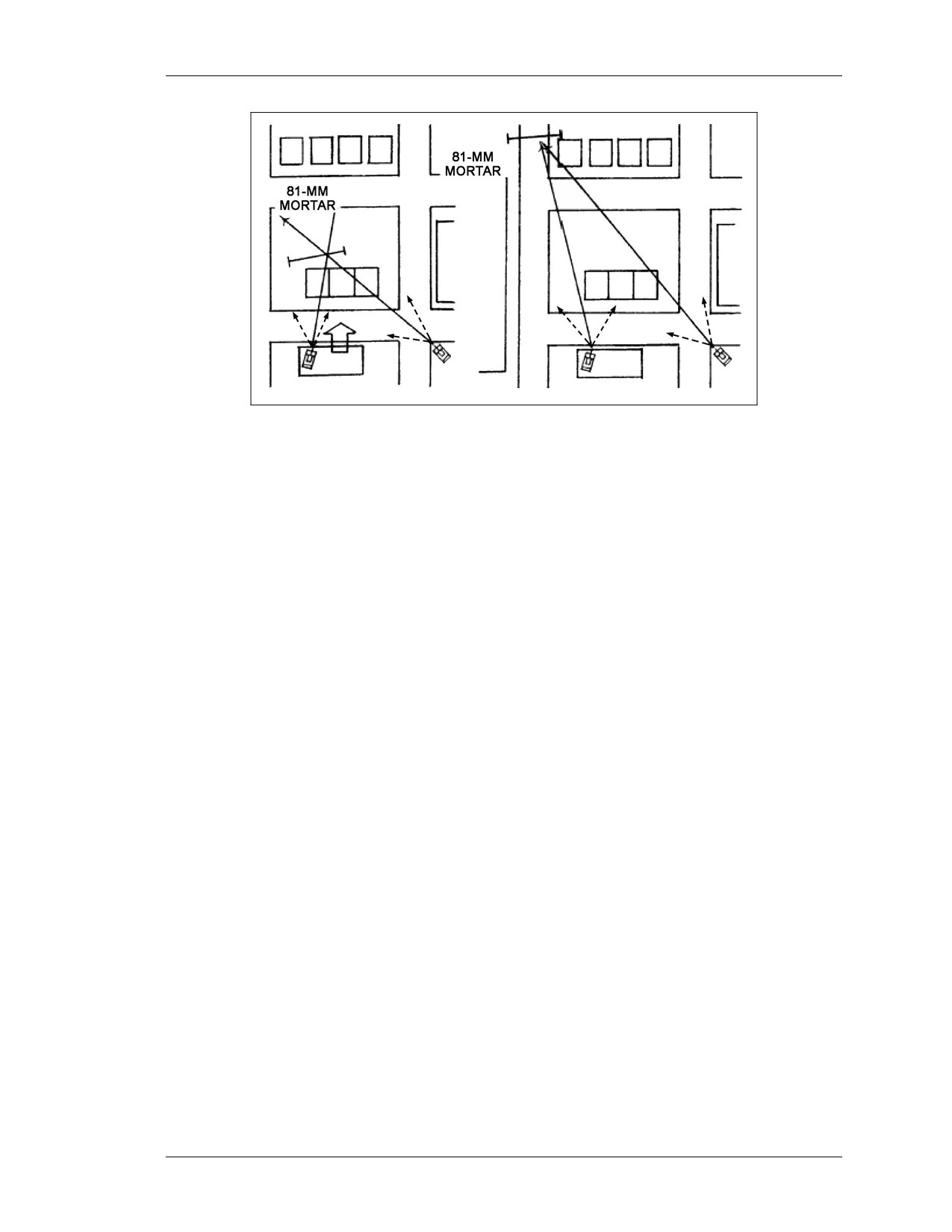
g. Isolation of a Building. To isolate a building, the BFVs take an overwatch
position (Figure E-7). They fire the 25-mm gun and 7.62-mm coax machine gun. They
adjust indirect fire to suppress enemy troops in the building and in nearby buildings who
can fire at the assault element.
E-8
FM 3-22.1
Figure E-7. Isolation of a building and shifting of fires.
E-8. DEFENSIVE TASKS
In the defense, Infantry soldiers in the BFV platoon will defend just like a light infantry
platoon. The following are typical defensive tasks given to a BFV crew or section in the
defense:
a. Provide fire support for dismounted elements and mutual support to other BFVs.
b. Destroy enemy armored vehicles and direct fire artillery pieces.
c. Destroy or make enemy footholds untenable by fire using the 25-mm gun.
d. Provide rapid, protected transport for organic rifle teams or other
Infantry elements.
e. Reinforce threatened areas by movement through covered and concealed
routes to new firing positions.
f. Provide mutual support to other antiarmor fires.
g. Provide a mobile reserve and counterattack force.
h. Provide resupply of ammunition and other supplies to the Infantry.
i.
Evacuate casualties, prisoners, and noncombatants.
NOTE: Weigh the overall value of the BFV to the defense against the need to
resupply or to evacuate casualties.
E-9. DEFENSIVE PLAN
The BFVs are integrated into the company team defensive fire plan. The 25-mm gun and
7.62-mm coax machine gun fields of fire cover streets and open areas; TOWs are used to
cover armor avenues of approach. Once placed in position, BFVs should not be moved
for logistical or administrative functions. Other vehicles should accomplish these
functions, when possible.
a. Positioning of BFVs and Weapons. Once the company team commander gives
the BFV platoon leader his mission, the platoon leader will position his BFVs and
dismounted element. Dismounted machine guns should be positioned to have grazing
fire. For the coax machine gun to have grazing fire, the BFV must be in a hull-down
position. BFVs are assigned primary, alternate, and supplementary positions. ATGMs
E-9
FM 3-22.1
should be positioned on upper stories for longer range and to permit firing at the tops of
armored vehicles. These positions should permit continuous coverage of the primary
sectors and all-round defense.
b. Engagement Ranges. Due to the close engagement ranges on urban terrain, the
25-mm gun and 7.62-mm coaxial machine gun are used more than ATGMs. Short ranges
degrade the BFV's own antiarmor capability, so they must rely instead on Dragons,
Javelins, and AT4s (Figure E-8). ATGM and AT positions should be placed where they
can support the BFV but must not attract enemy attention to the BFV location. Dragons,
Javelins, and AT4s are much more effective against the flanks, rear, and tops of enemy
armored vehicles and should be positioned to attack those areas. TOWs are also
employed against enemy armored vehicles, however, minimum arming distances and
back blast areas should always be taken into consideration during employment.
Figure E-8. Position of AT4 supporting BFV.
NOTE: TOWs cannot be dismounted. Company team commanders must determine
which weapon will work most effectively against the threat he is anticipating.
Ideally, the BFV should be positioned to take advantage of all the weapons on
the vehicle.
c. Integration of Fires. All of the BFV’s crew-served weapons are integrated with
the rest of the company team’s weapons and assets. The positions are recorded on a
company sector sketch and forwarded to battalion.
E-10. BRADLEY TABLE IIA, BRADLEY CREW URBAN EXERCISE
The BCUE introduces crews to stationary and moving BFV engagements in an urban
environment. This table develops the driving skills of the driver in built up areas while
E-10
FM 3-22.1
the crew engages targets typically found in UO operations. Crews engage stationary and
moving LTID-equipped panel targets (when available) from a moving and stationary
MILES or PGS-equipped BFV. Frontal stationary targets may be used if moving targets
are not available or the UO site is not equipped with moving targets. The BCUC consists
of 5-day engagements and 5-night engagements (see table below). Scaled targets may be
used however full-scale targets are recommended. OPFOR may be used when UO
facilities are not equipped with full-scale targets. Figure E-9, page E-12, shows day and
night engagements for BT IIA.
a. Task. Engage and destroy stationary and moving targets from a stationary and
moving BFV during the day and night.
b. Conditions. Given a MILES or PGS equipped BFV, suitable UO environment
with LTID equipped targets, during the day and night.
c. Standards. The crew must achieve a minimum of a “P” rating on 7 of the 10
engagements, with 2 of the 7 being night engagements. They must not engage any
friendly or noncombatant targets.
d. TDRS Cards. If OPFOR is used with BFVs that have PGS, then TDRS cards
must be programmed for "Force on Force."
E-11

FM 3-22.1
BRADLEY TABLE IIA, DAY ENGAGEMENTS
TARGET TYPE
BFV
CONDITIONS
AND POSTURE
Stationary
Gunner, ISU or IBAS
HE Moving, Coax Point
(Hunter-Killer)
(RPG Rooftop), Coax
Point (Sniper Window)
Moving
Gunner, ISU or IBAS
AP Moving, Coax Point
(Hunter-Killer)
(RPG Rooftop)
Moving
Commander,
No Fire (friendly or
CSE or RBD
noncombatant), Coax
Point (Sniper Window)
Stationary
Gunner, Auxiliary Sight
AP Stationary, Coax
Point
(Sniper Window)
Stationary
Gunner, ISU or IBAS
HE Stationary (Bunker),
Coax Area (Rooftop)
BRADLEY TABLE IIA, NIGHT ENGAGEMENTS
TARGET TYPE
BFV
CONDITIONS
AND POSTURE
Moving
Gunner, ISU or IBAS
AP Stationary, Coax
(Hunter-Killer)
Point (RPG Rooftop)
Stationary
Gunner, NBC
HE Moving, Coax Area
(Hunter-Killer)
(rooftop), Coax Point
(RPG Rooftop)
Moving
Commander,
HE Stationary (bunker),
CSE or RBD
Coax Point (Sniper
Window)
Stationary
Gunner, ISU or IBAS
No Fire (friendly or
noncombatant), Coax
Point (RPG Rooftop)
Stationary
Gunner, ISU or IBAS
AP Moving, Coax Point
(Sniper Window)
Figure E-9. BT IIA, day and night engagements.
NOTE: The target types shown in parentheses are included to help units develop
scenarios. They may use any type of target, as long as it falls into the target
category shown. Also, resources permitting, they may substitute moving
targets for stationary targets.
E-12

FM 3-22.1
E-11. TIMING MATRIXES
The matrixes in Figure E-10 show target threat times.
LIGHTLY ARMORED AND UNARMORED VEHICLES
One
Two
Three
Range
Normal
Condition
Conditions
Conditions
(Meters)
(Seconds)
(Seconds)
(Seconds)
(Seconds)
< 50
7
8
12
13
50
8
9
13
14
100
9
10
14
15
200
10
11
15
16
300
10
11
15
16
DISMOUNTED TROOPS
< 50
4
6
9
NA
50
5
7
10
NA
100
6
8
9
NA
200
7
9
12
NA
Figure E-10. Timing matrixes for various targets.
E-12. SCRIPT AND SCENARIO
The script should support an overall scenario. An example scenario to help crews
understand the importance of situational awareness might have a BFV platoon attached to
a light infantry company. The BFVs support the light infantry company from the South
using their dismounted element as local security for their vehicles. The light infantry
company maneuvers from the Northwest to seize a foothold on the city. Before
conducting this table, the leader should give the crew an OPORD and a map of the urban
environment with the buildings numbered.
a. Engagement 1. Assault elements are maneuvering towards Building C1. Orient
your fires on Buildings A6, C2, D1, and D2. Report when set.
b. Engagement 2. Assault elements have secured C1 and are maneuvering towards
C2. Orient your fires on the rooftop of C2 and on Buildings A6, D1, and D2.
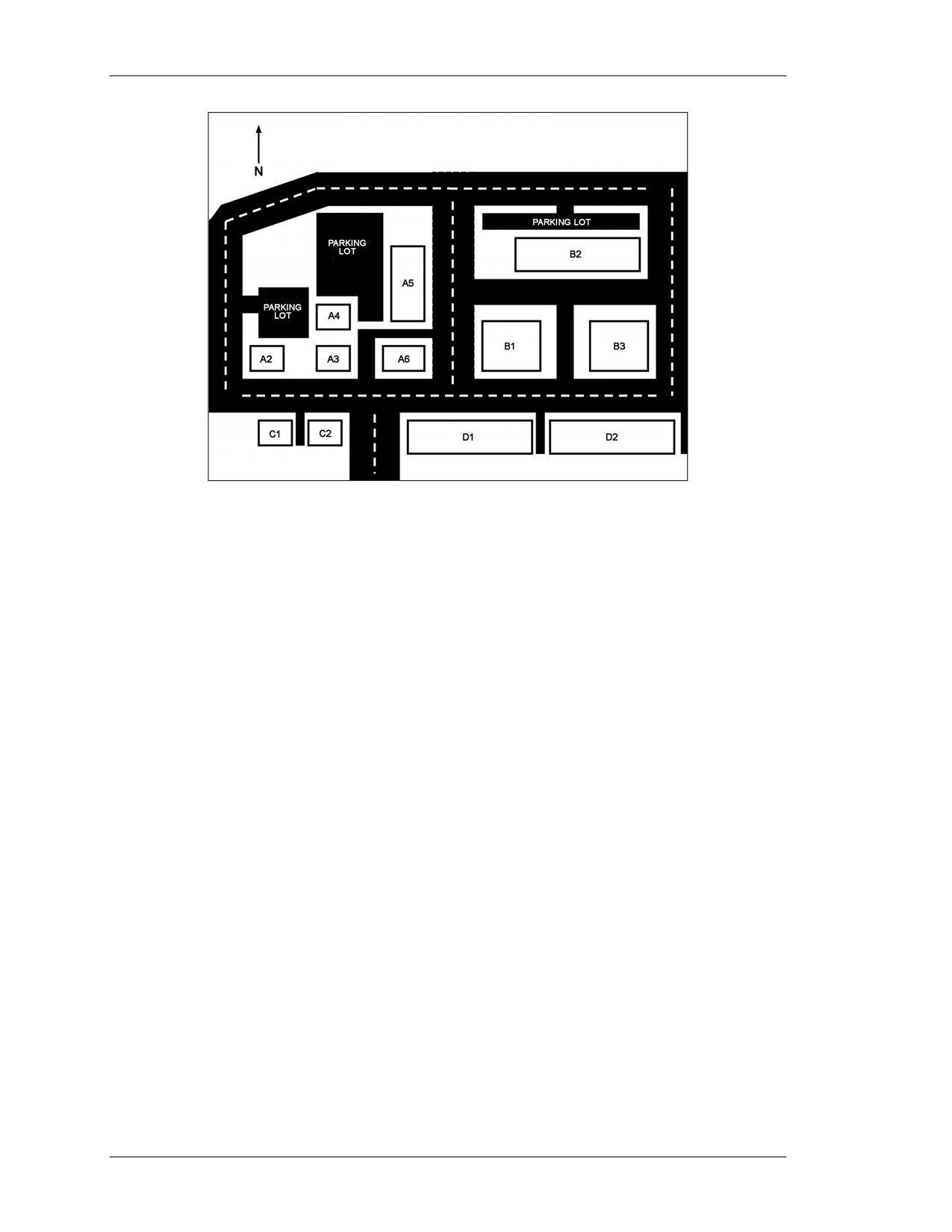
E-13. EXAMPLE MAP HANDOUT
On this handout, buildings are numbered, and main roads are marked with road dividers,
but alleys and small roads are unnumbered and otherwise unmarked
(Figure E-11,
page E-14).
E-13
FM 3-22.1
Figure E-11. Diagram of urban area.
E-14. BRADLEY TABLE IIIA, BRADLEY INFANTRY SQUAD OR SECTION
URBAN EXERCISE
As the name implies, the Bradley Infantry squad or section urban exercise (BISSUE)
integrates the performance of squad or section collective tasks by the dismounted element
with the mounted element in an urban environment. Urban operation drills develop in
mounted and dismounted personnel and crews the basic task-integration skills needed in
BISSUE. Leaders develop the BISSUE scenario to support their training for UO. All
squad and section members participate in a realistic exercise scenario. In this scenario,
they must conduct battle-focused squad or section collective tasks, which integrate the
following at a minimum. For this table, units may use OPFOR equipped with MILES
(recommended), or targets equipped with LTIDS (Figure E-12):
a. Crew Drills.
(1) Dismount the vehicle.
(2) Mount the vehicle.
(3)
(Fire team member) load the 25-mm ammunition ready box (HE or AP).
(4)
(Fire team member) reload a TOW launcher.
b. Battle Drills.
(1) Enter building.
(2) Knock out bunkers.
(3) Conduct initial breach of a mined wire obstacle.
(4) Clear a room.
E-14

FM 3-22.1
c. Tasks.
(1) (BFV) perform overwatch/support by fire.
(2) Clear restricted terrain.
BRADLEY TABLE IIIA, DAY ENGAGEMENTS
TARGET TYPE
BFV
CONDITIONS
AND POSTURE
Moving
Gunner, ISU or IBAS
AP stationary, coax
(Hunter-Killer)
point (RPG rooftop)
Stationary
Gunner, NBC
HE moving, coax area
(Hunter-Killer)
(rooftop), coax point
(RPG rooftop)
Moving
Commander,
HE stationary (bunker),
CSE or RBD
coax point (sniper
window)
Stationary
Gunner, ISU or IBAS
No fire (friendly or
noncombatant), coax
point (RPG rooftop)
Stationary
Gunner, ISU or IBAS
AP moving, coax point
(sniper window)
Figure E-12. BT IIIA, day engagements.
NOTE: The target types shown in parentheses are included to help units develop
scenarios. They may use any type of target, as long as it falls into the target
category shown. Also, resources permitting, they may substitute moving
targets for stationary targets.
E-15. EXAMPLE FIRE COMMANDS
Leaders must have the flexibility and capability to place direct fire from BFVs on key
targets throughout combat operations.
a. Figure E-13, page E-16, provides the command for the dismounted leader to call
for BFV direct fire.
b. Figure E-14, page E-16, provides the command for the BC to identify the enemy
and clear fire with the dismounted leader.
E-15

FM 3-22.1
Squad or Team Leader's Alert
"C23, HE"
Direction
"On my tracer-laser"
or
"Building 23, I-J, A3"
Description of target
"Enemy sniper"
Range
"200 meters"
Method of Fire (manipulation and rate
"Single shot"
of fire)
BC confirmation
"Identified"
SL's command to commence firing
FIRE
Figure E-13. Leader's calls for direct fire.
BC's Alert
"Identified sniper"
Direction
"On my laser” or
"Building 23, I-J, A3"
Range
"200 meters"
Method of fire
"Permission to engage
(manipulation and rate of fire)
with single-shot
high explosive"
SL's confirmation
"Friendlies clear,
engage"
BC's command to commence firing
ON THE WAY
Figure E-14. Bradley commander's identification of an enemy target.
E-16
FM 3-22.1 (23-1)
APPENDIX F
Rifle Infantry Training
This appendix provides information for developing rifle infantry
training programs. ARTEP 7-7J-Drill provides the tasks, conditions, and
standards. Training must be battle-focused and challenging and must
emphasize rifle infantry skills. Rifle infantry training must start with the
individual soldier and progress through fire team, squad, and platoon.
F-1. CONSIDERATIONS
Tough standards help build rifle infantrymen who can win on the battlefield. Leaders and
trainers should review their training responsibilities for planning and execution in
FM 3-90.1. When conducting rifle infantry training, they must consider--
a. Fundamentals. Shoot, move, communicate, sustain, and secure.
b. Simplicity. Ensure proficiency in basics before moving to more complex tasks.
c. Prerequisites. Certify crew and battle drills before executing collective live-
fire tasks.
d. Realism. Expose leaders and soldiers to unexpected and challenging situations--
good and bad ones.
e. Conditions. Replicate battlefield conditions for live-fire training.
f. Risk. Assess risk before training.
g. Evaluations. Conduct AARs as part of training.
F-2. WEAPONS AND EQUIPMENT
Weapons and equipment training consists of preliminary weapon training and
qualification. All squad members must establish their proficiency with their assigned
weapons and equipment before moving on to collective task training.
F-3. PRELIMINARY WEAPONS TRAINING
During preliminary weapons training, squad members learn and demonstrate their
proficiency in disassembly, assembly, PMCS, and operation of their weapons along with
all other squad equipment. Preliminary weapons training covers the following weapons
and equipment:
• M16A2 rifles.
• M203 grenade launchers.
• M249 light machine guns.
• M240B machine gun.
• M47 Dragon or Javelins.
• Night vision devices.
• Mines and demolitions.
• Squad communication equipment.
F-4. WEAPONS QUALIFICATION
Leaders evaluate squad members' individual proficiency in using their assigned weapons
every six months, during weapon qualifications. (For detailed training strategies, see the
applicable weapon FMs and DA Pam 350-38.)
F-1
FM 3-22.1
F-5. MOVEMENT TRAINING
During movement training, rifle infantrymen train and rehearse individual, buddy-team,
fire-team, squad, and platoon movement formations and techniques. Movement training
begins with individual and buddy-team movement techniques. Once individuals and
buddy teams demonstrate their movement proficiency, leaders establish fire team and
squad formations. Squad members train in movement techniques after all of the squad
members have gained confidence in their individual abilities to move in fire team and
squad formations. All squad members must know arm-and-hand signals. Platoons engage
in movement training after squads achieve movement proficiency.
F-6. INDIVIDUAL AND BUDDY TEAM MOVEMENT
Squad and team leaders control and lead by example. They direct rifle infantrymen to
move by the best method for the situation. In an assault, this movement may be by
crawling or by short rushes from cover to cover. A high or low crawl is slow but may be
necessary when cover and concealment are limited. Soldiers use short three- to
five-second rushes when cover and concealment are available and the volume of enemy
fire is low enough to allow brief exposure. Soldiers must look for the next covered
position before moving away from their firing positions. When they move, they use the
best covered routes available.
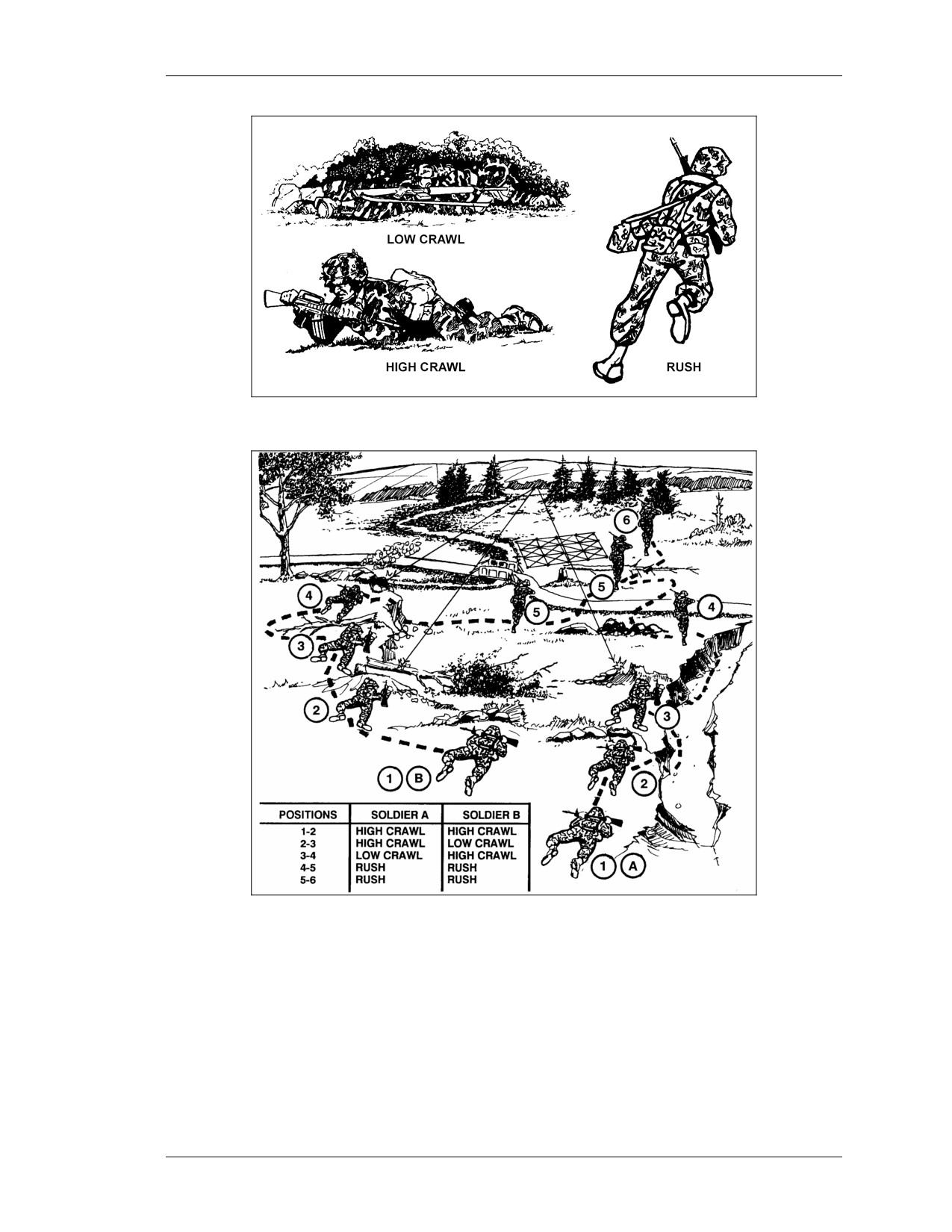
a. Individual movement training should include high and low crawl techniques, the
difference between cover and concealment, and short rush techniques (Figure F-1).
FM 21-75 explains the proper movement techniques. Squad leaders can designate a lane
through various types of terrain and have soldiers move from one end to the other. Squad
leaders should evaluate the soldiers' performance based on the use of cover and
concealment, length of exposure to enemy free, and speed of movement. As soldiers
master these basic skills, leaders can add challenges with natural or manmade obstacles
or add the use of MILES with a single enemy soldier at the far end of the lane. The squad
member must negotiate the lane without taking enemy fire.
b. Buddy-team movement training builds on individual movement skills by having
two-man teams negotiate the lane together. One soldier provides covering fire while his
buddy moves to the next covered position. The team must maintain visual or audible
communication with each other at all times during the movement. This exercise forms the
foundation for trust and confidence between fire team and squad members. They should
conduct this exercise before they execute battle-drill training. Figure F-2 shows an
example individual or buddy team movement exercise lane, with the numbers
representing the order of movement. The following text exemplifies an individual or
buddy-team movement exercise:
F-2
FM 3-22.1
Figure F-1. High and low crawl (L) and rush (R).
Figure F-2. Example individual or buddy team movement lane.
(1) Squad leaders should select a course area with various types of cover and
concealment to allow the soldier to choose the best positions and routes. The soldier's or
team's movement and coordination are evaluated by the performance measures in
STP 21-1-SMCT, Task 071-326-0502.
(2) The squad leader or team leader conducts precombat checks to ensure that each
soldier has the correct equipment and ammunition before starting the course. The soldier
or team occupies prone positions at the start of the course, and the team leader tells them
to move.
F-3
FM 3-22.1
(3) Soldiers search the terrain to the front for enemy activity, select their next
position, and choose a route that has the most cover and concealment.
(4) The soldier quickly moves along the route with the least exposure to enemy fire.
He masks his fire and does not cross in front of his buddy. The soldier uses the
appropriate individual movement technique (Figure F-3).
RUSH
HIGH CRAWL
LOW CRAWL
• Crossing open
• The route provides good cover
• The route provides cover
areas.
and concealment.
and concealment less than
one-foot high.
• Low volume of
• Poor visibility reduces enemy
enemy fire allows
observation.
• The enemy has good
brief exposure.
observation and can
• Enemy fire prohibits rushing but
effectively fire at the
• Time is critical.
speed is required.
position.
• Speed is not required.
Figure F-3. Movement techniques.
(5) This process continues until the soldier closes with and kills the enemy soldier. If
the enemy kills the soldier, the process starts again. Commanders can add situations to
this course to make the soldier execute other individual tasks such as some from
STP 21-1-SMCT. For example--
(a) The soldier can move over, through, or around a wire or log obstacle
(Task 071-326-0503) while negotiating the course.
(b) Squad or team leaders can throw artillery simulators during daylight exercises or
flares during night operations and evaluate the soldier's ability to react to indirect fire
(Task 071-326-0510) or flares (Task 071-326-0511).
(c) Once the soldier closes with the enemy, he can use hand grenades
(Task 071-325-4407) to knock out the enemy position. Once the enemy is killed or
withdraws, the soldier should prepare and report enemy information
(Task 301-348-1050) in the SALUTE report format.
(d) At the end of the mission, the soldier moves back to the start point (which can
simulate friendly lines) and is challenged by the next soldier. Leaders grade both soldiers
on use of a challenge and password (Task 071-331-0801).
F-7. FIRE TEAM, SQUAD, AND PLATOON MOVEMENT
Fire team, squad, and platoon movement training consists of movement formations and
techniques. Formations are the arrangement of squad members in relation to each other.
Movement techniques are the ways in which squads and platoons traverse terrain.
a. Movement Formations. Formations provide control, flexibility, and security.
Leaders choose formations based on METT-TC. Leaders position themselves in the best
position to control movement. Team leaders' positions are in front of their teams. All
members must maintain positions that allow them to see their leader and to receive
signals. Leaders change formations as needed, depending on terrain and visibility. They
assign each team member a different sector of responsibility to guard while moving. This
provides the formation with all-round security.
F-4
FM 3-22.1
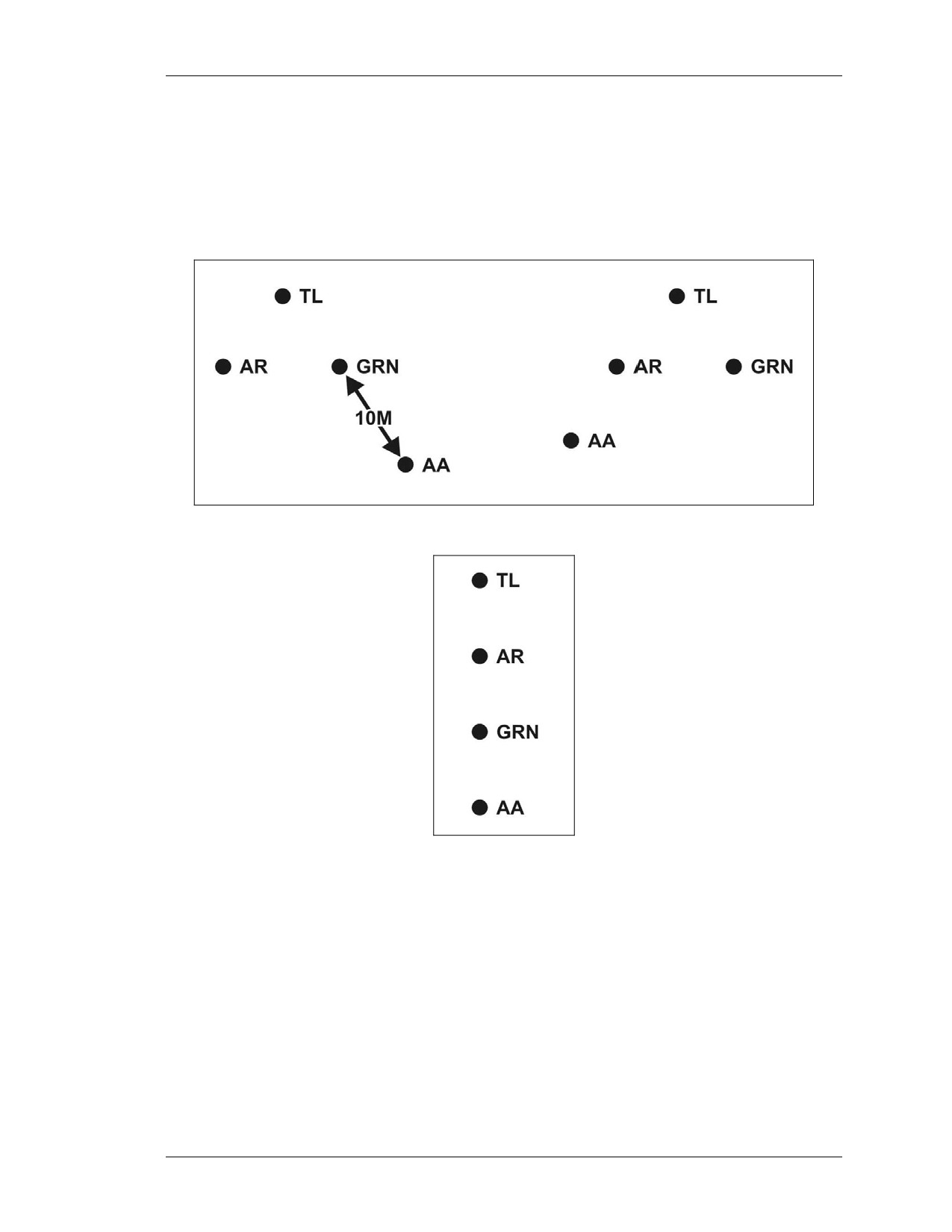
(1) Fire Team Formations.
(a) Wedge. The wedge formation (Figure F-4) is the basic formation for fire teams.
The interval between soldiers in a wedge expands or contracts depending on terrain or
visibility.
(b) File. The fire team uses the file formation (Figure F-5) when terrain precludes use
of the wedge.
Figure F-4. Fire team wedge formation.
Figure F-5. Fire team file formation.
(2) Squad Formations.
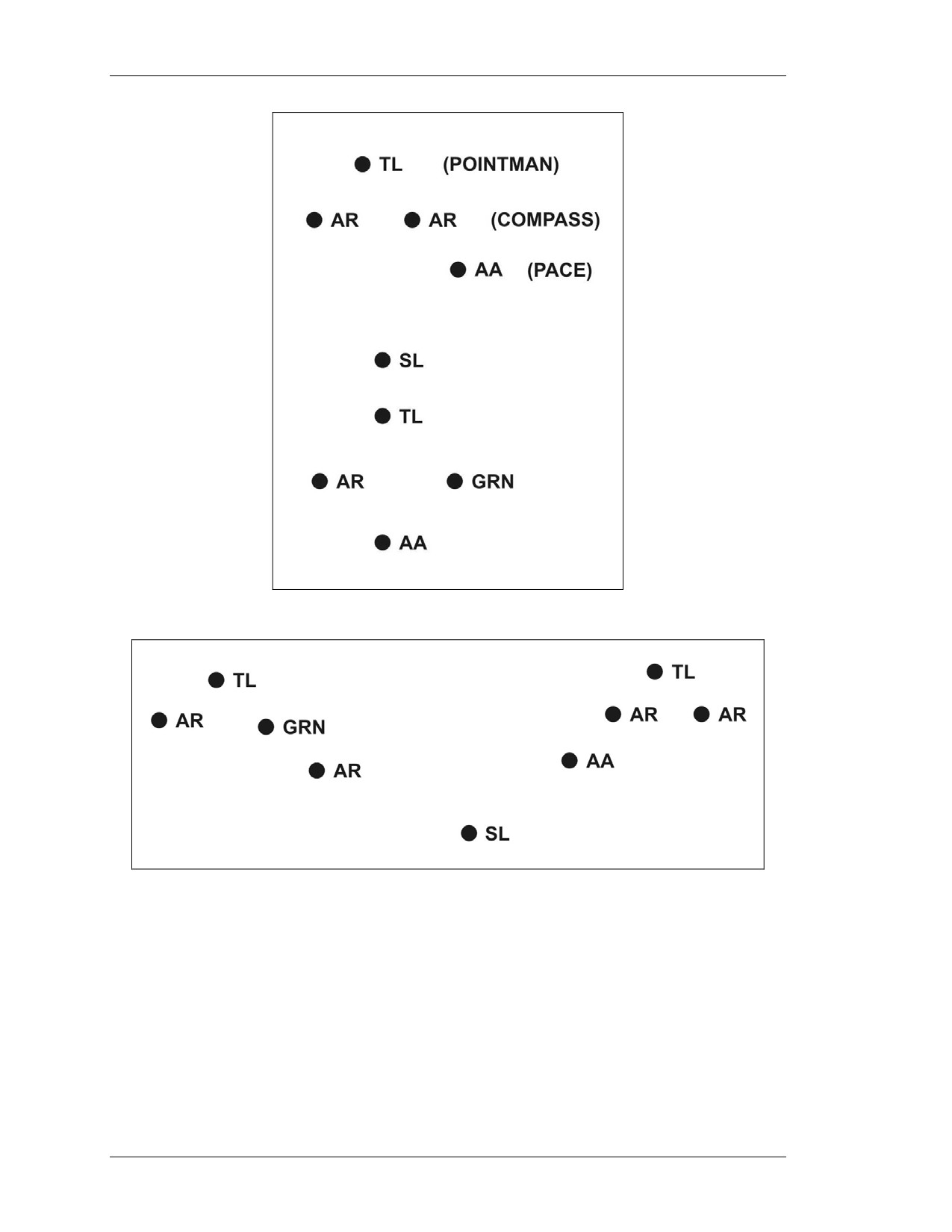
(a) Column. The squad's basic formation is the column (Figure F-6, page F-6).
It provides good dispersion laterally and in depth without sacrificing control, and it
facilitates maneuver.
(b) Line. The squad line provides maximum firepower to the front (Figure F-7,
page F-6).
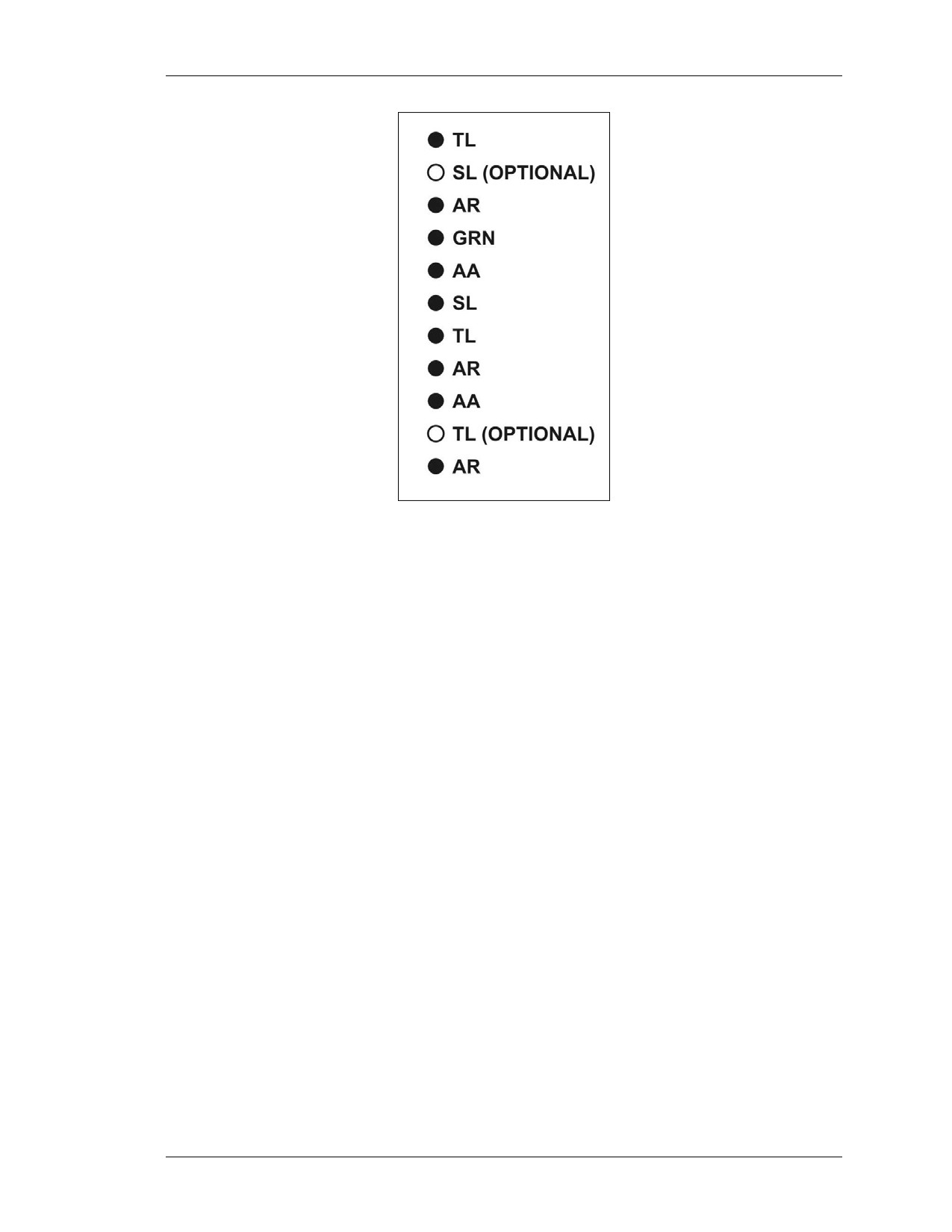
(c) File. The squad uses the squad-file formation in restrictive terrain (Figure F-8,
page F-7). To better control the formation, the squad leader can place himself in the first
or second position. From there, he can make key decisions quickly. Moving a team leader
to the rear can provide additional control of the rear of the formation.
F-5
FM 3-22.1
Figure F-6. Squad column formation.
Figure F-7. Squad line formation.
F-6
FM 3-22.1
Figure F-8. Squad file formation.
(3) Platoon Formations.
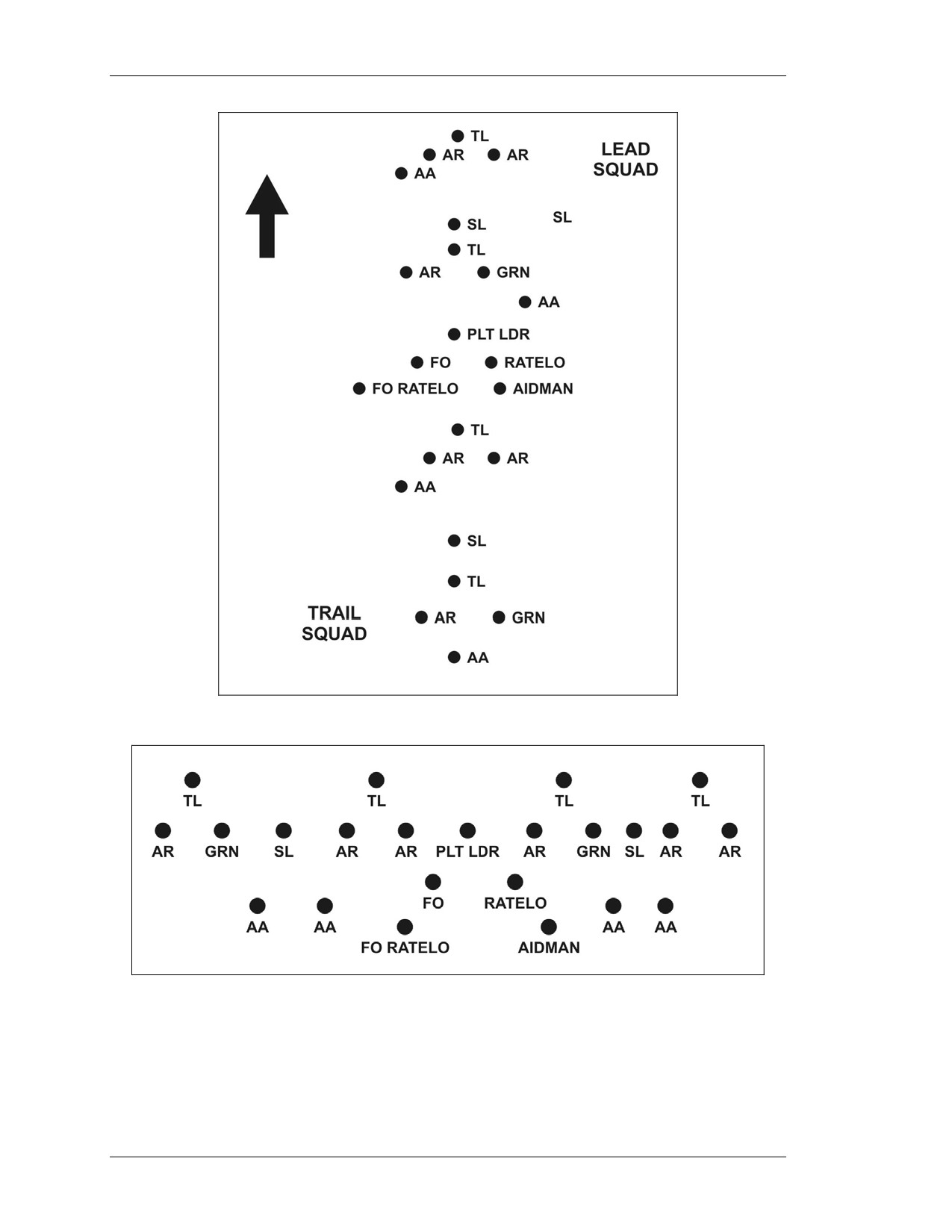
(a) Column. The platoon uses the column as its primary formation (Figure F-9,
page F-8). This formation can deliver a limited volume of fire to the front and a high
volume to the flanks.
(b) Line. The line formation allows the platoon to deliver the greatest amount of fire
to its front (Figure F-10, page F-8).
b. Movement Techniques. Squads and platoons use three basic movement
techniques: traveling, traveling overwatch, and bounding overwatch. They select a
movement technique based on the likelihood of enemy contact and on the need for speed.
In deciding, they consider such factors as control, dispersion, speed, and security.
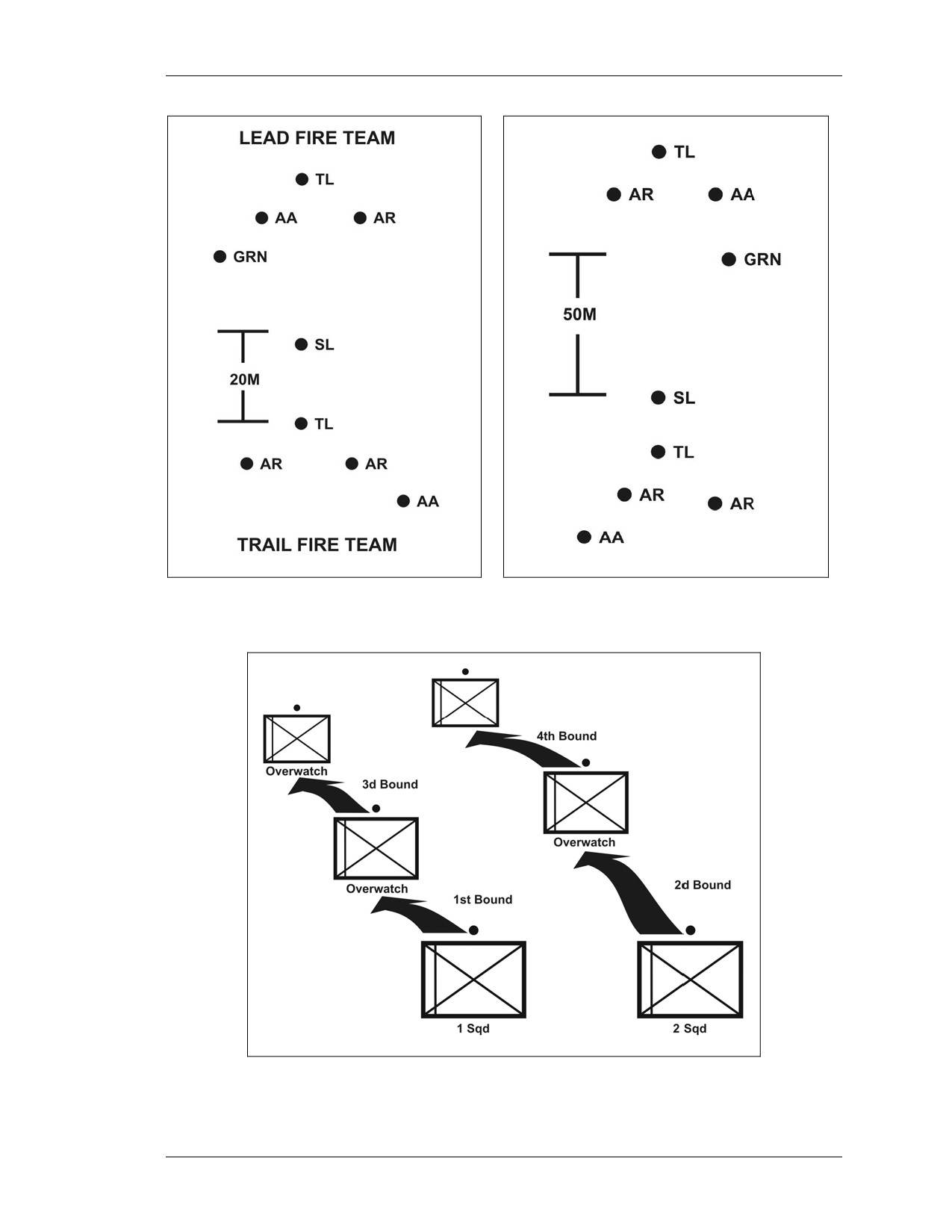
(1) Traveling. The squad or platoon uses traveling (Figure F-11, page F-9) when
contact with the enemy is not likely and they need speed.
(2) Traveling Overwatch. The squad or platoon uses traveling overwatch
(Figure F-12, page F-9) when contact with the enemy is possible. Traveling overwatch
resembles the traveling technique, except with greater distance between the lead fire team
or squad and the remainder of the element.
(3) Bounding Overwatch. The squad or platoon uses bounding overwatch
(Figure F-13, page F-9) when they expect contact with the enemy. This is the slowest
movement technique, but it provides the most security.
F-7
FM 3-22.1
Figure F-9. Platoon column formation.
Figure F-10. Platoon line formation.
F-8
FM 3-22.1
Figure F-11. Traveling movement
Figure F-12. Traveling overwatch
technique.
movement technique.
Figure F-13. Bounding overwatch movement technique.
F-9
FM 3-22.1
F-8. SQUAD OR PLATOON SITUATIONAL TRAINING EXERCISE
STXs are short, scenario-driven tactical exercises that train a single collective task or a
group of related battle drills and collective tasks. Chapter 4 of ARTEP 7-8-MTP explains
how to develop, resource, train, and evaluate an STX.
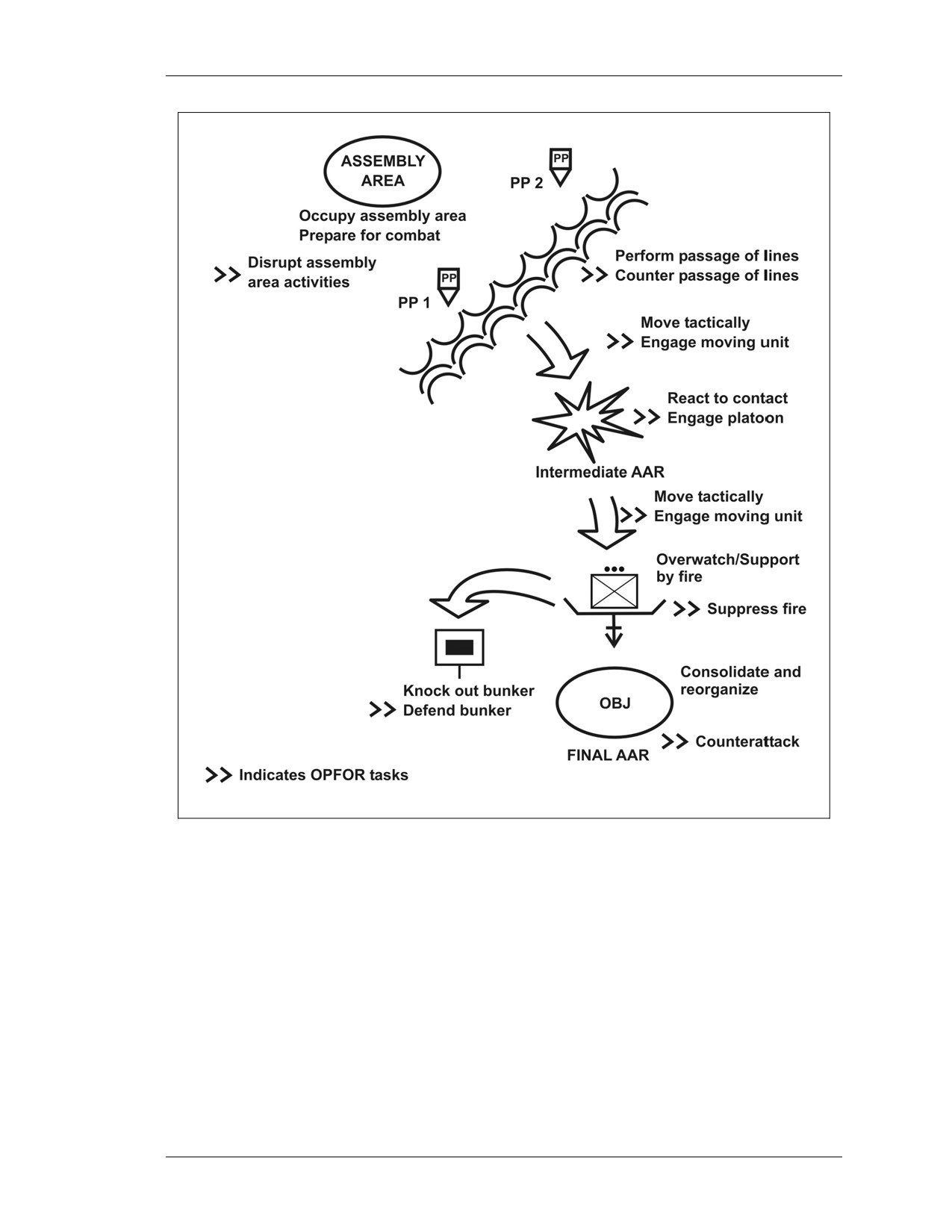
a. Commanders must develop a graphical scenario of task performance to fit the
exercise. In the scenario, the commander must place all rifle infantry critical collective
tasks that support his METL and need improvement in a logical sequence. Figure F-14
shows an example task-performance scenario.
b. After drawing the graphical scenario, leaders must list each event in sequence and
indicate the time required for each event. The leader adds all event times to determine the
overall time required to complete the STX. Trainers use this overall time as a guide for
planning purposes only, not as a training standard. Figure F-15, page F-12, provides an
example sequence of events and times for the STX.
c. Trainers match the events on the list with the corresponding T&EOs in
ARTEP 7-8-MTP. They do this to identify support requirements, prepare evaluation
packets, and develop an OPORD or scenario that leads the squad or platoon through each
of these collective tasks.
(1) Trainers review each T&EO to determine the support requirements for each event
within the STX. These requirements include personnel, vehicles, ammunition, training
aids, and training devices for friendly and OPFOR units. Trainers determine the
consolidated support requirements for the STX by totaling these requirements for each
event. Training managers must coordinate for and request these items early to ensure that
they are available.
(2) Leaders prepare evaluation packets by copying and sequencing the T&EOs. The
T&EOs form the framework of a collective task. The commander expands each T&EO
by adding performance measures and details that tailor it to his unit and specific mission.
This helps the evaluator record key training points during the STX execution. The
evaluation packet should also contain the exercise scenario, the OPORD, any
administrative instructions, and critical safety information.
(3) Commanders prepare orders that match the scenario. This procedure requires
some imagination to present a realistic situation to the squad or platoon conducting the
STX. A basic OPORD should provide the necessary information to start the exercise.
Commanders can assess the squad's or platoon's flexibility by issuing FRAGOs during
the exercise.
(4) Trainers must conduct an AAR so they can give the unit performance-oriented
training feedback. The evaluator or controller uses the AAR to tell a story about what
they had planned for the exercise. The soldiers and leaders discover for themselves what
actually happened, why it happened, and what they could have done better. They usually
conduct informal AARs at the crew, squad, and platoon levels.
F-10
FM 3-22.1
Figure F-14. Graphic scenario of task performance.
F-11

FM 3-22.1
EVENT
ACTION
ESTIMATED
1
Occupy Assembly Area
1 Hr
2
Prepare for Combat
2 Hr
3
Perform Passage of Lines
30 Min
4
Move Tactically
1 Hr
5
React to Contact
5 Min
6
Intermediate AAR
20 Min
7
Move Tactically
1 Hr
8
Overwatch/Support by Fire
2 Hr
9
Knock Out Bunker
2 Hr
10
Consolidate and Reorganize
1 Hr
11
Final AAR
45 Min
Maintain Operational Security
** Total Time: 11 hours
* These tasks are integrated and evaluated throughout the exercise.
** Additional time is required if great portions of the exercise are conducted at
night or during other limited visibility.
Figure F-15. Sequence of events and times for STX.
F-9. SQUAD OR PLATOON LIVE-FIRE EXERCISES
Live fire must replicate battlefield conditions. Squad and platoon LFXs
develop
confidence and esprit while reinforcing soldier, leader, and unit discipline. Rifle squad
and platoon LFXs are the culmination of separate rifle infantry STX training. Live-fire
exercises are critical for preparing soldiers and units for the danger, confusion, and speed
of combat operations. External evaluators should critique the LFX and give the
commander a critical assessment of the squad or platoon's performance of the critical
combat tasks that support the company METL.
a. Exercise Development. The principal focus of LFXs is weapons integration in a
tactical operation. Squads and platoons must learn the procedures to command, control,
and distribute well-aimed, effective fires, including small arms, indirect fire support
assets, and other weapons, demolitions, and pyrotechnics.
(1) The commander and S3 determine which ARTEP
7-8-MTP rifle infantry
operations will be evaluated based on METL and command guidance (movement to
contact, attack, raid, ambush, reconnaissance and security, defend, retrograde, or various
combinations of these). The S3 selects subtasks within these operations for the platoon or
squad to execute.
(2) The S3 and S2 select enemy target arrays that the infantry squad or platoon can
expect to see in combat. These rifle infantry target arrays are developed based on threat
analysis and command emphasis. Enemy scenarios must include M16A2, M249, M203,
AT4, and Dragon or Javelin targets.
(3) The S3 develops an exercise scenario in which the squad or platoon conducts
tactical tasks in a maneuver area and live-fire tasks mixed with tactical tasks on the range.
F-12
FM 3-22.1
Higher prepares an operation order, which provides all the tactical information and
supports the execution of the exercise, and gives it to the unit.
(4) Commanders must include night and NBC conditions into scenarios. Soldiers
should wear the man-worn MILES laser detector harnesses equipment (not weapons
transmitters), which allows the controller to cause a near miss or to kill personnel for
tactical errors or to induce stress. Combat service support
(casualty evacuation and
resupply) can be added to the scenario.
b. Prerequisites. The crew must meet the following prerequisites before the LFX:
(1) Each soldier must have qualified with his individual weapon (M16A2, M203,
M240B, and M249) within the previous 6 months.
(2) Dragon gunners must have certified with the Dragon within the past 3 months.
(3) Squads must have completed a squad LFX within the past 6 months before a
platoon LFX.
c. Standards. Each MTP operation and subtask has established maneuver and
live-fire standards. These standards are in ARTEP 7-8-MTP. Trainers use the T&EOs and
the rifle infantry penalty matrix from ARTEP 7-7J-MTP to evaluate the squad or platoon.
Units are given a rating of trained, needs practice, or untrained. Squads and platoons must
achieve a trained or needs practice rating to receive a GO on the LFX.
d. Example Squad LFX Scenario. The tasks cited in this paragraph are all from
ARTEP 7-8-MTP. Figure F-16, page F-14, shows an example squad LFX task list.
(1) The squad occupies a tactical assembly area (Task 7-3/4-1022) and prepares for
combat operations (Task 7-3/4-1046). The platoon leader gives an operation order in
which the squad moves as part of the platoon (simulated) along a specified route in a rifle
infantry movement to contact.
(2) The squad moves tactically
(Task 7-3/4-1025), performs a passage of lines
(Task 7-3/4-1040), and receives fire from a three-man enemy ATGM position. The squad
executes the React to Contact battle drill (Battle Drill 2 from ARTEP 7-7J-Drill), then
assaults (Task 7-3/4-1001) to destroy the enemy (Figure F-15, Event 1).
(3) The squad provides the platoon leader a SITREP and continues to move. The
squad makes contact with an enemy combat reconnaissance outpost consisting of several
troops and a reconnaissance BTR. The squad leader reports contact and the platoon leader
orders the squad to engage (Figure F-15, Event 2).
(4) The platoon leader orders the squad to continue to move. The squad receives fire
from a bunker. The lead fire team provides suppressive fire while the trail fire team
maneuvers to assault the enemy position from the flank. The squad knocks out the bunker
(Task 7-3/4-1012) and engages the enemy vehicle and troop targets in the enemy main
defensive belt (Figure F-15, Event 3).
(5) The squad leader continues to clear the objective and the enemy withdraws. The
squad consolidates and reorganizes on the position
(Task 7-3/4-1047). The squad
prepares a hasty defensive position (Task 7-3/4-1021) to prepare for a counterattack.
(6) The squad defends against an enemy platoon's counterattack. The squad can call
for and adjust indirect fire (Figure F-15, Event 4).
(7) The squad repels the counterattack and is ordered to disengage (Task 7-3/4-1008).
The mission is complete.
F-13
FM 3-22.1
F-10. SAMPLE RIFLE INFANTRY TRAINING PROGRAM
Units must develop training programs that train and evaluate infantry squads and
platoons. Successful training programs use the individual tasks that serve as building
blocks to support identified collective tasks. Collective tasks build upon each other:
beginning with fire team, then squad, and finishing with platoon collective tasks. The
rifle infantry squad-training program must parallel the mounted element's training. This
gets them both prepared to take part in integrated training at the prescribed times. These
building blocks also provide an organized method to plan, resource, and manage the
program. Leaders will find tasks, conditions, and standards in the following manuals--
• STP 21-1-SMCT.
• STP 7-11BC24-SM-TG.
• ARTEP 7-8-MTP.
• ARTEP 7-7J-Drill.
F-11. PRELIMINARY TRAINING
Preliminary training consists of movement training, weapons training, equipment
training, and qualification. Weapons and equipment training and qualification are the rifle
infantry element's equivalent to the mounted element's BGST.
F-14

FM 3-22.1
TARGET
TASK
ARRAY
RANGE
AMMUNITION
STANDARDS
1.
Engage
Enemy ATGM
200 to
30
5.56
Hit 1 target within
target with
team (3 IRETS)
400 M
(each M16A2)
20 seconds.
small-arms
5
(each M249)
weapons.
2.
Engage
Enemy squad (-)
300 to
30
5.66
Hit 2 targets within
target with
dug in as
500 M
(each M16A2)
20 seconds.
small-arms
combat outpost
3
40-mm
weapons
(5 IRETS)
(each M203)
(use AT-4).
100
(each M249)
One BTR-60
600 M
2
9-MM or
Kill target IAW
MILES
applicable
threat-based
timing matrix.
3.
Engage
Enemy platoons
100 to
60
5.56-mm
Hit bunker with
targets with
(21 IRETS) in
150 M
(each M16A2)
effective weapon
small-arms
prepared
system.
3
40-mm
weapons.
positions
(each M203)
100
(each M249)
Engage
Two BMPs
400 M
2
9-MM or
Kill targets IAW
targets
MILES
applicable
with AT-4.
threat-based
timing matrix.
4.
Engage
21 IRETS
600 to
90
5.56-mm
Hit 4 targets within
targets with
800 M
(each M16A2)
20 seconds at
small-arms
11 to 14 IRETS
300 to
50
(each M249)
each range band.
weapons.
400 M
7 to 9 IRETS
100 M
5
40-mm
(each M203)
Engage
Two BMPs
One at
4
9-mm or
Kill targets IAW
targets
500 M
MILES
applicable
with AT-4.
threat-based
One at
timing matrix.
400 M
Engage
One flank BMP
800 to
1
Dragon or
Kill target IAW
target with
1,000 M
Javelin
applicable
Dragon or
(MILES).
threat-based
Javelin.
timing matrix.
Figure F-16. Example squad LFX (day).
F-15
FM 3-22.1
F-12. MOVEMENT TRAINING (TABLES 1 -- IV)
Rifle Infantry Tables I through IV train soldiers in infantry movement.
a. Rifle Infantry Table I, Individual or Buddy-Team Movement Exercise. DT I
trains and evaluates individual and buddy-team movement techniques. Tasks
evaluated include--
(1) Individual. Move Under Direct Fire (071-326-0502).
(a) High crawl.
(b) Low crawl.
(c) Rush.
(d) Select Temporary Fighting Positions (071-326-0513).
(2) Buddy Team.
(a) Move Over, Through, or Around Obstacles (Except Minefields) (071-326-0503).
(b) React to Indirect Fire while Dismounted (071-326-0510).
b. Rifle Infantry Table II, Fire Team Movement Exercise. DT II trains and
evaluates a fire team's ability to move tactically. Tasks evaluated include--
(1) Move as a Member of a Fire Team (071-326-0510).
(2) Control Movement of a Fire Team (071-326-5605).
(3) Conduct the Maneuver of an M2 BFV Section/Squad (071-420-0007-A).
c. Rifle Infantry Table III, Squad Movement Exercise. DT III trains and
evaluates a squad's ability to use movement techniques. Tasks evaluated include--
(1) Conduct maneuver of a squad (071-326-5611).
(2) Select an overwatch position (071-326-5606).
d. Rifle Infantry Table IV, Platoon Movement Exercise. DT IV trains and
evaluates a platoon's ability to use movement techniques. Tasks evaluated include--
(1) Conduct Movement Techniques by an M2 BFV Dismount Platoon
(071-326-5910-A).
(2) Conduct the maneuver of a platoon (071-420-0005).
F-13. DEVICE TRAINING (TABLES VI -- VIII)
These firing tables train infantry squads and platoons to use devices. Device training
(DT) consists of infantry squad and platoon STXs. These STXs in turn consist of infantry
squad battle drills and collective tasks. STXs either use MILES equipment in a
force-on-force mode, or they use MILES LTID targetry. Although these are rifle infantry
exercises, while operating in assembly areas, the unit should provide the squad or platoon
with Bradleys. This ensures realistic training in assembly area procedures.
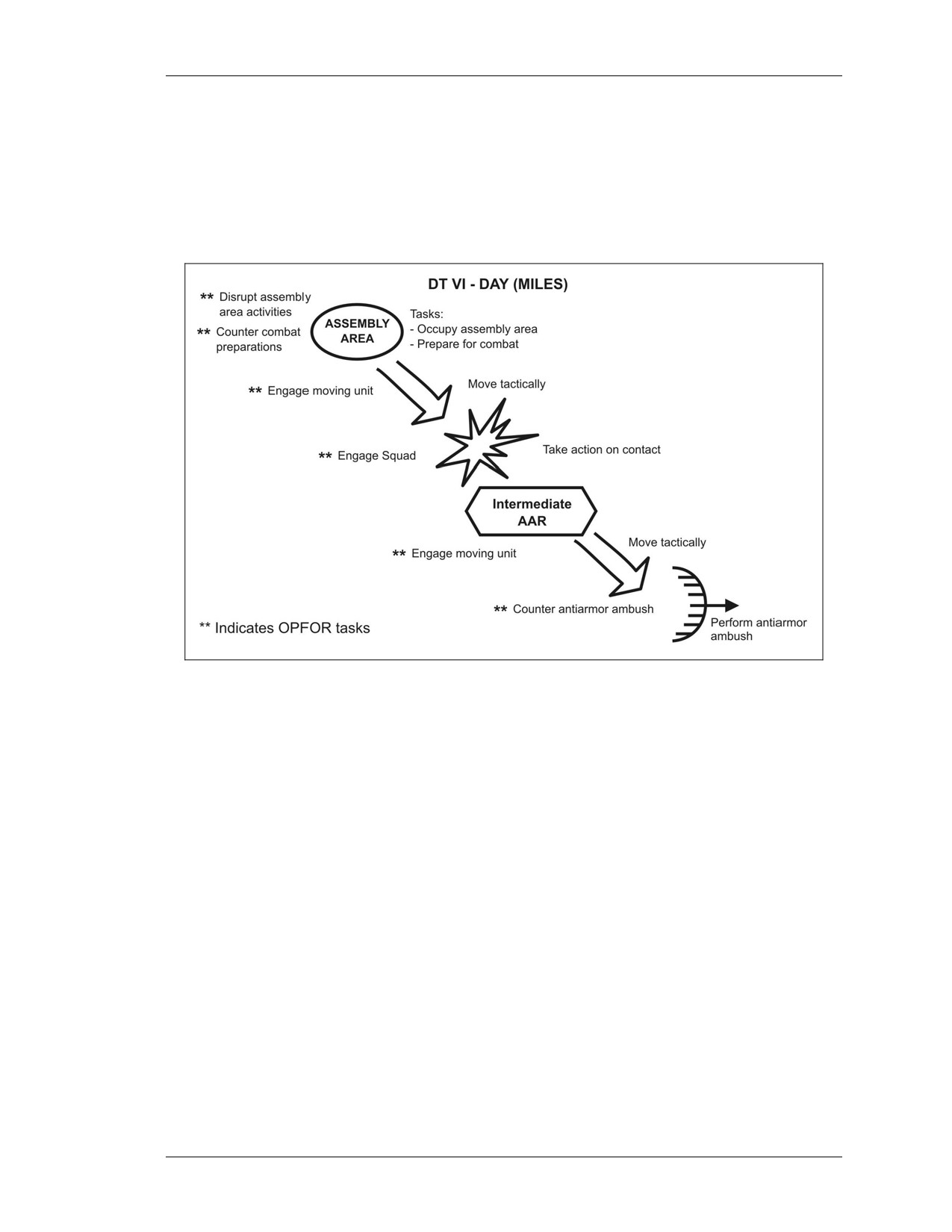
a. Table VI--Squad Practice. DT VI allows squads to practice troop-leading
procedures, reactions to contact, and an antiarmor ambush. Although this is a day
exercise, the squad may conduct it again at night (Figure F-17).
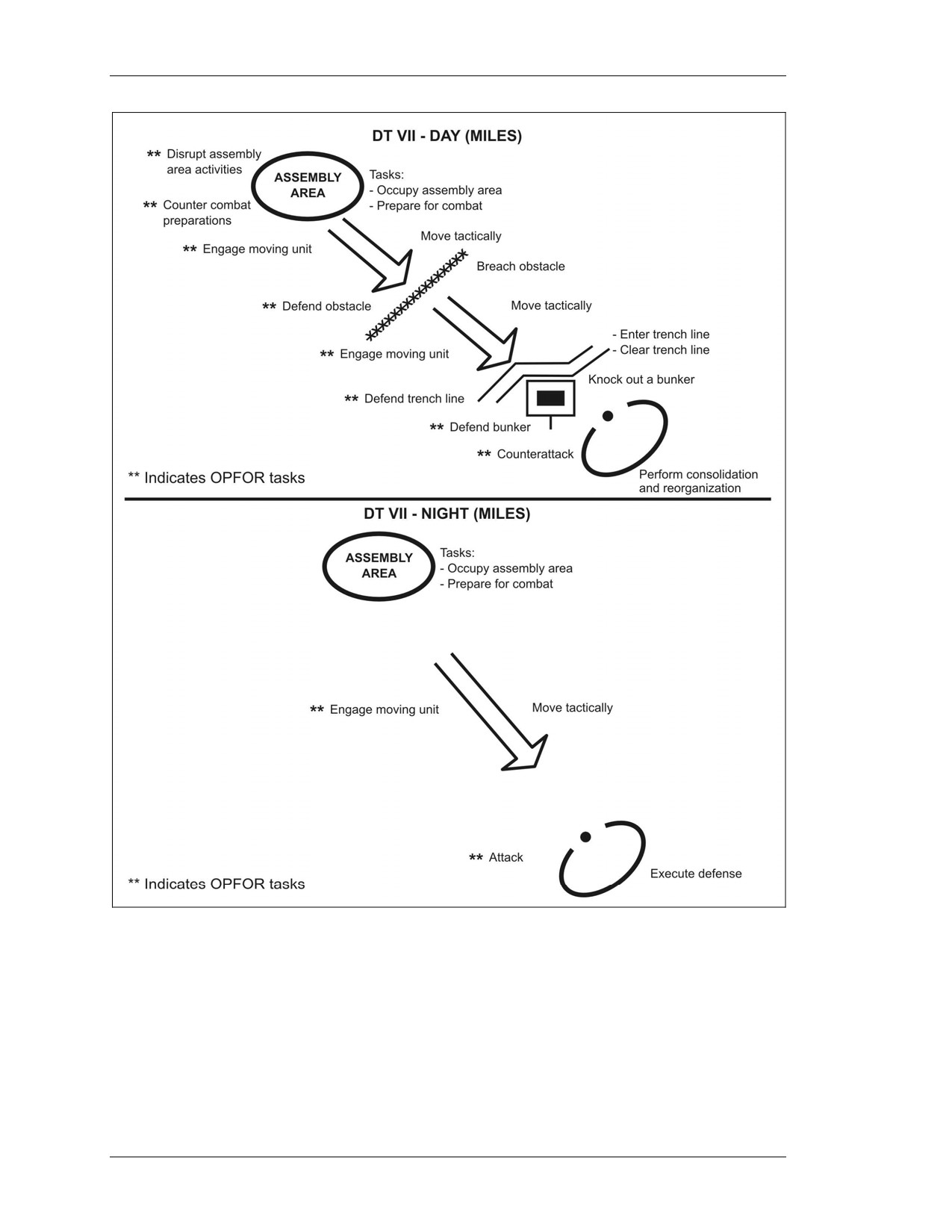
b. Table VII--Squad Certification. DT VII evaluates the rifle infantry squad's
conduct of tactical tasks, day and night (Figure F-18, page F-18).
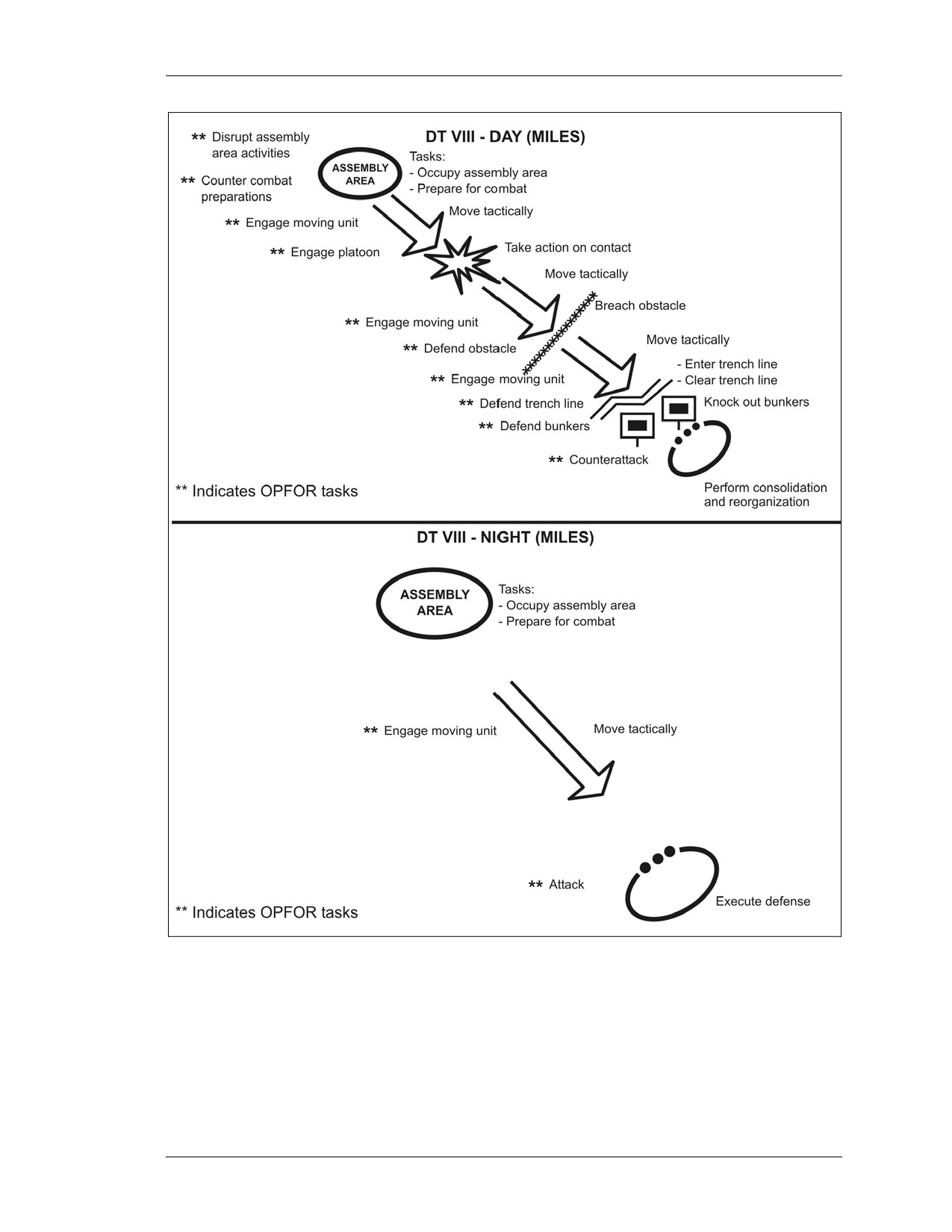
c. Table VIII--Platoon Certification. DT VIII evaluates the rifle infantry platoon's
conduct of tactical tasks, day and night (Figure F-19, page F-19).
F-14. LIVE-FIRE TRAINING (TABLES XI -- XII)
Live-fire training consists of infantry squad and platoon LFXs. The LFXs combine battle
drills and collective tasks conducted on live-fire ranges. Live-fire training includes two
rifle infantry qualification firing tables, XI (squad) and XII (platoon).
F-16
FM 3-22.1
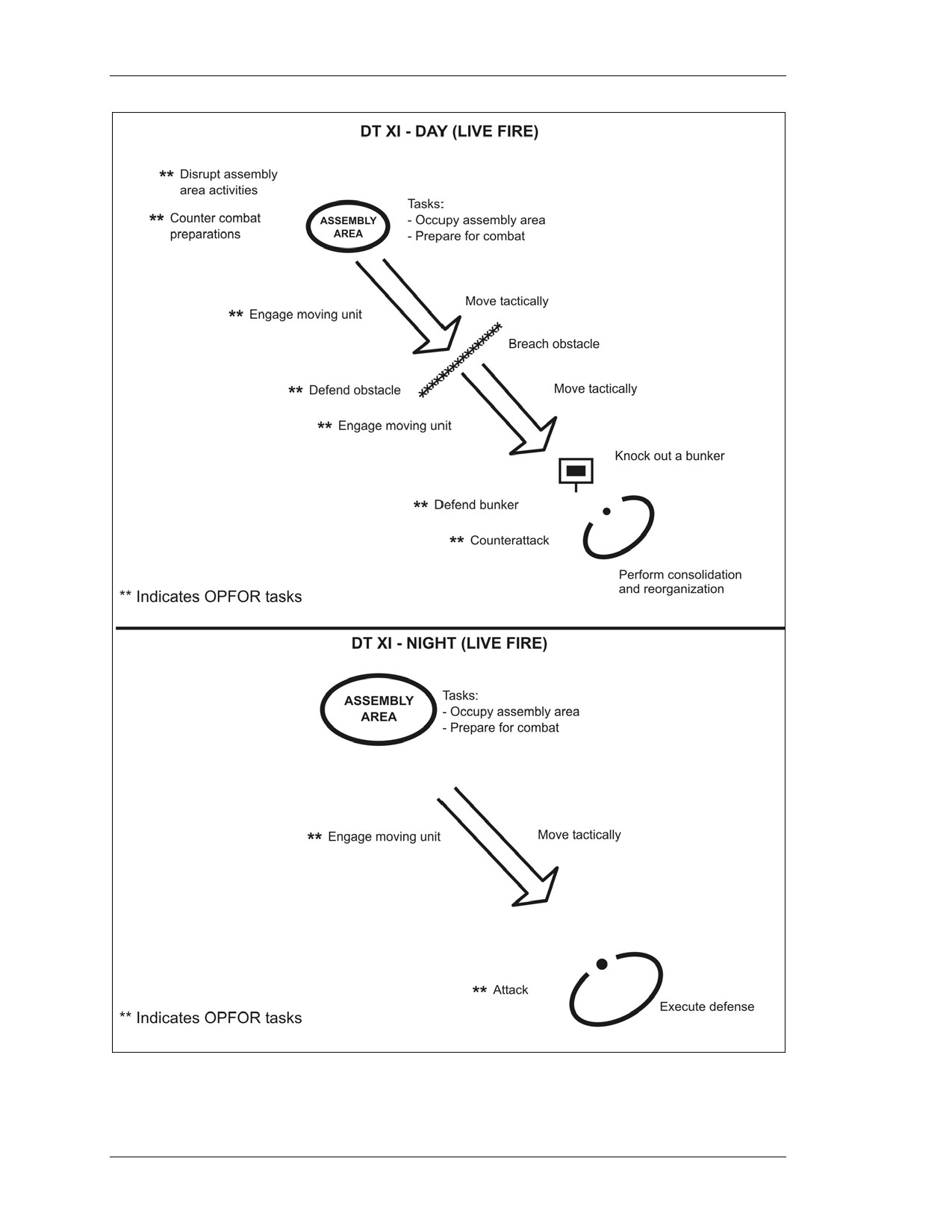
a. Rifle Infantry Table XI, Squad Qualification. DT XI evaluates the infantry
squad's ability to conduct live fire, tactical tasks during day and night (Figure F-20,
page F-20).
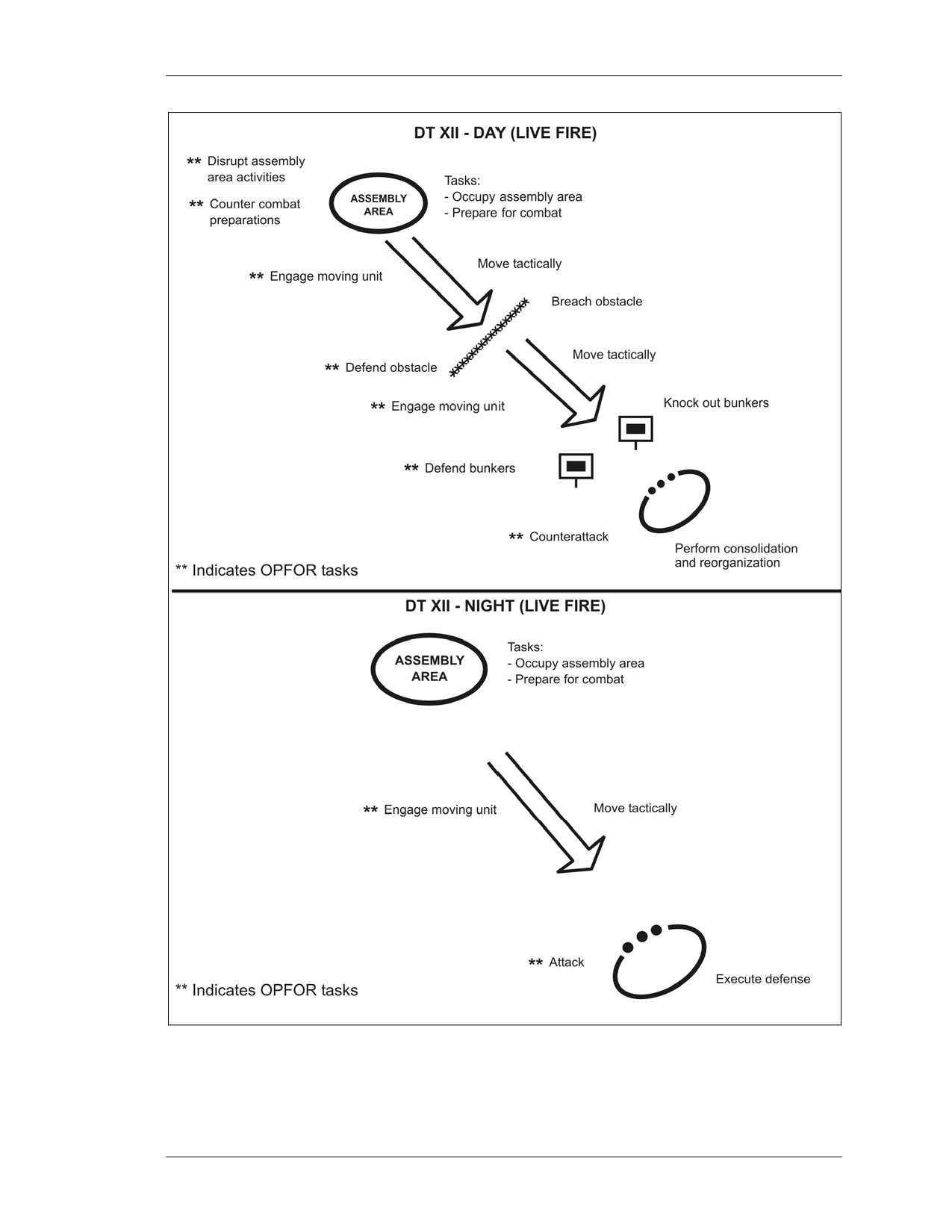
b. Rifle Infantry Table XII, Platoon Qualification. DT XII evaluates rifle infantry
platoon's ability to conduct live fire, tactical tasks during day and night (Figure F-21,
page F-21).
Figure F-17. Squad practice (Table VI).
F-17
FM 3-22.1
Figure F-18. Squad certification (Table VII).
F-18
FM 3-22.1
Figure F-19. Platoon certification (Table VIII).
F-19
FM 3-22.1
Figure F-20. Squad qualification (Table XI).
F-20
FM 3-22.1
Figure F-21. Platoon qualification (Table XII).
F-21
FM 3-22.1 (FM 23-1)
Glossary
AAR
after-action review
ABFIST
advanced Bradley full-crew interactive-simulation trainer
AC
active component
ACE
armored combat earthmover
admin
administrative (graphics only)
AD
air defense
ADA
air defense artillery
ADR
air-defense reticle
ammo
ammunition (graphics only)
amp
ampere (graphics only)
annunciator
one that annunciates; specifically, a usually electrically controlled
signal board or indicator
AP
armor piercing
APC
armored personnel carrier
APDS-T
armor-piercing discarding sabot with tracer
APFSDS-T
armor-piercing, fin-stabilized discarding sabot with tracer
APFT
Army Physical Fitness Test
AR
automatic rifleman
ARTEP
Army Training and Evaluation Program
ATGM
antitank guided missile
ATT
aided target-tracker
autogyro
a freely rotating rotor for lift
aux
auxiliary (graphics only)
AVLB
armored vehicle-launched bridge
az
azimuth (graphics only)
BATS
Bradley advanced training system
BC
Bradley commander
BCE
Bradley crew evaluator
BCPC
Bradley Crew Proficiency Course
BD
biocular display
BFV
Bradley fighting vehicle
BFIST
Bradley fire support team
BGM
basic guided missile
BGST
Bradley Gunnery Skills Test
BISSUE
Bradley Infantry squad or section urban exercise
BIT
built-in test
BMP
a light armored vehicle made by the former Soviet Union
BOT
burst on target
BPI
bolt position indicator
BPPC
Bradley Platoon Proficiency Course
BRDM
a scout car made by the former Soviet Union
BSFV
Bradley Stinger fighting vehicle
Glossary-1
FM 3-22.1
BSS
ballistic solution software
BSSE
Bradley squad or section exercise
BT
Bradley table
BTR
a light armored vehicle made by the former Soviet Union
C3I
command, control, communications, and intelligence
CALFEX
combined arms live-fire exercise
C2
command and control
C3
command, control, and communications
CBLS
combat lifesaver
CCTT
close-combat tactical trainer
cdr
commander
CDT
control display terminal
CEV
combat engineer vehicle
CFT
captive flight trainer
CFV
cavalry fighting vehicle
CGE
command-guidance electronics
CGF
computer-generated force
CGUN
control gun
CHS
commander's handstation
CIP
combat identification panel
CIV
commander's independent viewer
CM
cruise missile
CMTC
Combat Maneuver Training Center
co
company (graphics only)
coax
coaxial
COFT
conduct of fire trainer
commo
communication
COMSEC
communications security
contingent
dependent on or conditioned by something else
contingency
something liable to happen as an adjunct to or result of
something else
CP
control panel
CPU
computer processing unit
CS
combat support
CSCP
commander's sight control panel
CSE
commander's sight extension
CSIC
crew station-interface computer
CSS
combat service support
CTC
Combat Training Center
CTD
commander’s tactical display
CTT
common task test
CVC
combat vehicle crewman (helmet)
DA
Department of the Army
DCGE
digital command guidance electronics
Glossary-2
FM 3-22.1
DCS
digital compass system
def
defense (graphics only)
DEROS
date eligible for return from overseas
DH/DR
the amount of change occurring in height for each 100 meters of
change in range
DIFCUE
direct or indirect-fire cue [simulator]
DIVARTY
division artillery
DMPRC
digital multipurpose range complex
DoD
Department of Defense
DODAC
Department of Defense ammunition code
DR/DSE
the amount that range changes for each 1 mil of change in
superelevation
DT
device training
DTG
date-time group
DTV
day television
DU
depleted uranium
DVE
driver's vision enhancer
DVO
direct-view optics
EBFV
engineer Bradley fighting vehicle
EIB
expert infantryman badge
el
elevation (graphics only)
ELRF
eye-safe laser range finder
EOD
explosive ordnance disposal
EPLRS
Enhanced Position-Location Reporting System
F
Fahrenheit
FAAD
forward area air defense
FAASV
field artillery armored support vehicle
FBCB2
Force (XXI) battle command brigade and below
FCS
fire-control system
FCSW
fire-control software
FFE
fire for effect
FFCS
full-function crew station
FH/M
frequency hopping/master
FL
forward looking
FLIR
forward-looking infrared radar
flt
fault
FM
fire mission
FO
forward observer
forwarder
(25-mm machine gun) an internal piece of the feeder (top half of
the weapon) that pushes the rounds into position.
FOV
field of view
FPS
feet per second
FPW
firing port weapon
FR
fire request
Glossary-3
FM 3-22.1
FSSO
fire-support station operator
FT
firing table
FTX
field training exercise
fuse
a wick-type detonating device that, when lit by a match or other
means, sets off the bursting charge of a projectile, bomb,
or torpedo
fuze
a mechanical or electrical detonating device that sets off the
bursting charge of a projectile, bomb, or torpedo
GHS
gunner’s handstation
gnr
gunner (graphics only)
GPS
global positioning system
gren
grenadier (graphics only)
gripstock
the interface between gunner and missile
GSCP
gunner's sight control panel
GSR
ground surveillance radar
GTA
graphic training aid
gunnery
the use of guns; the science of the flight of projectiles and of the
effective use of guns.
G/VLLD
ground/vehicle laser locator designator
HB
handbook
HE
high explosive
HEI
high-explosive incendiary
HEI-T
high-explosive incendiary with tracer
HEMTT
heavy expanded-mobility tactical truck
HET
heavy equipment transporter
Hind
a helicopter made by the former Soviet Union
HMMWV
high-mobility, multipurpose, wheeled vehicle
hotbox
a box containing rounds of linked ammunition
hp
horsepower (graphics only)
hr
hour (graphics only)
HSG
home station gunnery
HTU
handheld terminal unit
Hz
hertz
IAW
in accordance with
IBAS
improved Bradley acquisition system
IC3
integrated communications, command, and control
IFF
identify friend or foe
IFV
Infantry fighting vehicle
impact
to strike forcefully
in
inch (graphics only)
intravehicular
within a vehicle
intervehicular
between vehicles
INU
inertial navigation unit
Glossary-4
FM 3-22.1
I/O
instructor/operator
IOS
instructor/operator station
IPB
intelligence preparation of the battlefield
ICPC
Infantry Crew Proficiency Course
IPPC
Infantry Platoon Proficiency Course
IR
infrared
IRETS
Infantry remoted-target system
ISU
integrated sight unit
ITOW
improved TOW
IUH
instructor utilization handbook
km
kilometer
KPH
kilometer per hour
lase
to emit coherent light; to use a device or weapon that employs
a laser light
LAV
light armored vehicle
lb
pound (graphics only)
LCD
liquid crystal display
LCPC
Linebacker Crew Proficiency Course
ldr
leader (graphics only)
LFX
live-fire exercise
LOGPAC
logistics package
LOS
line of sight
LRA
local reproduction authorized
LRF
laser range finder
Lt
lieutenant
LT
Linebacker table
LTID
laser-target interface device
LTTT
Linebacker Tabletop Trainer
LWRS
laser warning receiver system
m
meter (graphics only)
MANPADS
Man-Portable Air Defense System
maximum ordinate
the highest measurement the round will travel above the line
of sight, often referred to as "max ord"
MBT
main battle tank
MCD
missile countermeasure device
MCOFT
mobile conduct of fire trainer
MCS
missile control subsystem
MDI
miss-distance indicator
MEL
maximum engagement line
MELIOS
miniature, eye-safe-laser, infrared observation set
MEP
mission-equipment package
METL
mission-essential task list
METT-TC
mission, enemy, terrain, troops and time available, civilians
mi
mile (graphics only)
Glossary-5
FM 3-22.1
MILES
Multiple Integrated Laser-Engagement System
mm
millimeter
MOPP
mission-oriented protective posture
MPH
miles per hour
MPRC
multipurpose range complex
MPS
meters per second
msl
missile (graphics only)
MSR
missile simulation round
MTI
moving target indicator
MT-LB
a vehicle made by the former Soviet Union
MTOE
modified table of organization and equipment
MTP
mission training plan
NA
not applicable
NBC
nuclear, biological, chemical
NCO
noncommissioned officer
NCOIC
noncommissioned officer in charge
NFOV
narrow field of view
NSN
national stock number
NTC
National Training Center
obturator
something that closes or blocks an opening
ODS
Operation Desert Storm
ODS-E
Operation Desert Storm with appliqué
O/G
observer grid
OIC
officer in charge
OP
observation post
OPFOR
opposing force
ORD
operational requirements document
OPORD
operation order
orig
original (graphics only)
OTPD
optical turret positioning device
PC
personnel carrier
PCS
permanent change of station
PD
proximity device
PDF
principal direction of fire
PEWS
platoon early warning system
PGS
precision gunnery system
PH
probability of hit
PK
probability of kill
PLGR
precision lightweight GPS receiver
plt
platoon (graphics only)
PMCS
preventive maintenance checks and service
PN
part number
P/O
positioned on
Glossary-6
FM 3-22.1
POS-NAV
position-navigation
prox
proximity
psi
pounds per square inch
QDR
quality deficiency report
RATELO
radiotelephone operator
RBD
remote biocular display
RC
reserve component
rds
rounds (graphics only)
REMS
remotely employed sensor
retroreflector
device that reflects radiation (as light) so that the paths of the rays
parallel those of the incident rays
RIT
rifle infantry table
RMP
reprogrammable microprocessor
RMS
remote monitoring station
ROE
rules of engagement
RP
reference point
RPG
rocket-propelled grenade
RPVTS
Remotely Piloted Vehicle-Target System
RSO
range safety officer
RSOP
reconnaissance, selection, and occupation of position
rule of thumb
a method of procedure based on experience and common sense;
a general principle regarded as roughly correct but not intended to
be scientifically accurate
S&A
safety and arming
SALT
size, activity, location, and time
SALUTE
size, activity, location, unit, time, equipment
SCB
system control box
SDU
Stinger distribution unit
sec
second (graphics only)
setback
the distance that a projectile sits behind the nose cap, which allows
room for the air to push out the sabots
SHORAD
short-range air defense
SIMNET
simulations network
SIO
senior instructor/operator
SINCGARS
single-channel ground and air radio subsystem
SITREP
situation report
slave
one mechanism directly responsive to, or to make a mechanism
directly responsive to, another mechanism
SLD
squad leader’s display
SMCT
soldier's manual of common tasks
SOP
standing operating procedures
SPC
special-purpose computer
SPOT
Glossary-7