3-22.1 (FM 23-1) BRADLEY GUNNERY (NOVEMBER 2003) - page 11
FM 3-22.1
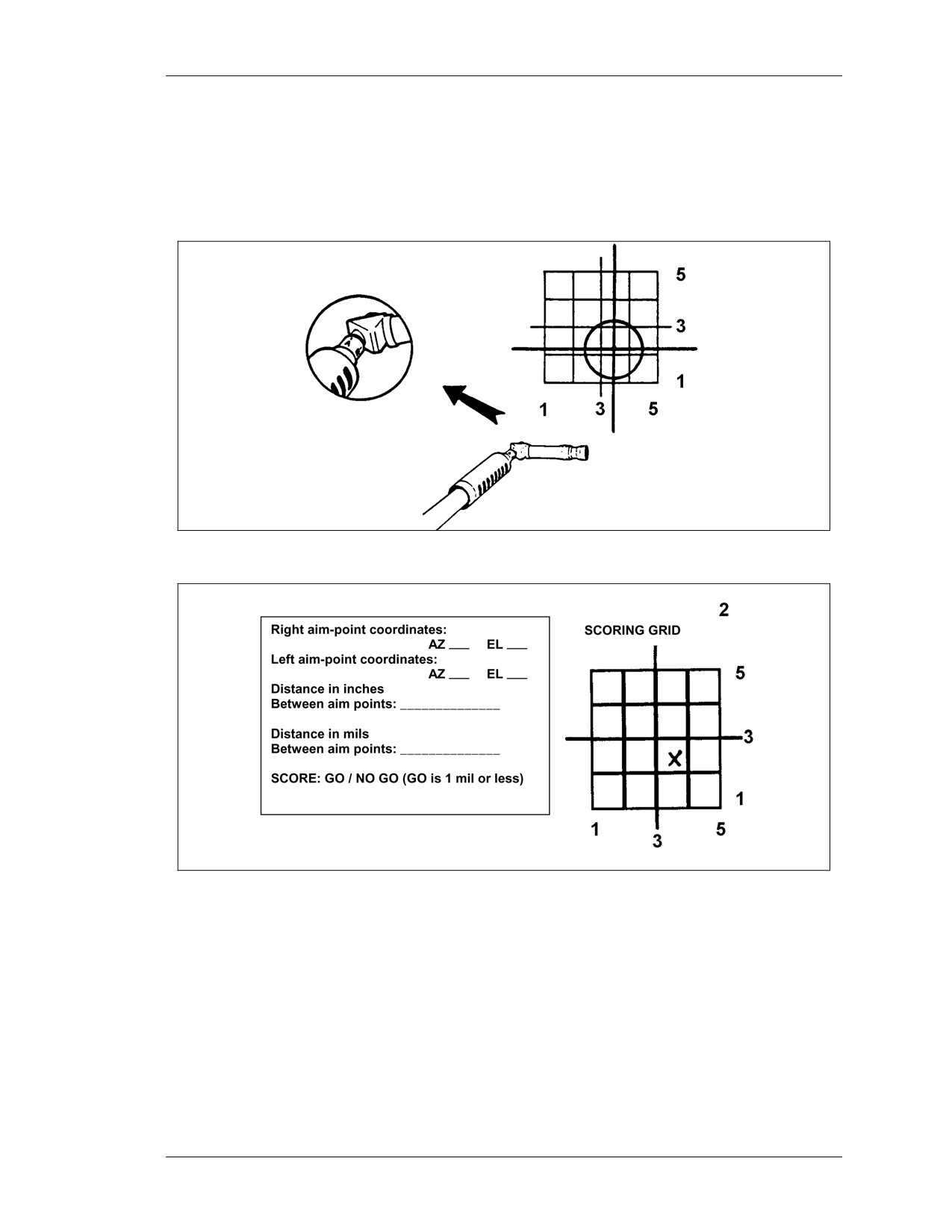
(b) Rotate the telescope to the right. In this example, the AZ coordinate reads 3 1/2,
and the EL coordinate reads 2 1/4 (Figure B-31).
(c) Estimate and record the AZ and EL coordinates in the RIGHT AIM-POINT
COORDINATES item in the TEST 2 section of the scoresheet.
(d) Plot the right aim point on scoring grid 2 (Figure B-32).
Figure B-31. Azimuth and elevation with adapter to the right, at mark "B."
Figure B-32. Right aim point coordinates, TEST 2.
(e) Rotate both the adapter and telescope to the left. Position the adapter's "B" mark
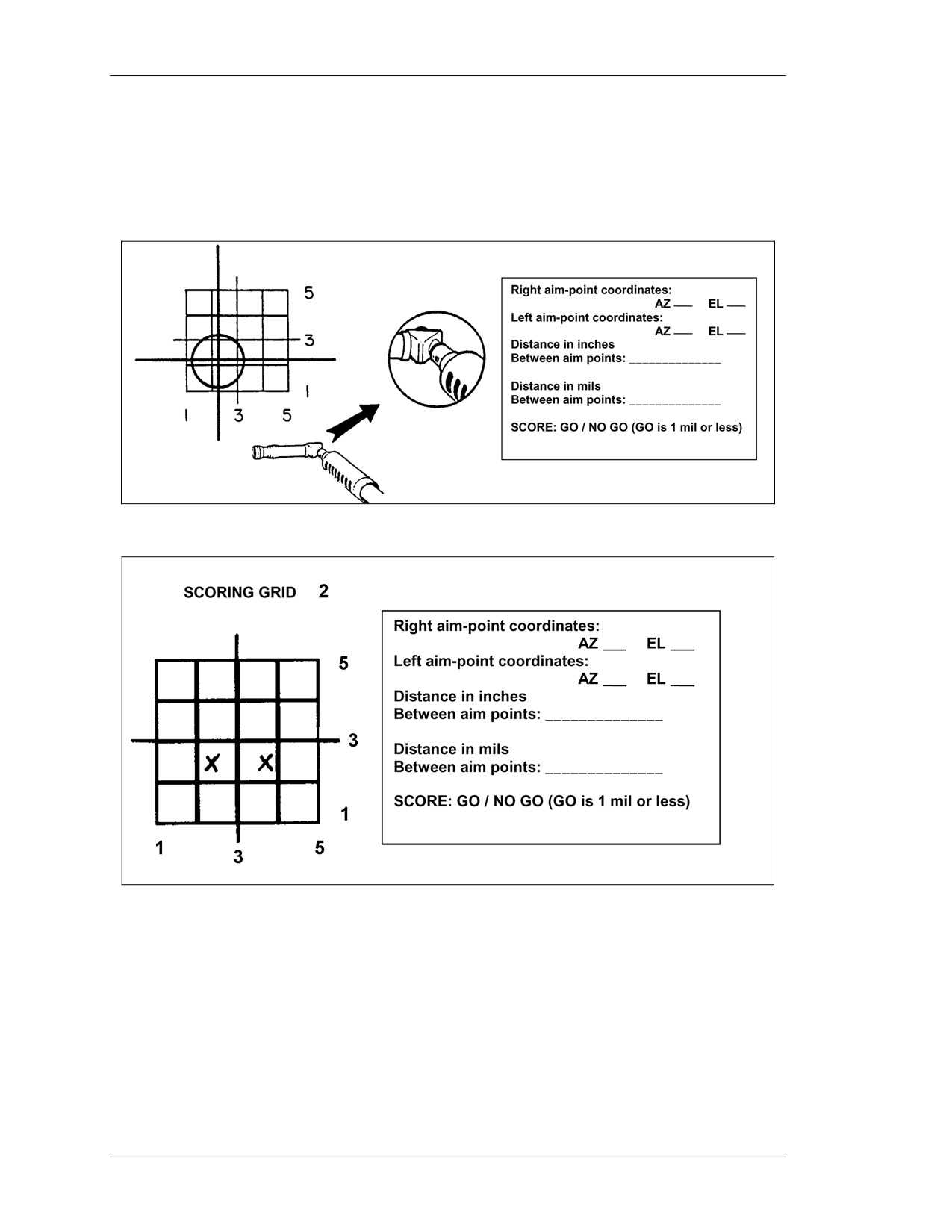
so that it faces left. AZ and EL coordinates should read 2 1/4 and 2 1/4, respectively
(Figure B-33, page B-22).
(f) Estimate and record the AZ and EL coordinates in the LEFT AIM-POINT
COORDINATES blank in data section 2 of the scoresheet.
(g) Plot the left aim point on scoring grid 2 (Figure B-34, page B-22).
B-21
FM 3-22.1
(7) You have now collected all of the data for one adapter. Continue testing until you
have tested all of the adapters from one company. Testing one adapter takes about two to
four minutes, so you can test thirteen adapters in about an hour. Test the adapters one
company at a time until you have tested all of the equipment in the battalion, then score
the adapters.
Figure B-33. Azimuth and elevation with adapter to the left, at mark "B."
Figure B-34. Left aiming point, TEST 2.
c. The distance between the two aiming points is the criterion used to measure
accuracy during one iteration of a test. For the adapter to receive a GO, the distance
between the telescope's two aiming points must measure
1 mil or less. On the
scoring grid, 1 mil equals 1/2 inch. Use a standard ruler to measure the distance between
points. For an adapter to score a GO, the distance must measure no more than 1/2 inch.
To pass the screening test, it must score a GO on both Tests 1 and 2. The following steps
for scoring the adapter are based on the previous example:
B-22
FM 3-22.1
(1) Use a ruler that has markings every
1/16 of an inch. A
1/16-scale allows
measurement to the nearest 1/8 mil of the scoresheet.
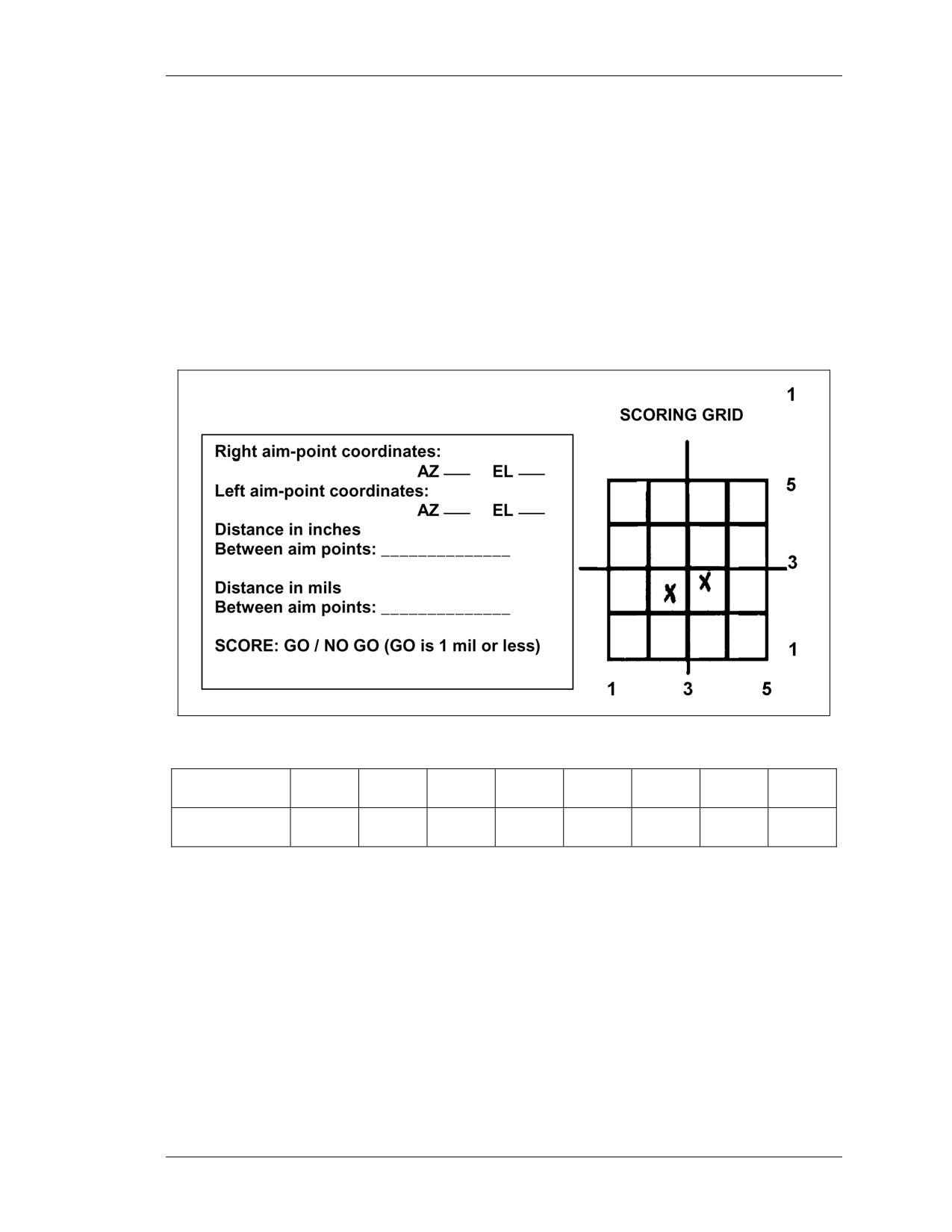
(2) Measure the distance between the two aiming points marked on scoring grid 1.
The distance in this example is 7/16 inch.
(3) Record the measured distance in the DISTANCE BETWEEN AIM POINTS
block of data section 1.
(4) Score TEST 1.
• Circle GO in data section 1 if distance is 1/2 inch or less.
• Circle NO GO in data section 1 if distance is more than 1/2 inch.
(5) Record distance in mils between aim points (Figure B-35). See the conversion
chart in Table B-1.
Figure B-35. Distance between aim points, TEST 1.
INCHES
1/8
1/4
3/8
1/2
5/8
3/4
7/8
1
MILS
1/4
1/2
3/4
1
1 1/4
1 1/2
1 3/4
2
Table B-1. Inch-to-mil conversion chart.
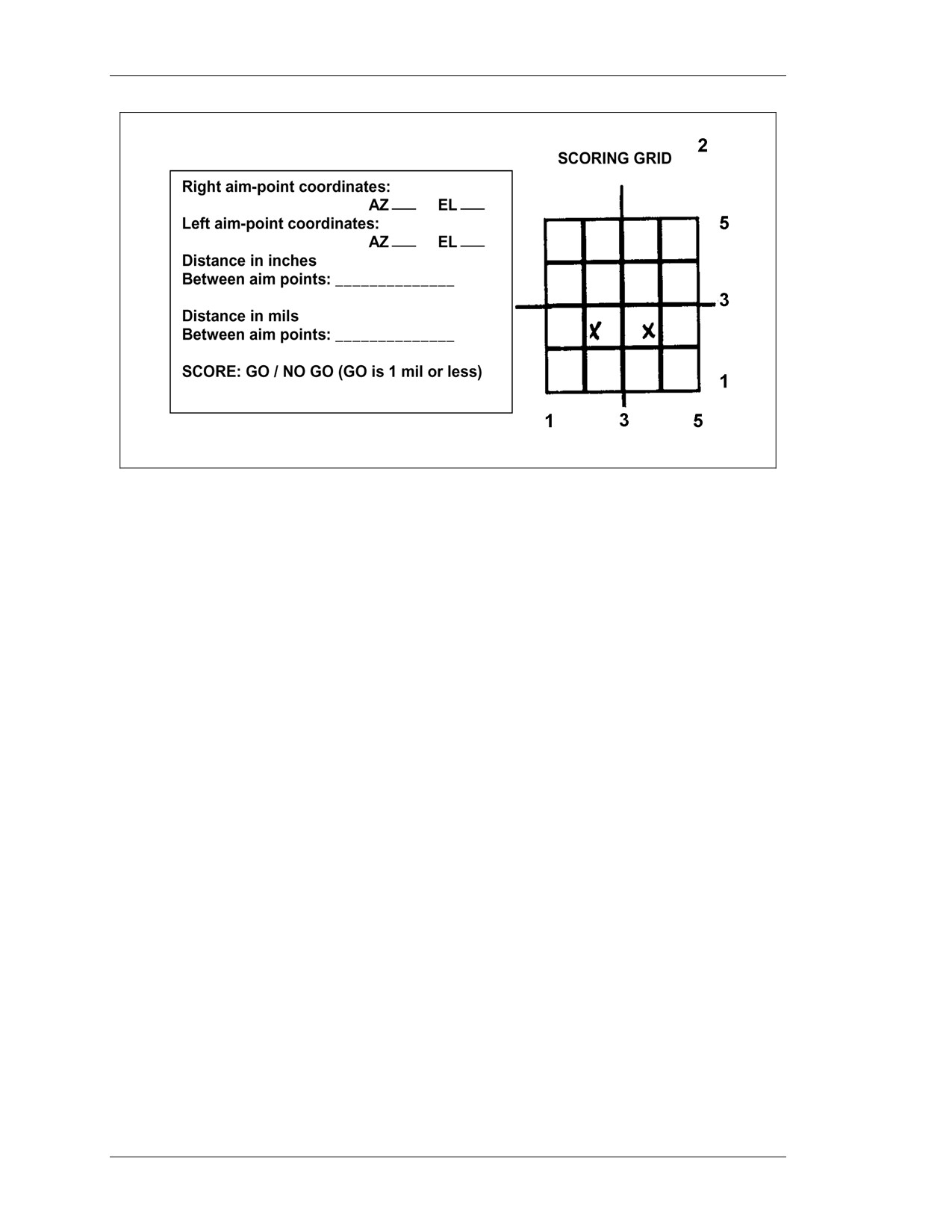
(6) Measure the distance between aiming points marked on scoring grid 2. The
distance in this example is 5/8 inch. Record this distance in the DISTANCE BETWEEN
AIM POINTS block in data section 1.
(7) Score TEST 2 (Figure B-36, page B-24).
• Circle GO in data section 1 if distance is 1/2 inch or less.
• Circle NO GO in data section 1 if distance is more than 1/2 inch.
B-23
FM 3-22.1
Figure B-36. Distance between aim points, TEST 2.
(8) Score the screening test.
(a) Circle PASS at top of scoresheet if telescope received a GO on both TEST 1 and
TEST 2.
(b) Circle FAIL at top of scoresheet if one or both tests yield a score of NO GO.
Figure B-13 shows an example completed scoresheet for this data. In this figure, the
adapter received a GO score for TEST 1 and a NO GO for TEST 2. Therefore, the adapter
in the example failed the screening test.
B-11. TELESCOPE-SCREENING TEST
After adapter screening, telescopes are paired with a highly accurate adapter and are
tested for accuracy. The most accurate adapter is the one proven by testing to have the
shortest distance between right and left aiming points.
a. Each telescope has a serial number stamped on the base plate near the shaft. Mark
the serial number on a piece of tape, then apply the tape to the 7.62-mm boresight kit
container. This simplifies the task of sorting accurate and inaccurate telescopes
after testing.
b. Test telescopes using telescope-rotation procedures. After inserting the adapter
into the gun barrel, insert the telescope with the eyepiece facing to the right. Observe and
record the aiming point on the scoresheet. Rotate the telescope only until the eyepiece
faces to the left. The telescope meets the standards if the aiming point changes 1 mil or
less after you rotate the telescope. To pass the screening test, each telescope must meet
the standard on two iterations of it. The following describes the screening procedure for
telescopes. Because you record data for, plot, and score the telescope test the same as you
did for the adapter test, this list need not repeat the sample data:
(1) Record date, time, tester, unit, telescope serial number, adapter assigned number,
and test type in information section of scoresheet.
B-24
FM 3-22.1
(2) Insert an accurate
25-mm adapter into the gun barrel with the
position mark facing up.
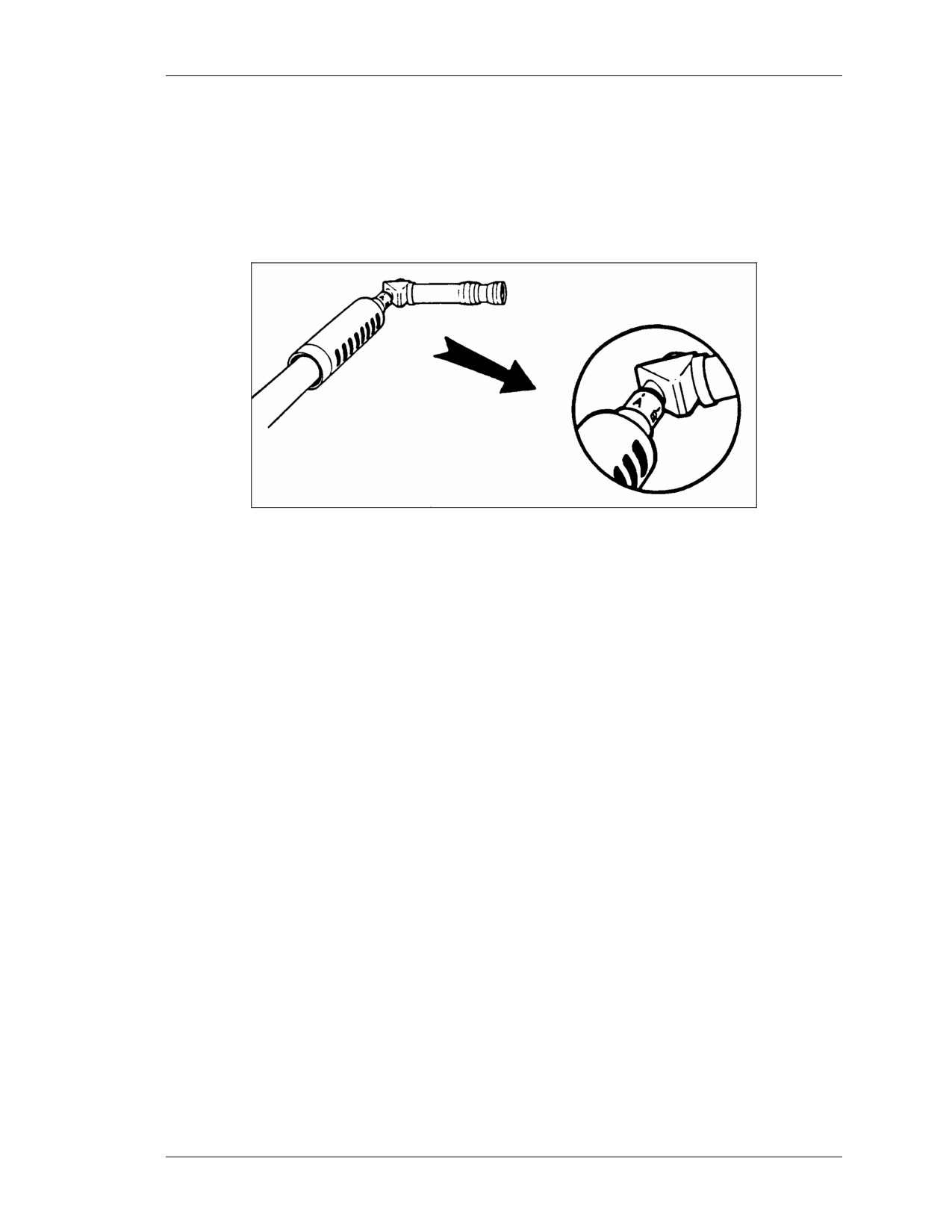
(3) Insert telescope into adapter with the eyepiece facing right (Figure B-37).
(4) Record AZ and EL coordinates in the RIGHT AIM-POINT COORDINATES
item in the TEST 1 section of the scoresheet.
(5) Plot the right aim point on the scoring grid.
Figure B-37. Mark "A" facing up, telescope to the right.
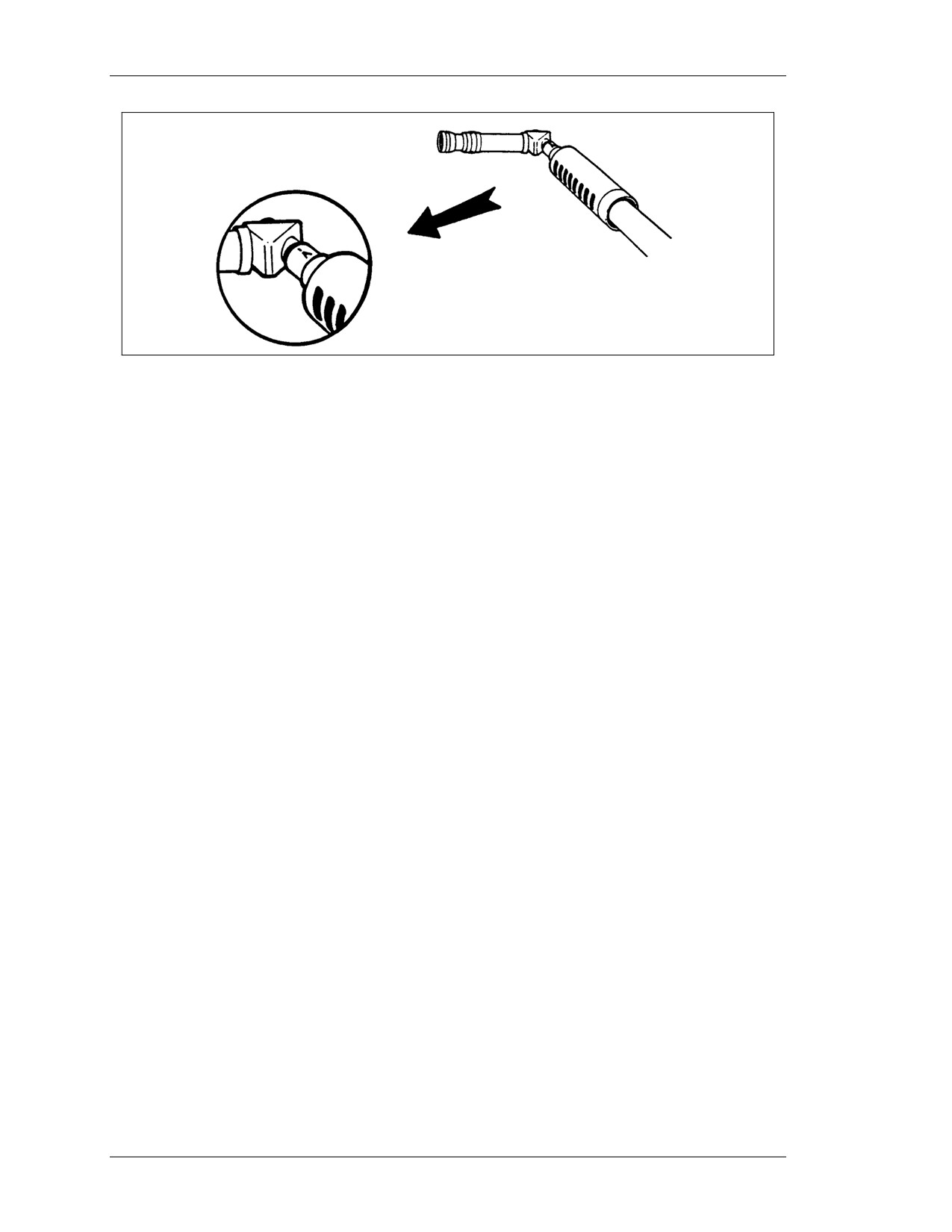
(6) Rotate only the telescope 180 degrees so that the eyepiece faces left. Ensure that
the adapter's mark "A" faces up (Figure B-38, page B-26).
(7) Record the AZ and EL coordinates in the LEFT AIM-POINT COORDINATES
item in the TEST 1 section of the scoresheet.
(8) Plot the left aim point on scoring grid 1. TEST 1 is now complete. TEST 2 is like
TEST 1 except that the adapter's mark "B" faces up.
(9) Rotate the adapter until the "B" faces up.
(10) Rotate the telescope to the right. Ensure "B" still faces up.
(11) Record right aim point in data section 2.
(12) Plot right aim point on scoring grid 2.
(13) Rotate telescope to the left. Ensure that "B" faces up.
(14) Record aim point in the LEFT AIM-POINT COORDINATES item in the TEST 2
section of the scoresheet.
(15) Plot left aim point on scoring grid 2. You have now tested one telescope.
Continue until you have tested all of the telescopes in the battalion.
B-25
FM 3-22.1
Figure B-38. Mark facing up, telescope to the left.
c. Score the telescopes after you collect the accuracy data for all telescopes. Score
them the same as you did the adapters. Score a "GO" on an iteration of the test procedure
when the distance between right and left aiming points measures no more than 1/2 inch
on the scoring grid. To pass the screening test, the telescope must earn a GO score on
both iterations. It fails if it receives a NO GO on either one. Circle PASS or FAIL in the
information section of the scoresheet.
B-12. ACCURATE BORESIGHT KITS
The objective is to form accurate 25-mm boresight kits from accurate telescopes and
25-mm adapters. The crew screens kits using the same procedures and standards used for
the adapters: namely, they use the kit-rotation procedure with a 1-mil standard. They pair
and test individual adapters and telescopes that meet the required standards, then they
issue accurate kits to the squad.
a. You can only form accurate kits from pairs of accurate adapters and telescopes. If
the number of accurate telescopes exceeds the number of accurate adapters, then start kit
testing with the telescopes, specifically, start with the ones that have the least distance
between the left and right readings.
b. After you form an accurate kit, keep it together. Use an electrical etching tool to
mark the telescope's serial number on the adapter.
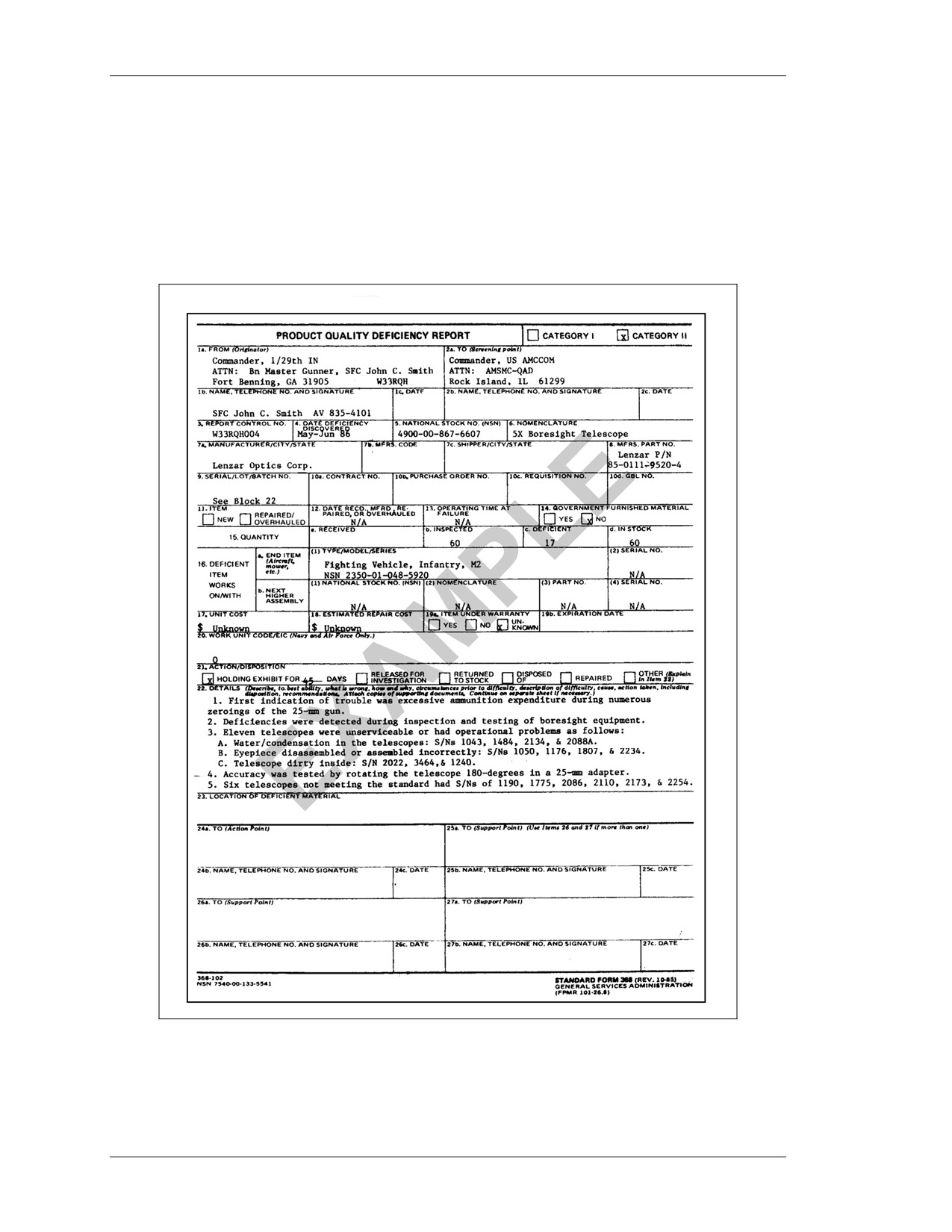
B-13. QUALITY DEFICIENCY REPORTS
The battalion master gunner reports telescopes and 25-mm adapters that fail the screening
tests on the quality deficiency report form (Standard Form 368). He can complete a
separate QDR for each defective piece of equipment, but completing one form for all
defective or inaccurate telescopes and another for all defective or inaccurate adapters is
easier. Figure B-39, shows an example completed QDR reporting defective and
inaccurate telescopes. This form is available electronically. Users can complete it
electronically, copy it from the back of the book and complete it manually, or some of
each. For example, the battalion master gunner can complete common data electronically
and print copies to finish later manually.
a. Telescope. The battalion master gunner reports defective or inaccurate telescopes
using the QDR (Standard Form 368), as follows:
B-26
FM 3-22.1
(1) Block 1a. Enter your unit designation, address (including zip code), and the
DODAC for the defective equipment.
(2) Block 1b. Enter your name and duty phone number, then, in the same block,
sign your name to signify that you completed the QDR.
(3) Block 2a. Enter the name and address of the manager who will receive
the QDR.
(4) Blocks 2b and 2c. Leave blank.
(5) Block 3. This block has exactly twelve places. In the first six, enter the
DODAC again; in the next two, enter the last two digits of the calendar year; in the last
four places, enter how many QDRs you are submitting for your unit at this time.
(6) Block 4. Enter the dates when the equipment was examined and tested.
(7) Blocks 5 and 6. Enter on this form the NSN and nomenclature from the
boresight telescope's data plate.
(8) Block 7. Enter the telescope's manufacturer.
(9) Block 8. Enter the part number, which you will find on the telescope's
base plate.
(10) Block 9. Enter the serial, lot, batch number, or any of these that you know for
the telescope adapters.
(11) Blocks 10a and 10b. Enter "UNKNOWN."
(12) Block 11. If telescopes are either new or repaired, check the appropriate box
in Block 11.
(13) Block 12. Enter manufacturing and repair dates, if you know them.
(14) Block 13. Enter "NA."
(15) Block 14. Check the NO square.
(16) Block 15. Complete Block 15a if appropriate. In Block 15b, enter the number
of items that were examined and tested. In Block 15c, enter the total number of telescopes
that were found defective or inaccurate. Complete Block 15d if appropriate.
(17) Block 16. In Block 16a(1), enter the BFV's NSN. In all the other parts of
Block 16, enter "NA."
(18) Blocks 17 and 18. Enter "UNKNOWN."
(19) Block 19. Check UNKNOWN.
(20) Block 20. Enter the letter "O," since defective items were detected and
reported at the organizational level.
(21) Block 21. Check and write "45" in the blank for HOLDING EXHIBIT FOR
____ DAYS, so that defective items will be held
45 days pending disposition
instructions.
(22) Block 22. This is the most important block--here you describe the problem in
detail. Be sure to write what data suggests or indicates that a problem exists, for example,
"excessive ammunition expenditure during zeroing." Here you must also describe how
the equipment was examined or tested to detect the problem, for example, telescope
rotation test, and the results of testing. If you need more space, include another sheet, and
write the report control number on it to indicate that it goes with your completed
Standard Form 368 (Figure B-39, page B-28).
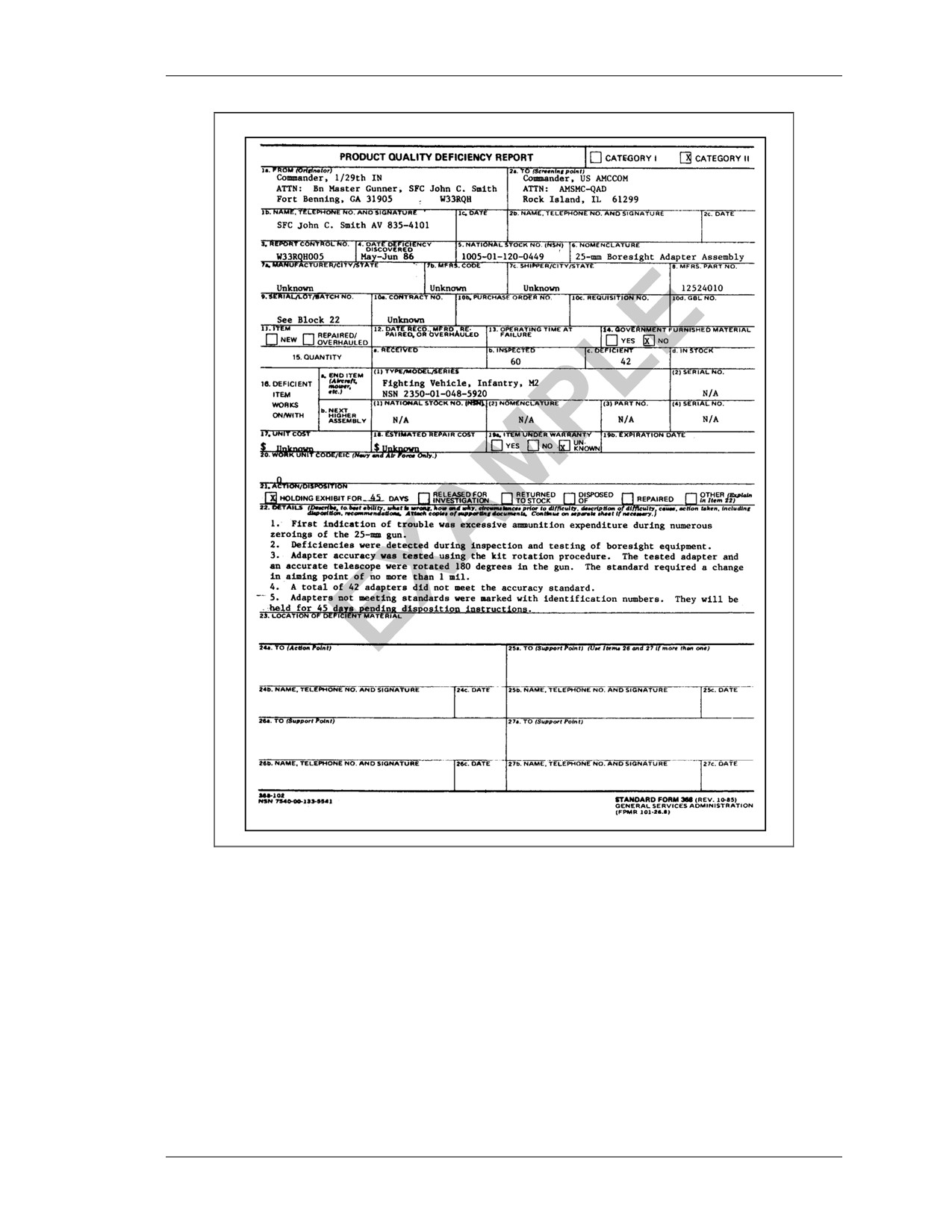
b. Adapter. Instructions for filling out a QDR for a defective or inaccurate adapter
follow (Figure B-40, page B-29). Since this is a separate QDR from the one reporting
telescopes, this report will have its own control number:
B-27
FM 3-22.1
(1) Blocks 1 and 2. Complete the same as for telescopes.
(2) Block 8. The part number depends on the design of the adapter.
(3) Blocks 9 through 21. Complete as described for telescopes.
(4) Block 22. Complete this, the most important part of the QDR, as described for
telescopes, but write in how many adapters you are reporting as defective (from Block 4).
c. Repair. Either depot maintenance or the manufacturer must repair boresight kits,
depending on the deficiency.
Figure B-39. Example completed SF 368 (telescopes).
B-28
FM 3-22.1
Figure B-40. Example completed SF 368 (adapters).
B-29
FM 3-22.1
Section III
BORESIGHTING AND WEAPON CHECKS WITH THE CLOSE-IN PANEL
This section describes how a crew uses the close-in boresight panel. It then describes how
they use the panel to boresight the BFV turret weapons in a restricted or confined area
like the motor pool.
B-14. DESCRIPTION OF PANEL
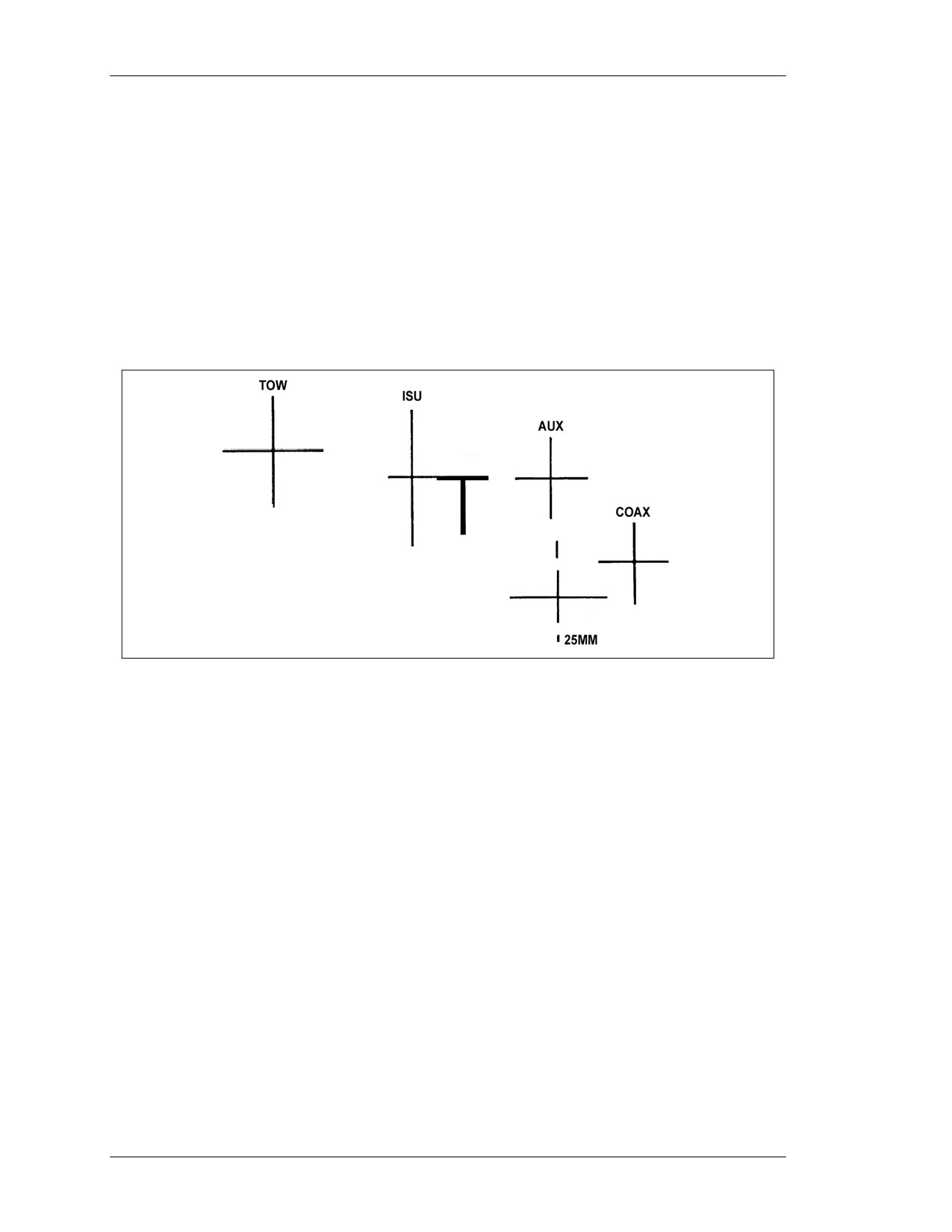
Five of the reference crosses bear the labels TOW, ISU, AUX, 25-MM, and COAX. A
sixth, "T"-shaped reference is made of metal to allow boresighting of the thermal sight.
The panel's background color is white. The ISU cross and "T" are black; and the TOW,
25-MM, COAX, and AUX crosses are orange (Figure B-41).
Figure B-41. Close-in panel.
B-15. WEAPON CHECKS
The close-in boresight panel also tests backlash, equilibrator, drift, and boresight
retention. These tests allow the BFV crew to identify weapon system errors that decrease
firing accuracy as well as to learn their weapons. Before firing live, while they are still in
the motorpool, the crew tests backlash, equilibration, and drift.
B-16. PANEL PLACEMENT
Depending on the positioning of vehicles and the panel in the motor pool, the company
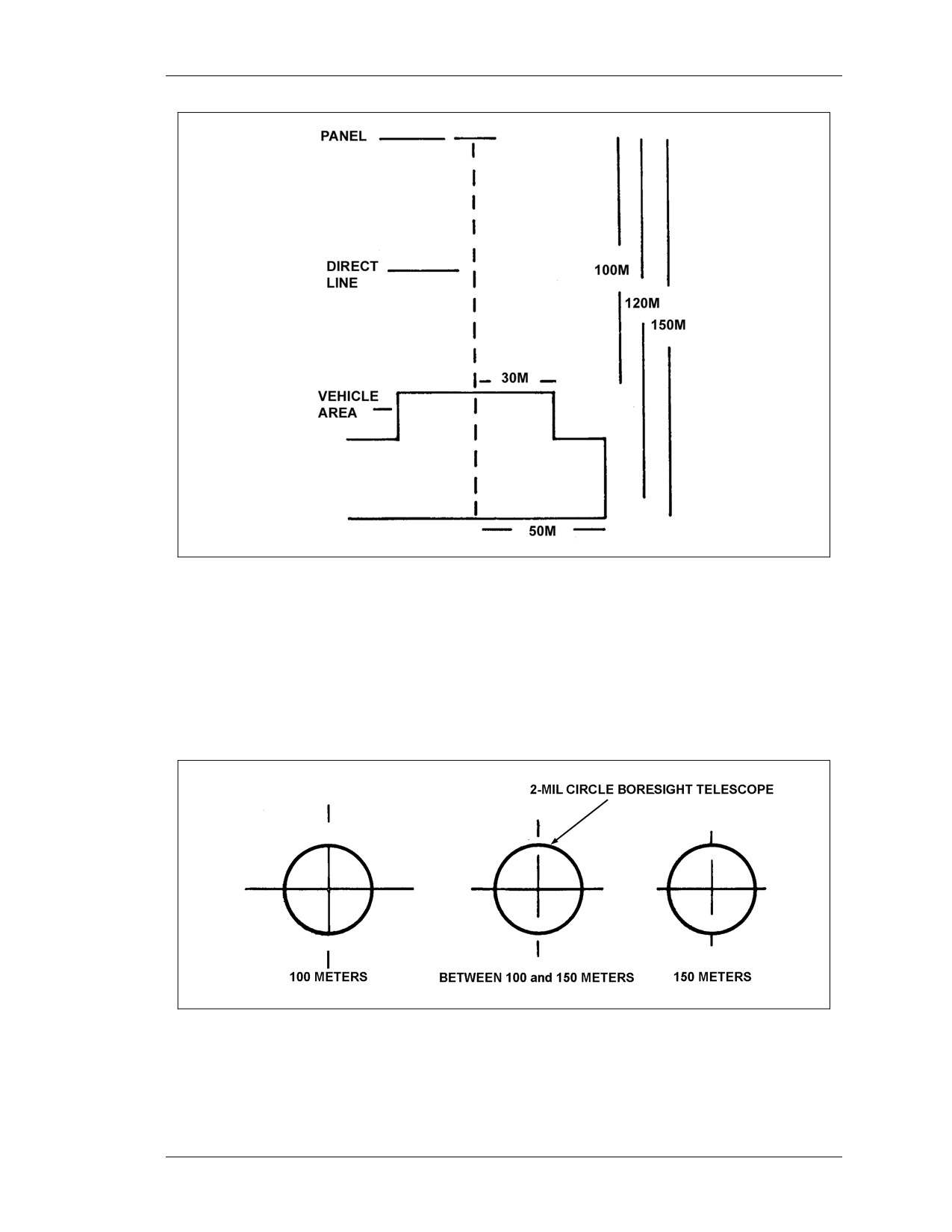
might be able to boresight the vehicles of an entire battalion with one panel. Figure B-42
shows an overhead view of panel placement and location of vehicles. They place the
panel from 0 to 25 meters above ground level, even atop a building or on the side
of a tower.
a. Vehicles must sit within 30 meters right or left for direct-line distances between
100 and 120 meters. Between 120 and 150 meters, they can sit as far away as 50 meters
to the right or left.
B-30
FM 3-22.1
Figure B-42. Panel placement.
b. Determine direct-line distance when the panel is first placed in the motor pool.
Insert a boresight kit into the 25-mm gun of a vehicle positioned on a direct line with the
panel. Align the boresight reticle with the 25-mm cross on the panel. Use ranging gaps in
the 25-mm cross to determine the panel's distance. Vehicles are at a correct distance if the
2-mil circle of the boresight reticle is on the edge, or in the gaps of the 25-mm cross.
Figure B-43 shows examples of vehicles located at the correct distances for boresighting.
Figure B-43. Correct distance alignment for boresighting.
B-31
FM 3-22.1
B-17. PREPARATION
Crews should know the boresight procedures described in TM 9-2350-252-10-2. All
turret weapons must be mounted and operational. A boresight kit and turret tool kit is
required. Crews use the following checklist to prepare for boresighting with the close-in
boresight panel:
• Master power ON.
• Turret power ON.
• Night vision switch ON.
• Turret, gun, and TOW select levers in POWER (to raise TOW launcher).
• TOW launcher raised.
• Turret azimuth selection lever in MANUAL.
• Gun elevation selection lever in MANUAL.
• TOW elevation drive selection lever in POWER.
• Day and thermal ballistic sight cover doors open.
• Sensor select switch set on NEUTRAL.
• Range control knob set at "0."
• Reticle brightness turned all the way to the right.
• Magnification set on HI.
• AP or HE selected on weapons control panel.
• Status indicator displays ammunition and range index.
• Gun reticle displayed.
• Turret travel lock disengaged.
B-18. WEAPONS AND SIGHT ALIGNMENT
The crew aligns weapons and sight as follows:
a. Perform the boresight kit accuracy test before aligning the sight and weapon.
b. To control backlash, lay the
25-mm gun so that the gun-lay pattern ends
in elevation.
(1) (Helper) rotate the telescope until the eyepiece faces upward.
(2) (Helper) align the boresight reticle with the 25-mm cross on the panel.
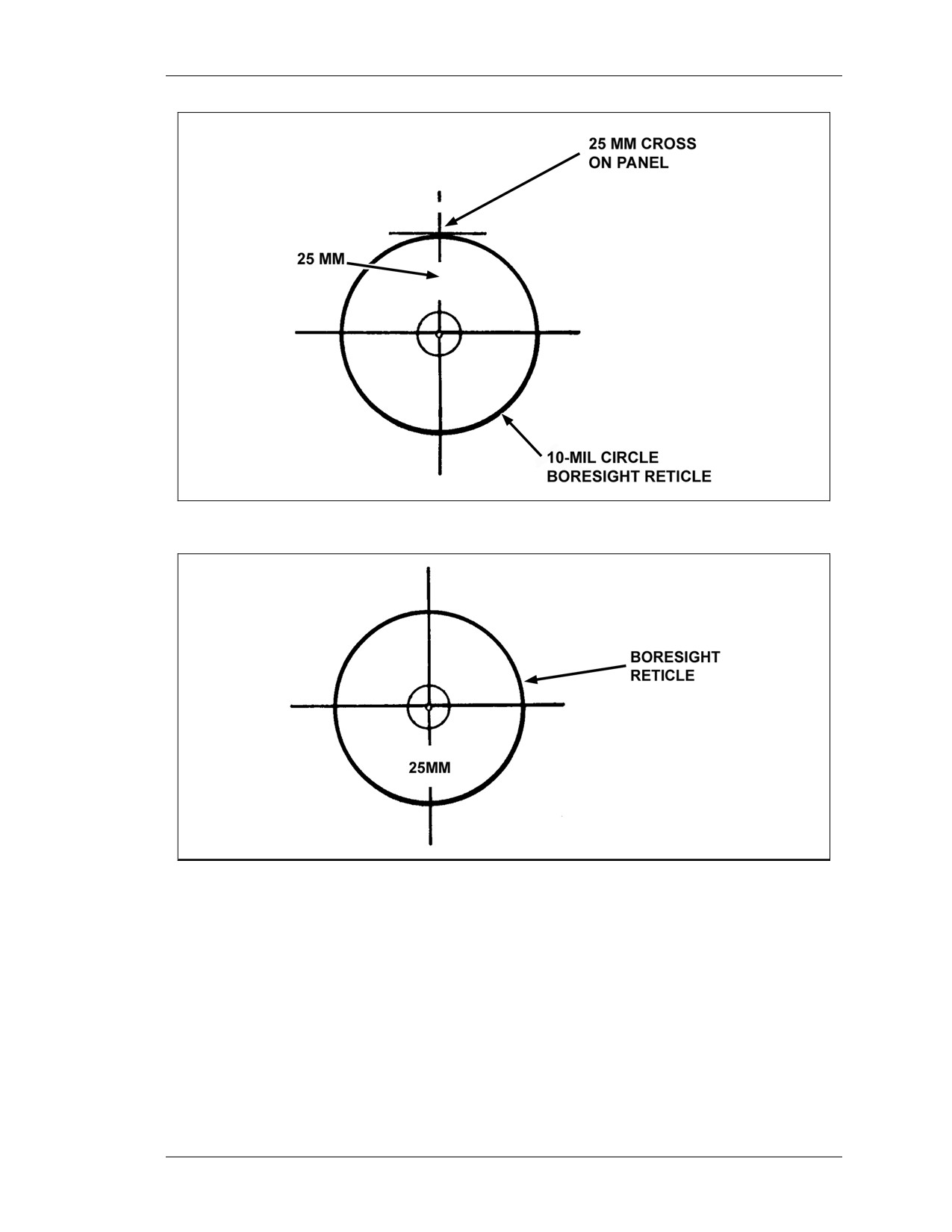
(a) Tell gunner to align the top of the 10-mil circle of the boresight reticle with the
25-mm cross on the panel (Figure B-44).
(b) Tell gunner to align the boresight reticle with the 25-mm cross on the panel
(Figure B-45).
NOTE: Traverse the turret, or elevate or depress the gun, only after aligning the TOW
weapon system.
c. Align the ISU day reticle. The neutral sensor-select setting works better on bright,
sunny days.
(1) Move the sensor select switch to CLEAR or NEUTRAL for the best view of the
ISU reticle and panel.
(2) Align the ISU reticle with the ISU cross on the panel using the AZ and EL
boresight adjustment knobs.
B-32
FM 3-22.1
Figure B-44. 10-mil circle aligned with the 25-mm cross.
Figure B-45. Boresight reticle aligned with the 25-mm cross.
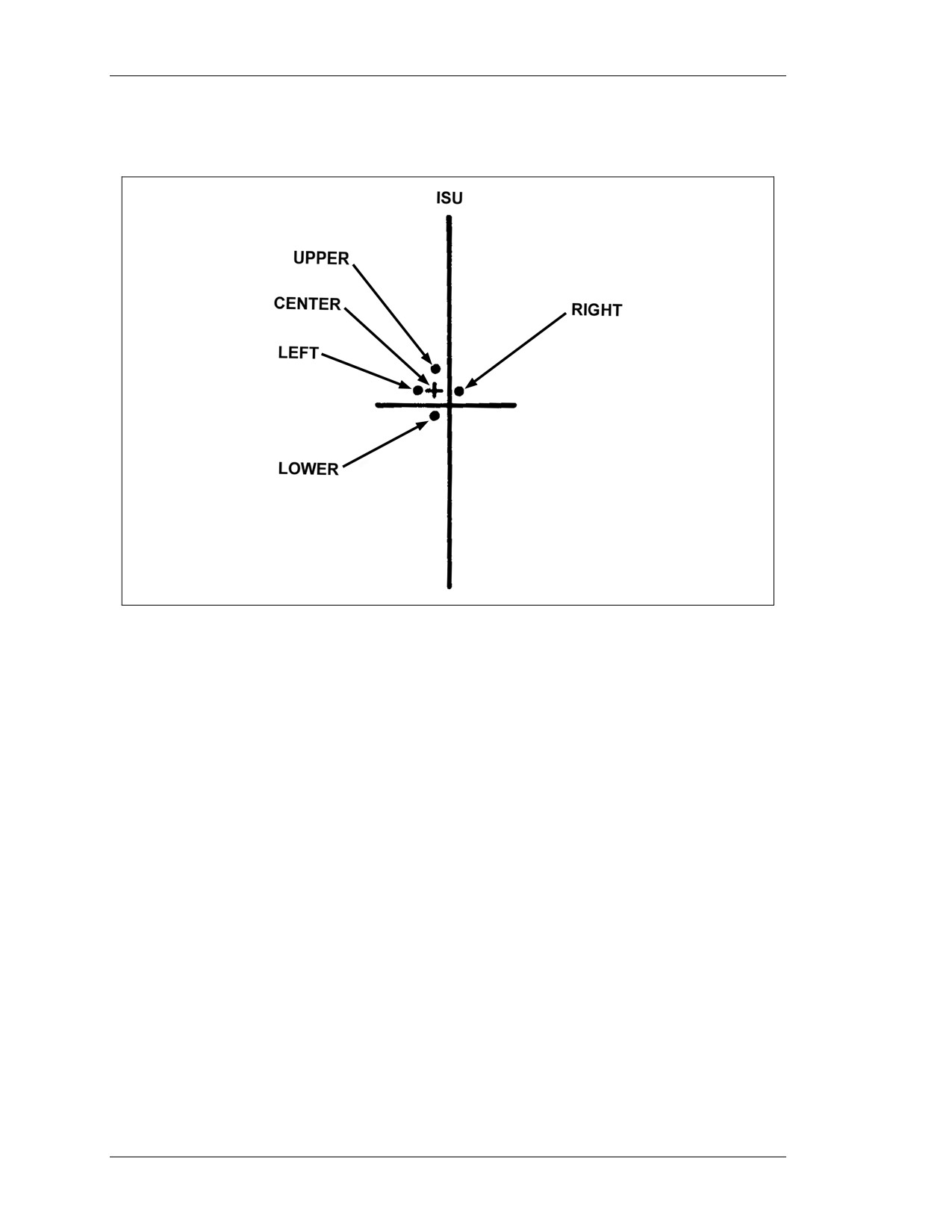
(3) Adjust the browpad (Figure B-46, page B-34). When the panel is 100 to 150
meters away, head movement on the browpad changes the aim of the reticle. For
example, moving the head to the left shifts the aim to the left. Correct adjustment of the
browpad is important.
(a) Move head to the left until the sight begins to black out. Note the aiming point of
the reticle; this aiming point is called the left limit.
(b) Move head to the right and note the right limit of the reticle.
(c) Move head up and note the upper limit of the reticle.
(d) Move head down and note the lower limit of the reticle.
B-33
FM 3-22.1
(e) Adjust the browpad so that the reticle appears centered between the left, right,
upper, and lower limits.
Figure B-46. Reticle centered between left, right, and lower limits.
(f) If after adjusting the browpad the ISU reticle is no longer aligned with the ISU
cross, realign the reticle using the AZ and EL boresight knobs.
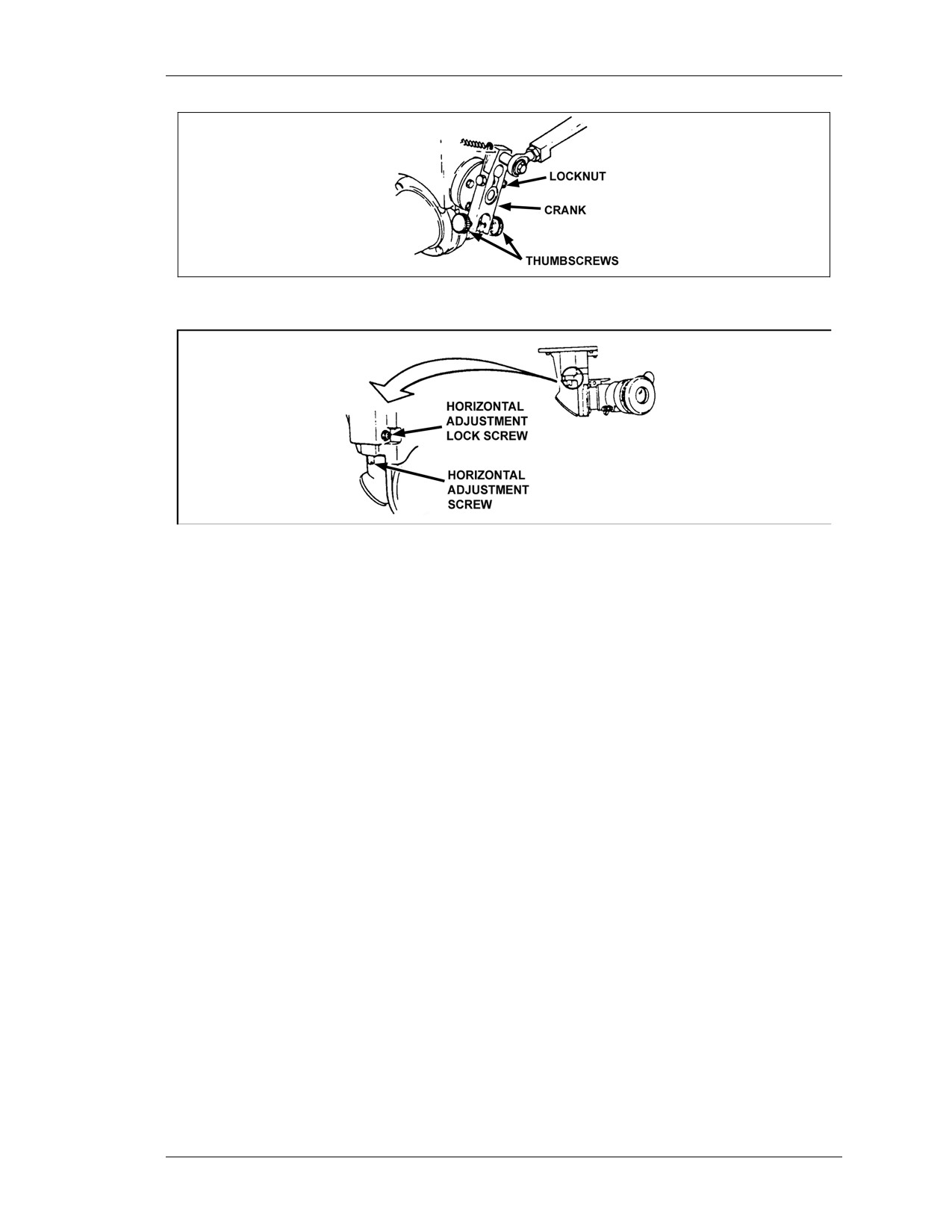
d. Align the auxiliary sight.
(1) Focus sight with the eyepiece diopter.
(2) If necessary, align the cross of the auxiliary sight with the AUX cross on
the panel.
(a) Loosen locknut.
(b) Adjust thumbscrews (Figure B-47) to align the level (horizontal) line of the reticle
crosshair with the level line of the AUX cross on the panel.
(c) Tighten the locknut.
(d) Loosen horizontal adjustment lock screw by about one-half turn to the left.
(e) Turn the horizontal adjustment screw to align the vertical line of the reticle
crosshair with the vertical line of the AUX cross on the panel.
(f) Tighten the horizontal adjustment lock screw (Figure B-48).
e. Align the 7.62-mm coax machine gun.
(1) Select ammunition.
(a) Press the 7.62 button on the weapon control box.
(b) Ensure that "7.62" appears on the status indicator.
B-34
FM 3-22.1
Figure B-47. Locknut, crank, and thumbscrews.
Figure B-48. Horizontal adjustment lock screw
and horizontal adjustment screw.
(2) (Helper) insert the 7.62-mm adapter and boresight telescope into the coaxial
machine gun. He then tells the gunner to align the boresight reticle with the COAX cross
on the panel.
(a) Tell the gunner to use the AZ knob on the gun to align the boresight AZ crosshair
(vertical) with the vertical line on the COAX cross.
(b) Tells the gunner to use the EL knob on the gun to align the boresight EL crosshair
(horizontal) with the level line on the COAX cross.
f. Align the ISU night reticle.
(1) Move sensor select switch to NIGHT.
(2) Use black hot to make the ISU reticle more visible on the "T" of the panel, so set
the polarity switch (PLRT) to that (black hot--BH).
(3) Adjust the thermal sight until you can see the "T" clearly:
• Turn the CON knob all the way to the right.
• Turn the BRT knob all the way to the left.
• Turn the BRT knob to the right until you can see the "T" on the panel.
• Focus on the "T" using the focus ring.
• Turn the CON knob left about one-quarter turn.
• Turn the BRT knob to the right until the "T" becomes clearer.
• Repeat focus ring, CON knob, and BRT knob adjustments, if necessary.
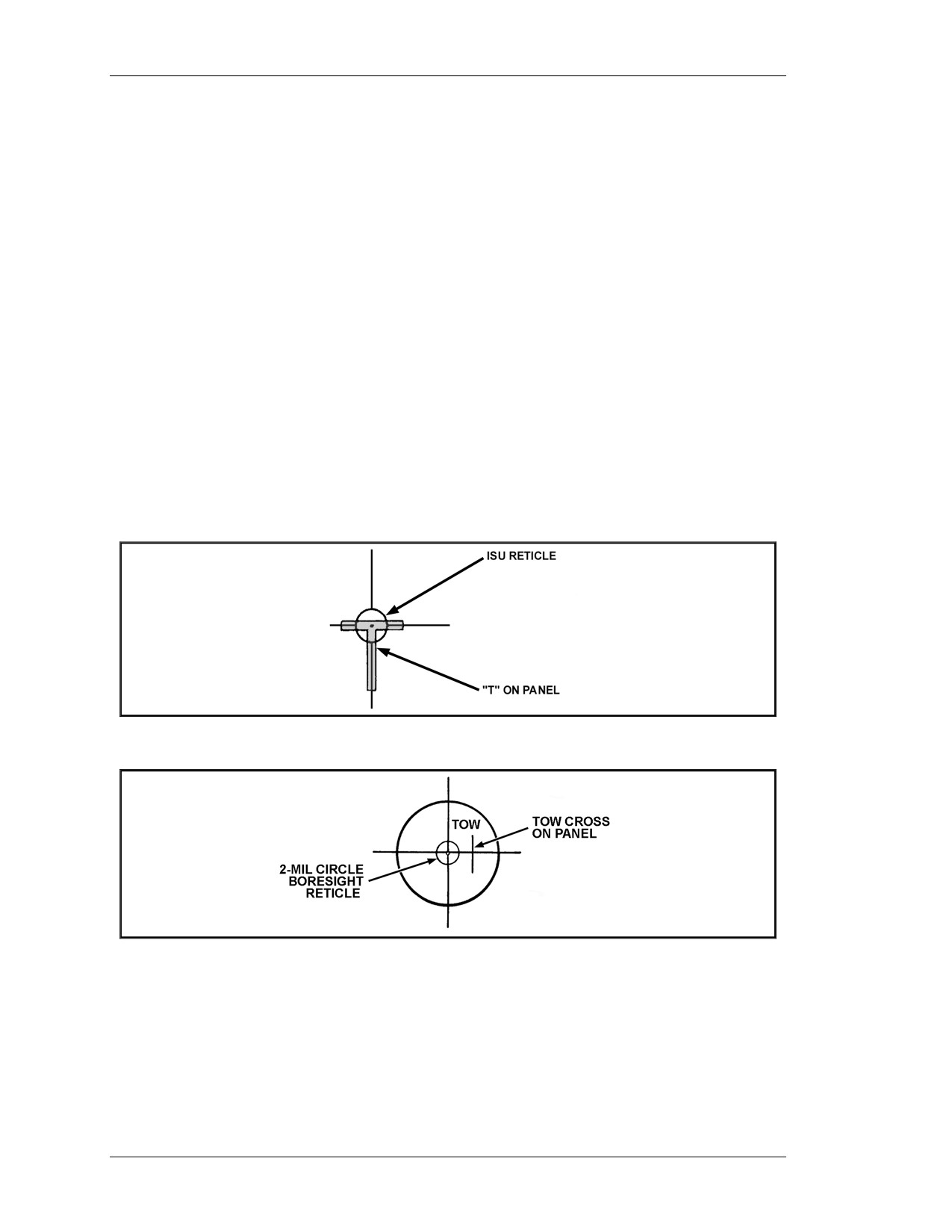
(4) Align the ISU reticle with the "T" on the panel using the night boresight EL and
AZ knobs (Figure B-49, page B-36).
g. Align the TOW weapon system.
(1) Move the sensor select switch to CLEAR or NEUTRAL.
(2) Place the 25-mm gun elevation select lever in the POWER mode.
B-35
FM 3-22.1
(3) Place the TOW elevation lever in the MANUAL mode.
(4) (Helper) insert the boresight telescope into the alignment hole between the TOW
launcher bores.
(5) Press the TOW button.
(6) Check that the TOW indicator light goes out when the self-test finishes.
(7) Ensure that "TOW" appears on the status indicator.
(8) (Helper) align the boresight reticle with the TOW cross on the panel.
(a) Tell gunner to traverse to align the boresight AZ crosshair (vertical) with the
vertical line of the TOW cross.
(b) Tell gunner to elevate or depress to align the boresight EL crosshair (horizontal)
with the level line of the TOW cross.
(9) Align the TOW reticle EL crosshair (horizontal) with the level line on the ISU
cross of the panel using the TOW boresight screw.
(10) Traverse to align the TOW reticle with the ISU cross on the panel (Figure B-50).
(11) Determine launcher alignment error.
(a) Observe the aiming point of the boresight reticle on the TOW cross of the panel.
(b) Estimate distance (mils) between the boresight reticle and TOW cross using the
2-mil circle of the boresight reticle.
(12) Adjust the launcher if the error is more than 1 mil.
Figure B-49. ISU reticle aligned with "T."
Figure B-50. Alignment of TOW cross and 2-mil circle.
B-19. BACKLASH TEST
When the direction of gun elevation is reversed, such as when the gun is depressed after
being elevated, the sight may not immediately move with the gun. This slack between the
sight and gun is called backlash. Backlash is controlled during boresighting by using a
gun-lay ending in elevation. To prevent gunnery errors due to backlash, gunners should
B-36
FM 3-22.1
also engage targets using a gun lay ending in elevation. This paragraph describes the
separate backlash-testing procedures for the ISU and auxiliary sight.
a. Boresight. Before testing the backlash, boresight the 25-mm gun, ISU day reticle,
and auxiliary sight as previously described. Set the weapon, sight, and turret controls the
same as at the start of boresighting.
b. Measurement of ISU Backlash. If necessary, select AP-SS on the weapon
control box. Avoid moving or removing the 25-mm boresight kit until you complete
backlash testing.
(1) Insert the
25-mm adapter and boresight the telescope in the 25-mm gun. If
necessary, focus the telescope.
(2) Use the gun and turret handwheels to align the ISU reticle with the ISU cross on
the panel.
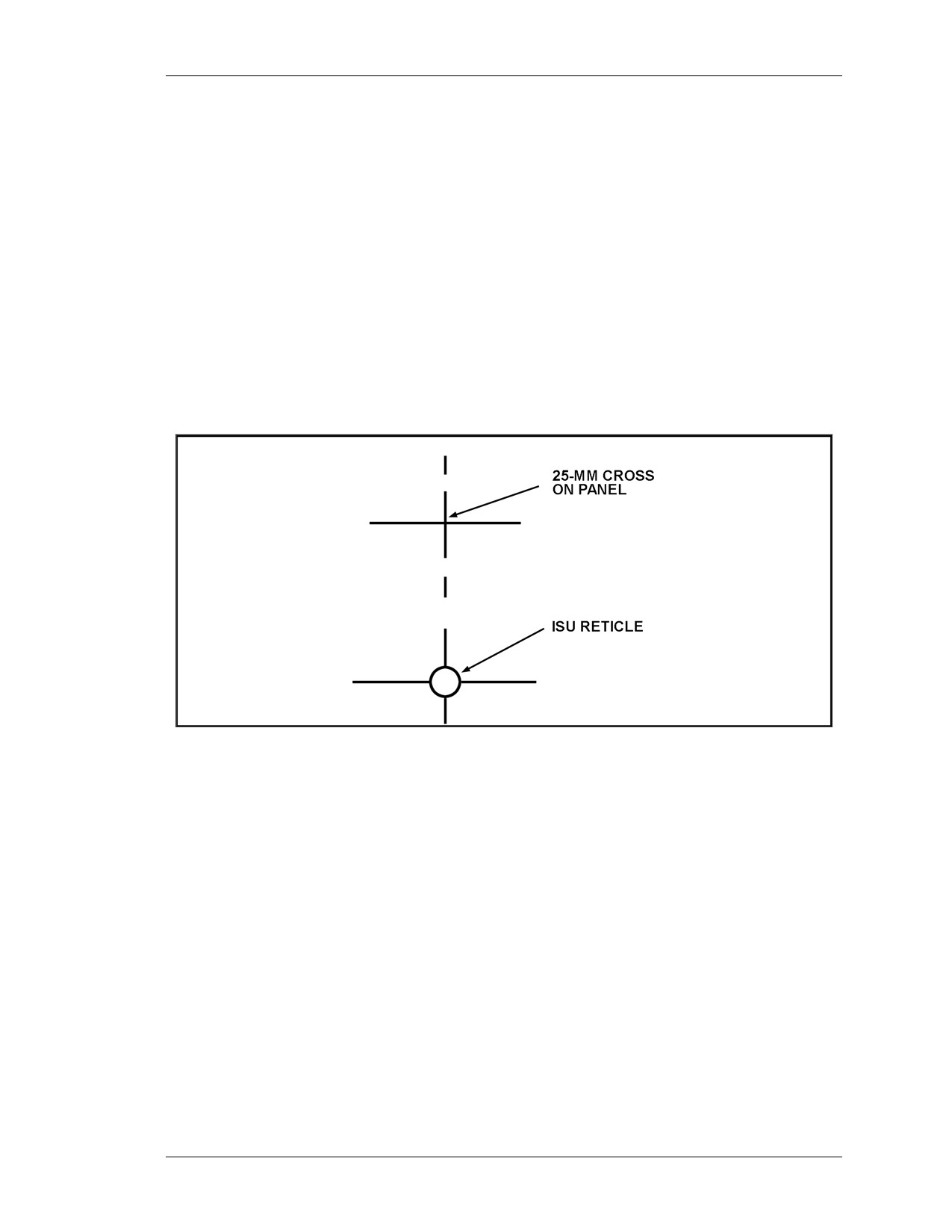
(3) Use the gun handwheel to depress the gun until the top of the ISU reticle touches
the bottom of the ISU cross on the panel (Figure B-51).
Figure B-51. Position of ISU reticle below the 25-mm cross.
(4) Elevate the gun to align the ISU reticle with the ISU cross on the panel.
(5) (Helper) note the aiming point of the boresight reticle.
(6) Elevate the gun. Use the gun handwheel to elevate the gun until the bottom of the
ISU reticle touches the top of the ISU cross on the panel.
(7) Depress the gun to align the ISU reticle with the ISU cross on the panel.
(8) (Helper) note the aiming point of the boresight reticle.
(9) Measure backlash. Helper--
(a) Note the location of the boresight reticle and the 25-mm cross.
(b) Use the 2-mil circle of the boresight reticle to estimate the distance (in mils)
between aiming points observed in elevation and depression. The backlash measures 1.5
mils for the example shown in Figure B-52, page B-38.
(c) Notify unit maintenance if backlash measures more than 2 mils.
B-37
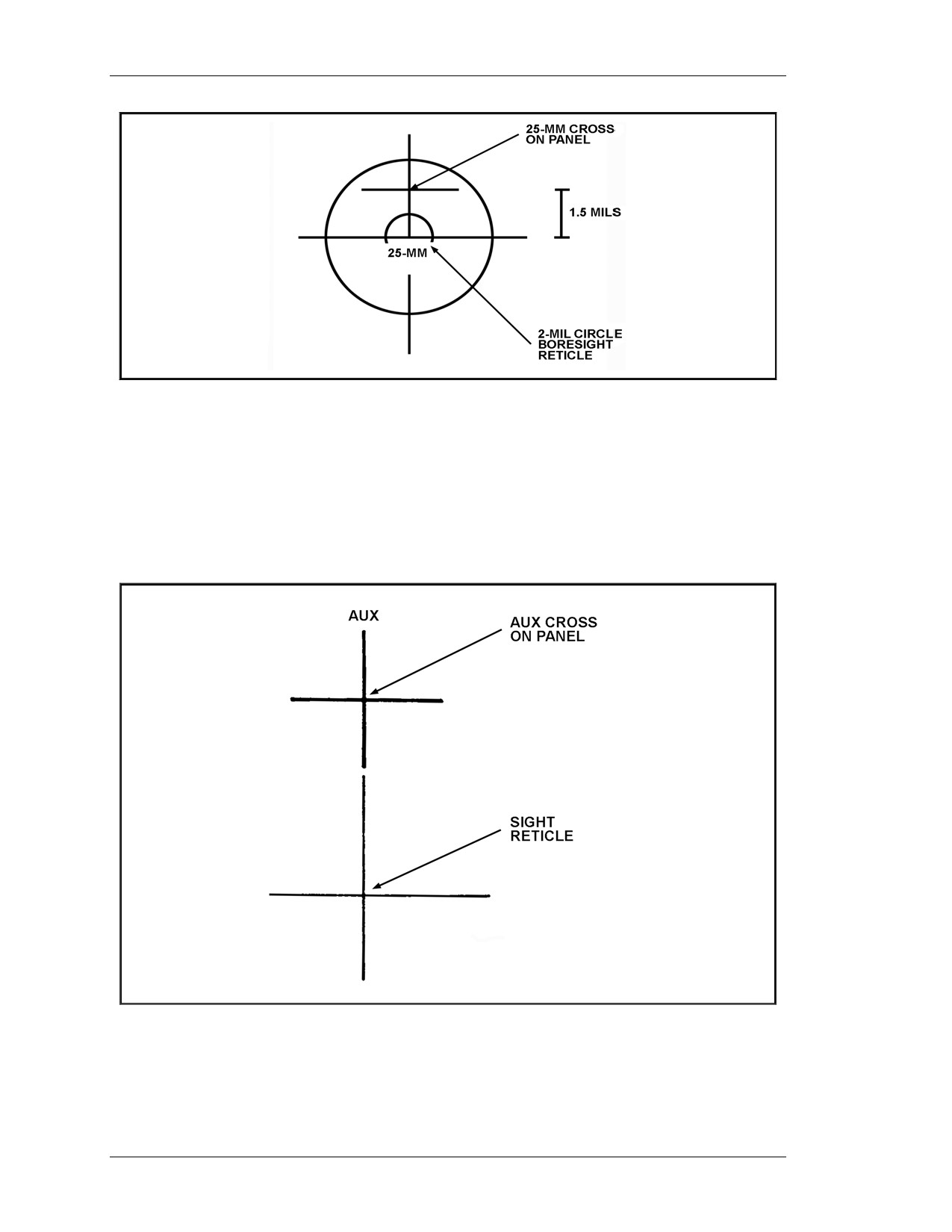
FM 3-22.1
Figure B-52. Distance between aiming points.
c. Measurement of Auxiliary Sight Backlash. Insert the
25-mm adapter and
boresight telescope into the 25-mm gun.
(1) Align the auxiliary sight reticle with the AUX cross on the panel using the turret
and gun handwheels.
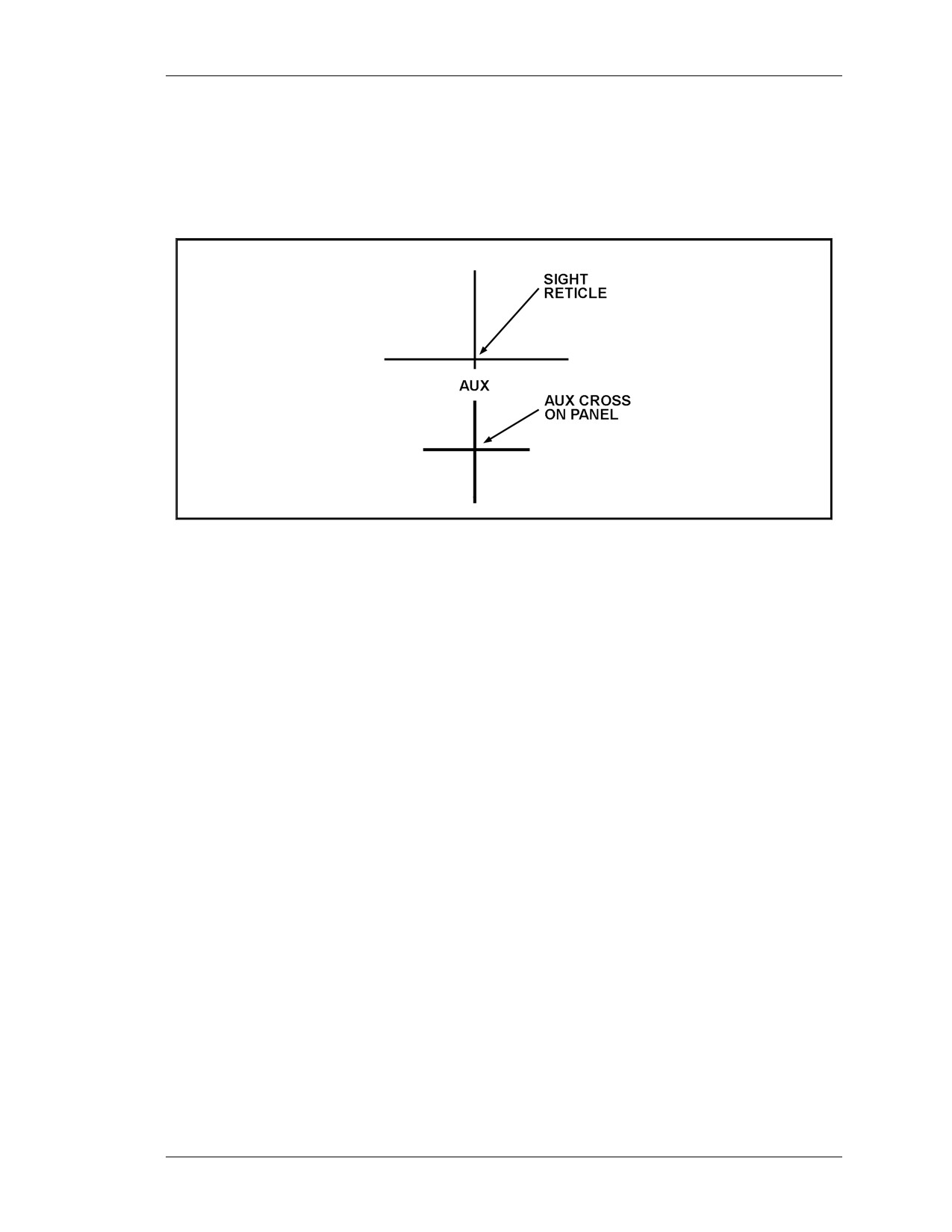
(2) Use the gun's handwheel to depress the gun until the top of the auxiliary sight
reticle touches the bottom of the AUX cross on the panel (Figure B-53).
Figure B-53. Auxiliary sight reticle positioned below the AUX cross.
B-38
FM 3-22.1
(3) Elevate the gun to align the auxiliary sight reticle with the AUX cross on
the panel.
(4) (Helper) note the aiming point of the boresight reticle.
(5) Use the gun handwheel to elevate the gun until the bottom of the auxiliary sight
reticle touches the top of the AUX cross on the panel (Figure B-54).
Figure B-54. Auxiliary sight reticle positioned above the AUX cross.
(6) Depress the gun to align the auxiliary sight reticle with the AUX cross of
the panel.
(7) (Helper) note the aiming point of the boresight reticle.
(8) Measure backlash as described for the ISU.
B-20. EQUILIBRATOR TEST
When the ISU reticle is laid on target in power mode, the aiming point should not change
when the gunner releases the palm switches. If when he releases the switches the sight
and the gun drop, then the weapon might have a faulty equilibrator. This test follows
boresighting and the backlash test. Turret and gun select levers remain on POWER
during this test.
a. Using the gunner's handstation, align the ISU reticle with the ISU cross on
the panel.
b. Release the palm switches.
c. Notify unit maintenance if the ISU circle and ISU cross fail to align after the
gunner releases the palm switches. Either a faulty equilibrator or a faulty gun elevation
brake can cause the weapon to fail the equilibrator test.
B-21. DRIFT TEST
Drift is tested after the equilibrator test. Switch settings and vehicle conditions are the
same as at the end of the equilibrator test. With stabilization on, the gunner depresses the
palm switches. The BFV remains stationary throughout the test, and the 25-mm and coax
reticle may drift away from the aiming point no more than 0.1 mil per second. To conduct
a 5-second drift test--
a. Turn stabilization on. Stabilization indicator light should come on.
B-39
FM 3-22.1
b. Press the drift button. Conduct the test within the one minute after you press the
drift button.
c. Using the gunner's handstation, align the ISU reticle with the ISU cross on
the panel.
d. Start the five-second test.
(1) (Helper) use your watch to signal the start of the test.
(2) (Gunner) press the palm switches, while keeping the handstation in the
NEUTRAL position.
e. Stop the test.
(1) (Helper) signal end of five-second test.
(2) (Gunner) release palm switches on helper's signal.
f. Score the drift.
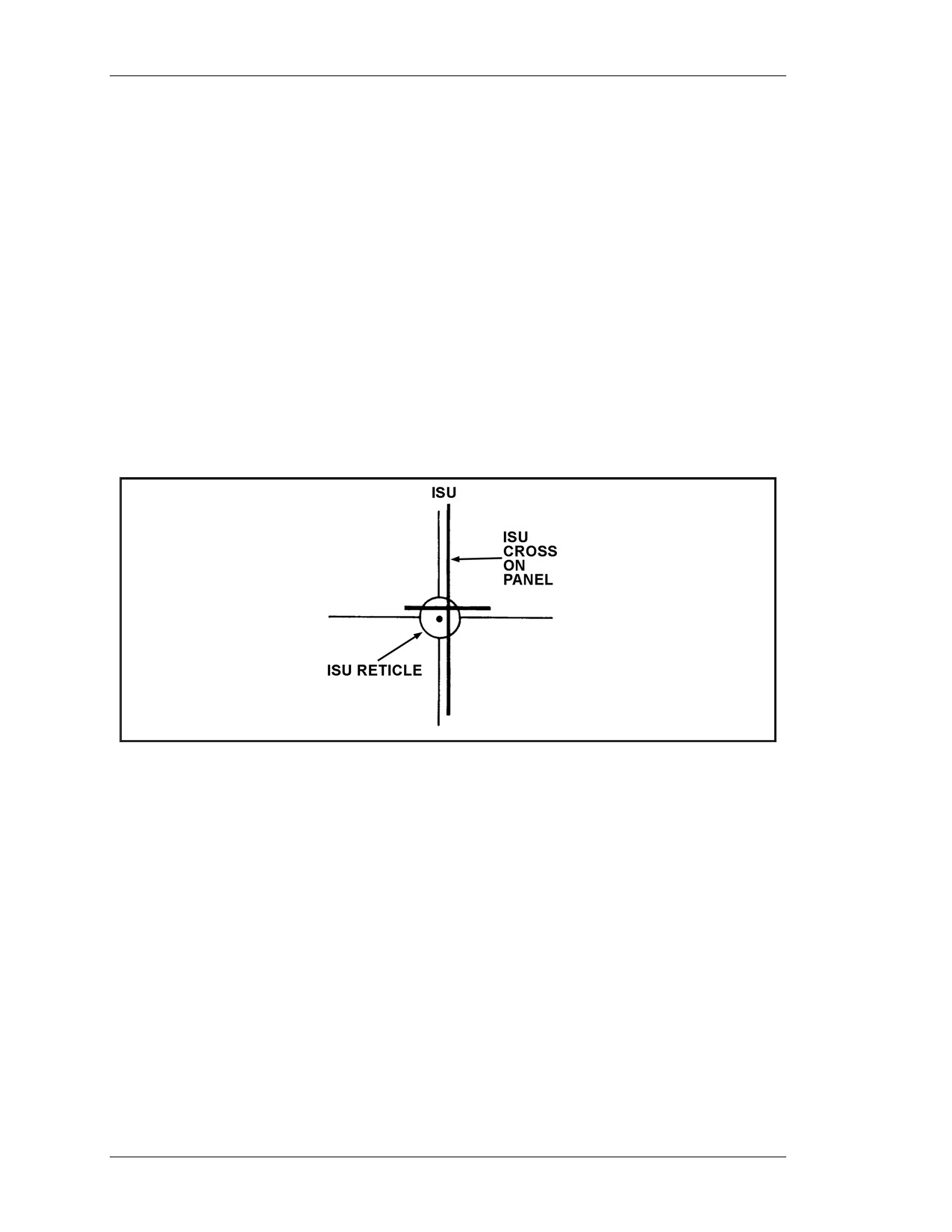
(1) The drift standard is met if the ISU cross of the panel falls on or within the 1-mil
circle in the ISU reticle (Figure B-55).
(2) Notify unit maintenance if the ISU cross of the panel falls outside the 1-mil circle
of the ISU reticle.
Figure B-55. Drift within 1-mil circle.
B-22. BORESIGHT-RETENTION TEST
After the 25-mm gun and ISU are boresighted, sight alignment should change no more
than 0.25 mil for vehicle operation up to 50 miles. This holds true only as long as the
ambient temperature remains within 54 degrees, plus or minus, from what it was when
boresighting occurred. If boresight retention requirements are met, the weapon can be
boresighted in the motor pool and the vehicle moved to a fighting position without having
to re-boresight before zeroing.
a. Test vehicles to ensure that they meet boresight retention requirements. Use your
most accurate boresighting equipment to test boresight retention. Due to the extent of
boresight equipment errors, the retention standard for field-testing is strictly held to 1 mil.
b. You can measure boresight retention during a tactical road march or any other
movement exercise that requires no adjustment of the boresight knobs. You can measure
it after moving any distance; you need not travel 50 miles!
B-40
FM 3-22.1
c. Boresight retention testing helps crews learn what conditions typically affect
boresight retention on their vehicle. They must know this so they can determine when to
re-boresight their weapons.
(1) Obtain a 25-mm boresight kit that passes the kit accuracy test.
(2) Prepare, lay the
25-mm gun, and align the ISU day reticle as described in
previously.
(3) Tape the covers of the boresight knobs to prevent accidental movement
or adjustment.
(4) Record distance traveled and temperature variations during the vehicle operations.
For example, record extreme temperatures and precipitation.
(5) Test boresight retention.
(a) Return vehicle to same position it was in when the weapons were last boresighted.
(b) Prepare to test boresight retention as previously described.
(c) Insert the boresight kit into the 25-mm gun.
(d) Align the ISU reticle with the ISU cross on the panel using a gun lay pattern
ending in elevation.
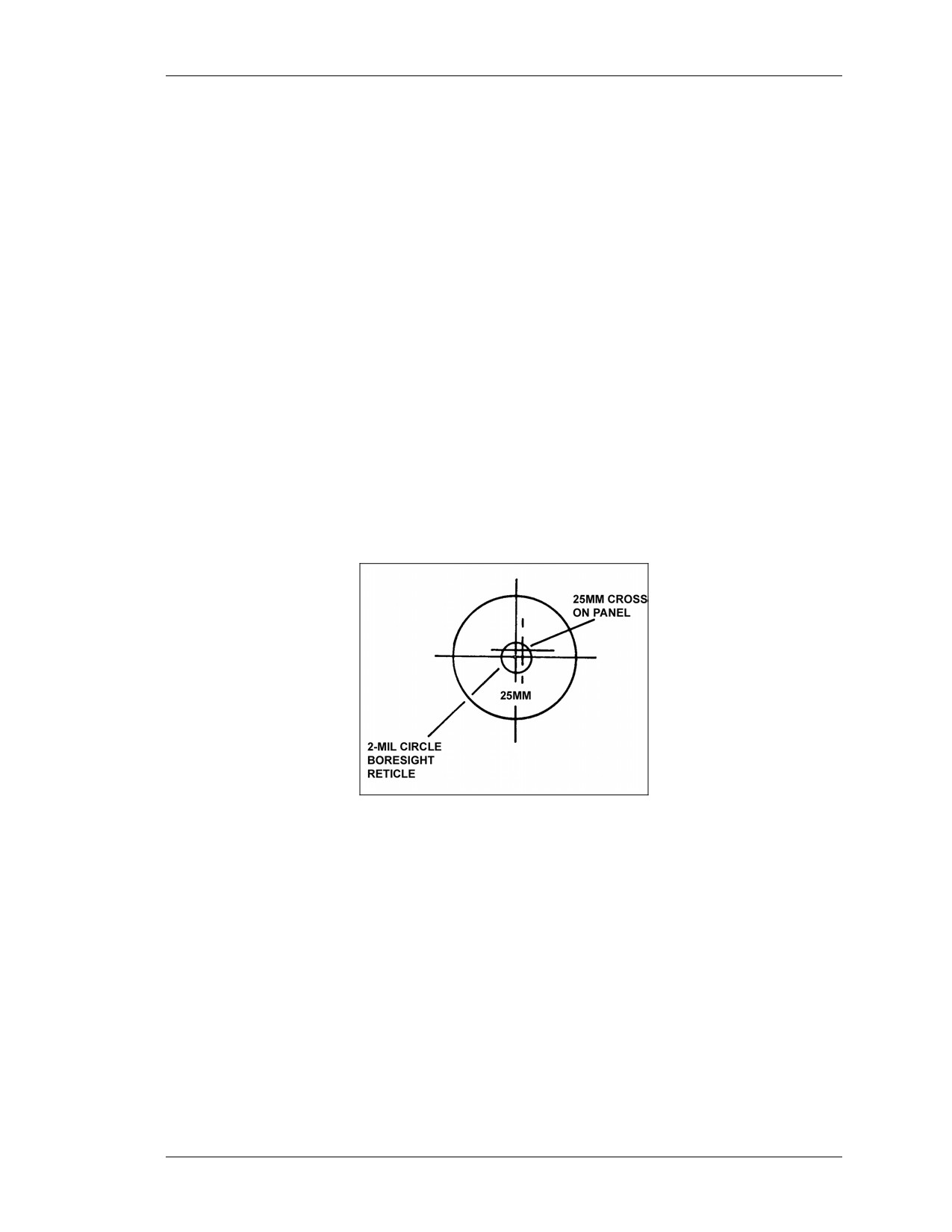
(e) Determine boresight retention. The weapon meets the 1-mil field standard if the
25-mm cross on the panel falls on or within the 2-mil circle on the boresight telescope
(Figure B-56). The weapon fails to meet the standard if the 25-mm cross on the panel
falls outside the 2-mil circle on the boresight telescope.
Figure B-56. Boresight retention met.
B-23. PANEL CONSTRUCTION
The panel can be constructed locally.
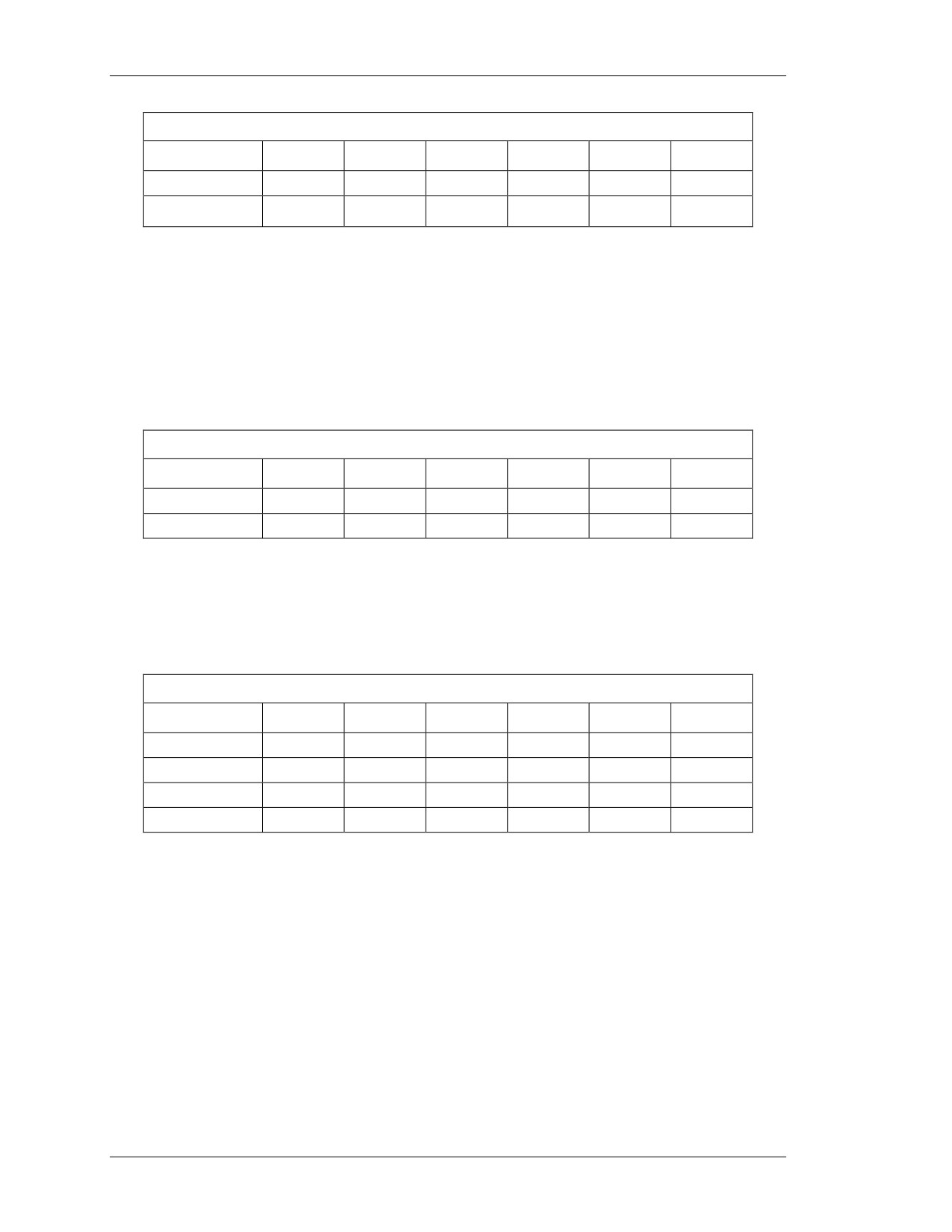
a. Panel Dimensions and Features. The close-in boresight panel is 4 feet by 8 feet.
Measure the location of the center of each cross from the lower left corner of the panel
(Table B-2, page B-42).
B-41
FM 3-22.1
REFERENCE CROSS
DIRECTION
TOW
ISU
T
AUX
25-MM
COAX
Right
19
41
49
63
64
74
Up
35
31
31
31
14
19
Table B-2. Distance (in inches) between crosses and
lower lefthand corner of close-in boresight panel.
(1) The lines of all crosses, except the "T," measure 1/2 inch long. The 1-inch lines of
the "T" are made of steel. They are screwed onto the panel to enhance the image for
thermal boresighting. Lines are either black or orange. Crosses viewed through a black
reticle
(boresight telescope and auxiliary sight) are orange. The two references, ISU
and "T," are black when viewed through the 25-mm reticle (Table B-3).
REFERENCE CROSS
FEATURE
TOW
ISU
T
AUX
25-MM
COAX
Color
Orange
Black
Black
Orange
Orange
Orange
Width (Inches)
1/2
1/2
1
1/2
1/2
1/2
Table B-3. Cross colors and line widths.
(2) Table B-4 shows the length of each arm on the crosses. The 8-inch upper and
lower lines of the 25-mm cross have ranging gaps from 4 to 6 inches from the center of
the cross.
REFERENCE CROSS
ARM
TOW
ISU
T
AUX
25-MM
COAX
Upper
8
10
0
6
8
8
Lower
8
10
8
6
8
6
Right
8
4
4
6
6
6
Left
8
8
4
6
6
6
Table B-4. Length of lines on crosses.
b. Supplies. If the names of crosses are not painted on, then use 3-inch vinyl stick-
on letters to spell TOW, ISU, AUX, 25-MM, and COAX. You will need--
•
1 each--plywood, exterior, 4- by 8-foot sheet, 3/4-inch, A/C or B/C grade.
•
1 each--sheet steel, 1-inch wide, 15 1/2-inches long.
•
4 each--screws, wood, flat-head, size 6, length 3/4 inches.
•
1 each--white paint primer, exterior, quart (oil or alkyd base).
•
1 each--white paint, exterior, quart (latex or oil base).
•
1 each--black paint, exterior, pint (latex or oil base).
•
1 each--orange paint, exterior, pint (latex or oil base).
B-42
FM 3-22.1
•
1 each--paint thinner or brush cleaner.
•
1 each--package of medium-grit sandpaper.
c. Equipment. You will also need the following equipment:
•
1 each--straightedge, 8 feet long.
•
2 each--C-clamps.
•
1 each--framing square.
•
1 each--tape measure at least 8 feet longer.
•
Several--paint pads, 6 inch or 8 inch; or paint brushes; or both.
•
1 each--paint brush, 3/8 inch.
•
1 each--router.
•
1 each--bit, router, straight, 1/2 inch.
•
1 each--power drill.
•
1 each--bit, drill, 1/4 inch.
•
1 each--jigsaw.
•
1 each--pencil.
d. Procedures. If you can measure, paint, and use a jigsaw, router, and drill, then
you can construct the panel yourself. Use a router to cut grooves for the crosses. This
simplifies painting them, because all you have to do is to paint in the grooves:
(1) Sand the front, back, and edge of the plywood to remove dirt and grease.
(2) Mark the words "LOW, LEFT" on the lower left-hand corner of the panel.
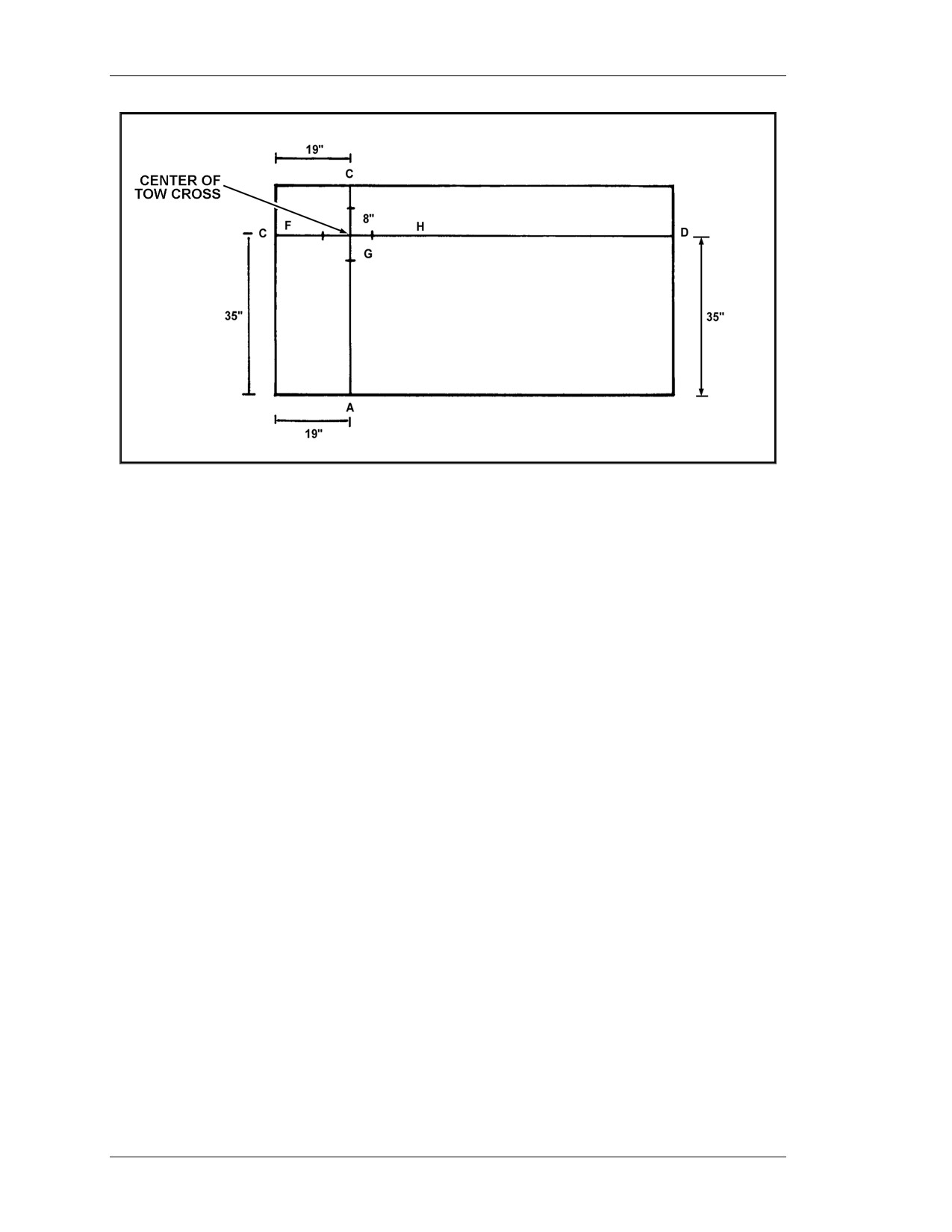
(3) To mark the TOW cross, use a pencil and the
8-foot long straightedge
(Figure B-57, page B-44).
(a) Mark 19 inches to the right "A" of the lower left edge of the panel. (Table B-2
shows that the TOW cross is 19 inches from the left edge of the panel.)
(b) Mark 19 inches to the right "B" of the upper left edge of the panel.
(c) Draw a line connecting the two marks made at "A" and "B."
(d) Mark (C) 35 inches up from the bottom edge of panel (along 8-foot side).
(e) Mark (D) 35 inches up from the lower right edge of the panel at "D."
(f) Draw a line connecting the two marks made at "C" and "D."
(g) Mark "E," "F," "G," and "H" at a distance of 8 inches from the center of the cross
formed by the lines drawn. Table B-4 shows the length of each arm.
(4) Mark the ISU, AUX, 25-MM, and COAX crosses as follows:
(a) Using the data from the RIGHT direction row of Table B-2, mark the vertical
lines of the crosses as previously described for the TOW cross.
(b) Using the data from the UP direction row of Table B-2, mark the horizontal lines
of the crosses as previously described for the TOW cross.
(c) Mark the length of each arm of each cross using the data from Table B-4.
(5) Rout each cross as follows:
(a) Set the router's depth shallow, at either 1/32 inch or 3/64 inch. This keeps the
router from cutting through the first layer of the plywood.
(b) Clamp the straightedge to the wood to make a jig (guide) for the router.
(c) Use the router to cut grooves between the tick marks for the lines of the cross.
(6) Apply a coat of primer to the front, back, and edge of the panel. Avoid letting the
paint build up in the grooves. Let the primer dry.
(7) Apply a coat of white paint to the entire panel. Let the paint dry.
B-43
FM 3-22.1
Figure B-57. Position of TOW cross.
(8) Paint the crosses using a 3/8-inch paintbrush and colors described in Table B-3.
Let this paint dry also.
(9) Make the "T" as follows:
(a) Use a jigsaw and cut the steel strip into two sections, one 8 inches long and the
other 7 1/2 inches long.
(b) In each section, drill a 1/4-inch hole 1 1/2 inches from each end, so each section
will have two holes in it.
(c) Apply a coat of primer to each section. Let the primer dry.
(d) Apply a coat of black paint to each section. Let the paint dry.
(10) Mount the "T" as follows:
(a) Lay a straight edge along the right arm of the ISU cross.
(b) Start at the edge of the right arm and draw a 9-inch line along the straightedge.
(c) Align the 8-inch strip of steel on the line. The left edge of the strip must touch
the right edge of the right arm of the ISU cross.
(d) Mount the strip using two wood screws.
(e) Center the
7 1/2-inch strip crossways beneath the 8-inch strip to form the
letter "T."
(f) Mount the 7 1/2-inch strip using two more wood screws.
(11) Label the crosses using vinyl letters and numbers. Apply labels as shown in
Figure B-41.
B-44
FM 3-22.1 (23-1)
APPENDIX C
Zeroing
Zeroing the 25-mm gun allows the gunner to confirm the weapon
system’s boresight and to adjust the sight reticle relative to the impact of
the round. Whereas boresighting aligns the ISU line of sight and the
weapon systems point of aim, zeroing allows finer alignment
(TM 9-2350-252-10-2, TM 9-2350-284-10-2, and TM 9-2350-294-10-2).
C-1. PROCEDURES FOR ZEROING THE 25-MM, ODS AND BELOW
After boresighting the 25-mm gun, zero it manually. Zero the Bradley on a level surface.
Zero the 25-mm gun at 1,200 meters and the coax at 800 meters. Use the most accurate
ammunition available. Avoid switching between HE and AP ammunition, because that
changes superelevation in the ISU. (If any problems with superelevation occur during
firing, notify unit maintenance.) Both the gunner and the BC must observe the strike of
the round through their respective primary sights. To fire a round, lay the reticle on the
target and squeeze the manual trigger switch. If the round strikes within the center of the
reticle circle, the 25-mm gun is zeroed. If the round does not strike within the center of
the reticle circle, adjust the boresight control knobs to align the reticle with the round
impact. Then, re-lay the reticle and fire another round. Repeat this procedure until either
the 25-mm gun is zeroed or three rounds are fired. If the three rounds are fired before the
gun is zeroed the gun, then the master gunner must check the system to determine if the
problem is mechanical. After zeroing the 25-mm gun to the daysight, leave the gun aimed
at the same point on the target. The crew will adjust the nightsight and auxiliary sight
reticles to the daysight’s point of aim. This does not require the crew to fire any more
zeroing rounds.
NOTE: After zeroing, record the boresight control knob numbers. Then, should
something jostle the weapon boresight control knobs, the crew can simply
reset them.
C-2. PROCEDURES FOR ZEROING THE COAX, ODS AND BELOW
The gunner and BC should work together to zero the coax. Fire a short burst of 10 to 15
rounds and use your primary sight to observe the impact of the tracer. The BC watches
through his sight extension. After the tracer impacts, the BC moves the azimuth and
elevation knobs to adjust the impact to the reticle aiming point. Repeat this procedure
until the coax is zeroed.
NOTE: After zeroing, Bradley ODS crews must ensure that they realign the reticles of
the laser range-finder and of the gun.
C-1
FM 3-22.1
C-3. PROCEDURES FOR ZEROING, A3 ONLY
Zero the Bradley A3 on a level surface. Zero the 25-mm to a target at 1,200 meters and
the coax to a target at 800 meters in front of and at the same elevation as the vehicle.
Once the vehicle is zeroed, the vehicle’s computer will remember the zero until someone
changes it or until the system suffers a catastrophic memory loss. The Bradley A3 crew
can save their calculations in vehicle records or commander notes. Then, to avoid having
to boresight and zero again in the future, they can simply verify their calculations before
range operations.
NOTE: If procedures in this manual differ from CTD procedures, follow the
CTD procedures.
a. Zero IBAS to 25-MM Gun. To zero the gun in the daytime, refer to the A3 zero
screens on the CTD (Figure C-1).
(1) If the crew cannot zero the
25-mm gun within three rounds, notify the
master gunner.
(2) Do not press CONTINUE. This would close the 25-mm screen, which would in
turn cause the A3 system to move to the next screen during zeroing procedures, leaving
the 25-mm improperly zeroed.
1. Use the DVO (preferred) or the TV or FLIR (using FLIR or TV switch on the GHS
to select TV or FLIR) for best viewing.
2. Select HI MAG (NFOV) using the HI/LO switch on the GHS.
3. Center the TAS reticle on the target using the T&E handwheels.
4. Range target using the laser range finder, or enter range manually on the GSCP.
5. Repeat Step 3 if required.
6. Cycle a ghost round.
7. Have the commander observe the impact of the round.
8. Fire one tracer round at the target.
9. Ensure the TAS reticle still aligns with the zero target. Re-aim as needed.
10. Press AIM POINT.
11. Center the TAS reticle at the impact point using the CHS or the GHS.
12. Press CALCULATE.
13. To use the new values, press SAVE. Repeat Steps 7 through 14 until you have
zeroed the 25-mm gun or until you have fired three rounds.
14. Center the TAS reticle on the target using the T&E handwheels.
Figure C-1. Steps for zeroing IBAS to 25-mm gun.
b. Zero Auxiliary Sight to 25-mm. To verify the zero using the backup sight
(AUX), follow the steps shown in Figure C-2. If you cannot align the auxiliary sight to
the 25-mm within two rounds, notify the unit master gunner.
C-2
FM 3-22.1
1. Verify that the TAS reticle aligns with the zero target.
2. Check that backup sight reticle's center vertical line aligns with the target.
(To
move reticle in azimuth, loosen horizontal adjustment lockscrew and turn
horizontal adjustment screw. Use screwdriver)
3. Align reticle so that the AP range line aligns with the target at the
appropriate range. (To move reticle in elevation, loosen locknut on elevation lever
and adjust thumbscrews. Use wrench and socket.)
4. Verify that the TAS reticle and the AUX reticle range line are both on target.
5. Have commander observe round impact point.
6. Fire one confirmation tracer round at the zero target.
7. If round does not hit the target, verify TAS reticle is center mass of zero target.
Figure C-2. Steps for zeroing the auxiliary sight to the 25-mm gun.
c. Zero Auxiliary Sight to Coax. To zero the coax, use the checklist shown in
Figure C-3.
Press CONTINUE.
1. Ideally, use the DVO. If you use the TV FLIR, do so only at night.
2. Select HI MAG (NFOV) using the HI/LO switch on the GHS.
3. Using the T&E handwheels, center the AUX sight on the target. Use the HE range
line (the outer, broken range lines) for the range displayed in the DVO (800-meter
target).
4. Range the target using the laser range finder, or manually index it on the GSCP.
5. Using the T&E handwheels, center the AUX sight on the target using the HE range
lines for the range displayed in the DVO (800 meters) .
Make the following adjustments with the coax knobs, not with the AUX sight:
6. Have the commander observe the round impact.
7. Fire one burst of 10 to 15 rounds at the target.
8. Open the coax access doors. Manually move the coax azimuth and elevation
knobs. This will move the strike of the rounds to center mass of the coax
zero target.
9. Repeat Steps 5 through 8 until you zero the coax. If you cannot zero the coax
in three bursts, notify the unit master gunner.
Figure C-3. Steps for zeroing auxiliary sight to the coax.
C-3
FM 3-22.1
d. Zero Coax to TAS. To zero the coax to the TAS, use the checklist shown in
Figure C-4.
1. Ensure that the AUX reticle still aligns with the zero target. Re-aim as needed.
2. Press AIM POINT.
3. Center the TAS reticle on the point of round impact using the CHS or the GHS.
4. Press CALCULATE.
5. To use the new values, press SAVE.
6. Verify the coax zero through the TAS by firing a burst at the zero target.
Figure C-4. Steps for zeroing the coax to TAS.
C-4. CONFIRMATION
The crew zeroes during BT VI, Crew Practice 2. They confirm the zero during BT VII,
Crew Practice 3, and BT VIII, Crew Qualification. Confirming the zero allows them to
ensure the vehicle's weapon systems have retained their zero. Normally, confirmation
only requires firing one or two rounds. During confirmation, the crew might need to
make some adjustments. If so, they follow the steps previously described. Environmental
parameters and TAS alignment are critical to accuracy of the Bradley A3 weapon system.
The crew aligns the TAS and adjusts for applicable environmental parameters IAW
TM 9-2350-294-10-2-1.
C-4
FM 3-22.1 (23-1)
APPENDIX D
Prefire Checks, Malfunctions,
and Postfire Checks
This appendix discusses prefire checks, malfunctions, and post-
fire checks. Before zeroing, the crew boresights all weapon systems to
ensure they align correctly before firing. They also conduct a thorough
prefire check to ensure that the turret and all turret weapon systems
operate properly. This prevents many of the common malfunctions that
can occur during firing. If a malfunction does occur, the crew tries to
clear it. If they cannot, they report the malfunction to the master gunner.
After firing the weapon systems, the crew conducts a postfire check.
D-1. PREFIRE CHECKLIST
Before conducting live fire, the crew performs prefire checks.
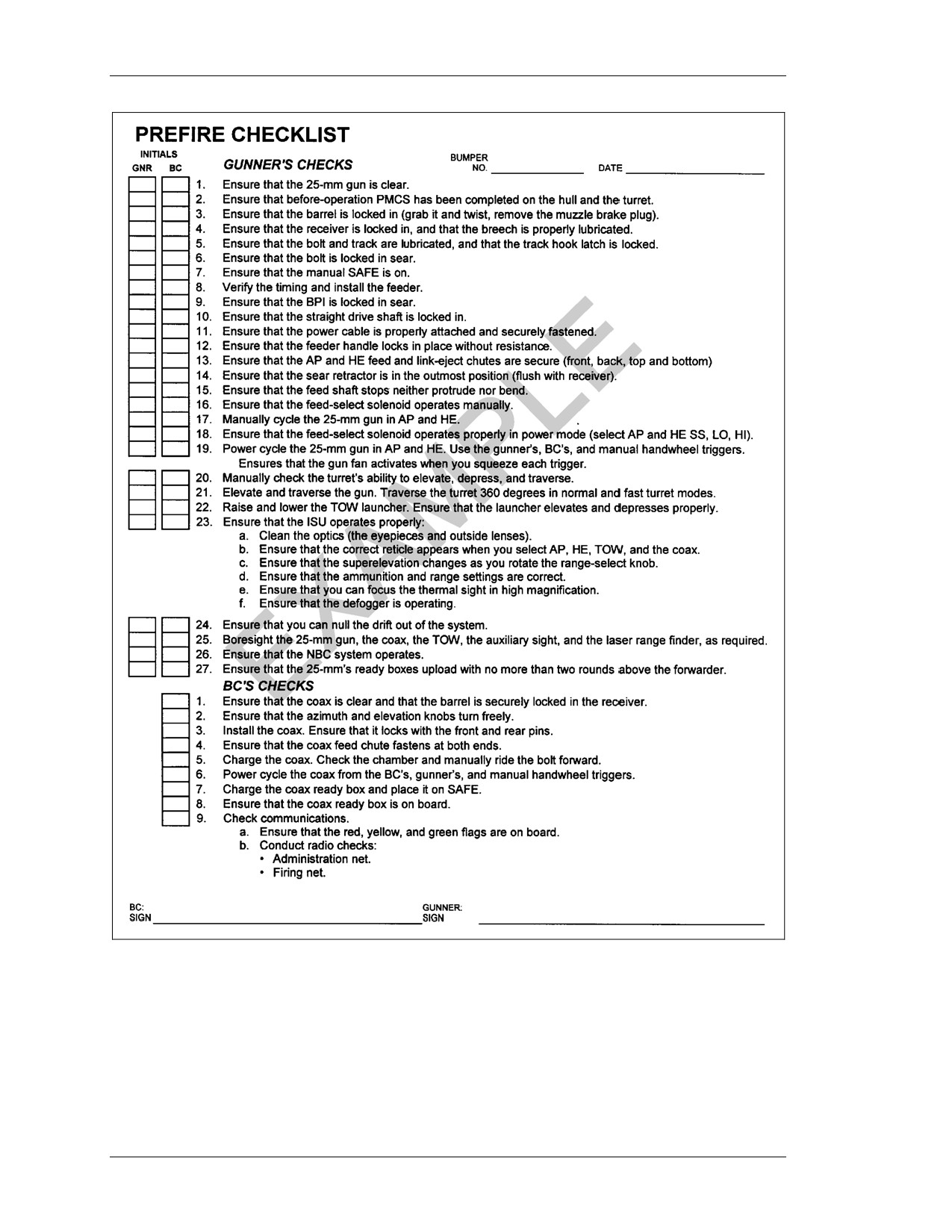
a. The crew uses a checklist similar to that shown in Figure D-1, page D-2, and to
the turret PMCS outlined in TM
9-2350-252-10-2 or TM
9-2350-284-10-2 to reduce
vehicle problems on the firing range.
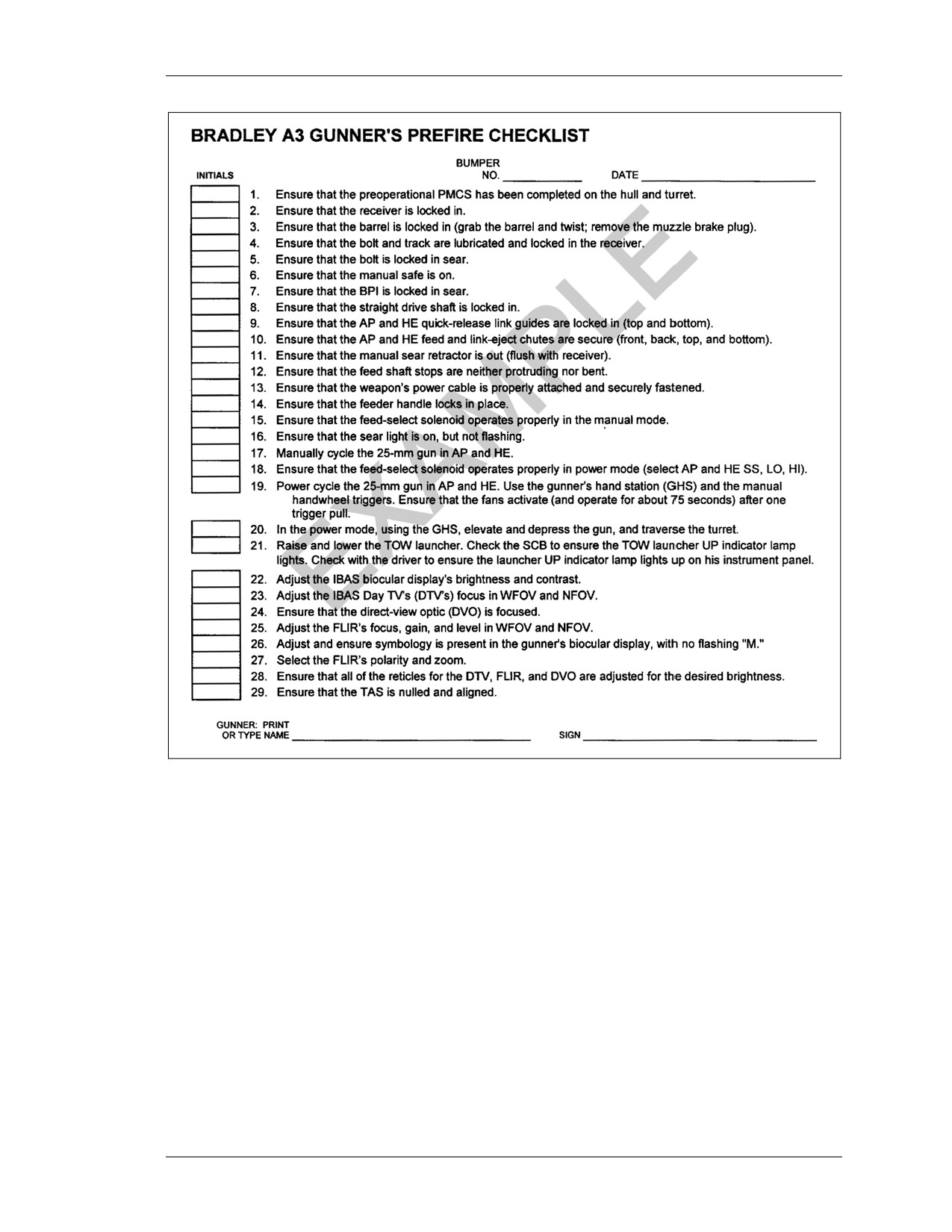
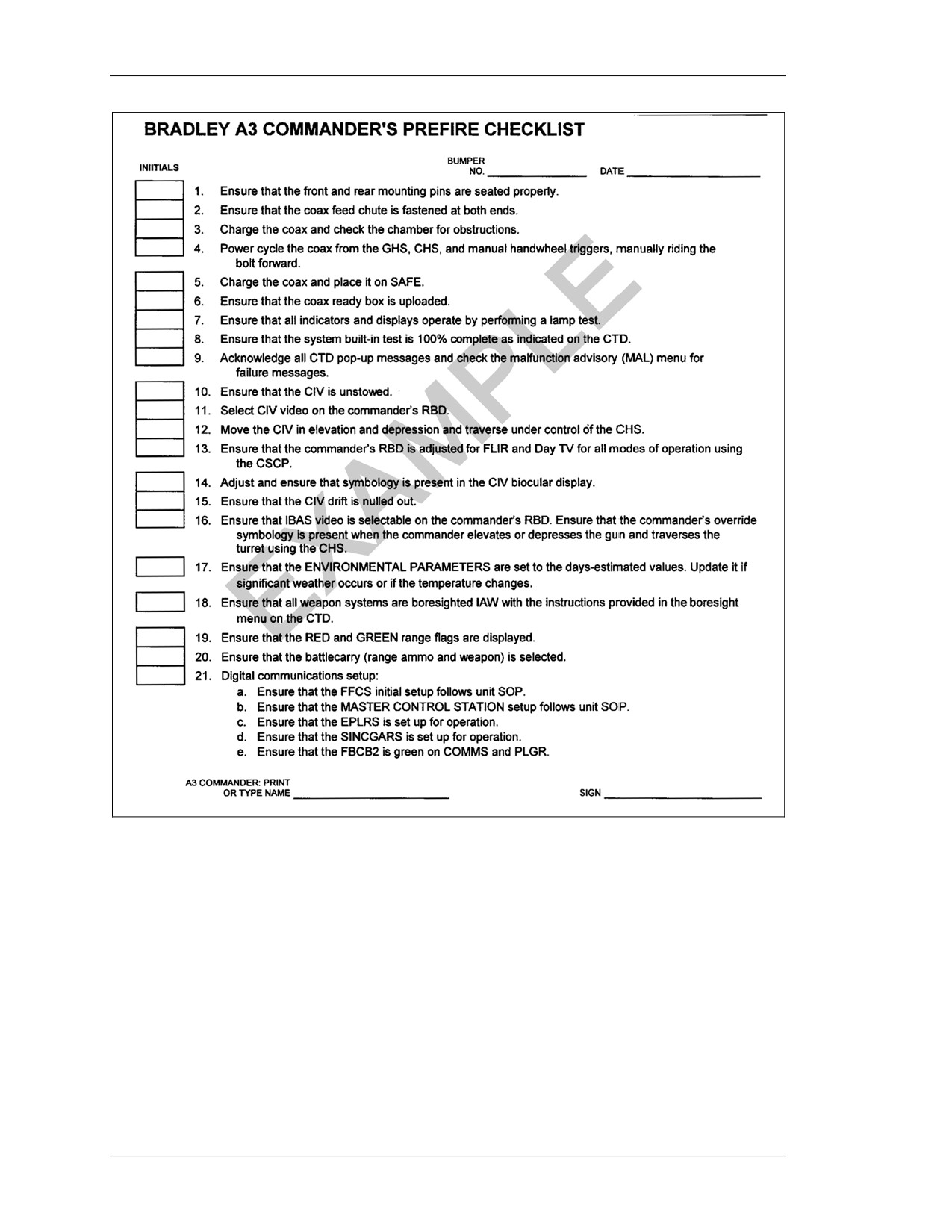
b. Bradley A3 crews can make a prefire checklist using the example shown in
Figures D-2A and D-2B, pages D-3 and D-4; and in the PMCS provided in TM 9-2350-
294-10-2-1.
c. Figures D-3A and D-3B, pages D-5 and D-6, show the Linebacker
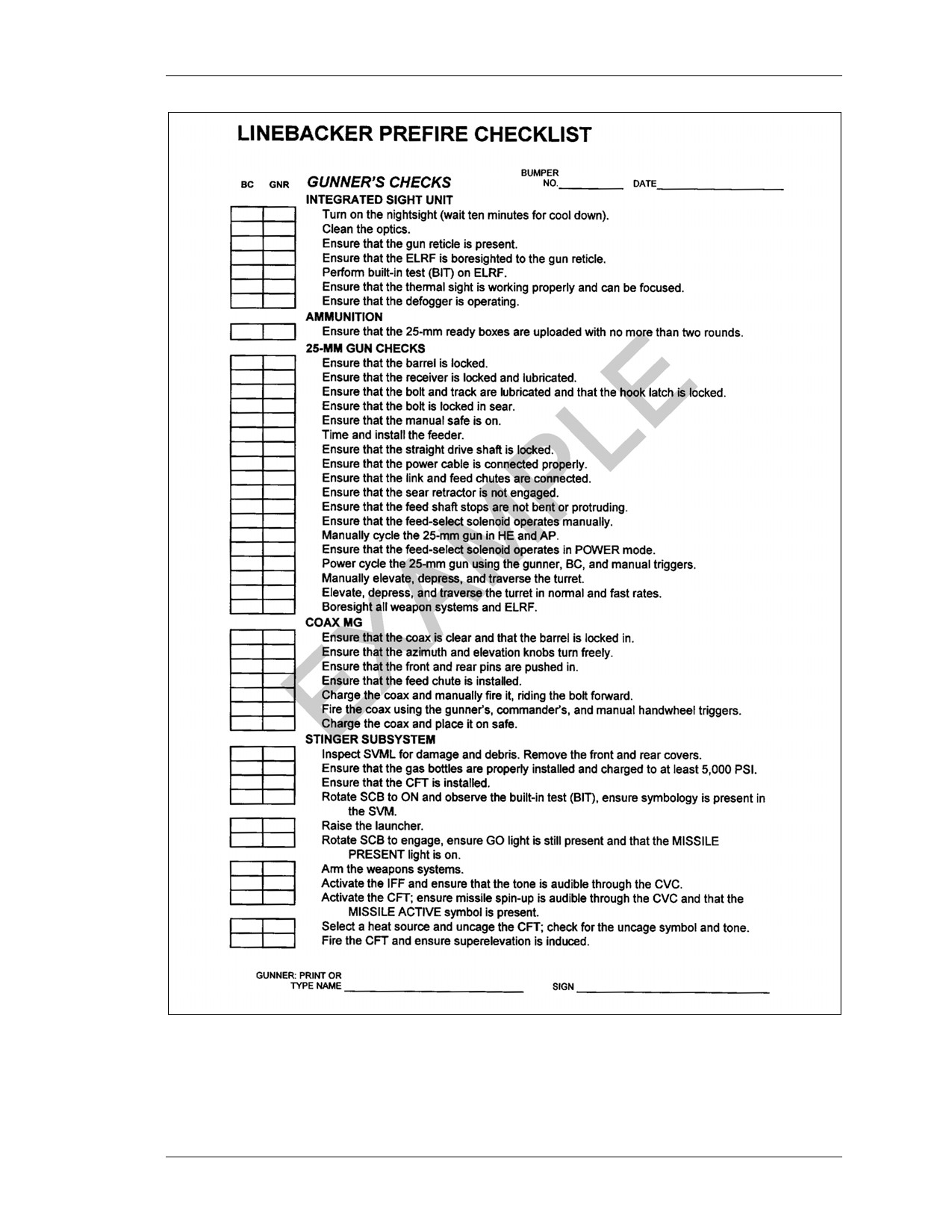
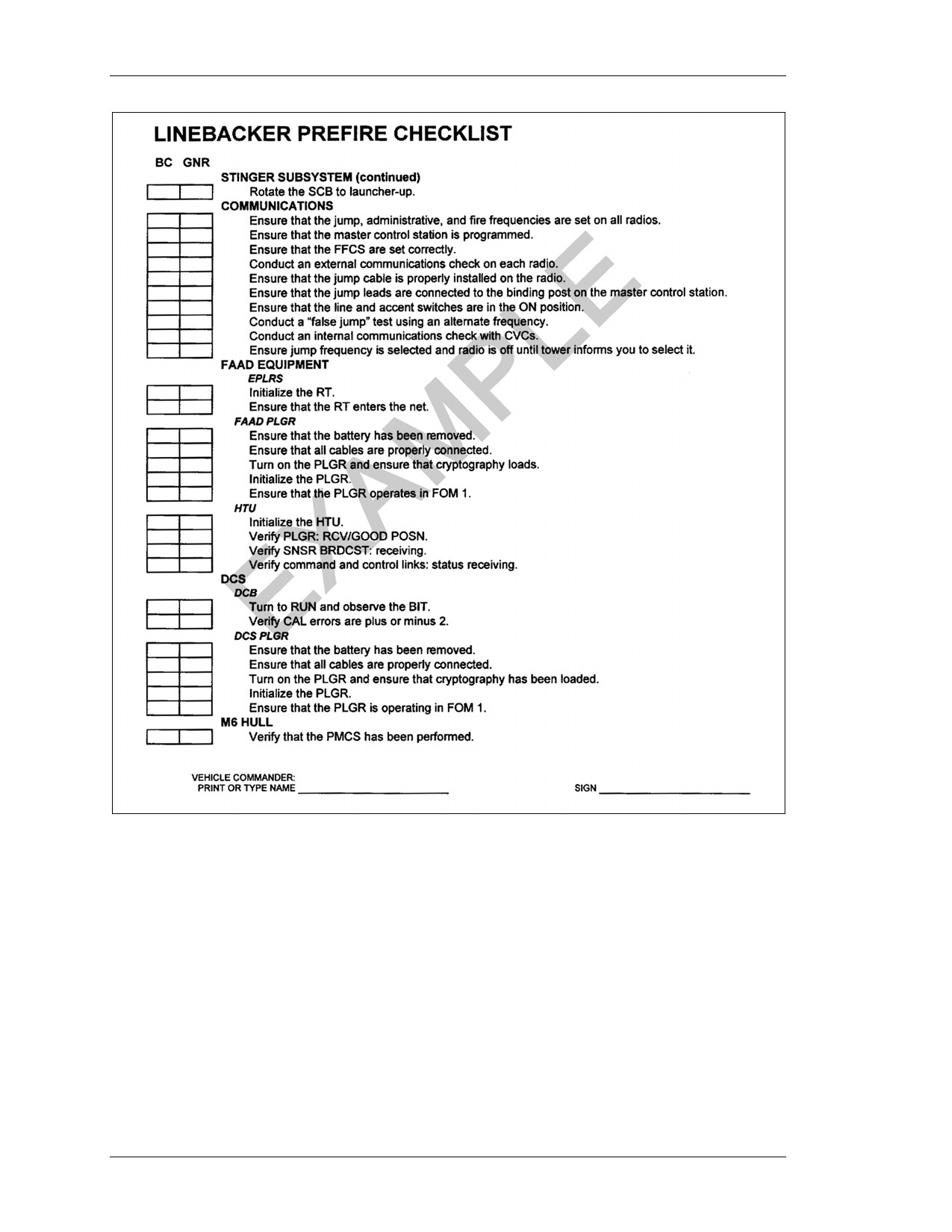
prefire checklist.
D-1
FM 3-22.1
Figure D-1. Example format for prefire checklist.
D-2
FM 3-22.1
Figure D-2A. Example format for Bradley A3 gunner’s prefire checklist,
Part 1.
D-3
FM 3-22.1
Figure D-2B. Example format for Bradley A3 commander’s prefire checklist,
Part 2.
D-4
FM 3-22.1
Figure D-3A. Example format for Bradley Linebacker
prefire checklist, Part 1.
D-5
FM 3-22.1
Figure D-3B. Example format for Bradley Linebacker
prefire checklist Part 2.
D-2. MALFUNCTIONS
Malfunctions cost a lot of firing time on BFV ranges. Crew error causes most
malfunctions. Crews must know the possible reasons for a typical malfunction to occur,
this way they can take the necessary steps to correct the malfunction(s) and continue with
training. As a precaution, the crew performs standard misfire procedures before
correcting any error. If they are not sure that the 25-mm is clear, they can use the
cleaning rod to ensure that it is.
D-6
FM 3-22.1
DANGER
WHEN A MALFUNCTION OCCURS, ALWAYS PERFORM
MISFIRE PROCEDURES BEFORE TAKING ANY OTHER
CORRECTIVE ACTION.
a.
25-mm Gun. If none of these steps corrects the malfunction, notify the master
gunner or maintenance personnel.
(1) If the gun did not cycle, check the following:
• Is the ARM-SAFE-RESET switch on SAFE?
• Is the ammunition selected?
(2) If the gun cycled to misfire, check the following:
• Is the manual safety switch set to SAFE?
• Is the tension released from the ammunition belt?
• Is the gun out of ammunition?
(3) If the gun cycled, but not to SEAR or MISFIRE, check for the following. Then,
use the hand crank to manually cycle the gun back to SEAR, and try again:
• Is the tension released from the ammunition belt?
• Is the sear retractor out?
• Is the straight drive shaft down?
(4) If you cannot clear a weapons malfunction IAW the TM, then you must clear it by
removing the feeder and physically inspecting the chamber for unfired ammunition.
(5) If the straight drive shaft has dropped after a malfunction, remove the feeder from
the receiver and visually check the weapon for unfired ammunition.
(6) The 25-mm ammunition can doublefeed if the protective nose caps are broken,
cracked, or missing; or if a weapon stoppage occurs and is cleared improperly.
b. M240C 7.62-mm Coaxial Machine Gun. If none of these steps corrects the
malfunction, notify the master gunner or maintenance personnel.
(1) If the bolt did not go forward, check the following:
• Is the ARM-SAFE-RESET switch set to SAFE?
• Is the manual safety switch set to SAFE?
• Is the LO AMMO OVRD light flashing?
• Is the coax solenoid plug connected?
• Is the ammunition selected?
(2) If the bolt did go forward, check the following:
• Is the ammunition belt seated in the feed tray?
• Is there a round or casing stuck in the chamber?
• Is the machine gun out of ammunition?
c. M257 Smoke Grenades. When smoke grenades fail to launch, perform
immediate action, then—
(1) Use the vehicle intercom system to tell the driver to move the vehicle to a safe
area. Ensure the driver moves it at least 125 meters from the nearest vehicle, building,
person, or equipment.
(2) Move the grenade launch switch to ON.
(3) Fire the smoke grenades.
D-7
FM 3-22.1
(4) Look for the smoke through the periscopes.
(5) Move the smoke grenade-launcher switch to OFF.
(6) Open the commander’s hatch cover.
(7) Check the smoke grenade launcher for misfired smoke grenades.
(8) Have helpers leave the vehicle.
(9) Move the turret power switch to OFF.
(10) Move the master power switch to OFF.
(11) Remove the smoke grenades from the side where the misfire occurred.
(12) Tell the gunner that the smoke launchers are clear; have helpers clear the
turret area.
(13) Move the smoke grenades to a well-marked spot at least 200 meters from the
nearest vehicle, person, or equipment.
(14) Notify the chain of command of the exact location, type, and number of smoke
grenades that malfunctioned.
(15) Notify unit maintenance that the M257 smoke grenade launchers on the vehicle
malfunctioned.
d. Turret Drive. If none of these steps corrects the malfunction, notify the master
gunner or maintenance personnel.
(1) If the turret will not traverse, check the following:
• Is the turret travel lock locked?
• Is the drive motor in manual?
• Is the turret drive on? If so, turn it off for 30 seconds, then back on.
(2) If the gun will not elevate or depress, check the following:
• Is the drive motor in manual?
• Is the turret drive on? If so, turn it off for 30 seconds, then back on.
e. Communications. If you lose communications, check the following:
• Is the master control station power light on?
• Are the radio cable connections loose?
• Has BIT failed on the master control station?
• Is the CVC cord disconnected?
• Does the VIC1 FBCB2 display a green status?
D-3. POSTFIRE CHECKS
After firing, the crew clears all weapon systems and removes all ammunition residue
from the exterior of the vehicle. Leaders verify that crews clear all weapon systems IAW
AR 385-63. On training ranges, range safety officers verify that crews have cleared all
weapon systems. Postfire checks prevent many accidents.
DANGER
AFTER FIRING, ENSURE ALL WEAPONS ARE CLEAR.
D-8
FM 3-22.1 (23-1)
APPENDIX E
Urban Operations
Both the worldwide shift from rural to urban societies, and the
requirement to switch between combat and SASO, have changed
US Army doctrine. When he can, the enemy will try to offset standoff and
precision fire by drawing the fight to urban areas. Urban operations (UO)
are military actions planned and conducted where man-made terrain
affects tactical options.
This appendix discusses the principles of urban operations and
provides TTP for employing the BFV in urban areas.
E-1. CONSIDERATIONS
The commander must treat any urban area as a terrain complex. He must know the
characteristics of each type of urban terrain and how it will affect his units and weapons.
He must also understand the advantages and disadvantages that urbanization offers, and
how it will affect tactical operations.
a. Urban sprawl complicates adherence to the following principles:
(1) Battalions task-organize around the brigade.
(2) Units below battalion operate as part of the battalion TF rather than alone.
(3) The battalion tries to avoid costly, time-consuming UO by isolating and
bypassing built-up areas.
b. The commander can conduct urban combat operations to capitalize on the area's
strategic or tactical advantages or to deny these advantages to the enemy. Major urban
areas represent their country's power and wealth in the form of industrial bases,
transportation complexes, economic institutions, and political and cultural centers.
Denying or capturing these can boost morale enough to decide the success or failure of
the larger conflict. Villages and small towns are often caught up in a battle due to their
nearness to major avenues of approach or because they sit on lines of communications
needed for ground combat operations.
E-2. TASKS
The primary tasks of the Bradley fighting vehicle in an urban environment are to suppress
enemy fires and breach exterior walls. The vehicles’ armor-piercing rounds can easily
penetrate brick structures, and they can penetrate concrete up to 16 inches thick. They
also work well against sandbag-reinforced and earthen structures.
a. Elevation and Depression. The 25-mm's elevation ranges from about -10 to
+60 degrees.
b. Visibility. The crew has limited visibility to the sides and rear and no visibility
to the top.
c. Ammunition. The 25-mm AP, HE, and even TP-T rounds can be used effectively
against enemy-occupied buildings and fortifications.
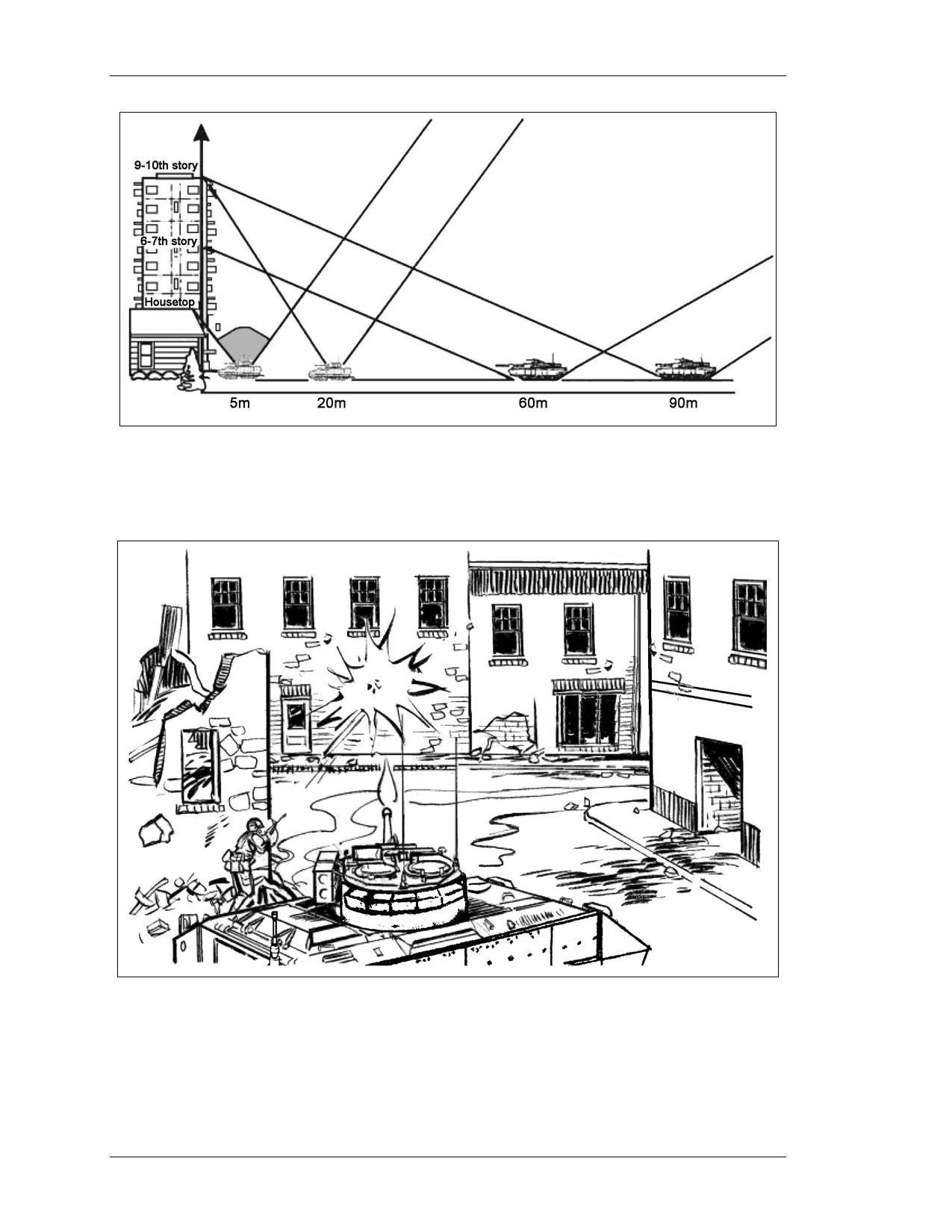
d. Fields of Fire. Figure E-1, page E-2, compares the BFV's and the M1 tank's fields
of fire on urban terrain. The BFV can engage a target nine to ten stories high at
20 meters, whereas an M1 tank requires 90 meters.
E-1
FM 3-22.1
Figure E-1. Comparison of M1 and BFV fields of fire.
e. Breach of a Wall. Figure E-2 shows one way to breach a wall using the 25-mm
main gun. TP-T is the best ammunition for this job.
Figure E-2. Circular fire pattern used to breach wall.
E-2
FM 3-22.1
f. Support of Infantry Assault. When using the BFV weapon systems to support
the infantry assault, leaders must consider the effects of the explosion on the Infantry
soldiers on the ground. These effects include fragmentation, the discarding sabots,
and overpressure.
E-3. TARGET ACQUISITION
Urban areas present units with unique target-acquisition challenges. For example, urban
areas often favor the defender's ability to acquire targets. This makes offensive target
acquisition extremely important, because whoever fires first could win the engagement.
Whether halted or moving, units and soldiers must try to acquire targets continuously.
Urban terrain affects target acquisition as follows:
a. They tend to perform the six steps of target acquisition (search, detect, locate,
identify, classify, and confirm) much faster in an urban environment than they would
elsewhere.
b. Buildings mask movement and the effects of direct and indirect fires. Intact and
rubbled structures cover and conceal both attackers and defenders.
c. Closed hatches reduce situational awareness
(ODS and below), but the BC
maintains it by using his CIV (M2A3 only).
d. The driver has an increased role in UO target acquisition. Acquiring targets is
most challenging when traveling past narrow side streets and alleys. The driver must
watch the left side of the vehicle, because a threat could appear there first.
E-4. SEARCH
Urban battlefields are three dimensional. Soldiers must use all of their senses to detect a
threat. Just as on other types of terrain, patrols and OPs help locate enemy forces.
a. Target-Acquisition Devices. Soldiers searching the urban battlefield should use
all available devices (binoculars, image-intensifiers, thermal sights, GSR, REMs, PEWS,
and field-expedient early warning devices) to acquire targets, because no single device
can meet every need. The BFV’s ISU and IBAS serve as excellent combat multipliers in
modern urban combat. For example, the IBAS, the CIV, and the second-generation FLIR
make the M2A3's hunter-killer technique especially effective. M2A3 gunners search for
targets on major streets, ensuring that the bottom of the IBAS picture (in WFOV) allows
them to see just a few feet in front of the vehicle, and that the top of the IBAS picture
(also in WFOV) allows them to see the first floor of buildings. Using the CIV, the BC
can simultaneously scan upper-level floors, rooftops, and narrow side streets and alleys,
while protected from sniper fire.
E-3
FM 3-22.1
b. Observation. The unit develops and implements clear observation SOP.
To ensure all-round and up-down (three-dimensional) security, leaders must clearly
explain observation duties to crewmembers. Soldiers quickly learn to recognize the
sights, smells, sounds of their urban battlefield, and to distinguish targets. On the M2A2
and below, the BC uses binoculars and the naked eye to search aboveground, including
rooftops and upper floors. At the same time, the gunner searches street and lower levels.
On the M2A3, the BC uses the CIV to search from inside the vehicle, safe from
sniper fire. On all BFVs, the driver scans the street to the vehicle's front and, as
previously stated, to the left when the vehicle passes alleys and side streets. To increase
survivability during observation, the crew keeps all hatches closed or in the
“popup” position.
c. Movement. Because attackers and defenders might have short distances between
them, the crew should stop often to scan their sector. They must choose their routes
carefully, using buildings and rubble to mask their movement. Crews who encounter a
threat while crossing a major road or intersection can back up and use a building as
protection while they prepare to engage the threat. However, they might be able to bound
through the road or intersection and hand off the target by radio to the next BFV. In the
case of two FBCB2-equipped BFVs, the first one could bound through a major road or
intersection, then digitally hand off the target to the next one. The crew or section uses
the same movement techniques in urban areas as on open terrain (traveling, traveling
overwatch, and bounding overwatch), except the overwatching element also watches the
upper floors.
d. Observation Posts. In selecting OPs, the commander considers the military
aspects of urban terrain. For example, upper-floor OPs offer better vantage points than do
street-level OPs. However, leaders should avoid obvious positions such as water towers
or church steeples.
E-5. TARGET DISCRIMINATION
Target discrimination, the act of quickly distinguishing combatants from noncombatants
and engaging the combatants, is vital in urban combat. US forces try to prevent casualties
among noncombatants. Selective engagement is less important in areas without
noncombatants. However, even in such areas, gunners can always mistake a friendly
soldiers for an enemy. Unless crews are well-trained in fire discrimination and control,
and practice firing discipline, urban combat can result in unintentional casualties among
noncombatants. Distances in urban environments are ever-changing. During short halts or
as time permits, M2A3-equipped crews should continuously check the focus, level and
gain, and brightness and contrast on the IBAS. This is how crews learn to discriminate
friend from foe using the IBAS. Finally, commanders must recognize the stress that
discriminating targets causes soldiers, and take steps to prevent and relieve it.
E-4