3-22.1 (FM 23-1) BRADLEY GUNNERY (NOVEMBER 2003) - page 10
FM 3-22.1
b. Ensured turret drive was off.
c. Placed the gun elevation and traverse select levers in MANUAL and the TOW
select lever in POWER.
d. Opened the ballistic sight doors.
e. Adjusted the focus, reticle, and symbology brightness and the image contrast and
brightness on both the TAS and the CIV sights.
f. If using FLIR, adjusted gain, level, polarity, and zoom as needed.
2. Inserted the boresight telescope into the 25-mm adapter.
a. Inserted the tapered shaft of the telescope snugly into the tapered hole of the
adapter with the red index mark on the adapter in the 12 o’clock position. This
positioned the telescope's eyepiece in the 3 o’clock position.
b. Removed the objective eyepiece lens caps from the telescope.
c. Unfold and attached the red warning flag to the telescope's objective-lens barrel.
3. Inserted the boresight telescope assembly into the 25-mm gun barrel.
a. Inserted the boresight telescope assembly into the 25-mm gun barrel with the red
index mark on the adapter in the 12 o’clock position. Ensured that the red mark on
the 25-mm adapter aligned with the red index mark on the telescope's body. This
positioned the telescope's eyepiece in the 3’oclock position.
NOTE: Regardless of which end you look in, the rifling spins to the right.
b. Ensured that the tapered muzzle cone of the boresight telescope assembly seated
firmly on the muzzle brake of the 25-mm gun barrel.
4.
Positioned the boresight telescope assembly crosshairs on the top left-hand corner of
the boresight panel.
a. Had helper direct the gunner to position the telescope crosshair on the top left-
hand corner of the boresight panel using manual traverse and elevation
handwheels.
b. Turned the boresight telescope assembly clockwise using the knurled section of
25-mm adapter only. Turned the adapter within the gun barrel.
5.
Collimated the boresight telescope assembly.
a. While gripping the knurled section of the 25-mm adapter, rotated the index mark
(the red dot) to the 6 o’clock position. This should have put the eyepiece at the
9 o’clock position. Ensured that the tapered muzzle cone of the adapter seated
against the muzzle brake of the 25-mm gun barrel.
b. Viewed the boresight panel. If the aim point had moved from its original position,
you adjusted the reticle (Step 6). If no adjustment was needed, you went to Step 7.
6.
Adjusted the crosshairs in the boresight telescope reticle.
a. Rotated the adjustment protective shroud on the boresight telescope to expose the
adjustment knobs.
b. Using the reticle adjustment knobs on the telescope, moved the reticle one-half of
the difference between the previous point and the new position, in both azimuth
and elevation.
c. Had the gunner use the manual elevation and traverse handwheels to move the
turret, in order to put the telescope crosshairs back on top of the left corner of the
boresight panel.
A-43
FM 3-22.1
d. While gripping the knurled section of the 25-mm adapter, rotated the index mark
(the red dot) clockwise to the right to the 12 o’clock position. This would have
placed the telescope eyepiece at the 3 o’clock position.
e. Looked through boresighted telescope. If the crosshair in telescope failed to align
with top left-hand corner of the boresight panel, then continued to move the
reticle one-half of the difference from the previous point to the top left corner of
the boresight panel. Used the reticle-adjustment knobs on the telescope to do this.
f. Repeated Step 6 until the reticle did not move from one position to the next. This
normally takes three to five cycles.
g. Once you were able to rotate the 25-mm adapter without the telescope crosshairs
moving from the initial aiming point (top left-hand corner) of the boresight panel,
you had collimated the telescope to the 25-mm gun.
h. Had the gunner and helper swap positions to check optical alignment through the
IBAS and boresight telescope.
7.
Operate the commander's tactical display:
a. From the CTD, selected MAIN.
b. From the TACTICAL screen, selected SETUP.
c. From the setup screen, selected FIRE CONTROL.
d. From fire control, selected MANUAL boresight.
8.
Performed preboresighting tasks.
a. Ensured Tasks 1 and 2 on the PREBORESIGHTING TASKS screen had been
performed.
b. Performed system null.
c. If TOW was to be boresighted, raised TOW launcher and placed red streamer on
turret drive system switch.
d. Opened the sight shield doors.
e. Placed the turret-drive system (TDS) in MANUAL mode.
f. When ready, pressed CONTINUE.
g. Selected BORESIGHT TAS, BACKUP SIGHT TO 25-MM GUN.
h. When ready, selected CONTINUE from the TOOLS, EQUIPMENT,
CONDITIONS, PERSONNEL REQUIRED screen.
i.
Boresighted the TAS, and backed up the sight to the 25-mm gun.
9.
Read and performed all 10 tasks on the BORESIGHT TAS, BACKUP SIGHT TO
25-MM GUN screen.
10. Selected CONTINUE.
a. When ready, selected CONTINUE from the BORESIGHT CIV TO 25-MM
GUN, TOOLS, EQUIPMENT, CONDITIONS, AND PERSONNEL
REQUIRED screen.
b. Boresighted the CIV to the 25-mm gun. Read and performed all 7 tasks on the
BORESIGHT CIV TO 25-MM GUN screen.
NOTE: When boresighting coax or TOW, do not collimate.
c. From the BORESIGHT TAS, BACKUP SIGHT TO COAX, TOOLS,
EQUIPMENT, CONDITIONS, AND PERSONNEL REQUIRED screen, selected
CONTINUE.
d. Boresighted the TAS, and backed up the sight to the coax.
A-44
FM 3-22.1
11. Read and performed all 13 tasks from BORESIGHT TAS, BACKUP SIGHT TO
COAX screen.
12. Selected CONTINUE.
a. When ready, selected CONTINUE from the BORESIGHT TAS TO TOW
LAUNCHER, TOOLS, EQUIPMENT, CONDITIONS, AND PERSONNEL
REQUIRED screen.
b. Boresighted the TAS to the TOW launcher.
c. Read and performed all 8 tasks from the BORESIGHT TAS TO TOW
LAUNCHER screen.
13. Selected CONTINUE.
a. When ready, selected CONTINUE from the ALIGN TAS TV NFOV TO ATT,
TOOLS, EQUIPMENT, CONDITIONS, AND PERSONNEL
REQUIRED screen.
b. Aligned the TAS TV NFOV to the aided target tracker.
c. Read and performed all 4 tasks on the screen.
14. Selected CONTINUE.
a. When ready, selected CONTINUE from the ALIGN TAS TV WFOV TO ATT,
TOOLS, EQUIPMENT, CONDITIONS, AND PERSONNEL
REQUIRED screen.
b. Aligned the TAS TV WFOV to the aided target tracker.
c. Read and performed all 4 tasks on the screen.
15. Selected CONTINUE.
a. When ready, selected CONTINUE from the ALIGN CIV FLIR TO TV, TOOLS,
EQUIPMENT, CONDITIONS, AND PERSONNEL REQUIRED screen.
b. Aligned the CIV FLIR TV.
c. Read and performed all 7 tasks on the screen.
16. Selected CONTINUE.
a. From the ZERO 25-MM GUN screen, selected EXIT and returned to main screen.
b. Removed the red streamer from the turret drive system switch.
c. Moved the TOW elevation drive-selected lever to POWER.
d. Moved the turret traverse drive-selected lever to POWER.
e. Moved the turret drive switched to ON.
f. Lowered the TOW launcher.
g. Moved the turret drive system switch to OFF.
17. Completed performance measures within 25 minutes.
A-45
FM 3-22.1
TASK 10B
BORESIGHT TURRET WEAPONS SYSTEMS (M7 BFIST)
CONDITIONS
Given an operational M7 BFIST with BII, operational boresight kit with 25-mm-gun
adapter, installed coax, and TM 9-2350-297-10-2. (Only this BGST task requires the use
of the technical manual.)
STANDARDS
Within 25 minutes the crewmembers boresighted--
·
Laser range finder.
·
25-mm gun.
·
M240C coax.
·
Nightsight and daysight.
EVALUATION PROCEDURES
1. Administrative Process. At this task, the evaluator logs information about each
crewmember on a roster. He supplies the crewmember with all required materials and
equipment, displaying them IAW this manual. He uses the performance measures to
record the crewmember's performance. Afterward, he tells the crewmember how well
the crewmember performed on this task and directs him to the next task or to further
training. One evaluator can test one--and only one--crewmember at a time.
2. Procedures Used When Personnel Receive a NO GO. If a crewmember fails to
achieve the standards on the performance measures, he earns a NO GO. When this
happens, the evaluator explains to the crewmember what he did wrong and how to
correct his mistakes. Then, he retests the crewmember IAW local SOP.
PERSONNEL, EQUIPMENT, AND MATERIALS
• Qualified BFIST 13F sergeant or above.
• Operational BFIST M7 with BII.
• TM 9-2350-284-10-2-1 and TM 9-2350-297-10-2.
• Boresight kit.
• Boresight panel (1,200 meters distant).
• Stopwatch.
• Clipboard with pen.
• One helper, qualified BFIST 13F sergeant or below.
PRETEST PREPARATION
1. Ensure boresight telescope is operational.
2. Ensure engine is off.
3. Ensure master power is on.
4. Ensure all drive-select levers are in POWER mode.
5. Ensure turret drive system is off.
6. Ensure vehicle is parked on level ground.
7. Ensure ballistic sight covers are closed.
8. Ensure driver and cargo hatches are closed.
A-46
FM 3-22.1
PRETEST CONDITIONS FOR EACH EXAMINEE
1. Ensure ARM-SAFE-RESET switch is at SAFE position.
2. Ensure thermal sight is off.
3. Ensure magnification is set at low.
4. Ensure range index is at 12.
5. Ensure reticle brightness is off.
6. Offset day and night 25-mm boresight knobs.
7. Offset coax-mount azimuth-elevation knobs.
8. Offset prism boresight screen.
9. Move turret out of target area.
10. Ensure travel lock is engaged.
11. Ensure turret shield door is closed.
TEST PLANNING TIME
Administration
5 minutes
Test
25 minutes
Total
30 minutes
INSTRUCTIONS TO EXAMINEE
The evaluator will read the following instructions aloud to the examinee:
"Let me have your attention. This task evaluates your ability to boresight the M242,
25-mm automatic gun, the M240C coaxial machine gun, and the eye-safe laser
range finder.
"Do you understand these instructions?"
Pause for 5 seconds, then say—
"You have 25 minutes to complete the task."
Pause again, then say--
"Begin."
Start timing at once. If the examinee has not completed the task after 25 minutes, then say
loudly enough for him to hear--
"Stop."
If at any time you think that he is going to damage the equipment or injure himself,
then say--
"Stop."
Any time the helper installs the boresight telescope, the red streamer must be attached.
PERFORMANCE MEASURES
1. Completed performance measures within 25 minutes.
2. Boresighted turret weapon systems.
a. Ensured turret power was on.
b. Moved night-vision power switch to ON.
c. Opened ballistic-sight cover doors.
A-47
FM 3-22.1
d. Moved range-control knob to 0.
e. Moved sensor-selected switch to CLEAR or NEUTRAL.
3.
Boresighted eye-safe laser range finder (ELRF).
a. Moved magnification switch to HIGH.
b. Moved TSCP power switch to on.
c. Selected FIST soft key (except in FIST mode).
d. Moved laser switch to ON.
e. Unstowed prism boresighted knob
f. Closed ballistic sight shield doors.
g. Located ELRF reticle.
h. Adjusted RET DSP knob.
i.
Adjusted RET BRT knob.
j.
Aligned ELRF reticle within center of TOW reticle.
k. Stowed prism boresighted knob.
l.
Moved laser switch to OFF.
m. Opened ballistic sight shield doors.
4.
Boresighted the M242 25-mm automatic gun.
a. If in FIST mode, deselected FIST soft key.
b. Pressed AP SS button.
c. Ensured that "AP" appeared on status indicator.
d. Adjusted RET or BRT knob for correct brightness of gun reticle.
e. Moved turret-traverse, drive-select lever to manual position.
f. Moved gun-elevation, drive-select lever to manual position.
g. Released turret-travel lock.
h. Centered gun reticle on aiming point of target.
i.
(Helper) installed 25-mm boresight adapter, red streamer, and boresight telescope.
j.
(Helper) focused boresight telescope on target.
k.
(Helper) aligned elevation cross hair in boresight scope on aiming point of target.
l.
(Helper) aligned azimuth cross hair in boresight scope on aiming point of target.
m. (Helper) checked accuracy of boresight telescope.
n. Aligned gun reticle on aiming point of target.
o.
(Helper and gunner-observer) switched positions and verified alignment.
p. Removed boresight telescope, red streamer, and 25-mm boresight adapter.
5.
Boresighted the M240C coax machine gun.
a. Pressed the 7.62 button.
b. Ensured that "7.62" appeared in the status indicator.
c. Ensured that the gun reticle aligned on the target's aiming point.
d. Moved to the commander’s seat.
e.
(Helper) installed boresight adapter, red streamer, and boresight telescope.
f.
(Helper) focused boresight telescope on boresight panel.
g.
(Helper) aligned the azimuth crosshair in the boresight scope reticle on the aiming
point of the target.
h.
(Helper) aligned the elevation crosshair in the boresight scope reticle on the
aiming point of the target.
i.
(Helper) removed boresight telescope, the red streamer, and the boresight adapter.
6. Boresighted the nightsight to the daysight.
A-48
FM 3-22.1
a. Moved the sensor select switch to NIGHT.
b. Aligned the elevation and azimuth crosshairs in the gun's reticle on the target's
aiming point.
c. Moved the sensor-select switch to CLEAR or NEUTRAL.
d. Ensured that both the TOW's and the gun's day and night reticles aligned on the
aiming point of the target.
A-49
FM 3-22.1
TASK 11
LOAD AND UNLOAD THE 25-MM HE READY BOX
CONDITIONS
Given a Bradley with the turret positioned at HE load and 75 rounds of 25-mm dummy
ammunition.
STANDARDS
The crewmember--
1. Within 6 minutes, loaded 75 rounds in the HE ready box.
2. Within
6 minutes, unloaded
75 rounds from the HE ready box and separated
ammunition into five 15-round belts.
EVALUATION PROCEDURES
1. Administrative Process. At this task, the evaluator logs information about each
crewmember on a roster. He supplies the crewmember with all required materials and
equipment, displaying them IAW this manual. He uses the performance measures to
record the crewmember's performance. Afterward, he tells the crewmember how well
the crewmember performed on this task and directs him to the next task or to further
training. One evaluator can test one--and only one--crewmember at a time.
2. Procedures Used When Personnel Receive a NO GO. If a crewmember fails to
achieve the standards on the performance measures, he earns a NO GO. When this
happens, the evaluator explains to the crewmember what he did wrong and how to
correct his mistakes. Then, he retests the crewmember IAW local SOP.
PERSONNEL, EQUIPMENT, AND MATERIAL REQUIRED
• Qualified 11B, 12B, 13F, 14R, or 19D, sergeant or above.
•
Operational M2, M2A2, M2A2 ODS, M2A3 or M3, M3A2, M3A2 ODS, or M3A3 with BII.
•
TM 9-2350-284-10-2, TM 9-2350-252-10-2, or TM 9-2350-294-10-2-1.
•
75 rounds of 25-mm dummy ammunition.
•
FM 3-22.1.
•
Stopwatch.
•
Clipboard with pen.
•
One helper, qualified 11B, 12B, 13F, 14R, or 19D, sergeant or below.
PRETEST PREPARATION
1. Position turret at HE load position with travel lock engaged.
2. Place five 15-round belts of 25-mm dummy ammunition on the floor of the hull to the
rear of the turret shield door.
3. Inspect HE ready-box door for serviceability; replace all unserviceable or
missing parts.
PRETEST CONDITIONS FOR EACH EXAMINEE
Ensure--
1. Turret position is in HE load position.
2. Master power and turret power are both off.
3. HE ready can door is secured.
A-50
FM 3-22.1
4. Ammunition selector lever is in AP position.
5. Turret shield door is closed.
6. Ammunition is in five belts of 15 rounds each.
TEST PLANNING TIME
Administration
6 minutes
Test
12 minutes
Total
18 minutes
INSTRUCTIONS TO EXAMINEE
The evaluator will read the following instructions aloud to the examinee:
"Let me have your attention. This task evaluates your ability to load and unload the
high-explosive ready box. You have 6 minutes to load the box and 6 minutes to unload
it and return the ammunition to five 15-round belts.
"Do you understand these instructions?"
Pause for 5 seconds, then say—
"You have 6 minutes to complete each task."
Pause again, then say--
"Begin."
Start timing at once. If the examinee has not completed each task after the appropriate
time, then say loudly enough for him to hear--
"Stop."
If at any time you think that he is going to damage the equipment or injure himself,
then say--
"Stop."
PERFORMANCE MEASURES
1. Completed performance measures within 6 minutes.
2. Loaded the HE ready box.
a. Inspected belts for misaligned rounds.
b. Belted the five 15-round belts together.
c. Knocked on turret-shield door and said--
"Loading high explosives."
d. Opened turret shield door.
e. Removed HE ready box door.
f. Hung first five rounds, double-link end first.
g. Hung 19th, 24th, and 25th rounds.
h. Counted out 25 rounds, hung 24th and 25th rounds, and continued until rounds
were loaded.
i.
Replaced HE ready box door.
j.
Ensured ammunition selector lever was in HE position.
A-51
FM 3-22.1
k. Closed turret shield door and said--
"High explosives loaded."
3. Unloaded HE ready box.
a. Knocked on turret shield door and said--
"Unloading high explosive."
b. Opened turret shield door.
c. Removed HE ready box door.
d. Removed ammunition.
e. Replaced HE ready box door.
f. Closed turret shield door and said--
"High explosive unloaded."
g. Separated ammunition into five 15-round belts.
A-52
FM 3-22.1
TASK 12
LOAD AND UNLOAD THE 25-MM AP READY BOX
CONDITIONS
Given a Bradley with the turret positioned at AP load and 45 rounds of 25-mm dummy
ammunition.
STANDARDS
The crewmember--
1. Within 6 minutes, loaded 45 rounds in the AP ready box.
2. Within
6 minutes, unloaded
45 rounds from the AP ready box and separated
ammunition into three 15-round belts.
EVALUATION PROCEDURES
1. Administrative Process. At this task, the evaluator logs information about each
crewmember on a roster. He supplies the crewmember with all required materials and
equipment, displaying them IAW this manual. He uses the performance measures to
record the crewmember's performance. Afterward, he tells the crewmember how well
the crewmember performed on this task and directs him to the next task or to further
training. One evaluator can test one--and only one--crewmember at a time.
2. Procedures Used When Personnel Receive a NO GO. If a crewmember fails to
achieve the standards on the performance measures, he earns a NO GO. When this
happens, the evaluator explains to the crewmember what he did wrong and how to
correct his mistakes. Then, he retests the crewmember IAW local SOP.
PERSONNEL, EQUIPMENT, AND MATERIALS
• Qualified 11B, 12B, 13F, 14R, or 19D, sergeant or above.
•
Operational M2, M2A2, M2A2 ODS, M2A3 or M3, M3A2, M3A2 ODS, or M3A3 with BII.
•
TM 9-2350-284-10-2, TM 9-2350-252-10-2, or TM 9-2350-294-10-2-1.
•
45 rounds of 25-mm dummy ammunition.
•
FM 3-22.1.
•
Stopwatch.
•
Clipboard with pen.
•
One helper, qualified 11B, 12B, 13F, 14R, or 19D, sergeant or below.
PRETEST PREPARATION
1. Position turret at AP load position with travel lock engaged.
2. Place three 15-round belts of 25-mm dummy ammunition on the floor of the hull to
the rear of the turret shield door.
3. Inspect AP ready-box door for serviceability; replace all unserviceable or
missing parts.
PRETEST CONDITIONS FOR EACH EXAMINEE
1. Turret is in AP load position.
2. Master power and turret power are both turned off.
3. AP ready-can door is secured.
4. Ammunition selector lever is in M919 position.
A-53
FM 3-22.1
5. Turret shield door is closed.
6. Ammunition is in three belts of 15 round each.
TEST PLANNING TIME
Administration
6 minutes
Test
12 minutes
Total
18 minutes
INSTRUCTIONS TO EXAMINEE
The evaluator will read the following instructions aloud to the examinee:
"Let me have your attention. This task evaluates your ability to load and unload the
AP ready box. You have 6 minutes to load the AP ready box, and 6 minutes to unload
the ready box and return the ammunition to the three 15-round belts. Do you
understand these instructions?"
Pause for 5 seconds, then say—
"You have 6 minutes to complete each task."
Pause again, then say--
"Begin."
Start timing at once. If the examinee has not completed each task after the appropriate
time, then say loudly enough for him to hear--
"Stop."
If at any time you think that he is going to damage the equipment or injure himself,
then say--
"Stop."
PERFORMANCE MEASURES
1. Completed performance measures within 6 minutes.
2. Loaded AP ready box.
a. Inspected belts for misaligned rounds.
b. Belted the three 15-round belts together.
c. Knocked on turret shield door and said--
"Loading armor piercing."
d. Opened turret shield door.
e. Removed AP ready-box door.
f. Hung first round, double-link end first.
g. Hung 25th and 26th round.
h. Placed single link end of belt and forward ammunition far enough above the
forwarder that the rounds stayed above the forwarder.
i.
Replaced AP ready-box door.
j.
Ensured ammunition selector lever was in AP position.
k. Closed turret shields door and said--
"Armor piercing loaded."
A-54
FM 3-22.1
3. Unloaded the AP ready box.
a. Knocked on turret-shield door and said--
"Unloading armor piercing."
b. Opened turret-shield door.
c. Removed AP ready-box door.
d. Removed ammunition.
e. Replaced AP ready-box door.
f. Closed turret-shield door and said--
"Armor piercing unloaded."
g. Separated ammunition into three 15-round belts.
A-55
FM 3-22.1
TASK 13
IDENTIFY COMBAT VEHICLES
CONDITIONS
Given a classroom with either a 35-mm slide projector screen and a slide tray loaded with
forty 35-mm slides of combat vehicles at various angles and in various conditions or a
computer with version 8.0 or later of the Recognition of Combat Vehicles (ROC-V)
program installed, plus a pencil, paper, and a stopwatch.
STANDARDS
The crewmember identified 36 of the 40 vehicles by nomenclature. Of the 40 slides--
• Half were thermal images.
•
28 showed foreign vehicles used by nonallied forces.
•
15 showed tanks.
•
17 showed IFVs, APCs, or reconnaissance or ATGM vehicles.
•
8 showed trucks, SP artillery, ADA, or engineer vehicles.
EVALUATION PROCEDURES
This task requires the soldier to identify combat vehicles from the front, side, oblique
angle, or rear using day and thermal vehicle images. The forty slides selected for testing
need not represent 40 different vehicles. The same vehicle may appear up to three times,
but each occurrence shows the vehicle from a different angle.
PERSONNEL, EQUIPMENT, AND MATERIALS
• Qualified 11B, 12B, 13F, 14R, or 19D, sergeant or above.
• Forty 35-mm slides of combat vehicles from performance measures.
• Classroom.
• Slide-projector with screen.
• Computer with ROC-V program installed.
• Performance measures (one for each soldier).
• Stopwatch.
• Chair, desk, or clipboard (one for each soldier).
• Pencil (one for each soldier).
PRETEST PREPARATION
The task evaluator selects forty slides from the performance measures. He ensures the
slide projector is operational and that the slides are recognizable from all locations in the
classroom. Some projectors have an automatic setting for exposure of each slide; if used,
this feature must be checked for accuracy.
PRETEST CONDITIONS FOR EACH EXAMINEE
The slide projector will be on, but slides will not be exposed.
A-56
FM 3-22.1
TEST PLANNING TIME
Administration
5 minutes
Test
13 minutes 20 seconds
Total
25 minutes
INSTRUCTIONS TO EXAMINEE
The evaluator will read the following instructions aloud to the examinee:
"Let me have your attention. This task evaluates your ability to identify combat
vehicles. You must correctly identify 36 of 40 vehicles by nomenclature. You have 10
seconds to view each slide and 10 seconds between slides to write your answer on the
performance measures provided. Stay in sequence if you want your answers to count
as correct. Do you understand these instructions?"
Pause for 5 seconds, then say—
"You have 20 seconds to complete each task."
Pause again, then say--
"Begin."
Start timing at once. If the examinee has not completed the task after the appropriate
time, then say loudly enough for him to hear--
"Stop."
PERFORMANCE MEASURES
Identified vehicle slides No. 1 through No. 40.
1. IFV or APC Reconnaissance Vehicles.
a. Light armored vehicle (LAV) family.
• LAV-25.
• LAV antitank.
• LAV 81-mm mortar carrier.
b. M2A3- or M3A3-series armored fighting vehicles.
• M2 or M3.
• M2A2 or M3A2.
• M2A2 ODS or M3A2 ODS.
• M2A3 or M3A3.
c. M113-series armored personnel carrier.
• M113A1.
• M113A2.
• M113A3.
• M577.
• M901 improved TOW vehicle.
d. LVTP-7 (AAV7A1).
e. M-88 armored recovery vehicle.
f. Saxon.
g. Warrior infantry fighting vehicle.
h. FV-432.
A-57
FM 3-22.1
i.
Marder-series infantry fighting vehicle.
• Marder 1.
• Marder 1A2.
j.
VAB-series.
• VAB 4x4.
• VAB 6x6.
k. AMX-10P.
l.
BTR-series.
• BTR-60PB.
• BTR-70.
• BTR-80.
m. BTR-152.
n.
BMP-series infantry fighting vehicle.
• BMP-1.
• BMP-2.
• BMP-3.
o.
BMD-series airborne combat vehicle.
• BMD-1.
• BMD-2.
• BMD-3.
• BTR-D.
p.
BTR-50PK.
q.
MTLB multipurpose tracked vehicle.
r.
BRDM-series.
• BRDM-2 with Sagger.
• BRDM-2 with Spandrel.
• BRDM-1.
• BRDM-2.
• BRDM-2U.
s.
Scorpion-series reconnaissance vehicle.
• Scorpion.
• Scimitar.
t.
Fox NBC reconnaissance.
u.
AMX-10RC.
v.
EE-9 Cascavel.
2.
Trucks, SP artillery, ADA, and engineer vehicles.
a. HEMTT-series truck.
• M978 fueler.
• M977 cargo.
b. M998 HMMWV.
c. M92582 (5-ton).
d. M163 Vulcan.
e. M998 Avenger.
f. ZSU-23-4.
g. ZSU-57-2.
h.
2S6.
A-58
FM 3-22.1
i.
SA-9 Gaskin.
j.
Gepard.
k. M-270 multiple launch rocket system (MLRS).
l.
M-109 SP artillery series.
• M-109A6 Paladin.
• M-992 FAASV.
m. 2S1.
n.
2S3.
o. M60 AVLB.
p. M-728 CEV.
q. M-9 ACE.
3.
Tanks.
a. T80.
b. T80U.
c. T90.
d. T62.
e. T62 modernized.
f. T54 and T55.
g. T54 and T55 modernized
h. PT 76.
i.
M 1985 (North Korea).
j.
Type 88 MBT (North Korea).
k. M1A1.
l.
M1A2.
m. M60A3.
n. Challenger 1.
o. Challenger 2.
p. Leopard 1.
q. Leopard 1A1.
r. Leopard 1A4.
s. Leopard 2.
t.
LeClerc.
u. Chieftain Mk-5 MBT.
A-59
FM 3-22.1
TASK 14
SET UP RADIO (ASIP) FOR DIGITAL COMMUNICATIONS
(M2A2 ODS FBCB2, M3A2 ODS FBCB2, OR M2A3 OR M3A3 ONLY)
CONDITIONS
Given a Bradley with BII and either SINCGARS radio AN/VRC-A or AN/VRC92A.
STANDARDS
Within the time specified, the crewmembers set up the radio system for digital
communications.
EVALUATION PROCEDURES
1. Administrative Process. At this task, the evaluator logs information about each
crewmember on a roster. He supplies the crewmember with all required materials and
equipment, displaying them IAW this manual. He uses the performance measures to
record the crewmember's performance. Afterward, he tells the crewmember how well
the crewmember performed on this task and directs him to the next task or to further
training. One evaluator can test one--and only one--crewmember at a time.
2. Procedures Used When Personnel Receive a NO GO. If a crewmember fails to
achieve the standards on the performance measures, he earns a NO GO. When this
happens, the evaluator explains to the crewmember what he did wrong and how to
correct his mistakes. Then, he retests the crewmember IAW local SOP.
PERSONNEL, EQUIPMENT, AND MATERIAL REQUIRED
• Qualified 11B, 12B, 13F, 14R, or 19D, sergeant or above.
•
Operational M2A2 ODS appliqué, M3A2 ODS appliqué, or M2A3 or M3A3 with BII.
•
TM 11-5820-890-10-8 and TM 9-2350-284-10-2 or TM 9-2350-294-10-2-1.
•
FM 3-22.1.
•
Stopwatch.
•
Clipboard with pen.
PRETEST PREPARATION
1. Ensure equipment is operational.
2. Ensure turret is positioned at 6,400 mils.
3. Ensure travel lock is engaged.
4. Ensure turret power is on and vehicle is in combat state.
PRETEST CONDITIONS FOR EACH EXAMINEE
1. Ensure PCKT no longer appears in display when DATA (4) is depressed on the
SINCGARS radio.
2. Ensure RT appears in display when RCU key is pressed on SINCGARS radio.
3. Ensure CHAN select switch is set to CUE.
4. Ensure COMSEC has been zeroed and FCTN switch is set to OFF.
5. Ensure MODE switch is set to FH.
6. Ensure COMSEC switch is set to CT.
7. Send digital SPOTREP.
A-60
FM 3-22.1
TEST PLANNING TIME
Administration
5 minutes
Test
5 minutes
Total
10 minutes
INSTRUCTIONS TO EXAMINEE
The evaluator will read the following instructions aloud to the examinee:
"Let me have your attention. This task evaluates your ability to set up a SINCGARS
radio for digital communications. Do you understand these instructions?"
Pause for 5 seconds, then say—
"You have 5 minutes to complete each task."
Pause again, then say--
"Begin."
Start timing at once. If the examinee has not completed each task after the appropriate
time, then say loudly enough for him to hear--
"Stop."
If at any time you think that he is going to damage the equipment or injure himself,
then say--
"Stop."
PERFORMANCE MEASURES
1. Completed performance measures within 5 minutes.
2. Set up radio for digital communications.
a. Adjusted DIM and VOL as required, using the menu CLR and CHG
(change) keys.
b. Set CHAN selected to Channel 1 using the menu CLR and CHG (change) keys.
c. Adjusted power setting as required for estimated distance:
• LO=less than 300 meters.
• M=less than 4 kilometers.
• HI=less than 8 kilometers.
• PA=up to 35 kilometers.
d. Set FCTN switch to LD (load).
e. Loaded COMSEC and FREQ hop data using AN/CYZ.
f. Set MODE to FH (frequency hopping) using menu CLR and CHG (change) keys.
g. Set COMSEC to CT (cipher text), using menu CLR and CHG (change) keys.
h. On the keypad, pressed FREZ then CLR. Display should have been blank.
Entered frequency and pressed STO.
i.
Pressed DATA (4) then CHG (7) until PCKT appeared in display.
j.
Moved FTCH switch back to SQ ON.
k. LCU configuration. Each of the following was unclassified:
• Connection: RADIO.
• Protocol: TACFIRE.
• Modulation: NRZ.
A-61
FM 3-22.1
• Baud rate: 4,800.
• Blocked rate: SINGLE.
• Blocked mode: SINGLE.
• Preamble: 2.2.
• Net access delay: OFF.
A-62
FM 3-22.1 (23-1)
APPENDIX B
Boresighting
This appendix discusses boresighting procedures. Before zeroing, the
crew boresights all weapon systems to ensure they align correctly. As a
reminder--
• Boresighting aligns the sight with the aim point.
• Zeroing aligns the sight with the impact point.
Section I. THEORY AND PRACTICE
Boresighting aligns the ISU OR IBAS and weapon systems to a common point of aim
and simplifies the task of zeroing the turret weapon systems (Figure B-1, page B-2). The
crew must ensure that boresight kits meet the accuracy standards in this appendix before
using them to boresight the weapon systems. They must turn in to battalion maintenance
any kits that fail the accuracy test. They perform accuracy tests during semiannual
servicing of vehicles, or whenever they detect problems during zeroing. They can swap
telescopes and adapters to form complete kits that meet the standards, if needed. Specific
boresighting instructions follow:
B-1. VISIBILITY CONDITIONS
During good visibility, boresight the gun’s daysight using the convenient-target method.
During limited visibility, for all but the A3, use the buddy method to boresight the
daysight (TMs 9-2350-252-10-2 and 9-2350-284-10-2). Only after completing this step
can you boresight the thermal sight to the daysight. Before boresighting, reset the
boresight knobs to zero.
B-2. RESTRICTED AREAS
For restricted or confined areas, such as a motor pool, use the close-in boresight panel to
boresight the turret weapons. In such areas, you can boresight the Bradley A3 sights to a
point of aim as near as 200 meters.
B-3. PREPARATION
Select the boresight mode from the menu on the CTD. The boresight menu takes you
step-by-step through aligning the IBAS, the CIV, and the backup sight’s LOS to the
weapon systems. Before entering the boresight mode on the CTD, ensure the vehicle is
stationary and level. Adjust the IBAS and CIV (brightness, contrast, focus, and polarity),
then collimate IAW TM 9-2350-294-10-2-1.
B-1
FM 3-22.1
B-4. INDICATIONS
Boresight all turret weapon systems before you fire the crew baseline exercise. Boresight
again only if you remove either the 25-mm receiver or the M240C, 7.62-mm coaxial
machine gun (the coax), or unless another member of the crew stands on or pulls either
weapon system from outside of the vehicle.
Section II. EQUIPMENT-TESTING PROCEDURES
Accurate boresighting is critical in combat situations. The crew must master boresighting
procedures and the use of boresighting equipment. Boresighting aligns the sight to the
aiming point of the 25-mm gun bore. Zeroing then aligns the sights with the point of
round impact. A skilled crew can boresight and zero accurately with only a few sight
adjustments and rounds.
B-5. EQUIPMENT
Boresighting the 25-mm gun requires a boresight telescope (NSN 4933-00-867-6607)
and one of two 25-mm adapters, depending on the BFV model. The adapter fits into the
gun bore, and the telescope fits into the adapter.
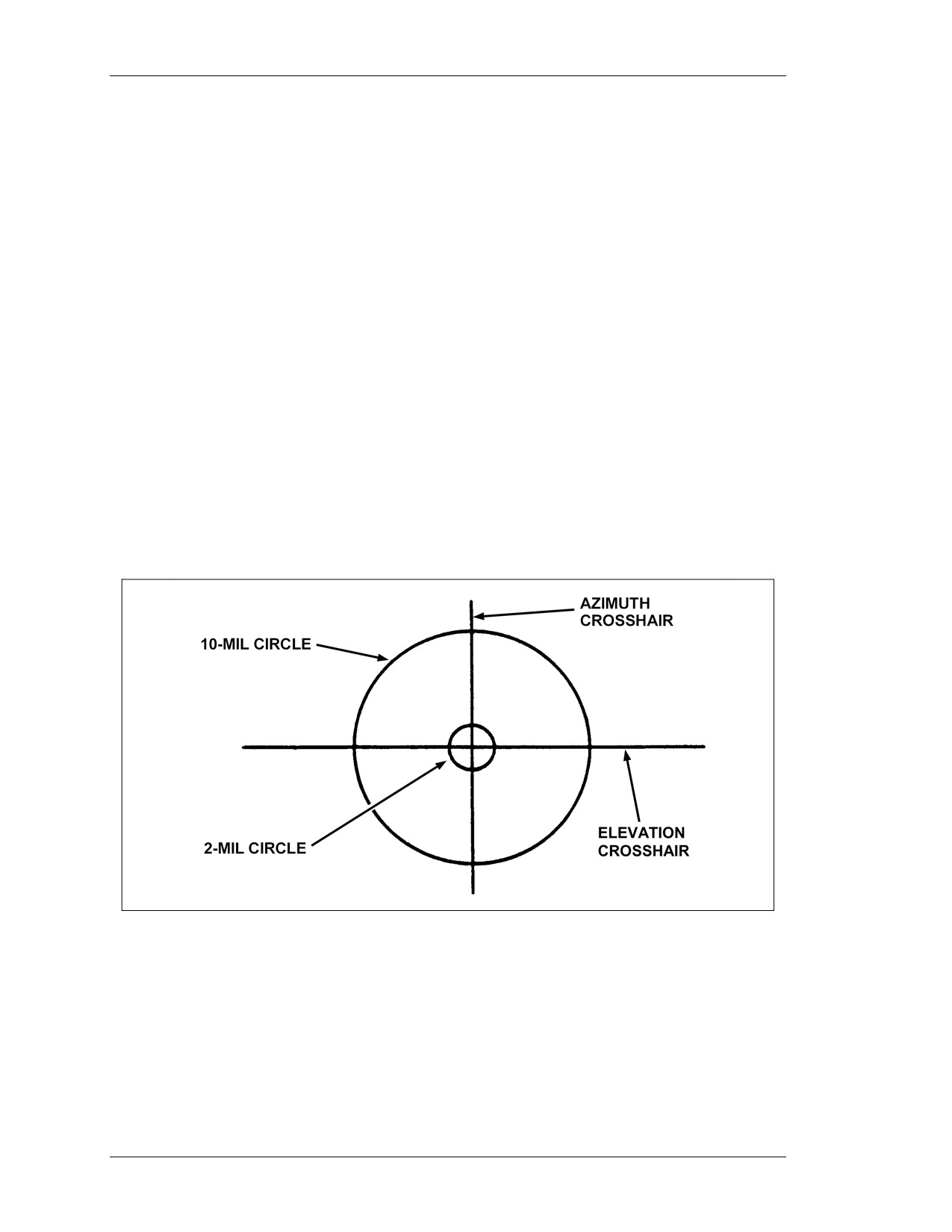
a. Boresight Telescope. Figure B-1 shows the reticle of the telescope. The reticle
has crosshairs, a 2-mil circle, and a 10-mil circle. The azimuth crosshair is the vertical
line; the elevation crosshair is the horizontal line. Use the 2-mil circle to test the accuracy
of the 25-mm boresight kit.
Figure B-1. Reticle for boresight telescope NSN 4933-00-867-6607.
(1) The telescope's
5X magnification allows the viewer to focus on any target
between 5 meters and infinity. After you have properly focused the telescope, the aiming
point of the reticle stays put, even if you move your head while looking at it.
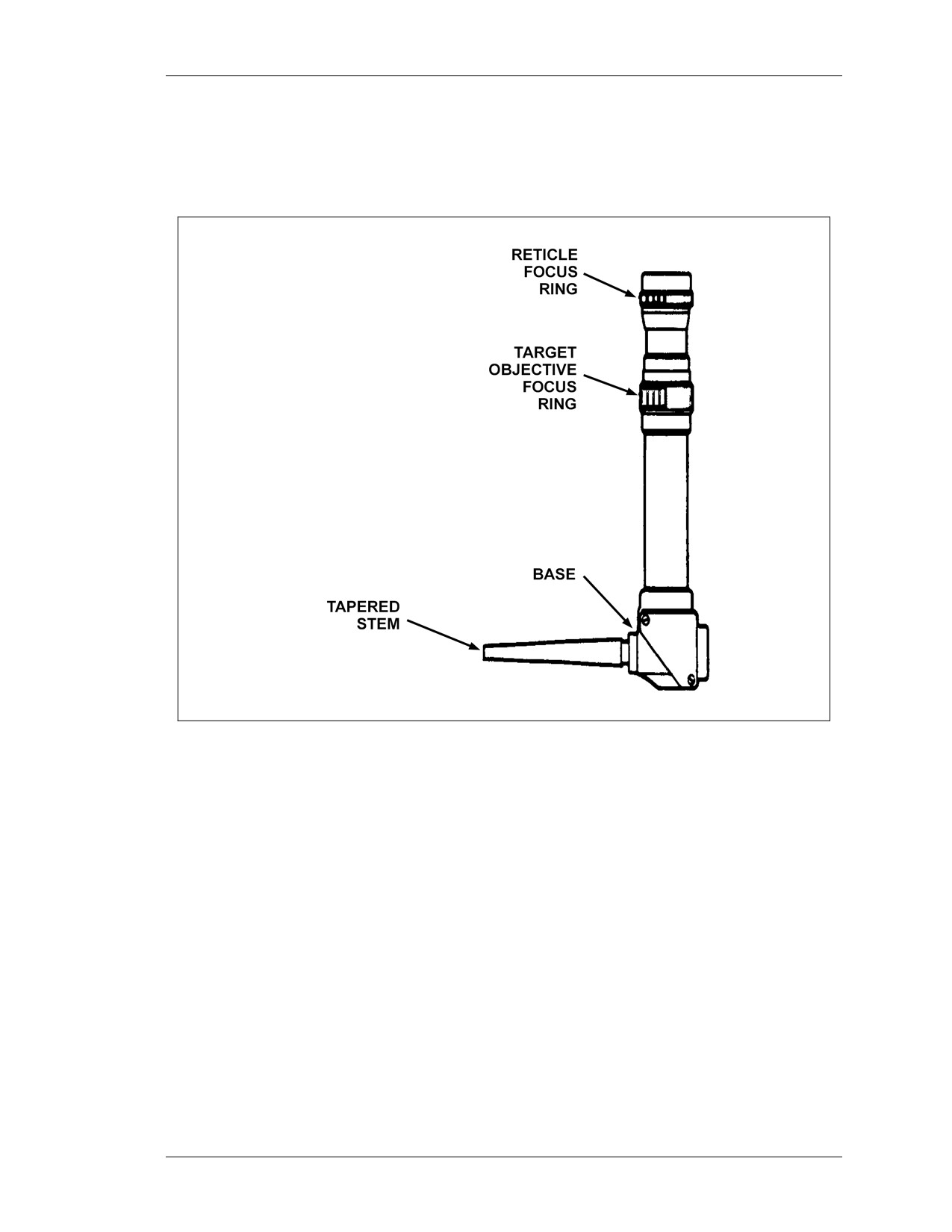
(2) Adjust the telescope's two focusing rings (Figure B-2) in the following order:
(a) Reticle-Focus Ring. Point the telescope at the sky or toward any other evenly lit
field of view. This forces you to look at the reticle rather than at a target. To focus, turn
the reticle-focus ring until the reticle appears sharp and clear.
B-2
FM 3-22.1
(b) Target Objective-Focus Ring. TM 9-2350-252-10-2 calls this ring a "vernier focus
dial." Regardless of what you call it, to adjust it, turn it back and forth until its reticle
aiming point remains the same when you move your head back and forth above
the eyepiece.
Figure B-2. Reticle-focus and target-objective-focus rings.
(3) Avoid unscrewing or disassembling the telescope itself. It is not waterproof. If it
does get wet, dry it at once. Water inside the telescope fogs the view.
(4) A plate on the base of the telescope lists the federal ordnance number and the
serial numbers. The serial number is the bottom (last) number listed.
b.
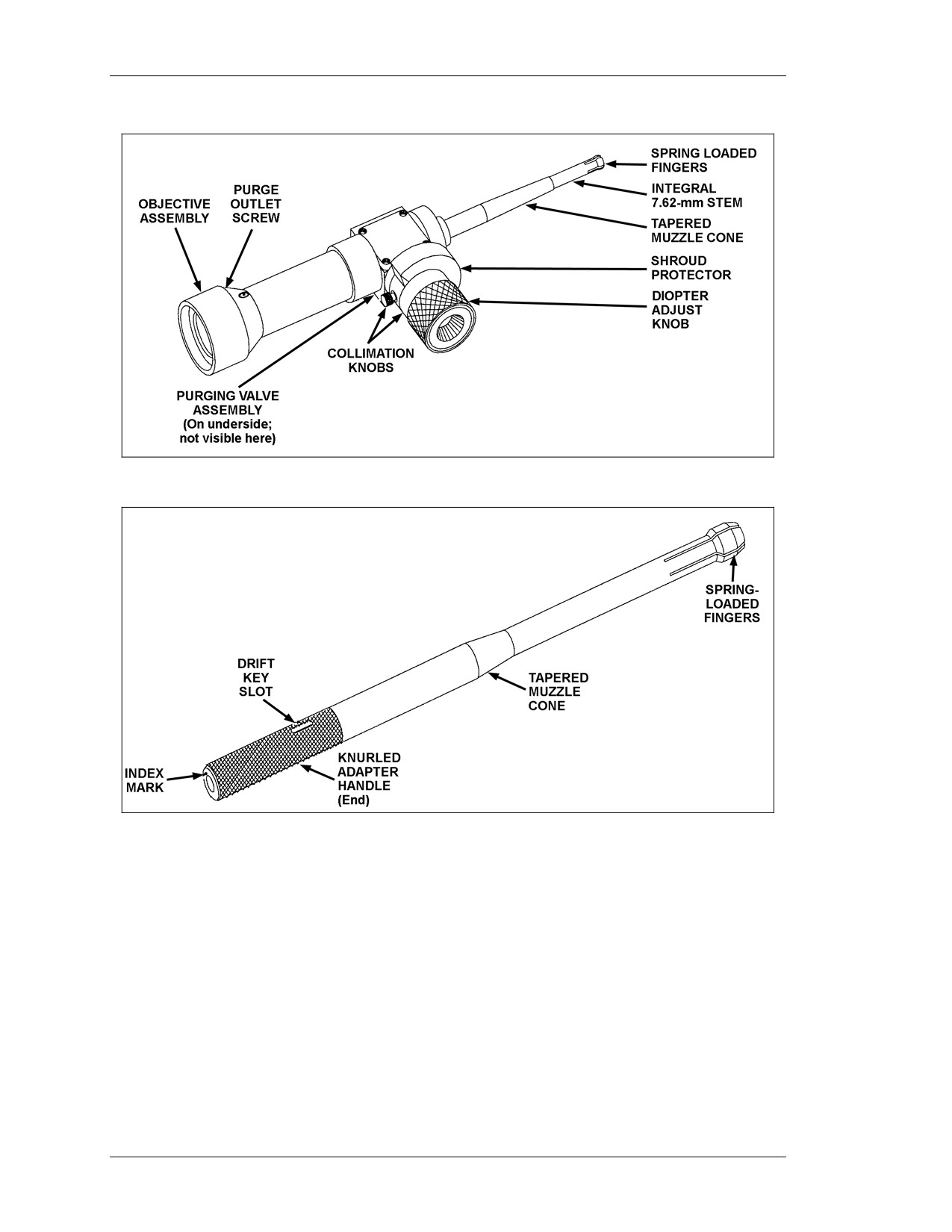
1-1000 Boresight Telescope Assembly and Integral 7.62-mm Adapter. The
tapered stem of the A3 boresight telescope
(NSN 1240-01-490-5099, Figure B-3,
page B-4) fits a 7.62-mm coax gun bore. The 25-mm adapter (NSN 1240-01-441-5410,
Figure B-4, page B-4) fits the 25-mm gun bore. Together, these two parts comprise the
boresight telescope assembly (BTA). When used properly, this 12X telescope offers a
fast, easy, and accurate way to align the gunner's sight to the axis of the gun bore.
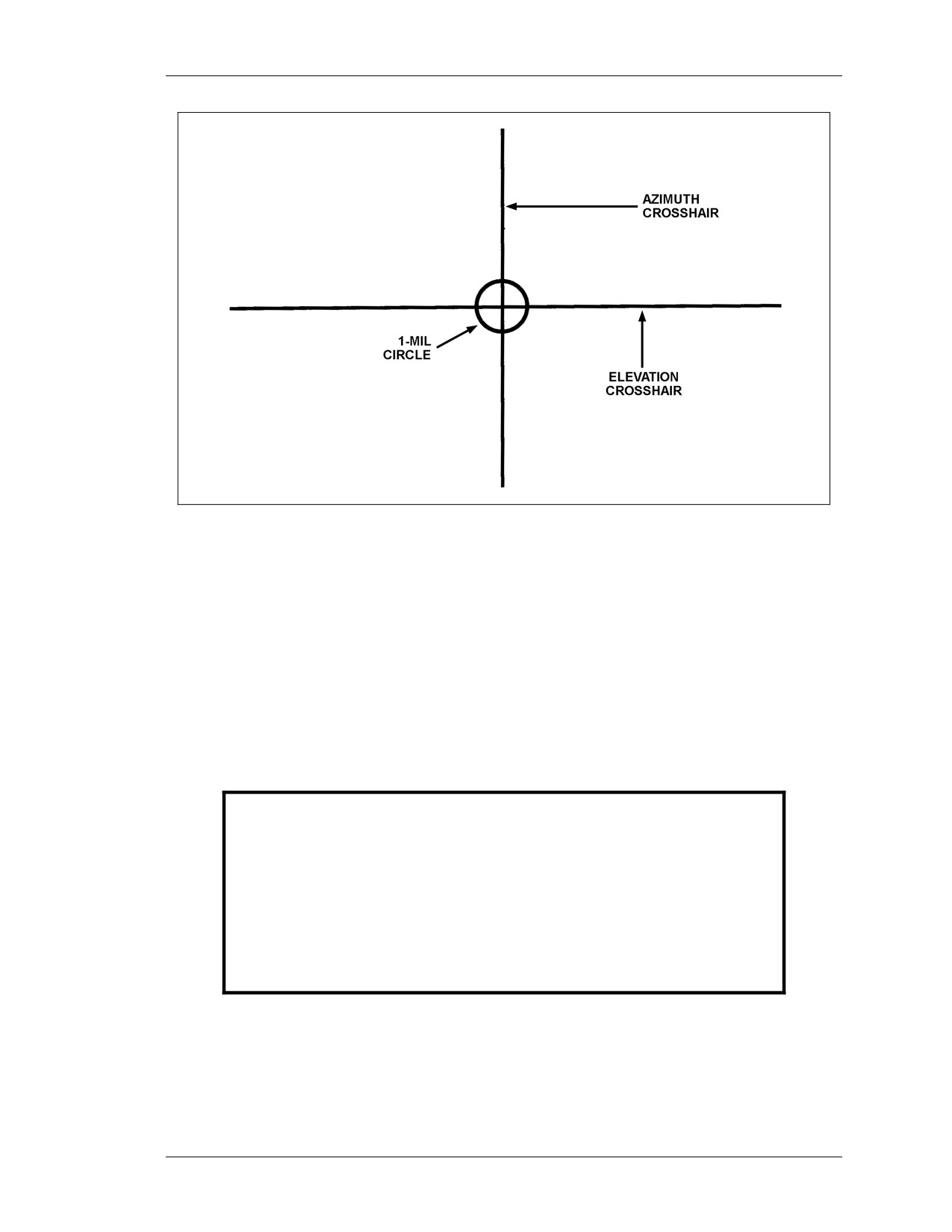
Figure B-5, page B-5, shows the reticle, which has a vertical crosshair (for azimuth),
horizontal crosshair (for elevation), and a 1-mil circle (for testing the accuracy of the
boresight kit).
NOTE: If after five or six rotations you cannot collimate the 25-mm gun using the
1-1000 telescope, then turn in the telescope to unit maintenance.
B-3
FM 3-22.1
Figure B-3. The 1-1000 boresight telescope.
Figure B-4. Adapter for the 1-1000 boresight 25-mm telescope.
B-4
FM 3-22.1
Figure B-5. Reticle for 1-1000 telescope.
(1) Objective Assembly. The objective assembly has an objective lens, an objective
cell assembly, and a lens cap with a parallax-reduction hole.
(2) Diopter-Adjustment Knob. The diopter-adjustment knob allows you to adjust the
image to plus or minus 4 diopters.
(3) Knurled Handle. Grasp the knurled handle (end) of the 25-mm adapter to install,
rotate, or remove it from the gun bore.
(4) Tapered Muzzle Cone, Each piece has a tapered muzzle cone to fit the
appropriate gun bore.
(5) Spring-Loaded Fingers. These center and secure the telescope to the adapter and
the adapter to the gun bore.
CAUTION
Only rotate the telescope itself when using it with the
7.62-mm coax, that is, when using it without the
25-mm adapter.
When using the 25-mm adapter, do not turn the telescope
itself; instead, grasp and rotate the knurled end of the
25-mm adapter.
(6) Purging Valve Assembly. The telescope has a valve assembly to purge and
charge nitrogen.
(7) Outlet Port Screw. This allows for nitrogen purging.
B-5
FM 3-22.1
(8) Index Mark. Align the red index mark (dot) on the 25-mm adapter with the
muzzle face of the gun bore.
(9) Shroud Protector. A shroud protects the collimation knobs.
(10) Collimation Knobs. Use these knobs (azimuth, elevation) to adjust the reticle
during collimation. The light port is exposed in both positions.
(11) Adapter Interface. This refers to the juncture of the
7.62-mm stem and
the adapter.
(12) Slotted Hole. This is where you will insert the drift key if the 7.62-mm stem gets
stuck in the adapter.
CAUTION
If the telescope stem gets stuck in the adapter, insert the drift
key in the slotted hole. To loosen the stem from the adapter,
work the key gently, without forcing it into the slot. Pushing
too hard would damage the fingers on the end of the
adapter stem.
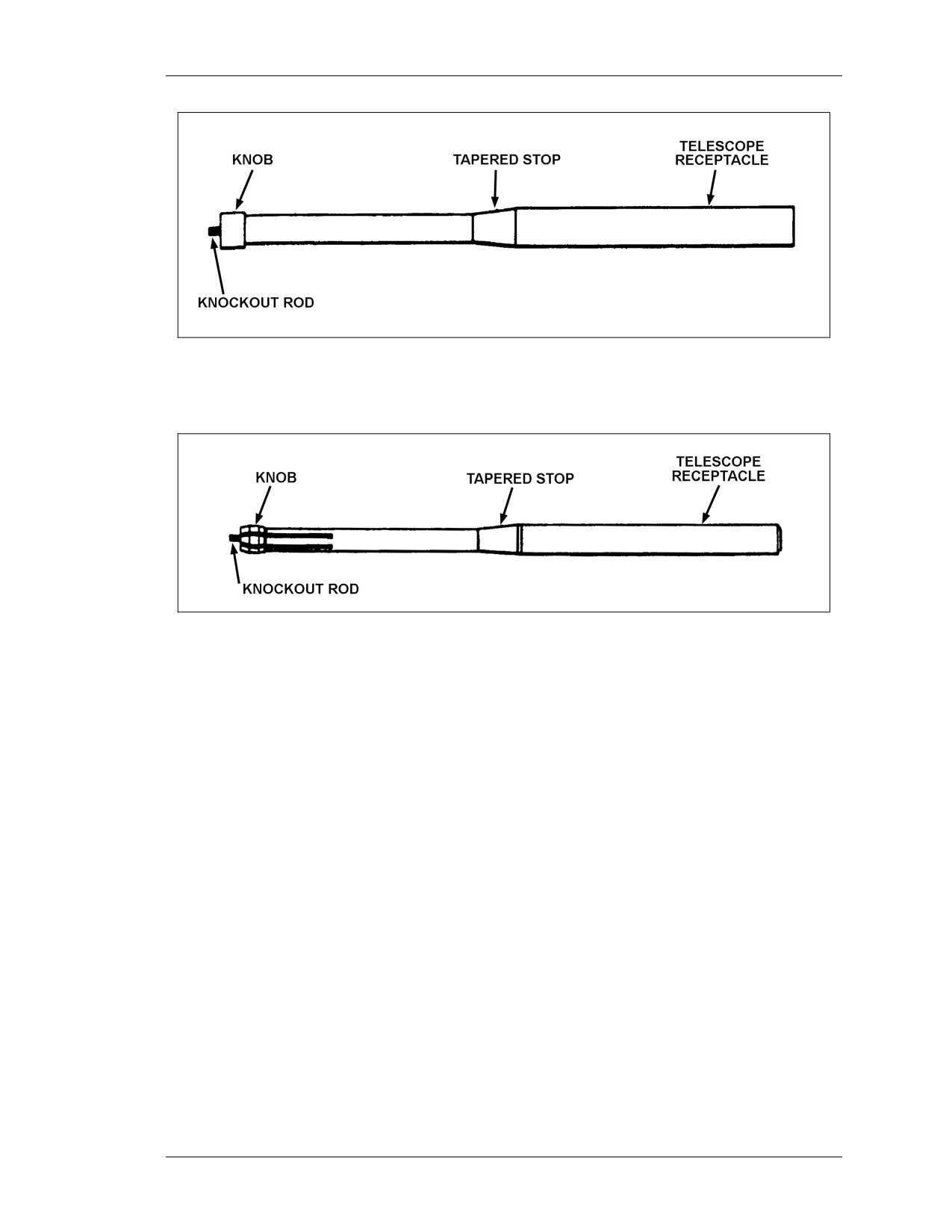
c. Older
25-mm Adapter. Figure B-6 shows the older
25-mm adapter
(PN 12524010). The knob inserts into the 25-mm gun barrel. The adapter is fully inserted
when the tapered stop contacts the end of the gun barrel. Insert the adapter slowly with a
slight twisting motion to keep it from locking in the barrel. The adapter is fully inserted
when the tapered stop contacts the end of the gun barrel.
(1) The newer adapter (PN 12524144, Figure B-7) offers improved accuracy over the
older model. On the newer one, both the plated knob and plated, tapered stop reduce
wear. Although the knob's diameter exceeds that of the bore, slots in the knob allow it to
compress (in diameter) to fit into the gun barrel.
(2) The telescope fits into the telescope receptacle on the adapter. When inserting the
telescope, hold it at the base without touching the glass lens. Insert the telescope firmly
by using a slight twisting motion. If the telescope is stuck in the adapter, gently hit the
telescope knockout rod. Hard hits on the rod could damage the telescope shaft.
CAUTION
Be careful--hitting the telescope-knockout rod too hard could
damage the telescope shaft.
B-6
FM 3-22.1
Figure B-6.
Older 25-mm adapter, PN 12524010, fits 25-mm barrel
on all BFVs through A2 ODS.
Figure B-7.
Newer 25-mm adapter, PN 12524144, fits 25-mm barrel
on all BFVs.
B-6. KIT ACCURACY TEST
Test the 25-mm kit for accuracy before you boresight the gun with it.
a. To prepare for testing, follow Steps 1 through 18 in the section entitled "Boresight
25-mm Gun" in TM 9-2350-252-10-2.
b. The kit rotation test described in this appendix differs from the turret TM’s
accuracy test. The TM prescribes two 90-degree rotations of the telescope to test its
accuracy. The 180-degree kit-rotation test described in this appendix tests the entire kit.
c. To test the accuracy of the kit, follow these steps rather than those in the
technical manual:
(1) Focus the telescope reticle using the reticle-focus ring.
(2) Focus on the target using the target objective-focus ring.
(3) Rotate the telescope so that the eyepiece faces right. If when you rotate the
telescope it slips in the adapter, hold both so that it does not.
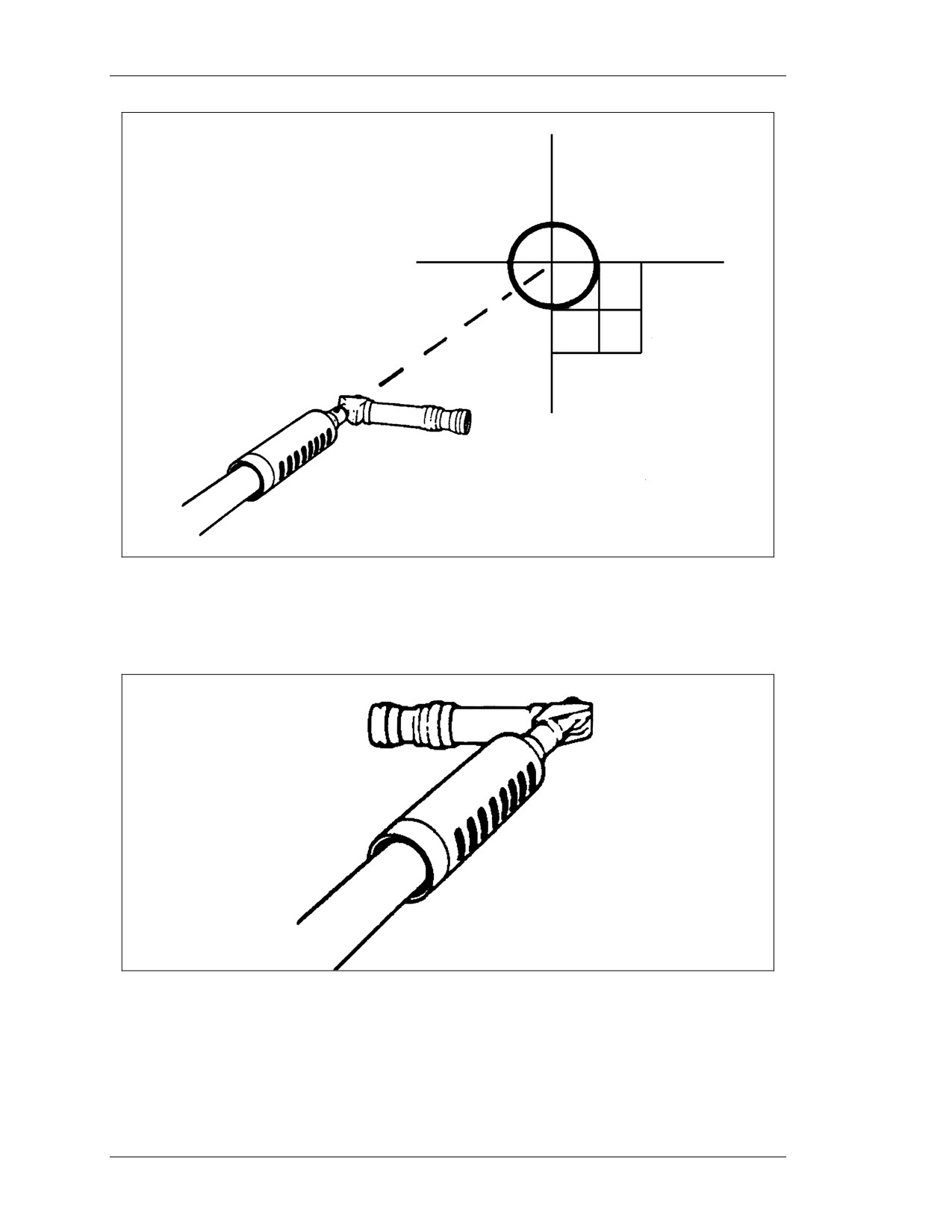
(4) Tell the gunner to lay the gun so that the telescope reticle aims at a target with a
corner such as a boresight panel or building. Figure B-8, page B-8, shows an 8-foot-
square boresight panel at 1,200 meters.
B-7
FM 3-22.1
Figure B-8. Telescope reticle aimed at a corner of boresight panel.
(5) Rotate the telescope and adapter together 180 degrees until the telescope faces left
(Figure B-9).
Figure B-9. Telescope facing to the left.
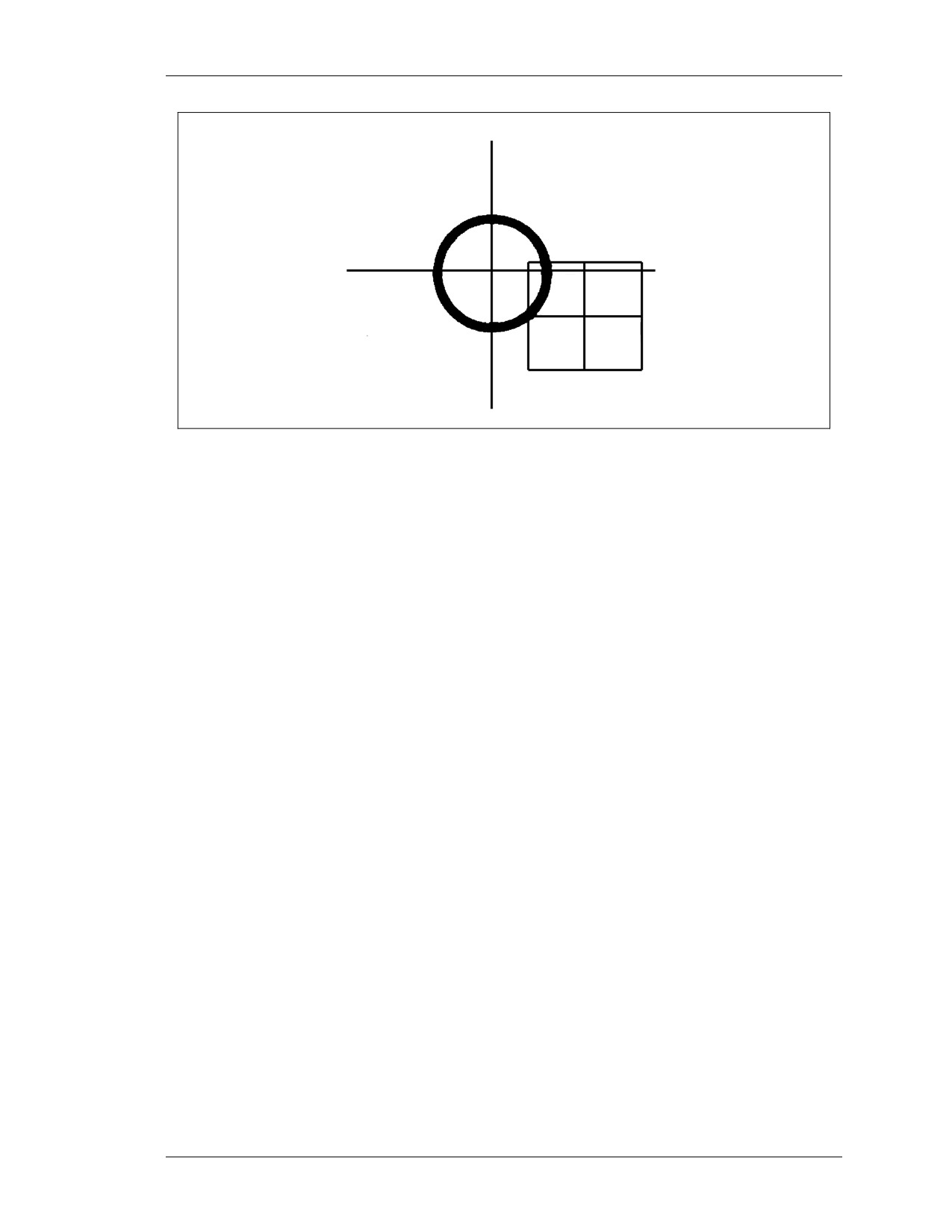
(6) Score accuracy. The kit meets standards if the original aiming point stays in or on
the 2-mil circle of the telescope reticle (Figure B-10). It fails the standards if the original
aiming point moves outside the 2-mil circle.
B-8
FM 3-22.1
Figure B-10. Aiming point in the 2-mil circle.
B-7. BORESIGHTING THE 25-MM GUN
After identifying an accurate kit, boresight weapons as described in
TM 9-2350-252-10-2, beginning with Step 23. Use both the boresight telescope and the
25-mm adapter.
B-8. PREPARATION TO SCREEN EQUIPMENT
A 25-mm boresight kit could be inaccurate due to the telescope, adapter, or both. If a
25-mm kit did not meet standards of the kit-accuracy field test, then test the telescope and
25-mm adapter separately. If a large number of kits fail to meet the standards, then the
battalion must screen all of its telescope and 25-mm adapters (Figure B-11, page B-10).
Then, it puts each accurate adapter with an accurate telescope to form accurate 25-mm
kits. Before screening equipment--
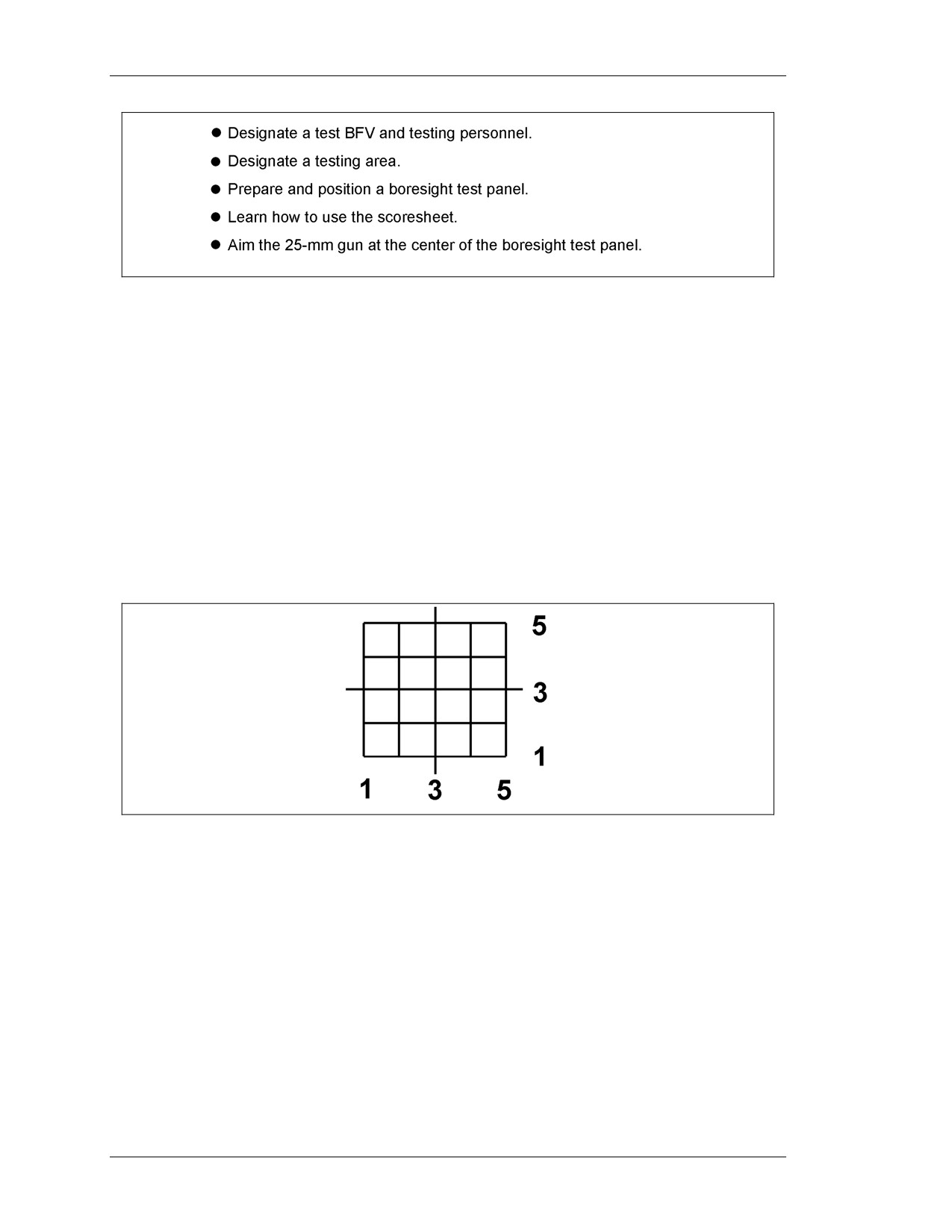
a. BFV and Testing Personnel. Use one BFV to test boresight equipment. The
25-mm gun barrel should have fired no more than 5,000 rounds, because gun erosion can
affect testing results.
(1) Two master gunners at either company or battalion level should conduct testing.
Testers should know boresighting. They should also know how to accurately obtain,
record, and score the boresight data. One tester observes aiming points of tested
equipment and the other tester records data on a standardized scoresheet (discussed later).
(2) To prevent eyestrain, testers should alternate between testing and recording.
Screening all of the boresighting equipment in a battalion may take from three to
five days.
B-9
FM 3-22.1
Figure B-11. Preparations before screening equipment.
b. Testing Area. Conduct testing close to where the boresight equipment is stored or
secured. This facilitates movement of equipment to and from the test vehicle. You will
need a 52-meter line of sight from the end of the 25-mm gun barrel to the test panel. You
can stow testing materials and equipment in the test vehicle overnight. This makes setup
easier at the beginning of each day.
c. Boresight Test Panel. Use a special test panel to test the equipment. The panel is
a scoring grid of 2-inch squares. Figure B-12 shows an example panel. Your local TSC
must produce the actual-size drawing. With the panel 52 meters from the end of the
25-mm gun barrel, each 2-inch square of the scoring grid, as seen through the boresight
telescope, measures 1 mil high and wide. This grid allows the tester to observe the
location of the boresight aiming point. The tester then records the aiming point on
the scoresheet.
Figure B-12. Example boresight test panel.
(1) The test panel has a white background. Solid 1/8-inch-wide black lines mark
squares on the panel. The length of each side of a square is 2 inches (5 centimeters).
Numbers measure 1 1/2 to 2 inches tall.
(2) If you waterproof the drawing like a map, you can staple it to a piece of plywood
and use it as a test panel. Lean it against a fence or any other rigid structure for support.
To keep the wind from knocking it down, tie the panel to the support structure in the
upright position. Be sure to locate the panel 52 meters from the 25-mm gun. It need not
sit at gun level.
B-10
FM 3-22.1
B-9. SCORESHEET
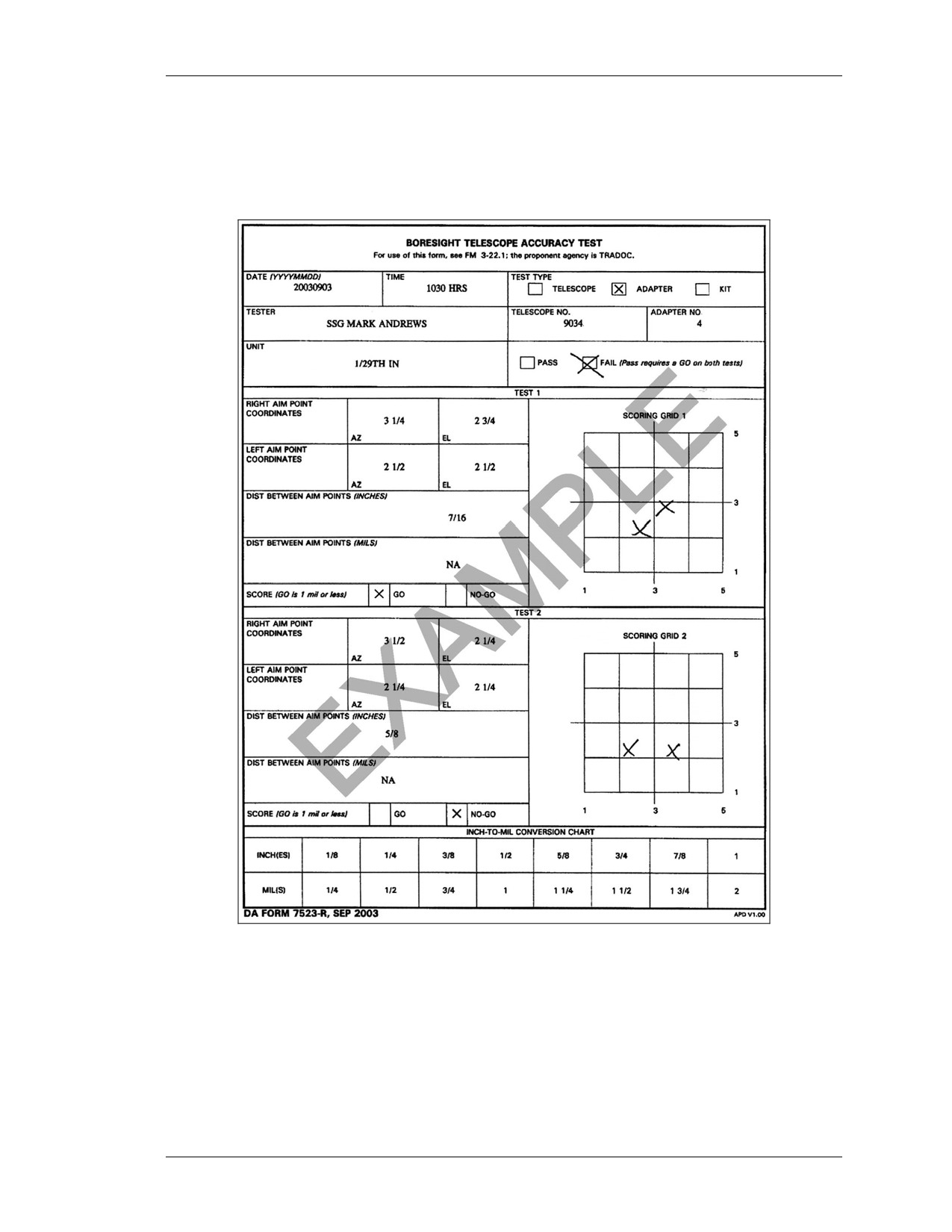
Use DA Form 7523-R to record and score boresight data as well as to screen all
equipment--adapters, telescopes, and
25-mm boresight kits. Figure B-13 shows an
example completed Boresight Telescope Accuracy Test.
Figure B-13. Example completed DA Form 7523-R,
Boresight Telescope Accuracy Test.
a. Use the information section at the top of the scoresheet to record your (the
tester's) name, when testing occurred, what you tested, and what results you obtained
(GO or NO GO). Record test data in the two screening blocks labeled TEST 1 and
TEST 2, one for each screening subtest. For equipment to pass the screening test, it must
receive a GO on both the subtests.
B-11
FM 3-22.1
b. Before testing begins, you must know how to record and plot boresight-aiming
points on the scoresheet.
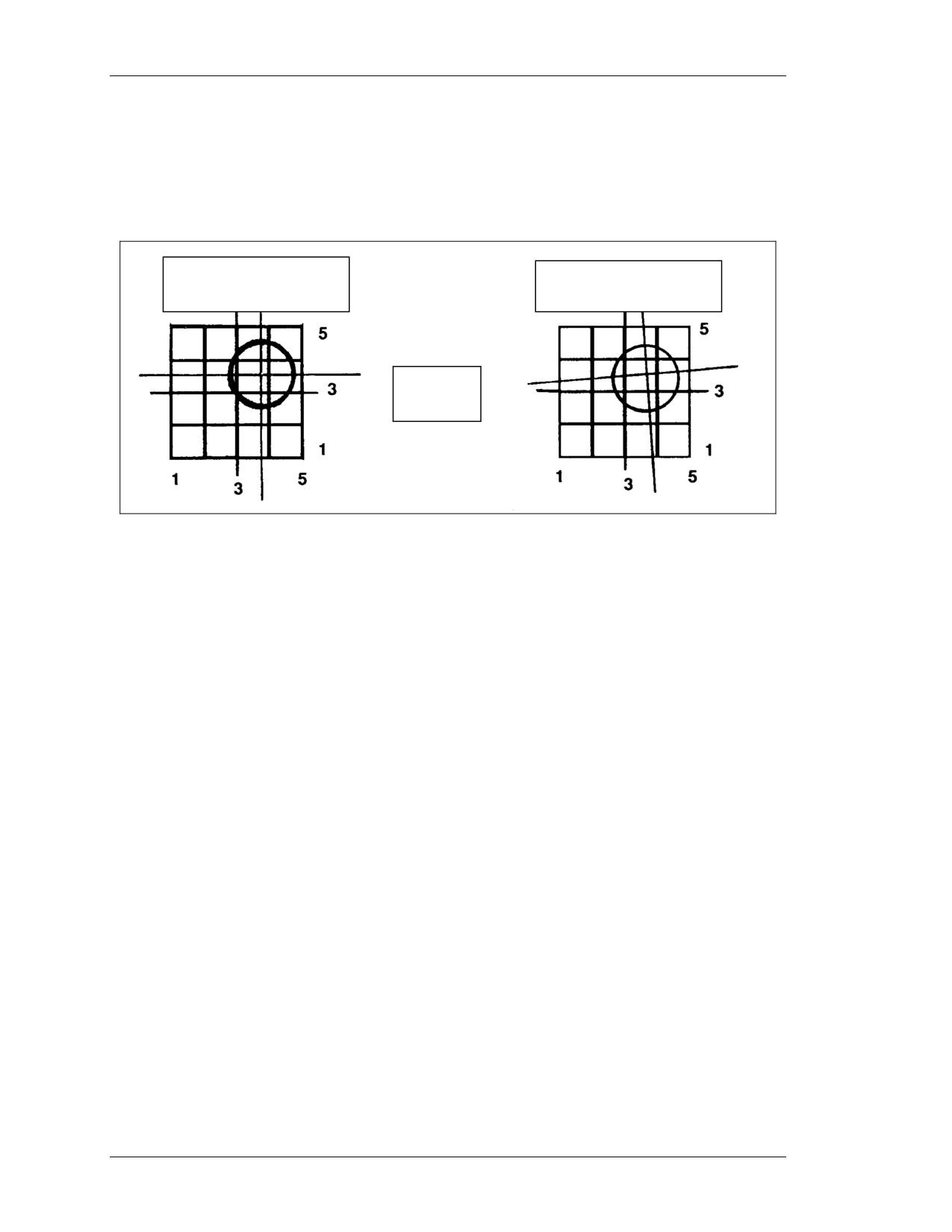
c. Before recording an aiming point, align the telescope reticle with the
scoring grid of the test panel. If the reticle is out of alignment, rotate the telescope until
you see the correct sight picture (Figure B-14).
CORRECT RETICLE
INCORRECT RETICLE
ALIGNMENT
ALIGNMENT
2 MIL
CIRCLE
Figure B-14. Reticle alignment.
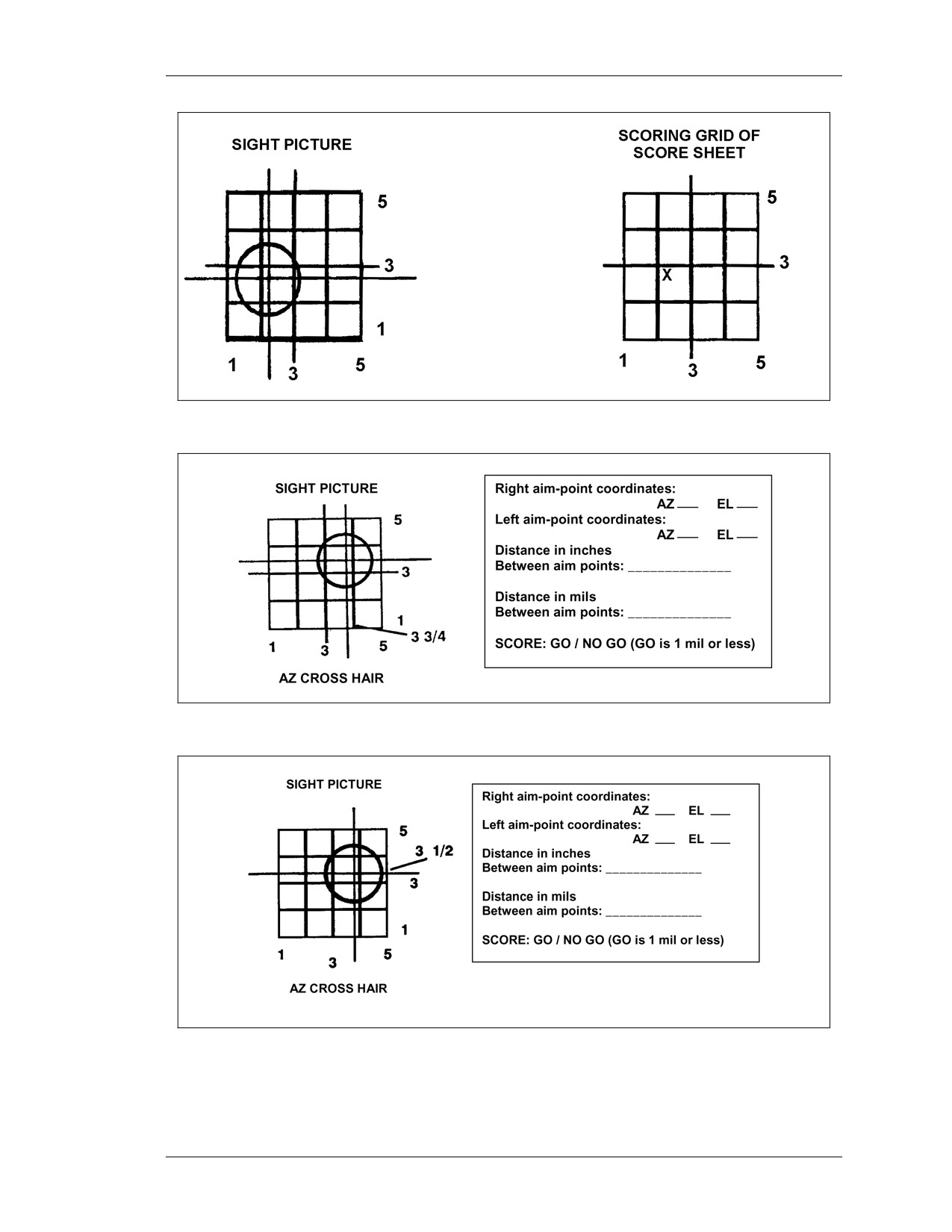
(1) Marking the Aiming Point on the Scoring Grid. One technique for observing and
plotting the telescope's aiming point is to draw an "X" on the scoring grid where the
telescope reticle aims at the panel (Figure B-15). However, the clutter between the reticle
and grid lines can make using this technique difficult.
(2) Determining Grid Coordinates for Each Aiming Point. The second technique
resembles that of using grid coordinates on a map. Determine grid coordinates for each
aiming point using the numbers along the bottom and right sides of the test panel. Read
the coordinates to the right and up, starting from the lower left-hand corner of the grid.
Take two readings for each aiming point of the telescope: an azimuth (AZ) coordinate
and an elevation (EL) coordinate.
(a) Read the right AZ coordinate where the AZ crosshair crosses the scale at the
bottom of the grid. In the example shown in Figure B-16, the AZ coordinate is 3 3/4 mils.
Record this in the RIGHT AIM-POINT COORDINATES blank in data section 1 of
the scoresheet.
(b) Read the right EL coordinate where the EL crosshair crosses the right side of the
grid. In the example shown in Figure B-17, the EL coordinate is 3 1/2 mils. Record this
in the RIGHT AIM-POINT COORDINATES blank in data section 1 of the scoresheet.
B-12
FM 3-22.1
Figure B-15. Sight picture and scoring grid.
Figure B-16. Azimuth for right aim-point coordinates.
Figure B-17. Elevation for right aim-point coordinates.
B-13
FM 3-22.1
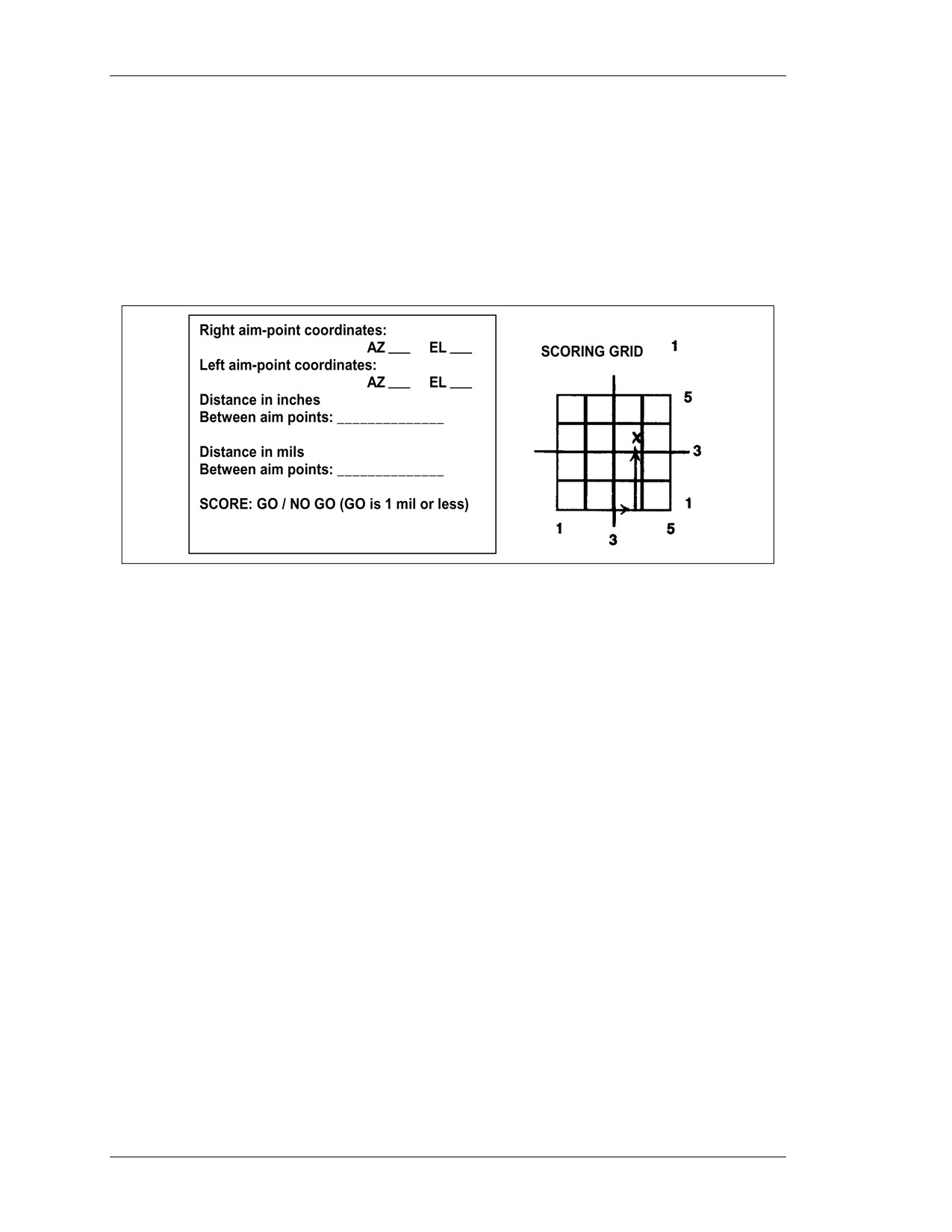
(3) Plotting Aiming Point on Scoring Grid. Plot the aiming point on the
scoring grid of the scoresheet. In this case, go right
3 3/4 mils and up 3 1/2 mils
(Figure B-18). You and another tester can practice recording boresight aiming points with
this technique by laying the 25-mm gun on different parts of the test panel. Practice
observing and recording the AZ and EL coordinates for the same aiming point. You
should be able to obtain AZ and EL readings to at least the nearest 1/4 mil. However,
taking readings to the nearest
1/8 mil produces optimal testing results and aiming
point accuracy.
Figure B-18. Plotted aiming point.
e. Gun Lay. Before testing begins, aim the gun near the center of the test panel.
This increases the likelihood that aiming points will fall on the grid during testing.
Aiming points off the grid are difficult to record and score. Lay the gun with boresight
equipment and with the turret in manual operational mode. You will need boresight
equipment scoresheet and pencil. You can lay a gun accurately with a boresight kit, if
you have one, using the following procedures:
(1) Insert the adapter into the gun barrel.
(2) Insert the telescope into the adapter with the eyepiece facing up.
(3) Tell the gunner to lay the gun so that the telescope reticle aims at the center of
the panel.
(4) Focus the telescope (Figure B-19).
• Focus the reticle using the reticle-focus ring.
• Focus on the target using the target objective-focus ring.
B-14
FM 3-22.1
Figure B-19. Reticle aimed at center of panel.
(5) The telescope is now aiming at the center of the target, but if the boresighting
equipment is inaccurate, the gun will not be aiming at the center of the target.
(6) Rotate the kit (telescope plus adapter) until the eyepiece faces to the right.
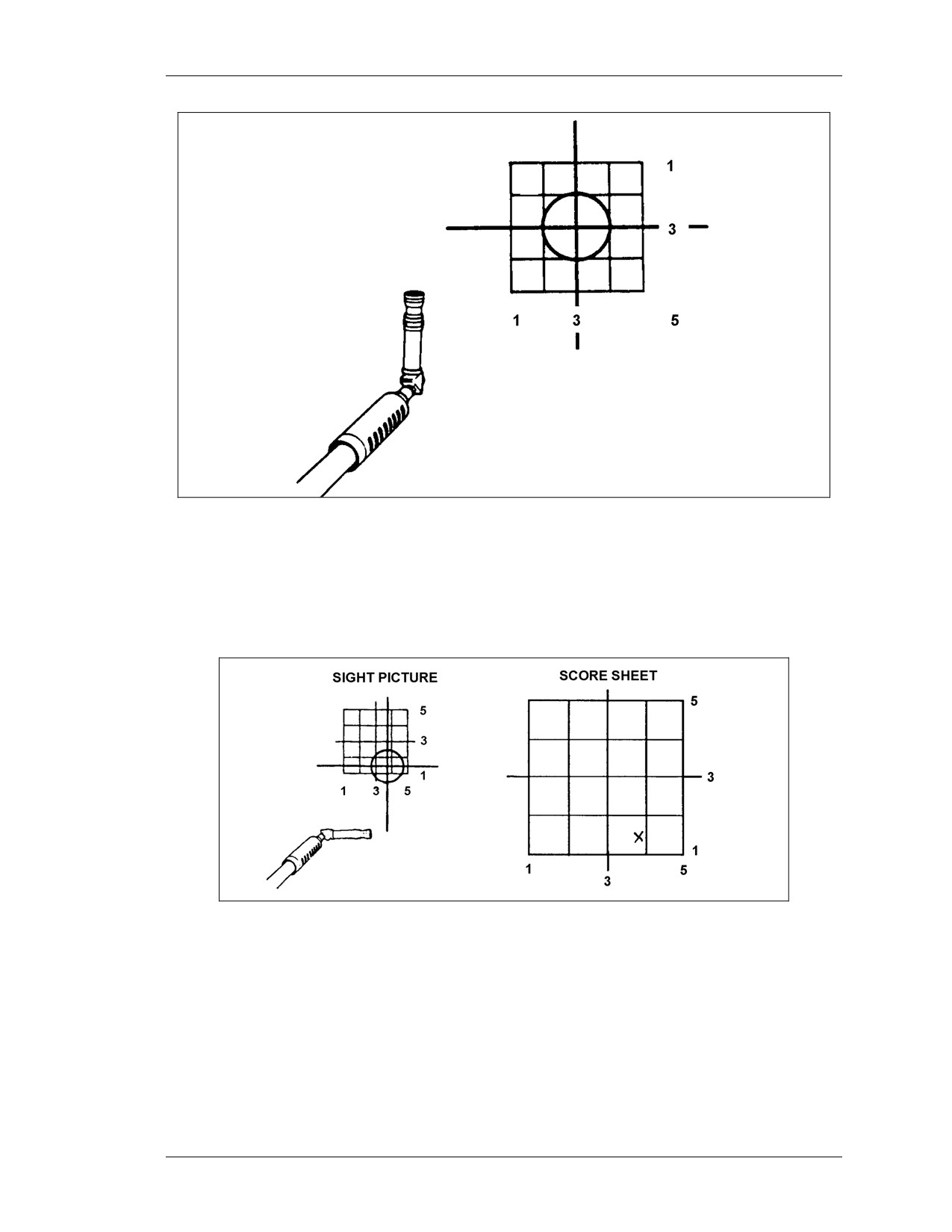
(7) Mark the aiming point on scoring grid 1 (Figure B-20).
Figure B-20. Kit right aiming point.
(8) Rotate the kit until the telescope eyepiece faces left.
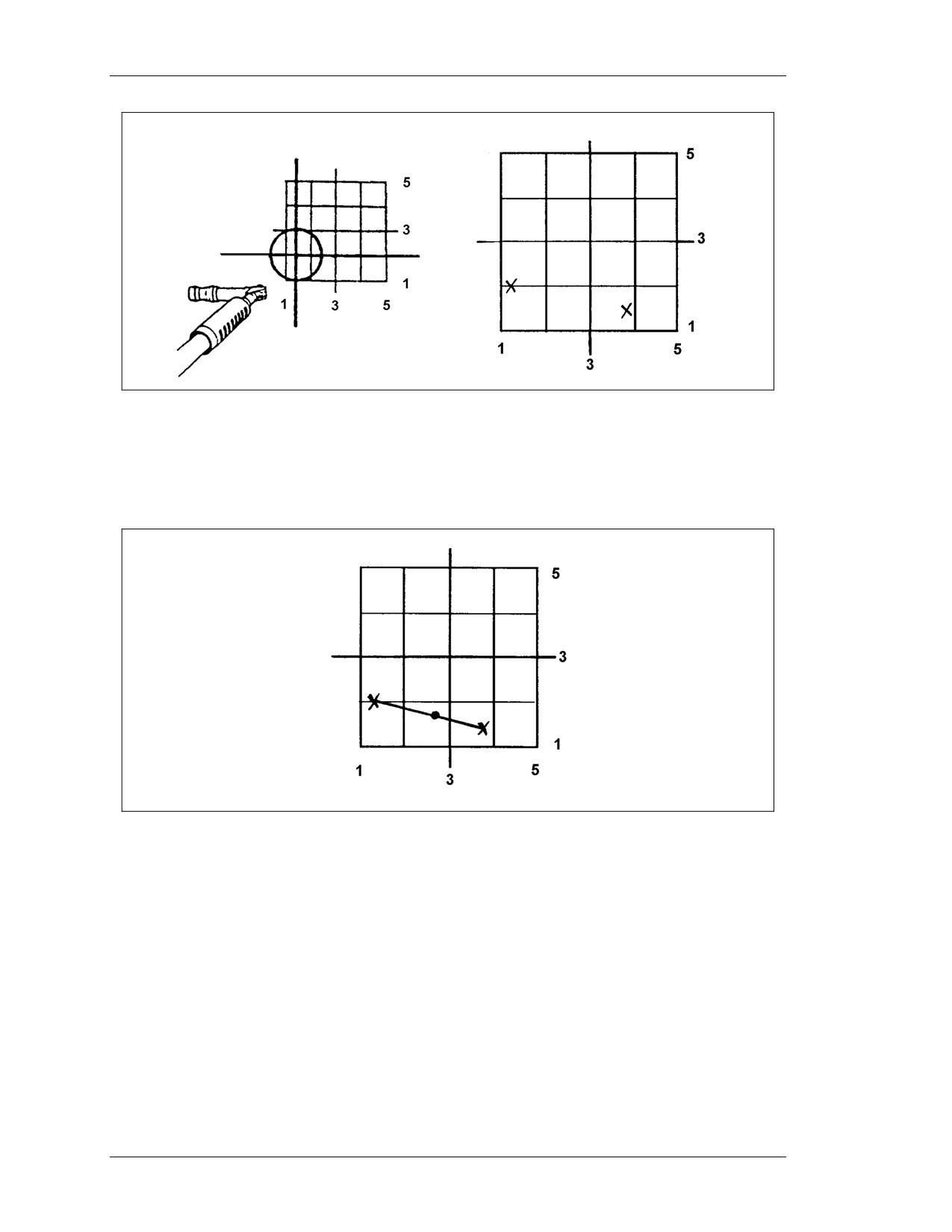
(9) Mark the left aiming point on scoring grid 1 (Figure B-21, page B-16). Taking
right and left aiming points is like using a shot group to zero a weapon.
(10) To determine the middle of the two aiming points, so you can estimate where
the gun is aiming, lay the gun on the estimated center of the panel.
B-15
FM 3-22.1
Figure B-21. Kit left aiming point.
(11) Determine aiming point of gun.
• Draw a line between the two aiming points marked on the scoresheet.
• Mark the middle of the line. This is where the gun is aiming (Figure B-22).
Figure B-22. Aiming point.
(12) Lay the gun on the estimated center of the panel.
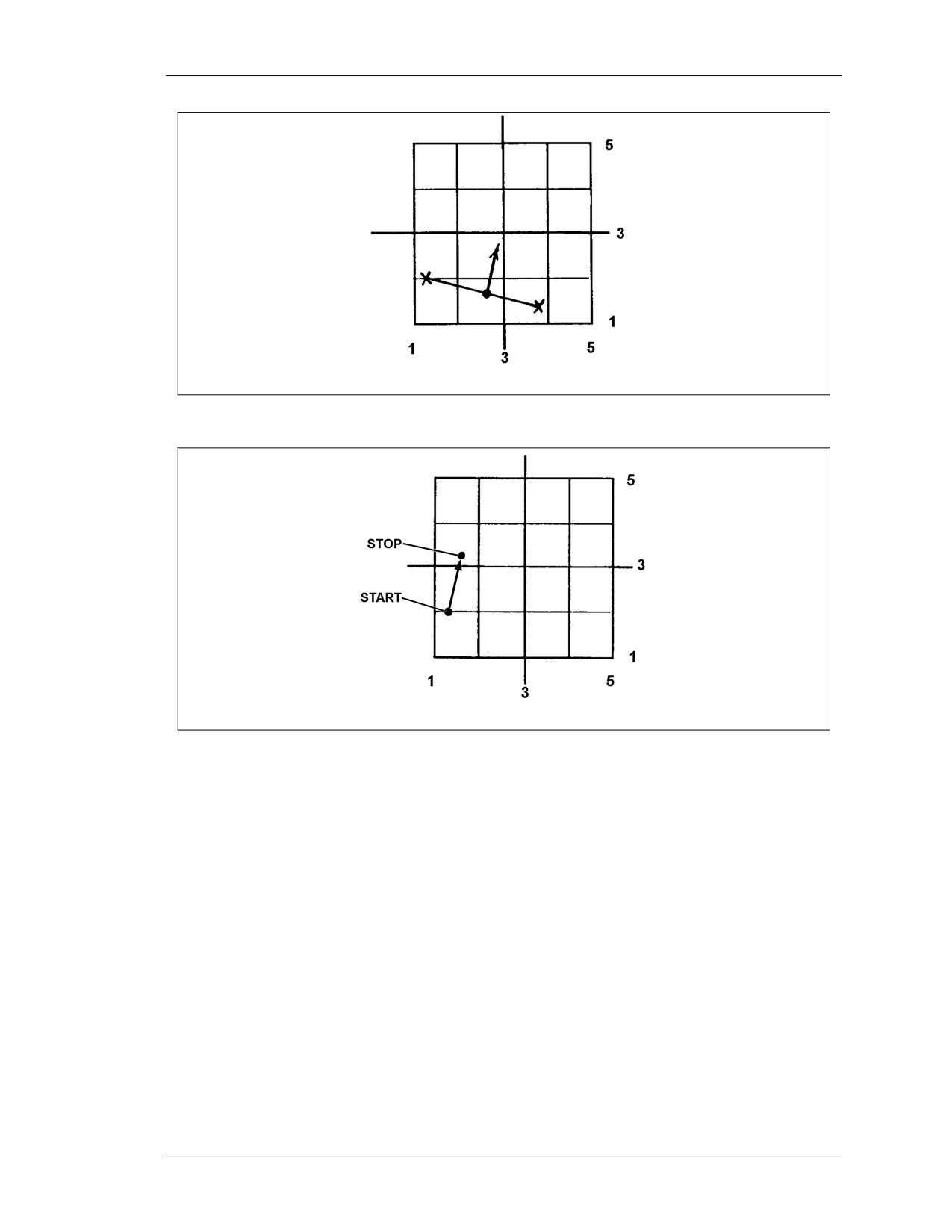
(13) Draw an arrow from the middle of the line to the center of the panel. The arrow
shows the distance and direction of the gun to target center (Figure B-23, page B-17).
(14) Helper tells the gunner to lay the gun the distance and direction shown by the
arrow from the last lay of the telescope (Figure B-24, page B-17).
(15) The example shows the start and stop points of a gun lay with the telescope
starting in the left position. In this case, the gun was moved about 1 1/4 mils in the
direction of one o'clock. You can lay the gun with the telescope in any position (left or
right), but you must move the gun the distance and direction indicated by the arrow.
B-16
FM 3-22.1
Figure B-23. Distance and direction from center.
Figure B-24. Adjusted aim point.
B-10. ADAPTER-SCREENING TEST
Adapters are tested first using an accurate telescope. New telescopes usually meet
accuracy requirements, so they are preferable for use. A new telescope can be obtained
from a new vehicle or from direct exchange for a defective telescope. A new telescope is
easy to identify as such if it is still wrapped in shipping material. However, some new
telescopes have been unwrapped, but remain unused. These will still have tape over the
eyepiece. An inspection for scratches, dirt, and fingerprints on the lens also gives a good
estimate of prior use.
B-17
FM 3-22.1
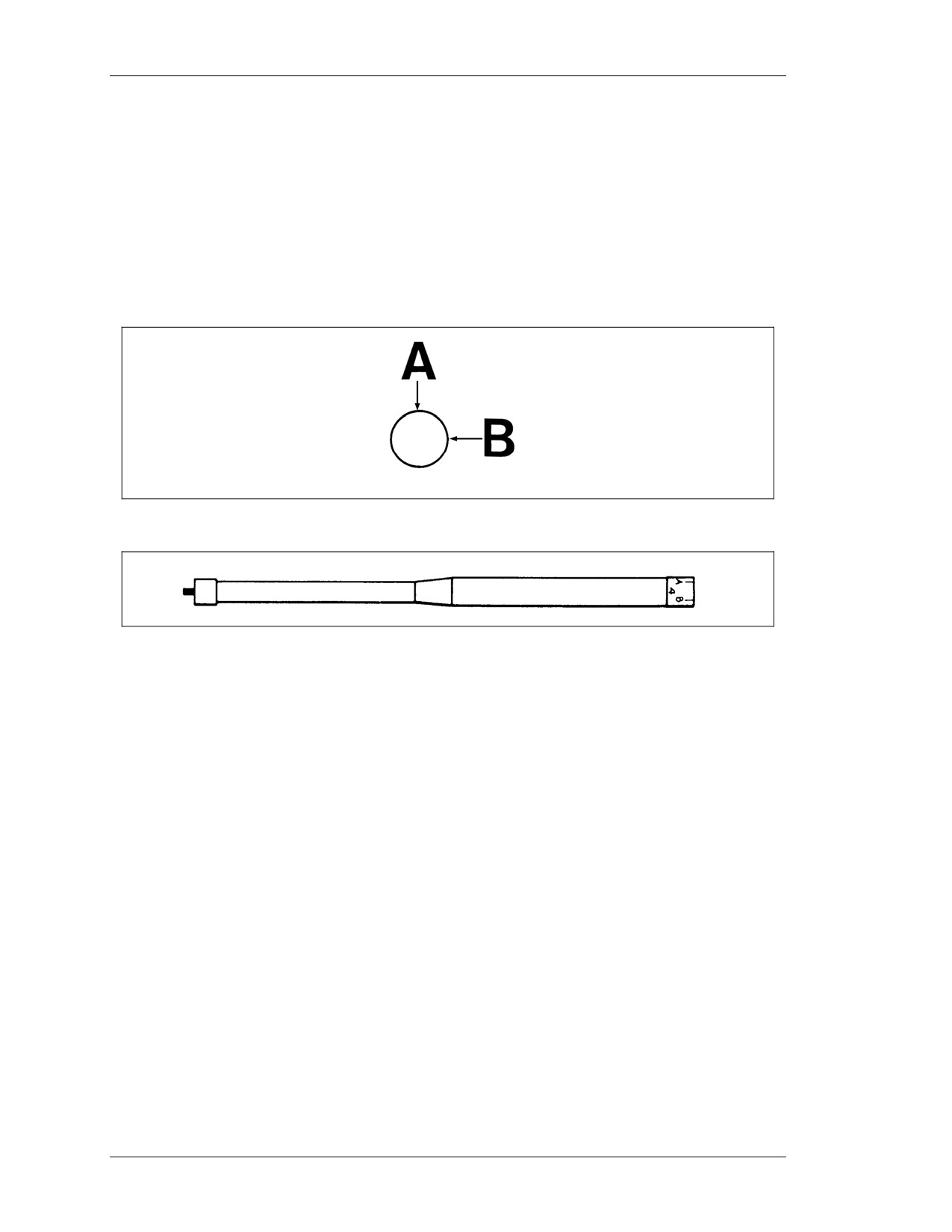
a. Mark adapters before screening. Wrap a piece of 1-inch-wide masking tape
around the telescope end of the adapter. Make position marks ("A" and "B") on the tape
to align the adapter in the barrel and the telescope with the adapter. You can use an
adapter-marking template for this (Figure B-25). If you use the template, you can also
tape it to your clipboard to hold scoresheets during testing. Place the telescope end of the
adapter on the template and on the position marks. Adapters have no permanent
identification marks, so you must add them yourself. Then you must mark an
identification number for each adapter on the tape. The example adapter shown in
Figure B-26 is marked with the number "4."
Figure B-25. Adapter-marking template.
Figure B-26. Marked adapter.
b. Begin testing when you have emplaced the vehicle and panel, aimed the gun at
the panel, marked the adapters, and obtained an accurate telescope. The data recorder
must have a set of scoresheets and a clipboard.
(1) Before testing each piece of equipment, record the date, time, unit, test type,
telescope serial number, adapter number, and your name on the scoresheet. Test type
indicates whether tester is checking an adapter, telescope, or kit.
(2) Test the adapters using the same kit-rotation procedure that you used for the kit-
accuracy field test. Begin testing with the telescope facing right. Observe and record the
reticle's aiming point on the scoresheet. Rotate the adapter and telescope together
one-half turn (180 degrees), until the eyepiece faces left. Record this aiming point on
the scoresheet.
(3) Test each adapter twice. This provides a more reliable estimate of accuracy.
Record data for the first test in the TEST 1 section of the scoresheet; record data for the
second test in the TEST 2 section. The tests differ only in the adapter's position in the gun
barrel. The following describes a sample test:
(a) Insert the
25-mm adapter into the gun barrel with the position mark "A"
facing right.
(b) Insert the telescope into the adapter with the eyepiece facing right.
B-18
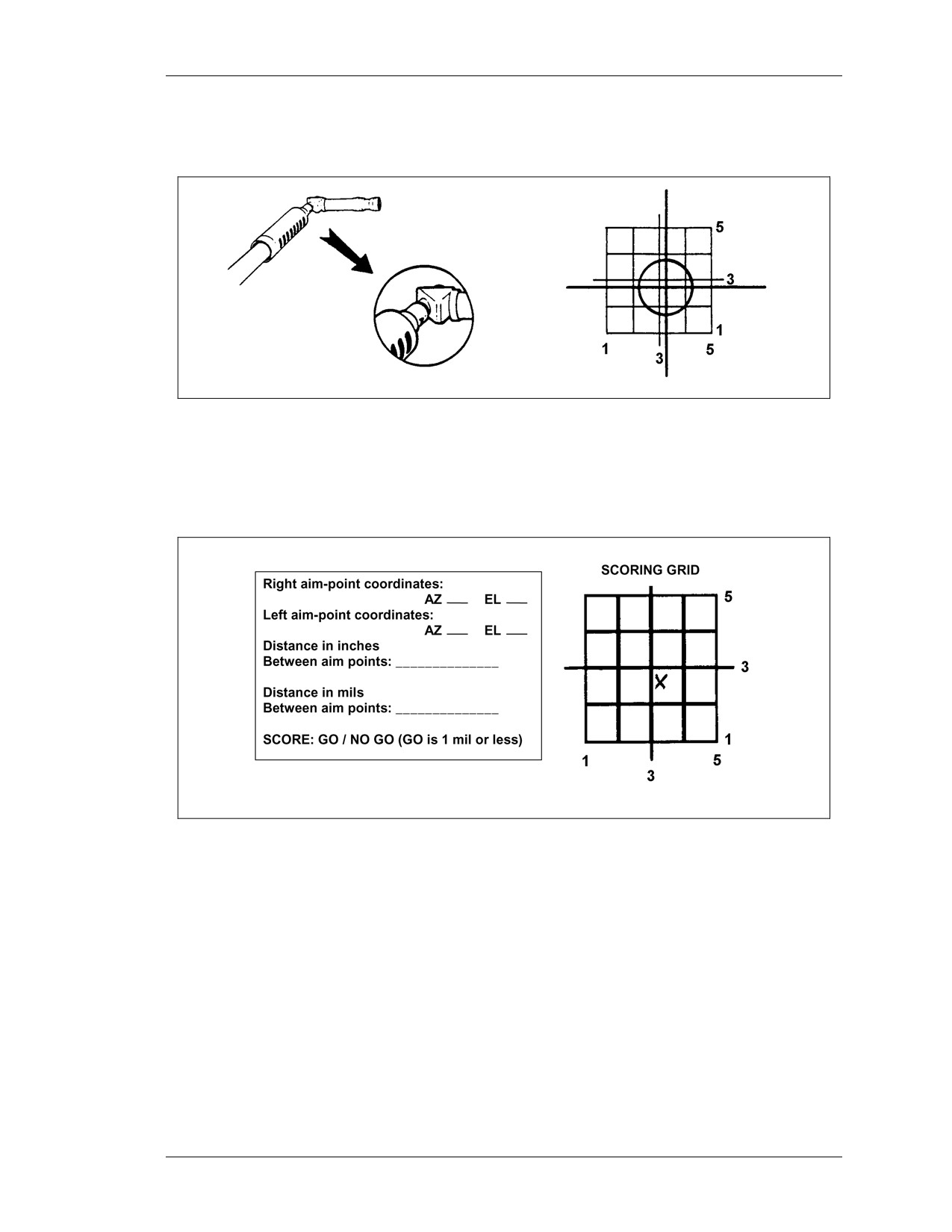
FM 3-22.1
(c) Estimate the AZ and EL coordinates for the aiming point. For this example, the
AZ coordinate is 3 3/4, and the EL coordinate is 2 3/4 (Figure B-27).
Figure B-27. Azimuth and elevation with adapter to the right, at mark "A."
(d) Record the AZ and EL coordinates in the RIGHT AIM-POINT COORDINATES
block of scoring grid 1 on the scoresheet.
(e) Plot the right aiming point for TEST 1 on scoring grid 1 (Figure B-28).
Figure B-28. Right aiming point as recorded on scoresheet.
(4) Ideally, plot an aiming point after recording its AZ and EL coordinates in the data
section on the scoresheet. Two testers collect data and record the aiming points.
(a) The tester observing the aiming point reads the AZ and EL coordinates to the
other tester, who records them on the scoresheet.
(b) Using the AZ and EL data on the scoresheet, the observer plots the aiming point
on the scoring grid.
(c) The observer compares the scoresheet and sight picture to check the accuracy of
the recorded aiming point data.
(5) Now that the testers have taken TEST 1's right reading, they must take the
left reading. During kit rotation, maintain the position of the telescope in the adapter. If
B-19
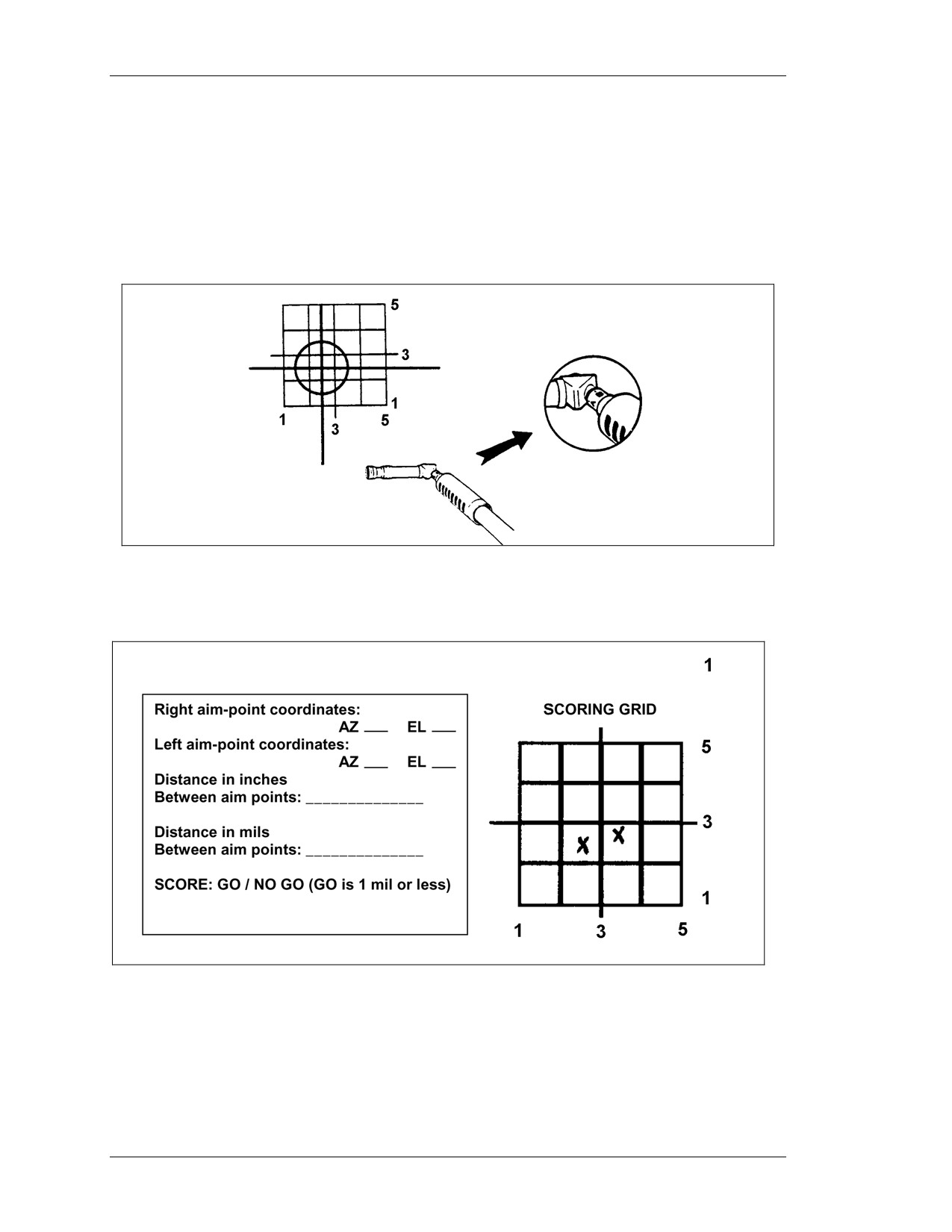
FM 3-22.1
the telescope slips in the adapter while rotating the kit, make sure that the adapter's
position mark "A" faces left before you record the aiming point.
(a) Rotate both the telescope and the adapter until the eyepiece faces left
(Figure B-29).
(b) Record the AZ and EL coordinates of the aiming point in the LEFT AIM-POINT
COORDINATES blank in data section 1 of the scoresheet. In the example, the AZ
coordinate is 2 1/2, and the EL coordinate is 2 1/2.
Figure B-29. Azimuth and elevation with adapter to the left, at mark "A."
(c) Plot the left aiming point for TEST 1 on the scoring grid 1 (Figure B-30).
Figure B-30. Left aiming point as recorded on scoresheet.
(6) TEST 1 of the adapter is now complete. Conduct TEST 2 just like TEST 1, except
that, before testing, you must align the telescope with the adapter's position mark "B."
(a) Rotate the adapter until mark "B" faces right.
B-20