3-22.1 (FM 23-1) BRADLEY GUNNERY (NOVEMBER 2003) - page 8
FM 3-22.1 (23-1)
CHAPTER 10
Cavalry Section Advanced Tables
This chapter provides the procedures and standards the trainer needs
to evaluate the cavalry section's advanced gunnery tables. It refers to
ARTEP 17-57-10-MTP simply as "the MTP," except to distinguish it from
other MTPs.
Section gunnery includes two tables for training and qualification
(Figure 10-1).
These tables combine gunnery and tactical training and MTP
operations and gunnery tasks from the MTP. They also train and evaluate
the section's ability to execute its METL, and to engage and destroy
multiple targets
(stationary and moving) using turret weapons and
indirect fires, in both good and limited visibility.
Each series of tactical and gunnery tasks replicates potential battlefield
conditions. All scout platoons perform reconnaissance and security
missions. Each mission includes unit and individual tasks. A successful
section gunnery program trains all the tasks that support the unit's METL.
Limited range resources require commanders to train individual and
collective tasks before they train gunnery tables. The MTP outlines the
steps needed for a unit to establish a successful training program.
Cavalry Section
Application
Page
Advanced Gunnery Tables
BT IX
Control and
10-5
Scout Section Training
distribute direct
fire to destroy
enemy targets
in a tactical
scenario
BT X
Integrate fire
10-10
Scout Section Qualification
and maneuver;
engage moving
targets with
CFV-mounted
weapons, day
and night.
Figure 10-1. Scout section firing tables.
10-1. PRINCIPLES OF TRAINING
When developing the section's gunnery program, the commander should remember these
principles of training from FM 7-0:
• Train as you will fight or support.
• Make commanders and leaders the primary trainers.
• Train using appropriate doctrine.
• Use performance-oriented training.
10-1
FM 3-22.1
• Use mission-oriented training.
• Train to fight and support as a combined arms and services section.
• Train to sustain proficiency.
• Train to challenge.
10-2. PURPOSE OF GUNNERY TABLES
The scout section gunnery tables train and evaluate Bradley-equipped scout sections.
These gunnery tables test the scout section's ability to conduct reconnaissance and
security missions and to engage stationary and moving targets. In any tactical scenario,
leaders focus on the scout's primary mission of collecting and reporting information. The
commander must also evaluate the scout's ability to use his combat resources (direct- and
indirect-fire assets) effectively, while remaining undetected on the battlefield.
a. The commander can use the example scenarios in this paragraph to design his
own tables, depending on resources available and the unit's training needs. This
flexibility ensures that each unit receives the training it needs for its scout section to
function effectively.
b. To maintain tactical emphasis throughout the scout section tables, each table has
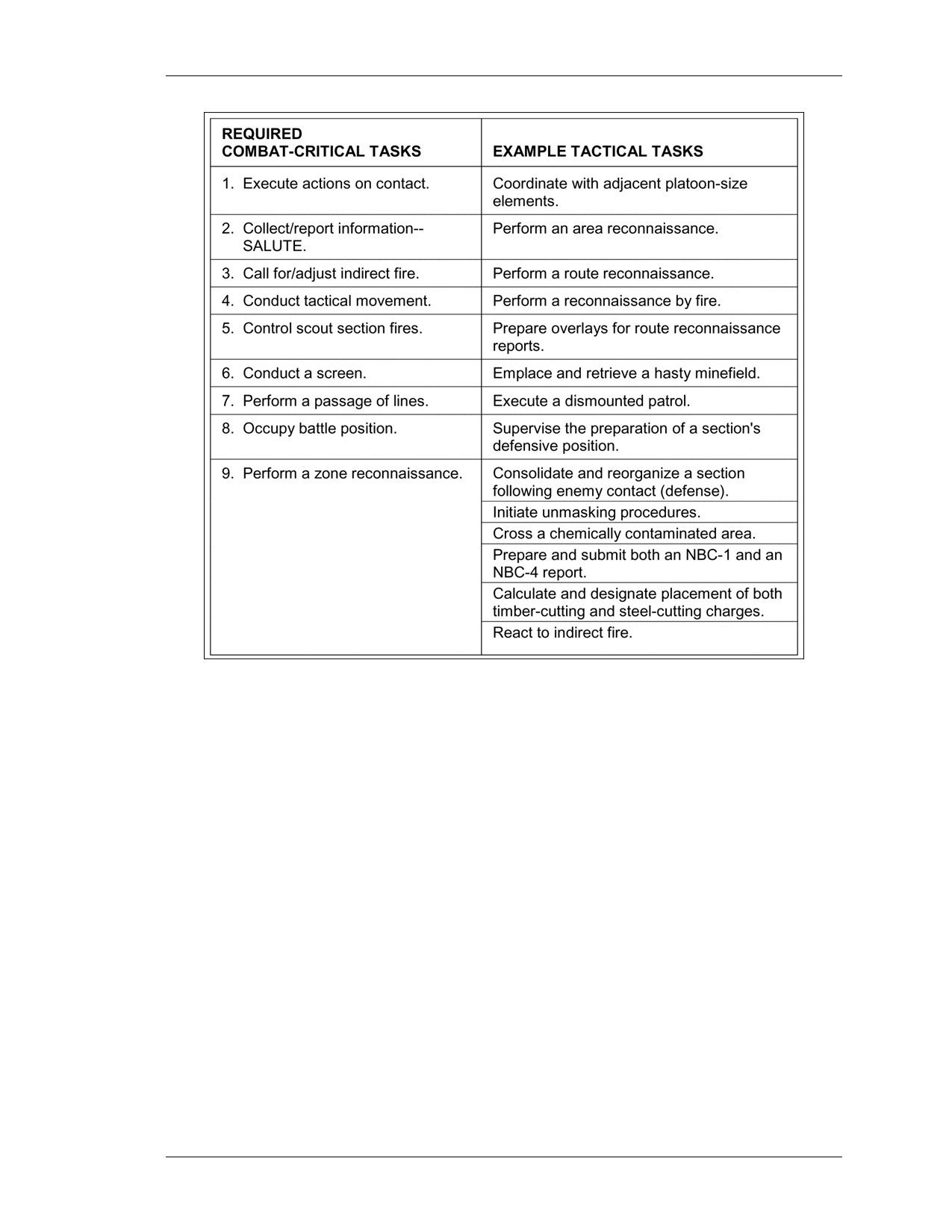
nine mandatory, combat-critical tasks and at least three tactical tasks, which the
commander selects
(Figure 10-2 shows the task list). The tactical tasks comprise
60 percent of each table; the other 40 percent are Bradley gunnery tasks. Sections are
formally evaluated on tactics and gunnery tasks.
10-2
FM 3-22.1
Figure 10-2. Combat-critical and example tactical tasks.
c. The MTP is the primary source the commander uses to develop the performance
checklists he will use in the tactical portions of the tables. To develop performance
checklists from tasks other than those in the MTP, he uses unit SOPs and other FM s.
10-3. EVALUATION PROCEDURES AND STANDARDS
The following evaluation procedures and standards apply to section gunnery. They allow
sections to train and practice the skills normally performed in combat. Evaluators use
AARs to critique sections after they complete the tables. They do not rate crew duties
(Appendix F) on these tables; however, a section does receive a penalty if an individual
scout squad fails to perform tactically sound maneuvers or to hit the targets:
a. Evaluation Procedures. Evaluators use the performance checklists in the MTP to
evaluate scout sections on tactics. If the commander selects any tactical tasks other than
those in Figure 10-2, he must develop a performance checklist for each. He bases the
checklist(s) on the MTP.
b. Start Time. Engagement times give the evaluator a tool for evaluating section
engagements, which start--
(1) When the first section vehicle on the move is exposed to the threat.
10-3
FM 3-22.1
(2) When the first section vehicle in the defense stops in a hull-down position or fires
the first round. Depending on the tactical scenario, target-exposure times should allow the
section to report and determine the most desirable course of action (that is, indirect fire).
c. Stop Time. Three conditions determine engagement stop times.
(1) The section leader announces CEASE FIRE; all section vehicles have returned to
the defilade position.
(2) All targets are killed.
(3) All section vehicles return to defilade positions for the final time.
d. Alibi Criteria. Chapter 8 lists acceptable alibi criteria.
e. Evaluation Standards. Terrain, weather, and distance between engagements
dictate course time. Tactical tasks can be conducted at a nearby training area and
combined with the gunnery portion if range areas are too small for tactical maneuvering;
however, this is an exception. Commanders should integrate the tactical and gunnery
tasks to maximize the training effectiveness of these tables. The section must achieve, as
a minimum--
(1) A GO on 70 percent of the tactical tasks on the scout section tables--equal to
420 points on each table.
(2) A
70 percent target kill rate on gunnery tasks during each table--equal to
280 points on each table.
10-4. SCORING PROCEDURES
Each table uses a 1,000-point system for the areas of tactics and gunnery.
a. Tactics. Tactics count
60 percent (600 points), so total points fall between
1 and 600. Evaluators use the performance checklists in the MTP. The commander may
adapt these checklists to more accurately reflect his METL. To calculate total points, he
uses the tactical-evaluation formula shown in Figure 10-3. Depending on the METL's
importance, he can assign point values to each task.
TACTICS EVALUATION -- PERCENTAGE SCORE
Divide the number of tactical tasks passed (TP) by the number of tactical tasks
evaluated (TE). Multiply the result by 100.
Example: If TP = 29 and TE = 31, then (29 ÷ 31 = .94) X 100 = 94%
TACTICS EVALUATION -- POINTS EARNED
Divide the number of tactical tasks passed (TP) by the number of tactical tasks
evaluated (TE). Multiply the result by 600 (possible tactical points).
Example: If TP = 29 and TE = 31, then (29 ÷ 31 = .94) X 600 = 564
The resulting number equals the number of points awarded for the tactical
evaluation of the tables. (Round up .5 and above; round down .4 and below.)
Figure 10-3. Tactical-evaluation formula.
b. Gunnery. Gunnery counts 40 percent (400 points), so total points must fall
between 1 and 400. The commander and evaluator use the gunnery-evaluation formula
shown in Figure 10-4 to calculate points IAW established destruction criteria for each
weapon system and for all target presentations, to include the following:
10-4
FM 3-22.1
• BFV-mounted weapons.
• Indirect fire.
• Dismounted engagements.
GUNNERY EVALUATION -- PERCENTAGE SCORE
Divide the number of targets destroyed (GD) by the number of targets presented
(GP) and multiply the result by 100.
Example: If (GD) = 40 and (GP) = 48, then (40 ÷ 48 = .83) X 100 = 83%
GUNNERY EVALUATION -- POINTS EARNED
Divide the number of targets destroyed (GD) by the number of targets presented
(GP). Multiply the result by 400 (possible gunnery points).
Example: If (GD) = 40 and (GP) = 48, then (40 ÷ 48 = .83) X 400 = 332
The resulting number equals the number of points awarded for the gunnery
evaluation of the tables. (Round up .5 and above; round down .4 and below.)
Figure 10-4. Gunnery-evaluation formula.
10-5. RATINGS
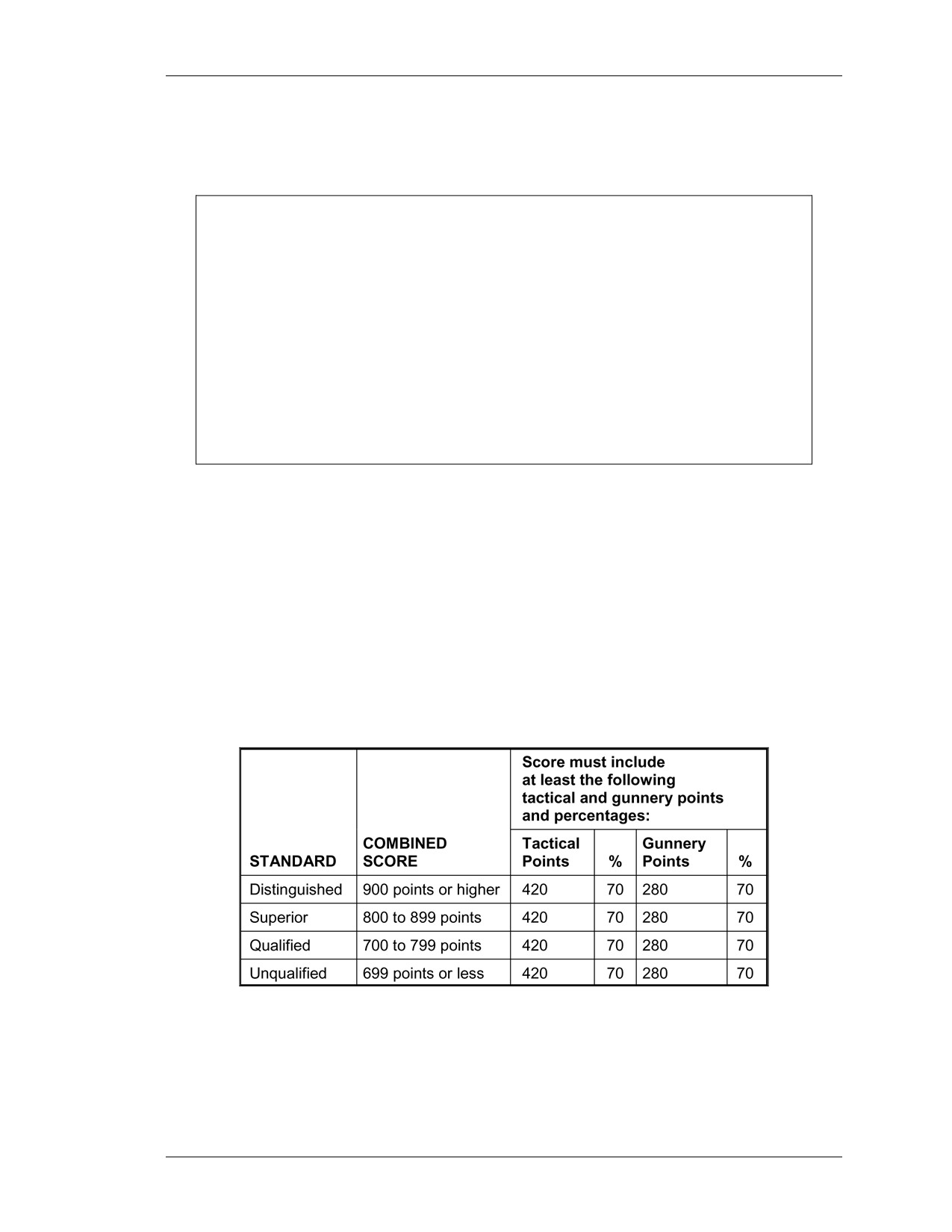
Leaders rate sections based on the following standards (Figure 10-5):
a. Distinguished. Section earns a combined score of 900 points or higher, which
must include at least 420 (70 percent) tactical and 280 (70 percent) gunnery points.
b. Superior. Section earns a combined score of 800 to 899 points, which must
include a minimum of 420 (70 percent) tactical and 280 (70 percent) gunnery points.
c. Qualified. Section earns a combined score of 700 to 799 points, which must
include a minimum of 420 (70 percent) tactical and 280 (70 percent) gunnery points.
d. Unqualified. Section earns a combined score of 699 points or less, or it fails to
achieve 420 (70 percent) tactical points or 280 (70 percent) gunnery points.
Figure 10-5. Scoring standards.
10-6. TARGETS
Target arrays should reflect the type of threat forces a section will normally encounter.
FM 17-98 describes these forces in detail for both reconnaissance and security missions.
10-5
FM 3-22.1
Based on the METL, the commander determines the number and types of targets to be
engaged. At no time will the number of targets exceed the number of rounds allocated by
DA Pam 350-38. Also, during each table phase, at least three 25-mm targets will be
presented for each live-firing vehicle. This is due to the loading requirements of the
M242 25-mm automatic gun.
a. Thermal Targets. In all cases, thermal targets should represent the accurate
thermal signatures of threat vehicles.
b. Target Signature. When appropriate to the scenario, hostile fire simulators can
simulate the threat vehicle(s) firing at the section.
c. Target-Exposure Time. The tables use the following target-exposure times:
(1) Targets in indirect-fire engagements are presented for 90 seconds.
(2) All offensive (direct-fire) engagements are presented for 50 seconds (day) or 60
seconds (night).
(3) All defensive (direct-fire) engagements are presented in depleting target arrays for
40 seconds (day) and 50 seconds (night).
NOTE: If troop targets are presented in a defensive engagement, they are also
presented in the final target array.
10-7. BRADLEY TABLE IX, SCOUT SECTION TRAINING
The scout-section table trains and evaluates tactical and gunnery skills. It prepares section
members for scout-section qualification. The commander can conduct this table with live
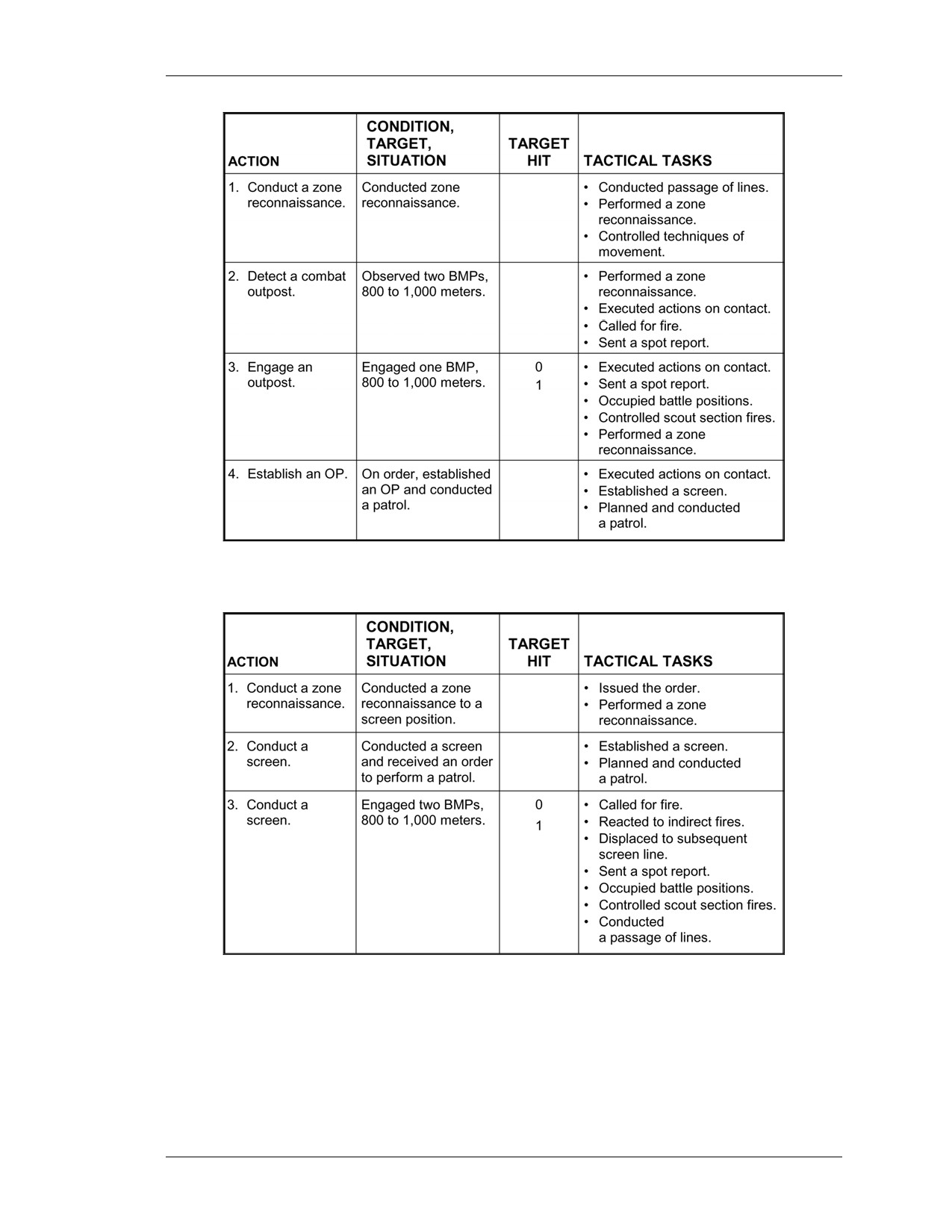
fire or lasers. It must include, at a minimum, the nine combat-critical tasks, three tactical
tasks
(selected by the commander), and the required percentage of gunnery tasks
(Figures 10-6 and 10-7).
a. Prerequisites. Before the scout section can fire Scout Table IX, they must meet
the following conditions:
(1) Each crew in the section must have qualified within the previous six months. Due
to crew turnover, the crew should fire the training and qualification tables immediately
after they qualify as a crew. If one crewmember leaves before the section fires Scout
Table IX, that crewmember's vehicle can fire Scout Table IX, but it may do so only in
dry-fire status.
(2) Each vehicle crewmember must have passed the BGST IAW Appendix A.
10-6
FM 3-22.1
Figure 10-6. Example Bradley Table IX, Scout Section Training (Day).
Figure 10-7. Example Bradley Table IX, Scout Section Training (Night).
10-7
FM 3-22.1
b. Requirements. Each scout section must receive a passing score on the section-
training table
(Scout Table IX) before it can fire the section-qualification table
(Scout Table X).
c. Action. The scout section conducts a reconnaissance mission, security mission, or
both. It acquires, reports, and employs accurate direct and indirect fires to engage targets
in a tactical array.
d. Conditions. The scout section uses reconnaissance and engagement techniques
against threat targets. Moving and stationary targets appear individually and
simultaneously. The table must include at least one NBC engagement and one auxiliary
sight engagement.
e. Standards. The crew earns gunnery points IAW the gunnery evaluation formula
in Figure 10-4. Crews are evaluated on their engagement techniques. Tactical standards
must adhere to the MTP.
f. Conduct of the Range. Depending on the availability of maneuver area and
range time, the scout section can use MILES or PGS and fire its training table at a local
training area, or they can fire full-caliber gunnery at a range facility. The commander
must decide, based on range time availability and his design of the section tables, the
most appropriate location to conduct the table: MILES- or PGS-conducted tables, force-
on-force engagements, or target lift mechanisms with LTID.
(1) Tactical Tasks. The unit commander must select at least three METL tasks to
train and evaluate along with the nine combat-critical tasks. He must then develop a
friendly and threat scenario so he can evaluate the tasks in a realistic tactical training
setting. The training area should measure at least 1 by 2 kilometers. Evaluators use
performance checklists to record tactical evaluation.
(2) Gunnery Tasks. The gunnery tasks for the scout section training table can include
a live-fire, MILES, or PGS table. Neither the number of targets nor the rounds allocated
can exceed the total number allowed by DA Pam 350-38.
(a) Live-fire gunnery works best, but range and maneuver area constraints might
require separate conduct of the tactical and gunnery portions of the table. Commanders
should try to integrate tactical and gunnery tasks.
(b) Units may use device-based gunnery to train before a major gunnery table. Time,
training area, range facilities, and ammunition available determine the commander's
method of training.
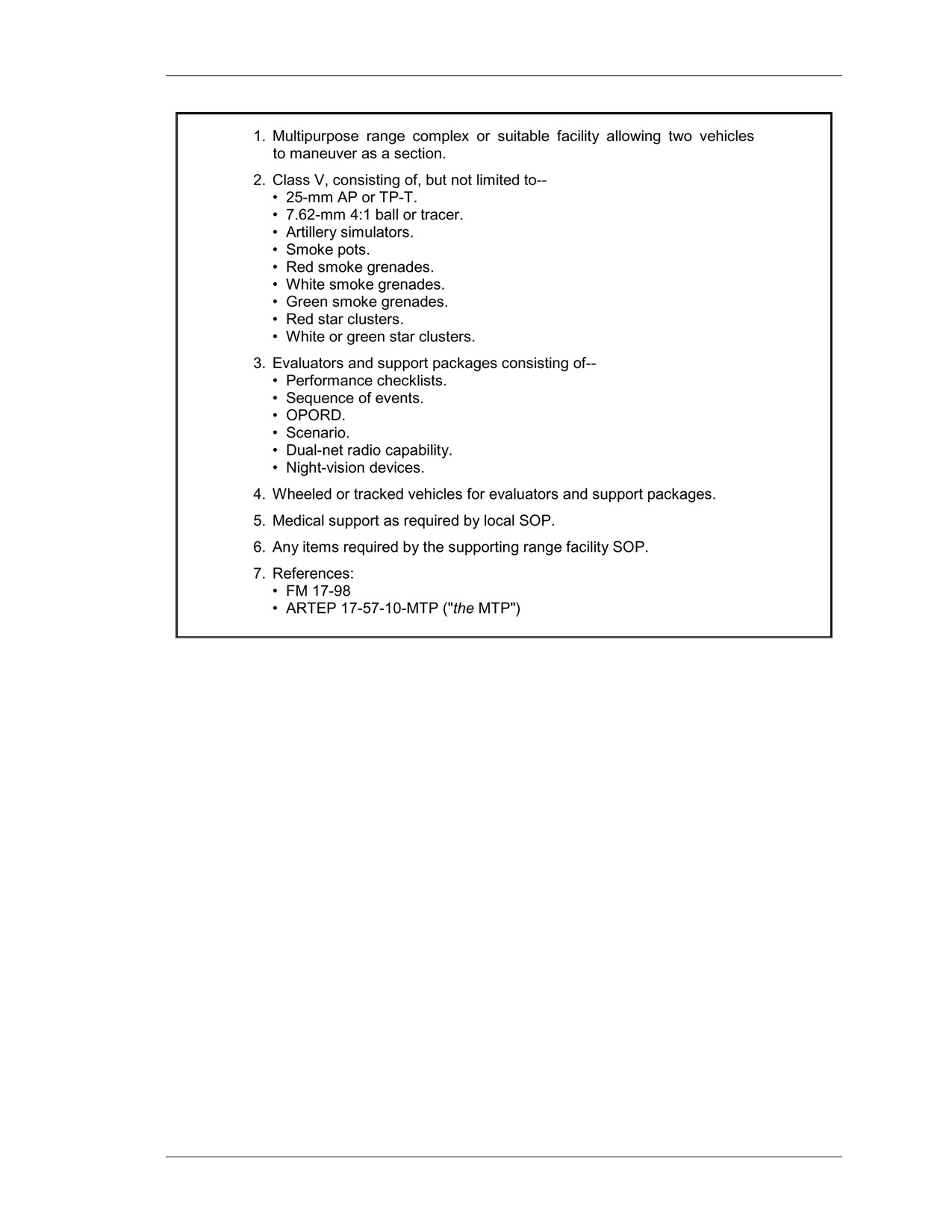
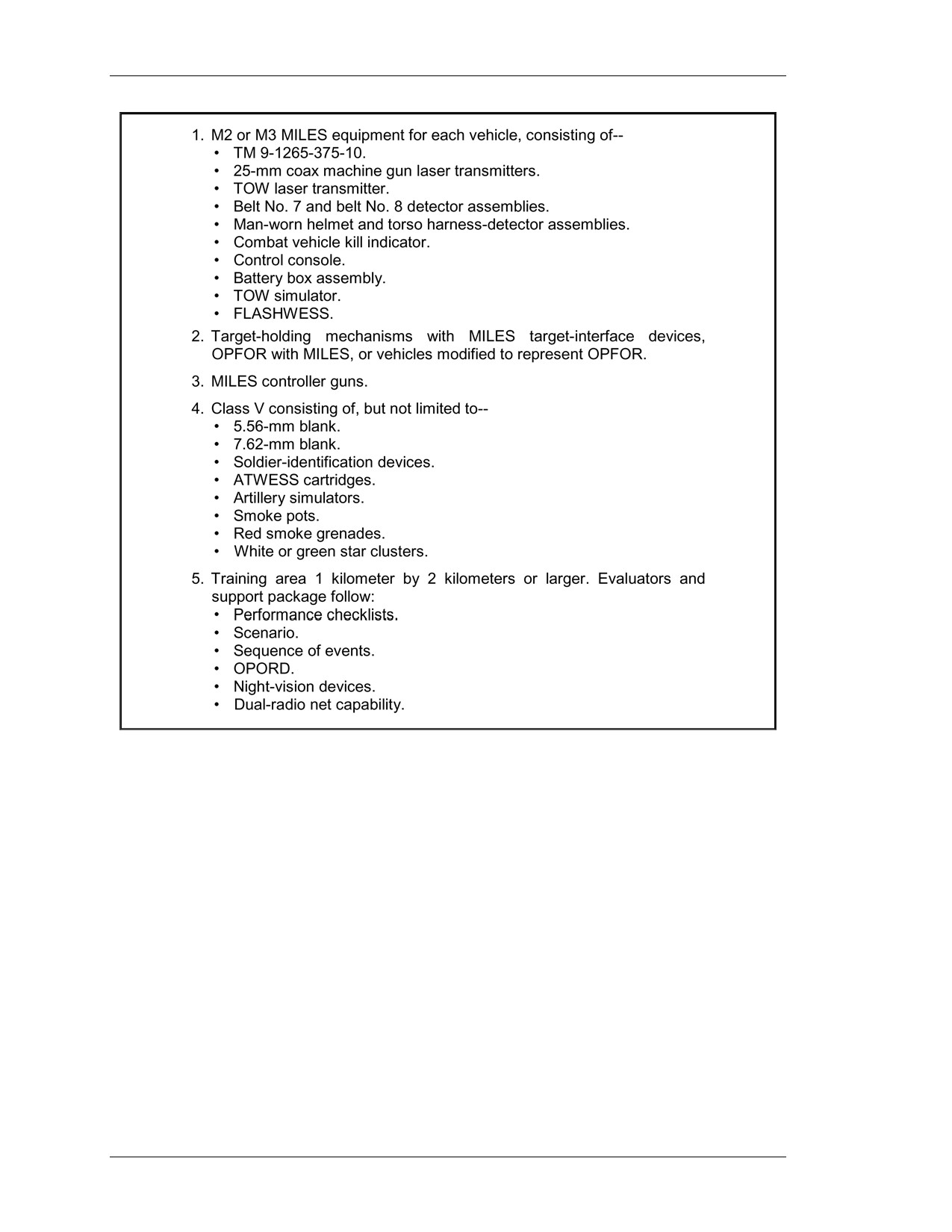
(3) Resources. To help the commander identify resources needed for table execution,
Figure 10-8 recommends resources for live-fire gunnery. Figure 10-9 recommends
resources for device-based gunnery.
10-8
FM 3-22.1
Figure 10-8. Resource list for live fire-based gunnery.
10-9
FM 3-22.1
Figure 10-9. Resource list for device-based gunnery.
(a) Live-fire gunnery requires a multilane range facility, such as a multipurpose range
complex (MPRC), which allows at least two vehicles to maneuver as a section. Local
range SOPs dictate support requirements.
(b) Device-based gunnery requires the use of MILES or PGS. A scout section is
easily equipped with MILES or PGS. However, inattention to detail and failure to follow
boresight and checkout procedures will seriously degrade training. Including MILES or
PGS in a precombat evaluation helps identify and correct shortcomings. Whenever
MILES or PGS is used, the master gunner makes sure the mounting and checkout
procedures follow TM 9-1265-375-10.
(c) Both device-based and live-fire gunnery tables require evaluator support.
Evaluators
(selected from troop level) are identified, trained, and scheduled before
conduct of the table. Each evaluator receives a scoring packet that contains performance
checklists, scenarios, OPORDs, and sequence-of-events lists. Though internal evaluation
is acceptable, external evaluation is preferred.
10-10
FM 3-22.1
(4) After-Action Review. After the section completes the table, evaluators meet with
the entire section for an after-action review. During the AAR, they discuss the section's
strengths and weaknesses, and how they can improve. Videotaped tables provide positive
and negative visual feedback to the section.
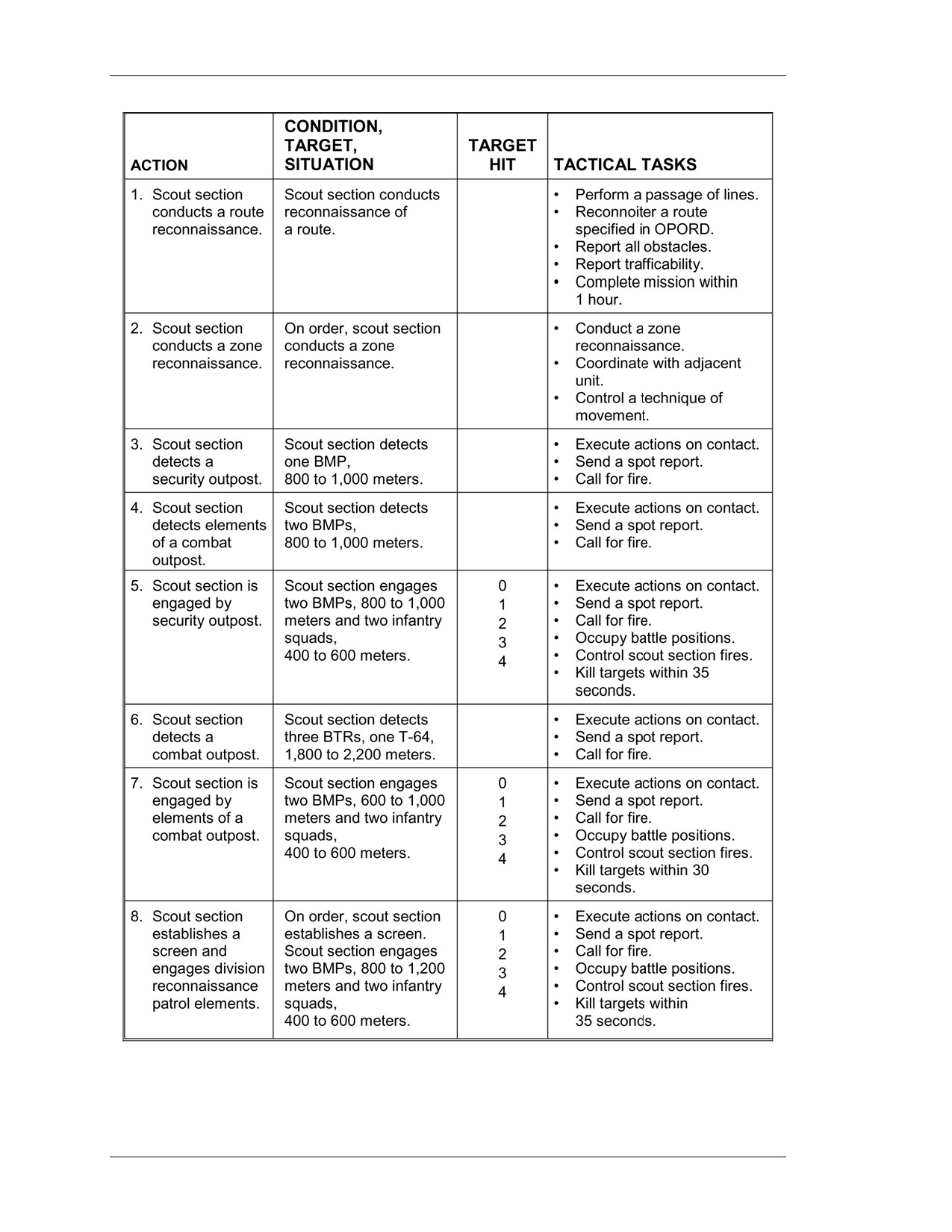
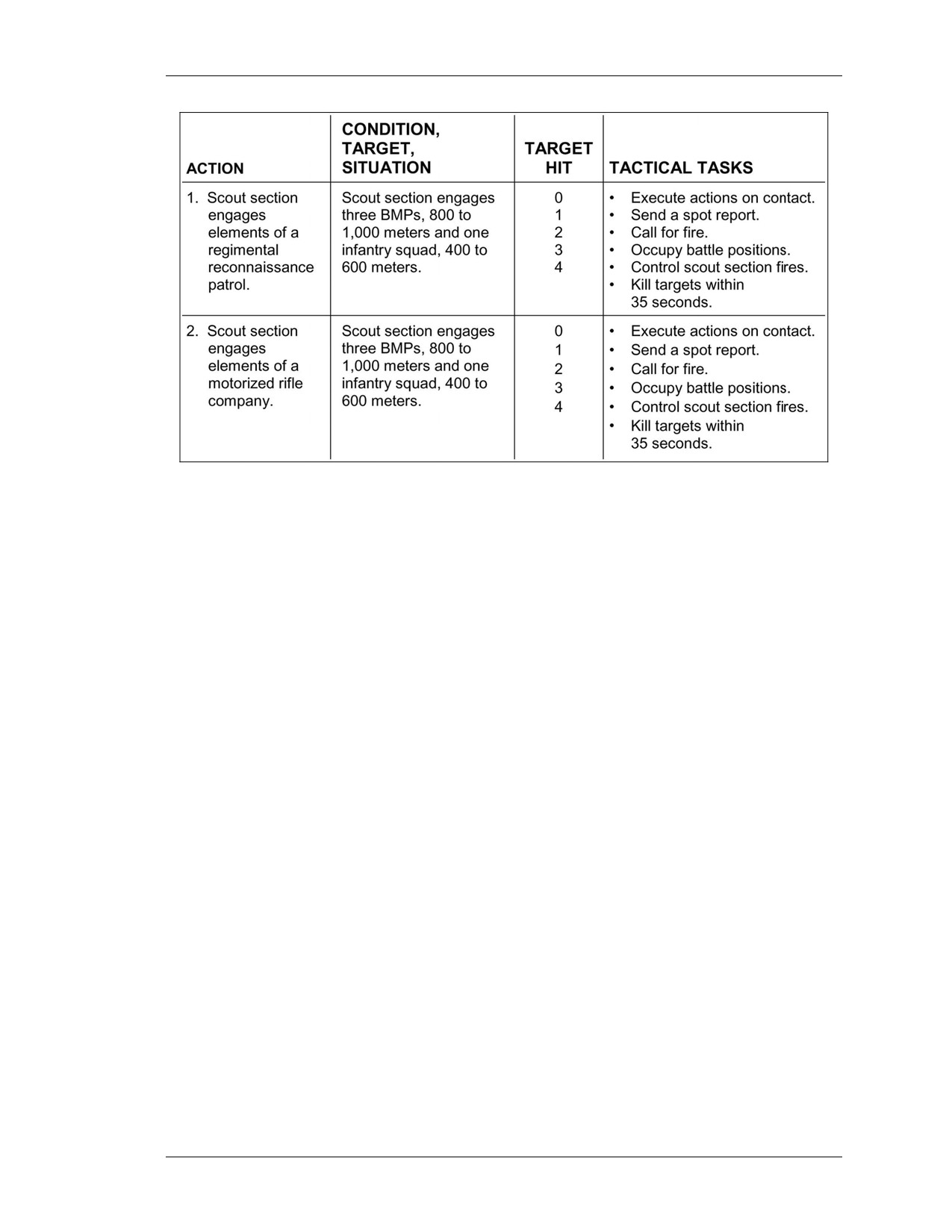
10-8. BRADLEY TABLE X, SCOUT SECTION QUALIFICATION
During qualification, leaders evaluate the scout section's tactical and gunnery proficiency
in a realistic scenario (Figures 10-10 and 10-11, pages 10-12 and -13).
a. Prerequisites. The scout section must meet the following conditions before firing
the scout section qualification table:
(1) Each scout section must have received a passing score on the scout section
training table within three months before firing the scout section qualification table.
(2) Each vehicle crewmember must have passed the Bradley gunnery skill test (IAW
Appendix A).
b. Requirements. Each scout section must qualify on the scout section-qualification
table. As a minimum, the section must receive a GO on 70 percent of the tactical tasks
and kill 70 percent of the targets in gunnery tasks.
c. Action. The scout section conducts a reconnaissance mission, a security mission,
or both. Then it acquires targets, sends reports, and employs accurate direct and indirect
fires to engage targets in a tactical array.
d. Conditions. The scout section uses reconnaissance and engagement techniques
against threat targets. Moving and stationary targets appear individually and
simultaneously. The table must include at least one NBC engagement and one auxiliary
sight engagement.
e. Standards. Crews rate gunnery points and receive critiques on their engagement
techniques. Tactical standards follow the MTP.
10-11
FM 3-22.1
Figure 10-10. Example scout section qualification (day).
10-12
FM 3-22.1
Figure 10-11. Example scout section qualification (night).
f. Conduct of the Range. Scout section qualification tasks should reflect the scout
section training table. Scout section qualification is a full-caliber gunnery table for a
multilane range facility. When range facilities permit free maneuvering, leaders should
conduct tactical and gunnery tasks at the same time. If the range facility does not allow
free maneuvering, then leaders can conduct tactical qualification tasks on a separate, 1-
by 2-kilometer training area. Qualification may not include practice runs. Finally, when
possible, day fire should precede night fire.
(1) Local range SOPs dictate range conduct. Leaders should develop and obtain
approval of firing scenarios well in advance of section qualification. For each table, at
least three
25-mm targets are presented for each vehicle. However, DA Pam 350-38
dictates resource limits, including the number of targets used. (Figures 10-8 and 10-9 list
recommended resources.)
(2) The tactical tasks in scout section qualification require a free-maneuver range
facility or a separate 1- by 2-kilometer training area. Within the training area, OPFOR or
target-lifting mechanisms can reinforce acquisition, reporting, and call-for-
fire procedures.
(3) The gunnery tasks of scout section qualification require a multilane facility. This
allows two vehicles to maneuver as a section. Local range SOPs dictate range-support
packages.
(4) Before conducting the qualification table, commanders identify, train, and
schedule extra evaluators at troop level. Each evaluator receives a scoring packet that
contains performance-checklist scenarios, OPORDs, and a sequence of events.
Commanders should try to use external evaluators, although they can use internal
evaluators, if necessary.
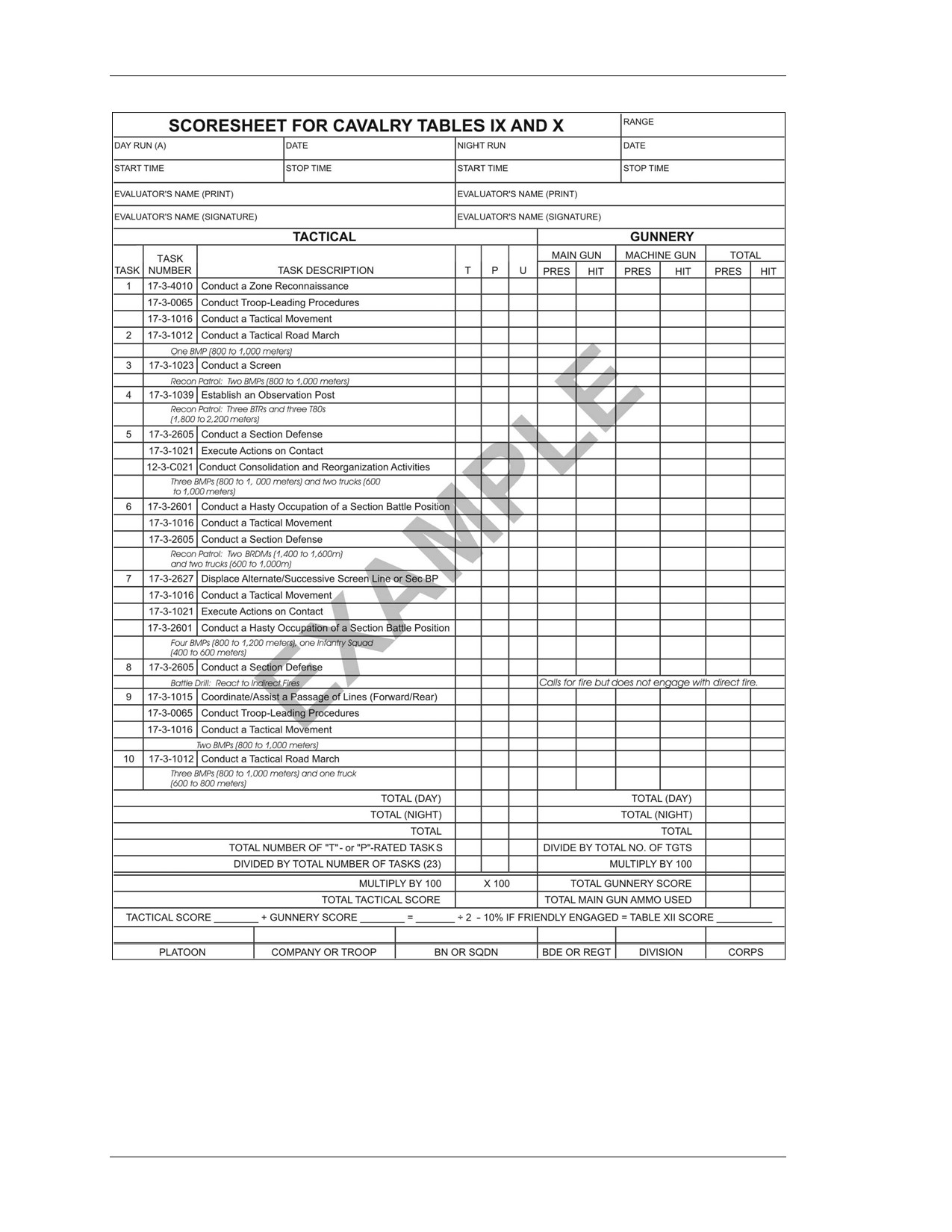
g. Scoresheet. Figure 10-12, page 10-14, shows an example completed format for a
cavalry Table IX and X scoresheet.
10-13
FM 3-22.1
Figure 10-12. Example format for scoresheet, Cavalry Tables IX and X.
10-14
FM 3-22.1 (23-1)
CHAPTER 11
Air Defense Advanced Tables
This chapter identifies the gunnery target presentations required to
support collective tasks. Units determine specific threat target types and
engagement distances. ARTEP MTPs 44-177-14 and -15, Chapters 9,
discuss evaluation procedures and standards.
Before, training revolved around the squad in a nontactical
environment. Now, advanced gunnery tables link directly to platoon and
squad operations IAW FM
44-43, ARTEP MTPs 44-177-14 and -15, and
the combat drills in ARTEP 44-177-14-Drill. Each task supports the
commander based on his unit's METL. Gunnery events progress from
preliminary to device to live fire.
The advanced tables in this chapter, which integrate tactical and
gunnery tasks, give the commander the opportunity to evaluate his platoon
on its ability to execute tactical and gunnery tasks
(Figure 11-1).
Specifically, he evaluates each platoon's collective ability to shoot, move,
and communicate. He uses air-defense sensor systems to help crews
acquire and identify friendly and hostile aerial targets. He can use the
guidelines and procedures in this chapter to establish device-based
gunnery exercises.
The advanced gunnery exercises in this chapter and in the MTP set the
standards for training and evaluation. They also allow battalion
commanders to tailor engagements based on particular contingency
missions and training emphasis.
Air Defense Advanced Gunnery Tables
Page
Bradley Table IXA, Section Practice
11-7
Bradley Table XA, Section Qualification
11-7
Linebacker Table IXA, Section Practice
11-7
Linebacker Table XA, Section Qualification
11-7
Figure 11-1. Air defense advanced gunnery tables.
11-1. DEVELOPMENT OF EXERCISE
These requirements apply to both practice and qualification tables. Linebacker or BSFV
section practice is a building block for section qualification. Both exercises are fully
resourced with ammunition. However, other training resource constraints may prohibit
firing section practice as prescribed. Section qualification must follow the guidelines and
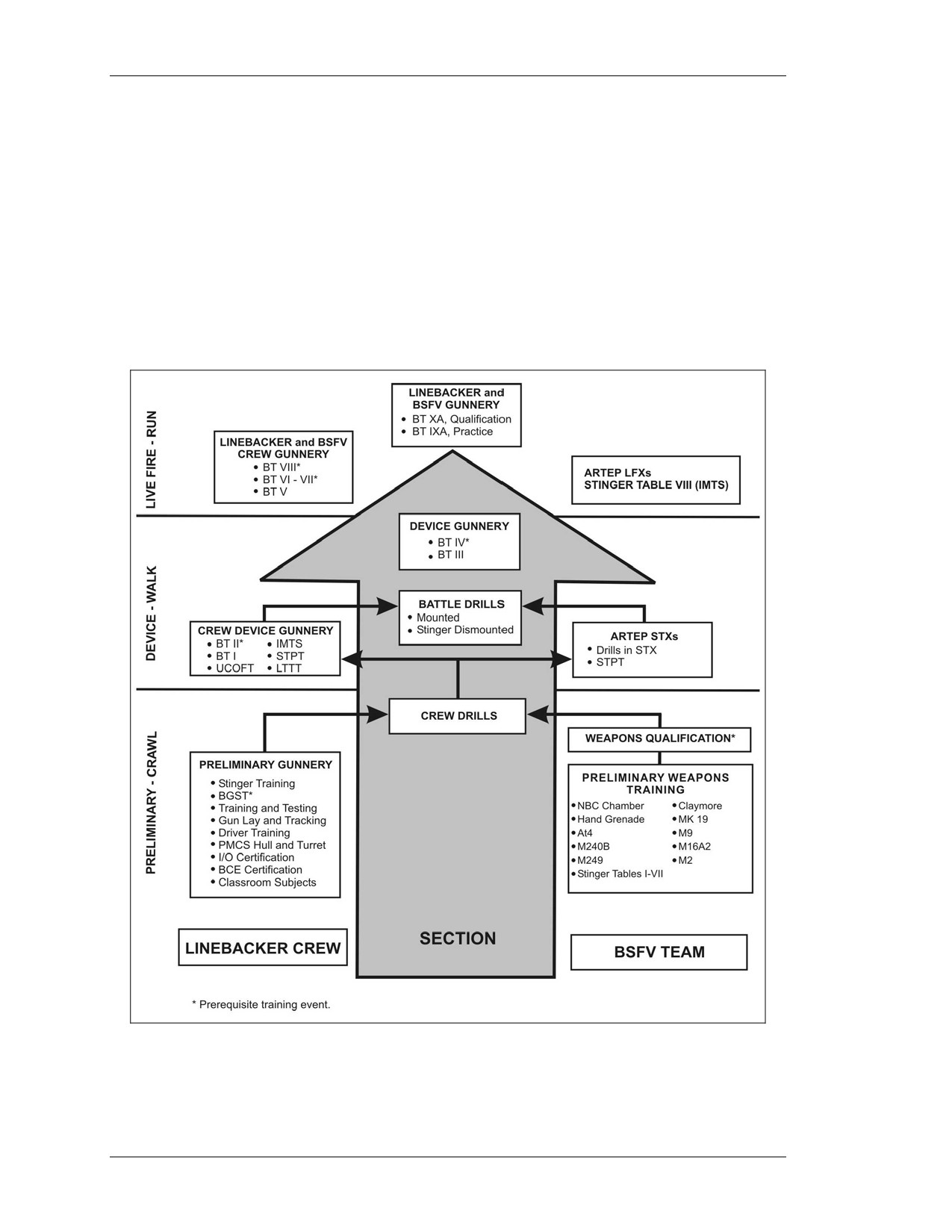
standards provided in this chapter and in Chapter 9. Figure 11-2, page 11-2, shows the
ADA training strategy.
a. Advanced gunnery tables incorporate at least eight collective tasks, the first five
of which are mandatory.
b. The S3 identifies three additional collective tasks to support the unit METL, then
develops an OPORD to support the mission.
11-1
FM 3-22.1
c. The battalion master gunner coordinates all of the resources and personnel needed
to support the gunnery exercise.
d. Although this is not a timed event, commanders may impose time standards to
coincide with the unit METL.
e. The platoon is organized into two maneuver sections. One section has three
vehicles and the other section has two. The platoon leader commands and controls one
section, and the senior section leader commands and controls the other. Tactics and
gunnery scores for each section are combined and averaged into one overall rating for
the platoon.
f. FAAD C3I sensors and slew-to-cue are used on all SVML aerial engagements.
The platoon only engages manually when the data link is offline.
Figure 11-2. Training strategy for ADA.
11-2
FM 3-22.1
11-2. LIVE-FIRE REQUIREMENTS
The live-fire collective tasks are conducted on a range complex that provides the best
available target and maneuver area. These requirements apply to both practice and
qualification live-fire tables. Aerial targets have priority over ground targets.
a. Range. Section practice and qualification may be conducted on the same range.
However, targets will not be presented in the same sequence.
b. Multiple, Simultaneous Targets. When the target array consists of more than
one target, simultaneous target exposure must be used. Simultaneous target exposure
occurs when all targets for the task are presented at the same time, requiring crews to use
proper engagement techniques.
c. Realistic Practice. Targets should represent the actual threat arrays a section
could encounter on the battlefield. Sections must encounter a realistic array of single and
multiple ground and aerial targets. Leaders may add friendly targets to emphasize the
importance of training to prevent fratricide.
d. Minimum Standards. Each squad in the section must, at a minimum, execute the
following tasks:
(1) Bradley Table XA Tasks.
• Three dismounted Stinger engagements.
• Two 25-mm aerial engagements.
• One 7.62-mm coaxial engagement.
• One ground engagement conducted using the auxiliary sight.
• Five 25-mm ground engagements.
• One engagement conducted under nuclear, biological, or chemical conditions.
(2) Linebacker Table X Tasks.
• Three standard vehicle-mounted launcher engagements.
• One 25-mm aerial engagement.
• One dismounted Stinger engagement.
• Five 25-mm ground engagements.
• Three 7.62-mm coaxial engagements.
• One ground engagement using the auxiliary sight.
• One engagement under nuclear, biological, or chemical conditions.
11-3. TARGETRY
Ground targets will be constructed IAW TC 25-8. Targets should also have signature
devices to simulate enemy fire. Targets should also have thermal signatures. Aerial
targets are the Su-25 Frogfoot and the Mi-24 Hind-D autogyro RPVTSs. Typical speeds
are between 45 and 70 mph for rotary-wing aircraft and between 45 and 100 mph for
fixed-wing aircraft. Three requirements support target engagements. The only acceptable
aerial target is the one-fifth-scale target.
a. For device gunnery, one-fifth scale targets need PGS retroreflectors and smoke.
b. For Stinger and 25-mm live aerial engagements, targets need infrared (IR) source
and miss-distance indicator (MDI) scoring systems.
c. For each of the following weapons, place targets at the stated ranges:
•
25-mm targets--500 to 1,600 meters.
•
Coax targets--300 to 700 meters.
•
Aerial targets--1,000 to 5,000 meters.
11-3

FM 3-22.1
11-4. AMMUNITION
Ammunition is allocated according to DA Pam 350-38. Section practice tables are fully
resourced for Linebacker and Bradley Stinger fighting vehicles. Table 11-1 shows the
allocation for each vehicle, by table.
AMMUNITION
TP-T
7.62-MM
ATWESS
Bradley Tables IXA and XA
80 rounds
50 rounds
3 rounds
Linebacker Tables IX and X
60 rounds
200 rounds
1 round
Table 11-1. Advanced gunnery ammunition requirement.
11-5. EVALUATION STANDARDS
If range areas are too small for tactical maneuvering, then tactical tasks can be conducted
at a nearby training area and combined with the gunnery portion. Commanders should
integrate the tactical and gunnery tasks to exploit the full training effectiveness of these
tables. Each section of the platoon must earn at least 420 points on collective tasks. Each
section of the platoon must earn at least 280 points on gunnery tasks (aerial and ground
targets combined).
a. Vehicle Exposure Time. Target exposure times must fall within the standards in
Chapter 9. In the defense, total time must fall within the 50-second time limit. However,
the vehicle cannot remain exposed beyond the vehicle exposure timing matrixes (IAW
the appropriate matrix). The timing standards for dismounted Stinger engagements are in
accordance with ARTEP 44-177-14-Drill.
b. Scoring Procedures. Each table uses the following 1,000-point system for tactics
and gunnery:
(1) Tactics counts 600 points. The senior evaluator uses the performance checklist in
ARTEP 44-177-15-MTP.
(2) Gunnery counts 400 points. The senior evaluator combines and averages the
scores for aerial and ground targets. He uses the final numbers to determine a total score
for that section.
(3) The senior evaluator combines and averages scores for both sections of the
platoon (tactics and gunnery) to obtain a single, overall platoon rating.
c. Platoon Rating. To qualify, the platoon's score must equal at least 700 points,
with tactics and gunnery combined. Ratings follow:
(1) Distinguished. Combined score of at least 900 points.
(2) Superior. Combined score of 700 to 899 points.
(3) Qualified. Combined score of 700 to 799 points.
(4) Unqualified. Combined score of 699 or less, or failure to earn at least 420 points
on tactics or 280 points on gunnery.
11-4

FM 3-22.1
EXAMPLE:
Collective Tasks
Collective Tasks
Attempted:
Passed:
Score:
10
8
480 out of 600
points
Aerial or Ground
Aerial or Ground
Targets Presented:
Targets Engaged:
Score:
24
20
333 out of 400
points
NOTE: Total score for section (combining tactical and gunnery)
480 + 333 = 813
11-6. ARMY UNIVERSAL TASK LIST
The gunnery tables incorporate the following collective tasks:
a.
Mandatory Tasks.
(1) Perform risk-management procedures.
(2) Establish unit defense.
(3) Respond to a chemical attack.
(4) Conduct air-defense operations.
(5) Conduct LOGPAC activities (resupply).
b.
Additional Collective Tasks.
(1) Develop IPB (SHORAD).
(2) Provide command and control.
(3) Plan air defense.
(4) Handle enemy prisoners of war.
(5) Conduct RSOP (SHORAD).
(6) Conduct a convoy.
(7) Establish the platoon command post.
(8) Cross a chemically contaminated area.
(9) Prepare for operations under NBC conditions.
(10) Use passive air-defense measures.
(11) Maintain operations security.
(12) Conduct operational decontamination.
(13) Perform field-sanitation functions.
(14) Perform unit-level maintenance.
(15) Treat casualties.
(16) Sustain air-defense operations.
(17) Conduct troop-leading procedures.
(18) Establish liaison team.
11-5
FM 3-22.1
(19) Secure command post.
(20) Take active combined arms air-defense measures against hostile
aerial platforms.
(21) Conduct battlefield stress-reduction and -prevention procedures.
11-7. EVALUATION TEAM
The evaluation team consists of one officer who is the planner, another officer, and one
noncommissioned officer who actually evaluates the overall tactical performance
of a platoon.
a. Senior Evaluator. The battalion S3 is responsible for the development, design,
and execution of the exercise, with the assistance of the battalion master gunner. The
battalion commander or his representative determines the overall training assessment of
the section.
b. Platoon Evaluator. One captain with battery-command experience should
evaluate the platoon leader on overall collective task completion and mission success and
conducts the platoon after-action reviews.
c. Assistant Evaluators. A sergeant or staff sergeant with squad leader experience
should assist the evaluator. Each crew has one assistant, who observes overall crew
performance, leader tasks, vehicle actions, and fire control and distribution; he also helps
with live-fire safety. He assesses the crew during evaluation and provides feedback to
crewmembers during the AAR. To evaluate the Stinger dismounted position of the drill,
the assistant evaluator must be Stinger certified.
d. Allowable Variations. The battalion commander may add friendly targets to
advanced gunnery tables. He may modify the types of tasks IAW unit METL. In the
absence of a moving target, a stationary frontal target of the same type and at the same
range is used. If a stationary target is used, target conditions must be adjusted.
11-8. PREREQUISITES
Each crewmember must have qualified on the BGST (in the position he is occupying)
within the previous three months. Reserve component crewmembers must have qualified
on the BGST within the previous four months. All crewmembers must have qualified by
position on either Linebacker or Bradley Table VIII within the previous six months. All
crewmembers must have completed Stinger Crew Tables I through VIII.
11-9. REFIRES FOR QUALIFICATION
A section that fails to qualify must refire the failed engagements, but only until they earn
enough points to qualify. The highest rating that a refiring section can obtain
is "Qualified." Battalion commanders decide whether to accept alibis. The battalion
commander only accepts alibis under the following conditions:
• Target failures or weapon malfunctions.
• Equipment failures not the result of crew error.
• Unsafe conditions not related to the firing vehicle.
11-10. BRADLEY TABLES IXA AND IX, SECTION PRACTICE
Firing the Section Practice 2 portion of Bradley Table IXA and of Linebacker Table IX
prepares the sections for qualification. This is the first time that the squads function
11-6
FM 3-22.1
together as a section using full-caliber ammunition. The objective is to practice
integration and coordination to form a collective effort.
a. Sections should practice the fire-control and distribution techniques that they will
use during qualification.
b. Exercise development, standards evaluation, ammunition, and target
considerations are the same as for section qualification.
c. BT IXA and LT IX are fully resourced but can be modified by using devices, if
ammunition or range constraints prohibit live-fire execution.
11-11. BRADLEY TABLES XA AND X, SECTION QUALIFICATION
The sections qualify on both Bradley Table XA and Linebacker Table X. These tables
evaluate the crew's abilities to execute collective tasks in a tactical live-fire environment.
Conduct of these live-fire tables must follow--
• Scenario-development guidelines.
• Ammunition and target guidelines.
• Standards, scoring, and evaluation procedures.
• All prerequisites.
11-7
FM 3-22.1 (23-1)
CHAPTER 12
Engineer Gunnery
FMs 7-0 and 7-1 explain how to plan, resource, and execute training
events. ARTEP 5-335-DRILL, ARTEP 5-335-70-MTP, TC 5-150, and this
chapter provide the TTP and standards to conduct and evaluate Engineer
platoon gunnery training (Figure 12-1).
Chapter 3 covers crew training; Chapter 9 covers section and platoon
device training; and this chapter covers platoon practice and qualification
(Engineer Bradley Tables XI and XII). Together, these events integrate
Bradley and Engineer squad tasks, which support tactical and gunnery
scenarios in all conditions using all organic weapons. This trains leaders
and subordinates to distribute and control fires.
The commander selects and develops tactical operations based on his
mission-essential task list (METL) and on the unit's contingency area of
operations.
Engineer Bradley Gunnery Tables
Page
Engineer Bradley Tables III and IV,
Section and Platoon Device Gunnery
12-5
Engineer Bradley Table XI, Platoon Practice
12-5
Engineer Bradley Table XII, Platoon Qualification
12-6
Figure 12-1. Engineer Bradley firing tables.
12-1. ENGINEER PLATOON TRAINING PROGRAM
The commander develops his training program after assessing the unit's strengths and
weaknesses. The resulting program must reflect crew and platoon turbulence, support the
unit's METL, sustain strengths, and correct weaknesses. Any EBFV-equipped unit can
adapt this program for its training requirements. The strategy progresses logically,
integrating separate crew and squad training
(crawl, walk, run) into platoon-level
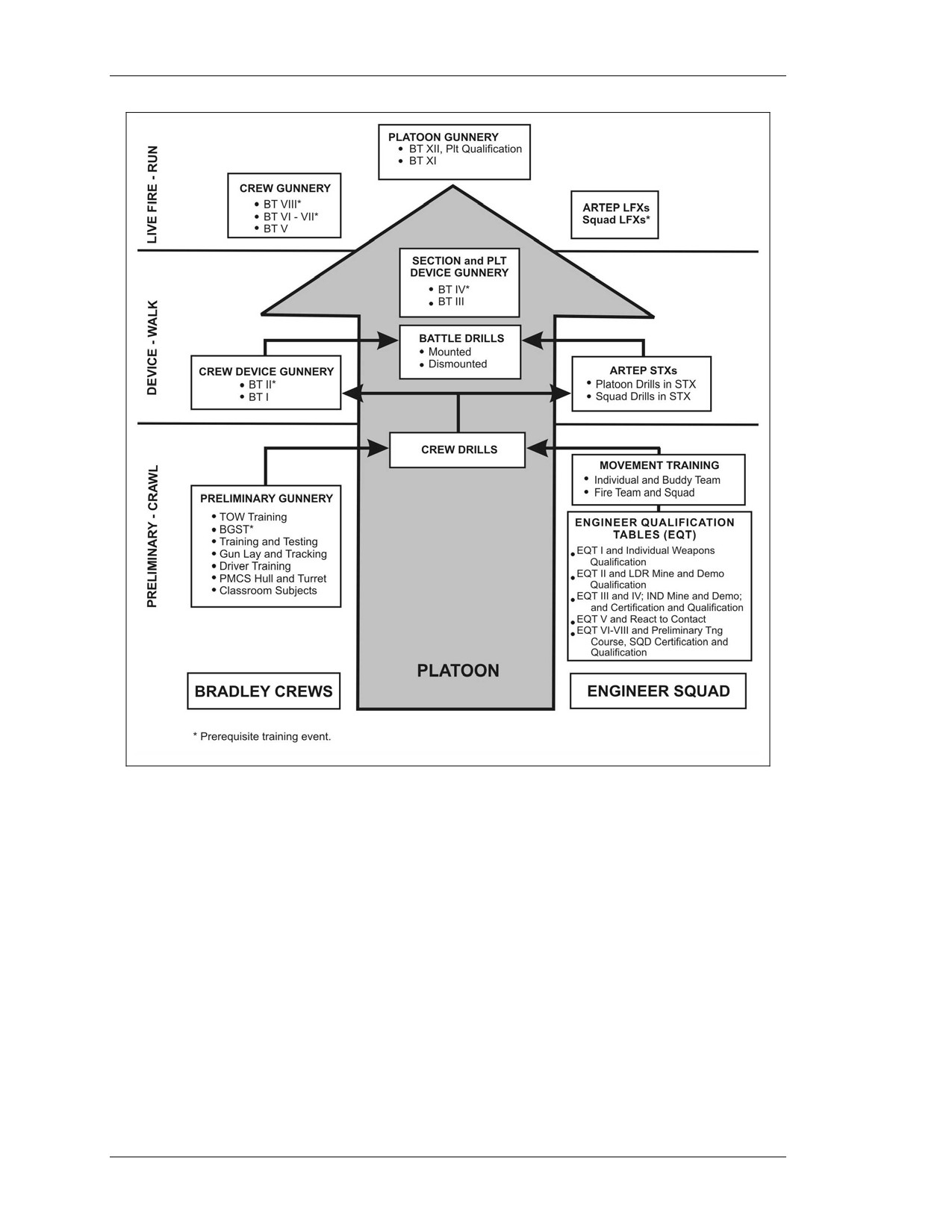
training. Figure 12-2 shows an engineer platoon training program.
12-1
FM 3-22.1
Figure 12-2. Engineer platoon training program.
12-2. DEVELOPMENT OF EXERCISE
All engineer platoons must be able to integrate the EBFV while performing mobility,
countermobility, and survivability missions. These missions consist of individual and
collective tasks performed at the platoon level. The MTP and the engineer platoon
gunnery tables in this chapter set an Army standard for training and evaluation. At the
same time, they allow unit commanders the flexibility to tailor all tactical and gunnery
tasks to their particular METL and training emphasis. Chapter 9 of this manual, ARTEP
5-335-DRILL and TC
5-150, Engineer Qualification Tables, outline the engineer
platoon's evaluation procedures and standards. This chapter specifies the required
gunnery target presentations to support these collective tasks. The following guidelines
apply to both the EBFV platoon practice and qualification tables:
a. General Requirements. The EBFV platoon practice is a building block for
EBFV platoon qualification.
12-2
FM 3-22.1
(1) Ammunition constraints might keep the platoon from firing full-caliber
ammunition during Table XI. Units must fill the void with available Bradley gunnery
training devices and simulators. The EBFV platoon qualification is resourced with
ammunition. That might make it the first time an EBFV platoon collectively fires an
integrated live-fire scenario. When EBFV platoons qualify, they must follow the
guidelines and standards in this chapter, Chapter 9, ARTEP
5-335-Drill,
ARTEP 5-335-70-MTP, and TC 5-150.
(2) The battalion commander and the S3 select the MTP missions. They also
develop a scenario that is tactically sound, supports the local range layout, and that
reflects their unit's METL.
(3) The S3 picks collective tasks based on the unit's operational missions and MTP.
(4) The S3 and battalion master gunner--
(a) Determine which collective tasks the platoons will fire live.
(b) Develop scenarios that enable the platoon to conduct tactical missions while
accomplishing the identified collective tasks. They incorporate live-fire gunnery
presentations into the collective tasks.
(5) Conduct the platoon gunnery tables in two phases--one during the day and
one at night.
(6) The S3, S2, and battalion master gunner select vehicle and troop target arrays
that represent a realistic scenario. They also--
(a) Identify specific threat target types, engagement distances, and range bands.
(b) Specify most- and least-dangerous targets based on a threat template
and analysis.
(7) The battalion staff develops an OPORD to support mission execution, which
forces EBFV platoons to use all organic and attached equipment and weapon systems.
(8) The battalion master gunner assembles all platoon evaluation packets with the
appropriate T&EOs and gunnery summary sheets. He arranges the T&EOs in the
observer-controllers' (OCs') packets in collective-task sequence.
(9) LTIDs allow for MILES or PGS replication of TOW, Javelin, and Dragon fire.
MILES or a 9-mm subcaliber device can replicate AT4 fire.
b. Live-Fire Requirements. Live-fire and collective tasks are conducted on the
range complex that provides the best available targetry and maneuver area.
(1) Platoon practice and qualification can occur on the same range, but target
scenarios differ. They must expose all targets within a particular band simultaneously.
This forces the firing EBFV platoon to control and distribute fire properly at every level.
For each firing section within the platoon, up to three vehicle or troop targets are
presented at one time. For each firing platoon, one dismounted squad or up to two RPG
teams are presented at one time.
(2) To prevent multiple kills, the computer must address each IRET target(s)
separately.
(3) During the platoon qualification table, each dismounted and mounted element
fires at least two NBC engagements--one day and one night. Both elements may fire
during the same engagement. Commanders may increase the number of NBC tasks,
during which the firing platoon assumes MOPP4 during all NBC tasks.
(4) Simulated or live indirect-fire support may be incorporated into the scenario to
enhance realism. Indirect-fire support targets are additional targets that are determined
12-3
FM 3-22.1
on the threat template and are not part of the direct-fire template. If mortars are used for
illumination, and the task is evaluated according to the MTP, then the firing element
receives credit for using fire support.
c. Scenario Development. Evaluators and range personnel can use pyrotechnics
and simulators to simulate target effects and to cue certain events.
(1) A target presentation should enforce fire distribution and control at the team,
squad, section, or platoon levels. It should also trigger certain training events.
(2) The scenario should include combat support (CS) and combat service support
(CSS), and tasks like resupply or refuel on the move (ROM).
(3) Vehicles and soldiers should have the MILES components that do not interfere
with live-fire engagements. MILES allows evaluators to rapidly assess personnel and
vehicle casualties. It also allows EBFV platoons to incorporate personnel- and vehicle-
evacuation procedures into all collective and live-fire tasks.
(4) Each soldier receives a MILES casualty card. Using these allows platoon
evaluators to assess casualties during all collective- and live-fire tasks. However, vehicle
commanders, gunners, and drivers will receive return-to-duty (RTD) cards, which allow
them to move vehicles safely.
(5) Each platoon evaluator needs a copy of the unit's SOP to implement during the
evaluation.
(6) The firing platoon's company commander should follow the platoon for
command and control purposes. He can enhance the tactical scenario by simulating radio
traffic, to include issuing instructions and FRAGOs and receiving reports from
the platoon.
(7) Target presentation is based on the platoon's tactical employment. The platoon
should react to and not anticipate target presentations.
d. Targetry. Units construct all targets IAW TC 25-8.
(1) Chapter 8 discusses EBFV targetry requirements, including 25-mm targetry and
coax area and point targetry. Minimum target requirements by target type follow:
• AP Point
12
• HE Area
1
• HE Point
9
• Coax Area
12
• Coax Point
8
• Infantry Targets... 50
• TOW or Javelin
1
(2) Engineer dismounted targets look exactly like BFV dismounted targets. RPG and
ATGM targets consist of three E-type silhouettes placed in line, in depth, or in a wedge
formation, at up to 5 meters apart or 10 meters in depth (Chapter 8). Trench-line targets
consist of four to seven E-type silhouettes arranged realistically. These targets are placed
up to 5 meters apart in an area no larger than 30 meters in width and 20 meters in depth.
(3) The EBFV's target-exposure time varies, depending on the type of target and the
presentation. To determine exposure time, the master gunner must know engagement
type, target type, conditions, and distance to target.
(4) Dismounted troop targets are exposed four times, for five seconds each time,
at ten-second intervals.
12-4
FM 3-22.1
(5) To enhance the advanced table scenario, the battalion commander may add
friendly targets, smoke, and other obscurants.
e. Ammunition. Platoons receive and internally distribute all of the ammunition
allocated for the LFX, including that allocated for both the day and night phases.
(1) DA Pam 350-38 (STRAC) allocates the following ammunition:
• Full-caliber ammunition for EBFV platoon qualification.
• Ammunition for all dismounted squad and platoon LFXs.
(2) Chapter 8 lists ammunition allocations for each BFV target (coax, 25-mm and
TOW or Javelin) as follows:
• AP or TPDS-T
96 rounds
• HE or TP-T
96 rounds
•
7.62
1,600 rounds
• Infantry Targets
IAW STRAC
• TOW or Javelin
1 PGS or MILES missile
(3) If additional ammunition and range time are available, units can modify
the scenario (threat targets).
12-3. PREREQUISITES
To participate in a live-fire platoon-gunnery exercise, the platoon must meet the
following prerequisites. The platoon maintains integrity. That is, crewmembers always
participate in platoon live-fire gunnery exercises with their own platoon(s):
a. Each EBFV primary and alternate crewmember must have qualified on the BGST
within the previous three months (Active Component only).
b. Squad members and crewmembers must qualify and complete certain
prerequisites within the previous six months.
(1) Individual Weapon. Each squad member (dismounted or mounted) has qualified
on his individual weapon.
(2) BT VIII--Crew Qualification. EBFV crewmembers must have qualified on
BT VIII, Crew Qualification.
(3) BT IV--BPPC. The EBFV platoon must have completed BPPC (BT IV).
c. Each platoon member has already completed EQBTs I through VIII. As a
minimum, he has qualified on EQBTs I, III, and IV.
12-4. ENGINEER BRADLEY TABLES III AND IV, SECTION AND PLATOON
DEVICE GUNNERY
Section and platoon device gunnery consists of BT III, Squad and Section Exercise, and
BT IV, Platoon Proficiency Course. These tables train and evaluate collective
squad/section and platoon tasks. To conduct the exercises, leaders use MILES or PGS
with LTID-equipped targets, or they use a force-on-force scenario. Scenario development
and evaluations follow ARTEP 5-335-Drill , TC 5-150 and Chapter 9 of this manual.
12-5. ENGINEER BRADLEY TABLE XI, PLATOON PRACTICE
Engineer Bradley Table XI serves as a building block to prepare the engineer platoon for
qualification. Ammunition constraints might require the platoon to fire the practice table
with Bradley training devices (PGS or MILES) rather than with full-caliber ammunition.
a. The platoon practices the fire-distribution and control techniques used during
platoon qualification.
12-5
FM 3-22.1
b. Engineer Bradley Table XI development, standards, evaluation, and target
considerations mirror Engineer Bradley Table XII.
c. Engineer Bradley Table XI is resourced for PGS or MILES. However, if
ammunition and range time are available, then the Engineer Bradley Table XI may be
fired live.
12-6. ENGINEER BRADLEY TABLE XII, PLATOON QUALIFICATION
Platoon qualification evaluates the platoon's ability to execute collective tasks in a
tactical live-fire environment. Collective-task evaluations measure the platoon's combat
proficiency while executing mobility, countermobility, and survivability missions.
Mounted and dismounted engineer squads are integrated and evaluated on their ability to
fight as a cohesive EBFV platoon.
a. Follow the scenario-development guidelines in this chapter.
b. Follow the ammunition and target guidelines in this chapter.
c. Follow the standards, scoring, and evaluation procedures in Chapter
8,
ARTEP 5-335-Drill, ARTEP 5-335-70-MTP, and TC 5-150.
d. Enforce all prerequisites in this chapter.
e. Conduct the engineer Bradley platoon qualification with live, full-caliber
ammunition.
f. Incorporate appropriate EQBT IX through XII tasks into the dismounted portion
of this Engineer Bradley Table XII.
12-6
FM 3-22.1 (23-1)
CHAPTER 13
Fire-Support Team Gunnery
FM 7-0 (25-100) and FM 25-101 explain how to plan, resource, and
execute training events. FMs 6-20-40, 6-30 and ARTEP 6-115-20-MTP,
and this chapter provide the TTP and standards to conduct and evaluate
BFIST gunnery training.
Chapter 3 covers crew training; this chapter covers BFIST
team training (Figure 13-1):
• BT IV--BFIST Team Proficiency Course.
• BT IX--BFIST Team Fires Integration Course.
• BT X--BFIST Team Certification.
These exercises provide the standards for training and evaluating M7
crew performance, while allowing DIVARTY or battalion commanders to
tailor engagements for their particular contingency missions and
training emphasis.
BFIST Gunnery Tables
Page
BT IV, BFIST Proficiency Course
9-22
BT IX, BFIST Fires Integration Course
13-8
BT X, BFIST Certification
13-8
Figure 13-1. BFIST firing tables.
Section I. TRAINING PROGRAM
The brigade FSO must develop his training strategy after assessing his fire supporters'
strengths and weaknesses. His assessment and strategy must reflect personnel turbulence
(changes). The strategy must focus on his METL, sustain their strengths, and correct their
weaknesses. Some tasks apply to all soldiers; some apply only to BFIST crews.
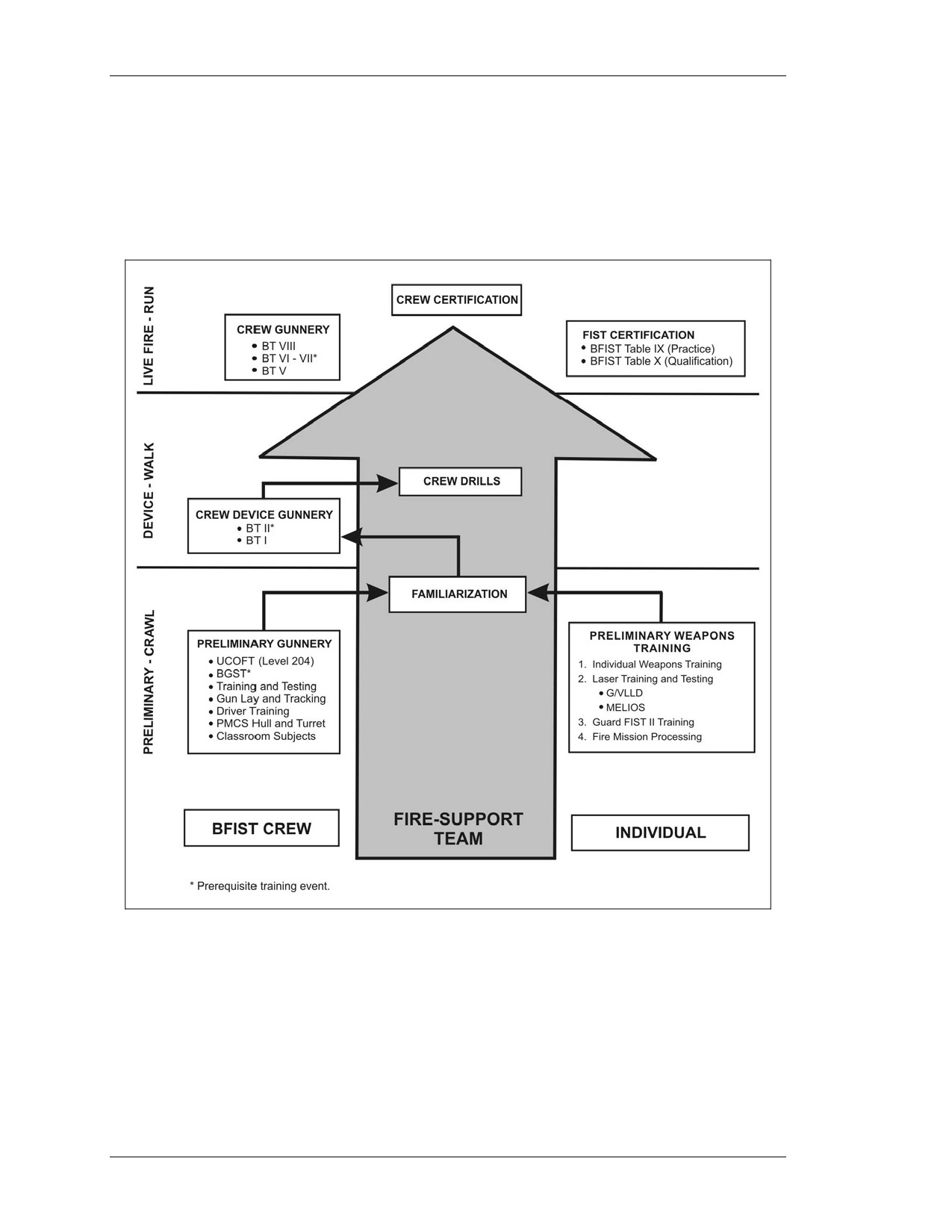
Figure 13-2 shows an integrated training program. Any unit can adapt this strategy to its
own requirements. BFIST gunnery progresses logically from fire-support crew training
through collective, tactical, live-fire
evaluation during Table X, BFIST
Team Certification.
13-1. CREW TRAINING
Along with the master gunner, the brigade FSO is the principal trainer for crew duties,
crew coordination, and gunnery skills. His main references include this manual; all of
FM 6-30; FM 22-100; FM 3-21.71 (7-7J), ARTEP 7-7J-DRILL, ARTEP 7-7J-MTP; and
the appropriate technical manuals.
a. Preliminary Gunnery Training. Preliminary gunnery training focuses on the
technical aspects of the BFIST gunnery theory, turret operations, and elementary gunnery
techniques. The trainers combine classroom instruction and hands-on training to teach
each crewmember the abilities, limits, and traits of the vehicle. Crews learn how to
manipulate the turret, lay the gun, and track and adjust fires for the 25-mm gun, and for
the 7.62-mm coaxial machine gun. They also practice crew drills in the COFT, in BATS,
and in hands-on tasks. Record BGST tests their technical proficiency.
13-1
FM 3-22.1
b. Device Gunnery Training. Device gunnery training lets crews practice and
refine their collective vehicle skills with low-cost training devices. This phase of training
integrates individual crew duties and actions--crews perform as a team (Chapter 8). The
crew conducts a defensive exercise that lets the driver practice "berm drills" while other
crewmembers engage single and multiple targets, both stationary and moving. The
Guard FIST II Trainer and Bradley Table II (BCPC) both evaluate their abilities.
Figure 13-2. Bradley fire-support team training program.
c. Crew Gunnery Training. Crew gunnery lets the crew practice their collective
crew-gunnery techniques with live ammunition. The crews must meet harder standards
during challenging--and changing--conditions like those in combat. The outcome is a
crew highly skilled in destroying likely enemy threats on the battlefield. BT VIII, Crew
Qualification, evaluates the crew's proficiency.
13-2
FM 3-22.1
13-2. COFT TRAINING STRATEGY
COFT is a valuable training tool that enhances crew training. As one example, the unit
might place an HTU in the turret and an LCU in the crew shelter for practicing fire
missions. Also, the division or regimental commander normally establishes the reticle
aim-level standards for live fire. However, in the case of COFT, the unit commander does
so. SAFAS only overrides the unit commander's reticle-aim standards if they are unsafe
in live-fire conditions.
13-3. ADVANCED GUNNERY
Advanced gunnery requires leaders to combine the nontactical training into a tactical
environment with a realistic scenario. They integrate tactical and gunnery tasks into the
advanced tables, which include BFIST Tables IX and X, Crew Fires Integration Course
and Crew Certification, respectively. These tables allow leaders to evaluate the BFIST
crews on their collective abilities to execute both tactical and gunnery tasks, including
shooting, moving, and communicating.
Section II. EVALUATION
BFIST gunnery evaluations require defined, measurable standards that reflect the
proficiency level of the fire-support team. BFIST team evaluators and observer-
controllers evaluate and enforce the standards. The crew uses the ISU because the M7
BFIST has no auxiliary sight. If the BFIST is later equipped with an auxiliary sight, the
crew will use standard Bradley tasks.
13-4. STANDARDS
If ranges prohibit tactical maneuvering, commanders can conduct tactical tasks at a
nearby training area and combine the tactical and gunnery tasks. This maximizes the
training effectiveness of the firing tables. Each crew must earn at least 70 percent on
collective tasks, 70 percent on gunnery tasks, and 80 percent on observed-fire tasks.
a. Vehicle Exposure Time. Leaders do not adjust vehicle- and target-exposure
times when integrating observed-fire and direct-fire tasks. The vehicle cannot remain
exposed past the vehicle-exposure times stated in the timing matrixes in Chapter 8.
b. Scoring Procedures. Each table uses a percentage system for tactics, observed
fire, and gunnery. Scoring breaks down as follows:
(1) Observed Fire. This is worth 100 percent--80 percent equals 4 of 5 tasks T or P.
(2) Tactics. This is worth 100 percent--70 percent equals 7 of 10 tasks T or P.
Evaluators use the performance checklist in ARTEP 6-115-MTP and unit SOP.
(3) Gunnery. This is worth 100 percent--70 percent equals 4 of 5 tasks T or P.
(4) Overall Rating. To obtain an overall rating for the crew, combine and average the
crew's scores for tactics, observed fire, and gunnery. Figure 13-3, page 13-4, shows the
formula for computing the crew's cumulative (total) score. Once you compute it, round it
up to the nearest whole number. For example, round 76.67 percent up to 77 percent.
c. Crew Rating. To qualify, the crew must earn a combined score of at least
70 percent on tactics, observed fire, and gunnery. Ratings break down as follows:
(1) Distinguished. Crew earns a combined score between 90 and 100 percent.
(2) Superior. Crew earns a combined score between 80 and 89 percent.
(3) Qualified. Crew earns a combined score between 70 and 79 percent.
13-3

FM 3-22.1
(4) Unqualified. Crew earns a combined score of 69 percent or less, that is, failure to
score at least 70 percent on tactics, 80 percent on observed fire, or 70 percent on gunnery.
TARGETS
ATTEMPTED
PASSED
OR TASKS
OR PRESENTED
OR ENGAGED
SCORE
Collective
10
7
70 percent:
Tasks
6 Trained
1 Needs practice
3 Untrained
Observed-Fire
5
4
80 percent:
Targets
3 Trained
1 Needs practice
1 Untrained
Direct-Fire
80 percent:
Targets
4 Trained
• Threat
5
4
0 Needs practice
• Nonthreat
5
0
1 Untrained
Total
Figure 13-3. Formula for computing cumulative score.
13-5. TEAM
The evaluation team consists of one officer (the planner), a senior NCO, and a junior
NCO. The senior evaluator evaluates the platoon's overall tactical performance.
a. Senior Evaluator. The Brigade FSO develops, designs, and executes the
exercise, with the help of the master gunner. The battalion commander or his
representative assesses the section's overall performance during training.
b. Crew Evaluator. A BFIST-experienced senior NCO should perform the crew
evaluation, with one evaluator for each crew. He evaluates the crew on overall collective
task completion and mission success, and then he conducts the AAR.
c. Assistant Evaluator. A BFIST-certified sergeant or staff sergeant should serve as
assistant evaluator. Each crew requires one assistant evaluator. He assesses the crew
during evaluation, observing their overall performance of leader tasks and their vehicle-
related actions. He also helps ensure live-fire safety. Finally, he provides input during
the AAR.
d. Allowable Variations. A DIVARTY or battalion commander may add friendly
targets to advanced gunnery tables. He may also modify the types of tasks used, IAW the
unit's METL. If leaders cannot obtain a moving target, they may use a stationary frontal
target of the same type and at the same range. To use a stationary target, they must adjust
target conditions accordingly.
13-4
FM 3-22.1
e. Engagement Standards. Crews use the engagement standards from generic
Bradley tasks for direct-fire targets. However, on indirect-fire missions, crews have
30 seconds to identify the target, give the proper fire command, lase the target, and send
the fire mission. Scoring criteria follow:
T -- Identify the target and send the fire mission within 20 seconds.
P -- Identify the target and send the fire mission within 30 seconds.
U -- Fail to identify the target or send the fire mission after 31 seconds.
f. Task Standards. Leaders use generic Bradley engagement task standards for
BFIST direct-fire targets. Evaluators score the BFIST team's proficiency in lasing, in
using the proper fire command, and in transmitting the FR message during gunnery.
Bradley Tables II through VI include indirect-fire targets in their target arrays. All fire-
mission engagements are presented before direct-fire engagements
(Figure 13-4,
page 13-6). The crew must earn at least a "P" rating on 4 out of 7 indirect engagements.
(1) Target Kill Standards. During range setup, the master gunner records grid
coordinates for all fire-mission targets. To receive target-kill credit, the crew must send
the correct target grid, accurate to within 150 meters, to the FSE. For all fire missions,
master gunners use the farthest targets on the range.
(2) BFIST Exposure Matrixes. Leaders use generic Bradley exposure matrixes for
BFIST direct-fire engagements. The BFIST crew engages indirect-fire targets from turret
defilade. If the crew exposes the vehicle, then the BFV matrix standard applies IAW the
conditions of the engagement and the threat vehicle's capability to engage the BFIST.
Whether in the defense, the offense, or retrograde, the BFIST crew has 30 seconds to
identify and engage indirect-fire targets.
(3) Timing of the Engagement. Time begins when the indirect-fire target is fully
exposed (target locked). Evaluators time this engagement separately from the self-
defense engagement. For example, due to range and time limitations, all indirect targets
have one condition--normal. Evaluators check other conditions during Tables IX and X.
If the crew exposes the vehicle, leaders use the matrixes in Chapter 8. For example,
target-exposure time for a stationary T-72 at 2,500 meters is 23 seconds.
(a) After the BFIST crew engages the indirect target, direct-fire targets are presented.
Time target exposures separately for indirect-fire and direct-fire targets.
(b) Whether or not the BFIST crew engages the indirect-fire target, the direct-fire
target(s) must appear as soon as the 30-second, indirect-fire period expires. Crew must
pass all subtask standards in order to meet task standards.
(4) Critical Subtask Standards. Evaluators use critical subtask standards to score the
BFIST crew's ability to engage indirect-fire targets in less than normal operating
conditions. Before the crew can meet a task's overall engagement standards, it must first
meet the subtask standards. Until then, leaders consider the crew untrained on that task.
The crew engages all target(s) in the FIST mode.
(a) Gunner's Engagement. The gunner uses his handstation to identify and lase
targets in the FIST mode. He also operates the TSCP (targeting-station control panel).
(b) Commander's Engagement. The commander uses his handstation to identify and
lase targets in the FIST mode.
13-5

FM 3-22.1
TARGET
TARGET
TARGET
BFIST EXPOSURE TIME
EXPOSURE
POSTURE
CONDITION
(THREAT TIME TO HIT)
TIME
Normal,
30 seconds
1
T-72 tank
Depends on range of
Stationary, or
target and whether or not
Indirect Target
the BFIST crew exposes
the vehicle from turret
defilade.
2
BTR-80, moving,
2 conditions
24 seconds
50 seconds
1,200 meters,
NBC environment
3
ATGM,
1 condition
11 seconds
50 seconds
600 meters,
NBC environment
Figure 13-4. Defense, day engagement, indirect.
(5) Crew Engagement. The crew switches to gun mode when presented with
direct-fire targets. The gunner or the BC lases in FIST mode, then switches to gun mode,
and then reacquires the target for engagement.
(6) Leader Subtask Standard. The leader subtask evaluates the BFIST
commander's ability to control the crew, vehicle, MEP, and self-defense system. The
BFIST commander must maintain control to synchronize reengagements and operate
efficiently. He must also use the proper fire-mission commands for each indirect
engagement and when engaging direct-fire targets.
(7) Noncritical Subtask Standard. These tasks remain unchanged, except for the
response terms for the fire-mission command.
(8) BFIST Crew Live-Fire Gunnery Standards. These standards also remain the
same, except for the addition of a fire mission before the direct-fire engagements.
Therefore, Tables V and VI include one new task for the BFIST crew: Engage and
Destroy Stationary Indirect Targets from a Stationary and Moving M7 BFIST During
Both Day and Night.
Section III. ADVANCED GUNNERY
Advanced gunnery tables let the commander evaluate the team’s ability to execute
tactical and gunnery tasks. A successful team gunnery program trains all tasks required to
support the unit’s METL. Team (advanced) gunnery consists of BFIST Tables IX and X.
The objective is to integrate direct and indirect fires to form a team collective effort.
13-6. DEVELOPMENT OF EXERCISE
Units determine specific threat target types and engagement distances. Chapter 8, this
chapter, and FM 6-30 provide evaluation procedures and standards. Certain guidelines
apply to all BFIST tables.
a. Concept of the BFIST Tables. Leaders use a "scenario-based training" concept
to develop the BFIST Tables, which they resource based on the unit METL. Each
13-6
FM 3-22.1
engagement's tactical scenario includes battlefield awareness, situational awareness, and
SOPs. The crew then makes decisions based on this scenario.
(1) Example 1. The BFIST crew occupies an OP position behind an infantry
company in the defense. GSR shows an MTI of 12 vehicles moving in your defensive
sector. The crew is presented with a moving BMP at 1,200 meters, an RPG team at 600
meters, and a T-72 at 4,000 meters. The crew should report the BMP and the RPG team
and should initiate a report to the maneuver commander on the T-72. The maneuver
commander then makes the tactical decision to request fire on the T-72.
(2) Example 2. The BFIST crew has pushed forward with a dismounted scout section
and set up in an OP. The scout section has received the order to avoid engaging the
enemy. They must only observe and report. The BFIST crew must request fires on the
attacking enemy's tank elements, then engage the direct-fire targets. The BFIST crew
occupies a turret-defilade position. They are presented with or they are engaged by
(signature device) an RPG team at 400 meters and a T-72 at 3,000 meters. They should
engage the RPG team first, then initiate a fire mission on the T-72.
b. General Requirements. BFIST table IX is a building block for BFIST Table X
(crew qualification). BFIST Table X is fully resourced with ammunition. However, other
training resource constraints may prohibit firing some practice as prescribed. Leaders
conduct BFIST crew qualification IAW the guidelines and standards in this chapter and
in Chapter 8.
(1) Advanced gunnery tables incorporate at least sixteen collective tasks. The first six
are mandatory.
(2) The DIVARTY or battalion commander identifies three more collective tasks to
support the unit METL.
(3) The Brigade FSO develops an OPORD to support the execution of the mission.
(4) The unit master gunner coordinates all necessary resources and personnel to
support the gunnery exercise.
(5) This is not a timed event, but commanders may impose time standards to coincide
with the unit METL.
(6) The crews or FIST teams will operate, scan, and lase targets in FIST mode.
They will engage direct-fire targets in gun mode. This trains them to maintain their
weapons status for their primary mission.
(7) BFIST crews must fire these tables in order to receive proper training on the total
vehicle operation. They must train as much as possible to ensure that they can smoothly
move from FIST mode to gun mode. They must know how to quickly and accurately
reacquire target(s) and engage with the 25-mm or coax.
c. Live-Fire Requirements. Leaders conduct live-fire collective tasks on the range
complex that provides the best available observed-fire targets, maneuver area, and direct-
fire targets.
(1) Leaders can conduct crew practice and qualification on the same range. However,
they use a different target-presentation sequence for each.
(2) When the target array consists of more than one target, all targets are presented
for a particular task simultaneously. They require crews to use proper battlefield analysis,
situational awareness, and engagement techniques.
13-7
FM 3-22.1
(3) Targets should represent realistic threat arrays that a crew might encounter on the
battlefield. Leaders can include friendly targets to emphasize the importance of fratricide
training.
d. Minimum Standards. The crew must meet the following minimum standards:
(1) BFIST Tables IXA and XA.
• Three observed-fire engagements (two digital and one voice).
• Two 25-mm point engagements.
• Two 7.62-mm coaxial engagements (one point and one area).
• One engagement conducted under NBC conditions.
(2) BFIST Tables IXB and XB.
• Two observed-fire engagements (one digital and one voice).
• Two 25-mm point engagements.
• One 7.62-mm coaxial engagement (area).
• One engagement conducted under NBC conditions.
(3) BFIST Tables IX and X. Leaders can conduct these with maneuver units using
Bradley or tank Table XII, platoon qualification.
e. Targetry. Leaders have 25-mm targets constructed IAW TC 25-8. They equip
targets with signature devices to simulate enemy fire. They ensure targets also have
thermal-signature devices. Observed-fire targets can include employed steel (hulks) or
constructed targets. The following requirements support target engagements:
(1) Ensure device-based targets all have sensing devices for either PGS or MILES.
(2) Place 25-mm targets between 600 meters and 1,200 meters.
(3) Place coax targets between 300 and 900 meters.
(4) Place observed-fire targets between 800 and 7,000 meters.
f. Ammunition. DA Pam 350-38 allocates ammunition and fully resources BFIST
tables. Figure 13-5 shows example allocations for each vehicle.
13-8

FM 3-22.1
BFIST TABLES XA AND XB
Ammunition Type
Rounds or Each
TP-T
45
TPDS-T
45
7.62-MM
250
155-MM HE
20
155-MM Fuse, PD
20
120-MM Mortar
20
Signature Device
10
Figure 13-5. Example advanced gunnery ammunition requirement,
BFIST Tables XA and XB.
13-7. PREREQUISITES FOR BFIST TABLE X
Each crewmember must have qualified on the BGST within the previous three months.
They must also have passed BT II (BCPC, enhanced for BFIST) within the previous three
months. They must have qualified on Bradley Table VIII within the previous six months.
All crews must have completed BFIST Table IX within the previous three months, and
they must have completed the DIVARTY or battalion FIST certification exercises within
the previous six months.
13-8. COLLECTIVE TASK LIST
The advanced gunnery tables incorporate the following collective tasks. Leaders may add
other tasks to support the unit's METL and the area contingency plan, or to compensate
for unit strengths and weaknesses:
• Establish fire-support operations.
• Plan fires in support of maneuver operations.
• Participate in fire-support rehearsal.
• Establish an observation post.
• Conduct fire missions.
• Coordinate and control fire plan execution.
• Coordinate, direct, and adjust other fire-support assets.
• Perform risk-management procedures.
• Respond to a chemical attack.
• Cross a chemically contaminated area.
• Prepare for operations under nuclear, biological, or chemical conditions.
• Maintain operations security.
• Conduct operational decontamination.
13-9
FM 3-22.1
• Perform field sanitation functions.
• Treat casualties.
• Conduct battlefield stress-reduction and prevention procedures.
• Perform unit-level maintenance.
13-9. REFIRES FOR QUALIFICATION
A crew that fails to qualify must refire only the engagements that it fails. Also, it must
only fire the number of engagements needed to qualify. However, "Qualified" is the
highest rating that a refiring crew can obtain. Either the battalion commander or the
brigade FSO decides whether to accept a crew's alibi. If he does, the crew refires the alibi
engagement. Criteria for acceptable alibis include--
• Target failure or weapon malfunction.
• Equipment failure, not due to crew error.
• Unsafe conditions, not due to crew error.
13-10. BFIST TABLE IX, CREW FIRES-INTEGRATION COURSE
This device-based table forms a building block for BFIST Table X. The objective is for
the crew to practice executing collective tasks in a tactical environment. STRAC does not
authorize ammunition for this table.
a. Crews should practice the same observed- and direct-fire techniques they will use
during crew certification.
b. Exercise development, standards evaluation, training aids, and target
considerations are the same as for crew certification.
c. This table uses either PGS or MILES.
d. Crews can use live fire for observed-fire and direct-fire missions, given
appropriate ranges and sufficient ammunition, but they must first meet the prerequisites
for firing live ammunition.
13-11. BFIST TABLE X, CREW CERTIFICATION
Crew certification evaluates the crew's ability to execute collective tasks in a tactical live-
fire environment. Leaders always conduct BFIST Table X with live fire, and they ensure
that this table follows--
• All prerequisites.
• Scenario development guidelines.
• Ammunition and target guidelines.
• Standards, scoring, and evaluation procedures.
13-12. FIRE COMMANDS
Figure 13-6 shows a fire-command format. Set PROC MODE in both LCU and HTU to
ACTIVE. This allows the transfer of target data to the FR grid format. Resetting PROC
to PASSIVE mode requires the user to retrieve target data from the RECEIVED
MESSAGE queue.
13-10

FM 3-22.1
OBSERVER
ELEMENT
BC
AND GUNNER
FSSO
Alert
GUNNER
Pulls up FR grid format
Weapon, ammo,
FIRE MISSION
fire mission
Description
TWO TANKS
Direction
Distance
No need for BC
“Identified two
* Includes address IAW unit
to announce
T-72s, lasing”
SOP and TGT type,
when ELRF
subtype, and strength.
determines
** Firing mode will be FFE
range.
unless BC, or unit SOP
specifies otherwise.
Execution
Send to LCU
a.
Mission type
SEND (say after
“Checking Grid”
(other than FFE)
maneuver
“Ready to Send”
commander
b.
Actual target
“Fire Mission Sent”
clears
description such
“Acknowledgement”
fire mission)
as "T-72" or "BMP"
c. Method of
Engagement
d. Method of control
Termination
(IAW FM 6-30)
Figure 13-6. Fire command format.
13-11
FM 3-22.1 (23-1)
APPENDIX A
Bradley Gunnery Skills Test
The BGST is a tool for evaluating and determining a crew's level of
proficiency, IAW prescribed training, to conduct live-fired gunnery. As the
name implies, it evaluates the crew's Bradley gunnery skills. However, it
does not replace the tasks in the
11B,
12B,
13F,
14R, or
19D
soldier's manuals.
A-1. ADMINISTRATION
All Bradley crewmembers must successfully complete the BGST within three months
before they fire live rounds (four months for RC). However, if a soldier qualified in his
current vehicle positioned within the past three months (four months for RC), then he
only needs to requalify if the commander wants him to do so.
a. All Bradley crews must achieve a GO on all tasks to receive an overall GO.
b. Trainers administer the BGST using actions, conditions, and standards as well as
administrative guidelines and performance measures.
c. Trainers should also use the BGST as a diagnostic tool. It helps them to determine
the level and effectiveness of cross training throughout the Infantry squad.
d. Battalion commanders can add tasks to the BGST for a more comprehensive
evaluation, but they cannot delete tasks from it. Once all crews attain basic proficiency,
commanders should add NBC conditions to further BGST training.
e. The evaluator logs individual crewmember information on a roster. He can test
one crewmember at a time. He obtains and displays all required materials and equipment
IAW the instructions in this manual or, if unique, the instructions in the task.
A-2. EVALUATION
Internal or external evaluators can administer the BGST, but external evaluators work
better. All evaluators must qualify on the BGST within one year of the date the
commander allows them to evaluate BGST testing. Evaluators must achieve a GO on any
task they were to evaluate within the 30 days before they evaluate it. Figure A-1 shows
an example completed DA Form 7522-R (Bradley Gunnery Skills Test Scoresheet).
a. Prerequisite Training. Leaders conduct preliminary gunnery training before they
administer the Bradley gunnery skill test.
b. Criteria for Successful Completion of BGST. To achieve a GO for the task, a
crewmember must complete all of the performance measures within the specified time.
To achieve an overall GO on the BGST, the crewmember must receive a GO on
every task.
c. Critique and Followup. After the crewmember completes the task, the evaluator
critiques him.
(1) If a crewmember meets the task standards, the evaluator directs him to the
next task.
(2) If a crewmember fails to achieve the standards on any performance measure, he
earns a NO GO on the task. The evaluator explains to the crewmember what he did
wrong and how to correct his mistakes. Then, he retests the crewmember IAW local SOP.
A-1

FM 3-22.1
d. Scoring. The evaluator records each crewmember's scores directly on the task
performance measures as well as on the unit's performance scoresheet. The evaluator
includes his own name and the date; the soldier's name, grade, unit, duty position, and
overall score (GO or NO GO); and any remarks such as vehicle type. He scores everyone
either GO or NO GO for each task. The crewmember earns a NO GO if he--
• Fails to complete the task.
• Performs a task or a task step incorrectly.
• Fails to meet the time standard.
e. Performance Measures. Leaders cross-reference the performance measures for
all tasks with the latest TMs. In case of a discrepancy between performance measures in
this manual and in the TM, the TM takes precedence. Leaders should also try to cross-
reference against applicable soldier's manuals. This helps them to standardize training
and testing. Figure A-1 shows an example completed BGST scoresheet.
A-3. TASKS
Table A-1 shows the location of each task in this appendix. Only task 10A requires the
use of the TM.
NO.
TITLE
PG
Task 1
Clear, Remove, Disassemble, Assemble, and Install an M242 25-mm Gun
A-4
Task 2
Load a 25-mm Gun Feeder
A-8
Task 3
Apply Immediate Action on a 25-mm Gun
A-10
Task 4
Unload and Clear a 25-mm Feeder
A-12
Task 5
Install an M240C Coax MG (M2, M3, M2A2, M3A2, or M2A2 ODS; or M3A2 ODS)
A-14
Task 5a
Install an M240C Coax MG (M2A2 ODS FBCB2 or M3A2 ODS FBCB2, or M2A3 or M3A3 Only)
A-16
Load, Fire, and Apply Immediate Action on an M240C Coax MG
Task 6
A-18
(M2, M3, M2A2, M3A2, or M2A2 ODS or M3A2 ODS)
Load, Fire, Apply Immediate Action on M240C Coax MG
Task 6a
A-21
(M2A2 ODS FBCB2, M3A2 ODS FBCB2, or M2A3 or M3A3 Only)
Clear M240C Coax MG and Unload 7.62-mm Ammo (M2, M3, M2A2, M3A2, or M2A2 ODS, or
Task 7
A-24
M3A2 ODS)
Clear M240C Coax MG and Unload 7.62-mm Ammo (M2A2 ODS FBCB2, M3A2 ODS FBCB2,
Task 7a
A-27
or M2A3 or M3A3 Only)
Task 8
Remove an M240C Coax MG (M2, M3, M2A2, M3A2, M2A2 ODS, or M3A2 ODS)
A-30
Task 8a
Remove an M240C Coax MG (M2A2 ODS FBCB2, M3A2 ODS FBCB2, or M2A3 or M3A3 Only)
A-32
Task 9
Disassemble (Field Strip) and Assemble an M240C Coax MG
A-34
Task 10
Boresight Turret Weapon Systems (M2, M3, M2A2, M3A2, M2A2 ODS, or M3A2 ODS)
A-38
Task 10a
Boresight Turret Weapon Systems (M2A3, M3A3 Only)
A-43
Task 10b
Boresight Turret Weapon Systems (BFIST)
A-48
Task 11
Load and Unload the 25-mm HE Ready Box
A-52
Task 12
Load and Unload the 25-mm AP Ready Box
A-55
Task 13
Identify Combat Vehicles
A-58
Set Up Radio (ASIP) for Digital Communications
Task 14
A-62
(M2A2 ODS FBCB2, M3A2 ODS FBCB2, or M2A3 or M3A3 Only)
Table A-1. BGST task index.
A-2