3-22.1 (FM 23-1) BRADLEY GUNNERY (NOVEMBER 2003) - page 6
FM 3-22.1
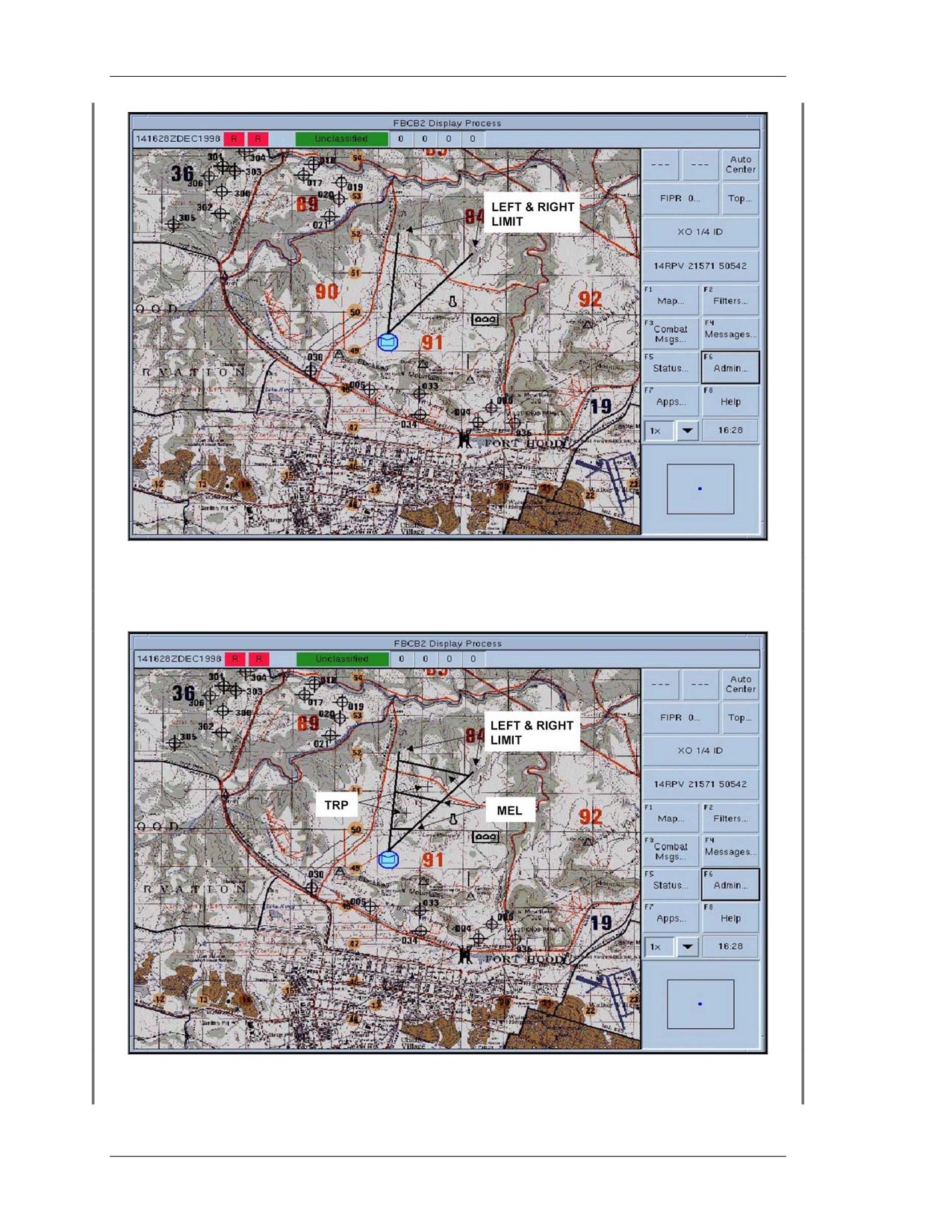
Figure 7-21. Example of digital range card showing
maximum engagement lines.
Figure 7-22. Example of digital range card showing TRPs.
7-36

FM 3-22.1
b. Send the range card's data section information along with an overlay. To do this,
use the free-text data box on the overlay message. You can obtain some digital
information by clicking on the icon shown on the overlay.
c. Address and electronically send the overlay to the platoon leader. He can change
the overlays to overlap sectors of fire. He then electronically sends back the overlays to
each vehicle or squad so they can adjust their overlays accordingly. From the range card
overlays, the platoon leader creates his platoon sector sketch, which he then sends
electronically to the company commander.
NOTE: Keep one copy of the standard range card with the vehicle. Send the other
copy, along with the digital range card, to the platoon leader.
7-24. FIRING POSITION
After a range card has been completed, the position should be marked with ground stakes.
This enables the Bradley (or a replacement Bradley) to reoccupy the position and use the
range card data.
a. Stake the Position. Before the driver moves the Bradley, stake the position. Three
stakes are required to mark the position effectively (Figure 7-23).
Figure 7-23. Staked position.
(1) Place one stake in front of the Bradley. Center it on the driver's station, just
touching the hull. Use a stake long enough for the driver to see it when the vehicle is in
position. Place the other two stakes parallel to the left track. Line up one stake with the
hub on the front wheel and line up the other with the rear wheel. Place the stakes close to
the Bradley, leaving only enough clearance to move the Bradley into position.
(2) Drive the stakes firmly into the ground. Place engineer tape or luminous tape on
the friendly side of the stakes so that the driver can see them. Place a rock at each of the
7-37
FM 3-22.1
front two corners of the vehicle. This will help the driver reoccupy the position if the
stakes are lost.
(2) Move into the Position. If the situation permits, have a ground guide assist
the driver.
(a) If you cannot use a ground guide due to enemy fire, the driver moves the Bradley
in, parallel to the side stakes, with the front stake centered on his station.
(b) Once the Bradley is in position, the gunner indexes the range and azimuth for one
of the TRPs on the range card. If the sight is aligned on the TRP, the Bradley is correctly
positioned. If the sight is not aligned on the TRP, the gunner should tell the driver which
way to move the vehicle to align the sight on the target. You should only have to make
minor adjustments.
(c) If the stakes are lost and the position is not otherwise marked, the vehicle is
moved to the approximate location. The BC or gunner can use a compass to find the left
and right limits. If time allows, the driver then moves the vehicle until it is within 6 to 8
inches of the exact position.
7-25. TASK
Figure 7-24 shows the Bradley range card task.
7-38
FM 3-22.1
PREPARE A BRADLEY RANGE CARD
CONDITIONS
Given a fully operational Bradley, sector of fire, compass, paper, pencil, map
(1:50,000), three marking stakes, and DA Form 5517-R, Standard Range Card.
STANDARDS
Within 15 minutes, the crew prepared a range card that showed the target area,
to include--
1. Weapon symbol.
2. Circle value.
3. Sectors of fire.
4. Target reference points or reference points.
5. Dead space.
6. Weapon reference point.
7. Magnetic north.
8. Identification data.
9. Target or sector data.
EVALUATION PROCEDURES
1. Administrative Process. At this task, the evaluator logs information about
each crewmember on a roster. He supplies the crewmember with all required
materials and equipment, displaying them IAW this manual. He uses the
performance measures to record the crewmember's performance. Afterward, he
tells the crewmember how well the crewmember performed on this task and
directs him to the next task or to further training. One evaluator can test one--and
only one--crewmember at a time.
2. Procedures Used When Personnel Receive a NO GO. If a crewmember fails
to achieve the standards on the performance measures, he earns a NO GO. When
this happens, the evaluator explains to the crewmember what he did wrong and
how to correct his mistakes. Then, he retests the crewmember IAW local SOP.
PERSONNEL, EQUIPMENT, AND MATERIAL REQUIRED
• Qualified 11B, 12B, 13F, 14R, or 19D, sergeant or above.
• Operational M2, M2A2, M2A2 ODS, M2A3 or M3, M3A2, M3A2 ODS, or M3A3 with BII.
• FM 3-22.1.
• Stopwatch.
• Compass.
• Clipboard with pen.
Figure 7-24. Range card task.
7-39
FM 3-22.1
• Three stakes per vehicle.
• One helper, qualified 11B, 12B, 13F, 14R, or 19D, sergeant or below.
PRETEST PREPARATION
1. Ensure equipment is operational.
2. Ensure turret is positioned at 6400 mils.
3. Ensure travel lock is engaged.
PRETEST CONDITIONS FOR EACH EXAMINEE
1. Issue a blank range card.
2. Issue a pencil and a compass.
3. Turn on turret power and drives.
4. Point out left and right limits and reference point.
TEST PLANNING TIME
Administration
5 minutes
Test
15 minutes
Total
20 minutes
INSTRUCTIONS TO EXAMINEE
The evaluator will read the following instructions aloud to the examinee:
"Let me have your attention. At this task, you will be tested on your ability to prepare a
Bradley range card. Do you understand these instructions?"
Pause for 5 seconds, then say—
"You will have fifteen minutes to complete each test."
Pause, then say--
"Begin."
Begin timing as soon as you give the command "BEGIN." If the examinee has not
completed each task after the allowed time, say loudly enough for the examinee
to hear--
"Stop."
If at any time you think that the examinee is going to damage the equipment or
injure himself, say--
"Stop."
PERFORMANCE MEASURES
1. Completed performance measures within 15 minutes.
2. Prepared a Bradley range card.
Figure 7-24. Range card task (continued).
7-40
FM 3-22.1
a.
Indicated identification data.
(1) Indicated unit identification.
(2) Indicated magnetic north.
b.
Filled in sketch portion.
(1) Indicated weapon position by proper symbol.
(2) Indicated left and right limits.
(3) Indicated circle value.
(4) Indicated TRPs or RPs.
(5) Indicated dead space.
(6) Indicated maximum engagement lines.
(7) Indicated weapon reference point.
c.
Filled in data section.
(1) Indicated position identification.
(2) Indicated vehicle type or bumper number.
(3) Indicated circle value in meters.
d.
Indicated target information.
(1) Indicated left and right limits.
(2) Indicated TRPs.
(3) Indicated RPs.
(4) Indicated WRPs.
e.
Indicated date and time.
Figure 7-24. Range card task (continued).
7-41
FM 3-22.1 (23-1)
CHAPTER 8
Crew Gunnery
Crew gunnery leads to section and platoon qualification. This training
consists of progressive tables to develop crew gunnery skills,
which include engaging and destroying single and multiple targets from a
stationary or moving BFV in a wide variety of conditions.
The tables and their evaluations focus on the individual crew's
collective ability to operate the BFV in all of its configurations, that is,
with all of its common and specialized systems and capabilities. Crew
gunnery focuses on tasks that occur inside the turret (Figure 8-1).
Commanders can tailor the events based on their contingency AO and
METL. Their options extend to target type and target engagement ranges.
Guidelines and procedures supplement the crew gunnery tables and
tasks to aid the commander in executing and evaluating crew gunnery.
Bradley Crew Gunnery Tables
Application
Page
BT I, Crew Defense
Figure 8-13
All crews
8-25
BT II, Crew Proficiency Course
Figure 8-14A
ODS and below
8-27
Figure 8-14B
ADA Linebacker
8-28
Figure 8-14C
A3
8-29
Figure 8-14D
BFIST
8-30
BT V, Crew Practice 1
Figure 8-15
All crews
8-35
BT VI, Crew Practice 2
Figure 8-16A
ODS and below
8-37
Figure 8-16B
ADA Linebacker
8-38
Figure 8-16C
A3
8-39
Figure 8-16D
BFIST
8-40
BT VII, Crew Practice 3
Figure 8-17A
ODS and below
8-41
Figure 8-17B
ADA Linebacker
8-42
Figure 8-17C
A3
8-43
Figure 8-17D
BFIST
8-44
BT VIII, Crew Qualification
Figure 8-18A
ODS and below
8-45
Figure 8-18B
ADA Linebacker
8-46
Figure 8-18C
A3
8-47
Figure 8-18D
BFIST
8-48
Figure 8-1. Bradley crew gunnery tables.
8-1

FM 3-22.1
Section I. EVALUATION
Evaluators need clear standards to measure the crew's proficiency in Bradley gunnery.
FM 3-90.1 requires leaders to evaluate collective training in the TPU format, so this
section follows that doctrine. The evaluator observes each crew's teamwork, specifically
in the areas of coordination, weapons system proficiency, and marksmanship. He
evaluates the crew as "T" (trained), "P" (needs practice), or "U" (untrained), based on the
GOs and NO GOs they receive.
8-1. ENGAGEMENT STANDARDS
Engagement standards consist of task and subtask standards. The crew must meet task
standards to succeed in the engagement. Each task standard comprises a combination of
critical, leader, and noncritical subtask standards. Critical subtasks must be accomplished
to meet the engagement task standards. Leader and noncritical subtasks support the
engagement task. The task standards apply to every engagement. Figure 8-2 shows
engagement evaluation criteria for crew gunnery.
T
GO
On all task standards
On all critical subtask standards
On all leader subtask standards
NO GO
No more than one NO GO on a noncritical subtask
standard.
P
GO
On all task standards
On all critical subtask standards
NO GO
On one or more leader subtask standards
OR
On two or more noncritical subtask standards.
U
NO GO
On one or more task standards
OR
On one or more critical subtask standards.
Figure 8-2. Criteria for evaluating crew gunnery engagements.
8-2. TASK STANDARDS
Engagement task standards require the crew to hit a given target with an appropriate
number and type of rounds without exposing the BFV beyond the given target's threat
time to engage the Bradley. Crews will receive full or no credit for an engagement. To
receive credit for the overall engagement, the crew must kill all targets in an engagement
IAW the appropriate engagement standards.
a. Target Kill Standards. Figure 8-3 shows crew-gunnery kill standards. Crews
receive a "U" (untrained) rating if they fail to achieve a kill IAW Figure 8-3, or if they
use ammunition other than that designated for destroying the target IAW Figure 8-4.
Some ammunition types can destroy other types of targets, and some are effective at
greater ranges than those shown in Figure 8-4; however, this table identifies the
ammunition standard for Bradley gunnery.
8-2

FM 3-22.1
TARGET
TARGET TYPE
STANDARDS
TOW Target
Armor
Hit with at least 1 round
Vehicle
Hit with at least 3 rounds
25-mm Point Target
ATGM
Hit with at least 1 round
25-mm Aerial Target
Helicopter
Hit with at least 5 rounds
25-mm Area Target
Troop
Suppress 75% of target area
Troop
Hit 1 target with 1 round
Coax Point Target
Truck
Hit with at least 3 rounds
Coax Area Target
Troop
Hit 1 troop target with 1 round
Stinger Target
Fixed-wing aircraft
Hit with at least 1 round
Figure 8-3. Target-kill-standards chart.
DESIGNATED AMMUNITION AND
ENGAGEMENT RANGES (IN METERS)
TARGETS
STINGER
TOW
AP
HE
COAX
Armored
3,750
Light-armored
2,500
2,500
Unarmored
901 to 2,500
901 to 3,000
900
Aerial
5,000
1,201 to 2,500
1,200
Troops
901 to 3,000
900
Figure 8-4. Target ammunition requirements.
b. BFV Exposure Matrixes. BFV exposure matrixes determine the BFV crew's
allowable exposure time to a given target. This methodology depends on various threat
weapon systems' capabilities. Once the BCE knows the target category, conditions, and
range, he refers to the applicable exposure matrix. When using an exposure matrix, the
BCE looks at the left-hand column for the target range. He follows that row to the right
until it intersects with the number of conditions that apply to that target. The number in
the corresponding box is the maximum allowable BFV exposure time for that target. For
targets that fall between the 100-meter increments, the BCE rounds the range up or down
to the nearest 100 meters. For example, he rounds down 1,550 meters to 1,500 meters;
and he rounds up 1,651 meters to 1,700 meters. When he must use alternate targets, such
as when he must substitute a stationary target for a moving one, the BCE uses the
conditions for the alternate target. The four matrixes include--
(1) Armored Targets. This matrix
(Figure 8-5) is not based on actual threat
capabilities. It is derived from a standard target-acquisition time-plus-the-time-of-flight
of the TOW missile. The armored target-timing matrix is based on the Bradley in a turret-
defilade position--in either day or night defense.
(2) Lightly Armored or Unarmored Targets. This matrix is based on the time a threat
target takes to hit a Bradley, BFIST, or Linebacker (Figure 8-6).
8-3
FM 3-22.1
(3) Aerial Targets. This matrix is based on the time a threat target takes to hit a
Bradley or BFIST (Figure 8-7), or Linebacker (Figure 8-8).
(4) Troop Targets. This matrix is based on the time a threat target takes to hit a
Bradley, BFIST, or Linebacker (Figure 8-9).
c. Matrix Condition. Times in the lightly armored or unarmored, aerial, and troop
matrixes are based on the worst-case threat targets in each category. Three conditions
apply to the threat target: NBC environment, moving BFV, and moving threat target.
Each condition gives the BFV crew additional time to engage the target, because the
threat needs more time to engage the BFV. NBC environments affect the threat's ability
to rapidly engage a BFV. When the matrix conditions exist, the threat needs more time to
place a hit on the BFV than under normal conditions. And, he finds hitting a BFV more
difficult and time-consuming than he would otherwise. The threat on the move needs
more time to place effective fire on a BFV. To determine the allowable exposure time to
a given target, the BCE must know--
(1) Target Category.
• Armored.
• Lightly armored or unarmored.
• Aerial.
• Dismounted troops.
(2) Number of Target Conditions.
• Normal conditions.
• One, two, or three additional conditions.
(3) Target Range.
8-4

FM 3-22.1
BFV
EXPOSURE MATRIX--ARMORED TARGETS
RANGE
DEFENSE
RANGE
DEFENSE
(Meters)
(Seconds)
(Meters)
(Seconds)
500
24
2,200
32
600
24
2,300
32
700
24
2,400
33
800
25
2,500
33
900
25
2,600
34
1,000
25
2,700
34
1,100
26
2,800
35
1,200
27
2,900
35
1,300
27
3,000
36
1,400
27
3,100
36
1,500
28
3,200
37
1,600
28
3,300
38
1,700
29
3,400
39
1,800
29
3,500
39
1,900
30
3,600
40
2,000
30
3,700
41
2,100
31
3,800
42
Figure 8-5.
BFV exposure matrix for armored targets.
8-5

FM 3-22.1
BFV
EXPOSURE MATRIX
LIGHTLY ARMORED AND UNARMORED TARGETS
ONE
TWO
THREE
RANGE
NORMAL
CONDITION
CONDITIONS
CONDITIONS
(Meters)
(Seconds)
(Seconds)
(Seconds)
(Seconds)
400
11
12
16
17
500
12
13
17
18
600
13
14
18
19
700
14
15
19
20
800
14
17
20
21
900
15
18
21
22
1,000
16
19
22
24
1,100
17
20
23
25
1,200
18
21
24
26
1,300
18
22
26
28
1,400
19
23
27
29
1,500
20
24
28
30
1,600
21
25
29
32
1,700
22
26
30
33
1,800
22
28
31
35
1,900
23
29
32
36
2,000
24
30
33
37
2,100
25
31
34
38
2,200
26
32
36
40
2,300
26
33
37
41
2,400
27
34
38
42
2,500
28
35
39
43
NOTE: Beyond 2,000 meters, use the M910E1 round.
Figure 8-6.
BFV exposure matrix for lightly armored and unarmored targets.
8-6

FM 3-22.1
BFV
EXPOSURE MATRIX--AERIAL TARGETS
ONE
TWO
THREE
RANGE
NORMAL
CONDITION
CONDITIONS
CONDITIONS
(Meters)
(Seconds)
(Seconds)
(Seconds)
(Seconds)
400
9
10
12
16
500
10
11
12
16
600
10
11
13
17
700
10
11
13
17
800
10
11
13
18
900
10
12
14
18
1,000
11
12
14
19
1,100
11
12
14
19
1,200
11
13
15
19
1,300
11
13
15
20
1,400
11
13
15
20
1,500
12
13
15
21
1,600
12
14
15
21
1,700
12
14
16
21
1,800
12
14
16
22
1,900
13
14
16
22
2,000
13
14
16
23
2,100
13
15
16
23
2,200
13
15
17
23
2,300
14
15
17
24
2,400
14
15
17
24
2,500
14
16
17
24
NOTE: For Linebacker or BSFV, use matrix only IAW allowable variation No. 7.
Figure 8-7.
BFV exposure matrix for aerial targets.
8-7

FM 3-22.1
Linebacker
EXPOSURE MATRIX--AERIAL TARGETS
ROTARY-WING
FIXED-WING
Range
Time
Range
Time
1,000 M
20 seconds
2,000 M
30 seconds
1,500 M
25 seconds
2,500 M
35 seconds
2,000 M
30 seconds
3,000 M
40 seconds
2,500 M
35 seconds
3,500 M
45 seconds
3,000 M
40 seconds
4,000 M
50 seconds
NOTE: Use this table only with RPVTS.
Figure 8-8.
Linebacker exposure matrix for aerial targets.
8-8

FM 3-22.1
BFV
EXPOSURE MATRIX
DISMOUNTED TROOP TARGETS
ONE
TWO
RANGE
NORMAL
CONDITION
CONDITIONS
(Meters)
(Seconds)
(Seconds)
(Seconds)
300
8
10
13
400
9
10
14
500
9
11
14
600
9
11
15
700
10
12
16
800
10
12
16
900
11
13
16
1,000
11
13
16
1,100
12
14
17
1,200
12
14
17
1,300
12
15
18
1,400
12
15
19
1,500
13
16
19
1,600
13
17
20
1,700
14
17
20
1,800
14
18
21
1,900
15
18
22
2,000
15
19
23
2,100
16
19
23
2,200
16
20
24
2,300
17
20
25
2,400
17
21
25
2,500
18
21
26
Figure 8-9.
BFV exposure matrix for dismounted troop targets.
d.
Timing Procedures. The BCE must record BFV exposure times for each task
fired, even when using computers. Exposure time measures how long the firing BFV is
exposed to any threat target(s). Timing procedures apply for single and multiple target
engagements. During multiple target engagements, the BCE times each target separately.
He determines timing as described, without variations.
e. Offensive or Retrograde Engagements. In an offensive or retrograde
engagement, the firing BFV is exposed in the open and on the move. Target exposure
(presentation) indicates threat engagement time has begun.
(1) Time Starts. Time starts when the target or simultaneous targets are fully exposed
(target lock) or when the crew fires the first round, whichever occurs first.
(2) Time Stops. Timing stops for each target in an engagement when the target is
killed or when its exposure time expires.
8-9

FM 3-22.1
f. Defensive Engagements. In a defensive engagement, the firing BFV starts in
turret defilade, moves into hull defilade to engage target(s), then returns to turret defilade.
(1) Time Starts. Time starts when either a crew fires the first round, or when all
targets are fully exposed
(target lock) and the firing vehicle is stopped in a hull-
defilade position.
NOTE: Threat time starts for turret-defilade armored engagements when all targets are
fully exposed.
(2) Time Stops. Time stops for each individual target if, during an engagement, the
firing vehicle begins to move back into a turret-defilade position, the target is killed, or
the target exposure time expires.
(3) Time Resets. If BFV exposure time has not been exceeded, then time resets when
the firing vehicle begins to move back into a turret-defilade position.
g. Coax Area Engagements. In a defensive engagement, the firing BFV starts in the
turret defilade, then moves into hull defilade to engage coax area targets. For coax area
engagements, time stops when one IRETS target is killed.
h. Linebacker. In an offensive or defensive engagement, the Linebacker may
engage aerial targets from the turret-defilade position or on the move. Linebacker crews
use slew-to-cue function on aerial engagements.
(1) Time Starts. Time starts when the local air-defense warning "DYNAMITE-
DYNAMITE" sounds (aerial engagements only).
(2) Time Stops Again. Time stops when the launcher superelevates
(Stinger
engagement only).
i.
BFV Exposure Standard. If a crew is exposed to a target longer than the allotted
time (IAW Figure 8-5 through Figure 8-9), the crew receives an untrained rating for the
engagement.
(1) Engagement Example 1. A BFV in the defense, during NBC conditions, during a
day engagement, engages a moving BTR-80 at 1,200 meters and an ATGM team at 600
meters (Figure 8-10).
TARGET
SIGHT AND
BFV EXPOSURE TIME
EXPOSURE
TARGET
POSTURE
RANGE
CONDITIONS
(Threat Time to Hit)
TIME
BTR-80
Moving,
1,200 M
2 conditions
24 seconds
50 seconds
NBC
ATGM
NBC
600 M
1 condition
11 seconds
50 seconds
Figure 8-10. Example 1 conditions and exposure times.
(a) Description. The BFV moves from a turret-defilade to a hull-defilade position
(time starts for both targets), engages and kills the BTR-80, and returns to the turret-
defilade position (time stops for both targets). The BFV was exposed to both the BTR-80
and ATGM team for a total of 12 seconds (time is reset). The BFV then returns to a hull-
defilade position (time starts) and engages and kills the ATGM team (time stops). The
8-10

FM 3-22.1
BFV was exposed for 8 seconds. The BFV engaged and destroyed the BTR-80 in
12 seconds and had 24 seconds to do so. Although the BFV killed the BTR-80 within the
allotted time and killed the ATGM team, the crew receives a NO GO in accordance with
the BFV exposure-time matrix (Figure 8-9). Therefore, the crew receives a "U" rating on
this engagement.
(b) Rationale. When the BFV assumed a hull-defilade position the first time, the BFV
became exposed to both the BTR-80 and the ATGM team. The threat time to hit a BFV
for an ATGM team at 600 meters with 1 condition is 11 seconds. When the BFV exposed
itself for 12 seconds while engaging the BTR-80, this allowed time for the ATGM team
to hit the BFV. The crew engaged the least dangerous target first.
(2) Engagement Example 2. A BFV in the offense or in retrograde, during a day
engagement, engages a moving BTR-80 at 1,200 meters and an ATGM team at 600
meters (Figure 8-11).
TARGET
SIGHT AND
BFV EXPOSURE TIME
EXPOSURE
TARGET
POSTURE
RANGE
CONDITIONS
(Threat Time to Hit)
TIME
BTR-80
Moving
1,200 M
2 conditions
24 seconds
24 seconds
ATGM
---
600 M
1 condition
11 seconds
11 seconds
Figure 8-11. Example 2 conditions and exposure times.
(a) Description. The BFV is moving in offense or retrograde. Both targets are
exposed simultaneously; therefore, the BFV is exposed to both threats (time starts for
both targets). The BFV engages the BTR-80 first and kills it in 22 seconds (time for the
BTR-80 stops). During the BTR-80 engagement, the ATGM's 11-second exposure time
expired (the range computer dropped the target). The BFV cannot achieve a target kill on
the ATGM in accordance with Figure 8-2. The crew receives a NO GO in accordance
with both the target kill standards in Figure 8-2 and the BFV exposure-to-dismounted-
troop target-timing matrix in Figure 8-9. The crew is rated untrained
(U) for this
engagement.
(b) Rationale. When the ATGM and BTR-80 were exposed simultaneously, the BFV
was exposed to both targets and target exposure time had begun. Although the BFV
killed the BTR-80 before the BTR-80 exposure time expired, the BFV failed to hit the
ATGM before the BFV target exposure time had expired. The crew engaged the least
dangerous target first.
(c) Additional Notes. First, on ranges that do not have defilade positions, markers
must be placed in the ground to assist the BCE in determining when the firing vehicle is
exposed and when it has returned to a defilade position. The vehicle must move at least
one vehicle length when moving into and out of the defilade position. Second, on
computer-controlled ranges, scenarios must be adjusted to ensure multiple targets are
programmed to lift at the same time, if possible. Third, fire commands are given only
after targets are exposed.
8-11
FM 3-22.1
8-3. CRITICAL SUBTASK STANDARDS
Critical subtask standards evaluate the crew's ability to engage targets in less than normal
operating conditions. If the crew does not meet all the applicable subtask standards, the
engagement task standards cannot be met. The crew is assessed an untrained rating on the
given engagement task.
a. Auxiliary Sight. Crew engages target(s) using the auxiliary sight. Gunner uses
the auxiliary sight to engage target(s) and the commander does not view through the
commander's sight extension. When conducting the auxiliary sight engagement on the
A3, crew executes engagement in GUNPOWER TRACK mode.
b. NBC Environment. Crew engages target(s) in an NBC environment.
(1) Vehicle crew must be in MOPP 4 in accordance with STP 21-1-SMCT.
(2) Crewmembers close all vehicle hatches.
(3) All crewmembers must restore intravehicular communication with each other.
(4) Bradley commander must restore radio communication with exercise controllers.
c. Manual Controls. Crew engages target(s) using manual controls.
(1) Gunner must place traverse drive select lever in manual position.
(2) Gunner must place the gun elevation drive select lever in manual position.
(3) Gunner must engage target(s) using the traverse and elevation manual handwheels
and trigger.
(4) Gunner can use his handstation to switch from low to high magnification and on
A3 models.
(5) Gunner can use his handstation to lase on the on A2 ODS and on A3 models
during manual engagements. They will still have to use the manual range knob, since the
system will not superelevate in the manual configuration.
d. Commander's Handstation. Commander engages target(s) using the
commander's handstation.
e. Friendly Targets. Crew does not engage friendly target(s).
(1) Crew must identify target(s) as friendly.
(2) Crew does not fire on friendly target(s).
(3) Crew reports friendly target(s) in sector to exercise controllers.
f. Stinger Subsystem (Linebacker Only). Linebacker crews engage target(s) using
the Stinger subsystem.
(1) Gunner's hatch must be closed.
(2) Gunner places Stinger control box in engage mode and arms Stinger system.
(3) Gunner interrogates target.
(4) Gunner activates missile.
(5) Commander and gunner ensure acquisition tone is heard.
(6) Gunner uncages missile.
(7) Commander and gunner ensure missile lock tone is heard.
(8) Gunner fires the system.
8-12
FM 3-22.1
8-4. LEADER SUBTASK STANDARDS
The leader subtask evaluates the Bradley commander's ability to control the crew,
vehicle, and weapon systems. Without this control, engagements will not be
synchronized, and efficiency will suffer.
a. Fire Commands. Bradley commander uses proper fire commands for each
engagement.
(1) The BC must include the required elements of a precision fire command in
sequence during single- or multiple-target defensive engagements. Bradley ODS and A3
commanders must include the required elements of a precision fire command in
sequence, but the "range" element is optional.
• Alert.
• Ammunition and weapons.
• Description.
• Range (optional for Bradley ODS and A3 models).
• Execution.
• Termination.
(2) The BC must include the required elements of a battlesight fire command in
sequence during single-target offensive or retrograde engagements. Bradley ODS and A3
commanders must use the elements of a precision fire command (as previously discussed)
for offensive or retrograde engagements and the elements of a battlesight fire command
when in the system degraded mode (ELRF failure). The elements are the same for each:
• Alert.
• Battlesight.
• Description.
• Execution.
• Termination.
(3) If the Bradley commander uses a multiple precision-fire command, he must
include the required elements in sequence for multiple-target defensive engagements. If
the Bradley ODS or A3 commander uses a multiple precision fire command, he must
include the required elements in sequence during multiple-target defensive engagements;
"range" element is optional.
• Alert.
• Ammunition, weapon, or both (first target).
• Description (of all targets, after which, first target is described again).
• Range (optional for Bradley ODS and A3 models.)
• Execution.
• Termination (first target).
• Ammunition, weapon, or both (second target).
• Description (second target).
• Range (optional for ODS and A3 models).
• Execution.
• Termination (final target).
(4) If the Bradley commander uses a multiple battlesight fire command during a
multiple-target offensive or retrograde engagement, then he must include the required
elements in sequence. If the Bradley ODS or A3 commander uses a multiple fire
command, then he must include all of the required elements of a precision fire command
8-13
FM 3-22.1
for offensive or retrograde engagements. With an ELRF failure, he uses the required
elements of a battlesight fire command.
• Alert.
• Battlesight.
• Description (of all targets, after which, first target is described again).
• Execution.
• Termination (first target).
• Description (second target).
• Execution.
• Termination (final target).
(5) The commander must include required elements of Stinger fire command in
sequence for both defensive and offensive engagements.
• Alert.
• Ammunition.
• Description.
• Execution.
• Termination.
b. Most Dangerous First. The commander ensures the crew engages the most
dangerous target first.
c. Ammunition and Weapon. The commander ensures that the crew selects the
proper ammunition and weapons systems for the target(s) are selected IAW Figure 8-3
and unit-engagement criteria.
d. Distance Moved. When going to and from a turret-defilade to a hull-defilade
position, the commander ensures the vehicle moves at least one-vehicle length.
e. Command to Fire. The commander ensures gunner does not fire before receiving
the command to fire.
f. Digital Systems. The crew uses the digital system for Linebacker, Bradley ODS,
and A3 IC3. The commander must send both a SALT and a situation report upon
completion of the day and night phases. In each phase (day and night), the only firing
task on which the evaluator scores the use of the digital system is the last engagement.
8-5. NONCRITICAL SUBTASK STANDARDS
Noncritical subtask standards apply to the techniques and procedures crews use for
successful engagements. Even if the crew fails to meet these subtask standards, they can
still meet the engagement task standards.
a. Response Terms. Commander or gunner must use proper response terms in
support of the leader subtask standards.
(1) Gunner confirms target by announcing "Identified." (For Bradley ODS and A3
models, see Chapter 6.)
(2) Commander or gunner announces, "Cannot identify" when he can not identify
the target.
(3) Gunner announces "Cannot engage" when he is inhibited from firing and the
commander must engage the target(s).
(4) Commander or gunner notifies the crew by announcing "On the way" before he
fires a weapon system.
8-14
FM 3-22.1
(5) When the proper target effect has been determined, the gunner announces,
"Target destroyed."
b. Engagement Techniques. Commander or gunner uses proper engagement
techniques IAW Chapter 6.
(1) Commander or gunner fires a sensing round; two if the ammunition has changed;
then fires a 3- to 5-round burst (25-mm point targets).
(2) Commander or gunner fires a 10- to 15-round initial burst; then fires an additional
10- to 15-round burst(s) at point targets until target is destroyed (coax point targets).
(3) Commander or gunner fires a 10- to 15-round initial burst at center mass, then
fires an additional 10- to 15-round burst in a suppressive pattern (coax area targets).
(4) Commander or gunner fires a 15- to 20-round burst (25-mm) while adjusting on
the target (aerial target).
(5) The Bradley A3 commander or gunner fires a 3- to 5-round burst without a
sensing round, except when using the auxiliary sight, or when the ELRF is not
operational
c. Driving Techniques. Driver uses proper driving techniques:
(1) Returns to the turret-defilade position after a defensive engagement.
(2) Maintains a steady platform while in an offensive or retrograde engagement.
(3) Stays on course roads as briefed in the range safety briefing.
(4) Does not cause damage to the Bradley.
(5) Does not exceed the established range speed limit.
(6) Driver avoids stalling the vehicle.
d. Defensive Techniques. Crew uses proper defensive techniques:
(1) Gunner raises TOW launcher (SVML for Linebacker) before first engagement in
the defensive position.
(2) Gunner lowers TOW launcher (SVML for Linebacker) before movement from the
defensive position.
(This standard applies to the last defensive engagement in
that position.)
e. Suppression Techniques. Commander or gunner uses an effective suppression
technique to achieve suppression for coax area targets.
8-6. CREW DEVICE-GUNNERY STANDARDS
Crew device gunnery consists of BT I, Crew Defense, and BT II, Bradley Crew
Proficiency Course.
a. BT I, Crew Defense.
(1) Action. Engage and destroy stationary and moving targets from a defensive
position during the day and night.
(2) Conditions. Given a MILES or PGS-equipped BFV in a defensive position,
suitable engagement area with LTID-equipped targets, during the day and night.
(3) Standards.
(a) During the day, the crew must achieve a minimum of a "P" rating on seven of the
ten engagements, with one of the seven being an NBC engagement.
(b) During the night, the crew must achieve a minimum of a "P" rating on seven of
the ten engagements, with one of the seven being an NBC engagement.
b. BT II, Bradley Crew Proficiency Course.
8-15
FM 3-22.1
(1) Action. Engage and destroy stationary and moving targets from a stationary and
moving BFV during the day and night.
(2) Conditions. Given a MILES or PGS-equipped BFV and suitable maneuver and
engagement area with LTID-equipped targets, during the day and night.
(3) Standards. The crew must achieve a minimum of a "P" rating on nine of the
twelve engagements with one of the nine being an NBC engagement, one of the nine
being a TOW engagement, two of the nine being night engagements.
8-7. CREW LIVE-FIRE GUNNERY STANDARDS
Crew live-fire gunnery consists of BTs V through VIII, Crew Practice and Qualification:
a. BT V, Crew Practice 1.
(1) Action. Engage and destroy stationary and moving targets from a stationary and
moving Bradley during the day and night.
(2) Conditions. Given a Bradley using the coax machine gun-authorized allocation of
ammunition, suitable live-fire range with targets, during the day and night.
(3) Standards. The crew must achieve a minimum of a "P" rating on seven of ten
engagements, with one of the seven being an NBC engagement, two of the seven being
night engagements.
b. BT VI, Crew Practice 2.
(1) Action. Engage and destroy stationary and moving targets from a stationary
Bradley during the day and night.
(2) Conditions. Given a Bradley, authorized allocation of ammunition, suitable live-
fire range with targets during the day and night.
(3) Standards. The crew for ODS and below must achieve a minimum of a "P" rating
on five of seven engagements (six of eight for all others) with one of the five (six) being
an NBC engagement, one of the five (six) being a night engagement.
c. BT VII, Crew Practice 3.
(1) Action. Engage and destroy stationary and moving targets from a stationary and
moving Bradley during the day and night.
(2) Conditions. Given a Bradley, authorized allocation of ammunition, suitable live-
fire range with targets during the day and night.
(3) Standards. The crew must achieve a minimum of a "P" rating on seven of nine
engagements with one of the seven being an NBC engagement, two of the seven being
night engagements.
d. BT VIII, Crew Qualification.
(1) Action. Engage and destroy stationary and moving targets from a stationary and
moving Bradley during the day and night.
(2) Conditions. Given a Bradley, authorized allocation of ammunition, suitable live-
fire range with targets during the day and night.
(3) Standards. The crew receives a distinguished, superior, or qualified rating based
on the criteria shown in Figure 8-12.
8-16

FM 3-22.1
DISTINGUISHED
Crew scored "T" on at least nine out of ten engagements.
• Crew earned no more than one "P" score.
• Crew received no "U" scores.
SUPERIOR
Crew scored "T" on at least eight out of ten engagements.
• One of the eight must have been an NBC engagement.
• Two of the eight must have been night engagements.
QUALIFIED
Crew scored either "T" or "P" on seven of ten engagements.
• One of the seven must have been an NBC engagement.
• Two of the seven must have been night engagements.
UNQUALIFIED
Crew's scores met one or more of the following conditions:
• "U" on four or more engagements of any kind
• "U" on both NBC engagements
• "T" or "P" on only one night engagement.
LEGEND T
— Trained
P
— Needs practice
U — Untrained
Figure 8-12. Scoring criteria.
8-8. QUALIFICATION REFIRES
If a crew fails to qualify, it refires for qualification. The highest rating that a crew can
earn when refiring is "Qualified."
a. A crew refires only the engagements scored "U."
b. A crew refires only the number of engagements required to obtain a
qualified rating.
c. The highest score the crew may receive when refiring a "U" task is "P."
d. If a crew refires a failed engagement before it fires all of the engagements in
BT VIII, it also receives, at best, a "Qualified" rating.
8-9. ALIBIS
Battalion and squadron commanders are the deciding authority on alibis. The crew refires
all alibi engagements. The commander only accepts alibis under the following conditions:
• Range equipment fails.
• Vehicle equipment fails, but not due to crew error.
• Unsafe conditions occur, but not due to crew error.
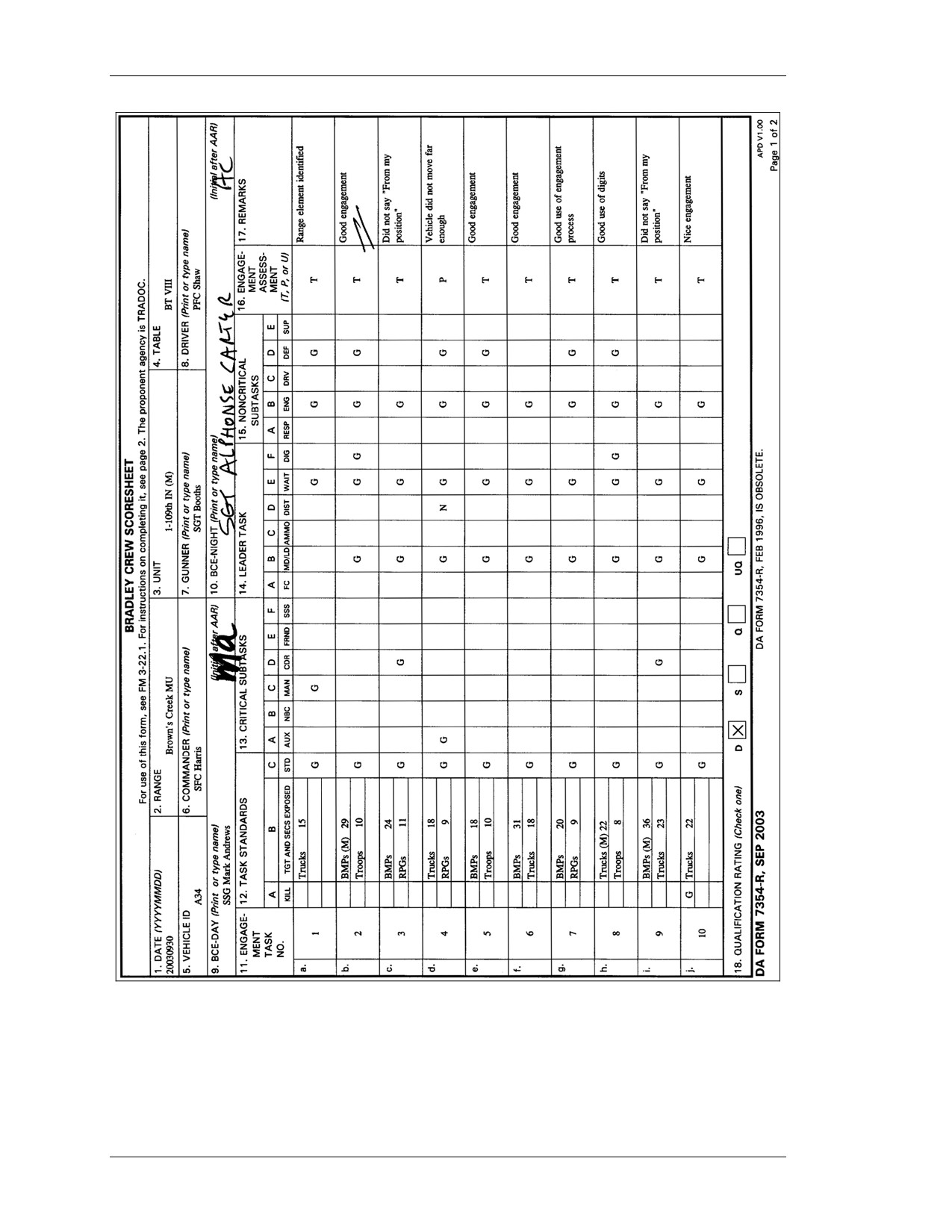
8-10. CREW SCORESHEET
Evaluators use DA Form 7354-R, Bradley Crew Scoresheet (Figure 8-13), to record the
results of gunnery engagements. Evaluators must print each entry accurately and legibly.
The instructions for completing the scoresheet are on the back of the blank form onto
8 1/2 by
11-inch paper. The blank form is located at the back of this manual
(after the Index). If needed, they can download it from the US Army Publishing
Directorate (see References).
8-17
FM 3-22.1
Figure 8-13. Example completed DA Form 7354-R, Bradley Crew
Scoresheet.
8-18
FM 3-22.1
Section II. EVALUATORS
The unit master gunner is responsible for training Bradley crew evaluators (BCEs).
8-11. DUTIES
The BCE assesses Bradley crew duties for device and crew gunnery
(Chapter 6,
Section V). He also enforces safety requirements, instructs nonqualification exercises,
and evaluates qualification exercises. Finally, he evaluates and rates the crew and
conducts an AAR.
a. Prerequisites. A soldier must have at least a rank of sergeant (E5) with an MOS
of 11B, 12B, 13F, 14R, or 19D, and, before he attends a BCE certification course, he
must have prior gunnery experience on the specific system he will evaluate.
b. Responsibilities. Master gunners are gunnery subject matter experts. They
develop and conduct BCE training.
(1) Division master gunners (enhanced and separate brigade master gunners) are
responsible for monitoring the BCE training program and developing certification
examinations.
(2) Battalion master gunners are responsible for executing the BCE training program.
8-12. CERTIFICATION
Certification is initial training for BCEs. BCEs must certify within three months of any
live-fire exercise (four months for RC). For M2A3 and M3A3 ODS appliqué units, BCEs
must be FBCB2 qualified. Certification consists of--
a. Attending a 40-hour BCE training program.
b. Passing a written examination with at least 40 questions with a minimum score
of 90 percent. The certification examination must include at least two questions in each
of the following areas:
(1) Range safety (AR 385-63 and local range SOPs).
(2) Fire commands (Chapter 6, Section IV).
(3) Engagement procedures (Chapter 6).
(4) Offensive BFV-timing procedures (Section I).
(5) Defensive BFV-timing procedures (Section I).
(6) Multiple target-timing procedures (Section I).
(7) BFV exposure-timing matrixes (Section I).
(8) Scoring procedures for multiple-target engagements (Section I).
(9) After-action review procedures (Section III).
(10) Refires and alibis (Section I).
(11) Scoresheets.
(12) Threat-based, target-exposure-timing matrixes (Section V).
c. A hands-on evaluation requires BCEs to evaluate a crew firing 10 engagements
using a videotape or the COFT or BATS. The BCEs must also conduct an AAR in
accordance with Section III.
(1) During a COFT or BATS session, BCEs use the briefing monitor to evaluate the
firing crew. This does not interfere with the I/O or scheduled training.
(2) The BCEs use the same clocks and scoresheets that they used during live-fire
gunnery for the evaluation.
8-19
FM 3-22.1
8-13. RECERTIFICATION
Recertification is refresher training for BCEs. Recertification consists of the written
examination and the hands-on evaluation. BCEs must recertify within the three months
before a live-fire exercise (four months for RC).
NOTE: The division master gunner (enhanced and separate brigade master gunner)
develops the exam to certify or recertify BCEs.
8-14. SUSTAINMENT
Sustainment training ensures the BCE knows evaluation procedures. It ensures that the
commander can find consistent, effective crew evaluators year-round. The BCE must
evaluate four exercises a month, in the COFT or BATS, using the same type of clocks or
timing boards and scoresheets used in device and crew gunnery.
Section III. AFTER-ACTION REVIEWS
The senior BCE or commander conducts a formal AAR after all crew gunnery events. In
AARs, he combines the feedback received from all participants. AARs identify where a
crew, section, or platoon meets--or fails to meet--Army standards. AARs provide
commanders, leaders, and training managers with a focus for future training events.
8-15. PLANNING
Successful AARs require planning and resource management. Commanders and training
managers--
a. Select Evaluators. One of the most challenging tasks during the planning phase
is selecting and scheduling qualified evaluators. Whom they select depends on the type of
evaluators they need--crew, section, or platoon evaluators; or internal or external
evaluators.
(1) Crew Evaluators. Evaluators required for crew gunnery events must hold BCE
qualifications. All company or troop evaluators must be certified and BCEs.
(2) Internal or External Evaluators.
(a) Battalion or squadron or higher organizations normally support internal
evaluations. Unit BCEs evaluate crews. Crew device and crew practice are internally
evaluated events.
(b) The BCEs from a different battalion, squadron, or higher organization support
external evaluations.
b. Develop Evaluation Records. The scoresheets, along with the computer printout,
give the BCE a record of each engagement for use during the AAR.
c. Select the AAR Site. When organizing the training site, the commander and
training managers should simultaneously plan the location of the AAR site. They should
locate it close enough to the training site to avoid long delays between training and
reviewing the training results. However, they should place it far enough from the training
area to avoid the distractions of other elements conducting training such as the signatures
of vehicles moving or firing. The AAR site should accommodate all participants
comfortably and shelter them from the elements.
d. Select Training Aids. Training aids give evaluators and participants a means to
reenact the training event. They can also encourage discussion. At a minimum, evaluators
8-20
FM 3-22.1
should use a range diagram of the area. Training aids to use during AARs include--
(1) Charts or Drawings. This should show the scenario, routes, and targets with any
operational graphics supporting the AAR. Using charts or drawings lets all participants
review actions while they follow the prescribed scenario.
(2) Sand Tables. This shows the topographical features of the area. Sand tables
should reflect the scale of the area accurately. They should show the scenario, routes, and
targets along with any operational control measures that apply to the training. This allows
the evaluator to guide the discussions while focusing on the particular place the
action occurred.
(3) Tape Recorders. These recorders can play back the fire commands and the radio-
net traffic.
(Recorders allow the crew to hear their commands and review
their responses).
(4) Thru-Sight Videos. This allows playback of real-time video of live-fire gunnery
engagements and fire commands. It (TSV) offers a look at engagement techniques and
identifies errors that can be corrected before the next training event.
(5) Precision Gunnery System AAR Computer. This is used to review gunnery data
during device-based exercises. It allows the evaluator and crewmembers to see the
placement of each round in relation to the target and its corresponding data.
8-16. PREPARING
Before conducting an evaluation and an AAR, the evaluator prepares himself and the
AAR site.
a. Review the Scenario. Before evaluating a crew or platoon, the evaluator must
know the scenario and the mission, the collective tasks, and the terrain of the training
area. Once he knows the scenario and mission, he must ensure he knows the doctrine
that applies.
b. Observe Training. The evaluator must place himself in the best position to
observe the task being conducted. The evaluator must record his observations.
c. Collect Information. After the event, the evaluator must collect information from
other observers. During gunnery events, he collects information such as target kill times
from the tower observers and BCEs.
d. Develop a Discussion Outline. The evaluator must develop an outline he wants
to follow during the AAR. He should identify the key areas he wants the participants to
discuss. This should include both strong and weak points. During this time, he should
decide how he is to accomplish his goal for the AAR. As an example, he should list key
questions to ask to give him the results he wants. He must determine what methods or
techniques he will suggest to improve efficiency. If required, he should ask master
gunners or other experienced personnel to relay helpful tips to the crew or platoon.
e. Rehearse. Before participants arrive at the AAR site, the evaluator organizes his
training aids, evaluation sheets, and seating arrangements. He should ensure the training
aids are functioning and viewable by all participants. At a minimum, evaluators should
rehearse the key points to be made.
8-17. CONDUCTING
Crew members usually know how they performed before the AAR, though they may not
know why they performed the way they did. The function of the evaluator conducting the
8-21
FM 3-22.1
AAR is to encourage members to discuss what they did and to guide them into
discovering why. The members then determine how they can do it differently next time.
The evaluator aids in these discussions and provides expertise when needed. When
conducting AARs, the evaluator should use the following guidelines:
a. Ensure all Participants are Present. The evaluator should not begin the AAR
until all participants are present. Anyone missing may have witnessed an event and may
have something to contribute to the discussion.
b. Restate the Training Objectives. The evaluator begins the AAR by restating the
training objectives of the training event and its major tasks for the crew (crew gunnery).
He begins by stating its title, "You just completed the day phase of Bradley Table VII."
He then highlights the major task involved, "This phase tested your ability to conduct
four engagements. The first was a defensive engagement using the auxiliary sight; the
second was an offensive engagement; the third was a defensive commander engagement
in an NBC environment; and the fourth was a retrograde while returning up range."
c. Generate Discussion. The evaluator begins the discussion by asking questions
about the first event. For crew gunnery, "Who saw the target first?" After discussing one
event, the evaluator asks questions about the next. He and the evaluated unit discuss
events in chronological order.
d. Orient on Training Objectives. As discussions move away from the objectives,
the evaluator must bring the discussions back on track. The evaluator keeps discussions
on topic to make the best use of valuable AAR time.
e. Seek Maximum Participation. Evaluators must ensure all participants are heard
and not let one person monopolize discussions. If a member has not participated, the
evaluator asks him a direct question such as, "What were you doing during this time?"
f. Summarize to Emphasize Key Learning Points. As weaknesses are discovered
and discussed, the evaluator summarizes the result and the solution.
8-22
FM 3-22.1
g. Overview the Event. The evaluator closes the AAR by reviewing strengths and
weaknesses relative to Army standards. For example, "(Crew), we found that during the
fourth engagement, you failed to engage the AP target. This gave him the time to place a
killing burst on your BFV. After the discussion we just finished, you now know how to
avoid this mistake in the future. In accordance with FM 3-22.1, you received a 'U' for this
engagement. You earned a 'T' on each of the other three engagements."
Section IV. DEVICE GUNNERY
This section first trains collective device skills such as installing, boresighting
(Appendix B), calibrating, aligning, and removing the devices. Then it teaches gunnery
skills in BT I, Crew Defense and BT II, Bradley Crew Proficiency Course. The latter is a
prerequisite for full-caliber live fire. All Bradley crews must achieve the standard for BT
II as previously described in this chapter. They must do so within three months (four
months for RC) before they fire full-caliber ammunition. Device gunnery is conducted in
local training areas using MILES or PGS with LTID targetry. The tables train the crew to
engage stationary and moving targets using all weapon systems, from both stationary and
moving BFVs, day and night. The crew acquires and engages targets using power and
manual controls, gunner and commander handstations, integrated sight units, and the
auxiliary sights (IBAS and CIV on the Bradley A3). M6 Linebacker crews use captive
flight trainers and train in aerial engagements. M7 BFIST crews practice fire-
mission tasks.
8-18. GUIDELINES
Device gunnery tables should be conducted on full-scale ranges using PGS. If PGS is
unavailable, then MILES can be substituted. However, if PGS and MILES are both
unavailable, then the use of a coax single-shot adapter is authorized. The following
guidelines apply to crew device gunnery:
a. Evaluators (BCEs) rate all engagements and exercises as either trained ("T"),
needs practice ("P"), or untrained ("U"), in accordance with Section I.
b. To engage targets in the offense, the BC must give battlesight fire commands. To
engage targets in the defense, the crews must give precision fire commands. (Bradley A3
and ODS crews using the ELRF must do so as described in Chapter 6.)
c. All defensive engagements start with the firing vehicle in turret defilade. The
vehicle moves to a hull defilade to engage the target(s). On ranges without correct
defilade positions, units can simulate positions. In any of these positions, vehicles must
move at least one vehicle length.
d. Crewmembers fire all offensive and retrograde engagements from a moving BFV
using the stabilization system. If the firing vehicle's stabilization system fails, the crew
reports this immediately to the control tower or OIC. The engagement terminates, and the
vehicle conducts no offensive engagements until the system is corrected.
e. The BFV exposure time matrixes in Section I prescribe total target-
exposure times.
f. When the target array consists of more than one target, simultaneous target
exposure is used. A simultaneous target exposure occurs when all targets for the task are
presented at the same time, requiring crews to use proper engagement techniques.
8-23
FM 3-22.1
g. If moving targets are unavailable, a stationary frontal target of the same type and
at the same range is used. If a stationary target is used, evaluators compensate by
omitting one target condition.
h. Scaled targets equipped with LTIDs may be used with PGS and MILES
(Chapter 7).
i.
Bradley A3, ODS, and other variants with the FBCB2 will fire one day and one
night engagement under digital conditions.
j.
For M2A3 and M3A3 tables, the delayed hunter-killer target engagements will
include--
(1) Engagements in the Defense. Use the most-dangerous target for two-target
engagements, or the dangerous target for three-target engagements. In two-target
engagements, the least dangerous target is presented first; in three-target engagements,
the most and least dangerous targets are presented first, and least dangerous
are presented last.
(2) Engagements in the Offense. Use the least-dangerous target for two- and three-
target engagements. In two-target engagements, the most dangerous target is presented
first; in three-target engagements, the most dangerous and dangerous targets are
presented first.
k. For M2A3 and M3A3 tables, the delayed target for the hunter-killer tasks is
presented 15 to 20 seconds after target lock of the initial target(s) for three target
engagements. For two target engagements, delay presentation of the second target for 7 to
10 seconds.
8-19. BRADLEY TABLE I, CREW DEFENSE
The crew defense table allows the driver to integrate into the crew's coordination by
moving the vehicle to and from firing positions during day and night engagements
(Figure 8-14). This table trains the crew to engage targets with training devices. It
introduces them to training in a gunnery environment during day and night. Crew defense
consists of ten engagements. These ten engagements run during the day and again
at night.
8-24

FM 3-22.1
BT I
CREW DEFENSE
SIGHT AND
BFV 1
CREWMEMBER
CONDITIONS
TARGET TYPE
POSTURE
Stationary
Gunner
Auxiliary Sight 2
AP
Stationary
Stationary
Gunner
ISU or IBAS in
HE
Stationary
Manual
Stationary
Commander
RBD or CSE
AP
Stationary
Coax
Stationary
Gunner
ISU or IBAS
AP
Moving
Coax
AP 3
Stationary
Stationary
Gunner
ISU or IBAS
AP
Moving
in NBC
AP
Stationary
Stationary
Gunner
ISU or IBAS
TOW/
Moving
Aerial (CFT) 4
AP
Stationary
Stationary
Gunner
ISU or IBAS
Aerial 25-mm
Moving
HE 4
Stationary
Commander
RBD or CSE
TOW
Stationary
Stationary
Gunner
ISU or IBAS
HE
Area
Stationary
Commander
RBD or CSE
AP
Moving
HE
Stationary
1 M7 BFIST
Incorporate one FMT task into the day phase and one into the night phase.
2 Night
Use ISU or IBAS.
3 A3 BFV
Hunter-killer task.
4 M6
Substitute a suitable target type.
Figure 8-14.
BT l, Crew Defense.
8-25
FM 3-22.1
8-20. BRADLEY TABLE II, BRADLEY CREW PROFICIENCY COURSE
The BCPC introduces crews to moving BFV engagements. This table develops the
driving skills of the driver, while the crew engages targets on the move. Crews engage
moving and stationary targets from a moving and stationary BFV. The BCPC consists of
six day engagements and six night engagements.
• Figure 8-15A applies to the ODS and below.
• Figure 8-15B applies to the ADA Linebacker.
• Figure 8-15C applies to the A3.
• Figure 8-15D applies to the BFIST.
8-26

FM 3-22.1
BT II--ODS and Below
BRADLEY CREW PROFICIENCY COURSE
DAY ENGAGEMENTS
SIGHT AND
BFV
CREWMEMBER
CONDITIONS
TARGET TYPE
POSTURE
Stationary
Gunner
ISU
TOW
Moving
Defense
Gunner
ISU
AP
Stationary
Coax
Area
Offense or
Gunner
ISU
AP
Moving
Retrograde
HE
Stationary
Defense
Gunner
Auxiliary Sight
HE
Stationary
Coax
Point
Offense or
Commander
CSE
HE
Stationary
Retrograde
Defense
Gunner
ISU in NBC
AP
Moving
Coax
Area
NIGHT ENGAGEMENTS
SIGHT AND
BFV
CREWMEMBER
CONDITIONS
TARGET TYPE
POSTURE
Stationary
Gunner
ISU
TOW
Stationary
Defense
Gunner
ISU in Manual
HE
Stationary
Offense or
Gunner
ISU in NBC
AP
Moving
Retrograde
HE
Stationary
Defense
Gunner
ISU
HE
Moving
Coax
Area
Offense or
Commander
CSE
AP
Stationary
Retrograde
Coax
Point
Defense
Gunner
ISU
AP
Stationary
Coax
Point
Figure 8-15A.
BT II, Bradley Crew Proficiency Course (ODS and below).
8-27

FM 3-22.1
BT II--ADA Linebacker
BRADLEY CREW PROFICIENCY COURSE
DAY ENGAGEMENTS
SIGHT AND
BFV
CREWMEMBER
CONDITIONS
TARGET TYPE
POSTURE
Stationary
Gunner
ISU
CFT
Moving
Defense
Gunner
ISU
CFT
Moving
AP
Stationary
Offense or
Gunner
ISU
HE (20 Rounds)
Stationary
Retrograde
AP
Moving
Defense
Gunner
Auxiliary Sight
HE
Stationary
Coax
Point
Offense or
Commander
CSE
HE
Stationary
Retrograde
Defense
Gunner
ISU in NBC
CFT
Moving
Coax
Area
NIGHT ENGAGEMENTS
SIGHT AND
BFV
CREWMEMBER
CONDITIONS
TARGET TYPE
POSTURE
Stationary
Gunner
ISU
CFT
Moving
Defense
Gunner
ISU in Manual
HE
Stationary
Offense or
Gunner
ISU in NBC
AP
Moving
Retrograde
HE
Stationary
Defense
Gunner
ISU
HE (20 Rounds)
Stationary
Coax
Area
Offense or
Commander
CSE
AP
Stationary
Retrograde
Coax
Point
Defense
Gunner
ISU
AP
Stationary
CFT
Moving
Figure 8-15B.
BT II, Bradley Crew Proficiency Course (ADA Linebacker).
8-28

FM 3-22.1
BT II--A3
BRADLEY CREW PROFICIENCY COURSE
DAY ENGAGEMENTS
SIGHT AND
BFV
CREWMEMBER
CONDITIONS
TARGET TYPE
POSTURE
Stationary
Gunner
IBAS
TOW
Moving
Defense
Gunner
IBAS/ Hunter-Killer
AP
Stationary
AP
Moving
Coax
Area
Offense or
Gunner
IBAS
AP
Moving
Retrograde
HE
Stationary
Defense
Gunner
Auxiliary Sight
HE
Stationary
Coax
Point
Offense or
Commander
RBD
HE
Stationary
Retrograde
Defense
Gunner
IBAS in NBC
AP
Moving
Coax
Area
NIGHT ENGAGEMENTS
SIGHT AND
BFV
CREWMEMBER
CONDITIONS
TARGET TYPE
POSTURE
Stationary
Gunner
IBAS
TOW
Stationary
Defense
Gunner
IBAS in Manual
HE
Stationary
Offense or
Gunner
IBAS in NBC
AP
Moving
Retrograde
HE
Stationary
Defense
Gunner
IBAS
HE
Moving
Coax
Area
Offense or
Commander
RBD
AP
Stationary
Retrograde
Coax
Point
Defense
Gunner
IBAS
AP
Stationary
Hunter-Killer
Coax
Point
Coax
Point
Figure 8-15C.
BT II, Bradley Crew Proficiency Course (A3).
8-29

FM 3-22.1
BT II--BFIST
BRADLEY CREW PROFICIENCY COURSE
DAY ENGAGEMENTS
SIGHT AND
BFV
CREWMEMBER
CONDITIONS
TARGET TYPE
POSTURE
Stationary
Gunner
ISU (FMT)
TOW
Moving
Defense
Gunner
ISU
AP
Stationary
(FMT > 2,000 M)
Coax
Area
Tank
Stationary
Offense or
Gunner
ISU
AP
Moving
Retrograde
HE
Stationary
Defense
Gunner
ISU (Auxiliary
HE
Stationary
sight, if equipped)
Coax
Point
Offense or
Commander
CSE
HE
Stationary
Retrograde
Defense
Gunner
ISU in NBC
AP
Moving
Coax
Area
NIGHT ENGAGEMENTS
SIGHT AND
BFV
CREWMEMBER
CONDITIONS
TARGET TYPE
POSTURE
Stationary
Gunner
ISU (FMT)
TOW
Stationary
Defense
Gunner
ISU in Manual
HE
Stationary
Offense or
Gunner
ISU in NBC
AP
Moving
Retrograde
HE
Stationary
Defense
Gunner
ISU
HE
Moving
Coax
Area
Offense or
Commander
CSE
AP
Stationary
Retrograde
Coax
Point
Defense
Gunner
ISU
AP
Stationary
(FMT >2,000 M)
Coax
Area
Tank
Stationary
Figure 8-15D.
BT II, Bradley Crew Proficiency Course (BFIST).
8-30
FM 3-22.1
Section V. LIVE-FIRE GUNNERY
Crew live-fire gunnery trains and evaluates single vehicle crews' abilities to engage
stationary and moving, single and multiple targets with turret-mounted weapon systems.
This training is conducted during day and night or other limited visibility conditions,
from stationary and moving firing vehicles, and using full-caliber ammunition. Each
series of actions and engagements replicate potential battlefield conditions. Assessments
of preliminary and device gunnery identify weaknesses to improve during crew gunnery.
NOTE: Before executing each live-fire table, the crew must boresight (Appendix B),
zero (Appendix C), or at least confirm the zero of each weapon system.
8-21. DEVELOPMENT OF TABLE
Crew gunnery establishes an Army standard for training and evaluation. At the same
time, battalion commanders tailor engagements for their particular contingency missions
and training emphasis. Each table has specific engagement tasks, conditions, and
standards. Battalion commanders identify specific threat target types and engagement
distances or range bands. BFV exposure-timing matrixes (Figures 8-5 through 8-10)
provide this flexibility while maintaining a standard throughout the Army. The unit may
use a tactical scenario; however, these firing tables are not tactical exercises. An example
is "Move from battle position 1 to battle position 2, enemy reported to your front." The
tables train and evaluate single vehicle crew proficiency only--wingman techniques are
not allowed. Units equipped with the FBCB2 variants will be evaluated on their use of
digital communications systems to send SPOTREPs and SITREPs.
a. Crew gunnery evaluation procedures and standards meet the requirements
described in this chapter. Crew gunnery tables follow:
• BT V, Crew Practice 1.
• BT VI, Crew Practice 2.
• BT VII, Crew Practice 3.
• BT VIII, Crew Qualification.
b. All crews will fire at a minimum BT II and BT VII before BT VIII, which must
be fired IAW the standards in this manual.
c. Division commanders will approve the range scenarios for BT VIII, Crew
Qualification.
d. Battalions specify battlecarry and most dangerous versus least dangerous targets,
based on threat analysis or training emphasis.
e. The crew must fire all offensive and retrograde engagements from a moving BFV
using its stabilization system.
f. BT VIII, Crew Qualification, has four swing tasks: two for day and two for night.
Using swing tasks lets the commanders and master gunners adjust the number of tasks
fired (day or night) to match available light conditions. For example, during a season with
more hours of darkness than daylight, they might use four day tasks and six night tasks.
They cannot switch swing tasks. The commanders can only move them between day and
night scenarios--they cannot substitute any other task for them.
g. BT VIII crew qualification scenarios must contain at least--
8-31
FM 3-22.1
(1) M2A2 ODS and Below.
• One day AP- and one night AP-type target at 800 meters or less.
• One day AP- and one night AP-type target at 1,400 meters and beyond.
(2) M2A3 Bradleys.
• One day AP- and one night AP-type target at 800 meters or less.
• One day AP- and one night AP-type target at 1,600 meters and beyond.
(3) Lateral Dispersion for M2A3 or M3A3 Bradleys. Each of the following must
have at least 14 degrees dispersion between targets, not to include the commander's
engagement (rule of thumb, 25 meters dispersion for each 100 meters). This provides at
least one target outside the IBAS's WFOV during a multiple-target engagement:
• One-day multiple engagement.
• One-night multiple engagement.
h. BTs I, II, and V through VIII must each include--
• One engagement under digital conditions in the day phase.
• One engagement under digital conditions in the night phase.
i.
All defensive engagements begin with the firing vehicle in the turret-defilade
position and then move to a hull-defilade position to engage. This does not apply to
Stinger and 25-mm aerial engagements. On ranges that prohibit this, or that have no
defilade positions, units use simulated positions. Vehicles must move at least one vehicle
length in any of these positions.
8-22. TARGETRY
All gunnery qualification tables must use full-scale targets.
a. All ranges and targets must comply with TC 25-8.
b. When a target array includes multiple targets, the trainer exposes them
simultaneously to test the crew's mastery of proper engagement techniques. For the A3
hunter-killer engagement, the third target is not read into the scenario. It is presented
15 to 20 seconds after target lock of the initial target(s) (Section IV). The purpose of this
task is to have the commander use his CIV to locate and identify targets at the same time
that the gunner engages other targets.
c. For offensive and retrograde engagements, total target-exposure time is set using
the BFV exposure-timing matrix (Figures 8-5 through 8-10, pages 8-5 through 8-10). The
master gunner uses the individual target's conditions and range to determine that target's
exposure time.
d. Target exposure time begins when the target is fully exposed. Total target-
exposure time does not include target lift time.
e. For defensive engagements, total target exposure time for all targets is
50
seconds. Figure 8-4 helps in establishing the armored engagement exposure time.
However, the BFV cannot remain exposed beyond the BFV exposure-timing matrixes in
this chapter.
f. Coax machine gun point-type targets and engagements are defined as--
(1)
Rocket-propelled grenade (RPG) or ATGM team targets, which include three
E-type silhouettes placed on line or in a wedge formation. They must not be more than
5 meters apart or 10 meters deep.
8-32
FM 3-22.1
(2) Unarmored targets within 900 meters. However, these targets must have unique
designs that the crew can easily identify. For example, they might have a recognizable
silhouette or thermal image. This reduces confusion as to the ammunition type to use.
g. For area targets in coaxial machine gun engagements, target arrays consist of
seven E-type silhouettes placed on line or in a column or wedge formation. Targets must
not be more than 5 meters apart nor extend beyond 30 meters in width or 20 meters
in depth.
8-23. AMMUNITION
When crews receive only one type of
25-mm ammunition, they must upload the
designated amount of ammunition into the appropriate ready boxes (HE or AP ready
box). The scenario target type determines the amount of ammunition the crew must load.
a.
25-mm Gun.
•
8 rounds of TPDS-T for each AP point target.
•
8 rounds of TP-T for each HE point target.
•
25 rounds of TP-T for each HE area target.
•
20 rounds of TP-T or TPDS-T for aerial targets.
b. Coaxial Machine Gun.
•
50 rounds of 7.62-mm for each RPG or ATGM team or unarmored target.
•
100 rounds of 7.62-mm for each area target.
8-24. ALLOWABLE VARIATIONS
Leaders may change their targets and firing tables as follows:
a. Battalion commanders may add friendly targets to BT VIII, Crew Qualification.
b. Battalion commanders may dictate more engagements on BT VIII using
14 degrees of dispersion between targets, not including the commander's engagement for
M2A3 or M3A3 vehicles. Battalion or squadron commanders may also--
• Modify BT I and BTs V through VII to improve on weak areas.
• Modify the number of tasks fired on BTs V through VII.
• Add friendly targets to BTs V through VII.
c. When moving targets are unavailable, trainers use a stationary frontal target of the
same type and at the same range. When they use a stationary target, evaluators
compensate by omitting one of the target's conditions.
d. If the firing vehicle's stabilization system fails, the crew reports it immediately to
the control tower or OIC. He terminates the engagement, and the vehicle conducts no
more offensive engagements until the system is corrected.
e. BTs V through VIII list the minimum number of engagements that the crew must
fire to achieve training goals. Any engagements added to the firing tables will pertain to
unit's METL and depend on ammunition availability.
f. All firing vehicles on BTs II and V through VIII equipped with FBCB2 systems
must start each phase with working digital communications. Only the commander can
approve vehicles to continue firing a table after it loses digital capability.
8-33
FM 3-22.1
8-25. PREREQUISITES
Crewmembers (11B, 12B, 13F, 14R, and 19D) must meet certain prerequisites before
participating in crew gunnery. They must--
a. Qualify on BGST within the previous three months (four months for RC).
b. Qualify on BT II within the previous three months (four months for RC).
8-26. BRADLEY TABLE V, CREW PRACTICE 1
Bradley Table V, Crew Practice 1, introduces crews to a live-fire gunnery environment
(Figure 8-16). This table uses the 7.62-mm coax machine gun, in the single-shot mode, as
a subcaliber device replicating main gun engagement. Due to the limited engagement
range of the coax, half-scale targets are placed at half the engagement distance; for
example, when a 1,200-meter engagement requirement exists, a half-scale target is placed
at 600 meters. Gunners must use the actual straight-line distances when engaging targets
(600 meters for a replicated 1,200-meter target).
8-34