3-22.1 (FM 23-1) BRADLEY GUNNERY (NOVEMBER 2003) - page 4
FM 3-22.1
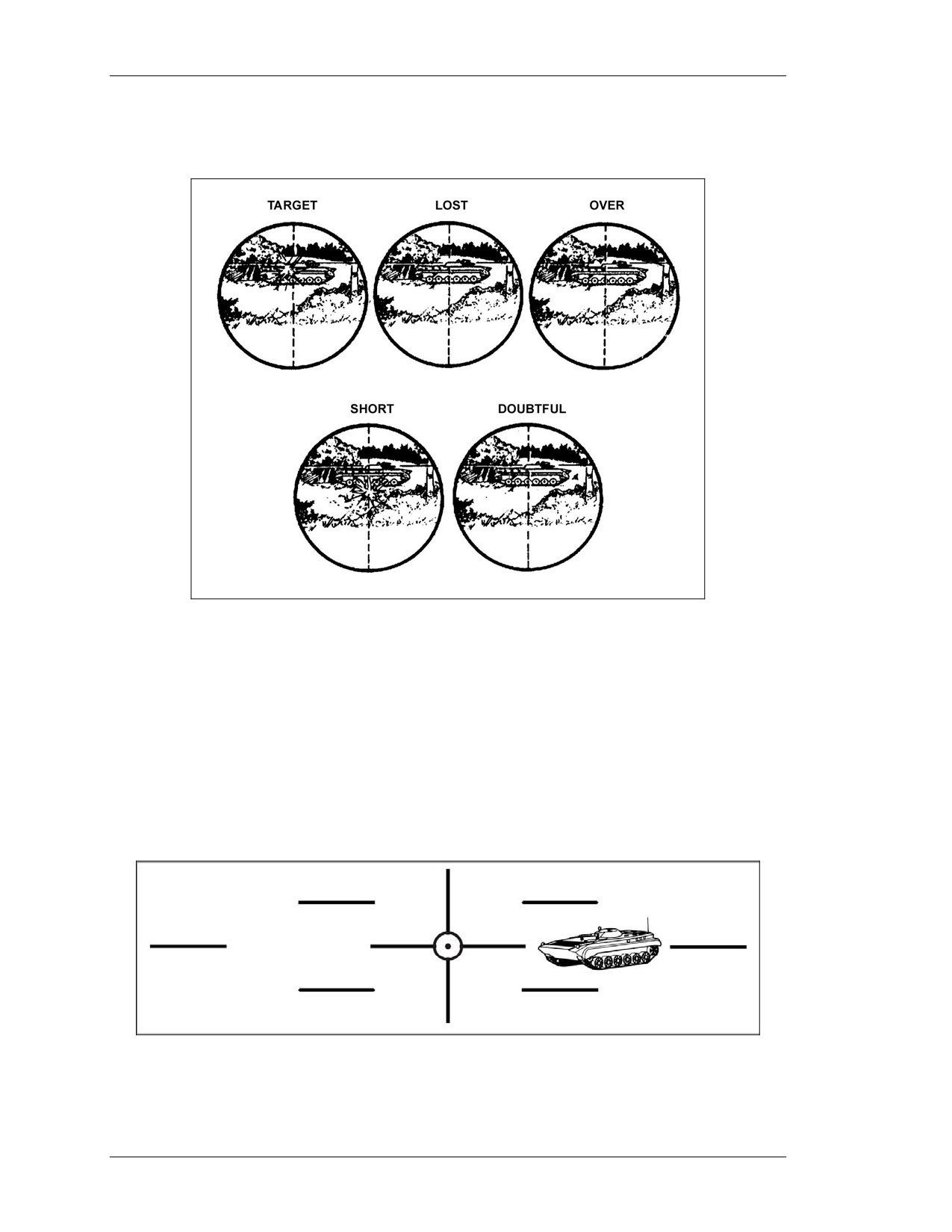
a range correction, it always requires a deflection shift. When a crewmember observes
"Doubtful…" he does so as "Doubtful Left" or "Doubtful Right."
Figure 6-26. Target observations.
c. Target Lead. When engaging a moving target, the gunner must lead (aim in
front of) the target to compensate for the movement. The amount of lead depends on the
velocity of the ammunition, target speed, and target angle, but he uses the standard lead
to start the engagement. This only applies to the A3 when in degraded mode.
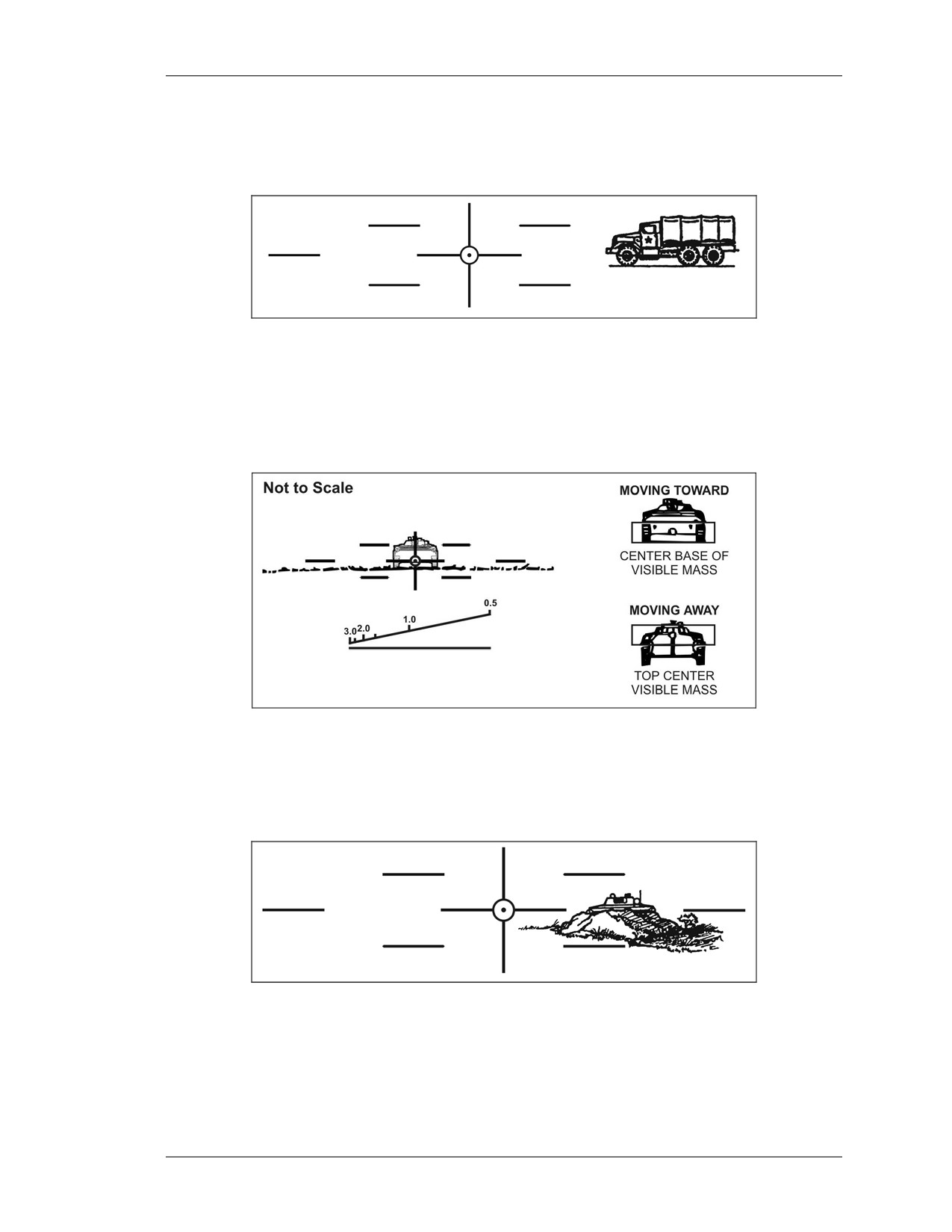
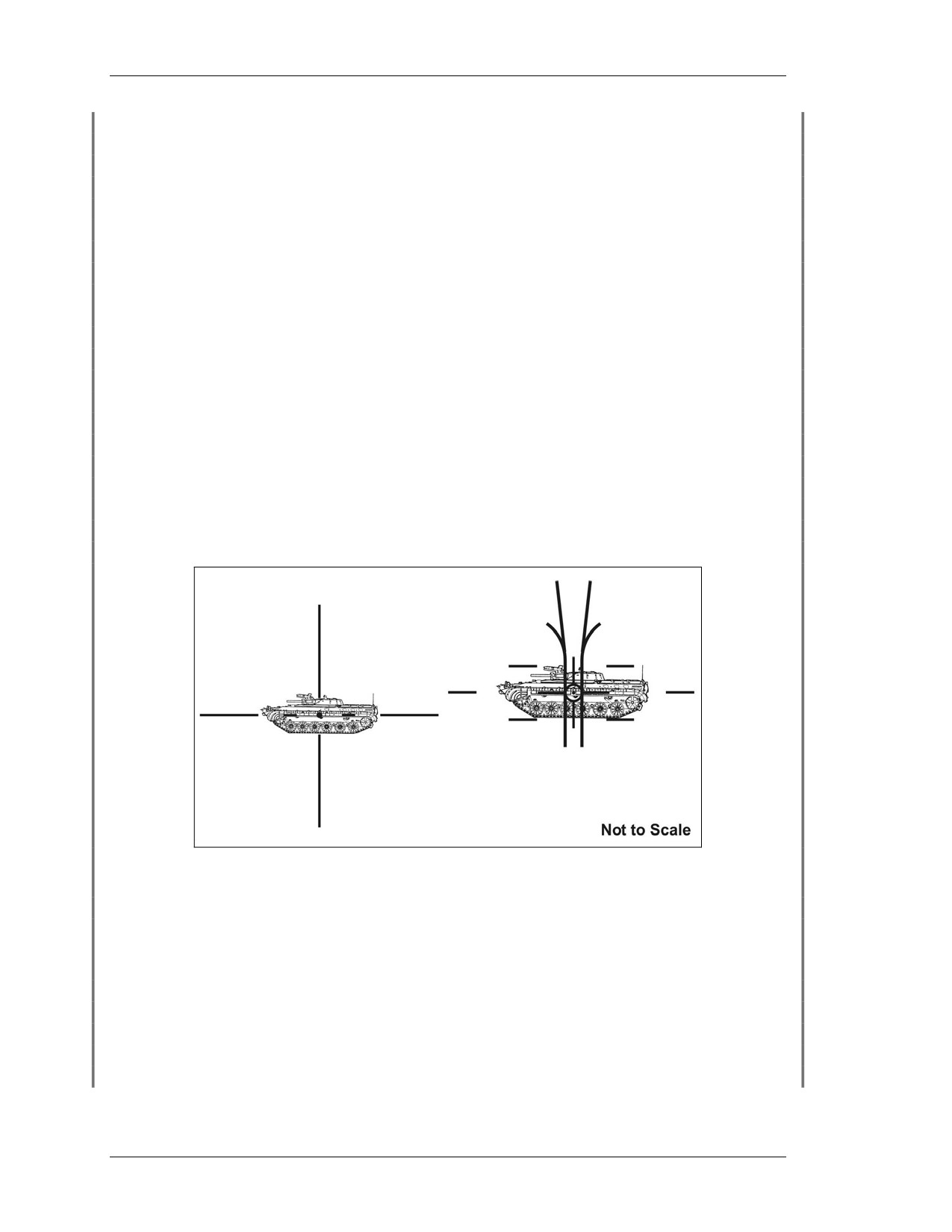
(1) When using AP ammunition, the gunner uses a 5-mil lead from the center mass of
the target. This rule is called the "gap lead." To apply gap lead, the gunner centers the
target in the gap of the gun reticle. Figure 6-27 shows a BMP given a gap lead. The lead
lines are shown as 2.5 mils long, except for the lead lines around the 1-mil circle, which
are 2 mils long.
Figure 6-27. Gap lead applied to a moving BMP.
6-30
FM 3-22.1
(2) When using HEI-T and 7.62-mm ammunition, the gunner uses far lead. To apply
far lead, he centers the farthest lead line of the ISU on the target. Figure 6-28 shows a far
lead truck engagement.
Figure 6-28. Far lead applied to a moving truck.
(3) When engaging targets moving toward or away from the position, the gunner may
need to make small vertical adjustments (Figure 6-29). When the target is approaching,
he aims at the center base of mass. When the target is moving away, he aims at the top
center mass. As the range changes, the gunner must carefully adjust this aim point.
Figure 6-29. Target moving toward or away from Bradley position.
(4) When a moving Bradley fires over its flank (side) at a stationary target, the
standard lead rule applies. The gunner leads the target in the opposite direction of the
BFV's travel (Figure 6-30).
Figure 6-30. Gap lead applied to a stationary BMP when a Bradley fires over
its left flank.
6-31
FM 3-22.1
(5) If the Bradley and target are moving parallel to each other, in the same direction,
and at the same speed, the gunner need not apply any lead. The vehicles' matching
movement eliminates the need.
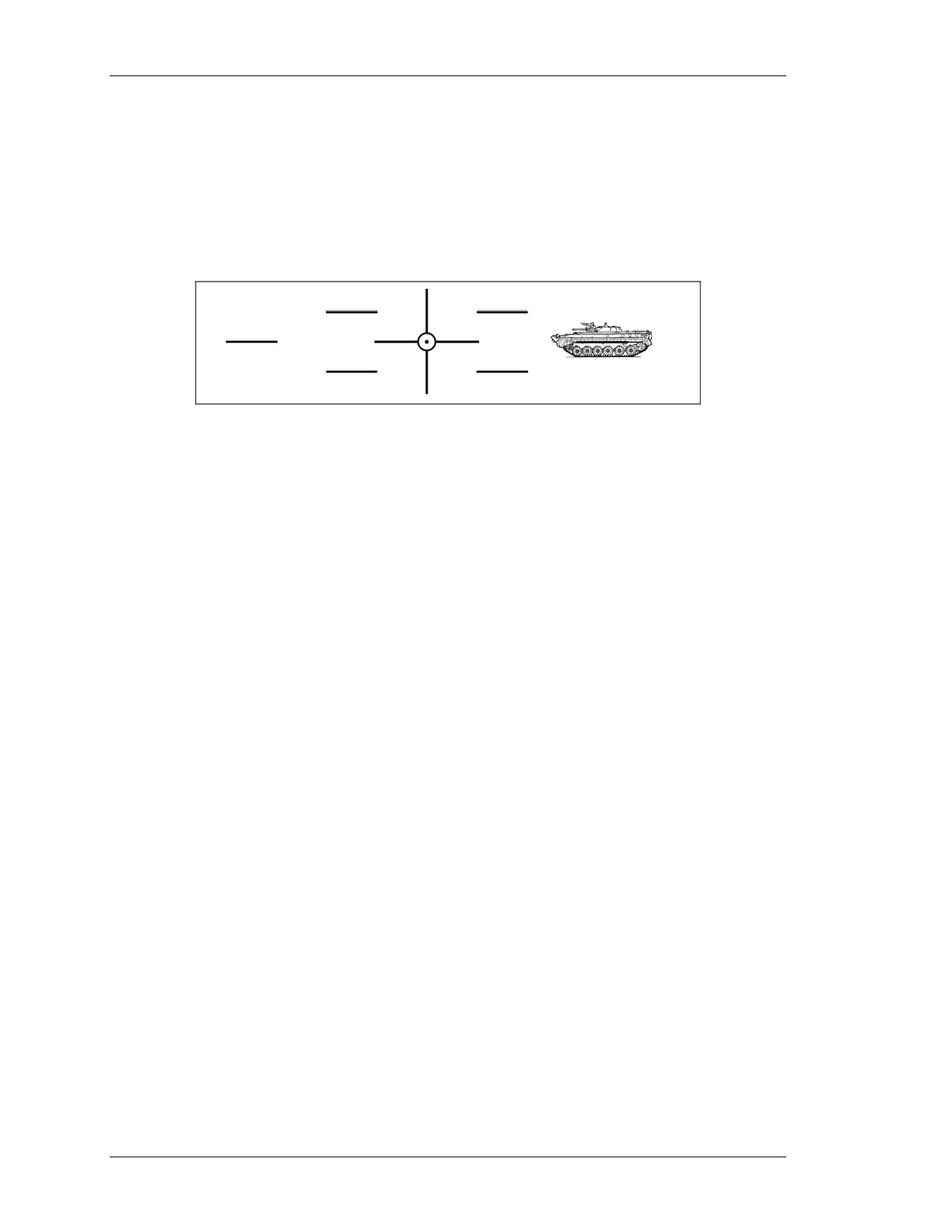
(6) If the Bradley and target are moving parallel but in opposite directions, the gunner
doubles the initial lead (Figure 6-31). With HE ammunition, this can cause the gunner to
run out of lead lines. If this happens, he changes to AP ammunition for that
specific situation.
Figure 6-31. Far lead applied when a target and a Bradley are parallel and
moving in opposite directions.
6-13. DIRECT-FIRE ADJUSTMENT
The crew has various ways to adjust direct fire, including burst-on-target and tracer-
on-target.
a. Burst on Target. Burst on target, the fastest method of adjustment, moves the
strike of the round from the ground onto the target.
(1) After the gunner has made his initial reticle lay on the target and fired, he applies
BOT by--
(a) Concentrating on the target, noting the point on the sight reticle where the round
appears as it hits or misses the target.
(b) Announcing his observation and BOT.
(c) Immediately adjusting the reticle aiming point based on his observation, to bring
the next round or burst on target. He must adjust quickly and accurately. This makes
additional adjustments or subsequent fire commands unnecessary.
(d) Announcing "On the way" and firing a burst of three to five rounds.
(e) Continuing to fire, adjusting each burst onto center mass until one destroys the
target or the BC commands CEASE FIRE.
(2) When the gunner applies BOT, the BC can observe the first round fired and the
subsequent burst of fire for deflection and range.
(3) Accuracy of the BOT method of adjustment depends on the gunner's ability to
maintain correct sight pictures and to make precise observations. To engage moving
targets accurately using BOT, the gunner must track continuously—before and during
the engagement.
b. Tracer on Target. TOT is similar to BOT. As the name implies, the gunner or
BC fires the 25-mm or coax machine gun. The firer adjusts the strike of the rounds onto
the target area based on the tracers.
c. Adjustment Techniques. The gunner and BC can announce adjustments using
any of the following methods:
(1) Target-Form Adjustment. Target form is the simplest method of adjustment. One
form is the visible height or width of the target. Range adjustments (up or down) refer to
6-32
FM 3-22.1
the height of the target; azimuth adjustments refer to the target's width. They can use
target form adjustment with the ISU, IBAS, or the auxiliary sights. They can add the
word "form" after the announced change, or they may let the change stand alone. If
"target form" is the unit's standard adjustment technique
(IAW unit SOP). The
commander always gives changes in full- or half-form increments.
(2) Mil Change. This method is simple and accurate at all ranges, but the gunner
must know his reticle's mil measurements. He gives mil changes whenever he uses a
nonballistic reticle in the ISU or IBAS.
(3) Meter. Because the auxiliary sight is marked in meters, the gunner uses meters
rather than mils. He must know how to read both of the ballistic reticles in his sight (AP
and HE). Though he can use this technique with the ISU, converting meters to mils can
cause confusion.
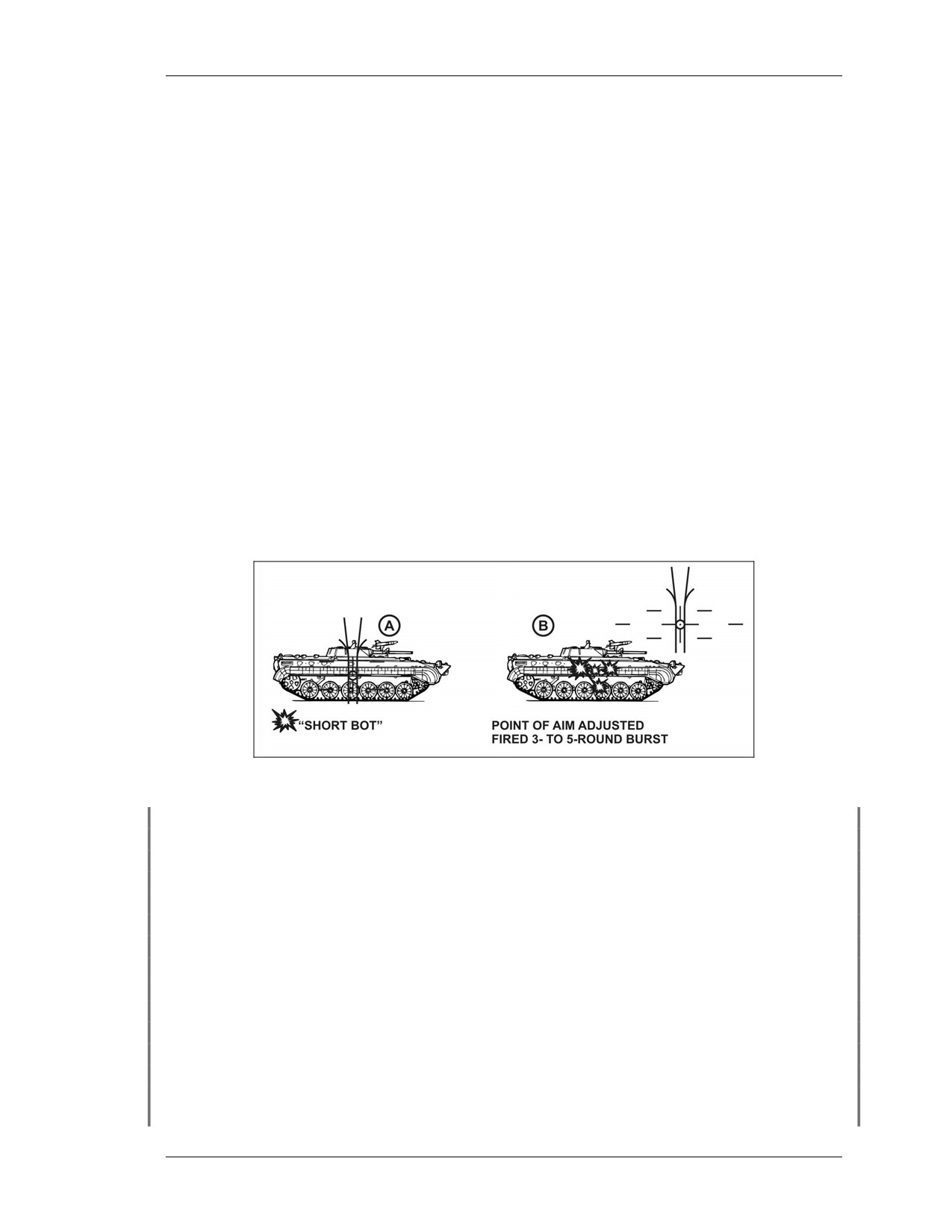
6-14. 25-MM-POINT TARGETS
Likely point targets on the battlefield include unarmored vehicles, lightly armored
vehicles, bunkers, RPG teams, and helicopters. When firing
25-mm point target
engagements, the gunner first fires a sensing round (two if the ammunition has changed).
He announces his observation and adjusts rounds by BOT (Figure 6-32). Then, he fires
three- to five-round bursts on the target. He continues firing bursts until he destroys the
target or the BC commands CEASE FIRE.
Figure 6-32. Burst on target against point target.
6-15. FIRE-CONTROL SUBSYSTEM
The FCS controls the Bradley A3's weapons system. Fire-control software (FCSW)
provides the main link between the system and the CIV, IBAS, ballistic solution software
(BSS), and TDS.
a. The FCS takes--
(1) Target range from the LRF.
(2) Barometric pressure and temperature data from the environmental
parameters screen.
(3) Ammunition and gun type from the system control box (SCB).
b. Using these figures, the FCS computes the correct angles needed to kill the target.
With this information--
(1) The crew independently searches, tracks, and hands-off targets for engagement.
(2) The crew tracks targets automatically.
(3) The commander overrides the gunner.
6-33
FM 3-22.1
6-16. KINEMATIC LEAD
When the 25-mm is selected, the Bradley A3 applies lead automatically, based on the
target's range, speed, and the rate of input into the handstation. This lead automatically
adjusts the offset between the line of sight and line of fire. This allows the gunner to keep
his reticle center mass of target through the engagement.
a. Using kinematic lead eliminates the need for manual target lead. To activate
kinematic lead, the gunner ranges the target using ELRF, or manually induces range
while depressing the handstation's palm switches. He keeps the palm switches depressed
and after he induces range, he applies a rate command by tracking the target with his
handstation.
b. For all 25-mm engagements, the gunner must keep the reticle center mass of the
target. BOT techniques apply only if the initial three-round burst fails to hit the target. If
this happens, he drops palms, re-lases, and fires.
c. To deactivate kinematic lead, the gunner releases the palm switches. This returns
the system to normal operation. However, re-lasing the target reactivates kinematic lead.
d. Based on the range and speed of the target, the Bradley A3 system offsets the line
of fire relative to the IBAS line of sight. This lets the gunner keep his reticle center mass
of the target (Figure 6-33).
NOTE: Kinematic lead is only available for the 25-mm gun.
Figure 6-33. A3 kinematic lead.
6-17. BRADLEY A3 25-MM POINT TARGETS
Crewmembers will fire three- to five-round bursts until they destroy the target. They use
sensing rounds only with the auxiliary sight or if the ELRF fails.
6-18. FAILURE OF EYE-SAFE LASER RANGE FINDER
To operate the ELRF A3 in degraded mode, such as when the ELRF fails, crewmembers
first manually select the range. Next, they apply BOT, as previously discussed. The
gunner fires a sensing round, followed by a burst of three to five rounds on the target,
again as previously discussed. When the system degrades, crewmembers should select
6-34
FM 3-22.1
the gun reticle and the horizontal-ranging stadia line. Even though they still have a
kinematic lead, they will not have range-finder capabilities for the BOT.
6-19. 25-MM AREA TARGETS
One of the Bradley's primary missions is suppressing enemy positions to support the
infantry rifle squad's movement. With its 5-meter bursting radius, HEI-T ammunition
supports this capability beyond coax range (900 meters), out to 3,000 meters.
a. Suppressive fire is direct fire on known or likely target locations to degrade one or
more of the enemy's basic combat functions: moving, shooting, observing, and
communicating. Success depends on suppressing the enemy--denying him the terrain, the
ability to observe, and the chance to engage.
b. A section repeats suppressive fire as often as needed to keep the enemy from
establishing a strong base of fire, or until the section clears the area of activity. To sustain
suppressive fire, the section can alternate fire between vehicles. This prevents each one
from using all of its ammunition.
c. Area targets can include terrain features, man-made objects, deployed soldiers, or
a location defined by enemy fire.
(1) The specific type of enemy units and weapons systems might be unidentifiable.
(2) Area targets include any that are too large for a point engagement. They also
include any that are very wide, very deep, or both, thus requiring extensive traversing.
Two examples of area targets include enemy positions in a tree line or troops on a hilltop,
when either spans an area wider than 10 meters.
d. Accurate range estimation ensures the effectiveness of area fire. Beyond
2,000 meters (tracer burnout), the round's slow flight and high angle of fire require the
gunner to check his sight picture by firing a sensing round. If the ammunition has
changed, the gunner fires two rounds, leaving the reticle in place until the round impacts.
This verifies the correct range and aiming point for the specific engagement.
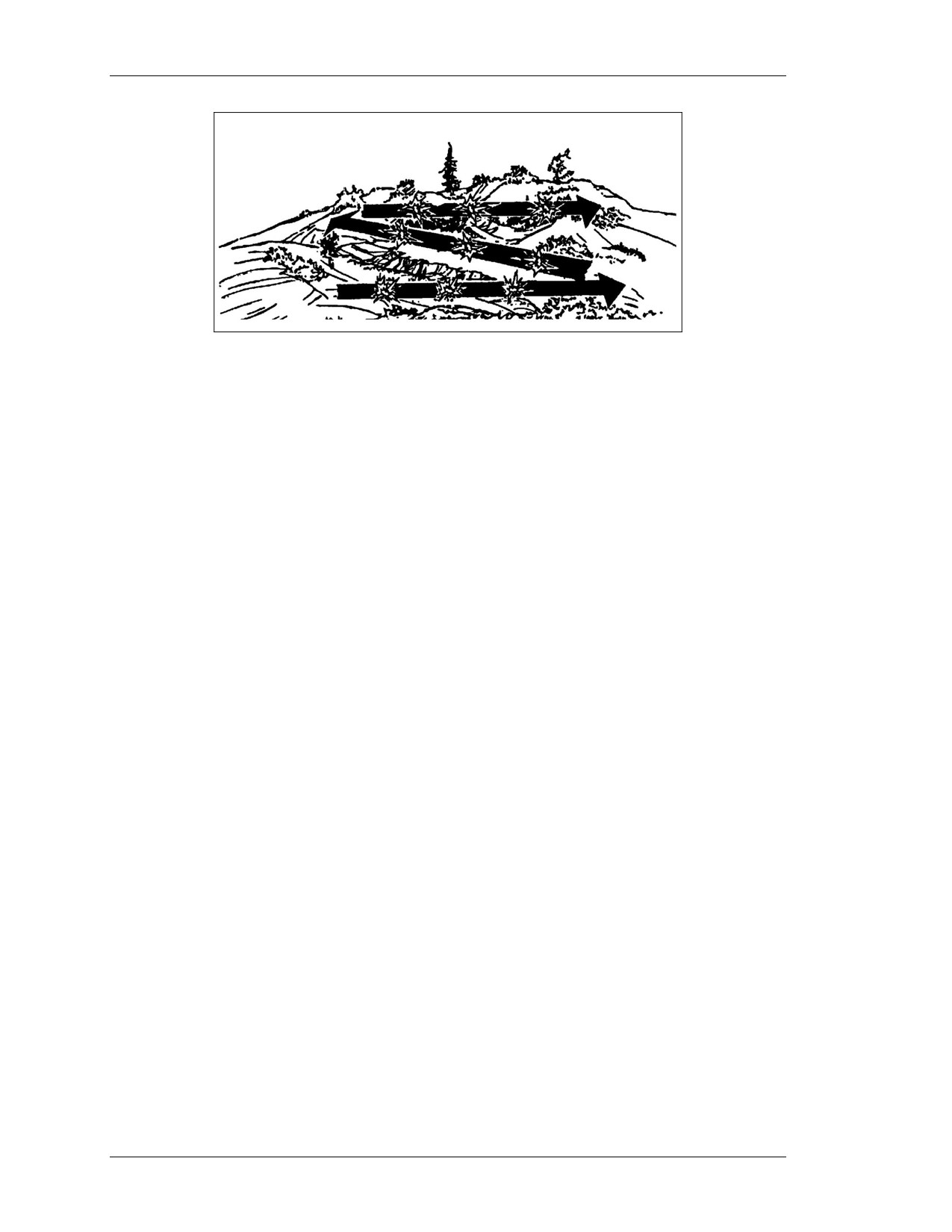
e. To engage an area target with HEI-T, the gunner uses a suppression technique
such as the "Z" pattern
(Figure 6-34, page 6-36). He corrects range by indexing a
different range or by adjusting the reticle. The number of rounds in a burst depends on
the size of the target and degree of success (one round for every 10 to 25 meters).
Developing and maintaining the ability to engage targets at extended ranges (1,800 to
3,000 meters) requires practice.
(1) The gunner lays the reticle on center mass of the target area and fires an
initial burst of 3 to 5 rounds. Then, he starts firing using suppression technique such as
the "Z" pattern.
(2) Once he reaches the opposite edge, he fires a second burst diagonally across the
target area to the opposite corner of the area.
(3) Finally, he fires a burst across the far depth of the target, covering the
entire width.
(4) He continues firing until he has covered the entire width and depth of the target
area, or until the BC commands CEASE FIRE.
6-35
FM 3-22.1
Figure 6-34. High explosives against area target.
f. The gunner can use the 25-mm HEI-T to--
(1) Designate area or point targets.
(2) Fire incendiary rounds.
(3) Reconnoiter by fire at ranges from 900 to 3,000 meters.
6-20. COAX MACHINE GUN
The coax machine gun destroys unarmored point targets, suppresses area targets and
troops, and conducts reconnaissance by fire. For suppressive fire, he uses the same
techniques with the coax that he uses with the 25-mm weapon system.
6-21. SUPPRESSIVE FIRE
Suppressive fire is defined as "direct fire on known or likely target locations to degrade
one or more of the enemy's basic combat functions: moving, shooting, observing, and
communicating." For effective suppressive fire, the gunner or commander must fire three
to four distinct bursts into the target area. To conserve 25-mm ammunition, the crew uses
the coax machine gun for suppressive fires up to 900 meters against unarmored vehicles
or troops. Machine gun suppressive fire is usually effective in bursts of 10 to 15 rounds.
6-22. COAX POINT TARGETS
The crew can engage targets such as jeeps, trucks, RPG teams, troops, and ATGMs while
the BFV is moving or stationary. For personnel consolidated in a small area (1 to
10 meters), they use the point target-engagement technique.
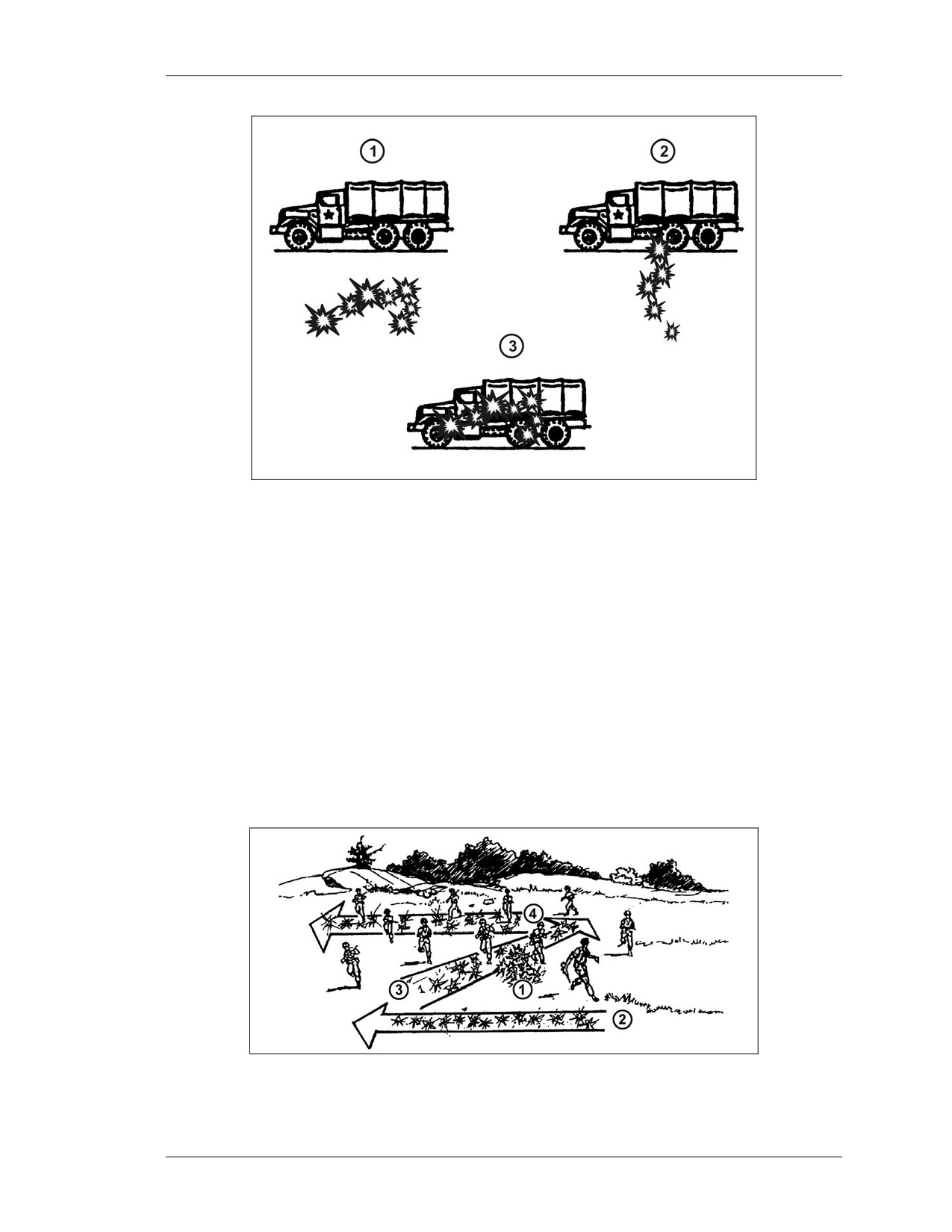
a. To engage a point target, the gunner indexes range or lases the target, lays
precisely on target, and fires an initial burst of 10 to 15 rounds (Figure 6-35). The initial
burst should hit as much of the target as possible. The gunner fires additional bursts until
he destroys the target or the BC commands CEASE FIRE.
b. If the initial burst falls short or long, the gunner adjusts the tracers onto the target.
Once the tracers move onto the target, he continues firing bursts until the BC commands
CEASE FIRE.
6-36
FM 3-22.1
Figure 6-35. Point target technique.
6-23. COAX AREA TARGETS
For personnel dispersed over a large area (over 10 meters), the gunner uses the area
target-engagement technique (Figure 6-36). He can engage area targets while the BFV is
moving or stationary.
a. Example Area Target in Depth. To engage an area target, the gunner lays the
reticle on center mass of the target area and fires an initial burst. Each burst consists of 10
to 15 rounds. Once he has confirmed the range to the target, he fires a second burst
horizontally across the front of the target area. He fires the third burst diagonally across
the target area. He fires the fourth burst horizontally across the rear of the target area.
After the gunner successfully suppresses the target, the BC commands CEASE FIRE.
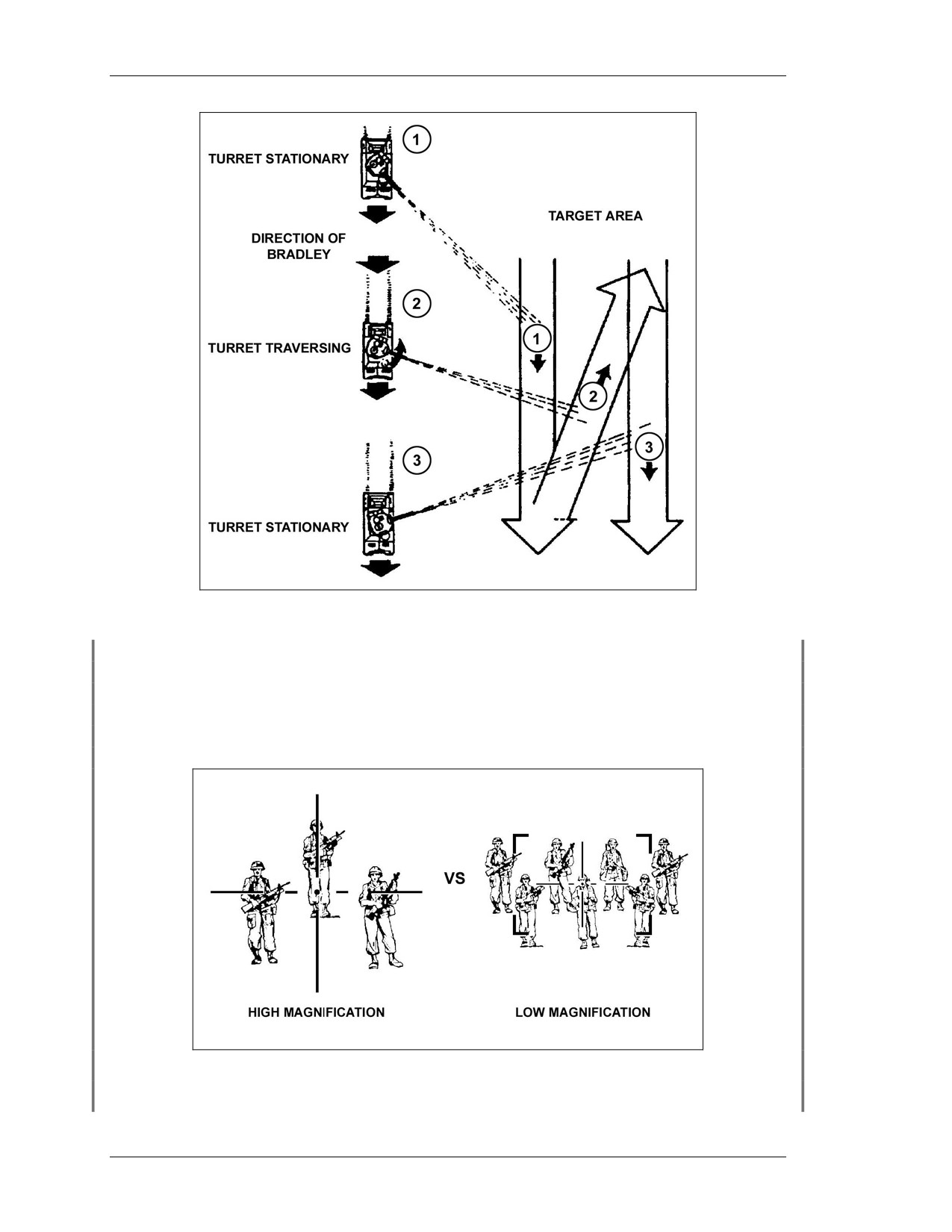
b. Example Frontal Area Target. When a target presents a frontal area, the
movement of the BFV's turret and of the vehicle itself carries the burst on through the
target (Figure 6-37, page 6-38). Round dispersion also helps cover the width of the target.
Figure 6-36. Example technique for area target in depth.
6-37
FM 3-22.1
Figure 6-37. Example technique for area target from a moving Bradley.
6-24. BRADLEY A3 COAX
Selecting COAX on the system-control box (SCB) disengages kinematic lead but keeps
superelevation. Engagement techniques for the coax machine gun apply. The gunner
may use low magnification to engage coax area targets within 500 meters. This allows
the crew to see the entire target area (Figure 6-38).
Figure 6-38. Bradley A3 coax area target technique.
6-38
FM 3-22.1
6-25. OTHER USES OF MACHINE-GUN FIRE
The coax machine gun also serves other purposes:
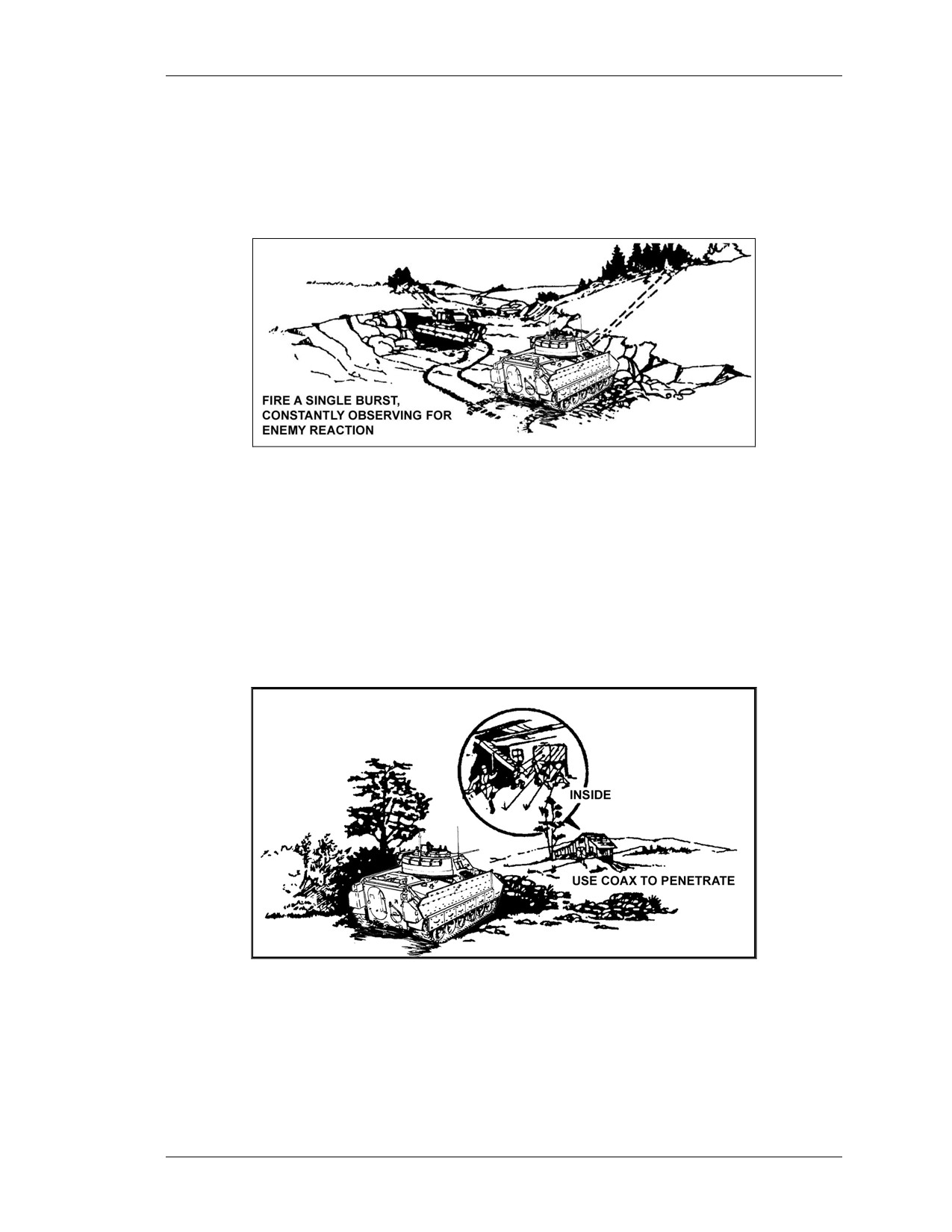
a. Reconnaissance by Fire. The gunner reconnoiters by fire to cause hidden enemy
forces to react. He fires a single burst, constantly watching for possible enemy movement
or return fire (Figure 6-39).
Figure 6-39. Reconnaissance by fire.
b. Firing through Concealment. The gunner can use the coax machine gun to
penetrate most of the means used to conceal dismounted enemy infantry, including trees,
hasty barricades, or lightly constructed buildings. He treats each such means as an
individual point target (Figure 6-40).
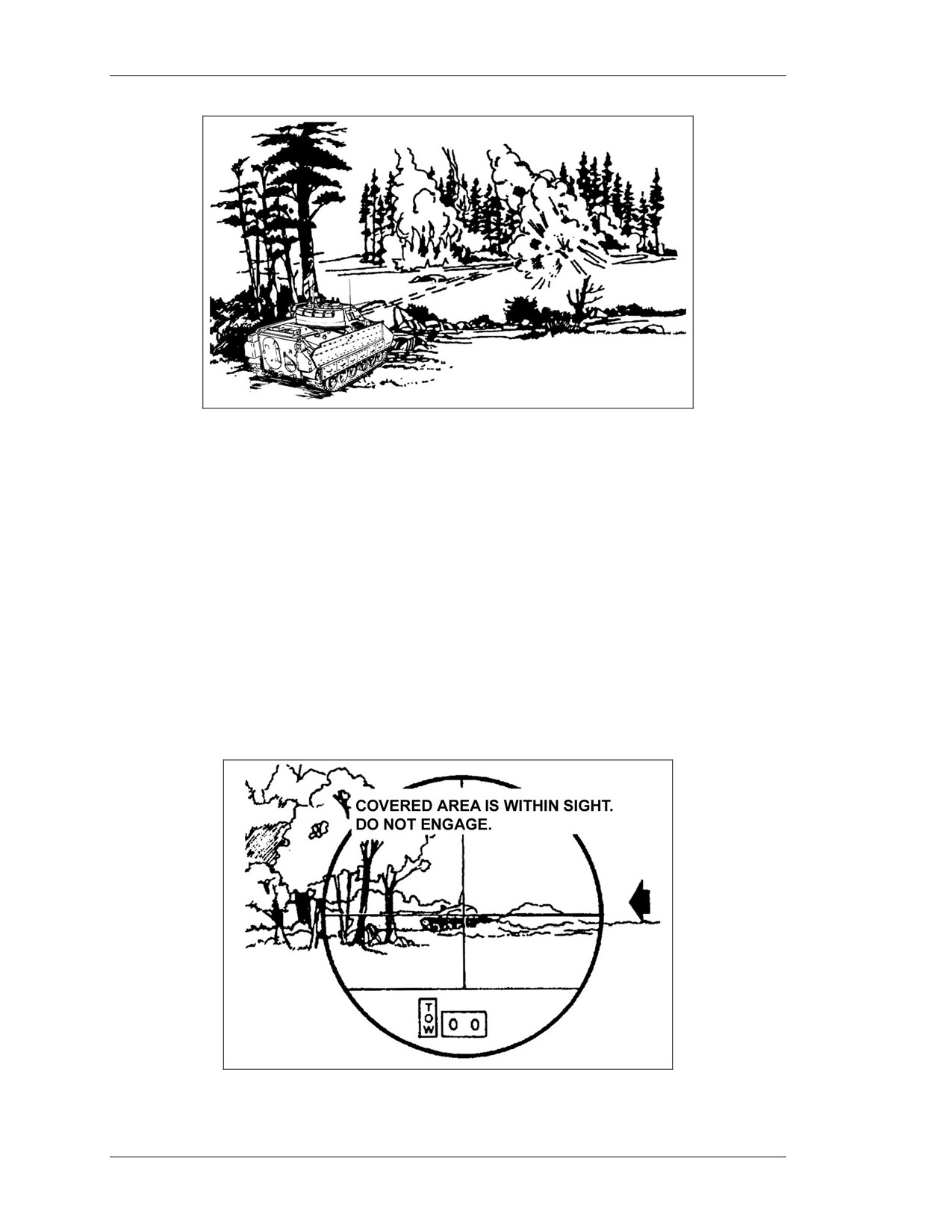
c. Incendiary Fire. Machine gun tracer ammunition, particularly armor-piercing
incendiary tracer rounds, can set fire to any readily combustible material, such as dry
grass, grain, dried brush, or wood. Fire denies a particular area to the enemy, and smoke
from a burning field can screen movements (Figure 6-41, page 6-40).
Figure 6-40. Firing through concealment.
6-39
FM 3-22.1
Figure 6-41. Incendiary fire.
6-26. TUBE-LAUNCHED, OPTICALLY TRACKED, WIRE-GUIDED MISSILE
The TOW is used against armored vehicles out to
3,000 meters
(basic TOW) or
3,750 meters (all other TOWs). Only a stationary Bradley can fire its TOW. When it
does, the driver and cargo hatches must remain closed. The vehicle must be on ground
that is sloped less than 10 degrees (the crew checks vehicle slope indicators). The gunner
ensures that both ballistic doors on the ISU or IBAS are open.
a. Before firing the TOW, the gunner must identify any obstacles between the
vehicle and the target that could interfere with the missile. If the target is moving, the
gunner must determine if it will remain in sight long enough for the missile to reach it.
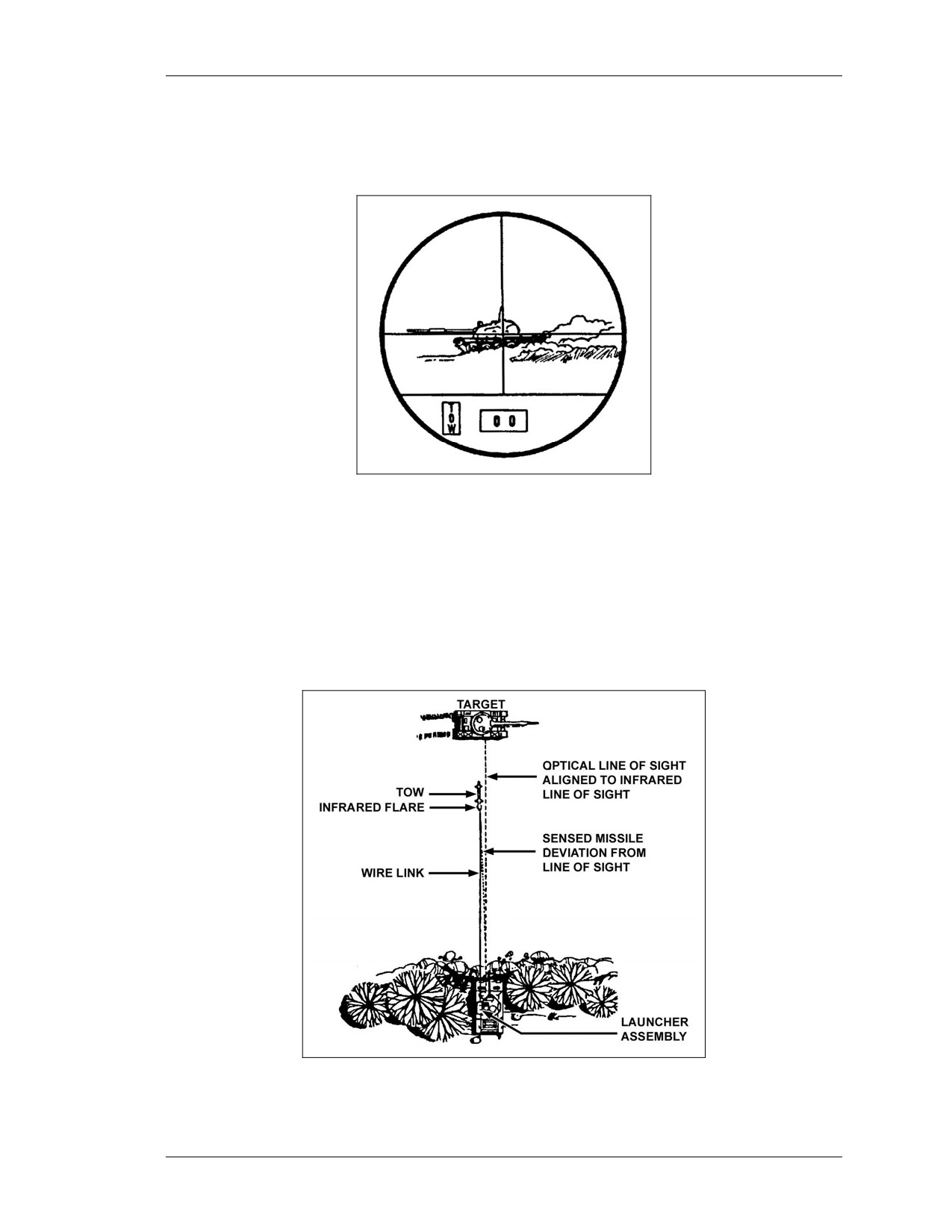
b. The gunner uses the sight to determine if the target is engageable (Figure 6-42).
He places the crosshairs on center mass of the target. On high magnification, if the area
between the vertical crosshair and the edge of the sight is clear of obstructions in the
direction of travel, then the target is engageable.
Figure 6-42. Obscured target.
6-40
FM 3-22.1
c. Figure 6-43 shows the sight picture the gunner will see when engaging with the
TOW. The word "TOW" displays on the status indicator at the bottom of the field of
view (FOV).
Figure 6-43. TOW sight picture.
d. When engaging a moving target with a TOW, the gunner must continuously track
the target, keeping the reticle crosshairs on center mass. The TOW 2B missile flies above
the target to kill. The center mass aim point must remain the same while the missile
travels to the target. Figure 6-44 shows this missile-tracking concept.
NOTE: Gunners, instead of guiding the missile when it enters the picture, maintain
reticle center mass of target.
Figure 6-44. Missile-tracking concept.
6-41
FM 3-22.1
e. Night engagements require more crew coordination and more detailed planning
than day engagements.
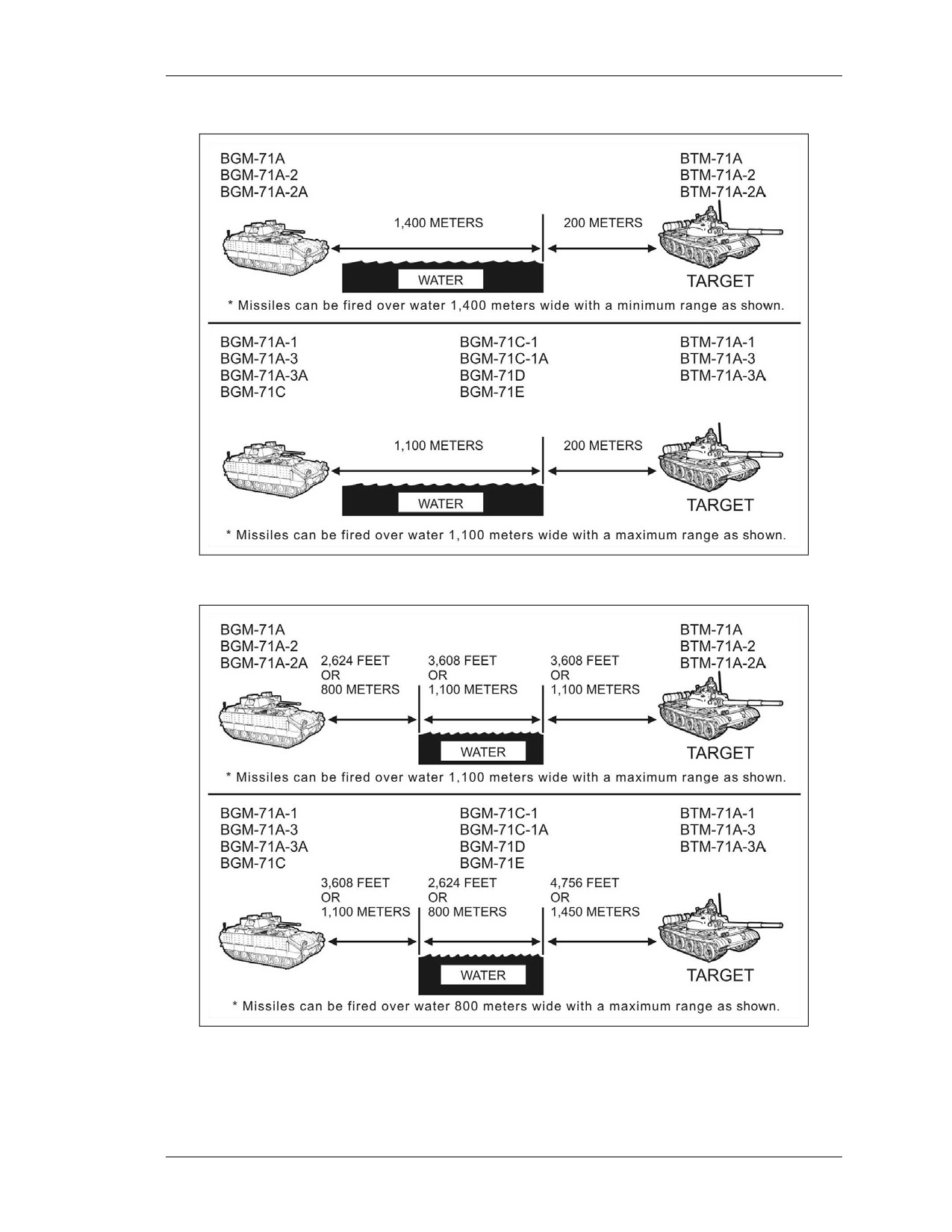
f. To fire the TOW over water, the BC analyzes the sector to determine if the water
will affect employment of the TOW.
(1) The gunner can fire various types of TOWs at their minimum and maximum
ranges over water (Figures 6-45 and 6-46, page 6-43). This assumes that both the TOW
launcher and the target sit at water-surface level.
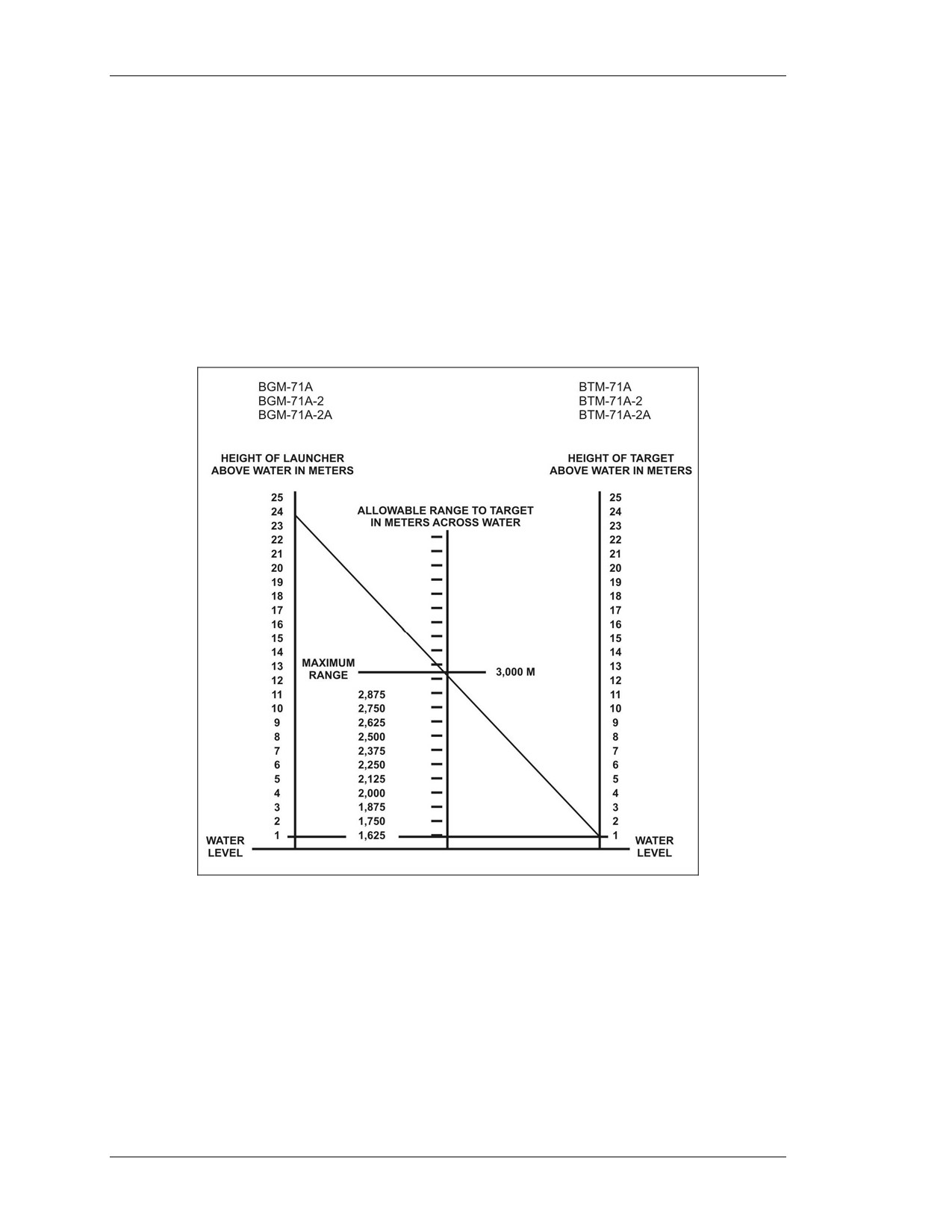
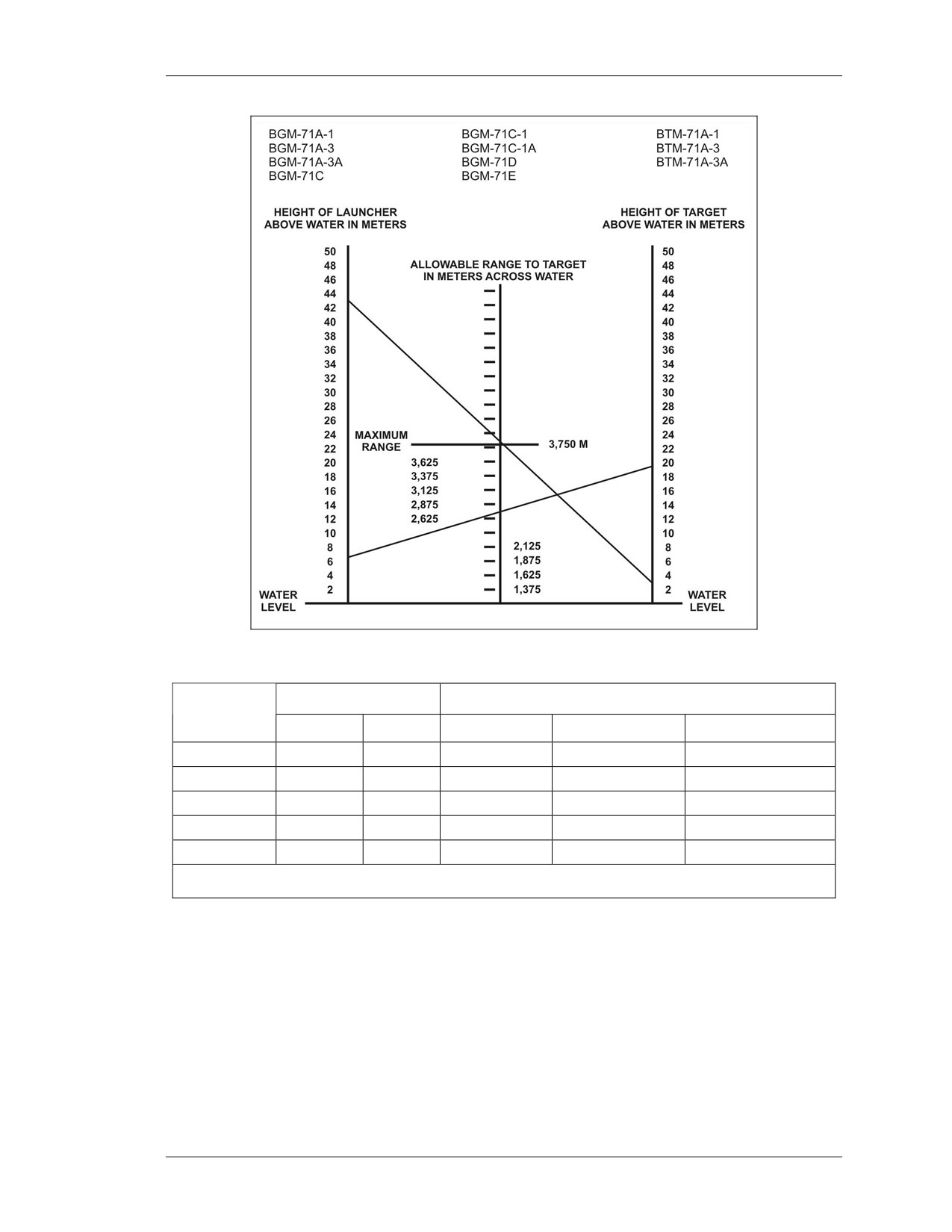
(2) For firing over water with a TOW or at a target that sits above the surface level of
the water, the BC determines the type of missile used, then uses Figure 6-47A (basic
TOW, page 6-44) and 6-47B (all TOWs after basic TOW, page 6-45), to determine the
extended range of missiles.
(a) He determines the TOW launcher's height above the water surface, then places a
tick mark at the corresponding height in the left-hand column of the table.
(b) He determines the height of the target above the water surface and places a tick
mark at the corresponding height in the right-hand column of the table.
(c) He connects the two tick marks with a straight line. The point where the lines
intersect the center column is the maximum range the missile can travel without getting
too close to the water.
6-27. M257 SMOKE-GRENADE LAUNCHER
The following fire command coordinates the crew's actions when firing the M257 smoke
grenade launcher:
a. While traversing the turret toward the area where he wants the smoke screen, the
BC commands GRENADE LAUNCHER to alert the crew to use the grenade launcher.
b. After laying the turret, the BC verifies that all hatches and the combat door
are closed.
c. The BC or gunner moves the grenade launcher ON-OFF switch to ON. The BC
commands FIRE or FROM MY POSITION. After firing the grenades, the gunner
announces GRENADES LAUNCHED. The BC then issues driving commands
appropriate to the tactical situation and returns to the open-hatch position to resume
acquiring targets.
d. The crew should reload the grenade launchers as soon as they can do so safely.
However, the BC first has the driver move the Bradley to an area where the BC expects
no enemy contact.
6-28. M231 FIRING-PORT WEAPON (M2 ONLY)
The FPW is mainly an offensive weapon that gives the M2 close-in, rear suppressive fire.
• FPW is fully automatic.
• FPW gunner engages targets by guiding tracers into the target area.
• FPW gunner uses TOT adjustment techniques followed by suppressive burst.
• FPW is located in the ramp only.
6-29. AERIAL TARGETS
Correctly matching weapon and ammunition to the range and target is the key to success.
Table 6-5, page 6-45, shows each weapon and the type of aerial targets that
it can destroy.
6-42
FM 3-22.1
Figure 6-45. Minimum TOW missile ranges over water.
Figure 6-46. Maximum TOW missile ranges over water.
6-43
FM 3-22.1
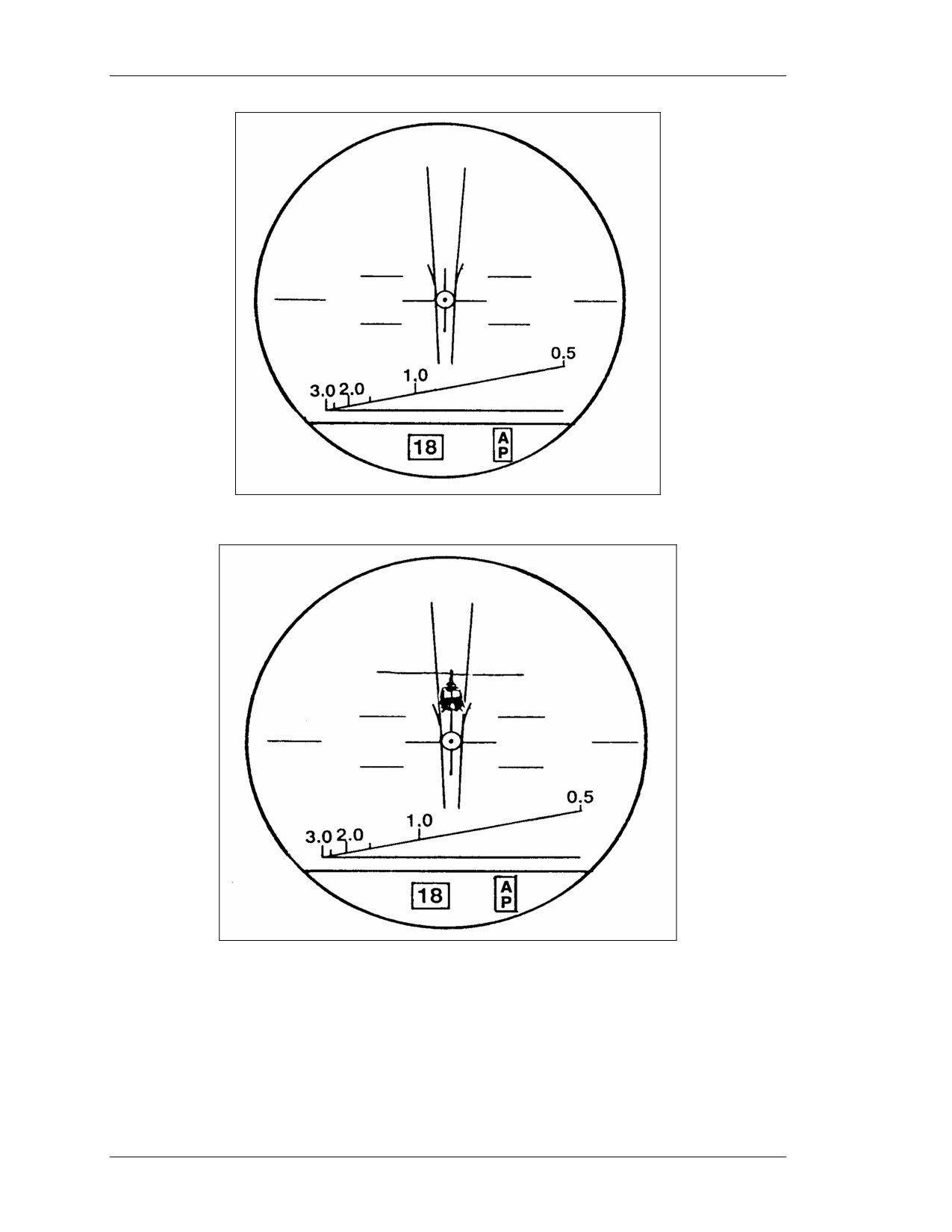
a. The
25-mm gun is effective against slow-moving, fixed-wing aircraft and
helicopters (Figures 6-48 and 6-49, page 6-46). When using the ADR sight, the gunner
indexes 1,800 meters. He can use APDS-T, APFSDS-T, or HEI-T ammunition. To
sustain the volume of fire and kill the target, he fires a continuous burst of 20 to 25
rounds (high rate), using TOT to adjust rounds on target. The APDS-T and APFSDS-T
rounds have higher probabilities of hitting the target than does the HEI-T round.
However, its greater dispersion factor gives the HEI-T round a higher probability of kill.
For helicopter targets--
(1) At ranges beyond 1,200 meters, the APDS-T is the most effective round.
(2) At ranges within 1,200 meters, the HEI-T is the most effective round.
(3) The ADR applies only for use on frontal targets.
Figure 6-47A. Extended range over water (basic TOW).
6-44
FM 3-22.1
Figure 6-47B. Extended range over water (all TOWs after basic TOW).
FIXED WING
HELICOPTER
AMMO
SLOW
FAST
ARMORED
UNARMORED
PARATROOPER
COAX
YES
YES
NO
YES
YES
HEI-T
YES
YES*
YES
YES
YES
APDS-T
YES
YES*
YES
YES
NO
APFSDS-T
YES
YES*
YES
YES
NO
TOW
YES
NO
YES
YES
NO
*Secondary sources for use in case the coax MG is unavailable or target is beyond coax range.
Table 6-5. Ammunition employed against aerial targets.
6-45
FM 3-22.1
Figure 6-48. Air-defense reticle.
Figure 6-49. Choking a helicopter with the ADR.
b. The crew uses the coaxial machine gun against fixed-wing aircraft, unarmored
helicopters, and airborne troops. It is ineffective against heavily armored helicopters such
as the Hind. When used, the coax machine gun must fire a continuous burst (50 to 100
rounds) at the aiming point, and the BC must use TOT to bring the rounds on target. Just
as in ground engagements, the maximum effective range of the coax is 900 meters.
6-46
FM 3-22.1
c. Beyond 1,700 meters, the 25-mm uses too much ammunition for each kill. Thus,
the crew uses the TOW weapon system against stationary, slow moving (up to 50 MPH)
aerial targets between 1,700 and 2,000 meters. Nevertheless, the gunner should use the
TOW against helicopters only when necessary.
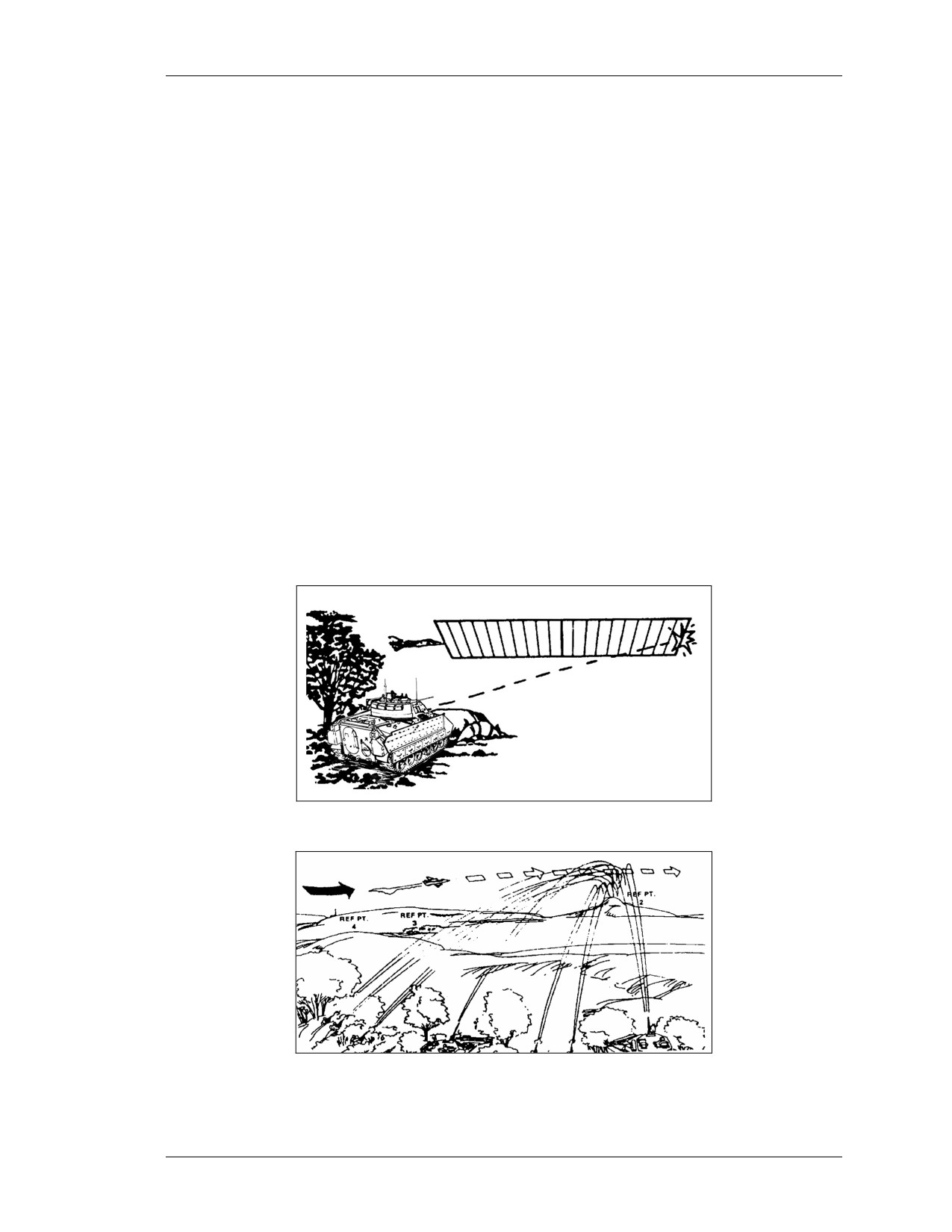
d. Ideally, when the BFV must engage high-speed aircraft, mounted and infantry
rifle elements fire small-arms weapons fire and controlled coaxial machine gun fire on a
designated point. The platoon leader or platoon sergeant can initiate this type of fire by
issuing a predetermined command or by firing tracers to indicate the target. He applies a
200-meter lead (the length of two football fields) on the approaching aircraft, so that the
aircraft will fly through the platoon's cone of fire. Gunners must not try to track high-
speed aircraft--they fly too fast (Figure 6-50).
(1) If the aircraft flies directly at the vehicle, the Bradley gunner fires a controlled
burst of 50 to 100 rounds. He selects an aiming point slightly above the nose of the
aircraft, so that the aircraft will fly into the cone of fire.
(2) Fixed-wing aircraft operate in pairs or in groups of three. Rotary-wing aircraft
operate in platoon-sized elements.
(3) To engage high-speed aircraft, the BC chooses one or more reference points
(Figure 6-51). For example, the platoon leader alerts the platoon. Then, as the aircraft
nears a reference point, the platoon leader orders ENEMY AIR, REFERENCE POINT
TWO, then FIRE. The Bradley and rifle infantry soldiers fire all weapons at a 45-degree
angle above the reference point.
Figure 6-50. Football-field technique.
Figure 6-51. Reference-point technique.
6-47
FM 3-22.1
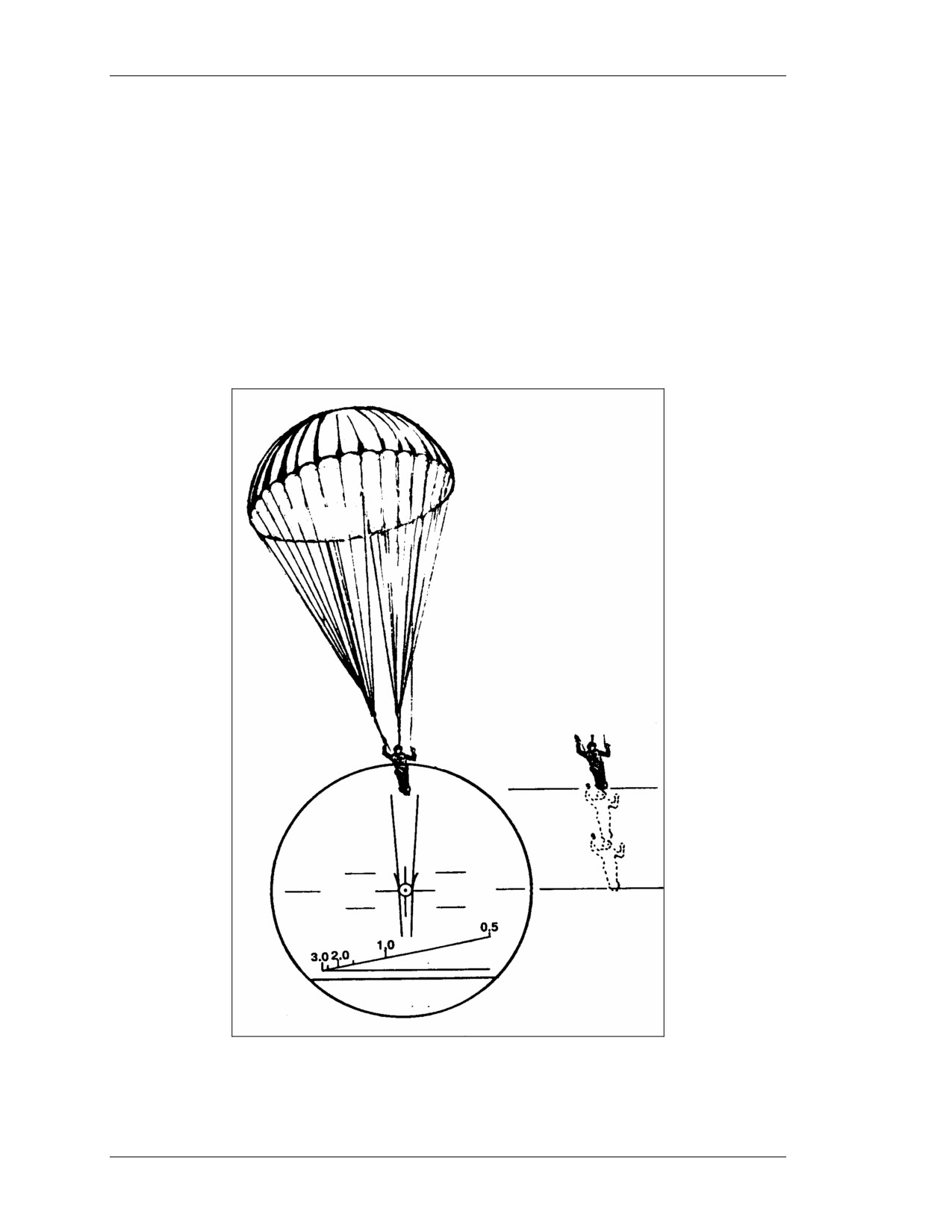
e. The paratrooper’s rapid rate of fall makes engaging him difficult (Figure 6-52).
To do so, the gunner must—
(1) Use the ISU or IBAS as the primary sight.
(2) Use the coax machine gun at ranges under 900 meters.
(3) Use the 25-mm (HEI-T) at ranges beyond 900 meters.
(4) Fire a burst with a lead of two man-heights beneath the dropping paratrooper. If
he sights troop-carrying helicopters, he engages these rather than the parachuting or
rappelling troops, because they present the greater danger.
(5) The helicopter is a better target than soldiers. Also, as to engaging personnel
exiting or who have exited from damaged aircraft, the Geneva Convention says—
(a) Aircraft Crews--Engagement prohibited.
(b) Paratroopers--Engagement allowed.
Figure 6-52. Engaging paratroopers.
6-48
FM 3-22.1
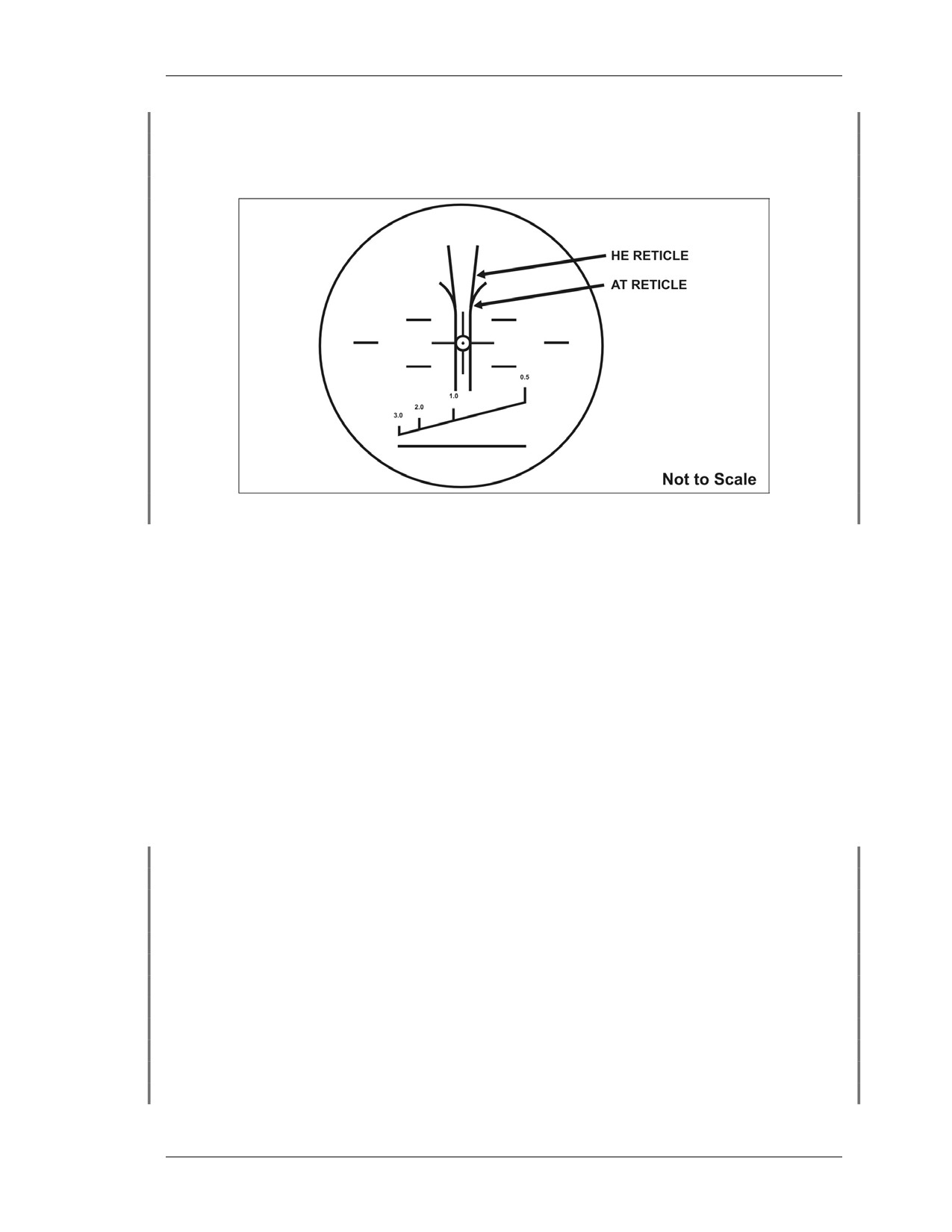
f. When using the 25-mm, the Bradley A3 crew can select ADR using the CTD. In
normal mode, the gunner should keep the IBAS reticle on the center mass of the target.
Kinematic lead still applies for aerial engagements (Figure 6-53).
Figure 6-53. Bradley A3 air-defense reticle.
6-30. PROBLEM AREAS
When a Bradley crew misses a target, the BC should ask--
• Did they boresight and zero correctly?
OR
•
(Basic Bradley and A2 models) Did they move the boresight knobs?
AND
• Did they get confused trying to engage?
• Did they get confused during the engagement?
• Did they disperse ammunition erratically?
• What range did they index?
• On target engagements requiring lead, did they use too little? Too much?
• Did they know how to use BOT?
• Did they know how to use engagement techniques?
• For normal operations, did the thermal display prove adequate? Or insufficient?
• Did they range the target using ELRF?
• Did they adjust the IBAS and CIV sights correctly?
• Did they confuse IBAS with CIV sight display?
• Did they release the palm switch after designating a target?
• Before engagement, did they perform TAS align? Null the system?
• Did they enter environmental parameter data correctly?
6-31. BRADLEY A3 AIDED-TARGET-TRACKER MODE
The aided target tracker (ATT) in the IBAS lets the BC and gunner track two targets at
once. However, they can only track targets embedded in the thermal image on the IBAS
(from the FLIR sensor). Both the gunner and BC can control ATT functions from their
respective stations.
6-49
FM 3-22.1
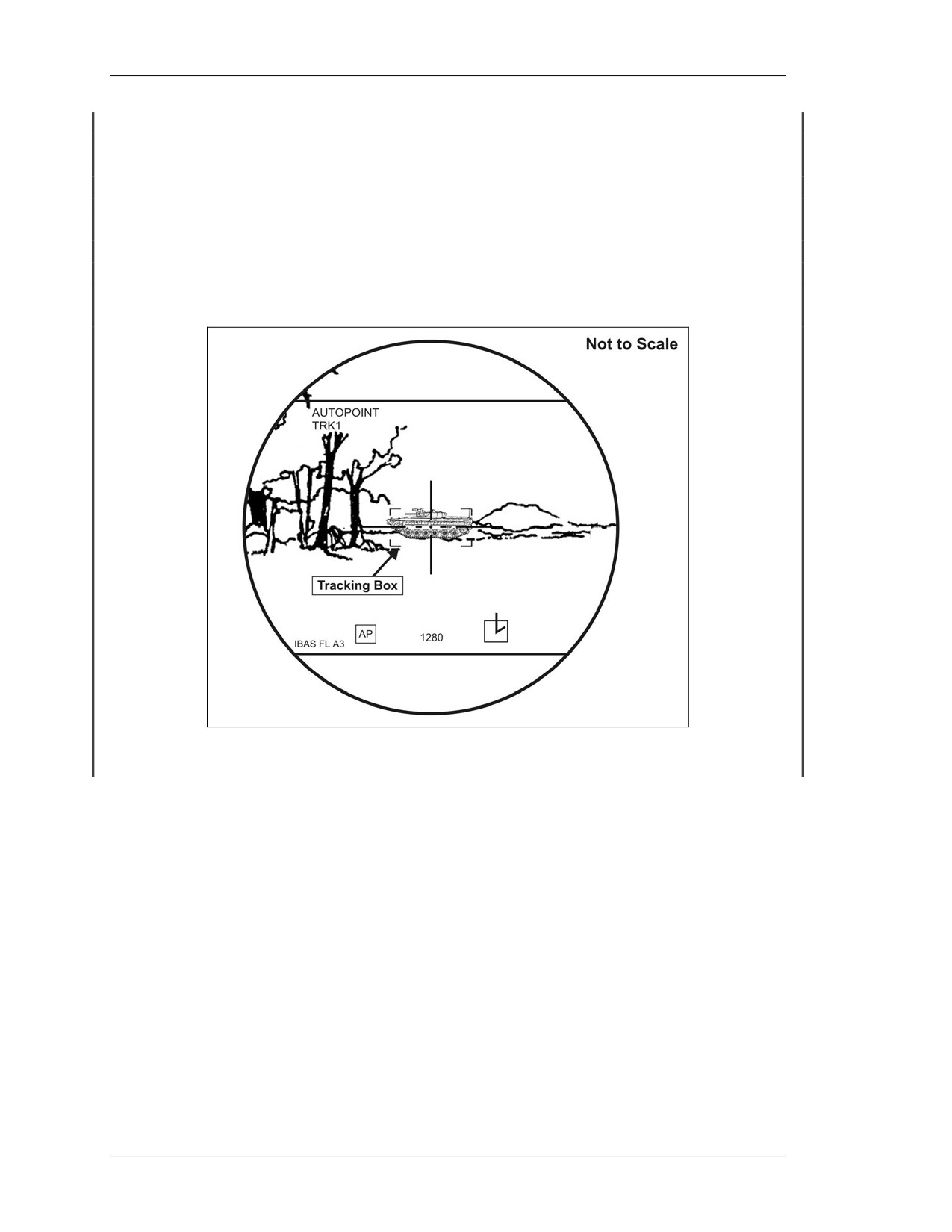
a. The ATT generates symbols such as blinking or solid track boxes that overlay the
IBAS image. The boxes indicate ATT status.
b. With the Day TV image selected for display, even though the ATT only tracks
targets in the FLIR image, the BC or gunner can still select the autotrack or autopoint
capability. They can do so because the Day TV and FLIR sensors display the same scene.
c. With Day TV selected, ATT symbols overlay the video image (Figure 6-54). The
BC or gunner uses the autopoint functions only with the 25-mm gun selected.
(1) To use track boxes with Day TV, leave both IBAS ballistic covers open.
(2) For targets beyond 3,000 meters, size gates in 2X and 4X zoom.
Figure 6-54. Bradley A3-aided target tracker.
6-32. TERMINATION OF ENGAGEMENT
The BC determines when to cease fire against a target, when to shift fire against multiple
targets, and when to shift from one firing position to another. Target effect might be
unclear. If so, the BC must decide when to shift fire based on target effects indicators.
6-33. KILL STANDARDS
Kill standard classifications include--
a. Mobility Kills. A mobility kill prevents a vehicle from moving under its
own power.
b. Firepower Kills. A firepower kill prevents a vehicle from using its
weapon systems.
c. Catastrophic Kills. A catastrophic kill is a total loss of weapons systems, vehicle
mobility, and all on-board equipment.
6-50
FM 3-22.1
6-34. ARMORED VEHICLES
Standards and indicators for armored vehicles follow:
a. Kill Standard. Based on the ammunition and time required to achieve
destruction, the crew must achieve at least a mobility or firepower kill.
b. Kill Indicators. During an engagement, certain indicators cue the gunner or BC
to cease or shift fire to a different target.
• The vehicle stops moving.
• The vehicle stops firing.
• The vehicle smokes from what appears to be internal damage.
• The vehicle explodes with immense smoke and flames.
• The crew abandons the vehicle.
c. Impact Indicator. When a 25-mm round (AP or HE) or a TOW missile hits an
armored vehicle, an observable explosion with flash occurs. This is the effect of the
round impacting on the target. It does not necessarily indicate damage to the target.
6-35. UNARMORED VEHICLES
Types and standards for unarmored vehicle kills follow:
a. Kill Standard. Threat unarmored vehicles have extra wheels, which allows them
to continue operating with one or more tires punctured. With an unarmored vehicle, the
crew must cause a mobility kill or force the driver and crew to abandon the vehicle.
b. Kill Indicators. One or more of the following indicators can cue the gunner or
BC to cease fire or shift to a different target:
• The vehicle stops moving.
• The vehicle is smoking.
• The vehicle explodes.
• The crew abandons the vehicle.
6-36. INFANTRY RIFLE SQUADS AND ANTIARMOR SYSTEMS
Kill types and standards for infantry rifle squad and antiarmor system follow:
a.
Kill Standard. Destruction of infantry riflemen point and area targets is difficult
to measure. The goal is to neutralize the threat infantry rifle squad and the target's
antiarmor firepower capability, by either destroying, damaging, or suppressing it.
b. Kill Indicators. When engaging threat point or area targets consisting of
infantry rifle squad or antiarmor, the BC may cease or shift fire if he observes certain
indicators.
(1) The threat infantry rifle squad stops maneuvering.
(2) The threat antiarmor fire covering threat rifle squads stops covering the squads
effectively or altogether.
(3) The Bradley's 25-mm rounds hit the threat rifle squad and antiarmor systems.
(4) The BC or the gunner observes that the rifle squad takes casualties.
c. Duration of Suppression. The BC decides how long to continue firing suppressive
fire depending on METT-TC. Also, he maintains suppression as long as the unit gains a
tactical advantage by doing so, or until another element can close with the target and
destroy it.
6-51
FM 3-22.1
Section IV. FIRE COMMANDS
Fire commands are the language of gunnery. Using incorrect language in a fire command
causes confusion and misunderstanding. Every direct-fire engagement begins with a fire
command. It alerts the crew to initiate actions. Subsequent fire commands direct the fires
of the selected weapon. They also sustain and control the engagement until the crew
destroys the target or receives the command to terminate fire. Though fire commands
vary in form, each must include the seven basic elements. During preliminary and
intermediate Bradley tables, the BC initiates fire commands only after target presentation.
6-37. ELEMENTS
The sequence and elements of a fire command are alert, weapon and ammunition,
description, direction, range, execution, and termination.
a. Alert. In this first element, the BC alerts the crew to an immediate engagement
and tells them who must conduct it.
b. Weapon and Ammunition. In this second element, the BC tells the crew what
weapon or ammunition to use.
c. Description. In this third element, the BC identifies the target. For multiple
targets, he also tells the crew which to engage first.
d. Direction (Optional). In this fourth element, in case the BC cannot lay the
weapon for direction or elevation himself, the BC guides the gunner.
e. Range (Optional). In the fifth element, the BC tells the gunner what range to
select. When the ELRF on the Bradley ODS or A3 reports errors, the BC gives this
element himself.
f. Execution. After the crew responds to the first five elements, the BC reconfirms
that the target is hostile, then tells the gunner to execute.
g. Termination. In this element, the BC tells the gunner to stop firing or, in a
multiple engagement, to shift fires to another target.
6-38. TERMS
During direct-fire engagements, the BC uses the following terms. These terms are
common to all fire commands:
a. Alert Terms. These terms identify who conducts the engagement, that is,
who fires:
(1) Turret Weapons. The BC says, "Gunner. "
(2) Firing Port Weapons. The BC says, REAR BANK.
(3) Basic (M2, M3, M2A1, or M3A1) Bradleys. The BC then says--
• REAR BANK.
• LEFT BANK.
• RIGHT BANK.
b. Weapon and Ammunition Terms. Figure 6-55 shows the terms that the BC uses
to identify each weapon and type of ammunition.
6-52

FM 3-22.1
WEAPON and
AMMUNITION
ANNOUNCED AS (TERM)—
25-mm HEI-T
"HE" (Pronounced "Aitch-E"
25-mm APDS-T, APFSDS-T
"SABOT" (Pronounced “Say-Bo”)
25-mm TP-T
"HE" or "SABOT" (Whatever type of
ammunition the TP-T is simulating)
M240C Coax
"COAX"
TOW
"MISSILE"
SVML (ADA)
"MISSILE"
Figure 6-55. Ammunition designations.
c. Descriptive Terms. Figure 6-56, page 6-54, shows the terms that the BC uses to
designate most targets. He uses the term "PC" to refer to most lightly armored targets. For
example, he uses it to identify self-propelled artillery, self-propelled antiaircraft systems,
command-and-control vehicles, and self-propelled ATGMs. He can identify combination
targets, such as truck-mounted ATGM systems, by combining terms. In this example, he
would say, TRUCK, ANTITANK. He could also add the term MOVING as part of the
descriptive element.
d. Directional Terms. The BC uses directional terms to guide the gunner's aim to
the target area.
(1) TRAVERSE. He uses this term when targets are located outside of the gunner's
FOV and the when the BC either cannot, or chooses not to, lay the gun for direction. In
this case, he commands, TRAVERSE RIGHT (or TRAVERSE LEFT). The gunner then
traverses rapidly in the direction commanded. As the gunner's aim nears the target, the
BC commands STEADY, and the gunner slows the traverse. As soon as the gunner lays
on the target, the BC announces ON. By now, the target should fall within the gunner's
FOV, so he stops traversing. If the target is still outside of his FOV, the gunner searches
the target area either until he identifies the target or until the BC corrects the direction.
(2) SHIFT. The BC uses this term when he sees two or more targets through the ISU
or IBAS at the same time. He commands SHIFT LEFT (or SHIFT RIGHT) then PC. The
gunner shifts quickly to the target given in this last command, and engages.
(3) DESIGNATE. The commander uses this term to inform the gunner that he (the
commander) will hand off a target to him. He can use this term either before or during a
fire command.
(4) REFERENCE POINT and DEFLECTION. The gunner must be able to
recognize the reference point easily. So, the BC uses binoculars to measure the deflection
from the reference point to the target, then he announces how much and toward which
direction the gunner must shift. For example, he might command REFERENCE POINT,
BRIDGE, RIGHT THREE ZERO. The gunner lays the sight reticle on the reference point,
estimates and traverses 30 mils to the right, then tries to identify the target.
6-53

FM 3-22.1
TYPE OF TARGET
ANNOUNCED AS (TERM)—
Tank or tank-like target
"TANK"
Infantry fighting vehicle or
"PC"
armored personnel carrier
Unarmored vehicle
"TRUCK"
Helicopter
"CHOPPER"
Fixed-wing aircraft
"PLANE, " "JET, " or "UAV" (ADA)
Personnel
"TROOPS"
Machine gun
"MACHINE GUN"
Antitank gun or missile
"ANTITANK"
Any other target
(Briefest term possible)
Figure 6-56. Target designations.
(5) Range Card Data. During limited visibility conditions, the BC might not be able
to see the target. When this happens, he gets the deflection, elevation, and range from the
range card (Chapter 7) and commands DEFLECTION. The gunner lays the turret for
direction using the turret azimuth ring. He repeats the deflection reading back to the BC,
who then reads the elevation from the range card and commands ELEVATION. The
gunner uses the gun elevation indicator and pointer to lay the weapon for elevation. He
repeats the elevation reading back to the BC. The BC gets the range setting from the
range card and commands RANGE. The gunner indexes the range and repeats it back
to the BC.
e. Range Terms. The BC announces range in
200-meter increments, which
correspond to the settings on the RANGE-SELECT knob. He rounds odd numbers down
to the next lower hundred-meter range. This simplifies identification of short rounds.
Figure 6-57 shows examples of announced ranges.
(1) As long as the crew understands the terminology, the BC can use any of the
examples shown in Figure 6-57.
(2) On Bradley ODS and A3 vehicles, if the gunner can determine the range using
ELRF, the BC need not announce the range.
RANGE TO
TARGET
ANNOUNCED AS (TERM)—
800 Meters
"EIGHT HUNDRED" or "EIGHT"
1,200 Meters
"ONE TWO HUNDRED," "TWELVE," or
"TWELVE HUNDRED"
3,040 Meters
"THREE THOUSAND" or "THIRTY"
Figure 6-57. Announced range designations.
6-54
FM 3-22.1
f. Execution Terms. The BC uses one of three terms to command the gunner to
execute the fire command:
(1) FIRE. The command FIRE tells the gunner to fire the weapon after he has
completed his crew duties (Section V).
(2) AT MY COMMAND. The BC uses this command to delay firing. Specifically, he
says AT MY COMMAND when he wants the gunner to kill a target at a specific location,
or when the platoon leader wants more than one gunner to shoot at the same time. For
example, the BC might use this command when the commander's METT-TC determines
that killing a BMP on a bridge would halt an enemy column. He might also use it when
the platoon leader would like to surprise the enemy with cross, depth, or frontal fire.
(3) FROM MY POSITION. Normally, the gunner engages all main gun targets. If
the gunner is unable to identify or engage the desired target, the BC will do it. He says,
FROM MY POSITION, makes the final gun lay, then ON THE WAY, and fires. As soon as
the gunner can resume his duties, the BC returns control to the him. Then, the BC
commands the gunner, FIRE.
g. Termination Terms. To terminate an engagement, the BC commands--
(1) CEASE FIRE. This stops the gunner from firing.
(2) CEASE TRACKING. This terminates firing of a TOW missile.
h. Response Terms. The gunner can respond to the fire command in various ways:
(1) "Identified." The gunner says this to confirm that he has located the target(s).
Saying "Identified" by itself tells the BC that the gunner has confirmed the target as
stated in the description. If appropriate, the gunner adds, "Friendly," "Neutral," or
"Doubtful."
(2) "Cannot Identify." The gunner uses this term to inform the BC that he (the
gunner) cannot find the target. The BC must either re-lay the weapon or engage the
target himself.
(3) "Cannot Engage." The gunner uses this term to inform the BC that he (the
gunner) can identify the target but, for some reason, cannot engage it.
(4) "On the way." The gunner uses this term to inform all crewmembers that he has
fired a weapon, and alerts crewmembers to observe the round.
(5) "Target destroyed." The gunner uses this term to inform the commander that he
has destroyed the target. The commander confirms this.
i.
Repeat Terms. When any crewmember misses part of the fire command, he
names the element that he missed. For example, if he says "Ammo," the BC repeats only
the ammunition or weapon element.
j.
Correction Terms. To correct an error in a fire command, the BC says
CORRECTION and corrects only the element in error. For example, GUNNER, HE,
TRUCK, ONE SIX HUNDRED. CORRECTION, ONE EIGHT HUNDRED, FIRE.
6-39. METHODS
Fire commands fall into two basic categories. Battlesight fire commands are the faster of
the two and all Bradleys use them. However, precision fire commands allow greater
accuracy in determining range.
6-55

FM 3-22.1
a. Battlesight Fire Command. The BC (A2 and below) uses battlesight fire
commands during offensive operations that require speed and accuracy. In the fire
command, he says BATTLESIGHT instead of the ammunition-weapon and range
elements. The target description identifies which battlecarry ammunition and range he
wants the gunner to use. For example, the BC might say, GUNNER, BATTLESIGHT, PC;
or GUNNER, BATTLESIGHT, TROOPS. When the gunner uses the auxiliary sight, the
range-line aiming point is the same as the battlecarry range in the ISU. When the gunner
uses the auxiliary sight, the range-line aiming point is the same as the battlecarry range in
the ISU. Figure 6-58 shows example battlesight fire commands for the Bradley A2;
Figure 6-59 shows examples for the ODS and A3 in which the crew uses a battlesight fire
command only when the ELRF fails.
Bradley A2
EXAMPLE 1
EXAMPLE 2
BRADLEY
BRADLEY
ELEMENT
CDR
GUNNER
ELEMENT
CDR
GUNNER
ALERT
GUNNER
ALERT
GUNNER
WPN AND
BATTLESIGHT
WPN AND
BATTLESIGHT
AMMO
AMMO
DESCRIPTION
PC
DESCRIPTION
TROOPS AND
PC, TROOPS
DIRECTION
TRAVERSE
(OPTIONAL)
RIGHT
DIRECTION
(OPTIONAL)
RANGE
"Identified"
RANGE
"Identified"
EXECUTION
FIRE
EXECUTION
FIRE
"On the way"
"On the way"
"Target
"Target
destroyed"
destroyed"
TERMINATION
CEASE FIRE
TRANSITION
CEASE FIRE
DIRECTION
WPN AND
AMMO
DESCRIPTION
RIGHT PC
RANGE
"Identified"
EXECUTION
FIRE
"On the way"
"Target
destroyed"
TERMINATION
CEASE FIRE
Figure 6-58. Example battlesight fire commands for the Bradley A2.
6-56

FM 3-22.1
Bradley A2 ODS and A3
EXAMPLE 1
EXAMPLE 2
BRADLEY
BRADLEY
ELEMENT
CDR
GUNNER
ELEMENT
CDR
GUNNER
ALERT
GUNNER
ALERT
GUNNER
WPN AND
BATTLESIGHT
WPN AND
BATTLESIGHT
AMMO
AMMO
DESCRIPTION
PC
DESCRIPTION
TWO PCs,
LEFT PC
DIRECTION
DIRECTION
(OPTIONAL)
(OPTIONAL)
RANGE
"Identified"
RANGE
"Identified"
(OPTIONAL)
(OPTIONAL)
EXECUTION
FIRE
EXECUTION
FIRE
"On the way"
"On the way"
OBSERVATION
"Target
OBSERVATION
"Target
destroyed"
destroyed"
TERMINATION
CEASE FIRE
TRANSITION
DIRECTION
SHIFT or
DESIGNATE
WPN AND
AMMO
DESCRIPTION
RIGHT PC
RANGE
"Identified"
EXECUTION
FIRE
"On The way"
OBSERVATION
"Target
destroyed"
TERMINATION
CEASE FIRE
Figure 6-59. Example battlesight fire commands for the ODS and A3.
b. Precision Fire Command. The BC (Bradley A2 and below) uses precision fire
commands in defensive engagements when he has the advantages of time and distance.
He uses the time to lay the turret weapons on target, to determine range, to issue a fire
command (except for the execution and termination elements), and to adjust the fire-
control system. On Bradley ODS and A3 vehicles, the gunner, rather than the BC,
determines the range to the target.
(1) BC Determines Range. After he determines range to the target, the BC gives the
gunner a precision fire command. (Figure 6-60, page 6-58, shows one example.) The
gunner then indexes the announced range.
(2) Gunner Determines Range. If the BC wants the gunner to determine the range,
he commands, RANGE.
(a) BFV A2. As soon as the gunner detects the target, he also determines the range
using the horizontal ranging stadia. Once he has done so, he says, "Identified [range]."
The BC issues a precision fire command (Figure 6-61, page 6-59). The gunner indexes
the range, then announces "On the way."
6-57

FM 3-22.1
Bradley A2 and Below
BRADLEY
ELEMENT
CDR
GUNNER
ALERT
GUNNER
WPN AND AMMO
SABOT
DESCRIPTION
PC
DIRECTION
(OPTIONAL)
RANGE
ONE SIX
HUNDRED
"Identified"
EXECUTION
FIRE
"On the way"
"Target
destroyed"
TERMINATION
CEASE FIRE
Figure 6-60. Example precision fire commands when BC determines range.
(b) BFV ODS or A3. If the ELRF returns an error code or receives a multiple return,
the gunner lases the target again. If he still gets a multiple return, he discriminates
between the returns using his first and last return switches. If this does not eliminate the
problem, he announces "Range." This requires either the BC or gunner to apply range-
determination procedures, and the gunner to induce range manually into the fire-control
system (Figure 6-62, page 6-59).
c. Subsequent Fire Command. Based on his observations, the BC formulates
subsequent fire commands to adjust the gunner's firing or to instruct the gunner to
reengage a previous target. The commands must include at least the alert and execution
elements. For reengagement, the BC includes a description element. He announces range
and deflection elements as necessary to direct the gunner.
(1) Alert. The BC announces his range observation as the alert
(for example,
SHORT). This also notifies the gunner that a subsequent fire command follows. If
reengaging a previous target, the BC commands, REENGAGE.
(2) Description. When reengaging, the BC identifies target type.
(3) Range Correction. If the round goes over the target, the BC subtracts range; if
short, he adds range. A correction greater than 200 meters might require the gunner to
index a different range in the ISU or auxiliary sight. The gunner should adjust range
errors of less than 20 meters by target form.
(4) Deflection Correction. The deflection correction derives from the BC's deflection
observation. For example, if the round goes to the left of the target, the BC’s correction
tells the gunner how far to the right to shift. The BC can correct deflection in mils or in
target forms.
6-58

FM 3-22.1
Bradley A2 ODS and A3,
Bradley A2
Example 1
BRADLEY
BRADLEY
ELEMENT
CDR
GUNNER
ELEMENT
CDR
GUNNER
ALERT
"GUNNER"
ALERT
GUNNER
WPN AND
"H-E"
WPN AND
SABOT
AMMO
(high explosive)
AMMO
DESCRIPTION
"TRUCK"
DESCRIPTION
PC
DIRECTION
DIRECTION
(OPTIONAL)
(OPTIONAL)
RANGE
"RANGE"
RANGE
Lases and
announces "Range"
"Identified, one
four hundred"
"Identified"
EXECUTION
"FIRE"
"One four
EXECUTION
FIRE
hundred"
"On the way"
"On the way"
"Target destroyed"
"Target
destroyed"
TERMINATION
"CEASE FIRE"
TERMINATION
CEASE FIRE
Figure 6-61. Example precision fire commands
when gunner determines range.
Bradley A2 ODS and A3,
Example 2
BRADLEY
ELEMENT
CDR
GUNNER
ALERT
GUNNER
WPN AND
SABOT
AMMO
DESCRIPTION
PC
DIRECTION
(OPTIONAL)
RANGE
"Range"
"One two
hundred"
"Identified"
EXECUTION
FIRE
"On the way"
"Target
destroyed"
TERMINATION
CEASE FIRE
Figure 6-62. Example precision fire commands for ODS and below
when gunner determines range.
6-59
FM 3-22.1
(5) Execution. The BC completes the subsequent fire command with the element of
execution, FIRE.
d. Reduced Fire Command. If more than two targets are presented during an
engagement, the BC can issue a reduced fire command to supplement the process.
However, the BC must first issue a correct precision fire command. Crews have to
engage targets quickly, so the BC might decide to omit one or more elements of the fire
command. If so, he must ensure that the crew understands the command. Regardless, he
always issues the description and execution elements.
(1) Alert. Optional.
(2) Ammunition/Weapon. Optional.
(3) Description. Required.
(4) Direction. Optional.
(5) Range. Optional.
(6) Execution. Required.
(7) Termination. Required.
e. Stinger Fire Command. The BC uses the Stinger fire command to engage enemy
aerial targets. The Linebacker gunner engages targets from a protected position or on the
move. Figure 6-63, left, shows an example Stinger fire command.
f. TOW Fire Command. The BC uses the TOW fire command to engage enemy
tanks and other targets beyond the range of the 25-mm gun. The Bradley fires from the
enfilade position. The BC always uses the word "MISSILE" for the AMMO element, and
he need not include a range element. Figure 6-63, right, shows an example TOW
fire command. The only term that might change is DESCRIPTION. You can use any
other appropriate term for that such as PC, CHOPPER, or BUNKER.
g. Firing Port Weapon Fire Command (M2 Only). The basic Bradley has six
firing port weapons on three separate banks. The BF A2 ODS and A3 have only two
firing port weapons, which are located on the ramp. In either case, the BC or FPW gunner
identifies a target and issues a firing port weapon fire command (Figure 6-64).
h. Multiple Target Engagement. In combat, Bradley crews must engage multiple
targets (Figure 6-65, page 6-63). They must engage quickly and accurately in order to
suppress or destroy all targets. The BC prioritizes targets by threat level. The gunner
identifies all targets before the engagement begins.
(1) BFV A2. Moving to a battle position, the BC acquires two BMPs to the front.
While laying the turret for direction, he issues a fire command. To complete
the engagement, he describes the target and gives the commands to execute and terminate
the engagement.
(2) BFV A2 ODS and A3. In the battle position, the BC acquires one tank and one
BMP to the front. While laying the turret for direction, he issues a fire command. To
complete the engagement, he announces the weapon and ammunition, describes the
target, and announces the range. He commands the crew to execute, then end the
engagement.
(3) Reduced Fire Command. If more than two targets are presented during an
engagement, the BC can issue a reduced fire command to supplement the process.
However, the BC must first issue a correct precision fire command.
6-60

FM 3-22.1
Stinger
TOW
BRADLEY
BRADLEY
ELEMENT
CDR
GUNNER
ELEMENT
CDR
GUNNER
ALERT
GUNNER
ALERT
GUNNER
AMMO
MISSILE
WEAPON
MISSILE
DESCRIPTION
[PLANE, JET,
DESCRIPTION
TANK
CHOPPER, or
DIRECTION
UAV]
(OPTIONAL)
INTERROGATE
RANGE
"Identified"
RANGE
"Identified"
EXECUTION
FIRE
EXECUTION
FIRE"
"On The way"
"On the way"
TERMINATION
CEASE FIRE
"Target
destroyed"
TERMINATION
CEASE
TRACKING
Figure 6-63. Example Stinger and TOW fire commands.
ELEMENT
BRADLEY CDR
FPW GUNNER
ALERT
LEFT BANK (LEFT REAR
or RIGHT REAR)
WEAPON OR AMMO
DESCRIPTION
TROOPS
DIRECTION (OPTIONAL)
RANGE
TWO HUNDRED
"Identified"
EXECUTION
FIRE
"On the way"
"Target destroyed"
TERMINATION
CEASE FIRE
Figure 6-64. Example fire command for firing port weapon.
i.
Infantry Platoon and Scout Section Fire Commands. The platoon leader uses
platoon fire commands to control the Bradley platoon's fires. He decides how to control
fires based on the situation and on how much time is available to plan and prepare.
(1) Limited Time Available to Plan and Prepare. In a meeting engagement or in a
movement to contact, when planning and preparation time is limited, he initiates fires
with a fire command. During the fight, he controls fires using fire patterns specified in
the platoon SOP. He transmits fire patterns orally or digitally unless otherwise specified.
(2) Time Available to Plan and Prepare. In a prepared defense, with several days to
plan and prepare, the platoon leader initiates the fight with a fire command or an event
such as "Fire when the enemy crosses the [specified] trigger line." During the fight, he
distributes fires IAW his carefully made, detailed fire distribution plans and preparations.
The object of the planning phase is to anticipate events and coordinate fires before the
fight starts. During execution, a well-planned defense requires little platoon radio-net
6-61
FM 3-22.1
traffic, because the platoon leader has already designated termination and trigger points,
priority engagements, and targets. The use of fire commands depends on knowledge of
the enemy and the amount of time available to plan, prepare, and rehearse.
(3) Standardized Fire Commands. Unit SOP establishes standardized platoon fire
commands. Platoon leaders and platoon sergeants must practice these commands to
proficiency. Using a standard format for platoon fire commands allows for the quickest
possible delivery of essential information and control measures. Even during adverse
conditions, using a standard format causes the unit to react positively. Brevity and clarity
are essential. Abbreviated methods for identifying target locations are encouraged;
however, everyone must know the meanings of the abbreviations.
(4) Elements of Platoon Fire Command. A standard platoon fire command may
include as many as eight elements in the following order: alert, weapon and ammunition,
description, location, range, control, execution, and termination (Figure 6-66, page 6-64).
The battlefield situation or platoon SOP dictates the number of elements used in a
fire command.
(5) Additional Information. The platoon leader may give coordinating instructions or
additional information to individual BCs, but this extra information is not part of the
platoon fire command. When a BC sends a contact or spot report, which he believes that
all of the other BCs in the platoon have received, the platoon leader only adds the new or
changed elements needed to complete the fire command (Figure 6-67, page 6-64).
NOTE: In all cases, if under an immediate threat, a crew may engage a target without
waiting for a platoon fire command.
6-62

FM 3-22.1
Bradley A2
Bradley A2 ODS or A3
BRADLEY
BRADLEY
ELEMENT
CDR
GUNNER
ELEMENT
CDR
GUNNER
ALERT
GUNNER
ALERT
GUNNER
WPN AND
WPN AND
BATTLESIGHT
MISSILE
AMMO
AMMO
TWO PCs,
TANK AND PC,
DESCRIPTION
LEFT PC
TANK
DIRECTION
DIRECTION
DESIGNATE
(OPTIONAL)
(OPTIONAL)
RANGE
"Identified"
RANGE
"Identified"
FIRE
FIRE
"On the way"
EXECUTION
"On the way"
"Target
EXECUTION
"Target
destroyed"
destroyed"
TERMINATION
CEASE FIRE
CEASE
TERMINATION
TRACKING
DIRECTION
SHIFT RIGHT
(OPTIONAL)
SHIFT or
DIRECTION
PC
DESIGNATE
DESCRIPTION
WPN AND
"Identified"
SABOT
AMMO
FIRE
DESCRIPTION
PC
"On the way"
EXECUTION
RANGE
"identified"
"Target
destroyed"
TERMINATION
CEASE FIRE
FIRE
"On the way"
EXECUTION
"Target
destroyed"
TERMINATION
CEASE FIRE
Figure 6-65. Example multiple target fire commands for BFV A2 only and
for the BFV A2 ODS and A3.
6-63

FM 3-22.1
1.
ALERT
RED, THIS IS RED SIX
2.
WEAPON AND AMMO (OPTIONAL)
TOW or SABOT
3.
DESCRIPTION
FOUR TANKS AND THREE BMPs
4.
LOCATION (OPTIONAL)
EAST OF TRP ZERO-ZERO-FOUR
5.
RANGE (OPTIONAL)
TWO-FOUR-HUNDRED
6.
CONTROL (OPTIONAL)
DEPTH, AT MY COMMAND
7.
EXECUTION
FIRE
8.
TERMINATION
CEASE FIRE
Figure 6-66. Eight possible elements of standard platoon fire command.
WINGMAN
"Red Six, this is Red Two. Identified two PCs east
of TRP zero-zero-four, one two
hundred meters, over."
PLATOON
"Red Two, this is Red Six, fire."
LEADER
Figure 6-67. Example of a standard platoon Spot Report.
Section V. CREW DUTIES IN AN ENGAGEMENT
This section provides examples of crew duties for single and multiple, offensive and
defensive engagements.
6-40. DEFENSIVE ENGAGEMENTS
Table 6-6 shows the crew’s duties during a single engagement in the defense; Table 6-7,
page 6-67, shows multiple engagements in the defense.
6-64

FM 3-22.1
ELEMENT
BRADLEY COMMANDER
GUNNER
DRIVER
Pre-mission
Conduct pre-mission and
Conduct pre-mission and
Conduct pre-mission and
prefire checks
prefire checks
PMCS
Ensure RBD is in the correct
Ensure that the IBAS has no
Check instrument panel for
position (IBAS or CIV) *
faults *
status
Check CTD for advisories *
Select battlecarry
Ensure vehicle is in neutral
Ensure 25-mm gun BPI is in
sear and that SCB/WCB
sear light is on
Clean plenum chamber
Ensure weapon system is set
Release handbrake
to electrical safe
Ensure IBAS or ISU is set
Ensure viewer operates
to low magnification (no zoom
applied) *
Ensure TOW launcher is up
Crew reports
Report "CREW REPORT"
Ensure all annunciator warning
lights are off
Report "BC Up"
Report "Gunner up"
Report "Driver up"
Report "Set" to higher
Beginning of
Announce "Crew scan"
Begin sector scan
Begin sector scan
engagement
Acquire target(s)
Report acquisition of target, for
Report acquisition of target
example, "PC flank"
Identify target
Classify target
Discriminate target
Alert
Announce "Gunner"; if desired,
Respond to alert
Respond to alert
lay gunner on target by
directional means
Weapon and
Announce weapon and
ammo
ammunition
Select weapon and
Ensure vehicle is in gear
ammunition; arm weapon
Description
Describe target
Ensure weapon is ready and
set to low magnification;
assume correct posture
Direction
Report "Identified"; this cues
(optional)
the BC that you have
the correct target
Confirm target
* A3-specific information.
Table 6-6. Crew duties, single engagement in the defense.
6-65

FM 3-22.1
ELEMENT
BRADLEY COMMANDER
GUNNER
DRIVER
Direction
Report "Cannot identify"; this
(optional,
cues the BC to place the
continued)
gunner on the target
Implement directional
techniques or take command
of the turret
Ensure that you have the
correct sight picture, weapon,
and ammunition
Select high magnification
(2x, 4x) and choose the laser *
Range
Announce range
Ensure gunner has the correct
range; if not, tell him to re-lase
it or determine it manually
Verify correct sight picture
Verify correct range
Verify correct ammo
Ensure that crew has the
ready-to-fire box *
Move forward
Stop
For a TOW engagement,
select TOW
Execution
Announce command of
Verify reticle lay
Place the drive-select lever in
execution
reverse; keep check on time
for the crew (optional)
Announce "On the way"
Fire weapon system
Count rounds (optional)
Observe rounds and either
Announce observation; adjust
Observe sector for additional
issues subsequent fire
rounds as needed
targets and impact of rounds
commands, select CIV and
scan battlefield, or both *
Observation and
Announce "Target destroyed"
response
Select IBAS and ensure that
(optional)
the target is destroyed *
Scan and ensure that all
targets engaged have been
destroyed
Termination
Announce "CEASE FIRE"
Cease fire
Announce "DRIVER BACK"
Move the vehicle to a hull
defilade position
Consolidation
Ensure RBD switch is in the
Ensure that the IBAS has no
Check instrument panel for
correct position *
faults *
status
Check CTD for advisories *
Select battlecarry
Ensure vehicle is in neutral
* A3-specific information.
Table 6-6. Crew duties, single engagement in the defense (continued).
6-66

FM 3-22.1
ELEMENT
BRADLEY COMMANDER
GUNNER
DRIVER
Consolidation
Ensure 25-mm gun BPI is in
(continued)
sear and that SCB/WCB
sear light is on
Clean plenum chamber
Ensure weapon system is set
Release handbrake
to electrical safe
Ensure IBAS or ISU is set to
Ensure viewer operates
low magnification (no zoom
applied) *
Ensure TOW launcher is up
Crew reports
Report "CREW REPORT"
Ensure all annunciator warning
lights are off
Report "BC up"
Report "Gunner up"
Report "Driver up"
Report ‘Set’ to higher
* A3-specific information.
Table 6-6. Crew duties, single engagement in the defense (continued).
ELEMENT
BRADLEY COMMANDER
GUNNER
DRIVER
Pre-mission
Conduct pre-mission and
Conduct pre-mission and
Conduct pre-mission and
prefire checks
prefire checks
PMCS
Ensure RBD is in the correct
Ensure that the IBAS has
Check instrument panel for
position *
no faults *
status
Check CTD for advisories *
Select AP (battlecarry)
Ensure vehicle is in neutral
Ensure 25-mm gun BPI is in
sear and that SCB/WCB
sear light is on
Clean plenum chamber
Ensure weapon system is set
Release handbrake
to electrical safe
Ensure IBAS or ISU is set to
Ensure viewer operates
low magnification (no zoom
applied) *
Ensure TOW launcher is up
Crew reports
Report "CREW REPORT"
Ensure all warning annunciator
warning lights are off
Report "BC up"
Report "Gunner up"
Report "Driver up"
Report "Set" to higher
Beginning of
Announce "CREW SCAN"
Begin sector scan
Begin sector scan
engagement
Acquire target(s)
Report acquisition of target
Report acquisition of target
Identify target
Classify target
Discriminate target
Alert
Announce "GUNNER"; lay
Respond to alert
Respond to alert
gunner on target by directional
means, if desired
Weapon and
Announce weapon and
ammo
ammunition
Select weapon and
Ensure vehicle is in gear
ammunition; arm weapon
Description
Describe target
Ensure weapon is ready and
set to low magnification;
assume correct posture
* A3-specific information.
Table 6-7. Crew duties, multiple engagements in the defense.
6-67

FM 3-22.1
ELEMENT
BRADLEY COMMANDER
GUNNER
DRIVER
Direction
Announce "Identified"; ensure
(optional)
that you have identified
the correct target
Confirm target
Announce "Cannot identify";
alert BC to place you on target
Implement directional
techniques or take command
of the turret
Ensure correct sight picture,
weapon, and ammunition
Select high magnification (2x,
4x) and lase *
Range
Announce range
Ensure gunner has the correct
range; if not, tell him to re-lase
or to manually induce range
Verify correct sight picture,
range, and ammo; ensure that
the crew has
the ready-to-fire box *
Announce "DRIVER UP"
Move forward
Announce "DRIVER STOP"
Stop
select TOW
Execution
Announce command of
Verify reticle lay
Place the drive-select lever in
execution
reverse; keep check on time
for the crew (optional)
Announce "On the way"
Fire weapon system
Count rounds (optional)
Watch rounds and announce
Announce observations; adjust
Observe sector for additional
adjustments; select CIV and
rounds as needed
targets and impact of rounds
scan battlefield *
Observation or
Announce "Target destroyed"
response
(optional)
Announce "CEASE FIRE"
Announce "DRIVER BACK"
Cease fire
Pull back to hull defilade
position
Direction
Implement directional
Place gear selector in drive,
(optional)
techniques or take command
prepare to move forward again
of the turret
Weapon and
Announce weapon and
ammo
ammunition (if changed)
If changed, select weapon
Ensure vehicle is in gear
and ammunition; arm weapon
* A3-specific information.
Table 6-7. Crew duties, multiple engagements in the defense (continued).
6-68

FM 3-22.1
ELEMENT
BRADLEY COMMANDER
GUNNER
DRIVER
Description
Describe target
Ensure weapon is ready and
set to low magnification;
assume correct posture
Announce "Identified"; ensure
that you have identified the
correct target
Confirm target
Announce "Cannot identify";
alert BC to place you on target
Implement directional
techniques or take command
of the turret
Ensure correct sight picture,
weapon, and ammunition
Range
Announce range
Ensure gunner has the correct
range; if not, tell gunner to re-
lase or to manually induce
range
Verify correct sight picture,
correct range, correct ammo
Ensure that crew has the
ready-to-fire box *
Announce "DRIVER UP"
Move forward
Announce "DRIVER STOP"
Stop
For a TOW engagement,
Select TOW
Execution
Announce command of
Verify reticle lay
Place the drive-select lever in
execution
reverse; keep check on time
for the crew (optional)
Announce "On the way"
Fire weapon system
Count rounds (optional)
Watch rounds and announce
Announce observations; adjust
Observe sector for additional
adjustments; select CIV and
rounds as needed
targets and impact of rounds
scan battlefield *
Observations,
Announce "Target destroyed"
response
(optional)
Scan and ensure that all
targets engaged have been
destroyed
* A3-specific information.
Table 6-7. Crew duties, multiple engagements in the defense (continued).
6-69