3-22.1 (FM 23-1) BRADLEY GUNNERY (NOVEMBER 2003) - page 2
FM 3-22.1
2-12. M257 SMOKE-GRENADE LAUNCHER
The M257 smoke-grenade launcher fires the L8A1 or L8A3 red phosphorus smoke
grenade and the M76 infrared screening grenade.
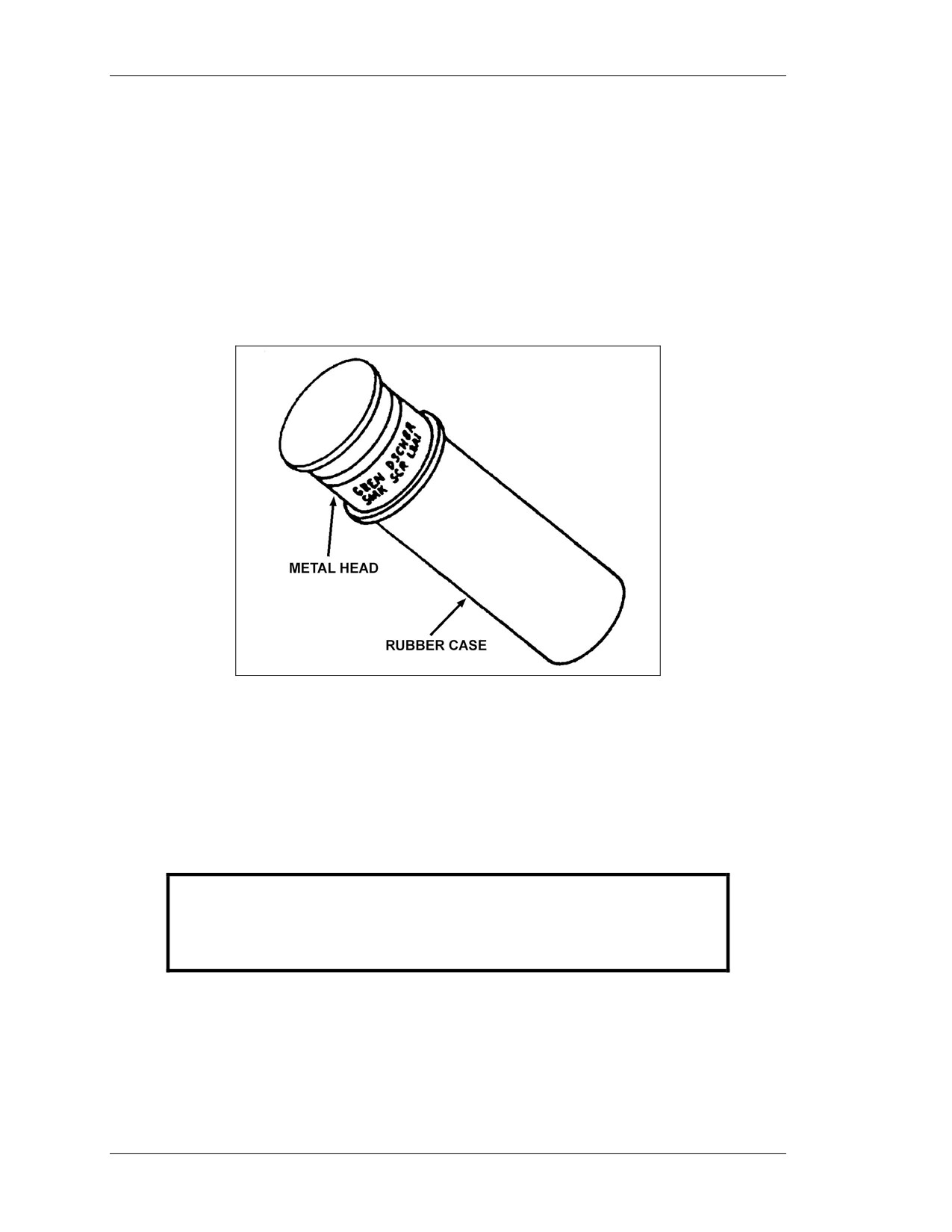
a. L8A1 or L8A3 Red Phosphorus Smoke Grenade. The red phosphorus smoke
grenades contain a mixture of red phosphorus and butyl rubber (Figure 2-19). The smoke
bursts in the direction the turret is pointed. The bursting radius is a 105-degree fan, 10
meters high and 20 to 50 meters to the front. The smoke cloud lasts from one to three
minutes, depending on wind speed and weather conditions. (TM 9-2350-252-10-2, TM 9-
2350-284-10-2, TM
9-2350-284-10-2-1, and TM
9-2350-294-10-2-1 provide more
operator information.)
Figure 2-19. L8A1 or L8A3 red phosphorus smoke grenade.
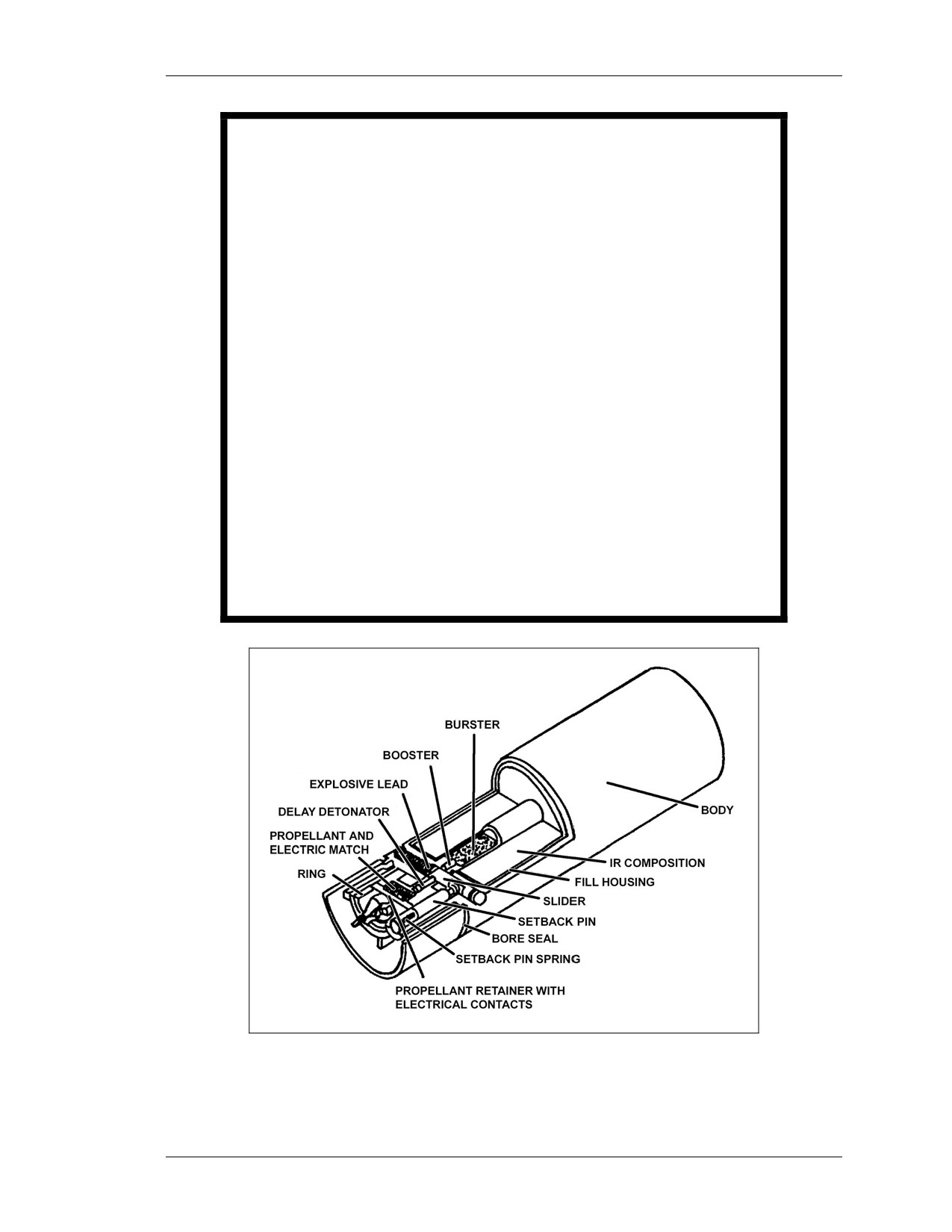
b. M76 Infrared Screening Grenade. The M76 infrared screening grenade
measures 9.5 inches long by 2.5 inches in diameter. It weighs about
4.5 pounds
(Figure 2-20). The launched grenade travels about
30 meters from the vehicle and
explodes at a height of 2.5 meters. The grenade uses a central burster to disseminate 3
pounds of brass powder explosively. The smoke cloud obscures the long-wave IR viewer
for about 30 to 60 seconds, depending on wind speed and other weather conditions.
CAUTION
When used, the M76 smoke grenade obscures the BFV’s day
and thermal visibility as long as the smoke cloud lasts.
2-24
FM 3-22.1
DANGER
SMOKE GRENADES
BEFORE LOADING SMOKE GRENADES, MAKE SURE
THAT BOTH THE TURRET POWER AND THE SMOKE
GRENADE LAUNCHER SWITCHES ARE OFF.
WHILE LOADING, THE LOADER MUST KEEP ALL PARTS
OF HIS BODY AWAY FROM THE FRONT OF THE SMOKE
GRENADE LAUNCHERS.
DURING LOADING, ALL PERSONNEL REMAIN WELL
AWAY FROM THE FIRING LINES.
AFTER ANY MISFIRE, MOVE THE VEHICLE AT LEAST
125 METERS AWAY FROM ANY OTHER VEHICLES,
BUILDINGS, PERSONNEL, OR EQUIPMENT.
AFTER REMOVING MISFIRED GRENADES, TAKE THEM
AWAY TO A WELL-MARKED SPOT AT LEAST 200
METERS FROM ANY VEHICLE, BUILDING, PERSONNEL,
OR EQUIPMENT (TM 9-2350-252-10-2, TM 9-2350-284-
10-2, and TM 9-2350-294-10-2-1).
Figure 2-20. M76 infrared screening grenade.
2-25
FM 3-22.1 (23-1)
CHAPTER 3
Crew Training
This chapter discusses how to prepare Bradley crews to qualify on
Bradley Table VIII (BT VIII). This preparation includes crew and leader
tasks, program development, training strategy and plans, and collective
training.
It also outlines the requirements crews must achieve in gunnery before
advanced gunnery training.
Section I. TASKS
Crew tasks are trained and evaluated first in preliminary gunnery, then in a simulator
(COFT or BATS), appended equipment (the Multiple Integrated Laser-Engagement
System [MILES] or the Precision Gunnery System [PGS]), then in live-fire training.
Crew gunnery culminates with BT VIII, Crew Qualification.
3-1. SKILLS
Crews must achieve proficiency in the following skills. The first seven apply to all
variants of the BFV. The rest apply to specific training requirements, based on variations
in the vehicles' capabilities and systems:
•
Engaging moving targets from a moving Bradley.
•
Engaging multiple targets using the auxiliary sight.
•
Engaging targets using manual controls.
•
Engaging multiple targets from the commander's position.
•
Engaging multiple targets requiring different ammunition types.
•
Engaging targets in an NBC environment.
•
Engaging targets at night.
•
Engaging targets under digital conditions (ODS and A3 only).
•
Engaging aerial targets using the SVML (ADA crews only).
•
Engaging targets using hunter-killer techniques (A3 only).
•
Conducting a fire mission task (FMT, applies to BFIST only).
3-2. PRELIMINARY GUNNERY
Preliminary gunnery
(Chapter 7) develops individual crewmember skills needed to
operate the vehicle and turret weapon systems. A crew whose members are all proficient
with all vehicle tasks is normally going to function better as a crew.
a. The BC is trained and evaluated on controlling the vehicle and crew, and on
laying the weapons systems on targets while issuing fire commands.
b. The BC and gunner are trained and evaluated on--
(1) Performing preventive maintenance checks and services on the turret.
(2) Manipulating the turret.
(3) Operating the turret weapons system controls.
(4) Disassembling and assembling the turret weapons.
(5) Uploading, downloading, and clearing the turret weapons.
(6) Performing immediate action on the turret weapons.
(7) Boresighting the weapons systems (Appendix B).
3-1
FM 3-22.1
c. The driver is trained and evaluated on--
(1) Performing all preventive maintenance checks and services on the hull.
(2) Performing offensive and defensive driving techniques.
d. The crew receives classroom instruction on gunnery techniques, gunnery
training, and section and platoon training.
3-3. COFT AND BATS
Using either the Conduct of Fire Trainer
(COFT) or the Bradley Advanced
Training System (BATS) simulates an environment in which the BC and gunner can gain
proficiency with crew-coordination skills. Neither trainer has a driver's station; however,
drivers should participate anyway, to develop the coordination needed to synchronize
vehicle movement to and from defensive positions. Training can also include other driver
tasks, such as counting of ammunition and announcing of vehicle and TOW launcher
status (up and down).
a. The BC is trained and evaluated on--
(1) Acquiring and designating targets.
(2) Initiating fire commands.
(3) Conducting target handoff procedures.
(4) Performing engagement techniques from the BC position.
b. The gunner is trained and evaluated on--
(1) Reacting to fire commands.
(2) Performing engagement techniques.
3-4. DEVICE GUNNERY
Device gunnery (Chapter 8) provides device-based training for collective crew tasks on
vehicles. These tables are conducted in local training areas or ranges using the Multiple
Integrated Laser-Engagement System (MILES) or the Precision Gunnery System (PGS).
Thru-sight video enhances this training.
a. Device gunnery includes BT I and BT II, Crew Defense and Bradley Crew
Proficiency Course (BCPC).
b. The BC is trained and evaluated on--
(1) Controlling the crew, vehicle, and weapons systems.
(2) Laying the weapons systems on targets.
c. The gunner is trained and evaluated on--
(1) Boresighting training devices (MILES or PGS).
(2) Focusing, aligning, and calibrating through-sight video.
(3) Engaging targets with training devices (MILES and PGS).
d. The driver is trained and evaluated on—
(1) Performing berm drills.
(2) Applying proper driving techniques.
3-2
FM 3-22.1
e. The crew is trained and evaluated on—
(1) Installing and removing training devices
(MILES or PGS, and thru-sight
video [TSV]).
(2) Operating as a crew in a gunnery range environment.
3-5. LIVE-FIRE GUNNERY
Crew gunnery (Chapter 8) introduces the crew to live-fire gunnery.
a. Live-fire gunnery includes--
(1) BT V, Crew Practice 1.
(2) BT VI, Crew Practice 2.
(3) BT VII, Crew Practice 3.
(4) BT VIII, Crew Qualification.
b. The BC and gunner--
(1) Zero the weapon systems (Appendix C).
(2) Upload, download, and clear the weapons using live ammunition.
(3) Engage targets with full-caliber ammunition.
(4) Conduct prefire and postfire checks (Appendix D).
c. The driver executes offensive and defensive driving techniques.
Section II. LEADER SKILLS
Training events must require subordinate leaders to use their initiative and act
independently to prepare them for the decentralized operations that characterize the
mechanized battlefield. Bradley leaders must be the most capable soldiers in the unit.
These key leaders must be tactically and technically proficient, because their leadership
determines the unit's success or failure in battle.
3-6. COORDINATION AND INTEGRATION
A critical leader task is the ability to coordinate and integrate the crew(s), sections, or
platoons to maximize their combat potential. The leader must be resourceful, tenacious,
and decisive, and he must lead from the front. Each leader must be innovative and
flexible in employing his unit. He must have the mental agility to transition quickly, and
he must have the instinct to act on the situation and the commander's intent.
3-7. CLOSE COMBAT
Above all else, the Bradley leader must have the skills and attributes essential to the
crew's, section's, or platoon's survival and success in close combat. Platoon leaders,
commanders, and NCOs are the primary trainers and training managers. To meet their
training responsibilities, commanders must—
a. Base training on wartime mission requirements.
b. Identify applicable Army standards and set unit goals.
c. Assess current levels of proficiency.
d. Provide the required resources.
e. Develop and execute training plans that produce proficient soldiers, leaders,
and units.
f.
Develop a tough, thorough, and well-balanced training program for crews
and squads.
3-3
FM 3-22.1
Section III. DEVELOPMENT OF TRAINING PROGRAM
The Bradley crew's strength comes from the skill, courage, and discipline of the
individual soldiers. Teamwork and cohesion enhance individual capabilities. To succeed
in close combat, the Bradley crew must have this cohesion. The crew-training program
focuses on developing tough, combat-ready platoons. Bradley crew members must have
the skill and the will--not just to participate in the close fight, but to dominate it.
3-8. BATTLE FOCUS
Battle focus is a concept for deriving peacetime training requirements from wartime
missions. Battle focus guides the planning, execution, and assessment of each unit's
training program. This is to ensure that its members train as they fight. The battle-focus
process is about the same for AC and RC units (both MTOE and TDA). FM 7-0 and
FM 7-1 explain how to plan, resource, and execute training events. This manual provides
the tactics, techniques, procedures, and standards to evaluate Bradley platoon and section
training. A complete training program emphasizes physical fitness, rifle marksmanship,
and precision gunnery skills. Frequent night training, especially with live fire, helps
platoons hone their skills.
3-9. MISSION-ESSENTIAL TASK LIST
A unit's training program must support the METL. Therefore, time, resources, and
command emphasis must all focus on training tasks that support the METL. Commanders
and platoon leaders use these collective tasks. Platoon sergeants and squad leaders should
use the appropriate MTP to identify the individual tasks that support the collective tasks.
To develop the METL, the commander must know and understand the war plans and
external directives handed down from higher.
a. War Plans. The most critical parts of METL development are the unit's wartime
operations and contingency plans. The missions and related information in these plans
provide the keys to determining essential training tasks. From each war plan, the
commander selects each mission that his unit is expected to execute in combat.
b. External Directives. Additional training tasks relevant to the unit's wartime
mission derive from external directives. Such directives could include--
•
Mobilization plans.
•
Installation wartime transition and development plans.
•
Force-integration plans.
c. Task List. Once he lists all possible tasks, the commander identifies those that
are most critical to success on the battlefield. This refined list becomes the METL.
3-10. COMMANDER'S ASSESSMENT
Before developing a training program, the commander must determine his unit's
proficiency on each METL task.
a. Training. The commander assesses training with input from the XO, S3,
subordinate leaders, and master gunners (FM 7-0 and FM 7-1). He can use individual and
crew training to determine the unit's proficiency.
3-4
FM 3-22.1
(1) Individual Training. Common task test results show basic individual
training proficiency. The Bradley Gunnery Skills Test
(BGST) evaluates specific
Bradley-related individual proficiency. Preliminary weapons training and qualification
scores indicate proficiency levels with the various weapons organic to the squads and
platoon. Reviewing Army physical readiness test scores also reveals individual
physical readiness.
(2) Crew Training. Crew training proficiency can be measured by reviewing
the COFT or BATS unit summaries along with either performance analyses or session
summaries. Crew device gunnery results and evaluation sheets from the last gunnery
period provide additional field-oriented data, which also help the commander to
determine proficiency.
b. Evaluation. The commander uses specific standards to measure the
demonstrated abilities of individuals and crews. Accurate evaluations are necessary to
identify where to place training emphasis. Leaders must make on-the-spot corrections and
demand aggressive action to correct training deficiencies. UCOFT or BATS results are
also good indicators of crew proficiency.
(1) Informal Evaluation. Unit leaders evaluate performance informally
during training.
(2) Formal Evaluation. The commander schedules a dedicated evaluator on
either the long-range or short-range training plan.
(3) Internal Evaluation. The evaluated unit plans, resources, and conducts its
own evaluations.
(4) External Evaluation. Higher headquarters or another unit plans, resources,
and conducts a unit evaluation.
Section IV. TRAINING STRATEGY
The commander develops his training strategy after assessing the strengths and
weaknesses of his unit. During his assessment, he considers, and his strategy must reflect,
any personnel turbulence (changes). His strategy must focus on his METL, sustain his
unit's strengths, and correct its weaknesses. He will find that some tasks apply to all
soldiers, some apply only to the BFV crew, and others apply only to the soldiers in the
squad. This requires an integrated training strategy. Gunnery progresses logically to
support crew training, leading the section or platoon up to a collective, tactical, live-fire
evaluation during section or platoon qualification.
3-11. CREW TRAINING
The Bradley commander, in coordination with the platoon leader and master gunner, is
the principal trainer for crew duties (Chapter 6), crew coordination, and gunnery skills to
form an efficient crew. His primary references include this manual and the appropriate
field manuals.
a. Preliminary gunnery training focuses on the technical aspects of BFV gunnery
theory, turret operations, and elementary gunnery techniques. The trainers use classroom
instruction and hands-on training to provide each crewmember with knowledge of the
capabilities, limitations, and characteristics of the vehicle. Crews learn fundamentals of
turret manipulation; gun lay; and tracking and adjusting fires for the
25-mm gun,
7.62-mm coaxial machine gun, Stinger, and TOW weapons. The unit also conducts
3-5
FM 3-22.1
specific TOW or Stinger system training. This includes classroom training, UCOFT or
BATS, and hands-on tasks. The record BGST (Appendix A) tests technical proficiency.
b. Device gunnery training allows crews to practice and refine their collective skills
on their vehicles using low-cost training devices. At this point, individual crew duties and
actions are integrated and crews perform as a team. The crew conducts a defense exercise
that allows the driver to practice "berm drills," while the crew engages single, multiple,
stationary, and moving targets. The crews' abilities are evaluated during BT II, Bradley
Crew Proficiency Course (BCPC).
c. Crew gunnery training solidifies crew collective gunnery techniques using live
ammunition. Crews must meet increasingly difficult standards during variable and
challenging conditions similar to combat. The outcome is a crew highly skilled in
destroying likely enemy threats on the battlefield.
3-12. CROSS TRAINING
The commander, platoon leaders, first sergeant, and platoon sergeants manage training to
ensure every soldier is trained in individual and collective tasks for both crew and
Infantry squad skills. The unit-training program must focus on developing tough,
combat-ready platoons with a balanced, simultaneous, integrated Infantry squad and crew
plan.
a. All soldiers require individual weapon training, physical training, common task
training, Bradley skills training, and maintenance training.
(1) A diagnostic BGST--
(a) Evaluates individual task proficiency.
(b) Identifies soldiers proficient enough to serve as gunners.
(c) Cross-trains soldiers when last-minute crew changes are required.
(2) The common task test (CTT) evaluates individual task proficiency.
(3) The Army Physical Fitness Test (APFT) is completed by all soldiers.
(4) Individual weapons qualification is completed by all soldiers.
b. During preliminary and device gunnery training, cross training occurs often to
counter inevitable peacetime or combat personnel losses. Cross training incorporates both
the crew and squad, sustaining basic crew skills and providing additional training for the
squad in case it must perform as a BFV crew. Cross training improves coordination
between the crew and the squad fight. DA Pam 350-38 requires that alternate crews train
regularly in the UCOFT or BATS, conduct crew device gunnery, and take the BGST.
Additionally, the platoon leader's backup crew is resourced to fire crew gunnery.
3-13. INTEGRATED TRAINING
The platoon sergeant, squad leaders, and BCs, in coordination with the platoon leader, are
the principal trainers for the collective skills of integrated vehicle teams, sections, and
platoon. Primary references include this manual and appropriate mission training plans
(MTPs) and Army Training and Evaluation Programs (ARTEPs). One of the most critical
parts of the Bradley training program is integrated drill: crews and squad. Trainers must
emphasize that crew and battle drills comprise the techniques and procedures for
immediate action. Trainers must ensure that each member involved in a drill knows
exactly what his individual task is, when to accomplish it, and what to do if he cannot
perform the task. Before conducting tactical section or platoon missions, the crew
rehearses and trains the drills to standard.
3-6
FM 3-22.1
a. Crew Drills. Crew drills instill instinctive reactions to situations on the vehicle.
With crew drills, the vehicle team must coordinate and synchronize their actions. Team
members must perform as loaders. The loader must react to BC and gunner commands,
and inspect and load 25-mm ammunition and TOW rounds. The squad must react
instinctively and without hesitation when mounting and dismounting the vehicle, while
the driver reacts to the BC's command to raise and lower the ramp.
b. Crew Battle Drills. Crew battle drills instill instinctive reactions to situations the
mounted section and platoon could face in combat. Crew elements must immediately
react to contact or ambush or immediately initiate an attack.
Section V. TRAINING PLANS
Once the commander has developed his METL and thoroughly assessed training
proficiency, he begins the detailed process of developing a training plan. When planning
the gunnery aspect of the training plan, he will find the master gunner to be his most
valuable asset.
3-14. BRADLEY MASTER GUNNER
The primary mission of the master gunner is to train gunnery. The master gunner helps
commanders at all echelons plan, develop, execute, and evaluate all Bradley-related
training (individual, crew, and collective).
a. The commander directs his specific responsibilities. The master gunner—
(1) Assists the validation or certification of newly assigned soldiers.
•
Sets up or conducts initial skills training for new BCs or gunners.
•
Assists in training new BC and gunner crews.
•
Trains and certifies Bradley crew evaluators.
(2) Assists all elements in the unit concerning gunnery training.
(3) Forecasts all ammunition for training.
(4) Manages gunnery records, BGST records, and crew rosters.
(5) Coordinates and controls training device use.
(6) If SIO (senior instructor/operator) qualified, he certifies and recertifies other
I/Os to conduct COFT and BATS training.
(7) Plans and manages COFT and BATS training.
(8) Trains crews on MILES and PGS gunnery (installation, boresighting and
troubleshooting procedures, point of aim, and maintenance).
(9) Executes gunnery training.
(10) Supervises live-fire ranges to ensure all standards are followed.
(a) Confirms zero techniques.
(b) Coordinates target arrays.
(c) Coordinates exposure times for targets.
(d) Coordinates maneuver box verification.
(e) Coordinates setup of all ranges to ensure they meet the
standards in this manual.
(11) Sets up and conducts BGST training and evaluates the results.
(12) Advises the commander of the tactical capabilities of the Bradley against
threat systems (in coordination with the S2).
b. The master gunner has received formal training to function at battalion level.
This includes extensive training in BFV maintenance, range plan preparation and
execution, and all phases of gunnery training. Though this chapter previously discussed
3-7
FM 3-22.1
the main responsibilities of the master gunner, their scope changes depending on this
level of assignment.
(1) Division or Brigade Master Gunner. Because effective unit gunnery
training programs require a great deal of attention, the master gunner assigned to division
or brigade level must--
(a) Work closely with master gunners assigned to lower echelons to ensure
uniform standards throughout training programs.
(b) Develop, IAW this manual, the written certification test for Bradley
crew evaluators.
(c) Provide any new information on ways to improve Bradley crew training.
(d) Coordinate with range-control personnel at the installation or
major training area.
(e) Help develop and upgrade range facilities.
(2) Battalion Master Gunner. When assigned to battalion level, the master
gunner must—
(a) Continue to train master gunners assigned to battalion.
(b) Help the battalion commander and command sergeant major select
candidates for master gunner school.
(c) Develop new training techniques to improve crew training.
(d) Coordinate with brigade for BFV training assets.
(e) Certify Bradley crew evaluators IAW this manual.
(f) Certify BGST evaluators IAW this manual.
(g) Certify range safety personnel.
(3) Company Master Gunner. When assigned to company level, the
master gunner must—
(a) Develop and execute company-level gunnery training plan.
(b) Help service the BFV as required.
(c) Work with unit maintenance on turret problems.
(d) Complete DA Form 2408-4, Weapon Record Data.
(e) Coordinate with the battalion S3 and battalion master gunner to secure
company gunnery training assets.
(e) Train Bradley crew evaluators IAW this manual.
(4) Platoon Master Gunner. When assigned to platoon level, the master
gunner must—
(a) Ensure the platoon BFV weapon system and turret are maintained.
(b) Update the company's master gunner on the platoon's crew training.
(c) Help the company's master gunner with unit gunnery training.
3-15. RELATIONSHIPS BETWEEN KEY LEADERS AND TRAINERS
The goal of BFV gunnery is to prepare Bradley-equipped crews and platoons for war by
training to tough, realistic, measurable standards. The key leaders and trainers in this
process are the commanders, sergeants major, operations officers, master gunners, and
platoon leaders.
a. The battalion commander has the unit execute section or platoon qualification
first. His command emphasis on training the whole section or platoon sets the precedent
for success. He defines his METL with input from those of his superior and subordinate
commanders. When prepared IAW this manual, the battalion METL drives the scenarios
3-8
FM 3-22.1
and engagements for section and platoon qualification. The battalion commander assesses
training to find out whether the unit is prepared to perform these tasks. He incorporates
input from the company commander, the command sergeant major, the Combat Training
Center's (CTC's) take-home packages from external evaluations, previous gunnery, and
COFT or BATS progress. Based on his assessment, he constructs the unit's long- and
short-range training plans.
b. In accordance with the battalion commander's guidance--
(1) Battalion Operations Officer. Together the battalion operations officer (S3)
and master gunner project the needs of the battalion METL against the unit-training
calendar. Multiechelon and sustainment training are the keys to success. The training plan
includes basic individual tasks and progresses to task-force training. The master gunner
helps the S3 develop the crew and infantry squad-training strategy. He develops scenarios
and forecasts ammunition, ranges, and training aids.
(2) Battalion Master Gunner. The master gunner focuses on planning
crew-training support. He expertly ensures the scenarios comply with this manual and
that the range complex supports the scenarios. He is trained to ensure the scenario targets
comply with safety requirements. Throughout the process, he uses his expertise to train
the Bradley vehicle crew. The master gunner informs the commander and S3 about unit
training on the UCOFT or BATS and about the marksmanship results of all individual
and crew-served weapons.
c. The company commander and his master gunner relate much like the S3 and his
master gunner do.
(1) Company Commander. The company commander provides his METL,
training assessment, and unit-specific training needs to the battalion commander. He also
provides guidance on training priorities to his master gunner.
(2) Company Master Gunner. The company master gunner informs the
company commander about crew and squad training needs and helps the commander
plan. He informally keeps the battalion master gunner informed of company training.
Formally, he helps the commander define and request training devices, ammunition,
ranges, and resources to support training. He also advises the commander on the
maintenance status of turret-specific problems such as worn-out barrels.
d. The platoon leader has several experienced NCOs to help him analyze, plan, and
prepare his platoon training.
(1) Platoon Sergeant. The most important source of information and aid is the
platoon sergeant, who knows firsthand the platoon's strengths, weaknesses, training
status, and maintenance status. In preparing platoon training, the platoon leader relies
most on the platoon sergeant, who consolidates input from the squad leaders into the
platoon and company training strategy. He also closely supervises the platoon
master gunner.
(2) Platoon Master Gunner. The platoon master gunner provides the same
expertise as the company master gunner. He knows training devices, strategies, and this
manual. This makes him a valuable asset in preparing platoon training. He provides the
necessary expertise when the platoon is tasked to conduct a specific crew or squad
training event for the platoon or company.
3-16. CREW STABILITY MANAGEMENT
The greatest problem a commander must contend with in developing a training plan is
crew turbulence (personnel changes). This turbulence is inevitable, so the commander
3-9
FM 3-22.1
must plan short- or long-term solutions for reducing it and controlling its effects. He must
do this before he develops and executes his training plan.
a. Short-term Solutions.
(1) Change personnel as a crew rather than a single crewman. For example, if a
staff sergeant Bradley commander is promoted to platoon sergeant, then his entire crew
moves with him. This causes only one crew change rather than two.
(2) Train an alternate for each position.
b. Long-Term Solutions.
(1) Continually cross-train personnel for replacements. Experienced soldiers are
easier to train than new soldiers.
(2) Form complete crews from new personnel who come into the unit. Match
loss dates (ETS, PCS, and DEROS) within the same crew.
3-17. LONG-RANGE TRAINING PLANS
Long-range planning is resource oriented (FM 7-1). Each commander identifies training
needs from his METL task-proficiency assessment. He sets goals and forecasts or
allocates resources to reach them. When considering his long-range plan, the commander
must answer several questions:
a. What is the current platoon proficiency level (crew and squad)? The answer to
this question depends on--
(1) Squad and crew turbulence (changes).
(2) Performance during previous gunnery maneuver exercises and squad and
platoon situational training and live-fire exercises (STXs and LFXs).
b. What are the performance goals for the platoons? What proficiency level must
crews and infantry squads reach in order to accomplish METL tasks? Some
goals include--
(1) Meet or exceed DA Pam 350-38 qualification standards.
(2) Set a percentage of qualified marksmen, sharpshooters, and experts for AT4,
Dragon, Javelin, M16, M203, M240B, M249, or other weapon systems that the unit uses.
(3) Set a percentage of qualified, superior, and distinguished ratings for
BFV crews.
(4) Obtain an overall rating of trained
("T") on the appropriate advanced
gunnery table.
c. What resources must we have, and where is the command emphasis?
(DA Pam 350-38 also shows the ammunition authorization for every weapon system in
the battalion.)
•
Correct tasks that fall short of the standard.
•
Sustain proficiency in tasks that meet the standard.
d. What schools and training are needed to certify and train trainers?
•
Master gunner's course,
•
Bradley crew evaluator's certification, the
•
Bradley gunnery skills test-evaluator certification, the
•
Instructor/operator courses within the unit, and either the
•
Instructor course for the multiple integrated laser-engagement system, or the
•
Precision gunnery system training.
3-10
FM 3-22.1
3-18. SHORT-RANGE TRAINING PLANS
Resources identified during long-range planning are allocated and prioritized during
short-range planning. Command training guidance is published to provide trainers
detailed information on the training objective. Active and reserve components'
short-range training considerations are different. (FM 7-1 explains this process in detail.)
a. Considerations. Gunnery resource considerations are ammunition, fuel and
repair parts, range and maneuver area, and training device availability.
b. Ammunition. Master gunners must carefully manage ammunition allocations,
especially when dealing with 25-mm resources. The battalion master gunner forecasts
ammunition needs well before the training event. For many reasons, the ammunition
authorization could fall short of the forecasted training requirement. PGS will not train
proper boresight, zero, or gun-operation procedures. Once the master gunner knows the
yearly ammunition authorization, he allocates ammunition in a specific priority:
(1) Crew Training. The crew practices with MILES. However, MILES is
unsuitable for moving target engagements, because it does not require the gunner to apply
lead to engage a target. MILES is also unsuitable for training BOT and TOT.
Consequently, the commander must develop a strategy to train with less ammunition.
(a) Qualify crew.
(b) Rehearse crew.
(c) Conduct qualification refires and additional training.
(d) Reduce crew practice tasks for stable, prequalified crews.
(e) Give ammunition to new crews.
(f) Reduce rounds per engagement on training and practice exercises.
(g) Increase device-based training.
(h) Use PGS in crew practice scenarios.
(i) Increase use of COFT or BATS.
(2) Squad Training.
(a) Conduct weapons qualification.
(b) Conduct a squad and platoon LFX.
(c) Dry fire or use MILES on STX lanes.
(d) Reduce rounds per engagement on squad LFXs (not platoon LFXs).
(e) Conduct LFX refires and additional training.
(3) Platoon Training. Use PGS on platoon practice. PGS will not allow leaders
to see tracers from other vehicles for fire control and distribution applications. Dry fire or
use a subcaliber (7.62-mm) gun during platoon practice.
(a) Qualify the platoon.
(b) Rehearse the platoon.
c. Fuel and Repair Parts.
(1) Train closer to garrison.
(2) Use a limited number of vehicles to train crews.
(3) Use HETs to move vehicles to the range.
d. Range and Maneuver Area. Include target and range-support personnel.
(1) Short-range gunnery scheduling considerations include—
(a) Vehicle services.
(b) Other mandatory training, or events prescribed by higher headquarters.
(c) No training events (holidays, leaves, installation support).
3-11
FM 3-22.1
(2) Short-range guidance considerations include—
(a) Crew and squad training priorities and expected outcomes.
(b) Leader, individual,
and collective tasks associated with
the training event.
(c) Steps required in preparing trainers and evaluators.
(d) Integration of crew and squad training on the training calendar.
3-19. NEAR-TERM TRAINING PLANS
Near-term planning is primarily conducted at battalion, company, and platoon levels. Its
main purpose is to conduct final coordination and to provide specific guidance to
the units.
a. Training meetings should be held at battalion, company, and platoon levels so all
key personnel understand detailed information.
(1) Battalion meetings focus on training management. Leaders--
(a) Conduct final coordination of ranges, training areas, and ammunition.
(b) Coordinate between units for maintenance, medical, logistical, and
personnel requirements.
(c) Lock in and publish unit-training schedules.
(2) Company and platoon meetings cover the specifics of executing
the training event. Participants--
(a) Discuss when the training will be conducted, to include movement times
to the training area.
(b) Discuss personnel involved in the training event, and identify who is
responsible for conducting the training.
(c) Discuss in detail the BFV range setup, execution, and key individual
responsibilities (Chapter 5).
(d) Discuss training location, uniforms, and special equipment required to
conduct training.
(e) Discuss specific personnel performance measures to be evaluated.
b. Commanders should require briefbacks to ensure subordinate leaders understand
all aspects of the training event.
c. The formal training plan culminates with the training schedule. Commanders,
key leaders, and all trainers must continue to plan and coordinate training informally with
a series of pre-execution checks. Additionally, trainers, soldiers, and support personnel
must thoroughly prepare for training.
(1) Pre-execution checks systematically prepare soldiers, trainers, and resources
to ensure that training starts properly. These checks are developed, and responsibility for
them assigned, during short-range planning. FM 7-1 includes an example pre-execution
checklist. To develop an intensive pre-execution checklist, trainers should integrate range
and training area checks and considerations from Chapter 5.
(2) Commanders prepare trainers to conduct performance-oriented training by
providing time, guidance, resources, and references. Each trainer rehearses his
preparations and reviews the tasks and subtasks that he must conduct. This gives him
confidence in his ability to perform the task himself, and to teach soldiers the
correct skills.
3-12
FM 3-22.1
Section VI. COLLECTIVE TRAINING
Gunnery training must use all available resources to raise and sustain the proficiency
level of the METL tasks. Training must be well-structured, realistic, effective, and safe.
3-20. HOME-STATION GUNNERY
Home-station gunnery (HSG) is a continuous and progressive training program that is
intensified two to three months before a major gunnery rotation. HSG, which is planned
at battalion level and executed at company level—
• Orients the crew to the technical aspects of the turret systems.
• Exposes the crew to the most fundamental gunnery techniques.
• Integrates the crew into an efficient team during device gunnery (before live fire).
• Orients the squad in doctrinal aspects of STX operations.
• Integrates the section and platoon during device gunnery.
3-21. GUNNERY DENSITIES
Major gunnery densities normally focus on--
• Orienting the squad in the fundamental aspects of an LFX.
• Refining crew skills using full-caliber ammunition on full-scale ranges.
• Qualifying crews.
• Integrating the section and platoon in live-fire training and qualification.
3-22. GUNNERY LEVELS
A well-rounded gunnery program has four progressively difficult levels. Crews, squads,
sections, and platoons should achieve proficiency at each level before advancing to the
next. The four gunnery levels are as follows:
a. Preliminary. Preliminary gunnery introduces the crew to the vehicle system and
develops individual and crew skills in operating the BFV, turret, and weapon systems. It
provides classroom instruction as well as hands-on applications. Hands-on tasks include
gun lay, tracking, adjustment of fires, range card, and basic TOW gunnery tasks as well
as COFT or BATS exercises. (Chapter 7 discusses elements of preliminary gunnery.)
b. Device. Device gunnery trains crews, sections, and platoons using devices.
Crews conduct BT I, Crew Defense, which lets the driver practice berm drills using the
vehicle while the crew engages single and multiple stationary and moving targets.
Evaluators assess the crew's abilities during BT II, Bradley Crew Proficiency Course.
Sections also conduct BT III, Infantry Squad or Section Exercise, which allows the
infantry squad and vehicle sections to train together. This develops techniques needed to
perform squad collective tasks. BT IV, Infantry Platoon Proficiency Course, integrates
the entire platoon in a device-based combat scenario. The platoon leaders develop their
command and control skills and identify strengths and weaknesses for future training
emphasis. (Chapter 8 discusses some elements of device gunnery.)
c. Crew. Crew gunnery uses live fire to refine and evaluate crew skills developed
during preliminary and device gunnery. Crew gunnery includes three crew practice tables
(BT V, BT VI, and BT VII) and the crew qualification table (BT VIII). (Chapter 8
discusses elements of crew gunnery.)
d. Section and Platoon. Section and platoon gunnery integrates all the crews into a
live-fire tactical scenario. Both sections and platoons refine and verify tactics and
techniques developed during previous training. This gunnery consists of section and
3-13
FM 3-22.1
platoon practice and qualification tables
(BT IX and BT X, Section Practice and
Qualification; and BT XI and BT XII, Platoon Practice and Qualification. During
qualification, sections and platoons are evaluated on their collective abilities.
3-23. GUNNERY CONDITIONS
Gunnery conditions vary, so crews learn to fight in any battlefield environment. Training
in a variety of conditions ensures that crews can perform in adverse weather and
degraded-mode gunnery. They must not only use thermal sights at night, but also during
daylight operations in smoke, adverse weather conditions, and concealing terrain.
a. Adverse Weather. Soldiers must know how adverse weather affects the
performance of their systems. They also must know how to mechanically operate the
weapons system.
(1) Fog, snow, and heavy rain hinder target acquisition, range
determination, and BOT.
(2) Temperature extremes and humidity affect cyclic rates of fire and ballistics.
b. Degraded-Mode Gunnery. In degraded mode, BFV crews engage targets with a
less than fully operational system or under worse than normal operating conditions.
(1) Battle damage and maintenance problems can deny the use of primary sights
and turret control systems. Crews must continue the fight using—
(a) Auxiliary sight. All A3 crews must select "gun power track" when using
the auxiliary sight.
(b) Commander's hand station.
(c) Turret, manually operated.
(2) NBC conditions severely influence the crew's ability to—
(a) Operate turret controls and perform crew duties.
(b) Observe through the optics.
(c) Perform during continuous operations.
3-24. TRAINING REQUIREMENTS
A Bradley crew includes the BC, gunner, and driver, unless otherwise specified
(Figure 3-1):
a. BCs, gunners, and platoon alternate crewmembers must pass all BGST tasks in
the three months (four months for RCs) before live fire.
b. A crew must pass BT II within the three months (four months for RCs) before
they can fire full-caliber live rounds.
c. A crew must fire BT VII in the three months (four months for RCs) before they
fire BT VIII.
d. BCs and gunners must have completed the TOW gunnery program to standard
within the three months (four months for RCs) before they can fire a live TOW missile.
e. Crews who will fire live rounds during infantry platoon, scout team, engineer
platoon, BFIST team, or Stinger squad qualification must first qualify on BT VIII in the
six months before BT IX, BT X, BT XI, and BT XII.
f.
BGST evaluators must pass all BGST tasks within one year and, within the
month before they evaluate a particular BGST station themselves, they must achieve a
"GO" on that station.
3-14

FM 3-22.1
g. All Bradley crew evaluators must certify or recertify IAW the BCE certification
program
(Chapter 8)
in the three months
(four months for RC) before any
live-fire exercise.
PERSONNEL
REQUIREMENTS
• BCs
Pass all BGST tasks in the 3 months (4 months for RC) before
• Gunners
live fire.
• Platoon alternate
crewmembers
• Crews
Passed Table BT II in the 3 months (4 months for RC) before
full-caliber live fire. Fired BT VII in the 3 months (4 months for
RC) before BT VIII.
• BCs and gunners
Completed the TOW gunnery program to standard in the
3 months (4 months for RC) before TOW missile live fire.
Qualified on BT VIII in the 6 months before BT X, BT XI, and
• Crew firing
BT XII.
live rounds during
qualification for--
-- Infantry platoon
-- Scout team
-- Engineer platoon
-- BFIST team
-- Stinger squad
• BGST evaluators
Pass all BGST within 1 year.
In the month before they evaluate a particular BGST station
themselves, achieved a "GO" on that same station.
• All Bradley crew
Certified or recertified IAW BCE certification program in the
evaluators
3 months (4 months for RC) before any LFX.
Figure 3-1. Training requirements.
3-15
FM 3-22.1 (23-1)
CHAPTER 4
Training Devices
The commander balances BFV training resources and time, using
appended equipment, simulators, and training aids. This allows effective
and economical training to standards. However, nothing can replace live
fire. The commander and master gunner must start by assessing the unit's
proficiency.
4-1. TYPES
Trainers must identify the specific resources that increase a unit's ability to train, sustain,
and evaluate BFV gunnery and tactical training. Tables 4-1 and 4-2, pages 4-2 and 4-3,
offer a quick reference of the appended equipment, simulators, and aids that relate to
specific training events.
a. Appended Equipment.
• Thru-sight video (TSV).
• Multiple-Integrated Laser Engagement System (MILES).
• Precision Gunnery System (PGS), ODS and below.
• Precision Gunnery System, A3 only (PGS).
• Captive Flight Trainer (CFT).
b. Simulators.
• Conduct of-fire trainer (UCOFT and MCOFT).
• Bradley Advanced Training System (BATS).
• Simulations network (SIMNET).
• Close-combat tactical trainer (CCTT).
• Linebacker Tabletop Trainer (LTTT).
c. Training Aids.
• Tracking board.
• Laser target-interface device (LTID).
• Scale models.
• Dummy rounds (M172, M794, and MSR).
4-2. APPENDED EQUIPMENT
Appended equipment includes three-dimensional training products that mount on the
actual platform and that can be activated either mechanically or electrically. All
Bradley-appended equipment requires an operating temperature of 50 to 120 degrees
Fahrenheit (ambient) up to a peak of 125 degrees Fahrenheit. For system specifics on the
thru-sight video (TSV), refer to TM 9-6920-708-10.
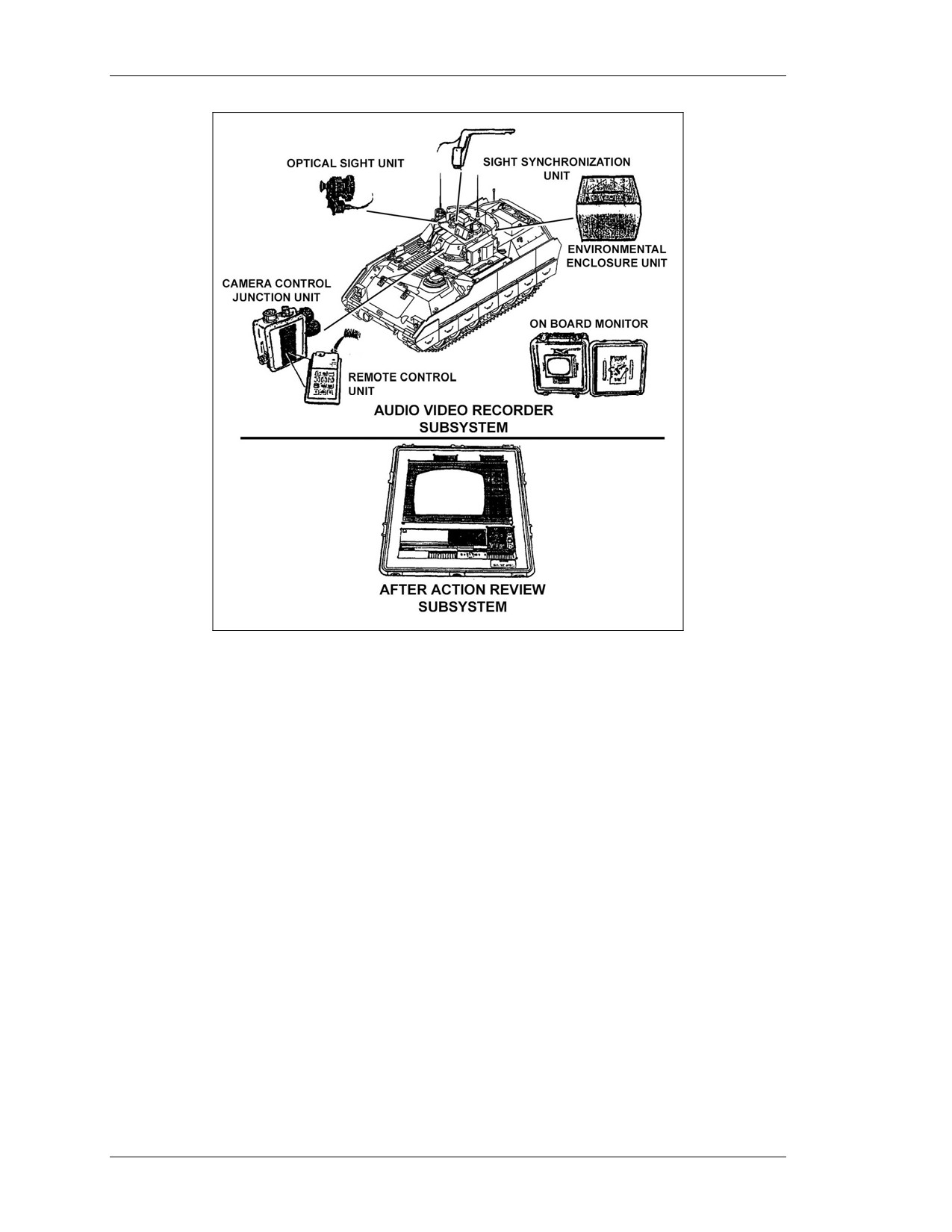
a. Thru-Sight Video. The vehicle-appended TSV (Figure 4-1, page 4-4) provides a
visible and audible record of gunnery or tactical-engagement exercises. Trainers use it to
evaluate and critique vehicle gunnery training-engagement sequences. TSV is transparent
to the crew. Its onboard monitor can play back training sequences immediately. The TSV
system has the following components:
(1) After-action review (AAR) subsystem. This subsystem lets evaluators play back,
zoom in, and freeze individual engagements. It also lets crews review their performance
on the AAR subsystem. The AAR subsystem is usually located in the AAR area.
4-1

FM 3-22.1
(2) Audio-video recorder.
(3) Environmental enclosure unit.
(4) Camera-control junction unit.
(5) Optical unit.
(6) Cable assembly.
APPENDED
EQUIPMENT
SIMULATORS
SIMNET,
TSV
MILES
PGS
CFT
COFT*
BATS
CCTT
M6 LTTT
PARTICIPANTS
Gunner Only
Gunner and BC
X
X
X
X
X
X
X
Gunner, BC,
X
and Driver
Infantry Riflemen
X
Platoon
X
X
FEATURES
Use of Bradley
X
X
X
X
Simulation of Bradley
X
X
X
X
Live Fire
X
X
X
Force on Force
O
X
O
O
X
Limited Visibility
X
X
X
X
X
X
X
X
Use in NBC
X
X
X
X
X
X
X
X
Permanent Location
X
X
X
Portability
X
X
X
X
X
X
Variable Difficulty
X
X
X
X
FEEDBACK
Audio
X
X
X
X
X
Video
X
X
X
X
X
X
Printout
X
X
X
X
TRAINING EVENTS
Preliminary Gunnery
X
X
X
X
X
X
X
Drill Training
O
X
X
X
Device Gunnery
O
X
X
X
Crew Gunnery
X
O
X
Advanced Gunnery
O
X
X
Special
O
O
O
X
X
--
Designated use
* UCOFT and MCOFT
O --
Alternate use
Table 4-1. Appended equipment and simulators.
4-2

FM 3-22.1
AIDS
Tracking
Scaled
Board
LTID
Models
PARTICIPANTS
Gunner Only
Gunner and BC
X
X
X
Gunner, BC,
and Driver
Infantry Riflemen
X
Platoon
X
FEATURES
Use of Bradley
X
X
Simulation of Bradley
Live Fire
Force on Force
Limited Visibility
X
Use in NBC
X
X
X
Permanent Location
Portability
X
X
X
Variable Difficulty
X
X
FEEDBACK
Audio
Video
Printout
TRAINING EVENTS
Preliminary Gunnery
X
O
X
Drill Training
O
Device Gunnery
X
Crew Gunnery
Platoon Gunnery
O
Special
X
X
--
Designated use
O --
Alternate use
Table 4-2. Training aids.
4-3
FM 3-22.1
Figure 4-1. Thru-sight video.
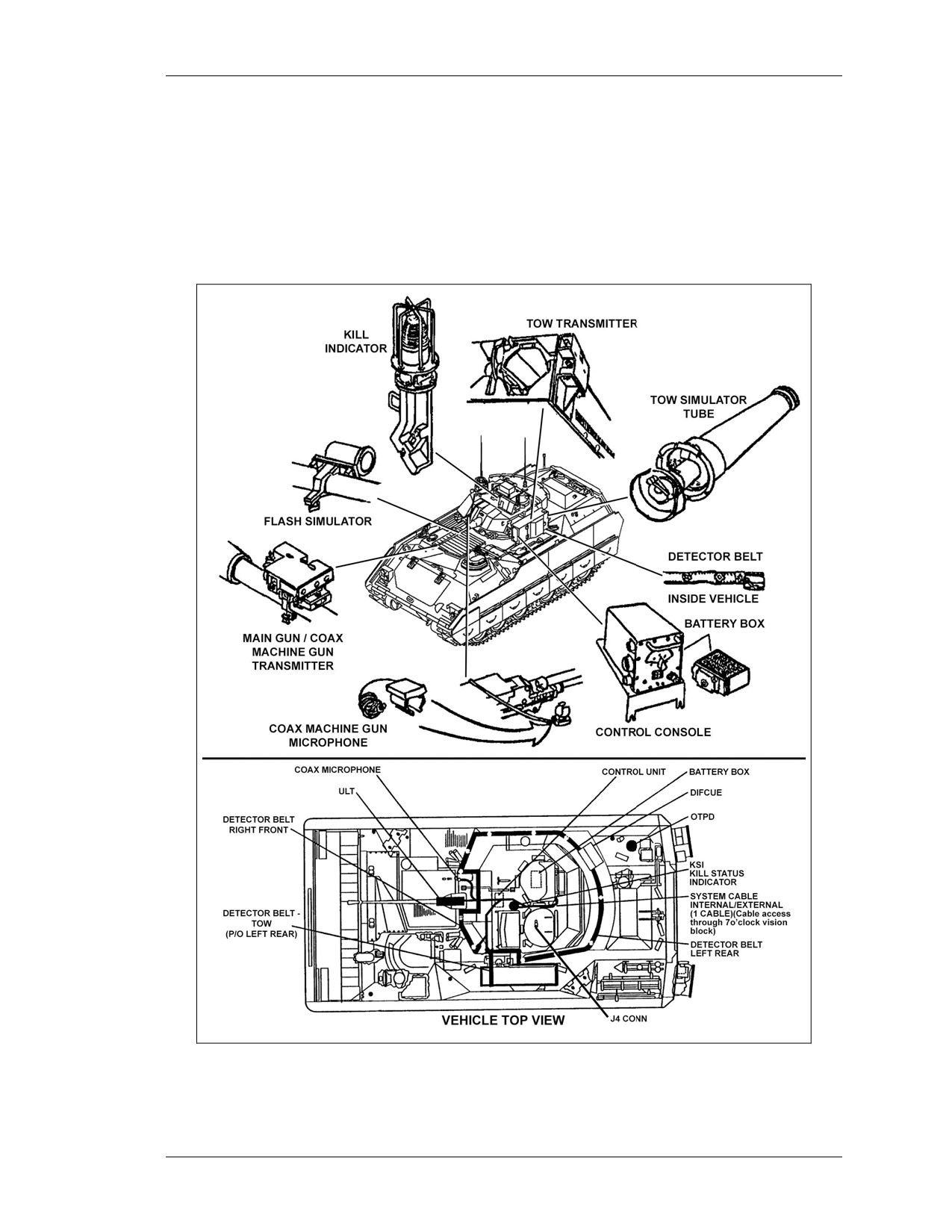
b. Multiple-Integrated Laser Engagement System. MILES (Figure 4-2) is an
integrated family of low-power, eye-safe, laser-based devices. It simulates the
casualty-producing effects of direct-fire weapons using semiconductor laser beams.
When fired, MILES sends an invisible laser beam from a transmitter attached to the
25-mm gun and to the TOW launcher. The laser beam transmits coded messages (based
on the weapon and ammunition selected) to the detector belt sensors on other
MILES-equipped vehicles. The MILES for the M2 or M3 fighting vehicle enables the
crew to use the vehicle in realistic combat training exercises (force-on-force). MILES is
unsuitable for training moving target engagements, because the gunner cannot apply lead
or induce range to engage the target. Also, trainers cannot use MILES to train BOT and
TOT, because the crew cannot see hit signatures or tracers (TM 9-1265-375-10).
(1) System components include—
• Control console.
• Superelevation training box (M2A2 ODS).
• Battery box.
• Flash weapons-effects systems simulator.
• TOW transmitter.
• Antitank, weapon-effects-signature simulator.
• TOW simulator tube.
• Main gun or coax transmitter.
• Detector belt system.
• Coax machine gun microphone.
• Combat vehicle kill indicator.
• Blank firing attachment, 7.62 mm.
• TOW training box (except A3).
4-4
FM 3-22.1
(2) The TOW training box on MILES-equipped vehicles has a training-mode bypass
feature that—
(a) Synchronizes the ISU sight picture with the MILES TOW aiming point.
(b) Eliminates drive system lag by making the gun the master axis in the TOW mode.
(c) Has an easily operated, transparent training and tactical mode.
(d) With the TOW selected, forces the ISU mirror to track gun-resolver input rather
than TOW-resolver input.
Figure 4-2. Location of MILES 2000.
4-5
FM 3-22.1
c. Precision Gunnery System, ODS and below. The PGS (Figure 4-3, page 4-7) is
an eye-safe laser appended training device that provides normal and degraded mode
gunnery on unit vehicles. The system allows crews to develop and sustain gunnery skills
while training using their own vehicles. Tracer and missile signatures in the commander's
and gunner's sights replicate the actual weapons and ammunition. This allows crews to
apply lead, BOT, and TOT procedures during engagements. The PGS is fully compatible
on MILES-equipped ranges, vehicles, and targets. The system can send and receive hit,
kill, and miss signals from other PGSs, tank weapons gunnery simulation systems
(TWGSSs), or MILES-equipped vehicles. A redesign of the mounting reconfiguration
allows the crew to fire the TOW "in simulation" while they fire the 25-mm and coax
"live." The PGS lets the BCEs review all engagements during the AAR. The PGS also
shows ballistic information for each simulated round fired. It identifies where each hits
relative to the target, in mils, both in azimuth and elevation. (TM 9-6920-710-12&P-1
and TM 9-6920-711-12&P-1 provide additional information.) The system
components include—
• Control panel.
• Controller unit.
• Hull detectors.
• Laser transceiver unit.
• Training-data-retrieval system.
• Vehicle-interface unit.
d. Precision Gunnery System, A3 Only. The A3 PGS simulates real-world firing
conditions and effects, with images and sounds. The Bradley A3 PGS training-device
interface panel (TDIP) includes fully integrated fire controls. The A3 adds the following
components:
• Driver-unit's dual bracket (A3 only).
• Tracer-burst obscuration simulator.
• Vehicle interface assembly bracket (A3 only).
• Video-mixer unit for tracer-burst-obscuration simulator (A3 only).
4-6
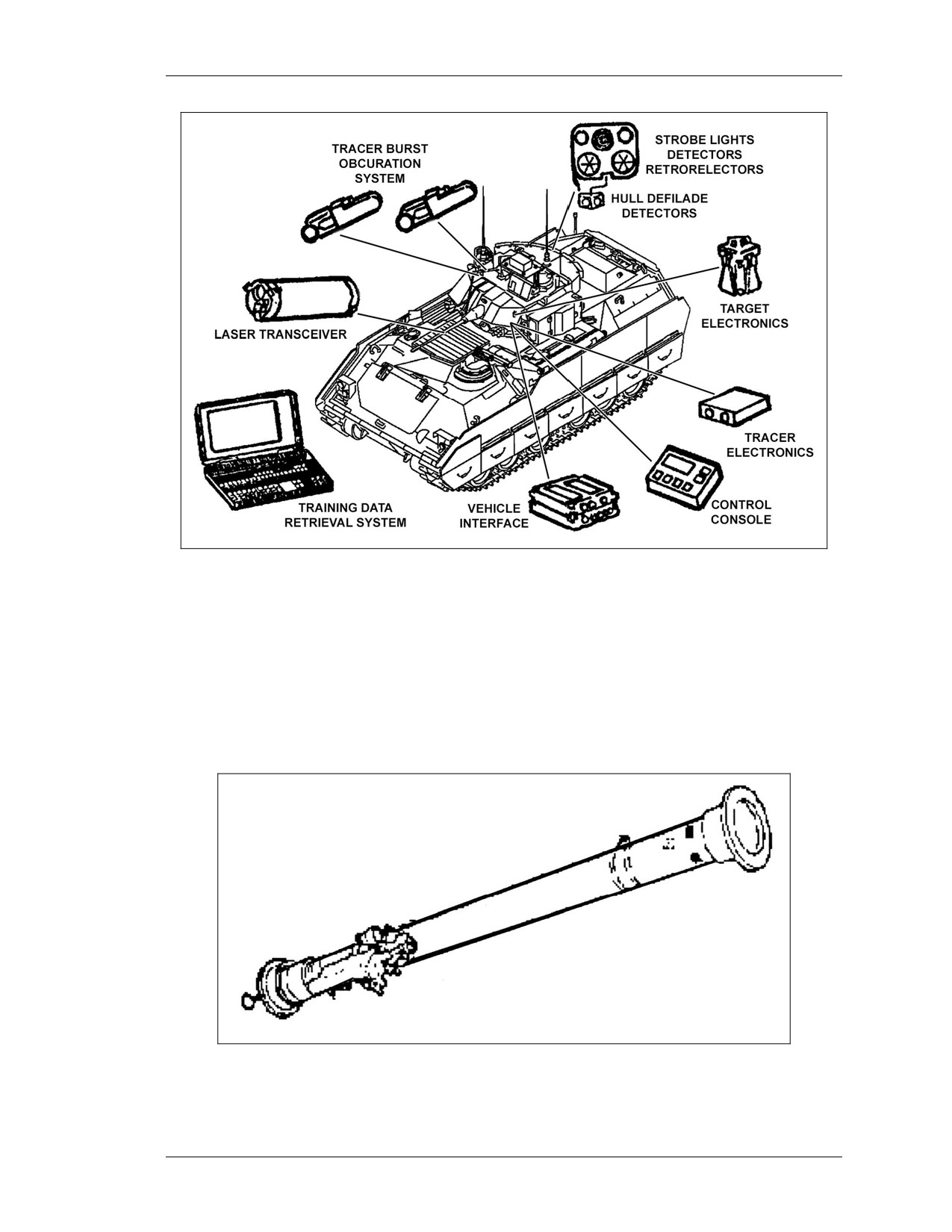
FM 3-22.1
Figure 4-3. Precision gunnery system.
e. Captive Flight Trainer. The CFT (Figure 4-4) is a missile simulator used to train
operator tracking and engagement skills. The CFT is used in conjunction with the
Remotely Piloted Vehicle-Target System (RPVTS) to train engagement procedures with
live targets. It consists of a Stinger-reprogrammable microprocessor
(RMP), missile
guidance assembly, a ballasted launch tube, and a container. The seeker and audio
interface is the same as for the tactical missile, with electrical power and coolant
provided by normal launcher sources.
Figure 4-4. Captive flight trainer.
4-7
FM 3-22.1
4-3.
SIMULATORS
Simulators provide high fidelity training without the use of the actual equipment. They
are stand-alone trainers that emulate the functions of equipment or systems. Simulators
use electronic or mechanical means to reproduce conditions necessary for an individual
or crew to practice operational tasks in accordance with training objectives. They
represent the equipment physically and functionally to varying degrees and follow the
mathematical equations that describe performance.
a. Conduct of Fire Trainer. The COFT is the primary simulator for training crew
gunnery skills without using ranges, ammunition, or vehicles. The COFT allows training
without regard to time of day or climatic conditions. The two COFT configurations
include the unit and mobile conduct-of-fire trainers (UCOFT and MCOFT).
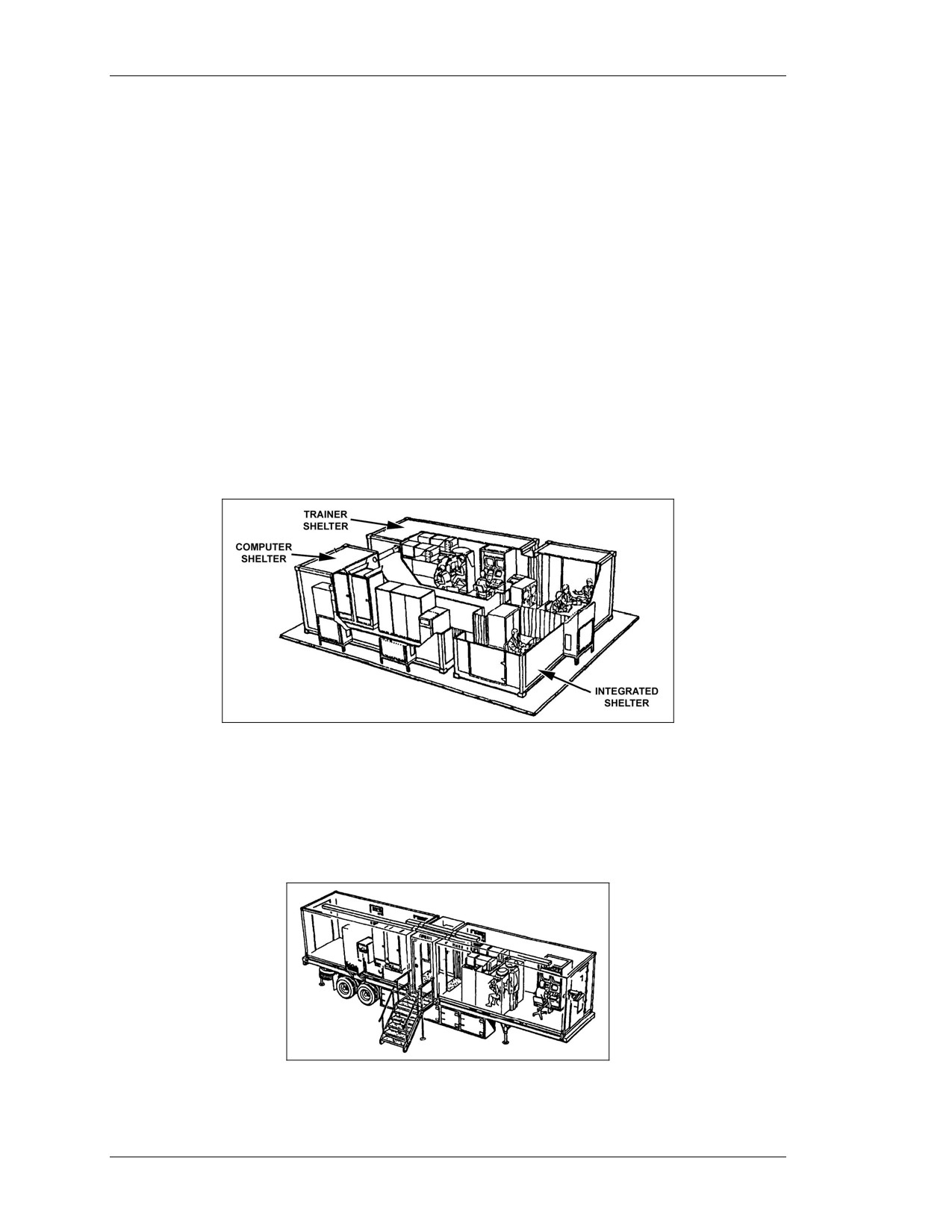
(1) The UCOFT
(Figure 4-5) consists of three interconnecting shelters. The
instructor's handbook
(HB
23-1 series) and TM 9-6920-737-10 describe how
to use them:
• Trainer shelter.
• Computer shelter.
• Integrated shelter.
Figure 4-5. Unit conduct-of-fire trainer.
(2) The MCOFT (Figure 4-6) consists of a training shelter and a computer shelter
mounted on a trailer to allow movement between various unit locations. The Army
National Guard is the main user of the MCOFT. The instructor's (HB 23-1 series) and
TM 9-6920-759-10 provide operating instructions.
Figure 4-6. Mobile conduct-of-fire trainer.
4-8
FM 3-22.1
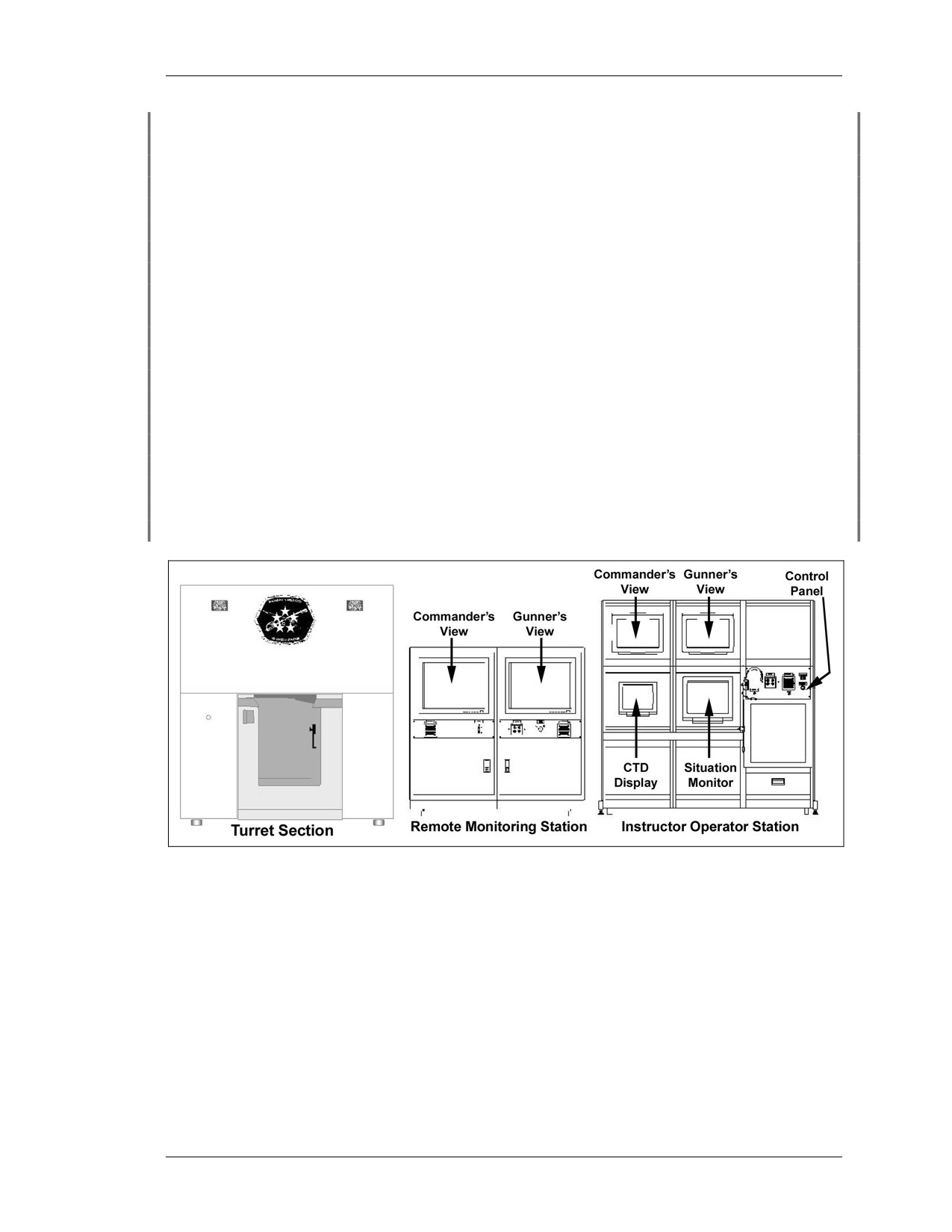
b. Bradley Advanced Training System. The BATS (Figure 4-7) serves as the
gunnery trainer for the Bradley A3. The purpose of the BATS is to train and sustain a
crew's ability to perform fundamental gunnery techniques in simulated gunnery and
combat scenarios. The BATS is the COFT for the Bradley A3:
(1) The BATS has four components.
(a) A crew station replicates the functions of the A3 turret controls, indicators, sights,
and weapons.
(b) An instructor/operator station is used by I/Os to initialize the BATS and conduct
training and briefings, and by senior I/Os to manage training.
(c) A remote monitoring station (RMS) facilitates briefings and concurrent training.
(d) A image generator (IG) provides images for the sights.
(2) The BATS provides sustainment and cross-training programs to train crews in a
simulated gunnery or combat mode. In BATS, three-dimensional targets (IAW TC 25-8,
Training Ranges), and range markers, ammunition allocations, and evaluation standards
(IAW this manual) allow battle-focused training in the gunnery mode. The BATS
provides realistic training in the combat mode by presenting realistic target models. The
crew's basic ammunition load is based on DA Pam 350-38, Standards in Weapons
Training, and on this manual. Based on target range, type, and the location of the hits, the
BATS determines the probability of a hit or kill (PH or PK). The SIO inputs engagement
parameters to support a specific unit's METL and its threat template.
Figure 4-7. Bradley advanced training system (BATS).
c. Simulations Network. The SIMNET (Figure 4-8, page 4-10) is a local network
of combat vehicle simulators that simulate the M1 tank and the M2 or M3 BFV. The
commander can request a SIMNET configuration in any size from tank or infantry
platoon up to battalion task force size. When SIMNET is used as a company- or
battalion-level trainer, a complete functional tactical operation center (TOC) and combat
trains command post (CP) are available to act as the administration logistics operations
center
(ALOC) that would normally be present during combat operations.
Computer-generated imagery is used to create the illusion of riding in tanks and BFVs
fighting force-on-force battles. The training benefits from SIMNET depend on two
important factors: training know-how and leadership. The system and its computers are
4-9
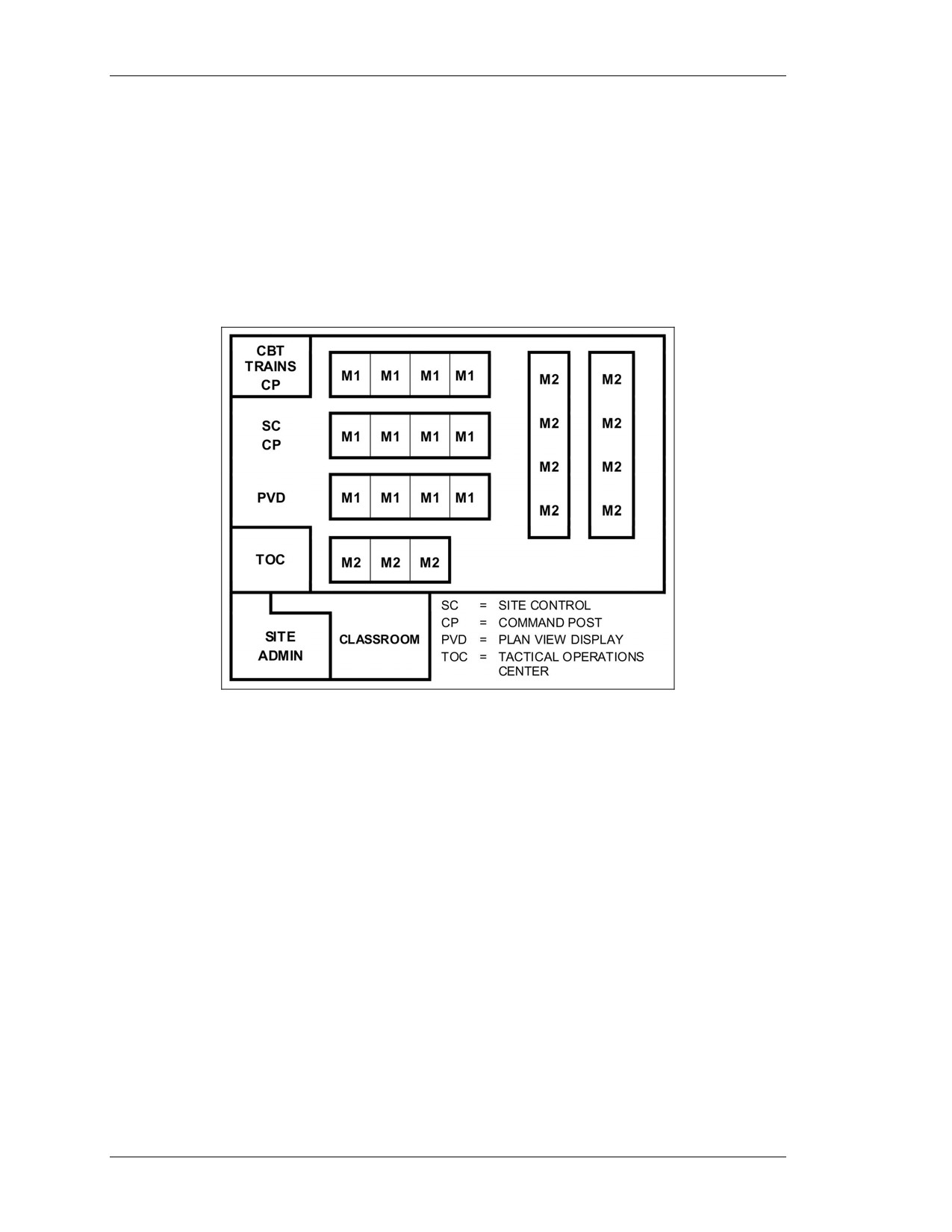
FM 3-22.1
simple to use. With few exceptions, four hours of practice will support STX training on
mounted tasks. As in any training, the leader must plan and prepare his objectives in
advance and must ensure that the entire chain of command knows and supports the
training objectives. The system components include—
• Semiautomatic forces station
• Simulator
• Tactical operations center
• Emulator
• Combat trains command post
• Plan view display
• Site control command post
• Data logger
• Infantry squad work station
Figure 4-8. Simulations network.
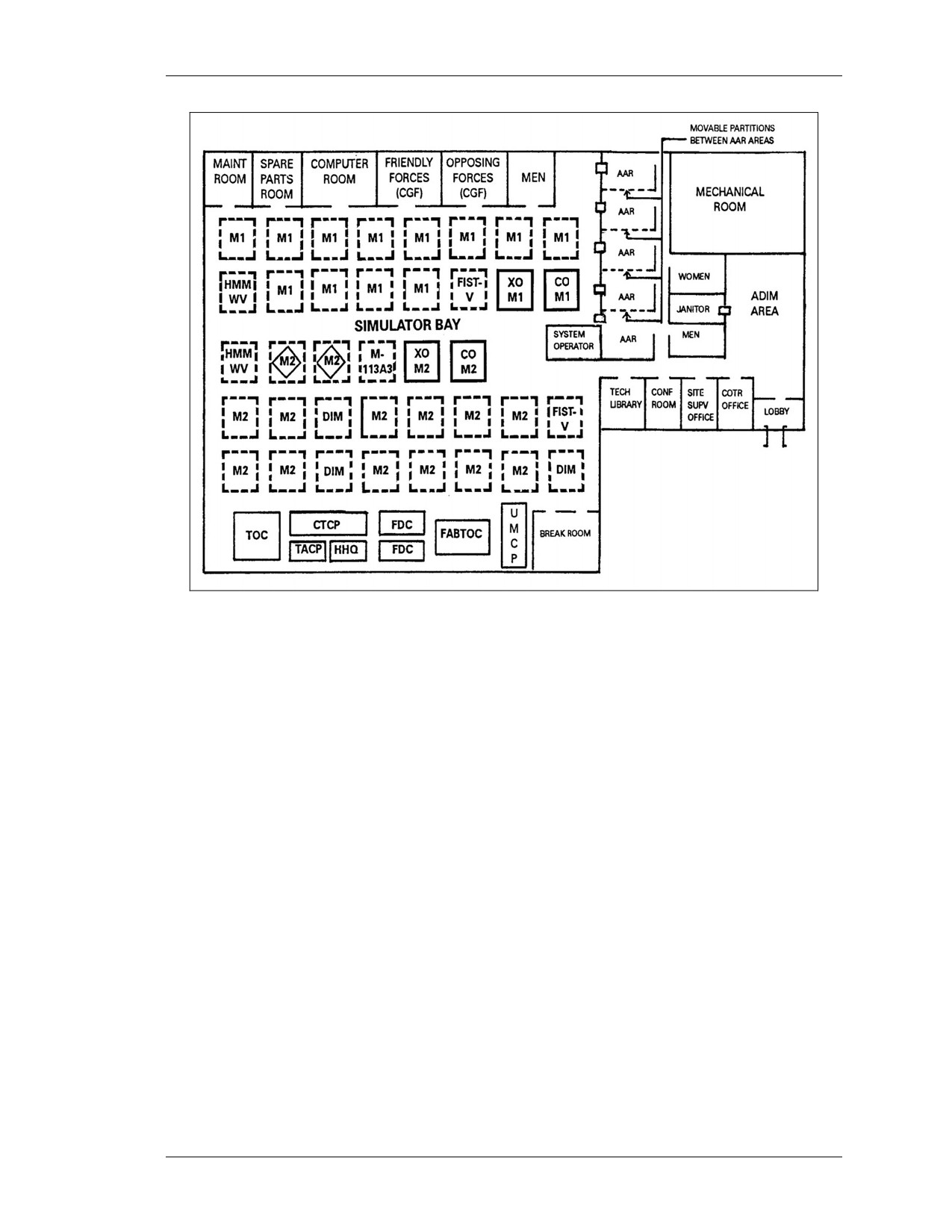
d. Close Combat Tactical Trainer. The CCTT (Figure 4-9) is a mounted task
trainer consisting of a network of individual, computer-driven, combat-vehicle (mounted
task) simulators. It trains the M1 Abrams tank, the M2 or M3 Bradley, the high-mobility
multipurpose wheeled vehicle (HMMWV), and the fire-support team (FIST) vehicle.
(1) The CCTT's controls duplicate those of the vehicles and functions they simulate.
CCTT computers can create a complex illusion of --
• Moving and fighting over actual terrain.
• Operating or riding inside the actual vehicles.
• Employing the vehicles' actual weapon systems.
(2) The trainer selects collective tasks to train units ranging in size from mounted
crews up through battalion task-force soldiers.
(3) The trainer's effectiveness depends heavily on its computer-generated force
(CGF) capability. This lets the trainer simulate both friendly and opposing forces that
can range in size from squad to regiment.
(4) Although this is a mounted-task trainer, the squad and platoon leaders also control
the actions of any passengers, including scouts.
4-10
FM 3-22.1
Figure 4-9. Close combat tactical trainer.
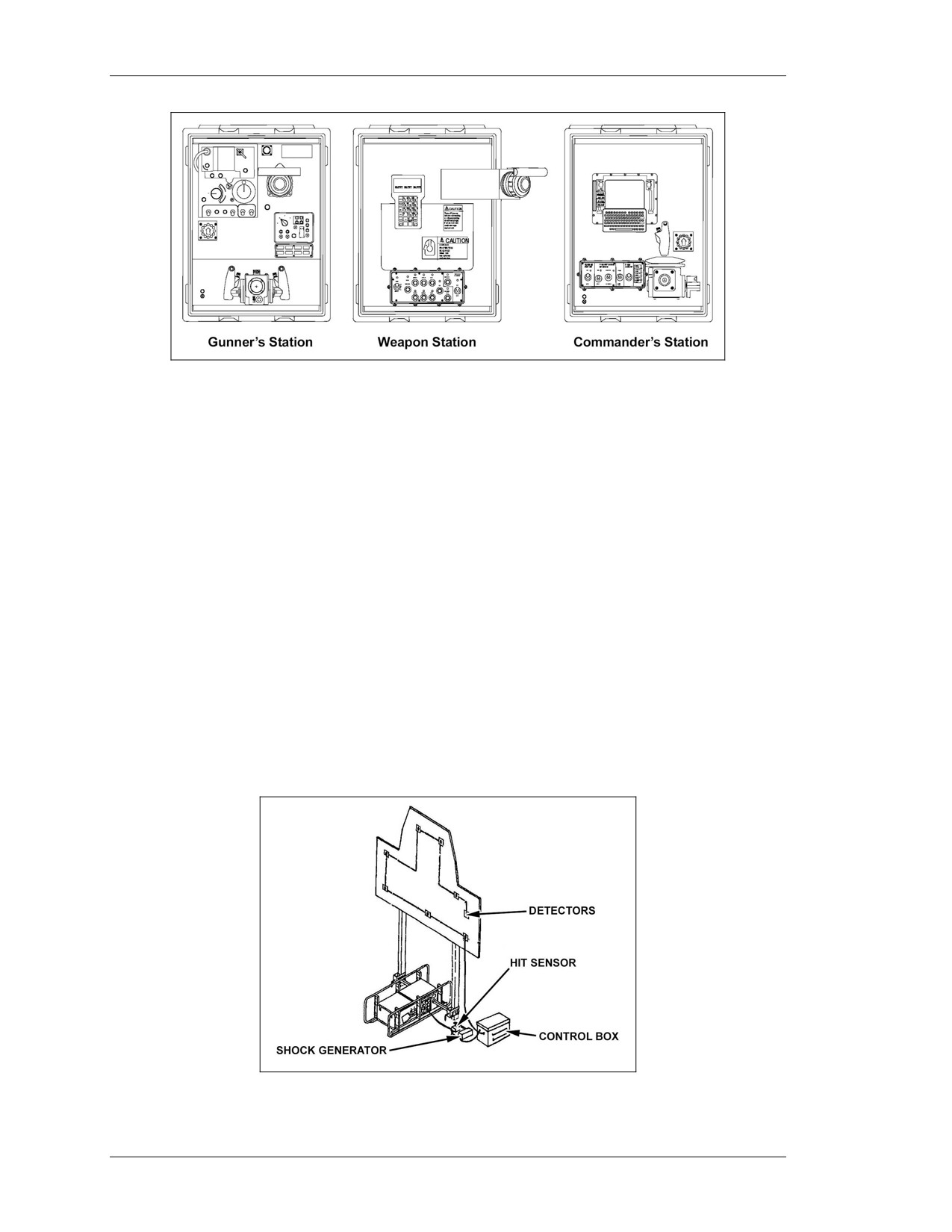
e. M6 Linebacker Tabletop Trainer. The LTTT (Figure 4-10, page 4-12) is a
deployable training device used for institutional and unit training. The system consists of
gunner, commander and an instructor operator stations. It has no driver’s station. Drivers
should work with the BC and gunner to develop the coordination needed to synchronize
movement of the vehicle into and out of defensive positions.
(1) The LTTT targets consist of UAVs, cruise missiles, fixed wing, helicopters, 1/5
Scale SU-25s, trucks, troops and PC targets.
(2) The LTTT develops and tests the proficiency of the individual, and squad in
gunnery techniques. The LTTT's aerial gunnery tables provide performance-oriented,
sequentially progressive, realistic, and challenging training. The LTTT provides the
squad leader and gunner a simulated environment to gain proficiency with crew
coordination skills required to execute their mission in combat.
(3) Switchology on the LTTT is very challenging for the Linebacker crew. The crew
must change from "Stinger Engage" mode to "25-mm and 7.62-mm Gun Engage" mode.
The system scores the crew's ability to change between these two firing modes. A crew
that fails to follow the correct switchology procedures fails the exercise.
(4) The Stinger scoring matrix resembles the Bradley COFT matrix. It advances or
reduces a crew based on their engagement abilities. In the computer-recommended
exercise, the crew is graded on target acquisition, reticle aim, and system management.
They receive a grade of "A" (rapid advance), "B" (normal advance), "C" (no advance) or
"F" (reduced), depending on their engagement ability.
4-11
FM 3-22.1
Figure 4-10. M6 Linebacker tabletop trainer.
4-4. TRAINING AIDS
Training aids are tools that help leaders conduct training.
a. Tracking Board. The tracking board (Figure 7-2, page 7-5) gives the Bradley
commander and gunner practice in traversing and elevating the sight reticles as if they
were tracking a vehicle moving cross-country. Tracking board exercises are practiced
with the primary sight, the auxiliary sight, and the TOW reticle, both day and night. An
advanced tracking board (Figure 7-4, page
7-7) is provided to make training more
challenging to crews. (Chapter 7 provides more detailed information on the use of the
tracking board.)
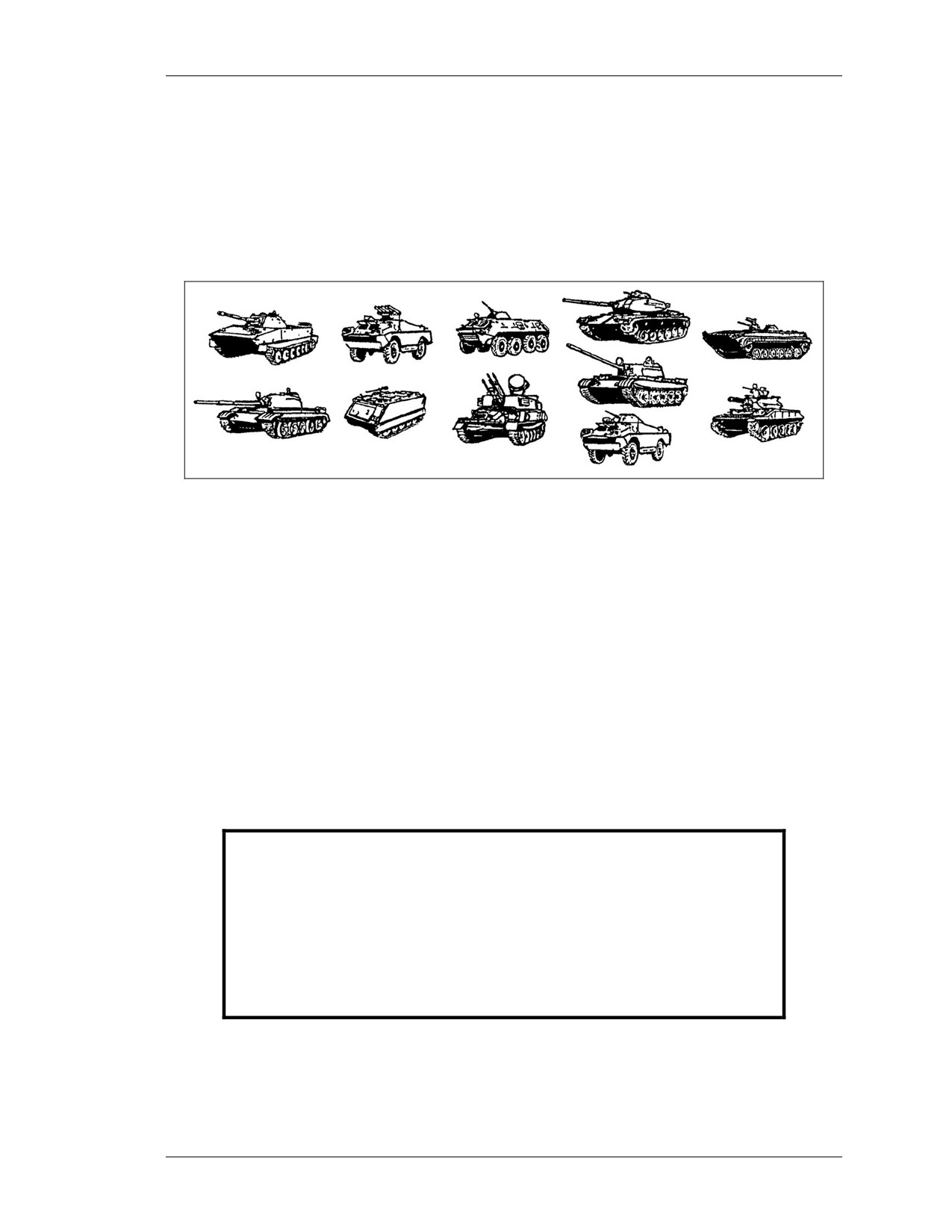
b. Laser-Target Interface Device. The LTID (Figure 4-11) aids in gunnery training
with MILES or PGS. The LTID receives a coded MILES message and converts it into
electrical pulses. These pulses activate the shock generator mechanism that activates a hit
sensor, simulating a projectile striking the target. LTIDs can be used on full-scale,
half-scale, or one-tenth-scale (on M31A1 lifters). Targets with LTIDs enhance training
on BT I, BT II, BT III, and BT IV as well as on the device-based BT XI
(TM 9-1265-376-10). System components include detection and electronic assemblies
and a shock-generator mechanism.
Figure 4-11. Laser target interface device.
4-12
FM 3-22.1
c. Scale Models. Armored vehicle scale models can be used to train crews in target
acquisition, range determination, and vehicle identification. These models are
three-dimensional and are made of a hard plastic. Scale models enhance preliminary
gunnery training such as range determination, gun lay, and combat vehicle identification.
Table 7-1, page 4-2 is used when determining scale versus combat ranges. The local
Training Support Center (TSC) can provide scale models in 1:10, 1:30, l:35, and 1:60
(Figure 4-12).
Figure 4-12. Armored vehicle scale models.
d. Dummy Rounds. Various dummy rounds are available to conduct training with
the M240C coax machine gun, the M242 25-mm automatic gun, and the TOW system.
(1) M172 Dummy Round (7.62 mm). The M172 is a 7.62-mm cartridge minus the
gunpowder and primer. It is used for nonfire training with the M240C coax machine gun.
The crew should use the round with the metal tip rather than the plastic tip, because the
plastic tips can bend and jam in the weapon or feed chute. The M172 dummy round can
be used to train four of the tasks that are part of the BGST. The M172 round is a Class V
item that can be requisitioned on DA Form 581, Request for Issue and Turn-in of
Ammunition, using the information shown in Table 4-3, page 4-16:
• Load the M240C coax machine gun.
• Fire the M240C coax machine gun.
• Apply immediate action.
• Unload and clear an M240C coax machine gun.
CAUTION
Because the M172 dummy round is made of brass and can
be damaged during training, the rounds should be inspected
periodically and replaced as needed. Continued use of
damaged rounds or links can damage the feed chute or the
weapon. Rounds and links should be checked and replaced
as needed.
4-13

FM 3-22.1
(2) M794 Dummy Round (25-mm). The M794 dummy round is a nonfiring training
round used to conduct training on various 25-mm tasks. The M794 dummy round is a
cast metal round that is noncorrosive and weighs about the same as the M792 and M793
rounds. Previous dummy rounds were made from fired casings and had plastic tips.
Because the casing of a fired round is slightly expanded, such rounds could get stuck in
the breech of the 25-mm gun. The use of such rounds should be discontinued and the cast
metal rounds requisitioned. The M794 dummy round can be used to train crewmembers
in the following tasks. The conditions and standards for these tasks are in Appendix A.
The M794 dummy round is a Class V item and can be requisitioned on DA Form 581
using the information shown in Table 4-3:
• Load and unload the HE and AP ready boxes.
• Load the 25-mm feeder.
• Apply immediate action on the 25-mm.
• Unload and clear the 25-mm gun.
NOMENCLATURE
DODAC
CARTRIDGE, 7.62-MM DUMMY M172
1305-A159
CARTRIDGE, 7.62-MM DUMMY M172 (CARTON PACKED)
1305-A162
CARTRIDGE, 25-MM DUMMY M794 (CARTON PACKED)
1305-A966
CARTRIDGE, 25-MM DUMMY M794 (LINKED)
1303-A967
Table 4-3. Requisition information.
(3) Missile Simulation Round. The MSR is used to train crews in all nonfire
TOW-related tasks. It is a dummy TOW round casing. It comes in a crate the same as an
actual round. The MSR simulates the actual weight of a real TOW missile. Although the
MSR does not have a diaphragm or humidity indicator, it does have a front cover and a
forward handling ring. It is a nonexpendable, major end item that units can requisition
through the supply system. It should not be discarded if it is damaged. It can be used to
practice uploading the BFV, uploading the TOW launcher, applying immediate action on
the TOW subsystem, removing a misfired TOW, and unloading and stowing a TOW to
its storage configuration. If the guide lugs or the electrical connector on the MSR are
damaged, the round should not be used. Continued use of a damaged round will cause
damage to the launcher.
4-14
FM 3-22.1 (23-1)
CHAPTER 5
Range Operations
This chapter outlines the procedures, duties, resources, and
responsibilities for establishing and operating both permanent and
temporary gunnery and tactical training facilities.
5-1. PREPARATION AND OPERATION
The leader develops a plan for conducting Bradley gunnery training. This plan varies
with the tables to be trained. The plan covers assets, opening of the range and occupation
of the site, conduct of the exercise, closure of the range, and other relevant training notes.
a. Assets. The plan states whether the battalion or company will conduct training.
(1) Battalion-Conducted Training.
(a) Battalion's Role. The battalion signs for, administers, and clears the range or
training site. This lets the company focus on gunnery, tactics, and maintenance.
(b) Company's Role. The training company helps police the range and performs
other administrative duties.
(c) Tables. Advanced gunnery tables require a large number of target arrays and
range-control personnel, so the battalion will need external help with them.
(2) Company-Conducted Training. The company signs for, administers, and clears
the range or training area. It provides all personnel:
• Soldier details.
• Safety officers.
• Range guards.
• Administrative personnel.
b. Opening of the Range or Occupation of Training Site (Sequence of Events).
Tasks for opening the range and occupying the site follow:
(1) The OIC--
• Signs for the range from range control.
• Arrives at the range or training site before the unit.
• Checks communications.
• Arranges for backup communications for live-fire exercises.
• Briefs the safety officer, the evaluators, and the training units.
• Ensures that range equipment is present and operational.
(2) The NCOIC--
• Sets up additional training areas.
• Supervises ammunition, targets, and administrative details.
(3) The weapon systems-certified range safety officer or NCO--
• Ensures that no one brings ammunition onto a nonfiring range.
• Supervises placement of vehicles in correct order for firing or training.
• Inspects storage of restricted or suspended ammunition.
• Inspects handling and lot numbers of restricted or suspended ammunition.
• Inspects medics and vehicles.
• Gives safety briefing before all live-fire exercises.
• Ensures barriers are closed.
• Ensures that range guards are posted and briefed on their duties.
5-1
FM 3-22.1
(4)
The master gunner--
• Ensures that all DA Forms 2408-4, Weapon Record Data, are up-to-date.
• Gives final briefing to Bradley crew evaluators.
• Ensures that the concurrent training is set up.
• Arrives at the range or training site before the firing unit.
c.
Conduct of Exercise. Tasks for conducting the exercise follow:
(1)
The OIC--
• Controls live-fire exercises.
• Maintains efficient throughput among units going through the course.
• Maintains all required communications.
(2)
The NCOIC--
• Supervises all details.
• Controls movement of vehicles and personnel.
(3)
The weapon systems-certified safety officer or safety NCO--
• Ensures that the crew handles misfires IAW safety regulations.
• Observes for any safety violation.
• Clears each Bradley at the end of each exercise.
(4)
The master gunner--
• Ensures that range firing adheres to the appropriate gunnery table.
• Ensures that crews boresight and zero correctly.
• Conducts on-site remedial training as needed.
• Supervises Bradley crew evaluators.
• Helps safety personnel clear weapons, when required.
• Helps maintenance personnel identify and correct malfunctions.
• Helps the commander determine or verify alibi conditions.
d.
Closure of Range. Tasks for closing the range follow:
(1)
The OIC--
• Notifies range control that firing has terminated.
• Debriefs unit personnel.
• Ensures clearing of range or training area follows local regulations and SOP.
(2)
The NCOIC--
• Supervises ammunition and target details.
• Ensures that range facilities have been policed.
(3)
The master gunner updates DA Form 2408-4 for each M242 fired.
(4)
The ammunition NCOIC--
• Ensures that only authorized personnel remove munitions from range.
• Prepares residue certificates required by ammunition supply point.
e.
Training Tips. The following tips will help the OIC conduct training on
the range:
(1) Brief Key Personnel. Before moving to the training site, the OIC briefs key
personnel about how to set up the site and react to unusual circumstances.
(2) Start on Time. The OIC prepares the training site and sets up communications
early so that crews can start firing on time. He plans operations so that training stops for
course maintenance at a normal or prearranged time. He posts this shutdown time in the
daily range bulletin. The OIC or master gunner makes sure that he has enough targets to
complete all training before the scheduled break.
5-2
FM 3-22.1
(3) Use Range Marker Lights (Live Fire). The OIC allows night firing only when
lights and thermal range markers are operational. If any of them fail, he closes the range
until the problem is corrected. Repair or use alternate lighting to correct the problem
IAW local range and unit SOPs.
(4) Plan Illumination. If possible, the OIC registers weapons before dark so he can
plan indirect illumination. To ease control and reduce support requirements, he locates
indirect-fire weapons on the same range as firing vehicles.
(5) Keep a Log. The OIC keeps an accurate log, which helps him stay current about
dry- and live-firing times and other important events. In his DA Form 1594 (Daily Staff
Journal or Duty Officer's Log), he includes, at least--
• The time that the unit occupied the range or training site.
• The time that he received range control's permission to fire live rounds.
• The name of the person who authorized live fire.
• The time that firing ceased.
• The time that the range reopened.
• Compass azimuth to stray impact points and time of each stray impact.
• The time that the unit cleared and departed the range.
(6) Brief Guards. The OIC has a plan to check and change guards frequently. Also,
he briefs guards on their duties and importance and ensures that they understand the
instructions.
(7) Prepare for Fires. During dry seasons, tracer ammunition could cause grass and
forest fires. The OIC plans for this possibility. Then, if a fire starts, he can quickly control
the situation. If the fires were to persist, units follow local SOPs.
(8) Police the Area. The OIC keeps the area policed at all times. Having a clean
training site reduces the chance of injury, especially at night. Continuously policing the
area keeps him from having to spend valuable time cleaning up after firing.
(9) Brief Visitors. The OIC has a plan for briefing visitors. He designates an NCO or
officer to brief them before escorting them to the primary training site.
(10) Check Safety Markers. The OIC makes sure that range safety markers are in
place before live firing begins. If he uses light markers, he checks them before nightfall.
(11) Coordinate for Munitions. The OIC coordinates with the support elements to
make sure he has the right type of live ammunition and pyrotechnics in the right amounts,
at the right times, and at the right places. To be sure the ammunition is neither restricted
nor suspended, he tasks someone to check its lot numbers against TB 9-1300-385.
(12) Conduct Other Training. The OIC stresses the areas in which the unit needs
more training, which could include--
• Prepare-to-fire checks.
• Target acquisition.
• Target identification.
• Range determination.
• Methods of adjustment.
• Movement techniques.
• Fire commands.
• Misfire procedures.
• Stabilization training.
• Crew tasks.
5-3
FM 3-22.1
• Platoon tasks.
• Maintenance of vehicles and weapons.
(13) Position Recovery Vehicle. The OIC has disabled vehicles removed from the
course quickly to avoid losing training time. He arranges for a manned recovery vehicle
to support the unit.
(14) Brief Bunker Personnel (Live Fire). The OIC briefs bunker personnel on safety
regulations and requirements and issues them control measures such as for entering and
exiting the bunker and bunker area. Bunker personnel must have two ways to
communicate with the tower.
(15) Brief OPFOR Personnel. The OIC briefs OPFOR personnel on their role in the
tactical training. He makes sure that they know what to do and when to do it. He stresses
that their actions must be the same for each unit going through the course.
5-2. RECONNAISSANCE
Before their unit occupies a range or training area, the OIC, the master gunner, and
NCOIC should personally reconnoiter, then coordinate with range control. While
reconnoitering--
a.
They should answer the following questions:
• Where are the routes to the range or training area?
• How many vehicles can fire the stationary or moving course simultaneously?
• Does the area offer both hull-defilade and defilade positions?
• What control facility (tower) is available and what is its condition?
• What communication hookups are available to operate the range?
• Are range limit markers visible during all levels of visibility?
• Is a level platform area available for boresighting and zero?
• Can zeroing and boresighting be conducted simultaneously?
• Are surveyed boresight panels available?
• What barriers and guard posts need to be closed or manned?
• Where are they?
• Who furnishes targets, target supplies, or training devices used on the range?
• What requirements are necessary for target operators or target details?
• What ammunition can be used on the range?
• Has the range or training area been cleared of duds?
b.
They should locate the following areas:
• Aid station.
• Ammunition pads.
• Barriers and guard posts.
• Briefing and debriefing areas.
• Firing line and maneuver areas.
• Clearing and dud pits.
• Concurrent training area.
• Helipad.
• Latrine.
• Maintenance area.
• Parking areas.
• Range limits.
• Tower.
5-4
FM 3-22.1
5-3. PERSONNEL, EQUIPMENT, AND LAYOUT
Good planning and execution of range or tactical training allows progressive training and
evaluation of the unit. AR 385-63, local range regulations, and unit SOPs describe
administrative requirements. Putting together a range book with all applicable regulations
and reference materials, such as range schedules, firing tables, gunnery tables, maps,
range logs, and a range certification list, will help the OIC operate the range efficiently.
a. Required Personnel. The following personnel are required to conduct range
training. The local range control office certifies each of them to operate a range.
(1) Officer in Charge. The OIC is responsible for the entire range or training site.
He plans, prepares, coordinates, and executes the training exercise. AR 385-63, Chapter 4
lists his specific duties. Among other things, he designates assistants to be responsible for
specific areas of operation. Everyone involved in the training exercise reports to him
about his respective duties.
(2) Range Safety Officer. The RSO is a weapon systems-qualified commissioned
officer, warrant officer, or NCO (staff sergeant or higher). The RSO directly represents
the officer in charge of firing. The RSO--
• Conducts a safety briefing before all live-fire exercises.
• Enforces all safety regulations.
• Ensures that everyone handles ammunition correctly.
• Enforces smoking restrictions near the vehicles, ammunition, and POL.
• Ensures misfires are handled IAW AR 385-63 and operator's manual.
• Investigates and reports accidents IAW all regulations.
• Ensures weapons on live-fire ranges always point towards impact area.
• Ensures personnel keep clear of the danger area (except IAW AR 385-63).
• Checks TB 9-1300-385 for ammunition with suspended or restricted lots.
• Ensures that barriers and guards are in place before the start of the exercise.
• Checks identification and qualifications of medical personnel.
• Ensures medical personnel have transportation, if required.
• Inspects and clears all weapons following the completion of fire.
• Checks DA Form 2408-4 for round count on the firing pin and breech.
(3) Master Gunner. The master gunner is the commander's gunnery technical
advisor; he helps the commander and the staff plan, develop, and conduct gunnery
training. The master gunner--
• Prepares a surface danger-area diagram and range overlay.
• Prepares scaled ranges, if required.
• Organizes range firing exercises.
• Sets up range firing exercises.
• Ensures proper conduct of range firing exercises.
• Supervises the Bradley crews to ensure proper boresighting and zeroing.
• Coordinates target array and layout for range firing and qualification.
• Conducts remedial training on site, as needed.
• Ensures that a standard Bradley crew evaluator program is implemented.
(4) NCOIC. The NCOIC coordinates and supervises details and helps the OIC and
RSO operate the range or training area.
5-5
FM 3-22.1
(5) Ammunition NCO. An ammunition NCO--
• Accounts for ammunition by type and lot.
• Ensures ammunition for the scheduled firing is the correct ammunition.
• Ensures proper storage of ammunition on ammunition pad at training area.
• Ensures proper security of ammunition on ammunition pad at training area.
• Using TB 9-1300-385, checks ammunition for suspended or restricted lots.
• Checks ammunition number with RSO to ensure it is not suspended or restricted.
• Issues the correct type and number of rounds as instructed by the OIC.
• Keeps a running inventory of expenditures.
• Cross-checks daily expenditures turned into the OIC by Bradley commanders.
• Polices up links, brass, and packaging materials from ammunition pad.
(6) Target NCO. On many automated ranges, the OIC does not need a target NCO.
On other ranges, the target NCO has specific duties.
(a) The target NCO ensures that the following conditions exist:
• Targets are type, color, and scale (if applicable) the OIC requires.
• Targets are properly located on the range.
• Target detail can operate and fix all target mechanisms used.
• Target detail has the required equipment and supplies.
• Pre-positioned targets are available when needed.
(b) The target NCO ensures he has enough of the following to support training:
• Spare targets.
• Target mechanisms.
• Batteries.
• Patches.
• Other related equipment.
(c) The target NCO reports to the OIC any mechanical malfunctions that require
prompt replacement before firing can continue.
(7) Bradley Crew Evaluator. This evaluator--
• Enforces required safety precautions.
• Acts as an instructor during practice.
• Acts as an evaluator during qualification.
• Conducts an AAR after firing ends.
• Confers with OIC and master gunner on any scoring discrepancy.
(8) Fire-Fighting Detail. During dry seasons, some range facilities require this
detail. When they do, planners should--
• Ensure availability of fire-fighting equipment.
• Designate vehicles for soldiers and equipment.
• Select access routes to the impact or target areas.
(9) Bunker Personnel. Bunker personnel move targets, if applicable.
(10) Radiotelephone Operators. Radiotelephone operators
(RATELOs) maintain
communications during an exercise.
(11) Medic. The medic or combat lifesaver (CBLS) must--
• Have a strip map.
• Know how to get to the nearest aid station or hospital.
5-6
FM 3-22.1
• Know RATELO procedures for use during air evacuation.
• Have a medical ID or
• Have a commander's memo stating that the soldier is a qualified medic.
• Have sufficient medical equipment for the mission.
b. Range Equipment. The OIC and NCOIC should make sure that the following
equipment is on hand:
(1)
Gunnery and Tactical Exercises.
•
Current gunnery standards for the table being conducted.
•
Range regulations.
•
All other required regulations, SOPs, maps, and overlays.
•
Target and scoring detail.
•
Targets and target-operating and control mechanisms.
•
Boresight equipment.
•
Night vision devices with enough batteries.
•
Target repair equipment.
•
Briefing tent.
•
Generators to power light sets.
•
Flashlights for scorers.
•
Evaluator communications.
•
Field telephones, as required.
•
FM radio sets and antenna (GRC-292).
•
Batteries for lights and radios.
•
Scorecards.
•
Stopwatches.
•
Binoculars.
•
Vehicles.
•
Vehicle recovery assets.
•
Backup aid vehicle.
•
Fire-fighting detail.
•
Fire-fighting equipment.
•
Equipment for concurrent training.
•
Other TOE and expendable supplies.
(2)
Gunnery Exercises.
• Ballistic firing tables.
• Compass for marking rounds out of impact area.
• Flag sets for vehicles and tower.
• Range flag.
• Range lights or lanterns.
(3)
Tactical Exercises.
• MILES or PGS equipment.
• OPFOR equipment.
• OPFOR personnel.
c.
Range and Training Area Layout for Gunnery Exercises. A well-organized
gunnery range provides maximum firing time. Planning and organizing ranges and
collecting everything needed before moving to the range ensures that firing can start and
finish on time. It also ensures an orderly range clearance.
5-7
FM 3-22.1
(1) Having a current battalion-level range-operation SOP saves the firing unit time
and energy. The SOP should provide guidelines for occupying the range. It should also
describe how to conduct specific tasks such as--
• Break down ammunition.
• Conduct range scenario.
• Coordinate with maintenance contact teams.
• Depart the range.
• Fight range fires.
• Issue firing orders
• Move vehicles to the ammunition point and to the ready line.
• Operate moving targets.
• Police the range.
• Repair target mechanisms.
• Replace targets.
(2) Stationary Bradley ranges have moving and stationary targets, which crews
engage from defensive positions or berms. OICs should coordinate with local range
control for help planning these exercises.
(3) Moving Bradley ranges have a maneuver box that stationary ranges lack (Figure
5-1). The maneuver box is the maximum distance the vehicle could travel and still have
the target exposed. If course roads exist, then the BC should move on those, also using
available terrain to help mask the vehicle. (Range control will help the units plan these
exercises.) Knowing the maneuver box allows the vehicle crew to acquire, range, and
destroy targets arranged in a realistic array, as listed on appropriate gunnery tables.
Maneuver boxes must be clearly defined. The firing vehicle must adhere to start and stop
points. At no time will the vehicle extend or surpass the exposure and engagement times.
5-8
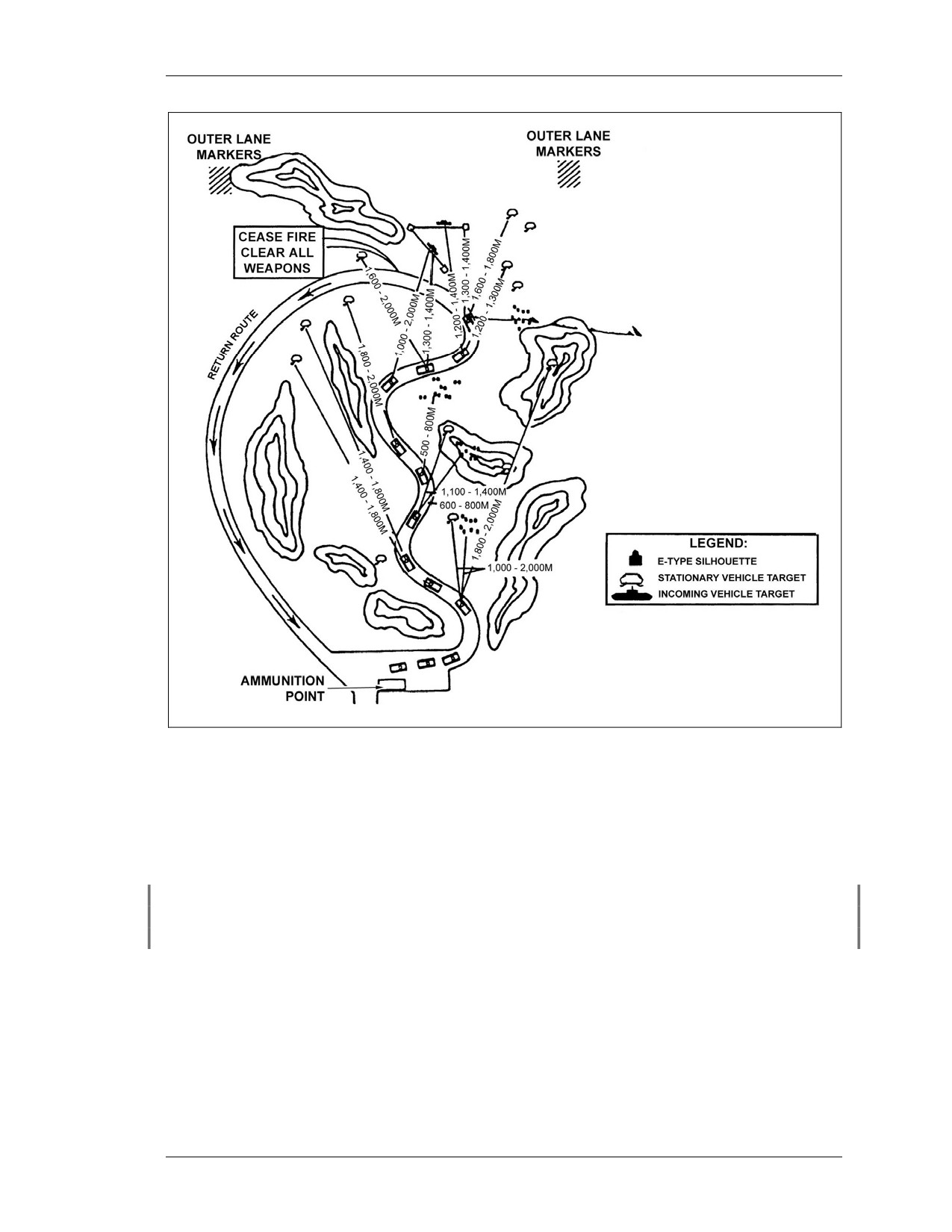
FM 3-22.1
Figure 5-1. Sample layout of a Bradley moving range.
(4) To determine the size of a maneuver box, the average vehicle speed for the
course and the target exposure time must be known. Figure 5-2, page 5-10, shows how to
determine the length of a maneuver box. If the first number after the decimal is 5 or
more, the length is rounded up to the next whole number. Figure 5-3, page 5-11, shows
how to determine the length of a hunter-killer maneuver box.
(5) Lateral target dispersion for M2A3 or M3A3 Bradleys must be at least
14 degrees. The "rule of thumb" is 25 meters of lateral dispersion for each 100 meters of
target range.
5-9