3-22.1 (FM 23-1) BRADLEY GUNNERY (NOVEMBER 2003) - page 1
FM 3-22.1 (FM 23-1)
FIELD MANUAL
HEADQUARTERS
NO. 3-22.1
DEPARTMENT OF THE ARMY
Washington, DC, 28 November 2003
BRADLEY GUNNERY
CONTENTS
Page
Gunnery Tables
viii
Preface
ix
CHAPTER
1.
VEHICULAR SYSTEMS
1-1. Overview of Models
1-1
1-2. M2A2 and M3A2 Models
1-1
1-3. M2A2 ODS and ODS-E, and M3A2 ODS
1-1
1-4. M2A3 and M3A3 Models
1-3
1-5. M6 Linebacker
1-5
1-6. M7 Bradley Fire Support Team
1-7
1-7. Bradley Rollover Drill
1-7
CHAPTER
2.
WEAPONS AND AMMUNITION
Section I. Weapon Systems
2-1
2-1. M242 25-mm Automatic Gun
2-1
2-2. M240C 7.62-mm Coaxial Machine Gun
2-4
2-3. Tube-Launched, Optically Tracked, Wire-Guided
Missile
2-5
2-4. M231 5.56-mm Firing Port Weapon
2-11
2-5. M257 Smoke-Grenade Launcher
2-11
2-6. Stinger Missile Subsystem
2-12
Section II. Ammunition
2-12
2-7. M242 25-mm Automatic Gun (Standard)
2-13
2-8. M240C 7.62-mm Coaxial Machine Gun
2-19
2-9. Tube-Launched, Optically Tracked, Wire-Guided
Missile
2-19
2-10. Stinger Missile
2-22
2-11. M231 5.56-mm Firing Port Weapon
2-23
2-12. M257 Smoke-Grenade Launcher
2-24
DISTRIBUTION RESTRICTION: Approved for public release; distribution is unlimited.
______________________________________________________
*This publication supersedes FM 23-1, 18 March 1996.
i
FM 3-22.1
Page
CHAPTER
3.
CREW TRAINING
Section I.
Tasks
3-1
3-1.
Skills
3-1
3-2.
Preliminary Gunnery
3-1
3-3.
COFT and BATS
3-2
3-4.
Device Gunnery
3-2
3-5.
Live-Fire Gunnery
3-3
Section II.
Leader Skills
3-3
3-6.
Coordination and Integration
3-3
3-7.
Close Combat
3-3
Section III.
Development of Training Program
3-4
3-8.
Battle Focus
3-4
3-9.
Mission-Essential Task List
3-4
3-10.
Commander's Assessment
3-4
Section IV.
Training Strategy
3-5
3-11.
Crew Training
3-5
3-12.
Cross Training
3-6
3-13.
Integrated Training
3-6
Section V.
Training Plans
3-7
3-14.
Bradley Master Gunner
3-7
3-15.
Relationships Between Key Leaders and Trainers
3-8
3-16.
Crew Stability Management
3-9
3-17.
Long-Range Training Plans
3-10
3-18.
Short-Range Training Plans
3-11
3-19.
Near-Term Training Plans
3-12
Section VI.
Collective Training
3-13
3-20.
Home-Station Gunnery
3-13
3-21.
Gunnery Densities
3-13
3-22.
Gunnery Levels
3-13
3-23.
Gunnery Conditions
3-14
3-24.
Training Requirements
3-14
CHAPTER.
4.
TRAINING DEVICES
4-1. Types
4-1
4-2. Appended Equipment
4-1
4-3. Simulators
4-8
4-4. Training Aids
4-12
CHAPTER
5.
RANGE OPERATIONS
5-1. Preparation and Operation
5-1
5-2. Reconnaissance
5-4
5-3. Personnel, Equipment, and Layout
5-5
5-4. Establishment of Live-Fire Range
5-14
5-5. Digital Range Setup
5-20
ii
FM 3-22.1
Page
CHAPTER
6.
ENGAGEMENT PROCESS
Section I.
Target Acquisition
6-1
6-1.
Search
6-2
6-2.
Target Detection
6-7
6-3.
Target Location
6-9
6-4.
Range Estimation
6-10
6-5.
Range Determination
6-11
6-6.
Target Identification
6-23
6-7.
Acquisition Reports
6-24
Section II.
Decision Process
6-25
6-8.
Determination of Target Threat Levels
6-25
6-9.
Selection of Weapon and Ammunition
6-25
6-10.
Target Confirmation
6-26
Section III.
Engagement Execution
6-27
6-11.
Methods
6-27
6-12.
Techniques
6-28
6-13.
Direct-Fire Adjustment
6-32
6-14.
25-mm-Point Targets
6-33
6-15.
Fire-Control Subsystem
6-33
6-16.
Kinematic Lead
6-34
6-17.
Bradley A3 25-mm Point Targets
6-34
6-18.
Failure of Eye-Safe Laser Range Finder
6-34
6-19.
25-mm Area-Targets
6-35
6-20.
Coax Machine Gun
6-36
6-21.
Suppressive Fire
6-36
6-22.
Coax Point Targets
6-36
6-23.
Coax Area Targets
6-37
6-24.
Bradley A3 Coax
6-38
6-25.
Other Uses of Machine-Gun Fire
6-39
6-26.
Tube-Launched, Optically Tracked, Wire-Guided
Missile
6-40
6-27.
M257 Smoke-Grenade Launcher
6-42
6-28.
M231 Firing-Port Weapon (M2 Only)
6-42
6-29.
Aerial Targets
6-42
6-30.
Problem Areas
6-49
6-31.
Bradley A3 Aided-Target-Tracker Mode
6-49
6-32.
Termination of Engagement
6-50
6-33.
Kill Standards
6-50
6-34.
Armored Vehicles
6-51
6-35.
Unarmored Vehicles
6-51
6-36.
Infantry Rifle Squads and Antiarmor Systems
6-51
Section IV.
Fire Commands
6-52
6-37.
Elements
6-52
6-38.
Terms
6-52
6-39.
Methods
6-55
iii
FM 3-22.1
Page
Section V. Crew Duties in an Engagement
6-64
6-40. Defensive Engagements
6-64
6-41. Offensive Engagements
6-71
CHAPTER
7.
PRELIMINARY GUNNERY
Section I.
Basic Instruction
7-1
7-1.
Hands-On Training
7-2
7-2.
Range-Determination Training
7-7
7-3.
Direct-Fire-Adjustment Exercises
7-8
Section II.
TOW Training
7-12
7-4.
Basic Tasks
7-12
7-5.
Operation in Power Mode
7-13
7-6.
Preparation for Loading
7-13
7-7.
Loading Procedures
7-14
7-8.
Fire and Immediate Action
7-14
7-9.
Removal of Misfired Missile
7-15
7-10.
Manual Procedure for Raising Launcher
7-15
7-11.
Tracking
7-16
7-12.
COFT Training
7-16
7-13.
BATS Training
7-16
Section III.
Standard Vehicle-Mounted Launcher
7-16
7-14.
Raise the Stinger Launcher
7-16
7-15.
Lower the Stinger Launcher
7-17
7-16.
Load Stinger Missiles
7-17
7-17.
Unload Stinger Missiles
7-18
7-18.
Operate the Linebacker in the Engage Mode
7-19
7-19.
Perform Immediate Action for Stinger Misfire
7-19
7-20.
Remove a Misfired Stinger Missile from the
Launcher
7-20
Section IV.
Bradley Range Card
7-20
7-21.
Description
7-21
7-22.
Preparation
7-23
7-23.
Digital Range Card Overlay
7-35
7-24.
Firing Position
7-37
7-25.
Task
7-38
CHAPTER
8.
CREW GUNNERY
Section I. Evaluation
8-2
8-1. Engagement Standards
8-2
8-2. Task Standards
8-2
8-3. Critical Subtask Standards
8-12
8-4. Leader Subtask Standards
8-12
8-5. Noncritical Subtask Standards
8-14
8-6. Crew Device-Gunnery Standards
8-15
8-7. Crew Live-Fire Gunnery Standards
8-16
iv
FM 3-22.1
Page
8-8.
Qualification Refires
8-17
8-9.
Alibis
8-17
8-10.
Crew Scoresheet
8-17
Section II.
Evaluators
8-19
8-11.
Duties
8-19
8-12.
Certification
8-19
8-13.
Recertification
8-20
8-14.
Sustainment
8-20
Section III.
After-Action Reviews
8-20
8-15.
Planning
8-20
8-16.
Preparing
8-21
8-17.
Conducting
8-21
Section IV.
Device Gunnery
8-23
8-18.
Guidelines
8-23
8-19.
Bradley Table I, Crew Defense
8-24
8-20.
Bradley Table II, Crew Proficiency Course
8-26
Section V.
Live-Fire Gunnery
8-31
8-21.
Development of Table
8-31
8-22.
Targetry
8-32
8-23.
Ammunition
8-33
8-24.
Allowable Variations
8-33
8-25.
Prerequisites
8-34
8-26.
Bradley Table V, Crew Practice 1
8-34
8-27.
Bradley Table VI, Crew Practice 2
8-36
8-28.
Bradley Table VII, Crew Practice 3
8-36
8-29.
Bradley Table VIII, Crew Qualification
8-36
CHAPTER
9.
INFANTRY PLATOON
Section I. Training Program
9-1
9-1. Infantry Squad Training
9-2
9-2. Integrated Training
9-3
9-3. Requirements
9-3
Section II. Fire Distribution and Control
9-4
9-4. Principles
9-4
9-5. Fire-Control Measures
9-5
9-6. Fire Plans
9-9
Section III. Evaluation
9-16
9-7. Evaluation Team
9-16
9-8. Evaluation Guidelines
9-17
9-9. Assessment of Penalties
9-18
9-10. Examples
9-19
Section IV. Section and Platoon Device Gunnery
9-20
9-11. Guidelines
9-21
9-12. Bradley Table III, Infantry Squad and Section
Exercise
9-21
v
FM 3-22.1
Page
9-13. Bradley Table IV, Infantry Platoon Proficiency
Course
9-21
Section V. Platoon Gunnery
9-22
9-14. Development of Exercise
9-22
9-15. Prerequisites
9-25
9-16. Bradley Table XI, Infantry Platoon Practice
9-25
9-17. Bradley Table XII, Infantry Platoon Qualification
9-26
CHAPTER
10.
CAVALRY SECTION ADVANCED TABLES
10-1. Principles of Training
10-1
10-2. Purpose of Gunnery Tables
10-2
10-3. Evaluation Procedures and Standards
10-3
10-4. Scoring Procedures
10-4
10-5. Ratings
10-5
10-6. Targets
10-5
10-7. Bradley Table IX, Scout Section Training
10-6
10-8. Bradley Table X, Scout Section Qualification
10-11
CHAPTER
11.
AIR DEFENSE ADVANCED TABLES
11-1. Development of Exercise
11-1
11-2. Live-Fire Requirements
11-3
11-3. Targetry
11-3
11-4. Ammunition
11-4
11-5. Evaluation Standards
11-4
11-6. Army Universal Task List
11-5
11-7. Evaluation Team
11-6
11-8. Prerequisites
11-6
11-9. Refires for Qualification
11-6
11-10. Bradley Tables IXA And IX, Section Practice
11-6
11-11. Bradley Tables XA and X, Section Qualification
11-7
CHAPTER
12.
ENGINEER GUNNERY
12-1. Engineer Platoon Training Program
12-1
12-2. Development of Exercise
12-2
12-3. Prerequisites
12-5
12-4. Engineer Bradley Tables III and IV, Section and
Platoon Device Gunnery
12-5
12-5. Engineer Bradley Table XI, Platoon Practice
12-5
12-6. Engineer Bradley Table XII, Platoon Qualification
12-6
CHAPTER
13.
FIRE-SUPPORT TEAM GUNNERY
Section I. Training Program
13-1
13-1. Crew Training
13-1
13-2. UCOFT Training Strategy
13-3
13-3. Advanced Gunnery
13-3
vi
FM 3-22.1
Page
Section II. Evaluation
13-3
13-4. Standards
13-3
13-5. Team
13-4
Section III. Advanced Gunnery
13-6
13-6. Development of Exercise
13-6
13-7. Prerequisites for BFIST Table X
13-9
13-8. Collective Task List
13-9
13-9. Refires for Qualification
13-10
13-10. BFIST Table IX, Crew Fires-Integration Course
13-10
13-11. BFIST Table X, Crew Certification
13-10
13-12. Fire Commands
13-10
APPENDIX
A.
BRADLEY GUNNERY SKILLS TEST
A-1
APPENDIX
B.
BORESIGHTING
B-1
APPENDIX
C.
ZEROING
C-1
APPENDIX
D.
PREFIRE CHECKS, MALFUNCTIONS,
AND POSTFIRE CHECKS
D-1
APPENDIX
E.
URBAN OPERATIONS
E-1
APPENDIX
F.
RIFLE INFANTRY TRAINING
F-1
GLOSSARY
Glossary-1
REFERENCES
References-1
INDEX
Index-1
DA Form 7354-R (Revised), Bradley Crew Scoresheet
DA Form XXX-A-R, Bradley Gunnery Skills Test Scoresheet
DA Form XXX-B-R, Boresight Telescope Accuracy Test Scoresheet
vii

FM 3-22.1
TABLE
TITLE
PAGE
I
Crew Defense, All *
8-26
II
Crew Proficiency Course--
ODS and below
8-27
ADA Linebacker
8-28
A3
8-29
BFIST
8-30
III
Infantry Squad/Section Exercise
9-21
Engineer Section/Platoon Device Gunnery
12-5
IV
Infantry Platoon Proficiency Course
9-21
BFIST Proficiency Course
9-21
V
Crew Practice 1, All
8-35
VI
BT VI, Crew Practice 2--
ODS and below
8-36
ADA Linebacker
8-37
A3
8-38
BFIST
8-38
VII
Crew Practice 3--
ODS and below
8-40
ADA Linebacker
8-41
A3
8-42
BFIST
8-43
VIII
Crew Qualification--
ODS and below
8-44
ADA Linebacker
8-45
A3
8-46
BFIST
8-47
IX
Cavalry Section Training
10-6
Air Defense Section Practice 2
11-6
BFIST Fires Integration Course
13-8
X
Cavalry Section Qualification
10-11
Air Defense Section Qualification
11-7
BFIST Certification
13-8
XI
Infantry Platoon Practice
9-25
Engineer Platoon Practice
12-5
XII
Infantry Platoon Qualification
9-26
Engineer Platoon Qualification
12-6
NOTE: Most tables are illustrated only the first time they are discussed;
consequently, some page numbers refer only to a text discussion.
Firing tables in this manual listed in numerical order.
viii
FM 3-22.1
PREFACE
This manual explains Bradley system gunnery doctrine and techniques. Operator's
manuals cover everything else. Where procedures conflict, the readers should follow the
ones in the technical manuals, because they can obtain priority updates for them.
Except as noted, this text refers not to published editions of ARTEPs, but to those
posted in March 2000 (or later) to the Reimer Digital Library (RDL).
Every person who works in any way with BFVs should have access to this manual:
commanders, staff, master gunners, and leaders at all levels. With it, they can develop
gunnery programs to sustain combat readiness.
The crewmember will find specific information, but training managers and master
gunners will find the information they need to develop BFV training. This includes--
• M2 and M3 Bradley gunnery theory, methods, and techniques.
• System features and capabilities.
• Gunnery training and evaluation at all levels.
The first eight chapters apply to all Bradleys. Subsequent chapters provide training
strategies and advanced gunnery by MOS.
References to division commands and master gunners include enhanced or separate
brigade commands and brigade master gunners. Double vertical lines in the margins (as
shown for this paragraph) identify information that pertains only to the Bradley A3.
The proponent for this manual is the United States Army Infantry School. Send
comments and recommendations to doctrine@benning.army.mil or on DA Form 2028 to
Commandant, USAIS, ATTN: ATSH-ATD, Fort Benning, Georgia 31905-5410.
Unless this manual states otherwise, masculine nouns and pronouns may refer to men
or to women.
ix
FM 3-22.1 (23-1)
CHAPTER 1
Vehicular Systems
The Bradley fighting vehicle (BFV) contributes to the combined arms
effort. It provides the Infantry, Cavalry, Engineers, Air Defense, and Field
Artillery with firepower, armor protection, and battlefield agility.
To employ the Bradley effectively, soldiers must know the
characteristics and capabilities of its vehicles. As the Army upgrades and
improves the BFV, and as Army doctrine changes, soldiers must stay
current on the Bradley's capabilities.
1-1. OVERVIEW OF MODELS
The original BFV models are the M2 Infantry fighting vehicle (IFV) and the M3 Cavalry
fighting vehicle (CFV), both of which fielded in 1983. Later model numbers represent
upgrades or differences in system configurations and capabilities. These include the
following. (Table 1-1, page 1-2, shows BFV technical data by model):
• M2 and M3.
• M2A2 and M3A2.
• M2A3 and M3A3.
• M2A2 ODS, M2A2 ODS-E, M3A2 ODS.
• M6 Linebacker.
• M7 BFIST.
1-2. M2A2 AND M3A2 MODELS
The A2 models offered several improvements over its predecessors. These improvements
included an increase of 100 HP in the power train, 30-mm armor protection, armored-tile
protection capability, and spall liners.
1-3. M2A2 ODS AND ODS-E, AND M3A2 ODS
Lessons learned during Operation Desert Storm inspired the development of two new
Bradley models, the M2A2 ODS and M3A2 ODS. The M2A2 ODS-E model is tailored
specifically for Engineer use. The ODS upgrades include the following:
a. Eye-Safe Laser Range Finder. The eye-safe laser range finder (ELRF) is part of
the vehicle's integrated-sight unit (ISU). Using the ELRF, the crew can determine target
ranges from 200 to 9,995 meters, accurate within 10 meters. The ELRF induces the
weapon systems to superelevate for the determined range.
b. Tactical Navigation System. The TACNAV system comprises the precision
lightweight GPS receiver (PLGR) and the digital compass system (DCS). It reports the
vehicle's position in three dimensions: longitude and latitude, grid location, and elevation.
The PLGR works with the DCS to provide the BFV's hull and turret azimuths, location,
directions, distance to way points, and steer-to data. This information shows up on both
the commander's and driver's compass displays.
1-1

FM 3-22.1
M2A2
M2,
M3,
ODS,
M3A2
CHARACTERISTICS
M2A2
M3A2
ODS-E
ODS
M2A3
M3A3
M6
M7
Weight (Combat, Pounds)
50,259
49,945
66,401
64,204
66,000
66,000
66,000
66,000
63,982
64,204
Ground Pressure
7.7
7.7
9.9
9.9
9.93
9.93
10.2
10.2
Fuel Capacity (Gallons)
175
175
175
175
175
175
175
175
Cruising Range
300, 483
300, 483
250, 400
250, 441
250, 441
250, 441
250, 441
250, 441
(Miles, KM)
Engine
VTA-903T
VTA-903T
VTA-903T
VTA-903T
VTA-903T
VTA-903T
VTA-903T
VTA-903T
Gross Horsepower (HP)
500
500
600
600
600
600
600
600
Gross HP-to-Weight
20.62
20.62
18.9
18.9
18.7
18.7
18.2
18.2
(Tons)
Transmission
500
500
500-3EC
500-3EC
500-3EC
500-3EC
500-3EC
500-3EC
Speed (MPH, KPH) Land
41, 66
41, 66
38, 61
38, 61
38, 61
38, 61
38, 61
38, 61
Speed (MPH, KPH) Water
4.5, 7
4.5, 7
5, 8
5, 8
NA
NA
NA
NA
Slope Climb
60%
60%
60%
60%
60%
60%
60%
60%
Trench Crossing
8’4”
8’4”
8’4”
8’4”
8’4”
8’4”
8’4”
8’4”
Vertical Wall Climb
36
36
36
36
36
36
36
36
(Inches)
Personnel Capacity
3
3
3
3
3
3
4
4
(Crewmembers)
Personnel Capacity
7, 6
2
7
2
7
2
1
1
(Passengers)
Total Personnel Capacity
10, 9
5
10
5
10
5
5
5
(Passengers +
Crewmembers)
Firing Ports
6, 2
0
2
0
2
0
0
0
TOW Missile Variant
*All
*All
All
All
All
All
NA
NA
TOW Missile Ready
2
2
2
2
2
2
NA
NA
TOW Missile Stowed
5
10
5
10
5
10
NA
NA
25-mm Ammo Ready
300
300
300
300
300
300
300
300
25-mm Ammo Stowed
600
1,200
600
1,200
600
1,200
300
300
M240C 7.62-mm
800
800
800
800
800,
800,
400
800
Coax Ready
400**
400**
M240C 7.62-mm Coax
1,400
3,600
1,400
3,400
1,400
3,400
2,800
2,800
Ammo Stowed
M60 7.62-mm
2,200
3,200
2,200
3,400
2,200
3,400
NA
NA
Ammo Stowed
M231 FPW 5.56-mm
4,200
0
2,200
0
2,520
0
NA
NA
Ammo Stowed
M16 5.56-mm
2,520
1,680
2,520
1,680
2,520
1,680
1,680
1,680
Ammo Stowed
Stinger Missile Ready
NA
NA
NA
NA
NA
NA
4
NA
Stinger Missile Stowed
NA
NA
NA
NA
NA
NA
6
NA
*
Firing the TOW 2, TOW
2A and TOW 2B missiles from the
**
The Bradley A3 command vehicle will have 400 7.62
basic TOW launcher is possible; however, the missile will have
rounds in the ready.
a reduced probability of hit.
Table 1-1. Comparison of BFV technical data by model.
1-2
FM 3-22.1
c. Missile Countermeasure Device. With the missile countermeasure device
(MCD), Bradley crews can deter first-generation thermal, wire-guided antitank missiles.
This greatly increases the survivability of crews.
d. Improved Vehicle Stowage.
(1) Bench seats.
(2) A tenth-man seat.
(3) Mounted water ration heater.
(4) Electric lift for engine-access door.
(5) Outside stowage for personal gear.
(6) Three
25-mm ammunition boxes. Each box contains
50 rounds of linked
ammunition (a "hot box").
e. Driver's Vision Enhancer. The driver's vision enhancer (DVE) is an uncooled,
forward-looking, infrared (FLIR) night-vision device. It has a sensor module and a
display module. The DVE is a real-time thermal-imaging system. It operates in the 8- to
12-micron spectral range. Detectors convert received infrared radiation into electrical
signals. The DVE processes the signals and displays the resulting image onto a flat-panel
LCD screen.
f. Force XXI Battle Command Brigade and Below. The FBCB2 is a digital
battlefield command information system. The FBCB2 and integrated communications,
command, and control (IC3) give A2 ODS, and A3 crews situational awareness and
real-time C2.
1-4. M2A3 AND M3A3 MODELS
Innovations on the digitized M2A3 and M3A3 BFV improve the BFVs' abilities to shoot,
move, and communicate:
a. Target Acquisition. Each A3 model has a commander's independent viewer
(CIV) and the improved Bradley acquisition subsystem (IBAS).
(1) Commander's Independent Viewer. The CIV gives the A3 dual-sight capability.
With the CIV, the commander can acquire targets independently from the gunner.
(a) While the gunner "kills" acquired targets, the commander can search for new
ones. He then designates the new targets and "hands them over" to the gunner. If for any
reason the gunner cannot fire, the commander can do so from his station by selecting
IBAS on the remote biocular display (RBD).
(b) The CIV can traverse a full circle (360 degrees) in azimuth and can depress and
elevate from -22 to +60 degrees.
(c) The CIV uses second-generation FLIR technology and day-TV video. The video
image from the CIV appears on the RBD. This allows the viewer to watch the image with
both eyes at the same time. The gunner and squad leader can also watch this video signal.
(2) Improved Bradley Acquisition Subsystem. On the A3, the gunner's primary sight
is the target-acquisition system (TAS), which is part of the IBAS. Like the CIV, the TAS
employs second generation FLIR technology and day-TV video. Like the A2 ODS, the
TAS also has direct-view optics (DVO) and the eye-safe laser range finder. The TAS
provides limited sight travel without the disturbing turret motion experienced in the
earlier BFVs. The TAS periscope's head mirror assembly provides 5 degrees of travel left
or right of center and 17 degrees of travel above and below center. This extends the
gunner sight's elevation range from
-22 to
+60 degrees. This "independent" travel
1-3
FM 3-22.1
accommodates the aided target tracker (ATT), which allows the gunner to track two
different targets within the same field of view (FOV) simultaneously. Using the autopoint
function allows the system to slew quickly to the closest tracked box nearest the center of
the reticle. As with the CIV, both the commander and the squad leader can see the TAS
video image. The TAS can also zoom from 4X to 48X to help identify the threat
(digital zoom).
b. Turret Drive System. The TDS moves the weapon and stabilizes the A3 weapon
systems. The TDS responds to fire-control system and crew inputs from the handstation.
c. Situational Awareness. Improvements to the sights and the commander's tactical
display (CTD) give the A3 commander a level of situational awareness never before
possible. The squad leader's display (SLD), controlled by video selection buttons on the
monitor, also gives passengers situational awareness of the battlefield. It gives more
information about the battlefield location of each vehicle in the company, team, or task
force. It also gives operational graphics, and it lets the leader send and receive orders and
mission updates and respond to an expanding area of operations.
d. Electrical Power Control. The A3 has segregated electrical power control. This
means that many of its components can keep working when others fail. Connection to a
data bus provides redundant communications. The A3 has a
400-ampere
current-regulated generator. The generator supplies power to six 24-volt hull batteries and
one 24-volt emergency-backup turret battery.
e. Fire Control. The A3's fire-control system allows the crew to independently
search, track, and conduct target hand-off. Like the other BFVs, it also allows the
commander to override the gunner and to abort a fired missile.
f. Integrated Communications, Command, and Control. The IC3 digital battle
command information system provides situational awareness. It also offers real-time
command and control information to A3 crews and passengers.
g. Navigation. The A3's position-navigation subsystem (POS-NAV) provides the
A3 with accurate positioning and navigation data. It works by combining GPS data with
data obtained from an inertial navigation unit (INU) and a vehicle motion sensor (VMS).
Using the CTD's digital map, the crew can navigate by loading and selecting routes
and overlays.
h. NBC Protection. The A3's large gas-particulate filter system has additional crew
stations and heaters to provide NBC protection to the entire Bradley crew and passengers.
i.
Diagnostics. The A3 maintains a higher level of combat survivability than earlier
models. The A3's built-in-test (BIT) continually monitors the system's turret status. On
the commander's tactical display, the BIT shows warnings and cautions about potentially
dangerous faults. It recommends degraded modes of operation when needed. Using pre-
mission and PMCS checklists simplifies system maintenance.
1-4
FM 3-22.1
1-5. M6 LINEBACKER
Air defense-specific modifications to the Bradley give the maneuver force continuous
day and night air-defense coverage, slew-to-cue (STC) acquisition, and shoot-on-the-
move aerial-engagement capability. These all rely on having as the primary weapon
system a standard vehicle mounted launcher (SVML) and on having Stinger missiles. The
M242 gun provides extra air defense coverage in missile dead zones and self defense
protection against ground targets.
a. Slew-To-Cue Acquisition. The M6 Linebacker can receive and display forward
area air defense (FAAD) command, control, communications, and intelligence (C3I)
cueing information while stationary or on the move. This increases its ability to keep up
with the maneuver force and to engage aerial targets before other assets can either
observe or attack. STC lets the Linebacker interface with the digital early-warning data
from the Enhanced Position-Location Reporting System (EPLRS)-based inter-FAAD
network. This allows automatic slewing of the turret in both azimuth and elevation on
hooked tracks, and centering of the aerial target in the gunner’s FOV. Once the STC
processes the slew command and acquires the target, the system continues to track until
the gunner engages the aerial target, or until he receives the command to disengage.
b. Standard Vehicle Mounted Launcher. Replacing the TOW launcher with the
SVML and fire-control system gives the Linebacker both a superelevation and a 360-
degree launch capability with four ready-to-fire Stinger missiles. This gives the vehicle
an effective shoot-on-the-move capability. At the same time, it enhances crew
survivability and provides continuous air-defense coverage for rapid maneuver forces.
The armored SVML assembly includes an alignment plate for azimuth boresighting.
Crewmembers can load and unload Stinger missiles through both inside and outside
access doors. The Stinger elevation drive-select lever allows the gunner to operate the
SVML in either manual or power mode.
c. Modes of Operation. The SVML has four modes:
(1) OFF. In this mode, the SVML is stowed.
(2) ON. In this mode, the SVML is stowed. The Stinger system powers up and
automatically runs the built-in-test (BIT). The SVML runs the Stinger BIT continuously.
If the BIT finds a fault, the fault indicator FLT lights on the system control box (SCB),
and the CDT displays a fault message.
(3) LAUNCHER UP. In this mode, the SVML is in the deployed position at an angle
of 0 degrees. If the launcher deploys within 16 seconds after the gunner pulls the palm
grips, the SCB GO light comes on. The BC runs the Stinger BIT continuously.
(4) ENGAGE. In this mode, the SVML is in the deployed position and tracks in
elevation. Only the gunner’s handstation is enabled. Switch functions of the gunner’s
handstation change to allow the gunner to activate and uncage the Stinger missile before
firing. The Stinger vision module (SVM) displays missile-related symbology, launcher
azimuth and elevation angles, and cueing information from the FAADS network. The BC
continuously runs the Stinger's BIT.
1-5
FM 3-22.1
d. Stinger Vision Module. The ISU has the SVM, which shows the gunner the
Stinger symbology, target data, and turret or launcher position, all of which he must
know to fire the missile. Upon missile uncage, the SVM indicates the position of the
Stinger missile seeker. This feature is available to the gunner for all primary sighting
modes such as FLIR and DVO. The SVM with Stinger missile-tone audio improves aerial
targeting and helps the gunner to ensure that the Stinger missile locks onto the correct
target rather than onto friendly aerial platforms or clutter. This also conserves missiles
and reduces fratricide. The Stinger vision module electronics (SVME) links the SVM to
the Bradley crew evaluator (BCE). The SVME is located behind the gunner, above the
EPLRS radio. The SVM, SVME, and ISU permit day and night operation of the Stinger
system and continuously send status reports to the gunner.
e. Identify Friend or Foe. The IFF system provides aerial target identification.
Components include the IFF antenna mounted on the right front of the turret, the IFF
interconnect box, and the IFF interrogator mounted to the right of the commander. The
IFF antenna transmits signals from the IFF interrogator and receives the response signals
from the aerial targets. To interrogate aerial targets, the gunner presses forward on either
side-thumb switch on his handstation. The IFF announces the results of the interrogation
over the intercom system as a series of tones.
f. Stinger Control Box. The SCB is the primary operator interface for the Stinger
system. This box houses the controls and indicators for performing aerial engagements
with the Stinger missiles. It lets the gunner move the SVML electrically into any of the
following.
(Indicator lights supply GO/Fault BIT results and firing indicators and
conditions of the Stinger system):
• Deployed or stowed positions
• Automatic or manual stinger missile tracking
• Indicator lights and lamp test
• Mode switch selection of system operation.
g. Gunner’s Controls. In the STINGER ENGAGE mode, the gunner’s controls can
interrogate aerial targets friend or foe; and they can activate, uncage, and fire the Stinger
missile. When the gunner's controls are in this mode, the commander’s controls are
inoperative.
h. Interface Electronics Assembly. This assembly receives mode signals from the
BCE and SCB, plus operational commands from the gunner’s control handstation, which
directs the activating, uncaging, and firing of the Stinger missile. The IEA also processes
aerial target data from the activated missile, giving the gunner a visual identification
when the seeker locks onto the target.
i. Handheld Terminal Unit. This is a small computer terminal used to receive,
process, and display aerial-targeting information, messages, and data. It is located in front
of the commander and mounts on the 7.62-mm gun door. The HTU interfaces with the
FAAD PLGR for carrier position and receives aerial target information from the Sentinel
radar via EPLRS radios.
j. Enhanced Position-Location Reporting System. The EPLRS radio provides
digital communication between all EPLRS-equipped divisional Linebacker elements.
They use the EPLRS radios to broadcast battle management and air-tracking data to
the HTU.
1-6

FM 3-22.1
1-6. M7 BRADLEY FIRE SUPPORT TEAM
Integrating FIST mission equipment lets the Bradley complete fire-support missions by
day or night. This model adds an inertial navigation system and a new targeting station-
control panel. A mission-processor unit automates the fire-request system. Having the
25-mm automatic cannon gives the BFIST unit self-defense and the ability to locate
targets on the move. The M7 has the same mobility, survivability, and battlefield
signature as the A2 Bradley.
1-7. BRADLEY ROLLOVER DRILL
The Bradley can roll over in rough terrain. This paragraph explains how crews can get
out of the vehicle quickly and safely, depending on the situation. The first crewmember
to notice the vehicle starting to roll over should say "Rollover" and act IAW Table 1-1.
a. Equipment Stowage. Proper stowage of equipment prevents unnecessary injuries.
Crewmembers must stow all equipment IAW published TMs and unit SOPs.
b. Fire-Suppression System. When a vehicle rolls over while still running, fuel and
oil pouring from the engine can start a fire. The internal fire-suppression system trips
only when the flame sensors detect a blazing fire. The system dispenses large amounts of
CO2 into the crew compartment, which can suffocate the crew. Consequently, during
operation, the driver can leave the system set to the manual mode, and exiting
crewmembers can activate the system themselves. He generally leaves the system in
automatic mode when the vehicle is unmanned. If the crew exits a burning vehicle, they
should try to take all weapons and protective gear, if they can do so safely (Figure 1-1).
BC
Gunner
Driver
Squad Member
BFV Is Rolling Over
Drops inside turret
Braces for
Braces for impact by placing
Braces for impact
and braces for
impact by
hands on walls of driver
by placing hands
impact.
holding the
compartment.
on inside of troop
bottom of
compartment;
seat.
maintains control of
weapon.
BFV Has Rolled Over
Begins crew checks
Ensures
Pulls fuel shutoff and turns
Checks for injuries
to ensure no fires
weapon
off accessories. If needed,
and reports
have started, and to
system is on
sets off internal (CO2)
to the BC.
account for
electrical and
fire-suppression system in
personnel.
manual SAFE.
engine compartment.
Checks for injured
Helps the BC
Exits vehicle through hatch,
Exits vehicle
personnel.
evacuate the
if unobstructed;
through clear hatch.
vehicle.
or, if driver hatch is blocked,
Reports rollover.
exits through the
crew compartment.
NOTE: Sometimes the crew should remain in the vehicle and wait for recovery.
Figure 1-1. Rollover procedures.
1-7
FM 3-22.1 (23-1)
CHAPTER 2
Weapons and Ammunition
To employ the Bradley effectively, soldiers must know not only its
vehicular systems, but also its weapon systems, ammunitions, and their
capabilities.
Section I. WEAPON SYSTEMS
The BFV's five weapon systems include the 25-mm automatic gun, the 7.62-mm coaxial
machine gun, the tube-launched, optically tracked, wire-guided
(TOW or Stinger)
missile-launcher system, the 5.56-mm firing port weapons (infantry vehicle only), and
two smoke-grenade launchers (Appendix A).
2-1. M242 25-MM AUTOMATIC GUN
The Bradley's main armament is the M242 25-mm, fully automatic, externally powered
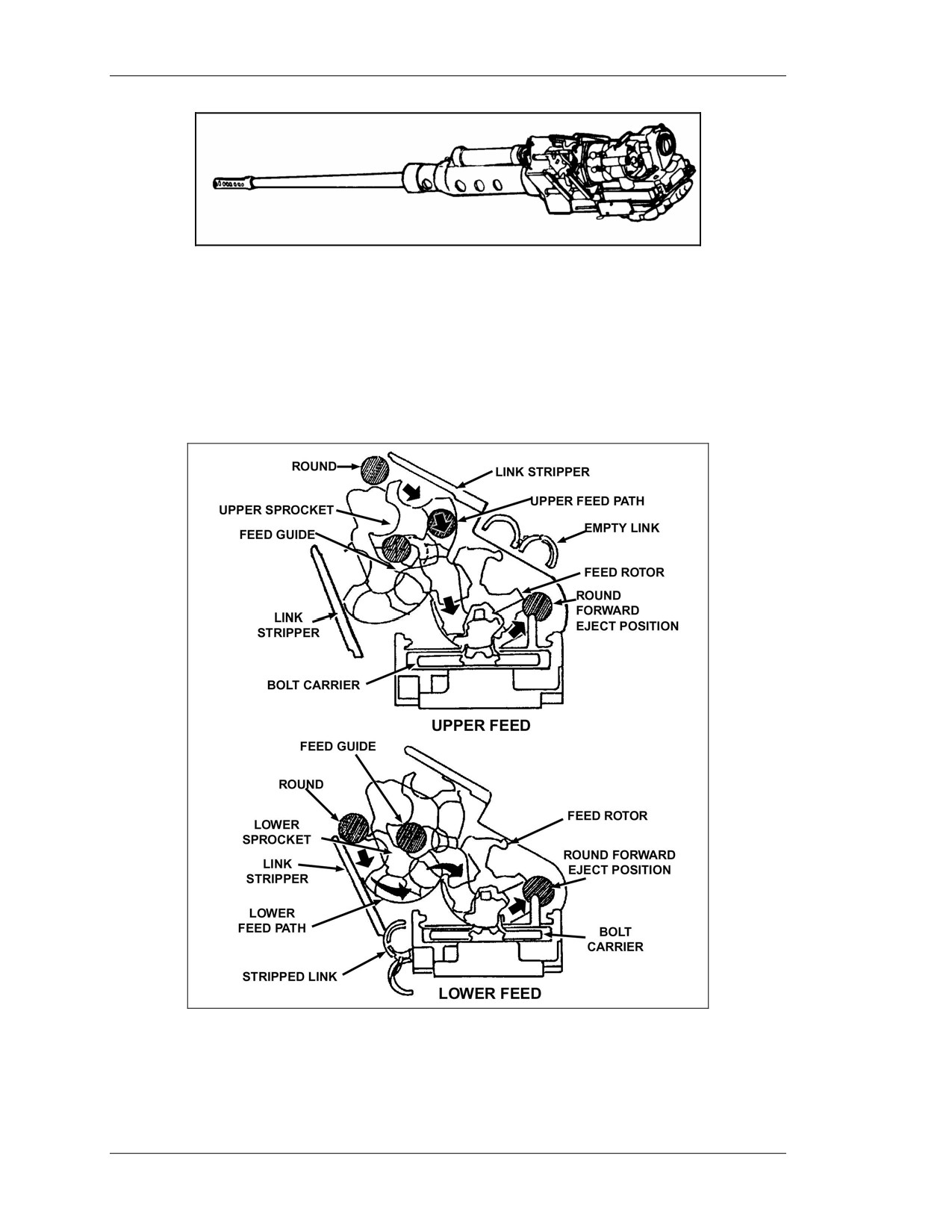
gun (Figure 2-1, page 2-2). It can destroy lightly armored vehicles and aerial targets such
as helicopters and slow-flying aircraft. It can also suppress enemy positions such as
troops in the open, dug-in positions, and built-up areas. (Vehicle TMs 9-2350-284-10-2,
9-2350-284-20-2-1, and 9-2350-294-10-2-1 provide more operator information.)
a. Dual-Feed System. A dual-feed system uses sprockets and extractor grooves to
control rounds (Figure 2-2, page 2-2). A system of clutches allows either sprocket to
engage and feed either an AP or HE cartridge. One ammunition box holds 70 rounds, and
the other holds 230 rounds. Each box can hold either AP- or HE-type ammunition. A
single 1.5-horsepower DC motor externally powers the 25-mm. The enhanced gun uses a
1.0-horsepower DC motor. For all 25-mm guns, unit maintenance replaces inoperable
1.5-horsepower DC motors with the newer 1.0-horsepower DC motors. The gunner can
choose from three rates of fire:
(1) Single Shot. The commander or gunner can shoot about as fast as he can
squeeze the trigger.
(2) Low Rate. The commander or gunner can shoot 100 rounds a minute, plus or
minus 25 rounds.
(3) High Rate. The commander or gunner can shoot 200 rounds a minute, plus or
minus 25 rounds.
DANGER
PREFIRE CHECK -- 25-MM GUN
BEFORE FIRING THE 25-MM GUN, THE GUNNER MUST
CHECK THE GUN COVER FOR SERVICEABILITY, ZIP IT
UP, AND ENSURE THE TURRET VENTILATION SYSTEM
IS OPERATIONAL TO PREVENT POISONOUS GAS FROM
LEAKING INTO THE TURRET. FIRING ROUNDS CAUSES
THE GUNPOWDER TO PRODUCE THIS GAS.
2-1
FM 3-22.1
Figure 2-1. M242 25-mm automatic gun.
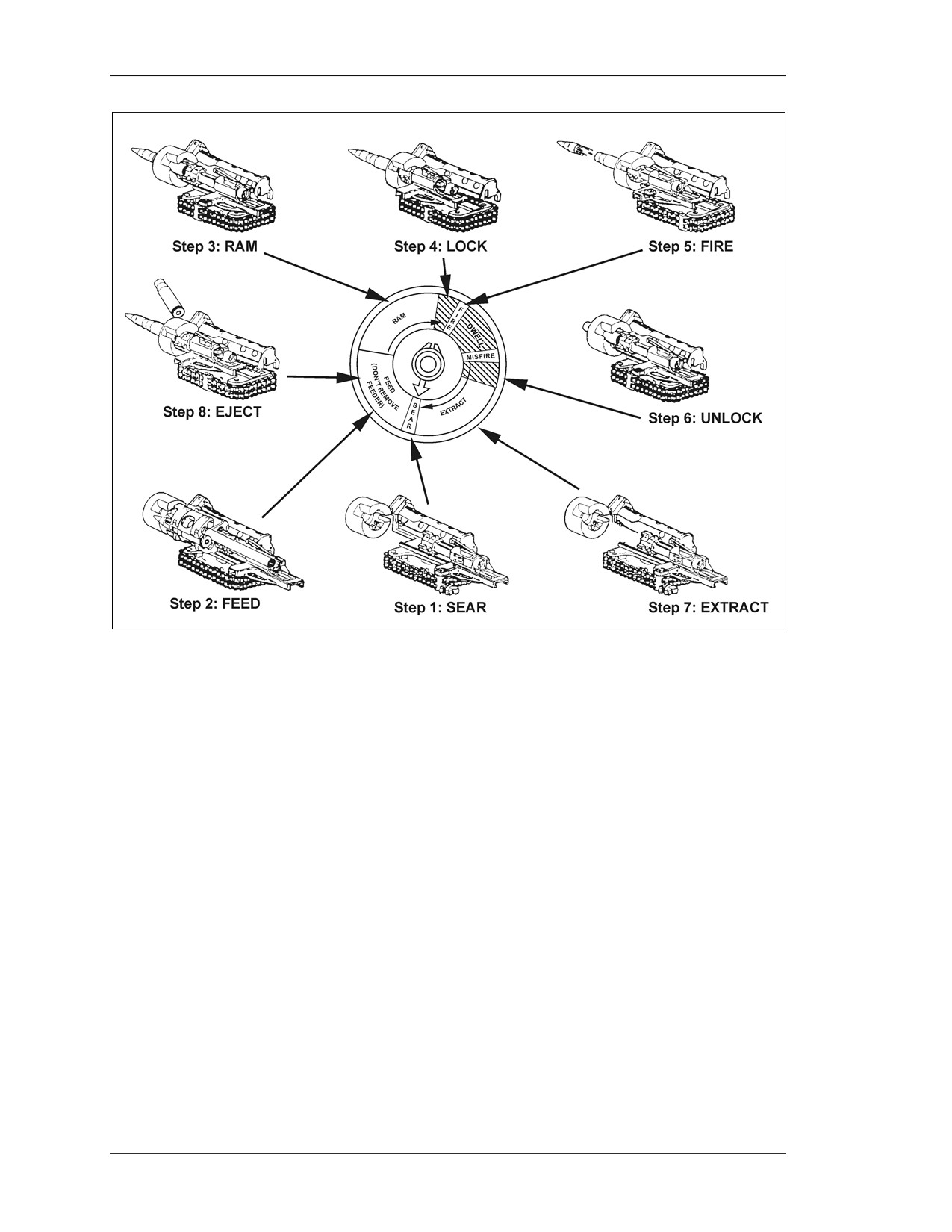
b. Cycles of Function. The 25-mm automatic gun has eight cycles of function that
relate to the bolt position indicator (Figure 2-3, page 2-4). The BPI shows the crew where
the bolt is located the whole time the gun moves through its eight cycles of function:
(1) Sear or Charge Cycle. The 25-mm bolt is forward of its rearmost position. The
sear engages the master link. As a safety measure, the firing pin remains uncocked. The
bolt position arrow points to SEAR.
Figure 2-2. Dual-feed system.
2-2
FM 3-22.1
(2) Feed Cycle. Linked ammunition enters the 25-mm gun feeder. The feed sprockets
strip the rounds from the links and move the round into the round positioner one at a
time. The round positioner pushes the round into the ready position. During the feed
cycle, the bolt moves about 25-mm to the rear of the sear position. The feeder rotor
rotates one-third of a turn, allowing the round positioner to place a round into the rotor.
The position arrow points to FEED or to DON'T REMOVE FEEDER. Absolute hang-fire
protection activates in this position.
(3) Chamber or Ram Cycle. The rotor stops moving counterclockwise once the round
is positioned on the bolt face. The bolt, bolt carrier, and round move forward until the
round seats fully in the chamber. The position arrow points to RAM.
(4) Lock Cycle. The bolt is in the full forward position and the bolt carrier is still
moving forward. The cam pin moving in its channel causes the bolt to rotate
counterclockwise. This allows the lugs on the bolt to engage in the recesses of the breech,
making a solid lock. Before the round fires, the position arrow points at the red zone.
(5) Fire Cycle. The final rotation of the bolt pushes the firing pin tang off the firing
pin pawl in the track assembly. This causes the firing pin spring to push the firing pin
forward. In its full forward position, the firing pin's tip protrudes 2 millimeters through
the bolt face. The indicator arrow points to FIRE. Although the gun requires no gas to
operate, it does use 12 mm of recoil to deactivate mechanical interlock. If the breech fails
to recoil, the gun stops cycling with the bolt still locked in the breech. The position arrow
points to MISFIRE.
(6) Unlock Cycle. Once past the MISFIRE position, the master link and slider start to
the rear. The slider pulls the bolt carrier with it. The cam pin rotates the bolt clockwise,
causing it to unlock from the recesses in the breech. As the bolt unlocks, the arrow points
to EXTRACT.
(7) Extract Cycle. As the bolt moves to the rear, the fixed T-slot extractors remove
the cartridge case from the chamber. The case remains positioned on the face of the bolt.
The bolt continues to the rear until it locks in the sear position. As this happens, the
position arrow moves from EXTRACT to SEAR.
(8) Eject Cycle. The expended case remains in the bolt face until the gunner pulls the
trigger to fire another round. When that happens, the bolt moves to the FEED position.
The rotor rotates one-third of a turn, feeding a round onto the bolt face and sweeping the
expended case into the feeder ejection chute. As the bolt moves forward to chamber the
round, the eject arm on the bolt carrier pushes the expended case from the receiver
cartridge eject port.
c. Enhanced
25-mm Gun. The A3's enhanced
25-mm gun has three major
components: a chrome-lined barrel, an enhanced feeder, and an enhanced receiver. The
gun also has quick-detachable link covers, a larger breach assembly, longer recoil, and a
triple-spring drive clutch. It also has a built-in test (BIT) for the feed-select solenoid and
gun-drive motor. The feed-select solenoid and the gun-drive motor each contains a
jumper wire that enables the on-vehicle BIT. (TM 9-1005-200-23&P provides more
information about the enhanced gun.)
2-3
FM 3-22.1
Figure 2-3. The M242 25-mm gun's eight cycles of function.
2-2. M240C 7.62-MM COAXIAL MACHINE GUN
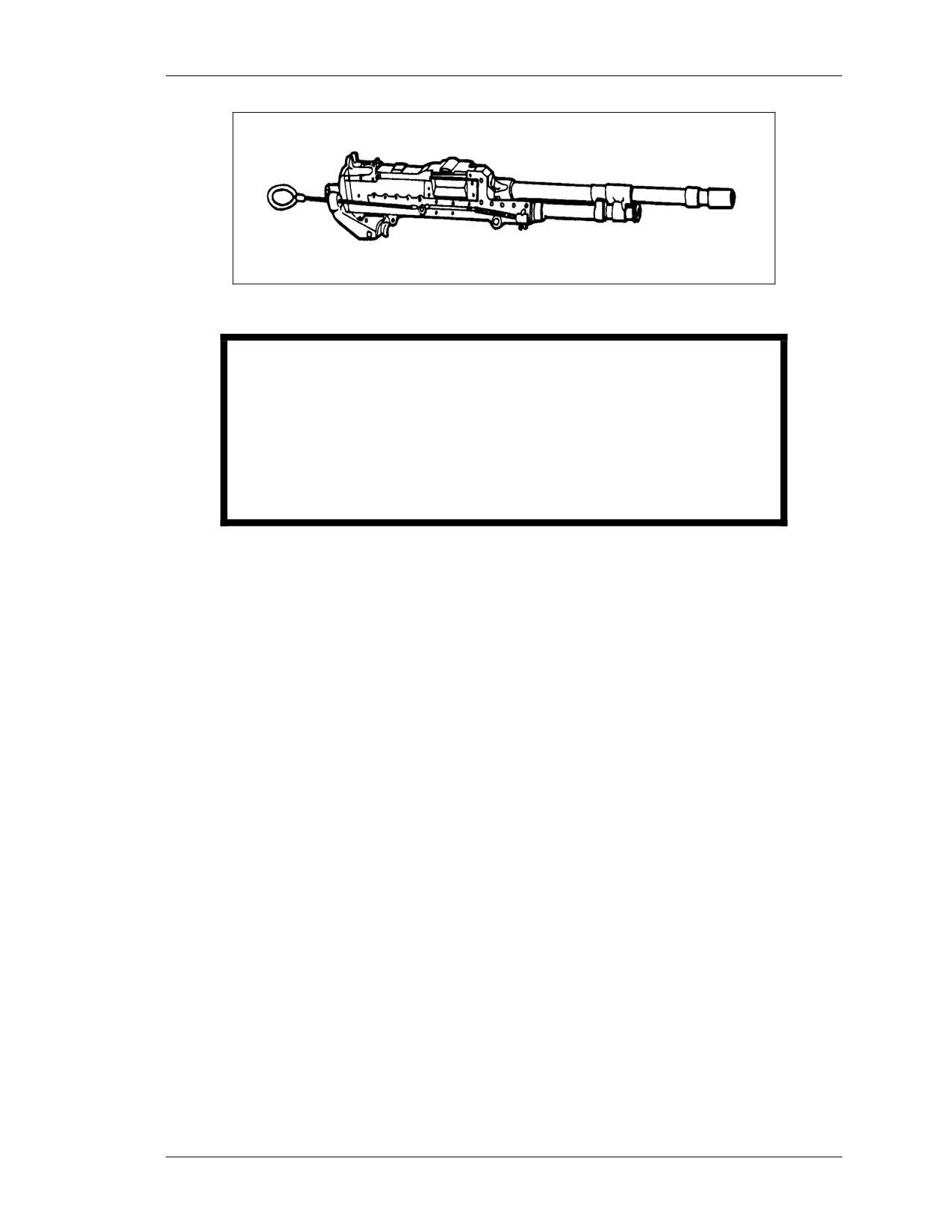
The BFV crew uses the M240C 7.62-mm coaxial machine gun to engage enemy
personnel, infantry crew-served weapons, antitank guided missile teams, and unarmored
vehicles (Figure 2-4). The coax machine gun is a belt-fed, gas-operated, fully automatic
weapon with a maximum effective range of 900 meters (tracer burnout). The coax
machine gun mounts on the right side of the turret, in front of the Bradley commander's
(BC's) position. The BC can reach the coax machine gun easily through access doors.
The coax machine gun has three rates of fire: cyclic, sustained, and rapid.
a. Cyclic Rate. At this rate, the gun fires 650 to 950 rounds a minute; the gunner
must change the barrel every minute.
b. Sustained Rate. At this rate, the gun fires 100 rounds a minute, with 4 to 5
seconds between each burst. The gunner must change the barrel every 10 minutes (TM 9-
2350-284-10-2).
c. Rapid Rate. At this rate, the gun fires 200 rounds a minute, with 2 to 3 seconds
between each burst. The gunner, must change the barrel every 2 minutes.
2-4
FM 3-22.1
Figure 2-4. M240C 7.62-mm coaxial machine gun.
DANGER
SEALS ON THE ACCESS DOORS
BEFORE FIRING THE COAX, INSPECT THE SEALS ON
THE ACCESS DOORS. CHECK FOR SERVICEABILITY
AND ENSURE ACCESS DOORS ARE CLOSED TO KEEP
POISONOUS GAS FROM LEAKING INTO THE TURRET.
2-3. TUBE-LAUNCHED, OPTICALLY TRACKED, WIRE-GUIDED MISSILE
The TOW is a command-guided surface-attack weapon that can destroy tanks, other
armored vehicles, and helicopters. It can also destroy fortified bunkers, gun
emplacements, and other protected positions. The TOW system destroys armored
vehicles at ranges from 65 to 3,750 meters, depending on the type of missile used. While
in a defilade position, the BC or gunner locates, engages, and destroys enemy targets
using the TOW. The BFV crew can reload the TOW launcher without exposure to
hostile fire.
a. When the firer pulls the trigger, the TOW or TOW
2 subsystem starts a
1.5-second self-balancing routine, which activates the gyro and stabilizes the missile. To
avoid accidentally aborting the missile, the crew must remember this delay when firing
the TOW. At launch, the electronic command guidance electronics or digital guidance
system (CGE or DCGE) or the missile control subsystem (MCS) sends a signal that
triggers the missile launch motor to ignite. This ignition propels the missile out of the
launcher, and then the flight motor takes over. When the missile enters the firer's line of
sight, the ISU or IBAS receives infrared energy from the missile. Components in the ISU
or IBAS then signal the CGE, DCGE, or MCS to position the missile with respect to the
ISU or IBAS line of sight. This exchange continues until the missile impact(s) or aborts
(Table 2-1, page 2-7).
2-5
FM 3-22.1
DANGER
1.5-SECOND DELAY
WHEN FIRING THE TOW, REMEMBER THE
1.5-SECOND DELAY, DURING WHICH THE GYRO
STABILIZES THE MISSILE.
b. The last step in the firing sequence occurs when the TOW or TOW 2 subsystem
automatically cuts the wire
23 seconds after launch. The subsystem also cuts the
wire when--
• The BC or gunner presses the TOW ABORT switch.
• The BC or gunner selects another missile on the TOW control box.
• The missile reaches the wire's maximum range.
• The BC or gunner resets the weapons control box.
• The BC or gunner deselects the TOW weapon system.
• The BC or gunner changes magnification (except A3).
c. When firing a TOW, the BC or gunner must lay the crosshairs on the center mass
of the target, fire the missile, and keep the crosshairs on the target during the flight of the
missile. This keeps the firer from losing control of the missile. (TM 9-2350-252-10-2,
TM 9-2350-284-10-2, TM 9-2350-284-10-2-1, and TM 9-2350-294-10-2-1 provide
specific procedures.)
d. Before firing any TOW 2-type missiles, the firer ensures that both ISU or IBAS
ballistic doors are open. (TM 9-2350-252-10-2, TM 9-2350-284-10-2, TM 9-2350-284-
10-2-1, and TM 9-2350-294-10-2-1 provide more information.)
e. Before the BC or gunner fire the TOW, the vehicle must be level or on a slope of
less than 10 degrees. The wings and control surfaces extend as soon as the missile clears
the launcher. To avoid damaging these surfaces, the end of the launcher needs at least 36
inches clearance.
f. Between 500 and 900 meters downrange, the missile could fly below the gunner's
line of sight. Therefore, the firer must allow at least 30 inches of clearance between the
line of sight and any obstruction. This reduces the chance of the missile hitting the
ground on its way to the target.
g. Some conditions limit the TOW's firing and engagement capabilities and
effectiveness.
(1) Firing Over Water. The BC should consider the following when employing the
TOW over water:
(a) Firing across bodies of water wider than 1,100 meters can reduce the range of the
TOW. Signals traveling through the command-link wires short out when a large amount
of the wire falls in the water. At ranges less than 1,100 meters, submersion of the wire
does not affect missile range.
2-6

FM 3-22.1
TIME
RANGE
VELOCITY
(SECONDS)
(METERS)
(FPS)
TOW
TOW
TOW
TOW2
TOW2
TOW2
EVENTS:
TOW2A
TOW2B
TOW2A
TOW2B
TOW2A
TOW2B
Trigger pull:
-1.58 sec
-1.58 sec
—
—
—
—
Initiation of
-1.48 sec
-1.48 sec
—
—
—
—
launch sequence:
Activation of
-0.88 sec
-0.88 sec
—
—
—
—
thermal beacon:
Enabling of fire
-0.01 sec
-0.01 sec
—
—
—
—
signal on launcher
and firing of launch
motor squibs:
Missile clearance
0.04 sec
0.04 sec
—
—
—
—
of launch tube:
Completion of
0.04 sec
0.04 sec
1.12 M
1.12 M
181 FPS
173 FPS
launch motor burn:
Ignition of flight
0.16 sec
0.16 sec
7.7 M
7.4 M
—
—
motor:
Burnout of flight
1.50
1.50
239
289 M
1,025
991
motor:
to
to
to
to
to
to
1,060
1,005
1.60 sec
1.60 sec
280 M
319 M
FPS
FPS
Interception of
14.35 sec
15.44 sec
3,000 M
3,000 M
488
459 FPS
3,000-meter target:
to
493 FPS
Interception of
20.10 sec
21.40 sec
3,750 M
3,750 M
387
367 FPS
3,750-meter target:
to
396 FPS
Table 2-1. TOW missile launch and in-flight sequence.
(b) A TOW position should sit as high above and as far back from the water as the
tactical situation will allow. As soon as the BFV occupies the position, the BC should
analyze the sector to determine if water will affect the employment of the TOW.
(Chapter 7, Section II discusses this in more detail.)
(2) Firing Over Electrical Wires. Contact between the command-link wires and a
live high-voltage power line can kill or injure personnel, cause a loss of control of the
missile, and it can damage launcher electronics.
2-7
FM 3-22.1
DANGER
FIRING OVER WIRES
WHEN FIRING OVER ELECTRICAL WIRES, TAKE CARE
TO AVOID LETTING THE COMMAND-LINK WIRES
TOUCH A LIVE HIGH-VOLTAGE POWER LINE. FAILURE
TO OBSERVE THIS PRECAUTION CAN CAUSE INJURY
OR DEATH, CAUSE THE FIRER TO LOSE CONTROL OF
THE MISSILE,
AND DAMAGE LAUNCHER
ELECTRONICS.
(3) Firing in Windy Conditions. Gusty, flanking, or quartering winds can move the
missile around during flight. As long as the crosshairs remain on the center mass of the
target, the weapon system will compensate for wind effects.
(4) Firing Through Smoke. For the firer to maintain a proper sight picture, he must
be able to see the target. Smoke can obscure the line of sight and hide the target. TOW
missiles have a xenon beacon for tracking. In addition to the xenon beacon, TOW 2,
TOW 2A, and TOW 2B missiles also have a thermal beacon. This thermal beacon allows
the gunner to track through most smoke obscuration. When a target disappears into a
smoke cloud, the firer should hold a smooth tracking rate so that the missile will still be
on target.
(5) Firing Through Area Fires. The firer follows the same visibility and
target-tracking instructions that apply to firing through smoke. He should also avoid
firing through or over fire if he thinks that the fire could touch the wires before missile
impact. A fire can burn through the command-link wire, causing the firer to lose control
of the missile.
h. Soldiers need to take the following precautions:
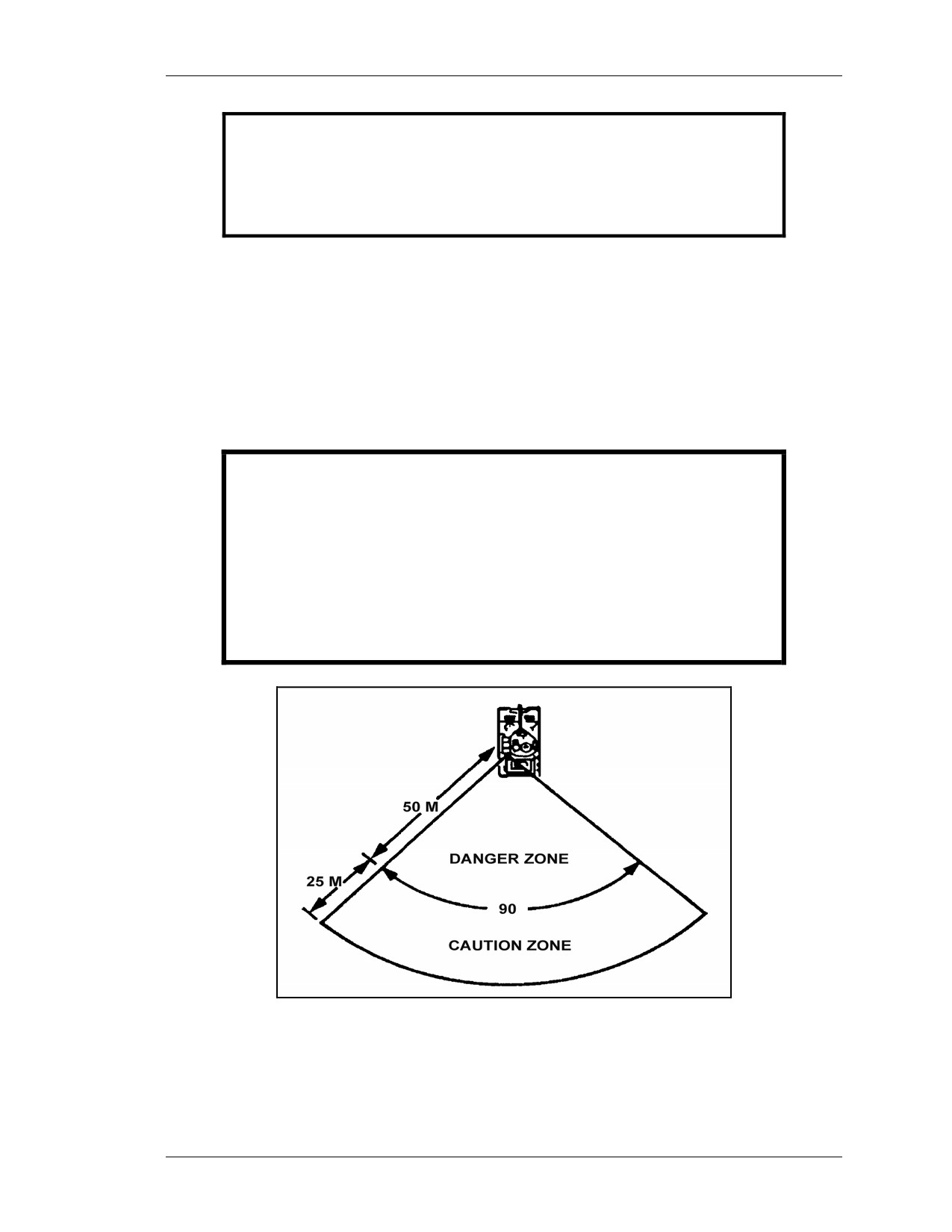
(1) Backblast. The TOW weapon system has a backblast area that extends 75 meters
to the rear of the vehicle in a 90-degree cone (Figure 2-5). This area comprises both a
50-meter danger zone and a 25-meter caution zone. The Bradley moves so that no
personnel, unarmored vehicles, or obstructions (such as walls, embankments, or large
trees) remain in the backblast area for its missile.
(a) Danger Zone. Flying debris can cause serious injury or damage equipment. Keep
all personnel and equipment out of the backblast area.
DANGER
BACKBLAST
KEEP ALL PERSONNEL CLEAR OF BACKBLAST
AREA. FLYING DEBRIS PRODUCED BY FIRING A
TOW MISSILE COULD INJURE OR KILL ANYONE
REMAINING IN THE BACKBLAST AREA.
2-8
FM 3-22.1
CAUTION
Remove all equipment and debris from the backblast area.
Flying debris produced by firing a TOW missile could badly
damage any equipment remaining in the backblast area.
(b) Caution Zone. In all training situations, keep all personnel and equipment clear of
the caution zone.
(2) Firing. Do not fire a damaged encased missile such as one with large dents or
cracks in the launch container. However, if the missile only has minor bending of the end
rings, this is not serious, and you can fire the missile without danger. Ensure the litmus in
the humidity indicator is blue. Pink indicates possible degradation in missile condition. If
this happens in a training environment, return the missile to the supply point. If it
happens during combat, you can fire the missiles.
WARNING
DAMAGED MISSILE CASE
NEVER fire a damaged encased missile. This includes,
for example, missiles with large dents or cracks in the
launch containers. However, if slightly bent end rings
are the only problem, then you can fire the missile
without danger.
Figure 2-5. TOW backblast area.
2-9
FM 3-22.1
WARNING
MISSILE AFFECTED BY MOISTURE
Ensure the litmus in the humidity indicator is blue. Pink
litmus might indicate a degraded missile.
•
Training -- Return missile to supply point.
•
Combat -- Use the missile.
(3) Handling Precautions. The electrolyte in the emergency battery assembly is
highly corrosive. If the battery sustains damage, electrolytes might leak out, and these can
cause serious injury, especially to the eyes.
WARNING
CORROSIVE BATTERY CONTENTS
The electrolytes in the emergency battery are highly
corrosive. If the battery sustains damage, electrolytes
might leak out, and these can cause serious injury,
especially to the eyes.
(a) Report all duds or defective missiles to an explosive ordnance-disposal
(EOD) team.
(b) In training, you must wait 30 minutes before removing a misfired missile from the
launcher. (TM 9-2350-252-10-2, TM 9-2350-284-10-2, TM 9-2350-284-10-2-1, and TM
9-2350-294-10-2-1 provide more information.)
DANGER
DUDS, DEFECTIVE MISSILES
DO NOT MOVE OR HANDLE DUDS OR DEFECTIVE
MISSILES, EXCEPT WHEN YOU REMOVE A MISFIRE
FROM THE LAUNCHER AND PLACE IT A SAFE
DISTANCE (200 METERS) FROM THE VEHICLE.
(c) The command-link wires are strong. Move carefully through areas where missiles
were fired.
(d) Do not move or handle duds or defective missiles except to remove a misfire from
the launcher and place it a safe distance (200 meters) from the vehicle.
2-10
FM 3-22.1
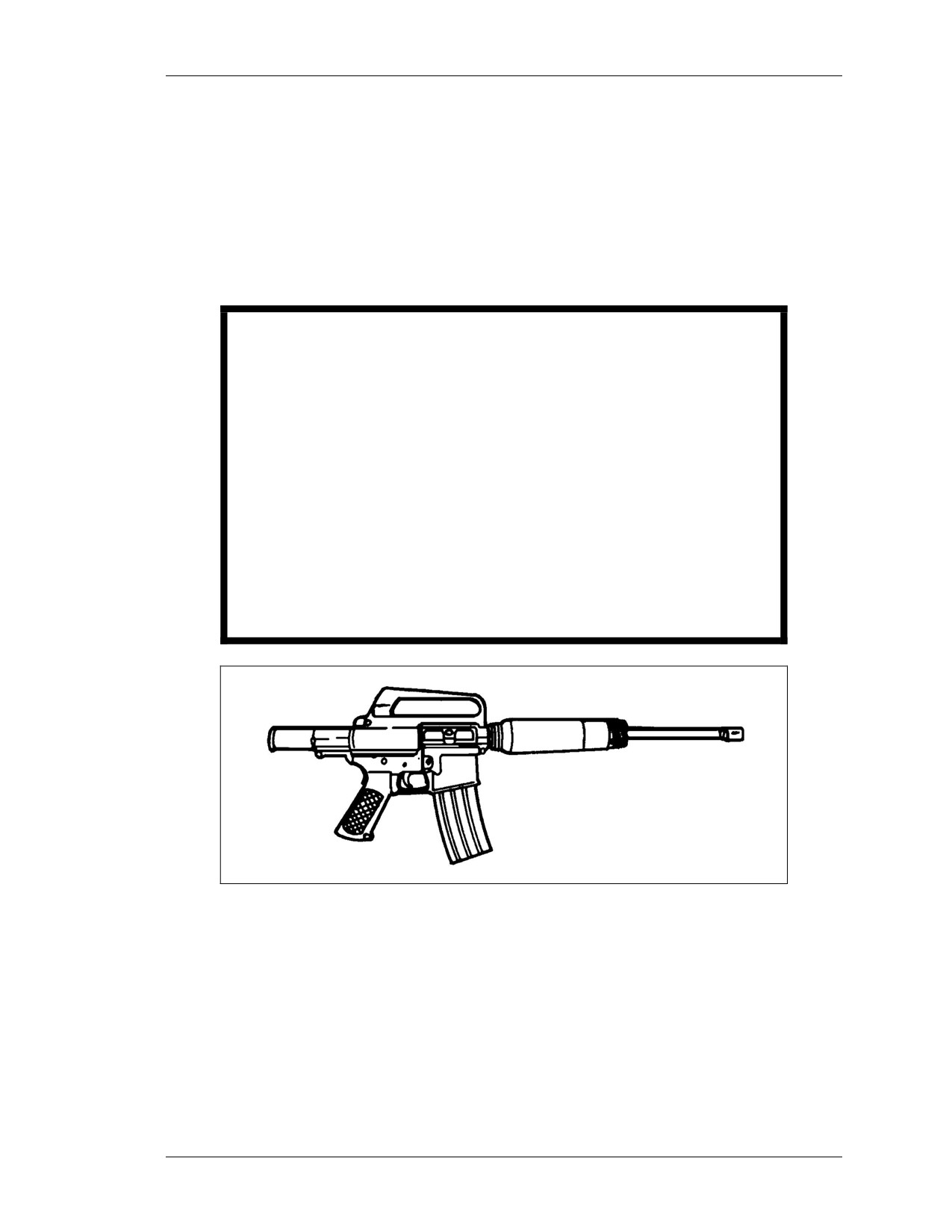
2-4. M231 5.56-MM FIRING PORT WEAPON
The infantry rifle squad uses the M231 5.56-mm FPW to engage enemy personnel,
crew-served weapons, and ATGM teams, and to suppress suspected close-in enemy
positions (Figure 2-6). The FPW has a maximum effective range of 300 meters (tracer
burnout). The basic BFV M2 has six firing port mounts, two on each side and two in the
ramp. The BFV M2A2, M2A2 ODS, and A3 have two firing port mounts in the ramp
(none on the sides). When not using the FPWs, the crew stores them in their assigned
storage racks located inside the vehicle.
DANGER
AMMUNITION
AVOID USING M193, M855 BALL, OR M856
AMMUNITION IN THE FPW--THESE WORK ONLY IN
THE M249 SAW OR IN THE M16A2.
FIRING PORT WEAPON
BEFORE USING THE FPW, MAKE SURE THAT THE
EXHAUST FANS WORK AND THAT THE EXHAUST
HOSE IS IN GOOD WORKING CONDITION. THEY
MUST BE ABLE TO REMOVE POISONOUS GASSES
FROM THE TROOP COMPARTMENT.
Figure 2-6. M231 5.56-mm firing port weapon.
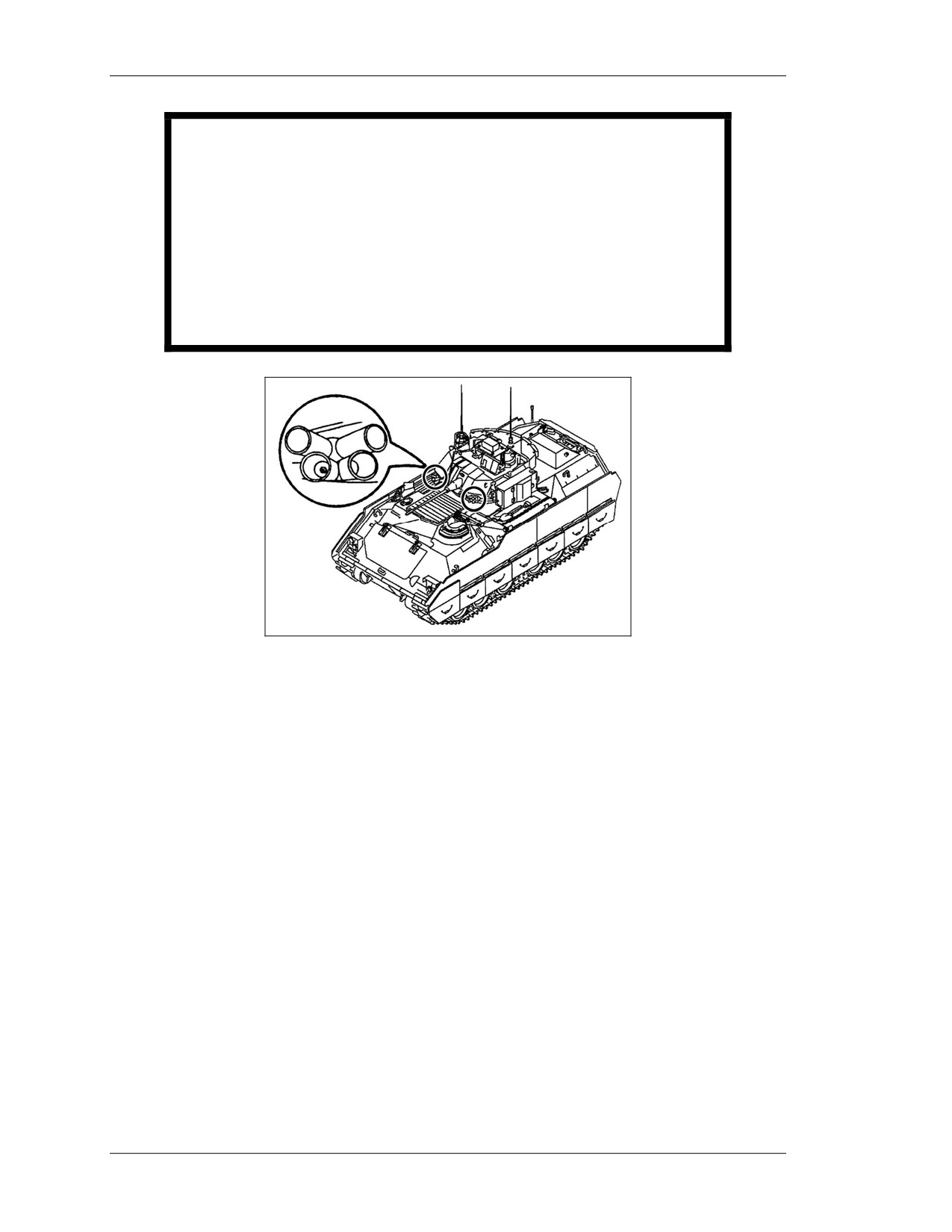
2-5. M257 SMOKE-GRENADE LAUNCHER
The BFV has two, four-tube, electrically fired grenade launchers, one on each side of the
25-mm gun (Figure 2-7, page 2-12). Therefore, each can fire four grenades. On
activation, the grenades create enough smoke to screen the Bradley in three seconds.
Using one switch inside the turret, the BC or gunner fires the launchers. The launchers
cannot fire independently. Both launchers--all eight grenades--fire at once.
2-11
FM 3-22.1
DANGER
SMOKE GRENADES
ELECTRICAL TROUBLE CAN CAUSE SMOKE
GRENADES TO KILL OR INJURE SOLDIERS.
BEFORE LOADING ANY SMOKE GRENADES,
ENSURE THAT THE TURRET POWER AND
GRENADE LAUNCHER SWITCHES ARE
SET TO OFF.
Figure 2-7. M257 smoke-grenade launchers.
2-6. STINGER MISSILE SUBSYSTEM
The M6 Linebacker can engage low-altitude, high-speed, fixed-wing aircraft; rotary-wing
aircraft; cruise missiles (CMs); and unmanned aerial vehicles (UAV) with its Stinger
missile standard vehicle-mounted launcher (SVML). The SVML rests in an armored box,
which is mounted on the left side of the turret on a retractable platform. This box houses
any mix of up to four Stinger missiles and provides a stable platform for controlled
missile launching. If the SVML is disabled, the crew can convert to a Stinger Man-
Portable, Air-Defense System
(MANPADS) team. The Stinger system provides
round-the-clock, day or night, all-weather air defense during offensive and defensive
operations. Coupled with the FAAD C2 and C3I elements of short-range air defense
(SHORAD), the Linebacker has an automatic or manual slew-to-cue, target-acquisition
capability, during both stationary and moving operations.
Section II. AMMUNITION
Each of the BFV's organic weapon systems uses ammunition designed to support the
missions of that BFV model. As mission requirements and threat capabilities change,
these munitions will counter the threat. For more realistic training, the 25-mm's training
ammunition replicates service ammunition.
2-12

FM 3-22.1
2-7. M242 25-MM AUTOMATIC GUN (STANDARD)
The five basic rounds used with the 25-mm gun include the M791, M792, M793, M910,
and M919. Table 2-2 compares the five types of 25-mm ammunition.
M791
M792
M910
M919
ROUND
APDS-T
HEI-T
M793 TP-T
TPDS-T
APFSDS-T
Muzzle velocity
(meters per
1,345 MPS
1,100 MPS
1,100 MPS
1,525 MPS
1,385 MPS
second):
Time of flight
(seconds):
1,000 meters
0.8 sec
1.2 sec
1.2 sec
0.7 sec
0.8 sec
1,500 meters
1.2 sec
2.2 sec
2.2 sec
1.2 sec
1.2 sec
2,000 meters
1.7 sec
3.6 sec
3.5 sec
1.8 sec
1.6 sec
2,500 meters
2.2 sec
5.3 sec
5.2 sec
2.5 sec
2.1 sec
Cartridge weight
458 gm
501 gm
501 gm
420 gm
454 gm
(grams):
Projectile weight
134 gm
185 gm
182 gm
95 gm
96 gm
(grams):
Tracer burn time
> 1.7 sec
> 3.5 sec
> 3.5 sec
> 1.8 sec
> 1.8 sec
(seconds):
Bursting radius,
NA
5 M
NA
NA
NA
arming distance:
10 to 200 M
Max effective
2,000 M
3,000 M
1,600 M
2,000 M
2,500 M
range (meters):
Tracer burn
> 2,000 M
> 2,000 M
> 2,000 M
> 2,000 M
2,500 M
range (meters):
">" means "more than."
Also, the M793 TP-T round loses its effectiveness after 1,600 meters.
Table 2-2. Comparison of ammunition for 25-mm gun.
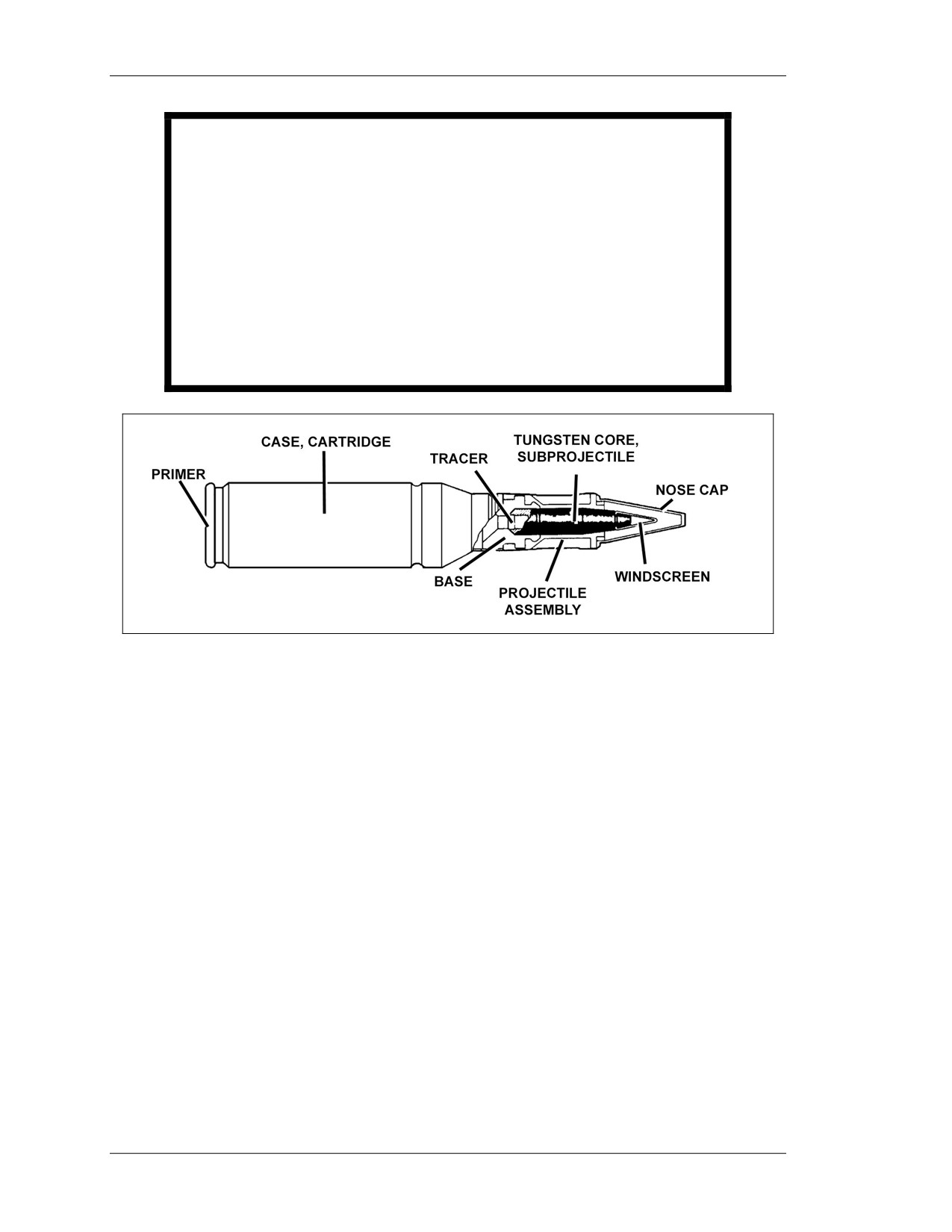
a. M791 Armor-Piercing Discarding Sabot with Tracer. The APDS-T
(Figure 2-8, page 2-14) penetrates lightly armored vehicles, self-propelled artillery, and
aerial targets such as helicopters and slow-moving, fixed-wing aircraft.
2-13
FM 3-22.1
DANGER
DISCARDING SABOTS
BEFORE FIRING ANY DISCARDING SABOT
AMMUNITION, CONSIDER THE SAFETY OF
SOLDIERS ON THE GROUND. THE DISCARDING
SABOT CAN CAUSE DEATH OR INJURY.
THE DISCARDING SABOT LEAVES THE BARREL
AT A 30-DEGREE ANGLE ON BOTH SIDES OF THE
GUN-TARGET LINE FOR 100 METERS.
Figure 2-8. M791 APDS-T.
(1) The APDS-T is a fixed-type, percussion, primed round. It consists of a
sabot-encapsulated projectile body crimped to a steel cartridge case. The projectile body
consists of a solid tungsten alloy penetrator, pressed-on aluminum windscreen, pressed-in
tracer pellets, molded discarding-type nylon sabot, staked aluminum base, and welded or
pressed-on nylon nose-cap. The projectile sabot and nose-cap are black with white
markings.
(2) Gasses produced by the burning propellant send the projectile from the gun at
1,345 meters per second (plus or minus 20 meters per second) and ignite the tracer.
Setback, centrifugal, and aerodynamic forces cause both the sabot and nose-cap to
discard as soon as the round leaves the barrel. The tungsten alloy penetrator (core) is
spin-stabilized and penetrates the target solely by kinetic energy.
(3) The maximum effective range is 2,000 meters due to tracer burnout. Although its
tracer burns out at 2,000 meters, an APDS-T round is accurate out to 2,200 meters. As the
range increases, the APDS-T penetration decreases, especially when target vehicles have
appliqué armor (an added layer of armor).
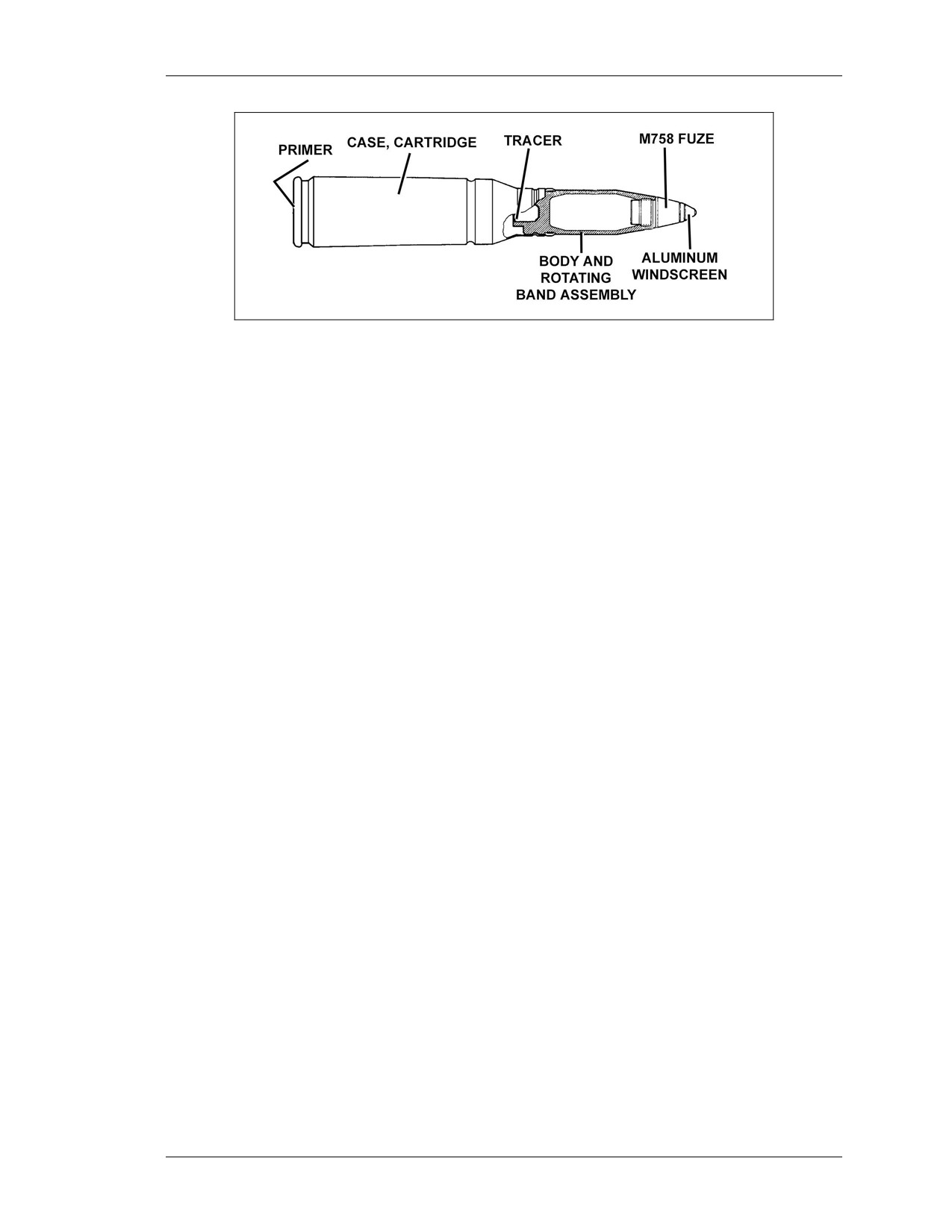
b. M792 High-Explosive Incendiary with Tracer. The HEI-T (Figure 2-9) can
destroy unarmored vehicles and helicopters and suppress antitank guided missile
(ATGM) positions and enemy squads beyond coax range (900 meters) and out to a
maximum effective range of 3,000 meters.
2-14
FM 3-22.1
Figure 2-9. M792 HEI-T.
(1) The HEI-T cartridge is a fixed-type, percussion-primed round. The one-piece
projectile body contains HEI and is crimped onto a steel cartridge case. The hollowed
steel projectile houses an M758 mechanical fuze, 32 grams of an HEI mix, and a
pressed-in tracer. The projectile is yellow with a red band, black markings, and a gold tip.
On some rounds, the projectile's yellow color is slightly orange near the red band.
(2)
Gasses produced by the burning propellant send the projectile out of the
gun at 1,100 meters per second (plus or minus 20 meters per second). On impact, the
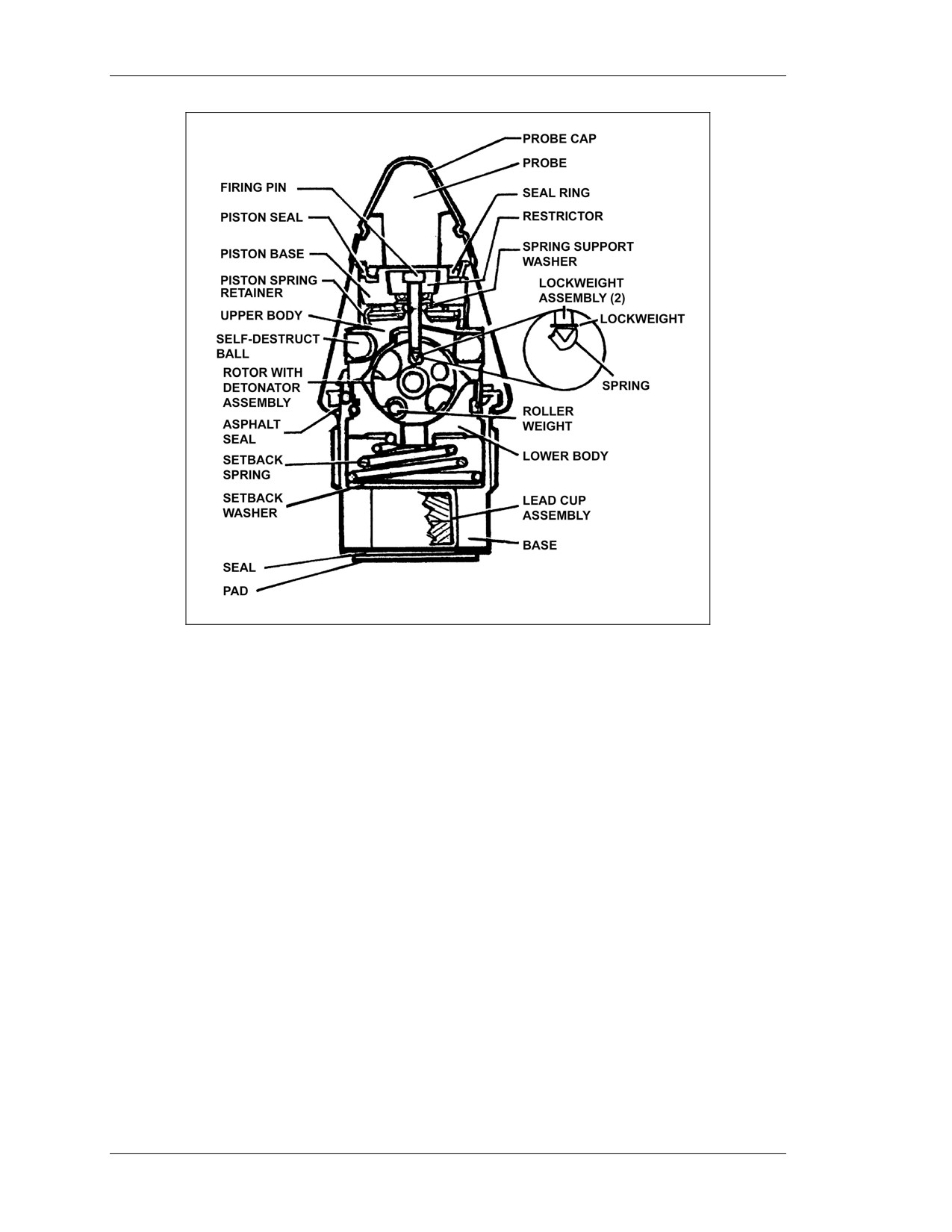
M758 mechanical fuze (Figure 2-10, page 2-16) ignites and the HEI filler detonates. This
projects steel fragments from the body, rotating band assembly, and incendiary filler over
a 5-meter radius.
(3)
The maximum effective range for HEI-T rounds is 3,000 meters, at which
range, a mechanical fuze (the M758) detonates the round. Accuracy decreases beyond
1,600 meters, and the tracer burns out at 2,000 meters. However, the round's 5-meter
bursting radius and rate of fire let the firer engage either point or area targets out to the
maximum effective range.
(4)
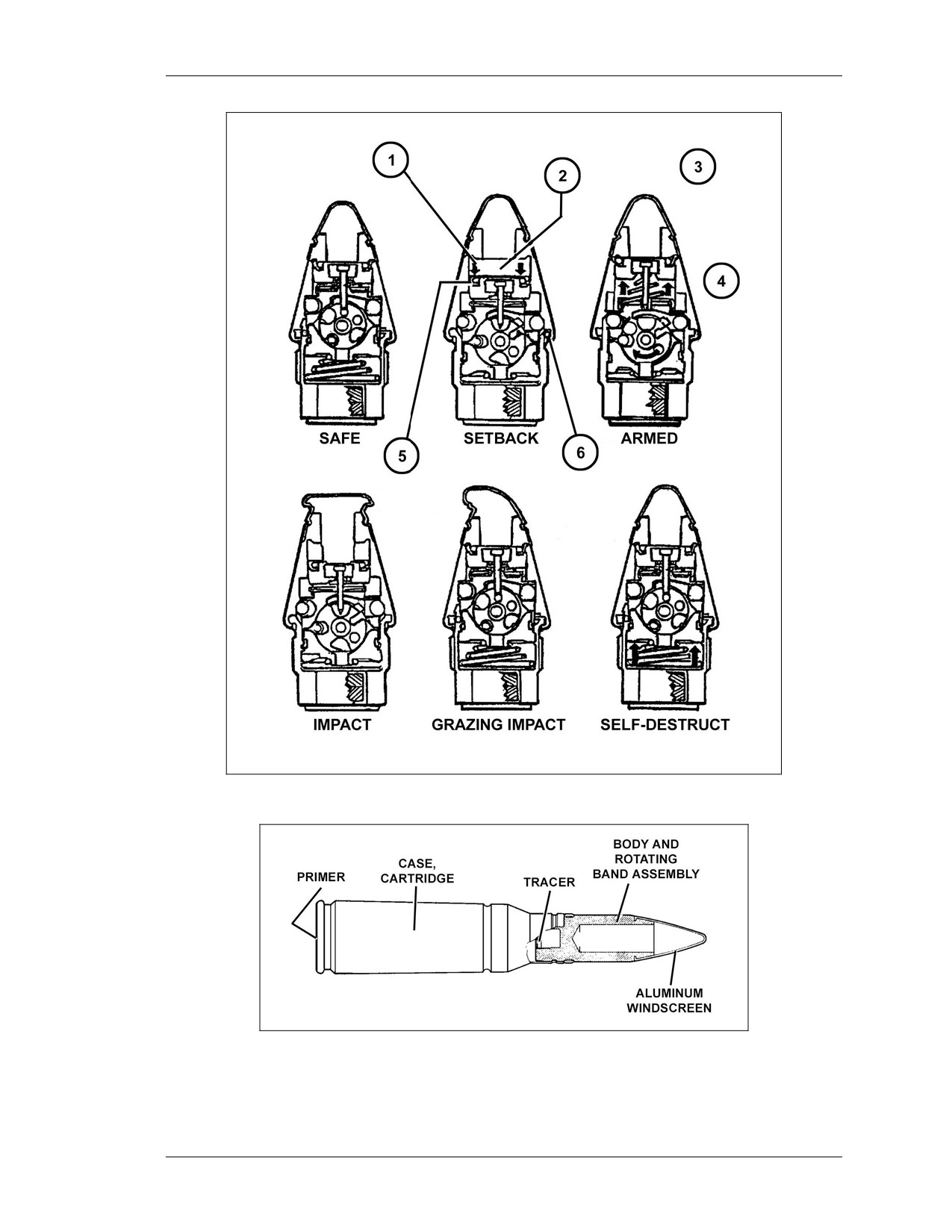
The M792 HEI-T projectile can detonate in any of three ways: direct
impact, grazing impact, and self-destruct (Figure 2-11, page 2-17). The piston and body
assemblies are forced to aft position by the projectile's acceleration in the gun tube (1).
The air is forced from the rear cavity into the newly created forward cavity (2). Air flows
through the porous restrictor (3). The spin locks the rotor (4) and causes the seal to fix
against the wall (5). This forces the ball outward and locks the body assembly in the rear
position (6).
(a) Direct Impact. Striking the target crushes the projectile's probe cap. This pushes
the probe rearward, which thrusts the firing pin into the detonator, which detonates the
HEI mixture.
(b) Grazing Impact. Due to spin decay (loss of forward velocity), the projectile
strikes the target with insufficient force. Spin decay triggers the setback spring to
overcome centrifugal force, pushes the body assembly forward, and thrusts the detonator
into the firing pin.
(c) Self-Destruct. If it does not hit a target, the projectile self-destructs at
3,000
meters. However, head and tail winds, depending on their severity, can reduce the
distance at which the round self-destructs.
2-15
FM 3-22.1
Figure 2-10. M758 HEI-T fuze.
c. M793 Target Practice with Tracer. The TP-T cartridge (Figure 2-12) is a
fixed-type, percussion-primed training round that matches the HEI-T round ballistically.
The projectile consists of a hollow steel body with blue with white markings. The TP-T's
maximum effective range is 1,600 meters, and the tracer is visible out to 2,000 meters.
However, accuracy is greatly reduced beyond 1,600 meters.
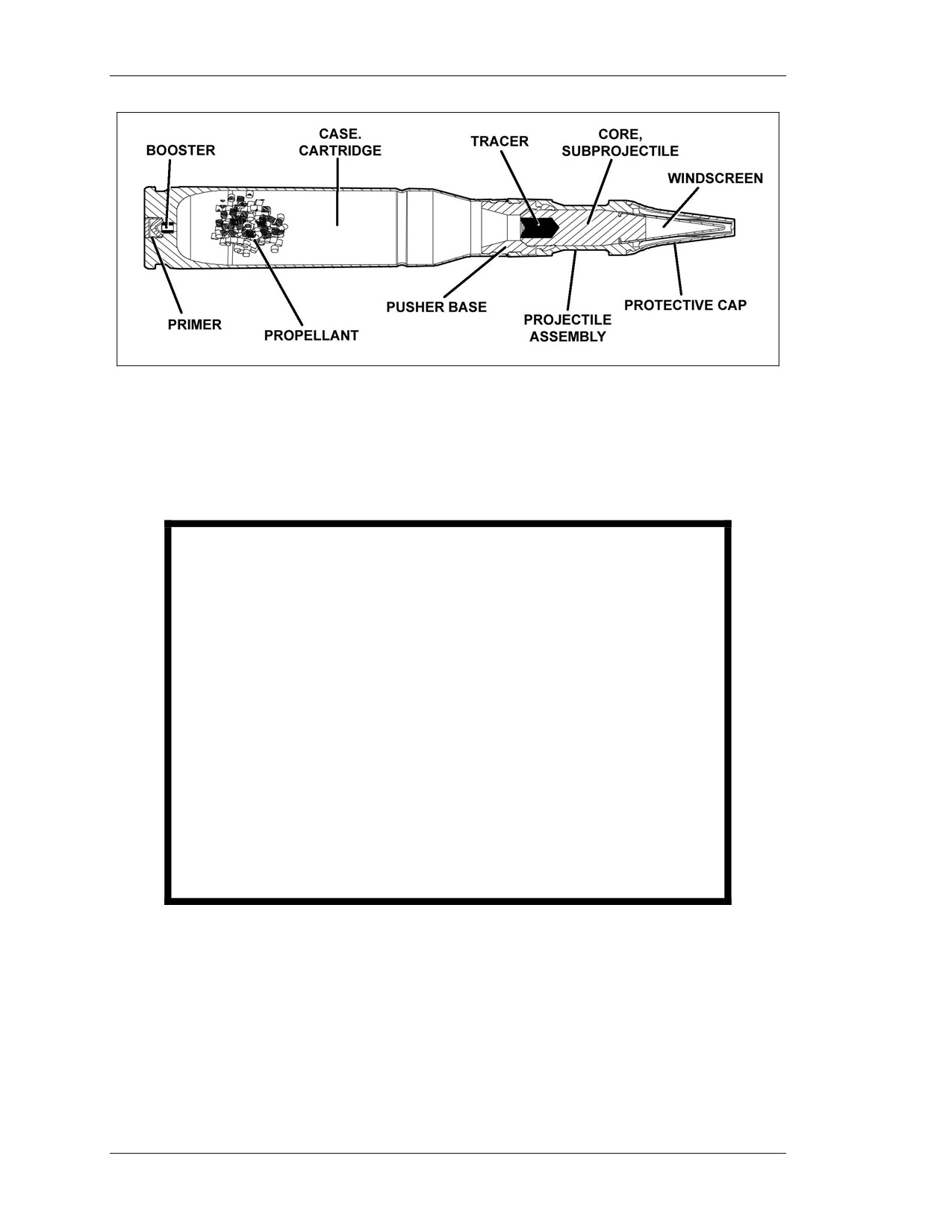
d. M910 Target Practice Discarding Sabot with Tracer. The target-practice,
discarding sabot with tracer (TPDS-T) replicates the flight pattern of the M791 APDS-T
round. The TPDS-T (Figure 2-13, page 2-18) allows units to practice sabot engagements
on limited-distance ranges. The maximum range of the TPDS-T is 6,404 meters.
(1) The TPDS-T cartridge is a fixed type, percussion-primed round. It consists of a
sabot-projectile assembly crimped to a steel cartridge case. The projectile assembly
includes a disposable aluminum pusher base. It also includes a subprojectile encapsulated
with a discarding nylon sabot and polyethylene protective cap. The subprojectile has a
steel core with either an aluminum or a steel windscreen and with pressed-in tracer
pellets. The projectile is blue with white markings.
(2) The TPDS-T cartridge trajectory ballistically matches the APDS-T plus or minus
1 mil to a range of 2,000 meters.
(3) The tracer burns out at 2,000 meters.
2-16
FM 3-22.1
Figure 2-11. M758 operational sequence.
Figure 2-12. M793 TP-T.
2-17
FM 3-22.1
Figure 2-13. M910 TPDS-T.
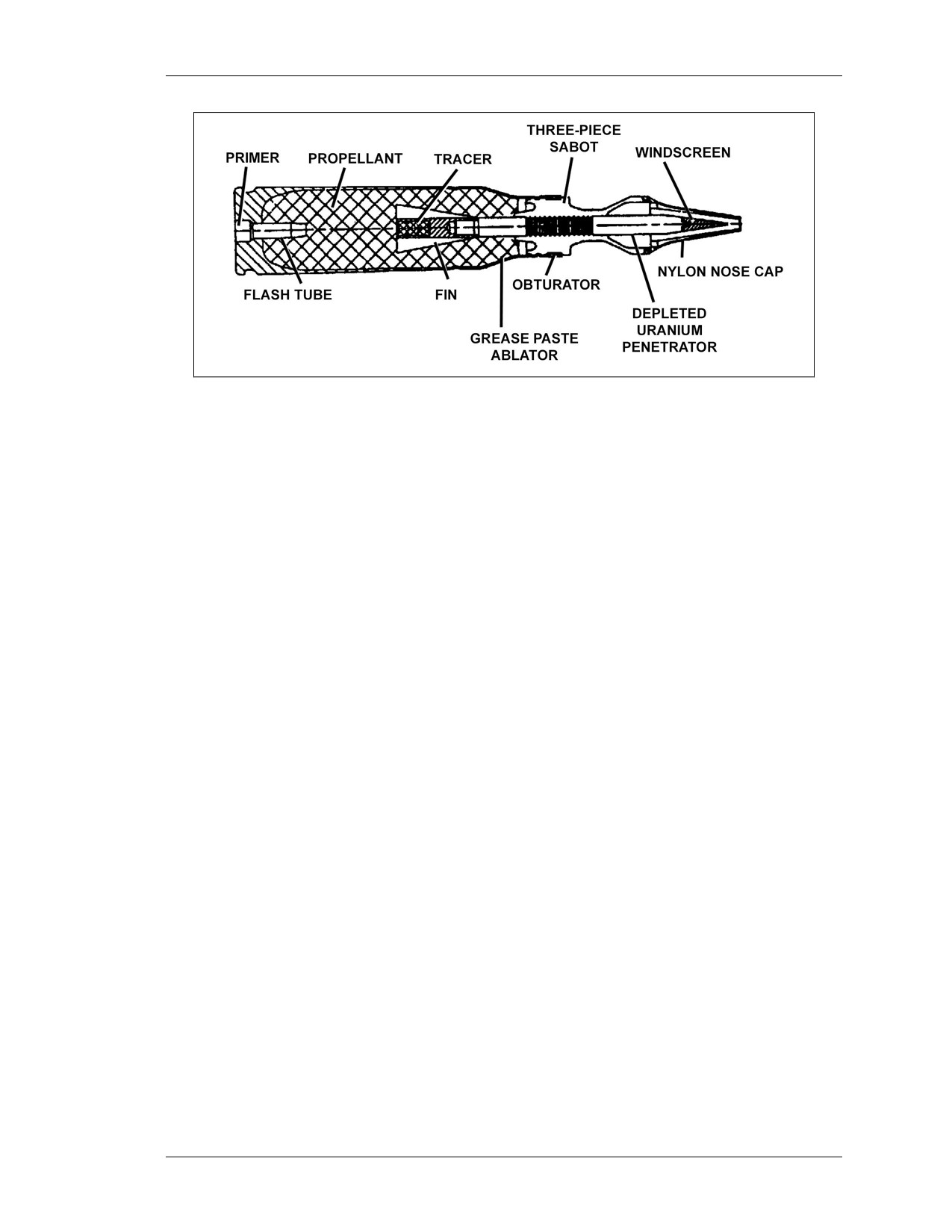
e. M919 Armor-Piercing, Fin-Stabilized Discarding Sabot With Tracer. The
armor-piercing, fin-stabilized discarding sabot with tracer
(APFSDS-T) round
(Figure 2-14) penetrates lightly armored vehicles, self-propelled artillery, and aerial
targets, which includes helicopters and slow-moving fixed-wing aircraft.
DANGER
M919 APFSDS-T AMMUNITION
ONLY USE M919 APFSDS-T AMMUNITION
IN COMBAT.
IF THE M919 SUSTAINS DAMAGE, FOLLOW
HANDLING AND REPORTING PROCEDURES IN
DA MESSAGE RUEADWD3453, DTG-17051Z
MAY 2001, AND IN THE VEHICULAR TECHNICAL
MANUALS.
TRADOC DU AWARENESS TRAINING, TIER I
(TSP TA-031-DUAT-001, TVT 3-120 PROVIDES
ADDITIONAL TRAINING AND HANDLING
PROCEDURES).
2-18
FM 3-22.1
Figure 2-14. M919 APFSDS-T.
(1) The APFSDS-T is a fixed-type, percussion primed round that consists of a
sabot-encapsulated projectile crimped into a steel cartridge case. The projectile is made
of slate gray, corrosion-protected, depleted uranium. It has a screw-on steel fin with
pressed-in tracer pellets; a three-piece, segmented aluminum sabot and a snap-on plastic
protective cap. The projectile sabot and protective nose-cap are black, and the slip-band
nylon obturator is white. The round has a green rubber sealant between the sabot
segments, the sabot and penetrator, and the sabot and the plastic cap.
(2) This kinetic-energy round is the same as the APDS-T (M791), but with a velocity
of 1,385 meters per second (plus or minus 20). The APFSDS-T round also has greater
effective range, penetration capabilities, and tracer burn time than the APDS-T.
2-8. M240C 7.62-MM COAXIAL MACHINE GUN
The preferred ammunition mix for the coax is four ball and one tracer (A131). Other
types of 7.62-mm ammunition are available. However, the four-and-one mix allows the
BC and gunner to use the tracer-on-target (TOT) method of adjusting fire to achieve
target kill or suppression. (TM 9-1005-313-10 provides more operator information.)
2-9. TUBE-LAUNCHED, OPTICALLY TRACKED, WIRE-GUIDED MISSILE
The developments and improvements to the TOW missile family follow the
developments and improvements of tank armor. The five missiles that followed the basic
TOW have each improved upon the previous model. Table 2-3, page 2-20, compares
models. Areas of improvement include penetration, maximum range, usefulness during
adverse firing conditions, resistance to jamming, and attack profiles.
a. Identification. Each TOW round has black markings and a two-inch yellow band
near the top, plus another two-inch band near the bottom. On live rounds, the bottom
band is brown; on training (inert) rounds, it is blue.
b. Characteristics. TOW models still in use include the following (Figure 2-15,
page 2-21). Although the basic Bradley TOW system can fire the TOW 2 and newer
2-19

FM 3-22.1
model TOW missiles in addition to the basic TOW missiles, doing so will reduce the
probability of a hit:
(1) Basic TOW
(BGM-71A). The basic TOW has a
5-inch, high-explosive,
shaped-charge warhead and a maximum effective range of 3,000 meters.
(2) Basic TOW (BGM-71A1). This is the basic TOW also, except with an improved
maximum effective range of 3,750 meters.
(3) Improved TOW
(BGM-71C). The ITOW's improved 5-inch warhead, with
extensible probe, allows for detonation at a greater standoff distance from the target. It
also gives the warhead greater penetration capability. The ITOW's maximum effective
range is 3,750 meters.
TOW
ITOW
TOW 2
TWO 2A
TOW 2B
MISSILES
(BGM-71A,A1)
(BGM-71C)
(BGM-71D)
(BGM-71E)
(BGM-71F)
Weight:
Out of tube
40.7 lb.
41.9 lb.
47.2 lb.
49.9 lb.
49.8 lb.
In tube
54.8 lb.
56.0 lb.
61.3 lb.
64.0 lb.
63.9 lb.
Length
45.8 in.
45.6 in.
46.2 in.
46.1 in.
46.2 in.
(out of tube):
Tube
8.6 in.
8.6 in.
8.6 in.
8.6 in.
8.6 in.
Diameter:
Maximum
3,000 and 3,750
3,750
3,750
3,750
3,750
ranges:
meters
meters
meters
meters
meters
Warhead
5-inch HE
5-inch HE
6-inch HE
6-inch HE
Two 5-inch
Size:
improved
explosively
formed
penetrators
Arming
distances:
Minimum
30 meters
30 meters
30 meters
30 meters
110 meters
Best
NA
NA
NA
NA
150 meters
Maximum
65 meters
65 meters
65 meters
65 meters
200 meters
Reliability:
95.4 percent
Operating Temperature:
- 25 º to
+ 125 º F
Vehicle Compatibility: All
Table 2-3. Characteristics of the TOW missile.
2-20
FM 3-22.1
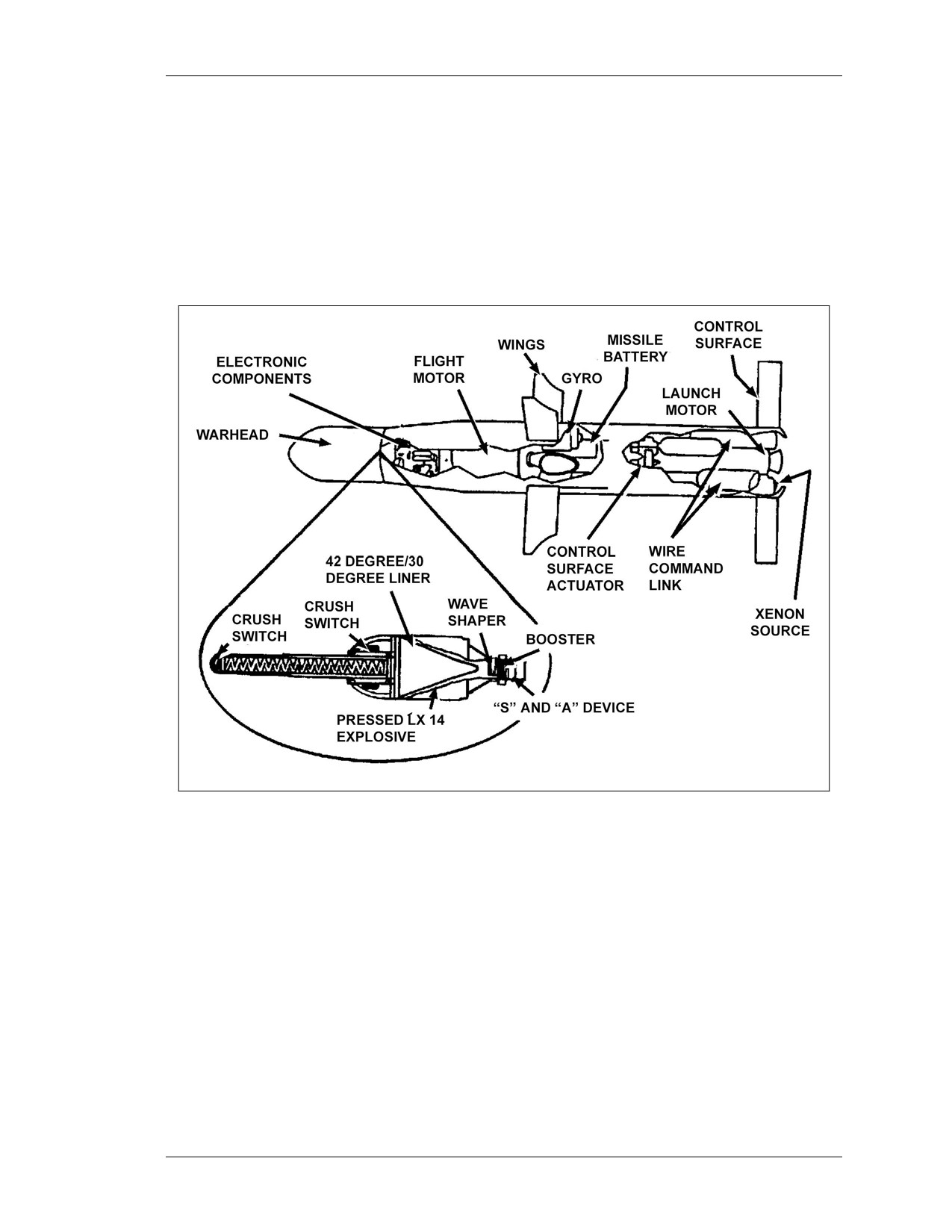
c. TOW 2 (BGM-71D). The TOW 2 has a 6-inch full-caliber warhead with an
extensible probe (Figure 2-16, page 2-22). This missile has a xenon beacon like the basic
and ITOW missiles, but it also has a thermal beacon. The thermal beacon improves
missile performance through battlefield smoke and obscurants, and against missile
countermeasure devices
(jammers). The thermal beacon links tracking to the
electro-optical FLIR, which is part of the TOW 2 subsystem. The TOW 2's flight motor is
also more powerful than the one in previous models. The TOW 2's maximum effective
range is 3,750 meters.
Figure 2-15. Basic and improved TOW missiles.
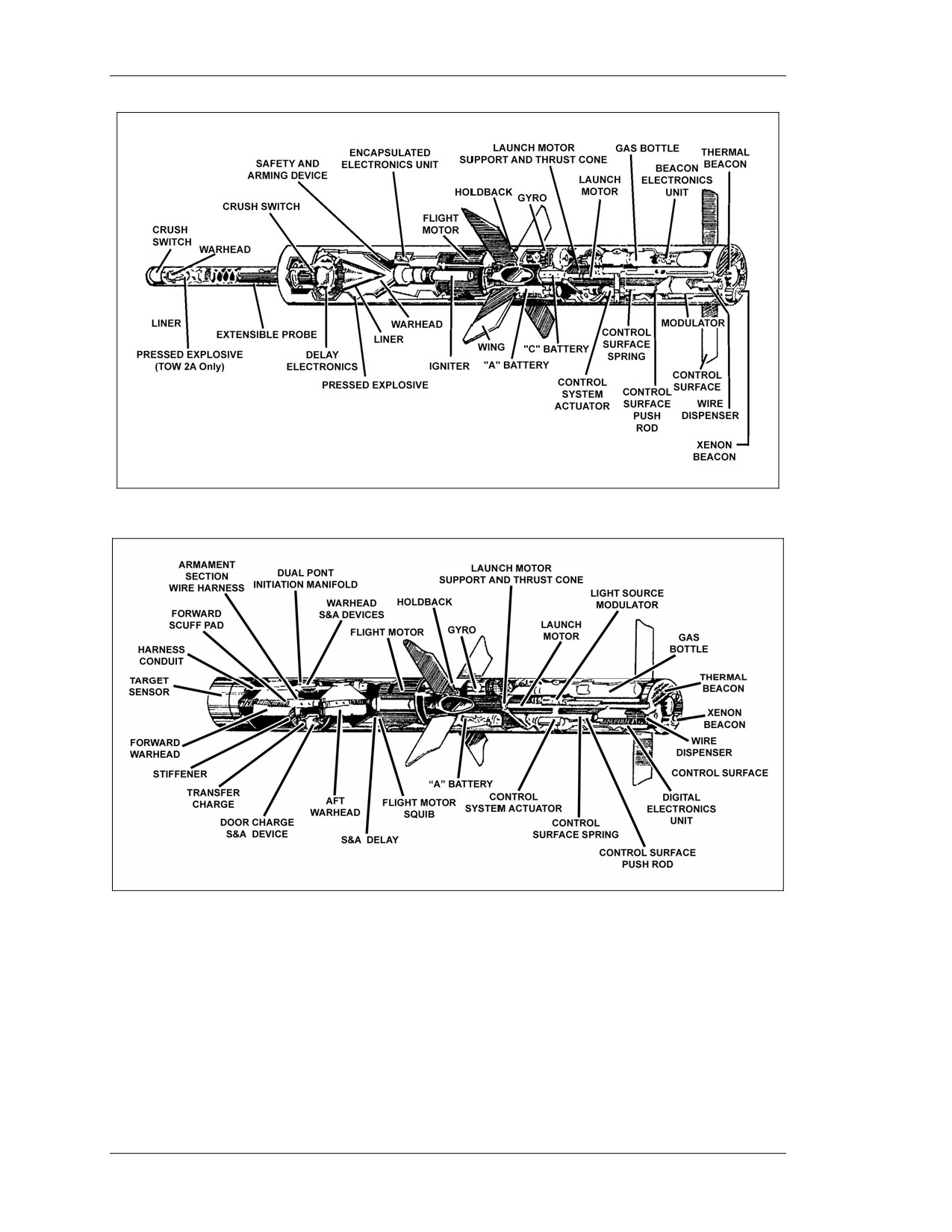
d. TOW 2A (BGM-71E). The TOW 2A has the same characteristics as the TOW 2,
except with the addition of a precursor charge on the extensible probe. The precursor
charge discharges reactive armor before the main charge impacts
(Figure 2-16,
page 2-22).
e. TOW 2B (BGM-71F). The TOW 2B is a top-attack missile (Figure 2-17,
page 2-22). The missile flies about 2.25 meters above the gunner's line of sight, but the
gunner aims center mass of the target. The missile detects the target by magnetic
signature and optical (laser) profile. The missile's sensors cannot distinguish friendly
from enemy, or destroyed from not destroyed. To prevent premature detonation of the
TOW 2B warheads, crews must ensure that their line of sight is clear of friendly and
destroyed vehicles. The TOW
2B has two 5-inch warheads that, when detonated,
explosively form two high-density tantalum penetrators.
2-21
FM 3-22.1
Figure 2-16. TOW 2 and TOW 2A missiles.
Figure 2-17. TOW 2B missile.
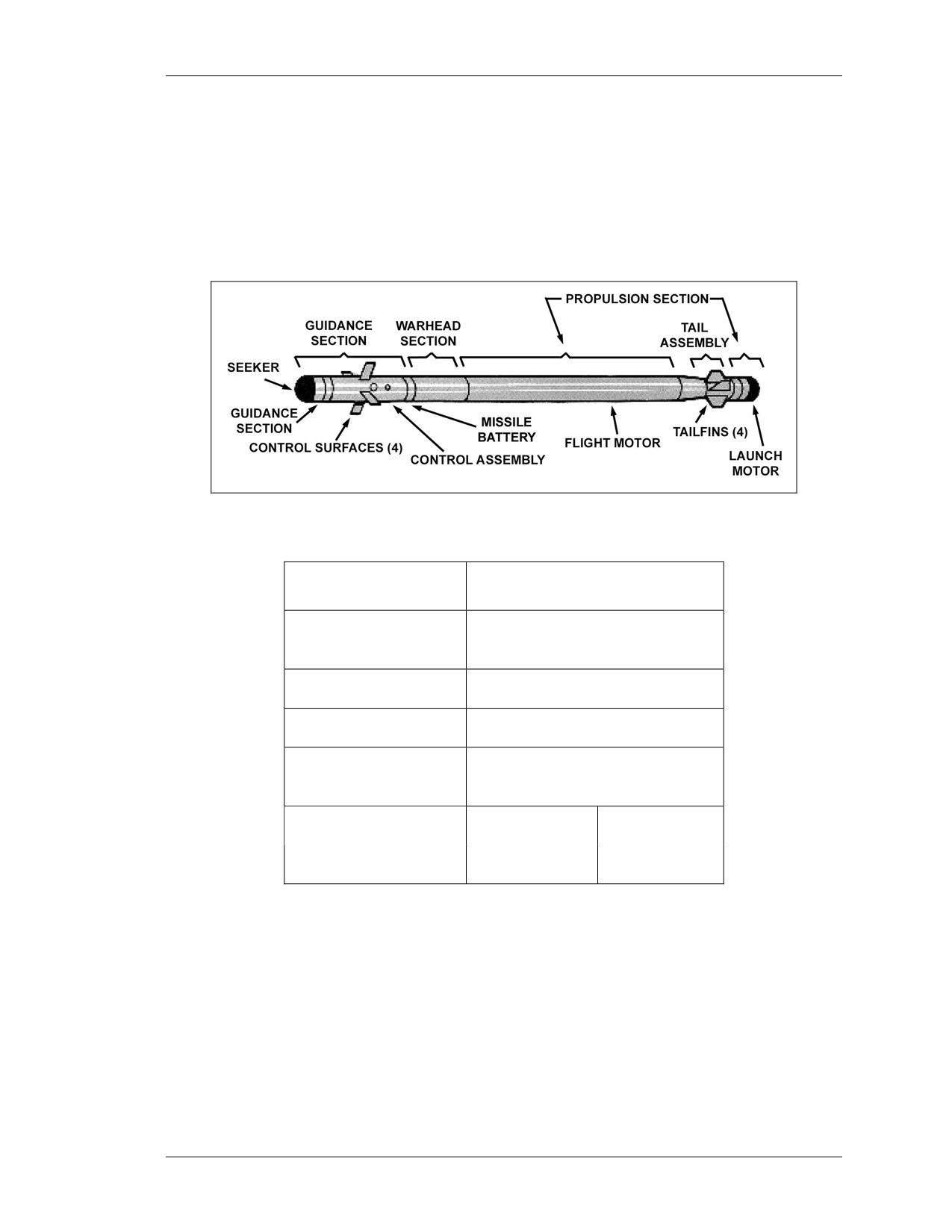
2-10. STINGER MISSILE
The Stinger missile is a fire-and-forget missile whose basic version is a passive infrared
homing missile. The more advanced version, the Stinger RMP, is a dual-mode homing
missile that uses data from infrared (IR) and ultraviolet (UV) detectors. The Stinger
missile round consists of a guidance section, warhead, flight motor, and launch motor.
The guidance section contains the seeker head, guidance assembly electronics, control
electronics, and control surfaces. The warhead is a small HE charge. The missile uses IR
or UV homing to track its target. The launch motor ejects the missile from the launch
2-22
FM 3-22.1
tube. The missile coasts a short distance, then the flight motor propels it in flight. The
launch motor expends and separates from the flight motor before the missile leaves the
launch tube. The expended motor drops at a safe distance outside the launch tube. Also,
at separation, a lanyard attached to the launch motor pulls the shorting plug from the
flight-motor's ignition circuit. After the missile coasts a safe distance, the flight motor
ignites. The missile self-destructs if it has not hit a target after 17 seconds of flight time
(Figure 2-18 and Table 2-4).
Figure 2-18. Stinger missile round.
Speed:
Supersonic
Weight:
28.1 pounds.
(without gripstock)
Length:
60 inches
Diameter:
2.75 inches
Maximum
4,000+ meters
Effective Range:
Backblast
Personnel
50 meters
Clearance:
Equipment
5 meters
Table 2-4. Characteristics of the Stinger missile.
2-11. M231 5.56-MM FIRING PORT WEAPON
The ammunition for the FPW is the M196 tracer. Its rapid rate of fire allows squad
members to use the TOT method of adjusting fire to suppress the target. When training,
the squad uses the M200 blank round and the M22 blank firing device. (TM 9-1005-309-
10 provides more operator information.) M193, M855 ball, and M856 ammunition are
incompatible with the FPW. They work in the M249 SAW and the M16A2 rifle.
2-23
///////////////////////////////////////