3-22.1 (FM 23-1) BRADLEY GUNNERY (NOVEMBER 2003) - page 5

FM 3-22.1
ELEMENT
BRADLEY COMMANDER
GUNNER
DRIVER
Termination
Announce "CEASE FIRE"
Announce "DRIVER BACK"
Cease fire
Move vehicle to hull defilade
position
Consolidation
Ensure RBD is in the correct
Ensure that the IBAS has no
Check instrument panel for
position *
faults *
status
Check CTD for advisories *
Select battlecarry
Ensure vehicle is in neutral
Clean plenum chamber
Ensure 25-mm gun BPI is in
Release handbrake
sear and that SCB/WCB
sear light is on
Ensure weapon system is set
to electrical safe
Ensure IBAS or ISU is set to
Ensure viewer operates
low magnification (no zoom
applied) *
Ensure TOW launcher is up
Crew reports
Report "CREW REPORT"
Ensure all annunciator warning
lights are off
Report "BC Up"
Report "Gunner Up"
Report "Driver up"
Report "Set" to higher
* A3-specific information.
Table 6-7. Crew duties, multiple engagements in the defense (continued).
6-70

FM 3-22.1
6-41. OFFENSIVE ENGAGEMENTS
Table 6-8 shows multiple engagements in the offense.
ELEMENT
BRADLEY COMMANDER
GUNNER
DRIVER
Pre-mission
Conduct pre-mission and
Conduct pre-mission and
Conduct pre-mission and
prefire checks
prefire checks
PMCS
Ensure RBD is in the correct
Ensure that there are no faults
Check instrument panel for
position *
in the IBAS *
status
Check CTD for advisories *
Select battlecarry
Ensure vehicle is in drive
Ensure 25-mm gun BPI is in
sear and that SCB/WCB
sear light is on
Clean plenum chamber
Ensure weapon system is set
Release handbrake
to electrical safe
Ensure IBAS or ISU is set to
Ensure viewer operates
low magnification (no zoom
applied)
Ensure TOW launcher is
stowed
Crew reports
Report "CREW REPORT"
Ensure all annunciator warning
lights are off
Report "BC Up"
Report "Gunner Up"
Report "Driver up"
Report "Set" to higher
Report "DRIVER MOVE OUT,"
gunner scan
Starts scanning
Move out and sets steady
platform
Beginning of
Begin target scan
Begin target scan
engagement
Acquire target(s)
Report acquisition of target
Report acquisition of target
Identify target
Classify target
Discriminate target
Alert
Announce "GUNNER"
Respond to alert
Respond to alert
Lays gunner on target by
directional means if desired
Weapon and
Announce battlesight.
ammunition
Announce weapon and
ammunition
Select weapon and
ammunition; arm weapon
Description
Describe target
Ensure weapon is ready and
set to low magnification;
assume correct posture
Direction
Announce "Identified"; Ensure
(optional)
he has identified the correct
target
Confirm target
* A3-specific information.
Table 6-8. Crew duties, multiple engagements in the offense.
6-71

FM 3-22.1
ELEMENT
BRADLEY COMMANDER
GUNNER
DRIVER
Direction
Announce "Cannot identify";
(optional,
cue commander to place you
continued)
on target
Implement directional
techniques or take command
of the turret
If target designate is used,
see Chapter 2 *
Ensure correct sight picture,
weapon, and ammunition
Range
Select high magnification
(2x, 4x) and lases *
Announce range
Ensure gunner has the correct
range. If not, tell him to re-lase
or to manually induce range
Verify correct sight picture,
correct range, correct ammo
Ensure that crew has the
ready-to-fire box *
Execution
Announce command of
Verify reticle lay
execution
Announce "On the way"
Fire
Count rounds (optional)
Watch rounds and announce
Announce observations; adjust
Observe sector for additional
adjustments; select CIV and
rounds as needed
targets and impact of rounds
scan battlefield for additional
targets *
Observation or
Announce "Target destroyed"
response
(optional)
Announce "CEASE FIRE"
Direction
Implement directional
Cease fire
(optional)
techniques or take command
of the turret
Weapon and
Announce weapon and
ammunition
ammunition if changed
If changed, select weapon and
ammunition; arm weapon
Describe target
Ensure weapon is ready and
set to low magnification;
assume correct posture
* A3-specific information.
Table 6-8. Crew duties, multiple engagements in the offense (continued).
6-72

FM 3-22.1
ELEMENT
BRADLEY COMMANDER
GUNNER
DRIVER
Direction
Announce "Identified"; ensure
(optional)
that you have identified the
correct target
Confirm target
Announce "Cannot identify";
cue commander to place you
on target
Implement directional
techniques or take command
of the turret
Ensure correct sight picture,
weapon, and ammunition
Select high (2x,4x) and lase *
Range
Announce range
Ensure gunner has the correct
range; if not, tell gunner to re-
lase or to manually induce
range
Verify correct sight picture,
correct range, and correct
ammo
Ensure that crew has the
ready-to-fire box
Execution
Announce command of
Verify reticle lay
execution
Announce "On the way"
Fire
Count rounds (optional)
Watch rounds and Announce
Announce observations; adjust
Observe sector for additional
adjustments; Select CIV and
rounds as needed
targets and impact of rounds
scan battlefield *
Observation or
Announce "Target destroyed"
response
(optional)
Select IBAS and ensure that
the target is destroyed *
Scan and ensure that all
targets engaged have been
destroyed
Termination
Announce "CEASE FIRE"
Announce "DRIVER BACK"
Consolidation
Ensure RBD is in the correct
Ensure that the IBAS has no
Check instrument panel for
position *
faults *
status
* A3-specific information.
Table 6-8. Crew duties, multiple engagements in the offense (continued).
6-73

FM 3-22.1
ELEMENT
BRADLEY COMMANDER
GUNNER
DRIVER
Consolidation
Check CTD for advisories *
Select battlesight
Ensure viewer operates
(continued)
Ensure 25-mm gun BPI is in
sear and that SCB/WCB
sear light is on
Clean plenum chamber
Ensure weapon system is set
to electrical safe
Ensure IBAS or ISU is set to
low magnification (no zoom
applied) *
Ensure TOW launcher is
stowed
Crew reports
Report "CREW REPORT"
Ensure all annunciator warning
lights are off
Report "BC up"
Report "Gunner up"
Report "Driver up"
Report "Set" to higher
* A3-specific information.
Table 6-8. Crew duties, multiple engagements in the offense (continued).
6-74
FM 3-22.1 (23-1)
CHAPTER 7
Preliminary Gunnery
Before conducting crew and tactical gunnery, crews, squads, sections,
and platoons must develop proficiency in individual and collective tasks.
They gain this proficiency by training in specified elementary gunnery
tasks and soldier skills. Preliminary gunnery introduces new
crewmembers to BFV gunnery and sustains the skills of experienced
crewmembers. Commanders conduct it year-round at the home station. It
consists of both classroom instruction and hands-on training. Squad
training should parallel Bradley preliminary gunnery training.
Section I. BASIC INSTRUCTION
Before crewmembers progress to hands-on training with vehicle systems, they must
receive basic classroom instruction. Classroom subjects include BFV basic subjects,
gunnery, and platoon training. Figure 7-1 shows BFV basic subjects, gunnery training,
and platoon training.
CLASSROOM SUBJECTS
1. Basic capabilities of the 25-mm, 7.62-mm, and TOW.
2. BFV range card.
3. Gun theory and weapons system functions.
4. Boresight and zero procedures.
5. Target acquisition and range determination.
6. Combat vehicle identification.
7. Fire commands.
8. Methods of engagement.
9. Engagement techniques.
10. FBCB2 training.
CREW GUNNERY TRAINING
1. Organization of gunnery training.
2. Gunnery exercises and standards.
3. Training devices.
4. Direct-fire adjustment.
5. TOW gunnery training.
RIFLE INFANTRY PLATOON TRAINING
1. Sector sketches (section and platoon).
2. Fire control and distribution.
3. Platoon fire commands.
4. Crew drills.
5. Battle drills.
ALL BRADLEY UNITS
1. Infantry.
2. Cavalry.
3. Air-defense artillery.
4. Engineer.
5. Bradley fire-support team.
Figure 7-1. Basic instruction.
7-1
FM 3-22.1
7-1. HANDS-ON TRAINING
Hands-on training lets crewmembers apply what they learned during preliminary gunnery
instruction. Crewmembers use their vehicles and equipment for hands-on training. (They
can use thru-sight video to get more detail for the AAR.)
a. Introductory Manipulation Training. During introductory manipulation
training, crewmembers learn about the turret-drive systems and the handstation. They
learn how the turret responds to their use of the handstation in the power (normal and
fast-turret) modes and how it responds in the manual mode. Manipulation combines eye-
hand coordination and reinforcement training. The two types of manipulation include
gun lay and tracking.
b. Gun-Lay Exercise. Gun lay requires the BC to lay the turret weapons systems on
the target. This allows the gunner to adjust onto the target. The emphasis is on the speed
and accuracy of the lay. The gun-lay exercise develops a BC's skill to use his handstation
and to use oral-direction terms for the gunner to lay the gun on the target while issuing a
fire command.
(1) Task. Lay the BFV's turret weapons systems on a target.
(2) Conditions. Given a fully operational BFV and a suitable exercise area with at
least ten scaled targets.
(3) Standards. The BC must correctly lay the weapons systems on eight of ten targets
using the commander's handstation and eight of ten targets using oral-direction terms. The
BC must place each target within the gunner's field of view, in high magnification, within
five seconds. Bradley A3 crews will conduct gun-lay exercises without the use
of the CIV.
(4) Conduct of the Exercise and Evaluation Procedures. The gun-lay exercise will
work in any area that measures at least 100 meters in depth and 50 meters in width.
(a) Targets must accurately represent an enemy force. The recommended target model
size is 1/35-scale; however, if a larger area is available, then larger targets may be used.
(b) The scaled targets are placed at ranges IAW Table 7-1. Targets are numbered and
lettered. Numbers must be visible to the naked eye; letters will only be visible in high
magnification.
(c) The evaluator announces the target number to the BC. The BC lays the weapon on
the target. The gunner says "Identified" and the letter of the target in response to
fire commands.
(d) The crewmember must complete the gun-lay exercise in the power mode using the
primary and auxiliary sights. The exercises progress in difficulty as the BC becomes
more proficient.
7-2

FM 3-22.1
SCALED
RANGES
COMBAT
RANGE
1/2
1/5
1/10
1/20
1/30
1/35
1/60
(METERS)
(METERS)
(FEET)
(METERS)
(FEET)
(FEET)
(FEET)
(FEET)
500
250
330
50
82
55
47
27
600
300
380
60
99
66
56
33
700
350
464
70
115
76
66
38
800
400
470
80
132
87
75
44
900
450
592
90
148
98
84
49
1,000
500
660
100
165
110
94
55
1,100
550
724
110
181
120
103
60
1,200
600
792
120
198
131
113
66
1,300
650
856
130
214
142
122
71
1,400
700
924
140
231
154
132
77
1,500
750
990
150
247
164
141
82
1,600
800
1,060
160
264
176
150
88
1,700
850
1,120
170
280
186
160
93
1,800
900
1,192
180
297
198
169
99
1.900
950
1,256
190
313
208
179
104
2,000
1,000
1,320
200
330
220
188
110
2,100
1,050
1,388
210
346
230
198
115
2,200
1,100
1,450
220
363
242
207
121
2,300
1,150
1,520
230
379
250
216
126
2,400
1,200
1,588
240
396
264
226
132
2,500
1.250
1,650
250
412
274
235
137
2,600
1,300
1,720
260
429
286
245
143
2,700
1,350
1,780
270
445
296
254
148
2,800
1,400
1,850
280
462
308
264
154
2,900
1,450
1,915
290
478
318
273
159
3,000
1,500
1,980
300
495
330
282
165
Table 7-1. Combat and scaled ranges.
7-3
FM 3-22.1
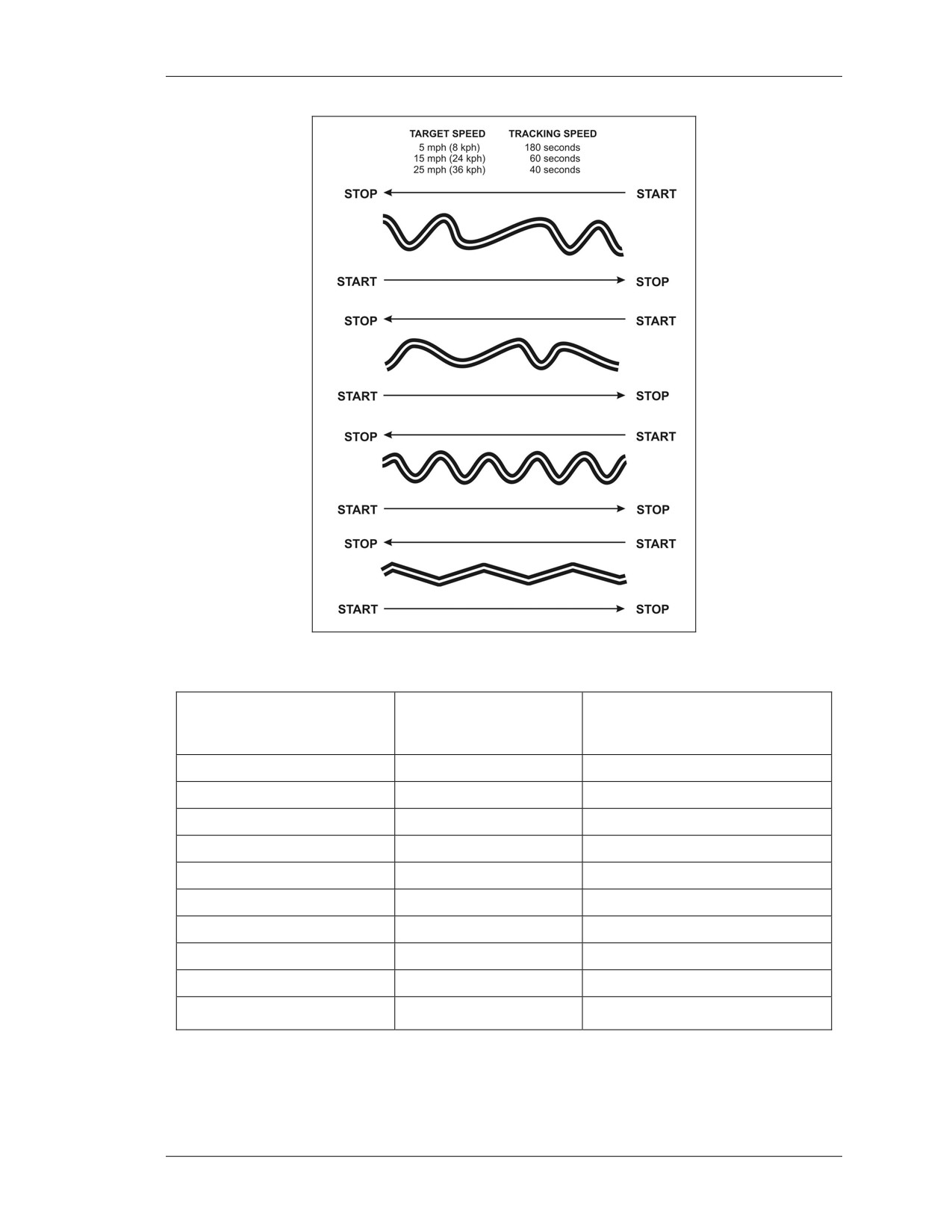
c. Tracking Exercise. The tracking exercise requires the gunner and BC to move
the sight reticle and TOW crosshair along a predetermined path. The BC must track with
the CIV along the same predetermined path. This path requires the gunner and BC to
make horizontal and vertical changes while tracking. Emphasis is on tracking accuracy.
The BC and gunner must track quickly and accurately in the power mode from the BC's
and gunner's handstations and in the manual mode from the gunner's position.
(1) Task. Manipulate turret.
(2) Conditions. Given a fully operational BFV and tracking board (Figure 7-2),
placed at the proper tracking line distance IAW Table 7-2 (Bradley-to-target distance).
(3) Standards. The BC and gunner must negotiate each tracking line, keeping the
1-mil aiming circle or TOW crosshair between the parallel tracking lines, within the time
standards in Figure 7-2. The reticle aiming point or crosshair must not move outside the
parallel lines more than three times on each tracking exercise. The exercise is conducted
by both the BC and gunner from their handstations and by the gunner in the manual mode
using the 25-mm reticle and TOW crosshair.
(4) Conduct of the Exercise and Evaluation Procedures. The tracking exercise will
work in any area that can meet the Bradley-to-target distance (Table 7-2).
(a) Evaluators assess each crewmember separately. He watches and evaluates the
exercise through an available sight such as the commander's sight extension or the
gunner's sight. On an A3, the evaluator uses the squad leader's display (SLD).
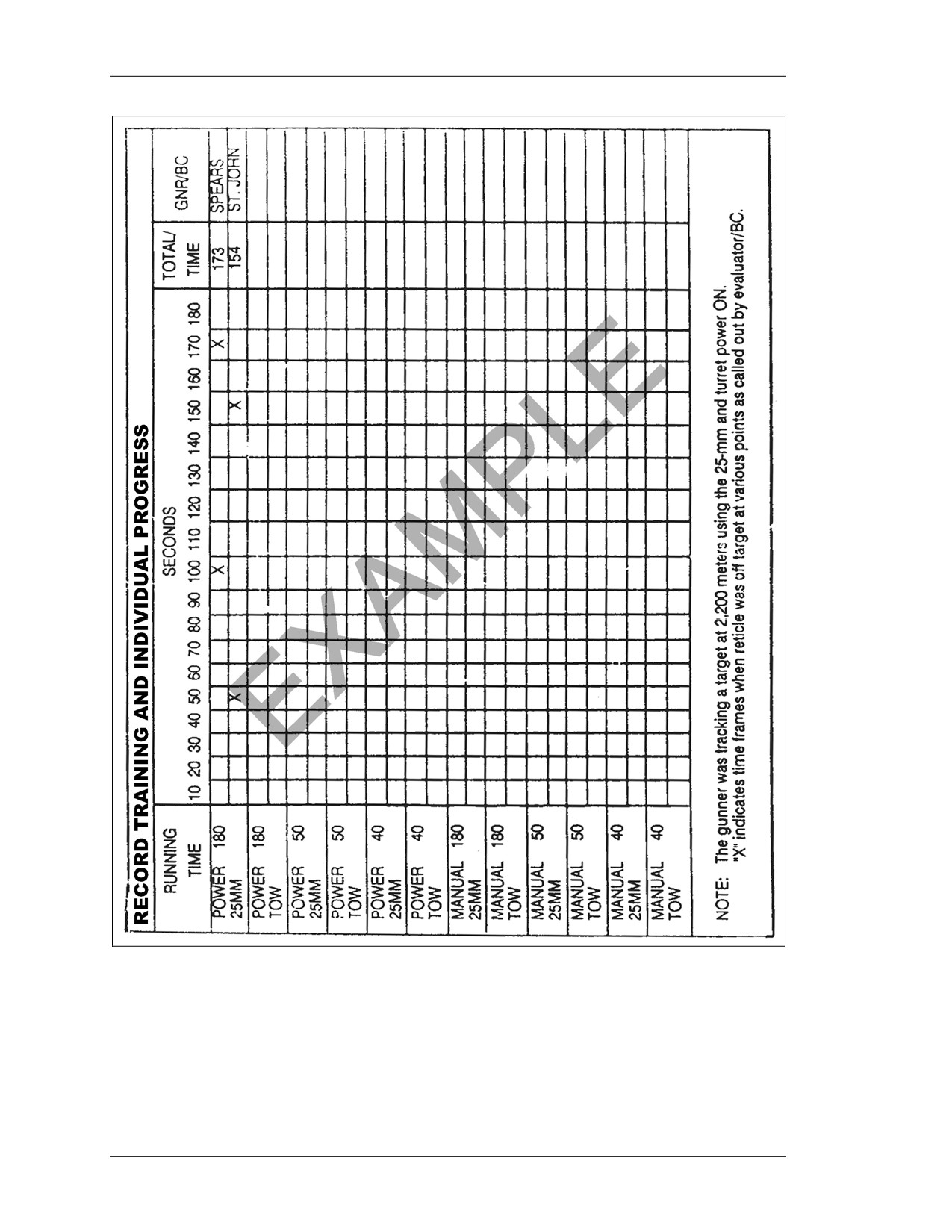
(b) Figure 7-3, page 7-6, shows an example format for a scoresheet used to record
training and individual progress.
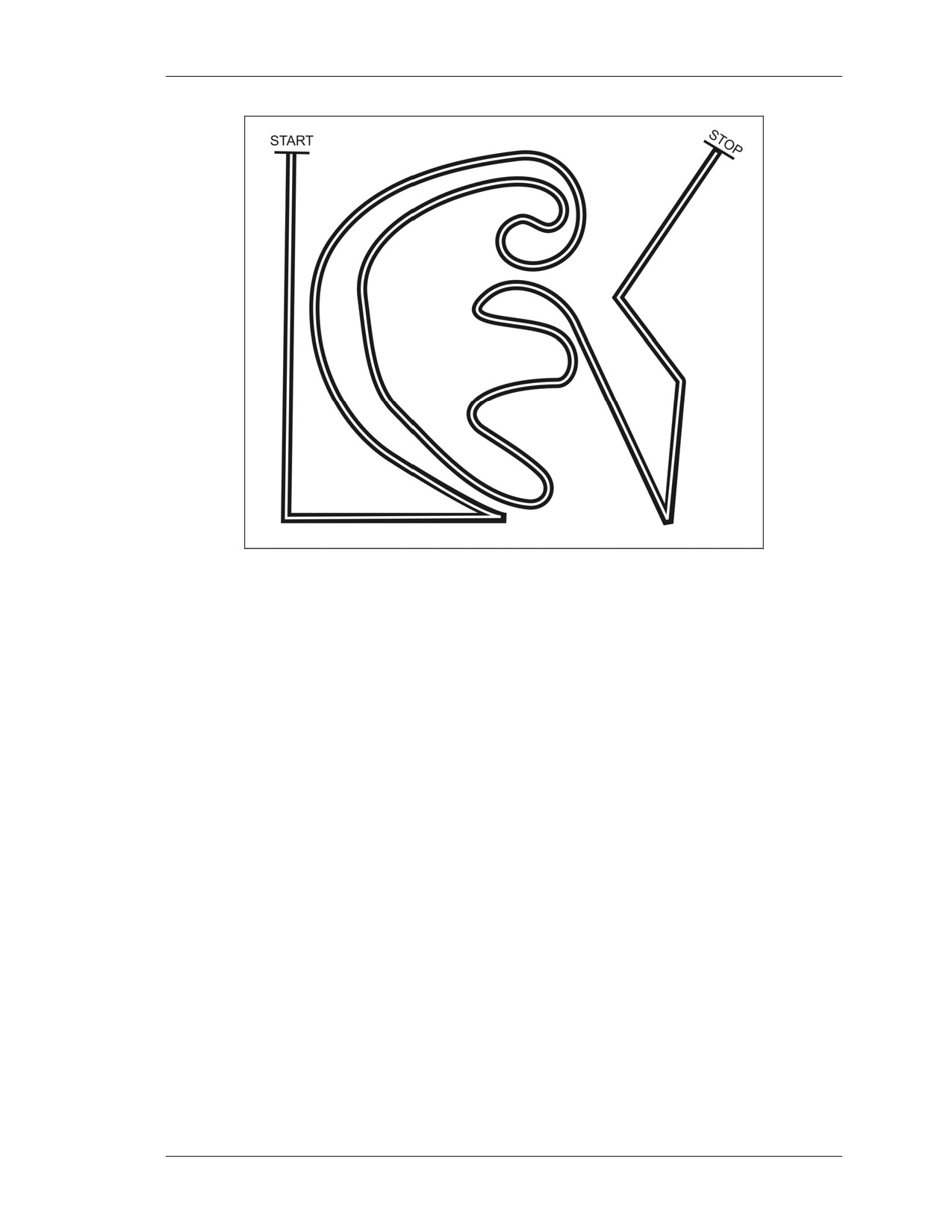
(c) After a crewmember's proficiency increases, the evaluator has him use the
advanced tracking pattern shown in Figure 7-4, page 7-7. Using this pattern requires the
crewmember to manipulate the turret with all combinations of vertical and horizontal
axes. Timing is based on the crew's previous performance of negotiating the pattern. This
time is used as a standard for improvement.
7-4
FM 3-22.1
Figure 7-2. Manipulation tracking line (tracking board).
BRADLEY-T0-TRACKING
LINE DISTANCE
LENGTH OF TARGET
WIDTH BETWEEN PARALLEL
(METERS)
LINE (METERS)
LINES (MILLIMETERS)
5
1.67
14.7
10
3.33
29.4
15
5.00
44.1
20
6.67
58.8
25
8.33
73.5
30
10.00
88.2
35
11.67
102.9
40
13.33
117.6
45
15.00
132.3
50
16.67
147.0
Table 7-2. Bradley-to-target distance.
7-5
FM 3-22.1
Figure 7-3. Example format for scoresheet.
7-6
FM 3-22.1
Figure 7-4. Advanced manipulation-tracking line (tracking board).
(5) Advanced Manipulation and Target-Acquisition Training. Advanced manipula-
tion and target-acquisition training builds on skills developed during the tracking
exercise. For the first time, crews apply the target-acquisition process. The conduct of fire
trainer (COFT) incorporates ten special-purpose exercises that help develop and reinforce
the crew's ability to detect, identify, and track moving targets. The A3 BATS has four
acquisition and manipulation exercises: search, detect, locate, and identify. Unlike the
COFT, the BATS allows the I/O to input special-purpose conditions, for which the BATS
then randomly generates a customized exercise based on the crew's training needs.
7-2. RANGE-DETERMINATION TRAINING
During preliminary gunnery instruction, BCs and gunners learn the various techniques for
determining range. During the range-determination exercise, the BC and gunner apply
some of these techniques.
a. Task. Determine range using common Bradley equipment.
b. Conditions. Given a fully operational BFV, one set of M22 binoculars, and an
exercise area with targets and known distances to the targets.
c. Standards. Determine the range to targets within 100 meters.
(1) Bradley Commander. Determine the range to four of five targets using
M22 binoculars.
(2) Gunner. Determine range to four of five targets while using the primary sight, and
also determined four of five targets while using the auxiliary sight.
d. Conduct of the Exercise and Evaluation Procedures. The range determination
exercise can be conducted at the gun-lay exercise site. Targets must accurately represent
7-7
FM 3-22.1
the enemy force. The recommended target model size is 1/35-scale; however, if a larger
training area is available, then larger targets may be used.
7-3. DIRECT-FIRE-ADJUSTMENT EXERCISES
Direct-fire-adjustment exercises train the assigned BC and gunner in the fundamentals of
direct-fire adjustment. These exercises require the gunner and BC to use methods of fire
adjustment. An error induced into the fire-control system ensures a first-round miss.
Because the exercises are conducted in the COFT, improper range must be indexed
before the crew begins the exercise (Figures 7-5, 7-6, 7-7, and 7-8, pages 7-9 thru -12).
a. Task. Employ direct-fire adjustment techniques from a stationary and moving
BFV against stationary and moving targets.
b. Conditions. Given a stationary and moving BFV (through COFT simulation).
c. Standards. Adjusted fire from a first-round miss from both the BC's and gunner's
positions, using both power and manual modes, and using the primary and auxiliary
sights. Used correct adjustment techniques. Hit target with the second round. To qualify
on the exercise, crewmember must have first qualified on each task.
d. Conduct of the Exercise and Evaluation Procedures. While using
predetermined exercises, the I/O must ensure that the crew uses no more than ten rounds
for each five-target task (two rounds for each target). The crew cannot offset the boresight
knobs in the COFT unless they are actually boresighting (Appendix B). To induce an
error into the system, the I/O must either rely on the crewmember setting elevation or
deflection or the BC to incorrectly estimate range. For exercises in the defense, and when
engaging stationary targets, crews index 600 meters to ensure a first-round miss. For
moving BFV and moving target exercises, the crew indexes 1,200 meters.
7-8

FM 3-22.1
CONDITIONS
STANDARDS
EXERCISE
TARGET,
CREW
NUMBER
TASK
SITUATION
AMMO
HITS
DUTIES
RATING
53211
1. Adjust direct-
5 stationary
10
3 to 5
SAT
Q
fire using the
targets,
rounds
0 to 2
UNSAT
U
gunner’s
day only
primary or
auxiliary sight.
41211
2. Adjust direct-
5 stationary
10
3 to 5
SAT
Q
fire using the
targets,
rounds
0 to 2
UNSAT
U
CSE.
day only
53311
3. Adjust direct-
5 moving
10
3 to 5
SAT
Q
fire using the
targets,
rounds
0 to 2
UNSAT
U
gunner’s
day only
primary or
auxiliary sight.
41311
4. Adjust direct-
5 moving
10
3 to 5
SAT
Q
fire using the
targets,
rounds
0 to 2
UNSAT
U
CSE.
day only
53221
5. Adjust direct-
5 stationary
10
3 to 5
SAT
Q
fire using the
targets,
rounds
0 to 2
UNSAT
U
gunner’s
night only
primary sight.
41221
6. Adjust direct-
5 stationary
10
3 to 5
SAT
Q
fire using the
targets,
rounds
0 to 2
UNSAT
U
CSE.
night only.
53321
7. Adjust direct-
5 moving
10
3 to 5
SAT
Q
fire using the
targets,
rounds
0 to 2
UNSAT
U
gunner’s
night only
primary sight.
41321
8. Adjust direct-
5 moving
10
3 to 5
SAT
Q
fire using the
targets,
rounds
0 to 2
UNSAT
U
CSE.
night only
Figure 7-5. Direct-fire adjustment exercise, Group 1.
7-9

FM 3-22.1
CONDITIONS
STANDARDS
EXERCISE
TARGET,
CREW
NUMBER
TASK
SITUATION
AMMO
HITS
DUTIES
RATING
53251
1. Adjust direct-
5 stationary
10
3 to 5
SAT
Q
fire using the
targets,
rounds
0 to 2
UNSAT
U
gunner’s
day only
primary or
auxiliary sight.
41231
2. Adjust direct-
5 stationary
10
3 to 5
SAT
Q
fire using the
targets,
rounds
0 to 2
UNSAT
U
CSE.
day only
53351
3. Adjust direct-
5 moving
10
3 to 5
SAT
Q
fire using the
targets,
rounds
0 to 2
UNSAT
U
gunner’s
day only
primary or
auxiliary sight.
41331
4. Adjust direct-
5 moving
10
3 to 5
SAT
Q
fire using the
targets,
rounds
0 to 2
UNSAT
U
CSE.
day only
5. Adjust direct-
5 stationary
10
3 to 5
SAT
Q
fire using the
targets,
rounds
0 to 2
UNSAT
U
gunner’s
night only
primary sight.
6. Adjust direct-
5 stationary
10
3 to 5
SAT
Q
fire using the
targets,
rounds
0 to 2
UNSAT
U
CSE.
night only.
7. Adjust direct-
5 moving
10
3 to 5
SAT
Q
fire using the
targets,
rounds
0 to 2
UNSAT
U
gunner’s
night only
primary sight.
8. Adjust direct-
5 moving
10
3 to 5
SAT
Q
fire using the
targets,
rounds
0 to 2
UNSAT
U
CSE.
night only
Figure 7-6. Direct-fire adjustment exercise, Group 2.
7-10

FM 3-22.1
CONDITIONS
STANDARDS
EXERCISE
TARGET,
CREW
NUMBER
TASK
SITUATION
AMMO
HITS
DUTIES
RATING
53411
1. Adjust direct-
5 stationary
10
3 to 5
SAT
Q
fire using the
targets,
rounds
0 to 2
UNSAT
U
gunner’s
day only
primary or
auxiliary sight.
41411
2. Adjust direct-
5 stationary
10
3 to 5
SAT
Q
fire using the
targets,
rounds
0 to 2
UNSAT
U
CSE.
day only
53511
3. Adjust direct-
5 moving
10
3 to 5
SAT
Q
fire using the
targets,
rounds
0 to 2
UNSAT
U
gunner’s
day only
primary or
auxiliary sight.
41511
4. Adjust direct-
5 moving
10
3 to 5
SAT
Q
fire using the
targets,
rounds
0 to 2
UNSAT
U
CSE.
day only
53421
5. Adjust direct-
5 stationary
10
3 to 5
SAT
Q
fire using the
targets,
rounds
0 to 2
UNSAT
U
gunner’s
night only
primary sight.
41421
6. Adjust direct-
5 stationary
10
3 to 5
SAT
Q
fire using the
targets,
rounds
0 to 2
UNSAT
U
CSE.
night only.
53521
7. Adjust direct-
5 moving
10
3 to 5
SAT
Q
fire using the
targets,
rounds
0 to 2
UNSAT
U
gunner’s
night only
primary sight.
41521
8. Adjust direct-
5 moving
10
3 to 5
SAT
Q
fire using the
targets,
rounds
0 to 2
UNSAT
U
CSE.
night only
Figure 7-7. Direct-fire adjustment exercise, Group 3.
7-11

FM 3-22.1
CONDITIONS
STANDARDS
EXERCISE
TARGET,
CREW
NUMBER
TASK
SITUATION
AMMO
HITS
DUTIES
RATING
53451
1. Adjust direct-
5 stationary
10
3 to 5
SAT
Q
fire using the
targets,
rounds
0 to 2
UNSAT
U
gunner’s
day only
primary or
auxiliary sight.
41431
2. Adjust direct-
5 stationary
10
3 to 5
SAT
Q
fire using the
targets,
rounds
0 to 2
UNSAT
U
CSE.
day only
53351
3. Adjust direct-
5 moving
10
3 to 5
SAT
Q
fire using the
targets,
rounds
0 to 2
UNSAT
U
gunner’s
day only
primary or
auxiliary sight.
41531
4. Adjust direct-
5 moving
10
3 to 5
SAT
Q
fire using the
targets,
rounds
0 to 2
UNSAT
U
CSE.
day only
5. Adjust direct-
5 stationary
10
3 to 5
SAT
Q
fire using the
targets,
rounds
0 to 2
UNSAT
U
gunner’s
night only
primary sight.
6. Adjust direct-
5 stationary
10
3 to 5
SAT
Q
fire using the
targets,
rounds
0 to 2
UNSAT
U
CSE.
night only.
7. Adjust direct-
5 moving
10
3 to 5
SAT
Q
fire using the
targets,
rounds
0 to 2
UNSAT
U
gunner’s
night only
primary sight.
8. Adjust direct-
5 moving
10
3 to 5
SAT
Q
fire using the
targets,
rounds
0 to 2
UNSAT
U
CSE.
night only
Figure 7-8. Direct-fire adjustment exercise, Group 4.
Section II. TOW TRAINING
The TOW training program teaches the crew to engage, track, and destroy armored
targets using the TOW missile system. They must complete this training, which consists
of basic TOW gunnery tasks; tracking exercises; and specified COFT or BATS exercises
within three months (four months for RC) before they fire live TOWs.
7-4. BASIC TASKS
Basic TOW tasks allow crewmembers to train hands-on while on their vehicles. Before
firing a live missile, crewmembers must operate, prepare to load, load, fire, perform
immediate action on, remove a misfired round from, and manually raise the launcher.
7-12
FM 3-22.1
7-5. OPERATION IN POWER MODE
To operate the TOW launcher power mode--
a. Task. Raise, elevate, depress, and lower the TOW launcher in the power mode.
b. Conditions. Given an operational Bradley.
c. Standards. Within three minutes, crewmember raised, elevated, depressed, and
lowered the TOW launcher.
d. Performance Measures. Completed the performance measures within
three minutes.
(1) Raised the TOW launcher.
(a) Moved turret-traverse drive-select lever to POWER position.
(b) Moved LAUNCHER UP-DN switch to UP.
(c) Squeezed palm switches until launcher stopped moving and LAUNCHER UP
indicator light came on.
(d) Released palm switches.
(e) Pressed TOW button.
(2) Elevated TOW launcher.
(a) Squeezed and held palm switches.
(b) Rotated gunner's control handles toward you until launcher reached desired
position or stopped.
(c) Centered gunner's control handles and released palm switches.
(3) Depressed TOW launcher.
(a) Squeezed and held palm switches.
(b) Rotated gunner's control handles away from you until launcher reached desired
position or stopped.
(c) Centered gunner's control handles and released palm switches.
(4) Lowered the TOW launcher.
(a) Moved LAUNCHER UP-DN switch to DN.
(b) Squeezed palm switches until LAUNCHER UP indicator light went out and
launcher stowed against turret.
(c) Released palm switches.
7-6. PREPARATION FOR LOADING
To prepare the TOW launcher for loading--
a. Task. Perform the procedures for preparing the TOW launcher for loading.
b. Conditions. Given an operational Bradley with the TOW launcher stowed.
c. Standards. Within one minute, prepared the TOW launcher for loading.
d. Performance Measures. Prepared the TOW launcher for loading. Completed
performance measures within one minute.
(1) Turned the turret power on.
(2) Turned the turret drive on.
(3) Raised TOW launcher.
(4) Traversed to TOW LOAD position (5950 mils).
(5) Elevated the launcher to 500 mils.
(6) Set the turret travel lock.
(7) Moved the turret drive switch to OFF.
7-13
FM 3-22.1
7-7. LOADING PROCEDURES
To load the TOW launcher--
a.
Task. Perform the procedures for loading the TOW launcher on a BFV.
b.
Conditions. Given an operational Bradley with the TOW launcher prepared for
loading and dummy TOW rounds mounted in the vertical racks.
c.
Standards. Within four minutes, the crewmember will load the TOW launcher.
d.
Performance Measures. Load the TOW launcher. Complete performance
measures within four minutes.
(1) Opened the cargo hatch cover to the second position.
(2) Removed the dust cover from the launcher.
(3) Pushed and held lock handles to the left; pulled down loading handles.
(4) Removed any obstruction from the tubes.
(5) Ensured the umbilical connectors did not extend down into the launch tubes.
(6) Unstowed the TOW missiles from vertical stowage.
(7) Removed the forward ring from the nose end.
(8) Removed the electrical connector cover.
(9) Inspected front and rear diaphragms for damage and humidity indicator color.
(10) Loaded two TOW missiles into the launcher.
(11) Ensured that the loading handles were locked.
(12) Closed the cargo hatch; told the gunner that loading was complete.
7-8. FIRE AND IMMEDIATE ACTION
To fire and apply immediate action on a TOW--
a.
Task. Fire and apply immediate action on a TOW.
b.
Conditions. Given an operational Bradley with the TOW launcher erect.
c.
Standards. Within two minutes, the crewmember--
(1) Prepared the TOW system for firing.
(2) Fired a TOW missile.
(3) Applied immediate action for a TOW misfire.
d. Performance Measures. Fired a TOW missile.
(1) Completed performance measures within two minutes.
(a) Turned on turret power and turret drive.
(b) Moved magnification switch to HIGH MAG.
(c) Checked slope indicator to ensure it was within 10-degree tolerance.
(d) Pressed the TOW button.
(e) Checked TOW and TOW test indicator lights.
(f) Checked to ensure that the lights on the annunciator box and on the TOW control
box were off.
(g) Pressed either the Number 1 or 2 button on the missile tube.
(h) Moved ARM-SAFE-RESET switch to ARM.
(i) Squeezed trigger and palm switches. Released trigger and held palm switches for
five seconds.
NOTE: Evaluator says, "Your missile has failed to fire."
7-14
FM 3-22.1
(2) Applied immediate action on the TOW system.
(a) Announced "Misfire TOW missile, attempting to fire again."
(b) Resqueezed the trigger and palm switches; release trigger; held palm switches for
5 seconds. (If misfire still exists, continue with misfire procedures.)
(c) Moved ARM-SAFE-RESET switch to RESET, then to SAFE.
(d) Reselected TOW by pressing TOW button.
(e) Checked TOW and missile indicators.
(f) Reselected misfired TOW missile.
(g) Checked that annunciator lights on the annunciator box and the TOW control
box were off.
(h) Moved ARM-SAFE-RESET switch to ARM.
(i) Refired the misfired TOW missile.
7-9. REMOVAL OF MISFIRED MISSILE
To remove a misfired TOW missile from the launcher--
a.
Task. Perform the procedures for removing a misfired missile from a
TOW launcher.
b. Conditions. Given an operational Bradley, TOW launcher erected, dummy TOW
round inserted into Tube No. 1, and a yellow flag.
c.
Standards. Within ten minutes, the crew prepared the vehicle, removed the
misfired missile, and followed all safety procedures.
d. Performance Measures. Completed the performance measures within
ten minutes.
(1) Removed the misfired TOW missile.
(2) Moved the ARM-SAFE-RESET switch to RESET, then to SAFE.
(3) Ensured ramp was raised and hatches were closed.
(4) Pivoted hull to 1,600 or 4800 mils while turret stabilization was on.
(5) Elevated the TOW launcher to maximum elevation.
(6) Moved the turret power switch to OFF.
(7) Climbed on top of the hull.
(8) Unlocked the TOW launcher.
(9) Removed the misfired missile from the launcher.
(10) Held the TOW missile by the rear flange.
(11) Carefully pulled the TOW missile straight out of the launcher.
(12) Handed the TOW missile to the helper (driver).
(13) Had the helper move the misfired TOW missile to a safe place, 200 meters away;
marked the position with a stake and yellow flag.
(14) Notified the chain of command of the location of the missile.
7-10. MANUAL PROCEDURE FOR RAISING LAUNCHER
To raise the TOW launcher in manual mode--
a.
Task. Perform the procedures for raising the TOW launcher in the manual mode.
b.
Conditions. Given an operational Bradley with basic issue items.
c.
Standards. Within ten minutes, the crewmember manually erected the
TOW launcher.
7-15
FM 3-22.1
d. Performance Measures. Completed performance measures within ten minutes.
(1) Erected the TOW launcher using the manual mode.
(2) Moved the gun-elevation drive-select lever to the POWER position.
(3) Moved the TOW elevation drive select lever to the MANUAL position.
(4) Removed the spring from the handle.
(5) Manually depressed the TOW launcher to clear the stow pin from the saddle.
(6) Manually raised the TOW launcher to the firing position.
7-11. TRACKING
The crew executed the TOW tracking exercise in conjunction with the 25-mm and
7.62-mm tracking exercises. Evaluators assessed crewmembers on their ability to move
the TOW crosshair along a predetermined path. They evaluated this exercise the same
way they did the 25-mm and 7.62-mm tracking exercises.
7-12. COFT TRAINING
TOW COFT training allows crews to apply what they have learned during preliminary
gunnery training. Crews must acquire, engage, track, and destroy threat-armored targets
within the simulated environment of the COFT. The task, conditions, and standards for
these exercises are in the HB 23-1 series of instructor handbooks for the Bradley COFT.
7-13. BATS TRAINING
The BATS trains and sustains the crew's ability to perform critical M2A3/M3A3
direct-fire-engagement tasks. The BATS training program is based on gunnery doctrine.
For realistic training and evaluation, the BATS simulates gunnery and combat
environments. The commander can structure BATS training around the unit's METL.
Together, these factors make BATS simulated fire seem identical to real live fire.
To design an exercise based on the crew's training needs, the I/O selects "Special-Purpose
Exercise Matrix," then "Exercise by Content."
Section III. STINGER VEHICLE-MOUNTED LAUNCHER
The SVML tasks teach Linebacker crewmen the skills they need to operate the Stinger
subsystem and engage and destroy aerial targets. The crew must complete SVML training
within three months of gunnery training.
7-14. RAISE THE STINGER LAUNCHER
To raise the STINGER launcher--
a.
Task. Raise the Stinger launcher.
b.
Conditions. Given training materials and a fully operational M6 vehicle, with
the following actions already completed:
(1) Turret in POWER mode.
(2) Stinger system in POWER mode.
c.
Standards. Raised the Stinger launcher within two minutes.
d.
Performance Measures.
(1) Rotated SCB MODE switch to LAUNCHER UP position.
7-16
FM 3-22.1
(2) Squeezed and held gunner's palm switches until launcher raised and locked in
up position.
(3) Released gunner's palm switches.
(4) Verified that CDT displayed LAUNCHER UP mode, SVM displayed Stinger
symbols, and SCB displayed no faults.
7-15. LOWER THE STINGER LAUNCHER
To lower the Stinger launcher--
a.
Task. Lower the Stinger launcher.
b.
Conditions. Given training materials and a fully operational M6 vehicle, with
the following actions already completed:
(1) Turret in POWER mode.
(2) Stinger system in POWER mode.
c.
Standards. Lowered the Stinger launcher within two minutes.
d.
Performance Measures.
(1) Rotated SCB MODE switch from LAUNCHER UP to the ON position.
(2) Squeezed and held gunner's palm switches until launcher lowered to the
stowed position.
(3) Released gunner's palm switches.
(4) Verified that the CDT displayed the ON mode, that the SVM displayed Stinger
symbols, and that the SCB displayed no faults.
7-16. LOAD STINGER MISSILES
To load the Stinger launcher--
a.
Task. Load the Stinger launcher.
b.
Conditions. Given training materials and a fully operational M6 vehicle, with
the following actions already completed:
(1) Launcher in launcher up position.
(2) ARM switch on SCB set on SAFE with cover closed.
(3) ARM-SAFE-RESET switch on weapons-control box (WCB) moved to RESET,
then to SAFE.
(4) Turret traversed to 4600 mils.
(5) Missile circuit breaker on Stinger distribution unit (SDU) pulled out.
(6) Travel lock pushed into locked position.
(7) Cargo hatch opened to the upright position.
(8) MODE switch on SCB rotated to ON; CDT display reads ON MODE, HATCH.
(9) INTERFERENCE and SCB FLT lights ON.
(10) CARGO HATCH OVERRIDE switch lifted and held.
(11) SCB FLT light out; CDT not displaying HATCH INTERFERENCE in the
OVERRIDE position.
(12) Gunner's palm switch and stow launcher depressed. Gunner's palm switch
released after launcher stows.
(13) CARGO HATCH OVERRIDE switch released.
(14) TDS switch on OFF.
c.
Standards. Loaded Stinger missiles into the SVML within four minutes.
7-17
FM 3-22.1
d. Performance Measures.
(1) Checked pressure gauges on both coolant bottle to ensure they read at least
3,500 PSI.
(2) Unstowed Stinger missiles from the missile stowage rack.
(3) Performed the first eight of the thirteen critical checks on Stinger missiles.
(4) Opened Stinger launcher access doors.
(5) Removed lower SVML access door.
(6) Inspected SVML.
(7) Loaded Stinger missiles into SVML.
(8) Installed lower SVML access door.
(9) Closed upper and lower SVML access doors.
(10) Closed Stinger launcher's armored access doors.
(11) Raised launcher to launcher up position.
7-17. UNLOAD STINGER MISSILES
To unload the Stinger--
a.
Task. Unload the Stinger launcher.
b.
Conditions. Given a fully operational M6 Linebacker with Number One and
Number Two missiles loaded, and with the following actions also already completed:
(1) Launcher in launcher up position.
(2) ARM switch on SCB set on SAFE with cover closed.
(3) WCB ARM-SAFE-RESET switch moved to RESET, then to SAFE.
(4) Turret traversed to 4600 mils.
(5) Missile circuit breaker on SDU pulled out.
(6) Travel lock in the LOCKED position.
(7) Cargo hatch opened to the upright position.
(8) MODE switch on SCB rotated to ON; CDT displayed ON MODE, HATCH.
(9) Verified that INTERFERENCE and SCB FLT lights were ON.
(10) CARGO HATCH OVERRIDE switch lifted and held.
(11) SCB FLT light out; CDT does not display HATCH INTERFERENCE in the
OVERRIDE position.
(12) Gunner's palm switch depressed and launcher stowed. Gunner's palm switch
released after launcher stowed.
(13) Released CARGO HATCH OVERRIDE switch.
(14) Moved TDS switch to OFF.
c.
Standards. Unloaded the Stinger launcher.
d.
Performance Measures.
(1) Opened Stinger launcher access doors.
(2) Removed lower SVML access door.
(3) Unloaded Stinger missiles from launcher.
(4) Installed protective covers on coolant bottle ports and automated
connectors in SVML.
(5) Installed lower SVML access door.
(6) Closed upper and lower SVML access doors.
7-18
FM 3-22.1
(7) Closed the Stinger launcher's armored access doors.
(8) Raised launcher to launcher up position.
7-18. OPERATE THE LINEBACKER IN THE ENGAGE MODE
To operate the Linebacker in the ENGAGE mode--
a.
Task. Operate the Linebacker in the ENGAGE mode.
b.
Conditions. Given a fully operational M6 Linebacker with one captive-flight
trainer loaded, and with the following actions already completed:
(1) ARM-SAFE-RESET switch on WCB moved to RESET position, then to SAFE.
(2) ARM-SAFE-RESET switch on WCB moved to ARM position.
(3) ISU range-control knob "00" setting verified.
(4) Magnification switch moved to LOW MAG position.
c.
Standards. Operated the Linebacker in ENGAGE mode and fired the missile
within 20 seconds.
d. Performance Measures.
(1) Rotated SCB MODE switch to ENGAGE mode position.
(2) Verified that the SCB displayed missile-present (MSL PRESENT) lights for each
missile loaded.
(3) Squeezed gunner's palm switches to slave launcher to gun in elevation, then
released palm switches.
(4) Verified that the SVM displays the Stinger missile reticle and that the fault did
not display.
(5) Verified SCB status as follows:
• Auto uncage light was illuminated.
• Missile (MSL) AUTO TRACK light was off.
• GO light was illuminated.
• FLT (fault) light was off.
• MSL ARM light was off.
• MSL PRESENT lights was illuminated for each missile loaded.
(6) Lifted ARM cover on the SCB and moved ARM toggle switch to ARM.
(7) Verified that the SCB ARM light was on.
(8) Moved ISU MAG switch to HIGH MAG position.
(9) Interrogated.
(10) Activated.
(11) Uncaged.
(12) Fired Stinger missile.
7-19. PERFORM IMMEDIATE ACTION FOR STINGER MISFIRE
To perform immediate action for the Stinger missile--
a.
Task. Perform immediate action for the Stinger missile.
b.
Conditions. Given a fully operational M6 Linebacker with two captive-flight
trainers loaded, with the following actions already completed:
(1) Stinger system operation verified.
(2) Turret operating in POWER mode.
(3) Stinger system operating in ENGAGE mode.
7-19
FM 3-22.1
(4) Stinger launcher boresighted.
(5) Daysight and nightsight covers open.
(6) Gunner's hatch cover closed.
(7) Driver's hatch cover closed.
(8) Cargo hatch cover closed.
(9) Ramp raised.
(10) Stinger missiles loaded.
c.
Standards. Performed immediate action for Stinger misfire within 10 seconds.
d.
Performance Measures.
(1) Tried to fire missile a second time.
(2) Released the lower thumb switch and trigger on the gunner's handstation.
(3) Ensured that the missile uncaged; verified that the symbol in SVM went off.
(4) Pressed the SEQ push-button on the SCB to select another missile.
(5) Verified that the MSL light flashed to identify that the missiles were active.
(6) Uncaged.
(7) Fired the missile.
7-20. REMOVE A MISFIRED STINGER MISSILE FROM THE LAUNCHER
To remove a misfired Stinger missile--
a.
Task. Remove a misfired Stinger missile from the launcher--
b.
Conditions. Given training materials and a fully operational M6 vehicle, with
the following actions already completed:
(1) Hull traversed to 4800 mils.
(2) Launcher elevated to 20 degrees.
(3) Turret power off.
(4) Vehicle master power off.
c.
Standards. Removed a misfired Stinger missile from launcher
within 5 minutes.
d. Performance Measures.
(1)
[Assistant gunner] Exited vehicle through ramp access door.
(2)
[Gunner] Exited turret through gunner's hatch.
(3) Opened the armored access door on the side of the misfired missile.
(4) Opened the SVML access door.
(5) Removed misfired missile.
(6) Handed down misfired missile to assistant gunner on ground.
(7) Transported misfired missile at least 10 meters downrange of vehicle.
(8) Closed SVML access door.
(9) Closed launcher armored door.
(10) Marked location of missile and notified EOD.
(11) [Crew] Reentered vehicle.
(12) Moved vehicle at least 205 meters away to a safe position.
Section IV. BRADLEY RANGE CARD
A range card is a sketch or diagram of the terrain that a direct-fire weapon covers by fire.
The range card (drawn on DA Form 5517-R, Standard Range Card) shows possible
7-20
FM 3-22.1
target areas and terrain features plotted in relation to a firing position. The information on
a range card is used to plan and control fire, to rapidly detect and engage targets, and to
orient replacement personnel or units.
7-21. DESCRIPTION
The Bradley gunner normally prepares range cards for his vehicle. He prepares one for
each primary, alternate, and supplemental position designated in the defense. He also
prepares one for any static position when enemy contact is possible, for example, a
position in an assembly area. A range card helps leaders plan and control fires, and it
helps the crew acquire targets during limited visibility. It also helps replacement
personnel or platoons or squads to move into position and to orient on their sector.
During good visibility, the gunner should have no problem maintaining orientation within
his sector. During poor visibility, however, he may not be able to detect lateral limits. If
he becomes disoriented and cannot find or locate reference points or sector limit markers,
he can use the range card data to locate the limits. As he makes the range cards, he learns
the terrain in his sector. He should continually assess the sector and, if needed, update the
range cards. To prepare them, he must know the sectors of fire, target reference points,
dead spaces, maximum engagement lines, and weapons reference points. FM 7-8
prescribes DA Form 5517-R and provides a blank reproducible copy of it after the index
for easy local reproduction on standard 8 1/2- by 11-inch paper.
a. Sectors of Fire. A sector of fire is a piece of the battlefield for which a leader is
responsible. He may have both primary and secondary sectors of fire. Leaders use sectors
of fire to distribute fires across their area of responsibility.
(1) The leader assigns a sector of fire to cover possible enemy avenues of approach.
He should overlap sectors to provide the best use of overlapping fire and to cover areas
that a single weapon system could not engage alone.
(2) The leader assigns left and right limits of a sector using prominent terrain features
or easily recognizable objects such as rocks, telephone poles, fences, or emplaced stakes.
(3) To find the left and right limits, the gunner should index the TOW into the ISU,
because that reticle position does not induce superelevation into the fire-control system.
When the leader selects ammunition, and the range changes, superelevation changes the
fields of view between APDS-T, HEI-T, and coax. Using the TOW reticle allows the
gunner to scan his sector without changing ammunition and range settings
while scanning.
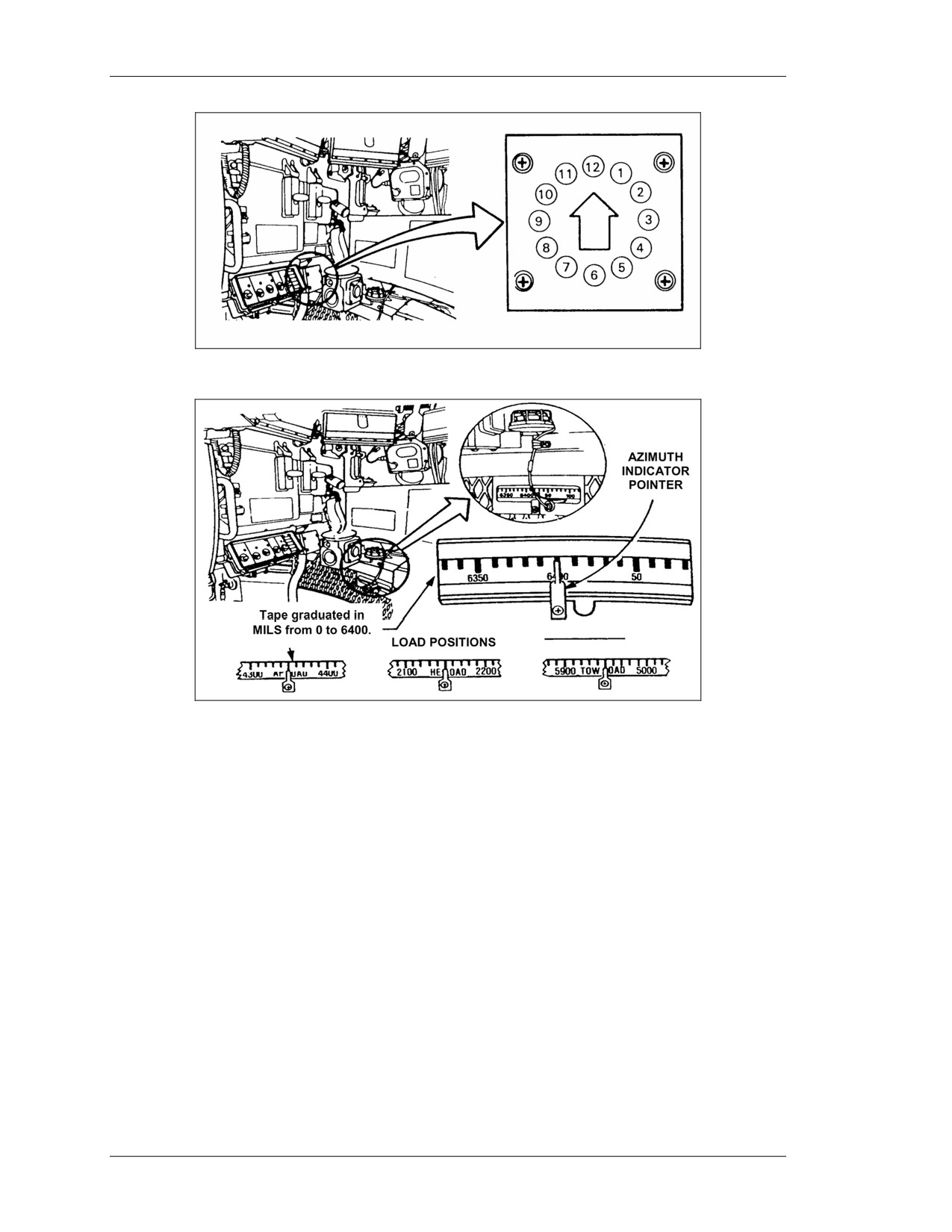
(4) The turret-position and azimuth indicators (Figures 7-9 and 7-10, page 7-22) also
help in determining sectors of fire. The platoon leader designates ammunition for each
TRP and reference point as prescribed by the platoon SOP or METT-TC.
7-21
FM 3-22.1
Figure 7-9. Turret position indicator.
Figure 7-10. Azimuth indicator.
b. Target Reference Points. Leaders designate natural or manmade terrain features
as reference points. The gunner uses these reference points to acquire targets and to
determine range during limited visibility. Predesignated TRPs must be visible to be useful
as TRPs or indirect-fire targets. The leader should always designate at least one TRP that
the gunner can see on low magnification.
(1) The commander or platoon leader designates indirect-fire targets used as TRPs so
that he can assign them target numbers. If TRPs fall within the sector of fire, the BC
points them out and gives the gunner their designated reference numbers. Leaders should
select heated objects to use as TRPs so that the crew can acquire them with
thermal sights.
(2) Each gunner has at least one but no more than four TRPs. Because the
information on a range card quickly gets crowded, it should only include pertinent data
for reference points and TRPs.
c. Dead Space. Dead space is any area that the crew cannot observe or cover by
direct-fire systems within the sector of fire. Leaders must identify all dead spaces within
the sector of fire, so the BC and platoon leader can plan how to use fires, such as mortars
7-22
FM 3-22.1
and artillery, to cover those areas. Vehicle crews walk the engagement area to help
gunners identify the dead spaces through the ISUs.
d. Maximum Engagement Line. The depth of the sector seldom exceeds the
maximum effective engagement range of the vehicle's weapons systems. It can be less,
however, if objects prevent the gunner from engaging targets at that range. To help
determine the distance to each MEL, the gunner or BC should use a map to make sure
that he shows the MELs correctly on the range card. MEL identification helps reduce the
amount of ammunition used in an engagement.
e. Weapon Reference Point. The WRP is easy to recognize on the map. This terrain
feature helps leaders plot the vehicle's position, and it helps replacement personnel find
the vehicle.
7-22. PREPARATION
The gunner prepares two copies of the range card. If the leader assigns alternate and
supplementary firing positions, he must make two copies of each of these as well. He
keeps one copy of each range card with the vehicle, and gives the other copies to the
section leader for his sketch.
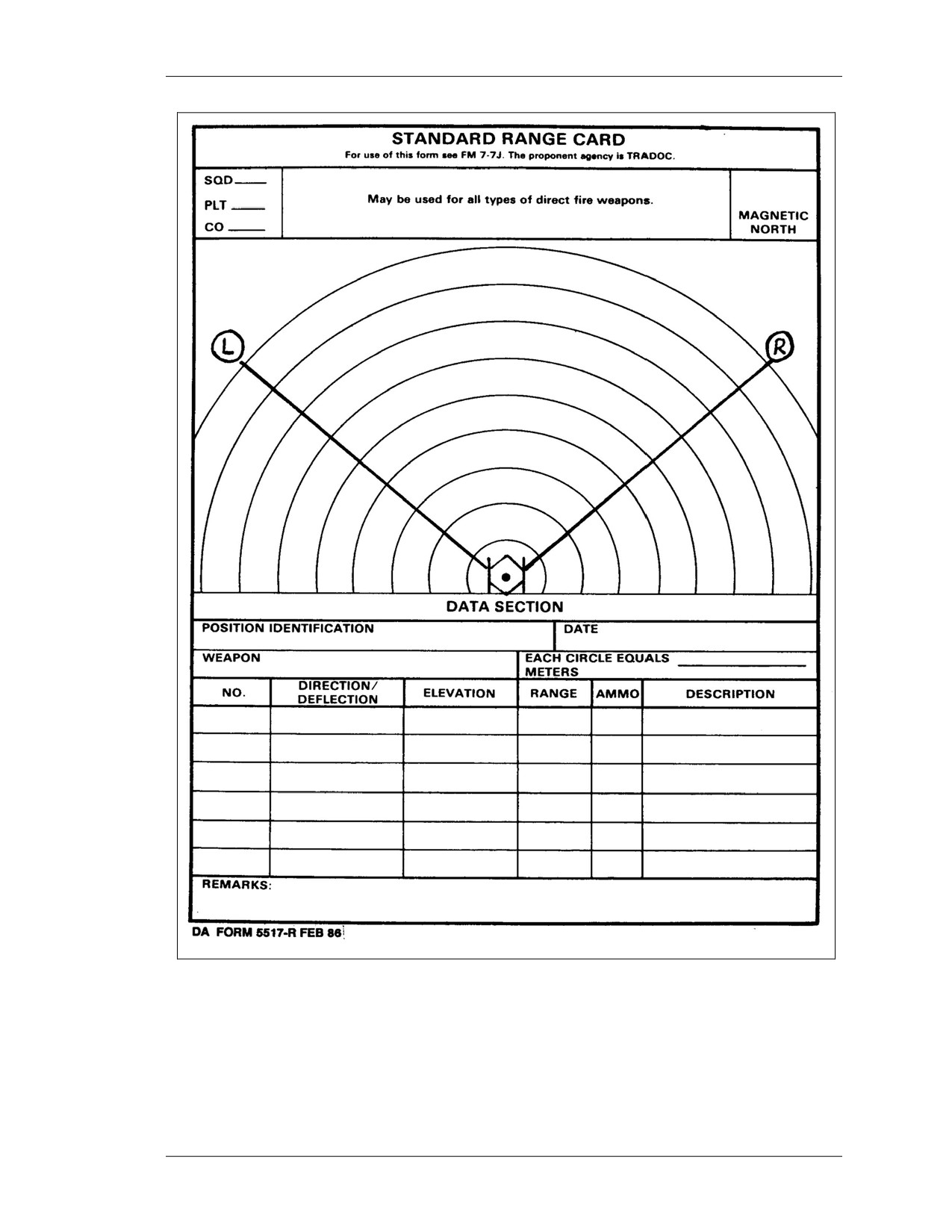
a. Draw the weapon symbol in the center of the small circle. Draw two lines from
the position of the BFV extending left and right to show the limits of the sector (
Figure 7-11, page 7-25).
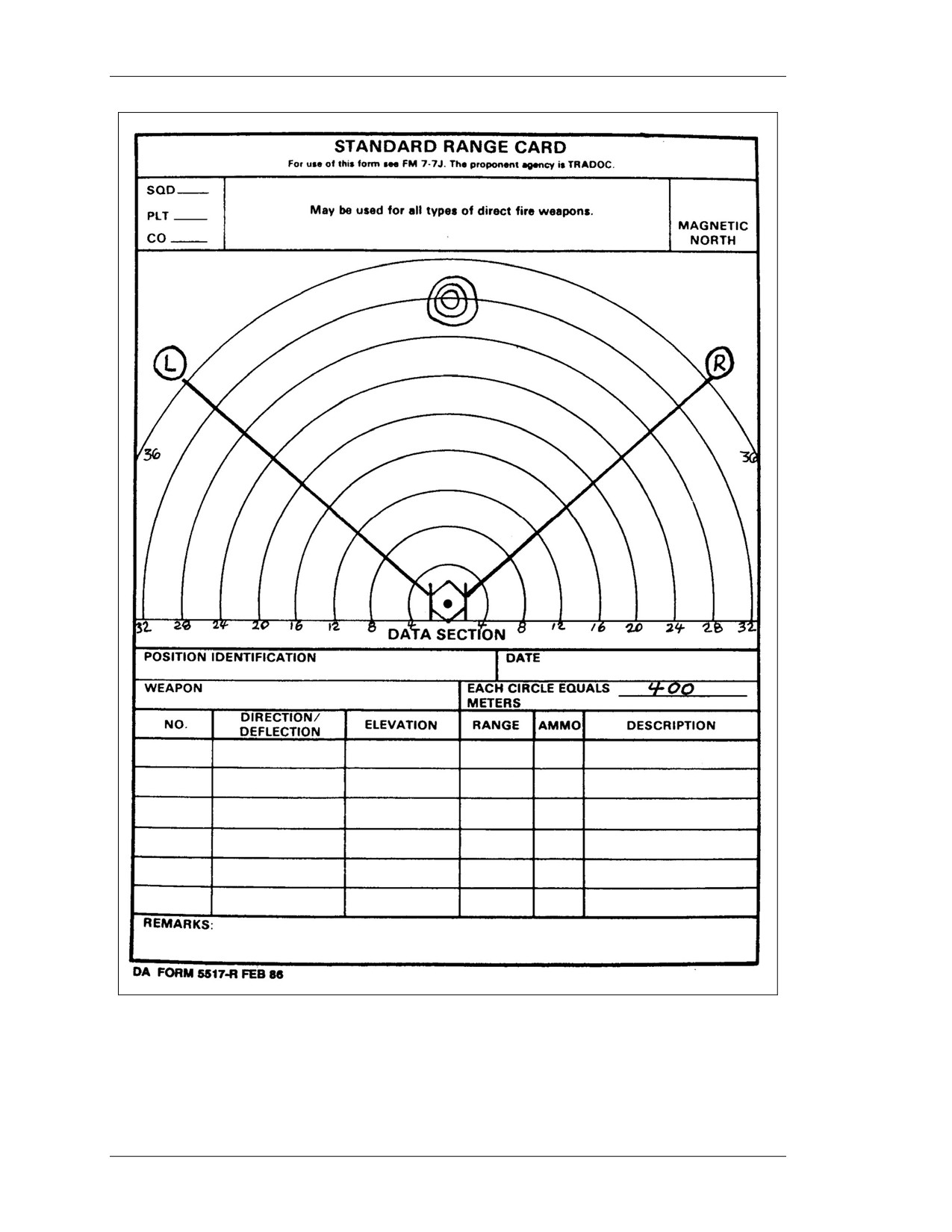
b. Determine the diameter of each circle by finding the farthest terrain feature that is
still within the weapon system's effective range. Determine the distance in meters to the
terrain feature. Round off the distance to the next higher hundred, if necessary. Determine
the greatest number of circles that will divide evenly into the distance (rounded to the
nearest 50 meters). The result is the diameter of each circle. Draw the terrain feature on
the appropriate circle on the range card. Clearly mark the increment for each circle across
the area where DATA SECTION is written. For example, Figure 7-12, page 7-26, shows
a hilltop at 3,145 meters. The distance rounds up to 3,200 meters which, divided by 8
equals 400. Thus, each circle has a diameter of 400 meters.
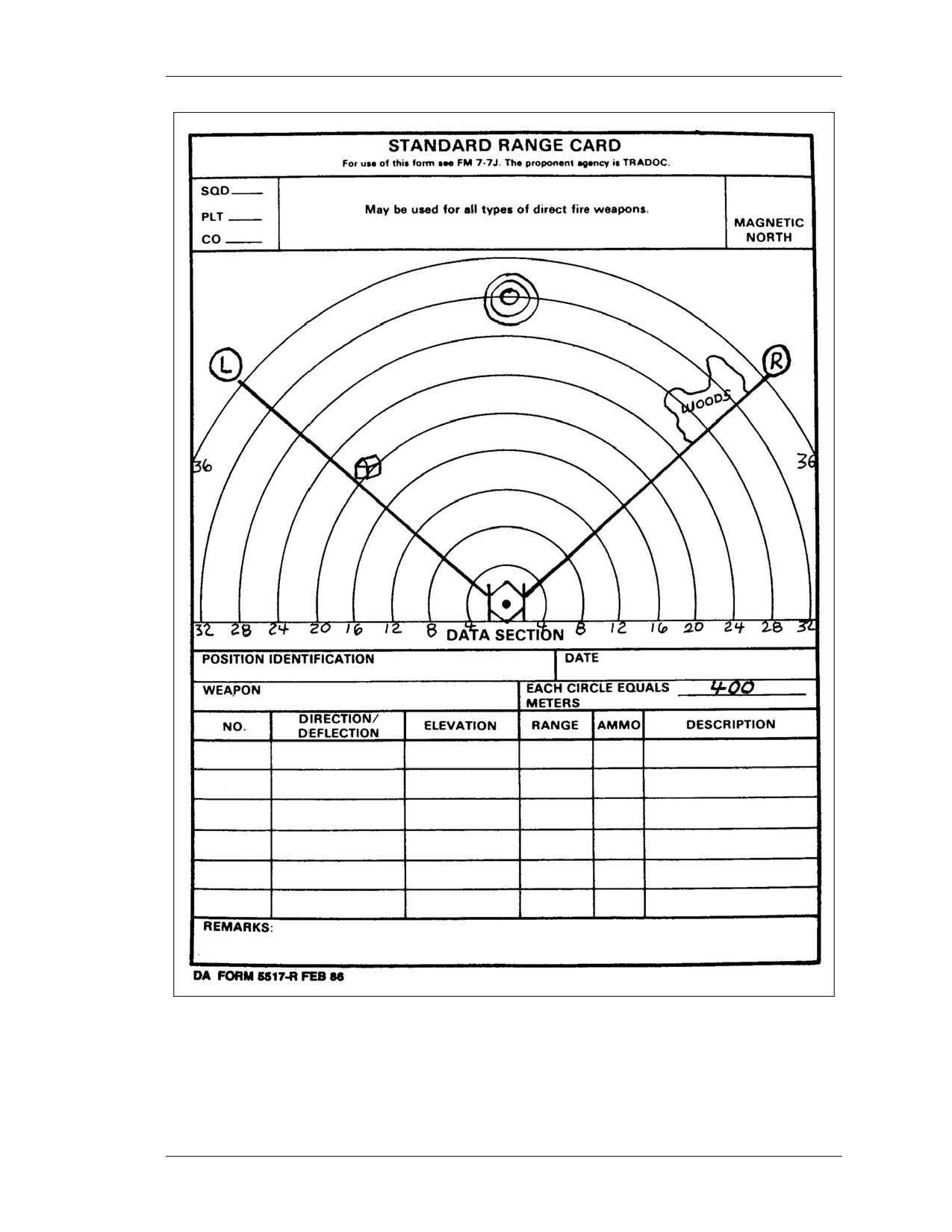
(1) Figure 7-13, page 7-27, shows a farmhouse at 2,000 meters on the left limit. The
wood line at 2,600 meters marks the right limit. Determine the distance to these features
by using a map; an ELRF (on ODS and M2A3 vehicles only); or a miniature, eye-safe-
laser, infrared observation set (MELIOS). Note how the circle markings can help you
position the other features on the range card.
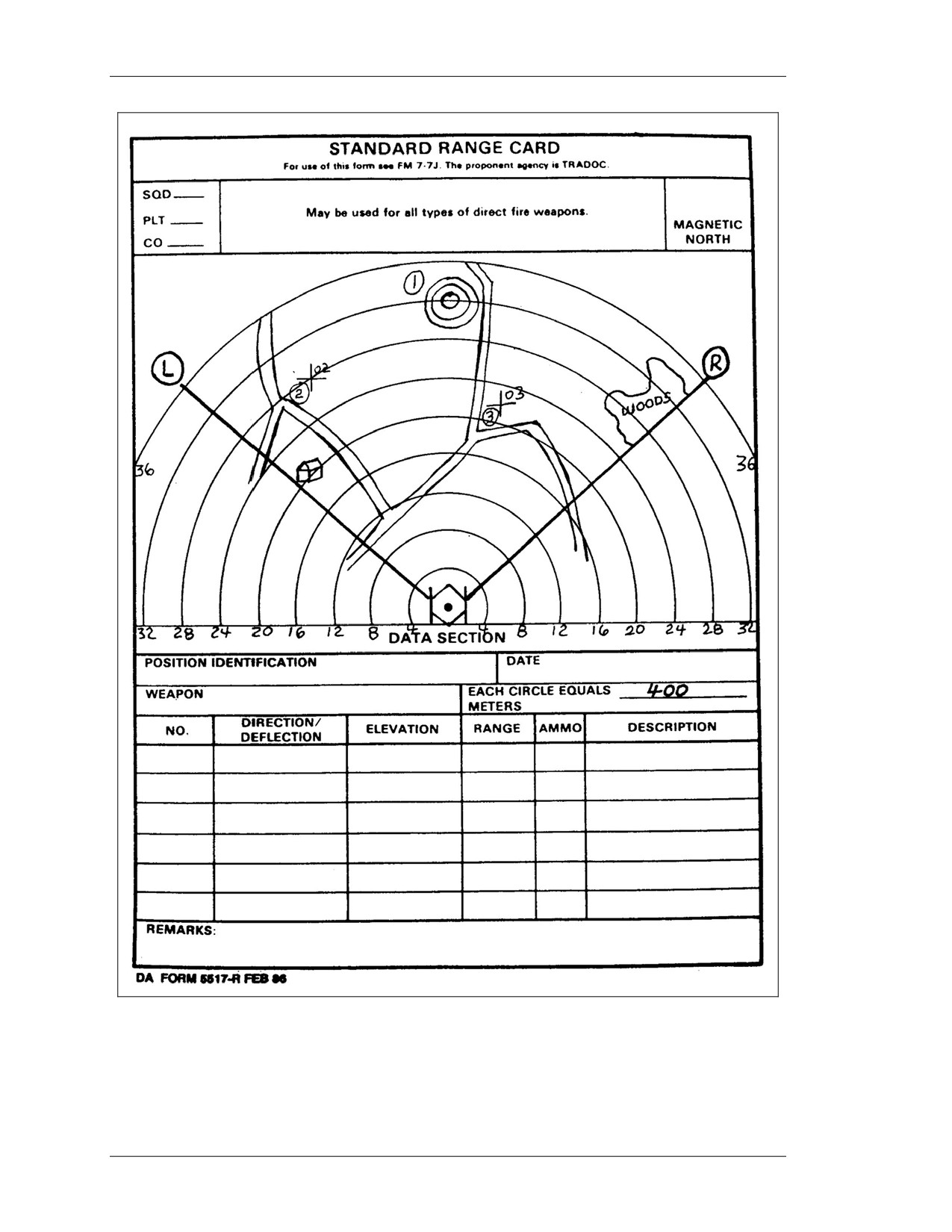
(2) Draw all TRPs and reference points in the sector. Mark each of these with a
circled number, starting with 1. Figure 7-14, page 7-28, shows the hilltop as RP 1, one
road junction as RP 2, and a second road junction as RP 3. Sometimes a TRP and
reference point are the same point, for example, RP 2 and RP 3. This occurs when you
use a TRP both to acquire targets and to determine range. Mark the TRP with the first
designated number in the upper right quadrant; mark the reference point in the lower left
quadrant of the cross. Determine the range to the junction, draw the junction, and then
draw the connecting roads from the road junction.
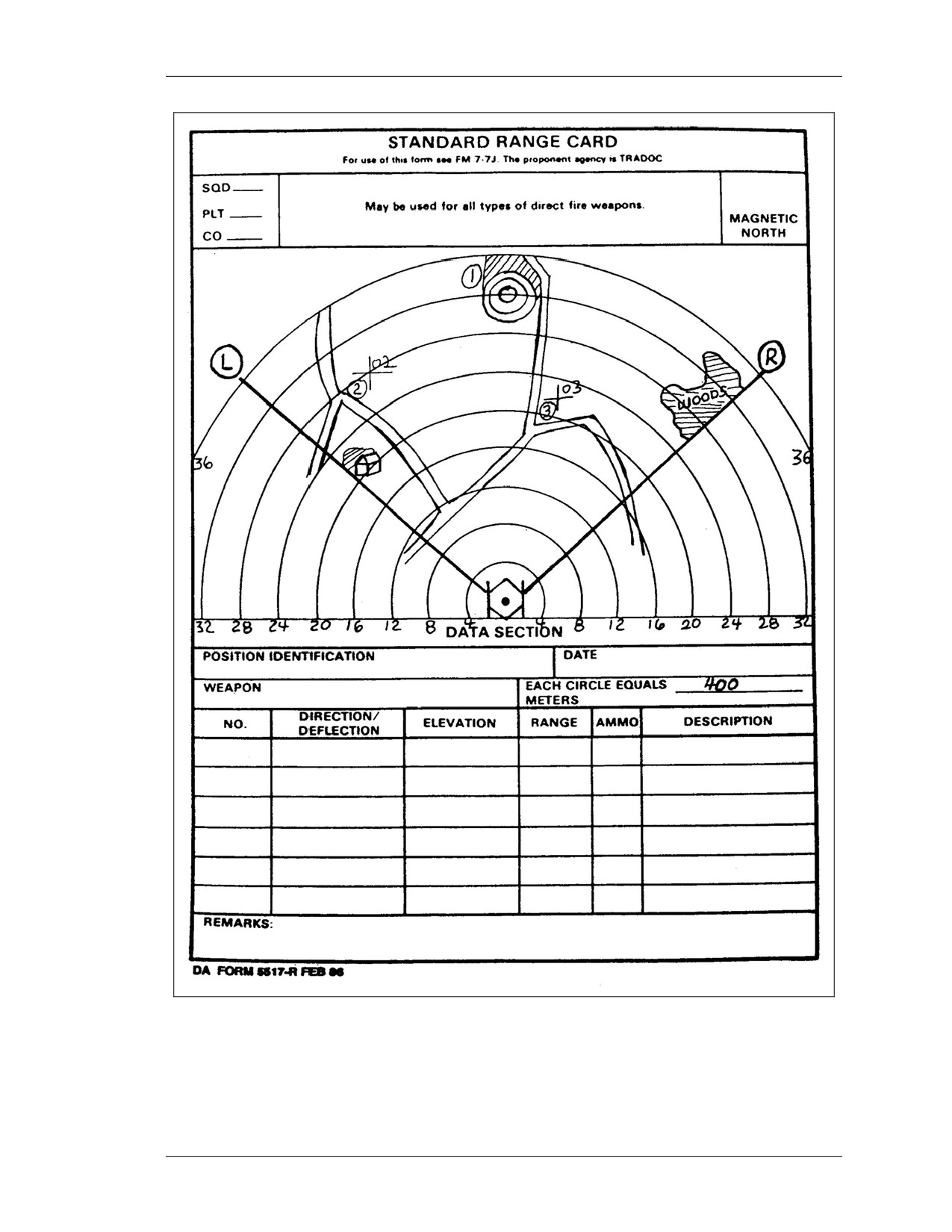
(3) Show dead space as an irregularly shaped area with diagonal lines drawn inside
(Figure 7-15, page 7-29). For any object that prohibits observation or coverage with direct
fire, extend the circle and diagonal lines to the farthest maximum engagement line. If the
7-23
FM 3-22.1
area beyond the dead space is engageable, close the circle. For example, you would close
the dead space outline in an area of lower elevation, because you could not engage the
area beyond it.
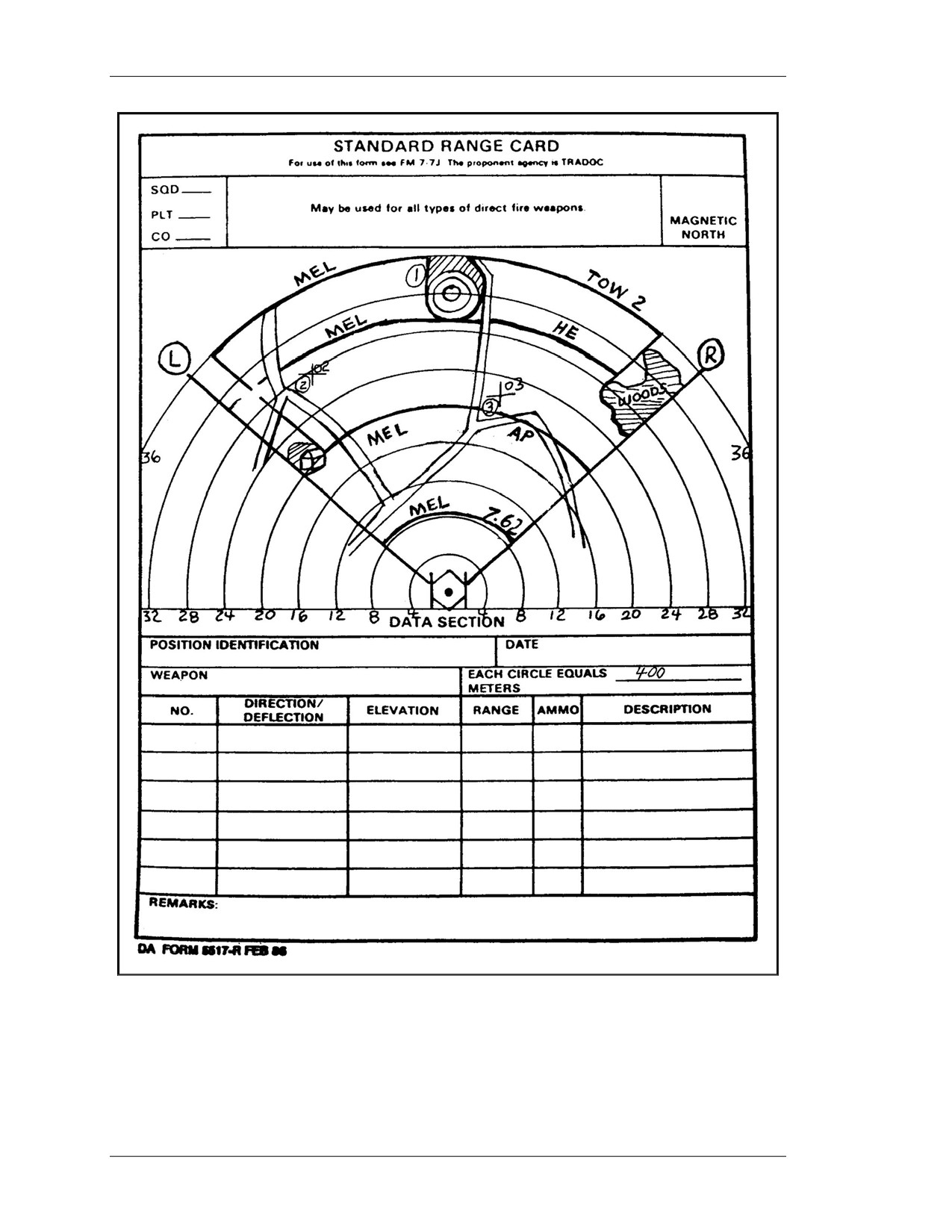
(4) Figure 7-16, page 7-30 shows how to draw and identify each MEL. Draw it along
the weapon's maximum effective engagement range, except where dead space limits
range. In these cases, draw the MEL along the front (near) edge of the dead space. For an
example of an exception to this guidance, note how Figure 7-15, page 7-29, shows the
MEL for HE extending beyond the dead space. This indicates a higher elevation where
HE area suppression is possible. MELs are not drawn through dead spaces. The
maximum effective ranges for Bradley weapon systems are--
• Coax
--
900 meters (tracer burnout)
• APDS-T
--
2,000 meters (tracer burnout)
• APFSDS-T
--
2,500 meters (tracer burnout)
• HEI-T
--
3,000 meters (self destruct)
• Basic TOW
--
3,000 meters (impact)
• TOW 2
--
3,750 meters (impact)
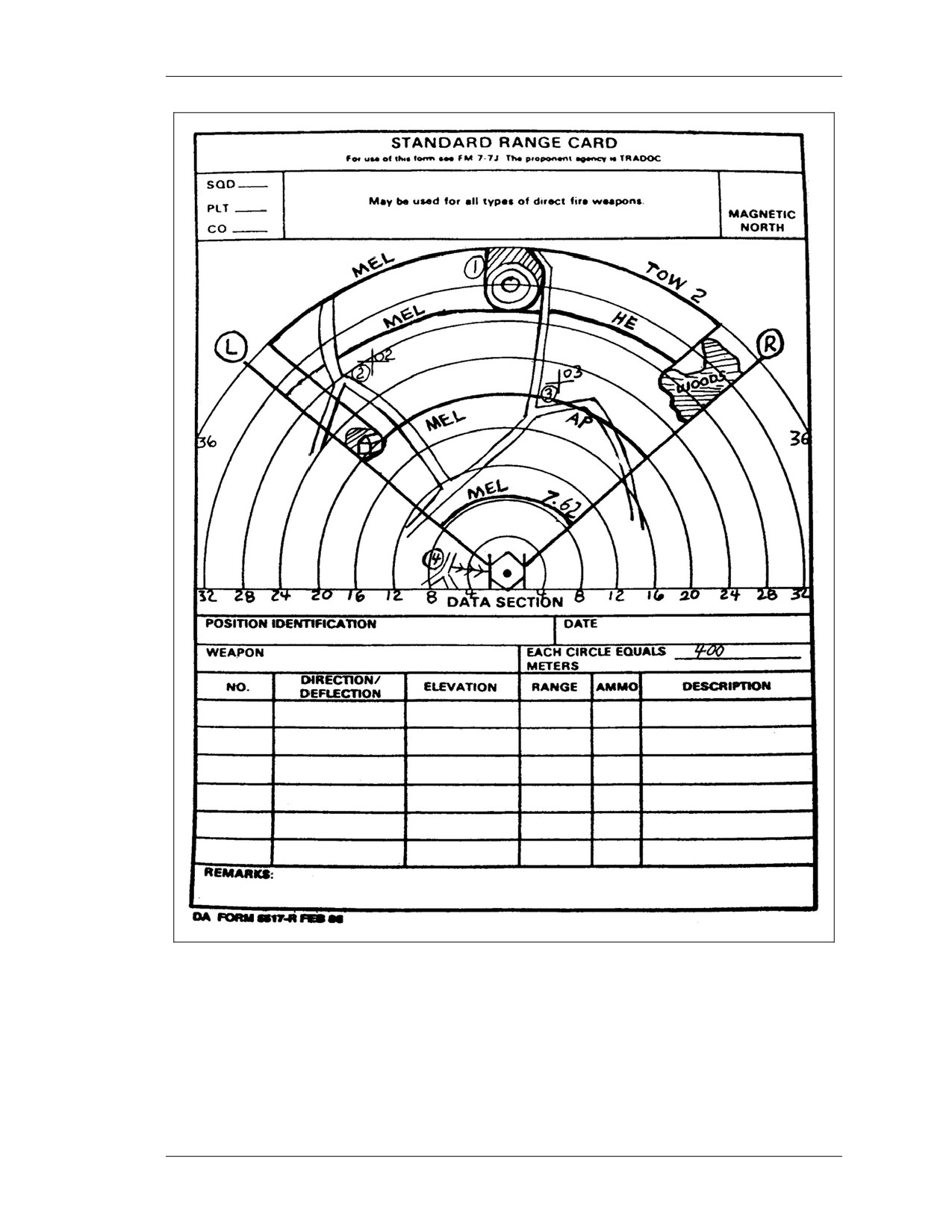
(5) Figure 7-17, page 7-31, shows the WRP as a line with a series of arrows
extending from a known terrain feature, pointing toward the Bradley symbol. Number
that terrain feature last. Mark the WRP location's six-digit grid coordinates. When no
terrain feature is designated as the WRP, use the range card's REMARKS block to show
the vehicle's location as an eight-digit grid coordinate. (In Figure 7-16, page 7-30, the
WRP is number 4.)
NOTE: When the vehicle's location prevents you from drawing the WRP precisely on
the sketch, then draw it to the left or right of the vehicle and nearest the
actual direction.
7-24
FM 3-22.1
Figure 7-11. Example of placement of weapon symbol and
left and right limits.
7-25
FM 3-22.1
Figure 7-12. Example of circle value.
7-26
FM 3-22.1
Figure 7-13. Example of terrain features for left and rights limits.
7-27
FM 3-22.1
Figure 7-14. Example of reference points and target reference points.
7-28
FM 3-22.1
Figure 7-15. Examples of dead spaces.
7-29
FM 3-22.1
Figure 7-16. Example of maximum engagement line.
7-30
FM 3-22.1
Figure 7-17. Example of weapon reference point.
7-31
FM 3-22.1
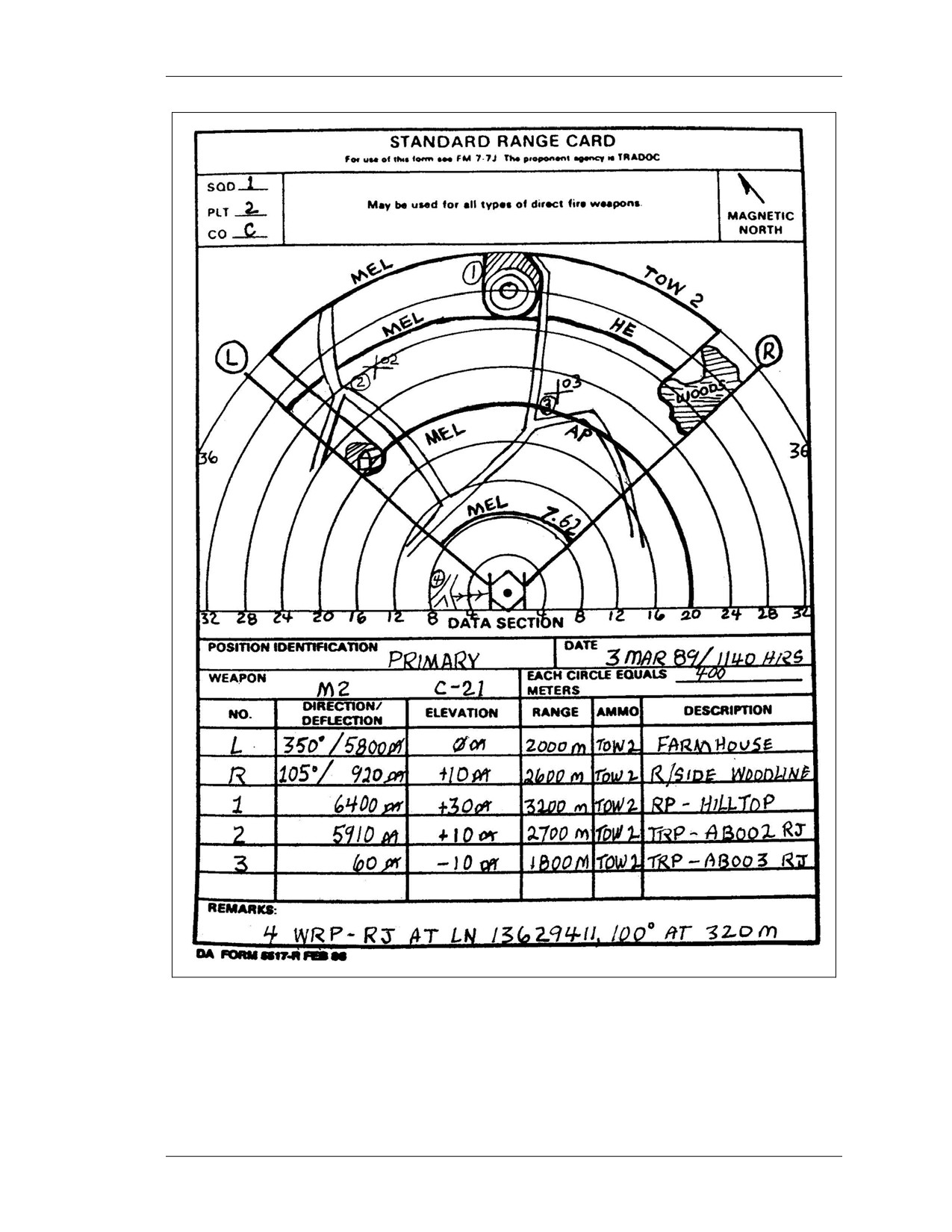
c. Complete the data section (Figure 7-18, page 7-33).
(1) Position Identification. Clearly mark each kind of position as to whether it is
primary, alternate, or supplementary.
(2) Date. Enter the date and time the range card was completed. Because range cards,
like fighting positions, must be updated constantly, the date and time are vital in
determining current data.
(3) Weapon. Enter "M2" and the vehicle's bumper number.
(4) Each Circle Equals
______ Meters. Write in the distance, in meters,
between circles.
(5) NO (Number). Start with left (L) and right (R) limits, then list TRPs and RPs in
numerical order.
NOTE: The platoon leader may dedicate a vehicle as an AP, HEI-T, or TOW target
IAW platoon SOP or METT-TC.
7-32
FM 3-22.1
Figure 7-18. Example completed DA Form 5517-R, Standard Range Card.
(6) Direction/Deflection. Use a lensatic compass to determine the direction in
degrees. The most accurate technique is to have the gunner aim at the terrain feature, then
to have the driver dismount and align himself with the gun barrel and the terrain feature
to measure the azimuth. To determine the correct deflection and elevation readings for the
7-33
FM 3-22.1
terrain feature, select TOW. Obtain the deflection reading from the BFV's azimuth
indicator, in the deflection block next to the magnetic azimuth
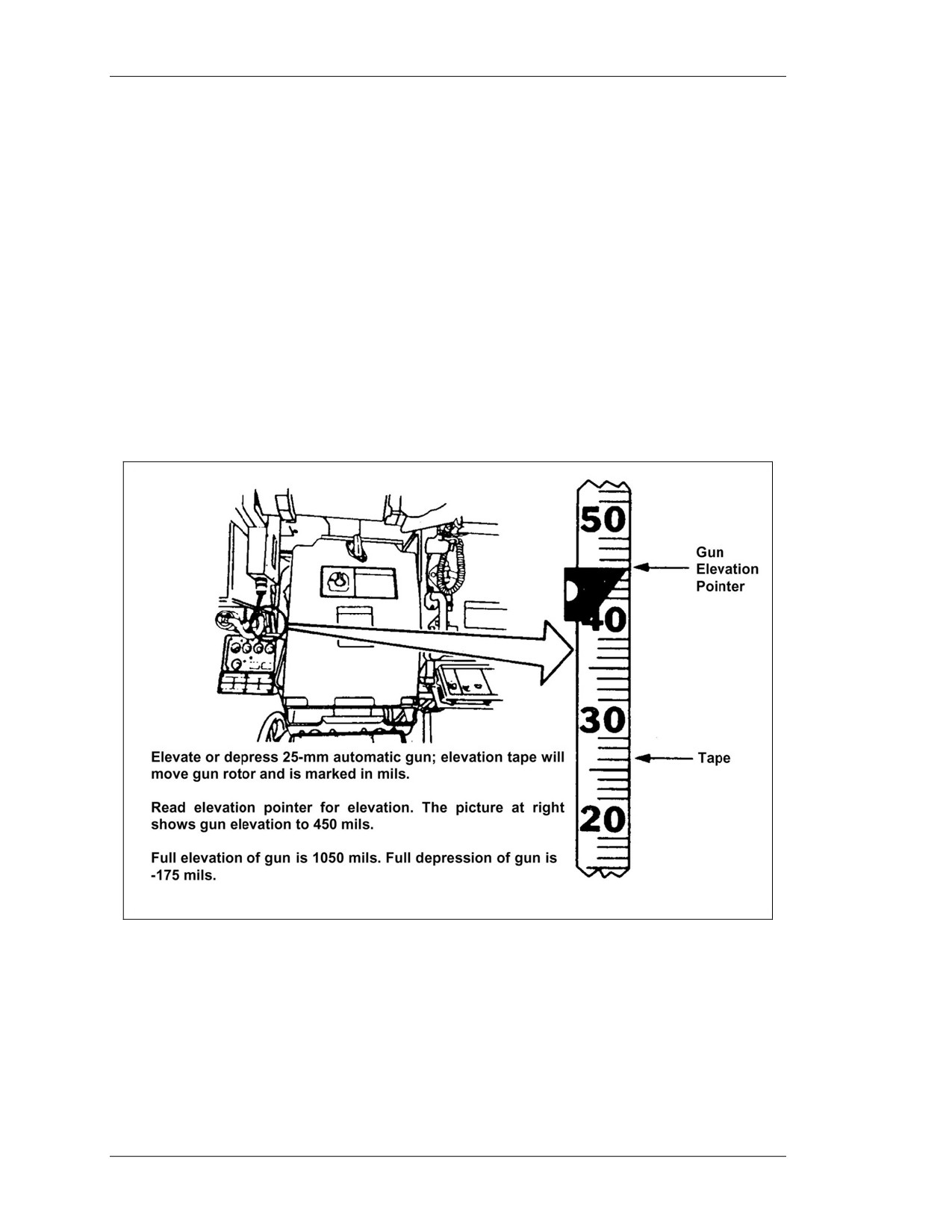
(7) Elevation. Show the gun elevation reading in tens or hundreds of mils
(Figure 7-19). The smallest increment of measure on the elevation scale is tens of mils.
Precede any number other than zero with a plus (+) or minus (-) sign to show whether the
gun needs to be elevated (+) or depressed (-). Index ammunition and range to obtain an
accurate elevation reading.
(8) Range. Record the distances, in meters, from the vehicle position to the left
limit, to the right limit, and to each TRP and RP.
(9) Ammo. List types of ammunition used.
(10) Description. Enter the name of the object such as farmhouse, wood line, or
hilltop.
(11) Remarks. Enter the WRP data. As a minimum, describe the WRP, give a six-
digit or eight-digit grid coordinate of the WRP, identify the magnetic azimuth, and state
the distance from the WRP to the vehicle position.
Figure 7-19. Gun elevation pointer.
d. Complete the marginal information at the top of the card (Figure 7-18, page 7-33).
(a) Unit Description. Include the bumper number, platoon, and company. Never
identify a unit higher than company.
(b) Magnetic North. Orient the range card with the terrain and draw the magnetic
north arrow pointed in the appropriate direction.
7-34
FM 3-22.1
7-23. DIGITAL RANGE CARD OVERLAY
With the aid of the appliqué armor and the IC3, which are found in the M2A2 ODS and
M2A3 Bradleys, the standard range card can be shown on a digital overlay. However, the
digital overlay should complement, not replace, the standard range card.
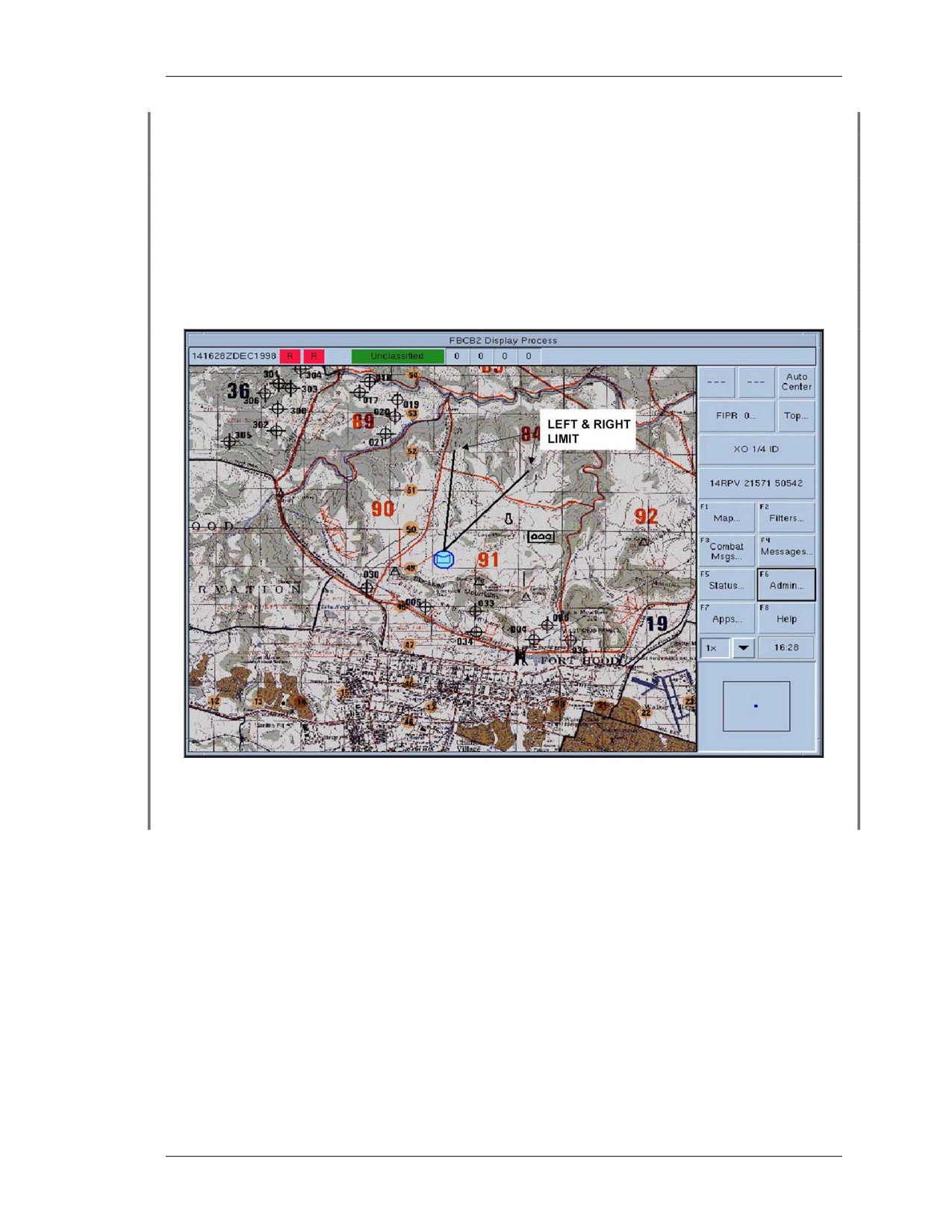
a. You can create a digital map and overlay. On this digital map, use the mouse or
keyboard to draw lines to represent the left and right limits for both primary and
secondary sectors of fire (Figure 7-20). You can then add digital icons for maximum
engagement lines and target reference points
(Figures 7-21 and
7-22, page 7-36),
reference points, and weapon reference points.
Figure 7-20. Example of digital range card showing
left and right sector limits.
7-35