3-22.1 (FM 23-1) BRADLEY GUNNERY (NOVEMBER 2003) - page 7

FM 3-22.1
BT V
CREW PRACTICE 1 1, 2
DAY ENGAGEMENTS
SIGHT AND
BFV
CREWMEMBER
CONDITIONS
TARGET TYPE
POSTURE
Defense
Gunner
ISU or IBAS
HE
Stationary
in Manual
Offense or
Gunner
ISU or IBAS
AP
Moving
Retrograde
HE 3
Stationary
Defense
Gunner
Auxiliary Sight 5
HE
Stationary
Offense or
Commander
CSE or RBD
AP
Moving
Retrograde
HE
Stationary
Defense
Gunner
ISU or IBAS
AP 4
Moving
in NBC
NIGHT ENGAGEMENTS
SIGHT AND
BFV
CREWMEMBER
CONDITIONS
TARGET TYPE
POSTURE
Defense
Gunner
ISU or IBAS
AP
Stationary
HE 3
Moving
Offense or
Gunner
ISU or IBAS
AP
Moving
Retrograde
in NBC
Defense
Commander
CSE or RBD
AP
Stationary
HE 4
Moving
Offense or
Commander
CSE or RBD
AP
Moving
Retrograde
HE
Stationary
Defense
Gunner
ISU or IBAS
AP
Moving
HE
Stationary
1 Ammunition Requirement..7.62-mm tracer, 160 rounds.
2 M7 BFIST
Incorporate one FMT task into the day phase
and one into the night phase.
3 A3 BFV
Hunter-killer task.
4 M6
Substitute suitable target type.
5 M7 BFIST
Substitute the ISU if not equipped with an auxiliary sight.
Figure 8-16.
BT V, Crew Practice 1.
8-35
FM 3-22.1
8-27. BRADLEY TABLE VI, CREW PRACTICE 2
Bradley Table VI, Crew Practice 2, is the first table that requires the crew to fire with
full-caliber ammunition using the 25-mm gun and the 7.62-mm coax burst techniques
(Figures 8-17A through 8-17D). Engagements are fired from a defensive position. BT VI
uses combat ranges to train BFV crew 25-mm and 7.62-mm coax engagement techniques
during daylight and darkness against stationary and moving targets and against point and
area targets.
8-28. BRADLEY TABLE VII, CREW PRACTICE 3
Bradley Table VII, Crew Practice 3, requires the BFV crew to conduct offensive and
defensive engagements with full-caliber ammunition (Figures 8-18A through 8-18D). BT
VII trains the Bradley crew to engage moving and stationary targets during daylight and
darkness from a stationary and a moving firing vehicle.
8-29. BRADLEY TABLE VIII, CREW QUALIFICATION
BT VIII, Crew Qualification, is a single-vehicle qualification table
(Figures 8-19A
through 8-19D). It evaluates the crew on the entire engagement process (Chapter 6) in
various firing conditions. Units are encouraged to fire on ranges that can accommodate
dual scenarios. However, firing vehicles must not help each other acquire targets.
Only battalion and company master gunners inspect (reconnoiter) range targetry during
crew qualification. Crews may receive a range orientation of the downrange area and
limit markers, but no targets are presented. The range briefing does not contain task
sequences or describe where the crew will fire particular tasks. If the unit conducts BT
VIII on the same range as BT VII, then the range scenarios (target arrays) in BTs VII and
VIII must differ.
8-36

FM 3-22.1
BT VI--ODS and Below
CREW PRACTICE 2
DAY ENGAGEMENTS
SIGHT AND
BFV
CREWMEMBER
CONDITIONS
TARGET TYPE
POSTURE
Defense
Gunner
ISU in Manual
AP
Stationary
Defense
Gunner
Auxiliary Sight
AP
Stationary
Coax
Point
Defense
Commander
CSE
AP
Stationary
Coax
Area
Defense
Gunner
ISU in NBC
AP
Moving
Coax
Area
NIGHT ENGAGEMENTS
SIGHT AND
BFV
CREWMEMBER
CONDITIONS
TARGET TYPE
POSTURE
Defense
Gunner
ISU
HE
Stationary
Coax
Area
Defense
Commander
CSE
HE
Moving
Defense
Gunner
ISU in NBC
HE
Stationary
Coax
Point
Ammunition Requirement:
TPDS-T
32 rounds
TP-T
24 rounds
7.62-mm
400 rounds
Figure 8-17A.
BT VI, Crew Practice 2 (ODS and below).
8-37

FM 3-22.1
BT VI--ADA Linebacker
CREW PRACTICE 2
DAY ENGAGEMENTS
SIGHT AND
BFV
CREWMEMBER
CONDITIONS
TARGET TYPE
POSTURE
Defense
Gunner
ISU in Manual
AP
Stationary
Defense
Gunner
Auxiliary Sight
AP
Stationary
Coax
Point
Defense
Commander
CSE
AP
Stationary
Coax
Area
Defense
Gunner
ISU in NBC
AP
Moving
CFT
Moving
NIGHT ENGAGEMENTS
SIGHT AND
BFV
CREWMEMBER
CONDITIONS
TARGET TYPE
POSTURE
Defense
Gunner
ISU
HE (20 Rounds)
Stationary
Coax
Area
Defense
Commander
CSE
HE
Moving
Defense
Gunner
ISU in NBC
HE
Stationary
Coax
Point
Defense
Gunner
ISU
CFT
Moving
Ammunition Requirement:
TPDS-T
32 rounds
TP-T
36 rounds
7.62-mm
300 rounds
CFT
2 rounds
Figure 8-17B.
BT VI, Crew Practice 2 (ADA Linebacker).
8-38

FM 3-22.1
BT VI--A3
CREW PRACTICE 2
DAY ENGAGEMENTS
SIGHT AND
BFV
CREWMEMBER
CONDITIONS
TARGET TYPE
POSTURE
Defense
Gunner
IBAS in Manual
AP
Stationary
Defense
Gunner
Auxiliary Sight
AP
Stationary
Coax
Point
Defense
Commander
RBD
AP
Stationary
Coax
Area
Defense
Gunner
IBAS in NBC
AP
Moving
Coax
Area
NIGHT ENGAGEMENTS
SIGHT AND
BFV
CREWMEMBER
CONDITIONS
TARGET TYPE
POSTURE
Defense
Gunner
IBAS
HE
Stationary
Coax
Area
Defense
Commander
RBD
HE
Moving
Defense
Gunner
IBAS in NBC
HE
Stationary
Coax
Point
Defense
Gunner
IBAS Hunter-Killer
HE
Stationary
Coax
Point
Ammunition Requirement: TPDS-T
32 rounds
TP-T
32 rounds
7.62-mm
450 rounds
Figure 8-17C.
BT VI, Crew Practice 2 (A3).
8-39

FM 3-22.1
BT VI--BFIST
CREW PRACTICE 2
DAY ENGAGEMENTS
SIGHT AND
BFV
CREWMEMBER
CONDITIONS
TARGET TYPE
POSTURE
Defense
Gunner
ISU in Manual
AP
Stationary
Defense
Gunner
ISU (Auxiliary
AP
Stationary
sight, if equipped)
Coax
Point
Defense
Commander
CSE
AP
Stationary
Coax
Area
Defense
Gunner
ISU in NBC
AP
Moving
Coax
Area
NIGHT ENGAGEMENTS
SIGHT AND
BFV
CREWMEMBER
CONDITIONS
TARGET TYPE
POSTURE
Defense
Gunner
ISU
HE
Stationary
Coax
Area
Defense
Commander
CSE
HE
Moving
Defense
Gunner
ISU in NBC
HE
Stationary
Coax
Point
Defense
Gunner
ISU
Tank
Stationary
(FMT > 2,000 M)
Ammunition Requirement:
TPDS-T
32 rounds
TP-T
24 rounds
7.62-mm
400 rounds
Figure 8-17D.
BT VI, Crew Practice 2 (BFIST).
8-40

FM 3-22.1
BT VII--ODS and Below
CREW PRACTICE 3
DAY ENGAGEMENTS
SIGHT AND
BFV
CREWMEMBER
CONDITIONS
TARGET TYPE
POSTURE
Defense
Gunner
Auxiliary Sight
AP
Moving
AP
Stationary
Defense
Gunner
ISU in Manual
HE
Stationary
Defense
Gunner
ISU in NBC
HE
Stationary
Coax
Point
Offense or
Commander
CSE
AP
Moving
Retrograde
HE
Stationary
Offense or
Gunner
ISU
HE
Stationary
Retrograde
Coax
Area
NIGHT ENGAGEMENTS
SIGHT AND
BFV
CREWMEMBER
CONDITIONS
TARGET TYPE
POSTURE
Defense
Gunner
ISU
AP
Moving
Coax
Point
Offense or
Commander
CSE
AP
Stationary
Retrograde
Defense
Gunner
ISU in NBC
AP
Stationary
Coax
Area
Offense or
Gunner
ISU
AP
Moving
Retrograde
Coax
Area
Ammunition Requirement:
TPDS-T
56 rounds
TP-T
32 rounds
7.62-mm
400 rounds
Figure 8-18A.
BT VII, Crew Practice 3 (ODS and below).
8-41

FM 3-22.1
BT VII--ADA Linebacker
CREW PRACTICE 3
DAY ENGAGEMENTS
SIGHT AND
BFV
CREWMEMBER
CONDITIONS
TARGET TYPE
POSTURE
Defense
Gunner
Auxiliary Sight
AP
Moving
AP
Stationary
Defense
Gunner
ISU in
HE
Stationary
Manual Target
CFT
Moving
Delay
Defense
Gunner
ISU in NBC
HE (20 Rounds)
Stationary
Coax
Point
Offense or
Gunner
ISU
AP
Moving
Retrograde
HE
Stationary
Offense or
Gunner
ISU
CFT
Moving
Retrograde
Coax
Area
NIGHT ENGAGEMENTS
SIGHT AND
BFV
CREWMEMBER
CONDITIONS
TARGET TYPE
POSTURE
Defense
Gunner
ISU
HE (20 Rounds)
Stationary
CFT
Moving
Defense
Commander
CSE
AP
Stationary
Offense or
Gunner
ISU in NBC
AP
Stationary
Retrograde
Coax
Area
Offense or
Gunner
ISU
AP
Moving
Retrograde
Coax
Area
Ammunition Requirement:
TPDS-T
48 rounds
TP-T
56 rounds
7.62-mm
350 rounds
CFT
3 rounds
Figure 8-18B.
BT VII, Crew Practice 3 (ADA Linebacker).
8-42

FM 3-22.1
BT VII--A3
CREW PRACTICE 3
DAY ENGAGEMENTS
SIGHT AND
BFV
CREWMEMBER
CONDITIONS
TARGET TYPE
POSTURE
Defense
Gunner
Auxiliary Sight
AP
Moving
AP
Stationary
Defense
Gunner
IBAS in Manual
HE
Stationary
Defense
Gunner
IBAS in NBC
HE
Stationary
Coax
Point
Offense or
Commander
RBD
AP
Moving
Retrograde
HE
Stationary
Offense or
Gunner
IBAS
AP
Stationary
Retrograde
Hunter-Killer
HE
Stationary
Coax
Area
NIGHT ENGAGEMENTS
SIGHT AND
BFV
CREWMEMBER
CONDITIONS
TARGET TYPE
POSTURE
Defense
Gunner
IBAS
AP
Moving
Hunter-Killer
Coax
Point
Coax
Point
Offense or
Commander
RBD
AP
Stationary
Retrograde
Defense
Gunner
IBAS in NBC
AP
Stationary
Coax
Area
Offense or
Gunner
IBAS
AP
Moving
Retrograde
Coax
Area
Ammunition Requirement:
TPDS-T
64 rounds
TP-T
32 rounds
7.62-mm
450 rounds
Figure 8-18C.
BT VII, Crew Practice 3 (A3).
8-43

FM 3-22.1
BT VII--BFIST
CREW PRACTICE 3
DAY ENGAGEMENTS
SIGHT AND
BFV
CREWMEMBER
CONDITIONS
TARGET TYPE
POSTURE
Defense
Gunner
ISU (Auxiliary
AP
Moving
sight, if equipped)
AP
Stationary
Defense
Gunner
ISU in Manual
HE
Stationary
Defense
Gunner
ISU in NBC
HE
Stationary
Coax
Point
Offense or
Commander
CSE or RBD
AP
Moving
Retrograde
HE
Stationary
Offense or
Gunner
ISU
HE
Stationary
Retrograde
(FMT > 2,000 M)
Coax
Area
Tank
Stationary
NIGHT ENGAGEMENTS
SIGHT AND
BFV
CREWMEMBER
CONDITIONS
TARGET TYPE
POSTURE
Defense
Gunner
ISU
AP
Moving
(FMT > 2,000 M)
Coax
Point
Tank
Stationary
Offense or
Commander
CSE
AP
Stationary
Retrograde
Defense
Gunner
ISU in NBC
AP
Stationary
Coax
Area
Offense or
Gunner
ISU
AP
Moving
Retrograde
Coax
Area
Ammunition Requirement:
TPDS-T
56 rounds
TP-T
32 rounds
7.62-mm
400 rounds
Figure 8-18D.
BT VII, Crew Practice 3 (BFIST).
8-44

FM 3-22.1
BT VIII--ODS and Below
QUALIFICATION
DAY ENGAGEMENTS
SIGHT AND
BFV
CREWMEMBER
CONDITIONS
TARGET TYPE
POSTURE
Defense
Gunner
ISU (Swing)
AP
Stationary
Coax
Area
Offense or
Gunner
ISU (Swing)
AP
Moving
Retrograde
HE
Stationary
Defense
Gunner
Auxiliary Sight
HE
Stationary
Coax
Point
Offense or
Commander
CSE
HE
Stationary
Retrograde
Defense
Gunner
ISU in NBC
AP
Moving
Coax
Area
NIGHT ENGAGEMENTS
SIGHT AND
BFV
CREWMEMBER
CONDITIONS
TARGET TYPE
POSTURE
Defense
Gunner
ISU in Manual
HE
Stationary
(Swing)
Offense or
Gunner
ISU in NBC
AP
Moving
Retrograde
HE
Stationary
Defense
Gunner
ISU (Swing)
HE
Moving
Coax
Area
Offense or
Commander
CSE
AP
Stationary
Retrograde
Coax
Point
Defense
Gunner
ISU
AP
Stationary
Coax
Point
Ammunition Requirement:
TPDS-T
48 rounds
TP-T
48 rounds
7.62-mm
450 rounds
Figure 8-19A.
BT VIII, Crew Qualification (ODS and below).
8-45

FM 3-22.1
BT VIII--ADA Linebacker
QUALIFICATION
DAY ENGAGEMENTS
SIGHT AND
BFV
CREWMEMBER
CONDITIONS
TARGET TYPE
POSTURE
Defense
Gunner
ISU (Swing)
CFT
Moving
AP
Stationary
Offense or
Gunner
ISU (Swing)
HE (20 Rounds)
Stationary
Retrograde
AP
Moving
Defense
Gunner
Auxiliary Sight
HE
Stationary
Coax
Point
Offense or
Commander
CSE
HE
Stationary
Retrograde
Defense
Gunner
ISU in NBC
CFT
Moving
Coax
Area
NIGHT ENGAGEMENTS
SIGHT AND
BFV
CREWMEMBER
CONDITIONS
TARGET TYPE
POSTURE
Defense
Gunner
ISU in Manual
HE
Stationary
(Swing)
Offense or
Gunner
ISU in NBC
AP
Moving
Retrograde
HE
Stationary
Defense
Gunner
ISU (Swing)
HE (20 Rounds)
Stationary
Coax
Area
Offense or
Commander
CSE
AP
Stationary
Retrograde
Coax
Point
Defense
Gunner
ISU
AP
Stationary
CFT
Moving
Ammunition Requirement: TPDS-T
40 rounds
TP-T
72 rounds
7.62-mm
300 rounds
CFT
3 rounds
Figure 8-19B.
BT VIII, Crew Qualification (ADA Linebacker).
8-46

FM 3-22.1
BT VIII--A3
QUALIFICATION
DAY ENGAGEMENTS
SIGHT AND
BFV
CREWMEMBER
CONDITIONS
TARGET TYPE
POSTURE
Defense
Gunner
IBAS (Swing)
AP
Stationary
Hunter-Killer
AP
Moving
Coax
Area
Offense or
Gunner
IBAS (Swing)
AP
Moving
Retrograde
HE
Stationary
Defense
Gunner
Auxiliary Sight
HE
Stationary
Coax
Point
Offense or
Commander
RBD
HE
Stationary
Retrograde
Defense
Gunner
IBAS in NBC
AP
Moving
Coax
Area
NIGHT ENGAGEMENTS
SIGHT AND
BFV
CREWMEMBER
CONDITIONS
TARGET TYPE
POSTURE
Defense
Gunner
IBAS in Manual
HE
Stationary
(Swing)
Offense or
Gunner
IBAS in NBC
AP
Moving
Retrograde
HE
Stationary
Defense
Gunner
IBAS (Swing)
HE
Moving
Coax
Area
Offense or
Commander
RBD
AP
Stationary
Retrograde
Coax
Point
Defense
Gunner
IBAS (Swing)
AP
Stationary
Hunter-Killer
Coax
Point
Coax
Point
Ammunition Requirement:
TPDS-T
56 rounds
TP-T
48 rounds
7.62-mm
500 rounds
Figure 8-19C.
BT VIII, Crew Qualification (A3).
8-47

FM 3-22.1
BT VIII--BFIST
QUALIFICATION
DAY ENGAGEMENTS
SIGHT AND
BFV
CREWMEMBER
CONDITIONS
TARGET TYPE
POSTURE
Defense
Gunner
ISU (Swing)
AP
Stationary
(FMT > 2,000 M)
Coax
Area
Tank
Stationary
Offense or
Gunner
ISU (Swing)
AP
Moving
Retrograde
HE
Stationary
Defense
Gunner
ISU (Auxiliary
HE
Stationary
sight, if equipped)
Coax
Point
Offense or
Commander
CSE
HE
Stationary
Retrograde
Defense
Gunner
ISU in NBC
AP
Moving
Coax
Area
NIGHT ENGAGEMENTS
SIGHT AND
BFV
CREWMEMBER
CONDITIONS
TARGET TYPE
POSTURE
Defense
Gunner
ISU in Manual
HE
Stationary
(Swing)
Offense or
Gunner
ISU in NBC
AP
Moving
Retrograde
HE
Stationary
Defense
Gunner
ISU (Swing)
HE
Moving
Coax
Area
Offense or
Commander
CSE
AP
Stationary
Retrograde
Coax
Point
Defense
Gunner
ISU (Swing)
AP
Stationary
(FMT > 2,000 M)
Coax
Area
Tank
Stationary
Ammunition Requirement:
TPDS-T
48 rounds
TP-T
48 rounds
7.62-mm
450 rounds
Figure 8-19D.
BT VIII, Crew Qualification (BFIST).
8-48
FM 3-22.1 (23-1)
CHAPTER 9
Infantry Platoon
FMs 7-0 and 7-1 explain how to plan, resource, and execute training
events. ARTEP 7-7J-MTP, FM 3-21.71, and this chapter provide the TTP
and standards to conduct and evaluate Bradley platoon gunnery training.
Chapter 3 covers crew training; this chapter covers section and
platoon device training as well as platoon practice and qualification
(Figure 9-1).
Infantry platoon gunnery integrates vehicle and infantry squad tasks.
These tasks support tactical and gunnery scenarios in all conditions using
all organic weapons. This trains leaders and subordinates to distribute
and control fires.
Bradley Infantry Platoon Gunnery Tables
Page
BT III--Infantry Squad and Section Exercise
9-21
BT IV--Infantry Platoon Proficiency Course
9-21
BT XI--Infantry Platoon Practice
9-25
BT XII--Infantry Platoon Qualification
9-26
Figure 9-1. Bradley Tables III, IV, XI, and XII.
Section I. TRAINING PROGRAM
Bradley infantrymen must have the skill and the will to do more than just participate in
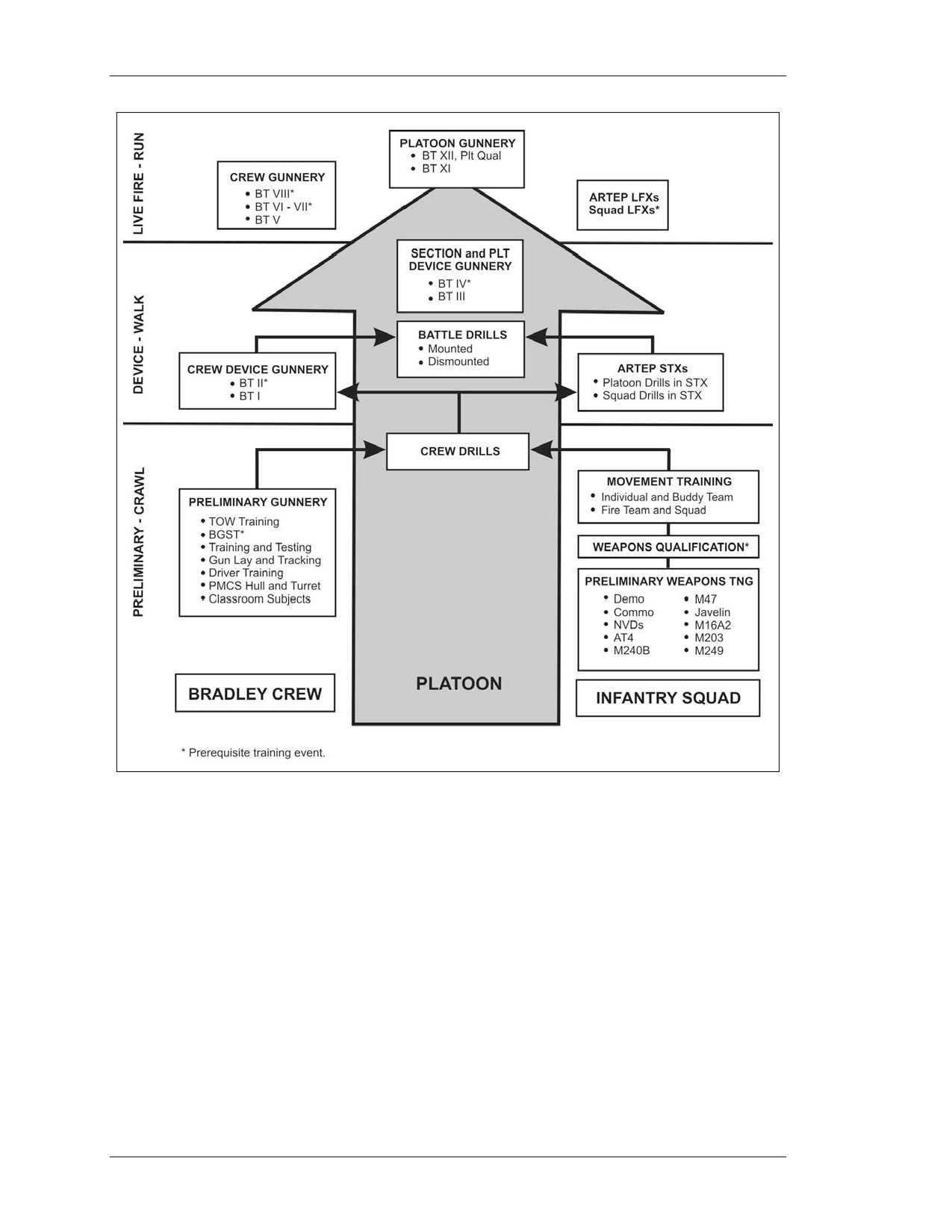
the close fight: they must be willing and able to dominate it. Figure 9-2, page 9-2, shows
how concurrent crew and squad gunnery training merge in the Bradley platoon integrated
gunnery-training strategy.
9-1
FM 3-22.1
Figure 9-2. Bradley platoon training program.
9-1. INFANTRY SQUAD TRAINING
The goal of infantry squad training is to qualify squads and platoons on live-fire and
battle-focused collective tasks that support the unit's METL. Squad training should
parallel crew training. This ensures both crew and squad elements are prepared for
integrated training on BTs III (ISSE) and IV (IPPC), page 9-21; and BTs XI and XII,
pages 9-25 and 12-5. The squad leader is the principal trainer for his soldiers' weapons,
equipment, and tactical proficiency. Training plans should include equipment training,
weapons qualification, movement drills, STXs, and LFXs (Appendix E). Squad training
can be grouped into the following levels:
a. Preliminary Training. This training starts with weapons and equipment
training. Soldiers conduct M16A2 advanced rifle marksmanship training to learn the
combat fire techniques required for squad operations. Soldiers continue preliminary
training by firing the M203 grenade launcher, M240B and M249 machine guns, the AT4,
9-2
FM 3-22.1
and the M47 Dragon or Javelin. Squad members should become experts with
demolitions, communications equipment, and NVDs. Their proficiency is measured
during weapons qualification and hands-on equipment tests. Each soldier learns the
individual skills and movement techniques required to survive in close combat. At the
end of this training, crew and infantry squad elements are integrated to conduct
crew drills.
b. Device Training. This consists of squad and crew drills in an STX using PGS or
MILES equipment. At the end of this training, crew and infantry squad elements are
integrated to conduct battle drills and section or platoon device gunnery.
c. Live-Fire Training. This consists of squad and platoon dismounted live-fire
exercises. At the end of this training, crews are integrated for Infantry platoon practice
and qualification (BTs XI and XII, pages 9-25 and 12-5).
9-2. INTEGRATED TRAINING
Platoon leadership works together to train the collective skills of integrated vehicle
teams, sections, and platoon. Section and platoon battle drills are vital to integrating
crews and squads. These drills teach routine sets of actions so that each soldier can
perform them instinctively. He knows his individual tasks, when to accomplish them, and
what to do if he cannot perform them.
a. Crew Drills. Crew drills instill instinctive actions that the vehicle team must be
able to perform in combat. These drills include uploading ammunition and mounting and
dismounting the vehicle.
b. Crew Battle Drills. Crew battle drills cover actions that the mounted section and
platoon might need in combat. Crew elements must immediately react to contact or
ambush or initiate an attack.
c. Squad Battle Drills. Squad battle drills cover actions that the squad or platoon
might need while dismounted. Squad members must immediately react to contact or
ambush or initiate an attack.
d. Device Gunnery. Device gunnery integrates vehicle sections and platoons with
their Infantry squads on BTs III (ISSE) and IV (IPPC). These exercises develop and
evaluate the collective skills of the section and platoon in a realistic tactical scenario
using training devices.
e. Platoon Gunnery. Platoon gunnery trains and evaluates Infantry platoons using
full-caliber ammunition. BT XI and XII (IPP and IPQ) provide platoons with a live-fire
exercise in which they can refine collective task execution during a tactical live fire
scenario. Platoon leaders must control the platoons, crew, and squad. The platoon
practice table should emphasize fire distribution and control.
f.
Combined Arms Live-Fire Exercise. Platoon training continues after
qualification. The platoon is integrated into company CALFEXs and externally evaluated
during company or battalion ARTEPs. During these multiechelon training events, the
platoon fights as part of the combined arms team.
9-3. REQUIREMENTS
Training requirements for the Infantry platoon are the same as those discussed in
Chapter 3 for the Bradley crew, plus the following (Figure 9-3, page 9-4)--
a. Infantry platoons must have completed BT IV in the six months before BT XII.
9-3

FM 3-22.1
b. Crews that will fire live rounds during infantry platoon qualification must qualify
on BT VIII in the six months before BTs XI and XII, pages 9-25 and 12-5.
c. Squad members must qualify with their individual weapons in the six months
before BT XII.
d. Squads must complete a squad live-fire exercise to ARTEP standards in the six
months before BT XII.
PERSONNEL
REQUIREMENTS
• Infantry platoons
Completed BT IV in the six months before Table XII.
• Crew firing of
Qualified on Table VIII in the six months before Tables XI and XII.
live rounds during
qualification for
Infantry platoon
• Each squad member
Qualified with his individual weapon in the six months before
Table XII.
• Each squad
Completed a squad live-fire exercise to ARTEP standards in the
six months before Table XII.
Figure 9-3. Training requirements.
Section II. FIRE DISTRIBUTION AND CONTROL
As an integral part of the combined arms team, the BFV infantry platoon provides the
infantry rifle squads with supporting direct fires at the necessary point on the battlefield.
Destroying or suppressing the enemy with direct fires is vital to all combat operations.
Leaders control the fires of BFV crews, automatic riflemen, antiarmor gunners,
grenadiers, riflemen, and available fire-support assets. They aim to achieve a desired
effect on the enemy and to prevent friendly fire. The platoon can only control and
distribute fire effectively through planning (unit SOP) and rehearsals.
9-4. PRINCIPLES
To maximize the platoon's ability to engage the enemy, leaders must synchronize the
fires of all direct-fire weapons and indirect-fire assets. The mechanized infantry platoon
controls and distributes fires by making fire plans. When developing and executing these
plans, leaders apply the following eight principles from FM 3-21.71:
a. Task Organize. The "3 by 9" platoon configuration has four Bradley fighting
vehicles, which are divided into two sections. The platoon also has three infantry squads.
When determining task organization, leaders consider the capabilities and limitations of
individual soldiers and crews. In the offense and defense, both the platoon leader and
platoon sergeant position themselves where they can best command and control
the platoon.
b. Destroy the Greatest Threat First. The platoon engages targets from most to
least dangerous. If two or more equally threatening targets appear, the platoon engages
the nearest one first. Leaders determine specific threat conditions from command
guidance for that operational area.
9-4
FM 3-22.1
c. Employ the Best Weapon for the Target. The platoon has many weapons.
Choosing the best weapon for a particular threat increases the likelihood of rapidly
destroying or suppressing that threat. Normally, Bradley crews engage enemy vehicles,
while infantry squads engage closer enemy threats (Chapter 6, Table 6-1).
d. Avoid Overkill. Using too many weapons against a single target wastes
ammunition. It also decreases the platoon's ability to acquire and engage multiple targets
effectively. Properly distributing platoon fires prevents overkill. That is, it keeps the
platoon from using more ammunition and effort than needed to destroy or suppress a
single target. To best distribute direct fire among the Bradley crews and infantry squads,
the platoon can divide engagement areas into sectors of fire or into quadrants.
e. Minimize Friendly Exposure. To increase survivability, Bradley crews and
infantry rifle squads avoid exposure to threat observation and fire, except as they must to
engage. Using natural and man-made defilade positions for cover and concealment helps
reduce exposure.
f.
Plan for Extreme Limited Visibility. At night, limited visibility fire-control
equipment enables the platoon to engage enemy forces at nearly the same ranges as
during the day. Fog, smoke, blowing sand, and other obscurants can reduce visibility,
preventing night vision-equipped systems from covering their surveillance
responsibilities or from engaging targets at normal ranges. Every limited visibility plan
relies on coordinating and using the Bradley's FLIR to help the infantry rifle squads, even
though rifle squads have their own internal night-vision systems
(NVDs) and
illumination. Leaders adjust their fire plans based on visibility conditions and on the
acquisition capabilities of their systems.
g. Prevent Fratricide. Leaders use ten tools to prevent the platoon from causing
friendly and civilian casualties (fratricide):
• Rules of engagement.
• Weapons-control status.
• Weapon safety postures.
• Weapons safety procedures.
• Other control measures.
• Combat vehicle and aircraft identification training.
• Situational awareness.
• Positional awareness.
• Bradley commander confirmation.
• Vehicle recognition markings.
• Combat identification panels.
h. Develop Contingencies for Diminished Capabilities. Although leaders first
develop their plans based on maximum capabilities, they also make backup plans that
allow for casualties or for the damage or failure of weapons. Although leaders cannot
plan for every possible problem, they can plan for the most likely ones.
9-5. FIRE-CONTROL MEASURES
To establish a direct-fire SOP, the leader applies fire-control measures. He modifies it
based on METT-TC conditions and, as reconnaissance permits, he develops detailed fire
plans. Fire-control and -distribution measures consist either of physical control measures
or of simple, concise, clearly written weapons-control instructions (FM 3-21.71).
9-5
FM 3-22.1
a. Target Reference Point. The leader designates recognizable terrain features as
target reference points (TRPs). He uses TRPs to control both direct and indirect fires in
support of the engagement plan. During movements, halts, and hasty actions, he selects
and adjust TRPs, depending on the terrain he can see at the time. In the defense, he
assigns TRPs along likely enemy avenues of approach, wherever he wants elements to
mass fires.
b. Sector of Fire. To cover his entire area of responsibility, the leader divides it
into sectors of fire. He assigns each sector to a subordinate element, crew-served weapon,
or individual soldier. Sector assignment means responsibility for acquiring and engaging
targets in that area. Limiting each element's or weapon's sector of fire prevents soldiers
from accidentally engaging adjacent units. To overlap sectors for complete coverage with
the direct-fire plan, the leader can use TRPs, clock directions, terrain-based quadrants,
and friendly-based quadrants. He can also assign secondary sectors of fire to increase
mutual support.
c. Primary Direction of Fire. When time is short or reference points too few to
assign a sector of fire, the leader assigns a PDF instead of a TRP. To orient an element,
weapon system, or soldier to a particular area on the battlefield, he uses the closest TRP,
clock direction, cardinal direction, tracer on target, or infrared laser pointer.
d. Trigger Line. This is a prominent feature, natural or manmade, such as a ridge,
stream, road, or railroad track. He uses this feature as a trigger line to initiate an
engagement or to distribute fires in depth within a sector.
e. Rules of Engagement. These specify engagement limitations and circumstances:
(1) Factors that influence the ROE include--
• National command policy.
• Mission and commander's intent.
• Operational environment.
• Law of war.
(2) ROE always recognize the soldier's right of self-defense, clearly defining--
• The conditions in which a soldier may fire at a target.
• The conditions in which a soldier may fire warning shots.
• Combatants.
• The treatment of noncombatants.
f.
Weapons-Control Status. The three levels of weapon control define the
conditions, based on target-identification criteria, in which friendly elements engage
targets. The platoon leader sets and adjusts weapons-control status based on the
disposition of friendly and enemy forces and on the clarity of the situation. In general, a
higher likelihood of fratricide requires more restrictive weapons control. The three levels
of weapons-control status, in descending order of restriction, are as follows:
(1) Weapons Hold. Engage only if engaged or ordered to engage.
(2) Weapons Tight. Engage only those targets positively identified as enemy.
(3) Weapons Free. Engage any targets not positively identified as friendly.
g. Engagement Priorities. These serve three functions; they--
• Identify what type(s) of targets to engage first.
• Distribute fires among the various types of targets.
• Match weapons and ammunition to target type.
9-6
FM 3-22.1
h. Cease-Fire Criteria. These are instructions that the commander gives to Bradley
platoons to prevent overkill and to free the greatest number of systems to acquire and
engage other targets.
i.
Fire Patterns. The leader distributes and adjusts the fires of the infantry rifle
squads, Bradley vehicle crews, or both into one or more of three basic fire patterns:
frontal, cross, and depth. He does this to best cover a threat formation or multiple or
simultaneous targets.
(1) Frontal Fire. When targets appear in front of the platoon in a lateral
configuration, the platoon leader initiates frontal fire. BFVs engage targets to their fronts:
the left flank BFV engages the leftmost target, and the right flank BFV engages the
rightmost target. As they destroy their targets, the BFVs shift their fires toward the center
of the enemy formation.
(2) Cross Fire. The platoon leader initiates cross fire when targets position
themselves or move laterally in front of the platoon, or when obstructions prohibit frontal
fire. With frontal fire, each flanking BFV engages the target on its own side first. With
cross fire, each BFV engages the farthest target on the opposite side of the EA. The right
flank BFV engages the leftmost target, and the left flank BFV engages the rightmost
target. Firing diagonally across an EA like this gives the crew more flank shots. If the
threat keeps moving forward, cross fire increases the chance of kills and reduces the
chance of detection. As the platoon destroys its targets, it shifts fire towards the center of
the enemy, and from near to far.
(3) Depth Fire. Leaders use depth fire for a target dispersed in column or column-
like formation. The center BFVs engage the closest target; flanking BFVs engage deeper
targets. As the platoon destroys targets, the BFVs all shift their fires towards the center of
the enemy formation.
j.
Engagement Techniques. The platoon leader can apply any of eight
engagement techniques to destroy or suppress enemy targets, while minimizing friendly
exposure:
(1) Alternating Fire. Either the BFVs or the members of the infantry rifle squad
alternate fires into an area or onto a specific target. This--
• Provides constant suppressive fires.
• Keeps the enemy from acquiring friendly elements.
• Minimizes individual BFV and infantry rifle squad exposure.
• Presents multiple points of fire.
(2) Simultaneous Fire. All BFVs in a platoon or section, or members of the infantry
rifle squad element, fire into their assigned sectors at the same time. Simultaneous fire
achieves maximum destruction and fire superiority.
(3) Sequential Fire. A single soldier fires multiple AT4s in sequence, correcting
each subsequent round until he achieves the desired target effect. Firing sequentially lets
the soldier correct his fire based on his previous rounds.
(4) Volley Fire. Units fire volleys to rapidly mass the effects of their fires or to gain
fire superiority. For example, a unit could initiate a support-by-fire operation with volley
fire, then use alternating or sequential fire to maintain suppression. Firing in volleys also
increases the chance that certain antiarmor weapons will hit and kill their targets. For
example, to rapidly destroy a BMP that is engaging a friendly position, the infantry rifle
squad can volley AT4 fire onto it.
9-7
FM 3-22.1
(5) Point Fire. This is the directing of all weapons fire onto a specific target such as
a machine gun or ATGM position. Spreading out the platoon on the ground improves
point fire, because then the platoon can hit the target from multiple directions.
(6) Area Fire. For numerous or less obvious enemy positions, the platoon distributes
fires over a large area. The platoon leader assigns each infantry rifle squad or BFV a
sector of fire within the target area. This ensures that the platoon covers the entire target
area with fire and observation.
(7) Time of Suppression. This is the time period, specified by the platoon leader,
during which the platoon must suppress an enemy position or force. Both the platoon's
BFV and infantry rifle squads receive the task to suppress an area in support of another
element's assault.
(8) Reconnaissance by Fire. This is the process of engaging possible enemy
locations to elicit a tactical response from the enemy such as return fire or movement.
This response helps the platoon and subordinate leaders acquire targets accurately and
mass fires against the enemy element.
k. Weapons-Ready Posture. This is an ammunition- and range-selection
instruction that allows leaders to prepare systems, ammunition, and soldiers for the most
likely engagement. Given an anticipated threat and visibility conditions (terrain and
weather), leaders establish the desired weapon and battlecarry (ammunition and range)
for each vehicle.
l.
Weapons-Safety Posture. This is an ammunition-handling command. It gives
leaders a way to precisely control the safety status of all of their weapons. Figure 9-4
shows the five weapons-safety postures. Soldier adherence to and leader supervision of
the weapon safety posture prevents accidental discharges of weapons.
m. Weapons-Safety Rules. Whereas the term "weapons-safety posture" applies to
ammunition, weapons-safety rules apply to weapons. Weapons-safety rules consist of
instructions for handling weapons during combat and training. Their purpose is to prevent
accidental discharges and injuries. Though each soldier bears the responsibility for
handling his weapons safely, each leader must enforce the following rules:
• Handle each weapon as though it were loaded.
• Clear weapon immediately upon assuming control of it.
• Orient weapons away from other soldiers.
• Orient turret weapons away from friendly vehicles or soldiers.
• Avoid placing your hands over the muzzle of a weapon.
• Avoid resting the muzzle on your or someone else's body.
• Keep your weapon on SAFE unless preparing to fire.
• Adhere to your leaders' weapon-safety postures.
9-8

FM 3-22.1
SAFETY
BFV WEAPONS
SQUAD WEAPONS
POSTURE
COMMAND
AND AMMUNITION
AND AMMUNITION
Ammunition
STOW AMMO
•
Stow 25-mm and coax
•
Stow small arms ammunition in
stowed
ammunition in shipping cans.
shipping cans.
•
Stow TOW missiles in racks.
•
Stow grenades in shipping boxes.
•
Stow smoke grenades in
•
Stow AT4s and missiles in
shipping cans.
designated locations in the vehicle
Ammunition
• FILL
•
Load 25-mm ready boxes.
•
Fill magazines.
ready
MAGAZINES.
•
Load coax ammunition boxes.
•
Load magazines, M249 ammunition
• LOAD READY
•
Load TOW missiles in the
boxes, hand grenades, and M203
BOXES AND
launcher.
grenades into pouches or vests.
LAUNCHERS
•
Load smoke grenades in their
launchers.
Ammunition
LOCK AMMO
•
Load 25-mm rounds into feeder.
•
Lock magazines into rifle.
locked
•
Ensure manual safety is ON.
•
Ensure all weapons are on SAFE.
•
Place coax ammunition on
feed tray.
•
Lock the bolt forward.
Weapons
READY
•
Cycle 25-mm ghost round.
•
Chamber round into rifle.
ready
WEAPONS
•
Place coax ammunition on the
•
Place M249 ammunition on
feed tray.
feed tray.
•
Lock bolt to rear.
•
Lock bolt to rear.
•
Ensure manual safety is OFF.
•
Ensure all weapons are on SAFE.
•
Ensure ARM-SAFE-RESET
switch is on SAFE.
Weapons
CLEAR WEAPONS
•
Remove and clear gun feeder.
•
Remove magazine.
cleared
•
Clear coax.
•
Clear rifle.
•
Remove bolt group.
•
Clear M249.
•
Remove ammunition box.
Figure 9-4. Weapons safety posture.
9-6. FIRE PLANS
Fire planning is a continuous process that focuses on METT-TC conditions. The platoon
leader establishes the direct-fire SOP based on probable conditions and on the platoon's
capabilities. He modifies it as he obtains more complete or more current information
about METT-TC conditions. During the planning phase of an operation, the platoon
leader analyzes METT-TC conditions. The result is a template of the enemy and
anticipated conditions. The leader uses this template to alter his platoon SOP and
establish mission-specific control measures (Figure 9-5, page 9-10). When the platoon
halts temporarily, or when it executes hasty actions, the leader supplements or changes
the SOP to fit current conditions. After reconnoitering, he develops an engagement plan
that incorporates both direct and indirect fires and that supports the commander's fire plan
and intent. Successful execution of any fire plan (from SOP to detail) requires rehearsal.
9-9

FM 3-22.1
PERIOD OR PHASE
ACTION
Training
• Develop the direct-fire SOP based on
contingencies and capabilities.
• Rehearse the direct-fire SOP.
Preparation for combat
• Establish mission-specific fire-control
and -distribution measures.
• Adjust the SOP.
• Rehearse.
Movement, halts, and
• Issue supplemental instructions.
hasty actions
• Talk through probable engagements,
as time permits.
Post-reconnaissance
• Develop a detailed engagement plan.
• Rehearse.
Figure 9-5. Fire-planning process.
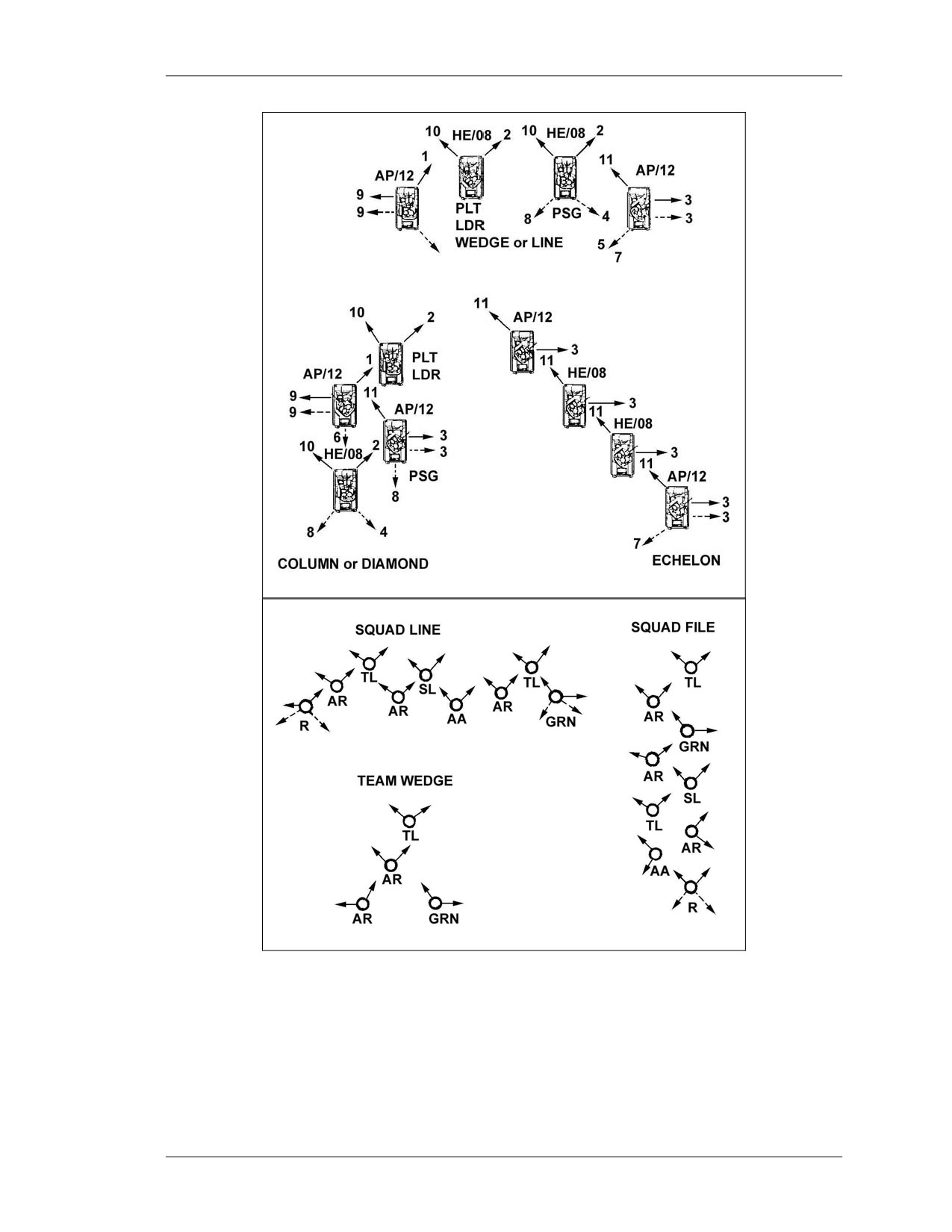
a. Direct Fire. A well-rehearsed direct-fire SOP ensures that all members of the
platoon react quickly and predictably (Figure 9-6, page 9-13). The leader bases each
element of the direct-fire plan on the capabilities of the platoon and on the anticipated
conditions. For example, if the contingency area is a desert with good observation and
long engagement ranges, he selects extended battlecarry settings for the BFVs.
(1) Choosing a standard, respective position for TRPs allows the platoon leader to
quickly establish and communicate his location. For example, he might number all
reference points from left to right. Three TRPs usually suffice for a platoon during
movements, halts, and hasty actions.
(2) The platoon leader assigns sectors and identifies engagement priorities to ensure
the platoon acquires all targets and distributes fires effectively. One technique he could
use is for both he and the platoon sergeant to search and engage mostly near- to mid-
range troops, and for him to have the wingmen observe for mid- to long-range light
armored fighting vehicles.
(3) The platoon leader designates a weapons-readiness posture for established
sectors and engagement priorities. In addition, the platoon leader and platoon sergeant
could, for example, select HE HI and Index 8 for range, while having the wingmen select
AP HI and Index 12 for range.
(4) Having a standing fire pattern enables the platoon to distribute fires while
engaging multiple, similar targets. For example, the platoon leader and platoon sergeant
engage the close to middle targets, then work their way to the outside of the enemy
formation. The wingmen, on the other hand, engage targets to their respective fronts, then
work their way toward the inside of the enemy formation.
(5) The platoon leader sets standard engagement techniques to achieve desired target
effects, minimizing friendly exposure. As an example, he could have the BFVs initiate
with simultaneous fire, then revert to alternating fires. One infantry squad suppression
pattern technique would be to engage initially with simultaneous fires, then to sustain
suppression with alternating fires, with each weapon firing a given number of rounds
or bursts.
9-10
FM 3-22.1
(6) The platoon leader selects an initial weapons-control status that allows soldiers to
engage the enemy, but that at the same time reduces the chance of fratricide. "Weapons
tight" is a good initial weapons-control status.
(7) The platoon leader chooses signals for shifting fire that members of the platoon
can both hear and see. For example, he might decide to use a green pyrotechnic and a
certain code word to shift fires, and a red pyrotechnic and another code word to adjust or
cease fires.
(8) The platoon leader plans for degraded capabilities and loss. In one example, a
single BFV temporarily assumes the responsibilities of a nonmission-capable or degraded
BFV of the same section. As the operational tempo permits, the platoon leader adjusts to
compensate for the degraded capabilities and losses. Also, if an automatic rifleman or
antiarmor gunner becomes a casualty, the assigned backup secures the M249, M240B, or
any antiarmor weapon and assumes the downed soldier's sector responsibilities.
b. Example Direct-Fire SOP. A direct-fire SOP would include the following
elements. Specific details are for example only:
(1) Target Reference Points.
• TRP 1--Left.
• TRP 2--Center.
• TRP 3--Right.
(2) Shift Signals.
• Shift fires-green pyrotechnic and "Green Hornet."
• Cease fires-red pyrotechnic and "Redman."
(3) Weapons-Control Status. This should be weapons tight, unless stated otherwise.
(4) Sector of Fire and Weapons-Ready Posture. (Figure 9-6.)
• The platoon leader and sergeant take on any close- to mid-range targets.
• The wingmen take on any mid- to long-range targets.
• The rear-most BFV (if last in the formation) takes on the secondary sector.
(5) Engagement Priorities.
• Platoon leader and platoon sergeant engage any troops.
• Wingmen engage any heavy- and light-armored fighting vehicles.
(6) Cease-Fire Criteria.
(a) The platoon leader and platoon sergeant cease firing at any target that a wingman
is effectively engaging.
(b) The platoon leader ceases firing at any target that the platoon sergeant is
effectively engaging.
(7) Frontal Fire Pattern.
(a) The platoon leader and platoon sergeant both engage from the inside (close
targets) to the outside.
(b) Wingmen engage from the outside to the inside.
(8) Engagement Technique. The platoon fires simultaneous fire, then alternates fire.
(9) Sectors. (Figure 9-6.)
(10) Weapons-Ready Posture.
(a) One M240B or two M249s use a four-to-one mix at 500 meters.
(b) Grenadiers fire HEDP at 150 meters.
(c) AT4s fire at 200 meters.
9-11
FM 3-22.1
(d) Riflemen fire ball ammunition at a range of 300 meters using the small apertures
on their sights.
(e) The point man fires a burst.
(11) Suppression Pattern. The platoon fires simultaneous, then alternating fire.
(a) Simultaneous Fire.
• One M240B or two M249s fire six five-round bursts.
• The grenadiers fire two rounds of HEDP.
• The riflemen fire twenty aimed rounds.
• One AT4 or Javelin crew, 3 X 9, fire sequentially at hardened targets only.
(b) Alternating Fire.
• M249 or M240B Number 1 fires three five-round bursts.
• The riflemen fire five aimed rounds.
• The grenadier fires one round of HEDP.
• M249 or M240B Number 2 fires three five-round bursts.
• The riflemen fires five aimed rounds.
• The grenadier fires one round HEDP.
• The leaders fill lulls in fire.
c. Mission-Specific Measures and SOP Adjustment. Analyzing METT-TC
reveals the need to set mission-specific fire-control and -distribution measures and to
adjust the direct-fire SOP. The platoon leader marks physical control measures, such as
TRPs, phase lines, and boundaries, on operational graphics and sketches. He assigns
PDFs for specific elements based on probable enemy locations. He also adjusts elements
of the direct-fire SOP, such as weapons-ready postures, engagement priorities, and
sectors, based on new, anticipated conditions and on the current capabilities of individual
soldiers, crews, squads, and systems.
9-12
FM 3-22.1
Figure 9-6. Example BFV platoon direct-fire SOP.
9-13
FM 3-22.1
d. Supplemental Instructions. As an operation proceeds, the platoon leader issues
fire-control and -distribution instructions based on observed and reported METT-TC
conditions. The platoon leader--
(1) Continuously asks himself the following questions:
• What can I use to control fires?
• Where is the enemy likely to come from?
• What friendly units might be in front of me?
(2) Designates and adjusts TRPs as the terrain changes.
(3) Assigns PDFs toward probable enemy locations or avenues of approach.
(4) Changes the weapons-control status of friendly maneuvering units. For example,
while moving, a platoon leader designates a road intersection as a TRP, assigns it as the
PDF for one section and, while a friendly unit moves in front of the platoon, changes the
weapons-control status from "Weapons Tight" to "Weapons Hold."
(5) Ensures that all subordinates know the TRPs. Points out their locations when he
assigns TRPs or when previously assigned TRPs become visible.
e. Detailed Fire Plans. Reconnaissance forms the basis for preparing detailed fire
plans, and rehearsal is the key to executing them.
(1) The company commander plans fires in as much detail as time permits
(FM 3-90.1 and FM 3-90.2).
(a) In the Offense. He establishes TRPs, assigns PDFs, and plans indirect fires based
on his reconnaissance.
(b) In the Defense. He integrates direct fires, supporting obstacles, and fire support
to build EAs. He tells platoons where to mass fires by designating TRPs.
(2) The platoon leader orients forces on assigned company TRPs, assigns more
TRPs as needed, and designates approximate positions for BFVs, squads, and infantry
antiarmor missile systems and automatic weapons.
(3) The squad leader orients and assigns positions for any antiarmor and automatic
weapons not directed by the platoon leader. He also positions the rest of the
infantry squad.
(4) The Bradley commander establishes the exact fighting positions by observing his
assigned TRP from both turret-defilade
(scanning)
and hull-defilade
(engagement) positions.
(5) To help identify dead spaces, the leader has a vehicle move through the sector or
EA. At the same time, he positions the squad's antiarmor weapons and the BC positions
the BFVs.
(6) After approving BFV and infantry squad positions, the platoon leader--
(a) Draws a platoon sector sketch based on BFV range cards and on infantry squad
and section sector sketches.
(b) Then, based on the company fire plan, he sets engagement priorities, weapon-
ready posture, and a platoon fire pattern.
(c) Conducts rehearsals to ensure subordinates know and can execute the fire plan
to standard.
f.
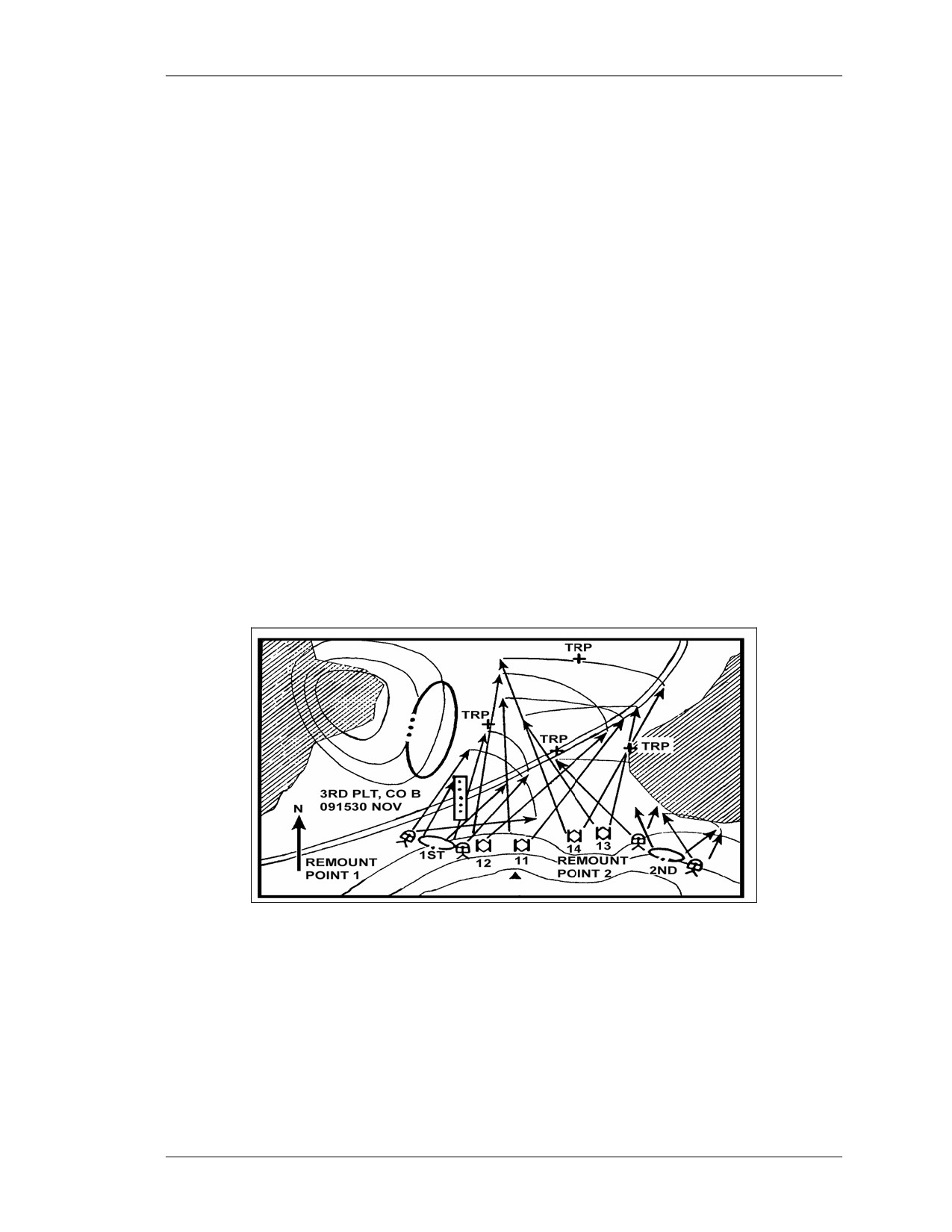
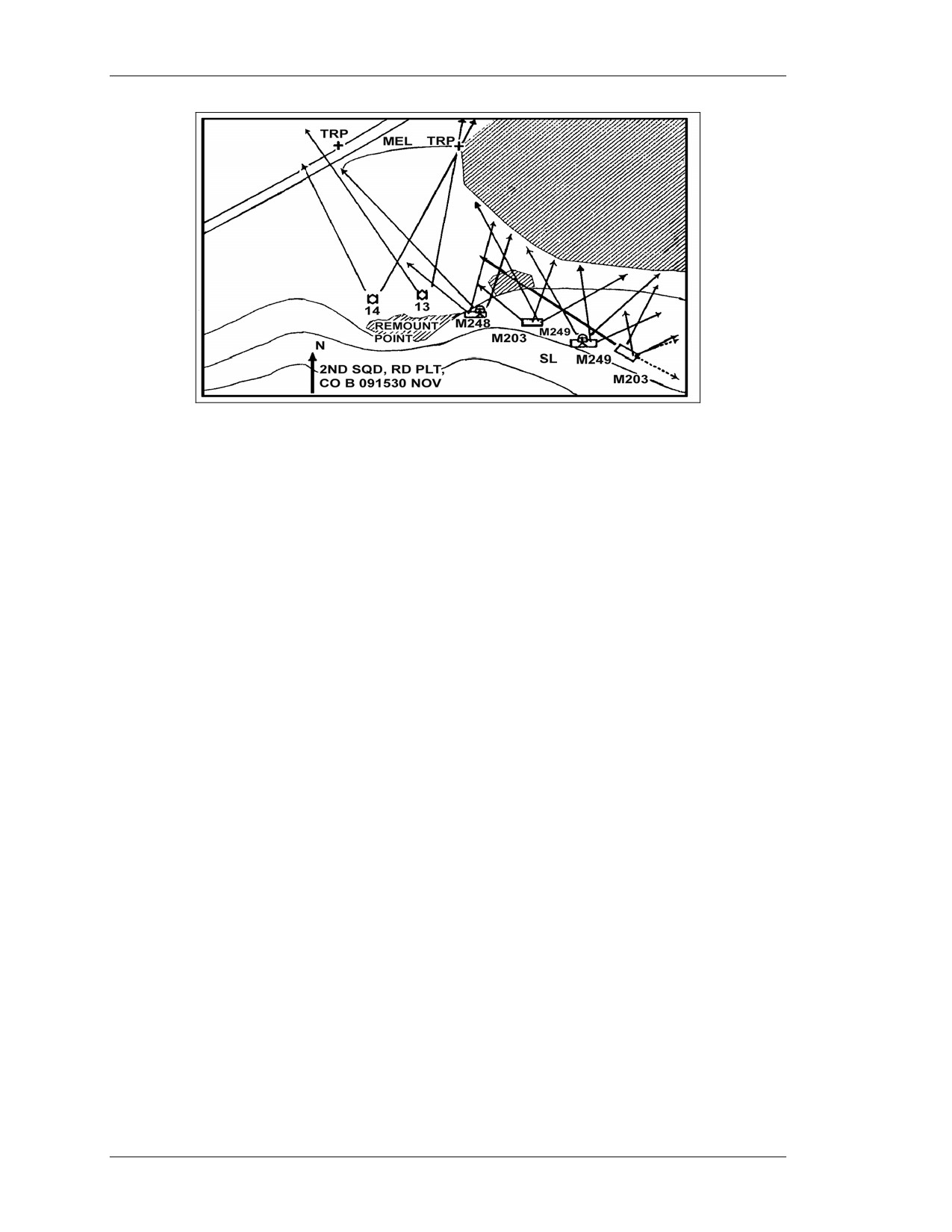
Sector Sketches. The platoon leader uses sector sketches to make sure he covers
his acquisition and engagement responsibilities, to orient subordinate elements, to
provide information to higher leaders, and to control fires. After confirming weapons
positions, he sketches his own engagement plan (Figures 9-7 and Figure 9-8, page 9-16).
9-14
FM 3-22.1
(1) Each leader prepares sector sketches on acetate overlays to a scale established by
the commander. The squad, section, and platoon sector sketches will look a lot alike. The
main difference between them is, of course, the size of the element. For example, the
platoon sketch shows the BFV, squad, and antiarmor missile positions. Squad and section
sketches show the BFV and soldier fighting positions.
(2) Each leader submits his completed sector sketch to the next most senior leader
for approval. After receiving approval, he distributes copies of his sketch to his
subordinates.
(3) The company commander should ensure that platoon leaders and platoon
sergeants receive copies of the company's fire plan. Each platoon leader issues copies of
his platoon's sketch to section leaders and squad leaders. Every sector sketch must show--
• Main terrain features.
• TRPs.
• Primary and alternate positions.
• Primary and secondary sectors of fire and maximum engagement lines.
• Primary directions of fire or final protective lines.
• Dead spaces.
• Observation post(s).
• Obstacles.
• Indirect fires associated with the engagement plan.
• Adjacent element positions.
• Remount point(s).
• Supplementary fighting positions for BFVs and infantry squads.
Figure 9-7. Platoon sector sketch.
9-15
FM 3-22.1
Figure 9-8. Squad or section sector sketch.
Section III. EVALUATION
Gunnery tasks are incorporated into tactical platoon collective tasks to allow live-fire
evaluation. The standards for each collective task are in the training and evaluation
outlines (T&EOs) in the MTP. These T&EOs are used to record the section's or platoon's
evaluations. The evaluation packets need to cover all pertinent organizational information
and task summary results. The senior trainer assesses the results of all evaluated
collective tasks and rates the platoon "T"
(trained), "P"
(needs practice), or "U"
(untrained). This section describes the roles, requirements, and guidelines for
incorporating live-fire tasks in collective tasks.
9-7. EVALUATION TEAM
Evaluators enhance the platoon training experience by providing valuable and credible
observations. Each evaluator should hold the same or higher rank than the evaluated
element's leader. Ideally, the evaluator should have experience in the evaluated leader's
position. This gives him credibility, and soldiers are more willing to learn from him.
FM 3-90.1 and the MTP give more information about the evaluators' specific roles and
procedures. The commander should task sufficient evaluators and exercise support
personnel to observe and evaluate the platoon's performance. Those tasked help the range
safety officer and perform their own assigned tasks. Battalion commanders must select
qualified personnel to serve as members of the evaluation team.
a. Senior Trainer. The battalion commander or his representative
(battalion
executive officer or S3) develops, designs, and executes the training exercise. He collects
all evaluation packets and penalty results. He factors in his own observations and assesses
the platoon's overall training. He approves alibis and oversees the AAR.
b. Senior Evaluator. Each platoon has one senior gunnery evaluator. He should be
a captain who has already commanded a company. He gives the senior trainer his
evaluations, observations, and an initial assessment. He also conducts the AAR.
c. Assistant Evaluator. Each section and squad has one assistant gunnery
evaluator. The assistant evaluator should be a lieutenant or sergeant first class who has
experience as a platoon leader or platoon sergeant. He observes overall squad and section
9-16
FM 3-22.1
leader tasks, dismounted element and vehicle actions, and fire control and distribution.
He also helps ensure live-fire safety. He initially assesses the squad or section using the
T&EOs. He provides input during the AAR.
d. Gunnery Evaluator. Each platoon has two gunnery evaluators, each of whom
should be a master gunner or a qualified BCE who understands target operations. The
gunnery evaluator follows his designated section, records vehicle-exposure times during
defensive engagements and, during offensive engagements, confirms target kills with the
range tower. Another gunnery evaluator can work with the computer operator to enhance
range operations. For the purpose of assessing penalties and casualties, gunnery
evaluators inform the senior evaluator as to which targets the crews missed and which
crews' vehicles were overexposed during the engagements.
9-8. EVALUATION GUIDELINES
The following guidelines establish standards and procedures for gunnery tasks that
support collective task assessment:
a. Collective task standards in the MTP are used for evaluations.
b. Penalties are imposed against the section's or platoon's vehicles when they are
exposed to the threat beyond established threat-based times (Chapter 8). Penalties are
imposed against the section's or platoon's dismounted elements based on targets they
failed to kill. These penalties are assessed IAW the gunnery task-penalty matrix shown in
Figure 9-9, page 9-18.
c. The senior evaluator or his designated representative may assess additional
penalties based on observations (NBC, indirect fires, or other situations), but he uses the
matrix to determine minimum penalties.
d. Penalties imposed are based on the respective threat target category and the
weapon system (infantry squad or vehicle) exposed to the target.
e. Timing procedures for determining vehicle exposure are the same as in crew
gunnery evaluation (Chapter 8).
f.
If neither the platoon, crew, section, squad, nor soldier engages a target, and if no
vehicle is exposed to the threat, then no penalty is assessed. The crew must meet the MTP
standards for the evaluated task.
g. Target engagement requires proper platoon fire commands.
h. Target kills apply if the weapon system used to engage the target can destroy the
replicated threat.
i.
The units should integrate CS and CSS into the exercise and perform applicable
tasks. These can include Class I, III, and V resupply and casualty evacuation tasks.
Combat lifesavers participate in CASEVAC.
j.
Unit or platoon SOP supplements the evaluation of the section's or platoon's
actions during the exercise.
k. The unit conducts AARs at the ends of the day and night phases.
l.
A section or platoon evaluated overall as "Untrained" must complete the entire
phase before it can qualify. The section or platoon may not redo or refire a collective task
in any phase to achieve a "needs practice" or better rating.
m. The only acceptable alibis are those based on the failure of range targetry or on
safety considerations unrelated to the firing platoon. Routine problems such as the failure
of a vehicle, weapon, or communications equipment do not constitute alibis. Platoons can
9-17

FM 3-22.1
deal with these problems as they would in combat--by cross-leveling ammunition,
personnel, and equipment--but the mission continues. Only the battalion commander may
approve alibis.
TARGET
BFV OFFENSE
BFV
DISMOUNTED
CATEGORIES
OR RETROGRADE
DEFENSE
INFANTRY
Aerial Targets
Catastrophic
Catastrophic
Two soldier casualties
per target not killed.
TOW, Javelin, or
Catastrophic
Mobility and
Two soldier casualties
Dragon Targets
Firepower
per target not killed.
AP Point Targets
Catastrophic
Firepower
Two soldier casualties
per target not killed.
HE Point Targets
Mobility and
Firepower
One soldier casualty
Firepower
per target not killed.
ATGM Teams,
Mobility
Firepower
One soldier casualty
Coax Point or
per target not killed.
Bunker Target
Dismount Squad,
Mobility
Firepower
One soldier casualty
Coax Area, or
per target not killed.
Trench Line
Figure 9-9. BFV platoon gunnery task-penalty matrix.
9-9. ASSESSMENT OF PENALTIES
Penalty assessments reflect possible results of a platoon's action.
a. Vehicle penalties are classified as mobility, firepower, mobility and firepower,
and catastrophic (Figure 9-9). During the conduct of the exercise, personnel must adhere
to range safety requirements rather than enforce penalties that conflict with range safety.
(1) Mobility Penalty. If it receives a mobility penalty, a vehicle may fire, but it may
not move (under its own power) until reconstituted. This can leave the vehicle exposed
during the next engagement, which merits an additional penalty. To avoid the additional
penalty, a platoon leader might have to adjust his direct-fire plan and engagement SOPs.
(2) Firepower Penalty. If it receives a firepower penalty, a vehicle may move, but it
may not fire until reconstituted. It may, however, continue to relay situation reports and
acquire and report any threat activity. Having a vehicle receive this penalty might require
the platoon leader to adjust his direct-fire plan and engagement SOPs.
(3) Combined Mobility and Firepower Penalty. If it receives a combined mobility
and firepower penalty, a vehicle can neither move nor fire until reconstituted.
(4) Catastrophic Penalty. If it receives a catastrophic penalty, a vehicle can do
nothing until reconstituted. All personnel on board at time of notification are considered
casualties IAW their MILES Casualty Tags (GTA 8-11-5).
b. Personnel penalties are also classified using these casualty tags. If the evaluator
imposes personnel penalties, each soldier in the platoon, including each Bradley
crewmember, receives a card. These cards identify a variety of personnel injuries ranging
from minor injuries, requiring only self-aid, to priority litter injuries that require casualty
evacuation. Killed-in-action cards are also used. Crew members (BC, driver, or gunner),
9-18
FM 3-22.1
should receive return-to-duty cards because of range safety requirements that may require
them to move the vehicle. These cards simulate the realism needed for leader decisions
and incorporation of CSS missions.
c. Each collective task is evaluated individually. A collective task may consist of
more than one live-fire engagement. Any penalty assessed during a collective task
remains in effect throughout that collective task.
d. Reconstitution of the penalized element(s) occurs at completion of a collective
task, if tactically feasible.
e. Evaluators use all penalties for a collective task to evaluate that collective
task standard.
f.
Failure to comply with an NBC condition during the day or night phase
automatically results in a "killed in action" assessment for that soldier. He retains this
status throughout that collective task.
9-10. EXAMPLES
This paragraph provides examples of situational evaluations and penalty assessments.
The platoon is conducting the subtask "Overwatch/Support by Fire" during a mounted
assault. Section A is in the overwatch position and Section B is bounding.
a. Example 1. Section A is presented two BMP targets. Both BMP targets are
exposed simultaneously for 50 seconds. The BFV threat exposure time is 22 seconds for
one BMP and 18 seconds for the other. Section A engages and kills the BMP with an 18-
second threat exposure time while exposing a BFV for 16 seconds. Section A then kills
the BMP with a 22-second threat exposure time while exposing a BFV for 20 seconds.
No penalty is assessed.
b. Example 2. Section kills the BMP with an 18-second threat-exposure time while
exposing a BFV for 17 seconds.
(1) Description. Section A fails to kill the BMP with a 22-second threat exposure
time while exposing a BFV to the threat for more than 22 seconds. Thus, the BFV
receives a penalty IAW the gunnery task-penalty matrix. Also, the senior evaluator may
assess an additional penalty against the bounding section because it was exposed to the
22-second BMP, but did not destroy the threat.
(2) Rationale. Total target-exposure time is 50 seconds. Depending on how long the
Section A BFV was exposed, the 22-second BMP could have had 27 seconds of target
exposure time remaining. Therefore, that BMP could have had 27 seconds to acquire and
apply a burst on a bounding BFV. This situation could vary based on conditions
and range.
c. Example 3. The section kills the BMP with an 18-second threat exposure time
while exposing a BFV for 17 seconds, but it fails to kill the BMP with a 22-second threat-
exposure time. If no BFV in either section is exposed to the threat beyond the BFV
exposure time, no penalty is assessed. However, the platoon must meet the MTP
standards for the entire collective task (that is, it must kill or destroy a percentage
of enemy).
d. Example 4. During the first live-fire engagement of a collective mounted assault
task, a platoon concentrates fires on the objective from a support position. Seven targets
are presented: three BMPs, two gun trucks, and two squads. Two of the platoon's BFVs
are overexposed to one BMP and one squad. Therefore, for that engagement, the platoon
9-19

FM 3-22.1
receives one catastrophic and one mobility penalty. The evaluator records the results on
the gunnery scoresheet. (Figure 9-10 shows an example format for such a scoresheet.)
In the second engagement, Section A bounds and overexposes itself to a BMP and to
a squad. This costs it one catastrophic and one mobility penalty. Thus, the platoon
receives a total of two catastrophic and two mobility penalties on the overall
collective task. The evaluator uses the results along with the collective task standards in
the MTP to make the assessments.
TARGETS
TARGET
PENALTIES
TASK
ELEMENT
SUBTASK
PRESENTED
KILLS
ASSESSED
Assault
Platoon
Concentrate
1 BMP
1
mounted
fires on the
enemy
1 BMP
1
1 BMP
1
1 BFV catastrophic
1 Gun Truck
0
1 Gun Truck
1
1 Squad
1
(7 IRETS)
1 Squad
1
1 BFV mobility
(7 IRETS)
Section A
Bound
1 BMP
1
1 BMP
0
1 BFV catastrophic
1 Squad
0
1 BFV mobility
(7 IRETS)
5 BMPs
4
2 BFV catastrophic
2 Gun Trucks
1
TOTALS
3 Squads
2
2 BFV mobility
(7 IRETS)
Figure 9-10. Example format for gunnery summary sheet.
Section IV. SECTION AND PLATOON DEVICE GUNNERY
Section
and platoon device gunnery consists of BT III, the Infantry squad/section
exercise, and BT IV, Infantry Platoon Proficiency Course (IPPC). These tables train and
evaluate collective squad/section and platoon tasks. To conduct the exercises, leaders use
MILES or PGS with LTID-equipped targets, or they use a force-on-force scenario. All
evaluations follow ARTEP 7-7J-Drill and FM 3-21.71, and Section III of this chapter.
BT IV (IPPC) is a prerequisite to BT XII, Infantry Platoon Qualification. Leaders must
9-20
FM 3-22.1
conduct the IPPC at least once during the day and once at night within the six months
before BT XII, page 12-6.
9-11. GUIDELINES
The following guidelines apply to section/platoon device gunnery:
a. Company commanders select squad collective tasks for BT III, the Infantry
squad/section exercise (ISSE).
b. Battalion commanders, along with their S3s, determine which additional platoon
collective tasks to evaluate during BT IV (IPPC).
c. Company commanders, along with their master gunners, develop operational
scenarios, OPORDs, and evaluation packets that support the squad collective tasks.
d. Battalion S3s, along with their master gunners, develop operational scenarios,
OPORDs, and evaluation packets to support the platoon collective tasks.
e. BFV and target-exposure times follow guidelines in Chapter 8.
f.
In force-on-force scenarios, OPFOR requirements and standards follow
ARTEP 7-7J-MTP.
g. For a range-targetry scenario, leaders use the gunnery task-penalty matrix
(Figure 9-9) to assess penalties.
h. Requirements for Bradley A3 and ODS units include one day and one night
engagement using digital communications equipment (ARTEP 7-7J MTP).
9-12. BRADLEY TABLE III, INFANTRY SQUAD AND SECTION EXERCISE
This table integrates the rifle squad with their vehicle section while conducting squad
collective tasks. Before ISSE, Bradley crews learn to integrate their training on the
vehicle. Units develop the ISSE scenario to support their METL and training emphasis.
All squad and section members must participate in a realistic scenario that requires them
to conduct battle-focused squad collective tasks that integrate, at a minimum, the
following from ARTEP 7-7J-Drill:
a. Crew Drills. (Minimum of three crew drills.)
b. Battle Drills. (Minimum required drills.)
• React to contact (mounted).
• Break contact (mounted).
c. Tasks. (Minimum of three additional, specific crew, squad, or section tasks.)
9-13. BRADLEY TABLE IV, INFANTRY PLATOON PROFICIENCY COURSE
This table integrates the mounted and dismounted elements of the platoon into the
platoon collective tasks. The battalion develops the IPPC scenario based on the METL
and training emphasis. All platoon members participate in a realistic scenario that
requires the platoon to conduct battle-focused platoon collective tasks. At a minimum,
this table evaluates four collective tasks from ARTEP 7-7J-Drill or -MTP. These tasks
must support the missions that are evaluated during platoon qualification as well as the
unit's METL.
9-21
FM 3-22.1
Section V. PLATOON GUNNERY
Previous sections and chapters discussed tactical and gunnery skills training and
evaluation for individuals, crews, squads, sections, and platoons. This section covers the
development and conduct of platoon live-fire gunnery exercises. Infantry platoon live fire
trains and evaluates how well the platoon integrates vehicle and rifle infantry and
distributes and controls fire. Platoons perform tactical collective tasks with integrated live
fire, in all conditions and with all platoon organic weapons. Platoon gunnery consists of
BTs XI and XII, pages 9-25 and 12-5 (Infantry Platoon Practice and Infantry Platoon
Qualification). Platoon collective tasks link directly to the seven platoon operations in
ARTEP 7-7J MTP and to the combat drills in FM 3-21.71 and ARTEP 7-7J-Drill. The
unit commander selects and develops tactical operations based on his METL and on the
contingency AO. He integrates Infantry squad and vehicle crew gunnery tasks to support
the tactical scenario. He uses the MTP T&EOs to assess overall performance. Chapter 8,
Section III of this chapter, and the MTP discuss evaluation procedures and
required personnel.
9-14. DEVELOPMENT OF EXERCISE
The MTP and the platoon gunnery exercises in this chapter establish an Army standard
for training and evaluation. At the same time, they allow unit commanders to tailor
tactical and gunnery tasks based on their particular missions and training emphasis. This
paragraph identifies the required gunnery target presentations to support platoon
collective tasks. Units determine specific threat target types and engagement distances or
range bands. Platoon gunnery evaluation procedures and standards are in Section III of
this chapter and the MTP. The following guidelines apply to both platoon practice and
qualification:
a. General Requirements. Bradley platoon practice is a building block for Bradley
platoon qualification. Both exercises are fully resourced with ammunition; however,
other training resource constraints could prohibit the platoon from the prescribed firing
practice. However, the platoon should collectively participate in live fire at least once
before they must qualify using live rounds. When they do qualify, platoons follow the
guidelines and standards in this chapter and in Section III of this chapter.
(1) The battalion commander and his S3 determine which MTP mission(s) to
conduct based on the unit's METL and specific command guidance.
(2) The S3 identifies the collective tasks to evaluate based on the operational
missions IAW the MTP.
(3) The S3 identifies which collective tasks to conduct live fire.
(4) Platoon gunnery will be conducted in two phases--one during the day and one
at night.
(5) The S3 and battalion master gunner develop scenarios that require the platoon to
conduct tactical missions and their respective collective tasks. Live-fire gunnery
presentations are incorporated into the identified collective tasks. This chapter identifies
the type and the minimum number of live-fire targets during qualification. However,
units may add targets if resources allow.
(6) The S3, S2, and battalion master gunner select vehicle and troop arrays that
represent threat forces in contingency areas or the required training emphasis. They also
specify threat target types and engagement distances, or range bands as well as most-to-
9-22
FM 3-22.1
least-dangerous targets, based on the threat analysis and training emphasis. The end
product is a threat template for platoon gunnery exercises.
(7) Different target types are combined to create presentations. A target presentation
is designed to force the platoon to distribute and control fire.
(8) The S3 develops an OPORD that supports the missions.
(9) The battalion master gunner prepares evaluation packets for each platoon. Each
packet contains T&EOs (from the MTP) and gunnery summary sheets. He arranges the
contents in collective-task sequence.
(10) The battalion master gunner coordinates all necessary resources and personnel to
support the gunnery exercises (Chapter 5).
(11) The platoon uses all organic equipment and weapons systems.
(12) Either the MILES or PGS with LTIDs can replicate TOW, Javelin, and Dragon
fire. Either MILES or a 9-mm subcaliber device can replicate AT4 fire.
(13) For the A3 and for FBCB2-equipped ODS models, BTs XI and XII, pages 9-25
and 12-5, must each include--
• One engagement under digital conditions in the day phase.
• One engagement under digital conditions in the night phase.
b. Live-Fire Requirements. Live-fire collective tasks are conducted on the range
complex that offers the best available target and maneuver area.
(1) Platoon practice and platoon qualification may be conducted on the same range.
However, target presentation will not be in the same sequence.
(2) The computer individually addresses all troop targets for scoring. Troop targets
will not be linked together to create multiple kills.
(3) All targets within a presentation are presented simultaneously. This requires the
firing element to properly control and distribute fires.
(4) Each firing vehicle is presented no more than two targets for each engagement,
except for the A3, which can have three.
(5) For each squad that will fire, no more than two dismount squads are presented
simultaneously.
(6) The infantry rifle elements conduct at least two NBC engagements; vehicle
elements do the same. These requirements can be combined if both infantry rifle and
vehicle crews fire during the engagement. One NBC engagement must be conducted
during the day phase and one NBC engagement during the night phase. Commanders are
encouraged to increase the number of NBC tasks conducted. The entire platoon is in
MOPP4 for all NBC tasks.
(7) Indirect-fire support should be incorporated in the scenario, whether it is
simulated or live fire (conduct live fire if possible). If mortars are used for illumination,
this can count as fire support. The platoon may not engage any of the required targets
with indirect fires. Indirect-fire targets are additional target presentations based on the
threat template. The commander evaluates this task IAW ARTEP 7-7J-MTP.
c. Scenario Enhancement. Evaluators can use pyrotechnics and simulators
(weapons effect) for effect and to cue the platoon to certain events.
(1) The scenario could include CS and CSS.
(2) Vehicles and soldiers should have specific MILES components that do not
interfere with live fire. This allows the evaluators imposing penalties to enforce
them rapidly.
9-23
FM 3-22.1
(3) All individual soldiers should receive MILES casualty cards. These cards will
replicate casualty status during live-fire tasks when penalties are imposed. Only vehicle
commanders, gunners, and drivers should receive return-to-duty cards for safe movement
of vehicles.
(4) Friendly targets should be incorporated into the scenario.
(5) Unit SOPs should be given to the evaluators for implementation into the
evaluation.
(6) The firing platoon's company commander should follow the platoon for C2.
Simulating radio traffic enhances the effects of the tactical scenario. Company
commanders receive all platoon reports and issue instructions and FRAGOs based on the
established scenario.
(7) Target presentations occur based on the platoon's tactical employment. The
platoon should react to rather than anticipate target presentations.
d. Targetry. All targets are constructed IAW Chapter 5 of TC 25-8.
(1) BFV Target Engagements. (Chapter 8.)
(2) Rifle Infantry Weapons.
(a) ATGM and Bunker Target Engagements. Vehicle targets are shown the same as
described for BFVs. RPG or ATGM teams are no more than three E-type silhouettes
placed in line, in depth, or in a wedge formation, no more than 5 meters apart or 10
meters in depth (Chapter 5).
(b) Infantry Rifle Squad and Trench-Line Target Engagements. Realistic arrays
include no more than 7 and no fewer than 4 E-type silhouettes placed in a linear or wedge
formation. They are spread up to 5 meters apart, but the whole target array fits in an area
up to 30 meters wide by 20 meters deep. For example, 14 troop targets equal two separate
dismounted squad targets.
(c) Substitutions. If range facilities cannot support an HE area target, the leader can
substitute three HE point targets. Each firing vehicle is presented no more than two
targets for each engagement, except for the A3, which can have three.
(3) Minimum Required Targets. Figure 9-11 shows the minimum required targets.
TARGET
MINIMUM TARGETS
AP Point
24
HE Area
2
HE Point
18
Coax Area
6
Coax Point
4
Infantry Targets
112
TOW
1
Figure 9-11. Minimum required targets.
e. Ammunition. DA Pam 350-38 dictates ammunition allocations (Figure 9-12). It
fully resources platoon practice and qualification for BFVs. It resources dismounted
weapons based on squad and platoon LFX allocations. If resources are available and extra
targets are added, platoons will receive additional ammunition based only on allocated
9-24

FM 3-22.1
rounds per additional target type. Platoons will receive and internally distribute
ammunition for the entire exercise
(day and night phases).
(Chapter 8 allocates
ammunition for each BFV target--the 25-mm, TOW, and coax.)
AP
192 rounds
HE
194 rounds
7.62-MM
800 rounds
Infantry Riflemen
Based on STRAC
TOW
1 missile (or PGS or MILES)
Figure 9-12. Ammunition allocations.
f.
BFV Target-Exposure Time. Each target has a different exposure time. To
determine this time, the master gunner needs to know the type of engagement, target
type, target conditions, and target distance. He uses the crew gunnery procedures in
Chapter 8.
g. Infantry Rifle Target-Exposure Time. Dismount troop targets are presented
four times, 5 seconds each time, at 10 second intervals.
h. Allowable Variations. Battalion commanders may add--
• Friendly targets to platoon qualification.
• Smoke and other obscurants to enhance the scenario's effects.
9-15. PREREQUISITES
The platoon must complete these prerequisite activities before conducting a live-fire
gunnery exercise:
a. All BFV crewmembers (including the platoon leader's backup crewmember)
must qualify on the BGST within the previous three months (four months for RC units).
b. All crews who fire live rounds must qualify (as a crew) within the previous six
months. Platoons maintain their platoon integrity. That is, only one platoon at a time can
take part in live fire--with no exceptions.
c. All squad members must qualify on their individual weapons (M16, M203,
M240B, and M249) within the previous six months.
d. All squads must complete a squad live-fire exercise to ARTEP standards within
the previous six months.
e. Platoons must complete IPPC (BT IV) within the previous six months.
9-16. BRADLEY TABLE XI, INFANTRY PLATOON PRACTICE
This table prepares the platoon for qualification. This is the first table in which the BFV
and dismounted infantry conduct live fire at platoon level. The objective is to practice
BFV and infantry squad integration and coordination to form a platoon collective effort.
a. The platoon should practice the fire-control and -distribution techniques they will
use during qualification.
b. Exercise development, standards, evaluation, ammunition, and target
considerations are the same as for platoon qualification.
9-25
FM 3-22.1
c. This table is resourced for full-caliber ammunition but can be modified for
vehicle subcaliber, 7.62-mm coax. Training devices, such as MILES or PGS, may be
used if ammunition or range constraints prohibit live-fire execution.
d. This table will model BT XII to include all collective and METL tasks for the
contingency area of operations.
9-17. BRADLEY TABLE XII, INFANTRY PLATOON QUALIFICATION
Platoon qualification evaluates the platoon's ability to execute collective tasks in a
tactical live-fire environment. Collective task evaluations measure the platoon's combat
proficiency. Mounted and dismounted infantry are integrated and evaluated on their
ability to fight as a cohesive BFV platoon. This is the focus of Bradley gunnery
previously discussed in this chapter.
a. The platoon must meet all prerequisites.
b. Bradley platoon qualification must be conducted live-fire using full-caliber
ammunition.
c. The unit must follow--
(1) Scenario development guidelines.
(2) Ammunition and target guidelines.
(3) Standards, scoring, and evaluation procedures (Section III).
9-26