FM 3-21.20 (FM 7-20) THE INFANTRY BATTALION (DECEMBER 2006) - page 14
Appendix G
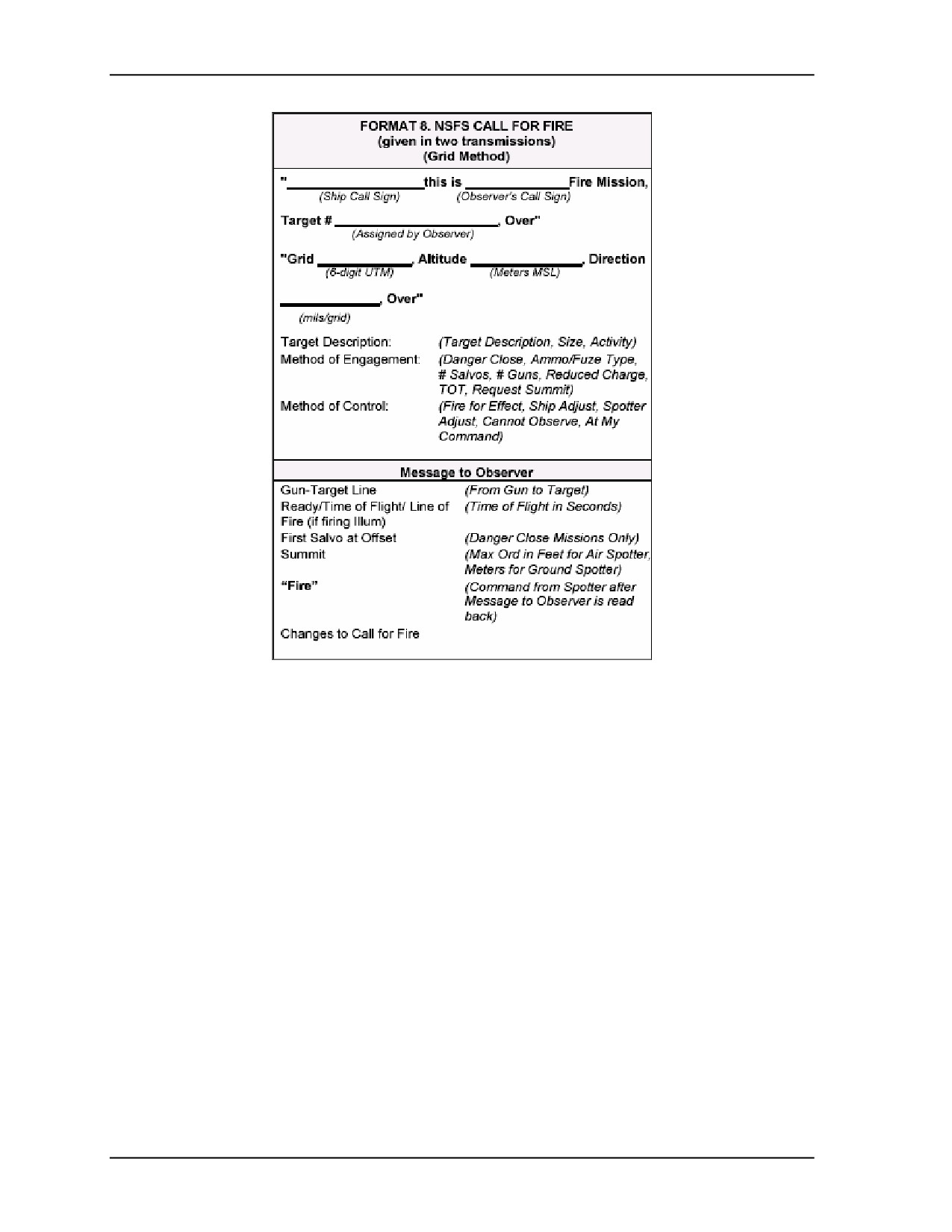
Figure G-6. Naval call for fire, grid method.
INTERAGENCY
G-57. The instruments of national power complement and reinforce each other. By understanding the
influence of other agencies and organizations, commanders can add diplomatic, informational, and
economic depth to their military efforts. US military capabilities allow other agencies to interact with
foreign powers from a position of strength and security. Just as integrating different unit capabilities results
in the advantages of combined arms warfare, synchronizing military power with other instruments of
national power leads to dynamic strategic capabilities (FM 3-0). US forces may cooperate or synchronize
with hundreds of government, nongovernment and international organizations, and agencies. The greater
the command and staff understanding of these organizations, the easier it is to coordinate or deconflict
operations. Usually, these agencies are receptive to Army offers of planning and coordination assistance.
Such an offer normally builds a sense of trust and understanding between them. This benefits all parties.
Army units can generally increase their situational understanding by communicating frequently with other
agencies--especially nongovernment agencies--operating in the AO.
G-18
FM 3-21.20
13 December 2006
Special Operations Forces and Joint, Interagency, and Multinational Operations
ORGANIZATION
G-58. Several example interagency organizations follow:
Department of Homeland Security
G-59. Homeland Security leverages resources within federal, state, and local governments, coordinating
the transition of multiple agencies and programs into a single, integrated agency focused on protecting the
American people and their homeland. More than 87,000 different governmental jurisdictions at the federal,
state, and local level have homeland security responsibilities.
Coast Guard
G-60. The coast guard is an armed force under the Department of Homeland Security. It has a statutory
civil law enforcement mission and authority. The Coast Guard and Navy cooperate in naval coastal warfare
missions during peace, conflict, and war. However, when directed by the President, or after a formal
declaration of war, the Coast Guard becomes a specialized Navy service.
Federal Emergency Management Agency
G-61. The Federal Emergency Management Agency (FEMA) is part of the Department of Homeland
Security's Emergency Preparedness and Response Directorate. FEMA has more than 2,600 full time
employees who work at FEMA headquarters in Washington D.C. They work at regional and area offices
across the country, including the Mount Weather Emergency Operations Center, and the National
Emergency Training Center in Emmitsburg, Maryland. FEMA also has nearly 4,000 standby disaster
assistance employees who are available for deployment after disasters. FEMA often works in partnership
with other organizations that are part of the nation's emergency management system. These partners
include state and local emergency management agencies, 27 federal agencies, and the American Red Cross.
CIA
G-62. The mission of the CIA is to support the President, the National Security Council, and all who
make and execute US national security policy by providing accurate, evidence-based, comprehensive, and
timely foreign intelligence related to national security and by conducting counterintelligence activities,
special activities, and other functions related to foreign intelligence and national security as directed by the
President.
FBI
G-63. The Federal Bureau of Investigation (FBI) is the investigative arm of the US Department of
Justice. The top ten priorities of the FBI are to—
• Protect the United States from terrorist attacks.
• Protect the United States against foreign intelligence operations and espionage.
• Protect the United States against cyber-based attacks and high-technology crimes.
• Combat public corruption at all levels.
• Protect civil rights.
• Combat transnational and national criminal organizations and enterprises.
• Combat major white-collar crime.
• Combat significant violent crime.
• Support federal, state, county, municipal, and international partners.
• Upgrade technology to successfully perform the FBI’s mission.
13 December 2006
FM 3-21.20
G-19
Appendix G
United States Agency for International Development (USAID)
G-64. USAID is an independent federal government agency that receives overall foreign policy
guidance from the Secretary of State. They support long-term and equitable economic growth and advance
US foreign policy objectives by supporting:
• Economic growth, agriculture, and trade,
• Global health and democracy.
• Conflict prevention and humanitarian assistance.
G-65. They provide assistance in four regions of the world:
• Sub-Saharan Africa
• Asia and the Near East
• Latin America and the Caribbean
• Europe and Eurasia
International Red Cross
G-66. The International Committee of the Red Cross (ICRC) is an impartial, neutral, and independent
organization whose exclusively humanitarian mission is to protect the lives and dignity of victims of war
and internal violence, and to provide them with assistance. The ICRC directs and coordinates the
international relief activities conducted by the movement in situations of conflict. It also endeavors to
prevent suffering by promoting and strengthening humanitarian law and universal humanitarian principles.
Médecins Sans Frontières
G-67. This group is also known as MSF or Doctors without Borders. They deliver emergency aid to
victims of armed conflict, epidemics, and natural and manmade disasters, and to others who lack health
care due to social or geographic isolation.
CAPABILITIES AND LIMITATIONS
G-68. There are unique capabilities and limitations for each agency. Only through detailed analysis will
the commander or staff fully appreciate each. General limitations are likely to include—
• Modern and sophisticated communication assets within the agency. These assets may not be
compatible with Army operational or tactical communication assets.
• Limited firepower, protection, and operational and tactical mobility compared to Infantry units.
PLANNING CONSIDERATIONS
G-69. The intricate links among the instruments of national power demand that commanders consider
how all capabilities and agencies can contribute to achieving the desired end state. Interagency
coordination forges a vital link between military operations and the activities of
• Other governmental agencies (OGAs).
• Governmental agencies of the US.
• Nongovernmental organizations.
• Host nation.
• Partner nations.
• Regional, international organizations.
G-70. Theater strategies routinely employ the capabilities of the entire US interagency network.
Interagency cooperation poses challenges. Among the most difficult is lack of mutual familiarity among
G-20
FM 3-21.20
13 December 2006
Special Operations Forces and Joint, Interagency, and Multinational Operations
the various agencies. In joint operations, leaders from the different services generally share a common
tradition and understanding of military matters. Interagency operations bring together leaders and staffs
that often have no common experiences. The institutional values and experiences of the separate agencies
and departments sometimes have few common points of reference. Some may even conflict. However,
education and teamwork can create an understanding and awareness of the missions, strengths,
weaknesses, and outlooks of the interagency members (Table G-2). CA assets are a vital link between the
military and all other agencies, IOs, and NGOs. The CMOC is especially useful in this critical aspect of
military operations. This understanding can mitigate the friction inherent in interagency operations.
Table G-2. Considerations for interagency operations.
Military
Political
Cultural
Targeting
Goals and objectives
Culture and language
Fire support coordination
National control of forces
Communication
Air and missile defense
Consensus building
Media relations
Teamwork and trust
Law enforcement
Doctrine, organization,
and training.
Equipment
MULTINATIONAL FORCES
G-71. Army forces will likely find themselves conducting multinational operations in future combat
operations. Whether working directly with or in proximity to multinational forces, commanders must
address the unique aspects associated with multinational operations.
ORGANIZATION
G-72. Multinational forces conducting operations with Army forces may be organized in many ways.
Command and support relationships may be dramatically different from what Army personnel are used to.
Multinational operations are conducted within the structure of an alliance or a coalition (JP 3-16). Military
alliances, such as the North Atlantic Treaty Organization (NATO), may afford participating nations time to
establish formal, standard agreements for broad, long-term objectives. Alliance members strive to field
compatible military systems, establish common procedures, and develop contingency plans to meet
potential threats in a fully integrated manner (FM 3-0).
CAPABILITIES AND LIMITATIONS
G-73. An Army force commander designated as a multinational force commander faces many complex
demands. These may include dealing with cultural issues, interoperability challenges, and an immature
theater C2 organization. Commanders may also be required to address different national procedures, the
sharing of intelligence, and theater support functions. Because coalition operations are not structured
around standing agreements, a preliminary understanding of the requirements for operating with a specific
foreign military may occur through peacetime military engagement. These developmental activities
include, but are not limited to, exercises, exchange programs, humanitarian assistance, ongoing personal
contacts, and pre-positioning of equipment. Every multinational operation is different. Commanders
analyze the mission’s peculiar requirements so they can exploit the advantages and compensate for the
limitations of a multinational force.
PLANNING CONSIDERATIONS
G-74. Allow extra time for cultural considerations and unique C2 issues inherent in multinational forces.
Be sure to—
13 December 2006
FM 3-21.20
G-21
Appendix G
• Plan for redundant communications and language barrier issues.
• Rehearse operations to account for differences in techniques, tactics, and procedures.
• Consider the sensitivity of multinational leaders to various nonmilitary issues such as home
government and ethnic considerations.
• Develop combined planning and tactical operations centers that maintain appropriate US only
OPSEC procedures.
G-22
FM 3-21.20
13 December 2006
Appendix H
Continuous Operations
The Infantry battalion often operates for extended periods in continuous operations.
Continuous operations are combat operations that continue at the same high intensity
level for extended periods. During continuous operations, leaders and Soldiers must
think faster, make decisions more rapidly, and act more quickly than the enemy acts.
Leaders must know the commander’s intent. They must be able to act spontaneously
and synchronously, even though the situation has changed and communications are
disrupted. The continuous cycle of day and night operations and the associated stress
of combat can lead to degradation in performance over time. Reducing this impact on
performance is a significant challenge for the C2 system. (FM 22-51 discusses the
effects of continuous operations on sleep and performance in detail.)
EFFECTS OF CONTINUOUS OPERATIONS
H-1.
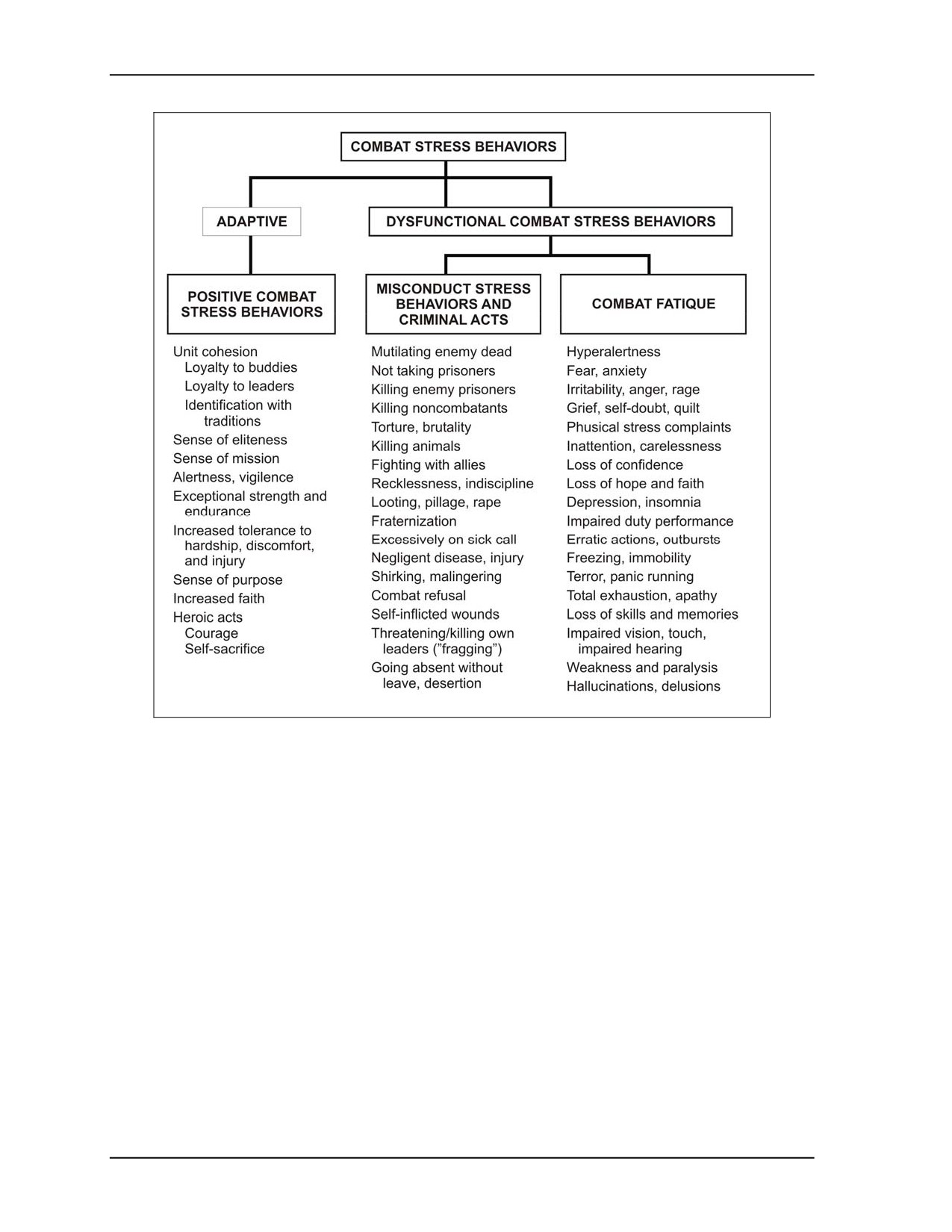
Continuous operations force leaders and Soldiers to perform under adverse conditions that cause
degradation in performance and may lead to combat stress. Figure H-1 shows combat stress behaviors.
CONTROL OF COMBAT STRESS
H-2.
Controlling combat stress is often the deciding factor in all forms of human conflict. It can be the
difference between victory and defeat. Stressors are a fact of combat. Soldiers must face this. Controlled
combat stress--properly focused by training, unit cohesion, and leadership--gives Soldiers the necessary
alertness, strength, and endurance to accomplish their mission. Controlled combat stress can call forth
positive stress reactions of loyalty, selflessness, and heroism. Conversely, uncontrolled combat stress
causes negative, erratic, or otherwise harmful behavior, which can
• Bring disgrace, disaster, and defeat, or
• Disrupt or block accomplishment of the mission.
WILL TO FIGHT
H-3.
The art of war aims to impose so much stress on enemy Soldiers that they lose their will to fight.
Both sides try to do this and at times accept severe stress themselves in order to inflict greater stress on the
enemy. To win, combat stress must be controlled.
13 December 2006
FM 3-21.20
H-1
Appendix H
Figure H-1. Combat stress behaviors.
RESPONSIBILITY FOR CONTROL OF COMBAT STRESS
H-4.
Responsibility for combat stress control requires a continuous interaction that begins with every
Soldier and his buddies. Combat stress control also includes unit combat lifesavers and trauma specialists.
The interaction continues through the small unit leaders and extends up through the organizational leaders,
both officers and NCOs, at all echelons.
Unit Cohesiveness
H-5.
Rigorous, realistic training for war must go on continuously to assure unit readiness. Emphasis
must be placed on establishing and maintaining cohesive units. Unit training and activities must emphasize
development of Soldier skills. This development should focus on building trust and establishing effective
communication throughout the unit.
Senior (Organizational) Leaders
H-6.
The chain of command ensures that the standards for military leadership are met. Senior leaders
provide the necessary information and resources to the junior leaders to control combat stress and to make
H-2
FM 3-21.20
13 December 2006
Continuous Operations
stress work for the US Army and against the enemy. The following are some suggestions for senior
leadership considerations for combat stress control.
• Demonstrate competence, commitment, courage, candor, and compassion.
• Plan to accomplish the mission with as few losses as possible.
• Set the policy and command climate for stress control, especially to build cohesive teams.
• Serve as an ethical role model.
• Make "the bureaucracy" work for the Soldiers.
• Provide resources to "take care of the Soldiers."
• Plan for and conduct tough, realistic training to include live fire.
• Provide as much information as possible to the Soldiers.
• Assure that medical and mental health/combat stress control personnel are assigned and trained
with their supported units.
• Have medical and metal health/combat stress control personnel conduct regular screenings of
individual Soldiers for signs of combat stress. These screenings should be immediately after
operations, upon return to home station and three to six months after returning to home station.
• Plan for combat stress control in all operations.
• Provide junior leaders/NCOs with necessary guidance.
• Ensure risk assessments are conducted before all training and combat operations.
• Supervise the junior leaders/NCOs and reward their success.
• Remain visible.
• Lead all stress control by good example.
• Maintain (through positive leadership and, when necessary, with disciplinary action) the high
standards of the international law of land warfare.
Junior (Direct) Leaders
H-7.
Junior leaders, and especially the NCOs, have the crucial task of applying the principles of stress
control day-by-day, hour-by-hour, and minute-by-minute. These responsibilities overlap with senior
leaders' responsibilities but include parts that are fundamentally "sergeants' business," supported by the
officers. The following are junior leadership considerations for combat stress control.
• Be competent, committed, courageous, candid, and caring.
• Build cohesive teams; integrate new personnel quickly.
• Cross-train Soldiers wherever and whenever possible.
• Plan and conduct tough realistic training that replicates combat conditions.
• Take care of Soldiers (including leaders).
• Assure physical fitness, nutrition, hydration, adequate clothing and shelter, and preventive
medicine measures.
• Make and enforce sleep plans.
• Keep accurate information flow down to the lowest level and back up again; dispel rumors.
• Encourage sharing of resources and feelings.
• Conduct after-action debriefings routinely.
• Maintain (through positive leadership and, when necessary, with disciplinary action) the high
standards of the international law of land warfare.
• Recommend exemplary Soldiers for awards and decorations.
• Recognize excess stress early and give immediate support.
• Keep those stressed Soldiers who can still perform their duties in the unit and provide extra
support and encourage them back to full effectiveness.
• Send those stressed Soldiers who cannot get needed rest in their small unit back to a supporting
element for brief sleep, food, hygiene, and limited duty, to return in one to two days.
13 December 2006
FM 3-21.20
H-3

Appendix H
• Refer temporarily unmanageable stress cases through channels for medical evacuation and
treatment.
• Welcome recovered battle fatigue casualties back and give them meaningful work and
responsibilities.
SLEEP
H-8.
Sleep issues include sleep deprivation (too little sleep) and degradation (poor sleep).
LOSS OF SLEEP OR SLEEP DEGRADATION
H-9.
One of the most significant factors leading to the degradation of a Soldier's performance is the
loss of sleep. Table H-1 shows the effects of sleep loss. Other contributing factors include low light levels,
limited visibility, disrupted sleep routines, physical fatigue, and stress.
Table H-1. Effects of sleep loss.
Deterioration in performance of tasks that are inadequately
AFTER 24 HOURS
or newly learned, that are monotonous, or that require
vigilance.
A marked deterioration in ability to register and understand
AFTER 36 HOURS
information.
Performance on most tasks will be about 50 percent of
AFTER 72 HOURS
normal.
The limit for intensive work including mental and
3 TO 4 DAYS
physical elements. Visual illusions are likely at this
stage, or earlier.
Performance is at its lowest ebb.
BETWEEN 0300 & 0600 HOURS
SIGNS OF SLEEP DEPRIVATION AND FATIGUE
H-10. To minimize the effects of sleep loss, all commanders must be able to recognize the signs of sleep
loss and fatigue. Table H-2 shows the indicators of sleep deprivation and fatigue.
SLEEP DENIAL
H-11. Commanders and leaders often regard themselves as being the least vulnerable to fatigue and the
effects of sleep loss. Tasks requiring quick reaction, complex reasoning, and detailed planning, however,
make leaders the most vulnerable to the effects of sleep deprivation. Leaders must sleep. The display of
sleep denial as an example of self-control by leaders is extremely counterproductive.
H-4
FM 3-21.20
13 December 2006

Continuous Operations
Table H-2. Signs of sleep deprivation and fatigue.
Body swaying when standing.
PHYSICAL CHANGES
Vacant stares.
Pale skin.
Slurred speech.
Bloodshot eyes.
Less energetic, alert, and cheerful.
MOOD CHANGES
Loss of interest in surroundings.
Possible depressed mood or apathetic and more
irritable.
Requires more effort to do a task in the morning than
EARLY MORNING DOLDRUMS
in the afternoon, especially between 0300 and 0600.
Unable to carry on a conversation.
COMMUNICATION PROBLEMS
Forgetfulness.
Difficulty in speaking clearly.
Slow comprehension and perception.
DIFFICULTY IN PROCESSING
Difficulty in accessing simple situations.
INFORMATION
Requiring more time to understand information.
Decreased vigilance.
IMPAIRED ATTENTION SPAN
Failure to complete routines.
Reduced attention span.
Short-term memory loss.
Inability to concentrate.
REDUCTION OF IMPACT
H-12. Table H-3 shows the measures that may reduce the negative impacts of continuous operations.
13 December 2006
FM 3-21.20
H-5

Appendix H
Table H-3. Reduction of the effects of continuous operations.
Sleep Scheduling
Countermeasures
Adequate
4 hours of continuous sleep in
Give simple, precise orders.
every 24 hours (likely to maintain
adequate performance over
Increase use of written orders.
several weeks).
Crosscheck.
Sleep Wakefulness
A small amount of sleep relative
to that lost is beneficial.
Plan more time for completion of
all tasks.
Recovery
10 hours uninterrupted sleep
required for full recovery after
Enforce adequate food and water
48-72 hours without sleep.
intake.
Catnaps
Catnaps are beneficial, but the
Develop and enforce sleep plans.
(10 To 30 Minutes)
only truly effective remedy is
sleep.
Good physical fitness slows the
effects of sleep loss and fatigue.
Timing
Consistent timing of sleep and
wakeup times will contribute to
Increase use of confirmation
successful adjustment to an
briefs.
arduous regimen.
Note: After 48 to 72 hours without sleep, Soldiers become militarily
ineffective. After five to seven days of even partial sleep deprivation,
alertness and performance decline to the same low level as seen
after two to three days without sleep.
H-6
FM 3-21.20
13 December 2006
Appendix I
CBRN Environment Operations
The purpose of using chemical and biological weapons varies based on when
employed by emerging nations and terrorist groups. Chemical weapons would most
likely be used early in an operation or from its onset to hinder an enemy’s
momentum; disrupt its command, control, and communications; produce casualties;
destroy or disable equipment; and disrupt operations. Biological weapons will target
rear area objectives such as food supplies, water sources, troop concentrations,
convoys, and urban and rural population centers, rather than frontline forces.
Chemical and biological agents may be employed separately or together and may
supplement conventional weapons.
The possibility of the use of chemical, biological, and or radiological dispersal
weapons by terrorist groups can not be overlooked. Planning must routinely address
the use of each of these as well as protective measures against enemy CBRN
weapons. Terrorist groups who have sufficient chemical and or biological agents may
use them in an operational or tactical situation. They will use persistent chemical
agents to restrict air base and port operations, and nonpersistent chemical agents on
bypassed troops, strongpoints, and flanks.
Section I. BATTLEFIELD
The CBRN-contaminated battlefield is the integration of CBRN weapons and contamination caused
by
industrial incidents into tactical operations.
COMMAND
I-1.
The battalion commander prepares his units and personnel to operate in a CBRN environment. To
do this, he ensures the battalion takes the proper protective measures including—
• CBRN vulnerability analysis.
• Dispersion and use of terrain as shielding.
• Continuous CBRN monitoring with detection equipment.
• Assumption of the appropriate MOPP level.
STAFF
I-2.
For CBRN operations, the battalion chemical officer, assisted by the battalion chemical NCO
provides technical advice to the battalion commander and the remainder of the battalion staff. The CBRN
staff officer and NCO—
• With the S-2, templates strikes and predictecs effects of enemy CBRN on battalion.
• Disseminates information received via the CBRN warning and reporting system (CBRNWRS).
• Recommends reconnaissance, monitoring, and surveying requirements.
• Recommends MOPP and OEG based on S-2's threat analysis and higher headquarters guidance.
• Maintains records of unit contamination to include radiological dose records.
• Conducts vulnerability analysis of unit positions.
• Plans battalion decontamination operations in conjunction with the S-3.
13 December 2006
FM 3-21.20
I-1

Appendix I
• Coordinates for nonorganic CBRN assets (decon, smoke, and reconnaissance) support.
• Acts as the liaison between attached chemical units and the S-3.
CHEMICAL AGENTS
I-3.
Chemical agents bring about casualties, degrade performance, slow maneuver, restrict terrain, and
disrupt operations (Table I-1). They can cover large areas and may be delivered as liquid, vapor, or aerosol
and disseminated by artillery, mortars, rockets, missiles, aircraft spray, bombs, land mines, and
covert means.
Table I-1. Characteristics of chemical agents.
Nerve
Blister
Blood
Choking
AGENT
Mask and BDO
Mask and BDO
Mask
Mask
PROTECTION
M8A1, M256A1,
M256A1, CAM,
M256A1
Odor (freshly
DETECTION
CAM, and M8 and
and M8 and M9
mowed hay)
M9 paper
paper
Difficult breathing,
Burning eyes,
Convulsions
Coughing,
SYMPTOMS
drooling, nausea,
stinging skin,
and coma
nausea, choking,
vomiting,
irritated nose
headache, and
convulsions, and
tight chest
blurred vision
Incapacitates
Blisters skin,
Incapacitates
Floods and
EFFECTS
damages
damages lungs
respiratory tract
Mark 1 NAAK
As for 2d and 3d
None
Keep warm and
FIRST AID
degree burns
avoid movement
M291 and flush
M291 and flush
None
None
DECON
eyes with water
eyes with water
BIOLOGICAL AGENTS
I-4.
US forces may be faced with enemies capable of producing and employing biological agents such
as disease-causing microorganisms (pathogens) and toxins. Biological agents can produce and reproduce
lethal or incapacitating effects over an extensive area. The delayed onset of symptoms and detection,
identification, and verification difficulties for biological agents can provide significant advantages to
adversaries who decide to use them.
TOXINS
I-5.
Toxins are poisonous substances produced from living organisms. The following characteristics
also apply to toxins:
• Can be synthesized (artificially produced).
• Mirror the symptoms of nerve agents.
• Present 8 to 12 hours of tactical concern (destroyed by sunlight).
• Can be fast acting (neurotoxins) or slower acting (cytotoxins).
PATHOGENS
I-6.
Pathogens are infectious agents that cause disease in man and animals. Examples of pathogens are
bacteria, viruses, and rickets. Characteristics of pathogens include—
• Delayed reaction (incubation 1 to 21 days).
I-2
FM 3-21.20
13 December 2006
CBRN Environment Operations
• Multiply and overcome natural defenses.
• Vectors (disease-infected insects) circumvent protective clothing and prolong hazards.
PROTECTION FROM BIOLOGICAL AGENTS
I-7.
Steps that can be taken to protect against biological agents include--
• Maintain up-to-date immunizations.
• Practice good hygiene.
• Maintain area sanitation.
• Maintain physical conditioning.
• Ensure water purification.
EFFECTS OF NUCLEAR WEAPONS
I-8.
Nuclear weapons are much more destructive than conventional weapons. Blast, nuclear and
thermal radiation, and electromagnetic pulse are of primary concern.
BLAST
I-9.
High-pressure shock wave crushes structures and causes missiling damage.
THERMAL RADIATION
I-10.
Intense heat and extremely bright light cause burns, temporary blindness, and dazzle.
NUCLEAR RADIATION
I-11.
Energy released from nuclear detonation produces fallout in the form of initial and residual
radiation, both of which cause casualties.
ELECTROMAGNETIC PULSE
I-12.
Surge of electrical power occurs within seconds of a nuclear detonation and damages electrical
components in equipment, such as radios, radar, computers, and vehicles; and in weapon systems such as
the TOW, Javelin, and Dragon.
PROTECTION FROM NUCLEAR ATTACK
I-13.
Cover and shielding offer the best protection from the immediate effects of a nuclear attack; this
includes cover in fighting positions (18 inches overhead cover), culverts, and ditches. Soldiers should
cover exposed skin and stay down until the blast wave passes and debris stops falling. Immediately after a
nuclear attack, begin continuous radiation monitoring.
MONITORING TECHNIQUES
I-14.
FM 3-11.3 describes monitoring techniques, correlation factor data, and recording forms.
Monitoring may be periodic or continuous.
13 December 2006
FM 3-21.20
I-3
Appendix I
Periodic
I-15.
Units conduct periodic monitoring during nuclear warfare. All units routinely--at least once an
hour--monitor a designated point in their respective areas. The CBRN defense annex of the unit SOP gives
detailed guidance on monitoring procedures.
Continuous
I-16.
All units initiate continuous monitoring when they receive a fallout warning, when a unit is on an
administrative or tactical move, when a nuclear burst occurs, when radiation levels above one centigray
(cGy) per hour are detected by periodic monitoring, and on order of the commander. Except for units on
the move, continuous monitoring stops on instructions from the commander or higher headquarters or
when the dose rate falls below one cGy per hour.
OPERATIONAL EXPOSURE GUIDANCE
I-17.
Operations in a nuclear environment are complicated by the necessity to control exposure of
personnel to nuclear radiation. An OEG determines the maximum radiation dose to which units may be
exposed and still accomplish a mission. Determination of this dose is based on the accumulated dose or
radiation history of the unit.
Section II. DEFENSE
Protect the force by adhering to three tenets of CBRN defense: contamination avoidance, protection, and
decontamination.
AVOIDANCE
I-18.
Avoiding CBRN attacks and hazards is the key to CBRN defense. Avoidance allows commanders
to shield Soldiers and units, thus shaping the battlefield.
ACTIVE AND PASSIVE MEASURES
I-19.
Contamination avoidance involves both active and passive measures. Passive measures include
training, camouflage, concealment, hardening positions, and dispersion. Active measures include detection,
reconnaissance, alarms and signals, warning and reporting, marking, and contamination control.
CBRN RECONNAISSANCE
I-20.
CBRN reconnaissance is the detection, identification, reporting, and marking of CBRN hazards.
CBRN reconnaissance consists of search, survey, surveillance, and sampling operations. Due to limited
availability of the M93 FOX reconnaissance vehicle, consider alternate means of conducting CBRN
reconnaissance such as reconnaissance elements, engineers, and maneuver units. As a minimum, consider
the following actions when planning and preparing for CBRN reconnaissance:
• Use the IPB process to orient on CBRN enemy NAIs.
• Pre-position reconnaissance assets to support requirements.
• Establish command and support relationships.
• Assess the time and distance factors for the conduct of CBRN reconnaissance.
• Report all information rapidly and accurately.
• Plan for resupply activities to sustain CBRN reconnaissance operations.
• Determine possible locations for post-mission decontamination.
I-4
FM 3-21.20
13 December 2006

CBRN Environment Operations
• Plan for fire support requirements.
• Plan fratricide prevention measures.
• Establish MEDEVAC procedures.
• Identify CBRNWRS procedures and frequencies.
PROTECTION
I-21.
CBRN protection is an integral part of operations. Techniques that work for avoidance also work
for protection (shielding Soldiers and units and shaping the battlefield). Other forms of protection involve
sealing or hardening positions, protecting Soldiers, assuming appropriate MOPP levels
(Table I-2),
reacting to attack, and using collective protection. Individual protective items include the protective mask,
joint services,
lightweight integrated suit technology
(JSLIST), overboots
(multipurpose
rain/snow/chemical and biological overboots (MULO)), and gloves. The higher-level commander above
the BCT establishes the minimum level of protection. Subordinate units may increase this level as
necessary but may not decrease it. The JSLIST may be worn for 45 days with up to six launderings or up to
120 days with no launderings. The JSLIST can be worn for 24 hours once contaminated. The MULO
provides 60 days of durability and 24 hours of protection against liquid chemical agents.
Table I-2. MOPP levels.
MOPP
Mask
Level/Equipment
Ready
MOPP0
MOPP1
MOPP2
MOPP3
MOPP4
Only
Mask
Carried
Carried
Carried
Carried
Worn
Worn
Worn***
JSLIST
Ready*
Avail**
Worn
Worn
Worn
Worn
Overboots
Ready*
Avail**
Avail**
Worn
Worn
Worn
Gloves
Ready*
Avail**
Avail**
Avail**
Avail**
Worn
Helmet Cover
Ready*
Avail**
Avail**
Worn
Worn
Worn
* Items available to Soldier within two hours with replacement available within six hours.
** Items must be positioned within arms reach of the Soldier.
*** Never “mask only” if nerve or blister agent is used in AO.
DECONTAMINATION
I-22.
Use of CBRN weapons creates unique residual hazards that may require decontamination. In
addition to the deliberate use of these weapons, collateral damage, natural disasters, and industrial emitters
may require decontamination. Contamination forces units into protective equipment that degrades
performance of individual and collective tasks. Decontamination restores combat power and reduces
casualties that may result from exposure, thus allowing commanders to sustain combat operations. Use the
four principles of decontamination when planning decontamination operations:
• Decontaminate as soon as possible.
• Decontaminate only what is necessary.
• Decontaminate as far forward as possible (METT-TC dependent).
• Decontaminate by priority.
13 December 2006
FM 3-21.20
I-5
Appendix I
DECONTAMINATION LEVELS
I-23.
The three levels of decontamination are immediate, operational, and thorough.
Immediate Decontamination
I-24.
Immediate decontamination requires minimal planning and is a basic Soldier survival skill.
Personal wipedown removes contamination from individual equipment using the M291. Operator spray-
down uses the on-board decontamination apparatus with DS2 to decontaminate surfaces that an operator
must touch or contact to operate the equipment.
Operational Decontamination
I-25.
Operational decontamination involves MOPP gear exchange and vehicle spray-down. MOPP gear
exchange is most effective when performed within the first six hours of being contaminated. It must be
completed within 24 hours of contamination. Vehicle wash-down removes gross contamination and limits
the spread of contamination.
Thorough Decontamination
I-26.
Thorough decontamination involves detailed troop decontamination
(DTD) and detailed
equipment decontamination (DED). Thorough decontamination is normally conducted (required after six
hours in a contaminated area without any decontamination performed) as part of reconstitution or during
breaks in combat operations. Support from a chemical decontamination platoon is required.
PLANNING CONSIDERATIONS
I-27.
Decontamination planning considerations include the following:
• Plan decontamination sites throughout the width and depth of the AO.
• Tie decontamination sites to the scheme of maneuver and templated CBRN strikes.
• Apply the principles of decontamination.
• Plan for contaminated routes.
• Plan logistics and resupply of MOPP, mask parts, water, and decontamination supplies.
• Consider medical concerns, including treatment and evacuation of contaminated casualties.
• Plan for site security.
I-6
FM 3-21.20
13 December 2006
Appendix J
Media Considerations
In today’s environment, the media are present in most military operations. In most
cases, the media can immediately send, publish, or broadcase whatever they see and
hear. Their words and images are powerful--and can affect national policy. Under our
form of government, the media have the right to cover operations, and the public has
a right to know what the media have to say. Although many members of the media
lack a full understanding of the military, they are nevertheless the key transmitters of
information about the Army to the public. Many good things about the Army are
unknown to the public. Commanders and public affairs personnel tell the Army’s
story. However, the right to a free press does not outweigh the necessity for
operations security and the accomplishment of the mission. This appendix covers
how to deal appropriately with the media.
OBJECTIVE
J-1.
The objective of the Infantry battalion commander, and more often through the unit’s personnel,
in dealing with the media, is to ensure that battalion operations are presented to the American public and
audiences around the world in the proper context. Commanders can best achieve this goal by educating
Soldiers and subordinate leaders about the positive aspects of a well-informed public.
REALITIES
J-2.
It is impossible, in this modern era, to keep large-scale military movements quiet. The media will
speculate on destinations of these moves and the likely missions, and such speculation can affect
operations security (OPSEC). News coverage for deployments will be immediate and worldwide, and the
messages put out by the media can change policy. The Army cannot and should not control media
messages or stories. The media will go everywhere they can to uncover unique angles and stories. They
will resist management and escort and will instead try to gather their information firsthand. However, many
members of the media have not served in the military and do not have an in-depth understanding of
military doctrine, terminology, and culture.
OBJECTIVES AND INTERESTS
J-3.
The media will want access to Soldiers and units. They will seek fresh stories every day and will
expect daily authoritative briefings from operators and leaders. The media are particularly interested in
excessive civilian casualties, fratricide, and the plight of noncombatants. They will want to discuss the
ROE and issues related to them. Also of media interest, will be any military-civilian disagreements or
conflicts such as looting, murder, rape, or mistreatment of prisoners. Civilian opinions, blaming US forces
for lack of food, fuel, water, or medical care, are sure to reach the press. Looming large on the press list
will be any US casualty figures, both actual and projected with little consideration for comparison or
context.
J-4.
The press will also want the Soldiers' perspective and will try to accompany Soldiers on missions.
The technique of embedding reporters with units should be considered if the operational conditions allow.
Embedding reporters with units for extended periods has added to the media’s understanding of Soldiers
and the military objectives, and has produced positive coverage about the Army.
13 December 2006
FM 3-21.20
J-1
Appendix J
CAPABILITIES
J-5.
With available technology, the media have the capability to collect and transmit images and sound
worldwide from any location. They have the ability to cover events quickly and to influence the public
either positively or negatively. With interest high in worldwide deployments, the media can send large
numbers of reporters to cover operations in detail.
COMMAND
J-6.
Commanders must anticipate, prepare, and respond within minutes or hours to breaking events.
Otherwise, it will be difficult or impossible to explain or counter what has already appeared on the
television or in print. When the released report is inaccurate, the commander should aggressively counter
the false report with timely and accurate information backed up by subject matter experts. It is also
important to coordinate statements among agencies. Bad news does not get better with age, and ignoring
the media will not make them go away. If the commander refuses to talk to the media, he will only
guarantee the military’s perspective will not be seen or heard. The commander must balance his time with
the news media to avoid being overexposed or ignored.
GUIDELINES
J-7.
The following are general guidelines for dealing with the media. These guidelines must be
tempered with the public’s right to know and the requirements of OPSEC.
SECURITY CONSIDERATIONS
J-8.
It is important that all Soldiers understand what is considered classified information and not
discuss it with the press. Soldiers should also understand that they are not required to talk to the media if it
is against their wishes. Precautions should be taken to protect classified information from the news media.
If someone accidentally reveals classified information, the reporter should be informed and asked not to
use it and explain why. All such incidents must be reported to the BCT commander. All Soldiers represent
the military and they should not guess or speculate on things they do not know. Anything said could be in
the hands of the enemy in minutes. In addition, grumbling or thoughtless complaining could provide the
enemy with propaganda to use against the military. The media must be prevented from televising nearby
recognizable landmarks, sensitive equipment, or operational or classified information contained in the CP.
The reasons for interfering with the telecast should be explained to the press.
MEDIA CONTROLS
J-9.
Media in the AO should be checked to ensure that they are credentialed, and a military escort
should escort them at all times for their safety. An interview should not be scheduled when it could
interfere with the mission. Even when preventing the disclosure of classified information, media material
or equipment should not be confiscated.
TOPICS TO AVOID DISCUSSING
J-10.
Neither the commander nor any member of his command should discuss political or foreign policy
matters. These are outside the direct scope of the military and would be purely speculative. No Soldier
should discuss matters in which he does not have direct knowledge. Operational capabilities, including
exact numbers or troop strengths, numbers or types of casualties, types of weapons systems, and plans,
should not be discussed with the press.
J-2
FM 3-21.20
13 December 2006
Media Considerations
INTERVIEWS
J-11.
The Infantry battalion commander or a senior member of the staff may be required to grant an
interview. This should be considered an opportunity to ensure that the needs of the media are met by
providing accurate, timely, and useful information.
MAINTAIN A PROFESSIONAL ATTITUDE
J-12.
Remain in control even when the media seem aggressive or ask inappropriate questions. Be polite
but firm. Be brief and concise; use simple language. Do not use jargon or acronyms; the public does not
know what they mean. Tell the Army’s story.
MAKE A GOOD IMPRESSION
J-13.
Relax and be yourself. Ignore the cameras and talk directly to the reporter. Remove your
sunglasses so the audience can see your eyes. Use appropriate posture and gestures.
THINK FIRST
J-14.
Stop and think before answering; questions need not be answered instantly. Answer only one
question at a time. Do not get angry. Correct answers are more important than deadlines.
KNOW QUESTION
J-15.
If you do not understand the question, ask the reporter to rephrase it. Know the question you are
answering. Do not answer "what if" questions or render opinions. Reporters often ask the same question in
different ways so stay consistent with your answer.
EVERYTHING COUNTS
J-16.
Everything is ON THE RECORD. You may be friendly but stick to business. The interviewer
chooses the questions and you choose the answers.
QUESTIONS WILL NOT BE THERE
J-17.
Videotape and print media will not include the question, just your answer. Your answer should
stand alone. If the interviewer uses a catch phrase, such as "assassination squad," do not use the word or
phrase in your answer. For example: "What are you doing about the assassination squads?" Bad Answer:
"The assassination squads are being investigated." Better Answer: "We are committed to investigating this
matter and will take the necessary and appropriate action."
SPEAK ABOUT WHAT YOU KNOW
J-18.
If you do not know the answer, simply say, "I don’t know." That answer rarely appears in print.
Avoid speculation or answering a question more appropriate for the Secretary of Defense. Talk about your
area of expertise.
TELL TRUTH
J-19.
Tell the truth even if it hurts. Do not try to cover embarrassing events with a security
classification. Never lie to the media.
13 December 2006
FM 3-21.20
J-3
Appendix J
KNOW, EXPRESS, AND STAY ON MESSAGE
J-20.
Generally, you will know what the media will want to ask. Decide beforehand the theme of your
responses. The media will try to make you divert from your message; however, stay focused on the
message.
TRAINING
J-21.
Units should train for media awareness in two parts, first in a classroom and then in the field.
CLASSROOM PHASE
J-22.
OPSEC should be covered thoroughly. Many of the things outlined in this appendix should be
discussed with Soldiers and leaders. If a media card is available in the command, it should be explained in
detail. Soldiers should be instructed on how to give an interview and their right to refuse to do so. Leaders
should understand their responsibility to convey the Army’s story truthfully so that the public will
understand it.
FIELD PHASE
J-23.
Soldiers should be given an opportunity to participate in an interview using Soldiers who
role-play as reporters. If possible, the role-playing Soldiers should be qualified in public affairs training.
This training should be included in regular field training exercises. If a video camera is used during the
interview, the tape can be replayed during an AAR. Due to possible far reaching effects of interviews, this
training should receive considerable command emphasis.
MEDIA CARDS
J-24.
If higher headquarters has not developed a media card, the battalion commander should ask the
PAO to develop one. If he or she does not or cannot, the commander should consider doing so for the
battalion. Items to include in a media card are—
• The name of the POC and how to contact him or her if a reporter arrives in the unit’s area.
• Responsibilities of a media escort.
• What information can or cannot be discussed.
• When to allow a media interview.
• How to treat reporters.
• How to conduct an interview.
• The best techniques to use in telling the Army’s story.
J-4
FM 3-21.20
13 December 2006
Appendix K
Unmanned Aircraft Systems
UAS operations support battlefield commanders and their staffs as they plan,
coordinate, and execute operations. UAS contribute to the SU of commanders
through ISR. Army UAS can perform some or all of the following functions;
enhanced targeting through acquisition, detection, designation, and BDA. Other UAS
missions support the maneuver commander by contributing to the effective tactical
operations of smaller units. Ground Control Stations (GCS) with common data links,
remote video terminals (RVTs), portable GCSs, and Army Airspace Command and
Control System (A2C2S) enhance SA and the COP, helping to set the conditions for
the current and future force's success. This appendix is an introduction to rapidly
developing UAS doctrine, equipment, and A2C2. It highlights capabilities of tactical
UAS likely encountered at the BCT and subordinate unit levels.
DESCRIPTION
K-1.
UAS can locate and recognize major enemy forces, moving vehicles, weapons systems, and other
targets that contrast with their surroundings. In addition, UAS can locate and confirm the positions of
friendly forces, the presence of noncombatant civilians, and so on. However, visually locating well
camouflaged enemy forces is difficult. The BCT and Infantry battalion and below units can enhance the
UAS capabilities by employing it as part of an overall collection plan, integrated with and cued by other
intelligence systems, in a synchronized effort to support the warfighters’ needs.
FUNDAMENTALS
K-2.
All UAS organizations must be able to—
• Plan and conduct strategic deployment.
• Conduct administrative and tactical movements.
• Coordinate with supported maneuver units.
• Gather information to support the IPB.
• Use the full spectrum of communications means to satisfy internal and external requirements
for combat information.
• Plan and coordinate A2C2.
K-3.
BCT and below UAS organizations must accomplish operations in any of the following
conditions:
• As subordinate unit assigned, attached, OPCON, or TACON to another service.
• Near ground forces.
• Day or night.
• Limited visibility.
• CBRN (avoid intentional contamination).
• All natural environments such as desert, mountains, rolling hills, dense forests, jungles, plains,
and urban areas.
• All operational environments such as contiguous, noncontiguous, linear, nonlinear, and
asymmetrical.
13 December 2006
FM 3-21.20
K-1
Appendix K
K-4.
BCT and below UAS organizations must be proficient in the following areas:
• Call-for-fire operations.
• Reconnaissance and security operations.
• Terrain flight: low-level, contour, and NOE
• Movement techniques: traveling, traveling overwatch, and bounding overwatch.
• Airfield and FARP operations.
• Emergency procedures.
• Base defense (includes emergency evacuation under all weather conditions).
• CBRN exposure avoidance, surveys, and decontamination.
EQUIPMENT
K-5.
UAS have rapidly developed in the past few years. Systems range from those capable of extreme
long distance and high altitude to resembling civilian hobby shop models. Most recently, development and
deployment of UAS specifically designed to support the BCT and below now support the tactical
commander.
BCT AND BELOW
K-6.
The Shadow and Raven UAS are the most common found at the BCT level and below. They are
characterized by relatively short flight duration, small size, limited payload options, and are not capable of
directly engaging the enemy.
SHADOW UAS
K-7.
The Shadow UAS is an effective intelligence gathering system that has been proven in combat.
The Shadow’s electro-optical/infrared (EO/IR) payload can produce color video in daylight operations and
black and white thermal images at night. This imagery give commanders near real-time intelligence day
and night. The aircraft is nearly undetectable in urban areas or other areas with ambient noise. The
Shadow’s operators can often identify enemy ambushes or insurgents planting improvised explosive
devices (IEDs). These capabilities let the Shadow unit--
• Support conventional combat operations and raids
• Provide TA
• Follow-up BDA
• Perform countermortar operations, and
• Assist with search and rescue operations.
System Mission
K-8.
The mission of the Shadow is to provide a real-time, responsive, day and night imagery
surveillance and reconnaissance capability to support SA, target acquisition, and BDA.
Fundamentals
K-9.
The Shadow is used at the BCT level, but may be allocated to support a subordinate battalion. The
Shadow conducts R&S missions to protect friendly forces and can perform screen missions and participate
in guard or cover missions. The Shadow provides reconnaissance and security and/or employs indirect fires
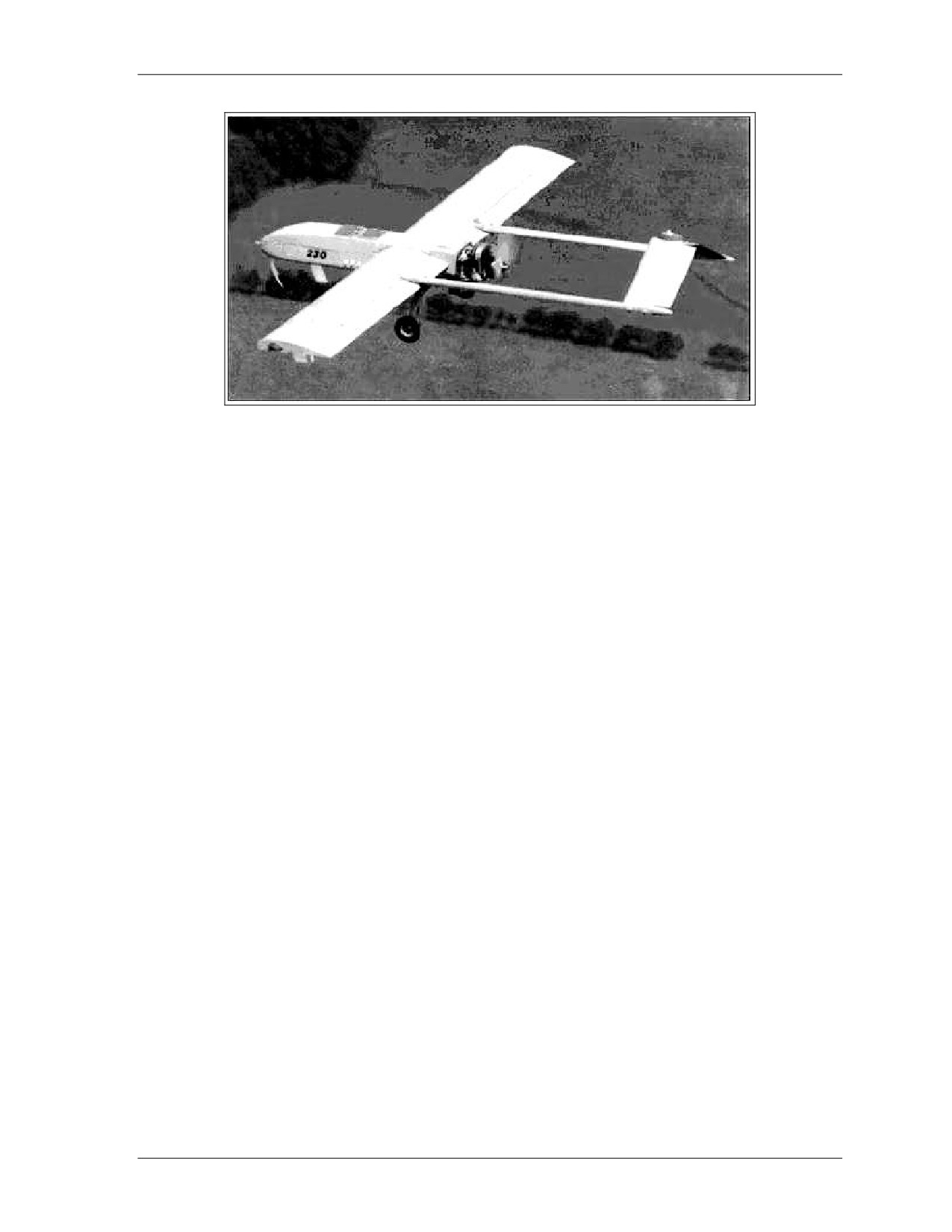
and can perform near real time BDA (Figure K-1).
K-2
FM 3-21.20
13 December 2006
Unmanned Aircraft Systems
Figure K-1. The Shadow UAS.
Description
K-10. The Shadow aircraft uses a twin-boom pusher design. The Shadow has a rotary engine. Its
nonretractable, tricyclic landing gear allow conventional wheeled take-off and landing. However, the
Shadow can also be launched from a catapult, plus it has a tail hook to catch arresting cables on a short
runway. A complete Shadow system has four air vehicles and two GCSs, and the operators have full
control over the air vehicle and their sensors. Both line of sight (LOS) and non-line-of-sight (NLOS) data
links provide command uplink and sensor data downlink.
Navigation
• For full autonomy, the Shadow can use a GPS-based navigation system.
Tasks
• Shadow tasks include day or night reconnaissance, surveillance, TA, and BDA.
Payloads
• Block 1 (initial production) vehicles--an EO/IR sensor turret.
• Block 2 vehicles (not fielded)--are projected to use an improved EO/IR sensor.
• Other, possibly including a synthetic aperture radar/moving target indicator (SAR/MTI).
Capabilities
K-11. Capabilities of the system include—
• Multiple payload capability.
• Modular design enables growth.
• Automatic landing and takeoff.
• Early entry capability with one C-130.
• System and maintenance section transportable on three C-130s.
• Compatible with Army battle command system (ABCS).
• EO/IR sensor.
13 December 2006
FM 3-21.20
K-3

Appendix K
Electro-Optical/Infrared Payload
K-12. The EO/IR payload
(Figure K-2) is a multimode, forward looking infrared
(FLIR)/line
scanner/TV sensor. It has a resolution sufficient to detect and recognize an armored personnel carrier sized
target from operational altitudes, for example, more than 8,000 ft above ground level (AGL) day; more
than 6,000 feet AGL at night; and at survivable standoff ranges (3 to 5 km) from the imaged target. Images
are processed onboard the AV and passed to the GCS via the system data link. The payload can provide
autonomous preplanned operation and instantaneous retasking throughout a mission. The EO/IR payload
provides continuous zoom capabilities when in enemy operations mode and multiple fields of view (FOV)
when in IR mode. The mission payload operator (MPO) selects the mode.
Figure K-2. Shadow mission payload.
Remote Video Terminal
K-13. The RVT (Figure K-3) is a portable system that receives, processes, and displays near real time
(NRT) video images and telemetry from the AV. The RVT receives video and telemetry signals from the AV
through either the antenna or the GCS. The RVT receives direct downlink from the AV when within 50 km
of the AV and displays annotated imagery to the operator (same as MPO display in the GCS). In addition,
the RVT can store imagery, recall selected segments, and display NRT imagery with annotations of
date/time group. It also can store selectable target locations in latitude/longitude, military grid reference
system, and universal transverse Mercator coordinates when in the center FOV, north seeking arrow, AV
position, and heading. The system has four RVTs to provide payload information in the AOs. Based on
METT-TC, the commander allocates RVTs to support his scheme of maneuver. The RVT is “user friendly”
and easy to operate. A Soldier assigned to the supported unit transports and operates the RVT. Supported
units receive the RVT and operator training from the Shadow platoon.
RAVEN UAS
K-14. Like the Shadow UAS, the Raven is a combat proven intelligence gathering system. It has seen
extensive use in ongoing combat operations, enhancing the intelligence-gathering capabilities of battalions,
companies, and even platoons.
K-4
FM 3-21.20
13 December 2006
Unmanned Aircraft Systems
System Mission
K-15. The Raven team provides R&S and remote monitoring, day and night imagery to support SA and
SU, target acquisition, and BDA down to company level.
Fundamentals
K-16. The Raven team normally operates at the battalion level, but may be allocated to support a
subordinate company or even a platoon. Ravens are deployed to conduct R&S missions and convoy
security to protect friendly forces. The Raven can provide information on enemy location, disposition,
activity, and/or employ indirect fires. Raven can perform real time BDA.
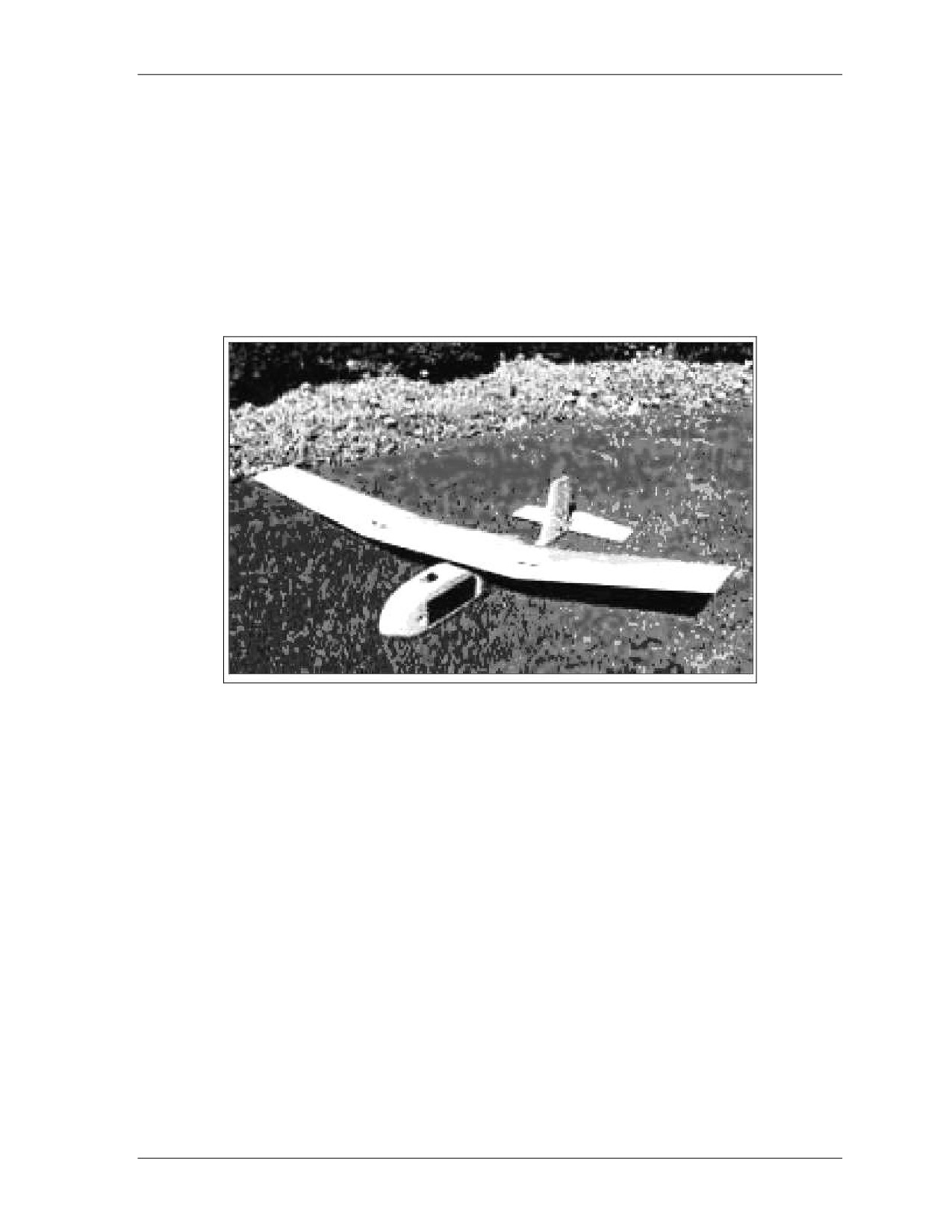
Figure K-3. The Raven UAS.
Description
K-17. The Raven is a man-portable, hand-launched small UAS that is designed for reconnaissance,
surveillance and remote monitoring. The Raven can be launched and recovered in minutes without special
equipment on unprepared terrain. It can be either remotely controlled from the ground control unit (GCU)
or fly completely autonomous missions using global positioning system waypoint navigation. The AV can
be ordered to immediately return to its launch point simply by pressing a single command button.
Capabilities
K-18. The following are some of the characteristics of the system:
• Hand launch, auto-land, or manual recovery.
• Auto navigation using military P(y)-code GPS.
• Manual navigation and flight modes.
• AV quick assembly (less than 3 minutes).
• Man-portable or backpackable.
• Quiet.
13 December 2006
FM 3-21.20
K-5
Appendix K
• Reusable (100 or more flights).
• Ability to climb to operational altitude in 1 to 2 minutes.
Organization
K-19. A Raven team typically consists of—
• Two operators from the unit to which the equipment is assigned.
• Three AVs.
• Three payloads.
• Three EO front and side look.
• Two IR front look.
• Two IR side look.
• One GCU.
• Remote video terminal.
• Single use and rechargeable batteries.
• Carry/protective cases.
• Battery charger and power supply.
• Field maintenance kit.
• Spare and repair parts.
Electro-Optical or Infrared Payload
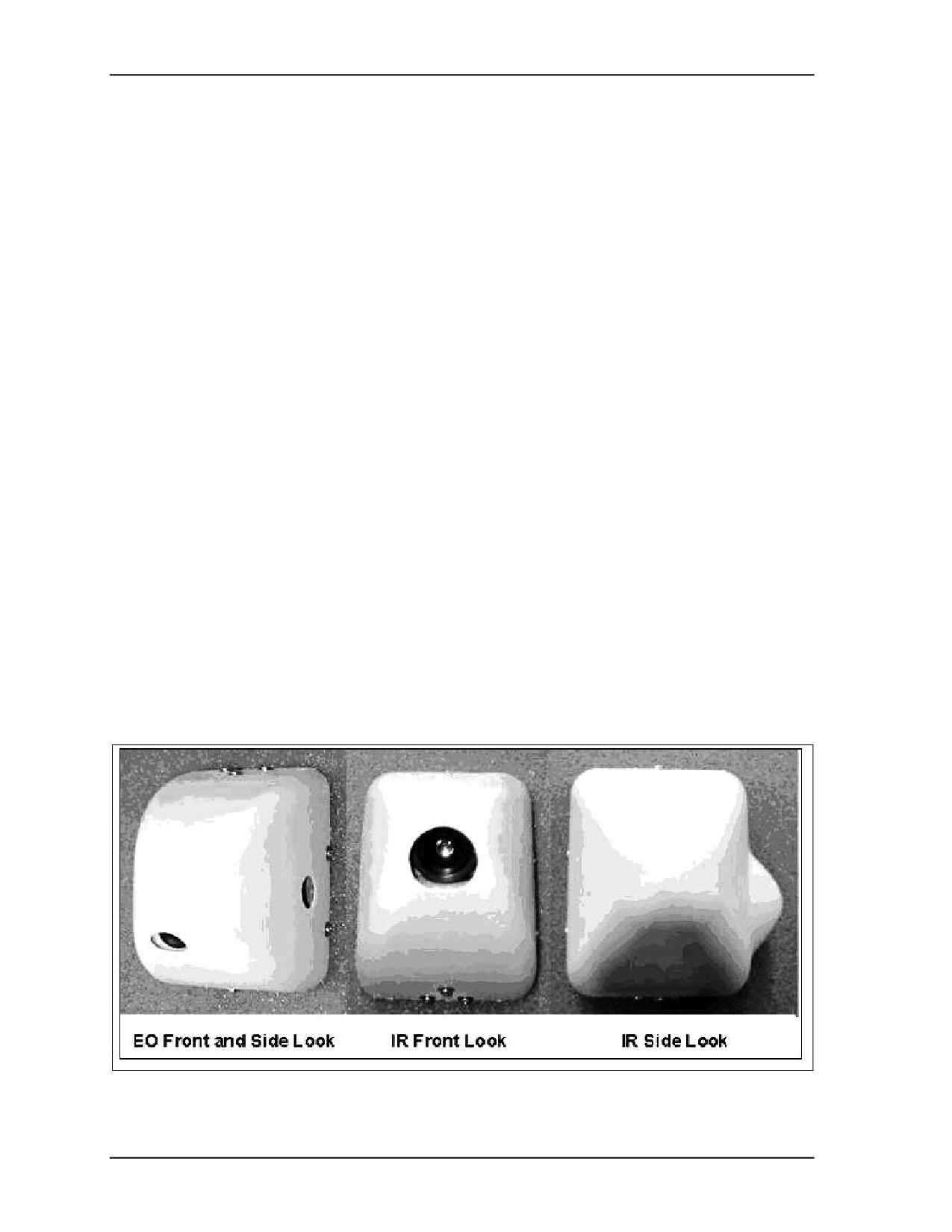
K-20. The optics package includes an EO, color camera nose (side and forward look) for day operations,
and two IR thermal noses (one side and one forward look) for night operations. EO IR Pixels 768H X
494V 160H X 120V Payload Nose Weight 6.2 oz 6.5 oz. The Raven aircraft carries either an EO or an IR
camera in its nose. The system includes three payload noses (Figure K-4). Video clarity begins to degrade
above 500 feet AGL:
• One nose holds cameras in forward and side look positions.
• One nose holds a camera in the forward look position.
• One nose holds a camera in the left side look position.
Figure K-4. Camera payloads.
K-6
FM 3-21.20
13 December 2006
Unmanned Aircraft Systems
Remote Video Terminal
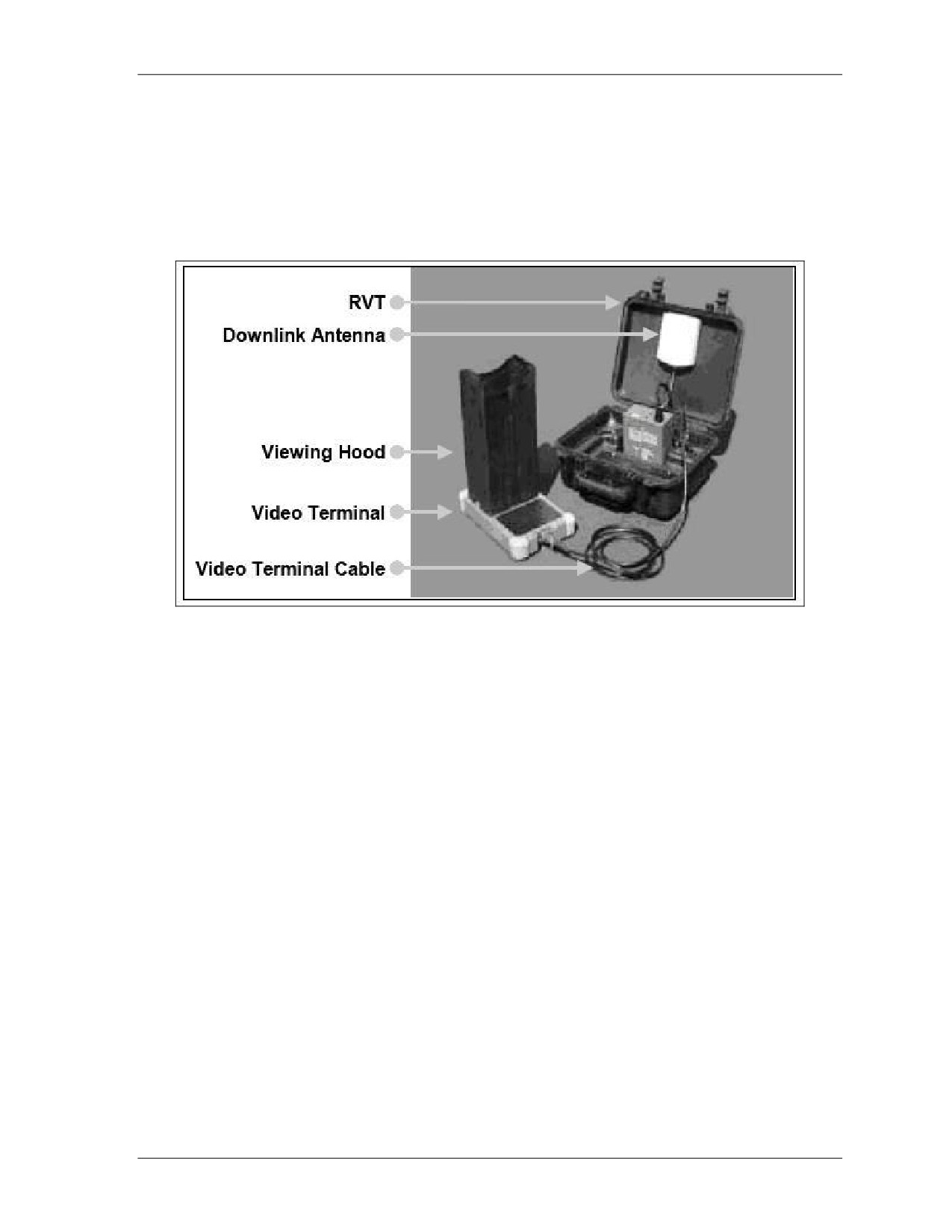
K-21. The UAS transmits live airborne video images and compass headings (location information) from
the AV to a GCU and RVT, enabling operators to navigate, search for targets, recognize terrain, and record
all information for analysis later. The RVT (Figure K-5) display is a receive-only monitor with no aircraft
control functions. It can be used to view real-time video from any location within a 5 to 10 km LOS of the
aircraft. A single BA- 5590 or BB-390 battery powers the RVT.
Figure K-5. Raven remote video terminal.
K-22. Field maintenance on the Raven typically includes routine inspections, servicing, cleaning, and
adjusting. Procedures that should be done at the field level do not require specialized training or tools. If
the repair is not at an operator (field) maintenance level, the item should be turned in to the battalion
supply S-4.
AIRSPACE CONTROL MEASURES
K-23. UAS present significant challenges due to their small size, agility, and increasing density, as well
as their limited ability to detect, see, and avoid other aircrafts. Thus, UAS pose an operational hazard to
manned aircraft operating nearby. UAS flights, like manned aircraft flights, must be coordinated to avoid
conflict with other airspace users. UAS missions should be coordinated with the airspace control authority,
area air defense commander (AADC), and the JFACC to safely separate UAS from manned aircraft and to
prevent engagement by friendly AD systems (FM 3-100.2).
PLANNED MISSIONS
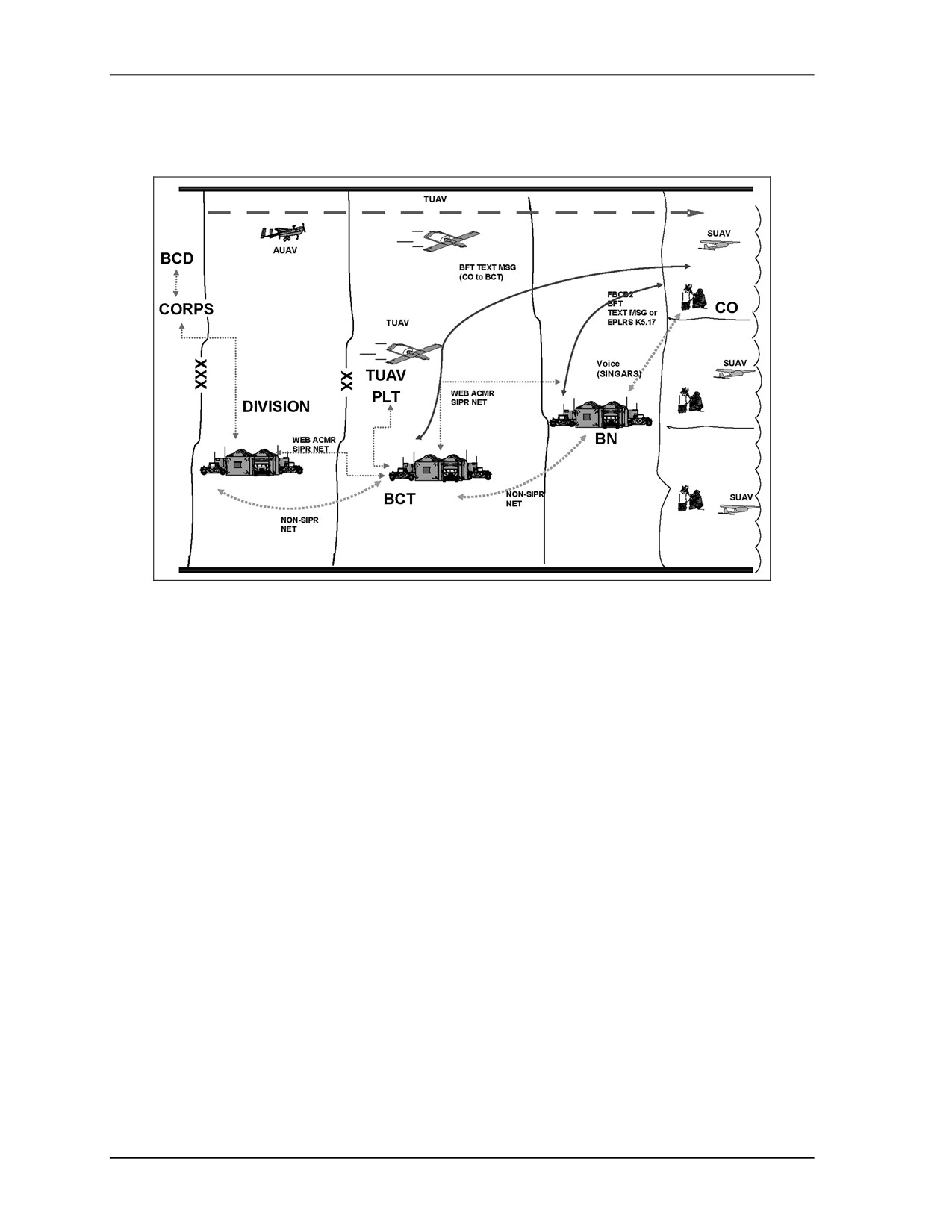
K-24. The ACA may establish specific UAS flight routes and altitudes, and publish them in the airspace
control plan. The established principles of airspace management used in manned flight operations apply to
UAS operations, but the JFC may waive them, if necessary. UAS missions may be both preplanned and
hasty in nature. Preplanned UAS flights should be included in the ATO, special instructions (SPINS), or
airspace control order
(ACO). The unit should coordinate hasty UAS missions with the appropriate
airspace control agencies to safely separate UAS from manned aircraft, and to prevent inadvertent
engagement by friendly air defense (AD) elements. See Figure K-6.
13 December 2006
FM 3-21.20
K-7
Appendix K
K-25. Before launching any UAS mission, commanders must assess the training and readiness level of
friendly forces. The analysis includes availability of critical systems, supporting fires, and joint support.
Figure K-6. UAS request flow.
Supporting Fires
K-26. The supported unit frequently has access to indirect fires from a coordinated fires network. These
complementary fires could facilitate movement to the objective area through JSEADs, engage targets
bypassed by UAS, or provide indirect fires on the objective. Knowing what and when FS is available are
important considerations during UAS mission planning and EA development. Efforts to coordinate joint
fires for actions on the objective could be critical to the success of operations in deep areas.
Airspace Control Order
K-27. The ACO is an order implementing the airspace control plan that provides details of the approved
requests for ACMs. It is published either as part of the ATO or as a separate document. ACO coordination
is required for any operations outside of Army controlled airspace.
Air Tasking Order
K-28. The ATO is a method for tasking and disseminating to components, subordinate units, and C2
agencies projected sorties, capabilities, and/or forces to targets and specific missions. It normally provides
specific instructions to include call signs, targets, and controlling agencies, as well as general instructions.
BCT AND BELOW TASKING AND PLANNING CONSIDERATIONS
K-29. UAS units organic to or supporting BCT and below frequently team with manned systems to
support ground maneuver and fire support units. UAS planners may be called upon to assist planners from
K-8
FM 3-21.20
13 December 2006
Unmanned Aircraft Systems
other mission areas. Because of this, UAS planners must have adequate knowledge to plan operations to
support a wide variety of unit missions.
Planned Mission Development
K-30. The S-2 develops NAIs that aid in focusing collection efforts in a systematic approach to answer
PIR, monitor decision points, and locate multiple high value targets (HVT). UAS can reconnoiter and
expand the supported brigade’s battlespace for targeting and early warning. UAS also support close
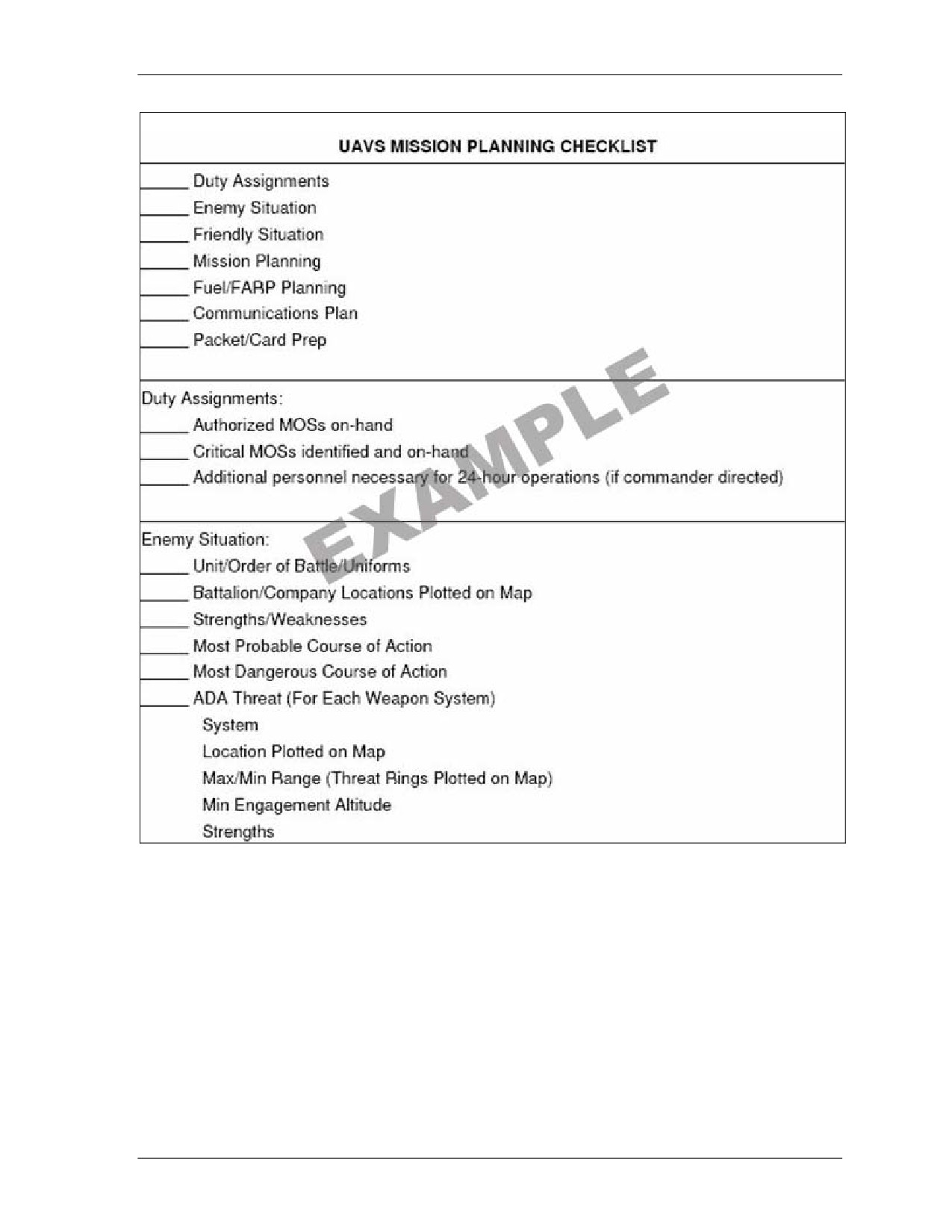
combat, and assist in security and surveillance of NAIs. See Figure K-7, pages K-11 through K-15.
K-31. UAS employment is optimized when integrated into an ISR plan that uses other collection assets
to cue the UAS. Collection systems can provide single source reports that UAS can confirm; this produces
reliable intelligence. Some of these collections systems are the JSTARS, GSR, improved remotely
monitored battlefield sensor system (IREMBASS), and SIGINT collectors such as Prophet and Guardrail
common sensor. Collection systems locate a potential enemy force; UAS then detect the enemy element
and confirm its composition. The bottom line is that UAS, cued by other ISR assets enable the BCT and
below to systematically gain and maintain contact with the enemy well before that enemy can range the
BCT main body.
K-32. Many BCTs have CGS access to provide JSTARS downlink and UAS imagery and data. The CGS
provides the ability to view both JSTARS MTI and SAR imagery on one screen; on a second screen, it can
display the UAS location, where it is looking, and its real-time video feed. Often, the UAS GCS is nearby,
enabling rapid landline interface. Trojan Spirit provides another means to link the GCS and CGS. JSTARS
provides the S-2 and UAS with tasking authority to monitor the big picture and fully integrate the UAS; in
this way, the UAS can confirm what the JSTARS detects.
K-33. Another BCT method for using UAS during offensive operations is to exploit the UAS ability to
move quickly through the zone and observe successive NAIs in a short time. The BCT ISR plan can use
the "waves" of reconnaissance method, in which ground collection assets move forward at different times.
This allows information from lead elements to cue follow-on reconnaissance forces and trailing
intelligence assets. If BCT UAS are in the first "wave" of reconnaissance in the synchronized ISR plan,
follow-on manned reconnaissance and security assets know where to concentrate their efforts. This UAS
"recon push" expedites the BCT’s movement through the zone. The UAS reconnaissance that cues ground
and air scouts, enables the BCT to identify the enemy’s disposition, determine its weakness, and exploit
that weakness.
K-34. Before such an operation, the S-2 develops NAIs to confirm or deny the enemy defense. Just
before reconnaissance assets crossing the LD, UAS launch to take an initial look at the NAIs. UAS over fly
and examine ground reconnaissance infiltration routes while en route to NAIs which correspond to primary
routes of advance. This allows the UAS to detect any enemy forces or obstacles that the ground
reconnaissance assets will encounter en route to their observation point. Once on station, the UAS sensor is
focused on each NAI. After the initial observation, the UAS may be returned to a previously observed NAI
to possibly observe signs of enemy movement.
K-35. Because the BCT and below small UAS flight duration is shorter than larger UAS, route planning
is critical, and must integrate manned reconnaissance routes with reconnaissance routes. See Figure K-8,
page K-15. If possible, the UAS should remain on station until the first "wave" of manned reconnaissance
assets arrive at their OP locations. This assures nearly continuous surveillance of NAIs. It shortens the
window between UAS reconnaissance of routes leading to an OP, and manned reconnaissance. It simplifies
handover of any UAS detected targets to the manned reconnaissance and security team.
K-36. Based on findings of this initial observation, the S-2 may refine the ISR plan. Collection assets
may be focused more on certain NAIs and may focus less on others, or may be redirected to new NAIs.
The commander issues a FRAGO to the ISR plan to adjust taskings. The FRAGO includes information
concerning the infiltration route reconnaissance of the second "wave" of manned and unmanned
reconnaissance.
13 December 2006
FM 3-21.20
K-9
Appendix K
K-37. The GCS and the supported BCT tactical operations center (TOC) transmit UAS derived and other
combat information and intelligence to ground units currently en route or about to cross the LD. This
enables the ground units to adjust their routes and movement techniques to the threat.
K-38. Fire support elements want dedicated UAS for target acquisition and fires. Maneuver and
intelligence elements want dedicated UAS for RSTA and air-to-ground engagements. With limited brigade
and below UAS capabilities, both units must compromise. The BCT commander must prioritize UAS
support, while allowing the potential for both units to benefit from UAS support. Below outlines two
approaches for establishing criteria for the transition of the UAS from surveillance to targeting.
K-39. The first approach is to establish HPTs for the UAS. During war-gaming, the battle staff identifies
HPTs. The staff also develops the observer plan to locate and track those HPTs for engagement and BDA.
During planning, the battle staff prioritizes those sufficiently important HPTs, which, if found, will cause
UAS operators to track and engage with on-call fires. In this approach, the commander consciously accepts
risk to the vehicle and loss of ISR. The target’s importance must justify loss of the UAS, or loss of combat
information during targeting. Conversely, UAS operators know to report non-HPTs.
K-40. An alternate approach is to have the commander specify a time or event during the battle when a
transition in UAS priorities will occur. For example, once the infantry battalion security, support, and
assault formations are in position to attack, the UAS may be diverted to observe the enemy reserve force.
K-41. For the lowest echelon UAS supporting battalion and below efforts, the battalion S-2 uses ISR
planning that combines BCT and above level SU with organic scouts and UAS. The battalion employs
RVTs to derive information from the BCT UAS. It also employs company and below UAS to
“see-over-the-next-hill” and perform more localized ISR. As with BCT level UAS planning, battalion and
below may exploit other sensors and scouts to cue UAS employment.
K-10
FM 3-21.20
13 December 2006
Unmanned Aircraft Systems
Figure K-7. Example format for UAS mission planning checklist.
13 December 2006
FM 3-21.20
K-11
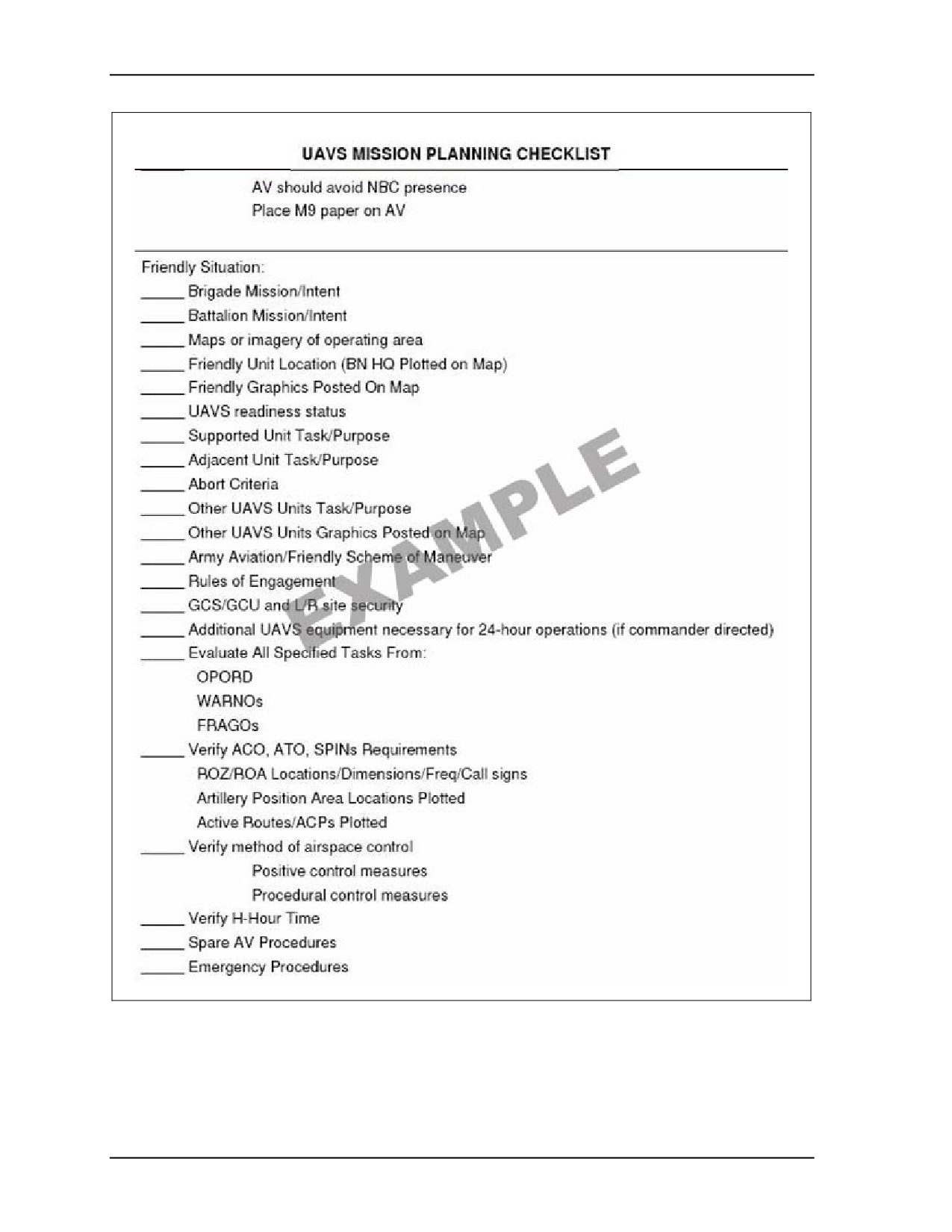
Appendix K
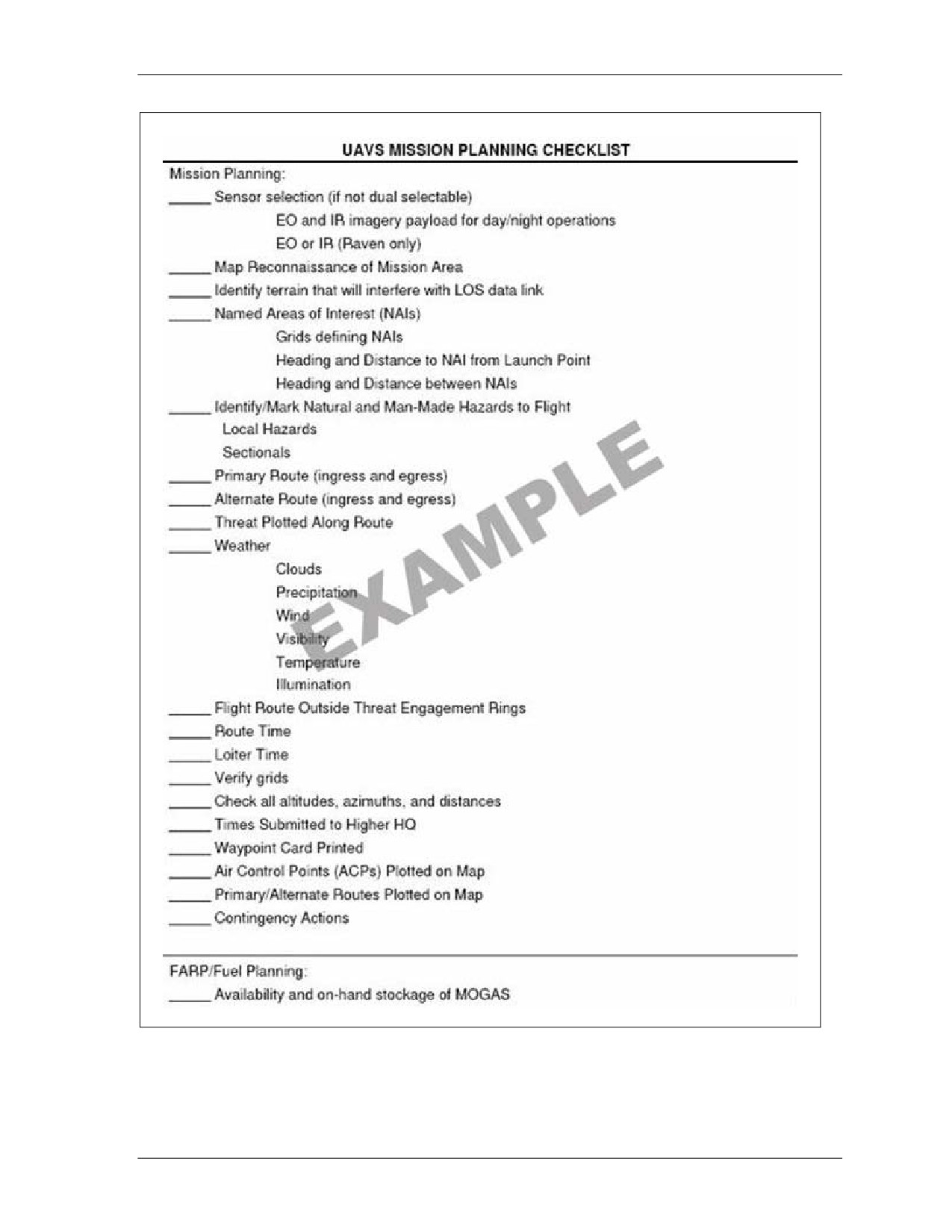
Figure K-7. Example format for UAS mission planning checklist (continued).
K-12
FM 3-21.20
13 December 2006
Unmanned Aircraft Systems
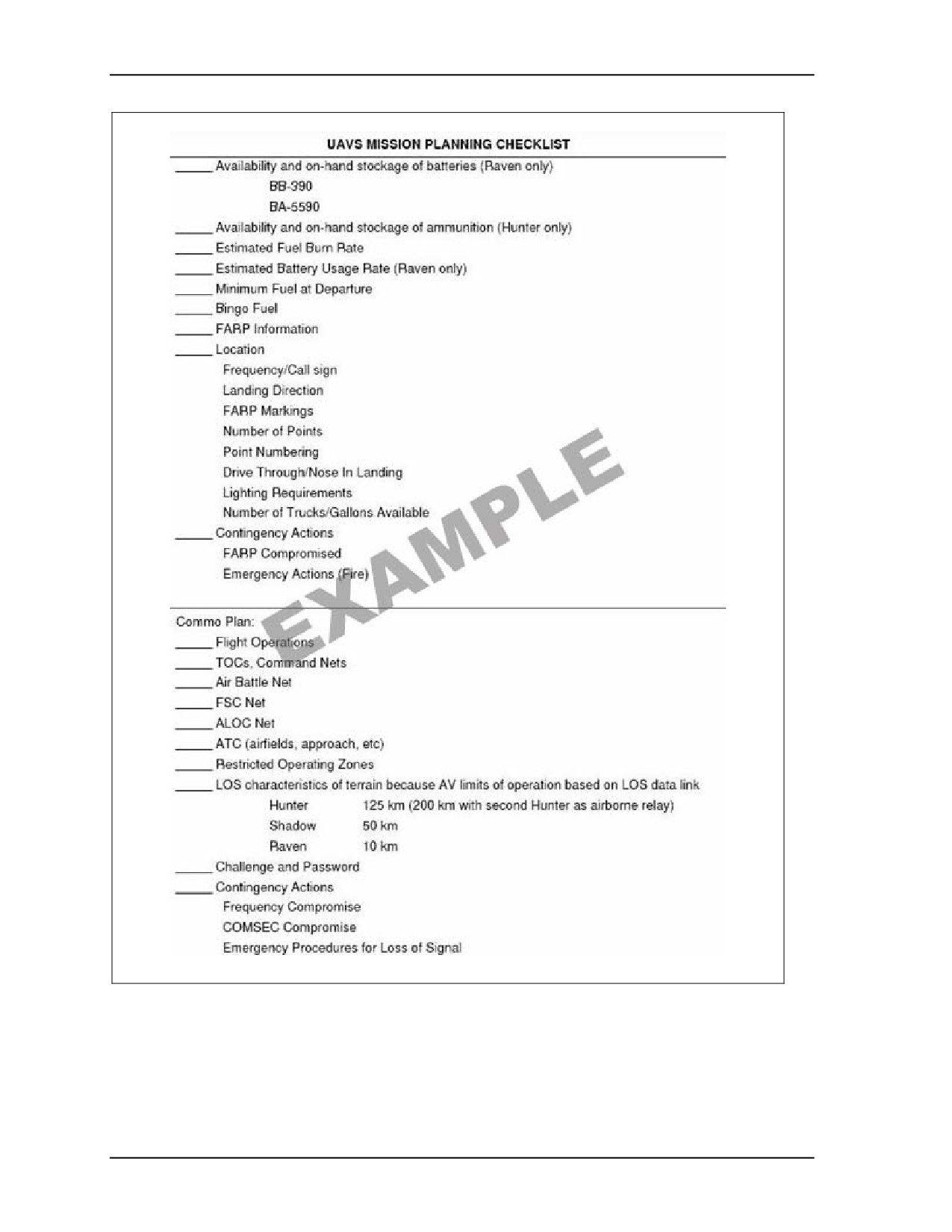
Figure K-7. Example format for UAS mission planning checklist (continued).
13 December 2006
FM 3-21.20
K-13
Appendix K
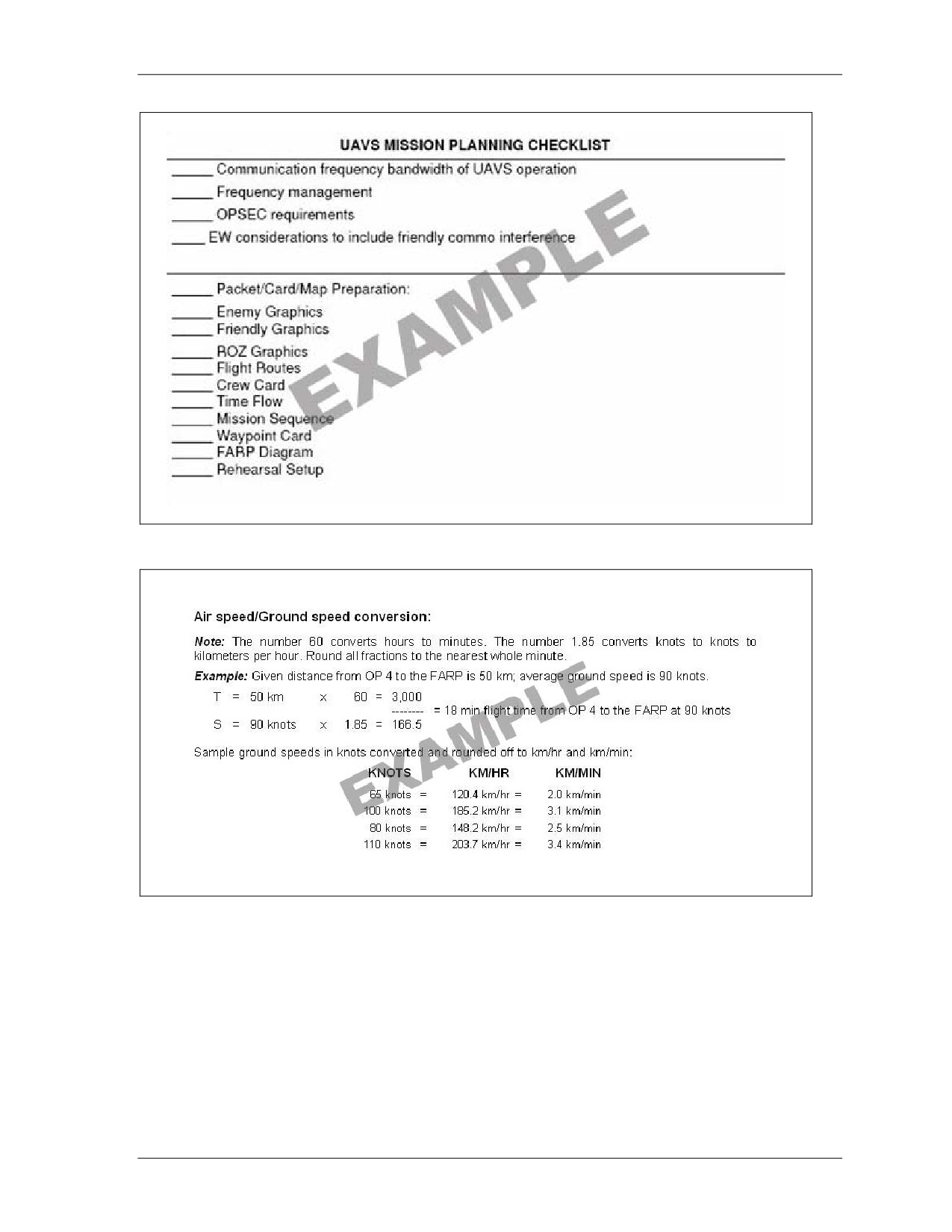
Figure K-7. Example format for UAS mission planning checklist (continued).
K-14
FM 3-21.20
13 December 2006
Unmanned Aircraft Systems
Figure K-7. Example format for UAS mission planning checklist (continued).
Figure K-8. Example UAS flight time worksheet.
UAS Immediate or Quick Reaction Missions
K-42. The immediate or quick reaction mission will be the one most common to the small unit
commander. These missions to find out what is “over the next hill” are normally of short duration and
extend over a limited range (3 to 5 kilometers). With the number of systems being introduced, it is crucial
that unit commanders and UAS teams become proficient with A2C2.
K-43. Immediate UAS mission requests do not necessarily mean the A2C2 measures have not been
planned or are not already in place. For example: a restricted operations area (ROA) may have been
13 December 2006
FM 3-21.20
K-15
Appendix K
coordinated in anticipation of the need to conduct immediate UAS missions. In this case, a UAS flight
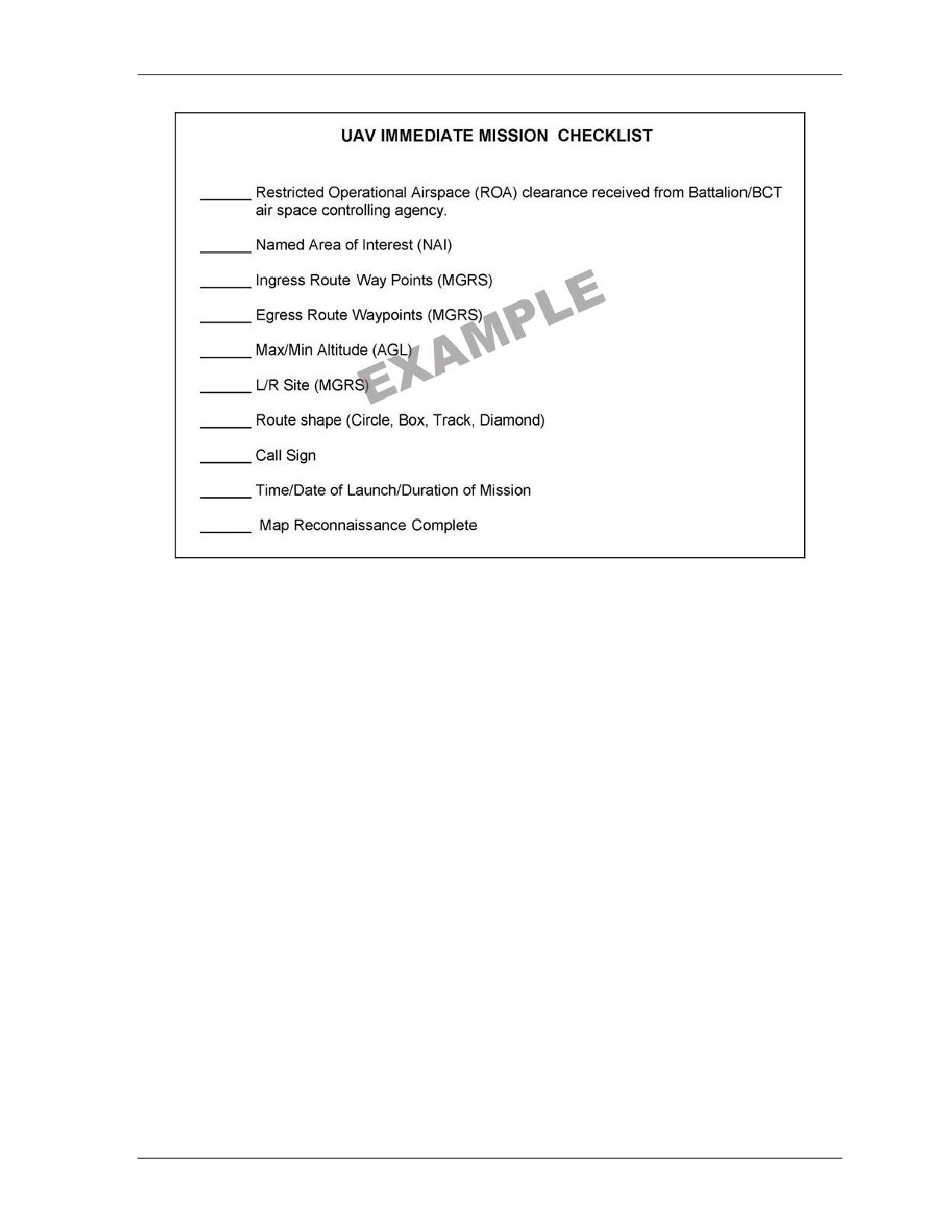
mission is cleared like that for indirect fires. The requestor calls on the battalion fire support or command
net and requests clearance for the UAS flight using the format in Figure K-9.
K-44. When the BCT or the battalion effectively owns the immediate airspace in their operations zone or
area, a less restrictive technique can be used. The BCT or battalion can coordinate ahead of time the
designation of a UAS “status” similar to the air defense weapons status. Normally this kind of procedure is
covered in the BCT or battalion operations SOP, for example:
“UAS FREE”
K-45. All UAS may fly with no restrictions inside the BCT/battalion operations area. UAS operators
must give notice of intent to fly, when, where and time duration. Unless the higher command stops the
launch, the command making the request may fly the UAS mission within the established ROA. When the
UAS is launched, the operators must submit an immediate mission notification (Figure K-9). The UAS
operators also announce when the UAS is over the target area and when the UAS is down.
“UAS TIGHT”
K-46. The same general rules apply as with UAS FREE; however, the operators must receive permission
to fly the UAS.
“UAS HOLD”
K-47. No UAS flights are allowed in the specified area, and all UAS in flight must be retrieved as soon
as possible.
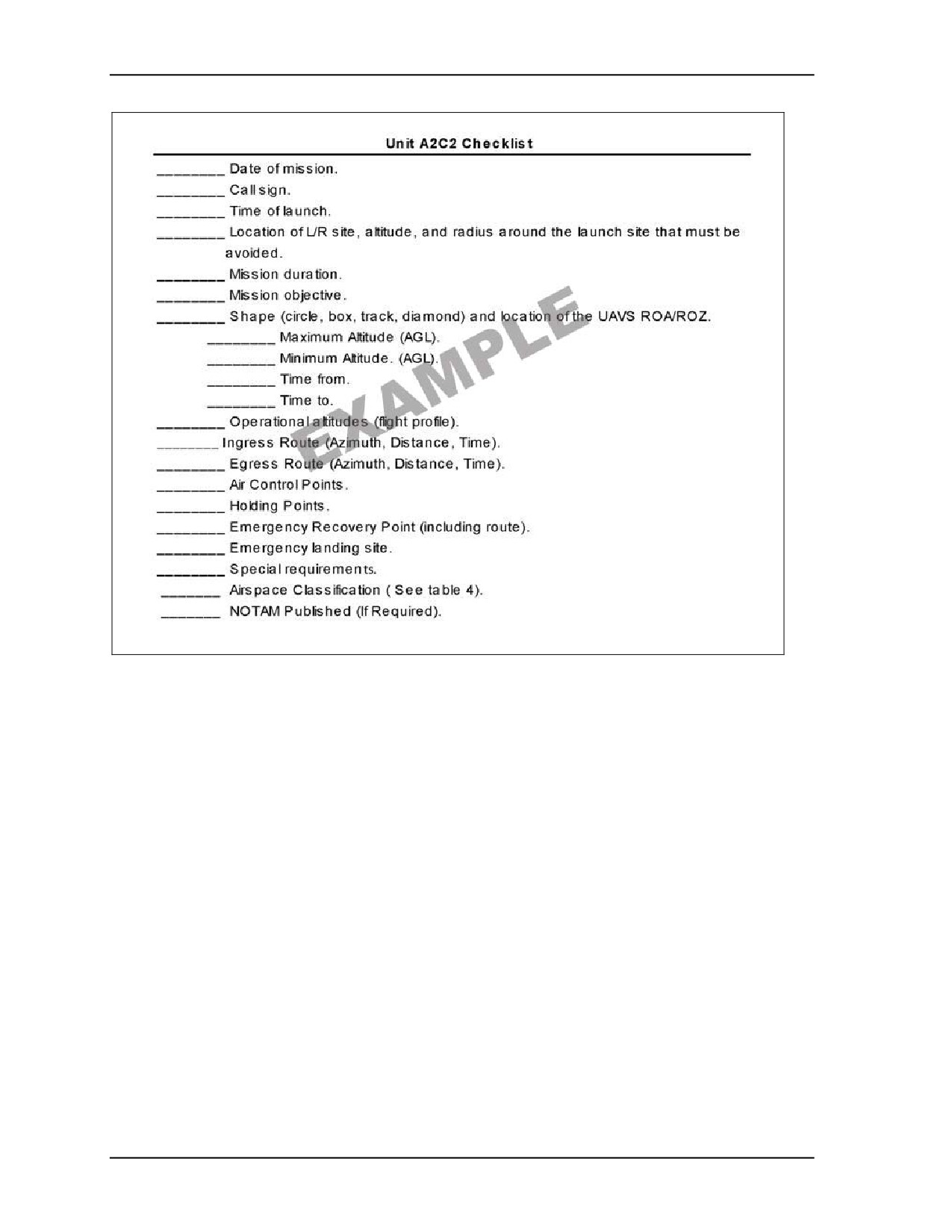
K-48. Figures K-9 and K-10, pages K-17 though K-18, are examples of an immediate mission checklist
and A2C2 checklist list that will assist the commander and UAS team in assuring the AO is clear and safe
for AV operations.
K-16
FM 3-21.20
13 December 2006
Unmanned Aircraft Systems
Figure K-9. Immediate mission checklist.
13 December 2006
FM 3-21.20
K-17
Appendix K
Figure K-10. A2C2 checklist.
K-18
FM 3-21.20
13 December 2006
Appendix L
Nonlethal Capabilities
Because of the wide spectrum of threats present today and the necessity to apply the
appropriate amount and type of force to accomplish the mission, force can no longer
be viewed as either on or off (lethal force or no force). The ability to achieve
objectives by employing nonlethal fires and weapons/munitions, allow force to be
viewed as a continuum and complementary to all types of operations. First, much like
a rheostat switch where power can be dialed up or down as desired, nonlethal
operations provide tools to allow a commander to employ sufficient force to
accomplish an objective without requiring the destruction of an enemy or the habitat.
Second, nonlethal operations are used to complement lethal force to achieve the
overall desired effect on the enemy. The intent of employing nonlethal capabilities is
not to add another step in the progression of escalation with an adversary but to add
other tools to use anywhere along that continuum.
OVERVIEW
L-1.
Military forces have long used nonlethal capabilities to influence behavior of people and nations.
Combined with the use of lethal capabilities and conventional arms, nonlethal capabilities have been
widely used to defeat and weaken adversaries. The following classic, nonlethal means will remain relevant
in future operations and are a part of an evolutionary process of capabilities, IO, fires, and
weapons/munitions development:
• Deception to prevent an enemy force from targeting actual forces,
• Jamming tactics to decrease effective command and control of enemy forces
• Shows of force to discourage and break-up protests;
• Use of physical obstacles to deny access
• Noise to create or enhance psychological impacts
• Smoke and obscurants to mask operations or defeat homing and guidance mechanisms
• Light to disorient combatants
• Leaflets to inform local populations of wanted terrorist.
DEFINITIONS
L-2.
Full spectrum operations require that adaptive leaders use the complete array of nonlethal
capabilities (fires and weapons/munitions) available to the Infantry battalion to deal effectively with many
situations encountered in whatever operating environment employed. There are two types of nonlethal
capabilities available to the commander: nonlethal fires and nonlethal weapons/munitions.
NONLETHAL CAPABILITIES AND EFFECTS
L-3.
Nonlethal effects are any results, outcome, or consequence of the use of nonlethal capability
whereby the intent is not to cause permanent harm or destruction. Nonlethal effects include elements of
offensive and defensive IO. CA, CMO, public affairs, PSYOP, PSYACTs, and related supporting legal
operations can have considerable impact on influencing target audiences. The term nonlethal effects is not
synonymous with the term IO in that engineer operations in stability operations and civil support
operations may also provide nonlethal effects, as well as other projects planned and executed by BCT
units.
13 December 2006
FM 3-21.20
L-1