FM 3-21.20 (FM 7-20) THE INFANTRY BATTALION (DECEMBER 2006) - page 15
Appendix L
NONLETHAL FIRES
L-4.
Nonlethal fires are traditionally delivered by the same platforms and munitions, which deliver
lethal fires. Currently, these are limited to smoke and illumination. Their employment is planned and
executed in much the same manner as lethal fires. In the future, projectiles may deliver a broader range of
nonlethal capabilities such as jamming, antiradiation, and incapacitating liquids.
NONLETHAL WEAPONS/MUNITIONS
L-5.
Nonlethal weapons/munitions are defined as weapons or munitions that are explicitly designed
and primarily employed, at a minimum, to discourage or at most, incapacitate personnel or materiel while
minimizing fatalities and undesired damage to property and the environment. Nonlethal weapons/munitions
are employed with the intent to compel or deter adversaries by acting on human capabilities or materiel
while minimizing fatalities and damage to equipment or facilities. The use of nonlethal weapons/munitions
can assist in the application of measured force. Nonlethal weapons/munitions achieve these benefits by
employing means other than catastrophic physical destruction to incapacitate their targets. The term
“nonlethal” should be understood as a function of intent; zero mortality or permanent damage are goals but
not guarantees of these weapons/munitions. Nonlethal weapons/munitions add flexibility to combat
operations and enhance force protection by providing an environment in which friendly troops can engage
threatening targets with limited risk of noncombatant casualties and collateral damage.
LETHAL VS NONLETHAL
L-6.
Nonlethal capabilities provide a wider range of options that augment but do not replace traditional
means of lethal/deadly force. The option to resort to deadly force must always remain available when the
commander believes it is appropriate to the mission. The existence of nonlethal capabilities does not
represent the potential for “nonlethal war,” and unrealistic expectations to that effect must be vigorously
avoided. Lethal and nonlethal capabilities are most effective when used together to achieve an overall
desired effect.
PLANNING CONSIDERATIONS
L-7.
Nonlethal capabilities planning is conducted by the BCT staff in the fire support cell. Infantry
battalions conduct limited nonlethal planning and are normally limited to instances where CA and PSYOP
teams are attached. The multifunctional IBCT fires cell structure provides the IBCT staff an organic
capability to perform all tasks of a traditional fire support element, plus integrate nonlethal capabilities,
primarily IO capabilities, in support of the operational plan.
BASIC COMBAT TRAINING
L-8.
The BCT commander relies on the fires cell to plan, coordinate, integrate, and synchronize in
executing lethal and nonlethal capabilities to support his scheme of maneuver. This includes the massing of
firepower and the massing or concentration of nonlethal capabilities to limit, disrupt, divert, destroy, or
damage enemy force in depth.
L-9.
The Infantry battalion is normally responsible during operations to execute parts of the BCT
nonlethal capabilities employment plan. The Infantry battalion will plan and execute nonlethal employment
primarily through special staff officers attached, OPCON or DS to the battalion.
CIVIL AFFAIRS
L-10. Civil-military operations are the activities of a commander that establish, maintain, influence, or
exploit relations between military forces, government and nongovernmental civilian organizations and
authorities, and the civilian populace in a friendly, neutral, or hostile area of operations in order to facilitate
L-2
FM 3-21.20
13 December 2006
Nonlethal Capabilities
military operations and consolidate and achieve US objectives. Civil-military operations may include
performance by military forces of activities and functions normally the responsibility of local, regional, or
national government (FM 41-10).
Civil Affairs Teams
L-11. CA teams normally consist of four Soldiers and can be attached or OPCON to an Infantry
battalion for specific missions or long duration in support of ongoing stability and civil support operations.
The team will have a team leader, a team sergeant, a team engineer NCO, and team medical NCO. As more
CA forces arrive in theater, the team may be augmented or replaced by specific functional specialist
required by the CA mission in the battalion area of operations.
Capabilities of Civil Affairs Teams
L-12. Basic capabilities of all CA teams are to—
• Deploy rapidly, within 24 to 48 hours.
• Provide CMO staff augmentation and CA planning and assessment support to maneuver
commanders.
• Maintain direct data and voice communications with conventional, SOF, and interagency
elements with both classified and unclassified connectivity.
• Provide linguistic, regional, and cultural expertise to supported commanders.
• Provide general and limited technical assessments (engineering, medical, and intelligence).
• Plan and support CMO conducted by military forces.
• Identify and facilitate FNS.
• Conduct liaison with civilian authorities.
• Minimize civilian interference with military operations.
• Conduct area studies and area assessments.
• Establish and operate a CMOC.
PSYCHOLOGICAL OPERATIONS
L-13. PSYOP are planned operations to convey selected information and indicators to foreign audiences
to influence their emotions, motives, objective reasoning, and ultimately the behavior of foreign
governments, organizations, groups, and individuals. The purpose of PSYOP is to induce or reinforce
foreign attitudes and behavior favorable to the originator’s objectives. PSYOP are a vital part of the broad
range of US diplomatic, informational, military, and economic activities. PSYOP characteristically are
delivered as information used during peacetime and conflict, to inform and influence. When properly
employed, PSYOP can save lives of friendly and/or adversary forces by reducing adversaries’ will to fight.
By lowering adversary morale and reducing their efficiency, PSYOP can also discourage aggressive
actions and create dissidence and disaffection within their ranks, ultimately inducing surrender (JP 3-53).
Tactical PSYOP Team
L-14. The Infantry battalion will normally receive a TPT attached, OPCON, or DS. The TPT consists of
a three man team lead by a staff sergeant. The TPT provides tactical PSYOP planning and dissemination
support. The TPT’s primary purpose is to integrate and execute tactical PSYOP into the supported battalion
commander’s maneuver plan. The TPT must also advise the battalion commander and staff on the
psychological impact of their operations on the target audience in their area of operations and answer all
PSYOP-related questions. The TPT can conduct loudspeaker operations, face-to-face communication, and
dissemination of approved audio, audiovisual, and printed materials. They gather PSYOP relevant
information, conducting town or area assessment, observing impact indicators, and gather pretesting and
post testing data. TPTs also conduct interviews with the target audience. They take pictures and document
13 December 2006
FM 3-21.20
L-3
Appendix L
cultural behavior for later use in products. TPTs often play a role in establishing rapport with foreign
audiences and identify key communications that can be used to achieve nonlethal objectives.
Role of TPT
L-15. Specifically the TPT operations can—
• Increase the supported unit commander’s ability to maneuver on the battlefield by reducing or
minimizing civilian interference.
• Potentially reduce the number of casualties suffered by the supported unit by reducing the
number of enemy forces he must face through surrender appeals and cease resistance messages.
• Assist the supported unit commander in gaining the tactical advantage through the use of
deception measures, increasing the probability of the gaining the element of surprise.
WEAPONS AND MUNITIONS
L-16. Nonlethal weapons/munitions extend the range of firepower options. They augment means of
deadly force. They are particularly valuable in both stability operations and civil support operations as they
enhance the ability to apply force in proportion to the threat and allow discrimination in its use. They
expand the number of options available to confront situations that do not warrant using deadly force but
require Soldiers to use overwhelming, decisive power to accomplish their missions. Nonlethal capabilities
must show military necessity, must be used proportionally, and must not result in unnecessary suffering.
L-17. Nonlethal weapons/munitions have existed and been used by military forces for many years.
Traditionally, nonlethal weapons/munitions have been used for crowd control or law enforcement.
Ongoing technological advancements continue to refine and expand nonlethal weapons/munitions
capabilities. Nonlethal weapons/munitions technology has continued to evolve with new requirements
based on circumstances encountered in operations such as Operation Enduring Freedom and Operation
Iraqi Freedom. The need for nonlethal weapons/munitions was clearly demonstrated by the increase in
missions conducted in urban areas with large civilian populations and the need to limit collateral damage.
L-18. The commitment of military power to resolve crises has traditionally involved the use of deadly
force or the implicit or explicit threat of the use of deadly force. The Infantry battalion is trained,
organized, and equipped for this purpose. An Infantry battalion armed only with traditional military
weapons/munitions normally has two options for enforcing compliance; threats of deadly force and
application of deadly force. This limitation creates a critical vulnerability that belligerents may quickly
discern and use to their advantage. Nonlethal weapons/munitions, always backed by lethal force, give the
battalion commander increased courses of action in planning operations.
L-19. Noncombatant casualties, to include serious injuries and fatalities, will continue to be a regrettable
but often unavoidable outcome when military power is employed, regardless of nonlethal
weapons/munitions availability. Nonlethal weapons/munitions used to “augment deadly force,” are now
fundamental to the planning and execution of Infantry battalion operations where the employment of
nonlethal capabilities is contemplated.
L-20. The following are advantages to employing nonlethal weapons/munitions:
• Can assist in the isolation of an objective.
• Can be more humane.
• Can be more consistent with political and social considerations.
• Can be more consistent with ROE.
• Can gain advantage over enemy employing only lethal weapons/munitions because of degree of
provocation.
L-21. Nonlethal capabilities extend the range of firepower options. They augment means of deadly
force. They are particularly valuable in both stability operations and civil support operations as they
L-4
FM 3-21.20
13 December 2006
Nonlethal Capabilities
enhance the ability to apply force in proportion to the threat and allow discrimination in its use. They
expand the number of options available to confront situations that do not warrant using deadly force but
require Soldiers to use overwhelming, decisive power to accomplish their missions. Nonlethal capabilities
must show military necessity, must be used proportionally, and must not result in unnecessary suffering.
Nonlethal weapons/munitions capability sets can be divided into four categories: personnel protectors;
personnel effectors; mission enhancers; and training devices.
PERSONNEL PROTECTORS
L-22. Personnel protectors include items, such as face shields and riot shields, which protect Soldiers
from blunt trauma injuries inflicted by thrown objects like rocks, bottles, and clubs.
PERSONNEL EFFECTORS
L-23. Personnel effectors include items such as riot batons, sting grenades, pepper sprays, beanbags,
foam, electric shock and high powered acoustic devices designed to either discourage or incapacitate
individuals or groups.
MISSION ENHANCERS
L-24. Mission enhancers include items such as bullhorns, combat optics, spotlights, personnel, and
vehicle barriers. These items are designed to facilitate target identification and crowd control. Also, these
items provide a limited ability to affect vehicular movement
TRAINING DEVICES
L-25. Training devices include items such as training suits, training batons, and inert pepper sprays.
They are designed to facilitate realistic hands-on scenario training in preparation for operations.
13 December 2006
FM 3-21.20
L-5
This page intentionally left blank.
Appendix M
Forward Operating Bases and Fire Bases
In some tactical situations, especially during stability or counterinsurgency
operations, the Infantry battalion may establish either fire bases or forward operating
bases. Bases are established and maintained as secure locations for conducting
operations and logistics support activities, or delivering supporting indirect fire.
Bases can be used in all types of operations; offense, defense, stability operations and
civil support operations, but they are most often established during dispersed,
noncontiguous, nonlinear situations. The Infantry battalion establishes and maintains
bases primarily as platforms from which to conduct offensive or stability operations.
In most instances, Infantry battalions are the smallest units that establish and
maintain bases although it is possible for companies to establish and maintain a base
for short periods. Platoons can establish temporary bases; however, if these are to be
maintained for long periods they must be augmented with logistics and fire support.
This appendix discusses the types of bases the Infantry battalion can establish or
participate in establishing. It also discusses site selection, construction, priority of
work, and continuous operations from a base.
OVERVIEW
M-1. The use by US forces of bases has a long and varied history. Before the Civil War, Infantry and
Cavalry units typically established and operated from frontier forts. These forts gave them a base to support
operations over vast unmapped areas against an elusive enemy.
M-2. The linear high-intensity combat operations of the Civil War did not often lend themselves to the
use of small, dispersed bases, but immediately after the war, the US Infantry and Cavalry moved to the
frontier once again. Between 1868 and 1888, the Army constructed a number of small forts from Texas to
Montana, much like the forward operating bases we use today. These provided security for the population
around them and supported forays to find and engage the elusive bands of hostile Indians, the premier
guerrilla fighters of their day.
M-3. After the initial pitched battles of the Spanish American War, US forces found themselves
conducting a drawn-out stabilization and counterinsurgency operation in the Philippines. Once again, units
established bases in remote areas from which they could patrol deeply into guerrilla territory and to which
they could return to rest, recuperate, and resupply.
M-4. In Vietnam, with long-range artillery, reliable radio communications, and unparalleled tactical
mobility, the Army modified operating bases into firebases. These not only provided combat units a secure
area from which to operate; they also contained powerful fire support units. With a network of firebases in
place, no American unit, regardless of its location in the area of operations, faced an enemy attack without
immediate and accurate indirect fire support.
M-5. The Cold War period in Europe did not lend itself to the use of operating bases or firebases.
German territorial forces secured the large rear areas, and combat forces were arrayed for linear,
contiguous operations. However, in Operation Desert Shield, US Forces quickly established bases in
remote desert locations. There they organized into combined arms task forces, stockpiled supplies, trained,
and prepared for powerful armored thrusts deep into Kuwait and Iraq.
M-6. Current stability and counterinsurgency operations worldwide have revived the use of operating
bases and firebases in both Iraq and Afghanistan.
13 December 2006
FM 3-21.20
M-1
Appendix M
TYPES OF BASES
M-7. Doctrinal names and definitions for bases (FM 1-02) are often misunderstood. Units normally
establish bases for two purposes: to provide a secure site for rest and refit and as a projection platform for
offensive or stability operations. Base may also be used to provide supporting fires or observation.
M-8. Infantry battalions can establish or participate in the establishment of several kinds of bases. The
most common bases are—
FORWARD OPERATING BASES
M-9. A forward operating base (FOB) is established to provide support for tactical operations. Most
often, those tactical operations are associated with stability or civil support, but that is not always the case.
Facilities may be established for either temporary or long-term operations. FOBs have been used
extensively by Infantry battalions in OIF and OEF as a base from which to conduct operations. A FOB
provides the battalion with a secure area in which to rest, recuperate, repair and maintain equipment, plan
and organize for upcoming operations. It may also be used to provide a secure environment for other
agencies or units to function in specialty roles.
INTERMEDIATE STAGING BASES
M-10. An intermediate staging base is a secure staging base established near to, but not within, the area
of operations. It is normally used for a short period, just long enough for the battalion to complete its
precombat preparations and to transition the bulk of its combat power into the operational area and
establish effective command and control of forces.
FIRE BASES
M-11. A fire base supports the operation’s main effort with indirect fires. It is a secure location for field
artillery, and sometimes mortar units, which allows the battalion to operate over large areas while still
being within the weapons’ range fans. Fire support bases are used in both stability and major combat
operations. They provide secure, defendable hardened locations for the indirect fire units. This minimizes
the amount of combat power the commander must allocate to defense and allows him to better use his
forces on offense. A base may be both a fire base and an operating base at the same time.
FUNDAMENTALS OF BASE DEFENSE
M-12. Regardless of what type of base the unit establishes, or where, it must be prepared to defeat an
enemy attack. Attacks may be conventional assaults supported by indirect fire, or they may be made by
unconventional means such as covert infiltration or suicide bomber. Attacks may consist solely of indirect
fires or standoff attacks using small arms. The base commander organizes and controls all forces assigned
to the base to capitalize on their capabilities. These forces must be trained, organized, and equipped to
defend the base. Fundamentals of base defense are the same as for defensive operations with two
additions—
BALANCE BASE SECURITY WITH POLITICAL AND LEGAL CONSTRAINTS
M-13. Base security may have to be designed around numerous political constraints. For example, status
of forces agreements between the United States and the host country.
KNOW RULES OF ENGAGEMENT
M-14. Base commanders and their subordinates must comply with the ROE. They should ensure that
inconsistencies among JIIM ROE are reconciled.
M-2
FM 3-21.20
13 December 2006
Forward Operating Bases and Fire Bases
SITE SELECTION AND CONSTRUCTION
M-15. The initial base site selection is critical and must meet the two fundamental purposes of a base:
defense and operations projection platform. Unless both conditions are satisfied, the base cannot be used
effectively.
METT-TC
M-16. Many aspects of the establishment of a base are the same as for defensive operations; however,
because a base is at least semi-permanent, different considerations apply.
Mission
M-17. The requirement to establish a base will be the result of a mission analysis of the primary mission.
The mission analysis will indicate the Infantry battalion can anticipate the conduct of operations in support
of other forces, such as providing security and defense for an air assault, or will conduct operations for an
extended period in the same general vicinity. A mission in support of other forces for example, might be to
provide long term security and defense for a lodgment in an air assault operation requiring the building of
an FOB.
Enemy
M-18. Enemy forces will always have at least a limited capability to threaten the forces using the base.
The base defense should be such that the minimum amount of combat power is required to defeat any
enemy attack. This frees the rest of the force for operations.
Terrain and Weather
M-19. Both terrain and weather are major considerations for the placement of the base.
Terrain
M-20. The terrain selected for the base must be defensible. If possible, key terrain is a good location for
the base. However, it may not always be possible to locate the base on key terrain because of other
METT-TC considerations. Other primary terrain considerations are—
• Access to good road networks.
• Ease of resupply and relief
• Water, power, and sanitation sources.
• Sufficient area for anticipated expansion.
• Maximum coverage for weapons (if used as a fire base).
Weather
M-21. The affect of adverse weather on the proposed base and the surrounding terrain is vital. For
example, if the proposed base site is in a flood zone, how will flooding affect operations.
Time
M-22. When the base is first occupied, normal priorities of work are followed for a perimeter defense.
Over time, the base is continually improved so that the base can fully support the needs of the units and
Soldiers.
13 December 2006
FM 3-21.20
M-3
Appendix M
Troops Available
M-23. The base should be able to support and provide protected work and living areas for all the units
that will potentially conduct operations at the base. Engineer unit support to establish a fully functional
base is normally required.
Civil Considerations
M-24. The base should not be too close to the civilian population to cause collateral damage and
casualties, in the event the base is attacked.
PRIORITY OF WORK
M-25. Initial priorities of work for the establishment of a base are the same as for a defense. Once the
initial base defense is established, with the assistance of building assets, the priorities change to include
creating infrastructure and hardening facilities.
M-26. Occupation of a new base follows the normal priorities of work for establishing security and
preparing a defensive. These include at least—
• Establishing initial base security, including observation posts and patrols outside the perimeter.
• Positioning crew-served weapons and assigning fields of fire.
• Preparing and emplacing unit CBRN detection equipment.
• Clearing fields of fire and preparing range cards.
• Preparing fighting positions.
• Installing and hardening communications.
• Emplacing obstacles and mines.
• Hardening primary fighting positions, including overhead cover.
• Preparing alternate and supplementary positions.
• Stockpiling and hardening the locations of ammunition, food, water, and medical supplies.
• Within 24 hours, providing for human waste disposal.
• Preparing routes and trenches between positions.
• Developing a counterattack plan.
• Conducting rehearsals, including rehearsals of movements to supplementary and alternate
positions.
M-27. After the initial occupation and preparation of the defense, the base priorities of work change to
establishment of the infrastructure to support ongoing operations. These priorities, which are established by
the base commander, include—
• Laying out base camp.
• Setting up water supply.
• Setting up waste disposal.
• Setting up electric power supply.
• Setting up dining facilities.
• Setting up fuel storage site.
• Establishing drainage patterns.
• Strengthening defenses.
• Clearing vegetation, moving earth, making earthen dikes and embankments.
• Building secured storage spaces.
• Building dispensary facilities.
• Building living facilities.
M-4
FM 3-21.20
13 December 2006
Forward Operating Bases and Fire Bases
CONSTRUCTION
M-28. From the time the area is first occupied for use as a defensive position, the base area is continually
upgraded. At some point, the defensive area is transformed into a base from which to conduct continuous
operations. Tasks associated with this semi-permanent construction are normally beyond the capability of
the Infantry battalion, and professional engineer support is required.
Engineers
M-29. Construction of the base normally requires the use of engineers. Engineers can be US Army
construction engineers, US Navy construction engineers (SEABEEs), contracted companies, and host
nation contracted support or a combination. When using contracted support, a vetting system must first be
in place to ensure base construction plans are not compromised to potential enemy forces.
Planning Considerations
M-30. A base’s primary functions are for defense and as a location to prepare and execute operations.
When constructing bases, these functions must remain paramount. For example, a base should have
multiple entrance and exit points so units conducting operations from the base can vary routes so as not to
be predicable. Also, a base should have multiple defensive lines around and inside the base as
contingencies to enemy attacks. Other construction considerations include—
• Hardening all fighting positions, bunkers, and facilities. See FM 5-103.
• Providing for a BDOC.
• Providing lighting to cover the entire perimeter of the base.
• Integrating sensors into the base perimeter warning system.
• Providing a vehicle parking area well away from the perimeter for contracted workers.
• Locating indirect fire weapons where they have the capability to fire 360 degrees (if the base is
also to be used as a fire base).
Entry Control Points
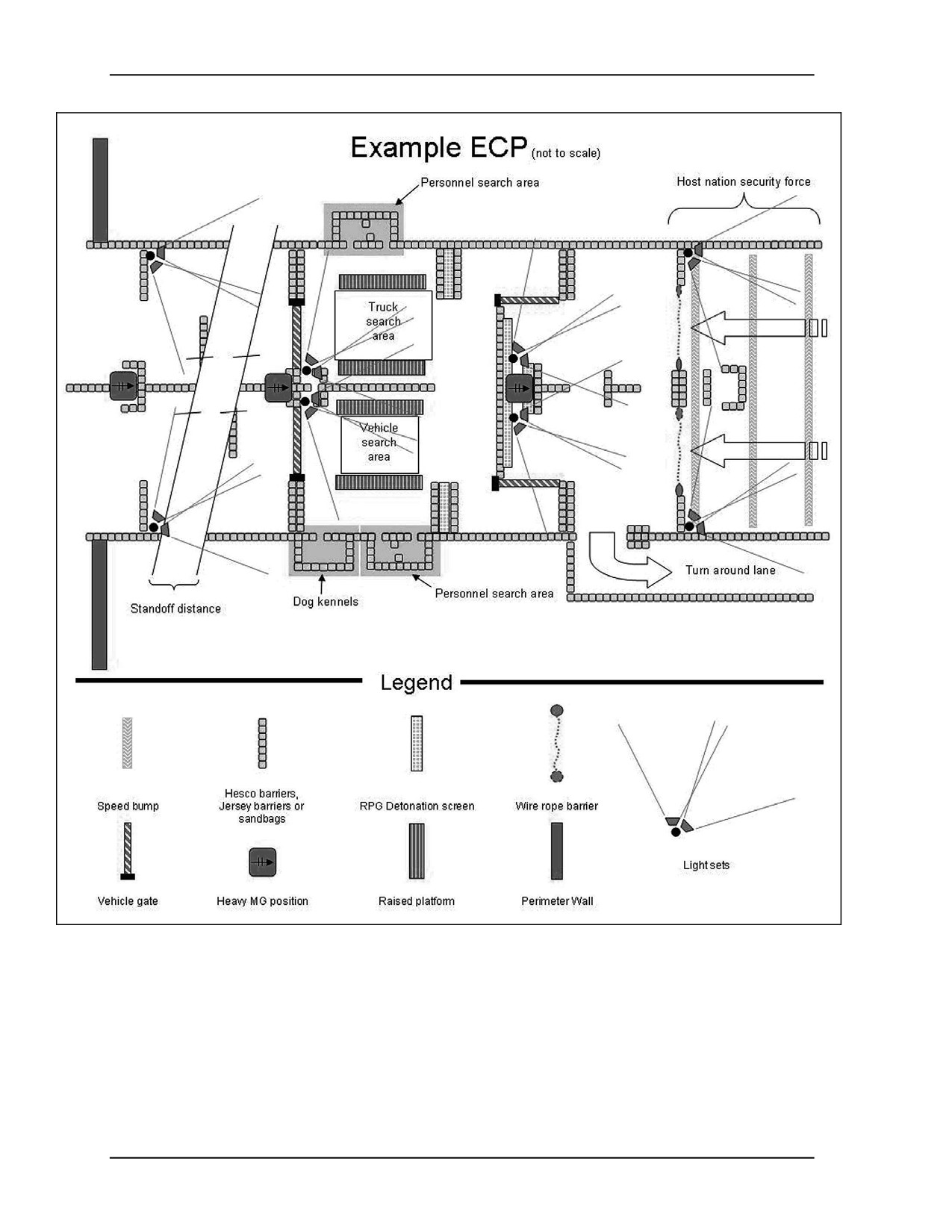
M-31. The design, construction, and operation of entry control points (ECPs) are critical to base defense.
Vehicle-borne and personnel carried explosive device effectiveness can be mitigated through proper ECP
design, construction, and operation. The most important consideration for ECP construction is the analysis
of the threats the installation is vulnerable to (Figure M-1).
Design Characteristics
M-32. Design characteristics should consider the following:
Deterrence
M-33. The overall ECP design, security posture, and procedures should convey to a potential aggressor a
hardened access point not likely to be penetrated.
13 December 2006
FM 3-21.20
M-5
Appendix M
Figure M-1. Example entry control points.
Detection
M-34. Multiple measures that sense validate and communicate the presence of an aggressor to the
response force. Detection measures and equipment include: cameras, vehicle passes, searches, questioning,
bomb dogs, vehicle and package X-ray machines, metal detectors, and explosive compound
sniffing devices.
M-6
FM 3-21.20
13 December 2006
Forward Operating Bases and Fire Bases
Defense
M-35. Active and passive measures employed to prevent an aggressor from gaining entry or to minimize
the effects of an attack. Defensive measures include: drop barriers, collapsible wire-cage barriers, blast
walls, stand-off, serpentines tracks, guards, RPG detonation screens, and ballistic glass.
Defeat
M-36. The active and escalating measure of force design to defeat an aggressor. Defeat measures
include: heavy machine guns, antitank weapons, and QRF.
Design Elements
M-37. Design elements are the basic building blocks of the ECP. Each element must be effective
individually and also be effective within the context of the intent of the whole ECP. The following are
design elements of an ECP:
Traffic control
M-38. The flow of vehicle, and personnel must be effectively controlled in order to efficiently segregate
and process legitimate movement through the ECP. Segregate the traffic through the ECP by establishing
points that check for different items. For example, ID Cards at one station and vehicle passes/registration at
another station. Control the speed of movement through the ECP with speed bumps, serpentines for
vehicles and turn styles for personnel. Have the ability to positively stop vehicle traffic using wire rope and
drop barriers. Canalize traffic so crew served and vehicle mounted weapons systems have good fields of
fire on vehicles negotiating the ECP. Provide points in the traffic control routes so unauthorized vehicles
can exit from the ECP.
Threat mitigation
M-39. Features incorporated to specifically mitigate identified threats such as, blast walls to protect from
the effects of overpressure, and standoff distance for fragmentation. Hesco barriers, sandbag walls, Jersey
barriers all provide some protection from explosive blasts. Shaped charged weapons effectiveness can be
reduced by the emplacement of screens, such as chain link fences, which cause the predetonation of rounds
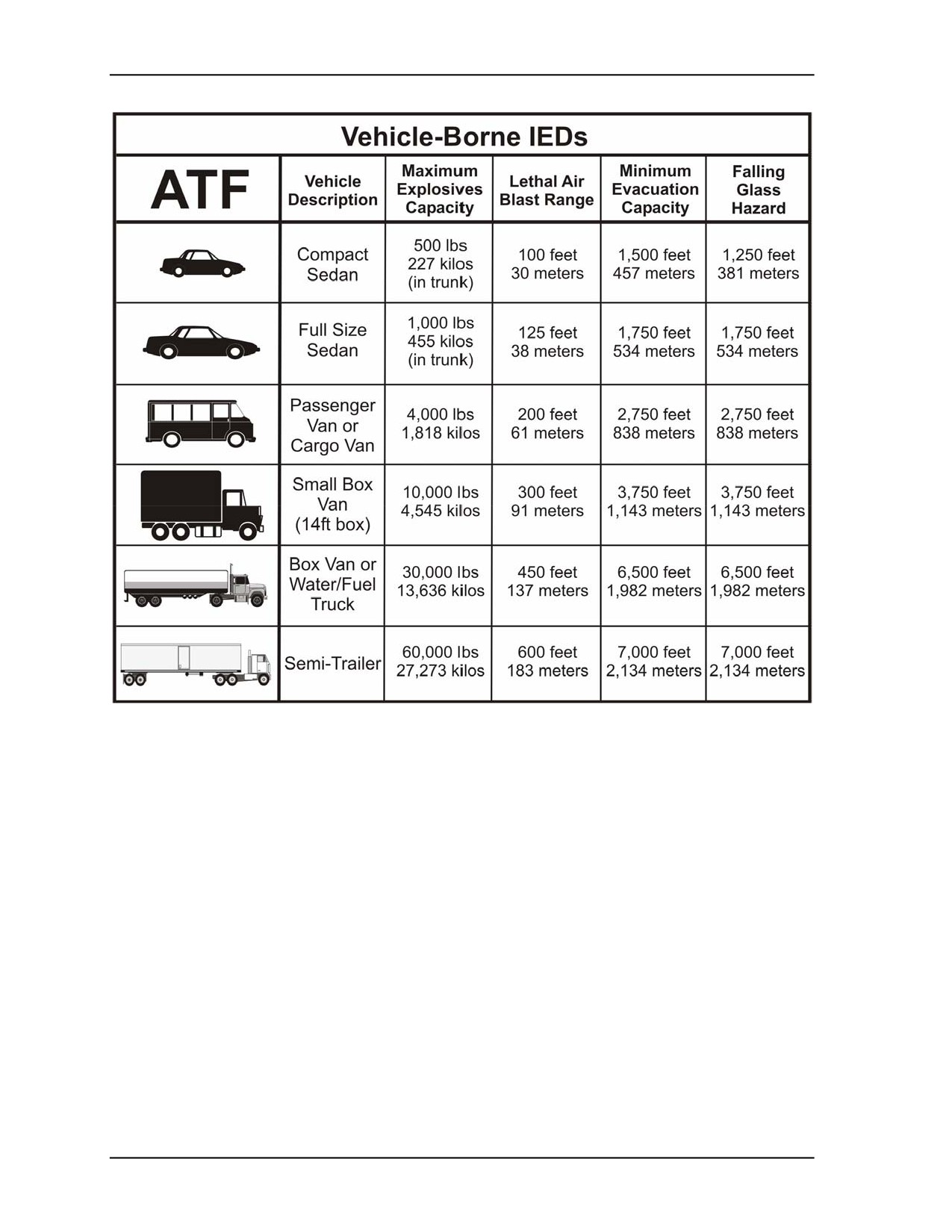
like RPGs. Keeping a safe distance from explosions (brought about by vehicle-borne IEDs) saves lives and
reduces blast effectiveness (Figure M-2). Consider the use of trans-load yards away from the base for
equipment and supplies that are to enter the base. Ensure crew served weapons, armored vehicles, and
close combat missile systems have clear fields of fire to engage targets.
13 December 2006
FM 3-21.20
M-7
Appendix M
Figure M-2. Vehicle-borne IEDs.
Procedures
M-40. Operating practices should be integrated so that all processes are thorough, quick, and with some
degree of overlap. Establish ECP procedures from point of entry to release from the ECP. Integrate host
nation forces in to the ECP procedures where appropriate. Conduct a guard mount that ensures
complacency is not established. Periodically test the procedures and conduct after action reviews to
identify and correct shortcomings. Consider changing procedures periodically to keep the enemy from
identifying and taking advantage of patterns in ECP procedures. Monitor reports from other ECPs and
adjust procedures proactively to respond to new threats.
Defense in Depth
M-41. Allow for repeated engagement zones. If a threat breaks through one section of the ECP, the next
engagement zone engages the threat. The outer perimeter of the base also establishes an engagement zone.
The interior of the base should also contain engagement/defensive zones/belts established by the BDOC.
M-8
FM 3-21.20
13 December 2006
Forward Operating Bases and Fire Bases
BASE DEFENSE OPERATIONS
M-42. Defense and security of tactical units, bases and installations are integral parts of combat missions.
A base defense consists of both normal and emergency local military measures to deter or reduce the effect
of enemy attacks or sabotage. It ensures the continued effectiveness of its facilities and the units to fulfill
their missions. A base is always assigned a base commander who may be the senior officer of the units in
the base or who may be another officer specifically given that responsibility..
ORGANIZATION AND CONTINUOUS OPERATIONS
M-43. The base commander is responsible for the perimeter defense of the base. If an Infantry battalion
is located on a base by itself, the battalion commander can also serve as the base commander. The BDOC
is solely responsible for base defense while the battalion CP is responsible for operations of subordinate
units that conduct operations from the base.
M-44.
The BDCO has the following basic functions:
•
Providing the essential C2 organization necessary to conduct coordinated base security related
operations.
•
Preparing comprehensive plans to implement the base commander’s overall base force
protection, security, and defense guidance.
•
Designing, coordinating, and implementing base force protection, antiterrorism, physical
security, and force protection working group.
•
Monitoring the current status of assigned, attached, and tenant unit forces and resources and
providing information to aid, allocate, and move forces and material to meet base security
requirements.
•
Identifying and communicating any base defense or area security shortfalls to the higher unit
base defense commander or JSC, as well as service or applicable functional component
command.
•
Keeping the base commander informed of the current base security situation.
•
Ensuring the participation of all units within the base perimeter in conducting active and
passive defense and security measures. Monitoring and directing guard forces as necessary.
•
Assessing potential conflicting interests and operational demands of base forces inherent when
operating within a multiservice or multinational environment.
•
Developing and executing a reconnaissance and surveillance plan to ensure proper security
from standoff threats.
•
Establishing and maintaining connectivity with higher level staff.
•
Preparing security related operational reports as required.
•
Maintaining a staff journal and displaying and filing necessary items to record operational
activities of the command.
•
Coordinating (when necessary) with the appropriate area commander or tenant commander to
ensure that base security actions are deconflicted with ongoing or planned combat or stability
operations related actions.
•
Planning and coordinating the base fire support plan.
•
Collecting and disseminating base emergency response capabilities to include medical support,
combat engineering, EOD, and fire fighting.
•
Evaluating actions to identify operational deficiencies and developing methods to improve
combined operational effectiveness to include coordinating, training, and exercising base
security related measures.
13 December 2006
FM 3-21.20
M-9
Appendix M
BASE DEFENSE
M-45. Base commanders establish a base defense with available forces to provide all-round security.
This base defense includes detailed planning and centralized control. Security measures may also include
provisions to protect adjacent civilian communities. Constant and aggressive action by friendly elements
against enemy forces constitutes a major element of base defense. Vigilance and sound security measures
reduce enemy interference with operations at the base. It also tends to cause enemy forces to divert their
operations from the area.
Security
M-46. Early warning of pending enemy actions provides the base commander time to react to any threat.
Security measures employed outside of the base are generally within direct fire range because the terrain
outside of that direct fire range fan may often be assigned to a different unit. These measure may include
outposts, patrols, ground surveillance and counterfire radar, military working dogs, and air R&S provide
early warning. Civilian informants and actions of indigenous personnel near the base indicate pending
enemy actions.
M-47. Counterfire radars are field artillery systems that can track and locate enemy mortar, artillery, and
rocket fires. Counterfire radars located in the target acquisition battery of the IBCT fires battalion. These
radars are not normally located with the Infantry battalion during major combat operations, but they are
routinely co-located during stability operations in order to reduce troops to tasks requirements.
M-48. There are currently three counterfire radar systems in use: Q-36, Q-37, and Q-47. These systems
do not have 360 degree coverage. The lightweight countermortar radar (LCMR) is in development and has
360 degree coverage out to 7 kilometers. The LCMR, when fielded, requires 360 degree line-of-site for full
usation of the system.
M-49. The land-based phalanx weapon system is a 20mm gun with multifrequency KU band radar for
surveillance and tracking. It has the capability to defeat threat RAM. The land-based phalanx weapon
system is an integral part of the C-RAM intercept battery. The C-RAM intercept battery, when deployed,
can operate jointly with coalition forces, allies, and other services within the theater. Operationally, the
C-RAM intercept battery will normally operate under a BDOC at an FOB.
M-50. Security measures employed inside of the base may include guard towers, and internal roving
patrols. Security measures vary with enemy threat, forces available, and other factors; all-round security is
essential. The base commander establishes and maintains a guard force IAW FM 22-6.
M-51. Other security techniques and procedures include:
• Guard shift rotations, which are determined by the BDOC, should be based on weather and
light conditions, fatigue and other human factors that reduce vigilance.
• The times of shifts should change often to limit the enemy's ability to pattern the base's daily
activities and battle rhythm.
• The commander of the relief and his NCOIC should constantly inspect each security position or
post to ensure guards are vigilant, clearly understand the ROE, are following the ordered
weapons ready posture, NVGs are present and operational and range cards are present,
serviceable, and accurate.
• The commander of the relief should continuously assess the base's defensive posture to identify
any possible weaknesses or vulnerabilities and report those to the BDOC.
• Inspection checklists are a valuable method to provide structure to each guard shift and should
be continually assessed and updated.
M-52. Snipers can pose a significant threat. Counter sniper measures include rehearsed responses,
reconnaissance and surveillance, and well constructed and designed base defenses. ROE should provide
specific instructions on how to react to sniper fire, to include restrictions on weapons to be used. The best
counter to enemy snipers is another sniper. Snipers are most familiar with sniper techniques and are best
able to locate and engage an enemy sniper.
M-10
FM 3-21.20
13 December 2006
Forward Operating Bases and Fire Bases
Force Protection
M-53. The BDOC establishes procedures for alerting units, individuals, and personnel accountability
during periods of increased force protection levels. Individuals should have protective equipment such as
body armor, and CBR protective masks readily available.
• Bunkers must be routinely inspected to ensure they are safe to occupy.
• Bunkers should have light, heat, food, and water available in the event they must be occupied
for extended periods.
• Each bunker should have a means of communication to the higher unit or BDOC so that
occupants can remain informed of the current situation, and for personnel accountability.
• Each living area and bunker should have a designated commander that is responsible for
accountability and security.
M-54. All units in the base area are responsible for implementing passive defense measures. Passive
defense measures reduce the probability (and the effects) of damage caused by enemy attacks. Units
assigned to the base, initiate passive defensive measures such as dispersion, camouflage, blackout, and use
of shelters. These measures assist in preserving the operating integrity of the base and in ensuring decisive
and effective action against enemy attack.
Alarms
M-55. An SOP should be established specifying alarms for anticipated contingencies. The alarm system
should be tested routinely. The alarms should be able to be heard throughout the base. Different alarms
should be used to distinguish different types of attacks. For example, there should be one type of alarm for
artillery, mortar, and rocket attacks and a different alarm type for ground attacks as personnel may be
required to perform different actions for each type of attack. A public address system is normally used to
announce the stand down from alerts.
Mutual Support
M-56. Defending forces ensure mutual employment of defensive resources, which include fires,
observation, and maneuver elements. Mutual support between defensive elements requires careful
planning, positioning, and coordinating due to the circular aspects of the base area. To control gaps, forces
employ surveillance, obstacles, prearranged fires, and maneuver. Defensive plans provide for the use of all
available support, including attack helicopters, AC-130 and CAS.
M-57. When defending a base, the terrain of the base is generally divided, and assigned to tenant units.
Although numbering and lettering unit sectors and towers is done for simplicity and quicker situational
awareness, those manning positions or towers as part of a guard shift must be controlled by one
commander of the relief to ensure unity of command.
Quick Reaction Force
M-58. The base commander forms and maintains a QRF. On a base occupied by an Infantry battalion,
the QRF is normally a squad sized force, but may be larger depending on the threat. The QRF’s mission is
to react to small scale threats inside or in the immediate vicinity of the base.
Reserve Force
M-59. The Infantry battalion commander normally designates a reserve force that can be used to respond
to threats external or internal to the base. The reserve is normally at least an Infantry or assault weapons
platoon sized unit.
13 December 2006
FM 3-21.20
M-11
Appendix M
Patrols
M-60. Detailed reconnaissance and counterreconnaissance plans, based on IPB, greatly enhance the
security of any base. Base defensive operations to counter small groups of enemy forces include,
aggressive and frequent patrolling by squad-size and platoon-size forces. Night patrols are particularly
effective as they will keep the enemy off balance and ensure that US forces can exercise freedom of
maneuver under all visibility conditions. These forces detect and capture or destroy small groups of
insurgents. Use of military working dogs adds security and detection ability to patrol operations.
M-61. Attached or OPCON mounted forces or weapons company platoons can be used to patrol regions
where the terrain is flat, rolling, and a mixture of open areas and small woods. The mobility and firepower
of these forces allow for rapid traverse of large areas and the ability to quickly engage enemy units. The
unit may patrol populated areas near the base. Also, it establishes surprise checkpoints along known or
suspected routes of insurgent communications and employs IEW assets to detect insurgent use of the
electromagnetic spectrum.
M-62. If allowed by the ROE, concealed night ambush sites are randomly manned outside the base
perimeter. These sites must be coordinated with adjacent units. Indigenous personnel should accompany
ambushes near populated areas. Their knowledge of the local populace and terrain assists the ambush
mission. Artillery and mortar targets are registered and plotted to provide rapid on-call support. NFAs must
also be established on the ambush sites. The unit emplaces detectors and sensors to provide early warning.
M-63. Reconnaissance patrols obtain target acquisition data. They may penetrate known
enemy-controlled territory to install sensors that report the enemy's presence along infiltration and supply
routes. Patrols observe known infiltration and supply routes, and report activity along these routes. They
provide early warning of enemy assembly areas; movement of weapons, ammunition, or other supplies;
and preparation of mortar, artillery and rocket firing sites. Reconnaissance patrols may also locate
suspected areas where other types of surveillance or acquisition systems may be employed to obtain
information. When conducting patrols outside of the base, detailed coordination must be conducted with
adjacent units. Indigenous personnel are assets to reconnaissance patrols. Their knowledge of the terrain,
ability to operate in the environment, knowledge of the language, and familiarity with local customs are
essential.
M-64. Units employ combat patrols in difficult terrain far from the base, but normally within range of
supporting artillery. These patrols may operate out of artillery range when supported by attack helicopters,
CAS aircraft, or AC-130 aircraft. They may be supplied by air and equipped to communicate with the base
and supporting aircraft. Such patrols vary in size from squad to platoon and are conducted at random times
so as not to set a pattern. They perform planned searches to locate areas used by enemy forces to hide
supplies, regroup, rest, train, or prepare for offensive actions. Small groups of enemy forces are engaged
and destroyed. Large groups are reported and kept under surveillance until they are attacked. Augmentation
in the form of local paramilitary guides or trackers increases the effect of combat patrols.
Host and Third Country Forces
M-65. The Infantry battalion commander normally considers integrating host and third country forces in
the overall base defensive effort with the approval of the BCT or higher level unit commander. The
commander emphasizes integration of host country forces in patrol and populace control activities. Based
on his threat assessment and host nation capabilities, the base commander should rely heavily on US forces
to secure US personnel and equipment. Both host and third country forces provide local security for their
own units; however, all local plans should be coordinated with, and integrated in, the base defense plan.
The extent of participation in base defense by host and third country forces depends on the orders and
guidance of their governments.
M-12
FM 3-21.20
13 December 2006
Glossary
Section I. ACRONYMS AND ABBREVIATIONS
1SG
first sergeant
ANGLICO
air and naval gunfire liaison
company
A
AO
area of operation
A2C2
Army airspace command and
AOR
area of responsibility
control
APC
armored personnel carrier
A2C2S
Army Airspace Command and
APFSDS-T
armor-piercing, fin-stabilized,
Control System
discarding sabot with tracer
AA
avenue(s) of approach
APOD
aerial port of debarkation
AADC
area air defense commander
APOE
aerial port of embarkation
AAR
after action review
ARFOR
Army forces
AATF
air assault task force
ARSOF
Army special operations forces
AATFC
air assault task force commander
ASAS
All Source Analysis System
ABCS
Army Battle Command System
ASOC
air support operations center
ABF
attack by fire
ASP
ammunition supply point
ACA
airspace coordination areas
ATGM
antitank guided missile.
ACE
aviation combat element
ATM
advanced trauma management;
asynchronous transfer mode
ACL
allowable cabin load
ATO
air tasking order
ACM
airspace control measures
ATS
air traffic service
ACO
airspace control order
AXP
ambulance exchange point
ACP
air control point
ACPS
Army Civilian Personnel System
B
ACT
analysis and control team
BAS
battalion aid station
ACU
Army combat uniform
BCS3
Battle Command Sustainment and
ACUS
Army Common User System
Support System
AD
air defense
BDA
battle damage assessment
ADA
air defense artillery
BDAR
battle damage assessment and
ADAM
area denial artillery munition
repair
ADC
area damage control
BDO
battle dress overgarment
ADDS
Army Data Distribution System
BDOC
base defense operations center
ADO
air defense officer
BF
battle fatigue
ADW
air defense warning
BFSB
battlefield surveillance brigade
A/EGM
attack/effects guidance matrix
BFT
blue force tracking
AFATDS
Advanced Field Artillery Tactical
BFV
Bradley fighting vehicle
Data System
BHL
battle hand-over line
AGCCS
Army Global Command and
BP
battle position
Control System
BSA
brigade support area
AGT
air ground team
BSB
brigade support battalion
AHD
antihandling device
BSC
brigade support company
AI
area of interest
BSFV
Bradley stinger fighting vehicle
ALE
automatic link establishment
BSMC
brigade support medical company
ALO
air liaison officer
BSSG
brigade service support group
AMDWS
air and missile defense workstation
BUA
built-up area
13 December 2006
FM 3-21.20
Glossary-1
Glossary
C
CMOC
civil-military operations center
CNR
combat net radio
C2
command and control
COA
course of action
C3I
command, control,
communications, and intelligence
COE
contemporary operating
environment
C4ISR
command, control,
communications, computers,
COLT
combat observation and lasing
intelligence, surveillance, and
team
reconnaissance
COMSEC
communications security
CA
civil affairs
CONOP
continuous operations
CAAT
civic affairs assessment team
CONOPS
concept of operations
CACOM
civil affairs command
CONUS
continental United States
CAFAD
combined arms for air defense
COP
common operational picture
CAS
close air support
COSCOM
corps support command
CP
command post; checkpoint
CASCOPE
civil areas, structures, capabilities,
organizations, people, and events
CPOG
chemical protective overgarment
CASEVAC
casualty evacuation
C-RAM
counter rocket, artillery, and
mortar
CAT
civil affairs team
CROP
container roll in/roll out platform
catk
counterattack
CRT
combat repair team
CBRN
chemical, biological, radiological,
and nuclear
CSC
combat stress control
CBRNE-CM
chemical, biological, radiological,
CSM
command sergeant major
nuclear, and high-yield explosive
CSP
contract support plan
consequence management
CSR
controlled supply rate
CBRNWRS
Chemical, Biological,
CTCP
combat trains command post
Radiological, Nuclear Warning
CTIL
commander’s track items list
and Reporting System
D
CCIR
commander’s critical information
requirements
DA
Department of the Army
CCP
casualty collection point
DED
detailed equipment
decontamination
CCT
combat control team
DISCOM
division support command
CD
counterdrug
DLIC
detachment left in contact
CDRJSOTF
commander, joint special
operations task force
DNBI
disease and nonbattle injury
CE
command element (marine-air-
DoD
department of defense
ground task force)
DP
delivery point
CFFZ
critical friendly fire zone
DPICM
dual-purpose improved
CFL
coordinated fire line
conventional munition
CFZ
critical friendly zone
DS
direct support
cGy
centigray
DSO
domestic support operation
CHEMO
chemical officer
DSSU
dismounted Soldier system unit
CI
counterintelligence
DST
decision support template
CID
criminal intelligence division
DSVT
digital secure voice terminal
CIP
combat identification panel
DTD
detailed troop decontamination
CJTF
combined joint task force
DTSS
digital topographic support system
CL
configured loads
DVNT
digital voice nonsecure telephone
CLS
combat lifesaver
DZ
drop zone
CLU
command launch unit
CMO
civil-military operations
Glossary-2
FM 3-21.20
13 December 2006
Glossary
E
FID
foreign internal defense
FIST
fire support team
EA
engagement area
FLIR
forward looking infrared radar
EBA
engineer battlefield assessment
FLIR/TIS
FLIR/thermal imaging system
EBC
embedded battle command
FLO
fighter liaison officer
ECB
echelons, corps, and below
FLOT
forward line of own troops
ECCM
electronic
counter-countermeasures
FM
frequency modulation
ECP
entry control point
FMC
field maintenance company
EEFI
essential elements of friendly
FO
forward observer
information
FOB
forward operating base
EFD
explosive-formed penetration
FOO
field ordering officer
EFET
essential fire and effects tasks
FPF
final protective fires
EFP
explosively formed projectile
FPOL
forward passage of lines
EFST
essential fire support task
FRAGO
fragmentary order
EMST
essential mobility-survivability
FS
fire support
task
FSB
fire support base; forward support
EMT
emergency medical technician
battalion
EO
electro-optical
FSC
forward support company
EOD
explosive ordnance disposal
FSCM
fire support coordination measure
EPLRS
Enhanced Position Location and
FSCOORD
fire support coordinator
Reporting System
FSE
fire support element
EPW
enemy prisoner of war
FSG
family support group
ETAC
enlisted terminal attack controller
FSMC
forward support medical company
EW
electronic warfare
FSMT
forward support MEDEVAC team
FSO
fire support officer
F
FSSG
Force Service Support Group
FA
field artillery
FST
forward surgical team
FAC
forward air controller
FTCP
field trains command post
FARP
forward arming and refueling point
FAS
forward aid station
G
FASCAM
family of scatterable mines
GBS
global broadcast service
FASP
field artillery support plan
GCS
ground control station
FBCB2
force XXI battle command brigade
GCE
ground combat element
and below
GPS
global positioning system
FBI
Federal Bureau of Investigation
GS
general support
FCR
fire control radar
GS-R
general support-reinforcing
FD
financial detachment
GSR
ground surveillance radar
FDC
fire direction center
FEBA
forward edge of battle area
H
FEC
forward error correction
HA
holding area
FEMA
Federal Emergency Management
HAZMAT
hazardous materials
Agency
HBCT
heavy brigade combat team
FFAR
folding fin aerial rocket
HCA
humanitarian and civic assistance
FFIR
friendly force information
HCP
health and comfort pack
requirements
HE
high explosive
FHA
foreign humanitarian assistance
HEMTT
heavy expanded mobility tactical
FHP
force health protection
truck
13 December 2006
FM 3-21.20
Glossary-3
Glossary
HET
heavy equipment transporter
JFSOCC
joint force special operations
HF
high frequency
component commander
HHC
headquarters and headquarters
JIIM
joint, interagency,
intergovernmental, and
company
multinational
HIMAD
high-to-medium altitude missile air
defense
JOA
joint operations area
HPT
high payoff target
JP8
type of fuel
HQ
headquarters
JNN/CPN
joint network node and
command post node (JNN/CPN
HSS
health service support
JSEAD
joint suppression of enemy air
HUMINT
human intelligence
defenses
HVA
high value asset
JSOA
joint special operations area
HVT
high value target
JSOTF
joint special operations task force
JSTARS
Joint Surveillance Targeting
I
Acquisition Radar System
IAW
in accordance with
JTAC
joint terminal attack controller
ICM
improved conventional munitions
JTF
joint task force
ICRC
international committee of the
Red Cross
L
ID
identification
LADW
local air defense warning
IDAD
internal defense and development
LAN
local area network
IED
improvised explosive device
LC
line of contact
IEW
intelligence and electronic warfare
LCOP
logistical common operating
IFF
identification, friend or foe
picture
IHFR
improved high frequency radio
LD
line of departure
IM
information management
LLDR
lightweight laser designator
IMETS
Integrated Meteorological System
rangefinder
INC
internet controller
LMTV
light medium tactical vehicle
INFOSYS
information system
LNO
liaison officer
INS
inertial navigation system
LOA
limit of advance
IO
information operations
LOC
line of communications
IP
initial point
LOGCAP
logistical civil augmentation
IPB
intelligence preparation of the
program
battlefield
LOGSITREP
logistics situation report
IPC
interpersonal communication
LOGPAC
logistics package
IREMBASS
Improved Remotely Monitored
LOS
line of sight
Battlefield Sensor System
LP
listening post
ISR
intelligence, surveillance, and
LRF/D
laser range finder/designator
reconnaissance
LRP
logistics release point
ITAS
Improved Target Acquisition
LRS
long-range surveillance
System
LSDIS
light and special division interim
ITV
in-transit visibility
sensor
J
LTIOV
last time information of value
LZ
landing zone
JAAT
joint air attack team
JAG
judge advocate general
M
JCS
Joint Chiefs of Staff
M/S
mobility/survivability
JFLCC
joint force land component
MAG
Marine Aircraft Group
commander
Glossary-4
FM 3-21.20
13 December 2006
Glossary
MAGTF
Marine air-ground task force
MSSG
MEU Service Support Group
MANPAD
man-portable air defense
MTC
movement to contact
MARDIV
Marine division
MTF
medical treatment facility
MAS
main aid station
MTP
mission training plan
MAW
Marine Air Wing
MTS
Movement Tracking System
MBA
main battle area
MTV
medium tactical vehicle
MCOO
modified combined obstacle
MTW
major theater war
overlay
MWR
morale, welfare, and recreation
MCS
maneuver control system
MDMP
military decision-making process
N
ME
main effort
NAI
named area of interest
MEB
Marine Expeditionary Brigade
NATO
North Atlantic Treaty Organization
MEDEVAC
medical evacuation
NC
node center
MEF
Marine Expeditionary Force
NCO
noncommissioned officer
MES
medical equipment set
NCOIC
noncommissioned officer in charge
METL
mission essential task list
NCS
net control station
METSAT
meteorological satellite
NEO
noncombatant evacuation
METT-TC
mission, enemy, terrain and
operations
weather, troops and support
NFA
no-fire area
available, time available, and civil
NGF
naval gunfire
considerations
NGO
nongovernmental organization
MEU
Marine Expeditionary Unit
NICP
national inventory control point
MEV
medical evacuation vehicle
NIMA
National Imagery and Mapping
MFP
mortar firing point
Agency
MG
machine gun
NLOS
non-line of sight
MGB
medium girder bridge
NLT
not later than
MGRS
Military Grid Reference System
NMC
nonmission capable
MGS
mobile gun system
NOE
nap of the earth
MI
military intelligence
NORMA
nature of the target, obstacle
MICLIC
mine clearing line charge
clearance, range to target, multiple
MICO
military intelligence company
firing positions, adequate area for
MIJI
meaconing, interference, jamming,
proper dispersion between aircraft
and intrusion
NOSC
network operations and security
MLMC
medical logistics management
center
center
NSA
national security agency
MLO
medical logistics officer
NSFS
national surface fire support
MLRS
Multiple Launch Rocket System
NTDR
near term data radio
MMS
maneuver and mobility support
NVD
night vision device
MOPMS
Modular Pack Mine System
NVG
night-vision goggles
MOPP
mission-oriented protective posture
O
MP
military police
MRE
meal, ready to eat
O&M
operations and maintenance
MSD
minimum safe distance
OAKOC
observation and fields of fire,
MSE
mobile subscriber equipment
avenues of approach, key terrain,
obstacles and movement, and
MSETAN
Mobile Subscriber Equipment
cover and concealment
Tactical Packet Network System
OB
order of battle
MSR
main supply route
OBSTINEL
obstacle intelligence
13 December 2006
FM 3-21.20
Glossary-5
Glossary
OCONUS
outside continental US
RAU
radio access unit
OEG
operational exposure guide
RC
reserve component
OGA
other governmental agency
RCU
remote-control unit
OI
operations and intelligence
RED
risk estimate distance
OIC
officer in charge
REMBASS
Remotely-Monitored Battlefield
OP
observation post
Sensor System
OPCON
operational control
RFI
request for information
OPLAN
operation plan
RFID
radio frequency identification
OPLAW
operational law
RFL
restricted fire line
OPORD
operation order
RI
relevant information
OPSEC
operations security
RPV
remotely piloted vehicles
ROA
restricted operations area
P
ROE
rules of engagement
PA
physician’s assistant
ROI
rules of interaction
PAC
Personnel and Administration
ROS
reduced operational status
Center
RP
release point
PAI
personnel asset inventory
RPG
rocket-propelled grenade
PAO
public affairs officer
RPOL
rearward passage of lines
PEO
peace enforcement operation
RSTA
reconnaissance, surveillance, and
PGM
precision guided munitions
target acquisition
PIR
priority intelligence requirements
RVT
remote video terminal
PKO
peacekeeping operation
S
PL
phase line
PLGR
precision lightweight GPS receiver
S-1
personnel staff officer (adjutant)
PLL
prescribed load list
S-2
intelligence staff officer
PLS
Palletized Load System
S-3
operations staff (and training)
PME
peacetime military engagement
officer
PMM
preventive medicine measures
S-4
supply officer
PO
peace operation
S-6
signal officer
POD
port of debarkation
SA
situational awareness
POV
privately owned vehicle
SALUTE
size, activity, location, unit, time,
PP
passage point
and equipment
PROFIS
Professional Officer Filler
SAO
security assistance office
Information System
SAMS
satellite automatic monitoring
PSG
platoon sergeant
system
PSYOP
psychological operations
SARSS
standard Army retail supply
PSYACT
psychological action
subsystem
PVNTMED
preventive medicine
SBCT
Stryker brigade combat team
PZ
pickup zone
SBF
support by fire
PZCO
pickup zone control officer
SCATMINE
scatterable minefield
SCATMINWARN
scatterable minefield warning
Q
SCL
strategic configured load
QRF
quick reaction force
SD
self-destruct
SDM
squad designated marksman
R
SE
supporting effort
RAAM
remote antiarmor mine
SEABEE
construction battalion (US Navy)
RAM
rockets, artillery, and mortars
SEAD
suppression of enemy air defense
Glossary-6
FM 3-21.20
13 December 2006
Glossary
SEN
small extension node
STARFIARS
Standard Army Financial
SEO
sniper employment officer
Inventory Accounting
and Reporting System
SF
Special Forces
SU
situational understanding
SFF
self-forging fragmentation
SVML
standard vehicle-mounted launcher
SFLE
special forces liaison element
SWT
scout weapons team
SFOD-A
special forces operational
detachment-Alpha
T
SGM
sergeant major
SGT
sergeant
T&C
targeting and counterfire
SHORAD
short-range air defense
TAA
tactical assembly area
TAI
target area of interest
SHTU
simplified handheld terminal units
SIDPERS
Standard Installation/Division
TACAIR
tactical air
Personnel System
TACCS
tactical air command and control
SIGINT
signals intelligence
specialists
SINCGARS
Single Channel Ground and
TACON
tactical control
Airborne Radio Subsystem
TACCP
tactical command post
SIP
system improvement plan
TACP
tactical air control party
SIR
specific information requirements
TACSAT
tactical satellite
SITTEMP
situational template
TALO
theater airlift liaison officer
SITREP
situation report
TAV
total asset visibility
SJA
staff judge advocate
TCF
tactical combat force
SOAR
special operations aviation
TDA
table of distribution and
regiment
allowances
SOC
special operations command
TEWT
tactical exercise without troops
SOCCE
special operations command and
THT
tactical HUMINT team
control element
TI
tactical internet
SOCOM
Special Operations Command
TIM
toxic industrial material
SOEO
scheme of engineer operations
TIO
tactical intelligence officer
SOF
special operations forces
TIRS
terrain index reference system
SOI
signal operating instructions
TIS
thermal imaging system
SOP
standing operating procedures
TMD
tactical munitions dispenser
SOR
specific orders and request
TOC
tactical operations center
SOSRA
suppress, obscure, secure, reduce,
TOE
table of organization and
assault
equipment
SP
start point
TOW
tube-launched, optically tracked
SPBS-R
supply property book
wire-guided missile
system-revision
TPFDDL
time phased force and deployment
SPIN
special instruction
data list
SPIRIT
special purpose intelligence remote
TPME
task, purpose, methods, and effects
integrated terminal
TPN
tactical packet network
SPO
support operations officer
TPT
tactical PSYOP team
SPOD
sea port of debarkation
TPU
tank pump unit
SPOE
seaport of embarkation
T-REx
tactical range extension
SPOTREP
spot report
TRP
target reference point
SRP
soldier readiness preparation
TSC
theater support command
SSC
small-scale contingency
TSM
targeting synchronization matrix
STAMIS
Standard Army Management
TSOC
theater special operations
Information System
command
13 December 2006
FM 3-21.20
Glossary-7
Glossary
TSOP tactical standing operating
V
procedure
VHSIC
very high speed integrated circuits
TSS target selection standards
VIP
very important person
TTP tactics, techniques, and procedures
VMF
variable message format
TV/EO television/electro-optical
VT
variable time
TVS television sensor
W
U
WAN
wide area network; wireless area
UAS unmanned aircraft system
network
UMCP unit maintenance collection point
WARNO
warning order
UMT unit ministry team
WCS
weapon(s) control status
UN United Nations
WIA
wounded in action
UO urban operations (replacing term
WMD
weapons of mass destruction
MOUT)
WP
white phosphorous
USAF US Air Force
WFF
warfighting function
USAID United States Agency for
International Development
X
USAOC United States Army Special
XO
executive officer
Operations Command
USMC United States Marine Corps
UXO unexploded ordnance
Section II. TERMS
Pave Penny passive laser tracker whose current
range is too short for the rounds it
must track
Glossary-8
FM 3-21.20
13 December 2006
References
SOURCES USED
These are the sources quoted or paraphrased in this publication.
DEPARTMENT OF DEFENSE PRODUCTS
DoD Directive 2311.01E
DoD Law of War Program, 9 May 2006.
DoD Directive 5240.1-R
Procedures Governing the Activities of DoD Intelligence Components that
Affect US Persons, December 1982.
FIELD MANUALS
FM 3-05.70
Survival. 17 May 2002.
FM 3-07.31
Multiservice TTP for Conducting Peace Operations. 26 October 2003.
FM 3-7
NBC Field Handbook. 29 September 1994.
FM 3-11
Multiservice TTP for NBC Defense Operations. 10 March 2003.
FM 3-21.91
Tactical Employment of Antiarmor Platoons and Companies.
26 November 2002.
FM 3-22.27
MK 19, 40-Mm Grenade Machine Gun, Mod 3. 28 November 2003.
FM 3-90
Tactics. 4 July 2001.
FM 3-90.2
The Tank and Mechanized Infantry Battalion Task Force. 11 June 2003.
FM 5-170
Engineer Reconnaissance. 5 May 1998, with Change 1, 13 July 1998.
FM 5-250
Explosives and Demolitions. 30 July 1998, with Change 1, 30 June 1999.
FM 7-85
Ranger Unit Operations. 9 June 1987.
FM 7-98
Operations in a Low-Intensity Conflict. 19 October 1992.
FM 17-95
Cavalry Operations. 24 December 1996.
FM 31-23
Special Forces Mounted Operations TTP. 5 May 1999.
FM 100-25
Doctrine for Army Special Operations Forces, 1 August 1999.
JOINT PUBLICATIONS
JP 1
Joint Warfare of the Armed Forces of the United States.
14 November 2000.
OTHER
Technical Memo 5-87
Modern Experience in City Combat, US Army Human Engineering
Laboratory, March 1987.
DOCUMENTS NEEDED
These documents must be available to the intended users of this publication.
ARMY REGULATIONS
AR 601-142
Army Medical Department Professional Filler System. 23 June 2004.
ARMY TRAINING EVALUATION PROGRAMS (MTPS AND DRILL BOOKS)
ARTEP 7-8-Drill
Battle Drills for the Infantry Rifle Platoon and Squad. 25 June 2002.
ARTEP 7-10-MTP
Mission Training Plan for the Infantry Rifle Company. 1 June 2002.
13 December 2006
FM 3-21.20
References-1
References
FIELD MANUALS
FM 1-02
Operational Terms and Graphics. 21 September 2004.
FM 1-112
Attack Helicopter Operations. 2 April 1997.
FM 1-114
Air Cavalry Squadron and Troop Operations. 1 February 2000.
FM 3-0
Operations. 14 June 2001.
FM 3-04.111
Aviation Brigades. 21 August 2003.
FM 3-05.401
Civil Affairs TTP. 23 September 2003.
FM 3-06.11
Combined Arms Operations in Urban Terrain. 28 February 2002.
FM 3-07
Stability Operations and Support Operations. 20 February 2003, with
Change 1, 30 April 2003.
FM 3-09.32
(J-FIRE) Multiservice Procedures for the Joint Application of Firepower.
29 October 2004.
FM 3-11.3
Multiservice TTP for CBRN Avoidance. 2 February 2006.
FM 3-11.4
Multiservice TTP for NBC Protection. 2 June 2003.
FM 3-19.40
Military Policy Internment/Resettlement Operations. 1 August 2001.
FM 3-21.8
Infantry Rifle, Platoon, and Squad. TBP.
FM 3-20.15
Tank Platoon. 1 November 2001.
FM 3-21.11
The SBCT Infantry Rifle Company. 23 January 2003.
FM 3-21.10
The Infantry Rifle Company. TBP.
FM 3-22.10
Sniper Training and Operations. TBP.
FM 3-34
Engineer Operations. 2 January 2004.
FM 3-34.2
Combined-Arms Breaching Operations. 31 August 2000, with Changes 1
through 3, 15 November 2000 through 11 October 2002.
FM 3-100.2
ICAC2 Multiservice Procedures for Integrated Combat Airspace C2.
30 June 2000.
FM 5-0
Army Planning and Orders Production. 20 January 2005.
FM 4-01.30
Movement Control. 1 September 2003.
FM 4-02
Force Health Protection in a Global Environment. 13 February 2003.
FM 4-25.12
Unit Field Sanitation Team. 25 January 2002.
FM 5-103
Survivability. 10 June 1985.
FM 5-104
General Engineering. 12 November 1986.
FM 6-22.5
Combat Stress. 23 June 2000.
FM 7-15
The Army Universal Task List. 31 August 2003, with Change 1,
18 March 2005.
FM 8-42
Combat Health Support in Stability Operations and Support Operations.
27 October 1997.
FM 8-51
Combat Stress Control in a Theater of Operations. 29 September 1994,
with Change 1, 30 January 19998.
FM 20-32
Mine/Countermine Operations. 29 May 1998, with Changes 1 through 5,
30 June 1999 through 1 April 2005.
FM 21-10
Field Hygiene And Sanitation. 21 June 2000.
FM 22-51
Leaders' Manual for Combat Stress Control. 29 September 1994.
FM 22-6
Guard Duty. 17 September 1991, with Change 1, 15 January 1975.
FM 27-10
The Law of Land Warfare. 18 July 1956, with Change 1, 15 July 1976.
FM 34-130
Intelligence Preparation of the Battlefield. 8 July 1994.
References-2
FM 3-21.20
13 December 2006
References
FM 41-10
Civil Affairs Operations. 14 February 2000.
FM 90-4
Air Assault Operations. 16 March 1987.
FM 90-7
Combined Arms Obstacle Integration. 29 September 1994, with Change 1,
10 April 2003.
FM 90-13
River-Crossing Operations. 26 January 1998.
FM 100-7
Decisive Force: The Army in Theater Operations. 31 May 1995.
FM 100-14
Risk Management. 23 April 1998, with Change 1, 8 August 2005.
FORMS
DEPARTMENT OF THE ARMY FORMS
DA Form 1156
Casualty Feeder Card
DA Form 2028
Recommended Changes to Publications and Blank Forms
DA Form 2404
Equipment Inspection and Maintenance Worksheet
DA Form 4137
Evidence/Property Custody Document
DA FORM 5988-E
Equipment Inspection Maintenance Worksheet (EGA)
DEPARTMENT OF DEFENSE FORMS
DD Form 1076
Military Operations Record of Personal Effects of Deceased Personnel
DD Form 1972
Joint Tactical Air Strike Request
DD Form 2745
Enemy Prisoner of War (EPW) Capture Tag
INTERNET WEB SITES
Some of the documents listed in these References may be downloaded from Army websites:
Air Force Pubs
Army Forms
Army Knowledge Online
NATO ISAs
Reimer Digital Library
JOINT PUBLICATIONS
JP 3-07.1
Joint TTP for Foreign Internal Defense. 30 April 2004.
JP 3-07.2
Antiterrorism. 14 April 2006.
JP 3-07.3
Joint TTP for Peace Operations. 12 Feb 1999.
OTHER
Handbook No. 92-3
Fratricide Risk Assessment for Company Leadership, Section II, Fratricide
Risk Assessment
TRAINING CIRCULARS
TC 7-98-1
Stability and Support Operations Training Support Package. 5 June 1997.
13 December 2006
FM 3-21.20
References-3
Index
155-mm shaping fires, 10-11
area defense using static and
avenues of approach in the urban
(illus)
dynamic elements, example,
area, 11-12 (illus)
60-mm fires, 10-13 (illus)
5-4 (illus)
aviation brigade planning
81-mm fires, shifting of, 10-13
area denial artillery munition
requirements, minimum, E-8
(illus)
(ADAM), 6-20, 10-26
(illus)
9-line briefing, close air support
minefield safety template,
aviation direct-fire coordination
(CAS), G-14 (illus)
10-30 (illus)
checklist, E-10 (illus)
area of operations
A
defense of, 5-40
B
A2C2 checklist, K-18 (illus)
movement into, 7-12
backblast danger zone, BFV
actions against fortified areas,
arms control, 6-12
TOW, D-11 (illus)
F-8
Army aviation
base defense, M-2, M-9
adjustment decisions, 2-19
air-ground coordination, E-7
base of operations, establishment
direction of action, 2-19
communications, E-7
of, 7-12
methods, 2-19
defensive operations, E-5
bases, forward operating and fire,
air
employment, E-14
M-1
defense, 10-33
maneuver headquarters LNO
basic combat training, nonlethal,
movement plan, C-7
planning requirements,
L-2
support, 10-14
E-16
basic Soldier skills, 7-14
air assault operations, C-1
maneuver support in urban
battalion
actions of battalion ( ), C-1
operations, E-17
close fight, E-9 (illus)
air assault roles, C-4
maneuver support in urban
column, 4-16 (illus)
air movement plan, C-7
operations, E-17
communications, 10-38
battalion organization, C-1
missions, E-1
delay, 11-43 (illus)
battalion task force key
offensive operations, E-3
detainees, 10-66 (illus)
personnel, C-3
retrograde operations, E-6
echelon left, 4-19 (illus)
command and control, C-3
art of command, 2-1
flank attack, 4-49 (illus)
fire support, C-2
command and control, 2-5
line formation, 4-20 (illus)
ground tactical plan, C-5
location of commander, 2-2
medical platoon, 10-60 (illus)
intelligence, C-2
role of commander, 2-1
movement to contact, 4-21
landing plan, C-6
science of control, 2-3
(illus)
loading plan, C-8
assault of crossing site, 8-21
nodal attack, 11-37 (illus)
mission analysis, C-1
assembly area(s), B-1, B-6
obstacle plan, 5-58 (illus)
movement and maneuver,
actions in, B-12
signal officer, 10-37
C-2
departure from, B-13
strip map, B-5 (illus)
planning considerations, C-2,
occupation, B-10
strongpoint, 5-50 (illus)
C-3 (i llus)
organization, B-7
trains, 10-49
protection, C-2
quartering party, B-8
vee formation, 4-18 (illus)
roles, C-4
security, B-12
wedge formation, 4-17 (illus)
staging plan, C-9
types of, B-6
battle
sustainment, C-3
assigned areas, systematic
handover, 5-15, 8-10
Air Force, G-7
clearance within, 11-31 (illus)
position, 5-43
air-ground coordination, E-7
assistance, 6-10
rhythm and targeting, 2-20
airspace control measures,
asymmetry, 1-16
battlefield organization, 1-11
UAS, K-7
attack(s), 4-39
BCT organization of security
ambulance squads, 1-8
massing to, example, 4-26
zone forces, 5-3 (illus)
area assessment checklist, 6-24
(illus)
BFV
(illus)
of a village, 11-34, 11-35
danger zone, D-10 (illus)
area defense, 5-11
attack team check in, E-10 (illus)
TOW backblast, D-11 (illus)
area sketch (simplified), E-19
audacity, 4-2
breaching
(illus)
operations, combined arms,
13 December 2006
FM 3-21.20
Index-1
Index
8-23
9-line briefing, G-14 (illus)
reduction of impact, H-5
organization, 8-25 (illus)
beginning of, 10-10 (illus)
sleep, H-4
brigade scheme of maneuver,
preplanned, G-10 (illus)
coordination and liaison, 2-15
nodal attack, 11-36 (illus)
shifting of fires, 10-11 (illus)
cordon, establishment of, 6-32
bull’s eye/checkpoint targeting,
urban areas, 11-3 (illus)
(illus)
E-20 (illus)
close fight SITREP, battalion,
counterattack, 5-57
E-9 (illus)
counterdrug, 6-10
C
column formation, battalion in,
counterinsurgency, N-1
camera payloads, K-6 (illus)
4-16 (illus)
countermobility, 5-57
cards, media, J-4
combat
counterreconnaissance, 3-9
categories of urban areas, 11-15
medic section, 1-8
(illus)
(illus)
stress, H-1, H-2 (illus)
crossing site, assault of, 8-21
CBRNE-CM, support to, 7-3
combined arms breaching
operations, 8-23
D
characteristics of chemical
agents, I-2 (illus)
command and control, 1-14, 2-5,
danger zone, BFV, D-10 (illus)
checkpoints, 6-35
6-22, 11-19, C-3, D-7
decentralized operations, 4-28,
chemical agents, characteristics
communications, 11-25
6-13
of, I-2 (illus)
fire support, 11-22
decide-detect-deliver-assess
chemical, biological,
rehearsals, 11-21
method, 2-21
radiological, and nuclear
signal, 10-37
decisive operations, 4-3
(CBRN)
structure, 1-2
defense, 4-63
agents, I-2
weapons effects, 11-26
of an AO, 5-41 (illus)
battlefield, I-1
command posts, 9-1. See also
in depth, 5-13, 5-14 (illus)
command, I-1
communications
effects of, 5-36
defense, I-4
facilities, 9-1
keys to successful, 5-35
avoidance, I-4
displacement, 9-2
defensive operations, 5-1, 11-37,
decontamination, I-5
survivability, 9-1
11-38 (illus), D-13, E-5
protection, I-5
operations, 9-3
characteristics, 5-4
nuclear weapons, I-3
battle captain, 9-4
commander’s vision, 5-36
operations, 10-34
communications, 9-3
effects, 5-36
staff, I-1
maps, 9-3
countermobility, 5-57
civic assistance, 6-9
commander’s
delay, 11-42
civil
critical information
forces and assets available,
considerations, 11-18
requirements (CCIR),
5-36
law enforcement, 7-4
11-19
how and where to defeat
civil support operations, 7-1
vision, 5-36
enemy, 5-36
Army role, 7-2
communications, 9-5, 10-37,
keys to successful defense,
base of operations, 7-12
11-25, E-7
5-35
basic Soldier skills, 7-14
concentration, 4-2
maneuver and protection
forms, 7-3
concept of defense, 4-39 (illus)
integration, 5-57
CBRNE-CM, 7-3
considerations for interagency
nodal defense, 11-39
civil law enforcement, 7-4
operations, G-21 (illus)
organization, 5-1
relief operations, 7-3
consolidation, 4-62
planning considerations, 5-6,
maintenance of support, 7-13
contact continuum, 4-2, 4-3
5-35
movement into area of
(illus)
preparation, 5-10
planning, 7-5, 7-7, 7-10
contemporary operational
purpose, 5-1
recovery, response, and
environment (COE), 1-16
sequence, 5-37
restoration, 7-10
asymmetry, 1-16
follow-on missions, 5-40
sequence, 7-11
scope, 1-17
main battle area fight, 5-39
snipers and, F-12
threats, 1-17
occupation and
training considerations, 7-13
variables, 1-17
establishment of
classes of supply, 10-52 (illus)
continuation of operations, 4-63
security, 5-37
clearance, systematic, within
continuous operations, H-1
positioning of forces, 5-38
assigned areas, 11-31 (illus)
combat stress, H-1
security area engagement,
close air support (CAS)
effects, H-1
5-38
Index-2
FM 3-21.20
13 December 2006
Index
security operations, 5-38
employment, E-14
foreign
survivability, 5-62
enemy, 11-7
humanitarian assistance, 6-10
techniques, 5-40
defeat of, 5-36
internal defense, 6-8
conduct a perimeter
overlay, 11-14 (illus)
forms of maneuver, 4-9
defense, 5-54
engineer company, Infantry
envelopment, 4-9
conduct a reverse slope
brigade combat team (IBCT),
frontal attack, 4-14
defense, 5-46
10-22 (illus)
infiltration, 4-12
counterattack, 5-57
entry control points, M-6 (illus)
movement techniques and
defend a battle position,
envelopment, 4-9, 4-10 (illus)
formations, 4-15
5-43
establishment of cordon, 6-32
penetration, 4-10
defend a strongpoint, 5-48
(illus)
turning movement, 4-11
defend an area of
evacuation operations,
forms of tactical offense, 4-20
operations, 5-40
noncombatant, 6-12
attacks, 4-39
quick reaction force, 5-57
execution, 2-16, 4-7
deliberate operations, 4-20
reserve, 5-56
assessment, 2-16
hasty operations, 4-20
types, 5-11
command and control, 2-16
movement to contact, 4-21
area defense, 5-11
considerations, 10-9
forward
battle handover, 5-15
decisions, 2-17
defense, 5-12, 5-13 (illus)
defense in depth, 5-13
exploitation, D-13
operating bases. See bases
execution, 5-14
passage of lines, 8-12 (illus)
forward defense, 5-12
F
support company, 10-46
mobile defense, 5-18
fatigue, H-5 (illus)
(illus)
retrograde operations,
field
fragment hazard zones, safety
5-18
artillery, 10-2 (illus), 11-22
and, 10-29 (illus)
in urban areas, 11-39
field discipline, 6-15
fratricide avoidance, A-7
delay, 11-42
fire bases. See bases.
checklist, A-11 (illus)
alternate positions, 5-25
fire support, 1-12, 4-60, 6-20,
risk, A-7, A-10
(illus)
10-1, 11-22, C-2, D-6
risk assessment matrix, A-8
methods, comparison of,
military decision-making
(illus)
5-24 (illus)
process (MDMP), 10-6
frontal attack, 4-14, 4-15 (illus)
subsequent positions, 5-26
planning and coordination,
(illus)
4-60, 10-3
G
urban area, 11-43 (illus)
planning process, 10-7 (illus)
ground tactical plan, C-5
deliberate operations, 4-20
fires, shifting, 10-12 (illus)
detainees, 10-64 (illus), 10-66
through 10-14 (illus)
H
(illus)
follow
hasty operations, 4-20
diplomatic efforts, 6-8
and assume, 4-6
hazard zones, fragment, 10-29
direction of action, 2-19
-on missions, 5-40
(illus)
dismounted Infantry movement
and support, 4-6
health service support, 10-58
rates, D-8
force(s)
Heavy and Stryker, D-1
dismounted rates of march
and assets, 5-36
missions, capabilities, and
(normal terrain), D-8 (illus)
organization, 4-58
limitations, D-1
disposition of forces in and about
positioning of, 5-38
Infantry only, D-4
a BP, 5-43 (illus)
protection, 2-15
mounted and Infantry, D-3
mounted only, D-4
E
operations, D-12
echelon left formation, 4-19
defensive operations, D-13
(illus)
exploitation, D-13
echelonment of fires, 10-8
offensive operations, D-12
effects of sleep loss, H-4 (illus)
retrograde operations,
emplacement authority, 10-28
D-14
(illus)
sustainment, D-14
planning considerations, D-6
13 December 2006
FM 3-21.20
Index-3
Index
Heavy and Stryker planning
J
METT-TC (continued)
considerations (continued)
time, 11-18
joint, interagency, and
command and control, D-7
troops and support available,
multinational operations, G-7
dismounted Infantry
11-17
Air Force, G-7
movement rates, D-8
military decision making process,
interagency, G-18
fire support, D-6
2-10, 2-11
Marine Corps, G-14
intelligence, D-7
abbreviation, 2-13
multinational forces, G-21
movement and maneuver,
time constraints, 2-13
Navy, G-16
D-6
training, 2-13
protection, D-7
military police support, 10-35
L
sustainment, D-8
minefield safety template, 10-30
landing plan, C-6
tank mounted infantry, D-8
(illus)
limitations, 1-2
safety, D-8
minimum aviation brigade
line formation, battalion in, 4-20
humanitarian and civic
planning requirements, E-8
(illus)
assistance, 6-9
(illus)
linkup
mission(s), 11-7, E-1
movement with stationary
I
analysis, C-1
force, 8-17 (illus)
illumination during urban
movement and maneuver,
operations, 8-15
operations, 11-25 (illus)
10-21
two moving units, 8-18 (illus)
immediate close air support
protection, 10-30
loading plan, C-8
(CAS) request, 10-16 (illus),
mobile defense, 5-18
LOGPAC deliveries, 10-43
G-11 (illus)
mobility and survivability tasks,
(illus)
immediate mission checklist,
10-23
K-17 (illus)
MOPP levels, I-5 (illus)
M
indicators of sleep deprivation
mortars, 11-23
M1 tank danger zone, D-9 (illus)
and fatigue, H-5 (illus)
in battalion close fight, 10-8
main battle area fight, 5-39
indirect fire support systems,
systems, organization, 10-3
main effort, 4-5
10-1
(illus)
maintenance operations, 10-56
Infantry battalion, 1-3 (illus)
movement, B-1
maneuver headquarters LNO
capabilities, D-2 (illus)
to contact, 11-32
planning requirements, E-16
limitations, D-3 (illus)
battalion, 4-21 (illus)
march elements, B-1
role, 11-5
and maneuver, 1-13, 6-20,
Marine Corps, G-14
Infantry brigade combat team,
10-21, C-2, D-6
capabilities and limitations,
engineer company, 10-22
essential mobility and
G-16 (illus)
(illus)
survivability tasks, 10-23
MDMP steps, staff inputs and
infiltration, 4-12, 4-14 (illus),
mission, 10-21
outputs, 2-12 (illus)
11-33, 11-34 (illus)
organization, 10-21
media, J-1
information operations, 7-10
planning considerations,
cards, J-4
initial photo reconnaissance of
10-22
considerations, 6-19
urban area of operations,
scatterable mines, 10-24
interviews, J-3
11-10 (illus)
order, B-3
training, J-4
insurgencies, support to, 6-10
rates, dismounted Infantry,
medical platoon, 1-7, 10-60
integration of urban areas into a
D-8
(illus)
defense, 11-39 (illus)
security during, B-5
methods for organizing the
intelligence, 1-15, 6-23, C-2, D-7
techniques and formations,
detachment left in contact,
intelligence, reconnaissance and
4-15
5-31 (illus)
surveillance (ISR), 3-1, 4-59
multinational forces, G-21
methods of delay, comparison of,
collection assets, 3-4 (illus)
5-24 (illus)
N
support, 3-12
METT-TC, 6-14, 11-6
interagency, G-18
Naval/Navy, G-16
civil considerations, 11-18
internal defense, foreign, 6-8
call for fire, grid method,
enemy, 11-7
interviews, J-3
G-18 (illus)
mission, 11-7
surface fire support, G-17
terrain and weather, 11-14
(illus)
nodal attack, 11-35
Index-4
FM 3-21.20
13 December 2006
Index
nodal attack (continued)
offensive operations (continued)
operations (continued)
battalion, 11-37 (illus)
linkup, 8-15
peace operations, 6-6
brigade scheme of maneuver,
main effort, 4-5
process, 2-6 (illus)
11-36 (illus)
maintenance, 10-56
shaping, 4-4
nodal defense, 11-39
movement to contact, 11-32
in support of diplomatic
different defensive techniques,
nodal attack, 11-35
efforts, 6-8
11-41 (illus)
offensive framework, 11-27
sustaining, 4-4
transitional situation, 11-40
organization, 4-3
termination of, 7-13
(illus)
planning considerations, 4-58
transitional, 4-62
noncombatant evacuation
fire support, 4-60
with outside agencies, 6-19
operations, 6-12
force organization, 4-59
organization, 4-3, 10-21
nonlethal capabilities, L-1
intelligence, reconnaissance
battlefield, 1-11
basic combat training, L-2
and surveillance, 4-59
breaching, 8-25 (illus)
weapons and munitions, L-4
scheme of maneuver, 4-60
and function, 1-2, 10-41
preparation, 4-7
of the reverse slope defense,
O
reserve, 4-5
5-46 (illus)
objective area reference grid,
sequence, 4-7
of security zone forces, BCT,
E-21 (illus)
shaping operations, 4-4
5-3 (illus)
observation posts, 6-27
surprise, 4-1
outside agencies, operations
obstacle
sustaining, 4-4
with, 6-19
effects, 5-59 (illus)
tempo, 4-2
plan, battalion, 5-58 (illus)
transition, 11-32
P
offensive
transitional operations, 4-62
parallel, collaborative, and
employment, snipers and, F-6
consolidation, 4-62
distributed planning, 2-9
framework, 11-27
continuation of operations,
passage of lines, 8-11
task organization, 11-21
4-63
forward, 8-14
(illus)
defense, 4-63
rearward, 8-15
urban operational framework,
reorganization, 4-63
patrols, snipers and, F-13
11-28 (illus)
types of offensive operations,
peace operations, 6-6
offensive operations, 4-1, 11-27,
11-28
penetration, 4-10, 4-11 (illus)
D-12, E-3
operational framework, urban,
perimeter defense, 5-54, 5-55
attack of a village, 11-34
offensive, 11-28 (illus)
(illus)
audacity, 4-2
operations. See also defensive
photo reconnaissance of urban
concentration, 4-2
and offensive operations.
area of operations, 11-10
contact continuum, 4-2
air assault, C-1
(illus)
decisive operations, 4-3
area of,
physical layout of roadblock,
execution, 4-7
defense of, 5-40
6-37 (illus)
follow and assume, 4-6
movement into, 7-12
plan revision and refinement,
follow and support, 4-6
urban photo reconnaissance
2-15, 11-4
forms of maneuver, 4-9
of, 11-10 (illus)
planning procedures, 2-9
envelopment, 4-9
Army aviation,
military decision making
frontal attack, 4-14
defensive, E-5
process, 2-10
infiltration, 4-12
maneuver support in
parallel, collaborative, and
movement techniques and
urban, E-17
distributed planning, 2-9
formations, 4-15
offensive, E-3
role of reconnaissance and
penetration, 4-10
retrograde, E-6
surveillance, 2-11
turning movement, 4-11
continuation of, 4-63
roles of commander and
forms of tactical offense,
decisive, 4-3
executive officer, 2-10
4-20
deliberate, 4-20
stages, C-3
attacks, 4-39
hasty, 4-20
attack, 4-48 (illus)
deliberate operations, 4-20
joint, interagency, and
population status overlay,
hasty operations, 4-20
multinational operations,
example, 11-11 (illus)
movement to contact, 4-21
G-7
possible tasks, examples, D-5
infiltration, 11-33
noncombatant evacuation,
(illus)
6-12
13 December 2006
FM 3-21.20
Index-5
Index
potential hazards, examples, A-3
reduction of effects of continuous
and fragment hazard zones,
(illus)
operations, H-6 (illus)
10-29 (illus)
preparation for operations, 2-14
reduction of impact, H-5
scatterable mines, 10-24
coordination and liaison,
reference grid, objective area,
scheme of maneuver, 4-60
2-15
E-21 (illus)
science of control, 2-3
force protection, 2-15
rehearsals, 2-16, 11-21
search and attack, example, 4-27
plan revision and refinement,
relief operations, 7-3, 8-9
(illus), 11-33 (illus)
2-15
reorganization, 4-63
search operations, typical
reconnaissance and
replenishment operations, 10-44
organization for, 6-31 (illus)
surveillance, 2-14
(illus)
search, dispersal to, example,
rehearsals, 2-16
reserve, 4-5, 5-56
4-25 (illus)
security, 2-15
response, 7-10
searches, 6-30
preparation, 4-7
restoration, 7-11
security, 2-15 (See also security
preplanned close air support
retrograde
operations)
(CAS) request form, G-10
employment, snipers and,
area engagement, 5-38
(illus)
F-10
of a foothold in a battalion
presence patrols, 6-27
operations, 5-18, 5-19 (illus),
attack, 11-30 (illus)
protection, 1-14, 6-15, 6-21,
D-14, E-6
occupation and establishment
10-30, C-2, D-7
reverse planning sequence, 8-26
of, 5-37
air defense, 10-33
(illus)
of officials, 6-28
chemical, biological,
reverse-slope defense, 5-46
post, 6-29 (illus)
radiological, and nuclear
(illus)
zone forces, BCT,
(CBRN) operations, 10-34
risk estimate distances (REDs)
organization of, 5-3 (illus)
military police support, 10-35
for mortars and cannon
security operations, 5-38, 8-2
mission, 10-30
artillery, 10-9 (illus)
(illus)
organization, 10-30
risk levels and impact on mission
area security, 8-7
planning considerations,
execution, A-4 (illus)
cover, 8-7
10-31
risk management, A-1
guard, 8-4
role of air defense officer,
accident risk, A-1
high value assets security,
10-32
Step 1 -identify hazards, A-2
8-8
Step 2 -assess hazards to
local security, 8-8
Q
determine risks, A-3
screen, 8-2
quick reaction force, 5-57
Step 3 -develop controls and
types, 8-1
make risk decisions, A-4
self-destruct windows, 10-25
R
Step 4 -implement controls,
(illus)
A-5
sequence, 4-7
RAAMs minefield safety
Step 5 -supervise and
sewer overlay, 11-13 (illus)
template, 10-30 (illus)
evaluate, A-5
Shadow
radios, number and type, E-7
steps correlated with MDMP
mission payload, K-4 (illus)
(illus)
tasks, A-2 (illus)
unmanned aircraft system,
Ranger battalion, 1-4 (illus)
tactical risk, A-1
K-3 (i llus)
rates of march (normal terrain),
worksheet, example
shaping operations, 4-4
dismounted, D-8 (illus)
completed, A-4 (illus)
show of force, 6-13
Raven remote video terminal,
river crossing operations, 8-20,
signal officer, battalion, 10-37
K-7 (illus)
F-12
signs of sleep deprivation and
Raven UAS, K-5 (illus)
roadblocks, 6-35, 6-37 (illus)
fatigue, H-5 (illus)
rear, flank, and advance guard
roles, 2-10
sleep, H-4
operations, 8-4 (illus)
rotary wing aircraft, E-3 (illus)
deprivation, H-5 (illus)
rearward passage of lines, 8-12
rules of engagement and
sniper(s)
(illus)
interaction, 6-15
actions against fortified
sustainment plan for, 8-14
areas, F-8
(illus)
S
defensive employment, F-9
reconnaissance and surveillance,
2-14
safety, D-8. See also danger,
employment officer, F-3
recovery, 7-11
fratricide, risk
offensive employment, F-6
patrols, F-13
Index-6
FM 3-21.20
13 December 2006
Index
retrograde employment, F-10
assistance, 6-9
battle handover, 8-10
river crossings, F-12
noncombatant evacuation
linkup operations, 8-15
selection criteria, F-1
operations, 6-12
preparation, 8-15
squad designated marksman,
operations in support of
control, 8-16
F-14
diplomatic efforts, 6-8
forms of linkup, 8-16
stability operations and civil
peace operations, 6-6
passage of lines, 8-11
support operations, F-12
security assistance, 6-10
relief operations, 8-9
teams, F-4
show of force, 6-13
command and control,
urban operations, F-11
support to insurgencies,
8-10
Soldier’s load, 10-61
6-10
planning considerations,
Special Forces operational
support to counterdrug
8-9
detachment-A, G-2 (illus)
operations, 6-10
river crossing operations,
special operations forces, G-1
warfighting functions, 6-19
8-20
planning considerations, G-1
command and control,
security operations, 8-1
types, G-1
6-22
area security, 8-7
squad designated marksman,
fire support, 6-20
cover, 8-7
F-14
intelligence, 6-23
guard, 8-4
stability operations, 6-1, 6-6
movement and maneuver,
high value assets security,
(illus)
6-20
8-8
actions, sequence of, 6-17
other considerations, 6-26
local security, 8-8
planning considerations, 6-13
protection, 6-21
screen, 8-2
decentralized operations,
sustainment, 6-25
types, 8-1
4-28, 6-13
staging plan, C-9
combined arms breaching
media considerations, 6-19
static and dynamic elements, area
operations, 8-23
METT TC considerations,
defense using, 5-4 (illus)
tenets, 8-23
6-14
static security posts, 6-28
deliberate operations, 8-27
operations with outside
strip map, battalion, example,
hasty operations, 8-29
agencies, 6-19
B-5 (illus)
tactical road march, B-1
protection and field
strongpoint
column organization,
discipline, 6-15
battalion, 5-50 (illus)
B-2
rules of engagement and
defense, 5-48
control measures, B-3
interaction, 6-15
examples, 5-49 (illus)
elements, B-1
sequence of stability
fire support plan, 5-53 (illus)
movement order, B-3
operations actions, 6-17
subterranean overlay, 11-13
planning considerations, B-2
task organization, 6-18
(illus)
security, B-5
techniques, 6-27
supply and transportation
tank-mounted infantry, D-8
observation posts, 6-27
operations, 10-51
target and friendly marking
presence patrols, 6-27
support, maintenance of, 7-13
methods, E-15 (illus)
roadblocks and other
support to counterdrug
target reference points, E-21
checkpoints, 6-35
operations, 6-10, 7-2, 7-4
(illus)
searches, 6-30
surprise, 4-1
targeting, 2-20, E-15 (illus),
security of officials, 6-28
survivability, 5-62
E-20 (illus)
snipers and, F-12
survivability, command post, 9-1
of checkpoint, E-15 (illus),
static security posts, 6-28
sustaining operations, 4-4
E-20 (illus)
types, 6-6
sustainment plan for rearward
task force key personnel, C-3
arms control, 6-12
passage of lines, 8-14 (illus)
task organization, 6-18, 11-20
combating of terrorism,
sustainment, 1-16, 6-25, C-3,
template, minefield safety, 10-30
(illus)
6-11
D-8, D-14
tempo, 4-2
stability operations, types
synchronization, 2-21
terrain and weather, 11-14
(continued)
systematic clearance within
terrain oriented attack, 4-54
foreign internal defense,
assigned areas, 11-31 (illus)
(illus)
6-8
terrorism, combatting of, 6-11
foreign humanitarian
T
threats, 1-17
assistance, 6-10
tactical challenges, 11-5
time, 11-18
humanitarian and civic
tactical enabling operations, 8-1
constraints, 2-13
13 December 2006
FM 3-21.20
Index-7
Index
training plan, 7-13
W
warfighting functions (continued)
trains, battalion, 10-49
sustainment, 1-16, 10-41
warfighting functions, 1-12
transition, 11-32
battalion trains operations,
(illus), 10-1
transitional operations, 4-62
10-49
command and control, 1-14,
consolidation, 4-62
health service support,
10-37
continuation of operations,
10-58
battalion communications
4-63
maintenance operations,
section, 10-38
defense, 4-63
10-56
battalion signal officer,
reorganization, 4-63
organization and function,
10-37
troops and support available,
10-41
fire support, 1-12, 10-1
11-17
other operations, 10-63
air, 10-14
turning movement, 4-11, 4-12
Soldier’s load, 10-61
echelonment of fires, 10-8
(illus)
supply and transportation
execution considerations,
types of security operations,
operations, 10-51
10-9
comparison of, 8-2 (illus)
weapons
planning and coordination,
and munitions, nonlethal, L-4
10-3
U
control status, 10-34
indirect systems, 10-1
effects, 11-26
unit dispersing to search,
MDMP and, 10-6
example, 4-25 (illus)
weapons engagement weapon,
mortars in battalion close
unit massing to attack, example,
normal, E-3 (illus)
fight, 10-8
4-26 (illus)
wedge formation, battalion in,
intelligence, 1-15, 10-38
unmanned aircraft systems
information, surveillance,
4-17 (illus)
(UAS)
and reconnaissance
flight time worksheet, K-1,
assets, 10-38
K-15 (illus)
IBCT information,
airspace control measures,
surveillance, and
K-7
reconnaissance assets,
BCT and below, K-2
10-40
equipment, K-2
movement and maneuver,
mission planning checklist,
1-13, 10-21
K-11 (illus)
essential mobility and
request flow, K-8 (illus)
survivability tasks,
urban area(s)
10-23
categories, 11-15 (illus)
mission, 10-21
close combat in, 11-3 (illus)
organization, 10-21
grid, E-20 (illus)
planning considerations,
initial photo reconnaissance
10-22
of, 11-10 (illus)
scatterable mines, 10-24
mapping procedures, 11-9
protection, 1-14, 10-30
sniper employment in, F-11
air defense types, 10-33
urban operational framework,
field discipline and, 6-15
offensive, 11-28 (illus)
military police,
10-35
V
mission, 10-30
vee formation, battalion in, 4-18
organization, 10-30
(illus)
planning considerations,
vehicle-borne IEDs, M-8 (illus)
10-31
Index-8
FM 3-21.20
13 December 2006