FM 3-21.20 (FM 7-20) THE INFANTRY BATTALION (DECEMBER 2006) - page 13

Appendix E
Table E-4. Target and friendly marking methods (continued).
DAY (D)/
FRIENDLY
TARGET
METHOD
NIGHT (N)
ASSETS
MARKS
MARKS
REMARKS
Smoke
D/N
All
Good
Good
Easily identifiable. May compromise friendly position, obscure target,
or warn of fire support employment. Placement may be difficult due
to structures.
Smoke (IR)
D/N
All/NVD at
Good
Good
Easily identifiable. May compromise friendly position, obscure target,
night
or warn of fire support employment. Placement may be difficult due
to structures. Night marking is greatly enhanced by the use of IR
reflective smoke.
Illum Grnd
D/N
All
N/A
Good
Easily identified, may wash out NVDs.
Bst
Signal mirror
D
All
Good
N/A
Avoids compromise of friendly location. Dependent on weather and
available light and may be lost in reflections from other reflective
surfaces (windshields, windows, water, and so forth).
Spot light
N
All
Good
Marginal
Highly visible to all. Compromises friendly position and warns of fire
support employment. Effectiveness depends on degree of urban
lighting.
IR Spot Light
N
All NVD
Good
Marginal
Visible to all with NVG. Less likely to compromise than overt light.
Effectiveness depends on degree of urban lighting.
IR Laser
N
All NVG
Good
Marginal
Effectiveness depends on degree of urban lighting.
Pointer
(below
.4 watts)
IR Laser
N
All NVD
Good
Good
Less affected by ambient light and weather conditions. Highly
Pointer
effective under all but the most highly lit or worst weather conditions.
(above .4
IZLID-2 is the current example.
watts)
Visual Laser
N
All
Good
Marginal
Highly visible to all. Risk of compromise is high. Effectiveness
depends on degree of urban lighting.
Laser
D/N
PGM- or
N/a
Good
Highly effective with PGM. Very restrictive laser acquisition cone and
Designator
LST-equipp
requires line of sight to target. May require coordination of laser
ed
codes.
Tracers
D/N
All
N/a
Marginal
May compromise position. May be difficult to distinguish mark from
other gunfire. During daytime use, may be more effective to kick up
dust surrounding target.
Electronic
D/N
See
Excellent
Good
Ideal friendly marking device for AC-130 and some USAF fixed-wing
Beacon
remarks
aircraft (not compatible with Navy or Marine aircraft). Least impeded
by urban terrain. Can be used as a TRP for target identification.
Coordination with aircrews essential to ensure equipment and
training compatibility.
Strobe
N
All
Marginal
N/A
Visible by all. Effectiveness depends on degree of urban lighting.
(Overt)
Strobe (IR)
N
All NVD
Good
N/A
Visible to all NVDs. Effectiveness depends on degree of urban
lighting. Coded strobes aid in acquisition.
Flare (Overt)
D/N
All
Good
N/A
Visible to all. Easily identified by aircrew.
Flare (IR)
N
All NVD
Good
N/A
Visible to all NVDs. Easily identified by aircrew.
Glint/IR
N
All NVD
Good
N/A
Not readily detectable by enemy. Very effective except in highly lit
Panel
areas.
Combat
D/N
All FLIR
Good
N/A
Provides temperature contrast on vehicles or building. May be
Identification
obscured by urban terrain.
Panel
VS17 Panel
D
All
Marginal
N/A
Only visible during daylight. Easily obscured by structures.
Chemical
D/N
All FLIR
Poor
N/A
Easily masked by urban structures and lost in thermal clutter.
Heat Sources
Difficult to acquire. Can be effective when used to contrast cold
background or when aircrew knows general location.
Spinning
N
All
Marginal
N/A
Provides unique signature. May be obscured by structures. Provides
chemlight
a distinct signature easily recognized. Effectiveness depends on
(Overt)
degree of urban lighting.
Spinning
N
All NVD
Marginal
N/A
Provides unique signature. May be obscured by structures.
chemlight
Effectiveness depends on degree of urban lighting.
(IR)
E-16
FM 3-21.20
13 December 2006
Army Aviation Support for Ground Operations
LASER DESIGNATION
E-54. A major challenge for a gunner is achieving and keeping LOS with a target or friendly position
from a moving aircraft. Helicopters may use hover capabilities but only in the most permissive
environments. Laser designation requires uninterrupted LOS to identify and engage a target. This may
mean the lasing platform, must be very near the target—possibly within enemy direct fire ranges,
danger-close distances, or weapon arming distances—to keep the spot on the target until ordnance impact,
especially in complex (urban) terrain. Smoke from burning vehicles or other fires may drift across the laser
to the target line causing laser dispersion. Most laser designating platforms cannot actually see their laser
spot on a target. Lasers are often boresighted to other supporting sensors like FLIR/TIS or TV/EO. If the
supporting sensor cannot see a target, the laser cannot effectively mark the target. Further, even though a
FLIR/TIS may "see" a target, the laser may not be capable of guiding ordnance against it since smoke,
invisible to the FLIR/TIS, may attenuate the laser energy.
E-55. The most significant contributor to laser attenuation, or nonselective scattering, is water vapor or
absolute humidity. The impact of humidity on FLIR/TIS performance is greater than its impact on the laser.
In other words, if you can detect the target in clear air, then the laser should provide sufficient laser energy
for seeker acquisition. As a rule of thumb, if you detect a target with a visual sensor and consistently
determine a range to it with a laser range finder, then you can likely designate it satisfactory for a
laser-guided weapon. For low and medium threats where a great amount of time is available to use the
FLIR/TIS to point the laser, the methods are simple. As the threat escalates and the time available for target
acquisition shrinks, targeting with the FLIR/TIS becomes more difficult, and the delivery accuracy of the
laser munitions may be degraded significantly.
TELEVISION/ELECTRO-OPTICAL
E-56. TV/EO sensors are subject to many of the same limitations as the naked eye, particularly TVS
with no low-light capability. Aircrews may not be successful in acquiring a target and achieving lock-on if
smoke, buildings, or other factors repeatedly interrupt line of sight. Low-light or all-light TV/EO sensors
may require frequent gain and filter changes to accommodate varying light levels. Normal means of target
and friendly identification many prove ineffective. Infrared strobes or even overt strobes normally visible
to TV/EO sensors may be lost in the light clutter. Laser pointers will suffer the same type of degradation.
TV/EO resolution is typically not sufficient at medium and extended ranges to discriminate between a
friendly position or a target and its surrounding features. Ground personnel may need to use more
aggressive and overt means of identifying their position and that of the target if TV/EO sensors are to be
used to identify, track, and engage targets.
MANEUVER HEADQUARTERS LNO PLANNING REQUIREMENTS
E-57. The following list is not all-inclusive but further defines the maneuver headquarters LNO's
planning requirements in support of aviation integration in the close fight. Many of these requirements
require the assistance of the maneuver battalion staff. Proper planning requires the integration of the
aviation brigade headquarters or battalion as early as possible in the MDMP.
• Coordinate airspace usage and control with the BCT S-3, aviation brigade S-3 Air, FSO, and
AD liaison officer.
• Coordinate for land usage within the supported unit's area of operations for forward assembly
areas, holding areas, and forward arming and refueling points.
• Coordinate for suppression of enemy air defenses.
• Ensure that the supported commander understands the number of aviation assets available and
duration of coverage provided. If required to support the operation, begin coordination to
ensure a FARP is available to support the mission.
• Provide the aviation unit with the most current update on the enemy situation, with additional
emphasis on air defense assets.
13 December 2006
FM 3-21.20
E-17
Appendix E
• Provide the aviation unit with fire support assets (not just SEAD) available. Provide call signs,
frequencies, priorities of targets, and any special instructions.
• Coordinate air routes into the BCT sector and FLOT-crossing procedures in both directions, if
required (passage points, alternate passage points, crossing times, SEAD windows, altitudes,
and airspeeds).
• Ensure that the ground commander is briefed on fighter management considerations.
• Coordinate for COMSEC, Have Quick sequences (through the ALO) and IFF fills. Ensure that
changeover times are the same between supporting and supported units and that both elements
understand the communications requirements, capabilities, and limitations of the other.
• Ensure method of target marking and friendly position marking is passed to aviation brigade.
• Prepare a mission statement for the attack unit to include the target, target location, and the
expected results of the attack (destroy, attrit, disrupt, overmatch, or deny or delay avenue of
approach).
• Designate an axis of advance, separate from the ground maneuver forces' axis, for each attack
helicopter unit.
• Coordinate for establishment and protection of BPs or ABF positions. To take advantage of
helicopter mobility, BPs should be planned for rear and flank shots into EAs, if possible. LNOs
should not try to pick individual firing positions but should use the guidelines in the acronyms
BRASSCRAF and NORMA (FM 1-112, Appendix A) to select BPs in conjunction with the
aviation brigade or battalion staffs.
E-58. Coordinate for fire control in EAs. Establish target priorities for attack helicopters. Inform the
ground commander that by doctrine, the target priorities for any attack helicopter are (in order)—
• Immediate threat to self.
• Immediate threat to platoon or company.
• Immediate threat to other friendly forces.
• Established target priorities.
E-59. Coordinate for joint air attack team operations if CAS will be available.
E-60. Coordinate laser codes, especially when working with compatible nonaviation laser systems such
as Copperhead, GLAD, Pave Penny, Maverick, and laser-guided bombs.
ARMY AVIATION MANEUVER SUPPORT IN URBAN OPERATIONS
E-61. Effective combined arms employment in urban areas requires that aviation and ground maneuver
forces synchronize their operations by operating from a common perspective. This paragraph highlights
some possible procedures that will aid in creating a common air-ground perspective.
GENERAL
E-62. Army aviation’s primary role during UO is the support of shaping operations. Aviation operating
on the urban periphery effectively enhances isolation, reconnaissance, resupply, troop movement,
evacuation, and support by fire for ground forces. Army aviation also enhances the combined arms team’s
ability to quickly and efficiently transition to new missions. Aviation forces are more vulnerable in urban
terrain due to the high risk of being engaged by enemy forces in close proximity. However, when aviation
forces operate in urban areas during UO, special measures and thorough risk analysis is conducted to
minimize the associated dangers. The following missions are commonly performed during UO.
E-18
FM 3-21.20
13 December 2006
Army Aviation Support for Ground Operations
Assess
E-63. Identify the portion(s) of the urban area essential to mission success. Aviation forces provide
reconnaissance capability, security to ground forces, movement of troops and supplies, and augmentation
of communication and surveillance capabilities
Shape
E-64. Isolate those areas essential to mission success or avoid isolation while in the defense. In the
offense, aviation forces attack to isolate the objective, move troops and supplies, enhance C2, conduct
reconnaissance, and augment ground forces. In the defense, aviation forces act as a maneuver element to
set the conditions for the main battle and prevent isolation.
Dominate
E-65. In order to dominate the area, precisely mass the effects of combat power. Army aviation supports
the ground maneuver commander’s intent and scheme of maneuver by providing maneuver and support
assets. Aviation supports the combined arms effort by providing support by fire, movement of troops and
supplies, enhanced C2, air assaults, reconnaissance, and continued isolation of the objective.
Transition
E-66. Transition the urban area to the control of another agency and prepare for follow-on operations.
Aviation forces conduct WFF missions that facilitate the combined arms transition to follow-on operations.
COMMAND AND CONTROL
E-67. Army aviation forces may be employed organic to a command level higher than the BCT to
conduct maneuver or provide support (DS or GS). Aviation forces may also be attached or under
operational control of another command. Operational control of attack helicopter units will remain at the
level of battalion or higher; however, attack helicopters may conduct direct air-to-ground coordination with
companies and platoons during combat operations.
MANEUVER GRAPHIC AIDS
E-68. One of aviation’s greatest strengths—its ability to maneuver three dimensionally—can also be a
detriment. The associated challenge is that aircrews have different visual cues and perspectives than do
ground forces. Common graphics and sketches can help alleviate these differences. A network route
structure, an ACP, and routes (preferably surveyed) may be used to facilitate route planning, navigation,
and C2. Sketches help correlate air and ground control measures with predominantly urban features. The
area sketch offers the ground commander and the aircrew a means of identifying friendly and enemy
locations for planning and coordination (Figure E-5). The area sketch is best used for smaller towns and
villages but can be applied to a certain EA or specific area of operations in a larger city. The area sketch
captures the natural terrain features, manmade features, and key terrain in that area and designates a letter
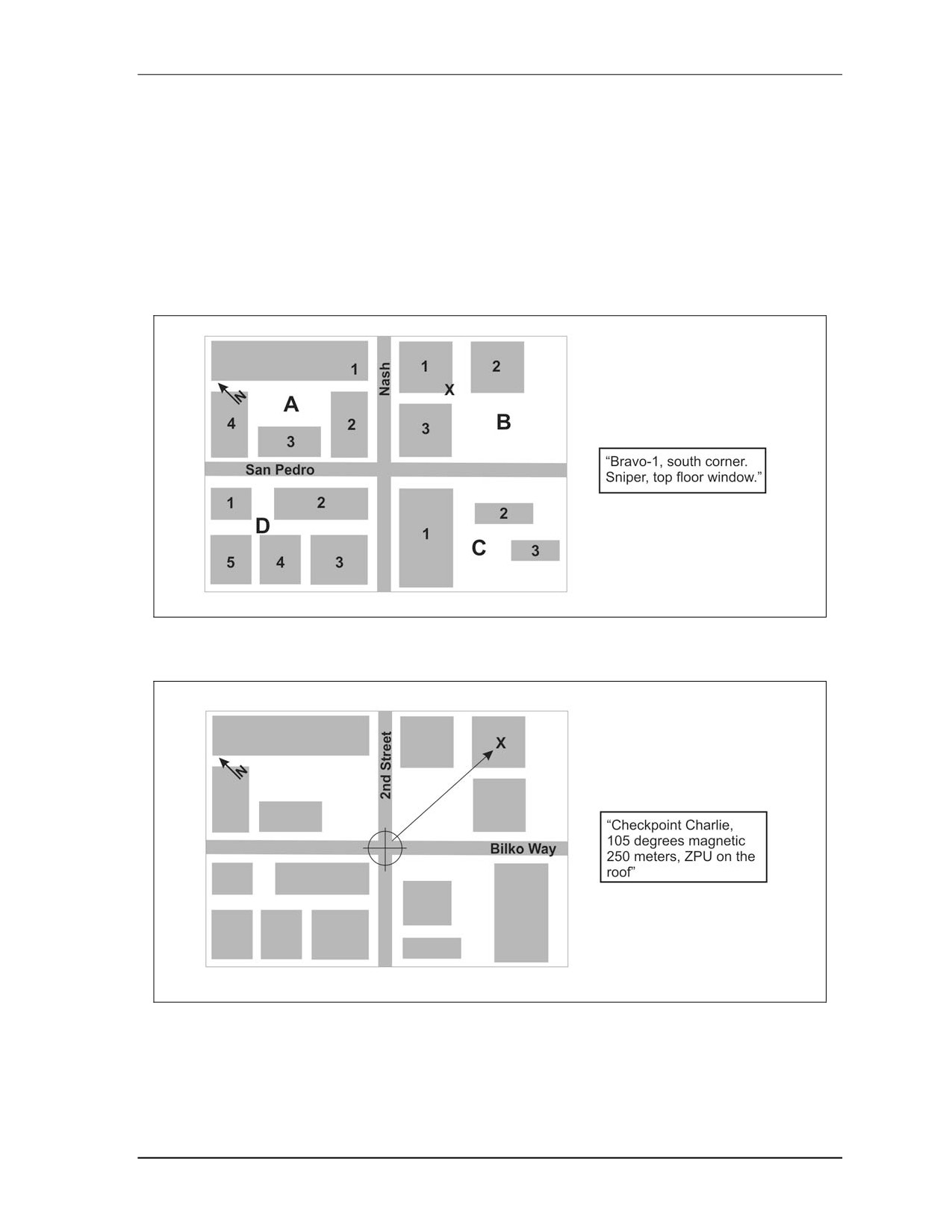
or numeric code to each. Buildings are coded and each corner of the building is coded. This gives the
aircrews an accurate way to target specific buildings as requested by the ground unit commander or to
identify friendly locations. Inclusion of maneuver graphic, fire support control measures, and airspace
control measures (ACMs) allows aircrews and maneuver elements to better visualize the urban portion of
the AO. Units must ensure they use the same area sketch for accurate coordination.
13 December 2006
FM 3-21.20
E-19
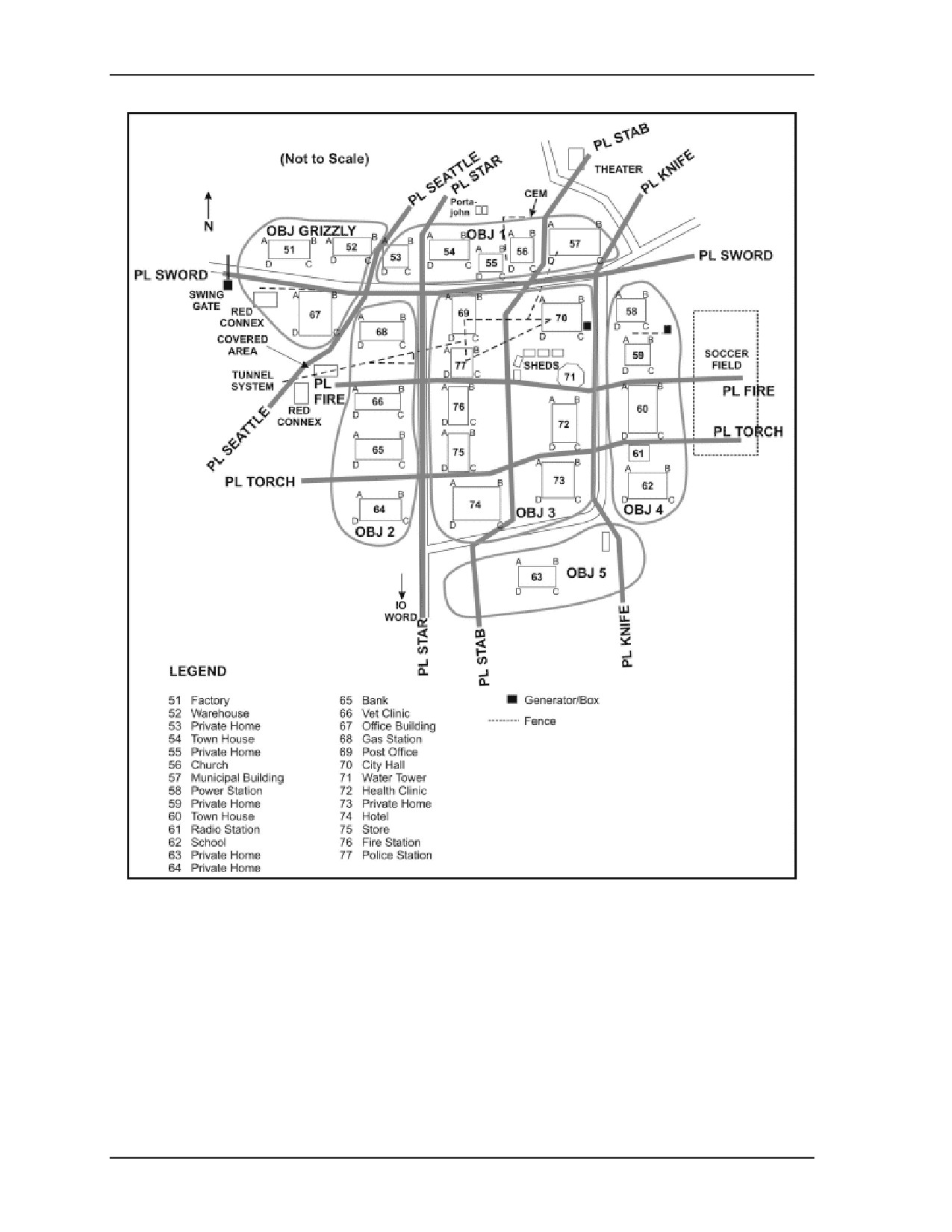
Appendix E
Figure E-5. Area sketch (simplified).
IDENTIFYING FRIENDLY POSITIONS, MARKING LOCATIONS, AND TARGET ACQUISITION
E-69. In the urban environment, friendly, enemy, and noncombatants may operate in close vicinity.
Furthermore, structures and debris can cause problems with identifying precise locations. Reliable
communication is essential to ensure aircrews know the locations of all participants in UO. To further
enhance air-ground coordination, methods are established to allow aircrews to visually identify key
locations. See Table E-3 for methods of marking.
E-20
FM 3-21.20
13 December 2006
Army Aviation Support for Ground Operations
Targeting Grids and Reference Techniques
E-70. Ground maneuver elements generally use a terrain-based reference system during urban
operations. Military grid reference system (MGRS) coordinates have little meaning at street level. Common
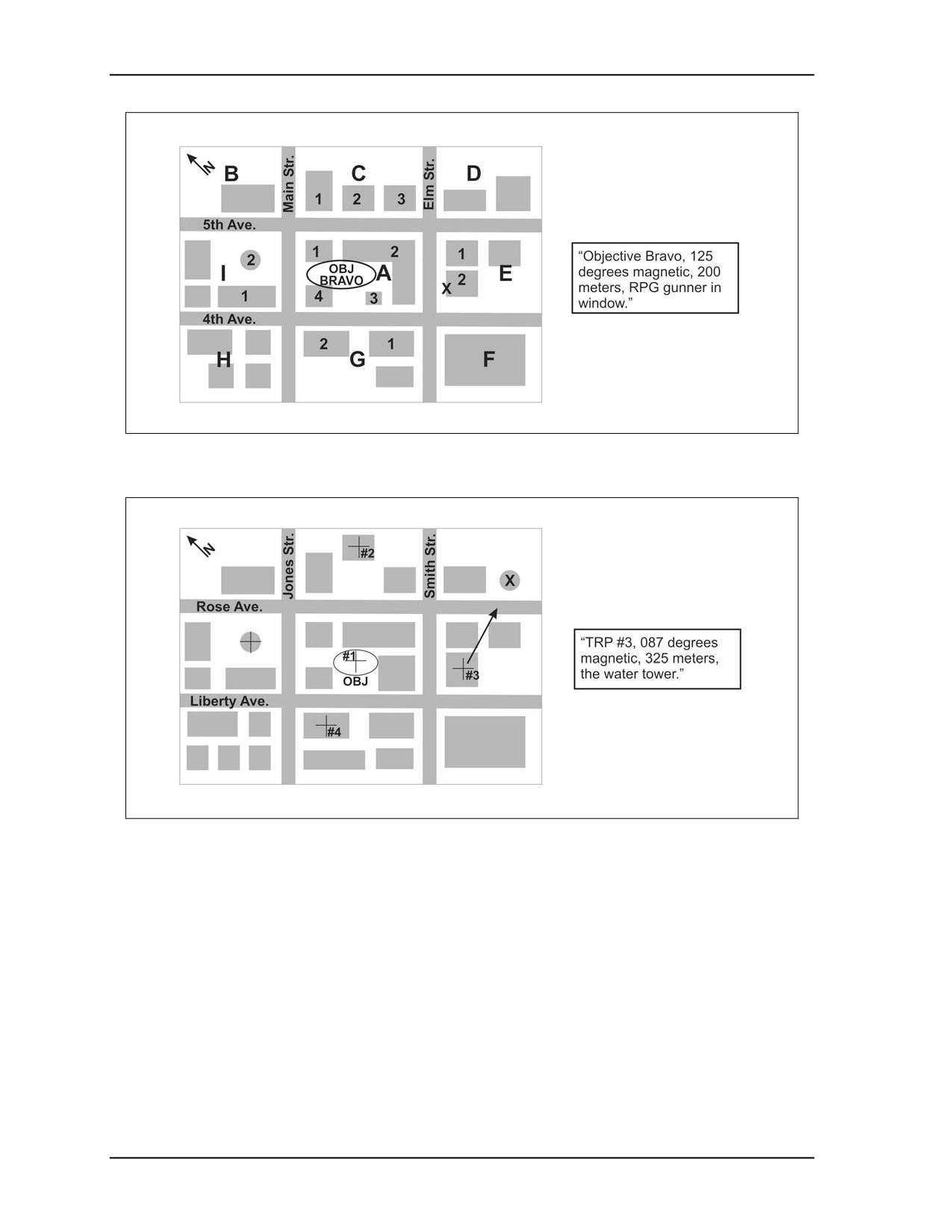
control methods include urban grid (Figure E-6), bull’s-eye/checkpoint targeting (Figure E-7), objective
area reference grid (Figure E-8), and TRPs (Figure E-9). These techniques are based on the street and
structure pattern present, without regard to the MGRS grid pattern. Aircrews must plan to transition to the
system in use by the ground element upon arrival in the objective area. For example, references to the
objective or target may include local landmarks such as, "The third floor of the Hotel Caviar, south-east
corner." This transition should be facilitated by using a "big to small" acquisition technique.
Figure E-6. Urban grid.
Figure E-7. Bull’s-eye/checkpoint targeting.
13 December 2006
FM 3-21.20
E-21
Appendix E
Figure E-8. Objective area reference grid.
Figure E-9. Target reference points.
Additional Cues
E-71. Physical terrain features and visual markings provide additional guidance for
identification purposes.
Roof Characteristics
E-72. Flat roofs, pitched roofs, domed roofs, and roofs with towers or air conditioning units on top will
aid in visual and thermal acquisition. Additional structural features revealed in imagery will aid in
confirmation. This method of terrain association will prove invaluable for visual engagement or
reconnaissance since structures are often too close to rely on mere grid coordinates.
E-22
FM 3-21.20
13 December 2006
Army Aviation Support for Ground Operations
Visual Markings
E-73. The visual signaling or marking of positions allows more ease in determining the location of
friendly forces. During building clearing operations, the progress of friendly units--both horizontally and
vertically--may be marked with spray paint or material hung out of windows. The simplest methods are
often the best. Traditional signaling devices, such as flares, strobes, and signaling mirrors, may be effective
as well. Target marking or an orientation on enemy positions may also be accomplished using signaling
procedures. The use of GLINT tape, combat identification (ID) panels, and infrared beacons assists in the
ID of friendly ground forces on urban terrain. Standardized usage of ground lighting, thermal contrast and
interposition of structures, influence the effectiveness of these devices.
Shadows
E-74. During both high and low ambient light conditions, expect to see significant urban shadowing
from buildings when cultural lights are present. Shadows will hide personnel and or vehicular targets, like
the shadows that hide small hills against the background of larger mountains. Shadows will hide
non-thermally significant targets, but thermal targets should still be seen. A combination of sensors will
need to be used to acquire and identify the target; therefore, a sensor hand-off plan must be thoroughly
briefed.
Global Positioning System
E-75. The use of aircraft with integrated GPS will reduce the amount of time spent finding the target
area. If ground forces can provide accurate coordinates, inputting a target grid into the GPS or inertial
navigation system will provide fire control cues (range, heading, time) to the target that will aid in quicker
target acquisition and help distinguish friendly forces from enemy forces.
ATTACK HELICOPTER ENGAGEMENT
E-76. Attack helicopters will conduct a variety of TTPs to engage targets in the urban area. Techniques
range from support by fire/attack by fire at maximum standoff ranges to running/diving fire and close
combat attack at minimum engagement ranges. Coordination is imperative to ensure positive ID of the
target as well as friendly locations.
E-77. Urban terrain introduces a unique challenge to aircrews and ground personnel alike with the
notion of the urban canyon. Simply stated, an urban canyon exists when a target or target set is shielded by
vertical structures. Unlike most natural terrain, the vertical characteristics of urban terrain can greatly affect
delivery options. Urban terrain typically creates corridors of visibility running between structures. Street
level targets are only visible along the street axis or from high angles. The interposition of structures
around a target interrupts LOS from many directions. The presence of buildings and other structures in
urban terrain creates corridors of visibility along streets, rivers, and railways. LOS must be maintained for
enough time to acquire the target, achieve a weapons delivery solution, and fly to those parameters. This
timeline is reduced during the employment of the AH-64D. A precise navigation system enables the
aircraft to slave its sensors and weapons to a stored target, thereby significantly reducing target acquisition
times. In some cases, the AH-64D may employ the gun or folding fin aerial rockets (FFARs) in an
"indirect" mode and never have to expose the aircraft to the target area. (Ground forces should make every
try to pass along accurate 8-digit grid coordinates as the AH-64D can easily and accurately engage
targets using this method.)
E-78. Visibility limitations on marking devices in the urban environment are geometric in nature. The
use of any pointer or laser requires LOS. In addition, the aircraft must have LOS with the target to see the
mark. Urban terrain severely limits LOS opportunities. Due to the close proximity of structures to one
another, there may be very narrow fields of view and limited axes of approach. The high number of
reflective surfaces in an urban setting presents an additional challenge. Laser energy can be reflected and
present multiple false returns. For these reasons, fire support can be expected to be more time consuming
and be much more dependent on good communications.
13 December 2006
FM 3-21.20
E-23
Appendix E
E-79. Combinations of marking devices and clear talk-on procedures will be essential to safe and
effective fire support. Ground forces consider using buddy lasing or remote lasing tactics for laser guided
munitions when urban effects preclude the attacking aircraft from maintaining LOS with the target until
ordnance impact. However, if designating with a ground-based laser along a narrow street bounded by tall
buildings, LOS geometry may allow the weapon to receive reflected laser energy. Aircrews must also
consider the potential miss distances for "precision" munitions when their guidance source is interrupted or
removed.
E-80. Armed helicopters can carry a mix of weapons. Commanders choose the weapons to use on a
specific mission based on their effects on the target, employment techniques, and the target's proximity to
ground forces. Planners must consider proportionality, collateral damage, and noncombatant casualties.
Planners and aircrew must consider the following when choosing weapons.
• Hard, smooth, flat surfaces with 90 degree angles are characteristic of man-made targets. Due
to aviation delivery parameters, munitions will normally strike a target at an angle less than 90
degrees. This may reduce the effect of munitions and increase the chance of ricochets. The
tendency of rounds to strike glancing blows against hard surfaces means that up to 25 percent
of impact-fused rounds may not detonate when fired onto areas of rubble.
• Identification and engagement times are short.
• Depression and elevation limits create dead space. Target engagement from oblique angles,
both horizontal and vertical, must be considered.
• Smoke, dust, and shadows mask targets. Also, rubble and man-made structures can mask fires.
Targets, even those at close range, tend to be indistinct.
• Urban fighting often involves units attacking on converging routes. The risks from friendly
fires, ricochets, and fratricide must be considered during the planning of operations.
• The effect of the weapon and the position of friendly and or enemy personnel with relation to
structures must be considered. Choose weapons for employment based on their effects against
the building material composition rather than against enemy personnel.
• Munitions can produce secondary effects such as fires.
E-24
FM 3-21.20
13 December 2006
Appendix F
Sniper Employment
Scout snipers and sniper/observers play a critical battalion task force role. The
Infantry unit TOE authorizes snipers to provide the commander accurate,
discriminating long-range small-arms fire, and direct observation of key terrain and
avenues of approach. Snipers can engage targets beyond the range of squad riflemen
and automatic weapons. They provide precise, deadly fires that can augment other
weapons systems or engage targets when and where other weapons are not effective.
Snipers are able to observe and report critical, detailed enemy information about the
enemy. Commanders should judge the efffectiveness of snipers by more than just the
casualties they inflict. Snipers also affect enemy activities, morale, and decisions.
Knowing US snipers are present hinders the enemy's movement, creates confusion
and continuous personal fear, disrupts enemy operations and preparations, and
compels the enemy to divert forces to deal with them (FM 3-22.10).
PERSONNEL SELECTION CRITERIA
F-1.
The standards of training and the independent nature of a sniper mission require the commander to
screen sniper candidates carefully. He looks for evidence of potential aptitude as a sniper. A Soldier will
need high motivation and the ability to learn a variety of skills to withstand the rigorous training program
and the increased personal risk and rigors of the job. The aspiring sniper must also have an excellent
personal record. The commander considers the following factors before selecting a Soldier to be a sniper or
recommending him for the US Army Sniper School.
BASIC QUALIFICATIONS
F-2.
The following are basic guidelines used to screen sniper candidates.
Marksmanship
F-3.
The sniper trainee must be an expert marksman. He must have scored expert on repeated annual
qualification fires. As an expert, he has learned the fundamentals for long-range engagements.
Physical Condition
F-4.
The sniper is often employed in extended operations with little sleep, food, or water. This requires
him to be in outstanding physical condition. Good health indicates good reflexes, muscular control, and
stamina. Also, the self-confidence and control that Soldiers gain from athletics, especially from team
sports, prove definite assets to a sniper trainee.
Vision
F-5.
Excellent vision is the sniper's prime tool. Therefore, a sniper must have vision correctable to
20/20, or better. However, wearing glasses can become a liability if the glasses are lost or damaged. Color
blindness is also a liability to the sniper, since this prevents him from detecting concealed targets that blend
in with the natural surroundings. Therefore, a sniper must have vision correctable to 20/20, or better.
13 December 2006
FM 3-21.20
F-1
Appendix F
Tobacco Use
F-6.
The sniper should not be a habitual smoker or user of smokeless tobacco, even if he stops for the
mission. Smoke, or an unsuppressed smoker's cough, can reveal the sniper's position. Also, the efficiency
of a Soldier who has quit using tobacco only for the mission is impaired by involuntary nervousness and
irritation.
Mental Condition
F-7.
A psychological examination can help the commander answer questions that indicate whether the
candidate has the right qualities to be a sniper—
• Will the candidate pull the trigger at the right time and place?
• Is he reliable?
• Has he demonstrated initiative, loyalty, discipline, and emotional stability?
Intelligence
F-8.
A sniper must be able to learn the following:
• Ballistics.
• Ammunition types and capabilities.
• Adjustment procedures for optical devices.
• Radio operation and procedures.
• Observation and adjustment of mortar and artillery fire.
• Land navigation skills.
• Military intelligence collecting and reporting.
• Identification of threat uniforms and equipment.
SPECIAL QUALIFICATIONS
F-9.
The sniper must be self-reliant, with good judgment and common sense. He also needs emotional
balance and fieldcraft skills.
Emotional Balance
F-10. The sniper must be able to calmly and deliberately eliminate targets that may not pose an
immediate threat to him. It is much easier to kill in self-defense or in the defense of others than to do so
without apparent provocation. The sniper must not be susceptible to emotions such as anxiety or remorse.
Candidates whose motivation toward sniper training rests mainly in the desire for prestige may be
incapable of the cold rationality that the sniper's job requires.
Fieldcraft
F-11. The sniper must know and feel comfortable spending long periods in the field. An extensive
background in the outdoors and knowledge of natural occurrences in the outdoors will help him in many of
his tasks. A Soldier with this kind of background often has great potential as a sniper.
COMMANDER RECOMMENDATION AND SNIPER SCHOOL PREREQUISITES
F-12. Commander involvement in personnel selection is critical. See FM 3-22.10 for specific
recommended sniper selection criteria.
F-2
FM 3-21.20
13 December 2006

Sniper Employment
SNIPER EMPLOYMENT OFFICER
F-13. Each Infantry battalion should designate a sniper employment officer (SEO). The SEO’s primary
duty is to advise the unit commander on the employment and control of the sniper squad and teams.
SELECTION
F-14. The individual the commander selects as the SEO depends on the type of unit, and the level of the
officer’s knowledge of sniper employment. The SEO can be the HHC commander, the XO, the scout
platoon leader, or any other officer. In the SEO's absence, either the sniper squad leader or the individual
sniper team leader can represent himself during mission planning and coordination with the battalion staff.
DUTIES AND RESPONSIBILITIES
F-15. The responsibilities of the SEO are remembered by using the mnemonic "KACTIS."
K
Know sniper capabilities and limitations.
A
Advise battalion and company commanders.
C
Coordinate all aspects of the sniper mission.
T
Train snipers whether they are deployed or in garrison.
I
Issue orders.
S
Supervise mission planning, preparation, and rehearsals.
Knowing
F-16. The SEO must know the capabilities and limitations of the sniper and the weapons systems in
order to participate in sniper training at every opportunity. He must also ensure that snipers are trained in
reconnaissance and surveillance as well as sniper skills.
Advising
F-17. The SEO must know how to employ snipers effectively in support of various operations so that he
can advise the commander. When given a mission to support a company or platoon, the SEO represents the
sniper team and advises the supported unit commander on what the assigned team can do for him.
Coordinating with the supported commander gives the SEO an opportunity to—
• Explain proper scout-sniper employment and tactics.
• Clarify misconceptions about the capabilities, limitations, and differences of scout and
sniper assets. All officers in the battalion should attend training provided by the SEO on sniper
operations.
Coordinating
F-18. Coordinating starts during mission planning and includes—
• Assigning teams to missions to support units or to serve as a part of the overall ISR mission. If
the team is assigned to a subordinate unit for an operation, the SEO and subordinate unit
commander must meet face to face, so that the SEO can advise the commander on sniper
employment.
• Discussing the use of terrain and sectors of operation. This ensures that both parties understand
the other's mission, prevents fratricide, and protects the integrity of the mission.
• Arranging for the insertion, resupply, and extraction of sniper teams operating independently of
a larger unit.
13 December 2006
FM 3-21.20
F-3
Appendix F
Training
F-19. The SEO ensures that training is challenging, realistic, and varied. He schedules and conducts
enough sniper training to maintain the sniper team’s proficiency. He also trains snipers to gather battlefield
information.
Issuing Orders
F-20. Orders are formal or informal in that they are either given as a full five-paragraph OPORD, or
given as a FRAGO. Missions should be assigned one at a time, with succeeding missions issued as
FRAGOs. This allows sniper teams to focus on planning and executing each mission.
Supervising
F-21. The SEO provides general overall supervision to the mission planning and briefbacks, including
details such as team SOPs, techniques, route plans, load tailoring, time management, and cross-loading.
However, he leaves the detailed supervision of the conduct of the mission planning and execution to the
team leader. The SEO should also supervise the debriefing and AARs for each team following the end of
the mission.
SNIPER TEAMS
F-22. Snipers avoid sustained battles. They operate in two- or three-Soldier teams, each consisting of a
senior sniper, a sniper, and an observer/security/driver; all are normally cross-trained. The senior sniper
carries a M16 or M4; the sniper carries the sniper weapon system (M24 or M107, arms room concept), and
each member has a side arm. Each team has an organic third team member that normally carries a M16 or
M4 with a M203. Each team also has a HMMWV assigned to the team by TOE. Team members help each
other with range estimation, round adjustment, and security.
EMPLOYMENT
F-23. The commander, S-3, a designated SEO, or the sniper squad leader, controls sniper teams from a
central location while conducting operations. Once deployed, sniper teams generally operate
independently. They must understand the commander's intent, his concept of the operation, and the purpose
for their assigned tasks to accomplish the assigned unit mission. Snipers are effective only in areas that
offer good fields of fire and observation. They must have the freedom of action to choose their own
positions once on the ground. The number of sniper teams participating in an operation depends on their
availability, the expected duration of the mission, and the enemy's strength and disposition.
SECURITY ELEMENT
F-24. Sniper teams should move with a security element (squad or platoon) whenever possible. This
allows the teams to reach their areas of operation faster and safer than if they operate alone. The security
element also protects the snipers during operations. When moving with a security element, snipers adhere
to the following guidelines:
• The leader of the security element leads the sniper team.
• Snipers must appear to be an integral part of the security element. Whenever possible, based on
METT-TC, snipers conceal sniper-unique equipment, such as optics, radios, and ghillie suits,
from view.
• Sniper uniforms must be the same as that of security element members. Snipers and element
members maintain proper intervals and positions in the element formation.
F-4
FM 3-21.20
13 December 2006
Sniper Employment
SNIPER ESTIMATE
F-25. Commanders should be knowledgeable on the proper use of snipers. If commanders know the
abilities and limitations of a sniper, the sniper can contribute significantly to the ISR collection plan and
the fight.
Mission
F-26. The sniper's primary mission is to support combat operations by delivering precise long range rifle
fire from concealed positions. The mission assigned to a sniper team for a particular operation consists of
the task(s) the commander wants the sniper team to accomplish and the reason (purpose) for it. The
commander must decide how he wants his sniper team to affect the battlefield. Then he must assign
missions to achieve this effect.
F-27. The commander assigns target priorities so snipers can avoid involvement in sustained
engagements. Sniper teams are free to change targets to support the commander's intent.
F-28. The commander describes the effect or result he expects and allows the sniper team to select key
targets. Because the sniper teams have both the M24 and M107 systems, the team can select the best
weapon to use to achieve the desired effect. For example, the M107 can effectively disable lightly armored
enemy equipment as well as personnel.
F-29. The commander may assign specific types of targets to achieve an effect. He may task snipers to
kill bulldozer operators or disable the bulldozer and other engineer equipment operators to disrupt enemy
defensive preparations. He may task snipers to disable enemy command or supply vehicles, or engage
Soldiers digging defensive positions.
F-30. The commander may assign specific point targets such as vehicles, equipment, bunkers, command
posts, or crew-served weapons positions. These can include enemy leaders, command and control
operators, antitank guided missile gunners, the antitank guided missile system, armored-vehicle
commanders, or weapons crews. Snipers can engage selected individuals. Snipers may be assigned
countersniper roles.
Enemy
F-31. The commander must ask the following questions when determining the characteristics,
capabilities, strengths, weaknesses, and disposition of the enemy:
• Is the enemy force heavy or light, rested or tired, disciplined or not?
• Is the enemy traveling on motorized Infantry or towed artillery?
• Is the enemy well supplied or short of supplies?
• Is the enemy patrolling aggressively or lax in security?
• Is the enemy positioned in assembly areas or dug in?
F-32. The answers to questions like these help the commander determine the enemy's susceptibility and
reaction to effective sniper operations. A well-rested, well-led, well-supplied, and aggressive enemy with
armored protection poses a greater threat to snipers than one that is tired, poorly led, poorly supplied, lax,
and unprotected. The commander needs to know if enemy snipers are present and effective since they can
pose a significant danger to his operations and his snipers. The commander must consider the enemy's
directed energy weapons capability since snipers are particularly vulnerable to these due to their use of
optical devices.
Terrain
F-33. The commander must evaluate and consider the terrain in and en route to the sniper's area of
operations, the time and effort snipers will expend getting into position and the effects of weather on the
sniper and his visibility. Snipers prefer positions at least 300 meters from their target area. Operating at this
13 December 2006
FM 3-21.20
F-5
Appendix F
distance allows them to avoid effective fire from enemy rifles while retaining much of the 800- to
2,000-meter effective range of two models of the sniper rifles. Snipers need areas of operations with
adequate observation, fields of fire, and good firing positions.
Troops
F-34. The commander must decide how many sniper teams to use depending on their availability, the
duration of the operation, expected opposition, and the number and difficulty of tasks and targets assigned.
Commanders must consider the snipers' level of training and physical conditioning and remember the
effects of these human factors on sniper operations.
F-35. The Infantry battalion sniper squad is designed to field three 3-Soldier sniper teams. Under this
organization, the commander can generally assign continuous missions to all three teams for a maximum of
24 to 48 hours. After this time, the teams will need to rest and rotate teams conducting missions.
F-36. During critical actions, and depending on the training of the squad members, it is possible to field
up to five, 2-Soldier sniper teams with a combination of M24 and M107 sniper systems. However, only
three teams will have organic vehicle movement capability and these operations should not exceed 24
hours in duration.
Time Available
F-37. The commander must consider how much time the snipers will have to achieve the result he
expects. He must allocate time for snipers to plan, coordinate, prepare, rehearse, move, and establish
positions. The commander must understand how the snipers' risk increases when they lack adequate time to
plan or to perform other tasks such as move to the area of operations. The amount of time a sniper team can
remain in a position without loss of effectiveness due to eye fatigue, muscle strain, or cramps depends
mostly on the type of position it occupies. Generally, snipers can remain in an expedient position for 6
hours before they must be relieved. They can remain in belly positions or semi-permanent hides for up to
48 hours before they must be relieved. Normal mission duration times average 24 hours. (FM 3-22.10
provides guidance on sniper position considerations, construction, and preparation and occupation times.)
Movement factors for snipers moving with a security element are the same as for any Infantry force. When
snipers move alone in the area of operations, they move slowly; their movement can be measured in feet
and inches. The sniper team is the best resource in determining how much time is required for their
movement.
Civil Considerations
F-38. The commander must give clear guidance on ROE and ROI. Civilians on the battlefield pose a
special threat to sniper teams because snipers are highly dependent on stealth in all phases of their
operations. The commander must give specific mission abort criteria if the team is compromised by
civilians.
OFFENSIVE EMPLOYMENT
F-39. Offensive operations carry the fight to the enemy to destroy his capability and will to fight.
Snipers play a major role in offensive operations by killing enemy targets that threaten the success of the
attack. Snipers can also contribute to the ISR plan. They can be tasked to observe and report on enemy
activities near NAIs to collect PIR. Follow-on sniper missions should be considered when assigning
intelligence collection missions. For example, if a sniper team is tasked to collect PIR on an objective, the
follow-on mission during the attack might be to kill machine gun crews once the assault on the
objective begins.
F-6
FM 3-21.20
13 December 2006
Sniper Employment
OFFENSIVE MISSIONS
F-40. During offensive operations, snipers—
• Conduct countersniper operations.
• Overwatch movement of friendly forces and suppress enemy targets that threaten the moving
forces.
• Place precision fire on enemy crew-served and antitank weapons teams and into exposed
apertures of bunkers.
• Place precision fire on enemy leaders, armored-vehicle drivers or commanders, FOs, and other
designated personnel.
• Place precision fire on small, isolated, bypassed forces.
• Place precision fire on targets threatening a counterattack or fleeing.
• Assist in screening a flank using supplemental fires.
MOVEMENT TO CONTACT
F-41. During a movement to contact, snipers move with the lead element, or they can be employed 24 to
48 hours before the unit's movement to—
• Select positions.
• Gather information about the enemy.
• Deny enemy access to key terrain through controlled precision fires, preventing enemy surprise
attacks.
ASSAULT
F-42. Snipers can provide effective support during an assault.
F-43. Snipers placed with lead elements move to positions that allow them to overwatch the movement
of the element and provide long-range small-arms fire. Sniper teams are most effective where supporting
vehicles cannot provide overwatching fires.
F-44. Snipers may also be placed in a position to suppress, fix, or isolate the enemy on the objective.
The sniper rifle's precision fire and lack of blast effect allow the sniper to provide close supporting fires for
assaulting Soldiers.
F-45. If time permits, snipers may be deployed early in the operation. Because the snipers' weapons
have better optics and longer ranges than other types of small arms, they can provide additional long-range
observation, reporting and precision fire on any enemy targets that may appear. Snipers will often move
with scouts during ISR operations and then once near their objective area, move to separate positions.
F-46. Snipers may move with the assault force toward the objective, occupy a close-in support-by-fire
position where they can help suppress or destroy targets threatening the assault force, or move onto the
objective to provide close-in precision fire against enemy fortified positions, bunkers, and trench lines.
Selection of the sniper support-by-fire position depends on METT-TC. The closer snipers are to the
objective area, the greater the chance they will be discovered and lose their effectiveness.
F-47. If elements appear on the battlefield at the same time snipers arrive, the snipers' security and
potential for surprise are degraded. To increase security and surprise, snipers may move covertly into
position in an objective area well before the main attack arrives. Ideally, a sniper team going in early
moves with infiltrating dismounted Infantry, or mounted scouts. These infiltration methods are faster and
more secure than moving alone. After the snipers are in position, Infantrymen may remain nearby as
additional security, but they are more likely to have other supporting tasks to perform. The battalion fire
support officer ensures indirect fire support for sniper teams, and he ensures that friendly troops know the
sniper's positions. This helps prevent fratricide.
13 December 2006
FM 3-21.20
F-7
Appendix F
F-48. After their fires are masked, snipers reposition as soon as possible. The commander must carefully
evaluate where snipers will be most useful. If he wants to use snipers in several different places, or if he
wants them to contribute throughout the attack, snipers use their organic transportation to enable them to
move quickly, stealthily, and safely on the battlefield.
F-49. Upon consolidation, snipers may displace forward to new positions that are not necessarily on the
objective. From these positions, the snipers provide precision fire and observation against bypassed enemy
positions, enemy counterattack forces, or other enemy positions that could degrade the unit's ability to
exploit the success of the attack.
RAID
F-50. During a raid, sniper teams can join with either the security element or the support element to—
• Cover avenues of approach and escape that lead in and out of the objective.
• Cover friendly routes of withdrawal to the rally point.
• Provide long-range fires on the objective.
• Snipers can move early with the scouts to observe and report on the objective, then join the
security or support element.
ACTIONS AGAINST FORTIFIED AREAS
F-51. Assaulting forces usually encounter some type of fortified positions prepared by the defending
force. These can range from field-expedient hasty positions produced with locally available materials to
elaborate steel and concrete emplacements complete with turrets, underground tunnels, and crew quarters.
Field-expedient positions are those most often encountered. More elaborate positions are likely when the
enemy has had significant time to prepare his defense. He may have fortified weapons emplacements or
bunkers, protected shelters, reinforced natural or constructed caves, entrenchments, and other obstacles.
ENEMY DEFENSIVE POSITIONS
F-52. The enemy tries to locate these positions so they are mutually supporting and arrayed in depth
across the width of his sector. He tries to increase his advantages by covering and concealing positions and
preparing fire plans and counterattack contingencies. Fortified areas should be bypassed and contained by a
small force.
SNIPER SUPPORT
F-53. The sniper's precision fire and observation capabilities are invaluable in the assault of a fortified
area. Precision rifle fire can easily detect and destroy pinpoint targets that are invisible to the naked eye.
The snipers' role during the assault of a fortified position is to deliver precision fire against observation
posts, exposed personnel, and the embrasures, air vents, and doorways of key enemy positions. The
commander plans the order in which snipers should destroy targets. Their destruction should systematically
reduce the enemy's defense by destroying the ability of enemy positions to support each other. Once these
positions are isolated, they can be reduced more easily. The commander must decide where he will try to
penetrate the enemy's fortified positions and then employ his snipers against those locations. Snipers can
provide continuous fire support for both assaulting units and other nearby units when operating from
positions near the breach point on the flanks. Sniper fires add to the effectiveness of the entire unit; the
commander can employ snipers in situations where other resources cannot be used for various reasons.
SNIPER PLAN
F-54. The sniper team bases its plan on information available. The enemy information it needs
include—
F-8
FM 3-21.20
13 December 2006
Sniper Employment
• Extent and exact locations of individual and underground fortifications.
• Fields of fire, directions of fire, locations and number of embrasures, and types of weapons
systems in the fortifications.
• Locations of entrances, exits, and air vents in each emplacement.
• Locations and types of existing and reinforcing obstacles.
• Locations of weak spots in the enemy's defense.
DEFENSIVE EMPLOYMENT
F-55. Snipers may effectively enhance or augment any unit's defensive fire plan. After analyzing the
terrain, the sniper team should recommend options to the commander.
DEFENSIVE TASKS
F-56. The sniper team can perform the following tasks during defensive operations:
• Cover obstacles, minefields, roadblocks, and demolitions.
• Perform counterreconnaissance (kill enemy reconnaissance elements).
• Engage enemy OPs, armored-vehicle commanders exposed in turrets, and ATGM teams.
• Damage enemy vehicles' optics to degrade their movement.
• Disable wheeled and light armored vehicles.
• Suppress enemy crew-served weapons.
• Disrupt follow-on units with long-range small-arms fire.
• Call for and adjust indirect fires.
PRIMARY POSITIONS
F-57. Snipers are generally positioned to observe or control one or more avenues of approach into the
defensive position. Due to the types of weapons systems available, snipers may be used against secondary
avenues of approach. Sniper employment can increase all-round security and allow the commander to
concentrate his combat power against the most likely enemy avenue of approach. Snipers may support the
battalion by providing extra optics for target acquisition and precise long-range fires to complement those
of other weapon systems. This arrangement seeks to maximize the effectiveness of all the unit's weapons
systems. Snipers in an economy-of-force role may cover dismounted enemy avenues of approach into TF
positions.
ALTERNATE AND SUPPLEMENTARY POSITIONS
F-58. Snipers establish alternate and supplementary positions for all-round security. Positions near the
FEBA are vulnerable to concentrated attacks, enemy artillery, and obscurants. Multiple sniper teams, if
used, can be positioned for surveillance and mutual fire support. If possible, they should establish positions
in depth for continuous support during the fight. The sniper's rate of fire neither increases nor decreases as
the enemy approaches. Sniper teams systematically and deliberately shoot specific targets, never sacrificing
accuracy for speed.
KEY TERRAIN
F-59. The commander can position snipers to overwatch key obstacles or terrain such as river-crossing
sites, bridges, minefields, or anything that canalizes the enemy directly into engagement areas. Snipers are
mainly used where less discriminate weapons systems are less effective due to security requirements,
terrain or ROE restrictions. Even though weapons systems with greater range and optics capability than the
snipers' weapons are available to the commander, he may be unable to use them for any of several reasons.
13 December 2006
FM 3-21.20
F-9
Appendix F
They might present too large a firing signature, be difficult to conceal well, create too much noise,
potentially cause unacceptable collateral damage, or be needed more in other areas. Sniper team members
provide the commander with better observation, greater killing ranges and more discriminate fires than do
other Soldiers or weapons systems.
FORCE SECURITY
F-60. Snipers can be used as an integral part of the security effort. They can help acquire and destroy
targets, augment the security element by occupying concealed positions for long periods, observe and
direct indirect fires (to maintain their security), and engage targets. Selective long-range sniper fires are
difficult for the enemy to detect. A few well-placed shots can disrupt enemy reconnaissance efforts, force
him to deploy into combat formations, and deceive him as to the location of the MBA. The sniper's stealth
skills counter the skills of enemy reconnaissance elements. Snipers can be used where scout or rifle platoon
mobility is unnecessary, freeing the scouts and riflemen to cover other sectors. Snipers can also be used to
direct ground maneuver elements toward detected targets. This also helps maintain security so ground
maneuver elements can be used against successive echelons of attacking enemy.
STRONGPOINT EMPLOYMENT
F-61. Snipers should be tasked to support any unit defending a strongpoint. The characteristics of the
sniper team enable it to adapt to perform independent harassing and observation tasks in support of the
force in the strongpoint, either from inside or outside the strongpoint.
REVERSE SLOPE DEFENSE
F-62. Snipers can provide effective long-range fires from positions forward of the topographical crest.
This can include fires on the counterslope, when the unit is occupying a reverse slope defense. As the
enemy force deploys on the reverse slope and is engaged by the main defense, snipers can engage targets
on the counterslope. Knowing there is no sanctuary on the counterslope, sniper fires can have a significant
effect on enemy morale causing confusion and disrupting the enemy attack plan.
RETROGRADE EMPLOYMENT
F-63. The sniper team must know the concept, intent, scheme of maneuver, withdrawal times or
conditions and priorities, routes, support positions, rally points, and locations of obstacles. Both
engagement and disengagement criteria must be planned and coordinated to ensure snipers achieve the
desired effect without compromising their positions.
FORCE ENEMY DEPLOYMENT
F-64. Snipers can help the delaying force by causing the enemy to deploy prematurely during retrograde
operations. They help by inflicting casualties with accurate, long-range small-arms fire. When the enemy
receives effective small-arms fire from unknown positions, he is likely to assume he is near an enemy
position and to begin maneuvering to a position of advantage against the perceived threat. Using a sniper
team, the commander can achieve the same effect he could with another Infantry unit. The snipers' stealth
also gives them a better chance of infiltrating out of positions close to the enemy.
REPOSITIONING
F-65. Delaying forces risk being bypassed or overtaken by attacking enemy forces. Snipers use their
organic transportation to move to successive positions. Vehicles must remain in defilade positions to the
rear of the sniper position, or they must occupy different positions away from the sniper's area of
operations to avoid compromising the sniper's position. In either case, a linkup point, egress routes, and
F-10
FM 3-21.20
13 December 2006
Sniper Employment
conditions for executing the linkup must be fully coordinated. Sniper team use organic communications
assets to facilitate control and movement.
INFILTRATION
F-66. Snipers may be required to infiltrate back to friendly positions. Their infiltration plans must be
fully coordinated to avoid fratricide when they try to reenter a friendly position. When planning successive
positions, the commander must realize the sniper team may be unavailable for use if it is destroyed or is
having difficulty disengaging from an enemy force. The commander must consider carefully how and
where he wants snipers to contribute to the operation. Planning too many positions for the sniper team in a
fast-paced retrograde may result in failure, temporary or even permanent loss of sniper teams.
SNIPER TASKS
F-67. Snipers may be assigned any of the following specific tasks:
• Delay the enemy by inflicting casualties.
• Observe and report enemy movement and activities along avenues of approach.
• Cover key obstacles with precision fire.
• Direct artillery fire against large enemy formations.
URBAN OPERATIONS EMPLOYMENT
F-68. The value of the sniper to a unit conducting urban operations depends on several factors,
including the type of operation, level of conflict, and ROE. Where ROE allow destruction, the snipers may
be used differently since other weapons systems have greater destructive effect. Where ROE limit or
prohibit collateral damage, snipers are a key asset to the commander.
URBAN TERRAIN
F-69. Sniper effectiveness depends partly on the terrain. The characteristics of an urban area degrade
control. To provide timely and effective support, the sniper must have a clear understanding of the scheme
of maneuver and commander's intent.
F-70. Observation and fields of fire are clearly defined by roadways. However, rooftops, windows, and
doorways limit surveillance. The effects of smoke from military obscurants and burning buildings can
degrade what otherwise appears to be an excellent observation and firing position. Integration of snipers
into the operation becomes more important because the enemy can fire from many directions--including
enemy snipers--and enemy infiltration tries must be countered.
F-71. Cover and concealment are excellent for both the attacker and defender. The defender has a
decisive advantage. The attacker normally reveals his position during movement through the area.
F-72. Avenues of approach inside buildings are advantageous because movement in a building is harder
to detect than movement through the streets. The sniper must be conscious of all avenues of approach and
must be prepared to engage targets that appear on any of them. Sniper teams must also be prepared for
close combat which is a common characteristic of urban operations.
POSITIONING
F-73. Snipers should be positioned in buildings of masonry construction that offer long-range fields of
fire and all-round observation. The sniper has an advantage because he does not have to move with, or be
positioned with, lead elements. He may occupy a higher position to the rear or flanks and some distance
away from the element he is supporting. By operating far from the other elements, a sniper avoids decisive
engagement but remains close enough to kill distant targets threatening the unit. Snipers should not be
13 December 2006
FM 3-21.20
F-11
Appendix F
placed in obvious positions, such as church steeples or minarets and on rooftops, since the enemy often
observes these and targets them for destruction. Indirect fires can generally penetrate rooftops and cause
casualties in top floors of buildings.
MULTIPLE POSITIONS
F-74. Snipers should operate throughout the area of operations, moving with and supporting the Infantry
and Weapons company teams as necessary. Some teams may operate independent of other forces. They
search for targets of opportunity, especially for enemy snipers. Since a single position may not afford
adequate observation for the entire team without increasing the risk of detection by the enemy, the team
may occupy multiple positions. Separate positions must maintain mutual support. Each team should also
establish alternate and supplementary positions.
TASKS
F-75. The commander may assign the following tasks to snipers:
• Conduct countersniper operations.
• Kill targets of opportunity.
Note: The sniper team assigns priorities to the targets of opportunity, based on an
understanding of the commander's intent. For example, they might first engage enemy
snipers, and then leaders, vehicle commanders, radio operators, sappers, and machine gun
crews.
• Deny enemy access to certain areas or avenues of approach (control key terrain).
• Provide fire support for barricades and other obstacles.
• Maintain surveillance of flank and rear avenues of approach (screen).
• Support local counterattacks with precision fire.
STABILITY OPERATIONS AND CIVIL SUPPORT OPERATIONS
F-76. Snipers can be valuable to commanders in stability operations and civil support operations. Since
the ROE normally limits collateral damage--and always must limit civilian casualties--snipers can
selectively kill or wound key individuals who pose a threat to friendly forces. This selective engagement
avoids unacceptable civilian casualties or collateral damage. Targets often hide in the midst of the civilian
populace, which makes them virtually invulnerable to US forces that cannot destroy these targets without
causing innocent casualties. For example: a lone gunman or bomb wielding terrorist in a crowd. The
Soldiers must first identify the gunman, which is nearly impossible from their vantage points. Then,
without hurting innocent bystanders, they must stop him from firing, fleeing, or detonating the bomb. This
is an easier task for an overwatching sniper than for Soldiers on the ground. The sniper can look down on
the crowd, use his optics to scan continuously, and employ precision fire to eliminate the identified enemy
without harming bystanders. Though other unit optical systems may supplement the surveillance effort
(Javelins and TOWs from the ground or from the upper floors of buildings); they avoid engaging the target
due to the risk of casualties among the surrounding civilians. After identifying the target, Javelins and
TOWs still need time to guide a precision weapon or maneuver a unit to address the target. The sniper rifle
provides the commander the only system that can both identify and engage the target.
RIVER CROSSINGS
F-77. Sniper teams, by virtue of their observation and precision-fire capabilities, are uniquely adaptable
to the initial stages of a river crossing. They are normally employed in general support of the battalion both
before and during the crossing.
F-12
FM 3-21.20
13 December 2006
Sniper Employment
POSITIONING
F-78. If possible, snipers assume positions across the total width of the crossing area before the
crossing. Their main task is to observe. They report all sightings of enemy positions and activity
immediately and provide a stealthy observation capability not otherwise available to the commander. Their
stealth prevents the enemy from learning key facts like what type of unit is trying to cross. The snipers
supplement normal reconnaissance assets.
CROSSING SUPPORT
F-79. Snipers provide support during the crossing by continuing to observe and suppress enemy OPs
and other key targets that heavier supporting elements might overlook. The snipers' ability to continue to
provide close-in suppressive fire makes continuous fire support possible up to the moment elements reach
the far side and begin their movement to establish the bridgehead line. Snipers should be positioned as
early as possible, preferably as part of the reconnaissance force. Their movement across the river must also
be planned in advance. How they get across and where their subsequent positions are must be coordinated.
Generally, they displace once friendly elements reach the far side.
INSERTED FORCE SUPPORT
F-80. Snipers expand the capability of the inserted force to engage threatening targets at long ranges.
Once on the far side, scouts and snipers may screen the flank or rear of the crossing force, infiltrate to
destroy key targets, such as a demolition guard or fortified emplacement, or man OPs well to the front of
the crossing force. This placement increases both early warning time and the crossing force's ability to
disrupt enemy counterattack forces.
PATROLS
F-81. With any size or type of patrol, only the terrain and the patrol leader’s ingenuity limit the effective
employment of sniper teams. Snipers must know and be able to apply all aspects of patrolling.
RECONNAISSANCE PATROLS
F-82. Snipers normally remain with the security element during reconnaissance patrols. If terrain
permits, snipers can provide long-range support to enable the reconnaissance element to patrol farther from
the security element. To prevent compromise of the reconnaissance element's position, snipers should fire
only in self-defense or when ordered by the patrol leader. Normally, the only appropriate time to fire at a
target of opportunity is when extraction or departure from the position is imminent and firing will not
endanger the success of the patrol.
RAID PATROLS
F-83. Sniper employment on a raid depends on the time of day and the size of the patrol. When the
patrol needs maximum firepower and its size must be limited, snipers may be excluded. If, on the other
hand, the patrol needs long-range precision fire and its size permits, sniper teams may be attached to the
security and/or the support element. If appropriate, the sniper team may be attached to the support element
to help provide long-range supporting fires. When attached to the security element, the sniper team may
provide observation, or assist in preventing enemy escape from the objective area, prevent reinforcements
from coming into the objective area, and can help cover the withdrawal of the assault force to the rally
point. When the element withdraws from the rally point, the sniper team may stay behind to delay and
harass enemy counteraction or pursuit.
13 December 2006
FM 3-21.20
F-13
Appendix F
AMBUSH PATROLS
F-84. During ambushes, snipers are positioned in areas that afford observation and fields of fire on
terrain features the enemy might use for cover after the ambush has begun. The snipers' long-range
capability allows them to be positioned away from the main body. Sniper fires are coordinated into the fire
plan. Once the signal to initiate fires is given, snipers add their fires to the rest of the patrols. Snipers shoot
leaders, radio operators, and crew-served weapons teams. If the enemy is mounted, every effort is made to
kill drivers of the lead and trail vehicles to block the road, prevent escape, and create confusion. Snipers
may remain in position to cover the withdrawal of the patrol.
SQUAD DESIGNATED MARKSMAN
F-85. A squad designated marksman
(SDM) can seldom perform as well as a trained sniper,
so commanders and platoon leaders should avoid trying to employ him as such. However, the marksman is
still a valuable asset who can contribute in many ways. Leaders should know the value of the marksman
and sniper, and use each to the best of his abilities in any situation. The SDM is discussed in detail
in FM 3-21.8.
F-14
FM 3-21.20
13 December 2006
Appendix G
Special Operations Forces and Joint, Interagency, and
Multinational Operations
“The nature of modern warfare demands that we fight as a
team...Effectively-integrated joint forces expose no weak points or seams to enemy
action, while they rapidly and efficiently find and attack enemy weak points...”--JP 1
Section I. SPECIAL OPERATIONS FORCES
Conventional US Army forces and SOF routinely conduct operations in the same area and coordinate the
execution of missions. Conventional and special operations forces in most theater campaign plans are assigned
unique but complementary tasks, and when combined and coordinated, contribute to the achievement of the
operational and tactical objectives. Some SOF are routinely attached to the Infantry battalion to assist in the
achievement of tactical objectives.
PLANNING CONSIDERATIONS
G-1.
As part of a BCT, the Infantry battalion is likely to conduct operations with or in support of SOF
in the COE. Detailed planning and coordination may often be required down to the battalion level. On
today’s noncontiguous modern battlefield, the battalion is likely to find SOF forces operating around or in
the BCT, battalion, or Infantry company AO. To maximize the combined combat power of these forces
working together, the battalion or Infantry company must appreciate the mission and purpose of each of
these forces, as well as their capabilities and limitations. This appendix covers information the commander
and platoon leader are likely to need to know in order to fulfill their responsibilities during such operations.
TYPES
G-2.
The United States Army Special Operations Command (USASOC) has five main organizations
that are likely to operate with conventional Infantry units. These units are Special Forces (SF), the 75th
Ranger Regiment, Civil Affairs, PSYOP, and the 160th Special Operations Aviation Regiment (SOAR).
SPECIAL FORCES
G-3.
Special Forces are part of USASOC:
Organization
G-4.
Special Forces operations are inherently joint and frequently controlled by higher echelons, often
with minimal involvement of intermediate HQ. The basic building block of SF is the 12-Soldier Special
Forces Operational Detachment-Alpha
(SFOD-A), known as an ODA or A-Team. All other SF
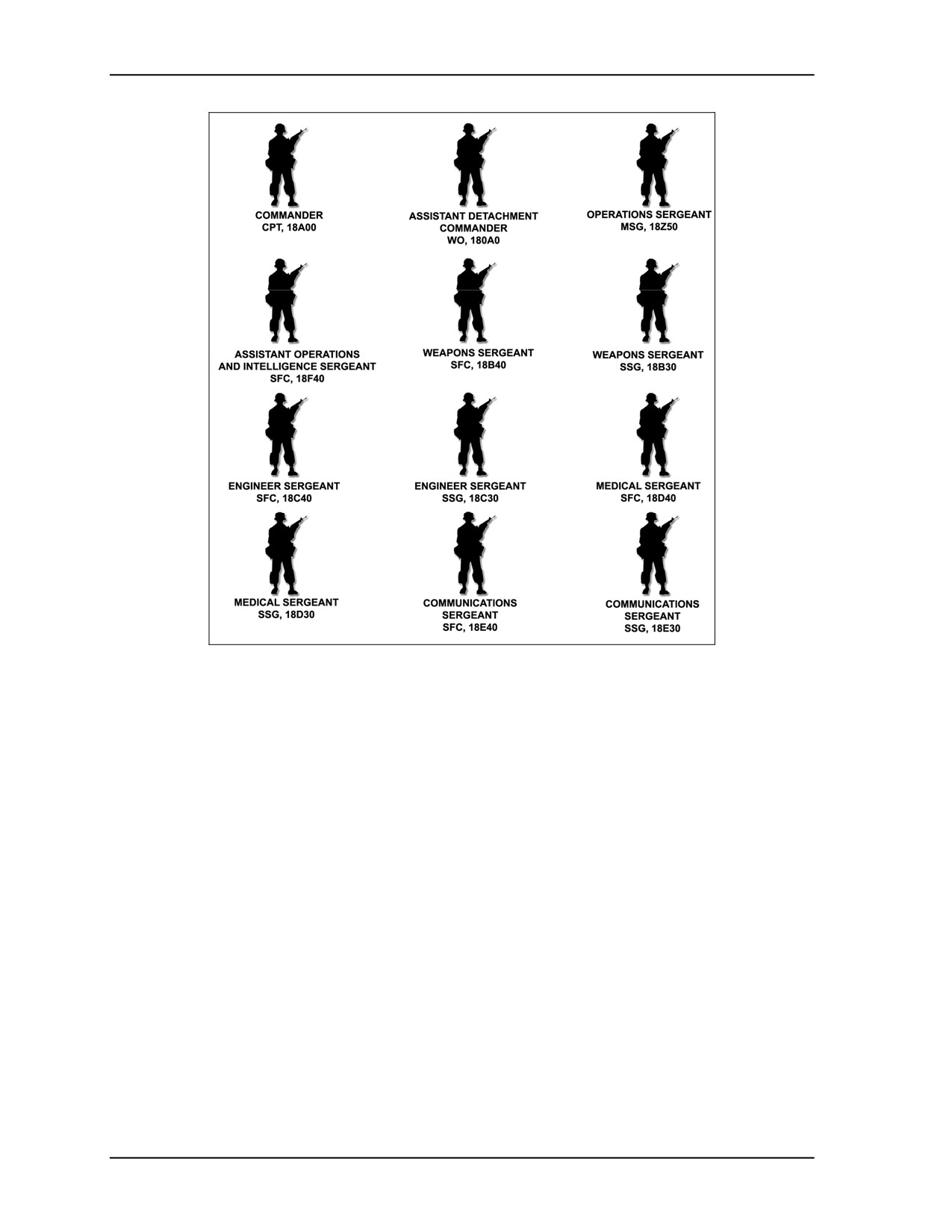
organizations command, control, and support the SFOD-A (Figure G-1).
13 December 2006
FM 3-21.20
G-1
Appendix G
Figure G-1. Special Forces operational detachment-A.
Capabilities
G-5.
Special forces are capable of—
• Infiltrating and exfiltrating specified operational areas by air, land, or sea.
• Conducting operations in remote areas and nonpermissive environments for extended periods
with little external direction and support.
• Developing, organizing, equipping, training, advising, and directing indigenous military and
paramilitary units/personnel.
• Employing foreign language ability and cultural training.
• Training, advising, and assisting allied and indigenous forces.
• Conducting reconnaissance, surveillance, and target acquisition.
• Conducting direct-action operations that include raids, ambushes, sniping, emplacing of mines
and other munitions, or providing terminal guidance for precision-guided missions.
• Conducting rescue and recovery operations.
• Conducting advanced trauma life-saving care.
• Communicating with disparate joint forces via redundant systems; including TACSAT, HF,
FM, VHF, and UHF.
• Employing CAS via attached Air Force combat control teams (CCTs) or by organic capabilities
or qualifications.
G-2
FM 3-21.20
13 December 2006
Special Operations Forces and Joint, Interagency, and Multinational Operations
Limitations
G-6.
SF limitations include the following:
• Depend on the resources of the theater army to support and sustain operations.
• Cannot conduct conventional combined armed operations on a unilateral basis. Their abilities
are limited to advising or directing indigenous military forces or conducting these types of
operations in conjunction with conventional or other joint forces.
• Do not have organic combined arms capability. They habitually require the support or
attachment of other WFF assets.
• Cannot provide security for operational bases without severely degrading operational and
support capabilities.
75TH RANGER REGIMENT
G-7.
Ranger organization, capabilities, and limitations are discussed below.
Organization
G-8.
The Rangers are a special operations Infantry organization. Their organization and C2 structure
are configured to support the unique demands placed on them by the specialized nature of the missions
they are expected to perform. They have personnel capable of serving in the role of liaisons to the BCT in
the event operations or mission requirements would dictate this. Ranger operations generally set conditions
for follow-on conventional forces or are independent of conventional forces, focusing on objectives above
the tactical level of warfare.
Capabilities
G-9.
Rangers have all the capabilities of conventional Infantry, air assault and airborne Infantry units,
with the addition of —
• Increased tactical and operational mobility due to increase in mobility assets.
• Greatly enhanced firepower due to additional organic direct and indirect fire weapon systems.
• Familiarity with planning and conducting joint operations.
Limitations
G-10. Same as normal Infantry limitations, namely, limited sustainment.
CIVIL AFFAIRS
G-11. Civil affairs has the following capabilities and limitations:
Organization
G-12. Civil affairs units include designated active and reserve component forces and units organized,
trained, and equipped specifically to conduct civil affairs activities and to support civil-military operations.
One CA battalion is Active Duty. The others are part of the US Army Reserve. Reserve CA forces have
4 commands (CACOMs), 8 brigades, and 28 battalions. The most common CA element is CA Team Alpha.
A CA Team Alpha is structured to meet the immediate needs of the host nation populace. It does this by
conducting or supporting CA activities or civil military operations in support of the overall plan. At
platoon level, the typical relationship consists of providing security to CA teams operating in high threat
areas.
13 December 2006
FM 3-21.20
G-3
Appendix G
Capabilities
G-13. Capabilities include the following:
• Providing CMO staff augmentation and CA planning and assessment support to maneuver
commanders.
• Providing linguistic, regional, and cultural expertise to supported commanders.
• Planning and supporting CMO conducted by military forces.
• Conducting the six CA activities--
-- Populace and resource control.
-- Foreign nation support.
-- Humanitarian assistance.
-- Military civic action.
-- Emergency services.
-- Support to civil administration.
• Conducting liaison with civilian authorities, NGOs, and IO, often thru a CMOC.
• Minimizing civilian interference with military operations.
• Conducting area studies and area assessments.
• Providing functional specialty skills limited to functional specialty teams.
Limitations
G-14. The small size of the CA teams usually requires security by the supported unit. Likewise, the
small force size of CA may not allow support to every commander.
PSYCHOLOGICAL OPERATIONS
G-15. PSYOP organization, capabilities, and limitations are as follows:
Organization
G-16. Tactical PSYOP teams (TPT) normally provide PSYOP support at battalion level and below. They
are the most common elements that Infantry squads and platoons are likely to come into contact with.
When attached to an Infantry battalion, the TPT chief acts as the PSYOP staff advisor to the battalion
commander. He also coordinates through the tactical PSYOP detachment for support in developing and
producing series to meet the battalion commander’s requirements. At the discretion of the battalion
commander, TPTs may be attached to platoons. In these instances, platoon leaders must have a clear
understanding of the commander’s intent to ensure the TPT is properly employed. It is the goal of PSYOP
to influence select foreign target audiences by expressing information subjectively in order to change
attitudes and behavior. The TPT will support the targeting process by recommending possible
psychological action (PSYACT), PSYOP-enabling actions, and targeting restrictions to be executed by the
military force. The TPT will also provide public information to foreign populations to support
humanitarian activities; serve as the supported military commander’s voice to foreign populations to
convey intent; and counter enemy propaganda, misinformation, and opposing information.
Capabilities
G-17. PSYOP capabilities include—
• Providing PSYOP staff support to the battalion headquarters.
• Disseminating series and conducting face-to-face communications with the targeted population.
• Coordinating PSYOP support requirements with the supported commander or staff.
G-4
FM 3-21.20
13 December 2006
Special Operations Forces and Joint, Interagency, and Multinational Operations
Limitations
G-18. PSYOP must rely on the supported unit to provide security for teams. The PSYOP elements are
dependant on the supported unit for much of their logistical support.
SPECIAL OPERATIONS AVIATION REGIMENT
G-19. SOAR organization, capabilities, and limitations are as follows:
Organization
G-20. The SOAR has a regimental headquarters, three special operations aviation battalions, and a
special operations aviation support battalion.
Capabilities
G-21. Special operations aviation elements normally support the Infantry battalion only on a case-by-
case basis against high-payoff targets within the battalion’s area of operations. The are normally used to
infiltrate, resupply, and exfiltrated US SOF and other designated personnel and equipment (FM 100-25).
Limitations
G-22. Special operations aviation elements have limited organic sustainment capabilities especially for
Class III bulk handling and storage. They do not possess a food service or water storage capability. The
units do not have security personnel for an adequate force protection over extended time. SOAR requires
support or agumentation for airspace deconfliction and tactical air support coordination (FM 100-25).
PLANNING CONSIDERATIONS FOR INTEGRATION OF SOF
G-23. OPCON of SOF (less CA and PSYOP in theater) normally is exercised by the theater special
operations command (TSOC), through the combined joint task force (CJTF), and further through the
commander of the JSOTF. Normally, C2 of a SOF is exercised by a joint force special operations
component commander (JFSOCC) or CDRJSOTF.
G-24. Whether operating independently from one another, or under either a SOF or conventional force
headquarters, Infantry and SOF may conduct concurrent combat operations in the same AO. SOF may
operate directly with the Infantry or within the Infantry AO as well as with Infantry units conducting
operations inside a JSOA or joint operations area (JOA). Physical contact between Infantry battalions and
SOF may range from short-term direct action operations to sustained combat operations. It is essential to
conduct thorough coordination and integrated planning to accomplish specific missions. SOF have several
elements to aid in coordination at the battalion level and above.
G-25. During extended operations involving both ARSOF and conventional forces, combined control
and deconfliction measures take on added significance. Thus, it is critical to integrate and synchronize
ARSOF with other joint and conventional forces operations.
G-26. Integration of ARSOF with conventional forces is always of critical concern for both conventional
and ARSOF commanders. Areas of interest typically include but are not limited to:
• Target deconfliction.
• Command, control, communications, computers, intelligence, surveillance, and reconnaissance
(C4ISR).
• Political concerns.
• Civil populace.
• Possible linkup of ARSOF with conventional forces.
13 December 2006
FM 3-21.20
G-5
Appendix G
• Frequency allocation and deconfliction.
• Intelligence-collection efforts.
• Surface or airspace deconfliction.
• Fire-support coordination.
• Coordination of logistics and theater support.
• CSAR.
G-27. SOF are most effective when fully integrated into the overall campaign plan. Given the ability of
SOF to operate (1) unilaterally, (2) independently as part of the overall campaign, or (3) in support of or
supported by a conventional commander, effective integration is dependent on a robust C2 structure.
Successful execution of operations requires centralized, responsive, and unambiguous C2. The limited
window of opportunity normally associated with the majority of SOF missions as well as the sensitive
nature of many of these missions require a C2 structure that is, above all, responsive to the needs of the
operational unit. SOF C2 may be tailored for a specific mission or operation. In that SOF can be assigned
to various commanders within the joint force, liaison between all components of the joint force and SOF,
wherever assigned, is vital to the effective employment of SOF.
Request for SOF Support
G-28. Commanders can request direct SOF support from the theater command’s TSOC. The TSOC
forms joint special operations task forces as required IAW the theater commander’s guidance and
operational needs. Based on operational needs and complexity of operations, conventional and SOF units
may exchange liaison cells or, depending on proximity of headquarters and habitual relationships,
commanders may be comfortable with daily coordination meetings.
Special Operations Command and Control Element
G-29. A special operations command and control element (SOCCE) may be used as an intermediate
command element between the ODAs, conventional forces, or the TSOC. The SOCCE is normally
collocated at echelons above the BCT, with smaller liaison teams operating at the BCT level and below.
The SOCCE normally locates at the ARFOR or Joint Force Land Component Command. A SOCCE
consists of a SF company headquarters with possible augmentation from ODAs to meet the SOCCE’s
support requirements.
Special Forces Liaison Element
G-30. A SFLE conducts liaison and coordination activities among US, allied, or coalition military
organizations to ensure mutual understanding and unity of effort, cooperation between commanders and
staffs, and tactical unity and mutual support by operational units. A SFLE may work with a BCT
headquarters to synchronize or coordinate operations between SOF and conventional forces. An SFOD-A
normally forms the nucleus for the SFLE. SFLEs do not command and control special forces units.
SOF Liaison Officers
G-31. SOF LNO personnel may be present and are typically used down to BCT level. A SOF LNO
package, tailored for a particular mission, could be used to the Infantry battalion level to coordinate a
particular SOF-conventional operation. Like SFLEs, LNOs do not command and control special
forces units.
Civil Affairs Planning Team
G-32. CA has six different types of planning teams that support from strategic level thru operational
level down to tactical level. At the battalion level, a CA Team A (CAT-A) is the designated support
planning team. For more information on CA and CMO planning support, see FM 41-10 and FM 3-05.401.
G-6
FM 3-21.20
13 December 2006
Special Operations Forces and Joint, Interagency, and Multinational Operations
Note: Army active duty Civil Affairs and Psychological Operations units are a component
of the United States Special Operations Command. In some specific situations, they might be
available to support conventional units. Army Reserve Civil Affairs and Psychological
Operations units are in support of conventional units.
Section II. JOINT, INTERAGENCY, AND MULTINATIONAL OPERATIONS
Conventional US Army forces require joint (Navy, Marine Corps, Air Force, and Coast Guard) support and
operational combinations to conduct successful operations. Increasingly, the use and support of other US
government agencies, for example, CIA, State Department, and the Agency for International Development, are
vital to accomplish tactical and operational objectives. Multinational operations also contribute to the
achievement of tactical and operational objectives, in that multinational forces bring cultural awareness and
international legitimacy to the conduct of operations.
AIR FORCE
G-33. Air Force air platform support is invaluable in creating the conditions for success before and
during land operations. Support of the land force commander’s concept for ground operations is an
essential and integral part of each phase of the operation. Air Force strategic and intra-theater airlift,
directed by US Transportation Command, supports the movement of Army forces, especially initial-entry
forces, into an AO. Air assets move Army forces between and within theaters to support JFC objectives.
Fires from Air Force systems create the conditions for decisive land operations. In addition, the Air Force
provides a variety of information-related functions to include intelligence, surveillance, and reconnaissance
that support land operations
(FM 3-0). For detailed Air Force operational and tactical planning and
coordination considerations and CAS planning and considerations, see JP 3-09.3.
ORGANIZATION
G-34. The TACP is the principal Air Force liaison element aligned with Army maneuver units from
battalion level and higher. The primary mission of BCT-level and above TACPs is to advise their
respective ground commanders on the capabilities and limitations of air power and assist the ground
commander in planning, requesting, and coordinating CAS. The TACP provides the primary terminal
attack control of CAS in support of ground forces. The following leaders are normally part of the TACP.
Air Liaison Officer
G-35. The ALO is the senior tactical air control party member attached to a ground unit who functions
as the primary advisor to the ground commander on air power. An ALO is usually an aeronautically-rated
officer.
Joint Terminal Attack Controller
G-36. The joint terminal attack controller (JTAC) is a qualified (certified) service member who, from a
forward position, directs the action of combat aircrafts engaged in CAS and other offensive air operations.
The JTAC is the ground commander’s CAS expert. A qualified and current joint terminal attack controller
will be recognized across the Department of Defense as capable and authorized to perform terminal attack
control.
G-37. The JTAC must—
• Know the enemy situation, selected targets, and location of friendly units.
• Know the supported unit’s plans, position, and needs.
13 December 2006
FM 3-21.20
G-7
Appendix G
• Validate targets of opportunity.
• Advise the commander on proper employment of air assets.
• Submit immediate requests for CAS.
• Control CAS with supported commander’s approval.
• Perform BDA.
CLOSE AIR SUPPORT
G-38. Close air support (CAS) is air action by fixed- and rotary-wing aircraft against hostile targets that
are in close proximity to friendly forces and that require detailed integration of each air mission with the
fire and movement of those forces (JP 3-09.3). CAS can be conducted at any place and time friendly forces
are in close proximity to enemy forces. The word close does not imply a specific distance; but rather, it is
situational. The requirement for detailed integration because of proximity, fires, or movement is the
determining factor. At times, CAS may be the best means to exploit tactical opportunities in the offense or
defense. CAS provides firepower in offensive and defensive operations to destroy, disrupt, suppress, fix,
harass, neutralize, or delay enemy forces. It may be used to mass the effects of combat power to exploit
opportunities in any operation. Infantry units organize, train, and equip themselves to employ CAS within
their roles as part of the joint force. As a result, a variety of aircrafts are capable of performing CAS. The
commander and his staff must be capable of integrating all CAS capabilities into the operation.
Planning CAS
G-39. Whether conducting offensive or defensive operations, commanders plan for CAS at key points
throughout the AO. For joint operations, planning CAS starts at the operational level. The conditions for
effective CAS are—
• Thoroughly trained personnel with well developed skills.
• Effective planning and integration.
• Effective command, control, communications, and computer systems.
• Air superiority (especially suppression of enemy air defenses).
• Target marking and or acquisition.
• Streamlined and flexible procedures.
• Appropriate ordnance.
G-40. Although not a requirement for CAS employment, favorable weather improves CAS
effectiveness. CAS has several planning considerations. They include the following:
• CAS can support offensive, defensive, and other military operations.
• CAS planners must account for the enemy’s disposition, composition, order of battle,
capabilities, and likely COAs.
• CAS planners must consider C2, intelligence, surveillance and reconnaissance, and CAS
aircraft assets available.
• Terrain can affect communications and visual line of sight for identifying the target and or
aircraft. Weather ceiling and visibility may affect the decision to employ low, medium, or high
altitude tactics.
• Time considerations include the time available for planning and the air tasking order (ATO)
planning cycle.
• Collateral damage risk to civilians, civilian structures, and properties associated with CAS
attacks.
G-8
FM 3-21.20
13 December 2006
Special Operations Forces and Joint, Interagency, and Multinational Operations
CAS Requests
G-41. There are two types of CAS requests: preplanned and immediate. Preplanned requests may be
filled with either scheduled or on-call air missions, while most immediate requests are filled with on-call
missions.
Preplanned Requests
G-42. CAS planners prepare preplanned requests by using DD Form 1972 (Joint Tactical Air Strike
Request, shown in Figure G-2).
Immediate Requests
G-43. Immediate requests arise from situations that develop outside the ATO planning cycle. Because
these requirements cannot be identified early on, tailored ordnance loads may not be available for specified
targets (Figure G-3).
13 December 2006
FM 3-21.20
G-9
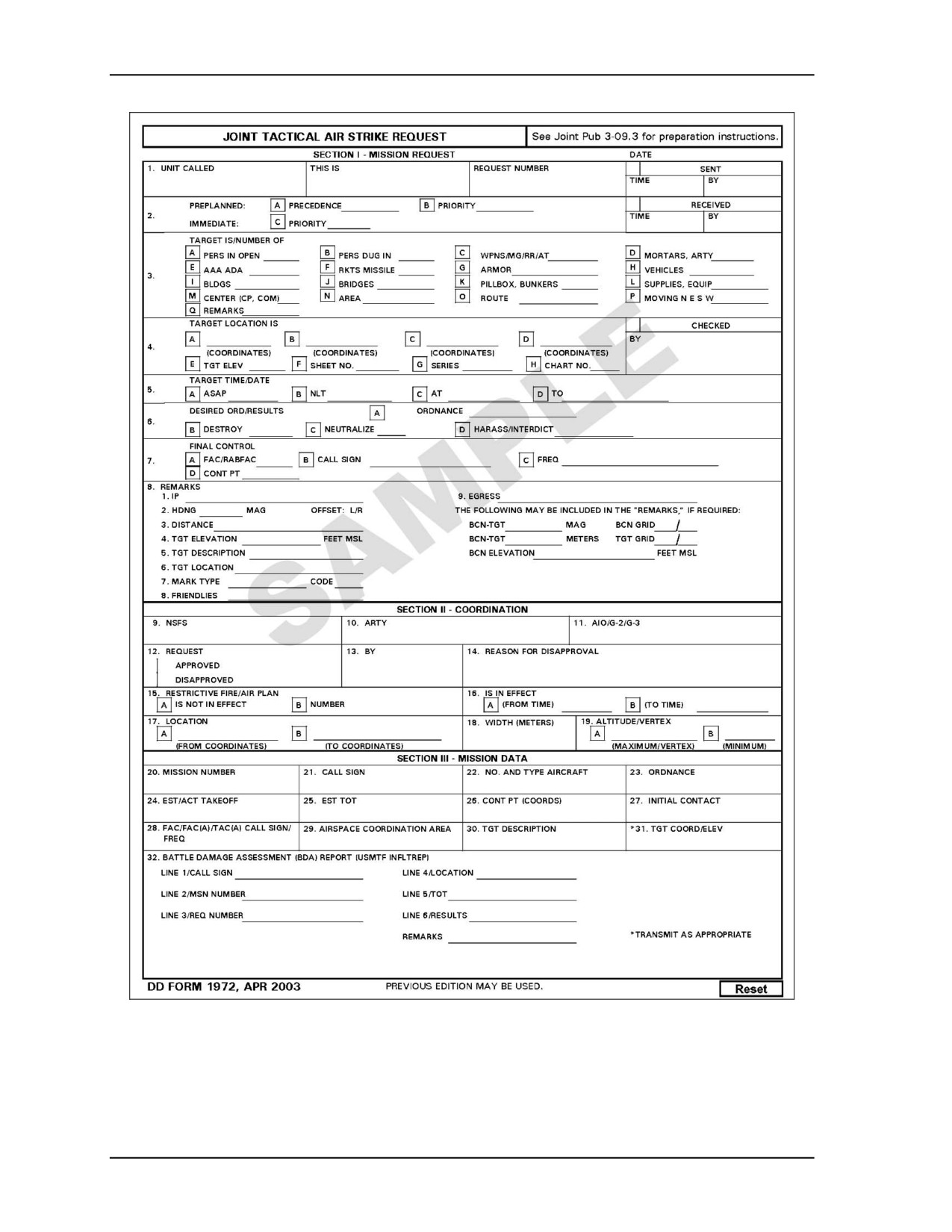
Appendix G
Figure G-2. Preplanned CAS request form.
G-10
FM 3-21.20
13 December 2006
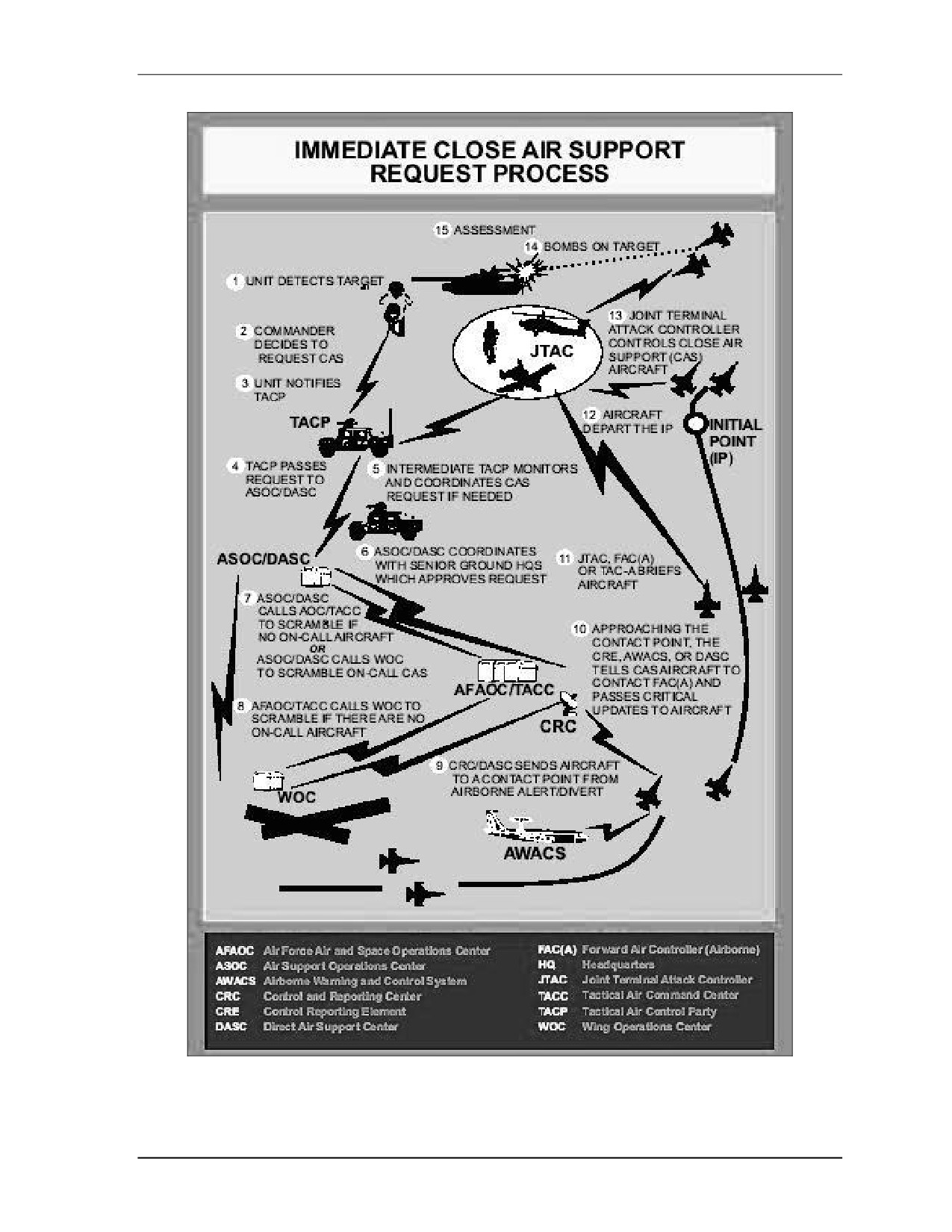
Special Operations Forces and Joint, Interagency, and Multinational Operations
Figure G-3. Immediate CAS request process.
13 December 2006
FM 3-21.20
G-11

Appendix G
EXAMPLE GENERAL CAS PLANNING CONSIDERATIONS
(DAY/NIGHT)
1. Ground Commander’s Intent/Mission Objectives.
2. Preparation of Maps (coordinate with S-2, Intel, and S-3).
a. Contact points, initial points, observation points, battle positions.
b. Friendly order of battle.
(1) Scheme of maneuver
(2) Scheme of fires
(3) Unit locations
(4) Observation/terminal attack control positions
c. Enemy order of battle.
(1) Unit location
(2) Target locations
(3) Threats
3. Reviews. Review ACO, ATO, SPINS, ROE, communications plan;
verify
appropriate forms, worksheets, and formats in use to request and control CAS.
4.
Weather.
a. Ceiling/visibility
b. Winds (ground and at altitude)
c. Sunrise/begin morning nautical twilight (BMNT)
d. Sunset/end evening nautical twilight (EENT)
e. Solar elevation/azimuth
f. Moon data (rise/set, elevation, azimuth, percent illumination)
5.
Agency Coordination.
a. ASOC
b. DASC
c. AWACS
d. JSTARS
6.
Preparation of AO Update.
7.
Fire Support Coordination.
a. ACM/FSCM plan
b. Artillery/mortar position areas (PA)
c. Gun-target line (GTL)
d. Minimum/maximum ordinate
e. Attack plan
f. Support by fire and maneuver
g. High-payoff target list (HPTL)
h. Attack guidance matrix (AGM)
i. Target marking (smoke/laser/illum)
j. SEAD
k. Schedule of fires worksheet
8.
Fighter Holding Plan.
a. Location
b. Altitude
9.
Rotary Aviation Coordination.
a. JAAT opportunities
b. Battle/firing positions
c. Altitudes
d. Minimum risk routes (MRR)
G-12
FM 3-21.20
13 December 2006

Special Operations Forces and Joint, Interagency, and Multinational Operations
EXAMPLE GENERAL CAS PLANNING CONSIDERATIONS
(DAY/NIGHT, continued)
e. Deconfliction plan
f. Frequencies
g. Downed aircrew and personnel recovery operations (CSAR assets)
10. Target Area Operations.
a. Authentication procedures
b. Friendly location marking procedures
c. Prepare CAS briefing 9-Line (Figure G-4)
d. 9-Line remarks considerations
(1) Target description
(2) Threats
(3) Artillery
(4) Clearance (final control/abort code)
(5) Desired ordnance effects
(6) Restrictions
(7) Timing/deconfliction plan
(8) Airspace coordination areas (ACAs)
(9) Weather
(10) SEAD and location
(11) Laser, illumination, night vision capability
(12) Danger close
e. Prepare target mark devices
(1) Artillery
(2) Laser/IR pointers
(3) FAC-A
11. Passing of BDA.
a. Fighters
b. ASOC
c. DASC
EXAMPLE GENERAL URBAN CAS PLANNING CONSIDERATIONS
1. Effective Targeting.
a. Large scale (1:25,000) maps with street names
b. Gridded overhead photos
c. UAS support
d. Other NIMA/standardized maps with geo-ref overlay
2. Responsive C2.
3. SEAD.
4. Target Marking Capabilities.
5. Effectiveness of Weapons.
a. Penetration capability
b. Proportional response
6. Capability of Platforms/Sensors.
7. Proficiency and Training of Participants.
8. Rules of Engagement Considerations.
13 December 2006
FM 3-21.20
G-13
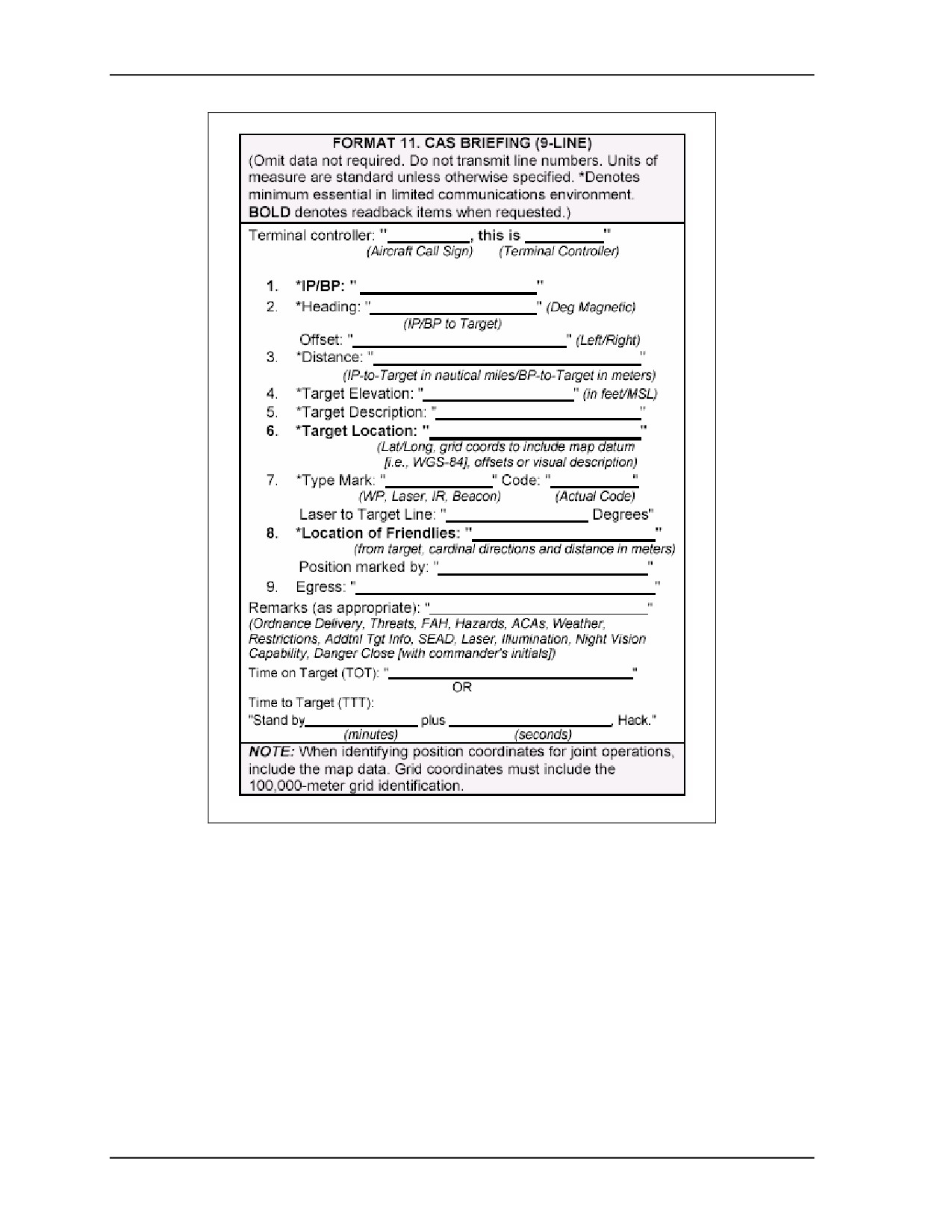
Appendix G
Figure G-4. CAS 9-line briefing.
MARINE CORPS
G-44. The Marine Corps, with its expeditionary character and potent forcible entry capabilities,
complements the other services with its ability to react rapidly and seize bases suitable for force projection.
The Marine Corps often provides powerful air and ground capabilities that complement or reinforce those
of Army forces. When coordinated under a joint force land component commander (JFLCC), Army and
Marine forces provide a highly flexible force capable of decisive land operations in any environment
(FM 3-0).
G-14
FM 3-21.20
13 December 2006
Special Operations Forces and Joint, Interagency, and Multinational Operations
ORGANIZATION
G-45. These are the Marine organizations that a BCT or Infantry battalion will likely encounter:
Marine Air-Ground Task Force
G-46. The specific composition of a Marine air-ground task force
(MAGTF) depends on the
requirements of a particular mission, but the basic organization is standard. Each MAGTF has a command
element
(CE), a ground combat element
(GCE), an aviation combat element
(ACE), and a
sustainment element.
Command Element
G-47. The CE consists of the MAGTF commander, an executive staff, headquarters sections,
communications, and other service support sections. The CE serves as the focal point for MAGTF
operational execution in coordinating and directing the efforts of assigned aviation, ground, and
sustainment forces.
Ground Combat Element
G-48. The GCE is task-organized around combat, fire support and protection units and can range in
capability and size from a single reinforced rifle company to one or more reinforced Marine divisions
(MARDIVs).
Aviation Combat Element
G-49. The ACE plans and executes air operations for the MAGTF. Marine aviation functions include air
reconnaissance, anti-air warfare, assault support, offensive air support, electronic warfare
(EW), and
control of aircraft and missiles. The ACE varies in size from a reinforced helicopter squadron to one or
more Marine Air Wings (MAWs). Like the GCE, the ACE is also task-organized with appropriate fire
support, protection, and sustainment.
Sustainment Element
G-50. The sustainment element is task-organized to provide the necessary sustainment to accomplish the
MAGTF mission. Based on situational requirements, sustainment elements vary in size from an expansive
Force Service Support Group (FSSG) that supports a Marine Expeditionary Force (MEF) to the Marine
Expeditionary Unit (MEU) Service Support Group (MSSG) that supports an MEU.
Marine Expeditionary Force
G-51. The MEF, the largest MAGTF, is the Marine Corps’ primary warfighting force. The MEF may
consist of one or more MARDIVs, one or more MAWs, and possibly more than one FSSG. An MEF
(single-vision/wing/FSSG) features about 55,000 Marine Corps and Navy personnel, 300 fixed- and
rotary-wing aircraft, 300 combat vehicles, and 72 artillery pieces.
Marine Expeditionary Brigade
G-52. The specific composition of the Marine Expeditionary Brigade (MEB) depends on the same
conditions that dictate the task organization of Army brigades. The MEB is the midsized MAGTF and is
normally commanded by a brigadier general. The MEB bridges the gap between the MEU at the tip of the
spear and the MEF. Like all MAGTFs, the MEB is comprised of the CE, GCE, ACE, and sustainment
element. The GCE is normally a reinforced Infantry regiment while the ACE is centered on a composite
Marine Aircraft Group (MAG), comprised of both rotary- and fixed-wing assets. The sustainment element
13 December 2006
FM 3-21.20
G-15

Appendix G
is commonly referred to as a brigade service support group (BSSG) and can sustain the fighting force for
about 30 days.
CAPABILITIES AND LIMITATIONS
G-53. The Marine Corps’ capabilities and limitations are listed in Table G-1.
Table G-1. Marine Corp capabilities and limitations.
Capabilities
Limitations
C2 several maneuver battalions, a Marine air
Limited ground capability to counter extensive
group, and associated fire support, protection, and
enemy armor threat.
sustainment units.
Conduct amphibious assaults, raids,
Limited numbers of ground mobility assets
demonstrations, withdrawals, and other
constrain tactical mobility to about one battalion by
amphibious operations.
ground transport.
Seize advanced operating bases.
Limited capability to conduct mounted ground
maneuver operations.
Conduct vertical assaults and envelopments.
Limited protection and decontamination
capabilities in CBRN environments.
Conduct sustained combat operations ashore as
Limited indirect counterfire capability.
part of a larger force to achieve campaign or major
operations’ objectives.
Provide close and deep air support and aerial
Limited bridging capabilities. Armored vehicle
reconnaissance.
launched bridges (AVLB) are in active forces while
the rest of bridging is in the reserves.
Achieve local air superiority to support ground
Limited organic ISR capability.
operations.
Conduct EW.
Conduct dismounted operations in all geographic
environments.
Conduct military operations in urban terrain.
Coordinate naval support of ground operations.
Conduct military operations other than war.
PLANNING CONSIDERATIONS
G-54. The basic principle for effectively integrating and employing Army and USMC forces, as a joint
warfighting team is to maximize the capabilities of one force, to counterbalance the vulnerabilities of the
other. To achieve that end, requirements for more external forces and assets must be identified and
resourced, command relationships must be established, and the force must be task-organized for
operational planning and execution.
NAVY
G-55. The Navy and Marine Corps conduct operations in oceans and littoral (coastal) regions. The
Navy’s two basic functions are: sea control operations and maritime power projection. Sea control
connotes uninhibited use of designated sea areas and the associated airspace and underwater volume. It
affords Army forces uninhibited transit to any trouble spot in the world (FM 3-0).
G-56. Most joint Army-Navy operations will likely involve Marine Corps assets. In the event that Army
headquarters are planning, coordinating, or directing naval assets, they are likely to fall into one of three
categories: special operations (SEAL), CAS, or ship-delivered surface fires. (Ship-delivered surface fires
procedures are listed in Figure G-5.) For SEAL considerations, detailed face-to-face coordination is
G-16
FM 3-21.20
13 December 2006
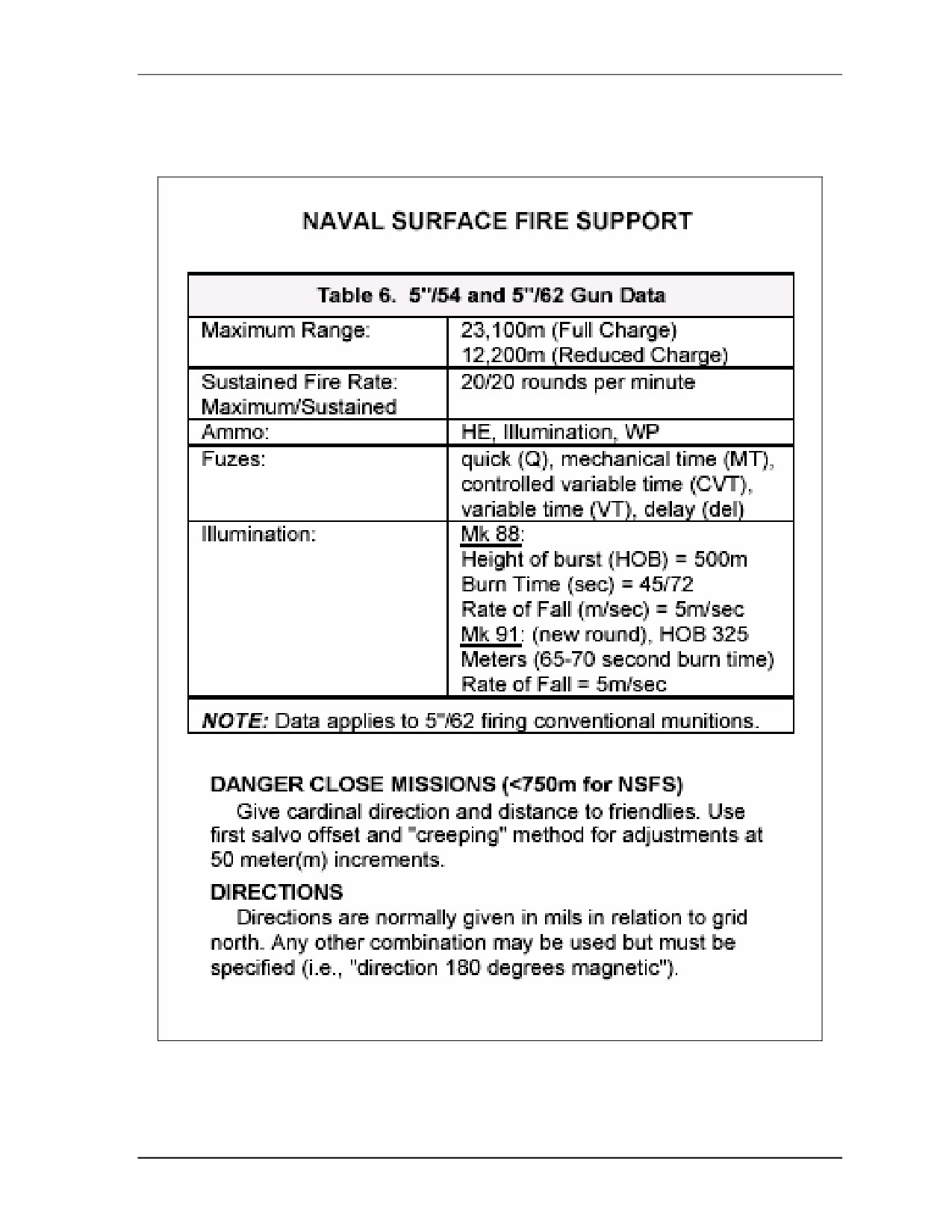
Special Operations Forces and Joint, Interagency, and Multinational Operations
recommended. Navy CAS is coordinated and directed in the same manner and using the same forms and
calls (Figure G-6) as Air Force CAS. For detailed naval fires information, see FM 3-09.32.
Figure G-5. Naval surface fire support.
13 December 2006
FM 3-21.20
G-17