FM 3-21.20 (FM 7-20) THE INFANTRY BATTALION (DECEMBER 2006) - page 11
Chapter 11
11-137. First aid training has increased significance in UO. The compartmented nature of UO,
transportation restrictions, communications difficulties, and the finite number of company and platoon
medics may limit the urban casualty’s initial treatment administered by nonmedical personnel. Units
identify and train combat lifesavers (CLSs) to perform in the absence of medics. The CLSs must have
adequate supplies of Class VIII. Positioning of medical personnel, identification of CCP, positioning of
medical evacuation (MEDEVAC) ambulance and locating treatment teams with supported units may
mitigate some risk to injured and wounded Soldiers. In addition, the increased potential for delayed
evacuation during UO mandates that medical personnel be skilled in prolonged casualty care. During the
3-4 October 1993 battle in Somalia, seven medics managed 39 casualties for more than 14 hours before
they could be evacuated. Evacuation delays also significantly increase potential infection. Such delays may
cause more casualties dying of their wounds; therefore, trauma specialist/company/platoon medics should
also be skilled in administering antibiotics on the battlefield.
11-138. All health care providers can recognize and treat injuries due to incendiary or fuel-air explosives
(also known as thermobaric weapons) a cloud of volatile gases, liquids, or powders; and then ignite,
creating a fireball consuming oxygen and creating enormous overpressure. When employed in an urban
structure, the blast wave or overpressure is greatly amplified. Injuries resulting from these weapons are
massive burns, broken or crushed bones, concussions, missile injuries, and internal injuries. Health care
providers can easily overlook internal injuries (at least initially) unless they are trained, prepared, and
expecting them. The increased use of body armor during UO will help prevent penetrating chest and
abdomen wounds. Medical personnel should expect more groin, pelvis, and extremity injuries.
Furthermore, when fighting Soldiers that are known to use body armor, an enemy (particularly snipers) can
be expected to target the head and face more often than other anatomic areas resulting in more head
injuries. Lastly, hearing loss may increase particularly when firing recoilless weapons in enclosed spaces
with little ventilation.
TRANSITION
11-139. During transition, the battalion continues to use all CS and sustainment assets consistent with the
mission end state and ROE to move from offensive operations to stability operations. The ultimate goal is
to return the urban area to civilian control. During this step, the roles and use of SOF, (especially CA and
PSYOP) CS, and sustainment units (medical, and military police) become more important with the
requirements to maintain order and stabilize the urban area. These assets normally support the battalion’s
transition efforts under BCT control. The battalion staff, in coordination with the BCT staff, prepare to
transition from being a "supported" force to being the "supporting" force.
MOVEMENT TO CONTACT
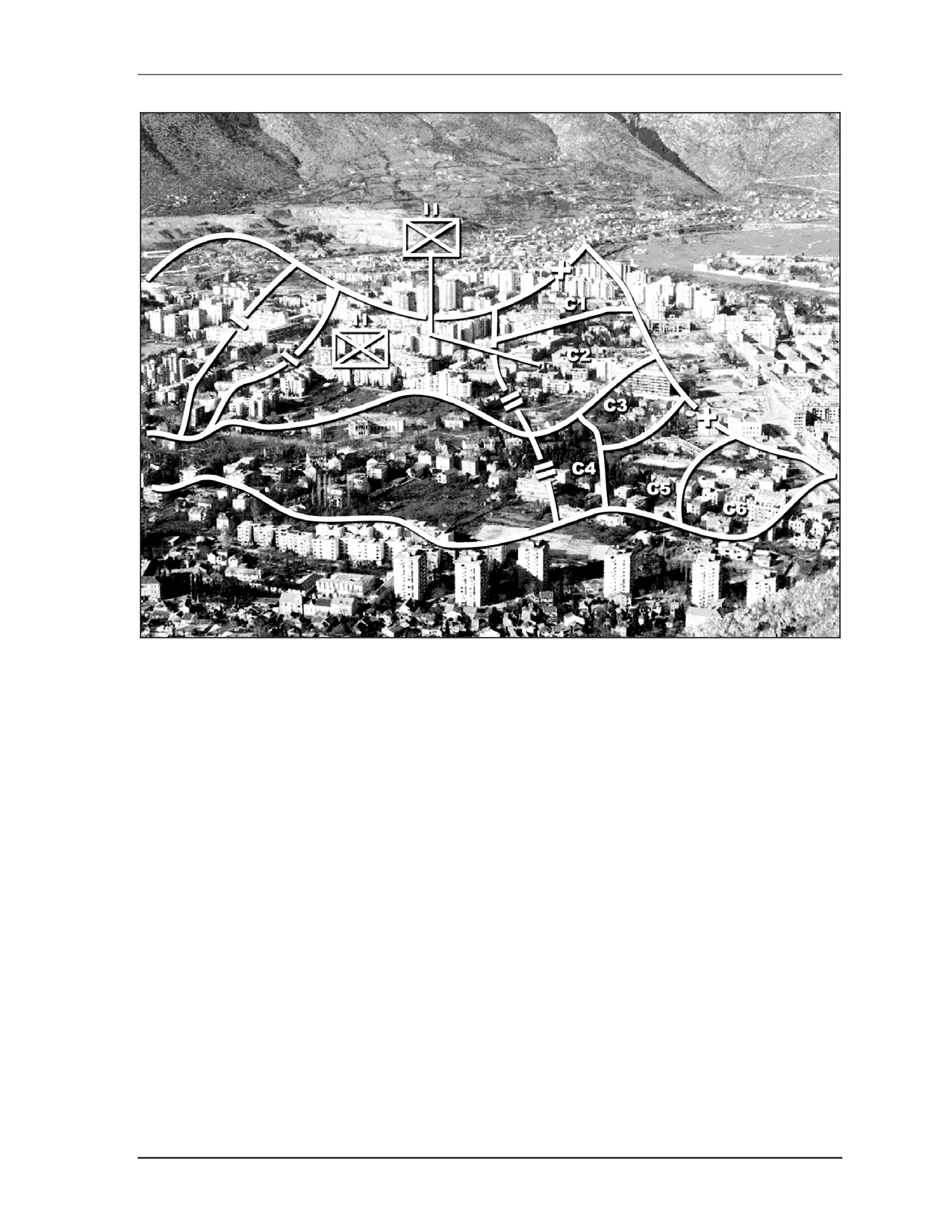
11-140. Figure 11-12 shows a MTC in an urban area using the search and attack technique. The battalion
uses this technique when the battalion commander does not have adequate information and a clear vision of
the enemy situation and the information cannot be gathered by BCT or higher echelon elements. The
battalion normally employs this technique against a known weak enemy force that is disorganized and
incapable of massing strength, for example, urban insurgents or gangs. The battalion divides its portion of
the AO into smaller areas and coordinates the movement of companies. It can either assign sectors to
specific companies or control their movement by sequential or alternate bounds within the battalion sector.
In the example shown in Figure 11-13, page 11-34, companies would find, fix, and finish the enemy, or
they would find and fix the enemy and the battalion would assign another company the task of finishing the
enemy (sequential or alternate bounds). During a mission of this type, the urban environment makes
finding, fixing, and finishing the enemy difficult for conventional Infantry forces. For example, movement
of units may become canalized due to streets and urban "canyons" created by tall buildings. The
application of firepower may become highly restricted based on the ROE. The use of HUMINT in this type
of action becomes increasingly more important and can be of great assistance during the "find" portion of
the mission.
11-32
FM 3-21.20
13 December 2006
Urban Operations
Figure 11-12. Search and attack technique.
INFILTRATION
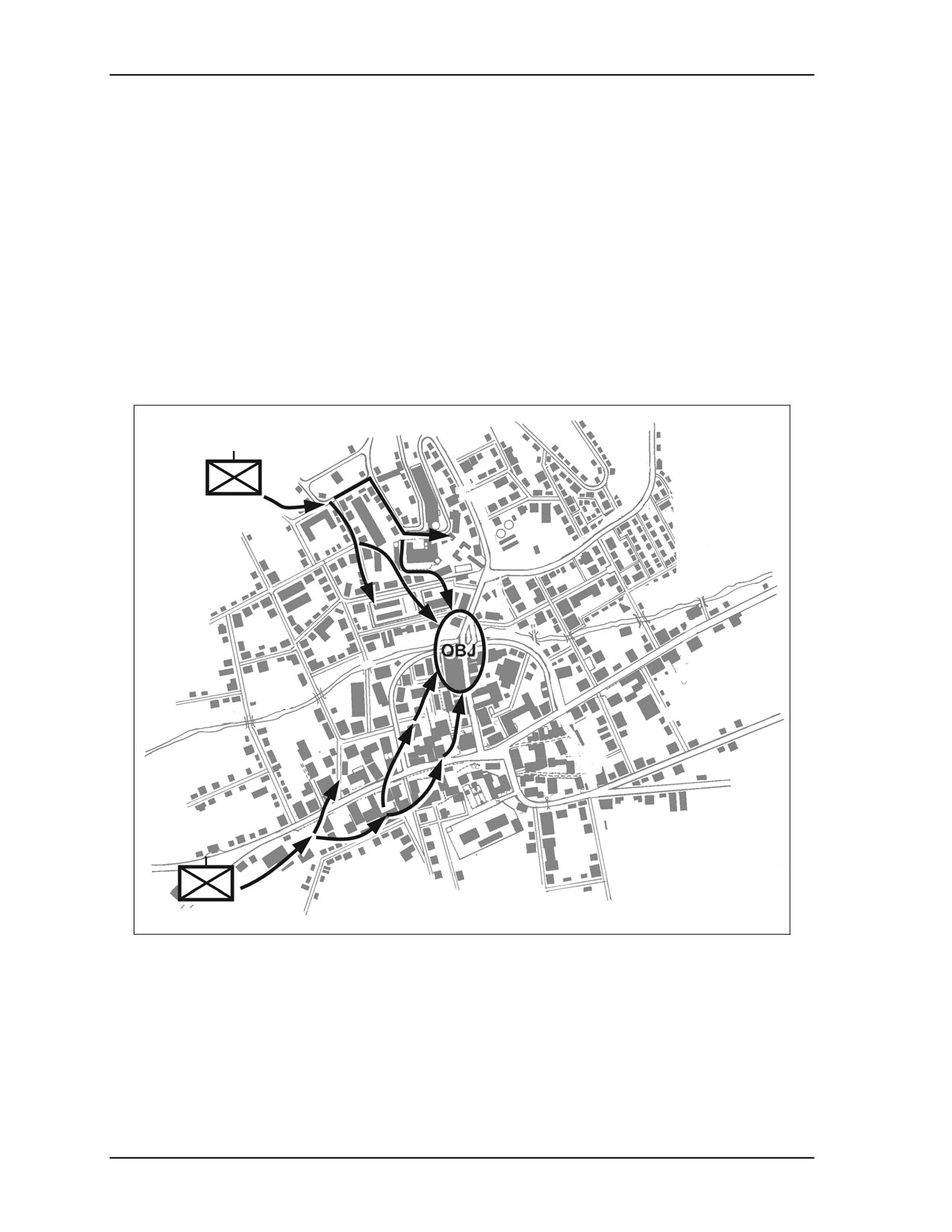
11-141. The following is an example that describes the actions of an Infantry battalion conducting an
infiltration with engineers attached.
11-142. The outskirts of a town may not be strongly defended. Its defenders may have only a series of
antiarmor positions, security elements on the principal approach, or positions blocking the approaches to
key features in the town. The strongpoints and reserves are normally deeper in the city.
11-143. A battalion may be able to seize a part of the town by infiltrating platoons and companies between
those enemy positions on the outskirts. Moving by stealth on secondary streets using the cover and
concealment of back alleys and buildings, the battalion may be able to seize key street junctions or terrain
features, to isolate enemy positions, and to help following units pass into the urban area. Such an
infiltration should be performed when visibility is poor and no civilians are in the area.
11-144. The Infantry battalion is organized into infiltration companies with engineers and a reserve
consistent with METT-TC. Each company should have an infiltration lane that allows infiltration by
company-size or smaller units. Depending on the construction of the urban area and streets, the infiltration
lane may be 500 to 1,500 meters wide.
11-145. The infiltrating companies advance on foot using available cover and concealment. Mortar and
artillery fire can be used to divert the enemy's attention and cover the sound of infiltrating troops.
11-146. Armored vehicles and antiarmor weapons are positioned to cover likely avenues of approach for
enemy armored vehicles. The battalion commander may position attached antiarmor units to cover the
13 December 2006
FM 3-21.20
11-33
Chapter 11
likely avenues of approach. In addition, weapons company antiarmor systems can support by fire if the
situation provides adequate support-by-fire positions.
11-147. As the companies move into the built-up area, they secure their own flanks. Security elements
may be dropped off along the route to warn of a flank attack. Engineers assist in breaching or bypassing
minefields or obstacles. Enemy positions are avoided but reported.
11-148. The infiltrating companies proceed until they reach their objective. At which time, they
consolidate, reorganize, and arrange for mutual support. They patrol to their front and flanks and establish
contact with each other. The company commander may establish a limit of advance to reduce chances of
enemy contact or to ensure safety from friendly forces.
11-149. If the infiltration places the enemy in an untenable position and he must withdraw, the rest of the
battalion is brought forward for the next phase of the operation. If the enemy does not withdraw, the
battalion must clear the urban area before the next phase of the operation. If the enemy counterattacks, the
battalion may establish a hasty defense (Figure 11-13).
Figure 11-13. Infiltration.
ATTACK OF A VILLAGE
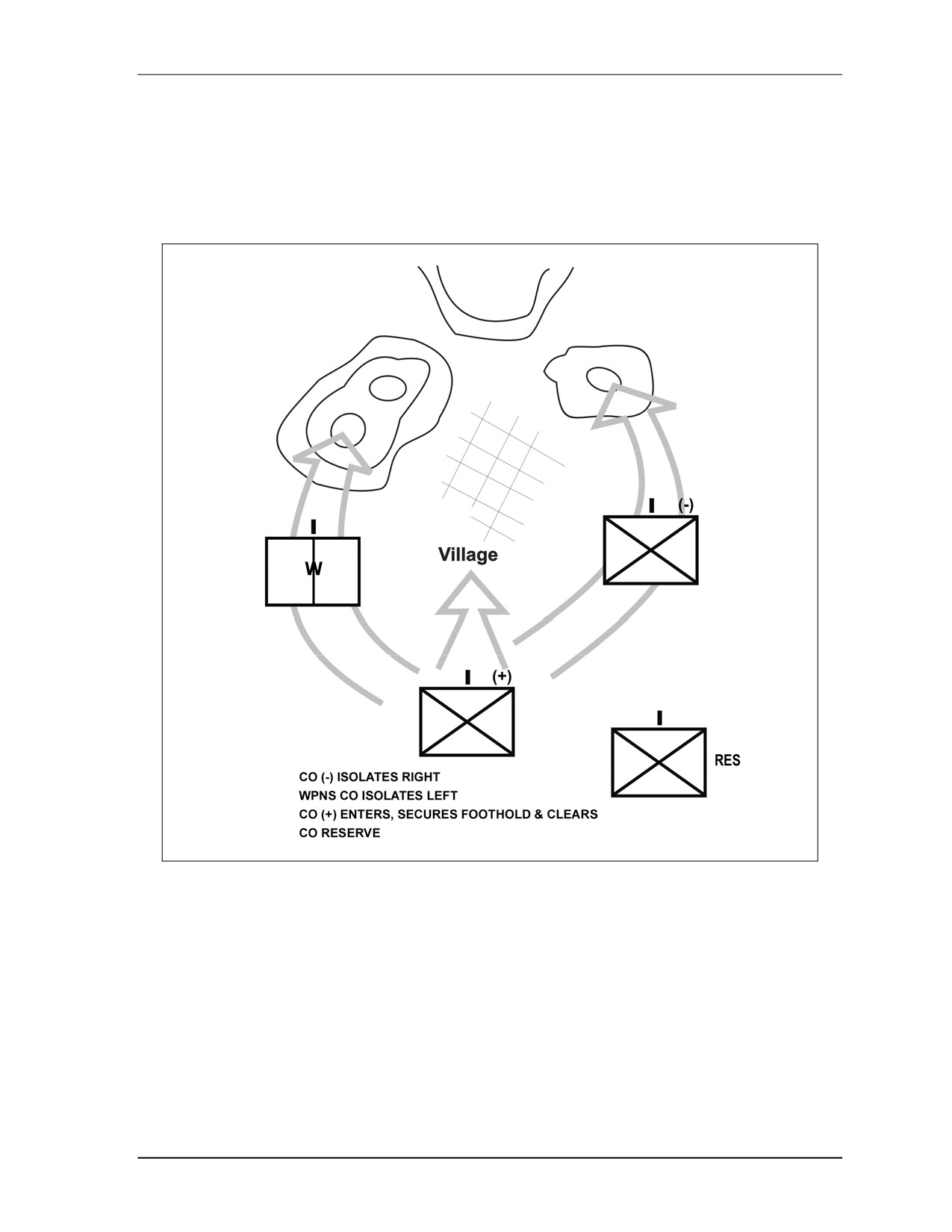
11-150. The battalion may have to conduct either a hasty or deliberate attack of a village that is partially or
completely surrounded by open terrain (Figure 11-14). After considering the factors of METT-TC, the
battalion performs the following tactical tasks:
• Reconnoiter the objective.
11-34
FM 3-21.20
13 December 2006
Urban Operations
• Move to the objective.
• Isolate the objective.
• Secure a foothold.
• Clear the objective.
• Consolidate, reorganize, and prepare for future missions.
Figure 11-14. Attack of a village.
NODAL ATTACK
11-151. The battalion may receive the mission to seize a key node (or nodes) as part of the BCT operation.
In certain situations, the battalion may have to seize nodes independently. Nodal attacks are characterized
by rapid attacks followed by defensive operations. The enemy situation must permit the attacking force to
divide its forces and seize key nodes. Multiple attacks, as shown in Figures 11-15 and 11-16, require
precise maneuver and supporting fires. The battalion may receive a nodal attack mission before an
anticipated sustainment replenishment operation or when isolation of an urban area is required so other
units can conduct offensive operations inside the urban area. Figure 11-15 shows a BCT conducting
multiple nodal attacks. Figure 11-16 (page 11-37) shows a battalion executing a nodal attack. Nodal attacks
13 December 2006
FM 3-21.20
11-35

Chapter 11
are used to deny the enemy key infrastructure. They may require a designated rapid response element (or
elements) in reserve in the event that enemy forces mass and quickly overwhelm an attacking battalion.
Normally, the reserve is planned at BCT level. Battalions executing a nodal attack independently must plan
for a designated rapid response reserve element. The duration of this attack should not exceed the
battalion’s self-sustainment capability.
Figure 11-15. Brigade scheme of maneuver, nodal attack.
11-36
FM 3-21.20
13 December 2006

Urban Operations
Figure 11-16. Battalion nodal attack.
Section V. DEFENSIVE OPERATIONS
An area defense concentrates on denying an enemy force access to designated terrain for a specific time and is
the type of defense most often used for defending an urban area. The mobile defense concentrates on the
destruction or defeat of the enemy through a decisive counterattack. Multiple BCTs units are most often
required to conduct a mobile defense, with a single BCT and its battalions participating as an element in the
fixing force conducting a delay or area defense or as an element of the striking force conducting offensive
operations. In an urban area, the defender must take advantage of the abundant cover and concealment. He must
also consider restrictions to the attacker’s ability to maneuver and observe. By using the terrain and fighting
from well-prepared and mutually supporting positions, a defending force can inflict heavy losses upon, delay,
block, or fix a much larger attacking force.
DEFENSIVE FRAMEWORK
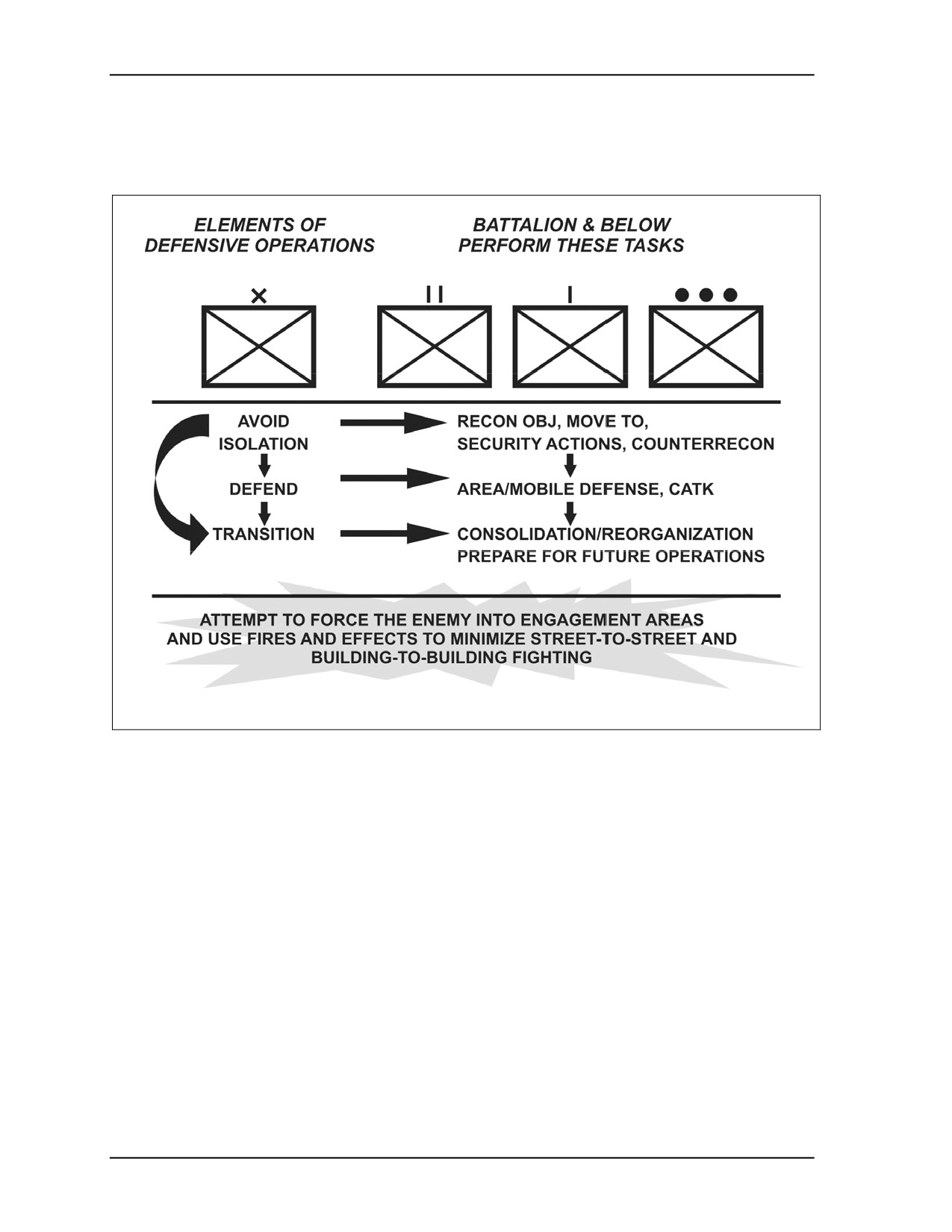
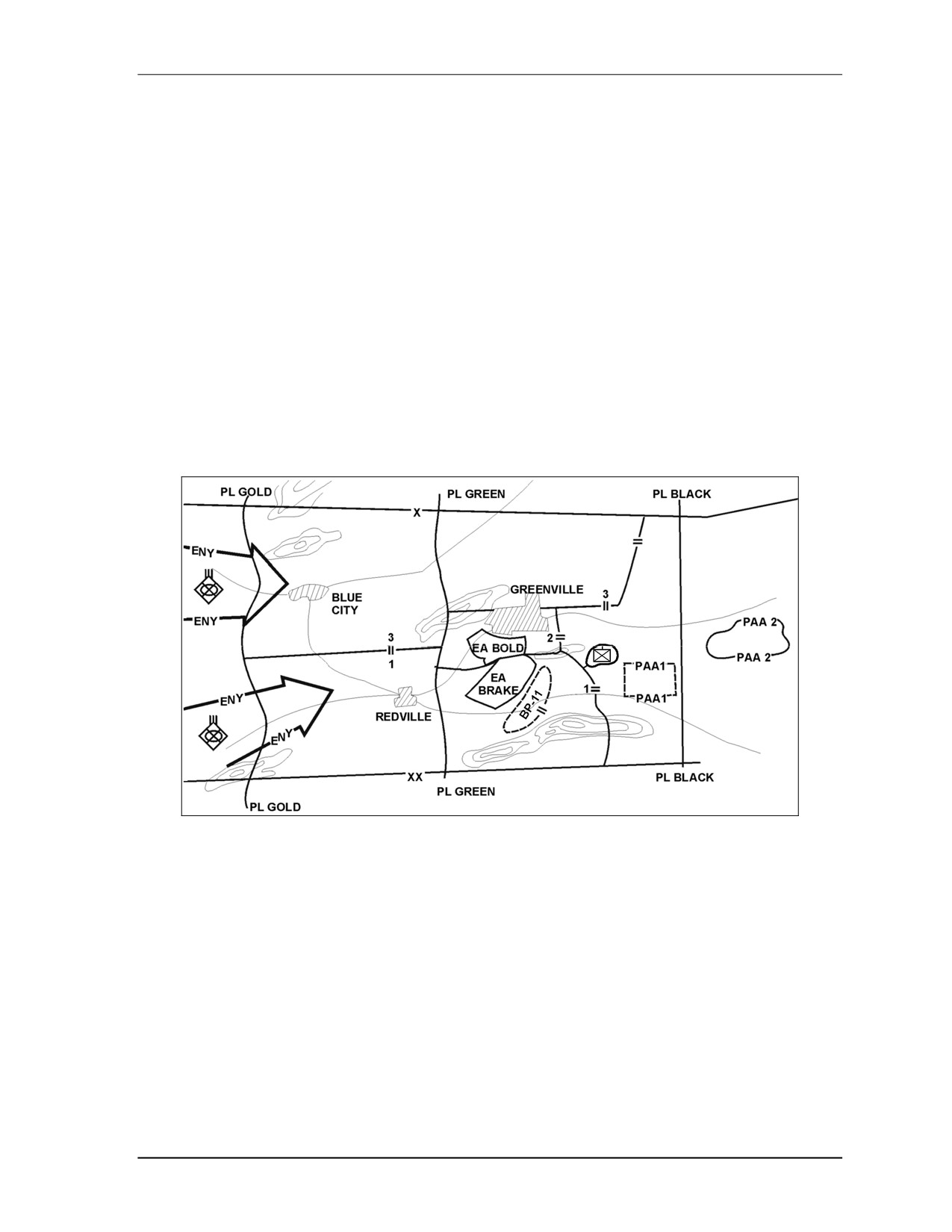
11-152. Normally, the battalion conducts defensive operations as part of the BCT. The BCT can conduct
the full range of defensive operations within a single urban area or in an AO that contains several small
towns and cities using the elements of the urban operational framework shown in Figure 11-17. The BCT
avoids being isolated through its security operations. It assigns defensive missions to subordinate battalions
in order to achieve the commander’s intent and desired end state. Well-planned and executed defensive
operations have four elements: assess, shape, dominate, and transition. During defensive operations, the
BCT commander seeks to—
• Avoid being isolated by the enemy.
• Defend key and decisive terrain, institutions, or infrastructure.
• Use offensive fire and maneuver to retain the initiative.
13 December 2006
FM 3-21.20
11-37
Chapter 11
11-153. Battalions conduct defensive operations by conducting counterreconnaissance missions and
patrols
(avoiding isolation); assigning BPs or sectors to companies (defending); and consolidating or
reorganizing and preparing for follow-on missions (transitioning).
Figure 11-17. Defensive urban operational framework.
DEFENSIVE PLANNING
11-154. Battalions defending in urban areas prepare their positions for all-round defense. Subordinate
units must employ security operations that include surveillance of surface and subsurface approaches.
Battalions constantly patrol and use OPs and sensors to maintain effective security. Special measures are
taken to control enemy combatants who have intermixed with the local population and civilian personnel
who may support the enemy.
11-155. Defensive fire support in UO must take advantage of the impact of indirect fires on the enemy
before he enters the protection of the urban area. FSOs at all levels coordinate and rehearse contingencies
that are inherent to nonlinear FSCM and clearance of fires.
11-156. In planning a defense in an urban area, the battalion staff identifies the following:
• Positions and areas that must be controlled to prevent enemy infiltration.
• Sufficient covered and concealed routes for movement and repositioning of forces.
• Structures and areas that dominate the urban area.
• Areas such as parks and broad streets that have fields of fire for tanks and antiarmor weapons.
11-38
FM 3-21.20
13 December 2006
Urban Operations
• Command and control locations.
• Protected areas for sustainment activities.
• Engagement areas, including employment and integration of obstacles with direct and
indirect fires.
• Sniper engagement criteria.
• Suitable structures that are defensible and provide protection for defenders.
• Contingency plans in the event that the battalion must conduct breakout operations.
• Plans for rapid reinforcement.
INTEGRATION OF URBAN AREA
11-157. The battalion may integrate villages, strip areas, and small towns into the overall defense, based
on higher headquarters’ guidance and applicable ROE (Figure 11-18). A defense in an urban area or one
that incorporates urban areas normally follows the same sequence of actions and is governed by the
principles contained in Chapter 5. When defending predominately urban areas, the battalion commander
must consider that the terrain is more restricted due to buildings that are normally close together. This
usually requires a higher density of troops and smaller company sectors or BPs than in open terrain.
Figure 11-18. Integration of urban areas into a defense.
NODAL DEFENSE
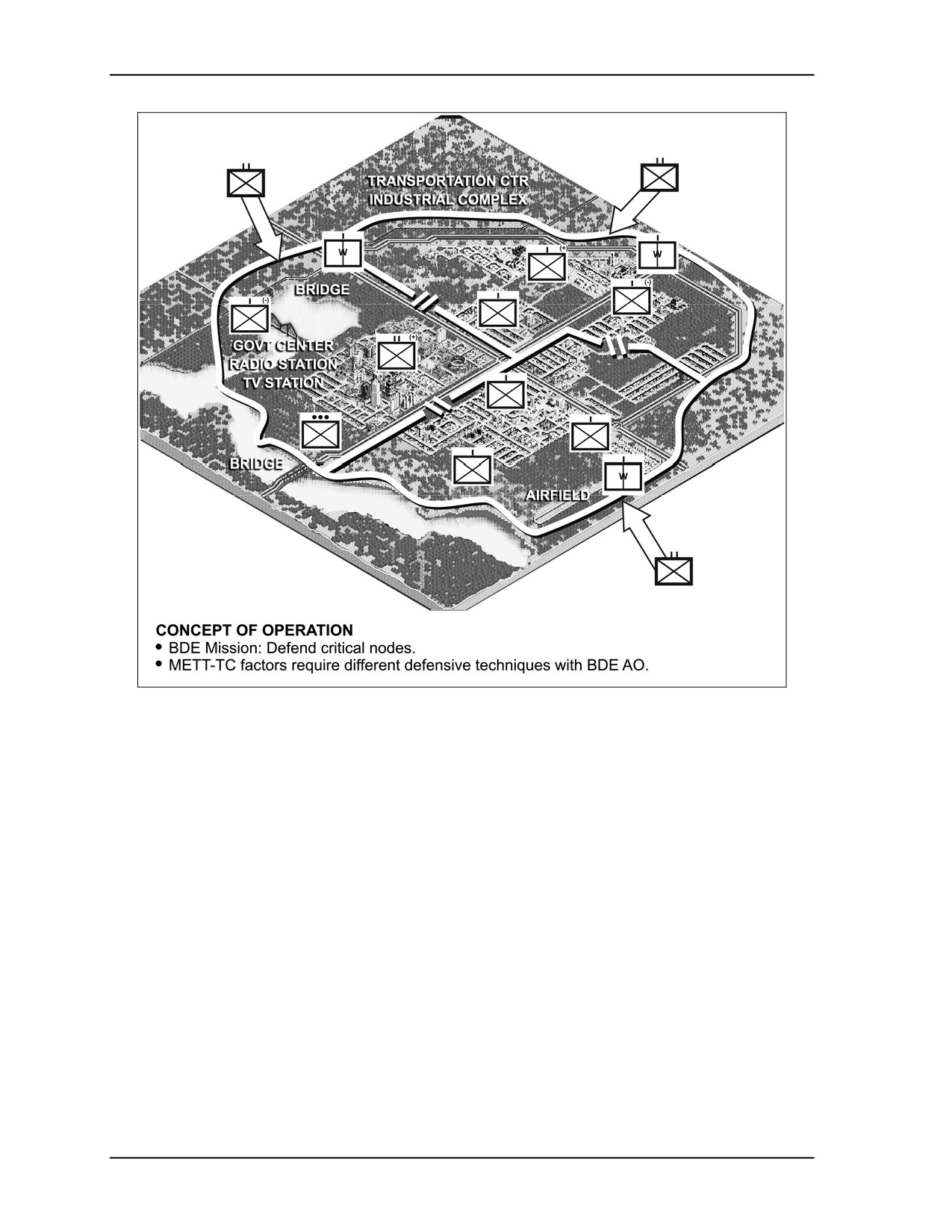
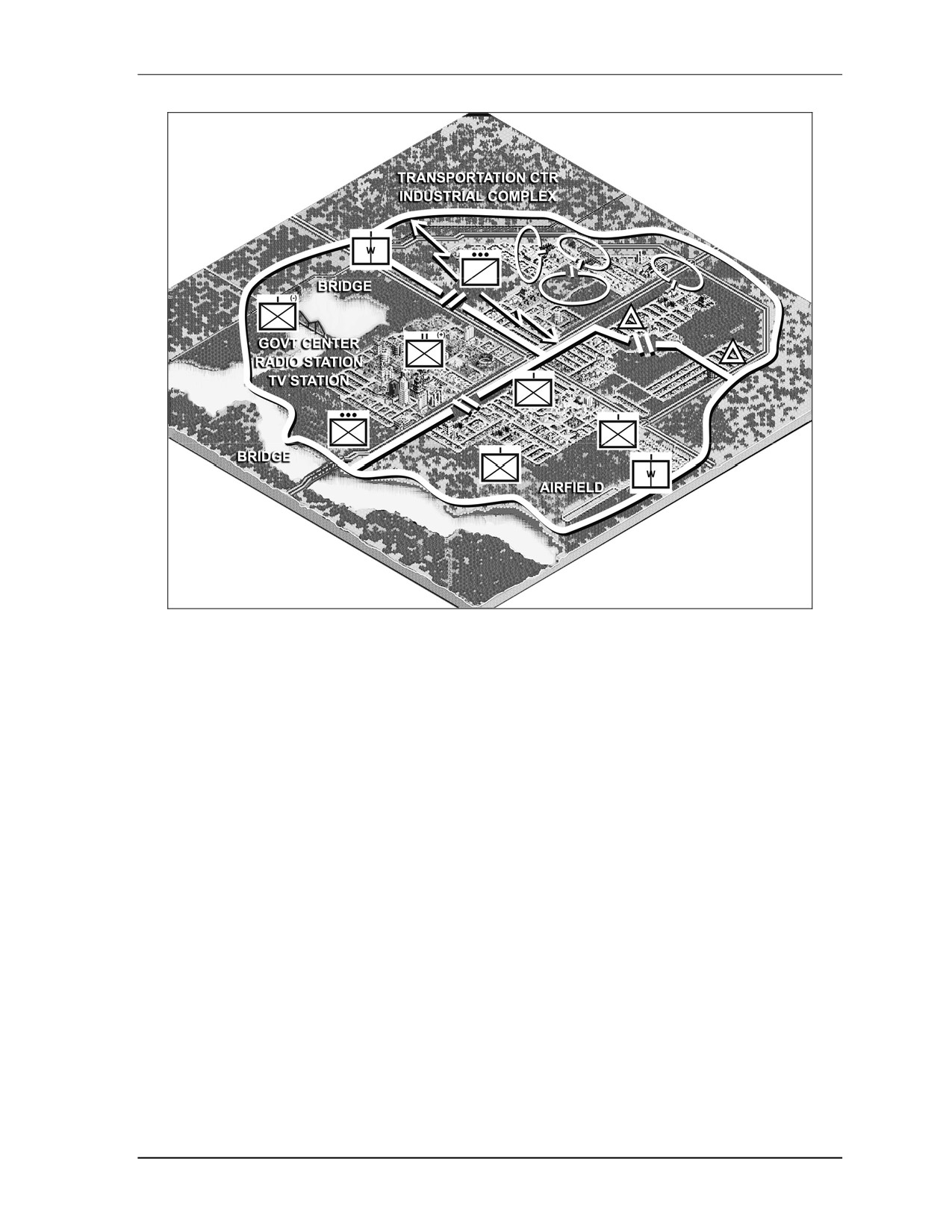
11-158. Figure 11-19 shows a transitional situation where the battalion moves from an offensive to a
defensive operation. The BCT mission may contain factors that require varying defensive techniques by the
subordinate battalions under BCT control. Figure 11-20 shows a nodal defense where battalions employ
different defensive techniques in order to achieve the BCT commander’s desired end state. The BCT
commander’s intent is to safeguard the key nodes seized during the offensive operation in order eventually
to return the infrastructure of this particular urban area back to civilian control. A combination of sectors,
BPs, strongpoints, roadblocks, checkpoints, security patrols, and OPs could be employed within the
battalion sector or AO. Figure 11-20, page 11-41, shows the changed battalion task organizations, the
extended boundaries, and the directed OPs.
13 December 2006
FM 3-21.20
11-39
Chapter 11
Figure 11-19. Nodal defense, transitional situation.
11-40
FM 3-21.20
13 December 2006
Urban Operations
Figure 11-20. Nodal defense, different defensive techniques.
TASK ORGANIZATION
11-159. Companies may have to be task-organized to conduct the specific missions assigned by the
battalion commander in a nodal defense.
SYMMETRICAL AND ASYMMETRICAL THREATS
11-160. The battalion is likely to respond to both symmetrical and asymmetrical threats within the AOs.
The defensive techniques chosen by subordinate companies should allow them to respond to the specific
threats in their respective AOs, BPs, or sectors.
BOUNDARY CHANGES
11-161. Based on the battalion commander’s intent and the defensive scheme of maneuver, boundary
changes may be required in order to give companies more or less maneuver space.
ROE MODIFICATION
11-162. The ROE may require modification based on the type of mission to be conducted. The ROE may
become more or less restrictive based on METT-TC factors. Commanders and leaders must ensure that the
ROE are clearly stated and disseminated at the beginning and conclusion of each day.
13 December 2006
FM 3-21.20
11-41
Chapter 11
DELAY
11-163. The purpose of a delay is to slow the enemy, cause enemy casualties, and stop the enemy (where
possible) without becoming decisively engaged or bypassed. The delay can be oriented either on the enemy
or on specified terrain such as a key building or manufacturing complex.
AMBUSHES AND BATTLE POSITIONS
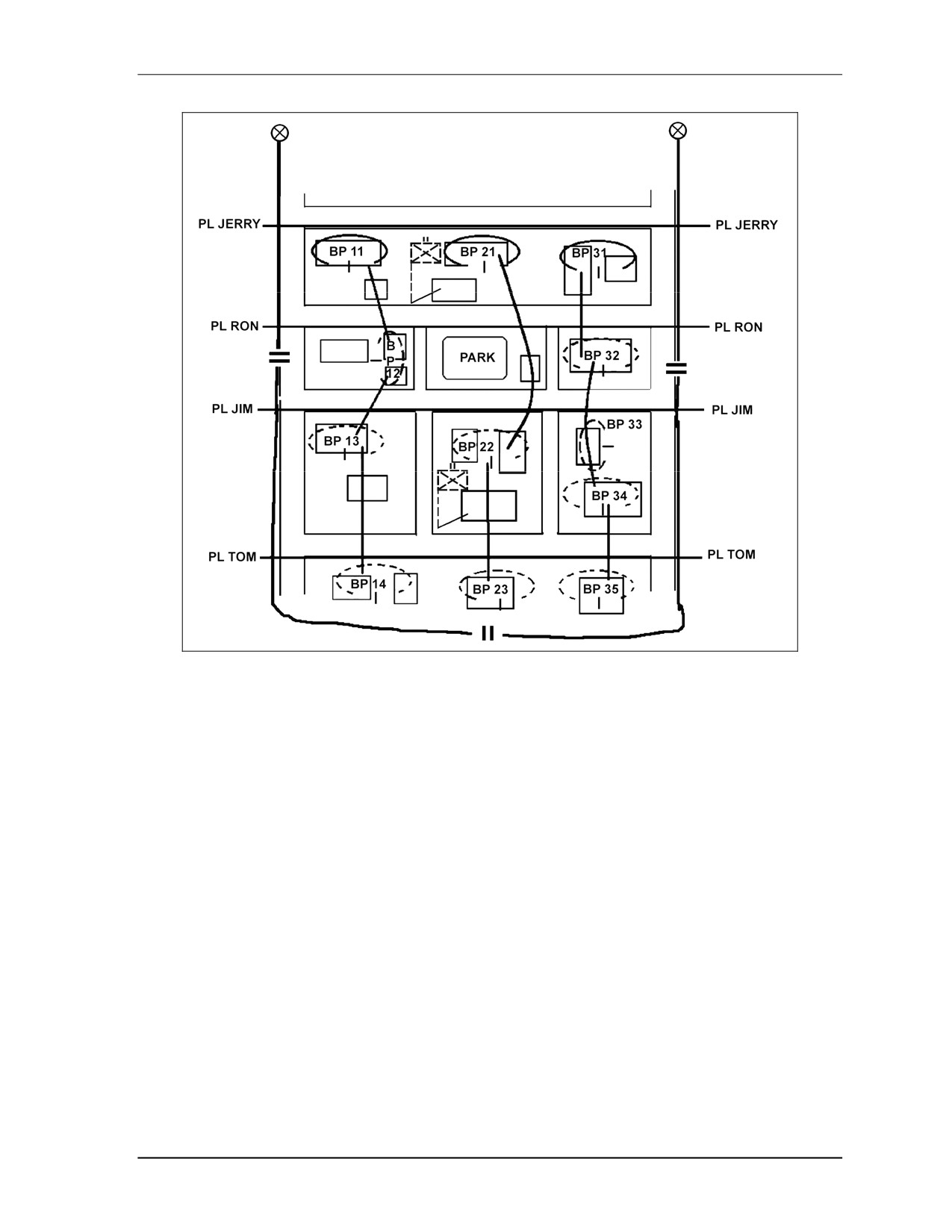
11-164. The battalion conducts a delay in an urban area from a succession of ambushes and BPs
(Figure 11-21). The size of the battalion AO depends on the amount of force available to control the area,
the nature of the buildings and obstacles along the street, and the length of time that the enemy must be
delayed.
Ambushes
11-165. The battalion plans ambushes on overwatching obstacles. Ambushes are closely coordinated but
executed at the lowest levels. The deployment of the battalion is realigned at important cross streets. The
battalion can combine ambushes with limited objective attacks on the enemy’s flanks. These are usually
effective at the edge of open spaces (parks, wide streets, and so forth).
Battle Positions
11-166. The battalion should place BPs where there is good observation and fields of fire. Such locations
are normally found at major street intersections, in parks, and at the edge of open residential areas. The
battalion prepares BPs carefully and deliberately, reinforces them with obstacles and demolished buildings,
and supports them using artillery and mortars. The battalion positions BPs to inflict maximum casualties on
the enemy in order to cause him to deploy for a deliberate attack.
TWO DELAYING ECHELONS
11-167. The battalion is most effective when deployed in two delaying echelons that alternate between
conducting ambushes and fighting from BPs. As the enemy threatens to overrun a BP, the company
disengages and delays back toward the next BP. As the company passes through the company to the rear, it
establishes another BP. The battalion uses smoke and demolitions to aid in the disengagement. Security
elements on the flank can help prevent the enemy from out-flanking the delaying force. An adequate
reserve can react to unexpected enemy action and conduct continued attacks on the enemy’s flank.
ENGINEERS
11-168. The engineer effort should at first, be centralized to support the preparation of BPs, and then
decentralized to support the force committed to ambush.
11-42
FM 3-21.20
13 December 2006
Urban Operations
Figure 11-21. Battalion delay in an urban area.
13 December 2006
FM 3-21.20
11-43
This page intentionally left blank.
Appendix A
Risk Management and Fratricide Avoidance
The primary objective of risk management and fratricide avoidance is to help units
protect their combat power through risk reduction, which enables them to win the
battle quickly and decisively with minimum losses. This appendix focuses on two
topics: risk management, which includes tactical and accidental risk, and the
avoidance of fratricide. Risk is the chance of injury or death for individuals and of
damage to or loss of vehicles and equipment. Risk, or the potential for risk, is always
present across the full-spectrum of operations. Risk management takes place at all
levels of the chain of command during each phase of every operation and is an
integral part of planning. The BCT commander, battalion commanders, staffs,
company commanders, and all Soldiers must know how to use risk management
(coupled with fratricide avoidance measures) to ensure the battalion executes the
mission in the safest possible environment within mission constraints. (For more
information on risk management, see FM 100-14.)
Section I. RISK MANAGEMENT
Risk management is the process of identifying and controlling hazards to conserve combat power and
resources. Leaders (to include the staff) must always remember that the effectiveness of the process depends on
their understanding of the situation. They never approach risk management with "one size fits all" solutions.
Leaders should also consider the essential tactical and operational factors that make each situation unique. This
five-step risk management process is integrated into the military decision-making process (Table A-1).
TACTICAL RISK
A-1.
Tactical Risk is a risk concerned with hazards that exists because of the presence of either the
enemy or an adversary. Intelligence plays a critical role in identifying hazards associated with tactical risk.
Intelligence preparation of the battlefield (IPB) is a dynamic leader process that continually integrates new
information and intelligence that ultimately becomes input to the leaders risk assessment process.
Intelligence assists in identifying hazards during operations by—
• Identifying the opportunities and constraints the battlefield environment offers to threat and
friendly forces.
• Thoroughly portraying threat capabilities and vulnerabilities.
• Collecting information on populations, governments, and infrastructures.
ACCIDENT RISK
A-2.
Accident risk includes all operational risk considerations other than tactical risk. It includes risks
to the friendly force and also includes risks posed to civilians by an operation, as well as an operational
impact of each hazard on the operation. The risk assessment provides for enhanced awareness of the
current situation. The awareness builds confidence and allows Soldiers and units to take timely, efficient,
and effective protective measures.
13 December 2006
FM 3-21.20
A-1

Appendix A
Table A-1. Risk management steps correlated with MDMP tasks.
Risk Management Steps
Step 1
Step 2
Step 3
Step 4
Step 5
Military
Identify Hazards
Assess Hazards
Develop Controls
Implement
Supervise and
Decision-Making
and Make Risk
Controls
Evaluate
Process
Decisions
Mission Receipt
X
Mission Analysis
X
X
COA
X
X
X
Development
COA Analysis
X
X
X
COA Comparison
X
COA Approval
X
Orders
X
Production
Rehearsal1
X
X
X
X
X
Execution and
X
X
X
X
X
Assessment1
1 All boxes are marked to emphasize the continued use of the risk management process throughout the mission.
STEP 1--IDENTIFY HAZARDS
A-3. A hazard is a source of danger. It is any existing or potential condition that could result in injury,
illness, or death of personnel; damage to or loss of equipment and property; or some other form of mission
degradation. Hazards arise in both tactical and training operations. Leaders identify the hazards associated
with all aspects and phases of the operation, paying particular attention to the factors of METT-TC. Risk
management is not an afterthought; leaders begin the process during MDMP (troop-leading procedures for
company and below) and continue it throughout the operation. Table A-2 lists possible sources of risk the
battalion might face during a typical tactical operation. The list is organized according to the factors of
METT-TC.
A-2
FM 3-21.20
13 December 2006

Risk Management and Fratricide Avoidance
Table A-2. Examples of potential hazards.
MISSION
• Duration of the operation.
• Complexity or clarity of the plan, that is, whether the plan is well-developed and
easily understood.
• Proximity and number of maneuvering units.
ENEMY
• Knowledge of the enemy situation.
• Enemy capabilities.
• Availability of time and resources to conduct reconnaissance.
TERRAIN AND
• Visibility conditions including light, dust, fog, and smoke.
WEATHER
• Precipitation and its effect on mobility.
• Extreme heat or cold.
• Additional natural hazards such as broken ground, steep inclines, or water obstacles.
TROOPS AND
• Equipment status.
EQUIPMENT
• Experience the units conducting the operation have working together.
• Danger areas associated with the platoon’s weapons systems.
• Soldier and leader proficiency.
• Soldier and leader rest situation.
• Degree of acclimatization to environment.
• Impact of new leaders or crewmembers.
• Friendly unit situation.
• NATO or multinational military actions combined with US forces.
TIME AVAILABLE
• Time available for TLP and rehearsals by subordinates.
• Time available for PCCs/PCIs.
CIVIL
• Applicable ROE or ROI.
CONSIDERATIONS•
• Potential stability or civil support operations, such as NEOs, refugee or disaster
assistance, or counterterrorism, that involve contact with civilians.
• Potential for media contact and inquiries.
• Interaction with host nation or other participating nation support.
STEP 2--ASSESS HAZARDS TO DETERMINE RISKS
A-4.
Hazard assessment is the process of determining the direct impact of each hazard on an operation
(in the form of hazardous incidents). Use the following steps:
• Determine which hazards can be eliminated or avoided.
• Assess each hazard that cannot be eliminated or avoided to determine the probability that the
hazard will occur.
• Assess the severity of hazards that cannot be eliminated or avoided. Severity, defined as the
result or outcome of a hazardous incident, is expressed by the degree of injury or illness
(including death), loss of or damage to equipment or property, environmental damage, or other
mission-impairing factors such as unfavorable publicity or loss of combat power.
• Taking into account both the probability and severity of a hazard, determine the associated risk
level (extremely high, high, moderate, or low). Table A-3 summarizes the four risk levels.
• Based on the factors of hazard assessment (probability, severity, and risk level, as well as the
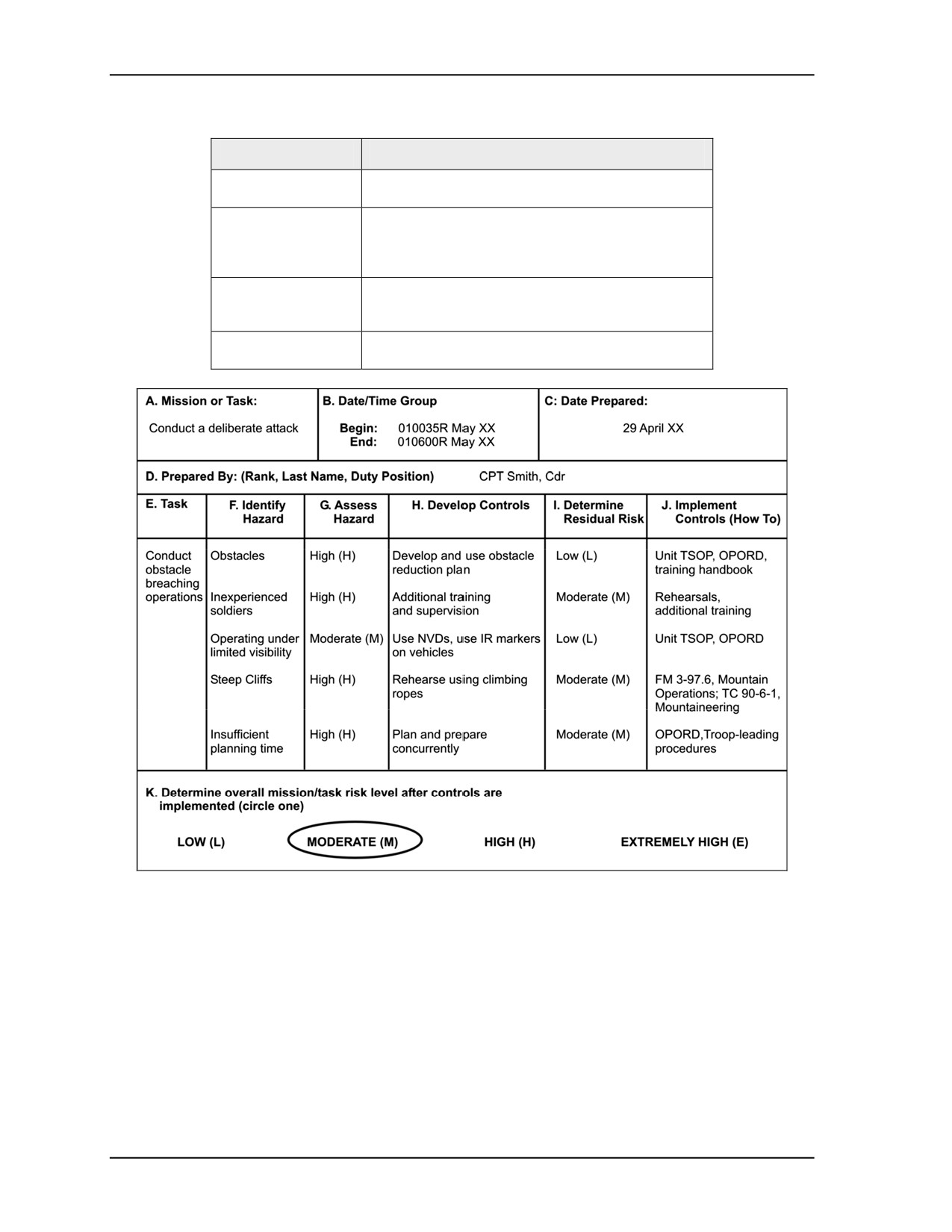
operational factors unique to the situation), complete risk management worksheet. Figure A-1
shows an example of a completed risk management worksheet.
13 December 2006
FM 3-21.20
A-3
Appendix A
Table A-3. Risk levels and impact on mission execution.
Risk Level
Mission Effects
Extremely high (E)
Mission failure if hazardous incidents occur in
execution.
High (H)
Significantly degraded mission capabilities in terms
of required mission standards. Not accomplishing all
parts of the mission or not completing the mission to
standard (if hazards occur during mission).
Moderate (M)
Expected degraded mission capabilities in terms of
required mission standards. Reduced mission
capability (if hazards occur during the mission).
Low (L)
Expected losses have little or no impact on mission
success.
Figure A-1. Example of completed risk management worksheet.
STEP 3--DEVELOP CONTROLS AND MAKE RISK DECISIONS
A-5.
Step 3 consists of two substeps: develop controls and make risk decisions. This step is done
during the COA development, COA analysis, COA comparison, and COA approval of the military
decision-making process.
DEVELOP CONTROLS
A-6.
Controls are the procedures and considerations the unit uses to eliminate hazards or reduce their
risk. After assessing each hazard, develop one or more controls that will either eliminate the hazard or
A-4
FM 3-21.20
13 December 2006
Risk Management and Fratricide Avoidance
reduce the risk (probability, severity, or both) of potential hazardous incidents. When developing controls,
it is important to consider the reason for the hazard and not just the hazard itself.
MAKE RISK DECISIONS
A-7.
A key element in the process of making a risk decision is determining whether accepting the risk
is justified or unnecessary. The decision-maker must compare and balance the risk against mission
expectations, then decide if the controls are sufficient and acceptable and whether to accept the resulting
residual risk. If the risk is determined unnecessary, the decision-maker directs the development of
additional controls or alternative controls; as another option, he can modify, change, or reject the selected
COA for the operation.
STEP 4--IMPLEMENT CONTROLS
A-8.
Implementing controls is the most important part of the risk management process. It is the chain of
command’s contribution to the combat readiness of the unit. Implementing controls includes coordination
and communication with appropriate superior, adjacent, and subordinate units and with individuals
executing the mission. The commander must ensure that specific controls are integrated into OPLANs,
OPORDs, SOPs, and rehearsals. The critical check for this step is to ensure that controls are converted into
clear, simple execution orders understood by all levels. If the leaders have conducted a thoughtful risk
assessment, the controls will be easy to implement, enforce, and follow. Examples of risk management
controls include the following:
• Thoroughly brief all aspects of the mission, including related hazards and controls, and ensure
that subordinates know the plan.
• Allow adequate time for rehearsals at all levels.
• Drink plenty of water, eat well, and get as much sleep as possible (at least 4 hours in any
24-hour period).
• Enforce movement safety procedures.
• Establish recognizable visual signals and markers to distinguish maneuvering units.
• Enforce the use of ground guides in assembly areas and on dangerous terrain.
• Limit single-vehicle movement.
• Establish SOPs for the integration of new personnel.
STEP 5--SUPERVISE AND EVALUATE
A-9.
During mission execution, leaders must ensure their subordinates properly understand and execute
risk management controls. Leaders must continuously evaluate the unit’s effectiveness in managing risks to
gain insight into areas that need improvement.
SUPERVISION
A-10. Leadership and unit discipline are the keys to ensuring implementation of effective risk
management controls. All leaders are responsible for supervising mission rehearsals and execution to
ensure standards and controls are enforced. In particular, NCOs enforce established combat readiness
policies as well as controls developed for a specific operation or task. Techniques include spot checks,
inspections, SITREPs, confirmation briefs, and supervision. During mission execution, leaders
continuously monitor risk management controls to determine whether they are effective and to modify
them as necessary. Leaders anticipate, identify, and assess new hazards. They ensure that imminent danger
issues are addressed on the spot and that ongoing planning and execution reflect changes in hazard
conditions.
13 December 2006
FM 3-21.20
A-5
Appendix A
EVALUATION
A-11. Whenever possible, the risk management process should also include an AAR to assess unit
performance in identifying risks and preventing hazardous situations. Leaders incorporate lessons learned
from the process into unit SOPs and plans for future missions.
COMMANDERS GUIDANCE
A-12. The BCT commander gives the battalion commanders and staff direction, sets priorities, and
establishes the command climate (values, attitudes, and beliefs). Successful preservation of combat power
requires him to imbed risk management into individual behavior. To fulfill this commitment, the
commander must exercise creative leadership, innovative planning, and careful management. Most
importantly, he demonstrates support for the risk management process. The commander and others in the
chain of command establish a command climate favorable to risk management integration by—
• Demonstrating consistent and sustained risk management behavior through leading by example
and stressing active participation throughout the risk management process.
• Providing adequate resources for risk management. Every leader is responsible for obtaining
the assets necessary to mitigate risk and for providing them to subordinate leaders.
• Understanding their own and their Soldier’s limitations, as well as their unit’s capabilities.
• Allowing subordinates to make mistakes and learn from them.
• Preventing a "zero defects" mindset from creeping into the unit’s culture.
• Demonstrating full confidence in subordinates’ mastery of their trades and their ability to
execute a chosen COA.
• Keeping subordinates informed.
• Listening to subordinates.
LEADER RESPONSIBILITY
A-13. For the commander, his subordinate leaders, and individual Soldiers alike, responsibilities in
managing risk include—
• Making informed risk decisions; establishing and then clearly communicating risk decision
criteria and guidance.
• Establishing clear, feasible risk management policies and goals.
• Training the risk management process. Ensuring that subordinates understand the who, what,
when, where, and why of managing risk and how these factors apply to their situation and
assigned responsibilities.
• Accurately evaluating the unit’s effectiveness, as well as subordinates’ execution of risk
controls during the mission.
• Informing higher headquarters when risk levels exceed established limits.
A-6
FM 3-21.20
13 December 2006
Risk Management and Fratricide Avoidance
Section II. FRATRICIDE AVOIDANCE
Fratricide avoidance is a complex problem defying simple solutions. Fratricide can be defined broadly as
employing friendly weapons and munitions with the intent of killing the enemy or destroying his equipment or
facilities but resulting in unforeseen and unintentional death or injury to friendly personnel. This section
focuses on actions leaders can take to reduce the risk and occurrence of fratricide using current resources.
MAGNITUDE OF PROBLEM
A-14. The modern battlefield is more lethal than any in history. The tempo of operations is rapid, and
the nonlinear nature of the battlefield creates C2 challenges for unit leaders.
A-15. The accuracy and lethality of modern weapons make it possible to engage and destroy targets at
extended ranges. However, the ability of US forces to acquire targets using thermal imagery and other
sophisticated sighting systems exceeds its capability to identify these targets accurately. Consequently,
friendly elements can be engaged unintentionally and destroyed in a matter of seconds. Added to this is
battlefield obscuration, which becomes a critical consideration whenever thermal sights are the primary
source of target identification. Rain, dust, fog, smoke, and snow degrade identification capability by
reducing the intensity and clarity of thermal images. On the battlefield, positive visual identification cannot
be the sole engagement criteria at ranges beyond 1,000 meters.
A-16. It is likely that the Army will regularly conduct close combat operations in an urban environment.
UO is characterized by intense short range engagements in close proximity to friendly and enemy forces.
These operations are compounded in complexity because of the three dimensional nature of UO (airspace,
surface, and subsurface), the compressed terrain, intermixing of civilians, and a restrictive ROE. These
factors all indicate a high probability of fratricide.
A-17. An accurate COP is essential and must be maintained throughout any operation. FBCB2 and other
technical enhancing systems enable the commander to have a more accurate COP. However, risk
identification and mitigation still play a vital and preventive role in fratricide avoidance.
RISK IDENTIFICATION AND PREVENTIVE MEASURES
A-18. Reduction of fratricide risk begins during the planning phase of an operation and continues through
preparation and execution.
A-19. Leaders consciously identify specific fratricide risk for any operation. Using this structured
approach, commanders can predict the most likely causes of fratricide and take action to protect their
Soldiers. Whether used for an actual combat operation or a training event, this thought process
complements the troop-leading procedures and analysis of METT-TC factors in planning.
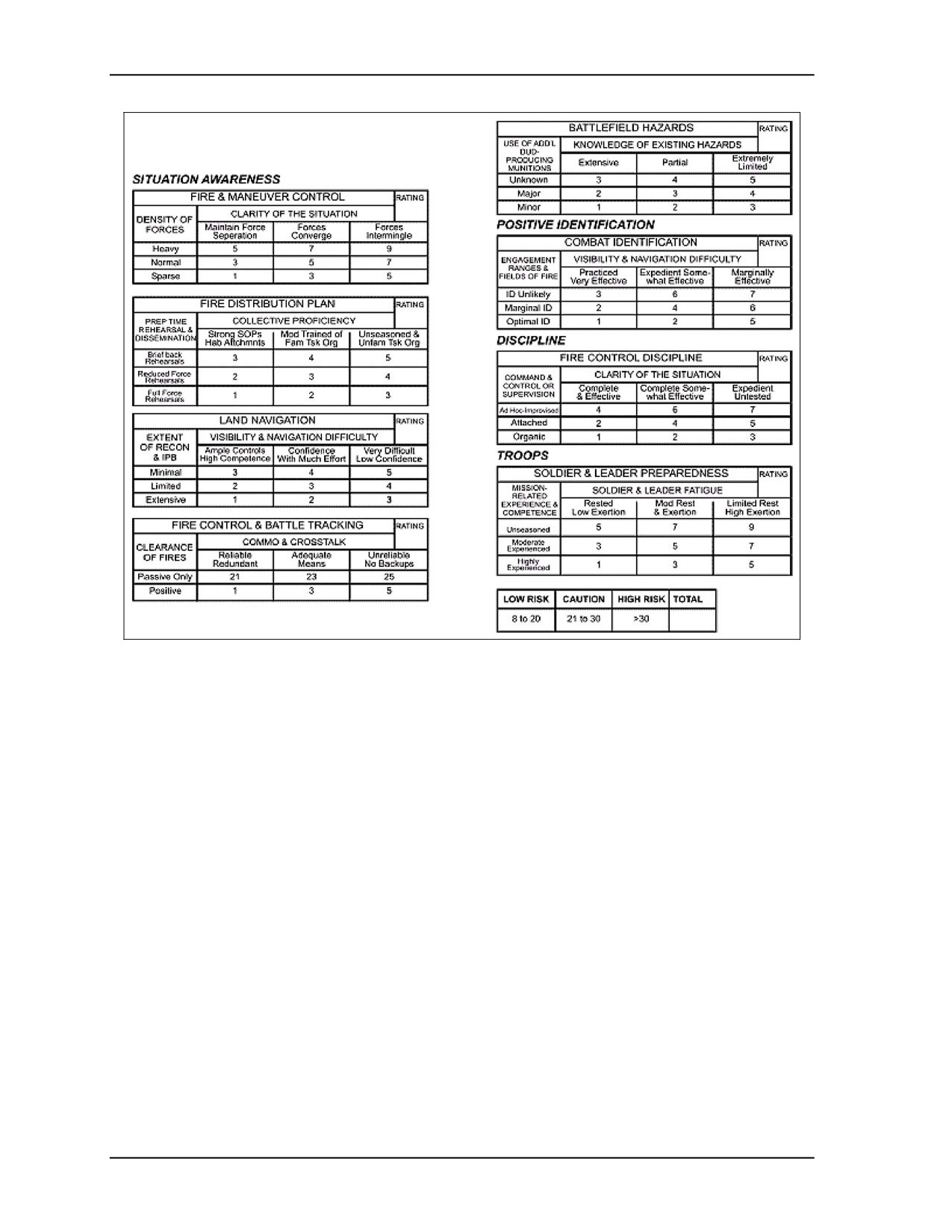
A-20. The fratricide risk assessment matrix shows an approach to assess the relative risk of fratricide for
combat maneuver (Figure A-2). To assign a risk value to each direct cause of fratricide, pair the most
critical METT-TC contributing factors associated with each cause. For each primary cause, favorable
conditions lead to a lesser risk value, found in the cell on the left side of the corresponding submatrix. As a
contributing factor becomes unfavorable, risk increases. The worst precondition for each kind of fratricide
is represented by the risk value in the cell on the right side of the submatrix. Figure A-2 is an example of a
fratricide risk assessment matrix that should be used in assessing every mission. For a detailed explanation
of how to use this matrix, see Section II of Handbook No. 92-3.
A-21. Risk identification must be conducted at all levels during each phase. The results must be clearly
communicated up and down the chain of command so risk assessment can begin. The following paragraphs
cover considerations influencing risk identification and focus on measures the leader can implement to
make the identification process more effective and help prevent friendly fire incidents from occurring:
13 December 2006
FM 3-21.20
A-7
Appendix A
Figure A-2. Example format for fratricide risk assessment matrix.
PLANNING PHASE
A-22. A thoroughly developed, clearly communicated, and completely understood plan helps minimize
fratricide risk. The following factors affect the potential for fratricide in a given operation:
• Clarity of the enemy situation.
• Clarity of the friendly situation.
• Clarity of the commander's intent.
• Complexity of the operation.
• Planning time available at each level.
A-23. Graphics are a basic tool commanders at all levels use to clarify their intent, add precision to their
concept, and communicate their plan to subordinates. Graphics can be a very useful tool in reducing the
risk of fratricide. Each commander must understand the definitions and purposes of operational graphics
and the techniques of their employment. (See FM 1-02 for the definition of each type of graphic control
measure.)
PREPARATION PHASE
A-24. Confirmation briefings and rehearsals are primary tools for identifying and reducing fratricide risk
during the preparation phase. The following are considerations for their use:
A-8
FM 3-21.20
13 December 2006
Risk Management and Fratricide Avoidance
• Confirmation briefings and rehearsals ensure subordinates know where fratricide risks exist and
what to do to reduce or eliminate them.
• Briefbacks ensure subordinates understand the commander's intent. They often highlight areas
of confusion or complexity or planning errors.
• The type of rehearsal conducted determines the types of risks identified.
• Rehearsals should extend to all levels of command and involve all key players.
A-25. The following factors may reveal fratricide risks during rehearsals:
• Number and type of rehearsals.
• Training and proficiency levels of units and individuals.
• The habitual relationships between units conducting the operation.
• The physical readiness (endurance) of the troops conducting the operation.
EXECUTION PHASE
A-26. During execution, in-stride risk assessment and reaction can overcome unforeseen fratricide risk
situations. The following are factors to consider when assessing fratricide risks:
• Intervisibility between adjacent units.
• Amount of battlefield obscuration.
• Ability or inability to identify targets positively.
• Similarities and differences in equipment, vehicles, and uniforms between friendly and enemy
forces.
• Vehicle density on the battlefield.
• The tempo of the battle.
• Civilians on the battlefield.
• Rules of engagement.
A-27. Maintaining an awareness of the COP at all levels and at all times is another key to fratricide
reduction as an operation progresses. Units develop and employ effective techniques and SOPs to aid
leaders and Soldiers in this process, to include—
• Monitoring the next higher radio net.
• Radio cross-talk between units.
• COP updates.
• Accurate position reporting and navigation.
• Training, use, and exchange of liaison officers.
FRATRICIDE REDUCTION MEASURES
A-28. The following measures provide a guide to actions that can reduce fratricide risk. Use of these
measures is not required, nor are they intended to restrict initiative. Leaders should apply them as
appropriate based on the specific situation and METT-TC factors.
• Identify and assess potential fratricide risks in the estimate of the situation. Express these risks
in the OPORD or FRAGO.
• Maintain awareness of the current situation, focusing on areas such as current intelligence, unit
locations and dispositions, denial areas (minefields and scatterable munitions), contaminated
areas such as improved conventional munitions, CBRN reports, SITREPs, and METT-TC
factors.
13 December 2006
FM 3-21.20
A-9
Appendix A
•
Ensure positive target identification. Review vehicle and weapon ID cards. Know at what
ranges and under what conditions positive identification of friendly vehicles and weapons is
possible.
•
Establish a command climate that stresses fratricide prevention. Enforce fratricide prevention
measures and emphasize the use of doctrinally sound tactics, techniques, and procedures.
Ensure constant supervision in the execution of orders and the performance of all tasks and
missions to standard.
•
Recognize the signs of battlefield stress. Maintain unit cohesion by taking quick, effective
action to alleviate it.
•
Conduct individual, leader, and collective (unit) training covering fratricide awareness, target
identification and recognition, and fire discipline.
•
Develop a simple, decisive plan.
•
Give complete and concise mission orders.
•
Use SOPs that are consistent with doctrine to simplify mission orders. Periodically review and
update SOPs as needed.
•
Strive for maximum planning time for you and your subordinates.
•
Use common language and vocabulary and doctrinally correct standard terminology and control
measures such as fire support coordination line, zone of engagement, and restrictive fire lines.
•
Ensure thorough coordination is conducted.
•
Plan for and establish effective communications (to include visual).
•
Plan for collocation of CPs when appropriate to the mission such as during a passage of lines.
•
Designate and employ LNOs as appropriate.
•
Ensure ROE are clear.
•
Include fratricide risk as a key factor in terrain analysis (OAKOC).
•
Conduct rehearsals whenever time permits.
•
Be in the right place at the right time. Use position location and navigation devices (GPS and
POSNAV); know your location and the locations of adjacent units (left, right, leading, and
follow-on). Synchronize tactical movement.
•
Plan and brief OPSEC (challenge and password, sign and countersign).
•
Include discussion of fratricide incidents in after-action reports.
•
Ensure fire commands are accurate, concise, and clearly stated. Make it mandatory for Soldiers
to ask for clarification of any portion of the fire command that they do not completely
understand.
•
Stress the importance of the chain of command in the fire control process; ensure Soldiers get
in the habit of obtaining target confirmation and permission to fire from their leaders before
engaging targets they assume are enemy elements.
•
Know who will be in and around the AO.
•
Know and understand the danger and caution areas of the weapons systems being employed.
For example, M1 Armor Piercing Fin Stabilized Discarding Sabot Tracer (APFSDS-T) round
pedals have a danger area to Soldiers of 90 degrees from the muzzle out to 1,000 meters. There
is also a firing noise and overpressure danger area out to 50 meters from the vehicle.
FRATRICIDE RISK CONSIDERATIONS
A-29. Figure A-3 parallels the five-paragraph OPORD and contains key factors and considerations in
fratricide prevention. This is not a change to the OPORD format, but a guide for use during OPORD
development to ensure fratricide prevention measures are included. It is not a strict directive. The factors
and considerations are listed where they would likely appear in the OPORD, but they may warrant
evaluation during preparation of other paragraphs.
A-10
FM 3-21.20
13 December 2006
Risk Management and Fratricide Avoidance
Task Organization
• Has the Unit worked under this task organization before?
• Are SOPs compatible with the task organization (especially with attached units)?
• Are special markings or signals, such as cat’s eyes, chemlights, or panels, needed for
positive identification of uniforms and equipment?
• What special weapons and equipment are to be used? Do they look or sound like enemy
weapons and equipment?
1.Situation.
a.Enemy Forces.
(1) Weather.
• What are the expected visibility conditions (light data and precipitation) for
the operation?
• What effects will rain, heat, and cold have on Soldiers, weapons, and equipment?
(2) Terrain.
• What is the topography and vegetation (urban, mountainous, hilly, rolling, flat,
desert, swamp/marsh, prairie/steppe, jungle, or open woods) of the expected AO?
• Has the terrain been evaluated using the factors of OAKOC?
b.Friendly Forces.
• Among the allied or coalition forces, are there differences (or similarities with
enemy forces) in language, uniform, and equipment that could increase fratricide risk
during combined operations?
• Could differences in equipment and uniforms among US forces increase fratricide risk
during joint operations?
• What differences in equipment and uniforms can leaders stress to help prevent
fratricide?
• What is the friendly deception plan?
• What are the locations of your unit and adjacent units (left, right, leading, and
follow-on)?
• What are the locations of neutrals and noncombatants?
• What are the locations of your own forces?
• What is the status of training activities?
• What are the levels of individual, crew, and unit proficiency?
• Will fatigue be a factor for friendly forces during the operation? Has an effective
sleep plan been developed?
• Are friendly forces acclimated to the AO?
• What is the age (new, old, or mixed) and condition of equipment in friendly units?
• What is the status of new equipment training?
• What are the expected MOPP requirements for the operation?
c.Attachments and Detachments.
• Do attached elements understand pertinent information regarding enemy and friendly
forces?
• Will gaining units provide this pertinent information to detached elements?
• Are communications systems compatible (digital/analog)?
2.Mission. Do all elements clearly understand the mission and all associated tasks and
purposes?
3.Execution.
a.Concept of the Operation.
(1) Maneuver: Are decisive and shaping operations identified?
(2) Fires (Direct and Indirect):
• Are priorities of fires identified?
• Have target lists been developed?
• Have the fire execution matrix and overlay been developed?
• Have locations of denial areas (minefield and FASCAM) and contaminated areas (ICM
and CBRN) been identified?
• Are the locations of all supporting fire targets identified in the OPORD and
OPLAN overlays?
Figure A-3. Fratricide prevention checklist.
13 December 2006
FM 3-21.20
A-11
Appendix A
• Are aviation and CAS targets clearly identified?
• Has the direct fire plan been developed?
• Have FPFs been designated?
• Are the requirements for accurate predicted fire met or do fire adjustments have
to be made?
(3) Engineer Tasks:
• Are friendly minefields, including FASCAM and ICM dud-contaminated areas, known?
• Have obstacles and the approximate time needed for reduction or breaching of each
been identified?
(4) Tasks to each subordinate unit: Are friendly forces identified, as appropriate,
for each subordinate maneuver element?
(5) Tasks to protection and sustainment units: Have locations of friendly forces been
reported to protection and sustainment units?
b.Coordinating Instructions.
• Are rehearsals to be conducted? Are they necessary? Are direct and indirect fires
included?
• Is a confirmation brief necessary?
• Are appropriate control measures clearly explained and shown in the OPORD and
overlays? Have they been disseminated to everyone who has a need to know? What is the plan
for using these control measures to synchronize the battle and prevent fratricide?
• Are the locations for higher echelonment slice elements in the BCT battlespace
posted and disseminated?
• Have target and vehicle identification drills been practiced?
• Do subordinate units know the immediate action, drill, or signal for “CEASE FIRE”
and “I AM FRIENDLY” if they come under unknown or friendly fire? Is there a backup?
• Is guidance in handling dud munitions, such as ICM and cluster bomb units (CBU),
included?
4.Service Support.
• Does everyone know trains locations and identification markings?
• Do medical and maintenance personnel know the routes between trains units?
5.Service Support.
a.Command.
• What are the locations of the commander and key staff members?
• What are the chain of command and the succession of command?
b.Signal.
• Do instructions include backup code words and visual signals for all special and
emergency events?
• Do instructions cover how air assets identify friendly forces and how friendly
forces identify friendly aircraft?
• Do they include backup code words and visual signals for all special and
emergency events?
• Are SOI distributed to all units with a need to know such as higher, lower,
adjacent, leading, and follow-on elements?
Figure A-3. Fratricide prevention checklist (continued).
A-12
FM 3-21.20
13 December 2006
Appendix B
Movements and Assembly Areas
The movement of troops from one location to another is inherent in any phase of a
military operation. Mission accomplishment relates directly to the ability to arrive at
the proper place, at the proper time, in effective condition, and in the formation best
suited for the assigned mission. Infantry battalions must conduct tactical road
marches and assembly area operations to achieve their missions.
Section I. TACTICAL ROAD MARCH
The Infantry battalion conducts two kinds of movement; administrative and tactical. An administrative
movement considers tactical implications, but its primary emphasis is on expediting movement and conserving
time and energy. Administrative movements are based on the assumption that contact with the enemy during or
shortly after the move is unlikely. A tactical road march is a rapid movement used to relocate units in a combat
zone in order to prepare for combat operations. Although hostile contact is not anticipated, the unit maintains
security measures and is prepared to act upon enemy contact. At battalion level and higher, the S-3 is
responsible for planning tactical road marches. The S-4 has primary staff responsibility for planning
administrative movements, but he coordinates his plans with all other staff members.
MARCH ELEMENTS
B-1.
The elements of a road march include the march column, serial, and march unit.
MARCH COLUMN
B-2.
A march column includes all elements using the same route for a single movement under control
of a single commander. A battalion may march over multiple routes to reduce closing time. A large march
column may be composed of a number of subdivisions, each under the control of a subordinate
commander.
SERIAL
B-3.
A serial is a subdivision of the march column. It consists of elements of a march column moving
from one area over the same route at the same time. All the elements move to the same area and are
grouped under a serial commander. A serial may be divided into two or more march units.
MARCH UNIT
B-4.
A march unit is the smallest subdivision of a march column. It is normally a squad, section,
platoon, or company. It moves and halts under control of a single commander using voice and visual
signals. It uses radio only when it can use no other means of communication.
Before Movement
B-5.
Before starting a march, each march unit of a serial reconnoiters its route to the start point and
determines the exact time to reach it. The movement order states the unit’s arrival and clearance times at
the start point. The serial commander then determines and announces the times for march units of his serial
to arrive at and clear the start point. Arrival time at the start point is critical. Each march unit must arrive at
and clear the start point on time; otherwise, movement of other elements may be delayed.
13 December 2006
FM 3-21.20
B-1
Appendix B
During Movement
B-6.
During movement, march units move at the constant speed designated in the order, maintaining
proper interval and column gap. Elements in a column of any length may simultaneously encounter many
different types of routes and obstacles, resulting in different parts of the column moving at different speeds
at the same time. This can produce an undesirable accordion-like action or whip effect. March units report
crossing each control point as directed by the march order. They maintain air and ground security during
the move.
MARCH COLUMN ORGANIZATION
B-7.
March columns, regardless of size, are composed of four elements: reconnaissance party,
quartering party, main body, and trail party. March columns are organized to maintain unit integrity and to
maintain a task organization consistent with mission requirements. All march units must provide their own
security.
RECONNAISSANCE PARTY
B-8.
The reconnaissance party may be augmented by engineer and other protection assets. It performs
route reconnaissance to determine travel time; it identifies critical points, including choke points and
obstacles. Route reconnaissance confirms and supplements data from map studies, higher headquarters, and
air reconnaissance. Instructions to the reconnaissance party should state the nature and extent of
information required and the time and place the report is to be submitted.
QUARTERING PARTY
B-9.
The quartering party normally consists of representatives from companies or attached units. It
reconnoiters the new area, marking unit positions and guiding the march column elements into these new
positions as they arrive. (See Section II for more information on quartering party responsibilities when
occupying an assembly area.)
MAIN BODY
B-10. March units of the main body consist of individual maneuver units with their trains, battalion
mortars, any attachments, the battalion CP, and the battalion trains.
TRAIL PARTY
B-11. The trail party normally consists of elements of the FSC and medical support and is a march unit
in a battalion serial.
PLANNING CONSIDERATIONS
B-12. Road marches require extensive planning. Commanders and staff use the military decision-making
process to determine how best to execute a move from one point to another. (See FM 4-01.30 for a detailed
discussion of movement planning considerations, terms, and movement time computation.)
FACTORS FOR CONSIDERATION
B-13. Consider the following factors in road march planning:
• Requirements for the movement. (Refuel requirements, time distance between march units
considering vehicle capacity and time required at the refuel site and time to clear choke points).
B-2
FM 3-21.20
13 December 2006
Movements and Assembly Areas
• Organic and nonorganic movement capabilities; determine external movement requirements.
• Unit movement priorities.
• Enemy situation and capabilities, terrain conditions, and weather.
• Organization of the battalion.
-- Positioning recovery vehicles throughout the march unit's flow to provide flexibility and
timely push/pull recovery to close all vehicles on the destination.
-- Ensure all march units have security and firepower.
• Security measures before and during the movement and at the destination.
• Assembly of the march units.
• Fire support coverage during movement and at the destination.
• Communications; particularly units without FBCB2.
• Actions at the destination.
SEQUENCE OF ROAD MARCH PLANNING
B-14. When preparing for a tactical road march, the battalion uses the following sequence of march
planning, as time permits:
• Prepare and issue an oral warning order as early as possible to allow subordinates time to
prepare for the march.
• Analyze routes designated by higher headquarters and specify organization of the march serial.
• Prepare and issue the march order.
• Prepare a detailed movement plan and assembly area plan.
• Organize and dispatch reconnaissance and quartering parties as required.
MOVEMENT ORDER
B-15. The movement order format is the same for administrative and tactical movements, in accordance
with FM 5-0. The movement order is prepared as an annex to an operation order, as a separate operation
order, or as a FRAGO.
CONTROL MEASURES
B-16. The commander uses the control measures discussed in the following paragraphs to assist in
controlling the battalion during the road march.
GRAPHICS
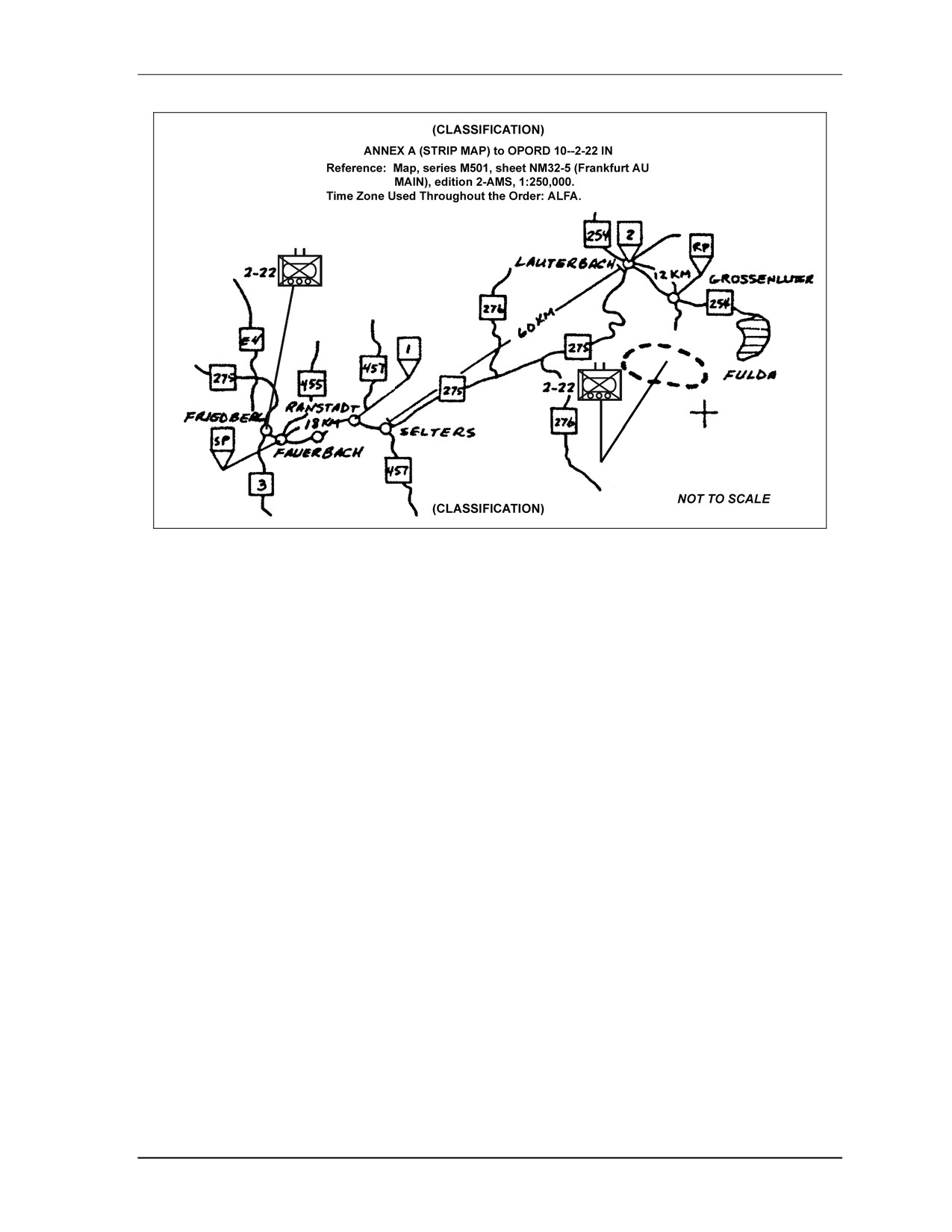
B-17. Road march graphics should include, at a minimum, the start point, release point, and route. The
battalion strip map should show the following (Figure B-1, page B-5).
• Start point.
• Release point (RP).
• Scheduled halts.
• Routes.
• Major cities and towns.
• Critical points and checkpoints.
• Distance between CPs.
• North orientation.
13 December 2006
FM 3-21.20
B-3
Appendix B
Start Point
B-18. A start point is a well-defined point on a route at which units fall under the control of the
movement commander. It is at this point that the column is formed by the successive passing, at an
appointed time, of each of the elements comprising the column. The SP should be an easily recognizable
point on the map and on the ground. It should be far enough from the assembly area to allow units to be
organized and moving at the prescribed interval when the SP is reached.
Release Point
B-19. A release point is a well-defined point on a route at which the elements comprising a column
return to the authority of their respective commanders. At the RP, each element continues its movement
toward its own destination. Multiple movement routes from the RP enable units to disperse rapidly and
navigate to their assembly areas or AO.
Scheduled Halts
B-20. Scheduled halts may be needed to provide rest, mess, and medical evaluation.
Critical Points and Checkpoints
B-21. Critical points or checkpoints on a route are places used for information references, places where
obstructions or interference with movement might occur, or places where timing may be a critical factor.
They are also used as a control measure for control and maintenance of the schedule. Guides or signs may
be used at designated critical points/checkpoints to ensure the smooth flow of movement.
Strip Map
B-22. All overlay data should be entered into FBCB2 so that vehicles equipped with the system can
maintain awareness of the current situation.
B-4
FM 3-21.20
13 December 2006
Movements and Assembly Areas
Figure B-1. Example battalion strip map.
COMMUNICATIONS
B-23. Messengers and visual signals are excellent means of communication during road marches. The
battalion generally uses radio only in emergencies and when it can use no other means of communication.
The battalion can also use road guides to pass messages from one march unit to a following march unit.
Road guides are important in controlling march units and the interval between them.
TRAFFIC CONTROL
B-24. The headquarters controlling the march may post road guides and traffic signs at designated traffic
control points. At critical points, guides assist in creating a smooth flow of traffic along the march route.
Military police or designated elements from the quartering party may serve as guides. They should have
equipment or markers that will allow march elements to identify them in darkness or other limited visibility
conditions. There is normally an RP for every echelon of command conducting the road march.
SECURITY
B-25. During the movement, march units maintain security through observation, weapons orientation,
dispersion, and camouflage. Commanders assign sectors of observation to their personnel to maintain
360-degree observation. Main weapons are oriented on specific sectors throughout the column. The lead
elements cover the front, following elements cover alternate flanks, and the trail element covers the rear.
HALTS
B-26. While taking part in a road march, the march elements must be prepared to conduct both
scheduled and unscheduled halts. In either case, vehicles should move to the side of the road while
maintaining vehicle dispersion. Security at halts is always the first priority.
13 December 2006
FM 3-21.20
B-5
Appendix B
AIR DEFENSE
B-27. Planning for AD and implementing all forms of AD security measures are imperative to minimize
the battalion's vulnerability to enemy air attack. The battalion commander must integrate his fire plans
effectively with any attached or supporting AD assets. Furthermore, he must ensure the battalion plans and
uses all passive and active AD measures that can be implemented at company level.
OBSTACLES
B-28. The battalion should bypass obstacles reported by the scout platoon, if possible. If it cannot
bypass obstacles, the lead march unit goes into a hasty defense to cover and overwatch and breaches the
obstacle, working with engineers if available. As the lead march unit breaches the obstacles, the other
march units move at decreased speed or move off the road and monitor the battalion command net. The
location of the obstacle should be posted on FBCB2 as soon as the situation allows.
ENEMY INDIRECT FIRE
B-29. Should the battalion come under attack by enemy indirect fire during the road march, the unit in
contact continues to move. The remainder of the battalion tries to bypass the impact area.
ENEMY AIR ASSAULT
B-30. Should hostile aircraft attack the battalion during the march, the march unit under attack moves
off the road into a quick defensive posture and immediately engages the aircraft with all available
automatic weapons. The rest of the battalion moves to covered and concealed areas until the engagement
ends.
RESTRICTIONS
B-31. Restrictions are points along the route of march where movement may be hindered or obstructed.
The march planner should stagger start times or adjust speeds to compensate for restrictions, or he should
plan to halt the column en route until the restriction is over.
LIMITED VISIBILITY
B-32. Units must be able to operate routinely under limited visibility conditions caused by darkness,
smoke, dust, fog, heavy rain, or heavy snow. Limited visibility decreases the speed of movement and
increases the difficulty in navigating, recognizing checkpoints, and maintaining proper interval between
units. To overcome C2 problems caused by limited visibility, commanders may position themselves just
behind lead elements. More restrictive control measures, such as additional checkpoints, phase lines, and
use of a single route, may become necessary.
Section II. ASSEMBLY AREA OPERATIONS
An assembly area is a location where a force prepares or regroups for future action. While in assembly areas,
units execute the organization, maintenance, resupply, and personnel actions necessary to maintain the combat
power of the force. Designation and occupation of an assembly area may be directed by a higher headquarters
or by the unit commander during relief or withdrawal operations or unit movements.
TYPES OF ASSEMBLY AREAS
B-33. The battalion may establish administrative or tactical assembly areas.
B-6
FM 3-21.20
13 December 2006
Movements and Assembly Areas
ADMINISTRATIVE ASSEMBLY AREAS
B-34. Administrative assembly areas are established where the likelihood of enemy contact is remote
and the commitment of the force from the assembly area directly to combat is not anticipated. Examples of
administrative assembly areas include; seaport debarkation, pre-positioned materiel marshaling areas, and
assembly areas occupied by units in reserve. Battalions may occupy administrative assembly areas alone or
as part of a larger force.
B-35. Ideally, administrative assembly areas provide—
• Concealment from air and ground observation.
• Terrain masking of electromagnetic signal signature.
• Sufficient area for unit dispersion, consistent with the degree and type of rear area or air enemy
present.
• Buildings for maintenance, billeting, mess, and headquarters. Optimally, buildings will have
light, heat, and wire communications.
• An area suitable for a utility helicopter LZ.
• Suitable entrances, exits, and internal routes. Ideally, unit personnel can easily secure entrances
and exits.
• Good drainage and soil conditions.
B-36. Administrative assembly areas are organized and occupied with an emphasis on unit integrity,
ease of operation, C2, and efficient use of facilities. Tactical dispersion and protection from ground or air
attack are lesser considerations in an administrative assembly area. Units are typically grouped tightly
together and placed at lower readiness conditions.
B-37. Units that are occupying administrative assembly areas and do not have an assigned reserve
mission, are typically preparing to move forward to a tactical assembly area in preparation for employment
in combat operations. Forces may occupy administrative assembly areas to await arrival of other units
before moving forward.
TACTICAL ASSEMBLY AREAS
B-38. Tactical assembly areas are areas occupied by forces where enemy contact is likely and
commitment of the unit directly from the assembly area to combat is possible or anticipated. Examples of
units likely to be in tactical assembly areas include units designated as tactical reserves, units completing a
rearward passage of lines, units preparing to move forward to execute a forward passage of lines followed
by offensive operations, units performing tactical movements, and units conducting reconstitution. Tactical
assembly areas should provide—
• Concealment from air and ground observation.
• Cover from direct fire.
• Terrain masking of electromagnetic signal signature.
• Sufficient area for the dispersion of subunits consistent with the enemy and friendly tactical
situation.
• Areas for unit trains, maintenance operations, and C2 facilities.
• Suitable entrances, exits, and internal routes. (Optimally, at least one all-weather paved surface
road transits the assembly area and connects to the MSR in use.)
• Terrain allowing the observation of ground and air avenues of approach into the assembly area.
• Good drainage and soil conditions.
ORGANIZATION
B-39. Battalion tactical assembly areas may be organized using one of three methods.
13 December 2006
FM 3-21.20
B-7
Appendix B
METHOD 1
B-40. The battalion may occupy a portion of the perimeter of an assembly area. It does so by arraying
companies, generally on a line oriented on avenues of approach into the assembly area. Leftmost and
rightmost units tie in their fires and areas of observation with adjacent units of other battalions. Depending
on the tactical situation and width of the area assigned to it, the battalion may maintain a reserve. Battalion
trains are located to the rear of the companies. The battalion mortar platoon and the main CP are located
centrally in the assembly area where they can communicate and support units by fire. The scout platoon
screens along the most likely or most dangerous avenues of approach.
METHOD 2
B-41. The battalion may assign sectors to subordinate companies and require them to tie in their fires
and observation with each other. The main CP, trains, and mortar platoon are located near the center of the
assembly area. Ideally, company sectors are assigned to balance the task organization against the
appropriate enemy avenues of approach The scout platoon occupies observation posts at key points around
the entire perimeter of the battalion or screens along the most dangerous or likely enemy avenues of
approach. This method configures the battalion in a perimeter defense with companies oriented outward.
This is the most common organization of battalion assembly areas.
METHOD 3
B-42. The battalion may assign separate individual assembly areas to subordinate companies, which
establish their own 360-degree security. Areas between companies are secured through surveillance and
patrolling. The main CP, trains, and heavy mortar platoon establish positions central to outlying
companies. If the battalion is dispersed over a large area, SHORAD assets (if available) may need to
collocate with companies for adequate AD.
QUARTERING PARTY
B-43. A quartering party is a group of unit representatives dispatched to a probable new site of
operations to secure, reconnoiter, and organize an area before the main body's arrival and occupation. Unit
SOPs establish the exact composition of the quartering party and its transportation, security,
communications equipment, and specific duties. Quartering parties typically reconnoiter, to include CBRN
reconnaissance, and confirm the route and tentative locations previously selected from map
reconnaissance. Quartering parties also serve as a liaison between their parent headquarters and the
quartering party of their higher headquarters to change unit locations in the assembly area based on the
results of their reconnaissance.
PLANNING CONSIDERATIONS
B-44. The S-2 routinely receives intelligence information from BCT headquarters throughout the
battalion's deployment and operations. From this information, the S-2 determines the characteristics and
likelihood of the air and ground threat to the quartering party during its movement to and occupation of the
assembly area. This information assists the battalion staff and the quartering party OIC in determining the
security required and the desirability of maintaining the quartering party in the assembly area during the
movement of the rest of the battalion.
B-45. For security, it may move with another subunit quartering party, depending on the likelihood of
enemy contact. Ideally, the quartering party moves over the routes to be used by the battalion and executes
a route reconnaissance and time-distance check.
B-46. The quartering party typically includes an OIC or noncommissioned officer in charge (NCOIC)
and representatives from the battalion main CP, battalion trains, and the battalion's subunits. The S-3 air,
HHC CDR, XO, S-1, S-3 sergeant major (SGM), and CSM are potential quartering party leaders.
B-8
FM 3-21.20
13 December 2006
Movements and Assembly Areas
B-47. Composition of the maneuver company quartering parties is usually determined by the company
commander but may be specified by the battalion commander. HHC representatives typically include
NCOs from key support sections such as communications or supply. Representatives from the mortar
platoon and the scout platoon are also represented in the quartering party.
B-48. The main CP quartering party identifies potential CP locations based on tactical requirements such
as cover and concealment and the line-of-sight signal requirements of FM radios.
B-49. If planning time is short, key members of the staff can move with the quartering party. This
enables the staff to begin detailed planning immediately upon arrival in the assembly area. This technique
also facilitates transitions to new missions by pre-positioning key staff members so planning can occur
concurrently with the movement of the main body.
B-50. If the battalion moves and occupies its assembly area as part of a BCT, the BCT makes all
coordination for fire support. If the battalion moves and occupies the assembly area without FS planning
by its higher headquarters, it conducts its own FS coordination.
B-51. During its planning, the staff determines sustainment requirements for the quartering party. The
estimate of necessary supplies and equipment covers the entire quartering party, including accompanying
staff section representatives and fire support, protection, and sustainment assets.
B-52. The quartering party may move under radio listening silence or other emission restrictive posture,
especially during movement to tactical assembly areas.
PREPARATION
B-53. The quartering party OIC or NCOIC plans his operations through coordination with battalion staff
officers.
Intelligence
B-54. The S-2 ensures the quartering party OIC/NCOIC is aware of the current enemy situation,
probable enemy courses of action, the weather forecast, and the terrain and vegetation likely en route to
and in the new assembly area.
Movement and Maneuver
B-55. The OIC or NCOIC coordinates with the S-3 to determine the mission of the quartering party,
whether or not the quartering party is to remain in the assembly area and await the remainder of the
battalion, and the route and movement restrictions to be used by the quartering party. The OIC or NCOIC
ensures subordinate unit quartering parties know where and when the battalion quartering party will be
located in the assembly area.
B-56. The battalion S-3 determines whether sending engineer personnel with the quartering party for the
reconnaissance and evaluation of routes, bridges, and cross-country mobility is recommended or required.
Protection
B-57. AD units, when available, may move with the quartering party en route to and in the new tactical
assembly area. If AD assets move with the quartering party, the AD unit leader ensures he knows both the
current and projected weapons control status (WCS) and AD warning.
Command and Control
B-58. After the OIC or NCOIC finishes planning, he gathers the quartering party where and when he
chooses to brief them. His briefing follows the standard five-paragraph field order format. In it, he
emphasizes actions at halts and critical areas, actions of the quartering party in the assembly area,
13 December 2006
FM 3-21.20
B-9
Appendix B
contingency plans, and procedures to request and receive fire support, protection, and sustainment. He
covers in detail MEDEVAC procedures, actions on contact, and actions to take if separated from the
quartering party.
EXECUTION
B-59. The following considerations apply to quartering party execution.
Movement and Maneuver
B-60. The quartering party navigates to the assembly area, generally along one route. If the quartering
party moves along a route to be used by the main body and the main body has not yet sent a reconnaissance
party forward, the quartering party conducts a route reconnaissance during its movement. The quartering
party may also execute a time-distance check of the designated route. He reports these times and distances
to the main CP after moving through the RP.
B-61. Upon arrival in the assembly area, the quartering party navigates to assigned positions and
executes the required reconnaissance. The quartering party also has the following responsibilities at the
assembly area:
• Determines locations for squads and above.
• Identifies unit left and right limits of fire, records this information, and sends updates to the
unit's commander.
• Determines the location for the main CP and records it.
• Verifies subordinate unit locations and sectors of fire to ensure there are no gaps in coverage.
• Transmits changes or updates to the main CP to alert the main body to changes in the route and
assembly area.
B-62. If reconnaissance of proposed locations reveals the area is unsuitable for occupation, the
quartering party OIC or NCOIC tries to adjust unit locations in the assigned area. If such adjustments do
not correct the problem, he immediately notifies the S-3 or commander.
B-63. If an element of the main CP has accompanied the quartering party, it moves to the location
reconnoitered by its representative and establishes forward C2 for the battalion. If AD assets have
accompanied the quartering party, they occupy advantageous firing positions oriented on air avenues of
approach. Representatives organize their respective areas by selecting and marking positions for vehicles
and support facilities. If designated, guides move on order to preselected checkpoints or RPs to await main
body march unit elements.
B-64. If the battalion quartering party is not going to remain in the assembly area, it does not depart the
assembly area until all subordinate unit quartering parties have reported. The unit quartering parties should
provide the results of their reconnaissance and identify requested changes to their tentative locations.
B-65. Each commander or unit leader must decide if guides are needed to assist in occupying the
assembly area. Normally, the leader plans the use of guides for occupation in limited visibility.
Sustainment
B-66. Sustainment assets may accompany the quartering party. Sustainment elements generally conduct
resupply operations for the quartering party at scheduled halts or in the new assembly area.
OCCUPATION
B-67. Units position themselves in assembly areas in accordance with their parent unit's tentative plan.
Quartering parties typically guide units into position. The units accomplish occupation smoothly from the
march without halting or bunching of units at the RP. Subordinate units normally establish routes and
B-10
FM 3-21.20
13 December 2006
Movements and Assembly Areas
separate SPs and RPs for march elements that extend from the march column's route or RP toward the
march units' assembly area positions. This technique clears the route quickly, maintains march unit C2, and
prevents bunching of units at the march column RP. The battalion begins movement to the assembly area
with an updated movement route, and a confirmed defensive scheme for occupation of the assembly area.
This enables the battalion to transition quickly from the road march into the actual occupation while
maintaining overall security for the main body.
INTELLIGENCE
B-68. The S-2 assists in planning the assembly area occupation by identifying enemy avenues of air and
ground approach into the new assembly area and the degree and type of rear area threat to the battalion in
its new location. The S-2 also identifies and disseminates the security requirements for the battalion and
begins preparing the reconnaissance and surveillance plan for the assembly area. In coordination with the
S-3, the S-2 makes preliminary plans for reconnaissance and surveillance tasks to be assigned to subunits
in the battalion, including the reconnaissance platoon.
MOVEMENT AND MANEUVER
B-69. The commander or S-3 chooses a method for occupation (whole battalion assembly area or
separate subunit assembly areas) and tentative subunit locations based on METT-TC. He then considers
selecting tentative assembly area locations. To operate effectively in the assembly area, selected subunits
may have specific positioning requirements such as being near mess units, near water for decontamination,
or on hard stand for maintenance. Based on METT-TC, the commander or S-3 develops contingency plans
that address the possibility of significant enemy contact in the assembly area. Time available and the
likelihood of enemy contact determine the level of detail in contingency plans. These plans typically
include fire support plans and alternate assembly areas or rally points in case the battalion is forced out of
its initial assembly area.
B-70. The type and extent of engineer support required in the assembly area depends on the anticipated
length of stay, type, and degree of enemy threat, terrain in the assembly areas, and the follow-on mission of
the battalion. Mobility and countermobility tasks include improving and controlling access routes into the
assembly area.
FIRE SUPPORT
B-71. Fire support requirements are coordinated with units already positioned near the new assembly
area. Support shortfalls between requirements and availability are coordinated with either higher or
adjacent units. Fire support planning includes support for battalion contingency plans in case of enemy
ground contact.
PROTECTION
B-72. AD planning when available for the tactical assembly area focuses on the selection of SHORAD
firing positions that will allow the engagement of enemy aircraft, along identified air avenues of approach.
Depending on the commander's stated priority of protection, assets available, and task organization, AD
units may locate with supported battalion subunits or in separate locations under battalion control.
B-73. Survivability tasks are also dependent upon the length of time the assembly area is to be occupied.
At a minimum, individual fighting positions are dug and improved as time permits. Hardening of C2
facilities is also a priority.
13 December 2006
FM 3-21.20
B-11
Appendix B
SUSTAINMENT
B-74. The S-4 recommends sustainment positioning and typically positions the combat trains near the
battalion main CP. HHC and FSC support elements position themselves in relation to the battalion TOC
and the mortar platoon.
COMMAND AND CONTROL
B-75. The XO and S-2 determine tentative locations for battalion C2 facilities from map or imagery
reconnaissance based on METT-TC. The overriding consideration for selecting these locations is the
ability of the various CPs to communicate higher, lower, and laterally. Establishing the main CP in the new
assembly area should occur early in the occupation so subunit CPs can locate based on their requirement to
communicate with the main CP.
ACTIONS IN ASSEMBLY AREA
B-76. The battalion focuses all actions in the assembly area on preparing for future operations to include
resupply, personnel replacement, maintenance, reorganization, rest, and the planning of future operations.
B-77. The battalion initiates human resource actions in the assembly area if time permits.
B-78. Maintenance activities concentrate on deadline faults and those degrading the unit's ability to
shoot, move, and communicate. The unit pays special attention to those maintenance tasks that are too
time-consuming or difficult to perform during combat operations.
B-79. The units conduct resupply actions in the assembly area to replenish items used in previous
operations, to assemble stocks for future operations, and to replace damaged and contaminated supplies as
required.
B-80. The unit conducts planning and preparation for future operations concurrently with maintenance
and administrative activities.
B-81. The unit may require training if issued new or modified equipment while in the assembly area.
Small unit training may be necessary if replacement personnel are introduced into the unit, especially if
significant numbers of key leaders are replaced.
SECURITY
B-82. Security comprises measures taken by a military unit to protect itself against surprise, observation,
detection, interference, espionage, sabotage, or annoyance that may impair its effectiveness. Security is
essential to the protection and conservation of combat power. It may be achieved by establishing and
maintaining protective measures or through deception operations designed to confuse and dissipate enemy
tries to interfere with the force being secured. Effective security prevents the enemy from gaining an
unexpected advantage over friendly forces.
SECURITY IN ASSEMBLY AREA
B-83. Forces in tactical assembly areas are provided a degree of security by their separation from the
line of contact and by the presence of other units between them and the enemy. In keeping with their
mission and the tactical situation, units in tactical assembly areas employ active security measures. These
measures include reconnaissance and patrols, visual and electronic surveillance of ground and air avenues
of approach, and establishment of OPs. Regardless of the security that may be provided by other units or
agencies, the commander takes whatever actions or precautions he deems necessary to secure his
command.
B-12
FM 3-21.20
13 December 2006
Movements and Assembly Areas
POSITIONING OF COMPANIES
B-84. The battalion positions companies with respect to avenues of approach and access routes into the
assembly area. Companies tie in their fires, observation, and patrolling with one another. This is simple for
the battalion, because the companies typically occupy a portion of a battalion perimeter and are adjacent to
another company. Companies exchange sector sketches, fire plans, and patrolling plans with adjacent units.
POSITIONING OF SCOUT PLATOON
B-85. The scout platoon may be positioned in one of three ways to enhance the security of the battalion.
It can form a screen astride the most likely or dangerous avenues of approach; it can establish several
temporary OPs and conduct patrols between them to provide a thin screen line that surrounds the entire
assembly area; or it can be positioned to observe an area that cannot be seen by other units in the assembly
area. Companies may also be repositioned to observe these areas. Battalion organic snipers, UAS, GSRs,
and surveillance assets allocated from the BCT may be retained under battalion control. More often, they
are attached to the scout platoon to augment the screen or employed as additional OPs.
OPERATIONS SECURITY
B-86. Operations security (OPSEC) includes active and passive measures that try to deny the enemy
information about friendly forces. Units in the battalion practice noise and light discipline, employ
effective camouflage, eliminate or reduce radio traffic, and use wire communications or messengers. Other
electronic transmissions such as jammers and radar may be restricted. Units may construct and employ
unidirectional antennas to reduce electronic signatures.
NONCOMBATANTS
B-87. Movement of civilians and refugees near assembly areas is strictly controlled to prevent enemy
sympathizers or covert agents from obtaining information about the battalion. Units may remove unit
markings and uniform patches in some cases to retain unit anonymity. When possible, the unit conducts
rehearsals in areas not subject to enemy observation and performs extensive movements and resupply
under limited visibility. OPSEC measures vary because of higher headquarters deception efforts.
RECONNAISSANCE AND SURVEILLANCE PLAN
B-88. The battalion reconnaissance and surveillance plan directs the employment of intelligence assets
under battalion control and assigns intelligence and security tasks to subordinate units. Companies
typically provide security patrols to their fronts and establish OPs IAW the reconnaissance and surveillance
plan. The scout platoon also conducts reconnaissance and security tasks in accordance with the
reconnaissance and surveillance plan. Patrols may be established to maintain contact between units when
companies occupy separate assembly areas.
DEPARTURE FROM ASSEMBLY AREA
B-89. The planning considerations for occupying the assembly area are based largely on the anticipated
future missions of units. Units are positioned in the assembly area so they can depart the assembly area en
route to their assigned tactical missions without countermarching or moving through another unit.
PLACEMENT OF SP
B-90. Units departing the assembly area must hit the SP at the correct interval and time. To achieve this,
the SP must be located a sufficient distance from the assembly area to allow units to maneuver out of their
positions and configure for the road march before reaching the SP. The SP for a battalion movement
13 December 2006
FM 3-21.20
B-13
Appendix B
should be located an adequate distance from the assembly area to permit the companies to attain proper
speed and interval before crossing it.
LIAISON OFFICERS
B-91. When unit-to-unit dispersion or terrain in the assembly area prohibits visual contact, LNOs
maintain contact between departing units and return to their parent units to initiate movement at the
correct time.
B-14
FM 3-21.20
13 December 2006
Appendix C
Air Assault Operations
When the Infantry battalion executes an air assault operation, Infantry companies
form the primary air assault force. Usually one or two companies form the basic air
assault force; however, the may be tasked organized with the weapons company if
close combat missile, antitank or heavy machinegun fires are anticipated to be needed
on the landing zone (LZ). Higher headquarters provide the additional assets required
to execute an air assault mission. In most cases, the operation concludes with a linkup
operation between Infantry and mounted forces.
Section I. CONSIDERATIONS
Situations favoring an air assault operation for the Infantry battalion include those in which the enemy has a
vulnerable area suitable for air assault, surprise can be achieved, and enemy air defenses are weak and
vulnerable, or can be effectively suppressed.
AIR ASSAULT MISSION ANALYSIS AND CONSIDERATIONS
C-1.
Typical air assault operations conducted by the battalion include river-crossing operations, seizure
of key terrain, rear area combat operations, and raids. The mobility and speed helicopters can be
exploited to—
• Secure a deep objective in the offense.
• Reinforce a threatened sector in the defense.
• Place combat power at a decisive point on the battlefield.
C-2.
For this reason, the Infantry battalion must be proficient in conducting air assault operations.
Considerations for air assault operations include the following. For all other mission analysis factors, see
FM 90-4:
• Ground mobility is limited once the unit is inserted unless vehicles are provided.
• Communication range may be limited to that of portable radios.
• CS and sustainment are austere.
• Air lines of communication must be planned for sustainment.
• Disposition of 81-mm and 120-mm mortars depends on the ability to displace the tubes and
ammunition.
AIR ASSAULT BATTALION ORGANIZATION
C-3.
As with all air assault operations, the battalion is organized to meet METT-TC and operational
considerations.
ACTIONS OF BATTALION (-)
C-4.
The OPORD should reflect detailed planning for actions of the entire force; not only the air
assault element, but also the battalion (-) or battalion (-) stay behind. This planning should emphasize
command and control relationships and linkup procedures. If the battalion (-) is tasked to perform linkup
operations with their deployed Infantry, then both (1) operational issues, such as time, place, and method of
linkup, and (2) change of command for operation and maneuver control must be carefully planned.
13 December 2006
FM 3-21.20
C-1