FM 3-21.20 (FM 7-20) THE INFANTRY BATTALION (DECEMBER 2006) - page 9
Chapter 10
BCT
10-49.
One ALO, one FLO, and four FACs.
Battalion
10-50.
One ALO and two FACs.
CLOSE AIR SUPPORT PLANNING DUTIES AND RESPONSIBILITIES
10-51.
The ALO and members of the battalion TACP provide the necessary expertise for the control
and application of tactical air power. The ALO serves as the primary tactical air power advisor for the
battalion, while TACP FACs provide final control for CAS missions executed in the battalion’s AO. Their
collaborative working relationship established with the BCT and maneuver battalion provides a working
knowledge of ground operations and enhances their ability to integrate TACAIR operations with ground
schemes of maneuver effectively.
Forward Air Controller
10-52.
The primary responsibility of TACP FACs includes the positive control of CAS aircraft flying
missions in support of brigade operations. Using their knowledge of ground operations, they are also better
able to provide the troop safety necessary to avoid fratricidal engagements. The following paragraphs
discuss FAC procedures and responsibilities.
Troop Safety
10-53.
The safety of ground forces is a major concern during day and night CAS operations.
Fratricidal engagements are normally caused by the incorrect identification of friendly troops operating in
an AO or a failure to mark the boundaries of the friendly unit adequately. The use of proper authentication
and ground marking procedures assures that a safe separation exists between the friendly forces and the
impact area of aerial delivered munitions. Proper radio procedures and markings assist the FACs and the
strike aircraft in the positive identification of ground forces and their operational boundaries.
Identification of Friendly Forces
10-54.
As digital technology continues to emerge and digital systems are fielded throughout combat
units, the disposition and location of friendly units will become more accurate. These systems will provide
enhancements to safety margins and help reduce the potential of fratricidal engagements during joint air
attack team (JAAT) or TACAIR operations. Friendly unit locations and boundaries can be marked using
flash mirrors, marker panels, and direction and distance from prominent land features or target marks.
Strobe lights are very good markers at night and in overcast conditions. They can be used with blue or
infrared filters and made directional using any opaque tube. Any light that can be filtered or covered and
uncovered can be used for signaling aircraft or marking friendly locations.
Target Acquisition
10-55.
Targets that are well camouflaged, small and stationary, or masked by hills or other natural
terrain are difficult for fast-moving aircraft to detect. Marking rounds (rockets) fired from aerial platforms
or artillery can enhance target acquisition and help ensure first-pass success.
Target Identification
10-56.
Strike aircraft must have a precise description of the target and know the location of friendly
forces in relation to terrain features that are easily visible from the air. Airborne FACs are generally
10-18
FM 3-21.20
13 December 2006
Warfighting Functions
assigned an AO and become intimately familiar with its geographical features as well as the unit operating
within the AO.
Final Attack Heading
10-57.
Choice of the final attack heading depends upon considerations of troop safety, aircraft
survivability, enemy air defense locations, and optimum weapons effects. Missiles or bombs are effective
from any angle. Cannons, however, are more effective against the sides and rears of armored vehicles.
S-3 Air
10-58.
The S-3 Air plans for and requests the use of CAS and attack helicopters to support the
commander's concept of the operation.
S-2
10-59.
The S-2 provides information on the avenues of approach, target array, terrain, and weather as
it applies to the time and location of the JAAT operation.
Attack Helicopter Liaison Officer
10-60.
The Army aviation liaison officer (when attached)—
• Provides status of Army aviation assets available.
• Begins planning the air corridors and air BPs to support the operation.
• Coordinates with the FSO and the ADO to deconflict air corridors.
• Coordinates for the planned airspace coordination areas (ACAs).
Fire Support Officer
10-61.
The FSO—
• Determines the need, availability, and positioning of artillery and battalion mortars,
commensurate with the enemy update, to support the JAAT.
• Coordinates with the aviation representative to provide call signs and frequencies to the
supporting FDC.
• Helps the TACP deconflict the initial points from artillery positions and develop ACAs to
support the mission.
• Determines the need for suppression of enemy air defense (SEAD).
• Plans and coordinates, in conjunction with the battalion staff, the use of nonlethal attack assets
to complement the JAAT.
• Determines when and how priorities of fires shift.
• Recommends FSCMs to enhance the success of the mission.
• Establishes a quick fire channel if necessary.
Air Defense Officer
10-62.
The ADO—
• Coordinates to ensure that the AD assets know the location of air corridors, friendly locations,
initial points, and ACAs.
• Ensures these assets are informed of friendly air operations and their integration into the battle.
13 December 2006
FM 3-21.20
10-19
Chapter 10
Tactical Air Control Party
10-63.
The TACP—
• Develops contact points, initial points, and ACAs in coordination with the FSO and the ADO.
• Disseminates contact points, initial points, and ACAs to the ASOC for dissemination to the
ground liaison officer and wing operations center for preflight briefing.
• Helps coordinate aircraft forward to the appropriate contact point or initial point (IP) and then
hands them off to the aviation commander conducting the JAAT operation.
SUPPRESSION OF ENEMY AIR DEFENSES
10-64.
SEAD operations target all known or suspected enemy ADA sites that cannot be avoided and
that are capable of engaging friendly air assets and systems, including suppressive fires. The FSE
integrates SEAD fires into an overall fire plan that focuses fires according to the commander’s guidance.
Synchronization of SEAD fires with the maneuver plan is accomplished using procedural control (an
H-hour sequence), positive control
(initiating fires on each target as the lead aircraft passes a
predetermined reference point or trigger), or a combination of the two. Regardless of the technique, the
FSO planning the SEAD must conduct detailed planning and close coordination with the ALO, liaison
officer (LNO), S-3 Air, S-2, ADO, FA battalion S-3/FDO, and FSE.
WEATHER
10-65.
Weather is one of the most important considerations when visually employing aerial-delivered
weapons. Weather can hinder target acquisition and identification, degrade weapon accuracy and
effectiveness, or negate employment of specific aerial munitions types. The S-3 Air can request IMETS
data from the division G-2. This will give him highly predictive and descriptive weather information for
specific times and locations in the battalion’s AO. This data improves his ability to determine when close
air support can be used. IMETS provides weather data based on inputs from the air weather services and
meteorological sensors. This system is currently located at echelons above the BCT. It predicts weather
effects on a specific mission, desired AO, or particular system. IMETS also provides weather hazards for
different elevations, surface temperatures in a specific AO, and wind conditions. Meteorological satellite
(METSAT) data may also be obtained to show regional cloud cover with high and low pressure systems
annotated.
ARMY AVIATION
10-66.
Army aviation (rotary-wing) units perform the full spectrum of movement and maneuver, fire
support, command and control, and sustainment missions. Aviation units destroy enemy forces by fire and
maneuver, perform target acquisition and reconnaissance, enhance C2, and move personnel, supplies, and
equipment in compliance with the overall scheme of maneuver. In support of the FS mission, aviation
functions in the following roles:
• Aerial observation and calls for fire.
• Insertion of COLTs.
• Air movement of weapons systems and ammunition.
• Air reconnaissance.
• Intelligence and electronic warfare.
• Attack helicopter operations.
• Aerial mine delivery.
• Medical evacuation.
• Search and rescue.
• C2 for JAAT operations.
10-20
FM 3-21.20
13 December 2006
Warfighting Functions
10-67.
Aviation has the capability to reach the battlefield quickly and move throughout the depth and
breadth of the battlefield. This mobility and flexibility aid the combined-arms commander in seizing or
retaining the initiative.
Section II. MOVEMENT AND MANEUVER
Engineers support the maneuver units on the battlefield through enhancements to mobility, countermobility,
and protection
(survivability). Mobility is the preservation of freedom of maneuver of friendly forces.
Countermobility operations deny mobility to enemy forces. Survivability operations protect friendly forces
from the effects of enemy weapon systems. The engineer’s focus is on mobility but they also provide limited
countermobility and survivability support.
MISSION
10-68.
The engineer company's primary mission is to provide focused mobility to the BCT and its
battalions. The company provides combat engineering support during offensive, defensive, stability
operations, and civil support operations. They also provide limited countermobility, survivability, and
sustainment engineering capabilities to the battalion.
ORGANIZATION
10-69.
Engineer units are tailored to fight as part of the combined-arms team in the IBCT. Engineer
units can be task-organized with equipment augmentation from engineer battalions at echelons above the
BCT to provide the necessary engineer functions to fight the battle. The IBCT normally requires
augmentation from other engineer units to sustain beyond 72 hours (mission, enemy, terrain, troops, and
time available dependent). An engineer company is assigned to the IBCT. Depending on the level of
intensity and the duration of the mission, an IBCT may require the equivalent of an engineer battalion to
sustain its operations and enhance its capabilities. Engineer leaders who can accept known risks, in pursuit
of mission accomplishment in line with the higher commander's intent, intensify these capabilities.
ENGINEER COMPANY
10-70.
The IBCT engineer company is assigned and executes engineer missions that are identified by
the BCT commander. Their employment depends on the BCT commander’s analysis of METT-TC. The
engineer company commander may receive augmentation from other engineer units. He directs his unit in
the execution of mission support to the BCT. The engineer company is self-sufficient for mobility.
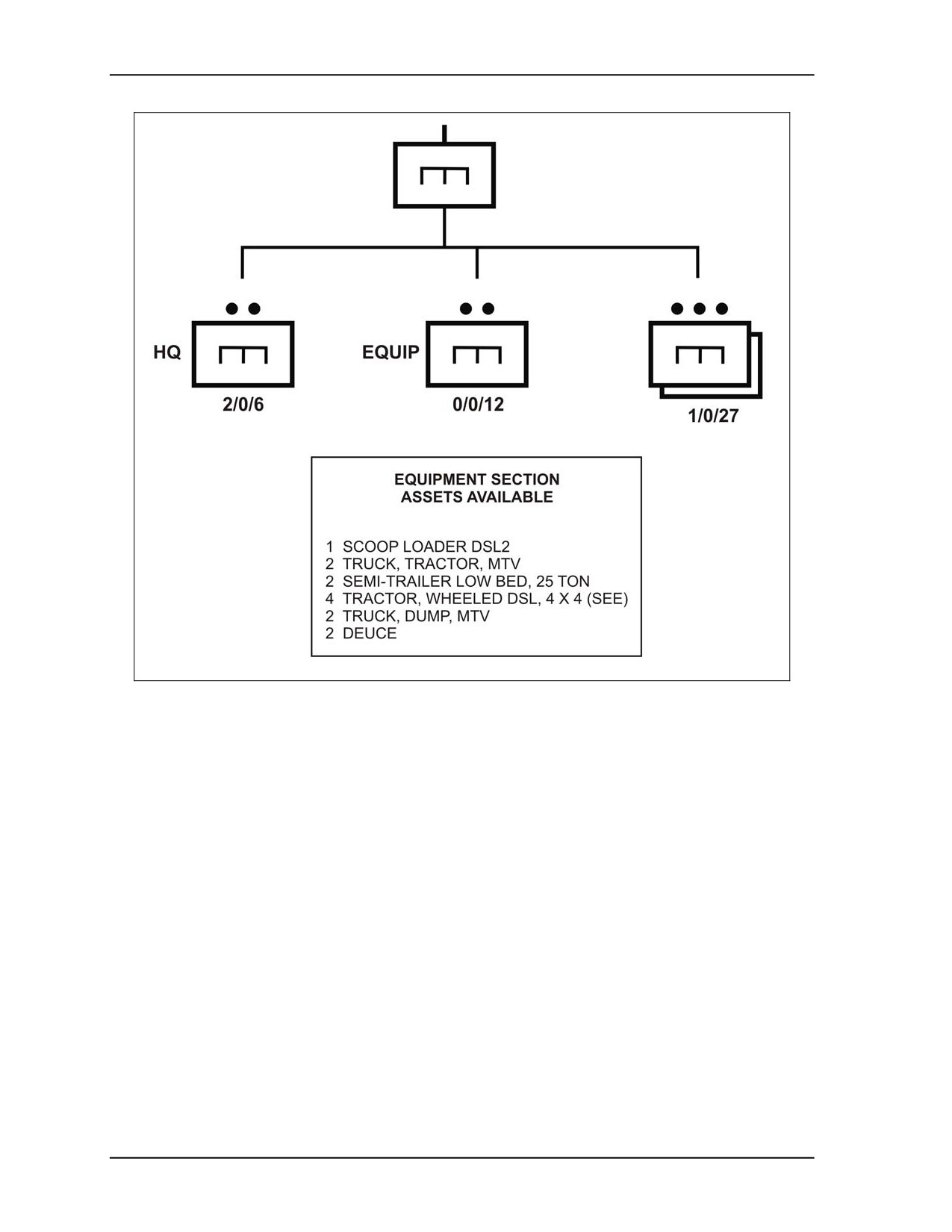
Figure 10-7 is the TOE for the IBCT engineer company.
13 December 2006
FM 3-21.20
10-21
Chapter 10
Figure 10-7. Infantry brigade combat team, engineer company.
ENGINEER PLATOON
10-71.
An engineer platoon may be task organized to a battalion or company, based on the BCT
commander’s analyses of METT-TC. The engineer platoon can be employed to accomplish almost any
engineer mission. However, the lack of organic sustainment assets and minimal depth of C2 and combat
systems will likely require augmentation or external support to conduct continuous operations over a
sustained period (more than 48 hrs). They may also require some augmentation to conduct combined-arms
tasks such as breaching operations. The engineer platoon may receive augmentation from its engineer
company or other units as required.
PLANNING CONSIDERATIONS
10-72.
The maneuver battalion staff plans, integrates, and synchronizes movement and maneuver
(mobility and countermobility), and protection (survivability) throughout the maneuver battalion’s AO. If
task-organized with engineers, the maneuver battalion engineer coordinates all military and civilian
engineer efforts for the maneuver battalion. Engineering tasks include those missions that help establish
and maintain infrastructure that is required to conduct and sustain military operations. Such tasks include
construction and repair of lines of communication, main supply routes, airfields, utilities, and logistical
facilities. FM 5-104 is the primary reference for general engineering planning. Details on staff engineer
responsibilities can be found in FM 3-34.
10-22
FM 3-21.20
13 December 2006
Warfighting Functions
ESSENTIAL MOBILITY AND SURVIVABILITY TASKS
10-73.
An EMST is a specified or implied WFF-specific task that is critical to mission success.
Identifying the essential tasks helps to focus the development of plans, staff coordination, and allocation of
resources. The staff, typically the maneuver support elements (engineer and chemical staff officers),
identifies the EMSTs. Failure to achieve an EMST may require the commander to alter his tactical or
operational plan.
10-74.
A fully developed EMST has a task, purpose, method, and effects. The task describes what
objective (number of lanes, MSR capability, bridging capability, block, turn, fix, and disrupt, protection
levels, and minimum number of survivability positions) must be achieved to support friendly formations or
what it will do to an enemy formation’s function or capability. The purpose describes why the task
contributes to maneuver. The method describes how the task will be accomplished by assigning
responsibility to maneuver units, supporting units, or delivery assets, and providing amplifying information
or restrictions. The effects are a way to try to quantify the successful accomplishment of the task (lanes
open, obstacles/bridging in place and MSR open).
10-75.
The approved EMSTs are described in the concept of operations in the base order. The concept
of operations includes the logical sequence of EMSTs that, when integrated with the scheme of maneuver
will accomplish the mission and achieve the commander’s intent. The scheme of engineer operations, also
in the base order, describes the detailed, logical sequence of mobility, countermobility, and survivability
operations, general engineer tasks, decontamination, smoke, and force protection tasks and their impact on
friendly and enemy units. It details how engineers expect to execute the mobility, countermobility, and
survivability plan IAW the time and space of the battlefield to accomplish the commander’s essential
mobility, countermobility, and survivability tasks.
MOBILITY
10-76.
At the tactical level, superior mobility is critical to the success of the force. Mobility facilitates
the momentum of forces by reducing or negating the effects of existing or reinforcing obstacles. Within
this context, the emphasis of engineer integration is on mobility operations. The commander, staff, and
engineers plan, organize, and prepare to perform mobility tasks using the full range of organic and
augmentation mobility assets. These mobility tasks include combined-arms route clearance, combined-arms
breaching, and maintaining area mobility.
Route Clearance
10-77.
Route clearance is a combined-arms operation typically executed by a maneuver company or
maneuver battalion. Engineers reduce or clear obstacles as part of a route-clearance mission. Units must
clear LOCs of obstacles and enemy activity that disrupt AO circulation. Units must conduct route clearance
to ensure that LOCs enable safe passage of combat, fire support, protection, and sustainment organizations.
Clearance operations are normally conducted in a low-threat environment. The significant difference
between breaching and clearing operations is that breaching usually occurs during an attack (while under
enemy fire) to project combat power to the far side of an obstacle. Route clearance focuses on opening
LOCs to ensure the safe passage of combat and support organizations within an AO. Details on route
clearance are covered in FM 3-34.2.
Combined Arms Breaches
10-78.
Engineers reduce lanes in obstacles as part of a combined-arms breaching operation. Because
of the potentially asymmetrical, nonlinear nature of operations, engineers must be prepared to perform
reduction tasks using manual, mechanical, and explosive reduction means. Through reverse breach
planning, the staff identifies critical mobility tasks, allocates reduction assets, and determines the breach
organization (support, assault, and breach force). Keys to allocating reduction assets include identifying all
reduction tasks within the zone or axis, matching specific reduction assets to each task, and planning
13 December 2006
FM 3-21.20
10-23
Chapter 10
50-percent redundancy in reduction assets for each task. For more specific information on combined-arms
breaching, see FM 3-34.2.
Area Mobility
10-79.
Generating and sustaining combat power requires the maneuver battalion to maintain area
mobility. Area mobility operations include clearing unexploded ordinance, clearing residual minefields,
tracking dirty battlefield effects, and MSR repair and maintenance. Limited organic assets necessitate
augmentation to preserve area mobility. The maneuver battalion staff identifies shortfalls in capability and
coordinates with the BCT to request additional assets.
COUNTERMOBILITY
10-80.
Countermobility is the augmentation of natural or manmade terrain with obstacle systems
integrated with direct and or indirect fire systems to disrupt, fix, turn, or block the enemy while the
maneuver commander destroys the enemy’s combat capabilities with increased time for target acquisition.
The commander and staff integrate obstacles within the maneuver plan, enforcing adherence to obstacle
emplacement authority and obstacle control measures. Task-organized engineers construct limited
conventional minefields, ground emplaced SCATMINEs, special munitions, and explosive and
nonexplosive obstacles in support of the scheme of maneuver. FM 3-34 is the primary reference for
countermobility planning.
SURVIVABILITY
10-81.
Survivability encompasses the development and construction of protective positions such as
earth berms, dug-in positions, and overhead protection as a means to mitigate the effectiveness of enemy
weapon systems. Significant survivability efforts will require engineer augmentation. The staff must plan
and prioritize survivability efforts. The plan should specify the level of survivability for each battle
position and the sequence in which they receive support (if available). The plan should also specify the
type and quantity of needed Class IV, where and when to deliver it. Additional considerations for
survivability planning include command and control of digging assets, site security (including air defense
coverage), sustainment (fuel, maintenance, and Class I), and movement times between battle positions.
FM 5-103 is the primary reference for survivability planning.
SCATTERABLE MINES
10-82.
SCATMINEs are remotely delivered or dispensed by aircraft, artillery, missile, or ground
dispensers and laid without pattern. All US SCATMINEs have a limited active life and self-destruct (SD)
after that life has expired. The duration of the active life varies with the type of delivery system and mine.
10-83.
SCATMINEs provide the commander with a means to respond to a changing enemy situation
with their flexibility and rapid emplacement capabilities. They enable the commander to emplace
minefields rapidly in enemy-held territories, contaminated territories, and other areas where it is impossible
for engineers to emplace conventional minefields. Some systems allow for rapid emplacement of
minefields in friendly areas.
10-84.
During the war gaming process, the engineer, in conjunction with S-3, S-2, and FSO, identifies
the requirement to respond to an enemy action with SCATMINEs. He then determines the minefield
location, size, density, emplacement and SD times, delivery method, and the trigger (decision point) for
execution.
CAPABILITIES
10-85.
SCATMINEs can be emplaced more rapidly than conventional mines, so they provide a
commander with greater flexibility and more time to react to changes in situations. The commander can use
10-24
FM 3-21.20
13 December 2006

Warfighting Functions
SCATMINEs to maintain or regain the initiative by acting faster than the enemy. Using SCATMINEs also
helps preserve countermobility resources that can be used to conduct other operations on the battlefield. As
with all obstacles, SCATMINES should be covered by observation and fires to be effective.
PLACEMENT
10-86.
All SCATMINEs are rapidly emplaced. This enhances battlefield agility and allows the
maneuver commander to emplace mines to best exploit enemy weaknesses. SCATMINEs can be used as
situational obstacles or to attack formations directly by using obstacles that disrupt, fix, turn, and block the
enemy. However they are used, they must be planned and coordinated to fit into the overall obstacle plan.
Modern fusing, sensing, and antihandling devices (AHDs) improve the ability of SCATMINEs to defeat
enemy tries to reduce the minefield.
TACTICAL FLEXIBILITY
10-87.
Upon expiration of the SD time, the minefield is cleared by self-detonation and the commander
can move through an area that was previously denied to enemy or friendly forces. In many cases, the SD
period may be set at only a few hours. This feature allows for effective counterattacks to the enemy's flank
and rear areas. Table 10-5 defines when certain mines begin self-destruction and when destruction is
complete.
Table 10-5. Self-destruct windows.
SD Time
SD Window Begins
4 hours
3 hours 12 minutes
48 hours
38 hours 24 minutes
5 days
4 days
15 days
12 days
LETHALITY
10-88.
SCATMINEs use an explosive technique that produces a full-width kill. The effect produces a
mobility kill against a vehicle’s engine, track, or drive-train, or it produces a catastrophic kill by setting off
the onboard ammunition, killing or incapacitating the crew, or destroying the vehicle’s weapons systems.
SCATMINEs are designed to destroy any tank currently available.
LIMITATIONS
10-89.
The following are limitations of SCATMINEs:
Extensive Coordination
10-90.
Because SCATMINEs are a dynamic weapon system, proper coordination with higher,
adjacent, and subordinate units is extremely important. To prevent friendly casualties, all affected units
must be notified of the location and the duration of SCATMINEs.
Proliferation of Targets
10-91.
SCATMINEs are regarded by some commanders as easy solutions to tactical problems. Target
requests must be carefully evaluated, and a priority system must be established because indiscriminate use
of weapons systems results in rapid depletion of a unit's basic load. Controlled supply rates (CSRs) are
likely to be a constraint in all theaters.
13 December 2006
FM 3-21.20
10-25
Chapter 10
Visibility
10-92.
SCATMINEs are highly effective, especially when fires and obscurants strain the enemy’s C2.
SCATMINEs lay on the surface of the ground, but they are relatively small and have neutral coloring.
Accuracy
10-93.
SCATMINEs cannot be laid with the same accuracy as conventionally emplaced mines.
Remotely delivered SCATMINE systems are as accurate as conventional artillery-delivered or tactical
aircraft-delivered munitions.
Orientation
10-94.
Between 5 and 15 percent of SCATMINEs come to rest on their edges. Mines with spring
fingers are in the lower percentile, and mines landing in mud or snow more than 10 centimeters deep are in
the higher percentile of mines that come to rest on their sides. When employing ADAMs or RAAMs in
more than 10 centimeters of snow or mud, use high-angle fire and increase the number of mines. Melting
of the snow may also cause the mines to change positions and activate AHDs.
DELIVERY SYSTEMS
10-95.
SCATMINE delivery systems include artillery, the Volcano, the GATOR, and MOPMS.
Artillery
10-96.
A 155-mm howitzer delivers ADAMs and RAAMs. Mines are contained within a projectile and
are dispensed while the projectile is in the air. The wedge-shaped ADAM is a bounding-fragmentation
mine that deploys up to seven tension-activated tripwires six meters away from the mine. After ground
impact, tripwires are released and the mine is fully armed. The lethal casualty radius is between 6 and 10
meters. The RAAM mine uses a self-forging fragmentation (SFF) warhead, has a magnetic-influence fuze,
and has a small cylindrical shape.
Multiple-Delivery Mine System
10-97.
The multiple-delivery mine system (Volcano) can be dispensed from the air or on the ground. It
can be mounted on any LMTV, a heavy expanded mobility tactical truck (HEMTT), a palletized load
system (PLS) flat-rack, or a UH-60 Blackhawk helicopter. The mixture of mines is fixed and cannot be
altered. All canisters are capable of dispensing mines with 4-hour, 48-hour, and 15-day SD times. The SD
times are field-selectable before dispensing and do not require a change or modification to the mine
canister. Reload time (not including movement time to the reload site) for an experienced four-Soldier
crew is about 20 minutes. The average time to emplace one ground Volcano load (160 canisters) is 10
minutes.
Gator
10-98.
The CBU-78 Gator is an aircraft delivered weapon that contains antitank and antipersonnel
mines. These mines can be detonated by target sensors (magnetic field for antitank and trip line for
antipersonnel) or by a disturbance/antidisturbance device. They also have a backup self-destruct time set
before aircraft launch. The Gator mine system provides a means to emplace minefields on the ground
rapidly using high-speed tactical aircraft. The minefields are used for area denial, diversion of moving
ground forces, or to immobilize targets to supplement other direct attack weapons.
10-26
FM 3-21.20
13 December 2006
Warfighting Functions
Modular Pack Mine System
10-99.
The MOPMS is a man-portable, 162-pound, suitcase-shaped mine dispenser. The dispenser
contains 21 mines (17 AT and 4 antipersonnel AP) in seven tubes with three mines located in each tube.
When dispensed, an explosive propelling charge at the bottom of each tube expels mines through the
container roof. Mines are propelled 35 meters from the container in a 180-degree semicircle. The safety
zone around one container is 55 meters to the front and sides and 20 meters to the rear.
10-100.
Mines are dispensed on command using an M71 remote-control unit (RCU) or an electronic
initiating device. Once mines are dispensed, they cannot be recovered or reused. If mines are not
dispensed, the container may be disarmed and recovered for later use. The RCU can recycle the 4-hour SD
time of the mines three times, for a total duration of about 13 hours. Mines with a 4-hour SD time will
begin to self-destruct at 3 hours and 12 minutes. All active mines must be recycled within 3 hours of the
initial launch or last recycle. This feature makes it possible to keep the minefield emplaced for longer
periods if necessary. The RCU can also self-destruct mines on command, allowing a unit to counterattack
or withdraw through the minefield, as necessary, rather than waiting for the SD time to expire. The RCU
can control up to 15 MOPMS containers or groups of MOPMS containers from a distance of up to 1,000
meters.
10-101.
The ability to command-detonate mines or extend their SD time provides an added flexibility
not currently available with other SCATMINE systems. With its unique characteristics, the MOPMS is
ideally suited for the following minefield missions:
• Emplacing hasty and deliberate protective minefields.
• Emplacing nuisance minefields (on trails, crossing sites, landing zones, drop zones, and road
junctions).
• Emplacing tactical disrupt and fix minefields.
• Closing gaps and lanes in existing minefields.
• Temporarily closing counterattack routes.
• Supporting ambushes.
• Reseeding minefields.
COMMAND AND CONTROL
10-102.
Due to the delivery means, C2 of SCATMINEs is more complex than with conventional mines.
SCATMINEs are very dynamic weapons systems because they can be rapidly emplaced and then cleared
by way of their SD capability. In addition, the physical boundary of a SCATMINE is not clearly defined.
These characteristics require impeccable communications and coordination to ensure that all friendly units
know where mines are located, when they will be effective, and when they will self-destruct.
Emplacement Authority
10-103.
The corps commander has emplacement authority for all SCATMINEs within the corps AO.
He may delegate this authority to lower echelons according to the guidelines in Table 10-6.
13 December 2006
FM 3-21.20
10-27

Chapter 10
Table 10-6. Emplacement authority.
System Characteristics
Emplacement Authority
Ground or artillery-delivered, with SD time greater
Emplacement authority may be delegated to the
than 48 hours (long duration).
BCT Commander.
Ground or artillery-delivered, with SD time 48
Emplacement authority may be delegated to the
hours or less (short duration).
BCT Commander and further delegated to the
battalion level.
Aircraft-delivered (Gator), regardless of SD time.
Emplacement authority may be delegated to the
BCT Commander and further delegated to the
battalion level.
Helicopter-delivered (Volcano), regardless of SD
Emplacement authority is normally delegated no
time.
lower than the commander who has command
authority over the emplacing aircraft.
MOPMS when used strictly for a protective
Emplacement authority is usually granted to the
minefield.
company or base commander. Commanders at
higher levels restrict MOPMS use only as
necessary to support their operations.
10-104.
Based on how the commander wants to shape the battlefield, he must specifically delegate or
withhold the authority to employ SCATMINE systems.
10-105.
Due to the complete control a commander has over the MOPMS, emplacement authority
guidelines do not apply to the MOPMS. It is impractical for the corps or brigade commander to authorize
every MOPMS protective minefield. Therefore, authority to emplace MOPMS minefields is specifically
delegated. In general, units can emplace MOPMS protective minefields as required for their own
self-defense and report them as they do any protective obstacle. Any MOPMS minefield used as part of an
obstacle plan must be reported as a SCATMINE.
Coordination
10-106.
Table 10-6 outlines basic responsibilities of key commands, staff elements, and units. The FSO
is involved in planning artillery-delivered (ADAM and RAAM) SCATMINEs, and the air liaison officer is
involved in planning air-delivered (Gator) SCATMINEs. The engineer has primary responsibility for
planning and employing SCATMINE systems. It is vital that coordination be conducted with all units and
subunits that will be affected by the employment of SCATMINEs. A scatterable minefield warning
(SCATMINWARN) is sent to all affected units before the emplacement of the minefield.
MARKINGS
10-107.
The maneuver unit that is responsible for the area of ground in which the minefield is emplaced
is also responsible for marking the minefield. This procedure normally requires direct coordination
between elements of the maneuver command (usually the engineer) and the delivering or emplacing unit.
However, it is unrealistic to expect units to mark artillery-delivered ADAM and RAAM, air-delivered
Volcano, or Gator minefields. For this reason, units operating near these minefields must know calculated
safety zones and use extreme caution.
Safety Zones
10-108.
A safety zone is an area where a stray or outlying mine has a chance of landing and laying at
rest. The commander must prevent friendly forces from maneuvering into the safety zone during the
minefield's life cycle. Depending on its specific location on the battlefield, the safety zone may be marked
with a fence.
10-28
FM 3-21.20
13 December 2006

Warfighting Functions
Fragment Hazard Zones
10-109.
If an AT mine that is oriented on its side self-destructs, the explosively formed projectile (EFP)
can theoretically travel 640 meters. Tests indicate that the acceptable risk distance is 235 meters from the
outer edges of the minefield's safety zone. This fragment hazard zone is also associated with Gator and
MOPMS AT mines. Commanders must be aware of the fragment hazard zone when the MOPMS is used
for protective minefield missions. Use Table 10-7 to determine the safety and fragment hazard zones.
Table 10-7. Safety and fragment hazard zones.
SYSTEM
SAFETY ZONE
FRAGMENT HAZARD ZONE
ADAM/RAAM
500 to 1,500 meters from aim point(s)
235 meters from the outside
(depends on delivery method)
dimensions of the safety zone
Gator
925 x 475 meters from aim point(s)
1,395 x 945 meters from aim point(s)
Ground
1,150 x 160 meters
235 meters from start and stop point
Volcano
and the center line
Air Volcano
1,315 x 200 meters
235 meters from start and stop points
and the center line
MOPMS
See FM 20-32 for specific placement
235 meters from the outside
dimensions of the safety zone.
ADAMs and RAAMs Safety Zones
10-110.
The FSO is responsible for obtaining safety zones. Safety zones may be computed by the BCT
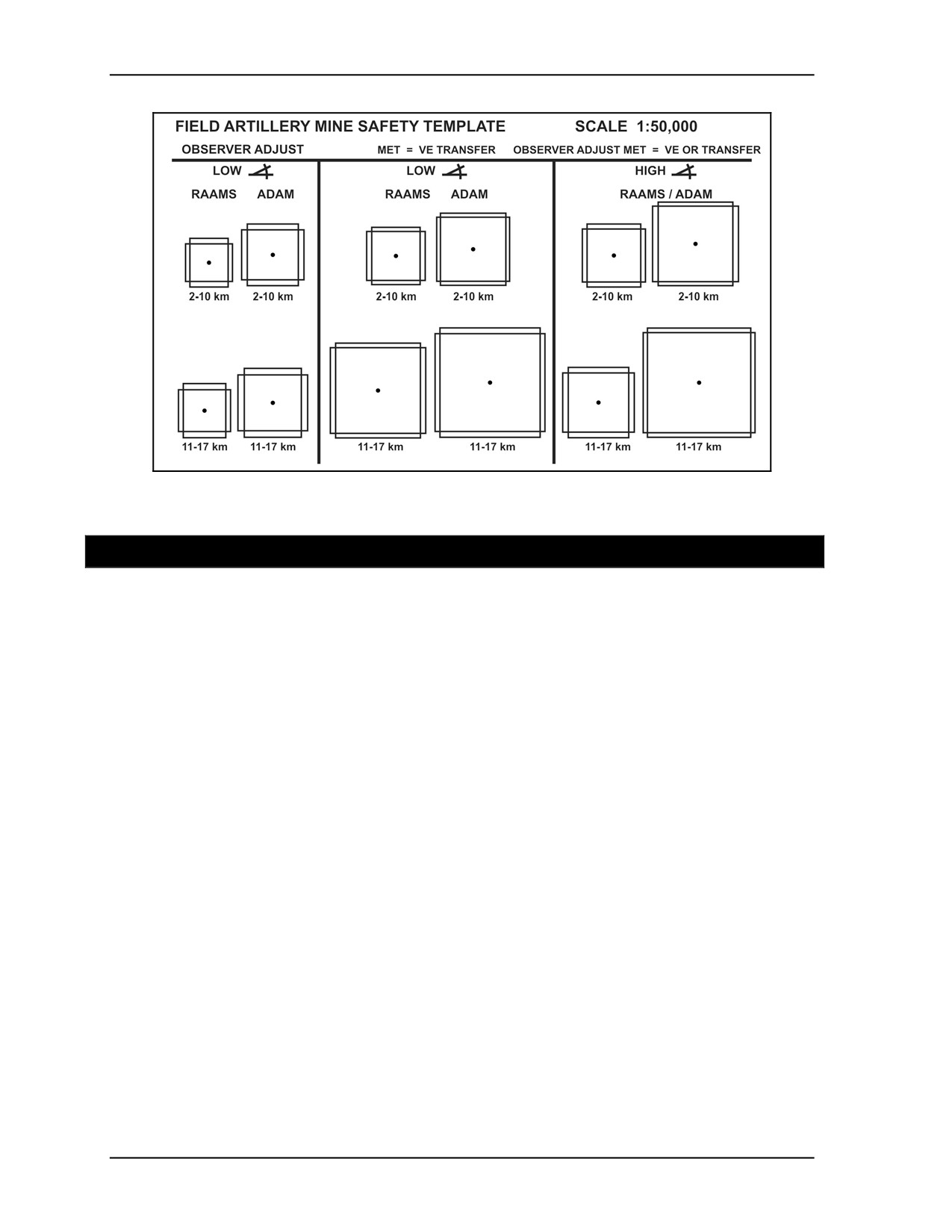
field artillery battalion FDC or by the FSO using a safety zone table. An alternative method is to use a mine
safety template. The engineer is responsible for disseminating the safety zones to appropriate units.
Use of Mine Safety Template
10-111.
Enter the template (Figure 10-8) with the fired minefield data—
• Technique (meteorological + velocity transfer or observer adjust).
• Trajectory (high or low angle).
• Type of projectile fired (RAAM or ADAM).
• Range (to minefield center).
• Aim point coordinates (center or left and right).
10-112.
Center the selected template safety zone square over the aim point(s). Draw a square to
establish the minefield safety zone.
13 December 2006
FM 3-21.20
10-29
Chapter 10
Figure 10-8. ADAMs and RAAMs minefield safety template.
Section III. PROTECTION
The objective of air defense is to limit the effectiveness of enemy offensive air efforts to a level that permits
freedom of action to all friendly forces. Maneuver units who conduct close operations must be protected from
the primary threat of attack helicopters, unmanned aerial systems, and high-performance aircraft. At the same
time, high-priority assets in the rear must also be protected from enemy air strikes.
MISSION
10-113.
Air defense artillery protects the force and selected assets from aerial attack and surveillance.
Early engagement of enemy aircraft is one of the most important SHORAD employment guidelines. The
high-to-medium-altitude missile air defense (HIMAD) and joint sensors pass information to the SHORAD
weapons for engagement. The primary aerial threats that must be countered by SHORAD systems are:
UAS, rotary-wing aircraft, cruise missiles, fixed-wing aircraft, rocket, artillery, and mortar fires.
ORGANIZATION
10-114.
The IBCT has no organic ADA capability. ADA assets come from echelons above the BCT.
ADA assets are normally deployed in the BCT AO by locating them with overlapping coverage areas.
While not normally attached to the battalion, man-portable air defense (MANPAD) or Stinger teams can be
deployed in Infantry battalion AOs for air defense coverage. Another ADA asset is the Avenger.
STINGER MISSILE
10-115.
The Stinger missile is usually the battalion’s primary air defense weapon system. The Stinger is
a short-range, heat-seeking guided missile that can be shoulder-fired. It is designed to counter the threat of
advance helicopters, UAS, remotely piloted vehicles (RPVs), high-speed maneuvering aircraft, and cruise
missiles. The Stinger has a range in excess of 5 kilometers.
10-116.
The Stinger can be employed as a MANPADS. The two-Soldier Stinger team, consisting of a
gunner and a crew chief, is normally transported in a HMMWV.
10-30
FM 3-21.20
13 December 2006
Warfighting Functions
AVENGER
10-117.
The Avenger weapon system is a lightweight, day or night, limited adverse weather firing unit
employed to counter low-altitude aerial threats. The firing unit consists of two Stinger vehicle-mounted
launchers (SVMLs, located on the turret), a machine gun, a forward-looking infrared (FLIR) sight, a laser
range finder (LRF), and an identification friend or foe (IFF). The gyrostabilized turret is mounted on a
HMMWV. The firing unit can launch a missile or fire the machine gun on the move or from a stationary
position with the gunner in the turret. It can also be remotely operated from a location up to 50 meters
away. Onboard communications equipment provides for radio and intercom operations.
LAND-BASED PHALANX WEAPON SYSTEM
10-118.
The LPWS is a 20mm gun with multifrequency KU band radar for surveillance and tracking. It
has a potential area defense against threat rocket, artillery, and mortars (RAM). The LPWS is an integral
part of the counterrocket, artillery, and mortar (C-RAM) intercept battery. The C-RAM intercept battery,
when deployed, can operate jointly with coalition forces, allies, and other services within the theater.
Operationally, the C-RAM intercept battery will normally operate under a base defense operations center
(BDOC) at an FOB.
PLANNING CONSIDERATIONS
10-119.
AD units may be attached to the battalion. When attached, the senior leader of the AD unit
becomes the ADO for the battalion.
10-120.
AD employment guidelines are used as aids for positioning individual AD firing units. The six
AD employment guidelines are—
Early Engagement
10-121.
Firing units must be positioned where they can engage enemy air platforms before the enemy
can release his ordnance on or gain intelligence about friendly forces. Firing units should be located well
forward and integrated into the supported battalion’s scheme of maneuver. In less likely missions of
defending a static asset, firing units should be positioned forward of the supported force along likely
enemy air avenues of approach.
Weighted Coverage
10-122.
Once the supported force commander designates his decisive operation, stinger teams should be
positioned along the most likely air avenues of approach to support the commander’s scheme of maneuver.
It is extremely important that detailed, in-depth air IPB is developed before deciding where to weight
coverage of air defense assets.
Depth
10-123.
Depth is achieved by positioning firing units so enemy air platforms encounter a continuous
volume of fire as they approach the protected force or asset. Depth is achieved by positioning assets so that
they can provide continuous fires along enemy air avenues, destroying the enemy as it advances toward the
protected force or asset. Depth is maximized through the integration of all air defense weapons. Additional
air defense assets on the battlefield, such as other Stinger teams, Avenger firing units, HIMAD assets, and
combined-arms air defense efforts from ground forces, contribute to the creation of depth on the battlefield.
13 December 2006
FM 3-21.20
10-31
Chapter 10
Balanced Fires
10-124.
Positioning air defense weapons to distribute fire equally in all directions creates balanced fires.
Except for the mission of defense of a static asset, where no clear avenues of approach are identified, this
guidance is seldom employed. As an example, on a flat, open battlefield characteristic of some desert
environments, no specific air corridor exists. In this situation, planning for balanced fires may be viable.
Mutual Support
10-125.
Mutual support is achieved by positioning weapons to complement fires from adjacent firing
units, thus preventing the enemy from attacking one position without being subjected to fire from one or
more adjacent positions. Mutual support enhances volume of fire and covers the dead space of adjacent
units. The planning range for mutual support for Stinger systems is about 2,000 meters.
Overlapping Fires
10-126.
Because of the battalion’s extended battlespace and a scarcity of available Stinger systems, the
air defense planner should try to enhance air defense protection by positioning firing units so that
engagement includes overlap. The planning range for overlapping fires for Stinger systems is about 4,000
meters.
ROLE OF AIR DEFENSE OFFICER
10-127.
When augmented with ADA assets, the unit commander or leader will serve as the battalion’s
air defense officer. The ADO must participate in the MDMP as an integral member of the battalion staff.
The ADO should work closely with the S-2 during the IPB process. He is best suited to prepare and brief
the air IPB. Airspace or the aerial dimension of the battlefield is the most dynamic and fast-paced of the
three dimensions.
MISSION ANALYSIS
10-128.
The most significant threats that must be evaluated at the battalion level for aerial IPB are UAS,
fixed-wing aircraft, and rotary-wing aircraft.
Air Threat Overview
10-129.
Air avenues of approach, type of air threat, probable threat objective, and potential to support
the maneuver forces.
Specified, Implied, and Essential Tasks
10-130.
From the air defense perspective such as early warning.
Constraints and Restrictions
10-131.
Initial air defense warning status, weapons control status, and systems limitations.
Forces Available
10-132.
SHORAD, HIMAD, and sensor coverage.
10-32
FM 3-21.20
13 December 2006
Warfighting Functions
Platoon Status
10-133.
Human resource, maintenance posture, weapons status, and missile supply.
Issues
10-134.
Coordination for related issues such as missile resupply.
ADDITIONAL RESPONSIBILITIES
• Assisting the S-3 in planning and executing the air defense portion of the operation.
• Advising the commander and S-3 on the employment of air defense assets.
• Coordinating with the S-3 air, FSO, and FAC for the appropriate air defense posture and A2C2.
• Controlling integration of air defense elements and early warning systems.
• Recommending priorities to the commander:
-- Threat. Reverse target value analysis.
-- Criticality. Force or asset that is essential to mission accomplishment.
-- Vulnerability. Susceptibility to surveillance and attack.
-- Recuperability. In terms of time and equipment.
10-135.
The ADO is also responsible for the execution of the air defense plan. He must monitor the
positioning and coverage provided by his assets and other ADA assets, recommending changes to the plan
based on the enemy threat and changes in the scheme of maneuver.
AIR DEFENSE TYPES
10-136.
The battalion adopts its air defense posture based on the type of supporting AD assets that are
attached. The battalion always uses a combination of active and passive measures to protect itself against
air attack.
PASSIVE AIR DEFENSE
10-137.
There are two types of passive air defense measures: attack avoidance and damage-limiting
measures. Attack avoidance measures are used to avoid being detected by the enemy. Damage-limiting
measures are those taken to avoid damage from air attack such as vehicle dispersion, camouflage, and
dug-in fighting positions with overhead protection.
Attack Avoidance
10-138.
Attack avoidance involves taking the actions necessary to avoid being seen by the enemy to
include concealment (the protection from observation or surveillance) and, more specifically, camouflage
(the use of natural or artificial material on personnel, objects, or tactical positions with the aim of
confusing, misleading, or evading the enemy). The techniques, procedures, and materials used for
concealment from aerial observation are the same as those used for concealment from ground observation.
Damage-Limiting Measures
10-139.
Damage-limiting measures are an try to limit any damages if the enemy detects friendly forces.
These measures are used when the troop or its platoons are located in a static position such as an assembly
area or when they are maneuvering. If caught in the open, personnel should immediately execute battle
drills and move to positions of cover and concealment that reduce the enemy's ability to acquire or engage
them. The same measures taken to limit damage from artillery attack are used for dispersion, protective
construction, and cover.
13 December 2006
FM 3-21.20
10-33
Chapter 10
ACTIVE AIR DEFENSE
10-140.
Although passive measures are the first line of defense against air attack, troops must be
prepared to engage attacking enemy aircraft. The decision to fight an air threat is based on the immediate
situation and weapons system capabilities. Based on the mission, companies do not typically engage
aircraft except for self-preservation or as directed by the battalion or company commander.
Crew-Served and Vehicle Weapons Systems
10-141.
Crew-served weapons and vehicle weapons systems provide a large volume and lethal means of
engaging threat aircraft. When different munitions are available, use the currently loaded munitions, and
then reload with the appropriate munitions to engage the aircraft.
Small Arms Used for Air Defense
10-142.
Small arms used for air defense incorporate the use of volume fire and proper aiming points
according to the target. The key to success in engaging enemy air is to put out a high volume of fire. The
commander must decide whether to engage and must provide the engagement command for the entire unit
to fire upon the attacking aircraft rather than having Soldiers fire at the aircraft individually.
AIR DEFENSE WARNINGS AND WEAPONS CONTROL STATUS
10-143.
Battalion leaders should ensure their subordinates understand the air threat and air threat
warning conditions.
10-144.
Air defense conditions are stated in the OPORD:
• Red. Indicates the attack is imminent.
• Yellow. Indicates that an attack is probable.
• White. Indicates that an attack is not likely.
10-145.
A local air defense warning (LADW) describes the air threat in the immediate area. LADWs
are designed to alert a particular unit, several units, or an area of the battlefield of an impending air attack.
AD units use LADWs to alert Army units about the state of the air threat in terms of "right here and right
now." They can be used in conjunction with air defense warnings (ADWs). Examples of LADWs are
described below:
• Dynamite. Indicates an attack is imminent or in progress.
• Look-out. Indicates an attack is likely.
• Snowman. Indicates an attack is not likely.
10-146.
Weapons control status determines the conditions for using weapons against enemy aircraft:
• Weapons Free. Enemy air is probable, and Soldiers may fire at aircraft not positively identified
as friendly.
• Weapons Tight. Enemy air is possible, and Soldiers may fire only at aircraft positively
identified as hostile according to announced hostile criteria.
• Weapons Hold. Enemy air is not likely, and Soldiers may not fire except in self-defense.
CHEMICAL, BIOLOGICAL, RADIOLOGICAL,
AND NUCLEAR OPERATIONS
10-147.
Introducing CBRN weapons into conventional tactical operations results in an integrated
battlefield. A battalion fights on an integrated battlefield the same as on a conventional battlefield.
However, in a CBRN environment, the battalion must be ready to implement protective measures to
10-34
FM 3-21.20
13 December 2006
Warfighting Functions
enhance its survivability and must provide timely information to higher headquarters about possible
contaminations to aid in protecting the BCT and other units.
10-148.
CBRN operations are conducted as a response to conditions on the battlefield. Chemical staff
personnel adhere to the following three principles:
AVOIDANCE
10-149.
Avoiding CBRN attacks and hazards is the key to CBRN defense. Avoidance involves both
active and passive measures. Passive measures include training, camouflage, concealment, hardening
positions, and dispersion. Active measures include detection, reconnaissance, alarms and signals, warning
and reporting, marking, and contamination control.
PROTECTION
10-150.
CBRN protection is an integral part of operations. Techniques that work for avoidance also
work for protection such as shielding Soldiers and units and shaping the battlefield. Activities that
comprise protection involve sealing or hardening positions, protecting Soldiers, assuming MOPP, reacting
to attack, and using collective protection.
DECONTAMINATION
10-151.
CBRN decontamination prevents the erosion of combat power and reduces possible casualties
resulting from inadvertent exposure or failure of protection. Decontamination allows commanders to
sustain combat operations. Decontamination principles involve; conducting decontamination as quickly as
possible, decontaminating only what is necessary, decontaminating as far forward as possible, and
decontaminating by priority (FM 3-11.4).
CHEMICAL, BIOLOGICAL, RADIOLOGICAL, AND NUCLEAR PERSONNEL IN INFANTRY
BATTALION
10-152.
The battalion chemical officer, along with the CBRN NCO, advises the commander on all
CBRN matters. The chemical officer is responsible for collecting, consolidating, and distributing all CBRN
reports from subordinate, adjacent, and higher units. Battalion chemical personnel inspect chemical
equipment and train subordinate units on CBRN defensive tasks. As a member of the S-3 plans and
operations section, the battalion chemical officer is normally found in the main CP. The chemical officer
acts as the liaison with any attached chemical elements. He is required to coordinate closely with the S-2
on the current and updated CBRN threat. Together they develop CBRN NAIs. The chemical officer
coordinates with the FS and aviation personnel on planned smoke operations and advises them of hazard
areas. He also coordinates with the S-4 on CBRN logistics matters, such as mission-oriented protective
posture, protective mask filters, and fog oil; and identifies “clean” and “dirty” routes and contaminated
casualty collection points.
MILITARY POLICE SUPPORT
10-153.
MP assets may be tasked to support maneuver units to assist in maintaining maneuverability,
survivability, security, law enforcement, discipline and control, and other operations. Commanders must
consider where MP support would be most effective in order to maximize MP resources and must be
prepared to designate other Soldiers within the battalion to assist in their execution.
13 December 2006
FM 3-21.20
10-35
Chapter 10
MILITARY POLICE SUPPORT MISSION
10-154.
The organic BCT MP platoon provides support to the BCT and subordinate battalions through
their five primary battlefield functions.
• Maneuver and mobility support.
• Area security.
• Law and order.
• Internment and resettlement.
• Police intelligence operations.
Maneuver and Mobility Operations
10-155.
MPs can support maneuver and mobility functions by expediting forward and lateral movement
of combat resources. MPs used in the circulation control role can perform the following functions.
• River crossing operations, breaching operations and passage of lines.
• Route reconnaissance and security.
• MSR regulation and enforcement.
• Straggler control.
• Dislocated civilian control.
Area Security
10-156.
MPs provide area security and force protection to enhance the maneuver unit’s freedom to
conduct missions. Area security actions include zone and area reconnaissance; counterreconnaissance
activities; and security of designated personnel, equipment, facilities, and critical points. These actions also
include convoy and route security. Specific actions include the following:
• Reconnaissance operations.
• Area damage control.
• Base and air base defense.
• Response force operations.
• Critical site, asset, and high-risk personnel security.
Law and Order Operations
10-157.
MPs conduct law and order operations when it becomes necessary to extend the combat
commander's discipline and control. These operations consist of those measures necessary to enforce laws,
directives, and punitive regulations, conduct military police investigations, and to control populations and
resources to ensure the existence of a lawful and orderly environment for the commander. Evolving
criminal threats impact military operations and require the commander to minimize the threat to forces,
resources, and operations. Close coordination with host-nation civilian police can enhance MP efforts at
combating terrorism, maintaining law and order, and controlling civilian populations. Law and order
operations include the following:
• Law enforcement.
• Criminal investigations.
• US customs operations.
Internment and Resettlement Operations
10-158.
MPs support tactical commanders by undertaking control of populations (EPW and dislocated
civilians) and US military prisoners. Internment and resettlement operations include the following:
10-36
FM 3-21.20
13 December 2006
Warfighting Functions
• EPW/CI handling.
• Populace and resource control.
• US military prisoner confinement.
Police Intelligence Operations
10-159.
Police intelligence operations consist of those measures to collect, analyze, and disseminate
information and intelligence resulting from the other four primary MP battlefield function and other MP
and Criminal Intelligence Division (CID) operations. The collection of this information is integrated into
the overall ISR plan.
EMPLOYMENT AND PLANNING CONSIDERATIONS
10-160.
The factors of METT-TC must be considered when using MP support. During offensive
operations, MPs best support the BCTs, and subsequently the battalion’s maneuver and mobility. To do
this, they control road traffic and facilitate route movement, evacuation, and control of refugees, stragglers,
and enemy prisoners of war. In the defense, MPs are best employed in the area security role to enhance
maneuver and mobility. MP resources must be synchronized and weighted to support the decisive
operation, just as is any other asset. MP support might be unavailable or inadequate to perform all
necessary MP battlefield functions at once. Commanders must prioritize those missions, and they may
choose other units within the BCT, including Infantry and weapons companies and platoons, to aid in
executing those missions.
Section IV. COMMAND AND CONTROL (SIGNAL)
The communications section provides the battalion with communications experts capable of supporting
battalion and subordinate companies. The section provides trained communications personnel to each maneuver
company who coordinate closely with the S-3 section to ensure and maintain clear lines of communication
during tactical operations. The communications section is responsible for the transfer of information and the
development of communications policies, procedures, and training for the battalion commander.
BATTALION SIGNAL OFFICER
10-161.
The communications section leader is the battalion signal officer (S-6) and the primary planner
for battalion communication operations. He advises the battalion commander, staff, and the maneuver
companies on all signal and communication matters. The duties of the battalion signal officer include—
• Plans, manages, and directs all aspects of the unit communications systems.
• Plans, supervises integration of communications with headquarters up, down, and adjacent.
• Supervises the communications activities of subordinate and attached units.
• Supervises unit maintenance of signal equipment for the unit and for subordinate units.
• Monitors status of support maintenance on unit and subordinate unit signal equipment.
• Prepares and writes the signal annex of unit orders and plans.
• Advises commander and staff on ECCM and develops MIJI reporting procedures.
• Helps the S-3 determine the location of the main, combat trains and field trains CPs.
• Ensures selected areas offer the best communications and the least interference.
BATTALION COMMUNICATIONS SECTION
10-162.
The communications section, lead by the S-6, is responsible for performing limited unit level
repair and maintenance. It also conducts evacuation of the battalion’s digital and wire communications
13 December 2006
FM 3-21.20
10-37
Chapter 10
equipment as well as maintenance of the digital system architecture that connects platoon, company and
battalion to the BCT and higher networks; and on both secure and nonsecure local area networks. The
communications section also has the capability to provide two retrans stations for the battalion, and
normally provides one Soldier to each company during operations as a communications equipment expert.
Section V. INTELLIGENCE
In the Infantry battalion, the primary means to obtain information is through subordinate maneuver companies,
patrols, scout platoon, snipers, OPs, and FISTs. The battalion S-2 is the primary staff officer responsible for
coordination of information collection and dissemination by planning use of battalion reconnaissance and
surveillance assets. The S-2 is responsible for all steps of the collection management process. The result is an
ISR plan integrated into the BCT ISR plan. The BCT has robust ISR assets, and the S-2 may request additional
intelligence support through the BCT. If allocated, these assets would operate normally DS or GS to
the battalion.
INFANTRY BATTALION INFORMATION, SURVEILLANCE,
AND RECONNAISSANCE ASSETS
10-163.
Information gathering at the Infantry battalion level is accomplished through a variety of
means. The principal ISR resources available to the battalion include its organic scout platoon, snipers, and
subordinate maneuver companies. Individual Soldiers, observation posts, and patrols are used and relied
upon to collect and report information about the enemy, terrain, and weather. The paragraphs below
discuss the assets most common to the Infantry battalion.
INDIVIDUAL SOLDIERS
10-164.
Individual Soldiers provide company and battalion commanders with a large quantity of timely
combat information. They perform patrols, man observation posts, and observe enemy forces with which
they are in contact. They observe and report first-hand information concerning enemy troops and
equipment, patrols, reconnaissance units, and the activities of each. The size, activity, location, unit, time,
and equipment (SALUTE) format for situation reports is the basis for both the training of individual
Soldiers and the reporting of combat information.
OBSERVATION POSTS
10-165.
The battalion establishes OPs to observe and listen to enemy activity within particular sectors
and to provide warning of the enemy’s approach. Units should place OPs where they can be supported by
fire and have access to covered and concealed withdrawal routes. Communications between the parent unit
and each observation post are essential. Ground surveillance radars, remote sensors, UASs, and night
observation devices can augment OPs.
PATROLS
10-166.
Patrols are conducted both before and during combat operations for reconnaissance,
counterreconnaissance, and security purposes. They are also used to conduct small-scale combat
operations. There are two categories of patrols, reconnaissance, and combat.
10-167.
Reconnaissance patrols are used to collect information and confirm or disprove the accuracy of
other information gained previously. The three main types of reconnaissance patrols are—
• Route reconnaissance to obtain information about the enemy and any dominating terrain
features along the route.
10-38
FM 3-21.20
13 December 2006
Warfighting Functions
• Zone reconnaissance to collect the information about enemy forces and the terrain between
specific boundaries.
• Area reconnaissance to gather information about the enemy or the terrain within a defined area
such as a town, ridgeline, woods, or other feature critical to current or planned operations.
10-168.
Combat patrols are used to provide security and to harass, destroy, or capture enemy personnel,
equipment, and installations. There are three types of combat patrols; raid, ambush, and security. The
collection and reporting of combat information is usually a secondary mission for combat patrols. Captured
enemy Soldiers, equipment, and documents are evacuated to the rear for exploitation at higher echelons.
The results of such actions may prove to be of significant value as either tactical or strategic intelligence.
RIFLE AND WEAPONS COMPANIES
10-169.
Individual Soldiers, OPs, small UAS, and patrols are the principal means available to maneuver
company commanders to gather information about the enemy, terrain, and weather in their immediate areas
and to acquire targets for immediate attack.
10-170.
The Javelin command launch unit is used in all weather and visibility conditions to assist
Soldiers in gathering information.
10-171.
The weapons company equipped with the TOW ITAS is also capable of information gathering
in all weather and visibility conditions.
10-172.
Small/close range UAS such as the Raven UAS; provide aerial company and platoons short
duration (flight time of 1 hour) and range (less than 15 kilometers) observation. Small UAS provide limited
duration aerial observation, limited to fair weather, and some limited visibility operations.
SCOUT PLATOON
10-173.
As the primary intelligence-gathering asset, the mission of the scout platoon is to provide
reconnaissance and security for its parent battalion and to assist in the control and movement of the
battalion and its subordinate elements.
10-174.
The scout platoon is used to—
• Conduct route, zone, and area reconnaissance missions.
• Establish observation posts.
• Conduct chemical detection and radiological survey and monitoring operations.
• Screen one flank, the front, or rear of the battalion.
• Act as part of an advance, flank, or rear guard.
• Establish a roadblock.
• Provide traffic control and road guides.
• Conduct damage assessment.
• Provide contact teams, conduct liaison missions, and perform quartering functions. It also
conducts limited pioneer and demolition work.
10-175.
The battalion commander may attach the scout platoon to a maneuver company for a specific
operation. The battalion S-2 normally supervises reconnaissance operations. He coordinates these
requirements with the battalion S-3. Security operations provide early warning of enemy maneuvers and
deny information to the enemy concerning the battalion's disposition or movements. The battalion S-3
plans and supervises security operations. He coordinates with the S-2 for information on enemy activity.
SNIPERS
10-176.
The organic battalion sniper section normally operates in three man teams. They have excellend
cross-country mobility and excel at surveillance as as the skilled us of cover and concealment. Inherent in
13 December 2006
FM 3-21.20
10-39
Chapter 10
the sniper’s ability to engage targets at long range, is their ability to conduct reconnaissance and
surveillance in excess of their weapons range. Snipers can observe and report on NAIs and PIR.
Consideration should be given to target selection engagement criteria when selecting reconnaissance and
surveillance targets for snipers (Appendix F).
IBCT INFORMATION, SURVEILLANCE,
AND RECONNAISSANCE ASSETS
10-177.
Ground surveillance radar teams, remote sensor teams (if available) from the BCTs military
intelligence company, and UAS are also available to help satisfy the maneuver company and battalion
commanders' ISR requirements.
GROUND SURVEILLANCE RADAR
10-178.
The AN/PPS-5D detects, locates, identifies, and tracks moving ground targets in an area under
surveillance. The GSR detects moving ground targets only and cannot distinguish between enemy and
friendly targets. GSRs provide the maneuver battalion a highly mobile, near all-weather, 24-hour capability
for battlefield surveillance. They may be employed on patrols and at observation posts and are used with
remote sensors and night observation devices. They may be employed near the FLOT, forward of the
FLOT, on the flanks, or in the rear area. The supported battalion S-2, company commander, or scout
platoon leader selects general locations where the radar may operate. The GSR team leaders select the
actual site within these general locations.
10-179.
Generally, GSRs are located with or near other friendly units such as scouts and OPs. This
allows mutual support, security, and complementary intelligence gathering capability.
REMOTELY-MONITORED BATTLEFIELD SURVEILLANCE SYSTEM
10-180.
The remotely-monitored battlefield surveillance system (REMBASS) can detect and classify
moving targets by responding to seismic acoustic disturbances, changes to infrared energy and magnetic
field changes produced by the targets. REMBASS sensors are placed along likely avenues of approach,
choke points, and obstacles. (The number of sensor strings depends on the area being covered.) The first
sensor is normally a seismic acoustic sensor for early warning and classification. The second sensor is
normally a count indicator of the expected type of target; a magnetic sensor for vehicles and an
infrared-passive sensor for personnel. The count indicator sensor provides the number of targets and
direction of travel. The third sensor is also a count indicator and provides rate of speed and length of
column. Once the sensors are activated, they send a burst of digital message to the monitoring station. The
system requires radio LOS to transmit activations from the sensors to the monitor station. With the
collected information, the operator prepares and submits a sensor activation spot report to the ISR
integration section at the squadron or to the supported unit.
TACTICAL UNMANNED AIRCRAFT SYSTEMS (UAS)
10-181.
Tactical UAS see short and close range UAS that are available in the Infantry company,
battalion, and BCT. Tactical UAS are organic to the IBCT and provide good observation and targeting
capability under most weather conditions. They also provide IR observation capability in limited visibility.
Short range UAS, also referred to as small UAS generally have a flight time of 6 to 12 hours, a range of
less than 125 miles, and may have the capability to laser designate a target. Regardless of the system,
tactical UAS provide Infantry units excellent observation capability to conduct reconnaissance, to observe
NAIs, and collect PIR.
10-40
FM 3-21.20
13 December 2006
Warfighting Functions
Section VI. SUSTAINMENT
Formerly known as combat service support, sustainment is the sixth warfighting function.
(Chapter 10
discusses the other five.) Sustaining the force ensures units can conduct continuous combat operations.
The IBCT subordinate battalions obtain their primary external support from an FSC as part of the BSB. The
Infantry battalion XO, FSC commander, S-1 and S-4, along with BSB personnel, plan, coordinate, and sustain
the maneuver battalion. The Infantry company commander is responsible for sustainment. The XO and the 1SG
are the company's primary sustainment operators. They work closely with the battalion staff, FSC commander,
and the FCS XO to ensure that the company receives the required support for its assigned operations. The
concepts and organizational structures in this chapter reflect a shift from the supply-based sustainment system
of the Army of Excellence (AOE). This technically enhanced, distribution-based logistics sustainment system
combines information capabilities with streamlined delivery systems. The result is an efficient
distribution pipeline.
ORGANIZATION AND FUNCTION
10-182.
Sustaining an Infantry battalion in a combat environment, to ensure continuous operations, is
the challenge facing sustainment planners and operators. The battalion must be armed, fueled, and fixed. Its
Soldiers must be sustained to ensure the battalion can plan and conduct combat operations and allow the
battalion commander to take advantage of opportunities to seize the initiative. This requires that
sustainment planners and operators at every level must continually anticipate needs, and ensure that the
maneuver units are properly sustained in order to conduct their mission. Anticipation of future sustainment
needs is critical to successful operations and to maintain the battalion’s momentum.
DISTRIBUTION-BASED LOGISTICS
10-183.
Under the old AOE supply-based logistics system, units relied on stockpiles and static
inventories located at each echelon. Distribution-based sustainment replaces bulk and redundancy, with
velocity and control. A distribution based system relies on accuracy of reporting of requirements by the
user and the logistician establishing trust within the system. Units will still maintain limited on-hand
combat spares (limited prescribed load list [PLL], shop and bench stock). Once a request is submitted, it is
expected that it be satisfied in a timely manner.
10-184.
Use of the BCS3 is designed to enhance establishing a logistical common operating picture
(LCOP) that is accurate and timely. The distribution based logistics system combines a LCOP, in-transit
visibility
(ITV), total asset visibility
(TAV), advanced materiel management, and advanced decision
support system technology to form a seamless distribution pipeline. In essence, the supply pipeline
becomes part of the warehouse which represents inventory in motion. This reduces but does not eliminate
both organizational and material layering in forward areas.
10-185.
The logistics system relies on reduced order to receipt time to produce efficiency; however, it is
designed with an overall intent to be effective in a combat environment. Direct throughput from the
theater’s sustainment brigade to the IBCT’s BSB or to the FSC, or in some cases directly to the maneuver
company, is a goal of distribution-based logistics. Throughput distribution bypasses one or more echelons
in the supply system to minimize handling and to speed delivery to forward units. Advanced materiel
management allows supplies to be tailored, packaged, and placed into configured loads (CLs) for specific
supported units. This is based upon a specific time and location point of need, and is synchronized through
distribution management channels based on the combat commander's mission and operation tempo.
Preconfigured loads can be accomplished at every level, but only as a guide, loads should be configured at
the highest level possible to minimize reconfiguring as the supplies near the end user.
10-186.
Advanced delivery platforms, such as the palletized load system (PLS) and the container roll
in/roll out platform (CROP) are used to deliver materiel to supported units. Using ITV and TAV, delivery
is tracked and managed from higher echelons to points as far forward as possible. Additional enablers
include advanced satellite based tracking systems, movement tracking system (MTS), and radio frequency
13 December 2006
FM 3-21.20
10-41
Chapter 10
identification (RFID) devices. Radar tracking station tags, which provide detailed distribution platform
interrogation of items, materials, and stocks, also provide detailed asset visibility to the distribution system
managers and forward units.
GUIDELINES
10-187.
The Infantry battalion commander plans and executes sustainment operations through his XO,
the battalion S-1, the battalion S-4 and the habitually associated FSC. The CTCP is the focal point of these
activities. Infantry platoons and companies plan, prepare, and execute their portion of the sustainment plan
and pass their requirements on to the battalion. The battalion processes these requirements and forwards
them on to the BCT at the brigade support area (BSA), which encompasses the BSB. The BSB processes
these requests and fills the requisitions through the FSC. In most cases, the FSC then delivers to the
maneuver units through LOGPACs. Unit SOPs should address planning, implementation, and
responsibilities in detail and should standardize as many routine sustainment operations as possible.
10-188.
At the BSB, the support operations officer (SPO) consolidates requisitions and transmits the
order to the BSB distribution company. The BSB distribution company fills the requisition with as much as
is practical, configures the supplies, and loads the contents onto its trucks. The distribution company trucks
then delivers the supplies to the FSC in the battalion field trains. The FSC and the Infantry company supply
sections conduct final configuration of the loads and deliver to the combat trains and/or directly to the
Infantry companies by LOGPAC. When LOGPACs are delivered to the Infantry battalion combat trains,
the supplies are either transloaded to FSC trucks, or used to replenish the FSC combat load. Typically, the
FSC replenishes the Infantry battalion, and the BSB distribution company replenishes each FSC.
10-189.
The battalion field trains maintains the option to locate within the BSA, or to establish a field
trains area somewhere between the BSA and the battalion combat trains, based on METT-TC. The
commander must consider the advantages and disadvantages of efficiency, responsiveness, and security
when deciding where to place his field trains. The field trains consist of the FSC(-), elements of the
battalion S-1 and S-4 sections, and the company supply sections (Figure 10-9).
10-42
FM 3-21.20
13 December 2006
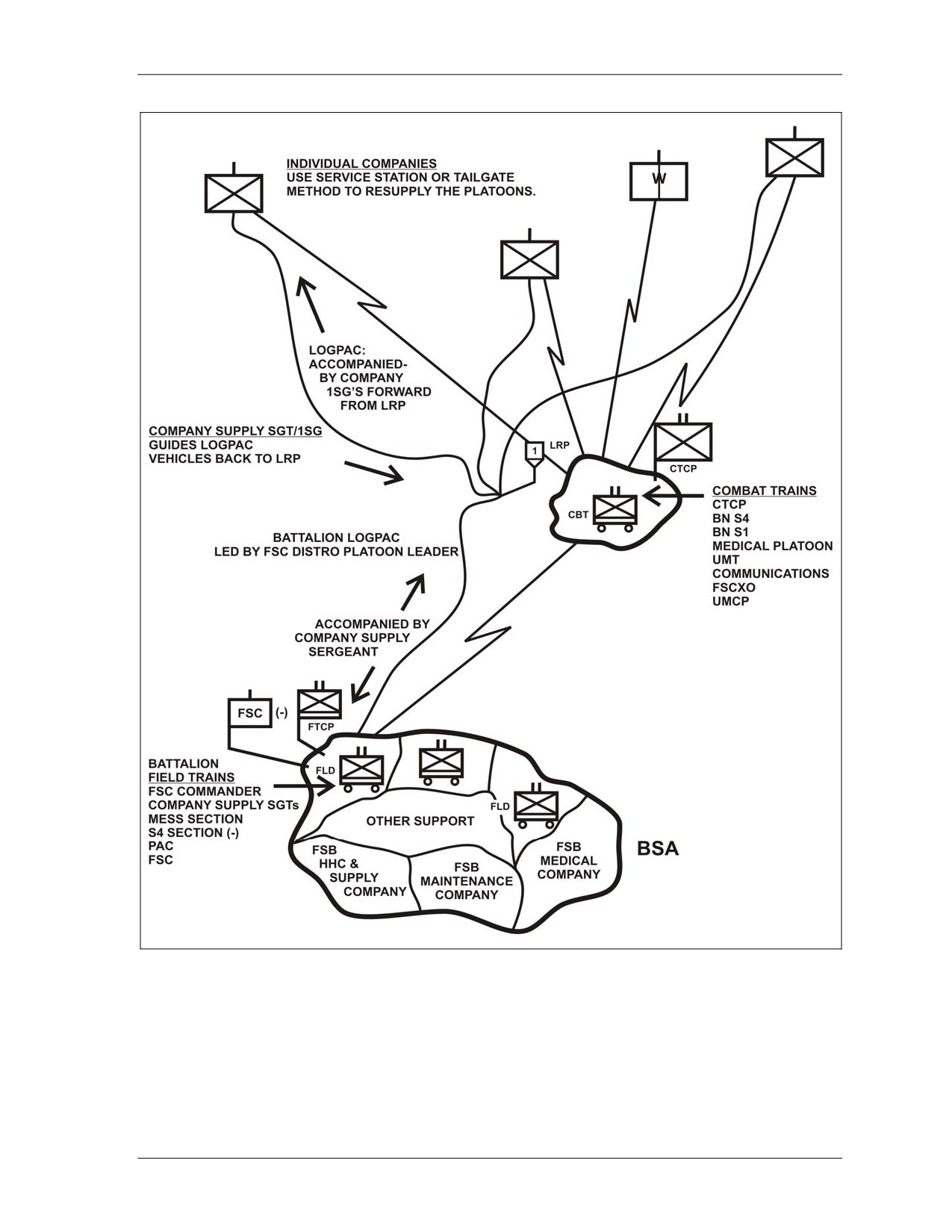
Warfighting Functions
Figure 10-9. LOGPAC deliveries.
10-190.
In the IBCT, logistical loads are broken into three combat loads. The first combat load is
located at the company level and is maintained by the company XO and 1SG. The second combat load is
located at the Infantry battalion combat trains and loaded on the FSC distribution platoons vehicles or on
the ground. The battalion S-4 manages the distribution of the load and the FSC maintains the load. The
third combat load is located in the BSB, managed by the BSB SPO, and loaded on the BSB distribution
company’s vehicles or on the ground.
13 December 2006
FM 3-21.20
10-43
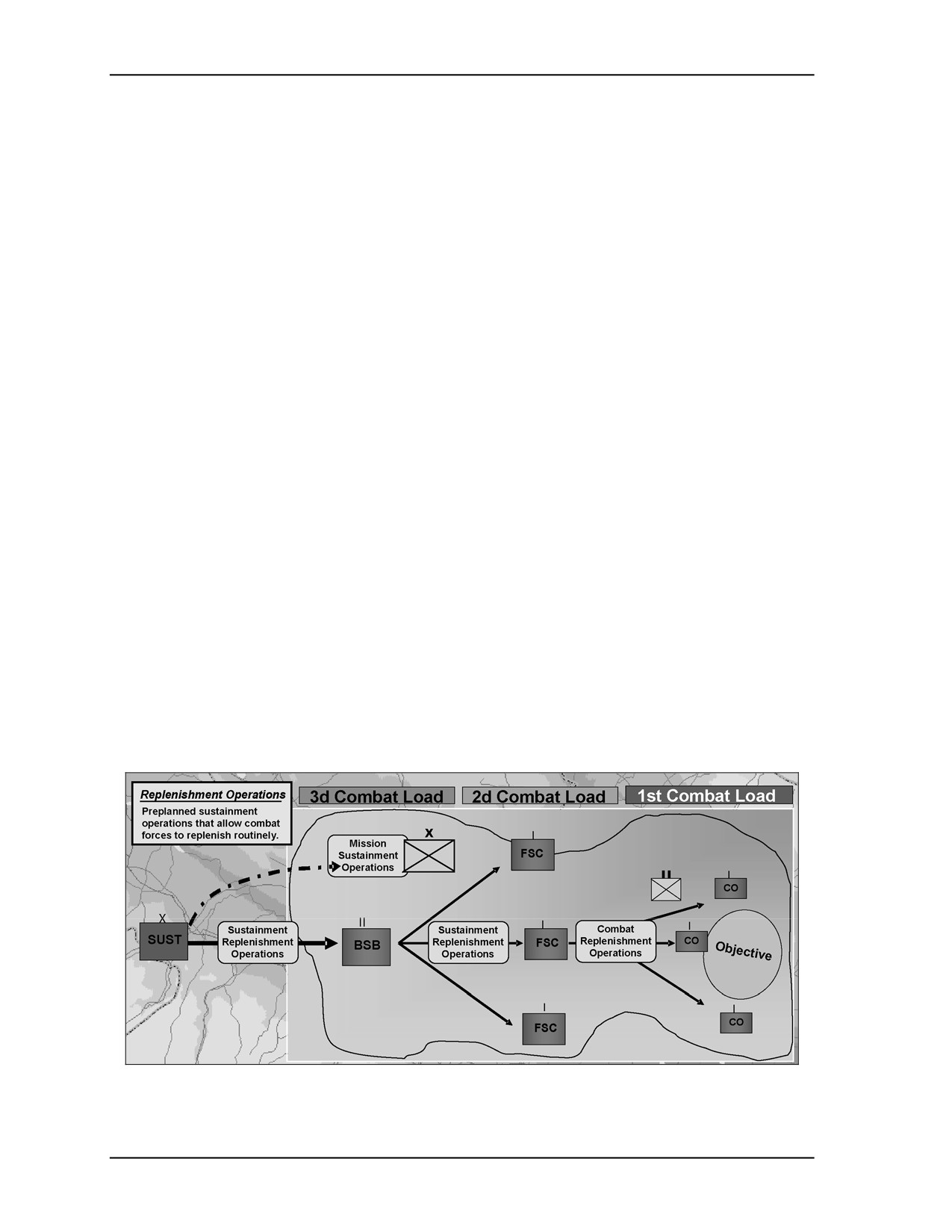
Chapter 10
10-191.
The battalion S-4 coordinates support for the attachments and verifies who will provide this
sustainment and how support for attachments is requested. When a large unit attachment joins the Infantry
battalion, the attachment should bring an appropriate slice of support assets from its parent unit. These
sustainment assets are controlled by the battalion XO and the FSC commander as with the rest of the
Infantry battalion sustainment elements. The attached unit leader must coordinate with the battalion S-1
and furnish him a copy of his unit battle roster, as well as provide the battalion S-4 the status of all key
elements of equipment. Thereafter, the attached unit submits reports and requests for resupply according to
the Infantry battalion standing operating procedures (SOP).
CATEGORIES
10-192.
Sustainment operations fall into the following three general categories (Figure 10-10):
Combat Replenishment Operations
10-193.
Combat replenishment operations is defined as brief or pit-stop like events to rearm, refuel,
provision essential supplies, and support the maintenance function by cross leveling and use of on-board
spares with a duration of up to 3 hours. Combat replenishment operations are replenishment events
executed by BCTs using organic assets to conduct internal resupply. They are executed by support sections
and resupply vehicles located in the FSC.
Sustainment Replenishment Operations
10-194.
A sustainment replenishment operation is conducted within a unit’s battle rhythm and that lasts
from 3 to 7 hours. It can be either a deliberate or a hasty operation. Sustainment replenishment operations
are executed by the BSB and may include augmentation from the sustainment brigade.
Mission Sustainment Operations
10-195.
Mission sustainment operations are intense, time-sensitive operations which include all
preparations for an upcoming mission; planning, troop leading, rehearsals, training, reconnaissance, and
surveillance, reconstitution, tailoring for the next mission, and information operation to ensure mission
success. Mission sustainment operations are planned deliberate operations with a duration of one to three
days which require support from the BSB and sustainment brigade.
Figure 10-10. Replenishment operations.
10-44
FM 3-21.20
13 December 2006
Warfighting Functions
BRIGADE SUPPORT BATTALION
10-196.
The BSB is emplaced by the supported BCT commander and controlled by the BSB
commander. The BSB includes personnel and equipment to support the various classes of supply to include
medical and maintenance support. Supply requirements for the maneuver battalions are collected at the
BSB and as much as practical are assembled into configured loads by the distribution company. The loads
are then delivered to the FSC when the two are not located at the same site. The BSB is supported by
logistics units assigned to support higher level headquarters. The BSB is located in the BSA, which may
also include the BCT rear CP.
FORWARD SUPPORT COMPANY
10-197.
The FSC is a multifunctional sustainment unit organized to provide habitual and direct support
to the Infantry battalion (Figure 10-11). The FSC directly supports the Infantry battalion and a close SOP
supported relationship exists between the units. Both the BSB and Infantry battalion commanders ensure
the FSC is tightly integrated into the Infantry battalion’s operations in garrison, training, and in combat. In
the modular force, the FSC is responsible for conducting the majority of sustainment operations that were
previously conducted by the Infantry battalion HHC. These responsibilities include—
• Field level vehicle and equipment maintenance and recovery.
• Resupply operations for all classes of supply (except medical) and water.
• Transportation for all classes of supply.
• Supplemental transportation of personnel with no organic wheel movement capability. The
FSC can move one Infantry company at any one time.
• LOGPAC operations.
10-198.
The FSC commander is the senior logistics commander at battalion level. He is not the planner;
however, he assists the battalion S-1 and S-4 with the battalion’s logistics planning. The FSC commander
is responsible for executing the logistics plan IAW the battalion commander’s guidance as developed by
the battalion S-1 and S-4. The FSC commander responds directly to the guidance and directives given by
the Infantry battalion XO who serves as the battalion logistics integrator and assists the battalion S-1 and
S-4 in logistics synchronization and troubleshooting. Many functions described in this section are a
coordinated effort between the FSC commander and the battalion S-1 and S-4. The FSC commander
provides information, input, or feedback to the battalion S-1 and S-4 for their use in planning and
coordination. He also provides the battalion commander a LCOP. The FSC regularly interfaces with the
BSB in order to provide logistics support to the battalion. He ensures requests are filled correctly by the
SPO and the distribution company in the BSB.
13 December 2006
FM 3-21.20
10-45
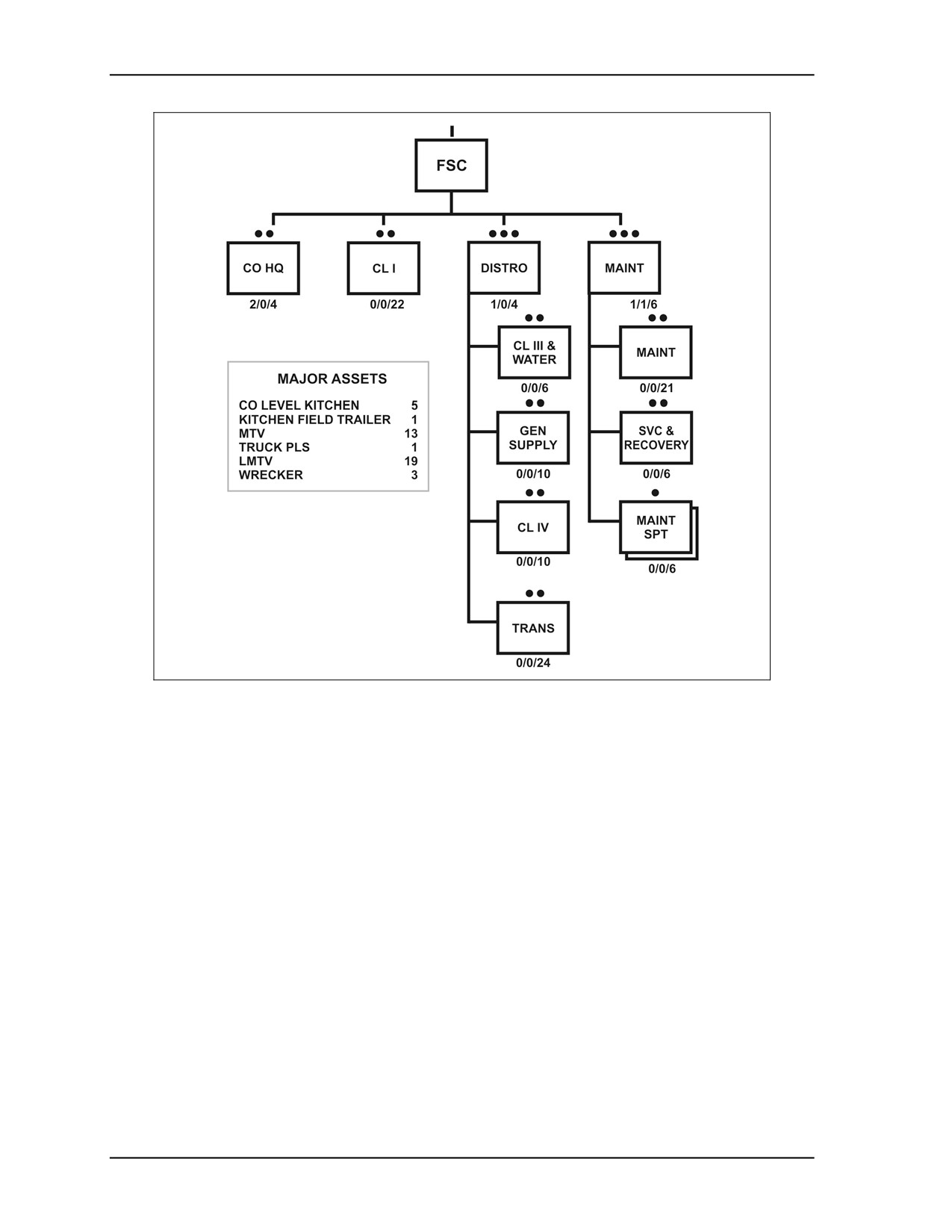
Chapter 10
Figure 10-11. Forward support company.
10-199.
The FSC XO is the principle assistant to the FSC company commander. As second in
command, he must understand both operations that provide support to the Infantry battalion, and the other
functions of the FSC. He supervises the company headquarters personnel and coordinates assigned
missions with subordinate elements. In accordance with commander directives, the XO formulates unit
operating procedures and also supervises CP operations. He often also serves as the FSC activities
coordinator at the CTCP.
10-200.
The 1SG is the company's senior NCO and typically is its most experienced Soldier. He is the
commander’s primary logistics and tactical advisor, and should be an expert in individual and NCO skills.
He is the company’s primary internal logistics operator and assists the commander in planning,
coordinating, and supervising all logistical activities that support the company’s mission. He operates
where the commander directs or where his duties require him. Often this dictates the FSC 1SG will assist in
the operation of the battalion field trains CP and FSC HQ.
10-201.
The distribution platoon provides supply and transportation support to the Infantry battalion.
The distribution platoon provides Class I (to include food service support), II, III (P, B), IV, V, VI, and
VII, to the battalion. The distribution section has the ability to conduct simultaneous Class III and V retail
support to the maneuver companies, the Infantry battalion HHC, and the FSC itself. The distribution
platoon leader of the FSC takes over the responsibilities previously held by the support platoon leader in
the Infantry battalion. The key activity of the distribution platoon is the conduct of LOGPAC operations to
the battalion, and acquiring replenishment sustainment stocks from sustainment brigade units through
combat replenishment operations and sustainment replenishment operations.
10-46
FM 3-21.20
13 December 2006
Warfighting Functions
10-202.
The FSC’s maintenance platoon provides field maintenance to itself and the Infantry battalion.
The platoon consists of a headquarters section and maintenance control section, recovery and service
section, and two field maintenance support teams. The maintenance platoon provides C2 and reinforcing
maintenance to the field maintenance support teams. The field maintenance support teams provide field
maintenance and BDAR primarily to the weapons company and the Infantry battalion HHC. As the
battalion commander task organizes the force, all or part of a field maintenance support team goes with the
company teams in order to maintain habitual support. The maintenance platoon maintains a limited
quantity of combat spares
(PLL, shop, and bench stock) in the maintenance control section. The
maintenance platoon’s supply section can provide Class IX support (combat spares) to each maneuver
company and the HHC. It maintains combat spares (PLL, shop, and bench stock) for the unit it supports
and also provides exchange of reparable items.
BATTALION RESPONSIBILITIES
10-203.
The Infantry battalion headquarters is ultimately responsible for the coordination and execution
of sustainment functions within the battalion. This includes conducting or supervising effective
sustainment operations for all units within the battalion’s AO. The primary sustainment functions required
to support the Infantry battalion include treatment and evacuation of casualties, resupply operations,
maintenance activities, and human resources support. The following battalion personnel have the primary
responsibility for sustainment.
Commander
10-204.
The commander ensures that sustainment operations sustain his battalion’s fighting potential.
He integrates sustainment activities into the tactical plan and provides guidance to the sustainment
operators. He tailors his sustainment operations to meet the tactical plan.
Executive Officer
10-205.
The XO synchronizes all staff actions including the battalion’s logistical effort. During the
planning phase, he reviews status reports from assigned and attached units; reviews the tactical plan with
the S-3 to determine battalion sustainment requirements; and supervises the coordination with BCT
sustainment personnel. The XO also ensures that the sustainment needs of other units in the battalion’s AO
are met.
Adjutant/Battalion S-1
10-206.
The battalion human resource section consists of the battalion adjutant, or S-1, and the personnel
and administrative center (PAC). The section is responsible for administration of all human resource matters
pertaining to the battalion and ensures assigned personnel transition smoothly into and out of the battalion.
10-207.
The S-1 section maintains unit strength reports and processes all human resource actions for
assigned Soldiers to include personnel awards, orders, and finance and legal actions.
10-208.
The S-1 coordinates the special staff efforts of the chaplain, battalion surgeon, medical platoon
leader, and any attached public affairs personnel. Also, the S-1 is the staff point of contact for activities
such as inspector general and judge advocate general issues.
10-209.
The S-1 is responsible for supervising the casualty evacuation system and coordinates with
medical platoon personnel to ensure that patient treatment and evacuation are planned, and coordinated
throughout the battalion area.
10-210.
During tactical operations, the S-1 is collocated with the S-4 section in the CTCP.
10-211.
The S-1 takes part in the full range of staff officer functions which include participating
in MDMP.
13 December 2006
FM 3-21.20
10-47
Chapter 10
10-212.
The S-1 has personnel located at both the combat and the field trains. Personnel in the combat
trains perform strength accounting, casualty reporting, and CP functions. Personnel in the field trains
perform replacement operations, administration services, human resource actions, legal services, and
finance services.
10-213.
The S-1 is also responsible for processing EPWs and tracking the status of WIAs as they are
processed through the medical system.
10-214.
While the responsibility for civilians on the battlefield is a civil affairs function, in the absence
of civil affairs personnel attached to the battalion, the S-1 may assume responsibility to ensure displaced
civilians do not interfere with operations.
10-215.
There is no authorized public affairs officer (PAO) in the Infantry battalion. The S-1 may have
the additional duty to provide information support to Soldiers and commanders in wartime. ROE and
guidance from the BCT PAO and commander, dictate what Soldiers will say when approached by the
media. The S-1 should manage and escort or arrange for escort of all media personnel in the battalion AO.
Logistics Officer/Battalion S-4
10-216.
The S-4 is the OIC of the combat trains and is the battalion’s primary logistician. He directs
actions from the CTCP and, in conjunction with the S-1, conducts sustainment functions for the battalion.
• The battalion logistics section is responsible for providing logistical planning and support to the
battalion and operates in both the combat and field trains. They coordinate the sustainment
functions of maintenance, supply, transportation, and services for the battalion and units
operating in the battalion’s AO. The S-4 normally positions his assistant at the main CP to
assist the S-3's synchronization of combat and sustainment operations or at the field trains to
establish coordination and provide technical support.
• The S-4 coordinates directly with the FSC commander for logistics resupply and equipment
maintenance operations.
• The S-4s primary focus is on water and Classes I through V, VII, and IX.
HHC Commander
10-217.
The HHC commander’s duties and areas of emphasis are assigned by the battalion commander.
Depending on the emphasis in ongoing operations and guidance from the battalion commander, the HHC
commander’s primary duties are typically to supervise the operations of the scout and mortar platoons and
the sniper section. The HHC commander will often be designated as the battalion sniper
employment officer (SEO).
Medical Platoon Leader/Battalion Surgeon
10-218.
The medical platoon provides FHP to the battalion. Its personnel provide immediate trauma and
combat medical treatment and MEDEVAC support to the headquarters and maneuver companies. The
medical platoon’s primary mission is to collect, triage, and treat patients, then make the determination to
either evacuate or return them to duty.
• The medical platoon, under the direction of the medical platoon leader, who is a surgeon,
operates the BAS normally located at the battalion CTCP. The medical platoon leader is
assisted by a PA, a medical operations officer, and the medical platoon sergeant.
• The medical platoon leader also serves as a special staff member to the battalion commander,
ensuring that battalion personnel maintain both physical and mental health.
• The medical platoon stocks and provides all Class VIII supply support for the battalion and
maintains and requests repair for organic medical equipment.
• Battalion medics also provide training to combat lifesaver personnel.
10-48
FM 3-21.20
13 December 2006
Warfighting Functions
Chaplain
10-219.
The unit ministry team (UMT) is composed of a chaplain and an enlisted chaplain assistant.
Each UMT develops a religious support plan that details how it can best coordinate and facilitate religious
support throughout the AO. The chaplain is also a special staff member who serves as a confidential
advisor to the commander on the spiritual fitness and the ethical and moral health of the command.
• Battalion UMTs normally operate from the CTCP or battalion aid station.
• When not conducting combat operations, the UMT coordinates with the CTCP to be at the right
place at the right time for those who need them the most. Movement with a logistics package to
an LRP is an excellent way to minister and provide services to a company.
• During combat operations, the UMT’s priority for religious support is care for the wounded.
The team performs “religious triage” in coordination with medical treatment personnel. The
UMT moves to positions where the largest numbers of casualties are to be collected, usually at
BAS.
• After combat, the UMT ministers to Soldiers, paying attention to leaders and those who show
signs of battle stress.
• The UMT reviews and may adjust battalion religious support plans to ensure that religious
coverage is available to all, to include contractors, refugees, displaced persons, detained
civilians in the AO, and enemy prisoners of war.
• Chaplains often serve as the "conscience of the command." They advise the commander on the
moral and ethical nature of command policies, programs, and actions and their impact on
Soldiers. The UMT is responsible for and supports the free exercise of religion. Chaplains
provide support for death notifications, Red Cross notifications by command, and liaison with
continental US (CONUS) and host nation clergy.
BATTALION TRAINS OPERATIONS
The logistical focal point for the Infantry battalion is the trains. Sustainment personnel and equipment organic or
attached to a force that provides support, such as supply, evacuation, and maintenance services, comprise the
unit trains. Whether or not battalion sustainment assets are centralized or placed in multiple locations is dependant
upon the tactical needs of the battalion.
INFANTRY BATTALION TRAINS
10-220.
The battalion uses unit trains only when occupying a battalion assembly area or when the
terrain restricts movement so that the battalion must depend on aerial resupply and evacuation for support.
In this case, the unit trains and all sustainment assets are placed in one central location. However, the
Infantry battalion normally operates in echeloned trains where the trains are split into multiple locations.
Echeloned trains for the battalion normally consist of two types: the battalion combat trains and the field
trains.
Combat Trains
10-221.
The battalion’s combat trains are normally positioned close enough to combat elements to be
responsive to forward units but beyond the range of enemy direct fires. The combat trains should not be
considered a permanent or stationary support area. The battalion combat trains usually consist of the S-1,
the HHC’s medical platoon, the UMT, communications personnel, forward elements of the FSC, and its
combat load. They are supervised by the CTCP, which is headed by the battalion S-4. The trains are
positioned based upon the factors of METT-TC. The battalion’s combat trains control all resupply
operations for the Infantry battalion. At times, the battalion may move company supply sections forward,
and an Infantry company may store its sustainment load with its company supply section in the combat
trains. The company sustainment load normally consists of rucksacks, duffel bags containing extra clothing
13 December 2006
FM 3-21.20
10-49
Chapter 10
and personal items, chemical protective over garments (CPOGs), and sleeping bags. As the alternate main
command post, and in the event that they must assume responsibilities as the main command post, the
combat trains command post must maintain SU of current and future battalion and brigade operations
Field Trains
10-222.
The fields trains are positioned based on METT-TC considerations and often will be located in
the BSA. The field trains are controlled by the FSC commander. The field trains normally consist of the
FSC, Infantry battalion PAC, personnel transitioning to and from the battalion and the HHC, and Infantry
company and weapons company supply sections. Usually, the Infantry and weapons companies will store
its sustainment loads with its company supply section in the field trains. The units in the field trains operate
as the primary direct coordination element between the Infantry companies and the BSA. The battalion S-4
coordinates all unit supply requests with the FSC commander. The FSC fills orders with on-hand stocked
items. Requests for those items not on-hand in the FSC are forwarded to the brigade S-4.
Unit Maintenance Collection Point
10-223.
The UMCP is normally located near the combat trains or collocated with the combat trains for
security, and should be on a main axis or supply route. The UMCP is manned by elements of the FSC. The
UMCP provides vehicle and equipment evacuation, and maintenance support to the field maintenance
support teams. Field maintenance support teams evacuate vehicles and equipment to the UMCP that cannot
be repaired within 2 hours. Normally, vehicles or equipment evacuated to the UMCP that cannot be towed
or repaired within 4-6 hours, are further evacuated to the field trains, BSB, or higher level support unit
10-224.
UMCP does not have to be located in the battalion combat trains; however, if not in the same
location, the UMCP is normally in the general vicinity. The advantages to collocating the UMCP at the
combat trains is for increased security, and coordination of class IX resupply. The trains must be mobile
enough to support frequent changes in location, time and terrain permitting, under the following
conditions when—
• Heavy use or traffic in the area may cause detection.
• Area becomes worn by heavy use such as in wet and muddy conditions.
• Security is compromised.
HHC, INFANTRY, AND WEAPONS COMPANY SUPPLY SECTIONS
10-225.
Company supply sections become the assembly point for company sustainment operations.
They usually consist of the company supply sergeant and one other supply specialist, and are normally
located in the battalion field trains. The section personnel are responsible for obtaining their company
supply request, assembling the requested supplies into a LOGPAC, and then loading it onto an FSC
distribution platoon vehicle. The company supply sergeant then accompanies the LOGPAC forward to the
LRP where the company receives its supplies.
SUPPORT AREA SECURITY
10-226.
Security of sustainment elements is critical to the success of the Infantry battalion mission;
therefore, trains must develop plans for continuous security operations.
Combat Trains Security
10-227.
The following should be considered when securing combat trains:
• Select good trains sites that use available cover, concealment, and camouflage. The best
defense for combat trains is to avoid detection.
10-50
FM 3-21.20
13 December 2006
Warfighting Functions
• Use strict movement and positioning discipline as well as noise and light discipline to prevent
detection.
• Establish a perimeter defense as in an assembly area.
• Establish observation posts and patrols.
• Position weapons (small arms and machine guns) for self-defense.
• Plan mutually supporting positions to dominate likely avenues of approach.
• Prepare a fire plan and make sector sketches.
• Identify sectors of fires.
• Emplace TRPs to control fires and for use of indirect fires.
• Conduct rehearsals.
• Establish rest plans.
• Identify an alarm or warning system that allows for rapid execution of the defense plan without
further guidance (normally included in an SOP).
• Designate a reaction force and ensure the force is equipped to perform its mission.
Field Trains Security
10-228.
The Infantry battalion will consider the factors of METT-TC along with the considerations
outlined in the previous paragraph, when determining where to position the field trains. If the field trains is
located within the BSA, the FSC commander must coordinate his defense plan with the BSB commander.
These defense plans must complement the plans of the other units located within the BSA.
COMMUNICATIONS
10-229.
Fast and reliable communications are critical to the sustainment effort. The CTCP reports the
battalion’s status, including combat losses, and sends resupply and support requests to the BCT.
10-230.
At the Infantry battalion level, sustainment communications may occur by any combination of
FM radio, digital connectivity, courier, or wire. FBCB2 is the primary means of sustainment
communication within the battalion, and the ABCS is the method to pass information to the BCT.
10-231.
The CTCP is the net control station (NCS) for the battalion administrative and logistics radio
network. (admin/log net) The S-4, S-1, FSC commander, maintenance platoon leader, distribution platoon
leader, medical platoon leader, company 1SGs, and others (as required) operate in the Infantry battalion
admin/log net. The CTCP also operates in the brigade admin/log net and in the Infantry battalion
command net.
10-232.
Communications are critical to expediting the sustainment effort. Unit 1SGs must report their
losses and requirements as soon as it is practical to do so. When use of radio or FBCB2 is not possible,
messages are sent with resupply or evacuation vehicles. The CTCP and FTCP maintain control of vehicles
moving forward to the LRPs. The IBCT Infantry battalion SOP establishes procedures for resupply without
request, in the event that communications fail.
SUPPLY AND TRANSPORTATION OPERATIONS
The supply system provides many types of supplies to the battalion. Generally the most important are
ammunition, repair parts for weapons systems and vehicles, water, subsistence, and POL, but the mission and
current situation will dictate the priority. To ensure continuous support, the leader ensures supplies are provided
as far forward as the tactical situation permits and that the need for these supplies is anticipated in advance.
Movement of supplies, equipment, and personnel for most companies normally come through vehicle assets from
the FSC or higher. The FSC generally stocks and has for immediate issue water, fuel and packaged POL,
ammunition, and repair parts.
13 December 2006
FM 3-21.20
10-51
Chapter 10
CLASSES OF SUPPLY
11-1.
Supplies are divided into ten major categories, which are referred to as classes. There are also a
few miscellaneous items that do not fit into any of the other ten supply classes (Table 10-8).
Table 10-8. Classes of supply.
SUPPLY
SYMBOL
DEFINITION
CLASS
I
Subsistence items.
II
Items of equipment other than principal items.
III
Petroleum, oil, and lubricants.
IV
Construction and barrier materials.
V
Ammunition.
VI
Personal demand items normally sold through exchanges.
VII
Major end items.
VIII
Medical material.
IX
Repair parts and components.
X
Material to support nonmilitary programs.
MISC
N/A
Water, captured material, and salvage material.
ROUTINE RESUPPLY
10-233.
Routine resupply operations cover items in Classes I, III, V, IX, and water, as well as mail and
any other items usually requested by the battalion. Resupply operations normally occur once a day.
Whenever possible, routine resupply should be conducted daily; ideally in limited visibility.
10-52
FM 3-21.20
13 December 2006
Warfighting Functions
Logistics Package Operations
10-234.
The LOGPAC technique is a simple, efficient way to accomplish routine resupply operations.
Typical LOGPAC operations are shown in Figure 10-9, page 10-43.
Preparation
10-235.
Company 1SGs compile and coordinate any unique supply requests for their companies and
route them through the battalion S-4 via the LOGPAC. Based on the requests and the predetermined supply
needs, the requested supplies and replenishments stocks are assembled by the distribution company of the
BSB. This activity is coordinated and supervised by the SPO of the BSB. The BSB distribution company
configures the loads as much as practicable and prepares them for movement to the FSC. Supplies are
usually configured to sustain the Infantry battalion and its companies for a 24-hour period or until the next
scheduled replenishment cycle. Other items to be included in the replenishment are coordinated by the
appropriate staff officer, and then delivered to the S-4 and S-1. These items may include replacement
personnel and Soldiers returning from medical treatment, vehicles returning to the company area from
maintenance, and mail and personnel actions.
Movement of Replenishment Load
10-236.
Replenishment loads normally follow a sequence of movement from the BSB distribution
company to the FSC located in the field trains. From the field trains, the loads are then delivered by
LOGPAC to the combat trains or delivered throughput directly to the companies. Throughput can be from
any echelon to any lower echelon if circumstances require.
Replenishment of FSC Loads
10-237.
Once the BSB distribution company has configured the replenishment load on its organic
vehicles, they are ready to move forward to the field trains under the control of FSC personnel. Once the
replenishment load reaches the field trains, the supplies are downloaded or transferred to vehicles of the
FSC distribution platoon.
Replenishment of Infantry Battalion Units’ Loads
10-238.
The loads for the Infantry battalion’s units (rifle companies, weapons company, HHC, and
special platoons and sections) are configured for final delivery in the field trains by the company supply
sergeants. The vehicles are lead to the LRP where they are met by the company 1SG or his representative.
Actions at LRP
10-239.
When the LOGPACs arrive at the LRP, the company 1SGs quickly assume control of the
company LOGPACs and continue tactical movement to the company resupply points. The LOGPAC will
stop at the LRP only when the tactical situation dictates or when ordered by the commander. Security will
be maintained at all times.
Resupply Procedures
10-240.
The individual companies can use the service station or tailgate resupply method. The time
required for resupply is an important planning factor. Resupply must be conducted as quickly and
efficiently as possible, both to ensure operational effectiveness and to allow the company LOGPAC
vehicles to return to the LRP on time. Service station resupply of the company normally takes 60 to 90
minutes but may take longer. Tailgate resupply usually requires significantly more time than service station
resupply. At times, it may also be necessary to use the in-position resupply method. However, this process
takes a considerable amount of time and may compromise friendly positions or activities.
13 December 2006
FM 3-21.20
10-53
Chapter 10
Return to LRP
10-241.
Once resupply operations are complete, the LOGPAC vehicles are prepared for the return trip.
Human remains and their personal effects are carried on cargo or fuel trucks. EPWs ride in the cargo trucks
and are guarded by walking wounded or other company personnel. All supply requests and personnel
action documents are consolidated for forwarding to the CTCP, where the appropriate staff section
processes them for the next LOGPAC. The supply sergeant leads the LOGPAC back to the LRP. It is
critical that the LOGPAC continue to move through the LRP as quickly as possible to avoid interdiction by
enemy forces or artillery. Whenever possible, all FSC vehicles and company supply sections consolidate at
a coordinated point, and the reunited LOGPAC convoy returns to the field trains together. When
METT-TC dictates or when the LOGPAC arrives too late to rejoin the larger convoy, the vehicles must
return to the field trains on their own in a secure manner.
EMERGENCY RESUPPLY
10-242.
Occasionally, normally during combat operations, the battalion may have such an urgent need
for resupply that it cannot wait for a routine LOGPAC. Emergency resupply usually involves Classes III,
V, and VIII, as well as CBRN equipment. Emergency resupply down to the company level can be
conducted using either the service station or tailgate method, but more often may use the in-position
method. The fastest appropriate means is normally used although procedures may have to be adjusted when
the company is in contact with the enemy.
PRESTOCK OPERATIONS
10-243.
Prestock resupply, also known as pre-positioning or cache, is most often beneficial in defensive
operations.
Pre-Positioned
10-244.
Normally only Class IV items are pre-positioned. Prestock operations must be carefully
planned and executed at every level. All leaders must know the exact locations of prestock sites, which
they verify during reconnaissance or rehearsals. The battalion and separate companies must take steps to
ensure survivability of the prestock supplies. These measures include digging in prestock positions and
selecting covered and concealed positions. The commanders must also have a plan to remove or destroy
pre-positioned supplies to prevent the enemy from capturing them.
Caches
10-245.
A cache is a pre-positioned and concealed supply point. It can be used in any operation. Caches
are an excellent tool for reducing the Soldier's load and can be set up for a specific mission or as a
contingency measure. Cache sites have the same characteristics as an ORP or patrol base, with the supplies
concealed above or below ground. An aboveground cache is easier to get to but is more likely to be
discovered by the enemy, civilians, or animals. There is always a security risk when returning to a cache. A
cache site should be observed for signs of enemy presence and secured before being used; it may have been
booby-trapped and may be under enemy observation.
10-246.
In the offense, advance elements may set up a cache along the intended route of advance to the
objective. Caches may also be set up in-zone to support continuous operations without allowing the enemy
to locate the company through air or ground resupply. Soldier's load considerations may limit the size of
caches. Do not let the cache activities jeopardize the offensive mission.
10-247.
In the defense, a defending unit may set up caches throughout the AOs during the preparation
phase. A cache can be established in each alternate or subsequent position throughout the depth of the
defense sector. During stay-behind operations, or in an area defense on a fluid battlefield, caches may be
the only source of supply for extended periods.
10-54
FM 3-21.20
13 December 2006
Warfighting Functions
Security
10-248.
While these techniques are used in both offensive and defensive operations, the transfer of
supplies to the company is usually conducted from a defensive posture. As such, the security
considerations for a resupply operation are like those for a perimeter defense.
NONSTANDARD SUPPLY
10-249.
The techniques described in the preceding paragraphs are the normal methods for resupply.
However, a basic understanding of nonstandard techniques and different modes of delivery is also required
for the successful execution of the sustainment function.
Aerial Resupply
10-250.
Air Force airlift and Army aviation assets may assist in resupply operations. The Infantry
battalion must be prepared to receive both air-dropped and sling-loaded supplies. The receiving commander
must consider the enemy's ability to locate his unit by observing the aircraft. Unless conducting the resupply in
an area under friendly control and away from direct enemy observation (reverse slope of a defensive position
with recon well forward), locate the DZ and LZ away from the main unit in an area that can be defended for a
short time. The delivered supplies are immediately transported away from the DZ and LZ. Each unit must know
how to select pickup and landing zones and receive aerial resupply. See FM 90-4.
Cross-Leveling
10-251.
Cross-leveling is simply a redistribution of supplies throughout the unit. Usually done
automatically within companies after every engagement, the battalion may cross-level supplies between
companies when resupply cannot be conducted. In some instances, supplies may not be evenly
redistributed. For example, during sustainment replenishment operations, a company defending a base
camp may postpone fuel resupply so that a company conducting an area presence mission is completely
supplied.
TRANSPORTATION
10-252.
Movement of supplies, equipment, and personnel with the limited vehicle assets available
requires careful planning and execution. Infantry companies have one organic HMMWV for C2, and one
LMTV with a 400 gallon water trailer for resupply operations. The weapons company has two organic
HMMWV for C2, and one LMTV with a 400 gallon water trailer for resupply operations. Additional
vehicle assets from FSC or higher can be provided for company resupply operations.
10-253.
When vehicles are provided to the company, they must be employed to capitalize on their
capability to execute the mission requirement, and they must be returned for follow-on company or
parent-unit missions. Transportation assets are scarce, often resulting in trade-offs. For example, upload
increased quantities of ammunition and less water, or carry unit rucksacks and be unavailable for resupply.
Commanders must ensure that transportation assets are being employed to accomplish the most important
missions. Time is critical and the company must reduce on-station time so that all company requirements
can be met. Most FSC vehicles do not have radios; however, most of them do have GPS integrated into the
vehicles. Vehicles leaders must ensure that drivers know where they are going and how to get there. Land
navigation training, marked routes, and strip maps referenced to landmarks are all ways to keep drivers
from getting lost.
10-254.
Because of the limited ground transportation, personnel must know how to conduct aerial
operations. An understanding of PZs and LZs selection, sling loading, bundle drops, and allowable cargo
loads may be critical to sustainment operations.
13 December 2006
FM 3-21.20
10-55
Chapter 10
CONTRACTING AND HOST NATION SUPPORT
10-255.
The Infantry battalion is expected to use contractors, DA civilians, and host nation support in
the AOs.
Contracting Support
10-256.
Though they involve a number of risks, contractors and DA civilians are playing an
ever-increasing role in providing sustainment to US forces. The Army may use contractors to bridge gaps
between required capabilities and actual force structure available within an AO. Contractors may be
employed, subject to METT-TC, throughout the AO and in virtually all conditions. Protecting contractors
on the battlefield is the commander’s responsibility. When contractors are expected to perform in
potentially hostile areas, the supported military forces must assure the protection of their operations and
personnel. Commanders must understand that contractors are subject to the same threat as Soldiers and
must plan accordingly. Contractor personnel cannot be required to perform force protection functions and
cannot take an active role in hostilities but retain the inherent right to self-defense. The defense logistics
agency will provide bulk fuel, water, and food to contractor personnel either through pre-positioned stocks
or host-nation contracts. The logistics civil augmentation program (LOGCAP) is also available when
needed.
Host Nation Support
10-257.
Host nation support is provided to Army forces and organizations located in or transiting
through host nation territory and includes both civil and military assistance. This support can include
assistance in almost every aspect required to sustain military operations within a theater. Planners must
consider that host nation support meets local, not necessarily US, standards. Host nation support can be a
significant resource provided it is available and that appropriate agreements are in place.
MAINTENANCE OPERATIONS
The maintenance of weapons and equipment is continuous. Every Soldier must know how to maintain his
weapon and equipment IAW the related technical manual.
SUPPORT
10-258.
At the tactical level, the maintenance support system is designed to repair equipment as fast as
possible and as near to the point of failure or damage as possible. Maintenance assets move as far forward
as the tactical situation permits to repair inoperable and damaged equipment, and to return it to the battle as
quickly as possible.
Vehicles
10-259.
Infantry battalions are responsible for operator and crew level maintenance on vehicles and
equipment. The FSC’s organic maintenance platoon and its two field maintenance support team provide
field level maintenance for vehicles and equipment. Normally the field maintenance support teams are
tasked to provide maintenance support to the Infantry battalion headquarters and weapons companies. If
the Infantry battalion task organizes, the field maintenance support teams provide prioritized support as
specified by the battalion. The BSB provides DS level maintenance and evacuation to GS and depot levels.
10-56
FM 3-21.20
13 December 2006
Warfighting Functions
Other equipment
10-260.
Maintenance on other equipment such as communications equipment and weapons has limited
organizational level maintenance available. Maintenance beyond the skill level of assigned personnel will
need evacuation to the FSC or the BSB for repair.
10-261.
The maintenance of weapons and equipment is continuous. Every Soldier must know how to
maintain his weapon and equipment IAW the related technical manual. The commander, XO, and 1SG
must understand the maintenance concept for every piece of equipment in the battalion.
10-262.
Proper operator level maintenance is key to keeping vehicles, equipment, and other materials in
serviceable condition. It is a continuous process that starts with preventive measures taken by each operator
of each piece of equipment or vehicle, and continues through repair and recovery of the equipment. It
includes the functions of inspecting, testing, servicing, repairing, requisitioning, recovering, and evacuating
equipment.
10-263.
Maintenance functions begin with PMCS, a daily responsibility for each piece of equipment to
include inspection and maintenance forms
(DA Form 2404 or 5988-E [Equipment Inspection and
Maintenance Worksheet]) when required. These forms are the primary means through which the company
obtains maintenance support or repair parts. The forms follow a pathway, described in the following
paragraphs, from operator/crew level to the BSA and back. The company XO or 1SG supervises the "flow"
of these critical maintenance documents and parts based on the unit’s SOP. These instructions must be
integrated into the SOPs for patrol bases, assembly areas, defenses, and reorganization to ensure that
maintenance is done without jeopardizing unit security, and to make it a habit for the Soldiers.
10-264.
In addition to operator maintenance, selected Soldiers are trained to perform limited
maintenance on damaged weapons and battle damage assessment and repair (BDAR). The purpose of
BDAR is to return disabled combat equipment to the tactical commander as quickly as possible. It is rapid
damage assessment and repair, bypassing or temporarily fixing components, to support a combat mission
or enable self-recovery. The CTCP implements the commander’s guidance on whether or not to use BDAR
in lieu of normal maintenance procedures. Such enabling repairs are almost always temporary, depending
on the repair required. At the completion of immediate combat operations, mechanics from the FSC will
make repairs that will return the equipment to fully mission-capable status. Since it may not be possible to
train BDAR techniques in peacetime using actual equipment, the best substitute is to train system-oriented
crews and mechanics to understand the principles associated with weapon systems. BDAR actions
include—
• Using shortcuts to install or remove parts.
• Modifying and installing components designed for other vehicles or equipment.
• Using parts serving a noncritical function on a like vehicle.
• Using substitute fuels, fluids, or other POLs.
• Using readily available materials to execute a temporary repair.
10-265.
Inoperative equipment is fixed as far forward as possible. When a piece of equipment is
damaged, it should be inspected to see if it could be repaired on the spot. Company armorers keep a
small-arms repair kit in the company trains or on the dedicated company vehicle. If equipment cannot be
repaired forward, it is evacuated immediately to the UMCP or returned with a LOGPAC. Even if the item
cannot be evacuated at once, the sustainment system is alerted to prepare for repair or replacement. If a
replacement is available (from an evacuated Soldier or inoperative equipment), it is sent forward. If not, the
leader must work around it by prioritizing the use of remaining equipment such as using a squad radio for
the company FM command net if the platoon radio is broken.
10-266.
Maintenance applies to all equipment. Items such as magazines, ammunition, and batteries are
also maintained and inspected. While test firing in an assembly area, mark the magazines of weapons that
have stoppages. If a magazine is marked more than twice, the magazine may be causing the stoppages.
13 December 2006
FM 3-21.20
10-57