FM 3-21.20 (FM 7-20) THE INFANTRY BATTALION (DECEMBER 2006) - page 10
Chapter 10
Inspect the ammunition belts for crew-served weapons along with the weapons. Dirty or corroded
ammunition may also cause weapon malfunctions.
HEALTH SERVICE SUPPORT
The medical threat to Soldiers comes from both enemy action and environmental situations that could adversely
affect their combat effectiveness. Effective and timely FHP initiatives are essential factors in sustaining combat
power during continuous operations. The Infantry battalion must ensure that its medical platoon coordinates with
the BSB medical company for PVNTMED and combat operational stress control support. This support includes:
10-267.
PVNTMED advice and consultation in the areas of disease and nonbattle injuries (DNBI),
environmental sanitation, epidemiology, entomology, and medical surveillance as well as limited sanitary
engineering services and pest management.
10-268.
Training and advice in the promotion of positive combat stress behaviors. The mental health
section, organic to the BSB medical company, can provide early identification, handling, and management
of misconduct stress behavior and battle fatigued Soldiers. It assists and counsels personnel with personal,
behavioral, or psychological problems and may refer suspected neuropsychiatric cases for evaluation.
PREVENTIVE MEDICINE AND FIELD SANITATION TEAM
10-269.
Throughout military history, the largest numbers of casualties are the result of the medical
threat from DNBI. Prevention of DNBI frees medical assets to support Soldiers wounded by battle injury.
The medical threat of DNBI remains the leading cause of personnel losses during military operations.
Commanders are responsible for protecting their personnel against DNBI. In addition, commanders must
be aware of occupational and environmental health hazards in operational areas. Commanders must also
emphasize and enforce high standards of field sanitation and personal hygiene at all times to preclude
DNBI from affecting Soldier readiness. Proper use of risk assessment (FM 100-14) and the subsequent risk
management of those risks identified will help reduce DNBI losses to the unit. Commanders and medical
personnel should receive a medical threat brief outlining the hazards.
10-270.
The use of preventive medicine measures (PMM) are used to eliminate or reduce DNBI
casualties and include—
• Soldiers using individual techniques of PMM.
• Chain of command planning for and enforcing PMM.
• Leaders, at all levels, supervising and enforcing PMM at the individual and collective level.
• Unit field sanitation teams training unit members in individual PMM and advising the
commander and unit leaders on implementing unit-level PMM.
10-271.
In all deployments, PVNTMED begins with the individual Soldier. No one else can better
protect the individual from illness, injury, or death than the individual. PMM at the individual level defend
the Soldier from a majority of the most prevalent illnesses in an AO and are easy and uncomplicated.
Following them will assist the Soldier in accomplishing his mission and returning home safely from a
deployment. For definitive information on PMM, see FM 21-10.
10-272.
Unit SOPs must address the following areas of concern:
• Ensure clean drinking water is supplied to and consumed by Soldiers.
• Ensure proper control of unit waste, both human waste and trash.
• Prevent weather-related problems. These include cold injuries such as frostbite, trench foot, and
immersion foot, and heat injuries like heat exhaustion and heat stroke. Soldiers must
understand the effects of conditions such as sunburn and wind-chill.
• Prevent battle fatigue to include strict implementation of the unit sleep plan (Appendix H).
10-58
FM 3-21.20
13 December 2006
Warfighting Functions
10-273.
Each company or troop-sized unit is required to have a field sanitation team whose members
are trained
(they must attend a 40-hour course) and fully equipped according to AR 40-5. Selected
members from each company or troop unit will be designated to receive special training in DNBI
prevention so they can advise the commander in PMM for DNBI. This training enables the unit
commander to provide for arthropod control, individual and unit field sanitation, the monitoring of the
unit's water supplies, and ensuring the sanitation of the unit's food supplies. These comparatively simple
steps have resulted in commanders being able to reduce DNBI losses, and thus sustain its fighting strength.
For definitive information on unit field sanitation team operations and training, see FM 4-25.12.
SOLDIERS WOUNDED IN ACTION
10-274.
Medical treatment of wounded or injured Soldiers during combat operations is a continuous,
progressive operation that occurs in a series of separate but interconnecting stages. It involves personnel,
equipment, and facilities at virtually every level of the organization. The normal flow of medical treatment
for combat casualties is from the point of injury to the casualty collection point to the BAS to the BSB
medical company. The following paragraphs discuss responsibilities at each phase of this process:
Point of Injury
10-275.
The point of injury normally involves the action of four Soldiers; the wounded soldier
conducting self-aid, another soldier providing buddy aid, a CLS, and a combat medic. All of these Soldiers
can contribute to saving a life and reducing the extent and lasting effects of an injury. The CLS is almost
always the first person on the scene to begin treating wounded and injured personnel. The CLS is a
nonmedical Soldier trained to provide advanced first aid and or lifesaving procedures beyond the level of
self-aid or buddy aid. The CLS is not intended to take the place of medical personnel but to slow
deterioration of a wounded Soldier’s condition until medical personnel arrive. Combat medics are normally
attached to each Infantry company and many Infantry platoons. They are trained in basic life saving
procedures and assist in preparing the casualty for transport to the CCP. The leader is responsible for
ensuring that all injured Soldiers receive immediate first aid and that the commander is informed of
casualties. He coordinates with the 1SG and company senior medic for ground evacuation. The leader--
• Ensures that all injured Soldiers receive immediate first aid.
• Informs the commander of casualties IAW FM 3-21.11.
• Coordinates with the 1SG and company senior medic for ground evacuation.
• Routes accurate information about each casualty to the proper channels.
Casualty Collection Point
10-276.
At the CCP, the senior medic conducts triage of all casualties, takes the necessary steps to
stabilize their condition, and initiates the process of moving them to the rear for further treatment. He
assists the 1SG in arranging evacuation via ground, air ambulance or by nonstandard means. METT-TC
dependent, the medical platoon may position a MEDEVAC vehicle ambulance with a company to provide
evacuation and en route care from the Soldier’s point of injury or the company’s CCP to the BAS. In mass
casualty situations, nonmedical vehicles may be used to assist in casualty evacuation as directed by the
company commander.
Note. Before casualties are evacuated beyond the CCP, leaders should remove all key
operational items and equipment IAW unit SOP. Minimum requirements of protective mask
and CPOG must stay with the individual.
13 December 2006
FM 3-21.20
10-59
Chapter 10
Battalion Aid Station
10-277.
The BAS conducts EMT and advanced trauma treatment. Only procedures necessary to
preserve life or limb or enable a patient to be moved safely are performed at the BAS. The BAS is
normally positioned within
30 minutes’ driving time of expected casualties. Patients normally are
evacuated from the BAS by FSMC ambulances. The BSB medical company habitually positions
ambulances at an ambulance exchange point collocated with or near the BAS.
Note. Designated medical personnel collect DA Form 1156 at the aid station; it is forwarded
through S-1 channels for processing by the PAC in the BSA.
Forward Support Medical Company
10-278.
The BSB medical company performs Echelon II FHP. This includes MEDEVAC from the BAS
to the BSB medical company, patient holding, combat stress control (CSC) support, Class VIII resupply,
preventive medicine support, medical equipment maintenance, x-ray, laboratory, and operational dental
care. The BSB medical company also provides area medical support to BSA elements and back-up support
to forward maneuver battalions. After the first 96 hours of BCT operations, the BSB medical company is
normally augmented with additional forward surgical teams.
BATTALION MEDICAL PLATOON
10-279.
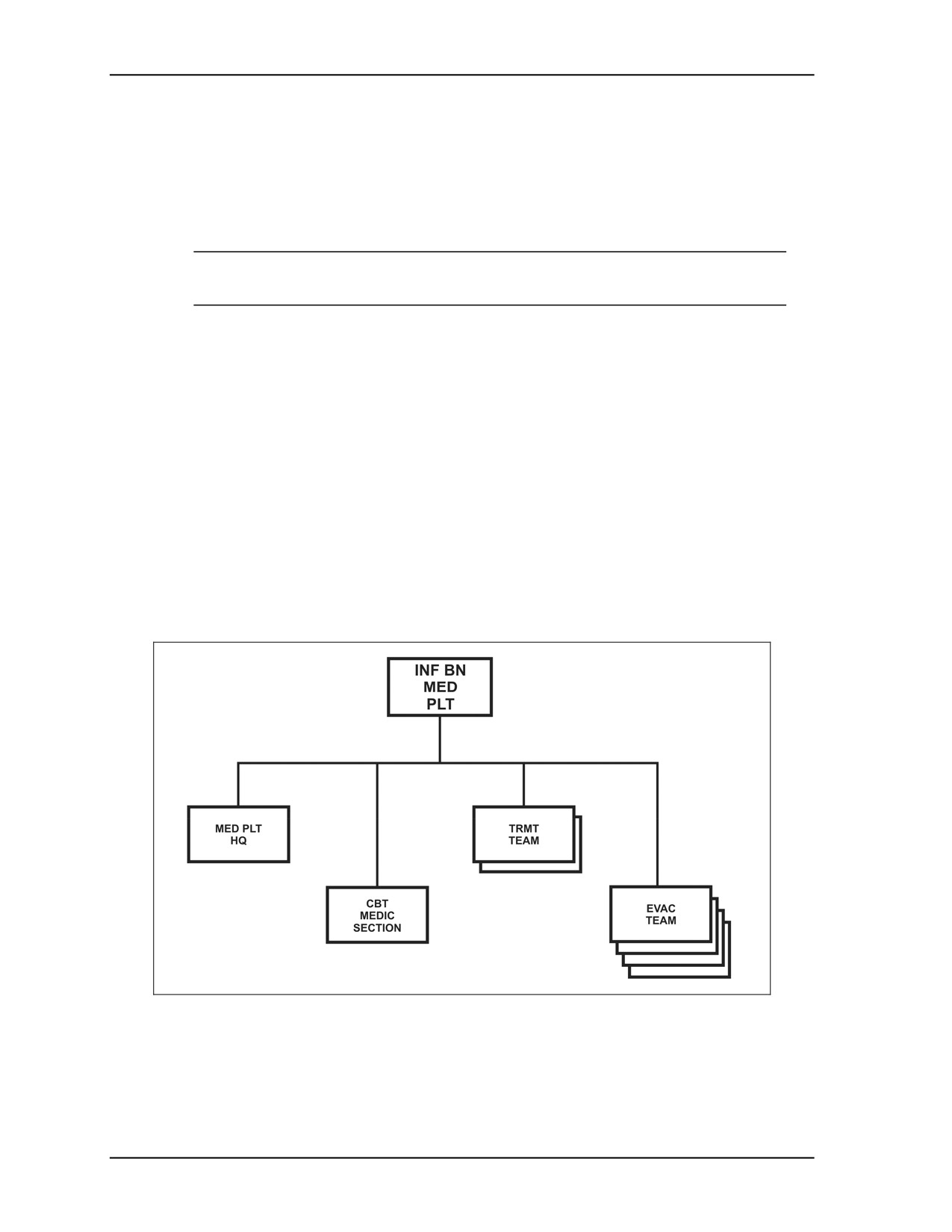
The medical platoon of the Infantry battalion is comprised of a headquarters, a combat medic
section with 16 combat medics, an evacuation squad with four evacuation teams in medical evacuation
vehicle (MEV) ambulances, and a treatment squad with two treatment teams (Figure 10-12). See Chapter 1
for a detailed discussion of the medical platoon’s organization and responsibilities.
Figure 10-12. Battalion medical platoon.
10-60
FM 3-21.20
13 December 2006
Warfighting Functions
COMBAT STRESS THREAT
10-280.
Many stressors in a combat situation are due to deliberate enemy actions aimed at killing,
wounding, or demoralizing our Soldiers and our allies. Other stressors are due to the natural environment
such as intense heat and cold, humidity, or poor air quality. Still others are due to leaders’ own calculated
or miscalculated choices such as decisions about unit strength, maneuver, the time of attack, and plans for
medical and logistical support. Sound leadership works to keep these operational stressors within tolerable
limits and prepares troops mentally and physically to endure them. In some cases, excessive stress can
affect both leaders’ and Soldiers’ decision-making and judgment, resulting in missed opportunities, high
casualties, and or failure to complete the mission.
10-281.
Some of the most potent stressors are interpersonal in nature and can be due to conflict in the
unit or on the home front. In extreme cases, reactions to such stressors may involve harm to self or to
others. These stressors must be identified and, when possible, corrected or controlled. For mental health or
combat and operational stress control support, contact the supporting medical company through the BAS.
For information on control of combat stressors and for details about specific leader and individual actions
to control stress, see FM 8-51, FM 6-22.5, FM 21-10, and FM 22-51.
MORTUARY AFFAIRS
10-282.
Commanders are responsible for recovering and evacuating Soldiers killed in action to a
collection point. Control of human remains and their personal effects is a systematic process. The following
paragraphs discuss responsibilities at each phase of this process.
Platoon
10-283.
During reorganization, the remains of those killed in action are brought to a company collection
point. DA Form 1156 is completed. All personal effects remain with the body, but equipment and issue
items are turned over to the 1SG.
Company
10-284.
The supply sergeant inventories the personal effects against DD Form
1076, Military
Operations Record of Personal Effects of Deceased Personnel. The company arranges for the remains to
be transported to a MA collection point in the BSA. As a rule, remains are transported on a different
vehicle than are wounded Soldiers.
Battalion
10-285.
The commander sends a letter of condolence to the Soldier's next of kin, normally within 48
hours of the death.
Brigade
10-286.
The BSB’s MA NCO and the brigade S-1 section coordinate to process the human remains and
supporting documentation as part of the casualty management program.
13 December 2006
FM 3-21.20
10-61
Chapter 10
SOLDIER’S LOAD
Infantry forces are designed to be flexible and responsive in all types of terrain and environments, and for this
reason, they consist mainly of foot-mobile fighters. Their success depends on the ability of Infantrymen to
deliver the appropriate weapon systems and material, to the decisive place on the battlefield in a timely manner;
while at the same time, maintaining the ability to defeat the enemy and survive. The Soldier’s load is managed at
the company and platoon level; however, standards are established at the battalion level using planning
considerations to ensure Soldiers are properly equipped, and mentally and physically ready for combat.
IMPACT
10-287.
The Soldier's load is always a crucial concern to all leaders. How much is carried, how far, and
in what configuration are important mission considerations, requiring command emphasis.
10-288.
The ability of an Infantry Soldier to fight is directly related to the load he must carry. An
excessive load reduces energy and agility. A Soldier carrying an excessive load is at a disadvantage when
they must react to enemy contact. Conversely, if the load is tailored to be light, leaders may make a
decision to leave behind mission-essential or crucial equipment to balance the load. Sometimes a Soldier
must carry more than the recommended combat load. However, leaders must realize how this will affect
the unit's overall effectiveness. (FM 21-18 provides additional information on Soldier's load.)
PLANNING CONSIDERATIONS
10-289.
When establishing the load plan, leaders must consider what ammunition, supplies, and
equipment is mission essential. Effective load planning will require the commander and his staff to take
risks based on detailed estimates. The commander will also tailor his ordnance and weapons load based on
the staff’s estimate of the situation. The commander arranges for the remainder of the load to be secured or
transported. Unit equipment and supplies are broken into one of the three echelons: combat load (fighting
load or approach march), sustainment load, and contingency load.
Combat Load
10-290.
A combat load is determined by the mission commander and consists of only what is necessary
to fight and survive immediate combat operations. There are two levels of combat load: fighting loads,
which are carried on dynamic operations where contact with the enemy is expected, and approach march
loads, which are carried when transportation cannot be provided for equipment over and above fighting
loads.
Fighting Load
10-291.
A fighting load is what the Soldier carries once contact has been made with the enemy. It
consists only of essential items the Soldier needs to accomplish his task during the engagement. Excessive
combat loads of assaulting troops must be configured so that the excess can be redistributed, or shed
(leaving only the fighting load) before or upon contact with the enemy.
Approach March Load
10-292.
An approach march load contains the operational essential equipment that Soldiers carry in
addition to their fighting load. These items are dropped in an assault position, ORP, or other rally point,
before or upon contact with the enemy. On extended operations, Soldiers must carry enough equipment
and munitions to fight and exist until a planned resupply can take place.
10-62
FM 3-21.20
13 December 2006
Warfighting Functions
Sustainment Load
10-293.
A sustainment load consists of the equipment required by the company commander for
sustained operations. This equipment is usually stored by the company supply section in the field trains and
brought forward when needed. A sustainment load can include rucksacks, squad duffel bags, and sleeping
bags. In combat, protective items for specific threats, such as CPOGs, may be stored in preconfigured unit
loads.
Contingency Load
10-294.
The contingency load includes all other items that are not necessary for ongoing operations
such as extra clothing, personal items, or even Javelins in a nonarmored threat environment. The critical
element for commanders is to determine what goes in these loads and who is responsible for the storage
and delivery of them.
OTHER OPERATIONS
Combat operations often result in casualties to Infantry battalion Soldiers who must be replaced. These
operations also result in the capture and detention of EPW and other potential enemy personnel with an
undetermined status. One of the primary concerns of the Infantry battalion is to quickly and efficiently move
EPWs and detainees to the rear area. All EPWs and detainees at the point of capture are treated the same.
REPLACEMENTS AND CROSS-LEVELING OF PERSONNEL
10-295.
To maintain effective, consistent combat power, the battalion must have specific plans and
procedures that allow each element to quickly integrate replacement personnel and equipment. Newly
arriving replacement Soldiers have a high degree of anxiety that can be reduced by well planned and
executed reception operations. Unit SOPs should define how replacements and equipment are prepared for
combat, including areas such as uploading, load plans, precombat inspections, and in-briefings.
Replacements for wounded, killed, or missing personnel are requested through the battalion S-1. Returning
or replacement personnel delivered with the LOGPAC should have already been issued all CTA-50
equipment, MOPP gear, and their personal weapons. The battalion S-1 cross-levels personnel among
companies to implement the commander’s guidance.
PERSONNEL REPLACEMENT
10-296.
Integrating replacements into the battalion and company is important. A new arrival on the
battlefield may be scared and disoriented as well as unfamiliar with local SOPs and the theater of
operations. The following procedures help integrate new arrivals.
10-297.
Units must establish SOPs for processing of new personnel. Replacements that arrive in the
BSA will be fed, billeted, and equipped before being sent to their companies.
10-298.
The battalion conducts in processing through the battalion S-1 section. New Soldiers may be
given a form letter to send to their next of kin. The letter should tell family members where to mail letters
and packages, tell them how to use the Red Cross in emergencies, and introduce them to the chain of
command. The medical platoon collects field medical records. Once assigned to a company, the battalion
S-1 arranges for transportation with a LOGPAC.
10-299.
When practical, the battalion commander will introduce himself and in-brief the replacement
Soldiers. This is normally done in the form of a short “welcome to the battalion” briefing. The battalion
and companies must have an SOP for reception and integration of newly assigned Soldiers.
13 December 2006
FM 3-21.20
10-63
Chapter 10
ENEMY PRISONER OF WAR AND DETAINED/RETAINED PERSONS OPERATIONS
10-300.
All persons captured, detained or retained by US Armed Forces during the course of military
operations are considered “detained” persons until their status is determined by higher military and civilian
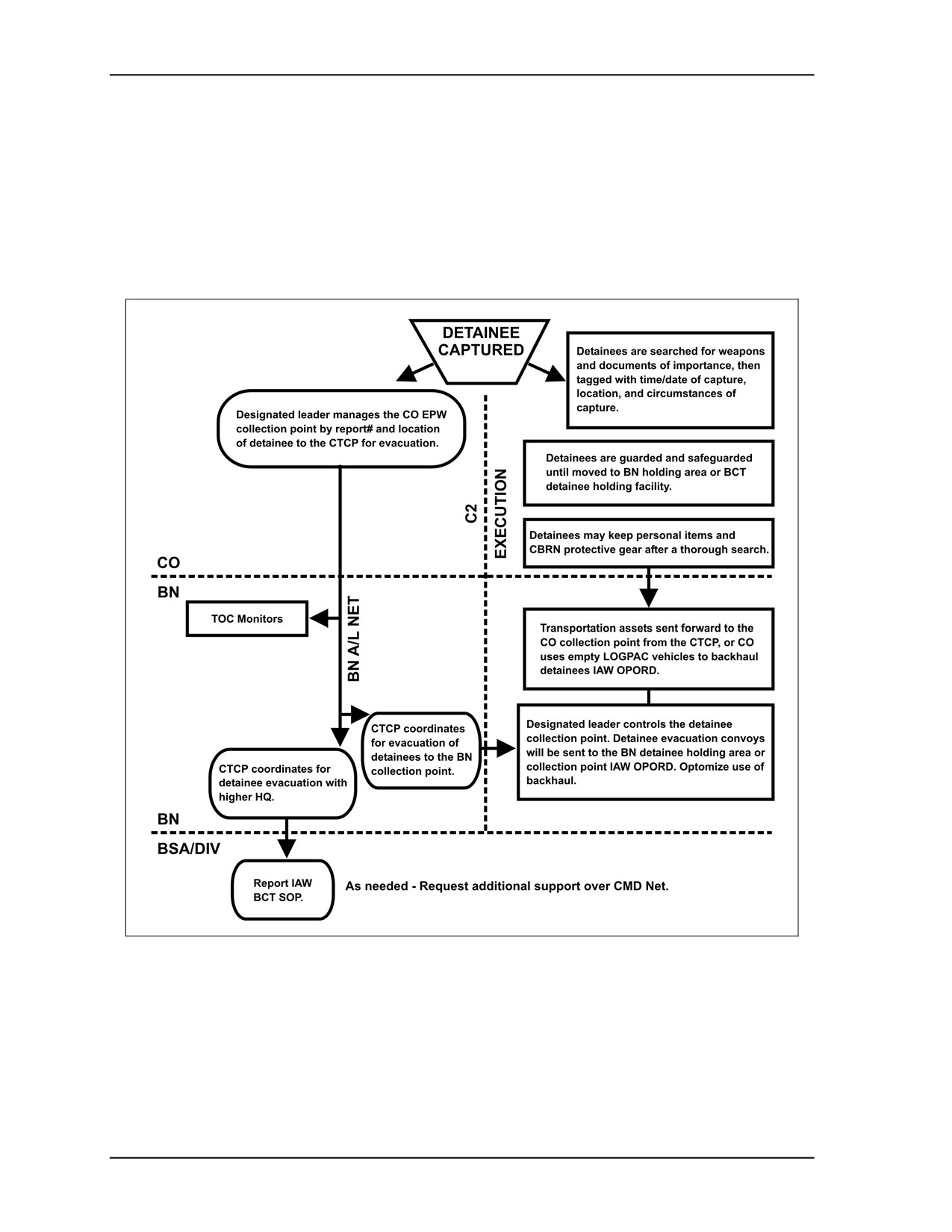
authorities. The BCT has an organic military police platoon organic to the BSTB to take control of and
evacuate detainees (Figure 10-13). However, as a practical matter, Infantry squads, platoons, companies,
and battalions capture and must provide the initial processing and holding for detainees. Detainee handling
is a resource intensive and politically sensitive operation that requires detailed training, guidance, and
supervision by the Infantry battalion leadership and staff.
Figure 10-13. Detainee handling.
10-301.
All detained persons shall be immediately given humanitarian care and treatment. US Armed
Forces will never torture, maltreat, or purposely place detained persons in positions of danger. There is
never a military necessity exception to violate these principles.
10-302.
Field processing of detainees is always handled IAW the 5 Ss and T method:
10-64
FM 3-21.20
13 December 2006
Warfighting Functions
Search
10-303.
Confiscate weapons and items of intelligence value or items that might assist the detainee to
escape. Let the detainee keep protective clothing, equipment, identification, and personal items. All
confiscated items must be tagged.
Silence
10-304.
Direct the detainees not to talk, or make facial or hand gestures. They may be gagged.
Segregate
10-305.
Leaders are separated from the rest of the population. Separate hostile elements such as
religious, political, or ethnic groups. Separate women and minors from adult male detainees.
Safeguard
10-306.
Ensure detainees are provided adequate food, potable water, clothing, shelter, medical attention
and not exposed to unnecessary danger. Do not use coercion to obtain information. Immediately report
allegations of abuse through command channels.
Speed to a Safe Area/Rear
10-307.
Evacuate detainees from the battlefield to a holding area or facility as soon as possible.
Transfer captured documents and other property to the forces assuming responsibility for the detainees.
Tag
10-308.
Use DD form 2745, Prisoner of War (EPW) Capture Tag, or other field-expedient means.
Record the date and time of capture, location of capture, capturing unit, and circumstances of capture.
10-309.
Detainees should be evacuated as soon as is practical to the BCT detainee collection point, or to
a higher level facility. Circumstances sometimes preclude rapid evacuation above battalion level; however,
it should never exceed 24 hours (JP 3-63). Tactical questioning of detainees is allowed relative to
collection of CCIR. However, detainees must always be treated IAW the US Law of War Policy as set
forth in the DoD Directive 2311.01E, DoD Law of War Program.
10-310.
Soldiers capturing equipment, documents, and detainees should tag them using DD Form 2745
and report the capture immediately. Detainees are allowed to keep protective equipment such as protective
masks. Other captured military equipment and detainee personal effects are inventoried on DA Form 4137,
Evidence/Property Custody Document. Soldiers then coordinate with the platoon and or company
headquarters to link up and turn the documents and prisoners over to designated individuals. Normally the
1SG, often assisted by the supply section, moves the detainees to the vicinity of the combat trains for
processing and subsequent interrogation by battalion or MI company personnel. Crews of vehicles
undergoing repair, or sustainment personnel can be used as guards.
10-311.
The CTCP plans and coordinates detainee operations, collection points, and evacuation
procedures. Detainees are evacuated from the battalion combat zone as rapidly as possible and moved to
either the battalion detainee holding area or BCT holding facility. The battalion holding area is normally
located near the CTCP or the FTCP. The BCT holding facility is normally located in the BSA, and
detainees are transported on returning LOGPAC vehicles or by transportation coordinated by the battalion
S-4. As necessary, the S-2 reviews and reports any documents or information of immediate value. The S-4
coordinates evacuation of large amounts of enemy equipment.
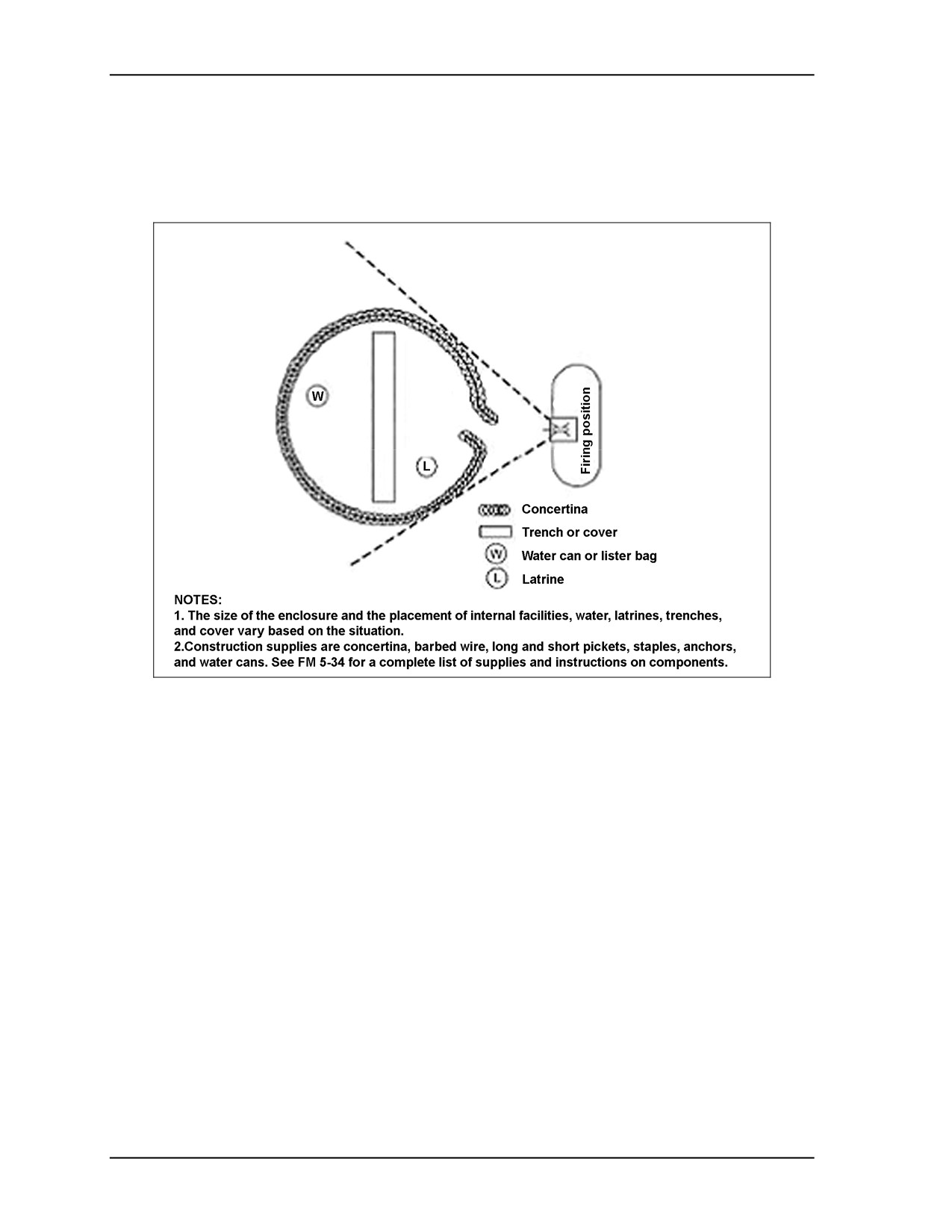
10-312.
The battalion detainee holding area should be simple and easily guarded by only a few Soldiers
and must include the following requirements:
13 December 2006
FM 3-21.20
10-65
Chapter 10
• Be securable.
• Contain water.
• Have latrine facilities.
• Provide adequate shelter (trench or cover) (Figure 10-14).
Figure 10-14. Battalion detainee holding area.
10-66
FM 3-21.20
13 December 2006
Chapter 11
Urban Operations
Urban operations (UO) are not new to the US Army. Throughout its history, the Army
has fought enemies on urban terrain. However, urban areas and urban populations
have grown significantly during the late twentieth century and have begun to exert a
much greater influence on military operations. The worldwide shift from a rural to an
urban society and the requirement to transition from combat to stability operations
have affected the way US forces conduct combat operations. Companies, platoons,
and squads will seldom conduct UO independently during offensive or defensive
operations and will most likely conduct assigned missions as part of a battalion
urban’s combat operation. However, UO engagements are almost always fought by
small units such as platoons and companies, due to the fragmented nature of urban
terrain. During stability and civil support operations, it is likely that companies,
platoons, and squads will conduct urban operations. This chapter provides the
necessary background information to facilitate an understanding of how commanders
plan and conduct UO.
Section I. INTRODUCTION
Urban operations are military actions that are planned and conducted on terrain, where manmade construction
affects the tactical options available to the commander. An urban area is a topographical complex where
manmade construction and the population are dominant features. Urban terrain confronts commanders with a
combination of difficulties rarely found in other environments. Urban areas are complex, dynamic
environments. However, three distinguishing characteristics can be identified as the “urban triad”: The physical
terrain of an urban area consists of three dimensional surface areas; internal and external space of buildings and
structures; subsurface areas; and the airspace above the battalion AO. The noncombatant population is
characterized by the interaction of numerous political, economical, and social activities. This population is
supported by the urban area’s physical and service infrastructure. Cities vary immensely depending on their
history, the cultures of their inhabitants, their economic development, the local climate, available building
materials, and many other factors. This variety exists not only among different cities but also within any
particular urban area. The urban environment, like all environments, is neutral and affects all sides equally. The
side that can best understand and exploit the effects of the urban area has the best chance of success.
FUNDAMENTALS
11-2.
The fundamentals described in this paragraph apply to UO regardless of the mission or
geographical location. Some fundamentals may also apply to operations not conducted in an urban
environment but are particularly relevant in an environment dominated by manmade structures and a dense
noncombatant population. BCT and Infantry battalion commanders and staffs should use these
fundamentals when planning UO.
UNDERSTAND HUMAN DIMENSION
11-3.
The human dimension of the urban environment often has the most significance and greatest
potential for affecting the outcome of UO. A useful source for this information is attached PSYOP, CA or
HUMINT assets. Commanders carefully consider and manage the allegiance and morale of the civilian
13 December 2006
FM 3-21.20
11-1
Chapter 11
population as these can decisively affect operations. The assessment of the urban environment must
identify clearly and accurately the attitudes of the urban population toward units. Commanders and staffs
make their assessments based on a thorough understanding and appreciation of the local social and cultural
norms. Sound application of the understanding of the human dimension will also encourage the population
to provide vital intelligence on the enemy. Well established policies, discipline, and consideration
positively affect the attitudes of the population toward Army forces.
PERFORM FOCUSED INFORMATION OPERATIONS
11-4.
Information superiority efforts aimed at influencing non-Army sources of information are critical
in UO. Because of the density of noncombatants and information sources, the media, the public, allies,
coalition partners, neutral nations, and strategic leadership will likely scrutinize how units participate
in UO.
11-5.
The proliferation of cell phones, Internet capability, and media outlets ensure close observation of
unit activities. With information sources rapidly expanding, public information about Army operations will
be disseminated rapidly. Therefore, units should integrate information operations into every facet and at all
levels of the operation to prevent negative impacts.
11-6.
Under media scrutiny, the actions of a single Soldier may have significant strategic implications.
A goal of information operations is to ensure that the information available to all interested parties, the
public, the media, and other agencies is accurate and placed in the proper context of the Army’s mission.
(For more information, see Appendix J.)
11-7.
While many information operations will be planned at levels above the BCT, tactical units
conducting UO may often be involved in the execution of information operations such as military
deception, operations security, physical security, and psychological operations. BCTs and battalions must
conduct aggressive ISR and security operations that will allow them to properly apply the elements of
assess, shape, dominate, and transition to specific UO.
CONDUCT CLOSE COMBAT
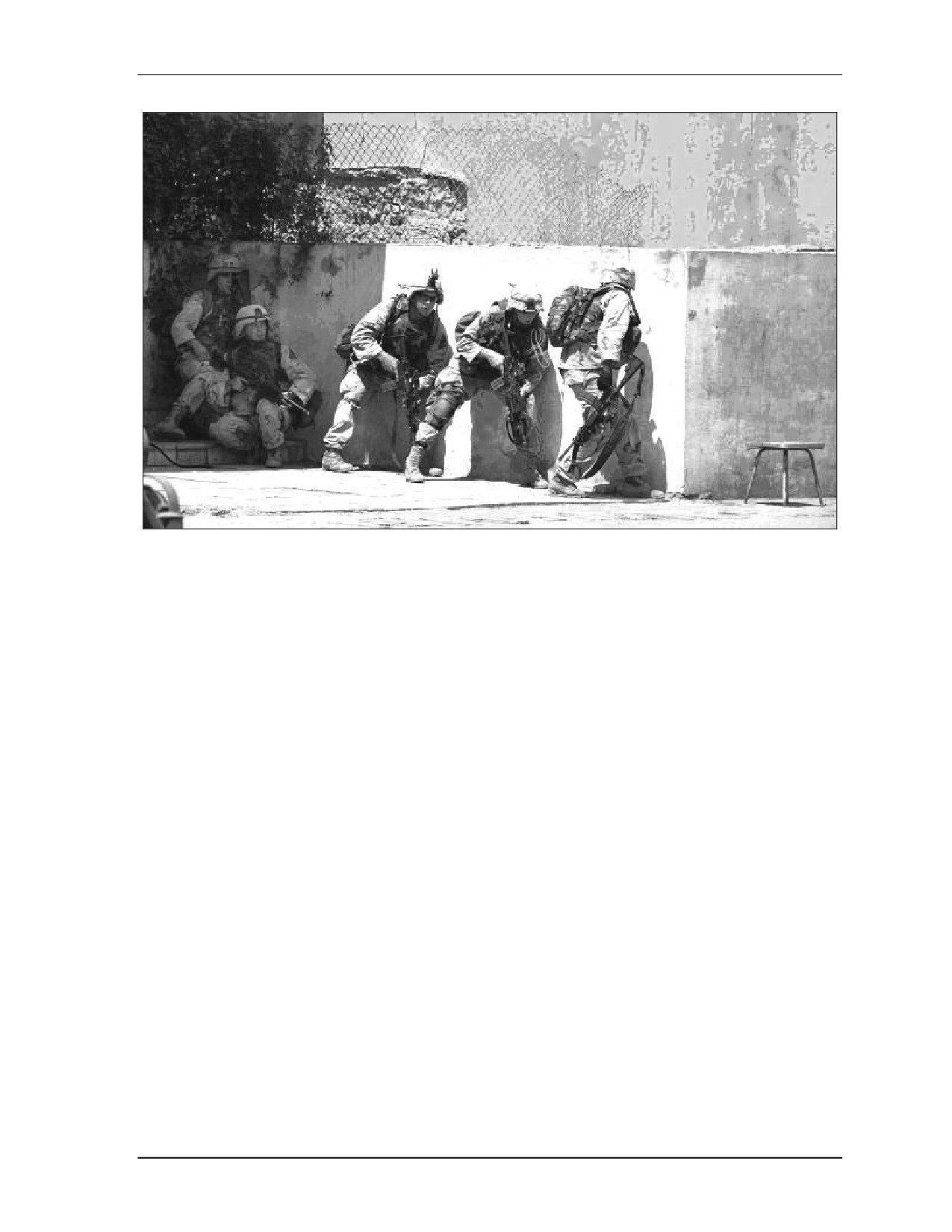
11-8.
Close combat is required in offensive and defensive UO. The capability to conduct close combat
must be present and visible in stability UO and may be required, by exception, in support UO. Close
combat in UO is resource intensive, requires properly trained and equipped forces, has the potential for
high casualties, and can achieve decisive results when properly conducted. Close combat in UO should be
conducted by combined arms task organized units and joint fires in support. Units must always be prepared
to conduct close combat as part of UO (Figure 11-1).
11-2
FM 3-21.20
13 December 2006
Urban Operations
Figure 11-1. Soldiers conducting close combat in an urban area.
AVOID ATTRITION APPROACH
11-9.
Previous doctrine was inclined towards a systematic linear approach to urban combat. This
approach placed an emphasis on standoff weapons and firepower. This approach can result in significant
collateral damage, civilian casualties, destruction of vital infrastructure, a lengthy operation, and be
inconsistent with the political situation and strategic objectives. Enemy forces that defend urban areas often
want units to adopt this approach because of the likely costs in resources. Commanders should consider
this tactical approach to urban combat only when the factors of METT-TC warrant its use.
CONTROL ESSENTIAL
11-10. Many modern urban areas are too large to be completely occupied or even effectively controlled.
Therefore, units must focus their efforts on controlling only the essentials to mission accomplishment. At a
minimum, this requires control of key terrain. In the urban environment, functional, political, or social
significance may determine what terrain is considered key or essential. For example, a power station or a
government building may be key terrain. Units focus on control of the essential facilities or terrain so they
can concentrate combat power where it is needed and conserve it. This implies risk in those areas where
units choose not to exercise control in order to be able to mass overwhelming power where it is needed.
MINIMIZE COLLATERAL DAMAGE
11-11. Units should use precision fires, information operations, and nonlethal tactical systems
(Appendix L) as much as possible consistent with mission accomplishment. Commanders must consider
the short- and long-term effects of firepower on the population, the infrastructure, and subsequent
missions.
13 December 2006
FM 3-21.20
11-3
Chapter 11
SEPARATE COMBATANTS FROM NONCOMBATANTS
11-12. There is almost never a clear distinction between combatants and noncombatants. However,
promptly separating noncombatants from combatants, as best as can be identified, may make the operation
more efficient and diminish some of the enemy’s asymmetrical advantages. Separation of noncombatants
may also reduce some of the restrictions on the use of firepower and enhance force protection. This
important task becomes more difficult when the adversary is an unconventional force and can mix with the
civil population.
RESTORE ESSENTIAL SERVICES
11-13. Tactical units may have to support a plan for the restoration of essential services that may fail to
function upon their arrival or cease to function during an operation. Essential services include power, food,
water, sewage, medical, and security. During planning for and the conduct of UO, the commander uses all
available assets to minimize collateral damage to potentially vital infrastructure.
PRESERVE CRITICAL INFRASTRUCTURE
11-14. Commanders and staffs analyze the urban area to identify critical infrastructure. Tries to preserve
the critical elements for post-combat sustainment operations, stability operations, or the health and well
being of the indigenous population may be required. This requirement differs from simply avoiding
collateral damage because units may have to initiate actions to prevent adversaries from removing or
destroying infrastructure that will be required in the future. In some cases, preserving critical infrastructure
may be the assigned objective of the UO.
TRANSITION CONTROL
11-15. UO of all types are resource intensive and thus commanders plan to conclude UO expediently yet
consistent with successful mission accomplishment. The end state of all UO transfers control of the urban
area to another agency or returns it to civilian control. This requires the successful completion of the
mission and a thorough transition plan. The transition plan may include returning control of the urban area
to another unit or agency a portion at a time as conditions permit.
PLANNING CONSIDERATIONS
11-16. Throughout history, military planners have viewed cities as centers of gravity and sources of
national strength. Cities are distinguished as population centers; transportation and communication hubs;
key nodes of industrial, financial, and information systems; seats of government; and repositories of
wealth. Because of the changing nature of society and warfare, deployments into urban environments have
become more frequent, and this trend is likely to continue. The purpose of such deployments will be to
neutralize or stabilize extremely volatile political situations, to defeat an enemy force that has sought the
protection afforded by urban terrain, or to provide assistance to allies in need of support. This chapter
provides guidance necessary for planning and executing missions in an urban environment. The BCT is the
primary headquarters around which units are task-organized to perform UO.
11-17. The increasing world population and accelerated growth of cities makes UO in future conflicts
very likely. Operations in urban areas usually occur when—
• The assigned objective lies within an urban area and cannot be bypassed.
• The urban area is key (or decisive) in setting or shaping the conditions for current or future
operations.
• The urban area is in the path of a general advance and cannot be surrounded or bypassed.
• The urban area is small enough to be bypassed or isolated by rapidly advancing units but still
needs to be occupied because it lies near or on logistics lines of communications.
11-4
FM 3-21.20
13 December 2006
Urban Operations
• Political or humanitarian concerns require the control of an urban area or necessitate operations
within it.
• An urban area is between two natural obstacles and cannot be bypassed.
• Defending from urban areas supports a more effective overall defense or cannot be avoided.
• Occupation, seizure, and control of the urban area will deny the enemy control of the urban
area and the ability to impose its influence on both friendly military forces and the local civilian
population, thereby allowing friendly forces to retain the initiative and dictate the conditions for
future operations.
ORGANIZATION
11-18. The Infantry battalion is well suited as a basic building block for UO because of its organizational
structure, precision weapons systems, and the numerous Infantry-specific tasks associated with UO.
ROLE OF INFANTRY BATTALION
11-19. The Infantry battalion achieves tactical successes by means of combined-arms at the company
level focused on dismounted assault. Combined-arms integration is vital to support dismounted operations
by squads, platoons, and companies, including dispersed actions. Supported by direct fires from organic
weapons, antiarmor weapons, and heavy forces, the battalion incorporates engineers, COLT fire support
teams, mortars, artillery, and joint fires and effects to provide the appropriate systems required for this
integration.
ISOLATION
11-20. An incontrovertible fact in UO is that isolation is a key to victory. If the attacker fails to isolate the
urban area, the defender can reinforce and resupply his forces, thus protracting the operation and
significantly decreasing the attacker’s resources and will to continue. If the defender is isolated, the
attacker seizes the initiative and forces the defender to take high-risk actions, such as a breakout or
counterattack, to survive. Mounted forces are optimal for executing isolation operations because they
possess the speed, agility, firepower, and protection necessary to successfully shape the urban area for
offensive or defensive operations.
CLOSE COMBAT
11-21. Historically, the close fight in urban combat has consisted of street-to-street fighting resulting in
high casualties and high expenditure of resources. Well executed combined arms operations can reduce the
high casualty rate traditionally associated with UO.
TACTICAL CHALLENGES
11-22. The battalion faces a number of challenges during the planning and execution of UO. The most
likely challenges are discussed in the following paragraphs.
CONTIGUOUS AND NONCONTIGUOUS AREAS OF OPERATIONS
11-23. The battalion must be prepared to conduct UO operations in both contiguous and noncontiguous
areas of operations.
11-24. Contiguous operations are military operations that the battalion conducts in AOs that facilitate
mutual support of combat, CS, and sustainment elements at varying levels. Contiguous operations have
traditional linear features including identifiable, contiguous frontages and shared boundaries between
13 December 2006
FM 3-21.20
11-5
Chapter 11
forces. For battalions, relatively close distances among adjacent battalions, supporting assets, and
subordinate units and elements characterize contiguous operations.
11-25. In noncontiguous operations, the battalion may be required to operate independently, removed
from BCT CS and sustainment assets by distance and time. Also, subordinate companies may operate in
isolated pockets, connected only through integrating effects of an effective concept of operations.
Noncontiguous operations place a premium on initiative, effective information operations, decentralized
security operations, and innovative logistics measures. Noncontiguous operations complicate or hinder
mutual support of combat, CS, and sustainment elements because of extended distances between
subordinate units and elements.
SYMMETRICAL AND ASYMMETRICAL THREATS
11-26. In addition to being required to face symmetrical enemy threats, the battalion must be prepared to
face enemy threats of an asymmetrical nature.
11-27. Symmetrical threats are generally "linear" in nature and include those enemy forces that
specifically confront the battalion’s combat power and capabilities. Examples of symmetrical threats
include conventional enemy forces conducting offensive or defensive operations against friendly forces.
11-28. Asymmetrical threats are those that are specifically designed to avoid confrontation with the
battalion’s combat power and capabilities. These threats may use the civilian population and infrastructure
to shield their capabilities from battalion fires. Asymmetrical threats are most likely to be based in and
target urban areas to take advantage of the density of civilian population and infrastructure. Additional
examples of asymmetrical threats include terrorist attacks, WMD, electronic warfare
(to include
computer-based systems), criminal activity, guerilla warfare, and environmental attacks.
QUICK TRANSITION, FROM STABILITY OPERATIONS, TO COMBAT OPERATIONS AND BACK
11-29. Stability operations are missions that may escalate to combat. The battalion must always retain the
ability to conduct offensive and defensive operations. Preserving the ability to transition allows the
battalion to maintain initiative while providing force protection. Commanders should consider planning a
defensive contingency with on-order offensive missions in case stability operations deteriorate.
Subordinate commanders and leaders must be fully trained to recognize activities that would initiate this
transition.
RULES OF ENGAGEMENT
11-30. UO are usually conducted against enemy forces fighting in close proximity to civilians. ROE and
other restrictions on the use of combat power are more restrictive than in other conditions of combat
(FM 3-06.11). If isolation of the enemy force from the civilian population can be achieved, this may allow
for less restrictive ROE.
Section II. METT-TC
Planning and preparation for UO are generally the same as for operations on open terrain. However, in order
for the commander and staff to develop viable COAs, the force must conduct ISR operations. UO require
significant HUMINT reconnaissance because sensors and other technological devices are not as effective in
urban environments. ISR operations can take the form of stealthy surveillance teams, tactical questioning of
noncombatants and informants, and reconnaissance of key terrain and avenues of approach. Using ISR assets
and satellite imagery, the staff can develop urban maps that include a common reference system, such as
numbering buildings, to assist subordinate unit C2. The commander and staff also take into account special
considerations when operating in this environment. This section provides special METT-TC considerations
for UO.
11-6
FM 3-21.20
13 December 2006
Urban Operations
MISSION
11-31. The battalion must close with and defeat the enemy in order to be decisive in UO. Close combat in
UO is resource intensive, requires properly trained and equipped forces, and has the potential for high
casualties. Therefore, the battalion must use close combat as its decisive operation only after shaping the
urban area through reconnaissance and surveillance, isolation, precision fires, and maneuver.
OBJECTIVE
11-32. The commander and staff must clearly understand the purpose of the operation. The battalion’s
objective may be terrain or force oriented. The commander must consider whether committing his force to
combat in urban areas is required or beneficial for achieving his intent.
INTENT
11-33. During planning for offensive operations, the commander and staff consider the overall purpose
and intent of the operation and define what is required. For example, the commander determines if clearing
means every building, block by block, or seizure of a key objective, which may require clearing only along
the axis of advance. Often, the battalion can integrate urban areas into the defensive scheme to develop a
stronger defense.
ENEMY
11-34. The battalion commander and staff consider the strength, composition, disposition, and activities
of the enemy. They consider both conventional and unconventional enemy forces and the tactics the enemy
may employ. Enemy tactics may range from ambushes and snipers to large-scale conventional actions
conducted by heavy forces. The IPB addresses the known and potential tactics and vulnerabilities of all
enemy forces and threats operating within and outside the urban area. The IPB considers the
three-dimensional environment of urban areas: airspace, surface, and subsurface. It also considers the
political, racial, ethnic, tribal, and religious factors that influence the enemy. (See Chapter 2, FM 3-06.11,
for a detailed discussion of urban intelligence preparation of the battlefield.)
11-35. The increasing availability of sophisticated technology has created unorthodox operational
approaches that can be exploited by potential opponents. These approaches seek to counter the
technological and numerical advantages of US joint systems and forces, and to exploit constraints placed
on US forces due to cultural bias, media presence, ROE, and distance from the crisis location.
11-36. Offsetting their inherent weaknesses, enemy forces use asymmetrical means to seek an advantage
in urban terrain to remain dispersed and decentralized, adapting their tactics and weapons to provide the
best success in countering a US response. Threats, in addition to conventional forces, may consist of—
• Unconventional forces.
• Paramilitary forces.
• Militia and special police organizations.
• Organized criminal organizations.
11-37. These forces range from units equipped with small arms, mortars, machine guns, antiarmor
weapons, field expedient weapons such as Molotov cocktails and mines to very capable mechanized and
armor forces equipped with current generation equipment. Urban environments also provide many passive
dangers such as disease from unsanitary conditions and psychological illnesses. While the active threats
vary widely, many techniques are common to all. The enemy may employ the following seven techniques
during UO.
13 December 2006
FM 3-21.20
11-7
Chapter 11
Use Population to Advantage
11-38. The populace of a given urban area represents key terrain which gives the side that manages it
best a distinct advantage. Future urban battles may see large segments of the populace remain in place, as
they did in Budapest, Grozny, and Mogadishu. Battalions involved in UO must be prepared to conduct
missions in and among the residents of the area.
11-39. Enemy forces may use the population to provide camouflage, concealment, and deception for their
operations. Guerrilla and terrorist elements may look the same as any other members of the community.
Even conventional and paramilitary troops may look "civilian." Western military forces adopted the
clean-shaven, close-cut hair standard at the end of the nineteenth century to combat disease and infection,
but twenty-first century opponents might very well sport beards as well as civilian clothing and other
"nonmilitary" characteristics.
11-40. The civilian population may also provide cover for enemy forces, enhancing their mobility close
to friendly positions. Enemy forces may take advantage of US moral responsibilities and try to make the
civilian population a burden on the Army’s logistical and force protection resources. They may herd
refugees into friendly controlled sectors, steal from US-paid local nationals, and hide among civilians
during operations.
11-41. The civilian population may also serve as an important intelligence source for the enemy. Local
hires (serving among US Soldiers, civilians with access to base camp perimeters, and refugees moving
through friendly controlled sectors) may be manipulated by enemy forces to provide information on
friendly dispositions, readiness, and intent. In addition, enemy special purpose forces and hostile
intelligence service assets may move among well-placed civilian groups.
Win Information War
11-42. Enemy forces may try to win the information war in direct opposition to the battalion’s operations.
Portable video cameras, Internet access, commercial radios, and cellular telephones are all tools that permit
enemy forces to tell their story. American "atrocities" may be staged and broadcast. Electronic mail may be
transmitted to sympathetic groups to help undermine resolve. Internet websites provide easy worldwide
dissemination of enemy propaganda and misinformation. Hackers may gain access to US sites to
manipulate information to the enemy’s advantage.
11-43. The enemy may make skillful use of the news media. Insurgent campaigns, for example, need not
be tactical military successes; they need only make the opposition’s campaign appear unpalatable to gain
domestic and world support. The media coverage of the Tet Offensive of 1968 affected the will of both the
American people and their political leadership. Although the battle for Hue was a tactical victory for the
US, the North Vietnamese clearly achieved strategic success by searing the American consciousness with
the high costs of urban warfare (Appendix J).
Manipulate Key Facilities
11-44. Enemy forces may identify and seize control of critical components of the urban area to help them
shape the battlespace to their own ends. Telephone exchanges provide simple and reliable communications
that can be easily secured with off-the-shelf technologies. Sewage treatment plants and flood control
machinery can be used to implement WMD strategies or to make sections of the urban area uninhabitable.
Media stations significantly improve the information operations position of the controlling force. Power
generation and transmission sites provide means to control significant aspects of civilian society over a
large area.
Use Three Dimensions of Urban Terrain
11-45. The enemy thinks and operates throughout all dimensions of the urban environment. Upper floors
and roofs provide the urban enemy forces excellent OPs and BPs above the maximum elevation of many
weapons. Shots from upper floors strike friendly armored vehicles in vulnerable points. Basements also
11-8
FM 3-21.20
13 December 2006
Urban Operations
provide firing points below many weapons’ minimum depressions and strike at weaker armor. Sewers and
subways provide covered and concealed access throughout the AOs. Conventional lateral boundaries often
do not apply as enemy forces control some stories of a building while friendly forces control others floors
in the same building.
Employ Urban-Oriented Weapons
11-46. Whether they are purpose-built or adapted, many weapons may have greater than normal utility in
an urban environment while others may have significant disadvantages. Urban enemy weapons are much
like the nature of urbanization and the urban environment: inventive and varied. Small, man-portable
weapons, along with improvised munitions, can dominate the urban environment. Examples of enemy
weapons favored in UO include—
• Weapons with no minimum depression or no maximum elevation.
• Weapons with little or no backblast (gas-metered, soft launch, and so forth).
• Mortars.
• Sniper rifles.
• Machine guns.
• Grenades.
• Grenade launchers.
• Flame and incendiary weapons.
• RPGs and other shoulder-fired antitank guided missiles (ATGMs).
• Riot control and tranquilizer agents.
• Mines and booby traps.
Engage Entire Enemy Force
11-47. Enemy forces may "hug" battalions operating in an urban area. They may also try to keep all or
significant portions of the battalion engaged in continuous operations to increase the battalion's
susceptibility to combat stress. UO, by their nature, produce an inordinate amount of combat stress
casualties, and continuous operations exacerbate this problem (Appendix H). The enemy may maintain a
large reserve to minimize the impact of this on their own forces.
Focus Attacks on Service Support and Unprotected Soldiers
11-48. Enemy forces may prey on Soldiers poorly trained in basic Infantry skills. Ambushes may focus
on these Soldiers while they are conducting resupply operations or moving in poorly guarded convoys. UO
are characterized by the isolation of small groups and navigational challenges, and the enemy may use the
separation this creates to inflict maximum casualties even when there is no other direct military benefit
from the action.
URBAN MAPPING PROCEDURES
11-49. Before entering an urban environment, the battalion obtains or develops urban maps to assist in
C2. The brigade should try to gain access to city planner or civil engineer maps to provide detailed
information of the urban area. The urban maps, whether digital or sketched, include a reference system to
identify buildings and streets (Figure 11-2). Naming conventions should be simple to allow for ease of
navigation and orientation in the urban environment (odd number buildings on left side of street, even
numbers on right side). Street names should not be used as references because the enemy can remove or
change street signs to confuse friendly forces.
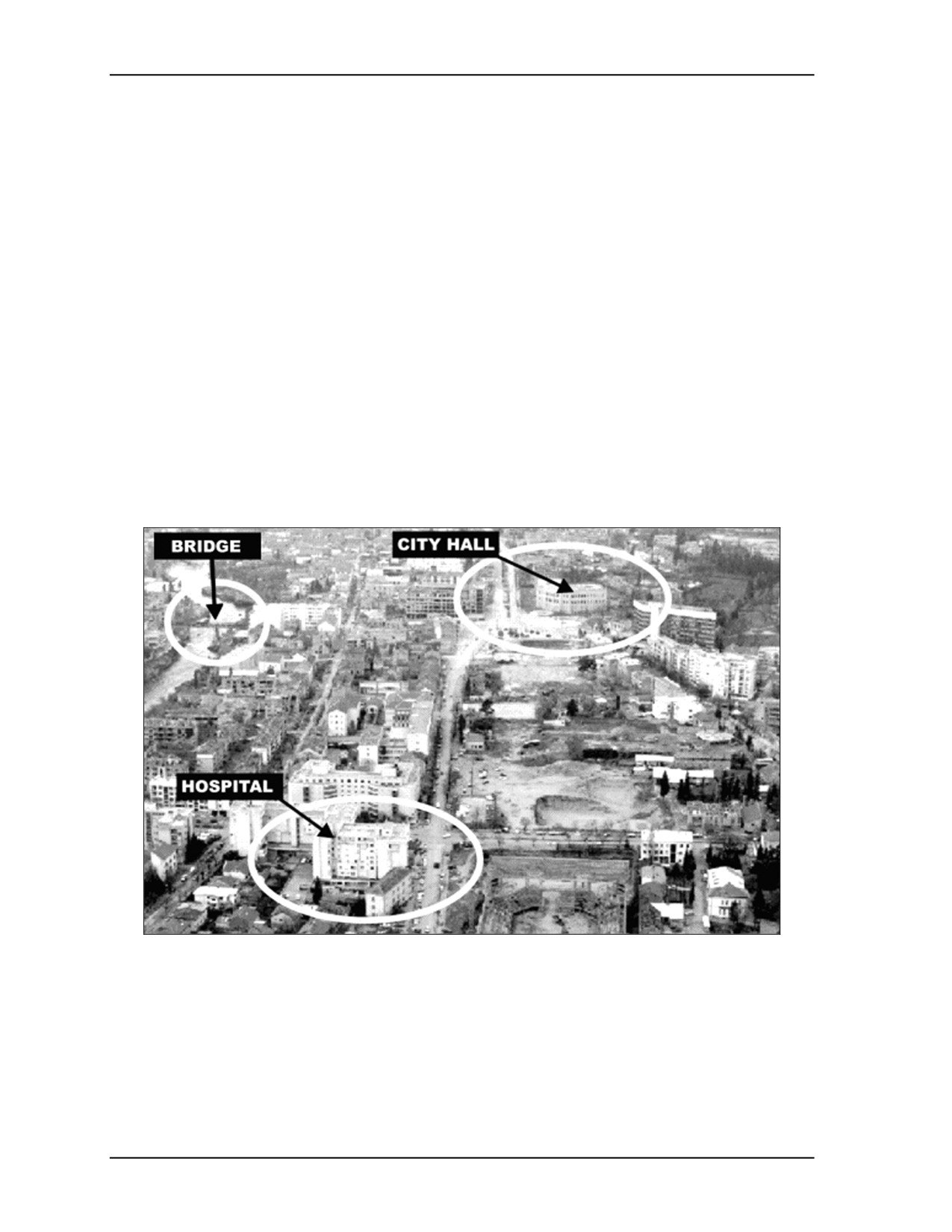
11-50. Initial map and aerial photograph reconnaissance can identify key terrain and other important
locations in the AO.
13 December 2006
FM 3-21.20
11-9
Chapter 11
Safe Havens
11-51. Safe havens include areas such as—
• Hospitals.
• Police stations.
• Embassies.
• Other (friendly) facilities.
Hazardous Areas
11-52. Hazardous areas include construction sites, dangerous intersections, bridges, and criminal areas.
Major Terrain Features
11-53. Major terrain features include such areas as parks, industrial complexes, and airports.
Subterranean Features
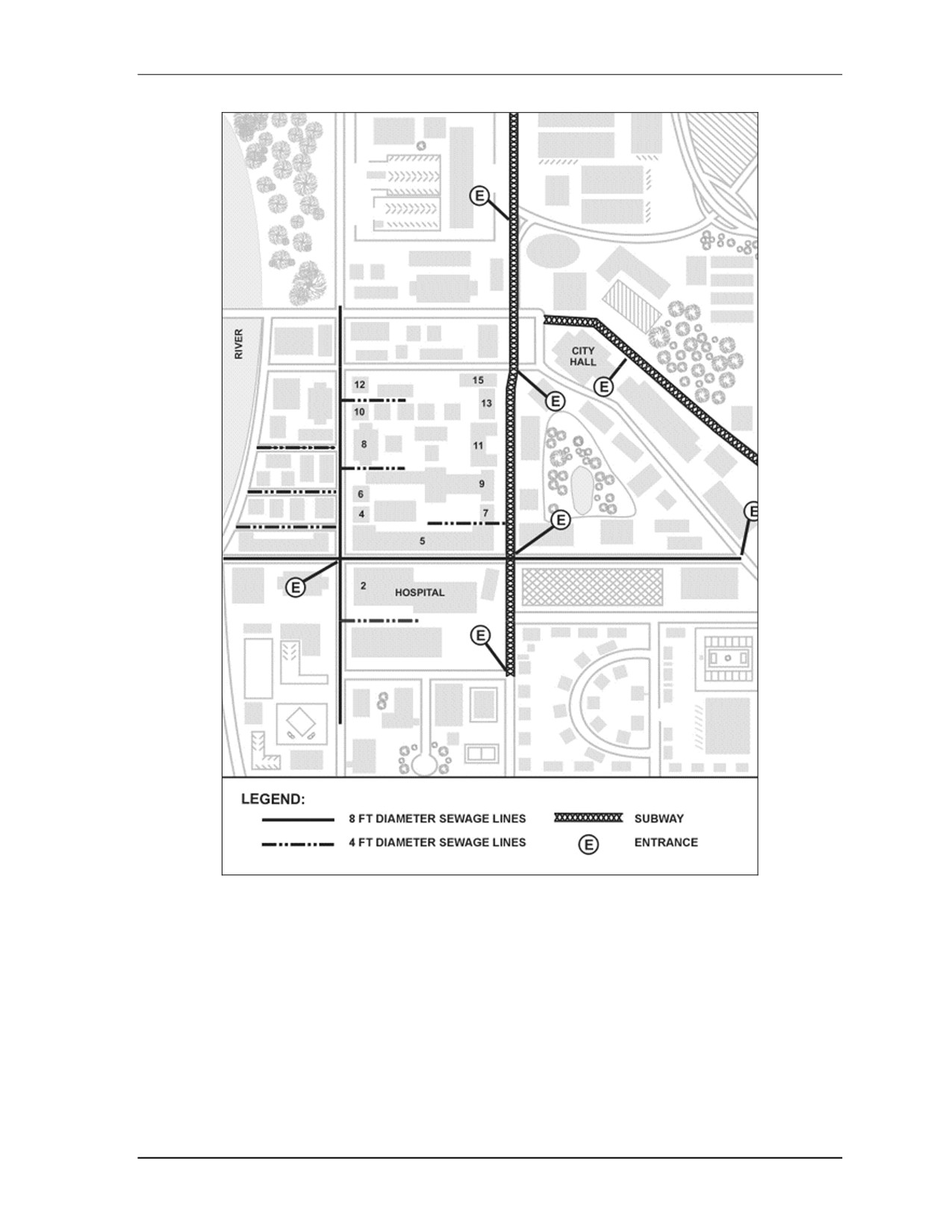
11-54. Subterranean features include sewers and utility systems, subway systems, and underground water
systems.
Figure 11-2. Initial photo reconnaissance of urban area of operations.
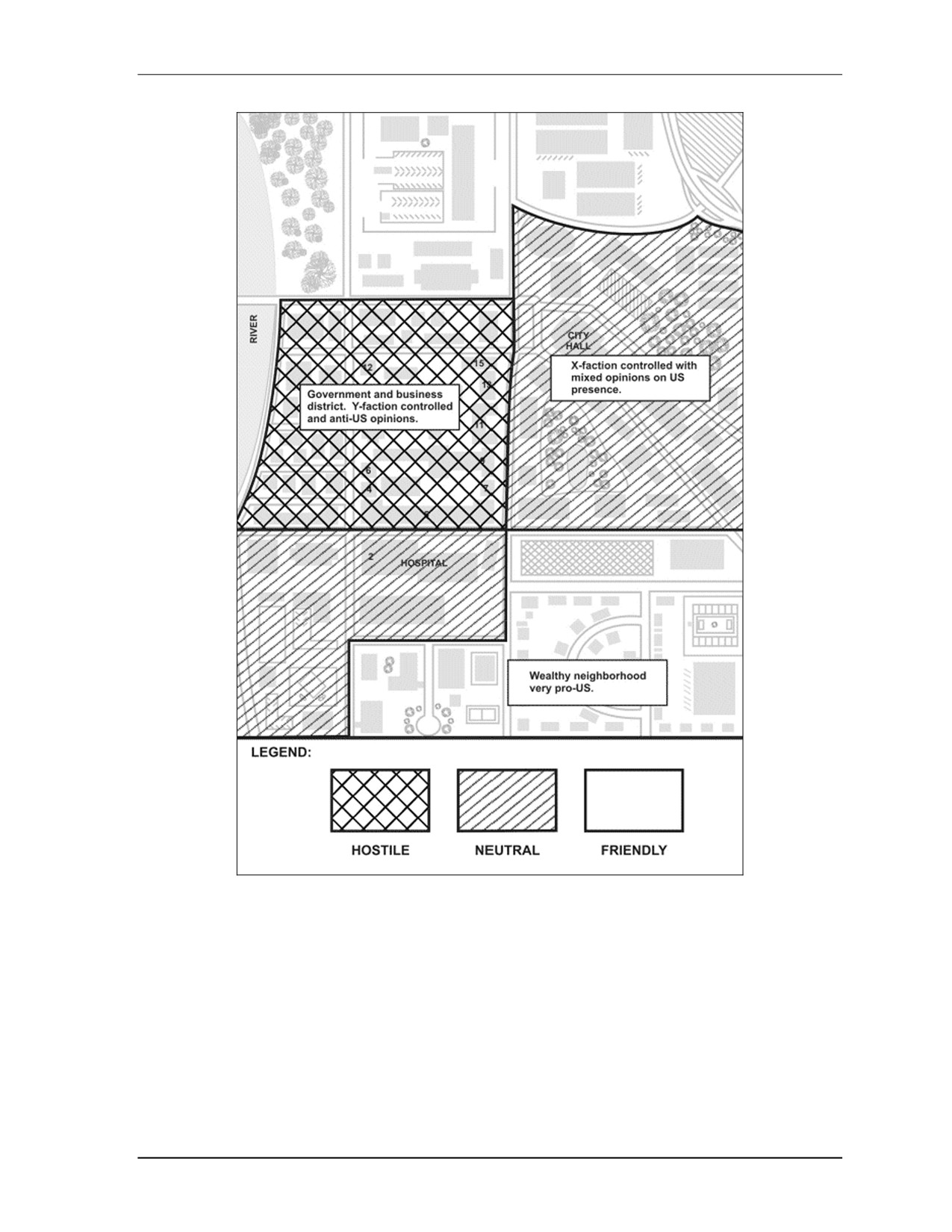
11-55. The urban map also facilitates control by providing a tool for tracking units in detail and obtaining
precise location updates. The battalion uses ISR assets to confirm and update their urban maps. These
improved maps are critical since most existing maps do not provide the level of detail necessary to conduct
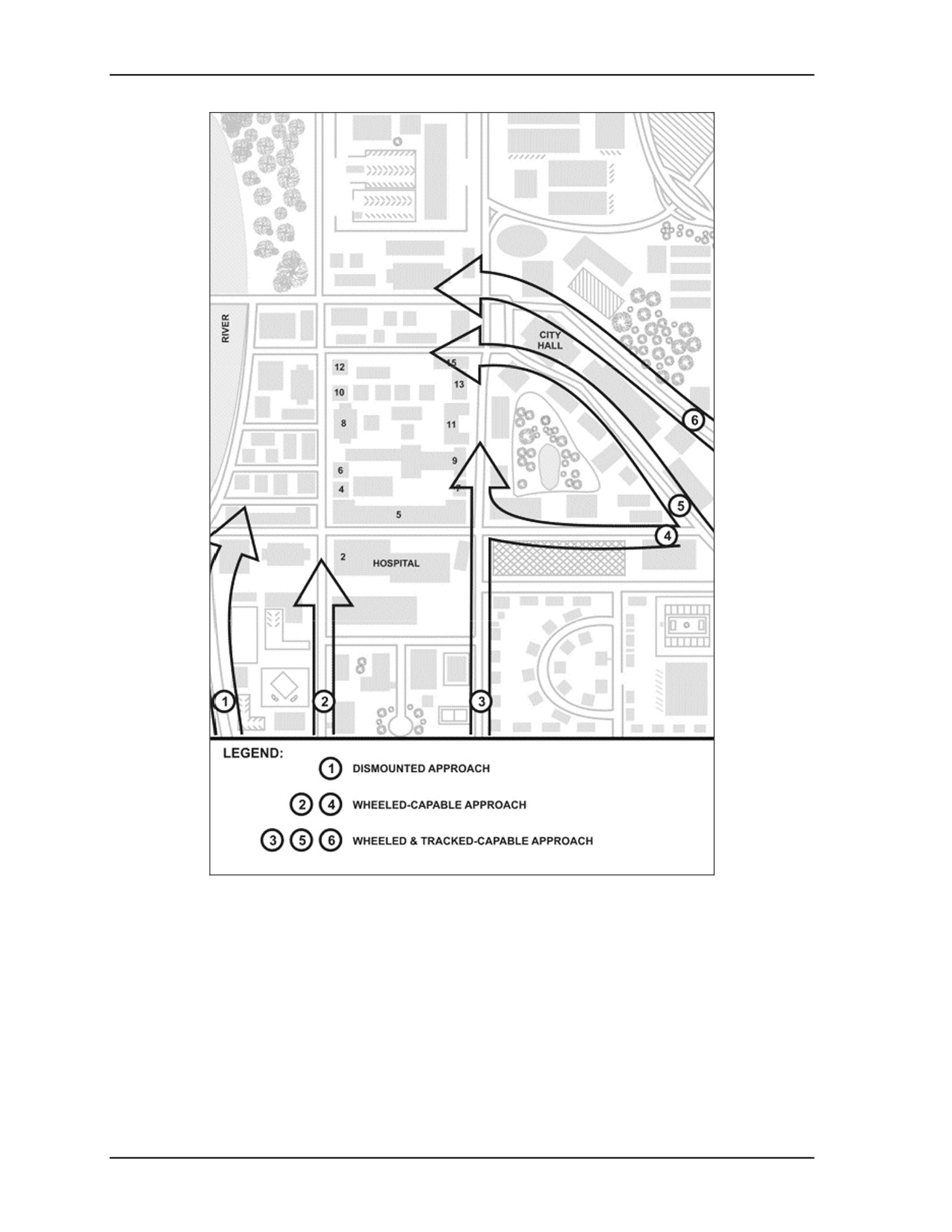
tactical operations. Specifically, the BCT assesses avenues of approach in the urban AO. Included with the
maps are overlays that categorize sections of the urban area by ethnicity, religious affiliation, and other
prevailing characteristics that could affect operations (Figures 11-3 through 11-6, pages 11-11 through
11-14).
11-10
FM 3-21.20
13 December 2006
Urban Operations
Figure 11-3. Example of population status overlay.
13 December 2006
FM 3-21.20
11-11
Chapter 11
Figure 11-4. Avenues of approach in the urban area.
11-12
FM 3-21.20
13 December 2006
Urban Operations
Figure 11-5. Sewer and subterranean overlay.
13 December 2006
FM 3-21.20
11-13
Chapter 11
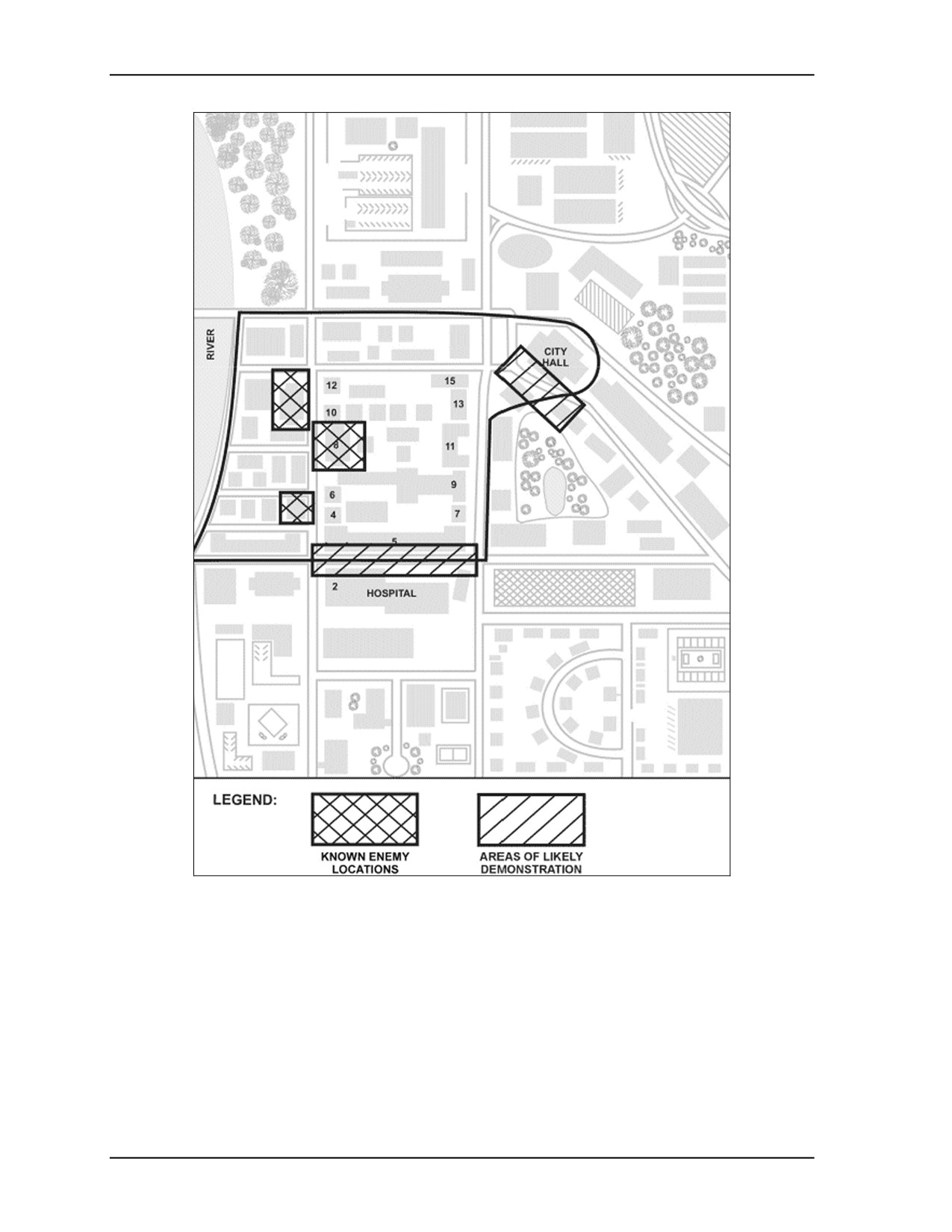
Figure 11-6. Enemy overlay.
TERRAIN AND WEATHER
11-56. An urban area is a concentration of structures, facilities, and people that form the economic and
cultural focus for the surrounding area. Battalion operations are affected by all categories of urban areas
(Table 11-1). Cities, metropolises, and megalopolises with associated urban sprawl cover hundreds of
square kilometers. Battalions normally operate in these urban areas as part of a larger force. Extensive
combat in these urban areas involves units of division level and above.
11-14
FM 3-21.20
13 December 2006

Urban Operations
Table 11-1. Categories of urban areas.
Category
Population
Considerations
Up to 3,000
The battalion’s AO can contain many villages. Battalions
Village
and companies bypass, move through, defend from,
and attack objectives within villages as a normal part of
operations.
Between 3,000 and
Operations in such areas normally involve BCT-sized or
Town
100,000
larger units. Battalions can bypass, move through,
defend in, or attack enemy forces in towns as part of
larger unit operations. Operations in these areas
normally require the full commitment of the BCT or
higher echelon formations.
Between 100,000 and
Extensive combat in large cities involves multiple BCT
City
1,000,000
formations. Battalions can fight adjacent to, on the
edges of, or inside cities.
Between 1,000,000
Extensive combat in large cities involves multiple BCT
Metropolis
and 10,000,000
formations. Battalions can fight adjacent to, on the
edges of, or inside cities.
Over 10,000,000
Extensive combat in large cities involves multiple BCT
Megalopolis
formations. Battalions can fight adjacent to, on the
edges of, or inside cities.
TERRAIN
11-57. A detailed analysis of the urban area and surrounding terrain is vital to the success of any
operation in an urban area (FM 34-130 and FM 3-06.11). The battalion commander must understand the
elements of the urban infrastructure that are necessary for achieving the intent and end state of the BCT’s
mission. Military maps normally do not provide sufficient detail for terrain analysis of an urban area.
Recent aerial photographs and other current intelligence products are critical. Maps and diagrams of the
city from other sources, such as local governments, tourist activities, or law enforcement services, can be
useful. Products that can be developed by the National Imagery Mapping Agency (NIMA) can be
specifically tailored for the AOs.
11-58. The S-2 should obtain maps and diagrams of the following:
• Subway systems, railways, and mass transit routes.
• Underground water, sewer, and utility systems.
• Electrical distribution systems, power stations, and emergency services.
• Fuel supply and storage facilities.
• Facilities for mass communications such as cell phones, computer hubs, radio, and telephone.
• Public administration buildings, hospitals, and clinics.
11-59. The terrain analysis should also identify the following:
• Structural characteristics of buildings, bridges, and transportation networks.
• Roads, highways, rivers, streams, and other waterways that may be used as high-speed avenues
of approach.
13 December 2006
FM 3-21.20
11-15
Chapter 11
• Analysis of the natural terrain surrounding the urban area (observation and fields of fire,
avenues of approach, key terrain, obstacles and movement, and cover and concealment
[OAKOC]).
• Analysis of the urban area itself, to include street patterns, structure types, and available
maneuver space (FM 34-130).
• Covered and concealed approaches to the urban area.
• Key and decisive terrain inside and outside of the urban area.
• Identification of buildings, areas, or facilities protected by the law of land warfare or restricted
by current ROE, such as places of worship or shrines, medical facilities, historic monuments,
and other facilities dedicated to arts and sciences, provided they are not being used for military
purposes (FM 27-10).
• Stadiums, parks, open fields, playgrounds, and other open areas that may be used for landing
zones or holding areas.
• Location of prisons and jails.
• Potential host nation support facilities such as quarries, lumber yards, major building supply
companies, and warehouses.
• Power lines, telephone lines, and raised cables that may be hazards to helicopters.
• Significant fire hazards and locations of other toxic industrial materials (TIMs).
• Weather effect products from topographic models or historical sources such as the effects of
heavy rains on local areas.
11-60. A close relationship with the local government and military forces can be very beneficial. They
can provide information about population, fire-fighting capabilities, police and security capabilities,
civilian evacuation plans, location of key facilities, and possibly current enemy activities. They may also be
able to provide translators and informants for gathering of HUMINT.
11-61. An infrastructure analysis of the urban area is also important. Because urban infrastructures vary
greatly, a comprehensive list cannot be provided. However, common characteristics include—
• Urban street patterns and trafficability.
• Sources of potable water.
• Bulk fuel and transport systems.
• Communications systems.
• Rail networks, airfields, canals and waterways, and other transportation systems.
• Industries.
• Power (to include nuclear) and chemical production facilities and public utilities.
WEATHER
11-62. Weather analyses that are important to battalion operations include visibility, winds, precipitation,
and temperature and humidity.
Visibility
11-63. Light data have special significance during UO. Night and periods of reduced visibility (including
fog) favor surprise, infiltration, detailed reconnaissance, attacks across open areas, seizure of defended
strongpoints, and reduction of defended obstacles. However, the difficulties of night navigation in
restricted terrain force the battalion to rely on simple maneuver plans with easily recognizable objectives.
Winds
11-64. Wind chill is not as pronounced in urban areas. However, the configuration of streets, especially
in close orderly block and high-rise areas, can cause wind canalization.
11-16
FM 3-21.20
13 December 2006
Urban Operations
Precipitation
11-65. Rain or melting snow often floods basements and subterranean areas, such as subways, and makes
storm and other sewer systems hazardous or impassable. Chemical agents and other TIMs are washed into
underground systems by precipitation.
Temperature and Humidity
11-66. Air inversion layers are common over cities, especially cities located in low-lying "bowls" or in
river valleys. Inversion layers trap dust, chemical agents, and other pollutants, reducing visibility and often
creating a greenhouse effect, which causes a rise in ground and air temperature. The heating of buildings
during the winter and the reflection and absorption of summer heat make urban areas warmer than
surrounding open areas during both summer and winter. This difference can be as great as 10 to 20 degrees
and can reduce the effectiveness of thermal sights and imaging systems.
TROOPS AND SUPPORT AVAILABLE
11-67. During UO, the battalion is often augmented with additional assets. Heavy forces (tanks, Infantry
fighting vehicles, Strykers), Engineers, ADA Army aviation, FA, MP, public affairs, PSYOP, civilian
affairs, smoke, decontamination, and long-range surveillance (LRS) assets, and special operations forces,
when available, may also support the battalion. Heavy forces will, in most circumstances, be OPCON to an
Infantry battalion which requires the parent unit to provide logistical and maintenance support that is
normally not available in the Infantry battalion or the IBCT. (See Figure 11-7 and Figure A-3 for example
task organizations. Actual task organizations depend on the factors of METT-TC.)
TROOP DENSITY, EQUIPMENT, AND AMMUNITION
11-68. Troop density for offensive missions in urban areas can be as many as three to five times greater
than for similar missions in open terrain. Troops require additional equipment such as ladders, ropes,
grappling hooks, and other entry equipment. The ammunition consumption rates for small arms, grenades
(all types), Claymore mines, antitank guided missiles, .50 caliber, MK 19, mortars, and explosives can be
four times the normal rate. The staff must ensure the continuous supply of Classes I, III, V, and VIII and
water to forward units. Supplies should be configured for immediate use and delivered as far forward as
possible to supported units. Support units are particularly vulnerable in UO and the commander must
consider security plans for logistics bases and resupply operations.
STRESS
11-69. The commander and staff must consider the effects of prolonged combat on Soldiers. Continuous
close combat produces high psychological stress and physical fatigue. Rotating units committed to combat
for long periods can reduce stress. Leaders should take extra effort and time to train and psychologically
prepare Soldiers for this type of combat (Appendix H).
DISCIPLINE
11-70. Maintaining discipline is especially important in UO. All commanders must ensure that their
Soldiers understand and follow the established ROE. The law of land warfare prohibits unnecessary injury
to noncombatants and needless damage to property. This prohibition may restrict the commander’s use of
certain weapons, munitions, and tactics.
13 December 2006
FM 3-21.20
11-17
Chapter 11
TIME
11-71. Combat in urban areas has a slower tempo and an increased use of methodical, synchronized
missions. In planning UO, the commander and staff must consider these factors. Planning must allow more
time for thorough reconnaissance, subordinate unit rehearsals, demolitions, breaching, fire fighting, entry
and movement techniques, fighting position construction, booby trap recognition and neutralization,
combat lifesaver training, and crowd control.
CIVIL CONSIDERATIONS
11-72. The commander and staff must understand the composition, activities, and attitudes of the civilian
population, within the urban area, to include the political infrastructure. Various options are available to the
commander to control the impact of civilians on the operation. These include screening civilians,
prohibiting unauthorized movement, diverting or controlling refugee movements, and evacuating.
Understanding the urban society requires comprehension of—
• Living conditions.
• Cultural distinctions.
• Ethnicity.
• Factions.
• Religious beliefs.
• Political affiliation and grievances.
• Attitudes toward US forces (friendly, hostile, or neutral).
CURFEW AND EVACUATION
11-73. A commander with the mission of defending an urban area may need to establish a curfew to
maintain security or to aid in control of military traffic. (Curfews are not imposed as punishment. They are
normally established to reduce noncombatant casualties and provide a measure of force protection.) A
commander can require civilians to evacuate towns or buildings if the purpose of the evacuation is to use
the town or building for imperative military purposes, to enhance security, or to safeguard those civilians
being evacuated. If the commander takes this action, he must specify and safeguard the evacuation routes.
If civilians are evacuated, there may also be a need to provide temporary housing and sustainment for
them. This is best coordinated with and conducted by other government agencies or nongovernmental
organizations. However, before the evacuation begins, the commander should ensure these plans are in
place so as not to cause overdue hardship and animosity among the civilian population. Battalions may also
be involved in securing routes and possibly safeguarding food, clothing, medical, and sanitary facilities.
Evacuated civilians must be transferred back to their homes as soon as hostilities in the area have ceased.
The staff must plan for and coordinate the movement and evacuation of civilians to ensure their actions do
not interfere with the military operation. The battalion staff and supporting civil affairs units working with
local officials coordinate the movements of civilians.
RESISTANCE GROUPS
11-74. The battalion may encounter civilian resistance groups whose actions may range from providing
the enemy with supplies, services, and noncombat support to actively fighting against friendly forces.
Members of such resistance groups should be dealt with IAW applicable provisions of the law of war.
Commanders should seek guidance from the judge advocate general (JAG) concerning the detention and
disposition of persons participating in acts harmful to friendly forces. The S-2 must work with PSYOP and
CA units to identify these threats and recommend, within the ROE, the appropriate preemptive action or
response. The activities of resistance groups may also benefit friendly forces. They may be a potential
source for TAC HUMINT assets; act as guides, liaisons, or translators; and provide subject-matter
11-18
FM 3-21.20
13 December 2006
Urban Operations
expertise on local public facilities such as refineries, power plants, and water works. They may also
provide active resistance against the enemy.
Section III. COMMAND AND CONTROL
UO require centralized planning and decentralized execution; therefore, the staff must develop a detailed plan
that synchronizes the WFF in order to meet the commander’s intent and provide subordinate units with the
means to accomplish the mission.
ENEMY FOCUS
11-75. During the mission analysis, the plan should focus on the factors of METT-TC. The commander
orients the plan on the enemy rather than terrain. He uses terrain factors to defeat the enemy.
Considerations include, but are not limited to, the following:
11-76. Thorough evaluation of the urban area’s related terrain and enemy force may take much longer
than in other environments. This time factor also affects friendly planning efforts.
11-77. Determine the enemy’s location, strength, and capabilities. Develop a plan that defeats his direct
and indirect fire systems.
11-78. Focus the axis of advance on the enemy’s weaknesses while maintaining adequate force
protection measures. When possible, employ multiple and supporting axes of advance.
11-79. Divide the objective area into manageable smaller areas that facilitate company maneuver.
11-80. Isolate the objective area and establish a foothold at the point of entry. The location chosen for the
foothold must allow for expansion.
11-81. The BCT and battalion maneuver plans directly affect the company schemes of maneuver. Every
platoon within the battalion must know what enemy targets will be engaged by BCT and battalion assets.
COMMANDER’S CRITICAL INFORMATION REQUIREMENTS
11-82. The commander's critical information requirements directly affect his decisions and dictate the
successful execution of tactical operations. The battalion staff must develop the components of the CCIR
that facilitate the commander’s ability to make decisions affecting the plan during UO. Essential elements
of friendly information
(EEFI) address the enemy commander’s PIR. Friendly forces information
requirements are items that cause the commander to make decisions that affect the plan. The following are
examples of PIR, EEFI, and FFIR that would help the commander in an urban environment.
11-83. These are intelligence requirements that a commander has anticipated and that have stated priority
in task planning and decision making. Examples include—
• Is the enemy using avenue of approach 1 to infiltrate into the battalion AOs?
• Does mobility corridor three (3rd Street) restrict movement of friendly armored and wheeled
vehicles?
• Is there an enemy strongpoint located between 3rd Street and 5th Street along 3rd Avenue?
• Does the enemy have ADA assets positioned along air avenue of approach 2?
• Is the enemy using the subway station at Maple and Grand Avenues as an assembly area for
their reserve?
13 December 2006
FM 3-21.20
11-19
Chapter 11
ESSENTIAL ELEMENTS OF FRIENDLY INFORMATION
11-84. These are critical aspects of a friendly operation that, if known by the enemy, would subsequently
compromise, lead to failure, or limit the success of the operation. Therefore, they must be protected from
detection. Examples include—
• Have any of the battalion command nets been compromised?
• Has my LOC been disrupted, and where?
• Has the enemy located my Q36?
11-85. This is information the commander and staff need about the friendly forces available for the
operation. Examples include—
• Reconnaissance elements captured or compromised.
• Main bridge locations along the ground route that have been destroyed.
• OPORD compromised.
• Loss of cryptographic equipment.
• Expected personnel and equipment replacements that did not arrive.
TASK ORGANIZATION
11-86. UO may require unique task organizations. For example, UO provide one of the few situations
where Infantry and armor elements may be effectively task-organized below platoon levels. Battalion
commanders consider providing assets where they will be needed to accomplish specific tasks. All phases
of mission execution are considered when developing task organization. Changes in task organization may
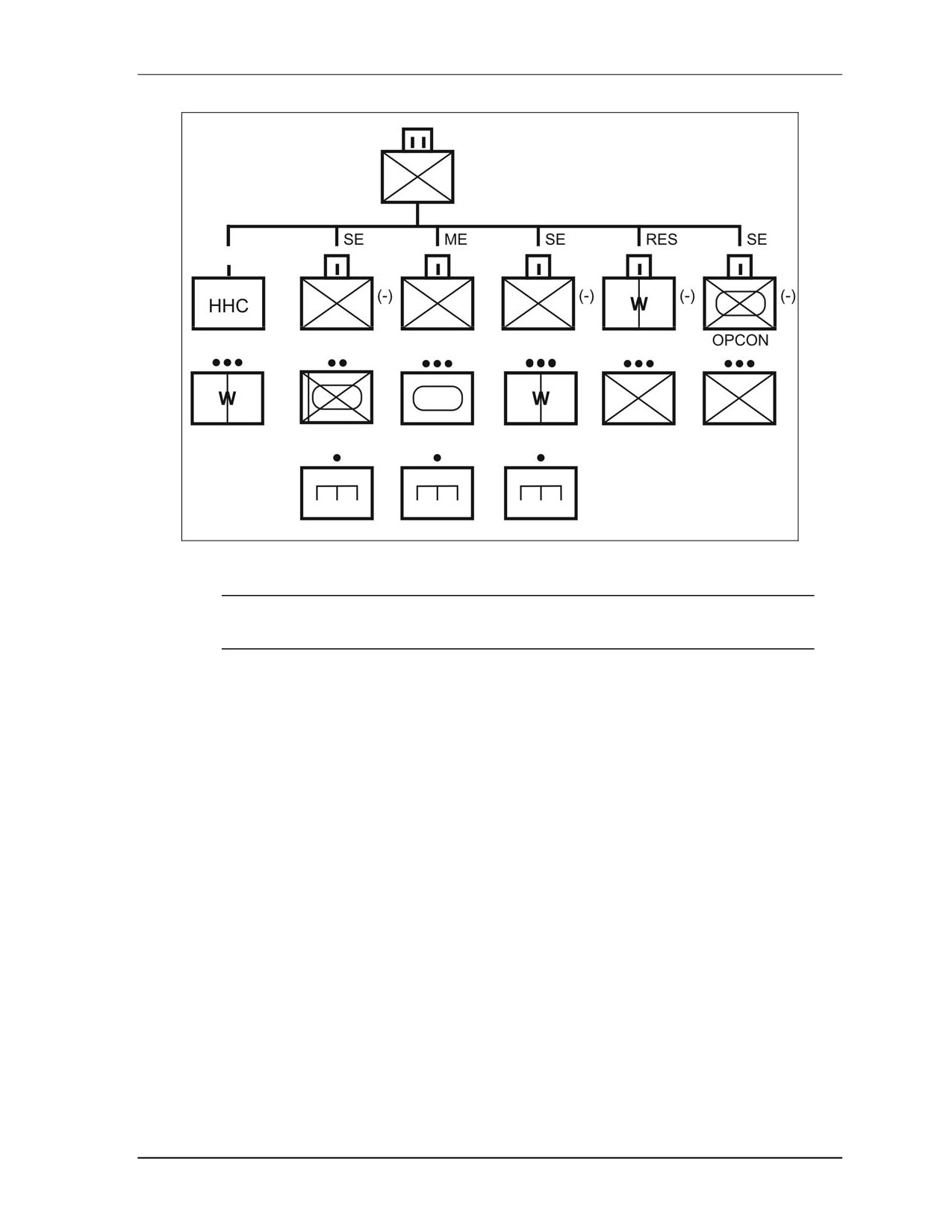
be required to accomplish different tasks during mission execution. Figure 11-7 (page 11-21) shows an
example task organization for an Infantry battalion task force conducting offensive UO that consist of a
main effort, three supporting efforts, and a reserve.
11-20
FM 3-21.20
13 December 2006
Urban Operations
Figure 11-7. Example offensive task organization.
Note. The task organization shown in Figure 11-7 may change after the assault when the
battalion reorganizes for follow-on missions.
REHEARSALS
11-87. After developing a thorough, well-synchronized plan, battalion commanders require subordinate
units to conduct combined-arms rehearsals at the levels at which the operations will occur, to include all
phases of the operation. When conducted properly, combined-arms rehearsals identify potential problems
in the synchronization of the plan between maneuver, CS, and sustainment elements. Rehearsals provide a
means for units that seldom operate together to train collective skills. Rehearsals should start early in the
troop-leading process. Some rehearsals can start shortly after receipt of warning orders. Subordinate units
can rehearse drills, such as breaching, clearing buildings, and moving between buildings, before receiving
a detailed plan. Infantry can also rehearse aspects of operating close to armored vehicles. The battalion
commander and staff must allocate sufficient time to subordinate units to conduct rehearsals. Rehearsals
for subordinate units to consider include, but are not limited to the following:
• Communications procedures.
• Direct fire control plan.
• Fires and effects.
• Breaching.
• Maneuver.
FIRE SUPPORT
11-88. Often, the role of fires in UO is to get the maneuver force into or around the urban area with
minimal casualties so that the commander has the maximum combat power to close with the enemy and
13 December 2006
FM 3-21.20
11-21
Chapter 11
finish the fight. Civil affairs and PSYOP assets should be coordinated with the appropriate command and
control warfare or information operations planning headquarters.
FIELD ARTILLERY
11-89. Appropriate FSCM are essential because fighting in urban areas results in opposing forces
fighting in close combat. When planning for fire support in an urban area, the battalion S-3 and FSO
should consider the following:
11-90. Target acquisition may be more difficult because of the increased cover and concealment afforded
by the terrain. Ground observation is limited in urban areas. Adjusting fires is difficult since buildings
block the view of adjusting rounds; therefore, the lateral method of adjustment may be most useful.
11-91. Initial rounds are adjusted laterally until a round impacts on the street perpendicular to the FEBA.
Airburst rounds are best for this adjustment. The adjustments must be made by sound. When rounds impact
on the perpendicular street, they are adjusted for range. When the range is correct, a lateral shift is made
onto the target, and the gunner fires for effect.
11-92. Special considerations apply to shell and fuze combinations when buildings limit effects of
munitions:
• Careful use of variable time (VT) is required to avoid premature arming.
• Indirect fires may create unwanted rubble and collateral damage.
• The close proximity of enemy and friendly troops requires careful coordination.
• White phosphorous may create unwanted fires and smoke.
• Fuze delay is used to penetrate fortifications.
• Visible illumination rounds can be effective; however, friendly positions should remain in
shadows and enemy positions should be highlighted. Tall buildings may mask the effects of
visible illumination rounds. Infrared illumination rounds may be more effective if the enemy
force does not possess night vision devises.
• VT, time, and improved conventional munitions (ICMs) are effective for clearing enemy
positions, observers, and antennas off rooftops.
• Swirling winds may degrade smoke operations.
• Scatterable mines may be used to impede enemy movements. SCATMINE effectiveness is
reduced when delivered on a hard surface.
11-93. Target acquisition is difficult in urban terrain because the enemy has many covered and concealed
positions and movement lanes. The enemy may be on rooftops, in buildings, and in sewer and subway
systems. Aerial observers are extremely valuable for targeting because they can see deep to detect
movements, positions on rooftops, and fortifications. Targets should be planned on rooftops to clear away
enemy FOs as well as communications and radar equipment. Targets should also be planned on major
roads, at road intersections, and on known or likely enemy positions. Consider employing artillery in the
direct fire mode to destroy fortifications, especially when assaulting well-prepared enemy positions. Also,
restrictive FSCM, such as a restrictive fire area or no-fire area, may be needed to protect civilians and
critical installations.
•
155-mm howitzers are effective in neutralizing concrete targets with direct fire.
Concrete-piercing 155-mm rounds can penetrate 36 inches of concrete at ranges up to 2,200
meters. Howitzers must be protected by Infantry when used in the direct-fire mode since they
do not have any significant protection for their crews.
• Forward observers must be able to determine where and how large the dead spaces are. This
area is a safe haven for the enemy because he is protected from indirect fires. For low-angle
artillery, the dead space is about five times the height of the building. For high-angle artillery,
the dead space is about one-half the height of the building. Positioning of artillery should
consider their ability to shoot high angle fire to reduce the dead space effect of tall buildings.
11-22
FM 3-21.20
13 December 2006
Urban Operations
• Aerial observers and tactical UAS are effective for seeing behind buildings immediately to the
front of friendly forces. They are extremely helpful when using the ladder method of
adjustment because they may actually see the adjusting rounds impact behind buildings. Aerial
observers can also relay calls for fire when communications are degraded due to power lines or
masking by buildings.
• Radar can locate many artillery and mortar targets in an urban environment because of the high
percentage of high-angle fires. If radar is sited too close behind tall buildings, it loses some
effectiveness.
• The use of airburst fires is an effective means of clearing snipers from rooftops.
• Artillery should be well practiced and prepared to conduct dangerously close fire missions.
MORTARS
11-94. Mortars are the most responsive indirect fires available to Infantry commanders and leaders. Their
mission is to provide close and immediate fire support to the maneuver units. Mortars are well suited for
combat in urban areas because of their high rate of fire, steep angle of fall, short minimum range and the
smaller bursting radius of 60mm and 81mm mortar ammunition. Commanders must ensure that mortar
support is integrated into all fire support plans. (See FM 3-06.11 for detailed information on the tactical
employment of mortars in the urban fight.)
ROLE OF MORTAR UNITS
11-95. The role of mortar units is to deliver suppressive fires to support maneuver, especially against
dismounted Infantry. Mortars can be used to obscure, neutralize, suppress, or illuminate during urban
combat. Mortar fires inhibit enemy fires and movement, allowing friendly forces to maneuver to a position
of advantage. The most common and valuable use for mortars is often harassment and interdiction fires.
One of their greatest contributions is interdicting supplies, evacuation efforts, and reinforcement in the
enemy rear just behind his forward defensive positions. During World War II and the recent Middle East
conflicts, light mortar HE fires have been used extensively during urban combat to deny the use of streets,
parks, and plazas to enemy personnel. Light mortars have also been used effectively as final protective
fires because of their relatively small bursting radius. Finally, mortars can be used, with some limitations,
against light armor and structures. Effectively integrating mortar fires with dismounted maneuver is critical
to successful combat in an urban area.
POSITION SELECTION
11-96. The selection of mortar positions depends on the size of buildings, the size of the urban area, and
the mission. Rubble can be used to construct a parapet for firing positions. Positions are also selected to
reduce effectiveness of enemy counterbattery fire.
Existing Structures and Masking
11-97. The use of existing structures, such as garages, office buildings, or highway overpasses, is
recommended to afford the best protection for positions, and lessen the amount of camouflage needed.
Proper masking enhances survivability. If the mortar is fired in excess of 885 mils to clear a frontal mask,
the enemy counterbattery threat is reduced. These principles are used in both the offense and the defense.
Placement
11-98. Mortars are not usually placed on top of buildings because lack of cover and mask makes them
vulnerable. They should not be placed inside buildings with damaged roofs unless the structure’s stability
has been checked. Overpressure can injure personnel, and the shock on the floor can weaken or collapse
13 December 2006
FM 3-21.20
11-23
Chapter 11
the structure. Overhead clearance must be verified before emplacing mortars. For example, overhead
telephone and electrical wires can interfere with the round when fired.
COMMUNICATIONS
11-99. Communication transmissions in urban areas are likely to be erratic. Structures reduce radio
ranges; however, remoting the antennas to upper floors or roofs may improve communications and
enhance operator survivability. The use of radio retransmissions is another technique that may apply in
urban areas. A practical solution is to use existing civilian systems to supplement the unit’s capability,
understanding that this is a nonsecure method of communication. Hard wire communication may be the
most suitable means of communication in an urban environment.
MAGNETIC INTERFERENCE
11-100. In an urban environment, all magnetic instruments are affected by surrounding structural steel,
electrical cables, and automobiles. However, when laying guns, digital compasses are not affected by these
urban environment restrictions and have been used effectively to overcome these problems.
HIGH-EXPLOSIVE AMMUNITION
11-101. Mortar HE fires are used more than any other type of indirect fire in urban combat. Although
mortar fires often target roads and other open areas, the natural dispersion of indirect fires results in many
hits on buildings. To minimize collateral damage in UO, leaders must use care when planning mortar fires.
11-102. HE ammunition, especially the 120-mm projectile, gives good results when used against lightly
built structures within cities. However, it does not perform well against reinforced concrete found in larger
urban areas.
11-103. When using HE ammunition in urban fighting, only point detonating fuzes should be used. The
use of proximity fuzes should normally be avoided because the nature of urban areas causes proximity
fuzes to function prematurely. Proximity fuzes, however, are useful in attacking some targets such as OPs
on tops of buildings.
ILLUMINATION
11-104. In the offense, illuminating rounds are planned to burst above the objective. If the illumination
was behind the objective, the enemy troops would be in the shadows rather than in the light. In the defense,
illumination is planned to burst behind friendly troops to put them in the shadows and place the enemy
troops in the light. Buildings reduce the effectiveness of the illumination by creating shadows. Continuous
illumination requires close coordination between the FO and FDC to produce the proper effect by bringing
the illumination over the defensive positions as the enemy troops approach the buildings (Figure 11-8).
11-24
FM 3-21.20
13 December 2006
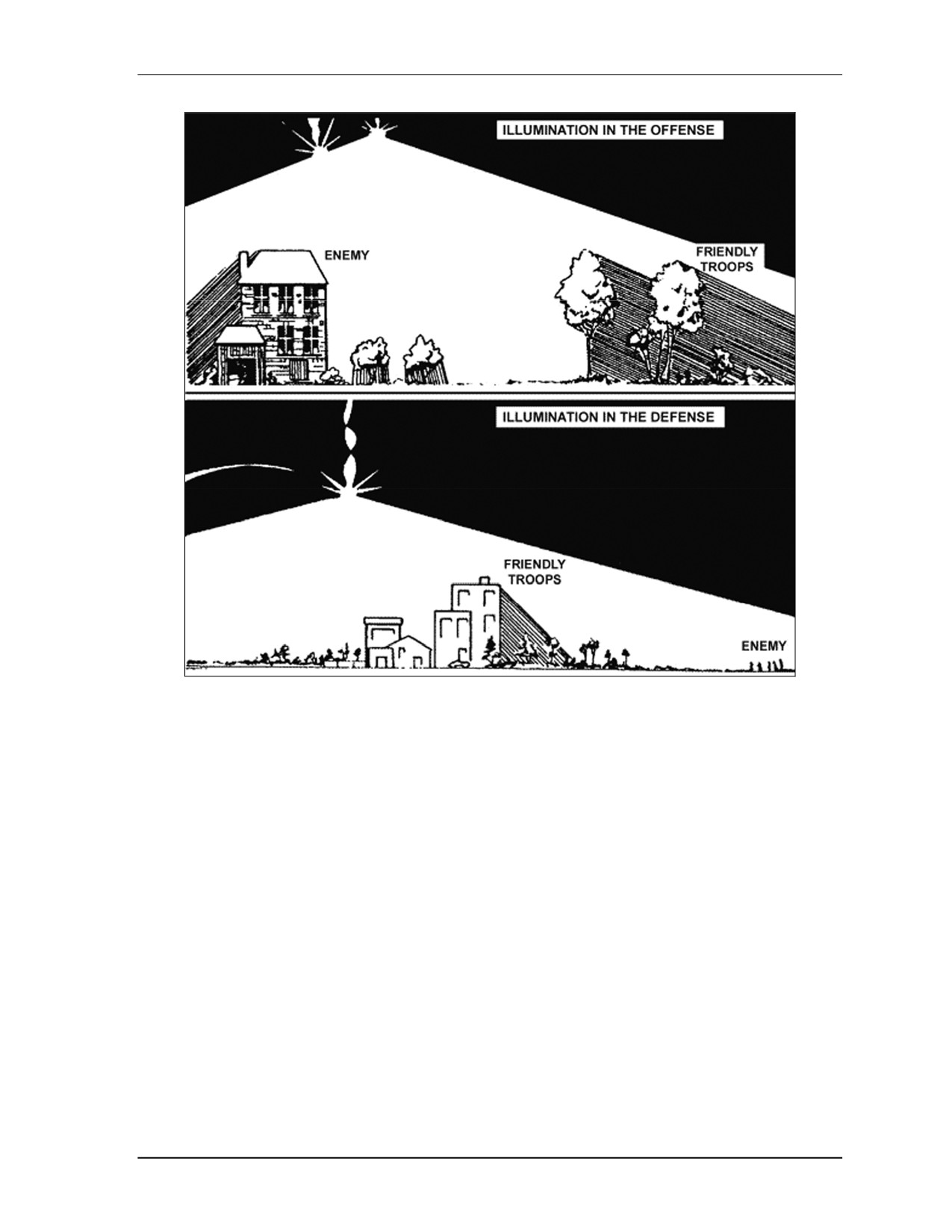
Urban Operations
Figure 11-8. Illumination during urban operations.
SPECIAL CONSIDERATIONS
11-105. When planning the use of mortars, commanders must consider the following:
• Observer positioning.
• Ammunition effects to include white phosphorous and red phosphorous and the effects of
obscurants.
• Dead space.
• Security for mortar crews.
• Displace of the mortars.
COMMUNICATIONS
11-106. One of the biggest challenges for a battalion staff is to maintain communications with subordinate
elements. Buildings and electrical power lines reduce the range of FM radios. Remoting radio sets or
placing antennas on rooftops can solve the range problem for CPs and trains. Companies do not have the
assets to ensure continuous communications, so the battalion staff must plan for continual movement of
battalion assets to support company operations.
13 December 2006
FM 3-21.20
11-25
Chapter 11
WIRE
11-107. Wire is a secure and effective means of communications in urban areas. Wires should be laid
underground, overhead on existing poles, or through buildings to prevent vehicles from cutting them.
MESSENGERS AND VISUAL SIGNALS
11-108. Messengers and visual signals can also be used in urban areas. Messengers must plan routes that
avoid the enemy. Routes and time schedules should be varied to avoid establishing a pattern. Visual signals
must be planned so they can be seen from the buildings.
SOUND
11-109. Sound signals are normally not effective in urban areas due to the amount of surrounding noise.
EXISTING SYSTEMS
11-110. If existing civilian or military communications facilities can be captured intact, they can also be
used by the battalion. An operable civilian phone system, for instance, can provide a reliable, although
nonsecure, means of communication. Use of news media channels in the immediate AOs for
other-than-emergency communications, must also be coordinated through the S-1 or civil affairs officer.
WEAPONS EFFECTS
11-111. The characteristics and nature of combat in urban areas affect the results and employment of
weapons. Leaders at all levels consider the following factors in various combinations.
SURFACES
11-112. Hard, smooth, flat surfaces are characteristic of urban targets. Rarely do rounds impact
perpendicularly to these flat surfaces. They usually hit at an angle. This reduces the effect of the round and
increases the threat of ricochets.
RANGES AND ENGAGEMENT TIME
11-113. Engagement times are short, and ranges are close in urban areas. About 90 percent of all targets
are located 50 meters or less from the identifying Soldier. Minimum arming ranges and troop safety from
backblast or fragmentation effects must be considered.
DEPRESSION AND ELEVATION LIMITS
11-114. Depression and elevation limits for some weapons create dead space. Tall buildings form deep
canyons that are often safe from indirect fires. Some weapons can fire rounds to ricochet behind cover and
inflict casualties. Target engagement from horizontal and vertical oblique angles demands superior
marksmanship skills.
OBSCURATION
11-115. Smoke from burning buildings, dust from explosions, shadows from tall buildings, and the lack of
light penetrating inner rooms combine to reduce visibility and increase a sense of isolation. Added to this is
the masking of fires caused by rubble and manmade structures. Targets, even those at close range, tend to
be indistinct.
11-26
FM 3-21.20
13 December 2006
Urban Operations
CONFUSION
11-116. Urban fighting often becomes confused melees with several small units attacking on converging
axes. The risks from friendly fires, ricochets, and fratricide must be considered during planning. Control
measures must be continually adjusted to lower the risks. Soldiers and leaders clearly mark their locations
IAW unit SOP to avoid fratricide (Appendix A). Armored vehicle crews will likely operate from a full
protected mode decreasing the crew’s ability to observe and protect the vehicle from rocket propelled
grenades (RPGs), antitank guided missiles (ATGMs), and mines. Infantry and armored vehicle crews must
have practiced, and redundant communications SOP established, to aid in enemy identification,
engagement, and prevention of fratricide.
BUILDINGS
11-117. Both the shooter and target may be inside or outside the buildings. They may both be inside the
same or separate buildings. The enclosed nature of combat in urban areas means the weapon’s effect, such
as muzzle blast or backblast and penetration from room to room or floor to ceiling, must be considered as
well as the round’s impact on the target. Usually, manmade structures must be attacked before enemy
personnel inside are attacked. Weapons and demolitions may be chosen for employment based on their
effects against masonry and concrete rather than against enemy personnel.
Section IV. OFFENSIVE OPERATIONS
Offensive operations in urban areas are based on offensive doctrine modified to conform to the urban terrain.
Urban combat also imposes a number of demands that are different from other field conditions such as
combined-arms integration, fires, maneuver, and use of special equipment. As with all offensive operations, the
commander must retain his ability to fix the enemy and maneuver against him. Offensive UO normally have a
slower pace and tempo than operations in other environments. Missions are more methodical. The battalion
must be prepared to conduct different missions simultaneously. For example, a battalion may establish
checkpoints in one section of a city and simultaneously clear enemy in another section.
"From 1942 to the present, shock units or special assault teams have been used by
attackers
(and often by defenders) with great success. These assault teams are
characterized by integration of combined-arms. Assault teams typically contain Infantry
with variable combinations of armor, artillery, or engineers."--US Army Human
Engineering Laboratory
OFFENSIVE FRAMEWORK
11-118. Figure 11-9 shows the urban operational framework as it applies to offensive operations and
shows the tactical tasks of subordinate units. While the elements of the operational framework are not
phases, tactical tasks may become phases at the battalion level and below, based on the factors of
METT-TC. Properly planned and executed offensive operations involve all tactical tasks shown. They may
be conducted simultaneously or sequentially, depending on the factors of METT-TC. During offensive
operations, the BCT commander’s intent normally include the following (also Appendix L):
• Synchronizing fires, information operations, and nonlethal capabilities.
• Isolating decisive points to dominate the urban area.
• Using superior combat power to destroy high pay-off targets.
• Using close combat, when necessary, against decisive points.
• Transitioning to stability operations.
• Using detailed intelligence, surveillance, and reconnaissance plan to assess the situation.
13 December 2006
FM 3-21.20
11-27
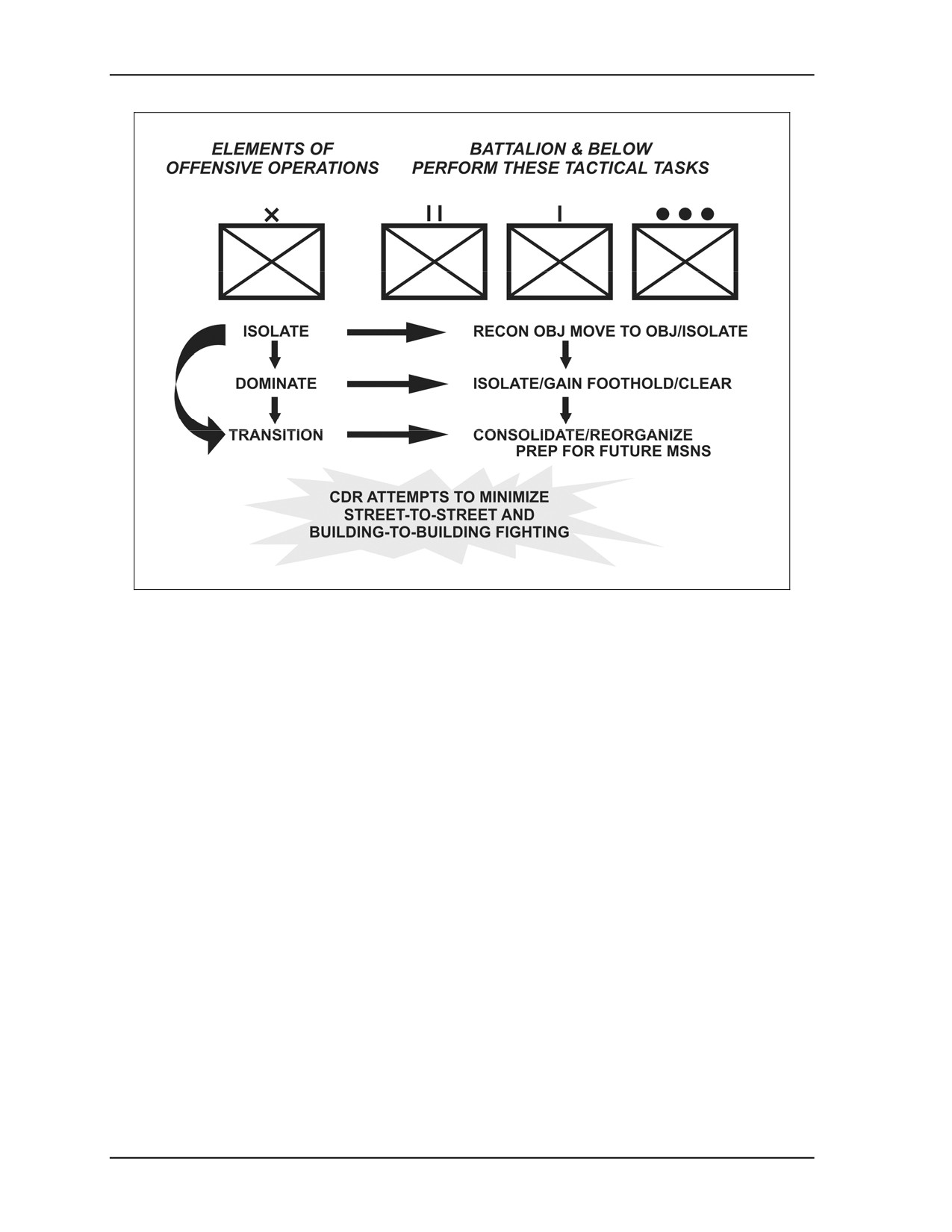
Chapter 11
Figure 11-9. Offensive urban operational framework.
TYPES OF OFFENSIVE OPERATIONS
11-119. Offensive operations in an urban area are planned and implemented based on the factors of
METT-TC. At the battalion level, the offense takes the form of either a deliberate or hasty operation such
as an MTC or attack. The battalion may also be given the mission to conduct special purpose attacks such
as a raid, demonstration, spoiling attack, or counterattack.
HASTY OPERATIONS
11-120. The battalions conduct hasty offensive operations after a successful defense or as part of a
defense; because of a MTC, meeting engagement, or chance contact during a movement; or in a situation
where the unit has the opportunity to attack vulnerable enemy forces. The attack in an urban area differs
because the close, complex nature of the terrain makes command, control, and communications, as well as
massing fires to suppress the enemy, more difficult. In urban areas, incomplete information, intelligence,
and concealment may require the maneuver unit to move through, rather than around, the friendly unit
fixing the enemy in place. Control and coordination become important to reduce congestion at the edges of
the urban area.
DELIBERATE OPERATIONS
11-121. A deliberate offensive operation is a fully synchronized operation that employs all available assets
against the enemy’s defense, IAW with the ROE. Deliberate operations are characterized by detailed
planning based on available information, thorough reconnaissance, preparation, and rehearsals. Given the
nature of urban terrain, the attack of an urban area is similar to the techniques employed in assaulting a
11-28
FM 3-21.20
13 December 2006
Urban Operations
strongpoint. At the battalion level, an attack of an urban area usually involves the sequential execution of
the following tactical tasks.
Reconnoiter Objective
11-122. This involves making a physical reconnaissance of the objective with battalion assets and those of
higher headquarters, as the tactical situation permits. It also involves making a map reconnaissance of the
objective and all the terrain that will affect the mission and an analysis of aerial imagery, photographs, or
any other detailed information about the building(s) and other appropriate urban terrain. Also, any other
information collected by reconnaissance and surveillance units, such as the battalion scout platoon, snipers
and tactical UAS is considered during the planning process.
Move to the Objective
11-123. This may involve moving through open terrain, urban terrain, or both. Movement should be made
as rapidly as possible without sacrificing security. Movement should be made along covered and concealed
routes and can involve moving through buildings, down streets, in subsurface areas, or a combination of all
three.
Isolate Objective
11-124. Isolation begins with the efforts of SOF units controlled by higher headquarters to influence
enemy and civilian actions. The battalion commander can use PSYOP teams, if available, to direct the
civilian population to move to a designated safe area through the use of loudspeaker broadcasts,
dissemination of print products or other methods.
11-125. In certain situations requiring precise fire, snipers can provide an excellent method of isolating
key areas while simultaneously minimizing collateral damage and noncombatant casualties (Appendix A.)
11-126. Isolating the objective also involves seizing terrain that dominates the area so that the enemy
cannot supply, reinforce, or withdraw its defenders. It also includes selecting terrain that provides the
ability to place suppressive fire on the objective. Battalions may be required to isolate an objective as part
of the overall BCT operation or to do so independently. Depending on the tactical situation, companies
within the battalion may have to isolate an objective by infiltration.
Secure a Foothold
11-127. Securing a foothold involves seizing an intermediate objective that provides cover from enemy
fire and a location for attacking troops to enter the urban area. The size of the foothold depends on the
factors of METT-TC.
11-128. As a company attacks to gain a foothold, it should be supported by suppressive fires and smoke.
In the example shown in Figure 11-10, the center battalion conducts a supporting attack to seize OBJ
DOG. (The battalion commander has determined that two intermediate objectives are necessary in order to
seize OBJ DOG.)
11-129. One company secures a foothold in OBJ Y. As a follow-on mission, the same company either
seizes OBJ Z and supports the battalion main effort by fire or facilitates the passage of another company
through OBJ Y to seize OBJ Z and support the battalion main effort by fire.
13 December 2006
FM 3-21.20
11-29
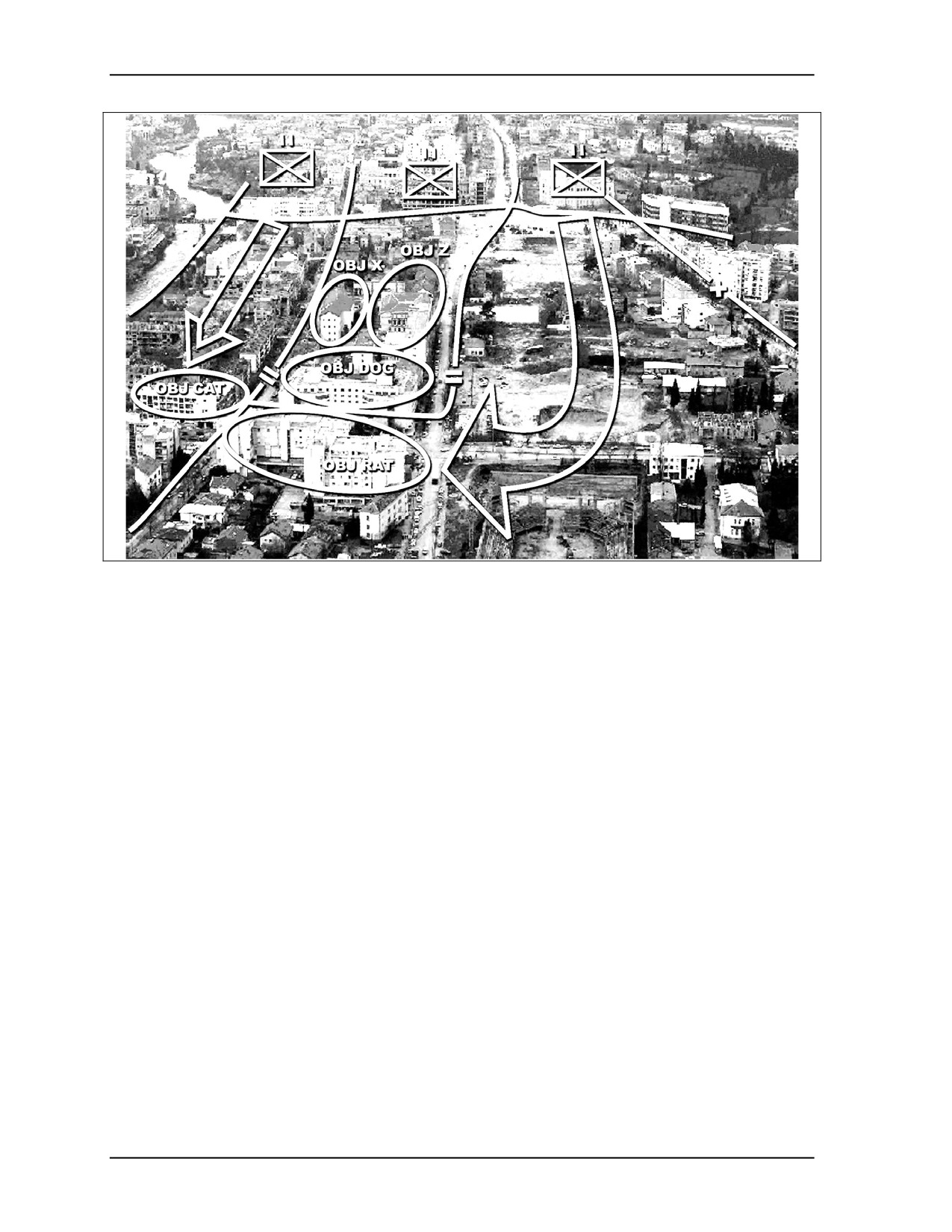
Chapter 11
Figure 11-10. Security of a foothold in a battalion attack.
Clear an Urban Area
11-130. The commander may decide to selectively clear only those parts necessary for the success of his
mission if—
• An objective must be seized quickly.
• Enemy resistance is light or fragmented.
• The buildings in the area have large open areas between them. (In this case, the commander
clears only those buildings along the approach to his objective or only those buildings
necessary for security.)
11-131. The mission may require the battalion to systematically clear an area of all enemies. Through
detailed analysis, the battalion commander may anticipate that he will be opposed by a strong, organized
resistance or will be in areas having strongly constructed buildings close together. He may assign his
company zones within the battalion zone or AO in order to conduct systematic clearing (Figure 11-11).
11-30
FM 3-21.20
13 December 2006
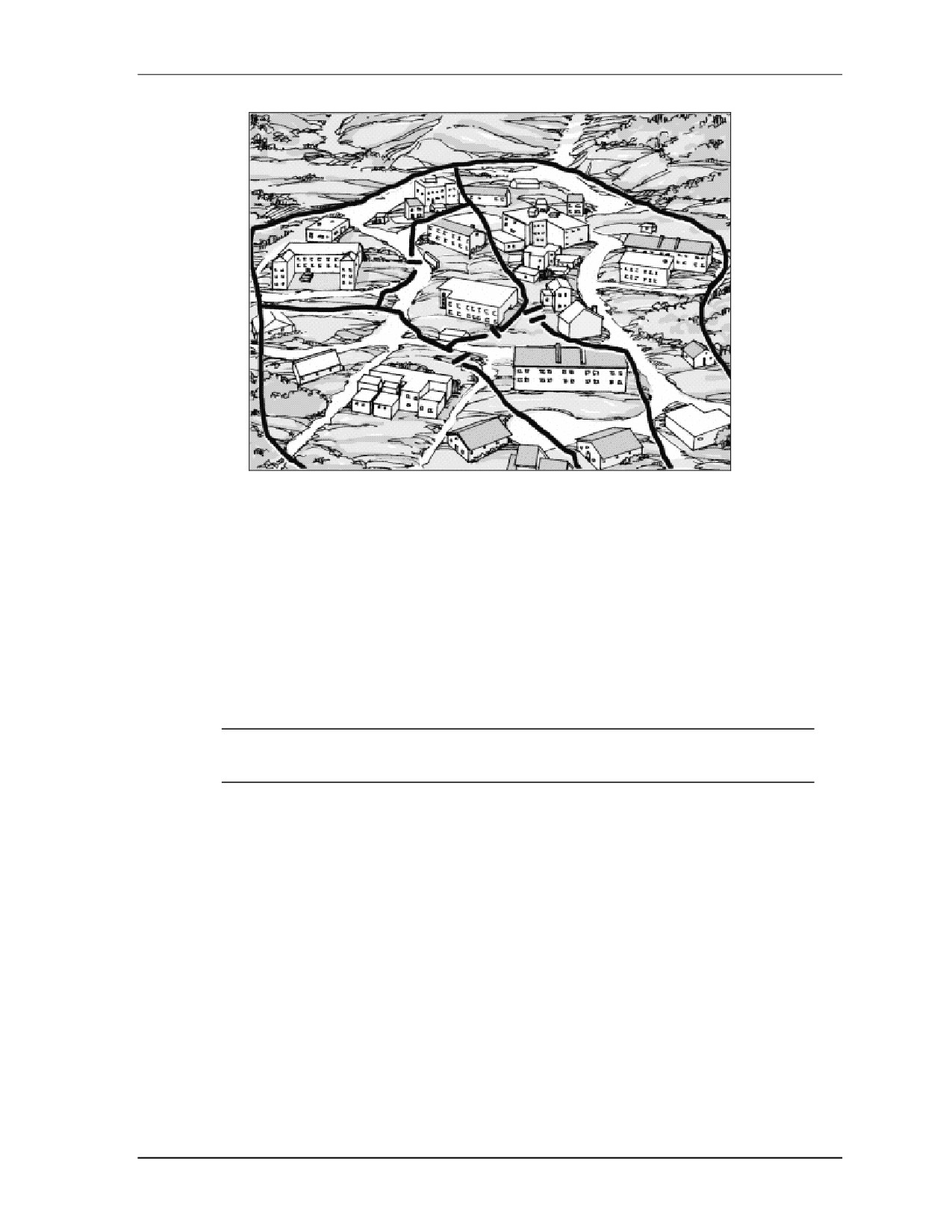
Urban Operations
Figure 11-11. Systematic clearance within assigned areas.
Consolidate or Reorganize and Prepare for Future Missions
11-132. Consolidation occurs immediately after each action. Reorganization and preparation for future
missions occurs after consolidation. Many of these actions occur simultaneously.
11-133. Consolidation provides security, facilitates reorganization, and allows the battalion to prepare for
counterattack. Rapid consolidation after an engagement is extremely important in an urban environment.
11-134. Reorganization actions (many occurring simultaneously) prepare the unit to continue the mission.
The battalion prepares to continue the attack or prepares for future missions, including the possible
transition to stability operations.
Note. FBCB2 assets significantly improve friendly force situational understanding in digitally
equipped units.
11-135. During urban combat, units rely heavily on self-aid, buddy aid, and aid from combat lifesavers to
provide basic medical care until casualties can be evacuated. There are differing types of injuries and
wounds that occur during urban operations, including a high percentage of orthopedic, blast, fire, and
crushing injuries. The unit’s force health protection plans strive to minimize the effects of wounds, injuries,
disease, urban environmental hazards, and psychological stresses on unit effectiveness, readiness, and
morale. Historically, the urban environment has had three to six times greater casualty rates than other
combat environments.
11-136. Casualty evacuation in an urban environment presents many challenges in the location,
acquisition, and evacuation of patients. Techniques may require modification to acquire and evacuate
casualties from above, below, and at ground level. Furthermore, during UO, the environment (rubble and
debris) may dictate that evacuation be accomplished by litter carriers rather than by vehicle or aircraft.
Commanders should consider using armored vehicles for evacuation. Commanders should also be prepared
for evacuation from within buildings and for the possibility that medical evacuation by Army air may not
be available due to the fragility of the aircraft and their susceptibility to small arms fire. Treatment facilities
may have to be moved much farther forward than usual. Units need specific medical policies, directives,
and SOPs for dealing with noncombatants.
13 December 2006
FM 3-21.20
11-31