FM 3-21.20 (FM 7-20) THE INFANTRY BATTALION (DECEMBER 2006) - page 8
Chapter 8
8-111. Obscuration degrades observation and target acquisition of the enemy forces while concealing
friendly force reduction and assault activities. Obscuration planning factors include wind direction, type of
obscuration systems available (mechanical smoke, artillery delivered, mortar delivered, smoke pots), and
the capabilities and limitations of these systems. Normally, obscuration starts with smoke delivered by
indirect fire that builds quickly, followed by mechanical or smoke pots that have a longer duration but take
more time to place and build. Typically, the most effective placement of obscuration is between the
obstacle and the overwatching enemy forces.
8-112. Friendly forces secure the point of breach to prevent enemy forces from interfering with the
reduction of lanes and passage of assault forces. The breach force must be resourced with sufficient combat
power to secure the point of breach.
8-113. Reduction is the creation of lanes through an obstacle. Reduction cannot be accomplished until
effective suppression and obscuration is achieved and the point of breach secured. The breach force will
reduce, proof, and mark the required number of lanes to pass the assault force through the obstacle.
Follow-on forces will continue to improve and reduce the obstacle when required. When possible, the
breach force should also try to secure a foothold to assist in the passage of the assault force.
8-114. The assault force’s primary mission is to seize terrain on the far side of the obstacle in order to
prevent the enemy from placing or observing direct and indirect fires on the reduction area.
BREACHING ORGANIZATION
8-115. Commanders develop COAs that organize friendly forces into a support force, a breach force, and
an assault force to quickly and effectively execute the breach fundamentals (Table 8-1).
8-24
FM 3-21.20
13 December 2006

Tactical Enabling Operations
Table 8-1. Breaching organization.
Breaching
Breaching Fundamentals
Responsibilities
Organization
Support Force
• Suppress
• Suppress enemy direct fire systems covering
the reduction area.
• Obscure
• Isolate by preventing enemy forces from
repositioning or counterattacking to place
direct fires on the breach force.
Breach Force
• Suppress (provides additional
• Create and mark the necessary lanes in an
suppression)
obstacle.
• Obscure (provides additional
• Secure the near side and far side of an
obscuration in the reduction
obstacle.
area)
• Defeat forces that can place immediate direct
• Secure (provides local
fires on the reduction area.
security)
• Report the land status and location.
• Reduce
Assault Force
• Assault
• Destroy any enemy forces capable of placing
direct fires on the reduction area from the far
• Suppress
side of an obstacle.
• Assist the support force with suppression if the
enemy is not effectively suppressed. Be
prepared to breach follow-on and protective
obstacles after passing through the reduction
area.
8-116. Support force responsibilities are to isolate the reduction area with direct and indirect fires,
suppress enemy’s direct and indirect fire at the point of breach, and control obscuration.
8-117. The breach force must have sufficient combat power to secure the point of breach as well as
sufficient reduction assets to reduce required number of lanes through the obstacle. CFZs should be
activated at the point of breach before commitment of the breach force to protect it from enemy
indirect fires.
8-118. The assault force’s primary mission is the destruction of enemy forces on the far side of the
obstacle to prevent the enemy from placing direct fires on the breach lanes.
MASS
8-119. The support force achieves mass by fixing and isolating enemy forces on the far side of the
obstacle. The breach force achieves mass by planning redundancy of breach assets, creating one lane per
each assaulting company-sized element, and creating two lanes separated by 800 to 1,000 meters (terrain
dependent) to pass the battalion. The assault force achieves mass by projecting a 3:1 combat power ratio at
the point of penetration (typically one isolated enemy platoon in an enemy company-sized defense for a
battalion breach).
13 December 2006
FM 3-21.20
8-25
Chapter 8
8-120. In addition to direct fires and massing the breach force, the battalion masses indirect fires, attack
helicopters and close air support to suppress and isolate the breach site.
SYNCHRONIZATION
8-121. Synchronization of combined-arms elements to successfully achieve the breach fundamentals is
essential. Commanders achieve synchronization through detailed reverse planning of offensive operations
(from the objective back to the assembly area), by issuing clear subordinate unit instructions, planning
effective C2, and ensuring their forces are well rehearsed.
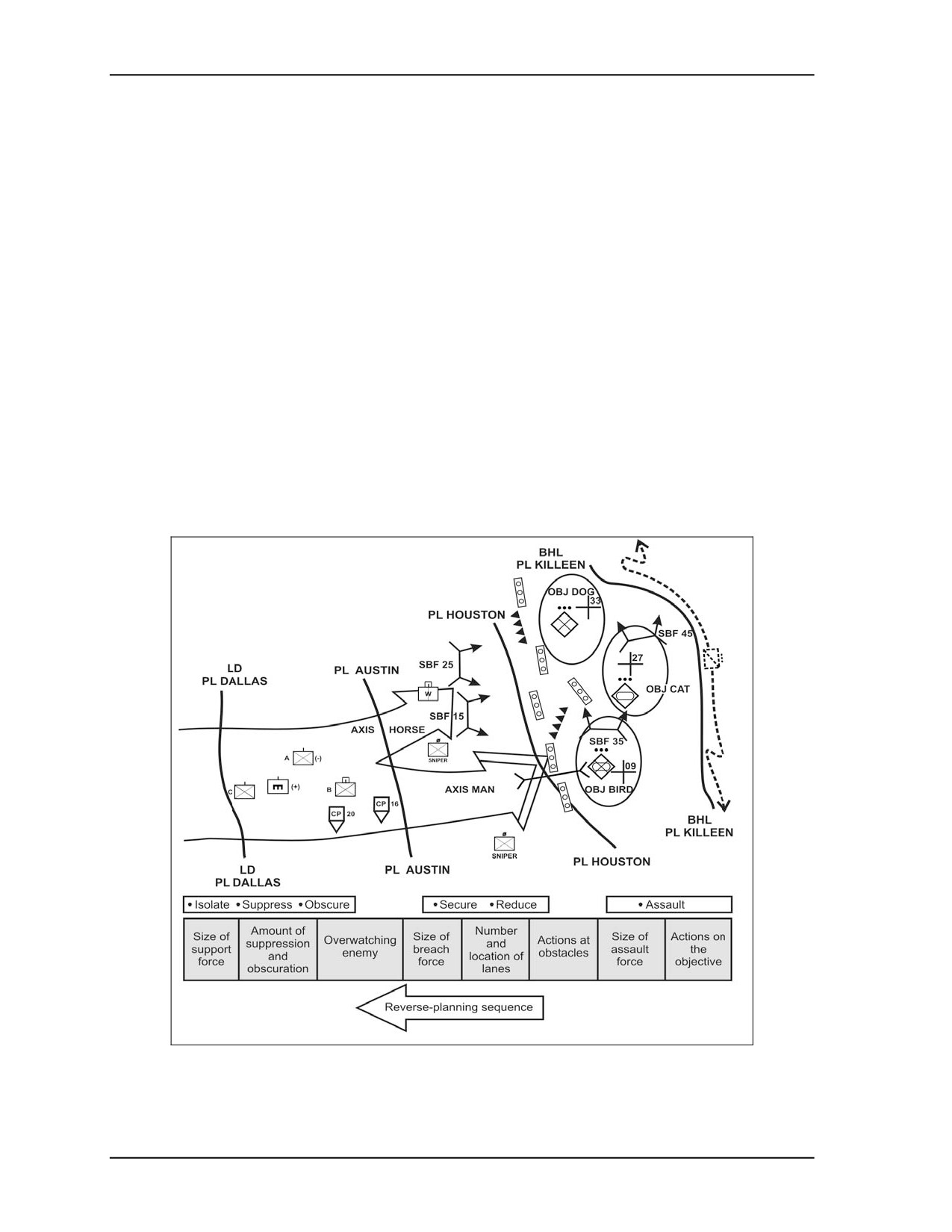
8-122. Detailed reverse planning is initiated during IPB and development of enemy situational template.
The scheme of maneuver, engineer operations, fires, air defense, and actions at the obstacle are all based
upon this common situational template. Actions on the objective determine the size and composition of the
assault force based upon desired 3:1 combat power ratio. The size and composition (Infantry, wheeled,
armor) of the assault force determines the number and location of breach lanes required. Lane requirements
and disposition and composition of the obstacles determine the mobility asset requirement of the breach
force. The enemy’s ability to interfere with the breach force at the point of breach determines size and
composition of the security element within the breach force. The enemy’s ability to mass fires on the point
of breach determines the amount of suppression required as well as the size and composition of the breach
force. Battalion reverse planning begins with actions on the objective and continues to its deployment from
tactical assembly areas in order to identify all requirements. Reverse planning should include enemy
special munitions capabilities and effects (Figure 8-8).
Figure 8-8. Reverse planning sequence.
8-26
FM 3-21.20
13 December 2006
Tactical Enabling Operations
DELIBERATE OPERATIONS
8-123. The following paragraphs discuss the detailed planning, preparation, and execution necessary in
conducting a combined-arms breach during deliberate operations.
PLANNING CONSIDERATIONS
8-124. Planning a breaching operation begins with the command and engineer estimates. The battalion
S-2 templates the enemy’s order of battle (OB), and the engineer officer assesses its engineer capabilities.
The enemy’s tactical and protective obstacles are doctrinally templated by the S-2 and engineer. The staff
develops COAs using the templates, and the engineer develops his scheme of engineer operations for each
COA. After selecting a COA, the commander allocates available assets to the breach, assault, and support
forces to ensure that they can accomplish their assigned tasks.
8-125. Identifying the enemy’s vulnerability is important so that the force can mass direct and indirect
fires and maneuver against that weakness. The battalion isolates a portion of the enemy to achieve the
desired combat ratio at the point of assault. It achieves mass by directing fire on the enemy from multiple
directions and by narrowing attack zones to concentrate its force against a smaller defending element.
8-126. When the attack requires breaching two or more complex obstacle systems, the commander must
retain enough engineers and sufficient breaching assets to reduce subsequent obstacles. The commander
must not commit all the engineers to breach the first obstacle system unless he is willing to risk his
capability to breach follow-on obstacles. Depleted engineer forces need significantly more time to conduct
follow-on breaches.
8-127. The breach and assault forces may require fires and smoke under their control in addition to that
controlled by the support force. The support, breach, and assault forces place direct fires on enemy
positions. This makes synchronization of direct and indirect fires extremely complex. Fire control is
planned in detail using SDZs, REDs, MSDs, well-understood control measures, and triggers that are
carefully rehearsed.
8-128. When a battalion conducts a combined-arms breach during a deliberate operation or plans to
conduct a passage of lines of a large force after a breach, breach plans must include detailed planning for
the staging and movement of follow-on forces and equipment. The plan should consider improvements to:
• The breach lanes.
• Markings of the lanes.
• Contact points and guides.
• Preparation for an enemy counterattack.
• Repositioning of indirect fire assets to provide extended coverage.
• Control measures for follow-on forces to continue the attack.
PREPARATION
8-129. The battalion continues an intelligence collection plan using the scout platoon, snipers, UAS,
attached engineers, patrols, and aerial reconnaissance. The S-2 and the battalion engineer continually refine
the template based on intelligence. The battalion may adjust task organization as it uncovers more details
of the defense and obstacle system. It also uses this information during the combined-arms rehearsals.
8-130. The battalion meticulously plans, manages, and controls the rehearsals. The battalion S-3 allocates
time for each unit to perform a combined-arms battalion rehearsal. When possible, the force rehearses the
operation under the same conditions expected during the actual engagement, including battlefield
obscuration, darkness, CBRN posture, and inclement weather. The rehearsal site reflects the actual obstacle
system in as much detail as possible. The force chooses terrain as similar as possible to that of the
operational area and constructs a practice obstacle system based on OBSTINTEL. Rehearsals include a
13 December 2006
FM 3-21.20
8-27
Chapter 8
leader and key personnel walk-through as well as individual rehearsals by support, breach, and assault
forces.
8-131. When the force commander rehearses the breaching operation, he also rehearses several
contingency plans. The contingencies should include possible enemy counterattacks and attack by enemy
indirect fire systems (artillery, rockets, attack helicopters, and other air assets). Rehearsals also include
enemy use of CBRN munitions.
COLLECTION OF OBSTACLE INTELLIGENCE
8-132. The success of combined-arms breaching during a deliberate operation depends heavily on the
success of the ISR plan. The S-2 develops the collection plan, with the scout platoon and snipers
concentrating on confirming enemy locations. The engineers focus on gathering intelligence on obstacle
orientation and composition as well as on the types of fortifications the battalion may encounter. UAS can
gather information on approaches to and composition of the obstacles, mine fields, and enemy reserve
forces locations and composition. Intelligence is used to refine the task organization of support, breach,
and assault forces and the scheme of maneuver.
EXECUTION
8-133. The force crosses the line of departure organized to conduct the combined-arms breach. If the
battalion encounters obstacles en route, it executes the breach with this organization. On arrival, the
battalion’s scout platoon and snipers adjusts artillery fires on the enemy positions to cover deployment of
the support force. Snipers engage key targets to reduce enemy C2, and destroy antitank and crew served
weapons. The support force moves into position and establishes its support by fire (SBF) position. Breach
and assault forces move into position and prepare to execute their tasks. The battalion commander
continues to incorporate last-minute information into his plan and makes final adjustments of positions and
locations.
8-134. The support force occupies its SBF position and immediately begins suppressing the enemy. The
support force FSE and battalion FSO execute group targets planned on enemy positions. Mortar and
artillery smoke are adjusted to provide initial obscuration of the breaching site from enemy target
acquisition. Depending on the wind conditions, the support force or the breach force will provide
mechanical smoke or emplace smoke pots to continue obscuration. The breach force begins movement
once suppression and smoke are effective, based on clearly defined commitment criteria. Timing is critical
since the high volume of suppressing fires and smoke can be sustained only for a short duration. SBF
positions have interlocking sectors of fires and are positioned to ensure suppression of the enemy’s
positions.
8-135. Once suppression and obscuration have built to effective levels, the breach force moves forward
to the breaching site. The engineers create the lanes while the combined-arms breach force provides for
local security. As they finish the lanes, engineers mark the lanes to assist the assault and following forces
in maneuvering to the lanes. The assault force penetrates the objective after receiving the order from the
battalion commander. The assault force must seize and clear the objective, prepare for counter attacks and
be prepared to pass additional forces for attacks beyond the objective. Due to the complexity of the breach,
the C2 systems spread out to ensure synchronization. The battalion S-3 controls the multicompany team
support force while the battalion commander positions himself where he can best control the entire
breaching operation.
CONTINUATION OF ATTACK
8-136. The obstacle system acts as a choke point and is dangerous even after the battalion has overcome
the defenses.
8-137. The battalion constructs additional lanes to speed the passage of follow-on forces. Next, it widens
the lanes to allow two-lane traffic through the obstacles and constructs switch lanes to prevent blocking by
8-28
FM 3-21.20
13 December 2006
Tactical Enabling Operations
disabled vehicles or artillery fires. Deliberate marking and fencing systems are installed, and military
police establish the necessary traffic control. Eventually, rear-area engineer forces clear the obstacles and
eliminate the choke point. After passage through the lanes, the maneuver force continues its mission.
8-138. Both the breaching and follow-on force must be aware of the potential for the enemy to reseed
breached obstacles with remotely delivered SCATMINEs or other rapidly emplaced obstacles. The
breaching commander may develop a response plan and position remaining mobility assets near the breach
lane(s) to rebreach, repair, or improve lanes as necessary. In addition, the commander may develop a
reaction plan for maneuver or other forces that encounter a reseeded portion of the obstacle while passing
through the lane. The commander of the follow-on force, regardless of the reported status of the breach
lanes he is about to pass through, should organize mobility assets forward in his formation that are
prepared to rebreach, repair, or improve these lanes as necessary.
HASTY OPERATIONS
8-139. Hasty operations are conducted when the enemy situation is vague and the commander may be
required to execute the combined-arms breach with his current task organization. Therefore, the battalion
commander must either task-organize his subordinate company teams with sufficient combat power to
conduct company team-level breaching operations or have a plan that allows for the flexible application of
combat power necessary to execute breaching operations. When conducting offensive operations such as a
MTC, while participating in an exploitation or pursuit, and when conducting passage of lines (forward or
rearward) and movements through defiles, the battalion commander must address breaching operations.
The battalion breach planning considerations and process discussed previously apply to combined-arms
breach planning during hasty operations as well. The only difference is the organizational echelon at which
the breach is planned, prepared for, and executed.
BATTALION TASK ORGANIZATION
8-140. Subsequent to COA development, the commander and staff anticipate where units are most likely
to encounter obstacles based on the scheme of maneuver and situational template. From this analysis, the
commander refines his task organization, if necessary, in order to apply the combat power required for
executing the templated breach. Also, the engineer recommends a task organization of engineer platoons
and critical breaching equipment to create enough lanes for the breaching unit. He maintains a mobility
reserve under his control that can create additional lanes for follow-on forces. This mobility reserve can
also mass mobility assets if the battalion must transition to a deliberate operation. The battalion FSO
designs his fire plan to provide priority of fires and smoke to company teams likely to conduct a breach.
Above all, the commander task-organizes company teams for the mission first. He then modifies the task
organization where necessary to provide company teams with the additional forces needed to conduct
independent breaching operations as part of the battalion effort.
13 December 2006
FM 3-21.20
8-29
This page intentionally left blank.
Chapter 9
Command Posts
Echeloned C2 facilities control with varying levels of staff participation at each
echelon. The battalion command group operates forward and consists of the
commander and those selected to go forward to assist in controlling maneuver and
fires during the battle. The command group normally includes the S-3, FSO, and
ALO but there is no requirement for these people to collocate. For example, the
commander may be in one part of the AO while the S-3 is in a different area. The
commander determines the composition, nature, and tasks of the command group
based on METT-TC analysis. The commander and S-3 also monitor the battle,
develop the situation, analyze COA, and control subordinate units. As a minimum,
the command group—
• Synchronizes combat assets in support of close operations.
• Controls close operations.
• Maintains the current operational situation.
• Provides close situation information to the main CP.
Section I. FACILITIES
Command and control facilities consist of the vehicles and locations where the commander, (assisted by his
staff) directs the battle and sustains the force. These facilities include the following command posts: main,
tactical, and combat trains. All three CPs have the ability to track the battle and assume control of the
current fight.
SURVIVABILITY
9-1.
CP survivability depends mostly on concealment and mobility. The best way to protect a CP is to
prevent the enemy from detecting it. Good camouflage and proper noise, light, and signal discipline
enhance the security provided by a good location.
LOCATION
9-2.
The best location for CPs is determined by a METT-TC analysis. Built-up areas can be good
locations for CPs because they provide cover and concealment, access to electricity and other services, and
good access and regress routes. However, they also can put indigenous populations at risk and can provide
enemy units covered and concealed positions to monitor and attack the CP. Locating a CP in built-up areas
for longer periods tend to degrade its ability to displace quickly. A CP not in a built-up area should be
located on a reverse slope with cover and concealment. Avoid key terrain features such as hilltops and
crossroads. Locate CPs on ground that is trafficable, even in poor weather. Other actions when positioning
CPs include—
• Ensure line-of-sight FM communications with higher, lower, and adjacent units.
• Use terrain to mask communications signals from the enemy.
• Use terrain for passive security, that is, for cover and concealment.
13 December 2006
FM 3-21.20
9-1
Chapter 9
• Collocate with tactical units for mutual support and local security.
• Avoid possible enemy TRPs templated for enemy artillery and CAS.
• Locate the CP near an existing road network, out of sight from possible enemy observation.
ACCESS
9-3.
CPs should be near, but not next to, a high-speed avenue of approach with no more than one or
two routes leading into the CP. These routes should provide cover, concealment, and access to other routes
of communication. When possible, a helicopter landing zone should be nearby.
SIZE
9-4.
The area selected must be large enough to accommodate all CP elements including liaison teams
and attachments from other units, communications support, and eating, sleeping, latrine, and maintenance
areas. Sufficient space must be available for positioning security and vehicle dismount points and parking.
SHELTER
9-5.
Dryness and light are vital when working with maps and producing orders and overlays. CPs
should be sheltered from weather conditions and should have lights for night work (exercising proper light
discipline.) Buildings are the best choice but if none are available, CPs can operate from their organic
vehicles or tents.
OPERATIONAL SECURITY
9-6.
OPSEC considerations for positioning CPs include--
• Avoid posting signs advertising CP locations. Disperse CP vehicles and thoroughly camouflage
all vehicles and equipment. Maintain noise and light discipline.
• Employ a security force and provide communications between it and the CPs. Establish security
force positions as in any defensive position, with a 360-degree perimeter and far enough out to
prevent enemy fires on the CPs.
• Ensure the security force has available CCM systems and other weapons, based on the potential
enemy threat. Establish a reaction force and rehearse the execution of the perimeter defense.
• Positioning C2 assets off major enemy avenues of approach reduces the probability of
detection.
• Use an OP to secure any remote antennas located outside the perimeter.
• Sound proof and dig in generators, if possible.
• Provide all subordinate units and elements of the CP with near and far recognition signals.
Ensure the CP uses these signals, challenges, and passwords to control access into its perimeter.
• In case of artillery or air attack, designate a rally point and an alternate CP, and ensure all
members of the unit know their locations.
DISPLACEMENT
9-7.
CPs may displace as a whole or, more often, by echelon. Displacement as a whole is normally
reserved for short movements with communications maintained by alternate means and minimal risk of
degrading CP operations.
9-8.
A portion of the CP, called a jump CP, moves to the new location, sets up operations, and takes
over operational control of the battle from the main CP. The remaining portion of the CP then moves to
rejoin the jump CP. The jump CP consists of the necessary vehicles, personnel, and equipment to assume
CP operations while the remainder moves.
9-2
FM 3-21.20
13 December 2006
Command Posts
9-9.
The XO or S-3 selects a general location for the jump CP site. The jump CP can be accompanied
by a quartering party, which may consist of a security element and personnel and equipment for quartering
the remainder of the CP. The signal officer, who is usually part of the quartering party, ensures
communications on all nets are possible from the new site. When the jump CP becomes operational, it also
becomes the net control station for the unit. The remainder of the CP then moves to rejoin the jump CP.
9-10.
Another technique is to hand off control to the command group or the CTCP and move the main
CP as a whole. The command group can also split, with the commander moving with the decisive
operations (or main effort) and the S-3 moving with a shaping effort.
Section II. OPERATIONS
Each CP must be organized to permit continuous operations and the rapid execution of the C2 process. SOPs
for each CP should be established, known to all, and rehearsed. These SOPs should include at a minimum--
• Organization and setup of each CP.
• Plans for teardown and displacement of the CP.
• Eating and sleeping plans during CP operations.
• Command post shift manning, shift changes and operation guidelines.
• Physical security plans for the CP.
• Priorities of work during CP operations.
• Loading plans and checklists.
• Orders production.
• Techniques for monitoring enemy and friendly situations.
• Posting of CP map boards.
• Maintenance of CP journals and logs.
• Usation of a planning SOP (if separate from the TSOP).
COMMUNICATIONS
9-11.
Command posts monitor communications nets, receive reports, and process information to satisfy
commander needs or CCIR. This information is maintained on maps, charts, and logs. Each staff section
maintains daily journals to log messages and radio traffic. For more information, see Section III.
MAPS
9-12.
CPs maintain information as easily understood map graphics and charts. Status charts can be
combined with situation maps to give commanders friendly and enemy situation snapshots for the planning
process. This information is updated continuously.
9-13.
For simplicity, all map boards should be the same size and scale, and overlay mounting holes
should be standard on all map boards. This allows easy transfer of overlays from one board to another.
9-14.
The following procedures for posting friendly and enemy information on the map will aid
commanders and staff officers in following the flow of battle.
• All graphics should be posted on an overlay. Friendly and enemy unit symbols should be
displayed on clear acetate placed on the operations overlay. These symbols can be marked with
regular stick cellophane tape or with marking pen.
• Units normally keep track of subordinate units two levels down. This may be difficult during
the conduct of combat operations. It may be necessary to track locations of immediate
subordinate units instead.
13 December 2006
FM 3-21.20
9-3
Chapter 9
BATTLE CAPTAIN
9-15.
The CP staff focuses on collecting the critical information the commander needs to fight the
battle. Information flow is a constant challenge, especially since everyone in the CP must maintain a COP.
The battle captain’s essential function is like that of a conductor in an orchestra with regards to the COP.
The battle captain’s role is to plan, coordinate, supervise, and maintain communication flow throughout the
CP to ensure the successful accomplishment of all assigned missions. The CP battle captain assists the
commander, XO, and S-3 by being the focal point in the CP for communications, coordination, and
information management. The battle captain is also the CP officer in charge (OIC) in the absence of the
commander, XO, and S-3.
9-16.
The battle captain has the overall responsibility for the smooth functioning of the CP facility and
its staff elements. This range of responsibility includes—
• Maintaining continuous operations of the CP while static and mobile.
• Battle-tracking the current situation.
• Ensuring communications are maintained with and between all stations, and that all messages
and reports are routed and logged per SOP.
• Assisting the XO information management and coordination of CP staff functions to ensure a
smooth and continuous information flow between the staff sections of the CP.
• Processing essential data from the incoming flow of information to ensure all tactical and
logistical information is gathered and provided to the CP staff, S-3, and XO on a regular basis.
• Tracking CCIR and providing recommendations to the commander and XO.
• Approving fabrication and propagation of manual unit icons.
• Sending reports to higher and ensuring relevant information is passed subordinate units.
• Providing security for the CP, including its physical security and maintenance of noise and
light discipline.
• Ensuring mobility of the CP, including configuration, equipment, and training, to facilitate
rapid movement.
• Conducting CP battle drills and enforcing CP SOP.
9-17.
The battle captain ensures all staff elements in the CP understand their actions in accordance with
the TSOP and OPORD, and provides coordination for message flow, staff briefings, updates to CP charts,
and other coordinated staff actions. As a focal point in the CP, the battle captain processes essential
information from incoming data, assesses it, ensures dissemination, and makes recommendations to the
commander, XO, and S-3. Dissemination to the staff of important events is critical. In doing so, the battle
captain assists in synchronization of staff actions.
9-18.
Information management in the CP can include processing journals, message forms, reports,
FRAGOs, and requests for information. The battle captain ensures the consistency, accuracy, and
timeliness of information leaving the CP, including preparing and dispatching FRAGOs and warning
orders. In addition, he monitors and enforces the updating of charts and status boards necessary for battle
management and ensures this posted information is timely, accurate, and accessible.
9-19.
To function effectively, the battle captain must have a working knowledge of all elements in the
CP, understand unit SOP, and ensure the CP staff uses them. He must know the current plan and task
organization of the unit and understand the commander’s intent. In addition, the battle captain must
understand the limits of his decision-making and action authority.
9-20.
The battle captain is integrated into the decision-making process and knows why certain key
decisions were made. He must know the technical aspects of the battle plan and understand the time-space
relationship to execute any specific support task. He must understand and enforce the battle rhythm; the
standard events or actions that happen during a normal 24-hour period; and ensure that the CP staff is
effective throughout the period. Battle captains use their judgment to adjust CP activities and events to
accomplish the CP mission across different shifts, varying tactical circumstances, and changes in
CP location.
9-4
FM 3-21.20
13 December 2006
Command Posts
Section III. COMMUNICATIONS
Command and control is exercised through communication. Communications is the means by which the
commander projects his C2 across the width and depth of the battlefield. Lines of communications must go up,
down, and laterally. The commander—
• Provides for redundancy in communications means by having backup at key locations.
• Makes sure subordinates know what to do during interruptions in communications. Ensure
SOPs specify immediate actions in case of jamming, including prearranged frequencies to
switch to and code words.
• Avoids overloading the communications systems. Use them only when necessary. Practice
disciplined communications procedures by eliminating nonessential conversations.
RESPONSIBILITIES
9-21.
The sequential order of responsibilities for communications is—
• Senior to subordinate.
• Supporting to supported.
• Reinforcing to reinforced.
• Passing to passed (for forward passage of lines).
• Passed to passing (for rearward passage of lines).
• Left to right.
• Rearward to forward.
9-22.
All units take immediate action to restore lost communications. These responsibilities apply to
establishing liaison between headquarters.
MEANS OF COMMUNICATION
9-23.
All standard communications means are available to the Infantry battalion. These include, wire,
couriers, sound and visual signals, telephones, and radios. Although not part of the Infantry battalion TOE,
single-channel tactical satellite (TACSAT) radios may also be available.
RADIO TRANSMISSIONS
9-24.
Radio transmissions should be brief to reduce the EW signature. Using secure operational and
numerical codes reduces the chance of enemy detection. Use low-power transmissions and terrain to mask
signals from enemy direction-finding equipment. Use couriers or wire for lengthy messages. Units must
practice using SOP, operational terms and other common abbreviation techniques such as the terrain index
referencing system.
INFORMATION STORAGE MEDIA
9-25.
Modern electronic information storage systems are prolific on the battlefield. Compact disks, flash
memory drives, thumb drives, and hard drives can store vast amounts of information. They are routinely
used to store and transfer data, including classified information. Because of their small size, they are easy
to misplace, duplicate, and even steal. Management of these devises poses a new but not unique problem
for physical security personnel. Care, storage and inventory management must be addressed in unit SOPs
and these devises should be considered sensitive items.
13 December 2006
FM 3-21.20
9-5
Chapter 9
SYSTEMS
9-26.
Communications currently available to the battalion fall under one of the subsets of the ABCS:
• Combat net radio.
• Army Common User System (ACUS).
• Army Data Distribution System (ADDS).
COMBAT NET RADIO
9-27.
The primary means of communication for the maneuver battalion is combat net radio (CNR). This
family of push-to-talk radios includes SINCGARS, improved high frequency radio (IHFR), and TACSAT
radios (when authorized).
ARMY COMMON USER SYSTEM
9-28.
The joint network node and the command post node (JNN/CPN) provide the Army Common User
System (ACUS) at echelon, corps, and below (ECB). The JNN/CPN provides the higher bandwidth and
Army battle command systems services required by maneuver commanders. Services range from secure
internet protocol router (SIPR) and nonsecure internet protocol router (NIPR), to video teleconferencing
(VTC). The equipment also enables both circuit switching and internet protocol-based networking. It
works with MSE (mobile subscriber equipment) through the
“Vantage” switching technology. The
Vantage provides seamless interface between Voice over IP and tactical networks through the use of two
dedicated MSE trunks.
ARMY DATA DISTRIBUTION SYSTEM
9-29.
The ADDS provides rapid battlefield information dissemination of products up and down the
chain of command and to adjacent units. Three critical components of the ADDS at the Infantry battalion
level are the tactical internet, FBCB2 and EPLRS.
TACTICAL INTERNET
9-30.
The tactical Internet (TI) is a collection of interconnected tactical radios and computer hardware
and software providing seamless C2 INFOSYS data exchange between movement and maneuver,
sustainment, and C2 INFOSYS platforms. The TI's primary function is to provide a more responsive
information exchange capability to support battle command at BCT level and below.
9-31.
The TI consists of FBCB2 computers, the enhanced position location and reporting system
(EPLRS) very high speed integrated circuits
(VHSIC), the SINCGARS SIP, and other supporting
communications equipment. It is an automated, router-based communications network using commercial
Internet standard protocols to move data vertically and horizontally through the BCT area and to
higher-level echelons using the JNN/CPN. Automated network management tools provide TI planning,
monitoring, and reconfiguring capabilities.
9-32.
The TI is divided into two subareas: autonomous systems and routing areas. An autonomous
system is a collection of networks, under a common administration, that shares a common routing strategy.
An autonomous system can consist of one or many networks, and each network may or may not have an
internal structure. A routing area is a network in an autonomous system. Routing areas and the autonomous
system share the same routing strategy.
FORCE XXI BATTLE COMMAND BRIGADE AND BELOW
9-33.
The FBCB2 hardware is a mix of commercial, ruggedized, and militarized computers installed in
vehicles at BCT level and below or issued to individuals as dismounted Soldier system units (DSSUs).
9-6
FM 3-21.20
13 December 2006
Command Posts
When available, the FBCB2 can be connected to the GPS and other embedded platform interfaces. FBCB2
is common to all aspects of the digitized battlefield; selected individuals in all platoons and companies
have one. They are in most C2 INFOSYS platforms and CPs.
9-34.
FBCB2 uses the variable message format (VMF) to send and receive messages horizontally and
vertically on the battlefield, irrespective of task organization. VMF improves current configurations in
which the WFF automation systems do not communicate to each other. Digitization provides
communication and processing capabilities to the warfighter, which yields significant advantages in two
key areas.
Situational Understanding
9-35.
Situational understanding is a state of understanding gained from knowledge based on accurate
and real-time information of friendly, enemy, neutral, and noncombatant locations and terrain. It consists
of a COP of the battlefield scaled to specific levels of interest and needs.
Command and Control
9-36.
C2 is direction by a commander over assigned forces in accomplishing a mission. A commander
employs C2 functions as he plans, directs, and controls forces and operations to accomplish a mission.
9-37.
FBCB2 provides each echelon with the COP two echelons up and down and one adjacent unit left
and right. FBCB2 significantly improves the effectiveness of the force.
9-38.
FBCB2 provides up-to-date combat situation information based on echelon and location of—
• Friendly and enemy positions.
• Air and ground unit positions.
• Maps, terrain, and elevation.
9-39.
FBCB2 provides rapid generation and dissemination of messages and acknowledgments of—
• Orders and requests.
• Fires and alerts.
• Reports.
• Overlays on the situation picture.
• Semiautomatic exchange of selected mission-critical data between the FBCB2 and the ABCS
component systems.
9-40.
FBCB2 hosts must receive new initialization data for each task reorganization affected. Transfer
of the modified initialization data to the ultimate users occurs through signal channels.
ENHANCED POSITION LOCATION REPORTING SYSTEM WITH VERY HIGH SPEED
INTEGRATED CIRCUITS
9-41.
Battalion C2 INFOSYS platforms employ EPLRS VHSIC as their primary data communications
link to company and platoon platforms. It serves as a position location, navigation, identification, and
communications system. Its primary components are the NCS and the radio sets. The NCS is the
centralized control element used for system initialization, monitoring, and control. The radio sets are the
radio receiver-transmitters provided to EPLRS VHSIC users. The battalion uses EPLRS VHSIC to provide
wide area network connectivity down to platoon and up to the BCT. The antenna used with the system is
an omni-directional dipole. The planning range is three to ten kilometers between radios, depending on
power output settings and terrain.
13 December 2006
FM 3-21.20
9-7
Chapter 9
DIGITAL COMMAND AND CONTROL SYSTEMS
AND ARCHITECTURE
This paragraph provides basic information on the digital C2 systems and architecture.
Army Battle Command System Components
9-42.
The ABCS consists of the five ABCS subcomponents, the FBCB2 system, and the tactical
Internet. The ABCS components have traditionally been "stovepipe" systems in their development, with
very limited interface capability to other digital systems. The ABCS components are the primary digital
communication systems between command posts. FBCB2 is the primary digital system for communication
and transmission of data at battalion level and below.
Maneuver Control System
9-43.
The MCS is the hub of the ABCS component in each command post. It is the primary system for
the creation and dissemination of orders, graphics, and operations-related reports. Embedded battle
command (EBC) is a software subcomponent of MCS-light. It is a derivative of FBCB2 software and
allows MCS-light to exchange reports and graphics with FBCB2 systems.
9-44.
At battalion level, MCS-Light performs the following primary functions:
• Receives orders and graphics from higher and adjacent units.
• Creates and disseminates orders and graphics to subordinate, higher, and adjacent units. (While
platform EBC is limited, the MCS has near-term ability to interface graphics and orders to
FBCB2.)
• Extracts information from other systems to display a picture of the battlefield that may include
friendly and enemy positional information, terrain, friendly graphics, artillery range fans, AD
umbrellas, obstacles and contaminated areas, C2 INFOSYS nodes, and supply nodes.
• Sends and receives reports.
9-45.
Future system capabilities should allow for MCS to support COA analysis, wargaming, and digital
rehearsals.
9-46.
Two MCS-Light systems are located in the CP. One is used primarily for generation and
transmission of orders and messages; the other is normally set to display the enemy and friendly COP and
friendly graphics to allow the staff to track the battle.
9-47.
There are limitations in the automatic generation of friendly locations. Obviously, forces that are
not equipped with FBCB2 or are not transmitting to the TI will not automatically appear in the COP picture
and must be manually input into MCS by the operations section. Operators may also manually input
friendly icons through FBCB2.
All-Source Analysis System
9-48.
All-source analysis system (ASAS) supports intelligence operations, providing linkage to strategic
and tactical intelligence sensors and sources. ASAS primary functions include—
• Data access, databasing, and correlation capabilities.
• Creation and dissemination of intelligence reports, templates, and annexes.
• Receipt of intelligence reports from a variety of sources (including FBCB2 and other digital
systems and display and management of the enemy COP).
• Collection management.
• Support of targeting functions.
9-8
FM 3-21.20
13 December 2006
Command Posts
9-49.
The S-2 uses ASAS to receive intelligence reports from all sources and to create and manage the
correlated COP, which the other ABCS components in the CP can access. Also, the S-2 routinely sends the
ASAS picture he generates down to subordinate units through FBCB2. He also sends it to the higher
headquarters.
Advanced Field Artillery Tactical Data System
9-50.
The AFATDS provides automated capabilities to control fire support operations. Located in the
FSE platform at the CP and in the supporting artillery battalion CP, the system provides the ability to—
• Create and disseminate fire support orders, graphics, and control measures.
• Receive and process calls for fire from other digital systems and target acquisition radars.
• Manage mission allocation.
• Monitor firing unit status and locations.
• Transmit and receive reports and free-text messages.
• Display the enemy and friendly COP from MCS-Light and ASAS-Light.
• In conjunction with ASAS, provide integrated fires and IEW management.
Air and Missile Defense Workstation
9-51.
The air and missile defense workstation (AMDWS) is a collaborative battlespace awareness
information management system that contributes to combat effectiveness by retrieving, fusing, and
distributing time-sensitive information necessary to achieve decision-cycle dominance. AMDWS retrieves
battlespace awareness information from many sources: joint headquarters, the ABCS network, national
intelligence assets, all-source centers, and tactical and strategic sensors. AMDWS uses this information to
provide an area-complete, combat-operations display that combines ground, air, and space-based sensor
inputs and command and staff data with automated planning tools. Distribution is accomplished over
tactical and special purpose communications in near-real time, while supporting concurrent interaction with
joint C2 networks, sensor sources, and ABCS systems. The AMDWS is the force operations system of the
forward area air defense command, control and intelligence network system supporting short-range air
defense units. Some of the system capabilities include but are not limited to—
• Sending and receiving messages and defense plans.
• Maintaining human resource and logistics databases and status for the air defense unit.
• Developing and running airbattle scenario.
• Maintaining situation awareness of the hostile air threat.
• Providing data required for air IPB.
• Maintaining situational awareness during ongoing air defense operations.
• Providing for the interface and data exchange between the tactical command system and other
elements of the ABCS.
• Planning defense design.
Battle Command and Sustainment Support System
9-52.
The battle command sustainment and support system (BCS-3) provides logistics status and
information in support of sustainment planning and operations. The system receives subordinate unit
logistical reports from FBCB2 and other BCS3 terminals, and transmits reports and requirements to
echelons-above-brigade support elements. The S-1 and S-4 sections in the CTCP have a BCS3 terminal
with FBCB2. It uses this terminal to receive digital logistical and situation reports from units within the
battalion and to input data into the BCS3 network to conduct human resource transactions and to request,
coordinate, and receive supplies.
9-53.
BCS3 provides a logistics picture for WFF information in support of the ABCS common
operating picture of the battlefield. The system provides information on all classes of supply, maintenance,
13 December 2006
FM 3-21.20
9-9
Chapter 9
medical services (a desired future capability), human resources, and movements to commanders and staffs.
This information is consolidated and collated into situation reports and planning estimates for current and
future operations. This capability provides a concise picture of unit requirements and support capabilities
that commanders have deemed crucial to the success of an operation and will have joint application.
9-54.
BCS3 integrates a COP of the following key logistics mission areas:
• Arming the force.
• Fueling the force.
• Manning the force.
• Fixing the force.
• Moving the force.
Internet Controller
9-55.
FBCB2 receives data across the tactical Internet through the Internet controller (INC). The INC is
a tactical router built into the SINCGARS radio system. The EPLRS data radio and the SINCGARS radio
transmit and receive digital information between vehicles.
Digital Command and Control Techniques
9-56.
This paragraph discusses considerations and techniques for digital C2 procedures and for
integrating analog and digital units. The potential of these systems to contribute to battlefield lethality,
tempo, and ability to dominate is enormous. Digital C2 systems bring a dramatic increase in the level of
informational dominance units may achieve. They can significantly speed the process of creating and
disseminating orders, allow for extensive databasing of information, and increase the speed and fidelity of
coordination and synchronization of battlefield activities. At the same time, achieving the potential of these
systems requires extensive training, a high level of technical proficiency by both operators and supervisors,
and the disciplined use of detailed SOPs. Communications planning and execution to support the digital
systems is significantly more demanding and arduous than is required for units primarily relying on
FM and JNN/CPN communications.
FM or Digital
9-57.
Whether to use FM or digital means for communication is a function of the situation and SOPs.
Some general considerations can help guide the understanding of when to use which mechanism at what
time. FM is normally the initial method of communications when elements are in contact. Before and
following an engagement, the staff and commanders use digital systems for disseminating orders and
graphics and conducting routine reporting. During operations, however, the staff uses a combination of
systems to report and coordinate with higher and adjacent units.
9-58.
FM is the primary method of communications between battalion and the BCT when elements are
in contact throughout the battalion. Before and following an engagement, the staff and commanders use
digital systems for disseminating orders and graphics and conducting routine reporting. During operations,
however, the battalion staff uses a combination of systems to report and coordinate with higher and
adjacent units.
9-59.
The Infantry battalion staff must remain sensitive to the difficulty and danger of using digital
systems when moving or in contact. They should not expect digital reports from subordinate units under
such conditions. Other general guidelines include the following:
• Initial contact at any echelon within the battalion should be reported on FM voice; digital
enemy spot reports should follow as soon as possible to generate the enemy COP.
• Elements moving about the battlefield (not in command posts) use FM voice unless they can
stop and generate a digital message or report.
9-10
FM 3-21.20
13 December 2006
Command Posts
• Emergency logistical requests, especially casualty evacuation requests, should be initiated on
FM voice with a follow-up digital report, if possible.
• Combat elements moving or in contact should transmit enemy spot reports on FM voice; their
higher headquarters should convert FM reports into digital spot reports to generate the COP. At
company level, the XO, the first sergeant, or the company CP converts the reports.
• Calls for fire on targets of opportunity should be sent on FM voice; FISTs submit digitally to
AFATDS.
• Plan calls for fire digitally and execute them by voice with digital back-up.
• Routine logistical reports and requests should be sent digitally.
• Routine reports from subordinates to battalion before and following combat should be sent
digitally.
• Orders, plans, and graphics should be done face-to-face, if possible. If these products are
digitally transmitted, they should be followed by FM voice call to alert recipients that critical
information is being sent. Also, the transmitting element should request a verbal
acknowledgement of both receipt and understanding of the transmitted information by an
appropriate Soldier (usually not the computer operator).
• Obstacle and CBRN-1 reports should be sent initially by voice followed by digital reports to
generate a geo-referenced message portraying the obstacle or contaminated area across
the network.
Friendly COP
9-60.
The creation of friendly COP is extensively automated, requiring minimal manipulation by
command posts or platform operators. Each platform creates and transmits its own position location and
receives the friendly locations, displayed as icons, of all the friendly elements in that platform's wide area
network. This does not necessarily mean that all friendly units in the general vicinity of that platform are
displayed, however, because some elements may not be in that platform’s network. For example, a combat
vehicle in a battalion will probably not have information on an above BCT level artillery unit operating
nearby because the two are in different networks. The COP generated from individual FBCB2 platforms is
transmitted to command posts through the TOC server to MCS-Light. The other ABCS components can
access the friendly COP through MCS.
Limitations
9-61.
Commanders must recognize limitations in the creation of the friendly COP which results from
vehicles or units that are not equipped with FBCB2. The following are two aspects to consider:
• Not all units will be equipped with all ABCS components for some time, particularly in the
reserve component. It is likely analog units will enter the BCT and battalion AOs.
• Most dismounted Soldiers will not be equipped with a digital device that transmits information.
Solutions
9-62.
The following are ways to overcome these limitations:
• A digitally-equipped element tracks the location of specified dismounts and manually generates
and maintains an associated friendly icon.
• The main CP tracks analog units operating within the area and generates associated friendly
icons. Also, the main CP must keep the analog equipped unit informed of other friendly units’
locations and activities.
• A digitally-equipped platform acts as a liaison or escort for analog units moving or operating in
the area. Battalion and higher elements must be informed of the association of the LNO icon
with the analog unit.
13 December 2006
FM 3-21.20
9-11
Chapter 9
• Do not use friendly positional information to clear fires because not all elements will be visible!
Friendly positional information can be used to deny fires and can aid in the clearance process,
but it cannot be the sole source for clearance of fires. This holds true for all ABCS systems.
Enemy COP
9-63.
The most difficult and critical aspect of creating the COP is creating the picture of the enemy. The
enemy COP is the result of multiple inputs (FM spot reports, UAS and JSTAR reports, reports from
FBCB2-equipped platforms in subordinate units, electronic or signal intelligence feeds) and inputs from
the S-2 section. Enemy information generation is a complex process that is partially automated but requires
a great deal of work and attention to detail to get right.
9-64.
Generation of the enemy COP occurs at all echelons. At battalion level and below, the primary
mechanism for generating information is FBCB2. When an observer acquires an enemy element, he creates
and transmits a spot report, which automatically generates an enemy icon that appears network-wide. Only
those in the address group to whom the report was sent receive the text of the report, but all platforms in
the network can see the icon. As the enemy moves or its strength changes, the observer must update this
icon. If the observer must move, he ideally passes responsibility for the icon to another observer. If
multiple observers see the same enemy element and create multiple reports, the S-2 (or some other element
that has the capability) must eliminate the redundant icons.
9-65.
Unit SOPs must clearly establish who has the ability, authority, and responsibility to create and
input enemy icons. Without the establishment of these procedures, it is highly probable that the enemy
COP will not be accurate.
9-66.
FBCB2 spot reports must include the higher headquarters S-2 in the address group for the data to
be routed through the CP server into ASAS-light to feed the larger intelligence picture. FM reports
received at a command post can be manually inputted into the ASAS-light database by the S-2 section.
FBCB2 and FM voice reports are the primary source of enemy information for fighting the close and rear
battles.
9-67.
The BCT S-2 section and the supporting analysis control team support the Infantry battalion by
receiving ASAS intelligence feeds from higher and adjacent units along with feeds from JSTARS, UAS,
and the common ground station. They enter enemy information from these sources into the ASAS database
and send this information through FBCB2 to the battalion S-2s. These feeds, along with FM voice and
FBCB2 reports, are the primary sources of the enemy COP for executing the BCT deep fight and providing
battalions a picture of what is coming into their areas.
9-68.
Fusion of all the intelligence feeds is normally done at BCT and higher levels. The BCT S-2
routinely (every 30 minutes to every hour) sends the updated enemy picture to subordinate units down to
platform level. Since the fused ASAS database is focused on the deeper areas of the battlefield and its
timeliness may vary, subordinate battalion elements and the reconnaissance units normally use only the
FBCB2-generated COP. Companies should stay focused entirely on the FBCB2-generated COP. Battalion
leaders and staffs refer occasionally to the FBCB2-generated intelligence picture to keep track of enemy
forces they might encountered in the near future, but that are not yet part of the battalion close fight.
9-69.
As systems develop further in the future, the generation of the enemy COP will be increasingly
automated. However, the success of the intelligence effort depends primarily on the ability of staffs to
analyze enemy activities effectively, to develop and continuously refine effective IPB, and to create and
execute effective collection management plans.
9-70.
Automation and displays contribute enormously to the ability to disseminate information and
display it in a manner that aids comprehension; however, information generation must be rapid for it to be
useful. Information must also be accompanied by analysis; pictures alone cannot convey all that is required
nor will they be interpreted the same by all viewers. S-2s must be particularly careful about spending too
much time operating an ASAS terminal while neglecting the analysis of activities for the battalion and
subordinate commanders and staffs.
9-12
FM 3-21.20
13 December 2006
Command Posts
Graphics and Orders
9-71.
All ABCS components effectively support the creation and transmission of doctrinal field orders.
The staff sections normally develop their portions of orders and send them to the S-3 where they are
merged into a single document. The S-3 deconflicts, integrates, and synchronizes all elements of the order.
Once the order is complete, it is transmitted to subordinate, higher, and adjacent units. In creating orders,
remember that the tactical Internet does not possess high transmission rates like civilian e-mail. Orders and
graphics must be concise to reduce transmission times. Orders transmitted directly to FBCB2-equipped
systems (as all subordinate leaders in the battalion have) must meet the size constraints of the order formats
in FBCB2. Graphics and overlays should be constructed with the same considerations for clarity and size.
Graphics
9-72.
Digital graphics must interface and be transmittable. The interface and commonality of graphics
will continue to evolve technologically and will require further software corrections. The following
guidelines apply:
• Create control measures relative to readily identifiable terrain, particularly if analog units are
part of the task organization.
• Boundaries are important, especially when multiple units must operate in close proximity or
when it becomes necessary to coordinate fires or movement of other units.
• Intent graphics that lack the specificity of detailed control measures are an excellent tool for use
with warning and fragmentary orders and when doing parallel planning. Follow them with
appropriately detailed graphics, as required.
• Use standardized colors to differentiate units. This should be articulated in the BCT SOP and
established at BCT level. For example, BCT graphics may be in black, battalion A in purple,
battalion B in magenta, and battalion C in brown. This adds considerable clarity for the viewer.
Subordinate company/team colors should be specified.
• Use traditional doctrinal colors for other graphics (green for obstacles, yellow for contaminated
areas, and so forth).
Overlays
9-73.
In order to accelerate transmission times when creating overlays, use multiple smaller overlays
instead of a single large overlay. System operators can open the overlays they need, displaying them
simultaneously. This technique also helps operators in reducing screen clutter.
9-74.
The S-3 should create the initial graphic control measures (boundaries, objectives, and phase
lines) on a single overlay and distribute it to the staff. This overlay should be labeled as the operations
overlay with the appropriate order number.
9-75.
Staff elements should construct their appropriate graphic overlays using the operations overlay as
a background but without duplicating the operations overlay. This avoids unnecessary duplication and
increase in file size and maintains standardization and accuracy. Each staff section labels its overlay
appropriately with the type of overlay and order number such as fire support, OPORD X-XX.
9-76.
Before overlays are transmitted to subordinate, higher, and adjacent units, the senior battle captain
or the XO checks them for accuracy and labeling. Hard copy (traditional acetate) overlays are required for
the CPs and any analog units.
9-77.
Transmit graphics for on-order missions or branch options to the plan before the operation as time
permits. If time is short, transmit them with warning orders.
Acetate Maps
9-78.
The advent of digitization does not mean that acetate and maps have no use and will disappear, at
least not in the near future. Maps still remain the best tools when maneuvering and fighting on the
13 December 2006
FM 3-21.20
9-13
Chapter 9
battlefield, and for controlling and tracking operations over a large area. The combination of a map with
digital information and terrain database is ideal; both are required and extensively used.
SOP Considerations
9-79.
This paragraph contains information regarding digital operations that is relevant for the BCT and
battalion tactical SOPs. Most of the digital operating procedures must be established at the BCT level to
achieve standardization and effective C2 INFOSYS. As units have different mission requirements and
technical changes occur, they should experiment with these guidelines.
Filter Settings
9-80.
To create a common picture, all FBCB2 and EBC platforms must have the same information filter
settings. This is particularly important for the enemy COP so that as icons go stale, they purge at the same
time on all platforms. Standard filter settings based upon the nature of the enemy’s operation should be
established in unit SOPs and be the same throughout the BCT. For enemy offensive operations, the filter
setting times should be short; for enemy defensive operations, the setting times should be longer, reflecting
the more static nature of the enemy picture.
9-81.
The standardization of friendly and enemy situational filter settings is of great importance in
maintaining a common COP throughout the force. FBCB2 provides three methods for updating individual
vehicle locations: time, distance, and manually. When the system is operational, it automatically updates
friendly icons using time, distance traveled, or both, based on the platform’s friendly situational filter
settings. The unit should standardize filter settings across the force based on both the mission and the
function of the platform or vehicle. Use shorter refresh rates for combat vehicles and vehicles that
frequently move and longer refresh rates for static vehicles such as CPs. Tailoring the frequency of these
automatic updates reduces the load on the tactical Internet, freeing more capacity for other types of traffic.
9-82.
The BCT node is probably the most effective place to standardize the situational filter settings
using the BCT tactical SOP. There are no set rules for what these settings should be; The commander must
establish them based on the unit’s experience using FBCB2 and the capacity of the tactical Internet. The
battalion should use the capability to update a vehicle’s position manually only when a platform’s system is
not fully functional and it has lost the ability to maintain its position within the system automatically.
Reporting and Tracking of Battles
9-83.
Having all platforms on the battlefield send spot reports digitally may result in mass confusion.
However, in order to eliminate reporting confusion, there should be one designated person within the unit
who is authorized to initiate digital spot reports. While the designated person will be somewhat removed
from the fight, they can assist those who execute the direct fire fight by filtering multiple reports of the
same event.
9-84.
Another technique that can be used to eliminate reporting problems is to limit the creation of
enemy icons through digital spot reports to reconnaissance elements and the company leadership
(commander, XO, or 1SG). Others report on FM to their higher headquarters, which creates and manages
the icon. At company level, the XO, 1SG, or CP personnel become the primary digital reporters. These
assignments cannot be completely restrictive. Unit SOPs and command guidance must allow for and
encourage Soldiers who observe the enemy and know they are the sole observer (because there is no
corresponding enemy icon displayed in the situational COP) to create a digital spot report. BCT and
battalion SOPs should define the schedule for report submissions, the message group for the reports, and
the medium (digital system or verbal) to be used.
9-85.
Battle tracking is the process of monitoring designated elements of the COP that are tied to the
commander’s criteria for success. Battle tracking requires special attention from all staff officers, and is
normally done both digitally and manually with situation maps and boards. The XO and S-3 must continue
to monitor the progress of the operation and recommend changes as required.
9-14
FM 3-21.20
13 December 2006
Command Posts
Updates
9-86.
Establish a routine schedule of system updates. For example, the S-2 section should continuously
update the ASAS database and should transmit the latest COP to the network every 30 minutes during
operations if the battalion commander, S-3, or reconnaissance elements need it. Also, staff sections should
print critical displays on an established schedule. These printed snapshots of the COP can be used for
continuity of battle tracking in the event of system failures, and can contribute to AARs and unit
historical records.
Orders and Overlays
9-87.
SOPs should define the technical process for creating, collating, and transmitting orders and
overlays, both analog and digital.
Filing System and Naming Convention
9-88.
For interoperability and clarity, BCT SOPs should define the naming convention and filing system
for all reports, orders, and message traffic. This significantly reduces time and frustration associated with
lost files or changes in system operators.
Databases
9-89.
C2 INFOSYS will inevitably migrate to a web-based capability, allowing information to be
entered into a database and then accessed by users as needed or when they are able to retrieve it. For
example, the S-2 may transmit an intelligence summary to all subordinates, and inevitably some will lose
the file or not receive it. The S-2 can simultaneously post that same summary to his “homepage” so users
can access it as required. If this technique is used, there are a few key things to consider—
• Posting a document to a homepage does not constitute communications. The right people must
be alerted when the document is available.
• Keep documents concise and simple. Elaborate PowerPoint slide briefings will take longer to
transmit, causing delays in the tactical Internet.
• The amount of information entered in a database and personnel who have access must be
carefully controlled, both to maintain security and to keep from overloading the tactical
Internet.
• Assign responsibility to the person(s) who is authorized to input and delete unit (both friendly
and enemy) icon information.
Integration of Digital and Analog Units
9-90.
It will be several years before the majority of the Army is digitally equipped. Procedures for
integrating digital and analog units are essential and should consider the following:
• FM and JNN/CPN are the primary communications mediums with the analog unit.
• Hard copy orders and graphics are required.
• Graphical control measures require a level of detail necessary to support operations of a unit
without situational information. This generally requires that more control measures be tied to
identifiable terrain.
• LNO teams are critical.
• The staff must recognize that integrating an analog unit into a digital unit requires retention of
most of the analog control techniques. In essence, both digital and analog control systems must
be in operation, with particular attention paid to keeping the analog unit apprised of all
pertinent information that flows digitally.
13 December 2006
FM 3-21.20
9-15
This page intentionally left blank.
Chapter 10
Warfighting Functions
To accomplish the assigned mission, the Infantry battalion commander must integrate
and synchronize his WFF as combat multipliers to enhance the combat power of his
maneuver companies. This chapter describes the six WFFs: movement,
maneuver (mobility and countermobility), fire support, protection, command and
control, intelligence, and sustainment.
Section I. FIRE SUPPORT
FS is the collective and coordinated use of indirect fire weapons and armed aircraft in support of the battle plan.
FS planning is the process of analyzing, allocating, and scheduling FS assets. FS assets include mortars, field
artillery cannons and rockets, and CAS. The FS system acquires and tracks targets, delivers timely and accurate
lethal fires, provides counterfire, and plans, coordinates, and orchestrates full-spectrum FS. Desired effects
from FS assets can be achieved through a combination of both lethal and nonlethal (Appendix L) means. The
integration of FS assets is critical to the success of the combat mission. The Infantry battalion FSO receives
guidance from the commander (in coordination with the plans developed by the Infantry battalion S-3) and
from higher HQ, then plans and coordinates FS assets to achieve the desired effects and support the Infantry
battalion commander's concept of the operation.
INDIRECT FIRE SUPPORT SYSTEMS
10-1.
The majority of FS to an Infantry battalion is provided by indirect FS. Indirect FS systems
include both field artillery cannon and rocket systems and mortars. Indirect FS systems may be under direct
command of a maneuver unit or may be in a supporting role.
FIELD ARTILLERY
10-2.
Field artillery cannon systems include both 105-mm and 155-mm howitzers. Table 10-1 lists
the capabilities of the field artillery cannon indirect fire systems that may support an Infantry battalion.
13 December 2006
FM 3-21.20
10-1

Chapter 10
Table 10-1. Types and characteristics of field artillery cannon systems.
CANNON SYSTEM
M119
M198
M109A6
105 mm
155 mm
155 mm
Caliber
14,000
24,000
24,000
Maximum Range (for HE) (m)
11,500
14,600
14,600
Planning Range (m)
DIRECT FIRE
DIRECT FIRE
DIRECT FIRE
Minimum Range (m)
RATE OF FIRE
6 RPM for 3 min
4 RPM for 3 min
4 RPM for 3 min
Maximum (rpm)
3
2
1
Sustained (rpm)
PROJECTILE
HE M760,
HE, WP, ILLUM,
HE, WP, ILLUM,
Type
ILLUM, HEP-T,
SMK, CHEM, NUC,
SMK, CHEM, NUC,
APICM, CHEM,
RAP, FASCAM,
RAP, FASCAM,
RAP
CPHD, AP/DPICM
CPHD, AP/DPICM
PD, VT, MTSQ,
PD, VT, CP, MT,
PD, VT, CP, MT,
Fuzes
CP, MT, DLY
MTSQ, DLY
MTSQ, DLY
LEGEND
AP
armor piercing
MO
multioption. VT, PD, DLY
APICM
antipersonnel improved
MT
mechanical time
conventional munitions
MTSQ
mechanical time super
chem
chemical
quick
CP
concrete Piercing
NUC
nuclear
CPHD
Copperhead
PD
point detonating
DLY
delay
RAP
rocket-assisted projectile
DPICM
dual purpose improved
RD
round
conventional munitions
RP
red phosphorus
FASCAM
family of scatterable
RPM
rounds per minute
mines
SMK
smoke
HE
high explosive
TIME
adjustable time delay
HEP-T
high-explosive plastic--
tracer
VT
variable time
illum
illumination
WP
white phosphorus
min
minute
BATTALION MORTARS
10-3.
Mortars are organic to Infantry battalions. The battalion mortar platoon provides the most
responsive indirect fire available to the battalion. These assets provide the commander with close and
immediate responsive fires in support of the maneuver companies. These fires harass, suppress, neutralize,
or destroy enemy attack formations and defenses; obscure the enemy's vision; or otherwise inhibit his
ability to acquire friendly targets. The three primary types of mortar fires are HE, obscuration, and
illumination
(visible and IR). Mortars also can be used for FPFs and smoke. Table 10-2 lists the
capabilities of mortar systems that may support an Infantry battalion.
10-2
FM 3-21.20
13 December 2006

Warfighting Functions
Table 10-2. Types and characteristics of mortar systems.
RANGE
AMMUNITION
(meters)
WEAPON
MODEL
TYPE
MIN
MAX
RATE OF FIRE
M224
M720/M888
HE
70
3,490(1)
30 rounds per minute for 4
M722
Smoke (WP)
70
3,490
minutes(2); 20 rounds per
60 mm
M721
Illum
200
3,490
minute sustained.
M767
Illum (IR)
725
931
M252
M821A1/M889
HE
83
5,900
81 mm
M819
Smoke (RP)
300
4,875
30 rounds per minute for 2
minutes then 15 rounds per
minute sustained.
M853A1
Illum
300
5,100
M816
Illum (IR)
300
5,100
M120/M121
M57/M933/
HE
200
7,200
M934
120 mm
M929
Smoke (WP)
200
7,200
16 rounds per minute for 1
M91/M930/
Illum (visible
200
7,100
and IR)
minute, then 4 rounds per
M983
minute sustained.
M971
DPICM
200
7,200
M984
ERMC/HERA
400
6,900
M395
PGMM
400
7,200
¹ Bipod mounted, charge 4 (maximum range handheld is 1340 meters.)
² Charge 2 and over. 30 rounds per minute can be sustained with charge 0 or 1.
FIRE SUPPORT PLANNING AND COORDINATION
10-4.
FS planning is accomplished concurrently with maneuver planning at all levels. Infantry
battalions typically use top-down FS planning, with bottom-up refinement of the plans. The commander
develops guidance for FS in terms of tasks, purposes, and effects. In turn, the battalion FSO, in conjunction
with the S-3, determines the method to be used in accomplishing each task. Individual units then
incorporate assigned tasks into their FS plans. In addition, units tasked to initiate fires must refine and
rehearse their assigned tasks. The commander refines the battalion FS plan, ensuring that the designated
targets will achieve the intended purpose. He also conducts rehearsals to prepare for the mission and, as
specified in the plan, directs subordinate units to execute their assigned targets.
BATTALION COMMANDER’S AND STAFF’S ROLE IN FIRE SUPPORT PLANNING
10-5.
The key role of the battalion commander in FS planning is to ensure the synchronization of
fires with maneuver. Fires and maneuver must be thought of concurrently; therefore, the commander
must—
• Decide precisely what he wants FS to accomplish.
• Take an active role in the development of the battalion’s EFSTs.
• Clearly articulate to his staff, not just his FSO, the sequenced EFSTs in terms of desired effects
for each target and the purpose of each target as it relates to the scheme of maneuver.
• Ensure the FSO understands his FS guidance. The guidance does not have to be any different
from the guidance he gives to his subordinate maneuver commanders.
• Give doctrinally stated effects and purposes. An effect for FS describes a targeting effect
against a specific enemy formation's function or capability. The purpose describes how this
13 December 2006
FM 3-21.20
10-3
Chapter 10
effect contributes to accomplishing the mission within the intent. The FSO, along with the S-3,
develops the method to achieve the desired effects and the purpose for each target.
• Ensure that FS missions are clearly synchronized with the scheme of maneuver and that
movement of FS assets is synchronized with maneuver movements.
BATTALION FIRE SUPPORT OFFICER’S ROLE IN FIRE SUPPORT PLANNING
10-6.
The battalion FSO plans, coordinates, and executes FS for the maneuver commander’s concept
of the operation. He is the fire support coordinator for the maneuver battalion. He must—
• Advise the commander and his staff on FS matters. This includes, among other things, making
recommendations for integrating field artillery assets and maneuver battalion mortars into the
scheme of maneuver. He also recommends their movement within the scheme of maneuver.
• Recommend to the maneuver battalion commander how to best employ and control FIST.
• Supervise all functions of the battalion FSC.
• Ensure all FS personnel are properly trained.
• Participate in brigade and battalion combined-arms and FS rehearsals.
• Prepare and disseminate the FS execution matrix or the FS plan.
• Coordinate with the tactical air control party on CAS missions and for terminal control
personnel.
• Assist in the coordination for positioning or movement of lethal and nonlethal assets in the
battalion AO.
• Establish and maintain communications with supporting artillery units.
• Process requests for more FS with the brigade FSE and CAS with the TACP.
• Disseminate the approved target list and matrix to subordinate elements.
• Recommend appropriate changes in the target list and attack guidance when required.
• Determine, recommend, and process time-sensitive high payoff targets to the brigade FSE.
• Coordinate with the battalion S-2 and S-3 for target acquisition coverage and processing of
battalion high payoff targets. Plan and supervise the execution of assigned and
developed EFSTs.
• Participate in the targeting meeting to update targets, HPTs, priorities, and asset allocation.
ESSENTIAL FIRE SUPPORT TASK PLANNING
10-7.
An EFST is a task that a FSE must accomplish in order to support a combined-arms operation.
Failure to achieve an EFST may require the commander to alter his tactical or operational plan. A fully
developed EFST has a task, purpose, method, and effects (TPME). The task describes what targeting
objective fires, such as delay, disrupt, limit, or destroy, must achieve on an enemy formation's function or
capability. The purpose describes why the task contributes to maneuver. The method describes how the
task will be accomplished by assigning responsibility to observers or units and delivery assets and
providing amplifying information or restrictions. Typically, the method is described by covering three
categories: priority, allocation, and restrictions. Effects quantify successful accomplishment of the task.
LINKING FIRE SUPPORT TASKS AND MANEUVER PURPOSE
10-8.
A clearly defined maneuver purpose enables the maneuver commander to articulate how he
wants FS to affect the enemy during different phases of the battle. In turn, this allows FS planners to
develop a FS plan that effectively supports the intended purpose. They can determine each required task (in
terms of effects on target), the best method for accomplishing each task (in terms of a FS asset and its fire
capabilities), and a means of quantifying accomplishment. A carefully developed method of fire is equally
valuable during execution of the FS mission; it assists not only the firing elements but also the observers
who are responsible for monitoring the effects of the indirect fires. With a clear understanding of the
10-4
FM 3-21.20
13 December 2006
Warfighting Functions
intended target effects, FS assets and observers can work together effectively, planning and adjusting the
fires as necessary to achieve the desired effects on the enemy. The following paragraphs describe several
types of targeting objectives associated with FS tasks and provide examples of how the battalion
commander might link a target task to a specific maneuver purpose in his order.
Delay
10-9.
The friendly force uses indirect fires to cause a particular function or action to occur later than
the enemy desires. For example, the commander might direct delaying fires in this manner: "Delay the
repositioning of the enemy’s antitank reserve, allowing Company B to consolidate on Objective Bob."
Disrupt
10-10.
Disrupting fires are employed to break apart the enemy’s formation, to interrupt or delay his
tempo and operational timetable, to cause premature commitment of his forces, or otherwise to force him to
stage his attack piecemeal; for example, "Disrupt the easternmost first-echelon Infantry battalion to prevent
the enemy from massing two Infantry battalions against Company C and Company A."
Limit
10-11.
Indirect fires are used to prevent an action or function from being executed where the enemy
wants it to occur; for example, "Limit the ability of the enemy’s advance guard to establish a firing line on
the ridge line to the flank of the battalion axis of advance to prevent the enemy from fixing the battalion
main body."
Divert
10-12.
Diverting fires are employed to cause the enemy to modify his course or route of attack; for
example, "Divert the enemy’s combined-arms reserve counterattack to EA Dog to facilitate its destruction
by Company B."
Screen
10-13.
Screening fires entail the use of smoke to mask friendly installations, positions, or maneuver.
They are normally conducted for a specified event or a specified period; for example, "Screen the
movement of the counterattack force (Company B) along Route Red to attack by fire (ABF) position 21 to
prevent the remnants of the enemy Infantry battalion from engaging the team."
Obscure
10-14.
Smoke is placed between enemy forces and friendly forces or directly on enemy positions, with
the purpose of confusing and disorienting the enemy’s direct fire gunners and artillery FOs. Obscuration
fires are normally conducted for a specified event or a specified period; for example, "Obscure the
northernmost Infantry company to protect our breach force until the breach site is secured." Or, “Obscure
observation from the East through the Al Hab intersection to protect the movement of the
weapons company.”
Note. The supported commander may also designate purposes for special munitions such as
area denial artillery munitions, remote antiarmor mine, Copperhead, or illumination rounds.
13 December 2006
FM 3-21.20
10-5
Chapter 10
FIRE SUPPORT AND MDMP
10-15.
The MDMP is an adaptation of the Army's analytical approach to problem-solving and is a tool
that assists the commander and staff in developing a plan. FM 5-0 details the steps of the MDMP. As a
member of the battalion staff, the FSO plays a crucial role in the MDMP both as the staff FS expert and as
a member of the targeting team. The MDMP process, Table 10-3, describes the sequence of inputs, actions,
and outputs of FS planning. At the battalion level, there is seldom time to conduct a formal MDMP
process. In most cases, the battalion commander and his staff use an abbreviated or accelerated
decision-making process.
10-6
FM 3-21.20
13 December 2006

Warfighting Functions
Table 10-3. Fire support planning process.
MDMP Step
Inputs
Actions
Outputs
Receipt of Mission
•
Higher HQ WARNO or
•
Understand higher maneuver and
• Initial WARNO, on
and Mission
OPORD.
FS plan.
mission receipt.
Analysis
•
Facts from higher, lower,
•
Organize and analyze facts.
• Fire support portion of
and adjacent FSEs.
mission analysis brief.
•
Identify specified and implied
•
IPB products.
tasks.
• Recommended EFSTs.
•
Enemy COA from S-2.
•
Translate status of FS assets into
• Commander approval or
•
High-value targets (HVTs)
capabilities.
modification of initial
EFSTs.
by phase or critical event.
•
Analyze effects of IPB on FS.
•
Facts from FS assets.
— Identify FS related CCIR.
• Other FS guidance.
— Identify FS constraints/
• WARNO after mission
restrictions.
analysis brief.
•
Obtain Commander’s initial
targeting guidance.
•
Develop draft EFSTs.
COA Development
•
Outputs from previous
•
Determine EFSTs for each COA.
• For each COA developed:
step.
•
Determine where to find and attack
(1) Concept of fires.
EFST formations.
(2) Draft FSEM.
•
Identify HPTs in those formations.
(3) Draft target list/overlay.
•
Quantify the effects for EFSTs.
(4) Draft targeting
synchronization matrix
•
Plan methods for EFSTs.
(TSM) or modified
•
Allocate assets to acquire.
TSM.
•
Allocate assets to attack.
(5) R&S plan.
•
Integrate triggers with maneuver
COA.
•
Use battle calculus.
•
Assist S-2 in R&S development to
support FS.
•
Prepare FS portion of COA/
sketch.
COA Analysis and
•
Outputs from previous
Targeting decisions:
Final Drafts:
COA Comparison
step.
• Finalize HPTL.
• FS paragraph.
• War-game FS plan(s) versus
• FS Annex:
enemy COAs.
(1) FSEM.
• Modify or refine inputs as required.
(2) TGT list.
• Refine and test FS plan.
(3) TGT overlay.
(4) TSM or modified TSM
(HPTL, AGM, TSS).
COA Approval and
•
Outputs from previous
• Brief approval.
•
(Commander) selection,
Orders Production
step.
modification, or approval
•
(FS) Brief plan as part of each
of COA.
Staff Supervision
COA.
•
(FSO) Issuance of
•
(FSO) present analysis as part of
WARNO as required.
staff.
• Finalized FS products.
• Issuance of OPORD as
part of staff.
• Conduct of FS backbrief.
• Management of
refinement.
• Rehearsal.
13 December 2006
FM 3-21.20
10-7
Chapter 10
MORTARS IN BATTALION CLOSE FIGHT
10-16.
On the battlefield, mortars act as both a killer of enemy forces and as an enhancer of friendly
mobility. Mortar fires inhibit enemy fire and movements and allow friendly forces to maneuver to a
position of tactical advantage. Effective integration of mortar fires with the overall FS plan and with
maneuver units is critical to successful combat. Listed below are some of the key capabilities of mortar
units.
•
Mortar units are organic to Infantry battalions and Infantry companies that make them always
available and responsive; regardless of whether or not the battalion has allocated supporting
artillery. Organic mortar fires do not have to be externally cleared when firing missions in side
the battalion AO.
•
Mortars provide obscuration and suppression to protect the battalion during the attack or to
support it while breaking contact with the enemy in the defense or movement to contact.
•
Mortars provide the commander with responsive fires to support the scout platoon's infiltration
and exfiltration and the counter reconnaissance force during security operations.
•
The maneuver commander can continue to use mortars for indirect FS in one part of the battle
and divert field artillery fires to assist in the critical fight elsewhere.
•
Mortars contribute to the battalion’s direct fire fight by forcing the enemy to button up, by
obscuring his ability to employ supporting fires, and by separating his dismounted Infantry
from its APCs and accompanying tanks.
•
Heavy mortars can penetrate buildings and destroy enemy field fortifications, preparing the
way for the dismounted assault force. Precision guided mortar munitions can destroy selected
high payoff targets.
•
Mortars provide battalion and company commanders with the ability to cover friendly obstacles
with indirect fire, regardless of the increasing calls for artillery fire against deep targets or
elsewhere on the battlefield. Mortar fires combine with the FPF of company machine guns to
repulse the enemy's dismounted assault. It also frees artillery to attack and destroy follow-on
echelons, which are forced to slow down and deploy as the ground assault is committed.
Mortars can use the protection of defilade to continue indirect fires and effects even when
subjected to intense counterfire.
•
Commanders and FSOs should review shell-fuse combinations to ensure they best meet intent.
ECHELONMENT OF FIRES
10-17.
Understanding echelonment of fires is critical for the indirect fire plan to be effectively
synchronized with the maneuver plan. The purpose of echeloning fires is to maintain constant and
overlapping fires on an objective while using the optimum delivery system up to the point of its risk
estimate distance (RED) in combat operations or minimum safe distance (MSD) in training. Echeloning
fires provides protection for friendly forces as they move to and assault an objective, which allows them to
get in close with minimal casualties. It prevents the enemy from observing and engaging the assault by
forcing the enemy to take cover, which allows the friendly force to continue the advance unimpeded.
10-18.
The concept behind echeloning fires is to begin attacking targets on or around the objective
using the weapons system with the largest RED. As the maneuver unit closes the distance en route to the
objective, the fires cease (or shift). This triggers the engagement of the targets by the delivery system with
the next largest RED. The length of time to engage the targets is based on the rate of the friendly force's
movement between the RED trigger lines. The process continues until the system with the smallest RED
ceases or shifts fires and the maneuver unit is close enough to eliminate the enemy with direct fires or
make its final assault and clear the objective.
10-19.
The RED takes into account the bursting radius of particular munitions and the characteristics
of the delivery system and associates this combination with a percentage for the probability of
incapacitation of Soldiers at a given range. The munitions delivery systems include mortars, field artillery,
helicopter, and fixed wing aircraft. The RED is defined as the minimum distance friendly troops can
10-8
FM 3-21.20
13 December 2006

Warfighting Functions
approach the effects of friendly fires without suffering appreciable casualties of 0.1 percent or higher
probability of incapacitation. Commanders may maneuver their units within the RED area based on the
mission; however, in doing so, they are making a deliberate decision to accept the additional risk to
friendly forces. Before the commander accepts this risk, he should try to mitigate the probability of
incapacitation. For example, maneuvering units in a defilade that provides some protection from the effects
of exploding munitions.
WARNING
Risk estimate distances are for combat use and do not represent
the maximum fragmentation envelopes of the weapons listed.
Risk estimate distances are not minimum safe distances for
peacetime training use.
10-20.
The casualty criterion is the 5-minute assault criterion for a prone Soldier in winter clothing
and helmet. Physical incapacitation means that a Soldier is physically unable to function in an assault
within a 5-minute period after an attack. A probability of incapacitation value of less than 0.1 percent can
be interpreted as being less than or equal to one chance in one thousand (Table 10-4).
Table 10-4. Risk estimate distances for mortars and cannon artillery.
Risk Estimate Distances (Meters)
10.0 Percent Probability
0.1 Percent Probability of
System
Description
of Incapacitation
Incapacitation
1/3
2/3
Max
1/3
2/3
Max
range
range
range
range
range
range
M224
60 mm mortar
60
65
65
100
150
175
M252
81 mm mortar
75
80
80
165
185
230
M120/121
120 mm mortar
100
100
100
150
300
400
M102/M1
105 mm howitzer
85
85
90
175
200
275
19
M109/M1
155 mm howitzer
100
100
125
200
280
450
98
155 mm DPICM
150
180
200
280
300
475
10-21.
Using echelonment of fires within the specified RED for a delivery system requires the unit to
assume some risks. The maneuver commander determines, by delivery system, how close he will allow
fires to fall in proximity to his forces. The maneuver commander makes the decision for this risk level, but
he relies heavily on the FSO's expertise. While this planning is normally accomplished at the battalion
level, the Company FSO has input and should be familiar with the process because he must execute the
same process with the company mortars.
EXECUTION CONSIDERATIONS
10-22.
When the lead elements of the battalion task force approach the designated phase line en route
to the objective, the FSO begins the preparation. Lead element observers and or company team FSOs track
movement rates and confirm them for the battalion task force FSO. The battalion task force FSO may need
to adjust the plan during execution based on unforeseen changes to anticipated movement rates
(Figure 10-1 through Figure 10-5 (pages 10-10 through 10-14).
13 December 2006
FM 3-21.20
10-9
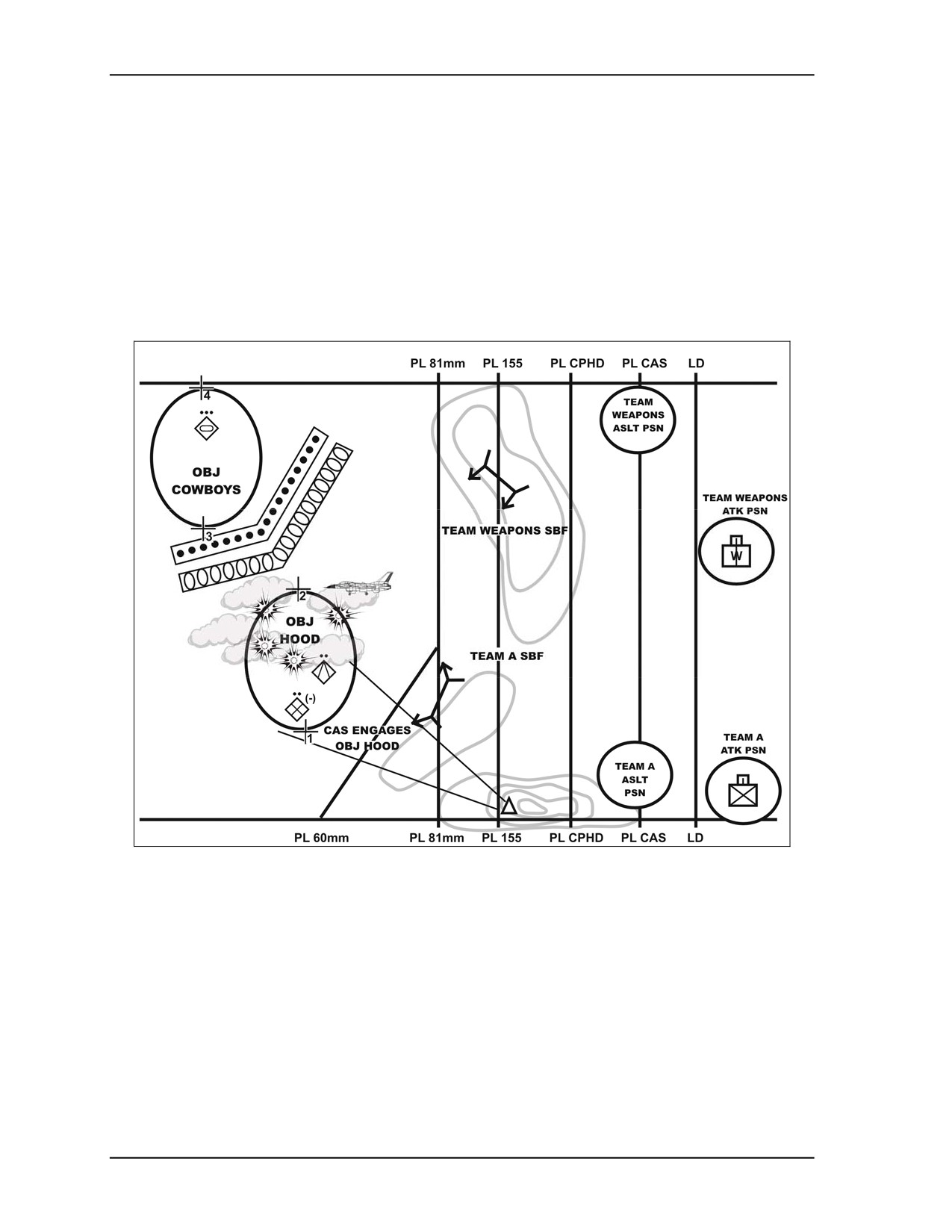
Chapter 10
10-23.
As the unit continues its movement toward the objective, the first delivery system engages its
targets. It maintains fires on the targets until the unit crosses the next phase line that corresponds to the
RED of the weapon.
10-24.
To maintain constant fires on the targets, the unit starts the next asset before the previous asset
ceases or shifts. This ensures no break in fires, enabling the friendly forces' approach to continue
unimpeded. However, if the unit rate of march changes, the fire support system must remain flexible to the
changes.
10-25.
The FSO shifts and engages with each asset at the prescribed triggers, initiating the fires from
the system with the largest RED to the smallest. Once the maneuver element reaches the final phase line to
cease all fires on the objective; the FSO shifts to targets beyond the objective.
Figure 10-1. Beginning of close air support.
10-10
FM 3-21.20
13 December 2006
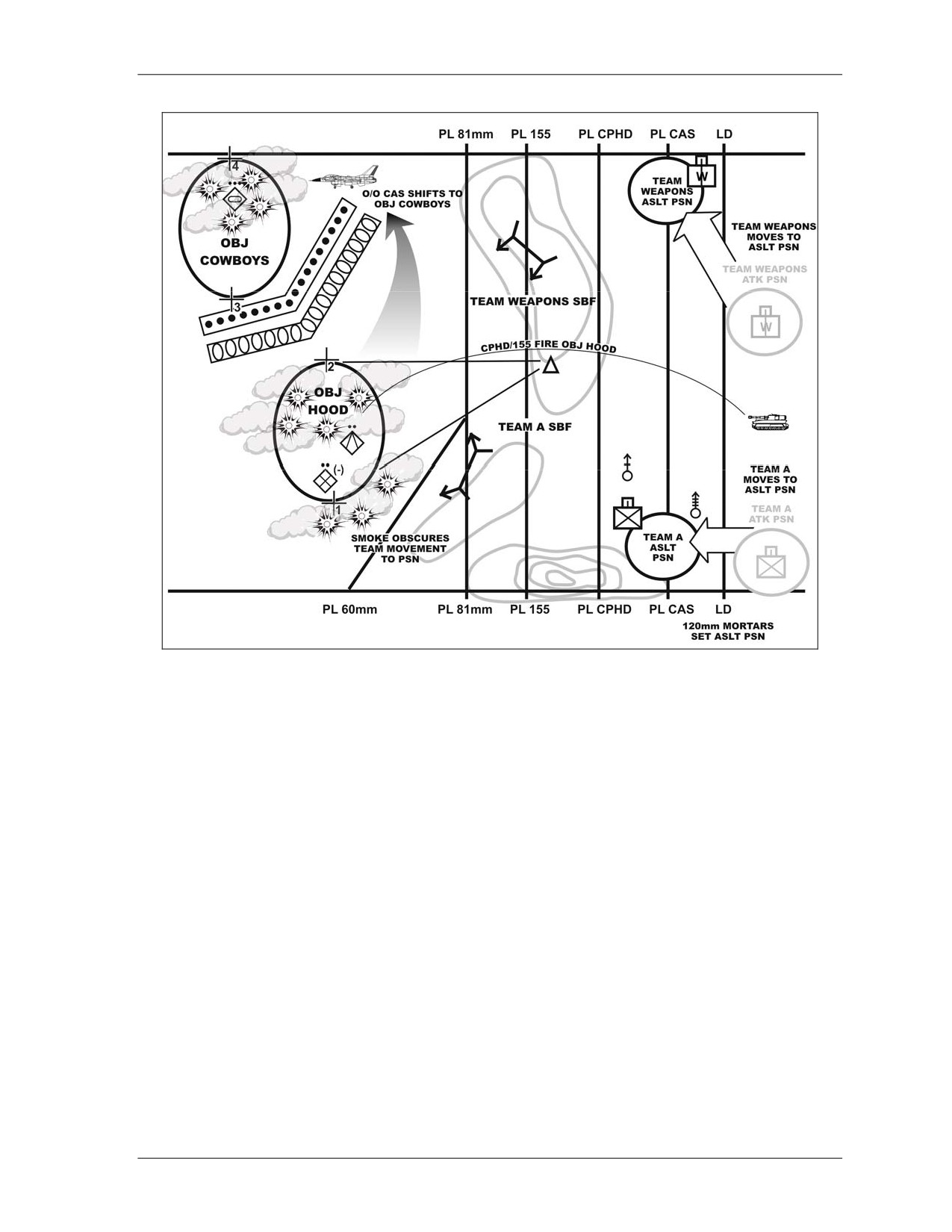
Warfighting Functions
Figure 10-2. Execution of 155-mm shaping fires; shifting of close air support.
13 December 2006
FM 3-21.20
10-11
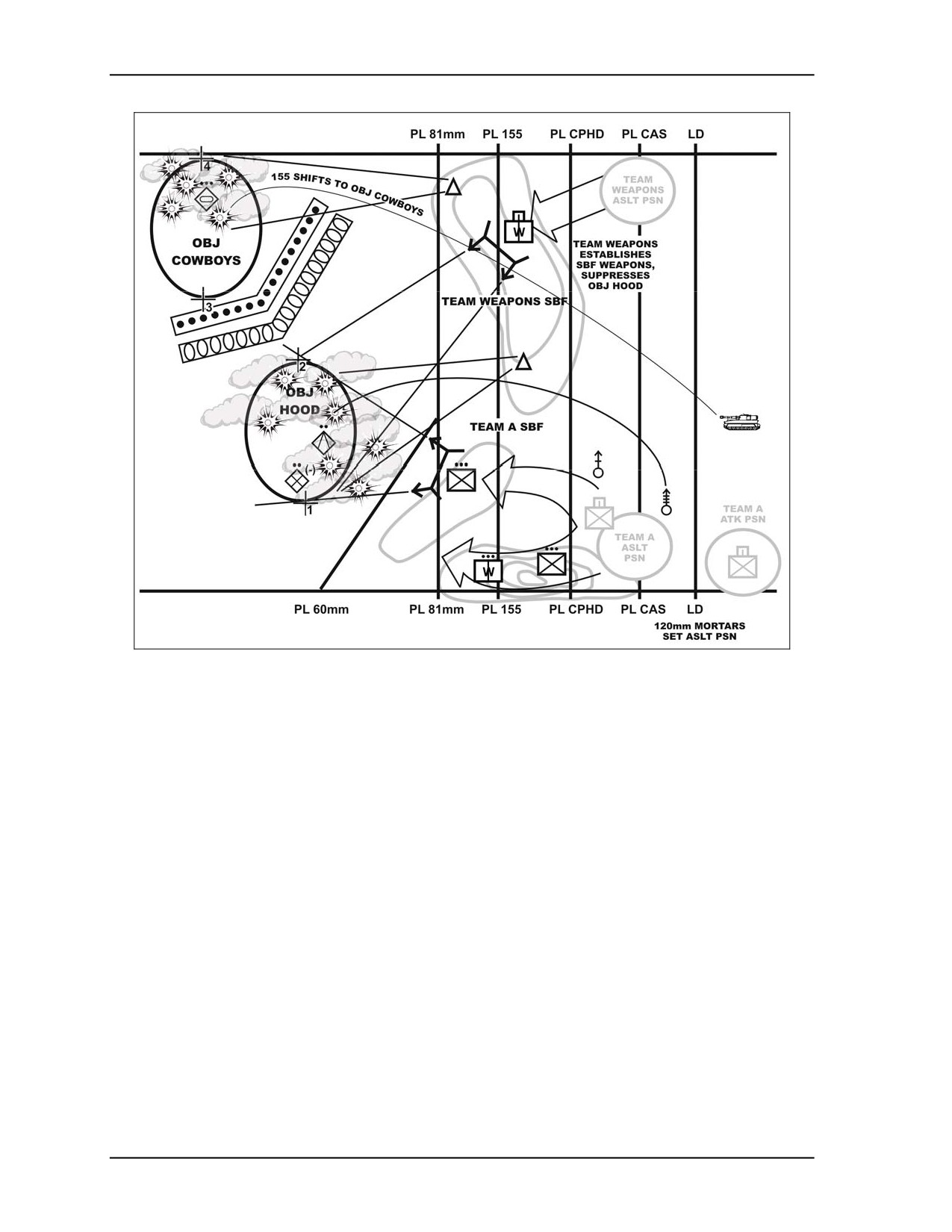
Chapter 10
Figure 10-3. Beginning of 81-mm and supporting fires; shifting of 155-mm fires.
10-12
FM 3-21.20
13 December 2006
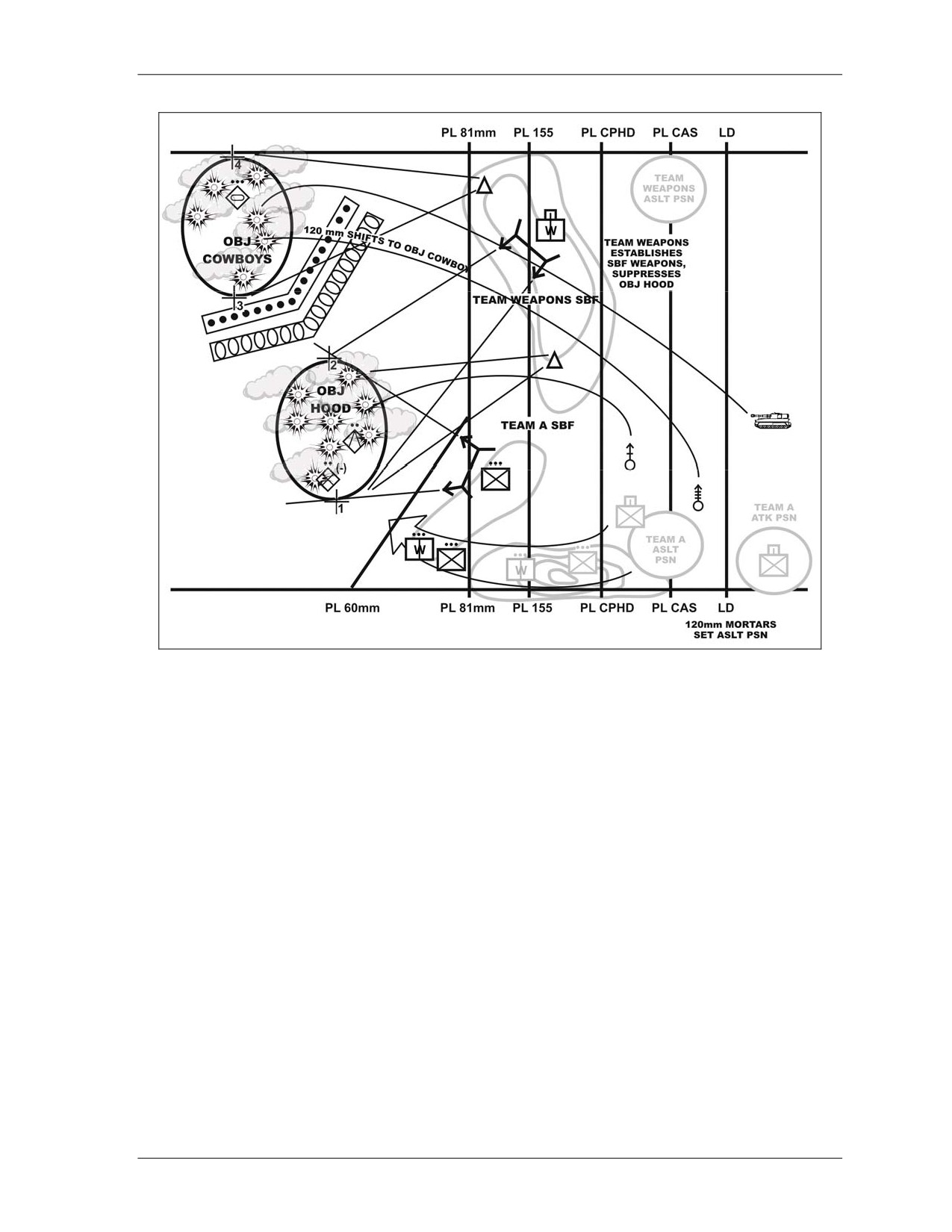
Warfighting Functions
Figure 10-4. Beginning of 60-mm fires; shifting of 81-mm fires.
13 December 2006
FM 3-21.20
10-13
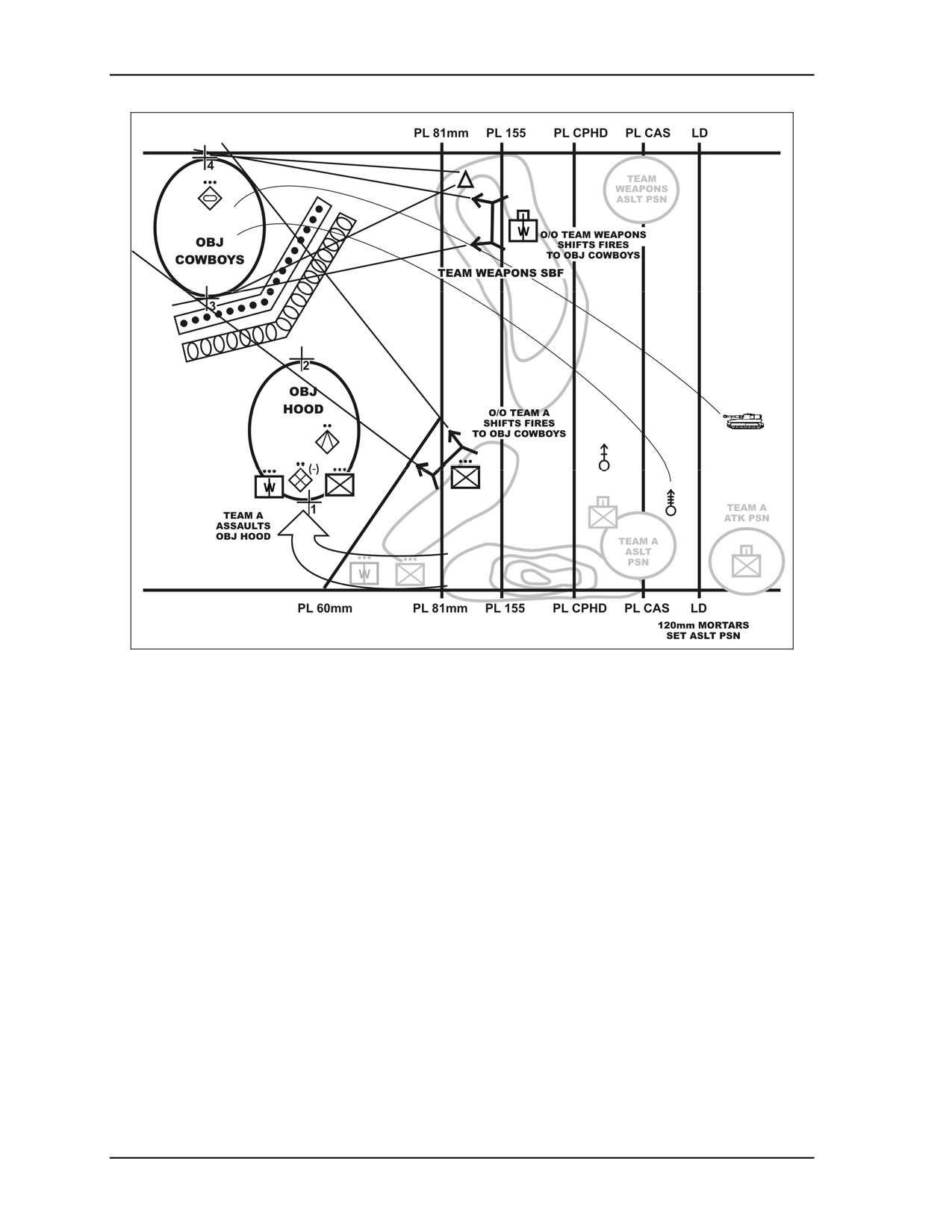
Chapter 10
Figure 10-5. Cessation of 60-mm fires; shifting of supporting fires.
AIR SUPPORT
10-26.
Infantry battalions are generally allocated CAS sorties only. CAS is defined as air strikes on
hostile surface forces that are in close proximity to friendly forces. CAS can be employed to blunt an
enemy attack; to support the momentum of the ground attack; to help set conditions for battalion and BCT
operations as part of the overall counterfire fight; to disrupt, delay and destroy enemy second echelon
forces and reserves; and to provide cover for friendly movements. For best results while avoiding mutual
interference or fratricide, aircraft are kept under “detailed integration” (part of the Air Force’s combat air
system). The effectiveness of CAS is directly related to the degree of local air superiority attained. Until air
superiority is achieved, competing demands between CAS and counterair operations may limit sorties
apportioned for the CAS role. CAS is the primary support given to committed battalions and BCTs by Air
Force, Navy, and Marine aircraft. BCTs/battalions can request air reconnaissance and battlefield air
interdiction missions through the next higher headquarters, but these missions are normally planned and
executed at that higher unit level, with the results provided to the Infantry commanders and their staff.
MISSIONS
10-27.
The BCT normally plans and controls CAS. However, this does not preclude the battalion from
requesting CAS, receiving immediate CAS during an operation, or accepting execution responsibility for a
planned CAS mission. CAS is another means of indirect FS available to the battalion. In planning CAS
missions, the commander must understand the capabilities and limitations of close air support and
synchronize CAS missions with both the battalion fire plan and scheme of maneuver. CAS capabilities and
10-14
FM 3-21.20
13 December 2006
Warfighting Functions
limitations (windows for use, targets, observers, airspace coordination, and so on) present some unique
challenges, but the commander and staff must plan CAS with maneuver the same way they do indirect
artillery and mortar fires. When executing a CAS mission, the battalion must have a plan that synchronizes
CAS with maneuver and the scheme of fires.
Preplanned Close Air Support
10-28.
Battalion planners must forward CAS requests as soon as they can be forecasted. These
requests for CAS do not normally include detailed timing information because of the lead-time involved.
Preplanned CAS requests involve any information about planned schemes of maneuver, even general
information, which can be used in the apportionment, allocation, and distribution cycle. Estimates of
weapons effects needed by percentage, such as 60 percent antiarmor and 40 percent antipersonnel; sortie
time flows; peak need times; and anticipated distribution patterns. All are vital to preparing the air tasking
order. ALOs and S-3s at all planning echelons must ensure that this information is forwarded through
higher echelons IAW the air tasking order (ATO) cycle.
Categories
10-29.
Preplanned CAS may be categorized as either scheduled or alert missions.
• A scheduled mission is a CAS strike on a planned target at a planned time.
• An alert mission is a CAS strike on a planned target or target area executed when requested by
the supported unit. Usually, this mission is launched from a ground alert (scramble), but it may
be flown from an airborne alert status. Alert (on-call) CAS allows the ground commander to
designate a general target area within which targets may need to be attacked. The ground
commander designates a conditional period within which he later determines specific times for
attacking the targets.
Request Channels
10-30.
There are specific request channels for preplanned CAS. Requests for preplanned tactical air
support missions are submitted to the FSE. The commander, ALO, and S-3 at each echelon evaluate the
request; coordinate requirements such as airspace, fires, and intelligence; consolidate; and, if approved,
assign a priority or precedence to the request. The S-3 Air then forwards approved requests to the next
higher echelon. To plan CAS, the S-3 Air must work closely with the S-3, FSO, and ALO.
Engagement Alternatives
10-31.
CAS aircraft assigned to attack preplanned targets may be diverted to higher priority targets;
therefore, the FSO should plan options for the engagement of CAS targets by other FS assets.
Immediate Close Air Support
10-32.
Immediate requests are used for air support mission requirements identified too late to be
included in the current air tasking order. Those requests initiated below battalion level are forwarded to the
battalion command post by the most rapid means available.
10-33.
At battalion level, the commander, FSO, ALO, and S-3 consider each request. Approved
immediate CAS requests are transmitted by the TACP over the Air Force air request net (Figure 10-6)
directly to the air support operations center (ASOC) collocated with the corps or separate division TOC.
10-34.
The TACP at each intermediate headquarters monitors and acknowledges receipt of the request.
Silence by an intermediate TACP indicates approval by the associated headquarters unless disapproval is
transmitted.
13 December 2006
FM 3-21.20
10-15
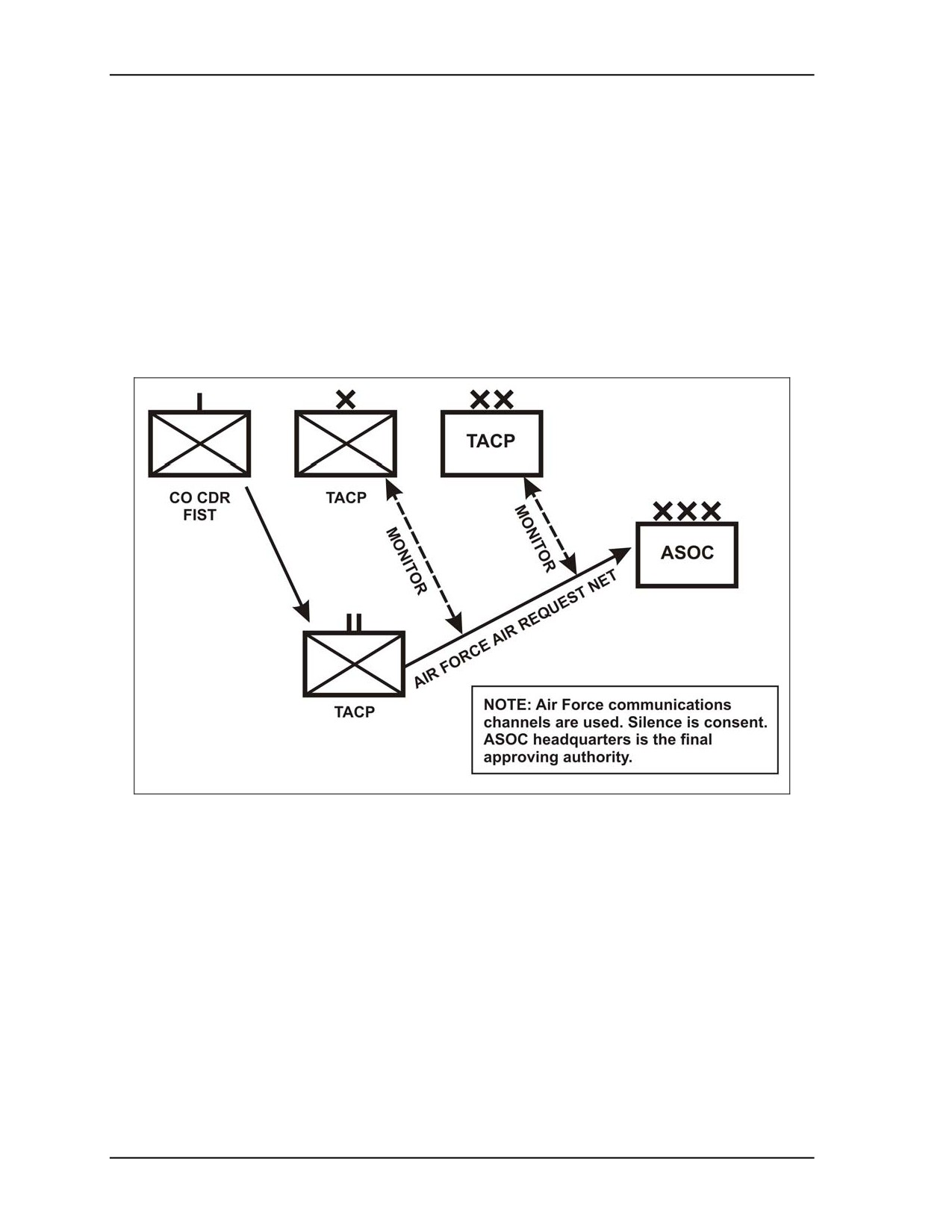
Chapter 10
10-35.
The ASOC coordinates with the G-3 Air at echelons above the BCT for all air support requests
initiated by that unit. Meanwhile, intermediate TACPs pass the request to the associated headquarters G-3
or S-3 for action and coordination.
10-36.
All echelons coordinate simultaneously. If any Army echelon above the initiating level
disapproves a request or substitutes another support means, such as Army aviation, or field artillery, the
TACP at that headquarters notifies the ASOC at the coordinating unit and the originating TACP, which
notifies the requester.
10-37.
When the coordinating unit commander or his representative approves the request, the ASOC
initiates the necessary action to satisfy the request. If all distributed sorties are committed, the coordinating
unit commander can request additional sorties from the next higher echelon, when appropriate. If the
ASOC has no CAS missions available, it can, with Army concurrence, divert sorties from lower priority
targets or request support from lateral or higher commands.
Figure 10-6. Immediate close air request channels.
PLANNING CONSIDERATIONS
10-38.
CAS mission success directly relates to thorough mission planning based on the following
factors and considerations. The S-3 Air is responsible for working with the battalion ALO/ETAC before
and during tactical air (TACAIR) operations. Since there are no digital links with supporting aircraft, he
must consistently keep the ALO apprised of the ground tactical situation through digital and conventional
means.
10-39.
When operating in the battalion’s AO, CAS aircraft are under the positive control of one of the
battalion’s TACP forward air controllers (FACs). FACs monitor the ground tactical situation, review the
COP, and monitor conventional voice radio nets of the supported ground or maneuver commander to
prevent fratricidal air-to-ground or ground-to-air engagements.
10-40.
Other planning factors include time available for planning, C2 procedures, communications,
and terrain.
10-16
FM 3-21.20
13 December 2006
Warfighting Functions
AIR FORCE SUPPORT
10-41.
Air Force units are attached to the battalion to plan, control, and direct close air support. The
TALO and the TACP are the typical air force assets attached to the battalion.
Air Liaison Officer
10-42.
TALOs are provided to Army maneuver units down to battalion. The ALO is responsible for
supervising the tactical air control party and coordinating close air support with the FSE and S-3 Air. The
ALO is the senior USAF representative for the TACP supporting the battalion. The ALO/ETAC is
normally located with the command group during tactical operations.
Tactical Air Control Party
10-43.
TACPs are provided to Army maneuver unit headquarters down to and including the battalion
level. TACPs provide direct interaction with the supported maneuver units and should be highly visible to
Army commanders and readily available to assist in the integration and synchronization of air power with
land-force fire and maneuver.
10-44.
The supported unit’s ALO is the commander of the TACP. TACPs, at higher echelons through
the BCT level, function primarily in an advisory role. These sections provide Air Force operational
expertise for the support of conventional Army planning and operations. They are the point of contact to
coordinate local air defense and airspace management activities. Their function is to specifically assist
Army planners in the preparation of the Army’s plan to integrate CAS into the overall scheme of fires and
maneuver. They coordinate preplanned and immediate air requests and assist in coordinating air support
missions with appropriate Army airspace command and control elements. Battalion TACPs have the added
responsibility of terminal attack control.
10-45.
TACPs coordinate activities through an Air Force air request net and the advanced airlift
notification net. The TACP performs the following functions:
• Serves as the Air Force commander’s representative
• Advises battalion commander and staff on capabilities, limitations, and employment of air
support, airlift, and reconnaissance.
• Coordinates with respective FSE and A2C2 cells.
• Helps synchronize air and surface fires.
• Helps prepare the air support plan
• Coordinates local air defense and airspace management activities.
• Integrates into the staff for air support planning for future operations.
• Advises on the joint suppression of enemy air defenses (JSEAD).
• Provides appropriate final attack control for CAS and operates the Air Force air request net.
Levels
10-46.
TACPs are generally manned at the following levels:
Two levels above the BCT
10-47.
One ALO, four fighter liaison officers (FLOs), two theater airlift liaison officers (TALOs), and
six forward air controllers (FACs).
One level above the BCT
10-48.
One ALO, three FLOs, three TALOs, and six FACs.
13 December 2006
FM 3-21.20
10-17