FM 3-21.20 (FM 7-20) THE INFANTRY BATTALION (DECEMBER 2006) - page 7
This page intentionally left blank.
Chapter 7
Civil Support Operations
The overall purpose of civil support operations is to meet the immediate needs of
designated groups, for a limited time, until civil authorities can accomplish these
tasks without Army assistance. Civil support operations are a subset of Homeland
Security which includes Homeland Defense (offensive and defensive operations) and
civil support operations. Civil support operations are only conducted inside the US
and its territories.
In civil support operations, Army forces provide essential services, assets, or
specialized resources to help civil authorities deal with situations beyond their
capabilities. Army forces may provide relief or assistance directly, when necessary,
but they normally support the overall effort controlled by another agency. In civil
support operations, the adversary is often disease, hunger, or the consequences of
disaster. Civil support operations for the battalion may include assisting civilians
extinguish forest fires, rescue and recovery from floods or other natural disasters, or
supporting security operations before, during, or after terrorist attacks.
Civil support operations vary by type and are further differentiated by the specific
factors of METT-TC. Civil support operations usually require the battalion to
perform common tactical missions and tasks but also call upon it to execute unique
missions and tasks. The purposes of civil support operations, the special constraints
they place on commanders, the location, and the types of judgments expected of
battalion commanders and their subordinates, distinguish these operations
from others.
Civil support operations involve Army forces providing essential supplies,
capabilities, and services to help civil authorities in the US and its territories deal
with situations beyond their control. In most cases, Army forces focus on overcoming
conditions created by natural or manmade disasters. Army forces may provide relief
or assistance directly; however, Army activities in civil support operations most often
involve setting the conditions that facilitate the ability of civil authorities or NGOs, to
provide the required direct support to the affected population.
Section I. FUNDAMENTALS
The US Army conducts civil support operations in the US and its territories, using active and
reserve
components. Domestic emergencies can require Army forces to respond with multiple capabilities and services.
For this reason, they may conduct the four forms of civil support operations simultaneously, during a given
operation.
13 December 2006
FM 3-21.20
7-1
Chapter 7
PURPOSE
7-1.
Civil support operations supplement the efforts and resources of federal, state, and local
governments, and NGOs within the United States and its territories. During civil support operations, the
US military always responds in support of another civilian agency. Civil support operations also include
those activities and measures taken by the Department of Defense (DoD) to foster mutual assistance and
support between DoD and any civil government agency in planning or preparedness for, or in the
application of resources for response to, the consequences of civil emergencies or attacks, including
national security emergencies or major disasters. A presidential declaration of an emergency or disaster
area usually precedes a civil support operation. The US military provides civil support primarily in
accordance with a DoD directive for military assistance to civil authorities. The military assistance to civil
authorities’ directive addresses responses to both natural and manmade disasters and includes military
assistance with civil disturbances, counterdrug activities, combating terrorism activities, and law
enforcement. In accordance with the Constitution, civilian government is responsible for preserving public
order. However, the Constitution does allow the use of military forces to protect federal and civilian
property and functions. For further information, see the Posse Comitatus Act. Typically, civil support
operations are conducted in response to such events as forest and grassland fires, hazardous material
releases, floods, earthquakes, hurricanes, and situations resulting from an enemy attack such as terrorist
activities.
ARMY ROLE
7-2.
The Army is not specifically organized, trained, or equipped for civil support operations. Instead,
Army elements and forces, tailored for warfighting, rapidly adapt to dominate a crisis or disaster situation.
In civil support operations, Army forces apply decisive military capabilities to set the conditions for the
supported civil authorities to achieve success. Army forces have a functional chain of command, reliable
communications, and well-trained, well-equipped forces that can operate and sustain themselves in an
austere environment with organic assets.
MULTIPLE AND OVERLAPPING ACTIVITIES
7-3.
In most situations, Army forces involved in civil support operations execute a combination of
multiple overlapping activities. Forces must conduct civil support operations with consistency and
impartiality to encourage cooperation from local agencies and the population and to preserve the legitimacy
of the overall effort. The actions of platoons, squads, or even individual Soldiers take place under the
scrutiny of many interested groups and can have disproportionate effects on mission success. Therefore,
high levels of discipline, training, and a thorough understanding of mission outcome are necessary for
effective civil support operations.
MISSION TRAINING
7-4.
A sound foundation in combat mission training and in basic military skills and discipline
underpins the battalion’s ability to perform civil support operations missions, but many of the key
individual and collective skills differ and must be trained for deliberately. Battalions use most of their
regularly trained movement and security tasks in civil support operations missions, but they modify those
tasks for the special conditions of their mission. They also train leaders and Soldiers for unique tasks
necessary to the certain types of operation that they are assigned.
OPERATIONAL ENVIRONMENT
7-5.
The mission, the terms governing the Army’s presence in the AO, the character and attitude of the
population, the civilian organizations cooperating with the battalion, the physical and cultural
environments, and a host of other factors combine to make each civil support mission unique. With the
exception of specific actions undertaken in counterterrorism operations, support to counterdrug operations,
7-2
FM 3-21.20
13 December 2006
Civil Support Operations
and noncombatant evacuation operations, civil support missions tend to be decentralized and highly
structured. A battalion’s activities consist largely of directing the operations of its companies and
supporting units within a sector or AO IAW a detailed operations order.
Section II. FORMS OF CIVIL SUPPORT OPERATIONS
Most civil support operations are independent actions. Because civil support operations only occur in the
United States or its territories, civil support operations rarely complement offensive, defensive, and stability
operations. Civil support operations generally fall into the following four categories:
y Relief operations.
y Support to domestic chemical, biological, radiological, nuclear, and high-yield explosive
consequence management (CBRNE-CM).
y Support to civil law enforcement.
y Community assistance.
RELIEF OPERATIONS
7-6.
In general, the actions performed during relief operations are identical in both civil support
operations and FHA operations; however, civil support operations are performed inside the US and its
territories and FHA outside the US and its territories. The actions can be characterized as either
humanitarian relief, which focuses on the well-being of supported populations, or disaster relief, which
focuses on recovery of critical infrastructure after a natural or manmade disaster. Relief operations
accomplish one or more of the following:
y Save lives.
y Reduce suffering.
y Recover essential infrastructure.
y Improve quality of life.
DISASTER RELIEF
7-7.
Disaster relief encompasses those actions taken to restore or recreate the minimum infrastructure
to allow effective humanitarian relief and set the conditions for longer-term recovery. This includes
establishing and maintaining minimum safe working conditions, plus security measures necessary to
protect relief workers and the affected population from additional harm. Disaster relief may involve
repairing or demolishing damaged structures; restoring or building bridges, roads, and airfields; and
removing debris from critical routes and relief sites.
HUMANITARIAN RELIEF
7-8.
Humanitarian relief focuses on life-saving measures to alleviate the immediate needs of a
population in crisis. It often includes the provision of medical support, food, water, medicines, clothing,
blankets, shelter, and heating or cooking fuel. In some cases, it involves transportation support to move
affected people from a disaster area.
SUPPORT TO CBRNE-CM
7-9.
The second type of civil support operation is support to domestic chemical, biological,
radiological, nuclear, and high-yield explosive consequence management
(CBRNE-CM). Military
operations assist civil authorities in protecting US territory, population, and infrastructure before an attack
13 December 2006
FM 3-21.20
7-3
Chapter 7
by supporting domestic preparedness and critical asset protection programs. If an attack occurs, military
support responds to the consequences of the attack.
DOMESTIC PREPAREDNESS
7-10.
The Army’s role in facilitating domestic preparedness is to strengthen the existing expertise of
civil authorities. This is accomplished in the two primary areas of response and training. Response is the
immediate reaction to an attack; training includes what happens after the attack.
PROTECTION OF CRITICAL ASSETS
7-11.
The purpose of this program is to identify critical assets and to assure their integrity, availability,
survivability, and capability to support vital DoD missions across the full spectrum of military operations.
Critical assets include telecommunications, electric power, gas and oil, banking and finance, transportation,
water, and emergency services. An attack on any of these assets may disrupt civilian commerce,
government operations, and the military.
RESPONSE TO CBRNE INCIDENTS
7-12.
The initial response to the use of WMD is primarily from local assets but sustained Army
participation may be required soon afterward. The Army’s capabilities in this environment are—
y Detection.
y Decontamination and medical care.
y Triage and treatment.
y MEDEVAC.
y Hospitalization (patient decontamination for self-evacuation).
y Technical consultation to commanders and local health care providers on health effects of
WMD incidents.
SUPPORT TO CIVIL LAW ENFORCEMENT
7-13.
Support to domestic civil law enforcement generally involves activities related to
counterterrorism, counterdrug operations, civil disturbance operations, or general support. Army support
may involve providing resources, training, or direct support. Federal forces remain under the control of
their military chain of command at all times while providing the support.
CIVIL SUPPORT TO COUNTERTERRORISM
7-14.
Army forces do not conduct domestic counterterrorism, but they may provide support to lead
federal agencies during crisis and consequence management of a terrorist incident. They may provide
assistance in the areas of transportation, equipment, training, and human resources. When terrorists pose an
imminent threat to US territory, its people, or its critical assets, the US military may conduct civil support
operations to counter these threats, using ground, air, space, special operations, or maritime forces. The
Federal Bureau of Investigation (FBI) is responsible for crisis management in the US.
CIVIL SUPPORT TO COUNTERDRUG OPERATIONS
7-15.
Army support to domestic counterdrug operations is very limited and usually only in a
support role.
7-4
FM 3-21.20
13 December 2006
Civil Support Operations
CIVIL DISTURBANCE OPERATIONS
7-16.
Non federalized Army forces (National Guard) assist civil authorities in restoring law and order
when local and state law enforcement agencies are unable to resolve a civil disturbance. Federal Army
forces assist in restoring law and order when the magnitude of a disturbance exceeds the capabilities of
local and state law enforcement agencies, including the National Guard. Army participation is to apply the
minimum force necessary to restore order to the point where civilian authorities no longer require military
assistance.
GENERAL SUPPORT
7-17.
The Army may also provide training, share information, and provide equipment and facilities to
federal, state, and local civilian law enforcement agencies.
COMMUNITY ASSISTANCE
7-18.
Community assistance is a broad range of activities designed to strengthen the relationship
between the Army and the American people. These projects should exercise individual Soldier skills,
encourage teamwork, challenge leader planning and coordination skills, and result in accomplishments that
are measurable. Example activities include youth physical fitness programs, medical readiness programs,
and anti-drug programs.
Section III. PLANNING AND EXECUTING OF CIVIL SUPPORT OPERATIONS
The planning and execution of civil support operations are fundamentally similar to planning, preparing,
executing, and assessing offensive, defensive, and stability operations. However, while each civil support
operation is unique, the following four broad considerations can help forces develop mission-specific concepts
and schemes for executing civil support operations.
PLANNING CONSIDERATIONS
7-19.
Whether they confront the complications of floods, storms, earthquakes, riots, disease, or other
humanitarian crises, the Infantry battalion brings its strengths to civil support operations. Although it has
limited numbers of medical personnel, the battalion brings to the operation its outstanding abilities to
organize and supervise operations, collect and distribute information, and communicate. Finally, it brings
large numbers of highly disciplined and motivated Soldiers. The following four broad imperatives help
forces plan and execute civil support operations. Other special considerations, attached elements, may also
apply. In addition, attached elements must be considered:
PROVIDE ESSENTIAL SUPPORT FOR LARGEST NUMBER OF PEOPLE
7-20.
Commanders must allocate finite resources to achieve the greatest good. Also, commanders
require an accurate assessment of what needs to be done in order to employ military power effectively. In
some cases, the battalion can accomplish this task using warfighting reconnaissance capabilities and
techniques. Commanders determine how and where to apply limited assets to benefit the most people in the
most efficient way. They usually focus initial efforts on restoring vital services, which include food and
water distribution, medical aid, power generation, search and rescue, and firefighting.
COORDINATE ACTIONS WITH OTHER AGENCIES
7-21.
Civil support operations are typically joint and interagency (Appendix G). Unity of effort between
the military and local authorities requires constant communication to ensure that tasks are conducted in the
most efficient and effective way and resources are used wisely.
13 December 2006
FM 3-21.20
7-5
Chapter 7
ESTABLISH MEASURES OF EFFECTIVENESS
7-22.
A critical aspect of mission handover is to have objective standards for measuring progress. These
measures of effectiveness determine the degree to which an operation is accomplishing its established
objectives. For example, a measure of effectiveness might be a decrease in the number of deaths caused by
starvation. This is an indicator that food convoys are reaching the designated areas. These measures are
situationally dependent, and must be adjusted as the situation changes and guidance from higher is
developed.
TRANSFER RESPONSIBILITY TO CIVILIAN AGENCIES
7-23.
Civil support operations planning must always include the follow-on actions of the civilian
agencies to restore conditions to normal. The following considerations determine handover feasibility:
y Condition of supported population and governments.
y Competing mission requirements.
y Specified and implied commitment levels of time, resources, and forces.
y Maturity of the support effort.
PLANNING PROCESS
7-24.
The battalion staff uses the standard Army planning process.
SPECIAL CONSIDERATIONS
7-25.
The battalion planning staff must understand the following special considerations:
y Specialized civil support operations terminology in the mission and tasks assigned to the
battalion for purposes of mission analysis and COA development.
y Command relationships in support to US civil authorities.
y Presence of, activities of, and the battalion’s relationship to nongovernmental organizations and
private voluntary organizations in the AO.
y The political, economic, military, and environmental situation in the AO.
y Local customs, cultures, religions, and ethnic groups.
y Force protection measures.
y ROE and other restrictions on operations.
y Terrain, weather, infrastructure, and conditions unique to the AO and the nature of
the operation.
y Security operations.
y Availability or need for specialized units such as public affairs, CA, chemical defense,
engineers, MPs, and others.
y Support relationships when the battalion provides material aid.
y The need for liaisons with interagency, GOs, NGOs, or local/state agencies.
y Interoperability of C2 with those agencies, for example, communications, reports, and ROE.
ATTACHED ELEMENTS
7-26.
Battalions involved in civil support operations are normally reinforced with engineers and may
also have troops attached. MPs, additional HSS personnel, CA, and public affairs often support battalions
in civil support operations. Since these units are not organic, the staff and company commanders should
learn the organizations, capabilities, limitations, and specific missions of attached organizations before
employing them. In some cases, protecting those elements imposes additional loads on the maneuver
companies.
7-6
FM 3-21.20
13 December 2006
Civil Support Operations
WARFIGHTING FUNCTIONS
7-27.
The warfighting functions are considered during planning for civil support just as they are for
other types of operations.
FIRE SUPPORT
7-28.
Basic fire planning considerations for direct and indirect fire weapons are generally no longer
valid during civil support operations. FS plans in civil support operations are integrated into tactical or
force protection operations as the situation warrants. The battalion FSE can be used to assist other areas
requiring planning support or can be used to support unique civil support operations functions such as the
establishment and operation of a civil military operations or public affairs center.
MOVEMENT AND MANEUVER
7-29.
In civil support operations, where area responsibilities, movements, and control of terrain are
sensitive and hazards are sometimes widely scattered, the battalion needs detailed information on its AO
and commonly uses detailed control measures. Battalion leaders must clearly delineate and ensure Soldiers
throughout the battalion understand routes, installations, hazards, boundaries, and other control measures.
Leaders must also clearly communicate special control measures, such as curfews, restrictions on
movements, and prohibition of weapons, to all concerned.
7-30.
Also, civil support operations missions may call for dispersed operations. Digital systems organic
to the battalion provide timely and accurate force tracking and facilitate reporting. Faster movement of
information concerning maneuver also facilitates faster reaction to threats and allows forces in motion to be
routed around new hazards.
MOBILITY AND SURVIVABILITY
7-31.
Mobility and survivability generally constitute major activities in civil support operations
missions, especially at their outset. Mobility for the force and the population is also an early issue in many
civil support operations as roads and bridges require repair, rubble clearing, hazardous area marking or
clearing, and assessment and repair to damaged aqueducts or hydrologic control facilities. Even in mature
civil support operations, engineer operations typically remain very active. They have access to topographic
tools and engineer data electronically from anywhere in the world.
Engineer Digital Tools
7-32.
The engineers of digitized forces employ software that facilitates managing and recording
engineer work and posting results to Maneuver Control System-Light and force XXI battle command,
brigade and below (FBCB2). They also have access to topographic tools and engineer data electronically
from anywhere in the world. These capabilities are of great value during civil support operations in
managing engineer work, adjusting priorities, projecting needs, and informing their units and the
population of the status of engineer projects.
Battalion Engineer
7-33.
Civil support operations are commonly supported with a great number of attached combat
engineer units as well as construction engineers and contracted civilian engineers. Several engineer
companies may support a battalion conducting civil support operations; if so, the senior engineer company
commander normally serves as the battalion engineer.
13 December 2006
FM 3-21.20
7-7
Chapter 7
COMMAND AND CONTROL
7-34.
Standard command and staff doctrine applies to civil support operations C2. Orders, estimates,
planning guidance, rehearsals, and backbriefs are all useful in directing civil support operations. The need
for mutual understanding between all members of the command group is as great in civil support
operations as in combat operations.
Cooperation
7-35.
As in other cases, cooperation with other services or agencies imposes special requirements for
training, coordination, and liaison. Multiservice operations in which the battalion controls troops of other
services or are controlled by another service's, call for special attention to command relationships and
limitations on the commander’s prerogatives.
Communications
7-36.
The battalion’s C2 systems yield significant advantages in planning and conducting civil support
operations. Operation of these systems depends on communications architecture provided by the BCT or
by another higher level of command. Use of nontactical or other nonstandard communications is likely in
support to civil authorities in the US. If this is the case, then battalion commanders and staff leaders need
training in operating these systems. In the early and concluding stages of an operation, the signal structure
may permit only limited use of C2 INFOSYS if available. The battalion’s plan for C2 must consider that
and provide for alternate means of communication or full reliance on tactical systems.
Liaison Teams
7-37.
Liaison teams can be extremely useful in providing a common view of the situation for
headquarters attached to the battalion. Battalions must staff their normal liaison teams and identify their
needs for more teams as early as possible.
INTELLIGENCE
7-38.
The battalion never conducts intelligence operations during operations in the US. In some cases,
intelligence operations may be replaced with neutral, self-defensive information collection operations. A
coordinated intelligence, surveillance, and reconnaissance effort is as critical to the battalion’s success in
civil support operations as during combat operations.
Information Collection
7-39.
Information collection is a constant process that is guided by the commander’s critical information
requirements and is normally embodied in the ISR plan. The commander may employ his scout platoon,
electronic sensors, Raven UAS (also HUNTER UAS if tasked from the BCT), patrols, engineers, liaison
teams, civil affairs, and so forth to achieve his ISR aims. The battalion’s scout platoon plays a special role
in ISR, but every Soldier and unit in the battalion has some responsibility for observing and reporting.
Therefore, the battalion commander’s PIR, focus for collection, and the associated ISR tasks must be
known throughout the battalion and revised as often as necessary to assure that Soldiers know what
information is of greatest importance.
Collection Assets
7-40.
The battalion may request UAS and other electronic sensors to support the battalion commander’s
PIR. However, in order to receive useful information from those assets, the battalion must specifically
request ISR support.
7-8
FM 3-21.20
13 December 2006
Civil Support Operations
Human Intelligence
7-41.
Human intelligence is especially important during civil support operations. The Soldier is the most
important collection asset for the battalion in these operations. The collection is focused on the effects of
the disaster on the population and infrastructure. Each Soldier observes and collects information about the
operational environment. In many cases, THT augmentation may be provided to the battalion. The
battalion S-2 must be knowledgeable in their employment of these teams.
SUSTAINMENT
7-42.
Sustainment for civil support operations usually requires substantial tailoring to adapt to unique
mission requirements; logistical requirements vary considerably between types of civil support operations.
Civil support operations commonly take place in areas where local resources and infrastructure are scarce,
damaged, or fully devoted to the civilian population, but resourced to a low degree.
Challenges
7-43.
The chief sustainment challenges of civil support operations are to anticipate needs and to
integrate units and sources into the civil support operations. Information needs include—
y Resources available within the local area and region.
y Status of critical supply items and repair jobs.
y Nature and condition of the infrastructure.
y Capabilities of general support sustainment units.
y Mission tasks.
y Overall material readiness of the battalion.
Contracting Options
7-44.
In some cases, contracting can augment organic sustainment. Battalions may encounter or employ
contractor-provided services and supply operations in civil support operations environments. The S-4 and
commander must understand the terms and limitations of contractor support.
Force Health Protection
7-45.
The battalion deploys with its organic medical assets for civil support operations. The battalion
may be augmented with additional HSS assets to support the battalion’s mission. Civil support operations
may include disaster relief and displaced personnel operations. Medical treatment provided in support of
these operations must comply with Title 10 of the US Code. See FM 8-42 for FHP support of disaster relief
or displaced personnel operations. The brigade support battalion’s medical company may require
humanitarian augmentation medical equipment sets to perform its civil support operations mission. Key
personnel
(health care providers) should review the requirements before deployment to provide for
contingencies and modifications (add or delete items) so that the level and types of medical supplies
conform to the mission requirements.
Liaison with Civil Authorities
7-46.
Nonstandard supporting relationships and close coordination with civil authorities may dictate the
use of liaisons and even the creation of additional liaison teams to assure their greatest usefulness and
coordination.
13 December 2006
FM 3-21.20
7-9
Chapter 7
INFORMATION OPERATIONS
7-47.
Information operations in civil support operations is the employment of the core capabilities of
computer network operations, public affairs, and operations security, in concert with specified supporting
and related capabilities, to affect information and information systems and to influence decision making.
The commander employs CA, public affairs, and OPSEC as part of his information operation. The
battalion commander supports the higher commander’s IO, carrying out tasks assigned to him and acting
independently within the higher commander’s intent and the constraints of his own resources.
7-48.
Because civil support operations are complex, usually decentralized, and often critical to the
force’s perceived legitimacy, continuity and consistency in IO are extremely important. The battalion must
present its position clearly to assure that the interested public understands it. The commander must be
aware of local interests, fears, and concerns of the effects of events and on the perceptions of his troops and
the population in general. He must understand the positions of and information environment created by—
y The population and its major segments.
y Other agencies working in the AO.
y Organizations located outside of the AO, but have economic and political interests.
y The media.
y Information gathered by elements of the battalion.
Note. Unless PSYOP is used strictly in a public information role, civil support operations do
not include PSYOP. PSYOP is prohibited from targeting US target audiences; however, they
consist of public affairs and any necessary OPSEC.
Section IV. PATTERN OF OPERATIONS
While civil support operations vary greatly in every mission, the Infantry battalion can expect events to follow
as broad pattern of response, recovery, and restoration.
RESPONSE
7-49.
As part of a response, the battalion enters the affected area, normally under BCT control, and
makes contact with federal, state agencies and relief organizations. Planning for the operation, staging
command posts into the area, establishing security, deploying the battalion, and initiating contacts with
supported activities and other parts of the relief force occur during this phase of operations. The battalion
may make its chief contributions in this phase. Its Soldiers are usually among the first relief forces to
arrive. Its C2 structure gives it the ability to communicate and coordinate. Furthermore, the battalion’s
ability to reconnoiter and gather information makes it useful in the initial efforts of authorities to establish
understanding and control of the area and to oversee critical actions. Typical requirements of the response
period are—
y Search and rescue.
y High volume EMT.
y Hazard identification.
y Dissemination of emergency information.
y Food and water distribution.
y Collection of displaced people in temporary shelter.
y Support to law enforcement agencies.
y Repair of power generation and distribution systems.
7-10
FM 3-21.20
13 December 2006
Civil Support Operations
y Clearance and repair of roads, railways, and canals.
y Firefighting, CBRNE and hazardous industrial waste decontamination, and flood control.
RECOVERY
7-50.
Once the battalion operation is underway, recovery begins. With initial emergencies resolved and
a working relationship between all parties in place, there should be steady progress in relieving the
situation throughout this phase of operations. The battalion is fully deployed in an AO or in an assigned
task. Its work includes coordination with its parent headquarters, supported groups, and other relief forces
and daily allocation of its own assets to recovery tasks. The battalion's task organization is likely to change
periodically as the need for particular services and support changes. Security, maintenance, effective
employment of resources, and Soldier support all need continuing attention. Medical officers should
review and assist the commander in counteracting the psychological effects of disaster relief work and
exposure to human suffering on the battalion’s Soldiers throughout the operation. Typical tasks include—
y Continuing and modifying information operations.
y Resettling people from emergency shelters to their homes.
y Repairing infrastructure.
y Contracting to provide appropriate support (when feasible).
y Restoring power, water, communication, and sanitation services.
y Removing debris.
y Supporting law enforcement agencies.
y Transferring authority and responsibility to civil authorities.
y Planning for redeployment.
y Assisting with restoration of health care delivery system.
RESTORATION
7-51.
Restoration is the return of normalcy to the area. As civil authorities assume full control of
remaining emergency operations and normal services, the battalion transfers those responsibilities to
replacement agencies and begins redeployment from the area. During restoration the commander should
consider issues such as—
y Transfer of authority to civil agencies.
y Transition of C2 for agencies and units that remain in the area.
y Movement plans that support redeployment and continued recovery in the area.
y Staging of C2 out of the area.
y Accountability of property or transfer of property to the community, if authorized.
Section V. SEQUENCE OF OPERATIONS
In every part of the sequence of civil support operations, special considerations apply to digitized units
initiating an operation or replacing another unit that has performed the mission before them. Generally, civil
support operations follow the sequence of—
y Movement into the AO.
y Establishment of a base of operations.
y Maintenance of support.
y Termination of operations.
13 December 2006
FM 3-21.20
7-11
Chapter 7
MOVEMENT INTO AREA OF OPERATIONS
7-52.
C2 considerations normally include using advance parties or liaison teams, establishing command
posts, and sequencing the arrival of key leaders. Battalion commanders must prepare a complete plan for
establishing control of the AO that includes a concept for phased installation of signal and C2. Transfer of
authority from the unit in place to the arriving unit and methodical, accountable handover of the AO is also
of primary interest. Detailed rehearsals and mock drills held in preparation for this task are a regular part of
preparatory training. Mission CCIR should guide staff specialists as they build information databases and
map displays to support the operation. The commander’s PIR should determine the order in which critical
information, for example, a list of the locations of hazards, and of the communities in greatest need of
support, is compiled and distributed.
ESTABLISHMENT OF BASE OF OPERATIONS
7-53.
Security, support, and continuous operations are the primary considerations during the
establishment of a battalion base of operations. The battalion must maintain security continuously.
OCCUPATION
7-54.
During the response phase, the battalion moves in accordance with the controlling headquarters'
order, employing advance parties and quartering parties as necessary. The battalion may move to an
assembly area in the affected area initially or may occupy its AO directly from the march. Early priorities
for the battalion include: establishing communications across the AO, refueling vehicles and recovering
any inoperable equipment, establishing or coordinating with existing logistical facilities and medical aid
stations, and reconnoitering the area. The battalion must complete these preliminary tasks as quickly as
possible in order to assume the mission promptly. In some cases, the battalion must defer operations until it
completes such tasks. For instance, a medical platoon cannot receive patients until its basic setup
is complete.
BATTALION FOCUS
7-55.
The battalion commander, the principal staff officers, and the company commanders vigorously
engage in making personal contact with supported groups, partners in the operation, and community
representatives early in the response phase. Executive officers and staff assistants are, therefore,
responsible for much of the internal activity of the battalion during response.
COMMAND POST OPERATIONS
7-56.
Organizing the command post for 24-hour operations in civil support operations also requires
early attention. A detailed SOP, complete operations maps, and special provisions for communications,
inspections, reporting, and adjusting security levels are necessities. Establishing a high standard for
operations from the outset is key both because of the general sensitivity of civil support operations and
because of the battalion's special vulnerabilities in its first days of the mission.
EQUIPMENT AUGMENTATION
7-57.
In some cases, the BCT augments the battalion with transportation assets. This is done to facilitate
movement of unit troops, materiel, or displaced personnel. When this happens, driver and maintenance
support is needed well before the battalion assumes the mission. The battalion might have to modify
sustainment and augment the FSC to support the attached fleet.
7-12
FM 3-21.20
13 December 2006
Civil Support Operations
MAINTENANCE OF SUPPORT
7-58.
Steady-state mission performance differs in each instance. The durations of civil support
operations vary. They typically focus on relieving crises in an area or population.
READINESS
7-59.
During some civil support operations, the battalion must retain its readiness to transition to
Homeland Defense operations. To ensure readiness, it maintains and rehearses QRF and provisions for
increased levels of security in base camps, at OPs, and in patrols. Commanders continually review their
operations to detect any patterns, vulnerabilities, or complacency that an opponent might exploit.
TERMINATION OF OPERATIONS
7-60.
Civil support operations end in different ways. Crises may be resolved, or continuing civil support
operations may be handed over to a replacement unit, federal or state agency, a police force, or local
authorities. Missions of short duration or narrow scope, such as support to civil authorities, may end with
the completion of the assigned task.
WITH TRANSFER OF CONTROL
7-61.
Transferring control of an AO or an operation to a follow-on force requires detailed coordination
to assure that all relevant information passes to the commander or the other authority assuming
responsibility. This procedure may entail transfer of maps, inventories, records, and equipment. In cases
where the battalion uses unique files and systems, staff leaders and commanders may have to go through
extensive coordination to assure that their successors possess and understand all critical information.
WITHOUT TRANSFER OF CONTROL
7-62.
If the battalion leaves the AO without replacement, it must plan for an orderly, secure departure
that protects the force throughout the operation and sustains sufficient C2 in the AO until withdrawal is
complete. In redeployment, force protection and accountability for Soldiers, systems, and materiel are
always of concern.
Section VI. TRAINING CONSIDERATIONS
The Infantry battalion must conduct civil support operations with consistency and impartiality to encourage
cooperation from the population and to preserve the legitimacy of the overall effort. The actions of platoons,
squads, or even individual Soldiers take place under the scrutiny of many interested groups and can have
disproportionate effects on mission success. Therefore, high levels of discipline and training and a thorough
understanding of mission outcome are necessary for effective civil support operations.
TRAINING PLAN
7-63.
A sound foundation in combat mission training and in basic military skills and discipline
underpins the battalion’s ability to perform civil support operations missions. However, many of the key
individual and collective skills differ and must be deliberately trained. Battalions use most of their
regularly trained movement and security tasks in civil support operations missions, but they modify these
tasks for the special conditions of their specific mission. They also train leaders and Soldiers for unique
tasks necessary for a certain type of operation and for civil-military interaction.
13 December 2006
FM 3-21.20
7-13
Chapter 7
MISSION-ESSENTIAL TASK LIST
7-64.
Civil support operations tasks are not usually included in a battalion’s mission-essential task list
unless the battalion has been specifically assigned a civil support operations mission or its commander has
determined that the likelihood of such assignment warrants dedicated training. Training for civil support
operations, therefore, begins with the perception or assignment of a mission. Notification for civil support
operations employment normally requires rapid reaction to an emergency but sometimes may allow for
deliberate preparation.
DELIBERATE PREPARATION
7-65.
Notification for civil support operations employment normally requires rapid reaction to an
emergency but sometimes may allow for deliberate preparation. In the case of deliberate preparation, a
commander can anticipate a minimum of one to two weeks of mission training. This training may include a
structured mission rehearsal exercise, AO orientation, and leader reconnaissance of the AO. Classes on the
AO and the mission, training in the ROE and in use of special equipment, and familiarization with the
other organizations present in the area may be part of this training. Reviews of Army lessons learned and
preparation of families and the rear detachment also accompany this training.
IMMEDIATE RESPONSE
7-66.
When there is not enough available time (usually in an emergency), the commander may have to
respond immediately to mission requirements. In cases such as Hurricane Andrew, Los Angeles riots or
forest fire fighting, commanders relied on the general military skills and discipline of their troops and
trained to the task as time allowed. Conditions vary from case to case in this kind of reaction, but
commanders can generally draw on Army lessons learned, general purpose tactics, techniques, and
procedures (TTPs), subject matter expertise from local agencies, and maps prepared for training and
intelligence from the projected AO to identify the most critical training requirements. The battalion must
address these in order of priority as time allows.
CIVIL SUPPORT OPERATIONS TASK ORGANIZATIONS
7-67.
Many civil support operations modify headquarters and unit organizations. New staff positions
may be added to the battalion (CA, civil-military operations officer, and public affairs are common).
Unfamiliar organizations may be added to the task organization and the companies, and platoons of the
battalion may be re-equipped and partially reorganized to meet mission requirements or to conform to
mission requirements. In such cases, conducting staff drills, training augmentees, learning to operate new
equipment, and practicing operations in new unit configurations must all factor into battalion and company
training plans.
BASIC SOLDIER SKILLS
7-68.
Basic Soldier skills are common to all operations and are as important in civil support operations
as elsewhere. Soldiers employed in civil support operations should be trained in—
y Individual and crew-served weapons.
y Special tools, equipment, and weapons.
y Mounted (when augmented with vehicles) and dismounted land navigation.
y Observation and reporting procedures.
y First aid.
y Rules of engagement.
y Safety.
y Counterterrorist actions.
7-14
FM 3-21.20
13 December 2006
Civil Support Operations
y Hazard identification.
y Appropriate handling procedures for displaced personnel.
y Communication operations.
SPECIFIC TRAINING
7-69.
Training for civil support operations centers on assisting distressed populations and responding to
emergencies, and it routinely requires cooperation with civil authorities. These operations typically involve
operating under special legal restrictions. Civil support operations training may address the following:
y Orienting troops and leaders on legal restrictions and requirements.
y Preparing troops and leaders for hazards in the AO.
y Protecting humanitarian relief efforts.
y Organizing and conducting convoys with civilians and civilian vehicles.
y Supporting civil affairs and public affairs operations.
y Organizing and securing relief centers.
y Assisting in logistical support and construction engineer operations.
y Supporting the coordination of nonmilitary organizations.
y Familiarizing troops with mission-specific tasks such as--
-- Firefighting.
-- Flood control.
-- Hazardous material clean-up.
-- Riot control.
-- Protection of endangered groups or individuals.
-- Assistance to civilian law enforcement officials.
-- Resettlement actions.
y Controlling civil disturbances
y Establishing, securing, and executing distribution points
ADDITIONAL REQUIREMENTS
7-70.
Almost all civil support operations have additional requirements. Some of these include—
y Orienting leaders and Soldiers to the mission.
y Familiarizing troops with the area.
y Adapting standard tactical practices to the conditions of the mission.
y Adapting fire support, protection, and sustainment operations to the limits of the mission.
y Understanding and applying ROE.
y Providing for force protection.
y Conducting effective media relations.
y Collecting information.
13 December 2006
FM 3-21.20
7-15
This page intentionally left blank.
Chapter 8
Tactical Enabling Operations
"Skepticism is the mother of security. Even though fools trust their enemies, prudent
persons do not. The general is the principal sentinel of his army. He should always be
careful of its preservation and see that it is never exposed to misfortune."
--Frederick
the Great
Tactical enabling operations are specialized missions planned and conducted to
achieve or sustain a tactical advantage. When executed, these operations are also part
of an offensive, defensive, stability, or civil support mission. The fluid nature of the
modern battlefield increases the frequency with which the Infantry battalion plans
and executes enabling operations such as passage of lines, relief operations, obstacle
reduction, linkup operations, and high-value asset security. This chapter discusses
techniques and procedures unique to the battalion that can be applied to these
specialized missions.
Section I. SECURITY OPERATIONS
Security operations are those operations undertaken by a commander to—
• Provide early and accurate warning of enemy operations.
• Provide the force being protected with time and maneuver space within which to react to the
enemy.
• Develop the situation to allow the commander to effectively use the protected force (FM 3-0).
PURPOSE
8-1.
Security operations provide reaction time, maneuver space, and protection of the force. They are
characterized by reconnaissance and surveillance aimed at reducing terrain and enemy unknowns, gaining
and maintaining contact with the enemy to ensure continuous information, and providing early and
accurate reporting of information to the protected force. Units may conduct these operations to the front,
flanks, or rear of a larger force and should be three dimensional. Security operations forces orient in any
direction from a stationary or moving force. Security operations pertain to any try to defeat enemy
reconnaissance and surveillance in order to deny the enemy intelligence information concerning the
battalion. Security operations contain both passive and active elements and normally include combat action
to seek, destroy, or repel enemy reconnaissance and surveillance units.
TYPES
8-2.
The five types of security operation are screen, guard, cover, area security, and local security
(Figure 8-1). The battalion normally participates in covering force operations only as part of a larger
element. The screen, guard, and cover, respectively, require increasing levels of combat power and provide
increasing levels of security for the main body. However, more combat power in the security force means
less for the main body. Area security preserves the commander's freedom to move his reserves, position
fire support assets, provide for C2, and conduct sustaining operations, and it provides immediate protection
to his force.
13 December 2006
FM 3-21.20
8-1

Chapter 8
Level of
Combat
Power
Required
Type
Description
LEAST
Screen
A screening operation mainly provides early warning to the protected force.
A guarding operation protects the main body. They do this by fighting to
gain time. At the same time, they observe and report information, and
Guard
prevent enemy ground observation of and direct fire against the main
body. Units conducting a guard mission cannot operate independently.
They rely on the fires and combat support assets of the main body.
A covering operation protects the main body. It does this by fighting to gain
Cover
time. At the same time, it observes and reports information, and it prevents
enemy ground observation of and direct fire against the main body.
Area
An area security operation protects friendly forces, installations, routes,
Security
and actions in a specific area.
Local
A local security operation is are conducted and established near a unit. Its
MOST
Security
purpose is to prevent tactical surprise by the enemy.
Figure 8-1. Comparison of types of security operations.
SCREEN
8-3.
The primary task of a screening force is to observe, identify, and report information. The
screening force protects the main body, impedes and harasses the enemy with supporting indirect fires, and
destroys enemy reconnaissance elements within its capability. The screen can be moving or stationary
depending on the posture of the main body.
BATTALION SCREEN
8-4.
At battalion level, the scout platoon normally performs screen missions. When the terrain provides
multiple enemy avenues of approach, the battalion commander may provide the scout platoon additional
assets, such as sniper teams and (if available) a COLT, or attach the scout platoon to a company to conduct
a screen. If the anticipated enemy threat is vehicle mounted, the commander could assign the screen
mission to the weapons company. The weapons company could also be task organized with truck mounted
Infantry platoons. The commander might also create a company team using the HHC commander and
attaching various units, for example: scouts, snipers, and an Infantry and assault platoon. The screening
force generally establishes a series of OPs and conducts patrols to ensure adequate surveillance of the
assigned sector.
PLANNING A SCREEN
8-5.
When assigning a screen mission to a subordinate unit, the battalion commander designates the
general trace of the screen and the time it must be established. The initial screen line should be forward of
the general trace but remain within range of supporting artillery. Screen lines are shown as phase lines.
Passage graphics are included in the overlay.
• Designate the left and right limits of the screen as well as a phase line for the near boundary.
This phase line can also become the on-order battle handover line.
• Confirm which unit has responsibility for the area between the screening force’s rear boundary
and the MBA. This should be the company(s) that occupies the sectors behind the screen.
• Designate general locations for OPs enabling surveillance of the avenues of approach into the
sector.
• Select routes or sectors to facilitate rearward displacement.
8-2
FM 3-21.20
13 December 2006
Tactical Enabling Operations
• Augment the security force as needed to provide intelligence, engineer, air defense, signal, and
sustainment. If the security force is not augmented with these assets, plans are still made and
executed that provide these functions to the screening force.
INTELLIGENCE
8-6.
The S-2 designates which named areas of interest the unit must observe and when. The S-2 does
not dictate the location of unit elements, nor how the unit maintains surveillance of the NAIs. If GSRs or
UAS operate under battalion control to support the security effort, the S-2 positions these assets and
integrates their locations and missions with the security action of the screening unit. Once the screen force
commander positions his unit, he informs the S-2 of their primary, alternate, and subsequent locations.
MOVEMENT AND MANEUVER
8-7.
Generally, the best unit configuration for the screen mission is a task-organized unit. The ability to
place units on the ground and conduct surveillance operations and active mounted and dismounted
patrolling is an essential aspect of the screen mission.
8-8.
Generally, the mobility and countermobility efforts are dedicated to the battalion’s main defensive
area or main body. If available, some engineer effort may be dedicated to the screen. The screening units’
obstacle plan should complement the obstacle plan in the MBA. The screening forces emplace obstacles to
disrupt the enemy reconnaissance forces and fixing forces. Point-type obstacles (point AT minefields,
modular pack mine systems [MOPMS], and wide area munitions) along restrictive portions of the enemy’s
avenues of approach are examples of obstacles that may be emplaced by screening forces and must be
covered by direct and indirect fires. If emplaced obstacles are breached by enemy reconnaissance forces,
the screening unit is prepared to re-emplace the obstacle and continue to cover it with direct and
indirect fires.
FIRE SUPPORT
8-9.
The FSO prepares for the screen mission as he would for a defense. He uses the enemy situation
template as a guide to plan fires to interdict enemy maneuver elements. He plans protective fires for all
screen force positions, which helps, if the screen forces must withdraw, prevent screening force elements
from becoming decisively engaged with the enemy. Accurate indirect fire is essential to the destruction of
the enemy reconnaissance effort. The FSO conducts a time-distance analysis covering the enemy’s
probable rate of advance and the time of flight of artillery or mortars. If available, COLTs may be added to
the screen force for use against enemy vehicles.
PROTECTION
8-10.
Fratricide risk is a special concern for the screen force. As enemy reconnaissance forces try to
infiltrate the screen, fratricide risk is possible as elements of the screen force may engage the enemy or as
the main body engages the enemy. To mitigate this risk, the screen force must conduct detailed
coordination to include direct and indirect fire control measures with the main body or main defensive
area units.
8-11.
The screen force task is normally to observe and report only. It engages the enemy in self-defense.
As enemy elements pass through the screen line, the screening units report to the main body or main
defense. The main body or main defense then destroys the enemy. This technique requires the screen force
to be close to the main body or defense; however, it causes reaction time and engagement ranges to be
relatively limited.
13 December 2006
FM 3-21.20
8-3
Chapter 8
SUSTAINMENT
8-12.
The S-4 and FSC commander plans for responsive and flexible support that may require the
immediate resupply of ammunition and evacuation of casualties and equipment upon contact. Lateral
supply routes to a coordinated position are identified during the planning process. On-order control
measures, LRPs, UMCPs, and AXPs are essential to the operation. Emergency resupply vehicles carrying
ammunition and other quickly expendable supplies are prepared to respond to sudden requisitions due to
enemy contact. Once the battalion begins the fight, evacuation of wounded personnel and damaged
equipment occurs along lateral supply routes.
GUARD
8-13.
A guard mission is assigned to protect the force by observing the enemy, reporting pertinent
information, and fighting to gain time. The guard force differs from a screen force in that it contains
sufficient combat power to defeat, repel, or fix the lead elements of an enemy ground force to prevent it
from engaging the main body with direct fires. The guard force normally deploys over a narrower front
than a comparably sized screening force, allowing greater concentration of combat power. The guard force
routinely engages enemy forces with both direct and indirect fires and operates in range of the main body’s
indirect fire weapons. The guard force commander must understand fully the degree of security his unit
provides the larger unit. This is critical because as the battle progresses, the higher unit commander may
require the degree of security to change such as from early warning to detailed and aggressive security for
the main body. Three types of guard operations are conducted in support of a stationary or moving friendly
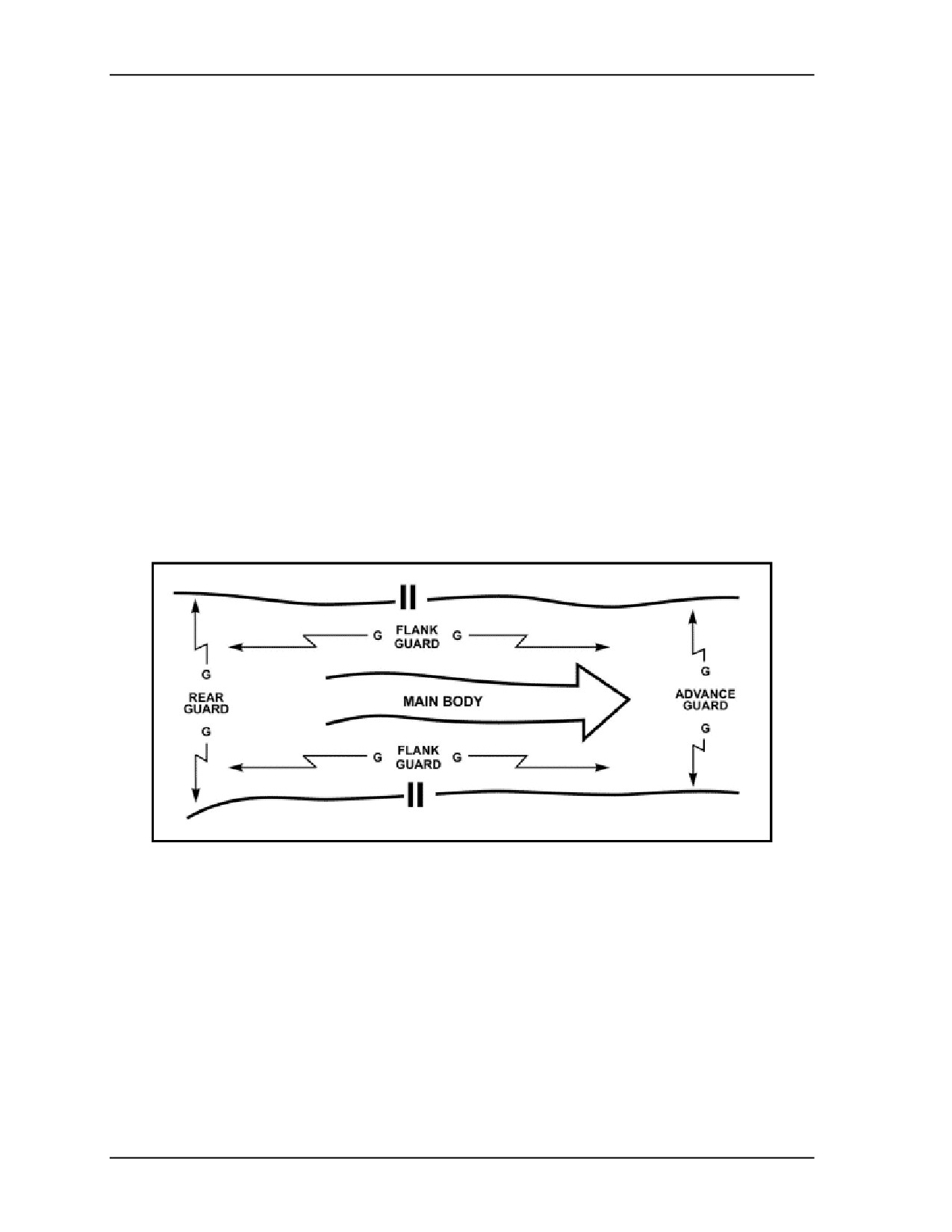
force: advance, flank, and rear guard. (Figure 8-2).
Figure 8-2. Rear, flank, and advance guard operations.
ADVANCE GUARD
8-14.
The advance guard moves ahead of the main force to ensure its uninterrupted advance, to protect
the main body against surprise, to facilitate the advance by removing obstacles and repairing roads and
bridges, and to cover the deployment of the main body as it is committed to action. The advance guard is a
task-organized combined-arms unit or detachment that precedes a column or formation and is offensive
in nature.
8-15.
The advance guard is normally conducted as a MTC. Generally, a battalion receives an advance
guard mission when the BCT moves as part of a higher level unit in a MTC. In deploying a battalion as an
advance guard, the BCT ensures the battalion has priority of fires. The advance guard clears the axis of
enemy elements to allow the unimpeded movement of the main body battalions. The security force of the
8-4
FM 3-21.20
13 December 2006
Tactical Enabling Operations
battalion, which can also be an advance guard, develops the situation to hand over the enemy to the
battalion. The advance guard can conduct hasty attacks if it has sufficient combat power to destroy or fix
the enemy force blocking its advance. The battalion must maintain communication and have situational
awareness of the trailing battalion to prevent potential fratricide.
8-16.
Depending on the commander's assessment of the situation, a battalion conducting an advance
guard normally conducts a MTC with companies advancing on axes, in zone, or (rarely) along directions of
attack.
8-17.
Based on METT-TC, trail elements of the advance guard ensure they maintain adequate distance
forward of the main body's lead elements to ensure freedom of maneuver for the main body. The battalion
commander establishes phase lines to control the movement of the main body and the advance guard.
Advance guard units remain within the supporting artillery’s range.
8-18.
The advance guard force tries to destroy enemy forces through hasty attacks. It may be necessary
for the battalion to mass at certain locations, destroy the enemy, report, and continue with its mission. If
enemy resistance is well prepared and cannot be destroyed, the battalion reconnaissance forces try to
identify a bypass route for the main body, to report enemy size and location, and (when given permission)
to fix and/or bypass the enemy. The following attacking forces are responsible for destroying the fixed or
bypassed enemy. The main body commander may elect not to bypass the enemy but to conduct an attack.
In this case, the advance guard keeps the enemy contained and prepares to pass main body elements
through to eliminate the enemy.
8-19.
An advance guard for a stationary force is defensive in nature. It defends or delays in accordance
with the main body commander’s intent. It is normally a task organized unit consisting of the scouts,
Infantry platoons, and weapons platoons. The guard force normally constitutes its own screen force to
identify enemy elements which are then destroyed by the remainder of the guard force. This necessitates
the guard force to have a larger operational area compared with a screen force. However, it is equipped
with sufficient combat power to destroy enemy reconnaissance and fix or delay the enemy main body.
REAR GUARD
8-20.
When a BCT, as part of a larger unit, is conducting a MTC and requires rear security, a battalion
may receive a rear guard mission. The rear guard protects the rear of the main body and all fire support,
protection, and sustainment elements in the main body. It may accomplish this by conducting an attack, a
defense, or a delay. A battalion commander conducting a rear guard operation follows the same axis of
advance as the protected force at a distance prescribed by the main body commander and normally within
artillery range. The battalion commander establishes company battle positions or sectors. When using
sectors, he designates phase lines and checkpoints to control movement. The rear guard's responsibility
begins at the main body rear boundary and extends as far from this boundary as the factors of METT-TC
allow. When conducting a rear guard action for a moving force, the main body of the protected force may
move beyond supporting indirect fire range. As a result, the Infantry battalion must be prepared to fight
with organic and attached indirect fire assets.
FLANK GUARD
8-21.
A battalion may receive a flank guard mission during an MTC if the BCT is part of a larger unit.
The flank guard is responsible for clearing the area from the BCT and larger unit main body to the flank
guard's designated positions. The battalion must be prepared to operate on a frontage greater than for other
tactical operations. Usually, the area extends from the lead forward screen, along the flank of the
formation, to either the FEBA or the rear of the moving formation, tying in with the rear guard. Due to the
complexities of this operation, this manual provides the following detailed discussion of flank guard
operations:
13 December 2006
FM 3-21.20
8-5
Chapter 8
Engineer Support
8-22.
The battalion engineer officer has two missions to consider in planning the guard mission;
mobility and countermobility operations. He concentrates his planning activities on mobility corridors or
avenues of approach that allow access to the main body. When attached from the BSTB, engineers are
organized as they would be for an MTC. Usually, they follow the lead element and assist in negotiating any
obstacles that prevent continued advance. The obstacle plan includes rapidly emplaced obstacles through
SCATMINE, Volcano (multiple delivery mine system), or other assets. Engineers also identify key bridges
or other potential obstacles during the planning process so they can render them usable for friendly
movement and unusable for enemy maneuver.
Protection
8-23.
The battalion plans for either active or passive air defense measures. When AD assets are DS to
the battalion, the unit commander or platoon leader will assist the staff in developing a flexible plan to
allow for the protection of the force as it changes posture between moving and stationary. Most AD assets
are attached to maneuver elements and the main CP. Route protection or other areas go without support or
rely on protection from main body AD assets. The battalion executes the air defense plan as in a MTC
where a moving force may need to adopt a defensive posture quickly. Whether moving or stationary, air
defense assets must be linked to the main body's air defense early warning net and the positioning of assets
must protect not only the flank guard but also air approaches into the main body.
Sustainment
8-24.
The logistics planner has the same challenges as in planning a MTC. He plans for responsive and
flexible support that may require the immediate resupply of ammunition and evacuation of casualties and
equipment upon contact. The planner identifies lateral supply routes to the vicinity of each potential enemy
engagement area during the planning process. On-order control measures, LRPs, UMCPs, and AXPs are
essential to the operation. As the battalion begins its movement, the battalion trains should travel abreast of
the flank guard unit (close to the main body) to avoid exposing sustainment elements to the enemy.
Emergency resupply vehicles carrying ammunition and other quickly expendable supplies are ready to
respond to sudden requisitions due to enemy contact. Once the battalion begins the fight, evacuation of
wounded personnel and damaged equipment occurs along lateral supply routes all the way to the main
body if that is where the support battalion is located. Otherwise, the evacuation is back along the axis of
advance.
Orientation of Forces
8-25.
A unique aspect of the flank guard mission is the orientation of the forces and the direction they
may be ordered to guard. While the force maneuvers forward along its assigned axis of advance or zone,
phase lines assist in the control of movement of the company elements. Once an element detects the enemy
and companies adopt hasty defensive positions, phase lines become boundaries for controlling the
defensive battle. This gives the battalion commander the option of designating company sectors in addition
to potential battle positions identified in zone or along the axis of advance. Similarly, control of the reserve
may be accomplished through phase lines and checkpoints regardless of the actual direction of the
maneuver. As a minimum, the following control measures are included:
• Phase lines (revert to boundaries on contact).
• Battle positions.
• TRPs.
• Axis of advance.
• Axis of advance of main body.
• Objectives (if used).
8-6
FM 3-21.20
13 December 2006
Tactical Enabling Operations
COVER
8-26.
A covering force, unlike a screening or guard force is a self-contained force, capable of operating
independent of the main body. The requirements placed upon the covering force, the C2 structure
necessary for the forces involved, and the large AO involved require an adequate level of command for
successful accomplishment. The battalion performs screen and guard missions. Covering force operations
is normally a BCT mission. The battalion may participate in a covering force as part of a BCT operation. A
covering force, or portions of it, often becomes decisively engaged with enemy forces; therefore, it must
have substantial combat power to engage the enemy and still accomplish its mission.
AREA SECURITY
8-27.
Area security operations may be offensive or defensive in nature and focus on the protected force,
installation, route, or area. The protected force ranges from echeloned headquarters, artillery units, and
reserves to the sustaining base. Protected installations can also be part of the sustaining base or they can
constitute part of the area's infrastructure: areas to secure range from specific points (bridges and defiles)
and terrain features (ridge lines and hills) to large population centers and their adjacent areas.
OPERATIONS IN NONCONTIGUOUS AREAS OF OPERATION
8-28.
Operations in noncontiguous AOs require that commanders emphasize area security. During
offensive and retrograde operations, the speed at which the main body moves provides some measure of
security. Rapidly moving units in open terrain can rely on technical assets to provide advance warning of
enemy forces. In restricted terrain, security forces focus on key terrain such as potential choke points.
REAR AND BASE SECURITY
8-29.
A commander executes rear area and base security as part of a BCT's sustaining operations
responsibilities or as part of stability and civil support operations (Chapter 6).
CIVIL CONSIDERATIONS
8-30.
Since civilians are normally present within the AO, a unit may have to restrain its use of force
when conducting area security operations. However, the commander always remains responsible for
protecting his force and considers this responsibility when establishing his ROE. Restrictions on
conducting operations and using force must be clearly explained and understood by everyone. They must
realize that friendly or hostile media and enemy psychological operations organizations can quickly exploit
their actions, especially the manner in which they treat the civilian population.
SAFETY
8-31.
Sometimes area security forces must retain readiness over long periods without coming in contact
with the enemy. This occurs most often during area security operations when the enemy knows that he is
seriously overmatched in terms of available combat power. In this case, the enemy normally tries to avoid
engaging friendly forces unless it is on his terms. The enemy will often use unattended mines, improvised
explosive devices, and other means that minimize exposure to friendly forces combat power. Forces
conducting area security should not develop a false sense of security, even if the enemy appears to have
ceased operations within the secured area. The commander must assume that the enemy is observing his
operations and is seeking routines, weak points, and lax security for the opportunity to strike with
minimum risk.
13 December 2006
FM 3-21.20
8-7
Chapter 8
LOCAL SECURITY
8-32.
Local security is a form of area security and includes any local measure taken by units against
enemy actions. It involves avoiding detection by the enemy or deceiving the enemy about friendly
positions and intentions. It also includes finding any enemy forces in the immediate vicinity and knowing
as much about their positions and intentions as possible. Local security prevents a unit from being
surprised and is an important part of maintaining the initiative. The requirement for maintaining local
security is an inherent part of all operations. Units perform local security when conducting full spectrum
operations, including tactical enabling operations. Units use both active and passive measures to provide
local security.
ACTIVE LOCAL SECURITY MEASURES
8-33.
Active measures include—
• Using OPs, patrols, and UAS.
• Establishing specific levels of alert within the unit. The commander adjusts those levels based
on the factors of METT-TC.
• Establishing stand-to times. The unit SOP details the unit's activities during the conduct of
stand-to.
PASSIVE LOCAL SECURITY MEASURES
8-34.
Passive local security measures include using camouflage, movement control, noise and light
discipline, and proper communications procedures. It also includes employing available ground sensors,
NVDs, and daylight sights to maintain surveillance over the area immediately around the unit.
HIGH-VALUE ASSETS SECURITY
8-35.
Inherent within the four forms of security is the consideration of high value asset security. The
increased number and importance of artillery, aviation, communications, and intelligence acquisition
systems has led to increased emphasis on their security.
TYPES OF HIGH-VALUE ASSETS
8-36.
HVA security missions are not simply additional requirements. They represent an evolution in the
way BCTs, and higher units fight. Systems that acquire and defeat the enemy with precision fires, at vastly
extended ranges, are important warfighting tools. Types of HVAs which a battalion could secure include—
• Q36, Q37, and lightweight countermortar radars.
• MLRS battery or battalion.
• BCT or higher unit UAS site.
• Patriot battery.
• Sentinel radars.
• FARPs.
• Land-based Phalanx Weapons System (LPWS)
PLANNING CONSIDERATIONS
8-37.
The magnitude of the security requirement for HVAs varies depending on how many missions are
assigned to the battalion for security of BCT and higher unit assets. Generally, these missions are kept to
the minimum number possible. When securing HVAs, the commander must address information
requirements. He must consider—
8-8
FM 3-21.20
13 December 2006
Tactical Enabling Operations
• What are the frequencies, locations, and linkup points of the HVA?
• What routes should be used to reach the HVA. How many unit AOs must the security force
move through? Under what conditions?
• What are the mission, organizational assets, and movement and positioning plans of the HVA?
• What is the nature of the enemy threat?
• Can the HVA be detected and targeted with indirect fire? If so, the battalion needs to consider
its own survivability and maintain standoff from the HVA.
• How long will the mission last (duration)? Who will determine change of mission?
• What other forces are in the area? What base clusters are nearby?
• What are the triggers to leave the security mission and enter the close fight? Is there an implied
reserve mission?
• What is the mission and movement plans of the security force parent unit?
• Who is the security force’s higher headquarters?
• What is the logistical support plan for the force? Who provides logistical security? Into whose
communication architecture do they plug?
• How will the battalion track its forces assigned to HVA security missions and transition them
back into the close fight?
Section II. RELIEF OPERATIONS
A relief is an operation in which one unit replaces another in combat. The incoming unit assumes responsibility
for the mission and the assigned sector or zone of action. A relief-in-place may be conducted at any point
during offensive or defensive operations. Relief operations are normally executed during limited visibility to
reduce the possibility of detection. To facilitate and ensure successful operations, the linkup and relieved force
commanders and staffs exchange as much information as possible to prevent the inadvertent engagement of
friendly forces by either direct or indirect fire systems during relief operations. Therefore, temporary
collocation of CPs is recommended.
PLANNING CONSIDERATIONS
8-38.
Upon receipt of the order to conduct the relief, the incoming battalion commander and staff
establish an exchange of liaison personnel in order to exchange information pertinent to the relief
operations. Commanders and staffs emphasize communications, intelligence handover, and transfer of
command. If possible, the incoming unit’s CP should collocate with the main CP to facilitate continuous
information exchanges relative to the occupation plan, fire support plan, and intelligence updates that
include past, present, and probable enemy activities. Face-to-face coordination reduces any potential
misunderstandings related to relief preparation or the forthcoming operations. Responsibility for the area is
transferred as directed by the senior common commander, normally when the incoming unit has a majority
of his fighting force in place and all C2 systems are operating. Friendly units are vulnerable to enemy
attack during this kind of operation. Care must be taken, and plans must address, screening operations that
provide sufficient security to warn friendly units in case the enemy tries to take advantage of the relief.
8-39.
When planning the relief, the staff determines the most appropriate method for executing the relief
by using one of the following methods:
RELIEVING UNITS ONE AT A TIME
8-40.
This method is the most deliberate and time-consuming; however, it minimizes confusion and
maintains the best command, control, and readiness posture. It involves sequentially relieving maneuver
companies one at a time. Separate routes to the rear of the relieved companies’ locations are planned for
each maneuver company and placed on the operations overlay. Routes are labeled sequentially and
correspond to the order in which the company executes them during the relief. When the lead company
13 December 2006
FM 3-21.20
8-9
Chapter 8
reaches its release point (RP), its platoons move to the positions they are occupying. Crews exchange range
card and fire support information, and the relieved unit then moves to the rear to its next location. When
the lead company is in position, the next company moves along its designated route to relieve its
counterpart: thereby repeating the relief process. This process repeats until each company has been
relieved. If transfer of supplies from the relieved unit is directed, the S-4 coordinates a transfer point to
execute the exchange.
RELIEVING UNITS AT SAME TIME
8-41.
This method is the quickest but risks revealing friendly unit intentions and is more difficult to
control. To expedite the relief, the in-place battalion prepares overlays to show current friendly graphics,
fire support measures, and the latest enemy situation update. They then pass these overlays to the relieving
force before the two forces make contact. Once the command groups collocate and exchange plans, relief
occurs at the same time at each location. The units of the relieving and relieved battalions execute at the
same time a move along different routes. Relieved units withdraw as soon as they are relieved and do not
wait for other units of the battalion to be relieved. The control measures at battalion level are identical to
those used for a sequential relief (one unit at a time).
RELIEVING UNITS BY OCCUPYING IN-DEPTH AND ADJACENT POSITIONS
8-42.
This technique requires sufficient terrain to accommodate positioning of two like-sized units at the
same time. In this case, the relieving unit locates where it can observe and provide protective direct and
indirect fires for the relieved unit using the relieved units’ fire plans. This procedure requires that relieving
company and battalion commanders conduct a detailed physical reconnaissance of the position with their
counterparts from the in-place unit. They enter information gathered from the physical reconnaissance,
such as BPs, TRPs, and routes to and from the area, on an operations overlay and share them throughout
the relieving unit during the planning and preparation process.
COMMAND AND CONTROL
8-43.
If either force gains direct fire contact with an enemy force, it immediately notifies the other unit
and the higher headquarters by way of frequency modulation (FM) voice communications. If responsibility
for the sector has not passed, the relieving unit becomes OPCON to the relieved unit. The assets and staff
of the relieved unit become OPCON to the relieving unit when the responsibility for the sector has passed
to the relieving battalion.
Section III. BATTLE HANDOVER AND PASSAGE OF LINES
Battle handover is a coordinated operation executed to sustain continuity of the combined-arms fight and to
protect the combat potential of both forces involved. Battle handover is usually associated with the conduct of a
passage of lines.
BATTLE HANDOVER
8-44.
Battle handover may occur during either offensive or defensive operations. During defensive
operations, it is normally planned and coordinated in advance to facilitate execution and usually involves a
rearward passage of lines. In the offense, it is situation-dependent and often initiated by a FRAGO. Battle
handover normally occurs in the offense when one unit passes through or around another unit.
8-45.
Battle handover occurs along a line forward of the stationary force. The BCT commander
establishes this line in consultation with both stationary and passing battalion commanders. The stationary
battalion commander normally determines the battle handover line (BHL) location. This line could be
forward of the FEBA in the linear defense (or the FLOT in the linear offense), or it could be a line
8-10
FM 3-21.20
13 December 2006
Tactical Enabling Operations
determined by the common controlling headquarters in a nonlinear environment. The BHL is located where
elements of the passing battalion can be effectively overwatched by direct fires or supported by indirect
fires of the forward combat element of the stationary battalion until the battle handover is complete.
8-46.
Physical handover normally occurs in the battle handover zone. Events may dictate that a force
break contact forward of or behind the BHL such as when a gap exists between echelons of the attacking
enemy force. Close coordination--physical or by FM voice--between the battalions involved in the
handover allows them to coordinate and execute this process at the small-unit level.
8-47.
The battle handover operation begins on order of the higher headquarters commander from either
unit, or when a given set of conditions occurs. Defensive handover is normally complete when the passing
battalion is completely clear and the stationary battalion is ready to engage the enemy. These actions may
occur at the same time. Offensive handover is normally complete when the passing battalion combat
elements completely cross the BHL. The BHL is normally considered the LD for the attacking battalion.
Until the handover is complete and acknowledged by the commanders, the battalion commander in contact
is responsible for the fight.
8-48.
Coordination for battle handover flows from the battalion commander out of contact to the
battalion commander in contact. The coordination for a battle handover overlaps with the coordination for
a passage of lines; the coordination for both is accomplished at the same time. The TSOP should outline
these coordination requirements to facilitate rapid accomplishment.
8-49.
Each unit transmits or delivers a complete copy of their OPORD and overlays. Any changes made
after initial distribution are updated immediately. The coordination effected between the two commanders
includes—
• Establishing FM voice communications.
• Providing updates of both friendly and enemy situations (voice and graphical).
• Coordinating passage points and routes and ensuring these are displayed on operational
overlays.
• Collocating C2 and exchanging liaison personnel (if required).
• Coordinating fires and fire control measures
(direct and indirect) and ensuring these are
displayed on operational overlays.
• Determining the need for and dispatching contact point representatives.
• Establishing and coordinating recognition signals.
• Exchanging locations of obstacles and related covering fires.
• Exchanging route information to include waypoints.
• Determining fire support, protection, and sustainment requirements.
PASSAGE OF LINES
8-50.
A passage of lines is the coordinated movement of one or more units through another unit. It is
normally conducted when at least one METT-TC factor does not permit the bypass of a friendly unit. A
passage of lines is a complex operation requiring close supervision and detailed planning, coordination,
and synchronization between the battalion commanders of the unit conducting the passage and the unit
being passed. The primary purpose of a passage of lines is to transfer responsibility for an area from one
unit to another. The battalion or its subordinate units execute a forward or rearward passage of lines
(Figures 8-3 and Figure 8-4). A passage of lines may be conducted to—
• Continue an attack or counterattack.
• Envelop an enemy force.
• Pursue a fleeing enemy.
• Withdraw covering forces or MBA forces.
13 December 2006
FM 3-21.20
8-11
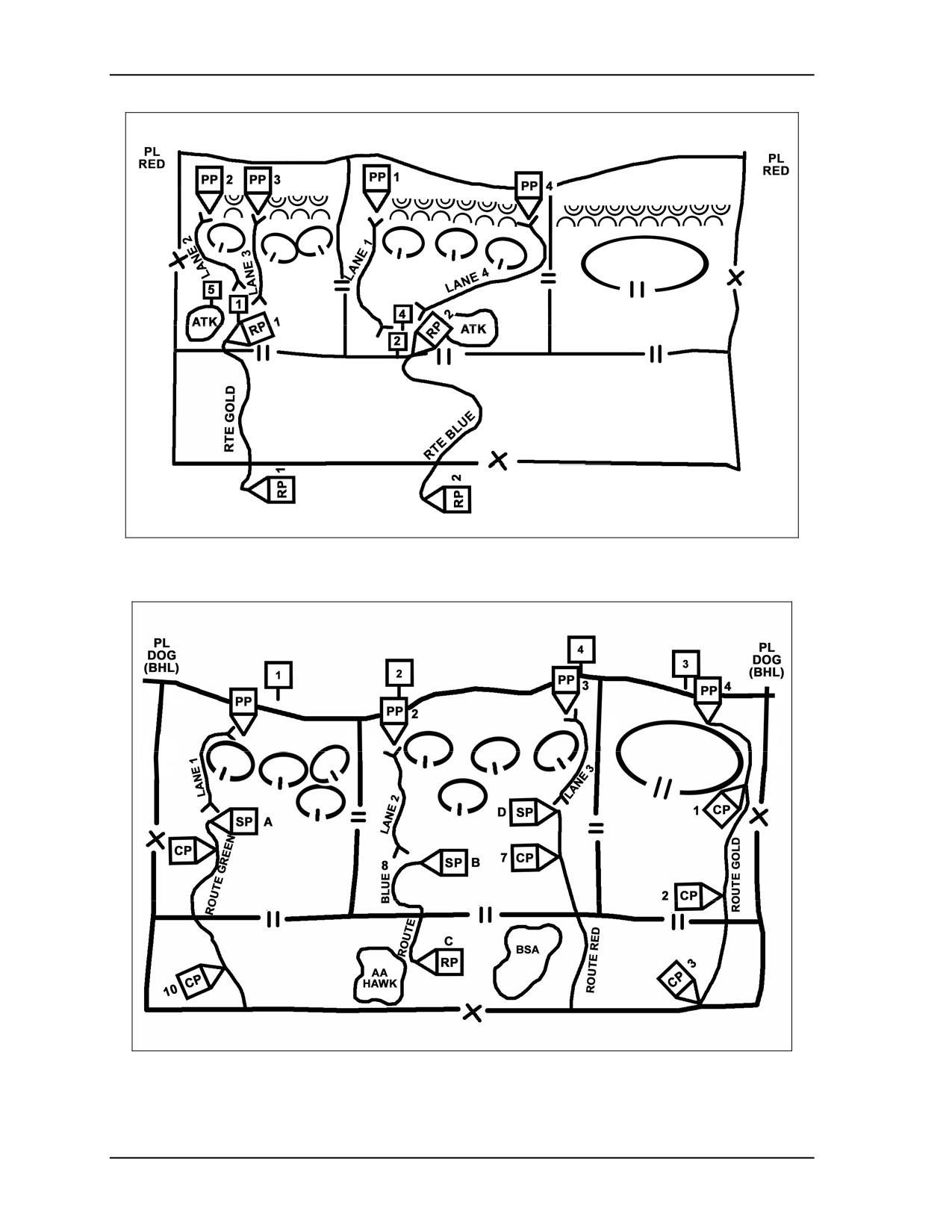
Chapter 8
Figure 8-3. Forward passage of lines.
Figure 8-4. Rearward passage of lines.
8-12
FM 3-21.20
13 December 2006
Tactical Enabling Operations
Terrain Management and Control Measures
8-51.
Terrain management is critical to successful completion of a passage of lines. Terrain is controlled
through the sharing of overlays that contain—
• Routes (primary and alternate).
• Checkpoint data.
• Friendly and enemy unit locations and status.
• Passage points and lanes.
• Fire support control measures.
• Obstacle types and locations.
• Sustainment locations and descriptions.
• Contact points.
MOVEMENT AND MANEUVER
8-52.
A passage of lines may require either the reduction of some obstacles or the opening and closing
of lanes through friendly obstacles. The passing battalion engineer must coordinate with the stationary unit
engineer. As a minimum, this coordination must address the following:
• Location and status of friendly and enemy tactical obstacles.
• Routes and locations of lanes and bypasses through friendly and enemy obstacles.
• Transfer of obstacle and passage lane responsibilities.
FIRE SUPPORT
8-53.
The battalion FSO reviews the fire support plan of the stationary unit and conducts direct
coordination to ensure that a clear understanding exists between the passed and passing units on the
established FSCMs. He does so through the transfer of digital fire support overlays between the two FSEs
via the Advanced Field Artillery Tactical Data System (AFATDS). Procedures to establish fire support
battle handover or transfer of control are also identified and approved by the maneuver commander.
Terrain and route management for artillery batteries and their support assets are especially important due to
potential terrain limitations. Sufficient artillery assets must be positioned to support the passage if enemy
contact is possible during the operation.
PROTECTION
8-54.
During the conduct of a passage of lines, units participating in the operation present a lucrative
target for air attack. The passing commander coordinates AD protection with the stationary force
commander for AD coverage during the passage of lines. This method allows the passing force’s
supporting air defense assets to conduct a move at the same time. If the passing force requires static air
defense, then it must coordinate the terrain with the stationary battalion’s S-3.
SUSTAINMENT
8-55.
The sustainment plan is integral to a successful passage of lines. Sustainment assets are positioned
to support the passage. Figure 8-5 shows the sustainment plan for a rearward passage of lines.
13 December 2006
FM 3-21.20
8-13
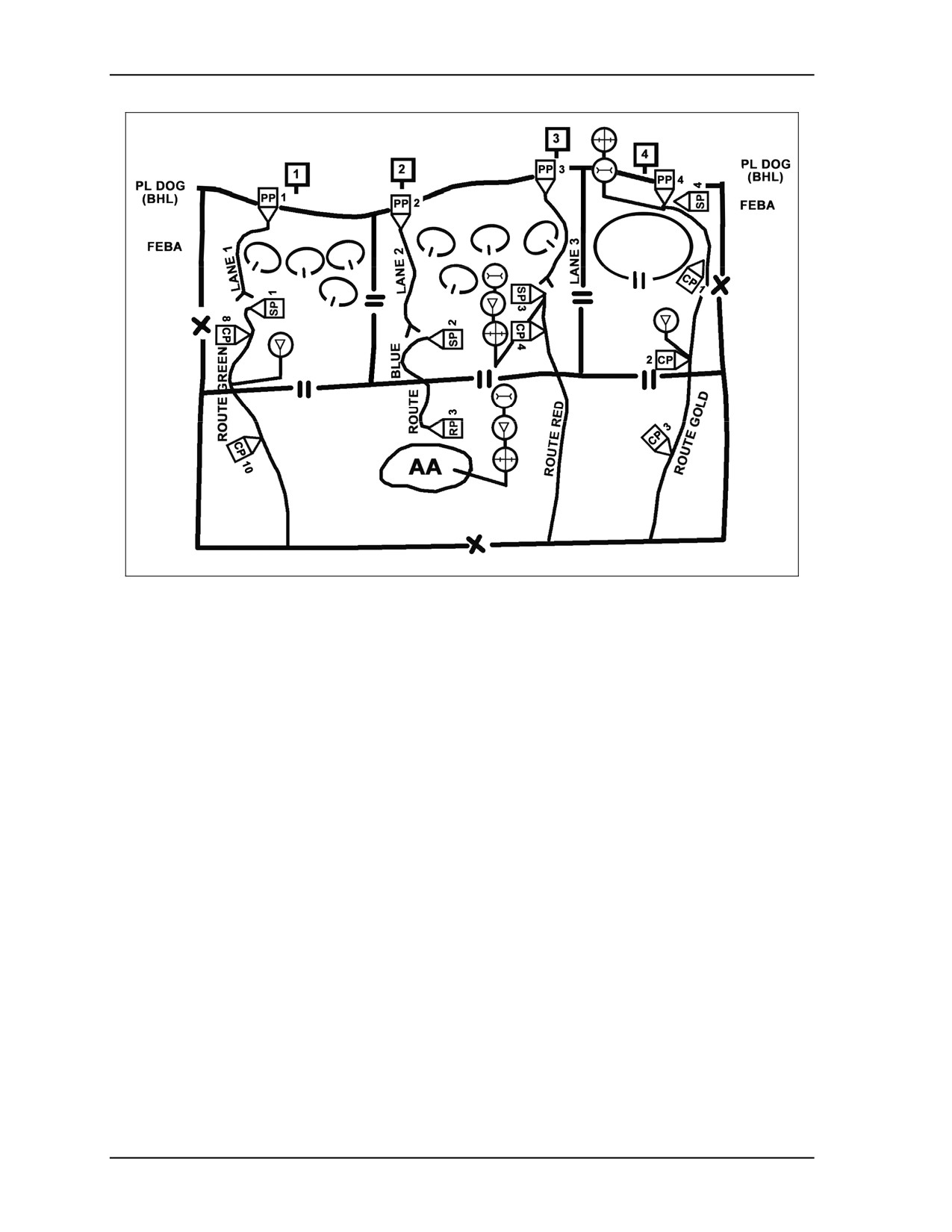
Chapter 8
Figure 8-5. Sustainment plan for rearward passage of lines.
FORWARD PASSAGE OF LINES
8-56.
In a FPOL (conducted as part of an attack), both the stationary and passing battalion commanders
must be aware of the passing battalion's objective. This awareness is especially important if the stationary
battalion must provide supporting fires. The stationary battalion and forward passing unit share data
needed to affect a passage of lines in a timely and safe manner.
8-57.
On receipt of an order, the passing battalion commander begins preparing his passage of lines plan
by conducting a reconnaissance while concurrently updating the information received from the stationary
battalion. For example, the passing battalion receives an operations overlay from the stationary battalion
that delineates routes to the contact points as well as the location of the actual linkup site. The battalion
commander and staff of the passing unit meet representatives from the stationary battalion at designated
contact points to conduct coordination.
8-58.
During the physical reconnaissance, the S-3 from the passing battalion updates the initial
operations overlay, incorporating information received from the stationary battalion by adding pertinent
control measures. Upon completion, the S-3 forwards this overlay to the main CP. Based on this
information; the staff completes development of the plan. Once approved by the commander, additional
control measures are added to the operations overlay as necessary to complete the plan.
8-59.
The main CP forwards the validated operations overlay update from the stationary and passing
battalion, BCT, and subordinate units to the liaison teams. This technique allows the S-3 and battalion
commander to develop their scheme of maneuver for the passage of lines overlay concurrent with
reconnaissance. At the conclusion of the reconnaissance and subsequent coordination with the stationary
battalion, the revised battalion plan is distributed to subordinate units and higher headquarters.
8-14
FM 3-21.20
13 December 2006
Tactical Enabling Operations
REARWARD PASSAGE OF LINES
8-60.
Typically, a rearward passage of lines occurs within a defensive framework in which elements of
the security force operate forward of the MBA. The main battle area forces are the stationary unit in a
rearward passage of lines. The covering force withdraws through them, handing off control of the fight at
the battle handover line.
8-61.
To facilitate a rearward passage of lines, the stationary force commander designates—
• The battle handover line.
• Contact points forward of the BHL.
• Passage points along the FEBA.
• Lanes to the rear of the MBA.
8-62.
Once he prepares the overlay, the stationary commander provides it and any amplifying
information to the passing force commander.
8-63.
The stationary and passing commanders determine the best method of exercising C2 to avoid
slowing the tempo of the operation and to reduce fratricide potential.
REHEARSAL
8-64.
During the rehearsal for a passage of lines, the battalion commander ensures that each
organization knows when and where to move as well as how to execute the required coordination.
Rehearsal items include—
• Fire support observation plan, target execution, communication linkages, and mutual support
operations. Confirm fire support control measures. Review unit routes and positioning.
• Locations and descriptions of obstacles, lanes, bypasses, and markings. Confirm locations of
any engineer stockpiles.
• Responsibility by unit for closing passage lanes after the passage of lines is complete.
• Air defense weapons locations, early warning communications, air threat, and weapons
control status.
• Passage points, routes, and recognition procedures. Rehearse route management, contact points,
and use of guides.
• Locations for and movement of sustainment units: rehearse these, along with mutual support
arrangements and any transfer of supplies.
• Locations of aid stations, ambulance exchange points, and casualty evacuation procedures
(rehearse these).
Section IV. LINKUP OPERATIONS
Linkup operations, which join two or more friendly forces, are conducted to—
•
Complete the encirclement of an enemy force.
•
Assist breakout of an encircled friendly force.
•
Join an attacking force with a force operating in the enemy’s rear area.
•
Make contact with other forces on a noncontiguous battlefield.
•
Join reconnaissance elements with the main body.
PREPARATION
8-65.
Before commencing a linkup operation, the headquarters elements of the stationary force and
linkup force must share information including COMSEC procedures and graphic overlays consisting of—
13 December 2006
FM 3-21.20
8-15
Chapter 8
•
Primary and alternate linkup points.
•
Checkpoint and waypoint information.
•
Unit disposition and activity (friendly and enemy).
•
Locations and types of obstacles.
•
Fire control measures including RFLs and no-fire areas (NFAs).
CONTROL
8-66.
The stationary and linkup force must maintain positive control during linkup operations to prevent
inadvertent fratricidal engagements. They use FM voice systems as required to share combat information
and to identify friend from foe positively. It is imperative that both the linkup and stationary units conduct
precombat communications checks before the operation begins.
FORMS OF LINKUP
8-67.
Linkup operations take one of two forms; linkup of a moving force and a stationary force or
linkup of two moving forces.
LINKUP OF A MOVING FORCE WITH A STATIONARY FORCE
8-68.
To ensure the forces join without engaging one another, linkup points are selected at locations
where the axis of advance of the linkup force intersects the security elements of the stationary force
(Figure 8-6). These points must be readily recognizable to both forces and should be posted on overlays.
When possible, the moving force should halt short of the linkup point and send a smaller force forward to
pinpoint the linkup point. Alternate points are chosen so the units are prepared in case enemy activities
cause linkup at places other than those planned. The number of linkup points selected depends on the
terrain and number of routes used by the linkup force.
8-16
FM 3-21.20
13 December 2006
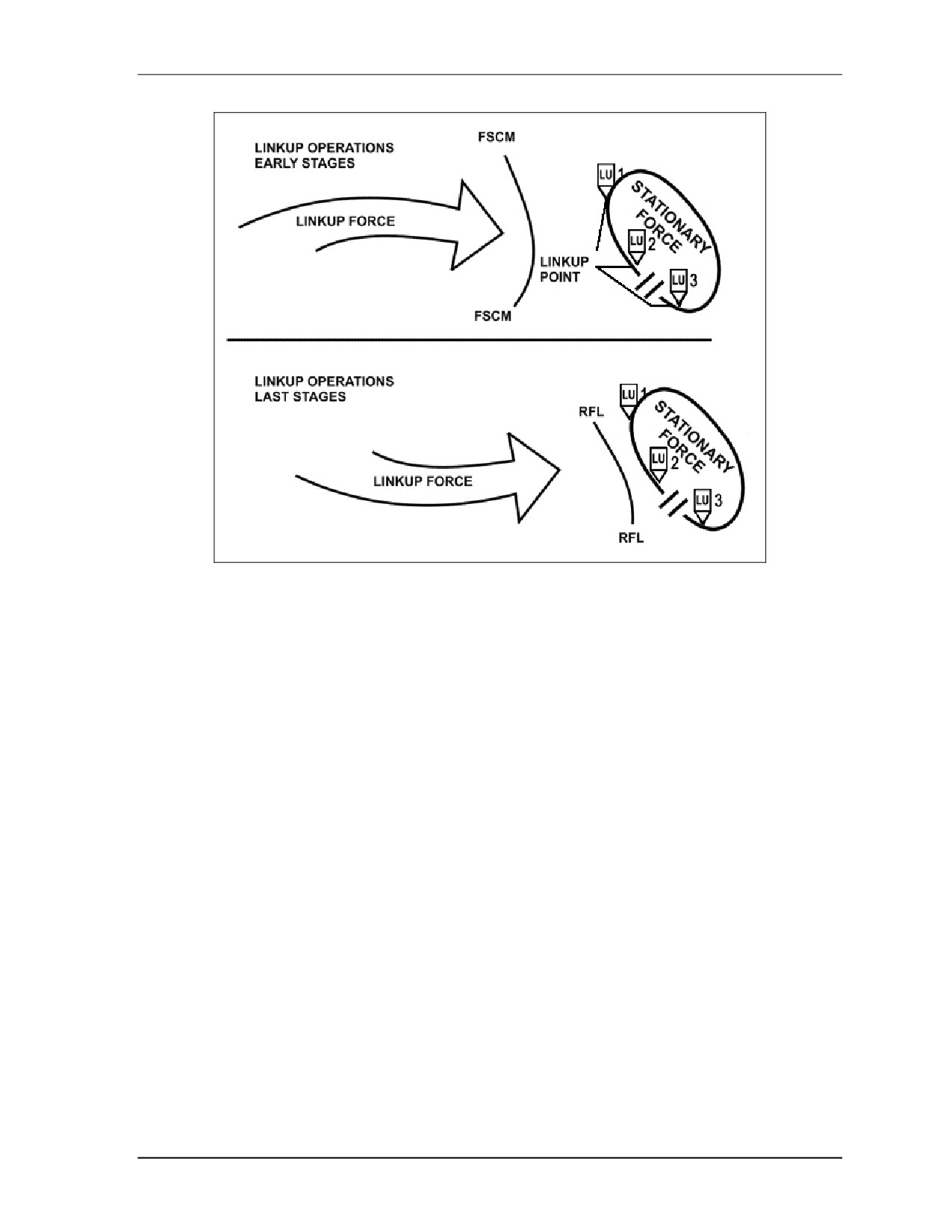
Tactical Enabling Operations
Figure 8-6. Linkup of a moving force with a stationary force.
8-69.
Communications are critical to linkup operations.
8-70.
To facilitate a rapid passage of lines and to avoid inadvertent engagement of friendly forces,
personnel in the linkup force must be thoroughly familiar with recognition signals and plans. As required,
stationary forces assist in the linkup by opening lanes in minefields, breaching or removing selected
obstacles, furnishing guides, providing routes with checkpoints, and designating assembly areas.
8-71.
When linking up with an encircled force, the battalion carries as much materiel as possible during
the linkup operation. This materiel includes Classes I, V, and VIII. If an enemy force has encircled the
stationary force, the battalion carries additional supplies and materiel requested through to the brigade S-4
and BSB before the linkup takes place. The battalion S-4 ensures that each company has received the
sustainment overlay showing MSRs, traffic control points, AXPs, and UMCPs.
LINKUP OF TWO MOVING UNITS
8-72.
Linkup between two moving units is one of the most difficult operations (Figure 8-7). It is
normally conducted to complete the encirclement of an enemy force. Primary and alternate linkup points
for two moving forces are established on boundaries where the two forces are expected to converge. As
linking units move closer, positive control is coordinated to ensure they avoid firing on one another and to
ensure the enemy does not escape between the two forces.
13 December 2006
FM 3-21.20
8-17
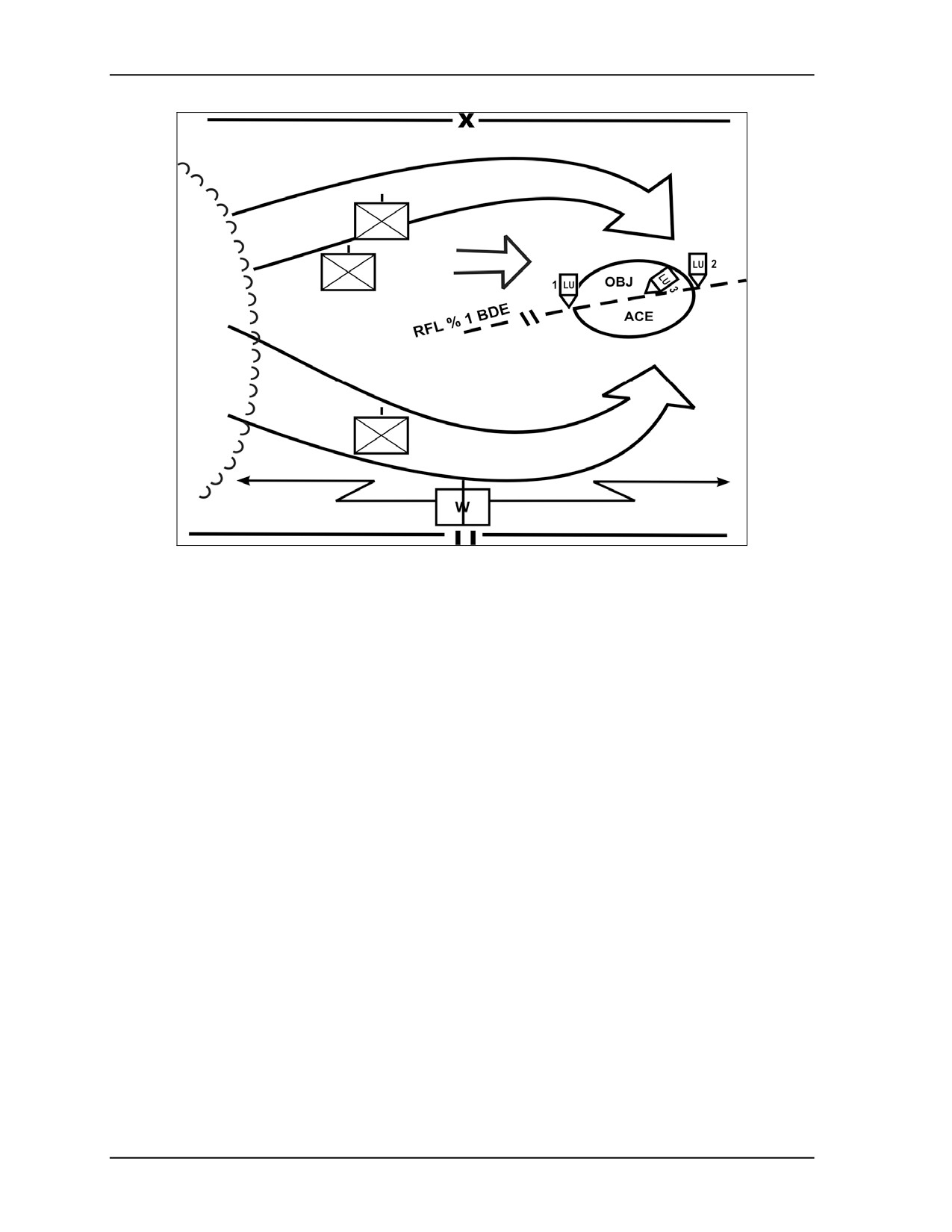
Chapter 8
Figure 8-7. Linkup of two moving units.
ACTIONS FOLLOWING LINKUP
8-73.
When the linkup is complete, the linkup force may join the stationary force, pass through the
stationary force, go around the stationary force, or continue the attack.
8-74.
If the linkup force is to continue operations with the stationary force, a single commander for the
overall force is designated. Objectives for the linkup provide for dispersion in relation to the stationary
force. The linkup force may immediately pass through the perimeter of the stationary force, be assigned
objectives within the perimeter, or be assigned objectives outside the perimeter, depending on the mission.
8-75.
When the BCT directs a linkup operation, it normally establishes a restricted fire line for both
battalions to ensure positive control and reduce the risk of fratricide. It transmits these RFLs to both units,
and they are subsequently adjusted and overlays updated as one force moves toward the other. This process
continues until a single RFL is established between the forces. Usually, this is the point on the ground
where the two forces plan to establish contact.
PLANNING
8-76.
If possible, the two units establish liaison during planning and continue it throughout the
operation. Liaison parties must have the capability to communicate with their parent unit. As the distance
closes between the forces, the necessity to track movement and maintain close liaison increases. Use of
Army aircraft and UAS can improve and expedite this process.
8-77.
Linkup operations frequently require a passage of lines. Once through friendly lines, and to affect
the linkup, the battalion moves out as in an exploitation; speed, aggression, and boldness characterize this
action. If possible, the linkup force avoids enemy interference with its mission and concentrates its efforts
on completing the linkup. If enemy forces threaten the successful accomplishment of the mission, they are
either destroyed or bypassed and reported.
8-18
FM 3-21.20
13 December 2006
Tactical Enabling Operations
8-78.
The headquarters directing the linkup operation must establish command relationships and
responsibilities for the forces involved. Both the linkup force and the force with which linkup is to be made
can remain under control of the directing headquarters. Operational plans must prescribe the primary and
alternate day and night identification and recognition procedures, vehicle systems, and manmade materials
used to identify friend from enemy.
8-79.
The communication plan includes all essential frequencies and secure variables to maintain
communication between the two forces.
8-80.
Logistical support requirements may be greater during linkup operations than during other
offensive actions. Additional considerations for planning logistical support in linkup operations include—
• Resupply of stationary unit.
• Duration the objective is to be held (METT-TC).
• Operations after the linkup is completed such as attack, withdraw, or defend.
• Transportation requirements for special purpose forces such as air assault and SOF.
• Lines of communication security requirements.
8-81.
Supply requirements for a linkup operation may exceed the transportation capability of the
battalion. The battalion may have to request additional vehicles from higher headquarters, Army aviation
support, or both.
8-82.
In linkup operations involving airborne and air assault units, the units assaulting the objective area
have priority for supply by air. Supplies for the ground linkup forces normally move by land
transportation. However, when the linkup and an airborne or air assault force plan to defend the objective
area jointly, supplies for the linkup force may be flown or dropped into the objective area and stockpiled.
8-83.
Evacuation of equipment, WIAs, and EPWs may create major problems for the linkup force. If
supply routes are open, normal evacuation procedures apply. When ground routes are not secure,
helicopters or intra-theater fixed wing aircraft are used for the evacuation of casualties and prisoners.
Damaged equipment may be moved forward with the linkup forces until it can be evacuated at the first
suitable opportunity.
PREPARATION
8-84.
If time is available, he conducts a rehearsal at higher headquarters. If time is not available, the
commander walks the linkup commander through the operation. He stresses the linkup and coordination
required to reduce the potential for fratricidal engagements between the linkup forces. In addition, he
ensures that each company commander is prepared to respond to an enemy meeting engagement or attack
before the linkup.
EXECUTION
8-85.
Depending on the enemy situation and METT-TC, the initial conduct of the linkup operation may
be identical to an exploitation or attack. During the operation, the commander monitors the progress and
execution to ensure that the established positive control measures are followed or adjusted as required.
Adjustments made to the OPLAN are coordinated and synchronized.
8-86.
As the linkup forces begin their maneuver, they establish FM voice communications and maintain
them throughout the operation. As each force maneuvers, progress is tracked and adjustments to the linkup
plan are made as METT-TC dictates. For example, if two forces are involved in the operations and one is
unable to travel at a speed commensurate with the plan, the linkup location may require adjustment.
8-87.
As the linkup forces near each other, the tempo of the operation may be slowed to maintain
positive control and to prevent fratricide. In this case, commanders must be vigilant and ensure enemy
forces do not slip between the two closing forces. If possible, one of the units should establish a hasty
defense and act as a stationary unit.
13 December 2006
FM 3-21.20
8-19
Chapter 8
8-88.
The battalion FSE changes or activates the FSCMs established for the operation based on the
progress of the forces and the enemy situation. All changes are provided to the FSEs of the maneuver units
involved in the linkup. As the maneuver units draw closer to each another, coordinated fire lines (CFLs)
are canceled, and an RFL is placed into effect to prevent fratricide between the converging forces. Once
the linkup has occurred, fire support for the battalion is organized as per the higher headquarters plan for
future operations.
8-89.
The battalion commander positions himself to observe the progress of the operation and maintains
FM voice communications with the S-3. The battalion S-3 is positioned based on the operational concerns
expressed by the battalion commander. For example, if a certain flank is of concern to the commander
during the operation, or a shaping attack is required to penetrate the enemy’s lines, then the battalion S-3
locates where he can best observe the battalion’s secondary action.
Section V. RIVER-CROSSING OPERATIONS
A hasty river crossing is a continuation of an attack across the river with no intentional pause at the water to
prepare so that there is no loss of momentum. This technique is possible when enemy resistance is weak and the
river is not a severe obstacle. The three types of river crossing operations are hasty, deliberate, and retrograde.
Battalions do not make deliberate or retrograde crossings independently; these are centralized operations where
the controlling echelon is a BCT or higher unit. (For a detailed discussion of these operations, see FM 90-13.)
PLANNING CONSIDERATIONS
8-90.
Battalions routinely make hasty crossings and reorganize in order to maintain the momentum of
operations. River crossing operations are planned and executed as for any other obstacle. The breach
fundamentals; suppress, obscure, secure, reduce, and assault (SOSRA) always apply; however, they are
adapted to the varying factors of METT-TC.
8-91.
Battalions cross in their respective zones at multiple points and as quickly as possible. The
battalion may require the use of existing or expedient crossing means. Additional support from the BCT or
higher level unit may be necessary if bridging requirements exceed the capability of engineers augmenting
the battalion. Bridge companies are normally controlled at levels above the BCT. Their support is available
only when headquarters have taken purposeful action to position the assets at the right time and place to
assist a battalion's hasty crossing. The battalion must coordinate for support through the BCT early in the
planning process.
8-92.
Small gaps, rivers, and streams that prohibit the advance are encountered more frequently than
large gaps and rivers that require extensive bridging. When terrain or enemy conditions dictate, each
battalion should request mobile crossing assets that enable it to install bridges quickly, cross small gaps,
and recover the bridges for future crossings. Follow-on bridges, such as the medium-girder bridge (MGB),
may need to be positioned at these gaps before assault bridges are removed so that following forces and
support units can maintain the pace of the battalion. The two types of hasty crossings are dry-gap and
wet-gap crossings.
HASTY DRY-GAP CROSSING
8-93.
Antitank ditches and craters are normally what battalions encounter as a dry-gap obstacle. The
battalion may use expedient crossing means if they are readily available and can be transported to the
crossing site. Reconnaissance elements should note material or existing features that can be used as
expedient crossing devices.
8-20
FM 3-21.20
13 December 2006
Tactical Enabling Operations
HASTY WET-GAP CROSSING
8-94.
Bank conditions, the depth and width of the wet gap, and the current velocity determine whether
the battalion can cross fording and whether bridging assets are required. Identifying wet gaps early and
deploying the required resources allow hasty crossings of known or anticipated gaps to occur.
8-95.
When selecting a fording site in a wet-gap crossing, the depth of the water is the most significant
factor. The depth of the water in one crossing area may change due to bottom surface mud or irregularities
(boulders and potholes).
8-96.
If possible, the battalion crosses the water obstacle at multiple points across a broad front. It
makes the crossing as soon as its elements reach the obstacle. As the bulk of the battalion crosses the water,
minimum forces remain to secure the crossing sites.
8-97.
As with a hasty dry-gap crossing, the battalion may use expedient crossing means if they are
readily available and can be transported to the crossing site. Reconnaissance elements should note material
or existing features that could be used as expedient crossing devices.
8-98.
A well-practiced SOP reduces the necessary planning and preparation time. A concise order
clearly articulating the commander's intent allows exploitation wherever subordinate units successfully
force a crossing. When possible, advance elements seize existing crossing means intact and ahead of the
main body.
8-99.
When facing negligible or light enemy resistance on both banks, the force does not have to clear
all enemy forces from the river to conduct a hasty crossing. It capitalizes on the speed of the crossing and
the limited ability of the enemy to oppose the crossing effectively.
ASSAULT OF CROSSING SITE
8-100. A battalion assault across a river normally begins with an attack to secure terrain on the exit bank.
This may involve an air assault, an assault crossing using pneumatic boats, or an infiltration by swimming
or rope bridges.
AIR ASSAULT CROSSING
8-101. An air assault is the fastest and most preferred crossing method. The following considerations
apply when planning an air assault as part of the battalion river crossing (See Appendix C and FM 90-4 for
more information on air assault operations.) Helicopters—
• Require indirect approaches to avoid detection.
• Provide the element of surprise.
• Give greater flexibility for emplacement of personnel and equipment.
• Provide the rapid insertion of forces into the area where the enemy is located, if a LZ is
available.
• Are greatly affected by weather conditions.
• Must have a high suppression of enemy air defense (AD) priority at the river, requiring
suppression of enemy AD effort.
• Are vulnerable to armored counterattacks and require a quick ground linkup.
RUBBER BOAT CROSSING
8-102. The following considerations apply when using rubber boats in an assault crossing. Rubber
boats—
• Offer great opportunity for surprise in a silent-paddle crossing.
• Provide a relatively fast means of crossing, especially when using outboard motors.
13 December 2006
FM 3-21.20
8-21
Chapter 8
• Maneuver well in the water.
• Require limited, if any, entry-bank preparation and no preparation on the exit bank.
• Have limited carrying capacity, particularly for AT weapons.
• Provide limited protection, mobility, firepower, and communications on the exit bank.
ORGANIZATION FOR BOAT CROSSING
8-103. The specific organization used for a boat crossing depends on METT-TC factors, particularly the
size of the bridgehead, the distance to exit-bank objectives, and the nature of the enemy's defense.
Regardless of these factors, the battalion organizes into support and assault forces and is assisted in the
assault by other units in support-by-fire positions.
Support Force
8-104. This force establishes a support-by-fire position along the friendly bank before the assault. It uses
night vision and thermal sights to locate enemy positions. It also develops a fire plan to engage these
positions and to provide suppressive fires on all suspected positions. When directed to engage, the support
force destroys all known and suspected positions. The assault force commander (usually the battalion
commander) directs the support force commander (usually the XO) to cease or shift suppressive fires as
necessary. Supporting artillery and the mortar platoon provide indirect fire support and effects.
Consideration of indirect fire REDs should be considered depending on the proximity of the friendly forces
to the crossing site.
Assault Force
8-105. The initial assault force moves across covertly if possible. This force tries to provide sufficient
security on the far shore so that subsequent crossings can proceed if surprise is lost. Reconnaissance and
security forces are pushed out as soon a possible to provide early warning and expansion of the lodgment
for more crossing forces. The engineers help the assault force establish hasty defenses after it has seized its
objectives. The initial assault force is normally composed of—
• Rifle platoons.
• Attached assault engineers.
• FOs.
• The command group.
• Assault platoons (if fordable).
Subsequent Crossings
8-106. The subsequent crossings are composed of additional combat support and sustainment assets and
may include the battalion command group. Subsequent crossings also transport additional material and
ammunition that is not required for the initial assault but is necessary to establish a defense or continued
offensive operations. This may include anti-armor weapons, mortars, ammunition, laser designators, mines,
or pioneer tools. The immediate movement of some AT weapons across to support the assault element is
essential if an armor threat exists. As vehicles carry all heavy AT weapons, engineers concentrate on
moving antiarmor systems or vehicles carrying heavy weapons across immediately after the second wave.
For a detailed description of assault crossing techniques and procedures, see FM 90-13.
8-22
FM 3-21.20
13 December 2006
Tactical Enabling Operations
Section VI. COMBINED-ARMS BREACHING OPERATIONS
Obstacle breaching is the employment of a combination of tactics and techniques to project combat power to
the far side of an obstacle. Breaching is a synchronized combined-arms operation under the control of a
maneuver commander. Breaching operations begin when friendly forces detect an obstacle and initiate
breaching fundamentals; they end when the enemy is destroyed on the far side of the obstacle or battle
handover has occurred between a unit conducting the breaching operation and follow-on forces. Breaching is
an inherent part of maneuver. Effective breaching operations allow friendly maneuver in the face of obstacles.
TENETS
8-107. Successful breaching operations are characterized by the application of breach tenets. These tenets
are applied whenever an obstacle is encountered, whether friendly forces are conducting an attack or route
clearance operations. The breach tenets are—
• Intelligence.
• Breaching fundamentals.
• Breaching organization.
• Mass.
• Synchronization.
INTELLIGENCE
8-108. The ability to identify how the enemy applies obstacles to the terrain is critical to a commander’s
success. The commander and staff conduct intelligence preparation of the battlefield to develop initial
situational templates and priority intelligence requirements. Intelligence gathered by reconnaissance forces
is essential to developing a finalized situational template and final point of breach locations. Unverified
enemy situational templates may cause friendly forces to deploy to reduce obstacles early, waste mission
time trying to locate nonexistent obstacles, develop COAs using ineffective obstacle reduction methods,
and fail to locate bypasses or become surprised by an obstacle. Augmentation of reconnaissance forces by
engineer squads or sections may be used as part of the overall ISR plan. Examples of obstacle intelligence
(OBSTINTEL) requirements include—
• Location of existing or reinforcing obstacles.
• Orientation and depth of obstacles.
• Soil conditions (determines ability to use mine plows, if available).
• Lanes or bypass locations.
• Composition of minefields (buried or surface laid antitank and antipersonnel (AP) mines.
• Types of mines and fuses (determines effectiveness of mechanical or explosive reduction
techniques).
• Composition of complex obstacles.
• Location of direct and indirect fire systems overwatching obstacle.
BREACHING FUNDAMENTALS
8-109. The breach fundamentals; suppress, obscure, secure, reduce, and assault (SOSRA) always apply;
however, they are adapted to the varying factors of METT-TC.
8-110. Suppression protects friendly forces reducing and maneuvering through an obstacle. Successful
suppression typically initiates the rest of the actions at the obstacle. In some situations, the weapons
company may be ideal to provide suppression.
13 December 2006
FM 3-21.20
8-23