FM 3-21.20 (FM 7-20) THE INFANTRY BATTALION (DECEMBER 2006) - page 5
Chapter 5
• Allow other friendly forces to establish a defense.
• Cover a withdrawing force.
• Protect a friendly force’s flank.
• Allow other forces to counterattack.
Forms
5-73.
Based upon the commander’s intent and METT-TC, a delay mission can have essentially two
forms; delay within an AO or delay forward of a specific control measure.
Delay within an Area of Operations
5-74.
The battalion may be assigned a mission to delay within an AO. This operation is meant to slow
and control the enemy tempo and defeat as much of the threat as possible without sacrificing the integrity
of the unit. The higher commander provides guidance regarding intent and desired effect on the enemy, but
he minimizes restrictions regarding terrain, time, and coordination with adjacent forces. This form of a
delay is normally assigned when force preservation is the highest priority and there is considerable depth to
the BCT or higher unit’s AO.
Delay Forward of a Specified Line for a Specified Time
5-75.
The battalion might be given a mission to delay forward of a specific control measure for a
specific period. This mission would be assigned when the BCT or battalion must control the enemy’s
attack and retain specified terrain to achieve some purpose relative to another element, such as setting the
conditions for a counterattack, for completion of defensive preparations, or for the movement of other
forces or civilians. Normally in a delay, inflicting casualties on the enemy is secondary to gaining time. It
carries a much higher risk for the battalion, with the likelihood that part of, or the entire unit becoming
decisively engaged. The timing of the operation is most often controlled graphically by a series of phase
lines with associated dates and times to define the desired delay-until period.
Culmination
5-76.
Delay missions usually conclude in one of three ways; a defense, withdrawal, or counterattack.
Planning options should address all three possibilities.
Organization
5-77.
The battalion’s organization of its forces depends on how the BCT has structured its forces unless
the battalion operates independently. The BCT normally organizes into a security force, main body, and
reserve, but an extended AO may preclude the use of BCT-controlled security forces and reserves. In this
case, the BCT may direct the battalion to organize its own security, main body, and reserve forces; the
same as if the battalion was operating independently. The BCT commander can designate a battalion as the
security or reserve force for the BCT. If the battalion has to establish a security force, it normally uses the
Scout platoon as a screen force positioned to observe the most likely enemy avenues of approach and to
initiate indirect fires to slow and weaken the enemy. Initially, the battalion main body usually locates well
forward in the AO, and then fights from a series of subsequent positions. The reserve force, normally a
company, is used to defeat enemy penetrations or to assist units with breaking contact.
Planning Considerations
5-78.
The delay requires close coordination of forces and a clear understanding by subordinates of the
scheme of maneuver and commander’s intent, and detailed mission graphics. The potential for loss of
control is very high in delay operations, making cross-talk and coordination between subordinate leaders
extremely important. Subordinate initiative is critical, but it must be in the context of close coordination
5-20
FM 3-21.20
13 December 2006
Defensive Operations
with others. Plans must be flexible, with control measures throughout the AO allowing forces to be
maneuvered to address all possible enemy options.
Battalion Order
5-79.
The battalion order must clearly articulate the parameters of the delay mission. It specifically
addresses subordinate missions in terms of space, time, and friendly strength. It also provides directions for
actions if the subordinate commander is unable to meet the terms of his delay mission. The following is an
example of the parameters of a delay mission issued to a subordinate battalion.
EXAMPLE
Mission: Battalion 3-6 IN delays to disrupt enemy forces forward of PL Blue ( Who
and What) until 010400Sep2006 (When) to allow the remainder of the BCT to
complete defensive preparations (Why).
Tasks to maneuver unit (3-6 IN): Retain at least 70% combat power (friendly
strength). Prevent an organized platoon from penetrating PL Blue for 3 hours
(When?). Force preservation is more important than time (priority). If unable to meet
mission parameters, provide at least 30 minutes' warning before initiating rearward
passage.
Upon completion of rearward passage, assume BCT reserve mission positioned
vicinity BP 17.
Effects of Terrain
5-80.
The staff analyzes the effects of terrain and the anticipated enemy situation to identify positions
that offer the best opportunity to engage, delay, and inflict damage on the enemy force. As the staff
develops delay positions and control measures, it calculates enemy closure rates and compares them to
friendly displacement rates between positions. Time and space factors dictate the amount of time
subordinate units have to engage the enemy and move, before becoming decisively engaged. These factors
are calculated for each avenue of approach. The staff develops triggers for displacement to positions
in depth.
Maneuver Considerations
5-81.
The staff considers maneuver actions, fires, obstacles, and the employment of other supporting
assets necessary to degrade the enemy’s mobility and support friendly forces’ disengagement to subsequent
positions. This is especially critical at locations and times when companies or the entire battalion may
become decisively engaged with the enemy. As the staff develops and refines the plan, it develops decision
points for key actions. This includes triggers for the employment of fires and situational or reserve
obstacles; displacement of subordinate units to subsequent positions; and movement of indirect fire assets,
C2 facilities, and sustainment units. The staff also selects routes for reinforcements, artillery, CPs, and
sustainment elements to use and synchronize their movements with the delaying actions of forward units.
Scheme of Maneuver
5-82.
The scheme of maneuver must allow the battalion to dictate the pace of the delay and maintain the
initiative. The commander selects positions that allow his forces to inflict maximum damage on the enemy,
support their disengagement, and enable their withdrawal. He may choose to delay from successive or
alternating delay positions, depending on the strength of the companies and the size of the AO.
Areas of Operations
5-83.
The battalion normally assigns deep and parallel AOs to delaying companies. This provides
enough terrain for companies to operate in depth, and maximizes the ability for battalion assets to
simultaneously support multiple units throughout the operation. Generally, each enemy avenue of approach
13 December 2006
FM 3-21.20
5-21
Chapter 5
is assigned to only one subordinate unit. The commander and his staff make provisions for coordinated
action along avenues of approach that diverge and pass from one subordinate AO to another.
Control Measures
5-84.
The battalion commander may add control measures, to include BPs, EAs, or attack-by-fire
positions. This allows company commanders to direct the fight more closely and give subordinates a
clearer picture of how the battalion commander envisions fighting the delay. The commander may use
events to control the delay. The commander must dictate specific events, for example, enemy company
penetrates PL Green, A Co in position at BP 12, that trigger the repositioning of subordinate forces. The
commander may also use phase lines to control the timing and movement of delaying units. Assigning time
minimums to delays by phase line can limit company commanders to delaying on or forward of those lines,
at least until the specified times. Contact points, coordination points, restrictive fire lines, coordinated fire
lines, and other control measures are established to support flank unit coordination.
Delay Positions
5-85.
When determining the scheme of maneuver, positions should incorporate as many of the
following characteristics as possible:
• Good observation and long-range fields of fire.
• Covered or concealed routes of movement to the rear.
• A road network or areas providing good cross-country trafficability.
• Existing or reinforcing obstacles to the front and flanks.
• Maximize use of highly defensible terrain.
Forced Enemy Deployment and Maneuver
5-86.
Engagement at maximum ranges of all weapons systems causes the enemy to take
time-consuming measures to deploy, develop the situation, and maneuver to drive the delaying force from
its position. An aggressive enemy commander will not deploy if he correctly determines that friendly
forces are delaying; he will use his mass and momentum to develop sufficient pressure to cause friendly
forces to fall back or become decisively engaged. Therefore, the delay must include the integration of
direct and indirect fires and situational obstacles to make the enemy doubt the nature of the friendly
mission and leave him no choice but to deploy and maneuver.
Avoidance of Decisive Engagement
5-87.
The key to a successful delay is to maintain a mobility advantage over the attacking enemy and
avoid decisive engagement. The battalion seeks to increase its mobility while degrading the enemy’s ability
to move. The battalion improves its mobility by—
• Maintaining contact with the enemy, maintaining reconnaissance and security on flanks, and
coordinating with adjacent units to prevent forces from being isolated.
• Prioritize and task-organize mobility assets in a manner which maximizes ability of the
battalion to perform the delay.
• Reconnoitering routes and BPs.
• Improving routes, bridges, and fording sites between delay positions, as time and resources
permit.
• Using indirect fires and obstacles to support disengagement and to cover movement between
positions.
• Task-organizing and positioning breaching assets within subordinate formations to breach
enemy SCATMINEs rapidly.
5-22
FM 3-21.20
13 December 2006
Defensive Operations
• Using multiple routes.
• Controlling traffic flow and restricting refugee movements to unused routes.
• Keeping logistical assets uploaded and mobile.
• Caching ammunition on rearward routes. Ensure that units know the locations of these supply
points. If possible, the supply point should be guarded and prepared for destruction if not used
by delaying forces.
• Task-organizing additional medical and equipment evacuation assets to the companies to
increase their ability to disengage and displace rapidly.
• Positioning air defense assets to protect bridges and choke points on rearward routes.
5-88.
The battalion degrades the mobility of the enemy by—
• Maintaining continuous pressure on the enemy throughout the AO.
• Attacking logistics as well as maneuver and fire support assets.
• Securing and controlling chokepoints and key terrain that dominates high-speed avenues of
approach.
• Destroying enemy reconnaissance and security forces; blinding the enemy and causing him to
move more deliberately.
• Employing a combination of directed, situational, and reserve obstacles.
• Employing indirect fires, smoke, and CAS, if available.
• Using deception techniques such as dummy positions.
Order Parameters
5-89.
An order for a delay order must specify certain parameters. The parameters are normally
expressed in paragraph 3, Tasks to Maneuver Units of an OPORD.
5-90.
First, it must direct one of two alternatives; delay throughout the depth of the AO or delay forward
of a specific line or area for a specific period. A mission of delay within an AO implies that force integrity
is a prime consideration. In this case, the battalion delays the enemy as long as possible while avoiding
decisive engagement. If the delaying force is ordered to hold the enemy forward of a given phase line (PL)
for a specified time, mission accomplishment outweighs preservation of the force’s integrity. Such a
mission may require the force to defend a given position until ordered to displace.
5-91.
The second parameter the order must specify is what is considered acceptable risk. Acceptable
risk ranges from accepting decisive engagement in an try to hold terrain for a given period to avoiding
decisive engagement in order to maintain the delaying force’s integrity. The depth available for the delay,
the time needed by the higher headquarters and subsequent missions for the delaying force determine the
amount of acceptable risk.
5-92.
Third, the order must specify whether the delaying force may use the entire AO or whether it must
delay from specific BPs. A delay using the entire AO is preferable, but a delay from specific positions may
be required to coordinate two or more units in the delay.
5-93.
The battalion order and commander’s intent define for the companies what the scheme of
maneuver is, what the priorities are, and how much freedom the subordinate leaders have in maneuvering
their forces. The battalion commander specifies constraints on maneuver and requirements for
coordination. He defines the criteria for disengagement and movement to subsequent positions or areas and
a series of BPs, checkpoints, or phase lines from which, or forward of which, the company must fight.
Alternate and Subsequent Positions
5-94.
In planning, if the commander chooses to delay using BPs, he can use either alternate positions or
subsequent positions. In both techniques, the delaying forces maintain contact with the enemy between
delay positions. Table 5-1 shows the advantages and disadvantages of the two techniques.
13 December 2006
FM 3-21.20
5-23

Chapter 5
Table 5-1. Comparison of methods of delay.
Method of
Delay
Use When--
Advantages
Disadvantages
Delay from
• AO is wide.
• Reduced fratricide
• Limited depth to the delay
risk.
positions.
subsequent
• Forces available are
positions.
not adequate to be
• Ease of C2.
• Easier to penetrate or
positioned in depth.
isolate units.
• Repeated rearward
passages not
• Less time is available to
required.
prepare each position.
• Less flexibility.
Delay from
• AO is narrow.
• Allows positioning in
• More difficult C2; requires
depth.
continuous coordination.
alternate positions.
• Forces are adequate
to be positioned in
• Harder for enemy to
• Requires passage of lines,
depth.
isolate units.
increasing vulnerability and
fratricide potential.
• More flexibility.
Delay from Alternate Positions
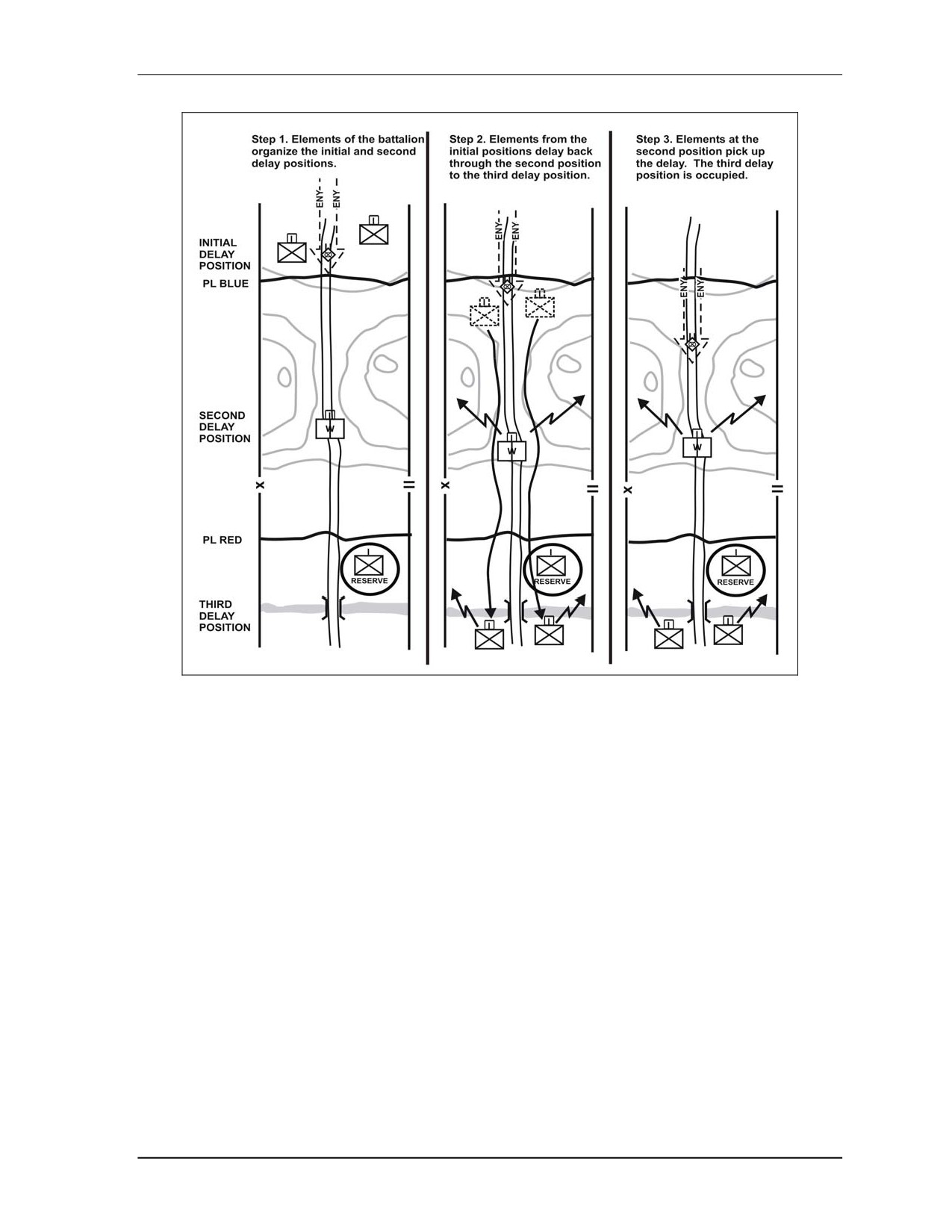
5-95.
In a delay from alternate positions (Figure 5-6), two or more units in a single AO occupy delaying
positions in depth. As the first unit engages the enemy, the second occupies the next position in depth and
prepares to assume responsibility for the operation. The first force disengages and passes around or
through the second force. It then moves to the next position and prepares to reengage the enemy while the
second force takes up the fight. Both the BCT and battalion can use this scheme of maneuver. If the AO is
narrow, the battalion employs companies in depth occupying alternate positions. This enables the battalion
to develop a strong delay, with forces available to counterattack or assist in the disengagement of the
company in contact. At the battalion level, using alternate positions helps maintain pressure on the enemy
and helps prevent platoons or companies from being decisively engaged. A delay from alternate positions
is particularly useful on the most dangerous avenues of approach because it offers greater security and
depth than a delay from subsequent positions. However, it also poses the highest potential for fratricide and
vulnerability as units pass through or near each other.
5-24
FM 3-21.20
13 December 2006
Defensive Operations
Figure 5-6. Delay from alternate positions.
Delay from Subsequent Positions
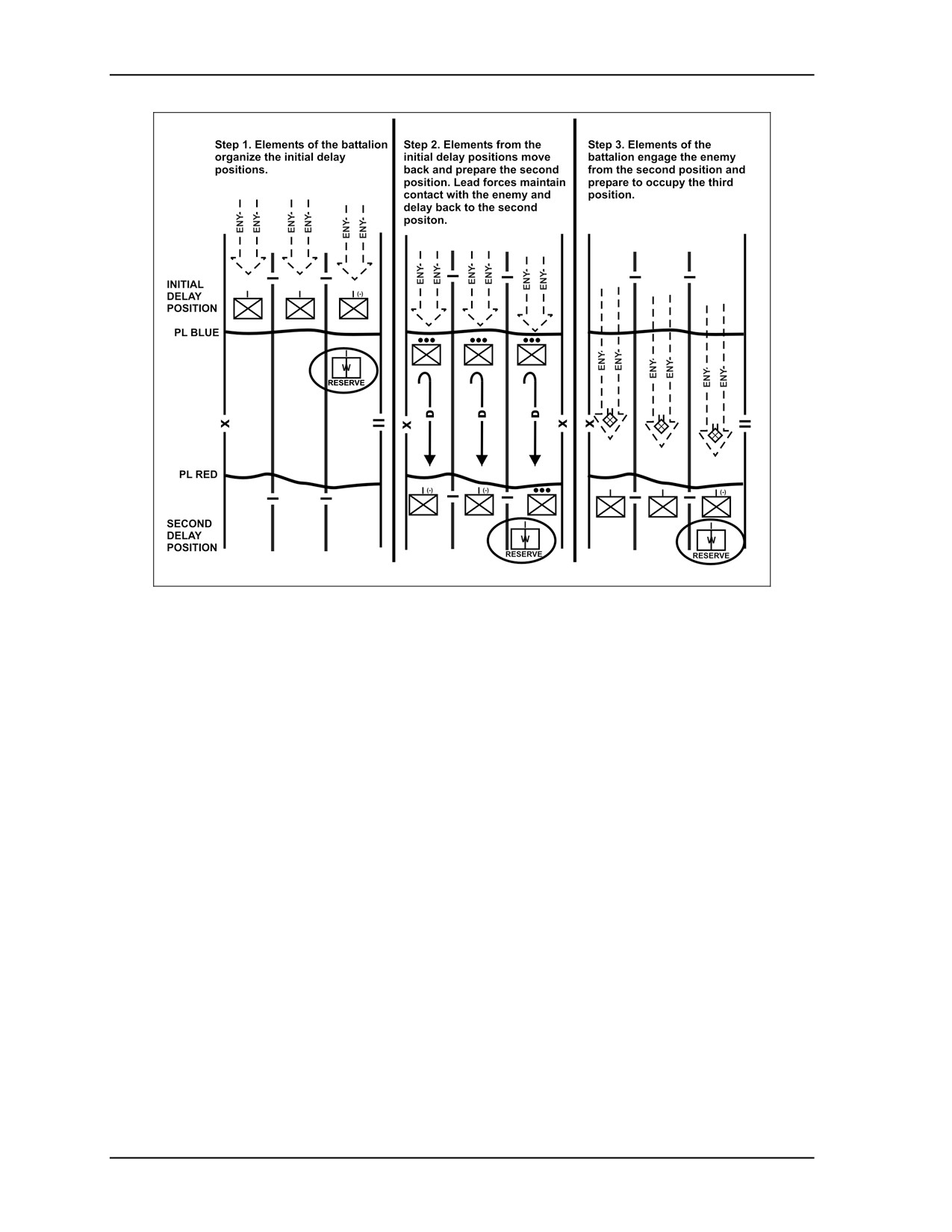
5-96.
The battalion uses a delay from subsequent positions when the assigned AO is so wide that
available forces cannot occupy more than a single tier of positions (Figure 5-7). In a delay from subsequent
positions, the majority of forces are arrayed along the same phase line or series of BPs. The forward forces
delay the enemy from one PL to the next within their assigned AOs. At battalion level, this is the least
preferred method of delaying since there is a much higher probability of forces becoming isolated or
decisively engaged, particularly if the delay must be maintained over more than one or two subsequent
positions. Also, the battalion has limited ability to maintain pressure on the enemy as it disengages and
moves to subsequent positions unless it has been allocated additional (and adequate) indirect fire support.
13 December 2006
FM 3-21.20
5-25
Chapter 5
Figure 5-7. Delay from subsequent positions.
Mobility and Countermobility
5-97.
The following are key considerations for mobility and countermobility operations:
• When operating within a large AO, task-organize countermobility assets to companies;
decentralizing control and execution.
• Task-organize mobility and sustainment assets to companies to support rearward breaching and
reducing requirements.
• Develop the obstacle plan to support disengagement of delaying forces and to shape the
enemy’s maneuver to meet the commander’s intent. Consider countermobility requirements for
all delaying positions throughout the depth of the AO. Integrate SCATMINE at delay positions
to support disengagement and movement to subsequent positions.
• Consider the impact of the obstacle effort on the movement of friendly forces and future
operations. Develop obstacle restrictions, establish lanes and guides, and employ situational or
reserve obstacles to support mobility requirements. Plan for closing lanes behind friendly
forces with scatterable or hand-emplaced mines.
• Develop clear criteria for execution of situational and reserve obstacles. Integrate decisions for
their execution in the decision support template.
5-26
FM 3-21.20
13 December 2006
Defensive Operations
Fire Support in a Delay
5-98.
The following are key considerations for the fire support plan:
• Attack the enemy throughout the AO.
• Engage the enemy with fires to inflict casualties and disrupt his approach before he gets to
friendly delaying positions. Plan final protective fires
(FPFs) for each series of delaying
positions to support disengagement.
• Mass fires on high-payoff targets and canalizing terrain to limit the momentum of the enemy’s
attack.
• Plan and designate priority targets along routes from one delaying position to the next.
• Mass all available fire support to support disengagements.
• Use smoke to screen friendly movements.
• Plan appropriate MFP to provide support throughout the entire mission.
• Consider split based operations and associated security measures and risks.
• Establish clear priorities and detailed triggers to adjust them.
• Develop detailed triggers to initiate and lift fires for each target.
Protection
5-99.
Ensure adequate air defense coverage of friendly forces during movements from one delaying
position to another. Consider protection along movement routes, chokepoints, and bridges that friendly
forces intend to use.
5-100. BCT planning defines CBRN operations in the delay. Battalions may coordinate for
reconnaissance assets if available in the BCT. Decontamination operations in the delay focus on individual
and crew operational decontamination procedures until the conclusion of the operation, when thorough
decontamination can be accomplished. If smoke generators are available, the battalion may employ them
for deception, obscuring movement and positions, or obscuring portions of the battlefield to reduce enemy
visibility and ease of movement.
5-101. Construct survivability positions in depth, as required, to support repositioning forces.
Sustainment
5-102. Sustainment for a delay is particularly complex. Communication within the sustainment system,
accurately tracking the battle, and anticipating support requirements are especially important. The
following are key sustainment planning considerations:
• Keep the sustainment assets mobile and supplies uploaded.
• Task-organize ambulances and recovery vehicles to the companies.
• Emphasize maintenance support forward for the weapons company with short evacuation
times.
• Synchronize refueling and resupply operations with the scheme of maneuver and the
anticipated enemy situation to ensure continuity of support. Increase emergency Class III and V
supplies positioned forward.
• Do not coordinate for throughput too far forward, which might cause assets to be caught in the
fight or add to route congestion. This may not apply during the initial preparations for the
delay.
• Plan routes for sustainment assets that do not conflict with maneuver elements or refugee
movement.
13 December 2006
FM 3-21.20
5-27
Chapter 5
Preparations
5-103. Defensive preparations discussed in Section II also apply during the conduct of a delay.
Inspections
5-104. The commander inspects planning and preparations of his subordinate units to ensure—
• Maneuver, fire, and obstacle plans are consistent with his intent.
• Flank coordination between delaying companies is conducted to maintain cohesion and mutual
support during the delay.
• All leaders have a clear understanding of the scheme of maneuver including disengagement
criteria, routes, triggers, and the commander’s intent.
Rehearsals
5-105. When conducting a rehearsal for a delay, key leaders practice the operation against all feasible
enemy COAs to promote flexibility of decision-making, plans, and execution. The commander examines
each subordinate unit commander’s plan as he fights the delay during the rehearsal and pays close attention
to the following:
• Direct and indirect fire instructions.
• Timing of movements (to include in limited visibility) and delaying actions from one position
to the next with special attention paid to the disengagement criteria.
• Means and methods of disengaging from the enemy and maintaining contact with the enemy as
the force moves to subsequent positions.
• Execution of situational and reserve obstacles to include closure of lanes.
• Movement times, routes, and positioning of fire support, protection, and sustainment assets.
5-106. The commander also rehearses plans to deal with potential reverses such as enemy penetrations
and unanticipated decisive engagement, and unanticipated opportunities to resume the offense. The
rehearsal serves to further synchronize the movement of combat forces, fire support, protection, and
sustainment units. It is especially important to portray movement times and required routes realistically
during the rehearsal to identify potential conflicts.
Execution
5-107. The battalion moves key forces and support assets to prepare for the delay. This initial movement
includes movement into the security area and MBA.
Security Area Actions
5-108. Delaying forces must be prepared to occupy the FLOT without a security force to their front;
however, this is never the preferred option. The BCT normally uses the reconnaissance squadron to occupy
the security area for a delay. The battalion may position the scout platoon or a task organized company in a
screen behind the reconnaissance squadron to maintain observation, to provide early warning, and to adjust
indirect fires to continue the disruption and attrition of the attacking enemy. As the enemy closes into and
through the security area, the screening forces move back through or around the initial main body positions
to subsequent positions that allow them to observe the MBA and assist in the disengagement and
movement of forces to their next positions.
Main Battle Area
5-109. The battalion uses fires and obstacles to force the enemy to deploy and assault. Its masses effects
quickly for a short period, to inflict the maximum damage on the enemy at the maximum range. To avoid
5-28
FM 3-21.20
13 December 2006
Defensive Operations
decisive engagement, the battalion must disengage before the enemy can breach obstacles or mass effective
fire on the delay position. Observers positioned to the flanks in depth continue to observe and shift indirect
fires as forces delay to subsequent positions. Companies may move by bounds within the battalion or
company to maintain direct fires on the enemy and cover movement. Short, intense engagements at near
maximum range with sustained indirect fires and covering obscurants, are the key to coercing the enemy
into deploying early and often for a decisive engagement.
Control
5-110. The battalion commander must closely control the disposition, displacement, and maneuver of his
forces in order to maintain the cohesion of the delay operation and keep the entire battalion synchronized
with the remainder of the BCT. Given the potential for loss of positive control, it is critical that the
commander clearly establish parameters for displacement.
5-111. As it executes the delay, the battalion and company commanders must continually assess their
situations and requirements to displace with the following considerations:
• What are the size, activity, and location of attacking and adjacent enemy forces? Are elements
of the battalion threatened with decisive engagement, encirclement, or bypass?
• What is the location and status of adjacent units?
• Are supporting assets, particularly artillery and mortars, postured to support movement? If not,
how long will it take them to be ready?
• Are the obstacles supporting the present position still intact and effective?
• What is the ammunition status?
• Are displacement routes clear?
5-112. The battalion must always make decisions about displacement and timing in the context of the
commander’s intent and priority for the delay, for example, is time more important than force preservation,
or vice versa? In many instances, the battalion or elements of it must accept decisive engagement to
execute the mission in conjunction with another force's counterattack.
Counterattacks
5-113. The battalion can rarely execute a substantial counterattack during a delay by itself unless it is part
of the larger BCT scheme of maneuver. Generally, counterattacks executed by the battalion, in its own
scheme of maneuver, are platoon to possibly company-size counterattacks to support disengagement of
forces or to destroy penetrations. Because of mobility, firepower, and range of weapons systems, the
biggest asset the battalion has to execute a counterattack is the weapons company. Whenever possible, the
BCT executes counterattacks to counter penetrations, to gain a temporary degree of initiative or freedom of
action, and to avoid a predictable pattern of operation.
Decisive Engagement
5-114. The battalion and companies avoid becoming decisively engaged except when necessary to
prevent the enemy from reaching a specified area too early or when a part of the force must be risked to
protect the entire force. If elements of the battalion are threatened with decisive engagement, or have
become decisively engaged, the commander may take actions to support their disengagement and may
perform any of the following:
• Allocate priority of all supporting fires to the threatened unit. This is the most rapid and
responsive means of increasing the unit’s combat power.
• Employ CAS or attack helicopters to suppress the enemy and restore freedom of maneuver to
the battalion.
13 December 2006
FM 3-21.20
5-29
Chapter 5
• Reinforce the unit. In a delay mission, particularly in a large AO, the battalion may not be able
to do this quickly enough with ground maneuver forces.
• Conduct a counterattack to disengage the unit.
Termination
5-115. A delay mission ends with another planned mission such as a defense, withdrawal, or attack.
Ideally, a battalion that has been delaying conducts a rearward passage of lines through the established
defense of another friendly force. The criteria for the termination of the delay must be detailed by the
commander by time, distance, or whether the battalion defeats the enemy. If the enemy attack is defeated
during the delay, the battalion may conduct one of the following:
• Maintain contact while another force counterattacks.
• Withdraw to perform another mission.
• Transition to the offense.
5-116. In all cases, the commander must plan for the expected outcome and actions taken after
termination of the delay based on the situation and the higher commander’s plan.
WITHDRAWAL
5-117. Withdrawal is a planned operation in which a force in contact disengages from an enemy force.
Withdrawals may or may not be conducted under enemy pressure.
Types
5-118. Withdrawals are either assisted or unassisted.
Assisted
5-119. The assisting force occupies positions to the rear of the withdrawing unit and prepares to accept
control of the situation. It can also assist the withdrawing unit with route reconnaissance, route
maintenance, fire support, protection, and sustainment. Both forces closely coordinate the withdrawal.
After coordination, the withdrawing unit delays to a battle handover line, conducts a passage of lines, and
moves to its final destination.
Unassisted
5-120. The withdrawing unit establishes routes and develops plans for the withdrawal, then establishes a
security force as the rear guard while the main body withdraws. Sustainment and protection elements
normally withdraw first, followed by combat forces; however, the protection and sustainment forces must
continue to maintain the ability to support all elements in the battalion. To deceive the enemy as to the
friendly movement, the battalion may establish a detachment left in contact (DLIC) if withdrawing under
enemy pressure. As the unit withdraws, the DLIC disengages from the enemy and follows the main body to
its final destination.
Organization
5-121. The battalion normally organizes into a security force, main body, and reserve. It may elect to use
a single company or elements of a company as the security or reserve force. It may also organize a DLIC or
stay-behind forces if required by the enemy situation.
5-30
FM 3-21.20
13 December 2006
Defensive Operations
Security Force
5-122. The security force maintains contact with the enemy until ordered to disengage or until another
force takes over the task. It simulates the continued presence of the main body, which requires additional
allocation of combat multipliers beyond that normally allocated to a force of its size. When withdrawing
under enemy pressure, the security force establishes or operates as a DLIC to provide a way to break
contact from the enemy sequentially. When conducting the withdrawal without enemy pressure, the
security force acts as a rear guard because the most probable threat is a pursuing enemy.
Detachment Left in Contact
5-123. The DLIC is an element that is left in contact as part of the previously designated (usually rear)
security force while the main body conducts its withdrawal. Its purpose is to remain behind to deceive the
enemy into believing the battalion is still in position while the majority of the unit withdraws. The DLIC
should be one of the strongest of the subordinate units with the most capable leadership. It will be the unit
under the greatest pressure, and the success of the withdrawal often depends on its effectiveness. The
commander establishes specific instructions about what to do if the enemy attacks and when and under
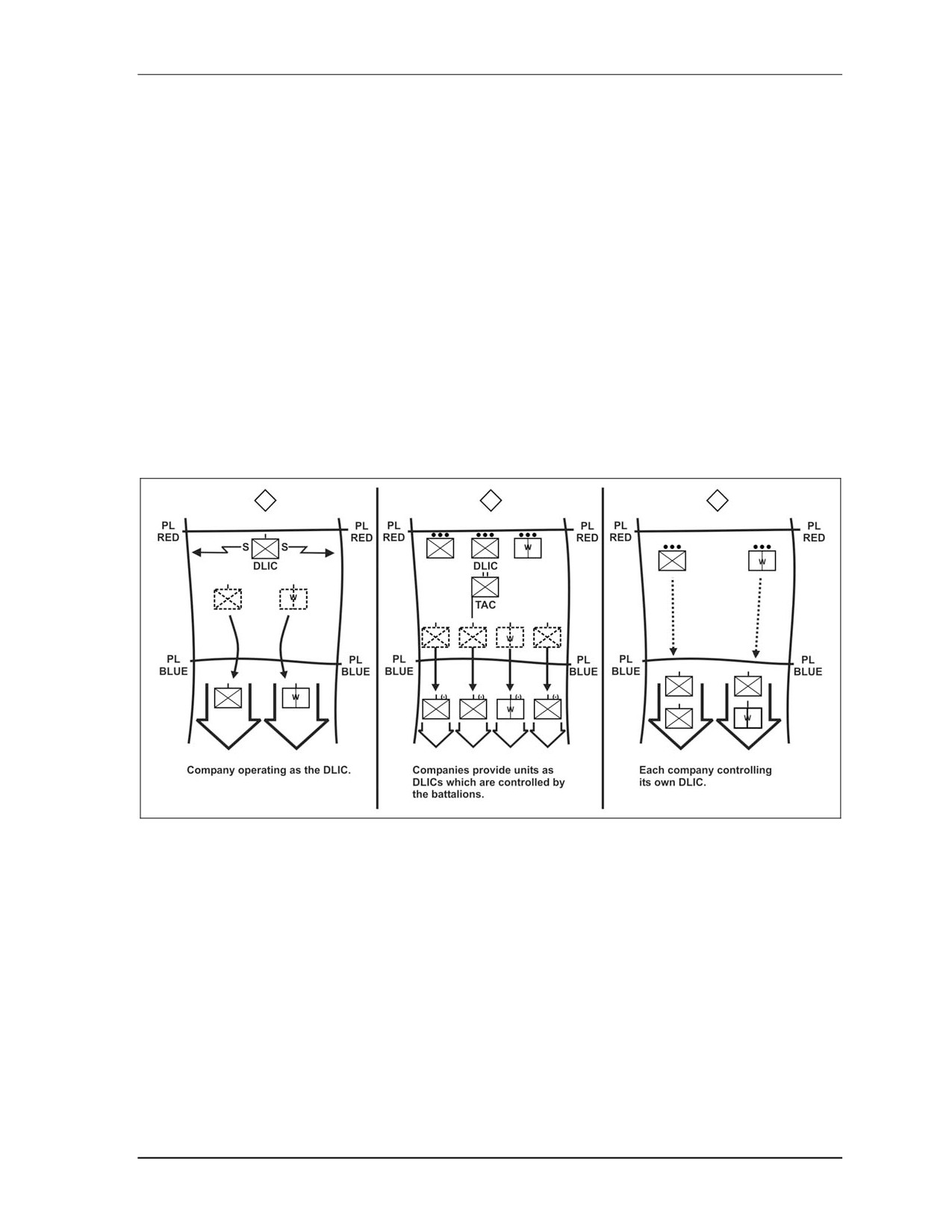
what circumstances to delay or withdraw. The battalion organizes a DLIC in one of three ways
(Figure 5-8).
Figure 5-8. Methods for organizing the detachment left in contact.
Single Company
5-124. A single company operates as the DLIC. This is the most effective option since it provides for
effective task organization and C2.
DLIC Element Formed from each Company
5-125. Each company provides forces for the DLIC mission. The resulting DLIC element then operates
under the battalion’s control. This is the least desirable option since it complicates C2 and task organization
and requires significant changes to the communications architecture. The battalion most commonly uses
this option when the subordinate companies have lost significant portions of their C2 capabilities.
13 December 2006
FM 3-21.20
5-31
Chapter 5
Company Control of Separate DLICs
5-126. Each company establishes and controls its individual DLIC. The battalion uses this option when it
is operating over a wider area or one with multiple corridors in the withdrawal AO. It allows for effective
dispersion of forces while maintaining standard C2 relationships.
Additional considerations
5-127. The battalion should establish an advance guard on its route of movement. It may designate a
company or the scout platoon reinforced with Infantry and mortars as the advance guard. The battalion
should task-organize both the DLIC and the advance guard with engineers, with mobility assets going to
the advance guard and obstacle and mobility assets going to the DLIC. The battalion main body consists of
the remaining companies, command posts, sustainment assets, remaining engineers, and the mortars (if
they are not task-organized to support either the DLIC or the advance guard). The battalion must ensure it
provides essential communications, sustainment, and indirect fire support for the DLIC. The battalion may
designate a reserve, normally a platoon or company in the main body. To create flank security, it uses the
scout platoon, engineers, or elements of the main body team.
Planning Considerations
5-128. Because the force is most vulnerable if the enemy attacks, the commander and staff normally plan
for a withdrawal under enemy pressure. It also develops contingency plans for a withdrawal without enemy
pressure. During planning, the commander and staff specifically consider the following:
•
Disengagement criteria (time, friendly situation, enemy situation).
•
Plan for a deliberate break in contact from the enemy.
•
Plan for deception to conceal the withdrawal for as long as possible.
•
Rapid displacement of the main body, safeguarded from enemy interference.
•
Selection and protection of withdrawal routes and alternates.
•
Sitting of obstacles behind the DLIC to complicate pursuit.
•
Fire support remains within supporting distance.
•
Sustainment assets remain within distance to support the DLIC.
Commander's Guidance
5-129. The commander develops his vision of the battle based on withdrawing under enemy pressure. He
determines the composition and strength of the security force, main body, the DLIC, and reserve. The
commander clearly defines how he intends to deceive the enemy as to the execution of the withdrawal;
how he intends to disengage from the enemy (use of maneuver, fires, and obstacles); and the final end state
of the operation in terms of time, location, and disposition of friendly and enemy forces.
Scheme of Maneuver
5-130. A withdrawal may be assisted or unassisted and may take place with or without enemy pressure.
The plan considers which of the variations the battalion executes based on the higher headquarters’ order
and the enemy situation.
Assisted Withdrawal
5-131. In an assisted withdrawal, the staff coordinates the following with the assisting force:
• Rearward passage of lines.
• Reconnaissance of withdrawal routes.
• Forces to secure choke points or key terrain along the withdrawal routes.
5-32
FM 3-21.20
13 December 2006
Defensive Operations
• Elements to assist in movement control such as traffic control points.
• Required combat, fire support, protection, and sustainment to assist the withdrawing battalion
in disengaging from the enemy.
Unassisted Withdrawal
5-132. In an unassisted withdrawal, the battalion establishes its own security and disengages from the
enemy. It reconnoiters and secures routes that it uses in its rearward movement while sustaining itself
during the withdrawal.
Withdrawal under Enemy Pressure
5-133. In a withdrawal under enemy pressure, all units other than the rear guard or DLIC withdraw
simultaneously when available routes allow. The following factors influence the decision to withdraw
simultaneously:
• Subsequent missions.
• Availability of transportation assets and routes.
• Disposition of friendly and enemy forces.
• Level and nature of enemy pressure.
• Degree of urgency associated with the withdrawal.
Transition
5-134. The element that will be the DLIC or rear guard must transition to cover the battalion’s AO.
Simultaneously, the battalion must prepare its sustainment assets and the remainder of the force to begin a
withdrawal to the rear. The battalion should seek to move on two routes to gain speed and shorten
formations. Using more than two routes exceeds the ability of the battalion to maintain security. Often,
only a single route will be available.
Breaking Contact
5-135. The battalion commander has essentially two options for breaking contact: break contact using
deception and stealth or break contact quickly and violently under the cover of supporting fires reinforced
by obstacles to delay pursuit. He bases this choice on the factors of METT-TC.
Withdrawal without Enemy Pressure
5-136. When conducting a withdrawal without enemy pressure, the commander can focus the plan on the
best method to displace forces rapidly and securely. He has the option of taking calculated risks that
increase his force’s displacement capabilities. He may order the main body to conduct a tactical road march
instead of moving in tactical formations, or he may move on as many routes as possible with reduced
security in order to gain speed.
Preparation
5-137. The commander prepares the battalion for the withdrawal through inspections and rehearsals in
the same fashion as discussed with other defensive operations. Inspections for this mission focus on
subordinate unit preparations to ensure a clear understanding of the scheme of maneuver and his intent.
During an assisted withdrawal, the commander ensures adequate coordination for battle handover and
passage of lines. The focus of the rehearsal for the withdrawal is on actions to maintain security,
disengagement from the enemy, and the movement of forces. When possible, key leaders or liaisons from
the assisting force should attend the rehearsal. The commander ensures control measures, which include
FSCMs to fully support the withdrawal. Leaders rehearse the plan against the full range of possible enemy
13 December 2006
FM 3-21.20
5-33
Chapter 5
actions. They rehearse contingencies for reverting to a delay, commitment of the reserve, and enemy
interdiction of movement routes.
Execution
5-138. Execution of the battalion withdrawal essentially follows this pattern:
• Task-organizing and positioning of security and deception forces.
• Reconnaissance and surveillance of withdrawal routes and subsequent positions.
• Preparation of obstacles to support the DLIC and withdrawal.
• Preparing wounded Soldiers and damaged equipment and nonessential supplies for movement.
• Moving nonessential protection and sustainment assets to the rear.
• Initiating movement, leading with forward security forces.
• DLIC breaks off contact and moves as a rear guard.
Disengagement
5-139. The security force remains in position and maintains a deception while the main body moves as
rapidly as possible rearward to intermediate or final positions. After the main body withdraws a safe
distance, the commander orders the security force to begin its rearward movement. Once the security force
begins moving, it assumes the duties of a rear guard. The security element must balance security and
deception with speed as it disengages. It maintains tactical movement and security techniques until it is
clear that the enemy is not pursuing and contact has been broken; it then withdraws as rapidly as possible.
The main body moves rapidly on multiple routes to designated positions. It may occupy a series of
intermediate positions before completing the withdrawal. Usually protection and sustainment assets move
first and precede combat and fire support units in the movement formation. The staff enforces the
disciplined use of routes during the withdrawal. Despite confusion and enemy pressure, subordinate units
follow specified routes and movement times.
Actions on Contact
5-140. Security forces counter the enemy’s try to disrupt the withdrawal or pursue the battalion. If the
security force and the reserve cannot prevent the enemy from closing on the main body, the commander
commits some or all of the main body to prevent the enemy from interfering further with the withdrawal.
The main body delays, attacks, or defends as required by the situation. In this event, the withdrawal
resumes at the earliest possible time. If the enemy blocks movement to the rear, the battalion must adjust its
order of withdrawal march to ensure protection and sustainment elements are not the primary fighting force
to eliminate the threat. Friendly forces shift to alternate routes and bypass the interdicted area.
Alternatively, they may attack through the enemy.
Termination
5-141. Once the battalion successfully disengages from the enemy, it normally has the following options:
• Rejoin the overall defense.
• Transition into a retirement.
• Continue moving away from the enemy and towards its next mission area.
5-142. The higher headquarters defines the next mission. Follow-on missions are normally planned as the
withdrawal is being planned or executed.
5-34
FM 3-21.20
13 December 2006
Defensive Operations
RETIREMENT
5-143. A retirement is a retrograde operation in which a force that is not in contact with the enemy moves
to the rear in an organized manner. The battalion conducts a retirement as part of the BCT to reposition for
future operations.
Organization
5-144. The battalion may serve either as a security element for the BCT, or as a part of the main body.
The battalion normally organizes itself with security, main body, and reserve elements, depending on the
situation and where the battalion is in the movement scheme. The formation and number of columns
employed, depend on the number of available routes and the potential for enemy interference. The
commander typically wants to move his major elements to the rear, while simultaneously using
multiple routes.
Planning Considerations
5-145. The commander and staff develop a movement plan based on the friendly situation, commander’s
guidance, and enemy situation. The staff develops detailed movement control measures, associated
graphics, and triggers to ensure the steady progress of movements and to prevent elements from congesting
the routes. They develop the movement formation and order of movement to balance the need for security
and speed. Security forces protect the main body from surprise, harassment, or attack by any pursuing
enemy forces. Each march column normally maintains an advance guard, rear guard, and flank security,
depending on the situation with adjacent friendly forces and the likelihood of enemy interference. The
main body may organize into an approach march or tactical road march if speed is most important and the
need for security is low.
Preparation
5-146. During preparations, the battalion units conduct rehearsals and prepare for the movement. Units
maintain OPSEC and security operations and dispatch advance parties, route security elements, and
quartering parties as required.
Execution
5-147. During a retirement, the battalions and its companies normally move to assembly areas to prepare
for future operations. Companies move IAW established movement times and routes. Strict adherence to
the movement plan is essential to avoid congestion or delay. The staff closely supervises the execution of
the movement plan. Sustainment and protection units usually move to the rear first. The battalion may
choose to provide the protection and sustainment units with security elements depending on the likelihood
of enemy contact.
Section III. PLANNING CONSIDERATIONS
Planning a defensive operation is a complex effort requiring detailed planning and extensive coordination. This
section contains planning considerations applicable for defensive operation. In the defense, synchronizing the
effects of the battalion combat and supporting systems allows a commander to apply overwhelming combat
power against selected advancing enemy forces to unhinge the enemy commander’s plan and destroy his
combined-arms team. All defensive operations are a mix of static and dynamic actions. As an operation
evolves, the commander knows he will probably have to shift his decisive and shaping operations to disrupt and
maintain pressure on the enemy, deny him freedom of maneuver, and prevent him from wresting away our
initiative.
13 December 2006
FM 3-21.20
5-35
Chapter 5
KEYS TO SUCCESSFUL DEFENSE
5-148. The commander’s keys to a successful defense are—
• Capability to concentrate and synchronize effects.
• Depth of the defensive area.
• Security.
• Ability to take full advantage of the terrain.
• Flexibility of defensive operations.
• Echelonment of direct and indirect fires.
• Fire distribution and fire control measures.
• Early identification of threat forces (UAS, counterreconnaissance, combat outposts, sensors,
JIIM/SOF assets).
• Timely resumption of offensive action.
COMMANDER’S VISION
5-149. Initially, integrated with the staff’s IPB, the commander expresses his vision of the enemy’s
anticipated actions. The battalion commander and staff refine the BCT IPB to focus on the details of the
operation in the battalion AO. The BCT commander normally defines where and how the BCT will defeat
or destroy the enemy and how he envisions the battalion executing its portion of the BCT fight.
HOW AND WHERE TO DEFEAT ENEMY
5-150. The commander and staff base their determination of how and where to defeat the enemy, on
where they believe the enemy will go, the terrain, the forces available, and the BCT commander’s intent.
The battalion commander may define a defeat mechanism that includes the use of single or multiple
counterattacks to achieve success. The battalion commander and staff analyze their unit’s role in the BCT
fight, and determine how to successfully accomplish their purpose. In an area defense, the battalion usually
achieves success by massing the cumulative effects of obstacles and fires to defeat the enemy forward of a
designated area, often in conjunction with a BCT counterattack. In a delay operation, the battalion achieves
success by combining maneuver, fires, and obstacles, and by avoiding decisive engagement until
conditions are right to achieve the desired effect of gaining time or shaping the battlefield for a higher
echelon counterattack.
FORCES AND ASSETS AVAILABLE
5-151. The commander and staff analyze the forces and assets available, paying particular attention to the
obstacle assets and fire support allocated by the BCT. The staff defines the engineer and fire support
allocation in terms of capability, resources, and priority. For example, it should define engineer capability
in terms of the number of obstacles of a specific effect engineers can emplace in the time available. Fire
support analysis should include the number of targets that can be engaged with an expected result at what
point in the battle.
EFFECTS
5-152. With a definitive understanding of the assets available, the commander and staff determine what
effects combat forces, fires, and obstacles must achieve on enemy formations by avenue of approach and
how these effects will support both the BCT’s and the battalion’s defeat mechanism. They define the
task(s) and purpose for subordinate units and establish priorities for protection and sustainment. They
develop obstacle and fire support plans concurrently with the defensive force array, again defining a task
and purpose for each obstacle and target in keeping with the commander’s stated EFSTs and intended
5-36
FM 3-21.20
13 December 2006
Defensive Operations
obstacle effects. The desired end state is a plan which defines how the commander intends to mass the
effects of direct and indirect fires with obstacles and use of terrain to shape the battlefield and defeat or
destroy the enemy.
Section IV. SEQUENCE
The battalion may assume a defensive mission following an attack of its own, or in anticipation of an enemy
attack. The following general sequence of operations applies to planning and executing all defensive
operations.
OCCUPATION AND ESTABLISHMENT OF SECURITY
5-153. Normally, the BCT has established some form of security with the reconnaissance squadron
before the battalion moves into the area. However, the battalion must still provide its own internal security,
especially on expanded or complex terrain and noncontiguous areas of operation. In order to prevent the
enemy from observing and interrupting defensive preparations and identifying unit positions, the battalion
establishes the security area well beyond where the MBA is desired, but within indirect fire and
communications range. If they cannot push the security area forward to achieve this objective, the battalion
may have to hold its positions initially, as it transitions and then withdraws units to the defensive MBA,
establishing a security force in the process.
LEADERS' RECONNAISSANCE
5-154. Before occupying any position, leaders at all echelons conduct some type of reconnaissance. This
reconnaissance effort is as detailed as the factors of METT-TC permit. It may consist of a simple map
reconnaissance, or a more detailed leader’s reconnaissance and initial layout of the new position. When
feasible, the commander and subordinate leaders conduct a reconnaissance of the AO to develop the plan
based on their view of the actual terrain. The commander and staff develop a plan for the leaders’
reconnaissance that includes the following. When available, the commander may use aviation assets to
conduct the leaders' reconnaissance:
• Provisions for security.
• Leaders and key staff members required to participate.
• Designation of a recorder.
• Areas to be reconnoitered.
• Time allocated for the reconnaissance.
• Indirect fires, communications, and CASEVAC support plans.
• Rapid reaction force to respond in the event that the reconnaissance element is compromised.
MOVEMENT INTO UNSECURED AREA OF OPERATIONS
5-155. If the battalion is moving into an unsecured AO, it may lead with the scout platoon, possibly
reinforced with dismounted or weapons company elements and mortars. Depending on the situation, the
battalion may send a company to secure the area. The mission of the security force is to clear the area,
check for contaminated areas and obstacles, and establish security for the battalion main body. After
clearing the battalion’s rear area and the area where the companies will be positioned, the security force
should position itself to—
• Prevent enemy observation of defensive preparations.
• Defeat infiltrating reconnaissance forces.
• Prevent the enemy from delivering direct fires or observed indirect fires into the battalion
defenses.
• Provide early warning of the enemy’s approach.
13 December 2006
FM 3-21.20
5-37
Chapter 5
POSITIONING OF FORCES
5-156. The positioning of the battalion security elements must be integrated into the security operations
of the BCT and adjacent battalions. In contiguous or linear defenses, the battalion commander normally
organizes and defines the security area forward of the FEBA, assigning the companies AOs of the
battlefield to prevent gaps in the battalion security. In non contiguous or non linear defenses, the battalion
commander normally organizes and defines the security area forward of the MBA, or along likely avenues
of approach. In this type of defense, companies will have more responsibility for independent security
areas. The key is to integrate operations at the BCT and battalion levels and again at the company level,
using all available resources to execute security operations.
SECURITY OPERATIONS
5-157. Preparation of the defense includes planning and plan refinement, positioning of forces, preparing
positions, constructing obstacles, planning and synchronizing fires, positioning logistics, and conducting
inspections and rehearsals. Throughout the preparation phase, security operations continue without
interruption. Security forces may be assigned screen, or area security missions. The scout platoon may be
positioned to screen and provide early warning along most likely enemy avenues of approach, reinforced in
depth with sections or platoons from Infantry or weapons companies.
SECURITY
5-158. Security is a consideration throughout the AO. The battalion arrays security forces in depth to
provide protection and to reduce the potential for enemy infiltration. It also secures the MBA to prevent
enemy reconnaissance, reduction of obstacles, targeting of friendly positions, and other disruptive actions.
Companies secure obstacles, BPs, and hide positions. The threat force and battlefield organization will
dictate the commander’s decision; whether elements in the battalion conducting sustaining operations are
allocated security forces, or if they provide their own security. With extended lines of communication, the
battalion may also secure logistical elements moving forward from the field trains to support the battalion.
DISPERSION
5-159. Forces should be widely dispersed and hidden, to reduce vulnerability and to aid in OPSEC. The
staff must balance the benefits of dispersion against the requirements and resources for security areas.
Usually, the greater the dispersion between companies, the larger the security area.
INTEGRATION
5-160. When applicable, integrate reconnaissance and ground maneuver units in the security forces. This
provides the forces required for the hunter-killer technique. Use reconnaissance forces primarily to locate
enemy elements and attack them with indirect fires but not to engage in direct fire attack except in
self-defense. The reconnaissance force can then guide the maneuver force to destroy, neutralize, or repel
threat forces with direct fires. Clearly establish the C2 headquarters and communication architecture for the
security force.
SECURITY AREA ENGAGEMENT
5-161. The battalion normally does not have a significant security area engagement, as this is largely the
domain of the BCT’s reconnaissance squadron for shaping the battlefield and setting favorable conditions
for the close fight. The battalion may execute some engagement tasks in the security area to support its
own, or higher’s defensive scheme.
5-38
FM 3-21.20
13 December 2006
Defensive Operations
EXECUTION OF PLANNED INDIRECT FIRES
5-162. The battalion's planned indirect fires usually include security force elements or a fire support team
(FIST), which executing indirect fire targets on a primary enemy avenue of approach. This may be in
support of the higher headquarters’ scheme of fires using BCT artillery, or in support of the battalion
scheme with the use of organic mortars and allocated artillery fires.
EXECUTION OF SITUATIONAL OBSTACLES
5-163. The battalion may be tasked by higher or may have integrated into a defensive scheme of its own;
the use of situational obstacles to execute in the security area. These obstacles serve to disrupt the enemy
and to force him to commit his engineer assets. They are usually planned and triggered relative to specific
enemy attack options, and are related to accomplishing a specific essential mobility survivability tasks
(EMST) and or EFST. This allows the battalion more effective engagements with indirect fires. Maneuver
forces may be employed forward to cover them with direct fires, and then withdraw to positions in the
MBA.
EXECUTION OF DELAY OPERATIONS THROUGH SECURITY AREA AND INTO MBA
5-164. The battalion may support its own or higher’s scheme of maneuver by fighting a delay through the
depth of the security area and into the MBA. The purpose may be to take advantage of restrictive avenues
of approach, to set the conditions for a counterattack, or to avoid a decisive engagement until favorable
conditions have been set.
BATTLE HANDOVER
5-165. The battalion assumes control of the FEBA fight from the security force as it completes its RPOL.
Transferring responsibility from the security force to the battalion on the FEBA requires firm,
clear arrangements--
• For assuming command of the action.
• For coordinating direct and indirect fires.
• For the security force’s rearward passage of lines.
• For closing lanes in obstacles.
• For detailed movement planning that clears the security force from the battalion AO with
minimal interference with the defense.
TRANSITION
5-166. As security area engagements transition into the MBA, security area forces withdraw to the initial
MBA, counterattack, or reserve positions. Some elements may maneuver to the flanks to maintain
surveillance on enemy avenues of approach, providing early warning and execution of fires against
follow-on enemy forces.
MAIN BATTLE AREA FIGHT
5-167. The battalion seeks to defeat, disrupt, or neutralize the enemy’s attack forward of or within the
MBA. If the battalion can bring sufficient firepower to shape the enemy in the security zone fight, an MBA
engagement may not occur. In this event, the battalion can rapidly transition and move its companies into a
strong counterattack. However, the battalion and the companies normally defend over a large area, and
enemy strength often forces an MBA engagement. In a non linear, non contiguous defense, dispersed
companies will have a larger security area with little or no support from battalion. Therefore, companies
will have a higher likelihood of having an MBA engagement. An MBA engagement is a combined-arms
fight, integrating both direct fire and indirect fires, reinforced with obstacles and organic mortars.
13 December 2006
FM 3-21.20
5-39
Chapter 5
5-168. The battalion continues to focus mortars, artillery, CAS, and attack aviation in an effort to attack
the enemy continuously throughout the depth of the battlefield; therefore, fire support to the battalion and
mortar support to companies, may be limited to critical points and times in the MBA fight. Combining all
available fires with maneuver, obstacles, and reserve elements, the battalion commander seeks to destroy
the enemy in designated EAs, or force his transition to a retrograde or hasty defense. The battalion
normally specifies control measures to coordinate and focus the defensive operation. Control measures
allow the commander to rapidly concentrate combat power at the decisive point, provide flexibility to
respond to changes, and allocate responsibility of terrain and obstacles, and reduce tactical and accidental
risk. These control measures include the security area, battle handover line (BHL), and the MBA. The
commander also uses BPs and direct fire control measures, and FSCMs to further synchronize the
employment of his combat power.
FOLLOW-ON MISSIONS
5-169. Following a successful defense, the attacker might have a period of confusion that the defender
can exploit. Counterattacks can be executed based on branches and sequels to the plan, before the enemy
can secure his gains or organize a defense. METT-TC and the higher commander’s concept of operations
dictate the battalion’s follow-on mission. If the situation prevents offensive action, the battalion continues
to defend. As in the initial establishment of the defense, gaining security zone space is critical. A local
counterattack can provide space for a security zone and time to reorganize. Any attack option must pay
particular attention not only to the terrain and enemy, but also to friendly obstacles (and their destruction
times, if applicable) and areas where dual-purpose improved conventional munitions
(DPICMs) or
bomblets have been used. If the battalion cannot counterattack to gain adequate security space, then the
battalion may have to direct one company to maintain contact with the enemy and guard the AO while
others move to reestablish the defense farther to the rear. The battalion must reorganize whether it
continues to defend or transition to offensive operations.
Section V. TECHNIQUES
The battalion normally defends using five basic techniques of defense: (1) Defend an AO, (2) Defend a BP,
(3) Conduct a Reverse slope defense, (4) Defend a strongpoint, and (5) Conduct a perimeter defense. The BCT
normally assigns the battalion an AO to defend; however, the battalion may use assign different techniques to
respective companies within the same operation, for example, A Co defends an AO, B Co defends a BP, and
the weapons company conducts a reverse slope defense.
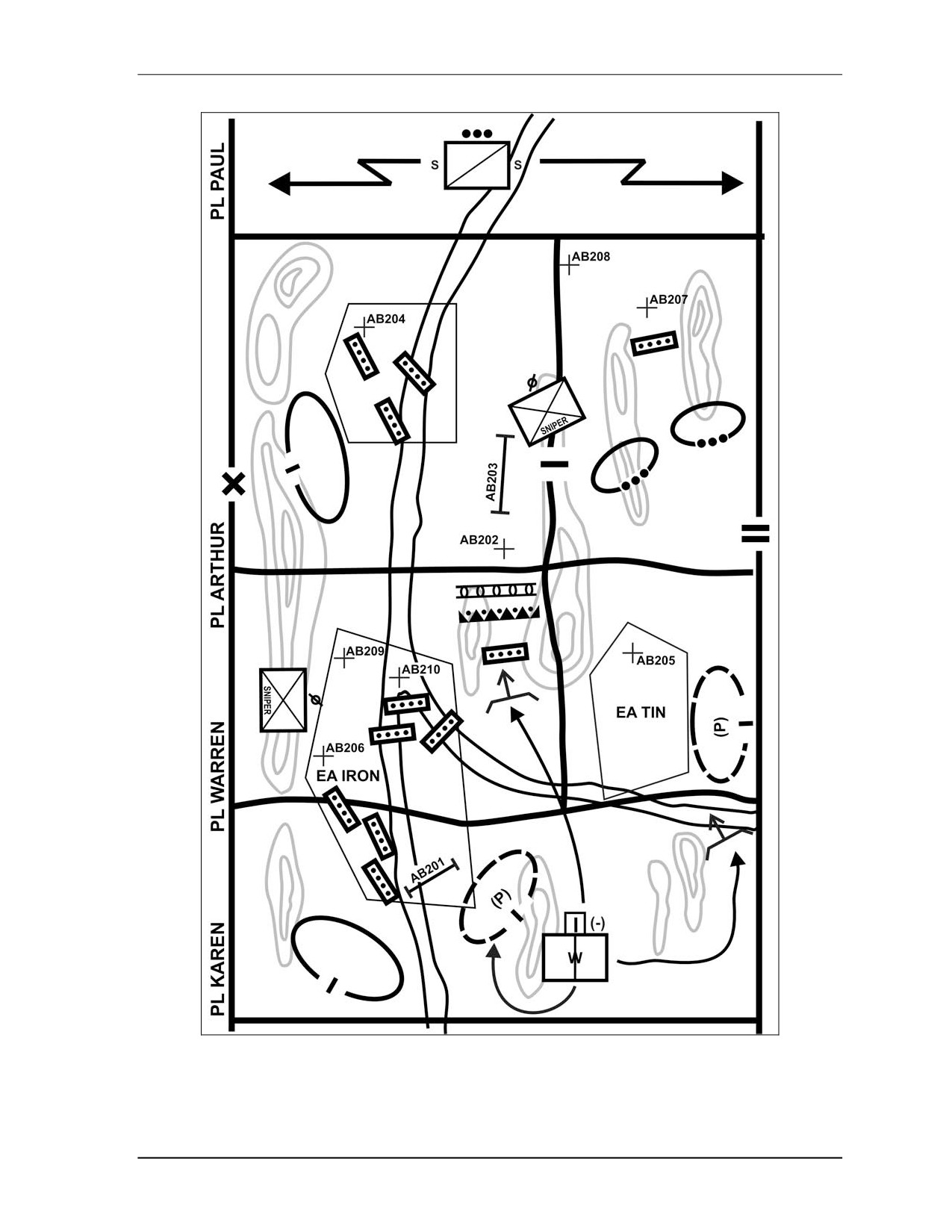
DEFEND AN AREA OF OPERATIONS
5-170. A defense in an AO provides the greatest degree of freedom of maneuver and fire planning within
a specific area. The battalion most often uses this method of control when it has an adequate amount of
depth and width to the battlefield and does not desire decisive engagement early in the MBA fight. For a
defense to be cohesive, the companies cannot maneuver with complete freedom. Phase lines, EAs, BPs,
and obstacle belts help coordinate forces and achieve synchronized action. Use of AOs allows flexibility
and prevents the enemy from concentrating overwhelming firepower on the bulk of the defending force.
Forces defending against an enemy with superior mobility and firepower must use the depth of their
positions to defeat the enemy. The depth of the defense must come from the initial positioning of units
throughout the AO, not from maneuvering. A properly positioned and viable reserve enhances depth
(Figure 5-9).
5-40
FM 3-21.20
13 December 2006
Defensive Operations
Figure 5-9. Defense of an AO.
13 December 2006
FM 3-21.20
5-41
Chapter 5
POSITIONS
5-171. A battalion defending against a mounted enemy uses a series of mutually supporting battle
positions, incorporating CCM antiarmor weapons. These positions should be located on
vehicular-restricted terrain, maximize the stand-off capabilities of the CCM weapons, and strengthened by
existing and reinforcing obstacles.
SECURITY
5-172. The AO defense is more effective against armor but more vulnerable to Infantry attack or
combined-arms action that can be directed against one position at a time. Position preparation must
emphasize all-round security and mutual support. ISR assets should be used to monitor the avenues of
approach.
DEPLOYMENT IN DEPTH
5-173. Forces deployed in depth must simultaneously engage the enemy with effective fires from
multiple locations as he tries to maneuver. The AO is organized around dispersed, small units that attack
the enemy throughout the depth of his formations. The focus of this technique is the enemy force. Mines
and other obstacles and patrols can close gaps that fire cannot cover effectively due to terrain masking or
heavily wooded areas. The commander generally positions Infantry along mounted avenues of approach
within restricted terrain and the weapons company along avenues of approach in unrestricted terrain;
thereby, maximizing each capability.
ENGAGEMENT OPTIONS
5-174. The commander has three basic engagement options when defending an AO. He chooses the
appropriate one based mainly on the restrictions of the terrain and his expectation of achieving surprise.
His first option is to begin engaging at maximum optimum range, based on the terrain and available
weapons systems. With this option, the commander would normally initiate with the weapons company to
maximize the standoff distance. His second option is to allow the enemy to close to within direct fire range
of the Infantry squads and machine guns. The defender then engages the enemy with violent, hasty, and
deliberate counterattacks designed to destroy the enemy from any direction. In restricted terrain, this option
denies a more mobile enemy force any firepower or mobility advantage. In the third option, the commander
can task organize Infantry companies with the weapons company, to provide close combat and antiarmor
capability in several locations. The commander uses this option when the enemy’s courses of action are
less clear. In this case, the commander normally maintains a larger reserve to react to enemy actions.
Beginning Engagement at Long Range
5-175. The defender initiates fires at long ranges with artillery, aircraft, and attack helicopters to begin to
break up the continuity of the attack. As the enemy closes to within range of organic CCM antiarmor
weapons, these weapons engage and further disrupt enemy synchronization by destroying key vehicles.
When the enemy enters the engagement range of the battalion's organic weapons, the battalion engages him
from multiple unexpected directions, and destroys him.
Allowing of Enemy into Depth of Position
5-176. This technique is offensive oriented. It allows for planned envelopments, ambushes, and
counterattacks throughout the enemy formation. It is difficult for a forward array of forces to defend armor
approaches. Such an array can be overrun or penetrated rapidly while under massive artillery, smoke, and
direct fire suppression. To avoid penetration, the battalion must array forces in depth. Concentrating the
battalion on wide fronts with a narrow depth may be risky.
5-42
FM 3-21.20
13 December 2006
Defensive Operations
DEFEND A BATTLE POSITION
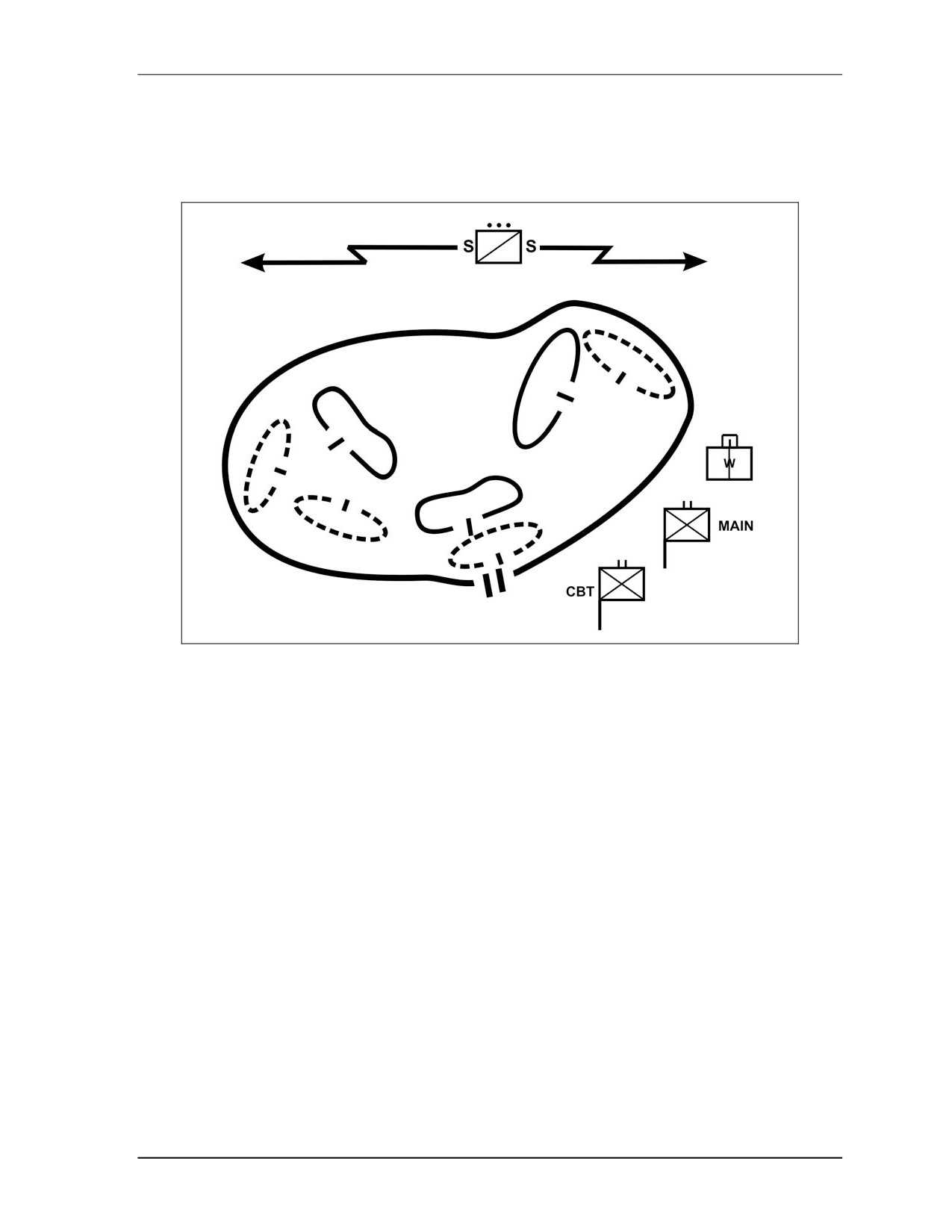
5-177. A BP is a general location and orientation of forces on the ground from which units defend.
Battalion- to squad-size units can use BPs (Figure 5-10).
Figure 5-10. Disposition of forces in and about a BP.
USE OF BATTLE POSITIONS
5-178. The commander’s use of BPs reduces his directives to subordinate commander and gives them
more freedom for placement of forces. Battle positions are graphic control measures identified by number,
letter, name, or a combination of these.
THREE LEVELS OF PREPARATION FOR A BATTLE POSITION
5-179. The three levels of preparation for a BP are: occupy, prepare, and plan. The use of on-order BPs
with the associated tasks "prepare" or "planned" adds flexibility and depth to the defensive plan.
Occupy
5-180. Occupation is complete preparation of the position where the company will initially defend. The
unit fully plans, prepares, and occupies the position before the "defend NLT" time specified in the battalion
OPORD. The company must rehearse the occupation, and the commander must establish a trigger for
occupation of the position.
Prepare
5-181. Preparation per se means that the unit fully reconnoiters the position and the corresponding EA,
marking positions in the BP and fire control measures in the EA. From the BP, the unit must accomplish all
13 December 2006
FM 3-21.20
5-43
Chapter 5
actions to enable it to execute the mission immediately on occupation. Planning, coordination, and
rehearsals are required for the unit to displace to the BP and accomplish the mission. Despite time
constraints, the unit digs in survivability positions, constructs fighting positions, designates target reference
points
(TRPs), develops direct and indirect fire plans, emplaces obstacles, clears fields of fire, and
prestocks ammunition. Prepare missions are normally critical to the defense. A unit assigned such a
mission must maintain security on the position and on the routes to it.
Plan
5-182. Planning means that the unit fully reconnoiters the EA and BP. They specifically plan tentative
unit positions in the BP, and they establish fire control measures in the EA. They also coordinate and plan
for defense from the position. Also, leaders reconnoiter, select, and mark positions, routes, and locations
for security elements. Then, they coordinate movement and other actions, such as preparing obstacles and
occupation plans, with other elements of the battalion.
MANEUVER
5-183. The commander can move his elements freely within the assigned BP. To comply with the
commander's intent, units can maneuver outside the BP to adjust fires or to seize opportunities for
offensive action. Battalion security, fire support, protection, and sustainment assets are often positioned
outside the BP with approval from the headquarters assigning the BP. Repositioning of units between BPs
must be carefully coordinated to prevent fratricide.
SPACE ALLOCATION
5-184. The commander allocates space to subordinate elements within the BP area based on the space
available, terrain, and mission task. The battalion commander thinks two levels down or in terms of platoon
BPs when he selects a BP for subordinate companies. When practical, he should allow enough space on
each BP for dispersed primary, alternate, and supplementary positions for key weapons. The battalion
commander can vary the number of maneuver elements in the battalion BP by allocating larger company
BPs. Battle positions can also reflect positions in depth. They may take a shape other than the standard
oblong shape, which suggests a linear defense within the BP. Large positions also increase dispersion to
counter artillery and chemical munitions. The commander can combine company AO and BPs in the
battalion AO to suit the tactical situation.
TYPES OF BATTLE POSITIONS
5-185. There are five types of BPs: primary, alternate, supplementary, subsequent, and strongpoint.
Primary Positions
5-186. Primary positions cover the enemy’s most likely avenue of approach into the area. A primary
position is the best position to accomplish the assigned mission. Routes between battle positions should be
well known and rehearsed (optimally under the same conditions expected during execution).
Alternate Positions
5-187. Alternate positions are those assigned for use when the primary position becomes untenable or
unsuitable for carrying out the assigned task. These positions allow the defender to carry out his original
task, such as covering an avenue of approach or EA, using the original direct fire plan. Alternate positions
increase the defender’s survivability by allowing engagement of the enemy from multiple positions and
movement to other positions in case of suppressive or obscuring fires.
5-44
FM 3-21.20
13 December 2006
Defensive Operations
Supplementary Positions
5-188. Supplementary positions are designated to cover avenues of approach that are not expected to be
the enemy’s primary avenue.
Subsequent Positions
5-189. Subsequent positions are those to which the unit expects to move during the course of the
engagement. The defending unit may have a series of subsequent positions
(particularly in delay
operations), each with associated primary, alternate, and supplementary positions.
Strongpoints
5-190. Strongpoints are heavily fortified BPs tied into an existing or reinforcing obstacle, to create an
anchor for defenses, or to deny the enemy key or decisive terrain. Strongpoints require extensive time,
engineering support, and Class IV resources to construct and normally require increased Class V to defend.
The battalion may be given strongpoint missions in rare instances; however, the static nature of the
operation, and the resources required to conduct the strongpoint make it an unusual mission assignment.
13 December 2006
FM 3-21.20
5-45
Chapter 5
CONDUCT A REVERSE SLOPE DEFENSE
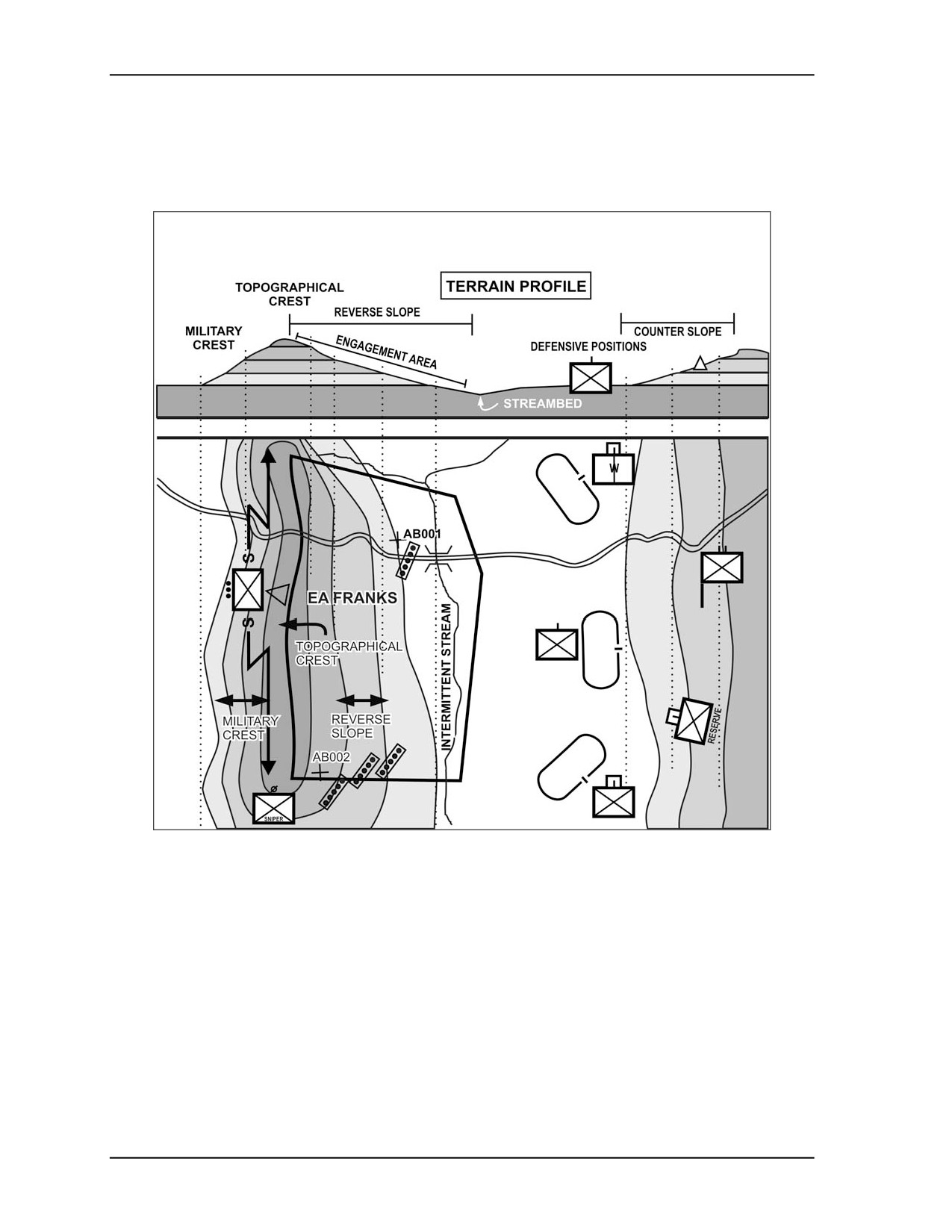
5-191. A reverse slope defense is organized to use a topographical crest to mask the defender from the
attacker's observation and from supporting direct fire (Figure 5-11).
Figure 5-11. Organization of the reverse slope defense.
CONDITIONS
5-192. The battalion commander may adopt a reverse slope position for elements of the battalion when
the following conditions exist. Surprising and deceiving the enemy about the true locations of the battalion
defensive positions is vital:
• Enemy fire makes the forward slope untenable.
• Lack of cover and concealment on the forward slope makes it untenable.
• The forward slope has been lost or has not yet been gained.
• The forward slope is exposed to enemy direct fire weapons fired from beyond the effective
range of the defender's weapons. Moving to the reverse slope removes the attacker's standoff
advantage.
5-46
FM 3-21.20
13 December 2006
Defensive Operations
• The terrain on the reverse slope affords better fields of fire than the forward slope.
• The defender must avoid creating a dangerous salient.
• The commander is forced to assume a hasty defense while in contact with or near the enemy.
ADVANTAGES
5-193. The following are some advantages of a reverse slope defense:
• Enemy ground observation of the battle area is masked, and degrades the observation
capabilities of most surveillance devices and radar.
• Enemy direct fire weapons cannot effectively fire on the position without coming within range
of the defender's weapons.
• The enemy must expose a majority of his force in an EA, if he wishes to mass the effects of his
direct fire weapons.
• The enemy must try to breach obstacles on the reverse slope within direct fire range of all the
defender's weapons. (The attacker cannot locate these obstacles until he encounters them; thus
reducing his reaction time and maneuver space.)
• The enemy is deceived as to the strength and location of defensive positions.
• Enemy indirect fire is less effective since he cannot see the defender.
• The defender gains tactical surprise.
• The lack of enemy ground observation allows more freedom of movement within the battle
area.
• CCM (Javelins and TOW missile systems), if positioned properly, can mass fires on the reverse
military crest; Infantry small-arms weapons can contribute their close fires to the battle.
• The unit can dig in more quickly even when the enemy is approaching because the slope of the
hill covers and conceals the unit from the direct fire and observation of approaching enemy
ground forces. Defenders can concentrate on position preparation.
DISADVANTAGES
5-194. The following are some disadvantages of a reverse slope:
• Observation of the enemy may be limited, and the defender may be unable to cover obstacles to
the front by direct fire.
• The topographical crest may limit the range of important direct-fire weapons. These weapons
may have to locate separately from the Infantry elements to exploit their range.
• The enemy holds the high ground in an attack. His attack is downhill; the counterattack is
uphill.
• Because the reverse military crest must be controlled, the effectiveness of the reverse slope
defense is reduced during limited visibility.
ORGANIZATION OF DEFENSIVE POSITION
5-195. The battalion commander organizes the defensive position IAW procedures that apply to all
defensive techniques.
Forward Edge of Position
5-196. The forward edge of the position should be within small-arms range of the crest. It should be far
enough from the crest that fields of fire allow the defender time to place well-aimed fire on the enemy
before he reaches friendly positions.
13 December 2006
FM 3-21.20
5-47
Chapter 5
Flanking Fires
5-197. A reverse slope position is most effective when units on adjacent terrain can place flanking fires
on the forward slope.
Security Force
5-198. The units should establish a security force to the front to stop or delay the enemy, to disorganize
his attack, and to deceive him as to the location of the defensive position. When this security element
withdraws, the unit must maintain observation, indirect fire, and security to the front. After withdrawing,
the security force may either become the reserve force or move into a battle position for the main
engagement. The mobility, optics, and long range direct fire capabilities of the weapons company, can
provide tremendous advantages for the battalion as the security force.
Observation Posts/Combat Outposts
5-199. The unit establishes observation posts or combat outposts on or forward of the topographical
crest. This allows long-range observation over the entire front, and indirect fire coverage of forward
obstacles. Observation posts or combat outposts are usually provided by the reserve, and may vary in size
from a few Soldiers to a reinforced platoon. They should include forward observers. At night, their number
may be increased to improve security. Depending upon their specific mission, these positions must be
prepared to conduct surveillance, patrols, engage enemy reconnaissance, and engage the main body forces.
DEFEND A STRONGPOINT
5-200. The mission to create and defend a strongpoint implies retention of terrain to stop or redirect
enemy formations. Battalion strongpoints can be established in isolation when tied to restricted terrain on
their flanks or on mounted avenues of approach tied to unit defensive positions on the strongpoint flanks.
Strongpoints may be on the FEBA or in depth in the MBA (Figure 5-12). A bypassed strongpoint exposes
enemy flanks to attacks from friendly forces inside and outside the strongpoint.
5-48
FM 3-21.20
13 December 2006
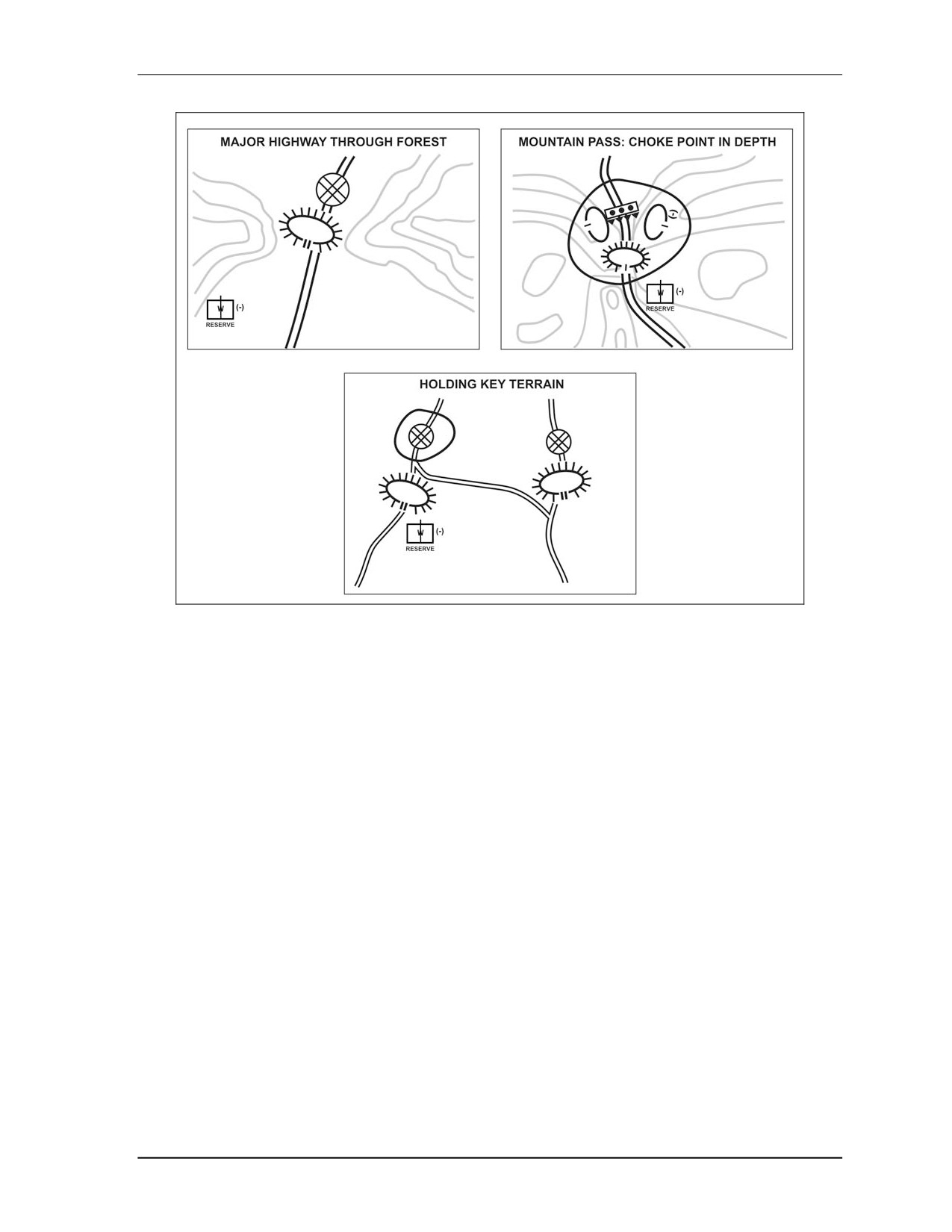
Defensive Operations
Figure 5-12. Examples of strongpoints.
PLANNING A STRONGPOINT DEFENSE
5-201. The battalion pays a high cost in manpower, equipment, material, and time to construct a
strongpoint. It takes several days of dedicated work to construct a strongpoint defense.
Enemy Assault
5-202. When the enemy cannot easily bypass a strongpoint, the unit should expect and be ready to repel
repeated enemy assaults. The strongpoint will probably receive intensive artillery attacks and must be
prepared with overhead cover. Multiple positions in the strongpoint provide defense in depth. Combat
vehicles committed to the strongpoint defense use multiple firing positions while Infantry squads use
positions tied together with trenches. A battalion assigned a strongpoint mission—
• Plans movement to alternate positions in the strongpoint.
• Coordinates with forces outside the strongpoint, especially counterattack forces.
• Plans direct fires in detail and receives fire support priority.
• Establishes a small reserve to counter penetrations and, when appropriate, attacks outside the
strongpoint.
Mutual Support
5-203. All positions in a strongpoint are mutually supporting (Figure 5-13). Positioning must allow
massing of the fires of two or more units in the primary EA and prevent the enemy from isolating positions
and defeating them in detail. Sectors of fire help coordinate and mass fires between positions. Avenues of
13 December 2006
FM 3-21.20
5-49
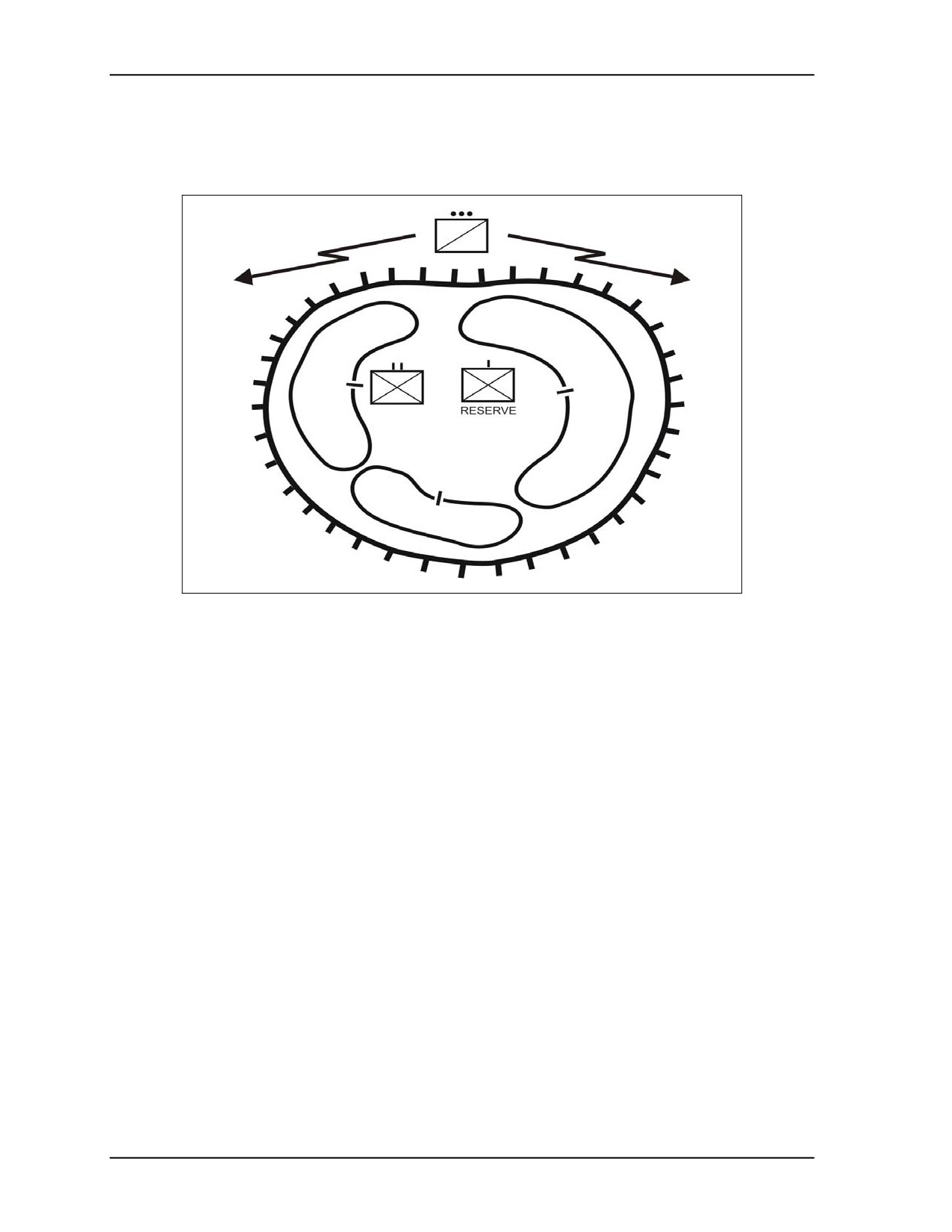
Chapter 5
approach into and around the strongpoint that cannot be covered by forces in primary positions must be
kept under surveillance and covered by supplementary positions prepared in as much detail as time permits
and occupied on order.
Figure 5-13. Battalion strongpoint, all forces within the strongpoint.
Forces Operating outside Strongpoint
5-204. In some situations, the battalion defends from a strongpoint with forces operating outside the
strongpoint. Security forces may operate forward or perform economy of force missions. Upon their return
to the strongpoint, security forces should screen a secondary avenue of approach, occupy a position in
depth, or become the reserve.
Employment Considerations
5-205. If practical, weapons company CCM antiarmor forces occupy positions in depth to take advantage
of their long-range fires. Alternate and supplementary positions are planned throughout the strongpoint and
AO. Consideration should be given to operating the mortars in split section to provide greater coverage for
the battalion, and avoid massing these key weapons in anticipation of great volumes of enemy artillery
fires. Combat trains, with emergency resupply of Classes II and V, are placed in prepared defilade
positions or buildings in the strongpoint. Supplies may be pre-positioned near primary, alternate, and
successive positions. The BCT provides units to keep the main supply route open.
Security Force
5-206. As with other types of defenses, the commander may use a company as part of the security force
to provide information through contact and spot reports. The company assigned the security mission
screens the battalion AO or along the most dangerous avenue of approach. This company provides early
warning to the battalion, destroys enemy reconnaissance elements, and helps shape the battlefield so the
enemy is directed against the strongpoint.
5-50
FM 3-21.20
13 December 2006
Defensive Operations
INTELLIGENCE SUPPORT FOR A STRONGPOINT
5-207. The strongpoint represents the culmination of the S-2's IPB and the commander's estimate of the
situation. Based on a METT-TC analysis, the battalion commander identifies the piece of ground as
decisive terrain. This piece of ground is the strongpoint.
Terrain Analysis
5-208. The S-2 conducts a detailed analysis of the terrain. Unlike other types of defense, the strongpoint
must be defensible in 360 degrees. As a result, the terrain analysis is conducted with the understanding that
enemy offensive operations, from an infiltration to a major attack, could appear from any direction
(multiple avenues of approach).
Reconnaissance and Surveillance Plan
5-209. The reconnaissance and surveillance plan is essential to the strongpoint’s effectiveness. Some
reconnaissance assets may be able to operate outside of the position to provide initial early warning. If the
strongpoint becomes encircled, the unit must be able to anticipate the actions of the enemy and respond
internally. OPs positioned outside the position must be sustainable should the strongpoint become
surrounded. The unit should have a plan for bringing patrols or other reconnaissance and surveillance
assets into the position despite enemy presence.
Maneuver Concept
5-210. The strongpoint defense is the most labor-intensive operation a battalion commander may execute.
Despite its static nature, the construction must allow for maximum flexibility. The key to an effective and
sustainable strongpoint defense is to have a solid obstacle and direct and indirect fire plan coupled with
properly constructed fortifications. The commander must take a personal interest in the interface between
maneuver, fire support, protection, and sustainment elements.
Positions
5-211. The actual construction of the battalion EA and the direct fire control measures for a battalion
strongpoint are identical to that discussed in earlier sections. After the S-2’s IPB initiates the EA
development process, the selection of company combat, protection, and sustainment positions is the first
priority of the battalion commander. He must plan so that his weapons systems can engage the enemy
effectively, along the major expected enemy avenue of approach. The S-2's line-of-sight analysis, the IPB,
and the obstacle plan determine these positions. The actual construction of the battalion EA and the direct
fire control measures are identical to that discussed in earlier sections. The considerations for weapons
systems employment; however, may be different, particularly with respect to the lack of depth in the
strongpoint. In a strongpoint, it is much more difficult to achieve depth of fires than in AO defensive
operations.
Defensive Position Selection
5-212. Once the commander has determined the locations suitable for each type weapon system, he
selects the company defensive positions. He addresses several considerations before finalizing the
defensive positions. First, how much firepower is needed to cover the enemy avenue of approach? Second,
how the defensive positions can be selected so they can be responsive to enemy attacks from other
directions? Third, what task organization is best suited to the terrain and meets the security needs of the
battalion?
13 December 2006
FM 3-21.20
5-51
Chapter 5
STRONGPOINT ENGINEER SUPPORT
5-213. The supporting engineer element commander or platoon leader accompanies the maneuver
commander on the reconnaissance of the strongpoint area. He helps plan indirect fires and SCATMINEs to
slow, disrupt, and canalize the advancing enemy. He also prepares the position to make it physically
impassable to armored or mechanized forces, severely restricted for dismounted forces, and to enhance the
killing power of CCM antiarmor weapons with obstacles. The commander determines emplacement
priority for fighting positions and obstacles and allocates the assets needed to accomplish the mission.
Strongpoints are constructed from inside to outside. Regardless of the configuration of the strongpoint, the
following are essential tasks to be performed:
• Prepare obstacles to prevent them from being overrun.
• Emplace obstacles at optimum weapon range.
• Construct protected routes between positions.
• Plan and coordinate for SCATMINEs.
RESERVE
5-214. In a strongpoint defense, it is important to maintain a reserve that can quickly react to enemy
activity against the position. The reserve may—
• Block an enemy penetration of the perimeter.
• Reinforce a position or section of the defense.
• Counterattack to restore a portion of the strongpoint.
STRONGPOINT FIRE SUPPORT
5-215. If the enemy is able to reach the strongpoint in significant strength, the close-in fire support plan
is essential to the integrity and survivability of the position. Fires are planned on obstacles close to the
position, even if they are within minimum safe distances. Evacuation of the position may become
necessary during the engagement. If fires are planned on the position, the unit can destroy the enemy and
reoccupy the positions for continued defense. The indirect fires plan will normally allocate fires before, on,
and beyond the strongpoint. Figure 5-14 shows the overall battalion fire support plan.
5-52
FM 3-21.20
13 December 2006
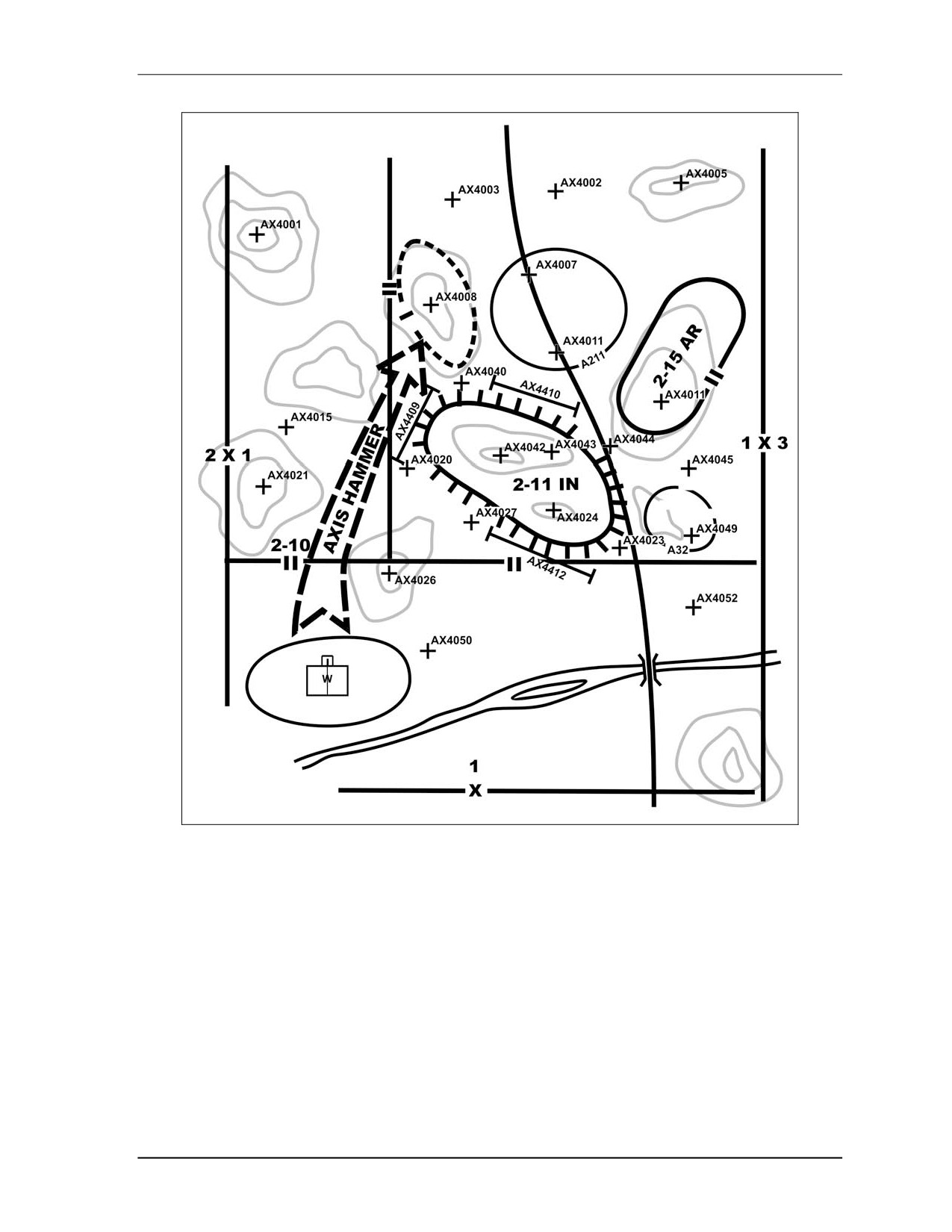
Defensive Operations
Figure 5-14. Strongpoint fire support plan.
PROTECTION
5-216. The AD commander and S-2 identify positions to facilitate engagements of enemy fixed- and
rotary-wing aircraft. The AD commander ensures the engineers site actual positions properly. Engineers
know how to construct positions, but the "occupant" must ensure the position is properly oriented.
STRONGPOINT SUSTAINMENT
5-217. The battalion S-4 helps plan for the following aspects of sustainment in a strongpoint.
13 December 2006
FM 3-21.20
5-53
Chapter 5
Cache
5-218. The S-4 examines the strongpoint construction plan and determines the best places to cache
ammunition and supplies. The units refine the cache plan by positioning smaller caches adjacent to
individual crew-served weapons. Once the unit caches have been identified or sited, the battalion S-4
develops a resupply plan. Battalion caches must be dispersed throughout the strongpoint to prevent a single
detonation.
Medical Support
5-219. Medical personnel must be ready to evacuate wounded from the perimeter to the aid station. The
aid station is dug in, with easy access to each unit. The aid station should have access to a water supply,
generators, and a bunker, if possible. In an elongated strongpoint, the aid station may split to provide
support from two locations.
Refuel Points
5-220. Even though combat vehicles in the position may be static, they still burn fuel during idling and
scanning. The battalion should develop a refueling plan for the weapons company vehicles.
Combat Trains CP
5-221. The CTCP is usually dug in separately from the battalion CP. It serves as the alternate CP should
the main CP be destroyed. It is normally positioned away from the main CP but in proximity to the aid
station and supply activities. The CTCP must establish redundant communications with the main CP so that
direct communication is possible between the two headquarters.
STRONGPOINT COMMAND AND CONTROL
5-222. The commander develops his strongpoint defense plan by using the terrain to its utmost
advantage. His observation posts must afford the opportunity to observe the battle, and he must be able to
traverse the strongpoint and respond to an attack from any direction. Communications systems must be
redundant. The battalion should use all digital, FM, and wire means available. Communication wire should
be buried deep in the strongpoint and field phones made available throughout the position.
CONDUCT A PERIMETER DEFENSE
5-223. A perimeter defense is a defense oriented in all directions (Figure 5-15). The battalion uses it for
self-protection. The battalion establishes a perimeter defense when it must hold critical terrain in areas
where the defense is not tied in with adjacent units or existing obstacles. The battalion may also form a
perimeter when it has been bypassed and isolated by the enemy and must defend in place. Unless executing
a strongpoint, the perimeter defense usually does not take considerable time and resources to execute.
5-224. These differences are in contrast to the strongpoint defense, in which the position is tied in with
the rest of the defense and considerable time and resources are spent to retain key or decisive terrain.
5-54
FM 3-21.20
13 December 2006
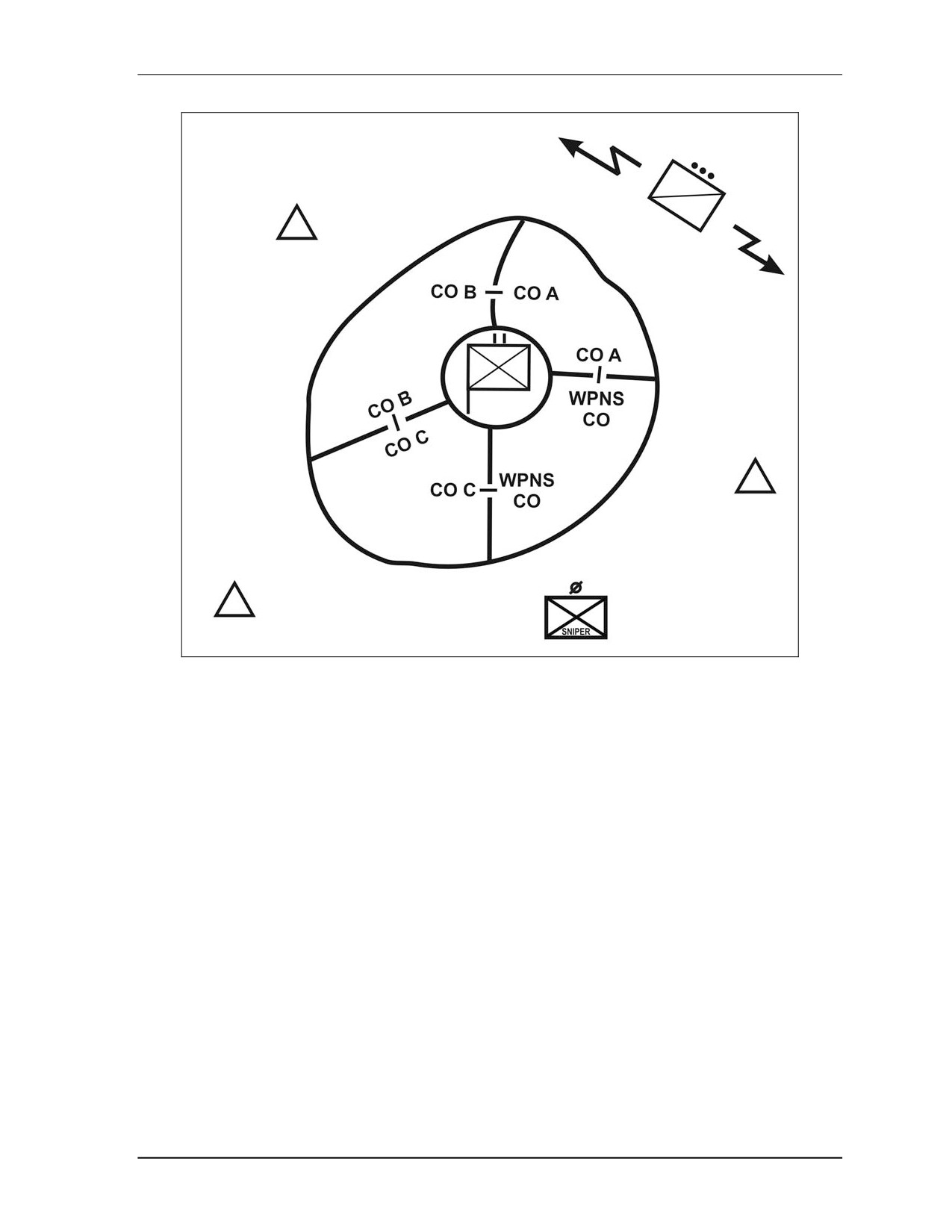
Defensive Operations
Figure 5-15. Perimeter defense.
PLANNING CONSIDERATIONS
5-225. While in a perimeter defense, the battalion should consider the following:
• Positioning CCM antiarmor weapons systems on restricted terrain to overwatch mounted
avenues of approach.
• Maximum depth allowed by the diameter of the perimeter through the location of security
elements, the reserve, and secondary sectors of fire of CCM antiarmor weapons.
• Construction of obstacles to fix or block the enemy for effective engagement.
• Positioning and scheduling of ISR assets that provide 360 degree and 24 hour coverage.
• Allocation of a reserve and quick reaction forces.
• Task organization of battalion with special attention to weapons company and security force.
SECURITY FORCE
5-226. The battalion commander employs a security force outside the perimeter for early warning. He
augments the security force with patrols and OPs controlled by subordinate companies on the perimeter.
Periodic patrols cover areas that stationary elements cannot observe.
13 December 2006
FM 3-21.20
5-55
Chapter 5
BATTALION RESERVE
5-227. The battalion reserve defends a portion of the second line of defense behind the perimeter
elements. The reserve must have the mobility to react to enemy action in any portion of the perimeter. It is
positioned to block the most dangerous avenue of approach and is assigned supplementary positions on
other critical avenues. If the enemy penetrates the perimeter, the reserve blocks the enemy penetration or
counterattacks to restore the perimeter. After committing the reserve, the commander immediately
designates a new reserve force to meet other threats.
COMMAND AND CONTROL
5-228. The battalion in a perimeter defense normally sets up two C2 operations; one for operations
conducted outside the perimeter, and one to conduct base defense. See Appendix M for more information
on C2 of base operations.
FIRE SUPPORT, PROTECTION, AND SUSTAINMENT
5-229. Fire support, protection, and sustainment elements may support from inside the perimeter or from
another location depending on the mission and status of the battalion, the type of transport available, the
weather, and the terrain. All sustainment assets inside the perimeter fall under the control of the battalion or
base commander, and should be in a protected location where they can provide continuous support. They
should also be integrated into the base security and defense plans. Since resupply may have to be done by
air, the position should include or be near a landing or drop zone. The availability of LZs and DZs
protected from the enemy's observation and fire is a main consideration in selecting and organizing the
position. Since aerial resupply is vulnerable to weather and enemy fires, commanders must emphasize
supply economy and protection of available stocks.
RESERVE
5-230. The reserve is a force withheld from action to be committed at a decisive moment within the
decisive operation. It provides the commander with the flexibility to exploit success or deal with a tactical
setback and the flexibility to respond in situations where there is a great deal of uncertainty about the
enemy. Normally, the battalion commander can only allocate a company as a reserve. This decreases the
ability of the battalion to respond to tactical emergencies or to exploit success. It increases the significance
of the BCT’s reserve element, which may be only a company or a two-company battalion operating over an
extended area. Situational obstacles, fires, UAS, CAS, and attack aviation can be used to augment
reserve forces.
5-231. The reserve’s likely tasks are issued as planning priorities and may include one or more of
the following:
• Counterattack locally.
• Defeat enemy air assaults
• Block enemy penetrations.
• Reinforce a committed company.
• Protect rear area operations.
• Secure high-value assets.
5-232. During defensive preparations, the battalion commander may employ his reserve in other tasks
such as security operations, rear area security, or obstacle emplacement. The commander must balance
these uses with the needs to protect his reserve, and with the reserve commander’s requirement to conduct
troop-leading procedures, coordination, and reconnaissance.
5-233. The commander and staff determine where and under what conditions the reserve force is likely to
be employed in order to position it effectively and give it appropriate planning priorities. The reserve force
5-56
FM 3-21.20
13 December 2006
Defensive Operations
commander analyzes his assigned planning priorities, conducts the coordination with units that will be
affected by his maneuver and commitment, and provides information to the commander and staff on routes
and employment times to designated critical points on the battlefield.
QUICK REACTION FORCE
5-234. The commander may allocate a quick reaction force (QRF) if he deems it necessary. The QRF is a
force withheld from action to be committed by the commander at a decisive moment within shaping,
decisive, or sustaining operations. This force is usually tailored to a specific threat, and potential missions.
It provides the commander with the flexibility of committing forces for emergencies throughout the
battlefield, without losing the combat power of his reserve force for decisive operations.
COUNTERATTACK
5-235. The battalion may conduct local counterattacks to restore or preserve defensive integrity or to
seize initiative upon unanticipated opportunities. The counterattack force is usually pre-positioned in a
location of advantage, and has mobility to respond quickly to the threat. Unless defensive operations have
left the battalion largely unscathed, the battalion usually lacks the ability to conduct a significant
counterattack by itself. Within the context of the BCT’s operations, a defending battalion may execute a
counterattack to support the BCT’s defensive posture, as part of a larger force seeking to complete the
destruction of the enemy’s attack, or as part of a transition to offensive operations.
Section VI. MANEUVER AND PROTECTION INTEGRATION
Much of the strength of a defense rests on the integration and construction of reinforcing obstacles, exploitation
of existing obstacles, and actions to enhance the survivability of the force through construction of fighting
positions and fortifications. The commander’s intent focuses countermobility and survivability planning
through his articulation of obstacle intent (target, relative location, and obstacle effect) and priorities and
establishment of priorities for survivability and countermobility. Guided by that intent, the battalion engineer
(usually the DS engineer platoon leader) develops a scheme of engineer operations that includes engineer task
organization, priorities of effort and support, subordinate engineer unit missions, and countermobility and
survivability instructions for all units. Chapter 10 contains information on engineer systems and capabilities.
COUNTERMOBILITY
5-236. The commander and staff develop the obstacle plan concurrently with the fire support plan and
defensive scheme, guided by the commander’s intent. (Figure 5-16 shows an example of a battalion
obstacle plan.) They integrate into the intelligence collection plan the use of intelligent minefields such as
Raptor, if allocated. The commander’s intent for countermobility should contain three elements:
TARGET
5-237. The target is the enemy force that the commander wants to affect with fires and tactical obstacles.
The commander identifies the target in terms of the size and type of enemy force, the echelon, the avenue
of approach, or a combination of these methods.
EFFECT
5-238. This is the intended effect that the commander wants the obstacles and fires to have on the
targeted enemy force. Tactical obstacles produce one of the following effects: block, turn, fix, or disrupt
(Table 5-2). The obstacle effect drives integration, focuses subordinates’ fires, and focuses the obstacle
effort.
13 December 2006
FM 3-21.20
5-57
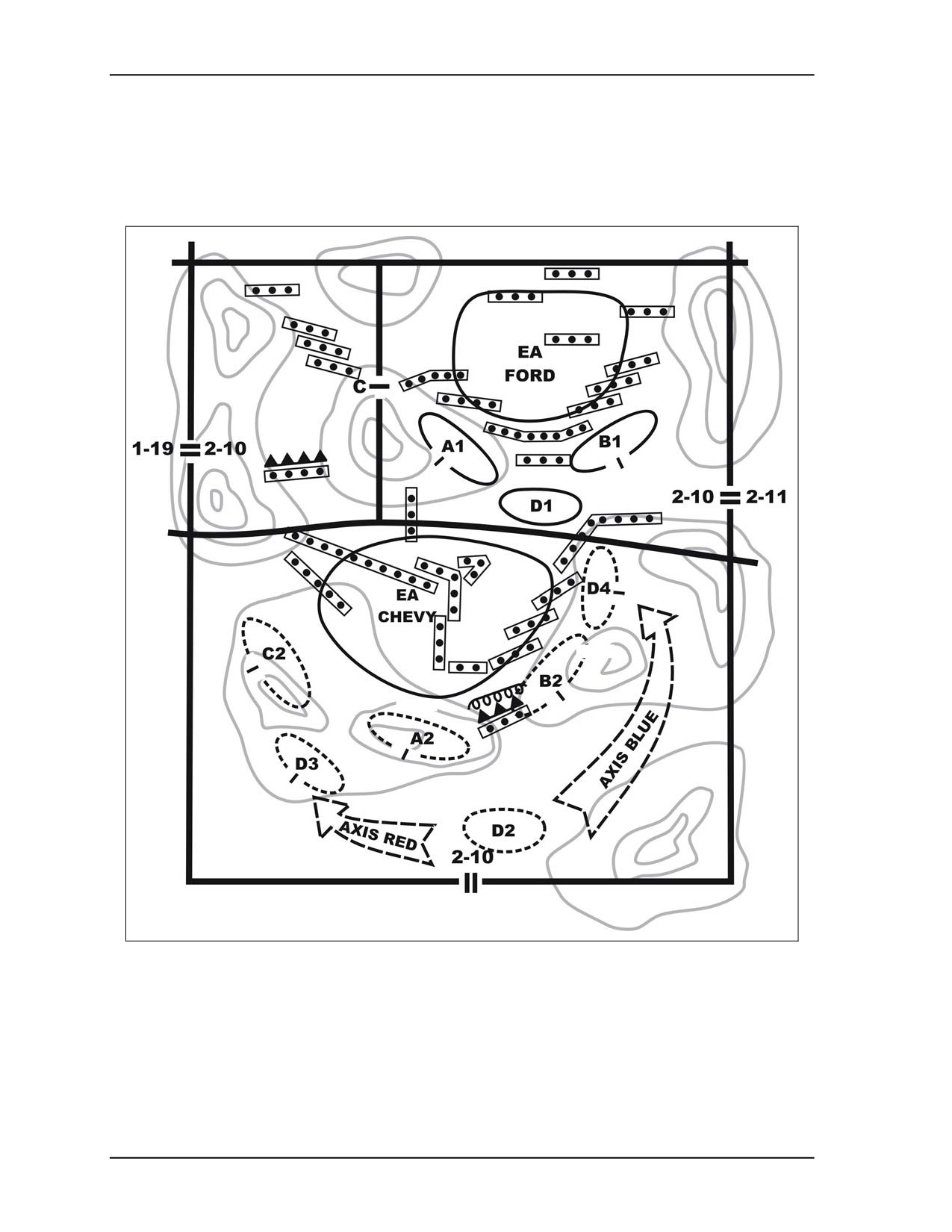
Chapter 5
RELATIVE LOCATION
5-239. The relative location is where the commander wants the obstacle effect to occur against the
targeted enemy force. Whenever possible, the commander identifies the location relative to the terrain and
maneuver or fire control measures to integrate the effects of obstacles with fires.
Figure 5-16. Example of a battalion obstacle plan.
5-58
FM 3-21.20
13 December 2006

Defensive Operations
Table 5-2. Obstacle effects.
Obstacle
Fires And
Effect
Purpose
Obstacles Must--
Obstacle Characteristics
•
Breakup enemy
•
Cause the enemy to deploy
•
Do not require extensive
formations.
early.
resources.
•
Interrupt the enemy's
•
Slow part of his formation
•
Difficult to detect at long
timetable and C2.
while allowing part to advance
range.
DISRUPT
unimpeded.
•
Cause premature
commitment of breach
assets.
•
Cause the enemy to
piecemeal his attack.
•
Slow an attacker within
•
Cause the enemy to deploy
•
Arrayed in depth.
an area so he can be
into attack formation before
•
Span the entire width of the
destroyed.
encountering the obstacles.
avenue of approach.
FIX
•
Generate the time
•
Allow the enemy to advance
•
Must not make the terrain
necessary for the
slowly in an EA or AO.
appear impenetrable.
friendly force to
•
Make the enemy fight in
disengage.
multiple directions once he is
in the EA or AO.
•
Force the enemy to
•
Prevent the enemy from
•
Tie into impassable terrain
move in the direction
bypassing or breaching the
at the anchor point.
desired by the friendly
obstacle belt.
•
Consist of obstacles in
commander.
•
Maintain pressure on the
depth.
TURN
enemy force throughout the
•
Provide a subtle orientation
turn.
relative to the enemy's
•
Mass direct and indirect fires
approach.
at the anchor point of the turn.
•
Stop an attacker along a
•
Prevent the enemy from
•
Must tie into impassable
BLOCK
specific avenue of
bypassing or penetrating
terrain.
approach.
through the belt.
•
Consist of complex
•
Prevent an attacker from
•
Stop the enemy's advance.
obstacles.
passing through an AO
•
Destroy all enemy breach
•
Defeat the enemy's mounted
or EA.
efforts.
and dismounted breaching
effort.
•
Stop the enemy from
using an avenue of
approach and force him
to use another avenue of
approach.
•
Breakup enemy
•
Cause the enemy to deploy
•
Do not require extensive
formations.
early.
resources.
•
Interrupt the enemy's
•
Slow part of his formation
•
Difficult to detect at long
timetable and C2.
while allowing part to advance
range.
DISRUPT
unimpeded.
•
Cause premature
commitment of breach
assets.
•
Cause the enemy to
piecemeal his attack.
TACTICAL OBSTACLES
5-240. Obstacles are force-oriented combat multipliers. The battalion employs tactical obstacles to attack
the enemy’s ability to move, mass, and reinforce directly. Tactical obstacles are integrated into the scheme
13 December 2006
FM 3-21.20
5-59