FM 3-21.20 (FM 7-20) THE INFANTRY BATTALION (DECEMBER 2006) - page 3
Chapter 4
battalion organization. The BCT commander should provide specific guidance to the Infantry battalions
regarding the composition of the reserve as well as the rules for the use of the reserve.
4-23. The Infantry battalion reserve can be as small as an infantry platoon or an assault weapons platoon.
The commander and staff must look for opportunities to use other assets, such as fires and situational
obstacles, to assist with the reserve mission. To generate larger ground maneuver reserves, the Infantry
battalion commander must redirect committed elements after they have accomplished their initial tasks or
when the enemy’s defeat frees them for other tasks.
4-24. The speed and agility of the combat platoons allow them to be committed, withdrawn, redirected,
and recommitted during the fight. The rotation of units into the reserve role requires the best possible
information available. Moving a unit from one area (left to right or front to rear) requires everyone in the
unit to know where they are, where the enemy is, and where other friendly units are located. Also, the
movement of ground forces over the distances expected in the expanded battlespace requires time. The
time and distance relationship for both mounted and dismounted actions, especially under limited visibility
conditions and rough terrain, is a key factor in determining which units the commander can realistically
consider as a possible reserve force.
4-25. The Infantry battalion reserve follows the main attack at a distance sufficient to keep it from
interfering with the movement of the lead company and to maintain its freedom of maneuver. The reserve
maintains the flexibility to shift its attack if the main effort changes.
4-26. The reserve commander must understand the commander’s intent, especially the decision points and
conditions for commitment of the reserve. The reserve commander must remain updated on the situation
and possess the same common operational picture (COP) as the combined arms battalion commander.
FOLLOW AND SUPPORT
4-27. In exploitation and pursuit operations, the Infantry battalion is normally not employed by BCTs and
higher echelon units in a follow and support role. Follow and support is a task in which a committed force
follows and supports the unit conducting the main attack. A follow and support task is assigned to a unit to
prevent the unit conducting the main attack (usually the Infantry battalion main effort) from having to
commit its combat power away from its primary task. A follow and support force executes one or more of
the following tasks:
y Destroy bypassed enemy forces.
y Block movement of enemy reinforcements.
y Secure routes or key terrain.
y Clear obstacles or reduce additional obstacle lanes.
y Guard or secure enemy prisoners, detainees, key areas, and installations.
y Recover friendly battle losses.
y Control refugees.
y Reinforce the main effort.
4-28. When operating as a follow and support force, the Infantry battalion’s movement techniques are
similar to those used in a movement to contact. The Infantry battalion coordinates plans with the unit it
follows. Both units exchange situation reports frequently to coordinate operations.
FOLLOW AND ASSUME
4-29. Follow and assume is a task in which a committed force follows another force, normally the main
effort, and is prepared to assume the mission of the other force if that force is fixed, halted, or unable to
continue. The follow and assume force maintains contact with the trail elements of the other force and
monitors all combat information and intelligence. It can maintain this contact through digital tools or by
physical contact. The COP should provide the same picture of the battle to the follow-on force as is
available to the lead force.
4-6
FM 3-21.20
13 December 2006
Offensive Operations
4-30. The follow and assume force is prepared to conduct a forward passage of lines but should try to pass
around a flank of the lead force when assuming its mission. Also, the following force avoids becoming
decisively engaged with enemy forces bypassed by the force it is following. The Infantry battalion S-2
must ensure that the following force is provided current information and disposition of the bypassed enemy
forces as well as a current picture of the enemy forces the lead element faces and those it expects to face.
4-31. Crucial actions to support the commitment of the follow and assume force include the following:
y Maintain current information on the enemy and friendly situation.
y Shift observers and reconnaissance assets as required.
y Develop graphic control measures to ensure a rapid passage of lines or passing on a flank.
y Ensure terrain is allocated for rapid movement while maintaining force protection.
y Be prepared for the shift in priority of support. Reposition assets and retask organize as
required.
y Activate emergency resupply operations as necessary.
y Establish direct-fire control measures and fire support coordination measures (FSCMs) such as
restrictive fire lines (RFLs).
Section III. SEQUENCE
The commander and staff consider preparation and execution as they plan an offensive mission.
PREPARATION
4-32. The battalion conducts extensive reconnaissance and surveillance of the objective to support the
commander’s decisions on how to employ his combat power against the enemy. He normally does not
make final decisions as to the exact conduct of the operation until reconnaissance and surveillance
operations determine, to the greatest extent possible, the enemy situation. The commander and staff direct
and supervise mission preparations to prepare the battalion for the battle. The battalion employs security
forces to protect and conceal attack preparations from the enemy while exercising OPSEC. Preparation
time is also used to conduct precombat checks and inspections, rehearsals at all levels, and sustainment
activities.
EXECUTION
4-33. Execution generally consists of the following five sequential events:
y Movement to the line of departure.
y Approach to the objective.
y Actions on the objective.
y Consolidation and reorganization.
y Transition.
MOVEMENT TO LINE OF DEPARTURE
4-34. When attacking from positions not in contact, battalions often stage in assembly areas, road march to
attack positions behind friendly units in contact with the enemy, conduct passage of lines, and begin the
attack. When attacking from positions in direct contact, the line of departure is the same as the line of
contact. In certain circumstances (noncontiguous operations), there may not be a line of departure.
13 December 2006
FM 3-21.20
4-7
Chapter 4
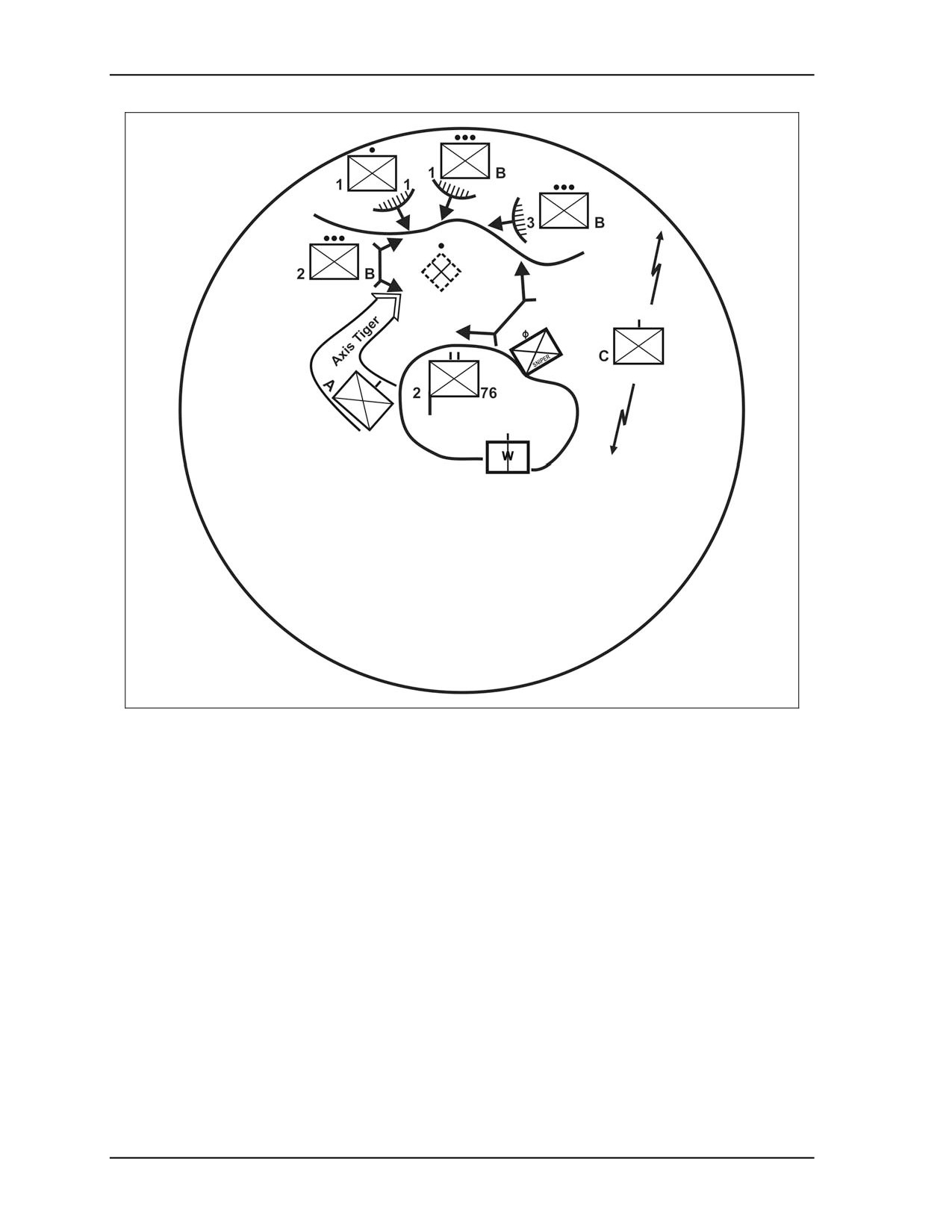
APPROACH TO OBJECTIVE
4-35. The commander and staff plan the approach to the objective to ensure security, speed, and flexibility.
They select routes, techniques, formations, and methods that best support actions on the objective. All
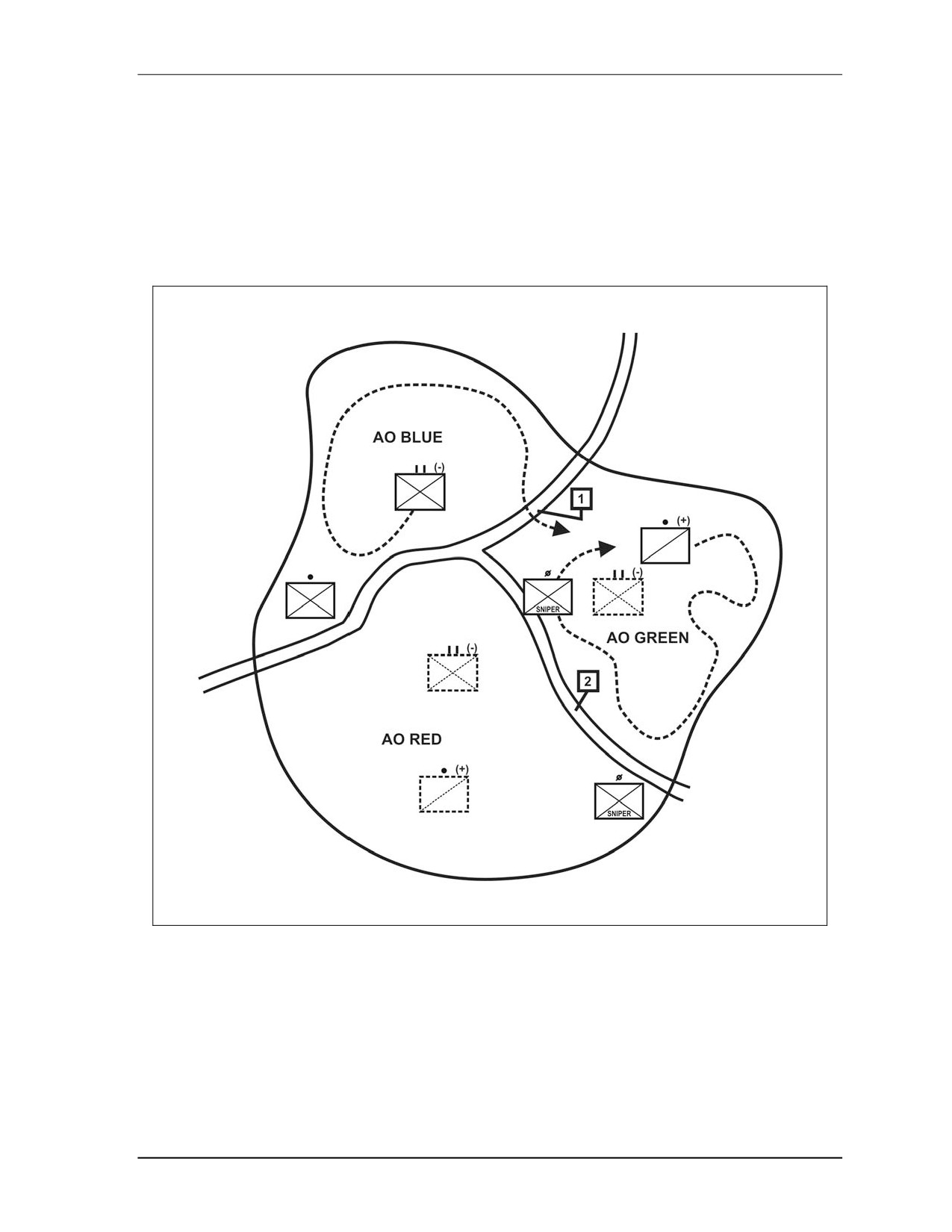
leaders must recognize this portion of the battle as a fight, not a movement. The battalion may have to fight
through enemy combat forces, obstacles, artillery strikes, security elements, possible spoiling attacks, and
other combat multipliers to reach the objective. The commander employs techniques that avoid the
enemy’s strength when possible and conceal the battalion’s true intentions. He tries to deceive the enemy
as to the location of the decisive operation, uses surprise to take advantage of his initiative in determining
the time and place of his attack, and uses indirect approaches when available to strike the enemy from a
flank or the rear.
ACTIONS ON OBJECTIVE
4-36. The battalion’s objective may be terrain- or force-oriented. Terrain-oriented objectives require the
battalion to seize or secure a designated area. However, to gain a terrain-oriented objective often requires
fighting through enemy forces. If the objective is an enemy force, an objective area may be assigned for
orientation, but the battalion’s effort is focused on the enemy’s actual location. The enemy may be a
stationary or moving force. Actions on the objective start when the battalion begins placing fires on the
objective. This action usually occurs with preparatory fires while the battalion is still approaching the
objective.
4-37. The battalion immediately reorients and continues the reconnaissance and surveillance effort beyond
the objective to detect enemy repositioning, counterattack forces, and to look for exploitation opportunities.
CONSOLIDATION AND REORGANIZATION
4-38. The battalion reorganizes and consolidates as required by the situation and mission. The
consolidation and reorganization plan needs to be as detailed as the assault plan.
Consolidation
4-39. Consolidation consists of actions taken to secure and strengthen the objective and defend against
enemy counterattack. The unit providing the shaping effort during the assault may or may not join the
assault force on the objective. Planning considerations should include unit locations, sectors of fire, forces
oriented on enemy counterattack routes, and provisions to facilitate transition to follow-on operations.
Reorganization
4-40. Normally conducted concurrently with consolidation, reorganization occurs as necessary to prepare
the unit for follow-on operations. Detailed planning provides the battalion with a plan for evacuating and
recovering casualties, recovering damaged equipment, providing for prisoners of war, and integrating
replacement personnel. As a part of reorganization, the battalion positions forces to prepare for enemy
counterattacks, the commitment of enemy reserves, and friendly forces follow-on missions. This includes
repositioning mortars to extend organic indirect fire coverage, establishing security forward of the
objective, covering likely enemy avenues of approach to the objectives, and shifting indirect fire targets to
beyond the objective.
Transition
4-41. The battalion executes follow-on missions as directed by the higher commander. The most likely
mission is to continue the attack. Other missions may include supporting a passage of lines for a follow-on
force, defending, or participating in an exploitation or pursuit. The battalion develops plans for follow-on
missions based on the higher headquarters’ plan, the higher commander’s intent, and the anticipated
situation.
4-8
FM 3-21.20
13 December 2006
Offensive Operations
Section IV. FORMS OF MANEUVER
The battalion uses the five basic forms of maneuver during an attack: envelopment, turning movement,
infiltration, penetration, and frontal attack. When the battalion is executing a form of maneuver, the subordinate
units may execute different forms of maneuver to assist the decisive operation and the battalion in
accomplishing their purpose and executing the battalion’s concept of operation. Forms of maneuver are
conducted in relation to or relative to an enemy force.
ENVELOPMENT
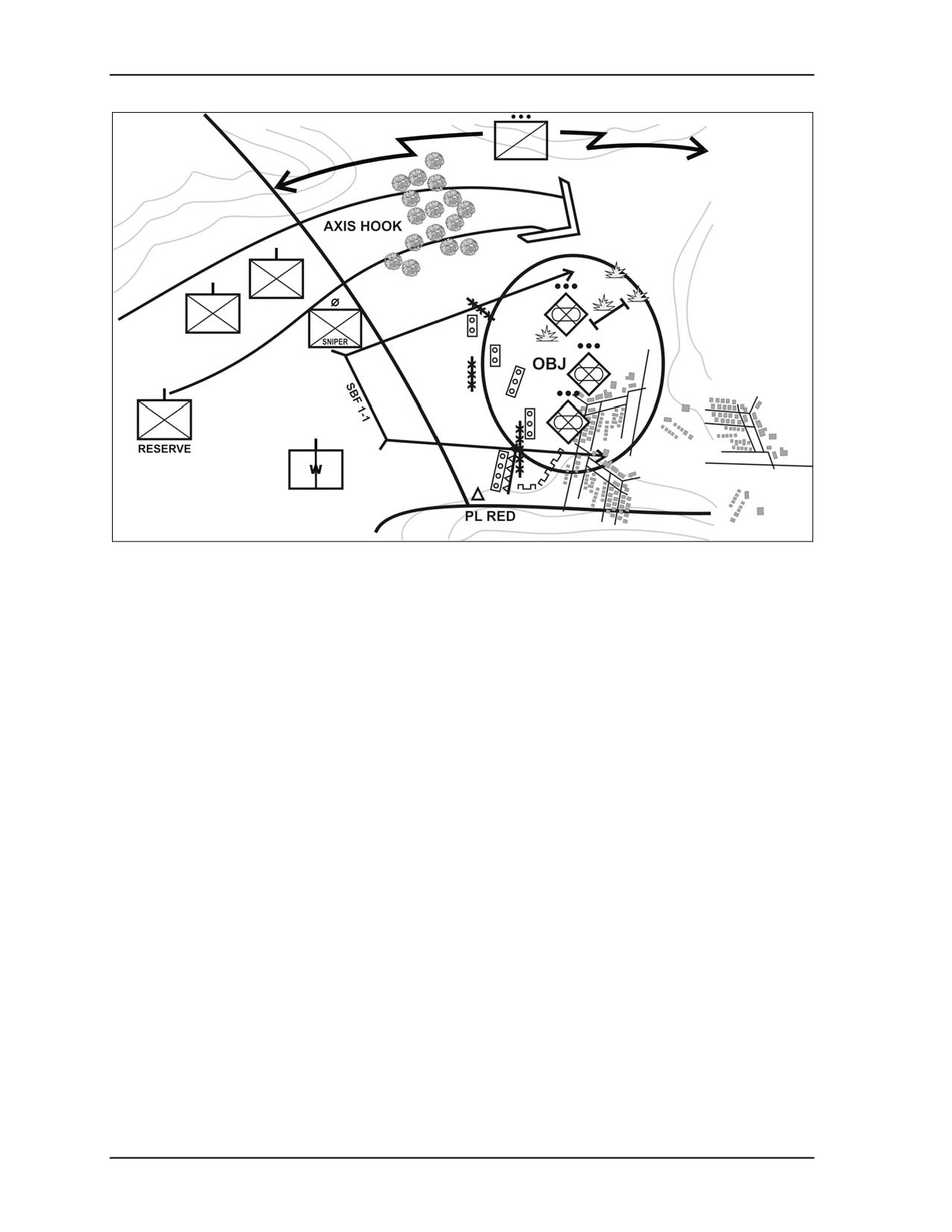
4-42. Envelopment seeks to apply strength against weakness. Envelopment avoids the enemy’s front;
where he is strongest, where his attention is focused, and where his fires are most easily concentrated. The
battalion tries to fix the defender with shaping attacks which typically consist of one or more companies.
The remaining companies of the battalion, the main attack, maneuver out of contact around the enemy’s
defenses to strike at assailable flanks, the rear, or both. The shaping attack must have sufficient combat
power to keep the enemy engaged, while the enveloping force maneuvers to close with the enemy.
4-43. Envelopments may be conducted against a stationary or moving enemy force. Sometimes the enemy
exposes his flank by his own forward movement, unaware of his opponent’s location. In a fluid battle
involving noncontiguous forces, the combination of air and indirect fires may isolate the enemy on
unfavorable terrain and establish conditions for maneuver against an assailable flank or rear. The attacker
needs to be agile enough to concentrate his forces and mass his combat power before the enemy can
reorient his defense (Figure 4-2).
4-44. Variations of the envelopment include the double envelopment and encirclement. Battalions do not
possess the resources to execute these variations independently, but rather, as a part of a BCT or higher
operation.
Double Envelopment
4-45. The attacker seeks to pass at the same time around both flanks of the enemy. This type of
envelopment requires two assailable flanks, precise coordination, sufficient combat power, detailed timing,
and precise fire control measures. The potential for fratricide increases significantly with this form of
envelopment.
Encirclement
4-46. Encirclement occurs when the battalion severs all LOCs, and prevents any reinforcement interdiction
using inner and outer encircling arms. Battalion fires are synchronized to complete the destruction of the
encircled force. Forces are positioned to block or interdict the enemy’s try to break through and link up
from the encirclement. Encirclements are likely to be an extension of an exploitation or pursuit. Battalions
normally participate in encirclements as part of a larger force.
13 December 2006
FM 3-21.20
4-9
Chapter 4
Figure 4-2. Envelopment.
PENETRATION
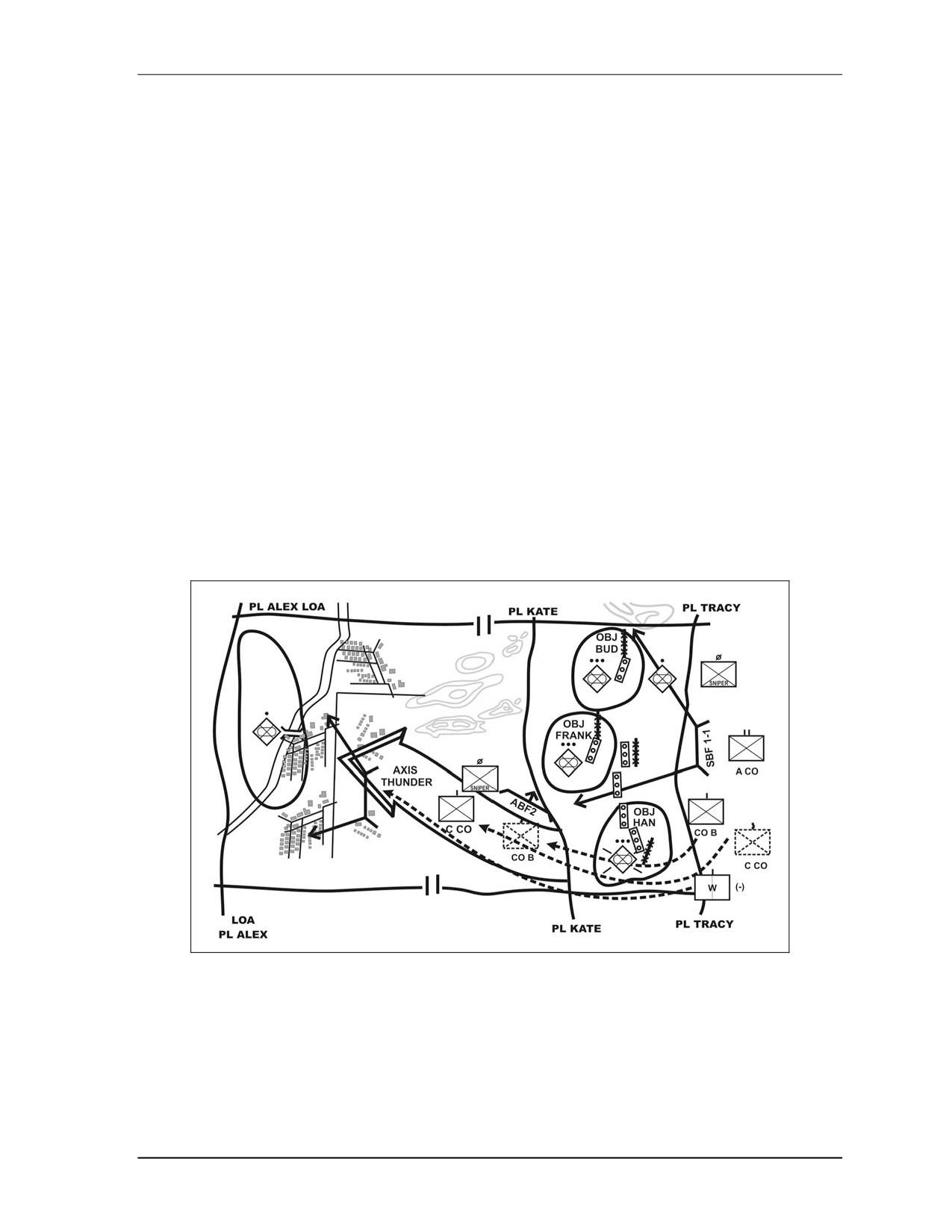
4-47. In a penetration, the attacker concentrates forces to strike at an enemy’s weakest point and rupture
the defense and break up its continuity to create assailable flanks. The attacker then uses the gap created to
pass forces through to defeat the enemy through attacks into his flanks and rear. A successful penetration
depends on the attacker’s ability to suppress enemy weapons systems, to concentrate forces to overwhelm
the defender at the point of attack, and to pass sufficient forces through the gap to defeat the enemy
quickly. A penetration is normally tried when enemy flanks are unassailable or when conditions permit
neither envelopment nor a turning movement such as an attack against the enemy’s main defensive belt
(Figure 4-3). Usually, when the penetration is successfully completed, the battalion will transition to
another form of maneuver.
CONCENTRATION
4-48. The penetration of an enemy position requires a concentration of combat power to permit continued
momentum of the attack. The attack should move rapidly to destroy the continuity of the defense since, if it
is slowed or delayed, the enemy is afforded time to react. If the attacker does not make the penetration
sharply and secure objectives promptly, the penetration is likely to resemble a frontal attack. This may
result in high casualties and permit the enemy to fall back intact, thus avoiding destruction.
STEPS
4-49. A penetration is conducted in three steps.
4-10
FM 3-21.20
13 December 2006
Offensive Operations
Step 1: Penetration of Main Line of Resistance
4-50. A reinforced company can execute the initial penetration. The weapons company has the potential to
play a significant role in this initial step.
Step 2: Widening of Gap to Secure Flanks
4-51. The battalion seizes enemy positions behind the obstacles and widens the shoulders of the
penetration to allow assaulting forces room to attack deep objectives.
Step 3: Seizure of Objective and Subsequent Exploitation
4-52. Exploitation of the penetration is made as companies complete the destruction of the enemy and
attack to secure deeper objectives. Objectives for the assaulting force are deep enough to allow an
envelopment of the rest of the enemy position and should facilitate attack by fire against second echelon
enemy positions and enemy counterattack routes.
PLANNING CONSIDERATIONS
4-53. To allow a penetration, the terrain must facilitate the maneuver of the penetrating force. The
concentration of the battalion is planned to penetrate the defense where the continuity of the enemy’s
defense has been interrupted such as gaps in obstacles and minefields or areas not covered by fire. Multiple
penetrations are normally only conducted at the operational level. When essential to the accomplishment of
the mission, intermediate objectives should be planned for the attack.
Figure 4-3. Penetration.
TURNING MOVEMENT
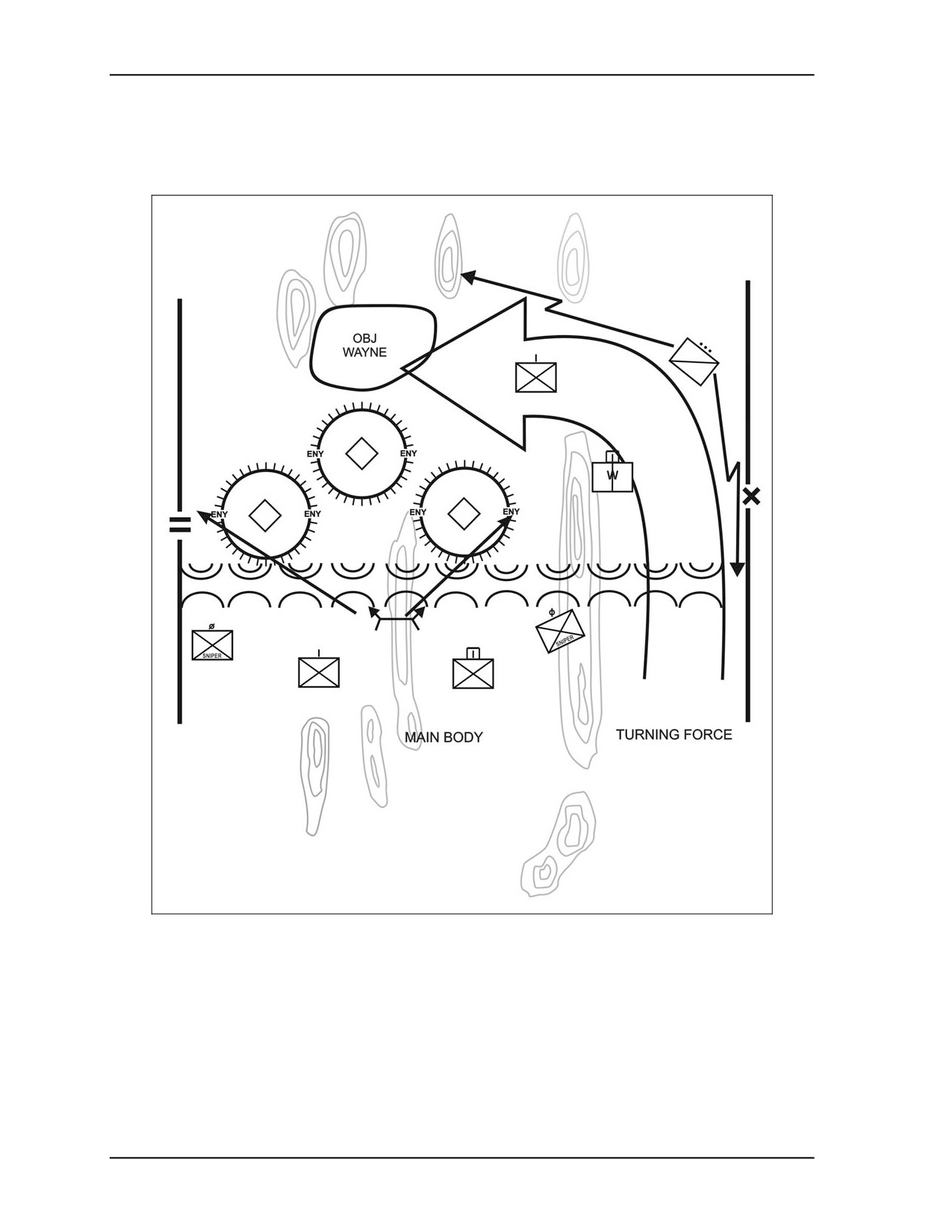
4-54. In a turning movement, the unit passes around and avoids the enemy’s main force. It then secures an
objective that causes the enemy to move out of its current position or divert forces to meet the threat
(Figure 4-4). The objective of the turning movement is to make contact with the enemy, but at a location of
13 December 2006
FM 3-21.20
4-11
Chapter 4
the unit’s advantage and out of the enemy’s established kill zones. The battalion conducts a turning
movement as part of a larger unit’s operation. The battalion can also conduct a turning movement with
subordinate companies.
Figure 4-4. Turning movement.
INFILTRATION
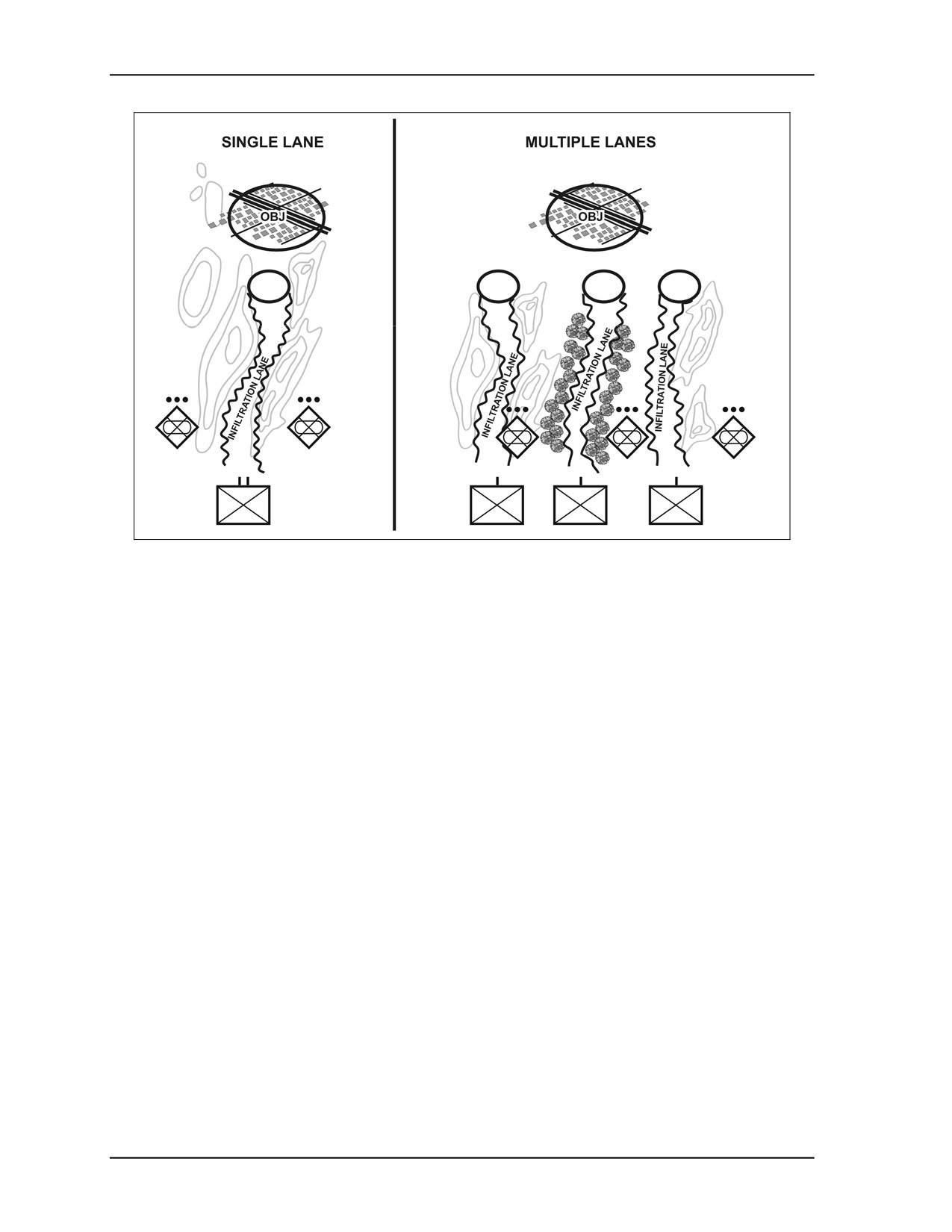
4-55. Infiltration is a form of maneuver in which combat elements conduct undetected movement through
or into an area occupied by enemy forces to occupy a position of advantage in the enemy’s rear
(Figure 4-5, page 4-14). The commander uses infiltration to—
y Attack lightly defended positions or stronger positions from the flank and rear.
y Secure key terrain in support of the decisive operation.
4-12
FM 3-21.20
13 December 2006
Offensive Operations
y Disrupt or harass enemy defensive preparations/operations.
y Relocate the battalion by moving to battle positions around an engagement area.
y Reposition to attack vital facilities or enemy forces from the flank or rear.
4-56. Detailed METT-TC analysis will dictate the location of infiltration routes, the number of infiltration
lanes, the size of the infiltration lane(s), the anticipated speed of movement, and the time of departure. An
infiltration should be planned during limited visibility through areas the enemy does not occupy or cover
by surveillance and fire. Planning should incorporate infiltration lanes, rally points along the route or axis,
and contact points. Companies and platoons usually conduct infiltrations, but it is possible to execute at a
battalion or squad level also. Careful planning considerations for the integration of the weapons company
throughout an infiltration must be exercised.
4-57. Although the weapons company may provide a larger and louder signature, the speed, mobility,
shock, and firepower of the weapons company may provide an overwhelming advantage to either set
conditions for or execute a decisive operation. The weapons company may have its own infiltration lane,
follow another unit on a lane, or may be held as a reserve element. Another consideration for the
infiltration means is the vertical infiltration. Due to limited resources, this means of infiltration may be
limited to reconnaissance and/or weapons company assets. Single or multiple infiltration lanes can be
planned.
SINGLE INFILTRATION LANE
4-58. Using a single infiltration lane—
y Facilitates navigation, control, and reassembly.
y Reduces susceptibility to detection.
y Reduces the area requiring detailed intelligence.
y Increases the time required to move the force through enemy positions.
MULTIPLE INFILTRATION LANES
4-59. Using multiple infiltration lanes—
y Reduces the possibility of compromise.
y Allows more rapid movement.
y Makes control more challenging.
13 December 2006
FM 3-21.20
4-13
Chapter 4
Figure 4-5. Infiltration.
FRONTAL ATTACK
4-60. The frontal attack is usually the least desirable form of maneuver because it exposes the majority of
the offensive force to the concentrated fires of the defenders. The battalion normally conducts a frontal
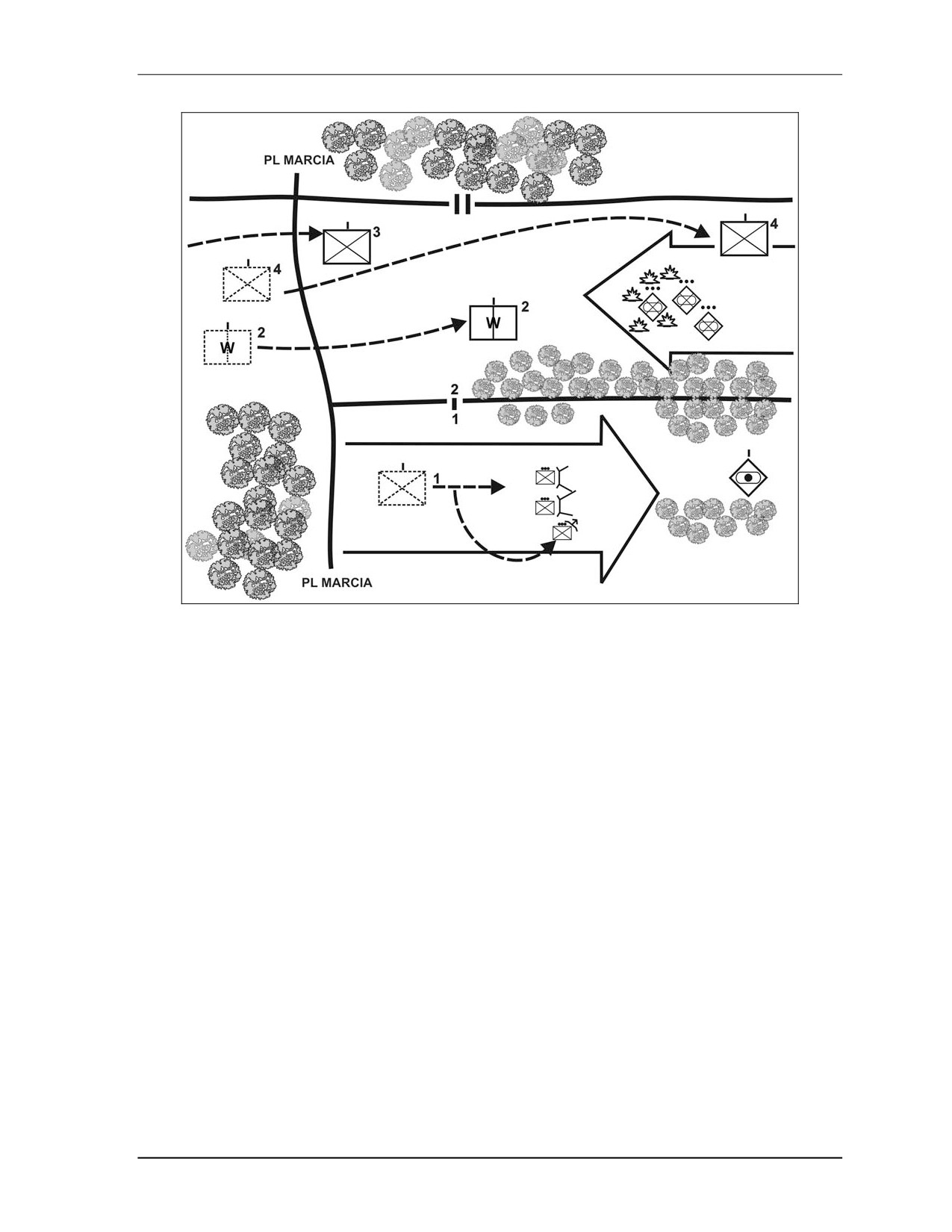
attack as part of a larger operation against a stationary or moving enemy force (Figure 4-6). Unless frontal
attacks are executed with overwhelming and well synchronized speed and strength against a weaker
enemy, they are seldom decisive. The battalion attacks the enemy across a wide front and along the most
direct approaches. It uses a frontal attack to overrun and destroy a weakened enemy force or to fix an
enemy force. Frontal attacks are used when commanders possess overwhelming combat power and the
enemy is at a clear disadvantage or when fixing the enemy over a wide front is the desired effect and a
decisive defeat in that area is not expected. The frontal attack may be appropriate in an attack or meeting
engagement where speed and simplicity are paramount to maintaining battle tempo and, ultimately, the
initiative; or in a shaping attack to fix an enemy force.
4-14
FM 3-21.20
13 December 2006
Offensive Operations
Figure 4-6. Frontal attack against a moving enemy.
MOVEMENT TECHNIQUES AND FORMATIONS
4-61. The selection of movement techniques and attack formations for the battalion depends on the factors
of METT-TC and the probable line of contact.
MOVEMENT TECHNIQUES
4-62. The battalion uses traveling, traveling overwatch, and bounding overwatch movement techniques. It
does not usually move as a unit using only one movement technique. The battalion commander will rarely
dictate which technique his companies will use except in rare instances. When moving as a unit along a
single avenue, the battalion commander designates the movement technique to be used by the lead unit(s)
based on the likelihood of enemy contact. For example, the battalion may be moving to contact in column
formation, while the lead company may be in a wedge formation using the traveling overwatch technique
dictated by the battalion commander. Movement techniques are used when not in contact with the enemy;
they end when the unit--
• Transitions to maneuver
• Comes into contact the enemy
• Begins actions on contact and overwatching force begins suppressive fires (maneuver).
4-63. The battalion should try to make enemy contact with the smallest possible friendly force. This
technique allows the majority of the battalion freedom to maneuver against the enemy force.
13 December 2006
FM 3-21.20
4-15
Chapter 4
FORMATIONS
4-64. The battalion may move in any one of these basic formations: column, wedge, vee, echelon, and line.
The battalion may use more than one formation in a given movement, especially if the terrain changes
during the movement. For example, the battalion commander may elect to use the column formation during
a passage of lines and then change to another formation such as a wedge. Companies within a battalion
formation may conduct movement using formations different from that of the battalion. Although the
battalion may be moving in a wedge formation, one company may be in a wedge, another in an echelon
right, and yet another in a column. Other factors, such as the distance of the move or the enemy
dispositions, may also prompt the commander to use more than one formation. Distances between units
depend on the factors of METT-TC.
Column Formation
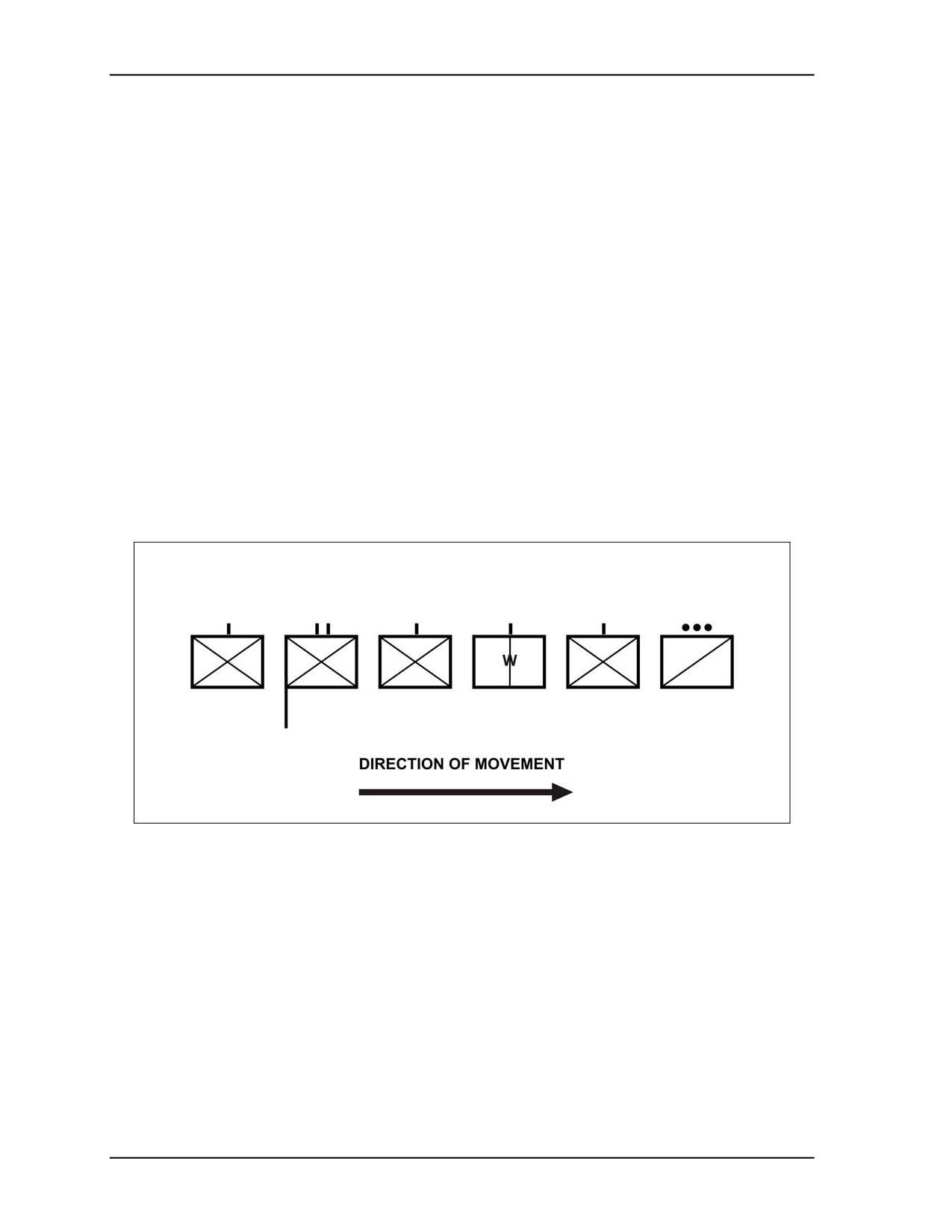
4-65. The battalion moves in column formation when early contact is not expected and the objective is far
away (Figure 4-7). The battalion’s lead element normally uses traveling overwatch while the following
units travel. The column formation—
y Speeds movement, eases control, and increases usefulness in close terrain.
y Allows quick transition to other formations.
y Requires flank security.
y Places most of the firepower on the flanks.
Figure 4-7. Battalion in column formation.
Wedge Formation
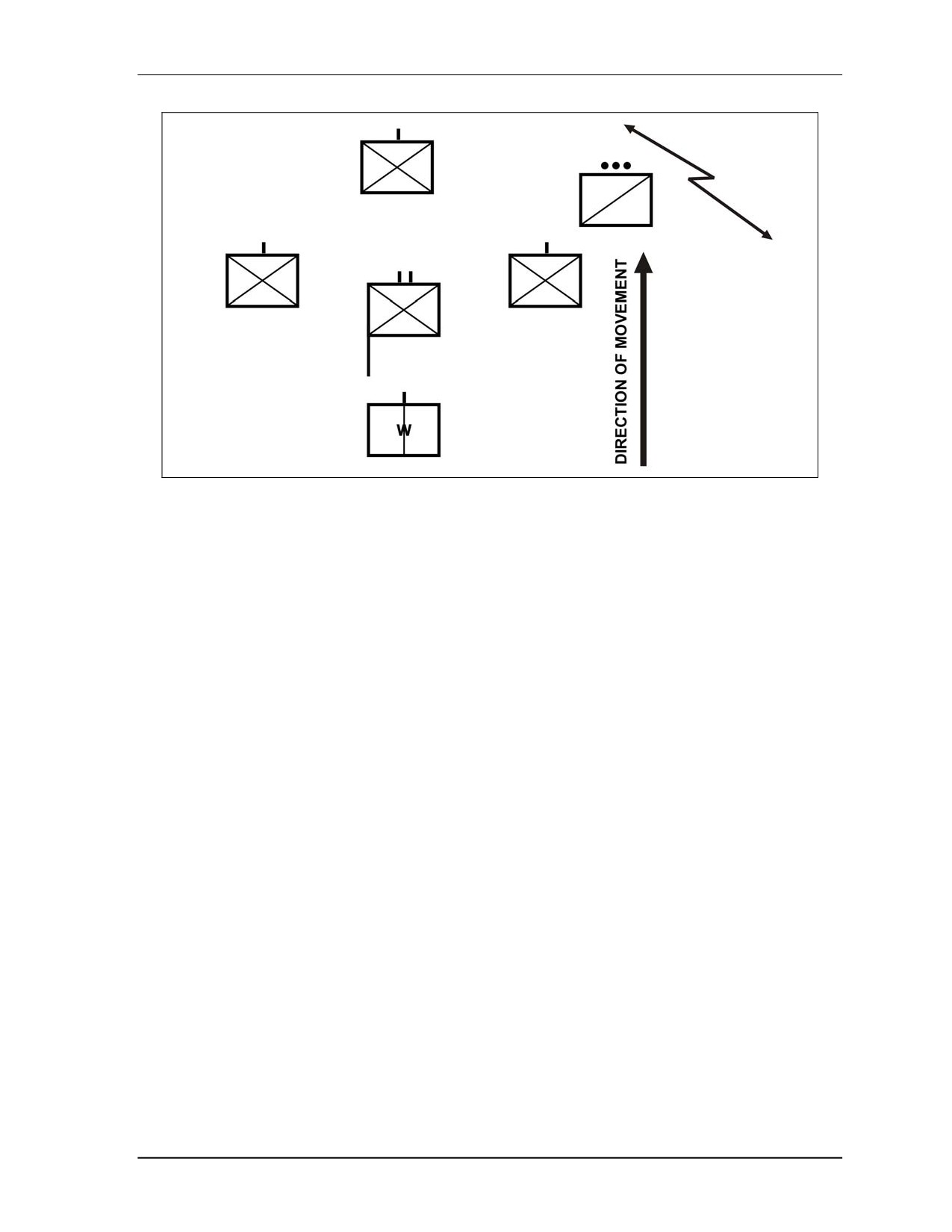
4-66. The wedge formation postures the battalion for enemy contact on its front and flanks (Figure 4-8).
The force uses the wedge when enemy contact is possible or expected but the location and disposition of
the enemy is vague. When not expecting enemy contact, it may use the wedge to cross open terrain rapidly.
The wedge formation:
y Facilitates control and transition to the assault.
y Provides for maximum firepower forward and good firepower to the flanks.
y Requires sufficient space to disperse laterally and in depth.
4-16
FM 3-21.20
13 December 2006
Offensive Operations
Figure 4-8. Battalion in wedge formation.
Vee Formation
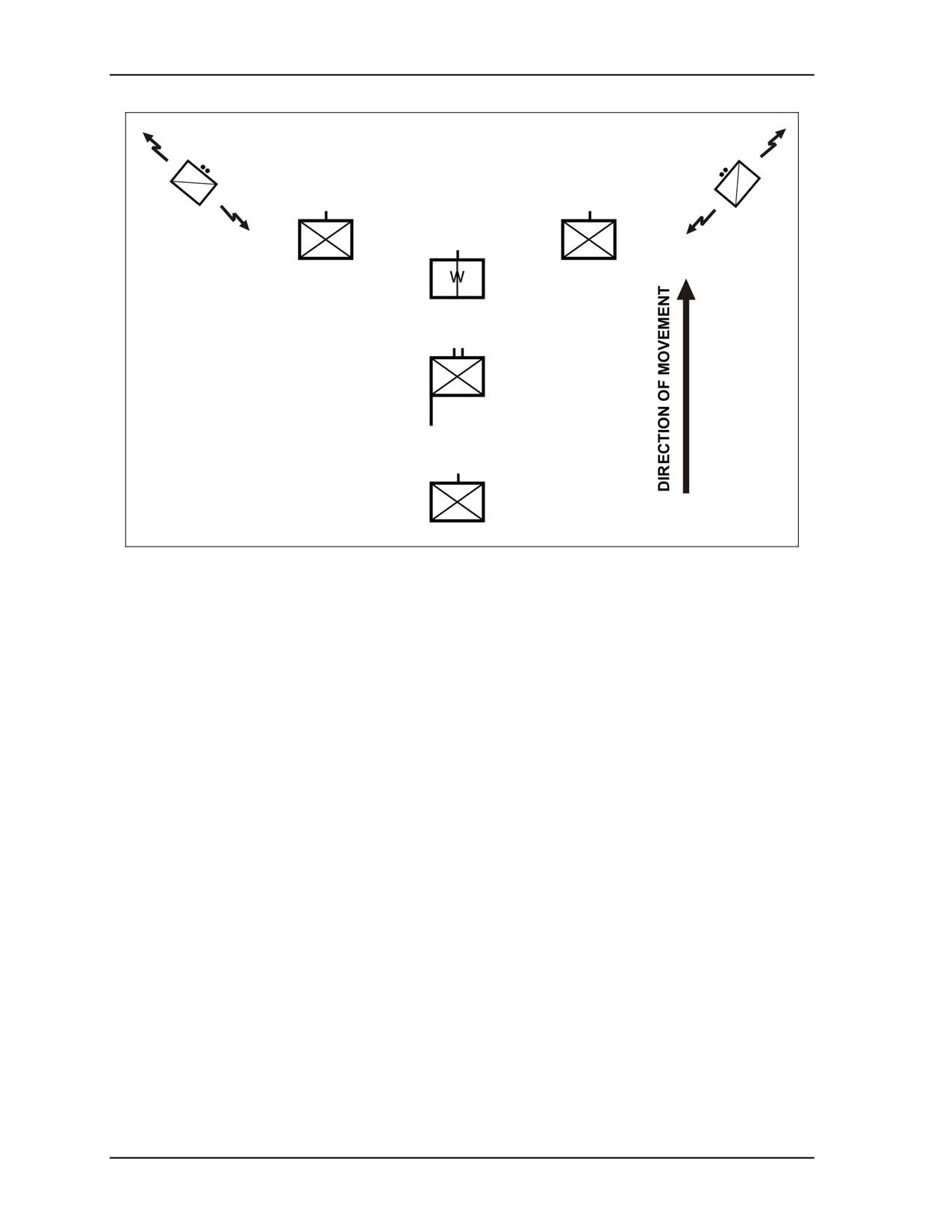
4-67. The vee formation postures the battalion with two companies abreast and one trailing (Figure 4-9).
This arrangement is most suitable to advance against an enemy known to be to the front of the battalion.
The battalion may use the vee when enemy contact is expected and the location and disposition of the
enemy is known. The following planning considerations apply:
y Formation is hard to orient and control is more difficult in close or wooded terrain.
y Formation provides for good firepower forward and to the flanks.
13 December 2006
FM 3-21.20
4-17
Chapter 4
Figure 4-9. Battalion in vee formation.
Echelon Formation
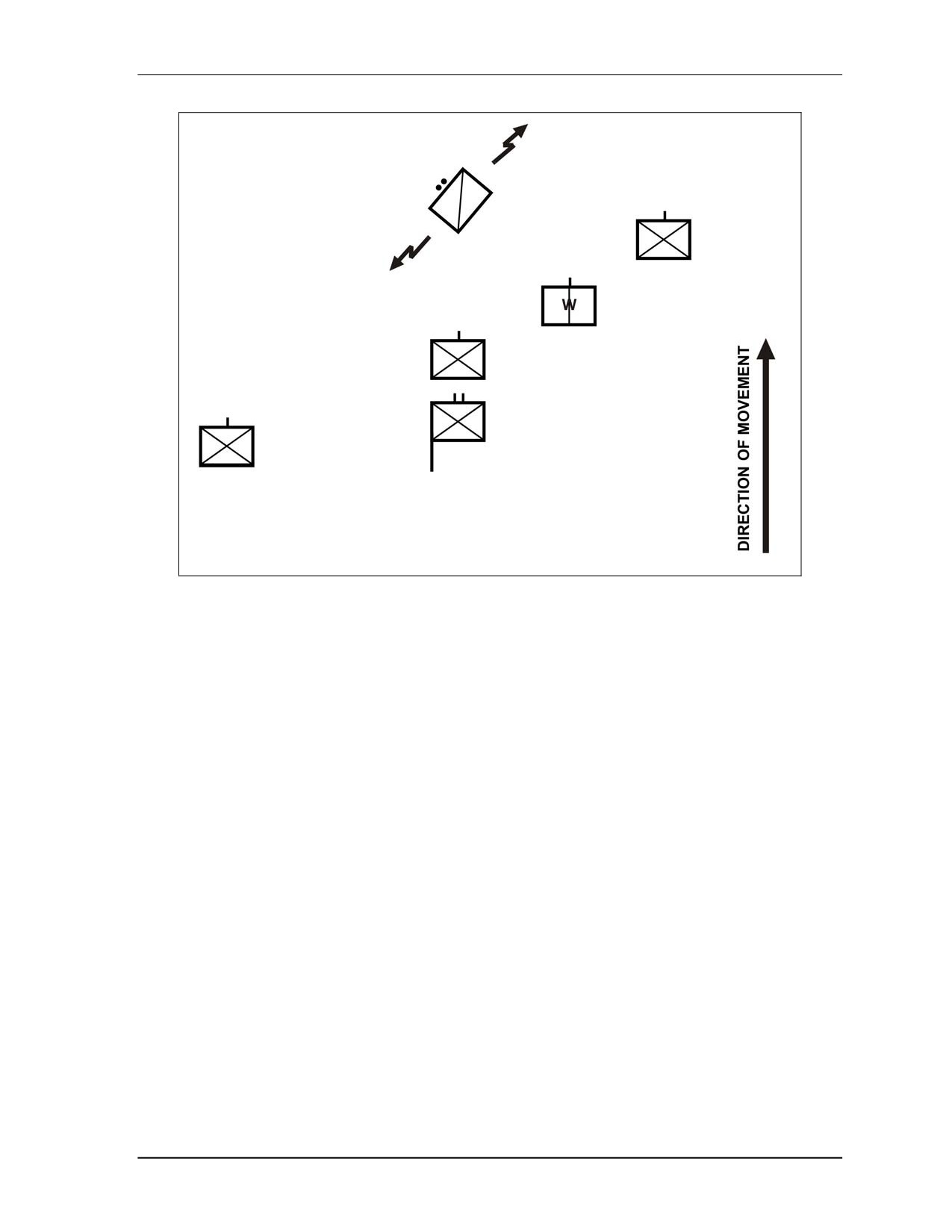
4-68. The echelon formation arranges the battalion with the companies in column formation in the
direction of the echelon (right or left) (Figure 4-10). The battalion commonly uses the echelon when
providing security to a larger moving force. The echelon formation—
y Provides for firepower forward and in the direction of echelon.
y Facilitates control in open areas but makes it more difficult in heavily wooded areas.
4-18
FM 3-21.20
13 December 2006
Offensive Operations
Figure 4-10. Battalion in echelon left formation.
Line Formation
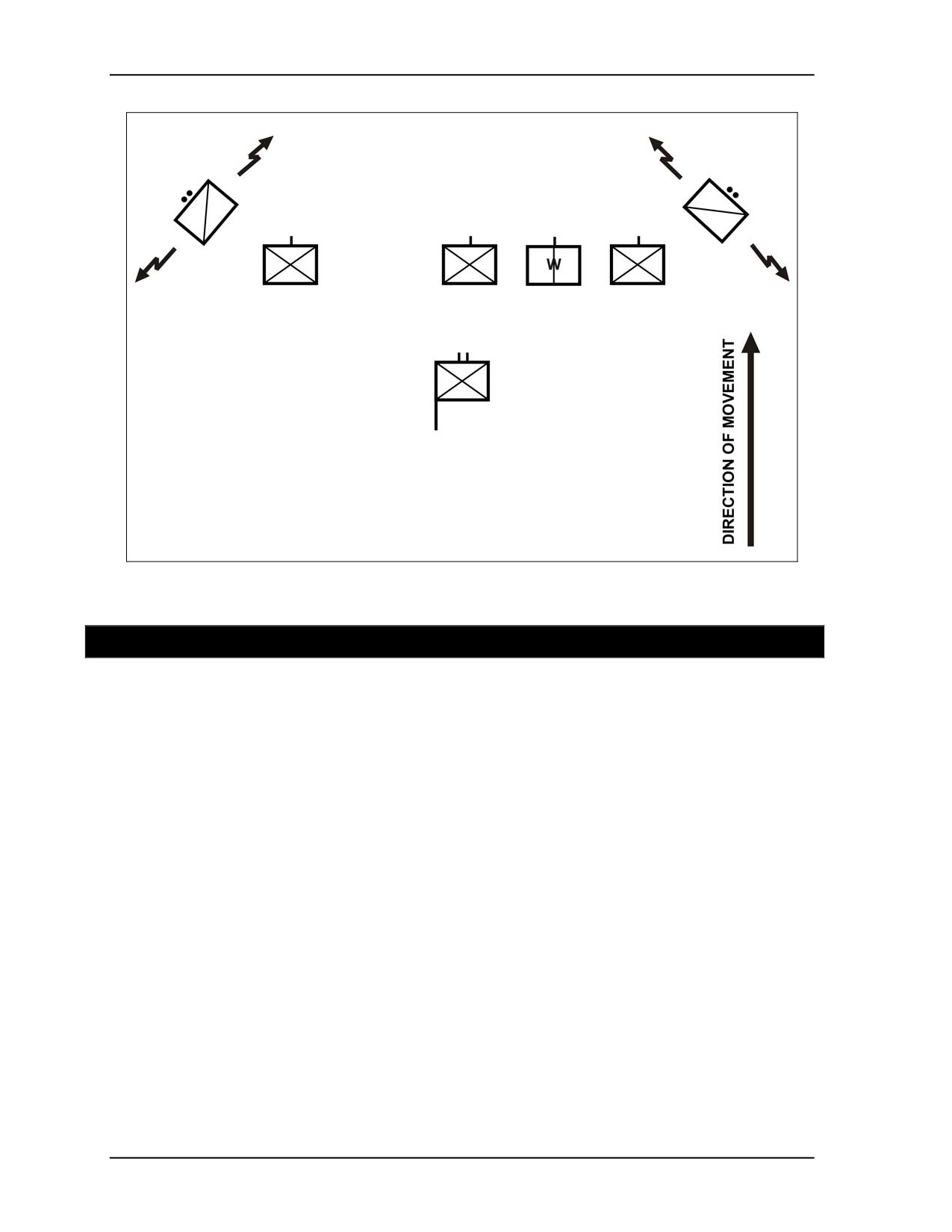
4-69. The line formation postures the battalion with companies on line and abreast of one another
(Figure 4-11). Because it does not dispose companies in depth, the line formation provides less flexibility
of maneuver than other formations. The battalion uses the line when it requires continuous movement with
maximum firepower to the front in an assault.
13 December 2006
FM 3-21.20
4-19
Chapter 4
Figure 4-11. Battalion in line formation.
Section V. FORMS OF TACTICAL OFFENSE
At the battalion level, the offense takes the form of either a deliberate or a hasty operation such as a movement
to contact, attack, exploitation, or pursuit across the full spectrum of conflict. The battalion may also be given
the mission to conduct special purpose attacks such as a raid, demonstration, spoiling attack, or counterattack.
Attacks, exploitations, and pursuits may be conducted sequentially or simultaneously throughout the AO.
HASTY OPERATIONS
4-70. The battalion conducts a hasty offensive operation after a successful defense or as part of a defense;
due to a movement to contact, a meeting engagement, or a chance contact during a movement; or in a
situation where the unit has an unexpected opportunity to attack vulnerable enemy forces. A hasty
operation uses immediately available assets to perform activities with minimal preparation or task
organizing, trading planning and preparation time for speed of execution. Hasty operations maximize the
effects of speed, agility, and surprise, but sacrifice a certain degree of synchronization. Reconnaissance and
surveillance assets are still deployed as soon as possible to gather the information needed by the
commander to make decisions. As a result, the commander can convert a hasty operation into a deliberate
operation without a substantial increase in planning time
DELIBERATE OPERATIONS
4-71. A deliberate offensive operation is one in which a commander’s detailed intelligence allows him to
develop and coordinate detailed plans and tailor his task organization. The result is a fully synchronized
operation that employs all available assets against the enemy’s defense and is characterized by detailed
planning based on available information, thorough reconnaissance, preparation, and rehearsals.
4-20
FM 3-21.20
13 December 2006
Offensive Operations
MOVEMENT TO CONTACT
4-72. Advanced ISR technologies have provided Infantry battalions with an enhanced COP; however,
these systems will never provide the commander with perfect intelligence which answers all of the
unknowns about the enemy force. The battalion conducts movement to contact when the tactical situation
is not clear or when the enemy has broken contact. Battalions conduct movement to contact independently
or as part of a larger force. The purpose of a movement to contact is to gain or reestablish contact with the
enemy. The battalion will normally be given a movement to contact mission as the lead element of an
attack or as a counterattack element of a BCT or higher level unit. The battalion conducts movement to
contact in a manner that allows it to maneuver to develop the situation fully, to maintain freedom of action,
and if required, to defeat the enemy once contact is made. Reconnaissance, surveillance, and flexibility are
essential in gaining and maintaining the initiative. The movement to contact terminates with the occupation
of an assigned objective or when enemy resistance requires the battalion to deploy and conduct an attack to
continue forward movement. A battalion given a movement to contact mission is assigned an axis of
advance and an objective at a depth to ensure contact with the enemy.
ORGANIZATION
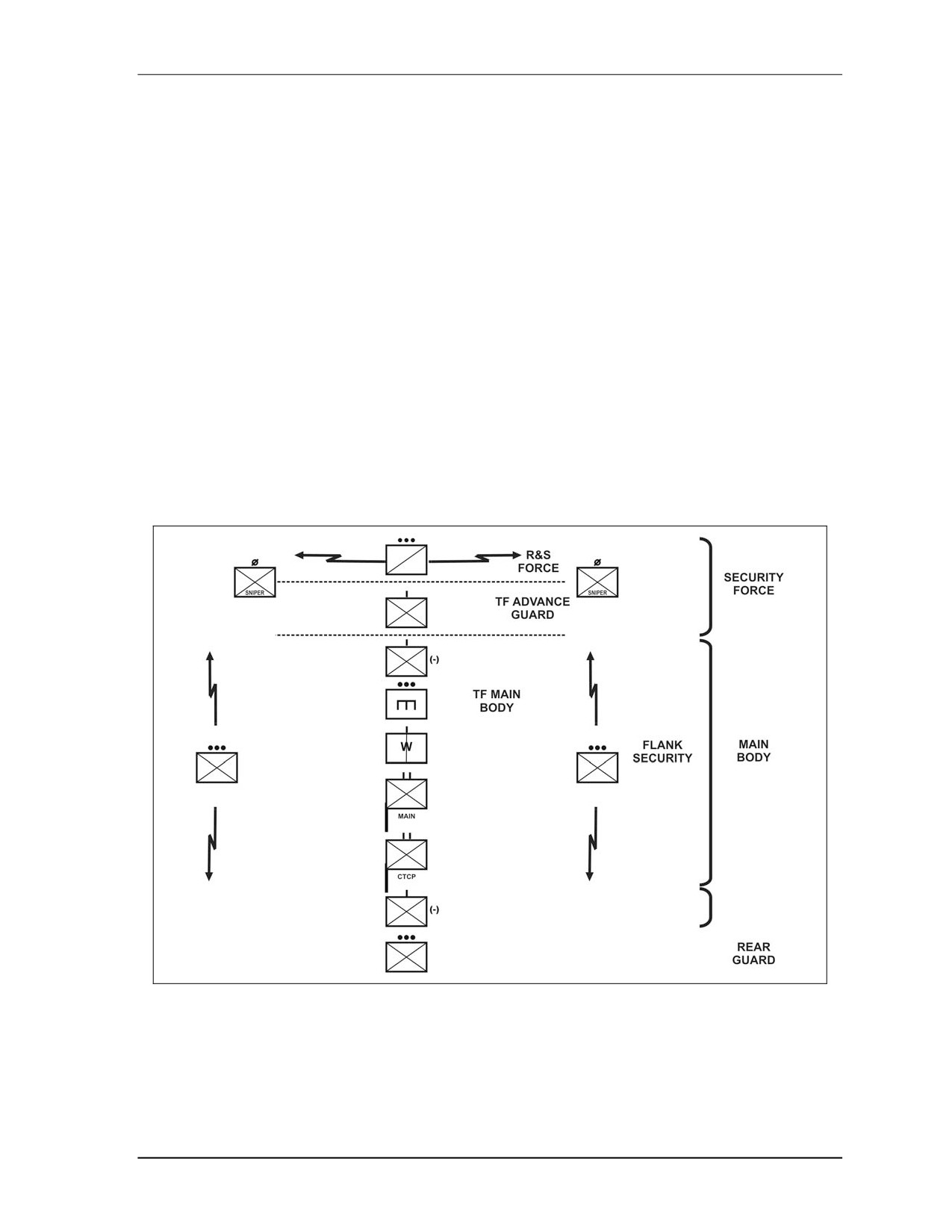
4-73. When executing a movement to contact, the battalion normally organizes into a security force
comprised of a reconnaissance and surveillance force, an advance guard, the main body, and flank and rear
guards (Figure 4-12).
Figure 4-12. Battalion movement to contact.
Reconnaissance and Surveillance Forces
4-74. The reconnaissance and surveillance force for the battalion is normally the scout platoon augmented
with snipers and UAS. Engineers and forward observers (FOs) are attached to the reconnaissance and
13 December 2006
FM 3-21.20
4-21
Chapter 4
surveillance force as necessary. Normally, the reconnaissance and surveillance force has initial priority of
indirect fires. The mission of the reconnaissance and surveillance force is to determine the size, activity,
location, and depth of the enemy force. Specifically, the reconnaissance and surveillance force must answer
the PIR established by the commander. Other tasks, similar to an area reconnaissance, normally include—
y Reconnaissance of routes, bridges, and roads.
y Reconnaissance of obstacles and restrictive terrain.
y Surveillance of critical areas, danger areas, or key terrain.
4-75. The reconnaissance and surveillance force covers the frontage of the battalion axis of advance. It
avoids decisive engagement, but once found it must keep the enemy under surveillance and report his
activity.
4-76. The reconnaissance and surveillance force is far enough ahead of the advance guard to provide
adequate warning, a detailed picture of the enemy force, and sufficient space for it to maneuver. The R&S
force will normally remain within supporting range of the battalion’s indirect fires unless task organized
with internal indirect fire support. However, the reconnaissance and surveillance force must not be so far
ahead that the advance guard cannot rapidly assist it in disengaging from the enemy, should that become
necessary. The advance guard keys its movement on the movement of the reconnaissance and
surveillance force.
4-77. The reconnaissance and surveillance force must be able to receive the latest information available
from the BCT reconnaissance squadron as well as information available from adjacent units, other
battlefield surveillance assets, and the S-2. With this information, the reconnaissance and surveillance force
can confirm information provided by these assets to greatly reduce the risks and unknowns normally
associated with a movement to contact mission. This information is also made available to the battalion
subordinate elements.
Advance Guard
4-78. The advance guard for a battalion is usually a company team. Its composition depends on the factors
of METT-TC. The engineers follow or are attached to the lead elements to ensure mobility and provide
route/bridge classification expertise and may have attachments from the weapons company. The two lead
companies are task-organized accordingly when a battalion moves in parallel columns.
4-79. The advance guard operates forward of the main body to provide security for the main body and
ensure its uninterrupted advance. It protects the main body from surprise attacks and develops the situation
to allow time and space for the deployment of the main body when it is committed to action. The advance
guard accomplishes this by destroying or suppressing enemy reconnaissance and ambushes, delaying
enemy forces, and marking bypasses for or reducing obstacles. The advance guard—
y Remains oriented on the main body.
y Reports enemy contact to the battalion commander.
y Collects and reports all information about the enemy.
y Selects tentative fighting positions for following battalion units.
y Tries to penetrate enemy security elements and reach or identify the enemy main force.
y Destroys or repels enemy reconnaissance forces.
y Prevents enemy ground forces from engaging the main body with direct fires.
y Locates, bypasses, or breaches obstacles along the main body’s axis of advance.
y Executes tactical tasks such as fix, contain, or block, against enemy forces to develop the
situation for the main body.
y May conduct a forward passage of lines (FPOL) with the main body.
4-80. Until the main body is committed, the advance guard is the battalion commander’s initial main
effort. Priority of fires shifts to the main body once committed.
4-22
FM 3-21.20
13 December 2006
Offensive Operations
4-81. In planning the movement to contact, each contingency operation should revolve around the actions
of the advance guard. The lead elements must be well trained on battle drills, especially those involving
obstacle reduction and actions on contact.
Main Body
4-82. The main body’s rate of movement is dictated by the advance guard. It maintains current information
of the advance guard’s activities and enemy locations. The main body, remaining attuned to the advance
guard’s situation, provides responsive support when it is committed.
4-83. The main body contains most of the battalion’s combat elements and is arrayed to achieve all-round
security. The combat elements of the main body are prepared to deploy and attack, giving them the
flexibility to maneuver to a decisive point on the battlefield to destroy the enemy.
4-84. The use of standard formations and battle drills allows the battalion commander, based on the
information available to him, to shift combat power rapidly on the battlefield. Companies employ the
appropriate formations and movement techniques within the battalion formation. Company commanders,
based on their knowledge of the battalion’s situation, anticipate the battalion commander’s decisions for
commitment of the main body and plan accordingly.
Flank and Rear Security
4-85. The flank and rear security mission may be given to one company as a shaping operation or may be
given to platoon-size elements from the companies within the main body to conduct guard missions under
organic company control. These elements remain at a distance from the main body to allow the battalion
time and space to maneuver to either flank or the rear. Flank and rear security elements also operate far
enough out to prevent the enemy from placing direct or observed indirect fires on the main body. Indirect
fires are planned on major flank and or rear approaches to enhance security. Because of its enhanced
observation capabilities, firepower, and mobility, the weapons company may be used to conduct the
security mission.
SEARCH AND ATTACK TECHNIQUE
4-86. The search and attack technique is a decentralized movement to contact; requiring multiple,
coordinated patrols (squad, platoon, or company-size) to—
y Destroy enemy forces.
y Protect the friendly force.
y Deny an area to the enemy.
y Collect Information.
4-87. The unit conducting a search and attack is organized into a finding force, a fixing force, and a finish
force. The procedure for conducting this technique is to organize the battalion in purpose as well as space.
It is most often used against an enemy operating in dispersed elements. When conducting a search and
attack, units can expect to spend significant time reconnoitering in an area of operations. The battalion may
conduct a search and attack as a coordinated battalion level operation or decentralized to independent
company level operations.
4-88. A coordinated battalion level search and attack uses its reconnaissance and surveillance assets
(scouts, snipers, and UAS) to assist in finding and potentially fixing a dispersed enemy. Once the enemy is
found, the finding force must determine if they can achieve fire superiority to fix the threat or if the
battalion must fix the enemy with its fixing force (usually consisting of a company size force). Once the
threat is fixed, the fixing force must determine if it is able to conduct the attack the finish force would
normally execute. If not, another company designated as the finish force will execute the assault. The
battalion may direct each individual company to conduct find, fix, and finish procedures at their level;
however, the battalion will provide the appropriate level of support in terms of assets, fires and effects, and
13 December 2006
FM 3-21.20
4-23
Chapter 4
sustainment to each of the companies. Companies may use UAS to assist in finding the enemy. Whether
conducting a consolidated or decentralized operation, the battalion must designate a decisive operation and
shaping efforts that enable it to maintain the amount of flexibility the situation dictates.
Purpose
4-89. Search and attack can be conducted for many reasons. The commander’s concept focuses the
battalion on one or more of the following:
Destruction of Enemy
4-90. The battalion must destroy enemy units operating in the area or render them combat ineffective.
Area Denial
4-91. The battalion must prevent the enemy from operating unhindered in any area, for example, in any
area he is using for a base camp or for logistics support.
Force Protection
4-92. The battalion must prevent the enemy from disrupting and destroying friendly military or civilian
operations, equipment, and property such as key facilities, headquarters, polling places, or dams.
Information Collection
4-93. The battalion must conduct IPB as soon as it enters an area and before it conducts any of the above
activities. The battalion must also verify or answer certain unknowns about the terrain and the enemy.
Tasks
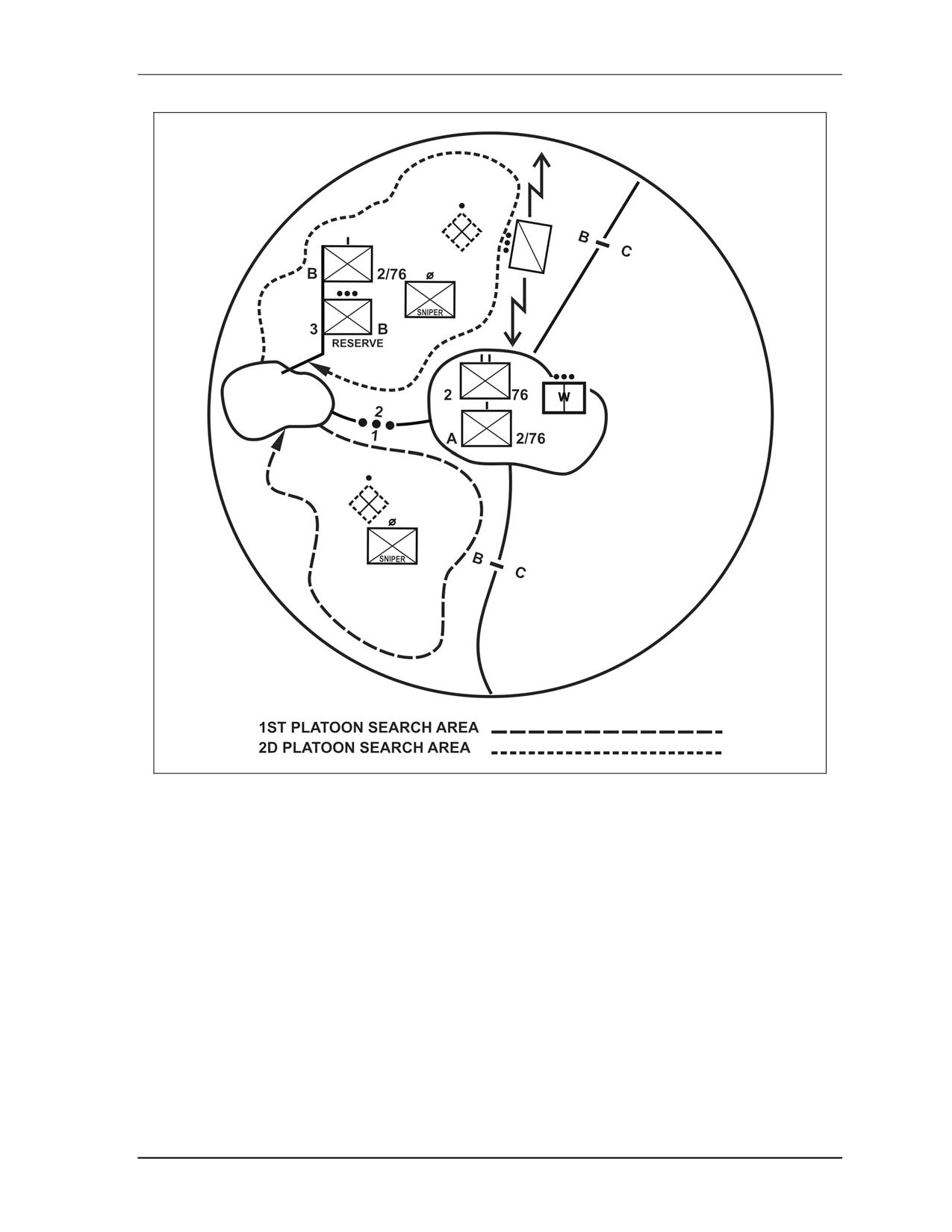
4-94. Search and attack operations can be conducted in a company- or battalion-size area of operations.
Figure 4-13 shows an example of dispersing to search, and Figure 4-14, page 4-26, shows an example of a
unit massing to attack. The unit can be tasked to—
y Locate enemy positions or routes normally traveled by the enemy.
y Destroy enemy forces within its capability or fix or block the enemy until reinforcements
arrive.
y Maintain surveillance of a larger enemy force through stealth until reinforcements arrive.
y Set up ambushes.
y Search towns or villages (a host nation representative should accompany the search party).
y Secure military or civilian property or installations.
y Act as a reserve.
y Develop the situation in a given area.
4-24
FM 3-21.20
13 December 2006
Offensive Operations
Figure 4-13. Example of unit dispersing to search.
13 December 2006
FM 3-21.20
4-25
Chapter 4
Figure 4-14. Example of unit massing to attack.
Concept Development
4-95. The concept for the search and attack is based on thorough IPB. The S-2 combines his own
predictive and pattern analysis with information available from the brigade’s and the battalion’s
reconnaissance and surveillance assets to determine likely enemy locations, capabilities, patterns, and
actions. The friendly concept can then be developed to capitalize on the battalion’s fires and maneuver.
The commander must understand higher echelon unit’s concept and provide a clear task and purpose for
each of his subordinate elements. The commander must consider the following when developing his
concept.
Find Enemy
4-96. Much time should be dedicated to determine the pattern of enemy operations. The commander and
his decisions are most effective once the pattern has been identified; however, it may take more time than
is available to accurately establish an enemy pattern.
4-97. The commander may consider using another technique to find the enemy. He can subdivide his area
of operations into smaller ones and have the scout platoon reconnoiter forward of the remainder of the
battalion (Figure 4-15). The scout platoon may be reinforced for this operation with snipers and UAS. In
4-26
FM 3-21.20
13 December 2006
Offensive Operations
Figure 4-15, the scout platoon conducts zone reconnaissance in AO Green, while the remainder of the
battalion conducts search and attack operations in AO Blue. At a designated time, the commander directs
the battalion to link up with the scout platoon at contact point 1 to exchange information. If necessary, the
scout platoon guides the battalion to sites of suspected or confirmed enemy activity. The scout platoon can
then move on to reconnoiter AO Red. This process is repeated for other AOs until the commander
terminates it. The commander may decide to emplace sensors, when available, along the border from AO
Red to AO Blue to identify enemy tries to evade the battalion. In Figure 4-15, an Infantry squad and a
sniper team have been tasked to emplace and monitor the sensors.
Figure 4-15. Example search and attack method with scout platoon forward.
4-98. The successive method of reconnaissance, discussed in paragraph 4-102, in which the scout platoon
reaches the area of operations before the remainder of the battalion, allows the scout platoon more
opportunities to gain information on enemy activity in the area. It also helps the battalion commander focus
his search and attack operation when the battalion moves to the new area. Cache or airdrop most often
provides logistical support for the reinforced scout platoon.
13 December 2006
FM 3-21.20
4-27
Chapter 4
4-99. The battalion will rarely use the scout platoon designated as the finding force, as a potential fixing
force. The scout platoon is organized to find information and the enemy, not to become decisively engaged
with the threat.
Fix Enemy
4-100. The unit conducts one of the following actions after developing the situation, based on the
commander’s guidance and METT-TC factors.
Prepare to Block Enemy Escape and Reinforcement Routes
4-101. The unit maintains contact and positions its forces to isolate and prevent the enemy from moving
to a position of advantage and prevent the interdiction of reinforcements. This facilitates the conduct of
attack by the finishing force. Control measures and communications must be established between closing
units to prevent fratricide. Unmanned aerial vehicles can assist in preventing fratricide by observing
forward of the moving units and identifying friendly and enemy units as they approach. Overt UAS flights
are also a nonlethal means to potentially fix enemy units.
Conduct an Attack
4-102. The fixing force can conduct the finishing attack when it is consistent with the commander’s intent
with respect to tempo, and if the available friendly forces can generate overwhelming relative combat
power. Sniper fires can be used to disrupt the enemy and contain his movement as the main attack
approaches.
Maintain Surveillance
4-103. The unit avoids detection so it can report enemy order of battle and activities. The unit must use
stealth to be successful in this effort and must always retain the ability to fix the element.
Remain Undetected and Follow the Enemy
4-104. The unit does this to continue to gather information. It must be careful to avoid an enemy ambush
and must always retain the ability to fix the element.
Finish Enemy
4-105. Battalions destroy enemy forces during a search and attack by doing the following:
y Rapidly concentrate combat power to conduct hasty or deliberate operations (attacks) or
maneuver to block enemy escape routes while another unit conducts the attack.
y Conduct reconnaissance and surveillance activities and collect information to develop the
situational template while remaining undetected.
y Employ indirect fire or CAS to destroy the enemy. The battalion may establish an area ambush
and use these assets to drive the enemy into the ambush.
Follow Through after Finish Enemy
4-106. The battalion’s operations do not end at the destruction of the enemy. The battalion must
immediately conduct consolidation and reorganization and prepare for follow on offensive or defensive
missions.
4-28
FM 3-21.20
13 December 2006
Offensive Operations
Execution
4-107. The commander must do the following to help ensure successful synchronized and decentralized
operations:
4-108. Specify where each unit will operate, establish measures to consolidate units before attacks, and
establish fire control measures for each unit. The commander seeks the most likely locations of enemy base
camps, supplies, C2 sites, and mortars. He designates the company most likely to make contact as the
decisive operation and prepares to shift the decisive operation, if necessary.
4-109. Concentrate battalion combat power. The commander does this so that once a patrol finds the
enemy; the battalion can quickly fix and destroy him.
4-110. Each company operating in a dispersed company area of operations can be tasked to destroy the
enemy within its capability. The battalion commander can direct each company to retain a reserve, or he
can retain a battalion reserve. He tries to arrange for indirect fire weapons that can respond to all
companies, as needed. He uses the reserve, priority of fire, and other available assets to weight the decisive
operation.
4-111. The battalion commander considers means to fix or contain the enemy if the company cannot
destroy him. The commander uses the battalion reserve, indirect fires, or CAS to do this.
4-112. The battalion commander provides control but allows for decentralized actions and small-unit
initiative. Reconnaissance and surveillance assets are redirected and repositioned to support execution, but
also to identify enemy counterattack forces entering the area of operations.
4-113. The battalion commander ensures that fire support and protection assets support the decisive
operation while remaining responsive to the rest of the battalion. Mortars remain GS to the battalion. If the
mortar platoon cannot support the entire dispersed battalion, the commander may consider splitting the
platoon into sections.
4-114. The commander must consider the size of the area to conduct the search and attack. This should be
dictated by the number of available forces and the time available. The staff must conduct analysis to
establish the duration of the mission. They need to assess the battalion’s ability to conduct continuous
operations in order to develop and resource a plan to maintain the battalion’s combat effectiveness.
Employment of Support Assets
4-115. Synchronization of fire support, protection, and sustainment assets is more difficult to achieve in
search-and-attack operations than in most other types of operations. Distances between units, the terrain,
and a vague enemy situation contribute to this difficulty. Movement and maneuver, fire support and
protection assets are employed as follows:
Movement and Maneuver
4-116. The antiarmor element selects close combat missile (CCM) TOW missile positions where it can
provide long range direct fire support. Based on his estimate, the commander can use the MK 19 or the
.50-caliber machine gun in place of the CCM TOW. However, the weapons company can also provide
mobility and additional firepower for the reserve. During limited visibility, the weapons company with its
advanced optics can augment security forces at key locations, monitoring areas where the enemy is
expected to travel at night.
4-117. Engineers provide expertise to help identify breach points in enemy defenses and assist with
mobility. When the battalion has armored vehicles available, engineers can conduct route reconnaissance,
determine bridge classifications, and find or make bypass routes where necessary. Engineers can clear
landing zones for helicopter support.
13 December 2006
FM 3-21.20
4-29
Chapter 4
4-118. Aviation units (assault and attack) can reconnoiter, guide ground forces to the enemy, provide lift
and fire support assets for air movement, direct artillery fires, aid C2, and protect exposed flanks. Attack
helicopters can reinforce when antiarmor firepower is needed to block the enemy (Appendix E).
4-119. Battalions must position TACPs well forward to increase the timeliness and accuracy of CAS. The
battalion staff should not disregard the option to attach the TACP to company level. This may provide
requests that are more responsive for CAS. To reduce the danger of fratricide, the battalion must develop
means of friendly identification of both the aircraft and the Soldiers.
Fire Support
4-120. The FSO prepares fire plans for attacks and contingencies, recommends positioning of attached
COLT team to support the decisive operation, and deconflicts airspace between the BCT assets and internal
indirect fire and UAS assets. Mountainous terrain increases the need for combat aviation, close air, and
mortar fire support (Appendix E).
4-121. The priority of battalion mortars during the search and attack is normally to the decisive operation.
Mortars usually locate with another unit for security. The Companies employ organic mortars to support
the attack, block ingress/egress routes, and prevent repositioning of enemy reserves.
Protection
4-122. The battalion may have Stingers or Avengers in a direct support role during a search and attack. In
addition to providing security for the CP or moving with the main body, AD elements can also operate
from key terrain overwatching a key route or air avenue of approach. If this is done, the battalion must
consider providing the attachment with security.
Command and Control
4-123. The commander positions himself to receive information and transmit orders during the search and
attack. He plans for shifting assets or committing the reserve. The command post must be positioned to
best influence the battle and to allow the commander the best vantage point to see the battlefield. This may
not necessarily be with the main effort.
INTEGRATION OF FIRE SUPPORT, PROTECTION, AND SUSTAINMENT ELEMENTS
4-124. The battalion commander determines how to integrate and maximize the employment of additional
combat enablers.
Movement and Maneuver
4-125. Priority of engineer support is to mobility. Elements of the supporting engineer unit will likely join
the reconnaissance and security force to reconnoiter obstacles and routes. Engineers travel with the
advance guard to assist in mobility of the advance guard and main body. Situational obstacles are planned
to support the security forces and the advance guard.
Fire Support
4-126. The lead elements will usually remain within supporting distance of the artillery to allow
responsive fires. Priority targets are allocated to the reconnaissance and security force and the advance
guard. Given the emphasis on proactive counterfires and the likelihood for operating in close terrain, the
battalion must rely on its organic mortars.
4-127. The battalion mortars are normally placed under the operational control of the advance guard to
reinforce the company’s organic mortars and to provide responsive fires and smoke to support initial
actions on contact.
4-30
FM 3-21.20
13 December 2006
Offensive Operations
4-128. Close air support, if available, interdicts enemy counterattack forces or destroys defensive
positions (Appendix E).
Protection
4-129. Air defense artillery assets generally provide area coverage for the battalion and cover movement
through restricted areas. However, some AD assets may provide direct support for the advance guard.
Regardless of the command relationship, AD elements operate well forward on the battlefield.
Sustainment
4-130. The object of sustainment operations is to provide support as close to the point of need as possible.
Decentralized support allows the FSC commander to weight the battle logistically or surge as required.
4-131. The XO and S-4 determine and anticipate mission requirements for more support of Class V. This
support can be pushed forward from the brigade support battalion (BSB), configured, uploaded, and
positioned at the combat trains. The FSC may push emergency resupply of Class V forward to logistics
release points (LRPs) or to company locations as needed.
4-132. The battalion medical platoon habitually establishes the battalion aid station under the direction of
the battalion TOC and CTCP and locates it where it can best support the battalion’s operations. Company
medical teams are generally attached to each company to provide medical coverage to each rifle platoon.
The battalion medical platoon’s evacuation squads are normally positioned forward with one squad per
company to augment the company medical teams and assist with the evacuation of casualties. The
maneuver company’s 1SG has operational control of the squad(s).
4-133. In the offense, the factors of METT-TC determine whether casualties are evacuated by ambulance
to a casualty collection point or back to the BAS. Medical evacuation personnel and a ground ambulance
from the FSB/BSB medical company are normally pre-positioned with each BAS. The supporting medical
company may also establish an ambulance exchange point (AXP) between the supported BAS and the
medical company Level II medical treatment facility (MTF). The AXP enhances medical evacuation
operations by shorting the amount of time supporting medical company ambulances are away from the
supported BAS. The AXP operations also permit reevaluation of patients to determine if their condition
and or priority for evacuation have changed.
PLANNING CONSIDERATIONS
4-134. Planning for movement to contact begins by developing the concept of the operation with the
decisive point on the objective. The commander then plans backward to the line of departure while
considering the conduct of the breach and the position of the isolation, support, assault, and breach assets.
Reconnaissance and Surveillance
4-135. The first consideration for a movement to contact is reconnaissance and surveillance planning. The
battalion is one of several elements executing the reconnaissance and surveillance plan.
4-136. The first priority is to determine anticipated enemy locations, strengths, and actions. Potential
enemy mission, intent, objectives, defensive locations, use of key terrain, avenues of approach and routes,
engagement areas, and obstacles are among the items that must be identified early and incorporated into the
reconnaissance and surveillance plan.
4-137. Various elements within the battalion conduct reconnaissance and surveillance operations.
13 December 2006
FM 3-21.20
4-31
Chapter 4
Scout Platoon
4-138. The scout platoon has the Soldiers that are best trained to function as the “eyes and ears” for the
battalion and is the element that can be committed the quickest. The battalion scout platoon’s primary role
is to monitor NAIs and TAIs. It is also used to confirm and identify enemy locations, orientations,
compositions, and dispositions. Before, during, and after the movement to contact, it reports its
observations and significant changes in enemy activity.
Ground Surveillance Radar
4-139. Ground surveillance radar (GSR) detects moving vehicles and personnel in open terrain at long
ranges and provides information on the number, location, disposition, and types of targets. Normally, GSR
covers open, high-speed approaches where early detection is critical. It also monitors defiles and detects
enemy reconnaissance elements using oblique shots across the battalion’s sector along open, flat areas. The
integration of GSR allows the scout platoon to focus on complex, urban, close, and restricted terrain.
Remote Sensors
4-140. Remote sensors are assets that belong to units outside of the battalion, but they are frequently
placed in DS of the battalion. These assets must be emplaced and monitored with the information going to
the battalion S-2 who relays it to higher headquarters.
Snipers and Other Individual Weapon Platforms
4-141. The sniper squad is trained and equipped to man observation posts (OPs) in support of the
reconnaissance and surveillance effort (Appendix F). Each weapon platform, especially during patrolling
or manning observation points, is a source of information that needs to be integrated into the overall ISR
effort. The weapons company also has vehicle mounted optics which can observe and positively identify
enemy forces at extended ranges.
Unmanned Aircraft Systems
4-142. Numerous UAS are available to support the reconnaissance and surveillance plan. Small UAS
provide the battalion organic and responsive capabilities which can reconnoiter and observe suspected
enemy positions and activities. However, small UAS are limited by their short range which could
compromise manned positions. Longer range tactical UAS at the BCT level can be tasked to contribute to
the effort or observe areas not covered by other assets.
4-143. A strong reconnaissance and surveillance effort requires relevant and rapid information exchange
between the battalion and the BCT. Intelligence, surveillance, and reconnaissance actions result in
information dominance and, once established, can convert the movement to contact into an attack.
MOVEMENT AND MANEUVER
4-144. The battalion plan for a movement to contact should be flexible and promote subordinate
initiative. Developing a simple scheme of maneuver, issuing a clear commander’s intent, and developing
plans to execute likely maneuver options that may occur during execution contribute to flexibility and
subordinate initiative.
4-145. In developing his concept, the commander anticipates where he is likely to meet the enemy and
then determines how he intends to develop the situation that leads to an attack under favorable conditions.
The commander focuses on determining the battalion’s organization and formation that best retains his
freedom of action upon contact and supports his concept against known or anticipated enemy forces.
4-146. The commander and his staff develop plans for the maneuver options of attack, report and bypass,
defense, and retrograde based on the higher commander’s intent and the situation. They define the
4-32
FM 3-21.20
13 December 2006
Offensive Operations
conditions in terms of the enemy and friendly strengths and dispositions that are likely to trigger the
execution of each maneuver option. They identify likely locations of engagements based on known or
suspected enemy locations. The commander states the bypass criteria for the advance guard. He must
recognize the loss of tempo that is created by the lead element fighting every small enemy force it
encounters. The advance guard may attack small enemy forces that it can quickly destroy without losing
momentum. However, larger or more stubborn enemy forces are best bypassed and destroyed by the main
body or a follow and support element.
4-147. The scheme of maneuver covers the battalion’s actions from LD to occupation of the final
objective or limit of advance (LOA). The scheme of maneuver specifically addresses—
y Actions at known or likely enemy locations.
y Methods for moving through and crossing danger areas.
y The battalion’s formation, movement technique, and known locations where each will change.
y Actions and array of forces at the final objective or LOA to prepare for future operations.
y Decision points and criteria for execution of maneuver options that may develop during
execution.
4-148. The following fundamentals guide the commander in developing the scheme of maneuver for a
movement to contact:
y Focus all efforts on finding the enemy by developing a strong reconnaissance, surveillance, and
target acquisition effort and through the employment of robust security forces.
y Make contact (if possible) with electronic means or observation by UAS first. If that is not
possible, then make contact with the smallest force possible, consistent with protecting the
force.
y Make initial contact with small, self-contained forces to avoid decisive engagement of the main
body. This procedure allows the commander maximum flexibility to develop the situation.
y Task-organize the force and use movement formations and techniques that enable the battalion
to deploy and attack rapidly in any direction.
y Maintain the ability to mass combat power rapidly in any direction.
y Keep forces within supporting distances to facilitate a flexible response.
y Maintain contact, once gained, regardless of the maneuver option adopted.
y Rely on SOPs and drills to develop the situation and maintain tempo. The massing of all
available combat power against the enemy once contact is made is critical to achieving success.
y Develop a flexible scheme of maneuver since the location of the engagement with the enemy is
not known. Flexibility is achieved by incorporating multiple DPs and triggers into the plan
based upon where engagements are likely.
4-149.
The following are key considerations for the scheme of engineer operations.
y Task-organize engineer forces and mobility assets well forward with the advanced guard to
support potential breaching operations.
y Ensure the reconnaissance plan integrates the collection of obstacle and terrain information.
y Maintain the flexibility to mass engineers to breach complex obstacles.
y Plan obstacle belts, obstacle control measures, and situational obstacles to support flank
security. Develop and adjust obstacle locations and triggers for execution based on the
battalion’s movement and the enemy situation.
y Develop plans for the handoff of marked obstacles, lanes, and bypasses.
y Consider the requirement for route maintenance, clearance, and repair.
13 December 2006
FM 3-21.20
4-33
Chapter 4
FIRE SUPPORT
4-150. The following are key considerations for the fire support (FS) plan.
y Facilitate responsive and decentralized fires by establishing a clear understanding of the
essential fire support tasks for each phase of the operation. This understanding is critical to the
success of the FS plan. Once the battalion makes contact, it shifts control of all available fires
to the observer who is in the best position to control fires against the enemy.
y Plan targets based on known or suspected enemy locations and danger areas and to support
future operations. Refine targets based on the reconnaissance effort as the operation progresses.
y Maximize the use of priority targets along the axis of advance. Plan triggers to put these targets
into effect and cancel them based on the movement of the battalion.
y Ensure immediately responsive fire support to the lead elements by assigning priority of fires to
the advance guard.
y Position observers effectively and maximize the use of lead maneuver forces to call for fires
since they often have the best view of the enemy. Observers must understand the essential fires
and effects tasks for each phase of the operation.
y Synchronize the movement and positioning of artillery and mortars with the tempo of the
battalion and the FS requirements.
y Decide if spilt based mortar platoon operations best support the battalion movement to contact.
PROTECTION
4-151. The following are key considerations for CBRN planning (Appendix F):
y Ensure the scout platoon is prepared for CBRN reconnaissance tasks.
y Immediately disseminate CBRN threats, once detected, throughout the BCT.
y Integrate and synchronize the use of smoke to support critical actions such as breaching or
assaults. Ensure artillery and mortar smoke and any DS smoke support assets attached to the
battalion complement each other.
y Develop decontamination plans based on the commander’s priorities and vulnerability analysis.
SUSTAINMENT
4-152. The following are key considerations for the sustainment plan.
y Ensure the sustainment plan is responsive and flexible enough to support all battalion maneuver
options.
y Support the battalion using the FCS for Class I, Class II, Class V, medical, and maintenance
and repair parts support.
y Always maintain internal security whether conducting resupply operations or remaining static
in the battalion rear area or the BSA.
y Use all available assets (FM, digital, visual) to develop and maintain an accurate enemy picture
behind the lead maneuver elements.
y Plan and rehearse for enemy contact.
y Plan and coordinate the locations, displacements, and routes of sustainment assets to maintain
responsive support.
y Plan and coordinate for aerial resupply.
Preparation
4-153. During preparation, the battalion commander and staff will receive the most current information
from organic and higher echelon unit’s scout and surveillance assets. They must ensure that FRAGOs are
4-34
FM 3-21.20
13 December 2006
Offensive Operations
published and that plans are updated to reflect any changes. The battalion commander must ensure his
subordinates understand his concept and intent and their individual missions as new information becomes
available. He normally uses backbriefs and rehearsals to ensure his intent is understood and all actions are
integrated and synchronized. Simple, flexible plans that rely on SOPs and are rehearsed repetitively against
various enemy conditions are essential to success.
Inspections
4-154. The commander inspects subordinate unit preparations to ensure they are consistent with his intent
and concept of operations. He emphasizes subordinate plans to move through danger areas, conduct actions
on contact, and transition into a maneuver option. The commander ensures each subordinate force
understands its assigned mission during the movement and the potential maneuver options that may
develop during execution.
Rehearsals
4-155. The battalion’s leadership rehearses the plan against a wide range of likely enemy COAs that
would cause the battalion to execute various maneuver options at different times and locations. The goal is
to rehearse the battalion’s subordinate commanders on potential situations that may arise during execution
and force them to make decisions under the anticipated conditions of the battle. This promotes flexibility
and agility while reinforcing the commander’s intent.
4-156. The commander seeks to rehearse the operation from initiation to occupation of the final objective
or LOA. If done properly, the rehearsals will also include the decision points and actions taken upon each
decision. Often, due to time constraints, the commander prioritizes the maneuver options and enemy COAs
to be rehearsed based on the time available. The rehearsal focuses on locating the enemy, developing the
situation, executing a maneuver option, exercising direct and indirect fire control measures, and exploiting
success. The rehearsal must consider the potential of encountering stationary or moving enemy forces.
Other actions to consider during rehearsals include—
y Actions to cross known danger areas.
y The advance guard making contact with a small enemy force.
y The advance guard making contact with a large force beyond its capabilities to defeat.
y The advance guard making contact with an obstacle the reconnaissance and surveillance force
has not identified and reported.
y A flank security force making contact with a small force.
y A flank security force making contact with a large force beyond its capability to defeat.
y Actions to report and bypass an enemy force (based on the bypass criteria).
y Transition into a maneuver option.
Reconnaissance and Surveillance
4-157. The ISR effort is on-going during the preparation for the movement to contact. The primary focus
of the reconnaissance and surveillance effort is to locate the enemy without being detected.
Locate Enemy
4-158. Locate the enemy early in order to--
• Confirm or deny the situational template
• Update the course of action
• Attack the enemy in depth
• Select favorable terrain and positions for the direct fire engagement
• Position observers, and
• Deploy before contact.
13 December 2006
FM 3-21.20
4-35
Chapter 4
4-159. When they detect enemy forces, reconnaissance and surveillance assets shift to determine the full
extent of the enemy’s strength and disposition. Reconnaissance assets gather vital information on the
enemy force and try to determine the enemy force’s vulnerabilities, such as an exposed flank, and the
enemy’s strengths. BCT elements, such as the reconnaissance squadron, will execute a reconnaissance
hand over of located enemy positions in the battalion’s area to the battalion scout platoon. If the scout
platoon encounters obstacles, it determines size, location, and composition and seeks bypasses. If it finds a
bypass, the reconnaissance elements mark and/or assist in guiding following units to the bypass. If it
cannot find a bypass, the scout platoon advises the commander on locations for a breach and assists in
guiding forces to the breach site. Snipers provide long range observation and precision fires to overwatch
the potential breach site.
4-160. The battalion advance guard maintains contact with the scout platoon to coordinate combat actions
and exchange information. As the scout platoon locates enemy positions, it hands these locations off to the
advance guard. In some cases, elements of the scout platoon maintain visual contact with the enemy and
guide the advance guard maneuver forces. Regardless of the technique used, these actions should be
rehearsed and closely coordinated during execution to prevent fratricide and confusion. The advance guard
often uses UAS to locate and target enemy units overwatching the breach site.
Support Battalion’s Movement
4-161. Due to the need to maintain a rapid tempo, the scout platoon emphasizes terrain and obstacle
reconnaissance primarily focused along the battalion’s axis of advance. The scout platoon seeks to identify
and confirm restricted terrain, trafficability of roads and routes, conditions of bridges, and locations of
fording sites. The platoon also reconnoiters potentially dangerous areas such as obstacles, defiles, likely
enemy positions, or possible ambush sites. If the scout platoon cannot clear these areas, the advance guard
must assume a more deliberate movement technique.
Support Actions upon Contact
4-162. Once a reconnaissance and surveillance element locates an enemy force, the battalion continuously
observes it. Reconnaissance assets assist friendly forces by guiding them along the best routes to engage
the enemy. As contact develops, reconnaissance assets report enemy actions and battle damage assessment.
EXECUTION
4-163. The battalion moves rapidly to maintain the advantage of a rapid tempo. However, the commander
must balance the need for speed with the requirement for security. He bases this decision on the
effectiveness of the reconnaissance and surveillance effort, friendly mobility assets, effects of terrain, and
the enemy’s capabilities. The battalion must closely track the movement and location of subordinate
companies and other battalion units. This ensures that security forces provide adequate security for the
main body and that they remain within supporting range of the main body, mortars, and artillery. The
movement of fire support, protection, and sustainment units is controlled by the Infantry battalion or their
parent organizations (depending on command and support relationships), which adjust their movements to
meet support requirements, avoid congestion of routes, and ensure responsiveness.
Actions at Obstacles
4-164. Obstacles pose a significant threat to the battalion’s momentum because the battalion’s ability to
breach obstacles is limited.
4-165. Once a battalion element detects an obstacle, it immediately disseminates the location and
description throughout the battalion. The battalion seeks a secure and favorable bypass. If a bypass is
available, the unit in contact with the obstacle exploits, marks, and reports the bypass. Enemy forces
4-36
FM 3-21.20
13 December 2006
Offensive Operations
normally overwatch obstacles. Units should approach all obstacles and restricted terrain with the same
diligence with which they approach a known enemy position.
4-166. When the battalion must breach, it maneuvers to suppress and obscure any enemy forces
overwatching the obstacle and then reduces the obstacle to support its movement. Engineer forces from the
main body support the breach effort by creating lanes, improving the marking of lanes, and guiding the
main body through the obstacle. Battalion snipers can provide long range observation and fires on enemy
units overwatching the obstacle.
Destruction of Enemy Forces
4-167. The battalion destroys enemy forces with a combination of indirect fires and maneuver.
4-168. Depending on the commander’s bypass criteria and the composition of the advance guard, the
advance guard may fix company or smaller size enemy forces identified by the reconnaissance and
surveillance force. Once committed as the fixing force, the advance guard fixes the enemy until the main
body can destroy it.
4-169. The advance guard must provide the location of such a fixed enemy force to the battalion S-2, who
then disseminates the information to all units in the battalion. Cross-talk between main body and fixing
force commanders is critical to coordinate actions and avoid fratricide. The fixing force directs or guides
the finishing force to the best location to attack the enemy. Once the battalion destroys the enemy, all
forces continue the advance.
Report and Bypass
4-170. When conducting a movement to contact as part of a larger force, the higher commander
establishes bypass criteria that allow the battalion to report and bypass enemy forces of a specific size.
4-171. When an enemy force meets the criteria, the battalion fixes the enemy force and leaves a small
force to maintain contact while the remainder of the battalion continues the advance. Once bypassed, the
destruction of the enemy force becomes the responsibility of the BCT.
4-172. Bypassed forces present a serious threat to forces that follow the maneuver elements, especially
sustainment elements. As they move around these threats, it is imperative the bypassed enemy forces’
locations and strengths are disseminated throughout the battalion to enable following units to properly
orient their security forces.
Meeting Engagement
4-173. A meeting engagement is a combat action that occurs when the battalion, not completely deployed
for battle, engages a sizable enemy force at an unexpected time and place. The enemy force may be moving
or stationary. A meeting engagement is most probable during a movement to contact. The goal, once in
contact, is to maneuver and overwhelm the enemy with combat power before he can react. This requires
the commander to keep his force in a posture ready to act immediately to contact and develop the situation.
Subordinate companies must act on contact, develop the situation, report, and gain a position of advantage
over the enemy to give the battalion time and position to act effectively. The battalion’s success depends
on its subordinate units’ ability to effectively develop the situation. The steps necessary to accomplish
this follow:
y Usually, the reconnaissance and surveillance force makes initial contact. They must determine
the size and activity of the enemy force and avoid being fixed or destroyed. If possible, the
reconnaissance and surveillance force avoids detection.
y If the enemy is moving, the reconnaissance and surveillance force determines the direction of
movement and the size and composition of the force. The reconnaissance and surveillance
force’s observers can disrupt lead enemy forces by placing indirect fires on them. Speed of
decision and execution is critical when the enemy is moving.
13 December 2006
FM 3-21.20
4-37
Chapter 4
y If the enemy is stationary, the reconnaissance and surveillance force determines whether the
enemy is occupying prepared positions and is reinforced by obstacles and minefields. The
reconnaissance and surveillance force tries to identify any crew served weapon or antitank
weapon positions, the enemy’s flanks, and gaps in his positions.
y The advance guard maneuvers to overpower and destroy platoon-size and smaller security
forces. Larger forces normally require deployment of the main body. The advance guard
protects the main body by fixing enemy forces larger than platoon size, which allows the
battalion main body to retain its freedom to maneuver.
y In developing the situation, the advance guard commander maintains pressure on the enemy by
fire and movement. He probes and conducts a vigorous reconnaissance of the enemy’s flanks to
determine the enemy’s exact location, composition, and disposition. The advance guard
transmits this information to the battalion commander.
y The battalion commander uses this information to develop a plan of action by selecting a
maneuver option from the several actions-on-contact options developed during planning.
Maneuver Options
4-174. It is paramount that the battalion commander has timely intelligence so he can select the
appropriate maneuver option. Normally, the commander makes the final decision for execution of a
maneuver option based on the progress of the initial engagement of the advance guard. The movement to
contact generally ends with the commitment of the main body. The following paragraphs provide a general
description of the options that may develop after a movement to contact.
Bypass
4-175. If rapid forward movement is required, and if the BCT commander has authorized bypass of
enemy forces, the battalion can bypass. If the size and mobility of the bypassed force represents a threat,
the battalion must fix or contain the enemy force until released by the BCT.
Hasty Ambush
4-176. Ambush is effective against a moving or infiltrating force that is not aware of the presence of the
battalion. Instead of immediately engaging the enemy, the advance guard (and possibly the entire battalion)
moves into hasty firing positions oriented on an engagement area. The battalion commander continues to
maneuver reconnaissance and surveillance assets to gather information on the enemy and prepare for the
next engagement. When most of the enemy is in the engagement area, the battalion uses massed fires and
maneuver to attack the enemy.
Attack
4-177. The battalion commander directs an attack when he--
• Has detailed knowledge of the enemy provided by his reconnaissance element,
• Has greater combat power than the enemy, or
• Determines that the battalion can reach a decisive outcome.
4-178. Then, he--
• Develops a scheme of maneuver and concept of fires for the attack
• Distributes orders to subordinate companies.
• Employs fires, CAS, and situational obstacles.
• Controls movement, deployment, and any changes in the task organization of the
battalion's forces.
4-38
FM 3-21.20
13 December 2006
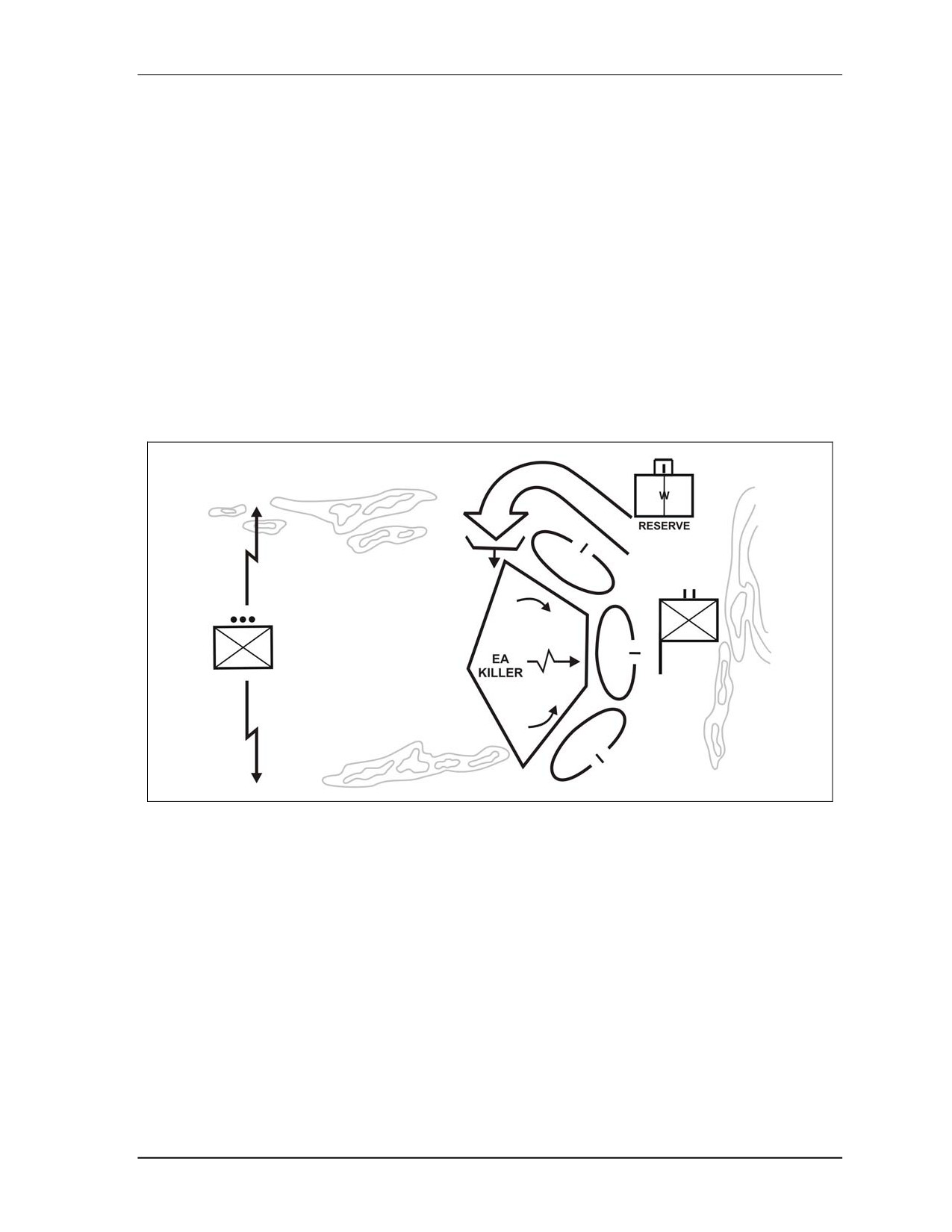
Offensive Operations
• After a successful attack, continues the movement to contact or executes other missions as
directed by the BCT commander.
Defend
4-179. The battalion commander directs a defense when the battalion has insufficient combat power to
attack, or when the enemy’s strength forces the battalion to halt and prepare for a more deliberate attack
(Figure 4-16). The battalion maneuvers to the best available defensible terrain. The commander may direct
the advance guard or another security force to delay an enemy attack. The purpose of this is to provide time
for the battalion to deploy.
4-180. The companies deploy, establish security, launch small UAS, array their forces, and develop fire
plans. The company commander emphasizes flank protection and coordination with adjacent units. As the
enemy attacks, the battalion commander repositions and maneuvers forces to defeat the enemy through
massed fires, situational obstacles, and counterattacks. The battalion commander seeks to defeat an
attacking enemy force and create the opportunity for offensive action. In some cases, the battalion may
need to retain its position to allow the BCT commander time to commit additional forces.
Figure 4-16. Concept of defense.
ATTACKS
4-181. Attacks range along a continuum defined at one end by fragmentary orders that direct rapid
execution and at the other end by detailed plans and orders. Attacks rely more on an implicit understanding
than on electronic communication with detailed orders and appropriate branches and sequels that make
understanding explicit. At one extreme of the continuum, the battalion discovers the general enemy
situation through a movement to contact and conducts an attack as a continuation of the meeting
engagement to exploit a temporary advantage in relative combat power and to preempt enemy actions. At
the other extreme of the continuum, the battalion moves into an attack from a reserve position or assembly
area with detailed knowledge of the enemy, a task organization designed specifically for the attack, and a
fully rehearsed plan. Most attacks fall somewhere between the two ends of the continuum.
13 December 2006
FM 3-21.20
4-39
Chapter 4
CHARACTERISTICS
4-182. An attack at the battalion level is a type of offensive action characterized by close combat, direct
fire, and movement and supported by indirect fires. When the battalion commander decides to attack, he
masses the effects of overwhelming combat power against a portion (or portions) of the enemy force with a
tempo and intensity that the enemy cannot match. The following paragraphs discuss the tactics for
conducting—
y A force-oriented attack against a stationary enemy force.
y A force-oriented attack against a moving enemy force.
y A terrain-oriented attack.
4-183. A terrain-oriented objective requires the battalion to seize, secure, or retain a designated
geographical area. A force-oriented objective requires the battalion to focus its efforts on a designated
enemy force. The enemy force may be stationary or moving. All attacks depend on synchronization and
integration of all WFF assets for success. They require planning, coordination, and time to prepare.
FORCE-ORIENTED ATTACK AGAINST A STATIONARY ENEMY FORCE
4-184. The battalion may attack a stationary enemy force as part of a counterattack, spoiling attack, or as
an initial attack against an enemy defense. The battalion may also attack a stationary force as part of a BCT
movement to contact or exploitation.
Planning Considerations
4-185. The focus of planning is to develop a fully synchronized plan that masses all available combat
power against the enemy.
Scheme of Maneuver
4-186. The battalion directs its decisive operation against an objective, ideally an identified enemy
weakness, which will cause the collapse of the enemy defense. The battalion seeks to attack the enemy’s
flanks, rear, or supporting formations causing disintegration or dislocation. By so doing, the enemy loses
control of its systems and the enemy commander’s options are reduced. Concurrently, the Infantry
battalion retains the initiative and reduces its own vulnerabilities.
4-187. The commander seeks to identify: an unobserved or covered and concealed avenue of approach to
the objective, a small unit lacking mutual support within the enemy defense, or a weak flank that he can
exploit to gain a tactical advantage. When attacking a well-prepared enemy defense, the commander
normally plans to isolate and then destroy small vulnerable portions of the enemy defense in sequence. The
commander and staff develop the plan using a reverse planning process starting from actions on the
objective and working back to the LD or assembly area. They incorporate plans for exploiting success and
opportunities that may develop during execution. They emphasize synchronization of movement, precise
direct and indirect fires, and support throughout the attack.
4-188. The commander and staff consider the enemy’s strengths and obstacles to determine when and
where the battalion may need breaching operations. The size of the enemy force overwatching the obstacle
drives the type of breach the battalion conducts. The commander and staff consider the enemy’s ability to
mass combat power, reposition his forces, or commit his reserve. The battalion then develops a scheme of
maneuver to mass sufficient combat power at an enemy weakness. The location selected for breaching and
penetration depends largely on a weakness in the enemy’s defense where its covering fires are limited.
4-189. The reverse planning process is an essential tool in building an effective plan to attack a defending
enemy. By starting with actions on the objective and working back to the line of departure, the staff can
allocate combat power, mobility assets, and indirect fires (suppression and obscuration).
4-40
FM 3-21.20
13 December 2006
Offensive Operations
Fire Support
4-190. The following are considerations for the FS plan:
y Position fire support assets to support the reconnaissance effort.
y Plan suppressive and obscuration fires at the point of penetration.
y Plan suppressive and obscuration fires in support of breaching operations.
y Plan fires in support of the approach to the objective. These fires engage enemy security forces,
destroy bypassed enemy forces, and screen friendly movement.
y Synchronize fires on the objective to suppress, neutralize, or destroy critical enemy forces that
can most affect the battalion’s closure on the objective.
y Plan fires beyond the objective to support an attack or defense, or to isolate the objective to
prevent the egress or ingress of threat forces.
y Use indirect fires and CAS to delay or neutralize repositioning enemy forces and reserves.
y Plan locations of critical friendly zones (CFZs) to protect critical actions such as support-by-
fire positions, breaching efforts, and mortar assets.
y Use risk estimate distances (RED) to determine triggers to initiate, shift, and cease loading of
rounds.
y Use echelon fires to maintain continuous suppression of enemy forces throughout the
movement to and actions on the objective.
Movement and maneuver
4-191. Maintaining the mobility of the battalion in offensive operations is critical. The battalion engineer
must plan and allocate mobility resources to the security forces (reconnaissance and surveillance and
advance guard) and to the main body. The security force has just enough mobility resources to cover its
own movement and to complete the reconnaissance mission. The advance guard needs enough resources to
conduct breaching operations such as reducing obstacles and opening lanes for the main body to pass. If
the obstacle is dense or covered by a relatively larger force, the main body deploys to conduct a breaching
operation. Engineer task organization is based on supporting battalion in-stride breaching operations with
minimal engineer assets under battalion control to transition to a battalion deliberate breach, if needed. The
battalion uses situational obstacles to attack an enemy’s vulnerability or a specific course of action and can
use mobile obstacle detachments to help secure the battalion flanks. The following are considerations for
the scheme of engineer operations:
y Always search for a bypass to an obstacle.
y Plan for adjustment of the breach location based on the latest obstacle intelligence.
y Ensure information on obstacles receives immediate battalion-wide dissemination, including
fire support, protection, and sustainment platforms and units.
y Ensure adequate mobility support is task organized well forward during the approach to the
objective to support breaching requirements.
y Retain ability to mass engineers to support breaching operations.
y Support assaulting forces with engineers to breach enemy protective obstacles.
y Ensure adequate guides, traffic control, and lane improvements to support movement of follow
on forces and sustainment vehicle traffic.
y Use situational obstacles for flank security.
Protection
In offensive operations, air defense units move to the position from which they can best protect the
battalion. The S-2 and AD officer must determine where likely enemy air avenues of approach are located,
and plan positions accordingly. Priorities for protection may include companies, fire support, engineer
elements, C2 nodes, and logistics assets. AD coverage is increased in areas and activities most vulnerable
13 December 2006
FM 3-21.20
4-41
Chapter 4
to air attack such as breaching operations or movements through restricted terrain. The following are
considerations for CBRN support:
y The scout platoon should be prepared for CBRN reconnaissance tasks.
y Disseminate any detected CBRN threats throughout the battalion immediately.
y Integrate and synchronize the use of smoke to support critical actions such as breaching or
assaults. Ensure artillery, mortar, and mechanical smoke are complementary.
y Develop decontamination plans based on the commander’s priorities and vulnerability analysis.
y Disseminate planned and active decontamination sites.
Sustainment
4-192. The following are considerations for the sustainment plan:
y Synchronize the movement and positioning of sustainment assets with the scheme of maneuver
to ensure immediate support of anticipated requirements. This synchronized plan must cover
movement from SP to the objective.
y Ensure adequate sustainment support to the reconnaissance and surveillance effort. The HHC
commander must plan and integrate timely resupply and evacuation support of forward
reconnaissance and surveillance assets into the reconnaissance and surveillance plan. He
focuses on medical evacuation, especially air evacuation.
y Plan immediate support to high-risk operations such as breaching or assaults through the
forward positioning of support assets.
y Plan for reorganization on or near the objective once the battalion secures the objective.
Articulate clear priorities of support during reorganization.
Preparation
4-193. The battalion uses available time before the attack to conduct extensive reconnaissance and
surveillance, precombat checks and inspections, and rehearsals while concealing attack preparations from
the enemy. The commander and staff refine the plan based on continuously updated intelligence.
Subordinates conduct parallel planning as well as start their preparation for the attack immediately after the
battalion issues a FRAGO. As more intelligence becomes available, the battalion commander revises
orders and distributes them; thereby giving subordinates more time to prepare for the attack. Regardless of
the time available, the commander must conduct detailed planning and supervision of subordinate
preparations. The commander will also use this preparation time to conduct brief backs and back briefs
with his subordinate commanders to ensure they understand their tasks, purposes, and are
planning/executing within his intent. Usually during the battalion’s preparation phase, the reconnaissance
element is collecting information to confirm or deny the situational template. This allows the commander
and staff time to incorporate any changes to the original course of action before executing.
Inspections
4-194. The commander supervises subordinate troop leading procedures to ensure planning and
preparations are on track and consistent with his intent. The commander may inspect subordinate unit order
briefs and rehearsals. He focuses his inspections on the decisive operation and critical events such as
assaults, breaching operations, and passage of lines. Since the commander cannot be everywhere at once,
he maximizes the use of other key leaders and technology to assist him. The requirement that subordinate
graphics and/or orders are provided back to the battalion staff allows the staff the opportunity to ensure
they are consistent with the battalion plans.
4-42
FM 3-21.20
13 December 2006
Offensive Operations
Rehearsals
4-195. The battalion usually conducts rehearsals, but the type and technique may vary based on time
available and the security that is required. During the combined-arms rehearsal, the battalion S-2 portrays a
thinking, uncooperative enemy with emphasis on enemy repositioning, employment of fires, and
commitment of reserves. The primary focus of the rehearsal is actions on the objective. Each subordinate
commander addresses the conduct of his mission as the rehearsal progresses. The rehearsal places special
emphasis on triggers and the coordinated maneuver of forces. All subordinate commanders must accurately
portray how long it takes to complete assigned tasks and how much space is required by their force. Direct
and indirect fire plans are covered in detail, to include the massing, distribution, shifting, and control of
fires. The commander ensures subordinate plans are coordinated and consistent with his intent. The
rehearsal also covers the following:
y Plans to execute follow on missions or exploit success.
y Likely times and locations where a reserve is needed and what are the commitment criteria.
y Execution of the FS plan, to include shifting of fires, employment of CAS, adjusting of
FSCMs, and positioning of observers.
y Breaching operations.
y Passage of lines.
y Contingency plans for actions against enemy counterattacks, repositioning, commitment of
reserves, or use of CBRN capabilities.
y Consolidation and reorganization.
y Execution of branches or sequels assigned by the brigade.
y Execution of the sustainment plan, to include unit maintenance collection point (UMCP),
CASEVAC, movement and activities of combat trains, rear area movement and activities, and
emergency resupply.
Reconnaissance and Surveillance
4-196. Effective and current intelligence is a prerequisite for a successful attack. Before conducting an
attack, the commander needs to determine the enemy’s strength and disposition. During hasty operations
the entire intelligence collection, analysis, and dissemination process must rapidly respond to the
commander’s critical information requirements. The commander must receive an accurate picture of the
enemy’s defense so he can decide on a COA and act faster than the enemy can react.
4-197. When preparing for a deliberate operation, the commander and staff participate in development of
the ISR plan. This well-resourced and coordinated ISR effort paints a detailed picture of the enemy
situation before an attack. This reconnaissance effort must include redundant information gathering
systems to ensure continuous flow of information to the battalion and correspondingly from the battalion to
the companies. The battalion commander uses this intelligence to decide on a COA and make refinements
to the plan. The ISR effort also provides him with continuous updates during the attack so he can adjust
execution of the operation based on the enemy’s reactions.
Enemy’s Current Array of Forces
4-198. The intelligence available to the battalion comes from a continuous stream of information that
begins with Joint Interagency Intergovernmental Multinational (JIIM), and SOF assets that funnel down to
the BCT and then to the battalion (Appendix G).
4-199. The first priority is to confirm information available on the enemy’s strength, composition, and
disposition. The next priorities are the effects of weather and terrain, and how the enemy is likely to fight.
The S-2 tries to identify what the enemy will do and what information the battalion needs to confirm the
enemy’s action. The battalion ISR effort focuses on identifying indicators required for confirming the
enemy’s actual COA. This information is vital in answering the commander’s information and intelligence
requirements and helps the staff in developing and refining plans. Ideally, the battalion does not make final
13 December 2006
FM 3-21.20
4-43
Chapter 4
decisions on how to execute the attack until it can identify the current array of enemy forces. Key areas to
identify for a defending enemy force include—
y Composition, disposition, and strength of enemy forces along a flank or at an area selected for
penetration.
y Composition, strength, and disposition of security and disruption forces.
y Location, orientation, type, depth, and composition of obstacles.
y Locations of secure bypasses around obstacles.
y Composition, strength, and disposition of defending combat formations within the enemy’s
main battle area (MBA).
y Composition, strength, and location of reserves.
y Location of routes the enemy may use to counterattack or reinforce his defense.
y Type of enemy fortifications and survivability effort.
4-200. Reconnaissance forces patrol to collect information. As time permits, reconnaissance and
surveillance assets observe the enemy defense from advantageous positions (OPs) to locate gaps in the
enemy’s defense, identify weapons systems and fighting positions, view rehearsals and positioning, and
determine the enemy’s security activities and times of decreased readiness. The S-2 must discern any
enemy deception efforts such as phony obstacles, dummy emplacements, and deception positions designed
to confuse an attacker.
Enemy Engagement Areas
4-201. The battalion commander, supported by the S-2, seeks to define the limits of the enemy
engagement areas. This includes where the enemy can mass fires, weapon ranges, direct fire integration
with obstacles, ability to shift fires, and mutual support between positions. This analysis requires effective
terrain analysis, confirmed locations of enemy weapons systems
(by system type), and a good
understanding of the enemy’s weapons capabilities and tactics. Reconnaissance forces report locations,
orientation, and composition of defending weapons systems and obstacles. The analysis of the enemy’s
direct fire plan assists the commander in determining where the probable line of contact is, when the
battalion must transition to maneuver, how to echelon indirect fires, and how feasible his scheme of
maneuver is. The use of long-range indirect fires allows the commander to shape what the enemy can do
relative to engagement areas. Key to such actions is the emplacement of obstacles.
Enemy Vulnerabilities
4-202. The overall ISR effort also seeks to identify enemy vulnerabilities that may include—
y Gaps in the enemy’s defense.
y Exposed or weak flanks.
y Enemy units that lack mutual support.
y Unobserved or weakly defended avenues of approach to the enemy’s flank or rear.
y Covered and concealed routes that allow the battalion to close on the enemy.
y Weak obstacles or fortifications in an enemy defense, especially along a flank.
Support on Approach to Objective
4-203. Reconnaissance elements initially focus on the enemy’s security and disruption forces forward of
his main defense to locate enemy positions and obstacles along the battalion’s planned routes of advance.
Reconnaissance forces also locate gaps and routes that allow them to infiltrate into the enemy main
defensive or rear area. The reconnaissance and surveillance effort seeks to locate enemy forces that may
reposition and affect the battalion’s approach to the enemy’s main defense. Successful attacks depend on
reconnaissance forces to call indirect fires on targets in the enemy’s rear that isolate the enemy front line
4-44
FM 3-21.20
13 December 2006
Offensive Operations
forces and prevent them from being reinforced. A rapid, secure advance to the enemy’s main defense
depends on the reconnaissance effort to locate enemy security forces and obstacles.
Execution
4-204. The battalion commander positions reconnaissance and surveillance assets to maintain observation
of enemy reactions to the battalion’s maneuver on the objective. Reconnaissance assets focus on areas that
the enemy will likely use to reposition forces, commit reserves, and counterattack. As the engagement on
the objective develops, reconnaissance forces report enemy reactions, repositioning, reinforcements, and
battle damage assessment (BDA). Again, reconnaissance elements target and engage with indirect fires
enemy repositioning forces, reserves, counterattacking forces, and other high-payoff targets. Early
identification of enemy reactions is essential for the battalion to maintain the tempo and initiative during
the attack.
Approach to Objective
4-205. During the approach, the battalion is prepared to—
y Bypass or breach obstacles.
y React to all seven forms of contact (visual, physical, indirect, obstacles, aircraft, CBRN, and
electronic warfare).
y Transition to different formations and techniques based on the terrain and enemy situation.
y Employ forces to screen or guard flanks that may become exposed or threatened during the
approach.
y Avoid terrain features that are likely enemy artillery reference points, locations for chemical
strikes, or locations for situational obstacles.
y Destroy or force the withdrawal of opposing enemy security and disruption forces.
y Minimize the effects of enemy deception.
4-206. When the situation permits, a defending enemy generally establishes a security area around his
forces to provide early warning of an attack, deny friendly reconnaissance, and disrupt the friendly force’s
attack. The strength of the enemy’s security area depends on the time available, forces available, and his
doctrine or pattern of operations. The battalion must counter the effects of enemy security forces to ensure
an unimpeded and concealed approach. This starts before the attack when reconnaissance forces seek to
locate enemy security forces. Once located, the commander has the following options available—
y Destroy them immediately with indirect fires and CAS (preferred option).
y Destroy them with indirect fires and CAS during the approach to the objective.
y Conduct limited objective attacks before execution of the main attack.
y Employ a strong advance guard to destroy or force the withdrawal of enemy security forces
during the approach to the objective.
y Attack with sniper fire to reduce their effectiveness.
4-207. The battalion must maintain a steady, controlled movement. Speed and dispersion, facilitated by
information dominance, are the norm with massing of weapons effects to destroy the enemy’s defense. If
the formation is too slow or becomes too concentrated, it is vulnerable to massed enemy fires.
Actions on Objective
4-208. Before the attack is initiated, the objective is isolated to prevent the ingress or egress of threat
forces. The battalion commander must set favorable conditions before committing his forces. He does this
using artillery, fixed wing and rotary wing CAS, organic mortars, a shaping operation from another
maneuver battalion, and the use of any JIIM or SOF assets. The battalion commander then maneuvers
combat forces and employs direct and indirect fires, situational obstacles, and smoke to execute decisive
13 December 2006
FM 3-21.20
4-45