FM 3-21.20 (FM 7-20) THE INFANTRY BATTALION (DECEMBER 2006) - page 2
Chapter 2
in the absence of orders. When significant opportunities appear, subordinates use the commander’s intent
to orient their efforts and display initiative.
SUBORDINATE INITIATIVE
2-3.
Initiative is the assumption of responsibility to decide and initiate independent actions when the
commander's concept or order is no longer applicable or when an unanticipated opportunity presents itself
that leads to the accomplishment of the commander's intent. Subordinates decide how to achieve their
assigned missions within the delegated freedom of action and the exercise of disciplined initiative during
execution; they have an absolute responsibility, however, to fulfill the commander's intent.
COMPONENTS
2-4.
The components of the commander’s intent include: end state, key tasks, and expanded intent (if
desired).
End state
2-5.
At the operational and tactical levels, an end state consists of those conditions that, when
achieved, accomplish the mission. The commander normally articulates an operation’s end state by
describing the relationship between friendly forces and the enemy, terrain, and the population.
Key Tasks
2-6.
Key tasks are those tasks that the force must perform as a whole, or are the conditions the force
must meet to achieve the end state, and the stated purpose of the operation. Key tasks are not tied to a
specific course of action (COA); but rather, they identify what the force must do to achieve the end state.
Acceptable COAs accomplish all key tasks. In changed circumstances, when significant opportunities
present themselves or the concept of operations no longer fits the situation, subordinates use key tasks to
keep their efforts focused on achieving the commander’s intent. Examples of key tasks include; terrain that
must be controlled, the operation’s tempo and duration, and the operation’s effect on the enemy. Key tasks
are not specified tasks for any subordinate unit; however, they may be sources of implied tasks.
Expanded Purpose
2-7.
If the commander’s intent addresses purpose, it does not restate the
“why” of the mission
statement; but rather, it addresses the broader operational context of the mission.
LOCATION OF COMMANDER
2-8.
In the past, the commander has been torn between the conflicting requirement to visualize the
battlefield and the requirement for his presence in the main or tactical command post (TACCP) to
participate in the MDMP. This dilemma slowed the planning and execution of operations while frustrating
the commanders’ efforts to “get out of the command post.”
2-9.
Infantry battalions must have the ability to visualize the battlespace in all dimensions and to share
a common operational picture (COP). In addition, battalion commanders retain the ability to recognize and
protect their own and other friendly forces. The commander cannot, however, fully visualize the battlefield
while directing and synchronizing the efforts of his battalion from the command post. He must move from
the CP to assess the situation face-to-face with subordinate commanders and their Soldiers. The C2
infrastructure within the Infantry battalion permits a commander to position himself where he can best
command without depriving himself of the ability to respond to opportunities and changing circumstances.
2-2
FM 3-21.20
13 December 2006
Battle Command
2-10.
The commander can be any place on the battlefield where he can best affect current operations but
not disrupt the planning and preparation for future operations. He will need information updates and
continuous assessments to make command decisions. He may need to make brief trips to the CP to approve
and personally deliver plans and orders from battalion to company level. However, the commander is not
tethered to the CP if he needs to review developed COAs, WARNOs, OPORDs, and FRAGOs or provide
guidance for planning. If the commander chooses, he can receive, review, edit, and disseminate orders and
issue guidance from his ABCS suite.
SCIENCE OF CONTROL
2-11.
The commander is the key to command and control in the battalion. Foremost among his roles is
his ability to combine the art of command and the science of control. He must use a method of visualizing
the battlespace, describing his visualization to subordinates, directing action to achieve results, and leading
the unit to mission accomplishment, with continuous assessment throughout the mission.
VISUALIZE
2-12.
The commander's visualization is the core mental process that supports his decision making and
by which he combines the art of command and the science of control. It is the process of achieving a clear
understanding of the battalion's current state with relation to the enemy and the environment, developing a
desired end state that represents mission accomplishment, and determining the sequence of activities that
moves the battalion from its current state to the end state. The commander begins to visualize the desired
end state when he receives a mission or perceives a change in the mission. He applies his current
situational understanding to the received or perceived mission. As he analyzes or receives staff analysis of
the mission, he develops a mental image of the friendly forces in relation to the enemy, the environment,
and possible future operations at the conclusion of the operation. The commander's visualization is his
assessment tool throughout the operation. He should focus on the following factors.
Understand Current State of Friendly and Enemy Forces
2-13.
The commander derives situational understanding from applying his judgment, experience,
expertise, and intuition to all of the information gathered on the current situation. Situational understanding
includes physical factors, human factors, and the relationships between friendly and enemy forces and the
environment that represent potential opportunities or threats for the battalion.
Common Operating Picture
2-14.
The COP is an operational picture tailored to the commander’s requirements based on common
data and information shared by more than one command. The COP includes friendly, enemy, and
environmental elements and helps the commander to make timely, accurate decisions. The COP is
displayed at a scale and level of detail that meets the information needs of the commander. Depending on
how long it takes friendly and enemy situational information to reach a particular unit, the COP will
represent varying degrees of accuracy of the actual picture at any given point. As technology continues to
push toward state-of-the-art digital communications to enhance near-real-time situational understanding,
the accuracy of the COP between the various units on the battlefield will be increased. C2 systems fuse
information from a variety of sources. Rapid distribution of information is enhanced as information
systems (INFOSYS) continue to be updated with digital devices on the battlefield.
Situational Understanding
2-15.
SU is the product of applying analysis and judgment to the COP to determine the relationships
among factors of METT-TC (mission, enemy, terrain, troops, time available, and civil considerations). It
enhances decision making by identifying opportunities, threats to the force or mission accomplishment, and
information gaps. However, SU is imperfect, particularly with respect to the enemy situation.
13 December 2006
FM 3-21.20
2-3
Chapter 2
Foresee a Feasible Outcome
2-16.
The commander must identify a feasible outcome to the operation that results in mission success
and leaves the battalion postured for the next operation.
Visualize Dynamics Between Opposing Forces
2-17.
The commander must identify the dynamics of opposing forces throughout the sequence of
actions. This includes evaluating possible enemy reactions and friendly counteractions. This evaluation
may lead to the identification of possible critical decision points throughout the operation.
DESCRIBE
2-18.
The commander describes his visualization by participating in the MDMP during planning and
preparation for an operation and during execution. Specifically, his commander's intent, planning guidance,
anticipated decision points, and commander's critical information requirements all serve to guide and focus
the C2 system to support his decision making and to communicate his decision for execution. He must
apply his judgment, experience, expertise, and intuition before making a decision and describing that
decision to subordinates. During preparation, the commander uses the rehearsal to describe further his
intent and concept to his subordinates, to identify and discuss options at decision points, to synchronize
activities within the battalion and among subordinate units, and to add to his own visualization. During
execution, the commander continues to visualize the implication of events, and he describes his
conclusions to his staff and subordinates through updated CCIR and guidance and to his higher HQ’s
through a situation report.
DIRECT
2-19.
The commander directs when he has made a decision and communicates that decision to his
subordinates through an order.
Plan
2-20.
Orders should enable subordinates to understand their situation, their commander's mission and
intent, and their own mission. Clear direction is essential to mission success; however, commanders must
strike a balance between necessary but minimum direction and overly detailed direction. The commander,
or his staff, assigns graphical, written, or procedural control measures (permissive or restrictive) to prevent
units from impeding one another and to impose necessary coordination. The commander should impose
only the minimum control measures necessary to provide essential coordination and deconfliction among
units.
Prepare
2-21.
The commander must update and validate his visualization during preparations as the results of
reconnaissance and surveillance operations become available. The earlier the commander identifies the
need for modifications, the easier it is for him to incorporate and synchronize them into his plan. He
describes the implications of his updated visualization and directs actions to effect his changes to the plan
throughout the orders process.
Execute
2-22.
Execution includes a continuous process of assessing the current state of the operation and making
adjustments to exploit opportunities and to account for unforeseen enemy actions. Combining the art of
command and the science of control is most evident during execution. The commander exercises judgment
and initiative continuously, assessing the situation and making decisions often with incomplete, conflicting,
2-4
FM 3-21.20
13 December 2006
Battle Command
and vague information. Waiting for perfect information is rarely an option. During execution, the
commander uses his visualization, along with continuous updated information, to ensure that his
subordinate units execute appropriate measures for the actual situation. A major part of the "art of
command" is to know when the plan must change and what criteria indicate a need for changes and then to
determine what changes will maximize unit effectiveness. The commander directs these actions primarily
through a FRAGO.
Section II. COMMAND AND CONTROL
Command and control has two components: the commander and the C2 system. The commander uses the C2
system to exercise C2 over forces to accomplish a mission.
SYSTEM
2-23.
The C2 system is the arrangement of personnel, information management, procedures, and
equipment and facilities essential to the commander to plan, prepare for, execute, and assess operations.
INFRASTRUCTURE
2-24.
The C2 infrastructure is a system of intelligence, surveillance, and reconnaissance collection and
processing procedures, information management, organizational structures, personnel, equipment,
facilities, communications, and computers essential to conduct operations. It is designed to exercise C2
over forces to accomplish the mission. It supports a commander’s exercise of C2 across the range of
military operations through regulation of forces and functions IAW the commander’s intent. The C2
infrastructure provides the commander and staff with the ability to plan, prepare, and execute using
resilient voice and data communications networks to enable effective C2 on the battlefield. This capability
includes the conduct of operations from alert through redeployment. It also includes conduct of
counterintelligence operations to deny the adversary’s ability to do the same. The battalion integrates the
C2 infrastructure through maneuver, fires and effects, logistics, force protection, information operations,
and intelligence.
EXERCISE
2-25.
The battalion commander must place the C2 system into action to exercise C2. Exercising C2 is
dynamic throughout the operations process. Although planning, preparing, executing, and assessing occur
continuously in operations, they need not occur sequentially. The battalion must prepare to perform all four
actions simultaneously, and the commander is at the center of the process (Figure 2-1). The operations
process is execution-focused rather than planning-focused.
13 December 2006
FM 3-21.20
2-5

Chapter 2
Figure 2-1. Operations process.
DISTRIBUTION AT BATTALION LEVEL
2-26.
The battalion’s staff sections are normally distributed among three C2 organizations: the
command group, main command post, and combat trains command post. The battalion commander
organizes his staff within each command post to perform essential staff functions to aid him with planning
and in controlling operations. These C2 organizations are normally positioned within the battalion's AO to
maintain flexibility, redundancy, survivability, and mobility. See Chapter 9 for more information.
COMMAND GROUP
2-27.
The command group usually consists of the commander, the fire support officer and or air liaison
officer, and other key staff officers as directed by the commander. Its purpose is the direct C2 of the
battalion. The command group is not a permanent organization; rather, it is formed anytime the battalion
commander goes forward to control an operation. The command group is equipped to operate wherever the
battalion commander feels it is necessary to influence operations with rapid decisions and orders. The
commander determines the actual placement of personnel within the command group.
2-28.
The commander fights the battle from the command group and positions himself in the best
location, normally near the main effort, to influence the battle without losing situational understanding.
From this forward location, he is better able to observe critical events, maintain communications, and sense
the battle. Whenever possible the commander uses the C2 system to free himself from the main CP so he
can physically visualize his subordinates and the terrain he is to fight on without affecting his
decision-making ability.
2-29.
In determining his location on the battlefield, the commander considers—
• Where on the battlefield he must position himself so that he can exert the greatest influence.
• Time and location of critical events and decision points that have the greatest impact on
mission accomplishment. Ideally, the commander selects a location where he can observe the
conditions that aid in making a critical decision.
• Security for the command group, including the commander's personal protection.
MAIN COMMAND POST
2-30.
The main CP is the battalion commander’s principal C2 facility. The main CP operates from a
stationary position and moves as required to maintain control of the operation. In linear operations
environments, it locates behind the Infantry companies’ CPs and, if possible, out of enemy
medium-artillery range. In nonlinear and or noncontiguous operations, it locates where it can best support
2-6
FM 3-21.20
13 December 2006
Battle Command
battalion operations and is least vulnerable to potential hostile actions. The battalion XO is responsible for
supervising all staff activities and functions within the main CP. The main CP serves the following
functions:
• Synchronizes combat, combat support, and sustainment activities in support of the overall
operation.
• Provides a focal point for the development of intelligence.
• Supports information understanding for the battalion commander and subordinates by
monitoring, analyzing, and disseminating information.
• Monitors and anticipates the commander’s decision points.
• Plans future operations.
• Coordinates with higher headquarters and adjacent units.
• Keeps higher headquarters informed.
• Serves as net control station for the operations and intelligence radio net and backup net control
station for the command radio net.
• Provides a stable, secure planning facility.
• Produces and disseminates the commander’s orders.
• Plans and controls reconnaissance and surveillance operations.
COMBAT TRAINS COMMAND POST
2-31.
The CTCP controls and coordinates the administrative and logistical support for the battalion. It
consists of the battalion S-1 and S-4, and it usually collocates with the BAS. The battalion S-1 and S-4
work closely with the forward support company (FSC) commander and the BSB support operations officer
to coordinate sustainment for the battalion. The CTCP serves the following functions:
• Tracks the current battle and is prepared to assume the functions of the main command post.
• Provides sustainment representation to the main CP for planning and integration.
• Forecasts and coordinates future requirements.
• Monitors main supply routes (MSRs) and controls sustainment traffic within the battalion’s
AO.
• Coordinates the evacuation of casualties, equipment, and enemy prisoners of war (EPWs).
INFANTRY BATTALION FIELD TRAINS COMMAND POST
2-32.
The attached FSC commander controls the field trains and all units that reside in it. The
battalion’s field trains will usually reside in the brigade support area (BSA); however, the field trains may
locate within the Infantry battalions AO. The field trains usually include the personnel administration
center (PAC), elements of the S-4 section, elements of the company supply sections, elements of the FSC,
and any other support elements that are not forward in the combat trains. Infantry companies normally
locate their supply sections with elements of the HHC headquarters section in the field trains. The HHC
1SG is typically the senior battalion representative in the field trains. The battalion S-4 coordinates all unit
supply requests, and ensures the logistics needs of the battalion are coordinated with the FSC commander.
This includes coordination of LOGPACs moving forward into the battalion AO, and satisfactory
completion of all maintenance requests.
COMMAND AND SUPPORT RELATIONSHIPS
2-33.
A subordinate unit falls under the direct command of a specific commander if that subordinate
unit is organic, assigned, attached, or under operational control to that specific commanders unit
13 December 2006
FM 3-21.20
2-7
Chapter 2
COMMAND
2-34.
Command responsibility and authority are established routinely through these following standard
relationships:
Organic
2-35.
This unit forms an essential part of an Army organization and is listed in its TOE or table of
distribution and allowances (TDA).
Assigned
2-36.
This unit is placed in an organization on a permanent basis and is controlled and administered by
the organization to which it is assigned.
Attached
2-37.
In this relationship, a unit is assigned temporarily to a command other than its parent unit. The
attached unit is under the command of the unit’s commander to which it is attached.
• The commanding officer exercises the same degree of C2 as with his organic units.
• C2 is subject to limitations specified by the commander directing the attachment. This
relationship includes the responsibility for logistics, training, operations, and uniform code of
military justice; however, the parent unit retains responsibility for transfer and promotion.
• Having a unit attached imposes an administrative and logistical burden on the unit to which the
attachment is made.
Operational Control
2-38.
This relationship places a unit under the control of a commander for specific operations. The
relationship is limited by function, time, or location. OPCON does not imply responsibility for
administration, logistics, discipline, internal organization, or training. The commander's relationship with
OPCON units is otherwise the same as with organic or attached subordinate units.
Tactical Control
2-39.
TACON is the authority normally limited to the detailed and specified local direction of
movement and maneuver of forces to accomplish a task. This is a command relationship where a
combatant commander delegates limited authority to direct the tactical use of combat forces. TACON is
often the command relationship established between forces of different nations in a multinational force.
SUPPORT
2-40.
Support is the action of an element or unit that aids, protects, complements, or sustains another
unit IAW an order requiring such support. A supporting unit assists another unit but is not under the
command of that unit. The commander's relationship with supporting units is as follows:
•
He ensures that the supporting unit establishes liaison and communications with his unit.
•
He keeps the supporting unit informed of the situation and the support needed.
•
The leader of the supporting unit advises him on its employment considerations.
•
A supporting unit honors his request for support as an order. In case of a conflict, the supporting
unit leader refers the matter to his parent unit commander. However, the request or order in
question is honored, until the conflict is resolved.
2-8
FM 3-21.20
13 December 2006
Battle Command
Direct Support
2-41.
A unit in DS supports another specific unit, but remains under the command of its parent unit
commander. The supporting unit answers directly to the supported unit's requests. The company
commander may not reallocate, reassign, or task-organize the DS force supporting him.
General Support
2-42.
Units in GS to the battalion are under control of their parent unit commander. They support the
battalion as a whole, not any specific company. Company commanders may request support from the GS
unit through the battalion.
Reinforcing Mission
2-43.
Reinforcing is a tactical artillery mission in which an artillery unit augments the fire of another
artillery unit. Coordination for support is normally provided through the DS artillery unit.
General Support-Reinforcing Mission
2-44.
General Support-Reinforcing (GS-R) is a tactical artillery mission where an artillery unit has the
mission of supporting the force as a whole and of providing reinforcing fires for another artillery unit.
Coordination for support is the responsibility of the DS artillery unit.
Section III. PLANNING PROCEDURES
Planning for operations leads the commander to make decisions during execution. At its core, decision making
is knowing if to decide, then when and what to decide. It includes understanding the consequences of decisions.
The MDMP is an established and proven analytical process. This tool helps the commander and staff develop
estimates and a plan. The recognition of the criticality of WFFs, and the digitization of the Army, have not
changed the steps of the MDMP; they have enhanced them. The analytical aspect of the MDMP is continuous,
occurring before, during, and after operations with constant feedback and updates of information. In the end,
the MDMP is the commander’s planning tool to be implemented as he deems appropriate.
PARALLEL, COLLABORATIVE, AND DISTRIBUTED PLANNING
2-45.
Parallel planning allows each echelon to make maximum use of time available. Collaborative
planning is the real-time interaction of commanders and staffs at two or more echelons. Distributed
planning allows the commander and staff members to execute planning from different locations.
PARALLEL PLANNING
2-46.
Parallel planning occurs when two echelons conduct their planning almost simultaneously. It
requires significant interaction between echelons. Parallel planning can happen only when higher
headquarters produce timely warning orders and share information with subordinate headquarters as it
becomes available.
COLLABORATIVE PLANNING
2-47.
Collaborative planning is the real-time interaction among commanders and staffs at two or more
echelons developing plans for a single operation. It must be used judiciously.
13 December 2006
FM 3-21.20
2-9
Chapter 2
2-48.
Collaborative planning is most appropriate when time is scarce and a limited number of options
are being considered. It is particularly useful when the commander and his staff can benefit from the input
of subordinate commanders and staffs.
2-49.
Collaborative planning is not appropriate when the staff is working a large number of courses of
action or branches and sequels, many of which will be discarded. In this case, involving subordinates
wastes precious time working options that are later discarded. Collaborative planning is also often not
appropriate during ongoing operations in which extended planning sessions take commanders and staffs
away from conducting current operations.
2-50.
As a rule of thumb, if the commander is directly involved in time-sensitive planning, some level
of collaborative planning is probably needed. The commander, not the staff, must make the decision to
conduct collaborative planning. Only the commander can commit subordinate commanders to using their
time for collaborative planning.
DISTRIBUTED PLANNING
2-51.
Digital communications and INFOSYS enable members of the same staff to execute the MDMP
without being collocated. Distributed planning saves time and increases the accuracy of available
information in that it allows for the rapid transmission of voice and data information, which can be used by
staffs over a wide geographical area.
MILITARY DECISION-MAKING PROCESS
2-52.
The MDMP is a process used by a commander and his staff to develop and thoroughly examine
numerous friendly and enemy courses of action. Based on the commander’s estimate, the MDMP can be
adjusted to meet the current situation. The commander and staff typically conduct this examination when
developing the commander's estimate and operation plans (OPLANs), when planning for an entirely new
mission, and during extended operations. This process can be performed slowly and deliberately or quickly
with heavy commander involvement. It also helps the commander and his staff to examine a specific
situation and, by applying thoroughness, clarity, sound judgment, logic, and professional knowledge, reach
a logical decision. (See Section IV for a detailed explanation of the MDMP and the use of MDMP in a
time-constrained environment.)
2-53.
The MDMP relies on doctrine (FM 5-0), especially the terms and symbols (graphics) consolidated
in FM 1-02. Using approved terms and symbols facilitates the rapid and consistent assessment of the
situation and the creation and implementation of plans and orders by minimizing confusion over the
meanings of terms and symbols used in the process.
ROLES OF COMMANDER AND EXECUTIVE OFFICER
2-54.
The commander is in charge of the military decision-making process. From start to finish, the
commander's personal role is central. His participation in the process provides focus and guidance to the
staff; however, there are responsibilities and decisions that are the commander's alone. The amount of his
direct involvement is driven by the time available, his personal preferences, and the experience and
accessibility of the staff. The less time available, the less experienced the staff, and the less accessible the
staff, the greater the commander’s involvement in the MDMP. See paragraph 2-19 for a discussion of
increased commander involvement in the decision-making process.
2-55.
The XO manages, coordinates, and disciplines the staff's work and provides quality control. He
ensures the staff has the information, guidance from the commander, and facilities it needs. He determines
timelines for the staff, establishes briefback times and locations, enforces the information management
plan, and provides any unique instructions needed to guide the staff in completing the MDMP process.
2-56.
Warning orders are used to facilitate parallel planning. By issuing guidance and participating in
formal and informal briefings, the commander and XO guide the staff through the decision-making
2-10
FM 3-21.20
13 December 2006
Battle Command
process. In a collaborative environment, the commander can extend this participation directly to
subordinate commanders and staffs. Such interaction helps the staff and subordinates to resolve questions
and involves all staff and subordinates in the complete process.
ROLE OF RECONNAISSANCE AND SURVEILLANCE
2-57.
The battalion commander deploys the battalion scout platoon and other assets early in the
planning process to facilitate early intelligence collection. However, the scout platoon is a primary source
of the battalion’s intelligence. It should only be deployed after he first considers, as a minimum, the
reconnaissance and surveillance planning factors found during mission analysis.
2-58.
The commander and staff ensure reconnaissance and surveillance is continuous during planning,
preparation, and execution of the mission. Data collected during reconnaissance and surveillance may
result in initial plans or courses of action being modified or even discarded. Further, when the plan
changes, the commander must modify his reconnaissance and surveillance objective to support the new
plan.
2-59.
Reconnaissance assists significantly in developing courses of action. Conducted early in the
planning process, it can help confirm or deny the commander's initial assessment
(visualization).
Information may also allow him to focus immediately on a specific course of action or to eliminate courses
of action that the reconnaissance shows to be infeasible.
2-60.
When conducting a reconnaissance, the commander must determine if the benefits outweigh the
risks. During defensive, stability operations, and civil support operations, the reconnaissance can often be
conducted with little risk. During offensive operations, reconnaissance involves more risk.
2-61.
When the commander deploys reconnaissance assets, particularly human intelligence, minimum
planning guidance is given to ensure the survival of the asset while still enabling mission accomplishment.
This guidance includes—
• Mission statement to include eyes-on-target time and anticipated length of mission.
• Priority intelligence requirement.
• Enemy situation in the operational area.
• Commander’s intent for intelligence (can be stated by the S-2 or S-3).
• Method of deployment and insertion with abort criteria. Coordination time and place are
included, if applicable.
• Fire support plan to include assets available.
• Communication plan (primary and back-up).
• Casualty evacuation plan.
• Exfiltration plan.
• Resupply plan.
Section IV. MILITARY DECISION-MAKING PROCESS
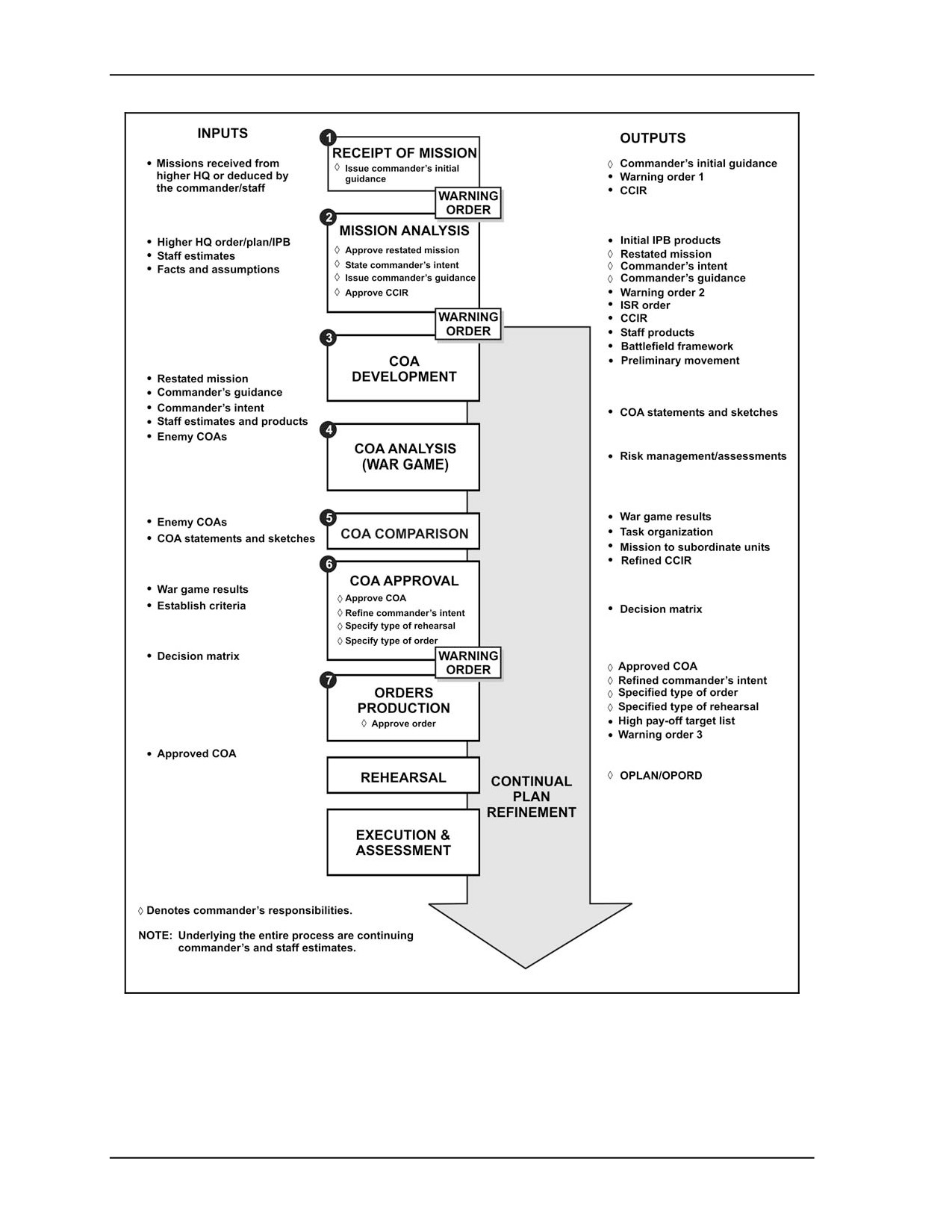
The MDMP has seven steps. Each builds on the outputs from the previous steps. Each then produces its own
output that drives subsequent steps (Figure 2-2). Errors committed early in the process, especially with a faulty
mission analysis, affect later steps. Estimates go on continuously to provide important inputs to the MDMP.
Each staff section produces estimates. Both these estimates and database updates support the planning process,
as well as mission execution. This section summarizes the MDMP. (See FM 5-0 for a more detailed discussion
of the MDMP.)
13 December 2006
FM 3-21.20
2-11
Chapter 2
Figure 2-2. MDMP steps, staff inputs and outputs.
2-12
FM 3-21.20
13 December 2006
Battle Command
TIME CONSTRAINTS
2-62.
The MDMP is the foundation for planning in a time-constrained environment. The products of the
MDMP are used in later planning sessions, when time is too short for a thorough reexamination, but when
significant parts of existing information and analysis of METT-TC factors -have not changed substantially.
Quickly developed plans are not likely to anticipate every possible branch or sequel, enemy action,
unexpected opportunity, or change in mission directed from higher headquarters, but this can be mitigated
by continuing staff planning after the order is given. Fleeting opportunities or unexpected enemy actions
may require a quick decision to implement a new or modified plan. The commander decides how to
abbreviate the MDMP; steps of the process should never be dropped; however, they may be done in a
shortened timeframe. What works for a unit depends on its proficiency and the factors of METT-TC in a
given situation. For more detailed information on the abbreviated decision making process, roles the
commander and staff play in it, and time saving techniques, see FM 5-0.
TRAINING ON THE MDMP
2-63.
Before a unit can conduct decision-making in a time-constrained environment, it must train on,
and master, all of the steps in the MDMP. A unit can only abbreviate the MDMP if it fully understands the
role of each step of the process and the requirements to produce the necessary products. Training on these
steps must be thorough and result in a series of staff battle drills tailored to the time available. Training on
the MDMP must be stressful and replicate realistic conditions and timelines. There is only one process, and
omitting steps of the MDMP to meet time constraints is not the solution. Anticipation, organization, and
prior preparation are the keys to success in a time-constrained environment. Well-trained staffs will know
where they can abbreviate actions and planning, focusing on only the most critical factors.
ABBREVIATION
2-64.
The unit abbreviates the MDMP when there is too little time for a thorough and comprehensive
application of the process. The most significant factor to consider is time. It is the only nonrenewable, and
often the most critical, resource.
TECHNIQUES
2-65.
There are four primary techniques for abbreviating the MDMP:
• Increase the battalion commander's involvement, allowing him to make timely decisions
without waiting for detailed briefings after each step.
• Limit options. When the commander is more prescriptive it saves the staff time by allowing
them to focus more closely.
• Maximize parallel planning. Although parallel planning should be normal during the MDMP,
maximizing its use in a time-constrained environment is critical.
• Limit the number of courses of action. If the commander conducts a personal assessment and
chooses a course of action, he can direct the staff to refine that one course of action only. This
technique normally saves the most time. It is highly dependent on the commander having an
accurate grasp of the relevant tactical situation facing the battalion.
2-66.
In a time-constrained environment, the importance of warning orders increases as available time
decreases; a verbal warning order now, followed by a written order later (or posted to a database), are
worth more than a written order one hour from now. The same warning orders used in the MDMP should
be issued when abbreviating the process. In addition to warning orders, units must share all available
information, (particularly intelligence preparation of the battlefield [IPB] products) with subordinates as
soon as possible. The C2 INFOSYS greatly increase this sharing of information and the commander’s
visualization through collaboration with his subordinates.
13 December 2006
FM 3-21.20
2-13
Chapter 2
2-67.
While the steps used in a time-constrained environment are the same, many of them may be done
mentally by the battalion commander or with less staff involvement than during the MDMP. The products
developed when the process is abbreviated may be the same as those developed for the MDMP; however,
they may be much less detailed and some may be omitted altogether. Unit SOPs and mission requirements
tailor this process to the commander’s preference for orders in this environment.
2-68.
When developing the plan, the staff may initially use the MDMP and develop branches and
sequels. During execution, they may abbreviate the process. A unit may use the complete process to
develop the plan while a subordinate headquarters abbreviates the process.
ADVANTAGES
2-69.
The advantages of using the abbreviated MDMP include the following:
• It maximizes the use of available time, and may be the required solution due to mission
requirements.
• It may allow subordinates more planning and preparation time.
• It focuses staff efforts on the commander's specific and directive guidance.
• It facilitates adaptation to a rapidly-changing situation.
• It compensates for an inexperienced staff.
DISADVANTAGES
2-70.
An abbreviated MDMP--
• Is much more directive; also, limits staff flexibility and initiative.
• Ignores some available options during the development of friendly courses of action.
• Can result in only an oral OPORD or FRAGO.
• Increases the risk of missing a key factor or failing to uncover a better option.
• Might decrease the coordination and synchronization of the plan.
• Requires more focus to rehearse, and could require more face --time between commanders.
Section V. PREPARATION FOR OPERATIONS
Preparing for operations includes activities conducted by the battalion before executing to improve its ability to
conduct an operation. At a minimum, these activities include: plan refinement, rehearsals, reconnaissance and
surveillance, coordination, inspections, and movement. Preparation occurs anytime the battalion is not
executing. Ideally, preparation begins with the receipt of an order (as does planning) and ends as execution
begins. Assessment during preparation monitors the progress of a unit’s readiness to conduct the operation. The
commander evaluates preparations against his criteria for success to determine variances and to forecast the
significance of those variances for mission accomplishment.
RECONNAISSANCE AND SURVEILLANCE
2-71.
During preparation, the battalion commander receives answers to some of his CCIR and improves
his intelligence about the enemy and terrain through the scout platoon and other ISR assets available to
him. A reconnaissance and surveillance operation is planned and executed with the same level of
importance as any operation. As the scout platoon and other assets gather information (answering the
CCIR), the staff should modify the collection plan to account for new information requirements and to
redirect efforts to collect additional information. The staff should focus collection efforts on the most
important unknowns remaining, emphasizing the current CCIR. The battalion commander must balance his
need for information--
2-14
FM 3-21.20
13 December 2006
Battle Command
• With the ability of the scout platoon and other assets to gather the information.
• On the risk to the scout platoon to collect it.
• On the ability of the battalion to sustain and provide indirect fire support to the scout platoon
over time and distance
• On the requirement to have the scout platoon available at critical times and places to support
the decisive action
• On the availability (time, type, and quantity) of other ISR assets.
SECURITY
2-72.
Security during preparation prevents surprise and reduces uncertainty through local security and
operational security. Local security and operations security (OPSEC) prevent the enemy from discovering
the battalion's plan and protect the force from unforeseen enemy actions. The goal in conducting security
operations is to prevent the enemy from gathering its CCIR. Security is a dynamic effort that anticipates
and prevents enemy intelligence-gathering efforts.
FORCE PROTECTION
2-73.
Force protection includes a combination of active and passive measures to deter, defeat, or
mitigate enemy actions. It is not a discrete mission assigned to a single subordinate unit but a continuous
effort executed by the battalion and all of its subordinate units regardless of their mission, location, or
threat. The commander and staff develop and initiate actions during planning but conduct the actions
during planning, preparation, and execution.
PLAN REVISION AND REFINEMENT
2-74.
The battalion commander adjusts plans based on new information. The enemy is also acting while
the battalion is preparing for an upcoming operation. As assumptions prove true or false, as the scout
platoon (or other ISR assets) confirms or denies enemy actions and dispositions, and as the status of
subordinate units change, the battalion commander determines whether the new information invalidates or
validates the plan, or requires him to adjust the plan.
COORDINATION AND LIAISON
2-75.
During preparation, the battalion conducts necessary coordination with higher, lower, adjacent,
supporting, joint, interagency, multinational, or SOF units or organizations
(Appendix G). This may
include sending and receiving liaison teams. Coordination includes deconflicting operations (to include
information operations), exchanging graphic control, fire support, and direct fire control measures.
Coordination should also include establishing communication links to guarantee continuous contact and
prevent fratricide during execution. This coordination is essential for synchronizing different unit and
organization actions during execution.
COORDINATION
2-76.
Exchanging information is critical to successful coordination. Coordination may be both internal
and external. Internal coordination occurs within the battalion staff. External coordination, often referred to
as collaborative planning, involves subordinate and supporting units or staffs and higher headquarters.
Coordination has four objectives:
• It ensures an understanding of the commander's intent and an understanding of subordinate and
supporting unit roles.
13 December 2006
FM 3-21.20
2-15
Chapter 2
• It ensures that all affected and interested personnel have been consulted or informed so they
may respond as desired or adjust their plans and actions.
• It avoids conflict and duplication of effort among subordinate units, reducing the risk of
fratricide and the expenditure of resources.
• It ensures that the commander and staff consider all relevant factors and effectively employ all
available assets.
LIAISON
2-77.
Liaison provides a means of direct communications between headquarters. Liaison may begin
with planning and continue throughout preparation and execution.
REHEARSALS
2-78.
The intent of a rehearsal is to practice actions to improve performance during execution. The
extent of rehearsals depends on the time available. Rehearsals allow participants to become familiar with
the plan and to translate the plan into a visual impression that orients them to the environment and other
units when executing the plan. Rehearsals imprint a mental picture of the sequence of key actions within
the upcoming operation. Rehearsals also provide a forum for coordination among subordinate and
supporting leaders. Rehearsals emphasize times, locations, and solutions for coordinating actions to
achieve synchronization at critical points during execution. Key to success is for the staff, normally the
S-3, to advise participants about any needed focus areas to be discussed in advance.
Section VI. EXECUTION
Execution is putting a plan into action by applying combat power to accomplish the mission using SU to assess
progress and make decisions. Inherent in the dynamic nature of execution is deciding to execute planned
actions as well as deciding to adjust the plan based on changes in the situation. Combining the art of command
and the science of control is most evident during execution. The commander exercises judgment and initiative
continuously. He assesses the situation and makes decisions, often with incomplete, conflicting, and vague
information. During execution, the commander uses his visualization, continuously updated with a current
COP, to assess the progress of operations. The commander’s current SU determines what CCIR needs to be
updated against the COP.
COMMAND AND CONTROL
2-79.
During execution, the C2 system must continuously manage relevant information. It must
compare the COP against the commander's intent, identify variances from the plan, and recommend ways
for the commander to correct or exploit the variances. Finally, the C2 system must direct actions to counter
unforeseen enemy or friendly actions and to exploit opportunities.
ASSESSMENT
2-80.
During execution, assessing the operation is an essential, continuing task. It is a deliberate
comparison of forecast outcomes to actual events to judge operational success at any point during the
operation. Commanders and staffs assess the probable outcome of the ongoing operation to determine
whether changes in the current operation are necessary to achieve the mission, react to unexpected threats,
or take advantage of opportunity. Commanders and staffs also assess the probable outcome of the current
operation in terms of its impact on potential future operations in order to develop concepts for these
operations early. Assessment supports the commander in making both execution and adjustment decisions.
2-81.
The most important question when assessing the conduct of an operation is whether the current
plan is still valid. Assessment supports the commander in making both execution and adjustment decisions.
2-16
FM 3-21.20
13 December 2006
Battle Command
As the commander develops his assessment, he describes his conclusions to his staff and subordinates to
guide them in supporting him. After he makes a decision, the staff readjusts the plan to include adjustments
to the criteria of success required by his decisions and the focus returns to executing and assessing.
MONITORING OF OPERATION
2-82.
The commander and staff monitor the ongoing operation to determine if it is progressing
satisfactorily according to the current plan (including any FRAGOs that may have modified it). The staff
monitors the facts and assumptions that formed the basis of the plan. They must ensure that these remain
valid, or they must identify the need for new facts and assumptions that could affect current and future
operations. Monitoring uses relevant information (RI) to develop a clear understanding of the battalion's
current state in relation to the enemy and the environment. The staff processes this RI and presents it to the
commander as a clear operational picture.
EVALUATING OF CRITERIA FOR SUCCESS
2-83.
The commander and staff continue to evaluate the commander's criteria for success during
execution. The staff must continually update staff estimates and sources of assessment to supplement and
support the commander's visualization
DECISIONS
2-84.
The battalion commander should not hesitate to modify his plan if it is necessary to: minimize
casualties, accomplish the mission, exploit an unanticipated opportunity, or achieve greater success.
Adhering to a plan when the situation has changed can waste resources and opportunities. The flexibility to
adapt to changing situations is the hallmark of a good commander. The battalion must train to take
advantage of unforeseen developments. The commander makes two basic types of decisions during
execution: execution decisions and adjustment decisions.
EXECUTION
2-85.
Execution decisions implement anticipated actions and are directed by the order. The most basic
form of this type of decision is applying combat power or conducting activities as outlined within the plan
or commander's intent. Executing branches and sequels are execution decisions.
Critical Routine Functions
2-86.
The battalion must accomplish routine tasks during execution. Although these tasks occur
routinely, the commander must consciously consider them during execution. His failure to consider these
routine tasks can waste resources, squander opportunities, or lead to mission failure.
Continuous Reconnaissance and Surveillance
2-87.
Reconnaissance and surveillance continuously feeds the commander's SU and affects his decision
making. The battalion commander should never keep the scout platoon and other ISR assets in reserve.
During execution, these assets should be focused on answering the CCIR, looking for opportunities for the
battalion to exploit, or beginning to shape future operations.
Commander's Critical Information Requirements
2-88.
The commander and staff must continue to review the CCIR during execution. The staff continues
to analyze IR against the mission and updated commander's intent to identify those indicators that may
directly affect the commander's decision making. As CCIR are answered or the situation changes, the
13 December 2006
FM 3-21.20
2-17
Chapter 2
commander may be required to develop new CCIR or establish new priorities to answer the IR. The staff
must disseminate these new CCIR or priorities to subordinate and supporting units. The staff must develop
a new collection plan and allocate assets (scout platoon, other ISR assets, or company teams) to answer the
new CCIR.
Tracking of Battle
2-89.
Battle tracking is monitoring designated elements of the COP that are tied to the commander's
criteria for success or tied to a decision. Battle tracking requires special attention from all staff officers.
The XO and S-3 must continue to monitor the progress of movement and recommend changes as required.
The staff cannot simply update maps and charts. It must analyze the information and be prepared to
provide its assessment to the commander. This provides the commander the information he needs to gain
an understanding of the situation.
Refinement of Targeting Process
2-90.
The commander's decisions provide the basis for targeting decisions made in support of the
continuing operation. The commander remains alert to situations when he must give or modify targeting
guidance to the staff. His guidance synchronizes the targeting process to continue achieving effects on the
enemy.
Management of Movement and Positioning of Fire Support, Protection, and Sustainment Units
2-91.
Massing the effects of combat power at a decisive point requires not only the maneuver of combat
forces, but also the movement of fire support, protection, and sustainment forces. Using fire support,
protection, and sustainment forces to shape or sustain must not interfere with the movement of combat
forces to the decisive point. In the heat of executing a mission, it is easy to lose sight of the time required to
reposition fire support, protection, and sustainment forces. The commander and staff must analyze triggers
to move fire support, protection, and sustainment assets to ensure that the movement of combat units does
not outpace the movement of fire support, protection, and sustainment units. The commander's
visualization should include the time required to move all battalion assets to get to the right place at the
right time.
Continuation of Terrain Management
2-92.
The battalion must carefully track the location and land use by all units within the area of
operations. Deconflicting land use among units in the battalion's area of operations is difficult but
necessary during execution. The staff must ensure that adequate space, including the use of routes, is
available at the right time to support critical activities. The commander's visualization should determine
what space is required for what force at what time to support the decisive action.
Planned Actions
2-93.
The commander or staff must recognize that a particular event or action directed by the OPORD
has met preconditions (events or triggers) for execution and direct the execution of this planned action.
Modifying planned actions to fit the current situation is still considered a planned action. Branches and
sequels to an order (or plan) are planned actions.
2-18
FM 3-21.20
13 December 2006
Battle Command
Section VII. ADJUSTMENT DECISIONS
Adjustment decisions modify the plan to respond to unanticipated threats or opportunities. Typically, a
commander's adjustment decision requires further synchronization across the WFFs. Adjustments take one of
two forms; reallocation of resources or changing the concept. The commander describes his visualization of the
adjustment through additional guidance. He must pay particular attention to the effects of adjustment decisions
on targeting and give sufficient guidance to support the targeting process. The commander's most important
adjustment decision is the commitment of the reserve. Employing the reserve successfully requires anticipation
and visualization, and allows the commander to task-organize, position, and move the reserve force in a manner
that minimizes any loss of momentum with its commitment.
METHODS
2-94.
When adjusting to a unique or complex situation, the MDMP is preferred if time is available.
When there is not sufficient time for a staff MDMP such as during fast-paced combat operations, decision
making may become more internalized for the commander. This decision making emphasizes the
commander's knowledge, judgment, experience, education, intellect, boldness, perception, and character.
MDMP
2-95.
The first way a commander can adjust to the situation is to use an abbreviated MDMP, focusing
the staff on one course of action. This method also uses intuitive decision making. It begins with the
commander using his current SU to visualize and mentally formulate a single course of action that solves
the unforeseen problem. He directs the staff to analyze and refine the COA. The commander resolves any
inadequacies the staff detects through its analysis by revising or modifying the given course of action
rather than developing a new one.
RECOGNITION DECISIONS
2-96.
The second way a commander can adjust to a situation is to use "recognition decisions." This type
of decision making requires the greatest involvement of the commander and the least involvement from the
staff. It relies on the commander’s experience in the use of intuitive decision making to be successful. The
commander visualizes the solution to a problem immediately, with little or no analysis of alternatives or
outcomes. Recognition decisions do not necessarily follow the MDMP; however, the commander's
decisions are well grounded in an understanding of the enemy and terrain, the updated commander's
estimate and staff estimates, and the OPORD that began the operation. This approach focuses on situational
understanding, assessing significant variances, and selecting or refining an acceptable decision mentally
instead of comparing multiple options to select the optimal answer.
DIRECTION OF ACTION
2-97.
Any decision to change a plan requires a change in the application of combat power and a
resynchronization to mass effects on the enemy. The battalion commander must direct action that applies
combat power to effect execution or adjustment decisions. The FRAGO is the normal means to direct
changes during execution.
SYNCHRONIZE OPERATIONS
2-98.
After the battalion commander makes a decision during execution, his staff must resynchronize
the ongoing operation to maximize the application of combat power against the enemy. This
resynchronization includes informing subordinates, integrating assets, incorporating the decision into the
targeting process, and deconflicting subordinate actions. Resynchronization should be used only to the
13 December 2006
FM 3-21.20
2-19
Chapter 2
extent required to ensure mission accomplishment. Excessive synchronization may waste valuable
resources and opportunities.
MAINTAIN CONTINUITY
2-99.
Continuity (making as few changes as necessary) allows for a greater chance of successful
execution. Continuity does not inhibit flexibility; the battalion commander and his staff should only make
the changes to current operations necessary to solve a problem. Maintaining the current plan as much as
possible allows subordinates to focus on only a few discrete changes. The commander and staff should
avoid changes that may preclude options for future operations.
TRANSITION
2-100. Today’s battlefield requires that units conduct operations continuously. During continuous
operations, units will constantly be in transition from one type of operation to another. Staff leaders should
plan for transitions, units should train for them, and all leaders should anticipate them. For example, units
may be in transition from operations such as from the offense to the defense, from the defense to the
offense, or from combat to stability operations. In order for operations to continue smoothly, it is essential
that units anticipate and are prepared for these transitions. The flow of battle should not be interrupted, and
security must always be maintained. It is important to remember that a transition to another type of
operation may begin before the current operation concludes.
Section VIII. BATTLE RHYTHM AND TARGETING
Targeting is the process of selecting targets and matching the response to them, taking account of operational
requirements and capabilities. It is a process specifically designed to manage DECIDE, DETECT, DELIVER
and ASSESS (D3A) functions. Targeting occurs within the MDMP when the battle staff is developing an
operations order (OPORD) and occurs outside of the MDMP once the plan is completed (in this respect
validating previous D3A decisions while planning for future D3A decisions). It’s an integral part of every
unit’s battle rhythm, especially during stability operations.
INTRODUCTION
2-101. Infantry units must establish and maintain a specific battle rhythm to ensure continuity of
operations during protracted combat. Each commander’s personality and leadership style impacts on his
unit’s battle rhythm. The unit’s battle rhythm may also be event driven. Regardless of the commander,
however, the established battle rhythm must be nested with the higher headquarters’ requirements.
CYCLE
2-102. The targeting cycle is normally a fixed cycle within a unit’s battle rhythm, but the desired
outcome may come in just a few hours or may take several months. Traditionally, smaller units have
shorter targeting cycles.
APPLICATION
2-103. Units conduct targeting during all types of Army operations: offense, defense, stability, and
civil support.
2-20
FM 3-21.20
13 December 2006
Battle Command
SYNCHRONIZATION
2-104. Targeting synchronizes the battalion’s lethal and nonlethal fires across the warfighting functions.
It can also help synchronize nontraditional requirements such as sphere-of-influence visits, ribbon-cutting
ceremonies, and other media events. It is not a planning meeting. It specifically focuses on desired
outcomes and recommends the appropriate resources to achieve those outcomes. Rather than producing a
separate directive to subordinate units, it incorporates decisions made during targeting into operations or
fragmentary orders. Examples of achieving a desired outcome might be destroying an enemy target using
lethal fires, or developing popular support to a local government by improving infrastructure.
DECIDE-DETECT-DELIVER-ASSESS METHOD
2-105. Using the Decide-Detect-Deliver-Assess method, commanders assign responsibility of targets to
subordinate units or staff sections. Subordinate units attack targets with lethal or nonlethal fires, and the
battalion staff analyzes the outcomes of a specific attack and adjusts the method based on the results. To
achieve the desired outcome, targets must be constantly reviewed within the battle rhythm and targeting
cycle. The staff constantly provides the commander their assessment of a target, and the commander
adjusts his guidance and priorities accordingly. The targeting cycle continues until the desired outcome is
achieved.
GUIDANCE
2-106. The commander is responsible for providing the targeting guidance with a clearly articulated
desired end state. The targeting working group, normally led by the Battalion Executive Officer, develops
courses of action during the targeting meeting. In a process similar to the traditional MDMP, courses of
action are presented to the commander for decision. After the commander approves a course of action, each
battalion staff officer develops appropriate requirements for subordinate units. The Battalion Operations
Officer synchronizes the staff’s efforts and includes the targeting tasks and purposes in the unit operations
order or fragmentary order.
13 December 2006
FM 3-21.20
2-21
This page intentionally left blank.
Chapter 3
Intelligence, Surveillance, and Reconnaissance Operations
Intelligence, surveillance, and reconnaissance, a tactical enabling operation, is a
broad category of activities designed to support the battalion’s intelligence
development, planning, and decision-making. The goal of ISR operations is to
answer the battalion commander’s critical information requirements and other
information requirements to enable timely and effective decision-making. The
Infantry battalion scout platoon is still the primary eyes and ears of the battalion
commander and provides him with an organic reconnaissance capability.
Section I. OVERVIEW
The Army has conducted reconnaissance and surveillance tasks since its inception. The production of
intelligence; the product gained by analyzing combat information for its relevance to the unit’s mission, has
always been critical to successfully accomplishing the mission. In today’s Army, information is a critical
element of combat power. The speed, reliability, and availability of combat information have changed
considerably from the methods of the past. For example, the availability of unmanned aircraft systems (UAS)
and the addition of snipers to the Infantry battalion organization have significantly increased the ability to
collect combat intelligence. (See Appendix F for more information about sniper employment; see Appendix K
for more information about UAS.) To use such intelligence effectively, one must act on it in a timely manner,
and then hit the enemy from unexpected directions. Doing so disrupts the enemy’s operations and allows
friendly forces to disrupt, dislocate, or destroy enemy formations.
DEFINITIONS
3-1.
ISR is the term presently applied to a combined arms enabling operation that combines what was
previously described as reconnaissance and surveillance, (a maneuver task) with the production and
dissemination of intelligence (previously shown as a staff task). ISR is a continuous operation focused on
the collection of relevant information that is analyzed to create intelligence that helps form the
commander’s visualization and supports the operational cycle. The following definitions of ISR are
extracted from FM 3-0.
INTELLIGENCE
3-2.
Intelligence is (1) the product resulting from the collection, processing, integration, analysis,
evaluation, and interpretation of available information concerning foreign countries or areas;
(2)
information and knowledge about an adversary obtained through observation, investigation, analysis, or
understanding.
SURVEILLANCE
3-3.
Surveillance is the systematic observation of aerospace, surface or subsurface areas, places,
persons, or things by visual, sound, electronic, photographic, or other means.
13 December 2006
FM 3-21.20
3-1
Chapter 3
RECONNAISSANCE
3-4.
Reconnaissance is a mission undertaken to obtain by visual observation or other detection
methods information about the activities and resources of an enemy or potential enemy, or to secure data
concerning the meteorological, hydrographic, or geographic characteristics of a particular area.
FUNDAMENTALS
3-5.
Commanders integrate ISR missions into a single plan that capitalizes on the different capabilities
of each element and other information-gathering assets. They synchronize reconnaissance and surveillance
missions that employ maneuver units with both the ISR plan and scheme of maneuver. The battalion uses
intelligence products developed at higher echelons to identify gaps in the intelligence process. The
battalion conducts reconnaissance and surveillance operations to fill the battalion CCIR. Successful
battalion reconnaissance and surveillance depend on the following battalion-level fundamentals.
CONDUCT RECONNAISSANCE CONTINUOUSLY AND EARLY
3-6.
Reconnaissance, surveillance, and security are continuous processes that should be conducted 24
hours a day. For security and surveillance missions, the scout platoon should be augmented with elements
from maneuver companies, sniper teams, and other combat and combat support elements assigned or
attached to the Infantry battalion.
FOCUS RECONNAISSANCE AND SURVEILLANCE ON CCIR AND DECISION POINTS
3-7.
The priority intelligence requirements (PIR) derived from the CCIR; identify the information
about the enemy needed by the commander to support his battlefield visualization and to make critical
decisions. PIR help the commander filter information available to him by defining what is important to
mission accomplishment. The commander and the staff use PIR to focus collection efforts and avoid
wasting reconnaissance resources. With the limited number of reconnaissance and surveillance assets
available at the battalion level, it is vital that the reconnaissance and surveillance effort be focused.
However, the increasing number of organic and attached reconnaissance and surveillance assets require
greater planning and monitoring efforts by the battalion staff. In addition to the battalion’s PIR, there will
also be PIR from the BCT and higher that will influence the focus of battalion reconnaissance and
surveillance efforts. Focusing the reconnaissance and surveillance effort ensures that the commander’s PIR
and IR are answered and assets are not wasted looking for the wrong information. The reconnaissance and
surveillance plan should focus on the collection of information required to support the ground maneuver
plan and provide observation of the decision points on the battlefield.
INITIATE APPROPRIATE RECONNAISSANCE AND SURVEILLANCE FORWARD
3-8.
Reconnaissance and surveillance assets are normally not held in reserve. Maximum
reconnaissance force forward has always been stressed. In the contemporary operational environment
(COE), the fluid, nonlinear and noncontiguous nature of operations requires that reconnaissance and
surveillance be continuous throughout the AO. However, men and machines cannot indefinitely conduct
24-hour operations as required by the COE. The battalion staff must plan rest and maintenance of
reconnaissance and surveillance assets while still ensuring CCIR are continuously answered and decision
points are covered. In some situations, the critical reconnaissance objectives may not be forward of the
maneuver forces.
INCLUDE STAFF IN RECONNAISSANCE AND SURVEILLANCE PLANNING
3-9.
The S-3 and S-2 rely upon the entire staff to assist in the planning and execution of the battalion
ISR plan by providing—
3-2
FM 3-21.20
13 December 2006
Intelligence, Surveillance, and Reconnaissance Operations
• A combined arms focus to the ISR plan.
• Subject matter expertise in respective WFF.
• Augmentation to the scout platoon (snipers, engineers, artillery observers).
• Communications planning.
• Information requirement submissions.
MAXIMIZE RECONNAISSANCE AND SURVEILLANCE ASSETS
3-10.
The battalion must maximize the capabilities of its limited reconnaissance and surveillance assets.
For the battalion to conduct its operations, collection requirements should specify exactly what needs to be
collected and where and when it needs to be collected and reported. Close coordination and integration
with the BCT staff is required to ensure that BCT and battalion assets are not being tasked to find the same
information. The S-3 must ensure that artillery observers are integrated into the effort.
REPORT, PROCESS, AND DISSEMINATE INFORMATION RAPIDLY AND ACCURATELY
3-11.
Once information arrives at the S-2, it is processed and disseminated to users such as the battalion
commander, key staff officers, and the FSE. Combat information goes directly (unprocessed) to the
commander for his consideration. To conduct reconnaissance and surveillance continuously, the battalion
supplements its organic reconnaissance and surveillance assets with intelligence from the BCT and
additional maneuver, fires and effects, or force protection assets. These assets provide the battalion with a
variety of options to draw upon, each with its own capabilities. Table 3-1, shows the ISR collection assets
that generally support a BCT which the battalion S-2 can request.
13 December 2006
FM 3-21.20
3-3

Chapter 3
Table 3-1. Intelligence, surveillance, and reconnaissance collection assets.
Asset
Planning Range
Function
Interoperability
IREMBASS
Detection range:
Detects moving targets:
ASAS-RWS
personnel, wheeled, and
Personnel: 3 to 50 m
tracked vehicles
Wheeled: 15 to 250 m
Uses seismic, acoustic,
Tracked: 25 to 350 m
magnetic, and infrared sensors
Common Ground
300 km
Has a receiver/preprocessor;
GS/ASAS, ASAS-RWS,
Station
serves as primary gateway for
AQF/JSTARS, GRCS,
brigade
A2C2s, UAS, GBS/BADD
Raven UAS
10 km
Performs reconnaissance,
Stand alone
surveillance, and target
acquisition
Ground Surveillance
6 km personnel
Performs surveillance and
Stand-alone
Radar
target acquisition
10 km vehicle
CI Teams and
N/A
Questions sources to obtain
G-2/S-2, ASAS-RWS
Interrogators
information to satisfy
intelligence requirements
Long Range
150 km
Conducts surveillance,
G-2/S-2, ASAS-RWS
Surveillance Teams
reconnaissance, target
acquisition, and damage
assessment
Prophet
300 km
Controls and receives ESM
ASAS-RWS, FBCB2
data from Prophet land and air
systems
Sentinel
40 km
Provides search and track
FAADC31, Avenger
functions against fixed and
rotary wing aircraft
Q-36 RADAR
Artillery, mortars:
Uses mortar- and
AFATDS/FBCB2
12 km
artillery-locating radar,
set for short-range, high-angle
Rockets: 24 km
weapons
Q-37 RADAR
Artillery: 30 km
Detects long-range, low-angle
AFATDS/FBCB2
weapons fire
Rocket: 50 km
RESPONSIBILITIES
3-12.
The battalion commander is responsible for the planning and execution of the reconnaissance and
surveillance operation. He is an integral member of the planning team and must provide the staff with clear
and concise guidance. His involvement in the planning process is critical, and he must provide the staff
with his CCIR early in the process. He must clearly articulate to the staff and XO their responsibilities in
the planning, and execution process and what risk to reconnaissance and surveillance assets he is willing to
accept. These responsibilities are discussed in the following paragraphs.
COMMANDER’S GUIDANCE
3-13.
The battalion commander must provide specific guidance to the reconnaissance force. The
commander’s guidance for reconnaissance includes focus, tempo, and engagement criteria. This guidance
is an extension of the commander’s intent, and is designed to focus the reconnaissance commander’s
efforts in relation to the battalion mission.
3-14.
Focus is the expression of what types of information the battalion commander is most concerned.
The commander’s focus for reconnaissance usually falls in three general areas: CCIR, targeting, and voids
in information. The commander’s focus allows reconnaissance to prioritize taskings and narrow the scope
of operations. An operation may have a terrain focus where status of routes, bridges, and obstacles are
more important than the enemy. Conversely, the operation may focus on the enemy, where locating his
3-4
FM 3-21.20
13 December 2006
Intelligence, Surveillance, and Reconnaissance Operations
security zone, main body, and reserves are essential. Also, commanders may express the focus in terms of
reconnaissance information pull and push.
Reconnaissance Pull
3-15.
Reconnaissance pull is used when the enemy situation is not well known and or the situation is
rapidly changing. The commander uses ISR assets to confirm or deny initial PIR before the decision on a
COA or maneuver option; thus “pulling” the battalion to the decisive point on the battlefield. Success of
the reconnaissance pull requires an integrated reconnaissance plan that can be executed before the
commander making a COA decision.
Reconnaissance Push
3-16.
Reconnaissance push is used once the commander is committed to a COA or maneuver option.
The commander “pushes” his ISR assets forward, as necessary, to gain greater visibility on specific named
areas of interest (NAIs) to confirm or deny the assumptions on which the COA is based. Information
gathered during reconnaissance push is used to finalize the battalion’s plan.
3-17.
The commander uses tempo by establishing the time requirements he envisions for the
reconnaissance force and expresses them in a statement that describes the degree of completeness,
covertness, and potential for engagement he is willing to accept. The following describes the rate battalion
commanders use to control the momentum of reconnaissance operations.
Deliberate Operations
3-18.
Deliberate operations are slow, detailed, and broad-based. They require the accomplishment of
numerous tasks. This is a description of the degree of completeness required by the commander.
Significant time must be allocated to conduct a deliberate reconnaissance.
Rapid Operations
3-19.
Rapid operations are fast paced, focused on key pieces of information, and entail a small number
of tasks. This is a description of the degree of completeness required by the battalion commander. It
describes reconnaissance operations that must be performed in a time-constrained environment.
Stealthy Operations
3-20.
Stealthy operations are conducted to minimize chance contact and prevent the reconnaissance
force from being detected. They are often conducted dismounted, and require increased allocation of time
for success. This is a description of the level of covertness required by the commander.
Forceful Operations
3-21.
Forceful operations are conducted without significant concern about being observed. They are
often conducted mounted or by combat units serving in a reconnaissance role. It is also appropriate in
stability operations or civil support operations where the threat is not significant in relation to the
requirement for information.
Aggressive Operations
3-22.
Operations have permissive engagement criteria and allow the reconnaissance commander to
engage in combat to meet his IR. This is a description of the potential for engagement.
13 December 2006
FM 3-21.20
3-5
Chapter 3
Discrete Operations
3-23.
Operations have restrictive engagement criteria and restrain the battalion reconnaissance forces
from initiating combat to gain information. This is a description of the potential for engagement.
3-24.
The battalion commander establishes engagement criteria by explaining what enemy forces he
expects reconnaissance forces to engage, and with what level of force. This decision assists the
reconnaissance leadership in planning direct and indirect fires and establishing bypass criteria. It is
particularly important when the reconnaissance force is augmented with combat systems to conduct
reconnaissance in force or security operations. If engagements significantly degrade the ability of the force
to gain the needed intelligence, the commander should consider allocating additional assets to the
reconnaissance effort.
Executive Officer
3-25.
The XO is responsible for staff synchronization during reconnaissance and surveillance planning.
He helps direct execution of the reconnaissance and surveillance effort along with the S-3, S-2, the
battalion staff, and the HHC company commander (if designated to assist in these operations).
S-1
3-26.
The S-1 and his staff section provide projected personnel status of reconnaissance and
surveillance assets at the time the reconnaissance and surveillance commences. The S-1 also coordinates
and plans health service support for the reconnaissance and surveillance assets, to include casualty
evacuation (CASEVAC) and MEDEVAC.
S-2
3-27.
The S-2 and his staff section recommend initial information and priority intelligence requirements.
Also, the S-2 staff section—
• Collects IR from other staff and special staff sections.
• Conducts IPB with staff input and develops the modified combined obstacle overlay (MCOO),
enemy situation templates, and event template.
• Conducts pattern analysis on enemy actions, locations, and tactics, techniques, and procedures
(TTPs).
• Identifies intelligence gaps.
• Translates the commander’s PIR into specific information requirements and specific orders and
requests.
• Determines and designates named areas of interest (NAIs).
• Identifies sources and nonorganic assets that can be used to answer the battalion PIR.
• Prepares and submits requests for information (RFIs) to the BCT.
• Has overall responsibility for developing the reconnaissance and surveillance matrix.
• Develops portions of the reconnaissance and surveillance annex and order: Paragraph
1
(situation), Paragraph 2 (mission), and Paragraph 3c (assignment of specific collection tasks
[specific orders and requests (SOR)] and when and where to look [NAIs] for each asset).
S-3
3-28.
The S-3 and his staff section are responsible for overall execution of the reconnaissance and
surveillance plan. They also—
3-6
FM 3-21.20
13 December 2006
Intelligence, Surveillance, and Reconnaissance Operations
• Identify and task battalion assets.
• Coordinate times and locations of linkup and logistics support relationships for attached
reconnaissance and surveillance assets.
• Deconflict terrain with BCT and adjacent units for reconnaissance and surveillance assets
forward of the line of departure (LD) and or line of contact (LC).
• Coordinate Army airspace command and control (A2C2) for all assigned and attached aerial
assets. This may include submission of flight routes, times, and altitudes to be included in the
air tasking order (ATO).
• Work with the battalion S-2 to ensure that all information requirements are covered to include
the secondary asset assigned if the primary can no longer conduct the mission.
• Develop the initial graphics overlay.
• Develop portions of the reconnaissance and surveillance annex and order: Paragraphs 3a and
3d (concept of operations and coordinating instructions).
FIRE SUPPORT OFFICER
3-29.
The FSO and his fire support element (FSE) develop a fire support plan to support reconnaissance
and surveillance assets, ensure observers are integrated into the reconnaissance and surveillance plan to
execute the battalion indirect fire plan, and facilitate fire effects coordination between battalion and the
combat observation lasing teams (COLTs). They also ensure fire support coordination measures are in
place to protect friendly troops during reconnaissance and surveillance operations and coordinate and
integrate battalion mortar platoon and company mortar section support.
S-4
3-30.
The S-4 and his staff section develop the logistical support plan for the operation and develop
paragraph 4 (in conjunction with the S-1) of the reconnaissance and surveillance annex and order (service
support and resupply).
SCOUT PLATOON LEADER
3-31.
The platoon leader is responsible for the tactical employment, collective training, administration,
human resource management, and logistics of the platoon. He must know his Soldiers and how to employ
the platoon and its weapons. He is personally responsible for positioning and employing all assigned or
attached weapons. The platoon leader—
• Leads the platoon in supporting the battalion missions. He bases his actions on the missions the
battalion commander assigns to him and on the battalion commander’s concepts.
• Informs his commander of his actions when operating without orders.
• Plans operations with the help of the platoon sergeant, squad leaders, and other key personnel.
• Stays abreast of the situation and goes where needed to supervise, issue FRAGOs, and
accomplish the mission.
• Requests necessary support from the battalion for his platoon to perform its mission.
• Provides guidance to the platoon sergeant in planning and coordinating the platoon’s
sustainment effort.
• During planning, receives on-hand status reports from the platoon sergeant, section leaders, and
team leaders.
• Reviews platoon requirements based on the tactical plan.
• During execution, supervises the platoon sergeant and squad leaders.
• Develops the fire support plan with the platoon sergeant, squad leaders, and team leaders.
• Coordinates the obstacle plan.
13 December 2006
FM 3-21.20
3-7
Chapter 3
• Analyzes tactical situations, disseminates information, and employs the full capabilities of his
platoon’s equipment to accomplish the mission.
• Ensures that situation reports (SITREPs) are accurate and are forwarded to the commander and
staff as applicable.
• Analyzes and then disseminates pertinent tactical friendly and enemy updates to his
subordinates.
• During limited visibility, employs all available night-vision device (NVD) assets to designate
targets for the direct and indirect fire weapons and for situation updates.
MEDICAL PLATOON LEADER
3-32.
The medical platoon leader directs force health protection (FHP) support for the battalion. He is
responsible for ensuring that FHP is provided for the battalion’s attached, OPCON, and organic
reconnaissance and surveillance assets. The medical platoon leader coordinates with the battalion S-1 to
provide medical support to the units executing ISR operations.
Section II. INTEGRATION
The BCT and battalion staffs must coordinate their ISR efforts to prevent duplication of effort. Without
integration, the battalion scout platoon; the BCT reconnaissance squadron; and the battlefield surveillance
brigade (BFSB) could easily be tasked to find the same information while leaving gaps in other parts of the
collection plan. Reconnaissance elements from these units and the Infantry battalions might unknowingly
compete for the same observation post (OP) positions. One reconnaissance section can conceivably call for fire
on another. It is easy to task multiple UAS assets to observe the same location. Without proper A2C2
coordination, this can cause damage and destruction of manned aerial platforms.
RECONNAISSANCE SQUADRON AND R&S ASSETS
3-33.
The battalion scout platoon and reconnaissance squadron can work together to perform their
reconnaissance missions in several ways.
OFFENSE
3-34.
During a BCT and or division movement to contact (MTC), the reconnaissance squadron
reconnaissance platoons can hand over key observation post positions to the battalion scout platoon as it
advances through the AO. The reconnaissance squadron elements can vector the battalion scout teams into
position and keep them informed about terrain, enemy positions, and obstacles that have already been
found. The battalion scout teams can provide over-watch for the reconnaissance squadron elements as they
continue on to their next series of OPs or reconnaissance of the area.
DEFENSE
3-35.
In the defense, the primary mission of the scout platoon is to provide security and early warning
for the battalion. Battalion reconnaissance may also be integrated or connected into the BCT’s
counterreconnaissance mission. Infantry battalion and reconnaissance squadron elements provide stealthy
observation and early warning of the enemy’s reconnaissance elements.
3-36.
The scout teams maintain a low signature by not engaging targets. Rifle platoons, assault platoons,
and sniper teams in the counterreconnaissance team kill the enemy reconnaissance. The scout teams locate
the enemy reconnaissance forces and then vector the counterreconnaissance elements to them.
3-37.
The reconnaissance squadron elements and battalion reconnaissance can be employed in depth to
provide multiple screens for the counterreconnaissance force (Figure 3-1). Reconnaissance squadron scouts
3-8
FM 3-21.20
13 December 2006
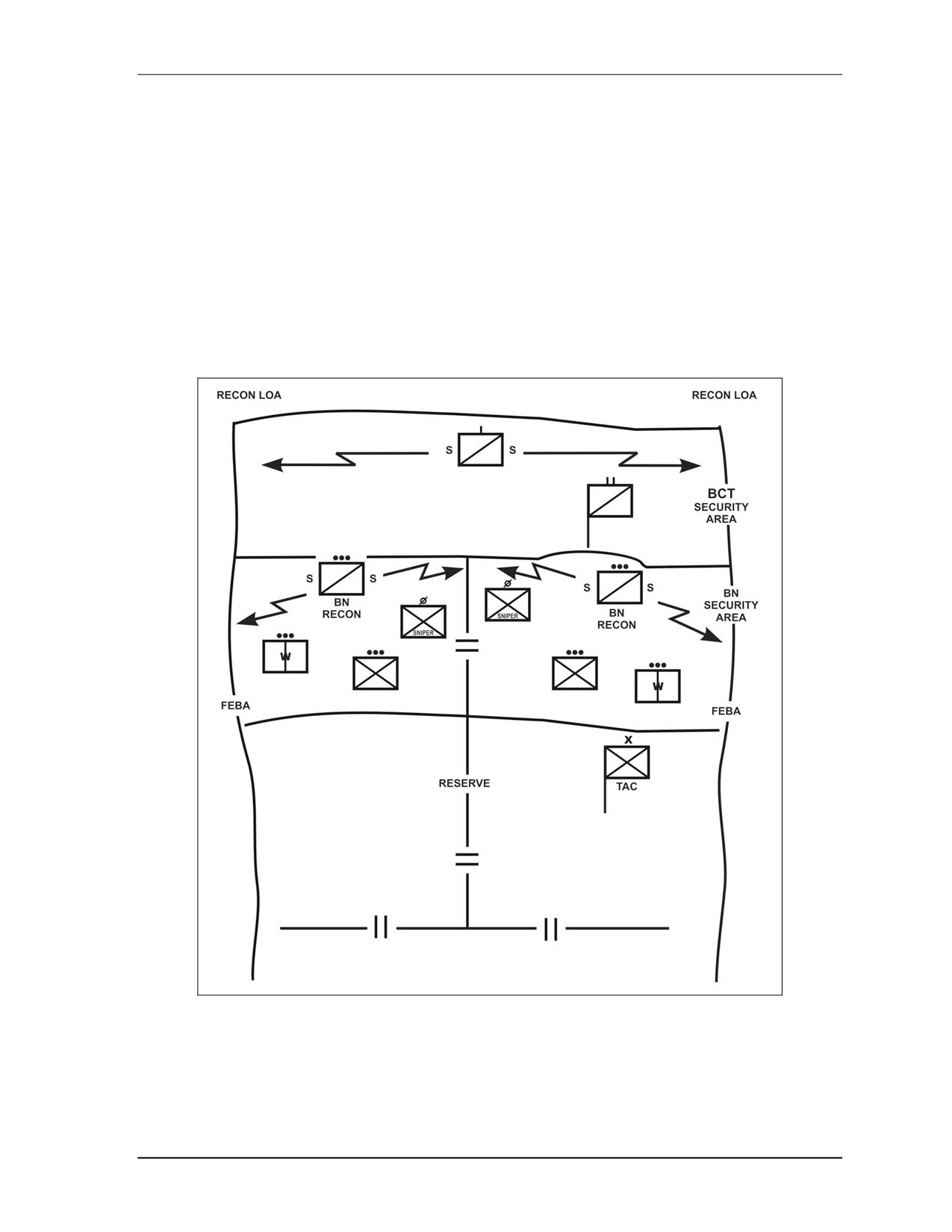
Intelligence, Surveillance, and Reconnaissance Operations
and counterreconnaissance teams occupy the most forward positions. Battalion reconnaissance elements
screen behind the counterreconnaissance force. Each battalion employs a counterreconnaissance force to its
front capable of fixing and destroying the enemy reconnaissance forces.
3-38.
For the battalion scout platoon and the reconnaissance squadron elements to work together, the
battalion and IBCT staffs must coordinate the following:
• Communications.
• C2 architecture.
• Terrain management.
• NAI and target area of interest (TAI) coverage and intelligence gaps.
• Fire support control measures.
• Fratricide avoidance measures.
Figure 3-1. Counterreconnaissance organization reconnaissance squadron troop and
battalion scout platoon.
13 December 2006
FM 3-21.20
3-9
Chapter 3
CAPABILITIES
3-39.
The scout platoon is the battalion’s primary means of conducting reconnaissance and surveillance.
The battalion scout platoon may be augmented with additional assets such as the following.
SNIPERS
3-40.
Snipers are assigned to each Infantry battalion. Sniper missions include surveillance and
reconnaissance. Snipers have excellent long-range observation and expert camouflage and stealth
movement capability. They can attack and destroy targets in excess of 2,000 meters. When selecting
surveillance and reconnaissance missions for snipers, consideration is given to the follow-on target. For
example, a sniper team is assigned to conduct surveillance on an NAI during the counterreconnaissance
phase and a TAI during the defense phase of the operation. The sniper team should be able to conduct both
missions from the same general location to minimize movement requirements and possible compromise of
their location.
ENGINEERS
3-41.
Engineers are attached to provide expertise on obstacle belts, minefields, and route and bridge
classification. Sappers can provide preparation of obstacle breaches during limited visibility.
JAVELIN TEAMS
3-42.
Infantrymen from the line companies may form Javelin teams to augment the platoon for
surveillance and target acquisition purposes during limited visibility operations. The nondisposable section
of the Javelin is the command launch unit (CLU). The night sight and day sight of the Javelin are
integrated into the CLU. Under most conditions, the thermal sight’s range is more than 3,000 meters. The
Javelin uses a passive infrared system for target acquisition and lock-on. This means that it emits no
infrared or radar signature that enemy systems or smart munitions can detect.
CBRN RECONNAISSANCE
3-43.
The scout platoon may also be augmented with CBRN reconnaissance assets from the IBCT.
FIRE SUPPORT TEAM
3-44.
An FO team may be attached to the scout platoon to provide fire support.
COLT TEAMS
3-45.
Occasionally the scout platoon will be augmented with the COLT team assigned to the Infantry
battalion HHC. The COLT team performs fire support and reconnaissance missions as directed, and is
equipped with the lightweight laser designator rangefinder
(LLDR) that lazes targets for munitions
requiring reflected laser energy for final ballistic guidance. They are also equipped with the forward
observer system computer for digital connectivity.
MULTISENSOR TEAM
3-46.
The multisensor team from the military intelligence (MI) company is another asset that may be
task-organized to the battalion. The improved remotely monitored battlefield sensor system (IREMBASS)
is an unattended ground sensor that will detect, classify, and determine direction of movement of intruding
personnel and vehicles. The ground surveillance radar (GSR) is an attended ground sensor that will detect,
classify, and determine the direction of movement of intruding personnel and vehicles. The Prophet is an
3-10
FM 3-21.20
13 December 2006
Intelligence, Surveillance, and Reconnaissance Operations
attended emitter-locator sensor that can detect, intercept, determine direction of bearing, and possibly
determine the location of intruding personnel communications emitters.
COMMUNICATIONS
3-47.
FM net structure and reporting procedures are unit- and SOP-dependent. The battalion scout
platoon uses the battalion operations and intelligence (OI) net for reporting enemy information and asset
locations. The scout platoon also has an internal platoon net for C2 within the platoon. When the scout
platoon is acting as part of a counterreconnaissance force, it communicates on the counterreconnaissance
unit command net. Reconnaissance teams from the battalion will need to communicate with elements of the
counterreconnaissance force to pass information and deconflict OP positions. This may be done on the
counterreconnaissance unit command net, platoon nets, or internal platoon nets.
EXECUTION
3-48.
Commanders depend on subordinate initiative to accomplish missions, even in the absence of
orders. Information systems will fail, either of their own accord or because of enemy action. Commanders
develop and communicate their vision to subordinates with enough clarity to allow them to act when this
happens. Subordinates complement initiative with constant coordination and by keeping their higher
commanders informed.
EMPLACEMENT AND ROUTES
3-49.
The battalion staff develops a general picture of where assets should locate on the battlefield. By
understanding the SOR and NAIs to cover, the scout platoon leader or squad leaders determine the exact
OP locations and routes for the reconnaissance teams. The battalion S-3 and S-2 must closely monitor OP
locations to ensure that there is no conflict with the other elements or other BCT assets. The battalion S-3
must also conduct direct coordination with the reconnaissance squadron as necessary.
INSERTION AND EXTRACTION ROUTES
3-50.
While deconflicting terrain with the S-3, the S-2, and scout platoon leader identify the methods
the platoon will use to infiltrate or bypass enemy forces to enhance its survivability and ensure mission
success. Inserting assets requires the coordination of the entire staff and may require the battalion to
conduct a forward passage of lines for the scout platoon. Critical coordination tasks and actions should be
listed in the reconnaissance and surveillance tasking matrix.
PROCESSING AND DISSEMINATATION OF INFORMATION
3-51.
The battalion S-2 must be able to quickly review the incoming combat information, sort it
according to criticality and the PIR and IR it answers, and transmit it to the user in the shortest amount of
time. Command post personnel must be aware of the CCIR. The CCIR are essential elements of friendly
information, friendly force information requirements (FFIR), and PIR. When CCIR are answered, the
commander must be notified immediately because these answers often influence his decision-making
process and battalion employment. While fused intelligence may be the best intelligence, partially analyzed
intelligence or combat information may cue the commander to enemy intentions that were not previously
addressed during the war gaming process.
PLAN MODIFICATION
3-52.
Whether modifying reporting requirements because of new reporting criteria; new or adjusted
PIR; loss of a scout squad, sniper team, UAS, or other asset; or changes in the mission, the battalion S-3
must be ready to adjust the reconnaissance and surveillance plan to fit the commander’s needs and continue
13 December 2006
FM 3-21.20
3-11
Chapter 3
the reconnaissance and surveillance mission. The following questions need to be considered during the
modification of the reconnaissance and surveillance plan:
• What asset needs to be moved?
• Do any other assets who can cover the requirement use electronic or visual collection methods
that are easier to retask?
• What are the new collection requirement and or focus?
• What is the risk in moving the scout squad, sniper team, or other manned asset? Is the risk
worth the potential information that might be gained?
• Do the communications require modification?
• Does the fire support plan need to change?
• Does the sustainment support plan need to change?
3-53.
During the planning process, the staff should also consider how to compensate for the loss of a
reconnaissance and surveillance asset during critical points in the mission. Staffs will need to consider
which unit or asset will replace the lost surveillance and target acquisition asset and issue a “be prepared
mission” to the unit or asset in the operations order.
Section III. SUPPORT
The IBCT and Infantry battalion staffs must plan, prepare, and synchronize fire support, health service support,
and communication and logistical support for the ISR assets. Concurrent with other operational planning, the
staff develops its plan during mission analysis and refines it in the war gaming portion of the MDMP. Fires and
sustainment rehearsals should be an integral step in preparation for reconnaissance and surveillance operations.
(See Chapter 10 for detailed discussions of the six warfighting functions.)
FIRE
3-54.
The S-3 ensures that indirect fires support the reconnaissance plan and that communication links
are maintained with observers and the main CP at all times. The distance the scout platoon can operate
away from the main body is normally limited to the range of supporting indirect fires. For some missions,
however, the staff and commander need to assess the risk and value of operating the scout platoon beyond
the range of supporting fires.
LOGISTICS
3-55.
Providing service support to reconnaissance and surveillance assets forward of the LD and or LC
provides a significant logistics challenge because the support elements also risk exposure to enemy contact.
It is dangerous to conduct logistics resupply operations across the forward line of own troops (FLOT) with
thin-skinned cargo vehicles.
3-56.
A maintenance team or LOGPAC can be dedicated to the scout platoon. The team responds to the
needs of the platoon and is brought forward by the headquarters 1SG, the HHC XO, or another responsible
individual. The LOGPAC links up with the scout platoon’s PSG at a specifically-designated release point
as far forward as possible. The PSG is then responsible for the distribution of supplies to the scout teams.
3-57.
The actual time when the scout platoon needs to resupply often does not coincide with the
standard LOGPAC times for the rest of the battalion. The HHC commander, battalion S-4, scout platoon
leader, and platoon sergeant must anticipate events to coordinate the best time for resupply. When the
battalion scout platoon is augmented with assets from the IBCT, the battalion will assume responsibility for
logistics support.
3-58.
To minimize risks during logistics operations, the HHC commander and scout platoon leader may
choose to adopt the following procedures:
3-12
FM 3-21.20
13 December 2006
Intelligence, Surveillance, and Reconnaissance Operations
• Develop Soldier load plans to carry Class I, water, and Class V.
• Coordinate for aerial resupply (METT-TC dependent).
3-59.
In some instances, the reconnaissance squadron may be able to assist the Infantry battalion
deployed reconnaissance and surveillance elements. The HHC commander and battalion S-4 should
consider this when developing the sustainment plan.
MEDICAL
3-60.
Treating and evacuating wounded Soldiers provides another challenge to reconnaissance and
surveillance planning because the reconnaissance and surveillance asset has most likely been engaged by
the enemy and possesses no dedicated medical support. Sending ground-based medical assets in a manner
that enhances their survivability, such as attached to a combat patrol or moving undetected under the cover
of darkness, often contradicts the necessity to treat wounded Soldiers quickly. During aerial evacuation of
wounded in action (WIA), planners need to consider landing zone (LZ) security, weather, terrain, possible
compromise of the reconnaissance and surveillance effort, possible loss of the aircraft, and the actual
urgency of patient care. To help the survivability of Soldiers in the scout platoon, the battalion needs to
train the scout platoon Soldiers in basic and advanced combat lifesaving techniques. Also, the scout team
members should rely primarily on their teams and sections to transfer wounded to designated casualty
collection points or pickup zones (PZs) for ambulance or aerial evacuation.
COMMUNICATIONS
3-61.
The S-3, S-2, and signal section develop the signal architecture to support the scout platoon and
other reconnaissance and surveillance assets deployed throughout the area of operation. All reconnaissance
and surveillance assets must have continuous, two-way, secure communications with the battalion main
CP. This requirement and the size of the reconnaissance and surveillance area of operations may require
the battalion to establish retrans sites forward in the battalion AO.
13 December 2006
FM 3-21.20
3-13
This page intentionally left blank.
Chapter 4
Offensive Operations
Offensive action is the decisive form of any engagement. The primary purpose of the
offense is to defeat, destroy, or neutralize an enemy force. A commander may also
take offensive actions to deceive or divert the enemy, deprive him of resources or
decisive terrain, collect information, or fix an enemy in position. Even in the defense,
offensive action is normally required to destroy an attacker and exploit success. The
key to a successful offensive operation is to identify the enemy’s decisive point;
choose a form of maneuver that avoids the enemy’s strength and one that masses
overwhelming combat power. This will result in accomplishing the unit’s purpose
regarding terrain and the enemy. This chapter discusses the basics of the offense
which apply to all offensive actions. It also discusses the concept of synchronized
attacks that maximize the battalion’s unique capabilities, and the planning and
executing of offensive operations.
Section I. FUNDAMENTALS
The Infantry battalion gains and maintains the initiative and keeps constant pressure on the enemy throughout
its AO. The Infantry battalion transitions from one offensive action to another without pausing. Planning and
preparing for the next and for follow-on operations occur simultaneously with execution of the current action.
Success in offensive operations depends on the proper application of the fundamental characteristics of the
offense discussed in the following paragraphs. The Infantry battalion’s ability to maneuver through restricted
and severely restricted terrain and relatively low electronic and audible signatures are key attributes.
SURPRISE
4-1. A force achieves surprise by attacking the enemy at a time or place and in a manner for which the
enemy is not physically or mentally ready. The Infantry battalion commander must have sufficient
information for a clear understanding of his current state in relation to the enemy and environment; a sound
understanding of what the end state is for the assigned mission, and a vision of how to move his force from
the current situation to the end state. A battalion achieves surprise by--
y Gaining and maintaining information dominance by conducting thorough reconnaissance and
surveillance and denying enemy reconnaissance efforts. The IBCT and higher echelon unit
intelligence assets provide depth to the effort and are used by the Infantry battalion to assist in
planning follow-on operations. Short range reconnaissance and surveillance assets of the
reconnaissance squadron and organic collectors in the Infantry battalion allow them to see,
decide, and act inside the enemy decision cycle.
y Striking the enemy from an unexpected direction at an unexpected time using intelligence,
rapid movement, and the ability to cross any type of terrain.
y Quickly changing the tempo of the operation. The constant application of pressure on the
enemy’s decision making cycle prevents him from regaining the initiative.
y Maintaining the element of surprise and unpredictability is critical in offensive operations.
Tactical actions should be sound but also always mixed and varied. Enemy forces have can and
will conduct pattern analysis.
13 December 2006
FM 3-21.20
4-1
Chapter 4
CONCENTRATION
4-2. A force achieves concentration by massing the effects of combat power. Superior timing, precision
maneuvers and fires (made possible by shared information dominance), and speed allow the Infantry
battalion commander to mass the effects of his forces. He can do this when and where needed, and he can
shift quickly from one objective or direction to another. Because he has the advantage in information he
receives, he better understands the effects of his actions. For example, it is easier for him to see if he has
succeeded, or if he needs to continue an attack. If so, he can then apply available combat power more
efficiently and focus his main effort more effectively. Once the Infantry battalion succeeds through the
concentration and control enabled by this understanding, it can quickly disperse, if needed, to avoid enemy
counteractions. A battalion achieves concentration through the following:
y Designation of a decisive operation and allocation of resources to support it.
y Careful planning and coordination based on a thorough analysis of terrain and enemy,
combined with accurate, timely reconnaissance and surveillance.
y Positions that allow it to mass effects.
y The ability to synchronize direct, indirect, and nonlethal assets.
TEMPO
4-3. Tempo is the ability to adjust the rate of operations relative to battle circumstances and relative to the
enemy’s capability to sense and react. It is the controlled rate of military action. While a rapid tempo is
often preferred, tempo should be adjusted to ensure synchronization. The goal is to maintain pressure on
the enemy, whether it is done quickly or slowly. Controlling and altering tempo promotes surprise, keeps
the enemy off balance, denies the enemy freedom of action, and contributes to the security of the battalion.
AUDACITY
4-4. Audacity is a simple plan of action boldly executed. Audacity inspires Soldiers to overcome
adversity and danger. Audacity is a key component of any successful offensive action and increases the
chance for surprise. It depends on the commander’s ability to see opportunities for action, to decide in time
to seize opportunities, and to accept calculated risks. Leaders must assess risks, understand when and
where to take risks, identify control measures, and execute boldly. The sharing of combat information
electronically between leaders at all echelons reduces the risk but does not eliminate the many uncertainties
associated with battle. Digitization improves the commander’s ability to make quick situational
assessments, to conduct on-the-spot risk assessments, and to make bold decisions based on near-real-time
information.
CONTACT CONTINUUM
4-5. Traditionally, the Infantry battalion made contact with the scout platoon and lead company to
develop the situation while in contact with the enemy. The lead company then fixed the enemy, allowing
the remainder of the battalion to maneuver against an assailable flank. This method was based on the
Infantry battalion’s ability to maneuver over all types of terrain with little signature. With additional
combat power (the weapons company) and information systems (INFOSYS) in the battalion, a new method
of making contact is required. This new contact continuum consists of understanding the situation and
maneuvering to a position of advantage to make contact with the enemy on the Infantry battalion’s terms
(Figure 4-1). Within the new contact continuum, the Infantry battalion can mass overwhelming combat
power at the decisive point to achieve its purpose more efficiently and effectively. The Infantry battalion
commander must also consider that the BCT reconnaissance squadron may provide the first situational
understanding (SU) of the enemy or may be in contact with the enemy, allowing the Infantry battalion to
maneuver out of contact to a position to initiate first contact with the enemy on the best terms for the
battalion.
4-2
FM 3-21.20
13 December 2006
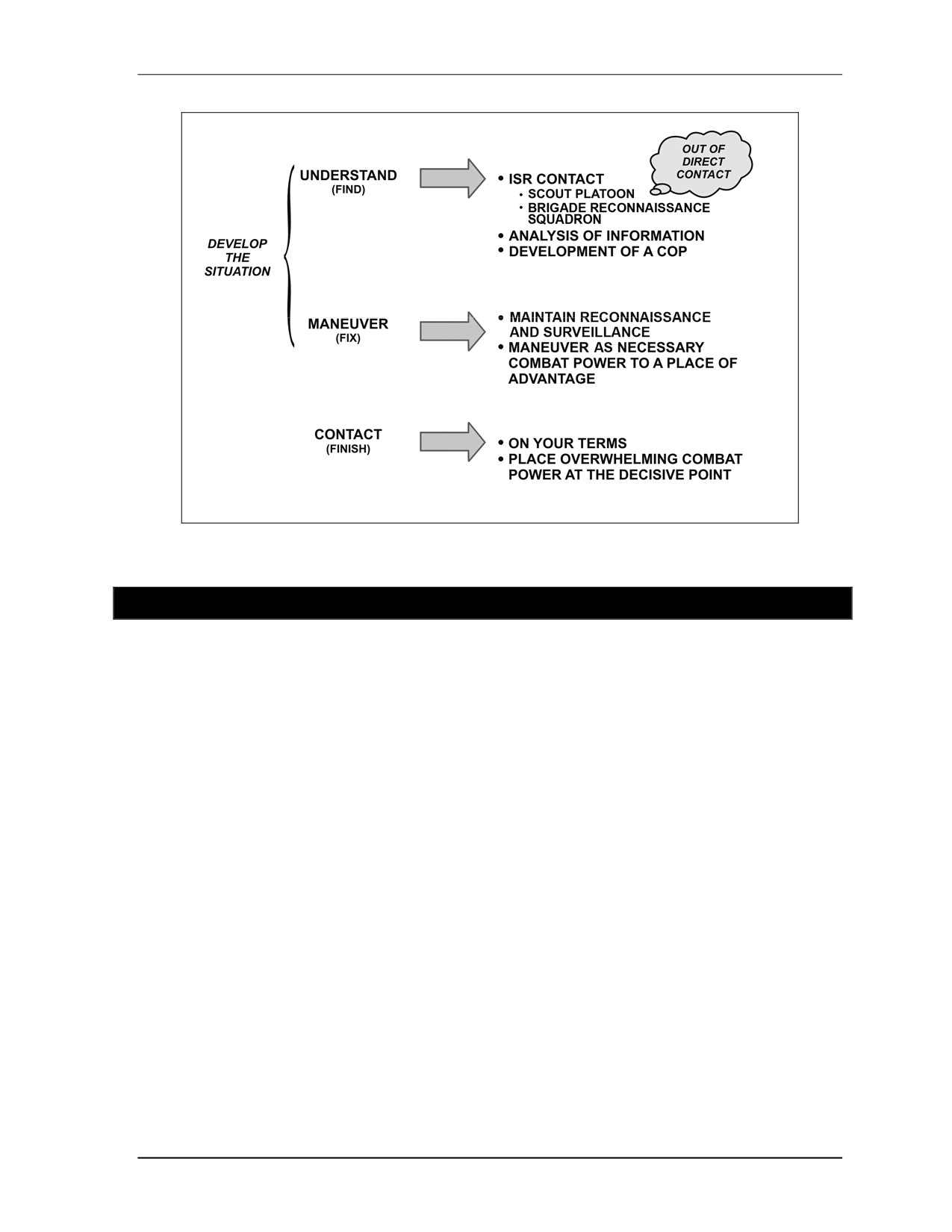
Offensive Operations
Figure 4-1. Contact continuum.
Section II. ORGANIZATION
Commanders organize forces according to purpose by determining whether each unit’s operation will be
decisive, shaping, or sustaining. The purpose-based framework centers on decisive, shaping, and sustaining
operations. Purpose unifies all elements of the battlefield organization by providing the common focus for all
actions. However, forces act in time and space to accomplish a purpose. These decisions form the basis of the
concept of operations. Alternatively, commanders may choose to use the decisive point, or main effort methods
to articulate their organization of forces if this better facilitates their ability to visualize, describe, and direct
actions, especially since Infantry battalions operate at the tactical level of war. Commanders also synchronize
operations in time and space. When circumstances require a spatial reference between friendly and enemy
forces, commanders may describe them in terms of deep, close, and rear areas. These spatial categories are
especially useful in combat operations that are generally contiguous, linear, and feature a clearly defined
enemy force.
DECISIVE OPERATIONS
4-6. Decisive operations directly achieve the mission and intent of the higher headquarters. Decisive
operations conclusively determine the outcome of battles and engagements. There is only one decisive
operation for any major operation, battle, or engagement for any given echelon. The decisive operation
may include multiple actions conducted simultaneously throughout the depth of the AO. Commander’s
weigh the decisive operation while economizing on the effort allocated to shaping operations.
4-7. In the offense and defense, decisive operations normally focus on movement and maneuver.
Conversely, logistics may be decisive during the mobilization and deployment phases of an operation or in
support operations, particularly if the mission is humanitarian in nature.
4-8. A reserve is a portion of a body of troops that is kept to the rear or withheld from action at the
beginning of an engagement but remains available for a decisive movement. Until committed, reserves
shape through their placement within the AO while planning for and preparing to conduct operations.
13 December 2006
FM 3-21.20
4-3
Chapter 4
When committed, they usually either become the decisive operation or reinforce the decisive operation.
Commanders can use reserves to influence circumstances or exploit opportunities. When commanders
anticipate uncertainty, they hold a greater portion of the force in reserve to posture the force to seize and
maintain the initiative as a situation develops. Reserves deploy and reposition as necessary to ensure their
protection, availability, and prompt reaction.
SHAPING OPERATIONS
4-9. Shaping operations create and preserve the conditions for the success of the decisive operation.
Shaping operations include lethal and nonlethal activities conducted throughout the AO (Appendix L).
They support the decisive operation by affecting the enemy’s capabilities and forces, or by influencing the
opposing commander’s decisions. Shaping operations use the full range of military power to neutralize or
reduce enemy capabilities. They may occur simultaneously with, before, or after initiation of the decisive
operation. They may involve any combination of forces and occur throughout the depth of the AO.
4-10. Some shaping operations, especially those that occur simultaneously with the decisive operation, are
economy-of-force actions. If the force available does not permit simultaneous decisive and shaping
operations, the commander sequences shaping operations around the decisive operation. A shaping
operation may become the decisive operation if circumstances or opportunity demand. In which case,
commanders weigh the new decisive operations at the expense of other shaping operations. The concept of
the operation clearly defines how shaping operations support the decisive operation.
4-11. Security is an important shaping operation. Security enables the decisive operation of the next higher
headquarters. Security protects the force and provides time for friendly forces to react to enemy or hostile
activities. It also blinds the enemy’s tries to see friendly forces and protects friendly forces from enemy
observation and fires.
SUSTAINING OPERATIONS
4-12. The purpose of sustaining operations is the generation and maintenance of combat power. Sustaining
operations are operations at any echelon that enable shaping and decisive operations by providing logistics,
rear area and base security, movement control, terrain management, and infrastructure development.
4-13. Sustainment encompasses activities at all levels of war that generate and sustain combat power. It
provides the essential capabilities and performs the functions, activities, and tasks necessary to sustain all
forces in theater.
4-14. Rear area and base security include measures taken by a military unit, an activity, or an installation
to defend and protect itself against all acts that could impair its effectiveness. It has four components:
(1) intelligence, (2) base and base cluster self-defense, (3) response force operations, and (4) combined
arms tactical combat force (TCF) operations (FM 100-7).
4-15. Movement control includes the planning, routing, scheduling, controlling, and security of the
movement of personnel and materiel into, within, and out of the AO. Maintaining movement control,
keeping lines of communications
(LOCs) open, managing reception and transshipment points, and
obtaining host nation support are critical to movement control.
4-16. Terrain management includes the process of allocating terrain, designating assembly areas, and
specifying locations for units and activities. The process includes grouping units together to form bases and
designated base clusters as necessary.
4-17. Infrastructure development applies to all fixed and permanent installations, fabrications, or facilities
that support and control military forces. Infrastructure development focuses on facility security
modifications and includes area damage control (ADC) and repairs.
4-18. Although they are neither decisive nor shaping, sustaining operations are inseparable from decisive
and shaping operations. Failure to sustain operations normally results in mission failure. Sustaining
operations occur throughout the AO, not just within the rear area. Sustaining operations determine how
4-4
FM 3-21.20
13 December 2006
Offensive Operations
quickly forces reconstitute and how far forces can exploit success. At the tactical level, sustaining
operations underwrite the tempo of the overall operation; they assure the ability to immediately take
advantage of any available opportunity.
MAIN EFFORT
4-19. Within the battlefield organization of decisive, shaping, and sustaining operations, commanders
designate and shift the main effort. The main effort is the activity, unit, or area the commander determines
constitutes subordinate element conducting the most important task at that time. The main effort and the
decisive operation are not always identical. The commander anticipates shifts of the main effort throughout
an operation and includes them in the plan. However, when a main effort is designated, the commander
weights it with resources and priorities. All other elements of the Infantry battalion support the main effort.
In planning the scheme of maneuver, the main effort must have sufficient combat power and support to
accomplish its mission. To weight the main effort, the commander may perform the following:
y Assign the main effort to the company with the greatest combat power.
y Allocate additional combat platoons in task organization to weight the main effort.
y Attach protection elements in direct support of the main effort.
y Position overwatch or support by fire elements to support the main effort.
y Assign priority of fires (artillery, mortars, PSYOP, and joint fires/close air support [CAS]) and
priority of targets.
y Coordinate adjacent unit or attack helicopter support by fire.
y Assign priority of sustaining operations to sustain the main effort.
y Narrow the scope of main effort responsibility by geographical area or specified tasks.
4-20. Enemy actions, minor changes in the situation, or lack of success by other elements must not divert
forces from the main effort. The commander commits the main effort at the decisive point where the unit’s
total combat power can be massed to achieve decisive results with respect to terrain, the enemy, and time to
achieve the unit’s purpose. Once committed, the unit may conduct the following:
y Secure key and or decisive terrain.
y Seize key and or decisive terrain.
y Destroy designated enemy forces.
4-21. The Infantry battalion commander may change the unit designated to conduct the main effort during
the course of an operation. Rapidly shifting the main effort as changes in the situation occur is challenging.
Time and distance factors determine which forces the combined arms battalion commander uses if he shifts
the main effort. If the commander designates a new element as the main effort, he must then shift priorities
of resources to support the new main effort.
RESERVE
4-22. The Infantry battalion designates a reserve when the BCT has no reserve, an inadequate reserve, or
when faced with an uncertain situation that requires flexibility in the plan. The Infantry battalion reserve
provides additional combat power during critical points in the fight, the ability to exploit the success of the
main effort, and a hedge against uncertainty. The reserve should be based on the level of detail known
about the enemy and should be sized to mitigate risk. The Infantry battalion’s information dominance over
the enemy allows the commander to capitalize on the capabilities of digitization to apportion his available
troops to the tasks required to affect his concept of attack. The composition of the reserve should also be
based on the firepower, mobility, and type of forces needed to meet its anticipated mission requirements
based on the enemy. Solid intelligence can lead the commander to concentrate his committed units against
specific enemy weak points and identify reserve requirements. The composition of the reserve should be
discussed and agreed on by the BCT commander to reflect the organization of the IBCT as a two Infantry
13 December 2006
FM 3-21.20
4-5