FM 3-21.20 (FM 7-20) THE INFANTRY BATTALION (DECEMBER 2006) - page 1
Headquarters
Field Manual
Department of the Army
No. 3-21.20 (7-20)
Washington, DC, 13 December 2006
The Infantry Battalion
Contents
Page
PREFACE
xvii
SUMMARY OF CHANGE
xviii
Chapter 1
INTRODUCTION
1-1
Section I. MISSION, CAPABILITIES, AND LIMITATIONS
1-1
MISSION
1-1
CAPABILITIES
1-1
LIMITATIONS
1-2
Section II. ORGANIZATION AND FUNCTION
1-2
COMMAND AND CONTROL STRUCTURE
1-2
FUNCTION
1-2
BATTLEFIELD ORGANIZATION
1-11
Section III. WARFIGHTING FUNCTIONS
1-12
FIRE SUPPORT
1-12
MOVEMENT AND MANEUVER
1-13
PROTECTION
1-14
COMMAND AND CONTROL
1-14
INTELLIGENCE
1-15
SUSTAINMENT
1-16
Section IV. CONTEMPORARY OPERATIONAL ENVIRONMENT
1-16
ASYMMETRY
1-16
THREATS
1-16
SCOPE
1-17
VARIABLES
1-17
Chapter 2
BATTLE COMMAND
2-1
Section I. ART OF COMMAND
2-1
ROLE OF COMMANDER
2-1
LOCATION OF COMMANDER
2-2
SCIENCE OF CONTROL
2-3
Section II. COMMAND AND CONTROL
2-5
SYSTEM
2-5
Distribution Restriction: Approved for public release; distribution is unlimited.
*This publication supersedes FM 7-20, 6 April 1992.
13 December 2006
FM 3-21.20
i
Contents
INFRASTRUCTURE
2-5
EXERCISE
2-5
DISTRIBUTION AT BATTALION LEVEL
2-6
COMMAND AND SUPPORT RELATIONSHIPS
2-7
Section III. PLANNING PROCEDURES
2-9
PARALLEL, COLLABORATIVE, AND DISTRIBUTED PLANNING
2-9
MILITARY DECISION-MAKING PROCESS
2-10
ROLES OF COMMANDER AND EXECUTIVE OFFICER
2-10
ROLE OF RECONNAISSANCE AND SURVEILLANCE
2-11
Section IV. MILITARY DECISION-MAKING PROCESS
2-11
TIME CONSTRAINTS
2-13
TRAINING ON THE MDMP
2-13
ABBREVIATION
2-13
Section V. PREPARATION FOR OPERATIONS
2-14
RECONNAISSANCE AND SURVEILLANCE
2-14
SECURITY
2-15
FORCE PROTECTION
2-15
PLAN REVISION AND REFINEMENT
2-15
COORDINATION AND LIAISON
2-15
REHEARSALS
2-16
Section VI. EXECUTION
2-16
COMMAND AND CONTROL
2-16
ASSESSMENT
2-16
DECISIONS
2-17
Section VII. ADJUSTMENT DECISIONS
2-19
METHODS
2-19
DIRECTION OF ACTION
2-19
Section VIII. BATTLE RHYTHM AND TARGETING
2-20
INTRODUCTION
2-20
CYCLE
2-20
APPLICATION
2-20
SYNCHRONIZATION
2-21
DECIDE-DETECT-DELIVER-ASSESS METHOD
2-21
GUIDANCE
2-21
Chapter 3
INTELLIGENCE, SURVEILLANCE, AND RECONNAISSANCE OPERATIONS ... 3-1
Section I. OVERVIEW
3-1
DEFINITIONS
3-1
FUNDAMENTALS
3-2
RESPONSIBILITIES
3-4
Section II. INTEGRATION
3-8
RECONNAISSANCE SQUADRON AND R&S ASSETS
3-8
CAPABILITIES
3-10
COMMUNICATIONS
3-11
EXECUTION
3-11
Section III. SUPPORT
3-12
FIRE
3-12
ii
FM 3-21.20
13 December 2006
Contents
LOGISTICS
3-12
MEDICAL
3-13
COMMUNICATIONS
3-13
Chapter 4
OFFENSIVE OPERATIONS
4-1
Section I. FUNDAMENTALS
4-1
SURPRISE
4-1
CONCENTRATION
4-2
TEMPO
4-2
AUDACITY
4-2
CONTACT CONTINUUM
4-2
Section II. ORGANIZATION
4-3
DECISIVE OPERATIONS
4-3
SHAPING OPERATIONS
4-4
SUSTAINING OPERATIONS
4-4
MAIN EFFORT
4-5
RESERVE
4-5
FOLLOW AND SUPPORT
4-6
FOLLOW AND ASSUME
4-6
Section III. SEQUENCE
4-7
PREPARATION
4-7
EXECUTION
4-7
Section IV. FORMS OF MANEUVER
4-9
ENVELOPMENT
4-9
PENETRATION
4-10
TURNING MOVEMENT
4-11
INFILTRATION
4-12
FRONTAL ATTACK
4-14
MOVEMENT TECHNIQUES AND FORMATIONS
4-15
Section V. FORMS OF TACTICAL OFFENSE
4-20
HASTY OPERATIONS
4-20
DELIBERATE OPERATIONS
4-20
MOVEMENT TO CONTACT
4-21
ATTACKS
4-39
Section VI. PLANNING CONSIDERATIONS
4-59
FORCE ORGANIZATION
4-60
INTELLIGENCE, RECONNAISSANCE AND SURVEILLANCE
4-60
SCHEME OF MANEUVER
4-61
FIRE SUPPORT
4-62
Section VII. TRANSITIONAL OPERATIONS
4-63
CONSOLIDATION
4-63
REORGANIZATION
4-64
CONTINUATION OF OPERATIONS
4-64
DEFENSE
4-64
Chapter 5
DEFENSIVE OPERATIONS
5-1
Section I. FUNDAMENTALS
5-1
PURPOSE
5-1
13 December 2006
FM 3-21.20
iii
Contents
ORGANIZATION
5-1
CHARACTERISTICS
5-4
PLANNING CONSIDERATIONS
5-6
PREPARATION
5-10
Section II. TYPES
5-11
AREA DEFENSE
5-11
FORWARD DEFENSE
5-12
DEFENSE IN DEPTH
5-13
EXECUTION
5-14
BATTLE HANDOVER
5-15
MOBILE DEFENSE
5-18
RETROGRADE OPERATIONS
5-18
Section III. PLANNING CONSIDERATIONS
5-35
KEYS TO SUCCESSFUL DEFENSE
5-36
COMMANDER’S VISION
5-36
HOW AND WHERE TO DEFEAT ENEMY
5-36
FORCES AND ASSETS AVAILABLE
5-36
EFFECTS
5-36
Section IV. SEQUENCE
5-37
OCCUPATION AND ESTABLISHMENT OF SECURITY
5-37
POSITIONING OF FORCES
5-38
SECURITY OPERATIONS
5-38
SECURITY AREA ENGAGEMENT
5-38
MAIN BATTLE AREA FIGHT
5-39
FOLLOW-ON MISSIONS
5-40
Section V. TECHNIQUES
5-40
DEFEND AN AREA OF OPERATIONS
5-40
DEFEND A BATTLE POSITION
5-43
CONDUCT A REVERSE SLOPE DEFENSE
5-46
DEFEND A STRONGPOINT
5-48
CONDUCT A PERIMETER DEFENSE
5-54
RESERVE
5-56
QUICK REACTION FORCE
5-57
COUNTERATTACK
5-57
Section VI. MANEUVER AND PROTECTION INTEGRATION
5-57
COUNTERMOBILITY
5-57
SURVIVABILITY
5-62
Chapter 6
STABILITY OPERATIONS
6-1
Section I. FUNDAMENTALS
6-1
PURPOSE
6-1
CHARACTERISTICS
6-3
Section II. TYPES OF STABILITY OPERATIONS
6-6
PEACE OPERATIONS
6-6
OPERATIONS IN SUPPORT OF DIPLOMATIC EFFORTS
6-8
FOREIGN INTERNAL DEFENSE
6-8
HUMANITARIAN AND CIVIC ASSISTANCE
6-9
iv
FM 3-21.20
13 December 2006
Contents
FOREIGN HUMANITARIAN ASSISTANCE
6-10
SUPPORT TO INSURGENCIES
6-10
SECURITY ASSISTANCE
6-10
SUPPORT TO COUNTERDRUG OPERATIONS
6-10
COMBATING OF TERRORISM
6-11
NONCOMBATANT EVACUATION OPERATIONS
6-12
ARMS CONTROL
6-12
SHOW OF FORCE
6-13
Section III. PLANNING CONSIDERATIONS
6-13
DECENTRALIZED OPERATIONS
6-13
METT-TC CONSIDERATIONS
6-14
RULES OF ENGAGEMENT
6-15
RULES OF INTERACTION
6-15
PROTECTION AND FIELD DISCIPLINE
6-15
SEQUENCE OF STABILITY OPERATIONS ACTIONS
6-17
TASK ORGANIZATION
6-18
MEDIA CONSIDERATIONS
6-19
OPERATIONS WITH OUTSIDE AGENCIES
6-19
Section IV. WARFIGHTING FUNCTIONS
6-19
FIRE SUPPORT
6-19
MOVEMENT AND MANEUVER
6-20
PROTECTION
6-21
COMMAND AND CONTROL
6-22
INTELLIGENCE
6-23
SUSTAINMENT
6-25
OTHER CONSIDERATIONS
6-26
Section V. TECHNIQUES
6-27
PRESENCE PATROLS
6-27
OBSERVATION POSTS
6-27
SECURITY OF OFFICIALS
6-28
STATIC SECURITY POSTS
6-28
SEARCHES
6-30
ROADBLOCKS AND OTHER CHECKPOINTS
6-35
Chapter 7
CIVIL SUPPORT OPERATIONS
7-1
Section I. FUNDAMENTALS
7-1
PURPOSE
7-2
ARMY ROLE
7-2
Section II. FORMS OF CIVIL SUPPORT OPERATIONS
7-3
RELIEF OPERATIONS
7-3
SUPPORT TO CBRNE-CM
7-3
SUPPORT TO CIVIL LAW ENFORCEMENT
7-4
Section III. PLANNING AND EXECUTING OF CIVIL SUPPORT OPERATIONS.. 7-5
PLANNING CONSIDERATIONS
7-5
PLANNING PROCESS
7-6
WARFIGHTING FUNCTIONS
7-7
INFORMATION OPERATIONS
7-10
13 December 2006
FM 3-21.20
v
Contents
Section IV. PATTERN OF OPERATIONS
7-10
RESPONSE
7-10
RECOVERY
7-11
RESTORATION
7-11
Section V. SEQUENCE OF OPERATIONS
7-11
MOVEMENT INTO AREA OF OPERATIONS
7-12
ESTABLISHMENT OF BASE OF OPERATIONS
7-12
MAINTENANCE OF SUPPORT
7-13
TERMINATION OF OPERATIONS
7-13
Section VI. TRAINING CONSIDERATIONS
7-13
TRAINING PLAN
7-13
BASIC SOLDIER SKILLS
7-14
SPECIFIC TRAINING
7-15
ADDITIONAL REQUIREMENTS
7-15
Chapter 8
TACTICAL ENABLING OPERATIONS
8-1
Section I. SECURITY OPERATIONS
8-1
PURPOSE
8-1
TYPES
8-1
SCREEN
8-2
GUARD
8-4
COVER
8-7
AREA SECURITY
8-7
LOCAL SECURITY
8-8
HIGH-VALUE ASSETS SECURITY
8-8
Section II. RELIEF OPERATIONS
8-9
PLANNING CONSIDERATIONS
8-9
COMMAND AND CONTROL
8-10
Section III. BATTLE HANDOVER AND PASSAGE OF LINES
8-10
BATTLE HANDOVER
8-10
PASSAGE OF LINES
8-11
FORWARD PASSAGE OF LINES
8-14
REARWARD PASSAGE OF LINES
8-15
REHEARSAL
8-15
Section IV. LINKUP OPERATIONS
8-15
PREPARATION
8-15
CONTROL
8-16
FORMS OF LINKUP
8-16
Section V. RIVER-CROSSING OPERATIONS
8-20
PLANNING CONSIDERATIONS
8-20
ASSAULT OF CROSSING SITE
8-21
Section VI. COMBINED-ARMS BREACHING OPERATIONS
8-23
TENETS
8-23
DELIBERATE OPERATIONS
8-27
HASTY OPERATIONS
8-29
vi
FM 3-21.20
13 December 2006
Contents
Chapter 9
COMMAND POSTS
9-1
Section I. FACILITIES
9-1
SURVIVABILITY
9-1
DISPLACEMENT
9-2
Section II. OPERATIONS
9-3
COMMUNICATIONS
9-3
MAPS
9-3
BATTLE CAPTAIN
9-4
Section III. COMMUNICATIONS
9-5
RESPONSIBILITIES
9-5
MEANS OF COMMUNICATION
9-5
RADIO TRANSMISSIONS
9-5
INFORMATION STORAGE MEDIA
9-5
SYSTEMS
9-6
Chapter 10
WARFIGHTING FUNCTIONS
10-1
Section I. FIRE SUPPORT
10-1
INDIRECT FIRE SUPPORT SYSTEMS
10-1
FIRE SUPPORT PLANNING AND COORDINATION
10-3
FIRE SUPPORT AND MDMP
10-6
MORTARS IN BATTALION CLOSE FIGHT
10-8
ECHELONMENT OF FIRES
10-8
EXECUTION CONSIDERATIONS
10-9
AIR SUPPORT
10-14
Section II. MOVEMENT AND MANEUVER
10-21
MISSION
10-21
ORGANIZATION
10-21
PLANNING CONSIDERATIONS
10-22
ESSENTIAL MOBILITY AND SURVIVABILITY TASKS
10-23
SCATTERABLE MINES
10-24
Section III. PROTECTION
10-30
MISSION
10-30
ORGANIZATION
10-30
PLANNING CONSIDERATIONS
10-31
ROLE OF AIR DEFENSE OFFICER
10-32
AIR DEFENSE TYPES
10-33
AIR DEFENSE WARNINGS AND WEAPONS CONTROL STATUS
10-34
CHEMICAL, BIOLOGICAL, RADIOLOGICAL, AND NUCLEAR OPERATIONS10-34
MILITARY POLICE SUPPORT
10-35
Section IV. COMMAND AND CONTROL (SIGNAL)
10-37
BATTALION SIGNAL OFFICER
10-37
BATTALION COMMUNICATIONS SECTION
10-37
Section V. INTELLIGENCE
10-38
INFANTRY BATTALION INFORMATION, SURVEILLANCE, AND
RECONNAISSANCE ASSETS
10-38
IBCT INFORMATION, SURVEILLANCE, AND RECONNAISSANCE ASSETS10-40
13 December 2006
FM 3-21.20
vii
Contents
Section VI. SUSTAINMENT
10-41
ORGANIZATION AND FUNCTION
10-41
BATTALION TRAINS OPERATIONS
10-49
SUPPLY AND TRANSPORTATION OPERATIONS
10-51
MAINTENANCE OPERATIONS
10-56
HEALTH SERVICE SUPPORT
10-58
SOLDIER’S LOAD
10-62
OTHER OPERATIONS
10-63
Chapter 11
URBAN OPERATIONS
11-1
Section I. INTRODUCTION
11-1
FUNDAMENTALS
11-1
PLANNING CONSIDERATIONS
11-4
ROLE OF INFANTRY BATTALION
11-5
TACTICAL CHALLENGES
11-5
Section II. METT-TC
11-6
MISSION
11-7
ENEMY
11-7
URBAN MAPPING PROCEDURES
11-9
TERRAIN AND WEATHER
11-14
TROOPS AND SUPPORT AVAILABLE
11-17
TIME
11-18
CIVIL CONSIDERATIONS
11-18
Section III. COMMAND AND CONTROL
11-19
ENEMY FOCUS
11-19
COMMANDER’S CRITICAL INFORMATION REQUIREMENTS
11-19
TASK ORGANIZATION
11-20
REHEARSALS
11-21
FIRE SUPPORT
11-21
FIELD ARTILLERY
11-22
MORTARS
11-23
COMMUNICATIONS
11-25
WEAPONS EFFECTS
11-26
Section IV. OFFENSIVE OPERATIONS
11-27
OFFENSIVE FRAMEWORK
11-27
TYPES OF OFFENSIVE OPERATIONS
11-28
TRANSITION
11-32
MOVEMENT TO CONTACT
11-32
INFILTRATION
11-33
ATTACK OF A VILLAGE
11-34
NODAL ATTACK
11-35
Section V. DEFENSIVE OPERATIONS
11-37
DEFENSIVE FRAMEWORK
11-37
DEFENSIVE PLANNING
11-38
INTEGRATION OF URBAN AREA
11-39
NODAL DEFENSE
11-39
DELAY
11-42
viii
FM 3-21.20
13 December 2006
Contents
Appendix A
RISK MANAGEMENT AND FRATRICIDE AVOIDANCE
A-1
Section I. RISK MANAGEMENT
A-1
TACTICAL RISK
A-1
ACCIDENT RISK
A-1
STEP 1--IDENTIFY HAZARDS
A-2
STEP 2--ASSESS HAZARDS TO DETERMINE RISKS
A-3
STEP 3--DEVELOP CONTROLS AND MAKE RISK DECISIONS
A-4
STEP 4--IMPLEMENT CONTROLS
A-5
STEP 5--SUPERVISE AND EVALUATE
A-5
Section II. FRATRICIDE AVOIDANCE
A-7
MAGNITUDE OF PROBLEM
A-7
RISK IDENTIFICATION AND PREVENTIVE MEASURES
A-7
PLANNING PHASE
A-8
PREPARATION PHASE
A-8
EXECUTION PHASE
A-9
FRATRICIDE REDUCTION MEASURES
A-9
FRATRICIDE RISK CONSIDERATIONS
A-10
Appendix B
MOVEMENTS AND ASSEMBLY AREAS
B-1
Section I. TACTICAL ROAD MARCH
B-1
MARCH ELEMENTS
B-1
MARCH COLUMN ORGANIZATION
B-2
PLANNING CONSIDERATIONS
B-2
MOVEMENT ORDER
B-3
CONTROL MEASURES
B-3
SECURITY
B-5
Section II. ASSEMBLY AREA OPERATIONS
B-6
TYPES OF ASSEMBLY AREAS
B-6
ORGANIZATION
B-7
QUARTERING PARTY
B-8
OCCUPATION
B-10
ACTIONS IN ASSEMBLY AREA
B-12
SECURITY
B-12
DEPARTURE FROM ASSEMBLY AREA
B-13
Appendix C
AIR ASSAULT OPERATIONS
C-1
Section I. CONSIDERATIONS
C-1
AIR ASSAULT MISSION ANALYSIS AND CONSIDERATIONS
C-1
AIR ASSAULT BATTALION ORGANIZATION
C-1
ACTIONS OF BATTALION (-)
C-1
Section II. PLANNING CONSIDERATIONS
C-2
INTELLIGENCE
C-2
MOVEMENT AND MANEUVER
C-2
FIRE SUPPORT
C-2
PROTECTION
C-2
SUSTAINMENT
C-3
COMMAND AND CONTROL
C-3
13 December 2006
FM 3-21.20
ix
Contents
Section III. AIR ASSAULT PLANNING STAGES
C-3
AIR ASSAULT BATTALION TASK FORCE KEY PERSONNEL
C-3
AIR ASSAULT ROLES
C-4
GROUND TACTICAL PLAN
C-5
LANDING PLAN
C-6
AIR MOVEMENT PLAN
C-7
LOADING PLAN
C-8
STAGING PLAN
C-9
Appendix D
HEAVY AND STRYKER CONSIDERATIONS
D-1
Section I. MISSIONS, CAPABILITIES, AND LIMITATIONS
D-1
MOUNTED AND INFANTRY
D-3
MOUNTED ONLY
D-4
INFANTRY ONLY
D-4
Section II. PLANNING CONSIDERATIONS
D-6
FIRE SUPPORT
D-6
MOVEMENT AND MANEUVER
D-6
PROTECTION
D-7
COMMAND AND CONTROL
D-7
INTELLIGENCE
D-7
SUSTAINMENT
D-7
DISMOUNTED INFANTRY MOVEMENT RATES
D-8
TANK MOUNTED INFANTRY
D-8
SAFETY
D-8
Section III. OPERATIONS
D-12
OFFENSIVE OPERATIONS
D-12
EXPLOITATION
D-13
DEFENSIVE OPERATIONS
D-13
RETROGRADE OPERATIONS
D-14
SUSTAINMENT
D-14
Appendix E
ARMY AVIATION SUPPORT FOR GROUND OPERATIONS
E-1
MISSIONS
E-1
OFFENSIVE OPERATIONS
E-3
DEFENSIVE OPERATIONS
E-5
RETROGRADE OPERATIONS
E-6
COMMUNICATIONS
E-6
AIR-GROUND INTEGRATION
E-7
AIR-GROUND COORDINATION
E-7
EMPLOYMENT
E-14
MANEUVER HEADQUARTERS LNO PLANNING REQUIREMENTS
E-17
ARMY AVIATION MANEUVER SUPPORT IN URBAN OPERATIONS
E-18
Appendix F
SNIPER EMPLOYMENT
F-1
PERSONNEL SELECTION CRITERIA
F-1
SNIPER EMPLOYMENT OFFICER
F-3
SNIPER TEAMS
F-4
OFFENSIVE EMPLOYMENT
F-6
ACTIONS AGAINST FORTIFIED AREAS
F-8
x
FM 3-21.20
13 December 2006
Contents
DEFENSIVE EMPLOYMENT
F-9
RETROGRADE EMPLOYMENT
F-10
URBAN OPERATIONS EMPLOYMENT
F-11
STABILITY OPERATIONS AND CIVIL SUPPORT OPERATIONS
F-12
RIVER CROSSINGS
F-12
PATROLS
F-13
SQUAD DESIGNATED MARKSMAN
F-14
Appendix G
SOF AND JOINT, INTERAGENCY, AND MULTINATIONAL OPERATIONS
G-1
Section I. SPECIAL OPERATIONS FORCES
G-1
PLANNING CONSIDERATIONS
G-1
TYPES
G-1
Section II. JOINT, INTERAGENCY, AND MULTINATIONAL OPERATIONS
G-7
AIR FORCE
G-7
MARINE CORPS
G-14
NAVY
G-16
INTERAGENCY
G-18
MULTINATIONAL FORCES
G-21
Appendix H
CONTINUOUS OPERATIONS
H-1
EFFECTS OF CONTINUOUS OPERATIONS
H-1
CONTROL OF COMBAT STRESS
H-1
SLEEP
H-4
REDUCTION OF IMPACT
H-5
Appendix I
CBRN ENVIRONMENT OPERATIONS
I-1
Section I. BATTLEFIELD
I-1
COMMAND
I-1
STAFF
I-1
CHEMICAL AGENTS
I-2
BIOLOGICAL AGENTS
I-2
EFFECTS OF NUCLEAR WEAPONS
I-3
Section II. DEFENSE
I-4
AVOIDANCE
I-4
PROTECTION
I-5
DECONTAMINATION
I-5
Appendix J
MEDIA CONSIDERATIONS
J-1
OBJECTIVE
J-1
REALITIES
J-1
OBJECTIVES AND INTERESTS
J-1
CAPABILITIES
J-2
COMMAND
J-2
GUIDELINES
J-2
INTERVIEWS
J-3
TRAINING
J-4
MEDIA CARDS
J-4
Appendix K
UNMANNED AIRCRAFT SYSTEMS
K-1
DESCRIPTION
K-1
13 December 2006
FM 3-21.20
xi
Contents
FUNDAMENTALS
K-1
EQUIPMENT
K-2
BCT AND BELOW
K-2
AIRSPACE CONTROL MEASURES
K-7
Appendix L NONLETHAL CAPABILITIES
L-1
OVERVIEW
L-1
DEFINITIONS
L-1
PLANNING CONSIDERATIONS
L-2
BASIC COMBAT TRAINING
L-2
WEAPONS AND MUNITIONS
L-4
Appendix M FORWARD OPERATING BASES AND FIRE BASES
M-1
OVERVIEW
M-1
FUNDAMENTALS OF BASE DEFENSE
M-2
SITE SELECTION AND CONSTRUCTION
M-3
BASE DEFENSE OPERATIONS
M-9
Appendix N COUNTERINSURGENCY OPERATIONS
TBP
GLOSSARY
Glossary-1
REFERENCES
References-1
INDEX
Index-1
Figures
Figure 1-1.
Infantry battalion
1-3
Figure 1-2.
Ranger battalion
1-4
Figure 1-3.
Warfighting functions
1-12
Figure 2-1.
Operations process
2-6
Figure 2-2.
MDMP steps, staff inputs and outputs
2-12
Figure 3-1.
Counterreconnaissance organization reconnaissance squadron troop and
battalion scout platoon
3-9
Figure 4-1.
Contact continuum
4-3
Figure 4-2.
Envelopment
4-10
Figure 4-3.
Penetration
4-11
Figure 4-4.
Turning movement
4-12
Figure 4-5.
Infiltration
4-14
Figure 4-6.
Frontal attack against a moving enemy
4-15
Figure 4-7.
Battalion in column formation
4-16
Figure 4-8.
Battalion in wedge formation
4-17
Figure 4-9.
Battalion in vee formation
4-18
Figure 4-10.
Battalion in echelon left formation
4-19
Figure 4-11.
Battalion in line formation
4-20
Figure 4-12.
Battalion movement to contact
4-21
xii
FM 3-21.20
13 December 2006
Contents
Figure
4-13.
Example of unit dispersing to search
4-25
Figure
4-14.
Example of unit massing to attack
4-26
Figure
4-15.
Example search and attack method with scout platoon forward
4-27
Figure
4-16.
Concept of defense
4-39
Figure
4-17.
Planning the attack
4-49
Figure
4-18.
Example of a battalion flank attack
4-50
Figure
4-19.
Terrain oriented attack
4-55
Figure
5-1.
BCT organization of security zone forces
5-3
Figure
5-2.
Example area defense using static and dynamic elements
5-4
Figure
5-3.
Example of a forward defense with battalions and companies defending forward
5-13
Figure
5-4.
Defense in depth
5-14
Figure
5-5.
Types of retrograde operation
5-19
Figure
5-6.
Delay from alternate positions
5-25
Figure
5-7.
Delay from subsequent positions
5-26
Figure
5-8.
Methods for organizing the detachment left in contact
5-31
Figure
5-9.
Defense of an AO
5-41
Figure
5-10.
Disposition of forces in and about a BP
5-43
Figure
5-11.
Organization of the reverse slope defense
5-46
Figure
5-12.
Examples of strongpoints
5-49
Figure
5-13.
Battalion strongpoint, all forces within the strongpoint
5-50
Figure
5-14.
Strongpoint fire support plan
5-53
Figure
5-15.
Perimeter defense
5-55
Figure
5-16.
Example of a battalion obstacle plan
5-58
Figure
6-1.
Types of stability operations
6-6
Figure
6-2.
Security post
6-29
Figure
6-3.
Typical organization for search operations
6-31
Figure
6-4.
Establishment of cordon
6-32
Figure
6-5.
Physical layout of roadblock
6-37
Figure
8-1.
Comparison of types of security operations
8-2
Figure
8-2.
Rear, flank, and advance guard operations
8-4
Figure
8-3.
Forward passage of lines
8-12
Figure
8-4.
Rearward passage of lines
8-12
Figure
8-5.
Sustainment plan for rearward passage of lines
8-14
Figure
8-6.
Linkup of a moving force with a stationary force
8-17
Figure
8-7.
Linkup of two moving units
8-18
Figure
8-8.
Reverse planning sequence
8-26
Figure
10-1.
Beginning of close air support
10-10
Figure
10-2.
Execution of 155-mm shaping fires; shifting of close air support
10-11
Figure
10-3.
Beginning of 81-mm and supporting fires; shifting of 155-mm fires
10-12
Figure
10-4.
Beginning of 60-mm fires; shifting of 81-mm fires
10-13
Figure
10-5.
Cessation of 60-mm fires; shifting of supporting fires
10-14
13 December 2006
FM 3-21.20
xiii
Contents
Figure
10-6. Immediate close air request channels
10-16
Figure
10-7. Infantry brigade combat team, engineer company
10-22
Figure
10-8. ADAMs and RAAMs minefield safety template
10-30
Figure
10-9. LOGPAC deliveries
10-43
Figure
10-10. Replenishment operations
10-44
Figure
10-11. Forward support company
10-46
Figure
10-12. Battalion medical platoon
10-60
Figure
10-13. Detainee handling
10-64
Figure
10-14. Battalion detainee holding area
10-66
Figure
11-1. Soldiers conducting close combat in an urban area
11-3
Figure
11-2. Initial photo reconnaissance of urban area of operations
11-10
Figure
11-3. Example of population status overlay
11-11
Figure
11-4. Avenues of approach in the urban area
11-12
Figure
11-5. Sewer and subterranean overlay
11-13
Figure
11-6. Enemy overlay
11-14
Figure
11-7. Example offensive task organization
11-21
Figure
11-8. Illumination during urban operations
11-25
Figure
11-9. Offensive urban operational framework
11-28
Figure
11-10. Security of a foothold in a battalion attack
11-30
Figure
11-11. Systematic clearance within assigned areas
11-31
Figure
11-12. Search and attack technique
11-33
Figure
11-13. Infiltration
11-34
Figure
11-14. Attack of a village
11-35
Figure
11-15. Brigade scheme of maneuver, nodal attack
11-36
Figure
11-16. Battalion nodal attack
11-37
Figure
11-17. Defensive urban operational framework
11-38
Figure
11-18. Integration of urban areas into a defense
11-39
Figure
11-19. Nodal defense, transitional situation
11-40
Figure
11-20. Nodal defense, different defensive techniques
11-41
Figure
11-21. Battalion delay in an urban area
11-43
Figure A-1. Example of completed risk management worksheet
A-4
Figure A-2. Example format for fratricide risk assessment matrix
A-8
Figure A-3. Fratricide prevention checklist
A-11
Figure B-1. Example battalion strip map
B-5
Figure C-1. Air assault planning process
C-3
Figure D-1. M1 tank danger zone
D-9
Figure D-2. BFV danger zone
D-10
Figure D-3. BFV TOW backblast danger zone
D-11
Figure E-1. Minimum aviation brigade planning requirements
E-8
Figure E-2. Battalion close fight SITREP
E-9
Figure E-3. Attack team check-in
E-10
xiv
FM 3-21.20
13 December 2006
Contents
Figure E-4.
Aviation direct fire coordination checklist
E-11
Figure E-5.
Area sketch (simplified)
E-20
Figure E-6.
Urban grid
E-21
Figure E-7.
Bull’s-eye/checkpoint targeting
E-21
Figure E-8.
Objective area reference grid
E-22
Figure E-9.
Target reference points
E-22
Figure G-1.
Special Forces operational detachment-A
G-2
Figure G-2.
Preplanned CAS request form
G-10
Figure G-3.
Immediate CAS request process
G-11
Figure G-4.
CAS 9-line briefing
G-14
Figure G-5.
Naval surface fire support
G-17
Figure G-6.
Naval call for fire, grid method
G-18
Figure H-1.
Combat stress behaviors
H-2
Figure K-1.
The Shadow UAS
K-3
Figure K-2.
Shadow mission payload
K-4
Figure K-3.
The Raven UAS
K-5
Figure K-4.
Camera payloads
K-6
Figure K-5.
Raven remote video terminal
K-7
Figure K-6.
UAS request flow
K-8
Figure K-7.
Example format for UAS mission planning checklist
K-11
Figure K-8.
Example UAS flight time worksheet
K-15
Figure K-9.
Immediate mission checklist
K-17
Figure K-10.
A2C2 checklist
K-18
Figure M-1.
Example entry control points
M-6
Figure M-2.
Vehicle-borne IEDs
M-8
Tables
Table 3-1. Intelligence, surveillance, and reconnaissance collection assets
3-4
Table 5-1. Comparison of methods of delay
5-24
Table 5-2. Obstacle effects
5-59
Table 6-1. Area assessment checklist
6-24
Table 8-1. Breaching organization
8-25
Table 10-1. Types and characteristics of field artillery cannon systems
10-2
Table 10-2. Types and characteristics of mortar systems
10-3
Table 10-3. Fire support planning process
10-7
Table 10-4. Risk estimate distances for mortars and cannon artillery
10-9
Table 10-5. Self-destruct windows
10-25
Table 10-6. Emplacement authority
10-28
Table 10-7. Safety and fragment hazard zones
10-29
Table 10-8. Classes of supply
10-52
13 December 2006
FM 3-21.20
xv
Contents
Table 11-1.
Categories of urban areas
11-15
Table A-1.
Risk management steps correlated with MDMP tasks
A-2
Table A-2.
Examples of potential hazards
A-3
Table A-3.
Risk levels and impact on mission execution
A-4
Table D-1.
Infantry battalion capabilities
D-2
Table D-2.
Infantry battalion limitations
D-3
Table D-3.
Examples of possible tasks
D-5
Table D-4.
Dismounted rates of march (normal terrain)
D-8
Table E-1.
Rotary-wing aircraft
E-3
Table E-2.
Examples of normal weapon engagement ranges
E-3
Table E-3.
Number and types of radios
E-7
Table G-1.
Marine Corp capabilities and limitations
G-16
Table G-2.
Considerations for interagency operations
G-21
Table H-1.
Effects of sleep loss
H-4
Table H-2.
Signs of sleep deprivation and fatigue
H-5
Table H-3.
Reduction of the effects of continuous operations
H-6
Table I-1.
Characteristics of chemical agents
I-2
Table I-2.
MOPP levels
I-5
xvi
FM 3-21.20
13 December 2006
Preface
This manual defines the role, operational requirements, mission tasks, battlefield functions, and command and
control relationships of Infantry battalions organic to the Infantry Brigade Combat Team (IBCT). Users of this
manual must understand the elements of doctrinal literature and their relationship to each other. The commonly
used terms, tactics, techniques, and procedures are both interrelated and mutually supportive. However, each
term has its own usage, level of detail, and place in the hierarchy of doctrinal publications. FMs provide
doctrine, tactics, and some techniques, while mission training plans (MTP) provide techniques and procedures.
Procedures can also be found in publications such as unit standing operating procedures (SOP) and Soldiers’
manuals as well as others. Tactics, techniques, and procedures, in that order, become more prescriptive and
require less judgment as these elements are applied.
This manual is provided for use by Infantry battalion commanders and staffs, company commanders, and
special platoon leaders. The term Infantry unit, as used in this context throughout this manual, refers to all
Infantry and Ranger units unless otherwise specified. Air assault and airborne mission trained units are
organized as Infantry units and are not differentiated in this manual. This manual is also provided for use by
instructors of US Army Infantry battalion operations. It provides the doctrine for Infantry battalions to use in
combat training and combat. It establishes a common base of tactical knowledge from which specific solutions
to battalion-level tactical problems can be developed. It is designed to increase the effectiveness of
battalion-level operations by providing doctrinal principles and selected battlefield-proven tactics, techniques,
and procedures.
While this manual is primarily written for US Army Infantry units, it is also a source of information for other
branches of the US Army and US military, and for multinational forces while working in a joint environment.
It applies to the Active Army, the Army National Guard (ARNG), the National Guard of the United States
(ARNGUS), and the US Army Reserve (USAR), unless otherwise stated.
The Summary of Change lists major changes from the previous edition by chapter and appendix.
Changes include lessons learned.
The proponent for this publication is the US Army Training and Doctrine Command. The preparing agency is
the US Army Infantry School. You may send comments and recommendations by any means, US mail, e-mail,
fax, or telephone, as long as you use or follow the format of DA Form 2028, Recommended Changes to
Publications and Blank Forms. You may also phone for more information.
E-mail
arthur.durante@us.army.mil
Phone
COM 706-545-7114 or DSN 835-7114
Fax
COM 706-545-7500 or DSN 835-7500
US Mail
Commandant, USAIS
ATTN: ATSH-ATD
6751 Constitution Loop
Fort Benning, GA 31905-5593
Unless this publication states otherwise, masculine nouns and pronouns may refer to either men or women.
Also, to improve clarity, some graphics show Soldiers' uniforms without the camouflage pattern.
13 December 2006
FM 3-21.20
xvii

Summary of Changes
Chapter 1
UPDATED
Infantry battalion organization
ADDED
Discussion of modularity issues
ADDED
Organization of IBCT
ADDED
Discussion of COE
Chapters 1, 4, 10
ADDED
Discussion of weapons company
Chapters 1, 10
ADDED
Forward support company
Chapter 3
ADDED
ISR
ADDED
Integration of UAS into collection and surveillance plan
Chapter 4
ADDED
Discussion of sniper squad employment
Chapter 5
NA
Chapter 6
ADDED
Stability operations
Chapter 7
UPDATED
Civil support operations
Chapter 8
ADDED
Tactical enabling operations
Chapter 9
ADDED
Command post operations
Chapter 10
CHANGED
BOS to WFFs
CHANGED
CSS to sustainment
ADDED
IBCT operations
Chapter 11
ADDED
Urban operations
Appendix A
ADDED
Risk management and fratricide avoidance
Appendix B
ADDED
Movements and assembly areas
Appendix C
ADDED
Air assault operations
Appendix D
UPDATED
Operations with Heavy and Stryker
Appendix E
UPDATED
Aviation support to ground operations
Appendix F
UPDATED
Sniper operations
ADDED
Squad designated marksman.
Appendix G
ADDED
SOF, joint, interagency, and multinational operations
Appendix H
ADDED
Continuous operations
Appendix I
ADDED
Operations in CBRN
Appendix J
ADDED
Media considerations
Appendix K
ADDED
UAS and A2C2
Appendix L
ADDED
Lethal/nonlethal capabilities
Appendix M
ADDED
Forward operating bases
Appendix N (TBP)
TO BE PUBLISHED ... Counterinsurgency operations
xviii
FM 3-21.20
13 December 2006
Chapter 1
Introduction
The Infantry battalion is the first level of command that includes an assigned
staff supporting a commander. The battalion can deploy rapidly, execute
early-entry operations, and execute missions throughout the full spectrum of
operations. It can conduct effective combat or other operations immediately
upon arrival to assist in the prevention, containment, stabilization, or
resolution of a conflict.
Section I. MISSION, CAPABILITIES, AND LIMITATIONS
The Infantry battalion can execute military operations in varying terrain and under any visibility conditions
throughout the full spectrum of operations. Infantry battalions use, and even seek out limited visibility
conditions in tactical and training situations to continually enhance their capabilities. Darkness, fog, heavy rain,
and falling snow offer the battalion opportunities to maximize its technical abilities and tactical skills. Infantry
battalions are also well suited for restrictive terrain such as mountains, jungles, and urban areas. They are best
when used in a combined arms formation, especially when armor, artillery, engineers, aviation, and other joint
assets are integrated into the operation. Task organizing combined arms with access to joint capabilities tailors
the organization to the mission. This flexibility allows the commander to apply combat power at a designated
time and place. An Infantry battalion can be completely wheel mobile using trucks from the forward support
company (FSC) and more trucks from the brigade support battalion (BSB). However, the Infantry brigade
combat team (IBCT) can only provide this mobility to one Infantry battalion at a time.
MISSION
1-1.
The primary mission of the Infantry battalion is to close with the enemy by means of fire and
maneuver. Its purpose is to destroy or capture him, to repel his assaults by fire, close combat, and
counterattack, or all of these. Infantry battalions can deploy rapidly and can be sustained by an austere
support structure. They conduct operations against conventional and unconventional enemy forces in all
types of terrain and climate conditions. The battalion's composition and training uniquely equip it to
conduct its mission. In addition to its primary war-fighting mission, the Infantry battalion might be tasked
to perform other types of operations, including stability operations and civil support operations,
semi-independently or as an integral part of a larger force. The Infantry battalion can routinely be task
organized as part of an IBCT, Heavy brigade combat team (HBCT), Stryker brigade combat team (SBCT),
or possibly to a supporting brigade.
CAPABILITIES
1-2.
The inherent capability of the Infantry battalion is linked to that of the BCT to which it is assigned
or task organized. The BCT is the primary fighting headquarters of the US Army tactical fight. The
Infantry battalion's relatively small, light organization allows it to move rapidly and strategically. As a
result, the Infantry battalion functioning as part of the IBCT often arrives in a theater of operations before
the HBCTs and SBCTs. BCTs have assigned robust intelligence collection, fires management, and
command and control systems. These systems allow the Infantry battalion to maneuver to points of
advantage before making physical contact with the enemy. In doing so, the battalion is less likely to
conduct movement to contact tactical offensive operations; it is more likely to conduct maneuver to a
13 December 2006
FM 3-21.20
1-1
Chapter 1
known point and to execute deliberate tactical offensive operations. It can accomplish this by using its
assigned Army Battle Command System (ABCS) to—
• Quickly access the BCT and higher intelligence databases.
• Maintain a clear picture of friendly force locations.
• Communicate over distance via satellite and digital means.
• Quickly communicate orders without the need for face-to-face coordination.
1-3.
All Infantry battalions share the same table of organization and equipment (TOE) and can conduct
air assault operations. However, some Infantry battalions receive regular, intense, and specialized training
in air assault and airborne operations.
LIMITATIONS
1-4.
Once the Infantry battalion is deployed to an area of operations, lack of rapid mobility is a
limitation. While insertion means vary, all Infantry battalions are comprised mostly of foot-mobile
Soldiers, and thus require organic or supporting unit vehicles for enhanced ground movement of troops or
supplies. In addition to limited mobility, the Infantry battalion lacks the firepower and protection of an
SBCT Infantry battalion or HBCT combined arms battalion. While moving, Infantry battalions are
especially vulnerable to enemy indirect fires and chemical, biological, radiological and nuclear (CBRN)
attacks. Also, the Infantry battalion can only conduct independent operations for short periods. Sustainment
must be carefully planned. It must focus on quantities of supplies immediately available to the unit,
forecasted requirements, and a distribution plan that is synchronized with the maneuver plan.
Section II. ORGANIZATION AND FUNCTION
The Infantry battalion is designed for employment in full spectrum operations, specifically, offense, defense,
stability operations, and civil support operations. The combination of rifle companies, weapons company, and
specialty assets such as the scouts, mortars, and snipers, allows the commander to internally task-organize
capabilities as needed.
COMMAND AND CONTROL STRUCTURE
1-5.
In addition, the command and control structure can readily accept external task-organized
elements, to include combat arms, combat support, and sustainment. Close attention must be paid to the
command and support relationship of task-organized elements to ensure adequate command, control, and
logistical support.
FUNCTION
1-6.
The Infantry battalion normally functions as part of an IBCT. Figure 1-1 and Figure 1-2
(page 1-4) show, and the following paragraphs discuss the organization of the two basic Infantry
battalions: Infantry and Ranger. Appendix D discusses the integration of Infantry, Heavy, and Stryker
forces; and Appendix G discusses integration with SOF, joint, interagency, and multinational operations.
Each battalion has three rifle companies, a weapons company, and a headquarters and headquarters
company (HHC). The battalion also has a habitually associated FSC task-organized for sustainment from
the BSB. The HHC has two elements: the headquarters section and the headquarters (HQ) company:
1-2
FM 3-21.20
13 December 2006
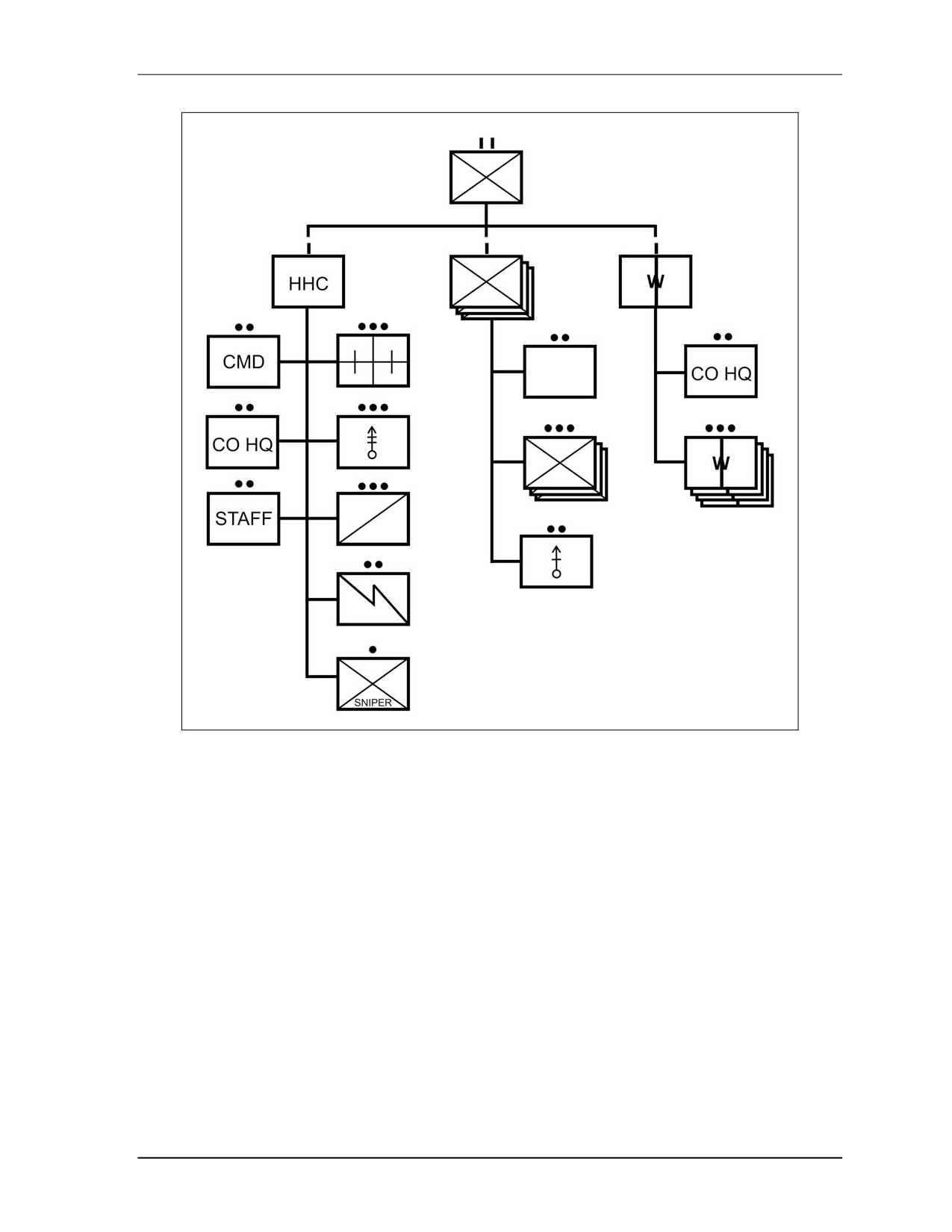
Introduction
Figure 1-1. Infantry battalion.
13 December 2006
FM 3-21.20
1-3
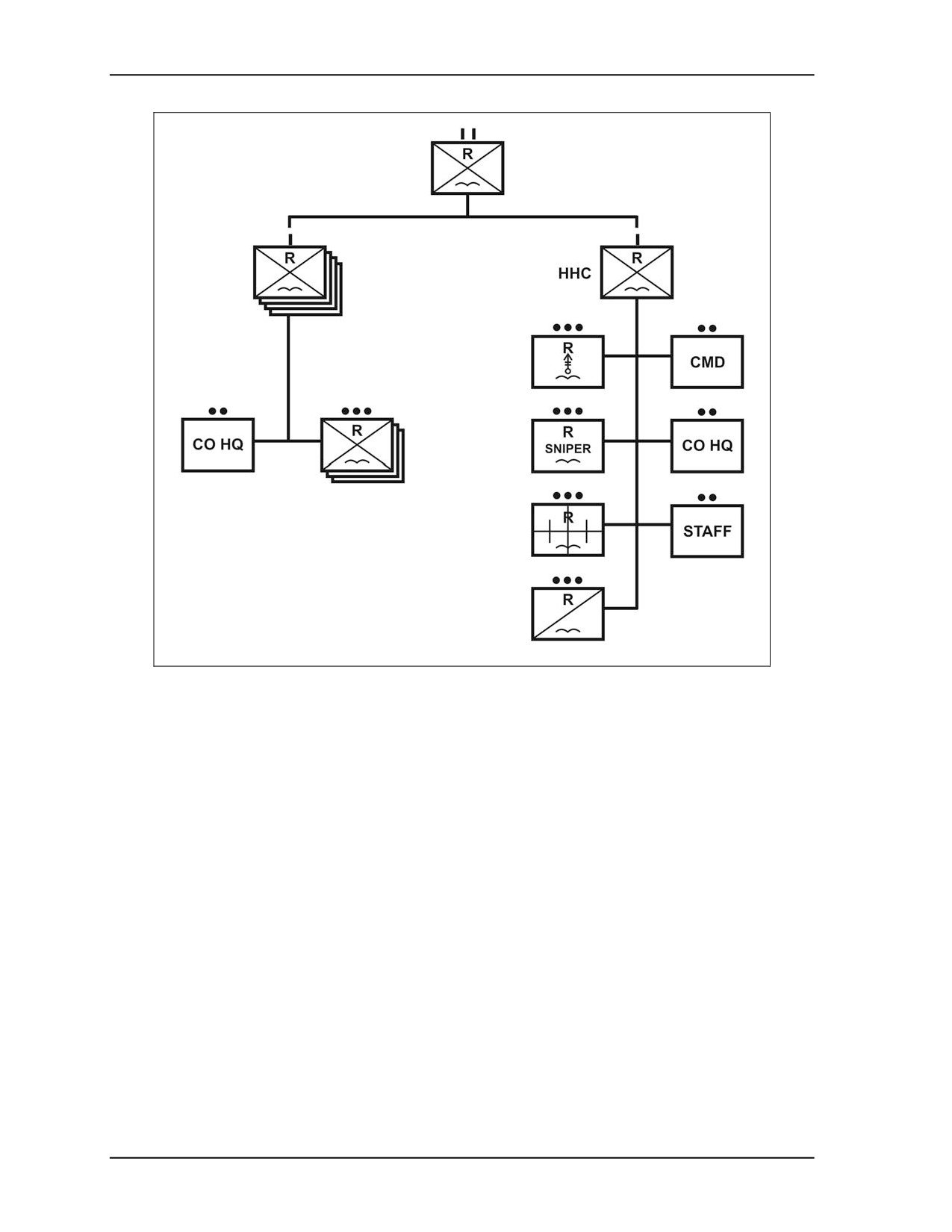
Chapter 1
Figure 1-2. Ranger battalion.
HEADQUARTERS SECTION
1-7.
The headquarters section includes the battalion command section and the coordinating, special,
and personal staff members. (See FM 6-0 for more on staff responsibilities and characteristics.)
Battalion Command Section
1-8.
The battalion command section consists of the battalion commander, the battalion executive
officer (XO), the battalion command sergeant major (CSM), and supporting enlisted Soldiers such as
vehicle drivers. The commander locates where he can observe and influence the critical points and actions
on the battlefield and communicate orders and guidance. The battalion command section has several
wheeled vehicles to assist with the command, control, coordination, and transportation of command section
personnel, but during execution of their duties, they are often on foot.
Battalion Executive Officer
1-9.
The battalion XO exercises the duties and responsibilities of second in command, chief of staff,
and logistics coordinator. His primary duties include—
•
Exercising command in the absence or incapacitation of the commander.
•
Integrating and synchronizing staff activities to optimize control of battalion operations.
1-4
FM 3-21.20
13 December 2006
Introduction
•
Directly supervising the battalion main command post.
•
Overseeing the synchronization of information management within the battalion.
•
Closely monitoring administrative and logistics issues within the battalion.
•
Executing any other duties prescribed by the commander.
•
Supervising military decision-making process (MDMP) and orders production.
•
Managing commander’s critical information requirements (CCIR).
Battalion Command Sergeant Major
1-10.
The CSM is the senior noncommissioned officer (NCO) within the Infantry battalion and advises
the commander concerning the enlisted ranks. He is the battalion’s senior enlisted trainer and works closely
with company commanders when coaching and training company first sergeants and platoon sergeants. He
acts as the commander’s representative in supervising aspects vital to battalion operations, as determined
by the commander and by himself.
Battalion Coordinating, Personal, and Special Staffs
1-11.
The battalion coordinating staff consists of the sustainment section (S-1 and S-4), the intelligence
section (S-2), the operations section (S-3), the communications officer (S-6), the liaison officer (LNO) and,
if authorized, the civil-military operations officer (S-9). The personal staff includes the chaplain and the
CSM. Special staff officers include other personnel with specific technical and functional area expertise
such as the fire support officer (FSO), the chemical officer (CHEMO), the FSC commander, and the
battalion surgeon. All staff elements assist the commander with planning, organizing, employing, and
sustaining the battalion. See Chapter 10 for a detailed discussion of the duties and responsibilities of the
fire support element (FSE) and the FSO. See Appendix I for a detailed discussion of the duties and
responsibilities of the CHEMO.
Sustainment Section
1-12.
The sustainment section consists of the human resources (S-1) and logistics sections (S-4).
Human Resources Section
1-13.
The human resources or S-1 section, led by the battalion adjutant, is responsible for maintaining
unit strength and conducting personnel actions. The S-1 identifies and reports critical human resources
shortages to the commander and higher headquarters. The S-1 section ensures assigned personnel transition
smoothly into and out of the battalion. It handles routine day-to-day tasks such as preparing battalion status
and strength reports, monitoring and preparing personnel awards and orders, scheduling, and other
administrative support as required. During tactical operations, the S-1 section operates with the S-4 section
to provide support to the battalion, including unit strength reporting to higher headquarters and
coordination of unit replacements as directed by the battalion commander. Elements of the S-1 locate with
the FSC to receive and sort mail, to monitor and track battalion personnel changes, such as receiving
incoming replacements or outgoing Soldiers, and tracking casualty and KIA flow as they return to or
through the BSA. Casualty tracking continues through Level III care. The S-1 is also the staff point of
contact (POC) for activities such as inspector general, public affairs, and judge advocate general issues.
The S-1 coordinates the medical platoon leader’s actions when he is in his role as special staff.
Logistics Section
1-14.
The logistics or S-4 section, led by the battalion logistics officer or S-4, is responsible for
providing logistical planning and support to the battalion and operates the battalion’s combat trains
command post (CTCP). The S-4 functions as the commander's primary logistics planner, with assistance
from the FSC commander, and provides timely and accurate logistical information required to support and
sustain the individual maneuver companies and specialty platoons with all classes of supply. The S-4
13 December 2006
FM 3-21.20
1-5
Chapter 1
section staffs the CTCP in conjunction with elements of the S-1 section and FSC personnel. The CTCP
provides human resource and logistics reporting (on hand status and forecasted requirement) to the FSC
and the brigade support battalion (BSB) command post (CP). It also coordinates logistics resupply and unit
replacements as required. The CTCP functions as the alternate battalion tactical operations center (TOC)
and monitors the current fight. As such, the S-4 and the logistics section anticipate the logistical
requirements of the battalion and ensure the XO is knowledgeable of the unit’s status.
Intelligence Section
1-15.
Intelligence is one of the commander's most important decision-making tools. The S-2 section is
responsible for providing timely and accurate intelligence analyses and products in support of the
commander, staff, and subordinate units. The S-2 supervises and coordinates collection, processing,
production, and dissemination of intelligence, and integrates this into the S-3's operational planning for
tasking. The section makes analytical predictions on when and where enemy, noncombatant, and weather
effects will occur. It also provides analysis on the effects of the battlefield environment on friendly and
enemy courses of action and capabilities. The S-2 is responsible for evaluating the enemy in terms of
doctrine and or pattern analysis, order of battle, high-value and high-pay-off targets, capabilities, and
vulnerabilities. In conjunction with the XO and S-3, the S-2 coordinates the battalion staff’s recommended
priority intelligence requirements (PIR) for inclusion in the commander's critical information requirements
(CCIR). The S-2 section integrates staff input to intelligence preparation of the battlefield (IPB) products
for staff planning, decision-making, targeting, and combat assessment. The S-2 also plans and manages
intelligence, surveillance, and reconnaissance (ISR) operations in coordination with the S-3 and FSO. The
S-2 or his intelligence representative also participates in the targeting meetings to provide the most current
threat information to assist with updating the target priority and methods of delivery
Operations Section
1-16.
The S-3 section is the commander's primary staff for planning, coordinating, prioritizing, and
integrating all battalion operations. The S-3 section runs the battalion main CP, under XO supervision. The
S-3 is generally the senior staff member of the tactical CP, commonly called the TAC, if the commander
employs one. The operations section’s main duties are to plan, prepare and produce the battalion operations
orders, control current operations, and coordinate critical support operations, as required, with the other
staff sections. In addition, the operations section develops and synchronizes the intelligence, surveillance,
and reconnaissance (ISR) collection plan. They also manage the battle rhythm of the TOC, to include
orders production; battle tracking, operations updates and briefings, rehearsals, receipt of reposts, and
reports to higher headquarters. Chapter 9 provides additional information on the operations section and
command post operations.
Communications Section
1-17.
The communications section, led by the S-6 communications officer, is responsible for all
communications for the battalion. Together, they ensure proper setup and operation of all communications
equipment in the TOC, TAC, CTCP, and the field trains CP. The communications section also ensures all
retransmission (retrans) operations for the battalion are set up and operational. The section monitors
maintenance on communications equipment and performs 10-and 20-level maintenance when necessary.
Liaison Section
1-18.
The liaison section is comprised of one LNO and an enlisted assistant. The joint and multinational
nature of operations requires that the Infantry battalion have the capability to conduct liaison operations.
The liaison team facilitates and coordinates the operations of the battalion with other units or agencies as
directed by the battalion commander. During combat operations, the LNO keeps other units informed of
the status, disposition, and location of the battalion, and assists in deconflicting boundaries and fires with
adjacent units. The LNO section is normally augmented with interpreter support when conducting
multinational operations. During the conduct of stability operations and civil support operations, the LNO
1-6
FM 3-21.20
13 December 2006
Introduction
can also act as a coordinator with the civil-military operations center
(CMOC), governmental and
nongovernmental organizations, as required.
Chaplain
1-19.
The unit ministry team (UMT) is composed of a chaplain and one enlisted chaplain's assistant.
The unit ministry team facilitates and coordinates religious support across the battalion’s area of operations
(AO). The chaplain is also a special staff member who serves as a confidential advisor to the commander
on the spiritual fitness and ethical and moral health of the command. The unit ministry team advises the
commander on humanitarian aspects and the impact of command policies on indigenous religions. He
provides and coordinates privileged and sensitive personal counseling and pastoral care to the unit’s
command, Soldiers, authorized civilians, and families. The unit ministry team locates where it can best
coordinate, communicate, and facilitate religious support. The S-1 section in the CTCP is normally the
coordinating staff that monitors UMT activities and location.
HEADQUARTERS COMPANY
1-20.
The headquarters company consists of the HHC headquarters and the battalion’s scout, mortar,
and medical platoons, and the communications and sniper section. The HQ Company provides intelligence,
fire support, protection, and very limited sustainment to the battalion through its specialty platoons and
HQs section. The attached FSC provides most sustainment to the battalion.
Company Headquarters Section
1-21.
The company headquarters section provides the immediate leadership, supply, and human
resources support to all HHC personnel, including the battalion’s command group, coordinating, special,
and personal staff, and specialty platoons and squads. It includes the HHC commander, first sergeant
(1SG), executive officer, and supporting supply and chemical sections. In a tactical environment, the HHC
HQ section provides flexibility to the battalion commander. The HHC commander, 1SG, and XO do not
have a set location from where they conduct their duties and as such, can be placed where they can most
effectively help the battalion to execute the mission.
1-22.
For example, the HHC commander might locate in the TOC to oversee mortar, scout, and sniper
operations, as well as to maintain CP security. The 1SG locates in the field trains as the noncommissioned
officer in charge (NCOIC) and assists in logistics package (LOGPAC) operations. The XO locates with the
FSC commander to provide tactical requirements advice and assistance. The HHC HQs section might be
used as a combat headquarters, for example, to lead a battalion reserve with task-organized elements from
different companies. The HHC HQ section also provides support to the battalion’s TOC with regard to
coordination of security and displacement operations. It has several wheeled vehicles to help support HHC
elements, including two small decontamination apparatuses for limited but immediate tactical
decontamination.
Medical Platoon
1-23.
The medical platoon provides force health protection (FHP) for the battalion using its organic
medical capabilities. The medical platoon is dependent on the health service support (HSS) system for
direct support (DS) and augmentation/reinforcement, when required. The medical platoon is organized
with a headquarters section, a treatment squad, four ambulance squads, and a combat medic section. The
medical platoon is responsible for providing Level I medical care. This care includes emergency medical
treatment for wounds, injuries, or illness, advanced trauma management, and sick call services. It also
includes casualty collection and medical evacuation from the supported unit to the battalion aid station
(BAS) or forward aid station (FAS). The medical platoon habitually establishes the BAS where it can best
support the battalion and has the capability to split into a BAS and a FAS for wider area coverage. It
normally operates under the direction of the CTCP.
13 December 2006
FM 3-21.20
1-7
Chapter 1
Headquarters Section
1-24.
The headquarters section provides command, control, communications, and resupply for the
medical platoon. The platoon headquarters consists of the field surgeon/medical platoon leader, the field
medical assistant, and the platoon sergeant. It normally collocates with the treatment squad to form the
BAS. The battalion surgeon, assisted by the field medical assistant and the platoon sergeant, is responsible
for the FHP plan for the Infantry battalion. The field medical assistant is the operations/readiness officer.
He plans, coordinates, and executes the FHP plan. See FM 4-02.4 and FM 8-55 for more information on
planning, preparation, and execution of HSS activities for FHP.
Treatment Squad
1-25.
The treatment squad consists of two treatment teams; Alpha and Bravo. These teams operate the
BAS and provide Level I medical care and treatment. This includes sick call, emergency medical treatment
(EMT), and advanced trauma management (ATM). The treatment teams can operate for limited times in
split-based operations in DS of battalion units. Typical operations for the treatment squads are as follows:
•
The battalion surgeon/platoon leader is located with Team Alpha, which is staffed by a health
care sergeant (SGT) and two health care specialists.
•
Team Bravo is staffed with a physician’s assistant (PA), a health care SGT, and two health care
specialists. They are trained to provide EMT and assist with ATM procedures.
•
The treatment teams can operate for a limited amount of time in split-based operations in DS of
battalion units for wider area coverage. Split based operations normally do not exceed 24 hours,
otherwise efficiency and capability of the teams is reduced.
•
Each team employs treatment vehicles with two medical equipment sets (MES's); one trauma
field MES, and one sick call field MES.
•
During periods where the Infantry battalion is not deployed, the battalion surgeon is normally
attached to the local medical care facility using the Professional Officer Filler Information
System
(PROFIS; AR 601-142). As a result, the platoon’s field medical
assistant/operations/readiness officer often serves as the medical platoon leader.
Ambulance Squads
1-26.
Medical platoon ambulances provide medical evacuation and en route care from the Soldier's
point of injury or a casualty collection point (CCP) to the BAS. The ambulance team in support of the
maneuver company works in coordination with the trauma specialists supporting the platoons. In mass
casualty situations, non medical vehicles may be used to assist in casualty evacuation as directed by the
supported commander. Plans for the use of non medical vehicles to perform casualty evacuation should be
included in the Infantry battalion's tactical standing operating procedures (TSOP) or operations order
(OPORD).
Combat Medic Section
1-27.
Trauma specialists are allocated based on one trauma specialist per each rifle platoon in the
battalion’s rifle companies. The platoon trauma specialist normally locates near the platoon sergeant. The
rifle company trauma specialist normally collocates with the 1SG. When the rifle company is engaged, he
remains with the 1SG and provides medical advice as necessary. As the tactical situation allows, he
manages the company CCP, provides treatment, and prepares patients for medical evacuation
(MEDEVAC). For definitive information on medical platoon operations, see FM 4-02.4 and FM 8-55.
Scout Platoon
1-28.
The battalion scout platoon serves as the forward "eyes and ears" for the battalion commander.
The primary mission of the scout platoon is to conduct reconnaissance and security to answer CCIR,
normally defined within the battalion’s ISR plan. The platoon can conduct route, zone, and area
1-8
FM 3-21.20
13 December 2006
Introduction
reconnaissance missions. The platoon can also conduct limited screening operations and can participate as
part of a larger force in guard missions. The platoon has one officer and 21 enlisted personnel. The platoon
leader is assisted by his platoon sergeant (PSG), who assists and advises the platoon leader and leads the
platoon in his absence.
1-29.
The scout platoon is organized into a platoon headquarters and three squads of six men each. Each
squad leader is responsible for controlling his squad’s movement and intelligence collection requirements.
He reports critical intelligence information obtained by his squad to the scout platoon leader or battalion
TOC.
1-30.
In either offensive or defensive operations, the commander may deploy his scout platoon to
conduct screening operations of the battalion's front, flank, or rear. The scout platoon may also occupy
outposts from which it can relay critical information to the TOC concerning enemy composition,
disposition, and activities.
Mortar Platoon
1-31.
The primary role of the battalion mortar platoon is to provide immediate, responsive indirect fires
in support of the maneuver companies or battalion. The battalion mortar platoon consists of a mortar
platoon headquarters, a mortar section with fire direction center (FDC), and four mortar squads. The
platoon’s FDC controls and directs the mortar platoon’s fires. Infantry battalion mortar squads are
equipped with 120-mm and 81-mm mortars, but are only authorized enough personnel to operate one of the
two systems at any one time (arms room concept). For a more in-depth look at mortars and their
characteristics, see Chapter 10.
1-32.
The mortar platoon provides the commander with the ability to shape the Infantry's close fight
with indirect fires that—
• Provide close supporting fires for assaulting Infantry forces in any terrain.
• Destroy, neutralize, suppress, or disrupt enemy forces and force armored vehicles to button up.
• Fix enemy forces or reduce the enemy's mobility and canalize his assault forces into
engagement areas.
• Deny the enemy the advantage of defile terrain and force him into areas covered by direct fire
weapons.
• Optimize indirect fires in urban terrain.
• Significantly improve the Infantry’s lethality and survivability against a close
dismounted assault.
• Provide obscuration for friendly movement.
1-33.
Each mortar system can provide three primary types of mortar fires—
• High explosive (HE) rounds are used to suppress or destroy enemy dismounted Infantry,
mortars, and other supporting weapons and to interdict the movement of men, vehicles, and
supplies in the enemy's forward area. Bursting white phosphorus (WP) rounds are often mixed
with HE rounds to enhance their suppressive and destructive effects.
• Obscuration rounds are used to conceal friendly forces as they maneuver or assault, and to
blind enemy supporting weapons. Obscurants can also be used to isolate a portion of the enemy
force while it is destroyed piecemeal. Some mortar rounds use bursting WP to achieve this
obscuration. Bursting WP may be used to mark targets for engagement by other weapons,
usually aircraft, and for signaling.
• Illumination rounds, to include infrared illumination, are used to reveal the location of enemy
forces hidden by darkness. They allow the commander to confirm or deny the presence of the
enemy without revealing the location of friendly direct fire weapons. Illumination fires are
often coordinated with HE fires both to expose the enemy and to kill or suppress him.
13 December 2006
FM 3-21.20
1-9
Chapter 1
Sniper Section
1-34.
The primary mission of the sniper section in combat is to support combat operations by delivering
precise long-range fire on selected targets.
Mission of Snipers
1-35.
Snipers create casualties among enemy troops, slow enemy movement, frighten enemy Soldiers,
lower morale, and add confusion to their operations. They can engage and destroy high payoff targets. The
secondary mission of the sniper section is collecting and reporting battlefield information. The sniper
section is employed in all types of operations. This includes offensive, defensive, stability operations and
civil support operations in which precision fire is delivered at long ranges. It also includes combat patrols,
ambushes, counter sniper operations, forward observation elements, military operations in urbanized
terrain, and retrograde operations in which snipers are part of forces left in contact or as stay-behind forces.
Composition of Sniper Section
1-36.
The Sniper section has 10 enlisted personnel, 3 long range sniper rifle systems, and 3 standard
sniper rifle systems. The section leader is the primary advisor to the battalion commander on sniper
employment. If the commander does not directly control sniper employment, he should designate a sniper
employment officer (SEO) to command and control the sniper section. The HHC commander or XO could
be used in this role.
Sniper Teams
1-37.
There are three sniper teams in the sniper section organized with a sniper, observer, and security.
As a result, the sniper section can effectively employ three sniper teams at any one time, although the
commander could employ up to five ad hoc sniper teams for limited duration missions by employing two
man teams. Sniper teams can be task organized to any unit in the battalion or employed directly under
battalion control. Snipers are most effective when leaders in the supported unit understand capabilities,
limitations, and tactical employment of sniper teams. See FM 3-22.10 and Appendix F for more
information on planning, preparing, and executing sniper team employment.
Common and Other Potentially Task Organized Elements Providing Special Staff
1-38.
The following are common and other potentially task organized elements that provide
special staff:
United States Air Force Tactical Air Control Party
1-39.
The augmenting USAF TACP consists of the air liaison officer (ALO) and two enlisted terminal
attack controllers
(ETACs). The TACP assists the commander with the planning, integration, and
execution of fixed wing close air support (CAS) operations. It is the commander’s primary link to Air
Force CAS assets that are made available to support the battalion’s mission.
Psychological Operations
1-40.
Psychological operations (PSYOP) units (Appendix G) are often attached or in direct support to
units, particularly in stability operations. An important potential byproduct of PSYOP can be additional
intelligence of the AO.
Civil Affairs
1-41.
Civil Affairs (CA, Appendix G) will often be attached or in direct support of units, particularly in
stability operations and civil support operations. CA can be vital to gaining the support of the local
1-10
FM 3-21.20
13 December 2006
Introduction
population and can provide important information about the AO and key local leaders. However, CA
cannot overtly collect intelligence. CA is also a related activity of IO that should be considered in any IO
campaign.
Engineers
1-42.
Typically combat engineers; the senior engineer advises the commander on how best to employ
his assets in mobility, counter mobility, and survivability roles. During stability operations and civil
support operations the engineer will be required to provide technical advice in a wide range of engineering
related areas, to include construction and general engineering subjects
Air Defense
1-43.
Short range air defense (SHORAD) units are unlikely to be attached or placed in DS or general
support (GS) of Infantry battalions. Regardless of the availability or relationship, air defense units may
require specific terrain within the battalion AO to accomplish their mission.
FORWARD SUPPORT COMPANY
1-44.
The FSC is a multifunctional sustainment unit organized to provide habitual and direct support to
the Infantry battalion. The FSC is habitually DS to the Infantry battalion and a close SOP supported
relationship exists between the units. Both the BSB and Infantry battalion commanders ensure the FSC is
tightly integrated into the Infantry battalion’s operations in garrison, training and in combat. In the
Modular Force, the FSC is responsible for conducting the majority of the sustainment operations that were
previously conducted by the Infantry battalion HHC. These responsibilities include—
• Unit level vehicle and equipment maintenance and recovery.
• Resupply operations for all classes of supply (except medical) and water.
• Transportation for all classes of supply and personnel.
• Supplemental transportation of personnel with no organic wheel movement capability.
• LOGPAC operations.
INFANTRY COMPANY
1-45.
The Infantry Company consists of a headquarters section, three Infantry platoons, and a 60-mm mortar
section. The Infantry Company is strategically mobile. Each Infantry platoon has three Infantry squads and
a weapons squad. Each weapons squad has two Javelin (close combat missile) command launch units and
two medium machine guns.
WEAPONS COMPANY
1-46.
The mission of the weapons company is to provide mobile heavy weapons and long range close
combat missile fires to the Infantry battalion. The weapons company consists of a headquarters section and
four assault platoons. Each assault platoon has two tube-launched, optically tracked, wire-guided (TOW)
close combat missile systems fired from the improved target acquisition system (ITAS). In addition, each
platoon is equipped with a .50 cal heavy barrel machine gun and a Mark 19 automatic grenade launcher.
BATTLEFIELD ORGANIZATION
1-47.
Commanders visualize their battlespace and determine how to arrange their forces. Spatially,
commanders may find it useful to organize this area into deep, close, and rear areas. However, this
framework is more appropriate for a linear battlefield than a non linear battlefield such as when conducting
stability operations and civil support operations. Battlefield organization is the arrangement of subordinate
forces according to purpose, time, and space to accomplish a mission.
13 December 2006
FM 3-21.20
1-11
Chapter 1
1-48.
The purpose-based framework centers on decisive, shaping, and sustaining operations. Purpose
unifies all elements of the battlefield organization by providing the common focus for all actions. Forces
act in time and space to accomplish a purpose. The nested effects caused by accomplishing these purposes
drive the framework. Main efforts are identified within the decisive, shaping, and sustaining operations for
the activity that the commander determines constitutes the most important task at the time.
1-49.
As a full-spectrum combat force, the Infantry battalion organization design includes capabilities
tailored specifically to the unique requirements of the battalion’s mission set. The battalion organization
allows the commander to scale his force to accept additional Infantry organizations and units or elements
that are not organic to the battalion structure such as heavy, Stryker, engineers, or civil affairs. This
organizational flexibility allows the battalion to function in its primary role as a major participant in
combat operations as part of a BCT or to serve as the base modular combat force in stability operations.
When the battalion has a temporary grouping of units under one commander designed to accomplish a
particular mission, it becomes a task force.
Section III. WARFIGHTING FUNCTIONS
A warfighting function (WFF) is a group of tasks and systems (people, organizations, information, and
processes) united by a common purpose that commanders use to accomplish missions and training objectives.
Integration and synchronization of the WFF occurs horizontally and vertically throughout the battalion.
Commanders visualize, describe, direct, and lead operations in terms of the WFFs. Decisive, shaping, and
sustaining operations combine all the WFFs to generate combat power. No WFF is exclusively decisive,
shaping, or sustaining. The six WFF plus leadership combine to become the seven elements of combat power.
Figure 1-3 shows the warfighting functions.
• Fire Support
• Movement and Maneuver
• Protection
• Command and Control
• Intelligence
• Sustainment
Figure 1-3. Warfighting functions.
FIRE SUPPORT
1-50.
The fire support WFF is the related tasks and systems that provide collective and coordinated use
of Army indirect fires, joint fires, and offensive information operations. It includes tasks associated with
integrating and synchronizing the effects of these types of fires with the other WFFs to accomplish
operational and tactical objectives. Lethal and nonlethal fires, including offensive information operations,
are integrated into the concept of operations during planning and targeting based on the targeting guidance.
The three components of the fire support WFF are—
• Fire support command and control.
• Target acquisition systems and assets.
• Fire support assets and resources.
1-51.
The fire support WFF encompasses the collective and coordinated use of all fire support assets
needed to conduct indirect fires in support of the scheme of maneuver. The fire support system acquires
and tracks targets; delivers timely and accurate fires; provides proactive counterstrikes; and plans,
coordinates, and orchestrates Army and Joint fires. The battalion FSO receives guidance from the
1-12
FM 3-21.20
13 December 2006
Introduction
commander regarding the task, purpose, method, and effects desired. He then plans, coordinates, and
achieves the desired effects using organic and non-organic means. Each FSE has subordinate fire support
teams that support the weapons company and each rifle company. Each fire support team assists the
maneuver company commander with establishing targeting information and assessment of effects and acts
as the liaison for all fire support assets. The TACP, consisting of an air liaison officer and enlisted tactical
air controllers, integrates into the battalion headquarters alongside the FSE, providing the ability to request,
coordinate, and control close air support. Some operations may include the United States Marine Corps
(USMC) or air and naval gunfire liaison company (ANGLICO) assets task-organized to the battalion,
typically to assist in controlling supporting naval gunfire.
MOVEMENT AND MANEUVER
1-52.
The movement and maneuver WFF is the related tasks and systems that move forces to achieve a
position of advantage in relation to the enemy. It includes those tasks associated with employing forces in
combination with direct fire or fire potential (maneuver), force projection (movement), mobility, and
counter mobility. Movement and maneuver are the means by which commanders mass the effects of
combat power to achieve surprise, shock, momentum, and dominance.
1-53.
The rifle companies and the weapons company of the Infantry battalion, maneuver to achieve a
position of advantage with respect to the enemy. The rifle companies are most effective in close combat but
also employ organic close combat missile and shoulder fired munitions/close combat missile weapons for
use against armored vehicles, buildings, bunkers, and fortifications. The weapons company provides
mobile heavy weapons fire, to include long-range close combat missile (antiarmor) fires, and the ability to
destroy buildings, bunkers, and fortifications. All other battalion assets support the maneuver elements.
The battalion achieves decisive action by means of combined arms effects at the company and platoon
level to achieve the desired purpose. Maneuver is usually supported by the integration of fire support;
however, protection and sustainment must be integrated throughout. Army aviation and fixed wing support
are also assets that may conduct operations in support of the battalion. Attack helicopters can conduct
enemy and terrain oriented combat missions using movement and maneuver. Aviation assets can also
provide timely reconnaissance and surveillance information to ground maneuver commanders and conduct
air movement and sustainment operations in support of Infantry forces.
1-54.
Mobility operations preserve the freedom of maneuver of friendly forces. These missions include
breaching obstacles, controlling battlefield circulation, improving or building roads, providing bridge and
raft support, and identifying routes around contaminated areas. Counter mobility operations attack and
deny mobility to enemy forces using obstacles and smoke generation.
1-55.
Infantry units conduct mobility, counter mobility, and survivability missions with or without
engineer support. Combat or construction engineers may augment the battalion; provide expertise,
equipment, and limited manpower. The senior engineer unit leader advises the commander on employment
and placement of engineer assets and obstacles. He also provides technical construction advice in stability
operations and civil support operations. The Infantry battalion may conduct missions that include the
construction of obstacles, emplacement and clearing of minefields, demolitions, road improvement, and
bridging.
1-56.
Infantry battalions may be augmented with military police (MP) support from the BCT. If the MP
platoon is not attached, the Infantry battalion will still often find portions of the BCT MP platoon operating
within its AO. The BCT MP platoon provides twelve 3-Soldier teams that habitually operate in pairs (two
weapons platforms) to perform mobile and/or dismounted operations. The six pairs of MP teams rotate to
cover 24 hour operations. Working with civil affairs planners and the S-3, MPs can also monitor refugee
routes and control points.
1-57.
The teams or mobile patrols provide a combination of the following capabilities as prioritized by
the commander:
• Maneuver and mobility support
(MMS) for vehicle traffic, circulation control points,
checkpoints, roadblocks, holding areas, and mobile patrols.
13 December 2006
FM 3-21.20
1-13
Chapter 1
• Area security/force protection mobile patrols for reconnaissance, detection, and response to
threat incidents.
• Operation of the detainee initial collection point.
• Incident response to maintain law and order and to collect and report on information to support
police intelligence operations.
• Security for small critical sites, facilities, or storage areas.
PROTECTION
1-58.
The protection WFF is the related tasks and systems that preserve the force so the commander can
apply maximum combat power. Preserving the force includes protecting personnel
(combatant and
noncombatant), physical assets, and information of the United States and multinational partners. It includes
the following task areas at the Infantry battalion level:
• Safety.
• Fratricide avoidance.
• Survivability.
• Air defense.
• CBRN.
• Defensive information operations.
• Force health protection.
1-59.
Survivability operations protect friendly forces from the effects of enemy weapon systems and
from the environment. Survivability measures include: hardening of facilities, fortification of battle
positions, deception, dispersion, and CBRN defense measures.
1-60.
Infantry units are trained to operate in a CBRN environment to survive and accomplish their
missions. They increase their survivability through adherence to the CBRN defense fundamentals including
contamination avoidance, CBRN protection, and CBRN decontamination. Decontamination assets within
the battalion are limited; however, they can provide for initial measures to control the spread and lessen the
risk of contamination. The BCT has an assigned chemical reconnaissance platoon that may operate in
support of the battalion. Smoke generating units may be task organized to an Infantry battalion. They are
used to obscure and deceive.
1-61.
The battalion and BCT have no organic air defense artillery (ADA) assets. ADA support comes
from an ADA battalion at echelons above the BCT. Infantry battalions employ the passive measure of
remaining undetected as their primary form of defense against air attacks. Other measures include: the use
of camouflage and moving in limited visibility. In the event of an air attack, the battalion should employ
combined arms for air defense (CAFAD) and the air defense procedures described in Chapter 10.
COMMAND AND CONTROL
1-62.
The command and control (C2) WFF is the related tasks and systems that support commanders in
exercising authority and direction. C2 has two components: the commander and the C2 system. The C2
system supports the commander’s ability to make informed decisions, delegate authority, and synchronize
the WFFs. Through C2, commanders initiate and integrate all systems and WFFs toward mission
accomplishment.
1-63.
As with all C2, the Infantry battalion’s C2 system is the arrangement of personnel, information
management, procedures, equipment, and facilities essential for the commander to conduct operations.
Personnel constitute the battalion commander, his subordinate commanders, and staff. Information
management is the provision of relevant information to the right person at the right time in a usable form to
facilitate situational understanding and decision making. Procedures are standard and consist of detailed
courses of action that describe how to perform a task. Equipment and facilities provide sustainment and a
work environment for the other elements of a C2 system.
1-14
FM 3-21.20
13 December 2006
Introduction
1-64.
By virtue of rank and assignment, the commander exercises command and control over his
battalion. He executes battlefield missions through his leadership coupled with his tactical knowledge,
visualization of the battlefield, situational understanding, and with the assistance of his subordinate
commanders and staff. The battalion commander positions himself on the battlefield where he can most
influence and direct combat actions. He must be able to see and feel the battle in order to command actions.
His presence on the battlefield must be apparent to his subordinates. The subordinate commanders must
understand and execute missions in accordance with his intent. The battalion commander leads by example
and maintains control over his unit while still allowing subordinate commanders to exercise initiative to the
extent possible. His staff assists him in the control of the battalion through the CPs, orders production,
manning and maintaining the communications system, and enforcing established procedures.
1-65.
Information management uses procedures and information systems to collect, process, store,
display, and disseminate information. Information management consists of relevant information and
information systems
(INFOSYS). Information systems are the equipment and facilities that collect,
process, store, display, and disseminate information. These include computers; hardware and software, and
communications, as well as policies and procedures for their use.
1-66.
Procedures allow common repeated tasks to be standardized and executed quickly and efficiently.
Procedures govern actions within a C2 system to make it more effective and efficient. Adhering to
procedures minimizes misunderstanding and hesitance, as commanders make frequent rapid decisions to
meet operational requirements.
1-67.
Equipment and facilities in the Infantry battalion consists of the main CP, also referred to as the
TOC, TAC, the CTCP, and the field trains CP. For more information on CP operations, see Chapter 9.
INTELLIGENCE
1-68.
The intelligence WFF is the related tasks and systems that facilitate understanding of the enemy,
terrain, weather, and civilian considerations. It includes tasks associated with ISR. It is a flexible,
adjustable architecture of procedures, personnel, organizations, and equipment. These provide relevant
information and products relating to the threat, civil populace, and environment to commanders. The
intelligence WFF focuses on four primary tasks:
• Support to situational understanding.
• Support to strategic responsiveness.
• Conduct ISR.
• Provide intelligence support to targeting.
1-69.
The Infantry battalion has limited organic means outside of the S-2 section to dedicate to
information collecting and reporting. The battalion relies mainly on the scout platoon, sniper teams,
Infantry patrols, and organic short range unmanned aircraft systems (UAS) to gather information. One
other important, internal source of information is the Soldier. Every Soldier in the battalion is a sensor and
is expected to observe and report relevant information in a timely manner. Most staff officers have access
to sources of intelligence. These sources can include their Soldiers on the ground such as CA, Air Defense,
and Engineers, or their counterparts at the next higher HQs or supporting brigade. They can also use the
“reverse WFF” method and give the S-2 logical assessments about how the adversary would employ any of
his assets that fall in the staff officer’s functional area of expertise. Other intelligence information must be
received from the BCT and higher echelons. This information helps the commander develop a situational
understanding (SU) of the battlefield by applying his judgment to the COP, and it should answer his PIR.
Situational understanding and information superiority enable the force to avoid surprise, develop rapid
decisions, conduct movement and maneuver with synchronized fires and effects, and achieve decisive
outcomes.
13 December 2006
FM 3-21.20
1-15
Chapter 1
SUSTAINMENT
1-70.
The sustainment WFF is the related tasks and systems that provide support and services to ensure
freedom of action, extend operational reach, and prolong endurance. It includes those tasks
associated with—
• Maintenance.
• Transportation.
• Supply.
• Field services.
• Explosive ordnance disposal.
• Human resources support.
• Financial management.
• Health service support.
• Religious support.
• Related general engineering.
1-71.
Considering the nature of the Infantry battalion’s mission, the sustainment structure is adequate to
provide for logistical needs, with the habitual DS relationship of the FSC. The battalion headquarters and
headquarters company includes the staff needed to plan sustainment and plan and conduct HSS operations.
Constrained vehicle assets allow the unit to operate in terrain that is more restrictive and increase strategic
and operational maneuverability. However, the FSC has sufficient sustainment assets to provide for the
conduct of continuous sustainment operations. The battalion executive officer orchestrates sustainment
activities in conjunction with the S-1, S-4, and FSC Commander. Together they plan and employ
sustainment assets to facilitate operations and ensure success of the battalion’s mission. Chapter 11
provides a detailed outline of the sustainment WFF.
Section IV. CONTEMPORARY OPERATIONAL ENVIRONMENT
Potential enemy states and non-state actors in various regions of the world generally see the United States as
the world’s dominant power, with large technological, economic, and material advantages and an
overwhelming military capability. Given this strategic assessment, potential US enemies seek to avoid US
military strengths while exploiting perceived US weaknesses. In this way, our enemies hope to achieve their
own regional or international goals without US intervention or, failing this, without the US military defeat of
those objectives. If it comes to a fight with US forces, our enemies are unlikely to fight the same way they
would fight their regional peers or lesser forces in their region.
ASYMMETRY
1-72.
Asymmetry is an ideological, cultural, technological, or military imbalance that exists when there
is a disparity in comparative strengths and weaknesses and in how a force generates combat power and
applies or focuses the effects of combat power. In the context of the COE, asymmetry, or an asymmetric
threat, means an adaptive enemy approach to avoid or counter US strengths without opposing them
directly, while seeking to identify, target, and exploit US weaknesses to achieve goals or objectives. For
example, an enemy without long-range artillery or missiles may use improvised explosive devises to target
Infantry and military vehicles to achieve the same destructive effect.
THREATS
1-73.
In today’s world, commanders must be prepared to go into any region or operational environment
and perform the full range of missions while dealing with a wide range of threats. Some threats come in the
form of nation-states; this may be a country or a coalition of countries. Threats can also come from entities
that are not states, including insurgents, terrorists, drug-traffickers, and other criminal organizations. These
1-16
FM 3-21.20
13 December 2006
Introduction
non-state actors may use force of arms to further their own interests and threaten the interests of the US or
other nation-states. Non-state threats may exist in isolation or in combination with other non-state or
nation-state threats.
“The unresting progress of mankind causes continual change in the weapons; and
with that must come a continual change in the manner of fighting.”
Alfred Mahan
SCOPE
1-74.
The COE is more than one specific threat or force. It is the complete environment in which US
forces operate worldwide. It includes the physical environment and all other factors, such as political,
military, economic, ethnic, religious, and tribal factors, that can affect US operations. These factors also
affect where our enemies will operate against us. Operating in the COE requires a change from viewing the
enemy only through the traditional line and block, time-phase, Soviet motorized rifle regiment paradigm, to
considering the entire operational environment to understand the adaptive and opportunistic enemies that
US forces will continue to combat worldwide. As part of his planning and execution of operations, the
commander must remain acutely aware of and carefully consider the differences in the relationship
between strategic, operational, and tactical goals, plans, and actions. He considers those of both US and
enemy forces relative to each situation in order to appreciate the nature of the conflict at his level, and in
his AO/AI).
VARIABLES
1-75.
During operations in the COE, commanders will encounter a variety of conflicts in a number of
different operational environments. Eleven critical variables define the nature of the operational
environments where those conflicts or other US military activities can occur. They are called variables
because the exact nature of the conditions, circumstances, and influences that make up the operational
environment varies by situation, region, and political considerations.
1-76.
Whether or not these operational variables might significantly affect the strategic, operational, or
tactical environment, they must at least be considered during any analysis of the mission or
changing situation.
VARIABLE 1--PHYSICAL ENVIRONMENT
1-77.
The physical environment has always been a key factor in military operations. History has
demonstrated that those forces able to obtain an advantage by using various aspects of the physical
environment have a much higher probability of defeating their opponents, regardless of size and capability
overmatch. Potential opponents clearly understand that less complex and open environments favor the US
with its standoff technology, precision guided munitions (PGM) and sophisticated ISR capability. For this
reason, they will seek to use complex terrain and urban environments in confrontations with US Forces.
VARIABLE 2--NATURE AND STABILITY OF STATE
1-78.
Understanding the nature of the state involved in the conflict and its degree of stability is critical
in calculating the center of gravity, nature of the military campaign, and true end state. A state that must
commit significant resources to maintain internal control represents less of a threat in conventional combat
and more of a threat in stability operations. The question then becomes: Is the real strength of the state; the
military, the police, or the population?
13 December 2006
FM 3-21.20
1-17
Chapter 1
VARIABLE 3--SOCIOLOGICAL DEMOGRAPHICS
1-79.
The demographics and sociological aspects of the population provide significant complexity to
military operations. States will fail due to cultural, ethnic, resource, or opportunity issues. Stopping those
conflicts would involve training a broader set of leader and unit competencies. In addition, states
fragmented by these types of issues and who have sophisticated military capability normally behave more
aggressively and violently within their regions.
VARIABLE 4--REGIONAL AND GLOBAL RELATIONSHIPS
1-80.
Regional and global relationships of potential opponents serve to define the scale of military
operations. They also give indication of escalation or limiting factors. In an unaligned world, these
relationships are much more fluid and unpredictable. Alliances within a region may add significantly to the
military capability of an opponent or globally broaden the AO. This could occur in the middle of
deployment or after the force has been introduced into the area of responsibility (AOR).
VARIABLE 5--MILITARY CAPABILITIES
1-81.
Existing military capabilities are the most critical variable for military operations. Once easy to
define, this variable is rapidly becoming the most complex of all. Hybridization, rapid technological
advancement, and capabilities developed from asymmetrical concepts generate constant change.
VARIABLE 6--INFORMATION
1-82.
Sophisticated and unsophisticated opponents alike understand the value of information operations.
Some argue that it will be the decisive factor in future conflicts. Most potential opponents feel this is the
most productive avenue to take to offset US conventional battlefield capabilities.
VARIABLE 7--TECHNOLOGY
1-83.
Advanced technology serves to level the playing field either symmetrically or by development of
asymmetrical capabilities. The presence of sophisticated technology indicates where opponents expect to
achieve the greatest advantage or perceive the greatest threat. The nature of the environment can change
dramatically with the introduction of a new or advanced system.
VARIABLE 8--EXTERNAL ORGANIZATIONS
1-84.
Increased globalization of individual economies and the development of world wide information
systems are generating enhanced worldwide awareness. This has resulted in the increase of United Nations,
regional, nongovernmental, and private organizations. In addition, these organizations are growing in
influence and power as well as in willingness to become involved in crises. In the past, many of these
organizations have become actively involved in crisis areas and are having a growing impact on operations.
VARIABLE 9--NATIONAL WILL
1-85.
Clearly, US national will is viewed by most countries as its strategic center of gravity. The degree
to which a state can attack its opponent's national will and still preserve its own, represents to a large
degree, its ability to achieve favorable conflict resolution. In today’s world of transparent military
operations, this attack and defense of national will has tactical as well as strategic implications.
1-18
FM 3-21.20
13 December 2006
Introduction
VARIABLE 10--TIME
1-86.
Time is always a critical factor. It drives the operation. In most cases, opponents view time as
being to their advantage in that the longer the amount of time between crisis and response, the greater the
opportunity for games of brinkmanship and adjusting the nature of conflict. Time is an operational factor
and a tool to manipulate tactical and strategic advantages.
VARIABLE 11--ECONOMICS
1-87.
Economic position represents a nation’s ability to rapidly purchase military capabilities or to
conduct sustained operations. It also gives indication of external relationships that could result in political
or military assistance. Criminal elements will want to profit from the US deployment by pilfering, by
manipulating contracts, and by preying on local and national employees in the service of the US.
13 December 2006
FM 3-21.20
1-19
This page intentionally left blank.
Chapter 2
Battle Command
Battle command is the exercise of command in operations against a hostile, thinking
enemy. It is the application of the leadership element combat power to operations.
Principally, battle command is an art that employs skills developed by professional
study, constant practice, and considered judgment.
Assisted by staff, the commander visualizes the operation, describes it (states his
intent and provides guidance); and directs the actions of subordinates within his
intent. He directs operations in terms of the WFFs. He directly influences operations
by his personal presence, supported by his command and control system.
Command of the battalion remains a personal function. The functions of command
and control are planning, preparing for, and executing the other warfighting
functions; to synchronize activities among them; and to assess the situation
continually.
Section I. ART OF COMMAND
Command is the authority that a commander in military service lawfully exercises over subordinates by virtue
of rank and assignment. Leaders possessing command authority strive to use it with firmness, care, and skill.
Command is more of an art than a science; although it exhibits characteristics of both. The "art of command"
requires expert performance of a specific skill, using intuitive faculties that the leader cannot gain solely by
study or education. Command also requires a conscious and skillful exercise of authority to fulfill command
responsibilities using decision making and leadership.
ROLE OF COMMANDER
2-1.
The Infantry battalion commander’s knowledge, experience, and personality determine how he
interacts with his unit. He drives the process through mission command. He establishes a command
climate for his unit, prepares his unit for operations, commands his unit during operations, and assesses his
subordinates. The commander refines the battalion’s command and control system, and he runs it based on
his personality. He establishes a system to meet the unique demands that he places on his unit, balancing
the abilities and personalities of his subordinates, and the capabilities of the equipment in the Infantry
battalion. Once the commander decides what he wants to do, he relays his intent to his subordinates.
COMMANDER'S INTENT
2-2.
The commander’s intent is a clear, concise statement of what the force must do and the conditions
the force must meet to succeed with respect to the enemy, terrain, and the desired end state. The
commander makes his own independent and sometimes intuitive assessment of how he intends to win. The
final expression of intent comes from the commander personally. The commander formulates and
communicates his intent to ensure unity of effort during operations, allowing subordinates to exercise
disciplined initiative. Intent, combined with mission, directs subordinates toward mission accomplishment
13 December 2006
FM 3-21.20
2-1
///////////////////////////////////////