FM 3-21.20 (FM 7-20) THE INFANTRY BATTALION (DECEMBER 2006) - page 4
Chapter 4
maneuver against the enemy. The commander commits maneuver forces and fires to isolate and then
rupture a small vulnerable portion of the enemy’s defense to gain a flank or create a penetration.
Dislocation
4-209. Attacking from an unexpected direction and time can also limit or even change the enemy courses
of action. This is called dislocation; its effect is fleeting and must be exploited rapidly before the enemy
can recover. If the battalion is successful in locating and attacking a position that is unexpected, the enemy
defense may become untenable. The battalion uses precision attacks that target key enemy systems such as
C2, indirect fires or reserve forces. Effective destruction of these key systems reduces the enemy control
and causes enemy organizational collapse.
4-210. Attacking from an unexpected direction and time can also limit or even change the enemy courses
of action. This is called dislocation; its effect is fleeting and must be exploited rapidly before the enemy
can recover. If necessary, the battalion achieves final destruction of the enemy force through the attack of
assaulting forces.
Fires
4-211. The battalion employs fires to weaken the enemy’s position and set the conditions for success
before closure within direct fire range of the enemy.
4-212. Initially, preparatory fires focus on the destruction of key enemy forces that can most affect the
scheme of maneuver. For example, during an attack to penetrate an enemy defense, the initial focus of
preparatory fires is to destroy the enemy positions at the selected point of penetration. Preparatory fires
may also—
y Suppress or neutralize enemy reserves.
y Emplace artillery delivered situational obstacles to block enemy reserve routes into the
objective.
y Deceive the enemy as to the battalion’s actual intentions.
y Destroy enemy security and disruption forces.
y Obscure friendly movements and deployment.
y Destroy or neutralize the enemy’s local C2 system.
4-213. The synchronization between indirect fires and maneuvering forces is critical. As maneuver forces
approach the enemy defense, the commander uses triggers to shift fires and smoke to maintain continuous
suppression and obscuration of the enemy. Proper timing, adjustment of fires, and detailed triggers dictated
by risk estimate distances enable a secure closure by the maneuver force on the enemy’s positions. The
commander must monitor the success of the preparatory fires to determine whether adequate conditions
exist for commitment of the force. Reconnaissance and surveillance elements provide BDA to the
commander to assist him in making this decision. The commander may need to adjust the tempo of the
battalion’s approach to the objective based on the BDA.
Fixation of Enemy
4-214. The battalion can fix the bulk of the enemy forces into given positions or pursue a COA that limits
the options available to the enemy.
4-215. In limiting or changing the options available to the enemy, the objective is to increase the
uncertainty during the battle for the enemy. The primary goal at the point of attack is to isolate the unit
targeted for destruction by preventing the enemy from repositioning and preventing another element from
reinforcing it.
4-216. A company normally fixes the enemy force by attacking an objective that isolates a portion of the
enemy’s defense. In open terrain, the most common task for the shaping force is to fix the enemy with
direct and indirect fire. In more complex terrain, the shaping force might have to seize terrain or destroy
4-46
FM 3-21.20
13 December 2006
Offensive Operations
key enemy forces in limited objective attacks to pass the main effort to their objective. This ensures that the
main effort does not have to fight their way and lose combat power en route to their objective.
Demonstrations and feints may be used to fix the enemy; although, these shaping operations should
exercise economy of force as they can usurp combat power from the decisive operation. The use of indirect
fires and fixed wing and rotary wing CAS is vital in attacking enemy forces and reserves in depth to reduce
their effectiveness or prevent their commitment against the battalion.
4-217. Before commitment, forces remain dispersed and outside the enemy’s direct fire range, and they
avoid exposing themselves to enemy observation. Forces not yet committed use this time to conduct final
preparations and make adjustments to their plans. A key action during this time is the update of intelligence
on the enemy locations and activities. The S-2 should have an updated intelligence summary available just
before the battalion crossing the LD. The commander can use assault positions, phase lines, a terrain index
reference system (TIRS), or checkpoints to control the positioning of the forces not yet committed.
Commanders throughout the battalion continuously assess the situation. The commander commits
subordinate forces when he is satisfied the desired levels of enemy suppression, destruction, and
obscuration are achieved. Timely reporting, cross-talk, accurate assessments, and sharing of information by
subordinate commanders are paramount to the success of the operation.
4-218. Precision long range sniper fires can assist in locating and destroying key equipment and
personnel that hinder or prevent effective reaction by enemy forces to the battalion attack.
4-219. The weapons company can provide mobile, heavy weapons platforms that can easily fix enemy
positions through fire superiority. The company may also be used in the isolation role of preventing the
withdrawal of the enemy off the objective or preventing reinforcements from counterattacking.
Decisive Maneuver
4-220. The attacker must be agile enough to concentrate his forces and mass his combat power by
decisive maneuver before the enemy can reorient his defense.
4-221. Normally, the destruction of a defending enemy force dictates an assault of the objective. The
shaping force shifts direct and indirect fires and repositions as required to support the maneuver of
assaulting forces. As the assaulting force is committed, the battalion commander and staff ensure that
information is available and current on the following:
y Locations and type of enemy contact on the objective.
y Locations of reconnaissance forces.
y Locations of lanes and obstacles, to include lane markings.
y Recognition signals and guides.
y Specific routes for the approach.
y Locations and orientation of fires from friendly forces.
y Additions or modifications of graphic control measures.
4-222. The previously dispersed assaulting force assembles into combat formations and maneuvers to
destroy the enemy forces and clear assigned objectives. The assaulting force moves along covered and
concealed routes to an exposed enemy flank, created penetration, or other position of advantage. Smoke
assists with concealing the movement of assaulting forces. The assault includes destruction of defending
forces and clearance of trenches and fortifications at the point of attack. The commander’s main focus is
maintaining the momentum and security of the assaulting force. The reconnaissance and surveillance effort
continues to report enemy repositioning, BDA, and enemy counteractions to the assault. The battalion
limits enemy repositioning and massing against assaulting forces through intense supporting fires and
CAS, a rapid assault, and employment of smoke. Once the assault force is through the point of attack,
follow-on forces quickly move through the penetration and disperse to prevent enemy forces from
concentrating fires on the battalion.
13 December 2006
FM 3-21.20
4-47
Chapter 4
FORCE-ORIENTED ATTACK AGAINST A MOVING ENEMY FORCE
4-223. The battalion is likely to attack a moving enemy force, especially during a counterattack, spoiling
attack, exploitation, or after a movement to contact.
Planning Considerations
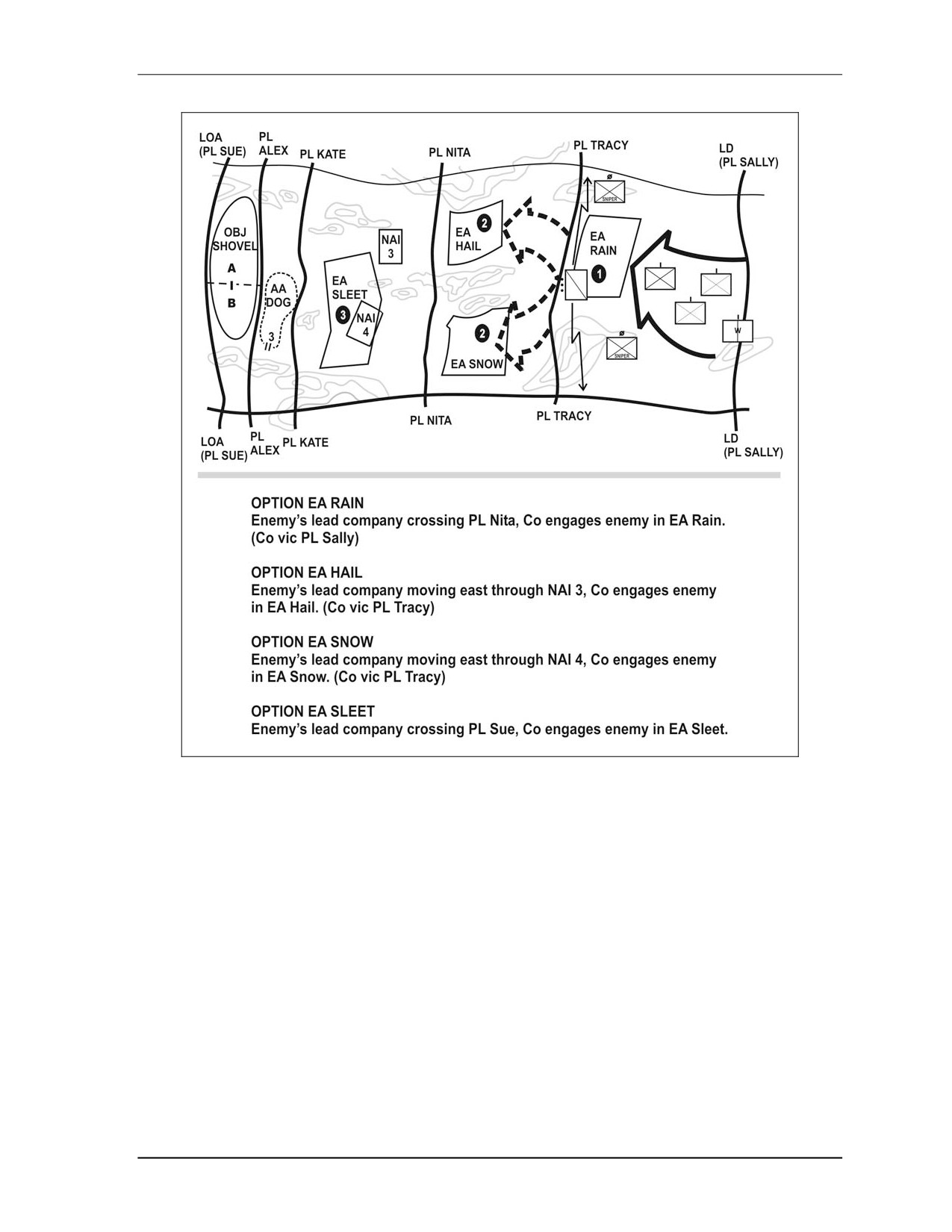
4-224. The battalion in a force-oriented attack against a moving enemy force normally organizes in the
same manner as a movement to contact and can be envisioned much like an ambush. Key planning
considerations are outlined below (Figure 4-17).
Determination of Where to Fight Enemy
4-225. The decision on where to fight the enemy requires that the commander have information
dominance over the enemy. The commander bases his decision on a clear understanding of the effects of
the terrain, the enemy situation, and what the enemy is expected to do. The commander and his staff select
the most advantageous location to fight the engagement and then determine other possible locations where
the engagement may occur based on a slower- or faster-than-expected enemy advance or the enemy’s use
of an unlikely avenue of approach. They identify these areas as objectives, intermediate objectives, or
engagement areas (EAs). The commander and staff develop control measures to help coordinate actions
throughout the battalion’s AO. The commander, primarily assisted by the S-3 and S-2, develops DPs for
the commitment of the battalion to each location based on relative locations and rates of movement of the
battalion and the enemy. The S-2 carefully selects NAIs to identify the enemy’s rate and direction of
movement to support the commander’s decision of where to fight the engagement.
4-48
FM 3-21.20
13 December 2006
Offensive Operations
Figure 4-17. Planning the attack.
Terrain Advantages
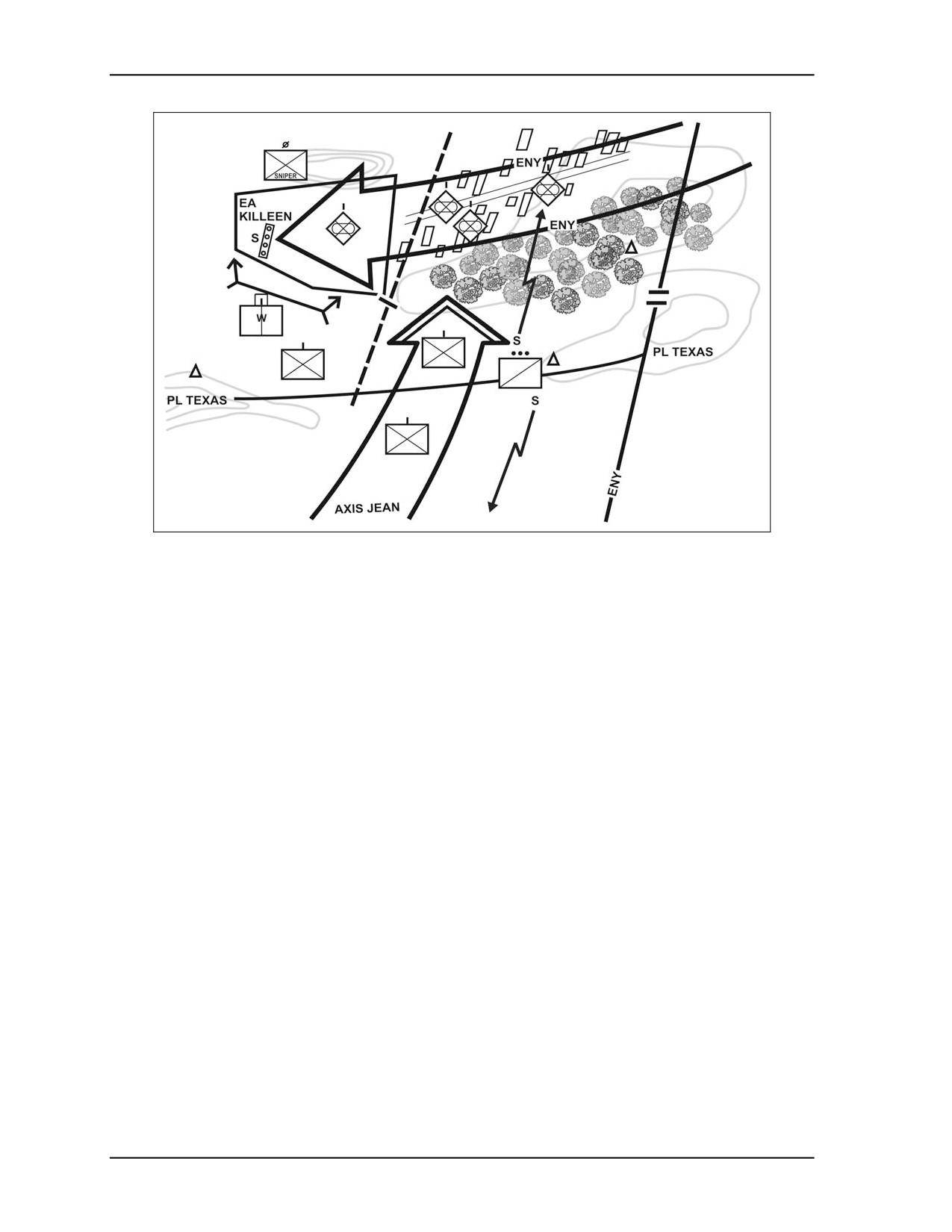
4-226. The commander uses the terrain to maximize the battalion’s freedom of maneuver and lethality
while limiting the freedom of maneuver available to the enemy. He looks for avenues of approach that
allow the battalion to strike the enemy from a flank or the rear. One or two companies block the enemy’s
advance while the other companies attack into the enemy’s flank. In this example, the terrain prevents the
enemy from moving away from the main attack while also protecting the battalion’s flank from an enemy
attack (Figure 4-18).
13 December 2006
FM 3-21.20
4-49
Chapter 4
Figure 4-18. Example of a battalion flank attack.
4-227. Although he develops plans to fight the enemy at the most advantageous location for the battalion,
the commander retains enough flexibility to attack the enemy effectively regardless of where the
engagement develops. The scheme of maneuver includes provisions to fight the enemy at other possible
locations. For simplicity, the commander seeks to keep the scheme of maneuver in each location as similar
as possible.
4-228. In some situations, such as a movement to contact, the battalion may have constraints in the time
or ability to select when and where to fight a moving enemy force. If so, the commander issues a FRAGO
for an attack based on his his physical view and knowledge of the battlefield. As the ISR assets gather
information, the commander quickly deploys and maneuvers the battalion to develop the situation and
defeat the enemy.
Fire Support
4-229. The following are key considerations for the FS plan:
y Use fires to affect the enemy’s maneuver well forward of the battalion to disrupt the enemy’s
formations and timetable.
y Destroy high-payoff targets (HPTs) and security forces.
y Carefully plan triggers, observer locations, and targets to maintain flexibility and ensure
achievement of required effects before contact with the enemy.
y Coordinate and synchronize with brigade the movement and positioning of artillery to support
EFSTs within each engagement location and to engage HPTs before the enemy enters the
selected area. Coordinate terrain requirements.
y Retain flexibility to mass fires at the decisive point in any location where the engagement may
occur.
y Plan triggers to put targets into effect and cancel them based on the battalion’s movement and
the commander’s decision of where to fight the enemy.
4-50
FM 3-21.20
13 December 2006
Offensive Operations
y Synchronize the mortar platoon’s movement, positioning, and fires with the scheme of
maneuver.
Movement and Maneuver
4-230. The weapons company gives the commander considerable options:
y He can use the weapons company as the fixing force because of their fire capability.
y He can use the weapons company as the assaulting force because of their speed and mobility.
y He may choose to task organize elements of the weapons company to the Infantry companies to
create balanced forces that can execute a variety of missions during the attack of a moving
enemy.
4-231. The following are key considerations for the scheme of engineer operations.
y Task-organize engineer forces well forward to support breaching
y Assign normal priority of support is to the lead company.
y Prepare to bypass or breach enemy situational obstacles.
y Integrate situational obstacles with fires and triggers to affect the movement of the enemy and
support flank security in support of the commander’s intent.
y To support flank security, plan obstacle belts and measures, and plan situational obstacles.
y Develop and adjust obstacles and triggers for execution based on the battalion’s movement and
the enemy situation.
Protection
4-232. The ADA element supporting the BCT operates DS to the battalions with the normal priority of
protection to the decisive operation. The ADA assets shift locations on the battlefield as required by the
phase of the operation to maintain adequate air defense coverage of critical forces and events. AD coverage
increases in areas and activities most vulnerable to air attack such as breaching operations or movements
through restricted terrain.
4-233. The CBRN assets are employed in a similar manner to their employment in an attack against a
stationary force. Obscurants and CBRN reconnaissance assets typically support the decisive operation.
Sustainment
4-234. The following are key considerations for the sustainment plan:
y Continuously update it. Ensure the sustainment plan is responsive and flexible enough to
support all maneuver options. Plan support from initiation of the operation to the final objective
or LOA.
y Integrate resupply operations with the scheme of maneuver.
y Weight the risk the extended distances create for security of MSRs and sustainment assets
based on the potential of undetected or bypassed enemy forces.
y Use all available assets to develop and maintain an accurate enemy picture behind the lead
maneuver elements.
y Plan and rehearse for enemy contact.
y Plan and coordinate the locations, displacements, and routes of sustainment assets to maintain
responsive support.
y Develop triggers based on the battalion scheme of maneuver to activate/deactivate collection
points and LRPs.
y Plan CASEVAC, resupply, and equipment recovery for engagements in each potential location.
13 December 2006
FM 3-21.20
4-51
Chapter 4
Preparation
4-235. Preparation for an attack against a moving enemy force is limited because the opportunity to attack
the enemy at the appropriate time and place depends on the enemy’s movement. This forces the battalion to
focus the preparation on executing fires and maneuver actions within each location. The commander
prioritizes each area to ensure the battalion prepares for the most likely engagements first. The commander
ensures all subordinate companies and supporting forces understand their role in each area and the decision
point for execution at each area. The leaders of the battalion rehearse actions in each area against various
enemy conditions to promote flexibility and initiative consistent with the commander’s intent. Repetitive
rehearsals against likely enemy actions are essential for success at all levels.
Reconnaissance
4-236. The reconnaissance and surveillance effort focuses on answering the CCIR to support the
commander’s decisions on when and where to initiate fires, where to fight the enemy, and how best to
maneuver the battalion against the enemy. The S-2 develops NAIs to identify enemy actions and decisions
that indicate the enemy’s selected COA. The following are key intelligence considerations for attacking a
moving enemy force.
Anticipate Enemy COA
4-237. The IPB details how the enemy is likely to move and fight. It emphasizes the enemy’s likely
formations and routes and how he will try to fight the ensuing meeting engagement. The analysis shows the
enemy’s expected rate of movement and how the enemy force is likely to be arrayed. This information is
based on a detailed terrain and time-distance analysis. The enemy normally has three general COAs—
y Assume a defense either before or after initial contact to retain control of defensible terrain or
limit the advantages the battalion may have.
y Attack to defeat or penetrate the battalion.
y Try to delay or bypass the battalion.
4-238. The S-2 develops enemy COAs based on the enemy’s likely objective, capabilities, strengths, and
known tactics. The S-2 determines those enemy actions that may indicate the enemy’s selection of a COA
and ensures observers are positioned to detect and report these indicators. The S-2 must always portray the
enemy’s flexibility, likely actions, and available maneuver options. The goal is to identify the enemy’s
most likely COA and have the battalion anticipate and prepare for it.
Gain and Maintain Contact
4-239. Preferably, the battalion establishes contact with the enemy using digital sensor platforms well
before it makes physical contact.
4-240. The battalion, with support from the brigade, receives information from battlefield surveillance
assets such as radar, UAS, access to joint surveillance target attack radar system (JSTARS), battlefield
surveillance brigade assets, and other JIIM and SOF sensors used to track the moving enemy force.
Intelligence produced from the information gathered by these sensors helps the battalion direct ground
reconnaissance assets to advantageous positions to physically observe and report information on the
enemy. Once made, the battalion maintains contact.
4-241. The information gained from the sensors as well as ground reconnaissance elements must be
shared with all elements of the battalion as quickly as possible. Information requirements normally
include—
y The enemy’s rate and direction of movement.
y The enemy’s formation, strength, and composition to include locations of security forces, main
body, reserves, and artillery formations.
4-52
FM 3-21.20
13 December 2006
Offensive Operations
y Enemy actions and decisions that indicate a future enemy action or intention.
y Location of enemy HPTs.
y Enemy vulnerabilities such as exposed flanks or force concentrations at obstacles.
Support Battalion Movement
4-242. Reconnaissance and surveillance forces move well forward of the battalion. They reconnoiter
obstacles and areas that may slow the battalion’s movement and disrupt the timing and planned location of
the attack. They seek to detect obstacles, contaminated areas, enemy security forces, and suitable routes for
the battalion’s use. Once contact is established, the reconnaissance and security force may then be used to
secure a flank of the attacking force.
Execution
4-243. The following considerations apply to the conduct of the attack:
Approach to Objective
4-244. The battalion moves with deliberate speed. By gaining contact with the enemy force through the
reconnaissance and surveillance force, the brigade can use long-range fires and CAS to destroy and disrupt
the enemy throughout his formation.
4-245. The battalion deploys, attacks from unexpected and or multiple directions, masses effects, and
destroys the remaining enemy before he can adequately react. The commander adjusts the speed of the
battalion to ensure that fires have set appropriate conditions and that the battalion arrives at the designated
location at the proper time in relation to the enemy. Effective reporting and analysis of the enemy’s rate
and direction of movement by reconnaissance and surveillance elements are critical to the timing of the
attack.
4-246. The commander seeks to conceal the movement of the battalion from the enemy to maintain
surprise. The battalion moves dispersed. It masks its movement and uses covered and concealed routes.
A robust reconnaissance detects and destroys enemy security forces that could otherwise warn the enemy
force of friendly actions.
Action on Objective
4-247. The battalion creates favorable conditions for decisive action by weakening and disrupting the
enemy’s formation, destroying his security forces, and fixing the enemy’s main body. The battalion main
body attacks and destroys, disintegrates, or dislocates the enemy.
Disrupt Enemy Formation
4-248. The battalion employs indirect fires reinforced with situational obstacles to set the conditions for
the EA or objective fight, disrupting and weakening the enemy before he gets to the area. Indirect fires
should provide time for the battalion to deploy before contact. Reconnaissance elements normally control
these initial fires.
Defeat Enemy Security Forces
4-249. Normally, the enemy employs security forces to protect his main body. The enemy’s ability to
seize the initiative often depends on his security forces. The battalion must avoid, destroy, or fight through
the enemy’s security forces to gain contact with the bulk of the enemy force. The commander employs fires
in conjunction with his advance guard to defeat the enemy’s security forces so the battalion’s main body
can decisively attack the bulk of the enemy force. Ideally, the battalion’s advance guard attacks the
enemy’s forward or flank security forces to develop the situation. The commander weights the advance
13 December 2006
FM 3-21.20
4-53
Chapter 4
guard with maneuver forces and indirect fires in order to destroy the enemy’s security force and gain
contact with the enemy’s main body before the enemy can effectively react.
Fix Enemy
4-250. The battalion normally fixes the enemy’s assault force to create the conditions for the battalion’s
main body attack. Normally, the battalion’s advance guard executes this task once it destroys the opposing
enemy security force. Indirect fires against the lead enemy forces allow the advance guard to deploy and
gain contact with the enemy main body. The advance guard commander keeps the battalion commander
informed of the enemy’s strength and actions. It is paramount that the battalion commander receives
accurate, timely reports and analysis of the enemy situation. Reconnaissance elements assist the advance
guard commander in providing accurate information to the battalion commander. The battalion commander
must know the enemy main body’s strength, disposition, and reactions. He uses this information to make
final adjustments to the main body’s attack.
Maneuver Main Body
4-251. As the advance guard develops the situation, the commander begins to maneuver the main body to
a favorable position for commitment.
4-252. The commander positions the battalion to attack the enemy formation from an assailable flank
where the battalion’s total combat power can be massed against an enemy weakness to reach a quick
decision. Rapid movement and massed fires characterize this attack. Indirect fires shift to suppress the
enemy force that directly opposes the main body’s attack. The main body strikes the enemy force with
overwhelming strength and speed. As the main body maneuvers against the enemy, the battalion FSO
adjusts FSCMs to provide continuous support and ensure force protection.
4-253. If the commander determines the enemy force is trying to bypass or avoid contact, he directs
indirect fires to delay and disrupt the enemy’s movement away from the battalion. The commander
maneuvers his forces to destroy or penetrate any enemy forces trying to fix or delay the battalion and
strikes the bulk of the evading enemy force from the flank or rear.
TERRAIN-ORIENTED ATTACKS
4-254. Terrain-oriented attacks require the battalion to seize and retain control of a designated area to
support future operations. The battalion attacks to seize terrain-oriented objectives for many reasons, for
example—
y To seize key terrain or structures such as bridges, airfields, or public services to support
follow-on operations.
y To seize terrain such as a chokepoint or route. It does this to block enemy withdrawals,
reinforcements, or movements against the brigade’s decisive operation; or to facilitate friendly
force passage.
y To secure an area, such as a lodgment area, for future operations.
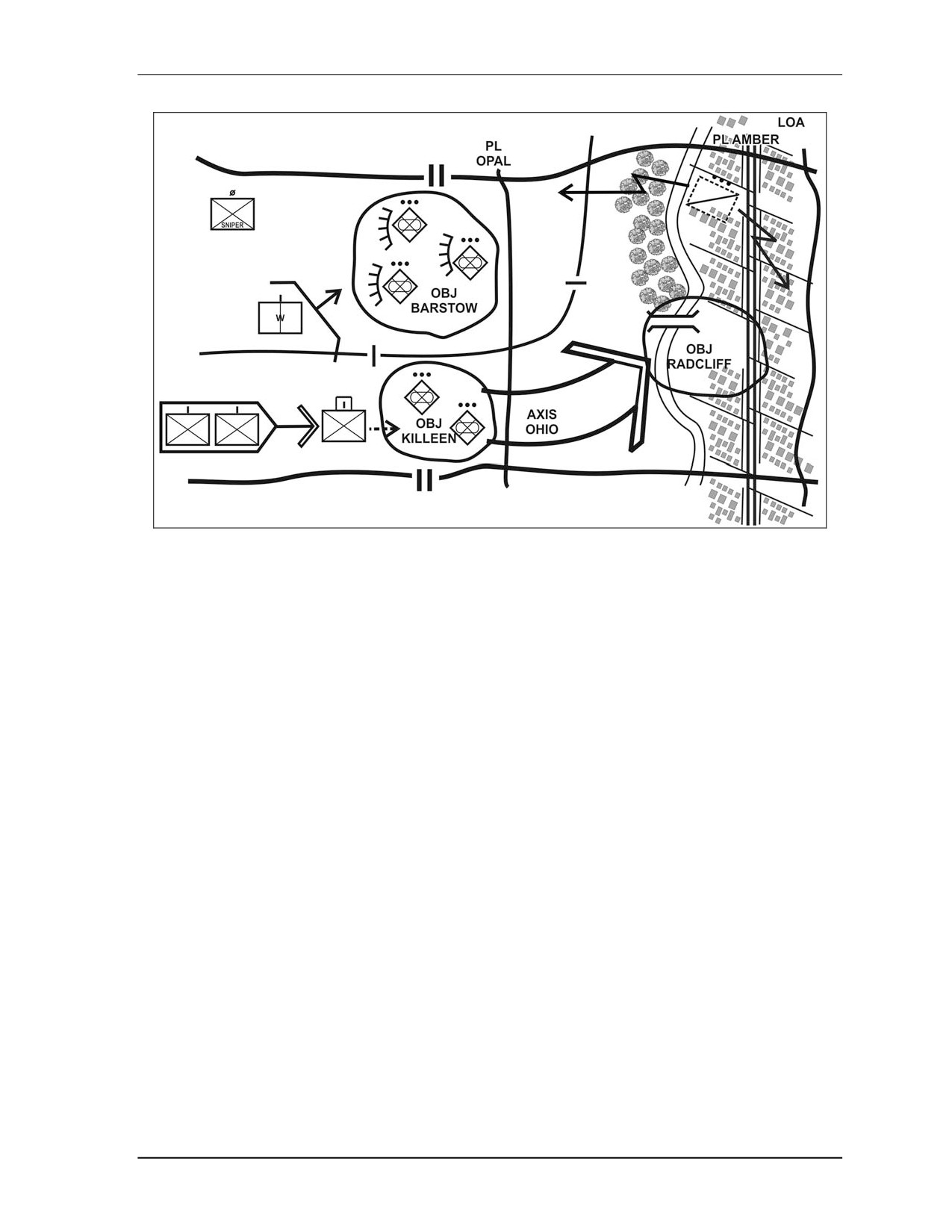
4-255. The battalion plans and executes terrain-oriented attacks in the same manner as attacks against
enemy forces (Figure 4-19). The major distinction in a terrain-oriented attack is that the battalion focuses
its efforts on the seizure and control of terrain instead of effects on the enemy. The commander plans and
directs the attack to gain control of the terrain as quickly as possible and conducts only necessary actions
against the enemy. Success of the mission does not normally entail decisive action against all enemy forces
within the AO.
4-54
FM 3-21.20
13 December 2006
Offensive Operations
Figure 4-19. Terrain oriented attack.
4-256. The battalion attacks only the enemy who directly affects the seizure of the objective or who might
affect the future operation. Commanders must understand that seizure of terrain-oriented objectives, likely
key terrain, will probably dislocate the enemy force. Therefore, the enemy might try to counterattack to
dislodge and defeat the friendly forces. Other key planning considerations that differ from force-oriented
attacks include--
Reconnaissance and Surveillance
4-257. The reconnaissance and surveillance effort, as in other attacks, capitalizes on all the battlefield
surveillance assets available to the brigade, as well as those that belong to the battalion, to identify the
enemy situation on the objective and any sizable enemy forces within the battalion’s battlespace. Battalion
ground reconnaissance elements occupy advantageous positions to gain observation and report information
on the enemy.
4-258. The commander, assisted by the S-2, must consider enemy forces within his battlespace,
specifically in areas outside his AO but inside his AI, that may react to the battalion’s seizure of the
objective. Once the battalion locates enemy forces, reconnaissance forces try to determine the enemy’s
strength and disposition as well as possible bypasses the battalion could exploit. This helps the S-2 develop
enemy COAs and identify indicators of the enemy’s commitment to a future action. The S-2 normally
considers enemy actions to defend in place; reinforce threatened enemy units; counterattack; delay; or
possibly withdraw.
Degree of Risk
4-259. The commander must determine the degree of risk he is willing to accept by leaving or bypassing
enemy forces in the battalion’s AO. He bases this decision on the higher commander’s intent and
established bypass criteria, the enemy’s capabilities, and the commander’s assessment of the situation. The
commander must recognize the potential effects that bypassed enemy forces may have on the battalion’s
sustainment operations and future operations. The commander normally employs economy of force
missions to contain, destroy, or fix bypassed enemy forces. The risk imposed by these bypassed forces is
13 December 2006
FM 3-21.20
4-55
Chapter 4
reduced by accurate and timely reporting of their locations and status throughout the battalion, especially to
the elements moving behind the maneuver forces in the battalion’s AO. Once the battalion secures the
objective, other forces or fires can destroy bypassed enemy forces or force their surrender.
Seizure of Objective
4-260. Once it seizes the objective, the battalion conducts a defense of the area to prevent the enemy from
recapturing it. The commander seeks to position his forces in a manner that best defends the objective
while allowing a rapid transition to follow-on operations. Reconnaissance and security forces establish a
screen force forward of the secured objective to provide security and early warning to the battalion to
prevent a surprise counterattack by the enemy. Engineers provide countermobility and survivability
support as time and resources allow. Indirect fire assets reposition to support extended coverage of the
defense and shift to targets beyond the objective.
EXPLOITATION
4-261. Exploitation is not normally conducted below the BCT level. Exploitation often follows a
successful attack to take advantage of a weakened or collapsed enemy. The purpose of exploitation can
vary, but it generally focuses on capitalizing on a temporary advantage or preventing the enemy from
establishing an organized defense or conducting an orderly withdrawal. To accomplish this, the BCT (or
higher level unit) attacks rapidly over a broad front to prevent the enemy from establishing a defense,
organizing an effective rear guard, withdrawing, or regaining balance. The BCT secures objectives, severs
escape routes, and destroys all enemy forces. Failure to exploit success aggressively gives the enemy time
to reconstitute an effective defense or regain the initiative by a counterattack.
4-262. The conditions for exploitation develop very quickly. Often the lead battalion in contact identifies
the collapse of the enemy’s resistance. The BCT commander must receive accurate assessments and reports
of the enemy situation to capitalize on the opportunity for exploitation. Typical indications of good
conditions for exploitation include—
y A significant increase in EPWs.
y An increase in abandoned enemy equipment and material.
y The overrunning of enemy artillery, C2 facilities, and logistics sites.
y A big decrease in enemy resistance or in organized fires and maneuver.
y A mixture of support and combat vehicles in formations and columns.
y An increase in enemy movement rearward, especially of reserves and FS units.
4-263. Should the battalion conduct exploitation as part of a larger operation, it might receive the mission
to seize a terrain-oriented objective. In this case, the battalion avoids decisive engagement and moves to
the objective as quickly as possible. If assigned a force-oriented objective, the battalion seeks and destroys
enemy forces anywhere within its AO. The exploitation ends when the enemy reestablishes its defense, all
organized enemy resistance breaks down, or the friendly force culminates logistically or physically.
PURSUIT
4-264. The battalion does not conduct a pursuit as an independent action. Even at the BCT level, the risk
associated with a pursuit operation generally outweighs the benefits. However, if provided aviation assets
or additional ground maneuver units, the BCT can conduct a pursuit. If so, the battalion can serve as the
direct-pressure force or the encircling force.
4-265. A pursuit is ordered when the enemy can no longer maintain a coherent position and tries to
escape. Unlike in an exploitation, the BCT’s mission in a pursuit is the destruction of the enemy rather than
avoiding enemy contact.
4-266. The direct-pressure force organizes a movement to contact and prepares to conduct a series of
attacks. Encirclement results when a force is able to destroy enemy communications and prevent his
4-56
FM 3-21.20
13 December 2006
Offensive Operations
reinforcement or escape. The encircling force, usually made up of uncommitted forces, must be more
mobile than the enemy. It must also be strong enough to protect itself from the enemy’s reserves and what
is left of the enemy's main body. The direct-pressure force must track and coordinate with the encircling
force. Timing is critical. Information systems are vital to this synchronization. The encircling force should
be prepared to conduct a defense until the direct-pressure force succeeds in destroying or forcing the
enemy to surrender. The goal of a pursuit is to fix the enemy between the direct-pressure force and the
encircling force, and then to destroy him.
SPECIAL PURPOSE ATTACKS
4-267. The battalion can launch attacks with various purposes to achieve different results. These special
purpose attacks include raids, feints, demonstrations, counterattacks, and spoiling attacks.
Raid
4-268. A raid is a deliberate attack that involves the swift, temporary penetration of enemy territory for a
specific mission. A raid usually ends with a planned withdrawal. Raids are usually small-scale attacks
requiring detailed intelligence, preparation, and planning. Typical raid missions are—
y Capture prisoners, installations, or enemy materiel.
y Destroy enemy materiel or installations.
y Obtain specific information on an enemy unit such as its location, disposition, strength, or
operating scheme.
y Deceive or harass enemy forces.
y Liberate captured friendly personnel.
4-269. The raiding force may vary in size from an Infantry platoon to a reinforced company. It may
operate within or outside the battalion’s supporting range. The raiding force moves to its objective by land,
air, or water for a quick, violent attack. Once it completes the raid mission, the raiding force quickly
withdraws along a different route. Specific planning considerations include the following:
4-270. Conduct detailed reconnaissance and maintain constant surveillance of the raid objective to ensure
the enemy situation remains unchanged and within the capability of the raiding force. Support from outside
the battalion helps to provide the intelligence needed to plan and conduct a raid successfully.
4-271. Position fire support systems to provide immediate responsive fires during the approach, actions
on the objective, and withdrawal. Interdiction fires, deception fires, counterfires, and situational obstacles
reduce the enemy’s ability to react to the raid.
4-272. Security is vital because the raiding force is vulnerable to attack from all directions.
• Establish clear abort criteria for the raid based on CCIR. These criteria may include loss of
personnel, equipment, or support assets, and changes in the enemy situation.
• Develop contingency plans for contact before and after actions on the objective.
• Plan casualty evacuation and raiding force extraction throughout the entire depth of the
operation.
• Plan rally points for units to assemble to prepare for the attack or to assemble after the mission
is complete and the force is ready to withdraw.
4-273. Logistical considerations include the type and number of weapons that the raiding party will have,
movement distance, length of time the raiding party will operate in enemy territory, and expected enemy
resistance. Aircraft or linkup provides CASEVAC or resupply of the raiding force, if required, during the
withdrawal.
4-274. Withdrawal should be over a different route than that used to approach the objective.
13 December 2006
FM 3-21.20
4-57
Chapter 4
Feint
4-275. A feint is a form of an attack intended to deceive the enemy and draw attention and combat power
(if possible) away from the decisive operation.
4-276. Feints must be of sufficient strength and composition to cause the desired enemy reaction. Feints
must appear real; therefore, some contact with the enemy is necessary. The feint is most effective under the
following conditions:
y When it reinforces the enemy’s expectations.
y When the enemy perceives it as a definite threat.
y When the enemy has consistently committed a large reserve early.
y When the attacker has several feasible COAs.
4-277. The purposes of a feint may include the following:
y To force the enemy to employ his reserves away from the decisive operation.
y To force the enemy to remain in position.
y To attract enemy supporting fires away from the decisive operation.
y To force the enemy to reveal defensive fires or weaknesses.
y To accustom the enemy to shallow attacks in order to gain surprise with another attack.
4-278. Planning for a feint mission follows the same sequence as any other attack. Special planning
considerations include the following:
y Resource the feint so it looks like the decisive operation or at least like a significant threat.
y Establish clear guidance regarding force preservation.
y Ensure adequate means of detecting the desired enemy reaction.
y Designate clear disengagement criteria for the feinting force.
y Assign attainable objectives.
y Issue clear follow-on missions to the feinting force.
Demonstration
4-279. A demonstration is a form of an attack used for deception. It is made with the intention of
deceiving the enemy; however, contact with enemy forces is not sought. Demonstrations support a BCTs or
higher level units’ plan; battalions do not conduct demonstrations alone. Demonstrations must be clearly
visible to the enemy without being transparently deceptive in nature. Demonstration forces use fires,
movement of maneuver forces, smoke, EW assets, and communication equipment to support the deception
plan. Planning considerations include the following:
y Establish an LOA for demonstration forces that allows the enemy to see the demonstration but
not to engage it effectively with direct fires.
y Establish other security measures necessary to prevent engagement by the enemy.
y Employ demonstrations to reinforce the enemy’s expectations and contribute to the decisive
operation.
y Develop contingency plans for enemy contact and to avoid becoming decisively engaged.
y Issue clear follow-on missions to the demonstration force.
y Establish the means to determine the effectiveness of the demonstration and assess its effect on
the enemy.
Counterattack
4-280. A counterattack is an attack launched from the defense aimed to defeat an attacking enemy force
or regain key terrain and ultimately regain the initiative. The counterattack is often the deciding action in
4-58
FM 3-21.20
13 December 2006
Offensive Operations
the defense and becomes the decisive operation upon commitment. The battalion is best suited for this role
in restricted terrain. In unrestricted terrain, the battalion is vulnerable to indirect fires and only possess,
with the weapons company, the mobility and potential firepower of a combined arms or Stryker battalion.
The commander may plan counterattacks as part of the battalion’s defensive plan, or the battalion may be
the counterattack force for the brigade or division.
Spoiling Attack
4-281. A spoiling attack is an attack launched from the defense to disrupt the enemy’s attack
preparations. Spoiling attacks focus on the enemy’s critical systems and forces that have the greatest
impact on the enemy’s ability to mount an attack. Lucrative targets include C2 systems, intelligence assets,
FS, and logistics. Spoiling attacks may be conducted as often as needed to deny adequate attack
preparation to the enemy. Normally, the battalion conducts a spoiling attack as part of the higher
headquarters operation. Spoiling attacks are planned and executed in the same manner as an attack.
Section VI. PLANNING CONSIDERATIONS
The battalion’s ability to access information available at higher echelons may alter the manner in which the
battalion actually plans, prepares for, and executes an attack. The amount of information and intelligence the
battalion receives affects adjustments to the reconnaissance effort, the size of the reserve element, movement
formations and techniques, security operations, and the tempo of operations. This can create unique planning
considerations. For example, the battalion generally avoids linear actions, stable fronts, and extended pauses
between operations. The battalion overloads the enemy by presenting an overwhelming number of actions from
multiple directions throughout the depth, width, and height of the battlespace. The battalion has the flexibility
to attack through varying types of terrain and thus to prevent the enemy from predicting the direction of attack
and orienting on the avenue of approach. By massing the effects of long- and short-range area and precision
fires with rapid combined arms movement, the battalion can decisively defeat the enemy. Improved navigation,
target acquisition, and the information-sharing capabilities of the battalion enhance understanding and
synchronization throughout offensive operations in near real time. This ability allows commanders in the
battalion to share common perceptions of the battlefield.
13 December 2006
FM 3-21.20
4-59
Chapter 4
FORCE ORGANIZATION
4-282. The commander task-organizes forces within the battalion after he chooses a scheme of maneuver.
The task organization allocates sufficient combat power to allow subordinate companies to accomplish
their assigned purposes.
SCOUT PLATOON
4-283. The scout platoon primarily executes reconnaissance and surveillance for the battalion. In
instances where the enemy situation remains vague, additional forces are allocated to assist in the
reconnaissance effort. Where the enemy mounts an effective security zone that denies the scout platoon the
ability to provide the information that the commander needs to make decisions during execution, he may
direct an Infantry rifle company to conduct a movement to contact or limited attacks through the enemy
security zone. From the battalion commander’s perspective, these operations constitute a
reconnaissance-in-force and feed sufficient information to build the level of awareness, which when
analyzed, leads to the situational understanding needed to facilitate his decision-making and decisive
combat action.
SECURITY FORCE
4-284. Across the full spectrum of conflict, the battalion commander carefully considers security force
requirements. Forces must be allocated to protect critical assets within the battalion AO against
conventional and unconventional attacks. Also, the scout platoon, OPs, UAS, and other ISR assets will
provide passive security through the conduct of their operations.
FLEXIBILITY
4-285. The battalion can conduct both linear and nonlinear operations within contiguous or
noncontiguous areas of operation. This flexibility allows the battalion to conduct company-level operations
against multiple objectives within the battalion’s AO.
RESERVE
4-286. Reserves should be designated at appropriate levels to address unforeseen events. The amount of
combat power allocated to the reserve depends primarily on the level of uncertainty about the enemy. The
increased ability of the battalion to gain a better degree of understanding about the enemy should allow the
commander to tailor the reserve to meet the specific threats and opportunities. At times, the situation may
dictate that the battalion retain a small, but tailored, force as the reserve because there is little likelihood of
catastrophic failure or because all of the Infantry rifle companies are conducting significant operations
simultaneously. At other times, the commander may determine that his degree of understanding allows him
to tailor subordinate forces to a level that will ensure their success and therefore he does not designate a
reserve.
INTELLIGENCE, RECONNAISSANCE AND SURVEILLANCE
4-287. Intelligence, surveillance, and reconnaissance are a broad category of assets designed to support
planning, decision-making, and targeting. The ISR effort is a combined arms maneuver operation, not just
a scout platoon mission. All personnel in the battalion are required to observe, by visual or other detection
methods, NAIs and TAIs in order to collect data, information, or combat information. Surveillance
involves the systematic observation of a particular NAI by visual, electronic, photographic, or other means.
Target acquisition by specialized/nonspecialized ISR assets detects, identifies, and locates targets in
4-60
FM 3-21.20
13 December 2006
Offensive Operations
enough detail to effectively employ fire and effects. Intelligence includes processes for collecting,
processing, and analyzing data and other relevant information.
INTEGRATION
4-288. The S-2 integrates IPB, the ISR matrix, event templates, and other MDMP products into the
analysis of information coming into the main CP from the scout platoon, other ISR assets, and higher unit
assets. The S-2 tries to answer the PIR, recommends refined PIR for the commander to consider, confirms
probable enemy COAs and intentions, and explains enemy actions in relation to the current friendly
operation. Ultimately, reconnaissance and surveillance operations set the conditions for the success of the
unit in the close fight.
EXECUTION
4-289. The battalion conducts reconnaissance and surveillance using organic and supporting
reconnaissance and surveillance and technical assets. The data, information, and combat information
collected from these assets, when combined with intelligence provided by the higher headquarters, help the
commander visualize a nearly complete picture of the enemy and environment within the battalion’s
battlespace. Specifically, the battalion employs an appropriate amount of its reconnaissance and
surveillance assets throughout its AO in order to identify favorable terrain and determine the enemy’s
composition, disposition, activities, strengths, and possible vulnerabilities.
RECONNAISSANCE AND SURVEILLANCE ORDER
4-290. The reconnaissance and surveillance order (and collection plan) is published early in the MDMP
process (not later than WARNO 2) with sufficient enemy detail and operational coordination to focus the
battalion’s reconnaissance and surveillance effort. This information allows the Infantry battalion to—
y Seize and maintain the initiative.
y Develop and disseminate effective maneuver and fires and effects plans before contact.
y Detect, identify, and destroy high payoff targets early.
y Allow follow-on forces to maneuver rapidly and without obstruction to the objective.
y Keep uncommitted forces available as long as possible in preparation for action at decision
points.
y Recognize and exploit fleeting opportunities presented by discovered enemy weaknesses.
y Reduce the risk of surprise by enemy operations.
SCHEME OF MANEUVER
4-291. The battalion directs its decisive operation (or main effort) against an objective, ideally an enemy
weakness, to cause the collapse of the enemy. By doing so, the battalion sustains the initiative and reduces
its own vulnerabilities. The battalion commander seeks to identify an assailable flank, poorly defended
avenue of approach, or a smaller unit lacking mutual support that he can exploit to gain a tactical
advantage. When attacking a well-prepared enemy defense, the commander normally plans to isolate and
then destroy vulnerable portions of the enemy defense throughout the depth of the zone of attack.
REVERSE PLANNING PROCESS
4-292. The commander and staff develop the plan using a reverse planning process that starts with the
decisive point and the endstate of the operation and works back to the assembly area. They incorporate
plans for exploiting success and unforeseen opportunities that may develop during execution. Emphasis is
placed on synchronizing maneuver, fires and effects, and support throughout the reconnaissance and
surveillance effort and the attack. Reconnaissance and surveillance facilitates maneuver, allowing combat
13 December 2006
FM 3-21.20
4-61
Chapter 4
forces to move on specific routes to objectives without significant enemy contact. The composition,
disposition, strength, and capabilities of the enemy force drives the type of attack the battalion conducts
(paragraph 4-35).
ENEMY CAPABILITIES
4-293. The staff considers the enemy’s ability to mass combat power, reposition his forces, or commit his
reserve. The battalion develops a scheme of maneuver to mass sufficient combat power to defeat the
enemy. The reverse planning process is an essential tool in building an effective plan to attack an enemy.
By starting with the decisive point and endstate of the operation and working back to the assembly area,
the staff can allocate combat power, mobility assets, and fires and effects (suppression and smoke).
FIRE SUPPORT
4-294. Fire support planning is the process of analyzing, allocating, and scheduling both lethal and
nonlethal fires support. The goal of fire support planning is to integrate both lethal and nonlethal fires into
battle plans to support the battalions’ scheme of maneuver. Fire support planning is performed
concurrently with the MDMP. Effective fire support planning places the right elements of the fire support
system in the right place at the right time IAW the commander’s intent. The following basic principles of
fire support planning apply—
y Plan early and continuously.
y Follow the commander’s targeting guidance.
y Exploit all available targeting assets.
y Consider the use of all available fire support means.
y Use the lowest echelon capable of furnishing effective support.
y Use the most effective fire support means.
y Furnish the type of fire support requested.
y Avoid unnecessary duplication.
y Consider airspace coordination.
y Provide rapid and effective coordination.
y Remain flexible.
y Provide for the safeguarding and survivability of friendly forces and installations.
EFFECTIVENESS
4-295. The effectiveness of fire support planning and the fire support system depends on the successful
performance of the four basic tasks: support forces in contact, support the concept of operations,
synchronize fire support, and sustain fire support.
Support Forces in Contact
4-296. Supporting forces in contact includes the allocation of weapons systems and sorties to subordinate
elements that actually engage the enemy. Supporting forces in contact usually means providing responsive
fire support that protects and ensures freedom of maneuver to forces in contact with the enemy.
Support Concept of Operations
4-297. Supporting the concept of operations means providing fire support for any possible contingency.
Fire support assets must be identified and marshaled for execution at the right time and place. The BCT
commander must allocate enough firepower to the battalion commander so that he can influence the battle
as necessary.
4-62
FM 3-21.20
13 December 2006
Offensive Operations
Synchronize Fire Support
4-298. Fire support is synchronized through fire support coordination, beginning with the BCT
commander’s estimate and concept of the operation. The battalion FSO helps the commander integrate all
fire support, including the battalion mortars, with the appropriate battlefield systems and WFFs.
Sustain Fire Support
4-299. Combat sustainment includes all the sustainment activities necessary to support battles,
engagements, and related actions. A battalion can realize the full combat potential of its forces and achieve
synchronization in its operations only when combat sustainment is planned, coordinated, and executed
efficiently. Planners must formulate tactical plans to reflect logistics limitations and exploit logistics
capabilities.
URBAN TERRAIN
4-300. The nature of restricted and urban terrain presents some special considerations. The ability to
direct and observe fires and effects within isolated compartments of restricted and urban terrain is required
down to the platoon. Minimum engagement ranges are as important as maximum ranges. Considerations
for the fire support plan include the following. see also Appendix L for more discussion of nonlethal
capabilities):
y Moving fire support assets to enable destruction or engagement of HPTs.
y Moving fire support assets to support the reconnaissance and surveillance effort.
y Locating and employing COLTs and TACP to facilitate precision fires.
y Using deception fires to confuse the enemy as to the location of the decisive operation.
y Planning fires of suppression and obscuration at the point of penetration.
y Planning fires of suppression and obscuration in support of breaching operations.
y Planning fires in support of the approach to the objective. These fires engage enemy security
forces, destroy bypassed enemy forces, and screen friendly movement.
y Synchronizing fires on the objective to suppress, neutralize, or destroy enemy forces that most
affect the battalion’s movement to the objective.
y Planning targets to attack repositioning enemy forces and the movement of enemy reserves.
y Planning fires beyond the objective to support an attack or defense.
y Using fires or CAS to delay or neutralize enemy reserves.
y Planning locations of critical friendly fire zones to protect critical assets such as support forces,
breaching efforts, and artillery assets.
y Planning nonlethal effects on civilian populations.
Section VII. TRANSITIONAL OPERATIONS
The battalion spends minimum time after concluding an engagement or actions on the objective to consolidate
and reorganize before continuing the attack. If consolidation and reorganization are required, the commander
selects the best time and location to facilitate future operations and provide force protection. The battalion must
maintain a high degree of security when performing consolidation and reorganization activities.
CONSOLIDATION
4-301. Consolidation is the process of organizing and strengthening a newly captured position. The
battalion may need to consolidate to reorganize, avoid culmination, prepare for an enemy counterattack, or
allow time for movement of adjacent units. The battalion makes consolidation plans for every mission,
13 December 2006
FM 3-21.20
4-63
Chapter 4
updates them during the attack, and passes them to units as the attack is completed. Actions during
consolidation include—
y Reestablishing communications (if required).
y Eliminating pockets of enemy resistance.
y Establishing security consistent with the threat.
y Establishing contact (electronic, physical, or both) with adjacent friendly units.
y Preparing defensive positions.
y Clearing obstacles or improving lanes to support friendly movement and reorganization
activities.
y Planning and preparing for future operations.
y Destroying captured enemy equipment and processing EPWs.
y Maintaining contact with the enemy and conducting reconnaissance.
y Cross-leveling and conducting emergency resupply.
4-302. The battalion maintains contact with the enemy by redirecting the scout platoon and sniper squad,
establishing OPs, directing small-unit patrols, receiving the latest intelligence from the S-2, and possibly
conducting limited objective attacks.
REORGANIZATION
4-303. Reorganization planning begins before and continues during the attack as losses occur. Companies
must feed reports to the battalion as losses occur so that the information entered into the sustainment
system allows movement of needed resupply forward so that it arrives as the battalion begins
reorganization. The battalion immediately takes all measures required to maintain its combat effectiveness
or return it to a specified level of combat capability. If extensive reorganization is required, the battalion
conducts it during consolidation. Reorganization tasks include—
y Establishing and maintaining security.
y Reestablishing the battalion chain of command, key staff positions, and C2 facilities lost before
or during the battle.
y Treating and evacuating casualties.
y Recovering and repairing damaged equipment as necessary.
y Redistributing ammunition, supplies, and equipment as necessary.
y Conducting resupply and refueling operations.
y Repositioning C2 facilities, communications assets, and logistics for future operations.
y Reorganizing companies and platoons if losses have occurred.
CONTINUATION OF OPERATIONS
4-304. For all missions assigned, the battalion should plan for exploiting success. However, at the
conclusion of an engagement, the commander may be forced to defend. The commander considers the
higher commander’s concept of operations, friendly capabilities, and the enemy situation when making the
decision to defend or continue offensive operations.
DEFENSE
4-305. The battalion conducts a defense when directed by higher headquarters, or to repel an enemy
counterattack, avoid culmination, or complete reorganization activities. The battalion occupies the most
defensible terrain, which may require the battalion to attack to seize defensible terrain. Normally, the
battalion pushes its scout platoon out to establish a security area to provide reaction time and early warning
of enemy actions. Subordinate companies occupy designated AOs, array forces, and develop fire plans.
4-64
FM 3-21.20
13 December 2006
Offensive Operations
Normally, the commander seeks to array companies to achieve an adequate level of defense and facilitate
future operations. Engineers provide survivability support and emplace obstacles as required to support the
defense.
13 December 2006
FM 3-21.20
4-65
This page intentionally left blank.
Chapter 5
Defensive Operations
Defensive operations defeat an enemy attack, buy time, economize forces, or develop
conditions favorable for offensive operations. Defensive actions alone are not
decisive; they must be combined with or followed by offensive action. Even within
the conduct of the BCT defense, the battalion exploits opportunities to conduct
offensive operations within its AO to deprive the enemy of the initiative, and create
the conditions to assume the offensive.
Section I. FUNDAMENTALS
The battalion defends temporarily to create the conditions necessary to resume offensive operations. As part of
the BCT, the battalion may defend, delay, withdraw, counterattack, or perform security operations or economy
of force tasks. A defensive engagement often requires the battalion to execute several of these tasks over its
course. A defense should never be a static operation. The battalion must always be prepared to maneuver to
exploit enemy weaknesses. As with offensive operations; the enemy can be defeated by physical destruction,
disintegration (reduction of control) and dislocation (reduction of enemy COAs, creation of new conditions), or
a combination of these methods. This section discusses the fundamentals of the defense.
PURPOSE
5-1.
The main purpose of the defense is to force or deceive the enemy into attacking under unfavorable
circumstances, defeat or destroy his attack, and regain the initiative for the offense. The defending
commander seeks to dictate where the fight will occur, preparing the terrain and other conditions to his
advantage while simultaneously denying the enemy adequate intelligence. Defense is a temporary measure
used to identify or exploit enemy weaknesses. Use of the defense provides the opportunity to change to the
offense. In general, the battalion defends to—
• Defeat or destroy an attacking enemy.
• Gain time to allow other units in the BCT to accomplish their missions.
• Fix or disrupt the enemy as part of a BCT operation.
• Deny enemy entry into an area or retain terrain.
• Economize forces in one area to apply decisive force elsewhere.
• Increase the enemy’s vulnerability by forcing him to concentrate forces.
• Prepare to resume the offensive.
• Develop favorable conditions for offensive actions.
• Reduce the enemy’s capability for offensive operations.
ORGANIZATION
5-2.
Defensive operations are organized around a framework of a security area, a main battle
area (MBA).
13 December 2006
FM 3-21.20
5-1
Chapter 5
SECURITY AREA
5-3.
The BCT normally establishes a security force with the reconnaissance squadron to provide early
warning, reaction time, and initial resistance to the enemy. Security missions are usually time- or
event-driven. The battalion commander clearly identifies the mission of the security force either by time,
space, and amount of destruction to the enemy force, or by the type of enemy forces to destroy. Depending
on the BCT commander’s guidance and plan, the battalion has several possible security force missions and
options. The battalion may—
• Establish a security area layered behind the BCT security area to add depth to the operation.
• Secure its own flanks and or rear while the BCT assets conduct the primary security area
operation forward of the forward edge of the battle area (FEBA) in a linear defense.
• Conduct its own security operation in the absence of a higher echelon security force.
• Provide units for the BCT security force. This could include the scout platoon, sniper section,
mortar platoon, or all three; maneuver platoons or companies, or the entire battalion.
Security Area Definition
5-4.
The security area begins at the FEBA and extends as far to the front and flanks as the unit deploys
forces. The primary function of forces in the security area is to furnish information on the enemy; however,
they also delay, deceive, and disrupt the enemy and conduct counterreconnaissance. The BCT commander
normally identifies the BCT’s security area, the battle handover line from the BCT to the battalion, the
exact trace of the FEBA, and where he envisions the main battalion fight will occur. From this, the
battalion commander can determine how to structure his security area and the array of forces to employ. If
the battalion commander must organize his own security force, he chooses from many available options.
These are four basic options:
• Use the scout platoon only as a screening force.
• Use the scout platoon in conjunction with maneuver elements, snipers, mortars, or all, in a
screen mission. The security force can operate directly under battalion control; however, the
HHC company commander or any company commander (weapons or rifle company) can
command this force.
• Use a rifle company or create a company team with a combination of the scout platoon, snipers,
mortars, and assault weapons platoons in a guard mission.
• Use the weapons company to establish a moving or stationary screen. The weapons company
may be augmented with any combinations of mortars, snipers, or scouts.
Specific Guidance and Tasks
5-5.
No matter what task organization he implements, the commander provides the force with specific
guidance and tasks. To terminate the security mission, the security force commander normally requires the
permission of the main body commander to withdraw behind the rear boundary. This may include—
• Duration of the mission.
• Results to be achieved against the enemy to include specific guidance against the enemy
reconnaissance forces.
• Specific CCIR with associated NAIs and TAIs and their windows of observation with
indicators.
• Avenues of approach to be monitored with PIR and last time information is of value.
• Fire support, protection sustainment, and C2.
• Engagement, disengagement, and withdrawal criteria and rearward passage coordinating
instructions.
• Follow-on tasks or missions.
5-2
FM 3-21.20
13 December 2006
Defensive Operations
Simultaneous Missions
5-6.
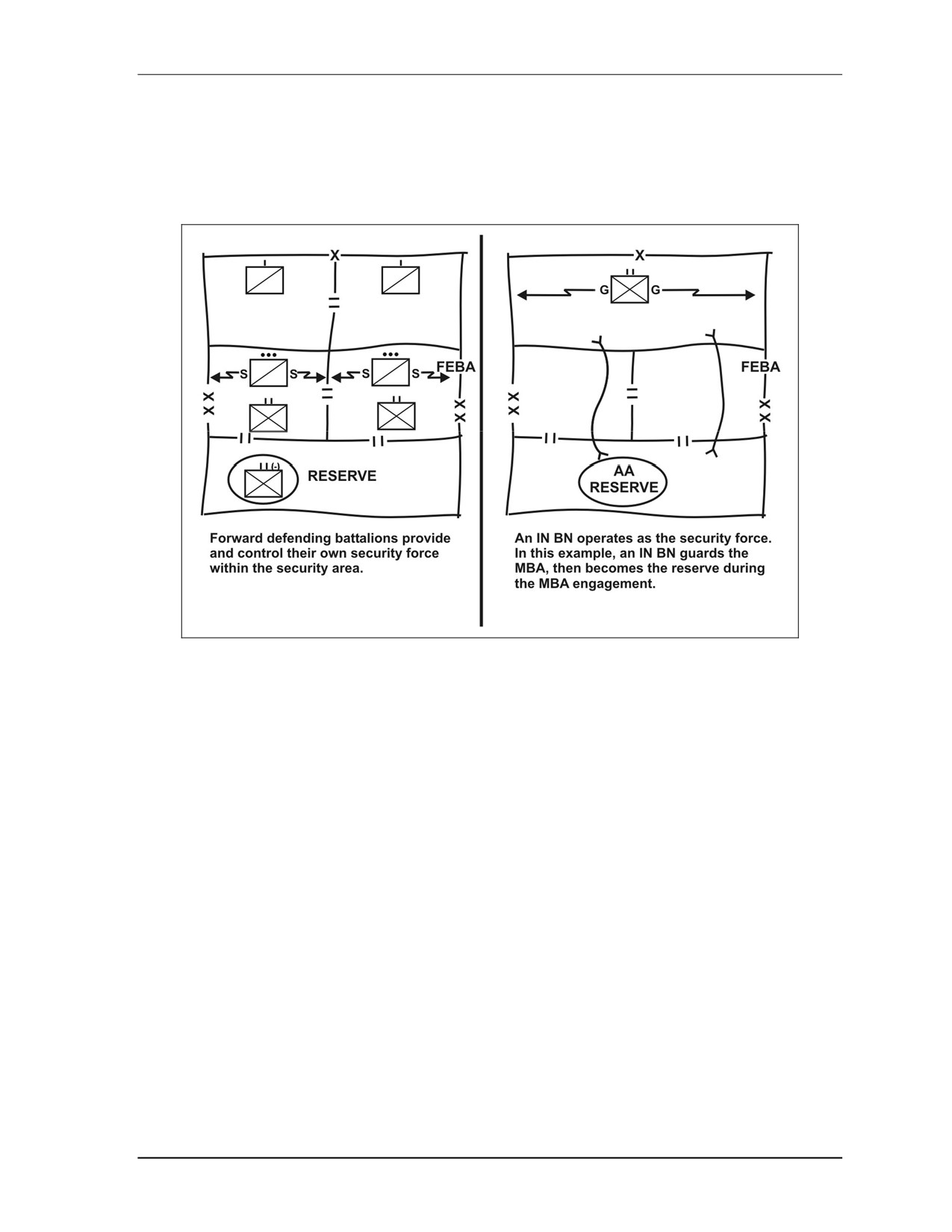
Using battalion resources to establish a security area, while simultaneously requiring the battalion
to defend the MBA is risky and divides the attention of the commander. Whenever possible, this should be
avoided. Figure 5-1 shows a typical organization of a defensive battlefield.
Figure 5-1. BCT organization of security zone forces.
MAIN BATTLE AREA IN A LINEAR DEFENSE
5-7.
The BCT and its battalions deploy the bulk of their combat power in the MBA. The BCT’s MBA
extends from the FEBA to the forward battalions’ rear boundaries. Battalion MBAs are subdivisions of the
BCT’s MBA. The FEBA marks the foremost limit of the areas in which the preponderance of ground
combat units deploy, excluding the areas in which security forces are operating. The BCT commander
assigns the battalion MBAs by establishing unit boundaries. BCT and battalion commanders establish AO,
BPs, or strongpoints to implement their concept of operation. As in all operations, commanders promote
freedom of action by using the least restrictive control measures necessary to implement their tactical
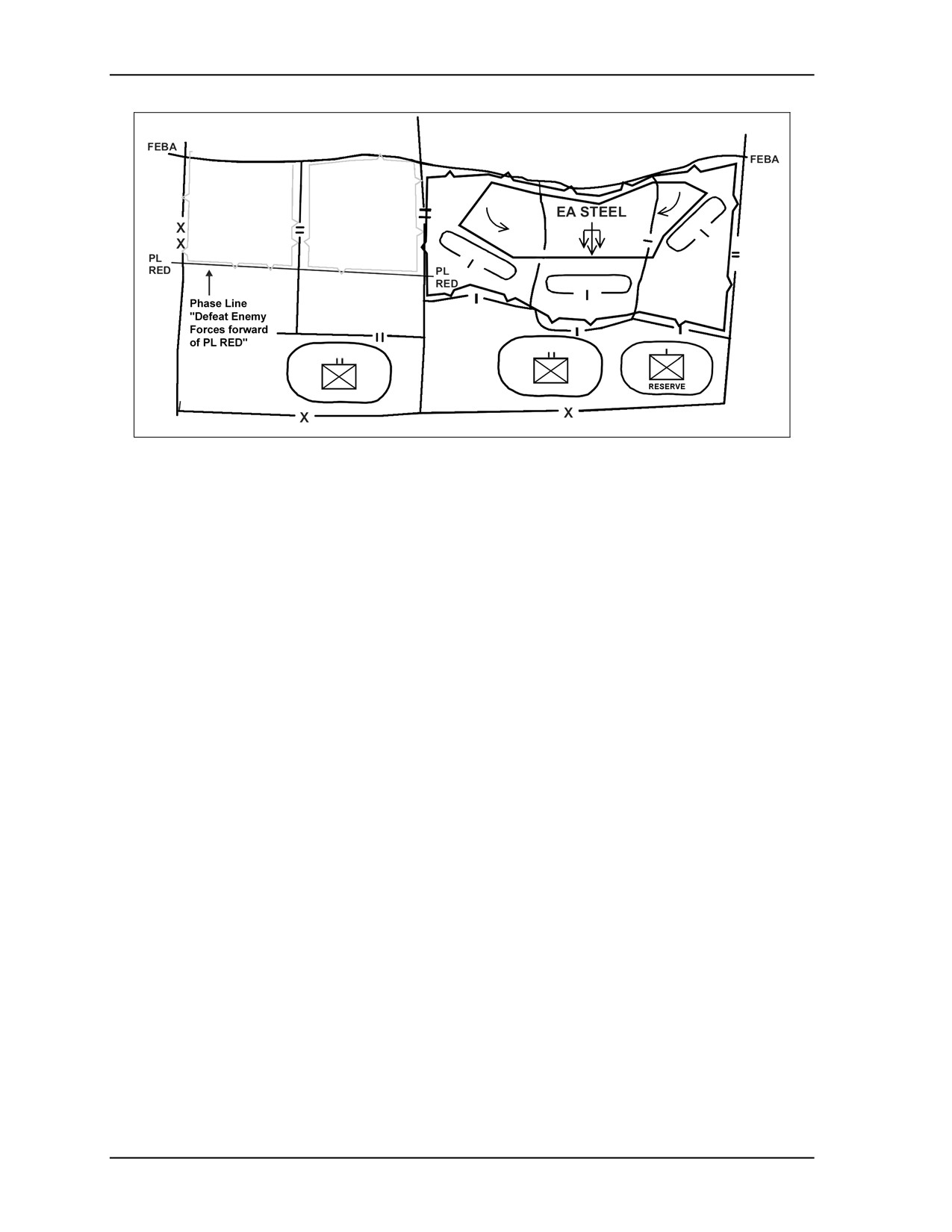
concepts (Figure 5-2).
13 December 2006
FM 3-21.20
5-3
Chapter 5
Figure 5-2. Example area defense using static and dynamic elements.
MAIN BATTLE AREA IN A NONLINEAR DEFENSE
5-8.
In a nonlinear defense, there is no cohesive battalion MBA. Company MBAs extend from the
units’ location to the battalion’s area of influence. This battalion MBA is independent of any other unit’s
MBA. Noncontiguous operations place a premium on initiative, effective information operations (IO),
decentralized security operations, and innovative logistics measures. Noncontiguous operations complicate
or hinder mutual support of combat, sustaining operations elements because of extended distances, and
security risks associated with movement between subordinate units and elements.
REAR AREA
5-9.
The Infantry battalion conducts only limited rear area operations. Although battalion does conduct
sustaining operations, the locations of these operations are mainly in the security area, the MBA, or outside
of the battalion AO. The BCT dircts, coordinates, and monitors most rear area operations during a linear
defense. The majority of the BCT’s sustaining operations occur here. Many BCT C2, protection, and
sustainment units are located in the rear area as well as support elements from the Infantry battalion. Their
importance and survivability is critical to sustained maneuver operations. Defense of the rear area must be
planned and units must be prepared to respond to threats in the rear area. A battalion may be given a rear
area protection mission from the BCT.
CHARACTERISTICS
5-10.
The characteristics of the defense are preparation, security, disruption, massing effects, and
flexibility.
PREPARATION
5-11.
The battalion commander determines likely enemy avenues of approach, likely enemy schemes of
maneuver, where to kill the enemy, integration of obstacles, unit positioning, and integration of indirect
fires, and he assigns missions accordingly. Defensive preparations include the following:
• The S-2, S-3, and WFF representatives execute the MDMP under the XO’s supervision for the
commander’s approval.
5-4
FM 3-21.20
13 December 2006
Defensive Operations
• Enact force protection measures that involve action against conventional threats, for example,
preparation of fighting positions and digging-in C2 nodes, as well as asymmetric threats
(terrorist attacks and weapons of mass destruction [WMD] employment).
• Designate a reserve.
• Conduct rehearsals to ensure synchronization. This includes employment of the reserve and
counterattack forces.
• Position forces in depth.
• Reinforce terrain with obstacles that support the scheme of maneuver.
• Coordinate with BCT reconnaissance battalion or other JIIM assets to confirm limits of AOs
and to deconflict direct and indirect fires.
SECURITY
5-12.
Security operations are measures taken by the Infantry battalion to protect itself against all acts
designed to impair its effectiveness, and prevent the enemy from gaining an unexpected advantage.
Because a force defends to conserve combat power for use elsewhere or later, commanders must secure the
force. The battalion ensures security by employing reconnaissance elements throughout the depth and
breadth of its assigned AO. The battalion may employ a counterreconnaissance force, combat outposts, or a
screen force to provide this security. Information operations capabilities such as PSYOP, military
deception, and electronic warfare can aid in securing the force and confuse the enemy as to the battalion’s
manner of defense. The battalion secures the force through integrated security operations tied with the BCT
reconnaissance squadron and other ISR assets.
DISRUPTION
5-13.
Defenders subvert an attacker’s tempo, formations and synchronization by countering his
initiative and preventing him from massing overwhelming combat power. Disruption attacks the enemy’s
will to fight and his means of effective C2. Deep precision fires, long-range precision sniper fires,
scatterable minefields (SCATMINEs), unexpected defensive positions, local counterattacks at all levels,
and attacks delivered by a reserve force, combine to disrupt the enemy’s attack and break his will to
continue offensive operations. Repositioning forces, aggressive local force protection measures, random
employment of roadblocks, ambushes, checkpoints, and information operations combine to disrupt the
threat of asymmetrical attack. These attacks disrupt enemy efforts to fight as a combined-arms team.
Maneuver units deceive the enemy as to the nature of their defense and employ local combined-arms
counterattacks to break the tempo of the enemy’s attack.
MASSING EFFECTS
5-14.
The battalion shapes and decides the battle by massing the effects of overwhelming combat
power. Effects are synchronized in time and space and should be rapid and unexpected so that they break
the enemy’s offensive tempo and disrupt his attack. The commander employs integrated ISR to shift the
effects of fires and maneuver forces so that they are repeatedly focused and refocused to achieve decisive,
destructive, and disruptive effects upon the enemy’s attack. The commander must be audacious in
achieving overwhelming combat effects at the decisive point.
FLEXIBILITY
5-15.
The defender gains flexibility by sound preparation and task organization, disposition in depth,
retention of reserves, repositioning, and effective C2. The defense is characterized by rapid, simultaneous,
and collaborative planning with flexible execution. Contingency planning permits flexibility. Flexibility
also requires that the commander "see the battlefield" to detect the enemy's scheme of maneuver early. Ipb
determines likely enemy actions; while security elements confirm or deny those actions.
13 December 2006
FM 3-21.20
5-5
Chapter 5
PLANNING CONSIDERATIONS
5-16.
The commander considers all the factors of METT-TC to determine how best to concentrate his
efforts and economize forces. A detailed terrain analysis might be the most important process that the
commander and his staff complete. A successful defense relies on a complete understanding of terrain in
order to determine likely enemy COA and the best positioning of the battalion assets to counter them.
SECURITY
5-17.
One of the first planning considerations for the battalion is security operations. The scout platoon,
often with augmentation, will operate forward of the maneuver battalion in order to clarify the tactical
situation. The commander gives the scout platoon specific PIR to allow for an efficient occupation of the
AO and to position itself for the preparation and execution of the area defense. Battalion security forces
may be able to clarify enemy intentions by collecting information on the massing of forces and troop
movement. On a noncontiguous battlefield, the security force is positioned between the protected force and
the known or suspected enemy locations. Significant consideration must be given when planning the
communications package; sustainment (with emphasis on the casualty evacuation process); mobility assets;
engagement, disengagement, and withdrawal criteria; and the indirect fire support coverage for all elements
participating at any time within the security area. The staff must consider redundant security and
observation means in the event one of the elements is compromised or incapacitated.
MOVEMENT AND MANEUVER
5-18.
In noncontiguous operations, the battalion often must defend either on a broad front or in an AO
large enough that employing units in mutually supporting positions is unrealistic. This requires a judicious
effort by the commander and his staff in determining the positioning of maneuver forces. During the terrain
analysis, the commander and staff must look closely for choke points, intervisibility lines, and reverse
slope opportunities in order to take full advantage of the battalion’s capabilities to mass fires and effects
while providing protection for the units.
5-19.
Once the commander has assigned areas of operation to his companies, he determines any
potential area between higher headquarters, adjacent, and subordinate units that is not assigned to any unit.
Any area within the battalion AO that is not assigned to a subordinate unit remains the responsibility of the
battalion. The battalion may plan to cover this area with reconnaissance assets, sensors, and UAS;
however, they may also identify, analyze, mitigate, and accept risk by placing no assets to monitor or react
to this unassigned area. The battalion plans local counterattacks to isolate and destroy any enemy that
manages to penetrate through a gap in the AO. The commander also plans to commit the reserve element or
reposition units not in contact to mass the effects of combat power against an attacking enemy.
5-20.
The need for flexibility for the companies requires graphic control measures to assist in C2 during
local counterattacks and repositioning of forces. Specified routes, phase lines, attack-by-fire positions,
EAs, target reference points, and other fire control measures are required for the effective synchronization
of maneuver. The following are the steps for EA development (asterisks denote steps that may occur
simultaneously).
• Identify enemy avenues of approach.
• Determine enemy scheme of maneuver.
• Determine where the battalion wants to kill the enemy.
• Emplace and integrate weapons systems and or direct fire. *
• Plan and integrate obstacles.*
• Plan and integrate fires.*
• Rehearse the direct fire plan and engagement criteria actions in the EA.
5-6
FM 3-21.20
13 December 2006
Defensive Operations
Reserve Force
5-21.
The commander designates and positions the reserve in a location where it can effectively execute
several contingency plans. He considers terrain, potential EAs, probable points of enemy penetrations, and
commitment criteria, and routes. The commander may have a single reserve under battalion control or, if
the terrain dictates, the companies may designate their own reserves. The reserve should be positioned
outside the enemy’s direct fire range in a covered and concealed position. Information concerning the
reserve must be considered essential elements of friendly information (EEFI) and protected from enemy
reconnaissance. The commander may choose to position his reserve forward initially to deceive the enemy
or to move the reserve occasionally in order to prevent it from being targeted by enemy indirect fires.
5-22.
The size of the reserve depends upon the size of the area covered in the defense, potential
missions, and the clarity of expected enemy action. The battalion may need to defend an AO so large that
only local reserves are feasible due to reaction time and the number of potential enemy COAs. BCT and
battalion security forces may be able to clarify enemy intentions by collecting information on the massing
of forces, electronic signals, and troop movement. The collection of information via JIIM, BCT, and
battalion ISR plans allows the commander to gain an understanding of the situation and to better focus his
efforts toward the size and task organization of the reserve.
5-23.
The battalion provides specific planning guidance to the reserve to include priority for planning.
The reserve commander should also expect to receive specific decision points and triggers for employment
on each contingency. This guidance allows the reserve commander to conduct quality rehearsals and to
anticipate his commitment as he monitors the fight. Finally, the commander develops a plan to reconstitute
another reserve force once the original reserve force is committed. This is most often accomplished with a
unit out of contact.
Engineer Support
5-24.
Plan the transition to countermobility and survivability work in detail, ensuring adequate time for
subordinate engineer troop-leading procedures.
• Site situational obstacles early. Plan multiple locations to support depth and flexibility in the
defense.
• Ensure adequate time, resources, and security for obstacle emplacement systems. Integrate
triggers for execution of situational and reserve obstacles in the decision support template.
• Focus the countermobility effort to shape the enemy’s maneuver into positions of vulnerability.
• Ensure adequate mobility for withdrawing security forces, the reserve, and repositioning of
MBA forces.
• Plan appropriately for Class IV and Class V (mines) download sites as near to the emplacement
location as is practical.
• Establish early on the priority of effort and the priority of support.
Aviation Support
5-25.
In defensive operations, the speed and mobility of aviation can help maximize concentration and
flexibility. During preparation for defensive operations, aviation units may support the battalion
commander with aerial reconnaissance, and observed indirect fires (Appendix E).
5-26.
During the defense, aviation fires can attack deep against high-payoff targets, enemy
concentrations, and moving columns and can disrupt enemy centers of gravity. Attack helicopter units can
be employed in depth to attack exploitation forces or follow-on echelons before they can move forward to
the close battle. Aviation forces may also conduct screening operations and may conduct guard operations
of an open flank in conjunction with ground forces.
5-27.
Attack helicopters routinely support security zone operations and can mass fires during the MBA
fight. Synchronization of aviation assets into the defensive plan is important to ensure aviation assets are
13 December 2006
FM 3-21.20
5-7
Chapter 5
capable of massing fires and to prevent fratricide. Detailed air-ground integration and coordination is
necessary to ensure efficient use of aviation assets (Appendix E).
5-28.
If the battalion is assigned aviation assets, careful consideration must be given to EA development
and direct fire planning. The supporting aviation unit, through its aviation LNO, must be involved in the
battalion planning process. The aviation LNO, the S-3, and the FSO must conduct A2C2 coordination and
deconfliction of the indirect fire, the UAS flight, fixed wing CAS, and the rotary wing CAS plans.
FIRE SUPPORT
5-29.
The battalion may receive priority of fires for a specific mission or phase of the defense.
However, the battalion and company mortars are its primary indirect fire assets, and the commander must
not rely solely on the limited indirect fire assets available to the BCT. The following are considerations for
the fire support plan:
• Allocate initial priority of fires to the forward security force. Plan targets along enemy
reconnaissance mounted and dismounted avenues of approach.
• Engage approaching enemy formations at vulnerable points along their route of march with
indirect fires and CAS, if available.
• Plan the transition of fires to the MBA fight.
• Plan echelonment of fires.
• Incorporate existing FSCMs and detailed triggers to adjust them.
• Develop clear triggers to initiate fires and adjust priority of fires.
• Ensure integration of fires in support of obstacle effects.
• Ensure integration of fires with the battalion counterattack plans and repositioning contingency
plans.
• Identify and target HPTs.
• Work in conjunction with the S-3 for A2C2 deconfliction.
• Determine multiple mortar firing points for the mortar platoon.
PROTECTION
5-30.
Key factors the battalion must consider, when AD assets are attached, include the following:
• Position AD assets and radars along air avenues of approach to provide early detection and
engagement of enemy aircraft. Defeat enemy air before it enters the battalion's AO or AI.
• Provide all-round air defense protection to the battalion with mutual supporting and
overlapping fires. Weight fires toward likely air avenues of approach.
• Plan primary, alternate, and supplementary firing positions to support defensive delays,
positions in depth, and counterattacks.
• Reposition ADA assets to replace lost assets or to mass against significant air threats.
• Ensure adequate security, survivability support, and sustainment (especially missile caches) for
ADA assets.
• Establish priorities of AD protection based on the criticality and vulnerability of units and the
threat.
• Plan to defend against enemy air attacks targeting critical friendly positions such as battle
positions (BPs) and start points (SPs).
• Protect the reserve, which has a critical role in the defense. The enemy will try to identify and
target it to prevent its decisive employment.
• Protect C2 assets. They are normally stationary and produce a high electronic signature; thus,
they are more susceptible to identification and targeting by enemy air attacks. ADA assets
protecting forward maneuver forces normally provide C2 assets with incidental area coverage.
5-8
FM 3-21.20
13 December 2006
Defensive Operations
• Protect C2 assets and logistical units.
• Plan for CBRN reconnaissance at likely locations for enemy employment of chemical or
biological agents.
• Use obscurants to prevent enemy observation of defensive preparation or to support
disengagement or movement of forces.
• Ensure engineers integrate survivability priorities for critical systems and units.
SUSTAINMENT
5-31.
Sustainment considerations are characterized by constrained organic assets. Therefore, battalions
must anticipate and plan accordingly to maintain the unit’s capability to fight.
5-32.
Plan primary and alternate MSRs to support the full depth of the defense. Coordinate MSRs to
avoid interfering with obstacle plans. Specify routes for contaminated equipment movement. Plan to
position the combat trains where they can best support the battalion with medical, Class IV, and Class V
resources. The combat trains must be able to maintain radio communications, monitor and battle track
operations at all times so that it can assume the duties of the battalion TOC if required. Consider the use of
preconfigured combat loads in the combat trains to expedite the process of emergency resupply. Also,
consider the use of pre-stocked classes of supply (Classes IV and V) within the defense.
5-33.
Plan for medical coverage as far forward as possible to reduce the time from point of injury to
Level I MTF/BAS. Considerations include—
• The use of a forward aid station (FAS) having both the FAS and main aid station (MAS)
positioned forward with company trains elements.
• The use of advanced trauma life saving teams.
• The use of external support.
5-34.
The battalion should plan pick-up zones for aerial medical evacuation, and must specify routes
and collection points for contaminated personnel. Other FHP considerations for defensive operations
include the following:
• The heaviest patient workloads, including those produced by enemy artillery and CBRN
weapons, can be expected during the preparation or initial phase of the enemy attack and in the
counterattack phase.
• The enemy attack can disrupt ground and air routes and delay evacuation of patients to and
from treatment elements. Plan for alternate evacuation means and routes to include preplanned
pick-up zones for aerial evacuation.
• The depth and dispersion of the defense creates significant time and distance problems for
evacuation assets. The FHP must be redundant and robust in evacuation assets.
5-35.
Because the enemy exercises the initiative early in the operation, it can preclude accurate
prediction of initial areas of casualty density. This fact is essential to the effective integration of air assets
into the medical evacuation (MEDEVAC) plan.
CIVIL CONSIDERATIONS
5-36.
Consideration of the higher headquarters ROE and limitations is necessary, particularly civilian
effects and restrictions on fires and types of weapons. Civilians may be removed from the area or protected
in their homes. Their movement and protection is a concern to the battalion in all cases. In some cases, the
battalion may have to arrange for supply, transportation, and medical care for civilians. This can be
coordinated by the CA or the civil military operations (CMO) representative if available.
5-37.
Restrictions may exist regarding use of cluster munitions, mines, nonlethal agents, obscurants, and
even mortar fires. Firing into towns or near refugees may be prohibited. Historical and cultural features
13 December 2006
FM 3-21.20
5-9
Chapter 5
may be protected, and can be identified by the CA or CMO representative. All of this can influence the
design of the defense.
5-38.
Consider availability of civilian assets and any limitations on use, including—
• Law enforcement support.
• Movement control.
• Transportation assets.
• Telecommunications security.
• Emergency supplies.
• Medical support.
• Decontamination support.
• Civilian labor.
• Buildings.
• Media sources.
PREPARATION
5-39.
During preparation, the commander and staff monitor preparatory actions and track the higher and
adjacent unit situations and the enemy situation. They update and refine plans based on additional
reconnaissance and updated intelligence information. The staff continues to disseminate these
modifications through FRAGOs. They conduct much of the preparation phase simultaneously with security
operations, continuing even as forward-deployed forces gain contact with the enemy. Throughout the
preparation phase, the battalion commander, company commanders, and key staff members physically
inspect preparatory activities. Weapons positioning, sitting of obstacles, direct and indirect fire plans and
associated triggers, sustainment operations, and Soldier knowledge of their missions are all critical checks.
The battalion should consider conducting spoiling attacks throughout the preparation phase to disrupt the
enemy’s offensive preparations.
REHEARSALS
5-40.
The battalion and subordinate units conduct rehearsals to practice their defense against multiple
enemy COAs. The type of rehearsal executed must consider time, preparation activities, and OPSEC.
Rarely will the battalion be able to conduct a full-force rehearsal given the tempo of operations and the
potentially large size of the AO. Commanders should consider conducting key leader map and or terrain
board rehearsals at night in order to focus their attention during periods of increased visibility on
inspecting preparations and working with subordinate leaders. The rehearsal should cover—
• Reconnaissance and security operations.
• Battle handover and passage of lines.
• MBA engagement.
• Engagement, disengagement, reposition, and withdrawal criteria.
• Reserve employment options and their commitment criteria.
• Actions to deal with enemy penetrations, major enemy efforts along areas of risk or flank
avenues of approach, and enemy actions in the rear area.
• Sustainment, particularly casualty evacuation, emergency resupply operations, and
reorganization.
• Execution of routes (reposition, reserves, withdrawal, to CCPs).
• Execution of follow-on missions to exploit defensive success.
• Integration of aviation assets, if available.
5-10
FM 3-21.20
13 December 2006
Defensive Operations
MONITORING OF PREPARATION
5-41.
As subordinate units position their elements and execute defensive preparations, the battalion staff
monitors and coordinates their activities and the overall situation.
5-42.
The S-2 closely monitors the enemy situation through information collected by the battalion ISR
operations. The ISR matrix focuses battalion efforts on indicators that reveal the enemy’s likely time and
direction of attack. The staff continually analyzes this assessment to determine the effects on preparation
time available and any changes to the COA. The commander updates his PIR as the situation changes and
is prepared to adjust the reconnaissance and surveillance operation to answer those questions. The S-3
closely monitors the status of rehearsals and updates the plan as needed based on continuously updated
intelligence and the status of preparations. The S-4 analyzes the status of logistics and maintenance of
equipment within the battalion to determine any required adjustments to the plan or task organization. The
engineer officer monitors the progress of all engineer efforts within the AO. He continually projects the
end state of this effort based on the current and projected work rates. He identifies potential shortfalls early
and determines how to shift assets to make up for the shortfalls or recommend where to accept risk.
5-43.
As the enemy closes on the battalion’s AO, the battalion begins final preparations that typically
include—
• Final coordinating of battle handover and passage of lines.
• Positioning of situational obstacle employment systems.
• Verifying communications status.
• Evacuating unused Class IV and V to prevent capture or loss to enemy action.
• Withdrawing engineer forces from forward areas.
• Linking up fire support, protection, and sustainment assets with reserve or other supported
combat forces (if not previously accomplished).
• Reviewing reconnaissance and surveillance plan to ensure it still meets the commander’s PIR.
• Final positioning or repositioning of reconnaissance and surveillance assets, security forces,
and observers.
• Positioning of teams to close lanes in obstacles or execute reserve obstacles.
• Executing directed, reserve, or situational obstacles.
• Periodic situation updates and issuing of final guidance to subordinates.
• Registering indirect fire targets with mortars, if not already done. The commander may also
conduct a final radio or even map rehearsal with key leaders.
• Conducting targeting meetings to continually update targets, resources, and priorities.
Section II. TYPES
There are three types of defensive actions: area defense, mobile defense, and retrograde operations. Each of
these defensive actions contains elements of the others and usually contains both static and dynamic aspects.
Battalions serve as the primary maneuver elements or terrain-controlling units for the BCT in all types of
defensive operations. They may defend AOs, positions, or may serve as security forces or reserves, or a
counterattack force as part of the BCT coordinated defense.
AREA DEFENSE
5-44.
The area defense concentrates on denying an enemy force access to designated terrain for a
specific time. Outright destruction of the enemy may not be a criterion for success. The focus is on
retaining terrain where the bulk of the defending force positions itself in mutually supporting positions,
controlling the terrain between positions. The defeat mechanism is normally massing effects into EAs,
usually supplemented by intervention of a reserve. The commander uses his reserve force to reinforce fires,
13 December 2006
FM 3-21.20
5-11
Chapter 5
add depth, block penetrations, restore positions, or counterattack to destroy enemy forces and seize the
initiative. Area defenses are conducted when—
• The mission requires holding certain terrain for a specific period.
• Sufficient time remains to organize the position.
• The battalion or BCT has less mobility than the enemy.
• The terrain limits counterattacks to a few probable employment options.
• The terrain affords natural lines of resistance and limits the enemy to a few well-defined
avenues of approach, thereby restricting the enemy’s maneuver.
5-45.
The battalion commander normally selects one of two forms of defensive maneuver for an area
defense--forward or defense in depth. However, the higher commander may define the general defensive
scheme for the battalion. The specific mission may impose constraints such as time, security, and retention
of certain areas that are significant factors in determining how the BCT will defend.
FORWARD DEFENSE
5-46.
The intent of a forward defense is to limit the terrain over which the enemy can gain influence or
control. The battalion deploys the majority of its combat forces near the FEBA with the scout platoon
establishing a relatively narrow security area (Figure 5-3). The battalion fights to retain these forward
positions and may conduct counterattacks against enemy penetrations or to destroy enemy penetrations in
forward EAs. Due to its inherent lack of depth, the forward defense is the least preferred option. While the
battalion may lack depth, companies and platoons are expected to build depth into the defense at their
levels. The battalion can expect to conduct a forward defense for protection of critical assets or other
forces, or for political purposes such as defending an ally’s threatened border. A battalion may defend
forward under the following conditions:
• Terrain forward in the AO favors the defense.
• Strong linear obstacles such as a river are located forward in the AO.
• The assigned AO lacks depth due to the location of the area or facility to be protected.
• Cover and concealment in the rear portion of the AO is limited.
• Higher headquarters directs the battalion to retain or initially control forward terrain.
5-12
FM 3-21.20
13 December 2006
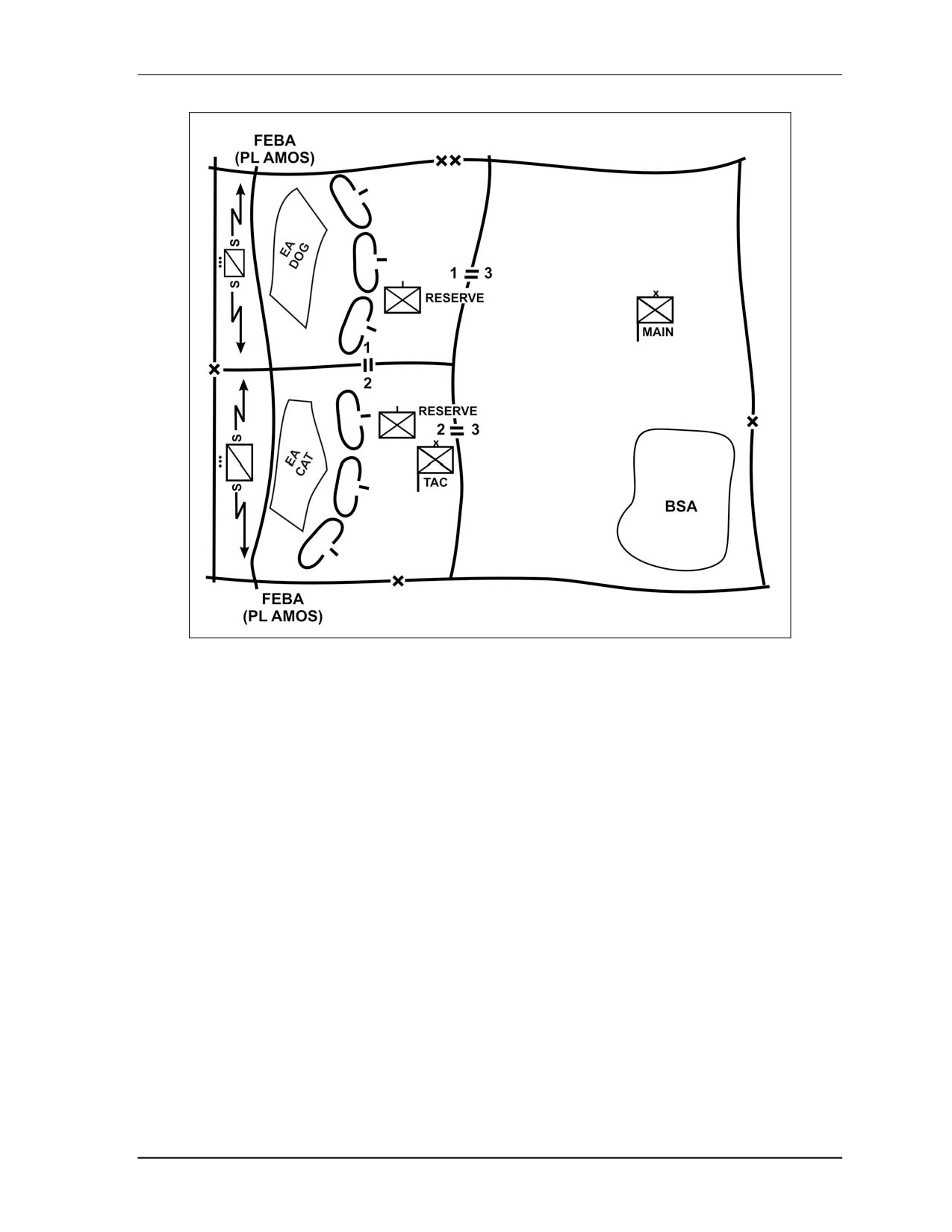
Defensive Operations
Figure 5-3. Example of a forward defense with battalions and companies defending forward.
DEFENSE IN DEPTH
5-47.
A defense in depth is the preferred option when tactical conditions allow. It reduces the risk of the
attacking enemy penetrating the defense and affords some initial protection from enemy indirect fires. It
also limits the enemy’s ability to exploit a penetration through additional defensive positions employed in
depth. The defense in depth provides more space and time to exploit ISR and fire support assets to reduce
the enemy’s options, weaken his forces, and set the conditions for destruction, disintegration, or
dislocation. It provides the commander more time to gain information about the enemy’s intentions and
likely future actions before decisively committing to a plan of his own. It also allows the battalion to
execute decisive maneuver by effectively repositioning companies to conduct counterattacks or to prevent
penetrations (Figure 5-4).
13 December 2006
FM 3-21.20
5-13
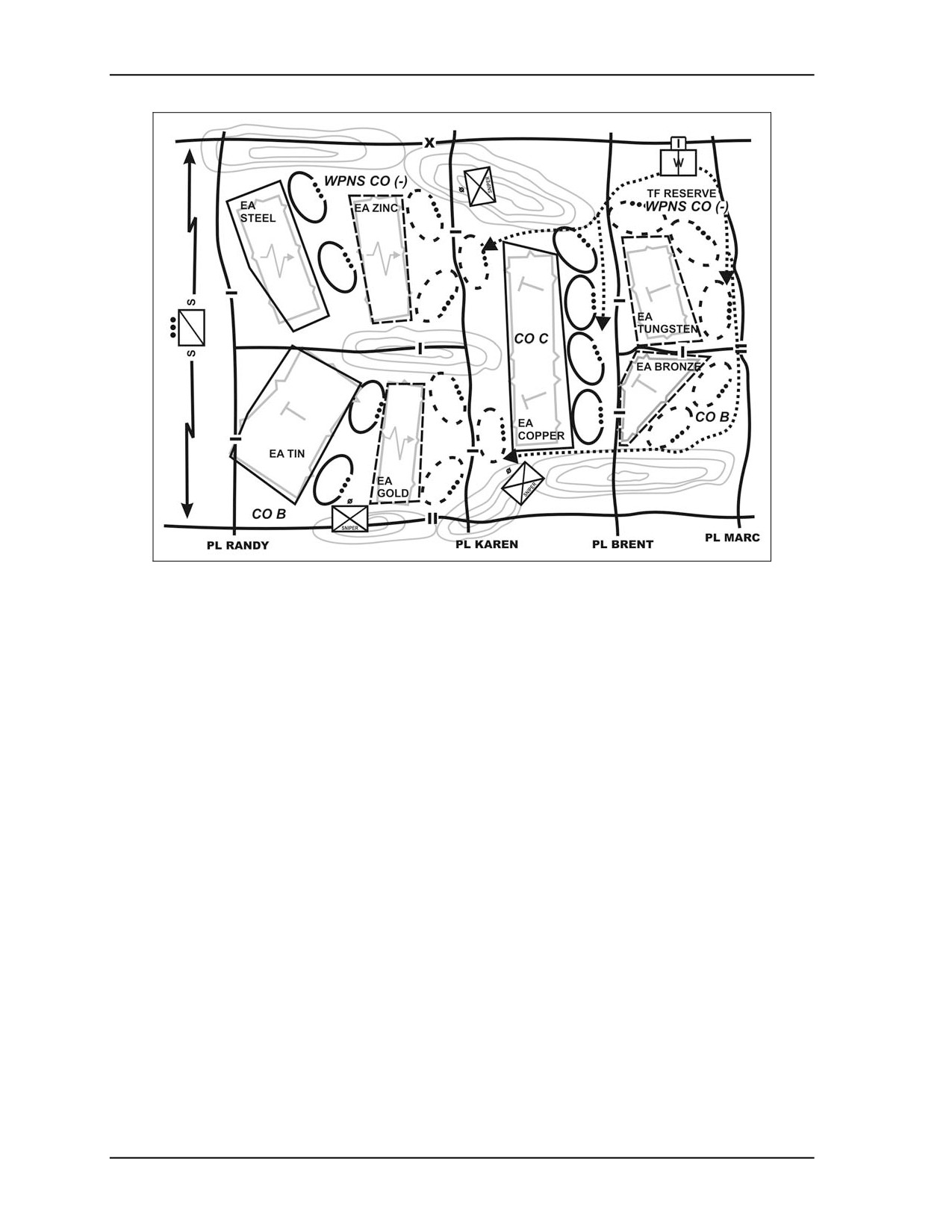
Chapter 5
Figure 5-4. Defense in depth.
EXECUTION
5-48.
Execution and preparation activities can occur simultaneously. For example, it common that the
main defense continues preparing, while the security force executes the counterreconnaissance.
SECURITY AREA ACTIONS
5-49.
Once security area forces have moved into the security area, actions in the security area
predominantly focus on reconnaissance, counterreconnaissance, target acquisition, reporting, delay of the
enemy main body, and battle handover. The battalion’s security zone forces integrate their actions with
friendly forces forward of them, maintaining information flow and security. The battalion’s elements may
have to execute battle handover with those forward elements and assist them in executing a rearward
passage. The security zone forces must coordinate and cross-talk with the companies to their rear.
Eventually, they must execute a rearward passage or move to the flanks of the MBA. On approaches that
the enemy does not use, it is usually advantageous to leave elements of the security force forward to
preserve observation and access to enemy flanks.
RECONNAISSANCE AND SURVEILLANCE
5-50.
The purposes of the reconnaissance and surveillance operation in the security zone are to provide
the commander with information to support his decision-making, to provide early warning and reaction
time, and to support target acquisition. Guided by the commander’s CCIR, the ISR plan, and the fire
support plan, reconnaissance and surveillance assets provide information that includes—
• Location, movement, and destruction of enemy reconnaissance assets.
• Speed, direction, composition, and strength of enemy formations.
5-14
FM 3-21.20
13 December 2006
Defensive Operations
• Locations of high-payoff targets such as artillery and rocket units, bridging assets, and C2
nodes.
• Enemy actions at decision points.
• Enemy flanking actions, breaching operations, force concentrations, and employment of
combat multipliers.
• Battle damage assessment.
• Movement of follow-on forces.
5-51.
The staff must integrate the information provided by the security forces with information received
from higher and adjacent units, other subordinate units, the BFSB, and JIIM/SOF.
5-52.
The total reconnaissance and surveillance operation must support the commander’s
decision-making. In an area defense, the commander’s critical decisions normally include—
• Initiation and employment of direct and indirect fires against enemy formations.
• Modifications or adjustments to the defensive plan.
• Execution of situational obstacles.
• Withdrawal of forward security forces.
• Commitment of the reserve, counterattack, or both.
SECURITY AREA ENGAGEMENT
5-53.
Engagements in the battalion security area are normally limited. Counterreconnaissance forces
focus on locating and destroying enemy reconnaissance elements. As the enemy closes into the area,
observers initiate indirect fires and execution of reserve obstacles. The focal points are normally early
warning and identification of the enemy’s decisive and shaping operations, strength, and composition of
threat forces, and direction of attack in order for the commander to make decisions and position forces. In
the event enemy reconnaissance assets penetrate the security area, battalion forces operating in the security
area must be prepared to conduct target handover with the battalion’s main battle area forces.
BATTLE HANDOVER
5-54.
The battle handover is the transfer of responsibility for the battle from the BCT’s or the higher
unit’s security zone elements to the battalions. The higher commander who established the security force
prescribes criteria for the handover and designates the location where the security forces will pass through,
routes, contact points, and the battle handover line. The battle handover line is normally forward of the
FEBA where the direct fires of the forward combat elements of the battalions can effectively overwatch the
elements of the passing unit. The BCT commander coordinates the battle handover with the battalion
commanders. This coordination overlaps with the coordination for the passage of lines, and the two should
be conducted simultaneously. Coordination normally includes—
• Establishing communications. This includes ensuring linkage on the tactical internet and
effective information overlap.
• Providing updates on both friendly and enemy situations and the addition of appropriate
command posts and leaders to the message groups on situation reports and updates.
• Coordinating passage, which includes identifying passage points and lanes, and recognition
signals and exchanging or disseminating graphics of these and obstacle overlays.
• Collocating C2 elements.
• Dispatching representatives to contact points and establishing liaisons.
• Coordinating recognition signals.
• Reporting status of obstacles and routes, including overlays.
• Coordinating fire support, protection, and sustainment requirements, with particular attention
given to casualty and equipment evacuation requirements.
13 December 2006
FM 3-21.20
5-15
Chapter 5
• Coordinating actions to assist the security force with breaking enemy contact.
• Coordinating and exchanging maneuver, obstacle, and fire plans.
• Coordinating location of and communications to any stay-behind elements. These must be
integrated into FSCMs to establish no fire areas (NFAs).
5-55.
Within the battalion, the battle handover between the battalion security elements and the
companies is less complicated, but equally as critical and must be planned in detail. Elements must identify
rearward passage points and lanes, and the passing elements need to coordinate their movement with the
element(s) covering them and through which they are moving. Frequently, the first elements to displace are
the maneuver forces that were executing counterreconnaissance, moving to initial defensive positions in
the MBA, or acting as the battalion or BCT reserve. The scout platoon normally displaces to vantage points
on the flanks, moves to establish surveillance on other avenues of approach, or infiltrates back to the
battalion rear area.
5-56.
When battle handover occurs within the battalion, the MBA companies—
• Assist passage of lines and disengagement.
• Gain and maintain contact with enemy forces as battle handover occurs.
• Maintain security.
• "On order" execute reserve obstacles
(battalion commander restricts authority) and "be
prepared" to emplace situational obstacles (situational obstacles may or may not be executed) in
the security area as the passing force withdraws. (See Chapter 2, FM 90-7.)
MAIN BATTLE AREA ENGAGEMENT
5-57.
The defensive battle is decided in the MBA by the actions of the battalion and its companies, and
their supporting fires, protection and sustainment units. During this execution phase, it is incumbent upon
the battalion staff to continue to assess the battalion’s situation and update courses of action such as
targeting, sustainment requirements, PIR, and adjustments of priorities for any assets.
MANEUVER
5-58.
During the MBA engagement, the BCT and battalions shift combat power and priority of fires to
defeat the enemy’s attack. This may require—
• Adjustment of subordinates' AOs and missions.
• Repositioning of forces.
• Shifting of the main effort, if one is designated.
• Commitment of the reserve.
• Modification of the original plan.
5-59.
Forward forces, obstacles, and fires within the MBA normally break the enemy’s momentum,
force the enemy to deploy earlier than desired, reduce his numerical advantage, disrupt his formations and
tempo, and force his troops into positions of vulnerability. The battalion masses fires (direct and indirect)
and obstacles to disrupt, fix, and then destroy attacking enemy forces as they enter the EAs.
5-60.
Depending on the defensive scheme, the battalion may conduct delay operations capitalizing on
movement and repeated attacks to defeat the enemy in depth or it may fight primarily from a single series
of positions.
COHESION
5-61.
The battalion must maintain a cohesive defense if it is to remain viable. This does not mean,
however, that the forces must be massed close together or that companies must have mutually supporting
fires. Companies can maintain cohesion with forces dispersed by cross-talk among subordinates, and
5-16
FM 3-21.20
13 December 2006
Defensive Operations
continual tracking and reporting of the enemy. The staff and commanders continually assess the enemy’s
options and movement while identifying means to defeat them. With forces widely dispersed, continual
assessment of time, distance, and trafficability factors is essential. To maintain defensive cohesion,
company commanders keep their movement, positioning, and fires consistent with the commander’s
defensive scheme.
THREATS TO SUSTAINMENT OPERATIONS
5-62.
During the MBA fight, protection of sustainment operations and locations is necessary to ensure
continuity of logistics operations. Because committing combat forces to sustaining operations and locations
such as the combat or field trains diverts combat power from the MBA, the commander carefully weighs
the need for such diversions against the possible consequences to the overall operation.
5-63.
Generally, sustainment nodes in the battalion area of operations or BCT rear area rely on
positioning, movement, and self-protection for survival. They—
• Establish sustainment operations in covered and concealed areas away from likely enemy
avenues of approach.
• Establish and maintain perimeter security and early warning OPs, integrating weapons and
crews that are in the rear for repair operations.
• Keep sustainment nodes postured to move on very short notice as the security battle begins.
• Maintain internal security for any movement while executing sustaining operations.
5-64.
Early warning to sustainment units in the rear is critical to their survival in the event of a
penetration of the MBA or an enemy attack from an unexpected area. Sustainment plans and rehearsals
address actions to be taken in the event of attacks on sustaining operations, including defensive measures,
displacement criteria, casualty evacuation, routes, rally points, and subsequent positions to which to move.
PENETRATIONS
5-65.
Unless the BCT plan makes other provisions, each battalion commander is responsible for
controlling enemy advances within his AO. If the enemy penetrates the defense or a penetration appears
likely, the battalion commander repositions forces or commits his reserve to block the penetration or to
reinforce the area where a penetration appears imminent. Simultaneously, the battalion commander may
allocate additional indirect fires to support the threatened area. He must alert the BCT commander to the
threat and that he has committed his reserve force (if applicable). The battalion commander must alert the
BCT commander of the situation as this may dictate when the BCT commander can commit his
reserve force.
5-66.
If a penetration threatens the battalion, the commander may take several actions to counter the
situation. In order of priority, he may do any or all of the following:
• Allocate priority of all available indirect fires, to include attack helicopters, and CAS, to the
threatened unit. This is the most rapid and responsive means of increasing the combat power of
the threatened unit.
• Direct or reposition adjacent units to engage enemy forces that are attacking the threatened unit.
This may not be possible if adjacent units are already decisively engaged.
• Commit the reserve to reinforce the threatened unit.
• Commit the reserve to block, contain, or destroy the penetrating enemy force.
• Accept penetration of insignificant enemy forces and maintain contact with them as they move
deeper into the MBA.
• Decide to move forces to alternate, supplementary, or subsequent positions or to
withdraw forces.
• Commit attached engineers to assist in containing the penetration or constitute a new reserve
from the engineers.
13 December 2006
FM 3-21.20
5-17
Chapter 5
5-67.
When a penetration occurs, units within the MBA continue to fight, refuse their flanks, and
engaging the enemy’s flanks and rear. The penetrated force must try to minimize the penetration to prevent
the area of penetration from widening and to protect adjacent unit flanks. Adjacent units take immediate
action to secure their exposed flanks, which may include security missions or the establishment of blocking
positions. Adjacent units may also need to reposition forces or direction of fire, readjust subordinate AOs
and tasks, or commit their reserve. MBA forces try to reestablish contact across the area of penetration
when possible.
COUNTERATTACK
5-68.
The battalion may conduct local counterattacks to restore or preserve defensive integrity. Unless
defensive operations have left the battalion largely unscathed, the battalion usually lacks the ability to
conduct a significant counterattack by itself. If the battalion has the ability to organize a counterattack
force, this force must have mobility or be pre-positioned in a position of advantage to attack the enemy
from an unexpected flank. Within the context of the BCT’s operations, a defending battalion may execute a
counterattack in support of the BCT’s defensive posture, as part of a larger force seeking to complete the
destruction of the enemy’s attack, or as part of a transition to offensive operations.
MOBILE DEFENSE
5-69.
The mobile defense concentrates on the destruction or defeat of the enemy through a decisive
counterattack. A mobile defense requires considerable depth in the AO in order for the commander to
shape the battlefield, causing the enemy to extend his lines of communication and support, expose his
flanks, and dissipate his combat power. This defense is executed at echelons above the BCT. The focus is
on defeating or destroying the enemy by allowing him to advance to a point where he is exposed to a
decisive counterattack by the striking force. The striking force is a dedicated force composed of the bulk of
the combat power and weighted with the majority of the available combat multipliers. The fixing force
shapes the battlefield and the enemy, setting the conditions for the striking force. Battalions may participate
in the mobile defense as an element in the fixing force conducting a delay or area defense. Battalions may
also constitute an element of the striking force conducting offensive operations. (Chapter 4 discusses
offensive operations.)
RETROGRADE OPERATIONS
5-70.
The retrograde is a type of defensive operation that involves organized movement away from the
enemy. The enemy may force these operations or a commander may execute them in order to overextend
threat force’s combat power and extend the enemy’s lines of communications. In either case, the higher
commander of the force executing the operation must approve the retrograde. Retrograde operations are
conducted to improve a tactical situation or to prevent a worse situation from developing. Battalions
normally conduct retrogrades as part of a larger force but may conduct independent retrogrades as required
such as when conducting a raid. In either case, the battalion’s higher headquarters must approve the
operation. Retrograde operations accomplish the following:
• Resist, exhaust, and defeat enemy forces.
• Draw the enemy into an unfavorable situation.
• Avoid contact in undesirable conditions or locations.
• Gain time.
• Disengage from battle for use elsewhere in other missions.
• Reposition forces, shorten lines of communication, or conform to movements of other
friendly units.
5-18
FM 3-21.20
13 December 2006

Defensive Operations
Note. Maintenance of morale is essential among subordinate leaders and troops in a
retrograde operation. Movement to the rear may seem like a defeat or a threat of isolation
unless Soldiers have confidence in their leaders and know the purpose of the operation and
their roles in it.
PLANNING CONSIDERATIONS
5-71.
The commander determines the end state of the delay based on the higher commander’s intent and
specific parameters of the higher headquarters’ delay order. The commander considers the factors of
METT-TC, especially the effects of the terrain, to identify advantageous locations from which to engage
the enemy throughout the depth of the AO. Specific delay planning considerations the commander and
staff must determine include the following. (Figure 5-5 shows the three forms of retrograde operations):
•
Force array and allocation of combat multipliers, particularly fires and obstacles.
•
Where and when to accept decisive engagement.
•
Acceptable level of risk for each subordinate force.
•
Form of delay and control measures (companies delay in sector, control by BPs, or some other
method).
•
Integration of obstacle intent and essential fire support tasks (EFSTs).
•
Numbers, locations, and preparation of alternate, supplementary, and/or subsequent positions.
•
Locations of mortar firing points to provide continuous coverage to the force throughout the
entire operation. This may incorporate the use of split section operations and multiple mortar
firing points (MFP).
•
Mobility assets to expedite movement to and from positions.
•
Positioning of fire support, protection, and sustainment assets to provide continuous support
throughout the operation
•
Likely subsequent mission, transition point(s), and conditions.
DELAY
• Trades space for time.
• Preserves friendly combat power.
• Inflicts maximum damage on the enemy.
WITHDRAWAL
• Planned, voluntary disengagement from the enemy.
• Conducted with or without enemy pressure.
RETIREMENT
• Organized movement to the rear by a force that is not
in contact with the enemy.
Figure 5-5. Types of retrograde operation.
DELAY
5-72.
In a delay, the battalion trades space for time and inflict maximum damage on the enemy. The
purpose of the delay is to control the enemy’s tempo by forcing the enemy to deploy multiple times and
repeatedly concentrate his combat power to defeat the delaying forces. Although the battalion must
establish and maintain contact, it should avoid becoming decisively engaged. It is critical that the
commander’s intent defines what is more important to the mission: time, damage to the enemy, or force
protection. Inflicting damage is normally more important than gaining time. The commander establishes
risk levels for each delay but ordinarily maintaining freedom of action and avoiding decisive engagement is
of ultimate importance. The battalion may execute a delay when it has insufficient combat power to attack
or defend or when the higher unit’s plan calls for drawing the enemy into an area for a counterattack, as in
a mobile defense. Delays gain time to—
13 December 2006
FM 3-21.20
5-19