FM 3-21.20 (FM 7-20) THE INFANTRY BATTALION (DECEMBER 2006) - page 6
Chapter 5
of maneuver and fires to produce specific obstacle effects. Obstacles alone do not produce significant
effects against the enemy; obstacles must be integrated with fires to be effective. The engineer section in
Chapter 10 provides tables and specific information on engineer capabilities and obstacle effects. The
following are the three types of tactical obstacles:
Directed
5-241. The BCT directs obstacles as specified tasks to the battalion using obstacle belts. The battalion
may use the same technique, but more likely will be specific about the location and type of obstacle. The
commander may use directed obstacles or obstacle groups to achieve specific obstacle effects at key
locations on the battlefield. In this case, the staff plans the obstacle control measures and resources as well
as determines measures and tasks to subordinates to integrate the directed obstacles with fires.
Situational
5-242. Situational obstacles are obstacles that the BCT or battalion plans and possibly prepares before an
operation; however, they do not execute the obstacles unless specific criteria are met. Situational obstacles
are "be-prepared" obstacles and provide the commander with flexibility for employing tactical obstacles
based on battlefield developments. The commander may use engineer forces to emplace tactical obstacles
rapidly, but more often, he relies on SCATMINE systems. The BCT staff normally plans situational
obstacles to allow the commander to shift his countermobility effort rapidly to where he needs it the most
based on the situation. Execution triggers for situational obstacles are integrated into the decision support
template (Chapter 10, Section III of this manual, and FM 90-7 for situational obstacles). Situational
obstacles must be well integrated with tactical plans to avoid fratricide. Given the changes in engineer
force structure, tactical concepts, and capabilities, situational obstacles are increasingly used instead of
conventionally emplaced obstacles.
Reserve
5-243. Reserve obstacles are demolition obstacles that are deemed critical to the plan for which the
authority to detonate is reserved by the designating commander. These are "on-order" obstacles. The
commander specifies the unit responsible for constructing, guarding, and executing the obstacle. Examples
of reserve obstacles include preparing a bridge for destruction or an obstacle to close a lane. Units normally
prepare reserve obstacles during the preparation phase. They execute the obstacle only on command of the
authorizing commander or when specific criteria are met.
(See Chapter
6, FM 90-7 for specific
considerations for planning reserve obstacles.) It is critical for the unit to understand and rehearse actions
to execute reserve obstacles.
Note. In addition to tactical obstacles, units also employ protective obstacles. Protective
obstacles are a key component of survivability operations, providing friendly forces with
close-in protection.
OBSTACLE GROUPS
5-244. Obstacle groups are one or more individual obstacles grouped to provide a specific obstacle
effect. Battalions integrate obstacle groups to ensure that companies plan individual obstacles that support
the scheme of maneuver. Companies integrate individual obstacles with direct- and indirect-fire plans to
achieve the specified obstacle group effect.
5-245. Obstacle groups normally attack the maneuver of enemy battalions. Normally, commanders plan
obstacle groups along enemy battalion avenues of approach as defined by company mobility corridors.
They may plan a group along a company-size avenue of approach. Unlike obstacle zones or belts, obstacle
groups are not "areas" but are relative locations for obstacle construction. Obstacle groups are represented
5-60
FM 3-21.20
13 December 2006
Defensive Operations
by obstacle effect symbols (block, fix, turn, disrupt) on battalion graphics. However, if the plan requires
specific obstacle types, commanders may refine obstacle group symbology with individual obstacle
graphics.
5-246. Battalion commanders plan obstacle groups within assigned obstacle zones or belts. When given a
belt with an assigned effect, the battalion commander may use any combination of group effects if the sum
effect of all groups achieves the overall effect of the belt.
5-247. Obstacle groups impose strict limitations on company commanders to preserve the link between
obstacle effects and the fire plan. The limitations are similar to the limitations imposed by a BP. A group
does not give the exact location of obstacles in the group just as a BP does not show the exact location of
each weapon in the company. The company commander and the emplacing engineer coordinate these
details directly. Company commanders may make changes to obstacles and fire-control measures based on
the reality of the terrain. These changes are coordinated with and tracked by the battalion commander and
staff to maintain the fidelity of the desired obstacle group effect and integration into the battalion scheme
of maneuver.
5-248. Battalions do not normally assign a company more than one obstacle group; however, a company
may effectively fight two groups at a time if the terrain supports it. To mass fires on an obstacle group,
more than one company often covers a single obstacle group within an EA. In these cases, the commander
responsible for establishing the EA is also responsible for integrating the obstacle group. Normally, the
battalion commander or S-3 plays a significant role in building and synchronizing an EA covered by two or
more companies.
5-249. Obstacle groups, resource factors, and standard individual obstacles are the basis of battalion
obstacle logistics planning. They enable the commander and staff to allocate the necessary resources to
each obstacle group, EA, or company BP. They also enable the staff to identify critical shortfalls, plan the
flow of materials within the battalion area, and schedule resupply.
TACTICAL OBSTACLE PLANNING
5-250. Detailed obstacle planning begins during COA development. The engineer focuses on five
specifics in his scheme of engineer operations for the obstacle plan.
Direct and Indirect Fire Analysis
5-251. The direct and indirect fire analysis examines how engineers can best use obstacles to enhance the
direct and indirect fire plan. The engineer must have a fundamental understanding of the direct and indirect
fire and maneuver plans and the battalion’s organization of the EA to integrate obstacles effectively with
the direct and indirect fire plan. The engineer must consider battalion EAs, TRPs, indirect fire targets, unit
locations, enemy formations, avenues of approach, and the commander’s obstacle intent in order to
effectively integrate obstacles. Synchronization of direct and indirect fires with obstacles multiplies the
relative effect on the enemy.
Obstacle Intent Integration
5-252. The engineer plans directed obstacle groups during the COA development process. Obstacle
groups integrated into the COA sketch graphically show the commander’s obstacle intent to support the
maneuver plan. Obstacle groups target specific enemy elements based on the situational template. The
engineer generally allocates an obstacle group against a battalion-sized avenue of approach with respect to
the EAs, TRPs, indirect fire targets, unit locations, enemy formations, and avenues of approach assessed
during the direct fire analysis. This process parallels the staff's placement of a company against the same
size enemy force. The intent of the obstacle groups supports subordinate unit task and purpose. The
engineer recommends specific obstacle group effects to the commander based on terrain, resources, time
available, and the battalion commander’s obstacle intent.
13 December 2006
FM 3-21.20
5-61
Chapter 5
Obstacle Priority
5-253. The staff determines the priority of each obstacle group. The commander's intent and the most
likely enemy COA clearly influence the priority. The obstacle priority should reflect the battalion’s most
critical obstacle requirement. The battalion engineer considers flank protection, weapons types and ranges,
and the commander's overall intent for the entire force before placing obstacle priority on the main EA.
Priorities assist the engineer in allocating resources and ensuring that the most critical obstacle groups are
constructed first.
Mobility Requirements
5-254. The engineer identifies battalion mobility requirements by analyzing the scheme of maneuver,
counterattack
(CATK) options, reserve planning priorities, fire support, protection, and sustainment
movement requirements, and adjacent and higher unit missions, maneuver, and movement. The engineer
integrates this analysis into obstacle group planning and avoids impeding friendly maneuver whenever
possible. Because the bulk of the engineer force is committed to countermobility and survivability during
defensive preparation, the battalion commander uses clear obstacle restrictions on specific areas within the
battalion AO to maintain mobility. Sometimes, obstacles must be constructed along a mobility corridor that
primarily supports friendly movement. When this happens, a lane or gap and associated closure procedures
are planned and rehearsed. These lanes or gaps may be closed with situational or reserve obstacles.
5-255. Beyond preparing and marking lanes and gaps through obstacles, engineers normally perform
mobility tasks once defensive preparations are complete. Mobility assets may then be positioned to counter
templated enemy situational obstacles, or be task organized to the reserve, counterattack force, or any other
unit that must maneuver or move subsequent to the execution of the defense. To do this effectively, the
engineers and the supported maneuver unit must integrate, prepare, and rehearse. Since this manner of
mobility support is critical to the success of the maneuver plan, timely linkup and coordination is factored
into the overall defensive preparation timeline.
5-256. The battalion might need significant mobility support during defensive preparation. For example,
it might need route reduction or clearance, road repair or maintenance, and LZ and PZ clearance. Engineers
have resources to perform these tasks, but they cannot perform them and simultaneously prepare the
defense. Thus, the battalion needs augmentation from the BSTB or higher level unit multifunction engineer
battalion. These engineers perform general engineering tasks, leaving the BCT engineers available to
construct the battalion defense.
SURVIVABILITY
5-257. Survivability operations in support of ground maneuver elements are increasingly limited given
force structure and tactical concepts. Survivability efforts within the battalion should focus on protection of
assets that must remain relatively static, such as communication nodes; support of logistical and
decontamination operations; and survivability for defending Infantry Soldiers.
5-62
FM 3-21.20
13 December 2006
Chapter 6
Stability Operations
This chapter discusses stability operations at the battalion level and provides
planning considerations. US forces are employed in stability operations outside the
US and its territories to promote and protect US national interests by influencing
political, civil, and military environments and by disrupting specific illegal activities.
Army forces must remain versatile and retain the flexibility to transition from the
primary mission of close, personal, and brutal fighting of traditional combat to
stability operations. The Infantry battalion normally performs stability operations as
part of a larger, multinational, or unified team but could be required to work
independently.
Army forces are highly suited for stability operations because they are trained,
equipped, and organized to control land, populations, and situations for extended
periods. Army forces engage in stability operations daily around the world. The depth
and breadth of Army force abilities provide the combatant commander of a unified
command with vital options to meet theater operational requirements. These
operations enhance theater engagement and promote regional stability.
Section I. FUNDAMENTALS
Stability operations promote and protect US national interest by influencing the threat, political, and
information dimensions of the operational environment. This is done through a combination of peacetime
developmental, cooperative activities, and coercive actions in response to crises (FM 3-0). Army force presence
promotes a secure environment in which diplomatic and economic programs designed to eliminate root causes
of instability may flourish. Presence can take the form of forward basing, forward deploying, or pre-positioning
assets in an AO. Army forces have the ability to establish and maintain a credible presence as long as necessary
to achieve the desired results.
PURPOSE
6-1.
The overarching goal of stability operations is to promote and sustain regional and global stability.
These operations may complement and reinforce offensive and defensive operations, or stability may be
the decisive operation. Army forces conduct stability operations in crises and before, during, and after
offensive and defensive operations. In a crisis, a stability operation can deter conflict or prevent escalation.
During hostilities, it can help keep armed conflict from spreading and assist and encourage committed
partners. Following hostilities, a stability operation can provide a secure environment in which civil
authorities can work to regain control. Demonstrating the credible ability to conduct offensive and
defensive operations underlies successful stability operations.
6-2.
Stability operations are inherently complex and place greater demands at the small-unit level.
Junior leaders are required to develop engagement skills, such as cultural awareness, negotiating
techniques, tactical questioning and critical language phrases, while maintaining warfighting skills.
Capable, trained, disciplined, and high-quality leaders, Soldiers, and teams are especially critical to
success. Soldiers and units at every level must be flexible and adaptive. Stability operations often require
the mental and physical agility to shift from noncombat to combat operations and back again.
13 December 2006
FM 3-21.20
6-1
Chapter 6
6-3.
Military forces conduct stability operations to accomplish one or more of the activities listed
below. These operations demonstrate the United States’ resolve through the commitment of time,
resources, and forces to establish and reinforce diplomatic and military ties. stability operations can—
• Protect national interests.
• Promote peace and deter aggression.
• Satisfy treaty obligations or enforce agreements and policies.
• Reassure allies, friendly governments, and agencies.
• Maintain or restore order.
• Protect life and property.
• Demonstrate resolve.
• Prevent, deter, or respond to terrorism.
• Reduce the threat of conventional arms and WMD to regional security.
• Protect freedom from oppression, subversion, lawlessness, and insurgency.
• Promote sustainable and responsive institutions.
6-4.
Stability operations may include both developmental and coercive actions. Developmental actions
enhance a host government’s willingness and ability to care for its people. Coercive actions apply carefully
prescribed force or the threat of force to change the security environment. For example, rapidly responding
to a small-scale contingency operation can diffuse a crisis and restore regional stability.
6-5.
Stability operations complement and are complemented by offensive and defensive operations.
Stability operations help restore law and order in unstable areas outside the US and its territories. Similarly,
offensive and defensive operations may be necessary to defeat adversaries intending to prevent the success
of a stability operation. The ability of Army forces to stabilize a crisis is related to its ability to attack and
defend. For example, shows of force often precede offensive and defensive operations in tries to deter
aggression and provide opportunities for diplomatic and economic solutions.
6-6.
Stability operations vary by type and are further differentiated by the specific factors of
METT-TC. The battalion performs many familiar core tactical missions and tasks during stability
operations. The purposes of operations, the special constraints on commanders, and the unique missions
and tasks, however, differentiate stability operations from other operations.
6-7.
Ideally, the battalion receives advance notice of stability operation missions and has time to
modify its mission essential task list
(METL) and complete a preparatory training program before
deploying. In other cases, the battalion may deploy and assume stability operations responsibilities on short
notice. In those cases, the battalion relies on its training in the fundamental tasks, such as C2, patrolling,
reporting, establishing OPs, and maintaining unit security, and trains to specific mission tasks during the
operation.
6-8.
In stability operations, commanders must emphasize cooperating and communicating with joint
headquarters, multinational units, civilian authorities, and nongovernmental organizations (NGOs). Also,
commanders must empower subordinate leaders to develop close association with the population of the
AOs within the ROI and typifies many stability operations. Considerations for stability operations
include—
6-9.
Leverage SOF, interagency, joint, and multinational cooperation
(Appendix G). As with all
operations, unity of effort is fundamental to success.
6-10.
Enhance the capabilities and legitimacy of the host nation. Army forces consciously enhance
host-nation credibility and legitimacy by demonstrating the proper respect for the host-nation’s
government, police, and military forces. Within the restrictions of international law and US policy,
commanders use host-nation forces and personnel for all possible activities. Within its capabilities, a host
nation should take the lead in both developmental and security activities. When host-nation capabilities
prove inadequate for the task, Army forces enhance those capabilities through training, advice, and
assistance.
6-2
FM 3-21.20
13 December 2006
Stability Operations
6-11.
Understand the potential for unintended consequences of individual and small unit actions. The
actions of individuals and units can have consequences disproportionate to the level of command. An
individual’s actions can even have strategic implications. Soldiers and leaders who are disciplined,
proficient, and knowledgeable in stability operations can create the opportunity for disproportional positive
consequences, while limiting the risk for negative consequences.
6-12.
Display the capability to use force in a nonthreatening manner. Army forces must be prepared for
combat in stability. However, that preparedness is shown so it does not provoke potential adversaries. The
force demonstrates strength and resolve, without being perceived as threatening. Consistent with mission
constraints, units display preparedness by routinely conducting demanding combined arms training in the
AO. The force should convey to all parties the breadth and depth of the resources available. To do so, it
must be present in the communities and ensure (consistent with the demands of OPSEC) that the public
knows the ROE and associated graduated response levels. The training should include challenging Soldiers
to react to situations at all levels in the areas of weapons use, levels of force, and ROE.
6-13.
Act decisively to prevent escalation. The nature of stability operations ordinarily constrains forces
in the ways and means available to accomplish military objectives. However, they are characterized by
initiative, speed, and determination when action is necessary. Units and individuals pursue military
objectives energetically and apply military power forcefully, if required. Army forces may act decisively to
dominate a situation by force or negotiate to settle disputes. Without hesitation, they ensure mission
accomplishment as well as protection of themselves, the people, and facilities under their charge.
Decisiveness reassures allies and deters adversaries. Failure to act decisively can cause a loss of respect for
the stability force. A loss of respect for the capabilities or will of the force to accomplish its mission can
embolden adversaries, and therefore weaken the trust of the supported population; making the mission
much more difficult.
6-14.
Apply force selectively and discriminately. Commanders ensure that their units apply force
consistent with assigned objectives and not excessive. Combat power is applied selectively in accordance
with assigned missions and prescribed limitations. Excessive force can lead to the loss of sympathy and
support of local and international populations. Inadequate force may jeopardize mission accomplishment,
and adversely affect the local populace and domestic support. Ordinarily, the local commander is best
qualified to estimate the degree of force that must be used, consistent with established rules of
engagement (ROE).
CHARACTERISTICS
6-15.
Stability operations are conducted in a dynamic environment. These operations are normally
nonlinear and often conducted in noncontiguous AOs. They are often time and manpower intensive.
Stability operations differ from the offense and defense in significant ways. Understanding their
characteristics helps units successfully adapt to the special requirements presented. Some common
characteristics of stability operations include: political objectives, modified concept of the enemy, joint,
interagency, and multinational cooperation, risk of mission creep, noncombatants, NGOs, information
intensity, constraints, and cross-cultural interaction. Although not applicable in every operation, these
characteristics apply to many operations. Understanding them aids in the adjustment that units may be
required to make when conducting these types of actions.
POLITICAL OBJECTIVES
6-16.
Political objectives influence stability operations at every level from strategic to tactical. These
operations are distinguished by the degree that political objectives directly influence operations and tactics.
Two factors about political primacy stand out. First, all military personnel should understand the political
objectives and the potential impact of inappropriate actions. Having an understanding of the political
objective helps avoid actions that may have adverse political effects. In such operations, junior leaders
commonly make decisions that have significant political implications. Second, political objectives can be
fluid. Changing objectives may warrant a change in military operations. Commanders should strive,
13 December 2006
FM 3-21.20
6-3
Chapter 6
through continuing mission analysis, to detect subtle changes that may lead to disconnects between
political objectives and military operations. Failure to recognize changes in political objectives may lead to
ineffective or counter productive military operations.
MODIFIED CONCEPT OF ENEMY
6-17.
Infantry units and Soldiers are naturally attuned to find, fix, and finish the enemy. Stability
operations require a modified understanding of who or what is the adversary. Commanders must take care
to not create an enemy where one does not exist. In situations where there is no enemy, military capability
may focus on overcoming obstacles and providing support to other agencies. In some missions, such as
peacekeeping, Soldiers must remain impartial.
JOINT, INTERAGENCY, AND MULTINATIONAL COORPERATION
6-18.
Stability operations typically involve unified action: joint, interagency, and multinational efforts.
(See Appendix G for more information on the latter types of operations.) The increased number of
participants (military and nonmilitary) and their divergent missions and methods create a coordination
challenge. In this environment, the potential exists for duplicating effort and working at cross-purposes.
Achieving unity of effort requires the greatest possible common purpose and direction among all agencies.
RISK OF MISSION CREEP
6-19.
Commanders and soldiers have a natural tendency to do more especially when faced with human
suffering. However, well-intentioned actions can be especially dangerous in stability operations, where
they can threaten impartiality as well as undermine long-term programs. There are two types of mission
creep. First is the type that occurs when the unit receives shifting guidance or change in mission for which
the unit is not properly configured or resourced; or if it is beyond the legal remit of the Army. The second
type of mission creep occurs when a unit tries to do more than is allowed in the current mandate and
mission. The best guard against mission creep is for the commander and staff to conduct a complete
mission analysis, considering interim and potential political end states.
NONCOMBATANTS
6-20.
Noncombatants are a defining characteristic of most modern military operations. Their presence is
unavoidable because in most cases their welfare is the reason for the operation. Noncombatants in stability
operations can create various challenges. Local populations may be friendly, hostile, or indifferent to the
presence of Army forces. In some cases, Army forces may have difficulty differentiating between hostile
and non hostile persons.
NGOS
6-21.
The very conditions that may necessitate a stability operation—widespread human suffering,
population movements, famine, human rights violations, and civil war—are also the conditions that attract
the services of NGOs. Commanders must be prepared to coordinate their efforts with a myriad array of
international organizations and NGOs. Each organization or agency has a different mandate, set of
capacities, organizational design, and cultural orientation. An operation’s success may depend on how well
the commander can forge productive working relationships will all these disparate bodies.
INFORMATION INTENSITY
6-22.
All military operations are information intensive. In stability operations, this is further
complicated by the numerous governmental and nongovernmental agencies involved. The scope and scale
6-4
FM 3-21.20
13 December 2006
Stability Operations
of required coordination and communication also complicate the operation. The cascading effects of events
and their global magnification through the media further exacerbates this characteristic of the environment
CONSTRAINTS
6-23.
Constraints are present in all military operations; stability operations are not an exception.
Constraints may arise for many reasons and may be imposed on military forces by the chain of command
or by the complex nature of the environment. Army forces in these actions must typically contend with
constraints such as force caps, restricted activities, restricted areas, and specific ROE.
CROSS-CULTURAL INTERACTION
6-24.
Interacting with other cultures can create a significant challenge during stability operations. Often,
adjustments in attitudes or methods must be made to accommodate different cultures. Ethnocentrism and
cultural arrogance can damage relationships with other forces, NGOs, or indigenous populations. The
welfare and perceptions of indigenous populations are often central to the mission during stability
operations. Army forces must establish good working relations with indigenous populations. Mutual trust
and rapport increase the chances for mission success.
POTENTIAL USE OF NONLETHAL WEAPONS
6-25.
Stability operations require lethal force constraints due to the importance of interaction and
relationship building with the local population, as well as probable media exposure. Nonlethal capabilities
extend the range of firepower options (Appendix L). They augment means of deadly force. They are
particularly valuable in both stability operations as they enhance the ability to apply force in proportion to
the threat and allow discrimination in its use. They expand the number of options available to confront
situations that do not warrant using deadly force but require soldiers to use overwhelming, decisive power
to accomplish their missions.
6-26.
The use of nonlethal weapons forms the basis of a response if force is required. The use of
nonlethal weapons, backed by lethal force, can defuse or deter a potentially dangerous situation involving
noncombatants.
SMALL UNIT LEADER SKILLS
6-27.
Stability operations are inherently complex and place great demands on small units and small unit
leaders. Small unit leaders may be required to develop or improve interpersonal skills, such as cultural
awareness, negotiating techniques, and critical language phrases, while maintaining warfighting skills.
They must also remain calm and exercise good judgment under considerable pressure. Soldiers and units at
every level must be flexible and adaptive. Often, stability operations require leaders with the mental and
physical agility to shift from noncombat to combat operations, and back again.
INTERPRETERS
6-28.
Stability operations normally require the use of language interpreters to effectively communicate
with the local government officials, police, armed forces, and civilian population. In many areas of the
world, the availability of qualified Army interpreters is very limited. In areas where limited military
interpreters exist, local interpreters may be hired to support Infantry battalions. Some of the considerations
of using local interpreters are—
• Screening potential interpreters to ensure they are trustworthy.
• If possible, use multiple interpreters working independently of each other to ensure quality of
translations.
13 December 2006
FM 3-21.20
6-5
Chapter 6
• Do not use English slang or phrases that can easily be misinterpreted.
• If possible, select older interpreters (because in most cultures, age demands respect).
• The interpreters should come from the higher social class (because they demand more respect
in the community).
• If gender is a social issue, choose the interpreter whose gender carries the most respect.
• When translating a message to a local, it may be more important to convey intent, rather than a
word-for-word literal translation.
Section II. TYPES OF STABILITY OPERATIONS
Stability operations typically fall into ten broad types that are neither discrete nor mutually exclusive. For
example, a force engaged in a peace operation may also find itself conducting arms control or a show of force
to set the conditions for achieving an end state. This section provides an introductory discussion of stability
operations. For more information, see FM 3-0 and FM 3-07. (Figure 6-1 shows and the following paragraphs
discuss the eleven types of stability operations.)
•
Peace operations (PO)
•
Foreign internal defense (FID)
•
Humanitarian and civic assistance
•
Foreign humanitarian assistance
•
Security assistance
•
Support to insurgencies
•
Support to counterdrug operations
•
Combating terrorism
•
Noncombatant evacuation operations (NEO)
•
Arms control
•
Show of force
Figure 6-1. Types of stability operations.
PEACE OPERATIONS
6-29.
Peace operations (POs) support strategic and policy objectives and the diplomatic activities that
implement them. POs include peacekeeping operations (PKOs), peace enforcement operations (PEOs), and
support to diplomatic efforts to establish and maintain peace. Although the US normally participates in
POs under the sponsorship of the United Nations (UN), a multinational organization, or a multinational
force, it reserves the right to conduct POs unilaterally. Optimally, forces should not transition from one PO
role to another unless there is a change of mandate or a political decision with appropriate adjustments to
force structure, ROE, and other aspects of the mission. Nevertheless, just as in other operations, it is crucial
that commanders and staffs continually assess the mission. In POs, this translates into planning for possible
or likely transitions. Examples include: transitioning from a US unilateral operation or multinational
coalition to an UN-led coalition, from combat to noncombat operations, or from military to civilian control.
6-30.
Commanders use the military decision making process to determine the appropriate force and
weapons to have at the unit’s disposal during peace operations. In general, peace keeping operations only
allow for self-defense and peace enforcement operations require units maintain the capability to conduct
combat operations.
PEACEKEEPING OPERATIONS
6-31.
PKOs are military operations conducted with the consent of all major parties in a dispute. They
monitor and facilitate the implementation of agreements, such as a cease fire or truce, and they support
6-6
FM 3-21.20
13 December 2006
Stability Operations
diplomatic efforts to reach a long-term political settlement (JP 3-07.3). Before PKOs begin, a credible truce
or ceasefire should be in effect, and the belligerent parties must consent to the operation.
6-32.
In peacekeeping operations, the battalion must use all its capabilities, short of coercive force, to
gain and maintain the initiative. The battalion may be assigned a variety of missions designed to monitor
peace and stability and to improve the humanitarian environment. The following are examples of PKO
missions:
• Observing, monitoring, verifying, and reporting any alleged violation of the governing
agreements.
• Investigating alleged cease-fire violations, boundary incidents, and complaints.
• Conducting regular liaison visits within the operational area.
• Verifying the storage or destruction of certain categories of military equipment specified in the
relevant agreements.
• Supervising cease-fires, disengagements, and withdrawals.
• Supervising prisoner of war exchanges.
• Assisting civil authorities.
• Providing military support to elections.
• Assisting in foreign humanitarian assistance.
• Assisting in the maintenance of public order.
6-33.
JP 3-07.3 and FM 3-07 provide additional details on PKO-related tasks. Army forces conducting
PKOs rely on the legitimacy acknowledged by all major belligerents and international or regional
organizations to obtain objectives. They do not use force unless required to defend the Soldiers or
accomplish the mission. Intelligence and information operations are vital in PKOs to provide the
commander with the information he needs to make appropriate decisions, protect the force, and ensure the
success of subordinate PKO-related efforts.
PEACE ENFORCEMENT
6-34.
PEOs involve the application of military force or the threat of military force (normally pursuant to
international authorization) to compel compliance with resolutions or sanctions designed to maintain or
restore peace and order. By definition, PEOs are coercive in nature and rely on the threat or use of force.
However, the impartiality with which the peace force treats all parties and the nature of its objectives,
separate PEOs from war. PEOs support diplomatic efforts to restore peace and represent an escalation from
peacekeeping operations.
6-35.
In PEOs, the battalion may use force to coerce hostile factions into ceasing and desisting violent
actions. Usually, these factions have not consented to intervention, and they may be engaged in combat
activities. A battalion conducting a PEO must be ready to apply elements of combat power to achieve the
following:
• Forcible separation of belligerents.
• Establishment and supervision of protected areas.
• Sanction and exclusion zone enforcement.
• Movement denial and guarantee.
• Restoration and maintenance of order.
• Protection of humanitarian assistance.
6-36.
The nature of PEOs dictates that Army forces assigned a PEO mission be able to conduct combat
operations. Maintaining and demonstrating a credible combat capability is essential for successful PEOs.
The PE force normally retains the right of first use of force. Units must be able to apply sufficient combat
power to protect themselves and forcefully accomplish assigned tasks. Units must also be ready to
transition quickly either to PKOs or to offensive and defensive operations if required.
13 December 2006
FM 3-21.20
6-7
Chapter 6
OPERATIONS IN SUPPORT OF DIPLOMATIC EFFORTS
6-37.
Forces may conduct operations in support of diplomatic efforts to establish peace and order
before, during, and after a conflict. Military support of diplomatic activities improves the chances for
success by lending credibility to diplomatic actions and demonstrating resolve to achieve viable political
settlements. While these activities are primarily the responsibility of civilian agencies, the military can
support these efforts within its capabilities. Army forces may support diplomatic initiatives such as
preventative diplomacy, peacemaking, and peace building.
Support to Preventive Diplomacy
6-38.
Preventive diplomacy is diplomatic action taken in advance of a predictable crisis to prevent or
limit violence. Army forces are not normally directly involved in preventive diplomacy but may support a
State Department effort by providing transportation and communications assets. In some cases, military
forces may conduct a preventive deployment or show of force as part of the overall effort to deter conflict.
Support to Peacemaking
6-39.
Peacemaking is the process of diplomacy, mediation, negotiation, or other forms of peaceful
settlement that arranges an end to a dispute and resolves the issue that led to it (JP 3-07.3). Peacemaking
includes military actions that support the diplomatic process. Army forces participate in these operations
primarily by performing military-to-military contacts, exercises, peacetime deployments, and security
assistance. Peacemaking operations also serve to influence important regional and host nation political and
military groups.
Support to Peace Building
6-40.
Peace building consists of post-conflict actions (predominately diplomatic and economic) that
strengthen and rebuild governmental infrastructure and institutions to avoid a relapse into conflict
(JP 3-07.3). Military actions that support peace building are designed to identify, restore, and support
structures that strengthen and solidify peace. Typical peace-building activities include restoring civil
authority, rebuilding physical infrastructure, providing structures and training for schools and hospitals,
and helping reestablish commerce. When executing peace-building operations, Army forces complement
the efforts of nonmilitary agencies and local governments. Many of the actions that support peace building
are also performed in longer-term FID operations.
FOREIGN INTERNAL DEFENSE
6-41.
FID is participation by civilian and military agencies of a government in any action programs
taken by another government to free and protect its society from subversion, lawlessness, and insurgency
(FM 1-02). The main objective is to promote stability by helping a host nation establish and maintain
institutions and facilities responsive to its people’s needs. Army forces in FID normally advise and assist
host-nation forces conducting operations to increase their capabilities.
6-42.
When conducting FID, Army forces provide military supplies as well as military advice, tactical
and technical training, and intelligence and logistics support (not involving combat operations). Army
forces conduct FID operations in accordance with JP 3-07.1 and FM 3-07. Army forces provide indirect
support, direct support (not involving combat operations), or conduct combat operations to support a host
nation’s efforts. Generally, US forces do not engage in combat operations as part of an FID. However, on
rare occasions when the threat to US interests is great and indirect means are insufficient, US combat
operations may be directed to support a host nation’s efforts. The battalion’s primary roles in nation
assistance operations are usually similar to its roles in peace-building operations. If involved in these
operations, battalions are most likely to provide forces rather than lead the effort themselves.
6-8
FM 3-21.20
13 December 2006
Stability Operations
Indirect Support
6-43.
Indirect support emphasizes the principles of host nation self-sufficiency and builds strong
national infrastructures through economic and military capabilities
(JP
3-07.1). Security assistance
programs, multinational exercises, and exchange programs are examples of indirect support. Indirect
support reinforces the legitimacy and primacy of the host nation government in addressing internal
problems. An example of indirect support is Infantry battalions participating in Joint Chiefs of Staff (JCS)
directed or JCS exercises such as Bright Star in Egypt.
Direct Support
6-44.
DS provides direct assistance to the host nation civilian populace or military
(JP
3-07.1).
Examples include civil-military operations, intelligence and communications sharing, and logistics. DS
does not usually involve the transfer of arms and equipment or the training of local military forces.
Combat Operations
6-45.
Combat operations include offensive and defensive operations conducted by US forces to support
a host nation’s fight against insurgents or terrorists. The use of US forces in combat operations should only
be a temporary measure. Direct involvement by the US military can damage the legitimacy and credibility
of the host nation government and security forces. Eventually, host nation forces must be strengthened to
stabilize the situation and provide security for the populace independently. The use of Infantry battalions in
Afghanistan, as part of Operation Enduring Freedom, is an example of combat operations in a host nation
while the US Army trains the Afghan Army to take over their own national security.
6-46.
US forces must conduct FID operations while subjected to close scrutiny. Hostile propaganda will
try to exploit the presence of foreign troops to discredit the host nation government and the US. Domestic
and world opinion may hold the US responsible for the actions of host nation forces as well as American
forces. The effective employment of PSYOP will aid in reducing this threat.
6-47.
Military support to counterinsurgencies is based on the recognition that military power alone is
incapable of achieving true and lasting success. More specifically, American military power cannot ensure
the survival of regimes that fail to meet the basic needs of their people. Support to counterinsurgency
include, but is not limited to, FID, security assistance, and humanitarian and civic assistance (JP 3-07).
6-48.
The battalion most often support counterinsurgency operations by providing security for a host
nation. The security operations include security of facilities and installations, defensive operations, and
protection of the local population. Its actions directly or indirectly support the host government’s efforts to
establish itself with the citizens as the legitimate and competent authority in the nation.
HUMANITARIAN AND CIVIC ASSISTANCE
6-49.
Humanitarian and civic assistance (HCA) programs assist the host nation populace in conjunction
with military operations and exercises. The very nature of HCA programs frequently dictates that
additional engineer units and support capabilities will augment units participating in HCA operations. In
contrast to humanitarian and disaster relief operations, HCA are planned activities authorized by the
Secretary of State with specific budget limitations and are appropriated in the Army budget. Assistance
must fulfill unit training requirements that correspondingly create humanitarian benefit to the local
populace. HCA programs must comply with Title 10, United States Code, Sections 401, 401(E), (5), and
Section 2551. For more information on selected sections of Title 10, US Code for medical support, see
FM 8-42. See AR 40-400 for information on emergency medical treatment for local national civilians
during stability operations. Humanitarian and civic actions are limited to the following categories:
• Medical, dental, and veterinary care provided in rural areas of a country.
• Construction of rudimentary surface transportation systems.
• Well drilling and construction of basic sanitation facilities.
13 December 2006
FM 3-21.20
6-9
Chapter 6
• Rudimentary construction and repair of public facilities.
• Specified activities related to mine detection and clearance, including education, training, and
technical assistance.
FOREIGN HUMANITARIAN ASSISTANCE
6-50.
US forces conduct FHA operations outside the borders of the US or its territories. This is done to
relieve or reduce the results of natural or manmade disasters, or other endemic conditions such as; human
suffering, disease, or deprivation that might present a serious threat to life or that can result in great
damage to or loss of property.
6-51.
The US military typically supplements the host nation authorities in concert with other
government agencies, NGOs, private voluntary organizations, and unaffiliated individuals. The majority of
FHA operations closely resemble civil support operations. The distinction between the two is the legal
restrictions applied to US forces inside the US and its territories. The Posse Comitatus Act which does not
apply to US forces overseas, restricts the use of the military in federal status, and prevents it from
executing laws and performing civilian law enforcement functions within the US.
6-52.
FHA operations are limited in scope and duration. They focus exclusively on prompt aid to
resolve an immediate crisis. In environments where the situation is vague or hostile, FHA activities are
considered a subset of a larger stability operation, offensive, or defensive operation.
SUPPORT TO INSURGENCIES
6-53.
The US supports insurgencies that oppose regimes that threaten US interests or regional stability.
While any Army force can support an insurgency, Army special operations forces (ARSOF) almost
exclusively receive these missions. The US supports only those forces that consistently demonstrate respect
for human rights. Given their training, organization, and regional focus, ARSOF are well suited for these
operations. When conventional Army forces are tasked to support an insurgency, they cooperate with
insurgents under the command of a ground component or joint force commander. Conventional US forces
supporting insurgencies may provide logistic and training support; however, they typically do not conduct
combat operations.
SECURITY ASSISTANCE
6-54.
Security assistance includes the participation of Army forces in any of a group of programs by
which the US provides defense articles, military training, and other defense-related services to foreign
nations by grant, loan, credit, or cash sales in furtherance of national policies and objectives (JP 3-07).
Army forces support security assistance efforts by training, advising, and assisting allied and friendly
armed forces.
SUPPORT TO COUNTERDRUG OPERATIONS
6-55.
In 1986, the President issued National Security Directive 221, which defines drug trafficking as a
threat to national security. It is also a threat to the stability of many friendly nations. Two principles guide
Army support to counterdrug operations. The first principle is to use military capabilities both to benefit
the supported agency and to train our Soldiers and units. The second is to ensure that military members do
not become directly involved in law enforcement activities. Army forces may be employed in a variety of
operations to support other agencies that are responsible for detecting, disrupting, interdicting, and
destroying illicit drugs and the infrastructure
(personnel, materiel, and distribution systems) of illicit
drug-trafficking entities.
6-56.
Counterdrug operations are always conducted in support of one or more governmental agencies.
These include the Coast Guard, Customs Service, Department of State, Drug Enforcement Agency, and
6-10
FM 3-21.20
13 December 2006
Stability Operations
Border Patrol of the Immigration and Naturalization Service. When conducted inside the US and its
territories, counterdrug operations are considered offensive or defensive operations under Homeland
Security and Homeland Defense and are subject to restrictions under the Posse Comitatus Act. Task Force
6 is an example of US Army forces supporting the counterdrug operations along the US/Mexican border.
6-57.
Whether operating in the US or in a host nation, Army forces do not engage in direct action
during counterdrug operations. Units that support counterdrug operations must be fully aware of legal
limitations regarding acquiring information on civilians, both US and foreign. Typical support to
counterdrug operations includes the following activities:
• Detection and monitoring.
• Host nation support.
• Command, control, communications, and computers.
• Intelligence planning, sustainment, training, and manpower support.
• Research, development, and acquisition.
• Reconnaissance.
COMBATING OF TERRORISM
6-58.
Terrorism is the calculated use of unlawful violence or threat of unlawful violence to instill fear,
intended to coerce or intimidate governments or societies in pursuit of goals that are generally political,
religious, or ideological (JP 3-07.2). Enemies who cannot compete with Army forces conventionally often
turn to terrorism. Terrorist attacks often create a disproportionate effect on even the most capable of
conventional forces. Army forces conduct operations to defeat these attacks. A battalion uses offensive
operations to counter terrorism and defensive measures to conduct antiterrorism operations. The tactics
employed by terrorists include, but are not limited to, the following:
• Arson.
• Hijacking or skyjacking.
• Maiming.
• Seizure.
• Assassination.
• Hostage taking.
• Sabotage.
• Hoaxes.
• Bombing.
• Kidnapping.
• Raids and ambushes.
• Use of WMD.
COUNTERTERRORISM
6-59.
Counterterrorism refers to offensive measures taken to prevent, deter, and respond to terrorism
(FM 1-02). Army forces participate in the full array of counterterrorism actions, including strikes and raids
against terrorist organizations and facilities. Counterterrorism is a specified mission for selected special
operations forces that operate under direct control of the President or Secretary of Defense, or under a
unified command arrangement. Infantry battalions generally do not conduct counterterrorism operations;
however, they may conduct conventional offensive operations in support of special operations forces
conducting counterterrorism operations.
13 December 2006
FM 3-21.20
6-11
Chapter 6
ANTITERRORISM
6-60.
Antiterrorism includes defensive measures used to reduce the vulnerability of individuals and
property to terrorist attacks to include limited response and containment by local military forces (FM 1-02).
Antiterrorism is always a mission consideration and a component of force protection. Antiterrorism must
be a priority for all forces during all operations—offensive, defensive, stability, and civil support. US units
may be high priority targets for terrorists because of the notoriety and media attention that follows an
attack on an American target. Experience shows that sensational acts of terrorism against US forces can
have a strategic effect. The 2001 terrorist attacks against the World Trade Center and the Pentagon resulted
in a change in US policy regarding proactive antiterrorism military operations. Commanders must take the
security measures necessary to accomplish the mission by protecting the force against terrorism. Typical
defensive antiterrorism actions include—
• Coordination with local law enforcement.
• Siting and hardening of facilities.
• Physical security actions designed to prevent unauthorized access or approach to facilities.
• Crime prevention and physical security actions that prevent theft of weapons, munitions,
identification cards, and other materials.
• Policies regarding travel, size of convoys, breaking of routines, host nation interaction, and
off-duty restrictions.
• Protection from WMD.
6-61.
The Infantry battalion should also conduct active defensive measures to prevent and/or deter
terrorism activities in their AO. These measures include:
• Patrols.
• Cordon and searches.
• Roadblocks.
NONCOMBATANT EVACUATION OPERATIONS
6-62.
Army forces conduct noncombatant evacuation operations (NEO) to support the Department of
State in evacuating noncombatants and nonessential military personnel from locations in a foreign nation to
the US or an appropriate safe haven. Normally, these operations involve US citizens whose lives are in
danger either from the threat of hostilities or from a natural disaster. They may also include selected
citizens of the host nation or third-country nationals. The NEO may take place in a permissive, uncertain,
or hostile environment and can be either unopposed or resisted by hostile crowds, guerrillas, or
conventional forces. Most often, the evacuation force commander has little influence over the local
situation. The commander may not have the authority to use military measures to preempt hostile actions,
yet he must be prepared to defend the evacuees and his force. A key factor in NEO planning is correctly
appraising the political-military environment in which the force will operate. The NEO can be a prelude to
combat actions, a part of deterrent actions, or a part of peace operations.
ARMS CONTROL
6-63.
Army forces can play a vital role in arms control. Army elements may be involved in locating,
seizing, and destroying WMD after hostilities, as they were following Operation Desert Storm. Other
actions include escorting authorized deliveries of weapons and materiel to preclude loss or unauthorized
use, inspecting and monitoring production and storage facilities, and training foreign forces in the security
of weapons and facilities. Arms control operations are normally conducted to support arms control treaties
and enforcement agencies. Forces may conduct arms control during combat or stability operations to
prevent escalation of the conflict and reduce instability. This could include the mandated disarming of
belligerents as part of a peace operation. The collection, storing, and destruction of conventional munitions
and weapons systems can deter belligerents from reinstigating hostilities. Specific Army force capabilities
6-12
FM 3-21.20
13 December 2006
Stability Operations
including engineers and explosive ordnance disposal (EOD) personnel are particularly suited to these
operations. Companies at checkpoints and conducting patrols have some part to play in controlling,
seizing, and destroying weapons. Arms control assists in force protection and increases security for the
local populace.
SHOW OF FORCE
6-64.
A show of force is an operation designed to demonstrate US resolve that involves increased
visibility of US deployed forces in an try to defuse a specific situation, that, if allowed to continue, may be
detrimental to US interests or national objectives (FM 1-02). The show of force can influence other
government or political-military organizations to respect US interests and international law. The battalion
may participate in a show of force as part of a temporary buildup in a specific region by conducting a
combined training exercise or by demonstrating an increased level of readiness. The US conducts shows of
force for three principal reasons: to bolster and reassure allies, to deter potential aggressors, and to gain or
increase influence.
6-65.
A combatant commander may have established force deployment options as part of an existing
contingency plan. These shows of force are designated as flexible deterrence options. For Army forces,
show-of-force operations usually involve the deployment or buildup of military forces in an AO, an
increase in the readiness status and level of activity of designated forces, or a demonstration of operational
capabilities by forces already in the region. An example of a show of force operation using Infantry
battalions was the deployment of 1st and 2nd Battalions of the 504th Parachute Infantry Regiment, 82nd
Airborne Division, along with Soldiers from the 7th Infantry Division at Fort Ord, California in a
deployment to Honduras as part of Operation Golden Pheasant in March 1988. This deployment was
ordered by President Reagan, in response to actions by the Cuban and Soviet-supported Nicaraguan
Sandinistas that threatened the stability of Honduras' democratic government.
6-66.
A show of force is designed to demonstrate a credible and specific threat to an aggressor or
potential aggressor. The mere presence of forces does not demonstrate resolve or deter aggression. To
achieve the desired effect, forces must be perceived as powerful, capable, and backed by the political will
to use them. An effective show of force must be demonstrably mission-capable and sustainable.
6-67.
Although actual combat is not desired when conducting a show of force, the battalion commander
must be prepared for an escalation to combat. Commanders must organize their units as if they intend to
accomplish the mission by the use of force. Units assigned a show of force mission assume that combat is
not only possible, but also probable. All actions ordinarily associated with the projection of a force to
conduct combat operations pertain to show-of-force deployments.
Section III. PLANNING CONSIDERATIONS
Stability operations, with the exception of specific actions undertaken in combating terrorism, support to
counterdrug operations, and noncombatant evacuation operations, tend to be decentralized operations over
extended distances. As such, the battalion’s activities consist largely of separated small-unit operations
conducted across an assigned sector or AO. The battalion must conduct these operations with consistency,
impartiality, and discipline to encourage cooperation from indigenous forces and garner popular support.
DECENTRALIZED OPERATIONS
6-68.
Subordinate commanders need maximum flexibility in executing their missions. Their commander
should give them specific responsibilities and ensure they understand his intent. Understanding the intent is
critical to successful decentralized execution of stability operations. The commander should employ
centralized planning techniques, such as frequent mission briefbacks and rehearsals, to ensure his intent is
understood.
13 December 2006
FM 3-21.20
6-13
Chapter 6
6-69.
Although subordinate elements may be conducting independent operations as part of stability
operations, commanders must maintain the ability to achieve mass, concentration, their objective and must
not become so decentralized as to piecemeal their efforts.
6-70.
Decentralized execution at the company, platoon, and even squad level is necessary for successful
execution of stability operations. As such, these small Infantry unit level leaders need, in addition to
understanding the commander’s intent, timely information about the friendly and enemy situations that
leads to situational understanding. Well rehearsed and executed drills, SOPs, and reports also contribute to
the small Infantry unit leader being able to execute timely decisions.
METT-TC CONSIDERATIONS
6-71.
The commander and staff must analyze each aspect of the mission and adapt the factors of
METT-TC to fit the situation. BCT and subordinate unit missions should be viewed as decisive, shaping,
or sustaining operations. Determining and executing the military actions necessary to achieve the desired
end state can be more challenging than in situations requiring offensive and defensive operations.
MISSION AND ENEMY
6-72.
During all operations, the commander and his staff must constantly assess the situation in terms of
the application and interrelation of the factors of METT-TC. However, stability operations often require
the application of METT-TC differently than they would when conducting offensive and defensive
operations. For example, the "enemy" may be a set of ambiguous but sophisticated threats and potential
adversaries. The unit mission may change as the situation becomes less or more stable. A mission can be as
simple as conducting a briefing to host nation forces in a military-to military exchange, or as difficult as
conducting combat operations to accomplish a peace enforcement mission, or restoring the power grid and
sanitation services to a country with millions of people. Stability may be threatened for a number of
reasons, and the enemy may be difficult to define or isolate. Depending upon the progress of the operation,
the complexity of the mission may change quickly.
TERRAIN, TROOPS, AND SUPPORT AVAILABLE
6-73.
Different factors may be important when analyzing the terrain and the troops and support
available in stability operations. What constitutes key terrain may be based more on political and social
considerations than on the physical features of the AOs. The troops available may include both organic
units and nontraditional assets such as host nation police and conventional units, contracted interpreters
and laborers, or multinational forces. The level of integration and cohesion of a force composed of diverse
assets is a key consideration for mission success.
TIME AVAILABLE
6-74.
Time considerations are substantially different in stability operations. The goals of a stability
operation may not be achievable in the short term. Success often requires perseverance, patience, and a
long-term commitment to solving the real problem. Battalion operations may be part of the continuum of
this long-term commitment. The achievement of these goals may take years. Conversely, daily operations
may require rapid responses to changing conditions based on unanticipated localized conflict among
competing groups.
CIVIL CONSIDERATIONS
6-75.
Civil considerations are especially critical in stability operations. Civil considerations relate to
civilian populations, culture, organizations, and leaders within the AO. Commanders consider the natural
environment to include, cultural sites in all operations directly or indirectly affecting civilian populations.
Commanders include civilian, political, economic, and information matters as well as more immediate
6-14
FM 3-21.20
13 December 2006
Stability Operations
civilian activities and attitudes. A simple technique for analyzing civil considerations, used by untrained
analysts, or when time is too short for in-depth research, is for the commander or planner to ask the
following questions:
• Who are the civilians we might encounter in our AO?
• Where, why, and when might we encounter them?
• What activities are those civilians engaged in that might affect our operations?
• How might our operations affect civilian activities?
6-76.
If CA support is available, they will use the preferred method of analyzing civil considerations by
using the mnemonic civil, areas, structures, capabilities, organizations, people, and events (CASCOPE).
More details on this method can be found in FM 3-05.401.
RULES OF ENGAGEMENT
6-77.
Rules of engagement (ROE) are directives issued by competent military authority that delineate
the circumstances and limitations under which United States forces will initiate and continue combat
engagement with other forces encountered (FM 1-02). ROE specify when, where, against whom, and how
units can use force. They may be used to control the use of force across the range of Army operations. The
aggressiveness that is important in wartime must be tempered with restraint in the ambiguous environment
of many stability operations.
6-78.
In general, ROE in major combat operations differ from ROE in smaller scale contingencies or
peacetime military engagements (PME). MCO ROE reflect the greater necessity to use force. They provide
guidelines to prevent civilian casualties and limit collateral damage; however, they permit armed forces to
engage all identified enemy targets, regardless of whether those targets represent actual, immediate threats.
By contrast, ROE used in many stability operations merely permit engagement in individual, unit, or
national self-defense. FM 3-07, Appendix C discusses ROE in greater detail.
RULES OF INTERACTION
6-79.
Rules of interaction (ROI) apply to the human dimension of stability operations. They spell out
with whom, under what circumstances, and to what extent Soldiers may interact with other forces and the
civilian populace. ROI, when applied with good interpersonal communication (IPC) skills, improve the
Soldier’s ability to accomplish the mission, while reducing possible hostile confrontations. ROI and IPC,
by enhancing the Soldier’s persuasion, negotiation, and communication skills, also improve his
survivability. ROI, founded on firm ROE, provide the Soldier with the tools to address unconventional
threats such as political friction, ideologies, cultural idiosyncrasies, and religious beliefs and rituals. ROI
must be regionally and culturally specific.
PROTECTION AND FIELD DISCIPLINE
6-80.
Protection has four components: force protection, field discipline, safety, and fratricide avoidance.
Force protection, the primary component, minimizes the effects of enemy firepower (including WMD),
terrorism, maneuver, and information. Combat readiness reduces the inherent risk of nonbattle deaths and
injuries. Fratricide avoidance minimizes the inadvertent killing or maiming of Soldiers by friendly fires.
Force protection requires special consideration in stability operations since threats may be different and, in
some cases, opposing forces may seek to kill or wound US Soldiers or destroy or damage property for
political purposes. Commanders try to accomplish a mission with minimal loss of personnel, equipment,
and supplies by integrating force protection considerations into all aspects of operational planning and
execution. Commanders and leaders throughout the battalion deliberately analyze their missions and
environments to identify threats to their units. They then make their Soldiers aware of the dangers and
create safeguards to protect them. Commanders must always consider the aspects of force protection and
how they relate to the ROE. Some considerations are—
13 December 2006
FM 3-21.20
6-15
Chapter 6
• Secure the inside perimeter if the host nation secures the outside perimeter.
• Avoid becoming a lucrative target and do not become predictable.
• Include security in each plan, SOP, OPORD, and movement order.
• Develop specific security programs such as threat awareness and OPSEC.
• Restrict access of unassigned personnel to the unit's location.
• Constantly maintain an image of professionalism and readiness.
• Consider force protection throughout the range of military operations; base the degree of
security established on a continuous threat assessment.
• Force protection consists of OPSEC, deception, health and morale, safety, and avoidance of
fratricide.
OPERATIONS SECURITY
6-81.
OPSEC considerations include the following.
6-82.
Communications security is as important in stability operations as it is in conventional military
operations. Belligerent parties can monitor telephones and radios. The need to maintain transparency of the
force’s intentions in stability operations is a factor when considering OPSEC.
6-83.
Maintaining neutrality contributes to protecting the force. In stability operations, the entire force
safeguards information about deployment, positions, strengths, and equipment of one side from the other.
If one side suspects that the force is giving information to the other side, deliberately or not, then one or
both sides can become uncooperative, putting both the success of the operation and the force itself at risk.
6-84.
The single most proactive measure for survivability is individual awareness by Soldiers in all
circumstances. Soldiers must look for things out of place and patterns preceding aggression. Commanders
should ensure Soldiers remain alert, do not establish a routine, maintain appearance and bearing, and keep
a low profile.
HEALTH AND MORALE
6-85.
Stability operations often require special consideration of Soldier health, welfare, and morale
factors. These operations frequently involve deployment to an austere, immature theater with limited life
support infrastructure. Commanders must consider these factors when assigning missions and planning
rotations of units into and within the theater.
SAFETY
6-86.
Commanders in stability operations may reduce the chance of mishap by conducting risk
assessments, assigning a safety officer and staff, conducting a safety program, and seeking advice from
local personnel. The safety program should be continuous, beginning with training conducted before
deployment. Training includes awareness of the safety risks in the natural environment, terrain and
weather, road conditions and local driving habits, access to or possession of live ammunition, unallocated
or uncleared mine fields, and special equipment such as armored vehicles and other factors that present
special hazards. These other factors may include details on water or waste treatment facilities and other
natural or cultural aspects of the area that may constitute a hazard to troops.
AVOIDANCE OF FRATRICIDE
6-87.
Most measures taken to avoid fratricide in stability operations are the same as those taken during
combat operations. However, commanders must consider other factors, such as local hires or NGOs, or
international organizations and civilian personnel, who might be as much at risk as US forces. Accurate
information about the location and activity of both friendly and hostile forces and an aggressive airspace
6-16
FM 3-21.20
13 December 2006
Stability Operations
management plan assist commanders in avoiding fratricide. For more information on fratricide avoidance,
see Appendix A.
SEQUENCE OF STABILITY OPERATIONS ACTIONS
6-88.
Stability operations generally follow this sequence:
•
Deployment and movement into the AO.
•
Establishment of a base of operation.
•
Conduct of stability operations.
•
Termination of operations.
6-89.
It must be remembered that offensive and defensive operations can and will often be conducted
while simultaneously conducing stability operations.
DEPLOYMENT AND MOVEMENT INTO AREA OF OPERATIONS
6-90.
The commander and staff must plan, synchronize, and control the movement of forces into the AO
to maintain the proper balance of security and flexibility. The commander must decide the sequence in
which his forces will enter the AO. The battalion commander must consider the number of suitable routes
or lift assets available to meet the movement requirements of his subordinate elements. Other
considerations include—
• Entering a hostile, neutral, or permissive AO.
• Constructing, improving and maintaining roads and routes.
• Clearing obstacles.
• Repairing bridges and culverts.
• Establishing security along routes.
• Controlling traffic to permit freedom of or restriction of civilian movements along routes.
• Communications architecture.
6-91.
There may be a need to deploy an advance party heavy with logistical and engineering support
into the AO initially if the AO does not have the infrastructure to support the operation. In other
circumstances, it may be necessary for the commander and a small group of specialized key personnel,
such as attached CA, public affairs, and or staff judge advocate, to lead an advance party. These personnel
will set the groundwork for the rest of the force by conducting face-to-face coordination with local civilian
or military leaders. Show-of-force operations will most likely necessitate that the commander send a large
contingent of forces to act as a deterrent and to ensure initial security. In all cases, a well-developed
movement order is essential.
ESTABLISHMENT OF A BASE OF OPERATION
6-92.
Often stability operations require the construction of a base of operations. A complete discussion
of establishing a base of operations is in Appendix M.
CONDUCT OF STABILITY OPERATION
6-93.
After the battalion has moved into its AO and established a base for future operations, a
continuation of the stability effort commences. To successfully execute the mission, commanders and
leaders at all levels must clearly understand the root causes of the conflict. This knowledge enables the
battalion leadership to prioritize tasks and begin stability operations. Tactical tasks executed during the
stability operation will be dependant upon the factors of METT-TC. Some tasks that have been conducted
during recent stability operations are as follows:
• Establishment and enforcement of buffer zones and zones of separation.
13 December 2006
FM 3-21.20
6-17
Chapter 6
• Offensive and defensive operations including raids, checkpoints, patrols, and reconnaissance
and surveillance.
• Securing lines of communication.
• Security operations.
• Treaty compliance inspections.
• Negotiation or mediation.
• Security for movement and distribution of disaster relief supplies and equipment.
TERMINATION OF STABILITY OPERATIONS
6-94.
The stability operation may be terminated in several ways. The battalion may be relieved of its
mission and conduct a battle handover of the operation to a follow-on force. This force could be another
US battalion, a coalition force, a UN force, or a nonmilitary organization. This requires a relief in place be
conducted (chapter 8 for a complete discussion of relief operations). The situation could become stabilized
and not necessitate the continuance of operations. In this case, the host nation or domestic community will
assume responsibility of stability. The battalion could be redeployed with no follow-on forces and without
the area being stabilized. A condition such as this would place the battalion in a vulnerable situation.
Security must be intense and the protection of the force during its exit must be well planned and executed.
Finally, the battalion could transition to combat operations. The commander must always ensure that the
battalion maintains the ability to transition quickly and forcefully.
TRANSITION TO COMBAT OPERATIONS
6-95.
If the stability operations are unsuccessful, the battalion may be ordered to transition to tactical
combat operations. The commander and staff must always keep in mind that the situation may escalate to
combat operations at any time. An escalation to combat operations is a clear indicator that the peace
enforcement effort has failed. The battalion must always retain the ability to conduct full-spectrum
operations. Preserving the ability to transition allows the battalion to maintain the initiative while providing
force protection. The commander must task organize the battalion to expeditiously transition to combat
operations while maintaining a balance between conducting the stability mission and maintaining a
combat posture.
TASK ORGANIZATION
6-96.
In conducting stability operations, the battalion commander organizes his assets for the type of
mission he must perform, integrating attached assets and the assets from higher headquarters to accomplish
the mission. The battalion organization must enable the unit to meet changing situations; thus, the
commander must consider which resources to allocate to companies and which to maintain control of at the
battalion headquarters. Task organization and support arrangements change frequently during long-term
stability operations. Commanders must frequently shift the support of engineers, medical units, and
aviation units from one area or task to another.
AUGMENTATION
6-97.
The unique aspects of stability operations may require individual augmentees and augmentation
cells to support unique force-tailoring requirements and personnel shortfalls. Augmentation supports
coordination with the media, government agencies, NGOs, international organizations, other multinational
forces, and civil-military elements. METT-TC considerations drive augmentation.
LIAISON
6-98.
Commanders may consider task organizing small liaison teams to deal with situations that develop
with the local population. Teams can free up maneuver elements and facilitate negotiation. Teams must
6-18
FM 3-21.20
13 December 2006
Stability Operations
have linguists and personnel who have the authority to negotiate on behalf of the chain of command. Unit
ministry, engineers, PSYOP, CA, counterintelligence, linguistics, and logistics personnel may be
candidates for such teams. Commanders must provide augmenting team members with resources and
quality of life normally provided to their own Soldiers.
MEDIA CONSIDERATIONS
6-99.
See Appendix J for a complete discussion of this topic.
OPERATIONS WITH OUTSIDE AGENCIES
6-100. US Army units conduct certain stability operations in coordination with a variety of outside
organizations. These include other US armed services or government agencies as well as international
organizations
(including NGOs, collation, and UN military forces or agencies). Coordination and
integration of civilian and military activities must take place at every level. Normally, operational and
tactical headquarters plan their operations to complement those of government and private agencies.
Likewise, military commanders need to make clear to other agencies their own objectives and operational
schemes. Coordinating centers such as the civil-military operations center are designed to accomplish this
task. These operations centers should include representatives from as many agencies as required.
Section IV. WARFIGHTING FUNCTIONS
Commanders plan for stability operations in a manner as plan for the offense and defense. The mission analysis
and command estimate processes outlined in FM 5-0 are equally as important in all types of operations.
Analysis using the tactical task areas outlined in FM 7-15 is helpful in focusing the planning effort. Many
considerations discussed in this section also apply to offensive and defensive operations. However, they appear
because the degree or manner in which they apply in these operations differs. The battalion commander must
clearly understand the mission and the situation, and he must ensure his staff and subordinate units understand
these as well. He must plan for continuous operations, and, as with offensive and defensive operations,
planning and preparation time is often very limited. The plan must facilitate adjustment based on changes in the
situation. The commander and his staff must consider—
• The mission: what the force is expected to do.
• The AO (size, location, terrain, and weather).
• The political, economic, military, and geographical situation in their AO.
• Local customs, cultures, religions, ethnic groups, and tribal factions.
• The importance of force protection, OPSEC, physical security, and permissible protection
measures.
• The ROE and appropriate actions to take concerning infringements and violations of
agreements.
• Physical considerations such as minefields, bridges, road conditions, and existing
infrastructure.
• Security operations.
• Use of additional assets such as intelligence, public affairs, civil affairs, psychological
operations, engineers, and MPs.
FIRE SUPPORT
6-101. Although FS planning for stability operations is the same as for traditional combat operations, the
use of FS may be very restricted and limited. The commander integrates FS into his tactical plan IAW the
ROE and restrictions imposed by the AO such as no-fire zones, restricted fire areas, and presence of
noncombatants. Special considerations include the following:
13 December 2006
FM 3-21.20
6-19
Chapter 6
• Procedures for the rapid clearance of fires.
• Close communication and coordination with host country officials.
• Increased security for indirect firing positions.
• Restricted use of certain munitions such as dual purpose improved conventional munition
(DPICM), area denial artillery munition (ADAM), or remote antiarmor mine (RAAM).
6-102. The battalion FSE is organized to collect information from forward observers (FOs) and they can
be used as observers for collecting and reporting information.
MOVEMENT AND MANEUVER
6-103. Battalion maneuver in stability operations is similar to maneuver in traditional combat operations
with extensive emphasis on security and engagement skills
(negotiation, rapport building, cultural
awareness, and critical language phrases). The intent is to create a stable environment that allows peace to
take hold while ensuring the force is protected.
BATTALION MANEUVER
6-104. Maneuver of the battalion in stability operations is often decentralized to the company or platoon
level. As required, these units receive relief from support forces such as engineers, logistics, and medical
personnel. The battalion commander must be prepared to rely on fire support, protection, and sustainment
elements to assist the maneuver forces when the need arises. When new requirements develop, the fire
support, protection, and sustainment elements must be ready to shift priorities.
COMBAT MANEUVER
6-105. Maneuver may involve combat. The battalion uses only the level of force necessary to stabilize
the crisis. Depending on the ROE, the battalion may precede the use of force with a warning, the use of
nonlethal means (Appendix L), or a combination of the two. However, employing lethal means normally
only occurs if a belligerent presents a threat to US personnel. The methods employed to reduce the crisis
could take the form of separating belligerent forces or maneuvering battalion elements to provide security.
A show of force or demonstration may be all that is necessary, or the battalion may employ patrolling,
searches, negotiation and mediation, information gathering, strikes and raids, or combat operations to
accomplish the mission.
6-106. Often, the commander finds that he has more tasks than units, and stability operations are no
exception. The function of a reserve force in a stability operation is the same as for other operations. The
reserve is a portion of a body of troops which is kept to the rear or withheld from action at the beginning of
an engagement, in order to be available for a decisive movement (FM 1-02). The reserve is sufficiently
armed, trained, equipped, mobile, and positioned to accomplish its mission. A reserve expands the
commander’s ability to respond to unexpected successes and reversals. Maintaining a reserve in these
operations is often difficult. Nonetheless, contingencies may arise that require using the reserve. The
maintenance of a reserve allows commanders to plan for worst-case scenarios, provides flexibility, and
conserves the force during long-term operations.
6-107. The QRF differs from a reserve in that it is not in support of a particular engagement. The QRF
answers to the establishing headquarters. Considerations when establishing QRF are—
• Transportation of the QRF.
• Communication equipment and procedures.
• Alert procedures.
• Training priorities.
6-20
FM 3-21.20
13 December 2006
Stability Operations
AVIATION SUPPORT
6-108. Aviation units—which can be deployed into the AO with early entry ground forces—can be a
significant deterrent on the indigenous combatants, particularly if these factions have armored or
mechanized Infantry forces. Observation or attack helicopters may be employed to act as a reaction force
against enemy threats. They may also conduct reconnaissance or surveillance over wide areas and provide
the battalion a means for visual route reconnaissance. Utility helicopters provide an excellent enhanced C2
capability to stability operations and may be used to transport patrols or security elements throughout the
AO. Medium lift helicopters are capable of moving large numbers of military and civilian peace
enforcement personnel and delivering supplies when surface transportation is unavailable or routes become
impassable.
MOBILITY AND COUNTERMOBILITY
6-109. Mobility within the battalion AO may be restricted due to poorly-developed or significantly
damaged road systems, installations, and airfields. Before the battalion can maneuver effectively, it must
prepare the AO to support that maneuver. This restricted mobility and need for the battalion to maneuver
effectively, may cause higher headquarters to augment the battalion with engineer assets from the BSTB or
the combat service brigade (ME).
PROTECTION
6-110. Engineers can play a major role in stability operations by constructing base camps, upgrading the
transportation infrastructure, conducting bridge reconnaissance, assisting in civic action by building
temporary facilities for the civilian populace, and reducing the mine threat. Factors that help determine the
amount of engineer support the battalion receives include—
• Terrain in the AO.
• Type and location of obstacles in the AO.
• Engineer assets available.
• Duration of the operation.
• Environmental considerations.
• Water supply and location.
• Sewage and garbage facilities.
• Local power facilities.
• Fire fighting capability.
• Basic country infrastructure
(road, bridge, rail, airfield, and port capability) including
contracted engineering support.
6-111. Regardless of battalion requirements, there may not be enough engineer assets, including civilian
contract engineer support, available. This situation requires battalion elements to construct their own
fortifications and assist with other engineer tasks within their capabilities. In prioritizing the use of
engineers or the use of organic forces to accomplish engineer tasks, the battalion commander emphasizes
the strengthening of force protective measures.
6-112. If attached to the battalion, an air defense officer
(ADO) or NCO can analyze enemy air
capabilities during the initial stages of planning. If an air threat exists or is possible, the ADO must take
care to use any attached AD elements to combat the threat in full compliance with the ROE. Since a
belligerent air capability can disrupt the battalion’s entry and operations in the AO, the battalion must
ensure any enemy air capability information remains a priority intelligence collection requirement.
13 December 2006
FM 3-21.20
6-21
Chapter 6
COMMAND AND CONTROL
6-113. Battalions seldom function as a joint headquarters. However, a BCT HQ can function as a
JTFHQ. If there is no JTF for the operation, a C2 element from a unit higher than the BCT performs the
role of the JTF to integrate the other services. This allows the battalion to focus on the control of its
companies.
COMMAND AND SUPPORT RELATIONSHIPS
6-114. The ambassador to the country is responsible for US operations, both civilian and military, except
for military forces under the command of a regional combatant commander. The ambassador heads a
country team that interfaces with civilian and military agencies. The term country team describes
in-country interdepartmental coordination among the members of the US diplomatic mission.
6-115. The US area military commander is not a member of the diplomatic mission. The JTF interfaces
with the senior military defense representative on the country team. If there is no JTF, BCT or battalion
headquarters may be responsible for interface with the country team and host nation.
6-116. C2 headquarters may be unilateral or established with the host nation. An interagency
headquarters of civilian and military forces also includes police, paramilitary, security, and even other US
agencies. The headquarters must coordinate operations with civilian agencies to ensure no conflict of
political and military objectives.
6-117. CA, CMO, and PSYOP activities require close coordination with members of the Country Team
to ensure that any initiatives conducted by the Infantry Battalion do not conflict with the Ambassador’s
efforts. CA and PSYOP personnel attached to the Infantry battalion must ensure that their operations are
closely coordinated so as not to conflict with the Country Team efforts. PSYOP approval authority by
policy rests with the Ambassador whenever a US Mission (Embassy) is active in a country. PSYOP
products pre-approved by the JTF and vetted with the Ambassador can be disseminated by PSYOP forces
attached to the Infantry Battalion. TPTs do not have organic product development capability, and therefore
must submit product requests to the next higher PSYOP element.
6-118. If a battalion follows an SOF unit or operation during a deployment, it should request a liaison
before arrival in the operational area. The battalion coordinates with SOF through the JTF. If there is no
JTF, the unit contacts the SOF through the security assistance office.
END STATE
6-119. To keep the battalion focused throughout the operation, the commander and his staff develop a
concept of the operation that establishes objectives and timelines to meet the desired end state. The concept
should cover the entire duration of the operation from deployment to the end state, defining how the
battalion will accomplish its assigned mission. The commander uses FRAGOs and subsequent OPORDs to
control execution of each phase of the operation and various missions as required.
6-120. The commander and his staff coordinate battalion plans and actions with the higher headquarters,
adjacent units, and government and NGOs in the AO to ensure unified effort. Use of liaison officers is vital
for this requirement.
COMMUNICATIONS
6-121. Communications abilities are augmented to effect long-range communications and proper liaisons.
The commander and his staff consider equipment compatibility, crypto use, information sharing, and
security measures when working with SOF, joint forces, and multinational forces.
6-22
FM 3-21.20
13 December 2006
Stability Operations
INTELLIGENCE
6-122. ISR plays an important role in the battalion's accomplishment of a stability operations mission.
The battalion commander uses every element available to collect information that helps him accomplish his
mission. He uses these elements in compliance with the ROE. Every member of the battalion, both Soldier
and civilian, plays a role in gathering information to support the battalion. The battalion commander uses
his battalion S-2 and the battalion intelligence section to form a coordinated intelligence production team.
They manage the information collection effort to ensure every member of the battalion understands the
information required and plays an active role in the collection of that information. Information collection
elements normally available to the battalion include the sniper squad, the scout platoon; maneuver
companies; elements attached to or supporting the battalion; Soldiers on patrols, in OPs, and at
checkpoints; small UAS, tactical HUMINT teams (THT), and other special operations forces such as CA,
PSYOP and SF.
6-123. In addition to organic elements, the battalion may have interrogation, counterintelligence, other
human intelligence (HUMINT) elements, or signals intelligence (SIGINT) elements from higher echelon
MI units or other theater intelligence resources. The battalion will have access to the Joint Network Node
as well as other intelligence sources such as SOF and JIIM.
HUMAN INTELLIGENCE
6-124. Tactical collection includes all sources. Technological capabilities may not provide a significant
advantage in some environments. HUMINT is a major focus and often the main source of intelligence. An
intelligence database may or may not apply or be available to the tactical commander. Every Soldier can
collect and report important information.
6-125. The attitudes and perceptions of the local populace in the AO are important in helping the
battalion commander decide how to use his forces to accomplish his objectives. Human intelligence
collected by battalion or other supporting or cooperating elements, is a primary means the battalion uses to
understand the attitudes and perceptions of the local populace. Tactical PSYOP teams (TPTs) are an
additional source for collecting information as they are in contact with local populations.
IPB APPLIED TO STABILITY OPERATIONS
6-126. The battalion commander uses the IPB process and the intelligence cycle as cornerstones for
successful stability operations. They can help the commander determine who the enemy is, what
capabilities the enemy has, and where he can find the enemy. They also serve as the basis for creating the
battalion concept of operations and allocating combat power available to the battalion. (See FM 34-130 for
IPB and how it applies to stability operations.) Although some of the traditional IPB products, such as a
doctrinal template, may not apply, the method remains intact. The development of detailed PIR and IR
enables all personnel in the AO to gather critical information to support the battalion. A part of IBP is to
assess the area in which the battalion will be operating. (See Table 6-1 for an area assessment checklist.)
The CMO estimate and the CA annex to the OPORD are products that may have already been completed
and will provide an assessment of the AO. If available, CA assets can conduct detailed area assessments of
the AO. For a detailed area assessment format, see FM 41-10.
13 December 2006
FM 3-21.20
6-23

Chapter 6
Table 6-1. Area assessment checklist.
Population and Leadership
• Is there a formal village leader? What is his/her name and
• Are there any refugees and if so, where are the refugees
what is the background?
originally from?
• Is there an informal village leader/tribe/clan? What is
• What is the size of the refugee population?
his/her/its name and background?
• Why did they come here?
• What language and dialect does the population speak?
• What is the relationship of the village with the surrounding
Are other languages and dialects used?
villages? Are they related? Do they support each other?
• What is the size of the original population?
Are they hostile? Is any portion of the population
discriminated against?
• What are the size and population of the surrounding
countryside the village services?
Food and Water
• What is the food and water status of the village?
• Are the villagers farmers or herders?
• Where do they get their food?
• What is the status of their crops or herds?
• What other means of subsistence are available?
• What is the quality of the water source?
Medical
• What is the status of the public health system/services for
• What are the primary endemic and epidemic diseases and
the AO?
what percent of the population is affected?
• How many public health personnel and facilities are
• What is the leading cause of death for the population or
available and what are their capabilities?
specified subpopulation?
• What is the health and nutritional status of the general
• What are the names and titles of key personnel within the
population or specified subpopulation?
public and private health care infrastructure?
Civil-Military Organizations
• What military organizations exist in the village or
• Who are their leaders?
surrounding countryside?
Nongovernmental Organizations (NGOs) and International, or Other Agencies
• What NGOs, IOs, NATO, UN, or other agencies operate in
• Do they have an outreach program for the surrounding
the town/village?
countryside?
• Who are their representatives?
• Which organization, if any, does the local populace
support?
• What services do they provide?
• What portion of the population do they service?
Commerce
• What commercial or business activities are present in the
• What services or products do they produce?
village?
Miscellaneous
• Determine the groups in the village in the most need.
• What skilled labor or services are available in the village?
What are their numbers? Where did they come from? How
• What are the major roads and routes through the village?
long have they been there? What are their specific needs?
How heavily traveled are they? Are there choke points or
• What civic employment projects would village leaders like
bridges on the routes? Are there alternate routes or
to see started?
footpaths?
• Determine the number of families in the village. What are
• What is the size of any transient population in the village?
their family names?
Where did they come from and how long have they been
How many in each family?
there?
• What food items are available in the local market? What is
the cost of these items? Are relief supplies being sold in
the market? If so, what items, from what source, and at
what price?
6-24
FM 3-21.20
13 December 2006
Stability Operations
SEWER, WATER, ELECTRICAL, ACADEMIC, TRASH, MEDIA, AND SECURITY
6-127. The memory device for sewer, water, electricity, academia, trash, media, and security
(SWEAT-MS) is useful for assessing the AO is to conduct an assessment of the local infrastructure, both
physical and cultural. The physical infrastructure includes the sewer, water, electrical, academic (schools)
and trash. These critical quality of life issues directly impact the lives of the population. If these issues are
in need of repair it is a logical starting point for US forces to concentrate resources. Insurgents will use and
exploit existing infrastructure deficiencies. A common method insurgents use to display the weakness of
the current local or national government is to disrupt or destroy critical components of infrastructure They
may also create additional infrastructure where gaps in government-provided services exist in order gain
the good will of the local population. If successful, this demonstrates the government’s inability to protect
critical infrastructure components and their inability to provide basic services such as security for
the population.
6-128. The cultural areas of media and security are also basic issues that need first order attention by US
forces. The media can assist in informing the indigenous population of the intent of US forces. Security is
critical to the safety and functioning of the US forces and the population. Like infrastructure deficiencies
that may be used against the local or national government, insurgents manipulation of the media and lack
of effective security can affect the effectiveness of US forces.
INFORMATION OPERATIONS
6-129. PSYOP focus on shaping the ideas, perceptions, and beliefs of select target audiences. The
successful management of PSYOP gives the commander the ability to affect the perception of target
audiences such as a belligerent faction or local leaders, and to accomplish the mission. Information
management is critical in stability operations, and security of elements which can help manage information
is essential to the success of these operations. The battalion commander may have PSYOP, CA, PA, and
OPSEC elements attached or operating in support of his battalion. If he must plan for their use, he must do
so in concert with the ROE, the order from higher headquarters, and his operational plan. If these elements
are operating in his area, he may be responsible for providing security for them. Sources of information the
battalion must use include—
• Neutral parties.
• Former warring factions.
• Civilian populace.
• Other agencies working in the AO.
• Media and information passed from organic and nonorganic assets.
SUSTAINMENT
6-130. The battalion’s ability to sustain itself in the AO depends on the theater’s maturity, the
sustainment structure, and the time flow of forces. Refugees, an inadequate infrastructure, and demands by
the host nation and coalition partners can make logistical support complex. One source of coordination and
assistance with these issues is the CMOC, embedded in the CA unit supporting the battalion.
GENERAL PRINCIPLES
6-131. General principles to consider when planning sustainment for stability operations include—
• Ability of the battalion to provide its own support.
• Ability of higher headquarters to provide support.
• Availability of local supplies, facilities, utilities, services, and transportation support systems by
contract or local purchase.
13 December 2006
FM 3-21.20
6-25
Chapter 6
• Availability of local facilities such as lines of communication, ports, airfields, and
communications systems.
• Local capabilities for self-support to facilitate the eventual transfer of responsibilities to the
supported nation for development or improvement.
• Availability of resources.
AUGMENTATION
6-132. To make up for inadequate logistical and health service infrastructures in the AO, the battalion
may be augmented with additional sustainment elements from the BSB. Some or all of these sustainment
elements may precede maneuver, fire support or protection elements into the AO. In addition to supporting
the battalion, sustainment elements may provide support for—
• Allied or indigenous governmental agencies.
• Allied or indigenous civilians.
• Allied or indigenous military forces.
• US governmental agencies.
• US civilian agencies and personnel.
• Other US military forces.
• US-backed personnel and organizations.
• International civilian and governmental agencies.
FORCE HEALTH PROTECTION
6-133. Specific tasks battalion FHP personnel may be required to perform in stability operations include:
health and welfare inspections of detainee holding areas, inspection of food, water, and humanitarian relief
supplies, inspections and recommendations for improvements to local hospitals and treatment facilities, and
medical civic action program (MEDCAPS) to promote US or Coalition relations in the AO. Additional
FHP requirements could include veterinary services, preventive medicine
(PVNTMED), hospital,
laboratory, combat and operational stress control, and dental support. For definitive information on FHP
for stability operations, see FM 8-42 and FM 4-02. See AR 40-400 for information on emergency medical
treatment for local national civilians during stability operations.
CONTRACTING
6-134. Contracting can be an effective force multiplier and can augment existing sustainment capabilities.
Weak logistical infrastructures in the AO may make it necessary to use contracting for some supplies and
services. If the commander knows that contracting functions may have to be performed, the battalion
commander obtains guidance from higher headquarters concerning contracting during the initial planning
stages. The CMOC has the internal and organic capability to conduct simple contracting pay agent and
FOO duties. Hostilities can cause interruptions in the delivery of any contracted services, such as food and
water, so the battalion must be prepared to support itself and provide necessary support to attached and
supporting forces and the local populace for limited periods.
OTHER CONSIDERATIONS
6-135. The battalion commander influences and shapes the AO for mission success by effectively using
buffer zones to separate belligerent factions, establishing checkpoints to control movement through and
within the battalion area, and conducting cordon and search operations to isolate and locate belligerents. To
plan effective stability operations, the commander must consider his AO and the environment. Diplomacy
and negotiations assist the battalion in building support from the host nation, in reducing the threat of
possible belligerents, and in creating an environment supportive of US actions. All planning should
6-26
FM 3-21.20
13 December 2006
Stability Operations
consider a QRF of appropriate size to react quickly to separate hostile parties before potential violent
situations grow out of control. The QRF must have the ability to respond anywhere in the battalion area
and handle any unforeseen crisis.
Section V. TECHNIQUES
The different techniques the battalion uses to accomplish its mission during stability operations are patrols,
observation posts, providing security to officials, static security posts, searches, roadblocks, and checkpoints.
Also, indigenous authorities or other high-ranking officials may require the protection of the battalion during
movement through or within the AOs.
PRESENCE PATROLS
6-136. The battalion may direct its subordinate companies to conduct specific patrols throughout the AO.
Regardless of the type of patrol, patrols always have a task and purpose. Presence patrols are usually
conducted overtly, using available transportation assets (air or ground) or on foot. Although the patrols are
conducted overtly, the companies take all precautions to protect the Soldiers on patrol. A patrol must be
readily identifiable as such by all parties and must conduct movement openly. The patrol wears distinctive
items of uniform such as the American flag and nonsubdued unit patches.
6-137. Patrols can accomplish the following:
• Deter potential truce violations by enforcing international agreements.
• Cover gaps between fixed observation posts.
• Confirm reports from observation posts.
• Investigate alleged breaches of the armistice.
6-138. A patrol must do the following:
• Avoid deviating from the planned route.
• Record in writing and sketch all observations.
• Halt when challenged, identify itself, and report any try to obstruct its progress.
• Record any changes in the disposition of the opposing forces.
OBSERVATION POSTS
6-139. Observation posts are an especially important element of the battalion’s effort to establish and
maintain security. OPs provide protection when long-range observation from current positions is not
possible. The battalion can employ any number of OPs as the situation dictates.
6-140. OPs are sited for maximum view of the surrounding area, for clear radio communications, and for
defensibility. OP locations are recorded, and the commander must authorize any relocation. Soldiers man
the OPs at all times. Access is limited to authorized personnel only. One squad usually mans an OP and
keeps a record of all activities. Soldiers are continuously accountable for weapons and ammunition. During
rotation to relieve Soldiers in an OP, the incoming and outgoing Soldiers conduct a joint inventory for the
record. If Soldiers in the OP discharge weapons, they report this immediately to headquarters and make a
written record of the circumstances. (SOPs include details on these and similar matters.) The mission of the
OP is to report the following:
• Movement of belligerent military forces, including unit identification, time, direction, and other
details that the OP can ascertain.
• Shooting, hostile acts, or threats directed against the peacekeeping force or civilians.
• Any improvement to defensive positions of a former belligerent.
13 December 2006
FM 3-21.20
6-27
Chapter 6
• An overflight by unauthorized aircraft, either military or civilian, including the time, direction,
aircraft type, and nationality.
• Any observed violations of an armistice agreement.
6-141. The peacekeeping force relies on the goodwill of the former belligerent parties for its safety.
Conspicuous marking on installations, vehicles, and personnel are a source of protection. The
peacekeeping force maintains its legitimacy and acceptability to the former belligerents through its
professional, disinterested, and impartial conduct of the peacekeeping mission. However, factions in the
former belligerents’ armed forces, in the civilian population, or among other interested parties may want to
disrupt the peacekeeping operation and subvert the diplomatic process. Therefore, the peacekeeping force
must be prepared to defend itself.
6-142. The battalion must strictly follow the ROE and limitations on the use of force. Each unit must
maintain a ready reserve or response force that can reinforce an OP or aid a patrol in distress. Field
fortifications, barriers, and well-sited weapons must protect installations, and the battalion must take
precautions to protect personnel and facilities from terrorist attacks. The peacekeeping force must fight
defensive engagements only if they cannot avoid such engagements. The commander must be prepared to
recommend withdrawal of the force when a serious threat appears.
SECURITY OF OFFICIALS
6-143. The battalion may be required to ensure that indigenous authorities or other high-ranking officials
may move within the AO without interference from hostile agents.
6-144. The strength of the security element required depends on the circumstances.
6-145. The battalion security force should provide an armored vehicle as optional transportation for the
official(s).
6-146. Additional modes of transportation must provide support to the vehicle carrying the official(s)
throughout the move. Each of the additional vehicles should have automatic weapons and Soldiers
designated to perform specific security tasks for the officials.
6-147. The vehicle carrying the official(s) should bear no distinguishing marks and more than one
vehicle of that type should travel in the escort.
6-148. The security element designated to accompany the official(s) must be capable of extracting the
official’s vehicle out of the danger area as quickly as possible in the event of an attack. The security
element must develop and rehearse contingency plans, alternate routes, and actions on contact.
6-149. Before starting the move, the security element commander briefs the official(s) about what will be
done in the event of an attack. Regardless of the official’s seniority, the security element commander is in
command of the move.
STATIC SECURITY POSTS
6-150. A static security post is any security system organized to protect critical fixed installations—
military or civil—or critical points along lines of communication such as terminals, tunnels, bridges, and
road or railway junctions (Figure 6-2).
6-28
FM 3-21.20
13 December 2006
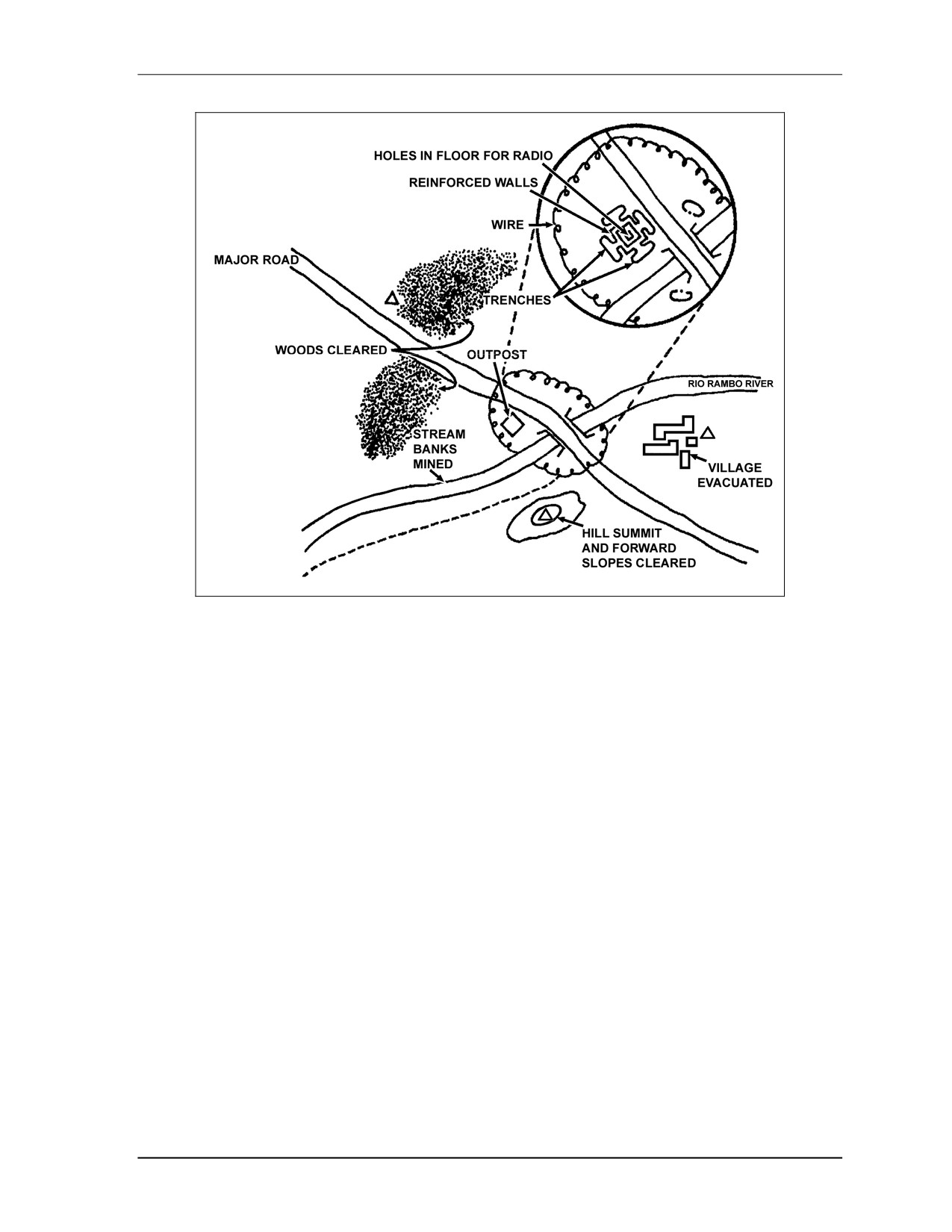
Stability Operations
Figure 6-2. Security post.
6-151. The size of the post depends on the mission, the size and characteristics of the hostile force, the
attitude of the civilian populace, and the importance of the item being secured. The post varies from a two-
Soldier bridge guard to a reinforced company securing a key communications center or civilian
community. The battalion coordinates establishment of security posts with the host nation.
6-152. The organization of a static security post varies with its size, mission, and distance from
reinforcing units. For security reasons, static security posts in remote areas are larger than the same type
post would be if located closer to supporting forces. It is organized for the security of both the installation
and the security force. The battalion must establish reliable communications between remote static security
posts and the parent unit's base.
6-153. The battalion must control access to the security post by indigenous personnel. It screens and
evacuates people living near the positions and can place informers from the local population along the
routes of approach.
6-154. The commander must give all possible consideration to Soldier comfort during the organization
and preparation of the security post. Even under the best conditions, morale suffers among Soldiers who
must operate for prolonged periods in small groups away from their parent organization.
6-155. If the static security post is far removed from other battalion units and might be isolated by enemy
action, the battalion prestocks sustaining supplies there in sufficient quantities. A static security post should
never have to depend solely on the local populace for supplies.
13 December 2006
FM 3-21.20
6-29
Chapter 6
SEARCHES
6-156. Searches are an important aspect of populace and resource control. The need to conduct search
operations or to employ search procedures is a continuous requirement. A search can orient on people,
materiel, buildings, or terrain. A search usually involves both civil police and Soldiers.
PLANNING CONSIDERATIONS
6-157. Misuse of search authority can adversely affect the outcome of operations. Soldiers must conduct
and lawfully record the seizure of contraband, evidence, intelligence material, supplies, or other minor
items for their seizure to be of future legal value. Proper use of authority during searches gains the respect
and support of the people.
6-158. Authority for search operations is carefully reviewed. Military personnel must perform searches
only in areas in military jurisdiction (or where otherwise lawful). They must conduct searches only to
apprehend suspects or to secure evidence proving an offense has been committed.
6-159. Search teams have detailed instructions for handling controlled items. Lists of prohibited or
controlled-distribution items should be widely disseminated and on hand during searches. The battalion
contacts military or civil police who work with the populace and the resource control program before the
search operations begin (or periodically if search operations are a continuing activity). Units must consider
the effect of early warning on the effectiveness of their operation.
6-160. Language difficulties can interfere when US forces conduct search operations involving the local
populace. The US units given a search mission are provided with interpreters as required.
6-161. The battalion conducts search operations slowly enough to allow for an effective search, but
rapidly enough to prevent the enemy from reacting to the threat of the search.
6-162. Soldiers use minimum-essential force to eliminate any active resistance encountered.
6-163. The battalion should develop plans for securing the search area (establishing a cordon) and for
handling detained personnel.
PROCEDURES
6-164. Search procedures are as follows:
Search of Individuals
6-165. In all search operations, leaders must emphasize the fact that anyone in an area to be searched
could be an insurgent or a sympathizer. To avoid making an enemy out of a suspect who may support the
host country government, searchers must be tactful. The greatest caution is required during the initial
handling of a person about to be searched. One member of the search team covers the other member who
makes the actual search.
(FM 3-19.40 and STP 19-95B1-SM discuss the procedure for searching
individuals.)
Search of Females
6-166. The enemy can use females for all types of tasks when they think searches might be a threat. To
counter this, use female searchers. If female searchers are not available, use doctors, aidmen, or members
of the local populace. If male Soldiers must search females, take all possible measures to prevent any
inference of sexual molestation or assault. A technique used by forces in Afghanistan to search women
using a magnetic wand metal detector was having the husband search his wife. First, the husband was
searched by the Soldiers, and then the husband used the wand on his wife. This method keeps the female
individual searches within the cultural norms of the country.
6-30
FM 3-21.20
13 December 2006
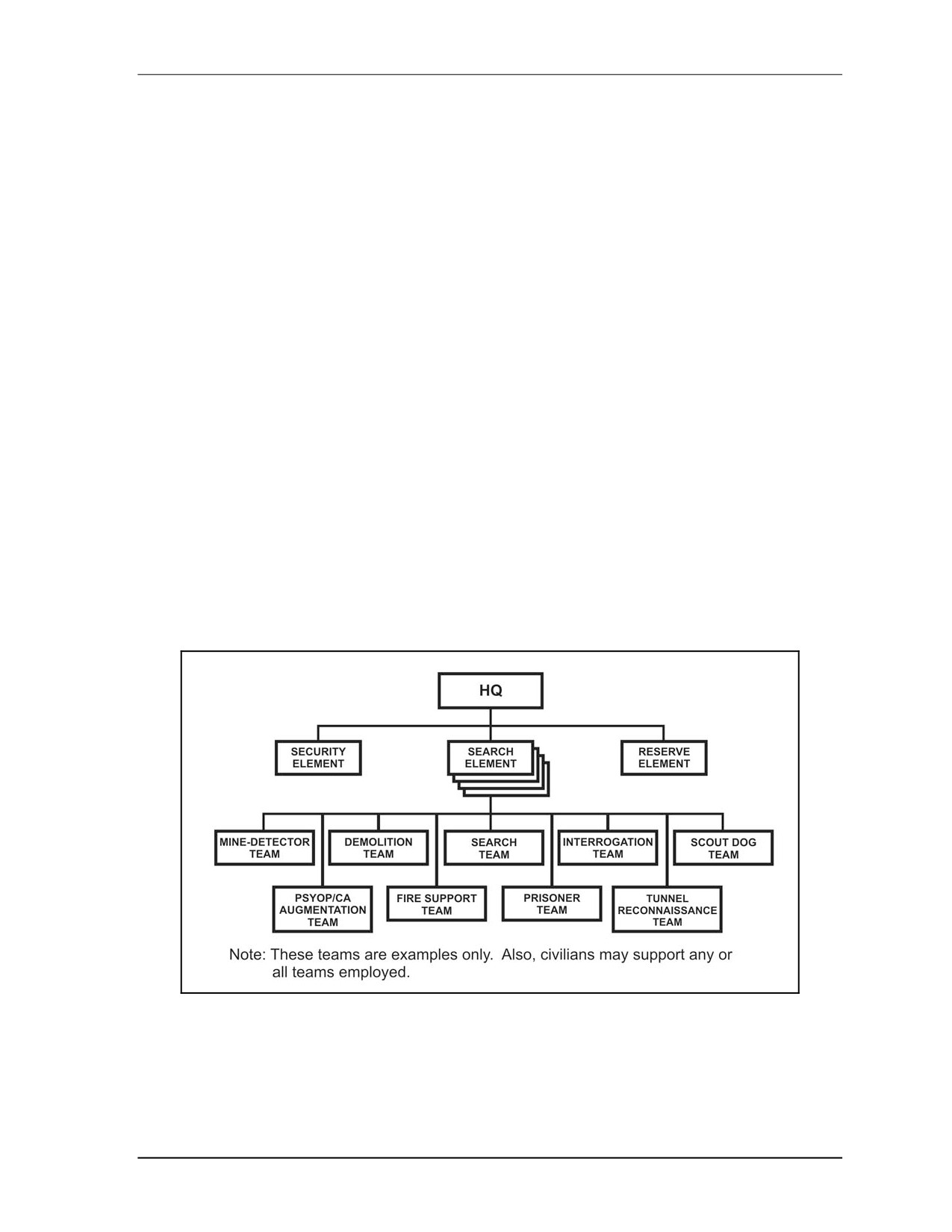
Stability Operations
Search of Vehicles
6-167. The search of vehicles may require equipment such as detection devices, mirrors, and tools.
Specially-trained dogs can locate drugs or explosives. Before the vehicle is searched, occupants may need
to be moved away from vehicles and individually searched. One technique is to have an occupant open all
doors, the trunk, and the hood. Soldiers pull security on the occupant as he conducts these actions. Then,
they move him to the individual search area and thoroughly search the vehicle. Although a thorough
vehicle search takes time, leaders must consider the effect on the population. Using a separate vehicle
search area can help avoid unnecessary delays.
Search of Built-Up Areas
6-168. These searches are also referred to as cordon-and-search operations. The principles, C2 and
procedures for this type of search, are discussed in the following paragraph. When intelligence identifies
and locates members of the insurgent infrastructure, an operation is mounted to neutralize them. All
operations must be conducted legally. This may include operations conducted by police acting on warrants
of a disinterested magistrate and based on probable cause. In the more violent stages of an insurgency,
emergency laws and regulations may dispense temporarily with some of these legal protections. Use the
least severe method to accomplish the mission adequately. Take care to preserve evidence for future
legal action.
CORDON AND SEARCH
6-169. The commander should divide the area to be searched in a built-up area into zones and assign a
search party to each zone. A search party normally consists of a security element (responsible for isolating
the objective and specific areas within the objective), a search element (responsible for entering and
searching specific focus areas and providing local security), and a reserve element
(responsible for
assisting either element, as required) (Figure 6-3).
Figure 6-3. Typical organization for search operations.
13 December 2006
FM 3-21.20
6-31
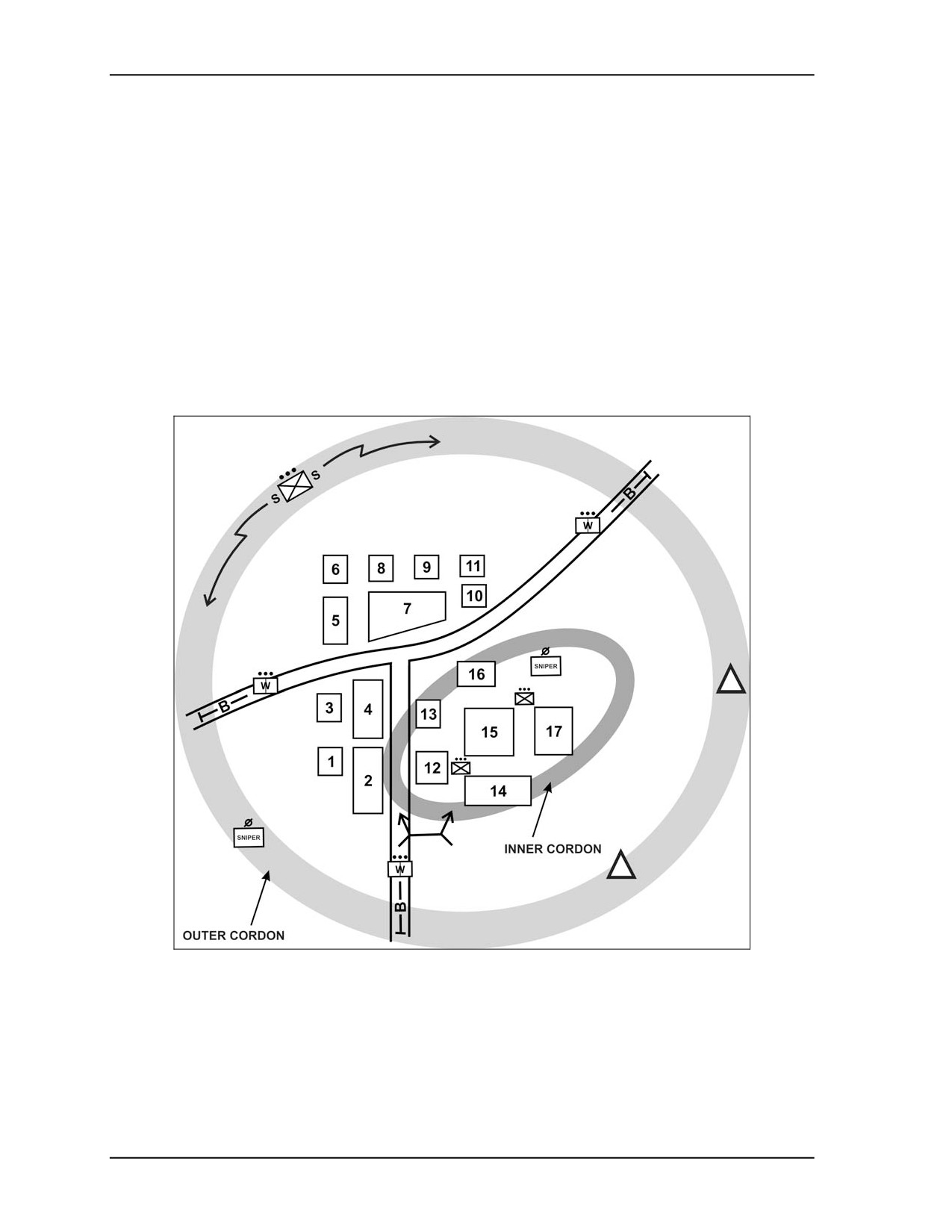
Chapter 6
Establishing Cordon
6-170. An effective cordon is critical to the success of the search effort. Cordons are designed to prevent
the escape of individuals to be searched and to protect the forces conducting the operation. The cordon not
only isolates the objective from individuals trying to escape, but prevents the insurgents with
re-enforcements from entering the objective area. Based on factors of METT-TC, two cordons may be
established: the outer cordon to focus on isolating the objective from outside, and the inner cordon to focus
on keeping individuals from escaping the objective area. However, both cordon elements must focus both
inward and outward for security purposes. The security element leader may have C2 of both the inner and
outer cordon elements. Small UAS, scout teams, or sniper teams should be considered for use in observing
the target search for enemy forces area before approach of the main body.
6-171. There are two techniques for emplacement of the cordon element(s): simultaneously or
sequentially. Careful consideration must be given to both as there are advantages and disadvantages to
both. Once the battalion has determined which techniques to use, ensure the order of march facilitates
smooth synchronized execution (Figure 6-4).
Figure 6-4. Establishment of cordon.
Outer Cordon
6-172. The outer cordon is an integral part of the security element in any cordon and search operation.
Therefore, it requires detailed planning, effective coordination, and meticulous integration and
synchronization to achieve the combined arms effects. Both lethal and nonlethal (Appendix L) effects
should be considered by the commander.
6-32
FM 3-21.20
13 December 2006
Stability Operations
6-173. Each subordinate outer cordon element (traffic control point or blocking position) must have a
designated leader and a clear task and purpose. Units and elements to consider for establishing the outer
cordon include:
• Weapons company.
• Assault platoons.
• Weapons squads (Javelin CLU equipped).
• Sniper teams.
6-174. The leader of the outer cordon maintains situational understanding in his AO to include the
progress of operations for the search elements and the outer cordon. In doing so, he can anticipate threat
activity, control direct and indirect fires, and facilitate the outer cordon task and purpose.
6-175. The security element of the outer cordon may include the following:
• Vehicle mounted platoons or sections.
• Interpreter(s).
• Detainee security teams.
• Crowd control teams.
• Observation posts.
• Traffic control points or blocking positions.
• Host nation security forces (military or police).
• Aviation.
• Dismounted platoons or squads.
• Female search teams.
Inner Cordon
6-176. The inner cordon may be under the control of the security element of the search element. It is
normally tasked with the following actions:
• Preventing exfiltration or reposition of threat forces.
• Serving as a support by fire force for search teams.
• Maintaining communications with the search element.
• Understanding the marking system and control measures.
• Seizing supporting structures in built-up areas to overwatch target area buildings
6-177. In remote areas, the battalion may establish the cordon without being detected. The use of limited
visibility aids in the establishment and security of the cordon but makes it difficult to control.
6-178. The battalion must enforce the ROE and should develop plans to handle detained personnel.
Infantrymen accompany police and intelligence forces to identify, question, and detain suspects. Infantry
may also conduct searches and assist in detaining suspects, under police supervision, but their principal
role is to reduce any resistance that may develop and to provide security for the operation. Use of force is
kept to a minimum.
Conducting Search
6-179. A search of a built-up area must be conducted with limited inconvenience to the populace; that is,
enough inconvenience to discourage insurgents and sympathizers from remaining in the locale, but not
enough to drive them to collaborate with the enemy because of the search. A large-scale search of a
built-up area is a combined civil police and military operation. Such a search should be planned in detail
and rehearsed while avoiding physical reconnaissance of the area just before the search. Aerial
photographs can provide information needed about the terrain. In larger towns or cities, the local police
might have detailed maps showing relative sizes and locations of buildings. As with any Army operation,
13 December 2006
FM 3-21.20
6-33
Chapter 6
mission analysis is critical. For success, the search plan must be simple and the search conducted swiftly.
The search element is organized into teams. These teams can include personnel and special equipment for
handling prisoners, or detainees, interrogations, documentation
(using a recorder with a camera),
demolitions, PSYOP and civil affairs, mine detection, military working dogs and tunnel reconnaissance,
interpreters, host nation security forces, aviation assets for observation or attack, TPT, THT, and female
search teams
6-180. There are three basic methods used to search a populated area: assemble inhabitants in a central
location, restrict inhabitants to their home, and control the heads of the households.
Assemble Inhabitants in a Central Location
6-181. This method is used if inhabitants appear to be hostile. It provides the most control, simplifies a
thorough search, denies insurgents an opportunity to conceal evidence, and allows for detailed
interrogation. Depending on the objective of the search, a personnel search team may be necessary in this
central location. This method has the disadvantage of taking the inhabitants away from their dwellings,
thus encouraging looting, which, in turn, engenders ill feelings. Another disadvantage in removing
inhabitants from their dwellings is that it can create an increased probability of false claims of theft and
damage from the local populace. The security element is then responsible for controlling the inhabitants.
The search element may escort individuals back to their dwellings to be present during the search or may
leave them in the central location.
Restrict Inhabitants to Their Home
6-182. This prohibits movement of civilians, allows them to stay in their dwellings, and discourages
looting. The security element must enforce this restriction. The disadvantages of this method are that it
makes control and interrogation difficult and gives inhabitants time to conceal evidence in their homes.
Control Heads of Households
6-183. The head of each household is told to remain in front of the house while everyone else in the
house is brought to a central location. The security element controls the group at the central location,
controls the head of each household, and provides external security for the search team. When dealing with
the head of the household, ensure that the unit leader explains the purpose of the search using an interpreter
(if available). During the search, the head of the household accompanies the search team through the
house. This person can be used to open doors and containers to facilitate the search. Looting is reduced,
and the head of the household sees that the search team steals nothing. This is a proven method for
controlling the populace during a search.
Searching a House
6-184. The object of a house search is to look for controlled items and to screen residents to determine if
any are suspected insurgents or sympathizers. A search party assigned to search an occupied building
should consist of at least one local policeman, a protective escort for local security, and a female searcher.
If inhabitants remain in the dwellings, the protective escort must isolate and secure the inhabitants during
the search. Escort parties and transportation must be arranged before the search of a house. Forced entry
may be necessary if a house is vacant or if an occupant refuses to allow searchers to enter. If the force
searches a house containing property while its occupants are away, it should secure the house to prevent
looting. Before US forces depart, the commander should arrange for the community to protect such houses
until the occupants return.
6-185. Make every try to leave the house in the same or better condition than when the search began. In
addition to information collection, the search team may use cameras or video recorders to establish the
condition of the house before and after the search. All sensitive material or equipment found in the house
should be documented before it is removed or collected, to include date, time, location, the person from
6-34
FM 3-21.20
13 December 2006
Stability Operations
whom it was confiscated, and the reason for the confiscation. The use of a camera can also assist in this
procedure.
OTHER CONSIDERATIONS
6-186. The reserve element is a mobile force positioned in a nearby area. Its mission is to help the search
and security elements if they meet resistance beyond their ability to handle. The reserve element can
replace or reinforce either of the other two elements if the need arises. Soldiers should treat any enemy
material found, including propaganda signs and leaflets, as if it is booby-trapped until inspection proves it
safe. Underground and underwater areas should be searched thoroughly. Any freshly excavated ground
could be a hiding place. Soldiers can use mine detectors to locate metal objects underground and
underwater.
AERIAL SEARCH OPERATIONS
6-187. Helicopter-mounted patrols escorted by armed helicopters take full advantage of the mobility and
firepower of these aircrafts.
6-188. The helicopter mounted patrols may conduct reconnaissance of an assigned area or route in
search of enemy forces. When the element locates an enemy force, it may instruct the armed helicopters to
engage the enemy force or they may land and engage the enemy by means of a ground assault. This
technique has little value in areas of dense vegetation or when a significant man-portable air defense threat
is present.
6-189. Helicopter-mounted patrols should be used only when sufficient intelligence is available to
justify their use. Even then, ground operations should be used in support of the helicopter mounted patrols.
APPREHENDED INSURGENTS
6-190. Certain principles govern actions taken when insurgents desert or surrender voluntarily and
indicate, at least in part, their attitudes and beliefs have changed. In this situation, the following
guidelines apply.
•
Confine them only for screening and processing, and keep them separate from prisoners who
exhibit no change in attitude.
•
Supervise them after their release. The supervision need not be stringent and is best
accomplished by host nation authorities, if possible.
•
Relocate them if they are in danger of reprisal from the enemy.
•
Remember they expect any promises made to induce their defection or surrender to be met.
•
Provide special handling to nonindigenous members of the insurgency who were captured.
ROADBLOCKS AND OTHER CHECKPOINTS
6-191. A related aspect of populace and resource control mentioned previously is the control of
transportation. Individuals and vehicles may be stopped during movement to assist in individual
accountability or capture of enemy personnel or to control the trafficking of restricted material. The ability
to establish roadblocks and checkpoints is an important aspect of movement control and area denial. The
fundamentals of searches, discussed previously, also apply to roadblocks and checkpoints. (FM 3-21.8 and
FM 3-21.10 provide additional information about roadblocks and checkpoints.)
6-192. Roadblocks and checkpoints help prevent traffic in contraband and stop the movement of known
or suspected insurgents. They should be manned by police or paramilitary forces, which stop vehicles and
pedestrians and conduct searches as required by conditions. They must take care to maintain legitimacy by
not targeting specific groups. Either host country or US Army combat forces defend these roadblocks and
checkpoints from enemy attack. If police strength is insufficient for the number of positions required, the
13 December 2006
FM 3-21.20
6-35
Chapter 6
Army can operate them. Whenever US Army forces operate roadblocks and checkpoints, host country
police or other forces should be present to conduct the actual stop and search. US forces should establish
communications with other elements of the site but should also remain in contact with their own chain of
command. The same principles apply to waterways as to landlines of communication.
6-193. Establish roadblocks in locations where approaching traffic cannot observe them until it is too
late to withdraw and escape. Narrow defiles, tunnels, bridges, sharp curves, and other locations that
channel traffic, are the preferred sites. Constructed nonexplosive obstacles slow traffic, restrict it to a single
lane, and bring it to a halt. An area off the main road should be used to conduct a detailed search of suspect
vehicles and people and to avoid unduly delaying innocent traffic. A small reserve using hasty field
fortifications in nearby defended areas should provide immediate support to operating personnel in case of
attack. A larger reserve, which serves a number of posts, should be capable of rapid reinforcement
(Figure 6-4).
6-194. US forces should fill the reserve role in combined operations with host nation personnel. The
reserve is vulnerable to being set up or ambushed, especially if an enemy has observed rehearsals. The
enemy may hit multiple locations simultaneously to test responsiveness or to aid his future planning.
Forces should vary locations of roadblocks and routes used (Figure 6-5).
6-36
FM 3-21.20
13 December 2006
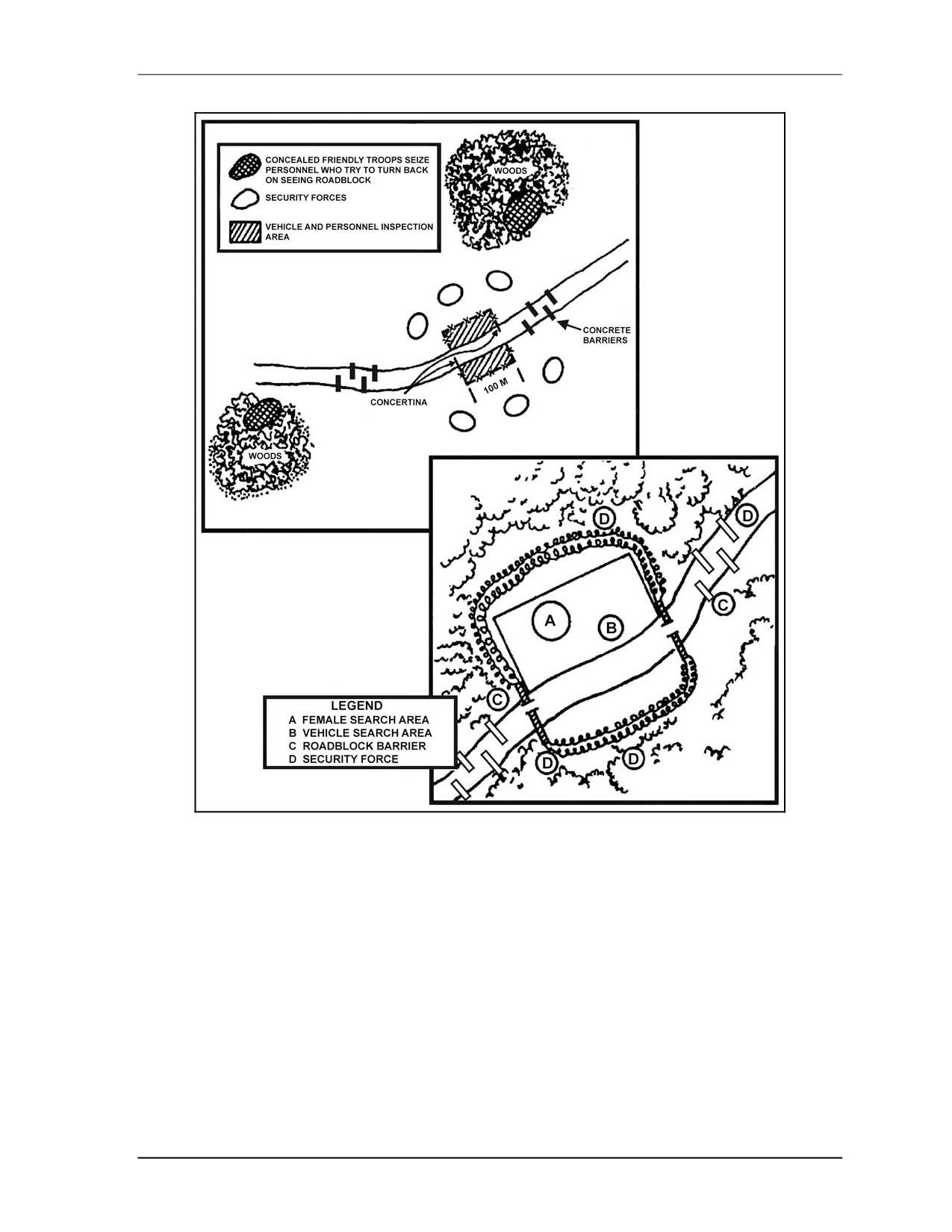
Stability Operations
Figure 6-5. Physical layout of roadblock.
13 December 2006
FM 3-21.20
6-37