FM 3-21.20 (FM 7-20) THE INFANTRY BATTALION (DECEMBER 2006) - page 12
Appendix C
Section II. PLANNING CONSIDERATIONS
The battalion commander and staff review the following planning considerations during the military
decision-making process leading to an air assault operation. For a detailed discussion of air assault planning,
see FM 90-4.
INTELLIGENCE
C-5.
The primary enemy tactics against air assault operations can be broken down into the following
four major areas:
• Air defense fires (including small arms).
• Fixed- and rotary-wing aircraft.
• Electronic warfare.
• Enemy reaction to LZ operations.
C-6.
The commander and staff must understand the capabilities and limitations of enemy aircraft in the
AO and take all measures to minimize the risk of encounter. They must analyze enemy capabilities to
interdict friendly LZs with ground forces, artillery, and CAS during the planning phase of the operation.
MOVEMENT AND MANEUVER
C-7.
Habitual relationships and the integration of Infantry and Army aviation, allow Infantrymen and
supporting fires to strike rapidly over extended distances. To provide surprise and shock effect, the
required combat power should be delivered to the objective area as early as possible, consistent with
aircraft and pickup zone capabilities. Attack helicopters, if available, are integrated into the tactical plan of
the ground force commander. During air assault operations, they additionally support the lift and assault
force by direct and indirect fires. Air assault forces operate relatively free of the terrain influences that
restrict surface operations. Air assault forces are best employed to locate and defeat enemy forces and
installations, or to seize terrain objectives to prevent enemy withdrawal, reinforcement, and supply, and to
prevent the shifting and reinforcement of enemy reserves.
C-8.
Engineers in an air assault operation assist mobility by constructing or expanding helicopter LZs
and FARPs, and by rehabilitating existing forward operational facilities. Engineers assist in breaching
obstacles and fight as Infantry when required.
FIRE SUPPORT
C-9.
FS planning provides for suppressive fires along flight routes and near LZs. Priority of fires must
be the suppression of enemy air defenses. Displacement of FS assets and resupply depends on helicopters
as prime movers unless prime movers are lifted into the area. Suppression of suspected ADA sites along
flight routes is vital to the success of an air assault operation. Naval gunfire (NGF) support and USAF CAS
may be available to augment available artillery.
PROTECTION
C-10. AD assets provide protection against low-flying aircraft and attack helicopters. Early warning of
enemy air is broadcast over the unit early warning net. Avengers, if available, are used in support of the
maneuver battalions and to protect C2 and static assets.
C-2
FM 3-21.20
13 December 2006
Air Assault Operations
SUSTAINMENT
C-11. Support of organic aviation units is extensive. FARPs are necessary to maintain the fast pace of
air assault operations. The battalion's organic assets push supplies, material, and ammunition forward by
helicopter to support the air assault operation.
COMMAND AND CONTROL
C-12. The key to successful air assault operations lies in precise, centralized planning and aggressive,
decentralized execution. The availability of aviation assets is normally the major factor in determining task
organization. Task organization is determined and announced early in the planning process. Units must
maintain tactical integrity throughout an air assault operation. Squads are normally loaded intact on the
same helicopter to ensure unit integrity upon landing.
Section III. AIR ASSAULT PLANNING STAGES
The successful execution of an air assault depends on a careful mission analysis by the commander and staff
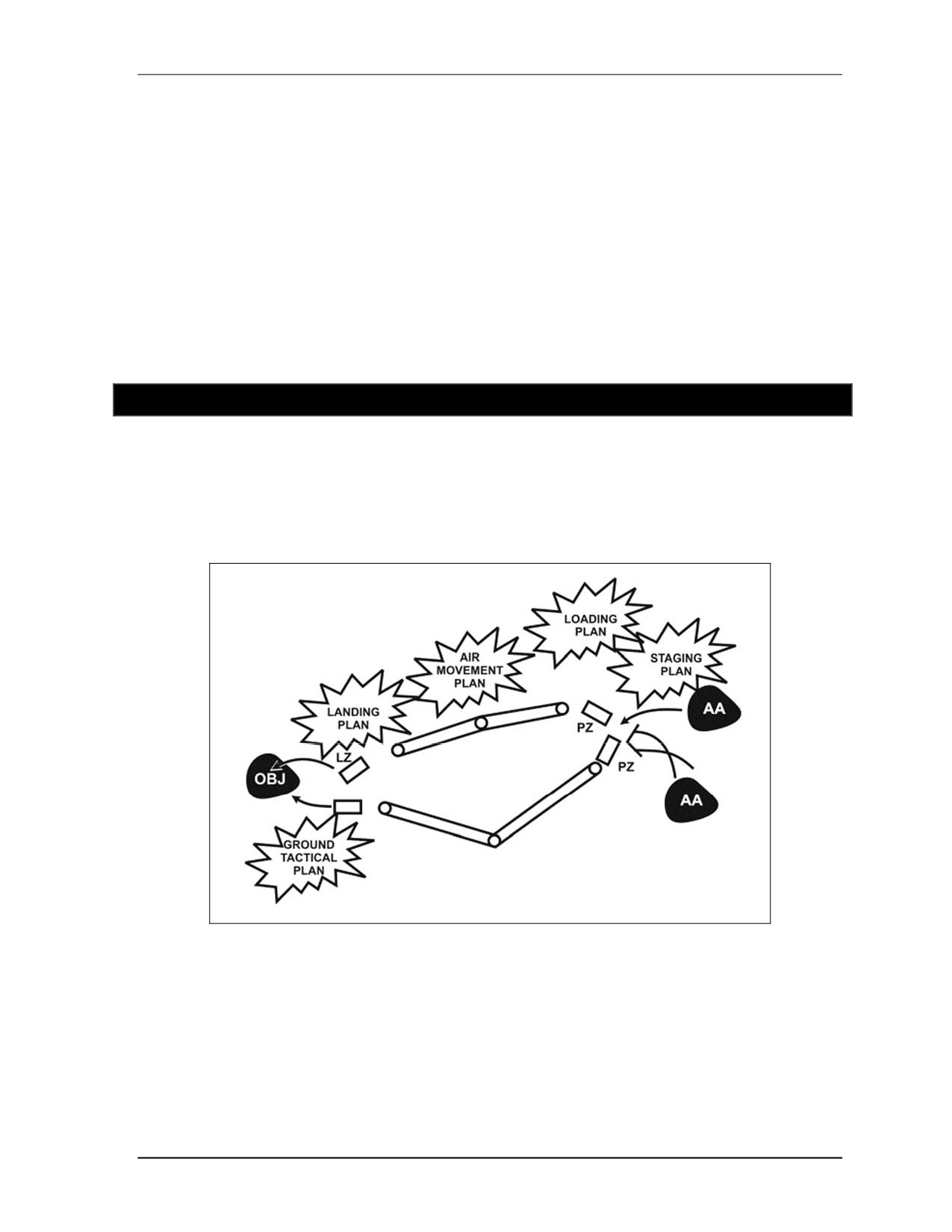
and a detailed, precise reverse planning sequence. The five basic plans that constitute an air assault operation
are the ground tactical plan, the landing plan, the air movement plan, the loading plan, and the staging plan
(Figure C-1). In operations involving units with organic combat vehicles, the ground tactical plan must also
include a linkup plan. Air assaults are planned in reverse order, beginning with the ground tactical plan and
working backwards to the staging plan.
Figure C-1. Air assault planning process.
AIR ASSAULT BATTALION TASK FORCE KEY PERSONNEL
C-13. The battalion staff is responsible for planning the air assault operation and the accompanying
battalion minus operations, developing the air assault in conjunction with the assault helicopter unit,
synchronizing all elements of the combined arms team, and allocating the necessary resources to the air
assault force to ensure successful execution of the operation.
13 December 2006
FM 3-21.20
C-3
Appendix C
AIR ASSAULT TASK FORCE COMMANDER
C-14. The air assault task force commander (AATFC) is normally the battalion commander. He has
overall responsibility for the air assault task force’s
(AATF's) planning and execution. The BCT
commander may decide to assume this role.
AIR MISSION COMMANDER
C-15. The supporting helicopter unit provides an AMC. For air assaults conducted by an aviation
company, the aviation battalion commander may designate a company commander or platoon leader to be
the AMC.
AVIATION LIAISON OFFICER
C-16. The supporting aviation unit should provide an aviation liaison officer to the AATF. He is
considered a special staff officer. His role is to advise the AATFC on all matters relating to Army aviation
and to jointly develop, along with the AATF staff, the detailed plans necessary to support the air assault
operation. During the execution phase, he should be available to assist the AATFC or S-3 in coordinating
the employment of aviation assets.
PICK-UP ZONE CONTROL OFFICER
C-17. The pickup zone control officer (PZCO) organizes, controls, and coordinates operations in PZs
selected by the AATFC. (The S-4 selects and controls logistical PZs.)
C-18. To manage operations, the PZCO forms a control group to assist him. The control group normally
includes air traffic control, subordinate units, and support personnel (manpower to clear the PZ and
security). The PZCO selects a central location to position the group. The PZCO is designated by the
AATFC, usually the S-3 Air. For battalion air assault operations, each company commander appoints a
PZCO who operates a company PZ for the battalion.
C-19. The PZCO should communicate on two primary radio frequencies: one to control movement and
loading of units, and one to control aviation elements (combat aviation net). Alternate frequencies are
provided as necessary.
C-20. The PZCO plans fires near PZs to provide all-round protection (from available support) without
endangering arrival and departure of troops or aircraft.
C-21. The PZCO ensures that adequate security is provided. Security protects the main body as it
assembles, moves to the PZ, and is lifted out. Security elements are normally provided by other forces if
the PZ is within a friendly area. Security comes from AATF resources if it is to be extracted from the
objective area.
C-22. The PZSO clears the PZ of obstacles and marks the PZ.
AIR ASSAULT ROLES
C-23. Utility helicopters and cargo helicopters are the primary aircraft used in air assault operations.
UTILITY HELICOPTERS
C-24. The primary mission of the utility helicopter in the air assault is to move troops. With the seats
installed, the allowable cabin load (ACL) for the UH-60 is 11 combat-loaded Soldiers. If the seats are
removed, the ACL increases. The ACL then depends on the type of equipment being carried by the troops.
For planning purposes, a UH-60 can transporting about 16 combat-loaded troops.
C-4
FM 3-21.20
13 December 2006
Air Assault Operations
CARGO HELICOPTERS
C-25. The CH-47D helicopter provides the AATFC with the capability of moving troops and equipment
in support of the air assault. In a troop-carrying mode, the CH-47D can transport up to
31
combat-loaded troops.
GROUND TACTICAL PLAN
C-26. The foundation of a successful air assault is the ground tactical plan. All other air assault planning
stages are based on the ground tactical plan, which specifies actions in the objective area that will lead to
accomplishment of the mission. The ground tactical plan addresses the following areas:
• Missions of all battalion elements and methods for employment.
• Zones of attack, sectors, or areas of operations with graphic control measures.
• Task organization to include command relationships.
• Location and size of reserves.
• Fire support to include graphic control measures.
• Sustainment.
Note. The AATF staff prepares this plan with input from all battalion elements and in
sufficient detail to facilitate understanding by subordinate commanders. It is imperative that
all aircrews know this ground tactical plan and the ground commander's intent.
COMMANDER'S INTENT
C-27. The AATFC articulates his intent for the air assault early in the planning process. Air assault
planning often begins after the AATFC issues his intent even though the ground tactical plan may not be
complete. The commander's intent for the air assault allows planners to understand the method and end
state and to begin to piece together the subsequent plans. The commander's intent for the air assault
includes things such as whether the assault force will land on the objective or land near it and maneuver to
it. The commander's intent for the air assault may include surprise as a critical element, which leads to the
development of fire support and SEAD plans.
ORGANIZATION FOR COMBAT
C-28. The mission, enemy situation, terrain, maneuver forces, and fire support assets all help air assault
planners determine the battalion organization for combat. Planners emphasize—
• Maximizing combat power in the assault to heighten surprise and shock effect. This is
especially important if the air assault force plans to land on or near the objective.
• Ensuring the battalion inserts the minimum essential force to accomplish initial objectives
quickly. The air assault force must be massed in the LZ and build up significant combat power
early to prevent being defeated by repositioning enemy forces.
• Ensuring the air assault force has sufficient assets to sustain it until linkup.
SCHEME OF MANEUVER
C-29. The AATFC develops a scheme of maneuver to accomplish his mission and seize assigned
objectives. Scheme of maneuver development by the battalion headquarters allows subsequent planning
phases of the air assault to be accomplished and must be done before development of the air assault.
Development of the battalion ground tactical plan need not be complete to begin air assault mission
planning. As a minimum, the AATFC must provide the ground scheme of maneuver for air assault
13 December 2006
FM 3-21.20
C-5
Appendix C
planning to begin. Battalion planners should not wait for the completed assault force OPORD to begin
planning. The battalion staff and aviation units can begin air assault planning as soon as the assault force
commander approves the general scheme of maneuver.
FIRE SUPPORT
C-30. The amount of artillery available to support the air assault and the locations of supporting artillery
units are critical factors in determining the ground tactical plan. Once the initial assault force has deployed
to the LZ, they are often out of range of conventional artillery. Indirect fire support planning should
include mortars, MLRS or ATACMS, and close air support.
ATTACK HELICOPTERS IN SUPPORT OF GROUND TACTICAL PLAN
C-31. During the ground fight, attack helicopters may assist the assault force commander by providing
reconnaissance near the LZs, destroying repositioning forces, destroying counterattacking forces, and
calling for and adjusting fire on targets of opportunity. A shift in C2 from the AMC to the assault force
commander is critical and must be planned and rehearsed in detail. During an air assault with multiple lifts,
the attack helicopters support the air assault and ground fight. (Some elements provide reconnaissance and
security for the air assault; other elements screen for the assault force.) Synchronization of the attack assets
must be precise and detailed to eliminate confusion and to avoid disrupting the air assault flow.
LANDING PLAN
C-32. The scheme of maneuver and ground tactical plan directly affects the selection of LZs, the landing
formation, and the amount of combat power air assaulted into the LZ. The landing plan is planned in
conjunction with the development of the ground tactical plan and supports the assault force commander's
intent and scheme of maneuver. The landing plan outlines the distribution, timing, and sequencing of
aircraft into the LZ.
LZ SELECTION
C-33. In coordination with the AMC and LNO, the AATFC selects primary and alternate LZs. The
number of selected LZs is based on the ground scheme of maneuver and LZ availability. The aviation
planners advise the AATFC on LZ suitability. The considerations for selecting suitable landing zones
are—
Location
C-34. The LZ must be in an area supporting the ground tactical plan of the AATFC. It may be located
on the objective, close by, or at a distance.
Capacity
C-35. The selected LZ must be big enough to support the number of aircraft the AATFC requires on air
assault lifts.
Enemy Disposition and Capabilities
C-36. The AMC must consider enemy air defense locations, weapons ranges and the ability of the
enemy to reposition ground forces to react to the air assault.
C-6
FM 3-21.20
13 December 2006
Air Assault Operations
Unit Tactical Integrity
C-37. Squads land in the LZ intact, and platoons land in the same serial. Vehicle crews land with their
vehicles. This ensures fighting unit integrity during the air assault.
Supporting Fires
C-38. LZs selected must be in range of supporting fires (artillery, CAS, and naval gunfire).
Obstacles
C-39. LZ selection includes existing obstacles on the LZ as well as plans for reinforcing them. LZs
should be selected beyond enemy obstacles.
Identification from Air
C-40. The LZ should be identifiable from the air, if possible.
ATTACK HELICOPTERS IN SUPPORT OF LANDING PLAN
C-41. During execution of the landing plan, attack helicopters can provide overwatch of the LZs,
conduct a reconnaissance of the egress flight routes, call for fire (if designated to do so), and set up a
screen for supporting the assault force commander during the ground tactical plan. The AMC must ensure
that the missions of the attack aircraft are synchronized with the assault helicopters.
AIR MOVEMENT PLAN
C-42. The air movement plan is based on the ground tactical and landing plans. It specifies the schedule
and provides instructions for the movement of troops, equipment, and supplies from the PZ to the LZ. It
provides coordinating instructions regarding air routes, air control points (ACPs), aircraft speeds, altitudes,
formations, and fire support. The AATFC develops the air movement plan in conjunction with the AMC
and flight lead. The air movement plan results in the production of the air movement table.
C-43. Selection of flight routes is always based on the factors of METT-TC. The battalion staff and the
AMC consider the location of friendly troops, enemy disposition, air defense systems, terrain, and the
locations of the PZ and LZ to select the best flight route. Selected flight routes should always be laid over
the enemy situational template produced by the S-2 to ensure that the flight route selected avoids known or
suspected enemy positions.
C-44. The battalion staff and the AMC select primary and alternate flight routes. Alternate flight routes
provide the assault force a preplanned, precoordinated method of moving from the PZ to LZ if the primary
route becomes compromised.
C-45. Flight routes that pass through adjacent unit sectors must be coordinated and approved by the
adjacent unit to avoid potential fratricide.
C-46. When selecting flight routes, the AMC and battalion staff must consider—
• Airspace management.
• Support of the landing plan.
• Enemy capabilities.
• Fire support.
• Flight route distance.
• Number of aircraft.
13 December 2006
FM 3-21.20
C-7
Appendix C
C-47. Attack helicopters can be used in support of the air movement plan. During the air movement
phase, the air assault security forces provide reconnaissance and security for the assault helicopters.
LOADING PLAN
C-48. The AATFC bases the loading plan on the air movement and ground tactical plans. The loading
plan ensures troops, equipment, and supplies are loaded on the correct aircraft. It establishes the priority of
loads, the bump plan, and the cross loading of equipment and personnel. Detailed load planning ensures the
battalion arrives at the LZ configured to support the ground tactical plan. A bump plan that ensures
essential troops and equipment are loaded ahead of less critical loads. Planning for the loading plan must
include the organization and operation of the PZ, the loading of aircraft, and the bump plan.
PICKUP ZONE SELECTION
C-49. The first step in the loading plan is selection of suitable primary and alternate PZs. Selection of
PZs is based on—
• METT-TC.
• Commander's intent.
• Location of assault forces in relation to PZs.
• Size and capabilities of available PZs.
• Number of PZs.
• Proximity to troops.
• Accessibility.
• Vulnerability to attack.
• Surface conditions.
PICKUP ZONE CONTROL
C-50. Once the AATFC selects the PZ, the PZ control officer
(PZCO) organizes, controls, and
coordinates PZ operation.
AVIATION INVOLVEMENT
C-51. The assault helicopter unit must ensure aviation expertise is present on the PZ.
PICKUP ZONE COMMUNICATIONS
C-52. Communications must use the most secure means available. PZ operations may be conducted
under radio listening silence to avoid electronic detection. This requires detailed planning. If under radio
listening silence, it is imperative that aircrews remain on schedule to allow the PZCO to keep a smooth
flow of troops from the PZ. PZ communications are accomplished on the established FM PZ control net,
with transmissions kept to a minimum.
PICKUP ZONE MARKING
C-53. The PZCO directs the marking of the PZ so the PZ is identifiable from the air. Far and near
recognition signals are needed, especially at night, to allow pilots to orient on the PZ quickly. Touchdown
points must be clearly marked. The PZCO must ensure no other lighting is on the PZ.
C-8
FM 3-21.20
13 December 2006
Air Assault Operations
DISPOSITION OF LOADS ON PICKUP ZONE
C-54. Personnel and equipment must be positioned on the PZ to conform to the landing formation.
Flight crews must understand the loading plan on the PZ and be prepared to accept troops and equipment
immediately upon landing. PZ sketches showing locations of loads in the PZ assist flight crews in loading
troops and equipment quickly once the aircraft arrive in the PZ. Flight crews should be provided a PZ
diagram.
ATTACK HELICOPTERS IN SUPPORT OF LOADING PLAN
C-55. During the loading phase, attack helicopters assist by providing overwatch of the PZs and
conducting a route reconnaissance of the air assault flight routes.
STAGING PLAN
C-56. The staging plan is based on the loading plan and prescribes the proper order for movement of
personnel and aircraft to the PZ. Loads must be ready before the aircraft arrive at the PZ. During mission
planning, the PZCO determines the time required for setting up the PZ, and selects times the PZ will be
established (based upon the air assault H-hour).
MISSION PLANNING
C-57. Mission planning includes coordination between the battalion and the AMC, development of the
aviation OPORD, issuance of the OPORD, and rehearsals.
ROUTES TO PICKUP ZONE
C-58. The AMC must select flight routes to the PZ that allow the aircraft to arrive at the PZ on time and
in the proper landing direction and configuration to accept loads.
13 December 2006
FM 3-21.20
C-9
This page intentionally left blank.
Appendix D
Heavy and Stryker
Employing Infantry forces with heavy and Stryker units is a combat multiplier. These
operations take advantage of the Infantry unit’s ability to operate in severely
restricted terrain, such as urban areas, forests, and mountains, combined with the
mobility and firepower inherent in heavy and Stryker units. To ensure heavy, Stryker
and Infantry assets are integrated and synchronized, forces should be mutually
supporting based on the commander’s concept of employment. This appendix
addresses conditions Infantry commanders must consider when planning and
executing tactical operations with heavy, or Stryker forces, operating as part of an
HBCT or SBCT. The following terms are used throughout the appendix:
Heavy
Refers to units with BFVs or M1 Abrams tanks.
Stryker
Refers to units with Stryker Infantry carrier vehicles
(ICVs) and
Stryker mobile gun system (MGS) vehicles.
Mounted
Refers to units with BFVs or M1 Abrams tanks, and both Stryker
vehicles.
Infantry
Refers to all Infantry, including air assault and airborne trained
Infantry, and Ranger units.
Section I. MISSIONS, CAPABILITIES, AND LIMITATIONS
Across the spectrum of operations, there is an overlap in which heavy, Stryker and Infantry forces can operate.
The use of a mixed force in this overlap takes advantage of the strengths of the forces and offsets their
respective weaknesses. Heavy/Infantry operations occur when an Infantry force is supporting a heavy force.
Infantry/heavy operations occur when an heavy force is supporting an Infantry force. Motorized unit operations
occur when, due to mission requirements, some type of army unit gets a mission requiring the use of wheeled
vehicles for movement. The unit can be a wheeled vehicle-equipped unit such as a Stryker unit or one
augmented with wheeled vehicles. The addition of wheeled vehicles provides the unit with increased agility and
provides them the flexibility to accomplish their missions. The integration of heavy, Stryker, and Infantry
forces enhances the friendly force ability to take advantage of the enemy force’s structure and to attack its
weaknesses and seize the initiative. Table D-1, page D-2, compares the capabilities of the IBCT Infantry
battalions, the HBCT Combined Arms Battalions, and the SBCT Infantry battalions; Table D-2, page D-3,
compares their limitations.
13 December 2006
FM 3-21.20
D-1

Appendix D
Table D-1. Infantry battalion capabilities
CAPABILITIES
IBCT INFANTRY
HBCT COMBINED ARMS
SBCT INFANTRY
Conduct offensive, defensive,
Conduct offensive, defensive, stability
Conduct offensive, defensive, stability
stability operations and civil support
operations, and civil support operations
operations, and civil support operations in
operations in all types of
in most environments. Specially suited
most environments. Specially suited for
environments. Specially suited for
to defeat heavy enemy forces and
rapid entry and provide mobile, limited
restricted and severely restricted
provide mobile protected firepower in
protected firepower.
terrain.
urban terrain.
Screen and guard friendly units.
Conduct security operations [screen,
Screen and guard friendly units.
guard, and cover (as part of the HBCT)]
for a larger force.
Exploit success and pursue limited
Exploit success and pursue a defeated
Exploit success and pursue a defeated
mobility opponents.
enemy as part of a larger formation.
enemy as part of a larger formation.
Can move through any terrain.
Accomplish rapid movement and limited
Tactically mobile.
penetrations.
Seize, secure, occupy, and retain
Seize, secure, occupy, and retain
Seize, secure, occupy, and retain terrain.
terrain.
terrain.
Destroy, neutralize, suppress,
Destroy, neutralize, suppress, interdict,
Destroy, neutralize, suppress, interdict,
interdict, disrupt, block, canalize,
disrupt, block, canalize, and fix enemy
disrupt, block, canalize, and fix enemy
and fix enemy forces.
forces.
forces.
Breach enemy obstacles.
Breach enemy obstacles.
Breach enemy obstacles.
Reconnoiter, deny, bypass, clear,
Reconnoiter, deny, bypass, clear,
Reconnoiter, deny, bypass, clear, contain,
contain, and isolate (terrain or
contain, and isolate (terrain or enemy).
and isolate (terrain or enemy).
enemy).
Weapons company allows
Combined Arms Battalions have
Assigned companies are built as combined
significant task organization options.
assigned tank, mechanized and
arms teams.
engineer companies that habitually
work together.
Operate in conjunction with
Operate in conjunction with
Operate in conjunction with IBCT/HBCT,
SBCT/HBCT, joint, interagency,
IBCT/SBCT, joint, interagency,
joint, interagency, multinational, or Special
multinational, or Special Operations
multinational, or Special Operations
Operations Forces.
Forces.
Forces.
Conduct small-unit operations in all
Conduct small-unit operations in most
Conduct small-scale operations in all types
types of environments.
types of environments.
of environments.
Conduct amphibious operations.
Conduct amphibious operations.
Conduct air assault (and airborne,
Conduct limited air assault operations.
Conduct air assault operations.
for selected units) operations.
High strategic mobility.
High tactical mobility.
Good mix of strategic mobility and tactical
mobility
Requires relatively small resupply.
Assigned sustainment can resupply for
Conduct sustained combat operations for 72
24-48 hours.
hours in all environments.
D-2
FM 3-21.20
13 December 2006

Heavy and Stryker
Table D-2. Infantry battalion limitations.
LIMITATIONS
IBCT INFANTRY
HBCT COMBINED ARMS
SBCT INFANTRY
Especially vulnerable to enemy
Heavily reliant on lightly armored
Vulnerable to enemy direct fires, CBRN,
fires, CBRN, and enemy air.
sustainment vehicle support
and enemy air.
(especially CL III) to conduct sustained
operations.
Sustainment structure may require
Large volume sustainment transport
Sustainment structure may require external
external support for independent
vulnerable to enemy action;
support for full-spectrum operations.
operations.
sustainment activities require large
footprint.
Lacks the firepower, mobility, and
Mobility and firepower are reduced by
Dense jungles and forests, very steep and
protection to conduct sustained
restricted and severely restricted
rugged terrain, and significant water
combat against an armored force.
terrain.
obstacles.
Foot mobile; organic vehicles
Strategic mobility is limited by
Vehicles are designed for transport more
cannot move all Soldiers at one
substantial quantities of heavy
than direct fires engagement against
time.
equipment.
conventional forces.
Excellent mobility through all terrain
Fewer riflemen on the ground than
Reduced C2 during dismounted
limited by slow rate of movement.
IBCT or SBCT Infantry Battalions
operations.
Soldiers very dependent on
Consumption of supply items is very
Consumption of supply items is high,
resupply.
high, especially Classes III, V, and IX.
especially Classes III, V, and IX.
MOUNTED AND INFANTRY
D-1.
The potential to use mounted and Infantry forces at the same time as part of a military operations
is unlimited. Their synergistic efforts build on their strengths and offset their weaknesses.
MISSIONS
D-2.
The ability to interject Infantry forces into a theater of war dominated by friendly mounted forces
gives the commander a flexible response to increasing tensions and a rapid response in the face of a sudden
all-out attack. Mounted and Infantry forces are routinely cross-attached and task-organized from the BCT
level down to the platoon and even section level. The decision to task-organize forces is based on echelons
above the BCT or JTF-level war planning, or on a subordinate commander’s request for augmentation. In
all cases, METT-TC drives the decision to use mounted and Infantry forces together.
CAPABILITIES
D-3.
An advantage of mixing mounted and Infantry forces is greater tactical flexibility for the
maneuver commander. In the offense, the Infantry force can infiltrate by ground or air to seize and hold
restricted and severely restricted terrain, allowing the mounted force to move faster. Also, Infantry can
execute tasks that mounted forces might lack the manpower or training to perform such as attacking in
restricted terrain to defeat enemy Infantry in prepared positions. In the defense, the Infantry force can
defend in restricted and severely restricted terrain and allow the mounted force to mass its systems along
the enemy's primary mounted avenue of approach. Along with such flexibility, the integrated force also has
the advantage of the mobility and firepower inherent in mounted units.
LIMITATIONS
D-4.
The challenge of combining mounted and Infantry is to understand the capabilities and limitations
of each type of force structure (Table D-1 and Table D-2); then planning and executing to compensate for
13 December 2006
FM 3-21.20
D-3
Appendix D
these challenges. Two major challenges are to understand and adjust for the differences in operational
tempo and sustainment requirements.
MOUNTED ONLY
D-5.
An IBCT or smaller Infantry unit operating with mounted forces should consider the following
missions, capabilities, and limitations of armored forces. For a comparison with the other types of Infantry
forces, see Table D-1 (capabilites) and Table D-2 (limitations):
MISSIONS
D-6.
The missions given to mounted forces are best suited for unrestricted terrain.
CAPABILITIES
D-7.
Mounted forces have the capability to—
• Conduct sustained combat operations in all environments.
• Accomplish rapid movement and deep penetrations.
• Exploit success and pursue a defeated enemy as part of a larger formation.
• Conduct security operations (advance, flank, and rear guard) for a larger force.
• Conduct defensive operations or delay in sector over large areas.
• Conduct offensive operations.
• Conduct operations with Infantry and special operations forces.
• Conduct stability operations and civil support operations.
• Heavy forces can deploy personnel task-organized to an AO onto pre-positioned equipment.
• Currently, all Stryker forces have an enhanced common operational picture.
LIMITATIONS
D-8.
Mounted forces in general, have restricted mobility in jungles, dense forests, steep and rugged
terrain, built-up areas, and water obstacles. The following are other limitations of mounted forces:
• They have a high consumption rate of supply items, especially Classes III, V, and IX.
• They are vulnerable to antiarmor weapons and mines.
• Heavy forces, and to a lesser degree Stryker units, are not organized to conduct long duration
or continuous dismounted Infantry operations.
• Mounted forces require a secure ground line of communication.
• Heavy forces have limited strategic mobility.
INFANTRY ONLY
D-9.
The Infantry organizations vary in capabilities and limitations and in their impact on the
heavy force. For a comparison with the other types of Infantry forces, see Table D-1 (capabilites) and
Table D-2 (limitations).
MISSIONS
D-10. The missions given to an IBCT must consider the enemy’s armored superiority in mobility and
firepower. The IBCT must offset its vulnerabilities with dispersion, cover and concealment, and use of
close and hindering terrain to slow the enemy. Table D-3 provides examples of possible light Infantry
tasks.
D-4
FM 3-21.20
13 December 2006

Heavy and Stryker
Table D-3. Examples of possible tasks.
Mounted Battalion Missions
Infantry Company Task
Movement to Contact
Clear and secure restricted areas; follow and support.
Air-assault to fix or destroy enemy targets; infiltrate or air-assault
Attack
to seize objectives; breach obstacles; create a penetration.
Exploitation
Secure LOC; air-assault to seize terrain or attack enemy forces.
Pursuit
Clear bypassed forces; air-assault to block enemy escape.
Follow and Support
Secure key terrain and LOC; provide rear security.
Block dismounted avenues; perform security tasks; occupy
Defense
strongpoint; ambush; provide rear area security; conduct urban
operations.
Linkup
Serve as follow-up echelon.
Demonstration
Conduct display operations.
Provide rear security, clear routes and occupy positions in depth;
Retrograde Operations
perform reconnaissance or deception; conduct stay-behind
operations.
CAPABILITIES
D-11. Infantry forces have the capabilities to perform the following actions:
• Seize, occupy, and hold terrain.
• Move on foot or by aircraft, truck, or amphibious vehicle.
• Move in all types of terrain.
• Conduct operations with heavy and Stryker forces.
• Conduct covert breaches.
• Conduct air assault and airborne (training dependent) operations.
• Take part in counterinsurgency operations within a larger unit.
• Rapidly accept and integrate augmenting forces.
LIMITATIONS
D-12. Infantry forces have the following limitations:
• They must depend on nonorganic transportation for rapid movement over long distances.
• They require external support when they must operate for an extended period.
• Unless dug in with overhead cover, they are extremely vulnerable to indirect fires.
• Unless dug in, they are vulnerable in open terrain to long-range direct fires.
13 December 2006
FM 3-21.20
D-5
Appendix D
Section II. PLANNING CONSIDERATIONS
Employment of mounted and Infantry forces requires thorough integration of the operating systems of all units.
Cross attaching Infantry and mounted forces only to the BCT level, leads to less than optimal mission
accomplishment. Task organizing Infantry and mounted forces to the battalion/task force and even to the
platoon and section levels can take full advantage of the capabilities of the different forces. However, task
organizing at each lower level causes increasing strain on the WFF, especially the sustainment WFF system and
it must be planned and executed with increased commander’s emphasis. This section focuses on planning
considerations for each of the seven operating systems.
FIRE SUPPORT
D-13. The mounted force must recognize that Infantry operations focus on stealth, which might not
allow for preparatory and other preliminary fires. Fire support available to each force must be integrated
into the fire support plan. Planners must know the organizations, capabilities, and limitations of all forces
involved, particularly digital and nondigital capabilities. In addition, planners should consider the
possibility of limited continuous fire support for the Infantry. Fire support from the Infantry’s DS artillery
may be interrupted due to the battalion’s towed howitzers operating in a mounted/Infantry force offensive
operation. During planning and preparation, a liaison team helps synchronize fire support. Restricted fire
control measures must be jointly developed and understood by everyone.
MOVEMENT AND MANEUVER
D-14. Either the Infantry or mounted force can fix the enemy which allows the other force to maneuver.
Whether it conducts the fixing operation or maneuver, the Infantry force requires the advantage of
restricted terrain. The following maneuver considerations apply during employment.
OPERATIONAL TEMPO
D-15. The differences between the operational tempo of Infantry and that of mounted forces are always
a key consideration, as are rehearsal schedules. An early rehearsal may be required, both to allow units to
take part jointly and to resolve the operational differences effectively.
EMPLOYMENT
D-16. Infantry is best suited to restricted and severely restricted terrain in that it can impede the enemy’s
mobility, and nullify his ability to use long-range weapons and observation assets.
MOVEMENT
D-17. To help prevent detection, leaders should plan the movement to coincide with limited visibility
conditions such as darkness, severe weather, smoke, or fog.
D-18. A common obstacle plan must be developed for all operations. Infantry forces may be used to
reduce obstacles and clear choke points for the mounted forces. In breaching operations, Infantry forces
must ensure the breach is large enough for the widest vehicle in the operation.
FIRES
D-19. Direct and indirect fires should be mutually supporting during integrated operations. The mounted
forces can use their long-range direct fires to provide suppression, allowing Infantry units to maneuver.
Conversely, Infantry forces can provide overwatch or support by fire to the mounted forces, which allows
M1s, BFVs, Stryker ICVs and MGSs to maneuver in restricted terrain.
D-6
FM 3-21.20
13 December 2006
Heavy and Stryker
INFILTRATION
D-20. Mounted forces can assist infiltration of the Infantry forces by augmenting security at the LD.
They can use their thermal capability to scan the area for enemy forces and can provide direct fire support
as necessary.
PROTECTION
D-21. Air defense assets may be deployed to fight and provide protection within the scope and design of
any organization. Because Infantry forces frequently maneuver in restricted terrain, Avenger coverage may
not be feasible. In such operations, man-portable Stingers should be allocated to support the Infantry.
D-22. The Infantry force lacks decontamination equipment and is more limited in a CBRN environment
than the mounted force. The need to carry protective clothing in addition to standard loads affects the
mobility of the Infantry force Soldiers. When the IBCT and the higher echelon headquarters cannot
provide transportation assets, and enemy CBRN use is possible, planners should consider using
HBCT/SBCT assets to transport the Infantry force equipment. HBCTs and SBCTs have water-hauling
capabilities they can use to offset Infantry shortfalls. Transporting such items with these assets reduces the
load of Infantry units. Commanders must consider METT-TC and must plan linkup points to ensure the
Infantry unit obtains these critical items as it needs them.
D-23. Survivability remains the priority for Infantry forces, which must prepare to take advantage of the
engineer assets available to the mounted forces and the engineer company that normally supports a
combined arms battalion.
COMMAND AND CONTROL
D-24. The directing HQ designates command relationships between the forces. The command
relationship between units can be either attached or OPCON. An Infantry unit attached to a mounted unit
can normally be adequately supported. Attachment of a mounted unit to an Infantry unit, however, requires
considerable maneuver and sustainment support from the mounted unit’s parent organization or from
higher-level support assets.
COMMUNICATIONS
D-25. Infantry units normally have considerably less digital and long-range communications capability
than mounted forces. The controlling unit must therefore thoroughly analyze the communication
requirements of an attached Infantry unit.
LIAISON OFFICERS
D-26. Units normally exchange LNOs, who assist in operational planning, coordinate the development
of orders and overlays, and serve as advisors to the counterpart units. In addition, leaders from the attached
unit may be required to perform special functions in the different organizational configurations.
INTELLIGENCE
D-27. Detailed intelligence is critical in integrating Infantry with mounted forces. Infantry forces orient
on concentrations of enemy units, including counterattack forces and artillery and air defense assets; they
also focus on the enemy’s Infantry assembly areas, LZs and PZs.
SUSTAINMENT
D-28. Infantry units are not organized, equipped, or trained to meet the support requirements of a
mounted force. The Infantry force relies on considerable assistance from the mounted support elements
13 December 2006
FM 3-21.20
D-7
Appendix D
and/or from support assets at echelons above the BCT. Mounted units, however, should be able to provide
support to an Infantry element. For a more detailed discussion of sustainment considerations, see Section V
of this appendix.
DISMOUNTED INFANTRY MOVEMENT RATES
D-29. Commanders of mounted forces often overestimate the speed with which Infantry can move.
Numerous factors can affect the rate of march for the Infantry forces; tactical considerations, weather,
terrain, march discipline, acclimatization, availability of water and rations, morale, individual Soldiers’
self-confidence, and individual loads. Table D-4 summarizes dismounted rates of march for normal terrain.
The normal distance covered by a dismounted force in a 24-hour period is from 20 to 32 kilometers,
marching from 5 to 8 hours at a rate of 4 kilometers per hour. A march in excess of 32 kilometers in 24
hours is considered a forced march. Forced marches increase the number of hours marched, not the rate of
march, and can be expected to impair the unit’s fighting efficiency. Absolute maximum distances for
dismounted marches are 56 kilometers in 24 hours, 96 kilometers in 48 hours, or 128 kilometers in
72 hours.
Table D-4. Dismounted rates of march (normal terrain).
ROADS
CROSS-COUNTRY
Day
4.0 kph
2.4 kph
Night
3.2 kph
1.6 kph
TANK MOUNTED INFANTRY
D-30. An additional maneuver consideration for an Infantry mounted or mounted Infantry operation is
the decision of whether to physically move Infantrymen on tanks. This mode of transportation can be
difficult but is not impossible; it does, in fact, afford some significant advantages. The mounted Infantry
can provide additional security for the tanks. When the team conducts a halt or must execute a breach or
other tactical tasks, Infantry assets are readily available to provide support and security. The commander
must weigh the potential dangers of carrying tank-mounted Infantrymen against the advantages of mobility
and security they can provide. For specific procedures and safety considerations involved in mounting
Infantry on tanks, see FM 3-20.15.
SAFETY
D-31. Initially, most Infantrymen are not familiar with the hazards that may arise during operations with
M1s, BFVs, Stryker ICVs, Stryker MGS and other armored vehicles. The most obvious of these include
the dangers associated with main-gun fire and the inability of mounted vehicle crews to see people and
objects near their vehicles. Leaders must ensure that Soldiers understand the following points of
operational safety.
DISCARDING SABOT
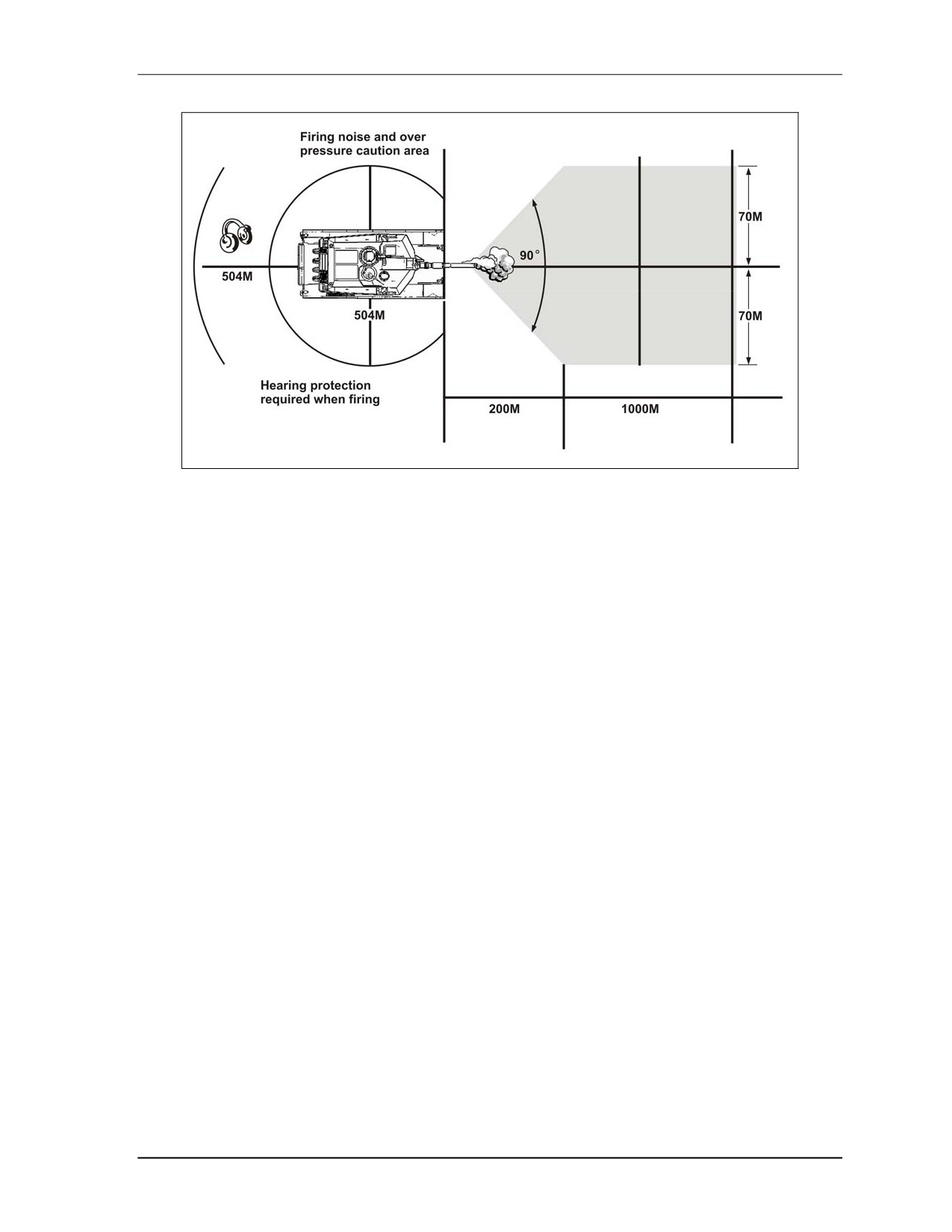
D-32. M1 and MGS sabot rounds and BFV armor piercing rounds discard stabilizing petals when fired
creating a downrange hazard for Infantry. The aluminum petals of the tank rounds are discarded in an area
extending 70 meters to the left and right of the gun-target line, out to a range of 1 kilometer (Figure D-1).
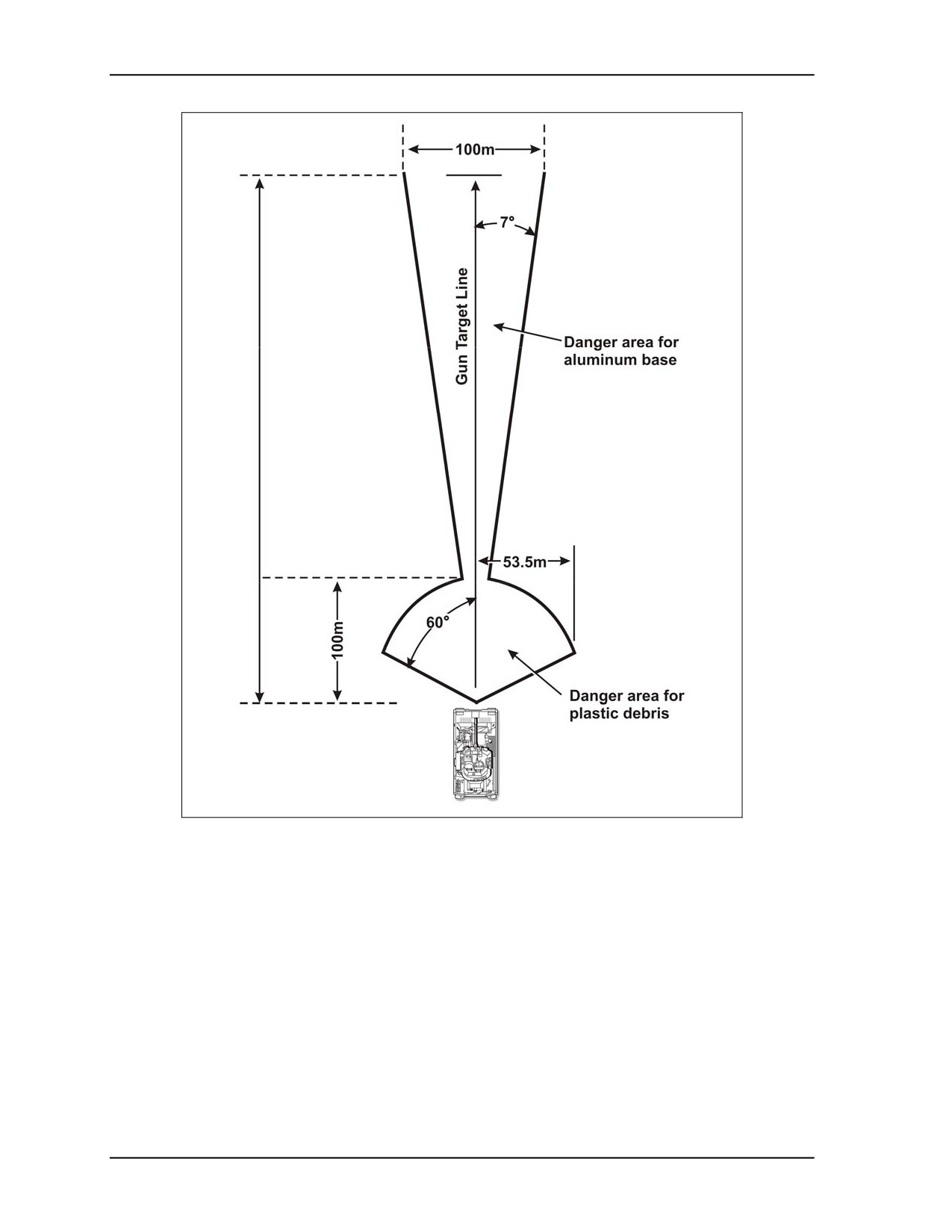
The danger zone for BFV rounds extends 60 degrees to the left and right of the gun-target line for the
plastic debris out to 100 meters and 7 degrees to the left and right of the gun target line for the aluminum
base out to 400 meters (Figure D-2). Danger zone data for the MGS is not yet available, but can be
assumed to be similar to the danger area for the M1. Infantrymen should not be in or near the direct line of
fire for the M1 or MGS main gun or BFV cannon unless they are under adequate overhead cover.
D-8
FM 3-21.20
13 December 2006
Heavy and Stryker
Figure D-1. M1 tank danger zone.
13 December 2006
FM 3-21.20
D-9
Appendix D
Figure D-2. BFV danger zone.
NOISE
D-33. Tank main guns create noise in excess of 140 decibels. Repeated exposure to this level of noise
can cause severe hearing loss and even deafness. In addition, dangerous noise levels may extend more than
600 meters from the tank. Single-layer hearing protection such as earplugs allows Infantrymen to work
within 25 meters of the side or rear of the tank without significant hazard.
GROUND MOVEMENT HAZARDS
D-34. Crewmen on mounted vehicles have very limited abilities to see anyone on the ground to the side
or rear. As a result, vehicle crews and dismounted Infantrymen share responsibility for avoiding the
hazards this may create. Infantrymen must maintain a safe distance from mounted vehicles at all times. In
D-10
FM 3-21.20
13 December 2006
Heavy and Stryker
addition, when they work close to a mounted vehicle, dismounted Soldiers must ensure that the vehicle
commander knows their location at all times.
Note. A related hazard is that M1-series tanks are deceptively quiet and may be difficult for
Infantrymen to hear as they approach. As noted, vehicle crews and dismounted Infantrymen
share the responsibility for eliminating potential dangers in this situation.
WARNING
M1 Exhaust Plume Hazard
M1-series tanks have an extremely hot exhaust plume that exits
from the rear of the tank and angles downward. This exhaust is
hot enough to burn skin and clothing.
TOW MISSILE SYSTEM
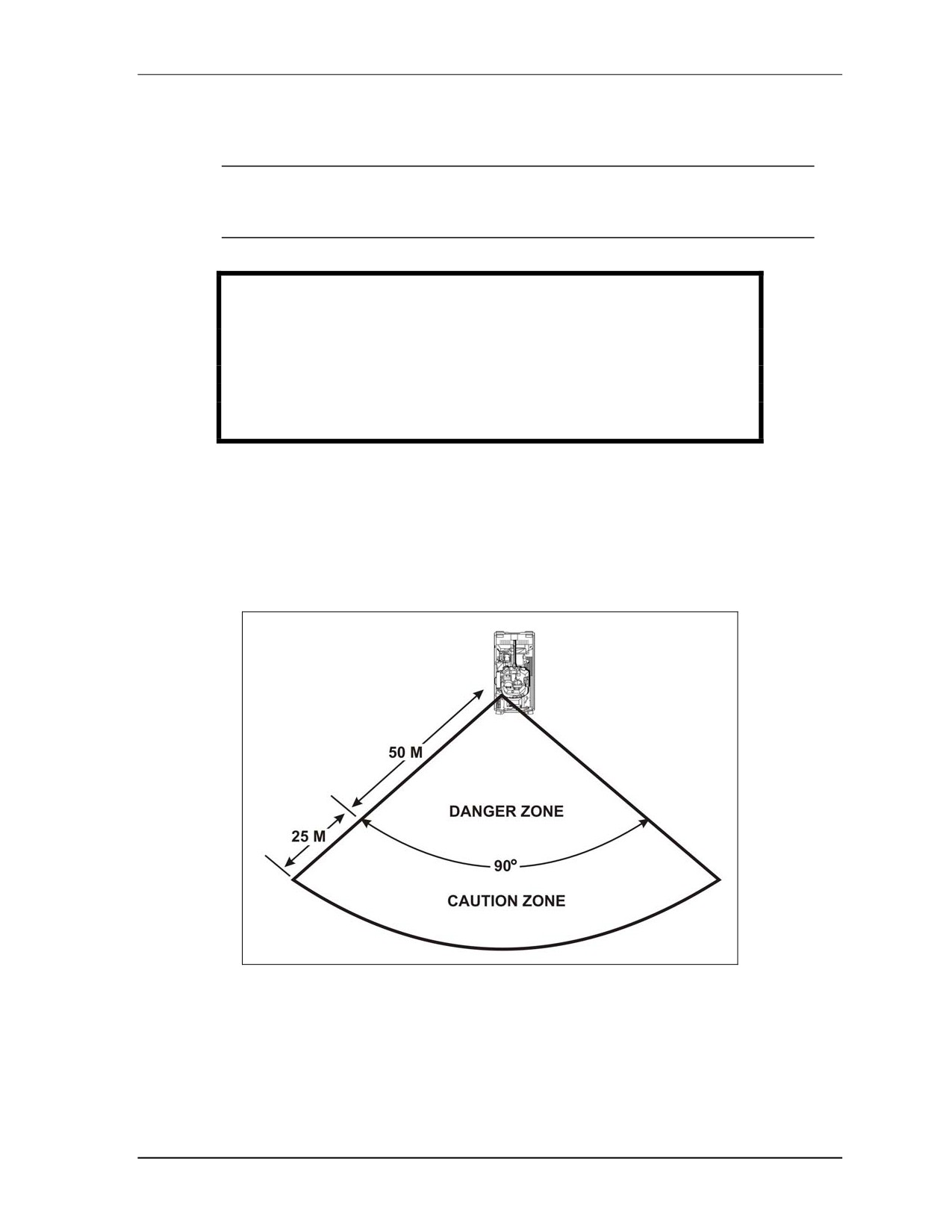
D-35. The TOW missile system has a dangerous area extending 75 meters to the rear of the vehicle in a
90-degree "cone." The area is divided into a
50-meter danger zone and a
25-meter caution zone
(Figure D-3). The danger area for the TOW systems mounted on HMMWVs and Strykers is the same as
for BFVs.
Figure D-3. BFV TOW backblast danger zone.
13 December 2006
FM 3-21.20
D-11
Appendix D
Section III. OPERATIONS
This section focuses on tactical employment of mounted and Infantry forces during combat operations.
OFFENSIVE OPERATIONS
D-36. The fundamentals, principles, and concepts discussed in Chapter 4 apply to Infantry and mounted
force offensive operations. While combining these forces in the offense can work well in many different
ways, the following are some of the most common examples.
MOUNTED FORCE SUPPORT, INFANTRY ASSAULT
D-37. M1s and BFVs or Stryker ICVs and MGSs support by fire while the Infantry assaults the
objective. The vehicles fire from hull-defilade positions until the Infantry masks their fires. This is the most
effective method for BFVs, Stryker ICVs and MGSs and may be used with M1s when antitank weapons or
obstacles prohibit them from moving to the objective.
D-38. This method may incorporate a feint to deceive the enemy as to the location of the decisive effort.
If so, the shaping efforts are timed to divert the enemy’s attention from the Infantry’s assault. The fires of
the mounted force may also cover the sound of the Infantry’s approach or breach. Close coordination is
vital for effective fire control.
D-39. This method may vary when either the terrain or disposition of the enemy limits the mounted
force’s ability to support the Infantry’s attack. In this case, the mounted force may be tasked to suppress or
fix adjacent enemy positions or to accomplish other tasks to isolate the objective area.
SIMULTANEOUS ASSAULT
D-40. With this method, Infantry and mounted forces advance together, and the Infantry and vehicles
move at the same speed. The vehicles may advance rapidly for short distances, stop and provide overwatch,
then move forward again when the Infantry comes abreast. Tanks are best suited to assault under fire.
BFVs, Stryker ICVs and MGSs may also be used in this manner but only when the threat of antitank fires
is small. If an antitank threat exists, Infantry usually lead while the vehicles follow to provide fire support.
Note. Leaders must consider the safety risks when Infantry and mounted forces work in close
proximity due to main gun overpressure and sabot debris.
D-41. This method may be used when the enemy situation is vague, when the objective is large and
consists of both unrestricted and restricted terrain, and/or when visibility, fields of fire, and the movements
of the mounted force are restricted. These conditions exist in limited visibility and in restricted terrain such
as in urban areas and wooded areas. The vehicles provide immediate close protected direct fires, and the
dismounted Infantry protects the vehicles from individual antitank measures.
D-42. This method sometimes requires Infantry to follow a safe distance behind the M1s, BFVs, Stryker
ICVs or MGSs for protection from frontal fires. This is true when the main enemy threat is small-arms fire.
From behind the vehicles, the Infantry can protect the flanks and rear of the vehicles from handheld
antitank weapons.
D-43. This method may require assaulting forces to advance together in operations that require long, fast
moves. Infantrymen may ride on the tanks or other vehicles until they make contact with the enemy.
Although this is a quick way to move, it exposes the Infantry to enemy fire, particularly airburst munitions,
and may interfere with the operation of the vehicles.
D-12
FM 3-21.20
13 December 2006
Heavy and Stryker
ASSAULT FROM DIFFERENT DIRECTIONS
D-44. With this method, mounted and Infantry forces converge on the objective from different
directions. Mounted and Infantry forces advance by different routes and assault the objective at the same
time. For this synchronization to succeed, the Infantry elements maneuver and close on their assault
position, ideally under cover of darkness or poor weather. The synchronization of the assault provides
surprise, increases fire effect, and maximizes shock action. Planning, disseminating, and rehearsing the
coordination of direct and indirect fire measures are critical in this type of operation.
D-45. This method is effective for mounted forces when the following two conditions exist:
• Terrain must be at least partly unrestricted and free from mines and other vehicle obstacles.
• Supporting fires and smoke must effectively neutralize enemy antitank weapons; during the
brief period required for the mounted forces to move from their assault positions to the near
edge of the objective.
D-46. This method requires coordination of Infantry and mounted forces to provide effective fire control
on the objective. When conditions prohibit mounted force vehicles from advancing rapidly, Infantry should
accompany them to provide protection.
EXPLOITATION
D-47. Exploitation follows success in battle. The mounted force is usually the most capable exploitation
force. It takes full advantage of the enemy’s disorganization by driving into his rear to destroy him. A
mounted force operating as a team (BFV/Stryker ICV- and M1/MGS-equipped units) may exploit the local
defeat of an enemy force or the capture of an enemy position. The purpose of this type of operation is to
prevent reconstitution of enemy defenses, to prevent enemy withdrawal, and secure deep objectives. A
common combination is a mounted battalion or task force reinforced by an Infantry unit, engineers, and
other supporting units. The Infantry may be transported in armored vehicles or trucks, or may ride on the
tanks. Riding on tanks reduces road space, decreases supply problems, and keeps the members of the team
together; however, it exposes the riding Infantry to enemy artillery fire. The Infantry leaders ride with the
corresponding mounted unit commanders. The mounted force battalion commander must weigh the
likelihood of enemy contact against the need for speed.
DEFENSIVE OPERATIONS
D-48. The combination of Infantry and mounted forces is well suited to conduct defensive operations.
The mounted force provides a concentration of antiarmor weapons and the capability to counterattack by
fire or maneuver rapidly. The Infantry force can occupy strongpoints, conduct spoiling attacks, and
conduct stay-behind operations. The fundamentals, principles, and concepts discussed in Chapter 5 apply
to combined Infantry and mounted force defensive operations.
INFANTRY FORCE IN DEPTH, MOUNTED FORCE FORWARD
D-49. The mounted unit covers forward of an Infantry unit’s defense, masking the location of the
Infantry unit. While passing through the Infantry unit’s positions, mounted units provide most of their own
overwatch protection. Careful planning is required for battle handover to the Infantry unit. The Infantry
unit’s direct fire overwatch weapons that are able to support from inside the battle handover line are limited
to the long-range antitank fire from the weapons company. To alleviate this problem, the mounted force
can provide some of its antiarmor assets to the Infantry. Usually, these assets are provided at company
level and above.
13 December 2006
FM 3-21.20
D-13
Appendix D
INFANTRY FORCE FORWARD WITH MOUNTED FORCE IN DEPTH
D-50. The mounted force assumes positions in depth behind the Infantry unit’s defense. The Infantry
unit’s forward deployment shapes the battlefield for decisive action by the mounted forces. The Infantry
unit leaves an assembly area and moves into the mounted force’s objective area. At the same time, the
Infantry unit prevents the enemy from using restricted and severely restricted terrain. If the enemy
penetrates the Infantry unit, the mounted force counterattacks, destroying the enemy or blocking him until
additional units can be repositioned to destroy him. To support the counterattack, the Infantry unit
identifies the location of the enemy’s main effort, slows his advance, and disrupts his C2, fire support and
protection elements. The Infantry unit can guide the counterattacking force through restrictive terrain to
surprise the enemy on his flank.
INFANTRY FORCE TERRAIN-ORIENTED, MOUNTED FORCE ENEMY-ORIENTED
D-51. Terrain-oriented refers to area defense whereas enemy-oriented refers to mobile defense-like
mission oriented posture. With this method, the entire force defends along the FEBA. The Infantry force
(whether used as a flanking or covering force or positioned in depth) places its elements to use restrictive
terrain effectively. The mounted force keeps its freedom of maneuver. To protect the Infantry unit, contact
points between units should be in restrictive terrain. The Infantry unit may defend to retain key or decisive
terrain while the mounted force maneuvers to destroy the enemy from the flanks or rear.
STRONGPOINT
D-52. The Infantry unit, with additional assets and sufficient time, occupies a strongpoint. The
strongpoint forces the enemy into the mounted force’s EA, or the enemy attacks the strongpoint with its
main effort allowing the mounted force to attack an assailable flank.
STAY-BEHIND OPERATIONS
D-53. The Infantry unit occupies hide positions well forward of the FEBA. As the enemy passes, the
Infantry force attacks the enemy’s C2, fire support, protection or sustainment elements. The mounted force
defends against enemy maneuver forces.
RETROGRADE OPERATIONS
D-54. Retrograde operations include delays, withdrawals, and retirements, which gain time and avoid
decisive action. During retrograde operations, mounted forces are normally employed against the enemy
forces and likely avenues of advance that most threaten the operation. To assist in movement to subsequent
positions, Infantry forces often need additional transportation assets. Basic movement techniques include
bounding and bounding overwatch. Mounted forces with small Infantry force units mounted, along with
Infantry scout platoons and weapons company elements, move to subsequent delay positions under the
cover of mutually supporting forces.
SUSTAINMENT
D-55. Sustainment planning and execution are critical elements for integration of Infantry and mounted
forces. IBCTs are not organized, equipped, or trained to meet the support requirements of a mounted unit.
The Infantry battalion is not structured to provide maintenance support to a mounted unit; however, they
can provide limited Class V
(5.56 mm, 7.62 mm, 50 cal, mortars, and antitank missiles) support.
Sustainment may be further complicated if the mounted force is operating across a large geographical area
to meet the demands of a decentralized mission. The following discussion covers sustainment
considerations that may affect Infantry/mounted and mounted/Infantry operations:
D-14
FM 3-21.20
13 December 2006
Heavy and Stryker
PLANNING AND INTEGRATION
D-56. Infantry/mounted operations may require the mounted team to integrate into the IBCT
organization early in the deployment phase. This, in turn, may require sustainment assets to move into the
theater of operations very early as well, usually at the same time as the command and control elements.
Specific support requirements, including needed quantities of supplies, depend on the mission and must be
planned and coordinated as early as possible. In addition, because the IBCT does not possess the required
logistical redundancy to sustain the mounted unit, it is imperative that mission requirements calling for
higher echelon unit sustainment assets be identified early in the planning process.
OPERATIONAL CONSIDERATIONS
D-57. A mounted unit can satisfy the sustainment needs of an Infantry unit more easily than an IBCT
can satisfy the needs of a mounted unit. The size and composition of the mounted force will provide insight
as to the magnitude of the requirement.
Mounted Battalion with an Infantry Company
D-58. Except for 60 mm mortar rounds, the combined arms battalion can provide all munitions the
Infantry company needs. The S-4 must plan to receive and move 60-mm mortar munitions and possibly
increase the anticipated usage for small arms ammunition. The Stryker battalion has 60 mm mortars and
would only need to adjust consumption rates.
IBCT with a Mounted Unit
D-59. Adding a mounted force to an IBCT significantly increases the POL, ammunition, and
maintenance that must be delivered to the FSC and the BSB. The IBCT lacks the transportation required to
support more than a company size mounted unit. The IBCT has no organic heavy equipment transporters
(HETs) for heavy vehicle evacuation. The mounted unit battalion S-4 must constantly anticipate the unit’s
needs to allow the IBCT S-4 more time to react. Support packages may be required for the mounted
element that is attached or under OPCON of the Infantry force. The preferred method of command
relationship is OPCON, which permits the mounted unit to continue receiving support from its parent BSB.
The mounted unit should always come to the Infantry unit with its FSC or a dedicated support package.
The support package should include fuel trucks and operators, HETs with drivers, tracked ambulances, and
maintenance support teams.
D-60. Operations with an IBCT create many unique supply considerations for the mounted battalion.
The sheer bulk and volume of supplies required by a mounted unit merits special attention during the
planning and preparation phases—the following paragraphs examine some of these supply-related
considerations:
Class I
D-61. Class I food requirements are determined based on the unit’s personnel strength reports. This
process may be complicated by unique mission requirements imposed on the unit such as rapid changes in
task organization or dispersion of subordinate companies over a wide area.
Class II
D-62. Many Class II items required by mounted crews, such as specialized tools and fire-resistant
clothing, may be difficult to obtain in an Infantry organization. Although the unit can order such items
through normal supply channels, the mounted unit may face significant delays in receiving them. To
13 December 2006
FM 3-21.20
D-15
Appendix D
overcome this problem, the mounted unit should identify any potential shortages and arrange to obtain the
needed supplies before leaving its parent organization.
Class III
D-63. The fuel and other POL products required by the mounted unit are bulky; they present the greatest
sustainment challenges in planning and preparing for Infantry/mounted operations. Transportation support
must be planned carefully. For example, planners must consider the placement of fuel transport vehicles
during all phases of the operation. They must also focus on general-use POL products such as lubricants,
which are seldom used in large quantities by the IBCT. As noted previously, the mounted unit should stock
its basic load of these items, as well as make necessary resupply arrangements, before attachment to the
IBCT.
Class IV
D-64. The mounted unit does not have any unique requirements for barrier or fortification materials. The
main consideration is that any Class IV materials that the commander wants may have to be loaded and
carried before attachment.
Class V
D-65. Along with POL products, ammunition for the mounted force presents the greatest transportation
challenge during combat operations. Planning for Class V resupply should parallel that for Class III.; key
considerations include: anticipated mission requirements, the availability of Class V transport vehicles, 120
mm main gun (M1), 105-mm main gun (MGS) and 25-mm (BFV). Ammunition may be prestocked based
on expected consumption rates in the BSB along with additional transportation assets.
Class VII
D-66. Class VII consists of major end items. The handling of these items requires thorough planning to
determine transportation requirements and positioning in the scheme of the operation.
Class IX
D-67. Repair parts for vehicles are essential to the sustainment of the mounted force. Repair parts
stockage levels must be carefully considered before operations begin. Mounted forces may find it
advantageous to prestock selected items to meet anticipated needs. The BSB and FSC will need to order
and stock an increased number of repair parts and many repair parts will be of significant size and weight.
Repair operations for mounted forces may also dictate that civilian contractors accompany the IBCT and
should be considered in the planning process.
D-16
FM 3-21.20
13 December 2006
Appendix E
Army Aviation Support for Ground Operations
Army aviation’s greatest contribution to the battlefield is providing the ground
maneuver commander the ability to apply decisive combat power at critical times
virtually anywhere on the battlefield. This combat power may be in the form of direct
fire support from aviation maneuver units or the insertion of Infantry forces or
artillery fires delivered via air assault. This versatility gives the maneuver
commander a decisive advantage on the battlefield. However, Army aviation support
has limitations that must be considered when planning and executing operations; the
most significant being limitations due to weather conditions and enemy air defense
capability. Ground maneuver commanders synchronize aviation maneuver with
ground maneuver to enhance operations across the COE. Aviation support to
operations allows the ground maneuver commander the ability to gain awareness and
SU, shape the battlefield, and to influence events throughout his AO.
MISSIONS
E-1.
Aviation units operate within the framework of the commander’s concept of operations. As a fully
integrated member of the joint, interagency and multinational team, aviation units gather intelligence and
information, move and sustain forces, provide fire support and overwatch, evacuate casualties and assist in
command and control functions 24 hours a day across the entire spectrum of operations.
MOVEMENT AND MANEUVER, AND FIRE SUPPORT
E-2.
Aviation maneuver and fire support missions include—
• Reconnaissance and surveillance.
• Security.
• Escort of air assault or air movement aircraft.
• Special operations.
• Attack by fire and support by fire.
• Air assault.
• Air movement.
• Aerial mine warfare (Volcano).
PROTECTION
E-3.
Aviation protection missions include theater missile defense.
SUSTAINMENT
E-4.
Aviation sustainment missions consist of the assistance provided by aviation forces to sustain
combat forces. These include—
• Aerial sustainment.
• Casualty evacuation.
13 December 2006
FM 3-21.20
E-1
Appendix E
COMMAND AND CONTROL, AND INTELLIGENCE
E-5.
Aviation C2 and intelligence missions include—
• Command, control, communications, and intelligence (C3I).
• Air traffic services (ATS).
OTHER ATTACK HELICOPTER MISSIONS
E-6.
In addition to the missions listed above, attack helicopters may be called on to perform some
additional, nontraditional roles. This is particularly true during stability operations and civil support
operations. Additional missions may include the following:
• Assisting, for limited periods, in the control and coordination of fires with the maneuver of
ground forces.
• Providing limited relay of radio messages from isolated ground units.
• Marking or identifying specific buildings and areas by smoke, fires, or targeting lasers.
• Videotaping routes or objectives for later analysis by ground commanders.
• Providing navigational and directional assistance to ground units.
• Providing limited area illumination by infrared or white light using either on-board sources or
illumination rockets.
OTHER LIFT/CARGO HELICOPTER MISSIONS
E-7.
In addition to the missions listed above, lift/cargo helicopters may be called on to emplace large or
heavy obstacles such as abandoned vehicles and concrete dividers.
AVAILABLE ASSETS
E-8.
Any rotary-wing aircraft can conduct reconnaissance operations since they all greatly increase the
range at which enemy movement can be detected. However, the aircraft primarily dedicated to
reconnaissance and security operations are AH-64A, AH-64D, and OH-58D (Table E-1).
AH-64A Apache
E-9.
The AH-64A is a twin-engine, tandem-seat, four-bladed attack helicopter with a crew of two rated
aviators. The pilot occupies the rear cockpit, and the copilot-gunner occupies the front cockpit. The aircraft
has day, night, and limited adverse weather fighting capabilities. The aircraft is equipped with a laser
range-finder/designator (LRF/D). The LRF/D is used to designate for the firing of a Hellfire missile and
provides range to target information for the fire control system. (See FM 1-112 for a detailed explanation
of the aircraft.)
AH-64D Longbow Apache
E-10. The AH-64D is a variant of the AH-64A. The AH-64D is designed to provide increased
effectiveness over the capabilities of the AH-64A while greatly reducing the AH-64A’s limitations. The
AH-64D has several key improvements, including fire control radar (FCR), radio frequency Hellfire (fire
and forget) missile system, digital communications, and other significant features. The day, night, and
limited adverse weather fighting capabilities of the AH-64A are significantly enhanced in the AH-64D.
OH-58D Kiowa Warrior
E-11. The OH-58D (I) Kiowa Warrior provides the maneuver commander with a versatile platform; it
can be armed with various weapons systems and is suitable for employment in numerous types of situations
E-2
FM 3-21.20
13 December 2006

Army Aviation Support for Ground Operations
and operations. The aircraft features a stabilized mast-mounted sight with a low-light television sensor
(TVS), thermal imaging system (TIS), and LRF/D. See FM 1-114 for a detailed explanation of the aircraft.
Table E-1. Rotary-wing aircraft.
M2 .50 Caliber
30-mm
Aircraft
2.75” (70-mm)
Machine Gun
Chain Gun
Type*
Hellfire
Rockets
(Rounds)
(Rounds)
AH-64A/D
16
76
---
1,200
OH-58D **
4
14
500
---
Max Range
8 km
8 km
2 km
4 km
NOTES:
Numbers in each column indicate the maximum load for each system. The total
amount of ordnance carried will vary based on METT-TC and selected weapon
configuration.
**
One weapon system per side for Hellfire and 2.75-inch rocket.
E-12. Maximum weapon ranges specified in Table E-1 above are based on "best-case" function of the
system. Maximum ranges should not be the only criteria used in the establishment of EAs to BPs,
or attack- or support-by-fire positions. Ranges to target engagement distances are affected by the factors of
METT-TC, and the single most important factor is weather because of the limiting impact on visibility and
thermal sensors. Examples of some normal engagement weapon ranges are listed in Table E-2.
Table E-2. Examples of normal weapon engagement ranges.
Weapon
Range
Hellfire
1,000 to 6,000 meters (day)
1,000 to 4,000 meters (night)
Rocket
1,000 to 6,000 meters
30 mm
500 to 3,000 meters
.50 cal MG
500 to 1,500 meters
OFFENSIVE OPERATIONS
E-13. Aviation assets contribute during offensive operations by assisting the ground maneuver
commander in finding, fixing, and engaging the enemy.
MOVEMENT TO CONTACT
E-14. During MTC operations, aviation assets can find, fix, and destroy the enemy. This allows the
maneuver commander to further focus ISR on finding the enemy in an expedited manner, thus allowing
him to develop the situation early, without premature deployment of the main body.
E-15. AH-64 Apache and OH-58D helicopters are extremely effective during MTC operations due to
their night-vision capabilities.
E-16. During MTC operations, aviation assets may perform additional tasks, to include—
• Conducting armed reconnaissance or reconnaissance in force to gain and maintain enemy
contact.
• Screening the front, flank, or rear of the ground maneuver unit.
• Acting as the rapid reaction force to conduct hasty attacks during a meeting engagement.
• Providing suppressive fires to allow for disengagement of friendly forces.
• Conducting air movements for resupply.
• Conducting CASEVAC, if necessary.
13 December 2006
FM 3-21.20
E-3
Appendix E
ATTACK
E-17. During attack operations, aviation assets can assist the ground maneuver commander in destroying
targets in the close or deep fight. The commander may employ aviation assets to—
• Provide direct and indirect fires.
• Overwatch assault objectives.
• Attack the enemy’s flank or rear to divert his attention away from the decisive or shaping
attack. Conduct forward, flank, or rear screening.
• Act as the TCF for rear operations.
• Attack deep to destroy follow-on echelons or reserves.
• Conduct air assaults to seize key terrain.
• Conduct air movement of REMBASS equipment to assist in enemy detection.
• Provide air assault security.
• Conduct CASEVAC operations.
• Conduct reconnaissance operations.
• Conduct deception operations to prevent detection of the ground maneuver force.
• Enhance C2 by providing an aerial platform for commanders.
• Provide pinpoint laser guidance for artillery fires.
• Conduct air movements for resupply.
EXPLOITATION
E-18. During exploitation operations, aviation assets can assist the ground maneuver commander in
maintaining the momentum gained by the attacking forces. The commander may employ aviation
assets to—
• Attack the enemy’s flanks and rear to maintain constant pressure on the defeated force.
• Attack rear area C2 and sustainment assets.
• Act as reserve to blunt any counterattacks or to provide the decisive blow by attacking to
destroy lucrative targets.
• Screen vulnerable flanks.
• Conduct air assaults to seize key terrain and maintain momentum.
• Provide air assault security.
• Conduct CASEVAC operations.
• Enhance C2 by providing an aerial platform for commanders.
• Provide pinpoint laser guidance for artillery fires.
• Conduct air movements for resupply.
PURSUIT
E-19. As the success of the exploitation develops, the speed of Army aviation is ideally suited to
maintain enemy contact, develop the situation, and deliver precision fires on enemy areas of resistance. The
commander may employ aviation assets to—
• Attack to destroy, disrupt, or reduce the effectiveness of counterattacking or reserve forces.
• Attack to fix withdrawing forces.
• Screen pursuing ground maneuver forces.
• Conduct air assaults to seize key terrain.
• Conduct air movement operations to resupply committed forces rapidly and maintain the
momentum.
E-4
FM 3-21.20
13 December 2006
Army Aviation Support for Ground Operations
• Conduct CASEVAC operations.
• Enhance C2 by providing an aerial platform for the commander.
• Provide pinpoint laser guidance for artillery fires.
• Conduct air movements for resupply.
AIRCRAFT POWER LIMITATIONS AND TIME ON STATION
E-20. The need to deliver hovering fires from temporary BPs may require the aircraft to carry less than a
full load of munitions or fuel. This is especially true in hot climates and high altitudes. Reduced loads
mean more frequent trips to forward area refuel and rearm points and less time on station. Long route
distances during air movements may require the establishment of forward arming and refuel points along
the route before operations. Climate will also affect the number of troops or amount of supplies the aircraft
can transport.
DEFENSIVE OPERATIONS
E-21. During defensive operations, the speed and mobility of aviation assets can help maximize
concentration and flexibility. Aviation has the capability to be the most responsive direct fire asset
available to the commander to react to unanticipated enemy actions.
AREA DEFENSE
E-22. During an area defense, aviation assets can support the ground maneuver commander's
preparation and defensive efforts. The ground maneuver commander may employ aviation to—
• Attack to fix enemy forces in the security zone.
• Screen during ground movement.
• Conduct reconnaissance, counterreconnaissance, and security operations, especially at night.
• Conduct air movement operations.
• Conduct CASEVAC operations.
• Emplace minefields using the Volcano mine system.
• Enhance C2 by providing an aerial platform for commanders.
• Provide pinpoint laser guidance for artillery fires.
• Conduct air movements for resupply.
MOBILE DEFENSE
E-23. During a mobile defense, aviation assets can work in conjunction with ground maneuver forces to
create a more lethal striking force to bring simultaneous fires to bear upon the enemy from unexpected
directions. In a mobile defense, the ground maneuver commander may employ aviation to—
• Attack to fix enemy forces in the security zone.
• Screen during ground movement.
• Conduct reconnaissance, counterreconnaissance, and security operations, especially at night.
• Conduct air movement operations.
• Conduct CASEVAC operations.
• Emplace minefields using the Volcano mine system.
• Enhance C2 by providing an aerial platform for commanders.
• Provide pinpoint laser guidance for artillery fires.
• Conduct air movements for resupply.
13 December 2006
FM 3-21.20
E-5
Appendix E
RETROGRADE OPERATIONS
E-24. During retrograde operations, aviation assets can assist the ground maneuver commander in
movement away from an enemy force or to the rear.
DELAY
E-25. In a delay operation, the ground maneuver commander trades space for time and preserves
friendly combat power while inflicting maximum damage on the enemy. Aviation forces can assist the
ground maneuver commander by—
• Concentrating fires to allow disengagement and repositioning.
• Conducting surprise attacks to confuse advancing enemy forces.
• Emplacing Volcano minefields to supplement obstacles or to impede or canalize enemy
movements.
• Conducting air assaults to move ground forces between delaying positions.
• Providing a C2 platform.
WITHDRAWAL
E-26. During a withdrawal, the ground maneuver commander voluntarily disengages the enemy. This
withdrawal may be conducted with or without enemy pressure. Aviation forces can assist the ground
maneuver commander in a withdrawal by—
• Using attack helicopters in an offensive manner to attrit enemy maneuver and fire support units.
• Providing security for withdrawing friendly units.
• Acting as the reserve.
• Conducting CASEVAC operations.
• Providing a C2 platform.
RETIREMENT
E-27. During retirement operations, a unit that is not in contact with the enemy moves to the rear in an
organized manner. Retirement operations are normally conducted during the hours of darkness. This makes
aviation's ability to maneuver on the battlefield rapidly to find, fix, and destroy the enemy during the hours
of darkness a decisive advantage to the ground maneuver commander. Aviation forces can assist the
ground maneuver commander during a retirement by—
• Providing security of routes during the retirement.
• Conducting hasty attacks to destroy enemy elements.
• Providing a C2 platform.
COMMUNICATIONS
E-28. Successful employment of aviation assets is possible only if they are able to communicate with the
other members of the combined arms team. The primary means of communications with helicopters is
FM frequency hop secure. To help reduce the load on the FM radios, all helicopters have UHF and VHF
radios. Table E-3 shows the number and type of radios in Army rotary-wing aircraft.
E-6
FM 3-21.20
13 December 2006

Army Aviation Support for Ground Operations
Table E-3. Number and types of radios.
Aircraft Type
FM
VHF
UHF
HF (ALE)
AH-64A
** 1 (2)
** 1 (0)
1
AH-64D
2
1
1
*1
CH-47D
*** 0, 1, 2
*** 2, 1, 0
1
*1
OH-58D
2
1
1
UH-60
2
1
1
*1
Notes:
CH47D and F, UH60A/L/M, AH64D Lot 7 and above.
**
Configuration is 2 FM and 0 VHF or 1 FM and 1 VHF.
***
Configuration is 2 FM and 9 VHF or 1 FM and 1 VHF or 0 FM and 2 VHF.
ALE (automatic link establishment): Selects the best frequency based on atmospheric conditions.
AIR-GROUND INTEGRATION
E-29. Direct fire aviation missions in the close fight differ greatly from engagements in a cross-FLOT
operation. In a cross-FLOT operation, attack aircraft can benefit from deliberate planning and freely
engaging at maximum ranges with minimal concern of fratricide. Engagements in the close fight, on the
other hand, often result in engagements within enemy direct fire weapons system ranges that are in close
proximity to friendly units. The hasty attack in the close fight typically lacks proper coordination between
air and ground elements. The following paragraphs focus on the hasty attack within an air-ground
integrated attack. Effective coordination between ground maneuver units and attack aviation maximizes the
capabilities of the combined arms team while minimizing the risk of fratricide. To ensure adequate and
effective air-ground integration, the following major problem areas should be addressed:
• Ensure aircrews understand the ground tactical plan and the ground maneuver commander's
intent.
• Ensure adequate common control measures are used to allow both air and ground units
maximum freedom of fire and maneuver.
• Ensure aircrews and ground forces understand the methods of differentiating between enemy
and friendly forces on the ground.
AIR-GROUND COORDINATION
E-30. Effective integration of air and ground assets begins with the supported ground maneuver
element. When the aviation brigade or a subordinate battalion must quickly assist a ground unit engaged in
close combat, the initial information provided by the unit in contact should be sufficient to get the aviation
attack team out of the aviation tactical assembly area to a holding area in order to conduct direct
coordination with the engaged maneuver unit. To ensure the air and ground forces exchange essential
information, planners should use the following five-step procedure:
• BCT planning requirements.
• Battalion close fight SITREP.
• Attack team check-in.
• Coordination for aviation direct fire.
• Battle damage assessment and reattack.
E-31. The ground unit, through its aviation liaison officer, provides the necessary information to meet
planning requirements to the aviation brigade headquarters
(Figure E-1). The initial planning and
information to be passed to the aviation brigade headquarters includes the location of the holding area, air
13 December 2006
FM 3-21.20
E-7
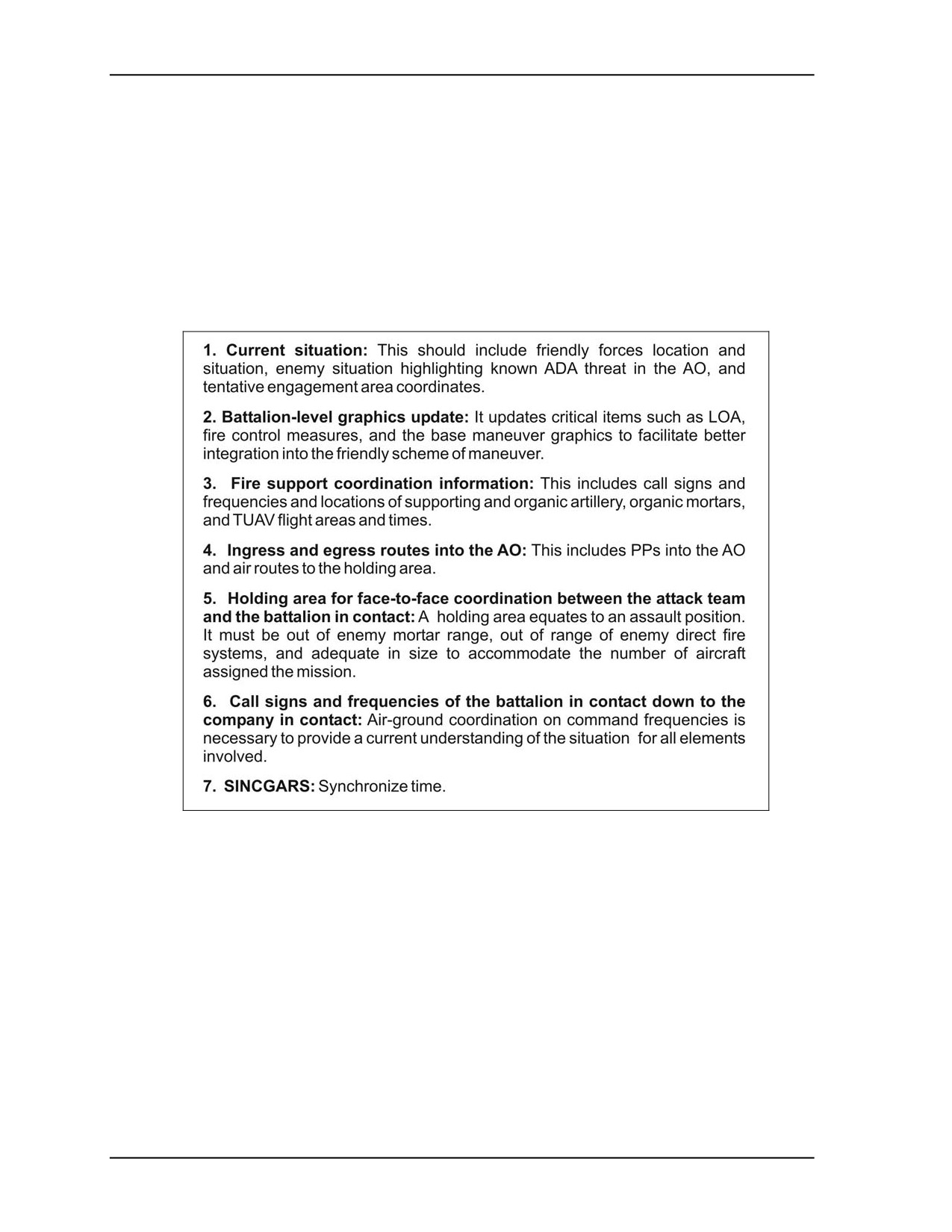
Appendix E
axis, and route or corridor for entry and exit through the AO. The holding area should be in the sector of
the ground maneuver battalion involved in close combat. The holding area may be a concealed position or
an aerial holding area that allows for final coordination between the attack team leader and the ground unit
leader. It must be located within FM radio range of all units involved. Alternate holding areas, along with
ingress and egress routes, must be designated if occupation is expected to last longer than 15 minutes. The
ground maneuver battalion also provides the call signs and frequencies or SINCGARS hopsets and
COMSEC information regarding the battalion in contact. If the unit is SINCGARS-equipped, the attack
team must also have the common "time," which may be taken from GPSs. In addition, the BCT provides a
current situation update for its AO and specifically for the supported battalions in the AO. This update
includes a recommended EA that will allow for initial planning for BPs or ABF or SBF positions and
possibly prevents unintentional overflight of enemy positions.
Figure E-1. Minimum aviation brigade planning requirements.
STEP 2--INFANTRY BATTALION CLOSE FIGHT SITREP
E-32. En route to the holding area, the attack team leader contacts the ground maneuver battalion on its
FM command net to receive a close fight SITREP (Figure E-2). This SITREP verifies the location of the
holding area and a means to conduct additional coordination. The attack team leader receives an update
from the ground maneuver battalion on the enemy and friendly situations. The battalion also verifies
frequencies and call signs of the unit in contact. By this time, the ground maneuver battalion has contacted
the ground maneuver unit leader in contact to inform him that attack aviation is en route to conduct a
hasty attack.
E-8
FM 3-21.20
13 December 2006
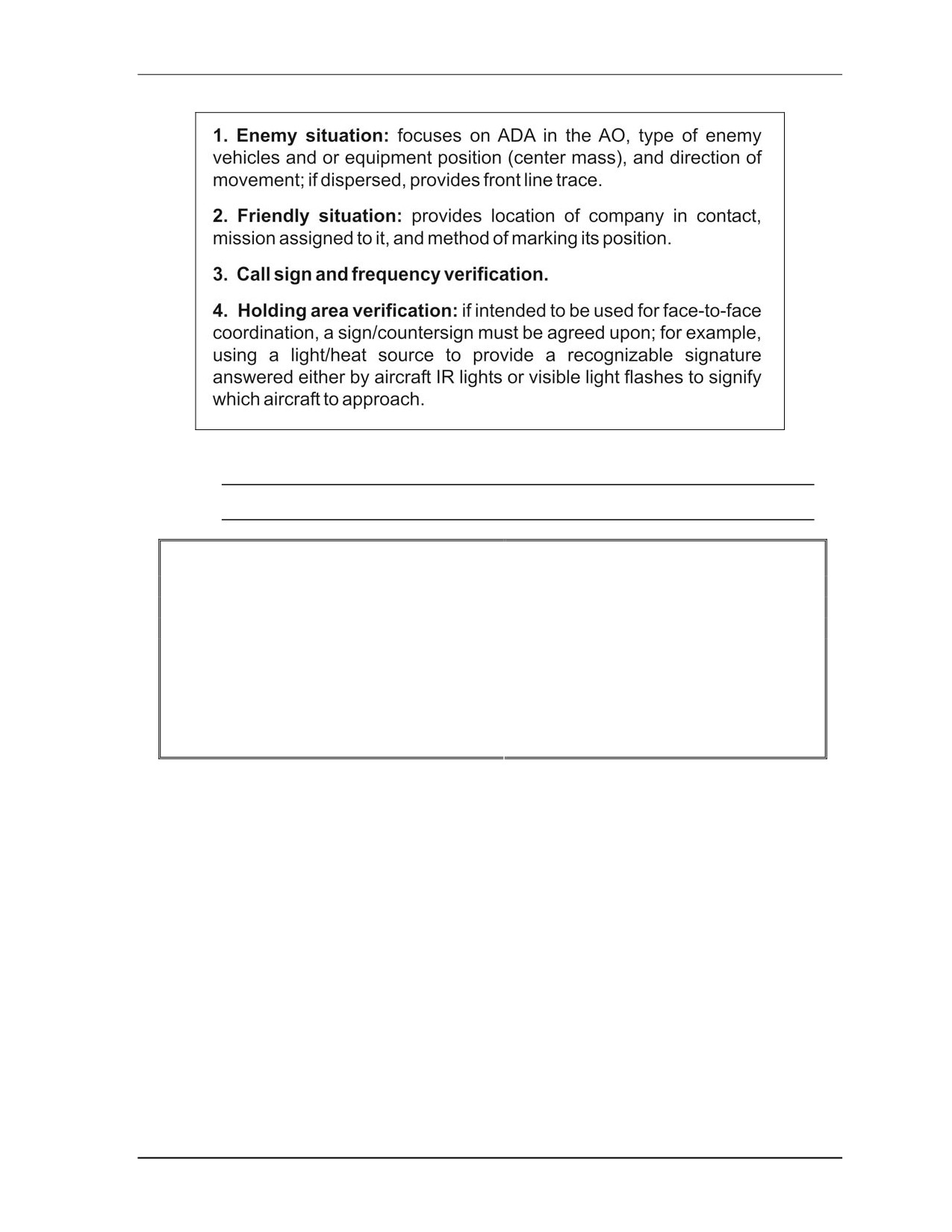
Army Aviation Support for Ground Operations
Figure E-2. Battalion close fight SITREP.
Note. The examples of simulated radio traffic in this appendix show what might occur:
EXAMPLE OF SIMULATED RADIO TRAFFIC
Attack Team
Ground Maneuver Battalion
“Bulldog 06 this is Blackjack 26, over.”
“Blackjack 26 this is Bulldog 06, over.”
“Bulldog 06, Blackjack 26 en route to HA
“Blackjack 26 this is Bulldog 06, enemy
at grid VQ98453287, request SITREP, over.”
Situation follows: Hardrock 06 is taking direct
fire from a platoon size armor element at grid
VQ96204362. Hardrock 06 elements are
established on phase line Nevada center mass
VQ96000050, holding area VQ94004000
expect radio coordination only. Contact
Hardrock 06 on GH 478. Over.”
E-33. Upon receiving the required information from the ground maneuver battalion, the attack team
leader changes frequency to the ground company's FM command net to conduct final coordination before
ingressing on attack routes to BPs or ABF or SBF positions. Coordination begins with the ground
maneuver company commander and ends with the leader of the lowest-level unit in contact.
E-34. When the attack team leader conducts coordination with any key leader, the ground command net
is the most suitable net on which both air and ground elements can conduct the operation. It allows all key
leaders on the ground, including the fire support team chief and the attack team leader and his attack crews,
to communicate on one common net throughout the operation. Operating on the command net also allows
the attack team to request responsive mortar fire for either suppression or immediate suppression of the
enemy. The AH-64A Apache is limited to only one FM radio due to aircraft configuration. However, the
OH-58D is dual-FM capable, which gives the attack team leader the capability to maintain communications
with the ground maneuver company as well as its higher headquarters or a fire support element.
STEP 3--ATTACK TEAM CHECK-IN
E-35. Upon making initial radio contact with the ground maneuver unit in contact, the attack team leader
executes a succinct check-in (Figure E-3). This check-in includes the attack team's present location, which
is normally its ground or aerial holding area; the attack team's composition; its armament load and weapons
13 December 2006
FM 3-21.20
E-9
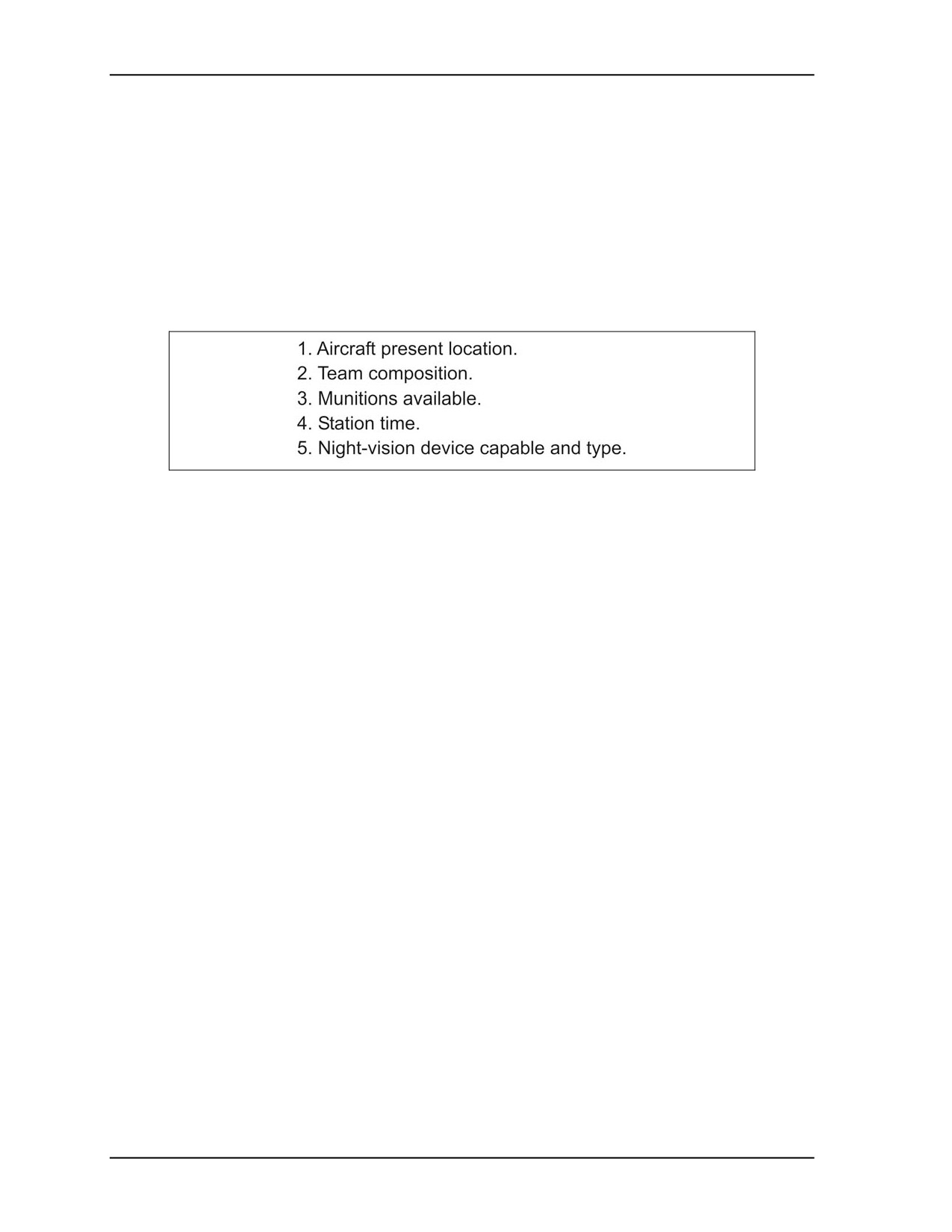
Appendix E
configuration; total station time; and its night-vision device capability. If not using a ground holding area
due to METT-TC considerations, the attack team selects and occupies an aerial holding area within
FM communications range until all required coordination is complete. The attack team leader and ground
unit's key leaders consider the effects on friendly forces of the various weapons carried by the attack
aircraft before target selection and engagement. Weapons systems and munitions selection for a given
engagement depend on the factors of METT-TC. Point target weapons systems, such as Hellfire, are the
preferred systems for armor or hardened targets when engaging targets in the close fight. The gun systems
and the 2.75-inch rockets are the preferred systems and munitions for engaging troops in the open, soft
targets such as trucks, and trench works. These area fire weapons systems pose a danger to friendly
Soldiers who may be in the lethality zone of the rounds or rockets. If this danger exists, the leader on the
ground must be very precise in describing the target he wants the aircraft to engage.
Figure E-3. Attack team check-in.
STEP 4--COORDINATION FOR AVIATION DIRECT FIRES
E-36. Time is the primary constraining factor for coordinating aviation direct fire in the hasty attack.
When possible, coordinate aviation direct fire face-to-face using the aviation direct fire coordination
checklist
(Figure E-4). If time is not available for face-to-face coordination, then use radio-only
communications and the request for immediate aviation direct fire (Figure E-5, page E-20). The request for
immediate aviation direct fire may also be used when targets of opportunity require engagement through a
target handoff between the ground and aviation elements after face-to-face coordination has been
conducted. Although face-to-face coordination is preferred, the factors of METT-TC dictate how the
commander in contact and the attack team leader conduct coordination. A major benefit of face-to-face
coordination is the attack team's ability to talk to the ground commander with a map available and integrate
into the ground scheme of maneuver. This also provides an opportunity for the attack team to update its
maps with the maneuver battalion's latest graphics.
E-10
FM 3-21.20
13 December 2006
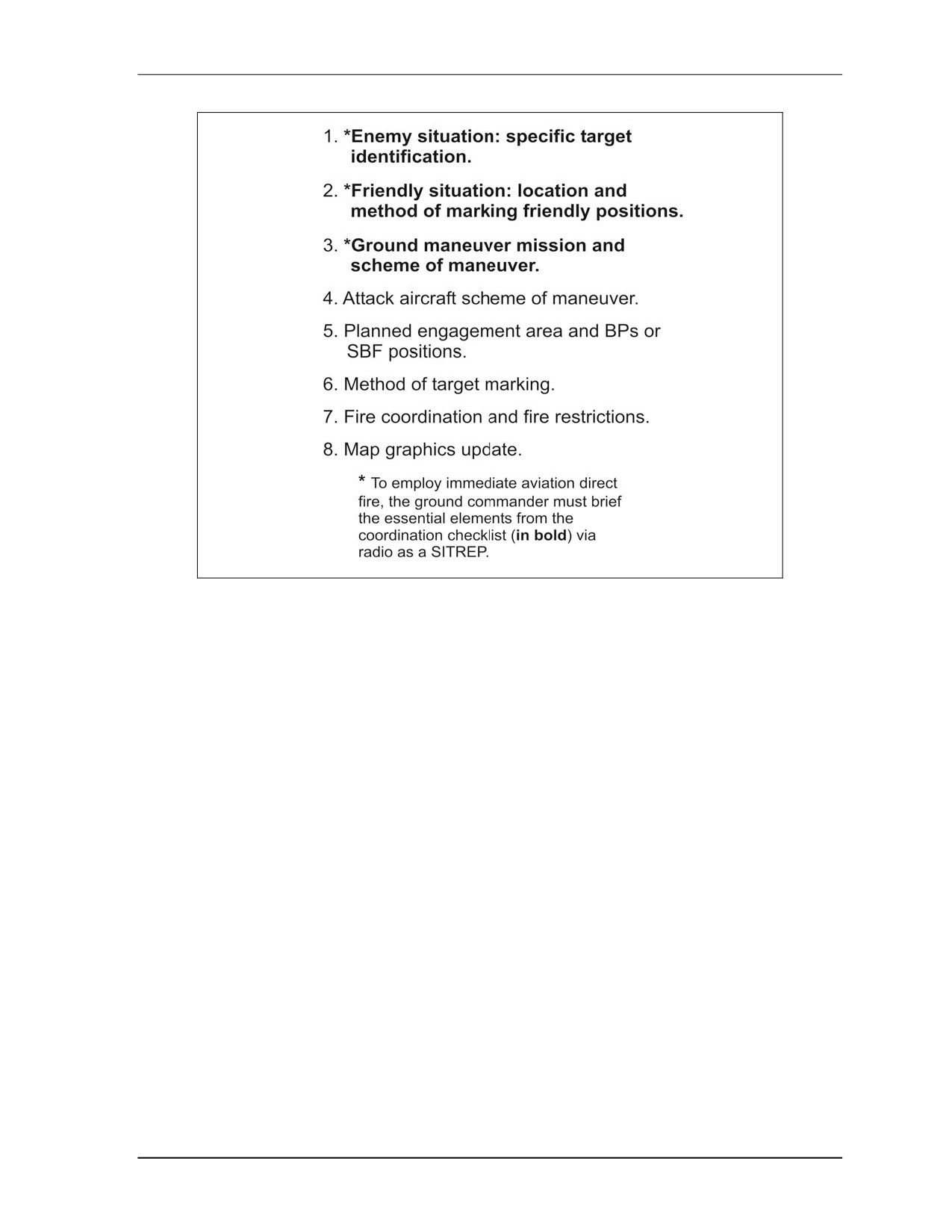
Army Aviation Support for Ground Operations
Figure E-4. Aviation direct fire coordination checklist.
Face-to-Face Coordination
E-37. Once they receive the flight check-in, the ground company commander and attack team leader
meet at the holding area and use the aviation direct fire coordination checklist to plan their attack
(Figure E-4).
E-38. There are several key elements of coordination to complete at the holding area:
• The target is identified and its activity explained.
• The friendly forces’ positions are identified on a map with a method of visually marking those
positions passed on to the flight.
• If not previously done, the EA is verified or defined.
• After defining the EA, the attack team leader establishes BPs and SBF positions.
• The scheme of maneuver for the ground elements is explained with the commander's intent and
description of what is considered the decisive point on the battlefield. With that information,
the attack team provides an integrated scheme of maneuver.
• Existing or required fire control measures are planned for and used to minimize the potential
for fratricide.
• Key maneuver graphics that are required to support or understand the scheme of maneuver are
passed between the ground commander and attack team leader.
• A method of marking targets, such as laser pointers and tracers, is determined.
E-39. After completing this coordination, forces execute the synchronized attack plan. Even with
carefully thought out plans, however, situations will arise during the attack that require flexibility and
possibly the need to mass effects against targets of opportunity at a new location within the supported
13 December 2006
FM 3-21.20
E-11
Appendix E
unit’s sector or zone. Ground and air forces attack these targets of opportunity on a case-by-case basis
using the request for immediate aviation direct fire (FM 3-04.111).
E-40. Ground and air commanders consider the time available for this coordination. If they remain in the
holding area for greater than 15 minutes, they must accept increased risk of holding area compromise. The
factors of METT-TC dictate the extent of preplanning they can accomplish and the length of time they
should occupy the holding area.
Radio-Only Communications Coordination
E-41. When using radio-only communications coordination, leaders use a request for immediate aviation
direct fire (FM 3-04.111). As previously discussed, leaders employ immediate aviation direct fire under
two different conditions: the first is when they have already conducted face-to-face coordination and
targets of opportunity arise. In this case, the ground element uses a request for immediate aviation direct
fire for target handoff. The second condition is when time is not available for face-to-face coordination. In
this case, the request for immediate aviation direct fire may be used as a stand-alone method of engagement
where the call is used for communicating attack requirements from ground to air via radio only.
E-42. When employing the request for immediate aviation direct fire under the first condition, it is
assumed that air and ground units have exchanged all essential elements from the coordination checklist
during face-to-face coordination at the holding area. During the attack, the ground commander calls the
attack team leader and requests immediate aviation direct fires for targets of opportunity. In this manner,
the forces accomplish target handoff and the attack team leader redistributes fires accordingly.
E-43. When employing the request for immediate aviation direct fire under the second condition, the
ground commander in contact briefs only essential elements from the aviation direct fire coordination
checklist as a SITREP via radio. He transmits this SITREP before a request for immediate aviation direct
fire. Once he receives the flight check-in, the ground maneuver leader then provides a situation update,
METT-TC permitting, containing essential elements from the aviation direct fire coordination checklist.
After sending the SITREP, the ground commander calls the attack aircraft forward from their holding area
or aerial holding area using a request for immediate aviation direct fire. Whether the attack team uses a
holding area or aerial holding area to conduct radio coordination depends on its abilities to maintain
FM communication with the ground element in contact.
E-44. As the attack team maintains position at an aerial holding area or within a holding area, the
ground maneuver leader succinctly outlines the concept of his ground tactical plan. He includes updates on
enemy composition, disposition, and most recent activities, particularly the location of air defense
weapons. He also provides an update on the friendly situation to include the composition, disposition, and
location of his forces and supporting artillery or mortar positions. After providing this information, the
ground maneuver leader uses the request for immediate aviation direct fire format for attack and for
subsequent re-attacks.
E-12
FM 3-21.20
13 December 2006
Army Aviation Support for Ground Operations
EXAMPLE SIMULATED RADIO TRAFFIC
Attack Team
Ground Manuever Battalion
“Hardrock 06, Blackjack 26.
“Blackjack 26, Hardrock 06, stand by for
Roger."
update. Friendly platoon in contact.
Standing by at HA for aviation
Located at VQ 96000050, marked by IR
direct fire request. Over."
strobes. Enemy platoon size armor element is
800 meters due north. There has been
sporadic heavy machine gun fire and main tank
gun fire into our position. Fire appears to be
coming from road intersection vic VQ
96204362. Negative knowledge on disposition
of enemy AD. I’ll be handing you down to
Hardrock 16 for the aviation direct fire request.
Over."
E-45. After receipt of a request for immediate aviation direct fire, the attack team leader informs the
ground unit leader of the BP, support-by-fire position, or the series of positions his team will occupy.
These are the positions that provide the best observation and fields of fire into the engagement or target
area. The BP or SBF position is the position where the attack aircraft will engage the enemy with direct
fire. It includes a number of individual aircraft firing positions and may be planned in advance or
established as the situation dictates. Its size varies depending on the number of aircraft using the position,
the size of the EA, and the type of terrain. The BP or SBF position is normally offset from the flank of the
friendly ground position, but close to the position of the requesting unit to facilitate efficient target
handoffs. This also ensures that rotor wash, ammunition casing expenditure, and the general signature of
the aircraft does not interfere with operations on the ground. The offset position also allows the aircraft to
engage the enemy on its flanks rather than its front and lessens the risk of fratricide along the helicopter
gun target line.
E-46. The attack team leader then provides the ground maneuver unit leader with his concept for the
team's attack on the objective. This may be as simple as relaying the attack route or direction from which
the aircraft will come, the time required to move forward from their current position, and the location of
the BP. Only on completion of coordination with the lowest unit in contact does the flight depart the
holding area for the BP. As the attack team moves out of the holding area, it uses nap of the earth (NOE)
flight along attack routes to mask itself from ground enemy observation and enemy direct fire systems. The
attack team leader maintains FM communications with the ground unit leader while he maintains internal
communications on either his VHF or UHF net.
13 December 2006
FM 3-21.20
E-13
Appendix E
EXAMPLE SIMULATED RADIO TRAFFIC
Attack Team
Ground Manuever Battalion
“Hardrock 16, Blackjack
“Blackjack 26, Hardrock 16. Stobes on at this
elements will attack from the
time. Over.”
southeast. Turn on IR strobes
at this time; we will establish a
BP to the 100 meters west of
your position. Over.”
“Roger Hardrock, Blackjack has
“Hardrock 16. Roger.”
your position. En route for
attack 30 seconds. Over.”
“Hardrock 16, Blackjack 26,
“Blackjack 26, Hardrock 16, Roger two T-80’s
engagement complete. Two
destroyed. End of mission. Out.”
T-180s destroyed. Over.”
Note. This scenario was written without friction, as though conditions were perfect. Grid
locations may be difficult for the ground maneuver unit to provide, depending on the intensity
of the ongoing engagement. Also, actual FM communications between the ground and air
may not work this well.
STEP 5--BATTLE DAMAGE ASSESSMENT AND REATTACK
E-47. After completing the requested aviation direct fire, the attack team leader provides a battle damage
assessment to the ground maneuver commander. Based on his intent, the ground maneuver commander
determines if a reattack is required to achieve his desired end state. Requests for aviation direct fire may
continue until all munitions or fuel is expended. Upon request for a reattack, the attack team leader
considers the effects on duration and strength of coverage he can provide the ground maneuver
commander. The attack team may need to devise a rearming and refueling plan; maintaining some of his
aircraft on station with the unit in contact while the rest of the team return to the forward arming and
refueling point. Beyond the coordination with the ground maneuver unit in contact, the attack team leader
must coordinate this effort with his higher headquarters.
EMPLOYMENT
E-48. All aircrew and ground maneuver leaders should understand the strengths and weaknesses of
available aviation sensors when employed in conjunction with target-marking equipment. This paragraph
addresses several factors operators consider when marking targets for varied aviation optics. The
equipment covered includes target-marking devices, NVG, forward looking infrared radar (FLIR), TIS,
TV/electro-optical (EO), electronic beacons, and laser designators.
TARGET IDENTIFICATION AND FRIENDLY POSITION MARKING
E-49. The method of marking friendly positions is a critical piece of planning that must be considered
thoroughly regardless of time available to the ground and air commanders. The ability of the aircrews to
observe and identify ground signals easily is critical in preventing fratricide and maximizing responsive
aerial fires. The signal or combination of signals is based on items commonly carried by ground maneuver
units, must be acquirable by the night-vision or thermal imaging systems on the aircraft, and must be
recognizable by the aircrew.
E-50. Determine all required identification and marking procedures before starting a mission. Accurate
and detailed maps, charts, or imagery facilitates aircrew orientation to the friendly scheme of maneuver.
Aircrews continue to work closely with the ground forces to positively identify friendly positions.
E-14
FM 3-21.20
13 December 2006
Army Aviation Support for Ground Operations
E-51. Visual signaling or marking positions helps determine the disposition of friendly forces. Often, the
simplest methods are the best. Traditional signaling devices, such as flares, strobes, and signaling mirrors,
may be quite effective. Target marking, or orientation on enemy positions, may also be accomplished by
signaling. Common techniques include the use of smoke, laser pointers, or tracers. Other devices are
available to aid in the recognition of friendly forces and equipment where the fluid tactical situation and
intermingling of forces in the close fight may make identification difficult. The use of glint tape, combat
identification panels (CIPs), and infrared beacons assists in the clear identification of friendly ground
forces, but ground lighting, thermal contrast, and intermediate obstructions influence the effectiveness of
these devices.
E-52. The proximity of friendly forces to targets requires positive identification and makes marking of
friendly units and targets critical. All participants must clearly understand the procedures and be issued the
appropriate devices. The fire support assets must also be familiar with the friendly marking system.
Aircrews require positive identification of the target and friendly positions before firing. The methods to
mark and identify targets are limited only by the creativity of the ground forces and aircrews. Commanders
should use Table E-4 as a reference but should not limit themselves to only these methods. Methods
employed are adapted to the conditions prevalent at the time. Positive air-to-ground communications are
essential to coordinate and authenticate marks.
E-53. Time permitting, attack aircraft may input a target grid into the aircraft GPS or inertial navigation
system (INS). The target grid can provide fire control cues (range, heading, and time to the target) to aid in
quicker target acquisition and help distinguish friendly from enemy. Because aviation direct fire missions
may be "danger close" with short firing ranges, tracking time is minimal and therefore so is the time
available to optimize the sensor.
13 December 2006
FM 3-21.20
E-15