FM 3-21.8 (FM 7-8) The Infantry Rifle Platoon and Squad (MARCH 2007) - page 6
Chapter 6
SECTION IV — CASUALTY PROCEDURES
6-48. Following are the procedures that should be followed in the treatment, evacuation, and reporting of
combat casualties.
INITIAL CARE
6-49. When combat begins and casualties occur, the platoon first must provide initial care to those
wounded in action (WIA).
6-50. Effective casualty evacuation provides a major increase in the morale of a unit. This is accomplished
through the administration of first aid (self-aid/buddy aid), enhanced first aid (by the combat lifesaver), and
emergency medical treatment (by the trauma specialist/platoon medic). Casualties are cared for at the point
of injury or under nearby cover and concealment.
6-51. During the fight, casualties should remain under cover where they received initial treatment. As soon as
the situation allows, squad leaders arrange for casualty evacuation to the platoon CCP. The platoon normally
sets up the CCP in a covered and concealed location to the rear of the platoon position. At the CCP, the
platoon medic conducts triage on all casualties, takes steps to stabilize their conditions, and starts the
process of moving them to the rear for advanced treatment. Before the platoon evacuates casualties to the
CCP or beyond, leaders should remove all key operational items and equipment from each person.
Removal should include automated network control devices
(ANCD), GPS maps, position-locating
devices, and laser pointers. Every unit should establish an SOP for handling the weapons and ammunition
of its WIA.
6-52. The tactical situation will determine how quickly fellow Soldiers can treat wounded Soldiers.
Understandably, fewer casualties occur if Soldiers focus on destroying or neutralizing the enemy that
caused the casualties. This is a critical situation that should be discussed and rehearsed by the squads and
platoons prior to executing a mission.
MOVEMENT
6-53. Timely movement of casualties from the battlefield is important not only for safety and care for the
wounded, but also for troop morale.
6-54. Squad leaders are responsible for casualty evacuation from the battlefield to the platoon CCP. At the
CCP, the senior trauma specialist assists the platoon sergeant and 1SG in arranging evacuation by ground
or air ambulance or by non-standard means. Leaders must minimize the number of Soldiers required to
evacuate casualties. Casualties with minor wounds can walk or even assist with carrying the more seriously
wounded. Soldiers can make field-expedient litters by cutting small trees and putting the poles through the
sleeves of zippered Army combat uniform (ACU) blouses or ponchos. A travois, or skid, may be used for
casualty evacuation. This is a type of litter on which wounded can be strapped; it can be pulled by one
person. It can be locally fabricated from durable, rollable plastic on which tie-down straps are fastened. In
rough terrain (or on patrols), casualties may be evacuated all the way to the BAS by litter teams. From there
they can be carried with the unit until transportation can reach them, or left at a position and picked up
later.
6-55. From the platoon area, casualties are normally evacuated to the company CCP and then back to the
BAS. The company 1SG, with the assistance of the platoon sergeant, is normally responsible for movement
of the casualties from the platoon to the company CCP. The unit SOP should address this activity,
including the marking of casualties during limited visibility operations. Small, standard, or infrared
chemical lights work well for this purpose. Once the casualties are collected, evaluated, and treated, they
are sent to company CCP. Once they arrive, the above process is repeated while awaiting their evacuation
back to the BAS.
6-56. When the company is widely dispersed, the casualties may be evacuated directly from the platoon
CCP by vehicle or helicopter. Helicopter evacuation may be restricted due to the enemy air defense artillery
(ADA) or small arms/RPG threat. In some cases, casualties must be moved to the company CCP or
6-10
FM 3-21.8
28 March 2007
Sustainment
battalion combat trains before helicopter evacuation. When there are not enough battalion organic
ambulances to move the wounded, unit leaders may direct supply vehicles to “backhaul” casualties to the
BAS after supplies are delivered. Normally, urgent casualties will move by ambulance. Less seriously hurt
Soldiers are moved through other means. If no ambulance is available, the most critical casualties must get
to the BAS as quickly as possible. In some cases, the platoon sergeant may direct platoon litter teams to
carry casualties to the rear.
6-57. The senior military person present determines whether to request medical evacuation and assigns
precedence. These decisions are based on the advice of the senior medical person at the scene, the patient’s
condition, and the tactical situation. Casualties will be picked up as soon as possible, consistent with
available resources and pending missions. Following are priority categories of precedence and the criteria
used in their assignment.
PRIORITY I-URGENT
6-58. Assigned to emergency cases that should be evacuated as soon as possible and within a maximum of
two hours in order to save life, limb, or eyesight; to prevent complications of serious illness; or to avoid
permanent disability.
PRIORITY IA-URGENT-SURG
6-59. Assigned to patients who must receive far forward surgical intervention to save their lives and
stabilize them for further evacuation.
PRIORITY II-PRIORITY
6-60. Assigned to sick and wounded personnel requiring prompt medical care. The precedence is used
when special treatment is not available locally and the individual will suffer unnecessary pain or disability
(becoming URGENT precedence) if not evacuated within four hours.
PRIORITY III-ROUTINE
6-61. Assigned to sick and wounded personnel requiring evacuation but whose condition is not expected to
deteriorate significantly. The sick and wounded in this category should be evacuated within 24 hours.
PRIORITY IV-CONVENIENCE
6-62. Assigned to patients for whom evacuation by medical vehicle is a matter of medical convenience
rather than necessity.
CASEVAC
6-63. Casualty evacuation (CASEVAC) is the term used to refer to the movement of casualties by air or
ground on nonmedical vehicles or aircraft. CASEVAC operations normally involve the initial movement of
wounded or injured Soldiers to the nearest medical treatment facility. Casualty evacuation operations may
also be employed in support of mass casualty operations. Medical evacuation (MEDEVAC) includes the
provision of en route medical care, whereas CASEVAC does not provide any medical care during
movement. For definitive information on CASEVAC, see FM 8-10-6, Medical Evacuation in a Theater of
Operations, Tactics, Techniques, and Procedures, FM 8-10-26, Employment of the Medical Company (Air
Ambulance), and Table 6-1.
6-64. When possible, medical platoon ambulances provide evacuation and en route care from the Soldier’s
point of injury or the platoon’s or company’s CCP to the BAS. The ambulance team supporting the
company works in coordination with the senior trauma specialist supporting the platoons. In mass casualty
situations, non-medical vehicles may be used to assist in casualty evacuation as directed by the Infantry
company commander. However, plans for the use of non-medical vehicles to perform casualty evacuation
should be included in the unit SOP.
28 March 2007
FM 3-21.8
6-11

Chapter 6
Table 6-1. Procedures to Request Medical Evacuation (MEDEVAC).
Line/
Explanation
Where/How
Who Normally
Reason
Item
Obtained
Provides
1/Location of
Encrypt the grid
From map
Unit leader(s)
Required so evacuation
pickup site by
coordinates of the pickup
vehicle knows where to pick
grid
site. When using the
up patient, and, unit
coordinates
DRYAD Numeral Cipher,
coordinating the evacuation
with grid zone
the same “SET” line will be
mission can plan the route
letters
used to encrypt the grid
for the evacuation vehicle
zone letters and the
(if evacuation vehicle must
coordinates. To prevent
pick up from more than one
misunderstanding, it is
location).
stated that grid zone letters
are included in the
message (unless SOP
specifies its use at all
times).
2/Requesting
Encrypt the frequency of
From SOI
RATELO
Required so evacuation
unit radio
the radio at the pickup site,
vehicle can contact
frequency,
not a relay frequency. The
requesting unit while en
call signal,
call sign (and suffix if used)
route (or obtain additional
and suffix
of the person to be
information and change in
contacted at the pickup site
situation or directions).
may be transmitted in the
clear.
3/Number of
Report only applicable
From
Medic or senior
Required by unit controlling
patients by
information and encrypt the
evaluation of
person present
the evacuation vehicles to
precedence.
brevity codes.
patient(s)
assist in prioritizing
Note the
A-Urgent
missions.
brevity codes
B-Urgent-Surgical
used.
C-Priority
D-Routine
E-Convenience
If two or more categories
must be reported in the
same request, insert the
word BREAK between
each category.
4/Special
Encrypt the applicable
From
Medic or senior
Required so equipment can
equipment
brevity codes.
evaluation of
person present
be placed on board the
required
A-None
patient/
evacuation vehicle prior to
B-Hoist
situation
the start of the mission.
C-Extraction equipment
D-Ventilator
5/Number of
Report only applicable
From
Medic or senior
Required so appropriate
patients
information and encrypt the
evaluation of
person present
number of evacuation
brevity code. If requesting
patient
vehicles may be dispatched
MEDEVAC for both types,
to the pickup site. They
insert the word BREAK
should be configured to
between the litter entry and
carry the patients requiring
ambulatory entry. For
evacuation.
example:
L + # of PNT-litter
A + # of PNT-ambulatory
6-12
FM 3-21.8
28 March 2007

Sustainment
Table 6-1. Procedures to Request Medical Evacuation (MEDEVAC) (continued).
Line/
Explanation
Where/How
Who Normally
Reason
Obtained
Provides
Item
6/Security
N-No enemy troops in area
From
Unit leader
Required to assist the
of pickup
P-Possibly enemy troops in
evaluation of
evacuation crew in
site
area (approach with
situation
assessing the situation and
(wartime)
caution)
determining if assistance is
E-Enemy troops in area
required. More definitive
(approach with caution)
guidance (such as specific
X-Enemy troops in area
location of enemy to assist
(armed escort required)
an aircraft in planning its
approach) can be furnished
by the evacuation aircraft
while it is en route.
7/Number
Specific information
From
Medic or senior
Required to assist
and type of
regarding patient wounds by
evaluation of
person present
evacuation personnel in
wound,
type (gunshot or shrapnel).
patient
determining treatment and
injury, or
Report serious bleeding and
special equipment needed.
illness
patient blood type (if known).
(peacetime)
8/Method of
Encrypt the brevity codes.
Based on
Medic or senior
Required to assist the
marking
A-Panels
situation and
person present
evacuation crew in
pickup site
B-Pyrotechnic signal
availability of
identifying the specific
C-Smoke signal
materials
location of the pick up. Note
D-None
that the color of the panels
E-Other
or smoke should not be
transmitted until the
evacuation vehicle contacts
the unit just prior to its
arrival. For security, the
crew should identify the
color. The unit should verify
it.
9/Patient
The number of patients in
From
Medic or senior
Required to assist in
nationality
each category does not
evaluation of
person present
planning for destination
and status
need to be transmitted.
patient
facilities and need for
Encrypt only the applicable
guards. Unit requesting
brevity codes.
support should ensure that
A-US military
there is an English-
B-US civilian
speaking representative at
C-Non-US military
the pickup site.
D-Non-US civilian
E-EPW
10/CBRN
Include this line only when
From situation
Medic or senior
Required to assist in
contamin
applicable. Encrypt the
person present
planning for the mission.
ation
applicable brevity codes.
Determine which
(wartime)
N-Nuclear
evacuation vehicle will
B-Biological
accomplish the mission and
C-Chemical
when it will be
accomplished.
11/Terrain
Include details of terrain
From area
Personnel at site
Required to allow
description
features in and around
survey
evacuation personnel to
(peacetime)
proposed landing site. If
assist route/avenue of
possible, describe
approach into area. Of
relationship of site to
particular importance if
prominent terrain feature
hoist operation is required.
(lake, mountain, and tower).
28 March 2007
FM 3-21.8
6-13
Chapter 6
UNIT SOPS
6-65. Unit SOPs and OPORDs must address casualty treatment and evacuation in detail. They should
cover the duties and responsibilities of key personnel, the evacuation of chemically contaminated casualties
(on routes separate from noncontaminated casualties), and the priority for manning key weapons and
positions. They should specify preferred and alternate methods of evacuation and make provisions for
retrieving and safeguarding the weapons, ammunition, and equipment of casualties. Slightly wounded
personnel are treated and returned to duty by the lowest echelon possible. Platoon medic evaluate sick
Soldiers and either treat or evacuate them as necessary. Casualty evacuation should be rehearsed like any
other critical part of an operation.
CASUALTY REPORT
6-66. A casualty report is filled out when a casualty occurs, or as soon as the tactical situation permits. This
is usually done by the Soldier’s squad leader and turned in to the platoon sergeant, who forwards it to the
1SG. A brief description of how the casualty occurred (including the place, time, and activity being
performed) and who or what inflicted the wound is included. If the squad leader does not have personal
knowledge of how the casualty occurred, he gets this information from any Soldier who does have the
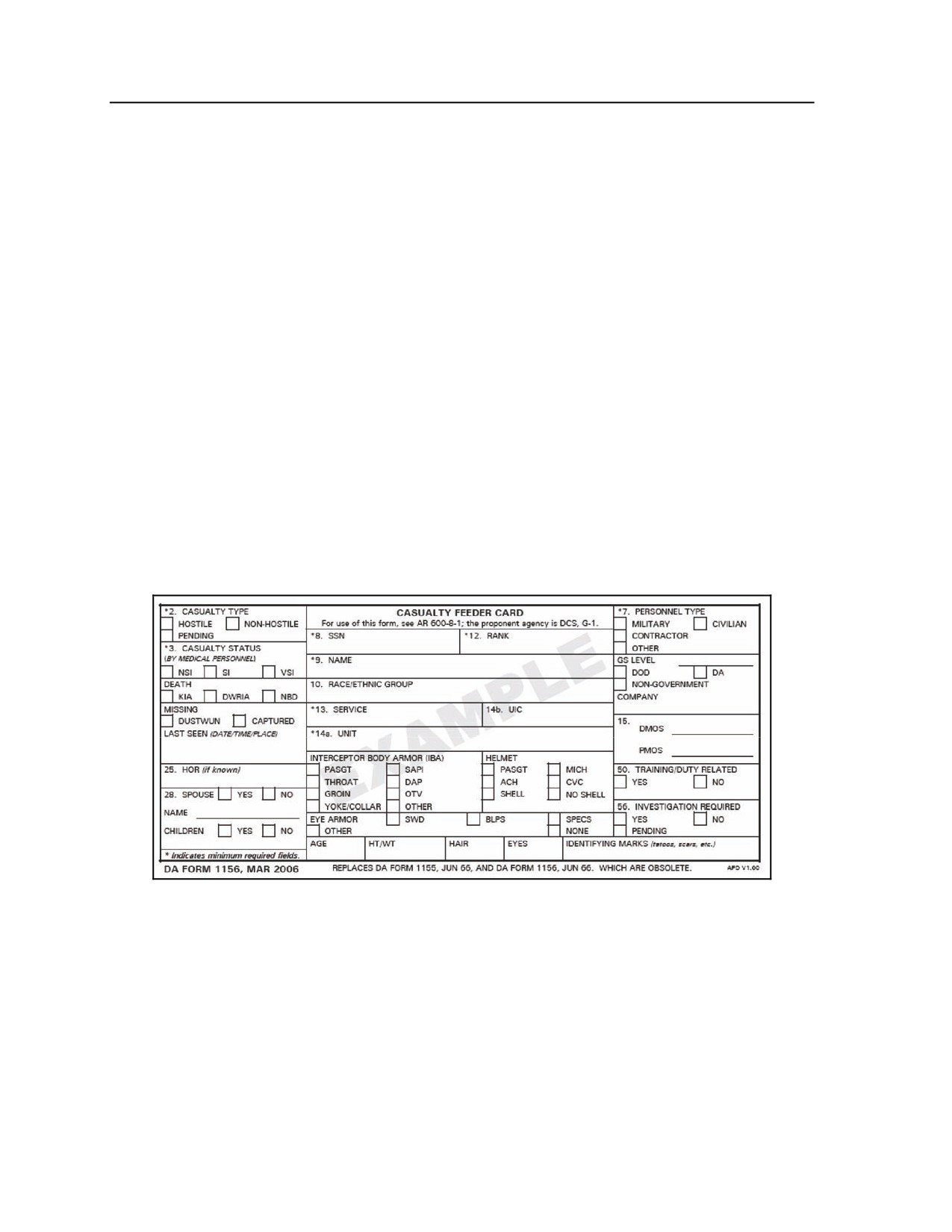
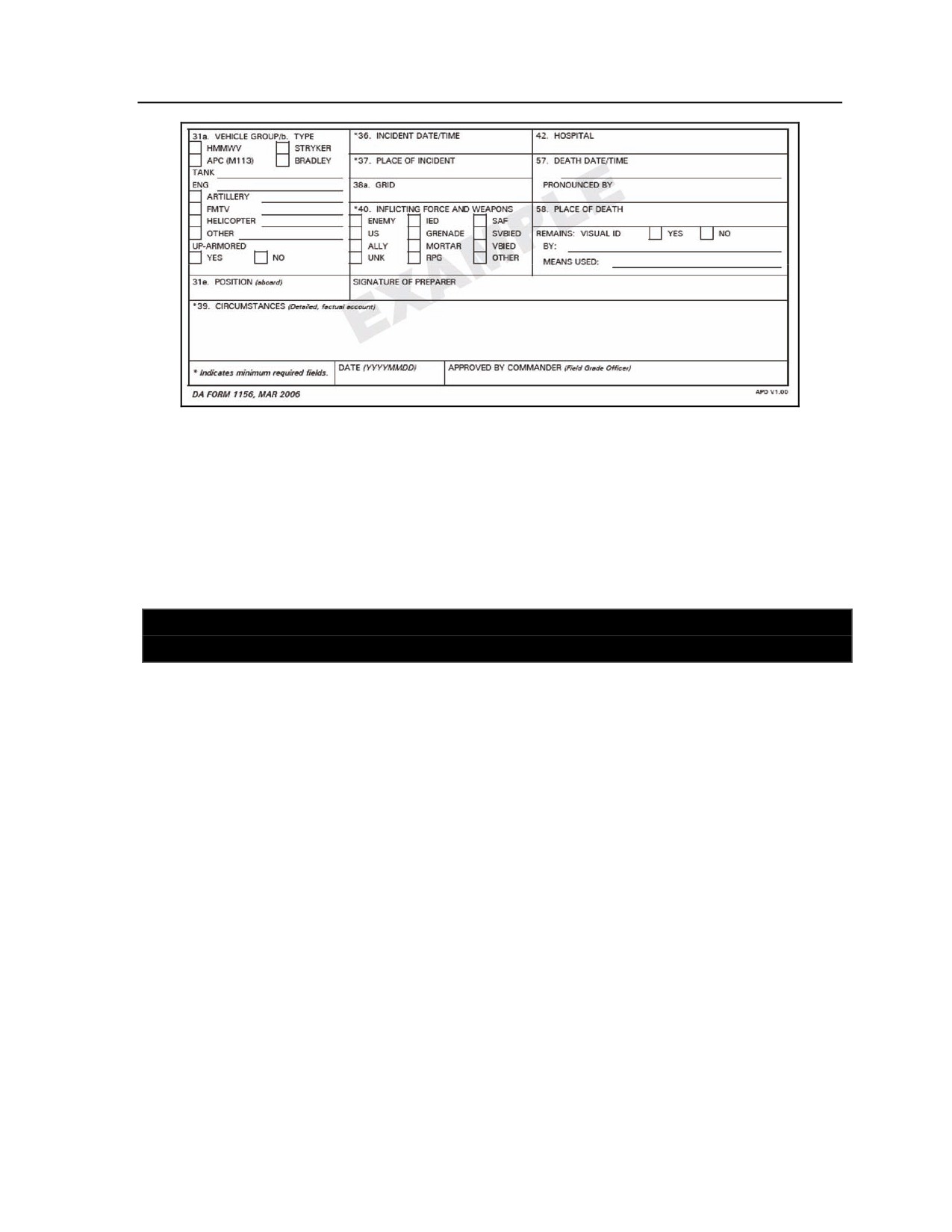
knowledge. Department of the Army (DA) Form 1156, Casualty Feeder Card (Figure 6-5A and B), is used
to report those Soldiers who have been killed and recovered, and those who have been wounded. This form
is also used to report KIA Soldiers who are missing, captured, or not recovered. The Soldier with the most
knowledge of the incident should complete the witness statement. This information is used to inform the
Soldier’s next of kin and to provide a statistical base for analysis of friendly or enemy tactics. Once the
casualty’s medical condition has stabilized, the company commander may write a letter to the Soldier’s
next of kin. During lulls in the battle, the platoon forwards casualty information to the company
headquarters.
Figure 6-5A. DA Form 1156, casualty feeder card (report front).
6-14
FM 3-21.8
28 March 2007
Sustainment
Figure 6-5B. DA Form 1156, casualty feeder card (report back).
KILLED IN ACTION
6-67. The platoon leader designates a location for the collection of KIAs. All personal effects remain with
the body. However, squad leaders remove and safeguard any equipment and issue items. He keeps these
until he can turn the equipment and issue items over to the platoon sergeant. The platoon sergeant turns
over the KIA to the 1SG. As a rule, the platoon should not transport KIA remains on the same vehicle as
wounded Soldiers. KIAs are normally transported to the rear on empty resupply trucks, but this depends on
unit SOP.
SECTION V — ENEMY PRISONERS OF WAR AND RETAINED/DETAINED
PERSONS
6-68. Enemy prisoners of war (EPW) and captured enemy equipment or materiel often provide excellent
combat information. This information is of tactical value only if the platoon processes and evacuates
prisoners and materiel to the rear quickly. In any tactical situation, the platoon will have specific
procedures and guidelines for handling prisoners and captured materiel.
6-69. All persons captured, personnel detained or retained by U.S. Armed Forces during the course of
military operations, are considered “detained” persons until their status is determined by higher military
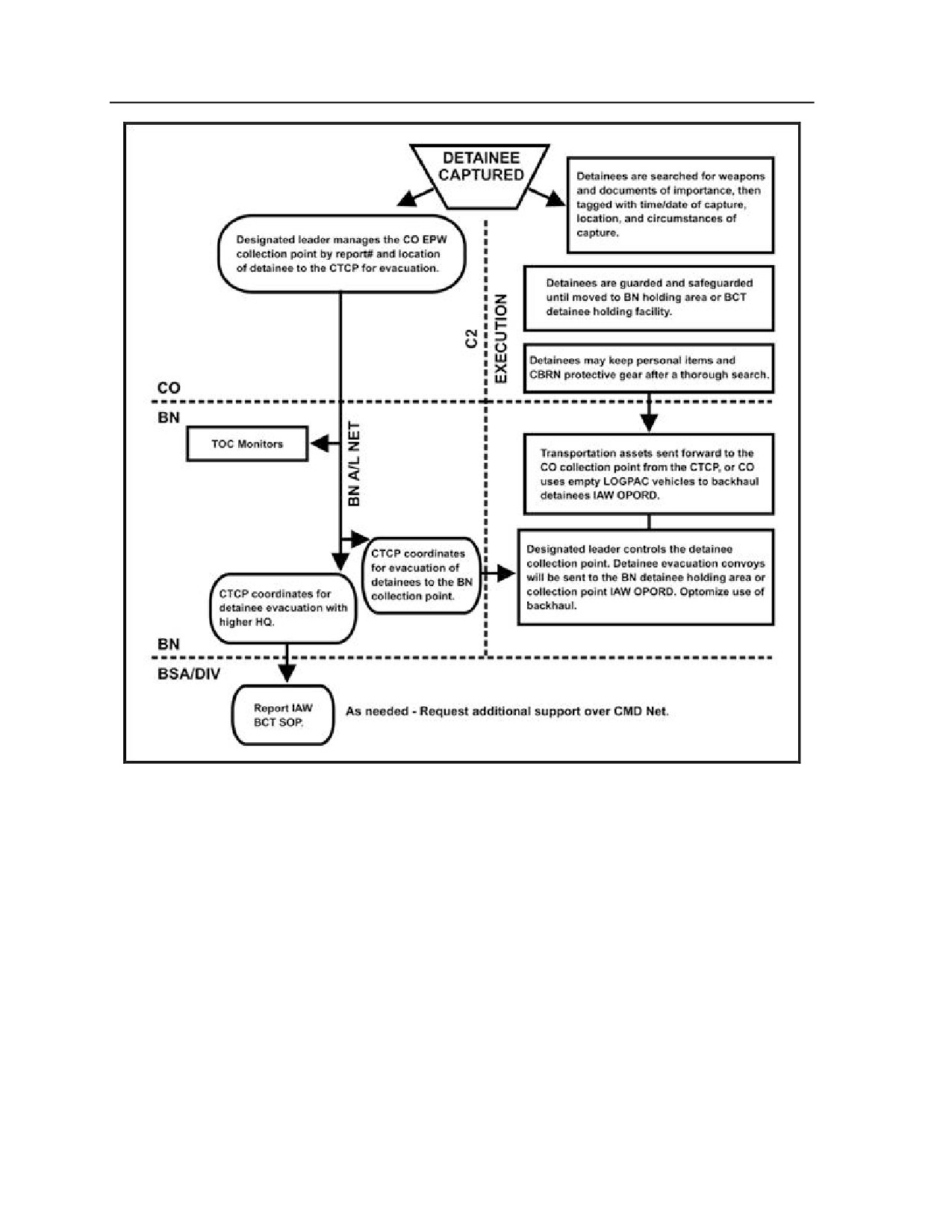
and civilian authorities. The BCT has an organic military police platoon organic to the BSTB to take
control of and evacuate detainees (Figure 6-6). However, as a practical matter, when Infantry squads,
platoons, companies, and battalions capture enemy personnel, they must provide the initial processing and
holding for detainees. Detainee handling is a resource intensive and politically sensitive operation that
requires detailed training, guidance, and supervision.
28 March 2007
FM 3-21.8
6-15
Chapter 6
Figure 6-6. Detainee handling.
6-70. All detained persons shall be immediately given humanitarian care and treatment. U.S. Armed
Forces will never torture, maltreat, or purposely place detained persons in positions of danger. There is
never a military necessity exception to violate these principles.
6-71. Field processing of detainees is always handled IAW the 5 Ss and T method:
Search: Confiscate weapons and items of intelligence value or items that might assist the
detainee to escape. Let the detainee keep protective clothing, equipment, identification and
personal items. All confiscated items must be tagged.
Silence: Direct the detainees not to talk, or make facial or hand gestures. They may be gagged.
Segregate: Leaders are separated from the rest of the population. Separate hostile elements such
as religious, political, or ethnic groups. Separate women and minors from adult male detainees.
Safeguard: Ensure detainees are provided adequate food, potable water, clothing, shelter,
medical attention, and that they not exposed to unnecessary danger. Do not use coercion to
obtain information. Immediately report allegations of abuse through command channels.
Speed to a safe area/rear: Evacuate detainees from the battlefield to a holding area or facility as
soon as possible. Transfer captured documents and other property to the forces assuming
responsibility for the detainees.
6-16
FM 3-21.8
28 March 2007

Sustainment
Tag: Before evacuating an EPW detainee, he must be tagged with Department of the Defense
(DD) Form 2745, Enemy Prisoner of War (EPW) Capture Tag (Part A) (Figure 6-7), or by field
expedient means. Field expedient means should include tagging with date and time of capture,
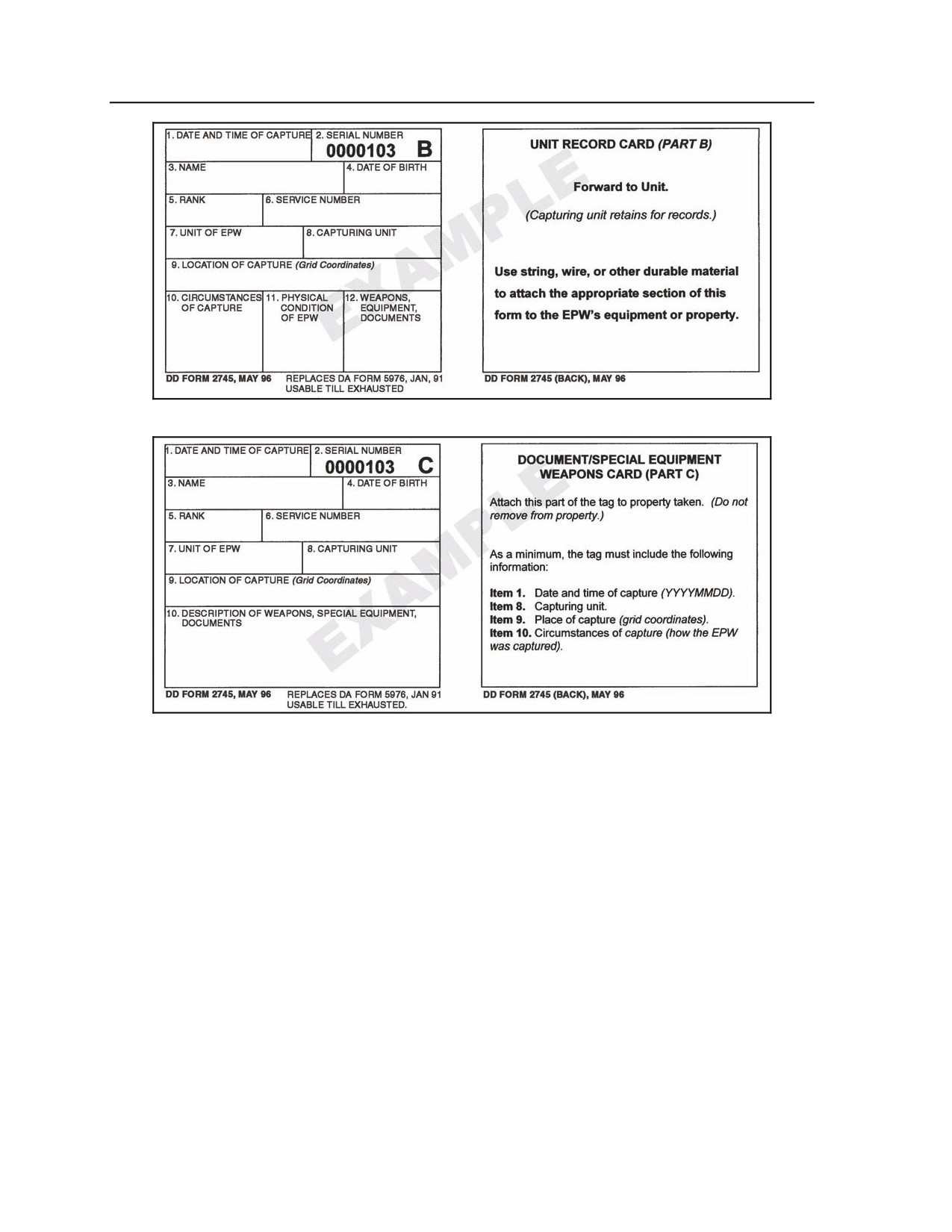
location of capture, capturing unit, and circumstances of capture. DD Form 2745, Unit Record
Card (Part B), is the unit record copy
(Figure
6-8). DD Form 2745, Document/Special
Equipment Weapons Card (Part C), is for the detainee’s confiscated property (Figure 6-9).
Tagging is critical. If it does not happen the ability of higher headquarters to quickly obtain
pertinent tactical information is greatly reduced.
6-72. Detainees should be evacuated as soon as is practical to the BCT detainee collection point. Tactical
questioning of detainees is allowed relative to collection of CCIR. However, detainees must always be
treated IAW the U.S. Law of War Policy as set forth in the Department of Defense Directive 2311.01E,
DoD Law of War Program.
6-73. Soldiers capturing equipment, documents, and detainees should tag them using DD Form 2745,
Enemy Prisoner of War (EPW) Capture Tag, take digital pictures, and report the capture immediately.
Detainees are allowed to keep protective equipment such as protective masks. Other captured military
equipment and detainee personal effects are inventoried on DA Form 4137, Evidence/Property Custody
Document. Soldiers then coordinate with the platoon and company headquarters to link up and turn the
documents and prisoners over to designated individuals.
6-74. In addition to initial processing, the capturing element provides guards and transportation to move
prisoners to the designated EPW collection points. The capturing element normally carries prisoners on
vehicles already heading toward the rear, such as tactical vehicles returning from LOGPAC operations. The
capturing element must also feed, provide medical treatment, and safeguard EPWs until they reach the
collection point.
6-75. Once EPWs arrive at the collection point, the platoon sergeant assumes responsibility for them. He
provides for security and transports them to the company EPW collection point. He uses available
personnel as guards, including walking wounded or Soldiers moving to the rear for reassignment.
Figure 6-7. DA Form 2745, enemy prisoner of war (EPW) capture tag (part A).
28 March 2007
FM 3-21.8
6-17
Chapter 6
Figure 6-8. DD 2745, unit record card (part B).
Figure 6-9. DD 2745, document/special equipment weapons card (part C).
6-18
FM 3-21.8
28 March 2007
Chapter 7
OFFENSIVE OPERATIONS
Platoon and squad leaders must understand the principles, tactics, techniques, and
procedures associated with the offense. They must comprehend their role when
operating within a larger organization’s operations, and when operating
independently. They must recognize the complementary and reinforcing effects of
other maneuver elements and supporting elements with their own capabilities. They
must also understand the impact of terrain, open or restrictive, on their operations.
This chapter discusses offensive operations and the elements that affect tactical
success.
SECTION I — INTRODUCTION TO OFFENSIVE OPERATIONS
7-1. Infantry platoon offensive actions can occur during all types of full spectrum operations. The enemy
situation affects the type of operation conducted. METT-TC influences the actions of leaders and options
available to them.
7-2. The outcome of decisive combat derives from offensive operations. The platoon can best close with
the enemy by means of fire and maneuver to destroy or capture him, repel his assault by fire, engage in
close combat, or counterattack through offensive operations. While tactical considerations call for the
platoon to execute defensive operations for a period of time, defeating the enemy requires a shift to
offensive operations. This is also true in stability operations in which transitions to the offense can occur
suddenly and unexpectedly. To ensure the success of the attack, the platoon leader must understand the
following fundamentals of offensive operations and apply the TLP during the operations process. (For a
discussion on the TLP operations process, refer to Chapter 5.) A sound doctrinal foundation during
offensive planning assists the platoon leader in capitalizing on the tactical employment of the Infantry
platoon.
CHARACTERISTICS OF OFFENSIVE OPERATIONS
7-3. Surprise, concentration, tempo, and audacity characterize all offensive operations. To maximize the
value of these characteristics, platoon leaders must apply the following considerations.
SURPRISE
7-4. Platoons achieve surprise by attacking the enemy at a time or place he does not expect or in a manner
for which he is unprepared. Unpredictability and boldness, within the scope of the commander’s intent,
help the platoon gain surprise. Total surprise is rarely essential; simply delaying or disrupting the enemy’s
reaction is usually effective. Surprise also stresses the enemy’s command and control and induces
psychological shock in his Soldiers and leaders. The platoon’s ability to infiltrate during limited visibility
and to attack are often key to achieving surprise.
CONCENTRATION
7-5. Platoons achieve concentration by massing the effects of their weapons systems and rifle squads to
achieve a single purpose. Massing effects does not require all elements of the platoon to be co-located; it
simply requires the effects of the weapons systems to be applied at the right place and time. Because the
attacker moves across terrain the enemy has prepared, he may expose himself to the enemy’s fires. By
28 March 2007
FM 3-21.8
7-1
Chapter 7
concentrating combat power, the attacker can reduce the effectiveness of enemy fires and the amount of
time he is exposed to those fires. Modern navigation tools such as global positioning systems (GPSs) allow
the platoon leader to disperse, while retaining the ability to quickly mass the effects of the platoon’s
weapons systems whenever necessary.
TEMPO
7-6. Tempo is the rate of speed of military action. Controlling or altering that rate is essential for
maintaining the initiative. While a fast tempo is preferred, the platoon leader must remember that
synchronization sets the stage for successful accomplishment of the platoon’s mission. To support the
commander’s intent, the platoon leader must ensure his platoon’s movement is synchronized with the
company’s movement and with the other platoons. If the platoon is forced to slow down because of terrain
or enemy resistance, the commander can alter the tempo of company movement to maintain
synchronization. The tempo may change many times during an offensive operation. The platoon leader
must remember that it is more important to move using covered and concealed routes (from which he can
mass the effects of direct fires), than it is to maintain precise formations and predetermined speeds.
AUDACITY
7-7. Audacity is a simple plan of action, boldly executed. It is the willingness to risk bold action to
achieve positive results. Knowledge of the commander’s intent one and two levels up allows the platoon
leader to take advantage of battlefield opportunities whenever they present themselves. Audacity enhances
the effectiveness of the platoon’s support for the entire offensive operation. Marked by disciplined
initiative, audacity also inspires Soldiers to overcome adversity and danger.
TYPES OF OFFENSIVE OPERATIONS
7-8. The four types of offensive operations, described in FM 3-90, are movement to contact, attack,
exploitation, and pursuit. Companies can execute movements to contact and attacks. Platoons generally
conduct these forms of the offense as part of a company. Companies and platoons participate in an
exploitation or pursuit as part of a larger force. The nature of these operations depends largely on the
amount of time and enemy information available during the planning and preparation for the operation
phases. All involve designating decisive points, maintaining mutual support, gaining fire superiority over
the enemy, and seizing positions of advantage without prohibitive interference by the enemy.
MOVEMENT TO CONTACT
7-9. Movement to contact is a type of offensive operation designed to develop the situation and establish
or regain contact. The platoon will likely conduct a movement to contact as part of a company when the
enemy situation is vague or not specific enough to conduct an attack. For a detailed discussion of
movement to contact, refer to Section V.
ATTACK
7-10. An attack is an offensive operation that destroys enemy forces, seizes, or secures terrain. An attack
differs from a movement to contact because the enemy disposition is at least partially known. Movement
supported by fires characterizes an attack. The platoon will likely participate in a synchronized company
attack. However, the platoon may conduct a special purpose attack as part of or separate from a company
offensive or defensive operation. Special purpose attacks consist of ambush, spoiling attack, counterattack,
raid, feint, and demonstration. For a detailed discussion of attack and special purpose attacks, refer to
Section VI.
EXPLOITATION
7-11. All commanders are expected to exploit successful attacks. In the exploitation, the attacker extends
the destruction of the defending force by maintaining constant offensive pressure. Exploitations are
conducted at all command levels, but divisions and brigades are the echelons that conduct major
7-2
FM 3-21.8
28 March 2007
Offensive Operations
exploitation operations. The objective of exploitation is to disintegrate the enemy to the point where they
have no alternative but surrender or fight following a successful attack. Indicators such as increased enemy
prisoners of war (EPW), lack of organized defense, loss of enemy unit cohesion upon contact, and capture
of enemy leaders indicate the opportunity to shift to an exploitation. Companies and platoons may conduct
movements to contact or attacks as part of a higher unit’s exploitation.
PURSUIT
7-12. Pursuits are conducted at the company level and higher. A pursuit typically follows a successful
exploitation. The pursuit is designed to prevent a fleeing enemy from escaping and to destroy him.
Companies and platoons may conduct pursuits as part of a higher unit’s exploitation.
FORMS OF MANEUVER
7-13. In the typical offensive operations sequence (see Section II), the platoon maneuvers against the
enemy in an area of operation. Maneuver places the enemy at a disadvantage through the application of
friendly fires and movement. The five forms of maneuver are—
(1) Envelopment.
(2) Turning movement.
(3) Infiltration.
(4) Penetration.
(5) Frontal attack.
ENVELOPMENT
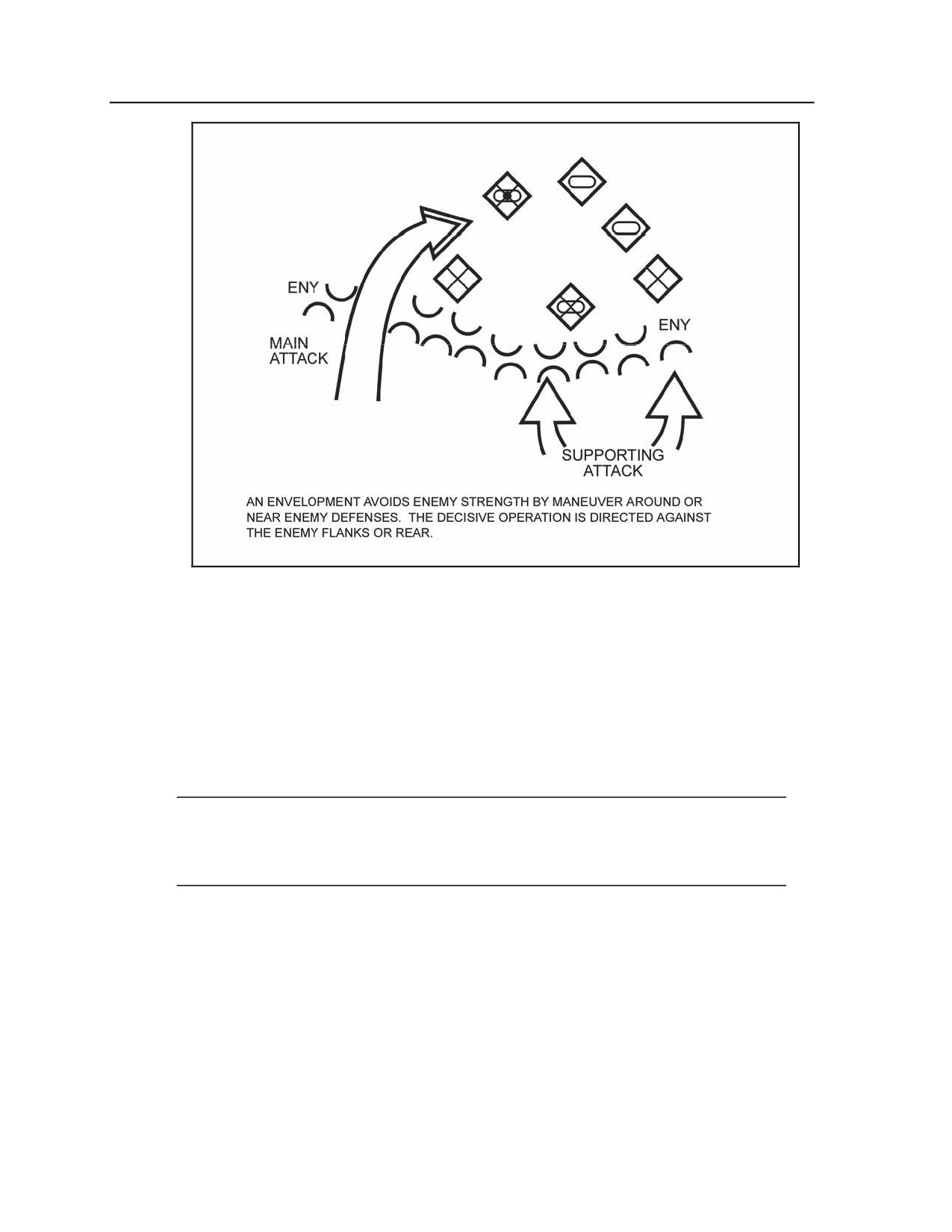
7-14. Envelopment (Figure 7-1) is a form of maneuver in which an attacking element seeks to avoid the
principal enemy defenses by seizing objectives to the enemy flank or rear in order to destroy him in his
current positions. Flank attacks are a variant of envelopment in which access to the enemy’s flank and rear
results in enemy destruction or encirclement. A successful envelopment requires discovery or creation of an
assailable flank. The envelopment is the preferred form of maneuver because the attacking element tends to
suffer fewer casualties while having the most opportunities to destroy the enemy. A platoon may conduct
the envelopment by itself or as part of the company’s attack. Envelopments focus on—
Seizing terrain.
Destroying specific enemy forces.
Interdicting enemy withdrawal routes.
28 March 2007
FM 3-21.8
7-3
Chapter 7
Figure 7-1. Envelopment.
TURNING MOVEMENT
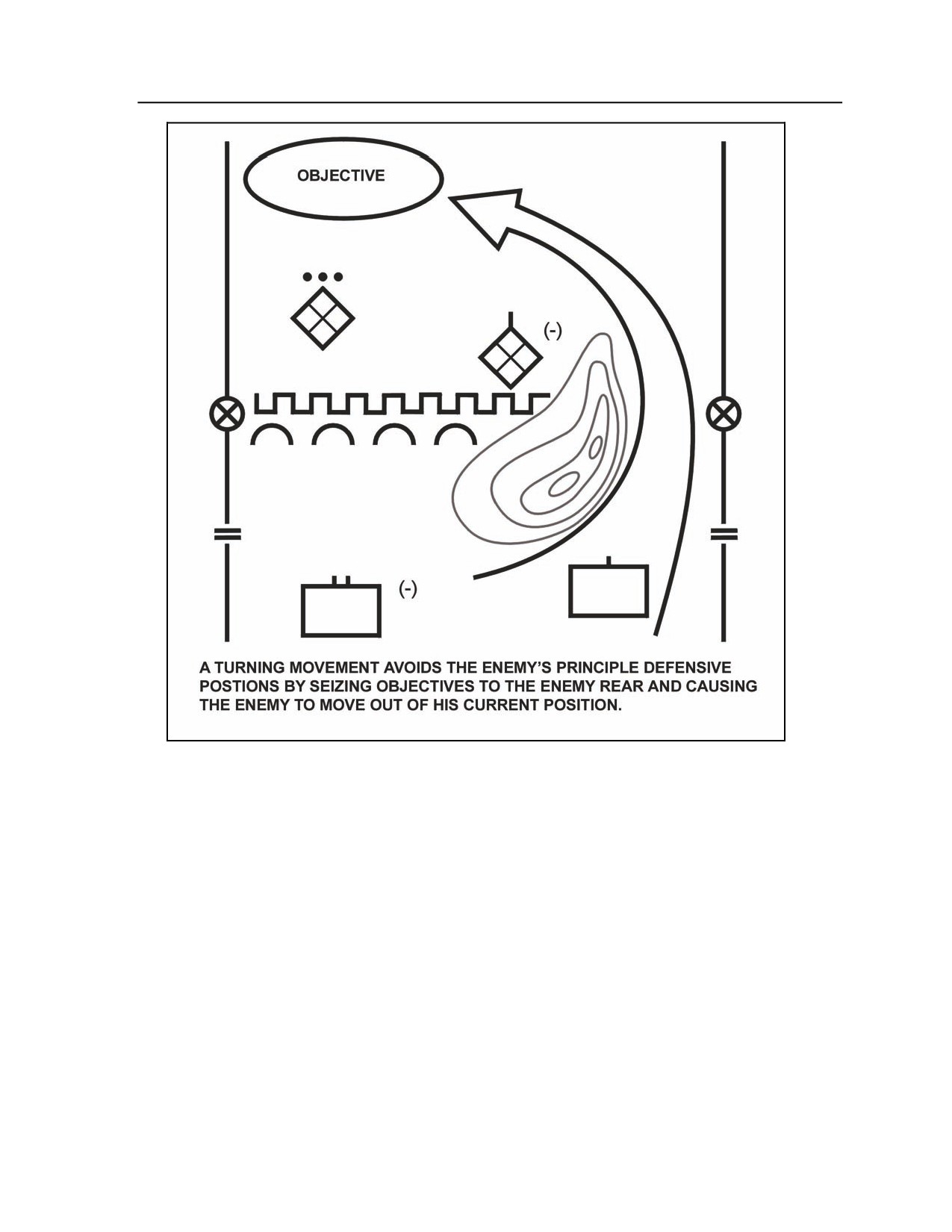
7-15. The turning movement (Figure 7-2) is a form of maneuver in which the attacking element seeks to
avoid the enemy’s principal defensive positions by seizing objectives to the enemy’s rear. This causes the
enemy to move out of his current positions or to divert major forces to meet the threat. For a turning
movement to be successful, the unit trying to turn the enemy must attack something the enemy will fight to
save or that will cause him to move to avoid destruction. This may be a supply route, an artillery
emplacement, or a headquarters. In addition to attacking a target that the enemy will fight to save, the
attacking unit should be strong enough to pose a real threat. A platoon will likely conduct a turning
movement as part of a company supporting a battalion attack.
NOTE: The turning movement is different from envelopment because the element conducting
the turning movement seeks to make the enemy displace from his current location. An
enveloping element seeks to engage the enemy in his current location from an unexpected
direction.
7-4
FM 3-21.8
28 March 2007
Offensive Operations
Figure 7-2. Turning movement.
INFILTRATION
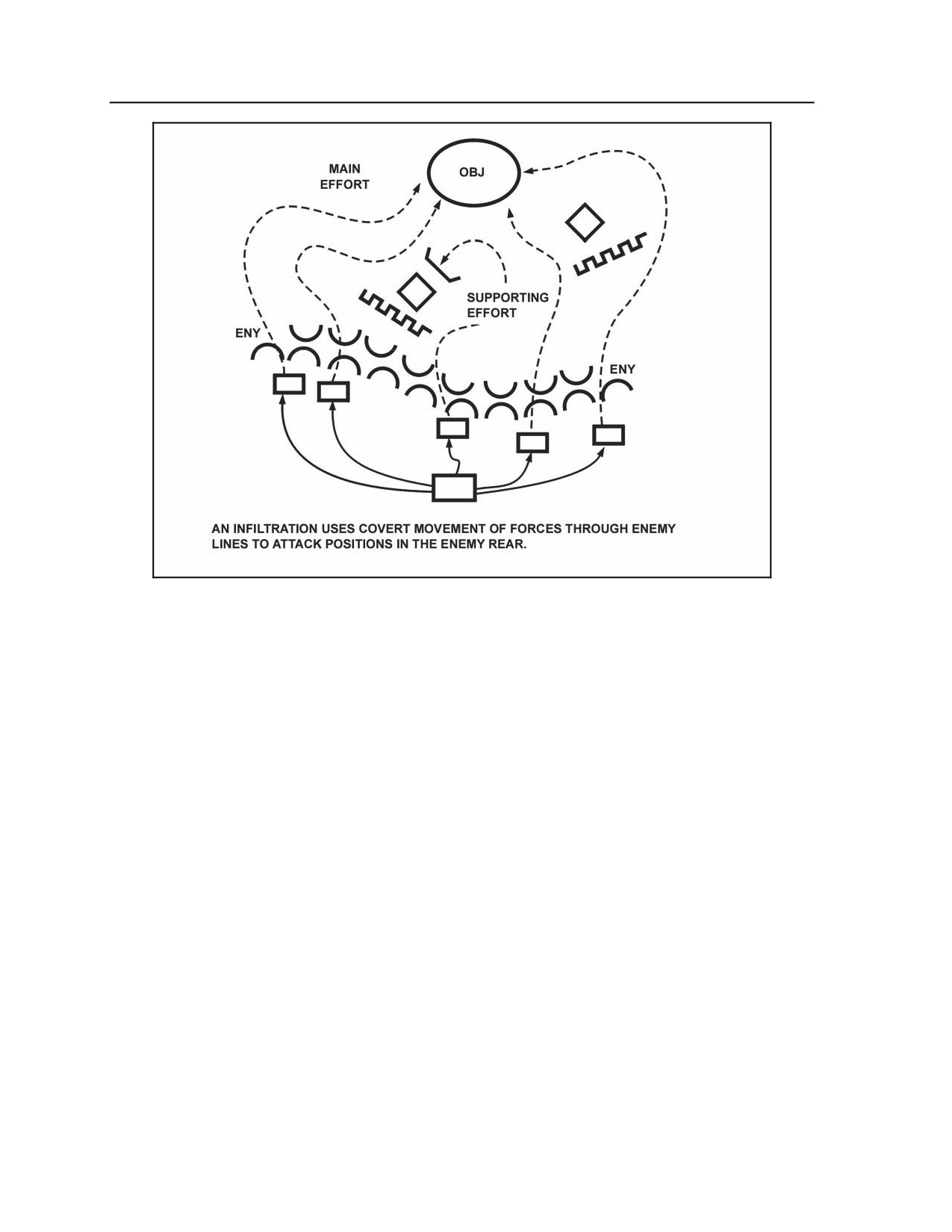
7-16. Infiltration (Figure 7-3) is a form of maneuver in which an attacking element conducts undetected
movement through or into an area occupied by enemy forces to gain a position of advantage in the enemy
rear. When conducted efficiently only small elements will be exposed to enemy defensive fires. Moving
and assembling forces covertly through enemy positions takes a considerable amount of time. A successful
infiltration reaches the enemy’s rear without fighting through prepared positions. An infiltration is normally
used in conjunction with and in support of a unit conducting another form of maneuver. A platoon may
conduct an infiltration as part of a larger unit’s attack with the company employing another form of
maneuver. A platoon may conduct an infiltration to—
Attack enemy-held positions from an unexpected direction.
Occupy a support-by-fire position to support an attack.
Secure key terrain.
Conduct ambushes and raids.
Conduct a covert breach of an obstacle.
28 March 2007
FM 3-21.8
7-5
Chapter 7
Figure 7-3. Infiltration.
PENETRATION
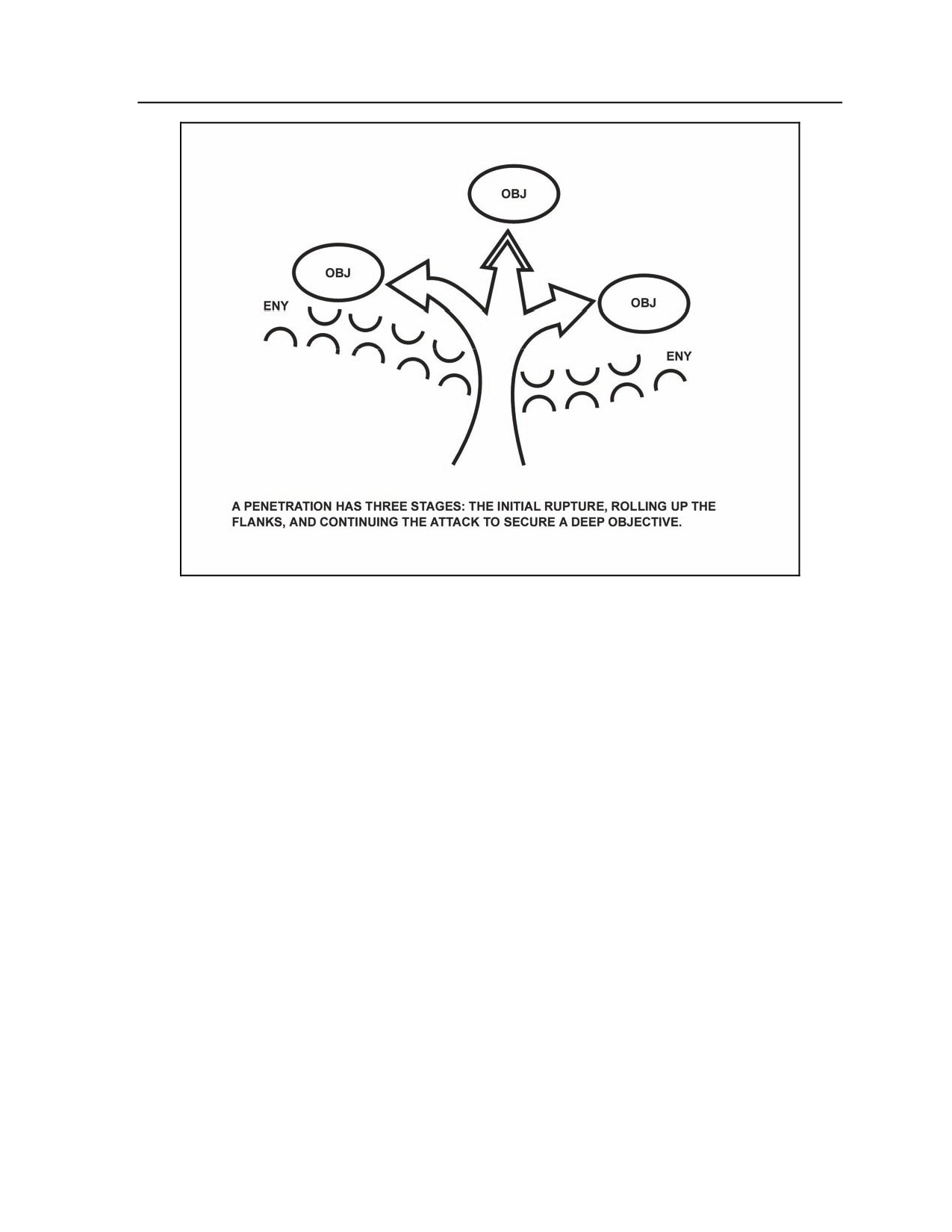
7-17. Penetration (Figure 7-4) is a form of maneuver in which an attacking element seeks to rupture enemy
defenses on a narrow front to create both assailable flanks and access to the enemy’s rear. Penetration is
used when enemy flanks are not assailable; when enemy defenses are overextended; when weak spots in
the enemy defense are identified; and when time does not permit some other form of maneuver. A
penetration normally consists of three steps: breach the enemy’s main defense positions, widen the gap
created to secure flanks by enveloping one or both of the newly exposed flanks, and seize the objective. As
part of a larger force penetration the platoon will normally isolate, suppress, fix, or destroy enemy forces;
breach tactical or protective obstacles in the enemy’s main defense; secure the shoulders of the penetration;
or seize key terrain. Similar to breaching obstacles, the platoon will be designated as a breach, support, or
assault element. A company may also use the penetration to secure a foothold within a built-up area.
7-6
FM 3-21.8
28 March 2007
Offensive Operations
Figure 7-4. Penetration.
FRONTAL ATTACK
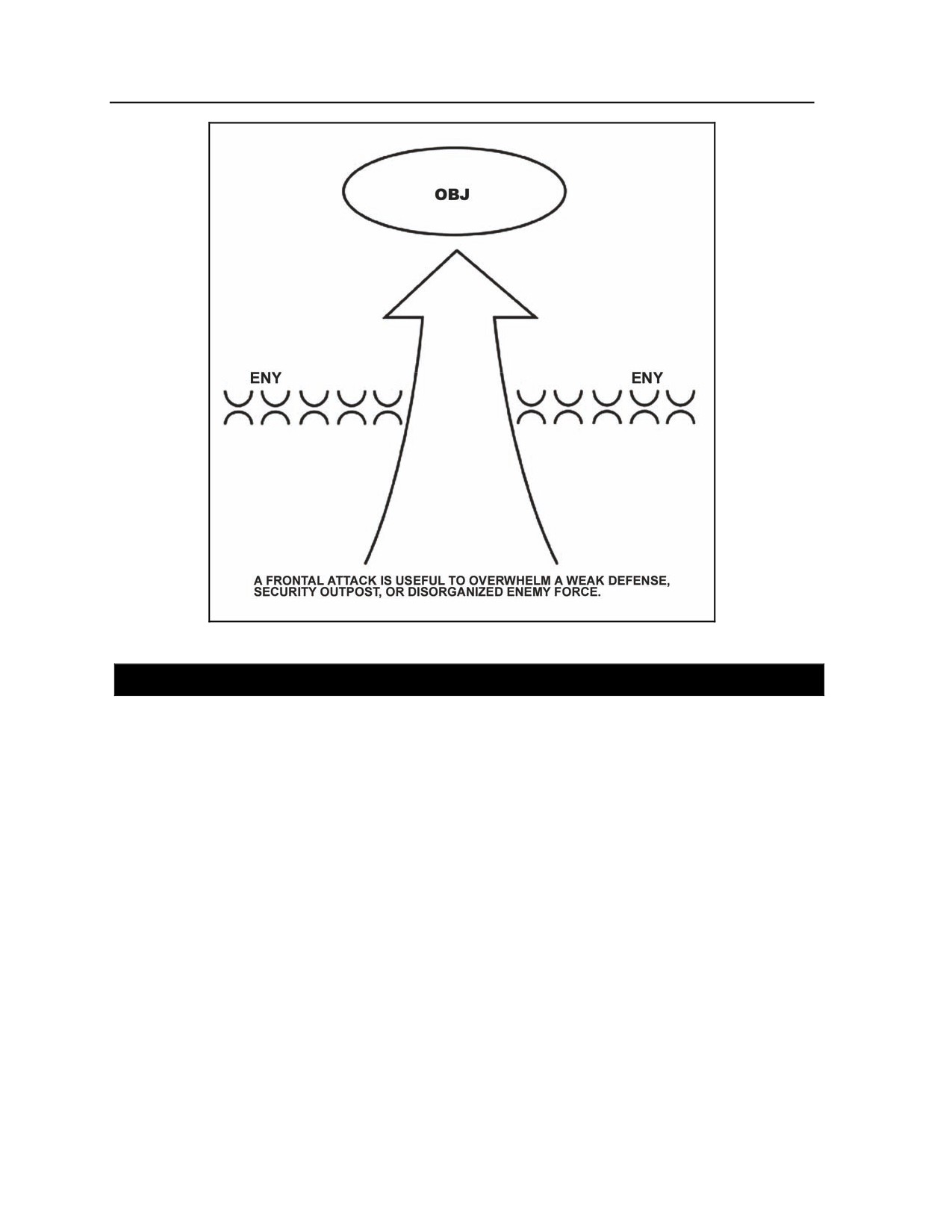
7-18. Frontal attack (Figure 7-5) is a form of maneuver in which an attacking element seeks to destroy a
weaker enemy force or fix a larger enemy force along a broad front. It is the least desirable form of
maneuver because it exposes the attacker to the concentrated fire of the defender and limits the
effectiveness of the attacker’s own fires. However, the frontal attack is often the best form of maneuver for
an attack in which speed and simplicity are key. It is useful in overwhelming weak defenses, security
outposts, or disorganized enemy forces, and is also often used when a unit conducts a reconnaissance in
force.
28 March 2007
FM 3-21.8
7-7
Chapter 7
Figure 7-5. Frontal attack.
SECTION II — SEQUENCE OF OFFENSIVE OPERATIONS
7-19. As the platoon leader plans for an offensive mission, he generally considers the following, which
apply to many, but not all, offensive operations:
Assembly area.
Reconnaissance.
Movement to the line of departure.
Maneuver.
Deployment.
Assault.
Consolidation and reorganization.
PREPARATION IN THE OFFENSE
7-20. The friendly Infantry attacker has the advantage of choosing the time, place, and method of the
engagement. Infantry units should maximize this advantage by engaging the enemy defender in a way that
the he is unprepared for. Preparations for offensive operations include planning and rehearsals enabled by
friendly reconnaissance operations that determine the enemy defender’s disposition, composition, strength,
capabilities, and possible courses of action. Friendly Infantry units then use this knowledge to develop their
own courses of action.
7-8
FM 3-21.8
28 March 2007
Offensive Operations
ASSEMBLY AREA
7-21. The assembly area (AA) is the area a unit occupies to prepare for an operation. To prepare the
platoon for the upcoming battle, the platoon leader plans, directs, and supervises mission preparations in
the assembly area. This time allows the platoon to conduct precombat checks and inspections, rehearsals,
and sustainment activities. The platoon will typically conduct these preparations within a company
assembly area; it will rarely occupy its own assembly area.
RECONNAISSANCE
7-22. All leaders should aggressively seek information about the terrain and the enemy. Because the enemy
situation and available planning time may limit a unit’s reconnaissance, the platoon will likely conduct
reconnaissance to answer the company commander’s priority intelligence requirements (PIR). An example
is reconnoitering and timing routes from the assembly area to the line of departure. The platoon may also
augment the efforts of the battalion reconnaissance platoon to answer the commander’s PIR. Other forms of
reconnaissance include maps, and if available, terrain software/databases. Updates from reconnaissance can
occur at any time while the platoon is planning for, preparing for, or executing the mission. As a result, the
leader must always be prepared to adjust his plans.
MOVEMENT TO THE LINE OF DEPARTURE
7-23. The platoon will typically move from the AA to the line of departure as part of the company
movement plan. This movement plan may direct the platoon to move to an attack position to await orders to
cross the line of departure. If so, the platoon leader must reconnoiter, time, and rehearse the route to the
attack position. Section and squad leaders must know where they are to locate within the assigned attack
position, which is the last position an attacking element occupies or passes through before crossing the line
of departure. The company commander may order all of the platoons to move within a company formation
from the assembly area directly to the point of departure at the line of departure. The point of departure is
the point where the unit crosses the line of departure and begins moving along a direction of attack or axis
of advance. If one point of departure is used, it is important that both the lead platoon and trail platoons
reconnoiter, time, and rehearse the route to it. This allows the company commander to maintain
synchronization. To maintain flexibility and to further maintain synchronization, he may also designate a
point of departure along the line of departure for each platoon.
MANEUVER
7-24. The company commander will plan the approach of all platoons to the objective to ensure
synchronization, security, speed, and flexibility. He will select the platoons’ routes, movement techniques,
formations, and methods of movement to best support his intent for actions on the objective. The platoon
leader must recognize this portion of the battle as a fight, not as a movement. He must be prepared to make
contact with the enemy. (For a detailed discussion of actions on contact, refer to Chapter 1, paragraph 1
160, and Chapter 3, Section V.) He must plan accordingly to reinforce the commander’s needs for
synchronization, security, speed, and flexibility. During execution, he may display disciplined initiative and
alter his platoon’s formation, technique, or speed to maintain synchronization with the other platoons and
flexibility for the company commander.
DEPLOYMENT
7-25. As the platoon deploys and moves toward the assault position, it minimizes delay and confusion by
beginning the final positioning of the squads as directed by the company commander. An assault position is
the last covered and concealed position short of the objective from which final preparations are made to
assault the objective. This tactical positioning allows the platoon to move in the best tactical posture
through the assault position into the attack. Movement should be as rapid as the terrain, unit mobility, and
enemy situation permit. A common control measure used in or just beyond the assault position is the
probable line of deployment (PLD), which is used most often under conditions of limited visibility. The
28 March 2007
FM 3-21.8
7-9

Chapter 7
probable line of deployment is a phase line the company commander designates as a location where he
intends to completely deploy his unit into the assault formation before beginning the assault.
ASSAULT
7-26. During an offensive operation, the platoon’s objective may be terrain-oriented or force-oriented.
Terrain-oriented objectives may require the platoon to seize a designated area and often require fighting
through enemy forces. If the objective is force-oriented, an objective may be assigned for orientation, while
the platoon’s efforts are focused on the enemy’s actual location. Actions on the objective begin when the
company or platoon begins placing direct and indirect fires on the objective. This may occur while the
platoon is still moving toward the objective from the assault position or probable line of deployment.
CONSOLIDATION AND REORGANIZATION
7-27. The platoon consolidates and reorganizes as required by the situation and mission. Consolidation is
the process of organizing and strengthening a newly captured position so it can be defended.
Reorganization is the actions taken to shift internal resources within a degraded unit to increase its level of
combat effectiveness. Reorganization actions can include, cross-leveling ammunition, ensuring key
weapons systems are manned, and ensuring key leadership positions are filled if the operators/crew become
casualties. The platoon executes follow-on missions as directed by the company commander. A likely
mission may be to continue the attack against the enemy within the area of operations. Regardless of the
situation, the platoon must posture itself and prepare for continued offensive operations. Table 7-1 contains
common consolidation and reorganization activities.
Table 7-1. Consolidation and reorganization activities.
Consolidation Activities
Reorganization Activities
•
Security measures include—
•
Reestablishing the chain of command.
Establishing 360-degree local security.
•
Manning key weapon systems.
Using security patrols.
•
Maintaining communications and reports, to
Using observation posts/outposts.
include—
Emplacing early warning devices.
Restoring communication with any unit
temporarily out of communication.
Establishing and registering final protective
fires.
Sending unit situation report.
Seeking out and eliminating enemy resistance
Sending SITREPs (at a minimum, subordinates
(on and off the objective).
report status of mission accomplishment).
•
Automatic weapons (man, position, and assign
Identifying and requesting resupply of critical
principal directions of fire [PDFs] to Soldiers
shortages.
manning automatic weapons).
•
Resupplying and redistributing ammunition and
•
Fields of fire (establish sectors of fire and other
other critical supplies.
direct fire control measures for each
•
Performing special team actions such as—
subunit/Soldier).
Consolidating and evacuating casualties, EPWs,
•
Entrenchment (provide guidance on protection
enemy weapons, noncombatants/ refugees, and
requirements such as digging/building fighting
damaged equipment (not necessarily in the
positions).
same location).
Treating and evacuating wounded personnel.
Evacuating friendly KIA.
Treating and processing EPWs.
Segregating and safeguarding noncombatants/
refugees.
Searching and marking positions to indicate to
other friendly forces that they have been
cleared.
7-10
FM 3-21.8
28 March 2007
Offensive Operations
SECTION III — PLANNING CONSIDERATIONS
7-28. The warfighting functions are a group of tasks and systems united by a common purpose that
Infantry leaders use to accomplish missions and training objectives. Planning, synchronization and
coordination among the warfighting functions are critical for success. The warfighting functions are
addressed in this section.
INTELLIGENCE
The Intelligence warfighting function consists of the related tasks and systems that facilitate understanding of
the enemy, terrain, weather, and civil considerations. In offensive operations the Infantry platoon leader uses his
intelligence, surveillance, reconnaissance (ISR) assets to study the terrain and confirm or deny the enemy’s
strengths, dispositions, and likely intentions, especially where and in what strength the enemy will defend.
These assets also gather information concerning the civilian population within the AO to confirm or deny their
numbers, locations, and likely intentions.
MOVEMENT AND MANEUVER
7-29. The movement and maneuver warfighting function consists of the related tasks and systems that
move forces to achieve a position of advantage in relation to the enemy. The purpose of maneuver is to
close with and destroy the defending enemy. Maneuver requires a base-of-fire element to suppress or
destroy enemy forces with accurate direct fires and bounding elements to gain positional advantage over
the enemy. When effectively executed, maneuver leaves enemy elements vulnerable by forcing them to
fight in at least two directions, robbing them of initiative, and ultimately limiting their tactical options.
Movement and maneuver are the means by which Infantry leaders mass the effects of combat power to
achieve surprise, shock, momentum, and dominance.
7-30. The platoon will likely focus on mobility during the movement phase of offensive operations and
may be required to breach obstacles as part of an offensive operation. These obstacles may be protective
(employed to assist units in their close-in protection), which the platoon is expected to breach without
additional assets. Tactical obstacles, however, which block, disrupt, turn, or fix unit formations, normally
require engineer assets to breach. Refer to FM 3-34.2, Combined-Arms Breaching Operations, for a more
detailed discussion of breaching.
FIRE SUPPORT
7-31. The fire support warfighting function consists of the related tasks and systems that provide collective
and coordinated use of Army indirect fires, joint fires, and offensive information operations. The platoon
may be able to employ indirect fires from field artillery or company and or battalion mortars to isolate a
small part of the enemy defense or to suppress the enemy on the objective. The platoon leader must always
keep in mind the potential danger to friendly elements created by indirect fires used in support of the
assault. He must ensure that the indirect fire assets always know the position and direction of movement of
his platoon.
PROTECTION
7-32. The protection warfighting function consists of the related tasks and systems that preserve the force,
so the Infantry leader can apply maximum combat power. Preserving the force includes protecting
personnel, physical assets, and information of the Infantry platoon. Areas included in protection at the
Infantry platoon level are:
Safety
Fratricide avoidance
Survivability
Air and missile defense
Force health protection
28 March 2007
FM 3-21.8
7-11
Chapter 7
SUSTAINMENT
7-33. The sustainment warfighting function includes related tasks and systems that provide support and
services to ensure freedom of action, extend operational reach, and prolong endurance. The primary
purpose of sustainment in the offense is to assist the platoon and company in maintaining momentum
during the attack. Key sustainment planning considerations for the platoon leader during the offense
include:
High expenditure of ammunition for selected tactical tasks.
Friendly casualty rate and how to evacuate the casualties to what locations.
Availability of water and other mission-essential supplies before, during, and after actions on the
objective.
COMMAND AND CONTROL
7-34. The command and control warfighting function consists of the related tasks and systems that support
Infantry leaders in exercising authority and direction. At the Infantry platoon and squad level, command
and control refers to the process of directing, coordinating, and controlling a unit to accomplish a mission.
During offensive operations Infantry leaders must establish control measures to provide a way to direct and
coordinate the platoon or squad’s movement.
7-35. Control measures are directives given graphically or orally by a commander to subordinate
commands to assign responsibilities, coordinate fires and maneuver, and control combat operations. Each
control measure can be portrayed graphically. In general, all control measures should be easily identifiable
on the ground. Leaders organize the battlefield by establishing control measures that dictate responsibility,
control movement, and manage fires.
AREA OF OPERATION
7-36. The area of operation (AO) is the basic control measure for assigning responsibility and conducting
operations. An AO is a clearly defined geographical area with associated airspace where leaders conduct
operations within the limits of their authority. Within an AO leaders are responsible for accomplishing their
mission and are accountable for their unit’s actions. Units acting as part of a larger unit operate within the
AO of the next higher commander. When assigned their own AO, leaders of Infantry platoons or squads
usually have expanded planning, preparation, and execution responsibilities. At lower levels, the term AO
is often synonymous with a unit’s current location and any associated operational environment, usually
without formal boundaries.
7-37. Boundaries control the maneuver and fire of adjacent units. They are normally drawn along
recognizable terrain features and are situated so key terrain features and avenues of approach are inclusive
to one unit.
7-38. Leaders use boundaries as their basic control measure to divide up the battlefield and assign
responsibilities. When given a boundary, the owning unit may employ any direct or indirect fire in
accordance with previously-issued orders and ROE without receiving further clearance from the controlling
headquarters. The following exceptions apply:
Munitions that produce effects outside of the boundary must be authorized by higher.
Munitions that are restricted must authorized.
Direct Fire and Boundaries
7-39. Direct fire may be used across a unit boundary without prior coordination if the enemy target is
clearly identified. When possible, direct fire boundries should be coordinated with adjacent units. Unless
the target poses an imminent threat, the leader authorizing the fire should attempt prior coordination before
engaging targets across his boundary. Indirect fire will not be used across a unit’s boundary unless prior
coordination is made.
7-12
FM 3-21.8
28 March 2007
Offensive Operations
Basic Control Measures
7-40. Leaders use the boundary to divide up their AOs for subordinates. An AO normally contains one or
more engagement areas
(defense operations) and or objectives
(offensive operations). Leaders use
additional control measures to specify responsibilities, control movement and fires (direct and indirect),
sequence subordinate activities, and synchronize other resources.
Types of AOs
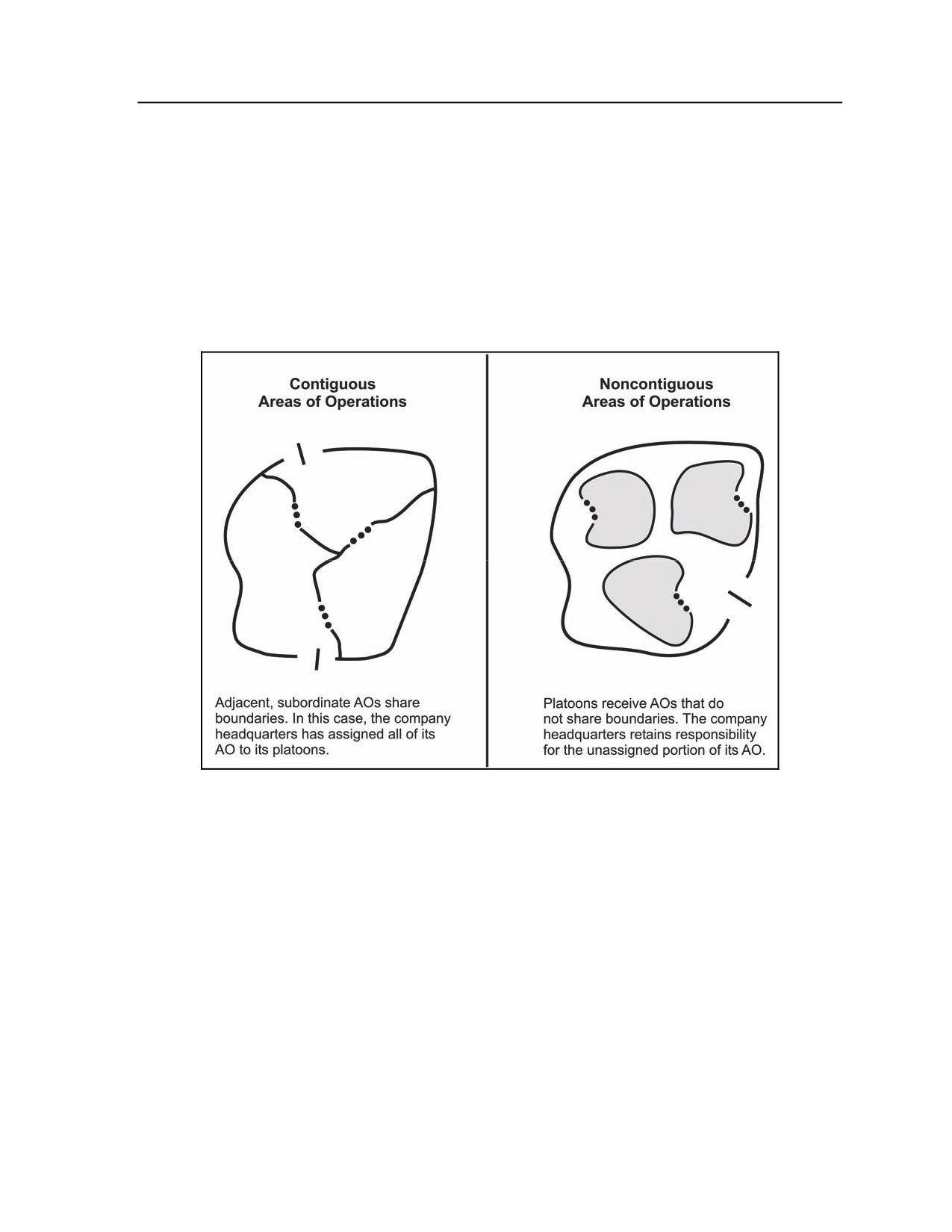
7-41. The type of AO is defined by whether a unit shares a boundary with an adjacent unit. If it does, it is a
contiguous AO. If a boundary is not shared with another unit, it is a noncontiguous AO (Figure 7-6). The
higher headquarters is responsible for the area between noncontiguous AOs.
Figure 7-6. Types of AOs.
Mutually Supporting Units
7-42. Regardless of whether a unit shares a common boundary, leaders must determine if they have
mutually-supporting adjacent units. The presence of a mutually-supporting unit indicates an increased
requirement for coordination. A position without mutually-supporting adjacent units indicates an increased
requirement for security—360-degree security.
INTEGRATING CONTROL MEASURES WITH TERRAIN
7-43. When looking for terrain features to use as control measures, leaders consider three types: linear;
point; and area. Linear features follow major natural and man-made features such as ridgelines, valleys,
trails, streams, power lines, and streets. Point features can be identified by a specific feature or a grid
coordinate including, hilltops, and prominent buildings. Area features are significantly larger than point
features and require a combination of grid coordinates and terrain orientation. Table 7-2 lists common uses
of terrain features for control measures.
28 March 2007
FM 3-21.8
7-13

Chapter 7
Table 7-2. Terrain feature control measures.
Use of Linear Terrain
Use of Point Terrain
Use of Area Terrain
Features in the Offense
Features in the Offense
Features in the Offense
Axis of advance
Check point
Assembly area
Direction of attack
Coordination point
Assault position
Infiltration lane
Linkup point
Battle position
Limit of advance
Point of departure
Objective
Line of contact
Rally point
Named area of interest
Line of departure
Target reference point
Targeted area of interest
Phase line
Probable line of deployment
Route
Use of Linear Terrain
Use of Point Terrain
Use of Area Terrain
Features in the Defense
Features in the Defense
Features in the Defense
Battle handover line
Observation post
Battle position
Final protective line
Target reference point
Main battle area
Forward edge of battle area
Security zone
(FEBA)
Forward line of own troops
(FLOT)
Screen line
Guard line
SECTION IV — PLATOON ATTACKS
7-44. Platoons and squads normally conduct an attack as part of the Infantry company. An attack requires
detailed planning, synchronization, and rehearsals to be successful. The company commander designates
platoon objectives with a specific mission for his assault, support, and breach elements. To ensure
synchronization, all leaders must clearly understand the mission, with emphasis on the purpose, of peer and
subordinate elements. Leaders must also know the location of their subordinates and adjacent units during
the attack. In addition to having different forms based on their purposes (refer to Section VII), attacks are
characterized as hasty, or deliberate. The primary difference between the hasty and deliberate attack is the
planning and coordination time available to allow the full integration and synchronization of all available
combined arms assets. Attacks may take the form of one of the following:
Enemy-oriented attacks against a stationary force.
Enemy-oriented attacks against a moving force.
Terrain-oriented attacks.
7-45. Additionally, some attacks may be significantly focused on executing a select task by a certain
date/time group. Attacks will either be daylight attacks or limited visibility attacks. Limited visibility
attacks are further divided into illuminated and nonilluminated attacks. Leaders must always plan on
nonilluminated attacks becoming illuminated at some point, whether due to friendly or enemy efforts.
DELIBERATE ATTACK
7-46. A deliberate attack is a type of offensive action characterized by preplanned coordinated employment
of firepower and maneuver to close with and destroy the enemy. The deliberate attack is a fully coordinated
operation that is usually reserved for those situations in which the enemy defense cannot be overcome by a
hasty attack. Commanders may order a deliberate attack when the deployment of the enemy shows no
identifiable exposed flank or physical weakness, or when a delay will not significantly improve the
enemy’s defenses. The deliberate attack is characterized by detailed intelligence concerning a situation that
allows the leader to develop and coordinate detailed plans. The leader task-organizes his forces specifically
7-14
FM 3-21.8
28 March 2007
Offensive Operations
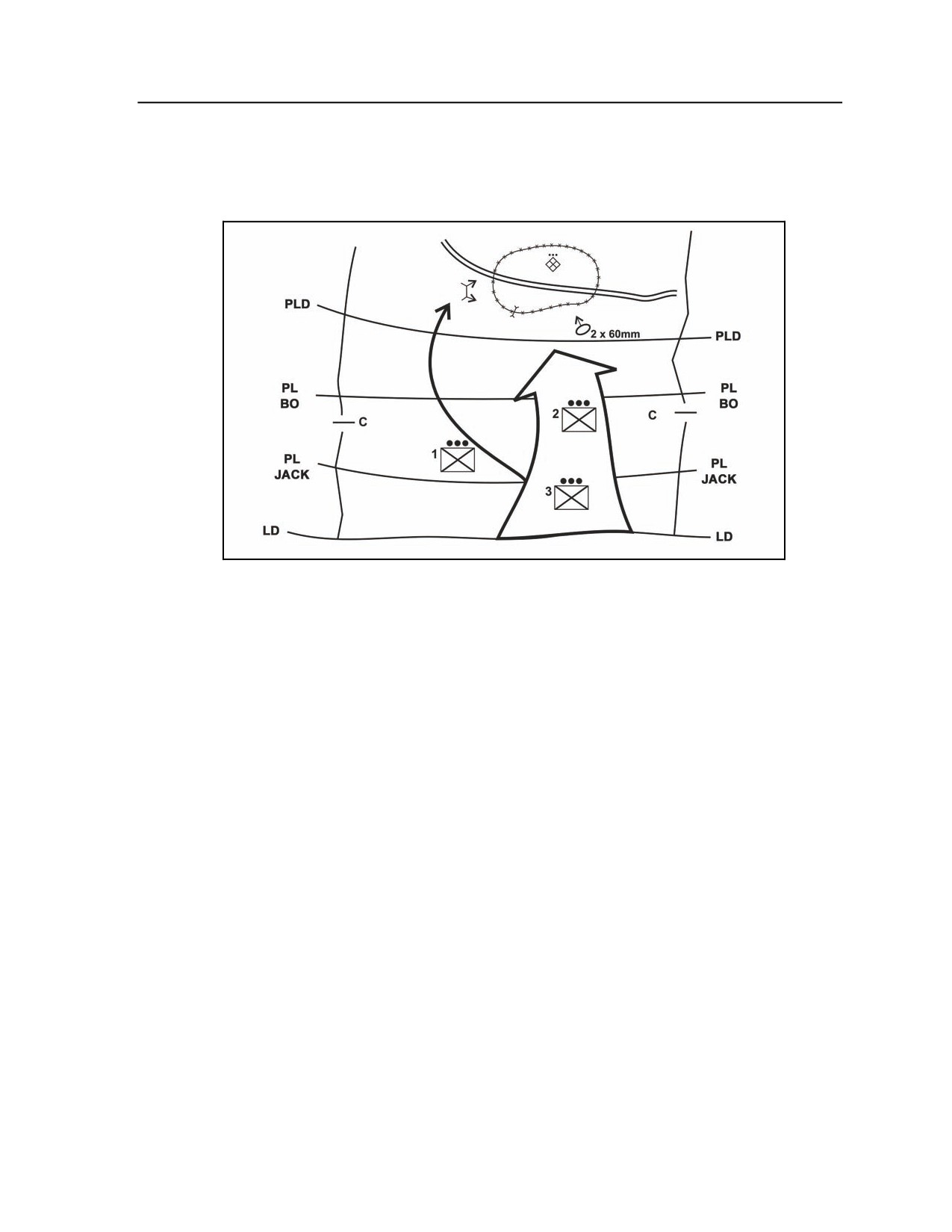
for the operation to provide a fully synchronized combined arms team. Time taken to prepare a deliberate
attack is also time in which the enemy can continue defensive improvements, disengage, or launch a
spoiling attack. The phases of the deliberate attack are reconnaissance, move to the objective, isolate the
objective, seize a foothold and exploit the penetration (actions on the objective), and consolidate and
reorganize (Figure 7-7).
Figure 7-7. Company deliberate attack.
RECONNAISSANCE
7-47. Before a deliberate attack, the platoon and company should gain enemy, terrain, and friendly
information from the reconnaissance conducted by the battalion reconnaissance platoon. However, this may
not always occur. The platoon and company should be prepared to conduct their own reconnaissance of the
objective to confirm, modify, or deny their tentative plan.
7-48. Platoons should not conduct reconnaissance unless specifically tasked to do so in a consolidated
reconnaissance plan. If possible, the company should determine the enemy’s size, location, disposition,
most vulnerable point, and most probable course of action. At this point, and with permission from
battalion, the company should direct the platoon to conduct a reconnaissance patrol. This element conducts
a reconnaissance of the terrain along the axis of advance and on the objective. It determines where the
enemy is most vulnerable to attack and where the support element can best place fires on the objective.
7-49. The tentative plan may change as a result of the reconnaissance if the platoon or squad discovers that
terrain or enemy dispositions are different than determined earlier in the TLP. The platoon or squad leader
may modify control measures based on the results of the reconnaissance, and must send these adjustments
to their leader as soon as possible. For example, the platoon may discover the weapons squad cannot
suppress the enemy from the north side of the objective as originally planned because of terrain limitations.
Therefore, the platoon leader moves the support-by-fire positions to the south side of the objective, adjusts
the tentative plan’s control measures, and radios the control measures to his commander for approval. The
graphics are subsequently disseminated throughout the company and to adjacent units as needed.
ADVANCE TO THE OBJECTIVE
7-50. The attacking element advances to within assault distance of the enemy position under supporting
fires using a combination of traveling, traveling overwatch, or bounding overwatch. Platoons advance to
successive positions using available cover and concealment. The company commander may designate
support-by-fire positions to protect friendly elements with suppressive direct fires. As the company
maneuvers in zone, it employs fires to suppress, neutralize, and obscure the enemy positions. The support
28 March 2007
FM 3-21.8
7-15
Chapter 7
by-fire elements may need to occasionally change locations to maintain the ability to support the advancing
assault element.
Assembly Area to the Line of Departure
7-51. The line of departure is normally a phase line where elements of the attacking element transition to
secure movement techniques in preparation for contact with the enemy. Platoons may maneuver from the
line of departure to designated support-by-fire positions, assault positions, and breach or bypass sites.
Before leaving the assembly area, the platoon leader should receive an update of the location of forward
and adjacent friendly elements. He should also receive updated enemy locations. The platoon leader then
disseminates these reports to each squad leader.
7-52. The platoon moves forward from the assembly area to the line of departure, usually as part of a
company formation along a planned route. The platoon leader should have reconnoitered the route to the
line of departure and specifically to the crossing point. During the planning stage, he plots a waypoint on
the line of departure at the point he intends to cross. The platoon navigates to the waypoint during
movement. The move from the assembly area is timed during the reconnaissance so the lead section crosses
the line of departure at the time of attack without halting in the attack position. If the platoon must halt in
the attack position, the squads establish security and take care of last minute coordination.
Line of Departure to Assault Position
7-53. The platoon moves from the line of departure to the assault position. The platoon leader plots
waypoints to coincide with checkpoints along the route. During movement, he ensures the platoon
navigates from checkpoint to checkpoint or phase line by using basic land navigation skills supplemented
by precision navigation.
Assault Position to the Objective
7-54. The assault position is the last covered and concealed position before reaching the objective. Ideally,
the platoon occupies the assault position without the enemy detecting any of the platoon’s elements.
Preparations in the assault position may include preparing bangalores, other breaching equipment or
demolitions, fixing bayonets, ceasing or shifting fires, or preparing smoke pots. The platoon may halt in the
assault position if necessary to ensure it is synchronized with friendly forces. Once the assault element
moves forward of the assault position, the assault must continue. If stopped or turned back, the assault
element could sustain unnecessary casualties.
7-55. Supporting fire from the weapons squad must continue to suppress the enemy and must be closely
controlled to prevent fratricide. At times, the assault element may mark each Soldier or just the team on the
flank nearest the support element. The key is to ensure the support-by-fire element knows the location of
the assault element at all times. The assaulting Soldiers and the support element sustain a high rate of fire to
suppress the enemy.
7-56. When the assault element moves to the breach point, the base-of-fire leader verifies the assault
element is at the right location. The base-of-fire leader is responsible for tracking the assault element as it
assaults the objective. The company commander shifts or ceases indirect fire when it endangers the
advancing Soldiers and coordinates this with the platoon’s assault. As the fire of the platoon’s support is
masked, the platoon leader shifts or ceases it or displaces the weapons squad to a position where continuous
fire can be maintained.
ISOLATE THE OBJECTIVE
7-57. The goals of isolation are to prevent the enemy from reinforcing the objective and to prevent enemy
forces on the objective from leaving. Infantry platoons will probably be an isolating element within a
company.
7-16
FM 3-21.8
28 March 2007
Offensive Operations
SEIZE A FOOTHOLD AND EXPLOIT THE PENETRATION (ACTIONS ON THE OBJECTIVE)
7-58. The platoon leader often designates assault, support, and breach elements within his platoon to
conduct a deliberate attack. One technique is to designate the weapons squad as the support element, an
Infantry squad as the breach element, and the remainder of the platoon as the assault element.
7-59. The supporting elements assist the breach element’s initial breach of the objective by placing
suppressive fires on the most dangerous enemy positions. As the breach is being established, the weapons
squad shifts fires (or local self-defense weapons) to allow the breach element to penetrate the objective and
avoid fratricide. Visual observation and information provided through the radio are vital to maintain
suppressive fires just forward of the breach and assault elements.
7-60. The supporting elements monitor the forward progress of the assault element and keep shifting
suppressive fire at a safe distance in front of them. The weapons squad positions itself to provide continual
close-in suppressive fire to aid the actions of the assault squad(s) as it moves across the objective.
7-61. Once the breach element has seized the initial foothold on the objective, the assault element may then
move through the breach lane to assault the objective. As this occurs, the platoon leader closely observes
the progress of the breach and assault elements to ensure there is no loss in momentum, and that assault and
breach elements do not cross in front of the supporting elements.
7-62. All communication from the support element to the breach, assault, and weapons support is by
frequency modulated (FM) radio or signals. If the platoon sergeant or squad leader observes problems, they
radio the platoon leader. The platoon leader uses this information and what he personally sees on the
objective to control the assault.
CONSOLIDATE AND REORGANIZE
7-63. Once enemy resistance on the objective has ceased, the platoon quickly consolidates to defend
against a possible counterattack and prepares for follow-on missions.
7-64. Consolidation consists of actions taken to secure the objective and defend against an enemy
counterattack.
7-65. Reorganization, normally conducted concurrently with consolidation, consists of preparing for
follow-on operations. As with consolidation, the platoon leader must plan and prepare for reorganization as
he conducts his TLP.
SITE EXPLOITATION
7-66. Once the sensitive site is secure, enemy resistance eliminated, and safe access established,
exploitation of the site begins. Subject matter experts and teams carefully enter and exploit every structure,
facility, and vehicle on the site and determine its value and its hazard to the platoon. The security force
continues to secure the site. Leaders may elect to rotate the assault, support, and security forces if the site
exploitation lasts for a prolonged period of time. .
HASTY ATTACK
7-67. The platoon normally participates in a hasty attack as part of a larger unit, during movement to
contact, as part of a defense, or whenever the commander determines that the enemy is vulnerable. A hasty
attack is used to—
Exploit a tactical opportunity.
Maintain the momentum.
Regain the initiative.
Prevent the enemy from regaining organization or balance.
Gain a favorable position that may be lost with time.
7-68. Because its primary purpose is to maintain momentum or take advantage of the enemy situation, the
hasty attack is normally conducted with only the resources that are immediately available. Maintaining
28 March 2007
FM 3-21.8
7-17
Chapter 7
constant pressure through hasty attacks keeps the enemy off balance and makes it difficult for him to react
effectively. Rapidly attacking before the enemy can act often results in success even when the combat
power ratio is not as favorable as desired. With its emphasis on agility and surprise, however, this type of
attack may cause the attacking element to lose a degree of synchronization. To minimize this risk, the
commander should maximize use of standard formations, well-rehearsed, thoroughly-understood battle and
crew drills, and SOPs. The hasty attack is often the preferred option during continuous operations. It allows
the commander to maintain the momentum of friendly operations while denying the enemy the time needed
to prepare his defenses and to recover from losses suffered during previous action. Hasty attacks normally
result from a movement to contact, successful defense, or continuation of a previous attack.
TASK ORGANIZATION
7-69. The hasty attack is conducted using the principles of fire and movement. The controlling
headquarters normally designates a base-of-fire element and a maneuver element.
CONDUCT OF THE HASTY ATTACK
7-70. By necessity, hasty attacks are simple and require a minimum of coordination with higher and
adjacent leaders. Leaders, however, still take the necessary measures to assess the situation, decide on an
appropriate course of action, and direct their subordinates in setting conditions and execution.
7-71. Execution begins with establishment of a base of fire, which then suppresses the enemy force. The
maneuver element uses a combination of techniques to maintain its security as it advances in contact to a
position of advantage. These techniques include:
Use of internal base-of-fire and bounding elements.
Use of covered and concealed routes.
Use of indirect fires and smoke grenades or pots to suppress or obscure the enemy or to screen
friendly movement.
Execution of bold maneuver that initially takes the maneuver element out of enemy direct fire
range.
SECTION V — OTHER OFFENSIVE OPERATIONS
7-72. This section focuses on offensive operations of movement to contact, exploitation, and pursuit the
platoon normally conducts as part of an Infantry company or larger element:
MOVEMENT TO CONTACT
7-73. Platoons and squads participate in a movement to contact as part of a company using movement
formations and techniques explained in Chapter 4. A company generally conducts a movement to contact
when it must gain or maintain contact with the enemy, or when it lacks sufficient time to gain intelligence
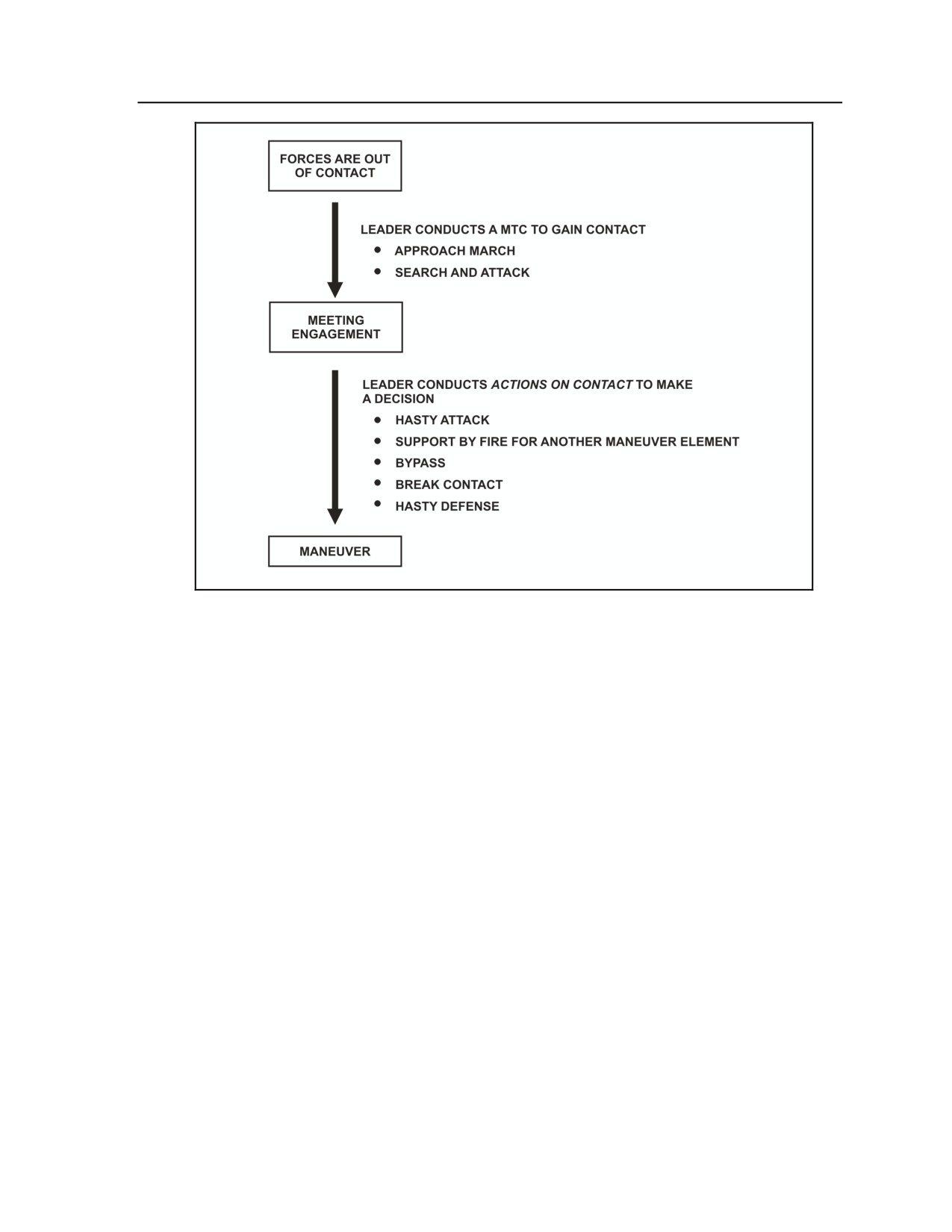
or make extensive plans to defeat the enemy (Figure 7-8). Higher intelligence assets should attempt to find
the enemy through reconnaissance and surveillance. Battalions may task or allow companies to gather
intelligence through reconnaissance and surveillance if the company commander needs to further develop
the intelligence picture. In this case, the company tasks a platoon or squad to conduct reconnaissance,
surveillance, or both.
7-18
FM 3-21.8
28 March 2007
Offensive Operations
Figure 7-8. Movement to contact framework.
7-74. The movement to contact results in a meeting engagement. A meeting engagement is the combat
action that occurs when a moving element engages a stationary or moving enemy at an unexpected time
and place. Meeting engagements are characterized by—
Limited knowledge of the enemy.
Minimum time available for the leader to conduct actions on contact.
Rapidly changing situation.
Rapid execution of battle and crew drills.
PLANNING CONSIDERATIONS
7-75. The company commander will not have a complete visualization of the situation. The leader’s role is
to gain as much firsthand information as possible. Combined with information on the enemy and the
terrain, firsthand information provides knowledge and understanding necessary to respond to the enemy.
However, if the enemy situation remains vague, the platoon must be prepared to act in any situation. This is
accomplished through proper planning, appropriate movement formations and techniques, fire control
measures, platoon SOPs, engagement criteria, and studying the terrain before and during movement to
anticipate likely enemy locations. While moving, all leaders study the terrain and anticipate enemy contact.
Based on these terrain studies, leaders should avoid likely areas of enemy ambush or areas that expose their
platoons to long-range observation and fires. If the enemy is a conventional force, his units may use a
doctrinal approach to their disposition, making it easier to find them. If faced with an asymmetric threat,
there may be no doctrinal template for the enemy. In this instance, the leader must look for historical
patterns in the enemy’s operations. In both cases, the leader has to analyze how the enemy fights, how he
uses terrain, and what he hopes to accomplish against friendly elements.
28 March 2007
FM 3-21.8
7-19
Chapter 7
TECHNIQUES
7-76. A movement to contact is conducted using one of two techniques: approach march, or search and
attack (Table 7-3). The approach march technique is used when the enemy is expected to deploy using
relatively fixed offensive or defensive formations, and the situation remains vague. The search and attack
technique is used when the enemy is dispersed, when he is expected to avoid contact or quickly disengage
and withdraw, or when the higher unit needs to deny him movement in an area of operation.
Table 7-3. The two types of movement to contact.
Approach march is best used when the—
Search and attack is best used when the—
• Enemy force is more conventional in nature.
• Enemy conducts operations over a very large
• Enemy force follows a more structured order
area in a dispersed manner, forcing friendly
units to disperse to locate him.
of battle and is more predictable.
• Enemy forces and operations are
• Enemy force is more centrally located.
unconventional or guerilla in nature.
• Enemy conducts more centralized operations.
• Enemy typically operates in small teams and
only makes contact when he feels he has the
advantage.
COMMAND AND CONTROL
7-77. The company commander will dictate a number of command and control techniques for the unit to
employ. The platoon leader, within the scope of the commander’s intent and guidance and the factors of
METT-TC, may modify these techniques to better control his sections and squads. The platoon leader will
tell the company commander of any additional graphic control measures he builds into his plan. Some
examples of command and control techniques are discussed below.
Graphic Control Measures
7-78. The company commander will normally assign lines of departure, phase lines, checkpoints, and GPS
waypoints to control the forward movement of the platoon. The platoon does not stop at a phase line unless
told to do so. If necessary, the platoon leader designates additional phase lines, checkpoints, or waypoints
for use within the platoon to reduce the number and length of radio transmissions used to control
movement.
Fire Control Measures
7-79. The platoon uses boundaries, direct fire plans, pyrotechnics, signals, and FRAGOs for direct fire
control and distribution. (For a detailed discussion of direct fire control and distribution, refer to Chapter 2.)
The variety of weapons in the Infantry platoon makes it critical for all squads to understand the observation
plan and the designated sectors of fire during a movement to contact. This takes on importance because of
the scarcity of information about the enemy.
Indirect Fire Plan
7-80. The platoon leader must have a good indirect fire plan for his route to cover anticipated places of
contact. These targets are a product of the platoon leader’s analysis of the factors of METT-TC and must be
incorporated into the company indirect fire plan.
DEVELOPING THE SITUATION
7-81. Once the platoon makes contact with the enemy, it maintains contact until the commander orders
otherwise. The platoon leader develops the situation based on the effectiveness of enemy fire, friendly
casualties, size of enemy force, and freedom to maneuver. He gathers and reports critical information about
the enemy and recommends a course of action. The platoon can bypass the enemy with permission from the
commander, conduct an attack, fix the enemy so another platoon can conduct the assault, conduct a
7-20
FM 3-21.8
28 March 2007
Offensive Operations
defense, establish an ambush, or break contact. The following guidelines apply for the platoon to develop
the situation after making contact.
DEFENSIVE CONSIDERATIONS
7-82. In some situations, a platoon conducting a movement to contact makes contact with a much larger
and more powerful enemy force. If the platoon encounters a larger enemy force where the terrain gives the
platoon an advantage, it should attempt to fix the enemy force. This allows the rest of the company to
maneuver against the force. If the platoon cannot fix the enemy, it may have to assume a defensive posture
(see Chapter 8) or break contact, but it should do so only if it is in danger of being overwhelmed.
Surrendering the initiative to the enemy means the enemy has fixed the platoon in place. Exposed rifle
squads are vulnerable to enemy indirect fires. If the platoon receives indirect fire during movement, it
should attempt to move out of the area or find a covered position for the rifle squads. Once the indirect fires
cease, the platoon prepares for an enemy assault. In the defense, the platoon leader—
Keeps the company commander informed and continues to report on enemy strength,
dispositions, and activities.
Positions squads to cover dismounted avenues of approach in preparation for the enemy’s attack.
Orients the weapons squad and their Javelins along mounted avenues of approach and
establishes positions for the M240B machine guns.
Establishes direct fire control and distribution measures.
Calls for and adjusts indirect fires.
APPROACH MARCH TECHNIQUE
7-83. The approach march advances a combat unit when direct contact with the enemy is intended. It can
be performed dismounted, mounted, or a combination of the two. The concept behind the approach march
as a technique for movement to contact is to make contact with the smallest enemy element. When
executed effectively it allows the commander the flexibility of maneuvering or bypassing the enemy force.
During an approach march, the company commander will organize his unit into two elements (advance
guard, and main body). As part of a company using the approach march technique, platoons may act as the
advance guard, the flank or rear guard, or may receive on-order missions as part of the main body.
Advance Guard
7-84. The advance guard operates forward of the main body to ensure its uninterrupted advance. It protects
the main body from surprise attack and fixes the enemy to protect the deployment of the main body. As the
advance guard, the platoon finds the enemy and locates gaps, flanks, and weaknesses in his defense. The
advance guard attempts to make contact on ground of its own choosing, to gain the advantage of surprise,
and to develop the situation (either fight through or support the assault of all or part of the main body). The
advance guard operates within the range of indirect fire support weapons. The platoon uses appropriate
formations and movement techniques based on the factors of METT-TC.
7-85. The advance guard is normally the most robust of the security elements. In addition to the general
security measures described above, the advance guard and its sub elements—
Preserve the main body’s freedom of maneuver.
Prevent unnecessary delay in movement of the main body.
Learn the whereabouts of the enemy.
Develop intelligence about the terrain and the environment.
Detect and overcome enemy security measures.
Identify and disrupt enemy attempts to ambush the main body.
Must be ready to gain fire superiority and fight any enemy forces encountered.
Watch the enemy (if direct fire contact is not pending).
Delay any enemy attacks to gain time for the main body to deploy.
28 March 2007
FM 3-21.8
7-21
Chapter 7
Main Body
7-86. When moving as part of the main body platoons may be tasked to assault, bypass, or fix an enemy
force; or to seize, secure, or clear an assigned area. The platoon also may be detailed to provide squads as
flank or rear guards, stay-behind ambushes, or additional security to the front. Platoons and squads use
appropriate formations and movement, assault, and ambush techniques.
7-87. The main body moves to reinforce any success achieved by the advance guard, flank the enemy
position, or apply overwhelming combat power to seize the contested area. During the attack, the leader on
the field takes care to isolate the objective by positioning the flank guard to prevent interdiction of enemy
reinforcements into the engagement. The positioning of flank guard blocking positions must be far enough
away from the area that no enemy weapons can bring fires to effect the attack by the main body.
Flank or Rear Guard
7-88. The platoon will have the responsibilities of flank or rear guard when moving within the company
main body. However, the platoon may act as the flank or rear guard for a battalion conducting a movement
to contact using approach march technique. In either situation, the platoon—
Moves using the appropriate formation and movement technique. (It must maintain the same
momentum as the main body.)
Provides early warning.
Destroys enemy reconnaissance units.
Prevents direct fires or observation of the main body.
Actions on Contact
7-89. Once the advance guard makes contact, the main body’s leader conducts actions on contact to
determine how the main body will fight the enemy. To facilitate this, the advance guard reports enemy
contact or disruption. It also deploys and attempts to overcome enemy based on information from point
patrol. If the advance guard is not able to overcome the enemy, it assumes a support-by-fire position to
support maneuver of the remainder of the advance guard. The remainder of the advance guard attempts a
close envelopment to defeat the enemy unless the enemy force is overwhelmingly superior. If successful,
the advance guard reforms and resumes march or initiates pursuit. If unsuccessful, the advance guard holds
its positions, blocks the enemy, and continues supporting the subsequent maneuver and attack of the main
body.
Additional Approach March COAs
7-90. There are several courses of action available to the leader when the advance guard comes into contact
with a force that it cannot overcome with its organic forces. These courses of action include—
Frontal attack.
Fix and bypass.
Fix, isolate, and attack.
Oblique attack.
Withdrawal.
SEARCH AND ATTACK TECHNIQUE
7-91. The search and attack is a technique conducted when the enemy is operating as small, dispersed
elements, or when the task is to deny the enemy the ability to move within a given area of operations. The
platoon will participate as part of company or battalion search and attack. A unit conducts a search and
attack for one or more of the following reasons:
Render the enemy in the area of operations combat-ineffective.
Prevent the enemy from operating unhindered in a given area of operations.
7-22
FM 3-21.8
28 March 2007
Offensive Operations
Prevent the enemy from massing to disrupt or destroy friendly military or civilian operations,
equipment, or facilities.
Gain information about the enemy and the terrain.
Organization of Elements
7-92. The higher commander will task-organize the subordinate units into reconnaissance (finding, fixing,
and finishing) elements. He will assign specific tasks and purposes to his search and attack elements. It is
important to note that within the concept of find, fix, and finish, all platoons could be the reconnaissance
element. Depending on the size of the enemy they find, they could end up executing a reconnaissance
mission, become the fixing element, or find that they are able to finish the enemy. Planning considerations
for organizing include—
The factors of METT-TC.
The requirement for decentralized execution.
The requirement for mutual support. (The platoon leader must be able to respond to contact with
his rifle squads or to mutually support another platoon within the company.)
The Soldier’s load. (The leader should ask, “Does the Soldier carry his rucksack, cache it, or
leave it at a central point? How will the rucksacks be linked up with the Soldier?”)
Resupply and CASEVAC.
The employment of key weapons.
The requirement for patrol bases.
Find (Reconnaissance Element)
7-93. The size and composition of the reconnaissance element is based on the available information on the
size and activity of the enemy operating in the designated area of operations. The reconnaissance element
typically consists of the battalion reconnaissance platoon plus other battalion and higher level assets.
Reconnaissance operations are used to answer information requirements used for leader decisionmaking
and are not normally followed immediately by a hasty attack. The find action of a search and attack is used
to locate the enemy with the expressed intent of making a hasty attack as soon as possible with the main
body. The platoon will reconnoiter named area(s) of interest (NAI) and other areas as designated. The
platoon may find the enemy through zone reconnaissance, patrolling, and establishing observation posts.
7-94. The task of the search element is to locate the enemy or information leading to the enemy. The
techniques used to search are unique to the area of operations and should be developed and adapted to the
specifics of the particular environment. What works in one location may not work in another.
7-95. The security element has two tasks: early warning of approaching enemy and providing support
forces to the search elements if in contact with the enemy. The purpose of the security element is to protect
the search element allowing them to search. Security elements tasked to provide early warning must be able
to observe avenues of approach into and out of the objective area. If the search element is compromised,
the security element must be able to quickly support them. These positions must also be able to facilitate
communication to higher as well as any supporting assets.
Fixing Element
7-96. The fixing element must have sufficient combat power to isolate the enemy and develop the situation
once the reconnaissance element finds him. When developing the situation, the fixing element either
continues to maintain visual contact with the enemy until the finishing element arrives, or conducts an
attack to physically fix the enemy until the finishing element arrives. The goal is to keep the enemy in a
position in which he can be destroyed by the finishing element. Sometimes the fixing element may have
sufficient combat power to destroy the enemy themselves. The platoon maintains visual contact to allow
the reconnaissance element to continue to other NAIs and isolates the immediate area. The fixing element
makes physical contact only if the enemy attempts to leave the area or other enemy elements enter the area.
At all times after contact is made, the platoon integrates as many combat multipliers into the fight as
28 March 2007
FM 3-21.8
7-23
Chapter 7
possible. Examples include indirect fire support, attack aviation, close air support (CAS), and antiarmor
sections or platoons, if they are available.
7-97. The fix element can consist of maneuver elements, fire support assets, and aviation elements. To
isolate the enemy, fixing elements normally establish a cordon of blocking positions on possible avenues of
approach out of the engagement area. The fix element is also responsible for ensuring its own internal
security, conducting link ups with the find/finish elements as required and coordinating fire support assets.
Finishing Element
7-98. The finishing element must have sufficient combat power to destroy enemy forces located within the
area of operations. The finishing element must be responsive enough to engage the enemy before he can
break contact, yet patient enough not to rush to failure. A platoon, as the finishing element, may be tasked
to—
Destroy the enemy with an attack.
Block enemy escape routes while another unit conducts the attack.
Destroy the enemy with an ambush while the reconnaissance or fixing elements drive the enemy
toward the ambush location.
Not allow the enemy to break contact.
Control Measures
7-99. The higher commander will define commander’s intent and establish control measures that allow for
decentralized execution and platoon leader initiative to the greatest extent possible. The minimum control
measures for a search and attack include—
Areas of operation.
Named areas of interest.
Phase lines.
TRPs.
Objectives.
Checkpoints.
Contact points.
GPS waypoints.
7-100. An area of operation defines the location in which the subordinate units will conduct their
searches. A technique called the “horse blanket” breaks the battalion and company area of operation into
many named smaller areas of operation. Units remain in designated areas of operation as they conduct their
missions. Battalion and higher reconnaissance assets might be used to observe areas of operation with no
platoons in them, while platoons or companies provide their own reconnaissance in the AO. This command
and control technique, along with TRPs, assists in avoiding fratricide in a noncontiguous environment. A
TRP facilitates the responsiveness of the fixing and finishing elements once the reconnaissance element
detects the enemy. Objectives and checkpoints guide the movement of subordinates and help leaders
control their organizations. Contact points aid coordination among the units operating in adjacent areas.
EXPLOITATION
7-101. A platoon normally takes part in exploitations as part of a larger force. However, the platoon
should exploit tactical success at the local level within the higher commanders’ concept of the operation
and intent.
PURSUIT
7-102. The objective of the pursuit is the total destruction of the enemy force. Forces equally as or more
mobile than the enemy normally conduct the pursuit. The platoon may take part in a pursuit after a
7-24
FM 3-21.8
28 March 2007
Offensive Operations
successful hasty attack, as part of a company mission, or as part of a task-organized company acting as a
designated pursuit element.
ATTACKS DURING LIMITED VISIBILITY
7-103. Effective use of night vision device(s) (NVD) and thermal weapons site(s) (TWS) during limited
visibility attacks enhance squad and platoon abilities to achieve surprise and cause panic in a lesser-
equipped enemy. NVD enhancements allow the Infantry Soldier to see farther and with greater clarity and
provide a marked advantage over the enemy.
7-104. Leaders have an increased ability to control fires during limited visibility. The platoon has three
types of enhancements for use in fire control: target designators (GCP-1 and AIM-1); aiming lights (AIM-1
and AN/PAQ-4B/C); and target illuminators designed for use with NVDs. These include infrared parachute
flares, infrared trip flares, infrared 40-mm rounds, infrared mortar rounds, infrared bike lights, and remote
black lights. These assets greatly aid in target acquisition and fire control. If the engagement becomes
illuminated, there are a variety of target illuminators for the unaided eye.
7-105. Soldiers carrying weapons with NVD enhancements have greater accuracy of fires during limited
visibility. Each Soldier in the platoon is equipped with an AN/PAQ-4B/C aiming light for his individual
weapon. The AN/PAQ-4B/C enables the rifleman to put infrared light on the target at the point of aim.
7-106. Leaders can designate targets with greater precision using the PEQ-2. The PEQ-2 is an infrared
laser pointer that uses an infrared light to designate targets and sectors of fire and to concentrate fire. The
leader lazes a target and directs his Soldiers to place their fires on the target. Soldiers then use the aiming
lights on their AN/PAQ-4B/Cs to engage the target.
7-107. Leaders also can designate larger targets using target illuminators. Target illuminators are
essentially infrared light sources that light the target, making it easier to acquire effectively. Target
illuminators consist of infrared illumination rounds, infrared M203 40-mm rounds, infrared trip flares, and
infrared parachute flares. Leaders and Soldiers use the infrared devices to identify enemy or friendly
personnel and then engage targets using their aiming lights.
7-108. The platoon leader and squad leaders follow tactical standing operating procedures (TSOP) and
sound courses of action to synchronize the employment of infrared illumination devices, target designators,
and aiming lights. This is done during their assault on the objective, while remaining prepared for a
noninfrared illuminated attack.
7-109. Leaders use luminous tape or chemical lights to mark assault personnel to prevent fratricide. The
enemy must not be able to see the marking. Two techniques are to place tape on the back of the helmet or
to use small infrared chemical lights (if the enemy has no NVDs). Supporting elements must know the
location of the lead assault element.
7-110. To reduce the risk to the assault element, the platoon leader may assign weapons control
restrictions. For example, the squad on the right in the assault might be assigned weapons free to the right
flank because no friendly Soldiers are there. The squad on the left may be assigned weapons tight or
weapons hold, which means that another friendly unit is located there.
7-111. The platoon leader may do the following to increase control during the assault:
Avoid use of flares, grenades, or smoke on the objective.
Allow only certain personnel with NVDs to engage targets on the objective.
Use a magnetic azimuth for maintaining direction.
Use mortar or artillery rounds to orient attacking units.
Assign a base squad or fire team to pace and guide others.
Reduce intervals between Soldiers and squads.
7-112. As in daylight, mortar, artillery, and antiarmor fires are planned, but are not fired unless the
platoon is detected or is ready to assault. Some weapons may fire before the attack and maintain a pattern
to deceive the enemy or to help cover noise made by the platoon’s movement. This is not done if it will
disclose the attack.
28 March 2007
FM 3-21.8
7-25
Chapter 7
7-113. Indirect fire is hard to adjust when visibility is poor. If the exact location of friendly units is not
clearly known, indirect fire is directed first at enemy positions beyond the objective, then moved onto the
objective.
7-114. Illuminating rounds that are fired to burn on the ground can be used to mark objectives. This helps
the platoon orient on the objective but may adversely affect NVDs.
7-115. Smoke is planned to further reduce the enemy’s visibility, particularly if he has NVDs. The smoke
is laid close to or on enemy positions so it does not restrict friendly movement or hinder the breaching of
obstacles. Employing smoke on the objective during the assault may make it hard for assaulting Soldiers to
find enemy fighting positions. If enough thermal sights are available, smoke on the objective may provide a
decisive advantage for a well-trained platoon.
7-116. Illumination is always planned for limited visibility attacks, giving the leader the option of calling
for it. Battalion commanders normally control the use of conventional illumination, but may authorize the
company commander to do so. If the commander decides to use conventional illumination, he should not
call for it until the assault is initiated or the attack is detected. It should be placed on several locations over
a wide area to confuse the enemy as to the exact place of the attack. Also, it should be placed beyond the
objective to help assaulting Soldiers see and fire at withdrawing or counterattacking enemy Soldiers.
NOTE: If the enemy is equipped with NVDs, leaders must evaluate the risk of using each
technique and ensure the mission is not compromised because the enemy can detect infrared
light sources.
SECTION VI — SPECIAL PURPOSE ATTACKS
7-117. When the company commander directs it, the platoon conducts a special attack. The commander
bases his decision on the factors of METT-TC. Special purpose attacks are subordinate forms of an attack
and they include—
Ambush.
Raid.
Counterattack.
Spoiling attack.
Feint.
Demonstration.
7-118. As forms of the attack, they share many of the same planning, preparation, and execution
considerations of the offense. Feints and demonstrations are also associated with military deception
operations.
AMBUSH
7-119. An ambush is a form of attack by fire or other destructive means from concealed positions on a
moving or temporarily halted enemy. It may take the form of an assault to close with and destroy the
enemy, or be an attack by fire only. An ambush does not require ground to be seized or held. Ambushes are
generally executed to reduce the enemy force’s overall combat effectiveness. Destruction is the primary
reason for conducting an ambush. Other reasons to conduct ambushes are to harass the enemy, capture the
enemy, destroy or capture enemy equipment, and gain information about the enemy. Ambushes are
classified by category (deliberate or hasty), formation (linear or L-shaped), and type (point, area, or
antiarmor). The platoon leader uses a combination of category, type, and formation for developing his
ambush plan. See Chapter 9 for greater detail on ambushes.
OPERATIONAL CONSIDERATIONS
7-120. The execution of an ambush is offensive in nature. However, the platoon may be directed to
conduct an ambush during offensive or defensive operations. The platoon must take all necessary
7-26
FM 3-21.8
28 March 2007
Offensive Operations
precautions to ensure that it is not detected during movement to or preparation of the ambush site. The
platoon also must have a secure route of withdrawal following the ambush. An ambush normally consists
of the following actions:
Tactical movement to the objective rally point (ORP).
Reconnaissance of the ambush site.
Establishment of the ambush security site.
Preparation of the ambush site.
Execution of the ambush.
Withdrawal.
TASK ORGANIZATION
7-121. The Infantry platoon is normally task-organized into assault, support, and security elements for
execution of the ambush.
Assault Element
7-122. The assault element executes the ambush. It may employ an attack by fire, an assault, or a
combination of those techniques to destroy the ambushed enemy force. The assault element generally
consists of a rifle squad. The platoon leader is normally located with the assault element.
Support Element
7-123. The support element fixes the enemy force to prevent it from moving out of the kill zone, which
allows the assault element to conduct the ambush. The support element generally uses direct fires in this
role, but it may be responsible for calling indirect fires to further fix the ambushed enemy force. The
support element generally consists of the weapons squad. The platoon sergeant is normally located with the
support element.
Security Element
7-124. The security element provides protection and early warning to the assault and support elements,
and secures the objective rally point. It isolates the ambush site both to prevent the ambushed enemy force
from moving out of the ambush site and to prevent enemy rescue elements from reaching the ambush site.
The security element may also be responsible for securing the platoon’s withdrawal route. The security
element generally consists of a rifle squad.
PLANNING
7-125. The platoon leader’s key planning considerations for any ambush include the following:
Cover the entire kill zone (engagement area) by fire.
Use existing terrain features (rocks or fallen trees, for example) or reinforcing obstacles
(Claymores or other mines) orienting into the kill zone to keep the enemy in the kill zone.
Determine how to emplace reinforcing obstacles on the far side of the kill zone.
Protect the assault and support elements with mines, Claymores, or explosives.
Use the security element to isolate the kill zone.
Establish rear security behind the assault element.
Assault into the kill zone to search dead and wounded, to assemble prisoners, and to collect
equipment. The assault element must be able to move quickly on its own through the ambush
site protective obstacles.
Time the actions of all elements of the platoon to prevent the loss of surprise.
28 March 2007
FM 3-21.8
7-27
Chapter 7
NOTE: When manning an ambush for long periods of time, the platoon leader may use only
one squad to conduct the entire ambush, rotating squads over time. The platoon leader must
consider the factors of METT-TC and must especially consider the company commander’s intent
and guidance.
CATEGORY
7-126. The leader determines the category of ambush through an analysis of the factors of METT-TC.
Typically, the two most important factors are time and enemy.
Deliberate
7-127. A deliberate ambush is a planned offensive action conducted against a specific target for a specific
purpose at a predetermined location. When planning a deliberate ambush, the leader requires detailed
information on the—
Size and composition of the targeted enemy unit.
Weapons and equipment available to the enemy.
Enemy’s route and direction of movement.
Times that the targeted enemy unit will reach or pass specified points along the route.
Hasty
7-128. The platoon (or squad) conducts a hasty ambush when it makes visual contact with an enemy force
and has time to establish an ambush without being detected. The conduct of the hasty ambush should
represent the execution of disciplined initiative within the parameters of the commander’s intent. The
actions for a hasty ambush should be established in a unit SOP and rehearsed so Soldiers know what to do
on the leader’s signal.
FORMATIONS
7-129. The platoon leader considers the factors of METT-TC to determine the required formation.
Linear
7-130. In an ambush using a linear formation, the assault and support elements deploy parallel to the
enemy’s route. This position forces the enemy on the long axis of the kill zone, and subjects the enemy to
flanking fire. The linear formation can be used in close terrain that restricts the enemy’s ability to maneuver
against the platoon, or in open terrain (provided a means of keeping the enemy in the kill zone can be
effected).
L-Shaped
7-131. In an L-shaped ambush the assault element forms the long leg parallel to the enemy’s direction of
movement along the kill zone. The support element forms the short leg at one end of and at a right angle to
the assault element. This provides both flanking (long leg) and enfilading (short leg) fires against the
enemy. The L-shaped ambush can be used at a sharp bend in a road, trail, or stream. It should not be used
where the short leg would have to cross a straight road or trail. The platoon leader must consider the other
factors of METT-TC before opting for the L-shaped formation. Special attention must be placed on sectors
of fire and SDZ of weapons because of the risk of fratricide when conducting an L-shaped ambush.
V-Shaped Ambush
7-132. The V-shaped ambush assault elements are placed along both sides of the enemy route so they
form a V. Take extreme care to ensure neither group fires into the other. This formation subjects the enemy
to both enfilading and interlocking fire.
7-28
FM 3-21.8
28 March 2007
Offensive Operations
TYPE
7-133. The company commander, following an analysis of the factors of METT-TC, determines the type
of ambush that the platoon will employ.
CONDUCTING AN AREA AMBUSH
7-134. An area ambush (more than one point ambush) is not conducted by a unit smaller than a platoon.
This ambush works best where enemy movement is restricted. Once the platoon is prepared, the area
ambush is conducted the same as a point ambush. The dominating feature of an area ambush is the amount
of synchronization between the separate point ambushes.
7-135. Area ambushes require more planning and control to execute successfully. Surprise is more
difficult to achieve simply because of the unit’s dispersion in the AO. Having more than one ambush site
increases the likelihood of being detected by the enemy or civilians. This major disadvantage is offset by
the increased flexibility and sophistication available to the leader.
CONDUCTING A POINT AMBUSH
7-136. Point ambushes are set at the most ideal location to inflict damage on the enemy. Such ambushes
must be able to handle being hit by the enemy force from more than one direction. The ambush site should
enable the unit to execute an ambush in two or three main directions. The other directions must be covered
by security that gives early warning of enemy attack.
RAID
7-137. A raid is a limited-objective form of an attack, usually small-scale, involving swift penetration of
hostile territory to secure information, confuse the enemy, or destroy installations. A raid always ends with
a planned withdrawal to a friendly location upon completion of the mission. The platoon can conduct an
independent raid in support of the battalion or higher headquarters operation, or it can participate as part of
the company in a series of raids. Rifle squads do not execute raids; they participate in a platoon raids.
OPERATIONAL CONSIDERATIONS
7-138. The platoon may conduct a raid to accomplish a number of missions, including the following:
Capture prisoners.
Destroy specific command, control, and or communications locations.
Destroy logistical areas.
Obtain information concerning enemy locations, dispositions, strengths, intentions, or
methods of operation.
Confuse the enemy or disrupt his plans.
Seize contraband.
TASK ORGANIZATION
7-139. The task organization of the raiding element is determined by the purpose of the operation.
However, the raiding force normally consists of the following elements:
Support element (support by fire).
Assault element (with the essential task of the mission).
Breach element (if required to reduce enemy obstacles).
Isolation/security element.
CONDUCT OF THE RAID
7-140. The main differences between a raid and other special purpose attacks are the limited objectives of
the raid and the associated withdrawal following completion. However, the sequence of platoon actions for
28 March 2007
FM 3-21.8
7-29
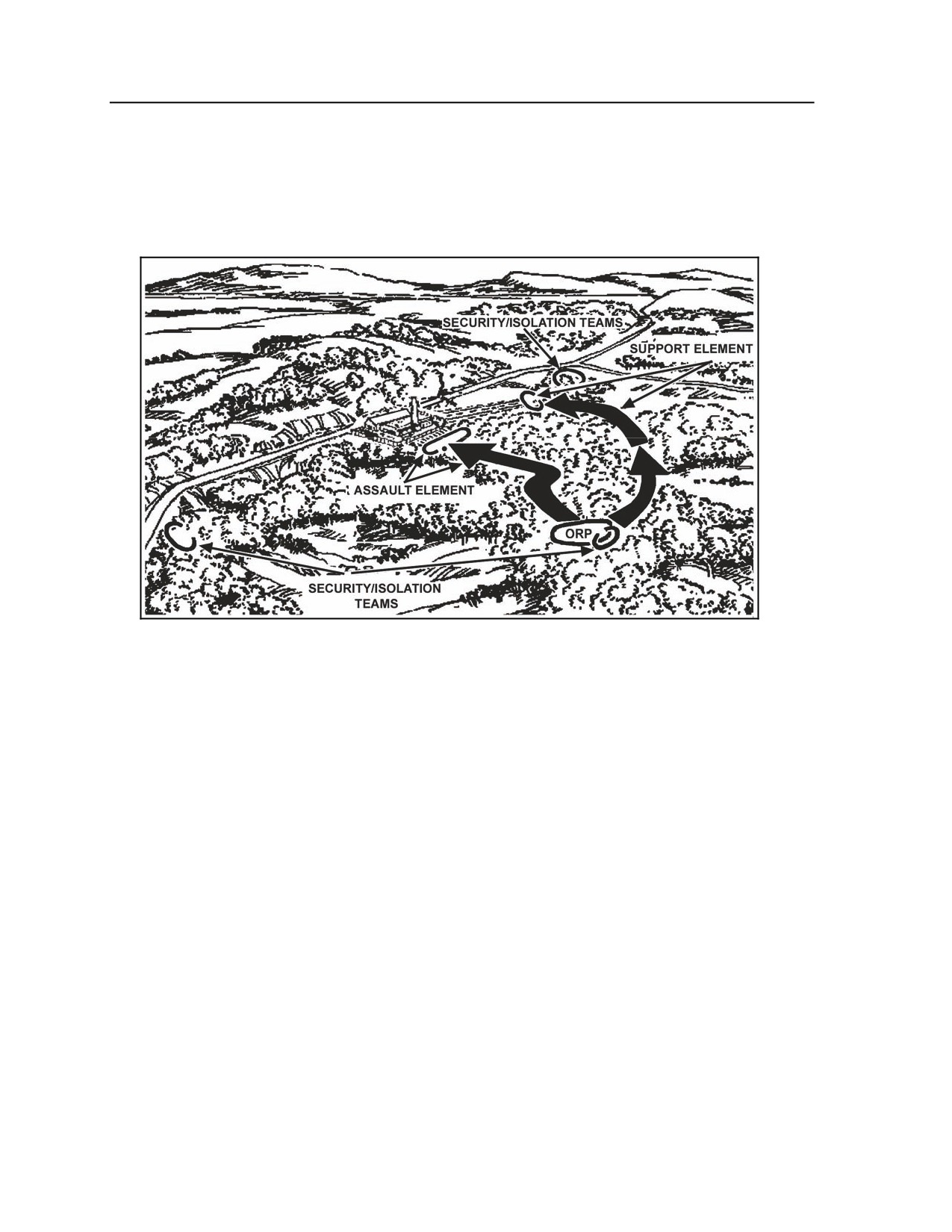
Chapter 7
a raid is very similar to those for an ambush. Additionally, the assault element of the platoon may have to
conduct a breach of a protective obstacle (if a breach element has not been designated). Raids may be
conducted in daylight or darkness, within or beyond the supporting distances of the parent unit. When the
enemy location to be raided is beyond supporting distances of friendly lines, the raiding party operates as a
separate element. An objective, usually very specific in nature, is assigned to orient the raiding unit (Figure
7-9). During the withdrawal, the attacking element should use a route different from that used to conduct
the raid itself.
Figure 7-9. Platoon raid.
COUNTERATTACK
7-141. The counterattack is a form of attack by part or all of a friendly defending element against an
enemy attacking force. The general objective of a counterattack is to deny the enemy his goal of attacking.
This attack by defensive elements regains the initiative or denies the enemy success with his attack. The
platoon may conduct a counterattack as a lightly committed element within a company or as the battalion
reserve. Counterattacks afford the friendly defender the opportunity to create favorable conditions for the
commitment of combat power. The platoon counterattacks after the enemy begins his attack, reveals his
main effort, or creates an assailable flank. As part of a higher headquarters, the platoon conducts the
counterattack much like other attacks. However, the platoon leader must synchronize the execution of his
counterattack within the overall defensive effort. The platoon should rehearse the counterattack and prepare
the ground to be traversed, paying close attention to friendly unit locations, obstacles, and engagement
areas.
SPOILING ATTACK
7-142. A spoiling attack is a form of attack that preempts or seriously impairs an enemy attack while the
enemy is in the process of planning or preparing to attack. The purpose of a spoiling attack is to disrupt the
enemy’s offensive capabilities and timelines, destroy his personnel and equipment, and gain additional time
for the defending element to prepare positions. The purpose is not to secure terrain or other physical
objectives. A commander (company or battalion) may direct a platoon to conduct a spoiling attack during
friendly defensive preparations to strike the enemy while he is in assembly areas or attack positions where
he is preparing offensive operations. The platoon leader plans for a spoiling attack as he does for other
attacks.
7-30
FM 3-21.8
28 March 2007
Offensive Operations
FEINT
7-143. A feint is a form of attack used to deceive the enemy as to the location and time of the actual
operation. Feints attempt to induce the enemy to move reserves and shift his fire support to locations where
they cannot immediately impact the actual operation. When directed to conduct a feint, the platoon seeks
direct fire or contact with the enemy, but avoids decisive engagement. The commander (company or
battalion) will assign the platoon an objective limited in size or scope. The planning, preparation, and
execution considerations are the same as for other forms of attack. The enemy must be convinced that the
feint is the actual attack.
DEMONSTRATION
7-144. A demonstration is a form of attack designed to deceive the enemy as to the location or time of the
actual operation by a display of force. Demonstrations attempt to deceive the enemy and induce him to
move reserves and shift his fire support to locations where they cannot immediately impact the actual
operation. When directed to conduct a demonstration, the platoon does not seek to make contact with the
enemy. The planning, preparation, and execution considerations are the same as for other forms of attack. It
must appear to be an actual impending attack.
SECTION VII — OFFENSIVE TACTICAL TASKS
7-145. Tactical tasks are specific activities performed by units as they conduct tactical operations or
maneuver. At the platoon level, these tasks are the warfighting actions the platoon may be called on to
perform in battle. This section provides discussion and examples of some common actions and tasks the
platoon may perform during a movement to contact, a hasty attack, or a deliberate attack. It is extremely
important to fully understand the purpose behind a task (what) because the purpose (why) defines what the
platoon must achieve as a result of executing its mission. A task can be fully accomplished, but if
battlefield conditions change and the platoon is unable to achieve the purpose, the mission is a failure.
NOTE: The situations used in this section to describe the platoon leader’s role in the conduct of
tactical tasks are examples only. They are not applicable in every tactical operation, nor are they
intended to prescribe any specific method or technique the platoon must use in achieving the
purpose of the operation. Ultimately, it is up to the commander or leader on the ground to apply
both the principles discussed here, and his knowledge of the situation. An understanding of his
unit’s capabilities, the enemy he is fighting, and the ground on which the battle is taking place
are critical when developing a successful tactical solution.
SEIZE
7-146. Seizing involves gaining possession of a designated objective by overwhelming force. Seizing an
objective is complex. It involves closure with the enemy, under fire of the enemy’s weapons to the point
that the friendly assaulting element gains positional advantage over, destroys, or forces the withdrawal of
the enemy.
7-147. A platoon may seize prepared or unprepared enemy positions from either an offensive or defensive
posture. Examples include the following:
A platoon seizes the far side of an obstacle as part of a company breach or seizes a building to
establish a foothold in an urban environment.
A platoon seizes a portion of an enemy defense as part of a company deliberate attack.
A platoon seizes key terrain to prevent its use by the enemy.
7-148. There are many inherent dangers in seizing an objective. They include the requirement to execute
an assault, prepared enemy fires, a rapidly changing tactical environment, and the possibility of fratricide
when friendly elements converge. These factors require the platoon leader and subordinate leaders to
understand the following planning considerations.
28 March 2007
FM 3-21.8
7-31