FM 3-21.8 (FM 7-8) The Infantry Rifle Platoon and Squad (MARCH 2007) - page 5
Chapter 4
platoon leader in accomplishing this mission. The following paragraphs focus on actions the platoon leader
and his subordinate leaders can take with current resources to reduce the risk of fratricide.
4-16. In any tactical situation, it is critical that every Infantry platoon member know where he is and where
other friendly elements are operating. With this knowledge, he must anticipate dangerous conditions and
take steps to either to avoid or mitigate them. He must also ensure that all squad and team positions are
constantly reported to higher headquarters so all other friendly elements are aware of where they are and
what they are doing. When the platoon leader perceives a potential fratricide situation, he must personally
use the higher net to coordinate directly with the friendly element involved.
EFFECTS
4-17. The effects of fratricide within a unit can be devastating to morale, good order, and discipline.
Fratricide causes unacceptable losses and increases the risk of mission failure. It almost always affects the
unit’s ability to survive and function. Units experiencing fratricide suffer the following consequences:
Loss of confidence in the unit’s leadership.
Self-doubt among leaders.
Hesitancy in the employment of supporting combat systems.
Over-supervision of units.
Hesitancy in the conduct of limited visibility operations.
Loss of aggressiveness in maneuver.
Loss of initiative.
Disrupted operations.
General degradation of unit cohesiveness, morale, and combat power.
CAUSES
4-18. The lack of positive target identification and inability to maintain situational awareness during
combat operations are major contributing factors to fratricide. The following paragraphs discuss the
primary causes of fratricide. Leaders must identify any of the factors that may affect their units and then
strive to eliminate or correct them.
Failures in the Direct Fire Control Plan
4-19. Failures in the direct fire control plan occur when units do not develop effective fire control plans,
particularly in the offense. Units may fail to designate engagement areas, adhere to the direct fire plan, fail
to understand surface danger areas, or position their weapons incorrectly. Under such conditions, fire
discipline often breaks down upon contact. An area of particular concern is the additional planning that
must go into operations requiring close coordination between mounted elements and dismounted elements.
Land Navigation Failures
4-20. Friendly units may stray out of assigned sectors, report wrong locations, and become disoriented.
Much less frequently, they employ fire support weapons in the wrong location. In either type of situation,
units that unexpectedly encounter another unit may fire their weapons at the friendly force.
Failures in Combat Identification
4-21. Vehicle commanders and machine gun crews cannot accurately identify the enemy near the
maximum range of their weapons systems. During limited visibility, friendly units within that range may
mistake each other as the enemy.
Inadequate Control Measures
4-22. Units may fail to disseminate the minimum necessary maneuver control measures and direct fire
control measures. They may also fail to tie control measures to recognizable terrain or events.
4-6
FM 3-21.8
28 March 2007
Protection
Failures in Reporting and Communications
4-23. Units at all levels may fail to generate timely, accurate, and complete reports as locations and tactical
situations change. This distorts the operating picture at all levels and can lead to erroneous clearance of
fires.
Individual and Weapons Errors
4-24. Lapses in individual discipline can result in fratricide. Incidents such as these include negligent
weapons discharges and mistakes with explosives and hand grenades.
Battlefield Hazards
4-25. A variety of explosive devices and materiel—unexploded ordnance, booby traps, and unmarked or
unrecorded minefields, including scatterable mines—may create danger on the battlefield. Failures to mark,
record, remove, or otherwise anticipate these threats lead to casualties.
Reliance on Instruments
4-26. A unit that relies too heavily on systems such as GPS devices, Force XXI Battle Command Brigade
and Below System (FBCB2), or Land Warrior will find its capabilities severely degraded if these systems
fail. The unit will be unable to maintain complete situational understanding because it will not have a
common operations picture. To prevent potential dangers when system failure occurs, the platoon leader
must ensure that he and his platoon balance technology with traditional basic Soldier skills in observation,
navigation, and other critical activities.
PREVENTION
4-27. These guidelines are not intended to restrict initiative. Leaders must learn to apply them, as
appropriate, based on the specific situation and the factors of METT-TC.
PRINCIPLES
4-28. At the heart of fratricide prevention are the following five key principles.
1 - Identify and Assess Potential Fratricide Risks During the TLP
4-29. Incorporate risk reduction control measures in WARNOs, the OPORD, and applicable FRAGOs.
2 - Maintain Situational Understanding
4-30. Focus on areas such as current intelligence, unit locations and dispositions, obstacles, CBRN
contamination, SITREPs, and the factors of METT-TC. Leaders must accurately know their own location
(and orientation) as well as the location of friendly, enemy, neutrals, and noncombatants.
3 - Ensure Positive Target Identification
4-31. Review vehicle and weapons ID cards. Become familiar with the characteristics of potential friendly
and enemy vehicles, including their silhouettes and thermal signatures, combat identification panels, and
thermal panels. This knowledge should include the conditions, including distance (range) and weather in
which positive identification of various vehicles and weapons is possible. Enforce the use of challenge and
password, especially during dismounted operations.
4 - Maintain Effective Fire Control
4-32. Ensure fire commands are accurate, concise, and clearly stated. Make it mandatory for Soldiers to
ask for clarification of any portion of the fire command that they do not understand completely. Stress the
importance of the chain of command in the fire control process and ensure Soldiers get in the habit of
28 March 2007
FM 3-21.8
4-7
Chapter 4
obtaining target confirmation and permission to fire from their leaders before engaging targets. Know who
will be in and around the AO.
5 - Establish a Command Climate That Emphasizes Fratricide Prevention
4-33. Enforce fratricide prevention measures, placing special emphasis on the use of doctrinally-sound
techniques and procedures. Ensure constant supervision in the execution of orders and in the performance
of all tasks and missions to standard.
GUIDELINES AND CONSIDERATIONS
4-34. Additional guidelines and considerations for fratricide reduction and prevention include the
following:
Recognize the signs of battlefield stress. Maintain unit cohesion by taking quick, effective action
to alleviate stress.
Conduct individual, leader, and collective (unit) training covering fratricide awareness, target
identification and recognition, and fire discipline.
Develop a simple, executable plan.
Give complete and concise orders. Include all appropriate recognition signals in paragraph 5 of
the OPORD.
To simplify OPORDs, use SOPs that are consistent with doctrine. Periodically review and
update SOPs as needed.
Strive to provide maximum planning time for leaders and subordinates.
Use common language (vocabulary) and doctrinally-correct standard terminology and control
measures.
Ensure thorough coordination is conducted at all levels.
Plan for and establish effective communications.
Plan for collocation of command posts whenever it is appropriate to the mission such as during a
passage of lines, or relief in place.
Make sure ROE and ROI are clear.
Conduct rehearsals whenever the situation allows adequate time to do so. Always conduct a
rehearsal of actions on the objective.
Be in the right place at the right time. Use position location and navigation devices (GPS or
position navigation [POSNAV]), know your location and the locations of adjacent units (left,
right, leading, and follow-on), and synchronize tactical movement. If the platoon or any element
becomes lost, its leader must know how to contact higher headquarters immediately for
instructions and assistance.
Establish, execute, and enforce strict sleep and rest plans.
SECTION II — AIR AND MISSILE DEFENSE
4-35. Leaders must consider the use of air defense (AD) if evidence exists of enemy forces having the
ability to employ fixed- or rotary-winged aircraft, or unmanned aircraft systems (UAS) against friendly
forces. Operations in these situations require forces to be thoroughly trained on passive and active AD
measures.
4-36. AD assets such as Stingers and Avengers may operate in and around the unit’s AO, but the AD is not
likely to be task-organized specifically to the Infantry platoon or squad. Therefore, the Infantry platoon and
squad must conduct its own AD operations, relying on disciplined passive AD measures and the ability to
actively engage aerial platforms with organic weapons systems.
4-8
FM 3-21.8
28 March 2007
Protection
EARLY WARNING PROCEDURES
4-37. Local AD warnings describe with certainty the air threat for a specific part of the battlefield. Air
defense artillery (ADA) units use these local warnings to alert units to the state of the air threat in terms of
“right here, right now.” There are three local AD warning levels:
Dynamite. Enemy aircraft are inbound or are attacking locally now.
Lookout. Enemy aircraft are in the area of interest but are not threatening. They may be
inbound, but there is time to react.
Snowman. Enemy aircraft do not pose a threat at this time.
NOTE: The area ADA unit commander routinely issues AD warnings for dissemination
throughout the theater of operations. These warnings describe the general state of the probable
air threat and apply to the entire area.
PASSIVE AIR DEFENSE
4-38. Passive AD is the Infantry platoon and squad’s primary method for avoiding enemy air attack.
Passive AD consists of all measures taken to prevent the enemy from detecting or locating the unit, to
minimize the target acquisition capability of enemy aircraft, and to limit damage to the unit if it comes
under air attack. Target detection and acquisition are difficult for crews of high-performance aircraft, and
the unit can exploit this advantage.
Guidelines
4-39. The Infantry platoon and squad should follow these guidelines to avoid detection or limit damage if
detected:
When stopped, occupy positions that offer cover and concealment and dig in and camouflage.
When moving, use covered and concealed routes.
Disperse as much as possible to make detection and attack more difficult.
Eliminate or cover the spoil from dug-in positions.
Do not fire on a hostile fixed-wing aircraft unless it is clear that the aircraft has identified
friendly elements. Premature engagement compromises friendly positions.
Designate air guards for every position; establish and maintain 360-degree security.
Establish an air warning system in the unit SOP, including both visual and audible signals.
Procedures
4-40. When the Infantry platoon or squad observes enemy fixed-wing aircraft, helicopters, or unmanned
aircraft systems (UAS) that could influence its mission, it initially takes passive AD measures unless the
situation requires immediate active measures. Passive AD measures normally mean that friendly unit
initiates its react-to-air-attack battle drill; however, the leader can initiate specific passive measures if
necessary.
4-41. Passive AD involves these three steps:
Step 1. Alert the friendly unit with a contact report.
Step 2. Deploy or take the appropriate actions. If the Infantry platoon or squad is not in the
direct path of an attacking aircraft, leaders have all friendly Soldiers seek cover and concealment
and halt with as much dispersion as possible based on the terrain.
Step 3. Prepare to engage the enemy aircraft.
28 March 2007
FM 3-21.8
4-9
Chapter 4
ACTIVE AIR DEFENSE
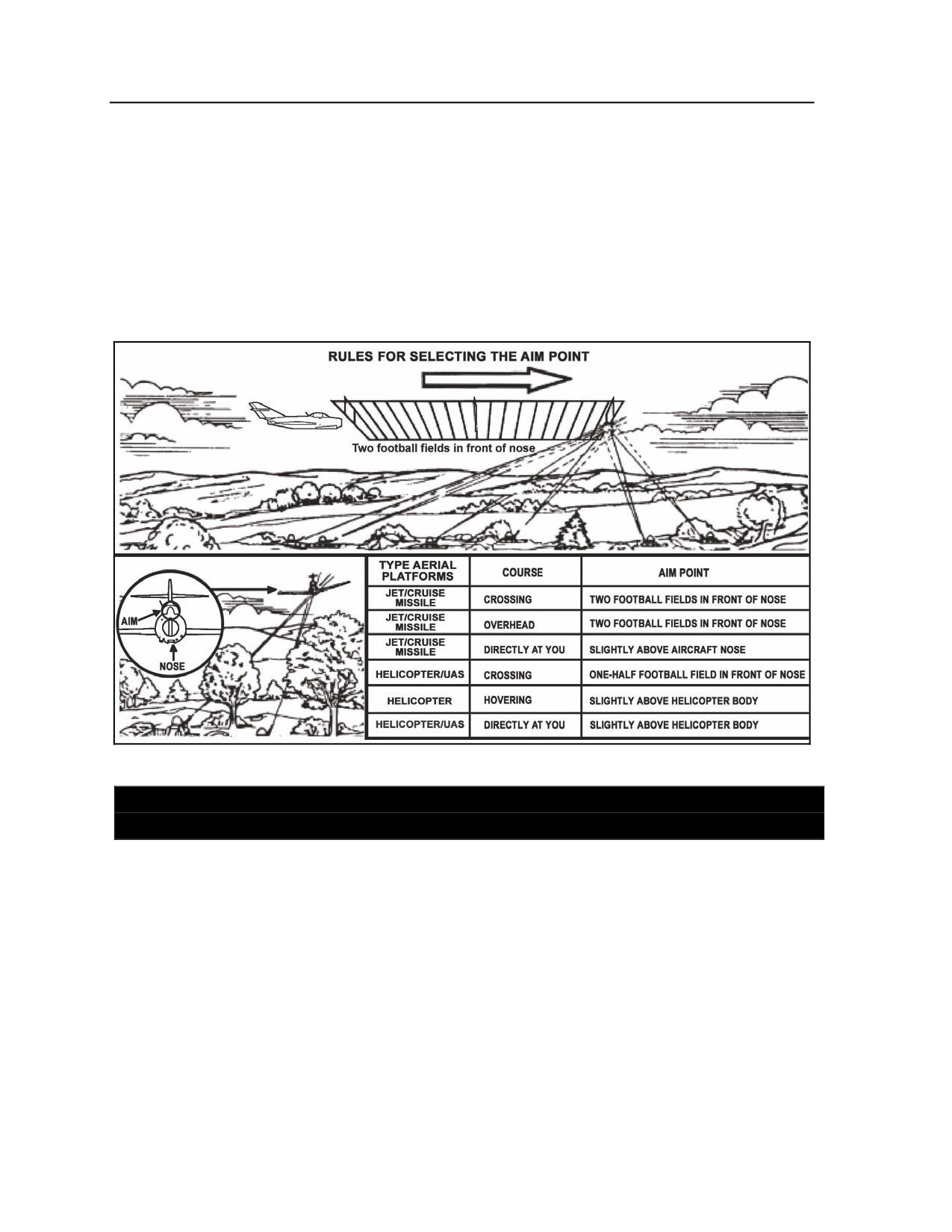
4-42. Infantry platoons and squads avoid engaging enemy aircraft. If engagement is unavoidable, the
friendly unit uses a technique known as volume of fire. This technique is based on the premise that the
more bullets a unit can put in the sky, the greater the chance the enemy aircraft will fly into them. Even if
these fires do not hit the enemy, a “wall of lead” in the sky can intimidate enemy pilots. This can cause
them to break off their attack or distract them from taking proper aim. One of the most important points
about volume of fire is that once the lead distance is estimated, Soldiers must aim at the estimated aiming
point and fire at that single point until the aircraft has flown past it. Soldiers maintain the aiming point, not
the lead distance. Once a Soldier starts firing, he does not adjust his weapon. Leaders establish the aiming
point based on the type of aircraft that is attacking (Figure 4-2).
Figure 4-2. Volume of fire aim points.
SECTION III — CHEMICAL, BIOLOGICAL, RADIOLOGICAL, AND NUCLEAR
DEFENSE
4-43. Chemical, biological, radiological, and nuclear (CBRN) weapons can cause casualties, destroy or
disable equipment, restrict the use of terrain, and disrupt operations. They can be used separately or in
combination to supplement conventional weapons. The Infantry platoon must be prepared to operate on a
CBRN-contaminated battlefield without degradation of the unit’s overall effectiveness.
4-44. CBRN defensive measures provide the capability to defend against enemy attack by chemical,
biological, radiological, and chemical weapons and to survive and sustain combat operations in a CBRN
environment. Survival and sustainment must use the following principles: avoidance of CBRN hazards,
particularly contamination; protection of individuals and units from unavoidable CBRN hazards; and
decontamination. An effective CBRN defense counters enemy threats and attacks by minimizing
vulnerabilities, protecting friendly forces, and maintaining an operational tempo
(OPTEMPO) that
complicates targeting.
4-10
FM 3-21.8
28 March 2007

Protection
TENETS OF CBRN DEFENSE
4-45. Protection of the Infantry platoon and squad requires adherence to four rules of CBRN defense:
contamination avoidance; reconnaissance; protection; and decontamination.
CONTAMINATION AVOIDANCE
4-46. Avoiding CBRN attacks and hazards is the first rule of CBRN defense. Avoidance allows leaders to
shield Soldiers and units, and involves both active and passive measures. Passive measures include training,
camouflage, concealment, hardening of positions, and dispersion. Active measures include employing
detection equipment, reconnaissance, warnings and reports, markings, and contamination control.
RECONNAISSANCE
4-47. CBRN reconnaissance is detecting, identifying, reporting, and marking CBRN hazards. The process
consists of search, survey, surveillance, and sampling operations. Due to the limited availability of the M93
Fox reconnaissance vehicle, commanders should consider as a minimum the following actions when
planning and preparing for this type of reconnaissance:
Use the intelligence preparation of the battlefield (IPB) process to orient on CBRN threat named
areas of interest (NAIs).
Pre-position reconnaissance assets to support requirements.
Establish command and support relationships.
Assess the time and distance factors for the conduct of CBRN reconnaissance.
Report all information rapidly and accurately.
Plan for resupply activities to sustain CBRN reconnaissance operations.
Determine possible locations for post-mission decontamination.
Plan fire support.
Enact fratricide prevention measures.
Establish MEDEVAC procedures.
Identify CBRN warning and reporting procedures and frequencies.
PROTECTION
4-48. CBRN protection is an integral part of operations. Techniques that work for avoidance also work for
protection (shielding Soldiers and units and shaping the battlefield). Other protection activities involve
sealing or hardening positions, protecting Soldiers, assuming mission-oriented protective posture (MOPP)
(Table 4-3), reacting to attack, and using collective protection. Individual protective items include the
protective mask, joint service lightweight integrated suit technology (JSLIST) overgarments, multipurpose
(rain/snow/chemical and biological) overboots (MULO), and gloves. The corps or higher-level commander
establishes the minimum level of protection. Subordinate units may increase this level as necessary, but
they may not decrease it.
Table 4-3. MOPP levels.
Equipment
MOPP
MOPP0
MOPP1
MOPP2
MOPP3
MOPP4
Mask
Ready
Only
Mask
Carried
Carried
Carried
Carried
Worn
Worn
Worn***
JSLIST
Ready*
Available**
Worn
Worn
Worn
Worn
NA
Overboots
Ready*
Available**
Available**
Worn
Worn
Worn
NA
Gloves
Ready*
Available**
Available**
Available**
Available**
Worn
NA
Helmet
Ready*
Available**
Available**
Worn
Worn
Worn
NA
cover
*Items available to Soldier within two hours with replacement available within six hours.
**Items must be positioned within arm's reach of the Soldier.
***Never "mask only” if a nerve or blister agent has been used in the AO.
28 March 2007
FM 3-21.8
4-11
Chapter 4
DECONTAMINATION
4-49. The use of CBRN weapons creates unique residual hazards that may force units into protective
equipment. When the wearing of protective equipment is necessary, performance of individual and
collective tasks can be degraded, and decontamination may be required. Decontamination is the removal or
neutralization of CBRN contamination from personnel and equipment. It restores combat power and
reduces casualties that may result from exposure, enabling commanders to sustain combat operations. In
addition to the effects of CBRN weapons, contamination from collateral damage, natural disasters, and
industrial emitters may also require decontamination. Use the four principles of decontamination when
planning decontamination operations:
(1) Decontaminate as soon as possible.
(2) Decontaminate only what is necessary.
(3) Decontaminate as far forward as possible (METT-TC dependent).
(4) Decontaminate by priority.
Levels
4-50. The three levels of decontamination are immediate, operational, and thorough (Table 4-4).
Immediate Decontamination
4-51. Immediate decontamination requires minimal planning. It is a basic Soldier survival skill and is
performed IAW STP 21-1-SMCT. The aim of immediate decontamination is to minimize casualties, save
lives, and limit the spread of contamination. Personal wipedown with the M291 removes contamination
from individual equipment.
Operational Decontamination
4-52. Operational decontamination reduces contact hazards and limits the spread of contamination through
MOPP gear exchange and vehicle spraydown. It is done when a thorough decontamination cannot be
performed. MOPP gear exchange should be performed within six hours of contamination, if possible.
Thorough Decontamination
4-53. Thorough decontamination involves detailed troop decontamination (DTD) and detailed equipment
decontamination (DED). Thorough decontamination is normally conducted by company-size elements as
part of restoration or during breaks in combat operations. These operations require support from a chemical
decontamination platoon and a water source or supply.
4-12
FM 3-21.8
28 March 2007

Protection
Table 4-4. Decontamination levels and techniques.
Levels
Techniques1
Purpose
Best Start Time
Performed By
Immediate
Skin decontamination
Saves lives
Before 1 minute
Individual
Personal wipe down
Stops agent from
Within 15 minutes
Individual or buddy
Operator wipe down
penetrating
Within 15 minutes
Individual or crew
Spot decontamination
Limits agent spread
Within 15 minutes
Individual or crew
Limits agent spread
Operational
MOPP gear
Provides temporary
Within 6 hours
Unit battalion crew or
exchange2
relief from MOPP4
Within 1 hour (CARC)
decontamination
Vehicle wash down
Limits agent spread
or within 6 hours (non-
platoon
CARC)
Thorough
DED and DAD DTD
Provides probability
When mission allows
Decontamination
of long-term MOPP
reconstitution
platoon
reduction
Contaminated unit
1 Techniques become less effective the longer they are delayed. 2 Performance degradation and risk assessment
must be considered when exceeding 6 hours. See FM 3-11.5, Multiservice Tactics, Techniques, and Procedures
Chemical, Biological, Radiological, and Nuclear Contamination.
Planning Considerations
4-54. Leaders should include the following when planning for decontamination:
Plan decontamination sites throughout the width and depth of the sector (identify water sources
or supplies throughout the sector as well).
Tie decontamination sites to the scheme of maneuver and templated CBRN strikes.
Apply the principles of decontamination.
Plan for contaminated routes.
Plan for logistics and resupply of MOPP, mask parts, water, and decontamination supplies.
Plan for medical concerns to include treatment and evacuation of contaminated casualties.
Maintain site security.
28 March 2007
FM 3-21.8
4-13
This page intentionally left blank.

Chapter 5
Command, Control, and
Troop-Leading Procedures
The purpose of Command and Control (C2) is to implement the commander’s will in
pursuit of the unit’s objective. C2 is both a system and a process. The essential
component for both is leadership. This chapter provides techniques and procedures
used by infantry platoons, squads, and sections for C2 and communications. It
describes troop-leading procedures (TLP), communications in combat, and operation
orders.
SECTION I — COMMAND AND CONTROL
5-1. C2 refers to the process of directing, coordinating, and controlling a unit to accomplish a mission. C2
implements the commander’s will in pursuit of the unit’s objective. The two components of C2 are the
commander and the C2 system. At platoon level the C2 system consists of the personnel, information
management, procedures, and equipment the platoon leader uses to carry out the operational process (plan,
prepare, execute, and assess) within his platoon.
LEADERSHIP
5-2. Leadership means influencing people by providing purpose, direction, and motivation to accomplish
a mission (Table 5-1). Leadership is the most vital component of C2.
Table 5-1. Elements of leadership.
The reason to accomplish the
Leadership:
PURPOSE
mission.
Influencing people to
The means to accomplish the
accomplish a mission by
DIRECTION
mission.
providing—
The will to accomplish the
MOTIVATION
mission.
MISSION-ORIENTED COMMAND AND CONTROL
5-3. Mission command is the conduct of military operations through decentralized execution based on
mission orders for effective mission accomplishment. Successful mission command results from
subordinate leaders at all echelons exercising disciplined initiative within the commander’s intent to
accomplish missions. It requires an environment of trust and mutual understanding. Successful mission
command rests on the following four elements.
Commander’s Intent. The commander’s intent is a clear, concise statement of what the force
must do and the conditions the force must meet to succeed with respect to the enemy, terrain,
and desired end state.
Subordinates’ Initiative. This is the assumption of responsibility for deciding and initiating
independent actions when the concept of operations no longer applies or when an unanticipated
opportunity leading to achieving the commander’s intent presents itself.
28 March 2007
FM 3-21.8
5-1
Chapter 5
Mission Orders. Mission orders are a technique for completing combat orders. They allow
subordinates maximum freedom of planning and action in accomplishing missions. They leave
the “how” of mission accomplishment to subordinates.
Resource Allocation. Commanders allocate enough resources for subordinates to accomplish
their missions. Resources include Soldiers, material, and information.
MISSION COMMAND
5-4. Mission command concentrates on the objective of an operation, not on how to achieve it. It
emphasizes timely decision-making. The platoon leader must understand the company commander’s intent
and his clear responsibility to act within that intent to achieve the desired end state. With the company
commander’s intent to provide unity of effort, mission command relies on decentralized execution and the
platoon leader’s initiative.
5-5. The company commander must create trust and mutual understanding between himself and his
subordinates. This is more than just control. Commanders must encourage subordinates to exercise
initiative. Mission command applies to all operations across the spectrum of conflict.
5-6. Mission command counters the uncertainty of war by reducing the amount of certainty needed to act.
Commanders guide unity of effort through the commander’s intent, mission orders, and the CCIR.
Company commanders hold a “loose rein,” allowing platoon leaders freedom of action and requiring them
to exercise subordinates’ initiative. Commanders make fewer decisions, but this allows them to focus on
the most important ones. The command operates more on self-discipline than imposed discipline. Because
mission command decentralizes decision-making authority and grants subordinates significant freedom of
action, it demands more of commanders at all levels and requires rigorous training and education. If the
platoon leader is new and has not reached the level of confidence or maturity of the commander, the
commander may need to be more directive until the platoon leader is ready.
5-7. Mission command tends to be decentralized, informal, and flexible. Orders and plans are as brief and
simple as possible, relying on implicit communication—subordinates’ ability to coordinate and the human
capacity to understand with minimal verbal information exchange. This can be a result of extended combat
or training in which many actions and procedures have become standing operating procedure (SOP). By
decentralizing decision-making authority, mission command increases tempo and improves the
subordinates’ ability to act in fluid and disorderly situations. Moreover, relying on implicit communication
makes mission command less vulnerable to disruption of communications than detailed command.
5-8. Mission command is appropriate for operations in the often politically-charged atmosphere and
complex conditions of stability operations. Company commanders must explain not only the tasks assigned
and their immediate purpose, but also prescribe an atmosphere to achieve and maintain throughout the AO.
They must explain what to achieve and communicate the rationale for military action throughout their
commands. Doing this allows platoon leaders, squad leaders and their Soldiers to gain insight into what is
expected of them, what constraints apply, and most important, why the mission is being undertaken.
5-9. Detailed command is ill-suited to the conditions of stability operations. Commanders using its
techniques try to provide guidance or direction for all conceivable contingencies, which is impossible in
dynamic and complex environments. Under detailed command, subordinates must refer to their
headquarters when they encounter situations not covered by the commander’s guidance. Doing this
increases the time required for decisions and delays acting. In addition, success in interagency operations
often requires unity of effort, even when there is not unity of command. In such an environment, detailed
command is impossible. In contrast to the detailed instructions required by detailed command, mission
command calls for a clear commander’s intent. This commander’s intent provides subordinates guidelines
within which to obtain unity of effort with agencies not under military command. Subordinates then act
within those guidelines to contribute to achieving the desired end state.
5-2
FM 3-21.8
28 March 2007
Command, Control, and Troop-Leading Procedures
NOTE: The platoon leader must understand the situation and commander’s intent one and two
levels higher than his own. However, he must know the real-time battlefield situation in detail
for his immediate higher level (company).
SECTION II — PLANS AND ORDERS
5-10. Plans are the basis for any mission. To develop his plan (concept of the operation), the platoon leader
summarizes how best to accomplish his mission within the scope of the commander’s intent one and two
levels up. The platoon leader uses TLP to turn the concept into a fully developed plan and to prepare a
concise, accurate operation order (OPORD). He assigns additional tasks (and outlines their purpose) for
subordinate elements, allocates available resources, and establishes priorities to make the concept work.
The following discussion covers important aspects of orders development and serves as an introduction to
the discussion of the TLP. This section focuses on the mission statement and the commander’s intent,
which provide the doctrinal foundation for the OPORD. It also includes a basic discussion of the three
types of orders (warning orders [WARNOs], OPORDs, and FRAGOs) used by the platoon leader. The
platoon leader and his subordinates must have a thorough understanding of the building blocks for
everything else that they do.
MISSION STATEMENT
5-11. The platoon leader uses the mission statement to summarize the upcoming operation. This brief
paragraph (usually a single sentence) describes the type of operation, the unit’s tactical task, and purpose. It
is written based on the five Ws: who (unit), what (task[s]), when (date-time group), where (grid location or
geographical reference for the AO or objective), and why (purpose). The platoon leader must ensure that
the mission is thoroughly understood by all leaders and Soldiers one and two echelons down. The following
considerations apply in development of the mission statement.
OPERATIONS
5-12. Full spectrum operations are groupings of related activities in four broad categories: offense, defense,
stability, and civil support.
TASKS
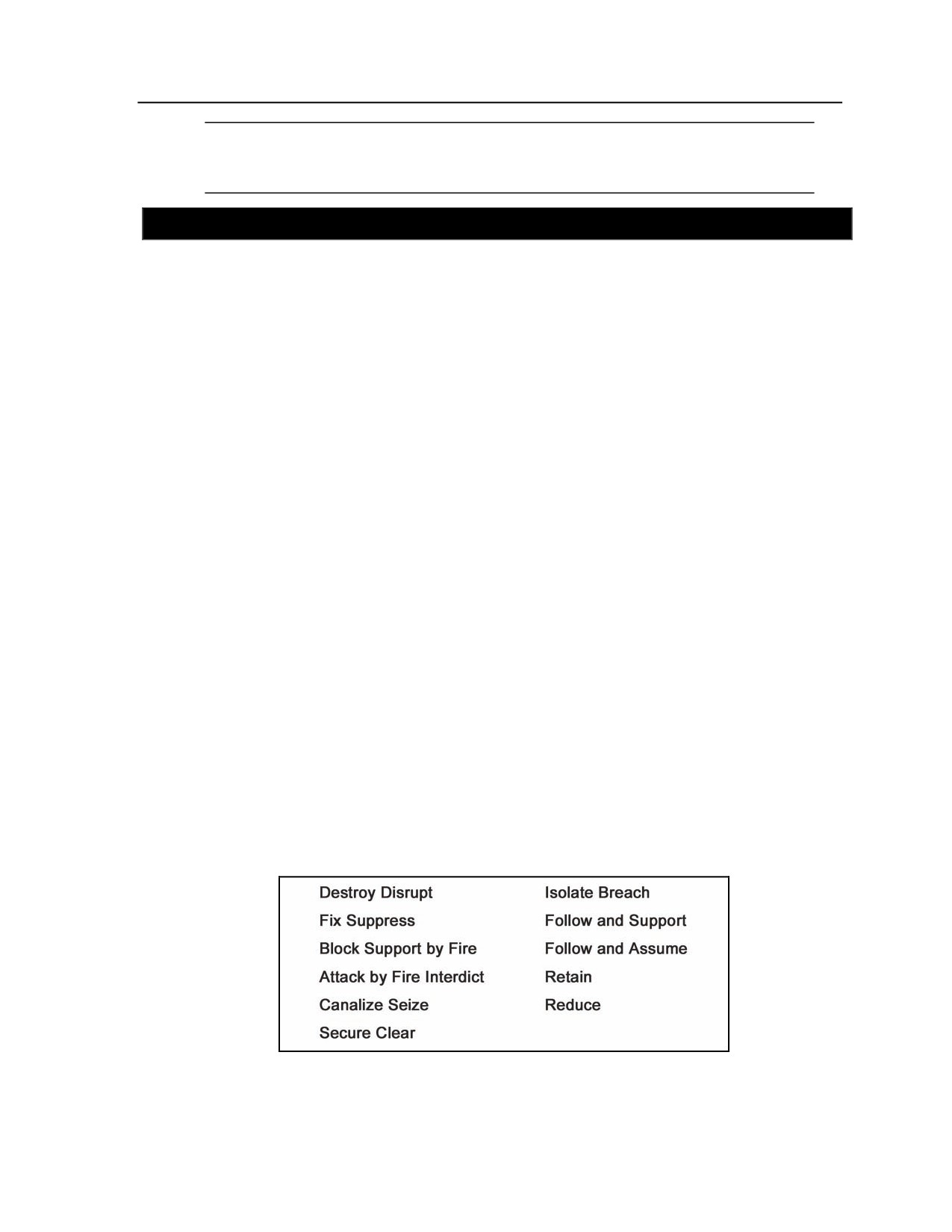
5-13. Tactical tasks are specific activities performed by the unit while it is conducting a form of tactical
operation or a choice of maneuver. The title of each task can also be used as an action verb in the unit’s
mission statement to describe actions during the operation. Tasks should be definable, attainable, and
measurable. Tactical tasks that require specific tactics, techniques, and procedures (TTP) for the platoon are
covered in detail throughout this manual. Figure 5-1 gives examples of tactical tasks the platoon and its
subordinate elements may be called upon to conduct. Refer to FM 1-02 for definition of the tactical tasks
listed in Figure 5-1.
Figure 5-1. Examples of tactical tasks.
28 March 2007
FM 3-21.8
5-3
Chapter 5
PURPOSE
5-14. A simple, clearly stated purpose tells subordinates the reason the platoon is conducting the mission.
PLACEMENT IN OPORD
5-15. The platoon leader has several options as to where in the OPORD he outlines his subordinates’ tasks
and purpose. His main concern is that placement of the mission statement should assist subordinate leaders
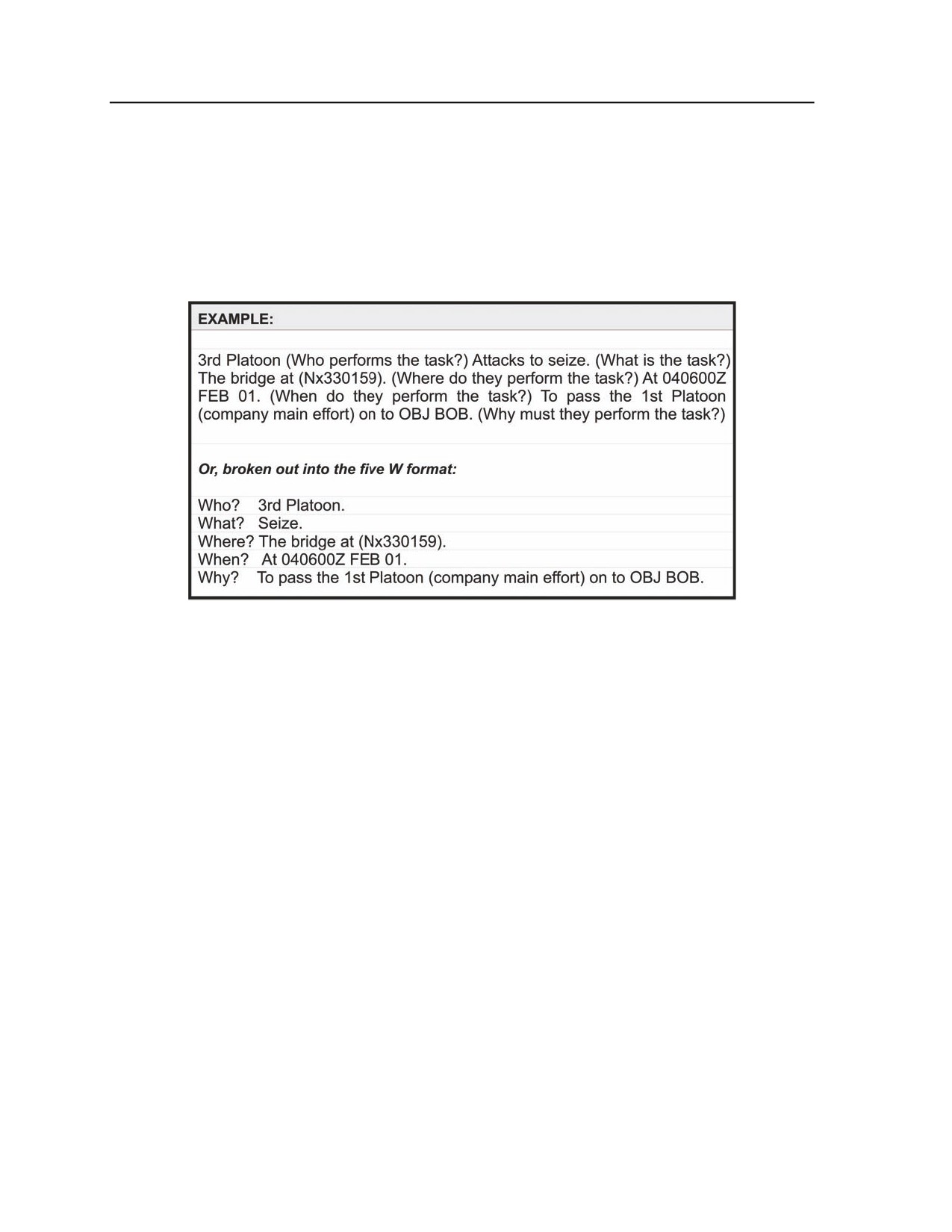
in understanding the task and purpose and each of the five W elements exactly. Figure 5-2 shows an
example of a mission statement the platoon leader might include in his order.
Figure 5-2. Example mission statement.
COMBAT ORDERS
5-16. Combat orders are the means by which the platoon leader receives and transmits information from
the earliest notification that an operation will occur through the final steps of execution. WARNOs,
OPORDs, and FRAGOs are absolutely critical to mission success. In a tactical situation, the platoon leader
and subordinate leaders work with combat orders on a daily basis, and they must have precise knowledge
of the correct format for each type of order. At the same time, they must ensure that every Soldier in the
platoon understands how to receive and respond to the various types of orders. The skills associated with
orders are highly perishable. Therefore, the platoon leader must take every opportunity to train the platoon
in the use of combat orders with realistic practice.
WARNING ORDER
5-17. Platoon leaders alert their platoons by using a WARNO during the planning for an operation.
WARNOs also initiate the platoon leader’s most valuable time management tool—the parallel planning
process. The platoon leader may issue a series of warning orders to his subordinate leaders to help them
prepare for new missions. The directions and guidelines in the WARNO allow subordinates to begin their
own planning and preparation activities.
(1) The content of WARNOs is based on two major variables: information available about the
upcoming operation and special instructions. The information usually comes from the company
commander. The platoon leader wants his subordinates to take appropriate action, so he normally
issues his WARNOs either as he receives additional orders from the company or as he completes
his own analysis of the situation.
(2) In addition to alerting the unit to the upcoming operation, WARNOs allow the platoon leader to
issue tactical information incrementally and, ultimately, to shorten the length of the actual
OPORD. WARNOs do not have a specific format, but one technique to follow is the five
5-4
FM 3-21.8
28 March 2007

Command, Control, and Troop-Leading Procedures
paragraph OPORD format. Table 5-2 shows an example of how the platoon leader might use
WARNOs to alert the platoon and provide initial planning guidance.
Table 5-2. Example of multiple warning orders.
PLATOON
LEADER’S
POSSIBLE CONTENT OF
PLATOON LEADER’S
ACTION
WARNING ORDER
PURPOSE
Receive the
Warning order #1 covers:
Prepare squads for movement to
company warning
Type of mission and tentative task
the tactical assembly area.
order
organization.
Obtain map sheets.
Movement plan.
Tentative timeline.
Standard drills to be rehearsed.
Conduct
Warning order #2 covers:
Initiate squad-level mission
METT-TC
Friendly situation.
analysis.
analysis
Enemy situation.
Initiate generic rehearsals (drill-
Security plan.
and task-related).
Terrain analysis.
Prepare for combat.
Platoon mission.
Develop a plan
Warning order #3 covers:
Identify platoon-level
Concept of the operation.
reconnaissance requirements.
Concept of fires.
Direct leader’s reconnaissance.
Subordinate unit tasks and
Prepare for combat.
purposes.
Updated graphics.
OPERATIONS ORDER
5-18. The OPORD is the five-paragraph directive issued by a leader to subordinates for the purpose of
implementing the coordinated execution of an operation. When time and information are available, the
platoon leader will normally issue a complete OPORD as part of his TLP. However, after issuing a series of
WARNOs, he does not need to repeat information previously covered. He can simply review previously
issued information or brief the changes or earlier omissions. He then will have more time to concentrate on
visualizing his concept of the fight for his subordinates. As noted in his WARNOs, the platoon leader also
may issue an execution matrix either to supplement the OPORD or as a tool to aid in the execution of the
mission. However, the matrix order technique does not replace a five-paragraph OPORD.
FRAGMENTARY ORDER
5-19. A FRAGO is an abbreviated form of an OPORD (verbal, written, or digital) that normally follows
the five-paragraph format. It is usually issued on a day-to-day basis that eliminates the need for restating
information contained in a basic OPORD. It may be issued in sections. It is issued after an OPORD to
change or modify that order and is normally focused on the next mission. The platoon leader uses a
FRAGO to—
Communicate changes in the enemy or friendly situation.
Task subordinate elements based on changes in the situation.
Implement timely changes to existing orders.
Provide pertinent extracts from more detailed orders.
Provide interim instructions until he can develop a detailed order.
Specify instructions for subordinates who do not need a complete order.
28 March 2007
FM 3-21.8
5-5

Chapter 5
SECTION III — TROOP-LEADING PROCEDURES
5-20. The TLP begin when the platoon leader receives the first indication of an upcoming mission. They
continue throughout the operational process (plan, prepare, execute, and assess). The TLP comprise a
sequence of actions that help platoon leaders use available time effectively and efficiently to issue orders
and execute tactical operations. TLP are not a hard and fast set of rules. Some actions may be performed
simultaneously or in an order different than shown in Figure 5-3. They are a guide that must be applied
consistent with the situation and the experience of the platoon leader and his subordinate leaders. The tasks
involved in some actions (such as initiate movement, issue the WARNO, and conduct reconnaissance) may
recur several times during the process. The last action (activities associated with supervising and refining
the plan) occurs continuously throughout TLP and execution of the operation. The following information
concerning the TLP assumes that the platoon leader will plan in a time-constrained environment. All steps
should be done, even if done in abbreviated fashion. As such, the suggested techniques are oriented to help
a platoon leader quickly develop and issue a combat order.
Figure 5-3. Troop-leading procedures.
RECEIVE THE MISSION
5-21. This step begins with the receipt of an initial WARNO from the company. It also may begin when
the platoon leader receives the commander’s OPORD, or it may result from a change in the overall
situation. Receipt of mission initiates the planning and preparation process so the platoon leader can
prepare an initial WARNO as quickly as possible. At this stage of the TLP, mission analysis should focus
on determining the unit’s mission and the amount of available time. For the platoon leader, mission
analysis is essentially the analysis of the factors of METT-TC, but he must not become involved in a
detailed METT-TC analysis. This will occur after issuing the initial WARNO. The platoon leader should
use METT-TC from the enemy’s perspective to develop the details of possible enemy courses of action
(COA). The following can assist in this process.
Understand the enemy’s mission. Will the enemy’s likely mission be based on his doctrine,
knowledge of the situation, and capabilities? This may be difficult to determine if the enemy has
no established order of battle. Enemy analysis must consider situational reports of enemy
patterns. When does the enemy strike, and where? Where does the enemy get logistical support
and fire support? What cultural or religious factors are involved?
Why is the enemy conducting this operation?
What are the enemy’s goals and are they tied to specific events or times?
What are the enemy’s capabilities?
What are the enemy’s objectives? Based on the situation template (SITEMP) and the
projected enemy mission, what are the enemy’s march objectives (offense) or the terrain or
force he intends to protect (defense)? The commander normally provides this information.
If the enemy is attacking, which avenues will he use to reach his objectives in executing his
COAs and why?
How will terrain affect his speed and formations?
How will he use key terrain and locations with clear observation and fields of fire?
5-6
FM 3-21.8
28 March 2007
Command, Control, and Troop-Leading Procedures
How will terrain affect his speed and formations?
How will he use key terrain and locations with clear observation and fields of fire?
Does the weather aid or hinder the enemy in accomplishing his mission or does the weather
degrade the enemy’s weapons or equipment effectiveness?
Enemy obstacles are locations provided by the company commander, platoon leader’s
assessment, or obtained from reconnaissance that give the platoon leader insight into how the
enemy is trying to accomplish his mission.
Perhaps the most critical aspect of mission analysis is determining the combat power potential of
one’s force. The platoon leader must realistically and unemotionally determine what tasks his
Soldiers are capable of performing. This analysis includes the troops attached to or in direct
support of the platoon. The platoon leader must know the status of his Soldiers’ experience and
training level, and the strengths and weaknesses of his subordinate leaders. His assessment
includes knowing the status of his Soldiers and their equipment, and it includes understanding
the full array of assets that are in support of the platoon such as additional AT weapons, snipers,
and engineers. For example, how much indirect fire is available and when is it available?
5-22. As addressed in the “receive the mission” TLP, time analysis is a critical aspect to planning,
preparation, and execution. Not only must the platoon leader appreciate how much time is available, he
must be able to appreciate the time-space aspects of preparing, moving, fighting, and sustaining. He must
be able to see his own tasks and enemy actions in relation to time. The platoon leader should conduct
backward planning and observe the “1/3 - 2/3 rule” to allow subordinates their own planning time.
Examples of time analysis are as follows.
(1) He must be able to assess the impact of limited visibility conditions on the TLP.
(2) He must know how long it takes to conduct certain tasks such as order preparation, rehearsals,
back-briefs, and other time-sensitive preparations for subordinate elements.
(3) He must understand how long it takes to deploy a support by fire (SBF) element, probably the
weapons squad, and determine the amount of ammunition needed to sustain the support for a
specific period of time.
(4) He must know how long it takes to assemble a bangalore torpedo and to breach a wire obstacle.
(5) Most importantly, as events occur, the platoon leader must adjust his analysis of time available
to him and assess the impact on what he wants to accomplish.
(6) Finally, he must update previous timelines for his subordinates, listing all events that affect the
platoon.
5-23. The commander will provide the platoon leader with civil considerations that may affect the
company and platoon missions. The platoon leader also must identify any civil considerations that may
affect only his platoon’s mission. Platoons are likely to conduct missions in areas where there are
numerous non-combatants and civilians on the battlefield. Some considerations may include refugee
movement, humanitarian assistance requirements, or specific requirements related to the rules of
engagement (ROE) or rules of interaction (ROI).
ISSUE A WARNING ORDER
5-24. After the platoon leader determines the platoon’s mission and gauges the time available for planning,
preparation, and execution, he immediately issues an oral WARNO to his subordinates. In addition to
telling his subordinates of the platoon’s new mission, the WARNO also gives them the platoon leader’s
planning timeline. The platoon leader relays all other instructions or information that he thinks will assist
the platoon in preparing for the new mission. Such information includes information about the enemy, the
nature of the overall plan, and specific instructions for preparation. Most importantly, by issuing the initial
WARNO as quickly as possible, the platoon leader enables his subordinates to begin their own planning
and preparation while he begins to develop the platoon operation order. An example may include the
squads rehearsing designated battle drills. This is called parallel planning.
28 March 2007
FM 3-21.8
5-7
Chapter 5
MAKE A TENTATIVE PLAN
5-25. After receiving the company OPORD (or FRAGO), the platoon leader develops a tentative plan. The
process of developing this plan in a time-constrained environment usually has six steps: receipt of the
mission, mission analysis, COA development, COA analysis, COA selection, and issue the order. The
platoon leader relies heavily on the company commander’s METT-TC analysis. This allows the platoon
leader to save time by focusing his analysis effort on areas that affect his plan. Typically, a platoon leader
will develop one COA. If more time is available, he may develop more than one, in which case he will need
to compare these COAs and select the best one.
MISSION ANALYSIS
5-26. This is a continuous process during the course of the operation. It requires the platoon leader to
analyze all the factors of METT-TC in as much depth as time and quality of information will allow. The
factors of METT-TC are not always analyzed sequentially. How and when the platoon leader analyzes each
factor depends on when information is made available to him. One technique for the analysis is based on
the sequence of products that the company commander receives and produces: mission, enemy, terrain and
weather, troops, time, civil considerations. The platoon leader must develop significant conclusions about
how each element will affect mission accomplishment and then account for it in his plan.
MISSION
5-27. Leaders at every echelon must have a clear understanding of the mission, intent, and concept of the
operation of the commanders one and two levels higher. Without this understanding, it would be difficult to
exercise disciplined initiative. One technique to quickly understand the operation is to draw a simple sketch
of the battalion and company’s concepts of the operation (if not provided by the commander). The platoon
leader now can understand how the platoon mission relates to the missions of other units and how his
mission fits into the overall plan, and he can capture this understanding of the purpose (why) in his restated
mission statement. The platoon leader will write a restated mission statement using his analysis of these
areas: the battalion mission, intent, and concept; the company mission, intent, and concept; identification of
specified, implied, and essential tasks; identification of risks; and any constraints.
Battalion Mission, Intent, and Concept. The platoon leader must understand the battalion
commander’s concept of the operation. He identifies the battalion’s task and purpose, and how
his company is contributing to the battalion’s fight. The platoon leader also must understand the
battalion commander’s intent found in the friendly forces paragraph (paragraph 1b) of the
company order.
Company Mission, Intent, and Concept. The platoon leader must understand the company’s
concept of the operation. He identifies the company’s task and purpose, as well as his
contribution to the company’s fight. The platoon leader must clearly understand the
commander’s intent from the order (paragraph 3a). Additionally, the platoon leader identifies the
task, purpose, and disposition for all adjacent maneuver elements under company control.
Platoon Mission. The platoon leader finds his platoon’s mission in the company’s concept of the
operation paragraph. The purpose of the main effort platoon usually matches the purpose of the
company. Similarly, shaping operation platoons’ purposes must relate to the purpose of the main
effort platoon. The platoon leader must understand how his purpose relates to the other platoons
in the company. He determines the platoon’s essential tactical task to successfully accomplish
his given purpose. Finally, he must understand why the commander gave his platoon a particular
tactical task and how it fits into the company’s concept of the operation.
Constraints. Constraints are restrictions placed on the platoon leader by the commander to
dictate action or inaction, thus restricting the freedom of action the platoon leader has for
planning by stating the things that must or must not be done. The two types of constraints are:
requirements for action (for example, maintain a squad in reserve); and prohibitions of action
(for example, do not cross phaseline [PL] BULL until authorized).
Identification of Tasks. The platoon leader must identify and understand the tasks required to
accomplish the mission. There are three types of tasks: specified; implied; and essential.
5-8
FM 3-21.8
28 March 2007
Command, Control, and Troop-Leading Procedures
Specified Tasks. These are tasks specifically assigned to a platoon by the
commander. Paragraphs 2 and 3 from the company OPORD state specified
tasks. Specified tasks may also be found in annexes and overlays (see p. 5-
21 for OPORD example).
Implied Tasks. These are tasks that must be performed to accomplish a
specified task, but which are not stated in the OPORD. Implied tasks are
derived from a detailed analysis of the OPORD, the enemy situation, the
COAs, and the terrain. Analysis of the platoon’s current location in relation
to future areas of operation as well as the doctrinal requirements for each
specified task also might provide implied tasks. SOP tasks are not
considered implied tasks.
Essential Tasks. An essential task is one that must be executed to
accomplish the mission derived from a review of the specified and implied
tasks. This is normally the task found in the mission statement
Identification of Risks. Risk is the chance of injury or death to individuals and damage to or loss
of vehicles and equipment. Risk, or the potential for risk, is always present in every combat and
training situation the platoon faces. Risk management must take place at all levels of the chain of
command during every operation. It is an integral part of tactical planning. The platoon leader,
his NCOs, and all other platoon Soldiers must know how to use risk management, coupled with
fratricide avoidance measures, to ensure that the mission is executed in the safest possible
environment within mission constraints. The platoon leader should review risk from a tactical
perspective (how can they best accomplish the mission with the least damage to their unit?) and
an individual perspective (how do I minimize the chances of my Soldiers getting hurt and keep
my equipment from being damaged?). Refer to Chapter 4 for a detailed discussion of risk
management and fratricide avoidance.
Restated Platoon Mission Statement. The platoon leader restates his mission statement using the
five Ws: who, what, when, where, and why. The “who” is the platoon. The “what” is the type of
operation and the platoon’s essential tactical task. The “when” is the date-time group (DTG)
given in the OPORD. The “where” is the objective or location taken from the OPORD. The
“why” is the purpose for the platoon’s essential tactical task taken from the commander’s
paragraph 3.
ANALYSIS OF TERRAIN AND WEATHER
5-28. The platoon leader must conduct a detailed analysis of the terrain to determine how it will uniquely
affect his unit and the enemy he anticipates fighting. The platoon leader must gain an appreciation of the
terrain before attempting to develop either enemy or friendly COA. He must exceed merely making
observations (for example, this is high ground, this is an avenue of approach). He must arrive at significant
conclusions concerning how the ground will affect the enemy and his unit. Because of limited planning
time, the platoon leader normally prioritizes his terrain analysis. For example, in the conduct of an assault,
his priority may be the area around the objective followed by the platoon’s specific axis leading to the
objective.
5-29. Terrain mobility is classified in one of three categories:
(1) Unrestricted. This is terrain free of any movement restrictions. No actions are required to
enhance mobility. For mechanized forces, unrestricted terrain is typically flat or moderately
sloped, with scattered or widely spaced obstacles such as trees or rocks. Unrestricted terrain
generally allows wide maneuver and offers unlimited travel over well-developed road networks.
Unrestricted terrain is an advantage in situations requiring rapid movement for mechanized
forces.
(2) Restricted. This terrain hinders movement to some degree, and units may need to detour
frequently. Restricted terrain may cause difficulty in maintaining optimal speed, moving in some
types of combat formations, or transitioning from one formation to another. This terrain typically
encompasses moderate to steep slopes or moderate to dense spacing of obstacles such as trees,
rocks, or buildings. The terrain may not require additional assets or time to traverse, but it may
28 March 2007
FM 3-21.8
5-9
Chapter 5
hinder movement to some degree due to increased security requirements. In instances when
security is the paramount concern, both friendly and enemy elements may move in more
restricted terrain that may provide more cover and concealment.
(3) Severely Restricted. This terrain severely hinders or slows movement in combat formations
unless some effort is made to enhance mobility. It may require a commitment of engineer forces
to improve mobility or a deviation from doctrinal tactics, such as using a column rather than a
wedge formation or moving at speeds much slower than otherwise preferred. Severely restricted
terrain includes any terrain that requires equipment not organic to the unit to cross (for example,
a large body of water and slopes requiring mountaineering equipment).
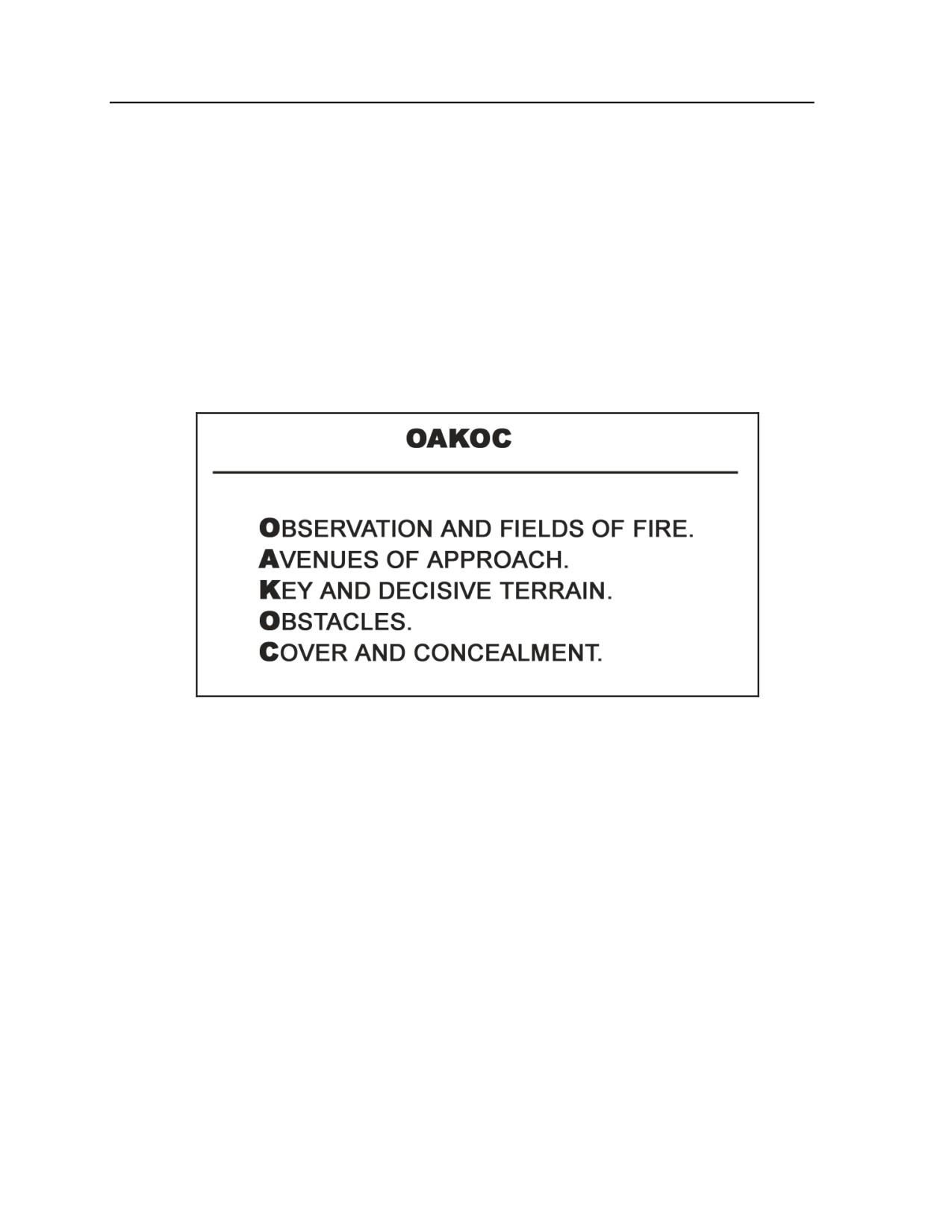
5-30. The military aspects of terrain observation (Figure 5-4) are used to analyze the ground. The sequence
used to analyze the military aspects of terrain can vary. The platoon leader may prefer to determine
obstacles first, avenues of approach second, key terrain third, observation and fields of fire fourth, and
cover and concealment last. For each aspect of terrain, the platoon leader determines its effect on both
friendly and enemy forces. The following are OAKOC aspects of terrain.
Figure 5-4. Military aspects of terrain.
OBSTACLES
5-31. The platoon leader first identifies existing and reinforcing obstacles in his AO that limit his mobility
with regards to the mission. Existing obstacles are typically natural terrain features present on the
battlefield. These may include ravines, gaps, or ditches over 3-meters wide; tree stumps and large rocks
over 18-inches high; forests with trees 8 inches or greater in diameter and with less than 4 meters between
trees; and manmade obstacles such as towns or cities. Reinforcing obstacles are typically manmade
obstacles that augment existing obstacles. These may include minefields, AT ditches, road craters, abatis
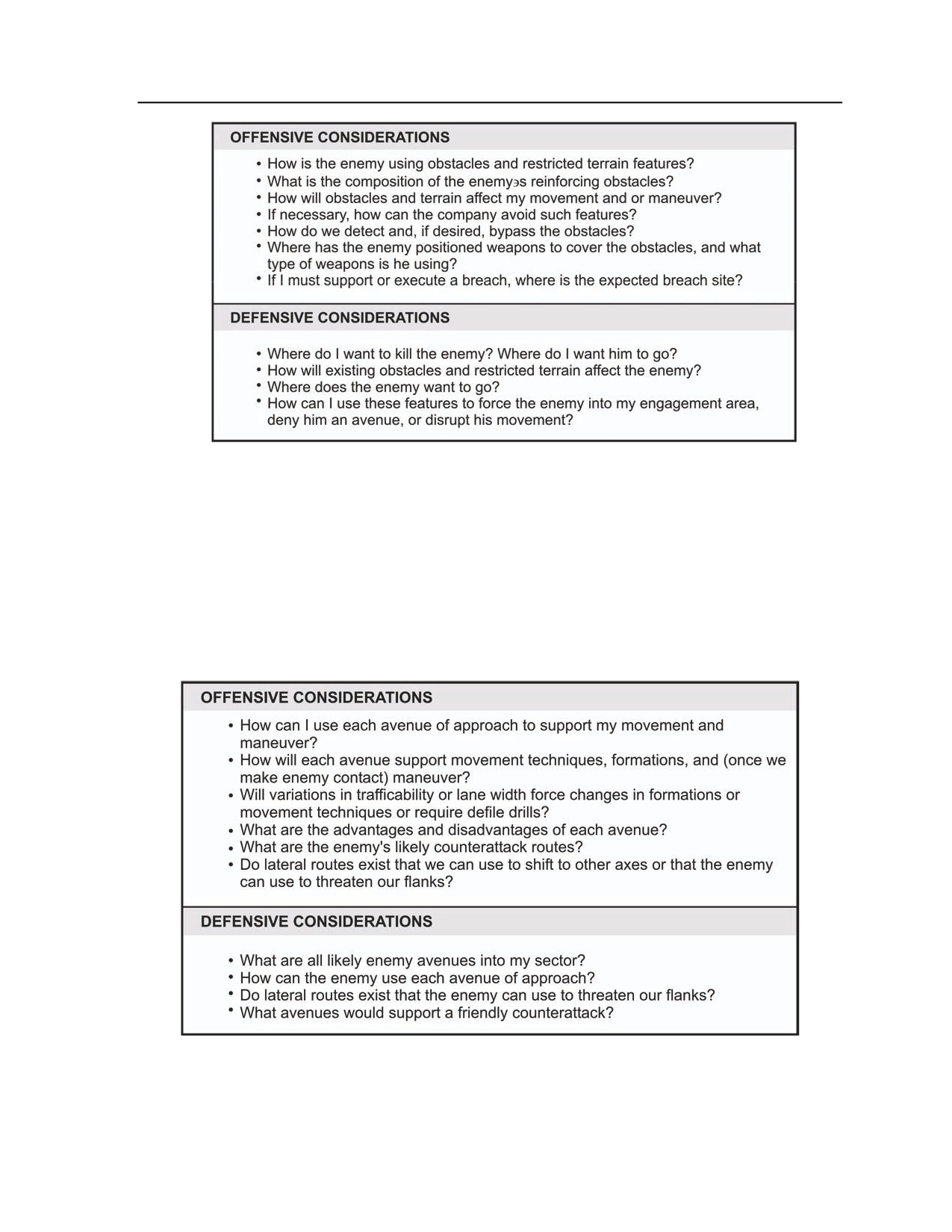
and log cribs, wire obstacles, and infantry strongpoints. Figure 5-5 lists several offensive and defensive
considerations the platoon leader can include in his analysis of obstacles and restricted terrain.
5-10
FM 3-21.8
28 March 2007
Command, Control, and Troop-Leading Procedures
Figure 5-5. Considerations in obstacle and terrain analysis.
AVENUES OF APPROACH
5-32. An avenue of approach is an air or ground route of an attacking force leading to its objective or key
terrain. For each avenue of approach, the platoon leader determines the type (mounted, dismounted, air, or
subterranean), size, and formation and speed of the largest unit that can travel along it. The commander
may give him this information. Mounted forces may move on avenues along unrestricted or restricted
terrain (or both). Dismounted avenues and avenues used by reconnaissance elements and infantry platoons
normally include terrain that is restricted and at times severely restricted to mounted forces. The terrain
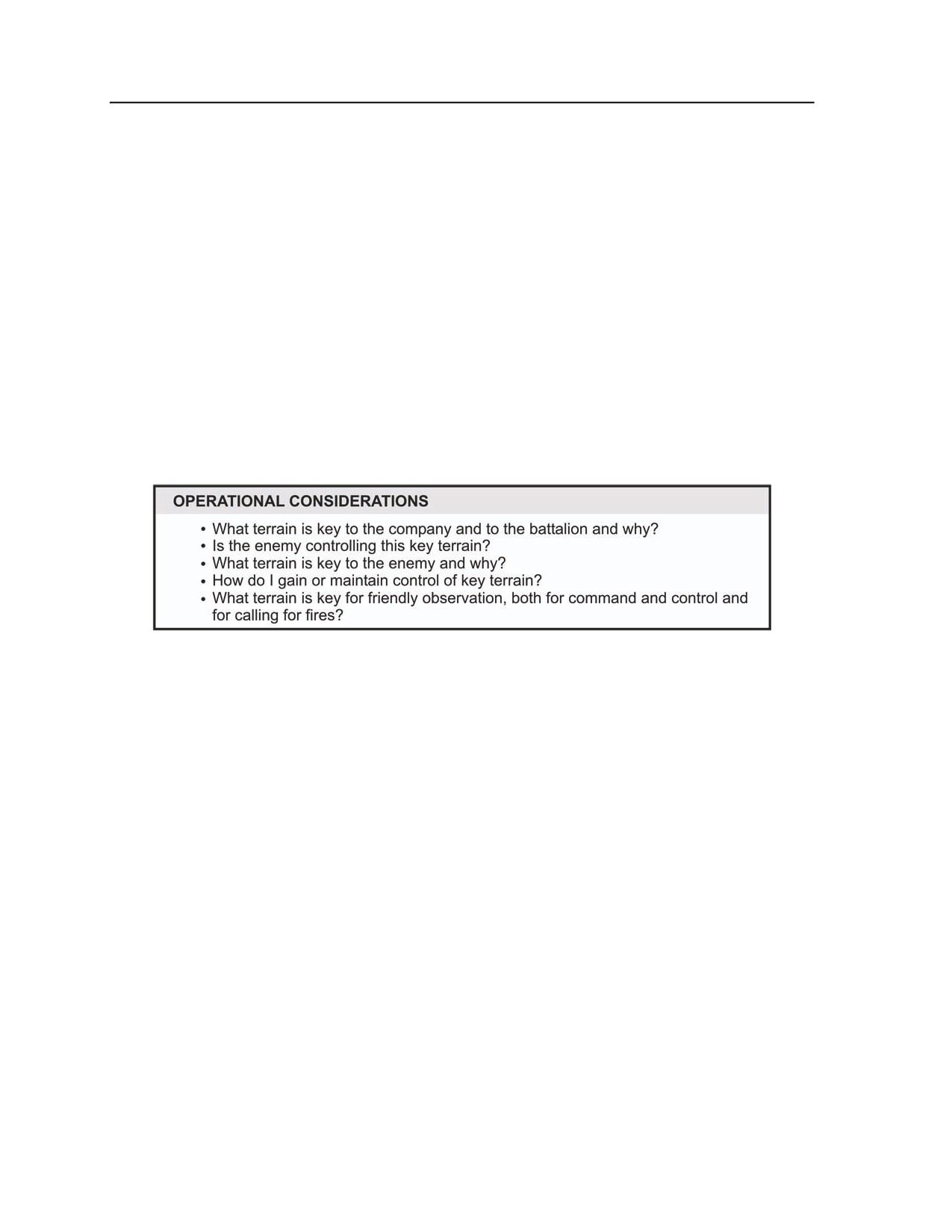
analysis also must identify avenues of approach for both friendly and enemy units. Figure 5-6 lists several
considerations for avenue of approach analysis.
Figure 5-6. Considerations for avenue of approach analysis.
28 March 2007
FM 3-21.8
5-11
Chapter 5
KEY TERRAIN
5-33. Key terrain affords a marked advantage to the combatant who seizes, retains, or controls it. The
platoon leader identifies key terrain starting at the objective or main battle area and working backwards to
his current position. It is a conclusion rather than an observation. The platoon leader must assess what
terrain is key to accomplishing his mission. Key terrain may allow the platoon leader to apply direct fire or
achieve observation of the objective (or avenue of approach). Key terrain may also be enemy oriented,
meaning that if the enemy controls the terrain it could prevent the platoon from accomplishing its mission.
An example of key terrain for a platoon could be a tree line on a hillside that provides overwatch
of a high-speed avenue of approach. Controlling this tree line may be critical in passing follow-
on forces
(main effort) to their objective. High ground is not necessarily key terrain. A
prominent hilltop that overlooks an avenue of approach and offers clear observation and fields of
fire, if it is easily bypassed, is not key terrain.
Although unlikely, the platoon leader may identify decisive terrain—key terrain that holds such
importance that the seizure, retention, and control of it will be necessary for mission
accomplishment and may decide the outcome of the battle. Use the following two military
aspects of terrain (observation and fields of fire, and cover and concealment) to analyze each
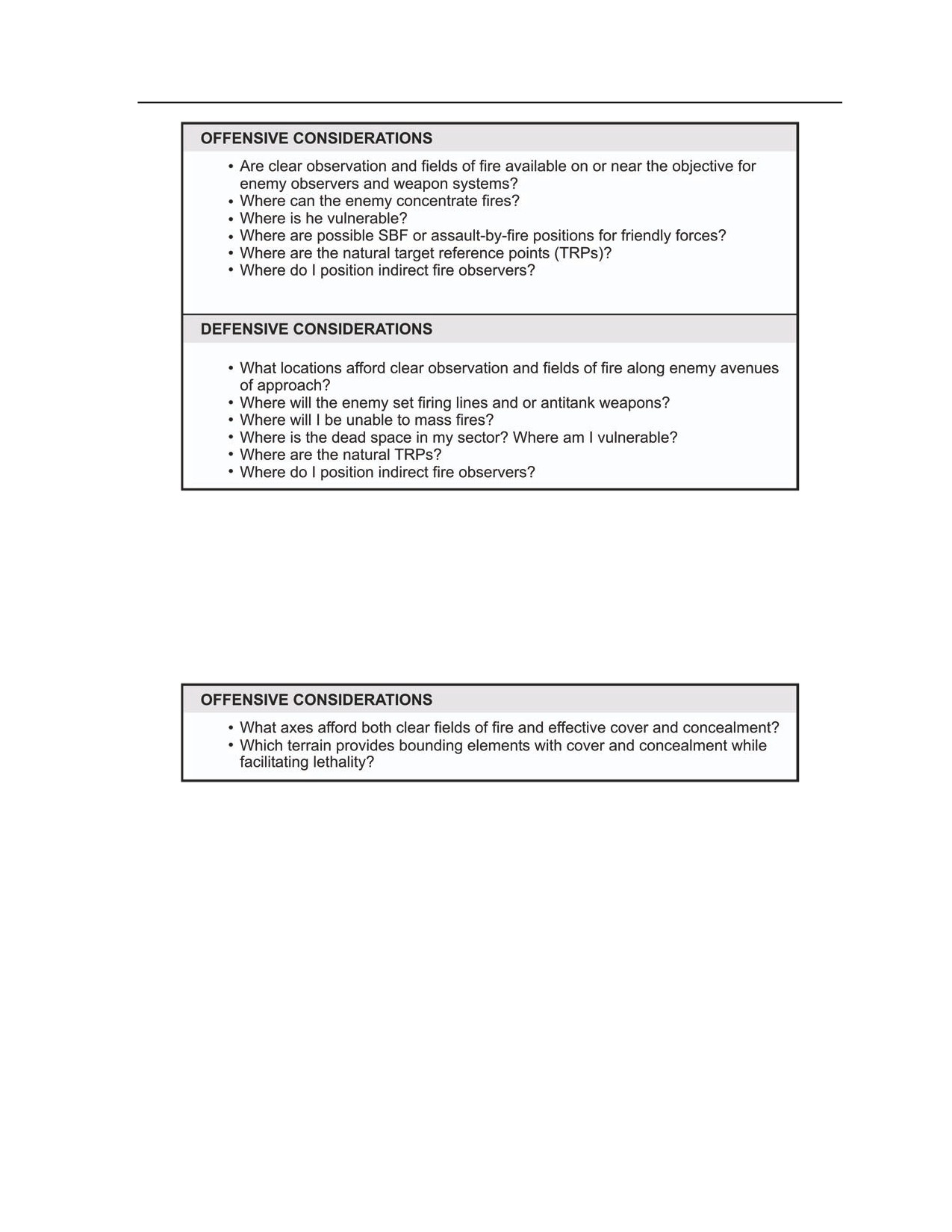
piece of key terrain. Figure 5-7 depicts operational considerations to use when analyzing key
terrain.
Figure 5-7. Considerations in key terrain analysis.
OBSERVATION AND FIELDS OF FIRE
5-34. The platoon leader analyzes areas surrounding key terrain, objectives, avenues of approach, and
obstacles to determine if they provide clear observation and fields of fire for both friendly and enemy
forces. He locates intervisibility lines (terrain that inhibits observation from one point to another) that have
not been identified by the commander and determines where visual contact between the two forces occurs.
When analyzing fields of fire, the platoon leader focuses on both friendly and enemy direct fire capabilities.
Additionally, he identifies positions that enable artillery observers to call for indirect fires and permit
snipers to engage targets. Figure 5-8 provides considerations for analysis of observation and fields of fire.
Whenever possible, the platoon leader conducts a ground reconnaissance from both the friendly and enemy
perspective.
5-12
FM 3-21.8
28 March 2007
Command, Control, and Troop-Leading Procedures
Figure 5-8. Considerations for analysis of observation and fields of fire.
COVER AND CONCEALMENT
5-35. Cover is protection from the effects of fires. Concealment is protection from observation but not
direct fire or indirect fires. Figure 5-9 provides considerations for analysis of cover and concealment.
Consideration of these elements can lead the platoon leader to identify areas that can, at best, achieve both
facets. The platoon leader looks at the terrain, foliage, structures, and other features on the key terrain,
objective, and avenues of approach to identify sites that offer cover and concealment.
Figure 5-9. Considerations in analysis of cover and concealment.
Five military aspects of weather
(1) Visibility.
(2) Winds.
(3) Precipitation.
(4) Cloud cover.
(5) Temperature/humidity.
5-36. The platoon leader must go beyond merely making observations. He must arrive at significant
conclusions about how the weather will affect his platoon and the enemy. He receives conclusions from the
commander and identifies his own critical conclusions about the weather. Most importantly, the platoon
leader must apply these conclusions when he develops friendly and enemy COAs. The five military aspects
of weather are—
Visibility. The platoon leader identifies critical conclusions about visibility factors (such as fog,
smog, and humidity) and battlefield obscurants (such as smoke and dust). Some visibility
considerations are—
28 March 2007
FM 3-21.8
5-13
Chapter 5
Will the current weather favor the use of smoke to obscure during breaching?
Will fog affect friendly and enemy target acquisition?
Light Data. The platoon leader identifies critical conclusions about beginning morning nautical
twilight (BMNT), sunrise (SR), sunset (SS), end of evening nautical twilight (EENT), moonrise
(MR), moonset (MS), and percentage of illumination. Some light data considerations are—
Will the sun rise behind my attack?
How can I take advantage of the limited illumination?
How will limited illumination affect friendly and enemy target acquisition?
Temperature. The platoon leader identifies critical conclusions about temperature factors (such
as high and low temperatures and infrared crossover times) and battlefield factors (such as use of
smoke or chemicals). Some temperature considerations are—
How will temperature (hot or cold) affect rate of foot march for the platoon?
How will temperature (hot or cold) affect the Soldiers and equipment?
Will temperatures favor the use of nonpersistent chemicals?
Precipitation. The platoon leader identifies critical conclusions about precipitation factors (such
as type, amount, and duration). Some precipitation considerations are—
How will precipitation affect mobility?
How can precipitation add to the platoon achieving surprise?
Winds. The platoon leader identifies critical conclusions about wind factors (such as direction
and speed). Some wind considerations are—
Will wind speed cause smoke to dissipate quickly?
Will wind speed and direction favor enemy use of smoke?
5-37. The platoon leader identifies critical conclusions about cloud cover (such as target acquisition
degradation, aircraft approach, and radar effectiveness). Some cloud cover considerations are—
Will heavy cloud cover limit illumination and solar heating of targets?
Will heavy cloud cover degrade the use of infrared-guided artillery?
Will cloud cover cause glare, a condition that attacking aircraft might use to conceal their
approach?
Will the cloud cover affect ground surveillance radar (GSR) coverage of the AO?
ANALYSIS OF ENEMY
5-38. This step allows the platoon leader to identify the enemy’s strength and potential weaknesses or
vulnerabilities so he can exploit them to generate overwhelming combat power in achieving his mission.
The platoon leader must understand the assumptions the commander used to portray the enemy’s COAs
covered in the company’s plan. Furthermore, the platoon leader’s assumptions about the enemy must be
consistent with those of the company commander. To effectively analyze the enemy, the platoon leader
must know how the enemy may fight. It is equally important for the platoon leader to understand what is
actually known about the enemy as opposed to what is only assumed or templated.
5-39. During doctrinal analysis, it is not enough only to know the number and types of vehicles, soldiers,
and weapons the enemy has. The platoon leader’s analysis must extend down to the individual key weapon
system. During stability operations or small-scale contingency (SSC) operations in an underdeveloped area
where little is known about the combatants, it may be difficult to portray or template the enemy doctrinally.
In this case, the platoon leader must rely on brigade and battalion analyses funneled through the company
commander as well as his own knowledge of recent enemy activities. The platoon leader should consider
the following areas as he analyzes the enemy.
Composition. The platoon leader’s analysis must determine the number and types of enemy
vehicles, soldiers, and equipment that could be used against his platoon. He gets this information
from paragraph 1a of the company OPORD. His analysis also must examine how the enemy
organizes for combat to include the possible use of a reserve.
5-14
FM 3-21.8
28 March 2007
Command, Control, and Troop-Leading Procedures
Disposition. From the commander’s information, the platoon leader identifies how the enemy
that his platoon will fight is arrayed.
Strength. The platoon leader identifies the strength of the enemy. It is imperative that the
platoon leader determines the actual numbers of equipment and personnel that his platoon is
expected to fight or that may affect his platoon. Again, much of this information is gained
through the detailed OPORD.
Capabilities. Based on the commander’s assessment and the enemy’s doctrine and current
location, the platoon leader must determine what the enemy is capable of doing against his
platoon during the mission. Such an analysis must include the planning ranges for each enemy
weapons system that the platoon may encounter.
Anticipated Enemy Courses of Action. To identify potential enemy COAs, the platoon leader
weighs the result of his initial analysis of terrain and weather against the enemy’s
composition, capabilities, and doctrinal objectives. He then develops an enemy SITEMP for
his portion of the company plan. The end product is a platoon SITEMP, a graphic overlay
depiction of how he believes the enemy will fight under the specific conditions expected on
the battlefield. The commander’s analysis and understanding of the current enemy and
friendly situation will provide the platoon leader with most of this information. Included in
the SITEMP is the range fan of the enemy’s weapons and any tactical and protective
obstacles, either identified or merely templated. Once the SITEMP has been developed it
should be transferred to a large-scale sketch to enable subordinates to see the details of the
anticipated enemy COA. After the platoon leader briefs the enemy analysis to his
subordinates, he must ensure they understand what is known, what is suspected, and what
merely templated (educated guess) is. The platoon’s SITEMP should depict individual Soldier
and weapons positions and is a refinement of the commander’s SITEMP.
SUMMARY OF MISSION ANALYSIS
5-40. The end result of mission analysis, as done during the formulation of a tentative plan, is a number of
insights and conclusions regarding how the factors of METT-TC affect accomplishment of the platoon’s
mission. The platoon leader must determine how he can apply his strengths against enemy weakness, while
protecting his weaknesses from enemy strength. From these the platoon leader will develop a COA.
COURSE OF ACTION DEVELOPMENT
5-41. The purpose of COA development is to determine one (or more) way(s) to achieve the mission by
applying the overwhelming effects of combat power at the decisive place or time with the least cost in
friendly casualties. If time permits, the platoon leader may develop several COAs. The platoon leader
makes each COA as detailed as possible to describe clearly how he plans to use his forces to achieve the
unit’s purpose and mission-essential task(s) consistent with the commander’s intent. He focuses on the
actions the unit must take at the decisive point and works backward to his start point. A COA should satisfy
the criteria listed in Table 5-3.
NOTE: The platoon leader should consider (METT-TC dependent) incorporating his squad
leaders and platoon sergeant in COA development. Incorporating the squad leaders and platoon
sergeant in the process may add time to the initial COA development process, but it will save
time by increasing their understanding of the platoon’s plan.
28 March 2007
FM 3-21.8
5-15

Chapter 5
Table 5-3. Course of action criteria.
Suitable
If the COA were successfully executed, would the unit accomplish the
mission consistent with the battalion and company commander’s concept
and intent?
The platoon must have the technical and tactical skill and resources to
Feasible
successfully accomplish the COA. In short, given the enemy situation and
terrain, the unit must have the training, equipment, leadership, and rehearsal
time necessary to successfully execute the mission.
Distinguishable
If more than one COA is developed, then each COA must be sufficiently
different from the others to justify full development and consideration. At
platoon level, this is very difficult to accomplish, particularly if the platoon has
limited freedom of action or time to plan and prepare.
Complete
The COA must include the operational factors of who, what, when, where,
and how. The COA must address the doctrinal aspects of the operation. For
example, in the attack against a defending enemy, the COA must cover
movement to, deployment against, assault of, and consolidation upon the
objective.
(1)
COA Development Step 1: Analyze Relative Combat Power. This step compares combat power
strengths and weaknesses of both friendly and enemy forces. At the platoon level this should not be a
complex process. However, if the platoon is attacking or defending against a force that has no order of
battle but has exhibited guerrilla- or terrorist-type tactics, it could be difficult. For the platoon leader, it
starts by returning to the conclusions the commander arrived at during mission analysis, specifically
the conclusions about the enemy’s strength, weakness, and vulnerabilities. In short, the platoon leader
is trying to ascertain where, when, and how the platoon’s combat power (Intelligence, Movement and
Maneuver, Fire Support, Protection, Sustainment, and Command and Control) can be superior to the
enemy’s while achieving the mission. This analysis should lead to techniques, procedures, and a
potential decisive point that will focus the COA development. See FM 1-02 for the definition of a
decisive point.
COA Development Step 2: Generate Options. The platoon leader must first identify the
objectives or times at which the unit will mass overwhelming firepower to achieve a specific
result (with respect to terrain, enemy, and or time) that will accomplish the platoon’s mission.
He should take the following action.
Determine the Doctrinal Requirements. As the platoon leader begins to develop a COA he
should consider, if he has not done so in mission analysis, what doctrine suggests in terms of
accomplishing the mission. For example, in an attack of a strongpoint, doctrine outlines several
steps: isolate the objective area and the selected breach site, attack to penetrate and seize a
foothold in the strongpoint, exploit the penetration, and clear the objective. In this case, doctrine
gives the platoon leader a framework to begin developing a way to accomplish the mission.
Determine the Decisive Point. The next and most important action is to identify a decisive point
in order to progress with COA development. The decisive point may be given to the platoon
leader by the company commander or be determined by the platoon leader through his relative
combat power analysis.
Determine the Purpose of Each Element. Determine the purpose of the subordinate elements
starting with the main effort. The main effort’s purpose is nested to the platoon’s purpose and is
achieved at the platoon leader’s decisive point. The platoon leader next identifies the purposes of
shaping efforts. These purposes are nested to the main effort’s purpose by setting the conditions
for success of the main effort.
Determine Tasks of Subordinate Elements. Starting with the main effort, the platoon leader
specifies the essential tactical tasks that will enable the main and shaping efforts to achieve their
purpose.
(2)
COA Development Step 3: Array Initial Forces. The platoon leader next must determine the specific
number of squads and weapons necessary to accomplish the mission and provide a basis for
5-16
FM 3-21.8
28 March 2007
Command, Control, and Troop-Leading Procedures
development of a scheme of maneuver. He will consider the platoon’s restated mission statement, the
commander’s intent, and the enemy’s most probable COA. He should allocate resources to the main
effort (at the decisive point) and continue with shaping efforts in descending order of importance to
accomplish the tasks and purposes he assigned during Step 2. For example, the main effort in an attack
of a strong point may require a rifle squad and an engineer squad to secure a foothold, whereas an SBF
force may require the entire weapons squad.
(3)
COA Development Step 4: Develop Schemes of Maneuver. The scheme of maneuver is a description
of how the platoon leader envisions his subordinates will accomplish the mission from the start of the
operation until its completion. He does this by determining how the achievement of one task will lead
to the execution of the next. He clarifies in his mind the best ways to use the available terrain as well as
how best to employ the platoon’s strengths against the enemy’s weaknesses (gained from his relative
combat power analysis). This includes the requirements of indirect fire to support the maneuver. The
platoon leader then develops the maneuver control measures necessary to enhance understanding of the
scheme of maneuver, ensure fratricide avoidance, and to clarify the task and purpose of the main and
shaping efforts.
(Refer to Chapter 4 for a detailed discussion of fratricide avoidance.) He also
determines the supply and medical evacuation aspects of the COA.
(4)
COA Development Step 5: Assign Headquarters. The platoon leader assigns specific elements (for
example, squads) as the main and shaping efforts. The platoon leader ensures that he has employed
every element of the unit and has C2 for each element.
(5)
COA Development Step 6: Prepare COA Statements and Sketches. The platoon leader’s ability to
prepare COA sketches and statements will depend on the amount of time available and his skill and
experience as a platoon leader. Whenever possible, the platoon leader should prepare a sketch showing
the COA. The COA statement is based on the scheme of maneuver the commander has already
developed and the platoon leader’s situational analysis. It focuses on all significant actions from the
start of the COA to its finish. The company commander should provide the platoon and squad leaders
his COA analysis when time is a limiting factor. Particularly if the order is verbal, it is extremely
useful to have one or more sketches of critical events within the plan that require coordinated
movement of two or more subordinate units.
Wargaming of COA. After developing a COA, the platoon leader wargames it to determine its
advantages and disadvantages, to visualize the flow of the battle, and to identify requirements to
synchronize actual execution. This is typically done during a discussion with the squad leaders,
platoon sergeant, or other key personnel. This technique is not complicated, and it facilitates a
total understanding of the plan. This is not a rehearsal. The wargame is designed to synchronize
all platoon actions, whereas during COA development the leader is focused on simply
integrating all platoon assets into the fight.
COA Comparison and Selection. If the platoon leader develops more than one COA, he must
compare them by weighing the specific advantages, disadvantages, strengths, and weaknesses of
each. These attributes may pertain to the accomplishment of the platoon purpose, the use of
terrain, the destruction of the enemy, or any other aspect of the operation that the platoon leader
believes is important. The platoon leader uses these factors as his frame of reference in
tentatively selecting the best COA. He makes the final selection of a COA based on his own
analysis.
INITIATE MOVEMENT
5-42. The platoon leader initiates any movement that is necessary to continue preparations or to posture the
unit for the operation. This may include movement to an assembly area (AA), battle position, perimeter
defense, or attack position; movement of reconnaissance elements; or movement to compute time-distance
factors for the unit’s mission.
28 March 2007
FM 3-21.8
5-17
Chapter 5
NOTE: The following discussion on reconnaissance and the amount or type of reconnaissance
conducted must be evaluated by the amount of information needed, the risk to leaders
conducting the reconnaissance, and time available, and it must be a coordinated effort with
higher command.
CONDUCT RECONNAISSANCE
5-43. Even if the platoon leader has made a leader’s reconnaissance with the company commander at some
point during TLP, he should still conduct a reconnaissance after he has developed his plan. The focus of the
reconnaissance is to confirm the priority intelligence requirements (PIRs) that support the tentative plan.
These PIRs are critical requirements needed to confirm or deny some aspect of the enemy
(location, strength, movement). The PIRs also include assumptions about the terrain (to verify,
for example, that a tentative SBF position actually will allow for suppression of the enemy, or to
verify the utility of an avenue of approach).
The platoon leader may include his subordinate leaders in this reconnaissance (or he may
instruct a squad to conduct a reconnaissance patrol with specific objectives). This allows them to
see as much of the terrain and enemy as possible. It also helps each leader visualize the plan
more clearly.
At the platoon level, the leader’s reconnaissance may include movement to or beyond a line of
departure (LD) or from the forward edge of the battle area (FEBA) back to and through the
engagement area along likely enemy routes. If possible, the platoon leader should select a
vantage point that provides the group with the best possible view of the decisive point.
The platoon leader may also conduct a leader’s reconnaissance through other means. Examples
of this type of reconnaissance include surveillance of an area by subordinate elements, patrols by
infantry squads to determine where the enemy is (and is not) located, and establishment of OPs
to gain additional information. If available, the leaders may use video from unmanned aircraft
systems (UAS) or video footage provided from helicopter gun cameras and digital downloads of
2D terrain products. The nature of the reconnaissance, including what it covers and how long it
lasts, depends on the tactical situation and the time available. The platoon leader should use the
results from the COA development process to identify information and security requirements for
the platoon’s reconnaissance operations.
COMPLETE THE PLAN
5-44. Completion of the plan includes several actions that transform the commander’s intent and concept
and the platoon concept into a fully developed platoon OPORD. These actions include preparing overlays,
refining the indirect fire list, completing sustainment and C2 requirements, and updating the tentative plan
as a result of the reconnaissance. It also allows the platoon leader to prepare the briefing site, briefing
medium and briefing material he will need to present the OPORD to his subordinates. Completing the plan
allows the platoon leader to make final coordination with other units or the commander before issuing the
OPORD to his subordinates.
ISSUE THE OPERATIONS ORDER
5-45. The OPORD precisely and concisely explains the mission, the commander’s intent and concept of
how he wants his squads to accomplish the mission. The OPORD must not contain unnecessary
information that could obscure what is essential and important. The platoon leader must ensure his squads
know exactly what must be done, when it must be done, and how the platoon must work together to
accomplish the mission and stay consistent with the intentions of the commander.
The platoon leader issues the order in person, looking into the eyes of all his Soldiers to ensure
each leader and Soldier understands the mission and what his element must achieve. The platoon
leader also uses visual aids, such as sand tables and concept sketches, to depict actions on the
objective or movement.
5-18
FM 3-21.8
28 March 2007

Command, Control, and Troop-Leading Procedures
The format of the five-paragraph OPORD helps the platoon leader paint a complete picture of all
aspects of the operation: terrain, enemy, higher and adjacent friendly units, platoon mission,
execution, support, and command. The format also helps him address all relevant details of the
operation. Finally, it provides subordinates with a predictable, smooth flow of information from
beginning to end.
SUPERVISE AND REFINE
5-46. The platoon leader supervises the unit’s preparation for combat by conducting confirmation briefs,
rehearsals, and inspections. Table 5-4 lists the items the unit should have.
Table 5-4. Precombat checklist.
Precombat Checklist
ID card
Pintels
Grappling hook
ID tags
T&E mechanisms
Sling sets
Ammunition
Spare barrels
PZ marking kit
Weapons
Spare barrel bags
ANCD
Protective mask
Extraction tools
Plugger/GPS
Knives
Asbestos gloves
Handheld microphones
Flashlights
Barrel changing handles
NVDs
Radios and backup
Headspace and timing gauges
Batteries and spare batteries
communication
Communication cards
M249 tools
Picket pounder
9-line MEDEVAC procedures
BII
Engineer stakes
Oil & transmission fluids
Pickets
OPORD
Anti-freeze coolant
Concertina wire
FRAGOs
5-gallon water jugs
TCP signs
Maps
MREs
IR lights
Graphics, routes, OBJs, LZs,
Load plans
Glint tape
and PZs
Protractors
Fuel cans
Chemical lights
Alcohol pens
Fuel spout
Spare hand sets
Alcohol erasers
Tow bars
Pencil with eraser
Pen and paper
Slave cables
Weapon tie downs
Tripods
Concertina wire gloves
5-47. Platoon leaders should
conduct a confirmation brief after issuing the oral OPORD to ensure
subordinates know the mission, the commander’s intent, the concept of the operation, and their assigned
tasks. Confirmation briefs can be conducted face to face or by radio, depending on the situation. Face to
face is the desired method, because all section and squad leaders are together to resolve questions, and it
ensures that each leader knows what the adjacent squad is doing.
5-48. The platoon conducts rehearsals. During the rehearsals, leaders practice sending tactical reports IAW
the unit’s SOPs. Reporting before, during, and after contact with the enemy is rehearsed in detail starting
with actions on the objective. Rehearsals are not intended to analyze a COA.
(1) The platoon leader uses well-planned, efficiently run rehearsals to accomplish the following:
Reinforce training and increase proficiency in critical tasks.
Reveal weaknesses or problems in the plan.
Integrate and synchronize the actions of attached elements.
Confirm coordination requirements between the platoon and adjacent units.
Confirm each Soldier’s understanding of the mission, concept of the operation, the direct fire
plan, anticipated contingencies, and possible actions and reactions for various situations that
may arise during the operation.
28 March 2007
FM 3-21.8
5-19
Chapter 5
(2) Rehearsal techniques include the following:
Map Rehearsal. A map rehearsal is usually conducted as part of a confirmation brief
involving subordinate leaders or portions of their elements. The leader uses the map and
overlay to guide participants as they brief their role in the operation. If necessary, he can use a
sketch map. A sketch map provides the same information as a terrain model and can be used
at any time.
Sand Table or Terrain Model. This reduced-force or full-force technique employs a small-
scale sand table or model that depicts graphic control measures and important terrain features
for reference and orientation. Participants walk around the sand table or model to practice the
actions of their own elements or vehicles (if working with mechanized units) in relation to
other members of the platoon.
Radio Rehearsal. This is a reduced-force or full-force rehearsal conducted when the situation
does not allow the platoon to gather at one location. Subordinate elements check their
communications systems and rehearse key elements of the platoon plan.
Reduced-Force Rehearsal. In this rehearsal, leaders discuss the mission while moving over
key terrain or similar terrain.
Full-Force Rehearsal. This technique is used during a full-force rehearsal. Rehearsals begin
in good visibility over open terrain and become increasingly realistic until conditions
approximate those expected in the AO.
NOTE: If time permits, the platoon should conduct a full-force rehearsal of the plan.
SQUAD ORDERS
5-49. The squad leader follows the same format as in Figure 5-10 and issues his five-paragraph format
OPORD to his squad. Because the squad is the smallest maneuver element, he does not develop COAs. He
must, however, assign specific tasks and purposes to his team leaders to ensure his squad mission is
accomplished.
5-20
FM 3-21.8
28 March 2007
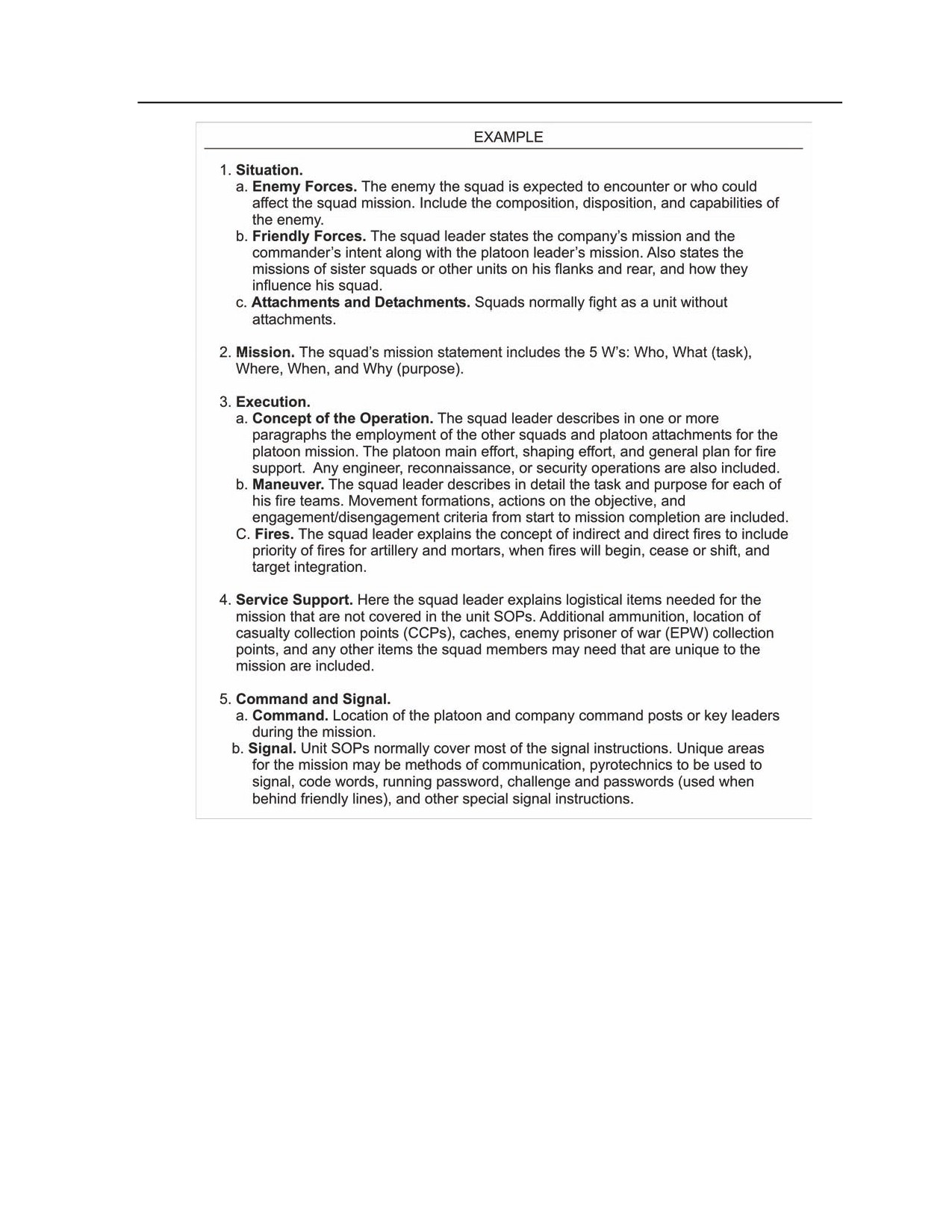
Command, Control, and Troop-Leading Procedures
Figure 5-10. Five-paragraph format OPORD example.
28 March 2007
FM 3-21.8
5-21
This page intentionally left blank.
Chapter 6
Sustainment
Sustainment facilitates uninterrupted operations by means of logistical support. It is
accomplished through supply systems, maintenance, and other services that ensure
continuous support throughout combat operations. The platoon leader is responsible
for planning sustainment. The platoon sergeant is the platoon’s main sustainment
operator. The platoon sergeant works closely with the company executive officer
(XO) and first sergeant (1SG) to ensure the platoon receives the required support for
its assigned missions. Sustainment responsibilities and procedures in the platoon are
the same as those that are habitually associated with Infantry units. The platoon and
company rely heavily upon their higher headquarters for their sustainment needs. The
company normally forecasts supplies with input from each platoon. in the process.
SECTION I — INDIVIDUAL RESPONSIBILITIES
6-1. Sustainment is an ever present requirement in all operations. All Soldiers, leaders, and units have
sustainment responsibilities. At the tactical level there are two main categories of personnel: sustainment
providers; and sustainment users. Both the sustainment provider and the sustainment user have
responsibilities for making the system work. The sustainment provider brings the sustainment user the
supplies needed to fight. An Infantry platoon is normally a sustainment user only, having no organic
sustainment assets. This section focuses on specific individual responsibilities within the platoon’s
sustainment chain.
PLATOON SERGEANT
6-2. As the platoon’s main sustainment operator, the platoon sergeant executes the platoon’s logistical
plan based on mission requirements, and platoon and company SOPs. The platoon sergeant’s sustainment
duties include—
Participating in sustainment rehearsals at the company level and integrating sustainment into the
platoon’s maneuver rehearsals.
Receiving, consolidating, and forwarding all administrative, personnel, and casualty reports to
the 1SG as directed or IAW unit SOP.
Obtaining supplies, equipment (except Class VIII), and mail from the supply sergeant and
ensuring proper distribution.
Supervising evacuation of casualties, KIAs, EPWs, and damaged equipment.
Maintaining the platoon’s manning roster.
Cross-leveling supplies and equipment throughout the platoon.
Coordinating logistics/personnel requirements with attached or OPCON units.
SQUAD LEADER
6-3. Each squad leader’s sustainment duties include:
Ensuring Soldiers perform proper maintenance on all assigned equipment.
Ensuring Soldiers maintain personal hygiene.
Compiling personnel and logistics reports for the platoon and submitting them to the platoon
sergeant as directed or IAW unit SOP.
28 March 2007
FM 3-21.8
6-1
Chapter 6
Obtaining supplies, equipment (except Class VIII), and mail from the platoon sergeant and
ensuring proper distribution.
Cross-leveling supplies and equipment throughout the squad.
TRAUMA SPECIALIST/PLATOON MEDIC
6-4. The trauma specialist/platoon medic is attached from the battalion medical platoon to provide
emergency medical treatment for sick, injured, or wounded platoon personnel. Emergency medical
treatment procedures performed by the trauma specialist may include opening an airway, starting
intravenous fluids, controlling hemorrhage, preventing or treating for shock, splinting fractures or
suspected fractures, and providing relief for pain. The trauma specialist is trained under the supervision of
the battalion surgeon or physician’s assistant (PA) and medical platoon leader. The trauma specialist is also
responsible for—
Triaging injured, wounded, or ill friendly and enemy personnel for priority of treatment.
Conducting sick call screening for the platoon.
Assisting in the evacuation of sick, injured, or wounded personnel under the direction of the
platoon sergeant.
Assisting in the training of the platoon’s combat lifesavers in enhanced first-aid procedures.
Requisitioning Class VIII supplies from the battalion aid station (BAS) for the platoon according
to the tactical standing operating procedure (TSOP).
Recommending locations for platoon casualty collection point(s) (CCP).
Providing guidance to the platoon’s combat lifesavers as required.
COMBAT LIFESAVER
6-5. The combat lifesaver (CLS) is a nonmedical Soldier trained to provide advanced first aid/lifesaving
procedures beyond the level of self-aid or buddy aid. The CLS is not intended to take the place of medical
personnel. His specialized training can slow deterioration of a wounded Soldier's condition until treatment
by medical personnel is possible. Each certified combat lifesaver is issued a CLS aid bag. Whenever
possible, the platoon leader ensures there is at least one CLS in each fire team.
TRAINING
6-6. Because combat lifesaving is an organic capability, the platoon should make it a training priority. An
emerging “first responder” program is now expanding CLS trauma treatment with increased emphasis on
combat and training injuries.
DUTIES
6-7. The combat lifesaver ensures that the squad CLS bag, litters, and IVs are properly packed. He also
identifies any Class VIII shortages to the platoon medic, and participates in all casualty treatment and
litter-carry drills. His advanced first-aid skills are called upon in the field until casualties can be evacuated.
The combat lifesaver must know the location of the CCP and the SOP for establishing it. The CLS has a
laminated quick reference nine-line MEDEVAC card.
SECTION II — PLANNING CONSIDERATIONS
6-8. Planning sustainment operations is primarily a company- and battalion-level operation. While the
company commander and XO plan the operation, the platoon leader is responsible for execution at platoon
level.
6-2
FM 3-21.8
28 March 2007
Sustainment
PLANNING
6-9. The platoon sergeant executes the plan at squad level. Sustainment at the Infantry platoon level is
characterized by the following: responsiveness, economy, flexibility, integration, and survivability
RESPONSIVENESS
6-10. To be effective sustainment needs to be responsive. This requires users to provide timely requests
for supplies and support while requiring providers to anticipate user needs in advance.
ECONOMY
6-11. To be efficient, sustainment providers and users exercise conservation. Because resources are always
limited, it is in the best interest of everyone to use only what is needed. The principle of economy
necessitates that Soldiers, leaders, and their units conserve resources whenever possible. This also ensures
other Soldiers and units will have the supplies they need.
FLEXIBILITY
6-12. The principle of flexibility embodies the chaotic nature of combat. Providers and users alike remain
aware that, despite the best efforts of all involved, things seldom go as planned; shipments are delayed,
convoys are attacked, and supplies are destroyed. To support the needs of both the individual unit and the
rest of the units on the battlefield requires both the user and provider to know what they need, when they
need it and possible substitutes.
INTEGRATION
6-13. To function properly, sustainment considerations must be integrated into every aspect of an
operation. Sustainment is not branch or rank specific - it is an essential part of all operations at all levels
by all Soldiers. Again, without sustainment units can not accomplish their mission
SURVIVABILITY
6-14. On the whole, sustainment assets are necessary yet finite resources that are easily destroyed. Units
without their classes of supply can not fight. Accordingly, survivability of sustainment assets is a high
priority for everyone. This affects the platoon in two ways. First units may be required to conduct security
missions for sustainment assets, such as convoy security, base security, and response force activities.
Second, units must ensure the survivability of their own supplies and any asset that might be under their
charge by properly safeguarding them
DEVELOPMENT OF THE SUSTAINMENT PLAN
6-15. The platoon leader develops his sustainment plan by determining exactly what he has on hand to
accurately predict his support requirements. This process is important not only in confirming the validity of
the sustainment plan, but also in ensuring the platoon submits support requests as early as possible. The
platoon leader formulates his sustainment execution plan and submits support requests to the company
based on his maneuver plan. It is critical for the company to know what the platoon has on hand for
designated critical supplies.
OPERATIONAL QUESTIONS
6-16. The sustainment plan should provide answers to the following types of operational questions:
TYPES OF SUPPORT
Based on the nature of the operation and specific tactical factors, what types of support will the
platoon need?
28 March 2007
FM 3-21.8
6-3
Chapter 6
QUANTITIES
In what quantities will this support be required?
If occupying a SBF position, how long is the platoon likely to fire, and at what rate of fire? This
drives the estimate for required Class V.
Will emergency resupply be required during the battle? Potentially when and where?
Does this operation require prestocked supplies (cache points)?
THREAT
What are the composition, disposition, and capabilities of the expected enemy threat?
How will these affect sustainment operations during the battle?
Where and when will the expected contact occur?
What are the platoon’s expected casualties and equipment losses based on the nature and
location of expected contact?
What impact will the enemy’s special weapons capabilities (such as CBRN) have on the battle
and on expected sustainment requirements?
How many EPWs are expected, and where?
TERRAIN AND WEATHER
What ground will provide the best security for CCPs?
What are the platoon’s casualty evacuation routes?
What are the company’s dirty routes for evacuating contaminated personnel and equipment?
TIME AND LOCATION
When and where will the platoon need sustainment?
Based on the nature and location of expected contact, what are the best sites for the CCP?
Where will the EPW collection points be located? Who secures them, when does the platoon
turn them over, and to whom?
6-17. Determine support requirements by asking the following questions:
What are the support requirements by element and type of support?
Which squad has priority for emergency Class V resupply?
RISK FACTOR
Will lulls in the battle permit support elements to conduct resupply operations in relative safety?
If no lulls are expected, how can the platoon best minimize the danger to the sustainment
vehicles providing the required support?
RESUPPLY TECHNIQUE
6-18. Resupply techniques the platoon use will be based on information developed during the sustainment
planning process.
CLASSES OF SUPPLY CONSIDERATIONS
6-19. The platoon sergeant obtains supplies and delivers them to the platoon. The platoon leader
establishes priorities for delivery, but combat demands that Class I, V, and IX supplies and equipment take
priority because they are the most critical to successful operations.
6-4
FM 3-21.8
28 March 2007
Sustainment
CLASS I
6-20. This class includes rations, water, and ice. It also includes gratuitous issue of items related to health,
morale, and welfare. The Daily Strength Report triggers an automatic request for Class I supplies.
Personnel in the field trains prepare rations and deliver them with the LOGPAC. If the unit has special food
requests, they must request them (for example, if a mission calls for MREs in lieu of planned hot rations).
CLASS II
6-21. This class includes clothing, individual equipment, mission-oriented protective posture (MOPP)
suits, tentage, tool sets, and administrative and housekeeping supplies. The platoon sergeant normally
distributes expendable items such as soap, toilet tissue, and insecticide based on battalion and company
LOGPAC schedules.
CLASS III
6-22. This class includes bulk and packaged petroleum, oil, and lubricants (POL) products, which Infantry
platoons do not normally require. Unusual Class III requests are coordinated by the company and then
delivered to the battalion combat trains.
CLASS IV
6-23. This class includes construction materials, pickets, sandbags, and concertina wire.
CLASS V
6-24. This class covers all types of ammunition and mines including, C4, and other explosives.
CLASS VI
6-25. This class includes personal-demand items including, candy, soaps, cameras, film, and sundry
packets that are normally sold through the exchange system.
CLASS VII
6-26. Infantry platoons do not normally have vehicles. However, this class includes major end items such
as major equipment and vehicles. Battle loss reports trigger the issuance of Class VII items.
CLASS VIII
6-27. This class covers medical supplies. The BAS replaces combat lifesaver bags and first-aid kits on a
one-for-one basis.
CLASS IX
6-28. This class includes repair parts and documents required for equipment maintenance operations.
Repair parts are issued in response to a specific request or are obtained by direct exchange of repairable
parts. The latter can include batteries for NVDs, and man-portable radios. In combat situations, exchange
and cannibalization are normal ways to obtain Class IX items.
CLASS X
6-29. This class includes materials to support nonmilitary programs such as agricultural and economic
development. Division level or higher will provide the platoon with instructions for requesting and issuing
Class X supplies.
28 March 2007
FM 3-21.8
6-5
Chapter 6
MISCELLANEOUS
6-30. This category covers anything that does not fall under one of the existing classes of supply.
MAINTENANCE
6-31. Proper maintenance is the key to keeping equipment and other materials in serviceable condition. It
is a continuous process, starting with preventive measures taken by each Soldier responsible for a piece of
equipment, and continuing on through repair and recovery efforts. Equipment services include inspecting,
cleaning, testing, servicing, repairing, requisitioning, recovering, and evacuating damaged equipment for
repair.
SOLDIER’S LOAD
6-32. The Soldier’s load is a main concern of the leader. How much is carried, how far, and in what
configuration are important mission considerations. Leaders must learn to prepare for the most likely
contingencies based on available information, because they cannot be prepared for all possible operations.
See FM 21-18, Foot Marches, and FM 3-21.10, The Infantry Rifle Company, for detailed discussions on
load planning, calculating, and management techniques used to assist leaders and Soldiers in organizing
tactical loads to ensure safety and combat effectiveness.
COMBAT LOAD AND BASIC LOAD
6-33. The platoon’s combat load varies by mission and includes the supplies physically carried into the
fight. The company commander may direct minimum requirements or be very specific for the composition
of the combat load. Often, the unit SOP or the platoon leader specifies most items. The basic load includes
supplies kept by the platoon for use in combat. The quantity of most basic load supply items depends on
how many days in combat the platoon might have to sustain itself without resupply. For Class V
ammunition, the higher commander or SOP specifies the platoon’s basic load.
TRANSPORTATION
6-34. Because the Infantry platoon leader has no organic transportation, they request transportation support
through the 1SG or company XO. They, in turn, request it from the battalion S4 for ground transportation
or S3 air operations if the transportation is for helicopters. Whenever possible, unless there is a specific
reason not to, rucksacks and excess equipment should be transported by vehicle.
SECTION III — RESUPPLY OPERATIONS
6-35. Resupply operations fall into one of three classifications: routine, emergency, or prestock. The
platoon SOP specifies cues for each method. The platoon should rehearse or conduct resupply operations
every time they conduct field training. The actual method selected for resupply in the field depends on
METT-TC factors.
ROUTINE RESUPPLY
6-36. Routine resupply operations primarily include Classes I, V, and IX; mail; and other items requested
by the platoon. When possible, the platoon should conduct routine resupply daily. Ideally, it does so during
periods of limited visibility.
6-37. The LOGPAC technique offers a simple, efficient way to accomplish routine resupply operations.
The key feature of LOGPAC, a centrally organized resupply convoy, originates at the battalion trains. The
convoy carries all items needed to sustain the platoon for a specific period (usually 24 hours) or until the
next scheduled LOGPAC. The battalion SOP will specify the LOGPAC’s exact composition and march
order.
6-6
FM 3-21.8
28 March 2007
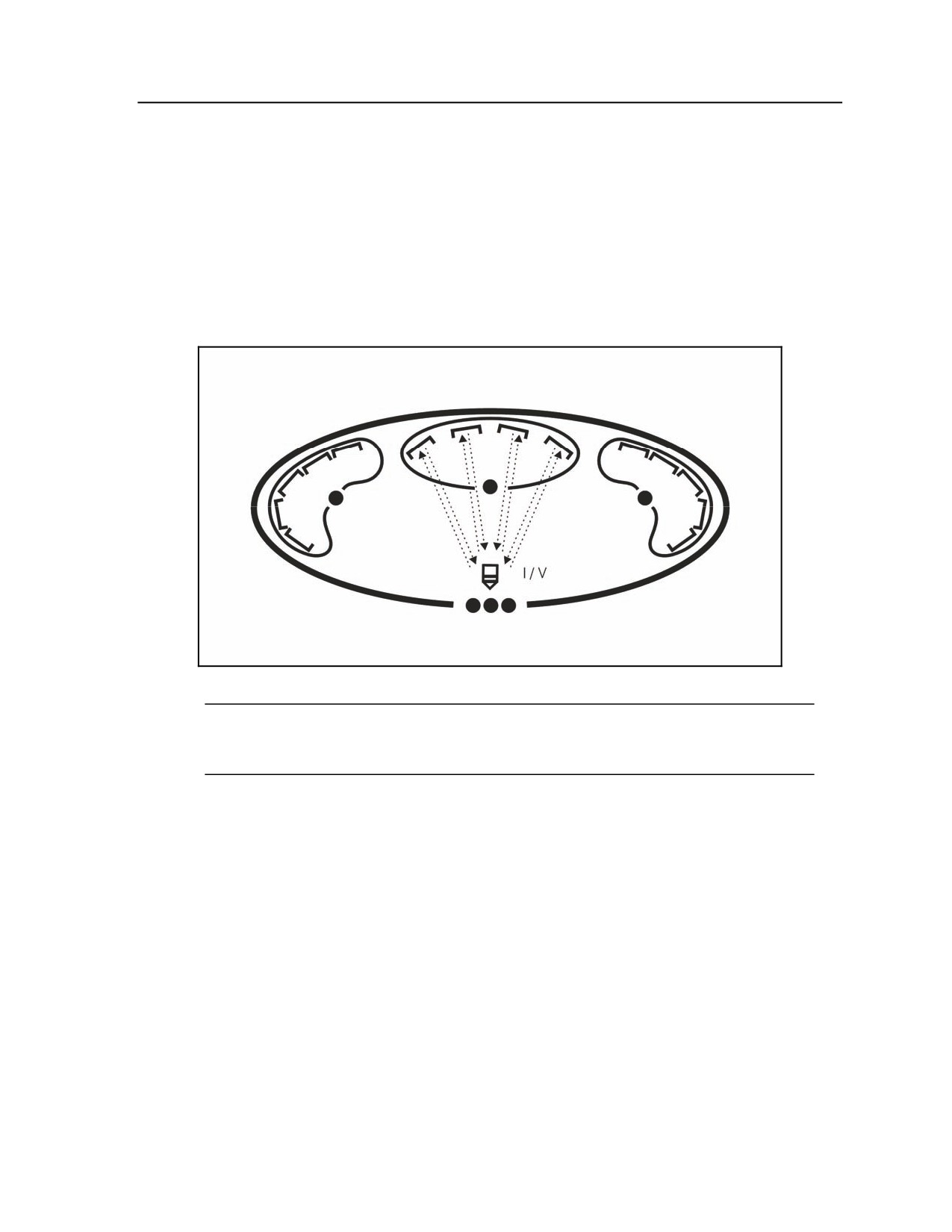
Sustainment
6-38. As directed by the commander or XO, the 1SG establishes the company resupply point. He uses
either the service station method (Figure 6-1), the tailgate method (Figure 6-2), or the in-position method
(Figure 6-3). He briefs each LOGPAC driver on which method to use. When he has the resupply point
ready, the 1SG informs the commander. The company commander then directs each platoon or element to
conduct resupply based on the tactical situation.
6-39. The service station method allows the squads to move individually to a centrally located resupply
point. This method requires the Soldiers to leave their fighting positions. Depending on the tactical
situation, a squad moves out of its position, conducts resupply operations, and moves back into position.
The squads rotate individually to eat; pick up mail, Class IX supplies, and other supplies and sundries; and
refill or exchange water. This process continues until the entire platoon has received its supplies. The
technique is used when contact is not likely and for the resupply of one or several classes of supplies.
Figure 6-1. Service station resupply method.
NOTE: The platoon order should state the sequence for moving squads or portions of squads
out of position. Companies may vary the technique by establishing a resupply point for each
platoon and moving the supplies to that point.
6-40. In AAs, the 1SG normally uses the tailgate method (Figure 6-2). Individual Soldiers rotate through
the feeding area. While there, they pick up mail and sundries and refill or exchange water cans. They
centralize and guard any EPW. They take Soldiers killed in action and their personal effects to the holding
area (normally a location downwind and out of sight of the platoon/company), where the 1SG assumes
responsibility for them.
28 March 2007
FM 3-21.8
6-7
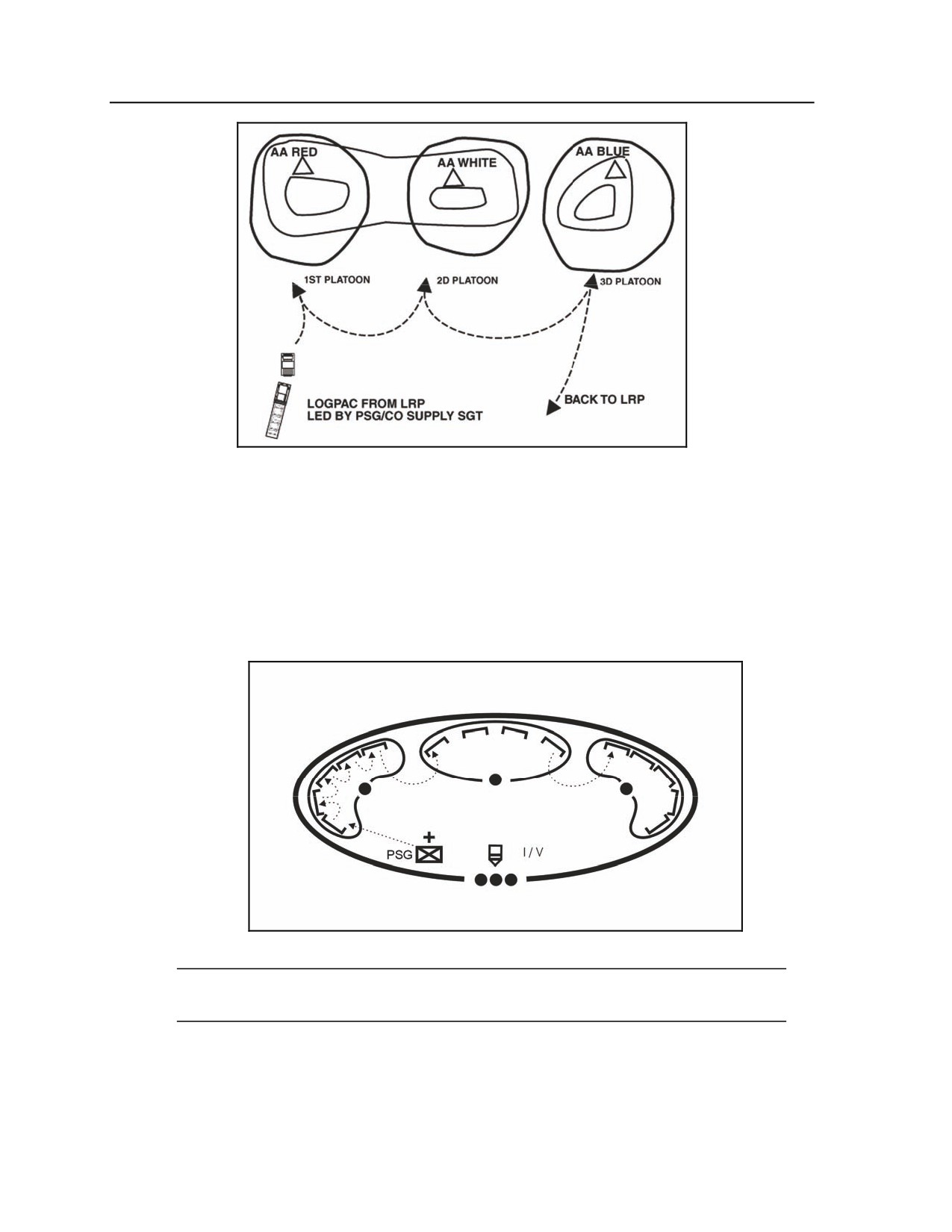
Chapter 6
Figure 6-2. Tailgate resupply method.
6-41. During operations when contact with the enemy is imminent, the in-position resupply method (Figure
6-3) may be required to ensure adequate supplies are available to the squads. This method requires the
company to bring forward supplies, equipment, or both to individual fighting positions. The platoon
normally provides a guide to ensure the supplies are distributed to the most critical position first. This
method—
Is used when an immediate need exists.
Is used to resupply single classes of supply.
Enables leaders to keep squad members in their fighting positions.
Figure 6-3. In-position resupply method.
NOTE: If resupply vehicles cannot move near platoon positions, platoon members may need to
help the resupply personnel move supplies and equipment forward.
EMERGENCY RESUPPLY
6-42. Occasionally during combat operations, the platoon may have such an urgent need for resupply that it
cannot wait for a routine LOGPAC. Emergency resupply may involve Classes I (usually water), V, VII,
6-8
FM 3-21.8
28 March 2007
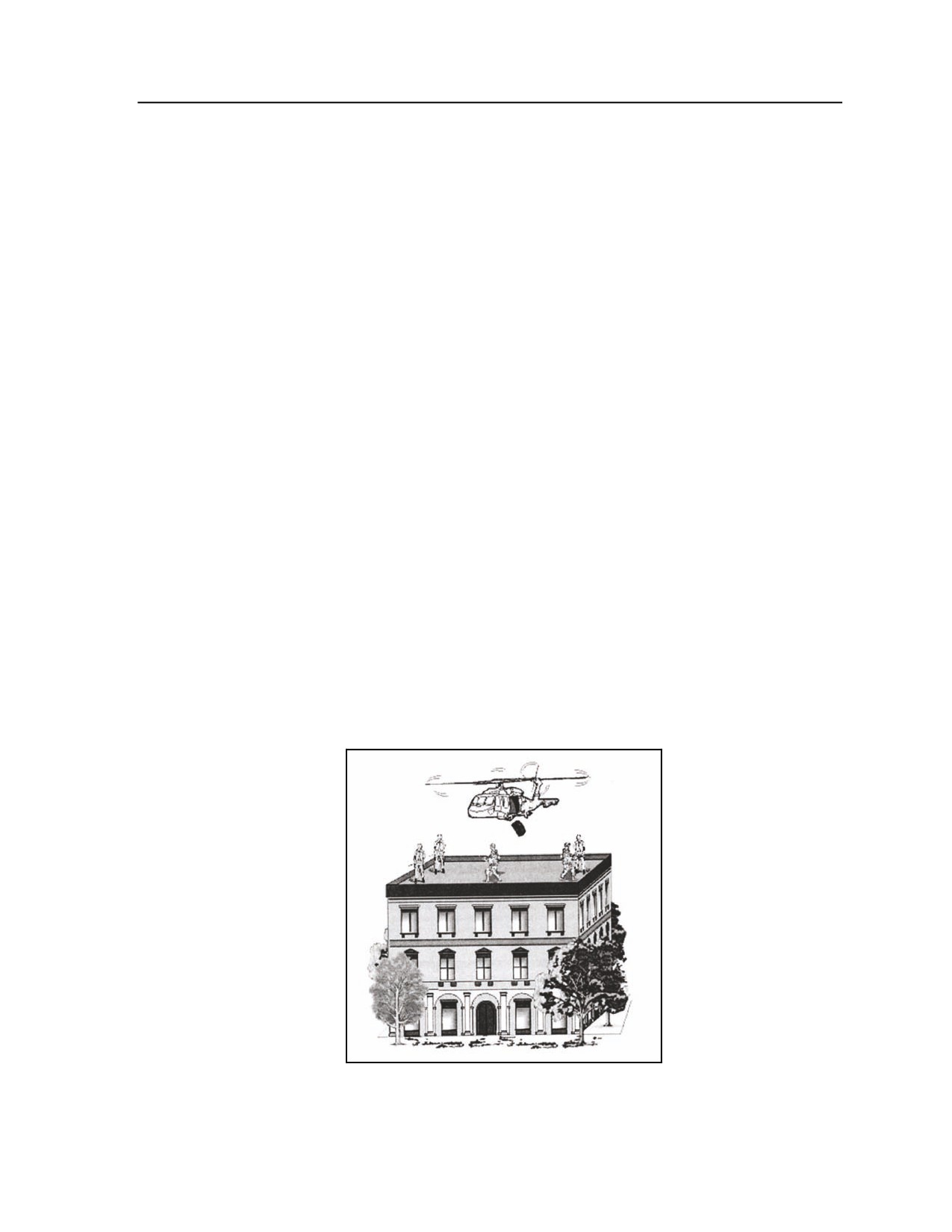
Sustainment
VIII, and CBRN equipment. Emergency resupply can be conducted using either the service station or
tailgate method, but more often uses the in-position method. The fastest appropriate means is normally
used, although procedures may have to be adjusted when the company is in contact with the enemy. In the
service station method, individual squads may pull back during a lull in combat to conduct resupply and
then return to the fight. With tailgate resupply, the company brings limited supplies forward to the closest
concealed position behind each element.
PRESTOCK RESUPPLY
6-43. In defensive or stay-behind operations and at some other times, the platoon may need prestocked
supplies (also known as prepositioned or cached resupply). Normally, the platoon only prepositions items
directed by the company.
6-44. All levels must carefully plan and execute prestock operations. All leaders, down to squad leader
level, must know the exact locations of prestock sites. They verify these locations during reconnaissance or
rehearsals. The platoon takes steps to ensure the survivability of the prestocked supplies. These measures
include selecting covered and concealed positions and digging in the prestock positions. The platoon leader
must have a removal and destruction plan to prevent the enemy from capturing prepositioned supplies.
6-45. During offensive operations, the company can preposition supplies on trucks well forward on the
battlefield. This works well if the company expects to use a large volume of fire, with corresponding
ammunition requirements. It allows the platoons to quickly resupply during consolidation or during lulls.
AERIAL SUSTAINMENT
6-46. Aerial sustainment is an aviation mission that consists of moving personnel, equipment, materiel, and
supplies by utility, cargo, and fixed-wing assets for use in operations. Overland resupply might not work
due to terrain, distance, or the existing enemy threat. The platoon must initiate a request for resupply and
must push it through company to battalion. The platoon must prepare to receive the supplies at the specified
time and location.
6-47. A aerial sustainment with speed balls is a technique with preconfigured loads to resupply Infantry
platoons in urban areas (Figure 6-4). Sustainment personnel prepackage supplies in aviation kit bags,
duffle bags, or other suitable containers. Helicopters fly as close to the drop point as possible, reduce
speed, drop supplies, and leave the area quickly. Supplies should be packaged in bubble wrap or other
shock-absorbing material to minimize damage.
Figure 6-4. Speed ball delivery.
28 March 2007
FM 3-21.8
6-9