FM 3-21.8 (FM 7-8) The Infantry Rifle Platoon and Squad (MARCH 2007) - page 3
Chapter 2
A correct fire command is brief, clear, and includes all the elements necessary for accomplishing the
mission. Fire commands are sent to the firing unit or gunner by the best understood means (visually or
vocally). To limit errors in transmission, the person receiving the commands repeats each element as it is
received.
2-107. Fire commands for direct fire weapons consist of six elements: alert, location, target description,
method of engagement, ammunition, and execution. When and how the leader issues a fire command is not
as important as covering the information in the fire command with his subordinates. Frequently, especially
at the fire team and crew-served weapon level, leaders use the elements of a fire command without
adhering to a strict format. The point is not that the leader adheres to a format, but that he maintains
positive control over his subordinates’ fires. However, using a more formal approach to fire commands
usually provides more clarity and certainty for Soldiers and crews.
ELEMENTS OF A FIRE COMMAND
2-108. Fire commands consist of—
Alert. The leader designates which weapon(s) is to fire by weapon type, Soldier’s position, or
Soldier’s name.
Location. The leader guides the Soldier onto the target.
Target Description. The leader identifies the target. For multiple targets, he also tells which
target to engage first.
Method of Engagement. The leader tells the Soldier how to deliver the fire onto the target.
Ammunition. The leader tells the Soldier which ammunition to use if munitions are other than
HE (this applies to M203 only).
Execution (Time). The leader reconfirms that the target is hostile, then gives an execution
command.
2-109. The full fire command is given when targets are not obvious and sufficient time is available to
issue a full order.
2-110. Brief fire commands are given when the target is obvious and time is limited.
2-111. Delayed fire commands are used when the leader can anticipate what is going to happen. The
Soldier or unit gets ready to fire but waits until the right moment before opening fire.
2-112. Subsequent fire commands are used to make adjustments in direction and elevation, change rates
of fire after a fire mission is in progress, interrupt fires, or to terminate the alert.
TERMS AND TECHNIQUES
2-113. The following list of terms and techniques clarify the different elements of the fire command.
Location
2-114. Leaders can use one or more of the following methods to assist Soldiers in locating and
distinguishing between targets (Table 2-5).
Use of Laser/Tracer. (“On my laser/tracer.”) To prevent loss of surprise when using tracer to
designate targets, the leader’s tracer fire becomes the last element of the fire command.
The Clock Method. An imaginary clock face is superimposed on the landscape with 12
o’clock being the direction of travel.
The TRP Method. The leader uses the closest, easily-recognizable point on the ground.
Cardinal Direction. Uses general compass directions (N, NE, E, SE, S, SW, W, and NW).
Pointing. The leader points his finger or weapon in the general direction of the target.
Orally. The leader gives the direction to the target in relation to the Soldier’s position (for
example, front, left front, right front).
2-22
FM 3-21.8
28 March 2007

Employing Fires
Table 2-5. Common means of identifying and marking target locations.
Terrain Features
Naked Eye (Day/Night)
Thermals (All Used at Night)
Hilltops
Azimuth (degree, mil) (D/N)
Burn barrels
Roads/streets
VS-17 panel (D)
BBQ grills
Streams
Engineer tape (D)
Reverse polarity paper
Road intersections
Chem light bundle (N)
Heated ammo can
Building corners
Strobe light (N)
IR (N)
Anything easily identifiable
Illumination (D/N)
Lasers (PAQ-4, PEQ-2, GCP, AIM 1)
Pyrotechnics (D/N)
Beacon/firefly strobe
Tracer fire (D/N)
Strobe light
Destroyed vehicle (D/N)
2-115. In defensive operations, the team leader and weapons squad leader use existing features as TRPs,
or they can emplace specially-made markers. The Soldier captures these TRPs and sectors on a range card.
In offensive operations, leaders normally predetermine location for TRPs and sectors based on the scheme
of maneuver of the platoon leader or commander. These TRPs and sectors are useful for planning.
However, the team leader/weapons squad leader must confirm them once they actually get on the ground.
Target Description
2-116. The most natural way for a leader to control his subordinates’ fire when in contact is to simply
describe the intended target(s). There are several terms used to shortcut the process, though leaders can use
whatever means possible to ensure understanding. To shorten the target description, the team leader or
weapons squad leader describes standard targets with standard procedure words (Table 2-6).
Table 2-6. Target descriptions and terms.
Target Type
Procedure Word
Tank or tank-like target
Tank
Personnel carrier
PC
Unarmored vehicle
Truck
Personnel
Troops
Helicopter
Chopper
Machine gun
Machine gun
Antitank gun or missile
AT weapon or RPG
Bunker
Bunker
Trench line
Trench
Urban structures
Door, window, room
Method of Engagement
2-117. The leader uses control to convey how he wants the target attacked. Common forms of this
element of the fire command are—
Rates of Fire. When changing rates, the leader needs only indicate rapid, sustained, or scan
and shoot.
Machine Gun Manipulation. Manipulation dictates the class of fire with respect to the
weapon and is announced as FIXED, TRAVERSE, SEARCH, or TRAVERSE AND
SEARCH.
28 March 2007
FM 3-21.8
2-23
Chapter 2
Execution
2-118. The leader uses one of the following orders to initiate fires:
Fire. The default rate of fire is at the sustained rate. The command to fire can occur in more
than one form, including:
Pre-arranged visual signal.
Pre-arranged event.
Pre-arranged audio signal.
Rapid Fire. Open fire at the rapid rate.
Scan and Shoot. Fire when targets appear in the designated sector.
At My Command. Be prepared to fire but do not initiate until the order to fire is given.
HAND-AND-ARM SIGNALS
2-119. Following are commonly used hand-and-arm signals for fire control (Figure 2-9).
Ready. The Soldier indicates that he is ready to fire by yelling, UP or raising his hand above
his head toward the leader.
Commence Firing or Change Rate of Firing. The leader brings his hand (palm down) to the
front of his body about waist level and moves it horizontally in front of his body. To signal an
increase in the rate of fire, he increases the speed of the hand movement. To signal slower fire,
he decreases the speed of the hand movement.
Change Direction or Elevation. The leader extends his hand and arm in the new direction and
indicates the amount of change necessary by the number of fingers extended. The fingers must
be spread so the Soldier can easily see the number of fingers extended. Each finger indicates 1
meter of change for the weapon. If the desired change is more than 5 meters, the leader extends
his hand the number of times necessary to indicate the total amount of change. For example,
right nine would be indicated by extending the hand once with five fingers showing and a
second time with four fingers showing for a total of nine fingers.
Interrupt or Cease Firing. The leader raises his hand and arm (palm outward) in front of his
forehead and brings it downward sharply.
Other Signals. The leader can devise other signals to control his weapons. A detailed
description of hand-and-arm signals is given in FM 21-60, Visual Signals.
2-24
FM 3-21.8
28 March 2007

Employing Fires
Figure 2-9. Hand-and-arm signals.
RANGE CARDS
2-120. A range card (DA Form 5517-R, Standard Range Card) is a sketch of the assigned sector for a
direct fire weapon system on a given sector of fire (Figure 2-10). A range card aids in planning and
controlling fires and aids the crews and squad gunners in acquiring targets during periods of limited
visibility. Range cards show possible target areas and terrain features plotted in relation to a firing position.
The process of walking and sketching the terrain to create a range card allows the individual Soldier or
gunner to become more familiar with his sector. Range cards also aid replacement personnel in becoming
oriented on the sector. Soldiers should continually assess the sector, and if necessary, update their range
cards.
28 March 2007
FM 3-21.8
2-25

Chapter 2
Figure 2-10. Example of completed DA Form 5517-R range card
(primary sector with final protective line).
ADJUSTMENTS
2-121. Direct fire adjustments are fairly easy to make because the observer is also the shooter. However,
when using an observer or spotter, direct fire adjustments are similar to those of indirect fire adjustments.
This includes making deviation and range corrections. Deviation corrections move the round right or left
toward the target, while range corrections add or drop the round toward the target with respect to the
observer.
2-26
FM 3-21.8
28 March 2007
Employing Fires
CLOSURE REPORT
2-122. The closure report completes the mission and provides a battle damage assessment. The report
should go to both the FDC and the parent unit. Higher headquarters staff officers use battle damage
assessment to update their running estimate and feed the common operating picture (COP).
SECTION V — EMPLOYING INDIRECT FIRES
2-123. The purpose of this section is to discuss techniques associated with calling for and adjusting
indirect fires.
CALL FOR FIRE
2-124. The battalion fire support execution matrix may require the platoon to call for and adjust its own
indirect fire support. Normally, the battalion fire support annex will designate company targets. However,
the matrix also might designate platoon targets. The platoon uses these preplanned artillery targets to call
for and adjust indirect fire. Either a Soldier or a forward observer (FO) can prepare and request a call for
fire. To receive immediate indirect fire support, the observer must plan targets and follow proper call-for
fire procedures. If available, he should use a GPS and laser range finder.
2-125. The call for fire consists of required and optional elements. If the observer is untrained, FDC
personnel are trained to assist him in the call-for-fire procedure and subsequent adjustments by asking
leading questions to obtain the information needed. Optional elements, methods of engagement, and
methods of fire and control require a relatively high level of experience, but are not necessary to get fire
support.
REQUIRED ELEMENTS
2-126. Calls for fire must include the following three elements:
Observer identification and warning order.
Target location.
Target description.
Observer Identification and Warning Order
2-127. Observer identification tells the fire direction center (FDC) who is calling. It also clears the net for
the duration of the call. The WARNO tells the FDC the type of mission and the method of locating the
target. The types of indirect fire missions are adjust fire, fire for effect (FFE), suppress, and immediate
suppression.
Adjust Fire
2-128. Use this command when uncertain of target location. Calling an adjust fire mission means the
observer knows he will need to make adjustments prior to calling a fire for effect.
Fire for Effect
2-129. Use this command for rounds on target, no adjustment. An example of this situation is if it is
known that the target is in building X. Building X is easily identified on the map as Grid ML 12345678910.
Suppress
2-130. Use this command to obtain fire quickly. The suppression mission is used to initiate fire on a
preplanned target (known to the FDC) and unplanned targets. An example is calling for fire to force the
enemy to “get down and seek cover.” This should enable friendly forces to close with and destroy the
enemy with direct fire.
28 March 2007
FM 3-21.8
2-27

Chapter 2
Immediate Suppression
2-131. Use this command to indicate the platoon is already being engaged by the enemy. Target
identification is required. The term “immediate” tells the FDC that the friendly unit is in direct fire contact
with the enemy target.
Target Location Methods
2-132. When locating a target for engagement, the observer must determine which of the target location
methods he will use: grid, polar, or shift from a known point.
Grid Mission
2-133. The observer sends the enemy target location as an 8- or 10-digit grid coordinate. Before the first
adjusting rounds are fired, the FDC must know the direction from the observer’s location. The observer
sends observer-target (OT) direction (to the nearest 10 mils) from his position to the target (Table 2-7).
Table 2-7. Example fire mission, grid.
Initial Fire Request From Observer to FDC
Observer
FDC
Z57, THIS IS 271, ADJUST FIRE, OVER.
THIS IS Z57, ADJUST FIRE, OUT.
GRID NK180513, OVER.
GRID NK180513, OUT.
INFANTRY PLATOON IN THE OPEN, ICM IN
INFANTRY PLATOON IN THE OPEN, ICM IN
EFFECT, OVER.
EFFECT, OUT.
Message to Observer
FDC
Observer
Z, 2 ROUNDS, TARGET, AF1027, OVER.
Z, 2 ROUNDS, TARGET IS AF1027, OUT.
For Subsequent Rounds (From Observer to FDC)
Observer
FDC
DIRECTION 1680, OVER.
DIRECTION 1680, OUT.
Note: Send direction before or with the first subsequent correction.
Polar Mission
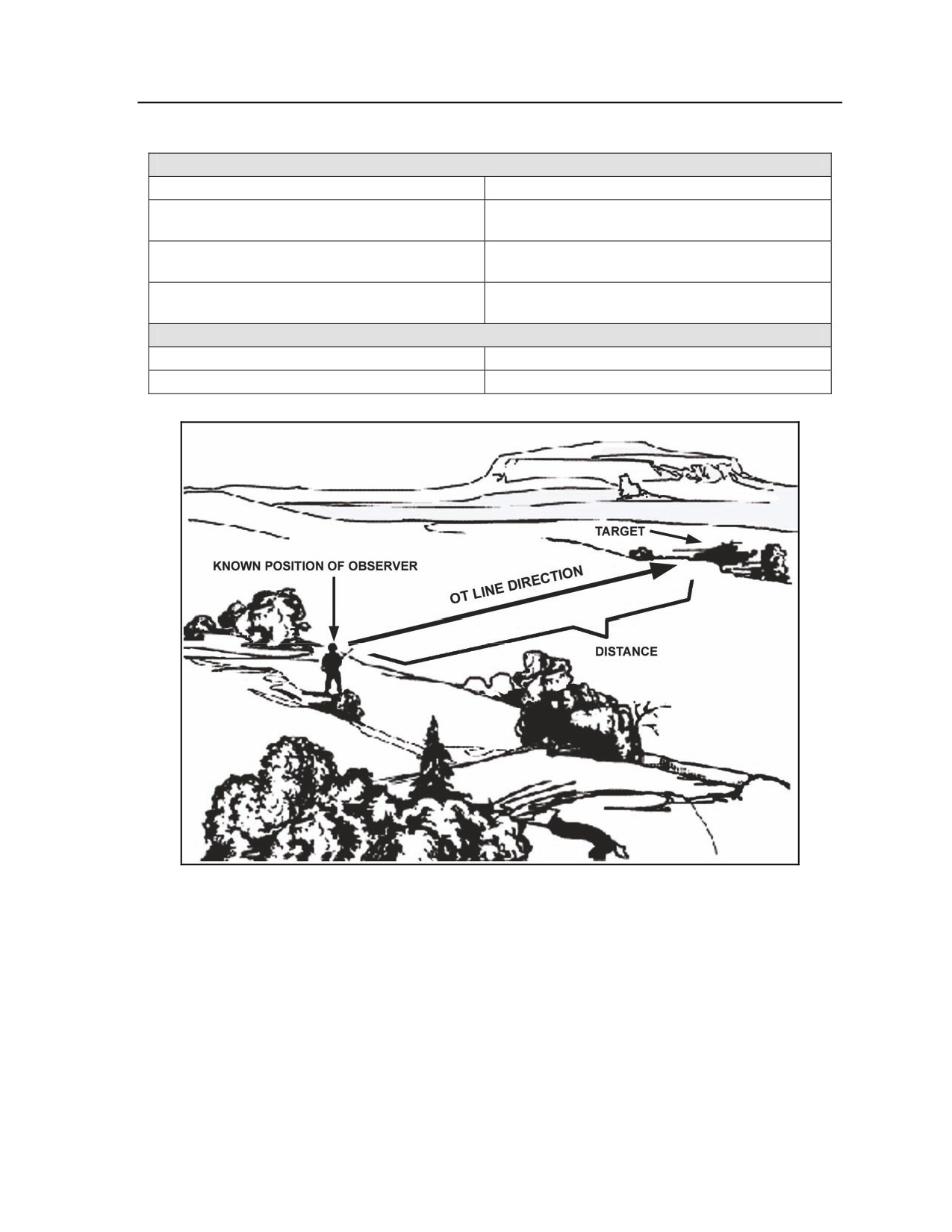
2-134. The observer sends direction, distance, and an up or down measurement (if significant) from his
location to the enemy target. The FDC must know the observer’s location prior to initiating the call for fire.
The word “polar” in the WARNO alerts the FDC that the target will be located with respect to the
observer's position. The up or down correction is an estimated vertical shift from the observer’s location to
the target and is only significant if greater than or equal to 35 meters. If the target is higher, it is an up
correction. If the target is lower, it is a down correction
(Table
2-8 and Figure
2-11). Normally,
inexperienced observers only send a direction and distance and ignore the up or down correction.
2-28
FM 3-21.8
28 March 2007
Employing Fires
Table 2-8. Example fire mission, polar plot.
Initial Fire Request From Observer to FDC
Observer
FDC
Z56, THIS IS Z31, FIRE FOR EFFECT,
THIS IS Z56, FIRE FOR EFFECT, POLAR,
POLAR, OVER.
OUT.
DIRECTION 4520, DISTANCE 2300, DOWN
DIRECTION 4520, DISTANCE 2300, DOWN
35, OVER.
35, OUT.
INFANTRY COMPANY IN OPEN, ICM,
INFANTRY COMPANY IN OPEN, ICM, OUT.
OVER.
Message to Observer
FDC
Observer
Y, VT, 3 ROUNDS, TARGET AF2036, OVER.
Y, VT, 3 ROUNDS, TARGET AF2036, OUT.
Figure 2-11. Polar plot method of target location.
Shift From a Known Point
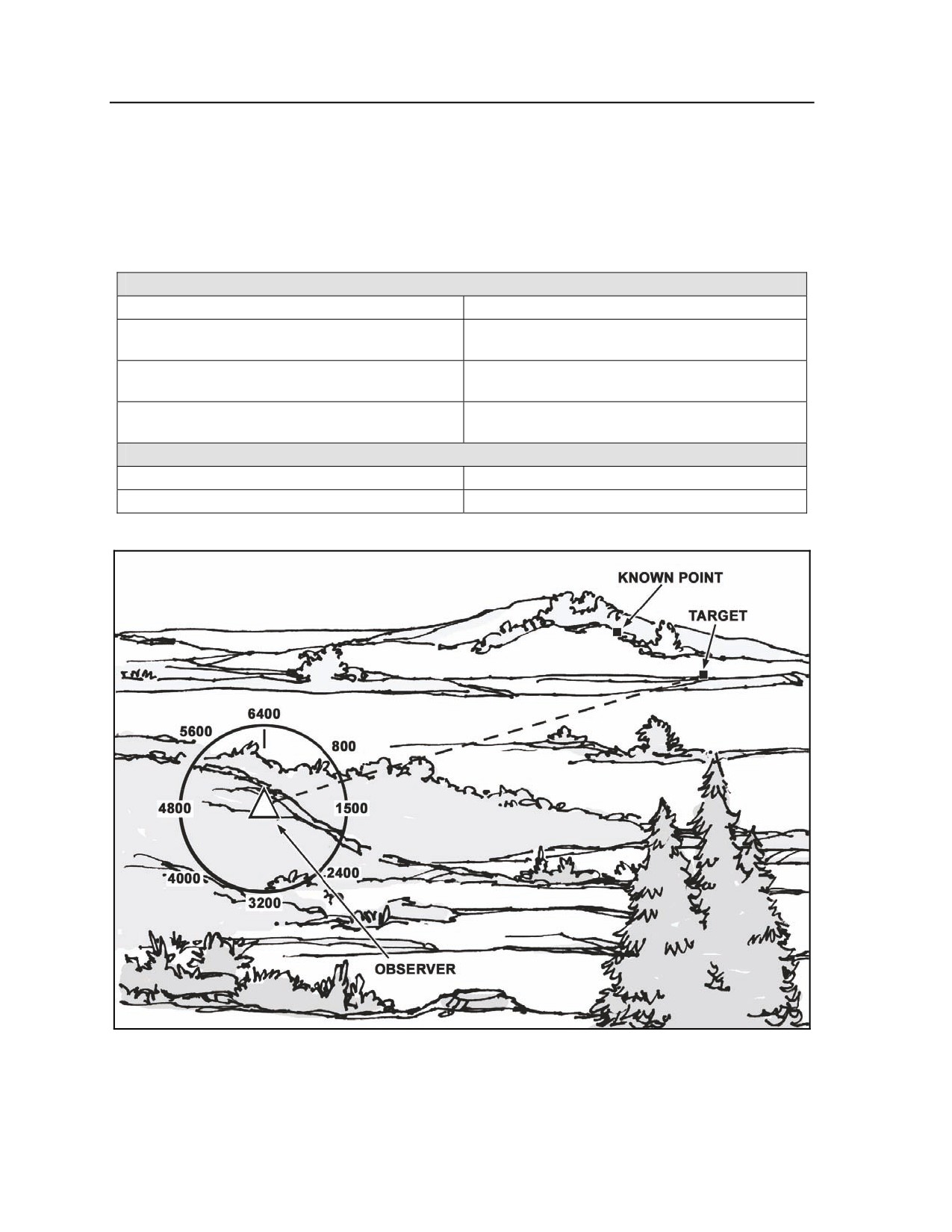
2-135. Shift from a known point is performed when the observer and FDC have a common known point.
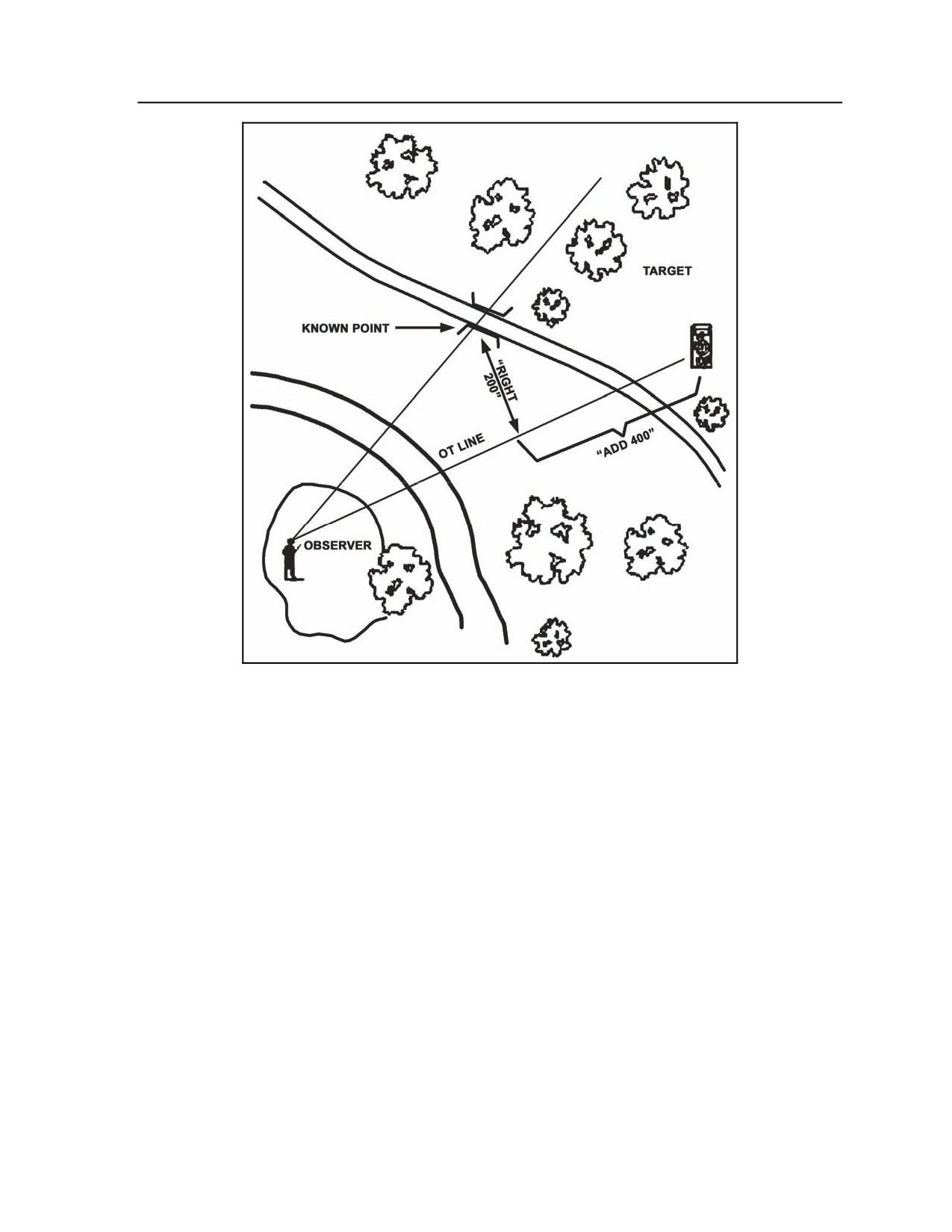
The observer sends OT line and then determines the lateral and range shifts. The enemy target will be
located in relation to a preexisting known point or recorded target. The point or target from which the shift
is made is sent in the WARNO. (Both the observer and the FDC must know the location of the point or
recorded target.) The observer sends a target/known point number, a direction, and left/right, add/drop, and
up/down corrections as listed below (Table 2-9, and Figures 2-12 and 2-13):
Direction from observer (grid azimuth in mils) to target.
The lateral shift in meters (how far left or right the target is) from the known point (Figure 2-13).
28 March 2007
FM 3-21.8
2-29
Chapter 2
The range shift (how much farther [ADD] or closer [DROP] the target is in relation to the known
point, to the nearest 100 meters) (Figure 2-13).
The vertical shift (how much the altitude of the target is above [UP] or below [DOWN] the
altitude of the known point, expressed to the nearest 5 meters). A vertical shift is usually only
significant if it is greater than or equal to 35 meters.
Table 2-9. Example fire mission, shift from a known point.
Initial Fire Request From Observer to FDC
Observer
FDC
H66 THIS IS H44, ADJUST FIRE, SHIFT
THIS IS H66, ADJUST FIRE, SHIFT AA7733,
AA7733, OVER.
OUT.
DIRECTION 5210, LEFT 380, ADD 400,
DIRECTION 5210, LEFT 380, ADD 400,
DOWN 35, OVER.
DOWN 35, OUT.
COMBAT OP IN OPEN, ICM IN EFFECT,
COMBAT OP IN OPEN, ICM IN EFFECT,
OVER.
OUT.
Message to Observer
FDC
Observer
H, 1 ROUND, TARGET AA7742, OVER.
H, 1 ROUND, TARGET AA7742, OUT.
Figure 2-12. Shift from a known point method using direction (in mils).
2-30
FM 3-21.8
28 March 2007
Employing Fires
Figure 2-13. Lateral and range shifts from a known point.
Sergeant Orest Bisko, a patrol leader from the
1st Marine Force
Reconnaissance Company, knew how to use artillery. When occupying an
observation post, Bisko fired his artillery at a set of known coordinates. This would
enable him to later shift from that known point to the target with speed and precision.
On 26 July 1966, while his four-man patrol was occupying an observation post, they
spotted a large collection of enemy encamped in a small, wooded grove. The enemy
force, he observed, apparently was in no hurry to move. Sergeant Bisko deliberately
whispered fire commands over his radio to his direct support artillery. He ordered
them to shift the distance from the known target and fire for effect. Three minutes
later shells began crashing into the enemy perimeter. After approximately
30
minutes, 50 enemy were dead and the patrol had escaped in the confusion.
Shifting from a Known Point
Small Unit Actions in Vietnam
Francis J. West
Target Description
2-136. The target description helps the FDC to select the type and amount of ammunition to best defeat
the enemy target. Following is a brief description of the target using the mnemonic SNAP:
Size and or shape (“one enemy soldier” or “platoon of enemy soldiers”).
Nature and or nomenclature (“T72,” “sniper team,” “machine gunner”).
28 March 2007
FM 3-21.8
2-31
Chapter 2
Activity (“stationary” or “moving”).
Protection and or posture (“in the open,” “dug in,” or “on a rooftop”).
Message to Observer
2-137. After the FDC receives the call for fire, it determines if and how the target will be attacked. That
decision is announced to the observer in the form of a message to the observer (Tables 3-7, 3-8, and 3-9).
The observer acknowledges the message to observer by reading it back in its entirety.
2-138. Additionally, the FDC will send the following transmissions:
Shot. The term SHOT, OVER is transmitted by the FDC after each round fired in adjustment
and after the initial round in the fire for effect (FFE) phase. The observer acknowledges with
SHOT, OUT.
Splash. The term SPLASH, OVER is transmitted by the FDC to inform the observer when his
round is five seconds from detonation/impact. The observer responds with SPLASH, OUT.
Rounds Complete. The term ROUNDS COMPLETE, OVER signifies that the number of
rounds specified in the FFE have been fired. The observer responds with ROUNDS
COMPLETE, OUT.
OPTIONAL ELEMENTS
2-139. A call for fire also might include the following information:
Method of engagement.
Danger close.
Method of fire and control.
Refinement and end of mission.
Method of Engagement
2-140. The observer uses the method of engagement portion of the call for fire to tell the FDC how to
attack the enemy target. The method of engagement consists of the type of engagement, trajectory, danger
close (if applicable), ammunition, and distribution.
Trajectory
2-141. A low-angle trajectory is standard without a request. A high-angle trajectory is at the request of the
observer or when required due to masking terrain. An example of this terrain would be an enemy position
in defilade on the backside of a mountain range. This allows the indirect fire munitions to successfully clear
the top of the masking terrain and have more of a vertical descent, resulting in the munitions impacting
directly on the enemy position.
Danger Close
2-142. Danger close is announced when applicable. Include the term danger close in the method-of
engagement portion of the call for fire when the target is within 600 meters of any friendly elements for
both mortars and field artillery. When adjusting naval gunfire, announce DANGER CLOSE when the
target is located within 750 meters and naval guns 5 inches or smaller are in use. For naval guns larger than
5 inches, announce DANGER CLOSE when the target is within 1,000 meters. The creeping method of
adjustment will be used exclusively during danger close missions. The forward observer makes range
changes by creeping the rounds to the target using corrections of less than 100 meters.
Ammunition
2-143. Ammunition is the type of projectile, the type of fuse action, and the volume of fire desired in the
fire-for-effect phase stated in rounds per howitzer. The type of ammunition can be requested by the
observer, but final determination is by the FDC based on Class V unit basic load and target description.
2-32
FM 3-21.8
28 March 2007
Employing Fires
Method of Fire and Control
2-144. The method of fire and control indicates the desired manner of attacking the target, whether the
observer wants to control the time or delivery of fire, and whether he can observe the target. The observer
announces the appropriate method of fire and control.
Fire When Ready
2-145. FIRE WHEN READY is standard without request, and is not announced. The mission will be fired
as soon as the data is processed, guns are laid on the target, and munitions are loaded.
At My Command
2-146. If the observer wishes to control the time of delivery of fire, he includes AT MY COMMAND in
the method of control. When the pieces are ready to fire, the FDC announces PLATOON (or BATTERY or
BATTALION) IS READY, OVER. (Call signs are used.) The observer announces FIRE when he is ready
for the pieces to fire. In certain scenarios, the observer must consider the time of flight for the munitions to
leave the indirect fire system and impact on the target. The “time of flight” data can be requested by the
observer and determined by the FDC. This only applies to adjusting rounds and the first volley of an FFE.
AT MY COMMAND remains in effect throughout the mission until the observer announces CANCEL AT
MY COMMAND, OVER.
2-147. AT MY COMMAND can be further specified. BY ROUND AT MY COMMAND controls every
round in adjustment and every volley in the FFE phase.
Time on Target
2-148. The observer may tell the FDC when he wants the rounds to impact by requesting, for example,
TIME ON TARGET, 0859, OVER. The observer must ensure his time and the FDC's time are
synchronized prior to the mission.
Time to Target
2-149. The observer may tell the FDC when he wants the rounds to impact by requesting TIME TO
TARGET (so many) MINUTES AND SECONDS, OVER, STANDBY, READY, READY, HACK,
OVER. Time to target is the time in minutes and seconds after the "hack" statement is delivered when
rounds are expected to hit the target.
Check Firing
2-150. CHECK FIRING is used to cause an immediate halt in firing. Use this command only when
necessary to immediately stop firing (for example, safety reasons) as it may result in cannons being out of
action until any rammed/loaded rounds can be fired or cleared from the tubes.
Repeat
2-151. REPEAT can be given during adjustment or fire-for-effect missions. During adjustment, REPEAT
means firing another round(s) with the last data and adjusting for any change in ammunition if necessary.
REPEAT is not sent in the initial call for fire.
2-152. During fire for effect, REPEAT means fire the same number of rounds using the same method of
fire for effect as last fired. Changes in the number of guns, the previous corrections, the interval, or the
ammunition may be requested.
Request Splash
2-153. SPLASH can be sent at the observer's request. The FDC announces SPLASH to the observer 5
seconds prior to round impact. SPLASH must be sent to aerial observers and during high-angle fire
missions.
28 March 2007
FM 3-21.8
2-33
Chapter 2
Refinement and End of Mission
2-154. The observer should observe the results of the fire for effect and then take one of the following
actions to complete the mission:
Correct any adjustments.
Record as target.
Report battle damage assessment.
Report end of mission.
ADJUST FIRE
2-155. If the rounds have accurately impacted the target after the initial call for fire, the observer requests
fire for effect. If the rounds are not impacting the target, the observer adjusts the indirect fire onto the
enemy target. Making adjustments to an indirect fire mission requires the observer to determine deviation
and range corrections. Deviation corrections move the round right or left toward the target while range
corrections add or drop the round toward the target with respect to the observer’s position. If the observer
cannot locate the target (due to deceptive terrain, lack of identifiable terrain features, poor visibility, or an
inaccurate map), he adjusts the impact point of the rounds. The observer chooses an adjusting point. For a
destruction mission (precision fire), the target is the adjusting point. For an area target (area fire), the
observer picks a well defined adjusting point close to the center. The observer spots the first and each
successive adjusting round and sends range and deviation corrections back to the FDC until rounds hit the
target. The observer spots each round by relating the round’s point of impact to the adjusting point. See FM
6-30, Tactics, Techniques, and Procedures for Observed Fire, for a more detailed discussion of adjusting
mortar and artillery fire.
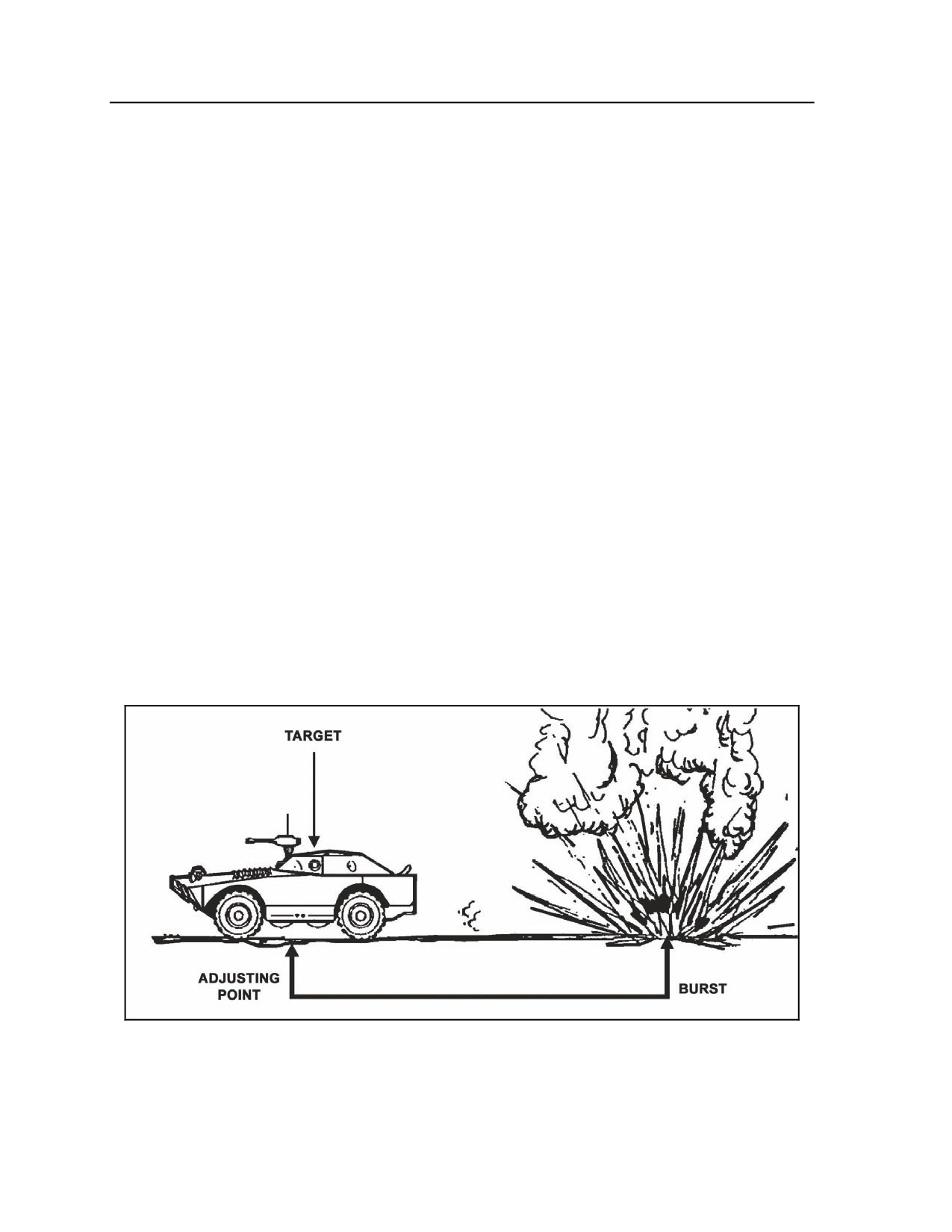
DEVIATION SPOTTING
2-156. Deviation spotting (left or right) involves measuring the horizontal angle (in mils) between the
actual burst and the adjusting point (Figure 2-14). For example, a burst to the right of the target is spotted
as “(so many) mils right.” The observer uses an angle-measuring device to determine deviation. He might
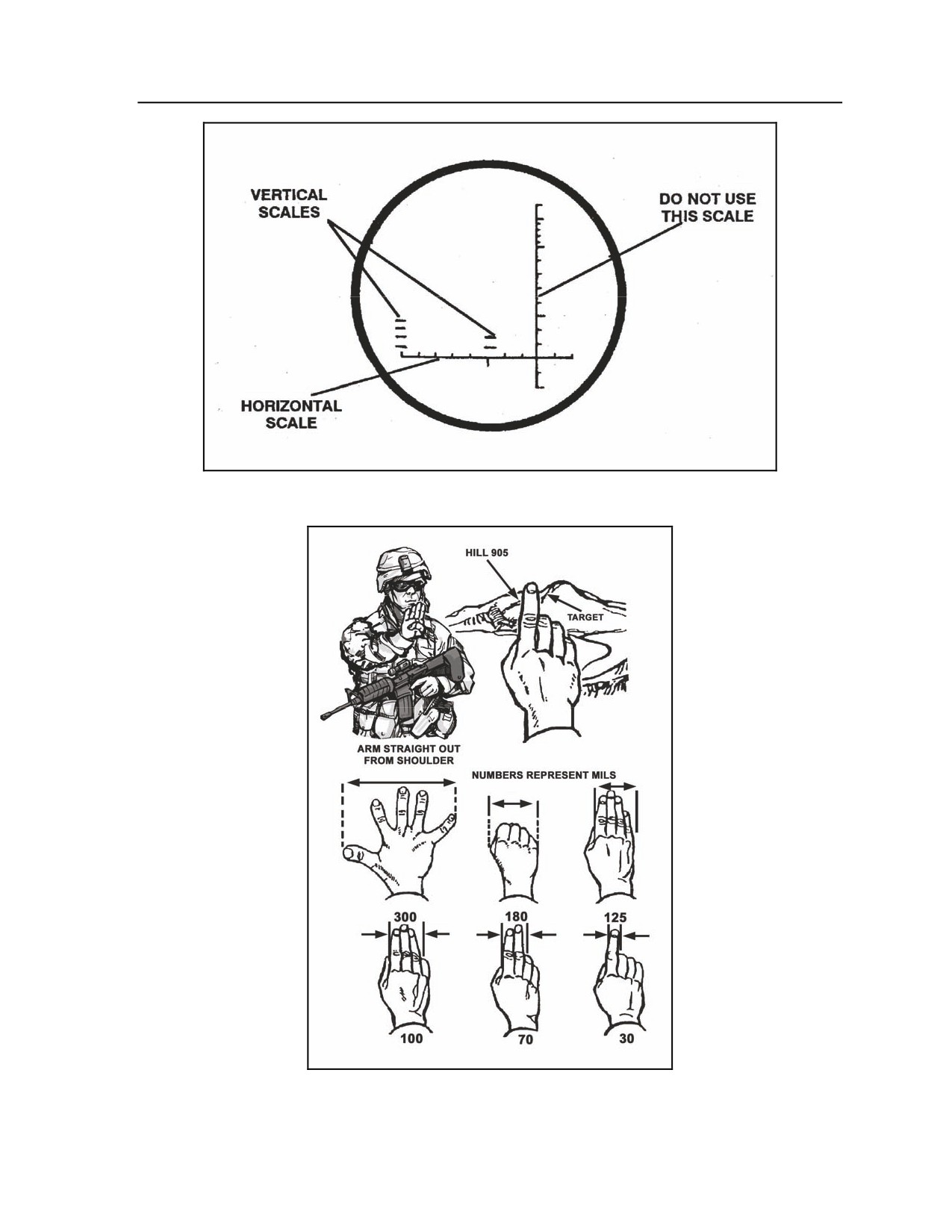
use the mil scale on his binoculars (Figure 2-15), or he might use his hand and fingers (Figure 2-16).
Figure 2-14. Deviation spotting.
2-34
FM 3-21.8
28 March 2007
Employing Fires
Figure 2-15. Binocular reticle with mil scale.
Figure 2-16. Estimating deviation angles with your hand.
28 March 2007
FM 3-21.8
2-35
Chapter 2
2-157. On binoculars, the horizontal scale is divided into 10-mil increments and is used for measuring
horizontal angles. The vertical scales in the center and on the left of the reticle (divided into 5-mil
increments) are used for measuring vertical angles. The scale on the right, if present, is no longer used.
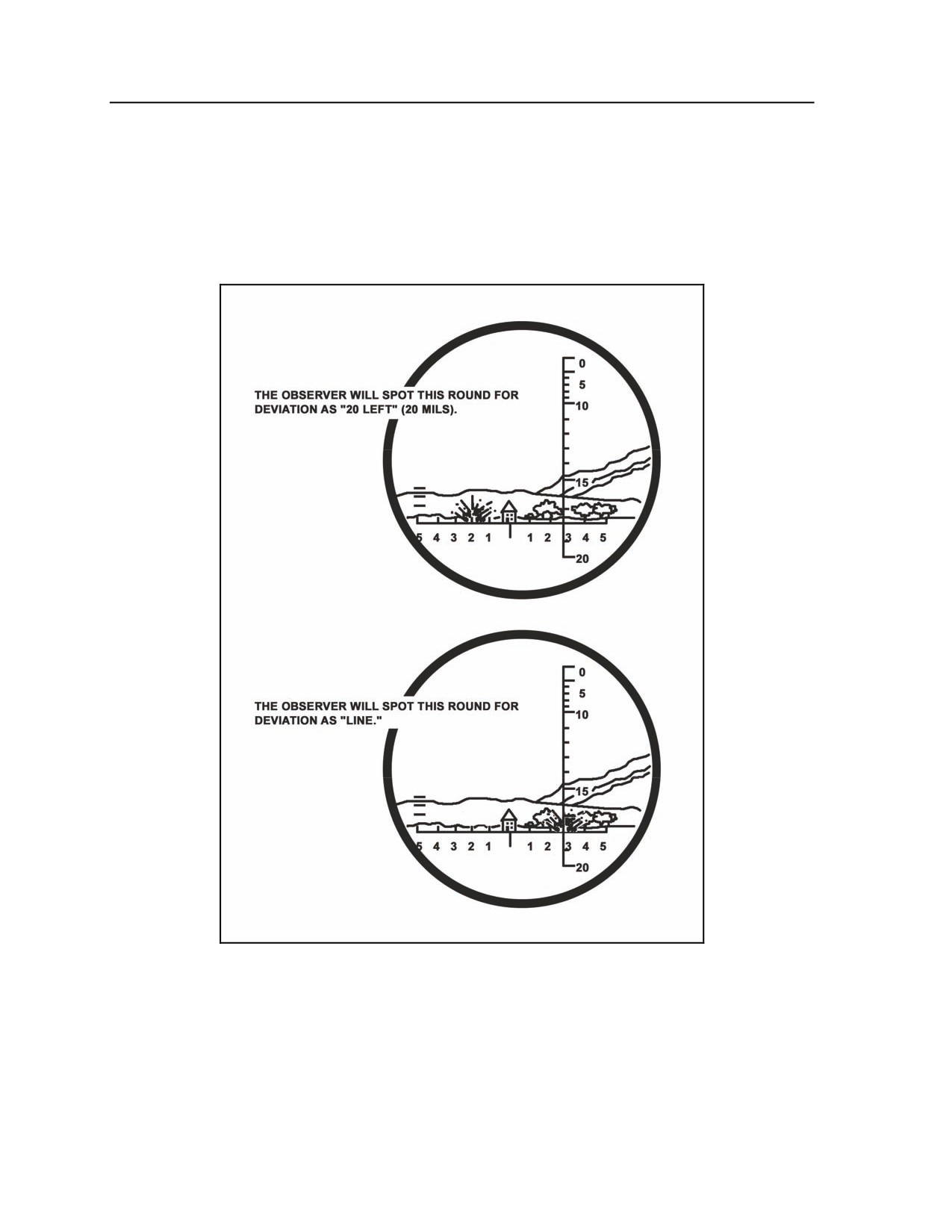
2-158. A burst on the OT line is spotted as “line.” Deviation (left or right) should be measured to the
nearest 5 mils for area targets, with measurements taken from the center of the burst. Deviation for a
destruction mission (precision fire) is estimated to the nearest mil. Figure 2-17 shows the adjusting point at
the center of the binocular horizontal scale.
Figure 2-17. Deviation spotting with binoculars.
DEVIATION CORRECTION
2-159. Deviation correction is the distance (in meters) the burst must be moved left or right to be on line
between the observer and the target. Once the mil deviation has been determined, the observer converts it
into a deviation correction (in meters). The OT distance is converted to a number called the OT factor (see
FM 6-30). The OT factor is used in adjusting fires after the initial call for fire. The OT direction is usually
determined in mils but degree azimuths can be used if necessary. OT distance is determined through
individual range estimation or through the use of specific technical laser range-finding equipment (such as
2-36
FM 3-21.8
28 March 2007

Employing Fires
MELIOS). To determine the OT factor, take the range to the target, divide by 1,000, then round to the
nearest even whole number.
2-160. The deviation correction is determined by multiplying the observed deviation in mils by the
distance from the observer to the target in thousands of meters (the OT factor). The result is expressed to
the nearest 10 meters (Figure 2-18 [Example 1]).
2-161. In adjustment of area fire, small deviation corrections (20 meters or less) can be ignored except
when a small change determines a definite range spotting. Throughout the adjustment, the observer moves
the adjusting rounds close enough to the OT line so range spotting is accurate. A minor deviation correction
(10 to 20 meters) should be made in adjustment of precision fire.
2-162. If the OT distance is greater than 1,000 meters, round to the nearest thousand and express it in
thousands of meters (Figure 2-18 [Example 2]). If the OT distance is less than 1,000 meters, round to the
nearest 100 meters and express it as a decimal in thousands of meters (Figure 2-18 [Example 3]).
Deviation Correction
Example 1:
Observer deviation 20 mils
OT distance 2,000 meters
OT factor 2
Observer deviation x OT factor = deviation correction
20 x 2 = 40 meters
Example 2:
OT distance 4,200 meters - OT factor 4
OT distance 2,700 meters - OT factor 3
Example 3:
OT distance 800 meters - OT factor 0.8
Figure 2-18. Determing deviation correction.
ANGLE T
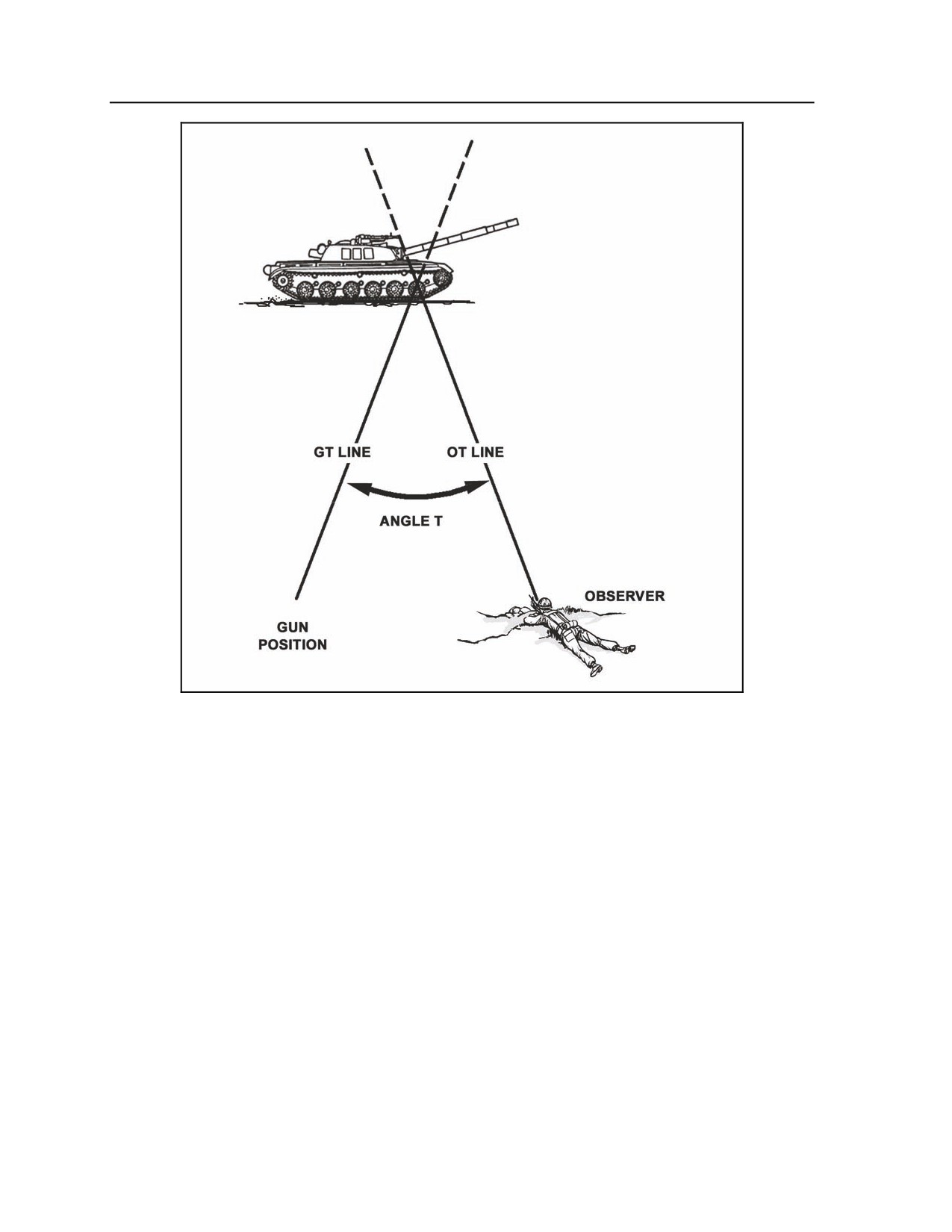
2-163. Angle T (Figure 2-19) is the angle formed by the intersection of the gun-target line and the OT
line with its vertex at the target. If angle T is 500 mils or greater, the FDC should tell the observer. If this
occurs, the observer continues to use the OT factor to make his deviation corrections. If he sees that he is
getting more of a correction than he has asked for, the observer should consider cutting the corrections in
half to better adjust rounds onto the target.
28 March 2007
FM 3-21.8
2-37
Chapter 2
Figure 2-19. Angle T.
RANGE SPOTTING
2-164. Range spotting (short or over) requires adjusting the range to obtain fire on the target. An adjusting
round’s burst on or near the OT line gives a definite range spotting. If he cannot make a definite spotting,
the observer announces a “lost” or “doubtful” spotting. In these situations only, he gives the deviation
correction to the FDC. Deviation corrections include—
Over. The observer sees the burst beyond the adjusting point.
Short. The observer sees the burst between himself and the adjusting point.
Target. The observer sees the burst hit the target. He uses this spotting only in precision fire
(destruction missions).
Range Correct. The observer believes that the burst occurred at the correct range.
Doubtful. The observer sees the burst but cannot tell whether it occurred over, short, target, or
range correct.
Lost, The observer cannot see or hear the burst.
RANGE CORRECTION
2-165. With each successive correction, the adjusting round lands over or short of the adjusting point, but
closes on the target. There are three methods of range corrections: successive bracketing; hasty bracketing;
and the creeping method.
2-38
FM 3-21.8
28 March 2007
Employing Fires
Successive Bracketing
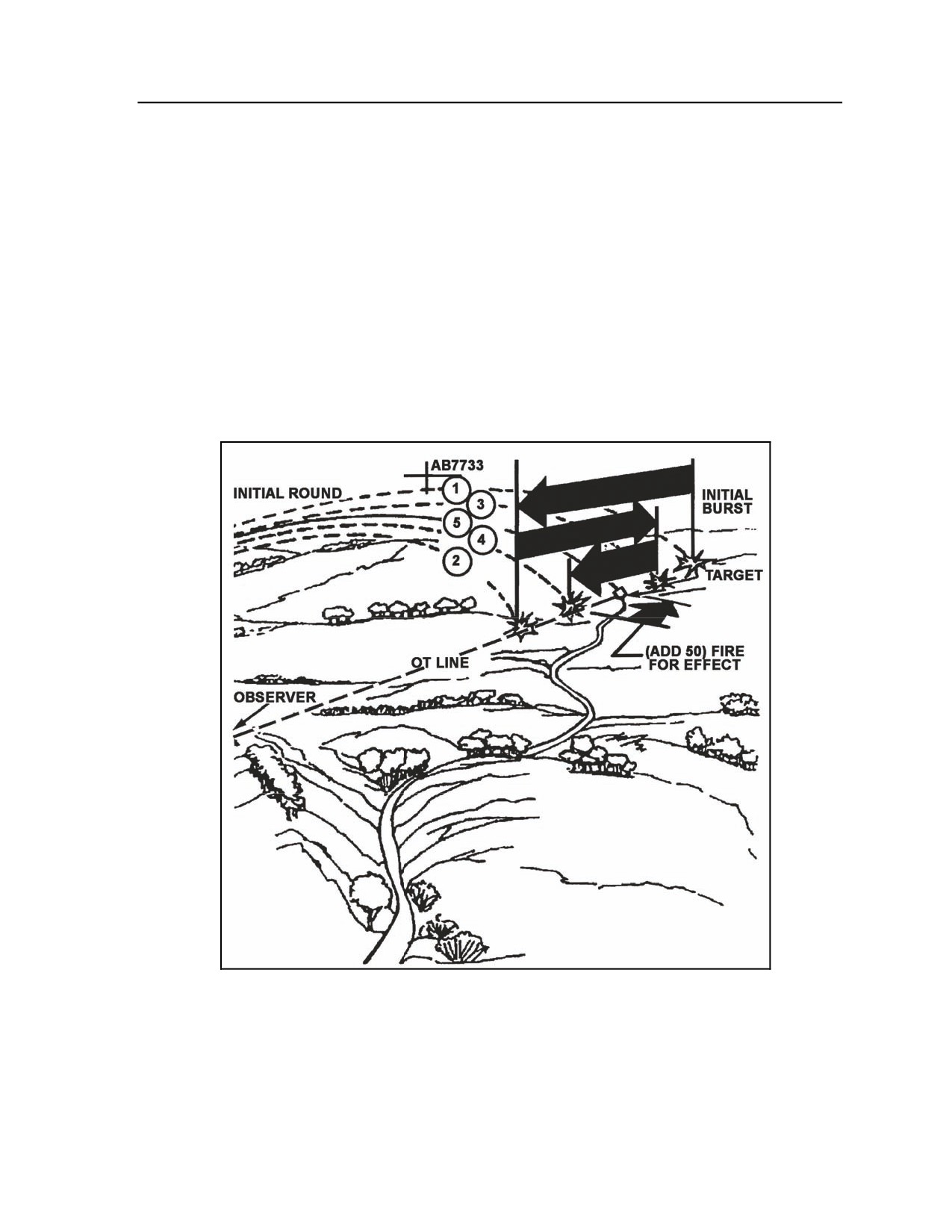
2-166. In bracketing, the observer deliberately gives range corrections that land over or short of the target.
After spotting the first round, the observer makes a drop/add correction which he believes will give him
one round over and one round short of the target. For example, if the first round impacts over the target,
the observer will give a drop correction which is large enough to cause the next round to impact short of the
target. Once the observer meets the goal of one round over and one round shot, he cuts each correction in
half and drops or adds as necessary. The observer continues bracketing until his correction is less than 50
meters. At this point his adjustment is finished and he transitions to a fire-for-effect mission. Using the
above example, his final adjustment would be “add 50 meters fire for effect.” This technique is called
successive bracketing (Figure 2-20).
2-167. When bracketing, the observer uses the following guide to determine his first range correction:
OT distance between 1,000 to 2,000 meters - initial add or drop at least 200 meters (+/- 200,
+/- 100, +/- 50 fire for effect).
OT distance greater than 2,000 meters - initial add or drop at least 400 meters (+/- 400, +/-
200, +/- 100, +/- 50 fire for effect).
Figure 2-20. Successive bracketing technique.
Hasty Bracketing
2-168. An alternative to successive bracketing is hasty bracketing. Bracketing is an effective technique in
that it is sure to bring fire on the target. However, bracketing is relatively time consuming. If the target is
moving, bracketing may not be fast enough to engage the target.
28 March 2007
FM 3-21.8
2-39
Chapter 2
2-169. A successful hasty bracket depends on a thorough terrain analysis, which gives the observer an
accurate initial target location. For his first correction, the observer receives a bracket similar to that used
for successive bracketing. Once the observer receives the initial bracket, he uses it like a yardstick to
determine the subsequent correction. He then sends the FDC the correction to move the rounds to the target
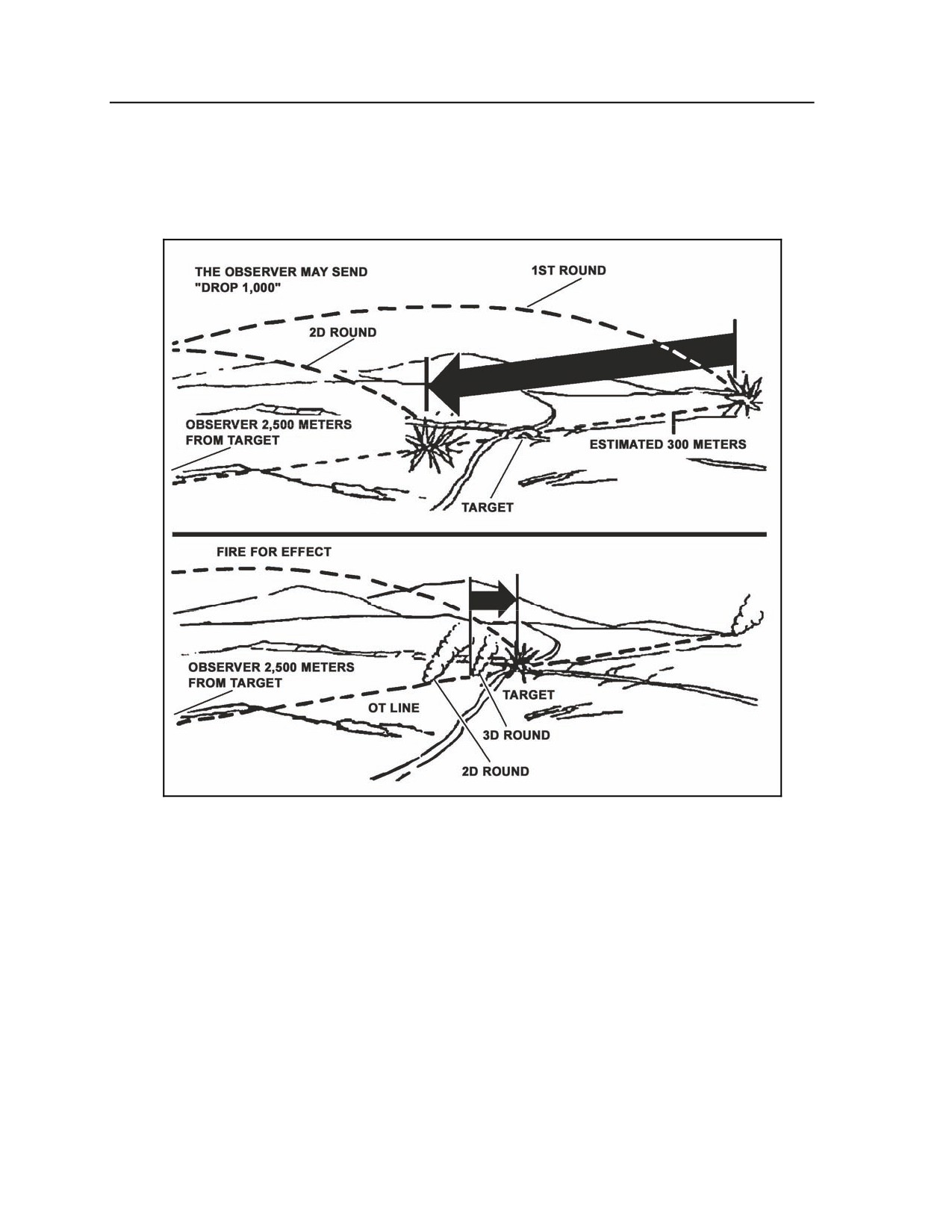
and to fire for effect (Figure 2-21). Hasty bracketing improves with observer experience and judgment.
Figure 2-21. Hasty bracketing technique.
Creeping Method
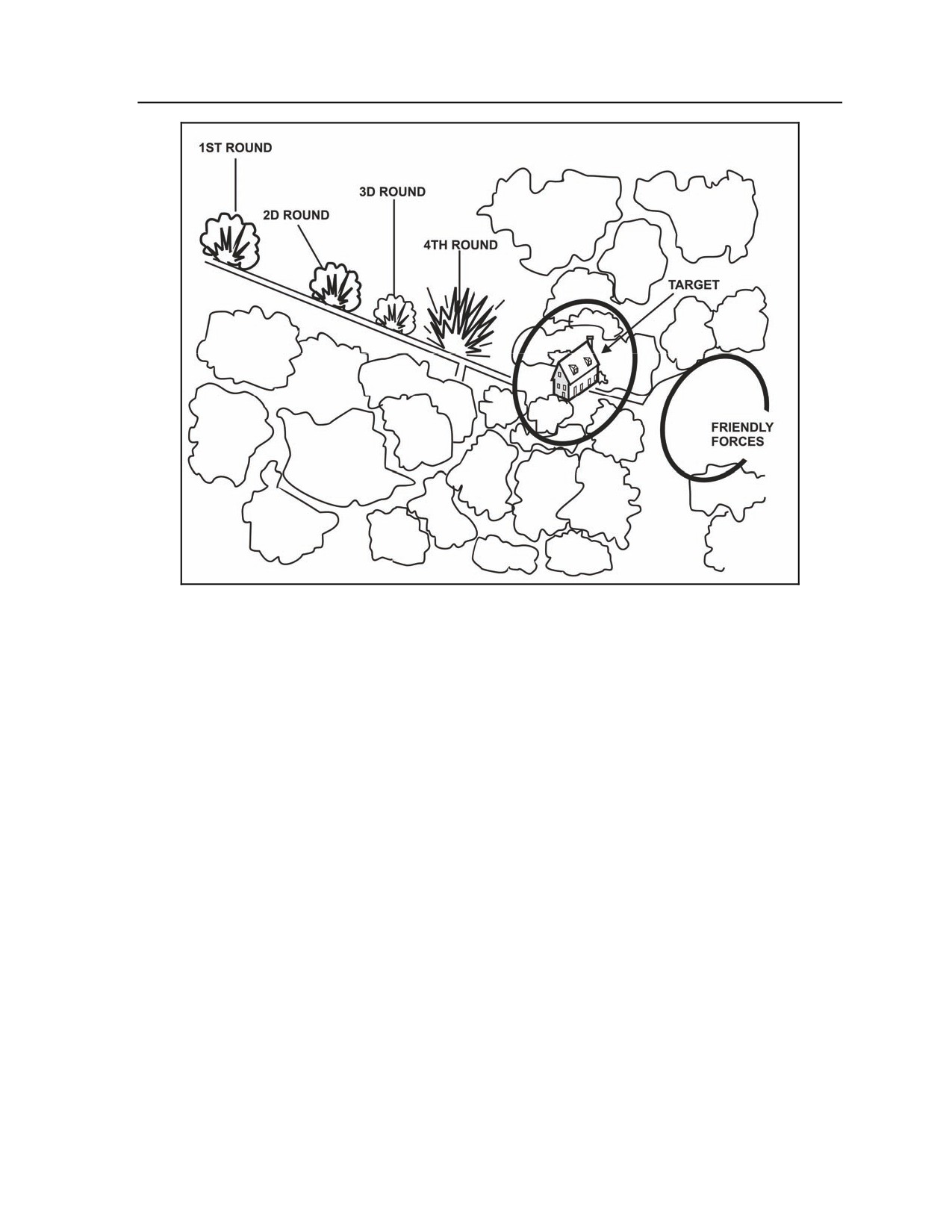
2-170. In danger close situations, the observer uses the creeping method of adjustment. He calls for the
first round and deliberately overshoots the target. He adjusts rounds in 100-meter increments or less until
the fire hits the target (Figure 2-22). This method requires more time and ammunition than other methods.
Therefore, the observer uses it only when he must consider safety first.
2-40
FM 3-21.8
28 March 2007
Employing Fires
Figure 2-22. Creeping method of adjustment.
END OF MISSION
2-171. End of mission completes the mission and reports the battle damage assessment. The report should
go to both the FDC and parent unit. Higher headquarters staff officers use battle damage assessment to
update their staff estimates and feed the common operating picture. The proper report format for an indirect
fire mission is END OF MISSION, TARGET# ____, BDA, OVER. An example of battle damage
assessment is FOUR T72s DESTROYED, or ENEMY SNIPER TEAM SUPPRESSED.
FIRE SUPPORT COORDINATION MEASURES
2-172. Leaders use fire support coordination measures (FSCM) to facilitate both the engagement of
targets and protection of friendly forces. Boundaries are the most basic FSCM. Boundaries are both
permissive and restrictive FSCM. The fire support coordinator recommends FSCM to the leader based on
the leader’s guidance, location of friendly forces, scheme of maneuver, and anticipated enemy actions.
Once the leader establishes FSCM, they are entered into or posted on all the unit’s displays and databases
(see FM 1-02).
PERMISSIVE FSCM
2-173. The primary purpose of permissive measures is to facilitate the attack of targets. Once they are
established, further coordination is not required to engage targets affected by the measures. Permissive
FSCM include a coordinated fire line, fire support coordination line, and free-fire area.
Coordinated Fire Line
2-174. A coordinated fire line (CFL) is a line beyond which conventional, direct, and indirect surface fire
support means may fire at any time within the boundaries of the establishing headquarters. This is done
without additional coordination. The purpose of the CFL is to expedite the surface-to-surface attack of
28 March 2007
FM 3-21.8
2-41
Chapter 2
targets beyond the CFL without coordination with the ground commander in whose area the targets are
located (see JP 3-09, Joint Fire Support). Brigades or divisions usually establish a CFL, though a maneuver
battalion may establish one. It is located as close as possible to the establishing unit without interfering
with maneuver forces to open up the area beyond to fire support.
Fire Support Coordination Line
2-175. The fire support coordination line (FSCL) is an FSCM that facilitates the expeditious attack of
surface targets of opportunity beyond the coordinating measure. The FSCL applies to all fires of air-, land-,
and sea-based weapon systems using any type of ammunition. Forces attacking targets beyond an FSCL
must inform all affected commanders in sufficient time to allow necessary reaction to avoid fratricide.
Supporting elements attacking targets beyond the FSCL must ensure that the attack will not produce
adverse effects on or to the rear of the line. Short of an FSCL, all air-to-ground and surface-to-surface
attack operations are controlled by the appropriate leader responsible for that area.
Free-Fire Area
2-176. A free-fire area is a specific area into which any weapon system may fire without additional
coordination with the establishing headquarters. Normally, division or higher headquarters establish a free-
fire area on identifiable terrain.
RESTRICTIVE FSCM
2-177. A restrictive FSCM prevents fires into or beyond the control measure without detailed
coordination. The primary purpose of restrictive measures is to provide safeguards for friendly forces.
Restrictive FSCM include no-fire area, restrictive fire area, and restrictive fire line.
No-Fire Area
2-178. A no-fire area (NFA) is a land area designated by the appropriate commander into which fires or
their effects are prohibited. Leaders use the NFA to protect independently-operating elements such as
forward observers and special operating forces. They also use it for humanitarian reasons such as
preventing the inadvertent engagement of displaced civilian concentrations, or to protect sensitive areas
such as cultural monuments. There are two exceptions to this rule:
(1) The establishing headquarters may approve fires within the NFA on a case-by-case mission
basis.
(2) When an enemy force within an NFA engages a friendly force, the friendly force may engage a
positively-identified enemy force to defend itself.
Restrictive Fire Area
2-179. A restrictive fire area (RFA) is an area in which specific restrictions are imposed and into which
fires that exceed those restrictions will not be delivered without coordination with the establishing
headquarters. The purpose of the RFA is to regulate fires into an area according to the stated restrictions
such as no unguided conventional or dud-producing munitions. For example, no DPICM rounds should be
fired into an area of land that is later going to be occupied by friendly forces. These types of munition have
a dud rate and could possibly result in friendly forces being incapacitated. Maneuver battalion or larger
ground forces normally establish RFAs. On occasion, a company operating independently may establish an
RFA. An RFA is usually located on identifiable terrain by grid or by a radius (in meters) from a center
point. The restrictions on an RFA may be shown on a map or overlay, or reference can be made to an
operation order that contains the restrictions.
Restrictive Fire Line
2-180. A restrictive fire line is a phase line established between converging friendly forces that prohibits
fires or their effects across that line. The purpose of this phase line is to prevent fratricide between
converging friendly forces. The next higher common commander of the converging forces establishes the
2-42
FM 3-21.8
28 March 2007

Employing Fires
restrictive fire line. Alternatively, the commander can use a restrictive fire line to protect sensitive areas
such as cultural monuments. This control measure can also be used as a direct fire control measure.
SECTION VI — CLOSE AIR SUPPORT AND NAVAL GUNFIRE
2-181. Close air support (CAS) is defined in JP 3-09.3, Joint Tactics, Techniques, and Procedures for
Close Air Support (CAS), as: air action by fixed- and rotary-wing aircraft against hostile targets that are in
close proximity to friendly forces and that require detailed integration of each air mission with the fire and
movement of these forces.
2-182. Very rarely will an Infantry platoon be directly supported by naval gunfire. But if they are, Navy
liaison representatives located with supported ground forces coordinate the control of the fire. Naval
gunfire can provide large volumes of immediately available, responsive fire support to land combat forces
operating near coastal waters.
CLOSE AIR SUPPORT
2-183. The air liaison officer (ALO) is the battalion commander’s advisor in planning, requesting, and
executing CAS missions. The ALO serves as a link between the maneuver element and the attacking
aircraft. The platoon may provide information that the ALO or tactical air control party (TACP) uses to
target enemy forces. A joint terminal air controller (JTAC) may also be attached to the platoon to facilitate
communication. The need for a JTAC should be identified during the planning phase of the mission.
2-184. Soldiers may provide emergency control if an ALO, FSO, FO, or JTAC is not available (ground
force commander accepts responsibility for friendly casualties). This is possible only if the platoon has a
UHF capable radio or if the aircraft is equipped with FM radios. Some U.S. Air Force, Navy, and Marine
Corps fixed-wing aircrafts only have ultra high frequency (UHF) radios (AV-8B and F-14) (see FM 6-30).
Others have FM capability
(A/OA-10, F16, F/A-18, and AC-130). The platoon may also provide
information on battle damage as observed. Figure 2-23 shows the format for assessing battle damage.
Battle Damage Assessment
Successful or unsuccessful
Target coordinates
Time on target
Number and type destroyed
Number and type damaged
Killed by air
Wounded by air
Dud bombs
Figure 2-23. Assessing battle damage.
AC-130 GUNSHIP
2-185. If the enemy air defense threat is low, the battalion requests CAS from an AC-130H or AC-130U
gunship. The AC-130 provides effective fires night operations and flies CAS and special operations. The
AC-130H aircraft contains one 40-mm gun and one 105-mm howitzer (the AC-130U has an additional 25
mm cannon). It is equipped with sensors and target acquisition systems that include forward-looking
infrared radar and low-light television. It is effective in urban environments due to its advanced sensors.
28 March 2007
FM 3-21.8
2-43

Chapter 2
ATTACK HELICOPTERS AND CLOSE COMBAT ATTACK
2-186. The primary mission of attack helicopter units is to destroy enemy armor and mechanized forces or
to provide precision fires. Employing attack helicopters increases the lethality of ground maneuver forces.
2-187. The close combat attack is a technique for using aviation direct fires closely integrated with close
fight on the ground. It may be planned or unplanned, but works most effectively when the company
integrates aviation assets into the planning process.
2-188. To request immediate close combat attack, if METT-TC permits, the ground unit in contact
executes a face-to-face coordination or uses a radio transmission to provide a situation update to the attack
aircraft. Figure 2-24 illustrates a close combat attack coordination checklist.
Close Combat Attack Coordination Checklist
1. Enemy situation - specific target identification.
2. Friendly situation - location and method of marking friendly positions.
3. Ground maneuver mission and scheme of maneuver.
4. Attack aircraft scheme of maneuver.
5. Planned EA and battle position/support-by-fire position.
6. Method of target marking.
7. Fire coordination and fire restrictions.
8. Map graphics update.
9. Request for immediate aviation close fight support - used for targets of opportunity
or for ground-to-air target handoff.
Figure 2-24. Checking close combat coordination.
2-189. After receipt of a request for immediate close combat attack, the attack team leader informs the
ground unit leader of the battle position, assault by fire position, or the series of positions his team will
occupy. This information should provide the best observation and fields of fire into the engagement or
target area. The attack team leader then provides the ground maneuver unit leader with his concept for the
team’s attack on the objective. Depending on SOP and tactical requirements, the flight lead may initially
talk with the Infantry battalion, but will likely get pushed to the company net and may talk directly to the
platoon leader.
2-190. Upon mission completion, the attack team leader provides the ground maneuver commander a
battle damage assessment of the intended target.
MARKING FRIENDLY POSITIONS
2-191. Whenever possible, friendly positions are marked to enhance safety, minimize the possibility of
fratricide, and provide target area references. Methods of marking friendly positions are shown in Table 2
10.
Table 2-10. Methods of marking friendly positions.
METHOD
DAY/
ASSETS
FRIENDLY
TARGET
REMARKS
NIGHT
MARKS
MARKS
Smoke
D/N
All
Good
Good
Easily identifiable, may compromise friendly
position, obscure target, or warn of fire support
employment. Placement may be difficult due to
structures.
Smoke (IR)
D/N
All/
Good
Good
Easily identifiable, may compromise friendly
NVD at
position, obscure target, or warn of fire support
night
employment. Placement may be difficult due to
structures. Night marking is greatly enhanced
by the use of IR reflective smoke.
ILLUM,
D/N
All
N/A
Good
Easily identified, may wash out NVDs.
ground burst
2-44
FM 3-21.8
28 March 2007

Employing Fires
Table 2-10. Methods of marking friendly positions (continued).
METHOD
DAY/
ASSETS
FRIENDLY
TARGET
REMARKS
NIGHT
MARKS
MARKS
Signal mirror
D
All
Good
N/A
Avoids compromise of friendly location.
Dependent on weather and available light and
may be lost in reflections from other reflective
surfaces such as windshields, windows, and
water.
Spotlight
N
All
Good
Marginal
Highly visible to all. Compromises friendly
position and warns of fire support employment.
Effectiveness is dependent upon degree of
urban lighting.
IR Spotlight
N
All NVD
Good
Marginal
Visible to all with NVDs. Less likely to
compromise than overt light. Effectiveness
dependent upon degree of urban lighting.
Visual laser
N
All
Good
Marginal
Highly visible to all. Risk of compromise is
high. Effectiveness dependent upon degree of
urban lighting.
Tracers
D/N
All
N/A
Marginal
May compromise position. May be difficult to
distinguish mark from other gunfire. During
daytime use, may be more effective to kick up
dust surrounding target.
Electronic
D/N
See
Excellent
Good
Ideal friendly marking device for AC-130 and
beacon
remarks.
some United States Air Force fixed wing (not
compatible with Navy or Marine aircraft). Least
impeded by urban terrain. Can be used as a
TRP for target identification. Coordination with
aircrews essential to ensure equipment and
training compatibility.
Strobe (overt)
N
All
Marginal
N/A
Visible by all. Effectiveness dependent upon
degree of urban lighting.
Strobe (IR)
N
All NVD
Good
N/A
Visible to all NVDs. Effectiveness dependent
upon degree of urban lighting. Coded strobes
aid in acquisition.
Flare (overt)
D/N
All
Good
N/A
Visible by all. Easily identified by aircrew.
Flare (IR)
N
All NVD
Good
N/A
Visible to all NVDs. Easily identified by aircrew.
Glint/IR panel
N
All NVD
Good
N/A
Not readily detectable by enemy. Very
effective except in highly lit areas.
Combat
D/N
All FLIR
Good
N/A
Provides temperature contrast on vehicles or
identification
building. May be obscured by urban terrain.
panel
VS-17 panel
D
All
Marginal
N/A
Only visible during daylight. Easily obscured by
structures.
Chemical
D/N
All FLIR
Poor
N/A
Easily masked by urban structures and lost in
heat sources
thermal clutter. Difficult to acquire, can be
effective when used to contrast cold
background or when aircraft knows general
location.
Spinning
N
All
Marginal
N/A
Provides unique signature. May be obscured
chem light
by structures. Effectiveness dependent upon
(overt)
degree of urban lighting.
Spinning
N
All NVD
Marginal
N/A
Provides unique signature. May be obscured
chemlight (IR)
by structures. Effectiveness dependent upon
degree of urban lighting.
28 March 2007
FM 3-21.8
2-45
Chapter 2
NAVAL GUNFIRE SUPPORT
2-192. Naval gunfire has a wide variety of weapons extending from light conventional armament to heavy
missiles and nuclear weapons. It can play a vital role in reducing the enemy’s capability of action by
destroying enemy installations and fortifications before a ground assault, and by protecting and covering
the supporting offensive operations of the land force after the assault.
2-46
FM 3-21.8
28 March 2007
Chapter 3
Tactical Movement
Tactical movement is the movement of a unit assigned a tactical mission under
combat conditions when not in direct ground contact with the enemy. Tactical
movement is based on the anticipation of early ground contact with the enemy, either
en route or shortly after arrival at the destination. Movement ends when ground
contact is made or the unit reaches its destination. Movement is not maneuver.
Maneuver happens once a unit has made contact with the enemy. Because tactical
movement shares many of the characteristics of an offensive action, the battlefield is
organized in a manner similar to other offensive actions. This chapter discusses the
basics and formations of tactical movement.
SECTION I — OVERVIEW
3-1. Movement refers to the shifting of forces on the battlefield. The key to moving successfully involves
selecting the best combination of movement formations and movement techniques for each situation.
Leaders consider the factors of METT-TC in selecting the best route and the appropriate formation and
movement technique. The leader's selection must allow the moving platoon to—
Maintain cohesion.
Maintain communication.
Maintain momentum.
Provide maximum protection.
Make enemy contact in a manner that allows them to transition smoothly to offensive or
defensive action.
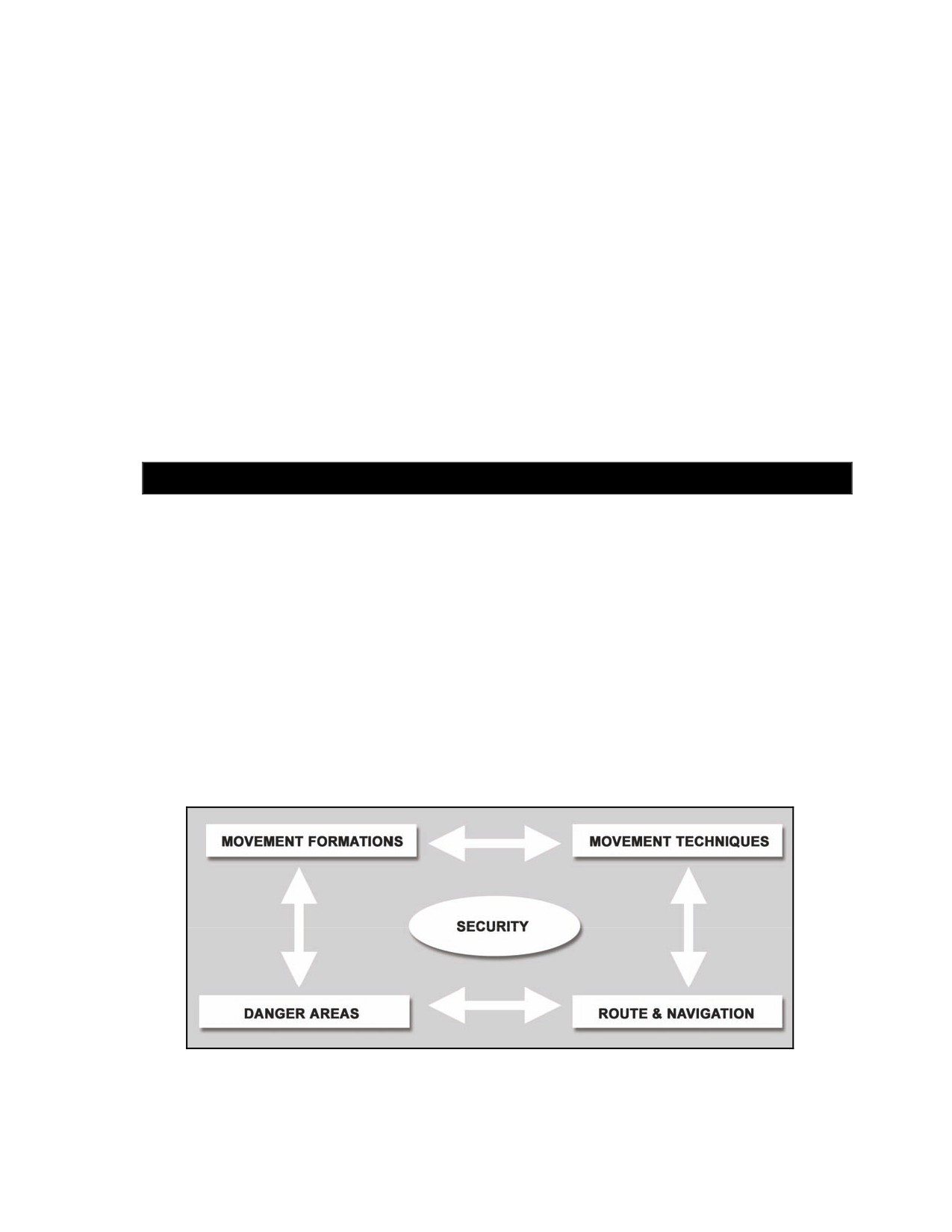
3-2. Careless movement usually results in contact with the enemy at a time and place of the enemy’s
choosing. To avoid this, leaders must understand the constantly-changing interrelationship between unit
movement, terrain, and weapon systems within their area of operations. This understanding is the basis for
employing movement formations, movement techniques, route selection and navigation, crossing danger
areas, and security (Figure 3-1).
Figure 3-1. Basics of tactical movement.
28 March 2007
FM 3-21.8
3-1
Chapter 3
3-3. Leaders executing tactical movement have three primary goals:
Avoid surprise by the enemy.
When necessary, transition quickly to maneuver while minimizing enemy effects.
Get to the right place, at the right time, ready to fight.
3-4. Units moving behind enemy lines seek to avoid enemy contact. They choose the movement that
allows them to retain security and control. To avoid loss of surprise and initiative, casualties, and mission
failure, platoons normally—
Avoid chance enemy contact, if possible.
Move on covered and concealed routes.
Avoid likely ambush sites and other danger areas.
Practice camouflage, noise, and light discipline.
Maintain 360-degree security.
Make contact with the smallest element if enemy contact is unavoidable.
Retain the initiative to attack at the time and place of the unit's choice.
Take active countermeasures such as using smoke and direct and indirect fire to suppress or
obscure suspected enemy positions.
3-5. Infantry platoons primarily move on foot. However, there are circumstances when they will move,
and even fight, mounted. Because their units may operate with vehicle support, leaders must be
comfortable employing tactical movement with a variety of vehicle platforms.
3-6. In selecting formations and movement techniques, leaders must consider other requirements such as
speed and control as well as security. When conducting tactical movement, leaders must be prepared to
quickly transition to maneuver and fight while minimizing the effects of the enemy. This requirement calls
for the leader to determine which formation or combination of formations best suits the situation.
MOVEMENT FORMATIONS
3-7. Movement formations are the ordered arrangement of forces that describes the general configuration
of a unit on the ground. They determine the distance between Soldiers, sectors of fire, and responsibilities
for 360-degree security. Movement formations are used in combination with movement techniques (and
other security measures), immediate action drills, and enabling tasks. Movement techniques define the level
of security one subordinate provides another within a formation. Immediate action drills are those combat
actions that enable the unit to quickly transition to maneuver during unexpected enemy contact. Enabling
tasks facilitate transitions between other combat tasks. See Section II of this chapter for more on movement
formations.
MOVEMENT TECHNIQUES
3-8. Movement techniques describe the position of squads and fire teams in relation to each other during
movement. Platoons and squads use three movement techniques: traveling, traveling overwatch, and
bounding overwatch.
3-9. Like formations, movement techniques provide varying degrees of control, security, and flexibility.
Movement techniques differ from formations in two ways:
Formations are relatively fixed; movement techniques are not. The distance between moving
units or the distance that a squad bounds away from an overwatching squad varies based on
factors of METT-TC.
Formations allow the platoon to weight its maximum firepower in a desired direction; movement
techniques allow squads to make contact with the enemy with the smallest element possible.
This allows leaders to establish a base of fire, initiate suppressive fires, and attempt to maneuver
without first having to disengage or be reinforced.
3-2
FM 3-21.8
28 March 2007
Tactical Movement
3-10. Leaders base their selection of a particular movement technique on the likelihood of enemy contact
and the requirement for speed. See Section III of this chapter for more on movement techniques.
ROUTE AND NAVIGATION
3-11. Planning and selecting a route is a critical leader skill. One of the keys to successful tactical
movement is the ability to develop routes that increase the unit’s security, decrease the Soldier’s effort, and
get the unit to the objective on time in a manner prepared to fight. Good route selection begins with a
thorough terrain analysis and ends with superior navigation. Planning and preparation are worthless if a
unit cannot find its way to the objective, or worse, stumbles onto it because of poor navigation. See Section
IV of this chapter for more on route and navigation.
DANGER AREAS
3-12. When analyzing the terrain (in the METT-TC analysis) during the troop-leading procedures (TLP),
the platoon leader may identify danger areas. The term danger area refers to any area on the route where the
terrain would expose the platoon to enemy observation, fire, or both. If possible, the platoon leader should
plan to avoid danger areas. However, there are times when he cannot. When the unit must cross a danger
area, it should do so as quickly and as carefully as possible. See Section V of this chapter for more
information on danger areas.
SECURITY
3-13. Security during movement includes the actions that units take to secure themselves and the tasks
given to units to provide security for a larger force. Platoons and squads enhance their own security during
movement through the use of covered and concealed terrain; the use of the appropriate movement
formation and technique; the actions taken to secure danger areas during crossing; the enforcement of
noise, light, and radiotelephone discipline; and the use of proper individual camouflage techniques. See
Section VII of this chapter for more on security.
3-14. Formations and movement techniques provide security by:
Positioning each Soldier so he can observe and fire into a specific sector that overlaps with other
sectors.
Placing a small element forward to allow the platoon to make contact with only the lead element
and give the remainder of the platoon freedom to maneuver.
Providing overwatch for a portion of the platoon.
OTHER CONSIDERATIONS
3-15. In planning tactical movement, leaders should also consider the requirements for—
Terrain.
Planning.
Direct fires.
Fire support.
Control.
TERRAIN
3-16. The formations and techniques shown in the illustrations in this chapter are examples only. They are
generally depicted without terrain considerations (which are usually a critical concern in the selection and
execution of a formation). Therefore, in both planning and executing tactical movement, leaders understand
that combat formations and movement techniques require modification in execution. Spacing requirements
and speed result from a continuous assessment of terrain. Leaders must stay ready to adjust the distance of
individuals, fire teams, squads, and individual vehicles and vehicle sections based on terrain, visibility, and
other mission requirements.
28 March 2007
FM 3-21.8
3-3
Chapter 3
3-17. While moving, individual Soldiers and vehicles use the terrain to protect themselves during times
when enemy contact is possible or expected. They use natural cover and concealment to avoid enemy fires.
The following guidelines apply to Soldiers and vehicle crews using terrain for protection:
Do not silhouette yourself against the skyline.
Avoid possible kill zones because it is easier to cross difficult terrain than fight the enemy on
unfavorable terms.
Cross open areas quickly.
Avoid large, open areas, especially when they are dominated by high ground or by terrain that
can cover and conceal the enemy.
Do not move directly forward from a concealed firing position.
PLANNING
3-18. One of the leader’s primary duties is to develop a plan that links together route selection and
navigation, combat formations, and appropriate security measures with enabling tasks that moves the unit
from its current location to its destination. This plan must take into account the enemy situation and control
during movement.
DIRECT FIRES
3-19. While moving or when stationary, each Soldier (or vehicle) has a sector to observe and engage
enemy soldiers in accordance with the unit’s engagement criteria (see Chapter 2). Individual and small unit
sectors are the foundation of the unit’s area of influence. Pre-assigned sectors are inherent in combat
formations. When formations are modified, leaders must reconfirm their subordinates’ sectors. Leaders
have the added responsibility of ensuring their subordinates’ sectors are mutually supporting and
employing other security measures that identify the enemy early and allow the leader to shape the fight.
FIRE SUPPORT
3-20. Planning should always include arranging for fire support (mortars, artillery, CAS, attack helicopters,
naval gunfire), even if the leader thinks it unnecessary. A fire plan can be a tool to help navigate and gives
the leader the following options:
Suppressing enemy observation posts or sensors.
Creating a distraction.
Achieving immediate suppression.
Covering withdrawal off of an objective.
Breaking contact.
CONTROL
3-21. Controlling tactical movement is challenging. The leader must be able to start, stop, shift left or right,
and control the unit’s direction and speed of movement while navigating, assessing the terrain, and
preparing for enemy contact. Determining the proper movement formations and techniques during planning
is important, but the leader must be able to assess his decision during execution and modify or change his
actions based on the actual situation.
3-22. Without adequate procedural and positive control, it is difficult for the leader to make decisions and
give orders, lead an effective response to enemy contact, or accurately navigate. Leaders exercise
procedural control by unit training and rehearsals in the basics of tactical movement. The better trained and
rehearsed subordinates are, the more freedom leaders have to concentrate on the situation, particularly the
enemy and the terrain. Leaders exercise positive control by communicating to subordinates. They do so
using hand-and-arm signals as a method of communication. They also use the other means of
communication (messenger, visual, audio, radio, and digital) when appropriate.
3-4
FM 3-21.8
28 March 2007
Tactical Movement
3-23. All available communication is used (consistent with OPSEC and movement security) to assist in
maintaining control during movement. March objectives, checkpoints, and phase lines may be used to aid
in control. The number of reports is reduced as normally only exception reports are needed. The leader
should be well forward in the formation but may move throughout as the situation demands.
Communications with security elements are mandatory. Operations security often prevents the use of
radios, so connecting files, runners, and visual signals can be used. Detailed planning, briefing, rehearsals,
and control are valuable if there is enemy contact. Alternate plans are made to cover all possible situations.
SECTION II — MOVEMENT FORMATIONS
3-24. This section discusses movement formations of Infantry fire teams, squads, and platoons. The
platoon leader uses formations for several purposes: to relate one squad to another on the ground; to
position firepower to support the direct-fire plan; to establish responsibilities for sector security among
squads; or to aid in the execution of battle drills. Just as they do with movement techniques, platoon leaders
plan formations based on where they expect enemy contact, and on the company commander’s plans to
react to contact. The platoon leader evaluates the situation and decides which formation best suits the
mission and situation.
3-25. Every squad and Soldier has a standard position. Soldiers can see their team leaders. Fire team
leaders can see their squad leaders. Leaders control their units using hand-and-arm signals.
3-26. Formations also provide 360-degree security and allow units to give the weight of their firepower to
the flanks or front in anticipation of enemy contact.
3-27. Formations do not demand parade ground precision. Platoons and squads must retain the flexibility
needed to vary their formations to the situation. The use of formations allows Soldiers to execute battle
drills more quickly and gives them the assurance that their leaders and buddy team members are in the
expected positions and performing the right tasks.
3-28. Sometimes platoon and company formations differ due to METT-TC factors. For example, the
platoons could move in wedge formations within a company vee. It is not necessary for the platoon
formation to be the same as the company formation unless directed by the company commander. However,
the platoon leader must coordinate his formation with other elements moving in the main body team’s
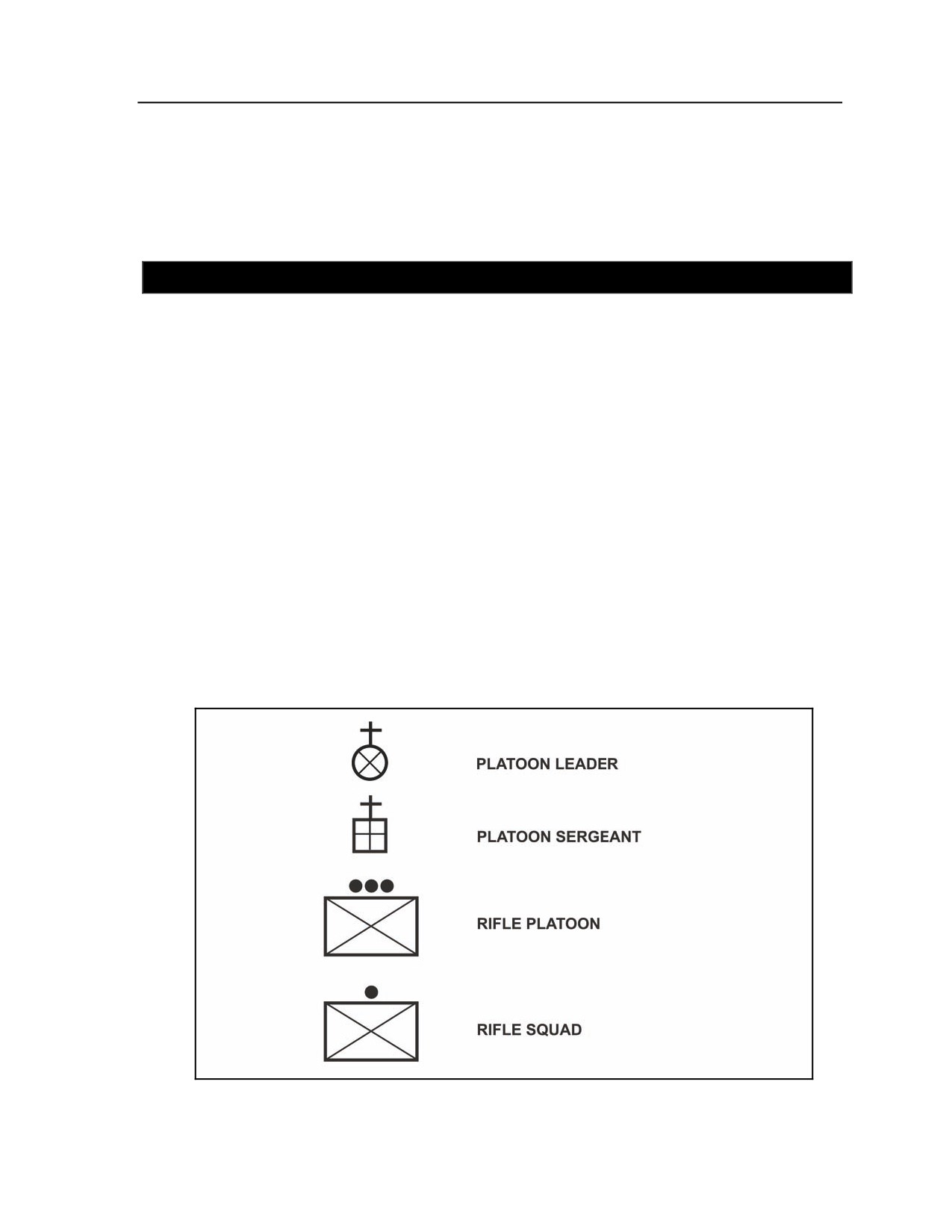
formation. Figure 3-2 illustrates platoon symbols.
Figure 3-2. Legend of platoon symbols.
28 March 2007
FM 3-21.8
3-5
Chapter 3
NOTE: The formations shown in the illustrations in this chapter are examples only. They
generally are depicted without METT-TC considerations, which are always the most crucial
element in the selection and execution of a formation. Leaders must be prepared to adapt their
choice of formation to the specific situation.
PRIMARY FORMATIONS
3-29. Combat formations are composed of two variables: lateral frontage, represented by the line
formation; and depth, represented by the column formation. The advantages attributed to any one of these
variables are disadvantages to the other. Leaders combine the elements of lateral frontage and depth to
determine the best formation for their situation. In addition to the line and column/file, the other five types
of formations—box; vee; wedge; diamond; and echelon—combine these elements into varying degrees.
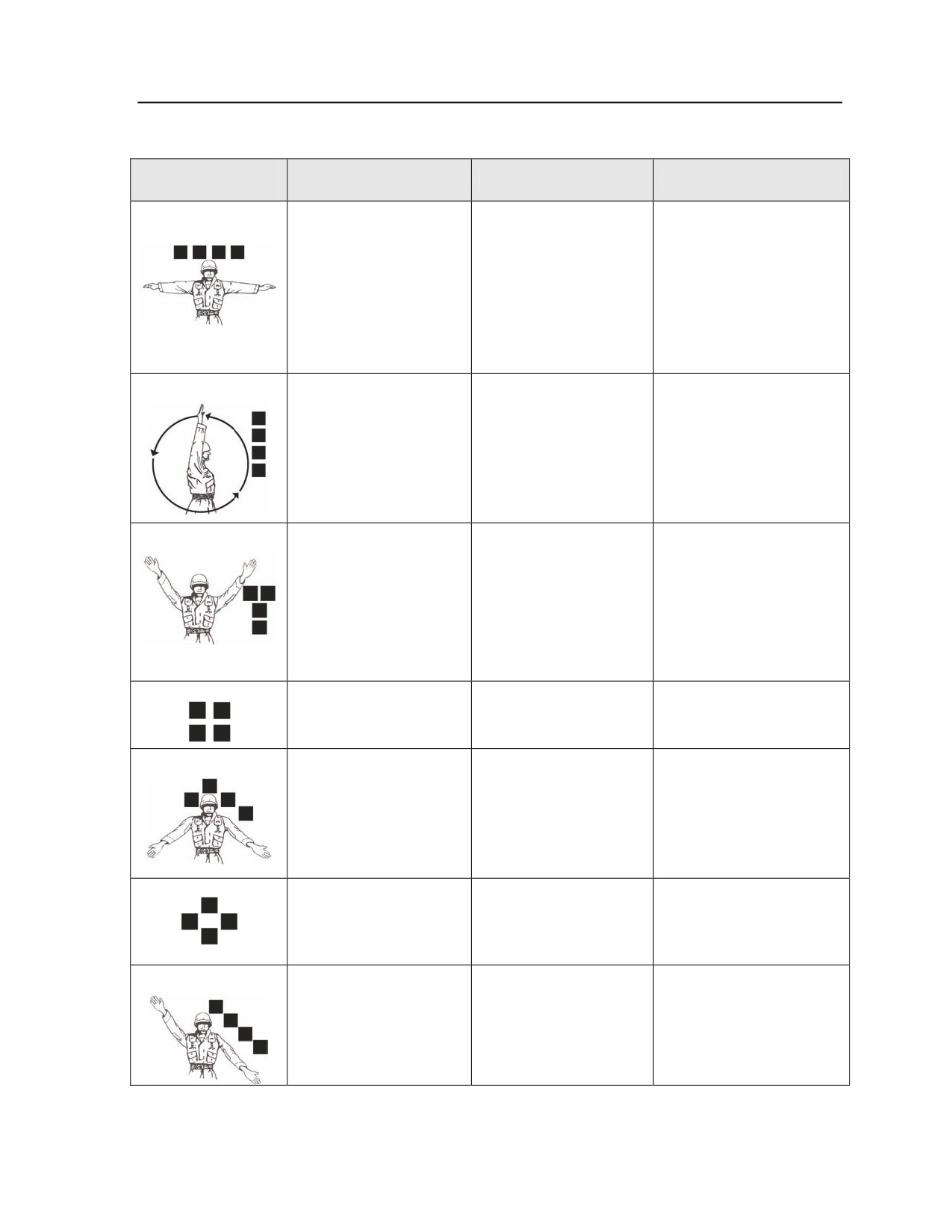
Each does so with different degrees of emphasis that result in unique advantages and disadvantages (Table
3-1).
3-30. The seven formations can be grouped into two categories: formations with one lead element, and
formations with more than one lead element. The formations with more than one lead element, as a general
rule, are better for achieving fire superiority to the front, but are more difficult to control. Conversely, the
formations with only one lead element are easier to control but are not as useful for achieving fire
superiority to the front.
3-31. Leaders attempt to maintain flexibility in their formations. Doing so enables them to react when
unexpected enemy actions occur. The line, echelon, and column formations are the least flexible of the
seven formations. The line mass to the front has vulnerable flanks. The echelon is optimized for a flank
threat—something that units want to avoid. The column has difficulty reinforcing an element in contact.
Leaders using these formations should consider ways to reduce the risks associated with their general lack
of flexibility.
3-6
FM 3-21.8
28 March 2007
Tactical Movement
Table 3-1. Primary formations.
Name/Formation/
Characteristics
Advantages
Disadvantages
Signal (if applicable)
Line Formation
- All elements arranged in a
Ability to:
- Control difficulty increases
row
- Generate fire superiority to
during limited visibility and in
- Majority of observation and
the front
restrictive or close terrain
direct fires oriented forward;
- Clear a large area
- Difficult to designate a
minimal to the flanks
- Disperse
maneuver element
- Each subordinate unit on the
- Transition to bounding
- Vulnerable assailable flanks
line must clear its own path
overwatch, base of fire, or
- Potentially slow
forward
assault
- Large signature
- One subordinate designated
as the base on which the
other subordinates cue their
movement
Column/File Formation
- One lead element
- Easiest formation to control
- Reduced ability to achieve fire
- Majority of observation and
(as long as leader can
superiority to the front
direct fires oriented to the
communicate with lead
- Clears a limited area and
flanks; minimal to the front
element)
concentrates the unit
- One route means unit only
- Ability to generate a
- Transitions poorly to bounding
influenced by obstacles on
maneuver element
overwatch, base of fire, and
that one route
- Secure flanks
assault
- Speed
- Column’s depth makes it a
good target for close air attacks
and a machine gun beaten zone
Vee Formation
- Two lead elements
Ability to:
- Control difficulty increases
- Trail elements move
- Generate fire superiority to
during limited visibility and in
between the two lead
the front
restrictive or close terrain
elements
- Generate a maneuver
- Potentially slow
- Used when contact to the
element
front is expected
- Secure flanks
- “Reverse wedge”
- Clear a large area
- Unit required to two
- Disperse
lanes/routes forward
- Transition to bounding
overwatch, base of fire, or
assault
Box Formation
- Two lead elements
See vee formation
See vee formation
- Trail elements follow lead
advantages
disadvantages
elements
- All-around security
Wedge Formation
- One lead element
Ability to:
- Trail elements are required to
- Trail elements paired off
- Control, even during limited
clear their own path forward
abreast of each other on the
visibility, in restrictive terrain,
- Frequent need to transition to
flanks
or in close terrain
column in restrictive, close
- Used when the situation is
- Transition trail elements to
terrain
uncertain
base of fire or assault
- Secure the front and flanks
- Transition the line and
column
Diamond Formation
- Similar to the wedge
See wedge formation
See wedge formation
formation
advantages
disadvantages
- Fourth element follows the
lead element
Echelon Formation
- Elements deployed
- Ability to assign sectors that
- Difficult to maintain proper
(Right)
diagonally left or right
encompass both the front and
relationship between
- Observation and fire to both
flank
subordinates
the front and one flank
- Vulnerable to the opposite
- Each subordinate unit on the
flanks
line clears its own path
forward
28 March 2007
FM 3-21.8
3-7

Chapter 3
FIRE TEAM FORMATIONS
3-32. The term fire team formation refers to the Soldiers’ relative positions within the fire team. Fire team
formations include the fire team wedge and the fire team file (Table 3-2). Both formations have advantages
and disadvantages. Regardless of which formation the team employs, each Soldier must know his location
in the formation relative to the other members of the fire team and the team leader. Each Soldier covers a
set sector of responsibility for observation and direct fire as the team is moving. To provide the unit with
all-round protection, these sectors must interlock. Team leaders must be constantly aware of their team’s
sectors and correct them as required.
Table 3-2. Comparison of fire team formations.
CHARACTERISTICS
Movement
When Most Often
Fire Capabilities
Formation
Used
Control
Flexibility
Security
and Restrictions
Fire team
Basic fire team
Easy
Good
Allows immediate
All-round
wedge
formation
fires in all directions
Fire team
Close terrain,
Easiest
Less
Allows immediate
Least
file
dense vegetation,
flexible than
fires to the flanks,
limited visibility
wedge
masks most fires to
conditions
the rear
3-33. The team leader adjusts the team’s formation as necessary while the team is moving. The distance
between men will be determined by the mission, the nature of the threat, the closeness of the terrain, and by
the visibility. As a general rule, the unit should be dispersed up to the limit of control. This allows for a
wide area to be covered, makes the team’s movement difficult to detect, and makes them less vulnerable to
enemy ground and air attack. Fire teams rarely act independently. However, in the event that they do, when
halted, they use a perimeter defense to ensure all-around security.
FIRE TEAM WEDGE
3-34. The wedge (Figure 3-3) is the basic formation for the fire team. The interval between Soldiers in the
wedge formation is normally 10 meters. The wedge expands and contracts depending on the terrain. Fire
teams modify the wedge when rough terrain, poor visibility, or other factors make control of the wedge
difficult. The normal interval is reduced so all team members can still see their team leader and all team
leaders can still see their squad leader. The sides of the wedge can contract to the point where the wedge
resembles a single file. Soldiers expand or resume their original positions when moving in less rugged
terrain where control is easier.
3-35. In this formation the fire team leader is in the lead position with his men echeloned to the right and
left behind him. The positions for all but the leader may vary. This simple formation permits the fire team
leader to lead by example. The leader’s standing order to his Soldiers is: “Follow me and do as I do.” When
he moves to the right, his Soldiers should also move to the right. When he fires, his Soldiers also fire.
When using the lead-by-example technique, it is essential for all Soldiers to maintain visual contact with
the leader.
3-8
FM 3-21.8
28 March 2007

Tactical Movement
Figure 3-3. Fire team wedge.
FIRE TEAM FILE
3-36. Team leaders use the file when employing the wedge is impractical. This formation is most often
used in severely restrictive terrain, like inside a building; dense vegetation; limited visibility; and so forth.
The distance between Soldiers in the column changes due to constraints of the situation, particularly when
in urban operations (Figure 3-4).
Figure 3-4. Fire team file.
SQUAD FORMATIONS
3-37. The term squad formation refers to the relative locations of the fire teams. Squad formations include
the squad column, the squad line, and the squad file. Table 3-3 compares squad formations.
Table 3-3. Comparison of squad formations.
CHARACTERISTICS
Movement
When Most
Formation
Often Used
Fire Capabilities and
Control
Flexibility
Security
Restrictions
Squad
The main squad
Good
Aids maneuver,
Allows large volume
All-around
column
formation
good dispersion
of fire to the flanks but
laterally and in depth
only limited volume to
the front
Squad line
For maximum
Not as
Limited maneuver
Allows maximum
Good to the
firepower to the
good as
capability (both fire
immediate fire to the
front, little to
front
squad
teams committed)
front
the flank and
column
rear
Squad file
Close terrain,
Easiest
Most difficult
Allows immediate fire
Least
dense vegetation,
formation to
to the flanks, masks
limited visibility
maneuver from
most fire to the front
conditions
and rear
28 March 2007
FM 3-21.8
3-9
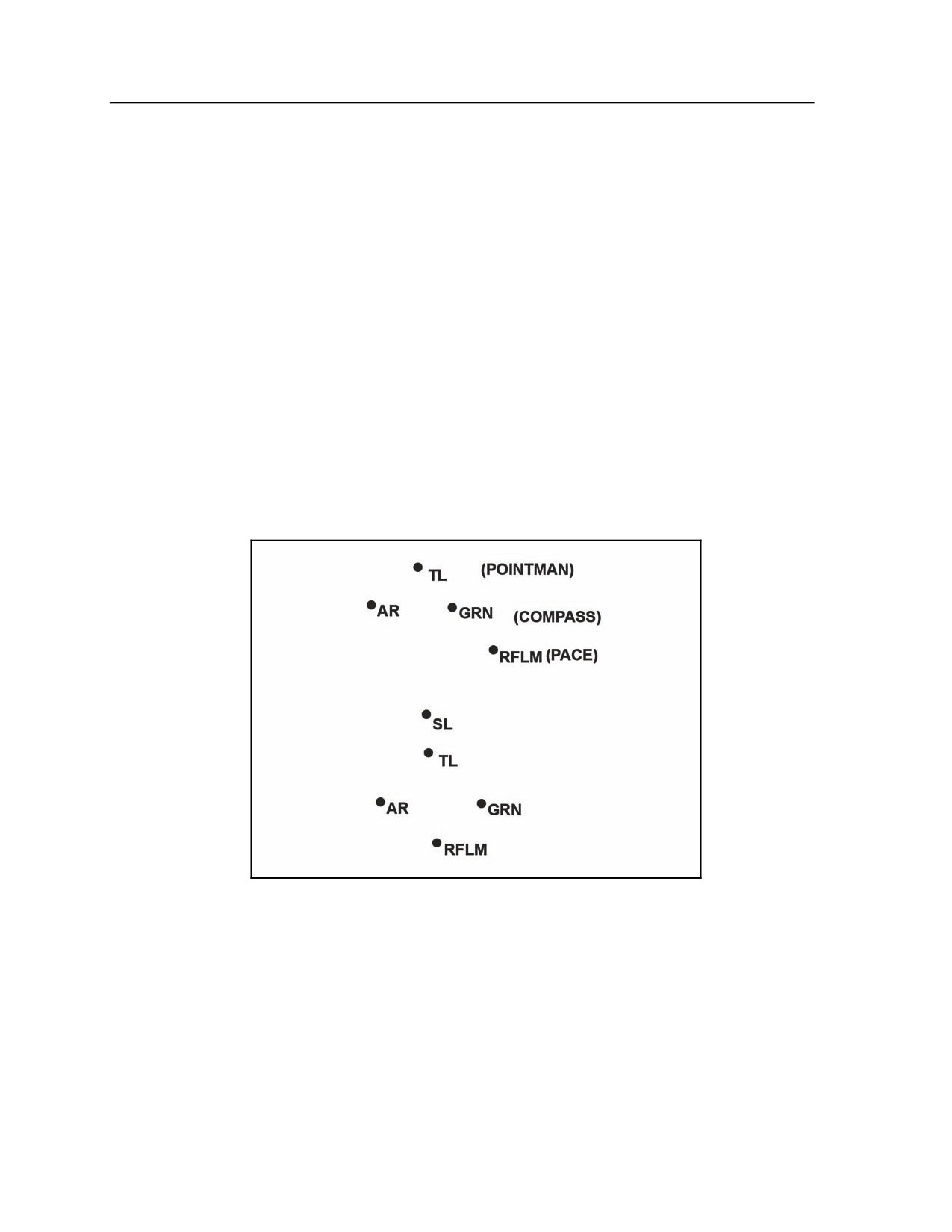
Chapter 3
3-38. The squad leader adjusts the squad’s formation as necessary while moving, primarily through the
three movement techniques (see Section III). The squad leader exercises command and control primarily
through the two team leaders and moves in the formation where he can best achieve this. The squad leader
is responsible for 360-degree security, for ensuring the team’s sectors of fire are mutually supporting, and
for being able to rapidly transition the squad upon contact.
3-39. The squad leader designates one of the fire teams as the base fire team. The squad leader controls the
squad’s speed and direction of movement through the base fire team while the other team and any
attachments cue their movement off of the base fire team. This concept applies when not in contact and
when in contact with the enemy.
3-40. Weapons from the weapons squad (a machine gun or a Javelin) may be attached to the squad for the
movement or throughout the operation. These high value assets need to be positioned so they are protected
and can be quickly brought into the engagement when required. Ideally, these weapons should be
positioned so they are between the two fire teams.
SQUAD COLUMN
3-41. The squad column is the squad’s main formation for movement unless preparing for an assault
(Figure 3-5). It provides good dispersion both laterally and in depth without sacrificing control. It also
facilitates maneuver. The lead fire team is the base fire team. Squads can move in either a column wedge or
a modified column wedge. Rough terrain, poor visibility, and other factors can require the squad to modify
the wedge into a file for control purposes. As the terrain becomes less rugged and control becomes easier,
the Soldiers assume their original positions.
Figure 3-5. Squad column, fire teams in wedge.
SQUAD LINE
3-42. The squad line provides maximum firepower to the front and is used to assault or as a pre-assault
formation (Figure 3-6). To execute the squad line, the squad leader designates one of the teams as the base
team. The other team cues its movement off of the base team. This applies when the squad is in close
combat as well. From this formation, the squad leader can employ any of the three movement techniques or
conduct fire and movement (see Section III).
3-10
FM 3-21.8
28 March 2007
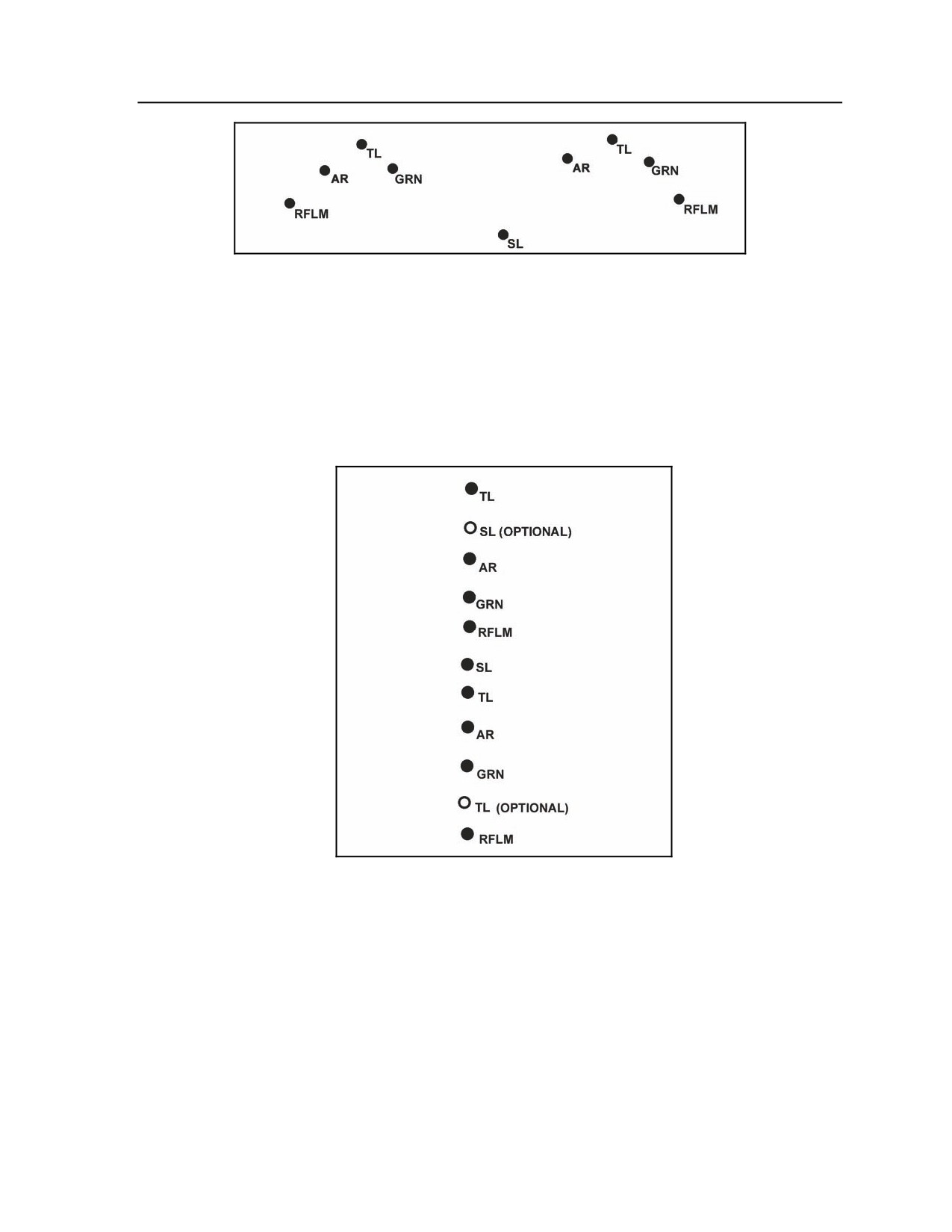
Tactical Movement
Figure 3-6. Squad line.
SQUAD FILE
3-43. The squad file has the same characteristics as the fire team file (Figure 3-7). In the event that the
terrain is severely restrictive or extremely close, teams within the squad file may also be in file. This
disposition is not optimal for enemy contact, but does provide the squad leader with maximum control. If
the squad leader wishes to increase his control over the formation he moves forward to the first or second
position. Moving forward also enables him to exert greater morale presence by leading from the front, and
to be immediately available to make key decisions. Moving a team leader to the last position can provide
additional control over the rear of the formation.
Figure 3-7. Squad file.
WEAPONS SQUAD MOVEMENT FORMATIONS
3-44. The weapons squad is not a rifle squad and should not be treated as such. During tactical movement
the platoon leader has one of two options when it comes to positioning the weapons squad. The weapons
squad can either travel together as a separate entity, or can be broken up and distributed throughout the
formation. The advantage to keeping the weapons squad together is the ability to quickly generate a support
by fire and gain fire superiority under the direction of the weapons squad leader. The disadvantage to this
approach is the lack of redundancy throughout the formation. The advantage to distributing the weapons
squad throughout the rifle squads is the coverage afforded to the entire formation. The disadvantage is
losing the weapons squad leader as a single command and control element and the time required to
reassemble the weapons squad if needed.
28 March 2007
FM 3-21.8
3-11
Chapter 3
3-45. When the weapons squad travels dispersed, they can either be attached to squads or attached to the
key leaders like the platoon leader, platoon sergeant, and weapons squad leader. There is no standard
method for their employment. Rather, the platoon leader places the weapons using two criteria: ability to
quickly generate fire superiority, and protection for these high value assets.
3-46. Like the rifle squad, the weapons squad, when traveling as a squad, uses either a column or line
formation. Within these formations, the two sections can also be in column or line formation.
PLATOON FORMATIONS
3-47. The actual number of useful combinations of squad and fire team combat formations within the
platoon combat formations is numerous, creating a significant training requirement for the unit. Add to that
the requirement to modify formations with movement techniques, immediate action drills, and other
techniques, and it is readily apparent that what the platoon leader needs is a couple of simple, effective
strategies. These strategies should be detailed in the unit’s SOPs. For a full description of each combat
formation and advantages and disadvantages refer again to Table 3-1.
PLATOON LEADER RESPONSIBILITIES
3-48. Like the squad leader, the platoon leader exercises command and control primarily through his
subordinates and moves in the formation where he can best achieve this. The squad and team leader
execute the combat formations and movement techniques within their capabilities based on the platoon
leader’s guidance.
3-49. The platoon leader is responsible for 360-degree security, for ensuring that each subordinate unit’s
sectors of fire are mutually supporting, and for being able to rapidly transition the platoon upon contact. He
adjusts the platoon’s formation as necessary while moving, primarily through the three movement
techniques (see Section III). Like the squad and team, this determination is a result of the task, the nature of
the threat, the closeness of terrain, and the visibility.
3-50. The platoon leader is also responsible for ensuring his squads can perform their required actions. He
does this through training before combat and rehearsals during combat. Well-trained squads are able to
employ combat formations, movement techniques, actions on contact, and stationary formations.
PLATOON HEADQUARTERS
3-51. The platoon leader also has to decide how to disperse the platoon headquarters elements (himself, his
RTO, his interpreter, the forward observer, the platoon sergeant, and the medic). These elements do not
have a fixed position in the formations. Rather, they should be positioned where they can best accomplish
their tasks. The platoon leader’s element should be where he conducts actions on contact, where he can
supervise navigation, and where he can communicate with higher. The FO’s element should be where he
can best see the battlefield and where he can communicate with the platoon leader and the battalion fire
support officer (FSO). This is normally in close proximity to the platoon leader. The platoon sergeant’s
element should be wherever the platoon leader is not. Because of the platoon sergeant’s experience, he
should be given the freedom to assess the situation and advise the platoon leader accordingly. Typically,
this means the platoon leader is more toward the front of the formation, while the platoon sergeant is more
to the rear of the formation.
BASE SQUAD
3-52. The platoon leader designates one of the squads as the base squad. He controls the platoon’s speed
and direction of movement through the base squad, while the other squads and any attachments cue their
movement off of the base squad.
MOVING AS PART OF A LARGER UNIT
3-53. Infantry platoons often move as part of a larger unit’s movement. The next higher commander
assigns the platoon a position within the formation. The platoon leader assigns his subordinates an
3-12
FM 3-21.8
28 March 2007
Tactical Movement
appropriate formation based on the situation and uses the appropriate movement technique. Regardless of
the platoon’s position within the formation, it must be ready to make contact or to support the other
elements by movement, by fire, or by both.
3-54. When moving in a company formation, the company commander normally designates a base platoon
to facilitate control. The other platoons cue their speed and direction on the base platoon. This permits
quick changes and lets the commander control the movement of the entire company by controlling only the
base platoon. The company commander normally locates himself within the formation where he can best
see and direct the movement of the base platoon. The base platoon’s center squad is usually its base squad.
When the platoon is not acting as the base platoon, its base squad is its flank squad nearest the base
platoon.
PRIMARY FORMATIONS
3-55. Platoon formations include the column, the line (squads on line or in column), the vee, the wedge,
and the file. The leader should weigh these carefully to select the best formation based on his mission and
on METT-TC analysis. A comparison of the formations is in Table 3-4.
3-56. Within these platoon formations, the rifle squads are either in a column or a line. Within the rifle
squad formations, the teams are in one of the six formations. Normally the platoon leader does not
personally direct fire team formations, but he can do so if the situation dictates. He should at a minimum
know the formation of the base fire team of the base squad. The weapons squad travels separately or
attached to the rifle squads.
28 March 2007
FM 3-21.8
3-13

Chapter 3
Table 3-4. Comparison of platoon formations.
CHARACTERISTICS
Movement
When Most
Formation
Often Used
Fire Capability/
Control
Flexibility
Security
Movement
Restrictions
Platoon
Platoon primary
Good for
Provides good
Allows limited
Extremely limited
Good
column
movement
maneuver
dispersion
firepower to the
overall security
formation
(fire and
laterally and in
front and rear, but
movement)
depth
high volume to the
flanks
Platoon
When the leader
Difficult
Minimal
Allows maximum
Less secure than
Slow
line,
wants all Soldiers
firepower to the
other formations
squads on
forward for
front, little to flanks
because of the
line
maximum
and rear
lack of depth, but
firepower to the
provides
front and the
excellent
enemy situation is
security for the
known
higher formation
in the direction of
the echelon
Platoon
May be used
Easier than
Greater than
Good firepower to
Good security all
Slower
line,
when the leader
platoon
platoon column,
the front and rear,
around
than
squads in
does not want
line, squads
squads on line,
minimum fires to
platoon
column
everyone on line;
on line, but
but less than
the flanks; not as
column,
but wants to be
more
platoon line,
good as platoon
faster
prepared for
difficult than
squads on line
column, better than
than
contact; when
platoon
platoon line
platoon
crossing the LD
column
line,
when LD is near
squads on
the objective
line
Platoon
When the enemy
Difficult
Provides two
Immediate heavy
Good security to
Slow
vee
situation is vague,
squads up front
volume of firepower
the front
but contact is
for immediate
to the front or
expected from the
firepower and
flanks, but
front
one squad to the
minimum fires to
rear for
the rear
movement (fire
and movement)
upon contact
from the flank
Platoon
When the enemy
Difficult but
Enables leader
Provides heavy
Good security to
Slow, but
wedge
situation is vague,
better than
to make contact
volume of firepower
the flanks
faster
but contact is not
platoon vee
with a small
to the front or
than
expected
and platoon
element and still
flanks
platoon
line, squads
have two squads
vee
on line
to maneuver
Platoon file
When visibility is
Easiest
Most difficult
Allows immediate
Extremely limited
Fastest for
poor due to
formation from
fires to the flanks,
overall security
dismounted
terrain, vegetation,
which to
masks most fires to
movement
or light
maneuver
front and rear
Platoon Column
3-57. In the platoon column formation, the lead squad is the base squad (Figure 3-8). It is normally used
for traveling only.
3-14
FM 3-21.8
28 March 2007
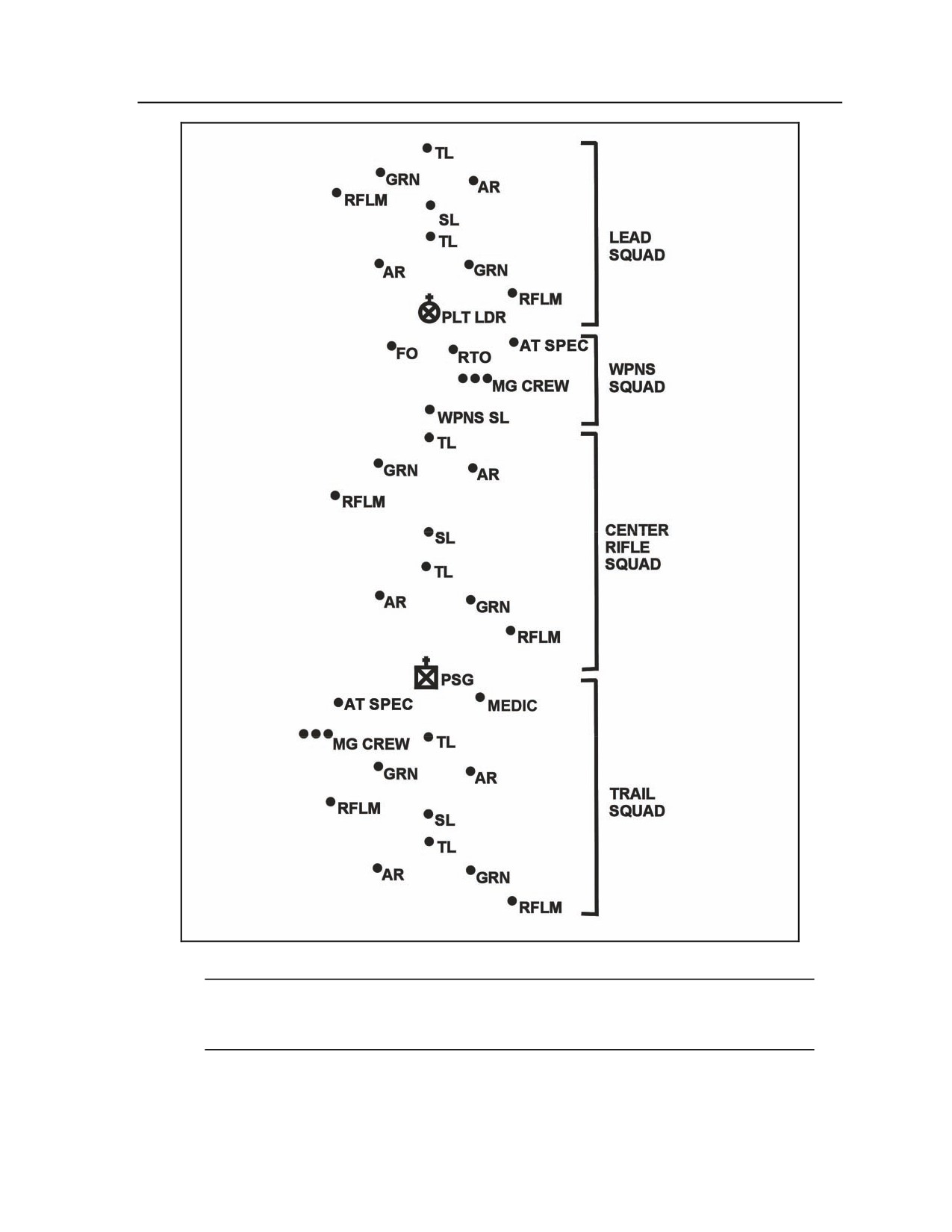
Tactical Movement
Figure 3-8. Platoon column.
NOTE: METT-TC considerations determine where the weapons squad or machine gun teams
locate in the formation. They normally move with the platoon leader and /or PSG so he can
establish a base of fire quickly.
28 March 2007
FM 3-21.8
3-15