FM 3-21.8 (FM 7-8) The Infantry Rifle Platoon and Squad (MARCH 2007) - page 1
*FM 3-21.8 (FM 7-8)
Field Manual
Headquarters
Department of the Army
No. 3-21.8
Washington, DC, 28 March 2007
The Infantry Rifle Platoon and Squad
Contents
Page
PREFACE
viii
SUMMARY OF CHANGE
ix
Chapter 1
FUNDAMENTALS OF TACTICS
1-1
SECTION I - FUNDAMENTALS OF INFANTRY PLATOON AND SQUAD
OPERATIONS
1-1
Infantry
1-1
Offensive and Defensive Combat
1-1
Warfighting functions
1-3
Intelligence
1-4
Movement and Maneuver
1-4
Fire Support
1-4
Protection
1-5
Sustainment
1-5
Command and Control
1-5
Characteristics of Close Combat
1-6
Section II - Doctrine and Training
1-7
Infantry Doctrine
1-7
Individual Infantry Skills
1-8
Warrior Ethos and Army Values
1-9
Every Soldier Is a Sensor
1-11
Section III - Organization
1-11
Infantry Platoon
1-11
Infantry Fire Team
1-14
Infantry Squad
1-17
Infantry Weapons Squad
1-20
Section IV - Combinations
1-21
Complementary Effects
1-21
Dilemma
1-22
Reinforcing Effects
1-22
Section V - Individual Leadership
1-24
Leadership by Example
1-25
Authority
1-25
Mission Command
1-27
Section VI - Tactical Decisionmaking
1-27
Distribution Restriction: Approved for public release. Distribution is unlimited.
*This publication supersedes FM 7-8, 22 April 1992.
FM 3-21.8
i
Contents
Page
Supporting Concepts
1-28
Troop-Leading Procedures
1-29
Actions on Contact
1-32
Risk Management
1-34
After-Action Reviews
1-34
Section VII - Combat Power
1-35
Four Critical Functions
1-35
Doctrinal Hierarchy of Operations
1-37
Section VIII - Situation
1-43
Human Dimension
1-43
Law of War
1-44
Operational Environment
1-46
Chapter 2
EMPLOYING FIRES
2-1
Section I - Considerations for Employing and Controlling Fire
2-1
Command and Control
2-1
Mass the Effects of Fire
2-2
Destroy the Greatest Threat First
2-2
Avoid Target Overkill
2-3
Employ the Best Weapon for the Target
2-3
Minimize Friendly Exposure (Protection)
2-4
Prevent Fratricide
2-4
Plan for Limited Visibility Conditions
2-4
Develop Contingencies for Diminished Capabilities
2-4
Section II - Weapon and Munition Characteristics
2-5
Common Weapons and Munition Characteristics
2-5
Fire Team Weapons
2-7
Complementary and Reinforcing Effects at the Fire Team Level
2-8
Section III - Engaging the Enemy Without Endangering Friendly Troops..2-9
Surface Danger Zone
2-9
Minimum Safe Distance and Risk Estimate Distance
2-10
Section IV - Employing Direct Fire
2-11
Rules of Engagement
2-11
Control Measures
2-11
Engagement Techniques
2-20
Fire Commands
2-21
Range Cards
2-25
Adjustments
2-26
Closure Report
2-27
Section V - Employing Indirect Fires
2-27
Call for Fire
2-27
Adjust Fire
2-34
End of Mission
2-41
Fire Support Coordination Measures
2-41
Section VI - Close Air Support and Naval Gunfire
2-43
Close Air Support
2-43
Naval Gunfire Support
2-46
Chapter 3
TACTICAL MOVEMENT
3-1
Section I - Overview
3-1
Movement Formations
3-2
Movement Techniques
3-2
Route and Navigation
3-3
Danger Areas
3-3
ii
FM 3-21.8
28 March 2007
Contents
Page
Security
3-3
Other Considerations
3-3
Section II - Movement Formations
3-5
Primary Formations
3-6
Fire Team Formations
3-8
Squad Formations
3-9
Platoon Formations
3-12
Section III - Movement Techniques
3-19
Squad Movement Techniques
3-21
Platoon Movement Techniques
3-24
Section IV - Route Selection and Navigation
3-28
Navigation Aids
3-28
Route Planning
3-29
Types of Navigation
3-29
Route Types
3-30
Develop a Leg
3-31
Execute the Route
3-32
Section V - Actions At Danger Areas
3-33
Crossing of Danger Areas
3-34
Crossing of Linear Danger Areas (Platoon)
3-35
Enemy Contact at Danger Areas
3-37
Section VI - Movement With Combat Vehicles
3-37
Combat Vehicle and Infantry Squad Formations
3-37
Combat Vehicle and Infantry Platoon Formations
3-40
Mounted Tactical Movement
3-41
Convoys
3-42
Actions at Danger Areas (Mounted)
3-42
Section VII - Security
3-44
Enemy
3-44
Terrain
3-45
Camouflage, Noise, and Light Discipline
3-45
Security at Halts
3-45
Section VIII - Other Movement Situations
3-47
Administrative Movement
3-47
Tactical Road Marches
3-48
Movement by Water
3-48
Movement During Limited Visibility Conditions
3-48
Chapter 4
PROTECTION
4-1
Section I - Risk Management and Fratricide Avoidance
4-1
Risk Management Procedures
4-1
Implementation Responsibilities
4-5
Fratricide Avoidance
4-5
Prevention
4-7
Section II - Air and Missile Defense
4-8
Early Warning Procedures
4-9
Section III - Chemical, Biological, Radiological, and Nuclear Defense
4-10
Tenets of CBRN Defense
4-11
Chapter 5
COMMAND, CONTROL, AND TROOP-LEADING PROCEDURES
5-1
Section I - Command and Control
5-1
Leadership
5-1
Mission-Oriented Command and Control
5-1
Section II - Plans and Orders
5-3
28 March 2007
FM 3-21.8
iii
Contents
Page
Mission Statement
5-3
Combat Orders
5-4
Section III - Troop-Leading Procedures
5-6
Receive the Mission
5-6
Issue a Warning Order
5-7
Make a Tentative Plan
5-8
Initiate Movement
5-17
Conduct Reconnaissance
5-18
Complete the Plan
5-18
Issue the Operations Order
5-18
Supervise and Refine
5-19
Squad Orders
5-20
Chapter 6
SUSTAINMENT
6-1
Section I - Individual Responsibilities
6-1
Platoon Sergeant
6-1
Squad Leader
6-1
Trauma Specialist/Platoon Medic
6-2
Combat Lifesaver
6-2
Section II - Planning Considerations
6-2
Planning
6-3
Development of the Sustainment Plan
6-3
Classes of Supply Considerations
6-4
Maintenance
6-6
Soldier’s Load
6-6
Combat Load and Basic Load
6-6
Transportation
6-6
Section III - Resupply Operations
6-6
Routine Resupply
6-6
Emergency Resupply
6-8
Prestock Resupply
6-9
Aerial Sustainment
6-9
Section IV - Casualty Procedures
6-10
Initial Care
6-10
Movement
6-10
Unit SOPs
6-14
Casualty Report
6-14
Killed in Action
6-15
Section V - Enemy Prisoners of War and Retained/Detained Persons
6-15
Chapter 7
OFFENSIVE OPERATIONS
7-1
Section I - Introduction to Offensive Operations
7-1
Characteristics of Offensive Operations
7-1
Types of Offensive Operations
7-2
Forms of Maneuver
7-3
Section II - Sequence of Offensive Operations
7-8
Preparation in the Offense
7-8
Assembly Area
7-9
Reconnaissance
7-9
Movement to the Line of Departure
7-9
Maneuver
7-9
Deployment
7-9
Assault
7-10
Consolidation and Reorganization
7-10
iv
FM 3-21.8
28 March 2007
Contents
Page
Section III - Planning Considerations
7-11
Intelligence
7-11
Movement and Maneuver
7-11
Fire Support
7-11
Protection
7-11
Sustainment
7-12
Command and Control
7-12
Section IV - Platoon Attacks
7-14
Deliberate Attack
7-14
Hasty Attack
7-17
Section V - Other Offensive Operations
7-18
Movement to Contact
7-18
Exploitation
7-24
Pursuit
7-24
Attacks During Limited Visibility
7-25
Section VI - Special Purpose Attacks
7-26
Ambush
7-26
Raid
7-29
Counterattack
7-30
Spoiling Attack
7-30
Feint
7-31
Demonstration
7-31
Section VII - Offensive Tactical Tasks
7-31
Seize
7-31
Clear
7-32
Suppress
7-34
Support by Fire
7-35
Attack by Fire
7-36
Section VIII - Urban Areas
7-36
Critical Tasks
7-36
Find
7-37
Isolate the Building
7-37
Assault a Building
7-38
Follow Through
7-47
Section IX - Attacking Fortified Positions
7-48
Find
7-48
Fix
7-49
Finish — Fighting Enemies in Fortifications
7-49
Follow Through
7-53
Chapter 8
DEFENSIVE OPERATIONS
Section I - Characteristics of the Defense
8-1
Preparation
8-1
Security
8-2
Disruption
8-2
Massing Effects
8-2
Flexibility
8-2
Section II - Sequence of the Defense
8-2
Reconnaissance, Security Operations, and Enemy Preparatory Fires
8-2
Occupation
8-3
Approach of the Enemy Main Attack
8-4
Enemy Assault
8-4
Counterattack
8-5
Consolidation and Reorganization
8-5
28 March 2007
FM 3-21.8
v
Contents
Page
Section III - Planning Considerations
8-6
Movement and Maneuver
8-6
Fire Support
8-13
Protection
8-13
Sustainment
8-15
Intelligence
8-15
Command and Control
8-15
Section IV - Engagement Area Development
8-16
Identify Likely Enemy Avenues of Approach
8-16
Identify Enemy Scheme of Maneuver
8-16
Determine Where to Kill the Enemy
8-16
Plan and Integrate Obstacles
8-17
Emplace Weapons Systems
8-17
Plan and Integrate Indirect Fires
8-17
Conduct an Engagement Area Rehearsal
8-18
Section V - Occupation and Preparation of Defensive Positions
8-19
Occupation of the Defense
8-19
Priority of Work
8-20
Security in the Defense
8-21
Establishment of Defensive Positions
8-22
Weapons Placement
8-22
Coordination
8-23
Section VI - Defensive Techniques
8-23
Defend an Area
8-24
Defend a Battle Position
8-25
Defend a Strongpoint
8-28
Defend a Perimeter
8-30
Defend a Reverse Slope
8-31
Section VII - Fighting and Survivability Positions
8-33
Principles
8-34
Fighting Position Materials
8-37
Types of Fighting Positions
8-38
Trenches
8-43
Section VIII - Retrograde
8-44
Withdrawal
8-44
Delay
8-48
Stay-Behind Operations
8-49
Retirement
8-50
Chapter 9
PATROLS AND PATROLLING
9-1
Section I - Overview
9-1
Patrols and Patrolling
9-1
Purpose of Patrolling
9-1
Types of Patrols
9-2
Organization of Patrols
9-2
Initial Planning and Coordination for Patrols
9-3
Completion of the Patrol Plan
9-4
Departure from Friendly Lines or Fixed Base
9-5
Rally Points
9-6
Section II - Combat Patrols
9-7
Combat Patrol Planning
9-8
Actions on the Objective - Raid
9-10
Actions on the Objective - Ambush
9-10
Security Patrols
9-22
vi
FM 3-21.8
28 March 2007
Contents
Page
Section III - Reconnaissance Patrols
9-22
Control Measures
9-24
Actions on the Reconnaissance Objective
9-27
Section IV - Area Reconnaissance
9-29
Actions from the Objective Rally Point
9-29
Observation Plan for an Area Reconnaissance
9-29
Short Range
9-30
Multiple Reconnaissance and Surveillance Teams
9-30
Security Element
9-30
Surveillance Teams
9-30
Section V - Route Reconnaissance
9-31
Conduct
9-31
Section VI - Zone Reconnaissance
9-33
Moving Element Techniques
9-33
Stationary Element Techniques
9-36
Multiple Area Reconnaissance
9-37
Section VII - Patrol Preparations
9-37
Preparations
9-37
Section VIII - Post Patrol Activities
9-41
Accounting for Patrol Members
9-41
Appendix A
MACHINE GUN EMPLOYMENT
A-1
Appendix B
SHOULDER-LAUNCHED MUNITIONS AND CLOSE COMBAT
MISSILE SYSTEMS
B-1
Appendix C
FIRE PLANNING
C-1
Appendix D
VEHICLE EMPLOYMENT CONSIDERATIONS
D-1
Appendix E
HELICOPTER MOVEMENT
E-1
Appendix F
OBSTACLE REDUCTION AND EMPLOYMENT
F-1
Appendix G
OTHER SMALL UNIT ORGANIZATONS
G-1
Appendix H
SECURITY
H-1
Appendix I
IMPROVISED EXPLOSIVE DEVICES, SUICIDE BOMBERS, AND
UNEXPLODED ORDANCE
I-1
GLOSSARY
Glossary-1
REFERENCES
References-1
INDEX
Index-1
28 March 2007
FM 3-21.8
vii
Preface
This field manual provides a doctrinal framework on how Infantry rifle platoons and squads fight. It also
addresses rifle platoon and squad non-combat operations across the spectrum of conflict. Content discussions
include principles, tactics, techniques, procedures, terms, and symbols that apply to small unit operations in the
current operational environment (COE). FM 3-21.8 supersedes FM 7-8, Infantry Rifle Platoon and Squad, dated
22 April 1992 (with change 1, dated 1 March 2001). It is not intended to be a stand-alone publication. To fully
understand operations of the rifle platoon and squad, leaders must have an understanding of FM 3-21.10, The
Infantry Rifle Company, and FM 3-21.20 (FM 7-20), The Infantry Battalion.
The primary audiences for this manual are Infantry rifle platoon leaders, platoon sergeants, and squad and fire
team leaders. Secondary audiences include, instructors in U.S. Army Training and Doctrine Command
(TRADOC) schools, writers of Infantry training literature, other Infantry leaders and staff officers, and Reserve
Officer Training Candidate (ROTC) and military academy instructors.
Infantry leaders must understand this manual before they can train their companies using ARTEP 7-8 MTP, and
ARTEP 7-8 Drill. They should use this manual as a set along with the publications listed in the references.
The Summary of Changes list major changes from the previous edition by chapter and appendix. Although
these changes include lessons learned from training and U.S. Army operations all over the world, they are not
specific to any particular theater of war. They are intended to apply across the entire spectrum of conflict.
This publication applies to the Active Army, the Army National Guard (ARNG)/Army National Guard of the
United States (ARNGUS), and the United States Army Reserve (USAR) unless otherwise stated.
The proponent for this publication is TRADOC. The preparing agency is the U.S. Army Infantry School
(USAIS). You may send comments and recommendations for improvement of this manual by U.S. mail, e-mail,
fax, or telephone. It is best to use DA Form 2028, Recommended Changes to Publications and Blank Forms,
but any format is acceptable as long as we can clearly identify and understand your comments. Point of contact
information follows:
E-mail: doctrine@benning.army.mil
Phone: COM 706-545-7114 or DSN 835-7114
Fax: COM 706-545-7500 or DSN 835-7500
US Mail: Commandant, USAIS, ATTN; ATSH-ATD, 6751 Constitution Loop
Fort Benning, GA 31905-5593
Unless otherwise stated, whenever the masculine gender is used, both men and women are implied.
viii
FM 3-21.8
28 March 2007
SUMMARY OF CHANGE
FM 7-8, Infantry Rifle Platoon and Squad, has been updated and renumbered as FM 3-21.8, The Infantry Rifle
Platoon and Squad. Following is an overview of the significant changes and updates in this new manual:
•
Introduces the concept of the Contemporary Operational Environment (COE).
•
Introduces the concept of the Warrior Ethos.
•
Introduces the concept of Every Soldier is a Sensor (ES2).
•
Updates the discussion of platoon command and control and troop-leading procedures.
•
Adds an updated chapter on direct fire control and distribution.
•
Updates the fundamentals of tactical operations in the COE.
•
Updates the discussion of the construction of fighting positions.
•
Adds a section on urban operations.
•
Adds a section on convoy and route security operations, check points, and road blocks.
•
Adds a chapter on sustainment.
•
Updates the Patrolling chapter (now Patrols and Patrolling) by adding definitions and discussions
on point reconnaissance, security, tracking, presence patrols, and pre- and post-patrol activities.
•
Adds a chapter addressing risk management and fratricide avoidance.
•
Updates the examples of platoon and squad warning orders (WARNOs) and operation orders
(OPORDs).
•
Replaces the term “Combat Service Support (CSS)” with “Sustainment”.
•
Updates the room-clearing drill. The platoon attack drill has been eliminated.
•
Updates the discussion of range cards and sector sketches.
•
Adds an appendix on AT section employment.
•
Updates the discussion of armored vehicle employment with Infantry, tanks, and BFVs.
•
Updates the discussion on hazards of unexploded ordnance (UXO), improvised explosive devices
(IEDs), mines, and suicide bombers.
•
Updates the discussion of CBRN defense operations.
•
Updates the content on obstacle reduction.
•
Adds an appendix on security.
•
Adds an appendix on helicopter employment.
•
Updates information on fire planning.
•
Removes all Infantry Battle Drills.
28 March 2007
FM 3-21.8
ix
This page intentionally left blank.
Chapter 1
Fundamentals of Tactics
The mission of the Infantry is to close with the enemy by means of fire and maneuver
in order to destroy or capture him, or to repel his assault with fire, close combat, and
counterattack. The Infantry will engage the enemy with combined arms in all
operational environments to bring about his defeat. The close combat fight is not
unique to the Infantry.
SECTION I — FUNDAMENTALS OF INFANTRY PLATOON AND SQUAD
OPERATIONS
1-1. The Infantry’s primary role is close combat, which may occur in any type of mission, in any theater,
or environment. Characterized by extreme violence and physiological shock, close combat is callous and
unforgiving. Its dimensions are measured in minutes and meters, and its consequences are final. Close
combat stresses every aspect of the physical, mental, and spiritual features of the human dimension. To this
end, Infantrymen are specially selected, trained, and led.
INFANTRY
1-2. Of all branches in the U.S. Army, the Infantry is unique because its core competency is founded on
the individual Soldier—the Infantry rifleman. While other branches tend to focus on weapon systems and
platforms to accomplish their mission, the Infantry alone relies almost exclusively on the human dimension
of the individual rifleman to close with and destroy the enemy. This Soldier-centric approach fosters an
environment that places the highest value on individual discipline, personal initiative, and performance-
oriented leadership. The Infantry ethos is encapsulated by its motto: Follow Me!
1-3. Although the battlefield may be entered from a differing range of platforms, all types of Infantry
must be able to fight on their feet. To perform this role, each type possesses two distinguishing qualities.
First, Infantry are able to move almost anywhere under almost any condition. Second, Infantry can generate
a high volume of lethal well-aimed small arms fire for a short time in any direction. Neither movement nor
fire are exclusively decisive. However, combined fire and movement win engagements. These two
strengths reveal three distinct vulnerabilities to Infantry. First, once committed it is difficult to adjust the
Infantry’s line of advance due to its limited tactical mobility. Second, determining the Infantryman’s load
required to accomplish the mission is always in conflict with preserving his physical ability to fight the
enemy. Third, Infantry are particularly susceptible to the harsh conditions of combat, the effects of direct
and indirect fire, the physical environment, and moral factors.
OFFENSIVE AND DEFENSIVE COMBAT
1-4. Infantry platoons and squads have a distinct position on the battlefield—the point of decision. Their
actions take place at the point where all of the plans from higher headquarters meet the enemy in close
combat. This role requires leaders at all levels to quickly understand the situation, make decisions, and fight
the enemy to accomplish the mission. Offensive close combat has the objective of seizing terrain and
destroying the adversary. Defensive close combat denies an area to the adversary and protects friendly
forces for future operations. Both types constitute the most difficult and costly sorts of combat operations.
28 March 2007
FM 3-21.8
1-1

Chapter 1
BASIC ACTIONS
1-5. Whether operating on its own or as part of a larger force, the goal of Infantry platoons and squads
remains constant: defeat and destroy enemy forces, and seize ground. To achieve this end state, Infantry
platoons and squads rely on two truths.
(1) In combat, Infantrymen who are moving are attacking.
(2) Infantrymen who are not attacking are preparing to attack.
1-6. These two truths highlight another truth—offensive action and defensive action are reciprocal
opposites that are found in all actions.
1-7. At the platoon and squad level it is necessary to make a clear distinction between these two basic
actions of attacking and defending, and larger scale offensive and defensive operations. The difference is
one of degree, not type. Offensive and defensive operations are types of full spectrum operations that are
undertaken by higher-level units.
TACTICAL PRINCIPLES
1-8. To achieve the basic truths of offense or defense, Infantrymen rely on fundamental principles. From
these they derive their basic tactics, techniques, and procedures used to conduct operations. The
information in Table 1-1 is introductory and forms the basis for the remainder of this chapter.
Table 1-1. Tactical principles.
PRINCIPLE
Tactical Maneuver: Fire without movement is indecisive. Exposed movement without fire is disastrous. There
must be effective fire combined with skillful movement. A detailed explanation of the supporting concepts is in
Chapter 2.
Advantage: Seek every opportunity to exploit your strengths while preventing the enemy from exploiting his own
strengths.
Combinations: The power of combination creates dilemmas that fix the enemy, overwhelming his ability to react
while protecting your own internal weaknesses.
Tactical Decisionmaking: Close combat demands flexible tactics, quick decisions, and swift maneuvers to
create a tempo that overwhelms the enemy.
Individual Leadership: Resolute action by a few determined men is often decisive.
Combat Power: The ability of a unit to fight.
Situation: Every military situation is unique and must be solved on its own merits.
Tactical Maneuver
1-9. Tactical maneuver is the way in which Infantry platoons and squads apply combat power. Its most
basic definition is fire plus movement, and is the Infantry’s primary tactic when in close combat. Fire
without movement is indecisive. Exposed movement without fire is potentially disastrous. Inherent in
tactical maneuver is the concept of protection. The principle of tactical maneuver is more fully explained in
Chapter 3, and is further integrated in other sections of this manual.
Advantage
1-10. Leaders and Soldiers must look for every opportunity to gain and maintain an advantage over the
enemy. In close combat there is no such thing as a fair fight. As much as possible, leaders must set the
conditions of an engagement, confronting the enemy on his terms, while forcing the enemy into unsolvable
dilemmas to defeat or destroy him. Important supporting concepts are doctrine and training, individual
Infantry skills, and the organization of the Infantry platoon and its squads.
1-11. Surprise means taking the enemy when the enemy is unprepared. Leaders continuously employ
security measures to prevent the enemy from surprising them. Infantry platoons and squads should be
1-2
FM 3-21.8
28 March 2007
Fundamentals of Tactics
especially concerned with their own security. They should expect the unexpected while avoiding patterns.
Tactical surprise is rarely gained by resorting to the obvious.
1-12. The ability to generate and apply combat power is a significant advantage of the Infantry platoon and
squad. This advantage results from the training of the units’ Soldiers; the Soldiers’ organization into teams,
squads, and platoons; Soldiers’ collective training in tasks and drills; and Soldiers’ ability to integrate other
assets and units into their formations. Through these elements, leaders exploit strengths while mitigating
vulnerabilities.
Combination
1-13. Based on the power of force and firepower combinations, combined arms is how Army forces fight.
Leaders creatively combine weapons, units, and tactics using the principles of complementary and
reinforcing effects to create dilemmas for the enemy. Making effective and efficient combinations puts a
premium on technical competence. Leaders must know the characteristics of the weapons and munitions
when employing fires. They must understand the inherent capabilities and limitations of their own and
other unit formations.
Tactical Decisionmaking
1-14. Tactical decisionmaking is the ability to make decisions during all phases of the operations process
(plan, prepare, execute, and assess). Within this framework, Infantry platoon and squad leaders exercise
command and control (C2) to be both effective and efficient in accomplishing their mission. Effectiveness
entails making accurate assessments and good decisions about how to fight the enemy. Control
complements command by using the most efficient means available. Key supporting concepts are troop-
leading procedures, actions on contact, and risk management.
Individual Leadership
1-15. Leadership at the Infantry platoon and squad level is comprised of three fundamental concepts:
leadership by example, authority, and mission command. Leadership by example is simply and most
powerfully expressed by the Infantry’s motto: Follow Me! Authority is the power to act. Mission command
is the Army’s command philosophy that focuses on leaders telling subordinates what must be accomplished
and why. Leaving the how to do it up to the subordinate.
WARFIGHTING FUNCTIONS
1-16. A warfighting function is a group of tasks and systems (people, organization, information, and
processes) united by a common purpose that commanders use to accomplish missions and training
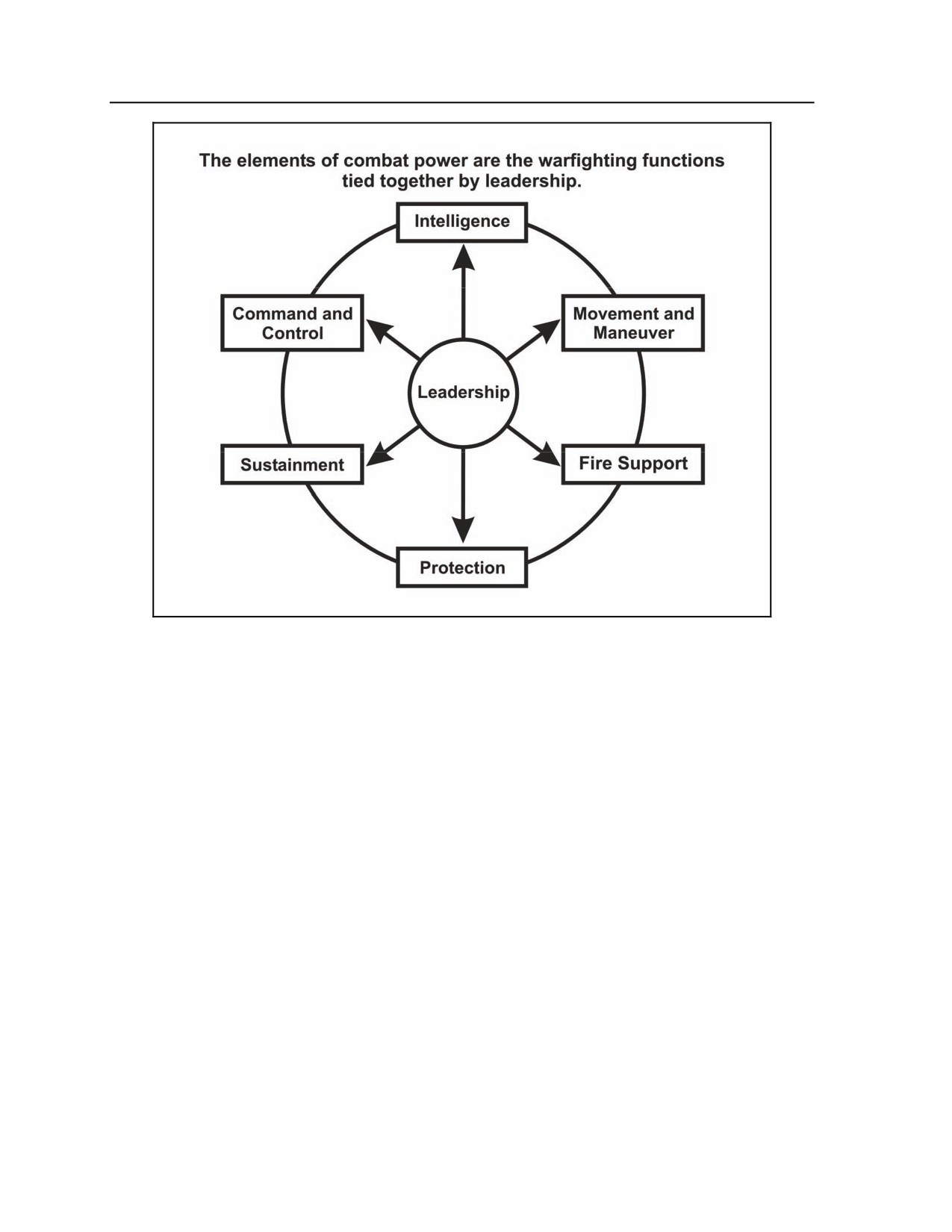
objectives. The warfighting functions are intelligence, movement and maneuver, fire support, protection,
sustainment, and command and control. These warfighting functions replace the battlefield operating
systems.
1-17. Commanders visualize, describe, direct, and lead operations and training in terms of the warfighting
functions. Decisive, shaping, and sustaining operations combine all the warfighting functions. No function
is exclusively decisive, shaping, or sustaining. Figure 1-1 illustrates the warfighting elements of combat
power.
28 March 2007
FM 3-21.8
1-3
Chapter 1
Figure 1-1. Warfighting elements of combat power.
INTELLIGENCE
1-18. The intelligence warfighting function involves the related tasks and systems that facilitate
understanding of the enemy, terrain, weather, and civil considerations. It includes those tasks associated
with intelligence, surveillance, and reconnaissance. The intelligence warfighting function combines a
flexible and adjustable architecture of procedures, personnel, organizations, and equipment to provide
commanders with relevant information and products relating to an area’s threat, civil populace, and
environment.
MOVEMENT AND MANEUVER
1-19. The movement and maneuver warfighting function involves the related tasks and systems that move
forces to achieve a position of advantage in relation to the enemy. It includes those tasks associated with
employing forces in combination with direct fire or fire potential (maneuver), force projection (movement),
and mobility and countermobility. Movement and maneuver are the means through which commanders
concentrate combat power to achieve surprise, shock, momentum, and dominance.
FIRE SUPPORT
1-20. The fire support warfighting function involves the related tasks and systems that provide collective
and coordinated use of Army indirect fires, joint fires, and offensive information operations. It includes
those tasks associated with integrating and synchronizing the effects of these types of fires with the other
warfighting functions to accomplish operational and tactical objectives.
1-4
FM 3-21.8
28 March 2007
Fundamentals of Tactics
PROTECTION
1-21. The protection warfighting function involves the related tasks and systems that preserve the force so
the commander can apply maximum combat power. Preserving the force includes protecting personnel
(combatant and noncombatant), physical assets, and information of the United States and multinational
partners. The following tasks are included in the protection warfighting function:
Safety.
Fratricide avoidance.
Survivability.
Air and missile defense.
Antiterrorism.
Counterproliferation and consequence management actions associated with chemical, biological,
radiological, nuclear, and high-yield explosive weapons.
Defensive information operations.
Force health protection.
SUSTAINMENT
1-22. The sustainment warfighting function involves the related tasks and systems that provide support and
services to ensure freedom of action, extend operational reach, and prolong endurance. Sustainment
includes those tasks associated with—
Maintenance.
Transportation.
Supply.
Field services.
Explosive ordnance disposal.
Human resources support.
Financial management.
Health service support.
Religious support.
Band support.
Related general engineering.
1-23. Sustainment allows uninterrupted operations through adequate and continuous logistical support such
as supply systems, maintenance, and other services.
COMMAND AND CONTROL
1-24. The command and control warfighting function involves the related tasks and systems that support
commanders in exercising authority and direction. It includes the tasks of acquiring friendly information,
managing relevant information, and directing and leading subordinates.
1-25. Command and control has two parts: the commander; and the command and control system.
Information systems—including communications systems, intelligence-support systems, and computer
networks—back the command and control systems. They let the commander lead from anywhere in their
area of operations
(AO). Through command and control, the commander initiates and integrates all
warfighting functions.
Combat Power
1-26. Combat power is a unit’s ability to fight. The primary challenge of leadership at the tactical level is
mastering the art of generating and applying combat power at a decisive point to accomplish a mission.
28 March 2007
FM 3-21.8
1-5
Chapter 1
Leaders use the operations process (plan, prepare, execute, and assess) to generate combat power. They
conduct operations following the Find, Fix, Finish, and Follow-through model to apply combat power.
1-27. At the core of a unit’s ability to fight are three time-tested components of close combat:
(1) Firepower.
(2) Mobility.
(3) Protection/Security.
1-28. These components appear throughout military history under various names as the central elements
required to fight and win against the enemy. Firepower consists of the weapons used to inflict casualties
upon the enemy. Firepower alone is indecisive without movement. Mobility is the ability to move on the
battlefield, dictating the speed, tempo, and tactical positioning of forces. Inherent in both firepower and
mobility is the need for protection from the enemy’s firepower and mobility. Leaders employ protection
and security measures to preserve their unit’s ability to fight. They deny the enemy protection through
creative combinations of unit firepower and mobility.
Situation
1-29. Every combat situation is unique. Leaders do their best to accurately assess the situation and make
good decisions about employing their units. The environment of combat, the application of military
principles, and the desired end state of Army operations culminate with the close fight of Infantry platoons
and squads. The leader should understand the larger military purpose and how his actions and decisions
might affect the outcome of the larger operation.
CHARACTERISTICS OF CLOSE COMBAT
1-30. Close combat is characterized by danger, physical exertion and suffering, uncertainty, and chance. To
combat these characteristics, Soldiers must have courage, physical and mental toughness, mental stamina,
and flexibility.
COURAGE
1-31. Courage is the quality Soldiers must possess to face and overcome danger. Hazards, real or potential,
are an ever-present aspect of the battlefield. Physical courage is necessary to deal with combat hazards.
Physical courage results from two sources: mental conditioning that comes from demanding training; and
motives such as personal pride, enthusiasm, and patriotism. Moral courage is necessary to face
responsibilities and do what is necessary and right.
PHYSICAL AND MENTAL TOUGHNESS
“The first quality of the Soldier is fortitude in enduring fatigue and privation; valor is
only the second. Poverty, privation, and misery are the school of the good Soldier.”
Napoleon, Maxim LVIII
1-32. Physical and mental toughness are the qualities Soldiers must have to combat physical exertion and
suffering. Physical toughness enables the Soldier to endure hardship and perform his rigorous duties.
Mental toughness enables the Soldier to put the harshness of the environment and his duties into proper
perspective. Mentally tough Soldiers can do what needs to be done to accomplish the mission.
MENTAL STAMINA
1-33. The individual’s awareness during combat is never complete. There is no such thing as perfect
awareness or understanding of the situation. Mental stamina is the quality Soldiers must have to combat
this uncertainty. Mental stamina provides the ability to assess the situation based on whatever facts are at
hand, to intuitively make reasonable assumptions about what is not known, and to make logical decisions
based on that information.
1-6
FM 3-21.8
28 March 2007
Fundamentals of Tactics
FLEXIBILITY
1-34. Chance is luck, opportunity, and fortune, and happens to both sides in close combat. It is not
predictable. However, it must be dealt with in that Soldiers must be flexible, resolute, and able to
continuously look forward.
SECTION II — DOCTRINE AND TRAINING
INFANTRY DOCTRINE
1-35. Doctrine contains the fundamental principles by which the military forces or elements guide their
actions in support of national objectives. It is authoritative, but requires judgment in application (FM 1-02,
Operational Terms and Graphics). Infantry doctrine expresses the concise expression of how Infantry
forces fight. It is comprised of principles; tactics, techniques, and procedures
(TTP); and terms and
symbols.
1-36. Infantry doctrine is based on hard-fought lessons from generations of combat Infantry Soldiers
engaged in numerous conflicts. Doctrine is always evolving and adapting, yet its fundamental principles are
as true today as they were generations ago.
1-37. Infantry doctrine facilitates communication among Infantry Soldiers regardless of where they serve,
contributes to a shared professional culture, and serves as the basis for training and instruction. Infantry
doctrine provides a common language and a common understanding of how Infantry forces conduct tasks
and operations. To be useful, doctrine must be well known and commonly understood.
PRINCIPLES
1-38. Principles are fundamental concepts and facts underlying the conduct of tasks and operations.
Principles are usually general, flexible, and apply across a broad spectrum. Because they are broad, they
apply at the Infantry platoon and squad levels as well as at the higher levels with relatively the same
meaning. Therefore, leaders at all levels need to remain aware of both the generic and specific aspects of
doctrinal terms.
TACTICS, TECHNIQUES, AND PROCEDURES
1-39. One of the defining characteristics of war is chaos. TTP are the counterweight to this chaos. From
the moment combat begins, plans often become obsolete, communications fail, Soldiers become casualties,
and units fragment. Military tactics are the practical means armies use to achieve battlefield objectives.
From this, “tactics” came to imply the deliberate control of military formation, movement and fire, and the
attempt to impose order where there is disorder to defeat the enemy.
1-40. TTP are those generally-accepted practices used to conduct operations. “Generally accepted” means
that the doctrine described is applicable to most operations, most of the time, and that there is widespread
consensus about their value and usefulness. “Generally accepted” does not mean that doctrine should be
applied uniformly on all missions. Leaders use their own standing operating procedures (SOPs) and
judgment to determine what is appropriate based on the specific mission, enemy, terrain, troops-time, civil
(METT-TC) conditions.
Tactics
1-41. Tactics are: (1) The employment of units in combat.
(2) The ordered arrangement and maneuver of
units in relation to each other or to the enemy to utilize their full potential (FM 1-02). Tactics are the ways
that we engage in combat with an enemy force.
Techniques
1-42. Techniques are the general and detailed methods used by troops or commanders to perform assigned
missions and functions, specifically the methods of using equipment and personnel. Techniques are the
28 March 2007
FM 3-21.8
1-7
Chapter 1
general methods used by the leader and his subordinates to perform the tactic. Techniques describe a way,
not the only way (FM 1-02).
Procedures
1-43. Procedures are standard methods used by the leader and his subordinates to perform and accomplish
a task or a portion of a task. For example, when the unit sustains a casualty, the leader or a radiotelephone
operator (RTO) might use the 9-line medical evacuation (MEDEVAC) procedure to call for medical
assistance.
Terms and Symbols
1-44. Doctrine provides a common language that professionals use to communicate with one another.
Terms with commonly understood definitions are a major component of the language. Symbols are its
graphical representation. Establishing and using words and symbols of common military meaning enhances
communications among military professionals in all environments, and makes a common understanding of
doctrine possible. (See FM 1-02.)
INDIVIDUAL INFANTRY SKILLS
1-45. Every Infantryman, from the private enlisted Soldier, to the general officer, is first a rifleman. As
such, he must be a master of his basic skills: shoot, move, communicate, survive, and sustain. These basic
skills provide the Soldier’s ability to fight. When collectively applied by the fire team, squad, and platoon,
these skills translate into combat power.
SHOOT
1-46. Infantrymen must be able to accurately engage the enemy with all available weapons. Soldiers and
their leaders must therefore be able to determine the best weapon-ammunition combination to achieve the
desired effect. The best combination will expend a minimum of ammunition expenditure and unintended
damage. To make this choice, they must know the characteristics, capabilities, and vulnerabilities of their
organic and supporting assets. This means understanding the fundamental characteristics of the weapon’s
lay (direct or indirect), ammunition (high explosive [HE], penetrating, or special purpose), trajectory (high
or low), and enemy targets (point or area). Properly applying these variables requires an understanding of
the nature of targets, terrain, and effects.
MOVE
1-47. Tactical movement is inherent in all Infantry operations. Movement is multifaceted, ranging from
dismounted, to mounted, to aerial modes, and is conducted in varying physical environments, including the
urban environment. For the individual, movement is comprised of the individual movement techniques
(IMT) of high crawl, low crawl, and 3-5 second rush; for the unit it is comprised of movement formations,
movement techniques, and maneuver (fire and movement). Mastering the many aspects of tactical
movement is fundamental. More importantly, Infantrymen must be thoroughly trained in the critical
transition from tactical movement to maneuver.
1-48. Understanding the terrain is critical to applying the fundamental of the particulars of shoot and move.
There are four basic terrain-related skills. First, the leader must know how to land navigate, mounted and
dismounted, day and night, using the latest technology (global positioning systems [GPS], Falcon View).
Second, leaders need to understand the basics of how to analyze the military aspects of terrain, Observation
and fields of fire, Avenues of approach, Key and decisive terrain, Obstacles, Cover and concealment.
(OAKOC). Third, once they understand how to look at the terrain in detail, leaders must understand how to
integrate the aspects of fire (direct and indirect) and tactical movement to fit the terrain. Fourth, leaders
must understand how to apply generic tactics and techniques to the unique terrain they are in, because
understanding and appreciating terrain is an essential leader skill.
1-8
FM 3-21.8
28 March 2007
Fundamentals of Tactics
COMMUNICATE
1-49. Soldiers communicate to provide accurate and timely information to those who need it. Information
is necessary to successfully execute combat operations. It enables leaders to achieve situational
understanding, make decisions, and give orders. There are two aspects of communication: the technical
means used to communicate; and the procedures used for reporting and disseminating information. The
Soldier’s and leader’s ability to use information to assess the situation, make decisions, and direct
necessary actions are also significant aspects in the communication process.
SURVIVE
1-50. To fully contribute to the mission, Soldiers must be able to survive. There are three aspects to
surviving: the enemy; the environment; and the Soldier’s body. Survival is both a personal responsibility
and a unit responsibility. These aspects require Soldiers to discipline themselves in routine matters such as
maintaining local security, maintaining field sanitation, caring for their bodies, and caring for their
equipment. It also requires Soldiers to know how to respond to extraordinary circumstances such as dealing
with casualties or functioning in a contaminated environment. Soldiers must know about the protective
properties of their personal gear and combat vehicles, the effects of weapon systems and munitions, and
how to build survivability positions. In short, Soldiers must do everything possible for the security and
protection of themselves, their equipment, and their fellow Soldiers. In the same way, leaders must do
everything possible to ensure the security and protection of their units.
SUSTAIN
1-51. Sustainment is an inherent feature in all operations. In order to shoot, ammunition is needed. Fuel
and repair parts are needed for movement, and batteries are needed to communicate. To survive, the Soldier
needs food and water. Soldiers and leaders need to forecast requirements before they need them, while at
the same time managing the Soldier’s load.
WARRIOR ETHOS AND ARMY VALUES
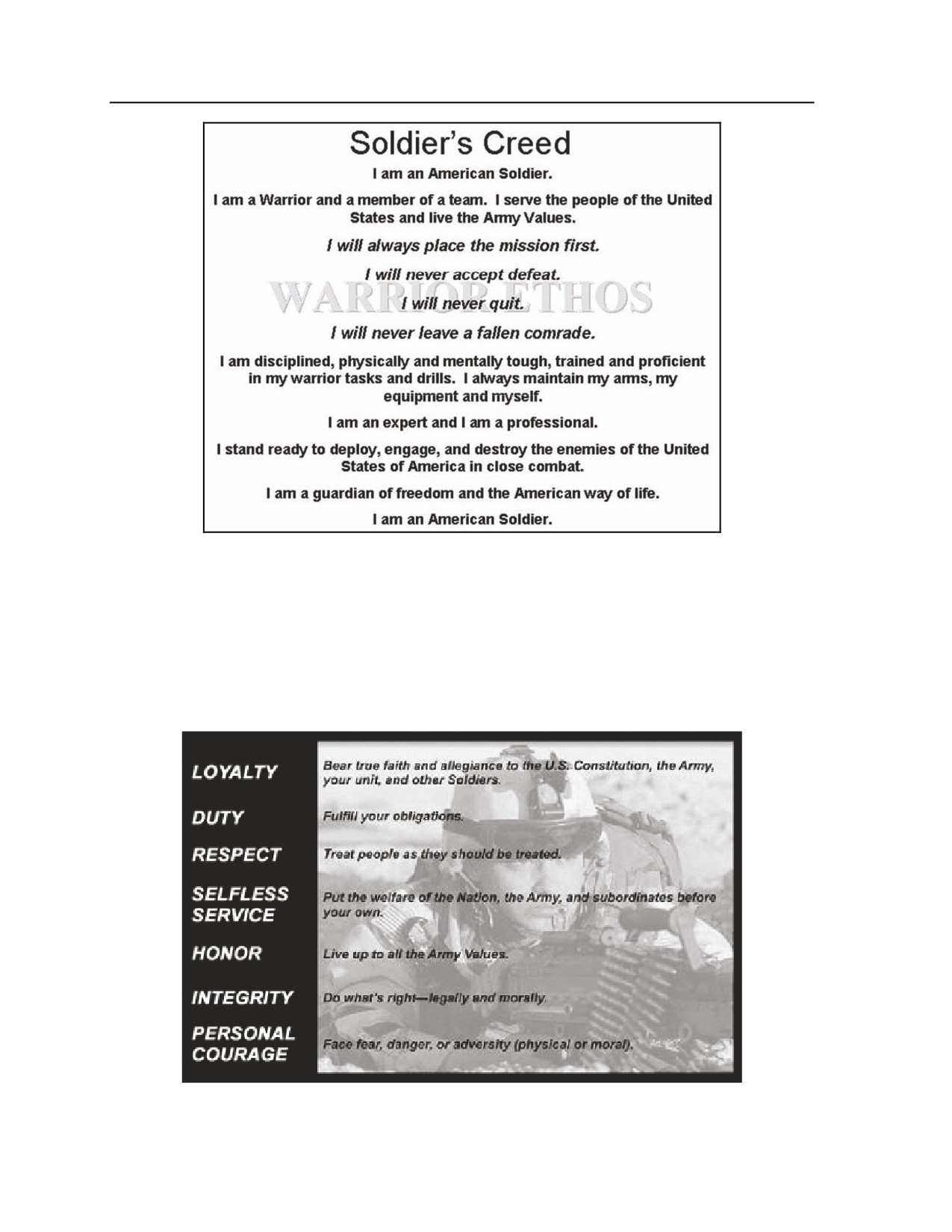
1-52. Warrior Ethos refers to the professional attitudes and beliefs that will characterize you. Developed
through discipline, commitment to Army Values and knowledge of the Army’s proud heritage, Warrior
Ethos notes military service as much more than just a “job” — it is a profession with the enduring purpose
to win wars and destroy our nation’s enemies. Figure 1-2 displays the Warrior Ethos definition as
embedded within the current Soldier’s Creed:
28 March 2007
FM 3-21.8
1-9
Chapter 1
Figure 1-2. The Soldier’s Creed.
1-53. Warrior Ethos is the foundation for your commitment to victory in times of peace and war. While
always exemplifying the tenets of Warrior Ethos — place the mission first, refuse to accept defeat, and
never quit or leave a fallen comrade behind. You must have absolute faith in yourself. And you must have
complete faith in your team, because they are trained and equipped to destroy the enemy in close combat.
1-54. The Army Values consist of the principles, standards, and qualities considered essential for
successful Army leaders. They firmly bind all Army members into a fellowship dedicated to serve the
Nation and the Army. Figure 1-3 lists the seven Army Values. It is not a coincidence that when reading
the first letters of the Army Values in sequence they form the acronym “LDRSHIP”.
Figure 1-3. The Army Values.
1-10
FM 3-21.8
28 March 2007
Fundamentals of Tactics
EVERY SOLDIER IS A SENSOR (ES2)
1-55. Soldiers must be trained to actively observe details related to the commander’s critical information
requirements (CCIR) in an AO. They must also be competent in reporting their experience, perception, and
judgment in a concise, accurate manner. Leaders who understand how to optimize the collection,
processing, and dissemination of information in their organization enable the generation of timely
intelligence. To accommodate this, leaders must create a climate that allows all Infantryman to feel free to
report what they see and learn on a mission.
1-56. ES2 trains Soldiers and leaders to see intelligence development as everyone’s responsibility. All
must fight for knowledge to gain and maintain greater situational understanding. At the heart of the concept
is the art of combat (tactical) collection. This process involves leaders directing and maximizing the
collection of combat intelligence by patrols, and Soldiers who understand their vital role as collectors of
combat information.
TACTICAL QUESTIONING
1-57. Tactical questioning involves the expedient initial questioning of an AO’s local population to gather
information of immediate value. Because tactical questioning applies to interaction with the local
population, it is more “conversational” than “questioning” in nature. The Infantry Soldier conducts tactical
questioning based on the unit’s standing operating procedures, rules of engagement, and the order for that
mission.
SITE EXPLOITATION
1-58. Site exploitation is defined as the search of a specific location or area to gain items of intelligence
value. Locations may include apartments, buildings, multiple structures, compounds, or fields. Once a site
has been cleared of enemy personnel, Infantry platoons will search for items of interest. Search items may
include:
Maps.
Propaganda material.
Phone or computer records.
Photos.
Weapons.
DEBRIEFING AND REPORTING
1-59. Once the platoon returns from the objective or site, a detailed debrief should begin. Everyone on the
mission has a role to play in a debrief. A practical method for debriefing is to review all patrol actions
chronologically. Leaders should not consider the mission complete or the personnel released until the
debriefings and reporting are done.
1-60. All information collected by platoons in contact with the local population is reported through the
chain of command. Upon return from the mission, photos should be downloaded. All material taken from
the objective should be laid out.
1-61. Finally, as detailed a sketch as possible should be made for visual reference of debriefed patrol areas.
For detailed information on debriefing, reporting, and tactical questions see FMI 2-91.4, Intelligence
Support to Operations in the Urban Environment.
SECTION III — ORGANIZATION
INFANTRY PLATOON
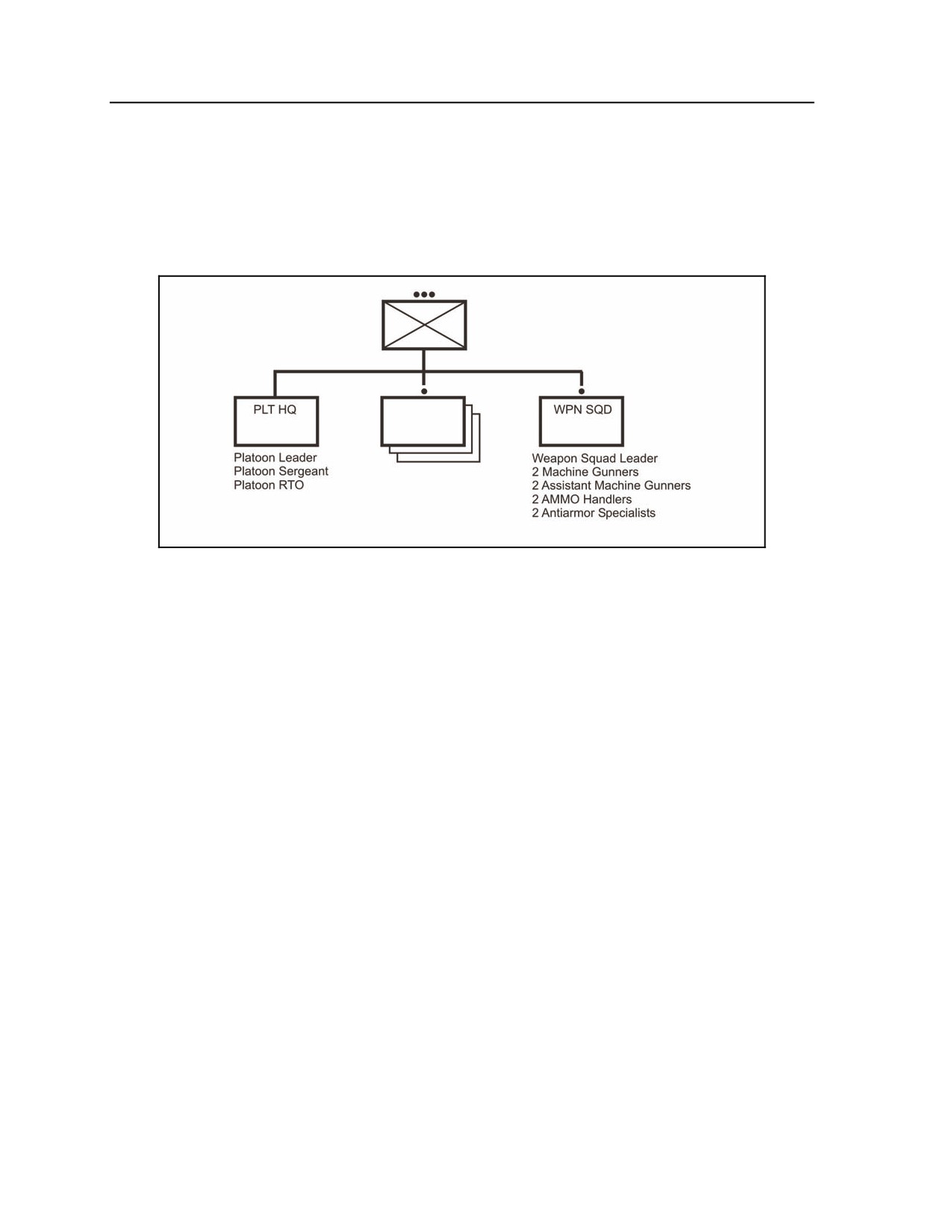
1-62. The Infantry platoon is organized with three Infantry squads, a weapons squad, and a platoon
headquarters. The headquarters section provides C2 of the squads and any attachments, and serves as the
28 March 2007
FM 3-21.8
1-11
Chapter 1
interface with the fire support and sustainment systems. Although all Infantry platoons use the same basic
doctrinal principles in combat, application of those principles differs based on assigned organization or task
organization (Figure 1-4).
1-63. One of the inherent strengths of the Infantry platoon is the ability to task organize. The Infantry
platoon headquarters must expect to receive other Soldiers and units in command relationships, and direct
other arms in support relationships.
Figure 1-4. Infantry platoon.
PLATOON HEADQUARTERS
1-64. The platoon headquarters has three permanently assigned members: the platoon leader, the platoon
sergeant, and the radiotelephone operator (RTO). Depending on task organization, the platoon headquarters
may receive augmentation. Two traditionally-attached assets are the fire support team, and the platoon
medic.
PLATOON LEADER
1-65. The platoon leader leads his subordinates by personal example. The platoon leader exercises
authority over his subordinates and overall responsibility for those subordinates’ actions. This centralized
authority enables the platoon leader to act decisively while maintaining troop discipline and unity. Under
the fluid conditions of close combat, even in the course of carefully-planned actions, the platoon leader
must accomplish assigned missions using initiative without constant guidance from above.
Responsibilities
1-66. The platoon leader is responsible for all the platoon does or fails to do. In the conduct of his duties he
consults the platoon sergeant in all matters related to the platoon. He must know his Soldiers and how to
employ the platoon and its organic and supporting weapons. During operations, the platoon leader—
Leads the platoon in supporting the higher headquarters missions. He bases his actions on his
assigned mission and the intent and concept of his higher commanders.
Maneuvers squads and fighting elements.
Synchronizes the efforts of squads.
Looks ahead to the next “move” for the platoon.
Requests and controls supporting assets.
Employs C2 systems available to the squads and platoon.
Ensures 360-degree, three-dimensional security is maintained.
1-12
FM 3-21.8
28 March 2007
Fundamentals of Tactics
Controls the emplacement of key weapon systems.
Issues accurate and timely reports.
Places himself where he is most needed to accomplish the mission.
Assigns clear tasks and purposes to his squads.
Understands the mission and commanders intent two levels up (the company and battalion).
Situational Understanding
1-67. The platoon leader works to develop and maintain situational understanding (SU). SU is a product of
four elements. First, the platoon leader attempts to know what is happening in the present in terms of
friendly, enemy, neutral, and terrain situations. Second, the platoon leader must know the end state that
represents mission accomplishment. Third, the platoon leader determines the critical actions and events that
must occur to move his unit from the present to the end state. Finally, the platoon leader must be able to
assess the risk throughout.
PLATOON SERGEANT
1-68. The platoon sergeant (PSG) is the senior NCO in the platoon and second in command. He sets the
example in everything. He is a tactical expert in Infantry platoon and squad operations, which include
maneuver of the platoon-sized elements, and employment of all organic and supporting weapons. The
platoon sergeant advises the platoon leader in all administrative, logistical, and tactical matters. The platoon
sergeant is responsible for the care of the men, weapons, and equipment of the platoon. Because the platoon
sergeant is the second in command, he has no formal assigned duties except those assigned by the platoon
leader. However, the platoon sergeant traditionally—
Ensures the platoon is prepared to accomplish its mission, to include supervising precombat
checks and inspections.
Prepares to assume the role and responsibilities of platoon leader.
Acts where best needed to help C2 the engagement (either in the base of fire or with the assault
element).
Receives squad leaders’ administrative, logistical, and maintenance reports, and requests for
rations, water, fuel, and ammunition.
Coordinates with the higher headquarters to request logistical support (usually the company’s
first sergeant or executive officer).
Manages the unit’s combat load prior to operations, and monitors logistical status during
operations.
Establishes and operates the unit’s casualty collection point (CCP) to include directing the
platoon medic and aid/litter teams in moving casualties; maintains platoon strength levels
information; consolidates and forwards the platoon’s casualty reports; and receives and orients
replacements.
Employs digital C2 systems available to the squads and platoon.
Understands the mission and commanders intent two levels up (the company and battalion).
PLATOON RADIOTELEPHONE OPERATOR
1-69. The platoon radiotelephone operator (RTO) is primarily responsible for the platoon’s communication
with its controlling HQ (usually the company). During operations, the RTO will—
Have communications at all times. If communication with the platoon’s next higher element is
lost, the RTO immediately informs the platoon leader or platoon sergeant.
Conduct radio checks with higher (in accordance with unit SOPs) when in a static position. If the
RTO cannot make successful radio contact as required, he will inform the platoon sergeant or
platoon leader.
Be an expert in radio procedures and report formats such as call for indirect fire or MEDEVAC,
and all types of field expedient antennas.
28 March 2007
FM 3-21.8
1-13
Chapter 1
Have the frequencies and call signs on his person in a location known to all Soldiers in the
platoon.
Assist the platoon leader with information management.
Assist the platoon leader and platoon sergeant employing digital C2 systems available to the
squads and platoon.
Determine his combat load prior to operations and manage his batteries during operations.
FORWARD OBSERVER
1-70. The forward observer (FO), along with a fire support RTO, is the unit’s SME on indirect fire
planning and execution. The FO is the primary observer for all fire support (FS) assets to include company
mortars (if assigned), battalion mortars, field artillery, and any other allocated FS assets. He is responsible
for locating targets and calling and adjusting indirect fires. He must know the mission and the concept of
operation, specifically the platoon’s scheme of maneuver and concept of fires. He works directly for the
platoon leader and interacts with the next higher headquarters’ fire support representative. The FO must
also—
Inform the FIST headquarters of the platoon situation, location, and fire support requirements.
Prepare and use maps, overlays, and terrain sketches.
Call for and adjust indirect fires.
Operate as a team with the fire support RTO.
Select targets to support the platoon’s mission.
Select observation post(s) (OP) and movement routes to and from selected targets.
Operate digital message devices and maintain communication with the battalion and company
fire support officer (FSO).
Maintain grid coordinates of his location.
Be prepared to back up the platoon leader’s radio on the higher headquarters net if needed.
Be prepared to employ close air support assets.
PLATOON MEDIC
1-71. The platoon medic is assigned to the battalion medical platoon and is attached upon order. His
primary function is force health protection. As such, he is the unit’s SME on treatment and evacuation of
casualties. He works directly for the platoon sergeant. However, he also interacts heavily with the
company’s senior medic. During operations the medic—
Treats casualties and assists the aid and litter teams with their evacuation.
Advises the platoon leader and platoon sergeant on all force health protection matters, and
personally checks the health and physical condition of platoon members.
Reports all medical situations and his actions taken to the platoon sergeant.
Requests Class VIII (medical) supplies for the platoon through the company medic.
Provides training and guidance to combat lifesavers.
INFANTRY FIRE TEAM
1-72. The Infantry fire team is designed to fight as a team and is the fighting element within the Infantry
platoon. Infantry platoons and squads succeed or fail based on the actions of their fire teams.
1-73. The Infantry fire team is designed as a self-contained team (Figure 1-5). The automatic rifleman
(AR) provides an internal base of fire with the ability to deliver sustained suppressive small arms fire on
area targets. The rifleman provides accurate lethal direct fire for point targets. The grenadier provides high
explosive (HE) indirect fires for both point and area targets. A team leader (TL) who provides C2 through
leadership by example (“Do as I do”) leads this team.
1-14
FM 3-21.8
28 March 2007

Fundamentals of Tactics
Figure 1-5. Infantry fire team.
RIFLEMAN
1-74. The rifleman provides the baseline standard for all Infantrymen and is an integral part of the fire
team. He must be an expert in handling and employing his weapon. Placing well-aimed, effective fire on
the enemy is his primary capability. Additionally, the rifleman must—
Be an expert on his weapon system—his rifle, its optics, and its laser aiming device. He must be
effective with his weapon system day or night. He must be capable of engaging all targets with
well-aimed shots.
Be able to employ all weapons of the squad, as well as common munitions.
Be able to construct and occupy a hasty firing position and know how to fire from it. He must
know how to quickly occupy covered and concealed positions in all environments and what
protection they will provide for him from direct fire weapons. He must be competent in the
performance of these tasks while using night vision devices.
Be able to fight as part of his unit, which includes being proficient in his individual tasks and
drills, being able to fight alongside any member of the unit, and knowing the duties of his
teammates and be prepared to fill in with their weapons if needed.
Be able to contribute as a member of special teams to include wire/mine breach teams, EPW
search, aid/litter, and demolitions.
Be able to inform his team leader of everything he hears and sees when in a tactical situation.
Be able to perform Soldier-level preventive medicine measures (PMM). (See Chapter 6.)
Be able to administer buddy aid as required.
Be able to manage his food, water, and ammunition during operations.
Be prepared to assume the duties of the automatic rifleman and team leader.
Understand the mission two levels up (squad and platoon).
GRENADIER
1-75. The grenadier is currently equipped with an M203 weapon system consisting of an M16/M4 rifle and
an attached 40-mm grenade launcher. The grenadier provides the fire team with a high trajectory, high
explosive capability out to 350 meters. His fire enables the fire team to achieve complementary effects with
high trajectory, high explosive munitions, and the flat trajectory ball ammunition of the team’s other
weapons. The grenade launcher allows the grenadier to perform three functions: suppress and destroy
enemy Infantry and lightly-armored vehicles with HE or high explosive dual purpose; provide smoke to
screen and cover his squad’s fire and movement; and employ illumination rounds to increase his squad’s
visibility and mark enemy positions. The grenadier must—
Be able to accomplish all of the tasks of the rifleman.
Be able to engage targets with appropriate type of rounds both day and night.
28 March 2007
FM 3-21.8
1-15
Chapter 1
Identify 40-mm rounds by shape and color. He must know how to employ each type of round
and know its minimum safety constraints.
Know the maximum ranges for each type of target for the grenade launcher.
Know the leaf sight increments without seeing the markings.
Know how to make an adjustment from the first round fired so he can attain a second-round hit.
Load the grenade launcher quickly in all firing positions and while running.
Be prepared to assume the duties of the automatic weapons gunner and the team leader.
Understand the mission two levels up (squad and platoon).
AUTOMATIC RIFLEMAN
1-76. The AR’s primary weapon is currently the 5.56-mm M249 machine gun. The M249 provides the unit
with a high volume of sustained suppressive and lethal fires for area targets. The automatic rifleman
employs the M249 machine gun to suppress enemy Infantry and bunkers, destroy enemy automatic rifle
and antitank teams, and enable the movement of other teams and squads. He is normally the senior Soldier
of the fire team. The AR must—
Be able to accomplish all of the tasks of the rifleman and the grenadier.
Be prepared to assume the duties of the team leader and squad leader.
Be able to engage groups of enemy personnel, thin-skinned vehicles, bunker doors or apertures,
and suspected enemy locations with automatic fire. He provides suppressive fire on these targets
so his teammates can close with and destroy the enemy.
Be familiar with field expedient firing aids to enhance the effectiveness of his weapon (for
example, aiming stakes).
Be able to engage targets from the prone, kneeling, and standing positions with and without
night observation devices. Also understands the mission two levels up (the squad and platoon).
TEAM LEADER
1-77. The team leader leads his team members by personal example. He has authority over his subordinates
and overall responsibility for their actions. Centralized authority enables the TL to maintain troop discipline
and unity and to act decisively. Under the fluid conditions of close combat, the team leader must
accomplish assigned missions using initiative without needing constant guidance from above.
1-78. The team leader’s position on the battlefield requires immediacy and accuracy in all of his actions.
He is a fighting leader who leads his team by example. The team leader is responsible for all his team does
or fails to do. He is responsible for the care of his team’s men, weapons, and equipment. During operations,
the team leader—
Is the SME on all of the team’s weapons and duty positions and all squad battle drills.
Leads his team in fire and movement.
Controls the movement of his team and its rate and distribution of fire.
Employs digital C2 systems available to the squad and platoon.
Ensures security of his team’s sector.
Assists the squad leader as required.
Is prepared to assume the duties of the squad leader and platoon sergeant.
Enforces field discipline and PMM.
Determines his team’s combat load and manages its available classes of supply as required.
Understands the mission two levels up (squad and platoon).
1-79. When maneuvering the team, the team fights using one of three techniques:
(1) Individual movement techniques (IMT, the lowest level of movement).
(2) Buddy team fire and movement.
(3) Fire team fire and movement (maneuver).
1-16
FM 3-21.8
28 March 2007
Fundamentals of Tactics
1-80. Determining a suitable technique is based on the effectiveness of the enemy’s fire and available
cover and concealment. The more effective the enemy’s fire, the lower the level of movement. Because the
team leader leads his team, he is able to make this assessment firsthand. Other leaders must be sensitive to
the team leader’s decision on movement.
INFANTRY SQUAD
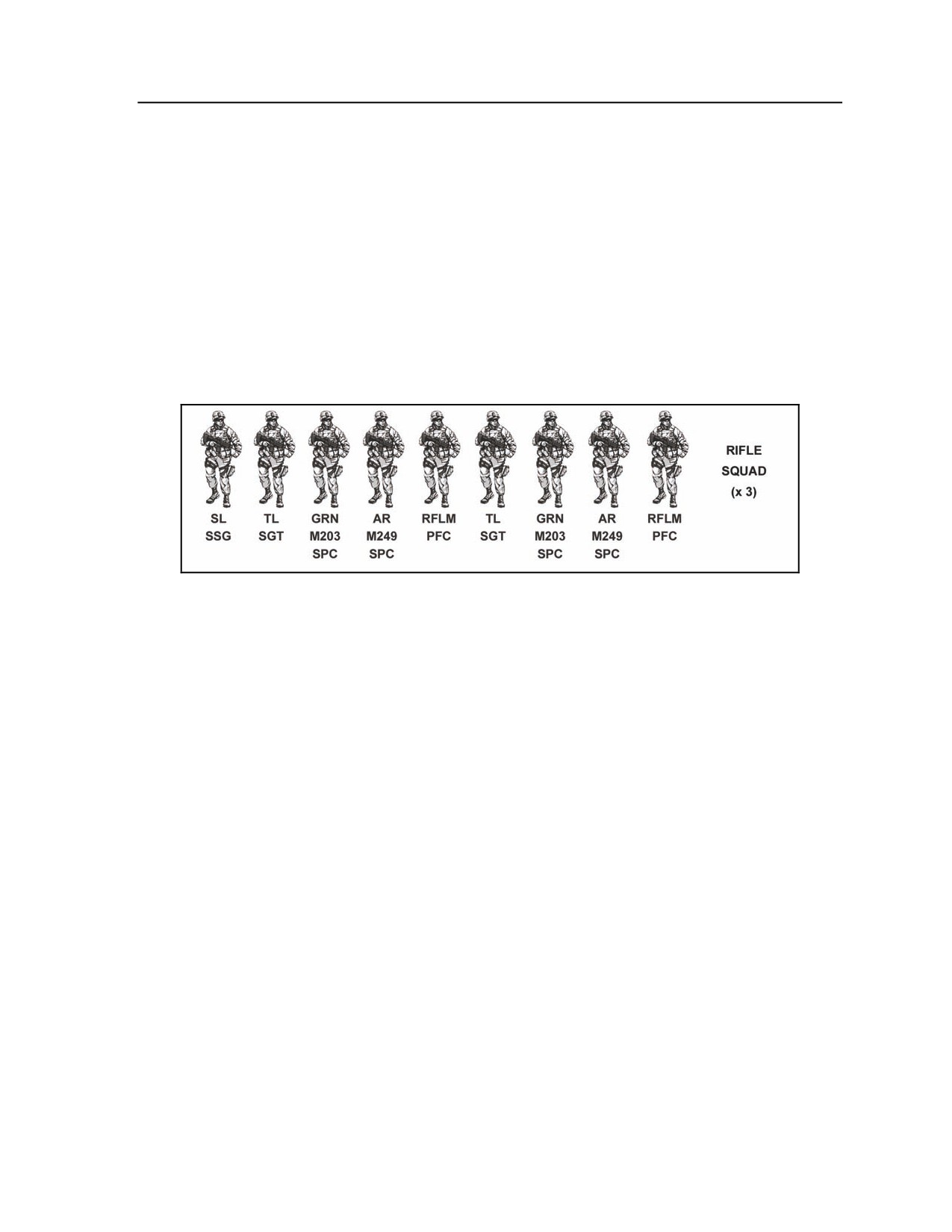
1-81. There are several variations of Infantry, but there is currently only one type of Infantry squad (Figure
1-6). Its primary role is a maneuver or base-of-fire element. While the platoon’s task organization may
change, the organization of the Infantry squad generally remains standard.
1-82. The Infantry squad is a model for all tactical task organizations. It is comprised of two fire teams and
a squad leader. It is capable of establishing a base of fire, providing security for another element, or
conducting fire and movement with one team providing a base of fire, while the other team moves to the
next position of advantage or onto an objective. The squad leader has two subordinate leaders to lead the
two teams, freeing him to control the entire squad.
Figure 1-6. Infantry squad.
SQUAD LEADER
1-83. The squad leader (SL) directs his team leaders and leads by personal example. The SL has authority
over his subordinates and overall responsibility for those subordinates’ actions. Centralized authority
enables the SL to act decisively while maintaining troop discipline and unity. Under the fluid conditions of
close combat, even in the course of carefully-planned actions, the SL must accomplish assigned missions
on his own initiative without constant guidance from above.
1-84. The squad leader is the senior Infantryman in the squad and is responsible for all the squad does or
fails to do. The squad leader is responsible for the care of his squad’s men, weapons, and equipment. He
leads his squad through two team leaders. During operations, the squad leader—
Is the SME on all battle drills and individual drills.
Is the SME in the squad’s organic weapons employment and the employment of supporting
assets.
Knows weapon effects, surface danger zone(s) (SDZ), and risk estimate distance(s) (RED) for
all munitions.
Effectively uses control measures for direct fire, indirect fire, and tactical movement.
Controls the movement of his squad and its rate and distribution of fire (including call for and
adjust fire).
Fights the close fight by fire and movement with two fire teams and available supporting
weapons.
Selects the fire team’s general location and sector in the defense.
Communicates timely and accurate spot reports (SPOTREPs) and status reports, including—
Size, activity, location, unit, time, and equipment (SALUTE) SPOTREPs.
Status to the platoon leader (including squad location and progress, enemy situation, enemy
killed in action [KIA], and security posture).
Status of ammunition, casualties, and equipment to the platoon sergeant.
28 March 2007
FM 3-21.8
1-17
Chapter 1
Employs digital C2 systems available to the squad and platoon.
Operates in any environment to include the urban environment.
Conducts troop-leading procedures (TLP).
Assumes duties as the platoon sergeant or platoon leader as required.
Understands the mission and commander’s intent two levels up (the platoon and company).
SQUAD DESIGNATED MARKSMAN
1-85. Squad designated marksmen are not squad snipers. They are fully integrated members of the rifle
squad who provide an improved capability for the rifle squad. They do not operate as semi-autonomous
elements on the battlefield as snipers, nor do they routinely engage targets at the extreme ranges common
to snipers. The designated marksman employs an optically-enhanced general-purpose weapon. He also
receives training available within the unit’s resources to improve the squad’s precision engagement
capabilities at short and medium ranges
1-86. A rifleman may be assigned as the squad designated marksman (SDM). The SDM is chosen for his
demonstrated shooting ability, maturity, reliability, good judgment, and experience. The SDM must be able
to execute the entire range of individual and collective rifleman tasks within the squad (see FM 3-22.9,
Rifle Marksmanship M16A1, M16A2/3, M16A4, and M4 Carbine.)
1-87. The designated marksman employs an optically-enhanced, general-purpose weapon and receives
training available within the unit’s resources to improve the squad’s precision engagement capabilities at
short and medium ranges. In contrast, snipers use specialized rifles and match ammunition, and are
specially selected and trained to provide precision fire at medium and long ranges
(normally from
stationary positions).
1-88. The squad marksman engages visible point targets with target priorities of enemy leaders, personnel
with radios, automatic weapons crews, enemy soldiers with rocket launchers or sniper rifles, or others as
directed by his squad and platoon leaders. He is particularly effective against targets that are only partially
exposed or exposed for only brief periods of time. A designated marksman delivers effective fire against
very small targets such as loopholes or firing slits, bunker apertures, partially obscured and prone enemy
snipers, crew-served weapons teams at close to medium ranges, and rapidly moving targets. He must be
able to detect and engage targets rapidly from awkward or nonstandard firing positions while he, the target,
or both are moving.
1-89. One designated marksman per fire team creates two highly flexible balanced teams with a squad
automatic weapon, grenade launcher, and precision-fire rifleman in each. This combines increased
situational awareness and target acquisition with precision point and area suppression. Integration of a
designated marksman within each fire team allows the squad to suppress enemy individuals, support
weapons, or small units while maneuvering to a position of advantage.
Equipment
1-90. The designated marksman uses an assigned weapon, normally an M16 or M4 equipped with optical
sights. Optical sight magnification and wide field of view allow him to observe, detect, identify, range, and
engage targets an iron sight or naked eye cannot. This provides the squad with improved situational
awareness as well as increased lethality. The telescopic sight dramatically improves the probability of first-
round hits on targets at unknown distances and greatly increases target identification capability for
shadowed targets and during low light conditions.
Training
1-91. The designated marksman requires additional training on his new role and on the operation and
maintenance of the optical sights. Additional training includes—
Zeroing techniques.
Target detection.
Range, wind, and moving target estimation.
1-18
FM 3-21.8
28 March 2007
Fundamentals of Tactics
Hold-off determination.
Alternate and nonstandard shooting positions.
Known distance field fire to 600 meters.
Close combat firing techniques.
Transition fire engagements.
Rapid target identification and engagement.
Night fire with and without additional night observation or aiming devices.
Shooting while moving forward, sideways, and back.
Shooting from vehicles.
Employment in Combat
1-92. The designated marksman moves and fights in combat as an integral part of the Infantry squad. He
provides precision support fire in the offense during the assault and engages targets to the maximum
effective range of his weapon in offensive, defensive, and retrograde operations. His ability to deliver
lethal, precise, and discriminating fire during stability operations forms the basis of counterinsurgency
combat. He enhances the squad's effectiveness and its ability to maneuver and accomplish its mission.
When employed tactically, designated marksmen provide precision direct fire as directed by the squad
leader. This fire limits fratricide, collateral damage, and noncombatant casualties.
1-93. The designated marksman is employed most effectively in combat situations where precision fire
versus a volume of fires is required. Types of operations in which designated marksmen are most useful
include:
Situations in which the squad requires precision fires in an urban area containing an enemy
mixed with multiple noncombatants or in those where the applicable ROE restricts the use of
area-fire weapons.
Close range engagements that have an immediate, critical need for precision rifle fire.
Situations in which the unit is facing an enemy with trained marksmen or armed irregulars being
used as snipers that must be countered.
Civil disturbances involving armed rioters mixed with noncombatants.
Vehicle and personnel checkpoint operations in which the squad needs an element in armed
overwatch.
Attacking specific targets identified by the platoon or squad leader.
Covering the approach and entry of the assault element to the objective.
Eliminating unexpected threats in and around the objective that appear and disappear suddenly
and without warning.
Covering specific avenues of approach into the unit’s position and searching the area for signs of
a counterattack.
Isolating the objective area by fire.
Providing diversionary fire for an assault element.
Covering obstacles or other key installations with precision fire.
Situations that require precision fire on apertures, exposed personnel, muzzle flashes, or other
designated point targets.
Situations with friendly troops on or near the objective when mortars, machine guns, and
grenade launchers must cease or shift their fires to prevent fratricide. The designated marksman
may be able to continue to fire in support of the assault.
INFANTRY WEAPONS SQUAD
1-94. The Infantry weapons squad provides the primary base of fire for the platoon’s maneuver. It is
comprised of two medium machine gun teams, two medium close combat missile (CCM) teams, and a
weapons squad leader (Figure 1-7).
28 March 2007
FM 3-21.8
1-19
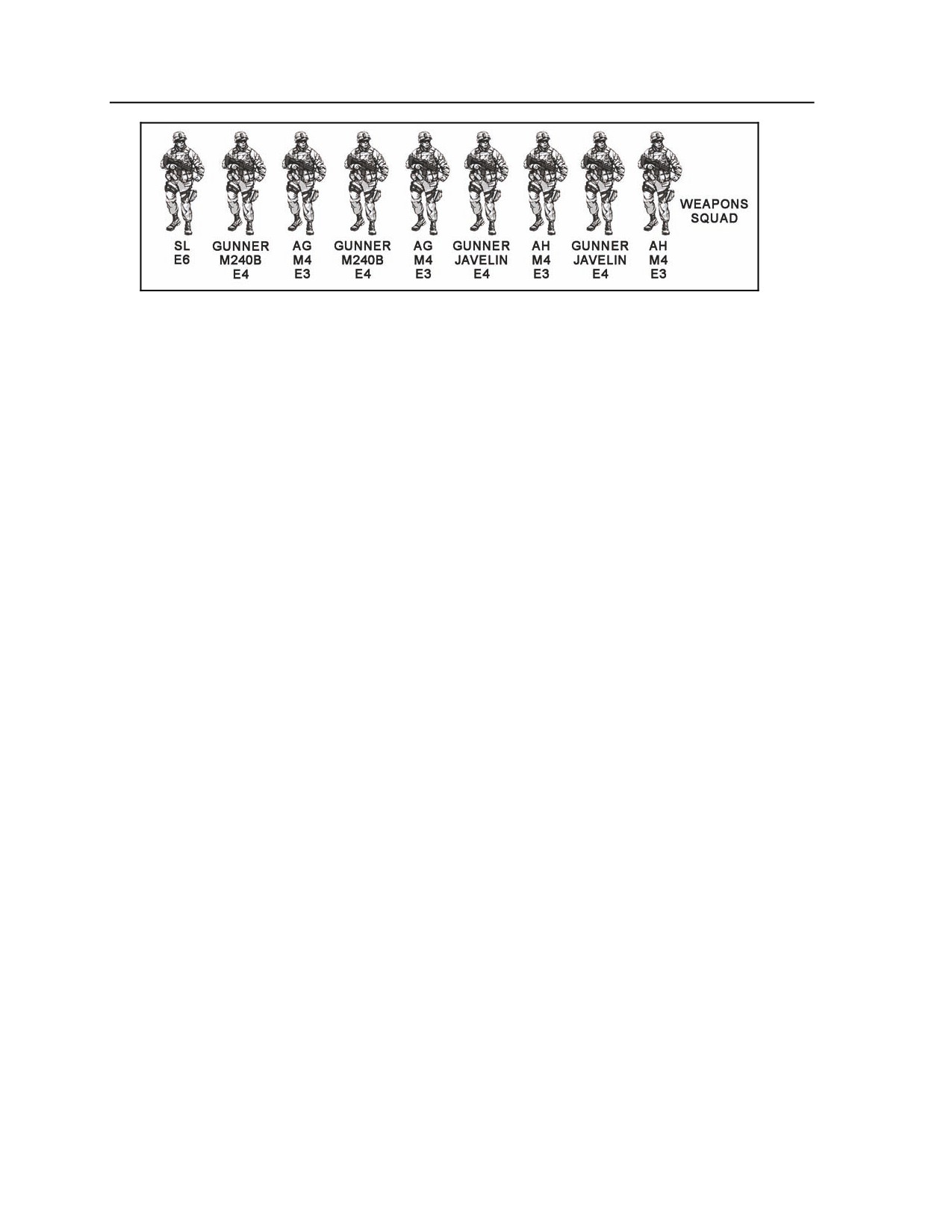
Chapter 1
Figure 1-7. Infantry weapons squad.
MEDIUM MACHINE GUN TEAM
1-95. The two-man medium machine gun team is comprised of a gunner and an assistant gunner (AG). The
weapons squad has two machine gun teams. These teams provide the platoon with medium-range area
suppression at ranges up to 1,000 meters during day, night, and adverse weather conditions.
Gunner
1-96. The gunner is normally the senior member of the team. During operations, the gunner—
Is responsible for his assistant gunner and all the gun equipment.
Is responsible for putting the gun in and out of action.
Is the SME for the information contained in FM 3-22.68, Crew-Served Machine Guns, 5-56-mm
and 7.62-mm.
When attached to a rifle squad, is the SME on employment of the medium machine gun. He
advises the rifle squad leader of the best way to employ the machine gun.
Enforces field discipline while the gun team is employed tactically.
Knows the ballistic effects of the weapon on all types of targets.
Assists the weapons squad leader and is prepared to assume his responsibilities.
Understand the mission two levels up (the squad and platoon).
Assistant Gunner
1-97. The assistant gunner is the second member of the gun team. He is prepared to assume the gunner’s
role in any situation. During operations, the assistant gunner will—
Constantly update the weapon squad leader on the round count and serviceability of the machine
gun.
Watch for Soldiers to the flanks of the target area or between the gun and the target.
Report round counts of ammunition in accordance with the unit standard operating procedure.
Obtain ammunition from other Soldiers who are carrying machine gun ammunition.
Provide a supply of ammunition to the gun when employed.
Spot rounds and report recommended corrections to the gunner.
Immediately assume the role of gunner if the gunner is unable to continue his duties.
Understand the mission two levels up (squad and platoon).
CLOSE COMBAT MISSILE TEAM
1-98. The two-man close combat missile team is comprised of a gunner and an ammunition handler.
Currently, the team uses the Javelin missile system. The weapons squad has two close combat missile
teams. This system provides the platoon with an extremely lethal fire-and-forget, man-portable, direct- and
top-attack capability to defeat enemy armored vehicles and destroy fortified positions at ranges up to 2,000
meters. The Javelin has proven effective during day, night, and adverse weather conditions.
1-20
FM 3-21.8
28 March 2007
Fundamentals of Tactics
WEAPONS SQUAD LEADER
1-99. The weapons squad leader leads his teams by personal example. He has complete authority over his
subordinates and overall responsibility for those subordinates’ actions. This centralized authority enables
the weapons squad leader to act decisively while maintaining troop discipline and unity and. Under the
fluid conditions of modern warfare, even in the course of carefully-planned actions, the weapons squad
leader must accomplish assigned missions using initiative without needing constant guidance from above.
1-100. The weapons squad leader is normally the senior squad leader, second only to the platoon sergeant.
He performs all of the duties of the rifle squad leader. In addition, the weapons squad leader—
Controls fires and establishes fire control measures.
Recommends machine gun employment to the platoon leader.
Coordinates directly with the platoon leader for machine gun base-of-fire effects and plans
accordingly.
Monitors ammunition expenditure.
Coordinates directly with the platoon leader in placement of the Javelin close Combat Missile
System (CCMS) to best cover armored avenues of approach in the defense and overwatch
positions in the attack.
Employs C2 systems available to the squad and platoon.
Performs the role of the platoon sergeant as required.
Understands the mission two levels up (platoon and company).
SECTION IV — COMBINATIONS
1-101. The Army’s preferred method of fighting is combined arms. Combined arms warfare is based on
the concept of strengths and weaknesses. All weapons, branches, and tactics have strengths and
weaknesses, advantages, and disadvantages. Understanding this, leaders use the power of combinations to
protect their weaknesses while using their strengths to create dilemmas for the enemy. There are two
principles that guide leaders in fighting combined arms: complementary effects; and reinforcing effects.
These two principles are separate and distinct, but are present in most situations.
COMPLEMENTARY EFFECTS
1-102. Leaders create complementary effects when they arrange elements with different characteristics
together (Figure 1-8). Complementary effects enable leaders to protect friendly vulnerabilities or enhance
effects on the enemy. For example, leaders can combine the effects of their direct fire weapons with those
of mortars or artillery to produce an overall greater effect than if each were used separately. Combinations
are created based on understanding the strengths and weaknesses of their weapons, the different branches
and services, and tactical tasks.
28 March 2007
FM 3-21.8
1-21
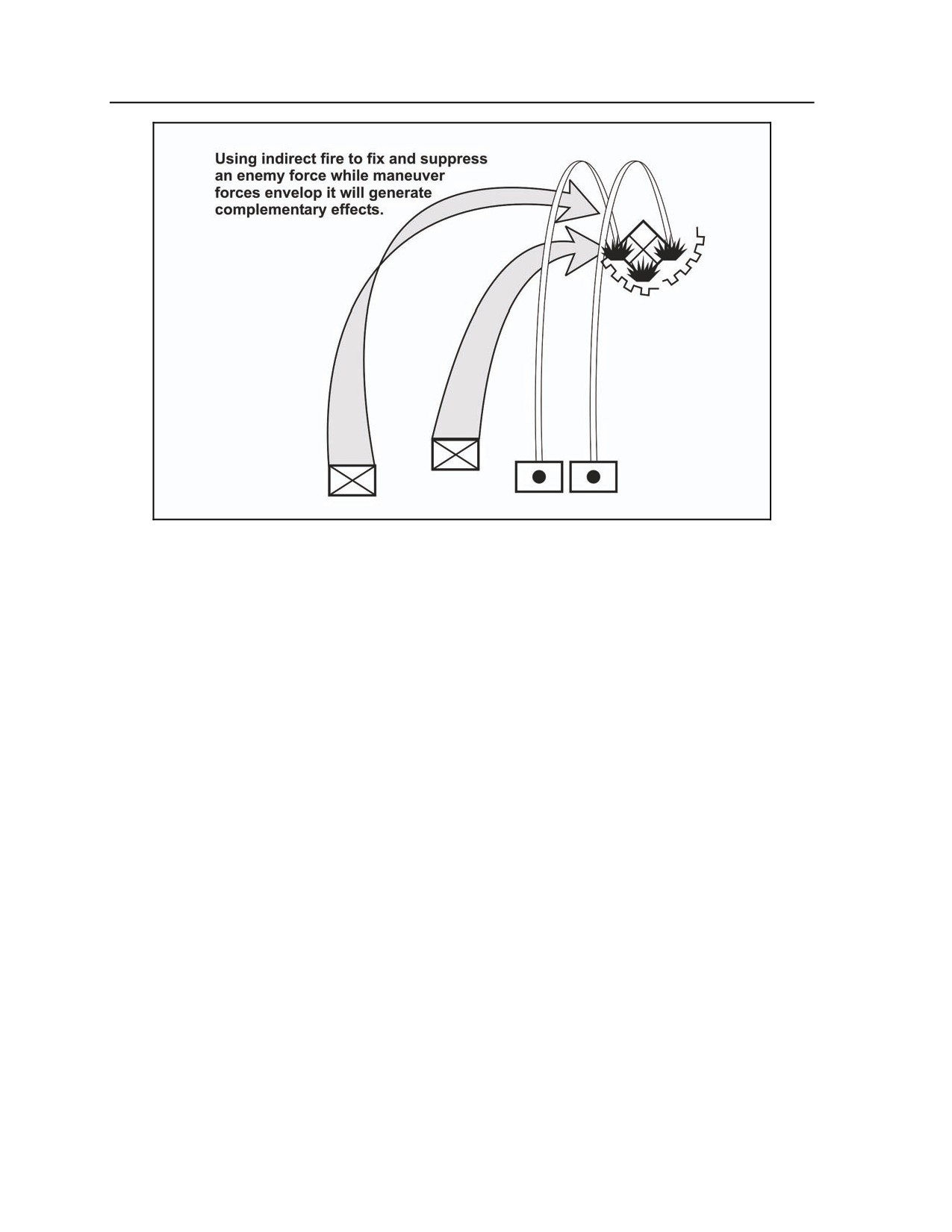
Chapter 1
Figure 1-8. Complementary effects.
DILEMMA
1-103. A dilemma is a situation in which the enemy is presented with two or more equally bad
alternatives. A problem is a situation in which the enemy is presented with only one bad alternative.
Creative combinations allow the leader to create a dilemma for the enemy. When presented with a
dilemma, an enemy has two reactions. The first reaction is not knowing what to do as he attempts to decide
between equally bad options. This effect is commonly termed “fixed.” When the enemy is fixed, the leader
benefits from freedom of action. The second reaction is to simply choose one of the two equally bad
options. Because the enemy’s choice is an option in which the friendly force has the upper hand, the leader
is able to exploit the enemy’s decision.
1-104. Taking a single-tracked approach can lead to poor or unsuccessful results. Relying on one weapon
type, on a single unit type, or a single tactical function does not present the enemy with a dilemma. Without
a complementary effect, the enemy is exposed to a problem that can be resolved with a likely solution.
Even if applied in rapid succession (sequentially), the enemy only needs to escape the problem at hand.
Without a second or third stressor to impair his ability to make good decisions, the enemy is able to react
and stay in the fight.
REINFORCING EFFECTS
1-105. Leaders create reinforcing effects when they combine the effect of similar capabilities (Figure 1
9). An example is a team leader reinforcing the effects of his squad automatic weapon with the fires of his
rifleman. Leaders do this by either employing the elements simultaneously or sequentially to achieve
focused, overwhelming effects at a single point. Simultaneous employment augments the effects of one
element with that of another. Sequential employment sustains the effect longer than if just one element was
used.
1-22
FM 3-21.8
28 March 2007
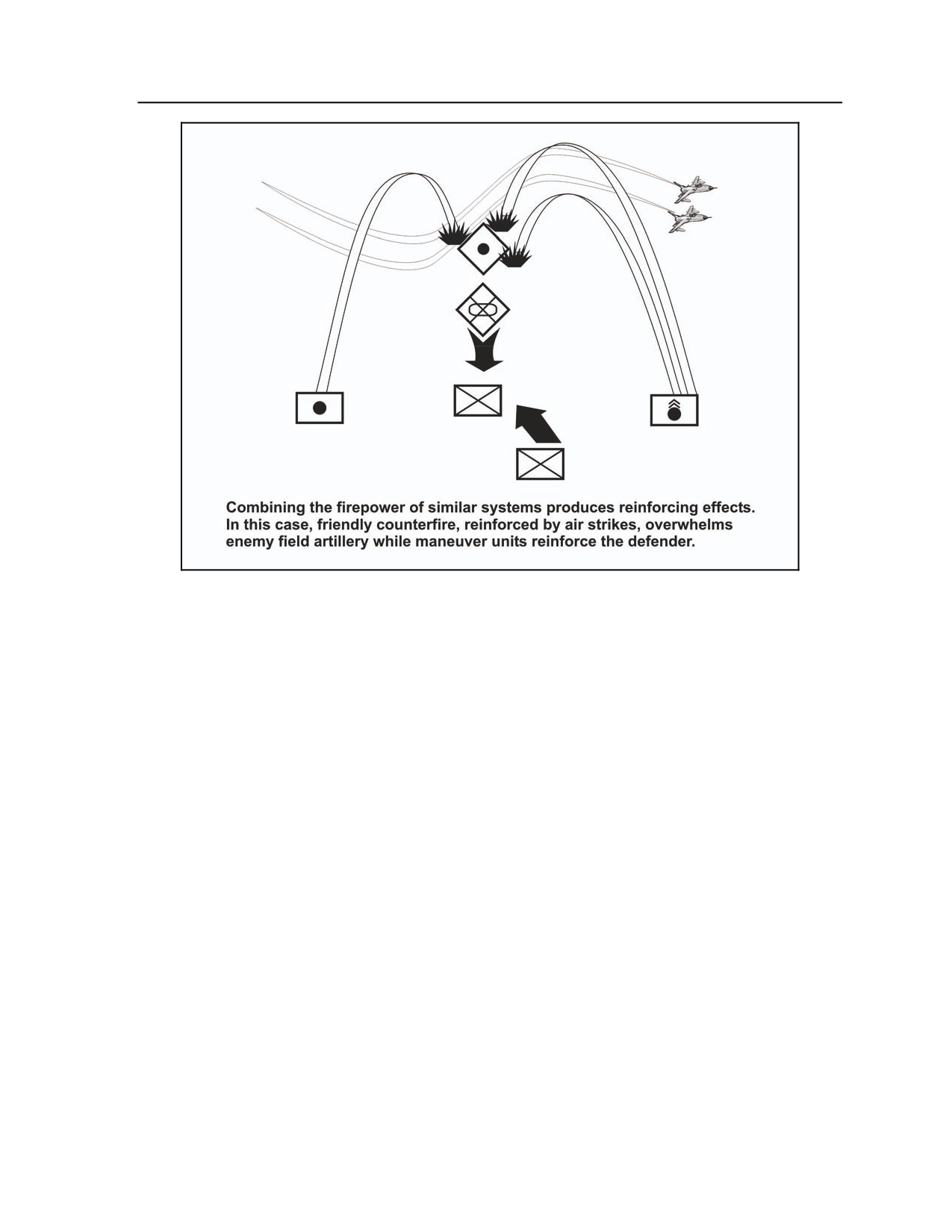
Fundamentals of Tactics
Figure 1-9. Reinforcing effects.
Effective Leaders Confront the Enemy with Dilemmas, Not Problems
1-106. Leaders always seek to present the enemy with a dilemma, not just with problems. There are many
ways to do this including, using combinations of weapons, different types of units, tactics, and terrain.
1-107. In Figure 1-10 a moving enemy Infantry force makes contact with a stationary friendly Infantry
force. There is an exchange of direct fire weapons. The direct fire contact poses a problem to which there is
a solution. The universal reaction to direct fire contact is to get down and return fire. Once the situation
develops, the direct fire effects, by themselves, tend to diminish as the enemy gets behind frontal cover and
returns direct fire.
1-108. Instead of making contact with direct fire, the friendly force may call for indirect fire. This, too,
poses a problem that can be solved with a solution. The universal reaction to indirect fire is for the
receiving unit to move out of the indirect fire burst radius. Once again, as the situation develops, the
indirect fire effects, by themselves, tend to diminish as the enemy moves out of the burst radius to an area
with overhead cover.
1-109. Regardless of how lethal the effects of either direct fire or indirect fire are, by themselves they
only pose problems that have solutions as their effects tend to diminish. Suppose the friendly force makes
contact using both direct and indirect fire systems. What can the enemy do? He has a dilemma—if he gets
up he gets shot, but if he stays down, he gets blown up. The enemy’s dilemma results from the
complementary effects of direct and indirect fire. This is the essence of combined arms warfare.
28 March 2007
FM 3-21.8
1-23
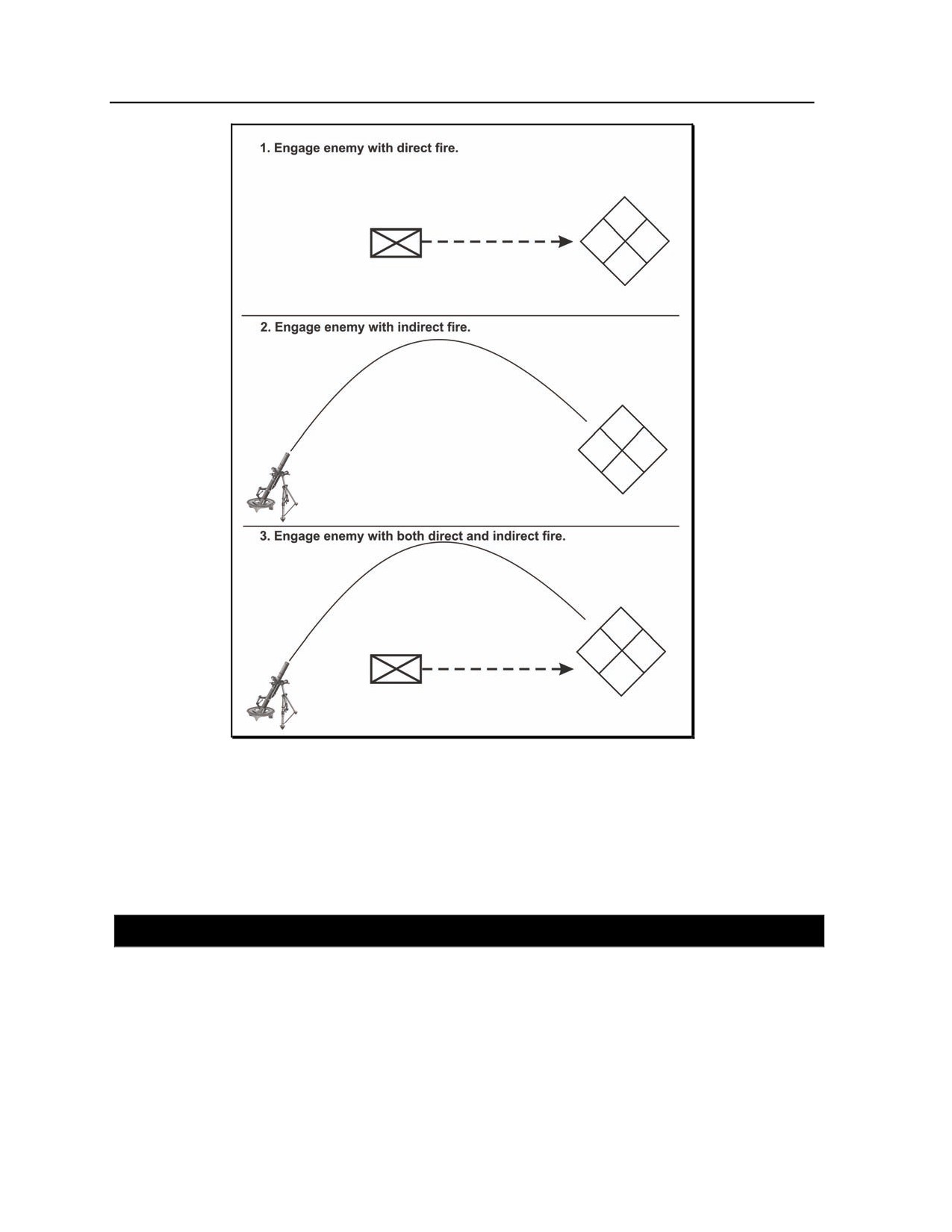
Chapter 1
Figure 1-10. Example of problem versus dilemma.
1-110. To increase their effectiveness, leaders seek to combine both complementary and reinforcing
effects. Continuing with the example from Figure 1-10, if the friendly Infantry has time, it can employ an
obstacle to halt the enemy. The effects of the obstacle reinforce both the effects of direct and indirect fire.
The synchronization of these three elements creates a “no-win” situation for the enemy. The engagement
area development technique is designed using this as a foundation. Engagement area development
combines the complementary effects of direct and indirect fire with the reinforcing effects of obstacles to
produce an engagement area for killing enemy forces.
SECTION V — INDIVIDUAL LEADERSHIP
1-111. Tactical leadership is ultimately about one thing—leading Soldiers to accomplish the mission.
Leadership is influencing people by providing purpose, direction, and motivation while operating to
accomplish the mission and improve the organization (FM 1-02). Leaders need—
Purpose: the reason to accomplish the mission.
Direction: the means to accomplish the mission.
Motivation: the will to accomplish the mission.
1-112. Leaders use command and control (C2) to influence their subordinates to accomplish the mission.
Command is the authority leaders exercise over individuals in their unit by virtue of their assignment.
1-24
FM 3-21.8
28 March 2007
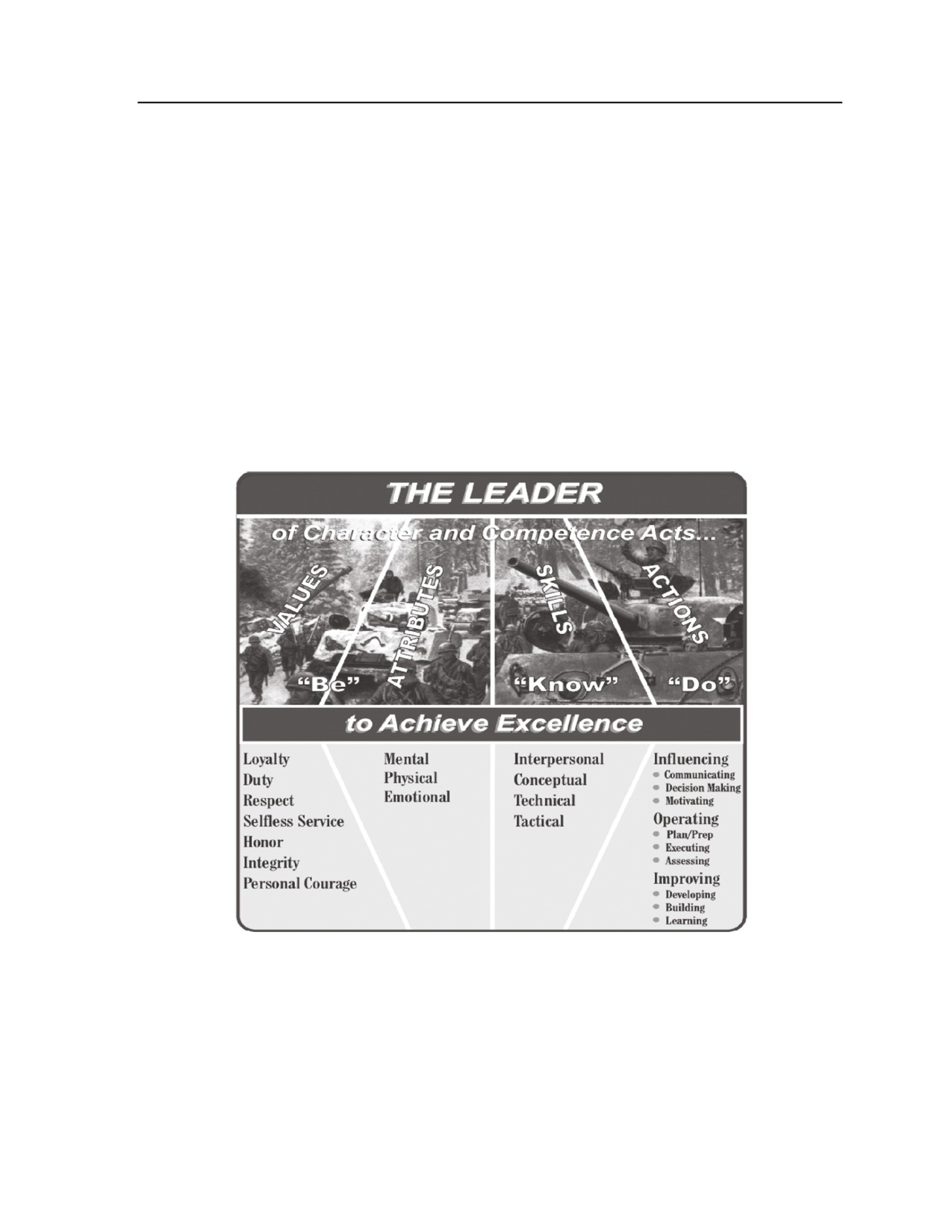
Fundamentals of Tactics
Control is the direction and guidance of subordinates to ensure accomplishment of the mission. Leadership
is the art of exercising C2 to influence and direct men in such a way as to obtain their willing obedience,
confidence, respect, and loyal cooperation to accomplish the mission. Leadership is the most vital
component of C2.
1-113. Professional military leadership involves a combination of personal character and professional
competence with a bias for the right action at the right time for the right effect. Leading Soldiers in combat
is the Infantry leader’s most important challenge.
1-114. There are three core principles that underlie the application of tactical leadership: leadership by
example; authority; and mission command.
LEADERSHIP BY EXAMPLE
1-115. Follow me!—the Infantry motto—best summarizes the principle of leadership by example. This
simple expression is further developed in the Army’s leadership philosophy: Be, Know, Do. Character
describes what a leader must be; competence refers to what leaders must know; action is what leaders must
do (Figure 1-11). These concepts do not stand alone. They are closely connected and together make up who
leaders seek to be (FM 6-22, Army Leadership).
Figure 1-11. Leader by example “Be, Know, Do” principle.
AUTHORITY
1-116. Authority is the delegated power to judge, act, or command. It includes responsibility,
accountability, and delegation (FM 6-0, Mission, Command, and Control). All Infantrymen in positions of
authority are leaders. Leaders exercise authority as they make decisions to accomplish their mission and
lead their Soldiers. Authority involves the right and freedom to use the power of position to carry out
military duties. It carries with it the responsibility to act. Battle command is the exercise of authority
against a hostile, thinking enemy.
28 March 2007
FM 3-21.8
1-25
Chapter 1
1-117. Although commanders alone have the ability to enforce obedience under the Uniform Code of
Military Justice (UCMJ), all leaders can expect subordinates to follow their orders. Commanders who
delegate authority to subordinates are responsible to ensure their subordinates’ lawful orders are followed.
This authority to enforce orders by law if necessary is one of the key elements of military leadership, and
clearly distinguishes military leaders from civilian leaders and managers.
1-118. Infantry leaders also have another source of authority: personal authority. It stems from values,
attributes, personality, experience, reputation, character, personal example, and most of all, tactical and
technical competence. Personal authority, freely granted to a leader by subordinates, ultimately arises from
the actions of the leader, and the trust and confidence generated by these actions. It is often more powerful
than legal authority and is the basis for leadership in the Infantry.
RESPONSIBILITY
1-119. Responsibility is the obligation to carry forward an assigned task to a successful conclusion. It
includes the authority to direct and take the necessary action to ensure success (FM 1-02).
1-120. Leaders have three major responsibilities. First, leaders are responsible for accomplishing all
assigned missions. Second, they are responsible for their Soldiers’ health, welfare, morale, and discipline.
Third, they are responsible for maintaining and employing the resources of their force. In most cases, these
responsibilities do not conflict. However, the leader’s responsibility for mission accomplishment can
conflict with their responsibilities to the Soldier. In an irreconcilable conflict between the two, including
the welfare of the leader himself, mission accomplishment must come first. However, leaders must
understand that the excessive loss of Soldiers and resources can severely inhibit their ability to accomplish
their mission.
1-121. Clear, legal, unambiguous orders are a responsibility of good leadership. Soldiers who receive
illegal orders that clearly violate the Constitution, the Law of War, or the UCMJ must understand how to
react to such orders. Soldiers who receive unclear or illegal orders must ask for clarification. Normally, the
superior issuing the unclear or illegal order will make it clear, when queried. He should state that it was not
his intent to issue an ambiguous or illegal order. If, however, the superior insists that his illegal order be
obeyed, the Soldier should request the rescinding of that order. If the superior does not rescind, the Soldier
has an affirmative legal obligation to disobey the order and report the incident to the next superior
commander.
ACCOUNTABILITY
1-122. Leaders are accountable for their own decisions and for the actions, accomplishments, and failures
of their subordinates. Accountability is non-negotiable and makes up the very backbone of the military
chain of command. It is impossible to exercise authority without accountability. Accountability is included
in the Army’s core values and is what enables us to achieve and maintain legitimacy.
1-123. Accountability has two forms: the UCMJ, and personal accountability. Use of legal authority to
enforce accountability at times may be necessary. However, it should not be used as a way of leading
Soldiers. It is much more practical to foster a climate that uses the trust of personal authority as a basis for
ensuring accountability. Leaders know that American Soldiers respond to trust as the stronger form of
accountability, and that the power of the UCMJ is used only when personal accountability proves
inadequate.
DELEGATION
1-124. Leaders delegate authority to allow subordinates to carry out their duties, and when necessary,
decide and act on behalf of their commander. While leaders can delegate authority, they cannot delegate
responsibility for the outcome of their subordinates’ actions. Subordinates are accountable to their leaders
for how they use their delegated authority.
1-125. When leaders delegate authority, they ensure subordinates understand the limits of their authority
or their freedom of action. A leader’s freedom of action includes his ability and responsibility to make
1-26
FM 3-21.8
28 March 2007
Fundamentals of Tactics
decisions without the approval of the next higher headquarters. Disciplined initiative by subordinates can
only occur when their freedom of action is clearly defined.
MISSION COMMAND
1-126. Mission command is the conduct of military operations through decentralized execution based
upon mission orders for effective mission accomplishment. Successful mission command results from
subordinate leaders at all echelons exercising disciplined initiative within the commander’s intent to
accomplish missions. It requires an environment of trust and mutual understanding
(FM 1-02). A
fundamental tenet of mission command is the importance of people over technology and equipment. There
are too many variables, obstacles, and opportunities for leaders to attempt controlling everything.
Therefore, mission command requires that leaders learn how to think rather than what to think. It
recognizes that the subordinate is often the only person at the point of decision who can make an informed
decision. Guided by the commander's intent, the mission, and the concept of the operation, the leader can
make the right decision. A second fundamental tenet of mission command is that with the authority of
freedom of action comes the subordinate’s leader’s responsibility to always accomplish his mission.
1-127. Mission orders that allow subordinates maximum freedom of planning and action to accomplish
missions are an effective leadership technique in completing combat orders (FM 1-02). Mission orders
leave the “how” of mission accomplishment to the subordinate. This way of thinking emphasizes the
dominance of command rather than control, thereby providing for initiative, the acceptance of risk, and the
rapid seizure of opportunities on the battlefield. Mission command is synonymous with freedom of action
for the leader to execute his mission in the way he sees fit, rather than being told how to do it.
DISCIPLINED INITIATIVE
1-128. Execution of mission command requires initiative, resourcefulness, and imagination. Initiative
must be disciplined because it should emanate from within the framework of the commander's mission,
intent, and concept—not merely from a desire for independent action. Leaders must be resourceful enough
to adapt to situations as they are, not as they were expected to be.
1-129. Disciplined initiative means that subordinates are required to make decisions, coordinate with their
adjacent units, and determine the best way to accomplish their missions. This includes assuming
responsibility for deciding and initiating independent actions when the concept of operations no longer
applies, or when an unanticipated opportunity leading to achieving the commander’s intent presents itself.
1-130. The amount of freedom of action afforded to his subordinates is a judgment call by the leader.
New subordinates or an uncertain environment call for more detail and direction, while experienced
subordinates familiar with the mission profile usually need less detail and direction.
NESTED PURPOSE
1-131. To integrate and synchronize all of their elements, leaders need to provide their subordinates with
a nested purpose, or a common focus. Initiative, taken to the extreme, risks a dangerous loss of control. To
correct this problem, leaders emphasize to subordinates the importance of their battlefield visualization as
well as procedural controls for accomplishing tasks whenever possible.
SECTION VI — TACTICAL DECISIONMAKING
1-132. Tactical decisionmaking is one of the primary ways leaders influence subordinates to accomplish
their mission. It is a process of the leader collecting information, employing a decisionmaking process, and
giving an order to subordinates (Figure 1-12). The information leaders use to make decisions comes from
the higher headquarters, the environment, and the common operating picture (COP). The processes used at
the Infantry platoon and squad levels are troop-leading procedures (TLP) during planning and preparation,
and actions on contact during execution. The combat order is the method of giving subordinates orders.
Throughout this process of decisionmaking, leaders continuously assess the situation and their decisions
using the risk management and after-action review (AAR) processes.
28 March 2007
FM 3-21.8
1-27

Chapter 1
Figure 1-12. Tactical decisionmaking process.
1-133. Decisionmaking involves not only knowing how to make decisions, but knowing if to decide,
when to decide, and what to decide. Understanding that once implemented, some commitments are
irretrievable, leaders anticipate and understand the activities and consequences that follow their decisions.
SUPPORTING CONCEPTS
1-134. U.S. Army leaders use two decision making methods: visualize, describe, direct; and assess,
decide, direct. Visualize, describe, and direct assists leaders in battlefield decisionmaking during planning
and preparation. This method provides the underlying logic behind the TLP decisionmaking. The assess,
decide, and direct method assists leaders in battlefield decisionmaking during operations. It provides the
logic underlying the action-on-contact decisionmaking process.
VISUALIZE, DESCRIBE, DIRECT
1-135. The activities of visualize, describe, and direct are—
Visualize the operation.
Describe the visualization to subordinates.
Direct subordinates with orders that make the visualization a reality.
Visualize
1-136. Effective battlefield leadership requires the leader to see through the fog and friction of military
action and clearly articulate the mission. Visualizing the battlefield is a conceptual skill that requires the
leader to imagine how to accomplish his mission based on the information he receives. Visualization
requires critical reasoning and creative thought. Critical reasoning assists the leader in analyzing and
understanding the situation. Creative thought enables the leader to merge his understanding of the unique
situation with established tactics, techniques, procedures, and unit SOPs to produce a tailored solution to
his tactical problem.
1-137. During operations one of the leader’s primary responsibilities is to develop battlefield
visualization. Four simple questions assist the leader in understanding the mission:
Where do we want to be?
Where are we now?
How do we get from here to there?
What will prevent us from getting there?
1-28
FM 3-21.8
28 March 2007
Fundamentals of Tactics
1-138. The leader’s battlefield visualization is the basis for making sound decisions before, during, and
after operations. However, it is important for the leader to know how much freedom of action he has in
designing his visualization. If the platoon or squad is conducting independent operations, it is likely that he
has the freedom to fully develop his visualization. If the leader’s mission involves conducting platoon
actions within the context of a larger unit’s operations, the leader has less freedom to develop his
visualization. Either way, the leader is always responsible for understanding the next higher leader’s
visualization.
Describe
1-139. Once leaders imagine the future and the means needed to achieve it, they influence their
subordinates by describing their visualization. Their communication, in common doctrinal terms, concepts,
and symbols, helps everyone understand what must be done and how each element contributes to the effort.
1-140. Leaders who communicate effectively—
Display good oral, written, and listening skills.
Persuade others.
Express thoughts and ideas clearly to individuals and groups.
Direct
1-141. Leaders issue orders to direct subordinates. Examples include combat orders and fire commands.
Orders can be oral or written.
ASSESS, DECIDE, DIRECT
1-142. Leaders assess by monitoring the situation through reports from subordinates and personal
observation. The information they receive is then evaluated against how the operation or action was
visualized. Leaders make many decisions during execution. Some are planned. Others are unforeseen; so
leaders prepare for both. They use combat orders and procedural and positive controls to direct
subordinates during execution.
1-143. Even when things are progressing satisfactorily, certain critical ongoing tasks must be
accomplished. At the platoon and squad level these include—
Focus on the decisive action.
Ensure security.
Monitor and adjust control measures.
Perform battle tracking (control fires and control movement).
Monitor sustaining actions.
TROOP-LEADING PROCEDURES
1-144. Troop-leading procedures (TLP) provide leaders a framework for decisionmaking during the plan
and prepare phases of an operation. This eight-step procedure applies the logic of visualize, describe, and
direct to the plan and prepare functions of the operations process. Steps in the TLP include:
Receive the mission.
Issue a warning order (WARNO).
Make a tentative plan.
Initiate movement.
Conduct reconnaissance.
Complete the plan.
Issue the order.
Supervise and assess.
1-145. For a complete discussion on making a tentative plan, see Chapter 6.
28 March 2007
FM 3-21.8
1-29
///////////////////////////////////////