FM 3-21.8 (FM 7-8) The Infantry Rifle Platoon and Squad (MARCH 2007) - page 2
Chapter 1
RECEIVE THE MISSION
1-146. Leaders receive their missions in several ways—ideally through a series of warning orders
(WARNOs), operation orders (OPORD)s, and briefings from their leader/commander. However, the tempo
of operations often precludes this ideal sequence, particularly at the lower levels. This means that leaders
may often receive only a WARNO or a fragmentary order (FRAGO), but the process is the same.
1-147. After receiving an order, leaders are normally required to give a confirmation briefing to their
higher commander. This is done to clarify their understanding of the commander’s mission, intent, and
concept of the operation, as well as their role within the operation. The leader obtains clarification on any
portions of the higher headquarters’ plan as required.
1-148. Upon receiving the mission, leaders perform an initial assessment of the situation (mission, enemy,
terrain, troops-time, civil [METT-TC] analysis), focusing on the mission, the unit’s role in the larger
operation, and allocating time for planning and preparing. The two most important products from this initial
assessment should be at least a partial restated mission, and a timeline. Leaders issue their initial WARNO
on this first assessment and time allocation.
1-149. Based on their knowledge, leaders estimate the time available to plan and prepare for the mission.
They issue a tentative timeline that is as detailed as possible. In the process they allocate roughly one-third
of available planning and preparation time to themselves, allowing their subordinates the remaining two-
thirds. During fast-paced operations, planning and preparation time might be extremely limited. Knowing
this in advance enables leaders to emplace SOPs to assist them in these situations.
ISSUE A WARNING ORDER
1-150. Leaders issue the initial WARNO as quickly as possible to give subordinates maximum time to
plan and prepare. They do not wait for additional information. The WARNO, following the five-paragraph
field order format, contains as much detail as available. At a minimum, subordinates need to know critical
times like the earliest time of movement, and when they must be ready to conduct operations. Leaders do
not delay in issuing the initial WARNO. As more information becomes available, leaders can—and
should—issue additional WARNOs. At a minimum the WARNO normally includes:
Mission or nature of the operation.
Time and place for issuing the OPORD.
Units or elements participating in the operation.
Specific tasks not addressed by unit SOP.
Timeline for the operation.
Rehearsal guidance.
MAKE A TENTATIVE PLAN
1-151. Once he has issued the initial WARNO, the leader continues to develop a tentative plan. Making a
tentative plan follows the basic decisionmaking method of visualize, describe, direct, and the Army
standard planning process. This step combines steps 2 through 6 of the military decisionmaking process:
mission analysis, COA development, COA analysis, COA comparison, and COA selection. At the Infantry
platoon level, these steps are often performed mentally. The platoon leader and squad leaders may include
their principal subordinates—especially during COA development, analysis, and comparison.
1-152. To frame the tentative plan, Army leaders perform mission analysis. This mission analysis follows
the METT-TC format, continuing the initial assessment performed in TLP step 1. This step is covered in
detail in Chapter 6.
INITIATE MOVEMENT
1-153. Movement of the unit may occur simultaneously with the TLPs. Leaders initiate any movement
necessary to continue mission preparation or position the unit for execution. They do this as soon as they
have enough information to do so, or when the unit is required to move to position itself for the upcoming
1-30
FM 3-21.8
28 March 2007
Fundamentals of Tactics
mission. Movements may be to an assembly area, a battle position, a new AO, or an attack position. They
may include movement of reconnaissance elements, guides, or quartering parties. Infantry leaders can
initiate movement based on their tentative plan and issue the order to subordinates in the new location.
CONDUCT RECONNAISSANCE
1-154. Whenever time and circumstances allow, leaders personally conduct reconnaissance of critical
mission aspects. No amount of planning can substitute for firsthand assessment of the situation.
Unfortunately, many factors can keep leaders from performing a personal reconnaissance. However, there
are several means available to the leader to develop and confirm his visualization. They include: internal
reconnaissance and surveillance elements, unmanned sensors, the higher unit’s intelligence, surveillance,
reconnaissance (ISR) elements, adjacent units, map reconnaissance, imagery, and intelligence products.
One of the most difficult aspects of conducting reconnaissance is the process of identifying what the leader
needs to know (the information requirements [IR]).
COMPLETE THE PLAN
1-155. During this step, leaders incorporate the result of reconnaissance into their selected course of
action (COA) to complete the plan and order. This includes preparing overlays, refining the indirect fire
target list, coordinating sustainment and C2 requirements, and updating the tentative plan as a result of the
reconnaissance. At the platoon and squad levels, this step normally involves only confirming or updating
information contained in the tentative plan. If time allows, leaders make final coordination with adjacent
units and higher headquarters before issuing the order.
ISSUE THE ORDER
1-156. Infantry platoon and squad leaders normally issue verbal combat orders supplemented by graphics
and other control measures. The order follows the standard five-paragraph field order format. Infantry
leaders use many different techniques to convey their orders (see Chapter 6). Typically, platoon and squad
leaders do not issue a commander’s intent. They reiterate the intent of their company and battalion
commanders.
1-157. The ideal location for issuing the order is a point in the AO with a view of the objective and other
aspects of the terrain. The leader may perform reconnaissance, complete the order, and then summon
subordinates to a specified location to receive it. At times, security or other constraints make it infeasible to
issue the order on the terrain. In such cases, leaders use a sand table, detailed sketch, maps, aerial photos
and images, and other products to depict the AO and situation.
SUPERVISE AND ASSESS
1-158. This final step of the TLP is crucial. Normally unit SOPs state individual responsibilities and the
sequence of preparation activities. After issuing the OPORD, the platoon leader and his subordinate leaders
must ensure the required activities and tasks are completed in a timely manner prior to mission execution. It
is imperative that both officers and NCOs check everything that is important for successful mission
accomplishment. The process should include:
Ensuring the second in command of each element is prepared to execute in their leader’s
absence.
Listening to subordinate operation orders.
Checking load plans to ensure Soldiers are carrying only what is necessary for the mission
and or what was specified in the OPORD.
Checking the status and serviceability of weapons.
Checking on maintenance activities of subordinate units.
Ensuring local security is maintained.
Conducting rehearsals.
28 March 2007
FM 3-21.8
1-31
Chapter 1
1-159. Platoons and squads use five types of rehearsals:
(1) Confirmation brief.
(2) Backbrief.
(3) Combined arms rehearsal.
(4) Support rehearsal.
(5) Battle drill or SOP rehearsal.
ACTIONS ON CONTACT
1-160. Actions on contact involve a series of combat actions, often conducted simultaneously, taken upon
contact with the enemy to develop the situation (FM 1-02). Leaders use the actions-on-contact process as a
decisionmaking technique when in contact with the enemy. This process should not be confused with battle
drills such as Battle Drill “React to Contact.” Battle drills are the actions of individual Soldiers and small
units when they come into contact with the enemy. Action on contact is a leader tool for making decisions
while their units are in contact. The process assists the leader in decisionmaking concurrent with fighting
his unit and assessing the situation.
1-161. The logic of assess, decide, and direct underlies the actions-on-contact decisionmaking process. As
the leader evaluates and develops the situation, he assesses what is currently happening and its relation to
what should be happening. The following four steps must be taken in the actions on contact process.
STEP 1 - DEPLOY AND REPORT
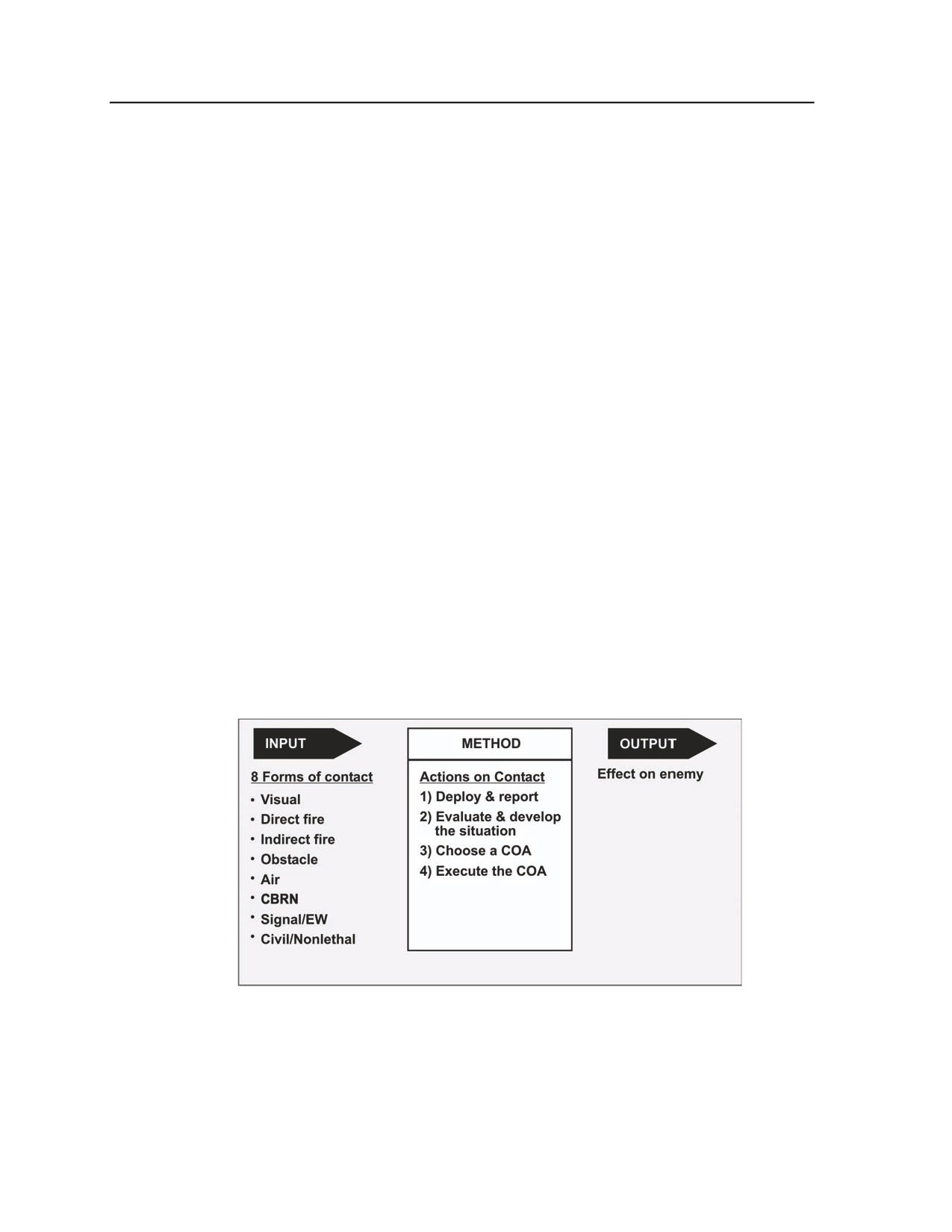
1-162. This step begins with enemy contact. Figure 1-13 details the forms of contact. This contact may be
expected or unexpected. During this step, subordinates fight through the contact with the appropriate battle
drill. While this is occurring, leadership has the following primary tasks:
Fix the enemy.
Isolate the enemy.
Separate the enemy forces from each other by achieving fire superiority.
Report to higher.
Begin “fighting” for information—actively pursue and gather it.
Figure 1-13. Enemy contact decisionmaking model.
1-163. During the TLP, leaders develop a vision of how their operation will unfold. Part of this process
involves the leader anticipating where he expects the unit to make contact. This enables him to think
through possible decisions in advance. If the leader expects contact, he will have already deployed his unit
by transitioning from tactical movement to maneuver. Ideally, the overwatching element will make visual
contact first. Because the unit is deployed, it will likely be able to establish contact on its own terms. If the
1-32
FM 3-21.8
28 March 2007
Fundamentals of Tactics
contact occurs as expected, the leader goes through the procedure making decisions as anticipated and
minor adjustments as required.
1-164. Regardless of how thorough the leader’s visualization, there will always be cases in which the unit
makes unexpected contact with the enemy. In this case, it is essential that the unit and its leader take actions
to quickly and decisively take back the initiative.
STEP 2 - EVALUATE AND DEVELOP THE SITUATION
1-165. This step begins with the leader evaluating and developing the situation. The leader quickly
gathers the information he needs to make a decision on his course of action. He does this through either
personal reconnaissance or reports from subordinates. At a minimum, the leader needs to confirm the
friendly situation and determine the enemy situation using the SALUTE format (size, activity, location,
unit, time, and equipment), and enemy capabilities (defend, reinforce, attack, withdraw, and delay). During
this analysis, the leader should look for an enemy vulnerability to exploit.
1-166. As part of developing the situation, the leader seeks a position of advantage to maneuver his force.
During this process, the leader considers the following:
Mutually supporting enemy positions.
Obstacles.
The size of the enemy force engaging the unit. (Enemy strength is indicated by the number of
enemy automatic weapons, the presence of any vehicles, and the employment of indirect
fires.)
A vulnerable flank to the position.
A covered and concealed route to the flank of the position.
1-167. If after his initial evaluation the leader still lacks information, he may attempt one or all of the
following to get the information he needs:
Reposition a subordinate(s) or a subordinate unit.
Reconnaissance by fire.
Request information from adjacent units or from the controlling headquarters.
STEP 3 - CHOOSE A COA
1-168. After developing the situation, the leader determines what action his unit must take to successfully
conclude the engagement. The leader then determines if the chosen task is consistent with the original
COA. If it still applies, he continues the mission. If it is not consistent, he issues a FRAGO modifying the
original COA. If the leader is unsure, he continues to develop the situation and seeks guidance from higher.
In general, the following options are open to the leader:
Achieve fire superiority by assault/attack (including standard Infantry battle drills).
Support by fire for another unit.
Break contact.
Defend.
Bypass enemy position.
1-169. The order of COAs listed above is relative to the effectiveness of fire and strength of the enemy
position. If the enemy is an inferior force, the unit in contact should be able to achieve fire superiority and
still have enough elements to conduct movement to attack the enemy force. If the entire unit is needed to
gain and maintain fire superiority, the next feasible COA is to establish a support by fire so another element
can conduct movement to attack the enemy. If the unit cannot achieve fire superiority, or there is no other
element to conduct an assault, the unit breaks contact. If the unit is decisively engaged and cannot break
contact, it establishes a defense until assistance from another unit arrives. In some instances, based on
METT-TC, the unit may bypass the enemy position.
28 March 2007
FM 3-21.8
1-33
Chapter 1
STEP 4 - EXECUTE THE COA
1-170. Following his decision, the leader gives the order. When describing his visualization, he uses
doctrinal terms and concepts and the five-paragraph field order format. The leader only needs to state those
directions and orders that have changed from the original order and emphasizes other items he deems
essential.
1-171. During this step, the leader must direct the engagement. There are three key things that the leader
needs to control: movement; fires; and unit purpose. These controls may be standard procedures or hands-
on positive controls.
RISK MANAGEMENT
1-172. Risk management is the process leaders use to assess and control risk. There are two types of risk
associated with any combat action: tactical hazards that result from the presence of the enemy; and
accidental hazards that result from the conduct of operations. All combat incurs both risks. The objective is
to minimize them to acceptable levels. The following four considerations will help the leader identify risk
to the unit and the mission (see Chapter 4):
Define the enemy action.
Identify friendly combat power shortfall.
Identify available combat multipliers, if any, to mitigate risk.
Consider the risks: acceptable or unacceptable?
AFTER-ACTION REVIEWS
1-173. An after-action review (AAR) is an assessment conducted after an event or major activity that
allows participants to learn what and why something happened, and most importantly, how the unit can
improve through change. This professional discussion enables units and their leaders to understand why
things happened during the progression of an operation, and to learn from that experience. This learning is
what enables units and their leaders to adapt to their operational environment. The AAR does not have to
be performed at the end of the activity. Rather, it can be performed after each identifiable event (or
whenever feasible) as a live learning process.
1-174. The AAR is a professional discussion that includes the participants and focuses directly on the
tasks and goals. While it is not a critique, the AAR has several advantages over a critique:
It does not judge success or failure.
It attempts to discover why things happened.
It focuses directly on the tasks and goals that were to be accomplished.
It encourages participants to raise important lessons in the discussion.
More Soldiers participate so more of the project or activity can be recalled and more lessons
can be learned and shared.
1-175. Leaders are responsible for training their units and making their units adapt. The AAR is one of the
primary tools used to accomplish this. It does this by providing feedback, which should be direct and on the
spot. Each time an incorrect performance is observed, it should be immediately corrected so it does not
interfere with future tasks. During major events or activities, it is not always easy to notice incorrect
performances. An AAR should be planned at the end of each activity or event. In doing so, feedback can
be provided, lessons can be learned, and ideas and suggestions can be generated to ensure the next project
or activity will be an improved one.
1-176. An AAR may be formal or informal. Both follow the same format and involve the exchange of
observations and ideas. Formal AARs are usually more structured and require planning. Informal AARs
can be conducted anywhere and anytime to provide quick learning lessons. The AAR format follows:
Gather all the participants.
Go through introductions and rules.
1-34
FM 3-21.8
28 March 2007
Fundamentals of Tactics
Review events leading to the activity (what was supposed to happen).
Give a brief statement of the specific activity.
Summarize key events. Encourage participation.
Have junior leaders restate portions of their part of the activity.
1-177. The art of an AAR is in obtaining mutual trust so people will speak freely. Problem solving should
be practical and Soldiers should not be preoccupied with status, territory, or second guessing "what the
leader will think." There is a fine line between keeping the meeting from falling into chaos where little is
accomplished, to people treating each other in a formal and polite manner that masks issues (especially
with the leader).
1-178. The AAR facilitator should—
Remain unbiased throughout the review.
Ask open-ended questions to draw out comments from all.
Do not allow personal attacks.
Focus on learning and continuous improvement.
Strive to allow others to offer solutions rather than offering them yourself.
Find solutions and recommendations to make the unit better.
1-179. To avoid turning an AAR into a critique or lecture—
Ask why certain actions were taken.
Ask how Soldiers reacted to certain situations.
Ask when actions were initiated.
Ask leading and thought-provoking questions.
Exchange "war stories" (lessons learned).
Ask Soldiers to provide their own point of view on what happened.
Relate events to subsequent results.
Explore alternative courses of actions that might have been more effective.
Handle complaints positively.
When the discussion turns to errors made, emphasize the positive and point out the difficulties
of making tough decisions.
Summarize.
Allow junior leaders to discuss the events with their Soldiers in private.
Follow up on needed actions.
SECTION VII — COMBAT POWER
1-180. Combat power is the ability of a unit to fight. To generate combat power, Army forces at all levels
conduct operations. An operation is a military action or carrying out of a mission (FM 1-02). Leaders at the
operational level of war develop operations in response to receiving strategic guidance. These operations
consist of numerous component operations, tasks, and actions. Within these operations, leaders at the
operational level assign their subordinate’s missions. These subordinates, in turn, develop operations to
accomplish their mission. They then assign the mission to subordinates as part of their overall operations.
This chain of events continues until the Infantry platoon and squad receives its mission. Leaders at all
levels use many tools to develop and conduct operations. Two of the most important tools are—
The four critical functions.
Full spectrum operations doctrine.
FOUR CRITICAL FUNCTIONS
1-181. Most combat actions follow the sequence of find, fix, finish, and follow-through. First, the unit
must find the enemy and make contact. Second, they fix the enemy with direct and indirect fires. Third, the
28 March 2007
FM 3-21.8
1-35
Chapter 1
unit must finish the enemy with fire and movement directed towards a vulnerable point in order to fight
through to defeat, destroy, or capture the enemy. Fourth, the unit must follow-through with consolidation,
reorganization, and preparing to continue the mission or receive a new mission.
1. FIND THE ENEMY
1-182. At the individual, crew, and squad and platoon levels, finding the enemy directly relates to target
acquisition. Target acquisition is the process of searching for the enemy and detecting his presence;
determining his actual location and informing others; and confirming the identity of the enemy (not a friend
or noncombatant). The most common method of target acquisition is assigning sectors to subordinates.
Once assigned, Soldiers use search techniques within their sectors to detect potential targets.
1-183. There are many different sources for finding the enemy. They include:
Other Soldiers, crews, squads and platoons.
Forward observers.
Reconnaissance elements (scouts, reconnaissance units, cavalry, and long-range surveillance
units).
Aviation assets such as the OH58D.
Unmanned aircraft system(s) (UAS).
Lightweight Counter-mortar Radar (LCMR).
Special Forces.
1-184. Finding the enemy consists of physically locating him and determining his disposition. Enemy
strength, composition, capabilities, probable COA, and exploitable vulnerabilities are important
determinations made in the location process. The leader seeks to develop the situation as much as possible
out of contact with the enemy. Once in contact, he fights for the information he needs to make decisions.
Plan and Prepare
1-185. Finding the enemy begins long before the unit moves across the line of departure (offense) or
occupies its battle position (defense). During planning, the leader’s METT-TC analysis is essential to
developing the clearest picture of where the enemy is located, the probable COA, and the most dangerous
COA. When there is little information about the enemy, a detailed analysis of terrain will assist the leader
in predicting enemy actions. During preparation, the leader sends out his reconnaissance or submits his
information requirements to higher headquarters to develop the enemy picture as thoroughly as possible.
Execute
1-186. During execution, the unit’s first priority is to find the enemy before the enemy finds them. This
involves employing good cover, concealment, camouflage, and deception while denying the enemy the
same. During tactical movement, the unit must have an observation plan that covers their entire area of
influence. Additionally, the leader takes measures to detect enemies in the unit’s security zone.
1-187. Once found, the leader has a decision to make. In the offense, the leader must determine if he has
enough forces to fix the enemy or if he should pass the enemy position off to a separate fixing force. In the
defense, he must determine if he has enough forces to disrupt the enemy or if he should pass the enemy
force off to a separate fixing force.
2. FIX
1-188. Immediately after finding the enemy, the leader has to fix the enemy in place. Fixing the enemy
holds him in position. When the enemy is fixed, the leader can maneuver to the enemy’s vulnerable point
without the fear of being attacked in an exposed flank, or of more enemy forces reinforcing. Fixing the
enemy normally consists of one of the following tactical mission tasks: support by fire, attack by fire,
suppress, destroy, or block. An enemy that is fixed is affected physically and or psychologically. The
means to achieve this effect—lethal, nonlethal, and combinations thereof—are endless.
1-36
FM 3-21.8
28 March 2007
Fundamentals of Tactics
1-189. Fixing the enemy is accomplished through isolation. “Isolate” means cutting the adversary off
from the functions necessary to be effective. Isolation has both an external aspect of cutting off outside
support and information, and an internal aspect of cutting off mutual support. Isolating the adversary also
includes precluding any break in contact.
1-190. External isolation stops any of the fixed enemy force from leaving the engagement while
preventing any other enemy force from reinforcing the fixed force. Actions outside of the objective area
prevent enemy forces from entering the engagement. Internal isolation occurs by achieving fire superiority
that prevents the enemy from repositioning and interfering with friendly maneuver elements.
1-191. Isolating the objective is a key factor in facilitating the assault and preventing casualties. Isolating
the objective also involves seizing terrain that dominates the area so the enemy cannot supply, reinforce, or
withdraw its defenders. Infantry platoons and squads may perform this function as a shaping element for a
company operation, or it may assign subordinates this function within its own organization. In certain
situations, the squads or platoon may isolate an objective or an area for special operations forces.
Depending on the tactical situation, Infantry platoons may use infiltration to isolate the objective.
1-192. The enemy is fixed when his movement is stopped, his weapons suppressed, and his ability to
effectively respond disrupted. Once fixed, the leader has a decision to make. In the offense, the leader must
determine if he has enough forces to assault the enemy, or if he needs to request a separate assault element
from the controlling headquarters. In the defense, he must determine if he has enough forces to
counterattack, or if he needs to request a separate counterattack force from the controlling headquarters.
3.
FINISH
1-193. After finding and fixing the enemy, the leader finishes the fight. In the offense, this is known as the
assault; in the defense, this is known as the counterattack. Finishing the enemy normally consists of one of
the following tactical mission tasks: clear, seize, or destroy. It is extremely important that leaders
understand the necessity to “have something left” when finishing the enemy and for the next step—follow
through. Failure to have enough combat power at the decisive point or during consolidation puts the unit at
risk to counterattack. The fight is finished when the enemy—
No longer has the physical ability to fight (meaning he is destroyed).
Has determined physical destruction is imminent.
No longer believes he can resist (meaning he is in shock).
4.
FOLLOW -THROUGH
1-194. Follow-through involves those actions that enable the unit to transition from close combat to
continuing the mission. It includes conducting consolidation and reorganization and exploiting success.
Transitioning the unit from the violence of close combat back to a state of high readiness is difficult. Units
are most vulnerable at the conclusion of close combat, and decisive leadership is absolutely essential to
make the transition. Continuing the attack or counterattacking may be a deliberate phase of the operation (a
“be-prepared-to” or “on-order” mission). It may also be a decision made by the controlling commander
based on a window of opportunity.
DOCTRINAL HIERARCHY OF OPERATIONS
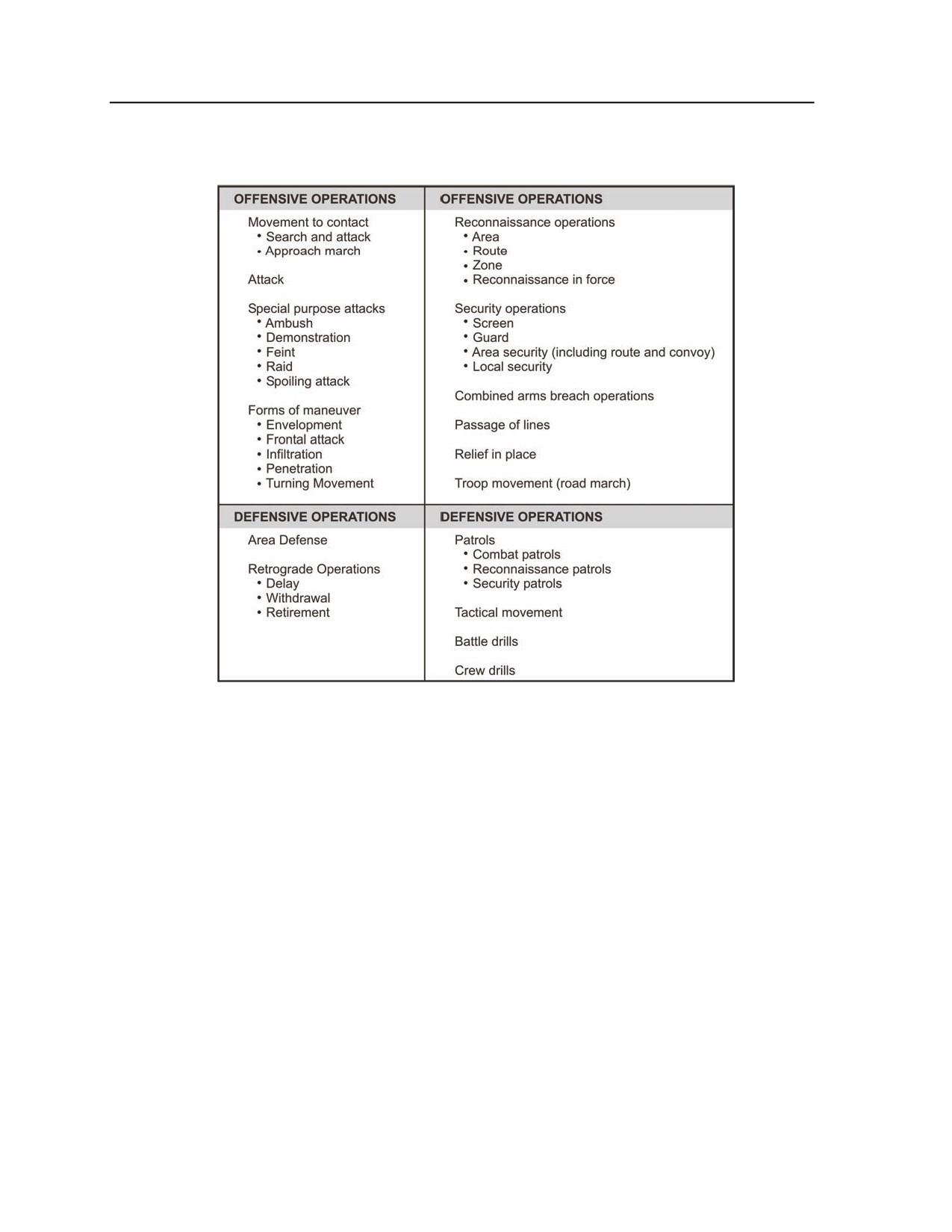
1-195. Figure 1-14 shows the doctrinal hierarchy and the relationship between the types and subordinate
forms of operations. While an operation’s predominant characteristic labels it as an offensive, defensive,
stability, or civil support operation, different units involved in that operation may be conducting different
types and subordinate forms of operations. These units often transition rapidly from one type or subordinate
form to another. While positioning his forces for maximum effectiveness, the commander rapidly shifts
from one type or form of operation to another to continually keep the enemy off balance. Flexibility in
transitioning contributes to a successful operation.
1-196. Infantry platoons and squads conduct all the types of operations listed in the doctrinal hierarchy.
However, the Infantry platoon and squad will almost always conduct these operations and their subordinate
28 March 2007
FM 3-21.8
1-37
Chapter 1
forms and types as part of a larger unit. In fact, many of these types of operations are only conducted at the
battalion, brigade, or division level. Only the types of operations applicable to Infantry platoons and squads
are further covered in this manual.
Figure 1-14. Doctrinal hierarchy of operations.
OFFENSIVE OPERATIONS
1-197. Offensive operations aim to destroy or defeat an enemy. Their purpose is to impose U.S. will on
the enemy and achieve decisive victory (FM 3-0, Operations). Dominance of the offense is a basic tenet of
U.S. Army operations doctrine. While the defense is the stronger form of military action, the offense is the
decisive form. Tactical considerations may call for Army forces to execute defensive operations for a
period of time. However, leaders are constantly looking for ways to shift to the offense. Offensive
operations do not exist in a vacuum—they exist side by side with defense, and tactical enabling operations.
Leaders analyze the mission two levels up to determine how their unit’s mission nests within the overall
concept. For example, an Infantry platoon leader would analyze company and battalion missions.
1-198. Effective offensive operations require accurate intelligence on enemy forces, weather, and terrain.
Leaders then maneuver their forces to advantageous positions before contact. Contact with enemy forces
before the decisive action is deliberate and designed to shape the optimum situation for the decisive action.
The decisive action is sudden and violent, capitalizing on subordinate initiative. Infantry platoon and squad
leaders therefore execute offensive operations and attack with surprise, concentration, tempo, and audacity.
1-199. There is a subtle difference between attacking and conducting an attack. Attacking in everyday
usage generally means the close combat action of fire and movement on an enemy or position. Attacking
occurs frequently on the battlefield in all types of operations. Conducting an attack is one of the four types
of offensive operations with specific doctrine meanings and requirements.
1-38
FM 3-21.8
28 March 2007
Fundamentals of Tactics
Offensive Purposes
1-200. How a unit conducts its offensive operations is determined by the mission’s purpose and overall
intent. There are four general purposes for the offense: throw the enemy off balance; overwhelm the
enemy’s capabilities; disrupt the enemy’s defense; and ensure their defeat or destruction. In practice, each
of these purposes has orientation on both the enemy force and the terrain. The labels merely describe the
dominant characteristic of the operation.
Enemy-Oriented
1-201. Leaders employ enemy-oriented attacks to destroy enemy formations and their capabilities.
Destruction results in an enemy unit (Soldiers and their equipment) that is no longer able to fight. Not
everything has to be destroyed for the force-oriented attack offense to be successful. It is usually enough to
focus on an enemy capability or unit cohesion. These attacks are best employed against an enemy
vulnerability. Once destruction occurs, a window of opportunity opens. It is up to the leader to take
advantage of an unbalanced enemy through local and general exploitations and pursuit.
Terrain-Oriented
1-202. Leaders employ terrain-oriented attacks to seize control of terrain or facilities. Units conducting
terrain-oriented attacks have less freedom of action to take advantage of a window of opportunity. The
unit’s first priority is the terrain or facility. Exploiting an enemy vulnerability can occur only when the
security of the terrain or facility is no longer in question.
Tactical Enabling and Infantry Platoon Actions
1-203. Although friendly forces always remain enemy focused, there are many actions friendly forces
conduct that are offensive in nature and are designed to shape or sustain other operations. Leaders employ
tactical enabling operations to support the overall purpose of an operation.
Types of Offensive Operations
1-204. Types of offensive operations are described by the context surrounding an operation (terrain or
force oriented). At the platoon and squad level, these offensive operations are basically planned, prepared
for, and executed the same. The four types of offensive operations include:
(1) Movement to Contact - undertaken to gain or regain contact with the enemy (force-oriented).
(2) Attack - undertaken to achieve a decisive outcome (terrain-oriented or force-oriented).
(3) Exploitation - undertaken to take advantage of a successful attack (force-oriented).
(4) Pursuit - undertaken to destroy an escaping enemy (force-oriented).
1-205. This order of offensive operations is deliberate because they are listed in order of their normal
occurrence. Generally, leaders conduct a movement to contact to find the enemy. When the leader has
enough information about the enemy to be successful, he conducts an attack. Following a successful attack,
the leader takes advantage of the enemy’s disorganization and exploits the attack’s success. After
exploiting his success, the leader executes a pursuit to catch or cut off a fleeing enemy to complete its
destruction. Although Infantry platoons and squads participate in exploit and pursuit operations, they do not
plan them.
DEFENSIVE OPERATIONS
1-206. Defensive operations defeat an enemy attack, buy time, economize forces, or develop conditions
favorable for offensive operations. Defensive operations alone normally cannot achieve a decision. Their
overarching purpose is to create conditions for a counteroffensive that allows Army forces to regain the
initiative (FM 1-02). Defensive operations do not exist in a vacuum—they exist side by side with offense,
tactical enabling operations, and Infantry platoon actions. Leaders analyze the mission two levels up to
determine how their unit’s mission nests within the overall concept.
28 March 2007
FM 3-21.8
1-39
Chapter 1
1-207. The principles of tactical maneuver also apply to the defense. To be decisive, defensive tactics
must have both ingredients. Ensuring mobility remains a part of the defense is one of the leader’s greatest
challenges. While it is true that defending forces await the attacker’s blow and defeat the attack by
successfully deflecting it, this does not mean that defending is a passive activity. Leaders always look for
ways to integrate movement into their defensive activities.
1-208. During the conduct of operations, regardless of type, friendly forces make many transitions
requiring the unit to stop and restart movement. Infantry platoons and squads that are not moving are
defending. Units that stop moving (attacking), immediately transition to defending. This transition is rapid
and should be second nature to all Soldiers and their units. This is particularly relevant at the Infantry
platoon and squad levels where the tactical situation can quickly shift to one where the unit is outnumbered
and fighting for its survival.
Defensive Purposes
1-209. How a unit establishes its defenses is determined by the mission’s purpose and intent. There are
four general purposes for conducting a defense: defeat an attacking enemy; economize friendly forces in
one area so they can be concentrated in another area; buy time; and develop conditions favorable for
resuming offensive operations. In practice, each of these stated purposes for conducting a defense is
considered in all defenses; the categories just describe the dominant purpose. Infantry platoons and squads
can also be tasked to defend specific locations such as key terrain or facilities.
Defeat an Attacking Enemy and Develop Conditions for Offensive Operations
1-210. Defenses are designed to defeat enemy attack while preserving friendly forces. Defeating the
enemy’s attack requires him to transition to his own defensive actions. While this occurs, a window of
opportunity for friendly forces may also occur. It is up to the leader to take advantage of an unbalanced
enemy through local and general counterattacks.
Economy of Force to Concentrate in Another Area
1-211. Commanders seldom have all the combat forces they desire to conduct operations without
accepting risk. Economy of force is defined as allocating minimum essential combat power to secondary
efforts
(FM 1-02). It requires accepting prudent risk in selected areas to achieve superiority—
overwhelming effects—in the decisive operation. As a result, commanders arrange forces in space and time
to create favorable conditions for a mobile defense and offensive operations in other areas.
Buy Time
1-212. Defenses to preserve friendly combat power are designed to protect the friendly force and prevent
the destruction of key friendly assets. There are times when the unit establishes defenses to protect itself.
Although friendly forces always remain enemy focused, there are many actions friendly forces conduct to
sustain the unit. These sustaining actions typically require the unit to establish a defensive posture while the
activity is conducted. Examples include: consolidation and reorganization, resupply/LOGPAC, pickup
zone/landing zone, and CASEVAC/MEDEVAC. This type of defense can also be associated with assembly
area activities, establishing lodgments for building up combat power, and facing a numerically-superior
enemy force.
Develop Conditions Favorable for Resuming Offensive Operations
1-213. The enemy may have the advantage over friendly forces in areas such as combat power or position.
This often occurs during forced entry operations where friendly forces defend in order to build up combat
power.
Key Terrain or Facilities
1-214. Defenses for denying enemy access to an area are designed to protect specific location, key terrain,
or facilities. Infantry platoons can be assigned missions to defend sites that range from hill tops—to key
1-40
FM 3-21.8
28 March 2007
Fundamentals of Tactics
infrastructure—to religious sites. Because the defense is terrain oriented, leaders have less freedom of
action when it comes to taking advantage of a window of opportunity. The unit’s first priority is the terrain
or facility. Exploiting an enemy vulnerability can occur only when the security of the terrain or facility is
no longer in question.
Types of Defensive Operations
1-215. Defensive operations fall into one of the following three categories:
(1) Area defense - focuses on retaining terrain for a specified period of time (terrain-oriented).
(2) Mobile defense - stops an enemy attack with a fixing force and destroys it with a strike
force (division level and higher operations [force-oriented]).
(3) Retrograde - a type of defensive operation that involves an organized movement away from
the enemy. The three types of retrograde operations are: delay; withdrawal; and retirement.
Area Defense
1-216. The area defense is the most common defensive operation undertaken at the tactical level (brigade
and below). This is discussed in Chapter 9.
Mobile Defense
1-217. The mobile defense is usually a corps-level operation. A mobile defense has three categories of
forces: a fixing force, a strike force, or a reserve force. The decisive operation of a mobile defense is the
strike force. Those units designated as the fixing force are essentially performing an area defense. Units
designated as the strike force are essentially performing an attack. (For more information on the mobile
defense, see FM 3-90, Tactics.)
Retrograde
1-218. The retrograde is a technique used by higher-level commanders to maintain or break contact with
the enemy. This is done as part of a larger scheme of maneuver to create conditions to regain the initiative
and defeat the enemy. Retrogrades improve the current situation or prevent a situation from deteriorating.
These operations are a means to an end; not an end in itself. The Infantry platoon’s fight in the higher
commander’s retrograde operation uses one of two techniques: fighting the enemy, or moving to the new
location. Leaders must be aware of the potentially catastrophic impact a retrograde has on friendly troop’s
morale. The retrograde is the defensive counterpart to an offensive exploitation or pursuit. There are three
techniques used to retrograde:
Delay - trades space for time (attempting to slow the enemy’s momentum).
Withdrawal - trades time for space (breaking contact as far from the enemy as possible).
Retirement - movement that is not in contact with the enemy.
STABILITY OPERATIONS
1-219. Stability operations encompass a range of actions that shape the political environment and respond
to developing crises. This section provides an introductory discussion of stability operations (FM 3-0 and
FM 3-07, Stability Operations and Support Operations).
1-220. Stability operations usually occur in conjunction with offensive and defensive operations. These
operations are diverse, continuous, and often long-term. They may include both developmental and
coercive actions. Developmental actions are aimed at enhancing a government’s willingness and ability to
care for its people, or simply providing humanitarian relief following a natural disaster. Coercive military
actions involve the application of limited, carefully prescribed force, or the threat of force to achieve
specific objectives. Stability operations are usually noncontiguous, and are often time and human intensive.
Army elements might be tasked to conduct stability operations in a complex, dynamic, and often
asymmetric environment to accomplish one or more of the following purposes:
28 March 2007
FM 3-21.8
1-41
Chapter 1
Deter or thwart aggression.
Reassure allies, friendly governments, agencies, or groups.
Provide encouragement and support for a weak or faltering government.
Stabilize an area with a restless or openly hostile population.
Maintain or restore order.
Satisfy treaty obligations or enforce national or international agreements and policies.
Provide humanitarian relief outside the continental United States and its territories.
CIVIL SUPPORT OPERATIONS
1-221. The overall purpose of civil support operations is to meet the immediate needs of designated
groups, for a limited time, until civil authorities can accomplish these tasks without Army assistance. Civil
support operations are a subset of Homeland Security. Operations support the nation’s homeland defense
(offensive and defensive), and are only conducted inside the U.S. and its territories.
1-222. During civil support operations, Infantry platoons and squads help provide essential services,
assets, or specialized resources to help civil authorities deal with situations beyond their capabilities. The
adversary is often disease, hunger, or the consequences of disaster. Civil support operations for the Infantry
platoon and squad may include assisting civilians in extinguishing forest fires, in rescue and recovery
efforts after floods or other natural disasters, or in supporting security operations before, during, or after
terrorist attacks. Platoons and squads must maintain the capacity to conduct offensive, defensive, and
tactical enabling operations during the conduct of civil support operations.
TACTICAL ENABLING OPERATIONS
1-223. Tactical enabling operations support the larger unit’s effort to accomplish its mission. They always
play a supporting role as part of one of the full spectrum operations. The effective planning, preparation,
execution, and assessment of tactical enabling operations mirror that of traditional offense and defense
operations.
1-224. There are six types of tactical enabling operations: reconnaissance; security; troop movement;
relief in place; passage of lines; and combined arms breach.
Reconnaissance
1-225. Reconnaissance operations are undertaken to obtain (by visual observation or other detection
methods) information about the activities and resources of an enemy or potential enemy. They are designed
to secure data concerning the meteorological, hydrographical, or geographical characteristics and the
indigenous population of a particular area (FM 1-02). The four forms of reconnaissance are route; zone;
area; and reconnaissance in force.
1-226. Reconnaissance is performed before, during, and after other operations to provide information to
the leader or higher commander for situational understanding. Reconnaissance identifies terrain
characteristics, enemy and friendly obstacles to movement, and the disposition of enemy forces and civilian
population; all of which enable the leader’s movement and maneuver. Leaders also use reconnaissance
prior to unit movements and occupation of assembly areas. It is critical to protect the force and preserve
combat power. It also keeps the force free from contact as long as possible so it can concentrate on its
decisive operation.
Security
1-227. Security operations are undertaken by the commander to provide early and accurate warning of
enemy operations, to provide the force being protected with time and maneuver space within which to react
to the enemy, and to develop the situation to allow the commander to effectively use the protected force.
The five forms of security are cover, guard, screen, area, and local.
1-42
FM 3-21.8
28 March 2007
Fundamentals of Tactics
1-228. The ultimate goal of security operations is to protect the force from surprise and reduce the
unknowns in any situation. Leaders employ security to the front, flanks, or rear of their force. The main
difference between security and reconnaissance operations is that security operations orient on the force or
facility being protected, while reconnaissance is enemy and terrain oriented. Security operations are
shaping operations.
Troop Movement
1-229. Troop movement is the movement of troops from one place to another by any available means
(FM 1-02). Troops move by foot, motor, rail, water, and air. There are three types of troop movement, with
corresponding levels of security based on the presence of the enemy: administrative movement; road
march; and approach march. (See Chapter 4.)
1-230. Successful movement places troops and equipment at their destination at the proper time, ready for
combat. Commanders use various forms of troop movement to concentrate and disperse their forces for
both decisive and shaping operations. Therefore, leaders and their Soldiers need to be familiar with all of
the methods and types of troop movements and their roles within them.
Relief in Place
1-231. A relief in place (RIP) is an operation in which all or part of a unit is replaced in an area by the
incoming unit. The responsibilities of the replaced elements for the mission and the assigned zone of
operations are transferred to the incoming unit. The incoming unit continues the operation as ordered (FM
1-02).
Passage of Lines
1-232. A passage of lines is a tactical enabling operation in which one unit moves through another unit’s
positions with the intent of moving into or out of enemy contact (FM 1-02). Infantry platoons and squads
perform roles as either the moving or stationary unit.
Combined Arms Breach
1-233. Combined arms breach operations are conducted to allow maneuver, despite the presence of
obstacles. Breaching is a synchronized combined arms operation under the control of the maneuver
commander. Breaching operations begin when friendly forces detect an obstacle and begin to apply the
breaching fundamentals. However, they end when battle handover has occurred between follow-on forces
and the unit conducting the breaching operation (FM 1-02).
SECTION VIII — SITUATION
1-234. Every military situation is unique and must be solved on its own merits. To better equip leaders to
solve tactical problems, this section discusses some of the background issues that directly or indirectly
affect Infantry platoons and squads. They are—
The human dimension.
The laws of war.
The operational environment.
HUMAN DIMENSION
“Were we able to examine all battles through a military microscope, it is probable that we
would almost always find the small seed of victory sowed by a determined leader and a
handful of determined men.”
Infantry in Battle, 1939
1-235. One of the toughest challenges faced by Infantry platoons is the need to reconcile the necessary
orderliness of doctrine and training with a disorderly battlefield. The human dimension of “Army life” in
28 March 2007
FM 3-21.8
1-43
Chapter 1
garrison tends to be centralized and predictable. This is not true in combat, because operations usually do
not proceed exactly as planned. For these reasons, leaders and their Soldiers must first understand that
apparent contradiction between order and disorder is a normal aspect of combat. A working knowledge of
the importance of will, skill, and the friction of combat is essential to fully comprehend the battlefield
situation.
WILL
1-236. The human will is close combat’s wild card. At times, human dynamics contribute more to victory
in close combat than weapons and tactics. Close combat is messy, violent, and dirty. Although much of
what happens in battle can be reduced to useful formulas (OPORDs, processes, drills, and methods),
fighting and winning always includes the human dimension.
SKILL
1-237. Skill is tactical and technical competence. It is mastery of the generally-accepted tactics,
techniques, and procedures used to carry out combat. Doctrine and training exist to promote the Soldier’s
skill to the highest level prior to combat, and to sustain it once in combat.
1-238. In close combat, commitment to winning and surviving the fight is the manifestation of human
will. No other element has the potential of equalizing seemingly unequal opponents. Because the human
will is difficult to measure, it is difficult to infuse into discussions of tactics. Concepts like tempo,
initiative, flexibility, audacity, and momentum attempt to convey this critical aspect in doctrine. To win in
combat, leaders and Soldiers must develop the will to adapt their training and doctrine to unique situations.
FRICTION
1-239. Friction is the resistance that comes from the environment that leaders and their units experience
during the course of an operation. It is comprised of all the elements in the operational environment that
come together to reduce the unit’s ability to accomplish its mission. Some (but not all) factors that
contribute to these incidents are—
Danger.
Unclear information or orders; misinterpreted orders.
Rapidly-changing situations and continuous demands.
Environmental factors such as noise, dirt, weather, and complex terrain.
Physical factors such as hunger, fatigue, and lack of sleep.
Fear.
1-240. Combat is where the positive aspects of will and skill battle with the negative aspects of friction.
When will and skill are strong, no amount of friction can prevent a victory. Failure often results when the
friction of close combat overcomes will and skill.
LAW OF WAR
1-241. The law of land warfare is an ever-present aspect of the operational environment. Leaders and their
Soldiers have a legal and moral obligation to follow it. The law of war (LOW) explains rights afforded to
everyone on the battlefield; both combatants and noncombatants.
WHY WE FOLLOW THE LAW OF WAR
1-242. U.S. Soldiers follow the LOW for five basic reasons. First, it is the law. Violations of the LOW are
punishable under the UCMJ, the 1996 War Crimes Act, and international law. Second, following the LOW
enhances public support for the military cause, contrasted by the lack of support displayed after incidents
like the My Lai massacre and Abu Ghraib prisoner abuse case. Third, following the law of war may
encourage some of our enemies to follow the law of war. Fourth, because they know American Soldiers
1-44
FM 3-21.8
28 March 2007
Fundamentals of Tactics
will care for them, there is a greater chance our enemies will surrender rather than continue fighting. Fifth,
it is morally right.
1-243. Although U.S. forces and their allies must respect the LOW, leaders remain aware that some of our
enemies do not. In some cases, enemies seek an advantage by exploiting the LOW, after which some
American Soldiers may have difficulty understanding why they should continue to follow the LOW.
Leaders must set the example by adhering to the letter as well as the spirit of the LOW, even in the face of
enemy violations.
PRINCIPLES
1-244. Under the LOW, leaders are legally accountable for the deadly force their units use during battle.
Four principles exist to assist leaders in following the LOW: military necessity; distinction; avoiding
unnecessary suffering; and proportionality. These principles guide the leader in making decisions that are
consistent with international law:
(1) Military Necessity. The principle of military necessity states: “Soldiers may use force not
forbidden by international law that is necessary to secure the proper submission of the enemy
military force.” In short, if you target someone or something with deadly force, doing so must
offer a direct and concrete military advantage.
(2) Distinction. The principle of distinction states that combatants must distinguish combatants
from noncombatants and military objects from civilian objects. On some contemporary
battlefields, enemies may try to exploit this principle by fighting in civilian clothes and using
civilian or protected structures.
(3) Avoid Unnecessary Suffering. The principle of avoiding unnecessary suffering allows you to
cause only the amount of injury, destruction, and suffering that is necessary to accomplish
your legitimate military purposes. Do not alter weapons to cause unnecessary suffering (such
as making dumb-dumb rounds). Do not kill or destroy more than is necessary to win the fight
or save another Soldier’s life.
(4) Proportionality. The principle of proportionality states that “military forces may not cause
suffering, injury, or destruction to noncombatants or civilian objects which would be
excessive in relation to the concrete and direct military advantage anticipated.” In other
words, the military necessity of the target must outweigh the collateral damage caused by the
commander’s act.
1-245. Rules of engagement (ROE) are directives issued by competent military authority that delineate the
circumstances and limitations under which United States forces will initiate or continue combat
engagement with other forces encountered (FM 1-02). The ROE define the commander’s rules for use of
force and limit the commander’s options to comply within the LOW. They take into account practical and
political considerations and may limit the commander’s use of force more than the LOW.
ENEMY PRISONERS OF WAR AND OTHER DETAINEES
1-246. The Geneva Convention acts as a shield to prevent the capturing force from prosecuting the
captured force for lawful warlike acts. It requires all captured personnel to be treated humanely as enemy
prisoner(s) of war (EPW) until a competent military tribunal determines that the captured personnel are not
entitled to that status. AR 190-8, Enemy Prisoners of War, Retained Personnel, Civilian Internees, and
Other Detainees, covers the proper treatment of EPWs and other detainees.
1-247. Injured enemy soldiers who are out of the fight and enemy soldiers making a clear attempt to
surrender are protected under the LOW. However, because America’s enemies know we follow the LOW,
they may try to exploit the LOW to gain a tactical advantage. An enemy may not feign injury or surrender.
For this reason, American Soldiers must maintain readiness to use deadly force when dealing with the
injured or surrendering enemy until these individuals are in custody. Once American Soldiers determine
that an enemy soldier is attempting to surrender or is injured so badly that he is out of the fight, that enemy
soldier is protected unless he enters back into the fight.
28 March 2007
FM 3-21.8
1-45
Chapter 1
1-248. At the Infantry platoon and squad levels, the six simple rules for EPWs are search, silence,
segregate, safeguard, speed to the rear (the five S’s), and tag. The tag includes the date of capture, location
of capture (grid coordinate), capturing unit, and special circumstances of capture (how the person was
captured). The five S’s include:
(1) Search the EPW thoroughly and disarm him.
(2) Silence—require the EPW to be silent.
(3) Segregate the EPW from other EPWs (by sex and rank).
(4) Safeguard the EPW from harm while preventing him from escaping.
(5) Speed the EPW to the designated EPW collection point.
1-249. Once the enemy is under friendly control, they assume the protected status of detainee. This is an
umbrella term that includes any person captured or otherwise detained by armed force. Under the LOW,
leaders and Soldiers are personally responsible for detainees under their control. Mistreatment of EPWs is a
criminal offense under the Geneva Convention, AR 190-8, and The 1996 War Crimes Act (18 U.S.C. §
2441). The War Crimes Act makes it a federal crime for any U.S. national, whether military or civilian, to
violate the Geneva Convention by engaging in murder, torture, or inhuman treatment.
TEN SOLDIER RULES
1-250. The following 10 simple rules will assist Soldiers in living and enforcing the law of war (LOW)
(use the mnemonic OBLIGATION):
(1) Only fight individuals who are identified as uniformed combatants, terrorists, or insurgents
committing hostile acts or demonstrating hostile intent.
(2) Based on triage, medically care for all wounded, whether friend, foe, or noncombatant.
(3) Leave medical personnel, facilities, or equipment out of the fight unless they are being used
by the enemy to attack U.S. forces.
(4) Injured or surrendering Soldiers who no longer have the means to fight are protected. Disarm
them, treat their wounds, and speedily turn them over to the appropriate authorities.
(5) Guarantee humane treatment of noncombatants and enemy prisoners of war.
(6) Abusing prisoners is never authorized. Do not kill, torture, or mistreat enemy prisoners of war
or those being detained by U.S. forces.
(7) Taking private possessions is stealing. Respect private property.
(8) Intervene, stop, or prevent violations of the law of war to the best of your ability.
(9) Only use necessary force to eliminate the threat and accomplish the mission.
(10) Never tolerate a LOW violation. Report all violations of the LOW to your superiors.
OPERATIONAL ENVIRONMENT
1-251. The operational environment is a composite of the conditions, circumstances, and influences that
affect the employment of military forces and bear on the decisions of the unit leader (FM 1-02). In every
day language, the operational environment is all of the variables that affect the leader’s mission. It is
essential for leaders to educate themselves on how to analyze and understand the variables within their
operational environment.
1-252. Understanding the operational environment is perhaps the most difficult aspect of making
decisions and conducting operations. The TTP for accomplishing tasks are fairly straightforward. This
manual and many others contain numerous TTP for how to perform tasks and missions. Choosing and
applying the appropriate TTP based on the specific conditions of a given operational environment,
however, is never straightforward and always carries with it second and third order effects. Leaders must
therefore educate themselves to understand their environment and the factors that affect their
decisionmaking. This will contribute greatly to the development of their judgment in complex and
uncertain situations.
1-46
FM 3-21.8
28 March 2007
Fundamentals of Tactics
1-253. Infantry platoon and squad leaders use the factors of METT-TC to understand and describe the
operational environment. These six widely-known and used factors are categories for cataloging and
analyzing information. Leaders and their Soldiers are constantly observing and assessing their environment.
28 March 2007
FM 3-21.8
1-47
This page intentionally left blank.
Chapter 2
Employing Fires
Suppressing or destroying the enemy with direct and indirect fires is essential to
success in close combat. Because fire and movement are complementary components
of maneuver, the Infantry platoon leader must be able to effectively mass the fires of
all available resources at critical points and times. Effective and efficient employment
of fires is achieved when the platoon acquires the enemy rapidly and masses the
effects of direct and indirect fires. When employed effectively the effects produce
decisive results in the close fight.
SECTION I — CONSIDERATIONS FOR EMPLOYING AND CONTROLLING
FIRE
2-1. When planning and executing fires, Infantry leaders must know how to apply several fundamental
principles. The purpose of these principles is not to restrict the actions of subordinates. They are intended to
help the platoon accomplish its primary goal in any engagement (acquire first, shoot first, and hit first)
while giving subordinates the freedom to act quickly upon acquisition of the enemy. The principles of fire
control are—
Command and control.
Mass the effects of fire.
Destroy the greatest threat first.
Avoid target overkill.
Employ the best weapon for the target.
Minimize friendly exposure (protection).
Prevent fratricide.
Plan for limited visibility conditions.
Develop contingencies for diminished capabilities.
COMMAND AND CONTROL
2-2. Every time a Soldier fires a weapon or requests indirect fire, he does so with the intent to kill or
destroy an enemy target. He may also affect an enemy target through nonlethal means such as smoke,
illumination, or nonlethal fires. Platoon and squad leaders are the first leaders in the chain of command who
are legally and morally responsible for the fires and effects produced by their subordinates.
2-3. Exercising control of the direct fires is founded upon the concept of authority. When given a mission,
leaders are given the authority they need to accomplish the mission. This non-negotiable responsibility
includes the need to fire weapons, move units, and conduct military actions. Leaders and their subordinates
are accountable for carrying out these duties in a legal, moral, and competent manner.
2-4. Tactical reasons to exercise control include, combining weapons to achieve complementary and
reinforcing effects, preventing fratricide on another unit, achieving a particular tempo, achieving surprise,
and preventing detection. Technical reasons to exercise control include limited ammunition quantities,
deconflicting fires, and managing surface danger zones (SDZs.)
2-5. Leaders must balance the need to personally control their subordinate’s fires with the need for their
units to be responsive to procedural control. The surest way for a leader to control his subordinate’s fires is
to withhold that authority to his level. The surest way to ensure his subordinates have maximum freedom of
28 March 2007
FM 3-21.8
2-1
Chapter 2
action is to provide them with rules and conditions to guide their personal fire decisions. These rules can be
issued in the unit’s TSOP, rules of engagement (ROE), and mission briefs.
MASS THE EFFECTS OF FIRE
2-6. Infantry units must mass the effects of fires to achieve decisive results. Leaders achieve fire
superiority by concentrating all available fires. Massing involves focusing fires at critical points,
distributing the effects, and shifting to new critical points as they appear. There are many ways to achieve
fire superiority. They include:
Using combinations of weapons and munitions.
Applying the appropriate volume and accuracy of fire at enemy point and area targets.
Establishing engagement criteria and engagement priorities.
Assigning Soldiers mutually supporting positions and overlapping sectors of fire.
Focusing fires on enemy vulnerabilities.
2-7. Concentration of fires, both preparatory and supporting, is necessary to gain and maintain fire
superiority. Fires from weapons not organic to the platoon or squad are coordinated by the unit leader or his
next higher headquarters. Artillery, tanks, and tactical air may be available to take part in the penetration
and reduction of enemy prepared defenses. Fire superiority is particularly important while attacking when
Infantry units begin breaching protective enemy obstacles and assaulting the enemy position itself. When
defending, fire superiority defeats the enemy’s attack, enabling the defender to transition to the offense by
counterattacking.
2-8. Every tactical plan the leader develops (for both offense and defense) must have a concept of fires.
(For example, how the platoon will gain and maintain fire superiority.) The plan to achieve fire superiority
includes initiation, adjustments, and ceasing fire. Because the effects of fire tend to diminish as the enemy
becomes accustomed to it, fires should initially be intense. Delivery of large volumes of concentrated fires
into a specified area inflicts maximum damage and shock. Properly timed and delivered fires contribute to
the achievement of surprise, and to the destruction of the enemy. Shifting and ceasing fires should be
planned and executed with equal precision. If not, the complementary movement to positions of advantage
is delayed, and the enemy could have an opportunity to recover and react.
2-9. Leaders concentrate the effects of combat power at the decisive place. First, leaders develop targets,
target reference points (TRPs), and sectors of fire to integrate the effects of fires and maneuver with the
terrain. Second, they select positions that maximize cover and concealment and emplace security elements
to enhance protection. Third, they seek information from reconnaissance and surveillance elements to
determine enemy dispositions and intentions. Finally, they exercise battlefield leadership before and after
contact by making bold decisions and synchronizing other elements of combat power.
2-10. The fire plan is developed concurrently with the leader’s scheme of maneuver, in as much detail as
time will allow. When developing his fire plan, the leader considers—
The use of all available assets.
The enemy situation, disposition, and terrain.
The nature of targets and the effects desired.
The availability of ammunition and Soldier’s combat load.
Time of fire (initiation of fires, duration and rate, and cease fires).
Scheduled and on-call fires.
Use of smoke and illumination.
Means of communication.
DESTROY THE GREATEST THREAT FIRST
2-11. The platoon engages targets in direct relation to the danger they present. If two or more targets of
equal threat present themselves, the platoon should engage the closest target first. The platoon marks the
defense engagement area (EA) so it can determine when to engage various targets, then plans these ranges
2-2
FM 3-21.8
28 March 2007
Employing Fires
on sketches and range cards. For example, the platoon should mark the EA at the Javelin maximum
engagement distance (2,000 meters) to ensure gunners do not waste missiles.
AVOID TARGET OVERKILL
2-12. The Infantry platoon strives to avoid engaging a target with more than one weapon system at a time.
To avoid target overkill, the platoon can divide EAs into sectors or quadrants of fire to better distribute
direct fire among the platoon. The platoon can use many techniques to mark the EA. The platoon and
company should develop a TSOP that divides the EA with both infrared and thermal TRPs to enable good
distribution of fires within the EA. Squads and platoons should mark EAs with infrared devices for
engagements during limited visibility. Thermal sights on the command launch unit (CLU) of the Javelin
cannot detect infrared sources. Therefore, the EA must also be marked with thermal devices. The platoon
can burn a mixture of rocks, sand, and diesel fuel inside a fuel drum, ammunition can, or bucket shortly
before dusk to give off a heat source for most of the night.
2-13. The platoon leader may also designate rates of fire, by weapon system, to avoid target overkill.
Predetermining the rates of fire and length of firing time allows the platoon leader to plan for sufficient
ammunition needed for desired effect. The rates of fire are cyclic, rapid, and sustained.
2-14. In offensive operations, avoid overkill by—
Establishing weapon system priorities to engage targets and distribute fires. The platoon leader
may establish that a Javelin team engages a tank on the objective while the other Javelin team
engages a bunker.
Having the weapons squad leader control the support-by-fire element to prevent needless
ammunition expenditure.
Having the platoon leader use direct fire control measures as discussed in Section IV of this
chapter.
EMPLOY THE BEST WEAPON FOR THE TARGET
2-15. Enemy target type, range, and exposure are key factors in determining the friendly weapon and
munitions that should be employed for the desired target effects. Using the appropriate weapon against the
enemy target increases the probability of its rapid destruction or suppression. The platoon leader task
organizes and arrays his forces based on the terrain, enemy, and desired fires effects.
2-16. Weapons and munitions are designed with specifications that enable their effects to be forecasted
with some degree of accuracy before being fired. They are also designed for a specific range versus specific
targets. Platoon and squad Infantry leaders must have an intimate understanding of their organic and
supporting weapons and munitions to include the following:
Weapon characteristics, ranges, and optimal use.
Munition characteristics, lethality, and optimal use (such as how to achieve intended effects and
avoid unintended effects).
Procedures to request, control, and adjust fires from other agencies.
2-17. Infantry platoon and squad leaders must ensure that they focus the fires of their weapons systems on
targets their weapon systems are designed to engage (Figure 2-1). For example, CCMS are used against
armored targets at ranges of up to 2,000 meters for stand-off protection. However, medium machine guns
are used to destroy enemy unarmored vehicles and dismounted Infantry at ranges within 1,000 meters.
Leaders plan and execute fires throughout the depth of the AO, engaging enemy targets early and
continuously IAW weapon capabilities and standoff. The principle of depth enables Infantry units to
achieve and maintain fire superiority. By engaging the enemy early, leaders disrupt the enemy’s plans,
forcing him to seek cover. To apply this principle, leaders are required to know weapon systems at their
effective ranges as well as the movement rates of Soldiers and equipment. When moving, the friendly force
echelons its fires in front of the friendly attacking force. This allows unhindered movement. When the
friendly force defends, they echelon their forces against the approaching enemy force.
28 March 2007
FM 3-21.8
2-3

Chapter 2
Figure 2-1. Weapon ranges.
MINIMIZE FRIENDLY EXPOSURE (PROTECTION)
2-18. Units increase their survivability by exposing themselves to the enemy only when necessary to
engage him with effective fires. Natural or man-made defilade provides the best cover. Infantry units
minimize their exposure by constantly seeking available cover, attempting to engage the enemy from the
flank, remaining dispersed, firing from multiple positions, and limiting engagement exposure times.
PREVENT FRATRICIDE
2-19. Leaders must be proactive in reducing the risk of fratricide, especially when it concerns their Infantry
platoon or squad on the multi-dimensional battlefield. There are numerous tools to assist them in fratricide
avoidance. By monitoring unit locations, leaders at all levels can ensure that they know the precise
locations of their own and other elements and can control their fires accordingly. Infantry leaders must
know the location of each of the squads.
2-20. The platoon can use infrared and thermal marking techniques to ensure that adjacent units do not
mistakenly fire at friendly forces during limited visibility. The assault element can use the infrared
chemical lights, blacklight tube lights tied to poles, and many other methods to mark the assault element’s
progress. Leaders must ensure that the enemy does not have night vision capability before marking their
Soldiers’ progress with infrared marking devices. For a detailed discussion of fratricide avoidance, refer to
Section III of this chapter.
PLAN FOR LIMITED VISIBILITY CONDITIONS
2-21. Dense fog, rain, heavy smoke, blowing sand, and the enemy’s use of smoke may significantly reduce
the leader’s ability to control direct fires of the platoon. Therefore, Infantry units are equipped with thermal
sights and night vision systems that allow squads to engage the enemy during limited visibility at nearly the
same ranges normally engaged during the day.
DEVELOP CONTINGENCIES FOR DIMINISHED CAPABILITIES
2-22. A platoon leader usually develops a plan based on having all of his assets available and makes
alternate plans to account for the loss of equipment or Soldiers. The platoon leader should develop a plan
that maximizes his unit’s capabilities while addressing the most probable occurrence. He should then factor
in redundancy within the platoon. For example, he may designate alternate sectors of fire for the squads
that provide him the means of shifting fires if one squad has been rendered ineffective. These contingencies
may become items within a unit SOP.
2-4
FM 3-21.8
28 March 2007

Employing Fires
SECTION II — WEAPON AND MUNITION CHARACTERISTICS
2-23. To better understand the science of employing fires, leaders should know the basic characteristics of
weapons and munitions. This knowledge leads to an increased understanding of capabilities and the ability
to achieve complementary, reinforcing effects.
COMMON WEAPONS AND MUNITION CHARACTERISTICS
2-24. There are five types of weapons used at the Infantry platoon level: small arms; machine guns;
grenade launchers; shoulder-launched munitions
(SLM)/Close Combat Missile System (CCMS); and
mortars. These weapons are developed with emphasis on certain characteristics (Table 2-1).
Table 2-1. Common weapon characteristics.
Small Arms
Machine Gun
Grenade
SLM/CCMS
Mortars
Launcher
Lay
Direct fire
Direct fire
Direct fire
Direct fire
Indirect fire
Ammunition
Penetration
Penetration
HE
Penetration/
HE
HE
WP
ILLUM
Trajectory
Low
Low trajectory
High trajectory
Low trajectory
High
trajectory
trajectory
Point or Area
Point target
Point and area
Point and area
Point target
Area target
Enemy Target
target
target
Organic
M4
M249 MG
M203
AT4
Organic to
Infantry Unit
M240 MG
SMAW-D
company/
Weapons
battalion
M72
Javelin
LAY
2-25. The lay of a weapon is the characteristic that determines how a Soldier engages a target. A weapon’s
lay is either direct or indirect fire. Every weapon organic to the Infantry platoon or squad is direct fire, with
the exception of company and battalion mortars. Infantry Soldiers armed with organic weapons engage the
enemy with the weapon’s own sight. The strength of a direct fire weapon is its responsiveness. The weapon
does not need to be requested from higher, nor does higher have to “clear fires” before a round may be
fired. Soldiers manning indirect fire weapons such as mortars engage the enemy by using a separate
observer (Figure 2-2). Soldiers manning mortar weapon systems have the tactical advantage of avoiding
direct contact with the enemy in the fight.
28 March 2007
FM 3-21.8
2-5
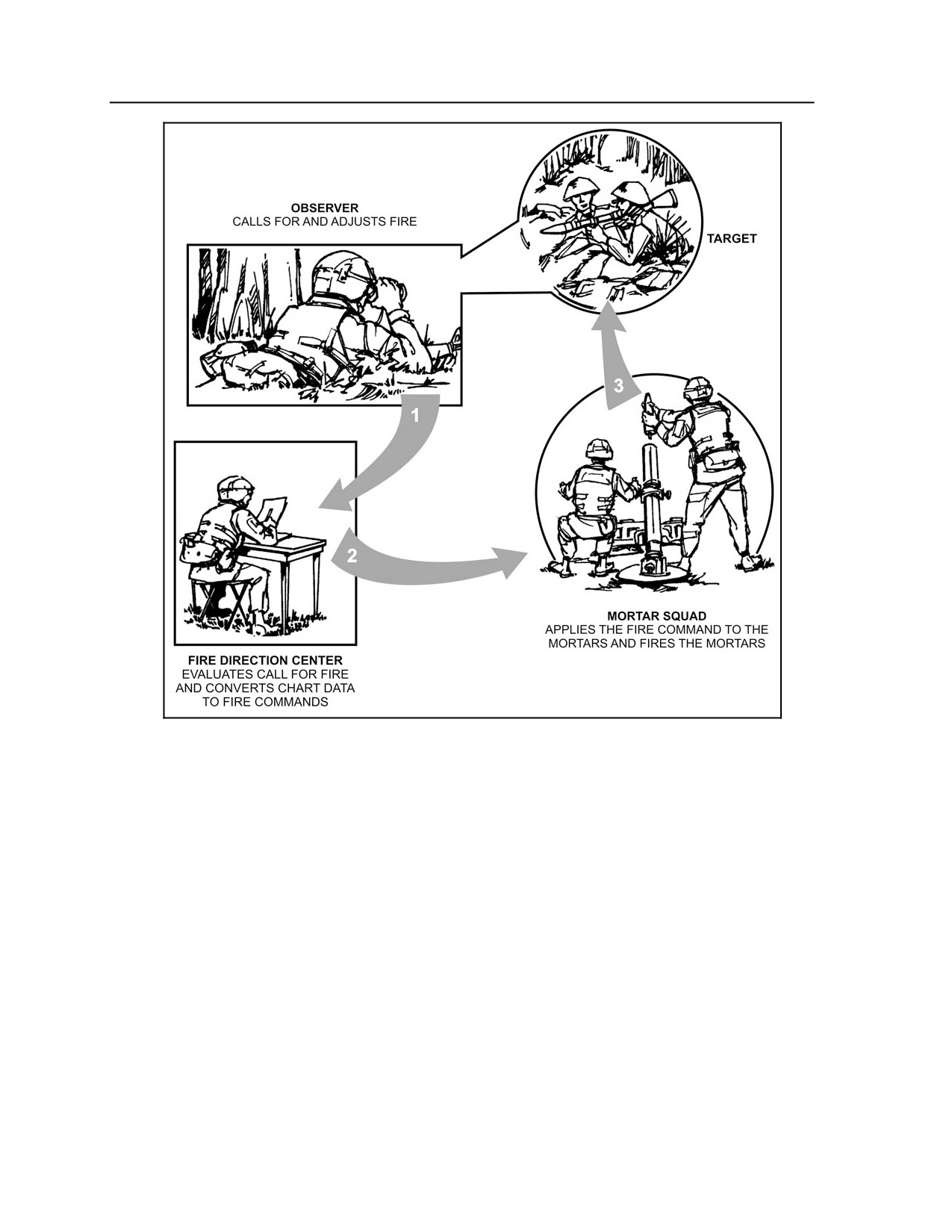
Chapter 2
Figure 2-2. Indirect fire.
AMMUNITION
2-26. For the purpose of this manual, there are three categories of ammunition: high explosive (HE);
penetration; and special purpose munitions. Only HE and penetration munitions are considered for
achieving complementary and reinforcing effects. The leader is able to engage known enemy targets (those
he can see and acquire) as well as likely enemy targets (those he cannot see and cannot clearly acquire). If
the enemy remains hidden but suspected, the grenadier will engage him with high explosives. If the enemy
attempts to move to a location that will protect him from HE munition, the automatic rifleman will engage
him with a penetrating munition. Special purpose munitions are described for general information only.
High Explosive
2-27. HE munitions are used to kill enemy soldiers, force enemy soldiers to remain under protective field
fortification cover, force an enemy vehicle to button up, or force an enemy vehicle into a less advantageous
position. Only a direct hit will destroy or significantly damage an armored vehicle.
2-28. There are two noteworthy strengths of HE munitions. First, HE muntions do not have to score a
direct hit to physically affect the target. This makes it possible to engage targets that are not clearly
acquired, but are likely or suspected. Second, HE munitions are especially effective at destroying structures
such as bunkers and vehicles.
2-6
FM 3-21.8
28 March 2007
Employing Fires
Penetration
2-29. The effectiveness of penetration munitions is dependent on the weapon system’s ability to generate
velocity, and the ability of the munition’s mass to punch a hole in the enemy target. It is fairly easy to
gauge the effectiveness of penetration munitions. Soldiers can engage targets with confidence because of
the known effect the round will have on a target. The three general categories of penetration munitions are
ball and tracer, armor piercing, and high explosive antitank (HEAT).
Ball and Tracer
2-30. Ball and tracer rounds use high velocity to penetrate soft targets on impact. Penetration depends
directly on the projectile’s velocity, weight, and angle at which it hits. Ball and tracer rounds are usually
small caliber (5.56 to 14.5 millimeters) and are fired from pistols, rifles, and machine guns.
Armor Piercing
2-31. Armor piercing rounds use shaped-charged or kinetic energy penetration warheads specially designed
to penetrate armor plate and other types of homogeneous steel. They are used effectively against fuel
supplies and storage areas.
HEAT (High Explosive Antitank)
2-32. HEAT rounds are designed to defeat armor through the use of shaped charge. A shaped charge is an
explosive charge created so the force of the explosion is focused in a particular direction.
Special Purpose
2-33. There are many types of munitions that do not fit the profile of the two major categories (HE and
penetration). These are called special purpose munitions. Examples are incendiary, obscuration,
illumination, nuclear, and chemical rounds.
TRAJECTORY
2-34. Infantry Soldiers can more effectively engage moving enemy targets with low trajectory fire than
high trajectory fire. Enemy reaction when engaged with friendly low trajectory fire is predictable: get down
and seek frontal cover. When this happens, high trajectory fire can effectively engage enemy targets in
fighting positions, holes, or deadspace where low trajectory fire cannot. Friendly high trajectory fire can
also force the enemy to move out of the area and seek overhead cover, limiting their effectiveness.
2-35. Leaders create a dilemma for the enemy by combining low and high trajectory weapons. If the enemy
gets up from his position and attempts to move, the automatic rifleman will engage him. If the enemy
decides to stay in his position behind frontal cover, the grenadier will engage him. Either option results in
the friendly force engaging the enemy. This united effect of the automatic rifleman and grenadier
outweighs the effect either would have if they engaged the enemy without the other.
ENEMY TARGET TYPES
2-36. Weapons and munitions are designed for employment against the two general types of enemy targets:
point, and area. A point target is located in a specific spot with a single aim point (enemy soldier, vehicle,
piece of equipment). An area target is spread over an area with multiple aim points (formation of enemy
soldiers, an enemy trench line). Some weapon systems such as machine guns and grenade launchers can
effectively engage both point and area targets.
FIRE TEAM WEAPONS
2-37. The rate of fire is the number of rounds fired in a minute by a particular weapon system. The leader
dictates the rate of fire for each weapon system under his control. There are two factors that contribute to
28 March 2007
FM 3-21.8
2-7
Chapter 2
leader decisions about rates of fire: achieving fire superiority; and ammunition constraints. For information
on equipment in the weapons squad or other supporting weapons, see Appendix A and Appendix B.
RIFLE
2-38. Rifleman and Infantry leaders are currently armed with the M4 rifle. The M4 rifle is a direct fire
weapon that fires ball and tracer 5.56-mm ammunition. The rifleman’s primary role is to kill the enemy
with precision fire. In this capacity, the rate of fire for the M4 rifle is not based on how fast the Soldier can
pull the trigger. Rather, it is based on how fast the Soldier can accurately acquire and engage the enemy.
The second role of the rifleman is to engage likely or suspected enemy targets with suppressive fire.
M249 MACHINE GUN
2-39. The automatic rifleman is currently armed with an M249 machine gun. The M249 is a direct-fire,
low trajectory weapon that is primarily used to fire ball tracer 5.56-mm ammunition linked at area targets.
The M249 also has the ability to fire unlinked 5.56-mm ammunition in 30-round magazines, but reliability
is greatly reduced. Firing with a magazine should be limited to emergency situations.
M240B MACHINE GUN
2-40. Two medium machine guns (currently the M240B) and crews are found in the Infantry platoon’s
weapons squad. Machine gunners are a self-contained support by fire element or with a rifle squad to
provide long range, accurate, sustained fires against enemy Infantry, apertures in fortifications, buildings,
and lightly-armored vehicles. Machine gunners also provide a high volume of short-range fire in self
defense against aircraft. THE M240B fires 7.62-mm ammunition. Refer to Appendix A for further
information on machine guns.
GRENADE LAUNCHER
2-41. The grenadier is currently armed with the M203 40-mm grenade launcher. The M203 is a direct fire,
high trajectory weapon that can be used for either point or area targets. The M203 fires several types of
munitions including, HE, high explosive dual purpose (HEDP) (antipersonnel/antiarmor), riot control (CS),
buckshot, and signaling. As with the rifleman, the grenadier’s rate of fire is based on how quickly he can
accurately acquire and engage the enemy.
SHOULDER-LAUNCHED MUNITIONS
2-42. Shoulder-launched munitions (SLM) are lightweight, self-contained, single-shot, disposable weapons
that consist of unguided free flight, fin-stabilized, rocket-type cartridges packed in launchers. SLM provide
the Soldier a direct fire capability to defeat enemy personnel within field fortifications, bunkers, caves,
masonry structures, and lightly armored vehicles. Soldiers use SLM to engage enemy combatants at very
close ranges—across the street or from one building to another. Likewise, SLM may be fired at long
distances to suppress the enemy or kill him. Soldiers may employ the SLM as a member of a support-by
fire element to incapacitate enemy forces that threaten the friendly assault element. When the assault
element clears a building, the leader may reposition the SLM gunner inside to engage a potential
counterattack force. Refer to Appendix B for further information on SLM.
COMPLEMENTARY AND REINFORCING EFFECTS AT THE FIRE
TEAM LEVEL
2-43. One of the leader’s primary duties is to control the distribution of his unit’s fires. An Infantry team
leader tasked to establish support by fire uses the principles of complementary and reinforcing effects to
guide his unit’s actions. The goal of each weapon system combination is to create an effect that outweighs
the effects that either weapon system would make acting alone. The primary combination team leaders
strive to employ are the weapons systems of the automatic rifleman and the grenadier. This combination is
the center around which the remainder of the fire team’s functions revolves.
2-8
FM 3-21.8
28 March 2007
Employing Fires
THE RIFLEMAN
2-44. The rifleman’s role when the grenadier and automatic rifleman combine their fires is to perform one
of three functions:
Reinforce the automatic rifleman. If necessary, the rifleman can replace the automatic rifleman
for a short time.
Fix another target while the automatic rifleman and grenadier destroy the target they are
engaging.
Provide security and observation.
THE TEAM LEADER
2-45. In weapon employment, the team leader’s role is to maximize the complementary effects of the
combination of the grenadier and automatic rifleman. He does this through using proper fire commands and
control measures. The team leader’s second role is to assume the duties of the rifleman if necessary.
SECTION III — ENGAGING THE ENEMY WITHOUT ENDANGERING FRIENDLY
TROOPS
2-46. In the offense, effective friendly supporting fires require firing on enemy targets that are close to
assaulting friendly Infantry Soldiers. A safe integration of fires and maneuver this close demands careful
planning, coordination, and knowledge of the supporting weapons. In the defense, the most common close
support is the final protective fire (FPF), which is normally placed very close to friendly positions. When
planning close supporting fires for the offense or defense, leaders consider the effect required, accuracy of
the delivery system, protection of Soldiers, integration of assets, timings and control, echelonment of fires,
and tactical risk from enemy forces.
2-47. Munition effects do not distinguish between friendly forces, noncombatants, and the enemy. To
inflict maximum casualties on the enemy while minimizing effects to friendly Soldiers and noncombatants,
leaders must have an understanding of weapon-munition effects, SDZ, minimum safe distances (MSD),
risk estimate distances
(RED), and the terrain’s influence on projectiles. Failure to account for
characteristics of direct and indirect weapon systems when considering tactics, techniques, and procedures
can result in serious unintended consequences.
2-48. There are many variables that impact on the accuracy of the weapon. Artillery and mortars are
referred to as area weapon systems because every round fired from the same tube impacts in an area around
target aiming point. This dispersion is greater in length than in width. The weather conditions (wind,
temperature, and humidity), the condition of the weapon, and the proficiency of the crew also affect
accuracy.
SURFACE DANGER ZONE
2-49. The SDZ is the ground and airspace for vertical and lateral containment of projectiles, fragments,
debris, and components resulting from the firing, launching, or detonation of weapon systems (including
explosives and demolitions). Each weapon system or munition has its own unique SDZ. The critical
components of the SDZ are the primary danger area and the buffer zone.
2-50. Understanding the components of the SDZ enable leaders and their Soldiers to make good decisions
concerning how close they can get to the effects of friendly weapon fire. SDZs are developed using precise
technical data without considering the effects of terrain. This data should be consulted whenever exact
specifications are required. However, because the technical data can be confusing, it is useful to describe
SDZs in a general manner. For exact weapon SDZs (see DA Pam 385-63, Range Safety).
2-51. The primary danger area consists of the dispersion and ricochet area along the gun-target line for the
maximum range of the weapon. The dispersion area is a 5-degree angle to the right and left of the gun-
target line that accounts for human error, gun or cannon tube wear, and propellant temperature. The
ricochet area contains any projectiles that make contact with surrounding terrain following the munition’s
28 March 2007
FM 3-21.8
2-9

Chapter 2
initial impact. It is located to the left and right of the dispersion area. The buffer zone is an area outside of
the ricochet area allocated for additional safety measures. The buffer area exists to the sides of the gun-
target line and at the far end of the weapon’s maximum effect range.
DIRECT FIRE
2-52. For direct fire weapons, the risk of being hit by friendly munitions at the edge of the buffer zone is
negligible. Based on the type of surface (earth, water, steel, or concrete), the risk increases significantly at
the edge of the ricochet area. Risk is extremely high at the edge of the dispersion area. In accordance with
DA PAM 385-63, the current level of acceptable risk in training is 1/1,000,000 (outside SDZ), but can be
waived by the installation commander to 1/100,000 (outside ricochet area). In combat, most commanders
use 1/100,000 (outside ricochet area) based upon METT-TC analysis and risk mitigation measures. Table
2-2 shows the probability of direct fire ricochets.
Table 2-2. Probability of ricochet.
Outside of Area
Probability
SDZ (Area A)
1/1,000,000
Ricochet area
1/100,000
Dispersion area
1/10,000
2-53. When Soldiers remain outside of the buffer zone, the probability of being hit by their own munitions
is unlikely. This is true for training and combat. During training, units usually are not authorized to come
any closer to the gun-target line than the buffer zone. However, there are many situations in combat that
require Soldiers to get closer to the gun-target line of their supporting weapons than the buffer zone allows.
In these situations, the leader must understand how to manage the risk to his unit. When assessing this risk
the question for leaders to consider is: “Is the threat from the effects of my munitions greater than the threat
from the enemy?”
REDUCING RISK
2-54. Given the uncertainty associated with combat and the threat of enemy action, leaders must
understand how to reduce risks associated with fire and movement in proximity to direct and indirect fires.
As a general rule, the dispersion and ricochet areas present an immediate danger to Soldiers. Observers and
protective measures are therefore required.
2-55. The easiest way to protect friendly forces from unintended consequences of their own weapons is to
always have an observer. Skilled observers can see the impact of the rounds and any maneuver elements
near that area. In circumstances where assigning observers is not possible, leaders must take other measures
to mitigate the risk of unintended consequences to friendly forces. Some of the most common include:
Wearing and requiring Soldiers to wear protective equipment (body armor, Kevlar helmet, eye
protection, hearing protection).
Using terrain, natural or man-made, to mask effects of munitions.
Adding a buffer zone of additional distance to the gun-target line.
Using armored vehicles.
Using graphic control measures.
Ensuring a highly qualified Soldier is operating the weapons system.
MINIMUM SAFE DISTANCE AND RISK ESTIMATE DISTANCE
2-56. When determining risk with indirect fires, leaders use a combination of minimum safe distances
(MSDs), and risk estimated distances (REDs). The MSD risk is designed for training and ensures that
friendly Soldiers are far enough away from the effects of munitions so the risk to them is negligible. REDs
refer to a safe distance away from a given type of friendly munitions and are only used in combat. REDs
are divided into two categories based on the percent of incapacitation (PI) to friendly Soldiers, expressed as
2-10
FM 3-21.8
28 March 2007

Employing Fires
.1 PI and 10 PI. The former (.1 PI) means that one in one thousand Soldiers will not be able to fight because
of potential weapon munitions effects. The latter (10 PI) means that one in ten Soldiers will not be able to
fight because of weapon effects. When MSDs and REDs are put together, the leader is able to manage his
risk from negligible—to 10 PI—based on his distance from the impact of friendly supporting indirect fire.
Table 2-3 contains a complete listing of MSDs and REDs for common fire support assets at maximum
range of weapons systems. (At lesser ranges the RED decreases).
Table 2-3. MSDs and REDs for common fire support assets.
Weapon System
MSD (Training)
RED (Combat)
.1 PI
10 PI
60-mm Mortar (M224)
250m
175m
65m
81-mm Mortar (M252)
350m
230m
80m
120-mm Mortar (M120/M121)
600m
400m
100m
105-mm Artillery (M102/M119)
550m
275m
90m
155-mm Artillery (M109/M198)
725m
450m
125m
155-mm Artillery DPICM
725m
475m
200m
WARNING
REDs are for combat use and do not represent the maximum
fragmentation envelopes of the weapons listed. REDs are not
minimum safe distances for peacetime training use.
SECTION IV — EMPLOYING DIRECT FIRE
2-57. This section discusses direct fire control and employment rules of engagement, control measures,
engagement techniques, fire commands, range cards, adjustments, and closure reports.
RULES OF ENGAGEMENT
2-58. The rules of engagement (ROE) specify the circumstances and limitations under which friendly
forces may engage. They include definitions of combatant and noncombatant elements, and stipulate the
treatment of noncombatants. Factors influencing ROE are national command policy, operational
requirements, and the law of war. ROE always recognize a Soldier’s right of self-defense while at the same
time clearly defining circumstances in which he may fire.
CONTROL MEASURES
2-59. Direct fire control measures are the means by which the platoon leader or subordinate leaders control
their unit’s direct fires. Application of these concepts, procedures, and techniques assists the unit in
acquiring the enemy, focusing fires on him, distributing the effects of the fires, effectively shifting fires,
and preventing fratricide. No single measure is sufficient to effectively control fires. At the platoon level,
fire control measures will be effective only if the entire unit has a common understanding of what the fire
control measures mean and of how to employ them.
28 March 2007
FM 3-21.8
2-11
Chapter 2
LEADER RESPONSIBILITIES
2-60. The Infantry platoon or squad leader communicates to his subordinates the manner, method, time to
initiate, shift, mass fires, and when to disengage by using direct fire control measures. The leader should
control his unit’s fires so he can direct the engagement of enemy systems to gain the greatest effect. The
commander uses the factors of METT-TC and reconnaissance to determine the most advantageous way to
use direct fire control measures to mass the effects on the enemy and reduce fratricide from direct fire
systems. He must understand the characteristics of weapon systems and available munitions (such as the
danger to unprotected Soldiers when tanks fire, discarding sabot ammunition over Soldiers’ heads or near
them). The primary graphic direct fire control measures are—
Unit boundary.
Target reference point.
Sector of fire.
Engagement area (EA).
2-61. Other direct fire control measures include—
Trigger line.
Maximum engagement line (MEL).
Final protective line (FPL).
Principle direction of fire (PDF).
Priority targets.
2-62. The noise and confusion of battle may limit the use of some of these methods. Therefore, the leader
must select a method or combination of methods that will accomplish the mission. The leader should
arrange to have a primary and secondary signaling method. The method may be positive (hands on) or
procedural (prearranged). There are three types:
(1)
Audio (radio, whistle, personal contact).
(2)
Visual (hand-and-arm signals, pyrotechnics).
(3)
Written (OPORD, range card, sector sketch).
FIRE CONTROL PROCESS
2-63. To bring direct fires against an enemy force successfully, leaders must continuously apply the four
steps of the fire control process. At the heart of this process are two critical actions intended to achieve
decisive effects on the enemy: rapid, accurate target acquisition, and the massing of fires Target acquisition
is the detection, identification, and location of a target in sufficient detail to permit the effective
employment of the platoon’s weapons. Massing of fires focuses direct fires at critical points, then
distributes the fires for optimum effect. The four steps of the fire control process follow.
(1)
Identify probable enemy locations and determine the enemy scheme of maneuver.
(2)
Determine where and how to mass (focus and distribute) direct fires’ effects.
(3)
Orient forces to speed target acquisition.
(4)
Shift direct fires to refocus or redistribute their effects.
TERRAIN-AND THREAT-BASED FIRE CONTROL MEASURES
2-64. Table 2-4 lists the control measures by whether they are terrain or threat-based.
2-12
FM 3-21.8
28 March 2007

Employing Fires
Table 2-4. Common fire control measures.
Terrain-Based
Threat-Based
Fire Control Measures
Fire Control Measures
Target reference point
Fire patterns
Engagement area
Engagement priorities
Sector of fire
Weapons ready posture
Maximum engagement line
Weapons control status
Final protective line
Trigger
Principal direction of fire
Weapons safety posture
Final protective fire
Restrictive firing line
Terrain-Based Fire Control Measures
2-65. The platoon leader uses terrain-based fire control measures to focus and control fires by directing the
unit to engage a specific point or area rather than an enemy element. The following paragraphs describe the
terrain-based fire associated with this type of control measure.
Target Reference Point
2-66. A TRP is a recognizable point on the ground that leaders use to orient friendly forces and to focus
and control friendly direct and indirect fires. Soldiers use TRPs for target acquisition and range
determination. Leaders designate TRPs to orient fires to a particular point, define sectors of fire and
observation, and define the limits of an EA. A TRP can also designate the center of a sector or an area
where the leader plans to distribute or converge with fires. In addition, when TRPs are designated as
indirect fire targets, they can be used in calling for and adjusting indirect fires. Leaders designate TRPs at
probable enemy locations and along likely avenues of approach. These points can be natural or man-made.
A TRP can be an established site such as a hill or a building, or a feature designated as an impromptu TRP
such as a burning enemy vehicle or smoke generated by an artillery round. Friendly units also can construct
markers to serve as TRPs (Figure 2-3). TRPs include the following features and objects:
Prominent hill mass.
Distinctive building.
Observable enemy position.
Destroyed vehicle.
Ground-burst illumination.
Smoke round.
Laser point.
28 March 2007
FM 3-21.8
2-13
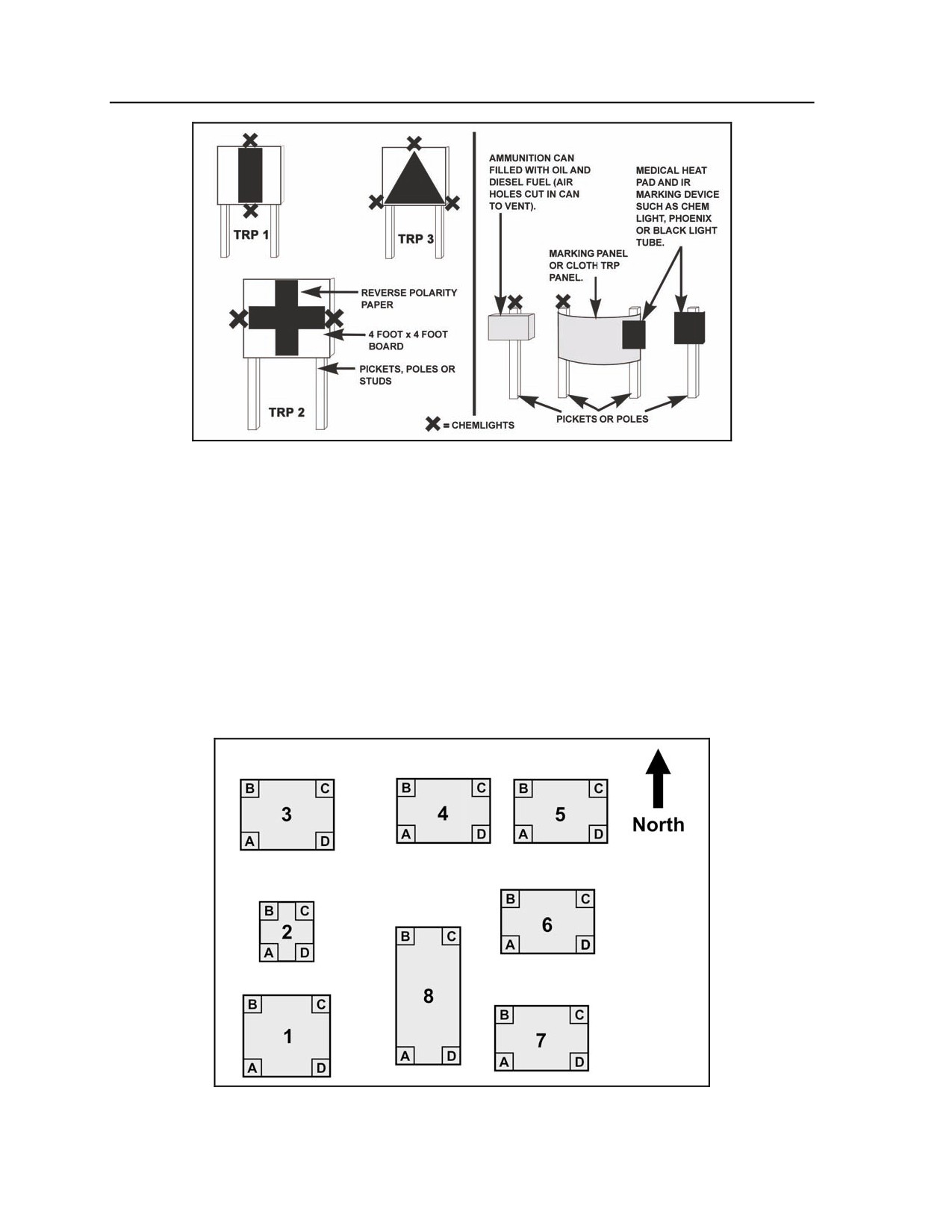
Chapter 2
Figure 2-3. Example of constructed TRP markers.
2-67. Leaders designate natural terrain features, man-made terrain features, or any other visual means to be
used as TRPs. While TRPs should be visible through all spectrums available to the unit, they should be
visible in three observation modes
(unaided, passive-infrared, and thermal). They must be easily
identifiable to the defender during daylight, should be heated so they can be recognized with thermal sights,
and should have an infrared signature so they can be recognized through night vision devices.
2-68. Leaders number TRPs for easy reference. For indirect fire systems, these numbers are assigned as
targets (for example, AB1001). For direct fire systems, leaders use any system that is easy and recognizable
to their subordinates. Figure 2-4 shows an example of a TRP numbering system when operating in a built-
up area. The building and corner numbering system starts at the southwest corner of the objective area.
Figure 2-5 shows an example of window and door numbering. In this technique, no distinction is made
between windows and doors unless specified. The numbering and lettering always start at the bottom left of
any completely visible structure. If a structure is obscured, an estimate is necessary until a more exact call
can be made. Corrections to supporting fires are given like indirect fire corrections (for example, left 2,
down 1).
Figure 2-4. Example of TRP numbering system.
2-14
FM 3-21.8
28 March 2007
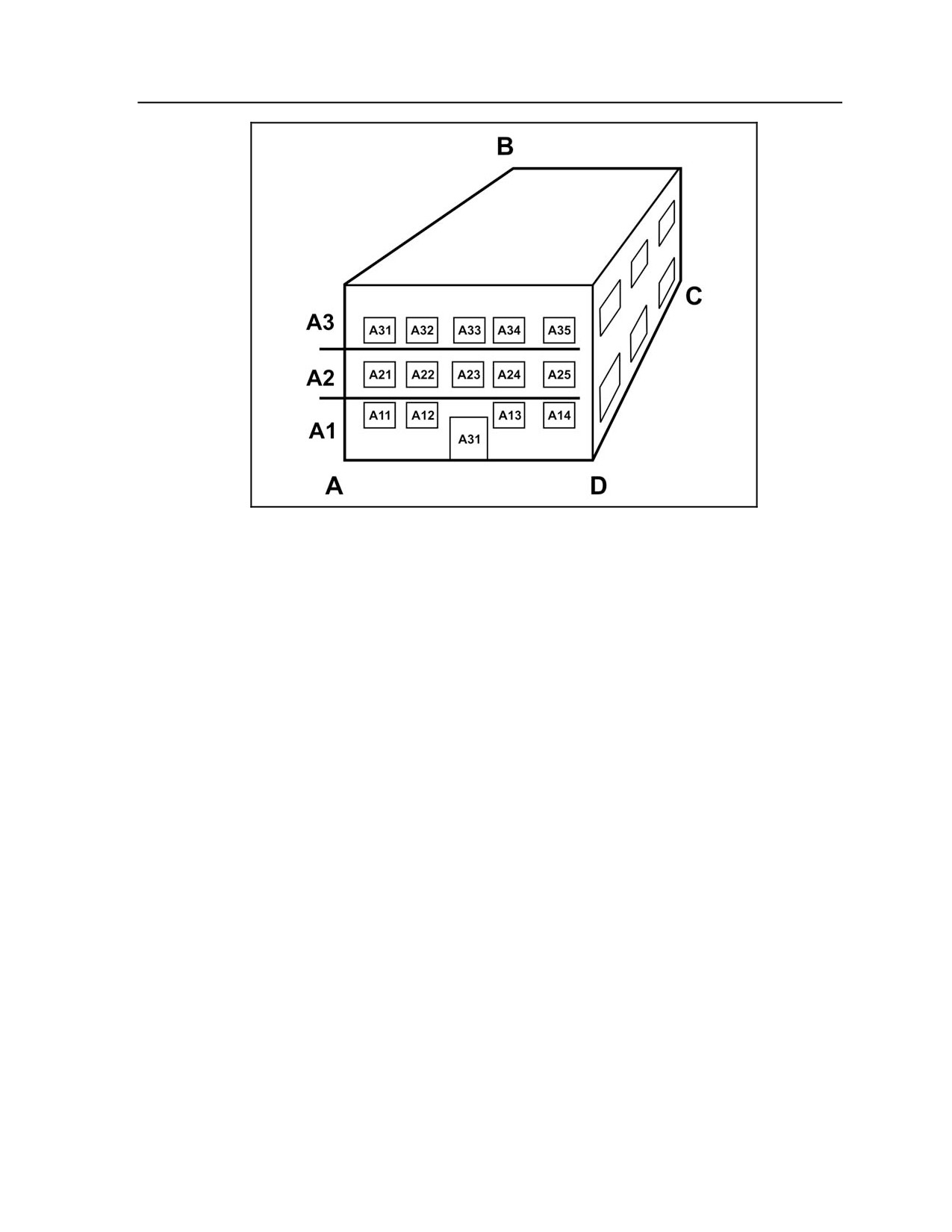
Employing Fires
Figure 2-5. Example of window and door numbering.
Engagement Area
2-69. The engagement area (EA) is an area along a likely enemy avenue of approach where the platoon
leader intends to mass the fires of all available weapons to destroy an enemy force. The size and shape of
the EA are determined by the degree of relatively unobstructed visibility available to the friendly unit’s
weapons systems in their firing positions, and by the maximum range of those weapons. For an engagement
area to be effective, the enemy must either choose to move through the area or be forced or channeled into
the area by friendly action (obstacles, indirect fire). Typically, commanders delineate responsibility within
the EA by assigning each platoon a sector of fire or direction of fire. These fire control measures are
covered in the following paragraphs.
Sector of Fire
2-70. Leaders assign sectors of fire to Soldiers manning weapons or to a unit to cover a specific area of
responsibility with observation and direct fire. In assigning sectors of fire, leaders consider the number and
type of weapons available. The width of a sector of fire is defined by a right and left limit. Leaders may
limit the assigned sector of fire to prevent accidental engagement of an adjacent friendly unit. The depth of
a sector is usually the maximum range of the weapon system unless constrained by intervening terrain or by
the leader (using a maximum engagement line [MEL]). At the platoon level, sectors of fire are assigned to
each subordinate by the leader to ensure that the unit’s area is completely covered by fire. Targets are
engaged as they appear in accordance with established engagement priorities. Means of designating sectors
of fire include:
TRPs.
Azimuth.
Clock direction.
Terrain-based quadrants.
Friendly-based quadrants.
2-71. Types of Sectors. Leaders should assign a primary and a secondary sector of fire. The primary sector
is the first priority; Soldiers and units are responsible for engaging and defeating the enemy here first. Fire
then shifts to the secondary sector on order, when there are no targets in the primary sector, or when the
leader needs to cover the movement of another friendly element. This secondary sector of fire can
28 March 2007
FM 3-21.8
2-15
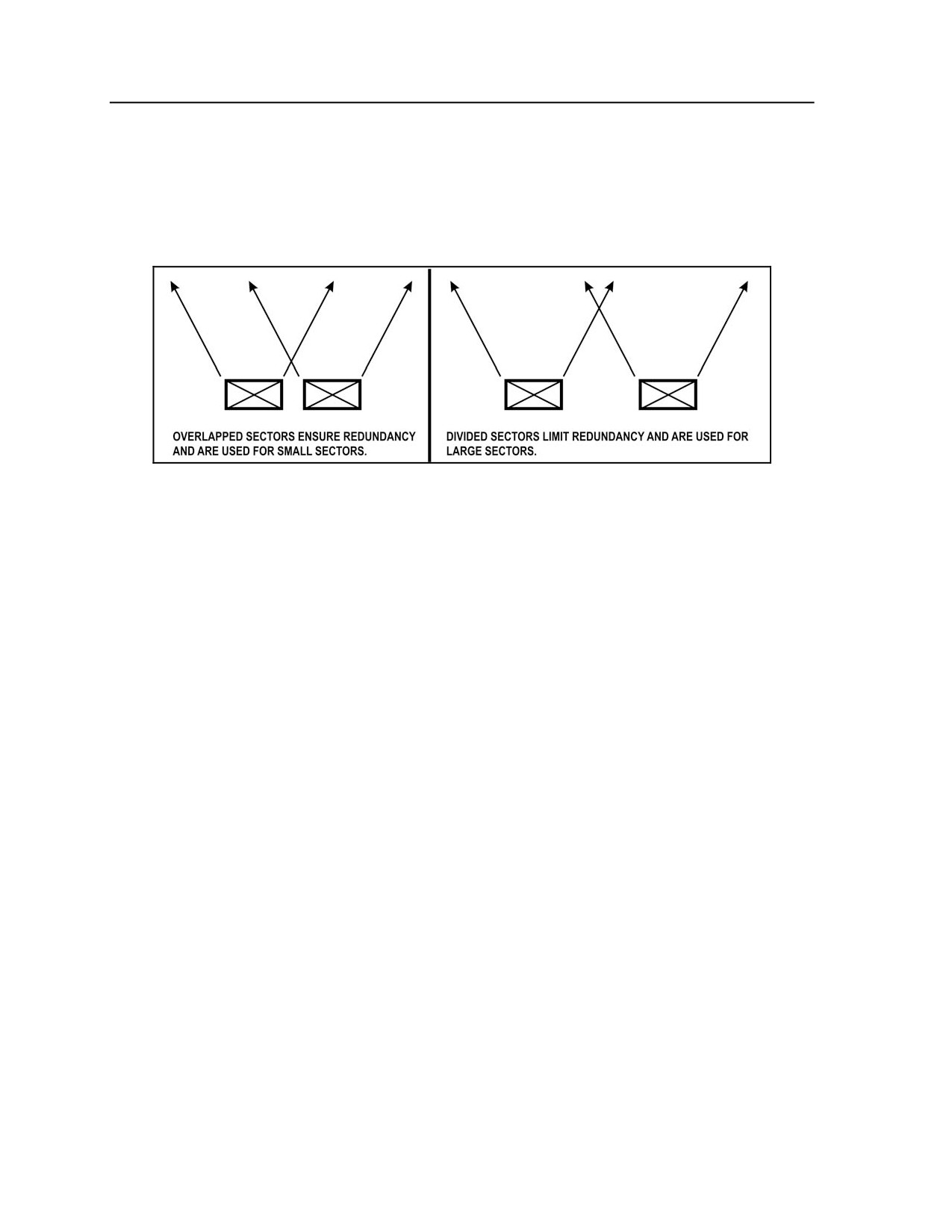
Chapter 2
correspond to another friendly element’s primary sector of fire to obtain overlapping fires and mutual
support.
2-72. Overlapping and Divided Sectors. When assigning sectors, leaders attempt to build in mutual
support and redundancy. By building redundancy into the observation and fire plan, leaders increase their
probability of early detection of the enemy. Two common techniques are overlapping a sector and dividing
a sector (Figure 2-6).
Figure 2-6. Overlapping and divided sectors.
2-73. Dead Space. It is important to identify dead space within a sector of fire. Dead space is any area that
cannot be observed or covered by direct-fire weapons systems, including where the waist of a Soldier falls
below a gunner or automatic rifleman’s point of aim. When stationary, the most accurate method for
determining dead space is to have one Soldier walk the weapon’s line of sight and make a pace count of
those areas where he encounters dead space. When the Soldier is not able to walk the line of fire, he can
also determine dead space by observing the flight of tracer ammunition from a position behind and to the
flank of the weapon.
2-74. All dead space within the sector must be identified to allow the leader and subordinate leaders to plan
high trajectory fires (mortars, artillery, or M203) to cover that area.
2-75. Searching the Sector. Searching is the act of carefully watching the assigned sector. Individual and
unit observation plans are inherent in all military operations. Individual Soldiers scan their sectors by
conducting a rapid scan followed by a slow scan. When conducting a rapid scan, Soldiers make a quick
overall search for obvious targets and unnatural colors, outlines, or movement. They follow the rapid scan
with a slow deliberate scan, searching for signatures and indicators of common targets. Soldiers who use a
more deliberate method to scan their sectors are generally more successful at detecting targets.
Maximum Engagement Line
2-76. The maximum engagement line (MEL) is the depth of the sector and is normally limited to the
maximum effective engagement range of the weapons systems. However, it is also influenced by the enemy
target description and the effects of terrain. Slope, vegetation, structures, and other features provide cover
and concealment that may prevent the weapon from engaging out to the maximum effective range. To
assist in determining the distance to each MEL, Soldiers should use a map to ensure the MELs are depicted
accurately on the range card. Identifying the MEL prevents squads from engaging targets beyond the
maximum effective ranges of their weapon systems and establishes criteria for triggers. This decreases
needless and ineffective ammunition expenditure during an engagement.
Final Protective Line
2-77. If a final protective line (FPL) is assigned, a machine gun is sighted along it to employ grazing fire
except when other targets are being engaged. An FPL becomes the machine gun’s contribution to the unit’s
final protective fire (FPF). An FPL is fixed in direction and elevation. However, a small shift for search
must be employed to prevent the enemy from crawling under the FPL. A small shift will also compensate
for irregularities in the terrain or the sinking of the tripod legs into soft soil during firing.
2-16
FM 3-21.8
28 March 2007

Employing Fires
Principal Direction of Fire
2-78. A PDF is generally assigned when the terrain does not lend itself to a FPL. A PDF is a direction of
fire that is assigned priority to cover an area that has good fields of fire or has a likely dismounted avenue
of approach. It also provides mutual support to the adjacent unit. Machine guns are sighted using a PDF if
an FPL has not been assigned. If a PDF is assigned and other targets are not being engaged, machine guns
remain on the PDF. The main difference between a PDF and an FPL is that the PDF is a sector, while the
FPL is a fixed line. Means of designating a direction of fire include—
Closest TRP.
Clock direction.
Cardinal direction and or magnetic azimuth.
Tracer on target.
Infrared laser pointer.
Final Protective Fire
2-79. The FPF is a line of fire established where an enemy assault is to be checked by the interlocking fires
of all available friendly weapons, to include indirect fire. The FPF is reinforced with protective obstacles
whenever possible. Initiation of the FPF is the signal for all squads, crews, and individual Soldiers to shift
fires to their assigned portion of the FPL.
Restrictive Fire Line
2-80. An RFL is a linear fire control measure beyond which fires are prohibited without coordination. In
the offense, the platoon leader may designate an RFL to prevent a base-of-fire squad(s) from firing into the
area where an assaulting squad(s) is maneuvering. This technique is particularly important when
mechanized vehicles directly support the maneuver of Infantry squads. In the defense, the platoon leader
may establish an RFL to prevent squads from engaging one of the platoon’s other rifle squads positioned in
restricted terrain on the flank of an enemy avenue of approach. Figure 2-7 illustrates fire control measures
on an example platoon sector sketch.
Figure 2-7. Example of fire control measures in platoon sector sketch.
28 March 2007
FM 3-21.8
2-17
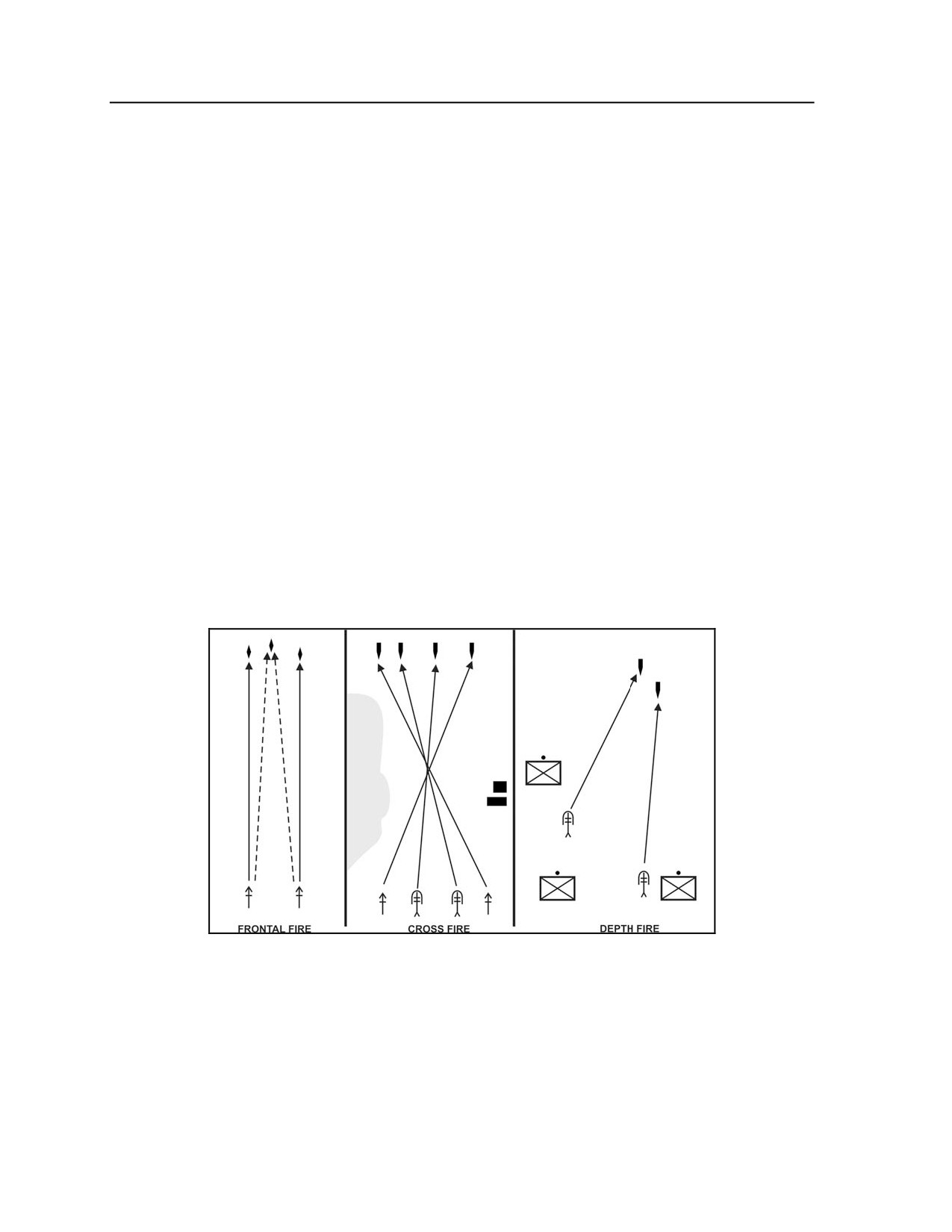
Chapter 2
Threat-Based Fire Control Measures
2-81. The platoon leader uses threat-based fire control measures to focus and control fires by directing the
unit to engage a specific, templated enemy element rather than fire on a point or area. Threat-based fire
control measures may be difficult to employ against an asymmetric threat. The following paragraphs
describe the threat-based fire associated with this type of control measure.
Fire Patterns
2-82. Fire patterns are a threat-based measure designed to distribute the fires of a unit simultaneously
among multiple, similar targets. Platoons most often use them to distribute fires across an enemy formation.
Leaders designate and adjust fire patterns based on terrain and the anticipated enemy formation. The basic
fire patterns are frontal fire, cross fire, and depth fire (Figure 2-8).
2-83. Frontal Fire. Leaders may initiate frontal fire when targets are arrayed in front of the unit in a lateral
configuration. Weapons systems engage targets to their respective fronts. For example, the left flank
weapon engages the left-most target; the right flank weapon engages the right-most target. As they destroy
enemy targets, weapons shift fires toward the center of the enemy formation and from near to far.
2-84. Cross Fire. Leaders initiate cross fire when targets are arrayed laterally across the unit’s front in a
manner that permits diagonal fires at the enemy’s flank, or when obstructions prevent unit weapons from
firing frontally. Right flank weapons engage the left-most targets; left flank weapons engage the right-most
targets. Firing diagonally across an EA provides more flank shots, increasing the chance of kills. It also
reduces the possibility that friendly elements will be detected if the enemy continues to move forward. As
they destroy enemy targets, weapons shift fires toward the center of the enemy formation.
2-85. Depth Fire. Leaders initiate depth fire when targets are dispersed in depth perpendicular to the unit.
Center weapons engage the closest targets; flank weapons engage deeper targets. As they destroy targets,
weapons shift fires toward the center of the enemy formation.
Figure 2-8. Fire patterns.
Engagement Priority
2-86. In concert with his concept of the operation, the company commander determines which target types
provide the greatest payoff or present the greatest threat to his force. He then establishes these as a unit
engagement priority. The platoon leader refines these priorities within his unit. Engagement priority
specifies the order in which the unit engages enemy systems or functions. Engagement priorities are
situational dependent. Subordinate elements can have different engagement priorities. For example, the
leader establishes his engagement priorities so his medium machine guns engage enemy unarmored
2-18
FM 3-21.8
28 March 2007
Employing Fires
vehicles while his SLM and CCMS engage enemy tanks. Normally, units engage the most dangerous
targets first, followed by targets in depth.
Weapons-Ready Posture
2-87. To determine the weapons-ready posture, leaders use their estimate of the situation to specify the
ammunition and range for the engagement. Range selection is dependent on the anticipated engagement
range. Terrain, visibility, weather, and light conditions affect range selection.
2-88. Within the platoon, weapons-ready posture affects the types and quantities of ammunition carried by
the rifle and weapons squads.
2-89. For Infantry squads, weapons-ready posture is the selected ammunition and indexed range for
individual and crew-served weapons. For example, an M203 grenadier whose likely engagement is to cover
dead space at 200 meters from his position might load HEDP rounds. He will also set 200 meters on his
quadrant sight for distance to the dead space. To prepare for an engagement in a wooded area where
engagement ranges are extremely short, antiarmor specialists may be armed with SLM instead of CCMS.
Weapons Control Status
2-90. The three levels of weapons control status outline the conditions, based on target identification
criteria, under which friendly elements may engage. The platoon leader sets and adjusts the weapons
control status based on friendly and enemy disposition, and the clarity of the situation. In general, the
higher the probability of fratricide, the more restrictive the weapons control status. The three levels are—
Weapons Hold. Engage only if engaged or ordered to engage.
Weapons Tight. Engage only targets that are positively identified as enemy.
Weapons Free. Engage any targets that are not positively identified as friendly.
2-91. As an example, the platoon leader may establish the weapons control status as weapons hold when
other friendly forces are passing friendly lines. Or the platoon leader may be able to set a weapons free
status when he knows there are no friendly elements in the vicinity of the engagement. This permits his
elements to engage targets at extended ranges even though it is difficult to distinguish targets accurately at
ranges beyond 2,000 meters under battlefield conditions. The platoon leader may change the weapons
control status for his elements based on situational updates. Weapons control status is extremely important
for forces using combat identification systems. Establishing the weapons control status as weapons free
permits leaders to engage an unknown target when they fail to get a friendly response.
Trigger
2-92. Triggers are an event or time-oriented criteria used to initiate planned actions to achieve surprise and
inflict maximum destruction on the enemy. A designated point or points (selected along identifiable terrain)
in an engagement area used to mass fires at a predetermined range (FM 1-02). Triggers can be a physical
point on the ground (trigger line), a laser or lazed spot, or an action or event that causes friendly forces to
do something. When using triggers to control fires, leaders ensure they have allocated them to start, shift,
and cease fires. Leaders use triggers within the context of the ROE and the weapons control status. For
example, a leader might say, WAIT UNTIL ENEMY SOLDIERS CROSS PL BLUE BEFORE
ENGAGING.
2-93. A trigger line is a phase line used to mass fires at a predetermined range. The trigger line can be used
when attacking or defending. In the offense, the trigger line is preferably perpendicular to the friendly axis
of advance and is used to initiate or cease fires when reached by the unit. If defending, the leader initiates
fire as the enemy reaches the trigger line.
Weapons Safety Posture
2-94. The weapons safety posture is an ammunition-handling command that allows leaders to control the
safety status of their weapons. Soldier adherence to and leader supervision of the weapons safety posture
prevents accidental discharge of weapons. Examples include:
28 March 2007
FM 3-21.8
2-19
Chapter 2
Handling live ammunition and weapons in peace time training in the same safe way during
combat.
Finger off the trigger and weapon on safe.
Hand grenades attached correctly to the ammo pouches.
Safety zones and back blast areas enforced.
Strict enforcement of unit weapons and ammunition-handling SOPs at all times.
ENGAGEMENT TECHNIQUES
2-95. Engagement techniques are effects-oriented fire distribution measures. The most common
engagement techniques in platoon operations are—
Point fire.
Area fire.
Volley (or simultaneous) fire.
Alternating fire.
Sequential fire.
Observed fire.
Time of suppression.
Reconnaissance by fire.
POINT FIRE
2-96. Point fire involves concentrating the effects of the platoon or squad’s fire against a specific,
identified target such as an enemy vehicle, machine gun bunker, or ATGM position. When leaders direct
point fire, all the unit’s weapons engage the target. They fire until they destroy it, or until the required time
of suppression expires. Employing converging fires from dispersed positions makes point fire more
effective because the target is engaged from multiple directions. The unit may initiate an engagement using
point fire against the most dangerous threat, and then revert to area fire against other, less threatening point
targets.
AREA FIRE
2-97. Area fire involves distributing the effects of a unit’s fire over an area in which enemy positions are
numerous or are not obvious. Typically, the primary purpose of area fire is suppression. However,
sustaining effective suppression requires judicious control of the rate of fire.
VOLLEY FIRE
2-98. Volley fire is released when two or more firers engage a single target and the range is known. These
firers engage the target at the same time on a prearranged signal such as a command, whistle, booby trap,
mine, or TRP. This can be the most effective means of engagement as it places the most possible rounds on
one enemy target at one time, thereby increasing the possibility of a kill.
2-99. Units employ simultaneous fire to rapidly mass the effects of their fires or to gain fire superiority.
For example, a unit may initiate a support-by-fire operation with simultaneous fire, and then revert to
alternating or sequential fire to maintain suppression. Volley fire is also employed to negate the chance that
one of the Soldiers might miss his intended target with fire from his SLM. For example, a squad may
employ volley fire with its SLM to ensure rapid destruction of an enemy vehicle that is engaging a friendly
position.
ALTERNATING FIRE
2-100. During alternating fire, pairs of elements continuously engage the same point or area targets one at
a time. For example, an Infantry platoon may alternate the fires of a pair of machine guns. Alternating fire
2-20
FM 3-21.8
28 March 2007
Employing Fires
permits the unit to maintain suppression for a longer duration than does volley fire. It also forces the enemy
to acquire and engage alternating friendly points of fire.
SEQUENTIAL FIRE
2-101. In sequential fire, the subordinate elements of a unit engage the same point or area target one after
another in an arranged sequence. Sequential fire can also help prevent the waste of ammunition, as when
rifle squads wait to see the effects of the first CCMS before firing another. Additionally, sequential fire
permits elements that have already fired to pass on information they have learned from the engagement. For
example, an Infantryman who missed a BMP with SLM fires could pass range and lead information to the
next Soldier preparing to engage the BMP with a SLM.
OBSERVED FIRE
2-102. Observed fire allows for mutual observation and assistance while protecting the location of the
observing element and conserving ammunition. The company commander may employ observed fire
between elements in the company. He may direct one platoon to observe while another platoon engages the
enemy. The platoon may use observed fire when it is in protected defensive positions with engagement
ranges of more than 800 meters. For example, the platoon leader may direct the weapons squad to engage
an enemy at long range and the Infantry squads to observe the effects of the fires. The observing elements
prepare to engage the enemy on order in case the weapons squad fails to effectively engage the enemy,
encounters weapon malfunctions, or runs low on ammunition.
TIME OF SUPPRESSION
2-103. Time of suppression is the period, specified by the platoon leader, when an enemy position or
force must be suppressed. Suppression time is typically dependent on the time it will take a supported
element to maneuver, so suppression is generally more event- than time-driven. Normally, a friendly unit
suppresses an enemy position using the sustained rate of fire of its automatic weapons. In planning for
sustained suppression, leaders must consider several factors, including:
The estimated time of suppression.
The size of the area being suppressed.
The type of enemy force to be suppressed.
The range to the enemy target.
The rates of fire.
The available ammunition quantities.
RECONNAISSANCE BY FIRE
2-104. Reconnaissance by fire is the process of engaging possible enemy locations to elicit a tactical
response from the enemy, such as return fire or movement. This response permits Infantry leaders to make
accurate target acquisition and to mass fires against the enemy element. Typically, the platoon leader
directs a subordinate squad to conduct the reconnaissance by fire. He may, for example, direct an
overwatching squad to conduct the reconnaissance by fire against a probable enemy position before
initiating movement by the bounding squad(s).
FIRE COMMANDS
2-105. Fire commands are the technical instructions used to initiate fires and can be used for individuals,
crews, or units (but for simplicity, this section just refers to Soldiers). Fire commands are used to initiate,
control, and synchronize fires. The fire command procedure takes the principles of direct fire employment
and puts them into a coherent, usable format.
2-106. There are two types of commands: initial fire commands (issued to commence firing); and
subsequent fire commands (issued to change firing data and to cease firing). The elements of both
commands follow the same sequence. Subsequent commands include only such elements that are changed.
28 March 2007
FM 3-21.8
2-21