FM 3-21.8 (FM 7-8) The Infantry Rifle Platoon and Squad (MARCH 2007) - page 4
Chapter 3
Platoon Line, Squads on Line
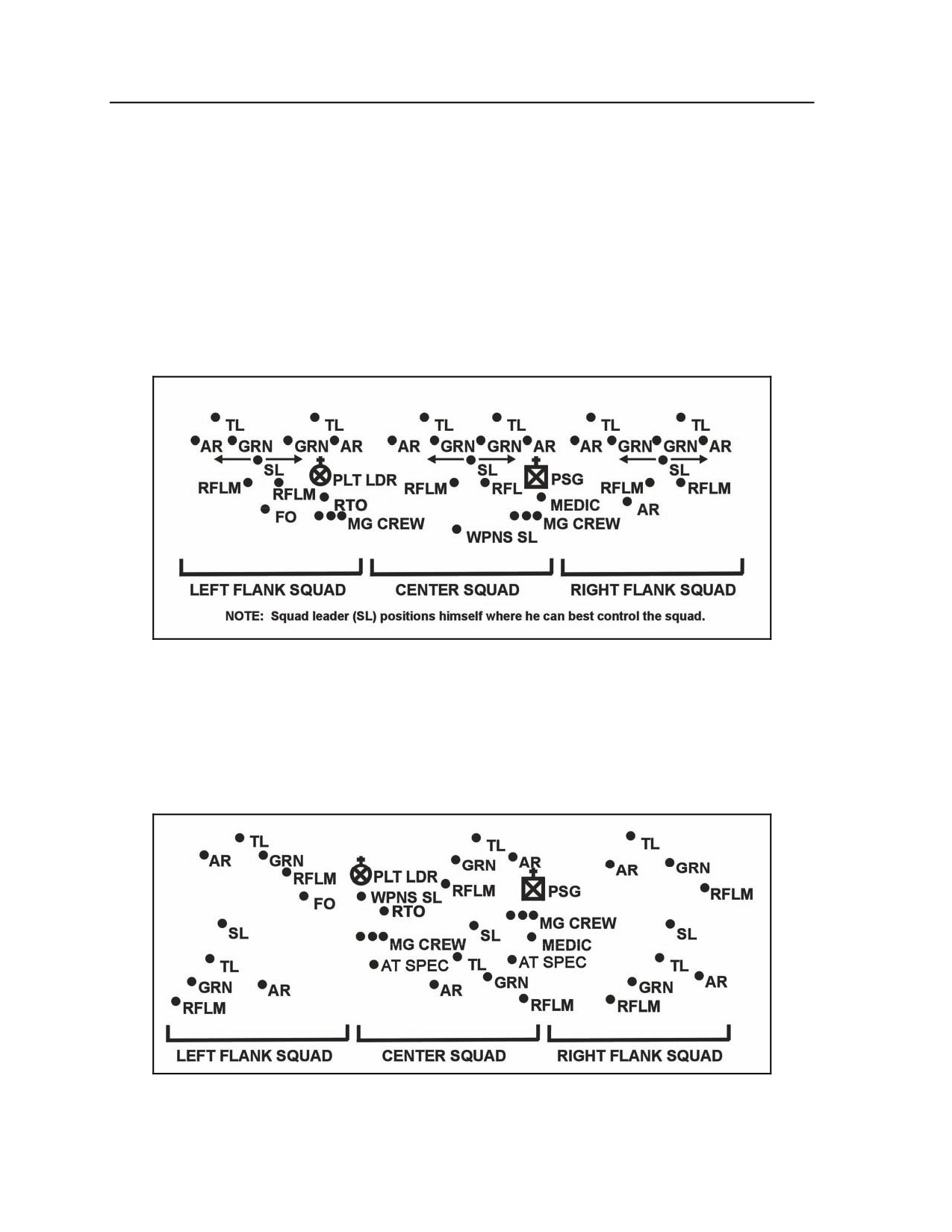
3-58. In the platoon line, squads on line formation, when two or more platoons are attacking, the company
commander chooses one of them as the base platoon. The base platoon’s center squad is its base squad.
When the platoon is not acting as the base platoon, its base squad is its flank squad nearest the base
platoon. The weapons squad may move with the platoon, or it can provide the support-by-fire position. This
is the basic platoon assault formation (Figure 3-9).
3-59. The platoon line with squads on line is the most difficult formation from which to make the transition
to other formations.
3-60. It may be used in the assault to maximize the firepower and shock effect of the platoon. This
normally is done when there is no more intervening terrain between the unit and the enemy, when antitank
systems are suppressed, or when the unit is exposed to artillery fire and must move rapidly.
Figure 3-9. Platoon line, squads on line.
Platoon Line, Squads in Column
3-61. When two or more platoons are moving, the company commander chooses one of them as the base
platoon. The base platoon’s center squad is its base squad. When the platoon is not the base platoon, its
base squad is its flank squad nearest the base platoon (Figure 3-10). The platoon line with squads in column
formation is difficult to transition to other formations.
Figure 3-10. Platoon line, squads in column.
3-16
FM 3-21.8
28 March 2007
Tactical Movement
Platoon Vee
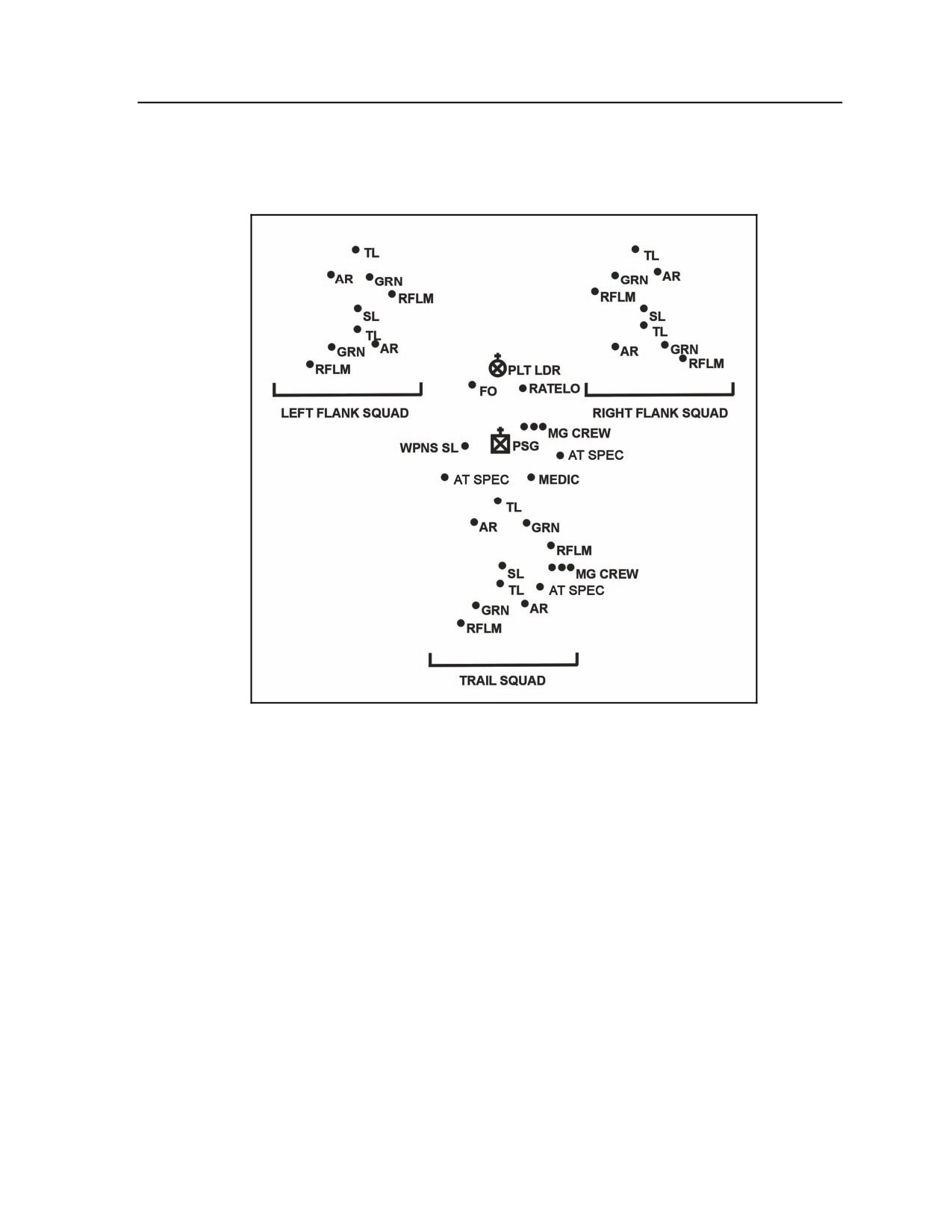
3-62. This formation has two squads up front to provide a heavy volume of fire on contact (Figure 3-11). It
also has one squad in the rear that can either overwatch or trail the other squads. The platoon leader
designates one of the front squads to be the platoon’s base squad.
Figure 3-11. Platoon vee.
Platoon Wedge
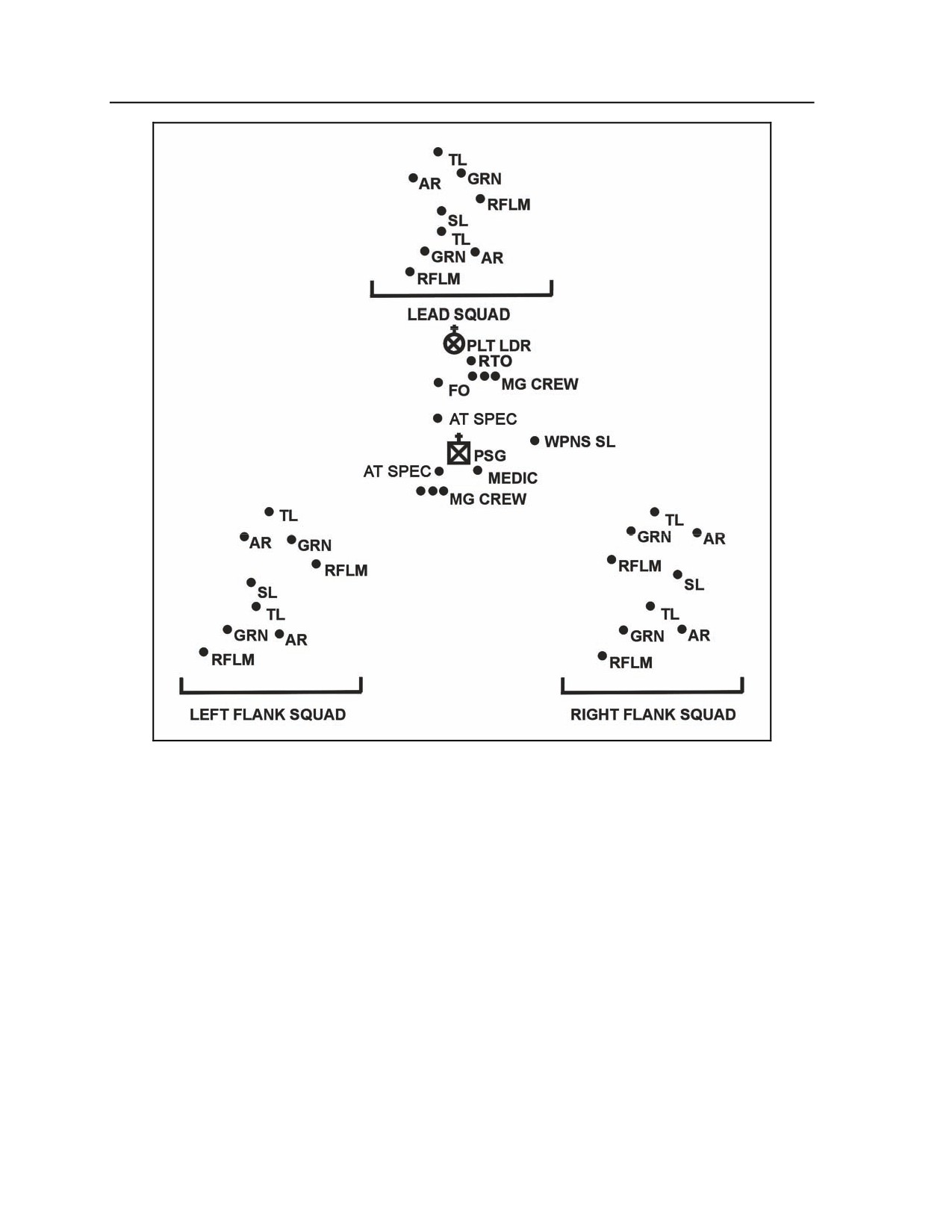
3-63. This formation has two squads in the rear that can overwatch or trail the lead squad (Figure 3-12).
The lead squad is the base squad. The wedge formation—
Can be used with the traveling and traveling overwatch techniques.
Allows rapid transition to bounding overwatch.
28 March 2007
FM 3-21.8
3-17
Chapter 3
Figure 3-12. Platoon wedge.
Platoon File
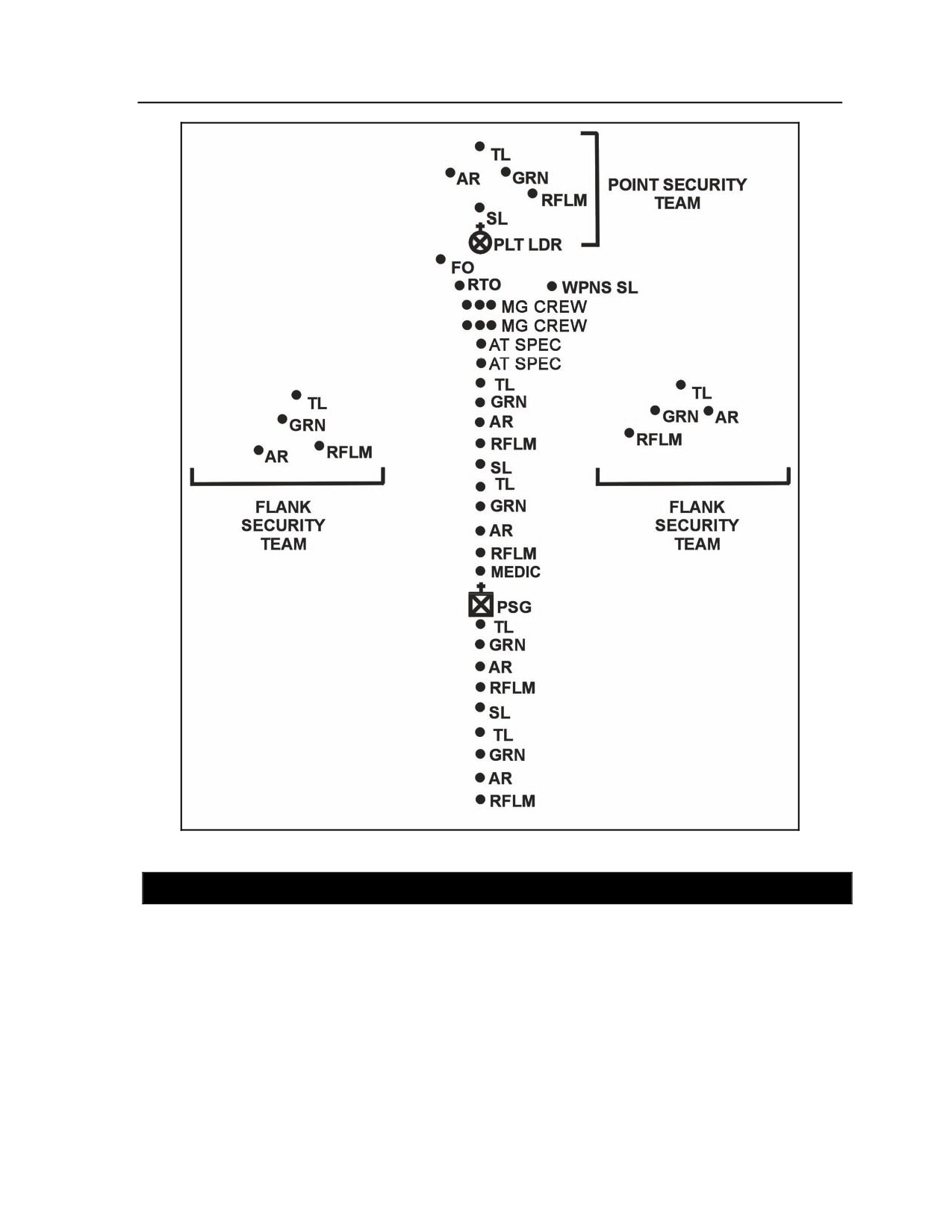
3-64. This formation may be set up in several methods (Figure 3-13). One method is to have three-squad
files follow one another using one of the movement techniques. Another method is to have a single platoon
file with a front security element (point) and flank security elements. The distance between Soldiers is less
than normal to allow communication by passing messages up and down the file. The platoon file has the
same characteristics as the fire team and squad files. It is normally used for traveling only.
3-18
FM 3-21.8
28 March 2007
Tactical Movement
Figure 3-13. Platoon file.
SECTION III — MOVEMENT TECHNIQUES
3-65. Movement techniques are not fixed formations. They refer to the distances between Soldiers, teams,
and squads that vary based on mission, enemy, terrain, visibility, and any other factor that affects control.
There are three movement techniques: traveling; traveling overwatch; and bounding overwatch. The
selection of a movement technique is based on the likelihood of enemy contact and the need for speed.
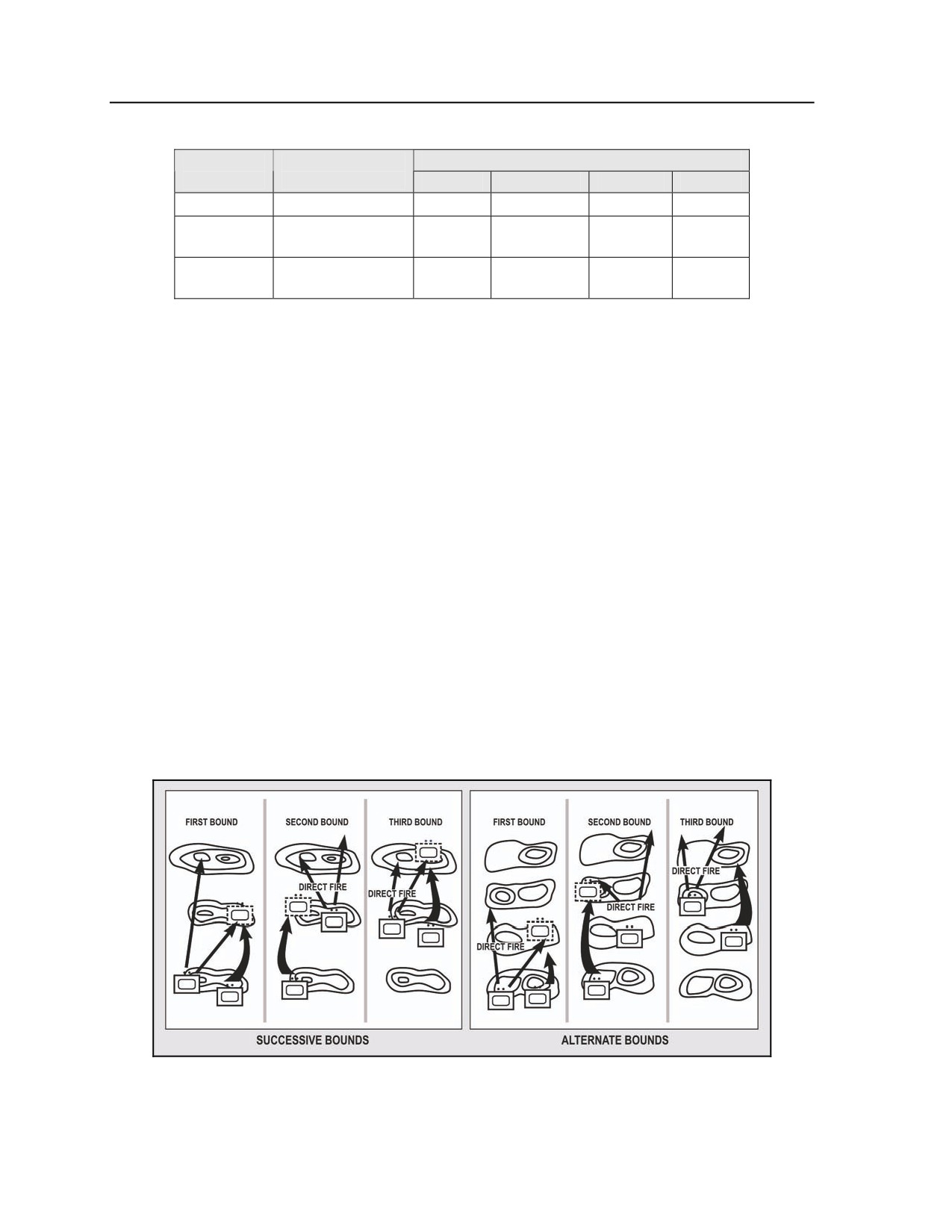
Factors to consider for each technique are control, dispersion, speed, and security (Table 3-5). Individual
movement techniques include high and low crawl, and three to five second rushes from one covered
position to another (see FM 21-75, Combat Skills of the Soldier).
28 March 2007
FM 3-21.8
3-19
Chapter 3
Table 3-5. Movement techniques and characteristics.
Movement
When Normally
CHARACTERISTICS
Techniques
Used
Control
Dispersion
Speed
Security
Traveling
Contact not likely
More
Less
Fastest
Least
Traveling
Contact possible
Less
More
Slower
More
overwatch
Bounding
Contact expected
Most
Most
Slowest
Most
overwatch
3-66. From these movement techniques, leaders are able to conduct actions on contact, making natural
transitions to fire and movement as well as to conducting tactical mission tasks. When analyzing the
situation, some enemy positions are known. However, most of the time enemy positions will only be likely
(called templated positions). Templated positions are the leader’s “best guess” based on analyzing the
terrain and his knowledge of the enemy. Throughout the operation, leaders are continuously trying to
confirm or deny both the known positions as well as the likely positions.
Methods of Maneuvering Subordinates
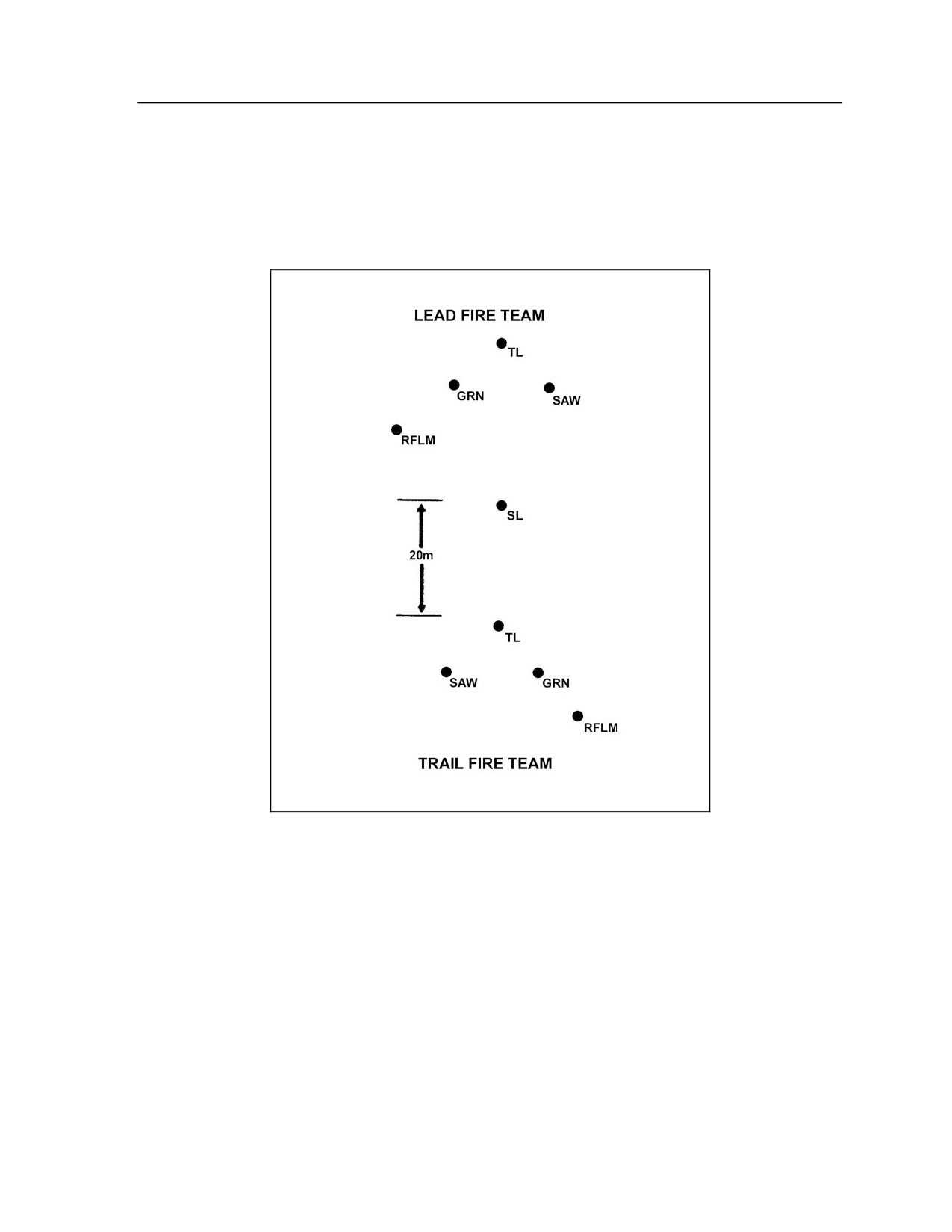
3-67. There are two methods of bounding the squads: successive; and alternate bounds. In successive
bounds the lead element is always the same; in alternate bounds (called leapfrogging), the lead element
changes each time (Figure 3-14).
Successive Bounds
3-68. If the platoon uses successive bounds, the lead squad, covered by the trail squad, advances and
occupies a support-by-fire position. The trail squad advances to a support-by-fire position abreast of the
lead squad and halts. The lead squad moves to the next position and the move continues. Only one squad
moves at a time, and the trail squad avoids advancing beyond the lead squad.
Alternate Bounds
3-69. Covered by the rear squad, the lead squad moves forward, halts, and assumes overwatch positions.
The rear squad advances past the lead squad and takes up overwatch positions. The initial lead squad then
advances past the initial rear squad and takes up overwatch positions. Only one squad moves at a time. This
method is usually more rapid than successive bounds.
Figure 3-14. Successive and alternate bounds.
3-20
FM 3-21.8
28 March 2007
Tactical Movement
SQUAD MOVEMENT TECHNIQUES
3-70. The platoon leader determines and directs which movement technique the squad will use.
SQUAD TRAVELING
3-71. Traveling is used when contact with the enemy is not likely and speed is needed (Figure 3-15).
Figure 3-15. Squad traveling.
SQUAD TRAVELING OVERWATCH
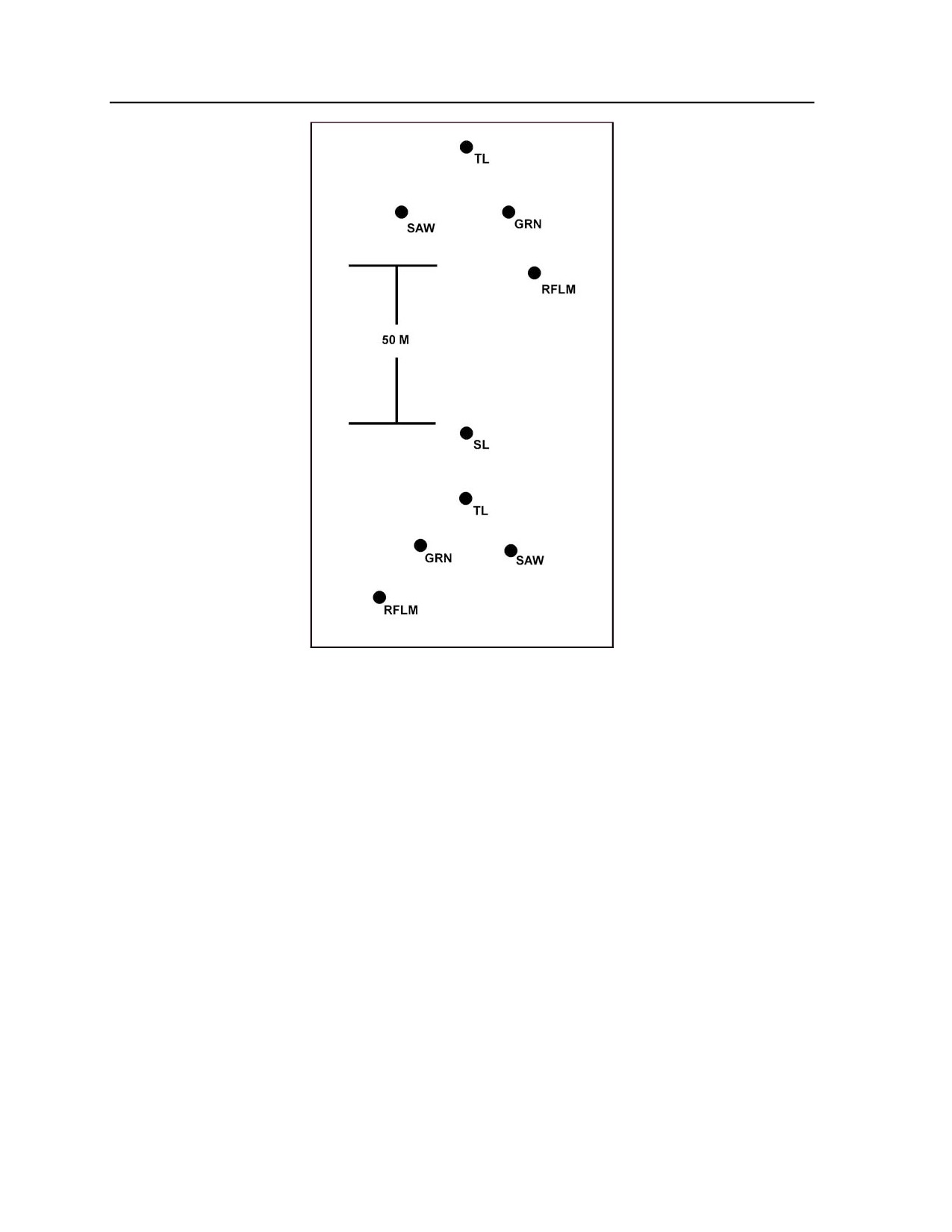
3-72. Traveling overwatch is used when contact is possible. Attached weapons move near the squad leader
and under his control so he can employ them quickly. Rifle squads normally move in column or wedge
formation (Figure 3-16). Ideally, the lead team moves at least 50 meters in front of the rest of the element.
28 March 2007
FM 3-21.8
3-21
Chapter 3
Figure 3-16. Squad traveling overwatch.
SQUAD BOUNDING OVERWATCH
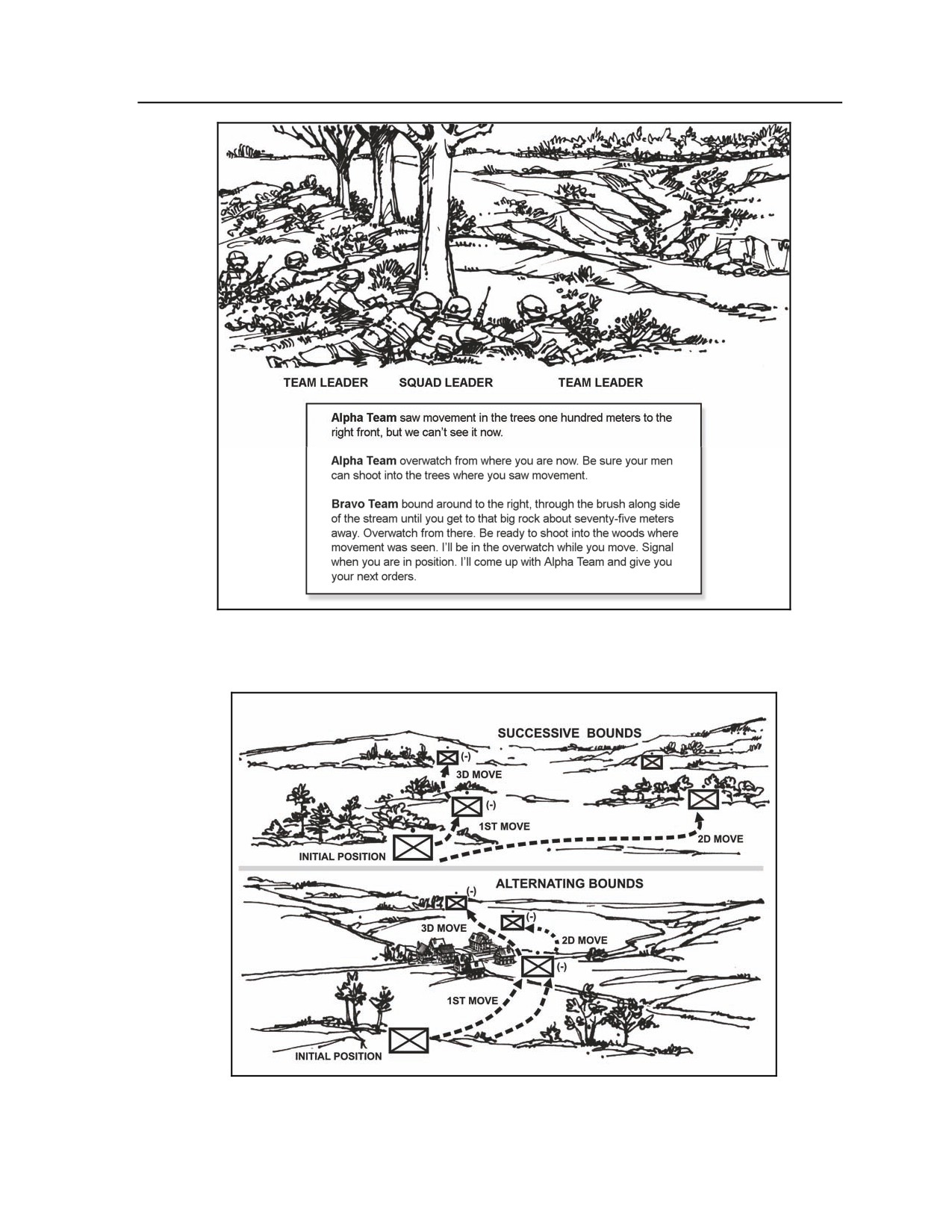
3-73. Bounding overwatch is used when contact is expected, when the squad leader feels the enemy is
near (based on movement, noise, reflection, trash, fresh tracks, or even a hunch), or when a large open
danger area must be crossed. The lead fire team overwatches first. Soldiers in the overwatch team scan for
enemy positions. The squad leader usually stays with the overwatch team. The trail fire team bounds and
signals the squad leader when his team completes its bound and is prepared to overwatch the movement of
the other team.
3-74. Both team leaders must know which team the squad leader will be with. The overwatching team
leader must know the route and destination of the bounding team. The bounding team leader must know his
team's destination and route, possible enemy locations, and actions to take when he arrives there. He must
also know where the overwatching team will be and how he will receive his instructions (Figure 3-17). The
cover and concealment on the bounding team's route dictates how its Soldiers move.
3-22
FM 3-21.8
28 March 2007
Tactical Movement
Figure 3-17. Squad bounding overwatch.
3-75. Teams can bound successively or alternately. Successive bounds are easier to control; alternate
bounds can be faster (Figure 3-18).
Figure 3-18. Squad successive and alternate bounds.
28 March 2007
FM 3-21.8
3-23
Chapter 3
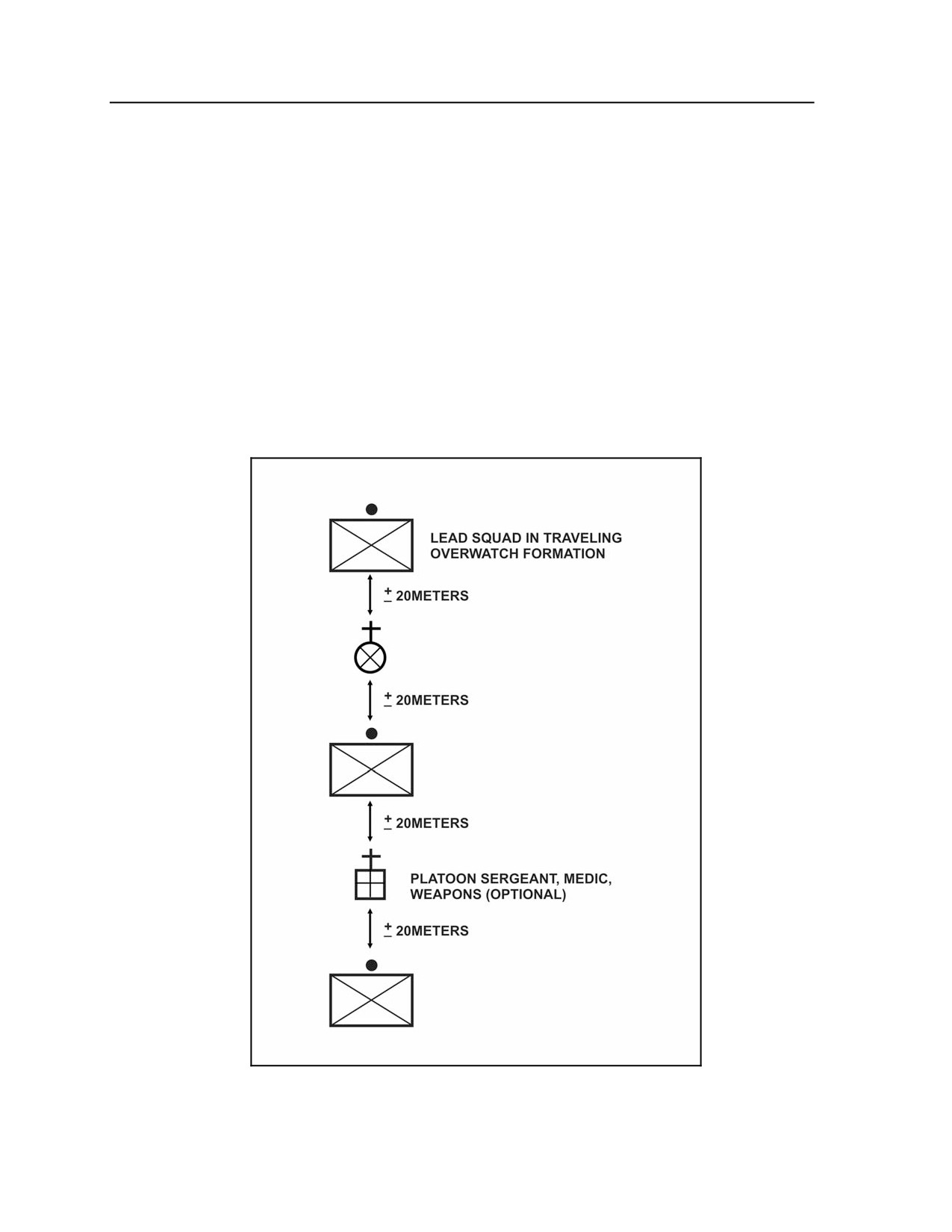
PLATOON MOVEMENT TECHNIQUES
3-76. The platoon leader determines and directs which movement technique the platoon will use. While
moving, leaders typically separate their unit into two groups: a security element and the main body. In most
scenarios, the Infantry platoon is not large enough to separate its forces into separate security forces and
main body forces. However, it is able to accomplish these security functions by employing movement
techniques. A movement technique is the manner a platoon uses to traverse terrain.
3-77. As the probability of enemy contact increases, the platoon leader adjusts the movement technique to
provide greater security. The key factor to consider is the trail unit’s ability to provide mutual support to the
lead element. Soldiers must be able to see their fire team leader. The squad leader must be able to see his
fire team leaders. The platoon leader should be able to see his lead squad leader.
TRAVELING
3-78. The platoon often uses the traveling technique when contact is unlikely and speed is needed (Figure
3-19). When using the traveling technique, all unit elements move continuously. In continuous movement,
all Soldiers travel at a moderate rate of speed, with all personnel alert. During traveling, formations are
essentially not altered except for the effects of terrain.
Figure 3-19. Platoon traveling.
3-24
FM 3-21.8
28 March 2007
Tactical Movement
TRAVELING OVERWATCH
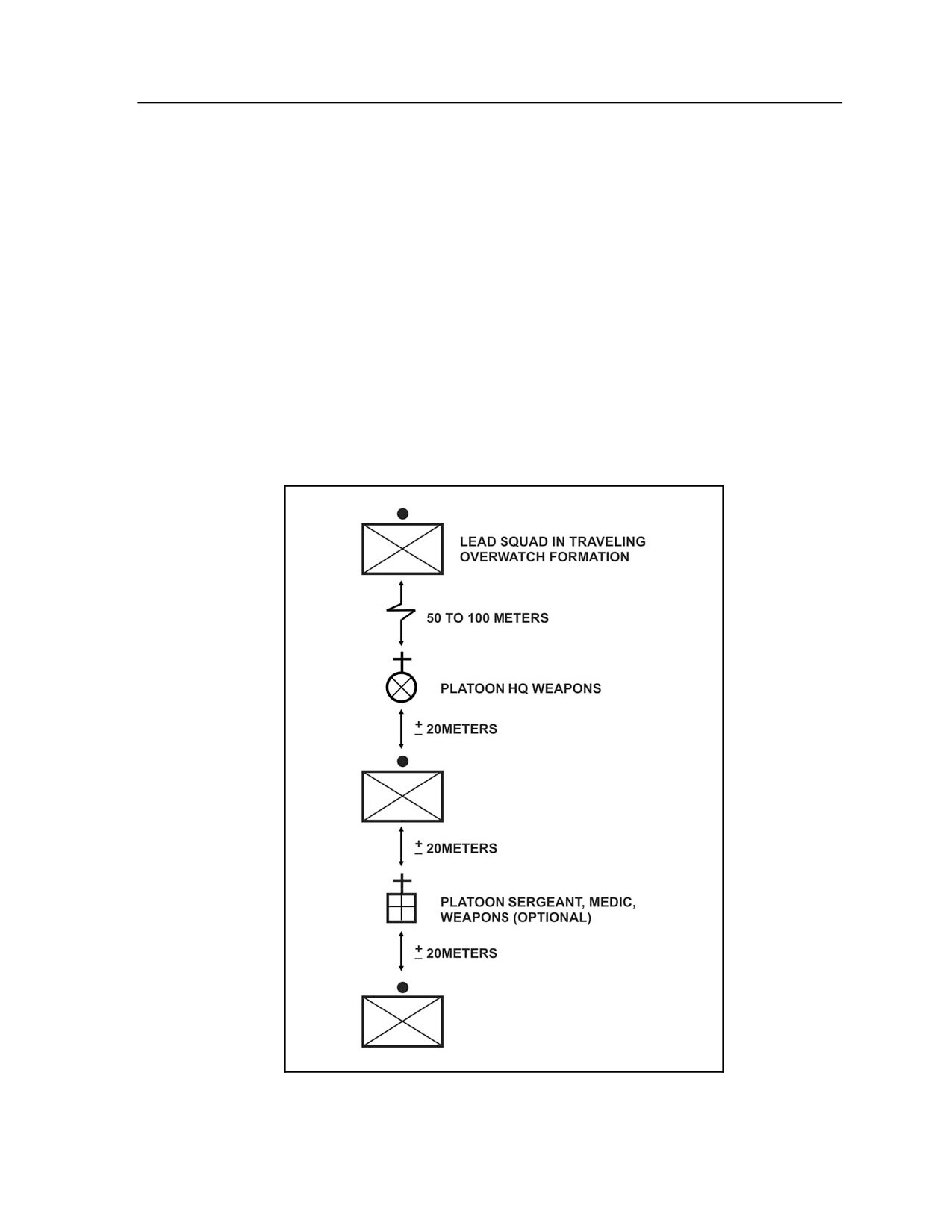
3-79. Traveling overwatch is an extended form of traveling in which the lead element moves continuously
but trailing elements move at varying speeds, sometimes pausing to overwatch movement of the lead
element (Figure 3-20). Traveling overwatch is used when enemy contact is possible but not expected.
Caution is justified but speed is desirable.
3-80. The trail element maintains dispersion based on its ability to provide immediate suppressive fires in
support of the lead element. The intent is to maintain depth, provide flexibility, and sustain movement in
case the lead element is engaged. The trailing elements cue their movement to the terrain, overwatching
from a position where they can support the lead element if needed. Trailing elements overwatch from
positions and at distances that will not prevent them from firing or moving to support the lead element. The
idea is to put enough distance between the lead unit and the trail unit(s) so if the lead unit comes into
contact, the trail unit(s) will be out of contact but have the ability to maneuver on the enemy.
3-81. Traveling overwatch requires the leader to control his subordinate’s spacing to ensure mutual
support. This involves a constant process of concentrating (close it up) and dispersion (spread it out). The
primary factor is mutual support, with its two critical variables being weapon ranges and terrain. Infantry
platoon’s weapon range limitations dictate that units should not generally get separated by more than 300
meters. In compartmentalized terrain this distance is obviously closer while in open terrain this distance is
greater.
Figure 3-20. Platoon traveling overwatch.
28 March 2007
FM 3-21.8
3-25
Chapter 3
BOUNDING OVERWATCH
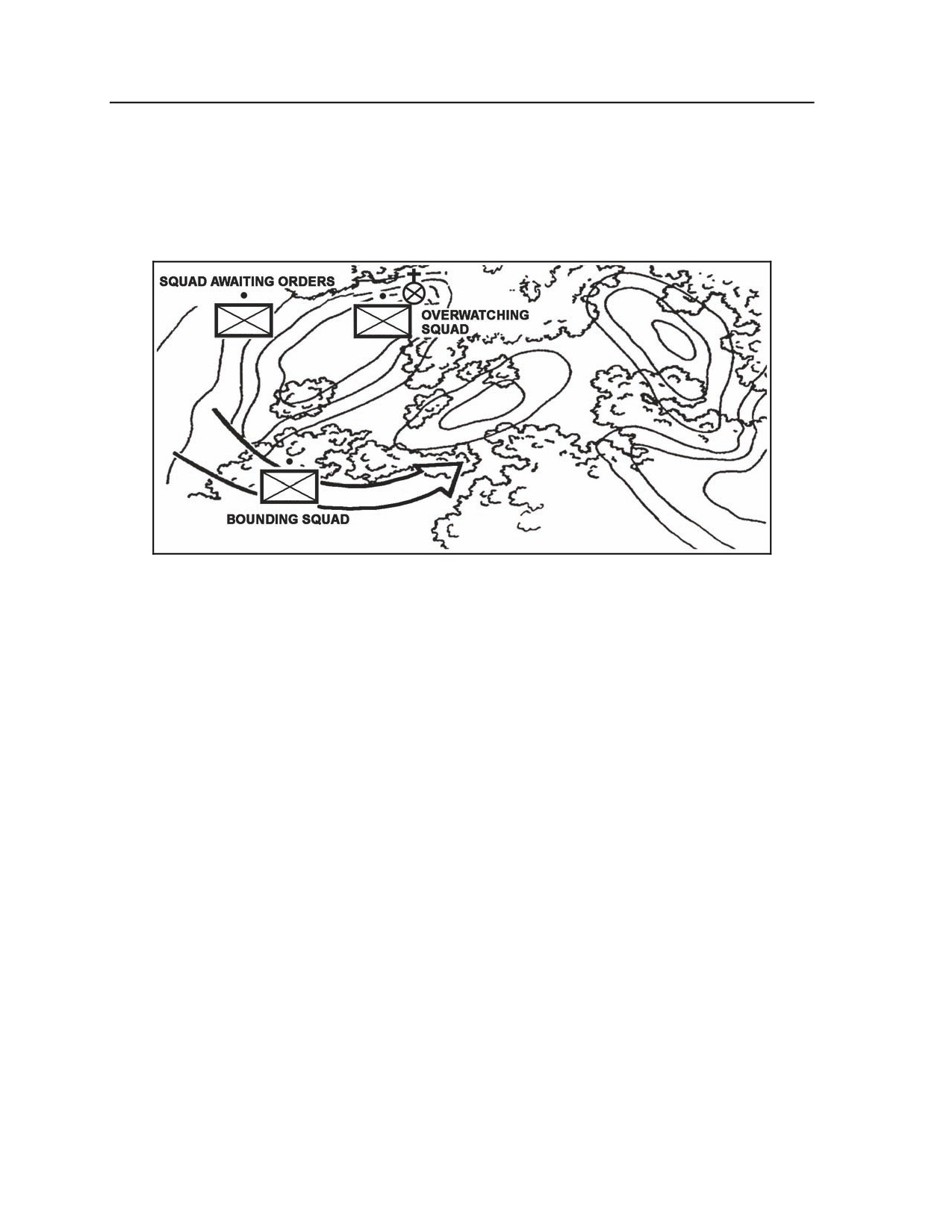
3-82. Bounding overwatch is similar to fire and movement in which one unit overwatches the movement of
another (Figure 3-21). The difference is there is no actual enemy contact. Bounding overwatch is used
when the leader expects contact. The key to this technique is the proper use of terrain. Subordinate units
fall into one of three categories: bounding, overwatching, or awaiting orders.
Figure 3-21. Platoon bounding overwatch.
One Squad Bounding
3-83. One squad bounds forward to a chosen position; it then becomes the overwatching element unless
contact is made en route. The bounding squad can use traveling overwatch, bounding overwatch, or
individual movement techniques (low and high crawl, and three to five second rushes by fire team or pairs).
3-84. Factors of METT-TC dictate the length of the bounds. However, the bounding squad(s) should never
move beyond the range at which the base-of-fire squad(s) can effectively suppress known, likely, or
suspected enemy positions. In severely restrictive terrain, the bounding squad(s) makes shorter bounds than
it would in more open areas. The destination of the bounding element is based on the suitability of the next
location as an overwatch position. When deciding where to send his bounding squad, a platoon leader
considers—
The requirements of the mission.
Where the enemy is likely to be.
The routes to the next overwatch position.
The ability of an overwatching element’s weapons to cover the bound.
The responsiveness of the rest of the platoon.
One Squad Overwatching
3-85. One squad overwatches the bounding squad from covered positions and from where it can see and
suppress likely enemy positions. The platoon leader remains with the overwatching squad. Normally the
platoon’s machine guns are located with the overwatching squad.
One Squad Awaiting Orders
3-86. Based on the situation, one squad is uncommitted and ready for employment as directed by the
platoon leader. The platoon sergeant and the leader of the squad awaiting orders position themselves close
3-26
FM 3-21.8
28 March 2007
Tactical Movement
to the platoon leader. On contact, this unit(s) should be prepared to support the overwatching element,
move to assist the bounding squad, or move to another location based on the platoon leader’s assessment.
Weapons Squad
3-87. Machine guns are normally employed in one of two ways:
Attached to the overwatch squad or the weapons squad that supports the overwatch element.
Awaiting orders to move (with the platoon sergeant [PSG]) or as part of a bounding element.
Command and Control of the Bounding Element
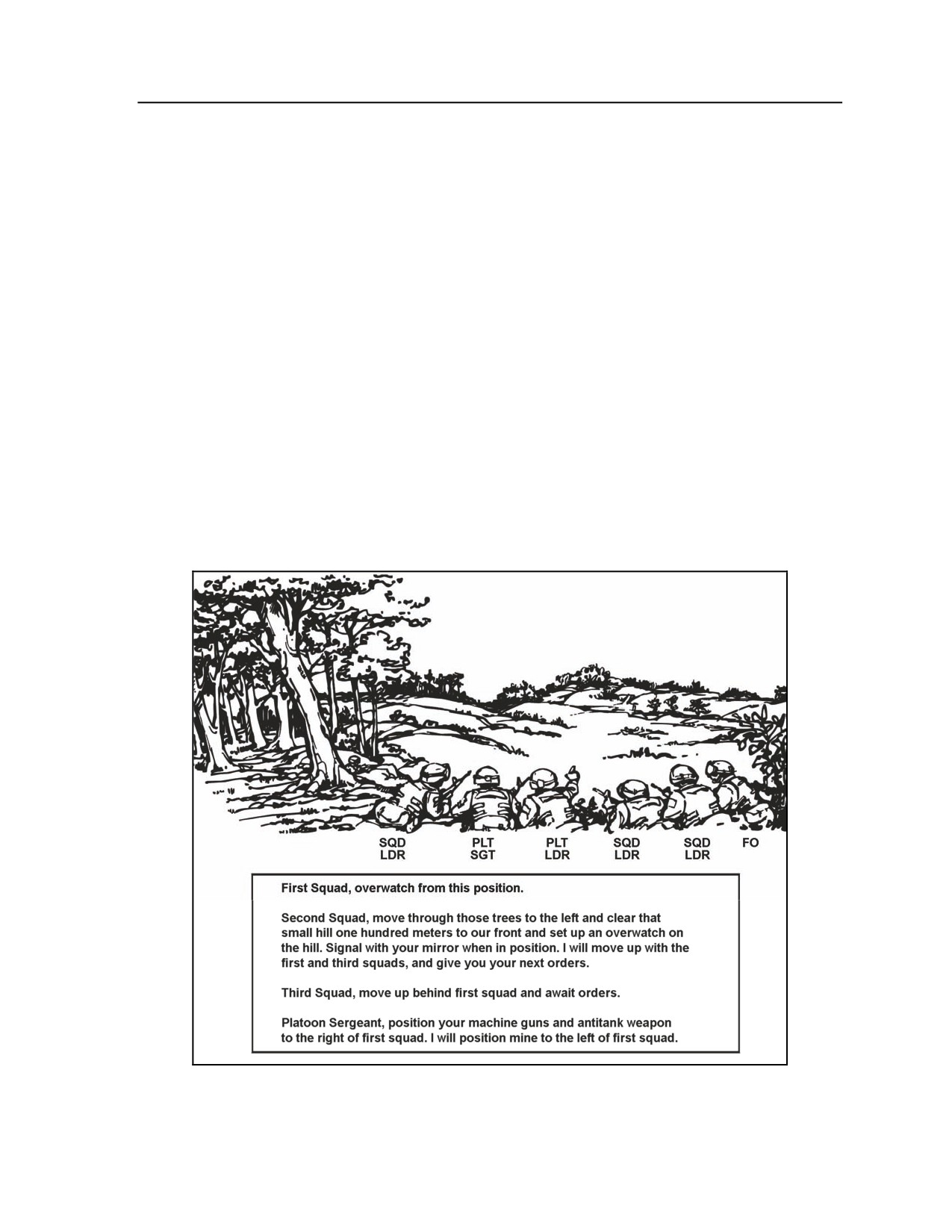
3-88. Ideally, the overwatch element maintains visual contact with the bounding element. However, the
leader of the overwatch element may have the ability to digitally track the location of the bounding element
without maintaining visual contact. This provides the bounding element more freedom in selecting covered
and concealed routes to its next location. Before a bound, the platoon leader gives an order to his squad
leaders from the overwatch position (Figure 3-22). He tells and shows them the following:
The direction or location of the enemy (if known).
The positions of the overwatching squad.
The next overwatch position.
The route of the bounding squad.
What to do after the bounding squad reaches the next position.
What signal the bounding squad will use to announce it is prepared to overwatch.
How the squad will receive its next orders.
Figure 3-22. Example of platoon leader’s orders for bounding overwatch.
28 March 2007
FM 3-21.8
3-27
Chapter 3
SECTION IV — ROUTE SELECTION AND NAVIGATION
3-89. During planning and preparation for tactical movement, platoon leaders analyze the terrain from two
perspectives. First, they analyze the terrain to see how it can provide tactical advantage, both to friendly
and enemy forces. Second, they look at the terrain to determine how it can aid navigation. Leaders identify
any areas or terrain features that dominate their avenue of approach. These areas are almost always
considered key terrain and provide the unit possible intermediate and final objectives.
3-90. Ideally, the leader identifies along his route not only ground that is good for navigation, but also
ground that facilitates destroying the enemy should contact occur. If the leader wants to avoid contact, he
chooses terrain that will hide the unit. If he wants to make contact, he chooses terrain from where he can
more easily scan and observe the enemy. On other occasions, the leader may require terrain that allows
stealth or speed. Regardless of the requirement, the leader must ensure that most of the terrain along his
route provides some tactical advantage.
3-91. Route Selection and Navigation are made easier with the aid of technology. Global Positioning
System (GPS) devices or Force XXI Battle Command Brigade and Below Systems (FBCB2) enhance the
Infantry platoon’s ability to ensure they are in the right place at the right time and to determine the location
of adjacent units.
NAVIGATION AIDS
3-92. There are two categories of navigational aids: linear; and point. Linear navigational aids are terrain
features such as trails, streams, ridgelines, woodlines, power lines, streets, and contour lines. Point terrain
features include hilltops, and prominent buildings. Navigation aids are usually assigned control measures to
facilitate communication during the movement. Typically, linear features are labeled as phase lines while
point features are labeled as checkpoints (or rally points). There are three primary categories of navigation
aids: catching features; handrails; and navigational attack points.
CATCHING FEATURES
3-93. Catching features are obvious terrain features that go beyond a waypoint or control measure and can
be either linear or point. The general idea is that if the unit moves past its objective, limit of advance, or
checkpoint, the catching feature will alert them that they have traveled too far.
The Offset-Compass Method
3-94. If there is the possibility of missing a particular point along the route (such as the endpoint or a
navigational attack point), it is sometimes preferable to deliberately aim the leg to the left or right of the
end point toward a prominent catching feature. Once reached, the unit simply turns the appropriate
direction and moves to the desired endpoint. This method is especially helpful when the catching feature is
linear.
Boxing-In the Route
3-95. One of the techniques leaders can use to prevent themselves from making navigational errors is to
“box in” the leg or the entire route. This method uses catching features, handrails, and navigational attack
points to form boundaries. Creating a box around the leg or route assists in more easily recognizing and
correcting deviation from the planned leg or route.
HANDRAILS
3-96. Handrails are linear features parallel to the proposed route. The general idea is to use the handrail to
keep the unit oriented in the right direction. Guiding off of a handrail can increase the unit’s speed while
also acting as a catching feature.
3-28
FM 3-21.8
28 March 2007
Tactical Movement
NAVIGATIONAL ATTACK POINTS
3-97. Navigational attack points are an obvious landmark near the objective, limit of advance, or
checkpoint that can be easily found. Upon arriving at the navigational attack point, the unit transitions from
rough navigation (terrain association or general azimuth navigation) to point navigation (dead reckoning).
Navigational attack points are typically labeled as checkpoints.
ROUTE PLANNING
3-98. Route planning must take into account enabling tasks specific to tactical movement. These tasks
facilitate the overall operation. Tactical movement normally contains some or all of the following enabling
tasks:
Planning movement with GPS waypoints.
Movement to and passage of friendly lines.
Movement to an objective rally point (ORP).
Movement to a phase line of deployment.
Movement to a limit of advance.
Linkup with another unit.
Movement to a patrol base or assembly area.
Movement back to and reentry of friendly lines.
3-99. Leaders first identify where they want to end up (the objective or limit of advance). Then, working
back to their current location, they identify all of the critical information and actions required as they relate
to the route. For example, navigational aids, tactical positions, known and templated enemy positions, and
friendly control measures. Using this information, they break up their route in manageable parts called legs.
Finally, they capture their information and draw a sketch on a route chart. There are three decisions that
leaders make during route planning:
(1) The type of (or combination of) navigation to use.
(2) The type of route during each leg.
(3) The start point and end point of each leg.
3-100. The leader assesses the terrain in his proposed area of operation. In addition to the standard Army
map, the leader may have aerial photographs and terrain analysis overlays from the parent unit, or he may
talk with someone familiar with the area.
3-101. To control movement, leaders use axes of advance, directions of attack, infiltration lanes, phase
lines, probable lines of deployment, checkpoints
(waypoints), final coordination lines, rally points,
assembly areas, and routes.
TYPES OF NAVIGATION
3-102. There are three types of navigation: terrain association; general azimuth method; and point
navigation. Leaders use whichever type or combination best suits the situation.
TERRAIN ASSOCIATION
3-103. Terrain association is the ability to identify terrain features on the ground by the contour intervals
depicted on the map. The leader analyzes the terrain using the factors of OAKOC and identifies major
terrain features, contour changes, and man-made structures along his axis of advance. As the unit moves, he
uses these features to orient the unit and to associate ground positions with map locations. The major
advantage of terrain association is that it forces the leader to continually assess the terrain. This leads to
identifying tactically-advantageous terrain and using terrain to the unit’s advantage.
28 March 2007
FM 3-21.8
3-29
Chapter 3
GENERAL AZIMUTH METHOD
3-104. For this method, the leader selects linear terrain features; then while maintaining map orientation
and a general azimuth, he guides on the terrain feature. Advantages of the general azimuth method are that
it speeds movement, avoids fatigue, and often simplifies navigation because the unit follows the terrain
feature. The disadvantage is that it usually puts the unit on a natural line of drift. This method should end
like terrain association, with the unit reaching a catching feature or a navigational attack point, then
switching to point navigation.
POINT NAVIGATION
3-105. Point navigation, also called dead reckoning, is done by starting from a known point and then
strictly following a predetermined azimuth and distance. This form of navigation requires a high level of
leader control because even a slight deviation over the course of a movement can cause navigation errors.
This method uses the dismounted compass and a distance from the pace man (or a vehicle’s odometer when
mounted) to follow a prescribed route. Point navigation requires the leader to follow these steps:
Use the compass to maintain direction.
Use the pace man’s pace or a vehicle odometer to measure the distance traveled for each leg
or part.
Review the written description of the route plan to help prevent navigational errors.
3-106. When performed correctly, point navigation is very reliable, but time consuming. It is best used
when the need for navigational accuracy outweighs the importance of using terrain. Point navigation is
particularly useful when recognizable terrain features do not exist or are too far away to be helpful. For
example, deserts, swamps, and thick forest make terrain association difficult. Using point navigation early
on in a long movement can stress the compass man and it may be advisable to switch him. One of the
problems with point navigation is negotiating severely restrictive terrain or danger areas.
COMBINATIONS
3-107. Leaders can benefit from combining the three types of navigation. Terrain association and the
general azimuth method enable leaders to set a rough compass bearing and move as quickly as the situation
allows toward a catching feature or a navigational attack point. Once reached, leaders switch to point
navigation by paying extremely close attention to detail, taking as much time as necessary to analyze the
situation and find their point. Terrain association and the general azimuth method allow for some flexibility
in the movement, and therefore do not require the same level of control as point navigation. Point
navigation, on the other hand, enables leaders to precisely locate their objective or point.
ROUTE TYPES
3-108. There are three types of routes leaders can choose from: those that follow linear terrain features;
those that follow a designated contour interval; and those that go cross compartment. Terrain association
can be used with all three route types. The general azimuth method is used with the contour and terrain
feature method. Point navigation is used primarily with cross compartment.
TERRAIN FEATURE
3-109. Following a terrain feature is nothing more than moving along linear features such as ridges,
valleys, and streets. The advantage of this method is that the unit is moving with the terrain. This is
normally the least physically taxing of the methods. The disadvantage is that following terrain features also
means following natural lines of drift, which leads to a higher probability of chance contact with the
enemy.
CONTOURING
3-110. Contouring (remaining at the same height for the entire leg) follows the imaginary contour line
around a hill or along a ridgeline. Contouring has two advantages. First, it prevents undue climbing or
3-30
FM 3-21.8
28 March 2007
Tactical Movement
descending. Second, following the contour acts as handrail or catching feature. The disadvantage of
contouring is that it can be physically taxing.
CROSS COMPARTMENT
3-111. Cross compartment means following a predetermined azimuth and usually means moving against
the terrain. The advantage of this method is that it provides the most direct route from the start point to the
end point of the leg or route. There are two primary disadvantages to this type of route. First, this method
can be physically taxing. Second, the unit might expose itself to enemy observation.
DEVELOP A LEG
3-112. The best way to manage a route is to divide it into segments called “legs.” By breaking the overall
route into several smaller segments, the leader is able to plan in detail. Legs typically have only one
distance and direction. A change in direction usually ends the leg and begins a new one.
3-113. A leg must have a definite beginning and ending, marked with a control measure such as a
checkpoint or phase line. (When using GPS, these are captured as waypoints.) When possible, the start
point and end point should correspond to a navigational aid (catching feature or navigational attack point).
3-114. To develop a leg, leaders first determine the type of navigation and route that best suits the
situation. Once these two decisions are made, the leader determines the distance and direction from the start
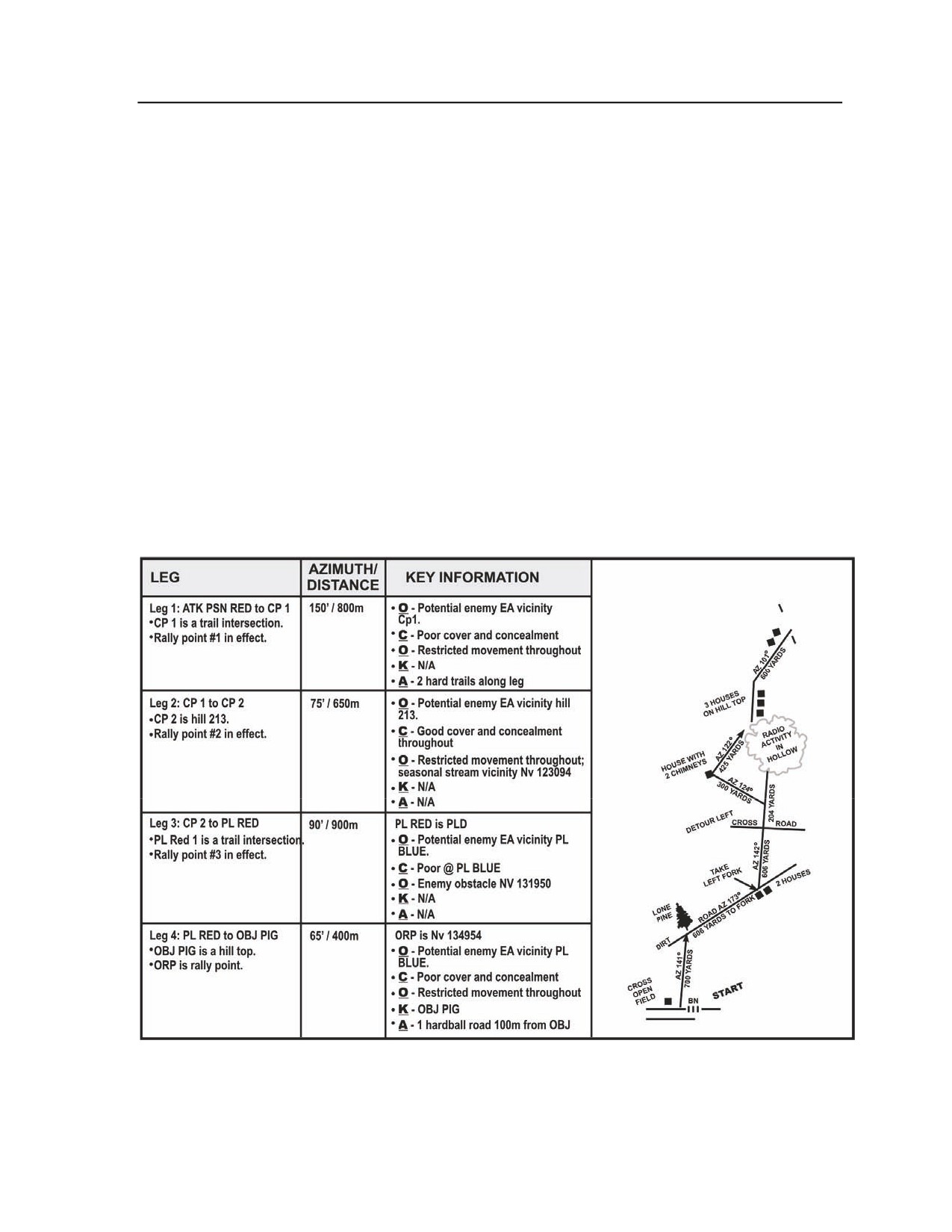
point to the end point. He then identifies critical METT-TC information as it relates to that specific leg.
Finally, leaders capture this information and draw a sketch on a route chart (Figure 3-23).
Figure 3-23. Sketch of legs example.
28 March 2007
FM 3-21.8
3-31
Chapter 3
EXECUTE THE ROUTE
3-115. Using decisions about the route and navigation made during planning and preparation, leaders
execute their route and direct their subordinates. In addition to executing the plan, leaders—
Determine and maintain accurate location.
Designate rally points.
DETERMINE LOCATION
3-116. Leaders must always know their units location during movement. Without accurate location, the
unit cannot expect to receive help from supporting arms, integrate reserve forces, or accomplish their
mission. To ensure accurate location, leaders use many techniques, including:
Executing common skills.
Designating a compass man and pace man.
Using GPS / FBCB2.
Common Skills
3-117. All Infantrymen, particularly leaders, must be experts in land navigation. Important navigation
tasks common to all include—
Locating a point using grid coordinates. Using a compass (day/night).
Determining location using resection, intersection, or modified resection.
Interpreting terrain features.
Measuring distance and elevation.
Employing a GPS / FBCB2.
Compass Man
3-118. The compass man assists in navigation by ensuring the lead fire team leader remains on course at
all times. The compass man should be thoroughly briefed. His instructions must include an initial azimuth
with subsequent azimuths provided as necessary. The platoon or squad leader also should designate an
alternate compass man. The leader should validate the patrol’s navigation with GPS devices.
Pace Man
3-119. The pace man maintains an accurate pace at all times. The platoon or squad leader should
designate how often the pace man is to report the pace. The pace man should also report the pace at the end
of each leg. The platoon or squad leader should designate an alternate pace man.
Global Positioning Systems
3-120. GPSs receive signals from satellites or land-based transmitters. They calculate and display the
position of the user in military grid coordinates as well as in degrees of latitude and longitude. During
planning, leaders enter their waypoints into the GPS. Once entered, the GPS can display information such
as distance and direction from waypoint to waypoint. During execution, leaders use the GPS to establish
their exact location.
NOTE: Leaders need to remember that GPS and digital displays are not the only navigational
tools they can use. The best use of GPS or digital displays is for confirming the unit’s location
during movement. Terrain association and map-reading skills are still necessary skills, especially
for point navigation. Over reliance on GPS and digital displays can cause leaders to ignore the
effects of terrain, travel faster than conditions allow, miss opportunities, or fail to modify routes
when necessary.
3-32
FM 3-21.8
28 March 2007

Tactical Movement
DESIGNATE RALLY POINTS
3-121. A rally point is a place designated by the leader where the unit moves to reassemble and reorganize
if it becomes dispersed. It can also be a place for a temporarily halt to reorganize and prepare for actions at
the objective, to depart from friendly lines, or to reenter friendly lines (FM 1-02). Planned and unplanned
rally points are common control measures used during tactical movement. Planned rally points include
objective rally point(s) (ORP), initial rally point(s) (IRP), and reentry rally point(s) (RRP). Unplanned rally
points are enroute rally points, near side rally points, and far side rally points. Despite the different types of
rally points, the actions that occur there are generally the same.
3-122. Prior to departing, leaders designate tentative rally points and determine what actions will occur
there. When occupying a rally point, leaders use a perimeter defense to ensure all-around security. Those
rally points used to reassemble the unit after an event are likely to be chaotic scenes and will require
immediate actions by whatever Soldiers happen to arrive. These actions and other considerations are listed
in Table 3-6.
Table 3-6. Actions at rally point.
Rally Points
Soldier Actions at an RP
Other Considerations
Select a rally point that—
• Establish security.
•
Travel time and distance.
• Is easily recognized.
• Reestablish the chain of
•
Maneuver room needed.
• Is large enough for the unit
command.
•
Adjacent unit coordination
to assemble.
• Account for personnel and
requirements.
• Offers cover and
equipment status.
•
Line of sight and range
concealment.
• Determine how long to wait
requirements for
• Is defensible for a short time.
until continuing the unit’s
communication equipment.
mission or linkup at a follow-
• Is away from normal
•
Trafficability and load
on RP.
bearing capacity of the soil
movement routes and
natural lines of drift.
• Complete last instructions.
(especially when mounted).
Designate a rally point by one
•
Ability to surprise the enemy.
of the following three ways:
•
Ability to prevent being
• Physically occupy it for a
surprised by the enemy.
short period.
•
Energy expenditure of
• Use hand-and-arm signals
Soldiers and condition they
(either pass by at a distance
will be in at the end of the
or walk through).
movement.
• Radio communication.
SECTION V — ACTIONS AT DANGER AREAS
3-123. When analyzing the terrain (in the METT-TC analysis) during the TLP, the platoon leader may
identify danger areas. When planning the route, the platoon leader marks the danger areas on his overlay.
The term danger area refers to any area on the route where the terrain could expose the platoon to enemy
observation, fire, or both. If possible, the platoon leader plans to avoid danger areas, but sometimes he
cannot. When the unit must cross a danger area, it does so as quickly and as carefully as possible. During
planning, the leader designates near-side and far-side rally points. If the platoon encounters an unexpected
danger area, it uses the en route rally points closest to the danger area as far-side and near-side rally points.
Examples of danger areas include—
Open Areas. Conceal the platoon on the near side and observe the area. Post security to give
early warning. Send an element across to clear the far side. When cleared, cross the remainder
of the platoon at the shortest exposed distance and as quickly as possible.
Roads and Trails. Cross roads or trails at or near a bend, a narrow spot, or on low ground.
28 March 2007
FM 3-21.8
3-33
Chapter 3
Villages. Pass villages on the downwind side and well away from them. Avoid animals,
especially dogs, which might reveal the presence of the platoon.
Enemy Positions. Pass on the downwind side (the enemy might have scout dogs). Be alert for
trip wires and warning devices.
Minefields. Bypass minefields if at all possible, even if it requires changing the route by a
great distance. Clear a path through minefields only if necessary.
Streams. Select a narrow spot in the stream that offers concealment on both banks. Observe
the far side carefully. Emplace near- and far-side security for early warning. Clear the far side
and then cross rapidly but quietly.
Wire Obstacles. Avoid wire obstacles (the enemy covers obstacles with observation and
fire).
CROSSING OF DANGER AREAS
3-124. Regardless of the type of danger area, when the platoon must cross one independently, or as the
lead element of a larger force, it must perform the following:
When the lead team signals "danger area" (relayed throughout the platoon), the platoon halts.
The platoon leader moves forward, confirms the danger area, and determines what technique
the platoon will use to cross. The platoon sergeant also moves forward to the platoon leader.
The platoon leader informs all squad leaders of the situation and the near-side and far-side
rally points.
The platoon sergeant directs positioning of the near-side security (usually conducted by the
trail squad). These two security teams may follow him forward when the platoon halts and a
danger area signal is passed back.
The platoon leader reconnoiters the danger area and selects the crossing point that provides
the best cover and concealment.
Near-side security observes to the flanks and overmatches the crossing.
When the near-side security is in place, the platoon leader directs the far-side security team to
cross the danger area.
The far-side security team clears the far side.
The far-side security team leader establishes an observation post forward of the cleared area.
The far-side security team signals to the squad leader that the area is clear. The squad leader
relays the message to the platoon leader.
The platoon leader selects the method the platoon will use to cross the danger area.
The platoon quickly and quietly crosses the danger area.
Once across the danger area, the main body begins moving slowly on the required azimuth.
The near-side security element, controlled by the platoon sergeant, crosses the danger area
where the platoon crossed. They may attempt to cover any tracks left by the platoon.
The platoon sergeant ensures everyone crosses and sends up the report.
The platoon leader ensures accountability and resumes movement at normal speed.
NOTE: The same principles stated above are used when crossing a smaller unit (such as a
squad) across a danger area.
3-125. The platoon leader or squad leader decides how the unit will cross based on the time he has, size of
the unit, size of the danger area, fields of fire into the area, and the amount of security he can post. An
Infantry platoon or squad may cross all at once, in buddy teams, or one Soldier at a time. A large unit
normally crosses its elements one at a time. As each element crosses, it moves to an overwatch position or
to the far-side rally point until told to continue movement.
3-34
FM 3-21.8
28 March 2007
Tactical Movement
CROSSING OF LINEAR DANGER AREAS (PLATOON)
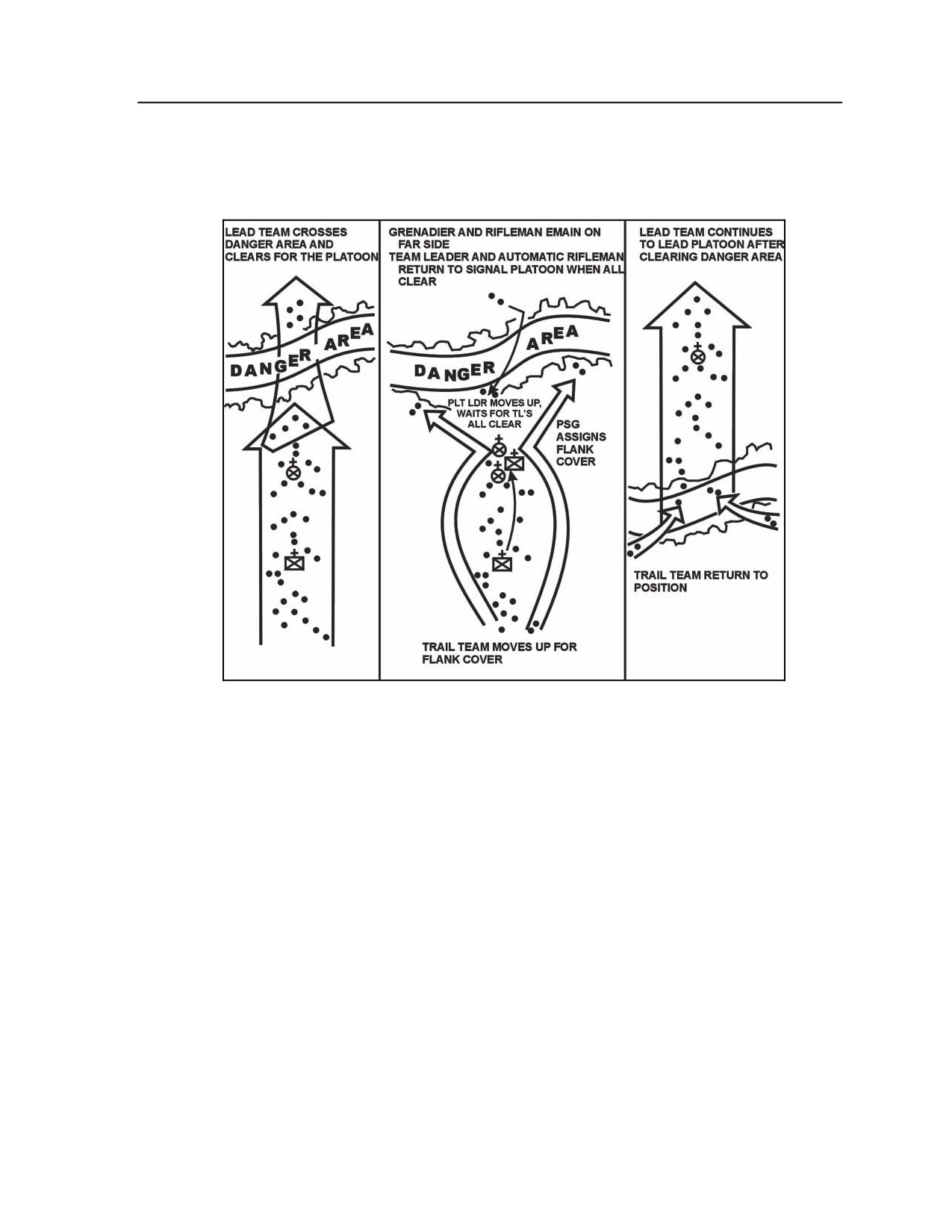
3-126. A linear danger area is an area where the platoon’s flanks are exposed along a relatively narrow
field of fire. Examples include streets, roads, trails, and streams. The platoon crosses a linear danger area in
the formation and location specified by the platoon leader (Figure 3-24).
Figure 3-24. Crossing a linear danger area.
CROSSING OF LARGE OPEN AREAS
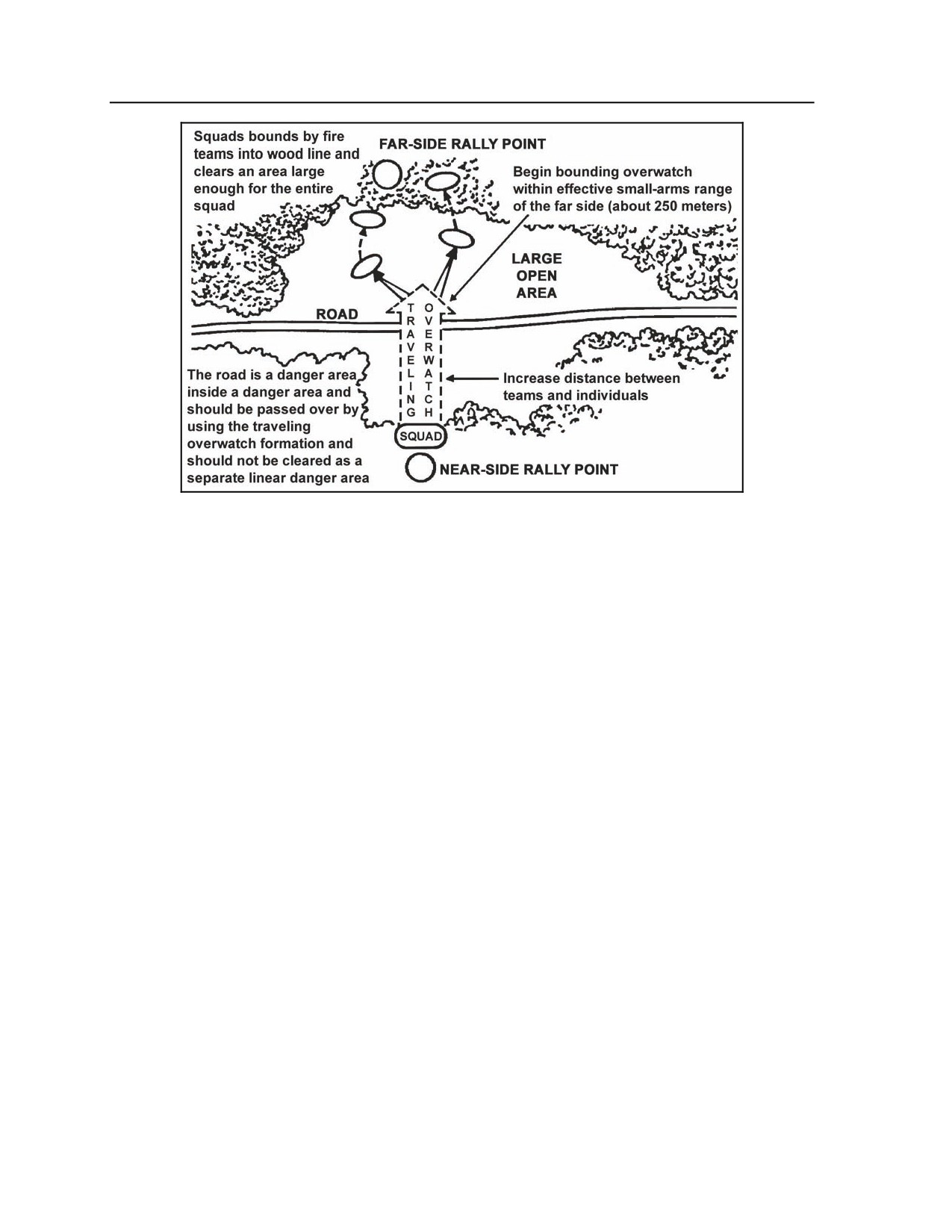
3-127. If the large open area is so large that the platoon cannot bypass it due to the time needed to
accomplish the mission, a combination of traveling overwatch and bounding overwatch is used to cross the
large open area (Figure 3-25). The traveling overwatch technique is used to save time. The squad or platoon
moves using the bounding overwatch technique at any point in the open area where enemy contact may be
expected. The technique may also be used once the squad or platoon comes within range of enemy small-
arms fire from the far side (about 250 meters). Once beyond the open area, the squad or platoon re-forms
and continues the mission.
28 March 2007
FM 3-21.8
3-35
Chapter 3
Figure 3-25. Crossing a large open area.
CROSSING OF SMALL OPEN AREAS
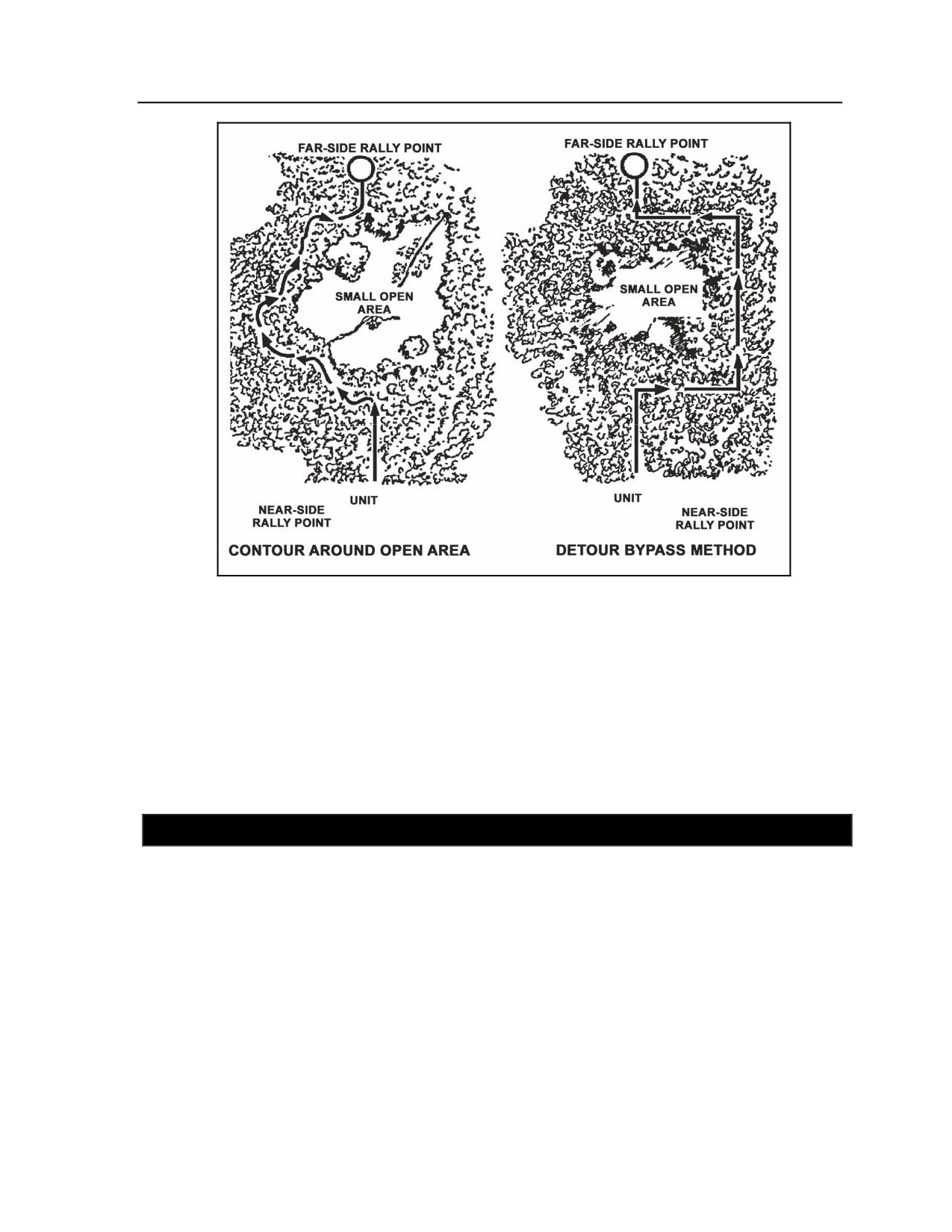
3-128. Small open areas are small enough to bypass in the time allowed for the mission. Two techniques
can be used (Figure 3-26).
Contouring Around the Open Area
3-129. The leader designates a rally point on the far side with the movement azimuth. He then decides
which side of the open area to contour around
(after considering the distance, terrain, cover and
concealment), and moves around the open area. He uses the wood line and vegetation for cover and
concealment. When the squad or platoon arrives at the rally point on the far side, the leader reassumes the
azimuth to the objective area and continues the mission (Figure 3-26).
Detour Bypass Method
3-130. The squad or platoon turns 90 degrees to the right or left around the open area and moves in the
direction of travel. Once the squad or platoon has passed the danger area, the unit completes the box with
another 90-degree turn and arrives at the far-side rally point, then continues the mission. The pace count of
the offset and return legs is not added to the distance of the planned route (Figure 3-26).
3-36
FM 3-21.8
28 March 2007
Tactical Movement
Figure 3-26. Crossing a small open area.
ENEMY CONTACT AT DANGER AREAS
3-131. An increased awareness of the situation helps the platoon leader control the platoon when it makes
contact with the enemy. If the platoon makes contact in or near the danger area, it moves to the designated
rally points. Based on the direction of enemy contact, the leader still designates the far- or near-side rally
point. During limited visibility, he can also use his laser systems to point out the rally points at a distance.
If the platoon has a difficult time linking up at the rally point, the first element to arrive should mark the
rally point with an infrared light source. This will help direct the rest of the platoon to the location. During
movement to the rally point, position updates allow separated elements to identify each other’s locations.
These updates help them link up at the rally point by identifying friends and foes.
SECTION VI — MOVEMENT WITH COMBAT VEHICLES
3-132. There are several options available to the platoon leader when augmented with vehicles. The
platoon leader should employ the vehicles in conjunction with the rifle squads so each complements the
other. Some options include—
Employ them to support the Infantry rifle squads.
Employ them separately to provide heavy direct fires or antiarmor fires.
Leave in hide positions.
Displace them to a secure location.
COMBAT VEHICLE AND INFANTRY SQUAD FORMATIONS
3-133. The principles of METT-TC guide the leader in selecting formations for combat vehicles and
Infantry. The same principles for selecting combat formations with Infantrymen apply when selecting
combat formations for combat vehicles moving with Infantrymen. The platoon leader can employ a variety
28 March 2007
FM 3-21.8
3-37
Chapter 3
of formations to meet the needs of his mission. The column, line, echelon, vee, and wedge are fundamental
movement formations for combat vehicles.
3-134. After the leader combines the mounted and Infantry elements into one combat formation, it is his
responsibility to ensure proper communication and fire control measures are implemented to maximize
lethality and prevent fratricide.
3-135. After selecting the combat formations for the combat vehicles and Infantry, the leader can decide
whether to lead with combat vehicles, Infantrymen, or a combination of the two. The default technique is to
lead with Infantrymen.
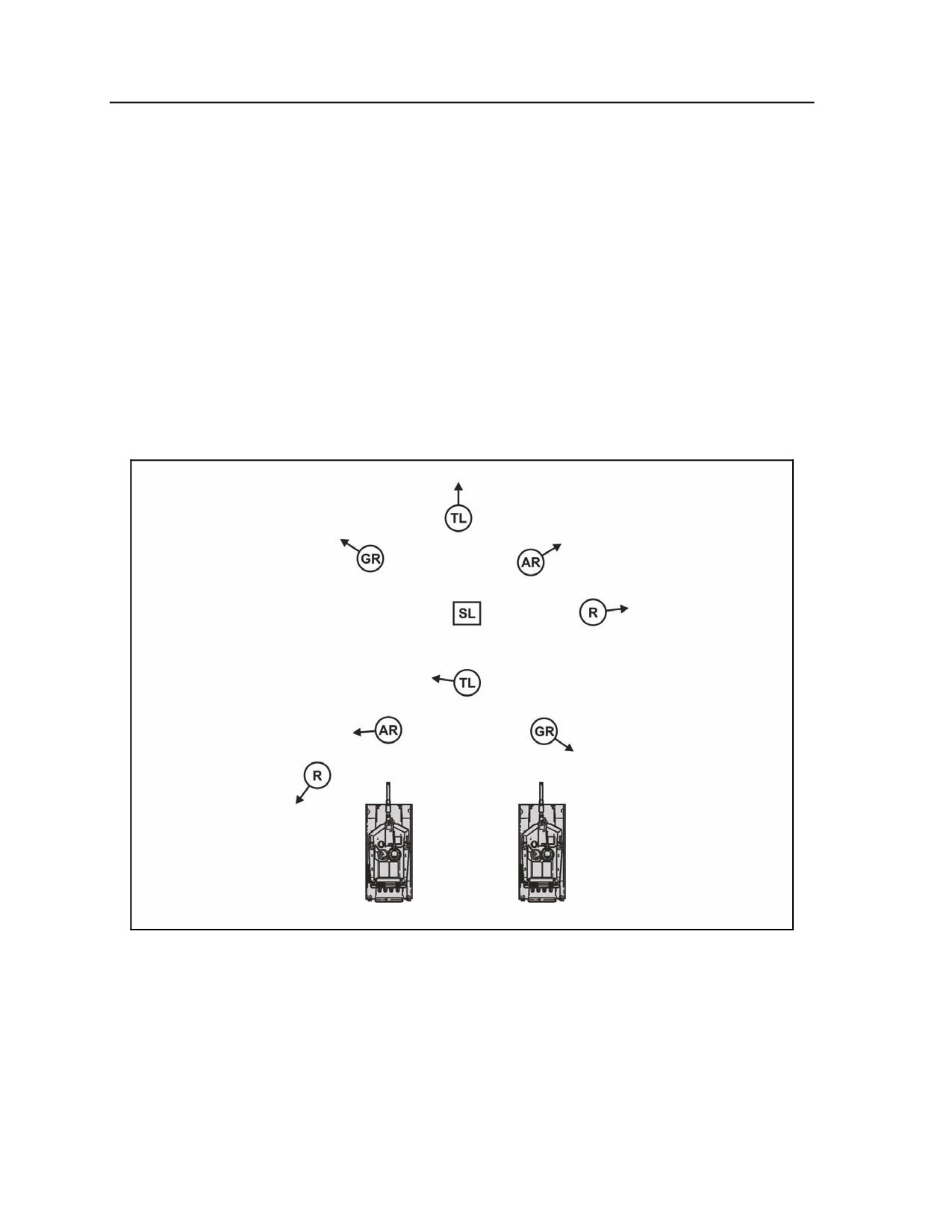
LEAD WITH INFANTRY
3-136. Infantrymen are better suited for leading combat formations (Figure 3-27) when—
A route leads through restrictive urban or rural terrain
Stealth is desired.
Enemy antitank minefields are templated.
Enemy antitank teams are templated.
Figure 3-27. Lead with Infantry squad.
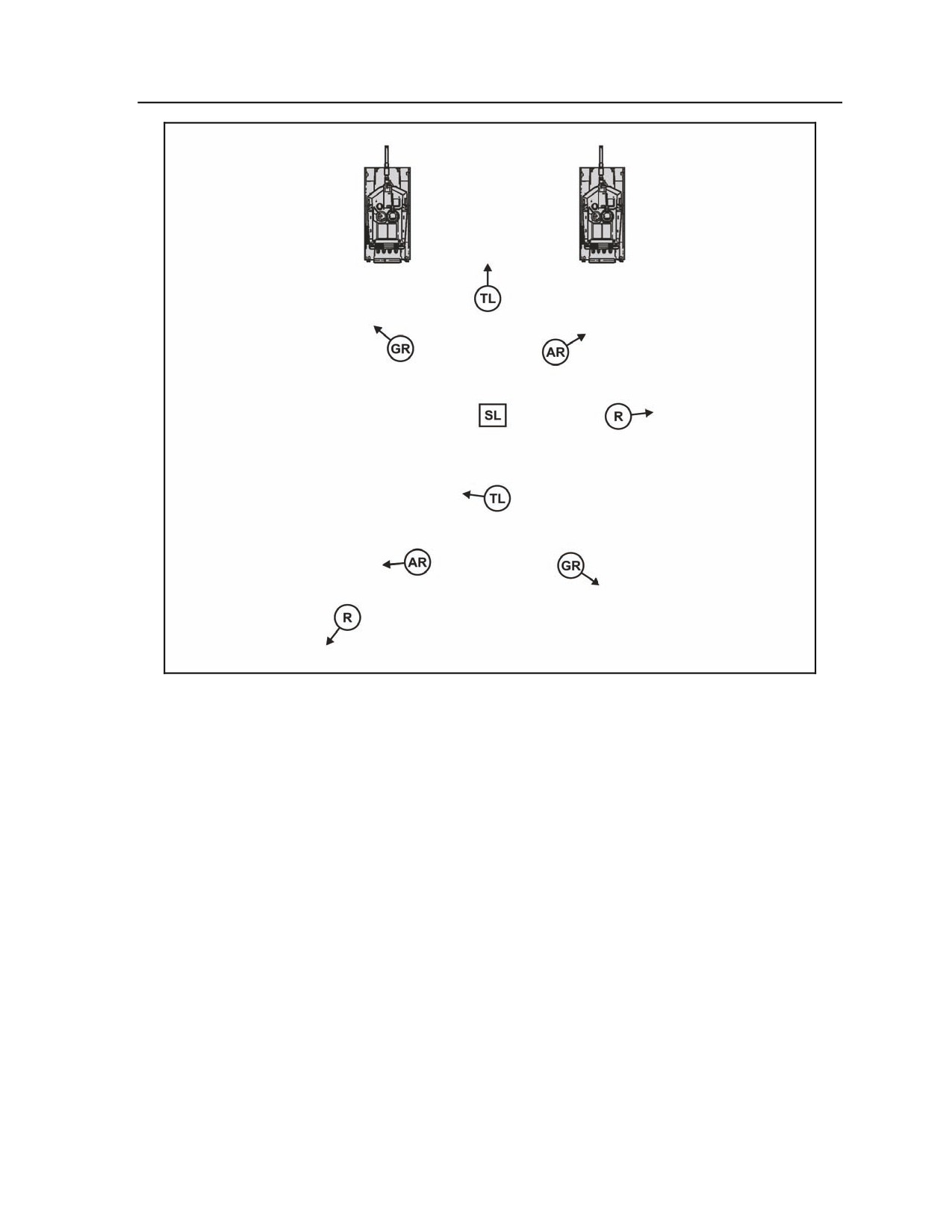
LEAD WITH COMBAT VEHICLES
3-137. Infantry leaders may choose to lead with combat vehicles (Figure 3-28) when—
There is an armored or tank threat.
Moving through open terrain with limited cover or concealment.
There is a confirmed enemy location/direction.
There are templated enemy antipersonnel minefields.
3-38
FM 3-21.8
28 March 2007
Tactical Movement
Figure 3-28. Lead with combat vehicles.
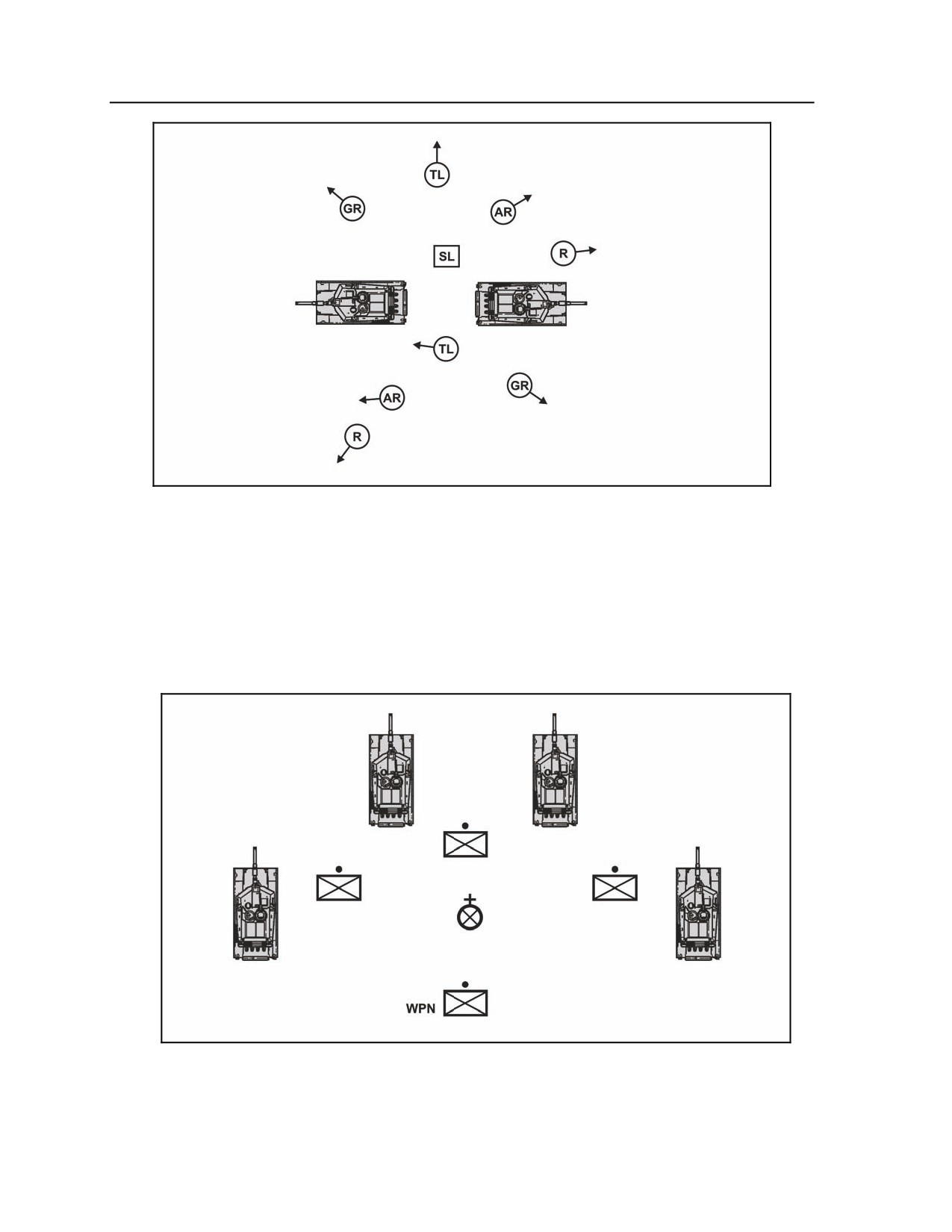
LEAD WITH BOTH COMBAT VEHICLES AND INFANTRY
3-138. Infantry leaders may choose to centrally locate the combat vehicles in their formation (Figure
3-29) when—
Flexibility is desired.
The enemy location is unknown.
There is a high threat of dismounted enemy antitank teams.
The ability to mass the fires of the combat vehicles quickly in all directions is desired.
28 March 2007
FM 3-21.8
3-39
Chapter 3
Figure 3-29. Lead with both combat vehicles and Infantry squad.
COMBAT VEHICLE AND INFANTRY PLATOON FORMATIONS
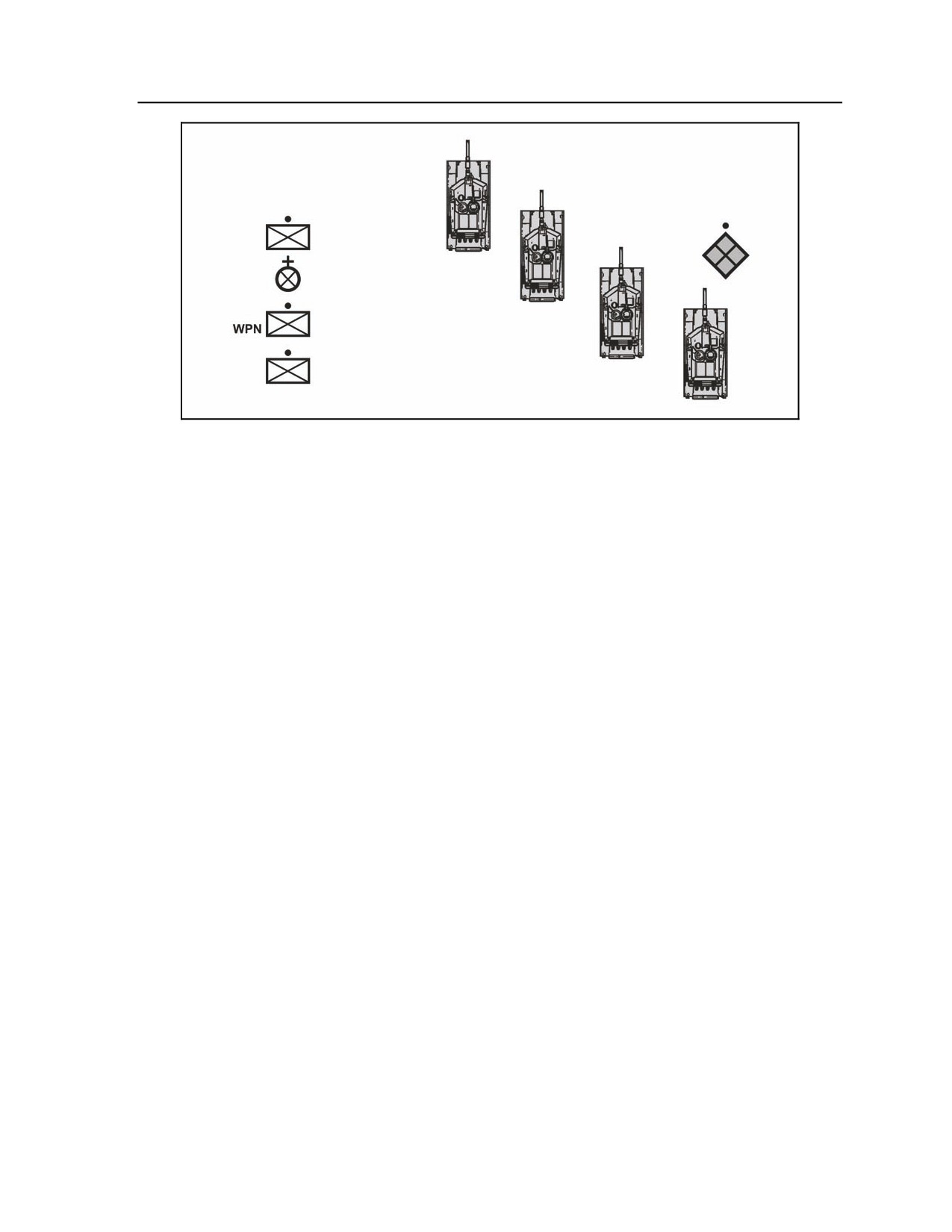
3-139. Infantry platoons can also incorporate their formations with those of combat vehicular units. The
principles for choosing platoon combat formations are the same as squad combat formations. The Infantry
platoon can conduct tactical movement with a platoon of combat vehicles (normally four) or a section of
combat vehicles (normally two). Figures 3-30 and 3-31 detail some basic Infantry platoon formations with
combat vehicle platoon formations.
Figure 3-30. Combat vehicle wedge, Infantry platoon diamond.
3-40
FM 3-21.8
28 March 2007
Tactical Movement
Figure 3-31. Combat vehicle echelon right, Infantry platoon column.
MOUNTED TACTICAL MOVEMENT
3-140. Mounted movement is very similar to dismounted movement. Depending on the vehicle type, a
platoon may have a squad in one to four vehicles. Units with more than four vehicles should consider
splitting the vehicles into two or more sections and control these sections much the same way squads
control their teams.
3-141. Units augmented with four or more vehicles can use any of the seven formations. They use them
within the context of the three movement techniques (see Section III) and should be prepared to execute
immediate action drills when transitioning to maneuver. When the mounted unit stops, they use the coil and
herringbone formations to ensure security.
3-142. In mounted successive bounds, vehicles keep their relative positions in the column. The first and
second vehicles operate as a section in moving from one observation point to another. The second vehicle
is placed in a concealed position, occupants dismounting if necessary, to cover movement of the first
vehicle to an observation point. On reaching this point, occupants of the first vehicle observe and
reconnoiter, dismounting if necessary. When the area is determined to be clear, the second vehicle is
signaled forward to join the first vehicle. The commander of the first vehicle observes the terrain to the
front for signs of enemy forces and selects the next stopping point. The first vehicle then moves out and the
process is repeated. Movement distance of the lead vehicle does not exceed the limit of observation or the
range of effective fire support from the second vehicle. The lead vehicle and personnel are replaced
frequently to ensure constant alertness. The other vehicles in the column move by bounds from one
concealed position to another. Each vehicle maintains visual contact with the vehicle ahead but avoids
closing up (Figure 3-32). However, as a rule, vehicles always work in pairs and should never be placed in a
situation where one vehicle is not able to be supported by the second.
3-143. In mounted alternate bounds, all except the first two vehicles keep their relative places in the
column. The first two vehicles alternate as lead vehicles on each bound. Each covers the bound of the other.
This method provides more rapid advance than movement by successive bounds, but is less secure.
Security is obtained by the vehicle commander who assigns each Soldier a direction of observation (to the
front, flank[s], or rear). This provides each vehicle with some security against surprise fire from every
direction, and provides visual contact with vehicles to the front and rear.
28 March 2007
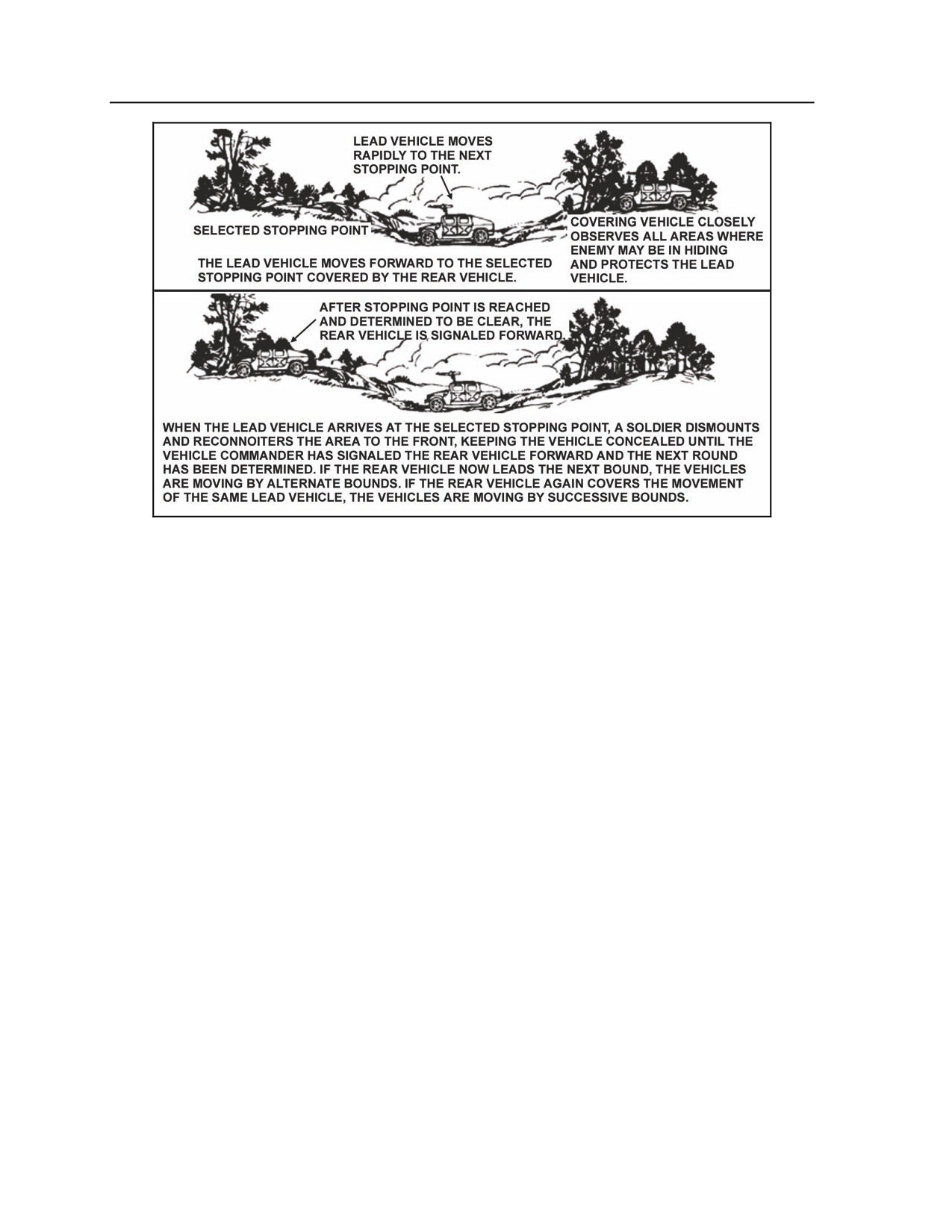
FM 3-21.8
3-41
Chapter 3
Figure 3-32. Lead vehicle moving by bounds.
CONVOYS
3-144. A convoy is a group of vehicles organized for the purpose of control and orderly movement with
or without escort protection that moves over the same route at the same time under one commander (FM1
02).
3-145. The platoon conducts motor marches, usually in trucks. Some of the special considerations may
include—
Protection. Sandbag the bottom of the trucks to protect from mines. Ensure crew-served
weapons are manned with qualified gunners.
Observation. Ensure Soldiers sit facing outward and remove bows and canvas to allow 360
degree observation and rapid dismount.
Inspection. Inspect vehicles and drivers to ensure they are ready. Perform before, during, and
after preventive maintenance checks and services (PMCS). Ensure drivers’ knowledge of the
route, speed, and convoy distance.
Loading. Keep fire team, squad, and platoon integrity when loading vehicles. Fire teams and
squads are kept intact on the same vehicle. Platoon vehicles are together in the same march
serial. Key weapons and equipment are crossloaded with platoon leaders and platoon
sergeants in different vehicles.
Rehearsals. Rehearse immediate action to enemy contact (near and far ambushes, air attack).
Ensure drivers know what to do.
Air Guards. Post air guards for each vehicle, with special consideration on the placement of
crew served weapons.
ACTIONS AT DANGER AREAS (MOUNTED)
3-146. Infantry platoons must be prepared to negotiate danger areas when mounted. The discussion of
leader and unit action are deliberately generic because of the wide variety of scenarios in which leaders
might find themselves.
3-42
FM 3-21.8
28 March 2007
Tactical Movement
3-147. When moving mounted, units normally travel on roads, trails, and in unrestrictive terrain. Mounted
units are typically vulnerable in the type of terrain favored by Infantry such as restrictive and close terrain.
In addition, areas such as bridges, road junctions, defiles, and curves (that deny observation beyond the
turn) are also considered danger areas. When leaders identify a danger area, they determine the appropriate
movement technique to employ (traveling, traveling overwatch, or bounding overwatch). They then
dismount their Infantry squads and clear the area or do a combination of both.
3-148. If time and terrain permit, the unit should either bypass a danger area or dismount Infantry to
reconnoiter and clear it. However, the distances between covered and concealed positions may make this
impractical. If time constraints prevent these options, the unit uses a combination of traveling overwatch
and bounding overwatch to negotiate the danger area. As with dismounted actions at a danger area, the
leader must be prepared to quickly transition to maneuver in case the unit makes contact with the enemy.
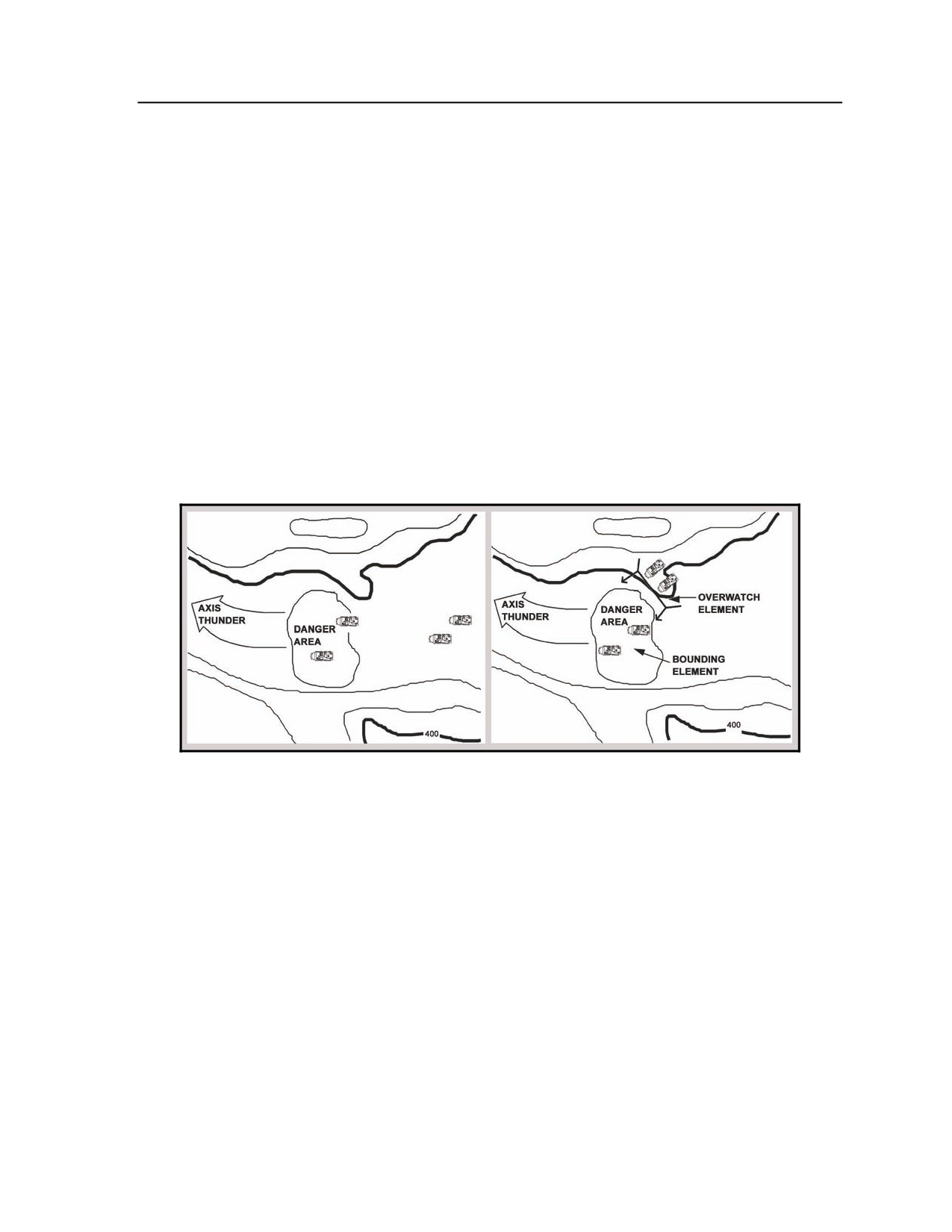
MOUNTED TRAVELING OVERWATCH
3-149. The lead element moves continuously along the covered and concealed routes that give it the best
available protection from possible enemy observation and direct fire (Figure 3-33). The trail element moves
at variable speeds providing continuous overwatch, keeping contact with the lead element, and stopping
periodically to get a better look. The trail element stays close enough to ensure mutual support for the lead
element. However, it must stay far enough to the rear to retain freedom of maneuver in case an enemy force
engages the lead element.
Figure 3-33. Mounted traveling overwatch.
MOUNTED BOUNDING OVERWATCH
3-150. With bounding overwatch, one section is always stopped to provide overwatching fire. The unit
executing bounding overwatch uses either the successive or alternate bounding method.
DISMOUNTING AND CLEARING THE AREA
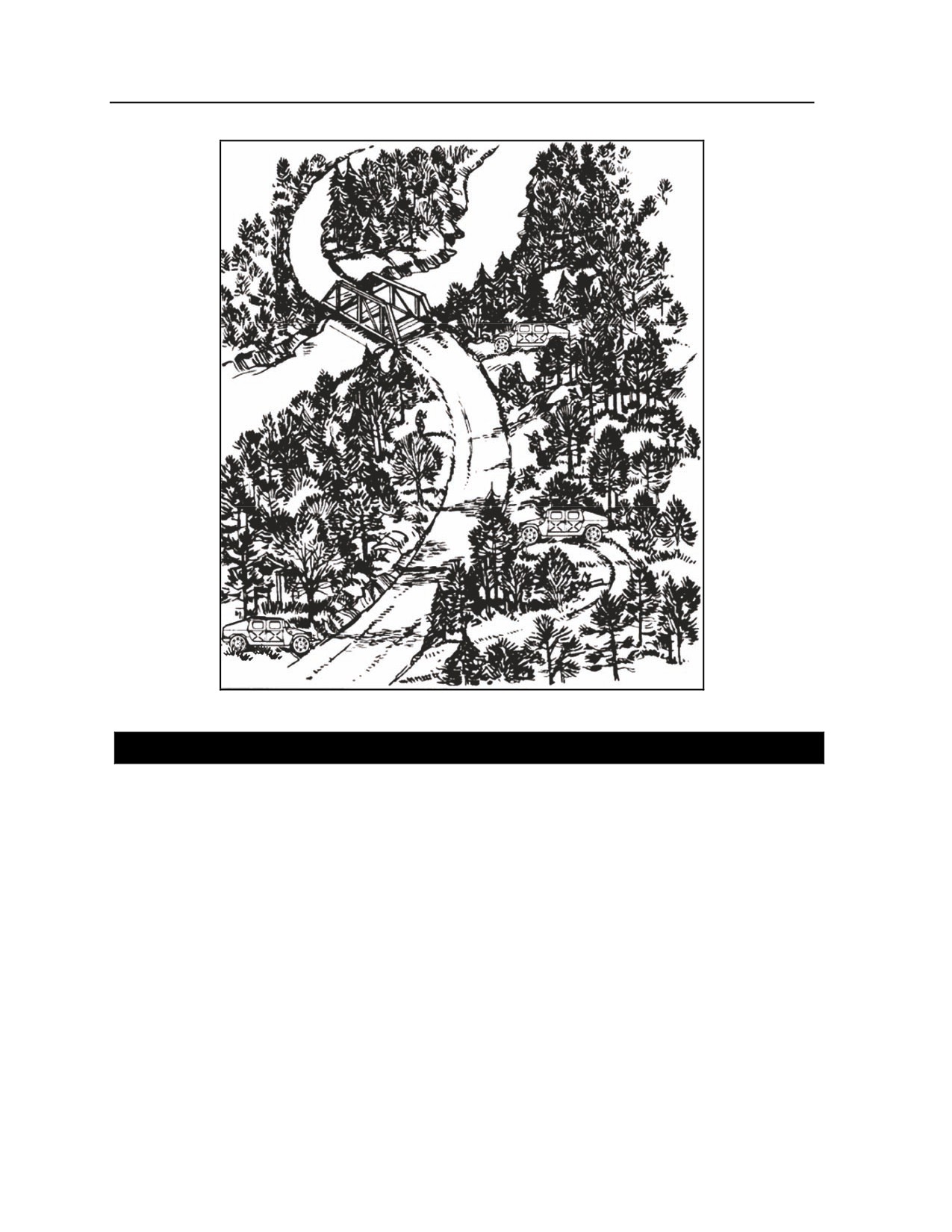
3-151. The commander of the lead vehicle immediately notifies the platoon leader when he encounters an
obstacle or other danger area. If needed, Soldiers dismount and take advantage of available cover and
concealment to investigate these areas (Figure 3-34). If possible, the vehicle is moved off the road into a
covered or concealed position. Weapons from the vehicle cover the advance of the dismounted element.
Designated Soldiers reconnoiter these places under cover of the weapons in the vehicle. Obstacles are
marked and bypassed, if possible. When they cannot be bypassed, they are cautiously removed.
3-152. Side roads intersecting the route of advance are investigated. Soldiers from one vehicle secure the
road junction. One or two vehicles investigate the side road. The amount of reconnaissance on side roads is
determined by the leader's knowledge of the situation. Soldiers investigating side roads do not move past
supporting distance of the main body.
28 March 2007
FM 3-21.8
3-43
Chapter 3
Figure 3-34. Dismounting and clearing the area.
SECTION VII — SECURITY
3-153. Maintaining security is a constant theme of tactical movement. Effective security can prevent
enemy surprise. Security therefore requires everyone to concentrate on the enemy. Though this seems
simple enough, in practice, it is not. This means that leaders and their Soldiers must be proficient in the
basics of tactical movement. Failure to attain proficiency diverts attention away from the enemy, thereby
directly reducing the unit’s ability to fight.
3-154. Platoons and squads enhance their own security during movement through the use of covered and
concealed terrain; the use of the appropriate movement formation and technique; the actions taken to secure
danger areas during crossing; the enforcement of noise, light, and radiotelephone discipline; and the use of
proper individual camouflage techniques.
3-155. During planning and preparation for movement, leaders analyze the enemy situation, determine
known and likely enemy positions, and develop possible enemy courses of action. After first considering
the enemy, leaders determine what security measures to emplace during tactical movement.
ENEMY
3-156. Leaders have to decide whether they are going to move aggressively to make contact, or stealthily
to avoid contact. Either way, the leader has to anticipate enemy contact throughout. If possible, leaders
should avoid routes with obvious danger areas such as built-up areas, roads, trails, and known enemy
3-44
FM 3-21.8
28 March 2007
Tactical Movement
positions. If these places cannot be avoided, risk management should be conducted to develop ways to
reduce danger to the unit. If stealth is desired, the route should avoid contact with local inhabitants, built-up
areas, and natural lines of drift.
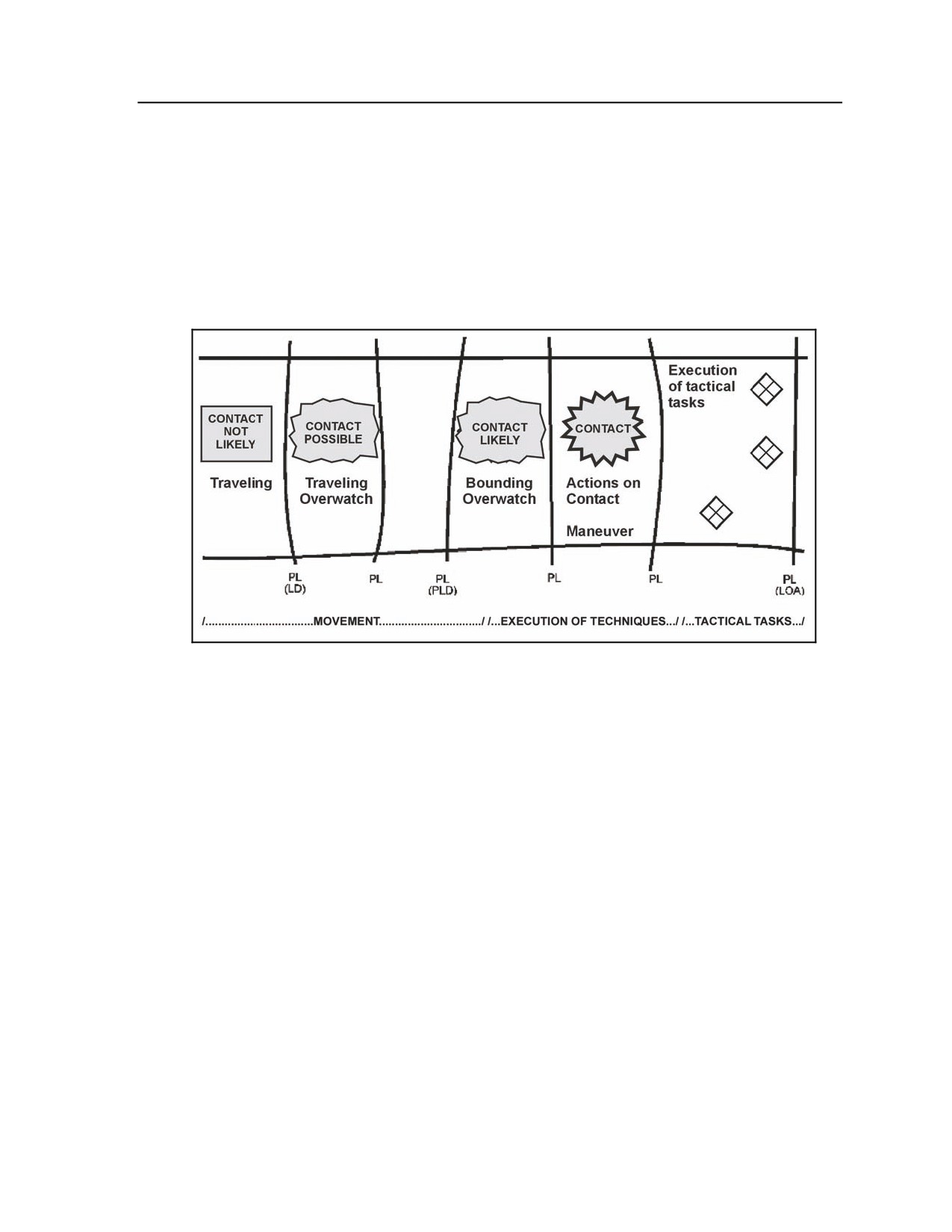
3-157. Movement techniques help the leader manage the amount of security his unit has during
movement. Traveling is the least secure and used when contact is not likely. Traveling overwatch is used
when contact is likely but not imminent. Bounding overwatch is used when contact is imminent. Leaders
establish the probable line of deployment (PLD) to indicate where the transition from traveling overwatch
to bounding overwatch should occur. When in contact with the enemy, the unit transitions from movement
to maneuver (fire and movement) while the leader conducts actions on contact (Figure 3-35).
Figure 3-35. Movement to maneuver.
TERRAIN
3-158. When planning movements, the leader must consider how terrain affects security while
simultaneously considering the other factors of METT-TC. Some missions may require the unit to move on
other than covered and concealed routes. While leaders may not be able to prevent the unit’s detection, they
can ensure that they move on the battlefield in a time and place for which the enemy is unprepared.
Particularly when moving in the open, leaders must avoid predictability and continue to use terrain to their
advantage.
CAMOUFLAGE, NOISE, AND LIGHT DISCIPLINE
3-159. Leaders must ensure that camouflage used by their Soldiers is appropriate to the terrain and
season. Platoon SOPs specify elements of noise and light discipline.
3-160. If Soldiers need more illumination than an image intensifier can provide in infrared mode during
movement, they should use additional infrared light sources. The combination should provide the light
needed with the least risk of enemy detection. When using infrared light, leaders must consider the enemy’s
night vision and infrared capabilities. For instance, an enemy with night vision capability can send infrared
light signals, and he can concentrate direct and indirect fire on a platoon that is using infrared light.
SECURITY AT HALTS
3-161. Units conducting tactical movement frequently make temporary halts. These halts range from brief
to extended periods of time. For short halts, platoons use a cigar-shaped perimeter intended to protect the
28 March 2007
FM 3-21.8
3-45
Chapter 3
force while maintaining the ability to continue movement. When the platoon leader decides not to
immediately resume tactical movement, he transitions the platoon to a perimeter defense. The perimeter
defense is used for longer halts or during lulls in combat.
CIGAR-SHAPED PERIMETER
3-162. When the unit halts, if terrain permits, Soldiers should move off the route and face out to cover the
same sectors of fire they were assigned while moving, allowing passage through the center of the
formation. This results in a cigar-shaped perimeter. Actions by subordinate leaders and their Soldiers occur
without an order from the leader. Soldiers are repositioned as necessary to take advantage of the best cover,
concealment, and fields of fire.
PERIMETER DEFENSE
3-163. When operating independently, the platoon uses a perimeter defense during extended halts,
resupply, and issuing platoon orders or lulls in combat. Normally the unit first occupies a short halt
formation. Then after conducting a leader’s reconnaissance of the position and establishing security, the
unit moves into the perimeter defense.
ACTIONS AT HALTS
3-164. Table 3-7 lists the standard actions taken at halts.
3-46
FM 3-21.8
28 March 2007

Tactical Movement
Table 3-7. Actions at halts.
Soldier (or Vehicle)
Squad Leader (or Section
Platoon Leader Actions
Actions*
Leader) Actions
• Moves to as much of a
• Adjusts his perimeter.
• Adjusts his perimeter.
covered and concealed
If operating independently,
If operating independently,
position as available.
the squad leader establishes
he establishes 360-degree,
• Visually inspects and
360-degree, three-
three-dimensional security.
physically clears his
dimensional security.
If operating as part of
immediate surroundings (a
Attempts to find terrain that
another organization, he
roughly 5-25m radius
anchors his position.
arrays his squads to best fit
around his position).
into the controlling
If operating as part of a
• Establishes a sector of
platoon, the squad leader
commander’s defensive
fire for his assigned
arrays his teams to best fit
scheme.
weapon (using 12
into the platoon leader’s
Supervises the emplacement
o’clock as the direction
defensive scheme, based on
of the weapons squad’s
the Soldier is facing, the
the platoon leader’s
weapon systems.
Soldier’s sector of fire
guidance.
• Dispatches an element (usually a
ranges from 10 o’clock
• Visually inspects and physically
fire team) to visually inspect and
to 2 o’clock).
clears (if required) the squad’s
physically clear the platoon’s
• Determines his
immediate surrounding (about
immediate surrounding (an area
observation and field of
35m, the distance within hand
out to small arms range, roughly
fire. Identifies dead
grenade range).
100-300m depending on terrain).
space in his field of fire.
• Ensures his squad’s individual
• Ensures his squads’ sectors of
• Identifies obstacles and
sectors of fire overlap with each
fire overlap with each other,
determines enemy
other, creating a seamless
creating a seamless perimeter
avenues of approach
perimeter with no gaps of fire
with no gaps of fire coverage.
(both mounted and
coverage.
• Identifies his dead space not
dismounted).
• Identifies his dead space and
covered and requests indirect fire
• Identifies the dominant
adjusts his M203 grenadiers
support to overwatch dead space
ground in his immediate
accordingly.
in the area of operation.
surroundings.
• Identifies obstacles and the likely
• Identifies obstacles and the likely
• Coordinates his actions
enemy avenue of approach
enemy avenue of approach
with the Soldiers (or
(mounted and dismounted).
(mounted and dismounted).
vehicles) on his left and
• Identifies the dominant ground in
• Identifies the dominant ground in
right.
his area of operation.
his area of operation.
(*These actions occur
• Coordinates responsibilities and
• Coordinates with the units on his
without leader prompting.)
sectors with the units on his left
left and right.
and right.
SECTION VIII — OTHER MOVEMENT SITUATIONS
3-165. The platoon can use other formations for movement.
ADMINISTRATIVE MOVEMENT
3-166. Administrative movement is normally planned by the S4 as movements in which vehicles and
Soldiers are arranged to expedite movement and conserve time and resources. No enemy interference is
anticipated when planning administrative movement.
28 March 2007
FM 3-21.8
3-47
Chapter 3
TACTICAL ROAD MARCHES
3-167. Infantry platoons participate in two types of tactical marches with the company: foot marches and
motor marches. Tactical road marches are conducted to rapidly move units within an area of operations to
prepare for combat operations. Commanders arrange troops and vehicles to expedite their movement,
conserve time, energy, and unit integrity. They anticipate no interference except possible enemy air. For
information on dismounted tactical road marches, see FM 21-18, Foot Marches.
MOVEMENT BY WATER
3-168. The platoon avoids crossing water obstacles when possible. Before crossing, however, leaders
should identify weak or non-swimmers and pair them with a good swimmer in their squad.
3-169. When platoons or squads must move into, through, or out of rivers, lakes, streams, or other bodies
of water, they treat the water obstacle as a danger area. While on the water, the platoon is exposed and
vulnerable. To offset the disadvantages, the platoon—
Moves during limited visibility.
Disperses.
Camouflages thoroughly.
Moves near the shore to reduce the chances of detection.
3-170. When moving in more than one boat, the platoon—
Maintains tactical integrity and self-sufficiency.
Crossloads key Soldiers and equipment.
Ensures that the radio is with the leader.
3-171. If boats are not available, several other techniques can be used such as—
Swimming.
Poncho rafts.
Air mattresses.
Waterproof bags.
A 7/16-inch rope used as a semisubmersible, one-rope bridge or safety line.
Water wings (made from a set of trousers).
MOVEMENT DURING LIMITED VISIBILITY CONDITIONS
3-172. At night or when visibility is poor, a platoon must be able to function in the same way as during
daylight. It must be able to control, navigate, maintain security, move, and stalk at night or during limited
visibility.
CONTROL
3-173. When visibility is poor, the following methods aid in control:
Use of night vision devices.
IR chemlights.
Leaders move closer to the front.
The platoon reduces speed.
Each Soldier uses two small strips of luminous tape on the rear of his helmet to allow the
Soldier behind him to see.
Leaders reduce the interval between Soldiers and between units to make sure they can see
each other.
Leaders conduct headcounts at regular intervals and after each halt to ensure personnel
accountability.
3-48
FM 3-21.8
28 March 2007
Tactical Movement
NAVIGATION
3-174. To assist in navigation during limited visibility, leaders use—
Terrain association (general direction of travel coupled with recognition of prominent map
and ground features).
Dead reckoning, compass direction and specific distances or legs. (At the end of each leg,
leaders should verify their location).
Movement routes that parallel identifiable terrain features.
Guides or marked routes. .
GPS / FBCB2 devices.
SECURITY AT NIGHT
3-175. For stealth and security in night moves, squads and platoons—
Designate a point man to maintain alertness, the lead team leader to navigate, and a pace man
to count the distance traveled. Alternate compass and pace men are designated.
Ensure good noise and light discipline.
Use radio-listening silence.
Camouflage Soldiers and equipment.
Use terrain to avoid detection by enemy surveillance or night vision devices.
Make frequent listening halts.
Mask the sounds of movement with artillery fires.
28 March 2007
FM 3-21.8
3-49
This page intentionally left blank.
Chapter 4
Protection
Protection is the preservation of the Infantry platoon and squad’s fighting potential so
leaders can apply maximum force at the decisive time and place. Protection is neither
timidity nor an attempt to avoid all risk, because risk will always be present.
Protection is a warfighting function (WFF) that encompasses the following areas:
safety, fratricide avoidance, survivability, air and missile defense, antiterrorism,
chemical biological radiological and nuclear
(CBRN), defense information
operations, and force health protection. This chapter covers the WWF areas of
protection that are most relevant to the Infantry platoon and squad: risk management
and fratricide avoidance, air defense, and CBRN.
SECTION I — RISK MANAGEMENT AND FRATRICIDE AVOIDANCE
4-1. Risk, or the potential for risk, is always present across full spectrum operations. The primary
objective of risk management and fratricide avoidance is not to remove all risk, but to eliminate
unnecessary risk. During peacetime leaders conduct tough, realistic training to help units protect their
combat power through accident prevention. During combat operations units conduct risk management and
fratricide avoidance to enable them to win the battle quickly and decisively with minimal losses. Risk
management is an integral part of planning that takes place at all levels of the chain of command during
each phase of every operation. This section outlines the process leaders use to identify hazards and
implement plans to address each identified hazard. It also includes a detailed discussion of the
responsibilities of the platoon’s leaders and individual Soldiers in implementing a sound risk management
program. For additional information on risk management, refer to FM 5-19, Composite Risk Management..
RISK MANAGEMENT PROCEDURES
4-2. Risk management is the systematic process that identifies the relative risk of mission and training
requirements. It weighs risk against training benefits and eliminates unnecessary risk that can lead to
accidents. The platoon leader, his NCOs, and all other platoon Soldiers must know how to use risk
management, coupled with fratricide reduction measures, to ensure that the mission is executed in the safest
possible environment within mission constraints.
STEP 1 - IDENTIFY HAZARDS
4-3. A hazard is a source of danger. It is any existing or potential condition that can cause injury, illness,
or death of personnel; damage to or loss of equipment and property; or some other sort of mission
degradation. Tactical and training operations pose many types of hazards. The leader must identify the
hazards associated with all aspects and phases of the Infantry platoon’s mission, paying particular attention
to the factors of METT-TC. Risk management must never be an afterthought; leaders must begin the
process during their TLPs and continue it throughout the operation. Table 4-1 lists possible sources of
battlefield hazards the Infantry platoon and squad might face during a typical tactical operation. The list is
organized according to the factors of METT-TC.
28 March 2007
FM 3-21.8
4-1

Chapter 4
Table 4-1. Potential hazards.
Potential Infantry Platoon and Squad Battlefield Hazards
Mission
• Duration of the operation.
• Mission complexity and difficulty/clarity of the plan. (Is the plan
well-developed and easily understood?)
• Proximity and number of maneuvering units.
Enemy
• Knowledge of the enemy situation.
• Enemy capabilities.
• Availability of time and resources to conduct reconnaissance.
Terrain and Weather
• Visibility conditions including light, dust, fog, and smoke.
• Precipitation and its effect on mobility. Consider all aspects of
the terrain as well as weather and trafficability.
• Extreme heat or cold.
• Additional natural hazards such as broken ground, steep
inclines, or water obstacles.
Troops and Equipment
• Experience the units conducting the operation have working
together.
• Danger areas associated with the platoon’s weapons systems.
• Soldier/leader proficiency.
• Soldier/leader rest situation.
• Degree of acclimatization to environment.
• Impact of new leaders or crewmembers.
• Friendly unit situation.
• NATO or multinational military actions combined with U.S.
forces.
Time Available
• Time available for TLP and rehearsals by subordinates.
• Time available for precombat checks and inspections.
Civil Considerations
• Applicable ROE or ROI.
• Potential operations that involve contact with civilians.
• Potential for media contact and inquiries.
• Interaction with host nation or other participating nation support.
STEP 2 - ASSESS HAZARDS TO DETERMINE RISKS
4-4. Hazard assessment is the process of determining the direct impact of each hazard on a training or
operational mission. The following steps should be used when assessing hazards:
Determine the hazards that can be eliminated or avoided.
Assess each hazard that cannot be eliminated or avoided to determine the probability that the
hazard will occur. A primary consideration is how likely the hazard is to cause injury, illness,
loss, or damage.
4-2
FM 3-21.8
28 March 2007
Protection
Assess the severity of hazards that cannot be eliminated or avoided. Severity is the result or
outcome of a hazardous incident that is expressed by the degree of injury or illness (including
death), loss of or damage to equipment or property, environmental damage, or other mission-
impairing factors such as unfavorable publicity or loss of combat power.
Accounting for both the probability and severity of a hazard, determine the associated risk level
(extremely high, high, moderate, or low). Normally, the highest-level individual risk assessed is
also the overall risk. Table 4-2 summarizes the four risk levels.
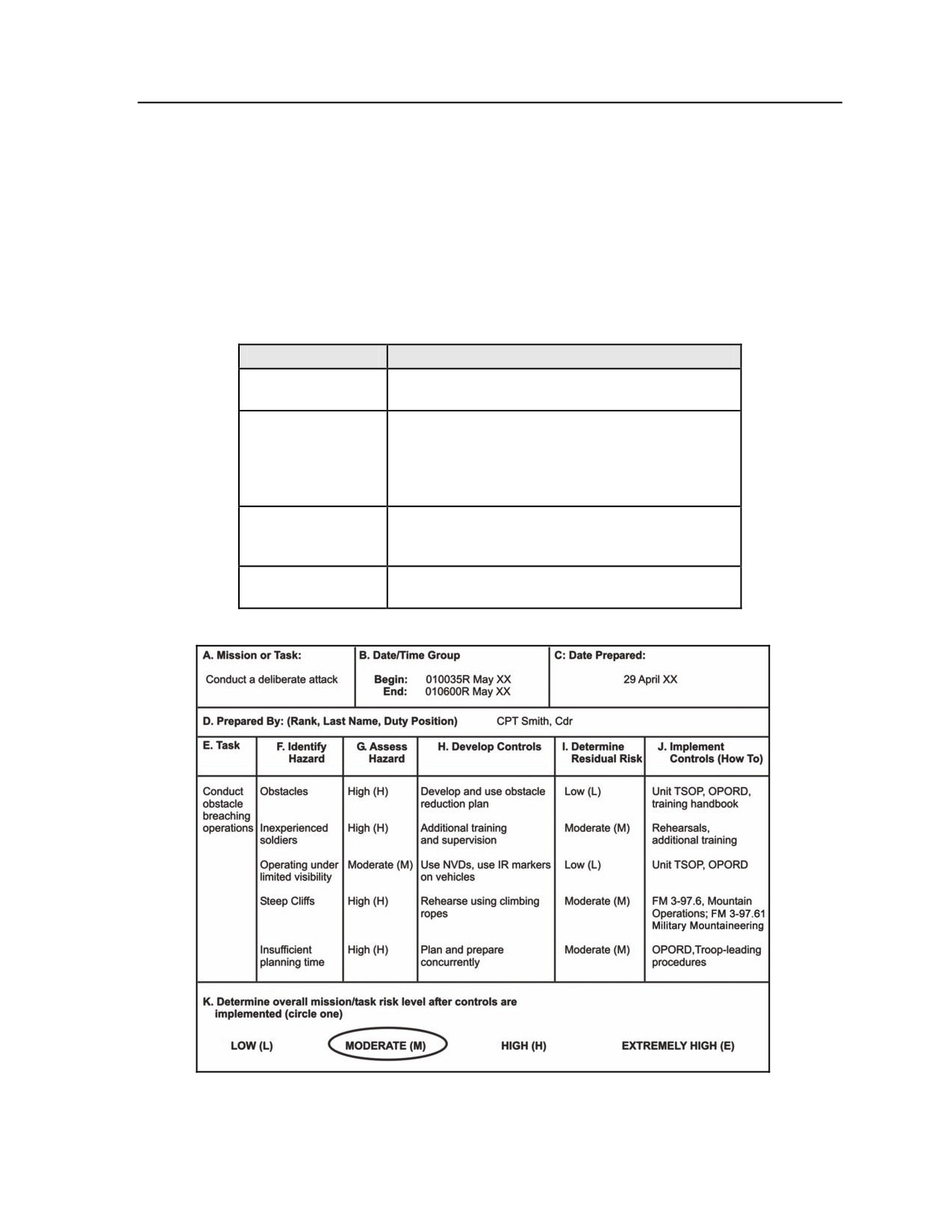
Based on the factors of hazard assessment (probability, severity, and risk level, as well as the
operational factors unique to the situation), complete the risk management worksheet. Figure 4-1
shows an example of a completed risk management worksheet.
Table 4-2. Risk levels and impact on mission execution.
Risk Level
Mission Effects
Extremely High (E)
Mission failure if hazardous incidents occur in
execution.
High (H)
Significantly degraded mission capabilities in
terms of required mission standards. Not
accomplishing all parts of the mission or not
completing the mission to standard (if hazards
occur during mission).
Moderate (M)
Expected degraded mission capabilities in terms
of required mission standards. Reduced mission
capability (if hazards occur during the mission).
Low (L)
Expected losses have little or no impact on
mission success.
Figure 4-1. Example of completed risk management worksheet.
28 March 2007
FM 3-21.8
4-3
Chapter 4
STEP 3 - DEVELOP CONTROLS AND MAKE RISK DECISIONS
4-5. This step consists of two substeps: develop controls and make risk decisions. These substeps are
accomplished during the “make a tentative plan” step of the TLP.
Develop Controls
4-6. After assessing each hazard, develop one or more controls that will either eliminate the hazard or
reduce the risk (probability, severity, or both) of potential hazardous incidents. Create as many control
options as possible and then select those that best control risks without significantly impeding the training
or operational mission objectives. When developing controls, consider the reason for the hazard, not just
the hazard itself. For example, driving can be a hazard, but driving in inclement weather or with limited
sleep may cause driving to be hazardous.
Make Risk Decisions
4-7. A key element in the process of making a risk decision is determining whether accepting the risk is
justified or unnecessary. Risk decisionmaking should be made at the appropriate level—high enough to tap
the experience and responsibility of those making the decision, and low enough to allow for the gaining of
experience. As a guide, the leader responsible for executing the training or operational mission is
authorized by the command or higher headquarters to make decisions at a specified risk level (extremely
high, high, moderate, or low). When a leader is not authorized to make decisions for a risk level, the
decision is referred to the next higher level of command. The decision maker must compare and balance the
risk against mission expectations. If he determines the risk is unnecessary, he directs the development of
additional controls or alternative controls; as another option, he can modify, change, or reject the selected
COA for the operation.
STEP 4 - IMPLEMENT CONTROLS
4-8. Controls are the procedures and considerations the unit uses to eliminate hazards or reduce their risk.
The implementation of controls is the most important part of the risk management process; it is the chain of
command’s contribution to the safety of the unit. Implementing controls includes coordination and
communication with appropriate superior, adjacent, and subordinate units and with individuals executing
the mission. The implementation of risk controls must be effectively communicated to all personnel,
especially those responsible for the actual implementation of the controls. The platoon leader must ensure
that specific controls are integrated into OPLANs, OPORDs, SOPs, and rehearsals. The critical check for
this step is to ensure that controls are converted into clear, simple execution orders understood by all levels.
Examples of risk management controls include:
Thoroughly briefing all aspects of the mission, including related hazards and controls.
Conducting thorough precombat checks and inspections.
Allowing adequate time for rehearsals at all levels.
Drinking plenty of water, eating well, and getting as much sleep as possible (at least 4 hours in
any 24-hour period).
Using buddy teams.
Enforcing speed limits, using of seat belts, and driver safety.
Establishing recognizable visual signals and markers to distinguish maneuvering units.
Enforcing the use of ground guides in assembly areas and on dangerous terrain.
Establishing marked and protected sleeping areas in assembly areas.
Limiting single-vehicle movement.
Establishing SOPs for the integration of new personnel.
4-4
FM 3-21.8
28 March 2007
Protection
STEP 5 - SUPERVISE AND EVALUATE
4-9. During mission execution, leaders must ensure that risk management controls are properly
understood and executed. Leaders must continuously evaluate the unit’s effectiveness in managing risks to
gain insight into areas that need improvement.
Supervise
4-10. Leadership and unit discipline are the keys to ensuring that effective risk management controls are
implemented. All leaders are responsible for supervising mission rehearsals and execution to ensure
standards and controls are enforced. Effective supervision assures sustained effectiveness of risk controls.
NCOs must enforce established safety policies as well as controls developed for a specific operation or
task. Techniques include spot checks, inspections, SITREPs, confirmation briefs, buddy checks, and close
supervision.
4-11. During mission execution, leaders must continuously monitor risk management controls to determine
whether they are effective and to modify them as necessary. Leaders must also anticipate, identify, and
assess new hazards. They ensure that imminent danger issues are addressed on the spot and that ongoing
planning and execution reflect changes in hazard conditions.
Evaluate
4-12. Whenever possible, the risk management process should include an AAR to assess unit performance
in identifying risks and preventing hazardous situations. During an AAR, leaders should assess whether the
implemented controls were effective by specifically providing feedback on the effectiveness of risk
controls. Following the AAR, leaders should incorporate lessons learned from the process into the Infantry
platoon’s SOPs and plans for future missions.
IMPLEMENTATION RESPONSIBILITIES
4-13. Leaders and individuals at all levels are responsible and accountable for managing risk. They must
ensure that hazards and associated risks are identified and controlled during planning, preparation, and
execution of operations. The platoon leader and his senior NCOs must look at both tactical risks and
accident risks. The same risk management process is used to manage both types. In the Infantry platoon,
the platoon leader alone determines how and where he is willing to take tactical risks. The platoon leader
manages accident risks with the assistance of his PSG, NCOs, and individual Soldiers.
BREAKDOWN OF THE RISK MANAGEMENT PROCESS
4-14. If higher headquarters is not notified of a risk taken or about to be taken, the risk management
process may break down. Such a failure can be the result of several reasons, but is usually one or more of
the following factors:
The risk denial syndrome in which leaders do not want to know about the risk.
A Soldier who believes that the risk decision is part of his job and does not want to bother his
leader.
Outright failure to recognize a hazard or the level of risk involved.
Overconfidence on the part of an individual or the unit in being able to avoid or recover from a
hazardous incident.
Subordinates who do not fully understand the higher commander’s guidance regarding risk
decisions.
FRATRICIDE AVOIDANCE
4-15. Fratricide is defined as the employment of friendly weapons with the intent of killing the enemy or
destroying his equipment that results in the unforeseen and unintentional death or injury of friendly
personnel. Fratricide prevention is the platoon leader’s responsibility. Leaders across all WFF assist the
28 March 2007
FM 3-21.8
4-5