FM 3-21.10 (FM 7-10) The Infantry Rifle Company (July 2006) - page 15
Appendix E
be an excellent vantage point. All-round defense becomes more important, because the enemy
can fire from many directions. His infiltration attempts must be countered.
y Cover and concealment are excellent for both the attacker and defender. The defender normally
has an advantage, because the attacker normally exposes himself when moving through
the area.
y Avenues of approach inside buildings are best, because movement in a building is less easily
detected than movement through the streets. The sniper must be conscious of all avenues of
approach, and must be prepared to engage targets that appear on any of them.
SELECTION OF POSITIONS
E-34. Snipers should be positioned in buildings of mass- or heavy-clad frame construction that offer
long-range fields of fire and all-round observation. The sniper has an advantage because he need not move
with, or be positioned with, lead elements. He may occupy a higher position to the rear or flanks and some
distance away from the element that he is supporting. By operating far from the other elements, a sniper
avoids decisive engagement, but remains close enough to kill distant targets threatening the unit. Snipers
should not be placed in obvious positions, such as church steeples and rooftops, since the enemy often
observes these and targets them for destruction. Indirect fires can generally penetrate rooftops and cause
casualties in top floors of buildings. Snipers should not be positioned where there is heavy traffic, because
these areas invite enemy observation as well.
MULTIPLE POSITIONS
E-35. Snipers should operate throughout the AO, moving with and supporting the company teams as
necessary. Some teams may operate independently from other forces. They search for targets of
opportunity, especially for enemy snipers. Since a single position may not afford adequate observation for
the entire team without increasing the risk of detection by the enemy, the team may occupy multiple
positions. Separate positions must maintain mutual support. Each team should also establish alternate and
supplementary positions.
TASKS
E-36. The commander may assign the following tasks to snipers.
y Conduct countersniper operations.
y Kill targets of opportunity. The sniper team assigns priorities to these targets based on their
understanding of the commander's intent, which might include, for example, to engage enemy
snipers, leaders, vehicle commanders, radio men, sappers, and machine gun crews, in that
order.
y Deny enemy access to certain areas or avenues of approach. In other words, control key terrain.
y Provide fire support for barricades and other obstacles.
y Maintain surveillance of flank and rear avenues of approach (screen).
y Support local counterattacks with precision fire.
STABILITY AND RECONSTRUCTION OPERATIONS
E-37. In stability and reconstruction operations, the sniper can dominate an AO by delivering selective
precision fire against specific targets IAW the ROE. Since the ROE normally limit collateral damage and
civilian casualties, snipers selectively kill or wound key individuals who pose a threat to friendly forces.
Targets often hide in the civilian populace, which makes them nearly invulnerable to US forces, who
cannot destroy these targets without causing innocent casualties. The sniper may also be employed to
gather information in an S&R operation.
E-8
FM 3-21.10
27 July 2006
Sniper Employment
TASKS
E-38. Some of the specialized tasks that commanders may assign to snipers follow.
y If and as authorized by local orders or instructions, snipers engage dissidents involved in such
activities as hijacking, kidnapping, and hostage taking.
y Snipers engage dissident snipers as opportunity targets or as part of a deliberate clearance
operation.
y Snipers covertly occupy concealed positions to observe selected areas.
y Snipers record and report all suspicious activity in the area of observation.
y Snipers help coordinate the activities of other elements from their hidden observation positions.
y Snipers protect other elements of the controlling forces, including key civilian noncombatants
such as judges, politicians, fire fighters, and repair crews.
ANONYMITY
E-39. Commanders must carefully protect the anonymity of unit snipers, even from other Soldiers in the
unit. This is especially true of successful snipers, because dissidents will target them. Ideally, snipers are
held in a central reserve and employed only after shooting starts. If needed, snipers may deploy in hidden
observation posts.
SPECIAL CONSIDERATIONS
E-40. Ideally, a sniper should deploy where he can receive the order to fire from the appropriate local
commander. This is often difficult. Due to the typical remoteness of the sniper's position, direct
communication with the commander is often impossible. Therefore, all orders, to include targets and Rules
of Engagement, must be clear to the sniper team before it deploys. Before that, the team must rehearse
when to open fire in all possible scenarios. They learn how to determine when their fire constitutes
reasonable force, regardless of circumstances:
y If the sniper is away from the local commander, then he must positively identify and engage his
targets based on his written orders.
y If he is physically near or in radio contact with the local commander, he identifies and engages
based on the verbal orders of the local commander.
y For accuracy in actual operations, snipers zero their weapons daily, before being placed on
standby. They zero at a minimum range of 100 meters just before their standby shift. They
should zero again just before deploying to a covert OP.
PEACE OPERATIONS
E-41. The tasks of the sniper team during peace operations generally consist of gathering intelligence,
overwatching, and reporting, but may also include countersniping. For peace operations, snipers are
employed in various types of observation posts.
COVERT RURAL
E-42. This is just like a conventional OP except that, depending on the nature and duration of the task,
the team should have--
y Weapons and other equipment to suit the task, based on METT-TC.
y Smoke and pen flares as an alternate means of communication.
y Close support during the insertion. This might mean acting as a radio relay or providing any
other means of support needed in case the team has to extract.
27 July 2006
FM 3-21.10
E-9
Appendix E
y A method of insertion appropriate to the task. Insertion is usually coordinated through the
battalion S-3. Common methods of insertion include foot, vehicle, or helicopter.
y The team will need at least 24 hours to prepare for a long-term OP.
COVERT URBAN
E-43. A covert urban OP requires more preparation time than does an overt OP. Reconnaissance for
suitable OP locations can take two to four days. Some of that time is used to determine the local habits in
the area such as patterns of foot traffic and children at play. Children present the greatest compromise
threat. The team must also learn what local security is in place, and where unexploded ordnance (UXO) is
located. Finally, they must allow time to infiltrate, set up security, and exfiltrate.
OVERT URBAN
E-44. Commanders use snipers overtly in urban operations as deterrents. Overt urban OPs should cover
the target area and have both flank and rear security. Higher vantage points reduce sniper team exposure.
The commander should only place snipers in overt OPs if the enemy sniper threat is low and if no other
assets can achieve the desired results. Just as they do when snipers operate anywhere, commanders should
aggressively protect the identities of the sniper team.
RIVER CROSSINGS
E-45. Sniper teams, by virtue of their observation and precision-fire capabilities, are uniquely adaptable
to the initial stages of a river crossing. They are normally employed in general support of the TF both
before and during the crossing.
SELECTION OF POSITIONS
E-46. Snipers assume positions across the total width of the crossing area (if possible) before the
crossing. Their main task is to observe. They report all sightings of enemy positions and activity
immediately, and they provide a stealthy observation capability not otherwise available to the commander.
Their stealth prevents the enemy from learning key facts like what type of unit is trying to cross. The
snipers supplement normal reconnaissance assets.
CROSSING SUPPORT
E-47. Snipers provide support during the crossing by continuing to observe and suppress enemy OPs
and other key targets that heavier supporting elements might overlook. The snipers' ability to continue to
provide close-in suppressive fire makes continuous fire support possible. They can continue providing
suppressive fire until the elements reach the far side and start moving to establish the bridgehead line.
Snipers should be positioned as early as possible, preferably as part of the reconnaissance force. Their
movement across the river must also be planned. The means of crossing, and their subsequent positions,
must be coordinated. Generally, the snipers displace once friendly elements reach the far side.
INSERTED FORCE SUPPORT
E-48. Snipers allow the inserted force to engage threatening targets at long ranges. Once on the far side,
snipers may screen the flank or rear of the crossing force, infiltrate to destroy key targets, such as a
demolition guard or fortified emplacement, or operate OPs well to the front of the crossing force. This
placement increases both early warning time and the crossing force's ability to disrupt enemy counterattack
forces.
E-10
FM 3-21.10
27 July 2006
Sniper Employment
PATROLS
E-49. With any size or type of patrol, only the terrain and the patrol leader's ingenuity limit how he can
effectively employ sniper teams. Snipers must know and be able to apply all aspects of patrolling.
RECONNAISSANCE PATROLS
E-50. Snipers normally remain with the security element during reconnaissance patrols. If terrain
permits, snipers can provide long-range support to enable the reconnaissance element to patrol farther from
the security element. To avoid compromising the reconnaissance element's position, snipers fire only in
self-defense or when ordered by the patrol leader. Normally, the only appropriate time to fire at a target of
opportunity is when extraction or departure from the position is imminent and firing will not endanger the
success of the patrol.
RAID PATROLS
E-51. How snipers are employed on a raid depends on the time of day and the size of the patrol. When
the patrol needs maximum firepower, yet its size is limited, snipers are not employed. However, they might
be employed with raid patrols as follows.
Security Element
E-52. If the patrol needs long-range precision fire, and the patrol size permits, sniper teams might be
attached to the raid patrol’s security element. When attached to the security element, the sniper team may
provide observation, or may help prevent the enemy from escaping the objective area.
Support Element
E-53. If appropriate, the sniper team might be attached to the raid patrol’s support element to help
provide long-range supporting fires.
Stay-Behind Element
E-54. It can also help cover the withdrawal of the assault force (raid patrol) to the rally point. When the
element withdraws from the rally point, the sniper team may stay behind to delay and harass enemy
counteraction or pursuit.
AMBUSH PATROLS
E-55. During ambushes, snipers are positioned in areas with observation and fields of fire on terrain
features the enemy might use for cover after the ambush starts. The snipers' long-range capability allows
them to position themselves away from the main body. Sniper fires are coordinated into the fire plan. Once
the signal to initiate fires is given, snipers add their fires to those of the rest of the patrols. Snipers shoot
leaders, radio operators, and crew-served weapons teams. If the enemy is mounted, the snipers try to kill
the drivers of the lead and trail vehicles in order to block the road, prevent escape, and create confusion.
Again, snipers may stay behind to cover the withdrawal of the ambush patrol.
27 July 2006
FM 3-21.10
E-11
This page intentionally left blank.
Appendix F
Operations with Army Special Operations Forces
At the Infantry company level, operations with and near SOF are unique.
This edition discusses the integration of Infantry Company operations with Army
SOF. It addresses types, organization, capabilities and limitations, and considerations
for planning and execution.
Examples of SOF and Infantry integration and cooperation might include SOF
precision attacks against an enemy target inside an Infantry unit’s area of operation. It
also might include an Infantry unit’s capture of an SOF host nation informant. Both
demand constant coordination and communication between Infantry and SOF to
achieve the shared goal of defeating the enemy.
This appendix discusses the organization, capabilities, and limitations of the various
SOF and, most importantly, considerations the Infantry company commander must
take into account whenever SOF are present.
UNITED STATES SPECIAL OPERATIONS COMMAND
F-1.
The United States Special Operations Command (USSOCOM) operators have specialized skills,
equipment, and tactics. They are organized with regional focus to take advantage of language skills,
political skills, and cultural sensitivity training. The totality of their full-spectrum, multi-mission force
critical specialties include civil affairs, psychological operations (PSYOP), combat controllers, combat
weathermen, pararescue Soldiers, Rangers, SEALS (sea, air, land), Special Forces (SF), and special
operations aviation (both Air Force and Army).
UNITED STATES ARMY SPECIAL OPERATIONS COMMAND
F-2.
The United States Army Special Operations Command (USASOC) is comprised of five types of
Army special operations (ARSOF) units including Special Forces (SF), Rangers, special operations
aviation
(SOA), psychological operations
(PSYOPS), and Civil Affairs
(CA) units. To facilitate
ARSOF/conventional coordination, integration, synchronization, or interoperability the controlling SOF
headquarters will dispatch C2 or liaison teams. Such teams may also be used when Army conventional
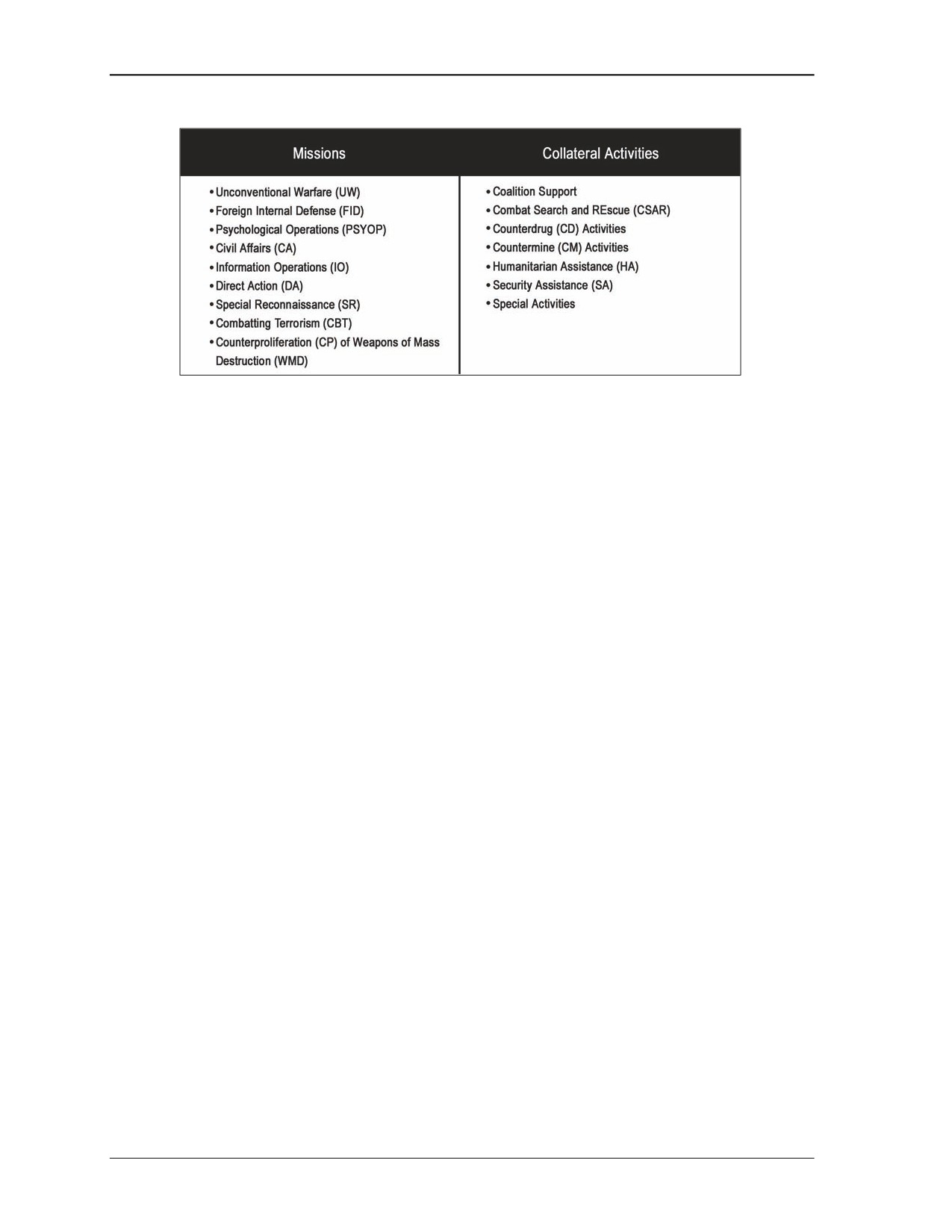
forces must operate with sister service SOF. Figure F-1, page F-2, lists ARSOF missions and collateral
activities.
F-3.
As part of the brigade combat team, the infantry battalion may conduct operations with or in
support of SOF in the OE. Detailed planning and coordination is required at the brigade level. On today’s
noncontiguous battlefield, the battalion may find SOF forces operating in close proximity to its AO. To
maximize their combined combat power, these forces must share an appreciation and understanding of
each others mission, purpose, capabilities, and limitations.
27 July 2006
FM 3-21.10
F-1
Appendix F
Figure F-1. ARSOF missions and collateral activities.
SPECIAL FORCES
F-4.
Special Forces (SF) operations are inherently joint and often controlled by higher echelons, with
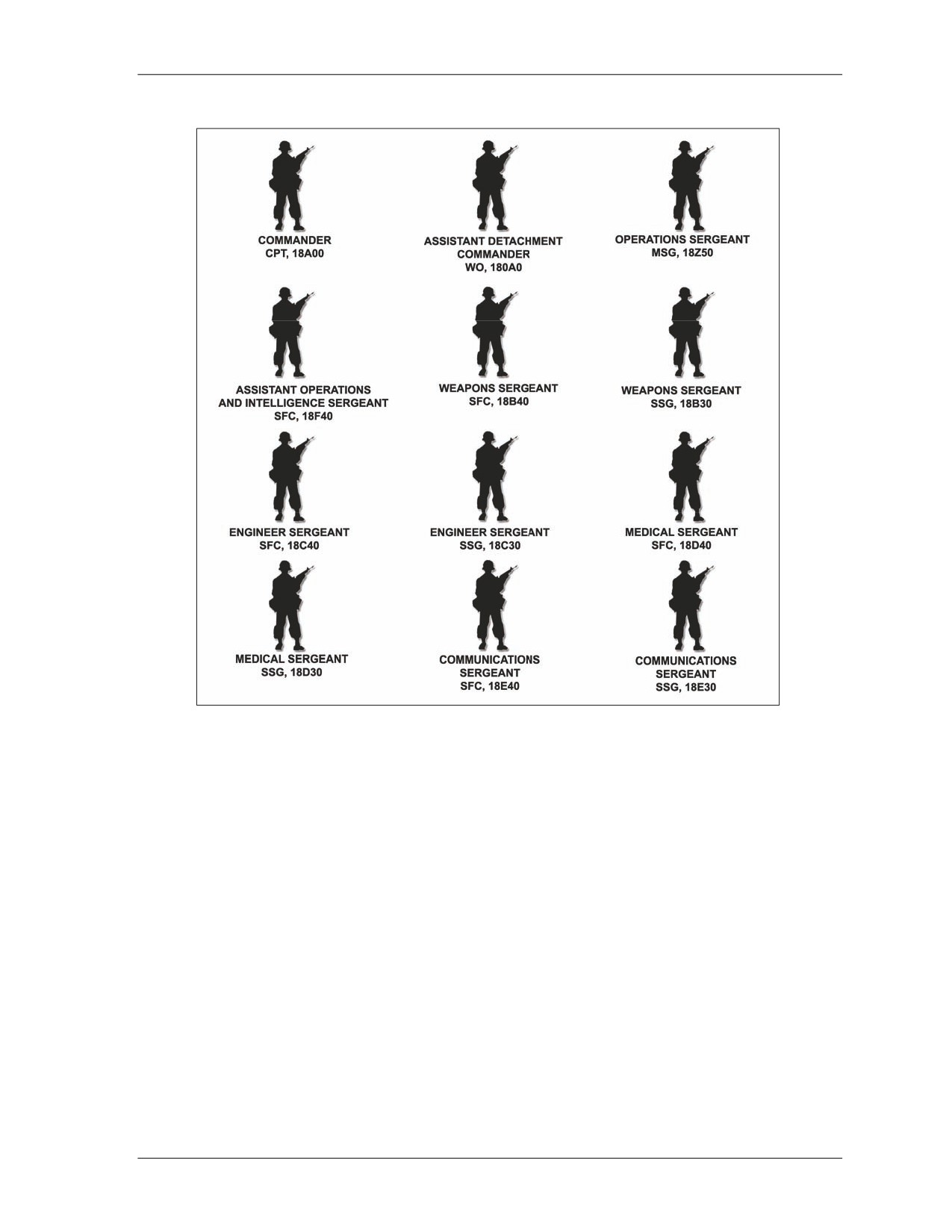
little involvement by the intermediate HQ. The basic building block of SF is the 12-Soldier SF operational
detachment-A (SFODA), known as an ODA or A-team (Figure F-2).
CAPABILITIES
y Infiltrate and exfiltrate specified operational areas by air, land, or sea.
y Have foreign language ability and cultural training.
y Operate at all levels across the entire spectrum of military operations.
y Conduct operations in remote areas and non-permissive environments for extended periods
with little external direction and support.
y Develop, organize, equip, train, advise, and direct indigenous military and paramilitary units
or personnel.
y Train, advise, and assist allied and indigenous forces.
y Conduct reconnaissance, surveillance, and target acquisition.
y Conduct direct-action operations that include raids, ambushes, sniper, special munitions, and
guidance for precision weapons.
y Conduct rescue and recovery operations.
LIMITATIONS
y Depend on the resources of the theater army to support and sustain operations.
y Cannot conduct conventional combined armed operations on a unilateral basis. Their abilities
are limited to advising or directing indigenous military forces conducting this type of operation.
y Do not have organic combined arms capability. They habitually require the support or
attachment of other combat, CS, and sustainment assets.
y Cannot provide security for operational bases without severely degrading operational and
support capabilities.
F-2
FM 3-21.10
27 July 2006
Operations with Army Special Operations Forces
Figure F-2. Special forces operational detachment A.
75TH RANGER REGIMENT
F-5.
The Ranger Regiment is structured roughly along the lines of a conventional infantry brigade and
as such has similar limitations. The Ranger force has a robust regiment headquarters that includes organic
reconnaissance, signal, and military intelligence detachments, and three Ranger battalions. The force is
organized, equipped, and trained to fight at the Ranger platoon, company, battalion, or regiment level but
possesses the flexibility to provide tailored elements to joint special operations task forces (or other
headquarters) and to employ other conventional or special operations forces placed under Ranger
command and control. Table F-1, page F-4, shows Ranger capabilities.
27 July 2006
FM 3-21.10
F-3
Appendix F
•
Plan and conduct joint special operations in conjunction with Army, Air Force, and Navy
special operations forces.
•
Conduct, or support, a forcible entry in conjunction with other joint special operations assets
to establish lodgment for inserting follow-on forces deep in enemy or denied territory.
•
Maintain a Ranger Force in an alert posture prepared for immediate deployment.
•
When properly augmented, form an Army Special Operations Task Force (ARSOTF)
headquarters or serve as the ground component of a joint task force (JTF).
•
Provide liaison teams for up to three higher controlling headquarters. Each team is equipped
and staffed to communicate with each command's deployed Ranger unit and integrate the
Ranger units into the warfighting functions of the supported command.
•
Employ cross-functional teams (CFT) to serve the Rangers as intermediate headquarters
between company-size elements and battalion headquarters. The CFT is task organized
according to METT-TC to perform numerous functions including: fuse intelligence and
operations, perform liaison, conduct C2, synchronization with conventional forces, and the full
targeting cycle.
•
Employ sniper teams in support of tactical operations to increase force protection and
minimize collateral damage with precision fires in limited visibility.
•
Conduct special reconnaissance (SR) in support of Ranger operations.
•
Conduct urban combat. Rangers are highly trained in urban combat and operate primarily at
night, maximizing the advantages of state-of-the-art technology for night vision and target
acquisition. They operate under very restrictive rules of engagement to minimize collateral
damage and noncombatant casualties.
•
Compress military decision-making process (MDMP) and ttroop-leading procedures (TLP).
Rangers are capable of compressing the MDMP and TLP.
•
Create an environment in which other special operations forces have freedom to operate.
•
Conduct operations to safeguard and evacuate Americans, or protect property abroad.
•
Provide a Ranger deployable planning team (RDPT) on short notice to any warfighting
commanders, JTF, or JSOTF headquarters to plan potential Ranger operations in support of
an emerging or ongoing contingency operation.
•
Conduct terminal guidance operations against high-value targets, either in support of
operations by a larger Ranger Force or as the primary Ranger mission in support of direct
action conducted by other forces.
•
Move small Ranger elements, small numbers of evacuees, resupply, or casualties through
urban terrain in armor-protected vehicles.
•
Operate exclusively in a digital environment maximizing situational awareness and
understanding of every Ranger.
•
Employ man-portable air defense weapons for force protection in forward support bases
(FSB) and on targets.
•
Operate in a chemical, biological, radiological, or nuclear (CBRN) contaminated environment
in conjunction with other JSOTF forces.
Table F-1. Ranger force capabilities.
SPECIAL OPERATIONS AVIATION
F-6.
The SOA rotary-wing aircraft include the AH/MH-6 Cayuse; the MH-60 Blackhawk; the MH-60
variant, known as the direct action penetrator (DAP); and the MH-47 Chinook. ARSOA units are designed
to plan, conduct, and support SO missions unilaterally or jointly in all theaters and all levels of conflict. To
accomplish this mission, ARSOA units are task organized according to the unit they will support, the
theater of operations, and expected missions.
F-7.
The AH/MH-6 Little Bird's immediate ancestors are the OH-6A light observation helicopters used
during the Vietnam War. The AH-6 is an attack version, used in close-air ground support and direct action.
F-4
FM 3-21.10
27 July 2006
Operations with Army Special Operations Forces
The MH-6 is a utility aircraft, used to insert or extract small combat teams. The MH-60 variants of the
Black Hawk are utility aircraft typically equipped with aerial refueling capability, infrared suppressive
exhausts, and other special operations-specific technology. The MH-47E Chinook is the 160th SOAR's
long-distance, heavy-lift helicopter, which is equipped with aerial refueling capability, a fast-rope
rappelling system and other upgrades or operations-specific equipment.
CAPABILITIES
y Plan and conduct air operations in all operational environments across the spectrum of conflict.
y Conduct SO as part of an Army special operations task force (ARSOTF) or joint special
operations task force (JSOTF).
y Provides the commander a means to infiltrate, resupply, and exfiltrate Army special operations
forces (ARSOF) engaged in all core missions and collateral activities.
y Prefer to operate at night. They use night vision goggles (NVG) or night vision systems (NVS)
and low-level flight profiles.
y Can operate in all operational environments and terrain: desert, mountain, jungle, urban, and
over water. Inherent in their training is the ability to operate from maritime platforms. Training
emphasizes precise navigation over long-range and under adverse weather conditions.
y Aircraft are modified to add the capability for aerial refueling; they are modified to enhance
precise navigation, secure communications, long-range flight performance, and increased
weapons lethality.
y Are specifically trained to provide close air support (CAS) and terminal guidance for precision
munitions and support of SOF.
LIMITATIONS
y Not equipped or manned to provide its own food service or water storage; requires food service
24 hours a day due to varied aircrew schedules.
y Cannot secure its aircraft or operating base; operates only from a secure base and airfield.
y Is not equipped or manned to effect its own integration into the airspace control system;
requires support or augmentation for airspace deconfliction and tactical air support
coordination.
y Cannot accept supply point distribution or to conduct moves; lacks the ground support assets
necessary to accept supply point distribution or to conduct moves; to conduct unit moves,
requires the unit distribution method of resupply and ground transportation support.
y Is not equipped to provide sufficient billeting for its personnel; requires climate-controlled
facilities that must be compartmented and lighted to accommodate varied aircrew schedules.
y Is not equipped, manned, or apportioned to the theater in sufficient quantities to provide even
its own aerial resupply or to conduct its own unit movement; requires GP aviation aerial
resupply and aerial movement support.
y Requires stove-pipe requisition and distribution systems for resupply of ARSOA-peculiar Class
II, V, and IX items; resupply of these items cannot be met through normal requisition and
distribution systems.
CIVIL AFFAIRS
F-8.
CA units establish, maintain, influence, or exploit relations between military forces and civil
authorities (both government and non-government) and the civil populace in a friendly, neutral, or hostile
AO to facilitate military operations and consolidate operational objectives. CA units are designed for
employment independently, attached, OPCON, or tactical control (TACON) to other forces. The most
commonly encountered element from a CA organization is Civil Affairs Team Alpha (CAT-A). The
CAT-A is structured to meet the immediate needs of the host nation populace by executing civil-military
operations in support of the overall plan. A civil affairs assessment team (CAAT) can also be sent down
27 July 2006
FM 3-21.10
F-5
Appendix F
from the Joint Special Operations Task Force (JSOTF) or the ARFOR (Army force) command element to
make a determination of the needs within the brigade AO prior to, or in conjunction with, a CAT-A. At the
platoon level, the typical relationship is one of providing security support in high threat areas to the CATs.
CAPABILITIES
F-9.
The Civil Affairs (CA) company of the CA battalion (USAR and Active Army) can—.
y Provide the CATs (five of them) with tactical-level civil reconnaissance (CR). Be able to plan,
execute, and transition CAO in all environments. Have communications capability that links
directly into the supported unit's communications architecture.
y Provide the civil-military operations center
(CMOC) cell with tactical level planning,
management, coordination, and synchronization of key civil-military operations
(CMO)
functions and activities within the supported commander's environment. Operate (over the
horizon) away from the supported unit as required, serving as a "standing capability" by
providing CMOC support to the BCT level HQ.
y A mechanism for civil-military coordination, collaboration, and communication.
y An initial entry and rapid deployment capability (Active Army).
y Limited functional specialty capability for initial assessment of the civil component of the
operational environment, assess the mission planning requirements, and develop and coordinate
the resources to meet immediate requirements to mitigate civil threats to the supported
commander's mission
(only RC USAR has functional specialists organic in the CA
company CMOC).
y The CAT conducts Civil affairs operations (CAO) and provides CMO planning and assessment
support to tactical maneuver commanders.
FUNCTIONS
F-10. The functions of the CAT are—.
y To conduct civil reconnaissance.
y To engage key leaders by constantly vetting contacts to identify elites within the CAT’s AO.
y To plan, coordinate, and enable CAO and project management.
y To provide civil information to the supported unit and CMOC for inclusion of civil inputs to
the supported commander's COP.
EMPLOYMENT
F-11. The CAT is deployed--
y To infiltrate rapidly by a variety of means, including static-line parachute (Active Army).
y To provide CMO staff augmentation and CA planning and assessment support to tactical
maneuver commanders.
y To maintain direct data and voice communications with conventional, SOF, IPI, international
organizations, NGOs, and interagency elements with classified and unclassified connectivity.
y To provide cross-cultural communications and limited linguistic support to supported
commanders.
y To plan and support CMO conducted by military forces.
y To conduct liaison with civilian authorities and key leader engagement.
y To minimize interference between civil and military operations and synchronize CMO to
enhance mission effectiveness.
y To conduct area studies and area assessments.
F-12. Civil affairs forces coordinate with military and civilian agencies. CA forces have extensive
capabilities in all forms of communications; thus, requiring very little, if any, augmentation from the
F-6
FM 3-21.10
27 July 2006
Operations with Army Special Operations Forces
supported command. By table of organization and equipment, CA units are authorized the latest in
conventional and Special Operations (SO) communications equipment and computers. This allows them to
send secured and unsecured Internet communication, over-the-horizon (OTH) radios, satellite-capable
radios, and laptop computers with Internet access. Also, CA units must be equipped with the current and
most common civilian communications equipment to allow them to interface with international
organizations, NGOs, and IPI in the AO. Specific requirements beyond these capabilities are determined
during mission analysis and forwarded to the supported command as a statement of requirements (SORs).
LIMITATIONS
F-13. The small size of the CA usually requires security by infantry. Also, CA typically needs
transportation due to their lack of internal transportation assets.
PSYCHOLOGICAL OPERATIONS
F-14. Tactical PSYOP teams (TPTs) normally provide PSYOP support at battalion level and below.
They are the most common PSYOP elements that Infantry squads and platoons are likely to meet. When
attached to a maneuver battalion, the TPT chief, most commonly an E-6, acts as the PSYOP staff advisor
and planner to the battalion commander. The TPT is a nonlethal, fire support combat multiplier, best
employed by the S-3. The TPT chief coordinates with the S-3 to employ the team to best support the
Commanders overall objectives effectively. He also coordinates with the tactical PSYOP detachment for
developing and producing PSYOP products to meet the battalion commander's requirements. At the
discretion of the battalion commander, TPTs might be attached to platoons. In these instances, platoon
leaders must have a clear understanding of the commander's intent to ensure the TPT is properly employed.
It is the goal of PSYOP to influence foreign populations by expressing information subjectively to
influence their attitudes and behavior. The TPT will advise the supported commander through the targeting
process regarding psychological actions (PSYACTs), PSYOP-enabling actions, and targeting restrictions
to be executed by the military force. The TPT will also provide public information to foreign populations
to support humanitarian activities; serve as the supported military commander's voice to foreign
populations to convey intent; and counter enemy propaganda, misinformation, and opposing information.
CAPABILITIES
F-15. PSYOP capabilities include--
y Providing PSYOP staff support from the battalion level to the GCC.
y Deploying globally with conventional and SOF.
y Disseminating products, conducting face-to-face communications with the targeted population,
conducting loudspeaker broadcasts, such as surrender appeals, introduction of forces,
harassment and deception, and provide linguistic and cultural expertise.
y Coordinating PSYOP support requirements with the supported commander or staff.
LIMITATIONS
F-16. PSYOP must rely on the supported unit to provide security for teams. Preapproved but
unavailable PSYOP products might take 24 to 72 hours to obtain. For the TPT to provide the commander
with communications with the foreign population, they will need an interpreter.
PLANNING CONSIDERATIONS
F-17. Combining the various forms of infantry with special operations elements is a combat multiplier.
Such operations take advantage of the infantry unit's ability to operate in restricted and severely restricted
terrain such as urban areas, forests, and mountains. Special operations forces (SOF) provide the units with
force multipliers, especially in information operations, effects, and intelligence.
27 July 2006
FM 3-21.10
F-7
Appendix F
COORDINATION
F-18. When operating with or near SOF, the Infantry company commander should coordinate, at a
minimum, the following with the SOF unit leader.
y C2 relationship.
y Communication information (frequencies, call signs, challenge and passwords, emergency
signals and codes).
y Safehouse locations.
y Number and types of vehicles.
y Control measures being used.
y Battle handover criteria.
y Liaisons.
y Sustainment plans.
y Contingency plans for mutual support.
F-19. SOF may operate with the infantry or within the infantry AO as well as with infantry units
conducting operations inside a JSOA. Physical contact between infantry units and SOF may range from
short-term direct action operations to sustained combat operations. It is essential to conduct adequate
coordination and integration to accomplish the specific mission. SOF have several elements to aid in
coordination at the battalion level and above.
SPECIAL OPERATIONS COMMAND AND CONTROL ELEMENT
F-20. A special operations command and control element (SOCCE) might be used as an intermediate
command element between the ODAs and the theatre SOC. The SOCCE typically will be embedded in
conventional forces at brigade or higher levels and serves as a conduit to ensure special operations
activities meet the needs of the SOC as well as the conventional force's campaign plan. A SOCCE consists
of a Special Forces company headquarters with possible augmentation from ODAs to meet the SOCCE’s
support requirements.
CIVIL AFFAIRS PLANNING TEAM A
F-21. CA planning team A (CAPT-A) is a CA communications (CACOM) asset designed to provide
responsive civil-military operations (CMO) staff augmentation of functional commands and corps-level or
JTF-level commands. They are capable of conducting initial area assessments for CMO and providing
recommendations for CA force structure to support the maneuver commander's CMO objectives.
RANGER DEPLOYABLE PLANNING TEAMS AND
CROSS-FUNCTIONAL TEAMS
F-22. The 75th Ranger Regiment forms RDPT and CFT to function as described in Table F-1.
REQUEST FOR SUPPORT
F-23. Commanders can request direct support of SOF from the unified command’s SOC. The SOC
forms joint special operations task forces as required IAW the unified commander's guidance and
operational needs. Based on operational needs and complexity of operations, conventional and SOF units
may exchange liaison cells or, depending on proximity of headquarters and habitual relationships,
commanders might be comfortable with daily coordination meetings.
F-8
FM 3-21.10
27 July 2006
Operations with Army Special Operations Forces
Note: Army active duty Civil Affairs and Psychological Operations units are a component
of the United States Special Operations Command. In some specific situations, they might be
available to support conventional units. Army Reserve Civil Affairs and Psychological
Operations units are in support of conventional units.
27 July 2006
FM 3-21.10
F-9
This page intentionally left blank.
Appendix G
Improvised Explosive Devices, Suicide Bombers,
Unexploded Ordnance, and Mines
Improvised explosive devices
(IEDs), mines, car bombs, unexploded ordnance
(UXO), and suicide bombers pose deadly and pervasive threats to Soldiers and
civilians in operational areas all over the world. Infantrymen at all levels must know
about these hazards, and they must know how to identify, avoid, and react to them
properly. Newly assigned leaders and Soldiers should read everything they can find
on current local threats, and they should learn the unit's policies such as those found
in the unit's standing operating procedures (SOP) and in locally produced Soldier
handbooks and leader guidebooks.
This edition introduces discussions of Improvised Explosive Devices
(IEDs),
homicide bombers, Unexploded Ordnance
(UXO) and mines. It incorporates
tactical-level countermeasures learned from recent combat operations.
Section I. IMPROVISED EXPLOSIVE DEVICES
IEDs are nonstandard explosive devices used to target US Soldiers, civilians, NGOs, and government agencies.
IEDs range from crude homemade explosives to extremely intricate remote-controlled devices. The devices are
used to instill fear in US Soldiers, coalition forces, and the local civilian population, and to diminish US
national resolve with mounting casualties. The sophistication and range of IEDs continue to increase as
technology continues to improve and as terrorists gain experience.
TYPES
G-1.
Some of the many types of IEDs follow.
TIMED EXPLOSIVE DEVICES
G-2.
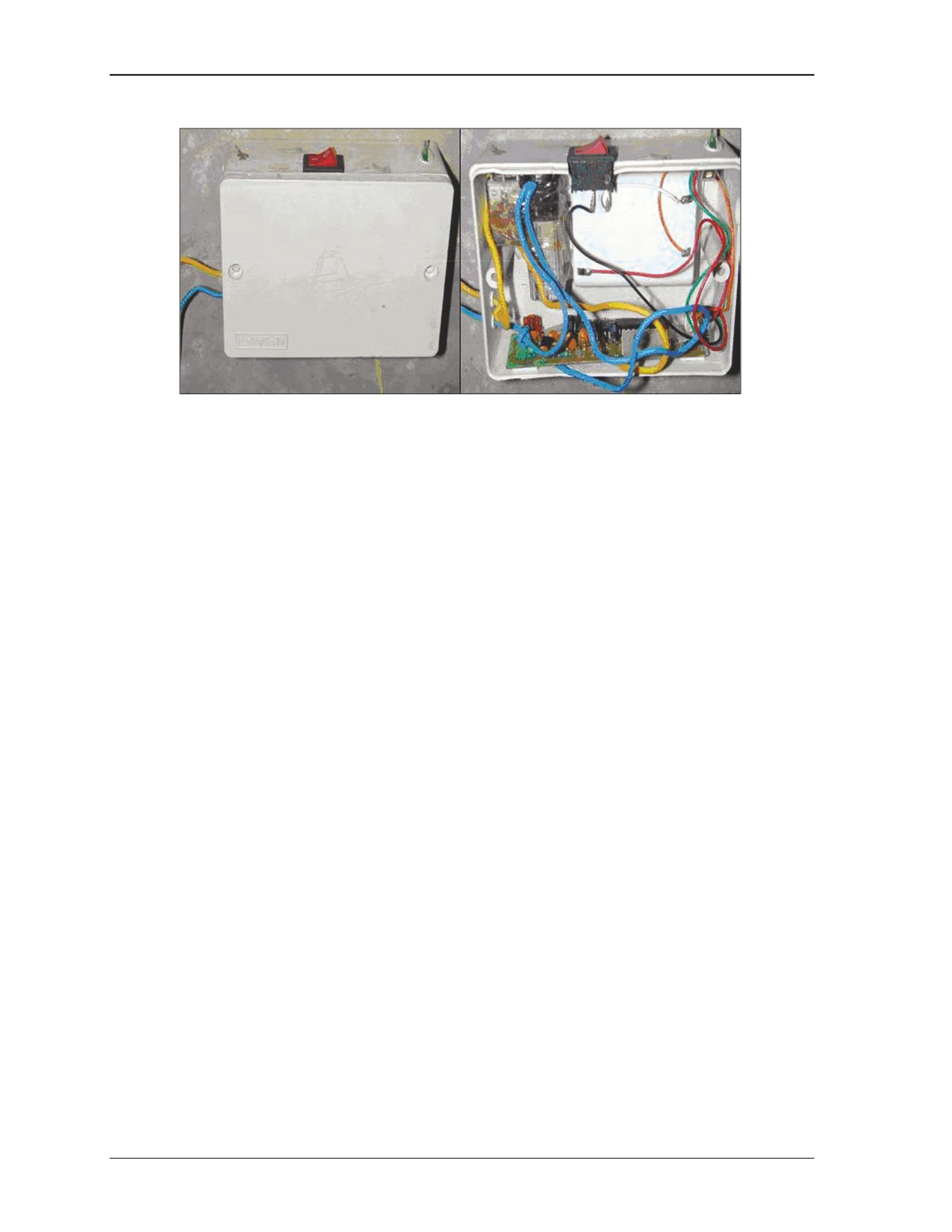
These can be detonated by remote control such as by the ring of a cell phone; by other electronic
means; or by the combination of wire and either a power source or timed fuze (Figure G-1, page G-2).
IMPACT DETONATED DEVICES
G-3.
These detonate after being dropped, thrown, or impacted in some manner.
VEHICLE BOMBS
G-4.
These may include explosive-laden vehicles detonated with electronic command wire or wireless
remote control, or with timed devices. They might be employed with or without drivers.
27 July 2006
FM 3-21.10
G-1
Appendix G
Figure G-1. Example of IED detonation device with explosive.
CHARACTERISTICS
G-5.
Key identification features and indicators of suspected IEDs or the presence of IEDs include--
y Exposed wire, cord, or fuze protruding from an object that usually has no such attachment.
y An unusual smell, sound, or substance emanating from an object.
y An item that is oddly light or heavy for its size.
y An object that seems out of place in its surrounding.
y An object or area that the locals are obviously avoiding.
y An object used with written or verbal threats, or an object that is thrown at personnel or
facilities, or both.
INGREDIENTS
G-6.
Anything that can explode will be used to make IEDs, for example--
y Artillery rounds containing high explosives or white phosphorous.
y Any type of mine (antitank or antipersonnel).
y Plastic explosives such as C4 or newer.
y A powerful powdered explosive.
y Ammonium nitrate (fertilizer) combined with diesel fuel in a container. The truck bomb that
destroyed the Oklahoma City Federal Building used ammonium nitrate and diesel fuel.
CAMOUFLAGE
G-7.
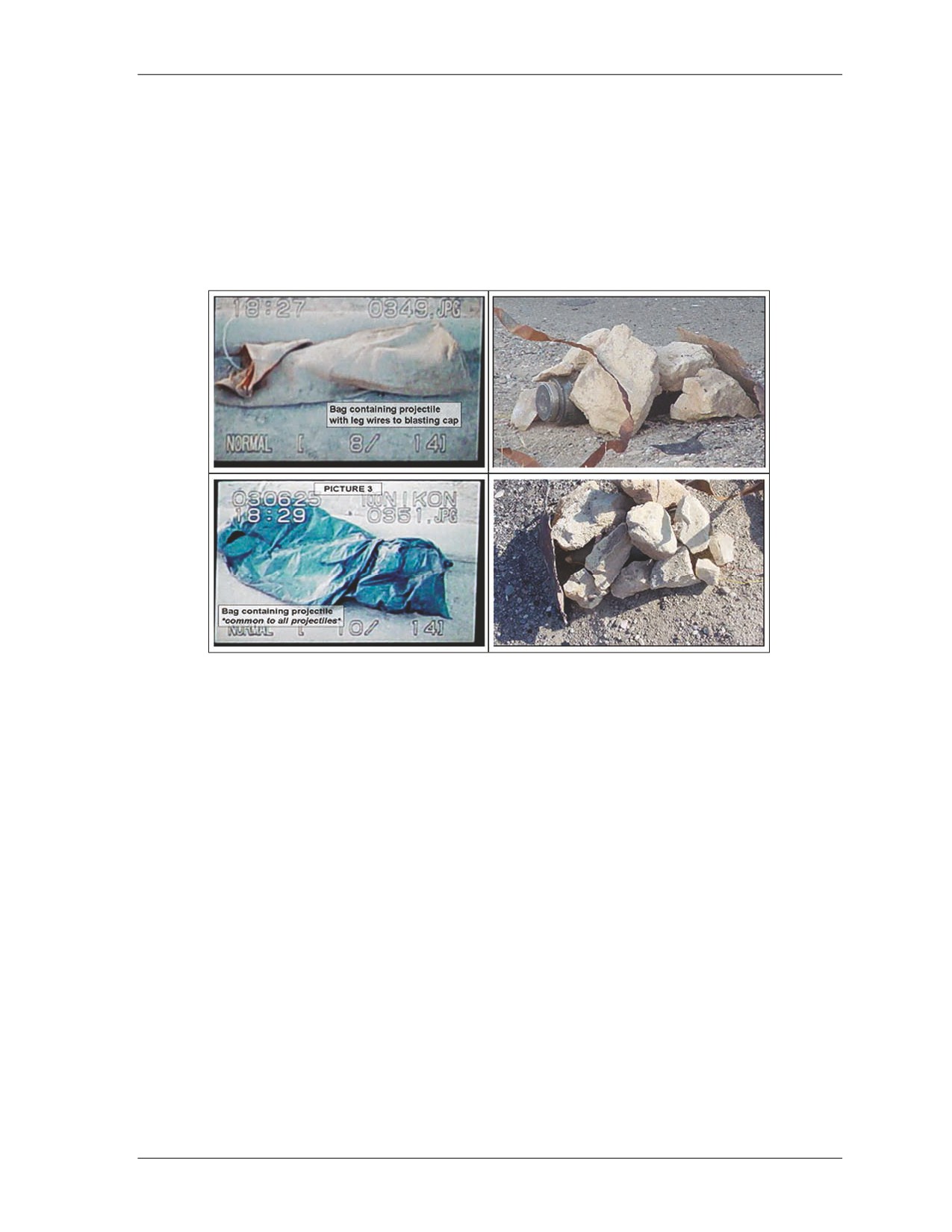
An IED can vary from the size of a ballpoint pen to the size of a water heater. They are often
contained in innocent-looking objects to camouflage their true purpose. The type of container used is
limited only by the imagination of the terrorist. However, containers usually have a heavy metal casing to
increase fragmentation. Figure G-2 shows some of the types of camouflage that have been used to hide
IEDs in Iraq. Some of the more commonly used containers are--
y Lead, metal, and PVC pipes with end caps (most common type).
y Fire extinguishers.
y Propane tanks.
G-2
FM 3-21.10
27July 2006
Improvised Explosive Devices, Suicide Bombers, Unexploded Ordnance, and Mines
y Mail packaging.
y Wood and metal boxes.
y Papier-mâché or molded foam or plastic "rocks," which are containers that look like rocks,
usually employed along desert roads and trails).
y Military ordnance, or rather modified military ordnance, which uses an improvised fuzing and
firing system.
Figure G-2. Camouflaged UXO.
VEHICLE-BORNE DEVICES (CAR BOMBS)
G-8.
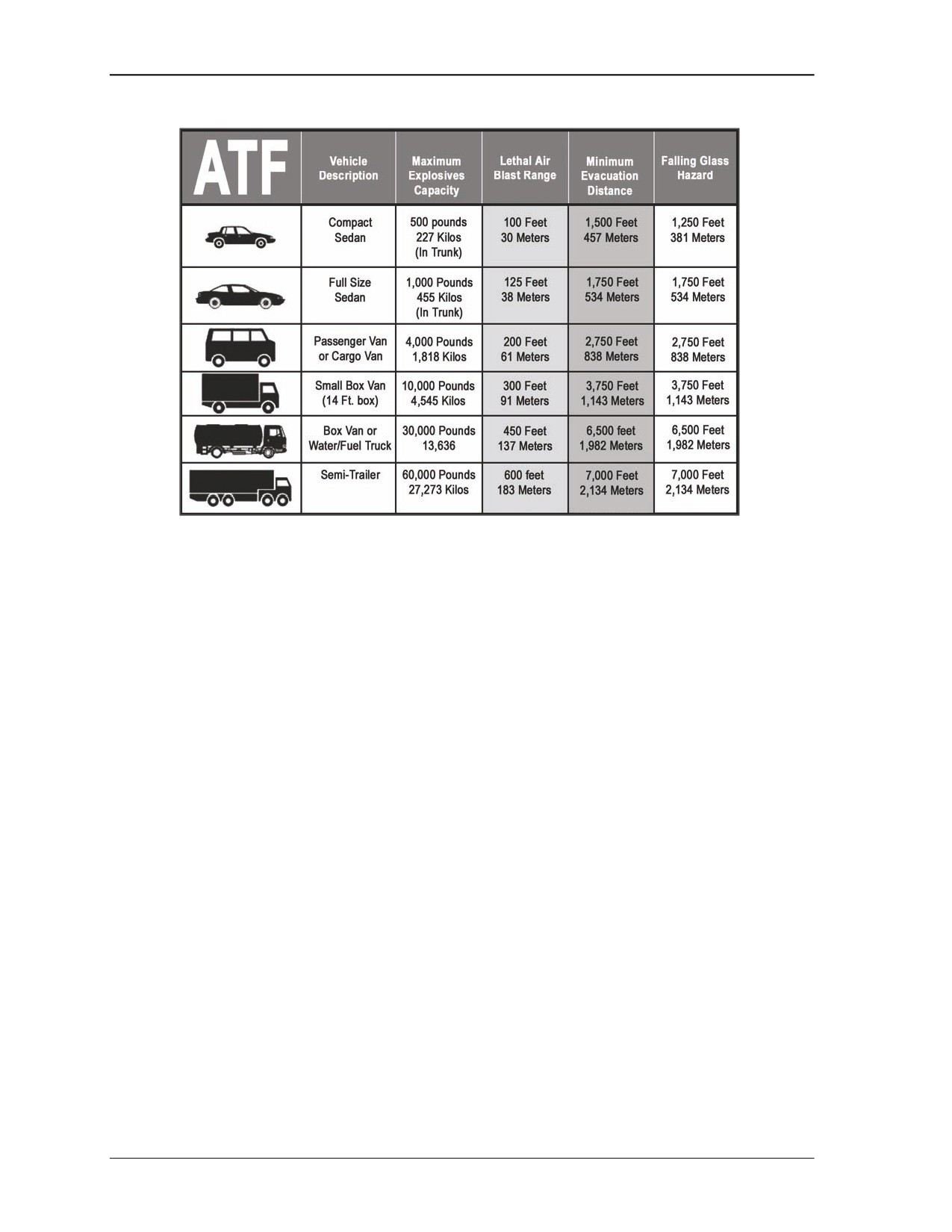
Car bombs obviously use a vehicle to contain the device. The size of the device varies by the type
of vehicle used—anywhere from a small sedan to a large cargo truck (Figure G-3, page G-4). Larger
vehicles can carry more explosives, so they can cause more damage than smaller vehicles. Device
functions, like package types, vary. Some of the signs of a possible car bomb include--
y A vehicle riding low, especially in the rear, and especially if the vehicle seems empty.
Explosive charges can also be concealed in the panels of the vehicle to distribute the weight of
the explosives better.
y Suspiciously large boxes, satchels, bags, or any other type of container in plain view such as
on, under, or near the front seat in the driver's area of the vehicle. One sign is wires or rope-like
material coming from the front of the vehicle and leading to the rear passenger or trunk area.
y A timer or switch in the front of a vehicle. The main charge is usually out of sight, and as
previously stated, often in the rear of the vehicle.
y Unusual or very strong fuel-like odors.
y An absent or suspicious-behaving driver.
27 July 2006
FM 3-21.10
G-3
Appendix G
Figure G-3. Vehicle IED capacities and danger zones.
EMPLOYMENT
G-9.
IEDs have been used against the US military throughout its history. Operation Enduring Freedom
(Afghanistan) and Iraqi Freedom (OIF) has seen the use of IED attacks on a significant scale targeting not
only US, coalition, and Iraqi Security forces, but also civilian gatherings and concentrations as well. Some
threat TTPs might include--
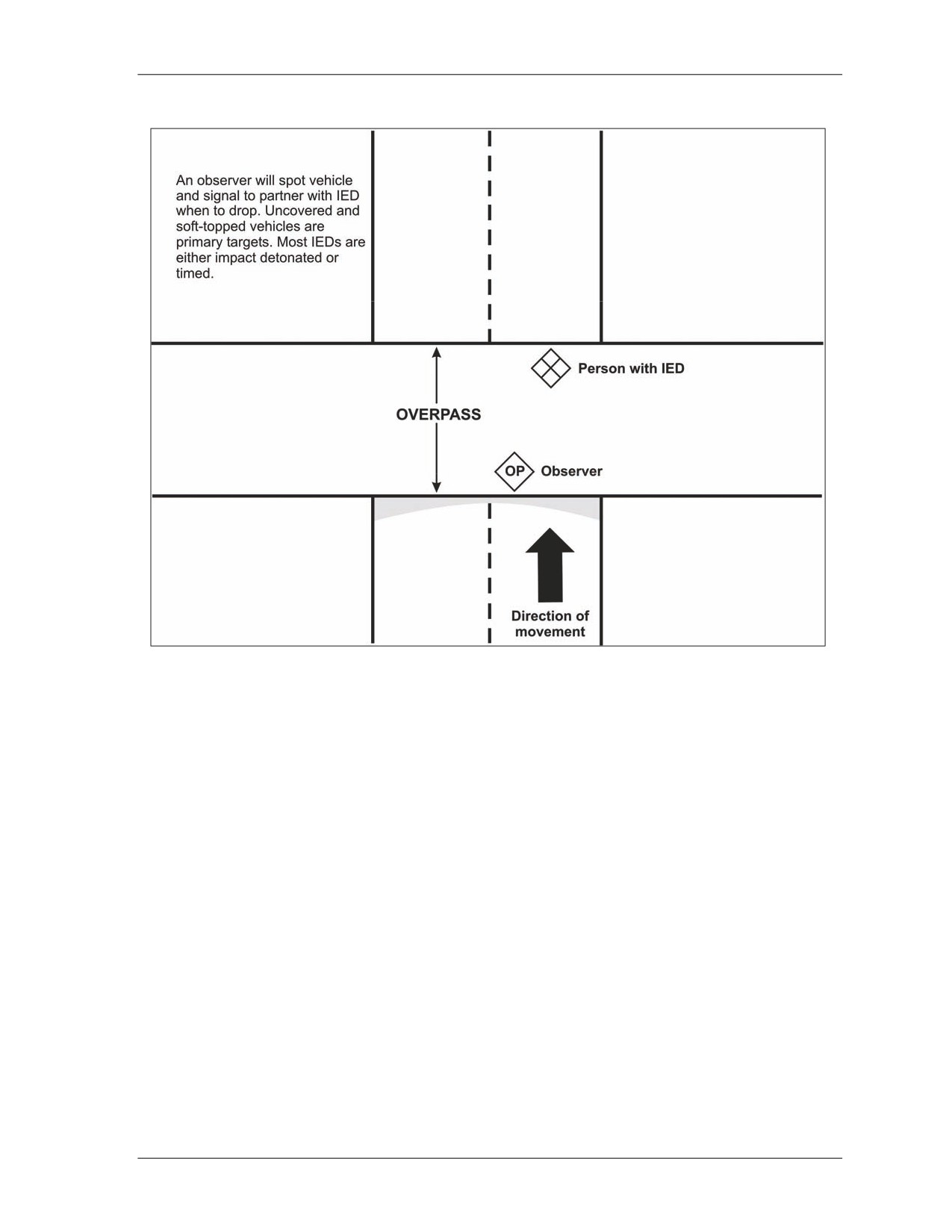
y An IED dropped into a vehicle from a bridge overpass. An enemy observer spots a vehicle and
signals a partner on the overpass when to drop the IED. Uncovered soft-top vehicles are the
main targets. These IEDs are triggered either by timers or by impact (Figure G-4).
y An IED used in the top-attack mode and attached to the bottom of a bridge or overpass. This
IED is command-detonated as a vehicle passes under it. This method gets around the side and
undercarriage armor used on US vehicles.
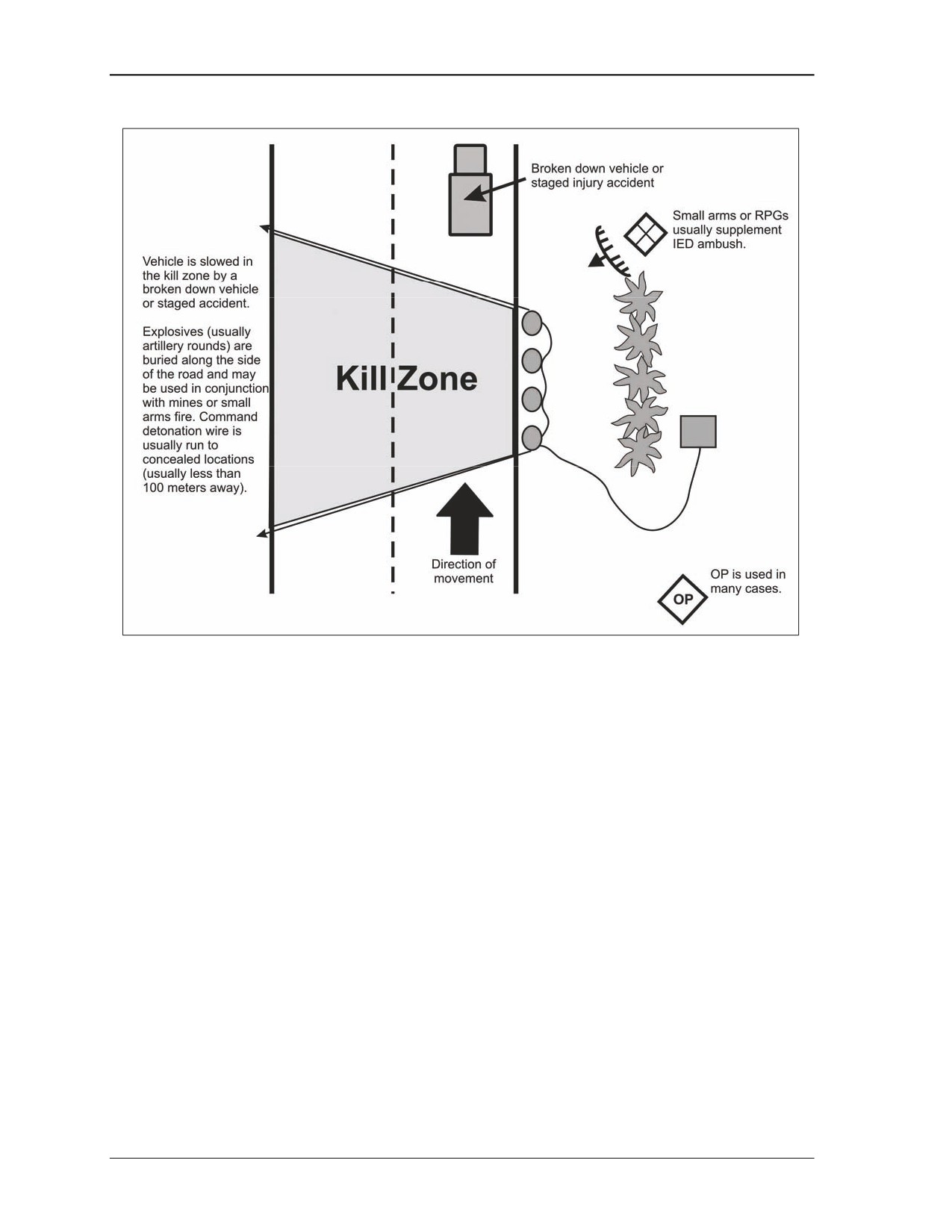
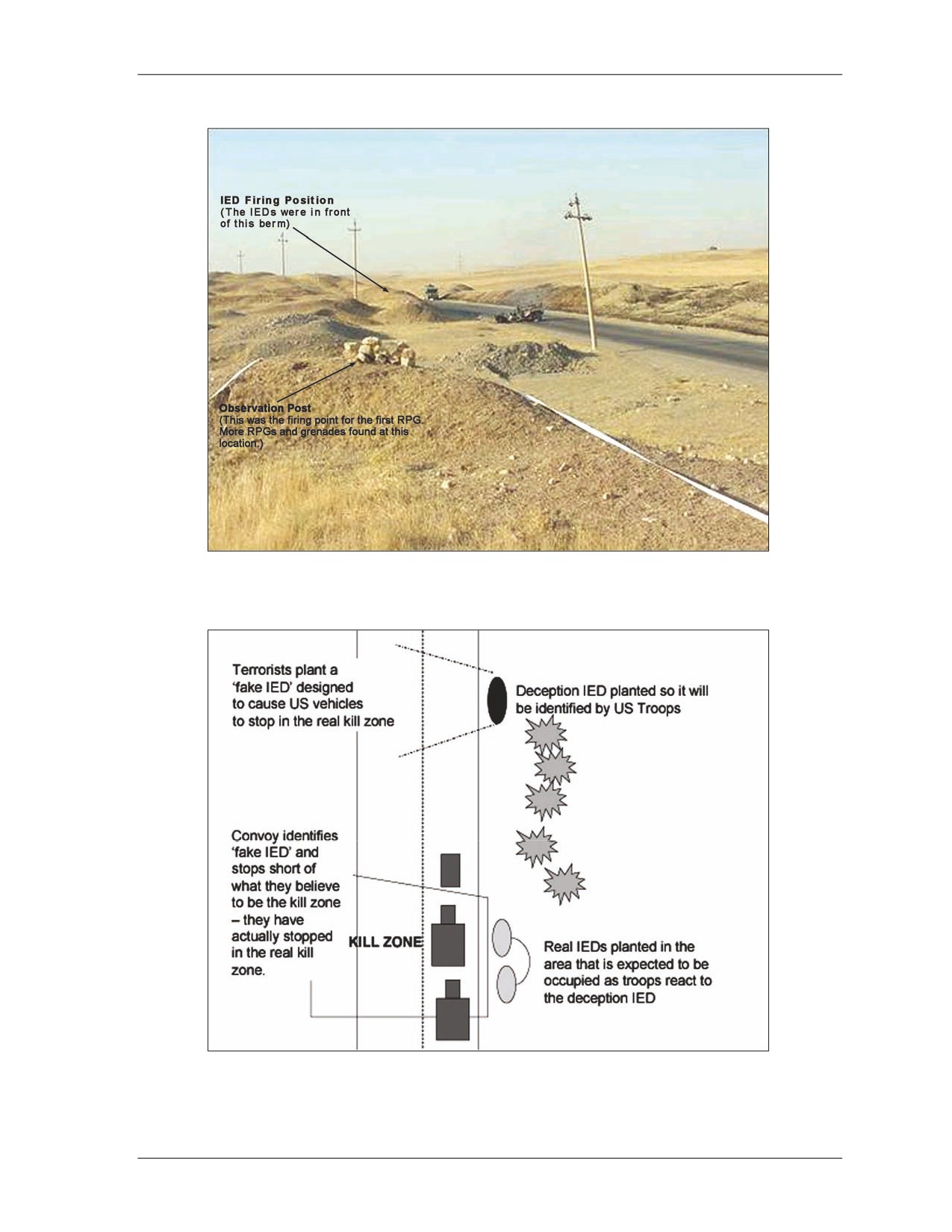
y An IED used with an ambush. Small arms, RPGs, and other direct-fire weapons supplement the
IED, which initiates the ambush
(Figure G-5, page G-6; and Figure G-6 and Figure G-7,
page G-7). Terrorists sometimes use deception measures, such as dummy IEDs, to stop or slow
vehicles in the real kill zone.
y The driver of a suicide or homicide vehicle, such as a taxicab, feigns a breakdown and
detonates the vehicle when Soldiers approach to help. The vehicle with IEDs might also run a
checkpoint and blow up next to it.
y Suicide bombers sometimes approach US forces or other targets and then self-detonate.
Children might approach coalition forces wearing explosive vests.
G-4
FM 3-21.10
27July 2006
Improvised Explosive Devices, Suicide Bombers, Unexploded Ordnance, and Mines
Figure G-4. Example of IED dropped into vehicles.
27 July 2006
FM 3-21.10
G-5
Appendix G
Figure G-5. Typical IED combination ambush.
G-6
FM 3-21.10
27July 2006
Improvised Explosive Devices, Suicide Bombers, Unexploded Ordnance, and Mines
Figure G-6. IED combination ambush in Iraq.
Figure G-7. Deception or fake IED used to stop convoy in kill zone.
27 July 2006
FM 3-21.10
G-7
Appendix G
COUNTERMEASURES
G-10. The enemy continues to adapt as friendly countermeasures evolve. The following are some
measures used to counter an IED threat.
AVIATION SUPPORT
G-11. Operate with army aviation support when possible. Terrorists employing command-detonated
IEDs generally rely on a quick escape after detonating an IED or executing an ambush. Recent trends have
shown that OH-58D support deters attacks because terrorists are unable to break contact easily.
ALL-ROUND SECURITY
G-12. Remain alert. Maintain all-round security at all times. Scan rooftops and bridge overpasses for
enemy activity.
CONVOY SECURITY
G-13. When possible, travel in large convoys. Vary road speed to disrupt the timing of
command-detonated devices. However, terrorists often target convoys
(or specific vehicles within
convoys) with poor security postures. All occupants of convoy vehicles should have and keep their
weapons pointed in an alert and defensive posture. Maintain a strong rear security element or a follow-on
"shadow" trail security element. This force can more quickly be brought to bear on an enemy attacking the
rear of a convoy. Use armed vehicles to speed ahead of a convoy to overwatch overpasses as the convoy
passes. The lead vehicle in a convoy should have binoculars to scan the route ahead. All convoys should
have with extra tow bars or towing straps to recover broken-down vehicles quickly.
ADAPTATION
G-14. Be aware of evolving enemy tactics and procedures and design countermeasures (Figure G-8,
page G-11). To the maximum possible extent, avoid becoming predictable; vary routes, formations, speeds,
and techniques.
TURNS
G-15. Avoid moving toward or stopping for an item in the roadway. Give wide clearance to items in the
road. Turn to the outside of corners because terrorists will often plant IEDs on the insides of turns to close
the distance to the target. Turning to the outside also allows a longer field of view past the turn.
AUDIBLE SIGNALS
G-16. At night, be aware of flares, gunfire lights going off, or horn honking, which can be used to signal
the approach of a convoy.
ENEMY OBSERVERS
G-17. Be alert for people who seem overly interested in your convoy, especially those using cell phones
while watching your convoy.
UNUSUAL SILENCE
G-18. Be aware of unusually quiet areas. Often, local civilians have been warned of an enemy attack on
coalition forces.
G-8
FM 3-21.10
27July 2006
Improvised Explosive Devices, Suicide Bombers, Unexploded Ordnance, and Mines
USE OF HEADLIGHTS
G-19. Do not use service drive headlights during the day. Having lights on during daylight makes the
military vehicles stand out and easier to identify at a greater distance.
VEHICLE PROTECTION
G-20. Harden all vehicles.
OTHER TRAVELING PRECAUTIONS
G-21. Do not stop for broken down civilian vehicles, vehicle accidents, or wounded civilians along a
convoy route.
CIVILIAN VEHICLE THREATS
G-22. Be alert to civilian vehicles cutting in and out or ramming vehicles in a convoy as if attempting to
disrupt, impede, or isolate the convoy. Current ROE might permit you to fire warning shots or to engage
threatening vehicles.
FIVES C'S TECHNIQUE
G-23. Using the five C's
(confirm, clear, call, cordon, control) technique helps to simplify both
awareness and reaction to a suspected IED.
CONFIRM
G-24. The first step when encountering a suspected IED is to confirm that it is an IED. If Soldiers
suspect an IED while performing 5- and 25-meter searches of their positions, they should act as if it could
detonate at any moment, even if it turns out to be a false alarm. Using as few people as possible, troops
should begin looking for telltale signs such as wires, protruding ordnance, or fleeing personnel.
CLEAR
G-25. If an IED is confirmed, the next step is to clear the area. The safe distance is determined by
several factors: the tactical situation, avoidance of predictability, and movement several hundred meters
away. Everyone within the danger zone should be evacuated. If more room is needed, such as when the
IED is vehicle-born, Soldiers should clear a wider area and continuously direct people away. Only
explosive ordnance disposal (EOD) personnel or their counterparts may approach the IED. While clearing,
avoid following a pattern and look out for other IEDs. If you find any more, reposition to safety and notify
a ranking member on the scene.
CALL
G-26. While the area around the IED is being cleared, a nine-line IED/UXO report should be called in.
The report is much like the nine-line MEDEVAC report. It includes the necessary information for the unit's
TOC to assess the situation and prepare an appropriate response.
CORDON
G-27. After the area has been cleared and the IED has been called in, Soldiers should establish fighting
positions around the area to prevent vehicle and foot traffic from approaching the IED. They assure the
area is safe by checking for secondary IEDs. They use all available cover. The entire perimeter of the
effected area should be secured and dominated by all available personnel. Available obstacles should be
used to block vehicle approach routes. Scan near and far for enemy observers who might try to detonate the
IED. Insurgents often try to hide where they can watch their target area and detonate at the best moment.
To deter attacks, randomly check the people leaving the area.
27 July 2006
FM 3-21.10
G-9
Appendix G
CONTROL
G-28. Since the distance of all personnel from the IED directly affects their safety, Soldiers should
control the site to prevent people from straying too close until the IED is cleared. No one may leave the
area until the EOD gives the "all clear." While controlling the site, assure all Soldiers know the
contingency plans in case they come under attack by any means, including direct-fire small arms or RPGs,
or indirect fires.
Section II. SUICIDE BOMBERS
These are different from all other terrorist threats, and require specific guidance on actions, particularly the
interpretation of the ROE.
DEFINITION
G-29. A suicide attack is so called because it is an attack that means certain death for the attacker.
The terrorist knows that success depends on his willingness to die. He conducts this kind of attack by
detonating a worn, carried, or driven portable explosive charge. In essence, the attacker is himself a
precision weapon. Suicide bombers aim to cause the maximum number of casualties, or to assassinate a
particular target. Stopping an ongoing suicide attack is difficult. Even if security forces stop him before he
reaches his intended target, he can still activate the charge and kill or injure those around him at the time.
An additional benefit is the simplicity of such an attack. Neither escape nor extraction is an issue. Nor is
intelligence, for no one will be left to interrogate. The only way to prepare for a suicide attack is to train
Soldiers to react immediately to it with competence and confidence. They also train to avoid overreacting
with unnecessary or inappropriate lethal force. The following are potential high-value targets for
suicide bombers.
y High-signature forces such as uniformed military and security elements; military vehicles;
civilian vehicles used for military purposes; military bases; checkpoints; patrols; liaison
personnel; or supportive host nation personnel.
y Members and facilities of the international community such as ambassadors and other
diplomats; embassy, UN, and NGO buildings; and diplomatic vehicles and staffs.
y National and provincial leaders and government officials.
y Civilians in public places such as markets, shops, and cafes. Although civilians in these
locations are seldom primary targets, some groups do attack them.
DELIVERY METHODS
G-30. The two main methods of employing devices are by person or by vehicle.
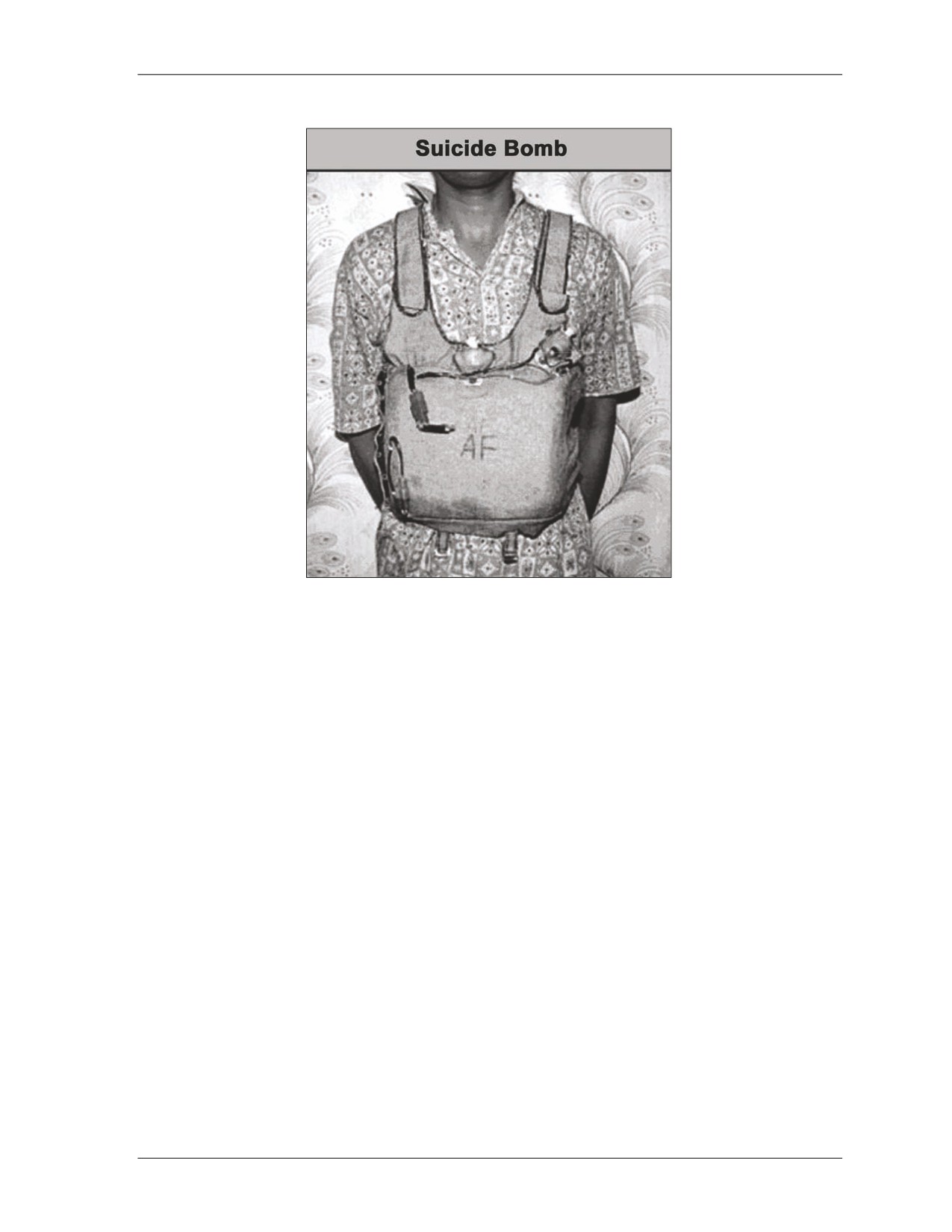
y A person-borne suicide bomb usually has a high-explosive and fragmentary effect and uses a
command-detonated firing system such as a switch or button the wearer activates by hand. A
vest, belt, or other specially modified clothing can conceal explosives with fragmentation
(Figure G-8, page G-11).
y A vehicle-borne suicide bomb uses the same methods and characteristics of other package or
vehicle bombs, and is usually command detonated.
G-10
FM 3-21.10
27July 2006
Improvised Explosive Devices, Suicide Bombers, Unexploded Ordnance, and Mines
Figure G-8. Suicide bomber vest.
INDICATORS
G-31. Suicide bombers can be either gender and any age. For example, recent Palestinian bombers were
female teenagers. However, you might be looking at a suicide bomber if you see someone who--
y Tries to blend in with the (target) environment.
y Wears ordinary, nondistinctive clothing, military or religious garb, or an oversized, bulky, or
unseasonably heavy coat or jacket.
y Demonstrates fanatical religious beliefs by behaviors such as praying fervently, possibly
loudly, in public.
y Has a shaved head (Muslim males); or wears their hair short and their face clean shaven; or
wears fragrance, which is unusual for an Arab man.
y Behaves nervously, that is, sweats, or glances about anxiously.
y Has religious verses from the Quran written or drawn onto their body, hands, or arms.
y (Islamic males) dresses as and pretends to be a woman.
y Carries a bag tightly, clutched close to the body, and in some cases squeezes or strokes it.
SPECIAL CONSIDERATIONS
G-32. Consider the following when dealing with potential suicide bombers:
y Most will try to detonate the device if they believe they have been discovered.
y Suicide bombers are of any nationality, not necessarily of direct Middle Eastern descent. They
may simply sympathize with the terrorist group’s cause(s).
27 July 2006
FM 3-21.10
G-11
Appendix G
y If you determine that a suspect is a suicide bomber, then you will probably have to use deadly
force. Prepare for and expect a detonation. Shoot from a protected position from as far away
as possible.
y Many suicide bombers use pressure-release-type detonation devices that they hold in their
hands. They apply the pressure before they begin their final approach to the target. The
explosive payload will detonate as soon as the bomber relaxes his grip, so it will go off even if
you kill him.
y Some bombers also have a command-detonated system attached to their bomb, and a second
person observes and tracks him to the target. This also allows the terrorists to control and
detonate the bomb, even if the bomber dies or his trigger is destroyed or disabled.
y The suicide bomber may also use a timed detonation system, and again this works whether or
not you kill him before he reaches his target.
COMPLICATIONS
G-33. Dealing with a suicide bomber is one of the toughest situations a Soldier can face. In just a few
seconds, he must identify the bomber, assess the situation, consider how to comply with the ROE, and act
decisively. There is seldom time to think beyond that, or to wait for orders. The only possible way to stop
the bomber short of his target is to immediately incapacitate him with lethal force. Challenging him would
probably cause him to trigger his device at once. The suicide bomber is trained and prepared to carry out
his mission. Some experts believe that a suicide bomber considers himself already dead when setting out
on an attack. The Soldier and leader must continually be aware that--
y A pressure release switch can detonate the device as soon as the bomber is shot.
y A device could be operated by remote control or timer even after the bomber is incapacitated.
y Another person observe and command-detonate the bomb.
y A second suicide bomber might be operating as a backup or to attack the crowd and assistance
forces that normally gather after a detonation.
Section III. UNEXPLODED ORDNANCE
UXO are made up of both enemy and friendly force ordnance that have failed to detonate. UXO sometimes
pose no immediate threat, but they can cause injuries, loss of life, and damage to equipment if appropriate
actions are not taken. UXO can be found on the battlefield, in urban areas, caves, and almost anywhere in an
AO. UXO can be a result of a recent battle or war, or left over from past conflicts. During Operation Enduring
Freedom (OEF), US Soldiers, coalition forces, and the local population were in danger of encountering an
estimated 10,000,000 pieces of UXO and mines left over from 23 years of war in Afghanistan. Soldiers in
Bosnia and Soldiers fighting in Operation Iraqi Freedom have been exposed to an estimated 8 million
antipersonnel mines and 2 million antitank mines, as well as UXO. Soldiers can expect to encounter UXO in
any future conflict.
RECOGNITION
G-34. Soldiers’ knowledge of UXO is essential to help prevent the risk of injury. Soldiers are generally
familiar with the appearance of ammunition and munitions used in their own weapons. They seldom
recognize what the actual projectile looks like once it has been fired, especially if it is discolored or
deformed by impact. Also, Soldiers might not be able to easily recognize UXO from USAF-delivered
weapons or from non-US weapons. In general, leaders should caution their Soldiers against disturbing any
unknown object on the battlefield.
G-35. FM 21-16 provides detailed illustrations and identifying characteristics of the four categories of
UXO, including projected, thrown, placed, and dropped.
G-12
FM 3-21.10
27July 2006
Improvised Explosive Devices, Suicide Bombers, Unexploded Ordnance, and Mines
PROJECTED ORDNANCE
G-36. This includes--
y Projectiles such as HE, chemical, illumination, and submunitions.
y Mortar rounds such as HE, chemical, WP, and illumination.
y Rockets such as self-propelled projectiles, no standard shape.
y Guided missiles such as missiles with guidance systems.
y Rifle grenades similar to mortars but fired from rifles.
THROWN ORDNANCE
G-37. Thrown ordnance including fragmentation, smoke, illumination, chemical, and incendiary
hand grenades.
PLACED ORDNANCE
G-38. This category includes--
y AP mines, generally small, of various shapes and sizes, and made of plastic, metal, or wood.
Might have trip wires attached.
y AT mines, large, of various shapes and sizes, and made of plastic, metal, or wood. Might have
antihandling devices.
DROPPED ORDNANCE
G-39. Dropped ordnance include--
y Bombs, small to very large, with metal casings, tail fins, lugs, and fuzes. May contain HE,
chemicals, or other hazardous materials.
y Dispensers that look similar to bombs but may have holes or ports in them. Do not approach as
sub-munitions might be scattered around.
y Very sensitive submunitions such as small bombs, grenades, or mines.
DANGER
DO NOT TRY TO TOUCH OR MOVE UXO. ORDNANCE FAILS FOR
MANY REASONS, BUT ONCE FIRED OR THROWN, THE FUZING
SYSTEM WILL LIKELY ACTIVATE. THIS MAKES THE ORDNANCE
TOO UNSTABLE TO HANDLE. IF THE ROUND FAILED TO
FUNCTION INITIALLY, ANY SUBSEQUENT STIMULUS OR
MOVEMENT MIGHT SET IT OFF.
IMMEDIATE ACTION
G-40. Many areas, especially previous battlefields, might be littered with a wide variety of sensitive and
deadly UXO. Soldiers need to follow these precautions on discovering a suspected UXO:
y Do not move toward the UXO. Some types of ordnance have magnetic or motion-sensitive
fuzing.
y Never approach or pick up UXO even if identification is impossible from a distance. Observe
the UXO with binoculars if available.
27 July 2006
FM 3-21.10
G-13
Appendix G
y Send a UXO report to higher HQ (Figure G-9). Use radios at least 100 meters away from the
ordnance. Some UXO fuzes might be set off by radio transmissions.
y Mark the area with mine tape or other obvious material at a distance from the UXO to warn
others of the danger. Proper markings will also help EOD personnel find the hazard in response
to the UXO report.
y Evacuate the area while carefully scanning for other hazards.
y Take protective measures to reduce the hazard to personnel and equipment. Notify local people
in the area.
1.
DTG: Date and time UXO was discovered.
2.
Reporting Unit or Activity, and UXO Location:
Grid coordinates.
3.
Contact Method: How EOD team can contact
the reporting unit.
4.
Discovering Unit POC: MSE, or DSN phone number and unit
frequency or call sign.
5.
Type of UXO: Dropped, projected, thrown, or placed, and
number of items discovered.
6.
Hazards Caused by UXO: Report the nature of perceived
threats such as a possible chemical threat or a limitation of
travel over key routes.
7.
Resources Threatened: Report any equipment, facilities, or
other assets threatened by the UXO.
8.
Impact on Mission: Your current situation and how the UXO
affects your status.
9.
Protective Measures: Describe what you have done to protect
personnel and equipment such as marking the area and
informing local civilians.
Figure G-9. Nine-line UXO incident report.
BOOBY TRAPS
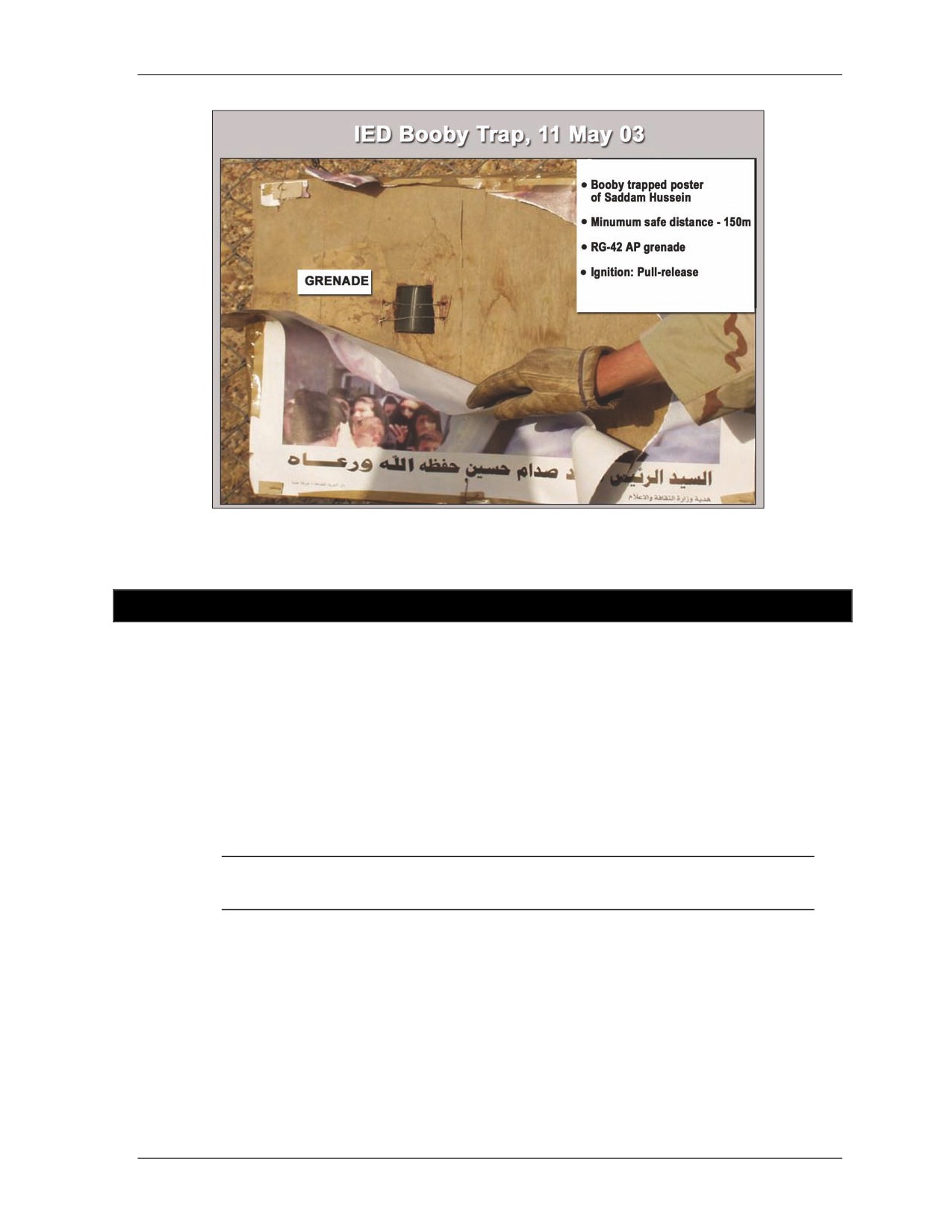
G-41. Booby traps typically are hidden or disguised explosive devices rigged on common items to go off
unexpectedly (Figure G-10, page G-15). They may also be employed as antihandling devices on UXO,
emplaced mines, or as improvised explosive devices (IED). Identify, mark, and report using the nine-line
UXO incident report (Figure G-9). Field-expedient booby traps have also been employed with some
success during most conflicts.
G-14
FM 3-21.10
27July 2006
Improvised Explosive Devices, Suicide Bombers, Unexploded Ordnance, and Mines
Figure G-10. Example booby trap.
Section IV. MINEFIELDS
Minefields are used by most adversaries and can be generally categorized into known or charted minefields and
uncharted minefields. All minefields pose a danger to Soldiers.
TYPES
G-42. The two types of mines follow.
y Antipersonnel (AP) mines are generally small and of various shapes and sizes. They can be
made of plastic, metal, or wood and may have trip wires attached.
y Antitank (AT) mines are larger than AP mines; of various shapes and sizes; and made of
plastic, wood, or metal. They may have antihandling devices.
Note: Current US policy limits the use of non-self-destructing antipersonnel mines to
defending the US and its allies from aggression across the Korean demilitarized zone.
STANDARD MINEFIELDS
G-43. Some of the many types of standard minefields used by our enemies and potential enemies follow.
y Protective minefields such as those used to impede and slow an attack, to provide for a
counterattack, to channel an attacking force, and to provide early warning.
y Defensive minefields such as those typically used to prevent a penetration of defensive
positions against armor or to reinforce the defense positions.
27 July 2006
FM 3-21.10
G-15
Appendix G
y Barrier, screening, restrictive, or obstructive minefields such as those emplaced to repel an
attack from the flanks and to channel the attacker toward a selected kill zone.
y Harassment, disruptive, and nuisance minefields such as those used to delay, disrupt, or
confuse an attacker.
y False or dummy minefields such as those used to deceive opposing troops into believing that a
given area is mined.
y Scatterable minefields such as those normally delivered by rockets or other means. Scatterable
minefields follow no pattern, and are usually unmarked.
y Air assault and airborne landing denial minefields such as those placed in potential air assault
landing zones or in airborne drop zones to prevent seizure of the terrain.
MINEFIELD PATTERNS AND MARKINGS
G-44. Some enemy armies will emplace their standard minefields according to a standard pattern and
mark them according to a standard method.
UNCHARTED MINEFIELDS
G-45. Many uncharted, randomly seeded minefields exist in the current AOs of units, and they will
probably also be present in future US combat and stability operations. Soldiers may encounter
antipersonnel and antitank mines of every type and origin. For example, in the northern regions of Iraq
alone, 25 different types of mines have been documented, mostly in uncharted minefields.
MINE INDICATORS
G-46. When mines are properly laid and camouflaged, visual location is nearly impossible. However,
three groups of possible visual indicators of minefields follow.
Man-Made Indicators
G-47. These indicate more typical use of conventional mine-marking systems or materials. The friendly
sides of minefields have standard markings such as metal stakes 10 to 15 meters apart with two strands of
barbed wire at a distance of four feet off the ground with rectangular metal signs. The enemy side of a
minefield has a single strand of barbed wire attached to short metal stakes, not more than one foot off
the ground.
IMPROVISED MARKINGS
G-48. Improvised markings are deliberate markings of mines using naturally available materials such as
tree limbs or painted or unpainted rocks.
NATURAL INDICATORS
G-49. Over time, armed and buried mines become difficult to keep camouflaged. Some of the
indicators include--
y Dead animals with missing or damaged limbs. Note that the animal may have walked several
miles before dying.
y Mines surface laid or exposed by weather and soil erosion.
y Depressions in the ground (regular or odd spacing).
y Raised patches of earth (regular or odd spacing).
y Wilting or dead patches of vegetation.
G-16
FM 3-21.10
27July 2006
Improvised Explosive Devices, Suicide Bombers, Unexploded Ordnance, and Mines
y Available trees and bushes not collected for firewood.
y Overgrown fields and footpaths.
REPORTS
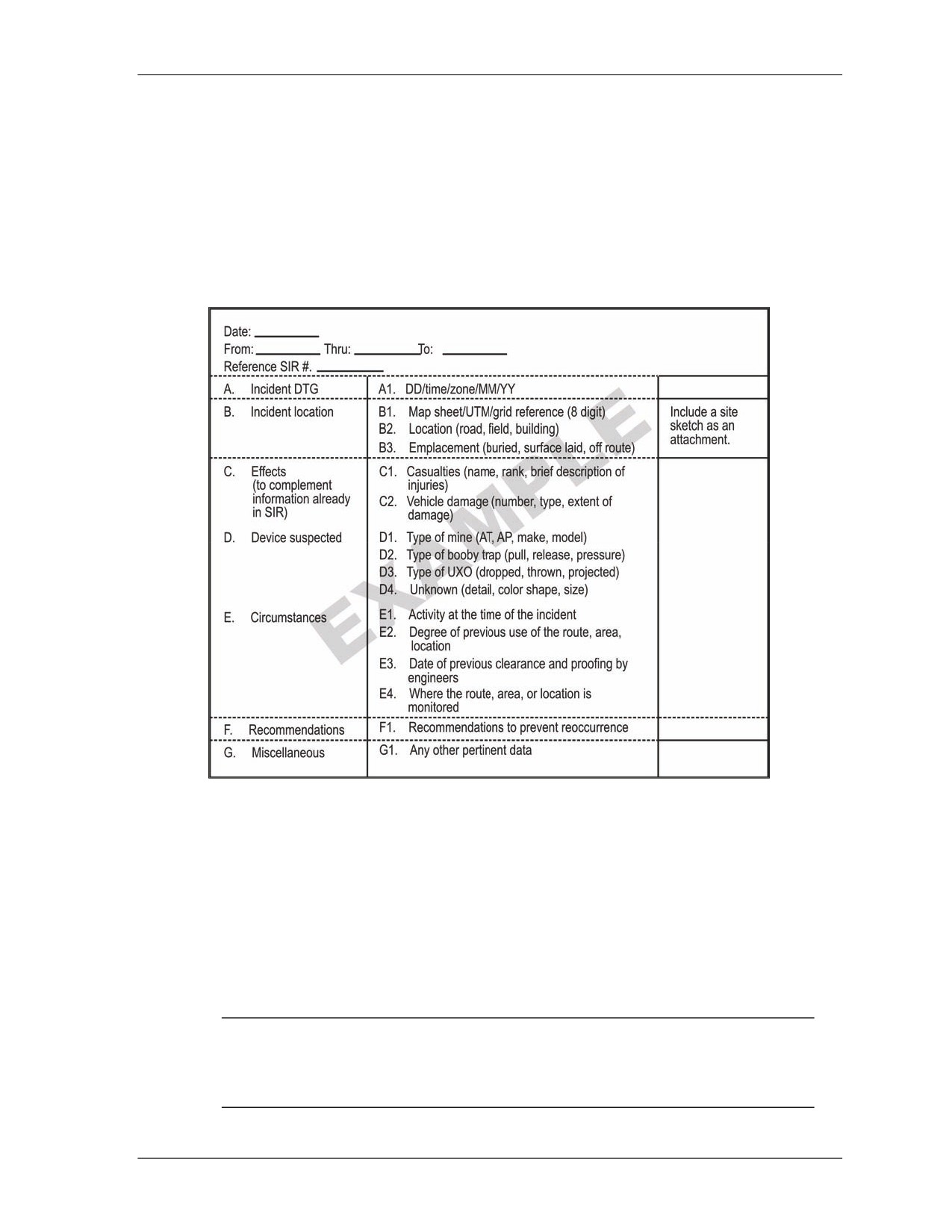
G-50. All mines and minefields should be marked, recorded, and reported to higher headquarters
(Figure G-11). Avoid mines and minefields during unit operations. If you cannot, then take appropriate
measures to reduce hazards to personnel and equipment.
Figure G-11. Example format for a mine incident report.
EXTRACTION
G-51. Soldiers use different methods to extract from minefields, depending on the situation.
EXTRACTION WHEN NOT IN CONTACT
G-52. When you or your patrol is not in contact but you mistakenly enter a minefield, immediately stop
and radio for assistance. Use mine detectors to clear a safe path out of the mined area. Mark and report the
area. When help is unavailable and you must rely on your own resources, use the following procedures.
Note: In an emergency, you can use radios in and around a minefield. Some mines can be
fuzed to detonate on a specific radio frequency, but these mines are rare and you are unlikely
to encounter them. The potentially life-saving advantage of using a radio to call for help far
outweighs the unlikely threat from radio frequency-sensitive mines.
27 July 2006
FM 3-21.10
G-17
Appendix G
EXTRACTION WHEN FOOTPRINTS CAN BE SEEN
G-53. Where you have detected a mine or tripwire, no casualties have occurred, and you do
see footprints--
y Stop. Warn the rest of the unit.
y Call for help. If help is available, do not move.
y If no help is available and you can see footprints, then follow them out of the minefield.
y Take care to step exactly in the footprints already on the ground.
y Once out of the mined area, mark and report it.
EXTRACTION WHEN FOOTPRINTS CANNOT BE SEEN
G-54. Where you have detected a mine or tripwire, but no casualties have occurred, and footprints
cannot be easily identified--
y Stop. Warn the rest of the unit.
y Call for help. If help is available, do not move.
y If no help is available and you see no footprints, then start from a standing position. Begin
clearing an area immediately around you using the "look, feel, probe" procedures.
Look
G-55. Without moving your feet, look all around you, including looking forward and to the sides for
tripwires. Then look closely around your feet for signs of fuzes, mine parts, disturbed ground, or slack
trip wires.
Feel
G-56. Find or make a tripwire feeler from a 2- to 3-foot long straight wooden rod, stick, light gauge
wire, or anything else that will allow you to feel a trip wire without engaging it. Use the feeler to check for
tripwires to your front left, front right, and front center, from ground level up to head height. Move your
fingers in a slow, sideways sweep around your feet to feel for exposed mine fuze prongs or other mine
parts.
Probe
G-57. Using any rigid, sharp, long, thin instrument, probe the ground in a regular pattern at a 30-degree
angle. Push in the probe at least 3 inches, with no more than 2 inches between probes, side to side. When
you finish probing an 18-inch wide row, start a new row 2 inches farther along the direction of travel.
Probe as gently as gentle as possible to achieve the desired depth. If the probe hits a solid object,
investigate the obstacle to identify if it is a mine or other explosive device. Using a bayonet or other tool,
dig down to the object's depth, and then slowly toward the side of the object. Dig in a side-to-side sweep
rather than downward. If you find a mine, do not dig around it. Leave it. Tell the others, and then mark
your cleared, 18-inch footpath to guide the Soldiers who follow. Once out of the mined area, mark and
report it.
EXTRACTION OF A SINGLE CASUALTY
G-58. Resist the urge to race into a minefield to help a casualty. Doing so is extremely hazardous.
However, to extract the casualty--
y Stop and warn the rest of the unit.
y Call for help.
G-18
FM 3-21.10
27July 2006
Improvised Explosive Devices, Suicide Bombers, Unexploded Ordnance, and Mines
y If the casualty is conscious, establish communications with him. Instruct the Soldier to hold still
while he administers the best possible self-aid.
y Reassure the casualty that help is coming.
y Identify the shortest and easiest route to the casualty.
y Clear a 30-inch wide path using the "look, feel, probe" method. Mark the path as you go.
y On arriving at the casualty's location, clear a 30- to 48-inch area (long axis to sides) around the
victim. Make a safe working area for medical and litter teams to evacuate him. Carefully clear
beneath him to see if he is lying on a mine.
y Remove the casualty to a medical facility.
y Mark and report the minefield.
EXTRACTION BY VEHICLE OR CONVOY
G-59. If a vehicle strikes a mine or if you see mines and determine or suspect that you have entered a
conventional minefield on a linear battlefield--
y Stop immediately.
y Radio the situation to the appropriate headquarters.
y Remain in the vehicle and await extraction if assistance is available.
y If unable to make contact for help, exit from the rear of the vehicle and walk carefully in the
visible vehicle tracks to the last known safe area. You can follow tire tracks easily, but you
must avoid the gaps left by armored vehicle tracks. These gaps can contain unexploded mine
fuzes, and thus pose a real threat.
y If there are no visible tire or track marks, use the "look, feel, and probe" method to clear their
way to safety.
y Mark and report the minefield.
27 July 2006
FM 3-21.10
G-19
This page intentionally left blank.
Appendix H
Operations in a Chemical, Biological, Radiological,
or Nuclear Environment
Chemical, biological, radiological, and nuclear (CBRN) weapons cause casualties,
destroy or disable equipment, restrict the use of terrain, and disrupt operations. They
are used separately or in combination to supplement conventional weapons. The
Infantry company must be prepared to operate on a CBRN-contaminated battlefield
without degradation of the platoon's overall effectiveness. This appendix prescribes
active and passive protection measures to avoid or reduce the effects of CBRN
weapons.
This edition updates discussions of Chemical, Biological, Radiological, and Nuclear
(CBRN) defense operations. It introduces current concepts, terms, procedures, and
equipment.
DEFENSE
H-1.
Protection of the force requires adherence to four rules of CBRN defense.
y Contamination avoidance.
y Reconnaissance.
y Protection.
y Decontamination.
CONTAMINATION AVOIDANCE
H-2.
Avoiding CBRN attacks and hazards is the first rule of CBRN defense. Avoidance allows
commanders to shield Soldiers and units, thus shaping the battlefield. It involves both active and passive
measures. Passive measures include training, camouflage, concealment, hardening of positions, and
dispersion. Active measures include detection, reconnaissance, alarms and signals, warnings and reports,
markings, and contamination control.
RECONNAISSANCE
H-3.
CBRN reconnaissance is detecting, identifying, reporting, and marking CBRN hazards and
consists of search, survey, surveillance, and sampling operations. Due to the limited availability of the M93
Fox reconnaissance vehicle, commanders should consider, as a minimum, the following actions when
planning and preparing for this type reconnaissance.
y Use the IPB process to orient on CBRN threat NAIs.
y Pre-position reconnaissance assets to support requirements.
y Establish command and support relationships.
y Assess the time and distance factors for the conduct of CBRN reconnaissance.
y Report all information rapidly and accurately.
y Plan resupply activities to sustain CBRN reconnaissance operations.
y Determine possible locations for post-mission decontamination.
y Plan fire support.
y Enact fratricide prevention measures.
27 July 2006
FM 3-21.10
H-1

Appendix H
y Establish MEDEVAC procedures.
y Identify CBRNWRS procedures and frequencies.
PROTECTION
H-4.
CBRN protection is an integral part of operations. Techniques that work for avoidance also work
for protection, for example, shielding Soldiers and units and shaping the battlefield. Other protection
activities involve sealing or hardening positions, protecting Soldiers, assuming MOPP
(Table H-1),
reacting to attack, and using collective protection. Individual protective items include the protective mask,
battle dress overgarments
(BDOs), green vinyl overboots, and gloves. The corps or higher level
commander establishes the minimum level of protection. Subordinate units may increase this level as
necessary, but they may not decrease it.
MOPP
Mask
Equip
Ready
MOPP0
MOPP1
MOPP2
MOPP3
MOPP4
Only
Mask
Carried
Carried
Carried
Carried
Worn
Worn
Worn***
BDO
Ready*
Avail**
Worn
Worn
Worn
Worn
Overboots
Ready*
Avail**
Avail**
Worn
Worn
Worn
Gloves
Ready*
Avail**
Avail**
Avail**
Avail**
Worn
Helmet Cover
Ready*
Avail**
Avail**
Worn
Worn
Worn
* Items available to Soldier within two hours with replacement available within six hours.
** Items must be positioned within arm's reach of the Soldier.
*** Never "mask only" if a nerve or blister agent has been used in the AO.
Table H-1. MOPP levels.
DECONTAMINATION
H-5.
Using CBRN weapons creates unique residual hazards that may require decontamination. In
addition to such weapons, collateral damage, natural disasters, and industrial emitters may require
decontamination. Contamination forces units into protective equipment that degrades performance of
individual and collective tasks. Decontamination restores combat power and reduces casualties that may
result from exposure, thus allowing commanders to sustain combat operations.
Principles
H-6.
Four principles of decontamination are used in planning decontamination operations.
y Decontaminate as soon as possible.
y Decontaminate only what is necessary.
y Decontaminate as far forward as possible (METT-TC dependent).
y Decontaminate by priority.
Levels
H-7.
The three levels of decontamination are immediate, operational, and thorough
(Table H-2).
(See Appendix C, FM 3-11.4 for information on BDO risk assessment.)
H-2
FM 3-21.10
27 July 2006

Operations in a Chemical, Biological, Radiological, or Nuclear Environment
Immediate
H-8.
Immediate decontamination requires the least planning. It is a basic Soldier survival skill that
Soldiers perform IAW STP 21-1-SMCT. A personal wipe-down removes contamination from individual
equipment using the M291.
Operational
H-9.
Operational decontamination involves MOPP gear exchange and vehicle spray-down. When a
thorough decontamination cannot be performed, MOPP gear exchange should be performed within six
hours of contamination.
Thorough
H-10. Thorough decontamination involves detailed troop decontamination
(DTD) and detailed
equipment decontamination (DED). Thorough decontamination is normally conducted by company-size
elements as part of restoration or during breaks in combat operations. These operations require support
from a chemical decontamination platoon and a water source or supply.
Level
Technique
Best Start Time
Responsibility
Advantages
Within 1 minute of
Skin decontamination
Individual
contamination
Prevents agents
Immediate
Personal wipe-down
Within 15 minutes
from penetrating*
Individual or crew
Operator spray-down
Within 30 minutes
MOPP gear exchange**
Best done within 6
Provides temporary
Operational
hours, but must be
Contaminated unit
relief from MOPP4.
Vehicle wash-down***
done within 24 hours
Limits agent spread
DED
Reduces MOPP
When mission allows/
Platoon leader or
Thorough
long-term with
reconstitution
senior unit leader
DTD
minimal risk
The techniques become less effective the longer they are delayed.
**
Performance degradation and risk must be considered when exceeding 6 hours.
***
Vehicle washdown is most effective if started within one hour.
Table H-2. Comparison data for decontamination levels.
Planning Considerations
H-11. Leaders should include the following when planning for decontamination.
y Plan decontamination sites throughout the width and depth of the sector (identify water sources
or supplies throughout the sector as well).
y Tie decontamination sites to the scheme of maneuver and templated CBRN strikes.
y Apply the principles of decontamination.
y Plan for contaminated routes.
y Plan for logistics and resupply of MOPP, mask parts, water, and decontamination supplies.
y Plan for medical concerns to include treatment and evacuation of contaminated casualties.
y Maintain site security.
27 July 2006
FM 3-21.10
H-3

Appendix H
CHEMICAL AGENTS
H-12. Chemical agents can cover large areas and might be delivered as a liquid, vapor, or aerosol. They
can be disseminated by artillery, mortars, rockets, missiles, aircraft spray, bombs, land mines, and covert
means. Table H-3 shows the symptoms and treatment of exposure to chemical agents.
Agent
Nerve
Blister
Blood
Choking
Protection
Mask and BDO
Mask and BDO
Mask
Mask
Detection
M8A1, M256A1,
M256A1, CAM, M8
M256A1
Odor (freshly
chemical agent
and M9 paper
mowed hay)
monitor (CAM), M8
and M9 paper
Symptoms
Difficult breathing,
Burning eyes,
Convulsions and
Coughing, nausea,
drooling, nausea,
stinging skin,
coma
choking, headache,
vomiting,
irritated nose
and tight chest
convulsions, and
blurred vision
Effects
Incapacitates
Blisters skin,
Incapacitates
Floods and
damages
damages lungs
respiratory tract
First aid
Mark 1 nerve agent
As for 2d and 3d
None
Keep warm and
antidote kit (NAAK)
degree burns
avoid movement
Decontamination
M291 and flush
M291 and flush
None
None
eyes with water
eyes with water
Table H-3. Characteristics of chemical agents.
H-13. Toxic industrial chemicals (TIC) and toxic industrial materials (TIM). Asymmetric warfare is
expected to pose increasing risks and hazards to the Infantry force from TIC and TIM. The chemical corps
continues to develop procedures that deal with these emerging threats in both foreign and domestic
situations. TIM is a generic term for toxic radioactive compounds in solid, liquid, aerosol, or gas form.
These may be used, or stored for use, for industrial, commercial, medical, military, or domestic purposes.
Toxic industrial materials may be chemical, biological, or radioactive and described as toxic industrial
chemical (TIC), toxic industrial biological (TIB), or toxic industrial radiological (TIR). Examples of TIC
and TIM include--
y Fuels.
y Oils.
y Pesticides.
y Radiation sources.
y Fertilizers.
y Arsenic.
y Cyanide.
y Metals such as mercury and thallium.
y Phosgene.
TREATMENT OF CHEMICAL CASUALTIES
H-14. Survival in a chemically contaminated area requires Soldiers to perform protection and life-saving
tasks. They must check for casualties, give first aid, identify the agent, send an NBC-1 or NBC-4 report,
request permission to move, schedule decontamination operations, and mark the area to warn friendly
Soldiers. A discussion of first aid under such conditions should include principles for the use of nerve
H-4
FM 3-21.10
27 July 2006
Operations in a Chemical, Biological, Radiological, or Nuclear Environment
agent antidotes. The nerve agent antidote kits, Mark I and CANA (convulsant antidote for nerve agent,
Figure H-1, page H-7) are used by the Army and Air Force to treat nerve agent poisoning.
MARK I
H-15. The following principles apply to the administration of the Mark I (Figure H-1, page H-7).
Self-Aid
H-16. If you experience most or all of the mild symptoms of nerve agent poisoning, you should
immediately hold your breath (do not inhale) and put on your protective mask. Then, administer one set of
Mark I injections into your lateral thigh muscle (or buttocks) as in Figure H-2, page H-7; and Figure H-3,
page H-8. (Procedures are listed on the autoinjector.)
H-17. Wait 10 to 15 minutes after the first set of injections to allow the antidote to take effect. If you can
get around (ambulate) are able to ambulate, and know who and where you are, then you will not need a
second set of Mark I injections.
WARNING
Giving yourself a second set of injections may create a nerve
agent antidote overdose, which could result in incapacitation.
H-18. If symptoms of nerve agent poisoning are not relieved after administering one set of Mark I
injections, seek someone else to check your symptoms. A buddy must administer the second and third sets
of injections, if needed.
Buddy Aid
H-19. If you encounter a service member suffering from severe signs of nerve agent poisoning, render
the following aid.
Step 1
H-20. Mask the casualty, if necessary. Do not fasten the hood.
Step 2
H-21. Administer, in rapid succession, three sets of the Mark I. Follow administration procedures
outlined in the kit.
CAUTION
Use the casualty's own antidote autoinjectors when providing aid. Do
not use your injectors on a casualty. If you do, you might not have any
antidote available when needed for self-aid.
27 July 2006
FM 3-21.10
H-5