FM 3-21.10 (FM 7-10) The Infantry Rifle Company (July 2006) - page 13
Chapter 12
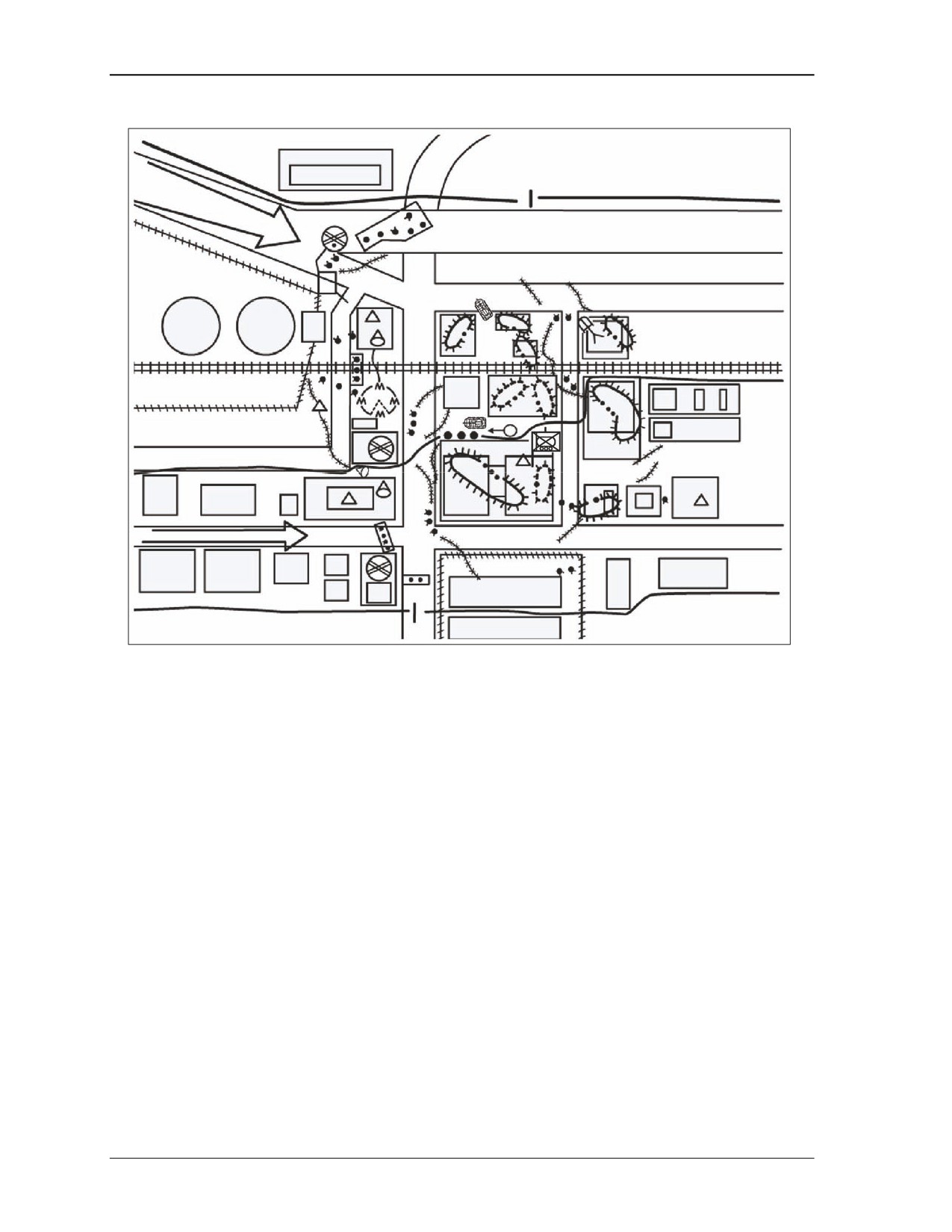
Figure 12-18. Urban strongpoint.
12-288. Construct obstacles and minefields to disrupt or canalize enemy formations, to reinforce fires, and
to protect the strongpoint from the assault. Place the obstacles and mines out as far as friendly units can
observe them, within the strongpoint, and at points in between where they will be useful.
12-289. Prepare range cards for each position and confirm them by fires. Plan indirect fires in detail and
register them. Indirect fires should also be planned for firing directly on the strongpoint using
proximity fuzes.
12-290. Plan and test several means of communication within the strongpoint and to higher headquarters
to include radio, wire, messenger, pyrotechnics, and other signals.
12-291. Improve or repair the strongpoint until the unit is relieved or withdrawn. More positions can be
built, routes to other positions marked, existing positions improved or repaired, and barriers built or fixed.
12-292. A strong point might be part of any defensive plan. It might be built to protect vital units or
installations, as an anchor around which more mobile units maneuver, or as part of a trap designed to
destroy enemy forces that attack it.
DELAY
12-293. The intent of a delay is to trade space for time: slow the enemy, cause him casualties, and stop
him, if you can, without becoming decisively engaged. This procedure is done by defending, disengaging,
moving, and defending again. A company delay is normally conducted as part of the battalion task force's
plan. The delay destroys enemy reconnaissance elements forward of the outskirts of the urban area,
12-66
FM 3-21.10
27 July 2006
Urban Operations
prevents the penetration of the urban area, and gains and maintains contact with the enemy to determine the
strength and location of the main attack. Infantry companies are well suited for this operation, because they
can take advantage of the cover and concealment provided by urban terrain and inflict casualties on the
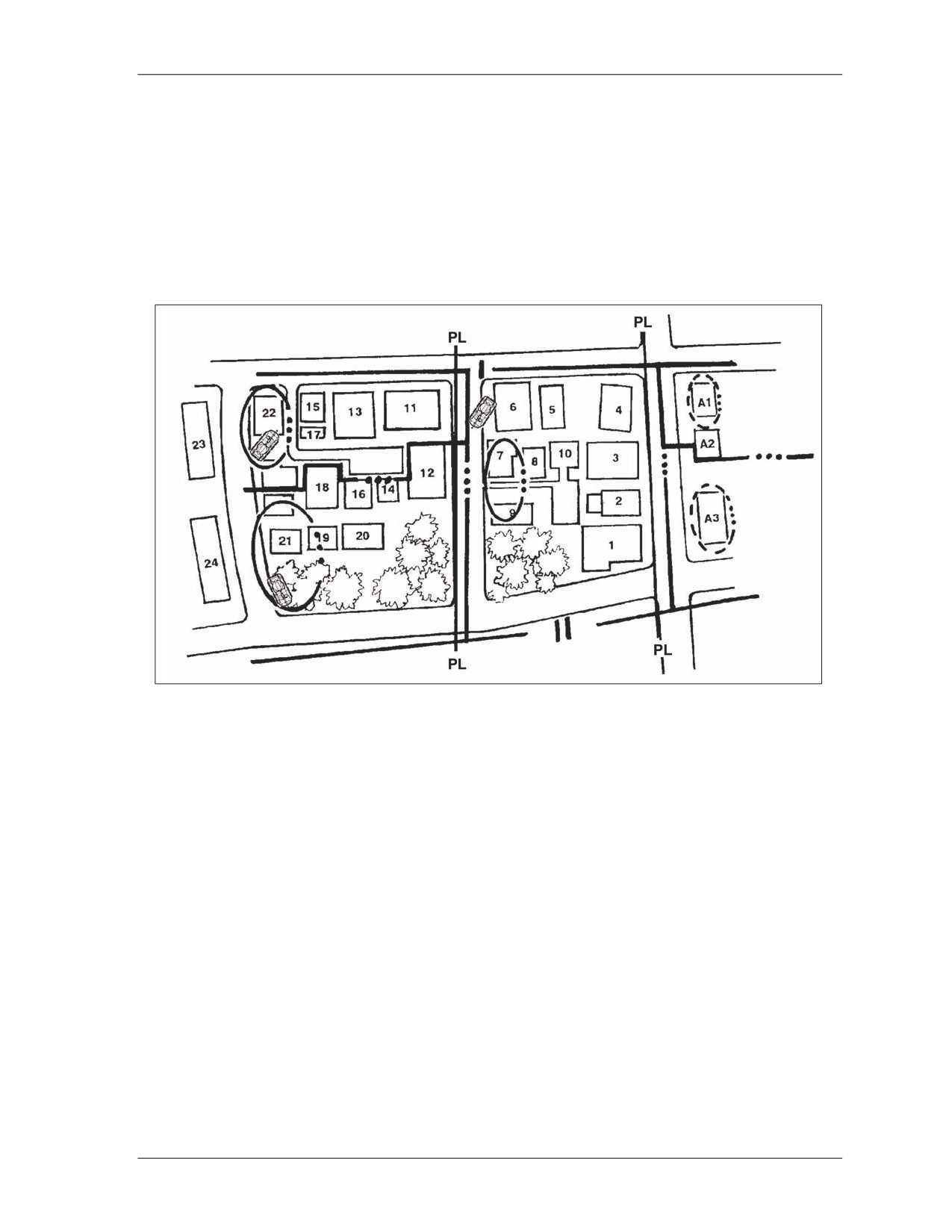
enemy at close range. Delays are planned by assigning platoon BPs, platoon sectors, or both. Figure 12-19
shows a company delay in urban terrain with the company commander assigning platoon BPs. Routes are
planned to each BP or within the sector. Routes are also planned to take advantage of the inherent cover
and concealment afforded by urban terrain such as going through and hugging buildings, using shadows,
and subsurface areas.
Figure 12-19. Company delay in an urban area.
12-294. The company's sector should be prepared with obstacles to increase the effect of the delay.
Engineers prepare obstacles on main routes but avoid some covered and concealed routes that are used by
the friendly troops for reinforcement, displacement, and resupply. These routes are destroyed and obstacles
are executed when no longer needed.
12-295. Antiarmor weapon systems and combat vehicles (tanks, BFVs if available) should be positioned
on the outskirts of the urban area to destroy the enemy at maximum range. They are located in defilade
positions or in prepared shelters. They fire at visible targets and then displace to alternate positions. If
available, platoons are reinforced with sensors or ground surveillance radars
(GSRs), which can be
emplaced on the outskirts or on higher ground to attain the maximum range in the assigned sector. Platoons
delay by detecting the enemy early and inflicting casualties on him using patrols, OPs, and ambushes, and
by taking advantage of all obstacles. Each action is followed by a disengagement and displacement.
Displacement occurs on covered and concealed routes through buildings or underground. By day, the
defense is dispersed; at night, it is more concentrated. Close coordination and maintaining awareness of the
current friendly and enemy situation are critical aspects of this operation.
27 July 2006
FM 3-21.10
12-67
This page intentionally left blank.
Appendix A
Risk Management, Fratricide Avoidance, and the Effects of
Continuous Operations
Risk is the possibility of loss or injury (damage) to personnel or equipment. Levels of
risk vary, but risk itself is constant across the full spectrum of operations.
Commanders at every level manage risk at all times, during every phase of every
operation. Risk is an integral part of planning. Accidents cost valuable human and
other resources. Every Leader and Soldier must know how to manage risk and avoid
fratricide to ensure the company executes the mission as safely as mission constraints
allow. Managing risk, avoiding fratricide, and understanding the effects of continuous
operations helps commanders avoid loss of combat power.
This edition adds discussions of risk management, fratricide avoidance, and
continuous operations as quick references, along with key safety and force protection
information.
Section I. RISK MANAGEMENT
Risk is the chance of injury or death to individuals and of damage to or loss of vehicles and equipment. Risk is
always present in every combat and training situation that Infantry companies might face. Risk management
must take place at all levels of the chain of command during each phase of every operation; it is integral to
tactical planning. All company leadership must know how to apply the risk-management process and supervise
procedures to mitigate risk. Soldiers must follow risk management guidelines and instructions. This, along with
fratricide reduction measures, helps ensure that the mission is executed in the safest possible environment,
within mission constraints.
TYPES OF RISK
A-1.
The two types of risk are tactical and accidental.
TACTICAL RISK
A-2.
Tactical risk is a risk concerned with hazards that exists because of the presence of either the
enemy or an adversary. Intelligence plays a critical role in identifying hazards associated with tactical risk.
IPB is a dynamic leader process that continually integrates new information and intelligence that ultimately
becomes input to the leaders risk assessment process. Intelligence helps identify hazards during
operations by—.
y Identifying the opportunities and risks (constraints) of the battlefield environment to both
friendly and threat forces.
y Thoroughly portraying threat capabilities and vulnerabilities.
y Collecting information on populations, governments, and infrastructures.
ACCIDENT RISK
A-3.
Accident risk includes all operational risk other than tactical risk. It includes the risks posed by an
operation to the friendly force and to civilians. The risk assessment enhances awareness of the situation.
The awareness builds confidence, and allows Soldiers and units to take timely, efficient, and effective
protective measures.
27 July 2006
FM 3-21.10
A-1

Appendix A
STEPS
A-4.
The five steps commanders take to manage risk follow.
STEP 1, IDENTIFY HAZARDS
A-5.
A hazard is a source of danger. It is any existing or potential condition that could cause injury,
illness, or death to personnel; damage to or loss of equipment and property; or other conditions that can
degrade the mission. Tactical and training operations pose many types of hazards. The commander must
identify the hazards associated with all aspects and phases of his unit's mission, paying particular attention
to the METT-TC factors. Risk management must never be an afterthought; leaders must begin the process
during their TLP and continue it throughout the operation. Table A-1 lists possible sources of battlefield
hazards. The list is organized according to the METT-TC factors.
y Duration of the operation.
Mission
y Complexity and clarity of the plan. (Is the plan well-developed and easily understood?)
y Proximity and number of maneuvering units.
y Knowledge of the enemy situation.
Enemy
y Enemy capabilities.
y Availability of time and resources to conduct reconnaissance.
y Visibility conditions including light, dust, fog, and smoke.
Terrain and
Weather
y Precipitation and its effect on mobility.
y Extreme heat or cold.
y Additional natural hazards such as broken ground, steep inclines, or water obstacles.
y Equipment status.
Troops and
Equipment
y Experience the units conducting the operation have working together.
y Danger areas associated with the platoon's weapons systems.
y Soldier and leader proficiency.
y Status of Soldier and leader rest.
y Acclimatization.
y Impact of new leaders or crewmembers.
y Other aspects of friendly unit situation.
y NATO or multinational military actions combined with US forces.
y Time available for TLP and rehearsals by subordinates.
Time Available
y Time available for PCCs and PCIs.
y Applicable ROE or ROI.
Civil
Considerations
y Stability and reconstruction as well as homeland security operations (both of which
significantly increase contact with civilians).
y Potential for media contact and inquiries.
y Interaction with host nation or other participating nation support.
Table A-1. Examples of potential hazards.
STEP 2, ASSESS HAZARDS TO DETERMINE RISKS
A-6.
Hazard assessment is the process of determining the direct impact of each hazard on an operation.
Use the following steps.
y Determine hazards that can be eliminated or avoided.
y Assess each hazard that cannot be eliminated or avoided to determine the probability that the
hazard will occur.
y Assess the severity of hazards that cannot be eliminated or avoided. Severity, defined as the
result or outcome of a hazardous incident, is expressed by the degree of injury or illness
A-2
FM 3-21.10
27 July 2006
Risk Management, Fratricide Avoidance, and the Effects of Continuous Operations
(including death), loss of or damage to equipment or property, environmental damage, or other
mission-impairing factors such as unfavorable publicity or loss of combat power.
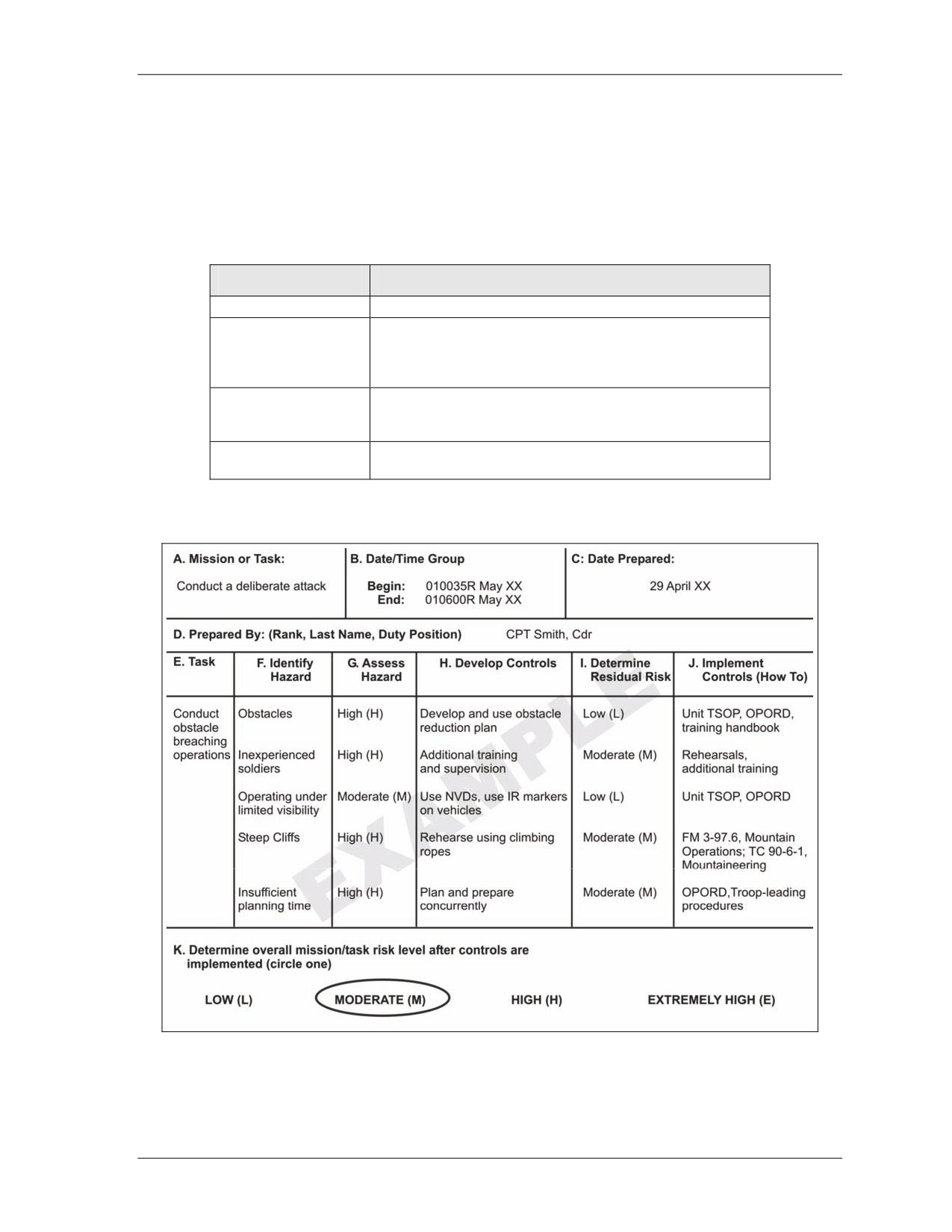
y Taking into account both the probability and severity of a hazard, determine the associated risk
level (extremely high, high, moderate, and low). Table A-2 summarizes the four risk levels.
y Based on the factors of hazard assessment (probability, severity, and risk level, as well as the
operational factors unique to the situation), complete the risk management worksheet.
Figure A-1 shows an example completed risk-management worksheet.
Risk Level
Mission Effects
Extremely High (E)
Mission failure if hazardous incidents occur in execution.
High (H)
Significantly degraded mission capabilities in terms of
required mission standards. Not accomplishing all parts of
the mission or not completing the mission to standard (if
hazards occur during mission).
Moderate (M)
Expected degraded mission capabilities in terms of required
mission standards. Reduced mission capability (if hazards
occur during the mission).
Low (L)
Expected losses have little or no impact on mission
success.
Table A-2. Risk levels and impact on mission execution.
Figure A-1. Example completed risk management worksheet.
27 July 2006
FM 3-21.10
A-3
Appendix A
STEP 3, DEVELOP CONTROLS AND MAKE RISK DECISIONS
A-7.
This step actually consists of two substeps: develop controls and make risk decisions. These
substeps are accomplished during the "make a tentative plan" step of the TLP.
Develop Controls
A-8.
After assessing each hazard, develop one or more controls that will either eliminate the hazard or
reduce the risk (probability, severity, or both) of potential hazardous incidents. When developing controls,
consider the reason for the hazard, not just the hazard itself. For example, driving can be a hazard; driving
in inclement weather or with limited sleep cause driving to be hazardous.
Make Risk Decisions
A-9.
A key element in the process of making a risk decision is determining whether accepting the risk
is justified or, conversely, unnecessary. The decision-maker must compare and balance the risk against
mission expectations. He alone decides if the controls are sufficient and acceptable and whether to accept
the resulting residual risk. If he determines the risk is unnecessary, he directs the development of additional
controls or alternative controls; as another option, he can modify, change, or reject the selected COA for
the operation.
STEP 4, IMPLEMENT CONTROLS
A-10. Controls are the procedures and considerations the unit uses to eliminate hazards or reduce their
risk. Implementing controls is the most important part of the risk management process; it is the chain of
command’s contribution to the safety of the unit. Implementing controls includes coordination and
communication with appropriate superior, adjacent, and subordinate units and with individuals executing
the mission. The commander must ensure that specific controls are integrated into OPLANs, OPORDs,
SOPs, and rehearsals. The critical check for this step is to ensure that controls are converted into clear,
simple execution orders understood by all levels. If the leaders have conducted a thoughtful risk
assessment, the controls will be easy to implement, enforce, and follow. (For indirect fire-control measures
associated with surface danger zones and risk estimate distances, see AR 385-63 and DA PAM 385-63).
Examples of risk management controls include--
y Thoroughly brief all aspects of the mission, including related hazards and controls.
y Conduct thorough PCCs and PCIs.
y Allow adequate time for rehearsals at all levels.
y Drink plenty of water, eat well, and get as much sleep as possible (at least four hours in any
24-hour period).
y Use buddy teams.
y Enforce speed limits, use of seat belts, and driver safety.
y Establish recognizable visual signals and markers to distinguish maneuvering units.
y Enforce the use of ground guides in AAs and on dangerous terrain.
y Establish marked and protected sleeping areas in AAs.
y Limit single-vehicle movement.
y Establish SOPs for the integration of new personnel.
STEP 5, SUPERVISE AND EVALUATE
A-11. During mission execution, leaders must ensure that risk management controls are properly
understood and executed. Leaders must continuously evaluate the unit's effectiveness in managing risks to
gain insight into areas that need improvement.
A-4
FM 3-21.10
27 July 2006
Risk Management, Fratricide Avoidance, and the Effects of Continuous Operations
Supervise
A-12. Leadership and unit discipline are the keys to ensuring that effective risk management controls are
implemented.
y All leaders are responsible for supervising mission rehearsals and execution to ensure standards
and controls are enforced. In particular, NCOs must enforce established safety policies as well
as controls developed for a specific operation or task. Techniques include spot checks,
inspections, SITREPs, confirmation briefs, buddy checks, and close supervision.
y During mission execution, leaders must continuously monitor risk management controls to
determine whether they are effective and to modify them as necessary. Leaders also must
anticipate, identify, and assess new hazards. They ensure that imminent danger issues are
addressed on the spot and that ongoing planning and execution reflect changes in hazard
conditions.
Evaluate
A-13. Whenever possible, the risk management process should also include an after-action review
(AAR) to assess unit performance in identifying risks and preventing hazardous situations. During an
AAR, leaders should assess whether the implemented controls were effective. Following the AAR, leaders
should incorporate lessons learned into unit SOPs and plans for future missions.
IMPLEMENTATION
A-14. Though company commanders and platoon leaders perform most formal risk management
planning, all unit members share implementation responsibilities. They help ensure that hazards and
associated risks are identified and controlled during planning, preparation, and execution of operations.
They must look at both tactical risks and accident risks. The same risk management process is used to
manage both types. In specific situations not addressed by the higher command, the senior available leader
determines how and where he is willing to accept tactical risks. He is also responsible for developing and
implementing mitigation procedures.
CHALLENGES
A-15. Despite the need to advise higher headquarters of a risk taken or about to be taken, the risk
management process may break down. Such a failure can be the result of several factors; it can usually be
attributed to the following.
y Ignoring or denying risk.
y A Soldier does not want to bother his leaders about risks that he feels are inherent to his job.
y Outright failure to recognize a hazard or the level of risk involved.
y Overconfidence on the part of an individual or the unit in being able to avoid or recover from a
hazardous incident.
y Subordinates who do not fully understand the higher commander's guidance regarding risk
decisions.
COMMAND CLIMATE
A-16. The commander gives direction, sets priorities, and establishes the values, attitudes, and beliefs
that make up the command climate. Successful preservation of combat power requires him to embed risk
management into individual behavior. To fulfill this commitment, the commander exercises creative
leadership, innovative planning, and careful management. Most importantly, he must demonstrate support
for the risk management process. The commander and his subordinate leaders establish a command climate
favorable to risk management integration by--
27 July 2006
FM 3-21.10
A-5
Appendix A
y Demonstrating consistent and sustained risk management behavior through leading by example.
y Emphasizing active participation throughout the risk management process.
y Providing adequate resources for risk management. Every leader is responsible for obtaining
the assets necessary to mitigate risk and for providing them to subordinate leaders.
y Understanding his own and his Soldiers’ capabilities and limitations.
y Allowing subordinates to make mistakes and learn from them.
y Preventing a "zero defects" mindset from creeping into the unit's culture.
y Demonstrating full confidence in subordinates’ mastery of their trade and their ability to
execute a chosen COA.
y Keeping subordinates informed.
y Listening to subordinates.
A-17. For the commander, his subordinate leaders, and individual Soldiers, responsibilities in managing
risk include--
y Making informed risk decisions. Establishing and then clearly communicating risk decision
criteria and guidance.
y Establishing clear, feasible risk management policies and goals.
y Training the risk management process. Ensuring that subordinates understand the who, what,
when, where, and why of managing risk. Ensuring that they know how these factors apply to
their situations and responsibilities.
y Accurately evaluating program effectiveness as well as subordinates’ execution of risk controls
during the mission.
y Informing higher headquarters when risk levels exceed established limits.
Section II. FRATRICIDE AVOIDANCE
Fratricide is the employment of friendly weapons that results in the unintentional death or injury of friendly
personnel or damage to friendly equipment. Fratricide prevention is a command responsibility , but again, all
leaders across all warfighting function elements assist in planning, practicing, and enforcing fratricide
avoidance measures. This section focuses on actions the commander along with all leaders take in using
available resources to reduce the risk of fratricide. In any tactical situation, every Soldier must know where he
is and where other friendly elements are. With this knowledge, he must anticipate dangerous conditions and
take steps either to avoid or to mitigate them. The commander must always be vigilant of changes and
developments in the situation that may place his platoons in danger. He must also ensure that all element
positions are continuously reported for higher headquarters battle tracking. When the commander perceives a
potential fratricide situation outside his company, he reports over the higher net to effect direct coordination.
EFFECTS
A-18. Fratricide results in unacceptable losses and increases the risk of mission failure. It usually affects
the unit's ability to survive and function. Units experiencing fratricide suffer these consequences.
y Loss of confidence in the unit's leadership.
y Self-doubt among leaders.
y Hesitancy in the employment of supporting combat systems.
y Over-supervision of units.
y Hesitancy in the conduct of night operations.
y Loss of aggressiveness in maneuver.
y Loss of initiative.
A-6
FM 3-21.10
27 July 2006
Risk Management, Fratricide Avoidance, and the Effects of Continuous Operations
y Disrupted operations.
y General degradation of unit cohesiveness, morale, and combat power.
CAUSES
A-19. The following paragraphs discuss the primary causes of fratricide. Leaders must identify any of
the factors that may affect their units and then strive to eliminate or correct them.
FAILURES IN DIRECT FIRE CONTROL PLAN
A-20. These occur when units fail to develop effective fire control plans, particularly in the offense.
Units might fail to designate EAs or to adhere to the direct fire plan, or they might position their weapons
incorrectly. Under such conditions, fire discipline often breaks down upon contact. An area of particular
concern is the additional planning that must go into operations requiring close coordination between
mounted elements and dismounted teams (AR 385-63 and DAPAM 385-63).
FAILURES IN LAND NAVIGATION
A-21. Units often stray from assigned sectors, report wrong locations, and become disoriented. Much
less frequently, they employ fire support weapons in the wrong location. In either type of situation, units
that unexpectedly encounter another unit may fire their weapons at the friendly force.
FAILURES IN COMBAT IDENTIFICATION
A-22. Vehicle commanders and machine gun crews cannot accurately identify the enemy near the
maximum range of their systems. In limited visibility, friendly units within that range may mistake one
another as the enemy.
INADEQUATE CONTROL MEASURES
A-23. Units may fail to disseminate the minimum necessary maneuver control measures and direct fire
control measures. They also may fail to tie control measures to recognizable terrain or events. As the battle
develops, the plan cannot address branches and sequels as they occur. When this happens,
synchronization fails.
FAILURES IN REPORTING AND COMMUNICATIONS
A-24. Units at all levels may fail to generate timely, accurate, and complete reports as locations and
tactical situations change. This distorts the operating picture at battalion and brigade level and can lead to
erroneous clearance of fires.
WEAPONS ERRORS
A-25. Lapses in individual discipline can result in fratricide. These incidents include charge errors,
accidental discharges, mistakes with explosives and hand grenades, and use of incorrect gun data.
BATTLEFIELD HAZARDS
A-26. A variety of explosive devices and materiel (unexploded ordnance; booby traps; and unmarked or
unrecorded minefields, including scatterable mines) may create danger on the battlefield. Failure to mark,
record, remove, or otherwise anticipate these threats leads to casualties.
RELIANCE ON INSTRUMENTS
A-27. A unit that relies too heavily on systems such as GPS devices or Force XXI Battle Command
Brigade and Below Systems (FBCB2) and Land Warrior will find its capabilities severely degraded if these
27 July 2006
FM 3-21.10
A-7
Appendix A
systems fail. The unit will be unable to maintain SU because it will not have a common operations picture.
To prevent potential dangers when system failure occurs, the leader must ensure that he and his elements
balance technology with traditional basic Soldier skills in observation, navigation, and other critical
activities.
PREVENTION
A-28. The measures outlined below provide the company with a guide to actions that reduce or prevent
fratricide risk. These guidelines are not intended to restrict initiative. Leaders must learn to apply them, as
appropriate, based on the specific situation and the METT-TC factors. Preventing and reducing fratricide
relies on following these five key principles.
IDENTIFY AND ASSESS POTENTIAL FRATRICIDE RISKS DURING TLP
A-29. Incorporate risk reduction control measures in WARNOs, the OPORD, and applicable FRAGOs.
MAINTAIN SITUATIONAL UNDERSTANDING
A-30. Focus on areas such as current intelligence, unit locations and dispositions, obstacles, CBRN
contamination, SITREPs, and the METT-TC factors.
ENSURE POSITIVE TARGET IDENTIFICATION
A-31. Review vehicle and weapons ID cards. Become familiar with the characteristics of potential
friendly and enemy vehicles, including their silhouettes and thermal signatures. This knowledge should
include the conditions, including distance (range) and weather, under which positive identification of
various vehicles and weapons is possible. Enforce the use of challenge and password, especially during
dismounted operations.
MAINTAIN EFFECTIVE FIRE CONTROL
A-32. Assure fire commands are effective and clearly understood. Rules of engagement play an
important part in this process. All Soldiers must understand the circumstances that both allow and restrict
engagements. Rehearsals are useful in practicing such plans and procedures. Continuously seek
information on friendly forces that might be operating in and around the AO.
ESTABLISH A COMMAND CLIMATE THAT EMPHASIZES FRATRICIDE PREVENTION
A-33. Enforce fratricide prevention measures, placing special emphasis on the use of doctrinally sound
techniques and procedures. Ensure constant supervision in the execution of orders and in the performance
of all tasks and missions to standard.
GUIDELINES AND CONSIDERATIONS
A-34. Additional guidelines and considerations for fratricide reduction and prevention include--
y Recognizing the signs of battlefield stress. Maintaining unit cohesion by acting quickly,
effectively to alleviate stress.
y Conducting individual, leader, and collective (unit) training. Covering fratricide awareness,
target identification and recognition, and fire discipline.
y Developing a simple, executable plan.
y Giving complete and concise OPORDs. Including all appropriate recognition signals in
paragraph 5 of the OPORD.
y To simplify OPORDs, using SOPs that are consistent with doctrine. Periodically reviewing and
updating SOPs as needed.
A-8
FM 3-21.10
27 July 2006
Risk Management, Fratricide Avoidance, and the Effects of Continuous Operations
y Striving to provide maximum planning time for leaders and subordinates.
y Using common language (vocabulary) and doctrinally correct standard terminology and control
measures.
y Ensuring thorough coordination is conducted at all levels.
y Planning for and establishing effective communications.
y Planning for collocation of command posts whenever appropriate to the mission such as during
a passage of lines.
y Ensuring that the ROE are clear.
y Rehearsing when the situation and time allow.
y Ensuring you are in the right place at the right time. Using position location-navigation devices,
such as GPS or position navigation (POSNAV) devices, to determine your location and those
of adjacent units (left, right, leading, and follow-on). Synchronizing tactical movement. If the
unit or any element becomes lost, contacting higher headquarters immediately for instructions
and assistance.
y Establishing, executing, and enforcing strict sleep and rest plans.
Section III. EFFECTS OF CONTINUOUS OPERATIONS
The Infantry company often operates for extended periods in continuous operations; such operations may
continue at a high intensity level for extended periods. During continuous operations, leaders and Soldiers must
think, decide, and act more quickly than the enemy acts. Leaders must know and implement the commander's
intent. They must be able to act spontaneously and synchronously, even though the situation has changed and
communications are disrupted. This continuous cycle of day and night operations and the associated stress of
combat cause degradation in performance. Reducing this impact on performance is a significant challenge for
the C2 system. Continuous operations force leaders and Soldiers to perform under adverse conditions that cause
degradation in performance and might lead to combat stress. Table A-3 shows some combat stress behaviors.
27 July 2006
FM 3-21.10
A-9

Appendix A
Combat Stress Behaviors
Adaptive
Dysfunctional
Positive combat stress
Misconduct stress
Battle fatigue
behaviors
behaviors and criminal acts
Unit cohesion.
y
Mutilating dead enemy.
y
Hyperalertness.
y Loyalty to buddies.
y
Killing enemy rather than taking
y
Fear, anxiety.
prisoners and keeping them
y Loyalty to leaders.
y
Irritability, anger, rage.
alive.
y Identification with unit tradition.
y
Grief, self-doubt, guilt.
y
Killing noncombatants.
y Sense of eliteness.
y
Physical stress complaints.
y
Torturing, committing brutalities.
y Sense of mission.
y
Inattention, carelessness.
y
Killing animals.
y Alertness, vigilance.
y
Loss of confidence.
y
Fighting with allies.
y Exceptional strength and
y
Loss of hope and faith.
y
Abusing alcohol or drugs.
endurance.
y
Depression, insomnia.
y
Behaving recklessly or lacking
y Increased tolerance to hardship,
discipline.
y
Impaired duty performance.
discomfort, and injury.
y
Looting, pillaging, raping.
y
Erratic actions, outbursts.
y Sense of purpose.
y
Fraternizing.
y
Freezing, immobility.
y Increased faith.
y
Going on sick call excessively.
y
Terror, panic runs.
y Heroic acts.
y
Neglecting disease or injury.
y
Total exhaustion, apathy.
y Courage.
y
Shirking, malingering.
y
Loss of skills and memories.
y Self-sacrifice
y
Refusing to fight.
y
Impaired vision, touch, or
hearing.
y
Self-inflicting wounds.
y
Weakness and paralysis.
y
Threatening or killing own
leaders ("fragging").
y
Hallucinations, delusions
y
Going absent without leave,
desertion
Table A-3. Combat stress behaviors.
COMBAT STRESS CONTROL
A-35. Controlling combat stress is often the deciding factor--the difference between victory and
defeat--in all forms of human conflict. Stressors are a fact of combat that Soldiers must face. Controlled
combat stress (when properly focused by training, unit cohesion, and leadership) alertness, strength, and
endurance to accomplish the mission. It can call forth stress reactions of loyalty, selflessness, and heroism.
Conversely, uncontrolled combat stress causes erratic or harmful behavior that disrupts or interferes with
accomplishment of the unit mission and brings disgrace, disaster, and defeat.
A-36. The art of war aims to impose so much stress on the enemy Soldiers that they lose their will to
fight. Both sides recognize this reality and each may accept severe stress in order to inflict greater stress on
the other. To win, combat stress must be controlled. Table A-4 shows the measures that may reduce the
negative impacts of continuous operations.
A-10
FM 3-21.10
27 July 2006

Risk Management, Fratricide Avoidance, and the Effects of Continuous Operations
Sleep Scheduling
Countermeasures
Adequate
4 hours of continuous sleep is required
y Give simple, precise orders.
every 24 hours to maintain adequate
y Increase use of written
performance over several weeks.
orders.
Sleep Wakefulness
A small amount of sleep relative to that
y Crosscheck.
lost is beneficial.
y Plan more time for completion
Recovery
10 hours of uninterrupted sleep is
of all tasks.
required for full recovery after 48 to 72
y Enforce adequate food and
hours without any.
water intake.
Catnaps
Catnaps help, but the only effective
y Develop and enforce
(10 To 30 Minutes)
remedy is sleep.
sleep plans.
Timing
Consistent sleep and wakeup times help
y Enforce good physical fitness.
the Soldier successfully adjust to an
y Increase use of confirmation
arduous regimen.
briefs.
Note: After 48 to 72 hours without sleep, Soldiers become militarily ineffective. After 5 to 7 days of partial
sleep deprivation, alertness and performance decline to the same low level as seen following 2 to 3 days
without sleep.
Table A-4. Reduction of impact of continuous operations.
RESPONSIBILITIES
A-37. Responsibility for combat stress control requires a continuous interaction that begins with every
Soldier and his buddies. Combat stress control also includes unit combat lifesavers and medics. The
interaction continues through the small unit leaders and extends up through the organizational leaders, both
officers and NCOs, at all echelons.
UNIT COHESIVENESS DEVELOPMENT
A-38. Rigorous, realistic training for war helps assure unit readiness. Emphasis must be placed on
establishing and maintaining cohesive units. Unit training and activities must emphasize development of
Soldier skills. This development should focus on building trust and establishing effective communication
throughout the unit.
SENIOR (ORGANIZATIONAL) LEADERS' RESPONSIBILITIES
A-39. The chain of command must ensure that the standards for military leadership are met. Senior
leaders must provide the necessary information and resources to the junior leaders to control combat stress.
The following are some suggestions for senior leadership considerations for combat stress control.
y Be competent, committed, courageous, candid, and caring.
y Plan to accomplish the mission with as few losses as possible.
y Set the policy and command climate for stress control, especially to build teams with high
cohesion.
y Serve as an ethical role model.
y Make the system work for the Soldiers, not vice versa.
y Assure resources take care of the Soldiers.
y Plan for and conduct tough, realistic training including live fire.
y Provide as much information as possible to the Soldiers.
y Assure that medical and mental health and combat stress control personnel are assigned and
trained with their supported units.
y Plan for combat stress control in all operations.
y Provide junior leaders and NCOs with necessary guidance.
27 July 2006
FM 3-21.10
A-11
Appendix A
y Ensure risk assessments are conducted prior to all training and combat operations.
y Supervise the junior leaders and NCOs and reward their success.
y Be visible.
y Lead all stress control by good example.
y Maintain, through positive leadership and, when necessary, with disciplinary action, the high
standards of the international law of land warfare.
JUNIOR (DIRECT) LEADERS' RESPONSIBILITIES
A-40. Junior leaders, that is, squad and platoon leaders, especially NCOs, must apply the principles of
stress control continuously. These crucial responsibilities overlap those of senior leaders, but include parts
that are fundamentally "sergeants' business," supported by junior officers.
y Be competent, committed, courageous, candid, and caring.
y Build cohesive teams; integrate new personnel quickly.
y Cross-train Soldiers wherever and whenever possible.
y Plan and conduct tough, realistic training that replicates combat conditions.
y Take care of Soldiers, including leaders.
y Assure physical fitness, nutrition, hydration, adequate clothing and shelter, and preventive
medicine measures.
y Make and enforce sleep plans.
y Keep accurate information flow down to the lowest level and back up again. Dispel rumors.
y Encourage sharing of resources and feelings.
y Conduct after-action debriefings routinely.
y Maintain, through positive leadership and, when necessary, with disciplinary action, the high
standards of the international law of land warfare.
y Recommend exemplary Soldiers for awards and decorations.
y Recognize excess stress early and give immediate support.
y Keep those stressed Soldiers who can still perform their duties in the unit and provide extra
support and encourage them back to full effectiveness.
y Send those stressed Soldiers who cannot get needed rest in their small unit back to a supporting
element for brief sleep, food, hygiene, and limited duty, to return in one to two days.
y Refer temporarily unmanageable stress cases through channels for MEDEVAC and treatment.
y Welcome recovered battle fatigue casualties back and give them meaningful work and
responsibilities.
SLEEP DEPRIVATION
A-41. A significant factor contributing to performance degradation is lack of sleep. Table A-5 shows the
effects of sleep loss. Other contributing factors include low light levels, limited visibility, disrupted sleep
routines, physical fatigue, and stress.
A-12
FM 3-21.10
27 July 2006

Risk Management, Fratricide Avoidance, and the Effects of Continuous Operations
After 24 Hours
A deterioration in performance of tasks that are inadequately or
newly learned, that are monotonous, or that require vigilance.
After 36 Hours
A marked deterioration in ability to register and understand
information.
After 72 Hours
Performance on most tasks will be about 50 percent of normal.
3 To 4 Days
The limit for intensive work, including mental and physical
elements. Visual illusions are likely at this stage or earlier,
especially in CBRN.
Between 0300 and 0600 Hours
Performance is at its lowest ebb.
Table A-5. Effects of sleep loss.
SIGNS
A-42. To minimize the effects of sleep loss, all commanders must be able to recognize the signs of sleep
loss and fatigue (Table A-6).
Physical Changes
y
Body swaying when standing.
y
Vacant stares.
y
Pale skin.
y
Slurred speech.
y
Bloodshot eyes.
Mood Changes
y
Less energetic, alert, and cheerful.
y
Loss of interest in surroundings.
y
Possible depressed mood or apathetic and more irritable.
y
Requires more effort to do a task in the morning than in the
Early Morning Problems
afternoon, especially between 0300 and 0600.
Communication Problems
y
Unable to carry on a conversation.
y
Forgetfulness.
y
Difficulty in speaking clearly.
Difficulty In Processing Information
y
Slow comprehension and perception.
y
Difficulty in accessing simple situations.
y
Requires more time to understand information.
Impaired Attention Span
y
Decreased vigilance.
y
Failure to complete routines.
y
Reduced attention span.
y
Short-term memory loss.
y
Inability to concentrate.
Table A-6. Indicators of sleep deprivation and fatigue.
LEADERS
A-43. Commanders and leaders often regard themselves as being the least vulnerable to fatigue and the
effects of sleep loss. Tasks requiring quick reaction, complex reasoning, and detailed planning make
leaders the most vulnerable to the effects of sleep loss. Leaders must sleep. Self-controlled leaders
recognize that depriving themselves of sleep is counterproductive and take measures to avoid it.
27 July 2006
FM 3-21.10
A-13
This page intentionally left blank.
Appendix B
TOW and Javelin Employment
This appendix addresses the organization and employment of the TOW and Javelin
close-combat missile systems. The weapons company assault platoon has TOWs, and
the antitank section in each rifle company line platoon has Javelins.
Close combat missile (CCM) systems include the tube-launched, optically tracked,
wire-guided (TOW) missile weapon system, as well as the Javelin weapon system.
Shoulder launched munitions such as the M136 AT4, the M72A7 light antitank
weapon (LAW), and the M141 bunker-defeat munition (BDM) supplement and
reinforce CCM fires at close ranges. The TOW-equipped Infantry battalion weapons
company is often task-organized to provide rifle companies with assault platoons to
provide support during combat operations.
This edition combines the discussion of TOW and Javelin employment to better
address tactical employment of close combat missile systems.
Section I. OVERVIEW
For each Infantry battalion, the organic weapons company has the antitank and other hard-target destruction
combat power (Figure B-1, page B-2). The weapons company commander advises the battalion commander on
the tactical employment of the company and its assault platoons. This includes both the unit's CCM capability
and its area-fire antipersonnel role.
INFANTRY BATTALION WEAPONS COMPANY
B-1.
The weapons company operates on the battlefield along with Infantry, armor, aviation, and other
elements of the combined-arms team. Close combat missile fires by a base-of-fire force or a fixing force
are important to destroy the integrity of the enemy's combined-arms team. They allow units to fix the
enemy force effectively, while maintaining sufficient combat power for decisive maneuver, and sufficient
depth to reduce risk and exploit success. Mass and depth are the keys to employing CCM assets. When
terrain and fields of fire allow, a weapons company commander (or assault platoon leader) normally
controls the CCM fires in support of the higher commander's scheme of maneuver, but commanders can
also task-organize and attach the assault platoons based on the METT-TC factors.
ORGANIZATION AND EQUIPMENT
B-2.
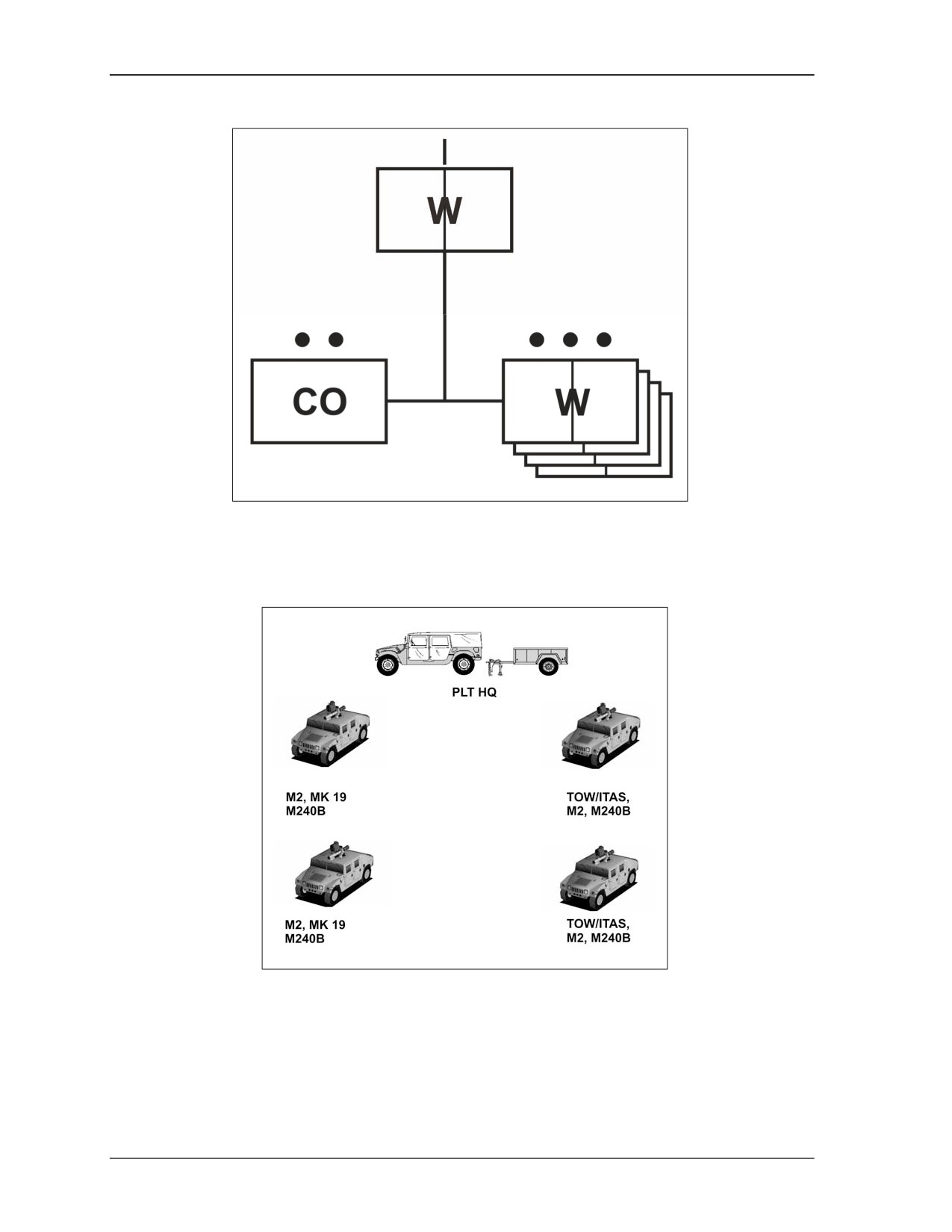
Each weapons company has four assault platoons (Figure B-2, page B-2). Each assault platoon
leader is responsible for the tactical employment of the platoon and its two sections. In addition to the
TOW missile, assault platoons of the weapons company also have the capability to mount either the
M2.50 caliber machine gun or the MK 19 40-mm grenade launcher on each vehicle. Normally all three
weapons systems are available within the unit. By virtue of having organic vehicles the assault platoons of
the weapons company have an enormous speed and mobility advantage over other Infantry forces. The
weapons company has four assault platoons. Each assault platoon has five vehicles normally mounted with
two TOW systems and a combination of MK 19 40-mm grenade launchers and M2.50 caliber machine
guns.
27 July 2006
FM 3-21.10
B-1
Appendix B
Figure B-1. Infantry battalion weapons company.
Figure B-2. Assault platoon of weapons company.
B-2
FM 3-21.10
27 July 2006
TOW and Javelin Employment
PRINCIPLES
B-3.
Following the principles for CCM employment increases the probability of destroying targets and
enhances the survivability of the CCM elements. The fundamentals follow--
MUTUAL SUPPORT
B-4.
To accomplish their assigned tasks, CCM units must mutually support each other. Mutual support
generates combat power by maximizing the units’ capabilities and minimizing its limitations. To establish
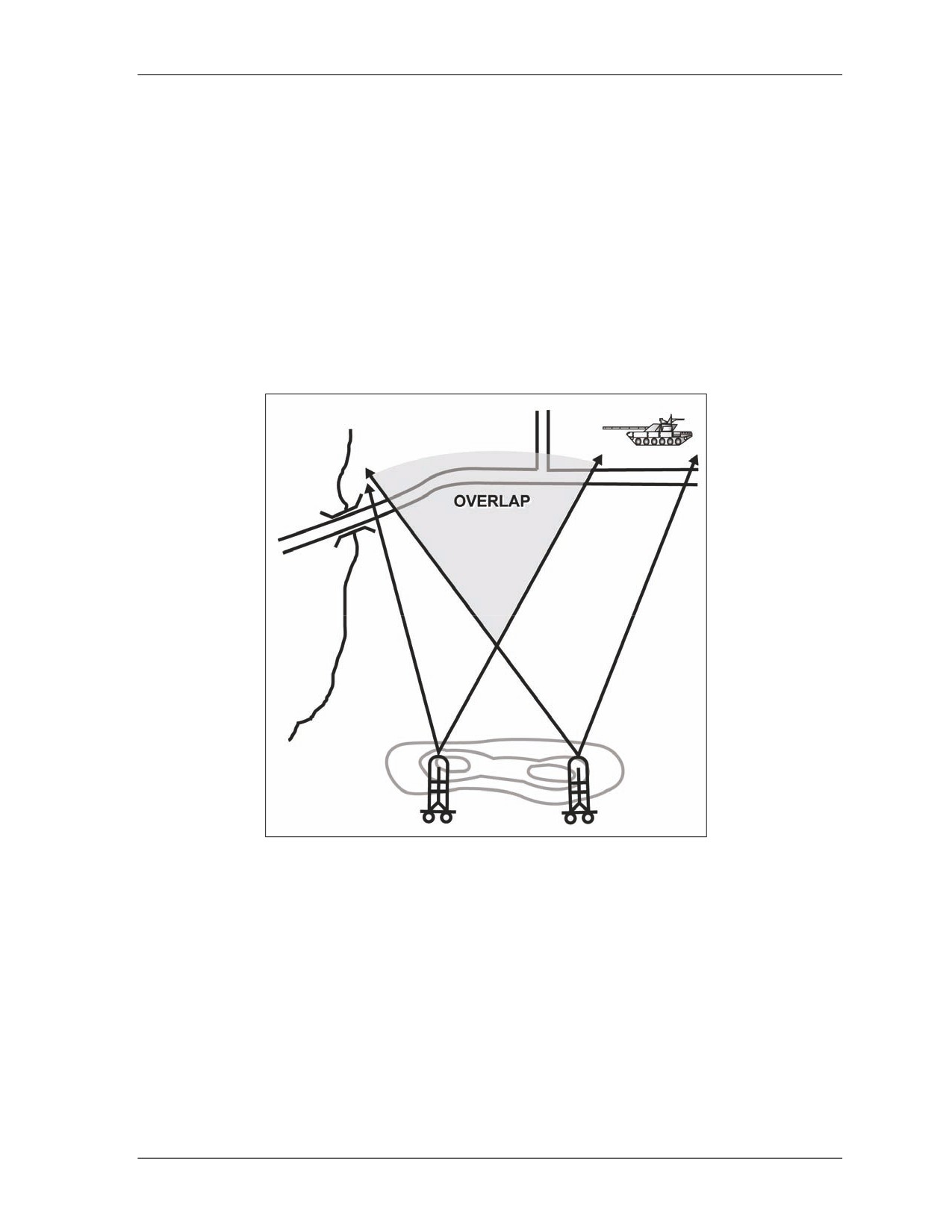
mutual support, CCMs and other heavy weapons are employed in sections with overlapping primary and
secondary sectors of fire (Figure B-3). If one squad is suppressed or forced to displace, the other squad
continues covering the assigned sector. To achieve this effect, the CCM squads are positioned so that fires
directed at one squad can suppress only that squad.
Figure B-3. Overlapping sectors of fire.
SECURITY
B-5.
When a CCM unit is attached to a rifle platoon or a company, it must be positioned where it can
gain security from adjacent Infantry units for protection against possible attack by dismounted enemy
infantry. Though the Infantry units are not required to collocate with the CCM unit, they must be able to
cover dismounted avenues of approach to the CCM positions. CCM units moving as a unit provide their
own local security. During halts, the driver or loader dismounts to secure the flank and rear sectors. Overall
flank and rear security must be controlled at the platoon level.
27 July 2006
FM 3-21.10
B-3
Appendix B
FLANK SHOT ENGAGEMENTS
B-6.
The CCM unit should be positioned to engage tanks or armored vehicles from the flank. Frontal
engagements at enemy armor are less desirable for the following reasons.
y An armored vehicle's protection is weaker to the flank.
y An armored vehicle's firepower and crew are not normally oriented to the flank.
y A flank engagement decreases the chance of detection and suppression by enemy vehicles.
y An armored vehicle provides a larger target from the flank than it does from the front.
STANDOFF
B-7.
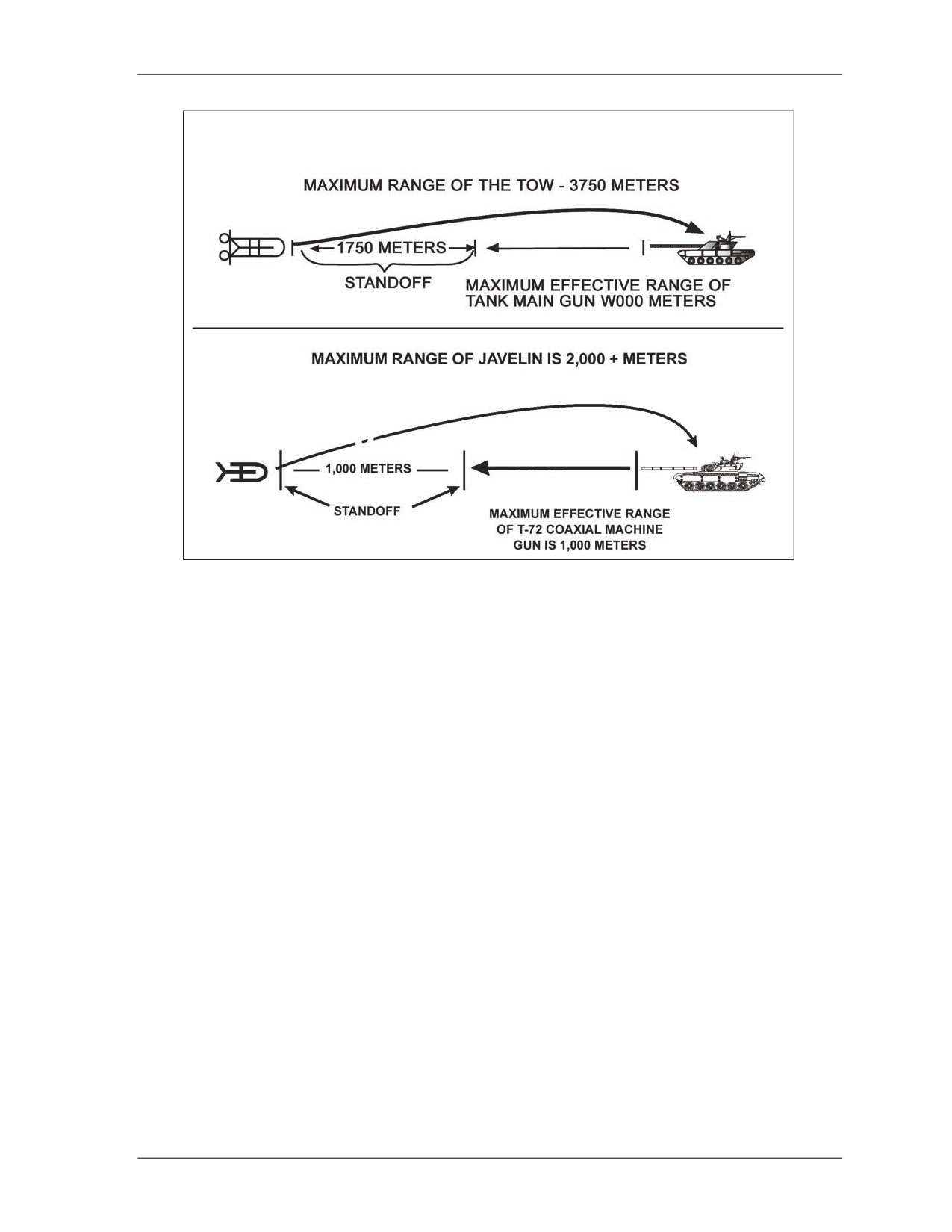
Standoff is the difference between a friendly weapon’s maximum effective range and an enemy
weapon’s maximum effective range (Figure B-4). For example, the TOW missile's maximum range of
3,750 meters provides it with a standoff advantage over modern, western-built tanks with maximum
effective ranges of 2,800 meters and older, non-modernized tanks with maximum effective ranges of 2,000
meters. Despite this advantage, engaging enemy armored vehicles within the standoff range (2,000 to 3,750
meters) may not always be tactically feasible. The additional tracking time required to fire a TOW missile
beyond 2,000 meters increases the likelihood of gunner error. This possibility gives a frontal target more
time to maneuver against the friendly position and provides a flanking target more time to reach cover.
Also, the terrain may not provide the fields of fire to support standoff distance engagements.
Note: The T-55 (modernized), T-64B, T-72S, T-80, T-80U, and T-90 main battle tanks and
the BMP-3 can fire ATGMs through their main gun tubes up to a range of 4,000 meters,
which means the TOW weapon system loses the standoff advantage against them. Some of
the tank-launched ATGMs can be fired while the vehicle is on the move. Also, threat armored
vehicles can fire HE fragmentation rounds to suppress TOW gunners up to a range of 9,750
meters.
B-4
FM 3-21.10
27 July 2006
TOW and Javelin Employment
Figure B-4. Standoff ranges, TOW (top) and Javelin (bottom).
COVER AND CONCEALMENT
B-8.
Cover and concealment are critical to the survival of CCM weapon systems and must be analyzed
along with the other METT-TC factors. The CCM unit must take full advantage of all natural and
man-made cover and concealment in order to be effective, to survive, and to overcome the following
inherent weaknesses.
y TOW, M2, and MK 19 expose gunner during firing.
y TOW exposes gunner and crew during reloading.
y TOW has long flight time, distinctive firing signature, and slow rate of fire.
y TOW takes time to track.
y MK 19 has long flight time and distinctive firing signature.
Cover
B-9.
Cover is protection from the effects of direct or indirect enemy fires. It might be natural or
manmade. Natural cover includes reverse slopes, ravines, and hollows whereas manmade cover includes
fighting positions, walls, rubble, and craters.
Concealment
B-10. Concealment is the protection from enemy observation. NVDs and other detection devices
penetrate darkness and prevent it from providing sufficient concealment. Leaders must choose
inconspicuous positions and avoid silhouetting the vehicles or weapon systems against the skyline. The
crew should avoid unnecessary movement, use all available concealment such as vegetation, terrain and
buildings), stay low to observe, expose nothing that shines, keep from altering familiar outlines, and stay as
quiet as possible.
27 July 2006
FM 3-21.10
B-5
Appendix B
EMPLOYMENT IN DEPTH
B-11. CCM units should be employed in depth whenever possible. This complicates the enemy's task of
identifying and destroying the weapons and crews. With careful positioning and disciplined fire control, a
CCM unit can mass its fires on the enemy continuously while attacking or withdrawing.
EMPLOYMENT AS PART OF A COMBINED ARMS TEAM
B-12. Skillful integration of CCM systems with Infantry squads and crew-served weapons, armored
vehicles, combat engineers, indirect fire and attack helicopters improves the combat effectiveness and the
survivability of the entire unit. Infantry rifle squads provide local security and engage enemy Infantry
moving along covered and concealed routes. They maneuver quickly under the heavy suppressive and
destructive fires of the CMM units. CCM units support the effective maneuver of tanks and Infantry
fighting vehicles. By destroying the enemy's lightly armored vehicles and crew-served weapons at long
range, they allow tanks and fighting vehicles to engage enemy forces with the freedom to move where their
fires will be most effective. Combat engineers help shape the battlefield, creating and reinforcing obstacles
that hold the enemy in position longer or force him to take more exposed routes. This means the CCM
units have more time to engage and destroy him. Indirect fires from artillery and mortars suppress enemy
counterfire and separate enemy Infantry from accompanying armored vehicles, which then become more
vulnerable to destruction by concealed CCM units.
CONSIDERATIONS
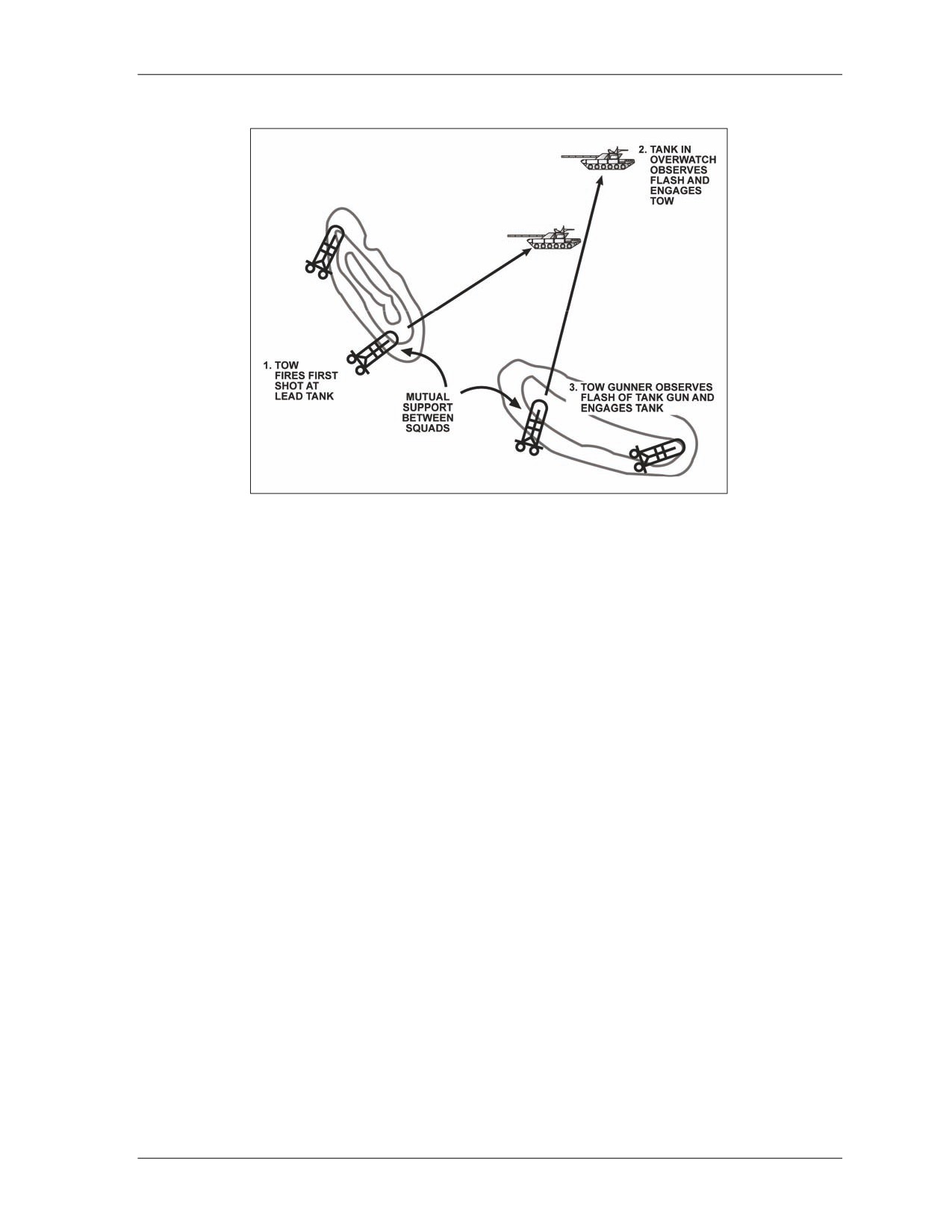
B-13. When employing CCM weapon systems, leaders should avoid conspicuous terrain, disperse
weapons laterally and in depth so that no single enemy weapon can suppress two squads, and disperse
assault platoon squads to reduce casualties and equipment damage that could result from enemy mortar and
artillery fires (Figure B-5). The considerations for CCM weapon system employment also apply during
route selection and movement.
Offensive Considerations
B-14. Determine the routes where cover and concealment are good. Identify areas along the approaches
to the objective where cover and concealment are poor. Consider using smoke or conducting missions in
limited visibility to provide concealment.
Defensive Considerations
B-15. Focus on locations with good fields of fire. Determine how the enemy can use the available cover
and concealment and look at it from his point of view, both in daylight and at night.
B-6
FM 3-21.10
27 July 2006
TOW and Javelin Employment
Figure B-5. Dispersion between squads.
CAPABILITIES AND LIMITATIONS
B-16. The TOW and Javelin provide direct fire against armored or other hard targets to support
maneuver of Infantry.
OFFENSIVE CAPABILITIES
B-17. A CCM unit initially provides the base of fire in an attack in order to suppress, fix, or destroy the
enemy in position. The CCM unit also can be employed in the offense to engage enemy in planned EAs, to
isolate objectives, destroy enemy counterattacks or withdrawing enemy forces, protect flanks, or to fix
enemy in place for destruction by Infantry or Armor companies. The CCM unit can be used in a
reconnaissance role in the offense. The unit can perform reconnaissance itself, but is usually more effective
when combined with the scout platoon. This will provide the scout platoon assets greater mobility,
additional night vision capabilities and greater firepower. The CCM unit can use its powerful optical and
target-acquisition systems to augment observation by the reconnaissance assets.
DEFENSIVE CAPABILITIES
B-18. A CCM unit can be positioned forward of the defensive sector to participate in security operations
or to overwatch reconnaissance units or obstacles. These assets can be employed in conjunction with the
reconnaissance assets in a manner similar to that of the offense. As the enemy closes, the CCM unit
displaces to positions that provide good observation and fires into an EA. CCM units often are positioned
throughout the depth of the AO to cover likely mounted avenues of approach. During counterattacks, the
CCM unit provides overwatching fires for the maneuvering element.
ADDITIONAL CAPABILITIES
B-19. The Infantry weapons company can use the HMMWV Interchangeable Mount System (HIMS).
This system enables the unit to adapt to changes in the tactical situation quickly. With the HIMS, the unit
can quickly mount the MK 19 or the M2 on the HMMWV and use them to destroy light armored vehicles,
field fortifications, and troops.
27 July 2006
FM 3-21.10
B-7

Appendix B
LIMITATIONS
B-20.
CCM units have limitations that apply to both offensive and defensive situations. CCM units
equipped with HMMWVs must consider that these vehicles lack protection against direct and indirect fires.
An assault platoon squad
(four Soldiers) cannot adequately defend itself when confronted with a
dismounted threat for an extended period; normally the squad is able to dismount only one Soldier for any
extended amount of time for security when halted. TOW missiles are accurate, but missile flight time is
long. The slow rate of fire and the visible launch signature of the TOW missile increase the assault platoon
squad’s vulnerability, especially if a HMMWV-mounted TOW engages within an enemy's effective
direct-fire range (no standoff). CCM elements can reduce this vulnerability by displacing often and by
integrating their fires with those of other weapon systems (M2 and MK 19) within the CCM unit, with
other CCM and shoulder launched munitions within the battalion, with obstacles, and with indirect fires.
Integrated direct and indirect fires with obstacles complicate the enemy's target-acquisition process.
Sustainment is limited for units conducting security missions. Additional support should be coordinated
with a higher headquarters when an antiarmor unit participates in a security mission.
Section II. JAVELIN CLOSE COMBAT MISSILE SYSTEM
The Javelin provides accurate, medium-range close combat missile capability for the infantry rifle platoon and
company. The weapons squad of each rifle platoon includes a two-Soldier antitank section with the Javelin as
its primary weapon. The Javelin is used in offensive operations to provide precision, direct fires that suppress
or destroy enemy armored vehicles, and to destroy bunkers, buildings, and other fortifications during urban
combat. In defensive operations, the Javelin might be used to overwatch obstacles, destroy armored vehicles,
and force the enemy to dismount prematurely, exposing his infantry to small arms and indirect fires. The
Javelin can destroy targets from medium ranges (65 to 2,000 meters), including helicopters and fortified
positions. The Javelin's infrared sight capability can be used to conduct surveillance in all types of weather. The
Javelin (Table B-1, page B-8) is a dual-mode (top attack or direct attack), man-portable, close-combat missile
that can engage and defeat tanks and other armored vehicles. The missile is contained in a disposable launch
tube/container that has a reusable tracker. It is a fire-and-forget weapon system. The Javelin's soft launch
reduces the visual and acoustical signature of the missile, making it difficult to identify and locate, at even
moderate distances.
Type System:
Fire and Forget
Carry Weight (Total).
49.2 lb (day and night).
Command Launch Unit.
14.1 lb (day and night).
Missile (with launch tube):
35.2 lb
Crew:
Man portable
Ready to Fire:
Less than 30 sec.
Reload Time:
Less than 20 sec.
Method of Attack:
Top attack or direct attack (top attack is normal)
Range:
Top-attack mode: 150 to 2,000 meters.
Direct-attack mode: 65 to 2,000 meters
Fighting Position Restrictions:
1 to 2 meters and ventilation is recommended
Guidance System:
Imaging Infrared
Sights:
Integrated day and nightsights
Time of Flight:
1,000 meters = about 4.6 sec.
2,000 meters = about 14.5 sec
Sight Magnification:
4X day, 4X wide field of view and 9X narrow field of view
Table B-1. Javelin technical characteristics.
B-8
FM 3-21.10
27 July 2006
TOW and Javelin Employment
COMMAND LAUNCH UNIT
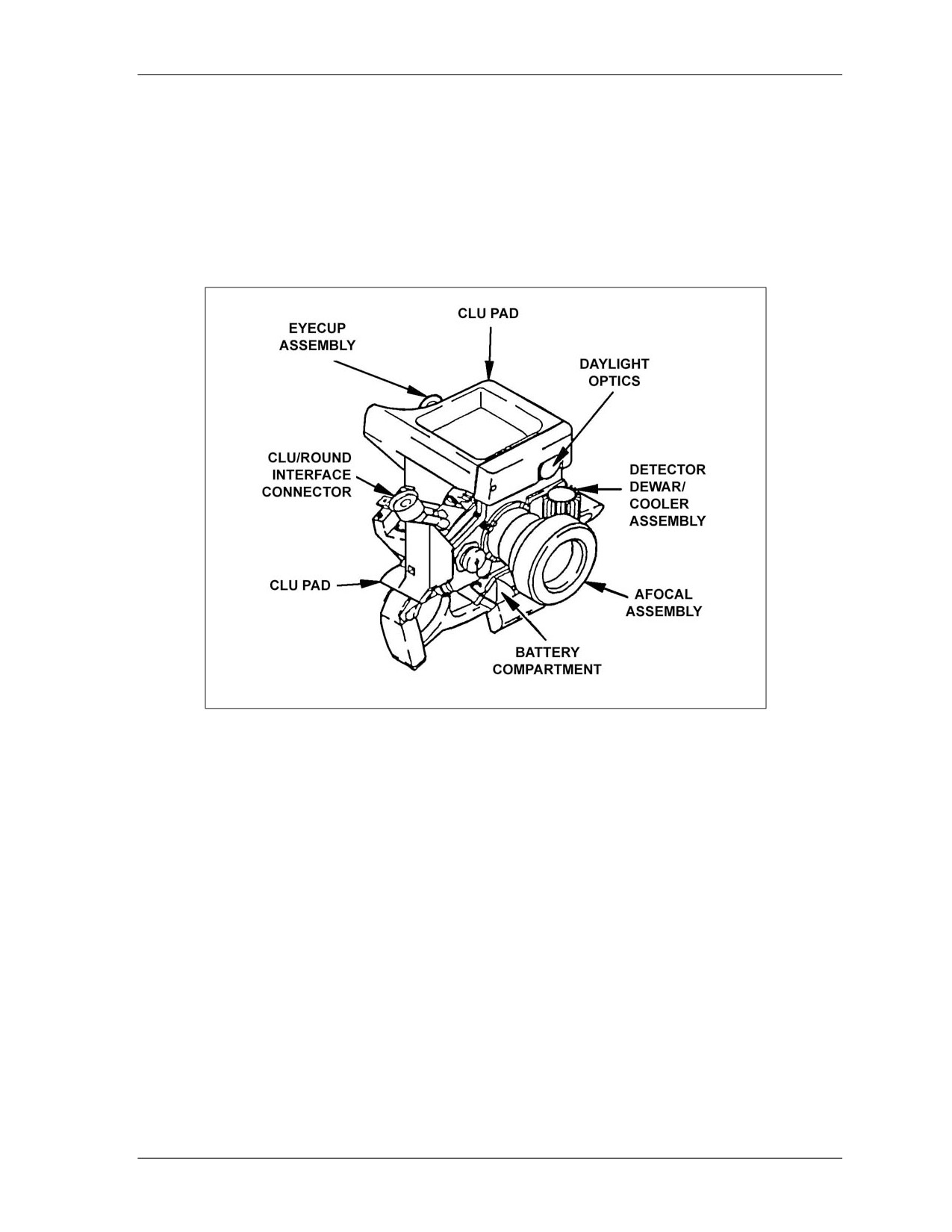
B-21. The nondisposable section of the Javelin is the CLU (Figure B-6). The nightsight and daysight of
the Javelin are integrated into one unit. The infrared sight has a 2,000-meter range, under most conditions,
which greatly increases target acquisition by the infantryman. The sight can operate for over four hours on
a single battery and requires no coolant bottles. It has a built-in test capability, which alerts the gunner if
the system is not functioning properly during operation.
Figure B-6. Command launch unit.
MISSILE
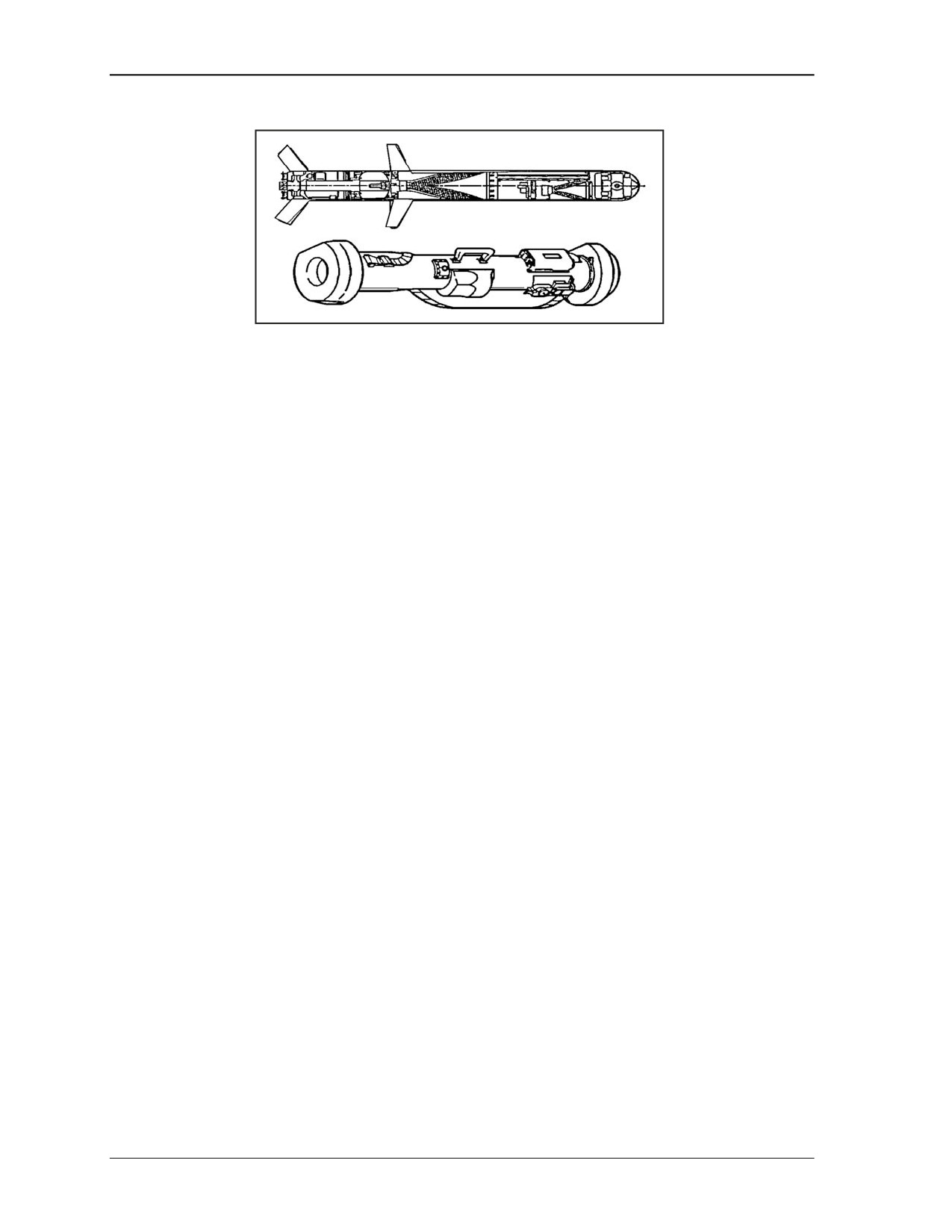
B-22. The Javelin missile is contained in a disposable launch tube. It has a passive imaging infrared
system, which locks on to the target before launch and is self-guiding. It uses a tandem shaped charge
warhead and a two-stage solid propellant with a low signature, soft-launch motor and a minimum-smoke
flight motor. The launch tube assembly and missile is shown in Figure B-7.
27 July 2006
FM 3-21.10
B-9
Appendix B
Figure B-7. Launch tube assembly and missile.
LETHALITY
B-23. The Javelin's 2,000-meter range and its tandem warhead defeats all known enemy armored
vehicles. It is powerful enough to produce extensive damage to field fortifications and medium-size
buildings.
B-24. In the top-attack mode, the missile strikes the thinner armor on the top of an armored vehicle
rather than the thicker frontal and side armor plates. Top attack also prevents an enemy target from
protecting itself by moving behind frontal cover. When used in urban areas or where obstacles might
interfere with the top-attack flight path of the missile, the Javelin can also be fired in the direct attack
mode.
B-25. The fire-and-forget capability of the Javelin increases the probability of a hit. Because the gunner
is not exposed to enemy suppressive fires while tracking the target until impact, he can use the missile's
flight time to reload, in a covered and concealed position, and begin engaging another target.
SURVIVABILITY
B-26. The Javelin's low launch signature decreases the enemy's ability to acquire gunners as they fire the
missile. All gunner engagement tasks are accomplished before launching the missile, making time of flight
irrelevant. The 2,000-meter range places the Javelin gunner outside the armored vehicle's effective coaxial
machine gun range. However, he is still within the range of the main gun.
B-27. The Javelin uses a passive infrared system for target acquisition and lock-on. This means that it
emits no infrared or radar beam (which enemy vehicles or smart munitions can detect) further increasing
the survivability of the Javelin gunner.
B-28. The Javelin sight offers the infantry leader an excellent observation capability. Under ideal
conditions, the Javelin sight can detect targets far in excess of 2,000 meters.
B-29. Because of the Javelin's slight back blast, it can be fired from smaller, harder to locate, better
protected positions that give the gunner a greater chance of remaining undetected or, if detected, surviving
any suppressive fires.
AGILITY AND FLEXIBILITY
B-30. The Javelin is man-portable and relatively lightweight for a CCM system. This allows the system
to be moved about the battlefield with relative ease. The Javelin's soft launch capability allows it to be fired
from inside buildings, bunkers, and other restricted spaces with less disruption to the gunner and less
signature to be observed by the enemy. Although flank shots are still the preferred method of engagement,
the Javelin's low signature launch and top-attack mode make frontal and oblique engagements more
B-10
FM 3-21.10
27 July 2006
TOW and Javelin Employment
effective than in the past, giving the infantry leader additional options in his CCM fires planning and
positioning. The capabilities of the Javelin give the leader more flexibility in the use and emplacement of
his CCM systems. This new degree of flexibility challenges the leader to make a careful METT-TC
analysis to ensure that he is taking full advantage of the Javelin's capabilities. The Javelin gives the leader a
system that complements other CCM and shoulder fired munitions fires available, allowing him to achieve
mutual support and greater overlapping fires between the systems.
LIMITATIONS
B-31. Sometimes, the Javelin system cannot engage targets. These occur either when a target is not
exposed long enough for the missile seeker to achieve proper lock on or when atmospheric conditions
interfere with the seeker.
LIMITED VISIBILITY
B-32. Heavy rain, smoke, fog, snow, sleet, haze, and dust are referred to as limited visibility conditions.
The presence of these conditions can affect the gunner's ability to acquire and engage targets with the
Javelin, especially when using the daysight of the CLU. The gunner should use the nightsight capability of
the CLU to acquire targets in limited visibility conditions because it provides the best target image.
INFRARED CROSSOVER
B-33. Infrared crossover occurs at least twice in each 24-hour period when the temperatures of soil,
water, concrete, and vegetation are approximately the same and the objects all emit the same amount of
infrared energy. If there is little difference in the amount of infrared energy between a target and its
background, then neither the Javelin CLU nor the missile seeker can detect the target well; this greatly
degrades the performance of the Javelin. This situation may last as long as an hour, until either the
background or the target changes temperature enough to become detectable again.
TIME-SPACE FACTOR
B-34. Just because a target appears in the open and within range does not always mean a Javelin gunner
can acquire, lock on, fire, and hit the target in the time it is exposed. A vehicle must be exposed long
enough for the gunner to identify it as a target and then to lock on the target with the Javelin missile seeker.
This process does not occur instantly; the time needed to do this varies depending on the skill of the
gunner.
EMPLOYMENT CONSIDERATIONS
B-35. The Javelin's primary role is to destroy enemy armored vehicles, but it can be used against point
targets such as bunkers and crew-served weapons positions. In addition, the Javelin's CLU can be used
alone as an aided vision device for reconnaissance, security operations, and surveillance. The principles of
CCM employment apply to the Javelin.
y Position for mutual support.
y Consider security requirements.
y Seek flank engagements.
y Seek to exploit standoff.
y Use cover and concealment.
y Employ in depth.
y Employ as part of a combined arms team.
27 July 2006
FM 3-21.10
B-11
Appendix B
SOLDIER'S LOAD
B-36. When employing the Javelin the Soldier's load becomes important. With a total system weight of
just under 50 pounds, the Javelin is admittedly heavy. Although a man-portable weapon, one Soldier
cannot easily carry the Javelin cross-country for extended periods. Leaders should be aware of this problem
and address it as they would any other Soldier's load difficulty. (FM 21-18 discusses Soldier's load and
cross-leveling of equipment during movement to reduce the burden on Soldiers.) Leaders should develop
unit SOPs that identify and describe the details of unit equipment cross-leveling.
URBAN COMBAT
B-37. Javelins provide overwatching CCM fires during the attack of a built-up area and an extended
range capability for the engagement of armor during the defense. Within built-up areas, they are best
employed along major thoroughfares and from the upper stories of buildings to attain long-range fields of
fire. The missile's minimum arming range and flight profile could limit firing opportunities in the confines
of densely built-up areas.
Restrictions
B-38. Ground obstacles and water do not restrict the Javelin with its fire-and-forget capability.
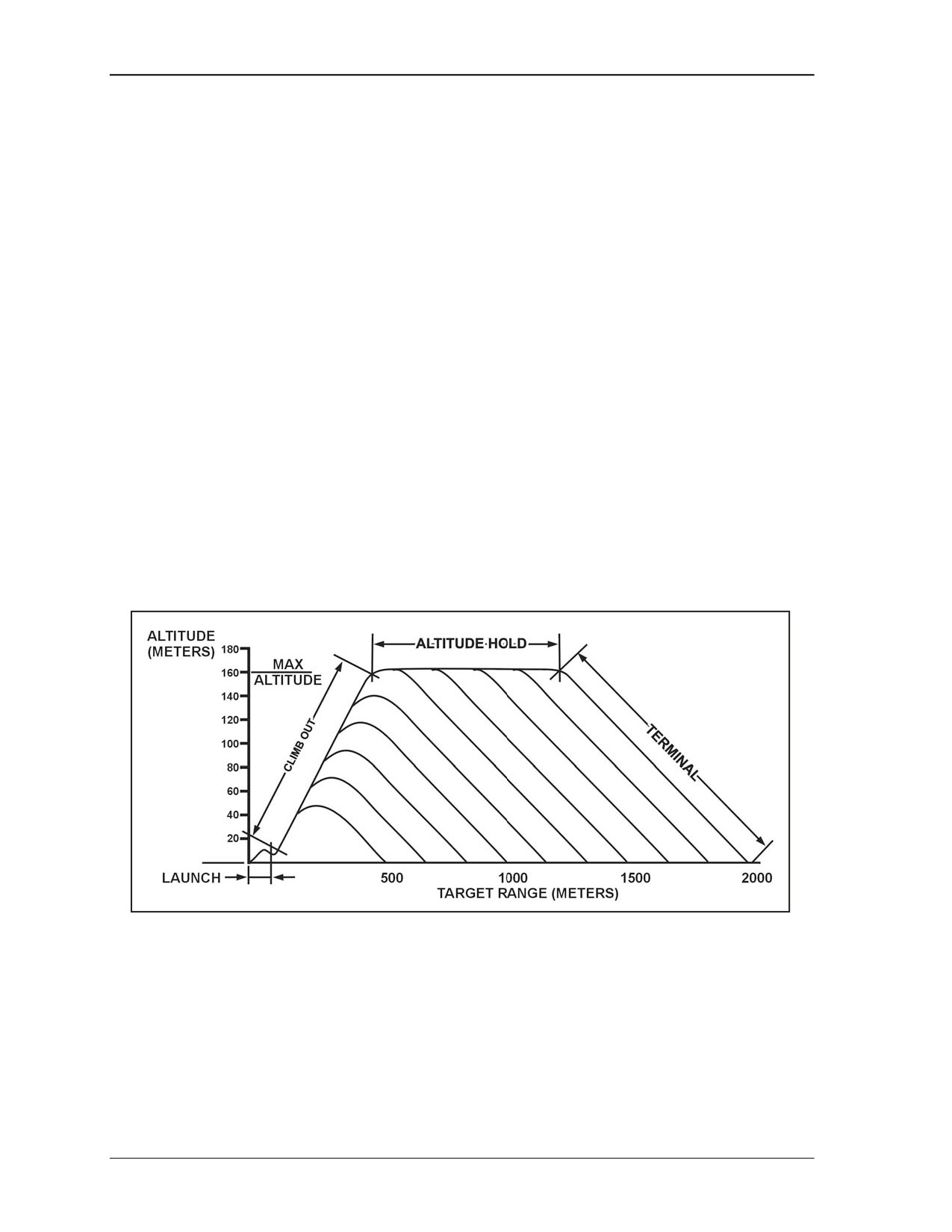
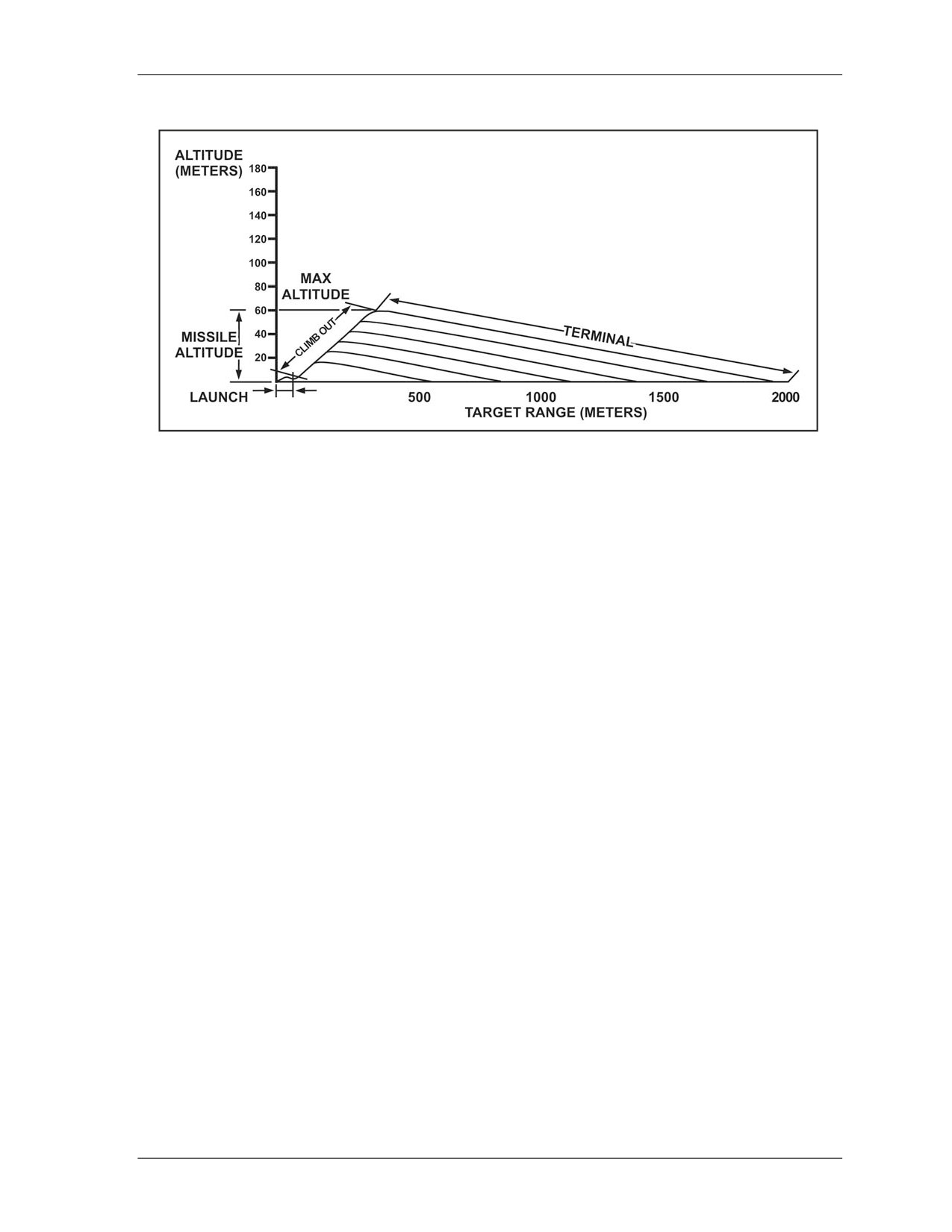
However, with its unique flight characteristics, overhead obstacles can limit its use in urban terrain. In the
top-attack mode, the Javelin missile requires up to 160-plus meters of overhead clearance (Figure B-8,
page B-12). In the direct-attack mode, the Javelin requires up to 60-plus meters of overhead clearance
(Figure B-9, page B-12). Gunners must ensure that sufficient overhead clearance is available along the
missile flight path before engaging targets in an urban environment.
Figure B-8. Javelin flight profile in top-attack mode.
B-12
FM 3-21.10
27 July 2006
TOW and Javelin Employment
Figure B-9. Javelin flight profile in direct-attack mode.
Dead Space
B-39. The aspects of dead space that affect Javelin fires the most are arming distance and target and
background temperature differences. The Javelin missile has a minimum arming window of 65 to 75
meters. Few areas in most urban environments permit fires much beyond the minimum arming distance.
Ground-level long-range fires down streets or rail lines and across parks or plazas are possible. The Javelin
might be used effectively from the upper stories or roofs of buildings to fire into other buildings. The
Javelin gunner must take into consideration the targeting dead space that is sometimes caused by the
background of the target and its heat signature. When firing from the upper stories of a building towards
the ground, the missile seeker sometimes cannot discriminate between the target and surrounding rubble,
buildings, or paving if that background material has the same temperature as the target.
Backblast
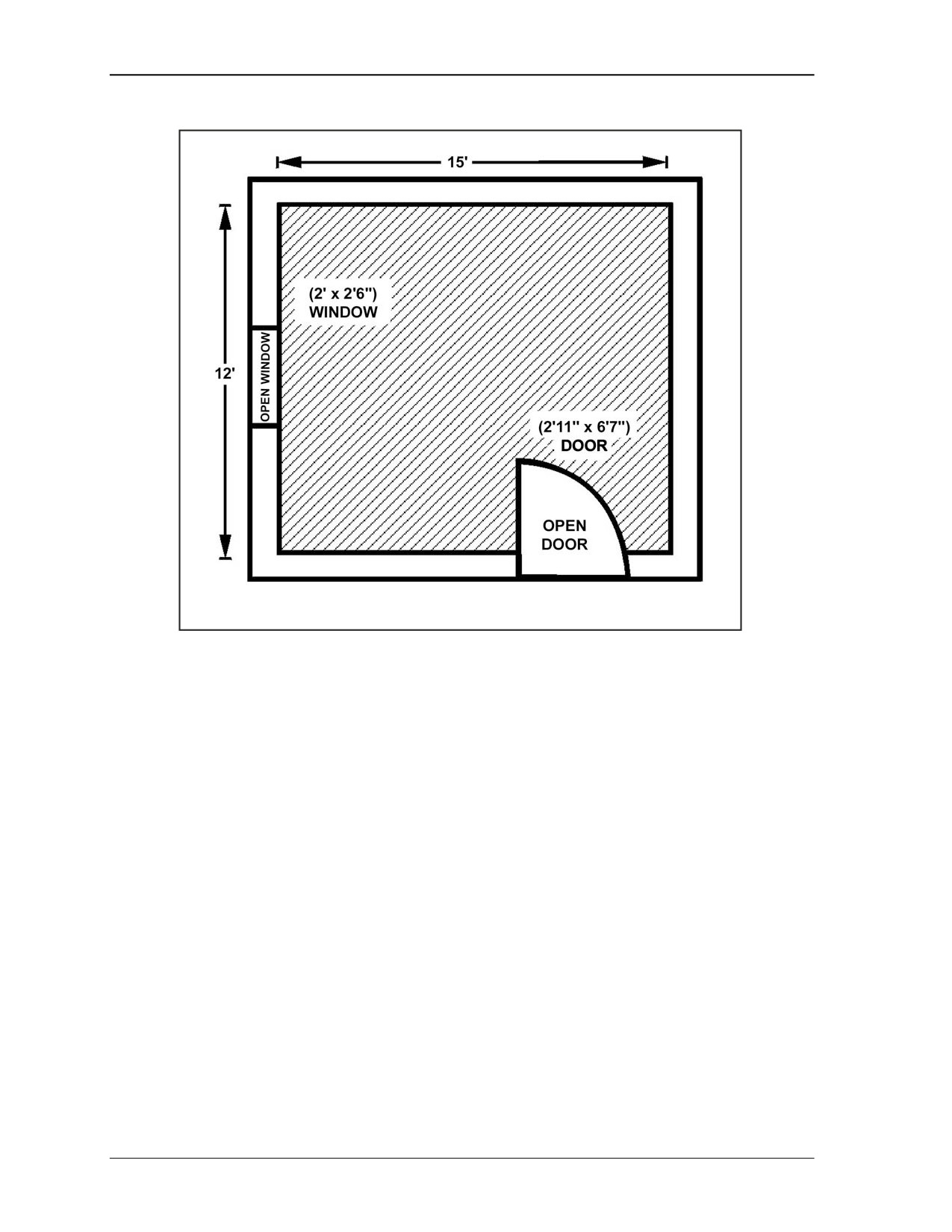
B-40. The Javelin's soft launch capability enables the gunner to fire from within an enclosed area with a
reduced danger from back blast overpressure or flying debris (Figure B-10). Personnel within the enclosure
should still wear a helmet, protective vest, ballistic eye protection, and hearing protection. To fire a Javelin
from inside a room, take these safety precautions.
y Ensure ceiling height is at least 7 feet.
y The floor size of the room should be at least 15 feet by 12 feet.
y Window opening must be at least 5 square feet.
y Door opening must be at least 20 square feet.
y When launching a missile from an enclosure, allow sufficient room for the missile container to
extend beyond the outermost edge of the enclosure.
y All personnel in the room must be forward of the rear of the weapon.
27 July 2006
FM 3-21.10
B-13
Appendix B
Figure B-10. Minimum room enclosure for Javelin firing.
WEAPON PENETRATION
B-41. The warhead of the Javelin can achieve significant penetration against typical urban targets.
Penetration, however, does not mean a concurrent destruction of the structural integrity of a position.
When engaging a position in a building, gunners should normally use the direct-attack mode to hit the
target. When engaging a position or bunker in the open, use either the top- or direct-attack mode.
JAVELIN FIRING POSITIONS
B-42. Each Javelin should have a primary firing position and at least one alternate position. Depending
on the factors of METT-TC, a supplementary position may also be assigned. A Javelin firing position must
allow for target engagement and provide protection for the Soldiers and the weapon system. When
selecting firing positions, leaders should consider the following. Avoid positions in swampy areas and very
steep hillsides. Also avoid positions on or near prominent terrain features such as--
y Cover to the front, flank, and overhead.
y Concealment from ground and aerial observation.
y Good observation and fields of fire.
y Covered and concealed routes to and between positions.
y Mutual support between squad positions and with other elements.
y Position below ridgelines and crests, preferably on the sides of hills.
B-14
FM 3-21.10
27 July 2006
TOW and Javelin Employment
DETECTION, RECOGNITION, AND CLASSIFICATION OF TARGETS
B-43. Gunners must engage targets quickly and efficiently. Speed of target engagement depends on each
Javelin gunner's proficiency in detecting potential targets, recognizing them as friend or foe, and
determining whether they can be engaged effectively. Dust and smoke make locating and identifying the
enemy difficult. As the battle progresses and friendly and enemy units become intermingled, identifying
targets become crucial tasks. Gunners in the company should be trained to detect enemy targets that are
camouflaged or partially concealed by terrain, vegetation, or smoke. They should also be trained to identify
targets as friend or foe based on vehicle identification aspects as well as situational understanding.
PRIMARY ANALYSIS
B-44. Because the Javelin's primary targets are armored vehicles, specifically tanks, gunners should look
for terrain where these targets are most likely to appear. Understanding armor tactics and the characteristics
of armor vehicles can help Javelin gunners recognize the terrain where these vehicles are most likely to be
employed.
ENEMY ANALYSIS
B-45. The tactics of many potential adversaries stress using speed and massive firepower to overwhelm
and destroy an opposing force. This dictates a very high average daily rate of advance. To move
consistently at a high rate, armored forces require firm ground to move rapidly and enough space to
deploy, maneuver, and fire. High-speed avenues of approach, such as road networks, broad ridges, and flat
or rolling terrain, should be observed constantly.
TERRAIN AND WEATHER ANALYSIS
B-46. A detailed analysis of the terrain and weather is useful in pinpointing armored or mechanized
avenues of approach and to evaluate them from the enemy's viewpoint. Some questions that the leader
should ask are "How can the enemy use this terrain?" and "Where is he most likely to appear first?"
Because weather significantly affects the trafficability of terrain, a ground reconnaissance is needed to
obtain current, detailed information about roads, trails, manmade objects, density of trees and brush, and
the seasonal conditions of streams and rivers. If a ground reconnaissance is not possible, an aerial
reconnaissance should be conducted or recent aerial photographs should be used.
ARMORED AND MECHANIZED VEHICLES’ MOBILITY CHARACTERISTICS
B-47. Javelin gunners can more easily determine where to look for enemy armored vehicles if they
know the vehicles’ mobility characteristics. If possible, tank and motorized rifle units will avoid terrain or
obstacles that can stop or impede their movement. Terrain factors that restrict armored or mechanized
vehicle mobility include--
y Slopes steeper than 30 degrees.
y Sturdy walls or embankments 3 or more feet high.
y Ditches or gullies 9 or more feet wide and 3 or more feet deep.
y Hardwood trees 10 inches or larger in diameter and 10 feet or less apart.
y Water obstacles at least 5 feet deep.
y Very swampy or very rough, rocky terrain.
y Built-up areas where vehicles are restricted to moving on confined roads, through park areas, or
across sports fields.
RANGE ESTIMATION
B-48. Javelin gunners do not need to know the exact range to a target before engaging; they only need to
know if it is within range. To speed this determination, gunners use an MEL. A Javelin MEL is an
imaginary line linked to an identifiable terrain feature. It is drawn across a sector’s maximum allowable
27 July 2006
FM 3-21.10
B-15

Appendix B
range from a Javelin firing position. To determine the location of this line on the ground, the company
leadership identifies terrain features at or near maximum range. Therefore, any target that crosses or
appears short of this line should be within range. Establishing a maximum engagement line greatly reduces
target engagement times, especially for targets that seem to be near maximum range. Several
range-determination techniques can be used to find the maximum range line or the range to targets.
LASER RANGE-FINDING METHOD
B-49. Most units and all FIST teams should have laser range-finders. The range from the Javelin
position to an easily identifiable terrain feature can be easily determined with the laser range-finder. Once
the maximum engagement line is determined, the gunner makes a note of a terrain feature at that location
on his range card. Any vehicle nearing that feature will be in range.
OBJECT RECOGNITION METHOD
B-50. Range determination by object recognition is simple and can be accurate with training. The
Soldier looks at the target with his naked eye, sights through 7X binoculars, or uses a Javelin optical sight.
Targets listed in Table B-2 are recognizable out to the ranges indicated. For example, if a target can be
recognized with the naked eye as an armored or wheeled vehicle, it is probably within 2,000 meters. When
using this method, the gunner must consider terrain, visibility conditions, and target size.
Range (Meters)
Targets
Naked Eye
7x Scope
Tank crewmembers
500
2,000
Soldiers, machine gun, mortar
500
2,000
Antitank gun, antitank missile launchers
500
2,000
Tank, APC, truck (by model)
1,000
4,000
Tank, Howitzer, APC, truck
1,500
5,000
Armored vehicle, wheeled vehicle
2,000
6,000
Table B-2. Range determination recognition method.
MAP AND TERRAIN ASSOCIATION METHOD
B-51. The maximum engagement line can be determined from a map. Do this for each firing position as
follows.
y Draw an arc on the map across the assigned sector of fire at 2,000 meters.
y Examine the map to identify the distinctive natural or man-made terrain features that the line
touches.
y Study the terrain in the sector of fire using binoculars or the Javelin CLU until all the selected
terrain features are located and positively identified.
y Connect these features by an imaginary line from the maximum engagement line.
SELF-DEFENSE AGAINST HELICOPTERS
B-52. Because Javelin positions are selected to cover enemy armor avenues of approach, the
medium-range fields of fire afforded by these positions may also enable Javelin gunners to engage
attacking aircraft that approach along the same general avenues.
B-16
FM 3-21.10
27 July 2006
TOW and Javelin Employment
WEAPONS CONTROL STATUS
B-53. The WCS established for air defense weapons also applies to Javelin gunners. Unless ordered
otherwise, gunners should only fire in unit self defense, for example, only engage aircraft that are attacking
friendly positions.
SELF DEFENSE ENGAGEMENTS
B-54. A Javelin gunner can automatically engage an enemy helicopter that is attacking its position,
regardless of the WCS. The gunner's target engagement sequence is the same as against ground targets.
The Javelin should be in the direct-fire mode when engaging helicopters. The rotors of the helicopter may
interfere with the sensors of the missile in the top-attack mode and result in erratic flight of the missile and
a target miss.
27 July 2006
FM 3-21.10
B-17
This page intentionally left blank.
Appendix C
Heavy and Stryker Employment
The Infantry company might be employed with Heavy or Stryker forces. An estimate
of the tactical situation determines the mixture and command relationship (attached
versus OPCON). Tactics and techniques explained in this appendix are for Infantry
working with such armored vehicles as the M1, M2, M3, or Stryker family of
Infantry carrier vehicles. These tactics and techniques also apply when an Infantry
rifle company is attached to a Heavy or Stryker battalion.
In this appendix, "Heavy" means units with BFVs and M1 Abrams tanks; "Stryker"
means units with Stryker Infantry carrier vehicles (ICVs) and mobile gun systems
(MGSs); and "mounted" means units with all of these.
"Infantry" means all Infantry units, including air assault and airborne trained Infantry
and Ranger units.
This edition adds a discussion of the employment of the Infantry Company with
Stryker Brigade Combat Team (SBCT) and with Heavy Brigade Combat Team
(HBCT) elements to fit modular force organization concepts and to capture
considerations including planning, logistics, communications, and key tactical tasks.
VEHICLES
C-1.
To employ any unit effectively, the leader must understand the specific capabilities and limitations
of the unit and its equipment. The most important considerations for the Infantry commander are an
appreciation for the differences in the perspective (with which mounted forces view the battlefield) and
how the Infantry force communicates effectively with the mounted force. Most heavy and Stryker vehicles
are equipped with the same types of FM radios employed by Infantry forces but only leader's vehicles have
more than one radio. Careful consideration must be given to how Infantry forces communicate with
mounted forces.
TANKS
C-2.
M1 tanks provide rapid mobility combined with excellent protection and highly lethal, accurate
fires. They are generally more effective in open terrain with extended fields of fire. However, they can be
very effective in restricted terrain, such as in urban areas, when combined with Infantry forces. The
following paragraphs address the capabilities and limitations of the M1 tank.
CAPABILITIES
C-3.
The tank's mobility comes from its capability to move at high speed both on and off road. The
ability to cross ditches, ford streams, and shallow rivers and to push through small trees, vegetation, and
limited obstructions allows effective movement in various types of terrain.
LIMITATIONS
C-4.
The tank requires Infantry forces for close in and rear security in restrictive and urban terrain.
Tanks consume large quantities of fuel. The tank requires dedicated Class III sustainment, most often from
the tank’s parent battalion, if operations will exceed eight hours. Tanks are noisy and must be started
27 July 2006
FM 3-21.10
C-1
Appendix C
periodically in cold weather or when using the thermal nightsight and radios to ensure the batteries stay
charged. The noise, smoke, and dust generated by tanks make it difficult for the Infantry in their vicinity to
capitalize on stealth to achieve surprise. Tanks cannot cross bodies of water deeper than 4 feet without
deep water fording kits or bridging equipment. When fighting with the hatches closed the tank crews
visibility in the immediate vicinity of the vehicle is severely limited. This presents an accident and
fratricide risk to Infantry operating in the immediate vicinity of the tank. Infantry Soldiers must take
precautions when operating in close proximity to tanks.
FIREPOWER
C-5.
The tank's main gun is extremely accurate and lethal at ranges out to 2,500 meters. Tanks with
stabilized main guns can fire effectively even when moving at high speeds cross-country. The tank is the
best antitank weapon on the battlefield. The various machine guns (tank commander's caliber.50 and
7.62-mm coax, and the loader's 7.62-mm MG) provide a high volume of supporting fires for the Infantry.
The target-acquisition capabilities of the tank exceed the capability of all systems in the Infantry battalion.
The thermal sight provides a significant capability for observation and reconnaissance. It can also be used
during the day to identify heat sources (personnel and vehicles) even through light vegetation. The laser
range finder provides an increased capability for the Infantry force to establish fire control measures, such
as trigger lines and TRPS, and determine exact locations. The normal, basic load for the tank’s main gun is
armor-piercing discarding sabot (APDS) antitank, high-explosive antitank (HEAT), and multipurpose
antitank
(MPAT) rounds. Two other rounds available are an obstacle-reducing round and a canister
antipersonnel round. The APDS round presents a safety problem when fired over the heads of exposed
Infantrymen due to the discarded SABOT petals that fall to the ground. HEAT and MPAT ammunition
provides better destructive effects on these targets, except for enemy personnel, against which the tank's
machine guns work best. The resupply of all tank ammunition is generally beyond the capability of the
Infantry battalion and normally requires logistic support from the heavy battalion.
PROTECTION
C-6.
Generally, the tank armor provides excellent protection to the crew. Across the frontal 60-degree
arc, the tank is impervious to all weapons except heavy antitank missiles or guns, and the main gun on
enemy tanks. When fighting with the hatches closed, the crew is impervious to all small arms fire, artillery
rounds (except a direct hit), and AP mines. The tank's smoke grenade launcher and on-board smoke
generator provide rapid concealment from all but thermal observation. However, the tank is also vulnerable
to lighter antitank weapons from the flanks, top, and rear. The top is especially vulnerable to
precision-guided munitions (artillery or air delivered). AT mines can also destroy/disable the vehicle.
When fighting with hatches closed, the tank crew's ability to see, acquire, and engage targets (especially
close-in Infantry) is greatly reduced.
INFANTRY FIGHTING VEHICLE
C-7.
The M2 and M3 provide good protection and mobility combined with excellent firepower. They
operate best on the same terrain as the tank; however, their reduced protection (when compared to the tank)
is a major employment consideration. The following paragraphs address the capabilities and limitations of
the Infantry fighting vehicle.
CAPABILITIES
C-8.
The mobility of the M2 and M3 is comparable to the tank. In addition to the three-Soldier crew,
the vehicle is designed to carry six to seven (depending on equipment load) additional Infantrymen.
LIMITATIONS
C-9.
The M2 and M3 use a lot of fuel. Also, they are louder than the M1, and must be started
periodically in cold weather or when using the thermal nightsight and radios to ensure the batteries stay
C-2
FM 3-21.10
27 July 2006
Heavy and Stryker Employment
charged. The noise, smoke, and dust generated by mechanized forces make it difficult for the Infantry to
capitalize on their ability to move with stealth and avoid detection when moving on the same approach.
FIREPOWER
C-10. The primary weapon on both the M2 and M3 is the 25-mm chain gun that fires two versions of
Armor Piercing Fin Stabilized Discarding Sabot with Tracer (APFSDS-T) and High Explosive Incendiary
with Tracer (HEI-T). This weapon is extremely accurate and lethal against lightly armored vehicles,
bunkers, trench lines, and personnel at ranges out to 3,000 meters. The stabilized gun allows effective fires
even when moving cross-country. The TOW provides an effective weapon for destroying enemy tanks or
other point targets at ranges to 3,750 meters. The 7.62-mm coax provides a high volume of suppressive
fires for self-defense and supporting fires for the Infantry at ranges to 900 meters (in some cases the coax
can engage targets past 900 meters). The combination of the stabilized turret, thermal sight, high volume of
fire, and mix of weapons and ammunition (TOW, 25-mm, and 7.62-mm), makes the M2 and M3 excellent
suppression assets supporting Infantry assaults. The target-acquisition capabilities of the M2 and M3
exceed that of the other systems in the Infantry battalion. The thermal sight provides a significant
capability for observation and reconnaissance. It can also be used during the day to identify heat sources
(personnel and vehicles) even through light vegetation. However, the resupply of 25-mm ammunition is
generally beyond the capability of the Infantry battalion and normally requires logistic support from the
heavy battalion.
PROTECTION
C-11. Overall, the M2/M3 provides good protection. When fighting with the hatches closed, the crew is
well protected from small-arms fire, fragmentation munitions, and AP mines. The M2/M3 smoke-grenade
launcher provides rapid concealment from all but thermal observation. Though the M2 and M3 retain the
ability to produce on-board smoke, this feature is seldom used, because the JP-8 fuel does not produce
billowing smoke like diesel fuel did. Second, smoke reveals the vehicle's exact location to the enemy. The
vehicle is also vulnerable from all directions to any AT weapons and especially enemy tanks. Antitank
mines can destroy or at least disable the vehicle. When the crew is operating the vehicle with the hatches
open, they are vulnerable to small-arms fire.
STRYKER INFANTRY CARRIER VEHICLE
C-12. A large part of the US Army's transformation includes fielding up to nine kinds of Strykers for the
SBCT. Together, they meet the requirements of key battlefield operations and functions. They include
vehicles designed for command, reconnaissance, fire support, mortars, antitank guided missiles or mobile
guns, engineers, medical support, and CBRN reconnaissance. However, this paragraph focuses only on the
overall design of the Stryker and on selected weapons systems.
CAPABILITIES
C-13. The Stryker family of vehicles includes the Infantry carrier vehicle (ICV), a fully mobile system
that provides protected transport for an Infantry squad and direct fire support during dismounted assault.
The ICV carries a nine man rifle squad plus a two-Soldier crew (vehicle commander and driver) that
operates the vehicle; or a seven-Soldier weapons squad. General design characteristics and features
include-- air-transportable, four to eight wheel drive, remote weapon station, FBCB2, driver vision
enhancer (DVE), commander periscopes, and thermal imager display with video camera, and reduced
acoustic signature. Under optimal conditions the top speed is over 60 MPH and range over 300 miles.
LIMITATIONS
C-14.
The Stryker lacks shoot-on-the-move capability. Also, due to its air transport weight and space
restrictions, it might not roll off fully fueled, with ammunition, or with add-on, retrofitted antiarmor
27 July 2006
FM 3-21.10
C-3
Appendix C
protection. Off-road, Strykers must operate at greatly reduced speeds. In urban terrain, their large turning
radius can affect their agility.
FIREPOWER
C-15.
The ICV local defensive armament consists of a remote weapon station that mounts either an M2
50 caliber machine gun with 2,000 rounds stowed ammunition, or the MK 19 40-mm grenade launcher
with 430 rounds stowed ammunition, and four smoke grenade launchers. Anti-tank armament includes the
mobile gun system M68A1 105MM cannon and the antitank guided missile system employing the elevated
TOW 2B. The mortar carrier gives the Stryker company very responsive, high-angle, indirect fire using
either the 120- or 60-mm mortars. However, the Stryker rifle platoon ICV has limited onboard armament
that can only defeat enemy thin-skinned vehicles and dismounted troops. Also, it can neither suppress nor
kill armored vehicles or tanks. Nor does it have a laser range finder or gun stabilizer, of which would
enhance the Stryker's lethality.
PROTECTION
C-16. The ICV standard armor provides all-round protection against up to 14.5 MM direct fire weapons
and 152 MM artillery airburst fragmentation. Add-on reactive armor and the steel cage RPG-7 retrofit
provide enhanced protection. Survivability is also increased by using the CBRN detection package and
individual crew respirators. However, although it bridges the gap between the heavy and light forces,
Stryker armor cannot withstand engagements by heavy tanks or antiarmor weapons.
SAFETY
C-17. Infantry battalion personnel may not be familiar with the hazards that may arise during operations
with tanks, BFVs, and other armored vehicles. The most obvious of these include the dangers associated
with main-gun fire and the inability of armored vehicle crews to see people and objects near their vehicles.
Leaders of mounted and dismounted units alike must ensure that their troops understand the following
points of operational safety.
DISCARDING SABOT
C-18. Tank and BFV SABOT rounds discard stabilizing petals when fired creating a downrange hazard
for unprotected personnel. The aluminum petals of the tank rounds are discarded in an area extending 70
meters to the left and right of the gun-target line, out to a range of 1 kilometer (Figure C-1). The danger
zone for plastic debris from BFV rounds extends 60 degrees to the left and right of the gun-target line and
out to 100 meters from the vehicle. The danger zone for the aluminum base from BFV rounds extends 7
degrees to the left and right of the gun target line and out to
400 meters (Figure C-2, page C-6).
Infantrymen should not be in or near the direct line of fire for the tank main gun or BFV cannon unless
they are under adequate overhead cover.
C-4
FM 3-21.10
27 July 2006
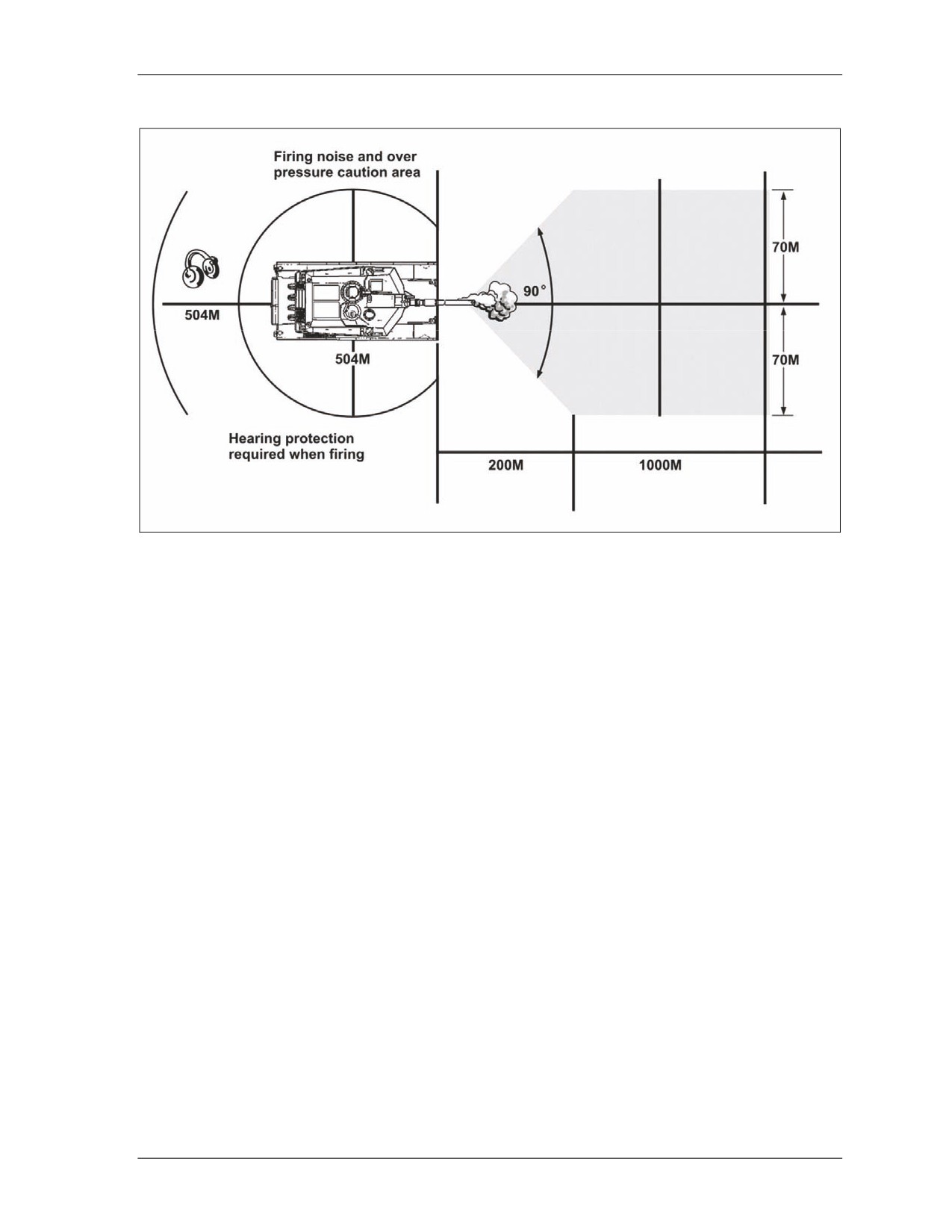
Heavy and Stryker Employment
Figure C-1. M1 tank danger zone.
27 July 2006
FM 3-21.10
C-5