FM 3-21.10 (FM 7-10) The Infantry Rifle Company (July 2006) - page 12
Chapter 12
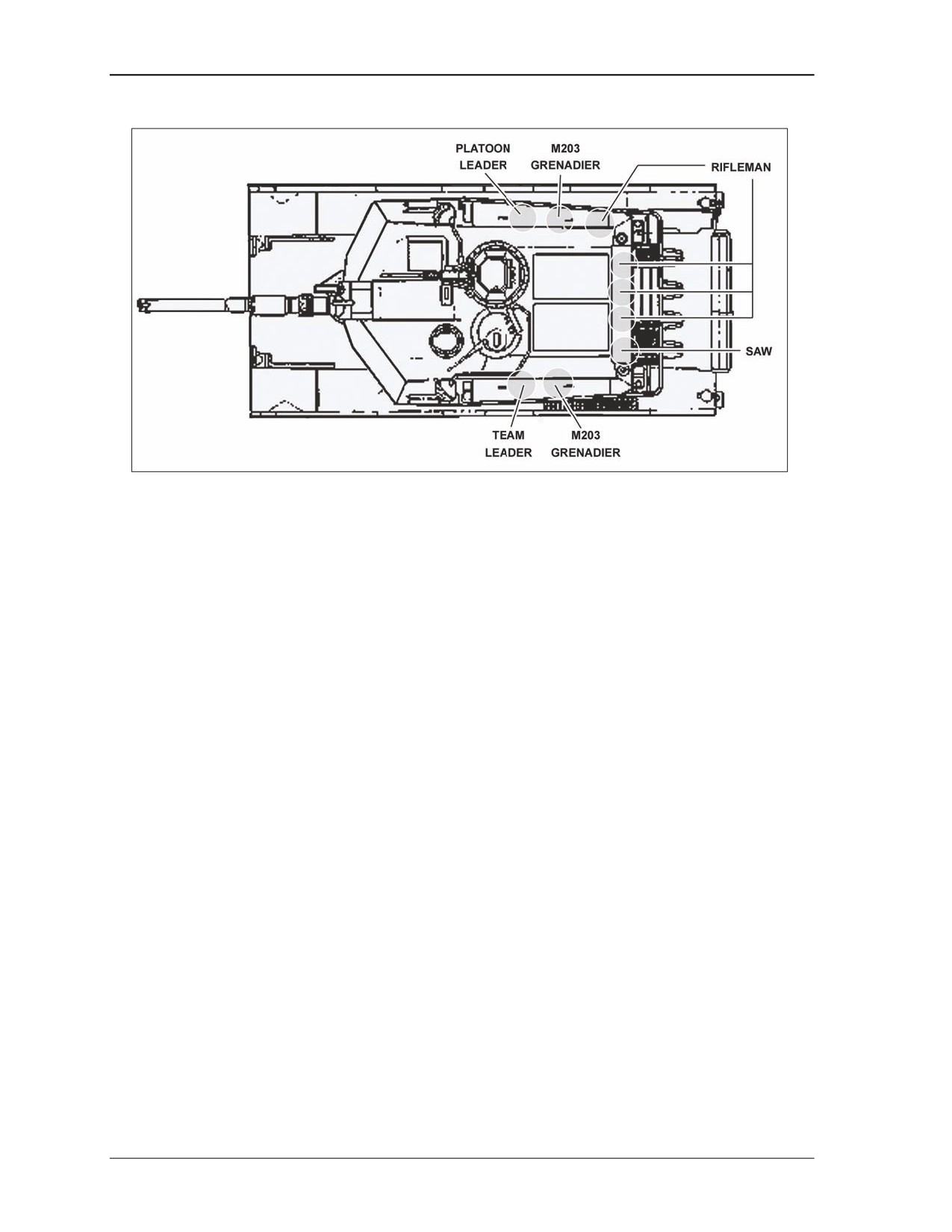
Figure 12-6. Example positions for Infantry riding on a tank.
PROCEDURES, PRECAUTIONS, AND CONSIDERATIONS
12-108. Infantry and armor leaders must observe the following procedures, precautions, and
considerations when Infantrymen ride on tanks.
y Infantrymen should thoroughly practice mounting and dismounting procedures and actions on
contact.
y Infantrymen must always alert the TC before mounting or dismounting. They must follow the
commands of the TC.
y Infantry platoons should be broken down by squads, similar to air assault chalks, with the
Infantry platoon leader on the armor platoon leader's vehicle and the Infantry platoon sergeant
on the armor platoon sergeant's vehicle.
y Platoon leaders, platoon sergeants, and team leaders should position themselves near the TC's
hatch, using the external phone (if available) to talk to the TC and relay signals to the unit.
y If possible, the lead vehicle should not carry Infantrymen. Riders restrict turret movement and
are more likely to be injured or killed on initial contact.
y Whenever possible, Infantrymen should mount and dismount to the front of a tank, while
ensuring the driver and, or, the TC have made eye contact and granted permission to climb on
to, or off, the tank to Infantrymen.
y Infantrymen must always have three points of contact with the vehicle, and watch for
low-hanging objects such as tree branches.
y Infantrymen should wear hearing protection.
y Infantrymen should not ride with anything more than their battle gear. Rucksacks should be
transported by other means.
y Infantrymen should scan in all directions while riding. They might be able to spot a target the
vehicle crew does not see.
12-26
FM 3-21.10
27 July 2006

Urban Operations
ACTIONS ON CONTACT
12-109. Infantrymen should be prepared to take the following actions on contact.
y Wait for the vehicle to stop.
y At the TC's command, dismount immediately (one fire team on each side). Do not move
forward of the turret. Do not dismount a vehicle unless ordered or given permission to do so.
y Move at least 5 meters to the either side of the vehicle. NEVER move behind or forward of
the vehicle.
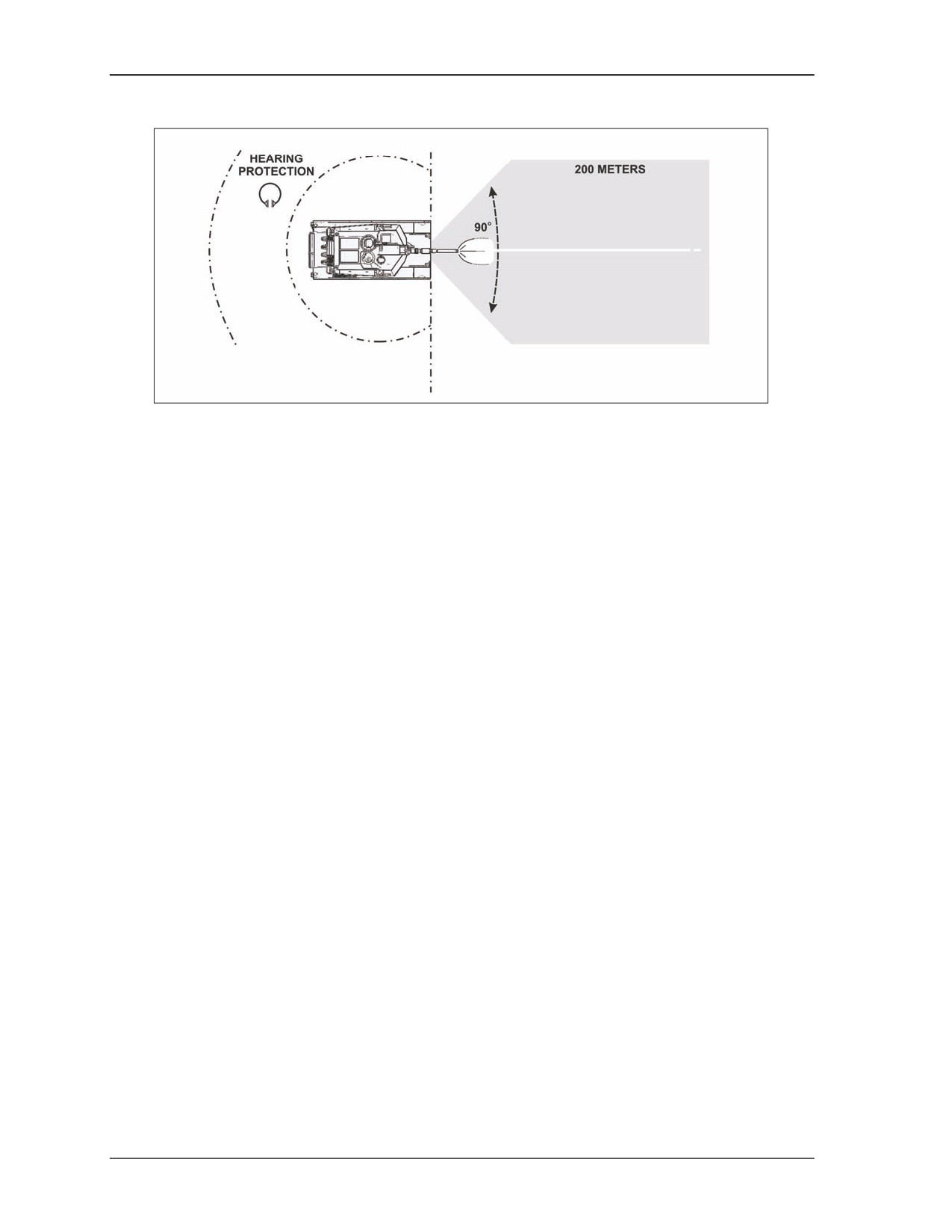
y NEVER move in front of vehicles unless ordered to do so. Overpressure from firing a main gun
can inflict serious injury to Infantrymen dismounted forward (Figure 12-7, page 12-28).
y NEVER dangle arms or legs, equipment, or anything else off the side of a vehicle; they could
catch in the tracks, causing damage to the equipment or vehicle and death or injury to the
Soldier.
y NEVER place too many riders on the vehicle.
y NEVER fall asleep when riding. The warm engine may induce drowsiness; a fall could be fatal.
y NEVER smoke when mounted on a vehicle.
y NEVER stand near a moving or turning vehicle at any time. Tanks have a deceptively short
turning radius.
WARNING
The overpressure from the tank’s 120-mm cannon can seriously
injure dismounted Infantry within a 90-degree arc extending from
the muzzle of the gun tube out to 200 meters.
DANGER
FROM 200 TO 1,000 METERS ALONG THE LINE OF FIRE, ON A
FRONTAGE OF ABOUT 400 METERS, DISMOUNTED INFANTRY
MUST BE AWARE OF THE DANGER FROM DISCARDING SABOT
PETALS, WHICH CAN CAUSE SERIOUS INJURIES OR DEATH TO
NEARBY PERSONNEL.
27 July 2006
FM 3-21.10
12-27
Chapter 12
Figure 12-7. Danger areas around a tank firing a 120-mm main gun.
ADDITIONAL CONSIDERATIONS
12-110. Additional considerations and preparations for transporting Infantrymen include--
Armor
12-111. Uses main-gun fire to reduce obstacles or entrenched positions for the Infantry.
12-112. Takes directions from the Infantry ground commander (platoon leader or platoon sergeant or
squad leader) to support their fire and maneuver.
12-113. Provides reconnaissance by fire for the Infantry.
12-114. Should know and understand how the Infantry clears buildings, and how they mark cleared
buildings, the casualty evacuation plan, signal methods, engagement criteria for tank main gun, front line
trace reporting, and ground communication from the tank with the dismounted personnel.
12-115. Uses its night vision capability to augment and supplement the Infantry's night vision capabilities.
Infantry
12-116. Provides information for the tank crewmembers to help them overcome tank noise and the lack of
ground SA. Provides reconnaissance and fire direction of enemy positions for main gun attack.
Considerations for dismounted tank security include--
y Tank crewmembers should rehearse the mounting and dismounting of Infantrymen from their
vehicle, briefing the Infantrymen on safety procedures for the vehicle and weapon systems.
y Tank commanders need to rehearse communicating with dismounted Soldiers via TA-1 and
DR-8 in the bustle rack.
Vehicle Preparation
12-117. Vehicle preparation for combat in urban terrain should include at least the following actions.
y Keep at least one ballistic shield to the integrated sight unit (ISU) closed (most engagements
will be under boresight range and the battlesight technique will suffice).
y Place sandbags around antenna connections and electrical wiring on the turret top.
12-28
FM 3-21.10
27 July 2006
Urban Operations
y Place extra coax ammunition inside the turret.
y Remove all highly flammable products from the outside of the vehicle and from the sponson
boxes in order to prevent vehicle fires due to small arms or RPG detonations.
CONSIDERATIONS FOR ARMORED VEHICLES, WEAPONS, AND
MUNITIONS
12-118. Numerous factors related to tanks and their organic weapons and munitions affect the tank
platoon's UO planning and execution, including--
y
The preferred main gun rounds in the urban environment are HEAT, multipurpose antitank
(MPAT) (ground mode), and MPAT-OR (XM908). These all perform much better than sabot
rounds against bunkers and buildings.
y
HEAT ammunition will open a larger hole in reinforced concrete or masonry structures than
MPAT or MPAT-OR (XM908). Both MPAT and MPAT-OR, however, offer greater
incapacitation capability inside the structure.
y
HEAT ammunition arms about 60 feet from the gun muzzle. It loses most of its effectiveness
against urban targets at ranges of less than 60 feet.
y
MPAT and MPAT-OR rounds arm about 100 feet from the muzzle of the gun. Because of the
shape and metal components of the projectiles, however, this ammunition remains effective at
ranges of less than 100 feet.
y
Sabot petals, including those on MPAT and MPAT-OR, endanger accompanying Infantry
elements. They create a hazard area extending 70 meters on either side of the gun-target line
out to a range of 1 kilometer.
y
The tank's main gun can depress only to -10 degrees and can elevate only to +20 degrees,
which creates considerable dead space for the crew at the close ranges that are typical in the
urban environment.
y
The external M2 HB machine gun can deliver a heavy volume of suppressive fire and penetrate
light construction, buildings, and most barricades. The M2 HB machine gun can elevate to +36
degrees. However, the TC must be unbuttoned to fire the M2 on the M1A2 or M1A2 SEP.
y
The M240 coax machine gun can effectively deliver suppressive fires against enemy personnel
and against enemy positions that are behind light cover.
y
The loader's M240 machine gun can effectively deliver suppressive fire against enemy
personnel and against enemy positions that are behind light cover; however, the loader must be
unbuttoned to operate it.
y
When buttoned up, the tank crew has limited visibility to the sides and rear and no visibility to
the top.
TASK ORGANIZATION WITH BRADLEYS AT COMPANY
TEAM LEVEL
12-119. The heavy platoon provides a very flexible heavy direct fire support asset to Infantry companies
conducting operations on urban terrain. The 25-mm cannon and 7.62-mm coax machine gun, combined
with the additional Infantry, Javelin, and TOW ATGMs, provide the company team commander powerful
combat multipliers during urban combat.
TARGET ENGAGEMENT
12-120. Streets and alleys are natural firing lanes and killing zones. Because of this, all vehicular traffic is
greatly restricted and canalized, and subject to ambush and short-range attack. Tanks are at a disadvantage
because their main guns cannot be elevated enough to engage targets on the upper floors of tall buildings.
The BFV, with +60 to -10 degrees elevation of the 25-mm gun and 7.62-mm coax machine gun, has a
much greater ability to engage targets in urban terrain.
27 July 2006
FM 3-21.10
12-29
Chapter 12
GENERAL CONSIDERATIONS WHEN USING BRADLEY FIGHTING VEHICLES
12-121. Infantry companies might be task-organized with heavy platoons when conducting operations in
urban terrain. A BFV platoon can provide its own Infantry support. Generally, BFVs should not be
separated from their Infantry. Working as a team, Infantrymen (the rifle squads) provide security for the
vehicles; the BFVs provide critical fire support for the Infantry company team.
Movement
12-122. When moving, if the street is large enough, BFVs should stay close to a building on either side of
the street. This allows each BFV to cover the opposite side of the street. BFVs can button up for protection,
but the BFV crew must remain alert for signals from Infantry. Coordination between mounted and
dismounted elements is critical in urban terrain.
Close Combat Missiles
12-123. The BFV lacks adequate armor protection to withstand medium to heavy ATGM fire. It is
normally employed after the area has been cleared of ATGM positions or on terrain dominating the city to
provide long-range antiarmor support or fire suppression. Shoulder-launched munitions or Javelins provide
a significant amount of the BFV platoon's short-range antiarmor fires in urban areas; the TOWs provide
long range antiarmor fires. The BFV's 25-mm gun and machine gun are employed while providing direct
fire support.
ORGANIZATION AND TASKS
12-124. The BFV platoon is comprised of mounted and dismounted elements. Based on the company
commander's guidance and the METT-TC factors, the BFV platoon leader will normally determine how his
elements will be deployed.
Section VII. OFFENSE
Offensive operations in urban areas are based on offensive doctrine applied to urban terrain. Urban combat
imposes a number of demands that are different from ordinary field conditions such as problems with troop
requirements, maneuver, and use of equipment. As with all offensive operations, the company commander must
retain his ability to maneuver against enemy positions.
PLANNING CONSIDERATIONS
12-125. Combat operations in a built-up area have a slower pace and tempo than operations in open
terrain. However, commanders still maintain a momentum that is relentless in order to keep the enemy off
balance. Due to the close environment (and the restricted ability to use all available weapons systems),
synchronization of maneuver and combat support assets is one of the Infantry company commander's main
challenges. Missions in UO are more methodical. Normally, the Infantry company conducts missions as
part of a battalion operation, but must be prepared to operate independently. The company must also be
prepared to conduct different but mutually supporting missions simultaneously such as establish a
checkpoint and clear a block at the same time.
TROOP REQUIREMENTS
12-126. Due to the nature of combat in built-up areas, more units are required to conduct operations in an
area of like size of rural terrain. The physical size of an AO is reduced. This is due to the nature of the
terrain. Urban terrain is more compressed, has three dimensions in which maneuver forces operate, and
operations are characterized by small units operating independently.
12-30
FM 3-21.10
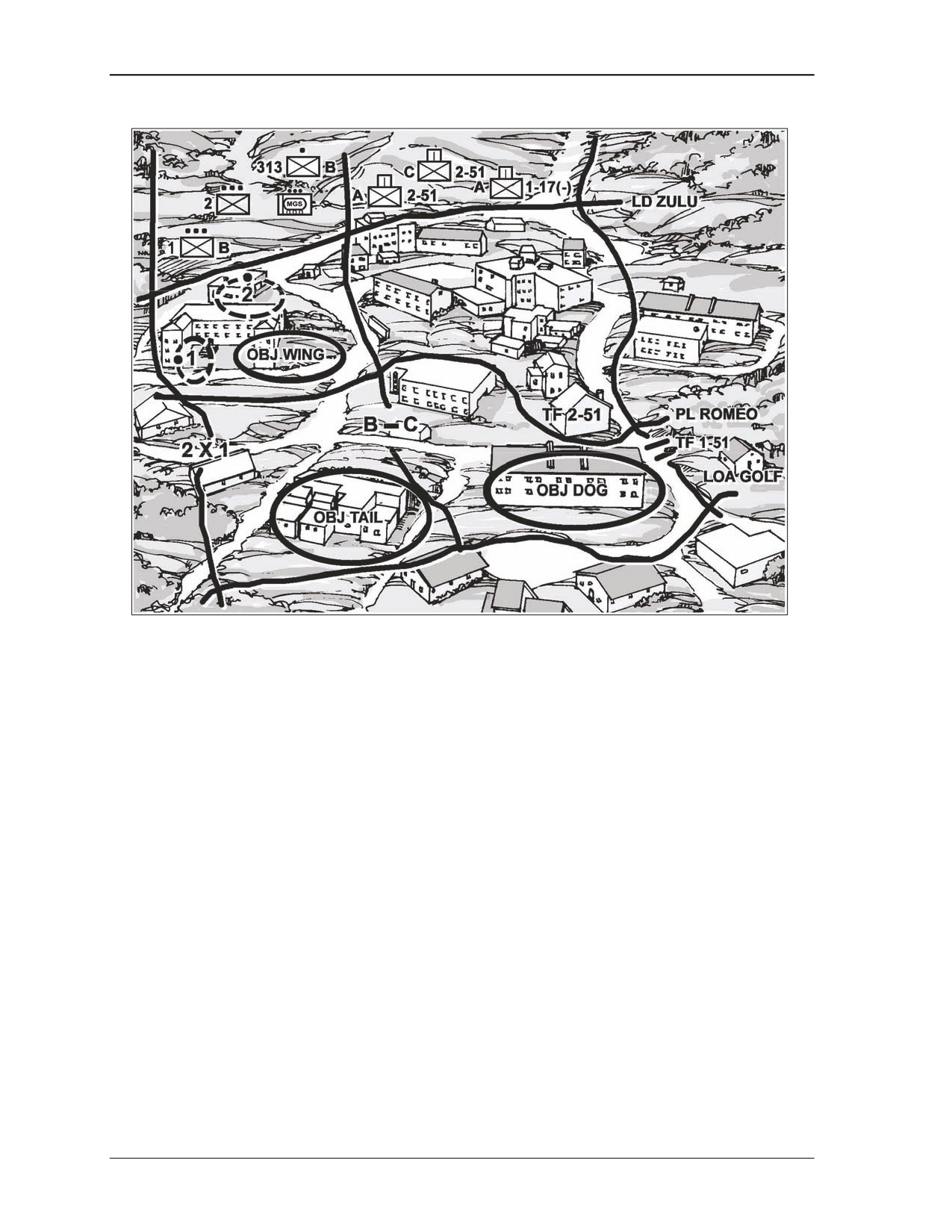
27 July 2006
Urban Operations
12-127. Commanders consider Soldier fatigue. Room-clearing techniques are physically demanding, so
they quickly tire a force. Commanders plan for the relief or rotation of their forces before they reach the
point of exhaustion.
12-128. Additional forces might be needed to control civilians in the built-up area. These forces protect
civilians, provide first aid, and prevent them from interfering with the tactical plan.
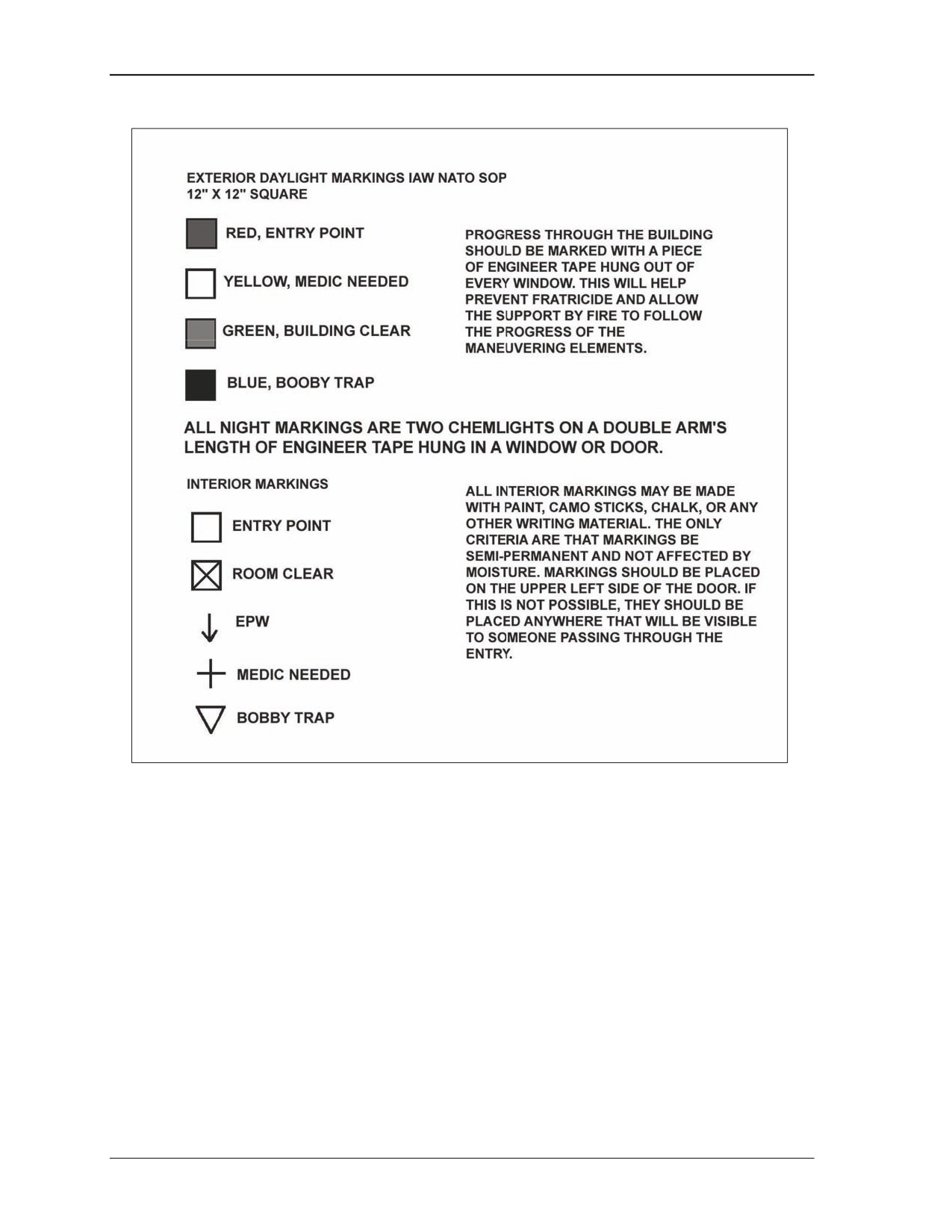
12-129. Fighting in a built-up area normally results in a greater number of friendly casualties. The ability
to see the enemy is fleeting and confined to very short ranges compared to combat in open terrain.
Fratricide prevention is a challenge and must be addressed in detail by the commander. The command is
likely to operate under some form of a restrictive ROE based on noncombatants on the battlefield. Plan for
CASEVAC and instruct subordinate units to conduct this task.
MANEUVER
12-130. The complex nature of the urban environment makes it difficult for commanders to maneuver
their Infantry company and its attachments quickly. The presence of large numbers of civilians, and
clearing buildings and looking for antiarmor ambushes, snipers, and booby traps degrade the company's
ability to maneuver platoons and squads. Due to the dense environment and its effects on weapons systems,
the synchronization of combat power is one of the commander's main challenges. Offensive operations are
planned in detail, with subordinate elements given specific instructions and on-order missions.
LIMITATIONS
12-131. Infantry company commanders attacking a built-up area must recognize some important
limitations in the use of available assets.
y The presence of large numbers of civilians or non combatants in urban areas must be factored
into all of the commander's analysis. The presence, flow, and actions of civilians on the
battlefield will have a huge effect on the actions of the Infantry company. Normally, the use of
indirect fires, especially field artillery, is much more restricted in built-up areas than in open
terrain. Leaders must consider the effects of indirect fire on the urban area and civilians,
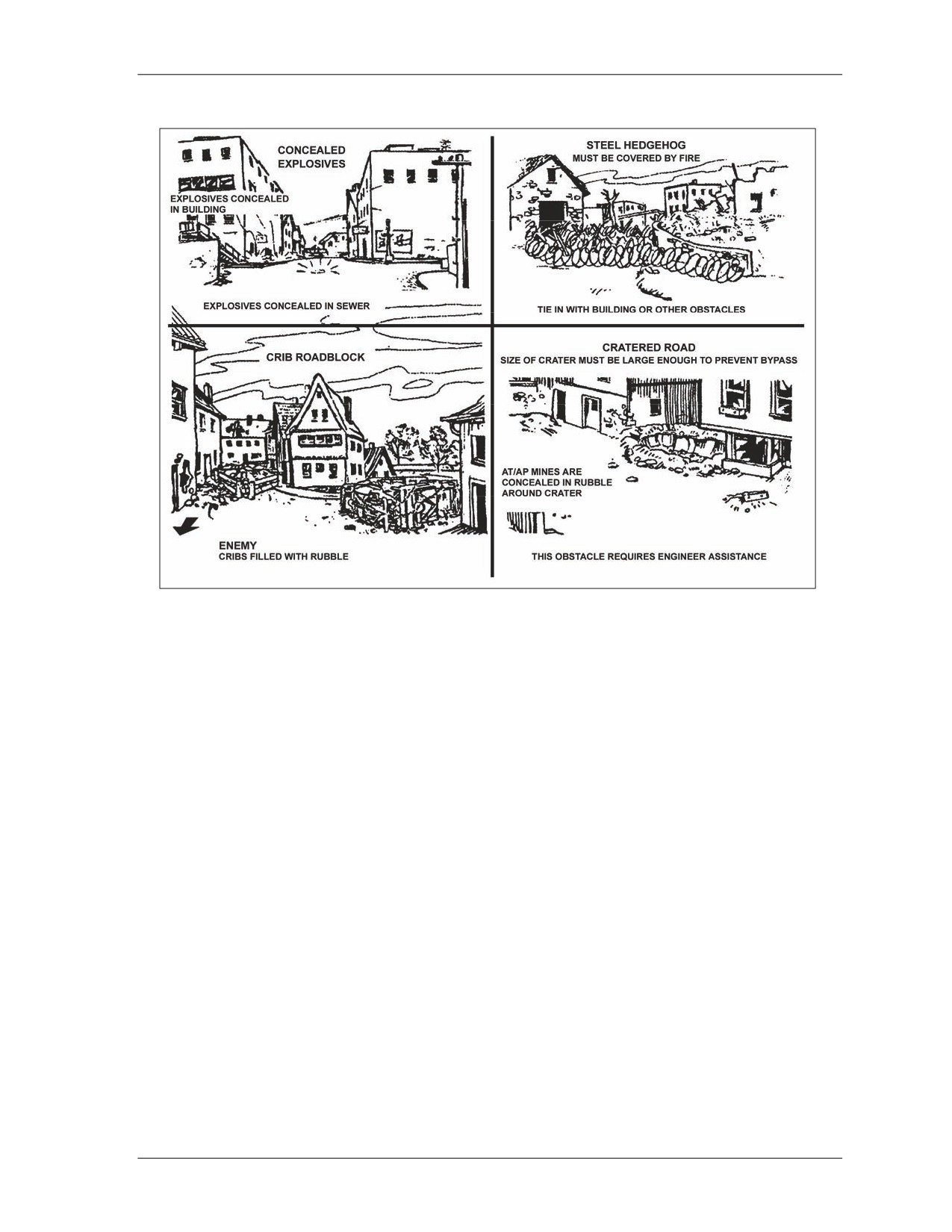
especially when restrictive ROE are in effect. Indirect fires must be fired in greater mass to
achieve the desired effect.
y The rubble caused by massive indirect fires adversely affects a unit's mobility during the attack.
y The commander and leaders consider the effect that city lights, fires, and background
illumination have on NVDs. These elements may limit the effectiveness of NVDs and make
thermal imagery identification difficult.
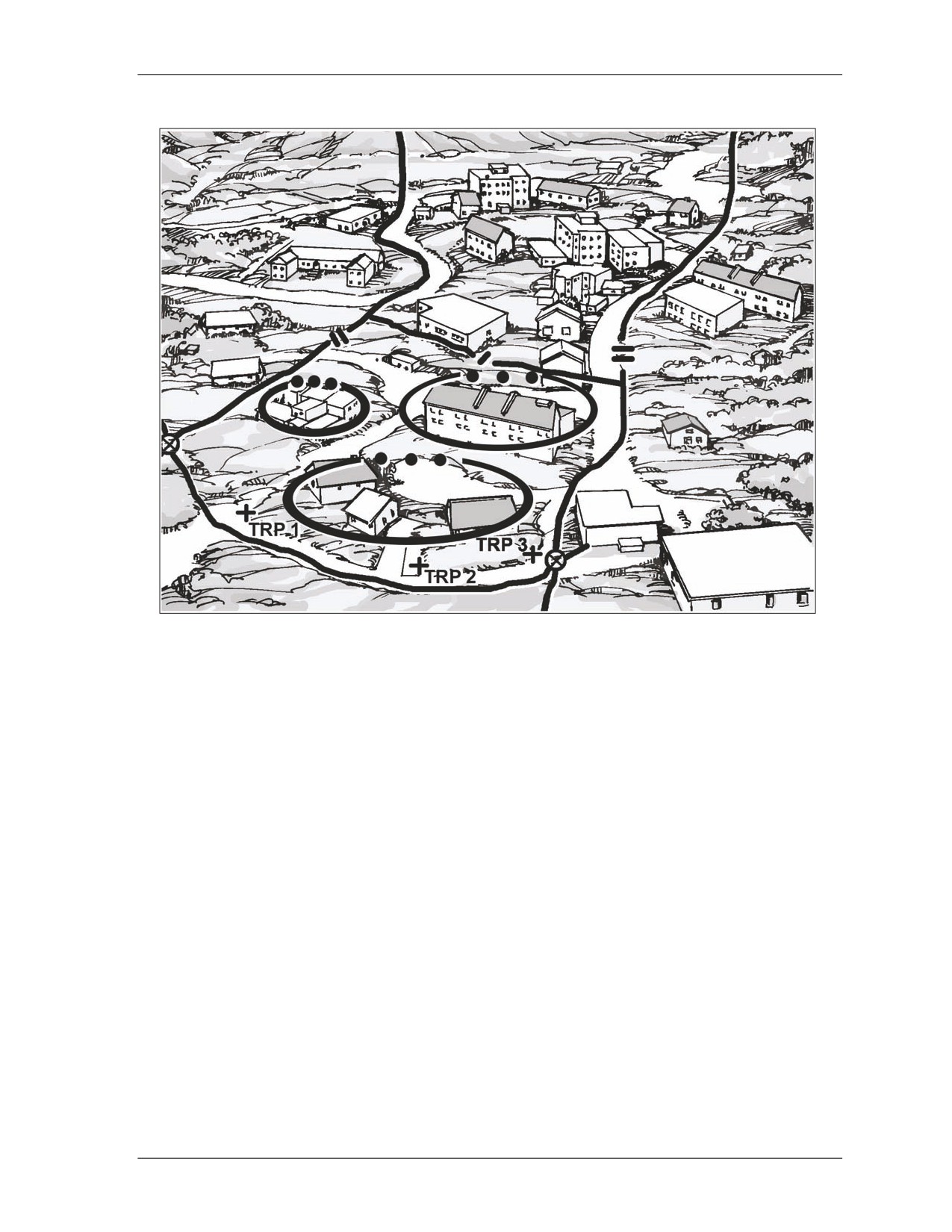
y Communications equipment may not function to its maximum effectiveness because of the
density in building construction. Therefore, execution of the operation relies on all Soldiers
understanding the plan and actions being event driven, rather than waiting for instructions.
METT-TC FACTORS
12-132. The Infantry company commander's analysis of the METT-TC factors is critical for successful
planning and execution during UO.
MISSION
12-133. The Infantry company commander must receive, analyze, and understand the mission before he
begins planning. He and his troops must clearly understand the conditions of the operation and the ROE.
The company commander must fully analyze, understand, and apply the effects of civilians and non
combatants on the battlefield. The company commander might be required to conduct different missions
simultaneously.
27 July 2006
FM 3-21.10
12-31
Chapter 12
Common Missions
12-134. Infantry companies should expect to receive similar types of offensive missions in urban terrain
that they receive in other terrain. The following are common company missions in urban combat.
Isolate an Urban Objective
12-135. The Infantry company normally conducts this mission as part of a battalion. The Infantry
company deploys its platoons to secure the area around or near a building, block, or village in order to kill
or capture any withdrawing enemy forces and prevent reinforcement of (or a counterattack against) the
objective. Engineers or other CS and sustainment assets may reinforce the company based on the ROE and
METT-TC factors. In view of the fact that many casualties might be inflicted on friendly units moving
between buildings or down streets, this mission takes on significant importance.
Assault a Building
12-136. Infantry companies normally conduct this mission as part of a battalion operation when the
building is too large for a platoon to assault and clear, and the enemy defending the building employs a
force larger than a platoon does. The company isolates the building, gains a foothold, and clears the
building. The battalion commander normally helps by directing another Infantry company (or other
companies) to isolate the building. Engineers or other CS and sustainment assets usually reinforce the
Infantry company consistent with the ROE and the METT-TC factors.
Attack a Block or Group of Buildings
12-137. Infantry companies may attack a block or group of buildings. Again, the company normally
conducts this mission as part of a battalion operation. If the company attacks a block as part of a battalion
operation, it might be the battalion's main or shaping operation. Another friendly unit may isolate the
objective, or the company may find that it must isolate the objective area in whole, or in part. If an Infantry
company receives the mission to assault a block independently, then the company must isolate the
objective area by itself.
Move to Contact
12-138. Infantry companies in UO may move through urban terrain in order to gain and maintain contact
with the enemy. This mission typically includes movement (often rapid) through an urban area to develop
the situation by seizing or clearing blocks and buildings.
Conduct Hasty Attack of a Village
12-139. Infantry companies may conduct a hasty attack of a village either independently or as part of an
Infantry battalion operation. Normally, the purpose of this mission is to reduce enemy control of a position
and facilitate movement for other operations.
Seize Key Urban Terrain
12-140. Infantry companies can seize key terrain to give friendly forces an advantage. Key terrain can
include, among other things, overpasses, building complexes, traffic circles, surrounding natural terrain, or
bridges. The Infantry company usually seizes key urban terrain independently either to facilitate its own
movement or to support other operations.
Raid
12-141. Infantry companies plan urban raids much as they do other raids. Objectives might be in built-up
areas, which would require the company to move through urban and other terrain in order to arrive at the
12-32
FM 3-21.10
27 July 2006
Urban Operations
objective. Although the company may conduct a raid independently, it could also do so in support of a
battalion area raid.
Analysis of Mission
12-142. When conducting his analysis, the Infantry company commander considers his battalion
commander's intent and the end state of the operation. For example, the company commander must
determine if clearance means every building, block by block (systematic clearance), or if the seizure of key
terrain requires clearing only along the axis of advance (selective clearance). The company commander
must also consider how and where the company must be postured in order to conduct follow-on missions
and to facilitate the battalion and brigade missions. This influences the missions he assigns to his platoon
and attached element leaders.
12-143. When the company is involved in clearing operations, bypassing buildings increases the risk of
attack from the rear or flank unless planned support isolates and suppresses those buildings. Normally, the
clearing platoons must not only clear each building in the company's zone but also leave security behind to
prevent enemy reoccupation of buildings. This may not be feasible due to the nature of the mission, but if it
is part of the plan, it should be made clear to the platoon leaders when orders are issued.
12-144. The engagement can transition quickly from precision to high intensity conditions, a transition
that might be caused by enemy actions. An assault against a deliberate, prepared defense with obstacles
becomes high intensity. Indications of an enemy-forced change of engagement criteria (and a change from
precision conditions to high intensity) include--
y The requirement to breach multiple obstacles.
y The use of booby traps by the enemy.
y The requirement to use repetitive explosive breaching to enter a building.
y Rooms that are so well prepared or barricaded that normal movement and clearing techniques
cannot be employed.
Movement
12-145. Moving from building to building or between buildings presents a challenge to platoons.
Historical examples have shown that many casualties occur during movement from building to building
and down streets. Therefore, Infantry company commanders plan operations in a manner that allows
subordinate elements to take maximum advantage of covered and concealed routes within the urban area.
Also, company commanders must carefully analyze which buildings must be isolated, suppressed, and
obscured, consistent with the ROE. If working with heavy units, they may use any available tanks and
BFVs as shields for maneuvering platoons.
Coordination of Fire Support
12-146. Most fire support coordination occurs at battalion level to take into account the ROE. Prior
coordination determines the techniques and procedures to use for communicating, identifying targets, and
shifting fires. The company FSO is extensively involved in this portion of the planning process. The
company plans fires consistent with the ROE, considering civilians, houses of worship, medical centers,
schools, public services, and historical monuments.
ENEMY
12-147. Key factors that affect the Infantry company commander's analysis are what phase of the OE
(regional, transitional, or adaptive) are enemy forces operating in, the type of enemy force that is expected
in the urban area, the enemy's probable courses of action, and the ROE. More restrictive ROE support the
defender; less restrictive ROE support the attacker. The type of threat is one factor used to determine how
the company should be task-organized and how combat power should be synchronized to accomplish the
mission. For example, if the company has the mission to secure a water treatment facility that is determined
27 July 2006
FM 3-21.10
12-33
Chapter 12
to be key terrain, the commander needs to consider possible threats to the facility that may not be direct
force-on-force actions.
Conventional Forces and Regional or Transitional Operations
12-148. Many third world countries have adopted techniques of urban combat from either the United
States or the Commonwealth of Independent States. Therefore, a future threat might consider the motorized
or mechanized rifle battalion the most effective unit for urban combat due to its mobility, armor protection,
and ability to adapt buildings and other structures for defense quickly. In countries whose forces are
equipped and trained as in the former Warsaw Pact, standard urban defenses include--
y Threat defenses that are organized into two echelons to provide greater depth and reserves.
y Company strongpoints are prepared and form the basis for the battalion defensive position.
y The reserve is located in a separate strongpoint.
y Ambush locations are established in the gaps of the strongpoints, and dummy strongpoints are
constructed to deceive the attacker.
y Positions for securing and defending the entrances to and exits from underground structures
and routes are established.
y Security positions are prepared forward of first echelon defensive positions.
y A motorized or mechanized rifle company may defend several buildings or a single large
building with mutually supporting fires.
y Each platoon defends one or two buildings, or one or two floors of a single building.
12-149. In many third world countries, the forces are predominantly light with some outdated armored
vehicles. Some countries may not have actual armed forces but have some form of armed militia(s). These
forces normally do not fight a defense in the former Warsaw Pact style, but rather offer uncoordinated
resistance, often extremely intense, as experienced in Somalia.
Unconventional Forces and Adaptive Operations
12-150. Enemy analysis of unconventional forces during adaptive operations is similar to that for low
intensity conflict during urban counterinsurgency, counterguerrilla, and counterterrorist operations.
(See Chapter 2, FM 3-06.11, for more on conventional and unconventional threat analysis in UOs.)
TERRAIN
12-151. Offensive operations are tailored to the urban environment based on an analysis of each urban
terrain setting, its types of built-up areas, and existing structural forms. Commanders and subordinate
leaders incorporate the following special planning considerations for an urban environment when
conducting an offensive operation.
y Military maps may not provide enough detail for urban terrain analysis nor reflect the
underground sewer system, subways, underground water system, mass transit routes, and utility
facilities. When available, the commander uses building or city plans, engineering prints, aerial
photographs, tourist maps, or other aids that may assist him in his analysis of the terrain.
y Natural terrain surrounding the built-up area.
y Key and decisive terrain such as intersections, building that dominate the AOs, and entrances to
subsurface avenues that allow covered repositioning of forces.
y Construction and structural composition of buildings.
y Confined spaces that limit observation, fields of fire, maneuver, or prevent the concentration of
fires at critical points.
y Covered and concealed routes to and within the built-up area.
y Limited ability to employ maximum fire power due to the need to minimize damage and
rubbling effects (based on ROE).
12-34
FM 3-21.10
27 July 2006
Urban Operations
y Challenges with conducting effective reconnaissance during conventional regional and
transitional operations. During operations in the adaptive phase of a conflict or operations
under restrictive ROE, the opposite is true. Reconnaissance and security are more easily
accomplished by both sides and are more difficult to prevent.
y ROE that limits the use of firepower.
y Significant numbers of civilians who might have to be evacuated, some forcibly. Civilians may
hinder operations on purpose or merely operations by their presence.
TROOPS AVAILABLE
12-152. An Infantry company normally participates in an attack as part of an attacking battalion.
Consideration is given to the mission and the assets available to accomplish the mission. The commander
makes a determination of whether he has enough of the proper assets to be successful. If available, towed
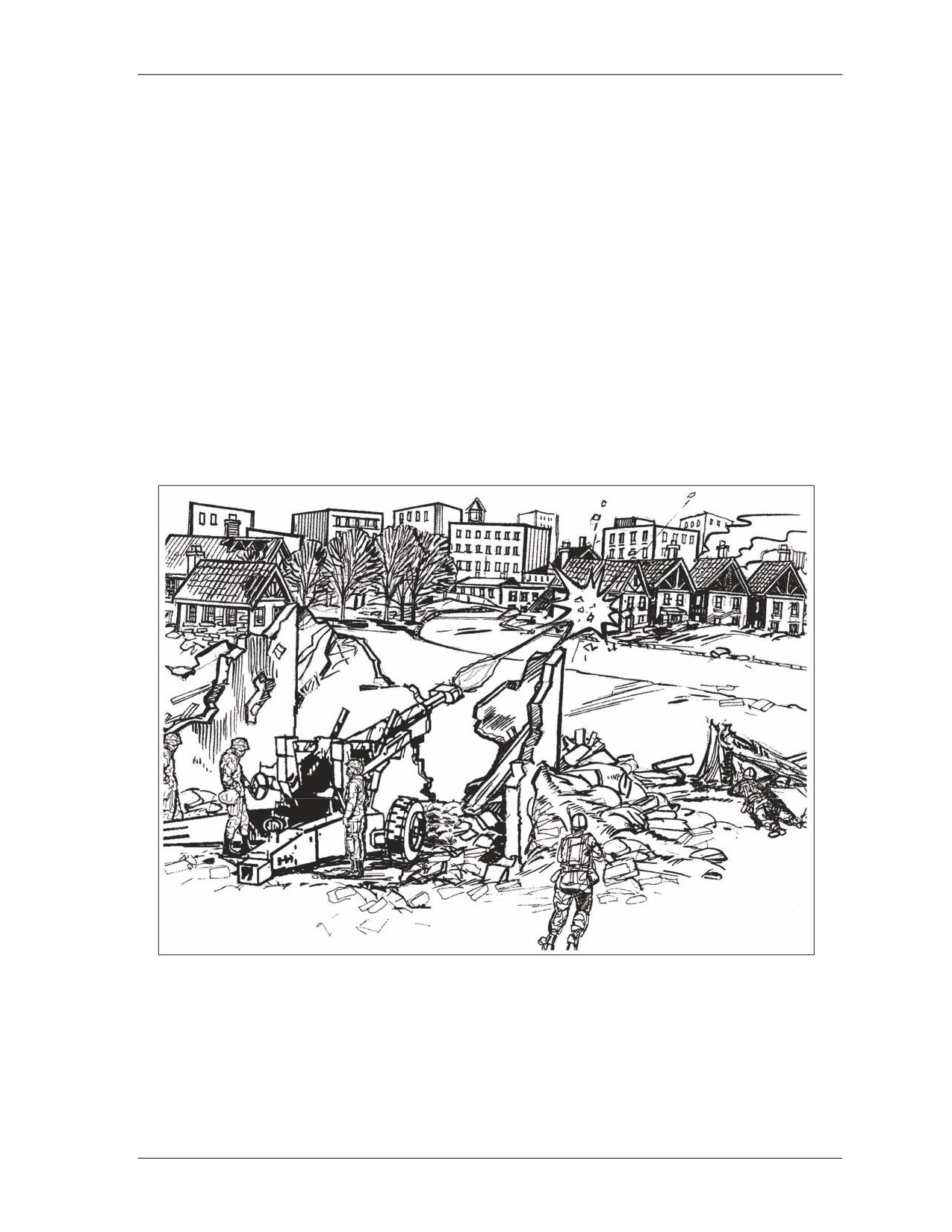
105-mm howitzers can use direct fire to destroy bunkers, heavy fortifications, or enemy positions in
reinforced concrete buildings (Figure 12-8). The towed 105-mm howitzer may also clear or create an
avenue of approach. Whenever artillery is used in the direct-fire role, it must be close to the Infantry
providing security against enemy ground attack. Prior coordination is necessary so the bulk of the field
artillery unit's shells are HE.
Figure 12-8. Artillery in direct-fire role.
TIME
12-153. Offensive operations in built-up areas have a slower pace and operational tempo. Consider the
following issues when analyzing time available for an attack in urban terrain.
y Time to prepare.
y Movement rates.
27 July 2006
FM 3-21.10
12-35
Chapter 12
y Time needed to clear a building.
y Impact of slower movement rates and time to accomplish tasks on the synchronization of
supporting assets.
12-154. Plan additional time to recover from fatigue. Troops tire more quickly because of stress and the
additional physical exertion related to clearing urban terrain.
12-155. Allow additional time for thorough reconnaissance and rehearsals in order to prevent excessive
casualties and fratricide.
CIVIL CONSIDERATIONS
12-156. Civil considerations have been discussed in detail in chapter 2. They include the influences of
man-made infrastructure, civilian institutions, and the attitudes and activities of civilian leaders,
populations, and organizations within an AO, with regard to the conduct of military operations. These
considerations, regardless of the environment should be analyzed and planned for, especially in the urban
environment where the civilians are such a critical component of how an urban area works. Civil
considerations of the urban environment can either help or hinder friendly or enemy forces. Leaders must
understand the impact of their actions--as well as their subordinate’s actions--on the civilian population,
and the effect they will have on current and future operations.
COMMAND AND CONTROL
12-157. Units in built-up areas frequently fight separated and isolated from one another. Planning is
centralized, but execution is decentralized. Therefore, the commander must clearly describe his vision of
the terrain and the enemy to his platoon and squad leaders. In all situations, leaders position themselves
where they can control the action and assist subordinate leaders. This is difficult in urban terrain due to
obstacles, poor visibility, difficulty in communications, and the intensity of urban combat. Infantry
commanders must demand timely, accurate, and complete reporting.
COMMAND
12-158. Infantry commanders issue orders and develop control measures to facilitate decentralized
execution. Increased difficulties in command, control, and communications from higher headquarters
demand increased responsibility and initiative from subordinate leaders. Graphic control measures common
to other tactical environments are also used in combat in built-up areas. These and other control measures
ensure coordination throughout the chain of command.
CONTROL
12-159. Thorough rehearsals and briefbacks enhance control. Subordinate leaders must clearly understand
the commander's intent (two levels up) and desired mission end state in order to facilitate control. Infantry
company commanders should consider using subordinate leaders to control certain portions of the fight
when the commander's attention needs to be focused elsewhere, for example, using the XO to control the
support element while the commander controls the assault elements.
Communications
12-160. In built-up areas, radio and FBCB2 communications are often less effective than field telephones
and messengers. Communications equipment may not function properly because of the materials used in
the construction of buildings and the environment. Wire laid at street level is easily damaged by rubble and
vehicle traffic. Pyrotechnic signals are hard to see because of buildings and smoke. The high noise level of
engagements in and around buildings makes sound signals and voice alerts difficult to hear. Besides, voice
communications can signal the unit's intent and location to the enemy. Line-of-sight (LOS) limitations
affect both visual and radio communications. Therefore, the time needed to establish an effective
communications system might be greater in an urban environment. Leaders consider these effects when
12-36
FM 3-21.10
27 July 2006
Urban Operations
they allocate time to establish communications. Since the effectiveness of normally dependable
communications might be uncertain in UO, units may fight without continuous communications.
Graphic Control Measures
12-161. Graphic control measures are used to convey intent and control the operation. This paragraph
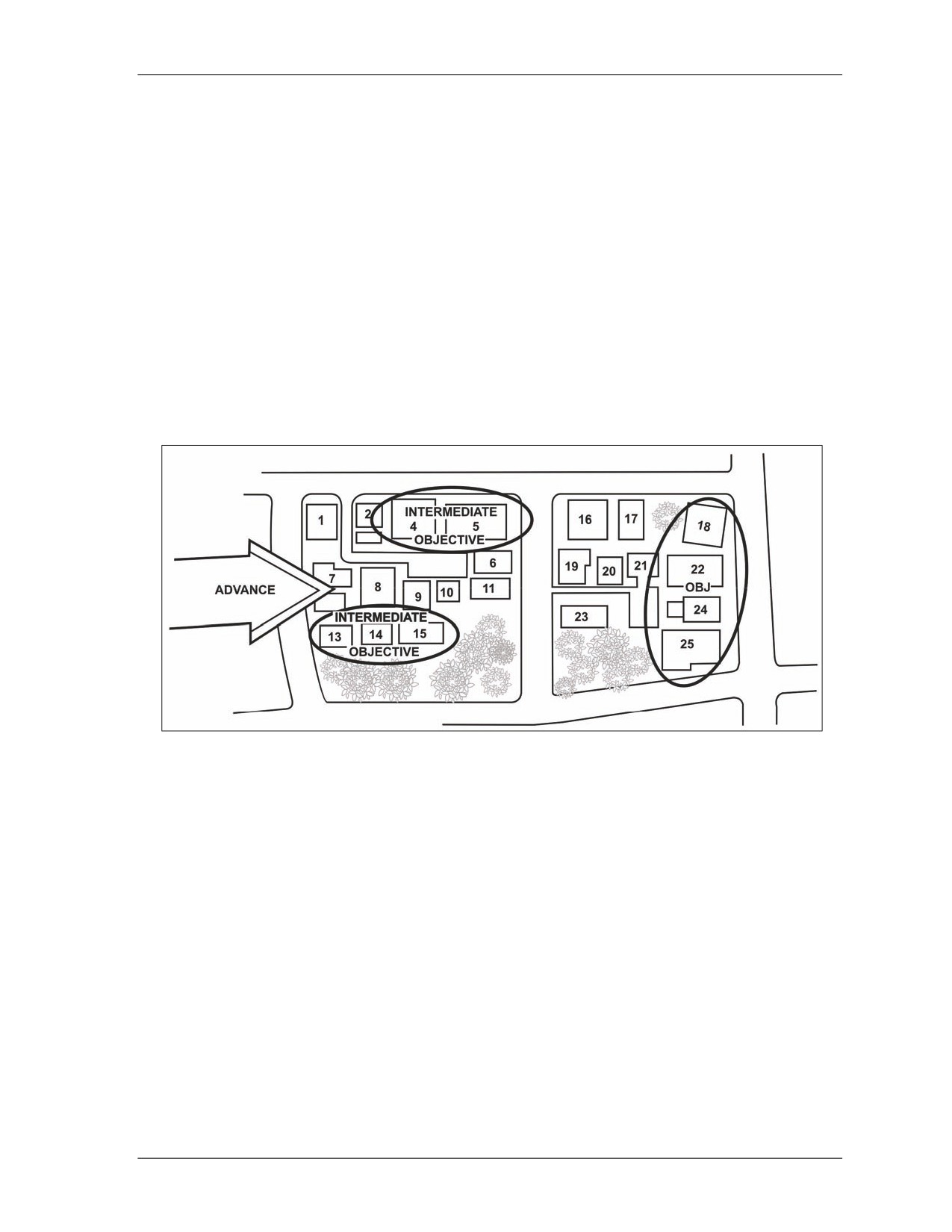
describes some considerations for using graphic control measures in UO.
12-162. Use numbers to identify buildings. When attacking to seize a foothold, the Infantry company
normally assigns a building or a few small buildings as a platoon's objective. When an objective extends to
a street, only the near side of the street is included in the objective area. Key buildings or groups of
buildings may also be assigned as intermediate objectives. To simplify assigning objectives and reporting,
buildings along the direction of attack should be identified. An example using numbers is shown in
Figure 12-9. Floors can be lettered in order to identify them. A possible method is to letter the ground floor
A (Alpha), second floor B (Bravo), and so on. Then, referencing a particular location is easier. For
instance, the third floor in Building 5 would be referred to as 5C.
Figure 12-9. Example numbering system.
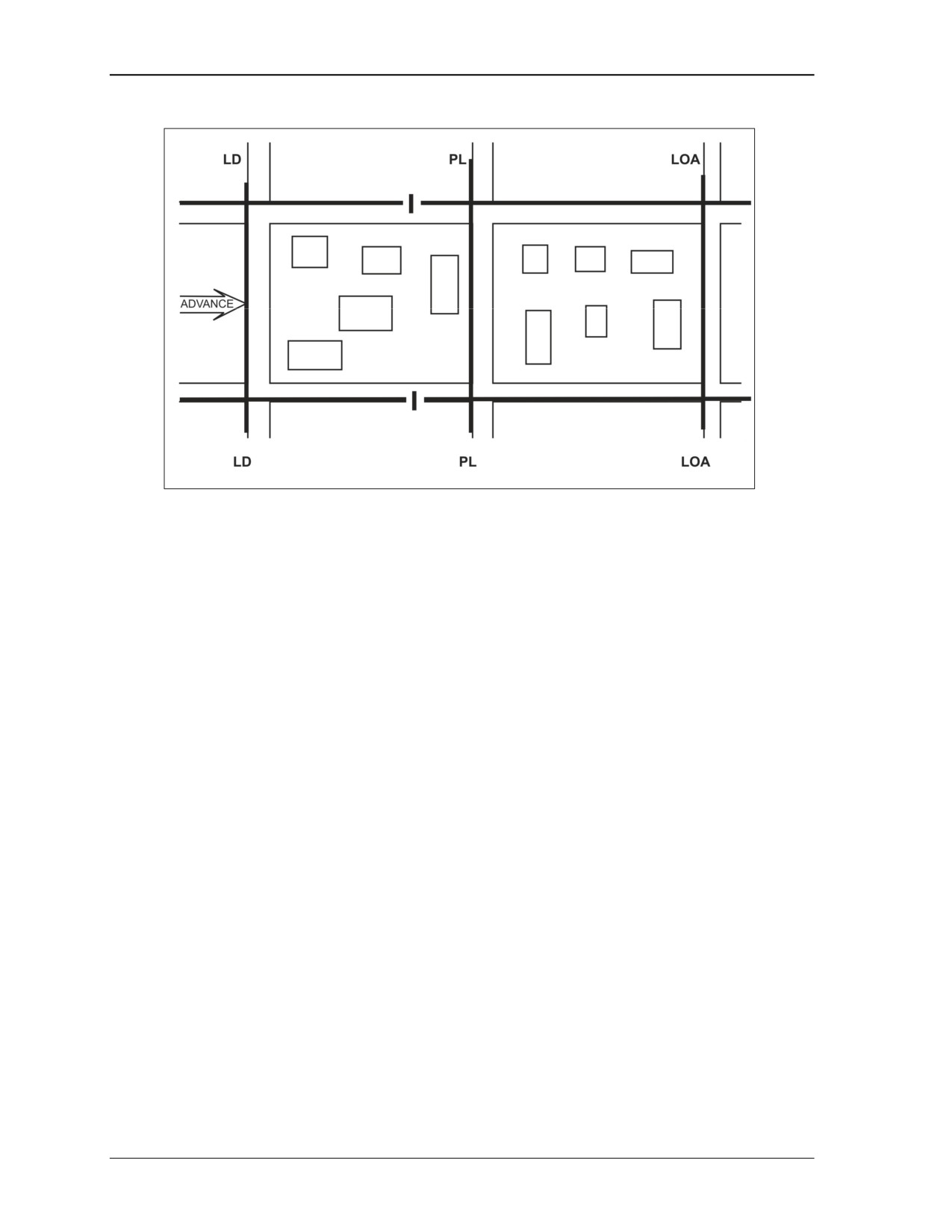
12-163. Phase lines can be used to report progress or to control the advance of attacking units
(Figure 12-10). Principal streets, rivers, and railroad lines are easily identifiable and are suitable phase
lines. Phase lines are shown on the near side of the street or open area. In systematic clearing, a company
may have the mission to clear its zone up to a phase line. In that case, the company commander chooses his
own objectives when assigning missions to his subordinate units.
27 July 2006
FM 3-21.10
12-37
Chapter 12
Figure 12-10. Zones, boundaries, and phase lines.
12-164. Set company boundaries within blocks, so that it is clear whether streets are included in a
company zone. Ensure that both units understand which has responsibility for the street itself. To facilitate
command and control, try to place boundaries to ensure both sides of a street are in the zone of one unit.
12-165. Plan checkpoints and contact points at street corners, buildings, railway crossings, bridges, or any
other easily identifiable urban feature.
12-166. Forward units may occupy an attack position for last-minute preparation and coordination. The
attack position is often behind or inside the last covered and concealed position, such as a large building,
before crossing the LD. The LD should be the near side of a street or rail line.
12-167. A unit's assigned frontage for the attack of a built-up area depends on the size of buildings and the
resistance anticipated. Based on city blocks averaging 175 meters wide, a company normally attacks on a
one- to two-block front. A battalion attacks on a two-to four-block front.
TASK ORGANIZATION INTO THREE ELEMENTS
12-168. The Infantry company commander normally task-organizes his company into three elements: an
assault force, a support force, and a reserve. In UOs, all elements must be prepared to breach. The support
force might be given a number of tasks to conduct sequentially or simultaneously. Specifically, the support
force may support by fire, isolate the objective, or breach. The tactical situation dictates whether separate
elements need to be task-organized in order to conduct these support missions. If available, engineers
usually support the force performing a breach. The size and composition of the force are determined by
METT-TC. If the company is part of a battalion operation, the company may have the mission to conduct
one or more of the tasks mentioned above. If conducting an urban attack independently, the Infantry
company must perform both assault and support force tasks.
ASSAULT FORCE
12-169. The purpose of the assault force is to destroy the enemy, capture the enemy, or force the
withdrawal of the enemy from any urban objective. The assault force of an Infantry company may consist
12-38
FM 3-21.10
27 July 2006
Urban Operations
of two or more Infantry platoons usually reinforced with engineers. Building clearing and room clearing
are normally conducted at platoon and squad levels. The assault force may also conduct a breach.
SUPPORT FORCE
12-170. The purpose of the support force is to provide any support that might be required by the assault
force. The support force at the Infantry company level normally consists of the company's organic assets,
such as Infantry platoons, mortars, and weapons squads; its attachments; and units that are under the
OPCON of the company commander. The support force must be prepared to breach. This assistance
includes, but is not limited to--
y Suppressing or obscuring the enemy within the objective building(s) and adjacent structures.
y Isolating the objective building(s) to prevent enemy withdrawal, reinforcement, or
counterattack.
y Breaching walls en route to and in the objective structure.
y Destroying or suppressing enemy positions with direct fire weapons.
y Securing cleared portions of the objective.
y Providing resupply of ammunition, explosives, and personnel.
y Evacuating casualties, EPW, and civilians.
RESERVES
12-171. Infantry companies fighting in urban terrain should designate a reserve when feasible. The
company reserve should be mobile and prepared for commitment. Because of the available cover in
built-up areas, the reserve can stay close to forward units. The reserve follows within the same block so
that it can immediately influence the attack. Platoons might be detached from the company to form a
battalion reserve. The reserve force should be prepared to breach. A unit with a reserve mission might be
called upon to perform one or more of the following tasks.
y Assume the mission of the assault force.
y Attack from another direction.
y Exploit an enemy weakness or friendly success.
y Clear bypassed enemy positions.
y Secure the rear or a flank.
y Maintain contact with adjacent units.
y Support or counterattack by fire.
BREACHING ELEMENT
12-172. At the Infantry company level, the assault, support, or reserve force may conduct breaching.
However, a separate breaching force might be created, or platoons might be given this task and organized
accordingly. The purpose of breaching is to provide the assault force with access to an urban objective,
using explosive, ballistic, or mechanical methods. Explosive breaching includes using nonelectrical
demolition systems; ballistic breaching includes using direct fire weapons; and mechanical breaching
includes using crowbars, axes, saws, hooligan’s tools, and sledgehammers. Attached engineers or members
of the company who have additional training in explosive, ballistic, and mechanical breaching techniques
may conduct the breach.
MOVEMENT
12-173. When moving in built-up areas (BUAs), an Infantry company follows the same fundamentals and
principles and uses the same movement techniques as in other areas. Enemy actions against the company
might consist of ambushes on the street, enfilade fire down the streets, sniper fire, fire from rooftops and
27 July 2006
FM 3-21.10
12-39
Chapter 12
from within buildings, or artillery or mortar fire. The company can minimize the effects of enemy
defensive fires during movement by--
y Using covered routes (moving through buildings).
y Moving only after defensive fires have been suppressed or obscured.
y Moving at night or during other periods of limited visibility.
y Selecting routes that will not mask friendly suppressive fires.
y Crossing open areas (streets and spaces between buildings) quickly under the concealment of
smoke with suppression provided by support forces.
y Moving on rooftops that are not covered by enemy direct fires.
y Using the concealment provided by shaded areas.
y Using cover provided by attached armored vehicles.
y Creating deceptions.
y Using suppressive fires on known or suspected enemy positions, as allowed by ROE.
Movement Down Streets
12-174. Should the situation allow or require movement down a street, platoons move in file along one or
both sides of the street with overwatching fires from supporting weapons. Individual Soldiers disperse,
move quickly, and observe and cover certain areas as detailed, for example, second-floor windows on the
opposite side of the street. As in all urban situations, platoons must search for defenders all-round and in
all three dimensions (front, flanks, rear, upper stories, basements, and rooftops).
Speed of Movement
12-175. The speed of movement depends on the type of operation, terrain, and degree of enemy resistance.
As in any other terrain, speed and security are trade-offs: the faster the unit moves, the less secure the
movement. Slowing down allows for improved security.
12-176. In lightly defended areas, the mission or the "need for speed" can mean moving through the streets
and alleys without clearing all buildings in order to reach and secure key terrain. More importantly, the
company commander must establish and enforce the tempo of the operation.
Danger Areas
12-177. As in any other type of terrain, the company avoids danger areas if possible. Unlike in other
terrain, almost everything is a potential danger area in urban terrain. Types of urban danger areas include,
among others--
y Open areas.
y Parking lots and garages.
y Intersections.
y Streets, alleys, and roadways.
y Traffic circles and cul-de-sacs.
y Bridges, overpasses, and underpasses.
y Subterranean areas.
y Rooftops.
y Areas where large numbers of civilians gather.
12-40
FM 3-21.10
27 July 2006
Urban Operations
DELIBERATE ATTACK
12-178. At the company level, a deliberate attack of an urban area usually involves the sequential
execution of the following.
RECONNOITER OBJECTIVE
12-179. This involves making a physical reconnaissance of the objective with company assets and those of
higher headquarters, as the tactical situation permits. It also involves a map reconnaissance of the objective
and all the terrain that affects the mission, to include the analysis of aerial imagery, photographs, or any
other detailed information about the building or other urban terrain, for which the company is responsible.
Also, any human intelligence (HUMINT) collected by reconnaissance and surveillance units, such as the
battalion reconnaissance platoon, snipers, is considered during the planning process.
MOVE TO OBJECTIVE
12-180. Movement is made rapidly without sacrificing security. Movement is along covered and
concealed routes and can involve moving through buildings, down streets, subsurface areas, or a
combination of all three. Urban movement must take into account the three-dimensional aspect of the urban
area.
ISOLATE OBJECTIVE
12-181. Isolating the objective involves seizing terrain that dominates the area so that the enemy cannot
supply, reinforce, or withdraw its defenders. Companies might be required to isolate an objective as part of
a battalion operation or might be required to do so independently.
SECURE A FOOTHOLD
12-182. Securing a foothold involves seizing an intermediate objective that provides cover from enemy
fire and a location for attacking troops to enter the urban area. The size of the foothold is METT-TC
dependent and is usually a company intermediate objective. In some cases, a large building might be
assigned as a company intermediate objective (foothold). As the company attacks to gain a foothold, it
should be supported by suppressive fire and smoke.
CLEAR AN URBAN AREA
12-183. Before determining how much to clear the urban area, leaders must consider the factors of
METT-TC. The ROE influence the tactics, techniques, and procedures (TTP) that platoons and squads
select as they move through the urban area and clear individual buildings and rooms. The two categories of
clearing urban areas are selective and systematic.
Selective Clearing
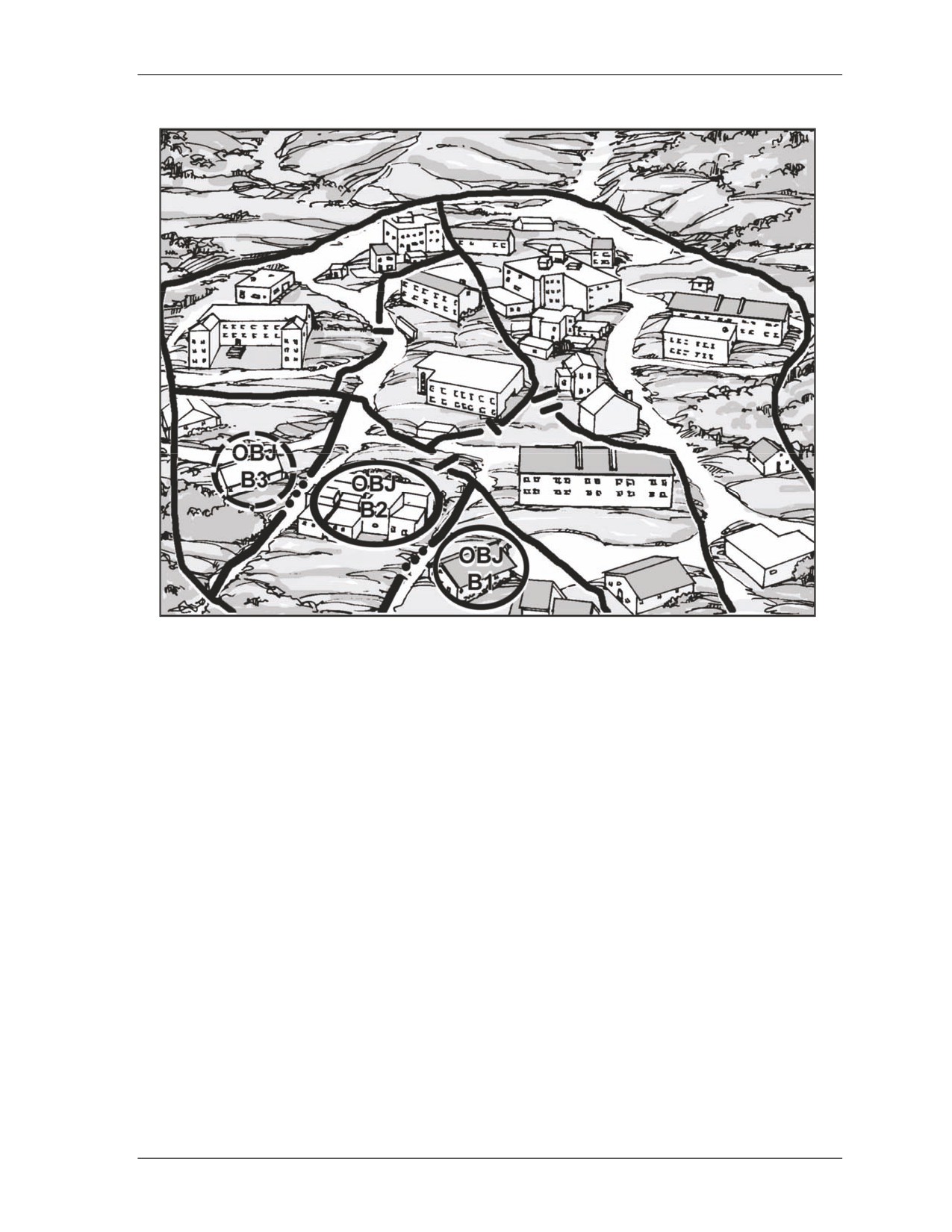
12-184. The commander may decide to clear only those parts necessary for the success of his mission if--
y An objective must be seized quickly.
y Enemy resistance is light or fragmented.
y The buildings in the area have large open areas between them. In this case, the commander
would clear only those buildings along the approach to his objective or only those buildings
necessary for security (Figure 12-11, page 12-43).
Systematic Clearing
12-185. An Infantry company may have a mission to clear an area of all enemy forces systematically.
Through detailed analysis, the commander may anticipate that he will be opposed by a strong, organized
27 July 2006
FM 3-21.10
12-41
Chapter 12
resistance or will be in areas having strongly constructed buildings that are close together. Therefore, one
or two platoons may attack on a narrow front against the enemy's weakest sector. They move slowly
through the area, clearing systematically from room to room and building to building. The other platoon
supports the clearing units and is prepared to assume their mission.
CONSOLIDATE, REORGANIZE, AND PREPARE FOR FUTURE MISSIONS
12-186. Consolidation occurs immediately after each action. Consolidation is security and allows the
company to prepare for counterattack and to facilitate reorganization. In an urban environment, units must
consolidate and reorganize rapidly after each engagement. The assault force in a cleared building must be
quick to consolidate in order to repel enemy counterattacks and to prevent the enemy from infiltrating back
into the cleared building. After securing a floor, selected members of the assault force are assigned to cover
potential enemy counterattack routes to the building. Priority must be given to securing the direction of
attack first. Those Soldiers alert the assault force and place a heavy volume of fire on enemy forces
approaching the building. Reorganization occurs after consolidation. Reorganization actions prepare the
unit to continue the mission; many actions occur at the same time.
Consolidate
12-187. Platoons assume hasty defensive positions after the objective has been seized or cleared. Based
upon their specified and implied tasks, assaulting platoons should be prepared to assume an overwatch
mission and support an assault on another building, or another assault within the building. Commanders
must ensure that platoons guard enemy mouseholes between adjacent buildings, covered routes to the
building, underground routes into the basement, and approaches over adjoining roofs.
Reorganize
12-188. After consolidation--
y Resupply and redistribute ammunition, equipment, and other necessary items.
y Mark the building to indicate to friendly forces that the building has been cleared.
y Move support or reserve elements into the objective if tactically sound.
y Redistribute personnel and equipment on adjacent structures.
y Treat and evacuate wounded personnel.
y Treat and evacuate wounded EPW and process remainder of EPW.
y Segregate and safeguard civilians.
y Reestablish the chain of command.
y Redistribute personnel on the objective to support the next phase or mission.
Prepare for Future Missions
12-189. The company commander anticipates future missions and prepares the company chain of
command for transition.
12-42
FM 3-21.10
27 July 2006
Urban Operations
Figure 12-11. Clearing of selected buildings within sector.
ISOLATION OF URBAN OBJECTIVE
12-190. Infantry companies isolate urban objectives in order to prevent reinforcement of (or counterattack
against) the objective and to kill or capture any withdrawing enemy forces. When planning the isolation,
commanders consider three-dimensional and in-depth isolation of the objective (front, flanks, rear, upper
stories, basements, and rooftops). They employ all available direct and indirect fire weapons consistent
with the ROE. Isolating the objective is a key factor in facilitating the assault and preventing casualties.
The company may perform this mission as the support element for a battalion operation, or it may assign
the task to its own internal support element for a company attack. In certain situations, Infantry companies
may isolate an objective or an area for special operations forces. When possible, the company should
isolate the objective using stealth and rapid movement in order to surprise the enemy. Depending on the
tactical situation, Infantry companies may use infiltration in order to isolate the objective. Likely tasks
include, among others, the following.
BATTALION ATTACK
12-191. An Infantry company may isolate the objective as the support element for a battalion operation.
When an Infantry company has this mission, the objective is normally a larger structure, block, or group of
buildings. The company commander task-organizes his platoons and assigns them sectors of fire based on
the METT-TC factors. In addition to isolating the objective, the company (support element) may have
additional tasks to conduct on order or simultaneously. Examples of these additional tasks include
providing the battalion reserve, assuming assault element missions, handling civilians and EPW, and
performing CASEVAC.
27 July 2006
FM 3-21.10
12-43
Chapter 12
COMPANY ATTACK
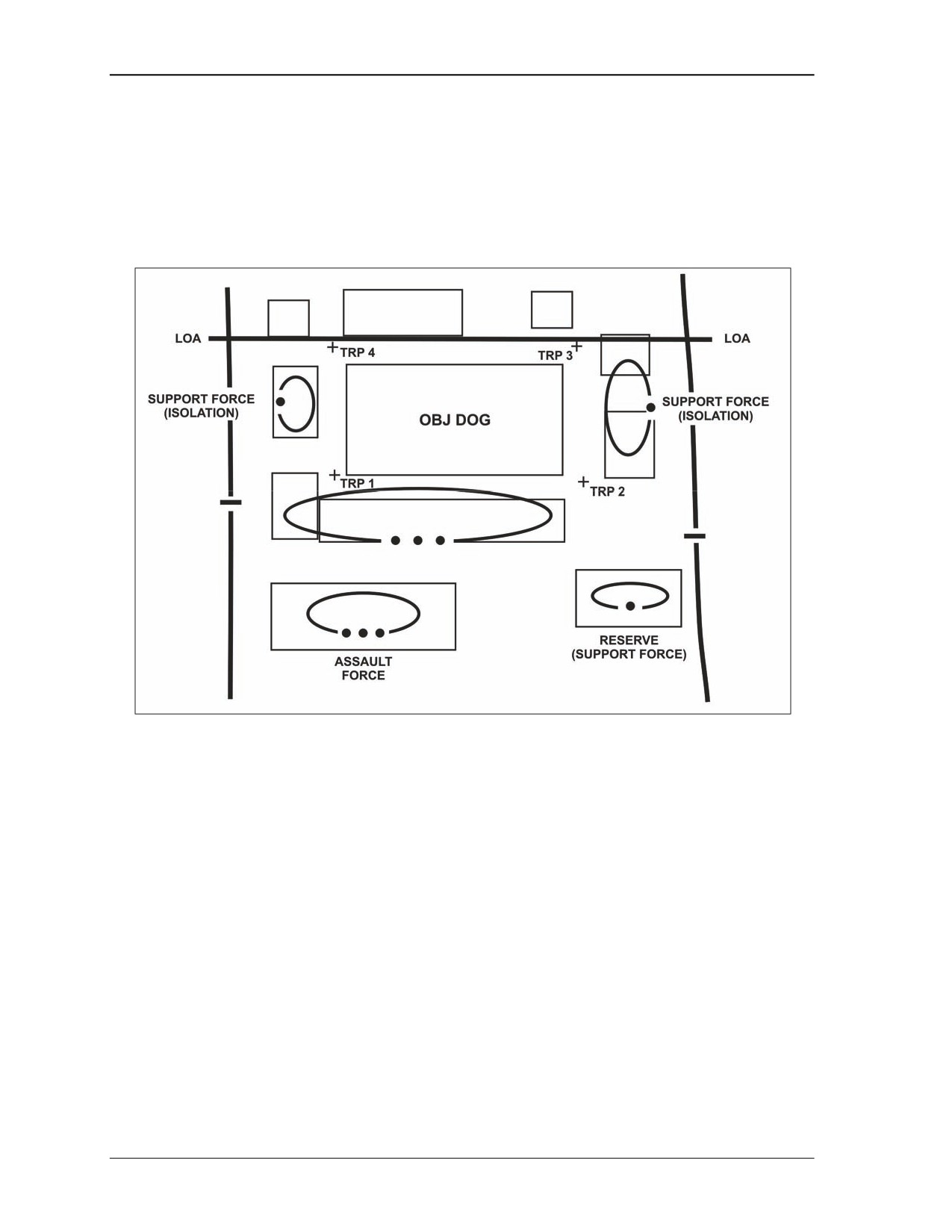
12-192. When an Infantry company conducts an attack, the task organization and tasks given to the
company support element are determined by the METT-TC factors. If the company conducts a company
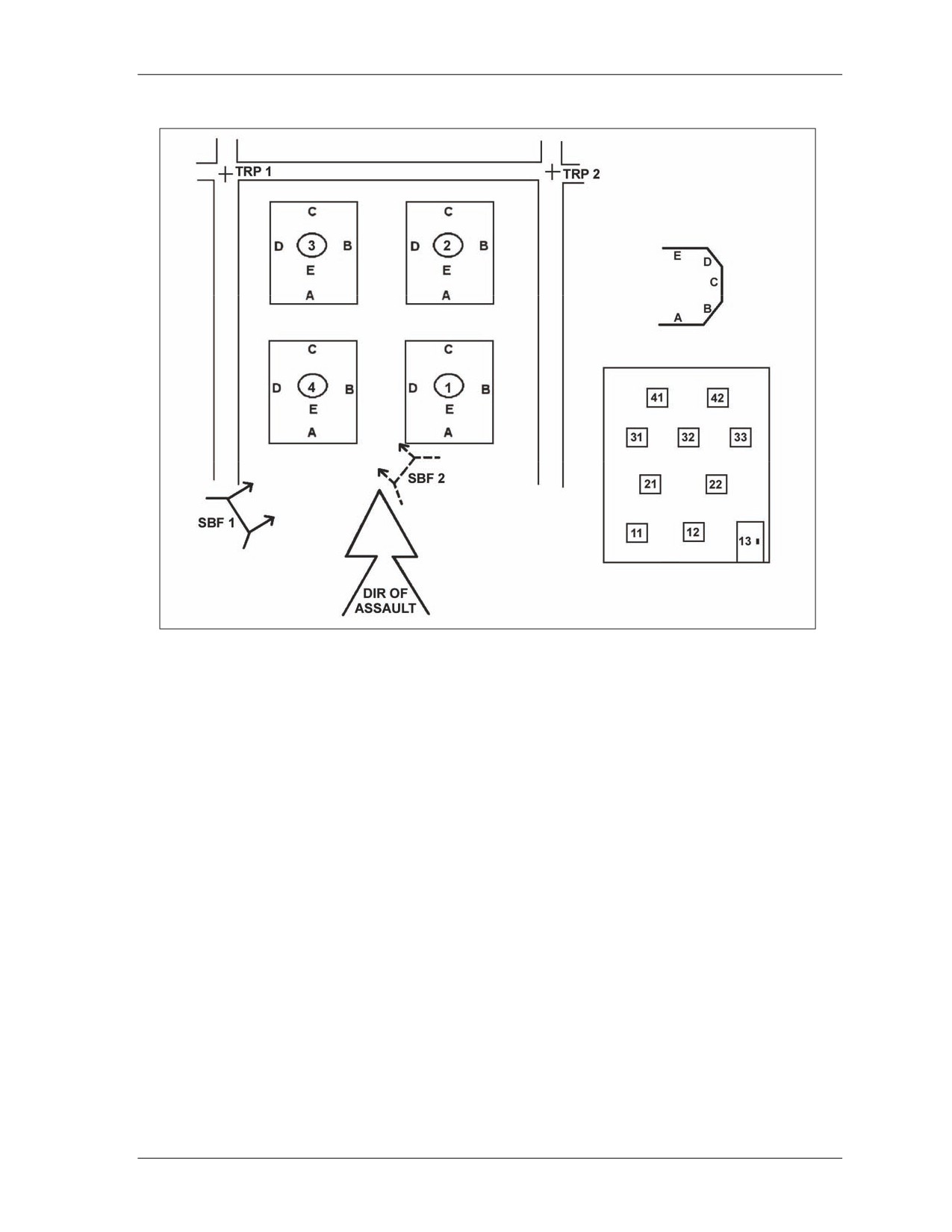
attack, the objective can be a building(s), block, traffic circle, or village (Figure 12-12). Figure 12-13,
page 12-45, shows how to control direct fires during the assault.
Figure 12-12. Isolation of an urban objective.
12-44
FM 3-21.10
27 July 2006
Urban Operations
Figure 12-13. Direction-of-attack technique for direct-fire
planning and control.
ASSAULT OF A BUILDING
12-193. The Infantry company conducts this task independently or as part of the assault element of a
battalion.
(Independently is defined here as an Infantry company having to provide its own support
element, as opposed to conducting an operation without flank and rear support such as a raid or ambush.) If
the company is the assault force of a battalion, it most frequently conducts the assault against a large
building defended by a strong enemy force, for example, a reinforced platoon. The company commander
must clearly understand the specified and implied tasks required to accomplish the mission, as well as the
battalion commander's intent and the concept of the operation. This allows the company commander to
task-organize and issue specific missions to his subordinate elements concerning which floors and rooms to
clear, seize, or bypass. As an example, Figure 12-14 shows an Infantry battalion assigned the task of
clearing the objectives in its zone (DOG and CAT). Company B has the task of seizing OBJ CAT. The
company commander has decided to assign an intermediate objective (MOUSE) to 1st Platoon. 3d Platoon
is a supporting element with the task of isolating MOUSE (1st and 2d squads to occupy the positions
indicated) and providing one squad to act as the company reserve (3d squad). 2d Platoon (+) will pass
through 1st Platoon, which will mark a passage lane and seize CAT.
27 July 2006
FM 3-21.10
12-45
Chapter 12
Figure 12-14. Assault of a building.
EXECUTION
12-194. Platoons may trade off with each other to clear alternate floors when clearing a multistory
building. This permits troops to rest after a floor has been cleared. Platoons will most likely need to leave
security on cleared floors and in cleared rooms. This facilitates the passage of another platoon, allowing the
continuation of the assault. The assault element must quickly and violently execute its assault and
subsequent clearing operations. Once it gains the momentum, the assault force must maintain this
momentum to prevent the enemy from organizing a more determined resistance on other floors or in other
rooms. If platoons find rooms, hallways, or stairwells that are barricaded with furniture or where obstacles
have been placed, they should first try to bypass the barricade or obstacle and maintain the momentum of
the attack. If they cannot bypass the barricade or obstacle, they should place security on it, check it for
booby traps, and then reduce it. Subordinate leaders should continue the momentum of the assault.
AMMUNITION AND EQUIPMENT
12-195. METT-TC factors and the ROE determine how the assault element is equipped and armed.
Commanders carefully manage the Soldier's load during the assault. Ammunition, water, special assault
weapons and equipment, and medical supplies are normally the only items carried in the assault. The
assault force carries only a fighting load of equipment and as much ammunition as is practical. (See
Chapter 11, Section II for more on load management.) The battalion and Infantry company trains maintain
control of additional ammunition and equipment not immediately needed by the assault force. An
often-overlooked munition in an urban battle is the light antitank weapon. Soldiers can use these for a
variety of purposes such as suppressing a manned position or supporting a breach into a structure.
Resupply should be pushed to the assault element by the support element.
12-46
FM 3-21.10
27 July 2006
Urban Operations
LOCATIONS
12-196. The assault may begin from the top or bottom of the building.
Top Entry
12-197. Entering at the top and fighting downward is the preferred method of clearing a building. This
method is only feasible, however, when the company can gain access to an upper floor or rooftop by ladder
or from the windows or roofs of adjoining, secured buildings, or by helicopter if enemy air defense
weapons can be suppressed. The company can also gain access to the roof by entering at ground level and
fighting up a stairwell or elevator shaft. They then clear the remainder of the building from the top to
bottom. This will afford the Soldiers a covered and concealed route to the upper floors of the building.
Rooftops are danger areas when surrounding buildings are higher and forces can be exposed to fire from
those buildings. Helicopters should land only on those buildings that have special heliports on the roofs or
on parking garages, but Soldiers can rappel or fast rope onto the roof or dismount as the helicopter hovers a
few feet above the roof. Troops can then breach the roof or common walls. They may use ropes or other
means to enter the lower floors through the holes created. The use of ladders to assault an upper level
should be a last resort.
Bottom Entry
12-198. Entry at the bottom is common and might be the only option available. When entering from the
bottom, breaching a wall (ROE dependant) is the preferred method because doors and windows might be
booby-trapped and covered by fire from inside the structure. If the assault element must enter through a
door or window, it should enter from a rear or flank position. Prior to entering the building, the commander
must ensure the platoons have the capability to create entry points from covered and concealed positions.
SUPPRESSIVE FIRES
12-199. The support force provides suppressive fire while the assault force systematically clears the
building. It also provides suppressive fire on adjacent buildings to prevent enemy reinforcements or
withdrawal. Suppressive fires can consist of firing at known and suspected enemy locations or, depending
on the ROE, only of firing at identified targets, or of returning fire. The support force destroys or captures
any enemy personnel trying to exit the building. The support force must also deal with civilians displaced
by the assault.
CLEARING OF ROOMS
12-200. Clearing platoons carry enough room marking equipment and plainly mark cleared rooms from
the friendly side IAW unit TSOP (Figure 12-15). Markings must be visible to friendly units even if the
operation occurs in limited visibility. The support force must understand which markings will be used and
ensure that suppressive fires do not engage cleared rooms and floors. The commander must know where
the assault teams are and which rooms and floors have been cleared. It is a key command and control
function for the company commander.
27 July 2006
FM 3-21.10
12-47
Chapter 12
Figure 12-15. Example marking SOP.
ATTACK OF BLOCK OR GROUP OF BUILDINGS
12-201. An Infantry company normally attacks a block or group of buildings as part of a battalion attack.
EXECUTION
12-202. Platoon attacks supported by both direct and indirect fires characterize the execution of this
mission. Success depends on isolating enemy positions
(which often become platoon objectives),
suppressing enemy weapons, seizing a foothold in the block, and clearing the block's buildings room
by room.
DIRECT-FIRE WEAPONS
12-203. Machine guns and other direct fire support weapons fire on the objective from covered positions,
consistent with the ROE. These weapons should not be fired for prolonged periods from one position. The
12-48
FM 3-21.10
27 July 2006
Urban Operations
gunners should use a series of positions and displace from one to another to gain better fields of fire and to
avoid being targeted by the enemy. Direct fire support tasks can be assigned as follows.
y Machine guns fire along streets and into windows, doors, mouseholes, and other probable
enemy positions. ROE may restrict firing only to known enemy locations.
y M203 suppress enemy positions.
y Riflemen engage targets of opportunity.
OBSCURATION AND ASSAULT
12-204. Before an assault, the Infantry company commander may employ smoke to conceal the assaulting
platoons. He secures their flanks with direct fire weapons and employment of the reserve, if necessary.
Concealed by smoke and supported by direct fire weapons, an assaulting platoon attacks the first isolated
building. The assault force uses the cover of suppressive fires to gain a foothold. The company commander
must closely coordinate the assault with its supporting fire so that the fire is shifted at the last possible
moment. After seizing the block, the company consolidates and reorganizes to repel a counterattack or to
continue the attack.
CONSOLIDATION AND REORGANIZATION
12-205. Consolidation occurs immediately after each action. Consolidation provides security and allows a
unit to reorganize and prepare for counterattack. In an urban environment, units must consolidate rapidly
after each engagement. The assault force in a cleared building must be quick to consolidate in order to
repel enemy counterattacks and to prevent the enemy from infiltrating back into the cleared building. Many
actions occur simultaneously. After securing a floor, selected members of the assault force cover potential
enemy counterattack routes to the building. Priority must be given to securing the direction of attack first.
Those Soldiers alert the rest of the assault force and place a heavy volume of fire on enemy forces
approaching the building. Reorganization actions prepare the unit to continue the mission.
CONSOLIDATION
12-206. Platoons assume hasty defensive positions once the objective has been seized or cleared. Based
upon their mission, assaulting platoons should be prepared to assume a support by fire position in order to
support an assault on another building or continue the attack with an assault within the building.
Commanders must ensure that platoons guard--
y Enemy mouseholes between adjacent buildings.
y Covered routes to the building.
y Underground routes into the basement.
y Approaches over adjoining roofs.
REORGANIZATION
12-207. Reorganization actions include--
y Resupply and redistribute ammunition.
y Mark the building to indicate to friendly forces that it has been cleared.
y Move support or reserve elements into the objective (if tactically sound).
y Redistribute personnel and equipment on adjacent structures.
y Treat and evacuate wounded personnel.
y Treat and process EPW.
y Segregate and safeguard civilians.
y Reestablish the chain of command.
y Redistribute personnel on the objective to support the next phase or mission.
27 July 2006
FM 3-21.10
12-49
Chapter 12
Note: During evacuation of casualties, the commander must ensure that he does not allow
the evacuation to interfere with his on-going operation. He ensures adequate forces are
maintained to prevent the enemy from successfully counterattacking and reoccupying the
building(s) that the company seized and cleared.
Section VIII. DEFENSE
In a built-up area, the defender takes advantage of inherent cover and concealment afforded by urban terrain.
He also considers restrictions to the attacker's ability to maneuver and observe. By using the terrain and fighting
from well-prepared and mutually supporting positions, a defending force can delay, block, fix, or destroy a
much larger attacking force. The defense of a built-up area is organized around key terrain features, buildings,
and areas that preserve the integrity of the defense and provide the defender ease of movement. The defender
organizes and plans his defense by considering obstacles, AA, key terrain, observation and fields of fire, cover
and concealment, fire hazards, and communications restrictions.
METT-TC FACTORS
12-208. Procedures and principles for planning and organizing the defense of a built-up area are the same
as for other defensive operations. In developing a defensive plan, the defender considers the METT-TC
factors. Planning for the defense of a built-up area is detailed and centralized. Execution is decentralized.
Therefore, the company commander and his subordinate leaders must understand the mission, end state,
and the commanders’ intent two levels up.
Mission
12-209. The Infantry commander may receive the mission as a FRAGO or OPORD. The Infantry
company may defend independently or as part of a larger force. Mission planning is essentially the same
for all defensive operations.
Enemy
12-210. The commander analyzes the type of enemy force he may encounter. If the attacker is mostly
dismounted Infantry, the greatest danger is allowing him to gain a foothold. If the attacker is mostly
armored or mounted motorized Infantry, the greatest danger is that he will mass direct fire and destroy the
defender's positions.
Terrain
12-211. Terrain in built-up areas is three-dimensional: ground level (streets and parks), above ground
(buildings), and below ground (subways and sewers). Analyze all manmade and natural terrain features
when planning to defend on built-up terrain. The type of built-up area in which he will operate affects the
commander's defensive plan. Commanders emphasize obtaining and using all information. The items of
information peculiar to combat in built-up areas include--
y Street, water, and sewer plans.
y Key installations and facilities.
y Key civilians.
y Civilian police and paramilitary forces.
y Sources of food.
y Communications facilities and plans.
y Power stations.
12-50
FM 3-21.10
27 July 2006
Urban Operations
Villages
12-212. Villages are often on choke points in valleys, dominating the only high-speed AA through the
terrain. If the buildings in such a village are well constructed and provide good protection against both
direct and indirect fires, a formidable defense can be mounted by placing a company in the town while
controlling close and dominating terrain with other battalion elements.
12-213. If the terrain allows easy bypass and no other villages are located on defensible terrain within a
mutually supporting distance, defending the village is unwise. Doing so would allow friendly forces to be
easily bypassed or isolated.
12-214. Commanders may use villages on approaches to large towns or cities to add depth to the defense
or to secure the flanks. These villages are often characterized by clusters of houses and buildings (stone,
brick, or concrete). Company-size BPs in these small villages can block approaches into the main defensive
positions.
Strip Areas
12-215. Strip areas consist of houses, stores, and factories and are built along roads or down valleys
between towns and villages. They afford the defender the same advantages as villages. If visibility is good
and fields of fire are available, a unit acting as a security force need occupy only a few strong positions
spread out along the strip. When engaged at long ranges, this will deceive the enemy into thinking the strip
is an extensive defensive line. Strip areas often afford covered avenues of withdrawal to the flanks once the
attacking force is deployed and before the security force becomes decisively engaged.
Towns and Cities
12-216. Sometimes a small force must face a mostly armored enemy in a small urban area that forms a
choke point. When this happens, the force can gain the advantage by dominating critical approaches. To
deny the enemy the ability to bypass the town or city, the defending force must control key terrain and
coordinate with adjacent forces. Reserve forces are positioned to reinforce critical areas quickly. Obstacles
and minefields help slow and canalize the attacker. In urban areas, finding positions that offer both good
fields of fire and cover is often difficult. The forward edge of a town usually offers the best fields of fire,
but are easily targeted by enemy overwatch and supporting fire. These areas often contain residential
buildings constructed of light materials. Factories, civic buildings, and other heavy structures, which
provide adequate cover and are more suitable for a defense, are usually deeper in the town, but offer
limited fields of fire on likely AAs. Of course, since the forward edge of a town is the obvious position for
a defender, it should usually be avoided. However, if the terrain limits the enemy's ability to engage, or if
the town has strongly constructed buildings that offer adequate protection, then the defender can set up his
position there. At first, a force might be assigned to BPs on the forward edge of the town. This allows it to
provide early warning of the enemy's advance. The force engages the enemy at long range, and deceives
the enemy as to the true location of the defense. Then, the force withdraws in time to avoid decisive
engagement. If the forward edge offers limited observation, from the forward edge, then the force should
be positioned on better terrain forward or to the flanks of the town. This will improve observation and
allow engagement of the enemy at long ranges. To prevent airmobile or airborne landings within the city or
town, the commander must emplace obstacles on probable LZs and DZs, to include parks, stadiums, and
large rooftops and heliports. Direct and indirect fires should also cover these areas.
Large Built-Up Areas
12-217. In large built-up areas, tall buildings are normally close together. This requires a higher density of
troops and smaller defensive sectors than in other urban terrain. The density of buildings, rubble, and street
patterns dictate the depth and frontage of the unit (Table 12-1).
27 July 2006
FM 3-21.10
12-51

Chapter 12
Unit
Frontages
Depths
Infantry battalion
4 to 8 blocks
3 to 6 blocks
Infantry company
2 to 4 blocks
2 to 3 blocks
Infantry platoon
1 to 2 blocks
1 block
Note:
An average city block has a frontage of about 175 meters. These minimum
figures apply in areas of dense block-type construction, multistory buildings,
and underground passages.
Table 12-1. Approximate frontages and depths in large built-up areas.
12-218. In a large built-up area, an Infantry company has a sector, BP(s), or a strongpoint to defend.
Although mutual support between positions should be maintained, built-up terrain often allows for
infiltration routes that the enemy may use to pass between positions. Therefore, the defender must identify
the following.
y Positions that enable him to place effective direct fires on the infiltrating enemy.
y Covered and concealed routes for friendly elements to move between positions (subways and
sewers).
y Structures that dominate large areas.
y Areas where antiarmor weapons have effective fields of fire such as parks, boulevards, rivers,
highways, and railroads.
y Firing positions for mortars.
y Command and control locations that offer cover, concealment, and ease of communications.
y Protected storage areas for supplies.
12-219. Leaders choose buildings that add most to the general plan of defense for occupation. Mutual
support between these positions is vital to prevent the attacker from maneuvering and outflanking the
defensive position, making it untenable. Buildings chosen for occupation as defensive positions should
have the following characteristics.
y Good protection.
y Strong floors to keep the structure from collapsing under the weight of debris.
y Thick walls.
y Construction consisting of nonflammable materials (avoid wood).
y Strategic locations (corner buildings or prominent structures).
y Adjacent to streets, alleys, vacant lots, and parks. (These buildings usually provide better fields
of fire and are more easily tied in with other buildings.)
y Covered by friendly fire and offering good escape routes.
Obstacles
12-220. A built-up area is itself an obstacle since it canalizes and impedes an attack. Likely AA should be
blocked by obstacles and covered by fire (Figure 12-16, page 12-48).
12-52
FM 3-21.10
27 July 2006
Urban Operations
Figure 12-16. Example of urban obstacles.
Avenues of Approach
12-221. The defender considers conventional AA into and out of the city, and the avenues above and
below ground level within built-up areas. Normally the defender initially has the advantage. He knows the
built-up area and can move rapidly from position to position through buildings and underground passages.
Control of these above-and below-ground AA becomes more critical when the defense of key terrain must
be oriented against terrorism and sabotage. All AA
(three-dimensionally) must be denied. Infantry
company commanders exploit the use of field-expedient obstacles, such as cars and light poles, or the
emplacement of command detonated antipersonnel mines and antitank mines. Commanders must clearly
understand the ROE and what they are permitted to emplace. When necessary, obstacles can be emplaced
without mines and covered by fire within the parameters of the ROE.
Key Terrain
12-222. Key terrain is any place where seizure, retention, or control affords a marked advantage to either
combatant. Examples of key terrain during UO are bridges over canals or rivers, building complexes,
public utilities or services, and parks. The population of a built-up area may also be considered key terrain.
The identification of key terrain allows the defender to select his defensive positions and helps in
determining the enemy's objectives.
Observation and Fields of Fire
12-223. The defender positions weapons to obtain maximum effect and mutual supporting fire. The
defender strives for long-range engagements out to the maximum effective ranges. Observers should be
well above street level to adjust fires on the enemy at maximum range. Fires and FPFs are preplanned (if
27 July 2006
FM 3-21.10
12-53
Chapter 12
possible and ROE permitting) and preregistered on the most likely approaches to allow for their rapid
shifting to threatened areas.
Cover and Concealment
12-224. The defender prepares positions using the protective cover of walls, floors, and ceilings. Soldiers
improve positions using materials on hand. When the defender must move, he can reduce his exposure by--
y Using prepared breaches through buildings.
y Moving through reconnoitered and marked subterranean systems.
y Using trenches.
y Using the concealment offered by smoke and darkness to cross open areas.
Troops Available
12-225. UOs are often Soldier intensive, particularly for units conducting offensive operations. Due to the
fortified nature of structures available to the enemy, the attacker must carry large quantities of bulky and
heavy systems, equipment, ammunition, and explosives to remove obstacles or penetrate walls. The result
is soldiers suffering from fatigue much sooner than in a non-urban environment. This also slows the
attacker and increases his exposure to hostile fire. This results in higher casualties and may make casualty
collection and evacuation extremely difficult. Maintaining security is another significant challenge.
Encountering large numbers of buildings and rooms makes it nearly impossible to secure much of the
ground taken during an attack. The enemy will always attempt to discover and reoccupy unsecured areas to
attempt to counter-attack. To the maximum extent possible, commanders must use as large a force as
possible, and assure they are physically fit and well rested for urban operations.
Employment of Platoons and Organic Assets
12-226. The commander decides where to engage the enemy. He then selects platoon BPs or assigns
sectors where platoons can implement his fire plan. The frontage for a platoon is about one to two city
blocks long. Platoons can occupy about three small structures or a larger two- to three-story building
(Figure 12-17). Along with platoon primary, alternate, and subsequent positions the commander may also
direct supplementary position(s) to reorient the defense to meet enemy threats from another direction.
12-54
FM 3-21.10
27 July 2006
Urban Operations
Figure 12-17. Platoon battle positions in a company sector.
Mortars
12-227. Company mortars are employed to maximize the effect of their high-angle fires. Due to UO
considerations of distance, obstacles, and suppression effects on the target, the best use of 60-mm mortars
might be in the direct lay mode and direct alignment. For indirect fire assets in the indirect fire mode,
employ mortars and artillery one-half and five times the height of the building to be cleared for minimum
planning distances in support of Infantry assaults. Mortars are used to engage--
y Enemy overwatch positions.
y Enemy Infantry before they seize a foothold.
y Targets on rooftops.
y Enemy reinforcements within range.
Javelins
12-228. Based on the Javelin's capabilities and limitations, commanders give the platoons missions that
can use antiarmor systems to support the defensive scheme of maneuver.
Employment of Fire Support
12-229. Fire planning must be comprehensive due to the proximity of buildings to targets, minimum range
restrictions, repositioning requirements, and ROE. Mortar and artillery fires are planned on likely enemy
support positions, AA and on top of, and immediately around defensive positions for close support.
27 July 2006
FM 3-21.10
12-55
Chapter 12
Artillery
12-230. Artillery fire should be used to--
y Suppress or obscure enemy overwatch elements.
y Disrupt or destroy an assault.
y Provide counterbattery fire.
y Support counterattacks.
y Provide direct fire when necessary.
Final Protective Fires
12-231. FPFs are planned to disrupt dismounted assaults threatening to overwhelm the defensive positions.
Fires within the city are planned along likely routes of advance to destroy the enemy as he tries to deepen a
penetration.
Priorities
12-232. The Infantry company commander establishes priorities of fire and priority targets. Priority targets
are based on enemy AA and enemy systems that present the greatest danger to the defense. Mortar and
artillery fires should suppress enemy ATGMs and overwatch positions or elements. If enemy formations
secure a foothold, priority shifts to the destruction of enemy forces within the penetration.
Support of Counterattacks
12-233. When initiated, counterattacks are given priority of supporting fires. When artillery executes the
missions mentioned above, it must remain mobile and be prepared to displace to preplanned positions to
avoid enemy counterbattery fire.
Indirect Fire Planning
12-234. At company and platoon level, indirect fire plans include fires of organic, attached, and
supporting weapons. The Infantry company commander also plans his own mortar and artillery fires on and
immediately around his BPs for close support.
Employment of Air Defense Assets
12-235. Air defense assets available to the commander, such as Stinger and Avenger, are normally
employed to ensure all-round air defense. These assets are normally controlled at battalion level, but they
might be placed under the Infantry company commander's control when METT-TC factors warrant. The
lack of good firing positions (for long-range, air defense missile systems in the built-up area) might limit
the number of deployed weapons. In the defense, weapons systems might have to be winched or airlifted
into positions. Rooftops and parking garages are good firing positions because they normally offer a better
line of sight. Stingers and Avengers might be assigned to protect specific positions or function in general
support of the battalion.
Employment of Engineers
12-236. Engineers are employed under battalion control or attached to Infantry companies. Infantry
company commanders may receive an engineer squad to assist them in preparing the defense. Commanders
must consider engineer tasks that enhance survivability, mobility, and countermobility. Tasks that
engineers can accomplish in the defense of a built-up area include--
y Constructing obstacles and rubbling.
y Clearing fields of fire.
12-56
FM 3-21.10
27 July 2006
Urban Operations
y Laying mines.
y Preparing mobility routes between positions.
y Preparing fighting positions.
y Fight as Infantry.
Employment of the Reserve
12-237. The commander's defensive plan always considers the employment of a reserve. The reserve force
should be prepared to counterattack to complete the destruction of the enemy force, counterattack to regain
key positions, to block enemy penetrations, to protect the flanks, or to assist by fire in the disengagement
and withdrawal of positions. For combat in a built-up area, a reserve force--
y Normally consists of Infantry.
y Must be as mobile as possible.
Time Available
12-238. The commander establishes and monitors the progress of the priorities of work. Many tasks are
accomplished simultaneously, but priorities for preparation should be IAW the commander's order. A
sample priority of work sequence follows.
Establish Security
12-239. The unit establishes all-round security by placing forces on likely AAs. METT-TC factors
determine the level of security, for example,
30 or
50 percent. The reconnaissance and
counterreconnaissance plan is initiated.
Assign Areas of Responsibility
12-240. Boundaries define areas of responsibility. They include areas where units may fire and maneuver
without interference or coordination with other units. Responsibility for the primary AA is never split. In
areas of semidetached construction, where observation and movement are less restricted, boundaries are
established along alleys or streets to include both sides of a street in a single sector. Where buildings
present a solid front along streets, boundaries might have to extend to one side of the street.
Responsibilities are assigned for EAs and BPs designated to cover the EA. BPs should be specifically
assigned to platoons, as required by METT-TC. The Infantry company commander should specify which
building(s) comprises the platoon BP or strongpoint. Positions should be clearly designated so that no
doubt remains as to which platoon has responsibility for occupation or control.
Clear Fields of Fire
12-241. In built-up areas, commanders may need to rubble certain buildings and structures to provide
greater protection and fields of fire to the defender. If the ceiling of a lower-story room can support the
weight of the rubble, collapsing the top floor of a building before the engagement starts may afford better
protection against indirect fires. Rubbling an entire building can increase the fields of fire and create an
obstacle to enemy movement. However, defenders must be careful. Rubbling buildings too soon or
rubbling too many may give away exact locations and destroy cover from direct fire. Planning must be
extensive so that rubbled buildings will not interfere with planned routes of withdrawal or counterattack.
Vehicles may also have to be moved to clear fields of fire.
Select and Prepare Initial Fighting Positions
12-242. The Infantry company commander selects positions in depth. The unit prepares positions as soon
as troops arrive and continue preparing as long as positions are occupied. Enemy infiltration or movement
27 July 2006
FM 3-21.10
12-57
Chapter 12
sometimes occurs between and behind friendly positions. Therefore, each position is organized for
all-round defense. The defender--
y
Makes minimum changes to the outside appearance of buildings where positions are located.
y
Screens or blocks windows and other openings to keep the enemy from seeing in or tossing in
hand grenades. Include all windows so that the enemy cannot tell which openings the defenders
are covering.
y
Removes combustible material to limit the danger of fire. Fires are dangerous to defenders and
create smoke that could conceal attacking troops. For these reasons, defenders should remove
all flammable materials and stockpile firefighting equipment such as water and sand. The
danger of fire also influences the type of ammunition used in the defense. Do not use tracers or
incendiary rounds extensively if threat of fire exists.
y
Turns off electricity and gas at the facility that serves the urban area. Both propane and natural
gas are explosive. Natural gas is also poisonous, displaces oxygen, and is not filtered by a
protective mask. Propane gas, although not poisonous, is heavier than air. If it leaks into an
enclosed area, it displaces the oxygen and causes suffocation.
y
Locates positions so as not to establish a pattern. The unit avoids obvious firing locations.
y
Camouflages positions.
y
Reinforces positions with all materials available such as mattresses and furniture. Use caution
because mattresses and fabric furniture are flammable. Fill drawers and cabinets with earth or
sand to provide cover. Consider placing vehicles, such as trucks or buses, over positions
outside buildings. Drain flammable fluids from vehicles and remove other flammables such as
seats. Fill gas tanks with water.
y
Blocks stairwells and doorways with wire or other material to prevent enemy movement. Create
holes between floors and rooms to allow covered and concealed movement within a building.
y
Prepares range cards, fire plans, and sector sketches.
y
Considers how to use basements. If grazing fire can be achieved from basement windows,
emplace machine guns in basements. When not using basements, seal them to prevent
enemy entry.
y
Caches resupply of ammunition, water, and medical supplies.
Establish Communications
12-243. When allocating time to establish communications, commanders consider the effects of built-up
areas. LOS limitations affect both visual and radio communications. Wire laid at street level is easily
damaged by rubble and vehicle traffic. The noise of built-up area combat is much louder than in other
areas, making sound signals difficult to hear. Therefore, the time needed to establish an effective
communications system in urban terrain might be greater than in other terrain. Infantry company
commanders consider the following techniques when planning for communications.
y Emplace LOS radios and retransmission sites on the upper floors of buildings.
y Use existing telephone systems. However, telephones are not secure even though many
telephone cables are underground.
y Use messengers at all levels since they are the most secure means of communications.
y If assets are available, lay wire through buildings for maximum protection.
Emplace Obstacles and Mines
12-244. To save time and resources in preparing the defense, commanders emphasize using all available
materials (to include automobiles, railcars, and rubble) to create obstacles. Civilian construction equipment
and materials must be located and inventoried. This equipment can be used with engineer assets or in place
of damaged equipment. Coordination must be made with proper civilian officials before use, which is
12-58
FM 3-21.10
27 July 2006
Urban Operations
normally a brigade or battalion staff responsibility. Engineers can provide advice and resources as to the
employment of obstacles and mines.
12-245. The principles for employing mines and obstacles do not change in the defense of a built-up area,
but techniques do change. For example, concrete and asphalt make burying and concealing mines in streets
difficult. Consider placing mines in sandbags so they are not visible and using fake mines placed in
sandbags in order to deceive the enemy. Mines and obstacles are emplaced consistent with the ROE. Any
antipersonnel mines must be command detonated.
12-246. Obstacles are tied to buildings and rubbled areas to increase effectiveness and to canalize the
enemy. Family of scatterable mines (FASCAM) might be effective on the outskirts of an urban area or in
parks, but in a city core, areas might be too restrictive.
12-247. Riot control agents might be employed to control noncombatant access into defensive areas.
Improve Fighting Positions
12-248. When time permits, all positions, to include supplementary and alternate positions, are reinforced
with sandbags and provided overhead cover. Attached engineers can help in this effort by providing advice
and assisting with construction.
Establish and Mark Routes Between Positions
12-249. Reconnaissance by all defending elements aids in route selection for use by defenders moving
between positions. Movement is crucial in fighting in built-up areas. Early selection and marking of routes
adds to the defender's advantages.
Civil Considerations
12-250. International law and moral imperatives require the Infantry company commander to consider the
effects of operations on the civilian population. The company commander also considers cultural,
economical, and political boundaries as they may have a direct impact on the range of tactical options
available to him.
12-251. Commanders might be precluded from countermobility operations directed at economically
important roads, railways, and bridges. They consider civilian movement when emplacing minefields.
Commanders implement restrictive fire control measures consistent with ROE.
12-252. Units with large civilian populations in their AO often conduct support operations while preparing
a defense. When Army forces must damage areas that are important to civilians, they ensure that civilian
leaders and populations understand why these actions are necessary.
Fire Hazards
12-253. The defender's detailed knowledge of the terrain permits him to avoid areas that are likely to be
fire hazards. All urban areas are vulnerable to fire, especially those with many wooden buildings. The
defender can deliberately set fires.
y To disrupt and disorganize the attackers.
y To canalize the attackers into more favorable EAs.
y To obscure the attacker's observation.
12-254. Likewise, the enemy may cause fires to confuse, disrupt, or constrain friendly forces and efforts.
Company commanders anticipate this possibility and ensure that fire-fighting equipment is on hand when
conducting this type of operations.
27 July 2006
FM 3-21.10
12-59
Chapter 12
COMMAND AND CONTROL
12-255. In all defensive situations, the Infantry company commander positions himself where he can
control the action. The leader must see and feel the battlefield. In urban terrain, this is a greater challenge
due to obstacles, poor visibility, difficulty in communication, and intense fighting.
GRAPHIC CONTROL MEASURES
12-256. Phase lines are used to monitor and control friendly units. Principal streets, rivers, and railroad
lines are suitable phase lines. They should be clearly and uniformly marked on the near or far side of the
street or open area. Checkpoints aid units in reporting locations and controlling movement. Contact points
designate specific points where units make physical contact. TRPs facilitate fire control. These and other
control measures ensure coordination throughout the chain of command.
COMMAND POSTS
12-257. Command posts should be located underground, if possible. Their vulnerability requires all-round
security. Since each CP might have to secure itself, it should be near the reserve unit for added security.
When collocated with another unit, however, CPs might not need to provide their own security. A
simplified organization for command posts is required for ease of movement. Alternate CP locations and
routes must also be identified.
ACTIONS ON CONTACT
12-258. When enemy forces attack to seize initial objectives, the defender employs all available fires to
destroy and suppress the direct fire weapons that support the ground attack. Enemy tanks and APCs are
engaged as soon as they come within the effective range of antiarmor weapons. As the enemy attack
develops, the actions of small-unit leaders assume increased importance. Squad and platoon leaders are
often responsible for fighting independent engagements. Thus, all leaders must understand their
commander's concept of the defense (two levels up). Where the enemy's efforts are likely to result in his
gaining a foothold, violent counterattacks must deny him access into the MBA.
REAR AREA
12-259. Infantry companies do not normally deploy maneuver elements in the rear area; however, squads
and platoons might be detached in order to protect sustainment elements. In certain cases, the company
trains may collocate with the battalion combat trains.
COUNTERATTACKS
12-260. Reserves should be prepared to counterattack to complete the destruction of the enemy, regain key
positions, block enemy penetrations, provide flank protection, and assist by fire the disengagement and
withdrawal of endangered positions. Enemy footholds must be repelled violently. When the reserves are
committed to counterattack to reinforce a unit, they might be attached to the unit in whose sector the
counterattack is taking place. Otherwise, the counterattack becomes the main effort. This makes
coordination easier, especially if the counterattack goes through the unit's positions.
DEFENSE DURING LIMITED VISIBILITY
12-261. Infantry company commanders can expect the attacker to use limited visibility conditions to
conduct necessary operations to sustain or gain daylight momentum. Commanders employ the following
measures to defend against attacks in limited visibility.
y Shift defensive positions and crew-served weapons to an alternate position or a hasty security
position just before dark to deceive the enemy as to the exact location of the primary position.
12-60
FM 3-21.10
27 July 2006
Urban Operations
y During limited visibility, consider the need to occupy, block, or patrol unoccupied areas
between units, which can be covered by observed fire during daylight. Install early warning
devices.
y Emplace radar, remote sensors, and night observation devices to cover streets and open areas.
y Position nuisance mines, noise-making devices, tanglefoot tactical wire, and OPs on all AA for
early warning and to detect infiltration.
y Plan for artificial illumination, for example, street lamps, stadium lights, or pyrotechnics.
y Use indirect fire, grenade launchers, and hand grenades when probing defenses. This helps
prevent disclosure of defensive positions.
y Plan a signal to initiate FPFs. Crew-served weapons, armored vehicle mounted weapons (if
available), and individual riflemen fire within their assigned sectors. Grenades and
command-detonated mines should supplement other fires as the enemy approaches the
positions.
y Move to daylight positions before BMNT. To facilitate movement, mark buildings from the
friendly side IAW unit SOP.
COMMUNICATIONS RESTRICTIONS
12-262. Radio communications are at first the best way to control the defense of a built-up area and to
enforce security. Structures and a high concentration of electrical power lines may degrade radio
communication in built-up areas. Wire should be emplaced and used for communications as time permits.
However, wire can be compromised if interdicted by the enemy. Messengers can be used as another means
of communication. Visual signals may also be used but are less effective because of the screening effects
of buildings and walls. Signals must be planned, widely disseminated, and understood by all assigned and
attached units. Increased battle noise makes the effective use of sound signals difficult.
HASTY DEFENSE
12-263. A likely defensive mission for the Infantry company in urban terrain is to conduct a hasty defense,
which is characterized by reduced preparation time. All the TLPs are the same. The priorities of work are
about the same, but many occur at the same time. Sectors of fire are determined, units are deployed,
weapons emplaced, and positions prepared IAW the amount of time the company commander has
available.
OCCUPATION AND PREPARATION OF POSITIONS
12-264. Preparations for the hasty defense vary with the time available. Security is the first priority. All
other preparations revolve around the ability to execute the direct fire plan. Camouflage and conceal the
presence of the hasty fighting positions and provide as much protection as possible for the Soldiers
operating them. Construct positions using appliances, furniture, and other convenient items and materials.
Locate positions back from the windows in the shadows of the room.
Position Crew-Served and Special Weapons
12-265. Generally, position crew-served and special weapons inside buildings unless an outside position is
preferable and can be protected and camouflaged.
Emplace Barriers and Obstacles
12-266. The company establishes two belts of barriers and obstacles that are not as extensive as in a
defense that permits more time. The company covers all obstacles with observation and fires.
27 July 2006
FM 3-21.10
12-61
Chapter 12
Prepare Positions
12-267. Consider the following work sequence.
y Gather available materials, such as tables, dressers, and appliances, to construct positions.
y Construct stable firing platforms for the weapons.
y Use the material gathered to build frontal and side protection. Fill cabinets, dressers, end tables,
and other furnishings with materials to stop small arms fire.
y Do not disturb firing windows. Curtains and other aspects of the original setting are
components of camouflage.
y Construct alternate firing positions similar to the primary positions.
y Emplace rear and overhead cover on the primary positions
(after constructing alternate
positions).
y Remove fire hazards. Pre-position firefighting equipment.
y Construct dummy positions in rooms above, below, and next to primary and alternate positions
in order to draw enemy suppressive fire away from primary positions.
y Walk the positions from the enemy side.
Rehearse
12-268. Conduct rehearsals with leaders and Soldiers on orienting the defense, selecting unit positions and
crew-served weapons positions, planning a counterattack, and a withdrawing plan, for example.
Enhance Movement
12-269. Little time is available to improve movement within the defense. Units should plan to use tunnels,
underground routes, and routes through buildings. The movement enhancement priority is to remove
obstructions to alternate positions and the counterattack route.
Communicate
12-270. Check communications. Communications are primarily radio. Plan and improve routes for
messengers. If time is available, emplace wire as an improvement to the defense.
IMPROVEMENT OF DEFENSE
12-271. As time permits, consider the following areas and prioritize them IAW the METT-TC factors.
y Barrier and obstacle improvement.
y Improvement of primary, alternate, and subsequent positions.
y Preparation of supplementary positions.
y Additional movement enhancement efforts.
y Initiation of patrols.
y Improvement of camouflage.
y Continued rehearsals for counterattack and withdrawal.
y Rest plan.
COMPANY DEFENSE OF A VILLAGE
12-272. A village is characterized by a built-up area surrounded by other types of terrain. Normally, an
Infantry company defends a village as part of a battalion defense, establishing BPs and strongpoints with
other Infantry companies defending from key or decisive terrain. Once the Infantry company commander
has completed his reconnaissance of the village, he reconnoiters the surrounding terrain and, with the
12-62
FM 3-21.10
27 July 2006
Urban Operations
information assembled, develops his plan for the defense. One of his first decisions is whether to defend on
the leading edge of the village or farther back within the confines of the village. Normally, defending on
the leading edge, where the defending company can take advantage of longer-range observation and fields
of fire, is more effective against an armor-heavy force. Defending in depth within the village to deny the
enemy a foothold is more effective against a force that is primarily Infantry. This decision is based on the
METT-TC factors. The company may need to coordinate with adjacent units to plan for the defense or
control of the open terrain that typically surrounds a village.
FACTORS
12-273. Several factors influence the commander's decision. First, he must know the type of enemy. If the
threat is mainly Infantry, the greatest danger is allowing them to gain a foothold in the town. If the threat is
armored or motorized Infantry, the greatest danger is that massive direct fire will destroy the Infantry
company's defensive positions. The Infantry company commander must also consider the terrain forward
and to the flanks of the village where the enemy can direct fires against his positions.
PLATOON BATTLE POSITIONS
12-274. Platoons are given a small group of buildings in which to prepare their defense, permitting the
platoon leader to establish mutually supporting squad-size positions. This increases the area that the
platoon can control and hampers the enemy's ability to isolate or bypass a platoon. A platoon might be
responsible for the road through the village. The rest of the Infantry company is then positioned to provide
all-round security and defense in depth.
COMPANY MORTARS AND JAVELINS
12-275. The positioning of the Infantry company's mortars must protect the mortars from direct fire and
allow for overhead clearance. Javelin positions must allow them to engage targets at maximum ranges with
alternate firing points.
DEFENSE OF A BLOCK OR GROUP OF BUILDINGS
12-276. An Infantry company normally conducts a defense of a city block or group of buildings as part of
a battalion conducting a sector defense in a built-up area. Company commanders may assign their platoons
strongpoints, BPs, sectors, or any combination of these. An Infantry company operating in urban terrain
might have to defend a city block or group of buildings in a core periphery or residential area. The
company conducts this operation IAW the battalion's defensive scheme of maneuver. The operation is
coordinated with the action of security forces that are charged with delaying to the front of the company's
position. The defense should take advantage of the protection of buildings that dominate the AA into the
MBA. This mission differs from defense of a village in that it is more likely to be conducted completely on
urban terrain, without the surrounding open terrain that characterizes the defense of a village. An Infantry
company is particularly well suited for this type of mission since the fighting requires the enemy to move
Infantry into the built-up area to seize and control key terrain.
RECONNAISSANCE AND SECURITY
12-277. Reconnoiter the terrain and prepare obstacles and fire lanes. Patrols supplement the OPs, mainly
during periods of limited visibility. The company should use wire communications. Platoons should have
the mission to provide one OP in order to provide spot reports concerning the size, location, direction, and
rate of movement; and the type of enemy assaulting the company sector or BP.
TASK ORGANIZATION
12-278. METT-TC factors determine how the company commander task-organizes the company to
accomplish the mission.
27 July 2006
FM 3-21.10
12-63
Chapter 12
EXECUTION
12-279. The defensive forces engage the enemy with direct and indirect fire on the AA, cover the
obstacles by fire, and prepare a strong defense inside the buildings. Reserve forces should be near the front
of the company sector in covered and concealed positions with a number of planning priorities.
Counterattack forces should have specific instructions as to what their actions will be after the enemy
assault has been repelled, for example, to stay in sector or to revert back to reserve status. The company
conducts rehearsals both day and night.
DEFENSE OF KEY TERRAIN
12-280. An Infantry company defends key terrain independently or as part of a battalion. It may form a
perimeter defense around key terrain such as a public utility
(a gas, electric, or water plant),
a communications center (a radio or television station), a government center, a command and control
facility, or a traffic circle that enhances movement, for example. The Infantry company can occupy and
defend buildings and other dominant terrain, or it can establish and operate checkpoints and roadblocks in
conjunction with this defense.
12-281. An Infantry company can defend a traffic circle or similar terrain to prevent the enemy from
seizing it. This is characterized by the occupation and defense of the buildings around the traffic circle that
control the AA into and out of the objective area. This defense might be part of conventional operations or
might be an adjunct to a mission of stability operations or support operations. In many cases, an unclear
enemy situation and extremely restrictive ROE characterize this mission. The METT-TC factors determine
how to defend the objective.
TASK ORGANIZATION
12-282. The METT-TC factors determine the task organization of the Infantry company.
TASKS
12-283. Some of the following tasks might be necessary.
y Provide inner and outer security patrols.
y Establish OPs.
y Establish checkpoints and roadblocks.
y Conduct civilian control and evacuation.
y Conduct coordination with local authorities.
y Prevent collateral damage.
y Supervise specific functions associated with operation of the facility such as water purification
tests and site inspections.
EXECUTION
The Infantry company commander does not have to occupy the key terrain. He deploys his units
in such a manner to prevent the enemy from controlling the key terrain. The company emplaces
machine guns and antitank weapons to cover the dismounted and mounted AA respectively. It
normally uses wire obstacles to deny entry into the area and uses antitank and
command-detonated mines consistent with the ROE. Obstacles are covered by fire and rigged
with detection devices and trip flares. The company is prepared to defend against a direct attack
such as a raid or sabotage. The company commander positions the 60-mm mortar section to
provide all-round fire support, and positions the AT section to engage vehicular targets. If the
threat does not require the employment of mortars or AT weapons, the commander can give
these sections other tasks.
12-64
FM 3-21.10
27 July 2006
Urban Operations
OTHER CONSIDERATIONS
12-284. Depending on the mission requirements and threat, the Infantry company commander might have
to consider the need for the following.
y Artillery and attack helicopter support.
y Air defense artillery assets to defend against air attack.
y Engineer assets to construct obstacles.
y Interpreters to assist in the functioning of a facility and operation of the equipment.
y Military police (MP), civil affairs, and PSYOP assets for civilian control and liaison.
y Coordination with local police and authorities.
FORCE PROTECTION
12-285. The Infantry company might be required to conduct a perimeter defense as part of a force
protection mission such as defending a friendly base camp on urban terrain. The same techniques of
establishing a perimeter defense described above are used. The company maintains the appropriate level of
security, for example, 100 percent, 50 percent, or 30 percent, consistent with the commander's plan and the
enemy situation. Additional tasks may include--
y Set up roadblocks and checkpoints.
y Search individuals and vehicles before they enter the camp.
y Maintain a presence as a show of force to the population outside the base camp.
y Conduct inner and outer security patrols.
y Clear urban terrain of any enemy that overwatches the base camp.
y Conduct ambushes to interdict any enemy forces moving toward the base camp.
y Restrict access to locations within the base camp and conduct surveillance of these locations
from (or from within) adjacent structures or positions.
y Conduct reaction force duties inside and outside the perimeter of the camp.
DEFENSE OF AN URBAN STRONGPOINT
12-286. A company might be directed to construct a strongpoint as part of a battalion defense
(Figure 12-18). In order to do so, it must be augmented with engineer support, more weapons, and
sustainment resources. A strong point is defended until the unit is formally ordered out of it by the
commander directing the defense. Urban areas are easily converted to strongpoints. Stone, brick, or steel
buildings provide cover and concealment. Buildings, sewers, and some streets provide covered and
concealed routes and can be rubbled to provide obstacles. Telephone systems can provide communications.
12-287. The specific positioning of units in the strongpoint depends on the commander's mission analysis
and estimate of the situation. The same considerations for a perimeter defense apply in addition to the
following.
y Reinforce each individual fighting position (to include alternate, subsequent and supplementary
positions) to withstand small-arms fire, mortar fire, and artillery fragmentation. Stockpile food,
water, ammunition, pioneer tools, and medical supplies in each fighting position.
y Support each individual fighting position with several others. Plan and construct covered and
concealed routes between positions and along routes of supply and communication. Use these
to support counterattack and maneuver within the strongpoint.
y Divide the strongpoint into several independent, but mutually supporting, positions or sectors.
If one of the positions or sectors must be evacuated or is overrun, limit the enemy penetration
with obstacles and fires and support a counterattack.
27 July 2006
FM 3-21.10
12-65