FM 3-21.10 (FM 7-10) The Infantry Rifle Company (July 2006) - page 10
Chapter 10
EXECUTION CONSIDERATIONS
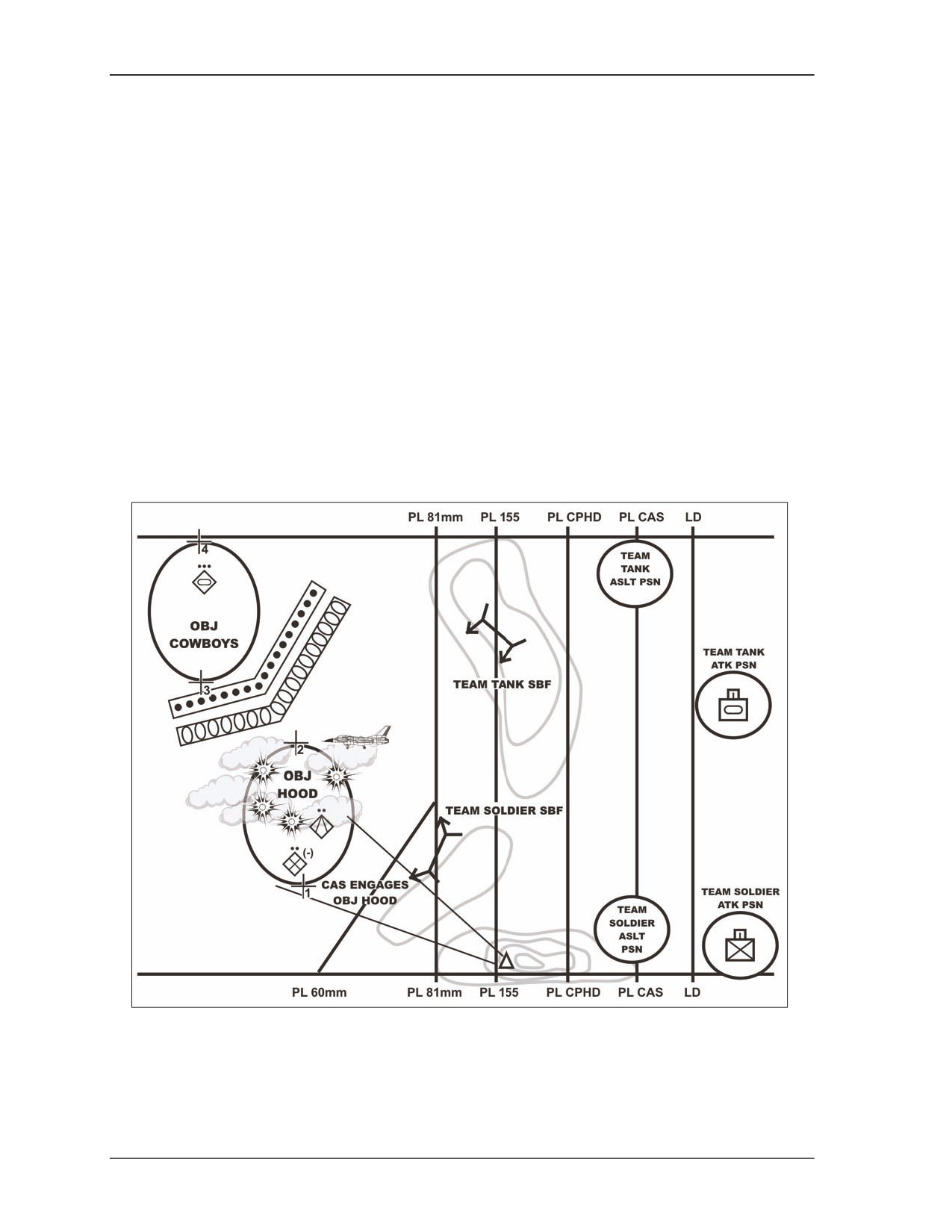
10-91. When the lead elements of the battalion task force approach the designated phase line or control
measure en route to the objective, the FSO begins the preparation. Lead element observers or company
team FSOs track movement rates and confirm them for the battalion task force FSO. The battalion task
force FSO may need to adjust the plan during execution based on unforeseen changes to anticipated
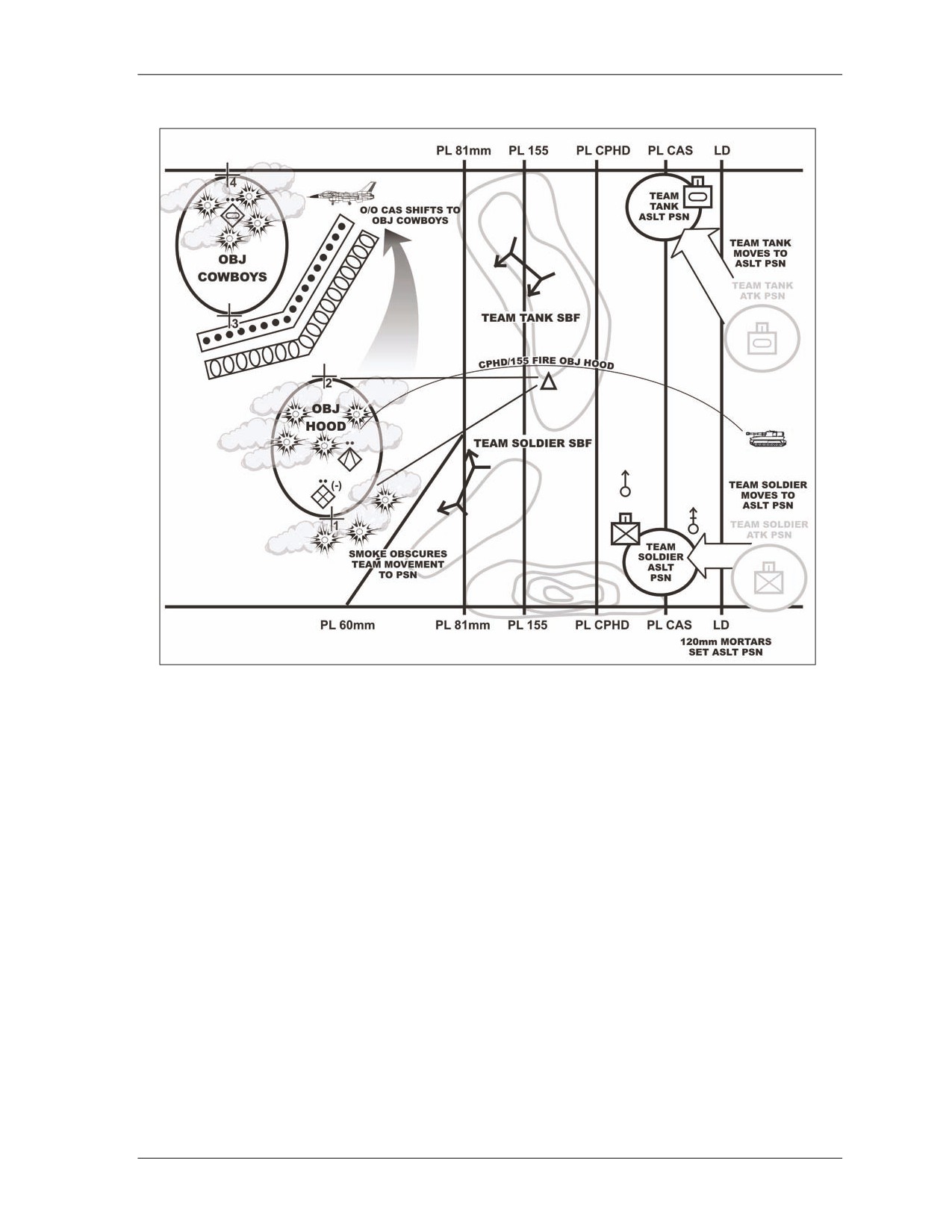
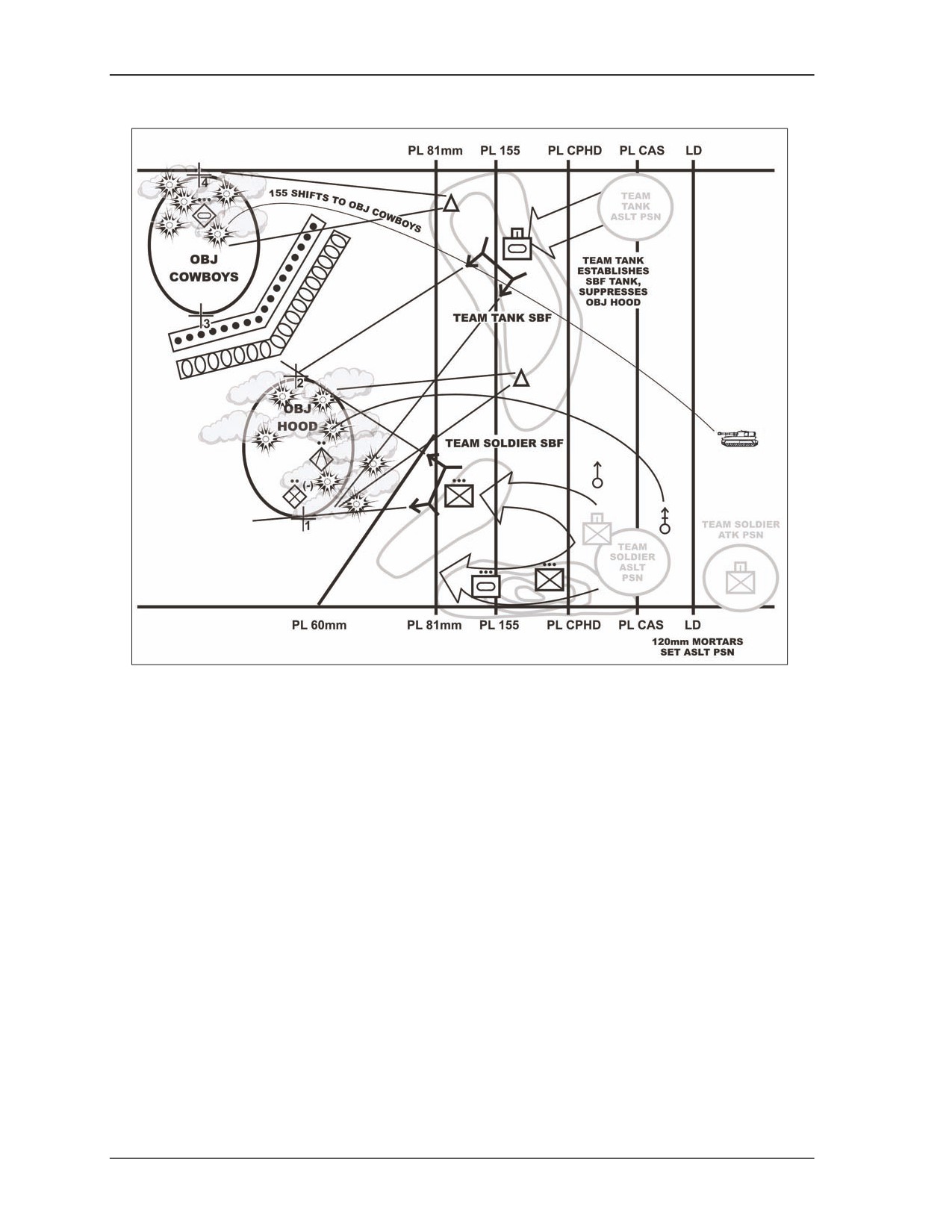
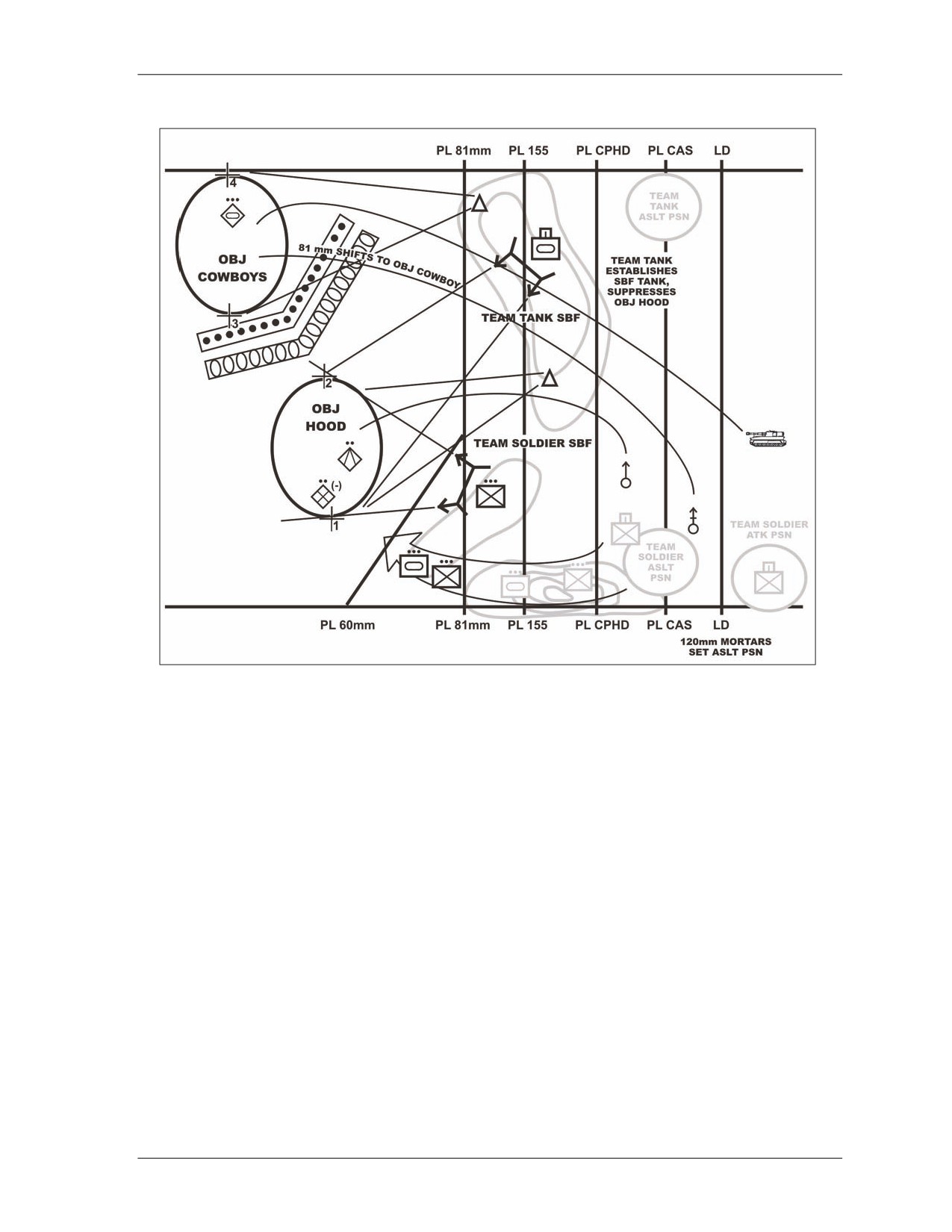
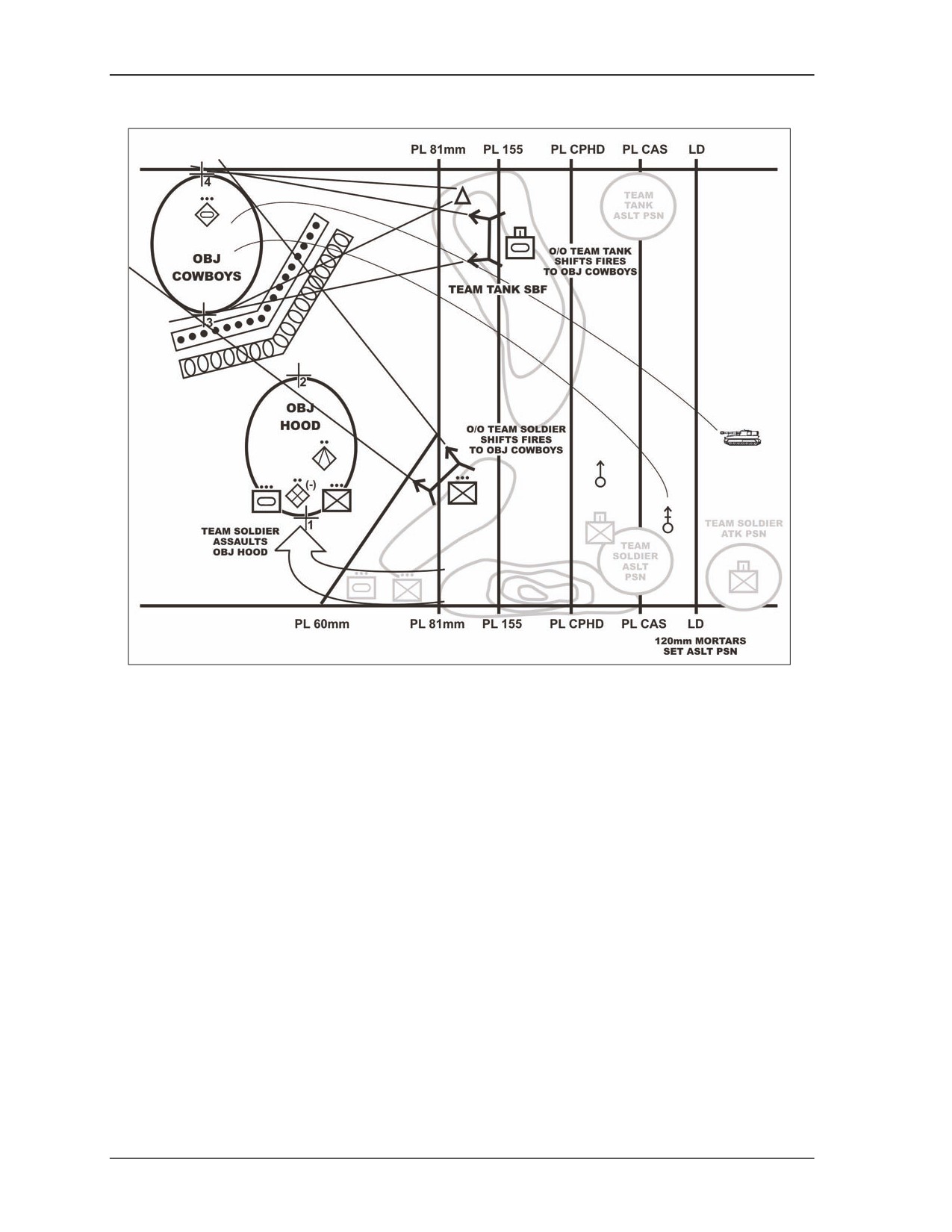
movement rates (Figure 10-7, Figure 10-8, Figure 10-9, Figure 10-10, and Figure 10-11, this page thru
page 10-27).
y As the unit continues its movement toward the objective, the first delivery system engages its
targets. It maintains fires on the targets until the unit crosses the next phase line that
corresponds to the RED-combat (or MSD-training) of the weapon.
y To maintain constant fires on the targets the unit starts the next asset before the previous asset
lifts. This ensures no break in fires, enabling the friendly forces' approach to continue
unimpeded. However, if the unit rate of march changes, the fire support system must remain
flexible to the changes.
y The FSO lifts and engages with each asset at the prescribed triggers, initiating the fires from the
system with the largest RED to the smallest. Once the maneuver element reaches the final
phase line to lift all fires on the objective, the FSO shifts to targets beyond the objective.
Figure 10-7. Beginning of close air support.
10-24
FM 3-21.10
27 July 2006
Maneuver Support
Figure 10-8. 155-mm shaping fires, close air support shifts.
27 July 2006
FM 3-21.10
10-25
Chapter 10
Figure 10-9. 155-mm shift, 81-mm, and supporting fires.
10-26
FM 3-21.10
27 July 2006
Maneuver Support
Figure 10-10. 81-mm shift, 60-mm mortars.
27 July 2006
FM 3-21.10
10-27
Chapter 10
Figure 10-11. 60-mm cease fire, shift of supporting fires.
MORTARS
10-92. Mortars, located in both the battalion and company level, act as both a killer of enemy forces and
as an enhancer of friendly mobility. They provide the maneuver commander with responsive, organic
indirect fire support at a higher rate of fire than field artillery units. Using mortars to suppress the enemy
inhibits his fire and movement while allowing friendly forces to gain a tactical mobility advantage.
(Table 10-6 shows the different ranges and types of ammunition for the company mortar systems.)
y Mortars provide the maneuver commander with immediately available, responsive indirect fires
in support of combat operations, and reinforce direct fires during close combat.
y Mortars are integrated with field artillery assets in an echelonment of fires. Echelonment of
fires is a technique for the integration and synchronization of maneuver and fires. It is the
execution of a schedule of fires fired from the highest caliber to the lowest caliber weapon
based on the risk estimate distances as the maneuver force moves toward an objective. The
echelonment of fires helps ensure that ground forces are able to move to an objective without
losing momentum, and sets the conditions for the direct firefight and reduces the risk of
friendly casualties.
y In the offense, mortars establish conditions for the maneuver elements in conducting their
combat operations. They assist in suppressing and fixing the enemy and provide close support
fires during the assault. Additionally they provide smoke for screening and obscuring friendly
10-28
FM 3-21.10
27 July 2006

Maneuver Support
movements. Heavy mortars can penetrate buildings and destroy enemy field fortifications,
preparing the way for the dismounted assault force.
y In the defense, mortars can force the enemy to button up, obscure his ability to employ
supporting fires, deny his use of defilade terrain, break up enemy concentrations and
formations, and separate enemy dismounted Infantry from their armored personnel carriers
(APCs) and accompanying tanks. They can destroy synchronization, reduce enemy mobility,
and canalize enemy units into engagement areas.
y The mortar section leader works closely with the company commander and his FSO to
maximize mortar fires and ensure the mortars are integrated into the echelonment of fires.
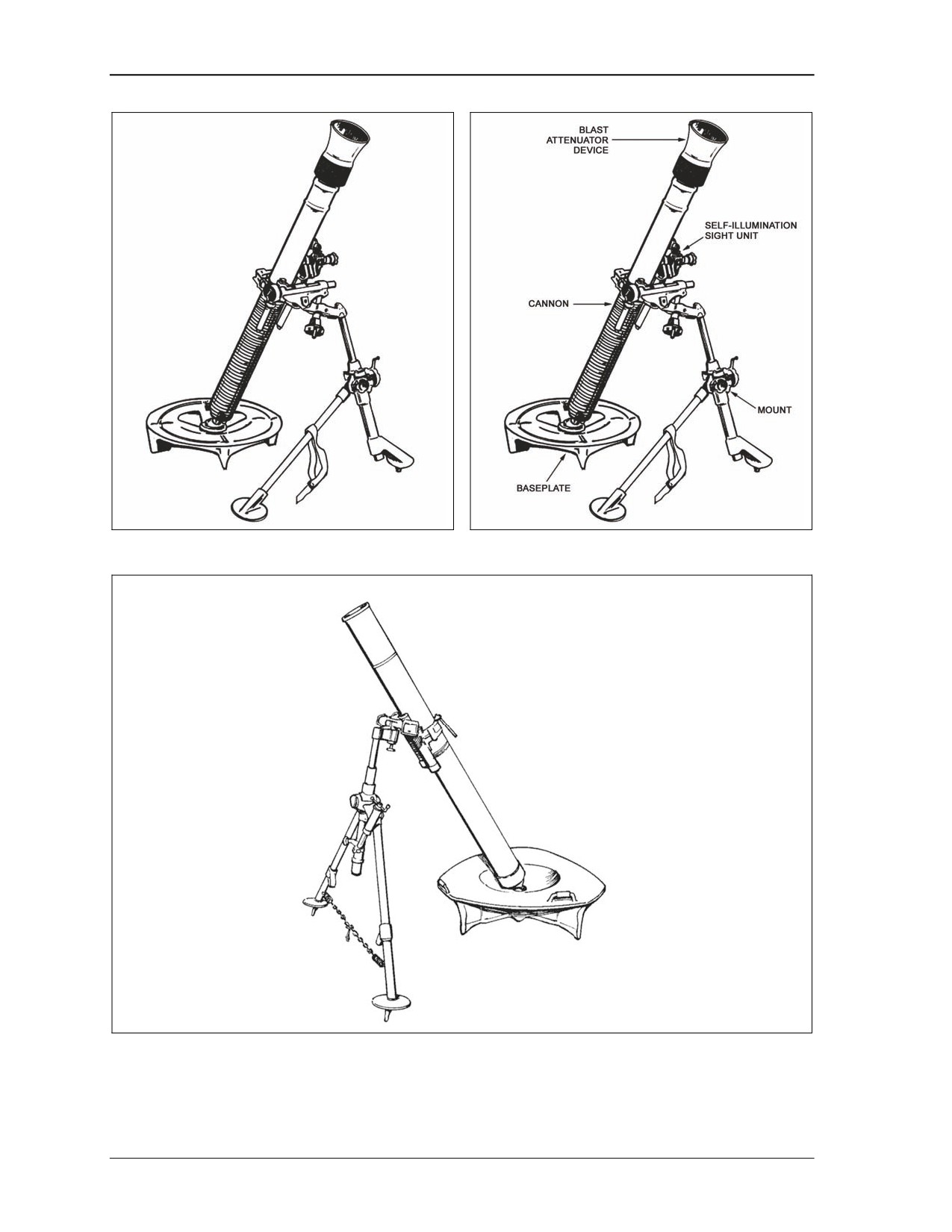
Figure 10-12, Figure 10-13, and Figure 10-14, page 10-29, show the mortars most likely to
support company operations.
Size/
Min
Max
Diameter of
Nomenclature
Model
Type
Range
Range
Illum
ROF
60-mm
M720/M9
HE
70
1 3,500
30 rpm for 4
M224
98
WP
70
3,500
500
minutes,2 then 20
M722
illum
200
3,500
300
rpm sustained
M721
WP
35
1,830
M302A1
illum
725
950
M83A3
HE
45
1,830
M494A
81-mm
M821
HE
83
5,608
30 rpm for 2
M252
M889
HE
83
5,608
1,200
minutes, then 15
M819
RP
300
4,875
rpm sustained
M853
illum
300
5,100
120-mm
M57
HE
200
7,200
15 rpm for 1 minute,
M121
M68
WP
200
7,200
1,500
then 4 rpm
M91
illum
200
7,100
1,500
sustained
M933
HE (PD)
200
7,200
M934
HE
200
7,200
M929
(MOF)
200
7,200
M930
WP
200
7,200
illum
1 Bipod mounted, charge 4 (maximum range handheld is 1,300 meters).
2 Charge 2 and over. 30 rpm can be sustained with charge 0 or 1.
Table 10-6. Mortar ammunition characteristics.
27 July 2006
FM 3-21.10
10-29
Chapter 10
Figure 10-12. 60-mm mortar.
Figure 10-13. 81-mm mortar.
Figure 10-14. 120-mm mortar.
10-30
FM 3-21.10
27 July 2006
Maneuver Support
MORTAR POSITIONS
10-93. Based on the mission, terrain, and company commander's guidance, the company mortar section
leader reconnoiters and selects mortar firing positions. A company mortar section position should--
y Allow firing on targets throughout the company's sector or zone, or the supported platoon's
sector or zone. In the offense, one half to two thirds of the range of the mortars should be
forward of the lead platoon.
y Be in defilade to protect the mortars from enemy observation and direct fire. Places such as the
reverse slope of a hill, a deep ditch, the rear of a building, and the rear of a stone wall are well
suited for mortar positions. The reverse slope of a hill may protect mortars from some
indirect fire.
y Have concealment from air and ground observation. Vegetation is best for breaking up
silhouettes. Mortars are positioned in defilade where natural camouflage conceals them. When
the location of the firing position provides little concealment, consider the use of a hide
position, which provides good cover and concealment and allows the mortar crews to occupy
their firing positions quickly when required.
y Have overhead and mask clearance. Overhead clearance is checked by setting the sight at
maximum elevation and looking along the mortar tube. Mask clearance is checked the same
way, but at minimum elevation.
y Have solid ground that supports vehicle movement and precludes excessive settling of base
plates. On soft ground, put sandbags under base plates to reduce settling.
y Have 25 to 30 meters between 60-mm mortars and 35 to 40 meters between 81-mm and
120-mm mortars. This reduces the chances of having more than one mortar hit by one enemy
round. It also provides proper sheaf dispersion without plotting for each gun.
y Have routes in and out. These routes should ease resupply and displacement.
y Be secure. The section might have to provide its own local security. Being near other friendly
units improves security.
y Avoid overhead fire of friendly Soldiers when possible.
10-94.
The FDC might be in voice-distance of the squads; however, telephone wire should be laid from
the FDC to each squad for security purposes and because battle noise might be so intense, that the squads
cannot hear the commands. The mortar section has a very limited capability to secure itself. Normally, it
collocates with other elements or has a security element attached. Mortar crews prepare mortar positions to
protect themselves and to serve as firing positions for the mortars. The crews construct the positions with
sandbags, ammunition boxes, earth, or any other available materials.
(FM 7-90 describes these
dug-in positions.)
MORTAR EMPLOYMENT
10-95. In a movement to contact, the mortar section usually supports the Infantry company with priority
of fire to the lead platoon. The section normally displaces one squad at a time so that at least one squad is
always in position and ready to fire. The section's displacement is based on the company's movement. The
leader keeps the company commander informed of the location and status of his weapons and ammunition.
The observers report their locations to the FDC.
y In an attack, sections prepare initial firing positions and may stockpile ammunition. They
occupy positions at the last moment before the attack. The section must remain ready
throughout the attack to respond to calls for fire and displace, if necessary.
y In the defense, mortars are farther to the rear than in the offense. The company commander
plans his mortar section's final protective fire on a dangerous, dismounted enemy AA. Extra
ammunition is stockpiled (if feasible). The mortars have some security when behind forward
troops, but they still prepare to defend their positions.
27 July 2006
FM 3-21.10
10-31
Chapter 10
y To avoid being suppressed, a number of mortar positions are designated, prepared (if feasible),
and occupied as required during the battle.
y In a withdrawal not under enemy pressure, one or more mortars might be left in position to
support the DLIC.
y No matter where the platoon or section is located, it does everything it can for its own security.
It might be able to post one or two security elements on the most dangerous approaches. It also
uses early warning devices. If attacked, the security elements give warning, kill as many of the
enemy as they can, and then rejoin their squads. The rest of the unit defends them from the
dug-in mortar positions. The company reserve might be employed for a counterattack or to
improve the security and defense of the mortar section.
y Targets are planned around the section's position so other mortars or artillery can
provide support.
MORTAR DISPLACEMENT
10-96. Mortars displace to provide continuous support and to evade suppression, whether the company is
attacking or defending. The displacement plan and the position of the mortar section in the company
formation are responsive to the commander, and should not disrupt the maneuver elements but they should
provide the mortar section with local security. It also allows the mortars to go into action quickly using the
desired method of engagement and should provide ammunition resupply for the mortars. The displacement
plan flows logically from other decisions made by the company commander, the company FSO, and the
mortar section leader. If the company commander determines that operations (offensive or defensive) will
move slowly enough to stay within mortar range and that continuous indirect fires must be available, he
may order the mortars to displace to a suitable support position before the company moves out. In this
event, he may not move them again until the company reaches its next position. The choices available for
displacement are displacement by section and displacement by squad.
DISPLACEMENT BY SECTION
10-97. The whole section displaces at the same time. This allows the section to mass fires and the section
sergeant to maintain control of his section. Moving as a section maximizes the limited FDC capability. It is
also the fastest method of displacement. While the section is moving, its fire support is not immediately
available unless it is positioned to fire using the direct lay or direct alignment methods or by conducting a
hip shoot. Using any of these methods, the mortar section can only be available with minimum delay.
DISPLACEMENT BY SQUAD
10-98. This method allows continuous coverage of at least part of the company's sector. However limited
communications equipment may still make it difficult to provide continuous indirect fire coverage even
when displacing by squad. However, the company can attach one squad to each of two bounding platoons,
so that, while using the direct lay or direct-alignment methods, one squad is always in overwatch of the
company's movement. This may allow increased mortar coverage of the company sector during
decentralized operations. It reduces the difficulty of transporting the mortar ammunition, and might also be
the best way to infiltrate the mortars. Each platoon carries the ammunition for the attached gun squad.
10-99. The company commander also decides whether to move the mortars as a separate element in the
company formation or to attach each gun squad to a subordinate element.
Attached
10-100. The mortars are attached to a subordinate element when the situation requires task organization,
such as on a patrol or with the company support element; or when the mortars need additional control,
security, and load-carrying capacity such as during an infiltration.
10-32
FM 3-21.10
27 July 2006
Maneuver Support
Separate
10-101. The mortars move as a separate element in the company formation when the commander wishes to
control them directly and keep them together for massed use. When the mortars move as an element, they
can displace by section or by squad.
MORTAR ENGAGEMENTS
10-102. Various engagement methods exist: direct lay and direct alignment
(no FDC required),
conventional indirect fire, and hip shoot. The primary methods of engagement for the 60-mm mortar are
direct lay and direct alignment.
DIRECT LAY
10-103. This method is used when the gunner can see the target. The mortar might be handheld or
bipod-mounted. An initial fire command is required to designate the target and (if desired) specify the
shell-fuze combination and number of rounds. The gunner then adjusts fire and fires for effect without
additional instructions (Table 10-7).
Advantages of Direct Lay
Disadvantages of Direct Lay
Can engage target immediately in handheld
Requires the mortar crew to be relatively
mode (the mortar weighs only 18 pounds and
close to the enemy and therefore susceptible
is therefore highly portable).
to direct and indirect fires.
Can be used by relatively untrained gunners
Is less effective at night (the gunner cannot
such as cross-trained Infantrymen.
engage when he cannot see).
Does not require an FDC.
Table 10-7. Advantages and disadvantages of direct lay.
DIRECT ALIGNMENT
10-104. This method allows the mortar crew to fire from full defilade positions without an FDC. It
requires that an observer be within 100 meters of the gun-target line and, if possible, within 100 meters of
the guns. Direct alignment can only be used when handheld or bipod-mounted, although bipod-mounted is
much more accurate (Table 10-8).
27 July 2006
FM 3-21.10
10-33

Chapter 10
Advantages of Direct Alignment
Disadvantages of Direct Alignment
Can engage target more quickly than the
Is slightly slower than direct lay.
methods requiring an FDC.
Requires the mortar crew to be relatively
Allows crew more protection than direct lay.
close to the enemy and therefore vulnerable
to indirect fires or assault.
Does not require an FDC.
Requires a well-trained observer to be within
100 meters of the gun-target line (preferably
within 100 meters of the guns).
Requires observers to be in direct
communication with the gun crew by voice,
arm-and-hand signal, landline, or radio.
Requires gun to be relaid to engage each
different target.
Table 10-8. Advantages and disadvantages of direct alignment.
CONVENTIONAL INDIRECT FIRE
10-105. This method is used when the mortars have been laid for direction and an FDC established with
positions plotted on the M16 plotting board or the mortar ballistic computer (MBC). In this situation (for
the 60-mm mortar), the section leader operates the MBC or the M19 plotting board and the radio as the
FDC (Table 10-9).
Advantages of Conventional Indirect Fire
Disadvantages of Conventional Indirect Fire
Can fire accurately at any target within range
Requires an FDC (there is no designated
as long as an observer who can communicate
FDC in the light Infantry mortar section).
with the FDC observes the target.
Is not as responsive as direct lay.
Can accurately engage plotted targets in
limited visibility.
Can locate well away from enemy direct fires.
Table 10-9. Advantages and disadvantages of conventional indirect fire.
HIP SHOOT
10-106. When a call for fire is received during movement and the target cannot be engaged by either the
direct lay or direct alignment method, a hip shoot is initiated. A hip shoot is a hasty occupation of a firing
position; it requires both an FDC and an observer. The section leader normally acts as the FDC (60 mm
only). The observer's corrections might be sent over the radio or by a wire net. The platoon or section
leader must determine an azimuth of fire by map inspection. He then gives this direction to the mortar
squads. The second squad leader uses the M2 compass (for the 60-mm section) to lay the base mortar. The
section leader uses the MBC, the graphical firing scale, or the firing tables to determine the appropriate
elevation and charge. He uses either the MBC or the M19 plotting board to refine the firing data based on
the observer's corrections. The section leader may use the aiming-point deflection method, depending upon
the terrain. The second mortar is laid either by sight-to-sight or M2 compass (Table 10-10).
10-34
FM 3-21.10
27 July 2006
Maneuver Support
Advantages of Hip Shoot
Disadvantages of Hip Shoot
Allows fire support when other methods of
Requires an FDC (there is no designated FDC in
engagement are not usable.
the light Infantry mortar section).
Is able to move at the same time as the unit and
Is the slowest method of fire and the least
still provide adequate fires.
accurate.
Table 10-10. Advantages and disadvantages of hip shoot.
AIR FIRE SUPPORT
10-107. Infantry company operations might be supported by attack aircraft including Army helicopters or
ground attack fighters of the Air Force, Navy, or Marines. However, next to Army aviation, the Air Force
most commonly provides sorties for the close-in fight. This type air power is typically close air support
(CAS) but can also be joint air attack team (JAAT) operations. Though JAAT missions might be flown in
or near the company AO, they are more complex than pure CAS, requiring higher level C2. Therefore, this
discussion primarily addresses CAS. Attack helicopter operations are discussed in Appendix D,
Aviation Support for Ground Operations.
Close Air Support
10-108. Tactical air control party (TACP) personnel are provided by the air force to maneuver units for
control of CAS. Controllers might be assigned down to the IBCT company level to direct CAS missions
and to perform terminal control. (FM 3-09.32 discusses this in detail, including complete procedures and
checklists.)
Requests
10-109. CAS requests might be initiated at any level. The two types of CAS request are preplanned and
immediate. Preplanned CAS is an air strike on a target that can be anticipated sufficiently in advance to
permit detailed mission coordination and planning. These missions are categorized as scheduled or on call.
A scheduled mission is executed at a specific time. An on call mission involves aircraft placed in a
ground/air alert status and preloaded with ordnance for a particular target or type of target. Immediate CAS
is an air strike on a target of opportunity that was not identified or requested sufficiently in advance to
permit detailed mission coordination or planning.
Request Procedures
10-110. Requests for preplanned CAS missions are submitted to the task force FSE. The commander,
ALO, FSO, and S-3 or S-3 Air evaluates requests, consolidate them and, if approved, assign a priority and
precedence. The S-3 or S-3 Air then forwards approved requests to brigade. Immediate CAS requests are
forwarded to the task force command post by the most expeditious means available. The ALO, FSO, and
S-3 or S-3 Air considers each request. Approved requests are transmitted by the TACP to the air support
operations center (ASOC). The ASOC coordinates with the senior ground HQ, which approves the request.
The TACP at each intermediate HQ monitors the request and informs the S-3 or S-3 Air, the ALO, and the
FSO or FSCOORD. Silence by an intermediate TACP indicates approval by the associated HQ.
27 July 2006
FM 3-21.10
10-35
Chapter 10
Joint Terminal Attack Controller
10-111. A JTAC is a qualified (certified) service member who, from a forward position directs the action
of combat aircraft engaged in close air support and other offensive air operations. A qualified and current
joint terminal attack controller is recognized across the Department of Defense as capable and authorized
to perform terminal attack control. Terminal attack control is the authority to control the maneuver of and
grant weapons release authority to attacking aircraft. Based on a risk assessment, the supported commander
will weigh the benefits and liabilities of authorizing a particular type of terminal attack. JTACs will
broadcast the type of control (1, 2, and 3) upon aircraft check-in.
Execution Procedures
10-112. The JTAC must coordinate with ground maneuver forces and obtain required CAS information
before building the CAS briefing. The memory tool "TTFACOR," shown in Figure 10-15, ensures that
JTACs coordinate the minimum information required for a CAS mission. Part of execution includes
coordination and deconfliction considerations as pre-execution measures. The following discussion
includes procedures that exceed minimum requirements in the event that CAS must be controlled by a
non-JTAC qualified person. Under such circumstances, the controller must identify himself as "non-JTAC
qualified" upon aircraft check-in:
CAS TTFACOR Pre-Execution Information Checklist:*
y Target commander's intent, valid, hostile target ID, coordinates.
y Threat intelligence updates or pilot (weather) report (PIREPS), SEAD.
y Friendlies update or confirm location, troops in contact, danger close.
y Artillery ACA activation, SEAD coordination.
y Control Cdr’s Approval, risk assessment, type control.
y Ordnance CAS, ordnance type, effects.
y Restrictions, artillery, weapons effects, friendlies, collateral damage.
*Also useful as TACP to FAC(A) and situation update briefing guide.
Figure 10-15. TTFACOR technique.
Tactical Operations Center Coordination
10-113. Facilitating coordination at the TOC involves the CAS battle drill. Either the ALO, as part of the
fire support element (FSE), or the JTAC uses this procedure to ensure CAS is integrated with surface fires
and maneuver forces to meet the commander's intent. Coordination includes the TOC staff, who rehearse
the battle drill so they can execute it quickly. (FM 3-09.32, JFIRE, lists the procedures for a CAS battle
drill. These procedures also apply to any non-CAS missions that require terminal attack control, but that do
not require detailed integration with artillery or ground force assets.) The following format applies to "CAS
check-in" (aircraft transmits to controller). The net control agency initiates the authentication statements
(examples follow this paragraph) in the "CAS check in" brief. The NCA can shorten their brief to save time
or to enhance security. To do this, they might say, for example, "as fragged" or "with exception":
Aircraft:
"This is (controller call sign)(aircraft call sign)
Identification and mission number:
""
Number and type of aircraft:
""
Position and Altitude:
""
Ordnance:
""
(Fusing, laser code)
Play time:
""
**Abort code:
""
**Remarks:
""
(NVG, LST, special mission items)
Flight lead will establish abort code
**Optional entry
10-36
FM 3-21.10
27 July 2006
Maneuver Support
10-114. The following format provides a situation update to inbound aircraft:
Situation update # (JTAC to fighter)
Target and general enemy situation
Activity
Friendly situation
Artillery activity
Clearance authority
Ordnance requested
Restrictions and remarks
Localized SEAD efforts (suppression and EW)
Hazards (WX, terrain, obstructions)
10-115. A situation update is normally given once, when a fighter first checks in. Higher echelons, such as
division or brigade, may assign an alphanumeric tracking number to ease subsequent check-ins at lower
echelons. For example, "Icebox 21, Hog Flight checking in as fragged with situation update Hotel." This
briefing should be broad in scope. More specific information is passed in the nine-line briefing. Situation
update might be passed to supporting airborne platforms
(JSTARS) to speed information flow.
Figure 10-16 shows an example format for a nine-line, close air support briefing.
27 July 2006
FM 3-21.10
10-37

Chapter 10
CAS Briefing (Nine Line)
Do not transmit line numbers. Units of measure are standard unless briefed.
Lines 4, 6, and restrictions are mandatory readback (*). JTAC may request
additional readback.
JTAC: " , this is "
(Aircraft call sign; JTAC)
"Type________ (1, 2, or 3) Control"
1. IP/BP: ""
2. Heading: " "
(Deg Magnetic; IP/BP to target)
Offset: " "
(Left/right, when required)
3. Distance: " "
(IP to target in nautical miles, BP to target in meters).
4.* Target Elevation: " "
(in feet/MSL)
5. Target Description: " "
6.* Target Location: " "
(Latitude and longitude, grid coordinates to include map datum such as
WGS-84, offsets, or visual description)
7. Type Mark: " " Code: " "
(WP, Laser, IR, Beacon) (Actual Code)
8. Location of Friendlies: " "
(From target, cardinal directions and distance in meters)
Position marked by: " "
9. Egress: " "
Remarks (as appropriate): " "
(Restrictions*, Ordnance delivery, threats, FAH, hazards, ACAs, weather,
target info, SEAD, LTL ,GTL {degrees magnetic north}, night vision, danger
close [plus commander's initials]).
Time on Target (TOT): " " or
Time to Target (TTT): " __ "
"Standby plus , Hack."
(minutes) (seconds)
Note: When identifying position coordinates for joint ops, include map data
Grid coordinates must include 100,000-meter grid identification
Figure 10-16. Example format for a nine-line close air support briefing.
Joint Air Attack Team
10-116. JAAT is a method of integrating rotary-wing and fixed-wing aircraft to locate and attack
high-priority targets and targets of opportunity. JAAT is a method of employment, not a mission. JAAT
fires are integrated mutually supportive, and synergistic, not simply deconflicted. The land force
commander typically determines when to employ a JAAT but any commander (air, land, or maritime) may
request one. JAAT can be employed anywhere on the battlefield across the spectrum of operations. CAS
procedures may/may not be required depending on the proximity of friendly forces and requirement for
detailed integration.
10-38
FM 3-21.10
27 July 2006

Maneuver Support
JAAT Planning
10-117. A mission commander will be designated for JAAT operations. The mission commander should
be the element with the highest situational awareness and ability to provide command and control. JAAT
can be accomplished with minimum coordination, if the participants are trained and proficient. Maximum
JAAT synergy occurs when the JAAT mission commander at the tactical level, normally an Air Mission
Commander (AMC), possesses the authority to coordinate attack execution directly with the other team
members. In non-CAS JAAT application, direct attack coordination is more efficient because there is no
requirement for JTAC/FAC(A) control. When JAAT is employed where CAS procedures are required,
Type 2 or 3 (Table 10-11) control options offer increased control flexibility that can preserve JAAT
synergy if the tactical risk assessment allows.
JTAC
Observes
Target
Results of Risk
and
Timely and Accurate Target
Type
Assessment
Aircraft
Data Provided
1
Commander assesses a
Required
By JTAC (Inherent to Type 1
high risk of fratricide to
control)
friendlies or noncombatants
2
Lower risk to friendlies or
Not
By Observer or through other
noncombatants but JTAC
Required.
JTAC sensors*
maintains control of
individual attacks
3
Commander assesses the
Not.
By JTAC or Observer or by
lowest risk of fratricide to
aircrew if targets comply with
Required.
friendlies or
prescribed guidance**
noncombatants.
JTAC may provide blanket
clearance.
* Observer: Scout, COLT, FIST, UAS, SOF, or assets that provide real-time targeting
information.
** Supporting commander delegates weapons release to JTAC for all types of control.
JTAC will provide "cleared hot" as appropriate for each attack in Types 1 and 2 control
and "cleared to engage" for Type 3.
Table 10-11. Close air support types for terminal attack attributes.
Section III. ENGINEERS
The engineer company is tailored to fight as part of the combined arms team in the IBCT. It focuses on mobility
but also provides limited countermobility and survivability engineer support. Only one engineer company is
organic to the IBCT.
ORGANIZATION
10-118. The engineer company can be augmented according to the mission, with units from combat
support brigades at echelons above the IBCT. Augmentation provides additional engineer capability and
functions.
27 July 2006
FM 3-21.10
10-39
Chapter 10
ENGINEER COMPANY
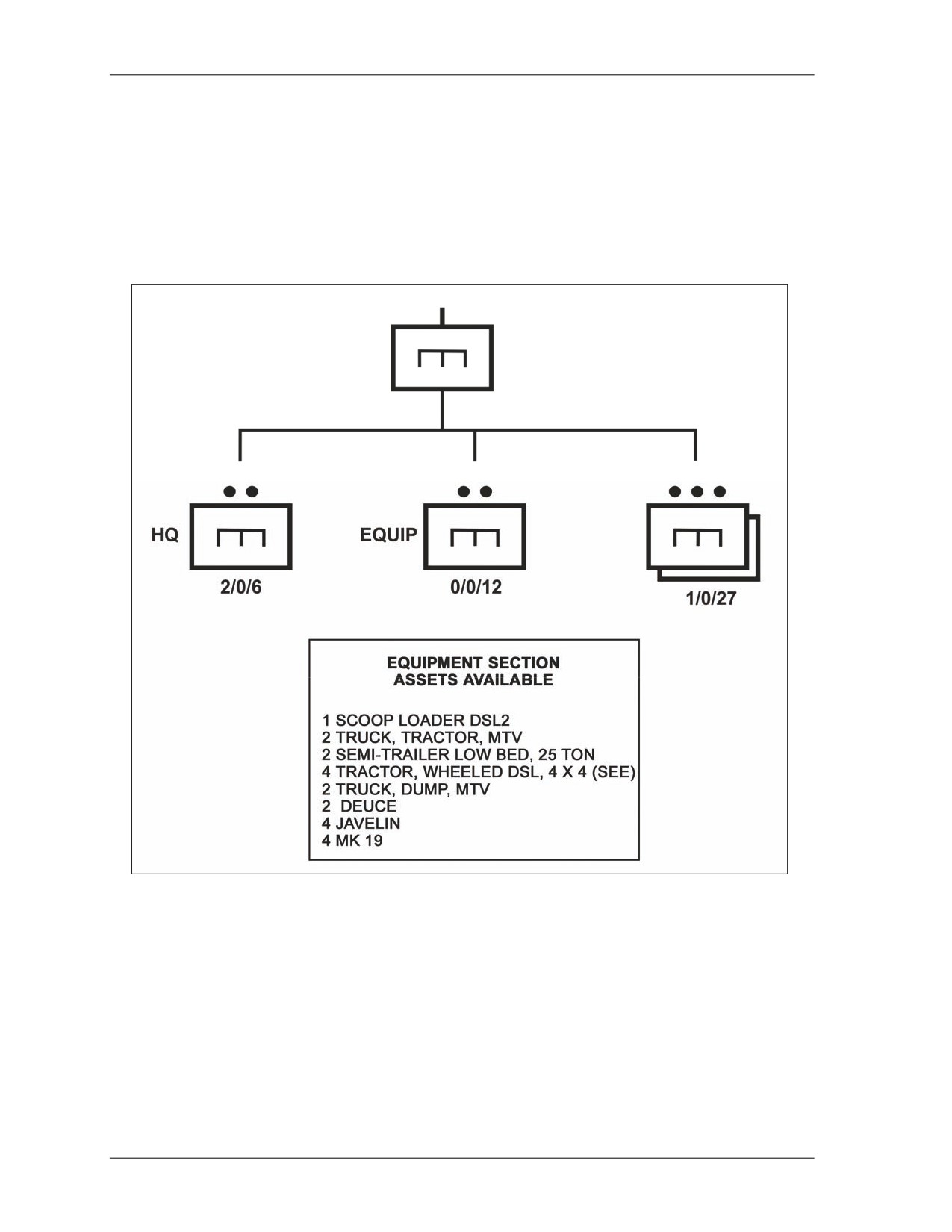
10-119. The IBCT engineer company is assigned and executes engineer missions that are identified by the
BCT commander. Their employment depends on the BCT commander's analysis of METT-TC. The
engineer company commander may receive augmentation from other engineer units. He directs his unit in
the execution of mission support to the BCT. The engineer company is self-sufficient for mobility
purposes. Figure 10-17 shows an example of IBCT engineer company organization.
Figure 10-17. IBCT engineer company.
ENGINEER PLATOON
10-120. An engineer platoon (Sappers) might be task-organized to a battalion or company, based on the
BCT commander's analysis of METT-TC. The engineer platoon can be employed to accomplish almost any
engineer mission. However, the engineer platoon lacks organic sustainment assets and has minimal C2
depth and combat systems. Thus, it will most likely require augmentation or external support to conduct
continuous operations over a sustained period of time (more than 48 hrs). The engineer platoon might also
require some augmentation to conduct combined-arms tasks such as breaching operations. The engineer
platoon may receive augmentation from its engineer company or other units as required.
10-40
FM 3-21.10
27 July 2006
Maneuver Support
SAPPER SQUAD
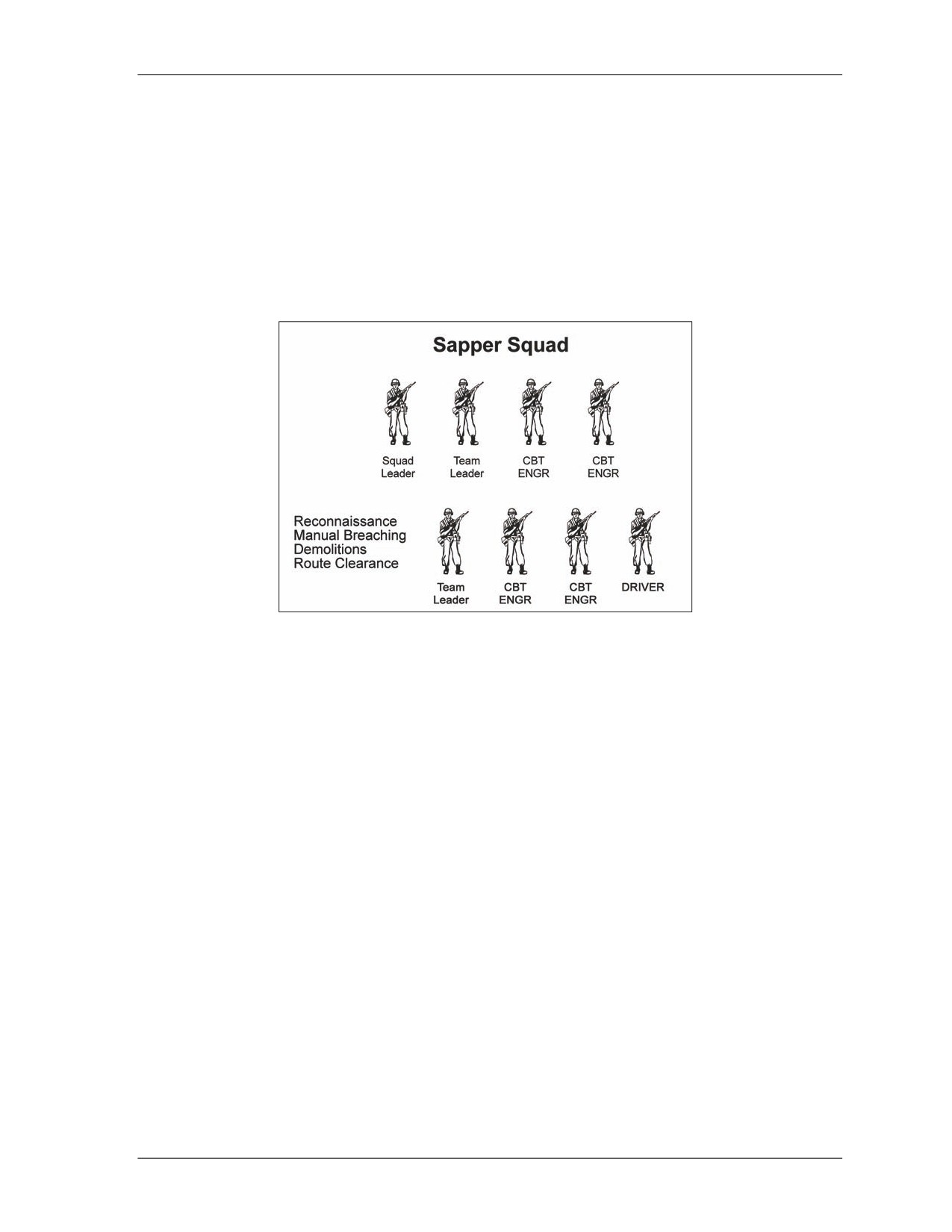
10-121. A sapper squad might be task organized to a company. It executes engineer tasks to support the
company mission. Task organization is based on the battalion commander's analyses of METT-TC. The
squad is the smallest engineer element that can be employed with its own organic C2 assets and as such can
accomplish tasks such as reconnaissance, manual breaching, demolitions, or route clearance as part of a
platoon or company mission. The sapper engineer may receive augmentation of engineer equipment such
as a small emplacement excavator (SEE) or other specialized engineer equipment based on METT-TC.
Figure 10-18 shows an example of a sapper squad.
Figure 10-18. Example sapper squad.
MISSIONS
10-122. The tactical missions of engineers correspond to those of IBCT Infantry units. Engineer units can
operate in restrictive terrain such as forests, jungles, mountains, and urban areas. Because of their austere
nature, IBCT engineers have limited tactical mobility. To compensate for this, IBCT engineers train to
operate in a decentralized manner. Like their supported maneuver force, they are very well suited to
operate under conditions of limited visibility.
10-123. The mobility, countermobility, and survivability tasks for Engineer fall within the WFF of
Maneuver and Movement or Protection. (Table 10-12 shows the tasks included in each of these categories).
An engineer platoon or squad might be attached to a company depending on METT-TC. Engineers also
conduct reconnaissance, evaluate obstacles, and employ demolitions.
10-124. The Engineer Corps is also responsible for general construction and topographic and geospatial
mapping. Combat engineers must also be prepared to fight as Infantry.
27 July 2006
FM 3-21.10
10-41

Chapter 10
Mobility
Countermobility
Survivability
Breach obstacles.
Construct obstacles to turn, fix,
Construct crew-served weapons
block, or disrupt enemy forces.
and vehicle fighting positions.
Clear minefields.
Clear routes.
Cross expedient gaps.
Construct combat roads
or trails.
Table 10-12. Engineer missions.
CAPABILITIES
10-125. The IBCT engineer's focus is mobility. They are expert in supporting infiltrations, air assaults,
parachute assaults, ambushes, and raids. In this role, the engineer may conduct covert breaches, route
reconnaissance, and obstacle reduction. They may also identify potential enemy counterattack routes to
establish countermobility measures, such as scatterable mines (SCATMINEs), to protect the force. IBCT
engineers train in Infantry skills and are able to move undetected when close to the enemy.
Weapon Characteristics
10-126. Weapons listed in the following paragraphs show munitions, which might be used or encountered
in the maneuver company area. Commanders should be aware of the safety zones for the particular system
they wish to employ:
Antipersonnel Obstacle Breaching System
10-127. The antipersonnel obstacle breaching system (APOBS) is a man-portable device that can quickly
create a footpath through AP mines and wire entanglements. The APOBS is normally employed by combat
engineers or Infantry Soldiers. The APOBS provides a lightweight, self-contained, two-Soldier, portable
line charge that is rocket-propelled over AP obstacles from a standoff position away from the edge of the
obstacle. For dismounted operations, the APOBS is carried in 25-kilogram backpacks by no more than two
Soldiers for a maximum of 2 kilometers. One backpack assembly consists of the rocket-motor launch
mechanism, containing a 25-meter line-charge segment and 60 attached grenades. The other backpack
assembly contains a 20-meter line-charge segment and 48 attached grenades. The total weight of the
APOBS is about 54 kilograms. It can breach a footpath that is about 0.6 by 45 meters and is fired from a
25-meter standoff.
Selectable Lightweight Attack Munition
10-128. The SLAM is a multipurpose munition with an antitamper feature. The SLAM is compact and
weighs only 1 kilogram, so it is easily portable. The SLAM is intended for use against APCs, parked
aircraft, wheeled or tracked vehicles; stationary targets such as electrical transformers, small fuel-storage
tanks (less than 10,000-gallon); and ammunition storage facilities. The EFP warhead can penetrate 40
millimeters of homogeneous steel. The SLAM has two models—one is self-neutralizing (M2) and the other
is self-destructing (M4).
y The M2 is solid green and has no labels, brands, or other distinguishing marks. This device is
used by SOF and is not available to other units.
y The M4 is green with a black warhead (EFP) face. Units designated as Ranger, airborne, air
assault, crisis response, and rapid deployment normally use this device.
10-42
FM 3-21.10
27 July 2006
Maneuver Support
y The SLAM has four possible employment methods—bottom attack, side attack, timed
demolition, and command detonation.
Demolitions
10-129. Engineers use different types of demolitions to accomplish their missions. (FM 5-250 covers the
types of demolitions used to support the light Infantry mission.)
Bangalore Torpedoes
10-130. Consist of 10 tube assemblies, 10 connecting sleeves, and 1 nose sleeve. The tube assemblies, or
torpedoes are steel tubes 5 ft long and 2 1/8 inches in diameter. The main charge is 10 ½ pounds of
composition B4 explosive. The primary use of the Bangalore is for clearing paths through wire obstacles
and heavy undergrowth. It will clear a 3 to 4 meter path through wire obstacles.
M183 Satchel Charge
10-131. Consists of 16 M112(C-4) charges and 4 priming assemblies. It has a total explosive weight of 20
lbs. The M183 assembly is used primarily for breaching obstacles or demolishing structures when large
demolition charges are required. The charge also is effective on smaller obstacles such as small
dragon’s teeth.
M112 Charge
10-132. Consists of 1.25 lbs of C-4 packed in an olive drab Mylar- film container with a pressure-sensitive
adhesive tape on one surface. The M112 is primarily used for cutting and breaching. Because of its ability
to cut and be shaped, the M112 is ideally suited for cutting irregularly shaped targets such as steel. The
adhesive backing allows you to place the charge on any relatively flat surface.
Modernized Demolition Initiator
10-133. The MDI is a new family of nonelectric blasting caps and associated items. MDI components
simplify initiation systems and improve reliability and safety. The components include the M11
high-strength blasting cap, the M12 and M13 low strength blasting cap, and the M14 high strength cap
(time delay).
Detonating Cord
10-134. Consists of a core of HE (6.4 pounds of PETN per 1,000 feet) wrapped in a reinforced and
waterproof olive drab coating. Detonating cord can be used to prime and detonate single or multiple
explosive charges simultaneously. Detonating cord can be used in conjunction with the MDI components.
Scatterable Mines
10-135. Scatterable mines might be used to support the commander's intent by turning, fixing, disrupting,
and blocking the enemy; however, they are used, they must be planned and coordinated to fit into the
overall obstacle plan. The different types of mine systems and their emplacement authority are described in
Table 10-13.
27 July 2006
FM 3-21.10
10-43
Chapter 10
Scatterable Mine System
Emplacement Authority
Ground- or artillery-delivered, with SD time
The corps commander may delegate emplacement
greater than 48 hours (long duration).
authority to division level, which may further delegate
to brigade level.
Ground- or artillery-delivered, with SD time of
The corps commander may delegate emplacement
48 hours or less (short duration).
authority to division level, which may further delegate
to brigade level (which may further delegate to
battalion level).
Aircraft-delivered (Gator), regardless of SD
Emplacement authority is normally at corps, theater,
time.
or army command level, depending on who has
air-tasking authority.
Helicopter-delivered (Volcano), regardless of
Emplacement authority is normally delegated no
SD time.
lower than the commander who has command
authority over the emplacing aircraft.
MOPMS when used strictly for a protective
Emplacement authority is usually granted to the
minefield.
company or base commander. Commanders at
higher levels restrict MOPMS use only as necessary
to support their operations.
Table 10-13. Emplacement authority.
Area-Denial Artillery Munitions (Field Artillery Delivered)
10-136. The wedge-shaped ADAM is a bounding-fragmentation mine that deploys up to seven
tension-activated trip wires 6 meters away from the mine. After ground impact, trip wires are released and
the mine is fully armed. The lethal casualty radius is between 6 and 10 meters.
Remote Antiarmor Mines (Field Artillery Delivered)
10-137. The RAAM mine has a cylindrical shape and provides a full-width or catastrophic kill (K-kill).
Using a magnetically influenced fuze, the mine projects a bi-directional, shaped-charge warhead through
the crew compartment of a vehicle.
Multiple Delivery Mine System, or Volcano (Ground or Air Delivered)
10-138. The Volcano is a scatterable mine system that can be mounted on a cargo truck or UH-60A
Blackhawk helicopter. It can rapidly produce tactical minefields with a linear frontage of up to 1,100
meters and a depth of 120 meters. The system can be employed to reinforce existing obstacles; close lanes,
gaps, and defiles; provide flank protection for advancing units. The Volcano dispenses mines with 4-hour,
48-hour, and 15-day self-destruct (SD) times. The SD times are field-selectable before dispensing and do
not require a change or modification to the mine canister. Reload time (not including movement time to the
reload site) for an experienced four-Soldier crew is about 20 minutes. The average time to emplace one
ground Volcano load (160 canisters) is 10 minutes.
10-44
FM 3-21.10
27 July 2006
Maneuver Support
Modular Pack Mine System (Man-Portable)
10-139. The MOPMS is a man-portable, 162-pound, suitcase-shaped mine dispenser. It contains 21 mines
(17 antitank mines and 4 antipersonnel mines) and propels them in a 35-meter, 180-degree semicircle from
the container. Mines are dispensed on command using the M71 remote control unit (RCU) or an electronic
initiating device such as the M34 blasting machine. When dispensed, an explosive propelling charge at the
bottom of each tube expels mines through the container roof. The company can use MOPMS to create a
protective minefield or to close lanes in tactical obstacles. The safety zone around one container is 55
meters to the front and sides and 20 meters to the rear. MOPMS has duration of four hours, which can be
extended up to three times (a total of 16 hours). Once mines are dispensed, they cannot be recovered or
reused. If mines are not dispensed, the container might be disarmed and recovered for later use. The RCU
can also self-destruct mines on command, allowing a unit to counterattack or withdraw through the
minefield. The RCU can control up to 15 MOPMS containers or groups of MOPMS containers from a
distance of 300 to 1,000 meters.
Hornet (Man-Portable)
10-140. The M93 Hornet, a wide area mine, introduces an entirely new obstacle concept to the
combined-arms company. The Hornet is a top-attack special munition that type-categorizes, reports, and
engages individual vehicles. It is an antitank and antivehicular off-route munition made of lightweight
material (35 pounds) that one person can carry and employ. The Hornet is a nonrecoverable munition that
can destroy vehicles by using sound and motion detection methods. It will automatically search, detect,
recognize, and engage moving targets by using top attack at a standoff distance up to 100 meters. It can be
a stand-alone tactical obstacle or can reinforce other conventional obstacles. It disrupts and delays the
enemy, allowing long-range, precision weapons to engage more effectively. (This feature is particularly
effective in non-LOS engagements.) It is employed by combat engineers, rangers, and SOF. The RCU is a
hand-held encoding unit that interfaces with the Hornet when the remote mode is selected at the time of
employment. After encoding, the RCU can be used to arm the Hornet, reset its SD times, or destroy it. The
maximum operating distance for the RCU is 2 kilometers.
Special Engineer Vehicles
10-141. Engineer earth-moving capabilities are key to survivability missions. Additional considerations
for survivability planning include command and control of digging assets, site security, sustainment (fuel,
maintenance, and Class I), and movement times between BPs. The commander should start the
survivability effort as soon as practical. He may employ blade assets to support systems such as mortars,
C2, and key weapons before the bulk of his combat systems are ready for survivability support. The
commander should establish a NLT time or a directed time to be ready for survivability. This helps prevent
waste of blade time. Companies prepare their area for the arrival of the blades by marking positions,
identifying leaders to supervise position construction, and designating guides for the blade movement
between positions.
Small Emplacement Excavator
10-142. The SEE has a backhoe, bucket loader, a handled hydraulic rock drill, a chain saw, and a
pavement breaker, among others. It can dig positions for individual, crew-served, and antitank weapons or
for Stinger missile teams. It can also be employed to dig in ammunition prestock positions.
Deployable Universal Combat Earthmover
10-143. The DEUCE is a high-speed, high-mobility earth-moving system that can perform clearing,
leveling, and excavation operations in support of all tactical engineer missions. It can drop by parachute
and travels up to 30 MPH on rubber tracks. The enclosed operator compartment and controls provide
numerous advantages over the D5 dozer it replaces.
27 July 2006
FM 3-21.10
10-45
Chapter 10
Scoop Loader
10-144. The 2.5 cubic yard scoop loader features a quick-coupler mechanism to attach and detach the
multipurpose bucket. Tactical delivery means include airdrop or low altitude parachute extraction and
some models are of sectionalized design for helicopter lift. Employment capabilities include loading trucks,
performing excavations, or other similar engineer operations.
Section IV. AIR DEFENSE ARTILLERY
Air defense assets may operate in and around the Infantry company AO. However, the company is unlikely to
receive task-organized air defense assets. Therefore, the company conducts its own air defense operations. It
relies on disciplined, passive air defense measures and the ability to engage aerial platforms actively with
organic weapons systems. Troops should be familiar with air defense assets, capabilities, operational
procedures, as well as self-defense measures.
SYSTEMS, ORGANIZATION, AND CAPABILITIES
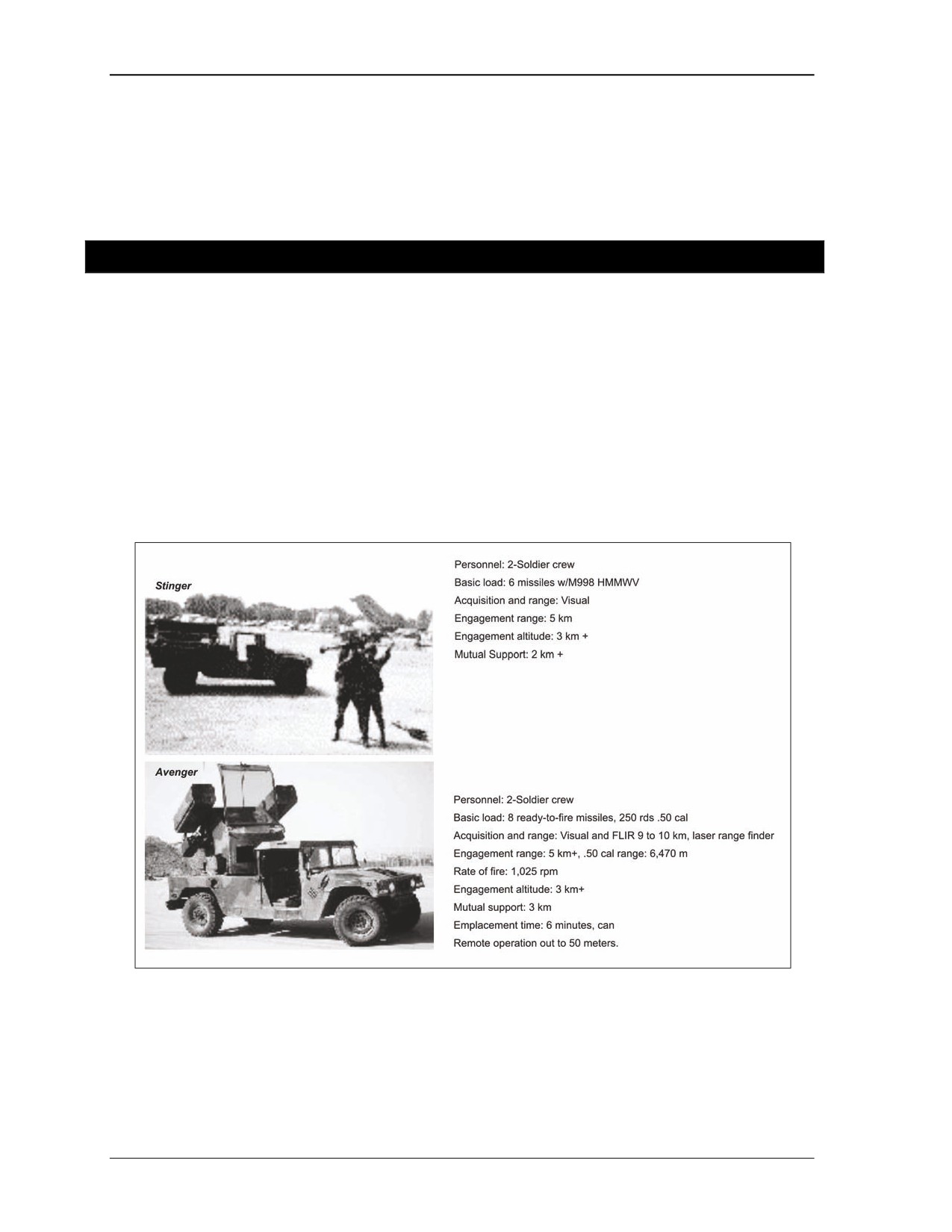
10-145. The man-portable Stinger and the HMMWV-mounted Stinger
(then called the "Avenger")
(Figure 10-19) might be used in and adjacent to the company AO. A maneuver battalion might be task
organized with an air defense platoon equipped with four Avengers.
Figure 10-19. Stinger, man-portable and mounted (as "Avenger") on a HMMWV.
10-46
FM 3-21.10
27 July 2006
Maneuver Support
EMPLOYMENT
10-146. In offensive situations, man-portable Stingers and Avengers accompany the main attack. They
may maneuver with the battalion's lead companies, orienting on low-altitude air avenues of approach.
When the unit is moving or in a situation that entails short halts, the Stinger gunners can dismount to
provide air defense when the unit reaches the objective or pauses during the attack. In the defense,
man-portable Stinger and the HMMWV-mounted Stinger (then called the "Avenger") (Figure 10-19) might
be used in and adjacent to the company AO. A maneuver battalion might be task-organized with an air
defense platoon equipped with four Avengers.
WEAPONS CONTROL STATUS
10-147. The WCS describes the relative degree of control in effect for air defense fires. It applies to all
weapons systems. The WCS is coordinated between the airspace controlling agency and brigade and
disseminated when required.
LEVELS OF CONTROL
10-148. The three levels of control are--
Weapons Free
10-149. At this least restrictive level of control, crews can fire at any air target not positively identified as
friendly.
Weapons Tight
10-150. At this moderate level of control, crews can fire only at air targets positively identified as hostile
according to the prevailing hostile criteria.
Weapons Hold
10-151. At this most restrictive level of control, crews may fire only in self-defense or in response to a
formal order.
EARLY WARNING PROCEDURES
10-152. Air defense warnings (ADWs) include--
RED: Air or missile attack imminent or in progress
YELLOW: Air or missile attack probable
WHITE: Air or missile attack not likely
10-153. While air defense warnings cover the probability of hostile air action over the entire theater of war
or operations, local air defense warnings describe with certainty the air threat for a specific part of the
battlefield. Air defense units use these local warnings to alert Army units to the state of the air threat in
terms of "right here, right now." The three local air defense warning levels are--
DYNAMITE:
Air platforms are inbound or are attacking locally now.
LOOKOUT:
Air platforms are in the area of interest, but are not threatening They might be
inbound, but there is time to react.
SNOWMAN:
No air platforms pose a threat at this time.
Note: The area air defense commander routinely issues air defense warnings for
dissemination throughout the theater of war or operations. These warnings describe the
general state of the probable air threat and apply to the entire area.
27 July 2006
FM 3-21.10
10-47
Chapter 10
REACTION PROCEDURES
10-154. Reaction procedures include both passive and active air defense measures.
Passive Air Defense
10-155. Passive air defense consists of all measures taken to prevent the enemy from detecting or locating
the unit, to minimize the target acquisition capability of enemy aircraft, and to limit damage to the unit if it
comes under air attack. One advantage the company can exploit is that target detection and acquisition are
difficult for crews of high-performance aircraft. In most cases, enemy pilots must be able to see and
identify a target before they can launch an attack.
Guidelines
10-156. The Infantry company should follow these guidelines to avoid detection or limit damage.
y When stopped, occupy positions that offer cover and concealment, dig in, and camouflage.
When moving, use covered and concealed routes.
y Disperse as much as possible to make detection and attack more difficult.
y If moving when an enemy aircraft attacks, disperse and seek covered and concealed positions.
y Do not fire on a hostile fixed-wing aircraft unless the aircraft has identified friendly elements.
Premature engagement compromises friendly positions.
y Designate air guards for every position; establish and maintain all-round security.
y Establish an air warning system in the unit SOP, including both visual and audible signals.
Procedures
10-157. When the company observes fixed-wing aircraft, helicopters, or UASs that could influence its
mission, it initially takes passive air defense measures unless the situation requires immediate active
measures. This reaction normally takes the form of each platoon's "react to air attack" battle drill. However,
if needed, the commander can initiate specific passive measures (discussed previously in this section).
Note: Passive air defense also includes the company's preparations for conducting active
air defense measures.
10-158. Passive air defense has three steps.
y Step 1 ... Alert the company with a contact report.
y Step 2 ... Deploy or take the appropriate actions. If the company is not in the direct path of an
attacking aircraft, the commander or platoon leaders order Soldiers to seek cover and
concealment. They may also be ordered to continue moving as part of the battalion.
y Step 3 ... Prepare to engage.
Active Air Defense
10-159. If the commander determines that the company is being targeted by or is in the direct path of
attacking aircraft, he may initiate active air defense procedures, including "react to air attack" drills by the
platoons. This decision must be weighed against the possibility of exposing his positions to threat aircraft
that might not have already seen them. If engagement is necessary, they use a technique known as volume
of fire. This technique is based on the premise that the more bullets a unit can put in the sky, the greater the
chance the enemy will fly into them. Even if these fires do not hit the enemy, a "wall of lead" in the sky
can intimidate enemy pilots, causing them to break off their attack, or it may cause inaccuracy in their
ordnance delivery. This technique may involve a designated leader firing a magazine of tracer ammunition
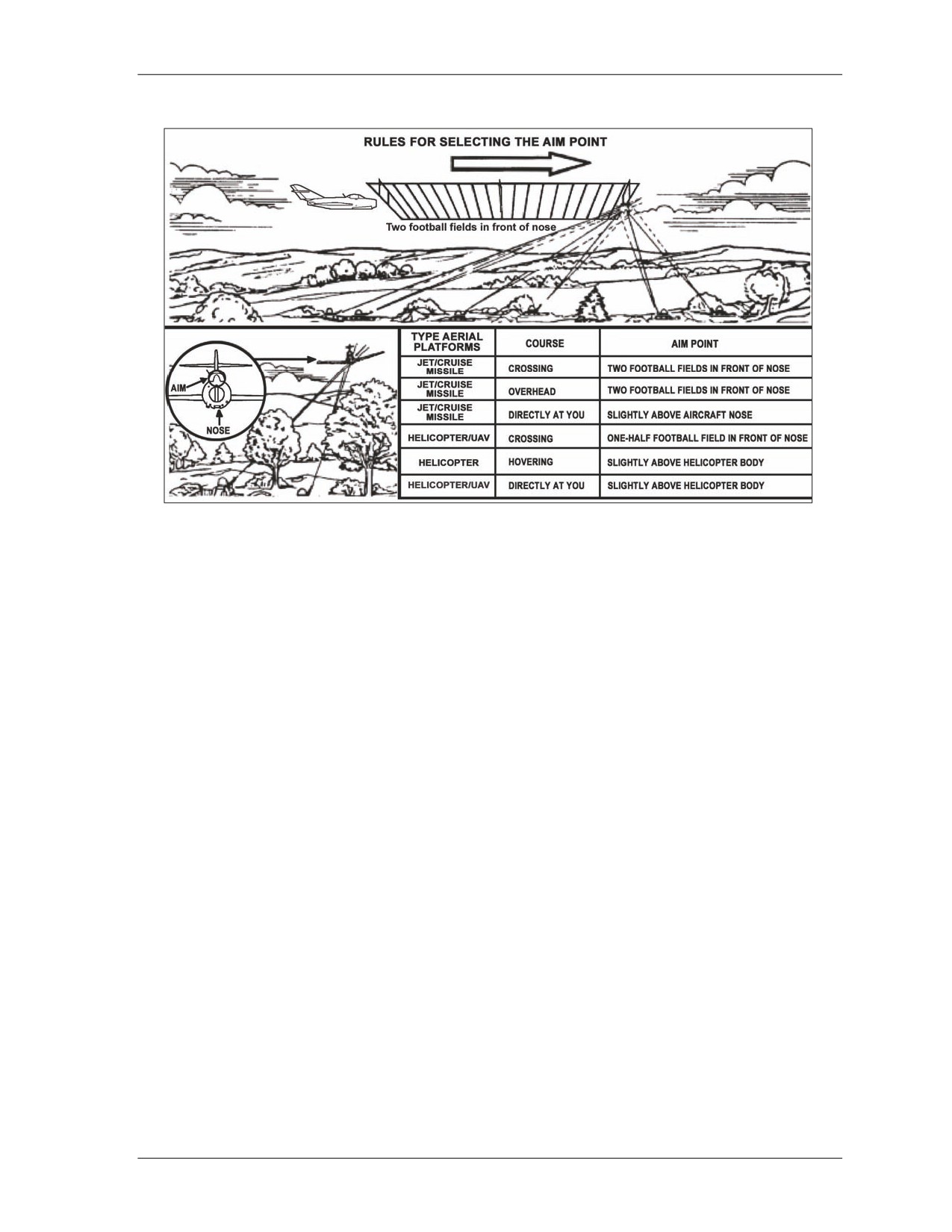
for other shooters to follow. The Soldiers maintains the aiming point, not the lead distance. (Figure 10-20).
10-48
FM 3-21.10
27 July 2006
Maneuver Support
Figure 10-20. Machine-gun aim points against helicopters and high-performance aircraft.
CHEMICAL, BIOLOGICAL, RADIOLOGICAL, OR NUCLEAR SUPPORT
10-160. Chemical, biological, radiological, and nuclear (CBRN) weapons can cause casualties, destroy or
disable equipment, restrict the use of terrain, and disrupt operations. They might be used separately or in
combination to supplement conventional weapons. The company must be prepared to fight on a
CBRN-contaminated battlefield. The CO designates principal CBRN defense trainers and advisors on
CBRN defense operations and CBRN equipment maintenance. These trainers include a CBRN defense
officer, a chemical NCO (MOS 74D), and an enlisted alternate. The CO ensures all personnel in his
command can operate and perform maintenance on all organic CBRN equipment. CBRN assets within the
Infantry company are limited. To survive on a contaminated battlefield, the company must practice the
fundamentals of CBRN defense, avoidance, protection, and decontamination. (For more on CBRN, see
Appendix H or FM 3-11.)
ARMY AVIATION
10-161. Army aviation is an asset at echelons above the BCT and might be requested by the Infantry
battalion. Requests from the Infantry company go through the battalion. Army aviation can be used for
command and control, reconnaissance, MEDEVAC, movement of troops and supplies, direct fire support,
and as maneuver units. Air assault helicopter operations deliver assault elements of the Infantry company
to locations on or near tactical objectives. (See Appendix D for a detailed discussion on Army aviation
support.)
OTHER ATTACK HELICOPTERS
10-162. Other Attack helicopters are employed as integral parts of the joint and combined arms team and
might be provided by US Marine or Navy assets. They are aerial attack systems also suited for situations
calling for a quick response if available. Previously discussed JFIRE procedures also apply in
employing them.
27 July 2006
FM 3-21.10
10-49
This page intentionally left blank.
Chapter 11
Sustainment Operations
The role of sustainment support in any military unit is to sustain the force for
continuous combat operations. Within the Infantry battalion, sustainment at the
company level is provided by the support and medical platoons in conjunction with
the battalion XO, HHC commander, S-1, and S-4. At the Infantry company level, the
company commander has ultimate responsibility for sustainment. The XO and the
1SG are the company's primary sustainment operators; they work closely with the
battalion staff to ensure they receive the required support for the company's assigned
operations.
This edition updates the discussion of sustainment, incorporates new terms, and
better addresses principles and TTP for unit trains, resupply, health service support,
and weapons replacement operations.
Section I. PLANNING CONSIDERATIONS
Infantry company commanders, as well as the battalion S-4, make plans and key decisions concerning
sustainment. The battalion S-4, company XO, company 1SG, company supply sergeant, platoon sergeants, and
squad leaders implement these plans. Platoon leaders plan and relay support requirements for mission
accomplishment to the company headquarters where it is consolidated and passed on to the battalion. Unit
SOPs address planning, implementation, and responsibilities in detail and standardize as many routine
sustainment operations as possible.
OVERVIEW
11-1.
The Infantry company plans, prepares, and executes its portion of the sustainment plan.
Concurrent with other operational planning, the company develops and refines its sustainment plan during
troop-leading procedures. Rehearsals are normally conducted at both battalion and company levels to
ensure a smooth, continuous flow of materiel and services. The company's sustainment responsibilities
follow.
y Determine requirements.
y Report status.
y Request support.
y Receive support.
y Distribute.
11-2.
Force health protection (FHP) in the Infantry company is a critical sustainment function. Medical
support comes from these life saving elements and measures.
y Self aid.
y Buddy aid.
y Combat life saver.
27 July 2006
FM 3-21.10
11-1
Chapter 11
y Combat medics.
y Treatment team, that is, support from the battalion aid station.
COMPANY RESPONSIBILITIES
11-3.
In sustainment operations, roles differ slightly from other operations.
COMMANDER
11-4.
The commander ensures that his sustainment operations meet the tactical plan. He will--
y Assure sustainment operations sustain his company's fighting potential.
y Identify special requirements for the mission.
y Integrate and synchronize sustainment activities into the tactical plan.
y Provide guidance to the operators.
EXECUTIVE OFFICER
11-5.
The XO coordinates and supervises the company's logistical effort. During planning, he receives
status reports from the platoon leaders, platoon sergeants, and 1SG. He then reviews the tactical plan with
the company commander to determine company sustainment requirements, and coordinates these needs
with the battalion S-4. During execution, as determined by the company commander, the XO locates at the
second most important place on the battlefield. At times, this is where he can best supervise sustainment
operations. The XO also performs the following functions.
y Determines the location of the company's resupply point based on data developed during
operational planning and the war gaming process.
y Selects resupply method according to METT-TC.
y Tailgate.
y Service station.
y Maintains logistics status (LOGSTAT).
y Receives LOGSTAT from platoons.
y Completes company rollup and forwards to the combat trains command post (CTCP).
y Along with the 1SG, ensures that the company executes sustainment according to the battalion
plan and SOP.
y Ensures his unit sustainment requirements are met.
FIRST SERGEANT
11-6.
In addition to his tactical responsibilities, the 1SG is a key player in sustaining the company. He is
also key in the execution of the company's plan and may supervise the company trains based upon the
commander's intent and the factors of METT-TC. He may assist the XO with LOGSTAT management and
in preparing paragraph 4 of the OPORD. He normally supervises the evacuation of casualties, EPW, and
damaged equipment in addition to supervising company resupply activities and monitoring company
maintenance activities. The 1SG orients new replacements and assigns them to squads and platoons IAW the
company commander's guidance. He assures proper tracking of casualties between battalion, platoon
leadership, and the senior trauma specialist; and oversees the NCO chain performing sustainment functions
and tasks IAW the company SOP. The 1SG may also perform the following functions:
y Conduct sustainment rehearsals at the company level and integration with maneuver rehearsals.
y Perform C2 over company medic and oversees the evacuation plan from platoon to
company CCP.
y Maintain the company battle roster.
11-2
FM 3-21.10
27 July 2006
Sustainment Operations
SUPPLY SERGEANT
11-7.
The supply sergeant is the company representative for resupply to the company and based upon
METT-TC may locate in either the combat trains or battalion field trains He assembles the logistics
package (LOGPAC) and moves with the LOGPAC forward to the company. He coordinates the company's
sustainment requirements with the support platoon leader and the Infantry battalion S-4. The supply
sergeant may control the MEDEVAC vehicle when it is unable to remain forward with the company. He
monitors the tactical situation and adjusts the sustainment plan as appropriate to meet the tactical plan and
the company commander's guidance. He may assist the commander by establishing caches. He forecasts
the company's consumption of food; water; ammunition; petroleum, oils, and lubricants (POL); and
batteries; based on the operation. The supply sergeant also performs the following sustainment functions.
y Coordinate with the battalion S-4 for resupply of Classes I, III, and V.
y Maintain individual supply and clothing records.
y Requisition Class II resupply as needed.
y Request Class IV and Class VII equipment and supplies.
y Coordinate for maintenance support from the Forward Support Company maintenance section
to include turn in and pick up maintenance documents, routine Class IX supplies, and
recoverable materials.
y Pick up replacement personnel and, if necessary, deliver them to the 1SG.
y Coordinate for receipt and evacuation of human remains and personal effects.
y Transport, guard, and transfer EPW as required.
y Accompany the LOGPAC to the logistics release point (LRP).
y Guide the LOGPAC to the company resupply point.
y Accompany the LOGPAC along with EPW and damaged vehicles (if applicable) back to the
BSA.
y Coordinate with the battalion S-1 section to turn in and pick up mail and personnel action
documents.
y Collect hazardous material (HAZMAT) and transport it to collection points as part of LOGPAC
procedures.
y Maintain and provide supplies for company field sanitation activities.
PLATOON SERGEANT
11-8.
Each PSG in the company performs the following sustainment functions.
y Ensure Soldiers perform proper maintenance on all assigned equipment.
y Compile and submit all personnel and logistics status reports for the platoon as directed or in
accordance with SOP.
y Collect each equipment inspection and maintenance form
(DA Form 2404, Equipment
Inspection or Maintenance Worksheet or DA Form 5988-E, Maintenance Request Register)
within the platoon.
y Obtain supplies and equipment (all classes except Class VIII) and mail from the supply
sergeant and ensures proper distribution within the platoon.
SENIOR TRAUMA SPECIALIST/SENIOR COMPANY MEDIC
11-9.
The senior trauma specialist or senior company medic is attached to the rifle company to provide
emergency medical treatment for sick, injured, or wounded company personnel. Emergency medical
treatment procedures performed by the trauma specialist might include opening airways, starting
intravenous fluids, controlling hemorrhages, preventing or treating shock, splinting suspected or confirmed
fractures, and relieving pain. The emergency medicine performed by the trauma specialist is supervised by
the battalion surgeon or physician's assistant (PA). The senior trauma specialist/company medic must--
27 July 2006
FM 3-21.10
11-3
Chapter 11
y Oversee and provide guidance to each platoon medic as required.
y Triage injured, wounded, or ill friendly and enemy personnel for priority of evacuation as they
arrive at the company CCP.
y Oversee sick-call screening for the company.
y Request and coordinate the evacuation of sick, injured, or wounded personnel under the
direction of the company 1SG.
y Assist in the training of the company personnel on first aid (self-aid and buddy-aid) and combat
lifesavers in enhanced first-aid procedures.
y Requisition Class VIII supplies from the BAS for the company according to the TSOP.
y Assist the commander with medical planning, advise on higher headquarters’ plan, and
recommend locations for company CCPs.
y Monitor the tactical situation, and anticipate and coordinate HSS requirements and Class VIII
resupply as necessary.
y Advise the company commander and 1SG on mass casualty operations.
y Keep the 1SG informed on the status of casualties, and coordinate with him for additional HSS
requirements.
Section II. SOLDIER'S LOAD
The Soldier's load is of crucial concern to the leader. How much do Soldiers carry, how far, and in what
configuration? These critical mission considerations require command emphasis and inspection. Army research
shows that a Soldier can carry 30 percent of his body weight and retain much of his agility, stamina, alertness,
and mobility. For the average Soldier, who weighs 160 pounds, this means carrying 48 pounds. Success and
survival in company operations demand that Soldiers retain these capabilities. When it cannot move with
stealth, agility, and alertness, the unit is at risk. For each pound over 30 percent of his body weight, the Soldier
loses function. When his load exceeds 45 percent of his body weight, or 72 pounds for the average Soldier, his
functional ability drops rapidly, and his chances of becoming a casualty increase. Research also shows that
training can only improve load-carrying capability by 10 to 20 percent--at best. Commanders must ensure that
Soldiers carry no more than 30 percent of their body weight when in contact or when contact is expected. At
other times, the Soldier's load should not exceed
72 pounds. Sometimes, Soldiers must exceed the
recommended weight. Leaders must realize how that excess weight impacts the unit's effectiveness. (FM 21-18
provides additional information on the Soldier's load.) This example, extracted from The Soldier's Load and
Mobility of a Nation, by S. L. A. Marshall, details the dangers of excess loads.
11-4
FM 3-21.10
27 July 2006
Sustainment Operations
EXAMPLE
During the Normandy Invasion, many casualties were attributed to the excessive loads carried by US
Soldiers as they tried to get ashore and across the beach. E Company, 16th Infantry suffered 105
casualties that day. Of these, 104 occurred on the beach, and most of them were due to their
overloads. Many Soldiers fell prone at the water's edge and were drowned by the incoming tide. The
Soldiers' packs were so heavy that they were able to walk only a few feet before falling to the sand. It
took the company more than an hour to move 250 meters across the beach. The paratroopers that
jumped into Normandy carried the following:
1 carbine or M1 rifle
1 steel helmet with liner
80 rounds of ammunition
1 knit cap
2 hand grenades
1 change of underwear
1 mine
2 pairs of socks
6 K-rations
1 gas mask
1 impregnated jumpsuit
1 first-aid packet
1 complete uniform
1 spoon
1 entrenching tool
2 gas protective covers
1 field bag
1 packet of sulfur
1 escape kit
1 set toilet articles
Although they were required to jump heavy, once on the ground the individual Soldier discarded all
unnecessary items and traveled light. They understood from their training that their success depended
on mobility, stealth, and surprise. Even though these airborne units were without resupply for days,
there is only one recorded incident where an airborne unit gave up ground due to ammunition
shortages.
PLANS
11-10. The purpose of load plans is two-fold. First, it lets the Infantry company commander use the
estimate of the situation to determine what ammunition, supplies, and equipment are essential. Second, it
accounts for the potential impact of the Soldier-load problem and emphasizes the need to carry only what is
necessary. The commander then arranges for the remainder of the load to be secured or transported. The
company commander must consider METT-TC in determining the Soldier's load to be carried by the
company. The company commander breaks down the company's equipment and supplies into one of the
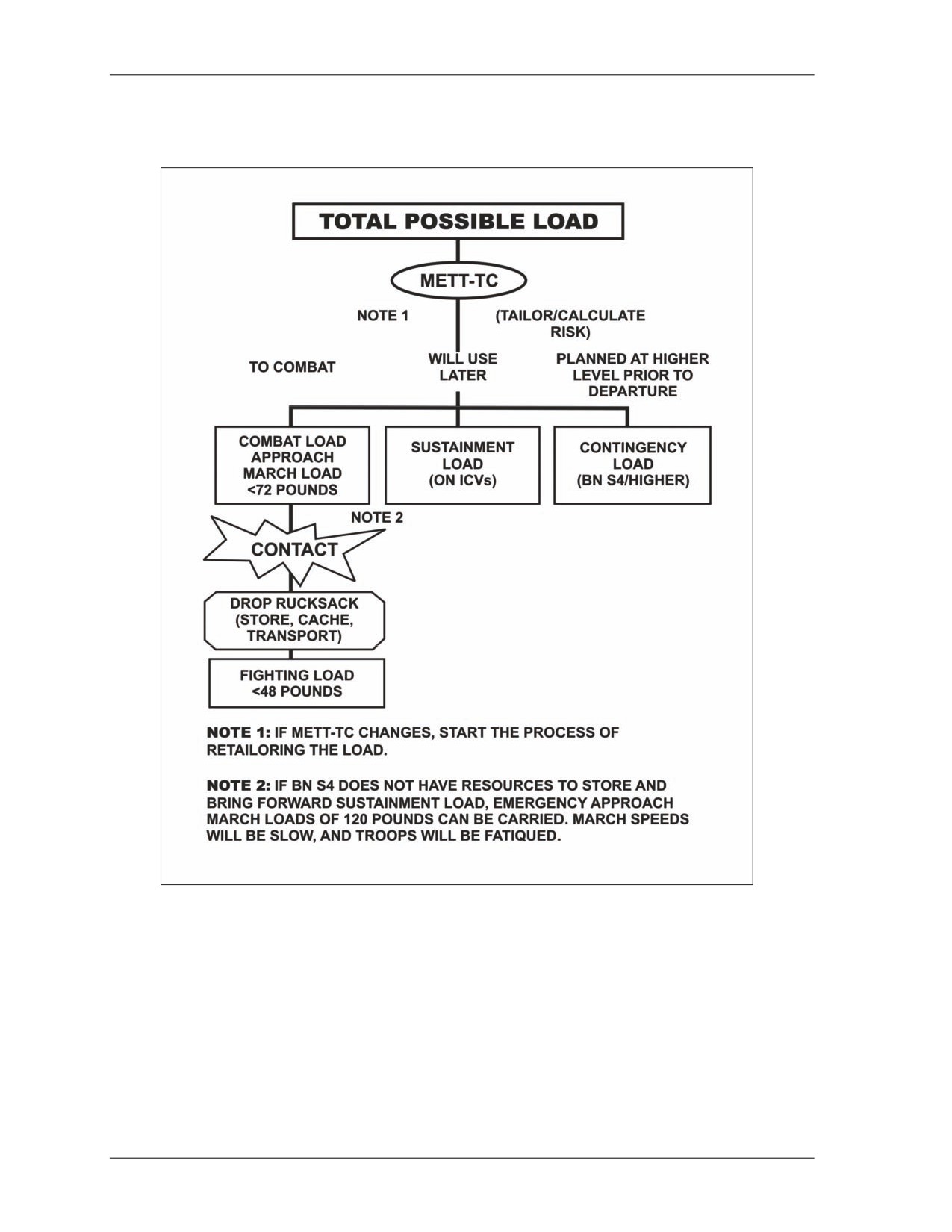
three echelons: combat load (approach march or fighting load), sustainment load, and contingency load
(Figure 11-1, page 11-6).
27 July 2006
FM 3-21.10
11-5
Chapter 11
Figure 11-1. Load echelon diagram.
COMBAT LOAD
11-11. A combat load consists of the minimum mission-essential equipment, as determined by the
mission commander. This includes only what is needed to fight and survive immediate combat operations.
The two levels of combat load are fighting loads, which are carried on dynamic operations where contact
with the enemy is expected, and approach march loads, which are carried when transportation cannot be
provided for equipment over and above fighting loads.
11-6
FM 3-21.10
27 July 2006
Sustainment Operations
FIGHTING LOAD
11-12. A fighting load is what the Soldier carries once contact has been made with the enemy. It consists
only of essential items the Soldier needs to accomplish his task during the engagement. For close combat
and operations requiring stealth, any load at all is a disadvantage. Cross loading of machine-gun
ammunition, mortar rounds, antitank weapons, and radio equipment causes most combat loads to exceed 48
pounds. This is where risk analysis is critical. Excessive combat loads of assaulting troops must be
configured so that the excess can be redistributed or shed (leaving only the fighting load) before or upon
contact with the enemy.
APPROACH MARCH LOAD
11-13. An approach march load is the load that the Soldier carries in addition to his fighting load. These
items are dropped in an assault position, ORP, or other rally point before or upon contact with the enemy.
On long dynamic operations, Soldiers must carry enough equipment and munitions to fight and exist until a
planned resupply can take place. These loads vary and may exceed the goal of 72 pounds.
SUSTAINMENT LOAD
11-14. A sustainment load consists of the equipment required for sustained operations. This equipment is
usually stored by the company supply section in the BSA and brought forward when needed. A sustaining
load can include rucksacks, squad duffel bags, and sleeping bags. In combat, protective items for specific
threats, such as joint-service lightweight integrated suit technology
(JSLIST) might be stored in
preconfigured unit loads. Commanders coordinate with the battalion S-4 to ensure that all sustainment load
items are available.
CONTINGENCY LOAD
11-15. The contingency load includes all other items that are not necessary for ongoing operations, such
as extra clothing, personal items, or even Javelins in a threat environment where the enemy lacks an
armored capability. Contingency loads might be stored in duffel bags or palletized. Determining what goes
in these loads and who is responsible for the storage and delivery of them, is a critical element for company
commanders.
CALCULATION
11-16. The combat load for each Soldier consists of three components: common essential items carried
(worn) by all Soldiers regardless of threat, environment, or mission; duty position load, consisting of the
Soldier's assigned weapon
(or components of the weapon system) plus ammunition; and variables,
consisting of all other items carried, based on the commander's estimate of the situation. The latter are
items that constitute the environmental, threat protection, and mission loads. When calculating load
requirements, leaders should--
y Adjust combat loads so Soldiers carry less than 72 pounds.
y Divide combat loads into fighting loads and approach march loads.
y Have Soldiers pack rucksacks and assault packs accordingly.
y Place all other company equipment into the sustainment load.
y Once he decides what items Soldiers will carry on the mission, the leader decides how they will
carry them. Soldiers need some items to be immediately available; other items can be carried in
rucksacks.
MANAGEMENT
11-17. The key to load management is to carry only what is necessary to accomplish the mission. The
following techniques assist the commander in load management.
27 July 2006
FM 3-21.10
11-7
Chapter 11
y Make sure Soldiers distribute their loads evenly over the body, body armor, and load-carrying
equipment (LCE), or load-bearing vest (LBV).
y Carry critical items within easy reach: carry water, ammunition, and a first aid pouch on the
LCE, with other items in Army combat uniform (ACU) pockets. Ensure that placement of all
items is standardized within the unit, and nothing that could prevent the Soldier from taking a
well-aimed shot is allowed on the firing side of the LCE.
y Distribute loads throughout the unit. If bulk ammunition, rations, water, or demolitions must be
manpacked, divide them into small loads consistent with METT-TC. This helps ensure they can
be distributed on the battlefield where needed.
y Rotate heavy loads among several Soldiers. The unit can rotate radios, M240s, mortars, and
Javelins if enemy contact is not imminent. Ensure that the assigned gunner stays near the
weapons system components if they are rotated.
11-18. Upon contact with the enemy, drop rucksacks (if the tactical situation permits). The commander
must consider how to recover the rucksacks and the effect not having the rucksacks might have on his unit)
or leave them in an ORP, an assault position, or the assembly area. The leader can later request battalion
transportation assets to bring them to his unit when possible (enemy situation dependent.) Soldiers mark
their rucksacks by unit to facilitate quick recovery.
y Share or consolidate items; if the weather requires Soldiers to carry sleeping bags, carry only
enough for those who will sleep at the same time; two or three Soldiers can share a sleeping
bag. Soldiers can share the bags as they take turns rotating security duty.) In the same manner,
two or three Soldiers can share a rucksack and take turns carrying it.
y Consider cutting rations to two or even one meal, ready to eat (MRE) per man per day for short
periods. Remember that the MRE is a complete meal. It provides all the nutrition Soldiers need
for sustained operations. Proper nutrition and fueling is critical for sustained Soldier
performance.
y While carrying the rucksack, use water and rations carried in or on it first. If Soldiers must drop
their rucksacks, what they carry in their ACUs and on the LCE or LBV remains available.
Replace ammunition, water, and rations carried on LCE or LBV, or in ACU pockets, as soon as
possible.
y When carrying radios in rucksacks, keep them attached to the backpack for access and use
when rucksacks are dropped.
y Consider caches, supply linkups, captured stocks, and foraging to provide food, water, shelter,
weapons, and equipment to reduce the need to manpack supplies.
y Avoid unnecessary movement and displacements. To conserve the Soldier's stamina, plan the
mission as efficiently as possible. Do not move a platoon when moving a squad can do the job.
If the leader becomes lost, he stops and determines his unit's location before moving and, if
necessary, sends out someone to confirm the unit's location.
11-19. Supervise the Soldier's load closely. Not only must you check to ensure that the Soldier carries all
items on the packing list, but also that he does not carry items not on the packing list. Do not let Soldiers
carry unnecessary or ‘comfort’ items that will add weight and detract from their performance. Soldiers
might be tempted to carry unnecessary items when they start on a mission and throw essential items away
when they are tired. Packing lists for rucksack management and leader inspections before and during the
mission ensure that only necessary items are carried. Rucksack management results in efficient use of a
Soldier's energy and ensures that essential items are available when needed in combat.
y The company net does not always need the COMSEC equipment to function effectively.
Ensure the threat warrants the extra weight on the radio operators.
y Consider distributing the approach march or sustainment loads to only two platoons. This
allows the lead platoon to move with more stealth and alertness and to remain unburdened in
case of contact. Platoons can then quickly swap rucksacks as they rotate the lead.
11-8
FM 3-21.10
27 July 2006
Sustainment Operations
Section III. TRAINS
The logistical focal point is generally described as the trains. Sustainment personnel and equipment organic or
attached to a force that provides support such as supply, evacuation, and maintenance services comprise the
unit trains.
OVERVIEW
11-20. The company trains are the focal point for company sustainment operations. It is the most forward
sustainment element, and provides essential medical treatment and critical resupply support. The size and
composition of the Infantry company trains vary depending upon the tactical situation. The trains may
consist of nothing more than preplanned locations on the ground (a control measure such as a checkpoint)
during fast-paced offensive operations, or the trains may contain two to five tactical vehicles during
resupply operations. The company trains are established to conduct evacuation (of WIAs, weapons, and
equipment) and resupply as required. The company trains are located in a covered and concealed position,
close enough to the company to provide responsive support, but out of enemy direct fire. The 1SG or XO
will position the trains and supervise sustainment operations. Support to the company trains comes from
the battalion combat trains.
SECURITY
11-21. Security of sustainment elements is critical to the success of the Infantry company and battalion
missions. For this reason, the company trains must develop plans for continuous security operations.
Company trains normally operate one terrain feature to the rear of the company. METT-TC factors dictate
the actual distance. This location gives the company virtually immediate access to essential sustainment
functions while allowing the trains to remain in a covered and concealed position behind the company
combat elements. Where feasible, they may plan and execute a perimeter defense. The trains, however,
may lack the personnel to conduct a major security effort. In such situations, they must plan and implement
passive security measures to provide protection from enemy forces.
Section IV. SUPPLY AND TRANSPORTATION OPERATIONS
Each Infantry company normally deploys with 72 hours of supplies. The commander uses the unit basic load as
the frame of reference for determining 72 hours worth of supplies. The Infantry company commander considers
his situation to decide on the best means of resupplying his company. Resupply requests are classified as either
routine or emergency. Cues and procedures for each method are specified in the company SOP and are
rehearsed during company training exercises. The resupply method is typically either tailgate or service station
depending on METT-TC. Infantry companies are supported by the Infantry battalion, which in turn is supported
by the brigade through the forward support battalion (FSB).
CLASSES
11-22. Supplies are divided into 10 major categories, which are referred to as classes (Figure 11-2,
page 11-11). The following paragraphs describe how these classes specifically relate to the Infantry
company.
CLASS I
11-23. Subsistence supplies will be configured into unit-configured loads based on personnel strength
reports. These loads are typically delivered by company supply sergeant LOGPACs to the battalion combat
trains linking up with the company 1SG who makes further delivery to the companies. The company water
trailer, supported by water from the BSB, supplies water to the unit. Units may also obtain water from
within the theater of operations.
27 July 2006
FM 3-21.10
11-9
Chapter 11
CLASS II
11-24. Limited stocks of Class II items (preventive medicine, field hygiene, weapons cleaning, and
special tools) will be available at the BSB. This class also includes CTA-50 items, clothing,
mission-oriented protective posture (MOPP) suits, tentage, tool sets, and administrative and housekeeping
supplies and equipment. Class II supplies will be delivered with the LOGPACs.
CLASS III
11-25. Fuel support to the company will come from the battalion by organic fuel vehicles. Unit SOP
determines how company vehicles are fueled. The two types of Class III are--
y Bulk--fuel.
y Package--coolant, oil, and lubricants, among other things.
CLASS IV
11-26. Company SOP specifies the use of Class IV items for the company. Requirements for class IV
items such as concertina wire, sandbags, and pickets must be delivered as needed to the company area on
battalion tactical vehicles.
CLASS V
11-27. The Infantry company deploys with a combat load of munitions. Ammunition resupply deliveries
will be accomplished by the battalion ammunition vehicles and delivered to the battalion combat trains.
CLASS VI
11-28. The BSB does not stock Class VI supplies. After 30 days in theater, the supplement health and
comfort pack (HCP) ration is usually issued with Class I rations.
11-10
FM 3-21.10
27 July 2006
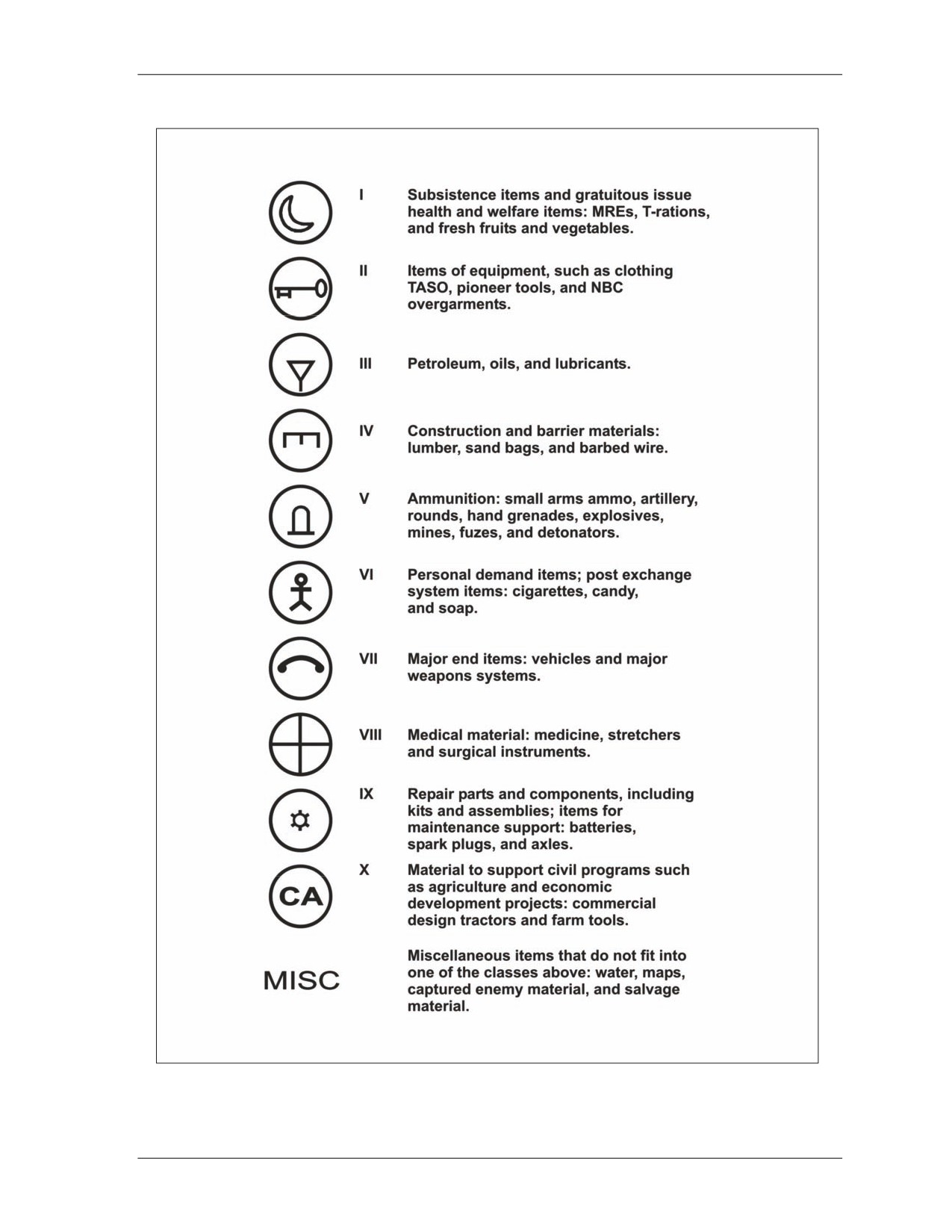
Sustainment Operations
Figure 11-2. Classes of supply.
27 July 2006
FM 3-21.10
11-11
Chapter 11
CLASS VII
11-29. Class VII status is reported through command channels; it is intensively managed and command
controlled. The BSB will receive replacement items as ready-to-fight systems. Ready-to-fight systems are
sent forward with the LOGPAC.
CLASS VIII
11-30. Medical supplies, such as first aid dressings, refills for first aid kits, water purification tablets, and
foot powder, are supplied to the battalion medical platoon by the BSB via LOGPAC, ambulance backhaul,
or emergency delivery.
CLASS IX
11-31. The battalion stocks limited Class IX to perform organizational maintenance on small arms and
communications equipment. The battalion either requests the appropriate repair parts in response to a
specific request or repairs the piece of equipment by controlled exchange of serviceable parts.
Rechargeable batteries for NVDs and man-portable radios may require one-for-one exchange. In combat
situations, exchange and controlled substitution are the normal means of obtaining Class IX items.
ROUTINE RESUPPLY
11-32. Routine resupply operations cover items in Classes I, III, V, and IX, as well as mail and any other
items requested by the company. Resupply operations normally occur once a day. Whenever possible,
routine resupply should be conducted daily, ideally during periods of limited visibility.
LOGISTICS PACKAGE OPERATIONS
11-33. The company supply sergeant compiles and coordinates any unique supply request for the
company and routes them through the battalion S-4. Based on the requests and the predetermined supply
needs, he then organizes and assembles the LOGPAC in the battalion field trains. Supplies are usually
configured to sustain the company for a 24-hour period or until the next scheduled LOGPAC. Other items
to be included in the LOGPAC are coordinated by the appropriate staff officer and delivered to the field
trains. These items may include, replacement personnel and Soldiers returning from medical treatment,
vehicles returning to the company area from maintenance, and mail and personnel actions.
Movement of LOGPAC
11-34. Once the company LOGPAC has been formed in the field trains, it is ready to move forward
under the control of the company supply sergeant. The forward support company XO or 1SG normally
organizes a convoy of company LOGPACs to facilitate movement along a supply route to the LRP where
the company's 1SGs take control. The 1SG controls distribution to the company using one of the various
techniques discussed later. The convoy commander must also establish security measures for the LOGPAC
along the MSR.
Actions at LRP
11-35. When the LOGPAC arrives at the LRP, the company 1SG assumes control of the company
LOGPAC and continues tactical movement to the company resupply point. The LOGPAC stops at the LRP
only when the tactical situation dictates or when ordered by the commander. Security is maintained at
all times.
11-12
FM 3-21.10
27 July 2006
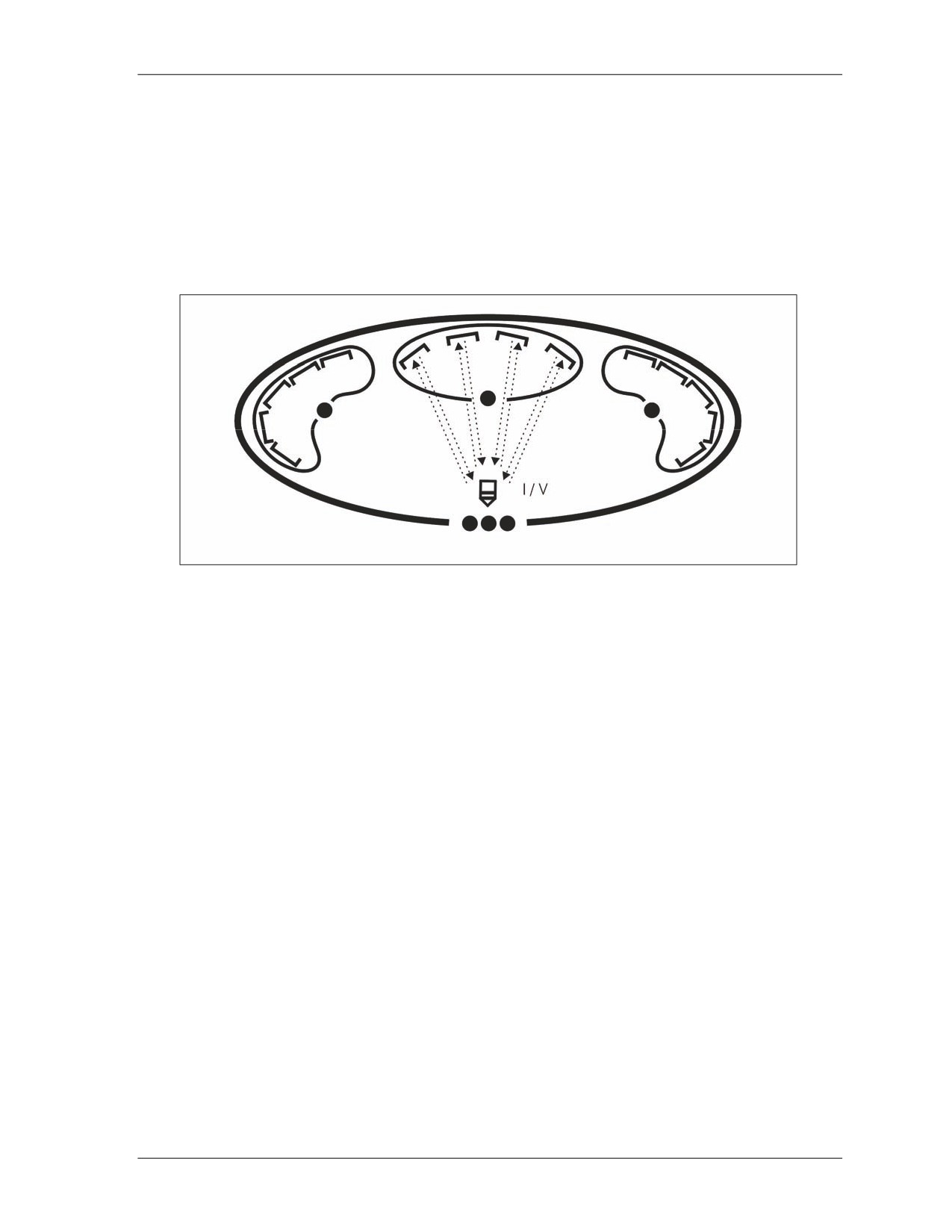
Sustainment Operations
Resupply Procedures
11-36. The company can use the service station (Figure 11-3) or tailgate resupply (Figure 11-4) method.
The time required for resupply is an important planning factor. Resupply must be conducted as quickly and
efficiently as possible, both to ensure operational effectiveness and to allow the company LOGPAC
vehicles to return to the LRP on time. Service station resupply of the company normally takes 60 to 90
minutes but may take longer. Tailgate resupply usually requires significantly more time than service station
resupply. At times, leaders must use the in-position resupply method (Figure 11-5), but this takes much
more time.
Figure 11-3. Service station resupply method.
27 July 2006
FM 3-21.10
11-13