FM 3-21.10 (FM 7-10) The Infantry Rifle Company (July 2006) - page 8
Chapter 8
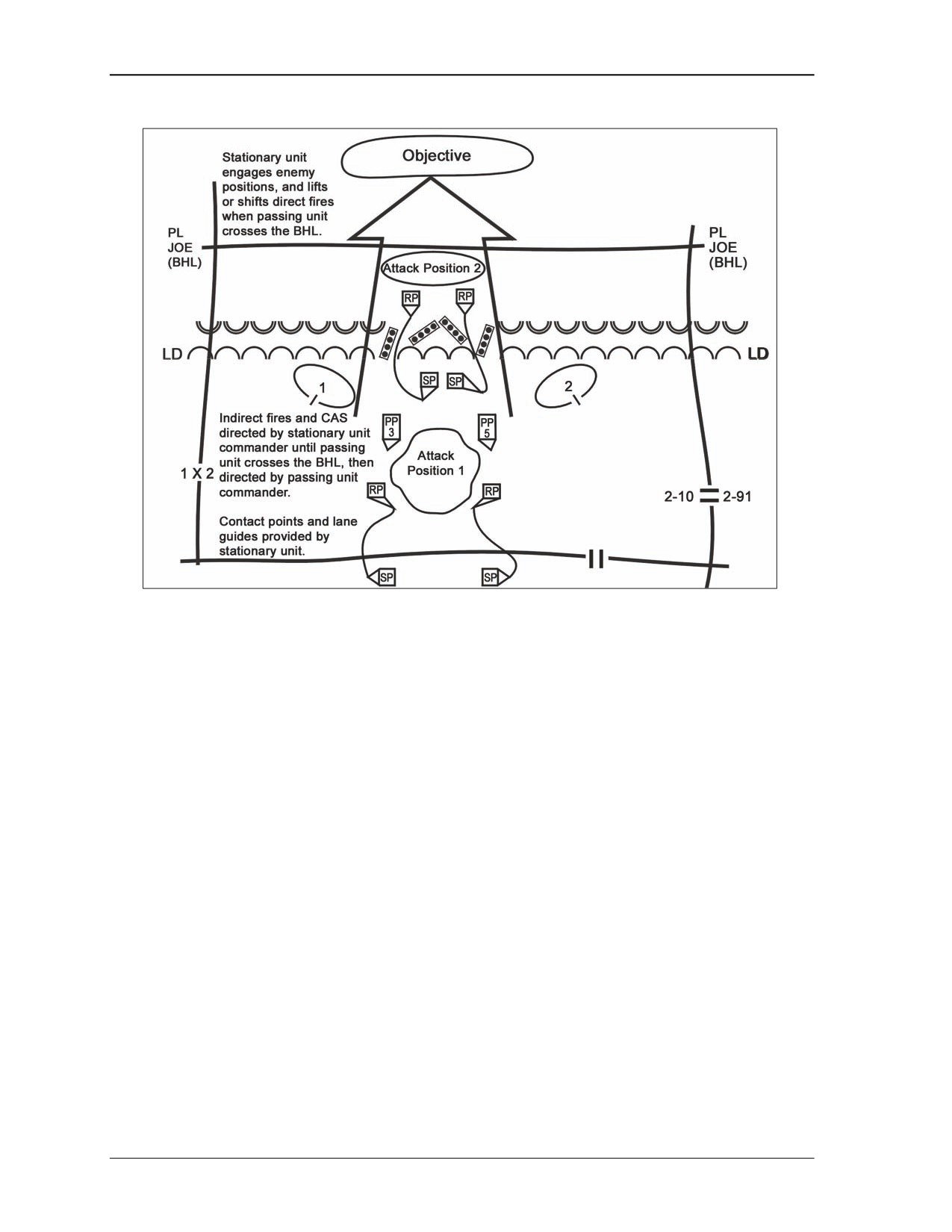
Figure 8-5. Infantry company conducting a forward passage of lines.
REARWARD PASSAGE OF LINES
8-69.
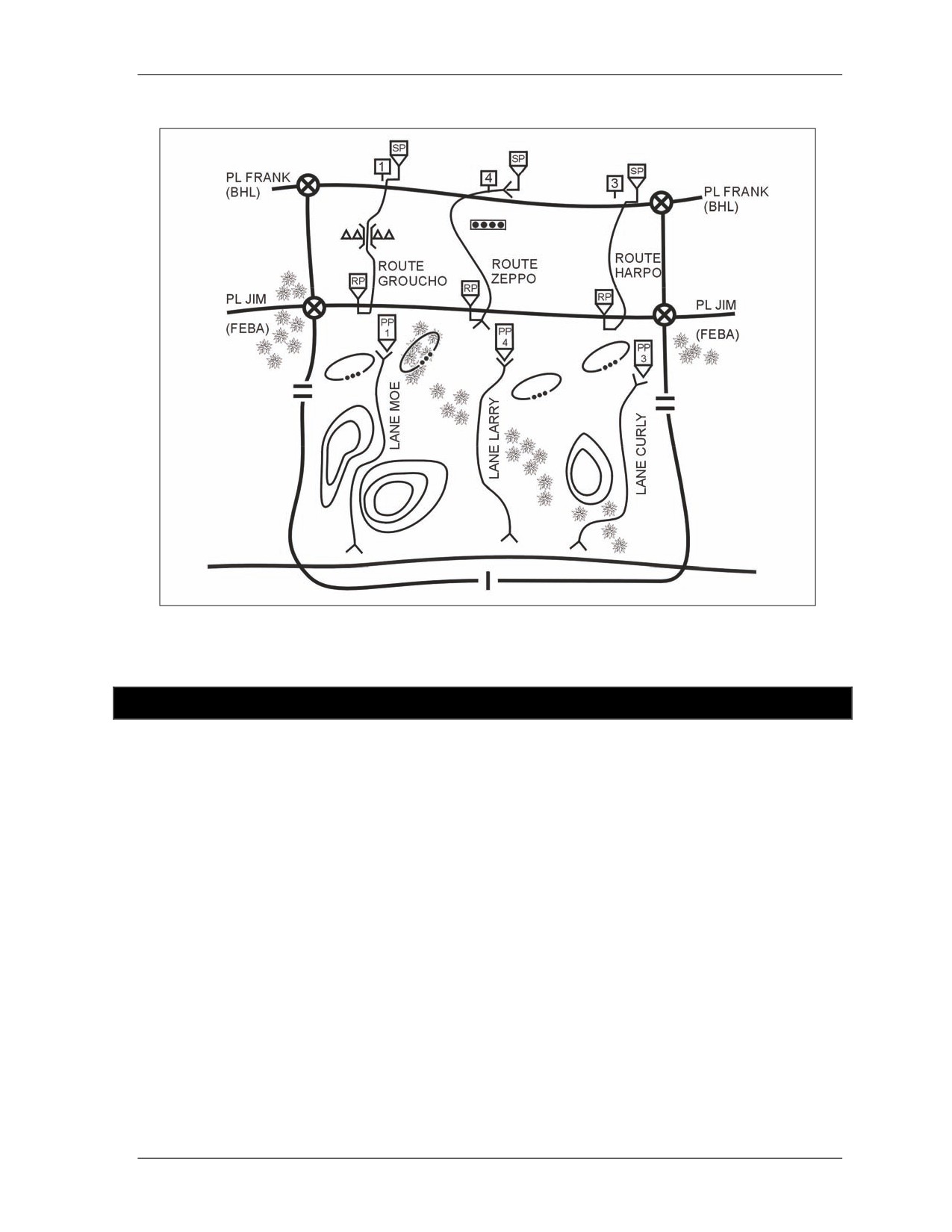
Due to the increased chance of fratricide during a rearward passage, coordination of recognition
signals and direct-fire restrictions is critical. While it is still beyond direct-fire range, the passing unit
contacts the stationary unit, and then coordinates as previously discussed. Coordination emphasizes near
recognition signals and location of the BHL. Additional fire-control measures, such as RFLs, might be
used to reduce the risk of fratricide. After coordination, the passing unit continues tactical movement
toward the passage lane. The passing unit is responsible for its own security until it passes the BHL. If the
stationary unit provides guides, the guide meets the lead element of the passing unit and, without stopping,
guides the unit to a designated location behind the stationary unit. If a guide is not provided, the passing
unit moves on its own to a designated area without stopping (Figure 8-6).
8-16
FM 3-21.10
27 July 2006
Tactical Enabling Operations
Figure 8-6. Infantry company conducting a rearward passage of lines.
Section III. SECURITY OPERATIONS
The company may conduct security operations to the front, flanks, or rear of the force. Security operations
provide early and accurate warning of enemy operations. They give the protected force time and maneuver
space to react to the enemy and develop the situation. This allows the commander to employ the protected force
effectively. (For more on security operations, see FM 17-95.)
TYPES
8-70.
The five forms of security operations are screen, guard, cover, area security, and local security.
Screen, guard, and cover entail deployment of progressively higher levels of assets and provide increasing
levels of security for the main body. Area security preserves a commander's freedom to move his reserves,
position fire support assets, conduct command and control operations, and provide for sustainment
operations. The company can conduct screen or guard operations on its own. It participates in area security
missions and covering force operations only as part of a larger element. The company always provides its
own local security. All forces have an inherent responsibility to provide their own local security. Local
security includes OPs, local security patrols, perimeter security, and other measures taken to provide
close-in security.
27 July 2006
FM 3-21.10
8-17
Chapter 8
PLANNING CONSIDERATIONS
8-71.
Security operations require the commander assigning the security mission and the security force
commander to address a variety of special operational factors.
AUGMENTATION OF SECURITY FORCES
8-72.
When it is assigned to conduct a screen or guard mission, the company may receive additional
combat, combat support, and sustainment elements. Attachments include at least--
y A scout platoon.
y An additional mortar section or platoon.
ENEMY-RELATED CONSIDERATIONS
8-73.
Security operations require the company to deal with a unique set of enemy considerations. For
example, the array of enemy forces (and the tactics that enemy commanders use to employ them) might
differ from those for any other tactical operation the company conducts. Additional enemy considerations
that could influence company security operations follow:
y The presence or absence of specific types of forces on the battlefield including--
- Insurgent elements that might be external to the enemy force.
- Enemy reconnaissance elements of varying strengths and capabilities, at division or brigade
tactical group, or other levels.
- Enemy security elements, such as disruption forces, including enemy stay-behind elements
or other bypassed enemy elements.
y Possible locations where the enemy will employ his tactical assets, including--
- Reconnaissance and infiltration routes.
- OP sites for surveillance or indirect fire observers.
y Availability and anticipated employment of other enemy assets, including--
- Surveillance devices such as radar devices or UASs.
- Long-range rocket and artillery assets.
- Helicopter and fixed-wing air strikes.
- Elements capable of dismounted insertion or infiltration.
- Mechanized forward detachments.
TIME SECURITY OPERATION IS INITIATED
8-74.
The time by which the screen or guard must be set and active influences the company's method of
deploying to the security area as well as the time it begins the deployment.
RECONNAISSANCE OF SECURITY AREA
8-75.
The company commander uses a thorough analysis of METT-TC factors to determine the
appropriate methods and techniques to accomplish this critical action.
Note: The company commander tries to personally reconnoiter the security area he expects
the company to occupy, even when the operation is preceded by a zone reconnaissance by
other battalion elements.
8-18
FM 3-21.10
27 July 2006
Tactical Enabling Operations
MOVEMENT TO SECURITY AREA
8-76.
In deploying elements to an area for a stationary security mission, the company commander must
deal with the competing requirements: to establish the security operation quickly and meet mission
requirements; and to provide the necessary level of local security while doing so. The company can move
to the security area using one of two basic methods: a tactical road march or a movement to contact. Either
method should be preceded by a zone reconnaissance by the Infantry battalion scout platoon. The
following paragraphs examine considerations and procedures for the two methods of movement.
Tactical Road March
8-77.
The company conducts a tactical road march to an RP behind the security area to occupy their
initial positions. This method of deployment is faster than a movement to contact, but less secure. It is
appropriate when enemy contact is not expected or when time is critical.
Movement to Contact
8-78.
The company moves from the LD to the security area using the appropriate movement technique
based on the likelihood of enemy contact. This method is slower than a tactical road march, but it is more
secure. It is appropriate when enemy contact is likely, or the situation is unclear.
LOCATION AND ORIENTATION OF SECURITY AREA
8-79.
The main body commander determines the location, orientation, and depth of the security area in
which he wants the security force to operate. The security force commander conducts a detailed analysis of
the terrain in the security area. He then establishes his initial dispositions (usually a screen line, even for a
guard mission) as far forward as possible, on terrain that allows clear observation of avenues of approach
into a sector. The initial screen line is shown as a phase line. It sometimes represents the forward line of
own troops (FLOT). As such, the screen line might serve as a restrictive control measure for movement.
This requires the company commander to conduct all necessary coordination if he decides to establish OPs
or to perform reconnaissance forward of the line.
INITIAL OP LOCATIONS
8-80.
The company commander deploys OPs to ensure effective surveillance of the sector and
designated NAIs. He designates initial OP locations on or behind the screen line. He provides OP
personnel with specific orientation and observation guidance, including, at a minimum, the primary
orientation for the surveillance effort during the conduct of the screen. Once set on the screen line, the
surveillance elements report their locations. The element that occupies each OP always retains the
responsibility for changing the location in accordance with tactical requirements and the commander's
intent and guidance for orientation. OPs maximize stealth. Patrols might be required to cover gaps between
the OPs. As required, the company commander tasks elements to conduct patrols.
WIDTH AND DEPTH OF SECURITY AREA
8-81.
The company sector is defined by lateral boundaries extending out to the limit of advance (LOA)
or the initial screen line. The company's ability to maintain depth through the sector decreases as the
screened or guarded frontage increases.
27 July 2006
FM 3-21.10
8-19
Chapter 8
SPECIAL REQUIREMENTS AND CONSTRAINTS
8-82.
The company commander specifies any additional considerations for the security operation,
including at least--
y All requirements for observing NAIs, as identified by the battalion.
y Any additional tactical tasks or missions for the company and subordinate elements.
y Engagement and disengagement criteria for all company elements.
INDIRECT FIRE PLANNING
8-83.
The company commander conducts indirect fire planning to integrate artillery and mortar assets
into the security mission. A wide sector may require him to position mortar assets where they can provide
effective coverage of the enemy's most likely axis of attack or infiltration route, as determined in his
analysis of the enemy. The commander can position the mortars so that up to two thirds of their maximum
range lies forward of the initial screen line. The company FSO helps the commander plan artillery fires to
cover gaps in mortar coverage.
POSITIONING OF COMMAND AND CONTROL AND SUSTAINMENT ASSETS
8-84.
The company commander positions himself where he can observe the most dangerous enemy axis
of attack or infiltration route, with the XO positioned on the second most critical axis or route. The XO
positions the company CP (if used) in depth and, normally, centered in sector. This allows the CP to
provide control of initial movement, to receive reports from the screen or guard elements, and to assist the
commander in more effectively facilitating command and control. Company trains are positioned behind
masking terrain, but they remain close enough for rapid response. The trains are best sited along routes that
afford good mobility laterally and in depth.
COORDINATION
8-85.
The company commander conducts adjacent unit coordination to ensure there are no gaps in the
screen or guard and to ensure smooth execution of the company's rearward passages of lines, if required.
Also, he must coordinate the company's follow-on mission.
SUSTAINMENT CONSIDERATIONS
8-86.
The company commander's primary consideration for sustainment during security operations is
coordinating and conducting resupply of the company, especially for Class V supplies. (One technique is
for the commander to pre-position Class V in successive positions.) However, in addition to normal
considerations, the commander may acquire other responsibilities in this area such as arranging
sustainment for a large number of attached elements or coordinating resupply for a subsequent mission.
The company's support planning can be further complicated by a variety of factors. To prevent these
factors from creating tactical problems, the company must receive requested logistical support, such as
additional MEDEVAC vehicles, from the controlling battalion.
FOLLOW-ON MISSIONS
8-87.
The complexities of security missions, combined with normal operational requirements, such as
troop-leading procedures or on-the-move (OTM) planning, EA development, rest plans, and sustainment
activities, can easily deprive the company commander of the time he needs for planning and preparation of
follow-on missions. He addresses these competing demands in his initial mission analysis to ensure that the
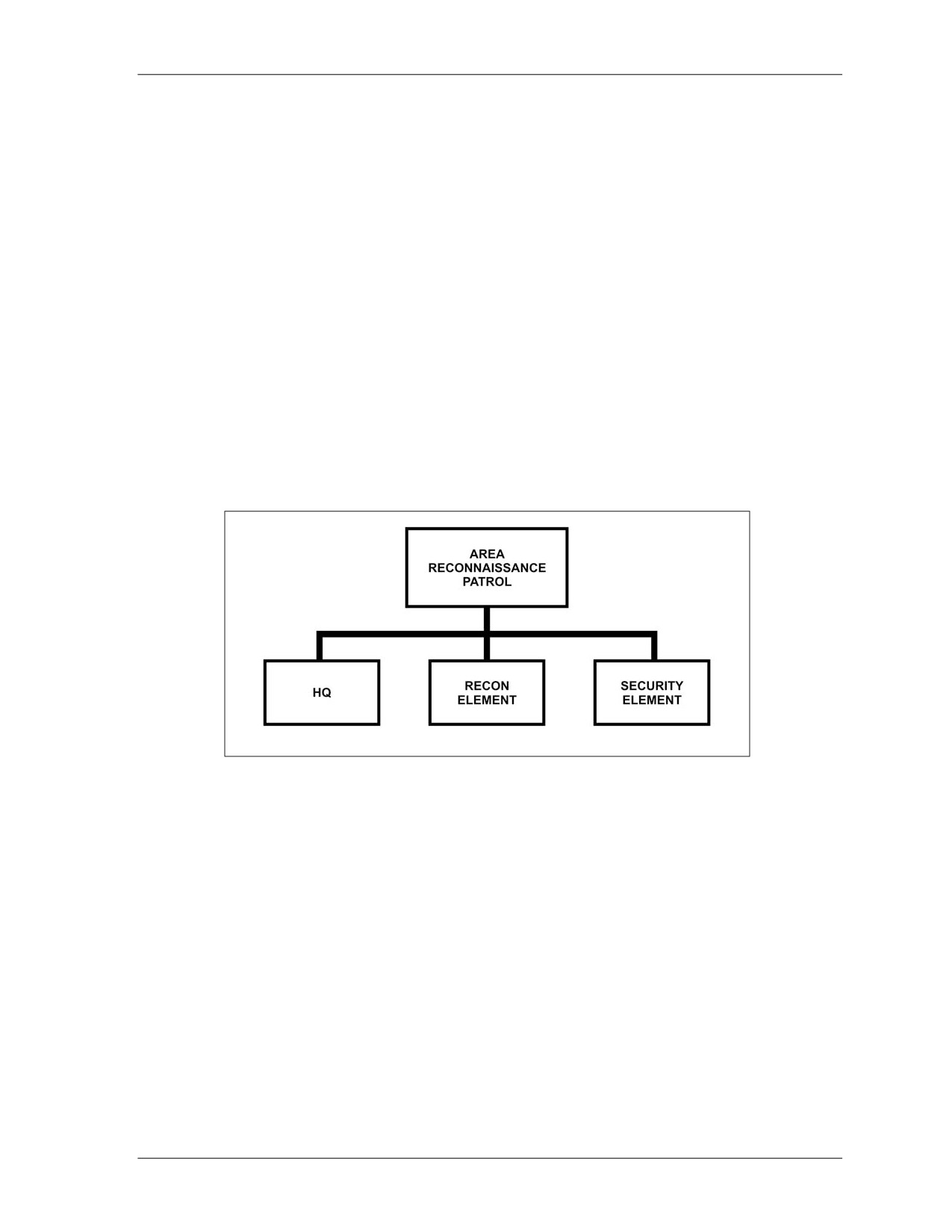
company and its leaders meet all requirements for current and future operations. For example, if METT-TC
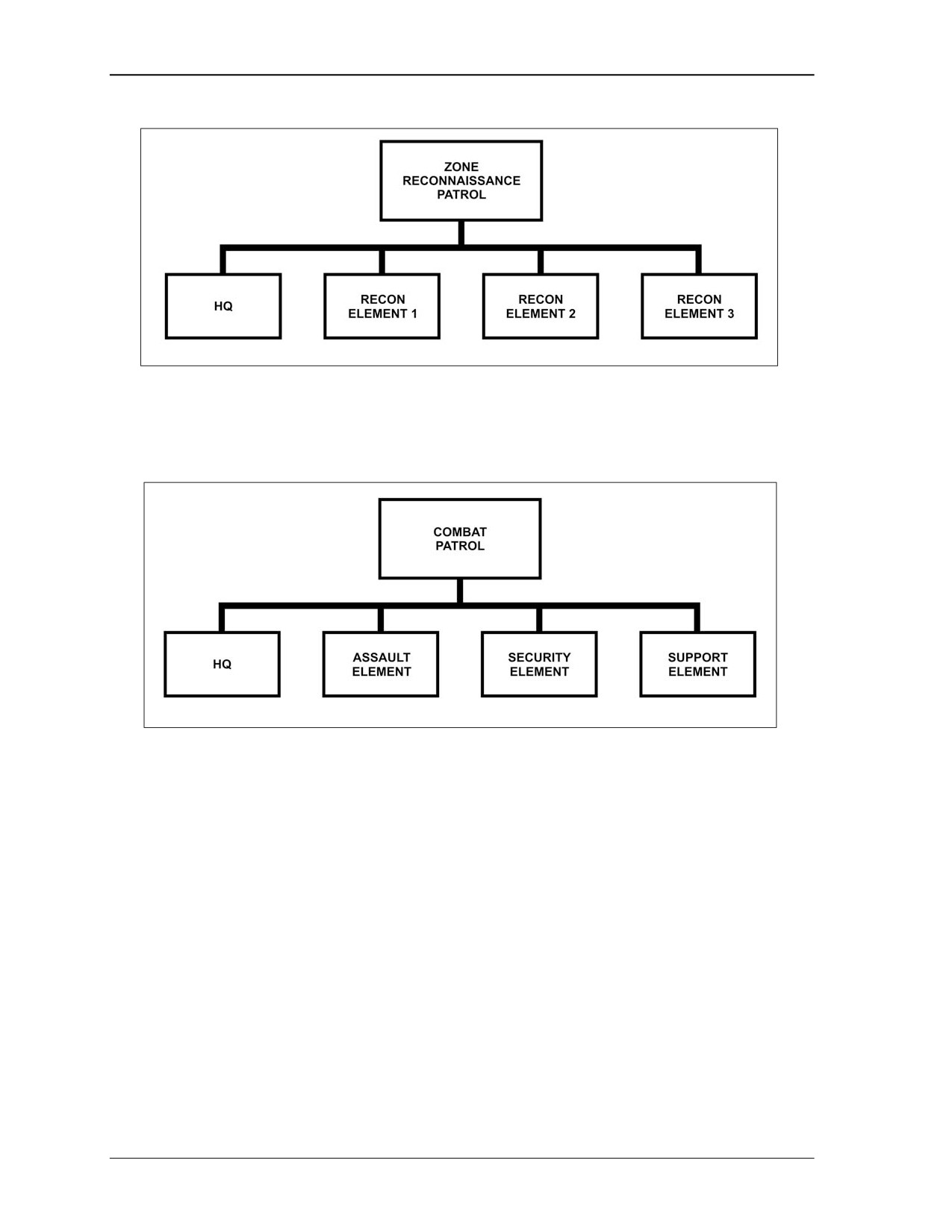
factors permit, the company commander can shift his focus to preparing for follow-on missions once
preparations for the security mission are complete or satisfactorily underway. Another technique is to
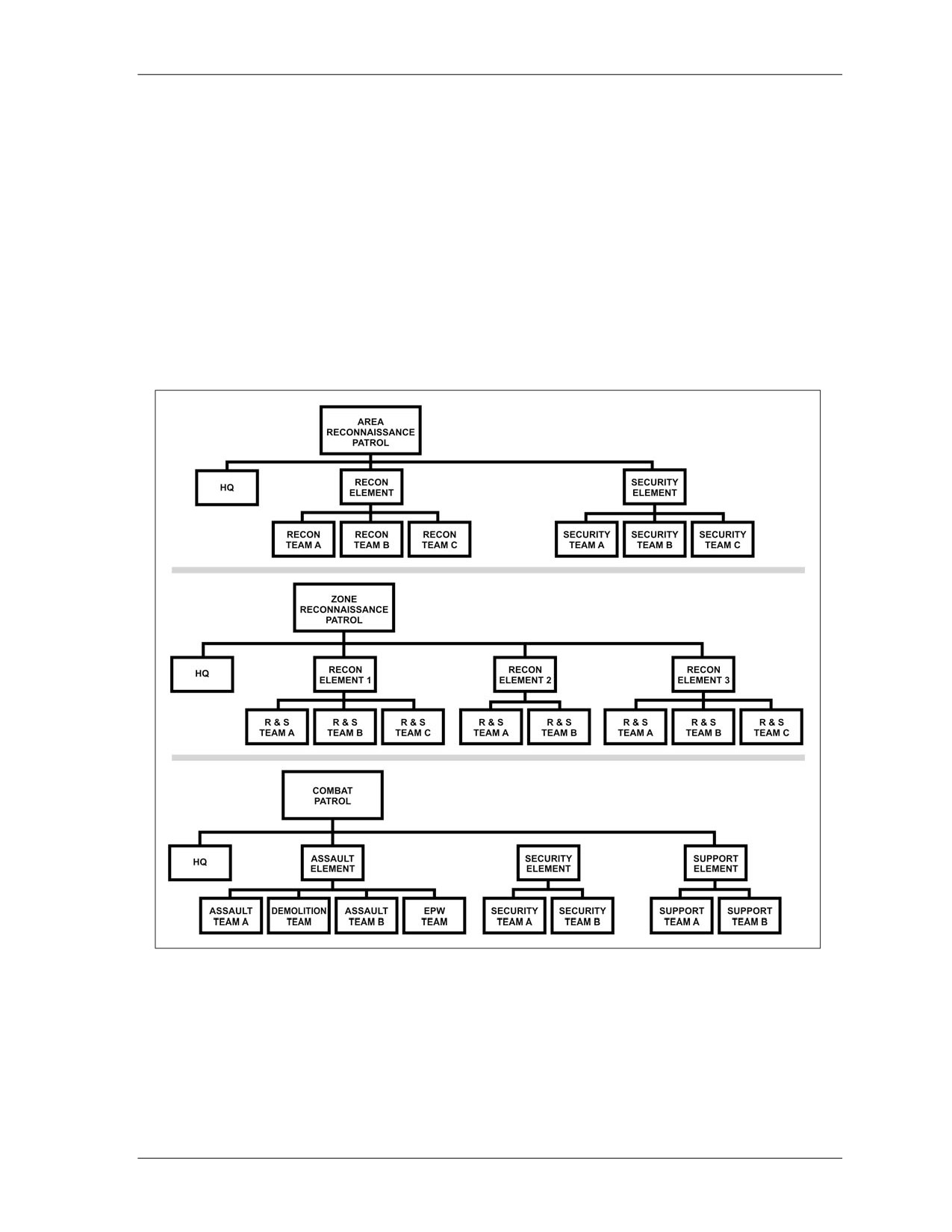
detach the XO with support personnel to prepare for follow-on missions. The XO’s party can handle such
operational requirements as reconnaissance, coordination, and development of follow-on EAs and BPs.
8-20
FM 3-21.10
27 July 2006
Tactical Enabling Operations
SCREEN
8-88.
A screen primarily provides early warning. The screening force observes, identifies, and reports
enemy actions to the main defense. A screen provides the least amount of protection for the main body of
any security mission. Generally, a screening force engages and destroys enemy reconnaissance elements
within its capabilities, but otherwise fights only in self-defense.
PURPOSES
8-89.
A screen is appropriate to secure gaps between forces, the exposed flanks or rear of stationary and
moving forces, or the front of a stationary formation. It is used when the likelihood of enemy contact is
remote, the expected enemy force is small, or the friendly main body needs only a minimum amount of
time, once it is warned, to act effectively. A screen is a series of OPs and patrols that ensure adequate
surveillance of the assigned sector. The screen serves--
y To prevent enemy ground elements from passing through the screen undetected or unreported.
y To maintain continuous surveillance of all avenues of approach into the sector under all
visibility conditions.
y To destroy or repel enemy reconnaissance elements within capability.
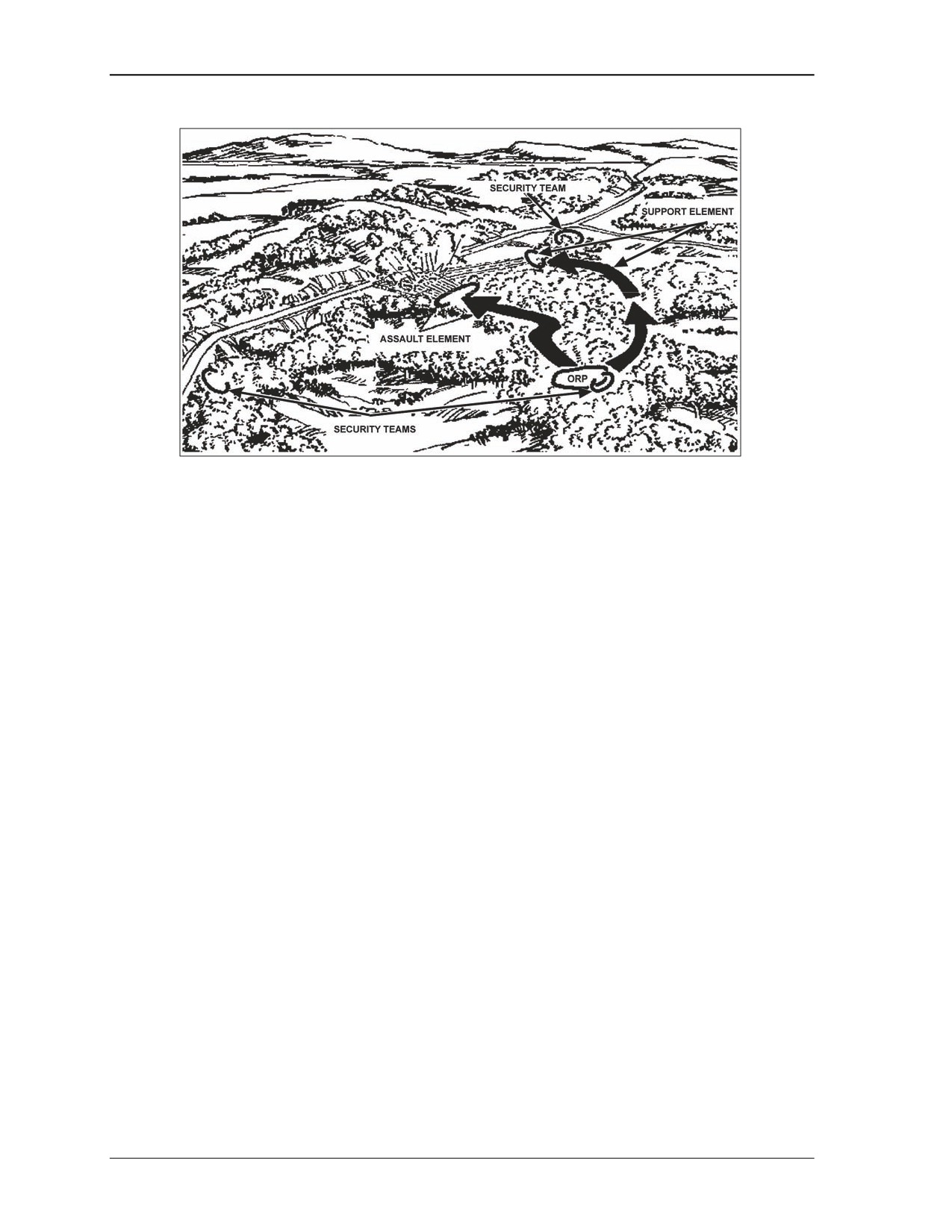
y To locate the lead elements of each enemy advance guard force and determine their direction of
movement.
y To maintain contact with enemy forces and report any activity in sector.
y To impede and harass the enemy within capability while displacing.
y To maintain contact with the enemy main body and any enemy security forces operating on the
flanks of friendly forces.
STATIONARY SCREEN
8-90.
When conducting a stationary screen, the company commander analyzes infiltration routes into
the sector. He assigns surveillance responsibility to the company's subordinate elements. He designates
locations of OPs, which should be in-depth through the sector. Sections within the company normally
operate the OPs. The commander identifies the enemy's likely axis of attack or infiltration routes. He
identifies additional control measures, such as NAIs, phase lines, TRPs, or checkpoints, to assist in
movement control, in tracking of enemy elements, or in confirming the enemy's course of action. The
company conducts patrols to reconnoiter areas it cannot observe from OPs. Once an OP detects the enemy,
the screening force normally engages with indirect fires. This disrupts the enemy and does not compromise
the location of the OP. Within its capability, the screening force may destroy enemy reconnaissance assets
with direct fires if indirect fires cannot accomplish the task. The screening force also impedes and harasses
other enemy elements, mainly with indirect fires. If enemy pressure threatens the security of the screening
force, the unit normally reports the situation and requests permission to displace to a subsequent screen
line.
MOVING SCREEN
8-91.
The company can conduct a moving screen to the front, flanks, or rear of the main body. The
movement of the screen is keyed to time and distance factors associated with the movement of the friendly
main body.
Moving Flank Screen
8-92.
Responsibilities for a moving flank screen begin at the front of the main body’s lead combat
element and end at the rear of the protected force. In conducting a moving flank screen, the company either
occupies a series of temporary OPs along a designated screen line or, if the protected force is moving too
fast, continues to move while maintaining surveillance and preparing to occupy a designated screen line.
The screening force may use one or more of these methods as the speed of movement of the protected force
27 July 2006
FM 3-21.10
8-21
Chapter 8
changes or contact is made. The four basic methods of controlling movement along the screened
flank follow.
Alternate Bounds by Individual OP
8-93.
The screening element uses this method when the protected force is advancing slowly and enemy
contact is likely along the screen line. Designated elements of the screening force move to and occupy new
OPs as dictated by the enemy situation and the movement of the main body. Other elements remain
stationary, providing overwatch and surveillance, until the moving elements establish their new positions.
These elements then move to new positions while the now-stationary elements overwatch and surveil. This
sequence continues as needed. The method of alternate bounding by individual OP is secure but slow.
Alternate Bounds by Unit
8-94.
The screening element uses this method when the protected force is advancing slowly and enemy
contact is likely along the screen line. Designated elements of the screening force move and occupy new
positions as dictated by the enemy situation and the movement of the main body. Other elements remain
stationary, providing overwatch and surveillance, until the moving elements establish their new positions.
These elements then move to new positions while the now-stationary elements overwatch and surveil. This
sequence continues as needed. The method of alternate bounding by unit is secure but slow.
Successive Bounds
8-95.
The screening element uses this method when enemy contact is possible. During this time, the
main body makes frequent short halts during movement. Each platoon of the screening force occupies a
designated portion of the screen line each time the main body stops. When main body movement resumes,
the platoons move simultaneously, retaining their relative position as they move forward.
Continuous Marching
8-96.
The screening element uses this method when the main body is advancing rapidly at a constant
rate and enemy contact is not likely. The screening force maintains the same rate of movement as the main
body while at the same time conducting surveillance as necessary. The screening force plans stationary
screen lines along the movement route, but occupies them only as necessary to respond to enemy action.
Moving Rear Screen
8-97.
The screening force may establish a moving rear screen to the rear of a main body force
conducting an offensive operation, or between the enemy and the rear of a force conducting a retrograde
operation. In either case, movement of the screen is keyed to the movement of the main body or to the
requirements of the enemy situation. Movements to a series of phase lines normally control the operation.
GUARD
8-98.
A guard force protects the friendly main body by fighting to gain time while also observing and
reporting information. The guard force prevents enemy ground observation of and direct fire against the
main body by reconnoitering, attacking, defending, and delaying. A guard force normally operates within
the range of the main body’s indirect-fire weapons. The three types of guard operations are advance guard,
flank guard, and rear guard. They are conducted in support of either a stationary or a moving friendly
force. The guard force normally deploys over a narrower area of operations than does a comparably sized
screening force, allowing greater concentration. The guard force disrupts and delays enemy forces with
both direct and indirect fires.
8-22
FM 3-21.10
27 July 2006
Tactical Enabling Operations
PURPOSES
8-99.
The purposes of the guard, in addition to those listed in the earlier discussion of the screen,
include--
y Destroy or repel all enemy reconnaissance elements.
y Fix or destroy enemy security elements.
y Cause the enemy main body to deploy, and then report its direction of travel to the friendly
main body commander.
TYPES
8-100. The following discussion covers operational considerations for advance guards, flank guards, and
rear guards.
Advance Guard
8-101. An advance guard for a stationary force is defensive in nature. The company defends or delays in
accordance with the intent of the main body commander. An advance guard for a moving force is offensive
in nature. The company normally conducts an offensive advance guard mission during a movement to
contact as part of a battalion. The role of the advance guard is to maintain the freedom of maneuver of the
main body by providing early warning of enemy activity, and by fixing or destroying enemy
reconnaissance and security elements. These actions allow the main body commander to develop the
situation.
Flank Guard
8-102. A flank guard protects a flank of the main body. A flank guard is similar to a flank screen except
that both OPs and defensive positions are planned. The company may conduct a moving flank guard during
an attack or a movement to contact. In conducting a moving flank guard, the company normally occupies a
series of BPs along the protected flank. It must maintain orientation both to the front (to perform its
overwatch role and to maintain its own security) and to the protected flank. It must also maintain a
sufficient distance from the main body to prevent the enemy from engaging the main body with long-range
direct fires before early warning can be sent.
Rear Guard
8-103. The rear guard protects the rear of the main body as well as all CS and sustainment elements
within the main body. This may occur during offensive operations or during retrograde operations. Rear
guards might be deployed behind either moving or stationary main bodies. The rear guard for a moving
force displaces to successive BPs along phase lines or delay lines in depth as the main body moves. During
retrograde operations, the rear guard normally deploys its elements across the entire sector behind the main
body’s forward maneuver units.
STATIONARY GUARD
8-104. As noted, a stationary guard mission is, at least initially, defensive in nature. The guard force
normally employs OPs to accomplish all surveillance requirements of the guard mission. The company
must be prepared to conduct actions against the enemy's main body and security elements as well as his
reconnaissance forces. The following paragraphs discuss considerations for operations involving these
enemy elements.
27 July 2006
FM 3-21.10
8-23
Chapter 8
Actions against Main Body and Security Element
8-105. Once contact is made with an enemy main body or security force, the guard force attacks, defends,
or delays in accordance with the enemy situation and the intent of the commander of the protected force
(Chapter 5).
Actions against Reconnaissance Elements
8-106. When the company must execute counterreconnaissance tasks, it normally task-organizes into a
surveillance element (normally occupying a screen line) and an attack element. Each element has specific
responsibilities and must work effectively with the other to ensure success of the operation.
Surveillance Element and Surveillance Sectors
8-107. The commander assigns responsibilities for surveillance of likely avenues of approach and
designated NAIs. The surveillance element is tasked with detecting, reporting, and maintaining contact
with the enemy in the assigned surveillance sector. In addition, the surveillance element is responsible for
passing the enemy force off to the attack element for destruction.
Attack Element
8-108. The attack element occupies hide positions, BPs, or attack-by-fire positions along likely enemy
avenues of approach. Once alerted by the surveillance force, it moves into position (if necessary) and
destroys the approaching enemy element. The attack element is responsible for direct fire planning and EA
development in support of the commander's plan. It rehearses all necessary movement to the planned
fighting positions and reports the movement times to the commander. Times of movement from hide
positions to fighting positions are synchronized with the movement rates of the enemy. The time
synchronization determines where the enemy must be acquired in order to provide the attack element time
to move to its fighting position.
Relationship of Surveillance and Attack Elements
8-109. The company's surveillance element must track locations of any enemy moving through the sector
while the attack element moves into position. Once the attack element is set and can observe the enemy, the
surveillance element completes target handover. This operation requires continuous communication
between the two subordinate elements conducting the handover, as well as close control by the company
commander or XO. In close terrain, the surveillance and attack elements must be positioned much closer
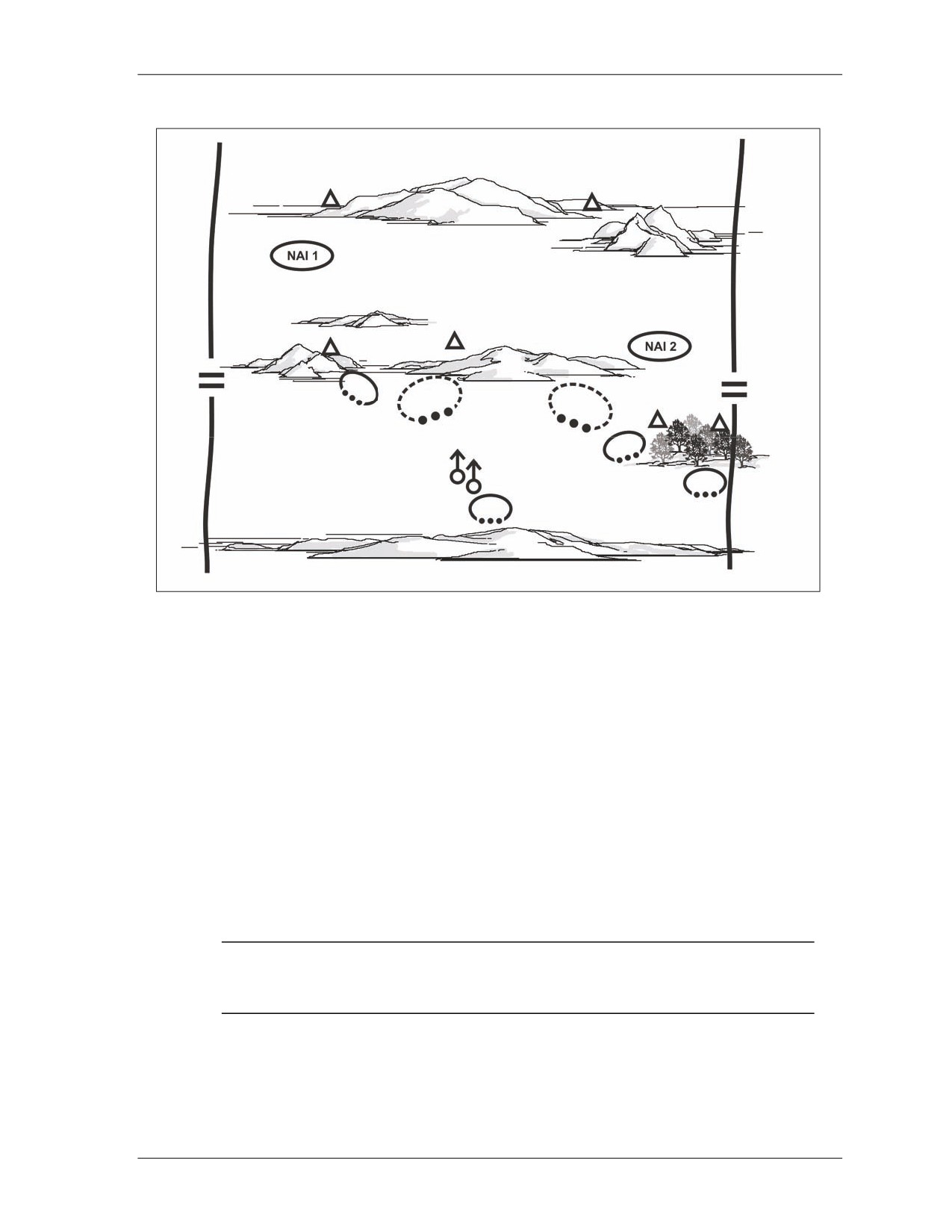
together than in open terrain. Figure 8-7 shows a company stationary guard operation.
8-24
FM 3-21.10
27 July 2006
Tactical Enabling Operations
Figure 8-7. Stationary guard with OPs forward.
MOVING FLANK GUARD
8-110. Many of the considerations for a moving flank screen apply to the execution of a moving flank
guard. However, unlike a moving flank screen that occupies a series of OPs, the flank guard force plans to
occupy a series of defensive positions.
8-111. In conducting a moving flank guard, the company either occupies a series of temporary BPs along
the protected flank or, if the protected force is moving too quickly, continues to move along the protected
flank. During movement, the company maintains surveillance to the protected flank while preparing to
occupy designated BPs based on enemy activity or on the movement of the protected force. The three basic
methods of controlling movement along the guarded flank are--
y Alternate bounds by unit.
y Successive bounds by unit.
y Continuous marching.
Note: These are identical to the methods for controlling movement along a screened flank,
except that the company and its platoons occupy designated defensive positions instead of
OPs.
8-112. The lead element of a moving flank guard must accomplish three tasks. It must maintain contact
with the protected force, reconnoiter the flank guard’s route of advance, and reconnoiter the zone between
the protected force and the flank guard’s advance. The rest of the flank guard marches along the route of
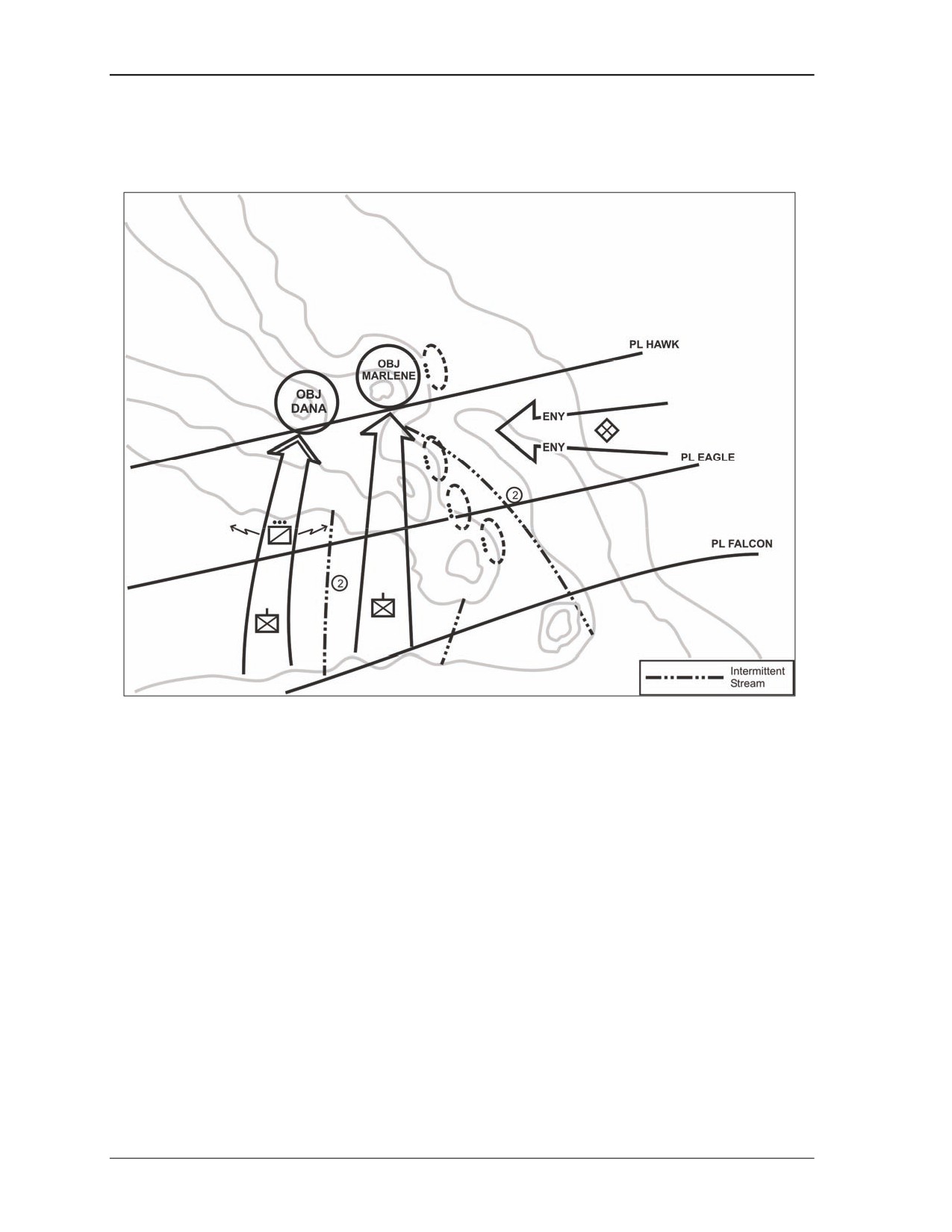
advance and occupies BPs to the protected flank as necessary. Figure 8-8, page 8-26, shows a company
27 July 2006
FM 3-21.10
8-25
Chapter 8
flank guard operation during a movement to contact. One platoon is employed to provide security to the
front and maintain contact with the main body. The other two platoons orient to the protected flank.
Figure 8-8 also shows BPs that the platoons might occupy to respond to the approaching enemy force.
Figure 8-8. Infantry company guarding flank during movement to contact.
LOCAL SECURITY
8-113. The company is responsible for maintaining its own security at all times. It does this by deploying
OPs and patrols to maintain surveillance. In addition to maintaining security for its own elements, the
company may implement local security for other units as directed by the battalion commander. Examples
of such situations include at least--
y Provide security for engineers as they emplace obstacles or construct survivability positions in
the company BP.
y Secure LZs.
y Establish OPs to maintain surveillance of enemy infiltration and reconnaissance routes.
y Conduct patrols to cover gaps in observation and to clear possible enemy OPs from
surrounding areas.
8-26
FM 3-21.10
27 July 2006
Tactical Enabling Operations
Section IV. BREACHING
Breaching operations are conducted when the company cannot bypass the obstacles with maneuver.
Understanding breaching theory is the first step to understanding breaching tactics. Units should always try to
bypass enemy obstacles. If the situation demands that the obstacles be reduced, then units should try to bypass
the obstacles, destroy or repel the defending enemy forces, and then reduce the obstacles. Only as a last resort
should commanders try to breach into an obstacle that is actively defended.
DEFINITIONS
8-114. Obstacle breaching is the use of combined tactics and techniques to advance an attacking force to
the far side of an obstacle that is covered by fire. It might be the most difficult combat task a force can
encounter. Breaching is a synchronized combined-arms operation under the control of a maneuver
commander. The following definitions are also common to breaching operations.
TACTICAL OBSTACLE
8-115. A tactical obstacle is employed to disrupt enemy formations, turn them into a desired area, fix
them in position under direct and indirect fires, or block their penetration while multiplying the effects and
capabilities of firepower. Depending on the terrain, tactical obstacles are usually employed at two-thirds
direct-fire maximum effective range.
PROTECTIVE OBSTACLE
8-116. A protective obstacle aids in close-in protection. They are usually employed at ranges of 30 to 100
meters to protect against hand grenades and Infantry assaults (terrain dependent).
LANE
8-117. A lane is a route through, over, or around an obstacle, which provides a passing force with
safe passage.
REDUCTION
8-118. A reduction task creates and marks lanes through, over, or around an obstacle to allow the
attacking force to accomplish its mission.
CLEARING
8-119. Clearing totally eliminates or neutralizes an obstacle or a portion of the obstacle. Clearing
operations are not conducted under fire.
BREACH AREA
8-120. The area where a breaching operation occurs. The area must be large enough to allow the
attacking unit to deploy its support force, and to extend far enough beyond the obstacle to allow follow-on
forces to deploy before they leave the breach area.
BYPASS
8-121. A bypass is a tactical task that involves maneuvering around an obstacle, a position, or an enemy
force to maintain the momentum of advance.
27 July 2006
FM 3-21.10
8-27
Chapter 8
POINT OF PENETRATION
8-122. A point of penetration is where the commander concentrates his efforts on the enemy's weakest
point in order to seize a foothold on the far side of the objective.
POINT OF BREACH
8-123. This is where the unit tries to create a lane through the obstacle. At first, points of breach are
planned locations only. Normally, the breach force determines the actual points of breach during the
breaching operation.
TENETS
8-124. Successful breaching operations are characterized by the application of breaching tenets. These
tenets are applied whenever an obstacle is encountered in the AO, whether during an attack or route
clearance operation. The five tenets of breaching are intelligence, fundamentals, organization, mass, and
synchronization.
INTELLIGENCE
8-125. In any operation where enemy obstacles can interfere with friendly maneuver, obstacle
intelligence
(OBSTINTEL) is always one of the information requirements and should become PIR.
Examples of information that is needed to fulfill obstacle information requirements include--
y The locations of existing and reinforcing obstacles.
y The orientations and depths of obstacles.
y Locations of the weakest points of the obstacles.
y Locations of the areas that provide the best cover and concealment.
y The presence, locations, and types of wire.
y Lanes and bypasses.
y The composition of the minefield, such as buried or surface-laid antitank and antipersonnel
mines or antihandling devices (AHDs), and the depths of the mines.
y Types of mines and fuzes.
y The locations of enemy indirect-fire systems that can fire into the breach area.
FUNDAMENTALS
8-126. Suppress, obscure, secure, reduce and assault (SOSRA) are the five breaching fundamentals that
ensure success when breaching against a defending enemy. These fundamentals always apply, but they
may vary based on the specific situation (METT-TC).
Suppress
8-127. Suppression is a tactical task used to employ direct or indirect fires. Suppression may also be an
electronic attack on enemy personnel, weapons, or equipment, conducted to prevent or degrade enemy fires
and observation of friendly forces. The purpose of suppression during breaching operations is to protect
forces while they reduce and maneuver through an obstacle. Effective suppression is a mission-critical task
performed in any breaching operation. Suppressive fires in sufficient volume secure the reduction area.
Successful suppression generally triggers the rest of the actions at the obstacle. Fire-control measures
ensure that all fires are synchronized with other actions at the obstacle. Although suppressing the enemy
overwatching the obstacle is the mission of the support force, the breach force should be able to provide
additional suppression against an enemy that the support force cannot effectively suppress.
8-28
FM 3-21.10
27 July 2006
Tactical Enabling Operations
Obscure
8-128. Obscuration protects forces conducting obstacle reduction and the passage of assault forces.
Obscuration hampers enemy observation and target acquisition, and it conceals friendly activities and
movement. Obscuration smoke deployed on or near the enemy's position minimizes its vision. Screening
smoke employed between the reduction area and the enemy conceals movement and reduction activities. It
also degrades enemy ground and aerial observations. Obscuration must be carefully planned to provide
maximum degradation of enemy observation and fires, but it must not significantly degrade friendly fires
and control.
Secure
8-129. Friendly forces secure the reduction area to prevent the enemy from interfering with obstacle
reduction and the passage of the assault force through the lanes created during the reduction. Security must
be effective against outposts and fighting positions near the obstacle and against overwatching units, as
necessary. The far side of the obstacle is secured by fires, or is occupied before any effort to reduce it. The
attacking unit's higher HQ isolates the breach area. It fixes adjacent units, attacks enemy reserves in depth,
and provides counterfire support. Identifying the extent of the enemy's defenses is critical before selecting
the best way to secure the point of breach. If the enemy controls the point of breach, and cannot be
adequately suppressed, then the force must secure the point of breach before it can reduce the obstacle. The
breach force must have enough maneuver assets to provide local security against the forces that the support
force cannot sufficiently engage. Elements within the breach force that secure the reduction area may also
be used to suppress the enemy once reduction is complete.
Reduce
8-130. Reduction is the creation of lanes through or over an obstacle to allow an attacking force to pass.
The number and width of lanes created varies with the enemy situation, the assault force's size and
composition, and the scheme of maneuver. The lanes must allow the assault force to rapidly pass through
the obstacle. The breach force will reduce, proof (if required), mark, and report lane locations and the
lane-marking method to higher HQ. Follow-on units will further reduce or clear the obstacle when
required. Reduction cannot be accomplished until effective suppression and obscuration are in place, the
obstacle has been identified, and the point of breach is secure.
Assault
8-131. A breaching operation is not complete until--
y Friendly forces have assaulted to destroy the enemy on the far side of the obstacle that can
place or observe direct and indirect fires on the reduction area.
y Battle handover with follow-on forces has occurred, unless no battle handover is planned.
ORGANIZATION
8-132. A commander organizes friendly forces to accomplish the five breaching fundamentals quickly
and effectively. This requires him to organize support, breach, and assault forces with the necessary assets
to accomplish their roles (Table 8-1).
27 July 2006
FM 3-21.10
8-29

Chapter 8
Breaching
Breaching
Organization
Fundamentals
Responsibilities
Support force
Suppress.
Suppress enemy direct-fire systems covering the
reduction area.
Obscure
Control obscuring smoke.
Prevent enemy forces from repositioning or
counterattacking to place direct fires on the breach
force.
Breach force
Suppress (provide additional
Create and mark the necessary lanes in an obstacle.
suppression).
Secure the near and far sides of an obstacle.
Obscure (provide additional
Defeat forces that can place immediate direct fires on
obscuration in the reduction area).
the reduction area.
Secure (provide local security).
Report the lane status and location.
Reduce
Assault force
Assault.
Destroy any enemy on the far side of an obstacle that
can place direct fires on the reduction area.
Suppress (if necessary)
Assist the support force with suppression if the enemy is
not effectively suppressed.
Be prepared to breach follow-on or protective obstacles
after passing through the reduction area.
Table 8-1. Relationship between breaching organization and fundamentals.
Support Force
8-133. The support force's primary responsibility is to eliminate the enemy's ability to interfere with a
breaching operation. Suppression depends on the commander massing enough direct fires to protect the
breach force. The support force must--
y Isolate the reduction area with fires.
y Mass and control direct and indirect fires to suppress the enemy and to neutralize any weapons
that can fire on the breach force.
y Control obscuring smoke to prevent enemy-observed direct and indirect fires.
8-134. The support force should be provided with assets to reduce the impact of unexpected obstacles or
scatterable minefields on their approach to and occupation of support-by-fire (SBF) positions. Failure to
provide reduction assets can greatly affect the synchronization of the entire breaching operation. As a
technique, a unit may create a reserve that supports the decisive operation throughout the operation.
Initially, the reserve can support the support force until it seizes SBF positions. Then, the reserve shifts
support to the breach or assault force. If possible, the support force should follow a covered or concealed
route to the SBF position, take up its assigned sectors of fire and observation, and begin to engage the
enemy. It might have to adjust its direct-fire plan.
8-135. Observation is critical. Artillery observers with the support force may initially bring indirect fires
on enemy positions to fix and suppress the enemy. The support force adjusts the indirect fire-delivered
obscuring smoke to protect the breach and assault forces as they approach the reduction area. When
resourcing the support force, consider possible personnel and equipment losses as it fights its way into its
SBF position. To increase the survivability of the support force, the commander may request a CFZ in
support of the support force once it occupies the SBF positions. A CFZ is an area, usually a friendly unit or
location, which the maneuver commander designates as critical to protect an asset whose loss would
seriously jeopardize the mission. Covered by a radar sector, the CFZ supports counterfire operations by
providing the most responsive submission of targets to the fire support system when rounds impact inside
the CFZ.
8-30
FM 3-21.10
27 July 2006
Tactical Enabling Operations
Breach Force
8-136. The breach force helps in the passage of the assault force by creating, proofing (if necessary), and
marking lanes. The breach force might be a combined-arms force. It includes reduction assets, enough
maneuver forces to provide additional suppression, and local security and engineers (if available). The
breach force applies portions of the following breaching fundamentals as it reduces an obstacle.
Suppress
8-137. The breach force must be provided with enough maneuver forces to provide additional
suppression against various threats, including enemy direct-fire systems and counterattacking or
repositioning forces. Enemy direct-fire systems that cannot be effectively observed and suppressed by the
support force are engaged by other forces, indirect fire, or air fire support.
Obscure
8-138. The breach force may employ quick building artillery or mortar-delivered smoke, followed by
vehicle-mounted smoke systems or smoke pots. It uses these for self-defense and lane coverage during the
passage of the assault force.
Secure
8-139. The breach force secures itself from threat forces that are providing close-in protection of the
obstacle. The breach force also secures the lanes through the tactical obstacles, once they are created, to
allow safe passage of the assault force.
Reduce
8-140. The breach force performs its primary mission of reducing the obstacle. To support the
development of a plan to reduce the obstacle, the composition of the obstacle system must be an
information requirement.
Assault
8-141. The assault force assaults through both the point of breach and the breach force to reach the far
side of an obstacle and seize the reduction area.
8-142. The breach force has two subordinate elements: security and reduction. The security element is
mostly maneuver forces. It normally provides additional suppression, obscuration, and local security. The
reduction element normally reduces the obstacle.
8-143. The breach force must be able to deploy and begin reducing the obstacle as soon as enemy fires
are suppressed and effective obscuration achieved. It can expect enemy artillery fires within a matter of
minutes. If available, CFZs should be activated at the point of breach, before the commitment of the
breach force.
8-144. After the breach force has reduced the obstacle and passed the assault force through, the breach
force might have to hand over the lane to follow-on units. At a minimum, the lanes must be marked and
their locations and conditions reported to both higher HQ and follow-on units, IAW the unit's SOP.
8-145. Achieving necessary mass for the assault requires the breach force to open lane(s) through the
obstacle for rapid passage and the buildup of forces on the far side. The size of the assault force determines
the number of lanes initially created. A dismounted assault force normally requires one lane for each
leading assault platoon. The tactical situation might require additional lanes to pass a large assault force
quickly through the obstacle to achieve sufficient combat-power ratio.
27 July 2006
FM 3-21.10
8-31
Chapter 8
Assault Force
8-146. The principle of mass influences the selection of the point of breach, the task organization of the
support, breach, and assault forces, and the integration of engineers in movement or attack formations.
y The need to generate enough mass in the maneuver space available strongly influences which
echelon can breach the obstacle. A company cannot simultaneously mass sufficient fires,
reduce the obstacle, and assault the defending position unless the obstacle is simple and
defended by no more than one platoon.
y The assault force's primary mission is to destroy the enemy and seize terrain on the far side of
the obstacle. The purpose is to prevent the enemy from placing direct fires on the created lanes.
The assault force might be tasked to assist the support force with suppression while the breach
force reduces the obstacle.
y The assault force must be sufficient in size to seize the point of penetration. Breach and assault
assets may maneuver as a single force when conducting lower-level breaching operations.
y When a small enemy force defends the obstacle, assault and breach force's missions might be
combined. This simplifies C2 and provides more immediate combat power for security and
suppression.
y Fire-control measures are essential, since support and breach forces might be firing on the
enemy when the assault force is committed. Suppression of overwatching enemy positions must
continue, and other enemy forces must remain fixed by fires until the enemy has been
destroyed. The assault force must assume control for direct fires on the assault objective as
support and breach force's fires are shifted or cease.
MASS
8-147. Breaching is conducted by rapidly concentrate efforts at one point to reduce the obstacle and
penetrate the defense. Massed combat power is directed against the enemy's weakness. The location
selected for breaching depends largely on the weakness in the enemy's defense, that is, where it has the
least covering fires. If friendly forces cannot find a natural weakness, they create one by fixing the majority
of the enemy force and isolating a small portion for attack.
SYNCHRONIZATION
8-148. Breaching operations require precise synchronization of the breaching fundamentals by support,
breach, and assault forces. Failure to synchronize effective suppression and obscuration with obstacle
reduction and assault can cause rapid, devastating losses of friendly troops in the obstacle or the enemy's
EA. The commander ensures synchronization through proper planning and force preparation.
Fundamentals to achieve synchronization are detailed reverse planning, clear subunit instructions, effective
C2, and well-rehearsed forces.
Detailed Reverse Planning
8-149. Synchronizing a breach begins by using the reverse-planning process to ensure that actions at
obstacles support actions on the objective. Planning the breach without regard to actions on the objective
may cause the operation to fail. During COA development, the commander analyzes the relative combat
power and compares enemy and friendly strengths and weaknesses. The commander decides how he must
attack the objective to accomplish his mission.
Effective Command and Control
8-150. Effective C2 is paramount to mission success. It is integrated into the plan by maneuver and
fire-control measures and the positioning of key leaders to see the battle space. Maneuver control measures
enable the commander to convey his intent, scheme of maneuver, and subunit instructions graphically.
Relating subunit actions to the terrain is critical to successful execution. Key leaders must be able to see the
battle space to make informed decisions. This is most critical in breaching operations. The commander
8-32
FM 3-21.10
27 July 2006
Tactical Enabling Operations
positions himself where he can best control the engagement. Since effective suppression is the most critical
event in a breaching operation, the commander can position himself with the support force, or he can go
where he can observe the effects of the suppression effort. This enables him to personally influence fire
control and facilitate the necessary cross talk between breach and assault forces.
Well-Rehearsed Forces
8-151. The most effective synchronization tool available to the commander is the rehearsal. The inherent
complexity of the breaching operation makes rehearsals at every level essential to success. The commander
must give his subordinates time to plan how they will execute their assigned missions and time to rehearse
it with their units.
Section V. PATROLS
This section introduces and defines presence patrols for stability, reconstruction, and civil support operations. It
also introduces and defines point reconnaissance, tracking, and contact patrols.
DEFINITION
8-152. A patrol is a detachment sent out by a larger unit to conduct a combat, reconnaissance, or security
mission. A patrol’s organization is temporary and specifically matched to the immediate task. Because a
patrol is an organization, not a mission, it is not correct to speak of giving a unit a mission to "Patrol."
8-153. Commanders sends a patrol out from the main body to conduct a specific tactical task with an
associated purpose. Upon completion of that task, the patrol leader reports to the commander and describes
the events that took place, the status of the patrol’s members and equipment, and any observations.
8-154. If a patrol is made up of a single unit, such as a rifle squad sent out on a reconnaissance patrol, the
squad leader is responsible. If a patrol is made up of mixed elements from several units, then the senior
officer or NCO is designated as the patrol leader. This temporary title defines his role and responsibilities
for that mission. The patrol leader may designate an assistant, normally the next senior man in the patrol,
and any subordinate element leaders he requires.
8-155. A patrol can consist of a unit as small as a fire team. Squad- and platoon-size patrols are normal.
Sometimes, for larger combat tasks, normally for a raid, the patrol can be a company (-).
8-156. The leader of any patrol, regardless of the type or the tactical task assigned, has an inherent
responsibility to prepare and plan for possible enemy contact while on the mission. Patrols are never
administrative. They are always assigned a tactical mission. On his return to the main body, the patrol
leader must always report to the commander. He then describes the patrol's actions, observations, and
condition.
TYPES
8-157. The planned action determines the type of patrol. The two main types of patrols are combat and
reconnaissance. Regardless of the type of patrol, the unit needs a clear task and purpose.
COMBAT PATROL
8-158. A combat patrol provides security and harasses, destroys, or captures enemy troops, equipment, or
installations. When the commander gives a unit the mission to send out a combat patrol, he intends for the
patrol to make contact with the enemy and engage in close combat. A combat patrol always tries to escape
detection while moving, but of course discloses their location to the enemy in a sudden, violent attack. For
this reason, the patrol normally carries a significant amount of weapons and ammunition. It may carry
27 July 2006
FM 3-21.10
8-33
Chapter 8
specialized munitions. A combat patrol collects and reports any information gathered during the mission,
whether related to the combat task or not. The three types of combat patrols are--
Raid Patrol
8-159. A raid is a surprise attack against a position or installation for a specific purpose other than
seizing and holding the terrain. It is conducted to destroy a position or installation, to destroy or capture
enemy soldiers or equipment, or to free prisoners. A raid patrol retains terrain just long enough to
accomplish the intent of the raid. A raid always ends with a withdrawal off the objective and a return to the
main body.
Ambush Patrol
8-160. An ambush is a surprise attack from a concealed position on a moving or temporarily halted
target. It can include an assault to close with and destroy the target, or it can include only an attack by fire.
An ambush need not seize or hold ground.
Security Patrol
8-161. A security patrol is sent out from a unit location during a halt, when the unit is stationary, to
search the local area, to detect any enemy forces near the main body, and to engage and destroy them
within the capability of the patrol. This type of combat patrol is normally sent out by units operating in
close terrain with limited fields of observation and fire. Although this type of combat patrol seeks to make
direct enemy contact and to destroy enemy forces within its capability, the patrol should try to avoid
decisive engagement. A security patrol detects and disrupts enemy forces that are conducting
reconnaissance of the main body or that are massing to conduct an attack. Security patrols are normally
away from the main body of the unit for limited periods, returning frequently to coordinate and rest. They
do not operate beyond the range of communications and supporting fires from the main body, especially
mortar fires.
RECONNAISSANCE PATROL
8-162. A reconnaissance patrol collects information or confirms or disproves the accuracy of information
previously gained. The intent for this type of patrol is to avoid enemy contact and accomplish its tactical
task without engaging in close combat. With one exception (presence patrols), reconnaissance patrols
always try to accomplish their mission without being detected or observed. Because detection cannot
always be avoided, a reconnaissance patrol carries the necessary arms and equipment to protect itself and
break contact with the enemy. A reconnaissance patrol travels light, that is, with as few personnel and as
little arms, ammunition, and equipment as possible. This increases stealth and cross-country mobility in
close terrain. Regardless of how the patrol is armed and equipped, the leader always plans for the worst
case: contact. The types of reconnaissance patrols are--
Route Reconnaissance Patrols
8-163. This kind of patrol obtains detailed information about a specified route, and about all terrain
where the enemy could influence movement along that route.
Area Reconnaissance Patrols
8-164. This kind of patrol focuses only on obtaining detailed information about the terrain or enemy
activity within a prescribed area.
8-34
FM 3-21.10
27 July 2006
Tactical Enabling Operations
Zone Reconnaissance Patrols
8-165. This kind of patrol is a directed effort to obtain detailed information on all routes, obstacles,
terrain, and enemy forces within a zone defined by boundaries.
Point Reconnaissance Patrols
8-166. This patrol goes straight to a specific location and determines the situation there. As soon as it
does so, it either reports the information by radio or returns to the larger unit to report. This patrol can
obtain, verify, confirm, or deny extremely specific information for the commander. These patrols are often
used in stability, reconstruction, or civil support operations. For example, in a reconstruction operation, the
commander might send such a patrol to determine the exact situation at a specific sewage pumping station,
that is, has it begun operation? Does it have all the equipment and personnel it needs? Have the necessary
repairs have been completed?
Leader’s Reconnaissance Patrols
8-167. This patrol reconnoiters the objective just before an attack or, in the case of a point
reconnaissance, prior to sending elements forward to locations where they will observe. It confirms the
condition of the objective. It gives each subordinate leader a clear picture of the terrain where he will
move, and of the part of the objective he must seize or observe. The patrol can consist of the unit
commander or representative, the leaders of major subordinate elements, and, sometimes, a few security
personnel and unit guides. This patrol gets back to the main body as quickly as possible. The commander
can use the following aid to help in remembering a five-point contingency:
G
Going--as in, where is the leader going?
O
Others--what others are going with him?
T
Time (duration)--how long will the leader be gone?
W
What do we do if the leader fails to return?
A
Actions--what actions do the departing reconnaissance element and the main body staying
in the ORP take on contact ?
Presence Patrols
8-168. This patrol is used in stability or civil support operations. It has many purposes, but it should
always see and be seen. Its main goal is to gather information about the conditions in the unit’s AO. To do
this, the patrol gathers critical (as determined by the commander) information, both specific and general.
The patrol seeks out this information, and then observes and reports.
8-169. In addition to reconnaissance tasks, presence patrols demonstrate to the local populace the
presence and intent of the US forces. That is, the patrol clearly demonstrates the determination,
competency, confidence, concern, and sometimes the overwhelming power of the force to all who observe
it, including local and national media. A presence patrol is planned for the possibility of enemy contact,
even though this is not their intent. Rarely should a commander use a presence patrol where enemy contact
is likely. Presence patrols work best for some types of stability operations, for example, peace operations,
humanitarian and civic assistance, NEO, FHA, or shows of force. To accomplish its secondary purpose, to
be seen, a presence patrol reconnoiters overtly. It takes deliberate steps to visibly reinforce the impression
that the commander wants to convey to the populace. Where the patrol goes, what it does there, how it
handles its weapons, what equipment and vehicles it uses, and how it interacts with the populace are all
part of that impression. Before sending out a presence patrol, the commander should carefully consider
what he wants to convey, and then clearly describe his intent to the patrol leader. When the presence patrol
returns to the main body, the commander thoroughly debriefs it not only for hard information, but also for
the patrol leader's impressions of the effects of the patrol on the populace. This allows the commander to
see to modify the actions of subsequent patrols.
27 July 2006
FM 3-21.10
8-35
Chapter 8
Tracking Patrols
8-170. A tracking patrol is normally a squad-size, possibly smaller, element. It is tasked to follow the trail
of a specific enemy unit in order to determine its composition, final destination, and actions en route.
Members of the patrol look for subtle signs left by the enemy as he moves. As they track, they gather
information about the enemy unit, the route it took, and the surrounding terrain. Normally, a tracking patrol
avoids direct fire contact with the tracked unit, but not always. Tracking patrols often use tracker dog
teams to help them maintain the track.
Contact Patrols
8-171. A contact patrol is a special reconnaissance patrol sent from one unit to physically contact and
coordinate with another. Modern technology has reduced, but not eliminated, the need for contact patrols.
Now, they are most often used when a US force must contact a non-US coalition partner who lacks
compatible communications or position-reporting equipment. Contact patrols may either go to the other
unit's position, or the units can meet at a designated contact point. The leader of a contact patrol provides
the other unit with information about the location, situation, and intentions of his own unit. He obtains and
reports the same information about the contacted unit back to his own unit. The contact patrol also
observes and reports pertinent information about the area between the two units.
COMPANY COMMANDER INVOLVEMENT
8-172. The company commander may be involved in patrolling in one of three ways. He may lead a
company-size patrol; he may provide small patrols from his company (as directed by battalion); or he may
send out patrols on his on initiative to support his company's operations. The company routinely conducts
patrols as part of the company and battalion R&S plans. When he receives a mission from battalion to send
out a patrol, the company commander--
y Obtains all necessary enemy information from the S-2 and other sources.
y Issues warning orders to the platoon he chooses for the patrol.
y Initiates appropriate troop-leading procedures.
y Coordinates and develops a detailed plan.
y Ensures the unit is prepared and properly organized and equipped for the mission.
y Assists the patrol leader with preparations, coordination, and final inspections before the patrol
departs.
y Ensures that the patrol is debriefed upon its return.
8-173. When the company commander plans to use a patrol to support a company operation, he identifies
its mission, organization, key time(s) and places(s) for departure and return, and (possibly) its routes.
Depending on the mission, he may assign the task, give his intent, and allow the platoon leader to plan the
patrol. He assists in planning fire support, logistic support, and communications.
ORGANIZATION
8-174. The commander decides what elements, teams, weapons, equipment, and men or units are needed
for his mission. However, he should use his unit's normal organization (squads and platoons) and chain of
command (squad and platoon leaders) as much as possible to meet these needs. For example, a combat
patrol may be organized as follows:
y Company headquarters serves as the patrol headquarters.
y 1st Platoon serves as the assault element.
y 2d Platoon serves as the security element.
y 3d Platoon and weapons platoon comprise the support element.
8-36
FM 3-21.10
27 July 2006
Tactical Enabling Operations
8-175. When task-organizing a company patrol, the company commander only selects as many personnel
as he needs. For example, if the security element only requires three security teams, the CO should task the
platoon for a security element headquarters and three fire teams. A patrol generally consists of a patrol
headquarters and the elements needed for the mission.
HEADQUARTERS
8-176. The headquarters of a company-size patrol may consist of the same number of men as a regular
company headquarters. However, regardless of a patrol's size, the commander tailors the headquarters to
meet mission needs. The patrol headquarters has the same responsibilities as any other command element.
ELEMENTS
8-177. In an area reconnaissance (Figure 8-9, page 8-37), a patrol has a reconnaissance element and a
security element.
8-178. In a zone reconnaissance, a patrol has several reconnaissance elements (Figure 8-10, page 8-38).
Each provides its own security.
8-179. A combat patrol normally has an assault element, a security element, and a support element
(Figure 8-11, page 8-38). At times, the support element is omitted and instead combined with the assault
element, or a reserve element might be required.
Figure 8-9. Area reconnaissance patrol.
27 July 2006
FM 3-21.10
8-37
Chapter 8
Figure 8-10. Zone reconnaissance patrol.
Figure 8-11. Combat patrol.
TEAMS
8-180. Each element of a patrol may be further organized into the teams needed to perform various tasks
(Figure 8-12, page 8-39).
Reconnaissance Patrol Elements
8-181. Reconnaissance patrol elements may be organized into several reconnaissance teams for an area
reconnaissance, or into R&S teams for a zone reconnaissance. R&S teams must provide their own security
while reconnoitering.
Security Elements
8-182. Security elements are organized into the number of security teams needed to secure the
objective area.
8-38
FM 3-21.10
27 July 2006
Tactical Enabling Operations
Combat Patrol Elements
8-183. Combat patrol elements are also organized into the teams needed for various tasks (assault,
security, support, and special purpose).
y Two or more assault elements are organized when the assault element leader cannot directly
control all of the assault element. This may be the case when the objective is to be assaulted
from more than one location.
y Security teams are organized as needed to secure and or isolate the objective area.
y Two or more support teams are organized when the support element leader cannot directly
control all of the weapons of the support element. This may be the case when there are many
supporting weapons, or they are too far apart for direct control; by the element leader.
y Special-purpose teams may also be organized for missions involving the use of scout dogs,
demolitions, litters for wounded, and EPW handling.
Figure 8-12. Organization of elements.
RAID
8-184. A raid is a surprise attack against a position or installation for a specific purpose other than seizing
the terrain. It is conducted to destroy a position or installation, to destroy or capture enemy soldiers or
27 July 2006
FM 3-21.10
8-39
Chapter 8
equipment, or to free friendly prisoners. Since the purpose does not include holding terrain, the operation
must include a planned withdrawal.
KEY CHARACTERISTICS
8-185. Surprise, firepower, and violence are the key characteristics for a successful raid. Surprise is best
achieved by attacking when the enemy least expects an attack, when visibility is poor, and from an
unexpected direction. Firepower is concentrated at critical points to suppress and kill the enemy. Violence
is best achieved by gaining surprise, by using massed fire, and by attacking aggressively.
PLANNING CONSIDERATIONS
8-186. Although the planning process (Chapter 2) for the attack also applies to a raid, some differences
exist. A raid is normally conducted in enemy controlled territory, often against an enemy of equal or
greater strength. The plan must ensure that the unit retains the element of surprise and avoids detection
prior to initiating the assault. An extraction or withdrawal plan must also be developed and coordinated to
ensure the unit's survival after they successfully accomplish the actions on the objective. The fire support
plan might be complex, depending on the depth of the raid. It can include a greater than usual reliance on
artillery, CAS, AC-130 gunships, and attack helicopters. Finally, a raid often requires more detailed
intelligence of the objective area. This may be obtained from higher units, or the company might have to
develop this information through reconnaissance.
ACTIONS ON OBJECTIVE
8-187. Raids are normally conducted on an objective that is a valuable asset to the enemy. The enemy
often has extra forces in position to react to any threat. The assault element must conduct a rapid and
precise assault into and through the objective. The element must spend as little time as possible on the
objective. Task organization should include only the personnel and teams who are essential to complete the
assigned mission. This is particularly important during limited visibility, to reduce confusion and friendly
casualties. Also, the assault must be thoroughly rehearsed to ensure precise execution.
PREPARATION
To achieve the surprise, violence, and speed of execution required, the unit's preparation is crucial to the
success of the operation. The following requirements are key to the success of a raid mission.
Maximum Use of Intelligence Information
The gathering and disseminating of information must be continuous, and the information provided to the raid
force, even while they are en route to the target area. To ensure mission accomplishment, the unit must be kept
informed of the latest enemy developments in the objective area to prevent being surprised.
Plan Development
The reverse planning sequence and the planning process discussed in Chapter 2 will assist in conducting the
detailed planning required for a raid. The plan must address the following phases.
PHASE 1
8-188. The unit is inserted or it infiltrates into the objective area.
PHASE 2
8-189. The objective area is then sealed off from outside support or reinforcement, to include the enemy
air threat.
8-40
FM 3-21.10
27 July 2006
Tactical Enabling Operations
PHASE 3
8-190. Any enemy force at or near the objective is overcome by surprise and violent attack, using all
available firepower for shock effect.
PHASE 4
8-191. The mission is accomplished quickly before any surviving enemy can recover or be reinforced.
PHASE 5
8-192. The unit quickly withdraws from the objective area and is extracted, or it infiltrates to link up with
friendly units or to conduct a new mission.
Coordination
8-193. Coordination is normally conducted through the battalion headquarters. At times, the company
may coordinate directly with adjacent, supporting, or host nation/allied forces.
Rehearsals
8-194. Rehearsals validate all aspects of planning for the raid and ensure precision in execution. They
allow changes to be made in the plan before it is carried out. Full-scale rehearsals should be conducted
under the most realistic conditions possible.
FAVORABLE CONDITIONS
8-195. A successful raid is ensured by--
y Launching the raid at an unexpected time or place by using limited visibility, and by moving
over terrain the enemy might think impassable.
y Avoiding detection through proper movement techniques and skillful camouflage and
concealment, to include using the natural cover of the terrain.
y Timing the operation as closely as possible.
y Using all available support, both organic and nonorganic, to include use of special weapons
such as Air Force laser and GPS-guided bombs.
y Performing quick, violent, precise, and audacious actions that focus full combat power at the
decisive time and place.
y Disengaging quickly upon mission completion.
y Withdrawing swiftly using planned routes and including a deception plan.
FUNCTIONS
8-196. Four functions are normally performed by the unit when conducting a raid. Each supplement is
organized and equipped to do a specific part of the overall mission. Depending upon the specific mission,
nature of the target, enemy situation, and terrain, the functions are as follows.
Command Group
8-197. The command group controls movement to and actions at the objective. This unit normally
consists of the company commander, other subordinate leaders, and communications to support these
leaders.
27 July 2006
FM 3-21.10
8-41
Chapter 8
Security Element
8-198. The security element, whose organization is determined by the mission of the raid force, size and
type of the enemy force, and its mobility and state of alert, terrain, avenues of approach into the area, and
the time needed to seal off the objective area. The security element may--
y Secure the objective rally point.
y Give early warning of and interdict approaching enemy forces.
y Block avenues of approach into the objective areas.
y Prevent enemy escape from the objective area.
y Provide overwatch for the units at the objective and suppressive fires to assist in their
withdrawal.
y Provide short-range air defense fires.
Support Element
8-199. The support element provides the heavy volume of fire needed to neutralize the enemy or
objective. Because fires from this unit are violent and devastating, they must be closely controlled to
ensure the precision needed. On order or as planned, fires are shifted, lifted, or both to cover the maneuver
of the assault element by suppressing enemy fire from the objective or aerial fires.
8-200. If an enemy quick-reaction force moves toward the objective area, the support element may also
be given specific locations to cover by fire in support of the security element. These may include routes to
and from the objective site, key terrain features, or installations adjacent to the main objective. Once the
assault has been completed, or on order from the raid force commander, the support element displaces to
the next planned position. Organization of the support element is determined by the following.
y Size of the objective, the geography of surrounding area, and the enemy threat in the area. This
element should be able to neutralize the objective and to lift or shift fires either when the
assault is launched or when so ordered by the raid force commander.
y Mission of the assault unit.
y Suitable firing positions.
y Size and nature of the enemy force in the objective area and those enemy forces capable of
reinforcement at the objective.
y Fire support from other units.
Assault Element
8-201. The assault element seizes and secures the objective and protects demolition teams, search teams,
prisoner-of-war teams, and other teams.
y The organization of the assault element is always tailored to the mission. Each objective must
be examined carefully. The element's mission is to overcome resistance, secure the objective,
and destroy the installation or equipment. Other specialized teams might also be needed. For
example, sniper teams could be needed to remove key sentries. To capture prisoners, liberate
personnel, and seize or destroy equipment, the assault element could be organized into assault
teams, prisoner teams, search teams, medical teams, demolition teams, or breach teams.
y To destroy a point target or installation in a heavily defended area where the USAF cannot get
close enough to be effective, the assault element might be organized with one small team
equipped with laser target designators. From covered and concealed positions, members of this
team could then guide USAF delivery of laser-guided munitions from a safe distance.
8-42
FM 3-21.10
27 July 2006

Tactical Enabling Operations
CONDUCT OF A RAID
8-202. The unit moves to the ORP, secures it, and sends out a leaders' reconnaissance. Once the final
plan is confirmed, elements and teams then move to their positions. After the raid, the patrol unit
reassembles at the ORP, and then it moves a safe distance away to recognize and disseminate information.
It then returns to friendly lines or continues the mission.
Security Element
8-203. The teams of the security element move to positions (Figure 8-13, page 8-44) where they can
secure the ORP, warn of enemy approach, and block avenues of approach into the objective area. They
also situate themselves where they can prevent enemy escape from the objective area and perform any
combination of these tasks within their capability. As the assault element and support element move into
position, the security element keeps the leader informed of all enemy action. It fires only if detected, or on
the leader's order. Once the assault starts, the security element prevents enemy entry into, or escape from,
the objective area. When the assault is over, the security element covers the withdrawal of the unit to the
ORP. It withdraws on order or on a planned signal.
Support Element
8-204. The support element moves into position before the assault element (Figure 8-14, page 8-45).
From its position, it suppresses the objective and shifts its fire when the assault starts. It normally covers
the withdrawal of the assault element from the immediate area of the objective. It withdraws on order or
on signal.
Assault Element
8-205. The assault element deploys close enough to the objective to permit immediate assault if detected
by the enemy. As supporting fire is shifted, lifted, or both, the assault element attacks and secures the
objective. It protects demolition teams, search teams and other special teams while they work. On order,
the assault element withdraws to the ORP. The assault element should be as small as possible and conduct
thorough rehearsals to avoid confusion on the objective.
Figure 8-13. Security elements move into position.
27 July 2006
FM 3-21.10
8-43
Chapter 8
Figure 8-14. Support and assault elements move into position.
AMBUSH
8-206. An ambush is a surprise attack from a concealed position on a moving or temporarily halted
target. The ambush can include an assault to close with and destroy the target, or it can consist of fire only.
An ambush need not seize and hold ground. The company plans, prepares, and conducts ambush patrols
the same as a platoon. An ambush is a useful tactic because small, well-trained, disciplined forces with
limited weapons and equipment can destroy much larger enemy forces. Also, an ambush reduces the
enemy’s overall combat effectiveness by destroying and harassing his forces. Enemy morale and
effectiveness suffer heavily at little cost to the unit executing the ambush.
EXECUTION
8-207. A successful ambush must be executed with precision, violence, speed, and audacity. For success,
ambush operations must emphasize the following.
Surprise
8-208. Surprise, more than any other single aspect, enhances the value of an ambush. Surprise increases
the potential for inflicting damage on the enemy with less risk to the unit.
Coordinated Firepower and Shock Effect
8-209. Coordinated firepower is used for maximum shock effect.
y Massive volumes of accurate fire, explosives, and mines, coupled with an aggressive attack,
break the enemy's spirit to fight back. Surprise increases shock effect and the chances for
success. Shock effect can cover unexpected defects in an ambush such as ambushing a much
larger force than expected.
y All weapons must be sited with interlocking fires in the kill zone and along likely avenues of
entrance or exit. Mortars should be used if the terrain permits. Tripods and traversing and
elevating mechanisms are normally used with machine guns to lock in fires. All riflemen use
firing stakes to mark left and right limits, and elevation stakes. There is a tendency to shoot
8-44
FM 3-21.10
27 July 2006
Tactical Enabling Operations
high in an ambush--especially at night. The M203 grenade launchers are sited to cover the dead
space and routes of escape.
Control
8-210. Control is essential; leaders must have contact with all members of their unit to alert them to the
oncoming enemy.
y Leaders should not move around the ambush site during this crucial period. A method used to
alert members can be to tie strings or vines to Soldiers' legs or arms. A series of light tugs can
alert all members of the ambush to the enemy's presence.
y The leader must initiate the ambush with a casualty-producing device. A bank of Claymore
mines on a double-ring main is an excellent device to spring an ambush. Other good techniques
are to use a machine gun or Javelins, if vehicles are in the kill zone. Whistles or pyrotechnics
are not used, because they would give the enemy time to react.
8-211. As soon as the enemy is hit, he reacts. The ambush force has only a few seconds to destroy the
enemy before the enemy recovers from the initial shock and leaves the kill zone, either by directly
counterattacking or by withdrawing. Subsequent fires and other banks of Claymore mines must be planned.
8-212. The leader initiates the ambush except when a member of the ambush knows he has been
discovered. He then has the authority to execute--with killing fire, not by yelling.
8-213. The cease-fire must be controlled by the leader. A whistle or other device may be used to get
attention and then cease-fire is signaled.
Security
8-214. The flanks and rear of an ambush site are open to counterattack. Flank and rear security may be
enhanced by--
y Echeloning in depth.
y Designating sectors of observation.
y Positioning RSTA devices.
y Enforcing noise and light discipline.
y Preparing a good withdrawal plan.
y Securing routes of withdrawal.
y Executing with speed and violence.
y Positioning a security force to seal off the ambush area.
y Preparing effective camouflage.
Simplicity
8-215. A simple, direct plan improves the chance of success. The ambush plan must be clear yet concise
to offer the greatest likelihood of success. For example--
y Mission statements for security, support, and assault elements must be clear, concise, and
direct.
y Tasks to be performed by the ambush elements should be easy to understand.
y Simple contingency plans.
y Routes into positions and withdrawal routes should not cross. They should be the shortest, most
secure routes.
27 July 2006
FM 3-21.10
8-45
Chapter 8
Training and Self-Discipline
8-216. All advantages must be exploited. Discipline must be strict. There must be no sleeping, talking,
eating, or smoking in the ambush site. If an ambush is to be set up for long periods, then the elements of
the ambush must be pulled back to the ORP at set times for rest. Extended ambushes of 24, 36, or 48 hours
require six- or eight-hour shifts. It may take a company to man an extended platoon ambush position. Tired
troops cannot man an ambush well; they cannot perform vigorous operations all day and be alert on an
ambush all night.
ORGANIZATION
8-217. A unit conducting an ambush must be task-organized to perform the following functions: assault,
security, and support. The ambush forces should be task-organized according to the TOE--by platoons,
squads, and fire teams. The TOE should not be changed to create smaller elements for an ambush. The
TOE formations may be reinforced with machine gun or recoilless rifle teams, or a 60-mm mortar squad.
Assault
8-218. The elements assigned the assault mission either move directly into their positions or move
through a release point. The mission may include any combination of the following actions.
y Conduct the main assault.
y Halt an enemy's motorized column or any moving target.
y Kill or capture personnel.
y Recover supplies and equipment.
y Destroy vehicles and supplies.
8-219. The leader decides how and when to use search teams. When Soldiers leave the security of their
well-chosen, concealed ambush position, they are subject to the fires of the enemy who may also be hidden
and ready. Always assume there is hidden enemy--the ambush will not kill them all. Either night vision
devices or white-light flashlight should be used to make a quick search. A white light flashlight is faster if
loss of night vision is not critical. If the return fire from the enemy is great or if the ambush missed the
main body, then the leader may choose to break contact and leave without searching the kill zone.
Security
8-220. The elements assigned the mission of security may move to their positions directly or by way of a
release point. Their missions may include any or all of the following actions.
y Secure flanks, rear, or ORP.
y Provide early warning.
y Seal off the kill zone to prevent the enemy from escaping or reinforcing.
y Assist in executing the ambush.
y Cover withdrawal of main ambush force.
Support
8-221. The units assigned a support mission provide fires that may include employment of--
y Heavy automatic weapon fires.
y Antitank fires.
y Mortar fires.
y Mines.
y Flame munitions.
8-46
FM 3-21.10
27 July 2006
Tactical Enabling Operations
AMBUSH SITE
8-222. When choosing an ambush site, all sources of information must be used to enhance surprise,
exploit the enemy's weak points, and take advantage of the terrain. Emphasis is on--
y Natural cover and concealment for the ambush force.
y Concealed, easily accessible routes of entry and withdrawal.
y Good observation and fields of fire.
y Limited enemy escape routes.
y Limited enemy reinforcement ability.
y Nearby assembly or rendezvous area.
y Terrain that will canalize enemy into kill zones, and natural obstacles to keep him there.
Take Advantage of Terrain
8-223. Emphasize exploiting all natural cover and concealment afforded by the terrain. Site the ambush
and individual positions based on the terrain rather than trying to adapt the terrain to a fixed geometric
design.
Restrict Enemy Movement
8-224. Restricting enemy movement by natural or man-made obstacles should also be planned.
TYPES OF AMBUSHES
8-225. Ambushes have two basic categories - area ambush and point ambush.
Area Ambush
8-226. An area ambush may be set up by platoons, companies, or battalions. It is used to interdict enemy
movement in a given area or inflict casualties on his forces. An area ambush consists of a series of point
ambushes. The size and locations of the ambushes are dictated by the METT-T analysis.
y Companies may conduct area ambushes independently or as part of a battalion area ambush.
The company may receive very specific guidance or only an area of operations and a mission
statement. The CO may develop a very detailed concept with a central ambush supported by
smaller ambushes for security/isolation. Or, the CO may assign platoon areas of operation and
allow decentralized execution.
y Considerations in selecting point ambush sites as part of a company area ambush include--
- Ensuring fires from one ambush force do not endanger other ambush units.
- The enemy's likely course of action, both before and after the ambush is initiated.
- The withdrawal/linkup plan after completing the ambush mission.
y The CO must establish clear criteria to each ambush site leader on when to initiate fires.
Point Ambush
8-227. Point ambushes are set at the most ideal location to inflict damage on the enemy. Such ambushes
must be able to handle being hit by the enemy force from more than one direction. The ambush site should
enable the unit to execute an ambush in two or three main directions. The other directions must be covered
by security that gives early warning of enemy attack.
8-228. The mechanical ambush is a special type of point ambush. It consists of Claymore mines set in
series with a double-ring main. It is command detonated. Soldiers prepare to engage the enemy with direct
fire after the mechanical ambush detonates. Mechanical ambushes are an effective way to interdict a large
27 July 2006
FM 3-21.10
8-47
Chapter 8
area using a small force. If the mechanical ambush is effective and our Soldiers do not reveal their
presence, the enemy is confused. This has a devastating effect on his morale and effectiveness.
EXECUTION OF AMBUSH
8-229. Stealth and security are important factors; the following are various ways to accomplish
these factors.
y Position security teams and early warning detection devices first.
y Use the best route to main ambush position consistent with security.
y Quickly occupy the ambush position and set up communications and signaling devices.
y Position key weapons (automatic and antiarmor).
y Rig Claymore mines and trip flares.
y Ensure that all weapons are correctly positioned. Assign sectors of fire to provide mutual
support and cover dead space.
Camouflage
8-230. During mission preparation, each man camouflages himself and his equipment, and secures his
equipment to prevent noise. At the ambush site, prepare positions with minimum change in the natural
appearance of the site. Conceal all resulting debris to prevent any evidence of occupation.
Movement
8-231. Keep movement to a minimum. Closely control the number of men moving at a time. Keep every
Soldier as quiet as possible, especially at night. Enforce light discipline rigidly at night and forbid smoking.
Signals
8-232. Change audible and visual signals, such as whistles or pyrotechnics, often to avoid setting patterns
and alerting the enemy. Three or four simple signals are needed to execute the ambush. Signals are used--
y To provide early warning of an enemy approach. A signal by the security force to alert the
patrol leader to the correct direction of enemy approach may be given. This includes
arm-and-hand signals, radio, or field telephone.
y To initiate the ambush. This may be the detonation of mines or explosives. Fire is then
delivered at once in the heaviest, most accurate volume possible. Properly timed and delivered
fires add to the achievement of surprise, as well as to the destruction of the target.
y To lift or shift fires if the kill zone is to be assaulted. Voice commands, whistles, or
pyrotechnics maybe used. When the kill zone is assaulted, the lifting or shifting of fires must be
as precise as when starting the ambush. Otherwise, the assault is delayed and the enemy has a
chance to recover and react.
y To withdraw. The signal for withdrawal can be voice commands, whistles, or pyrotechnics.
Objective Rally Point
8-233. Locate the ORP far enough from the ambush site so that it will not be overrun if the enemy
manages to attack the ambushers. Withdrawal routes should provide cover and concealment for the unit
and hinder enemy pursuit; they are a main consideration in the selection of the ambush site. They may be
the key to survival after executing the ambush. On signal, the ambush force quickly (but quietly)
withdraws to the ORP. If the force is pursued, they can withdraw by bounds, and use grenades or hasty
ambushes to delay pursuing forces.
8-48
FM 3-21.10
27 July 2006
Tactical Enabling Operations
Ambush Variety
8-234. Use more than one ambush method. If one method is used predominantly, the enemy will develop
an effective defense against it and will be affected less by the shock of the ambush since he knows what to
expect. No single method will fit all combinations of terrain, equipment, weather, and enemy capabilities.
Use a variety of signals as well, both audible and visual. Use weapons fire, mines, and RSTA when
possible and vary signals to avoid compromise.
Swift Action
8-235. Speed in the execution of the ambush and the withdrawal should prevent enemy reaction forces
from engaging the ambush force. Speed is often a shield against casualties and failure. If there is contact
with reaction forces, speed may enhance quick disengagement.
SUCCESSFUL AMBUSH
8-236. Emphasize the following to succeed.
y Intelligence, which ensures the enemy is ambushed at a time and place when he least expects or
is least prepared to fight.
y Detailed planning, thorough training, and rehearsing of all elements in all phases of the
ambush. This ensures maximum shock effect through swift, precise execution.
y All available night vision and detection devices, when appropriate.
y All available firepower.
y Speed, which aids in achieving surprise and enhancing the security of the force.
y Cover, concealment, and overall protection afforded by the terrain when moving or when
occupying ambush positions.
PATROL BASE
8-237. A patrol base is a position set up when the patrol unit halts for an extended period. When the unit
must halt for a long time in a place not protected by friendly troops, it takes active and passive security
measures. The time the patrol base may be occupied depends on the need for secrecy. It should be occupied
only as long as necessary, but not for more than 24 hours--except in an emergency. The unit should not use
the same patrol base more than once. The considerations for a perimeter defense apply for establishing a
company patrol base.
27 July 2006
FM 3-21.10
8-49
This page intentionally left blank.
Chapter 9
Direct Fire Control
Suppressing or destroying the enemy with direct fires is fundamental to success in
close combat. Effective direct fires are the unique contribution of maneuver forces to
the combined arms team, and fire and movement are complementary components of
maneuver. The Infantry company commander must effectively plan to focus,
distribute, and shift the overwhelming mass of his direct fire capability at critical
locations and times to succeed on the battlefield. Effective and efficient fire control
means that the company acquires the enemy and masses the effects of direct fires to
achieve decisive results in the close fight.
This edition introduces a discussion of direct fire control and distribution including
principles, processes, planning, and control.
Section I. FIRE-CONTROL PRINCIPLES
When planning and executing direct fires, the Infantry company commander and subordinate leaders must
know how to apply several fundamental principles. The purpose of these direct fire control principles is not to
restrict the actions of subordinates, but to help the company accomplish the primary goal of any direct fire
engagement: to eliminate the enemy by acquiring first and shooting first. Applied correctly, these principles
give subordinates the freedom to respond rapidly upon acquisition of the enemy. This discussion focuses on the
following principles.
y Mass the effects of fire.
y Destroy the greatest threat first.
y Avoid target overkill.
y Employ the best weapon for the target.
y Minimize friendly exposure.
y Plan and implement fratricide avoidance measures.
y Plan for extreme limited visibility conditions.
y Develop contingencies for diminished capabilities.
MASS EFFECTS OF FIRE
9-1.
The Infantry company must mass its direct fires to achieve decisive results. Massing entails
focusing direct fires at critical points and distributing the effects. Random application of fires is unlikely to
have a decisive effect. For example, concentrating the company's fires at a single target may ensure its
destruction or suppression; however, that fire control option will fail to achieve the decisive effect on the
remainder of the enemy formation or position.
DESTROY GREATEST THREAT FIRST
9-2.
The order in which the Infantry company engages enemy forces is in direct relation to the danger
these forces present. The threat posed by the enemy depends on his weapons, range, and positioning.
27 July 2006
FM 3-21.10
9-1
Chapter 9
Presented with multiple targets, a unit must initially concentrate direct fires to destroy the greatest threat,
and then distribute fires over the remainder of the enemy force.
AVOID TARGET OVERKILL
9-3.
Use only the amount of fire required to achieve necessary effects. Target overkill wastes
ammunition and is not tactically sound. To the other extreme, the company cannot have every weapon
engage a different target because the requirement to destroy the greatest threats first remains paramount.
EMPLOY BEST WEAPON FOR TARGET
9-4.
Using the appropriate weapon for the target increases the probability of rapid enemy destruction or
suppression; at the same time, it conserves ammunition. The Infantry company has many weapons with
which to engage the enemy. Target type, range, and exposure are key factors in determining the weapon
and ammunition that should be employed, as are weapons and ammunition availability and desired target
effects. The company commander arrays his forces based on the terrain, enemy, and desired effects of all
of his available direct fires.
MINIMIZE FRIENDLY EXPOSURE
9-5.
Units increase their survivability by exposing themselves to the enemy only to the extent necessary
to engage him effectively. Natural or manmade defilade provides the best cover from ATGMs and other
large caliber direct fire munitions. Dismounted Infantry minimize their exposure by constantly seeking
effective available cover, trying to engage the enemy from the flank, remaining dispersed, firing from
multiple positions, and limiting engagement times.
PLAN AND IMPLEMENT FRATRICIDE AVOIDANCE MEASURES
9-6.
The company commander must work proactively to reduce the risk of fratricide and noncombatant
casualties. He must plan and use the numerous tools to assist him in this effort: identification training for
combat vehicles and aircraft, the unit's weapons safety posture, the weapons control status (WCS), and
recognition markings. Knowledge and employment of applicable ROE are the primary means of preventing
noncombatant casualties.
PLAN FOR EXTREME LIMITED VISIBILITY CONDITIONS
9-7.
At night, limited visibility fire control equipment enables the Infantry company to engage enemy
forces at nearly the same ranges that are applicable during the day. However, obscurants such as dense fog,
heavy rain, heavy smoke, and blowing sand can reduce the capabilities of thermal and IR equipment. The
company commander develops contingencies for limited visibility conditions. Although a decrease in
acquisition capabilities has little effect on area fire, point target engagements are likely to occur at
decreased ranges. Firing positions, whether offensive or defensive, typically must be adjusted closer to the
area or point where the commander intends to focus fires. Another alternative is the use of visual or IR
illumination when there is insufficient ambient light for passive light intensification devices.
PLAN FOR DIMINISHED CAPABILITIES
9-8.
Leaders initially develop plans based on their units’ maximum capabilities; they make backup
plans for implementation in the event of casualties, weapon damage, or failure. While leaders cannot
anticipate or plan for every situation, they develop plans for what they view as the most probable
occurrences. Building redundancy into these plans, such as having two systems observe the same sector, is
an invaluable asset when the situation (and the number of available systems) permits. Designating alternate
9-2
FM 3-21.10
27 July 2006
Direct Fire Control
sectors of fire and supplementary firing positions provides a means of shifting fires if adjacent elements
become unable to fire.
Section II. FIRE-CONTROL PROCESS
To bring direct fires against an enemy force successfully, commanders and leaders continuously apply the four
steps of the fire control process. At the heart of this process are two critical actions: rapid, accurate target
acquisition and the massing of fires to achieve decisive effects on the target. Target acquisition consists of
detecting, identifying, and locating the enemy in sufficient detail to permit the effective employment of
weapons. Massing entails focusing fires at critical points and then distributing the fires for optimum effect. The
four steps are--
y Identify probable enemy locations and determine the enemy scheme of maneuver.
y Determine where and how to mass (focus and distribute) fire effects.
y Orient forces to speed target acquisition.
y Shift fires to refocus or redistribute their effects.
IDENTIFY PROBABLE ENEMY LOCATIONS AND DETERMINE
ENEMY SCHEME OF MANEUVER
9-9.
The Infantry company commander plans and executes direct fires based on his analysis of the
factors of METT-TC. In particular, his analysis of the terrain and the enemy force are essential and aid him
in visualizing how the enemy will attack or defend a particular piece of terrain. A defending enemy's
defensive position or an attacking enemy's support position is normally driven by terrain. Typically, there
are limited points on a piece of terrain that provide both good fields of fire and adequate cover for a
defender. Similarly, an attacking enemy will have only a limited selection of avenues of approach that
provide adequate cover and concealment. The company commander's understanding of the impact of a
specific piece of terrain on maneuver assist him in identifying probable enemy locations and likely avenues
of approach both before and during the fight. Figure 9-1, page 9-4, shows the commander's analysis of
enemy locations and scheme of maneuver. He uses any or all of the following products or techniques in
developing and updating the analysis.
y A SITEMP provided by the battalion.
y A SPOTREP or contact report on enemy locations and activities.
y Reconnaissance of the area of operations.
27 July 2006
FM 3-21.10
9-3
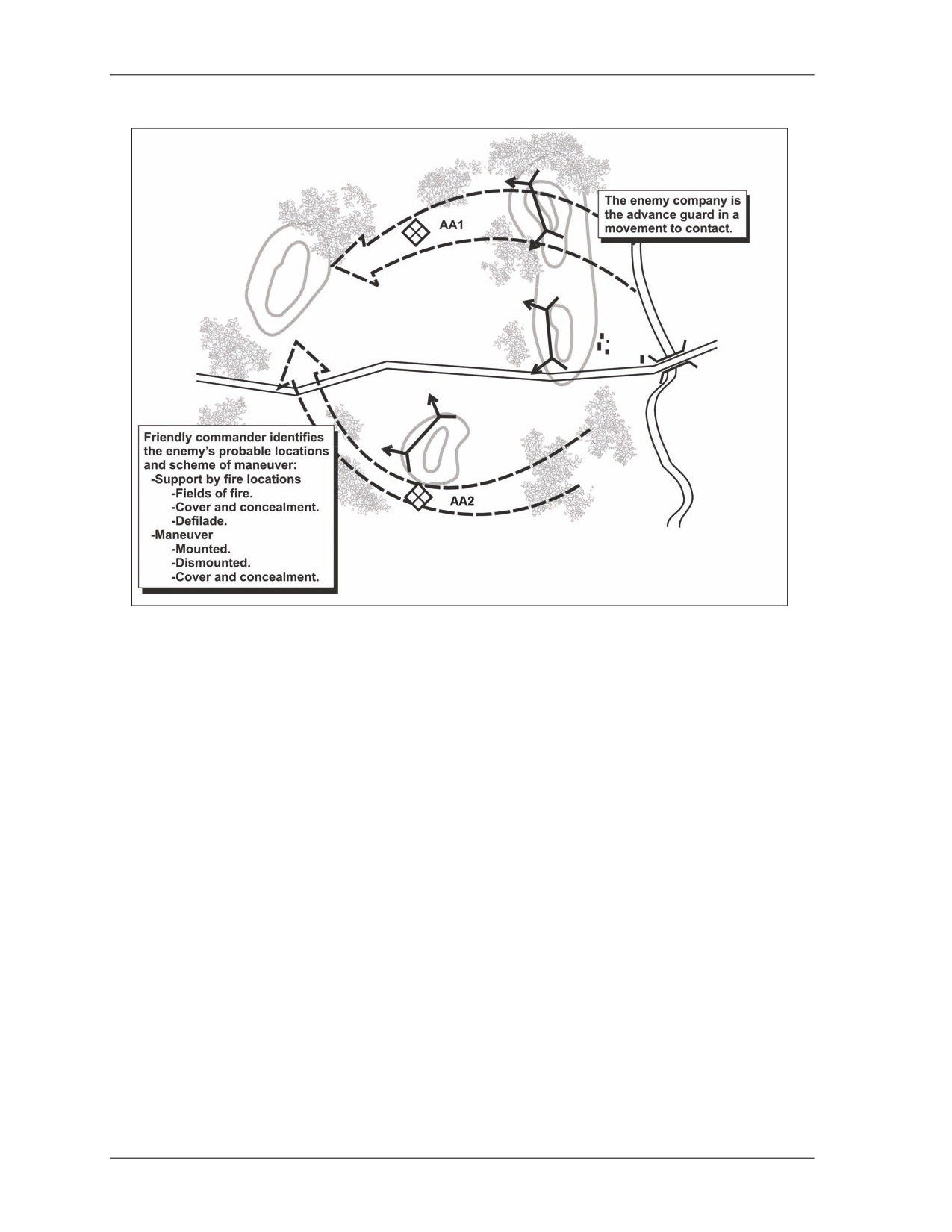
Chapter 9
Figure 9-1. Identification of probable enemy locations and determination of enemy scheme of maneuver.
DETERMINE WHERE AND HOW TO MASS FIRES
9-10. To achieve decisive effects, the Infantry company masses direct fires. Effective massing requires
the company commander both to focus the fires of subordinate elements and to distribute the effects of
those fires. Based on his analysis and his concept of the operation, the company commander identifies
points where he wants to or must focus the company's direct fires. Most often, he has identified these
locations as probable enemy positions or points along likely enemy avenues of approach where the
company can mass direct fires. Because the platoons may not initially be oriented on the point where the
commander wants to mass direct fires, he may issue a fire command to focus the fires. At the same time,
the company commander must use direct fire control measures to distribute the direct fires of his
subordinate elements effectively, fires that are now focused on the same point. Figure 9-2 shows how the
commander masses fires against the enemy.
9-4
FM 3-21.10
27 July 2006
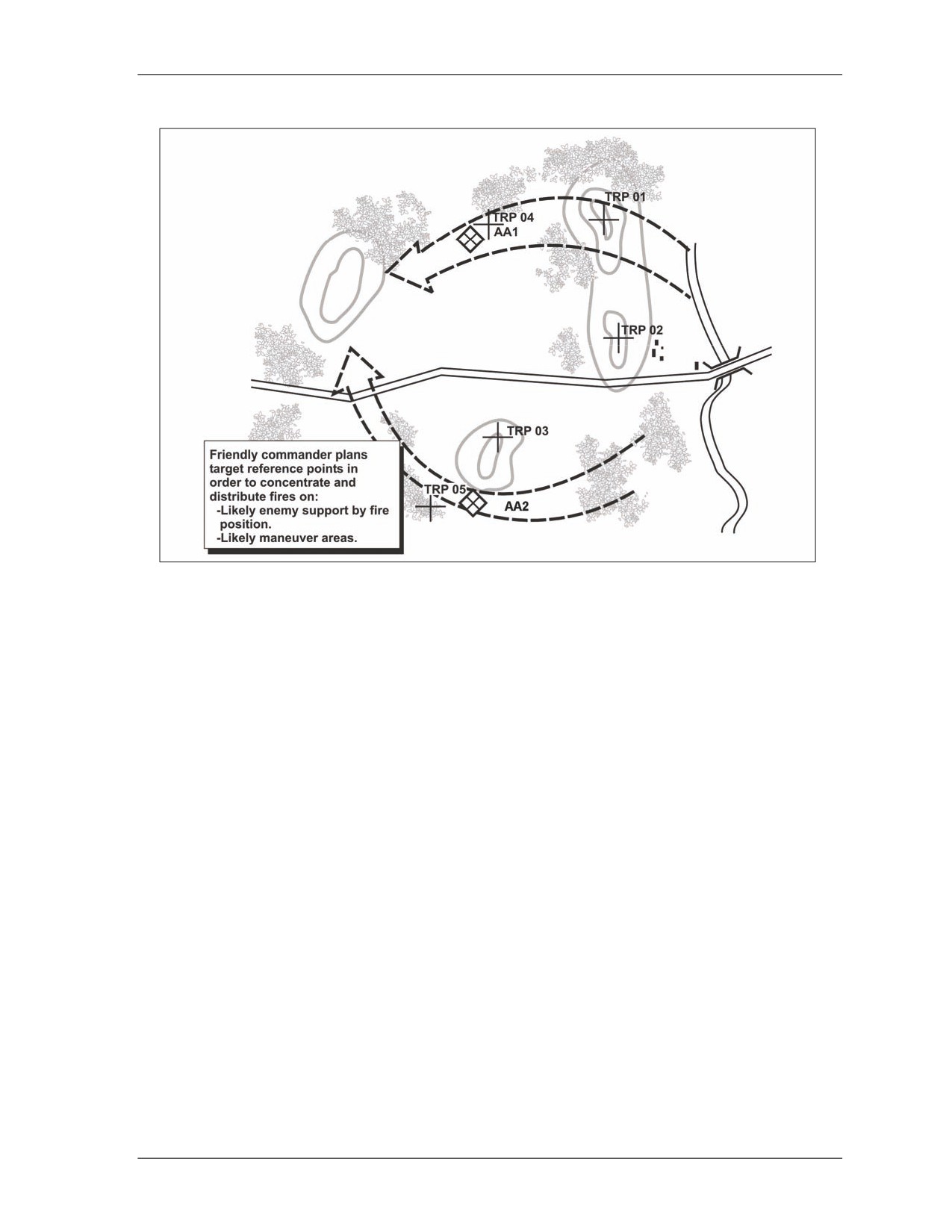
Direct Fire Control
Figure 9-2. Determination of where and how to mass (focus and distribute) fire effects
to kill enemy.
ORIENT FORCES TO SPEED TARGET ACQUISITION
9-11. To engage the enemy with direct fires effectively, the Infantry company must rapidly and
accurately acquire enemy elements. Orienting the company on probable enemy locations and on likely
enemy avenues of approach will speed target acquisition. Conversely, failure to orient the company slows
acquisition, which greatly increases the chance that enemy forces can engage first. The clock direction
orientation method, which is prescribed in most unit SOPs, is good for achieving all-round security, but it
does not ensure that friendly forces are most effectively oriented to detect the enemy. To achieve this
critical orientation, the commander typically designates TRPs on a recognizable permanent feature on or
near a probable enemy location or avenues of approach and orients his platoons using directions of fire or
sectors of fire. Figure 9-3, page 9-6, shows how the company commander orients the company for quick,
effective acquisition of the enemy force.
27 July 2006
FM 3-21.10
9-5