FM 3-21.10 (FM 7-10) The Infantry Rifle Company (July 2006) - page 6
Chapter 5
LINEAR DEFENSE
5-71.
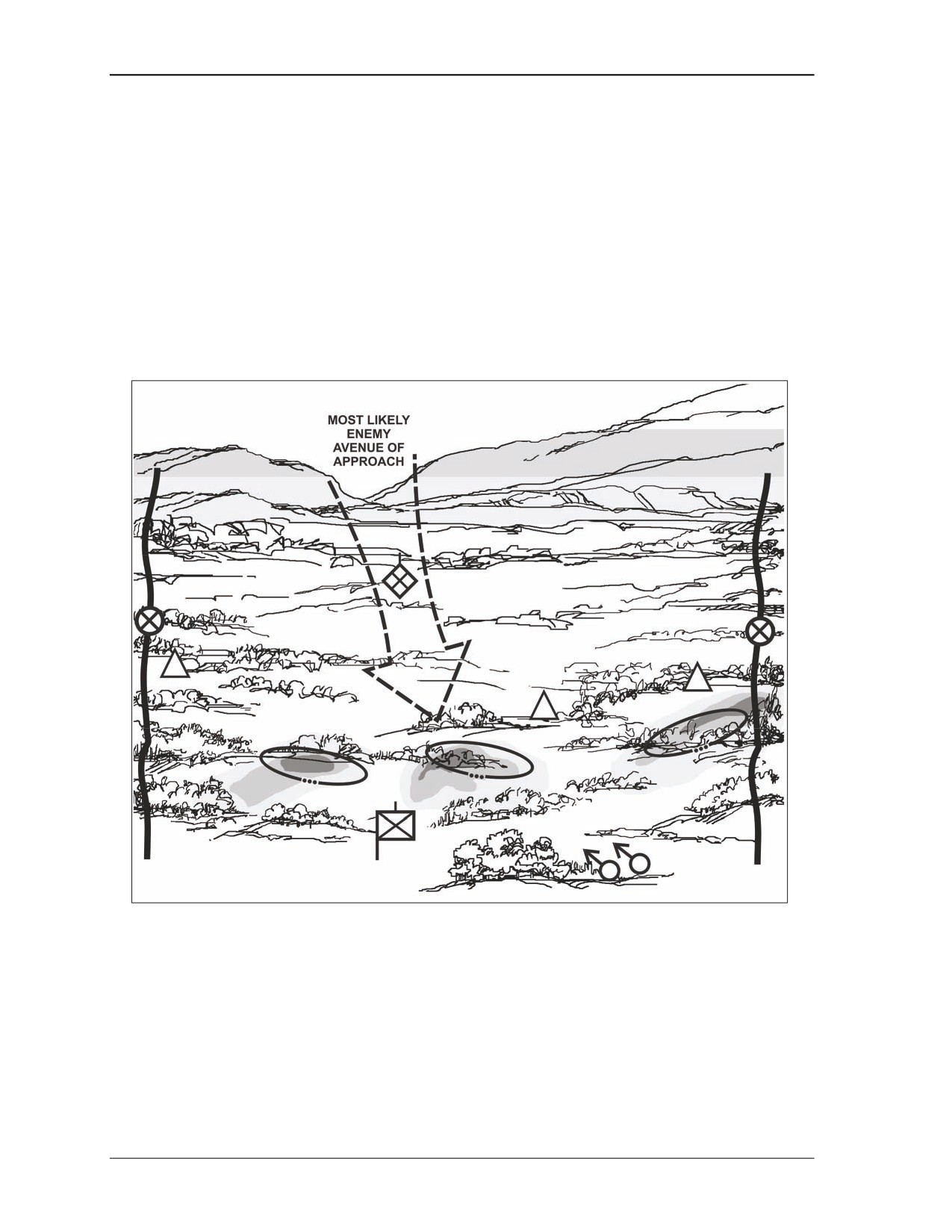
This technique allows interlocking and overlapping observation and fields of fire across the
company's front (Figure 5-11, page 5-24). The bulk of the company's combat power is well forward.
Sufficient resources must be available to provide adequate combat power across the sector to detect and
stop an attack. The company relies on fighting from well-prepared mutually supporting positions. It uses a
high volume of direct and indirect fires to stop the attacker. The main concern when fighting a linear
defense is the lack of flexibility and the difficulty of both seizing the initiative and seeking out enemy
weaknesses. When the enemy has a mobility advantage, a linear defense might be extremely risky.
Obstacles, indirect fires, and contingency plans are key to this maneuver. The company depends upon
surprise, well-prepared positions, and deadly accurate fires to defeat the enemy. The reserve is usually
small, perhaps a squad.
Figure 5-11. Linear defense.
Terrain Considerations
5-72.
A linear defense might be used when defensible terrain is available in the forward portion of the
company's sector, or to take advantage of a major linear natural obstacle. It is also used when the enemy is
mainly Infantry, the company conducts a security mission such as counterinfiltration, or as directed
by battalion.
5-24
FM 3-21.10
27 July 2006
Defensive Operations
Obstacles
5-73.
Minefields and other obstacles are positioned and covered by fire to slow the attacker and to
inflict casualties on him. Initially, engage him at long range by supporting fires (tactical air, attack
helicopters, and field artillery) to disrupt the momentum of his attack. Use fires from mortars, machine
guns, and small arms as he comes into range. If he penetrates the defense, block his advance with the
reserve and shift fire from the forward platoons onto the enemy flanks. Then, counterattack--either by the
company reserve or by the least committed platoon--with intense fires. The purpose is to destroy isolated or
weakened enemy forces and regain key terrain.
Counterreconnaissance
5-74.
The counterreconnaissance effort is critical when fighting a linear defense to deny the enemy the
locations of the company's forward positions. If the enemy locates the forward positions, he will
concentrate combat power where he desires while fixing the rest of the company to prevent their maneuver
to disrupt his attack. This effort might be enhanced by initially occupying and fighting from alternate
positions forward of the primary positions. This tactic enhances the security mission and deceives the
enemy reconnaissance that may get through the security force.
NONLINEAR DEFENSE
5-75.
The nonlinear defense is the most decentralized and dynamic defense conducted by an Infantry
company. It is frequently used when operating against an enemy force that has equal or greater firepower
and mobility capabilities. This type of defense is almost exclusively enemy-oriented and is not well suited
for retaining terrain. To be successful, this defense depends on surprise, offensive action, and the initiative
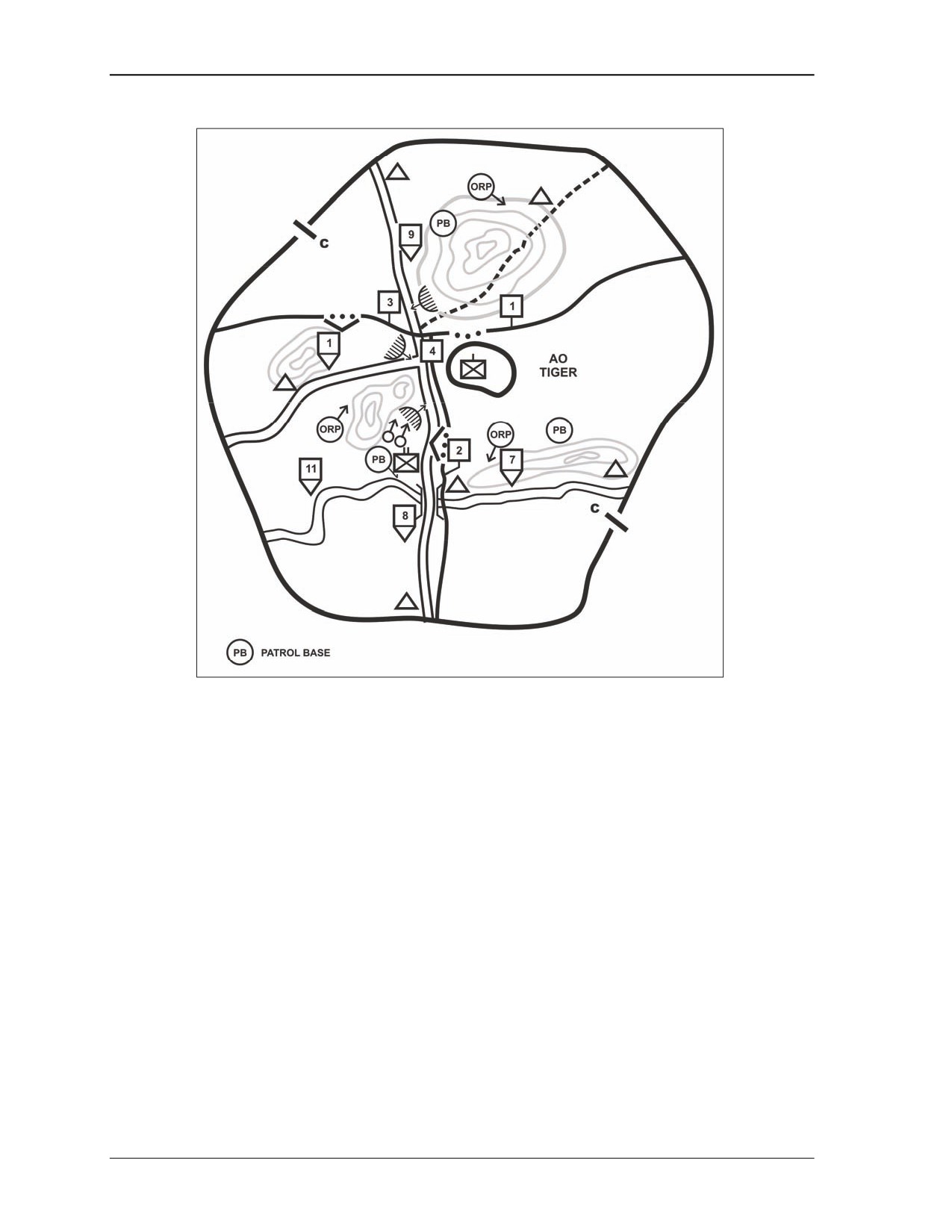
of small-unit leaders. (Figure 5-12). It is a very fluid defense with little static positioning involved.
27 July 2006
FM 3-21.10
5-25
Chapter 5
Figure 5-12. Nonlinear defense.
Company Focus
5-76.
Normally, the battalion directs this defensive technique when the battalion concept does not focus
the company. For example, the battalion might assign the company a sector and a mission that focuses the
company on the enemy force. Mutual support is achieved solely through the linkage of purposes in the
mission statements. The company commander may decide to conduct a nonlinear defense when he finds it
difficult to identify a single decisive point that allows the company to concentrate combat power and
achieve its purpose. Nonlinear defense may also be appropriate in terrain that prevents mutual support
between platoons or against an enemy force capable of directing overwhelming firepower against
identified friendly positions.
Reconnaissance and Security
5-77.
The reconnaissance and security plan for this defensive technique focuses on avoiding detection
by the enemy's reconnaissance assets. Operating in smaller units supports this requirement. Preparation and
activity along likely reconnaissance routes must be closely controlled. Ideally, the company allows the
enemy reconnaissance to move through the area before destroying him.
5-26
FM 3-21.10
27 July 2006
Defensive Operations
Platoon Sectors
5-78.
The company commander assigns platoon sectors and may also identify likely ambush positions
and rally points for each platoon. He identifies a decisive operation and assigns the shaping operation
missions that provide mutual support and degrade the enemy's ability to generate combat power against the
decisive operation. The decisive operation might be weighted by assigning priority of fires (POFs); by the
allocation of mines, barrier materials, and other supplies; and by locating the company CP, CCP, and most
of the caches in their vicinity.
Event-oriented Synchronization
5-79.
The platoons conduct numerous squad and platoon ambushes, raids, and counterattacks, but they
avoid decisive engagement. Before the enemy is able to react and concentrate against these small units,
they disengage and seek out another enemy weak point. The synchronization for this defense might be
event-oriented or accomplished by assigning ambush locations and initiating times or signals. The
event-oriented synchronization involves identifying key enemy assets or vehicles that, if destroyed or
disrupted, will have the greatest detrimental effect on the enemy.
Company Reserve
5-80.
A company reserve is normally quite small. Due to the extended distances over which the
company and platoons operate, the timely employment of the company reserve in a decisive action is not
likely. Generally, the platoons are able to employ resources more effectively. A squad-size company
reserve could be employed under the control of the 1SG as a logistics squad, for CASEVAC, or as a
reaction force to shape the decisive operation.
Other Considerations
5-81.
Other concerns include the difficulty of conducting resupply operations and casualty evacuation
when defending in this manner. Resupply can be accomplished through pre-positioning of the critical
supplies. CASEVAC requires detailed planning and battalion support. Platoon CCPs must be identified
well forward to support each platoon. Litter teams moving on routes that avoid the enemy normally
conduct the evacuation from these points to the company CCP. Treatment teams from the BAS should be
positioned at the company collection point, particularly if casualties may need to be held until darkness for
evacuation.
REVERSE SLOPE DEFENSE
5-82.
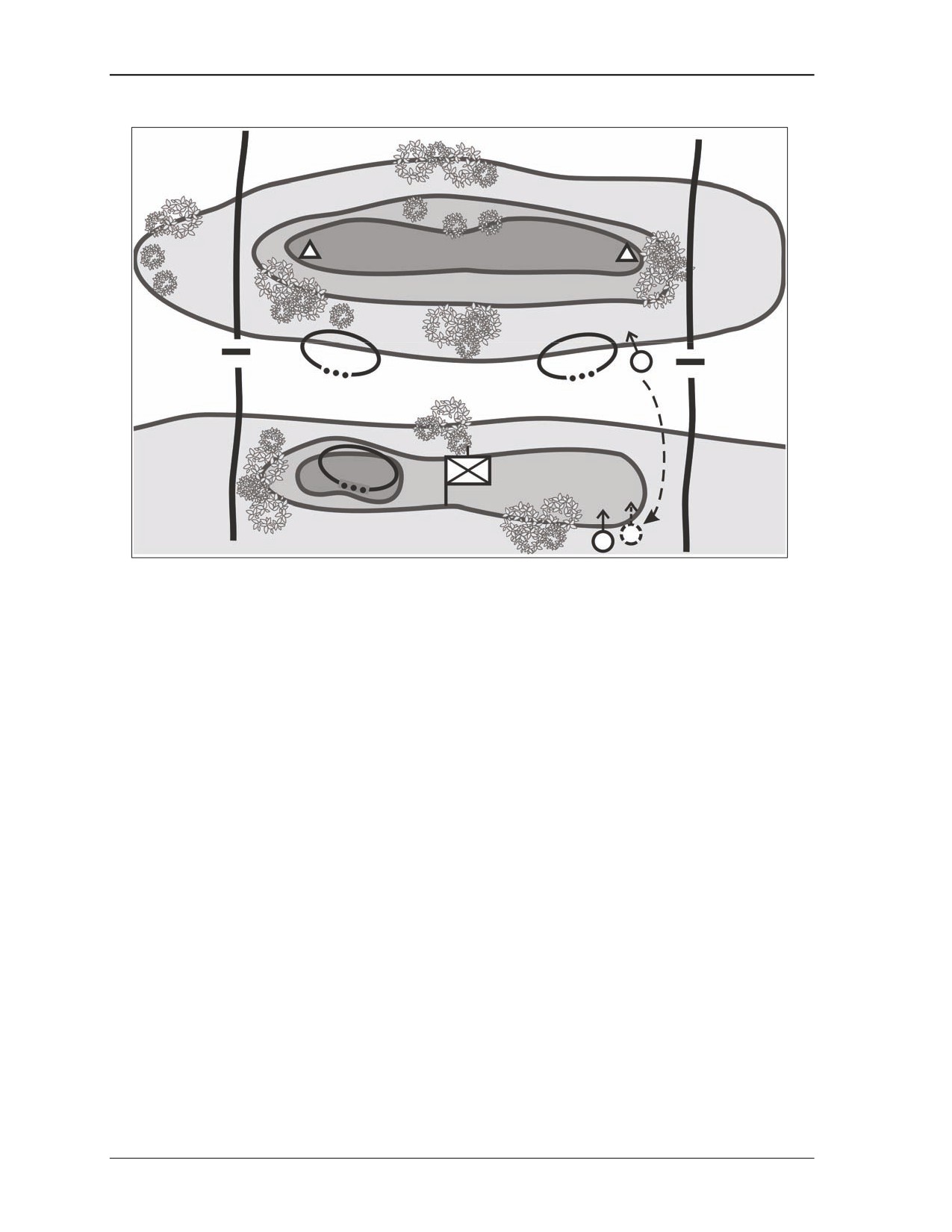
An alternative to defending on the forward slope of a hill or a ridge is to defend on a reverse slope
(Figure 5-13). In such a defense, the company is deployed on terrain that is masked from enemy direct fire
and ground observation by the crest of a hill. Although some units and weapons might be positioned on the
forward slope, the crest, or the counterslope (a forward slope of a hill to the rear of a reverse slope), most
forces are on the reverse slope. The key to this defense is control of the crest by direct fire.
27 July 2006
FM 3-21.10
5-27
Chapter 5
Figure 5-13. Company defense on a reverse slope.
General Considerations
5-83.
These considerations generally apply when defending on a reverse slope.
y The crest protects the company from direct fire. This is a distinct advantage if the attacker has a
greater weapon’s range than the defender. The reverse slope defense can eliminate or reduce
the standoff advantage of the attacker. It also makes enemy adjustment of his indirect fire more
difficult since he cannot see his rounds impact. It keeps the enemy's second echelon from
supporting his first echelon's assault.
y The enemy might be deceived and may advance to close contact before he discovers the
defensive position. Therefore, the defender may gain the advantage of surprise.
y The defender can improve positions, build obstacles, and clear fields of fire without disclosing
his positions.
y The defender may use dummy positions on the forward slope to deceive the enemy.
y Resupply and evacuation
(when under attack) might be easier when defending on a
reverse slope.
y Enemy target acquisition and jamming efforts are degraded. Enemy radar, infrared sights, and
thermal viewers cannot detect Soldiers masked by a hill. Radios with a hill between them and
the enemy are less vulnerable to jamming and direction finders.
y Enemy use of CAS and attack helicopters is restricted. Enemy aircraft must attack defensive
positions from the flank or from the rear, which makes it easier for friendly air defense
weapons to engage them.
y A counterattacking unit has more freedom of maneuver since it is masked from the enemy's
direct fire.
5-28
FM 3-21.10
27 July 2006
Defensive Operations
Special Considerations
5-84.
These considerations may apply when defending on a reverse slope.
y Observation of the enemy is more difficult. Soldiers in this position see forward no farther than
the crest. This makes it hard to determine exactly where the enemy is as he advances, especially
when visibility is poor. OPs must be placed forward of the topographic crest for early warning
and long-range observation.
y Egress from the position might be more difficult.
y Fields of fire are normally short.
y Obstacles on the forward slope can be covered only with indirect fire or by units on the flanks
of the company unless some weapons systems are initially placed forward.
y If the enemy gains the crest, he can assault downhill. This may give him a psychological
advantage.
y If OPs are insufficient or improperly placed, the defenders might have to fight an enemy who
suddenly appears in strength at close range.
Feasibility
5-85.
A defense on a reverse slope might be effective when--
y The enemy has more long-range weapons than the defender.
y The forward slope has little cover and concealment.
y The forward slope is untenable because of enemy fire.
y The forward slope has been lost or not yet gained.
y Better fields of fire exist on the reverse slope.
y It adds to the surprise and deception.
Plans
5-86.
The fundamentals of the defense apply to a defense on a reverse slope.
y Position forward platoons so they block enemy approaches and exploit existing obstacles. They
should permit surprise fire on the crest and on the approaches around the crest. Forward
fighting positions should have rear and overhead cover to protect friendly Soldiers from
fratricide.
y Position OPs, including FIST personnel, on the crest or the forward slope of the defended hill.
At night, increase OPs and patrol units to prevent infiltration. Machine guns might be attached
to OPs.
y Position the platoon in depth or reserve where it can provide the most flexibility, support the
forward platoons by fire, protect the flanks and the rear of the company, and, if necessary,
counterattack. It might be positioned on the counterslope to the rear of the forward platoons if
that position allows it to fire and hit the enemy when he reaches the crest of the defended hill.
y Position the company CP to the rear where it will not interfere with the reserve or supporting
units. The company commander may have an OP on the forward slope or crest and another on
the reverse slope or counterslope. He uses the OP on the forward slope or crest before the battle
starts when he is trying to determine the enemy's intentions. During the fight, he moves the OP
on the reverse slope or counterslope.
y Plan indirect fire well forward of, on, and to the flanks of the forward slope, crest, reverse
slope, and counterslope. Plan indirect FPF on the crest of the hill to control the crest and stop
assaults. Put the company's mortar section in defilade to the rear of the counterslope.
27 July 2006
FM 3-21.10
5-29
Chapter 5
y Reinforce existing obstacles. Protective obstacles on the reverse slope ― just down from the
crest where it can be covered by fire ― can slow the enemy's advance and hold him under
friendly fire.
y The commander normally plans counterattacks. He plans to drive the enemy off the crest by
fire, if possible. He must also be prepared to drive the enemy off by fire and movement as well.
ENGAGEMENT AREA DEVELOPMENT
5-87.
The EA is where the company commander intends to contain and destroy an enemy force using
the massed fires of all available weapons. The success of any engagement depends on how effectively the
commander can integrate the obstacle plan, indirect fire plan, direct fire plan, and the terrain within the EA
to achieve the company's tactical purpose. Beginning with evaluation of METT-TC factors, the
development process covers these steps.
y Identify all likely enemy avenues of approach.
y Determine likely enemy schemes of maneuver.
y Determine where to kill the enemy.
y Emplace weapons systems.
y Plan and integrate obstacles.
y Plan and integrate indirect fires.
y Rehearse the execution of operations in the EA.
Identify Likely Enemy Avenues of Approach
5-88.
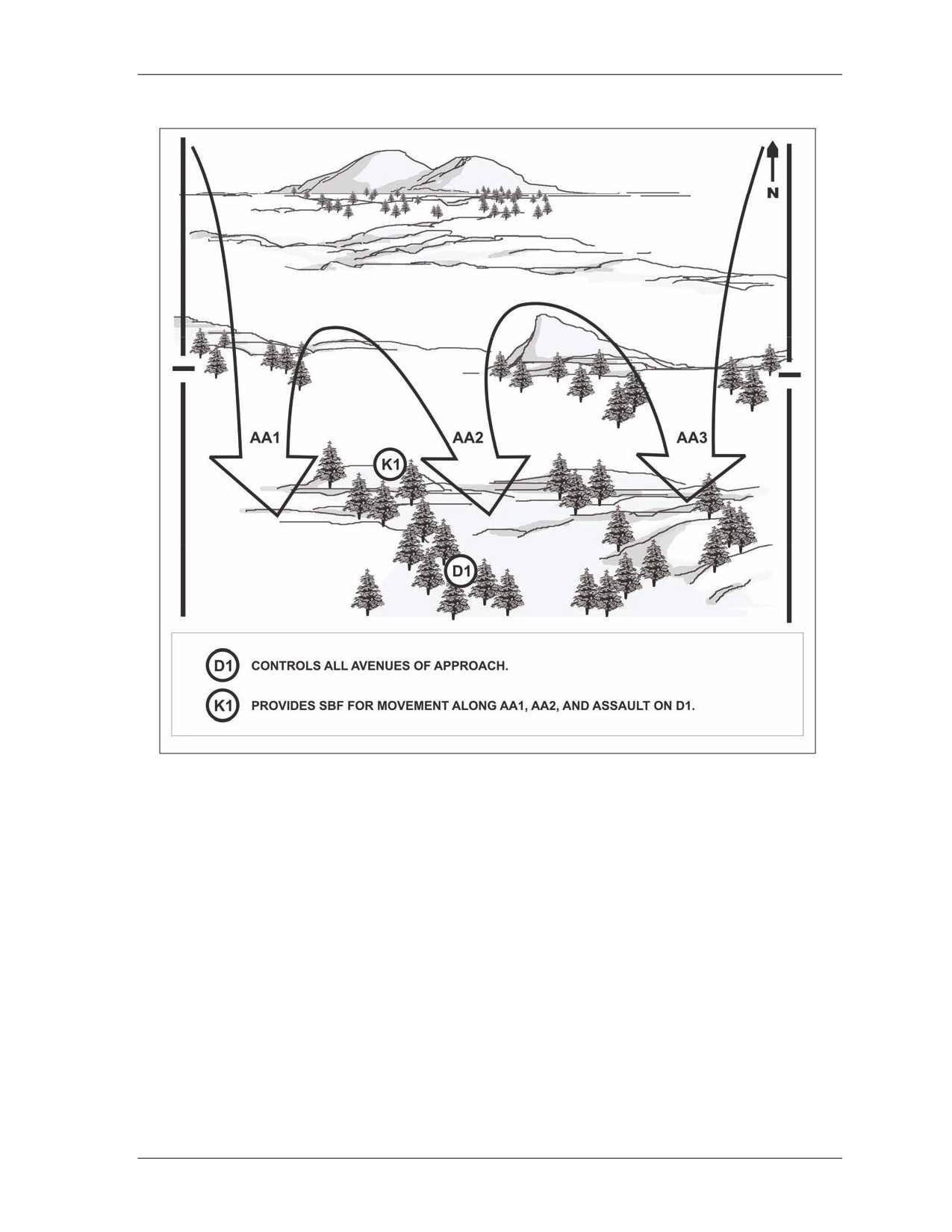
The following procedures and considerations (Figure 5-14, page 5-31), apply when identifying the
enemy's likely avenues of approach.
y Conduct initial reconnaissance. If possible, do this from the enemy's perspective along each
avenue of approach into the sector or EA.
y Identify key and decisive terrain. This includes locations that afford positions of advantage over
the enemy as well as natural obstacles and choke points that restrict forward movement.
y Determine which avenues will provide cover and concealment for the enemy while allowing
him to maintain his tempo. Determine what terrain the enemy is likely to use to support each
avenue.
y Evaluate lateral routes adjoining each avenue of approach.
5-30
FM 3-21.10
27 July 2006
Defensive Operations
Figure 5-14. Likely enemy avenues of approach.
Determine Enemy Scheme of Maneuver
5-89.
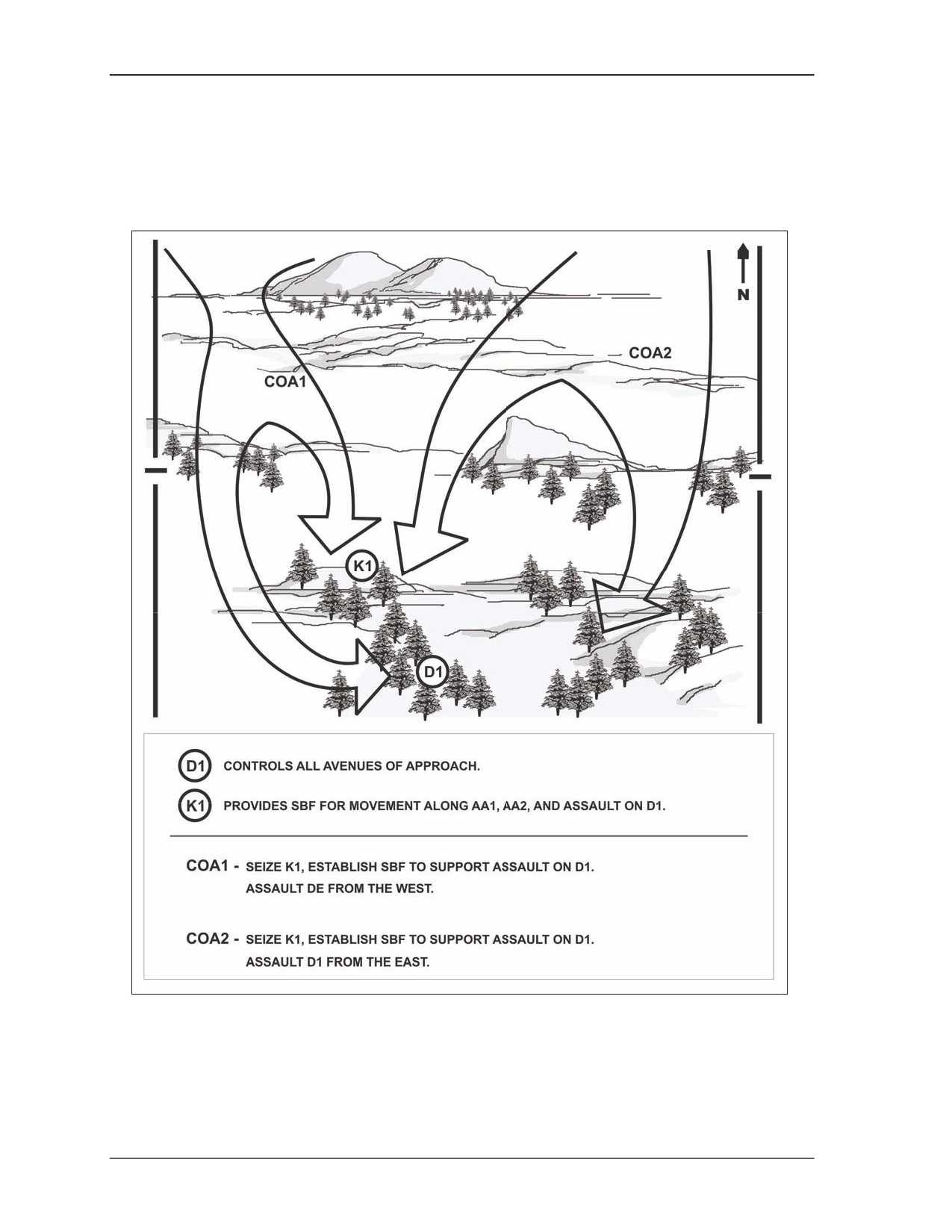
The company commander can use the following procedures and considerations (Figure 5-15) to
determine the enemy's scheme of maneuver.
y Determine how the enemy will structure the attack. In what formation will he attack? How will
he sequence his forces?
y Determine how the enemy will use his reconnaissance assets. Will he try to infiltrate friendly
positions?
y Determine where and when the enemy will change formations and establish support-by-fire
positions.
y Determine where, when, and how the enemy will conduct his assault and breaching operations.
Determine likely OPs and what terrain the enemy is likely to employ for supporting fires.
y Determine where and when he will commit follow-on forces.
27 July 2006
FM 3-21.10
5-31
Chapter 5
y Determine the enemy's expected rates of movement.
y Assess the effects of his combat multipliers.
y Determine what reactions the enemy is likely to have in response to projected friendly actions.
Figure 5-15. Example enemy scheme of maneuver.
5-32
FM 3-21.10
27 July 2006
Defensive Operations
Determine Where to Kill Enemy
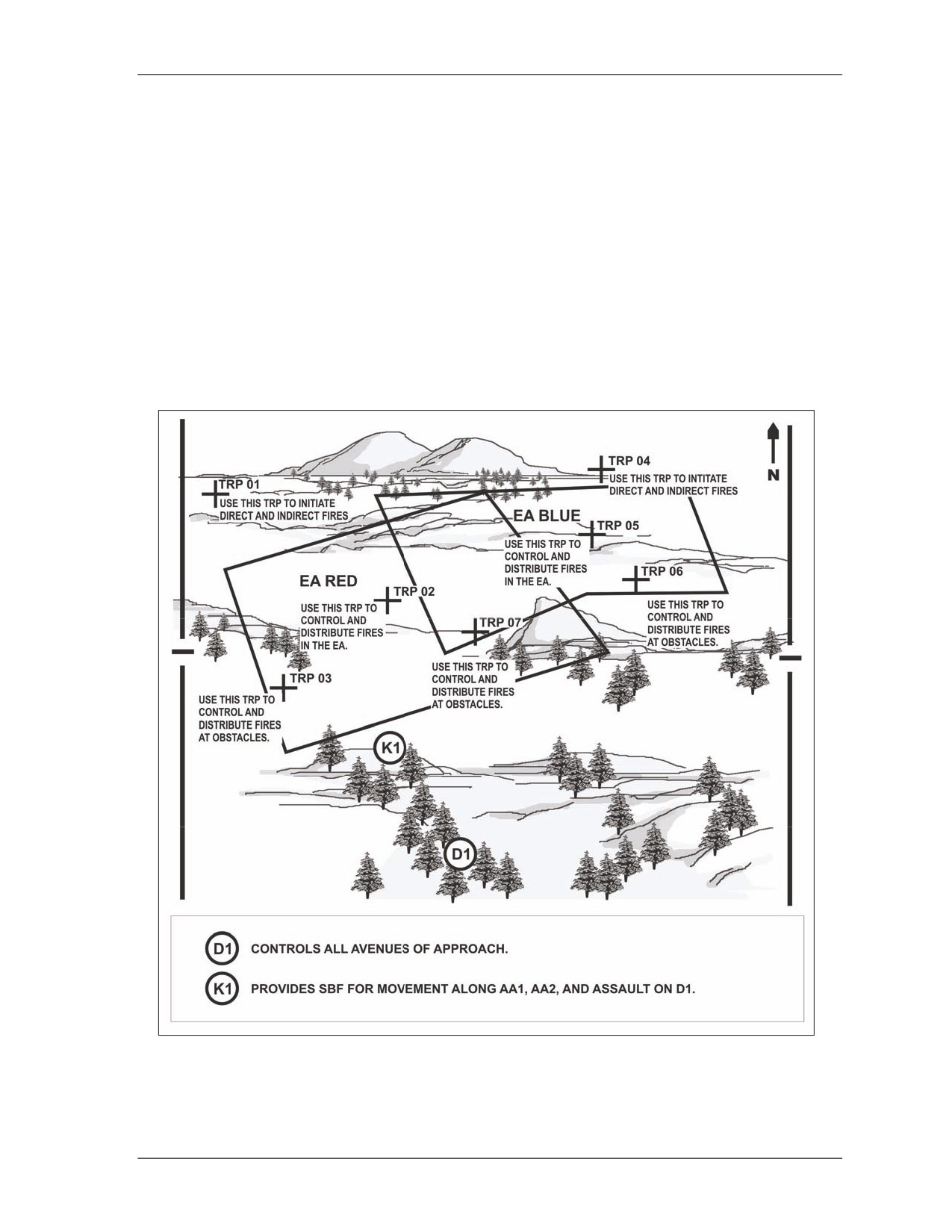
5-90.
Identify and mark where the battalion and company will engage the enemy
(Figure 5-16,
page 5-33).
y Identify TRPs that match the enemy's scheme of maneuver, allowing the company to identify
where it will engage enemy forces through the depth of the sector.
y Identify and record the exact location of each TRP.
y Determine how many weapons systems must focus fires on each TRP to achieve the desired
effects.
y Determine which platoons will mass fires on each TRP.
y Establish EAs around TRPs.
y Develop the direct fire planning measures necessary to focus fires at each TRP.
Figure 5-16. Locations to kill enemy.
27 July 2006
FM 3-21.10
5-33
Chapter 5
Note: In marking TRPs, use thermal sights to ensure visibility at the appropriate range
under varying conditions, including daylight and limited visibility (darkness, smoke, dust, or
other obscurants).
Emplace Weapons System
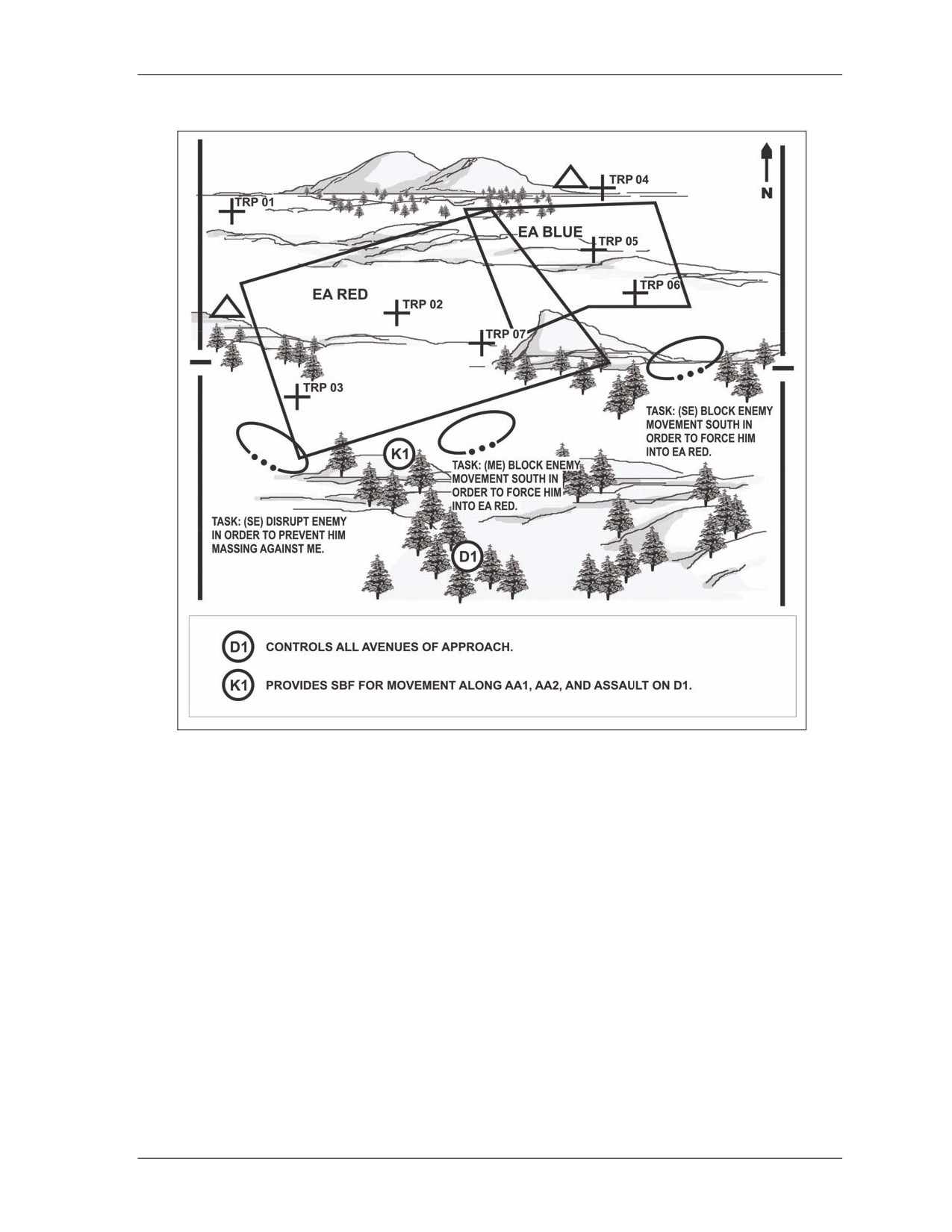
5-91.
The following steps apply in selecting and improving BPs and emplacing crew-served weapons
systems and Infantry positions (Figure 5-17).
y Select tentative platoon BPs. (When possible, select these while moving in the EA. Using the
enemy's perspective enables the commander to assess the survivability of the positions.)
y Conduct a leader's reconnaissance of the tentative BPs.
y Traverse the EA to confirm that selected positions are tactically advantageous.
y Confirm and mark the selected BPs.
y Ensure that BPs do not conflict with those of adjacent units and that they are effectively tied in
with adjacent positions.
y Select primary, alternate, supplementary, and subsequent fighting positions to achieve the
desired effect for each TRP.
y Ensure that platoon leaders, platoon sergeants, and squad leaders position weapons systems so that
the required number of weapons and platoons effectively covers each TRP.
5-34
FM 3-21.10
27 July 2006
Defensive Operations
Figure 5-17. Emplacement of weapons systems.
Plan and Integrate Obstacles
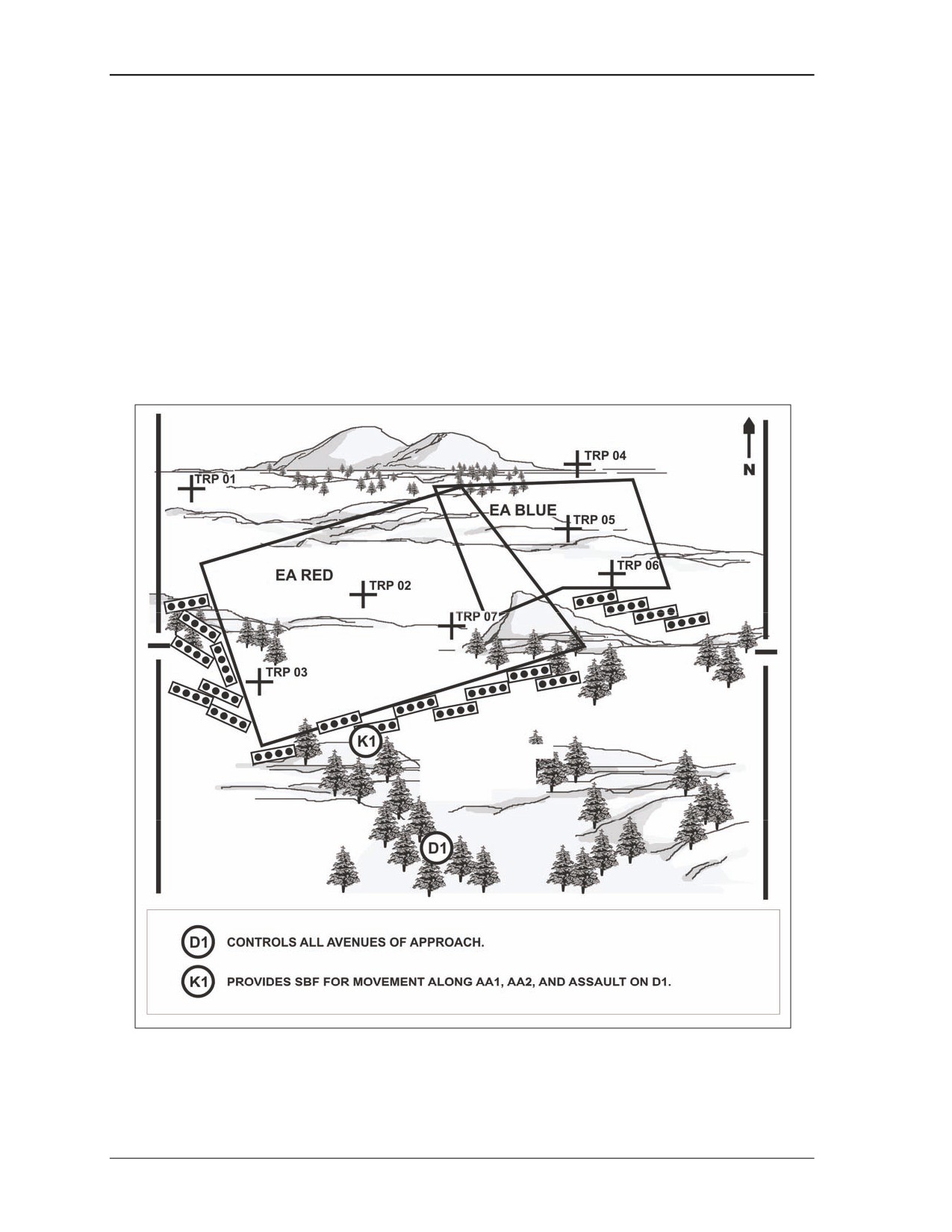
5-92.
The goal of obstacle planning is to support the commander's intent through optimum obstacle
emplacement and integration with fires. Obstacles must allow the enemy into the EA and then contain him
there. The focus at the battalion level and below is the actual integration of fires and obstacles. At the
battalion level, obstacle planning is very directive and detailed and centers on obstacle groups. At the
company level, obstacle planning deals with the actual sighting and emplacement of individual obstacles
within the groups. The following steps apply in planning and integrating obstacles in the company defense
(Figure 5-18).
y Understand obstacle group intent.
y Coordinate with the engineers.
y Site and mark individual obstacle locations.
y Combat elements should be used to provide security for the engineers as they emplace
obstacles.
- The overwatching element team marks fire control measures such as TRPs and artillery targets
in the EA.
27 July 2006
FM 3-21.10
5-35
Chapter 5
- Engineers enter the EA and move to the far side of the proposed trace of the obstacle group.
- The engineer squad/platoon leader and company commander collocate in the defensive
positions covering the obstacle.
- Elements from the engineers move along the proposed trace of the obstacle group.
- From the defensive position, the leaders follow the movement of the engineers, ensuring that all
points of the obstacle trace can be covered with fires.
- They maintain communications with the engineers via FM.
- The commander and engineer squad/platoon leader refines the obstacle trace, adjusting the
position of individual obstacles as necessary.
y Refine direct and indirect fire control measures.
y Identify lanes and gaps.
y Report obstacle locations and gaps to higher headquarters.
Figure 5-18. Plans for and integration of obstacles.
5-36
FM 3-21.10
27 July 2006
Defensive Operations
Plan and Integrate Indirect Fires
5-93.
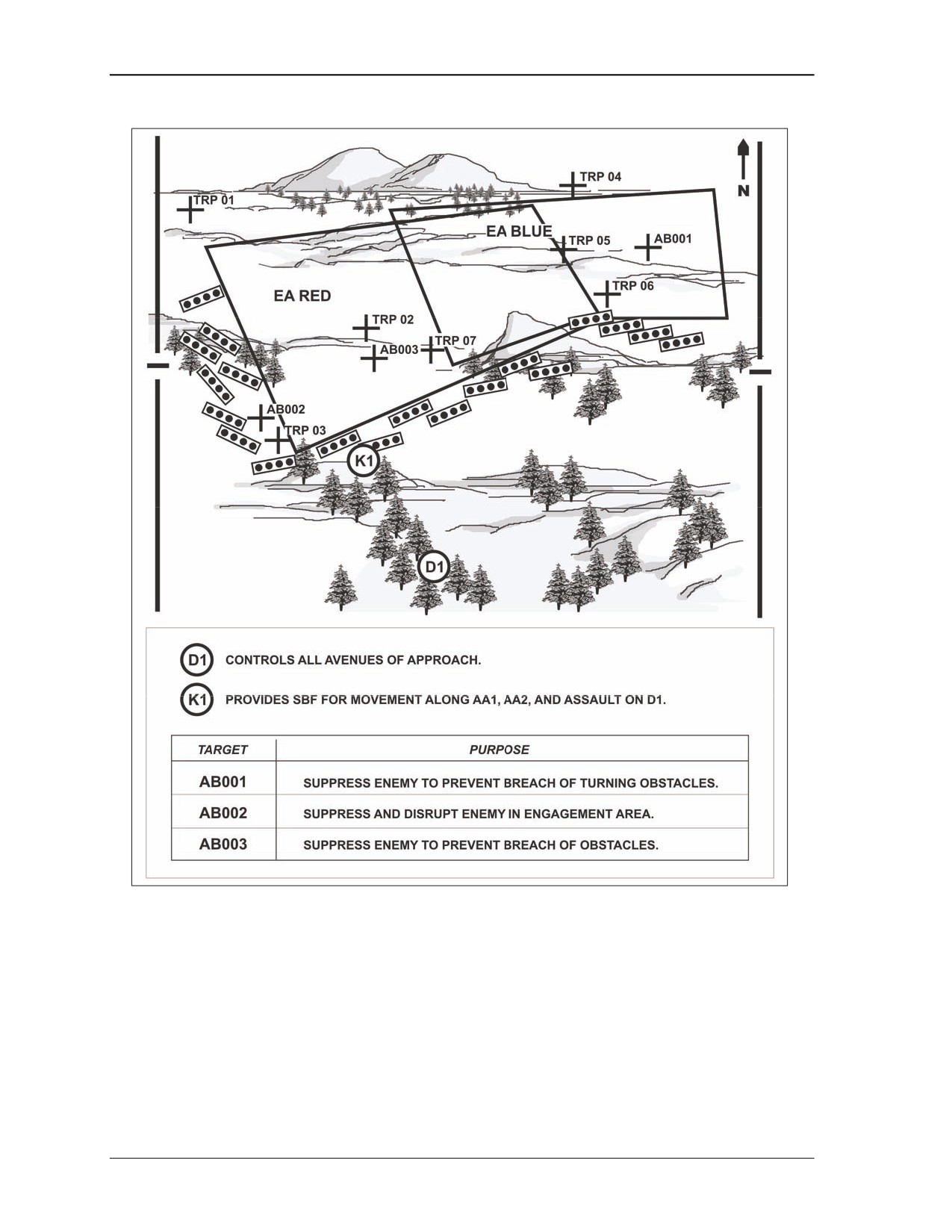
The following steps apply in planning and integrating indirect fires (Figure 5-19, page 5-38).
y Determine the purpose of fires and the essential fire support task (EFST) that supports it.
y Determine where the purpose can best be achieved.
y Establish the observation plan, with redundancy for each target. Observers include the FIST, as
well as members of maneuver elements with fire support responsibilities such as platoon
sergeants.
y Establish triggers.
y Obtain accurate target locations.
y Refine target locations to ensure coverage of obstacles.
y Adjust artillery and mortar targets.
y Plan FPFs.
y Request critical friendly zones (CFZs) for protection of maneuver elements and no-fire areas
(NFAs) for protection of OPs and forward positions.
27 July 2006
FM 3-21.10
5-37
Chapter 5
Figure 5-19. Integration of direct and indirect fires.
Conduct an Engagement Area Rehearsal
5-94.
The purpose of this rehearsal is to ensure every leader and Soldier understands the plan and all
elements are prepared to cover their assigned areas with direct and indirect fires. Although the company
commander has several options, the most common and most effective type of rehearsal is to replicate the
threat. One technique for the rehearsal in the defense is to have the company trains, under the control of the
company XO, move through the EA to show the enemy force while the commander and subordinate
platoons rehearse the battle from the company BP. The rehearsal should cover these actions.
y Rearward passage of security forces (as required).
5-38
FM 3-21.10
27 July 2006
Defensive Operations
y Closure of lanes (as required).
y Movement from the hide position to the BP.
y Use of fire commands, triggers, and maximum engagement lines (MELs) to initiate direct and
indirect fires.
y Shifting of fires to refocus and redistribute fire effects.
y Emplacement of scatterable mine systems.
y Preparation and transmission of critical reports.
y Assessment of the effects of enemy weapons systems.
y Displacement to alternate, supplementary, or subsequent BPs.
y Cross-leveling or resupply of Class V.
y Evacuation of casualties.
Note: The company commander should coordinate the rehearsal with the battalion to
ensure other units’ rehearsals are not planned for the same time or location. Coordinating
leads to more efficient use of planning and preparing time for all battalion units. It also
eliminates the danger of misidentification of friendly forces in the rehearsal area, which could
result in fratricide.
PRIORITY OF WORK
5-95.
Priority of work is a set method of controlling the preparation and conduct of a defense. TSOP
should describe priority of work to include individual duties. The commander changes priorities based on
the situation. All leaders in the company should have a specific priority of work for their duty position.
Although listed in sequence, several tasks are performed at the same time. An example priority of work
sequence is as follows.
y
Post local security.
y
Establish the company R&S operation.
y
Position Javelins, machine guns, and Soldiers; assign sectors of fire.
y
Position other assets (company CP and mortars).
y
Designate FPLs and FPFs.
y
Clear fields of fire and prepare range cards and sector sketches.
y
Adjust indirect fire FPFs. The firing unit FDC should provide a safety box that is clear of all
friendly units before firing any adjusting rounds.
y
Prepare fighting positions.
y
Install wire communications, if applicable.
y
Emplace obstacles and mines.
y
Mark (or improve marking for) TRPs and direct fire-control measures.
y
Improve primary fighting positions such as overhead cover.
y
Prepare alternate and supplementary positions.
y
Establish sleep and rest plan.
y
Reconnoiter movements.
y
Rehearse engagements and disengagements or displacements.
y
Adjust positions and control measures as required.
y
Stockpile ammunition, food, and water.
y
Dig trenches between positions.
y
Reconnoiter routes.
y
Continue to improve positions.
27 July 2006
FM 3-21.10
5-39
Chapter 5
Company Commander
5-96.
Many of these duties can be delegated to subordinates, but the commander must ensure they are
done. The commander must--
y Ensure local security and assign platoon OP responsibility.
y Conduct a leader's reconnaissance with the platoon leaders and selected personnel. Confirm or
deny significant deductions or assumptions from the mission analysis. Confirm the direct fire
plan, to include EAs, sectors of fire, position key weapons, and fire control measures.
Designate primary, alternate, supplementary, and subsequent positions that support the direct
fire plan, for platoons, sections, and supporting elements. Require platoons to conduct
coordination. Integrate indirect fire plan and obstacles to support the direct fire plan. Designate
the general company CP location.
y Check the company CP and brief the 1SG and XO on the situation and logistics requirements.
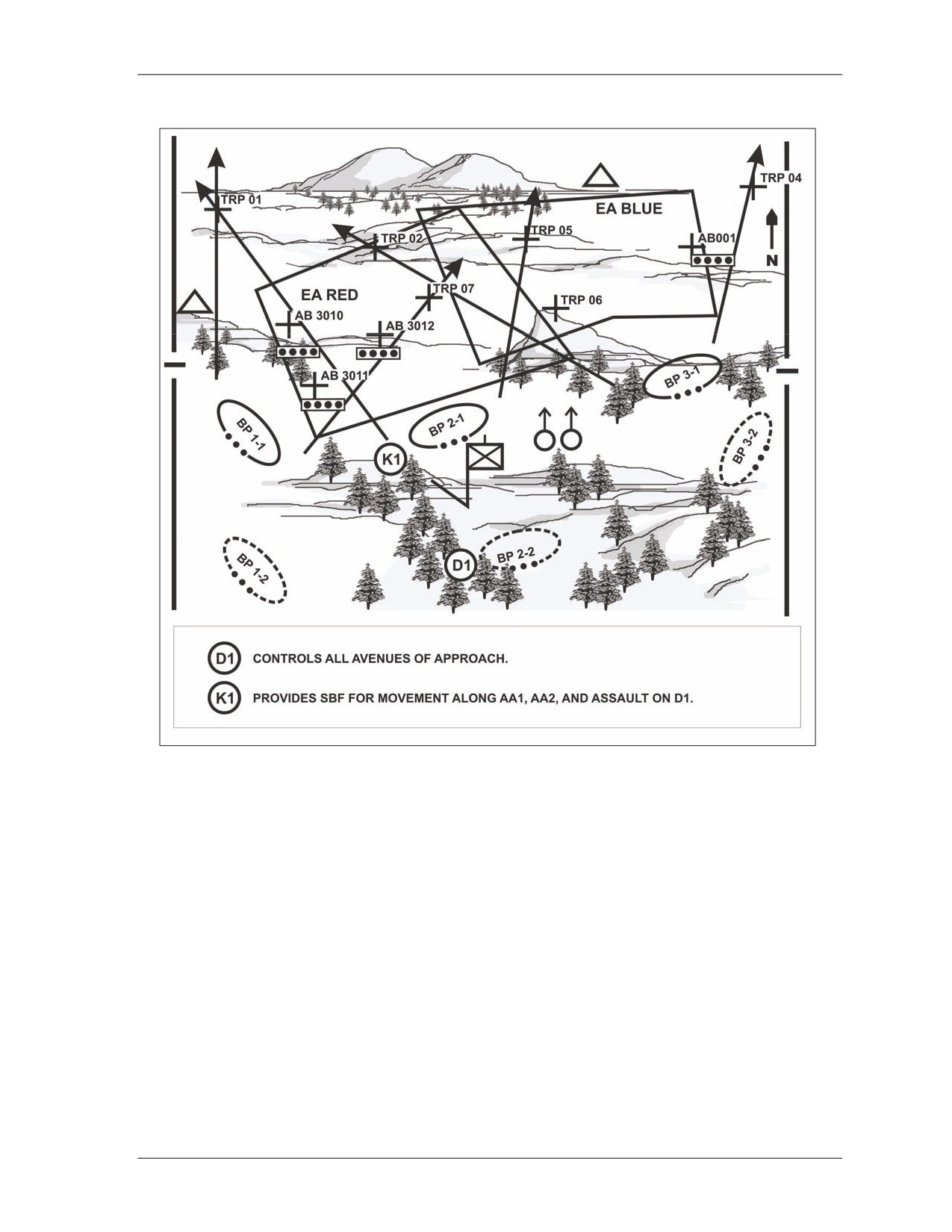
y Upon receipt of the platoon sector sketches, make two copies of a defensive sector sketch and a
fire plan. Retain one copy and forward the other to the battalion (Figure 5-20).
y Confirm the direct fire plan and platoon positions before digging starts. Coordinate with the left
and right units.
y Check with the battalion commander for any changes or updates in the orders.
y Finish the security, deception, counterattack, and obstacle plans.
y Walk the company positions after they are dug. Confirm clear fields of fire and complete
coverage of the sector by all key weapons. Look at the defensive plan from an enemy point of
view, both conceptually and physically.
y Check dissemination of information, interlocking fires, and dead space.
y Ensure immediate correction of deficiencies.
y Ensure EA rehearsals are conducted and obstacle locations reported.
5-40
FM 3-21.10
27 July 2006
Defensive Operations
Figure 5-20. Company defensive sector sketch.
First Sergeant and Executive Officer
5-97.
The first sergeant and XO must--
y Establish the company CP and ensure that wire communications link the platoons, sections, and
attached elements if applicable.
y Establish casualty collection points, company logistics release points, and EPW collection
points.
y Brief platoon sergeants on the company CP location, logistics plan, and routes between
positions.
y Assist the company commander with the sector sketch.
y Request and allocate pioneer tools, barrier material, rations, water, and ammunition.
y Walk the positions with the company commander. Start supervising emplacement of the
platoons and sections, and check range cards and sector sketches.
27 July 2006
FM 3-21.10
5-41
Chapter 5
y Establish routine security or alert plans, radio watch, and rest plans. Brief the company
commander.
y Supervise continuously and assist the commander with other duties as assigned.
Fire-Support Officer
5-98.
The FSO must--
y Assist the commander in planning the indirect fires to support the defense.
y Advise the commander on the status of all firing units, and on the use of smoke or illumination.
y Coordinate with the Infantry battalion FSO, firing units, and platoon leaders to ensure the fire
plan is synchronized and fully understood.
y Ensure the indirect fire plan is rehearsed and understood by all.
y Ensure all FPFs are adjusted as soon as possible.
y Develop observation plan.
y Coordinate and rehearse any repositioning of observers within the company sector to ensure
they can observe targets or areas of responsibility.
y Develop triggers.
y Report battlefield intelligence.
y Ensure redundancy in communications.
Mortar Section Leader
5-99.
The mortar section leader must--
y Choose a tentative firing position(s) and OP(s) and complete his portion of the fire plan based
on the company OPORD, coordinated with the FSO and his own analysis.
y Take part in the company leader's reconnaissance. Confirm or adjust the firing position, select
OPs, and coordinate the indirect fire plan with the company FSO.
y Issue FRAGOs to the mortar squads. Conduct a section leader's reconnaissance with squad
leaders. Require squad leaders to coordinate with platoons and squads for security and logistics
support.
y Direct the mortar section to begin digging.
y Establish internal and external wire communications, if applicable.
y Assist the FSO in completing the fire plan and overlays.
y Register and adjust the FPF.
y Inspect the mortar position.
y Reconnoiter routes to alternate firing positions.
Senior Radio Operator (Assisted by Radio Operator)
5-100. The senior radio operator and radio operator must--
y Supervise setting up wire, radio, and voice, with the battalion, platoons, and sections.
y Organize a radio watch.
y Supervise the performance of preventive maintenance checks and services (PMCS) on the
radios.
y Assist the 1SG and XO, as required. Help organize local security for the company CP, dig
fighting positions, and assist in OPORD production.
5-42
FM 3-21.10
27 July 2006
Defensive Operations
Chemical, Biological, Radiological, and Nuclear NCO
5-101. The CBRN NCO must--
y Assist the commander with an updated MOPP analysis.
y Ensure that chemical detection and monitoring procedures are established and maintained.
y Coordinate for decontamination support.
y Coordinate smoke support.
y Supervise decontamination operations.
y Provide guidance on operations in CBRN conditions.
ADJACENT UNIT COORDINATION
5-102. The ultimate goal of adjacent unit coordination is to ensure unity of effort in the accomplishment
of the Infantry battalion's missions. Items that adjacent units must coordinate include the following.
y Unit positions, including locations of command and control nodes.
y Locations of OPs and patrols.
y Overlapping fires (to ensure that direct fire responsibility is clearly defined).
y TRPs.
y Alternate, supplementary, and subsequent BPs.
y Indirect fire information.
y Obstacles (location and type).
y Air defense considerations, if applicable.
y Routes to be used during occupation and repositioning.
y Sustainment considerations.
Section V. RETROGRADE OPERATIONS
The retrograde is a type of defensive operation that involves organized movement away from the enemy
(FM 3-0). The enemy may force these operations or a commander may execute them voluntarily. In either case,
the higher commander of the force executing the operation must approve the retrograde (FM 3-90). Retrograde
operations are conducted to improve a tactical situation or to prevent a worse situation from developing.
Companies normally conduct retrogrades as part of a larger force but may conduct independent retrogrades
(withdrawal) as required such as on a raid.
PURPOSE
5-103. Retrograde operations accomplish the following.
y Resist, exhaust, and defeat enemy forces.
y Draw the enemy into an unfavorable situation.
y Avoid contact in undesirable conditions.
y Gain time.
y Disengage a force from battle for use elsewhere in other missions.
y Reposition forces, shorten lines of communication, or conform to movements of other
friendly units.
y Secure more favorable terrain.
27 July 2006
FM 3-21.10
5-43
Chapter 5
TYPES
5-104. The three types of retrograde operations are delay, withdrawal, and retirement.
DELAY
y This operation allows the unit to trade space for time, avoiding decisive engagement and
safeguarding its elements. A delay is a series of defensive and offensive actions over
subsequent positions in depth. It is an economy of force operation that trades space for time.
While the enemy gains access to the vacated area (space), friendly elements have time to
conduct necessary operations, while retaining freedom of action and maneuver. This allows
friendly forces to influence the action; they can prevent decisive engagement or postpone
action to occur at a more critical time or place on the battlefield.
Types
y The two types of delay missions follow.
- Delay in sector.
- Delay forward of a specified line or position for a specified time.
Components of Successful Delay
y For either type of delay mission, the flow of the operation can be summarized as "hit hard, then
move." A successful delay has three key components.
- The ability to stop or slow the enemy's momentum while avoiding decisive engagement.
- The ability to degrade the enemy's combat power.
- The ability to maintain a mobility advantage.
Delay Within a Sector
y The company might be assigned a mission to delay within a sector AO. The higher commander
normally provides guidance regarding intent and desired effect on the enemy, but he minimizes
restrictions regarding terrain, time, and coordination with adjacent forces. This form of a delay
is normally assigned when force preservation is the highest priority and there is considerable
depth to the AO.
Delay Forward of a Specified Line for a Specified Time
y The company might be assigned a mission to delay forward of a specific control measure for a
specific period. This mission is assigned when the battalion must control the enemy's attack and
retain specified terrain to achieve some purpose relative to another element, such as setting the
conditions for a counterattack, for completion of defensive preparations, or for the movement
of other forces or civilians. The focus of this delay mission is clearly on time, terrain, and
enemy destruction. It carries a much higher risk for the battalion, with the likelihood of all or
part of the unit becoming decisively engaged. The timing of the operation is controlled
graphically by a series of phase lines with associated dates and times to define the desired
delay-until period.
Culmination of Delay
y Delay missions usually conclude in one of three ways: a defense, a withdrawal, or a
counterattack. Planning options should address all three possibilities.
5-44
FM 3-21.10
27 July 2006
Defensive Operations
Planning Considerations
y In preparing for the delay, the commander uses planning considerations that are identical to
those for a defense in sector, varying only in their purpose. Planning for the delay must cover
several areas related to hindering enemy movement and maintaining mobility. These
considerations include--
- Use of existing terrain and obstacles, enhanced by employment of reinforcing obstacles.
- Designation of positions where the friendly force can harass or impede the enemy without
risking decisive engagement itself. This applies especially to a delay in sector. When a
battalion is delaying in sector, companies are normally assigned a series of specific BPs to
enhance command and control across the sector. Likewise, in a company delay in sector, the
commander will assign a series of specific BPs for each platoon.
- Assessment of opportunities to conduct limited counterattacks to disrupt enemy actions.
- Designation of high-speed avenues of withdrawal.
- Rehearsal of operations anticipated for the delay; these may include engagement of the
enemy and maneuver through the delay area.
Techniques
y In executing either a delay in sector or a time-related delay, the commander can choose from
the following techniques.
- Delay from subsequent positions or phase lines.
- Delay from alternating positions.
Delay from Subsequent Positions or Phase Lines
y This delay technique normally is used when the sector is so wide that available forces cannot
occupy more than a single line of positions. The commander must be aware of several factors
that may put his unit at a disadvantage during the delay.
- Lack of depth at any particular time.
- The possibility of inadequate time to prepare subsequent positions.
- Decreased security during disengagement.
- The possibility of gaps between units.
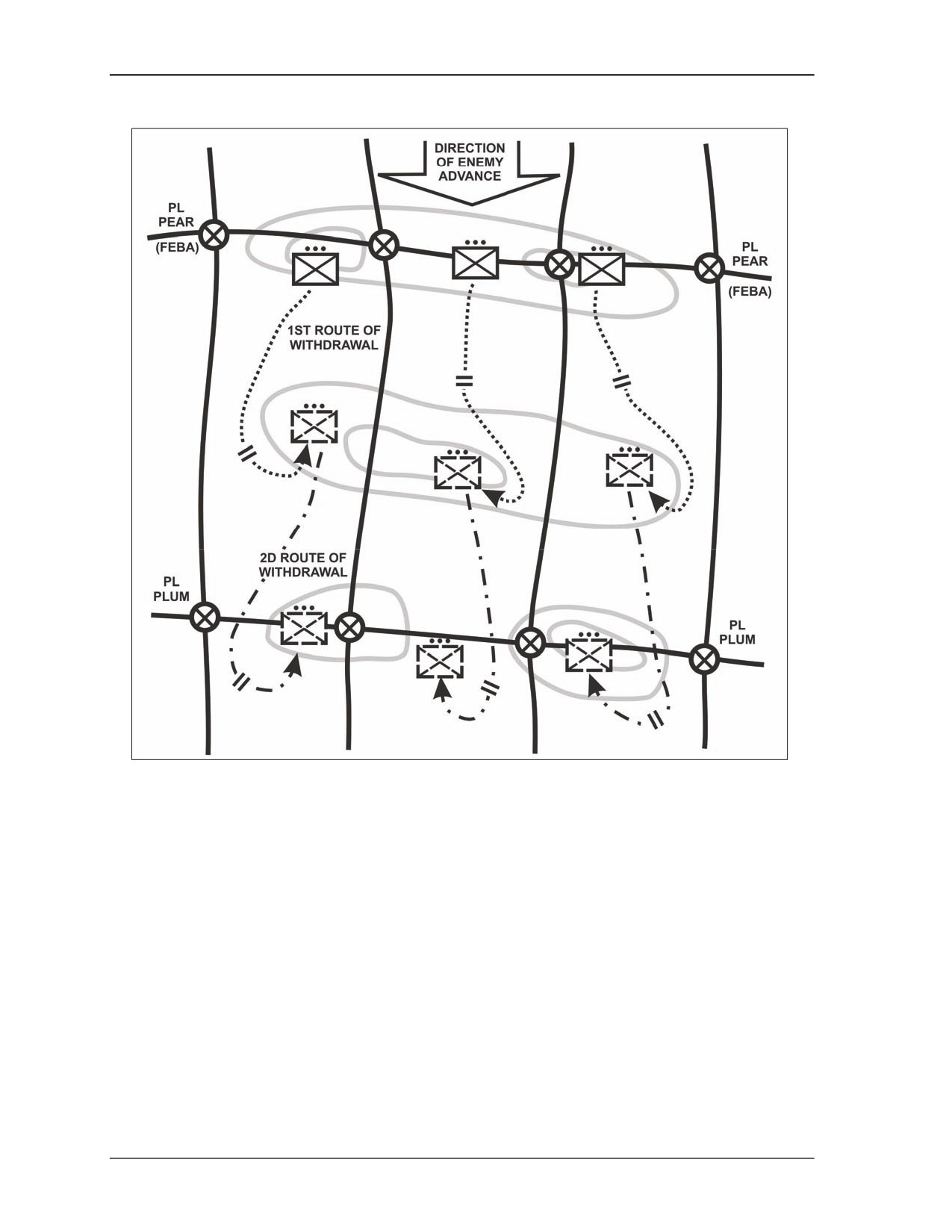
- When the unit receives the order to conduct the delay from its initial positions, one element,
such as a company in a battalion delay or a platoon in a company delay, displaces and
occupies its subsequent BP. The remainder of the unit maintains contact with the enemy
until the first displacing element is in position to engage the enemy from the subsequent
position. The first element then provides overwatch or base of fire as other elements displace
to their subsequent positions. Figure 5-21, page 5-46, shows a company conducting a
dismounted delay from subsequent positions.
27 July 2006
FM 3-21.10
5-45
Chapter 5
Figure 5-21 Example company dismounted delay from subsequent positions
Delay from Alternating Positions
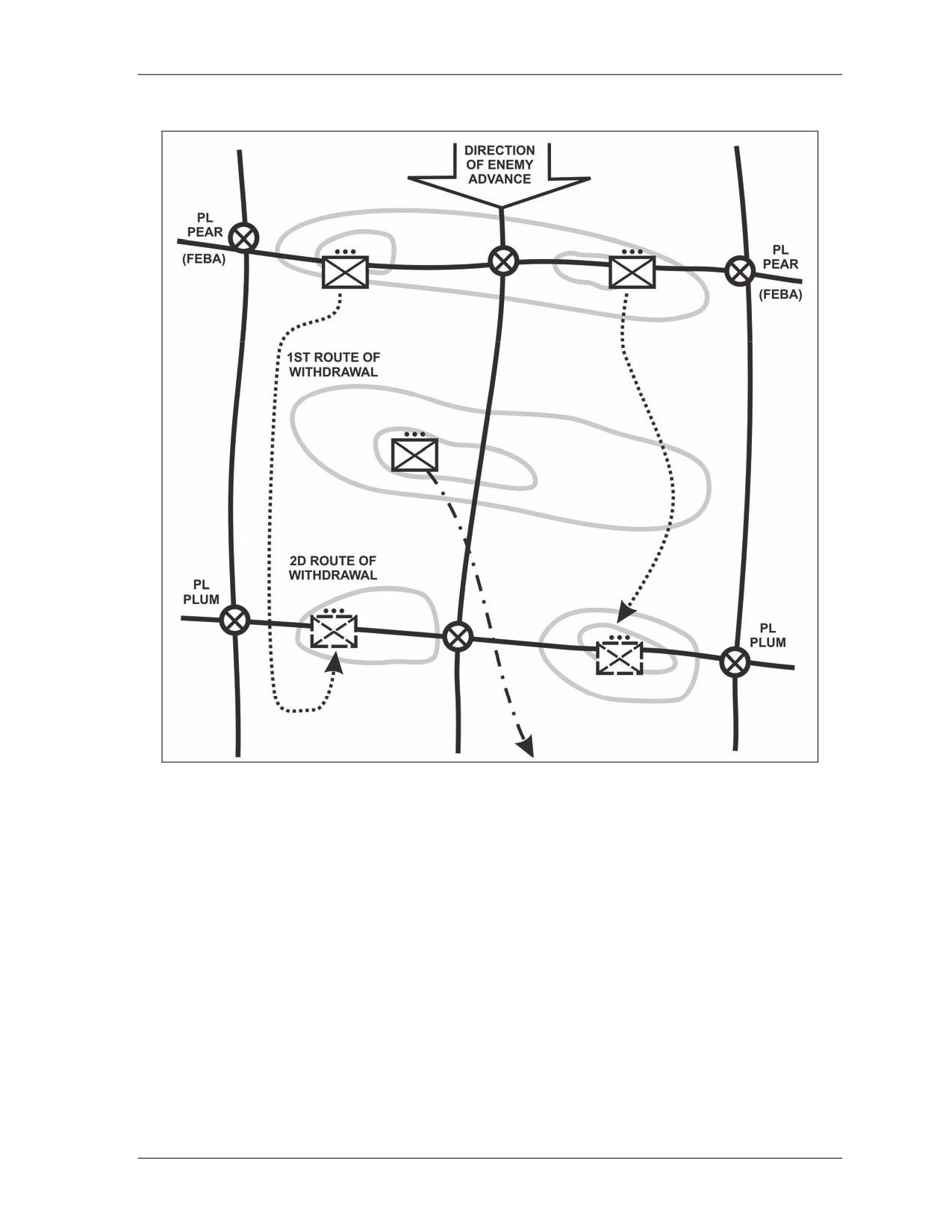
y This method of delay might be used when the delaying element has sufficient forces to occupy
more than a single line of positions (normally in a narrow sector). The delaying battalion or
company arrays one or more of its subordinate elements in the initial delay positions. This first
echelon then engages the enemy while the rest of the unit occupies and prepares second-echelon
delay positions. The unit then alternates fighting the enemy with movement to new positions. The
elements in the initial delay positions engage the enemy until ordered to displace, or until
displacement criteria are met. They then displace, moving through the second-echelon delay
positions to their own subsequent positions (which become the third echelon of the delay).
Elements in the second echelon overwatch the displacing units’ movement and assume
responsibility for engaging the enemy. This sequence continues until the delay operation is
completed. Figure 5-22 shows a company delay from alternating positions.
5-46
FM 3-21.10
27 July 2006
Defensive Operations
Figure 5-22. Example company delay from alternating positions.
WITHDRAWAL
5-105. The commander uses this operation to break enemy contact, especially when he needs to free the
unit for a new mission. Withdrawal is a planned operation in which a force in contact disengages from an
enemy force. Withdrawals may or may not be conducted under enemy pressure.
Types
5-106. The two types of withdrawals are assisted and unassisted.
Assisted
5-107. The assisting force occupies positions to the rear of the withdrawing unit and prepares to accept
control of the situation. It can also assist the withdrawing unit with route reconnaissance, route
maintenance, fire support, and sustainment. Both forces closely coordinate the withdrawal. After
27 July 2006
FM 3-21.10
5-47
Chapter 5
coordination, the withdrawing unit delays to a battle handover line, conducts a passage of lines, and moves
to its final destination.
Unassisted
5-108. The withdrawing unit establishes routes and develops plans for the withdrawal and then
establishes a security force as the rear guard while the main body withdraws. Sustainment and CS elements
normally withdraw first followed by combat forces. To deceive the enemy as to the friendly movement,
battalion may establish a DLIC if withdrawing under enemy pressure. As the unit withdraws, the DLIC
disengages from the enemy and follows the main body to its final destination.
Phases
5-109. Withdrawals are accomplished in three overlapping phases, as follows.
Preparation
5-110. The commander dispatches quartering parties, issues WARNOs, and initiates planning.
Nonessential vehicles are moved to the rear.
Disengagement
5-111. Designated elements begin movement to the rear. They break contact and conduct tactical
movement to a designated assembly area or position.
Security
5-112. In this phase, a security force protects and helps the other elements as they disengage or move to
their new positions. This is done either by a DLIC, which the unit itself designates in an unassisted
withdrawal, or by a security force provided by the higher headquarters in an assisted withdrawal. As
necessary, the security force assumes responsibility for the sector, deceives the enemy, and protects the
movement of disengaged elements by providing overwatch and suppressive fires. In an assisted
withdrawal, the security phase ends when the security force has assumed responsibility for the fight and the
withdrawing element has completed its movement. In an unassisted withdrawal, this phase ends when the
DLIC completes its disengagement and movement to the rear.
Unassisted Withdrawal
5-113. In an unassisted withdrawal, the unit conducting the withdrawal establishes the DLIC to maintain
contact with the enemy or to deceive him.
Battalion Withdrawal
5-114. In a battalion withdrawal, the DLIC may consist of an element from each company (under
leadership of the company XO or a platoon leader), with the battalion S-3 as the overall DLIC commander.
As an alternative, a company may serve as the DLIC for the rest of the battalion. The company commander
has several deployment options. He can reposition elements across the entire battalion frontage. Another
option is to position the company to cover only the most dangerous enemy avenues of approach; other
avenues into the sector are covered with observation from additional security elements provided by the
battalion such as the reconnaissance platoon.
5-48
FM 3-21.10
27 July 2006
Defensive Operations
Company Unassisted Withdrawal
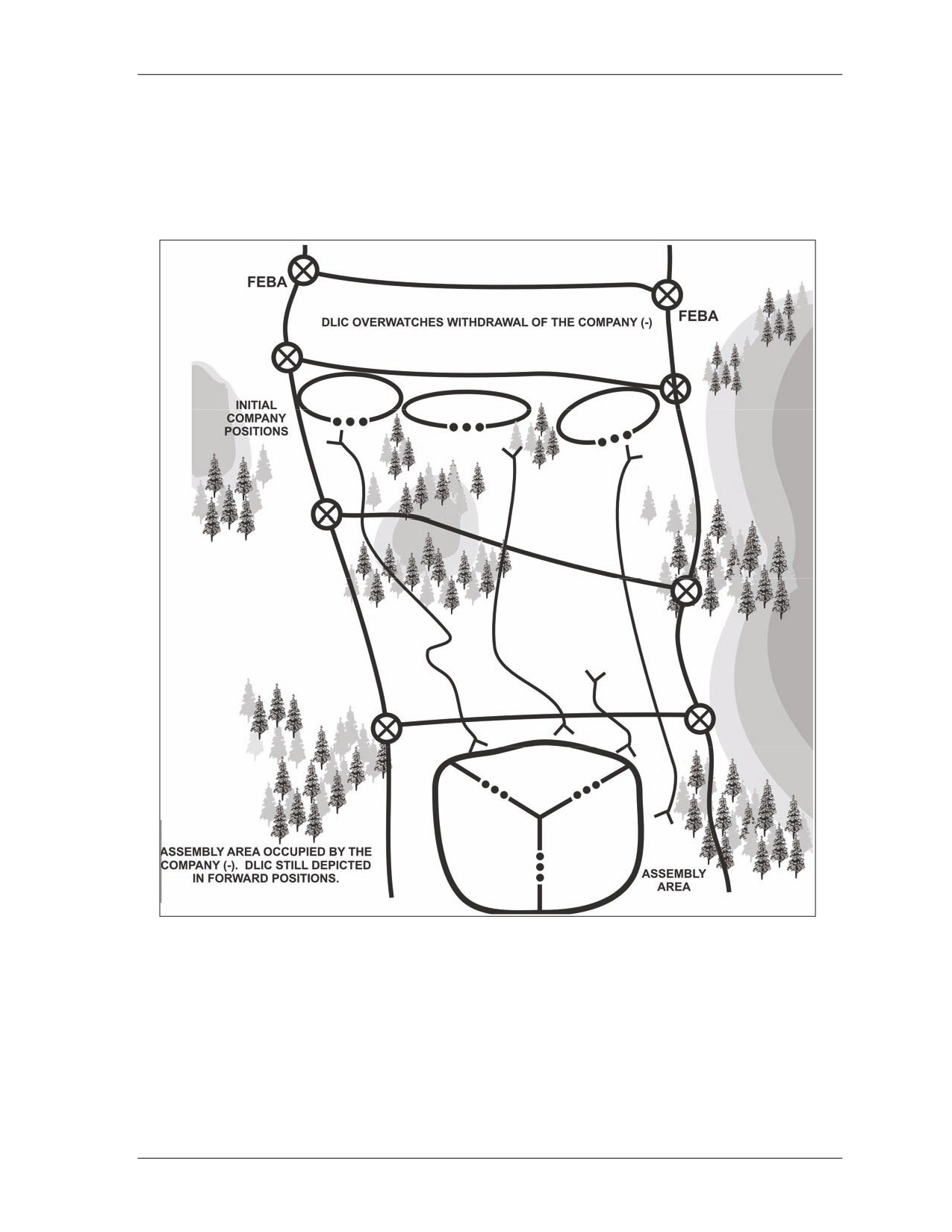
5-115. The commander has similar options in an unassisted company withdrawal. He may designate one
platoon to execute the DLIC mission for the company, or he can constitute the DLIC using elements from
the three rifle platoons with the XO as the DLIC commander. Figure 5-23 shows an example of an
unassisted withdrawal.
Figure 5-23. Example unassisted withdrawal.
Assisted Withdrawal
5-116. In an assisted battalion withdrawal, the higher headquarters will normally provide a security
element to maintain contact with and deceive the enemy while the battalion conducts its withdrawal.
Likewise, in a company withdrawal, the battalion provides the security force. The security force establishes
defensive positions behind the withdrawing unit and conducts preparations for a rearward passage of lines.
27 July 2006
FM 3-21.10
5-49
Chapter 5
The withdrawing force disengages from the enemy and conducts the rearward passage through the security
force to assembly areas in the rear.
RETIREMENT
5-117. This operation is employed to move a force that is not in contact away from the enemy. Typically,
the company conducts a retirement as part of a larger force while another unit’s security force protects their
movement. A retiring unit organizes for combat but does not anticipate interference by enemy ground
forces. Triggers for a retirement may include the requirement to reposition forces for future operations or
to accommodate other changes to the current CONOP. The retiring unit should move sustainment elements
and supplies first, and then should move toward an assembly area that supports preparations for the next
mission. Where speed and security are the most important considerations, units conduct retirements as
tactical road marches.
5-50
FM 3-21.10
27 July 2006
Chapter 6
Stability Operations
This edition introduces stability operations. Stability operations encompass a range of
actions that shape the political environment and respond to developing crises.
Stability operations usually occur in conjunction with offensive and defensive
operations. These operations are diverse, continuous, and often long-term. Stability
operations may include both developmental and coercive actions. Developmental
actions are aimed at enhancing a government’s willingness and ability to care for its
people, or simply providing humanitarian relief following a natural disaster. Coercive
military actions involve the application of limited, carefully prescribed force, or the
threat of force, to achieve specific objectives. Stability operations are usually
nonlinear and noncontiguous, and they are often time and human intensive. Army
elements might be tasked to conduct stability operations in a complex, dynamic, and
often asymmetric environment, to accomplish one or more of the following purposes.
• Deter or thwart aggression.
• Reassure allies, friendly governments, agencies, or groups.
• Provide encouragement and support for a weak or faltering government.
• Stabilize an area with a restless or openly hostile population.
• Maintain or restore order.
• Satisfy treaty obligations or enforce national or international agreements and
policies.
• Provide humanitarian relief outside the continental United States (CONUS) and
its territories.
Before adapting anything in this chapter, the commander must consider every aspect
of the situation and thoroughly analyze METT-TC.
Note: For more detailed information on stability operations, see these books--
FM 3-0, FM 3-07, FM 3-07.31, FM 7-98,
JP 3-07.2 JP 3-07.3 TC 7-98-1.
27 July 2006
FM 3-21.10
6-1
Chapter 6
Section I. PLANNING CONSIDERATIONS
Stability operations are normally planned centrally, at the strategic and operational levels. However, tactical
execution often takes the form of decentralized, small-scale, noncontiguous actions conducted over extended
distances. Responsibility for making decisions on the ground falls to junior leaders. The following paragraphs
examine several important considerations that influence planning and preparation for stability operations. (For a
more detailed discussion of these subjects, see FM 3-07.31.) While conducting stability operations,
commanders must know which phase of the COE in which they are operating. Since stability operations occur
in and around populated and urban areas, commanders must also know both friendly and enemy strategic,
operational, and tactical goals and purposes. The following discussions provide commanders a means of
delineating warfighting functions and other key considerations as they pertain to stability operations and lean
more toward the more challenging types of operations relating to combat in the urban environment:
INTELLIGENCE
6-1.
Intelligence planners must consider support to situational understanding and intelligence,
surveillance, and reconnaissance.
SUPPORT TO SITUATIONAL UNDERSTANDING
6-2.
The commander will acquire and develop intelligence for stability operations much the same as
war. The principle difference is in its focus. At lower echelons, the political, economic, linguistic, ethnic,
and other factors assume greater relevance to the mission.
6-3.
The many possible intelligence sources may include but are not limited to.
y The UN, governmental organizations
(GO), non-governmental organizations
(NGO),
International Committee for the Red Cross (ICRC), special operations forces (SOF) including
CA and PSYOP.
y Leaders of local disputing parties.
y Regional military and political leadership.
y Civilian populations.
y Insurgent elements.
y Police and paramilitary forces.
6-4.
Units need to conduct an urban IPB to set the conditions for the overall collection plan and to
improve the effectiveness of shaping operations. The minimum requirement for an urban IPB includes
identifying all the routes on which the unit will move, rivers, templated IED locations (based on historical
data, pattern analysis, and terrain), intervisiblity (IV) lines overlooking templated IED locations, and
enemy egress routes (see FM 34-130 and FM 3-6). The civil IPB process is most effective if guided by the
staff Civil-Military Officer.
(See FM 3-07.31 for a complete discussion of civil IPB.) A basic and
time-constrained analytical technique for the company commander may include asking the following
questions.
y Who are the civilians we might encounter in the sector?
y What activities are those civilians engaged in that might affect our operations?
y How might our operations affect the civilian population?
INTELLIGENCE, SURVEILLANCE, AND RECONNAISSANCE
6-5.
Many operations may be conducted quickly based on "actionable intelligence" received from
human intelligence (HUMINT) sources. The usefulness of this intelligence may be good and the speed at
which a unit can react is key to destroying or capturing and high-value target (HVT).
6-2
FM 3-21.10
27 July 2006
Stability Operations
6-6.
Integrating SUAS and aviation assets into the surveillance and reconnaissance plan is highly
beneficial. Aerial reconnaissance over-flights of routes helps deny the enemy use of the terrain. The enemy
will likely tend to avoid an area frequently patrolled by the air. UASs have frequently provided actionable
intelligence resulting in very successful targeting.
MOVEMENT AND MANEUVER
6-7.
The nature of operations may require many various types of units and MOSs to conduct frequent
and intensive small unit patrols both day and night. Platoons, sections, and squads will continually modify
patrolling techniques to adapt to the current environment. The basic security patrol moves to or through
specific areas to deter enemy aggression and reduce his activity.
6-8.
During OIF stability operations, insurgents targeted U.S. forces conducting vehicle movements,
mounted patrols, and convoys on a daily basis. All vehicle movements were vulnerable to attack, at almost
any place and time. In this non-linear and non-contiguous environment, units continually validated the
need for every vehicle movement to be planned, prepared, and executed as a combat operation. Additional
relevant discussions are in Chapter 8, Tactical Enabling Operations and Chapter 12, Urban Patrolling of
this field manual.
FIRE SUPPORT
6-9.
Artillery, mortar, and aerial fire support may be employed in support of both decisive and shaping
operations. Illumination rounds demonstrate that U. S. forces are alert and looking. Apart from
employment associated with the OP, FDC, or the gun-target line, familiar FA targeting methods also relate
well to information operations (IO). Therefore, the Fire Support Officers (FSOs) may also be a maneuver
company IO.
PROTECTION
6-10. Almost all protection functions work much the same for stability operations as discussed
throughout this manual, with only force protection deserving additional emphasis. Infantry commanders
must implement appropriate security measures to protect the force. Offensive measures taken to protect the
force are usually the most effective. Offensive measures include aggressive patrolling and offensive actions
taken against identified enemy forces. Aggressive intelligence gathering and pattern analysis greatly
increases the commander's situational understanding. As the commander's situational understanding
increases he can more aggressively and accurately identify and deter, capture or destroy enemy elements.
Defensive force protection measures include the establishment of various CPs, effective base camp security
procedures, and protection against IEDs and unexploded ordnance (Appendix G, IEDs, Suicide Bombers,
UXO, and Mines).
6-11. The Infantry company may receive security missions as part of the battalion security plan.
Additional security missions result from the company commander's concept for the company defense.
These missions might be oriented on friendly units, on the enemy and terrain (reconnaissance), or on the
enemy's reconnaissance assets (counter-reconnaissance). Although the commander quickly establishes a
security plan to keep the enemy from observing or surprising the company he must generally assume that
the enemy has excellent observation and situational understanding of US units and actions in urban areas.
The commander establishes this plan before moving the company into the area and maintains it
continuously - the commander builds his own situational understanding to counter that of the enemy and to
allow US forces to establish an effective offensive orientation. The Infantry company commander bases
this plan on orders received from the battalion and on the enemy situation, terrain, and visibility conditions.
The plan provides active and passive measures and counter-reconnaissance.
27 July 2006
FM 3-21.10
6-3
Chapter 6
ACTIVE MEASURES
6-12. These include OPs, stand-tos, traffic-control measures, and patrols.
y The commander develops observation and lodgement area security plans based on METT-TC.
He normally incorporates snipers and designated shooter in these plans.
y If needed, he conducts a stand-to both morning and evening to help Soldiers adjust to the
changing light and noise conditions. He has them prepare equipment and adjust or relocate their
positions as needed.
y A variety of means exist for controlling and monitoring foot and vehicular traffic flow. Some
are discussed in detail later in this chapter. The commander decides which techniques to
employ, again based on METT-TC.
y The battalion or company dispatches patrols whose missions directly contribute to security,
force protection, and intelligence gathering.
PASSIVE MEASURES
6-13. These measures include camouflage, movement control, light and noise discipline, and proper
radiotelephone procedures.
y To ensure effective coverage, the company commander can direct platoons to cover specific
areas with specific devices such as NVDs and thermal sights. He also determines how and
where to employ snipers or designated marksmen.
y As much as he can, the commander varies all aspects of the operation, avoiding establishing
routines that the enemy could exploit.
SUSTAINMENT
6-14. The operational environment the company faces during stability operations might be harsh,
creating special sustainment considerations. The commander must remember that the enemy will target
these vital and vulnerable operations and forces. He might also have to--
y Rely on local procurement of certain items, especially water and Class I.
y Plan for shortages of critical items such as repair parts, Class IV supply materials, and Class III
lubricants.
y Consider special Class V supply requirements such as nonlethal munitions.
COMMAND AND CONTROL
6-15. Because of the unique requirements of stability operations, more often than not the Infantry
company is task-organized to operate with a variety of units. This includes some elements with which the
company does not normally work such as linguists, counterintelligence teams, PSYOP, and civil
affairs teams
(CATs). During platoon-level shaping operations, unless the commander is conducting
battlefield circulation, the company command post will likely locate within the forward operating base
(FOB). For company-level decisive or shaping operations, the commander will move and locate with his
command and control element or company command post (CP).
RULES OF ENGAGEMENT
6-16. In decentralized operations, effective command guidance, a clear commander's intent, and a
detailed understanding of ROE are critical at the operational and tactical levels. The ROE direct the
circumstances and limitations under which US forces initiate, respond to, or continue combat engagement
with forces encountered. These rules reflect the laws of war, operational concerns, and political
considerations when the operational environment shifts from peace to conflict and back. The ROE must be
briefed and trained to the lowest tactical level. They are established for, given to, and thoroughly
6-4
FM 3-21.10
27 July 2006
Stability Operations
understood by every Soldier in the unit. Another important consideration in development and employment
of ROE is that commanders must assume that the belligerents they encounter fully understand the ROE.
These enemy elements will try to use their understanding of the ROE to their own advantage and to the
disadvantage of the friendly force. (See FM 3-07.31 for a more detailed discussion of ROE.)
RULES OF INTERACTION
6-17. The ROI are based on the ROE and are tailored to the specific regions, cultures, and populations
affected by the operation. They provide a foundation for relating to people and groups who play critical
roles in the operations. They cover an array of interpersonal communication skills such as persuasion
and negotiation. They provide tools for the individual Soldier to deal with the nontraditional asymmetric
threats that prevail in stability operations. These include political friction, religious and ethnic differences,
unfamiliar cultures, and conflicting ideologies. Thus, the ROI help keep the Soldier out of trouble, which
naturally enhances survivability. Every Soldier must know and understand the ROI. This means they must
be thoroughly briefed and rehearsed.
MEDIA
6-18. The presence of the media is a reality that confronts every Soldier involved in stability operations.
All leaders and Soldiers must know how to deal effectively with broadcast and print reporters and
photographers. This should include an understanding of which subjects they are authorized to discuss and
which subjects they must see the public affairs officer (PAO). Most current operations have media present
who can immediately transmit what they see and hear. The images and words they project are powerful and
can affect national policy. In our form of government, the media has the right to cover operations, and the
public has a right to know. Many in the media lack a full understanding of the military, but they keep the
public informed of Army operations and procedures. Therefore, there are many good things about the
Army that are unknown to the public, and commanders and public affairs personnel have a responsibility to
tell the Army’s story. Freedom of the press does not negate the requirement for OPSEC and the
accomplishment of the military mission (Appendix I, Media Considerations).
OPERATIONS WITH OUTSIDE AGENCIES
6-19. US Army units conduct certain stability operations in coordination with a variety of outside
organizations. These include other US armed services or government agencies as well as international
organizations such as private volunteer organizations (PVOs), nongovernmental organizations (NGOs),
and United Nations (UN) military forces or agencies. (See Appendix F for more information.)
27 July 2006
FM 3-21.10
6-5
Chapter 6
Section II. TYPES OF OPERATIONS
Stability operations typically fall into ten broad types that are neither discrete nor mutually exclusive. For
example, a force engaged in a peace operation may also find itself conducting arms control or a show of force
to set the conditions for achieving an end state. This section provides an introductory discussion of stability
operations (FM 3-0 and FM 3-07). Stability operations normally occur in conjunction with either offensive,
defensive, or support operations (Figure 6-1).
y Peace operations (including peacekeeping,
peace enforcement, and operations in
support of diplomatic efforts).
y Foreign internal defense.
y Security assistance.
y Humanitarian and civic assistance.
y Support to insurgencies.
y Support to counterdrug operations.
y Combating of terrorism.
y Noncombatant evacuation operations.
y Foreign humanitarian assistance.
y Arms control.
y Shows of force.
Figure 6-1. Types of stability operations.
PEACE OPERATIONS
6-20. Peace operations encompass three general areas: operations in support of diplomatic efforts,
peacekeeping, and peace enforcement.
PEACEKEEPING OPERATIONS
6-21. A peacekeeping force monitors and facilitates the implementation of cease-fires, truce negotiations,
and other such agreements. In doing so, it must assure all sides in the dispute that the other involved parties
are not taking advantage of settlement terms to their own benefit. The Infantry company most often
observes, monitors, or supervises and aids the parties involved in the dispute. The peacekeeping force must
remain entirely neutral. If it loses a reputation for impartiality, its usefulness within the peacekeeping
mission is compromised.
PEACE ENFORCEMENT OPERATIONS
6-22. What characteristics distinguish peace enforcement activities from wartime operations and from
other stability operations? The difference is that PEO compel compliance with international resolutions or
sanctions, and they restore or maintain peace and order. They might entail combat, armed intervention, or
the physical threat of armed intervention. Under the provisions of an international agreement, the battalion
and its subordinate companies might have to use coercive military power to compel compliance with the
applicable international sanctions or resolutions.
FOREIGN INTERNAL DEFENSE
6-23. Foreign internal defense means the participation, by the civilian and military agencies of a
government, in any action programs taken by another government to free and protect its society from
subversion, lawlessness, and insurgency (JP 1-02). The objective is to promote stability by helping the host
6-6
FM 3-21.10
27 July 2006
Stability Operations
nation establish and maintain institutions and facilities that can fill its people's needs. Army forces in
foreign internal defense normally advise and assist host-nation forces conducting operations to increase
their capabilities.
SECURITY ASSISTANCE
6-24. Army forces assist in providing HN security by training, advising, and assisting allied and friendly
armed forces. Security assistance includes the participation of Army forces in any program through which
the US provides defense articles, military training, and other defense-related services to support national
policies and objectives. Security assistance can take the form of grants, loans, credit, or cash sales
(JP 3-07).
HUMANITARIAN AND CIVIC ASSISTANCE
6-25. Humanitarian and civic assistance (HCA) programs help the HN populace in conjunction with
military operations and exercises. Foreign humanitarian assistance (FHA) operations are also limited in
scope and duration. They focus only on providing prompt aid to resolve an immediate crisis. In contrast to
foreign humanitarian (only) assistance operations, HCA is planned, and provides only--
y Medical, dental, and veterinary care in rural areas of a country.
y Construction of rudimentary surface transportation systems.
y Well-drilling and construction of basic sanitation facilities.
y Basic construction and repair of public facilities.
6-26. US forces conduct FHA operations outside the borders of the US or its territories. The purpose is
to relieve or reduce the results of natural or manmade disasters or other endemic conditions that pose a
serious threat to life (disease, starvation) or property. The US military typically supplements the HN
authorities along with other governmental agencies, nongovernmental organizations, private voluntary
organizations, and unaffiliated individuals. Most FHA operations resemble civil support operations. The
distinction between the two is that, inside the US and its territories, The Posse Comitatus Act (PCA)
prevents the use of the military from becoming a civil police force, or guardia civil. The PCA does not
apply to US forces overseas. In vague or hostile situations, FHA activities are handled as a subset of a
larger stability, offensive, or defensive operation.
SUPPORT TO INSURGENCY
6-27. This type of support includes assistance provided by US forces to help a friendly nation or group
that is trying to combat insurgent elements or to stage an insurgency itself. This type of stability activity is
normally conducted by special operating forces.
SUPPORT TO COUNTERDRUG OPERATIONS
6-28. US military forces might be tasked for a variety of counter-drug activities, which are always
conducted in conjunction with another government agency. These activities include destroying illicit drugs
and disrupting or interdicting drug manufacturing, growing, processing, and smuggling operations.
Counter-drug support may take the form of advisory personnel, mobile training teams, offshore training
activities, and assistance in logistics, communications, and intelligence.
COMBATTING OF TERRORISM
6-29. In all types of stability operations, antiterrorism and counterterrorism activities are a continuous
requirement in protecting installations, units, and individuals from the threat of terrorism. Antiterrorism
focuses on defensive measures used to reduce the vulnerability of individuals and property to terrorist
27 July 2006
FM 3-21.10
6-7
Chapter 6
attacks. Counterterrorism encompasses a full range of offensive measures to prevent, deter, and respond to
terrorism. (For more information on these activities, see JP 3-07.2.)
NONCOMBATANT EVACUATION
6-30. A noncombatant evacuation operation (NEO) is conducted primarily to evacuate US citizens
whose lives are in danger. It can also evacuate natives and third-country nationals. An NEO involves swift
insertions and temporary occupation of an objective followed by a planned withdrawal. The company uses
only the force needed to protect evacuees and defend itself.
ARMS CONTROL
6-31. To prevent a conflict from escalating, an Infantry company can conduct arms-control inspections
and disarm belligerents. Collecting, storing, and destroying conventional munitions and weapons systems
can deter belligerents from resuming hostilities.
SHOW OF FORCE
6-32. Deploying forces abroad lends credibility to a nation’s promises and commitments. Credible
show-of-force operations bolster and reassure allies. Infantry companies participating in a show-of-force
mission focus all preparations on the assumption that combat is probable. A show of force can quickly and
unexpectedly escalate into conflict, although the intent is to avoid this.
Section III. COMPANY TASKS
Stability operations are complex and demanding. The Infantry company in a stability operation must master
skills from negotiating to establishing OPs and checkpoints to escorting a convoy. The tasks and techniques in
this section include lessons learned and should help the Infantry company commander implement these and
other tasks. This section uses the term "enemy forces" to refer to guerillas, terrorists, or insurgent forces that
generally try to blend into the local populations and engage in asymmetric warfare.
ESTABLISH AND OCCUPY A LODGMENT AREA OR FORWARD
OPERATING BASE
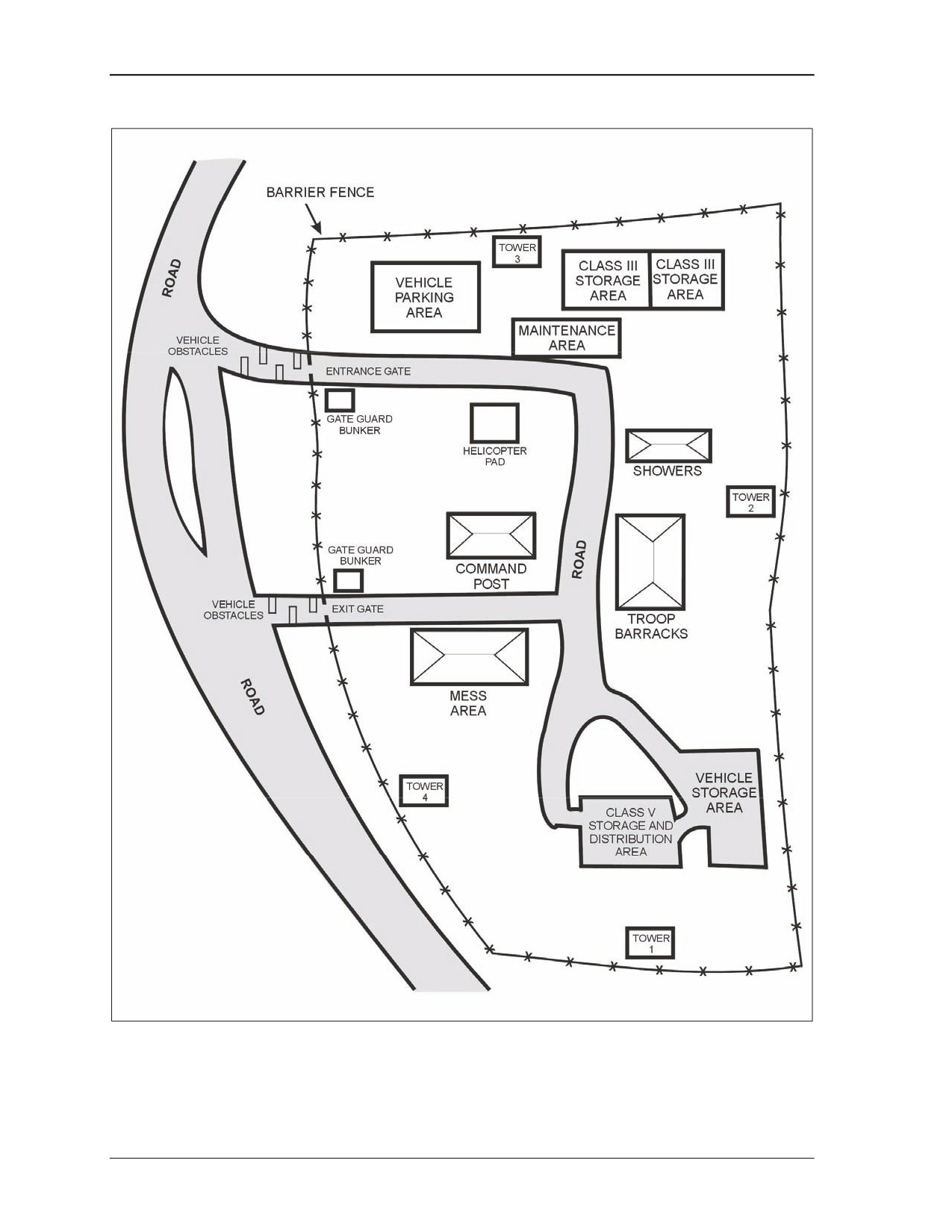
6-33. A lodgment area (base camp) or forward operating base (FOB) is a well-prepared position used as
a base of operations and staging area for the occupying unit (Figure 6-2, page 6-10). Like an assembly area
or defensive strongpoint, the lodgment area also provides some force protection because it requires
all-round security. However, several other factors distinguish a lodgment area from a less
permanent position.
6-34. Due to the probability of long-term occupation, the lodgment requires a lot of preparation and
logistical support. It needs shelters and facilities that can support the force and its attachments the whole
time. Also, the area must be positioned and developed so the unit can effectively conduct its primary
missions, such as PEO and counterterrorism, throughout its area of responsibility.
6-35. In establishing a lodgment, the Infantry company can either use existing facilities or request
construction of new ones. Existing structures are immediately available, and require little or no
construction support from engineers and members of the company. However, they might fall short of
meeting the company's operational needs, and their proximity to other structures can pose
security problems.
6-8
FM 3-21.10
27 July 2006
Stability Operations
6-36. The company can establish and occupy a lodgment area as part of a battalion or, given enough
support from battalion, as a separate element. Before preparing, constructing, and occupying the lodgment
area, the company commander plans the general layout based on the following.
y
Location.
y
Effects of weather.
y
Local traffic and pedestrian patterns.
y
Observation post sites and patrol routes.
y
Entry and exit procedures.
y
Vehicle emplacement and orientation.
y
Bunkers and fighting positions.
y
Direct and indirect fires.
y
Size and composition of the reserve.
y
Location of possible landing and pickup zones.
y
Sustainment, including--
- Mess areas, showers, and latrines with adequate drainage.
- Storage bunkers for Class III, IV, and V supplies.
- Maintenance and refueling areas.
- Aid station.
y
CP site security, including--
- Size, composition, and function of advance and reconnaissance parties.
- Nature and condition of existing facilities such as quarters; water, sewer, and power utilities;
and reinforced "hard-stand" areas for maintenance.
- Proximity to structures and roadways and security implications.
y
Priorities of work. The commander considers--
- Establishment of security of the immediate area and the perimeter.
- Establishment of initial roadblocks to limit access to the area.
y
Mine clearance.
y
Construction of revetments to protect vehicles, generators, communications equipment, and
other facilities.
y
Construction of barriers or berms around the lodgment area to limit enemy observation and to
protect occupants.
y
Construction of shelters for lodgment personnel.
y
Construction of defensive positions.
y
Construction of sanitation and personal hygiene facilities.
y
Construction of hardened CP facilities.
y
Continued improvement of site, for example, adding hard-wire electrical power or perimeter
illumination.
27 July 2006
FM 3-21.10
6-9
Chapter 6
Figure 6-2. Example Infantry company lodgment area using existing facilities.
6-10
FM 3-21.10
27 July 2006
Stability Operations
NEGOTIATE
6-37. Infantry company leaders might have to conduct negotiations. The two main types of
negotiations follow.
SITUATIONAL NEGOTIATIONS
6-38. Situational negotiations allow immediate discussion and resolution of an issue or problem.
For example, members of an advance guard might have to negotiate the passage of a convoy through a
checkpoint.
6-39. At the company level, situational negotiations are far more common than preplanned ones.
In stability operations, the commander, his subordinate leaders, and other Soldiers conduct some form of
negotiations almost daily. To do this, they must thoroughly understand the ROE and ROI.
6-40. Members of the company apply this working knowledge to the process of discussing, and
whenever possible, resolving issues and problems between opposing parties, which might include the
company itself. The negotiator must know when he has exhausted his options under the ROE and ROI, and
turn over the discussion to a higher authority. Negotiations move up through the levels of authority until
the issue is resolved.
6-41. To prepare, leaders rehearse the ROE and ROI. One good way is to rehearse how to apply ROE
and ROI in an example stability situation such as operating a checkpoint. This forces leaders and Soldiers
to analyze the ROE and ROI while applying them in an operational environment.
PREPLANNED NEGOTIATIONS
6-42. Preplanned negotiations allow discussion and resolution of an upcoming, specific issue or problem.
For example, the Infantry company commander conducts a work coordination meeting between leaders of
the belligerents to determine mine-clearing responsibilities. As with situational negotiations, preplanned
negotiations require leaders to know and understand the ROE and ROI. However, before a preplanned
negotiation, leaders must also know every aspect of the dispute or issue. The negotiator’s goal is to reach
an agreement that is acceptable to both sides, and that reduces antagonism and the threat of renewed
hostilities.
Identify Purpose of Negotiations
6-43. Before contacting leaders of the belligerent parties to initiate the negotiation process, the
commander must familiarize himself with both the situation and the area in which his unit will operate.
This includes identifying and evaluating AAs that connect the opposing forces. Results of the negotiation
process, which might be lengthy and complicated, must be based on national or international agreements or
accords. Negotiation topics include--
y When the sides will withdraw.
y Positions to which they will withdraw (these should preclude observation and direct fire by the
opposing parties).
y What forces or elements will move during each phase of the operation.
y Pre-positioning of peace forces that can intervene in case of renewed hostilities.
y Control of heavy weapons.
y Mine clearance.
y Formal protest procedures for the belligerent parties.
27 July 2006
FM 3-21.10
6-11
Chapter 6
Establish Proper Context
6-44. The commander must earn the trust and confidence of each opposing party. This includes
establishing an atmosphere (and a physical setting) that participants will judge to be both fair and safe. The
commander must--
y Always conduct joint negotiations on matters that affect both parties.
y When serving as a mediator, remain neutral at all times.
y Learn as much as possible about the belligerents, the details of the dispute or issue under
negotiation, and other factors such as the geography of the area and specific limitations or
restrictions, including the ROE and ROI.
y Gain and keep the trust of the opposing parties by being firm, fair, and polite.
y Use tact, and remain patient and objective.
y Follow applicable local and national laws and international agreements exactly.
Prepare
6-45. Thorough, exacting preparation is another important factor in ensuring the success of the
negotiation process. Company personnel--
y Negotiate sequentially, from subordinate level to senior level.
y Select and prepare a meeting place that is acceptable to all parties.
y Arrange for interpreters and adequate communications facilities, as necessary.
y Ensure that all opposing parties, as well as the negotiating company, use a common map
(edition and scale).
y Coordinate all necessary movement.
y Establish local security.
y Keep higher headquarters informed throughout preparation and during the negotiations.
y Arrange to record the negotiations (use audio or video recording equipment, if available).
Negotiate
6-46. Negotiators must always strive to maintain control of the session. They must be firm, yet
even-handed, in leading the discussion. At the same time, they must be flexible, with a willingness to
accept recommendations from the opposing parties and from their own assistants and advisors, who--
y Exchange greetings.
y Introduce all participants by name, including negotiators and any advisors.
y Consider the use of small talk at the beginning of the session to put the participants at ease.
y Allow each side to state its case without interruptions and prejudgments.
y Record issues presented by both sides.
y If one side makes a statement that is incorrect, be prepared to produce evidence or proof to
establish the facts.
y If the negotiating team or peacekeeping force has a preferred solution, present it and encourage
both sides to accept it.
y Close the meeting by explaining to both sides what they have agreed to and what actions they
must take. If necessary, be prepared to present this information in writing for their signatures.
y Do not negotiate or make deals in the presence of the media.
y Maintain the highest standards of conduct at all times.
6-12
FM 3-21.10
27 July 2006
Stability Operations
MONITOR COMPLIANCE WITH AN AGREEMENT
6-47. Compliance monitoring involves observing belligerents and working with them to ensure they
meet the conditions of one or more applicable agreements. Examples of the process include overseeing the
separation of opposing combat elements, the withdrawal of heavy weapons from a sector, or the clearance
of a minefield. Planning for compliance monitoring should cover, but is not limited to, the following
considerations.
y Liaison teams, with suitable communications and transportation assets, are assigned to the
headquarters of the opposing sides. Liaison personnel maintain communications with the
leaders of their assigned element and talk directly to each other and to their mutual commander
(the Infantry company or battalion commander).
y The commander positions himself at the point where violations are most likely to occur.
y He positions platoons and squads where they can observe the opposing parties, instructing them
to assess compliance and report any violations.
y As directed, the commander keeps higher headquarters informed of all developments, including
his assessment of compliance and noncompliance.
ESTABLISH OBSERVATION POSTS
6-48. Constructing and operating OPs is a high-frequency task for Infantry companies and subordinate
elements whenever they must establish area security. Each OP is established for a specified time and
purpose. Some OPs are overt (clearly visible) and deliberately constructed. Others are covert and designed
to observe an area or target without the knowledge of the local population. Each type of OP must be
integrated into supporting direct and indirect fire plans and into the overall observation plan. Based on
METT-TC factors, deliberate and overt OPs may include specialized facilities such as--
y Observation towers.
y Ammunition and fuel storage areas.
y Power sources.
y Supporting helipads.
y Kitchens, sleep areas, showers, and toilets.
6-49. An OP is similar in construction to a bunker and it is supported by fighting positions, barriers, and
patrols (Figure 6-3, page 6-14). Covert operations may include sniper or designated marksmen positions
over-watching TAIs.
Note: If necessary, the company can also employ hasty OPs, which are similar to
individual fighting positions.
27 July 2006
FM 3-21.10
6-13