FM 3-21.10 (FM 7-10) The Infantry Rifle Company (July 2006) - page 4
Chapter 3
y Space for dispersion of vehicles, personnel, and equipment.
y A suitable landing site nearby for helicopters.
Planning
3-85. The CO plans for an assembly area as he does for a perimeter defense. He organizes the assembly
area into a perimeter and assigns each platoon a sector of that perimeter. He also assigns positions to the
anti-armor weapons and mortar section, and selects positions for the company CP and trains. The
commander and the FSO plan indirect fire in and around the assembly area.
Actions in Assembly Area
3-86. Before the company moves into an assembly area, the CO sends a quartering party to reconnoiter
organize it for occupation by the main body.
y When the company arrives at the RP, the platoon guides link up with their platoons and
immediately lead them to their positions. The company headquarters guide links up with the
headquarters personnel and leads them to their positions. The movement from the RP to the
positions should be continuous.
y Once in position, the platoons establish OPs and conduct patrols to secure the area. The platoon
leaders then plan the defense of their sectors. Machine gunners, and anti-armor crews prepare
range cards. Fighting positions are prepared. Other defensive measures are taken as
appropriate.
Communications
3-87. Wire might be the primary means of communications within the assembly area; however, it might
be supplemented by messenger, radio, and prearranged signals.
3-22
FM 3-21.10
27 July 2006

Chapter 4
Offensive Operations
The Infantry company normally conducts offensive operations as part of a larger
force. Offensive operations let the commander seize the initiative (choose when and
where to fight), retain the initiative, and effectively exploit his company's strengths.
This chapter discusses the types and characteristics, sequence of events, actions on
contact, attacks, movements to contact, general and specific planning considerations,
and common activities of offensive operations. This edition expands the discussion of
the integration of small unmanned aerial systems (SUAS) and adds the continuum of
contact.
Section
Title
Topic(s)
I
Overview
Types and characteristics of offensive
operations, and forms of maneuver
II
Sequence
Order of events
III
Planning Considerations
Considerations for each WFF*
IV
Actions on Contact
All aspects of actions on contact, including
the steps
V
Attacks
Types of offensive operations, including
hasty and deliberate attack.
VI
Movement to Contact
Establishment and maintenance of contact
with the enemy
VII
Common Activities
Warfighting actions
* Additional planning considerations are discussed where they apply.
Section I. OVERVIEW
During any offensive operation, the commander identifies and focuses his attack on the enemy's weaknesses.
He avoids attacking into enemy strengths. This section discusses the characteristics and types of offensive
operations, and the various forms of maneuver.
CHARACTERISTICS
4-1.
The characteristics of the offense are surprise, tempo, concentration, and audacity. Due to the
nature of modern offensive operations, flexibility is included in the following discussion of the offense. For
each mission, the commander decides how to apply these characteristics to focus the effects of his combat
power against enemy weakness. Detailed planning is critical to achieve a synchronized and effective
operation. Instead of ‘fighting the plan,’ commanders should exploit enemy weaknesses.
27 July 2006
FM 3-21.10
4-1
Chapter 4
SURPRISE
4-2.
Units achieve surprise by striking the enemy at a time, place, or manner in which he is
unprepared. Total surprise is rarely essential or attainable. Simply delaying or disrupting the enemy's
reaction by attacking where he least expects is usually effective. Surprise delays the enemy's reactions,
stresses his command and control, and induces psychological shock in enemy soldiers and leaders. Surprise
may allow an attacker to succeed with fewer forces. The company's ability to attack in limited visibility or
through restrictive terrain, to operate in small units, and to infiltrate are often key to achieve surprise. The
company must exploit the effects of surprise before the enemy can recover.
TEMPO
4-3.
Tempo is the rate of military action relative to the enemy. Tempo is not the same as speed.
Controlling or altering tempo is essential for maintaining the initiative. Tempo promotes surprise, keeps the
enemy off balance, contributes to the security of the attacking force, and prevents the defender from taking
effective countermeasures. By increasing tempo, commanders maintain momentum.
4-4.
When properly controlled and exploited, tempo confuses and immobilizes the defender until the
attack becomes unstoppable. Leaders build tempo into operations through careful planning,
synchronization, coordination, and transition to the next operation.
4-5.
The company increases its tempo by using simple plans, quick decision making, decentralized
control, mission orders, and rehearsed operations. The company maintains tempo by ensuring sustainment
operations are well coordinated and continuous, thus preventing culmination.
CONCENTRATION
4-6.
The attacker masses the effects of combat power at the decisive point to achieve the unit's
purpose. Leaders concentrate the effects of their combat power, while trying not to concentrate forces.
4-7.
Because the attacker often moves across terrain the enemy has prepared, he might expose himself
to enemy fires. By concentrating overwhelming combat power at a weak area or system, the attacker can
reduce the effectiveness of the enemy fires and the amount of time he (the attacker) is exposed to
enemy fires.
4-8.
The challenge for the company commander is to concentrate combat power, while reducing the
enemy's ability to do the same against the friendly unit. Actions that cause the enemy to shift combat
potential away from the intended decisive point yield a greater advantage, for example, moving dispersed,
but concentrating at the last moment and using deception. The commander employs his Infantry
capabilities to achieve overwhelming combat power at the decisive point.
AUDACITY
4-9.
Audacity is a simple plan of action, boldly executed. The audacious commander develops
confidence by conducting a thorough estimate. His actions, although quick and decisive, are based on a
reasoned approach to the tactical situation and on his knowledge of his Soldiers, the enemy, and the terrain.
He is daring and original, but he is not rash.
4-10.
Audacious commanders throughout history have used the indirect approach. They maneuver to
maintain a position of advantage over the enemy, seek to attack the enemy on the flank or rear, and exploit
success at once, even if this briefly exposes their own flanks.
4-11.
Boldness and calculated risks have always been the keystones of successful offensive operations.
However, risks must be consistent with the higher commander's mission and intent. Commanders dispel
uncertainty through action; they compensate for a lack of information by seizing the initiative and pressing
the fight.
FLEXIBILITY
4-12.
Although not a characteristic of the offense, FM 3-90 says that flexibility bears discussion. At
some point in most attacks, the original plan must be adjusted to meet changes in the situation. The
commander maintains flexibility at all times so he can attack identified enemy weaknesses when they are
4-2
FM 3-21.10
27 July 2006
Offensive Operations
presented. The commander should avoid ‘fighting the plan’ and instead focus on fighting the enemy or
attacking identified enemy weaknesses. Mission orders, a clear commander's intent, and competent
subordinate leaders who exercise initiative ensure that proper adjustments are made.
4-13.
The commander and subordinate leaders must expect uncertainties and be ready to exploit
opportunities. The flexibility required often depends on the amount of reliable intelligence the commander
has on the enemy.
4-14.
The commander builds flexibility into his plan during the MDMP. By conducting a thorough war
game and rehearsals, he develops a full appreciation for possible enemy actions. A reserve increases the
company commander's flexibility.
TYPES
4-15.
The four types of offensive operations, described in FM 3-90, are movement to contact (MTC),
attack, exploitation, and pursuit. Companies can execute MTC and attack. Platoons generally conduct these
forms of offense as part of a company or larger unit operation. Companies and platoons participate in a
higher unit's exploitation or pursuit. The nature of these operations depends largely on the amount of time
and enemy information available during the planning of and preparation for the operation.
ATTACK
4-16.
An attack is an offensive operation that destroys enemy forces, seizes or secures terrain, or both.
Movement, supported by fires, characterizes the conduct of an attack. The company will likely participate
in a synchronized attack. However, a company may conduct a special purpose attack as part of, or separate
from, an offensive or defensive operation. Special purpose attacks consist of ambush, spoiling attack,
counterattack, raid, feint, and demonstration. (For a detailed discussion of attacks, see Section V.)
MOVEMENT TO CONTACT
4-17.
An MTC is a type of offensive operation designed to develop the situation and establish or regain
contact. The company may conduct an MTC on its own or as part of a larger unit's operation when the
enemy situation is vague or not specific enough to conduct an attack. (For a detailed discussion of MTC,
see Section VI.)
EXPLOITATION
4-18.
Exploitations are conducted at the battalion level and higher. The objective of exploitation is to
disorganize the enemy in depth. Exploitations seek to disintegrate enemy forces to where they have no
alternative but surrender or flight. Companies and platoons may conduct movements to contact or attack as
part of a higher unit's exploitation.
PURSUIT
4-19.
Pursuits are normally conducted at the brigade or higher level. A pursuit typically follows a
successful exploitation. Ideally, it prevents a fleeing enemy from escaping and then destroys him.
Companies and platoons will participate in a larger unit's exploitation and may conduct attacks as part of
the higher unit's operation.
FORMS OF MANEUVER
4-20.
Each form of maneuver attacks the enemy differently. Each poses different challenges for
attackers and different dangers for defenders. Maneuver places the enemy at a disadvantage through the
application of friendly fires and movement. The five forms of maneuver follow.
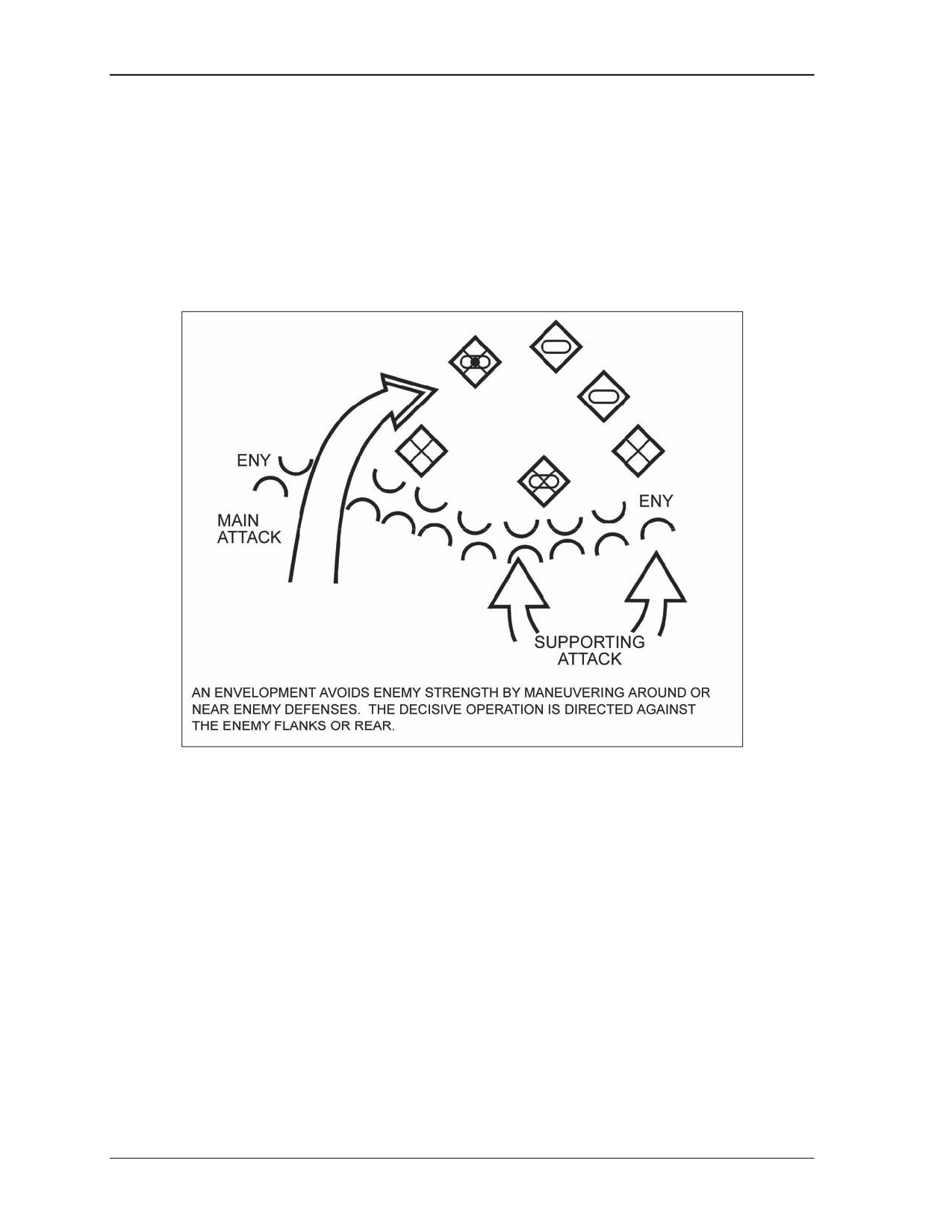
ENVELOPMENT
4-21.
Envelopment is a form of maneuver in which an attacking force seeks to avoid the principal
enemy's defenses by seizing objectives to the enemy rear or flank in order to destroy him in his current
27 July 2006
FM 3-21.10
4-3
Chapter 4
positions (Figure 4-1). A successful envelopment requires discovery or creation of an assailable flank. The
envelopment is the preferred form of maneuver because the enemy must fight in at least two directions and
the attacking force tends to suffer fewer casualties while having the most opportunities to destroy the
enemy. Envelopments focus on--
y Seizing terrain.
y Destroying specific enemy forces.
y Interdicting enemy withdrawal routes.
Figure 4-1. Envelopment.
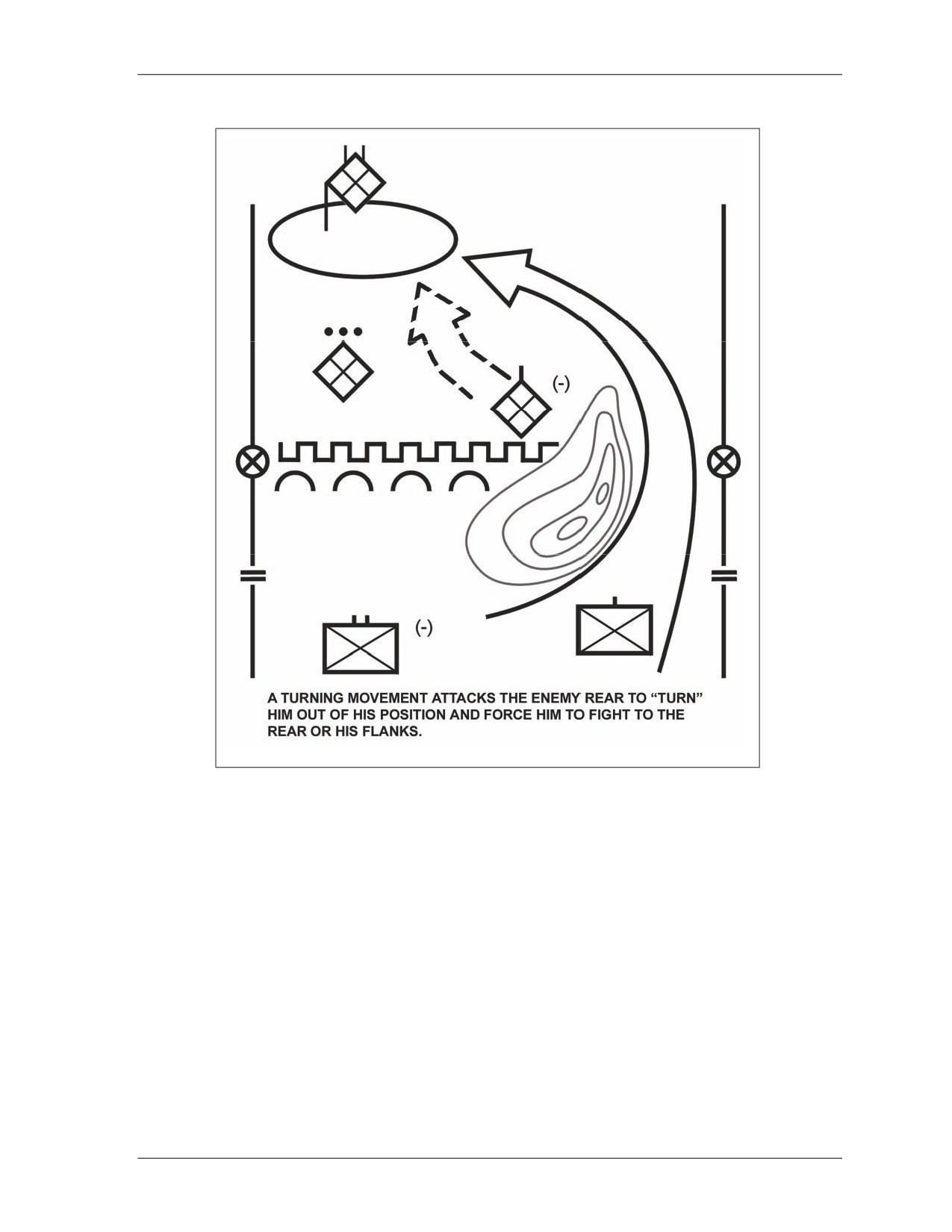
TURNING MOVEMENT
4-22.
Turning movement is a form of maneuver in which the attacking force avoids the enemy's
principal defensive positions by seizing objectives to the enemy's rear and causing the enemy to move out
of his current positions, or to divert major forces to meet the threat (Figure 4-2). For a successful turning
movement, the unit trying to turn the enemy must attack something that the enemy will fight to save. This
might be a supply route, artillery emplacement, or headquarters. In addition to attacking a target the enemy
will fight to save, the attacking unit should be strong enough to pose a real threat to the enemy. The
attacker seeks to secure key terrain deep in the enemy's rear and along his lines of communication. Faced
with a major threat to his rear, the enemy is turned out of his defensive positions and forced to
attack rearward.
4-4
FM 3-21.10
27 July 2006
Offensive Operations
Figure 4-2. Turning movement.
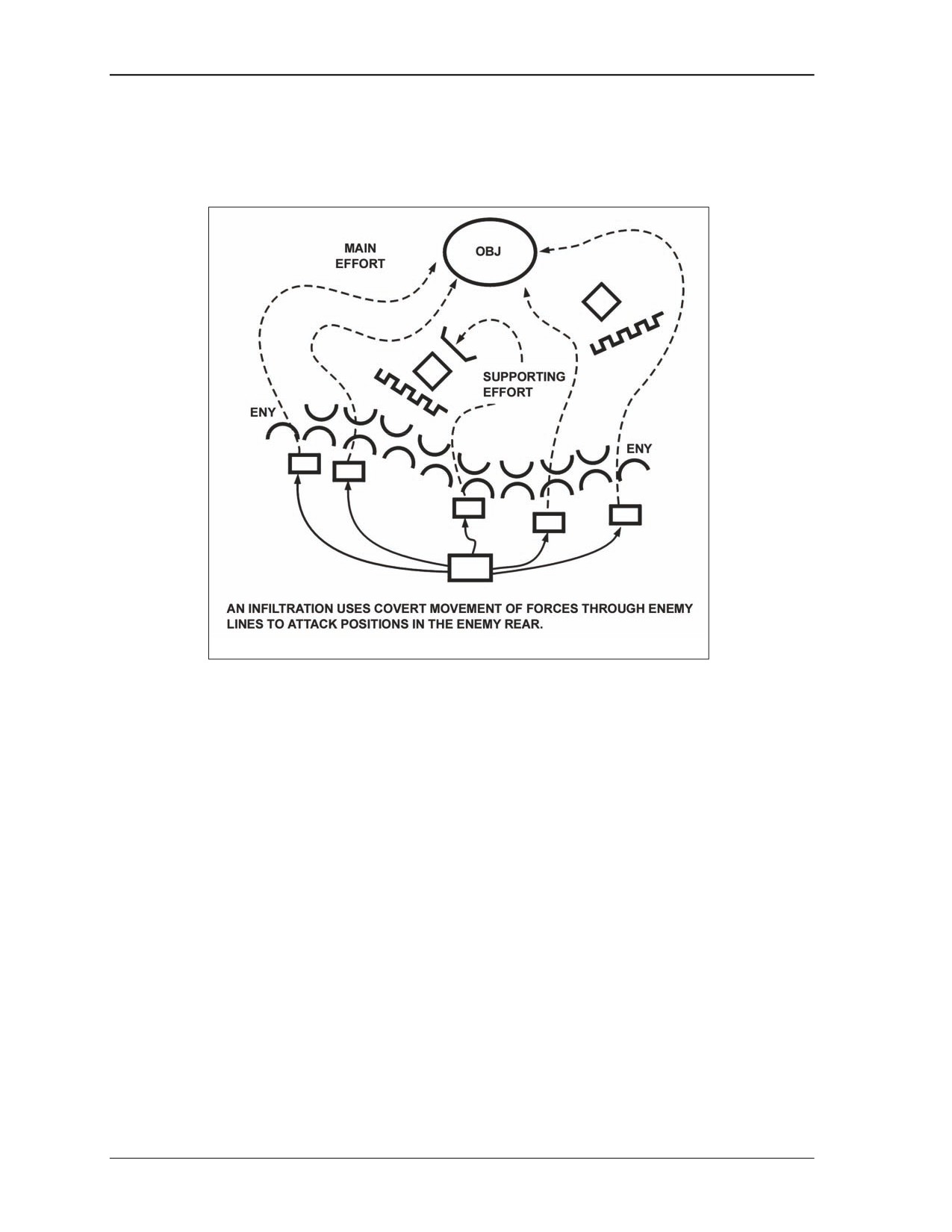
INFILTRATION
4-23.
Infiltration is a form of maneuver. In an infiltration, an attacking force moves undetected into or
through the enemy's main defenses, that is, an area occupied by an enemy forces. The purpose of an
infiltration is to occupy a position of advantage in the enemy rear area to concentrate combat power against
enemy weak points. Ideally, an infiltration exposes only small elements to enemy defensive fires
(Figure 4-3). Moving and assembling forces covertly through enemy positions takes a lot of time.
A successful infiltration reaches the enemy's rear without fighting through prepared positions. A company
may conduct an infiltration as part of a larger unit's attack with the battalion employing another form of
maneuver. The company commander may also employ maneuver by infiltration to move his platoons to
locations to support the battalion's attack. A company can infiltrate--
y To attack enemy-held positions from an unexpected direction.
y To occupy a support-by-fire position to support an attack.
y To secure key terrain.
27 July 2006
FM 3-21.10
4-5
Chapter 4
y To conduct ambushes and raids.
y To conduct a covert breach of an obstacle.
Figure 4-3. Infiltration.
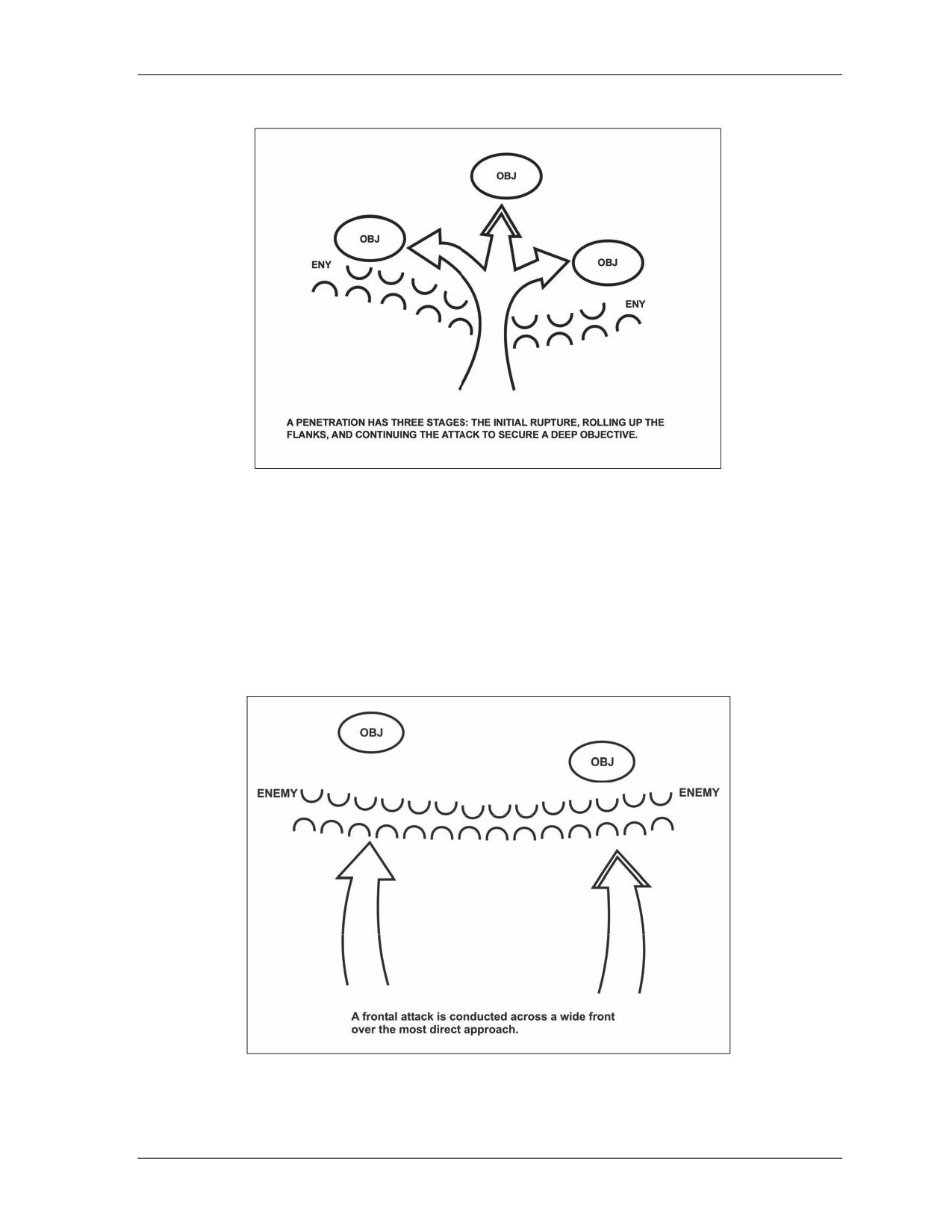
PENETRATION
4-24.
Penetration is a form of maneuver in which an attacking force seeks to rupture enemy defenses on
a narrow front to create both assailable flanks and access to the enemy's rear (Figure 4-4). Penetration is
used when enemy flanks are not assailable, when enemy defenses are overextended, when weak spots in
the enemy defense are identified, and when time does not permit some other form of maneuver. A
penetration normally consists of three steps.
y Breach the enemy's main defense positions.
y Widen the gap created to secure flanks by enveloping one or both of the newly exposed flanks.
y Seize the objective. As part of a larger force penetration, the company will normally isolate,
suppress, fix, or destroy enemy forces; breach tactical or protective obstacles in the enemy's
main defense (secure the shoulders of the penetration); or seize key terrain. A battalion may
also use penetration to secure a foothold within a large built-up area.
4-6
FM 3-21.10
27 July 2006
Offensive Operations
Figure 4-4. Penetration.
FRONTAL ATTACK
4-25.
Frontal attack is a form of maneuver in which an attacking force seeks to destroy a weaker enemy
force or fix a larger enemy force along a broad front. It is the least desirable form of maneuver, because it
exposes the attacker to the concentrated fire of the defender and limits the effectiveness of the attacker's
own fires. However, the frontal attack is often the best form of maneuver for an attack in which speed and
simplicity are key; it helps overwhelm weak defenses, security outposts, or disorganized enemy forces
(Figure 4-5).
Figure 4-5. Frontal attack.
27 July 2006
FM 3-21.10
4-7
Chapter 4
Section II. SEQUENCE
This section discusses the sequence of events the company commander must consider while planning for an
offensive mission. This sequence applies to many, but not to all, offensive operations.
ASSEMBLY AREA
4-26.
The commander directs and supervises mission preparations in the assembly area to prepare the
company for future operations. Preparation time also allows the company to conduct precombat checks and
inspections, rehearsals at all levels, and sustainment activities. See Chapter 3 for more information.
RECONNAISSANCE
4-27.
All echelons conduct reconnaissance. The enemy situation and available planning time may limit
the unit's reconnaissance, but leaders at every level aggressively seek information about the terrain and
enemy. Leaders must remember the benefits of having their Soldiers on the ground providing real-time
information in balance with the security risks involved. The on-the-ground company reconnaissance effort
reports on enemy activity in the company's AO near the LD, attack position (ATK PSN), assault position
(ASLT PSN), or the company-assigned unit objective (OBJ). This provides the maneuver commander with
the information needed to execute the best possible tactical plan. The commander should also consider
ground reconnaissance with the use of SUASs. Most SUASs have both a daylight and limited visibility
(infrared) capability and significantly aid in providing the commander with needed information on the
terrain and enemy.
MOVEMENT TO LINE OF DEPARTURE
4-28.
When attacking from positions not in contact, Infantry companies often stage in rear assembly
areas, road march to ATK PSN behind friendly units in contact with the enemy, conduct passage of lines,
begin the attack, and then move into their AOs. The movement from the assembly area to the LD is timed
so the movement to and across the LD is continuous. The lead element of the company starts crossing the
LD at the attack time specified in the battalion OPORD. Before the company's movement, a patrol might
be sent to reconnoiter and mark the route and check the time it takes to move to the LD. In order to be in an
overwatch position, ready to support the company as it crosses LD, the support element may precede the
assault and the breach elements to the LD. Mortars are moved forward to a firing position near the LD to
allow maximum coverage of the objective area. The commander avoids stopping in the attack position.
However, if the company is ahead of schedule or told to hold in the attack position, they occupy the attack
position, post security, and wait until time to move.
MANEUVER
4-29.
Maneuver is the essence of every tactical operation. It is the use of movement in combination with
fire
(or fire potential) employed to achieve a position of advantage with respect to the enemy. The
commander employs those techniques that avoid the enemy's strength, focus on enemy weakness, and
conceals the company's true intentions. He deceives the enemy as to the location of the decisive operation,
uses surprise to take advantage of his initiative in determining the time and place of his attack, and uses
indirect approaches, when available, to strike the enemy from a flank or the rear. The company commander
maneuvers his platoons to close with the enemy, to gain positional advantage over him, and ultimately to
destroy him or force him to withdraw or capitulate.
BASE OF FIRE FORCE
4-30.
The combination of fire and movement requires a base of fire in which some elements of the
company remain stationary and provide protection for the bounding forces by preventing the enemy to
react to the bounding force.
4-8
FM 3-21.10
27 July 2006
Offensive Operations
4-31.
The base of fire force occupies positions that afford effective cover and concealment,
unobstructed observation, and clear fields of fire. Selection of the base of fire position is based on a careful
study of the terrain, knowledge of enemy locations, or likely enemy locations. When the enemy situation is
vague or unknown, the position is selected in such a manner as to be able to place effective fire on terrain
that dominates the area the bounding force will traverse. Once in position, the base of fire is responsible for
both suppressing known enemy forces and for scanning assigned sectors of observation; it identifies
previously unknown enemy elements and suppresses them. The protection provided by the base of fire
force allows the bounding unit to continue its movement and to retain the initiative even when under
enemy observation or within range of enemy weapons.
4-32.
Because maneuver is decentralized in nature, decisions on where and when to establish a base of
fire must be made at the appropriate level. These decisions normally fall to a leader on a specific part of the
battlefield, who knows which enemy forces can engage the bounding force, and which friendly forces are
available to serve as the base of fire. At company level, these decisions might be made within the company
(with the base of fire provided by a platoon), within platoons (with the base of fire provided by the
weapons squad), or within squads (with a fire team as the base of fire). A detailed understanding of the
terrain is critical to select appropriate positions.
BOUNDING FORCE
4-33.
Movement in a maneuver situation is inherently dangerous. It is complicated by the obvious
potential for harm posed by enemy weapons, and by the uncertainty posed by new terrain and other factors.
y The bounding force takes full advantage of the cover and concealment the terrain provides.
Leaders enhance security by exploiting use of restrictive terrain (time dependent), intervening
terrain features, inter-visibility lines, and avoidance of skylining.
y All elements involved in the maneuver maintain all-round security at all times. Elements in the
bounding force scan their assigned sectors of observation continuously.
y Although METT-TC factors ultimately dictate the length of the bounds, the bounding force
should not move beyond the range at which the base of fire force can effectively suppress
known, likely, or suspected enemy positions. This minimizes the bounding force's exposure to
enemy fires.
y In restricted and severely restricted terrain, bounds are generally much shorter than in areas that
are more open.
y The bounding element remains focused on its ultimate goal of gaining a positional advantage,
which it can then use to destroy the enemy by direct and indirect fires.
y When the bounding force comes under direct fire from the enemy it may become the base of
fire, which allows the original base of fire force to become the maneuver force.
DEPLOYMENT
4-34.
The company approaches the objective in a manner that supports its deployment prior to the
assault. If a support element (from the company) is to be used, it should be positioned before the company's
assault element reaches the assault position. The support element initiates its fire on the objective on order
or at a specified time. Supporting indirect fires are synchronized to impact at the same time. The company
should minimize time in the assault position (or not stop at all. ) Movement should be as rapid as the
terrain, force mobility, and enemy situation permit.
ASSAULT
4-35.
The objective for the company may vary from operation to operation. In every case, the
company's actions on the objective are critical and thus the focus of the commander's concept. To develop
the concept, the commander starts at the decisive point. This is where the commander wants to focus his
combat power. From there, he works backwards. He plans all the tasks and purposes of all the subordinate
units so they shape the decisive operation's action at the decisive point. The commander's estimate will
27 July 2006
FM 3-21.10
4-9
Chapter 4
determine what other considerations must be included for the actions on the objective. During offensive
operations, the unit remains enemy and effects oriented; however, based on the METT-TC factors, the
company's objective might be terrain or force oriented. Terrain-oriented tasks and purposes require the
company to seize, secure, or retain a designated area. These tasks and purposes may or may not require
fighting through enemy forces. Force-oriented tasks and purposes require the company to destroy,
suppress, or fix, enemy forces. The company's effort is focused on the enemy's actual location. The enemy
might be a stationary or moving force. Actions on the objective start when the company begins placing
fires on the objective; this normally occurs when the commander initiates his echelonment of fires onto the
objective. Once the company achieves a position of advantage, the Infantry company conducts a rapid and
violent assault to accomplish its mission, normally under the cover of darkness.
CONSOLIDATION AND REORGANIZATION
4-36.
The company consolidates and reorganizes as required by the situation and mission. Consolidation
is the process of organizing and strengthening a newly captured position so that it can be defended.
Reorganization is the actions taken to shift internal resources within a degraded unit to increase its level of
combat effectiveness. The company executes follow-on missions as directed by the battalion commander.
A likely mission is to continue the attack against targets of opportunity in the objective area. Whether a
raid, hasty attack, or deliberate attack, a company should posture itself and prepare for continued offensive
operations to defeat local counterattacks.
Section III. PLANNING CONSIDERATIONS
The WFF are critical tactical activities the commander can use to review planning, prepare, and execute.
Synchronization and coordination among the WFF are critical for success. This section discusses selected WFF
and other planning considerations. For a detailed discussion of command, control, and intelligence,
see Chapter 2.
INTELLIGENCE
4-37.
The company commander will not have complete information about enemy intentions. Therefore,
he must obtain or develop the best possible IPB products and conduct continuous ISR collection
throughout the operation. He may also need to request information from the battalion staff to answer PIR.
4-38.
ISR assets serve to help study terrain to determine the enemy’s best area for his main defense,
routes he may use for counterattacks (both enemy and own OAKOC); and confirm or deny strengths,
dispositions, and likely intentions, especially where and in what strength the enemy will defend.
MOVEMENT AND MANEUVER
4-39.
The battalion commander may task-organize the company with engineers as part of a breaching
operation in the offense. The company commander may receive additional mobility assets such as an
engineer platoon. (FM 3-34.2 discusses breaching operations in detail.)
FIRE SUPPORT
4-40.
As part of the top-down fire planning system, the company commander must refine the fire plan
from higher headquarters to meet his mission requirements and ensure that these refinements are
incorporated into the higher headquarters plan. He incorporates the results of his METT-TC analysis and
designates key observer locations and targets from the fire plan as an integral part of the company
rehearsal. In addition, he works with the FSO to develop a corresponding observation plan and establishes
triggers for initiating, ceasing, or shifting fires. The commander may assign responsibility for the firing of
certain targets to subordinate leaders. The company commander and the FSO must have a thorough
4-10
FM 3-21.10
27 July 2006
Offensive Operations
understanding of organic FSEs and traditional artillery and mortar support assets. The majority of the
company's fire support is from mortar systems organic to the Infantry battalion and company. The
commander employs supporting fires in the offense to achieve a variety of purposes such as--
y To suppress enemy weapons systems that inhibit movement.
y To fix or neutralize bypassed enemy elements.
y To prepare enemy positions for an assault. Preparatory fires are normally used during a
deliberate attack, with fires placed on key targets before the assault begins. These indirect fires
are integrated and synchronized with the company's direct fire systems to provide constant
pressure on the enemy position and prevent him from reacting to, or repositioning against, the
company's assaulting elements. The commander must weigh the benefits of preparatory fires
against the potential loss of surprise.
y To obscure enemy observation or screen friendly maneuver. The company can take advantage
of smoke in various maneuver situations, such as during a bypass or in deception operations.
y To support breaching operations. Fires are employed to obscure and suppress enemy elements
that are overwatching reinforcing obstacles.
y To illuminate enemy positions. Illumination fires are always included in contingency plans for
night attacks.
PROTECTION
4-41.
Stinger sections, with organic vehicle support, are seldom attached to the company, but may travel
with the company in order for the company to protect the air defense assets. Their security must be a
consideration in planning for offensive operations. The company commander must plan for and rehearse
internal air security and active air defense measures. The commander must anticipate possible contact with
enemy air assets by templating enemy helicopter and fixed-wing air corridors and AA. Unit SOPs should
dictate internal air security measures and active air defense measures.
SUSTAINMENT
4-42.
The main purpose of sustainment in the offense is to assist maneuver elements in maintaining the
momentum of the attack. Sustainment functions are performed as far forward as the tactical situation
allows. Company trains normally remain one terrain feature out of direct fire range of the enemy behind
the location of the company. The commander must consider the enemy situation and how it relates to the
security of the company trains. If the company is conducting decentralized operations, the company trains
locate where they can best support the platoons in the accomplishment of the company's mission.
COMMAND AND CONTROL
4-43.
Though the company’s assigned mission and objective may be the either decisive or shaping for
the battalion, the commander may decide to translate, develop, and assign both decisive and shaping tasks
for the platoons, sequencing his operation by "find, fix, finish, follow through" concepts. Typically, he will
plan to make contact with the smallest element possible, deceive the enemy as to the company main or
decisive effort, employ timely and synchronized fire support, and maneuver platoons to destroy the enemy
and seize the company objective.
4-44.
The commander will locate where he can maintain a current and accurate picture, and best control
his elements as the attack progresses; this is usually with the decisive element. He is prepared to exploit
unforeseen advantages and anticipates the need or requirement to shift his effort due to success or to
preserve his freedom of maneuver.
27 July 2006
FM 3-21.10
4-11
Chapter 4
Section IV. ACTIONS ON CONTACT
In both offensive and defensive operations, contact occurs when a member of the Infantry company encounters
any situation that requires an active or passive response to a threat or potential threat. This section discusses the
forms, circumstances, development of, times, and steps of actions on contact.
FORMS
4-45.
These situations may entail one or more of the following forms of contact.
y Visual (friendly elements may or may not be observed by the enemy).
y Physical or direct fire with an enemy force.
y Indirect fire.
y With obstacles of enemy or unknown origin.
y With enemy or unknown aircraft.
y Involving CBRN conditions.
y Involving electronic warfare tactics.
y With nonhostile elements such as civilians.
CIRCUMSTANCES
4-46.
Leaders at echelons, from platoon through battalion, conduct actions on contact when they or a
subordinate element, recognize one of the forms of contact or receive a report of enemy contact. The
company may conduct actions on contact in response to a variety of circumstances, including--
y Subordinate platoon(s) conducting actions on contact.
y Reports from the battalion or another higher unit.
y Reports from or actions of an adjacent unit.
DEVELOPMENT
4-47.
To identify likely contact situations that may occur during an operation, Infantry company
commanders and platoon leaders analyze the situation throughout the TLP. Commanders plan for each of
the forms of contact throughout the operation. Through planning and rehearsing, they develop and refine
COAs to deal with probable enemy actions. The COAs are the foundation for the company's scheme of
maneuver. During the troop-leading procedures, the leaders evaluate a number of factors to determine their
impact on the unit's actions on contact. For example, the commander considers how the likelihood of
contact affects his choice of movement techniques and formations in order to outline procedures for the
transition to more secure movement techniques before a contact situation.
TIME REQUIREMENTS
4-48.
Infantry commanders must understand that properly executed actions on contact (for any of the
forms of contact) require time at both platoon and company levels. To develop the situation fully, a platoon
might have to execute extensive lateral movement, conduct reconnaissance by fire, or call for and adjust
indirect fires. Each of these activities requires time. The commander must balance the time required for
subordinate elements to conduct actions on contact with the need of the company or battalion to maintain
tempo and momentum.
4-12
FM 3-21.10
27 July 2006
Offensive Operations
STEPS
4-49.
The company executes actions on contact, as applicable for each form of contact, using a logical,
well-organized process of decision-making and action, which actually entails four separate actions:
(1) deploy and report; (2) evaluate and develop the situation; (3) choose a COA; and (4) execute the
selected COA. These can be done out of sequence. In fact, some are more likely to be done at the same
time. These actions provide an orderly framework that enables the company and its platoons to respond to
initial contact and then apply sound decision-making and timely actions to complete the operation. Ideally,
the company will acquire the enemy before being sighted by the enemy; the company can then initiate
physical contact on its own terms by executing the designated COA.
STEP 1, DEPLOY AND REPORT
4-50.
Events that occur during initial contact depend in great measure on whether the contact is
expected or unexpected. Regardless of whether contact is expected or unexpected, the first step of actions
on contact concludes with the unit deployed (into base of fire and maneuver forces), the enemy suppressed
or destroyed (if applicable), and the commander sending a contact report to battalion headquarters. The
following paragraphs examine some variables the company commander faces in expected and unexpected
contact situations. The roles of platoon battle drills, SOPs, and reports are also detailed.
Expected Contact
4-51.
If the commander expects contact, he will have already deployed the company by transitioning to
the bounding overwatch movement technique. If the company is alert to the likely presence of the enemy, it
has a better chance of establishing visual contact and then physical contact, on its own terms before being
detected by the enemy. An overwatching or bounding platoon usually makes visual or physical contact that
initiates the company's actions on contact. In a worst-case scenario, the platoon might be engaged by a
previously undetected (but expected) enemy element. In this event, the platoon conducts a battle drill for its
own survival and then initiates actions on contact.
Unexpected Contact
4-52.
In some cases, the company may make unexpected contact with the enemy while using traveling
or traveling overwatch. The element in contact or, if necessary, the entire company might have to deploy
using battle drills to survive the initial contact.
Battle Drills
4-53.
Battle drills provide automatic responses to contact situations where immediate, often violent
execution is critical, both to initial survival and to ultimate success in combat. Rather than being a
substitute for carefully planned COAs, drills buy time for the unit in contact, and frame the development of
the situation. When enemy contact occurs, the company's platoons deploy immediately, executing the
appropriate battle drills under the direction of the commander. (For additional information on dismounted
platoon battle drills, see FM 3-21.8 (FM 7-8) and ARTEP 7-8-Drill.)
Maneuver Standing Operating Procedures
4-54.
An effectively written, well-rehearsed maneuver SOP helps to ensure quick, predictable actions
by all members of the company. The SOP, unlike platoon battle drills, allows leaders to take into account
the friendly task organization, a specific enemy, and a specific type of terrain. Therefore, the SOP can
assist the company in conducting actions on contact and maintaining the initiative in a number of
battlefield situations.
27 July 2006
FM 3-21.10
4-13
Chapter 4
Reports
4-55.
Timely, accurate, and complete reports are essential throughout actions on contact. As part of the
first step of the process, the company commander must send a contact report to the battalion as soon as
possible after contact occurs. He provides subsequent reports to update the situation as necessary.
STEP 2, EVALUATE AND DEVELOP THE SITUATION
4-56.
While the company deploys, the commander evaluates and develops the situation. The goal of
these actions is to create conditions, which provide for the successful execution of the decisive action. The
commander gathers as much information as possible, either visually or, more often, through reports from
the platoon(s) in contact.
Factors
4-57.
He analyzes the information to determine critical operational considerations, including
these factors.
y Size of the enemy element.
y Location, composition, activity, orientation, and capabilities of the enemy force.
y Effects of obstacles and terrain.
y Probable enemy intentions.
y How to gain positional advantage over the enemy.
y Friendly situation (location, strength, and capabilities).
y Possible friendly COAs to achieve the specified end state.
Techniques
4-58.
After evaluating the situation, the commander may discover that he does not have enough
information to identify the necessary operational considerations. To make this determination, he must
further develop the situation IAW the battalion commander's intent, using a combination of these
techniques.
y Squads conducting surveillance (using binoculars and other optical aids).
y Lateral maneuver to gain additional information by viewing the enemy from another
perspective.
y Indirect fire.
y Reconnaissance by fire.
Reports
4-59.
Once the commander has determined the size of the enemy force the company has encountered, he
sends a report to the battalion.
STEP 3, CHOOSE A COURSE OF ACTION
4-60.
After developing the situation and determining that he has enough information to make a decision,
the company commander selects a COA that meets the requirements of the battalion commander's intent,
achieves the company's purpose, maximizes the effects of terrain, minimizes casualties, and is within the
company's capabilities.
Nature of Contact
4-61.
The nature of the contact (expected or unexpected) may have a significant impact on how long it
takes a commander to develop and select a COA. For example, in preparing to conduct an attack, the
company commander determines that the company will encounter an enemy security OP along its axis of
4-14
FM 3-21.10
27 July 2006
Offensive Operations
advance. During TLP, he develops a scheme of maneuver to defeat the outpost. When the company's lead
platoon makes contact with the enemy, the commander can quickly assess that this is the anticipated
contact and direct the company to execute his plan. On the other hand, unexpected contact with a
well-concealed enemy force may require time for development of the situation at platoon level. As the unit
fights for critical information that will eventually allow the commander to make a sound decision, the
company might have to employ several of the techniques for developing the situation.
Procedures for Selecting Course of Action
4-62.
The company commander has several options in selecting a COA.
y If his development of the situation reveals no need for change, the company commander directs
the company to execute the original plan.
y If his analysis shows that the original plan is still valid but that some refinement is necessary,
the company commander informs the battalion commander (prior to execution, if possible) and
issues a FRAGO to refine the plan.
y If his analysis shows that the original plan needs to be changed but the selected COA will still
comply with the battalion commander's intent, the company commander informs the battalion
commander (prior to execution, if possible) and issues a FRAGO to retask his subordinate
elements.
y If his analysis shows that the original plan deviates from the battalion commander's intent and
needs to be changed, the company commander must report the situation and, based on known
information in response to an unforeseen enemy or battlefield situation, recommend an
alternative COA to the battalion commander.
y If the battlefield picture is still vague, the company commander must direct the company or a
platoon to continue to develop the situation. This will allow him to gather the information
needed to clarify a vague battlefield picture. He then uses one of the first four options to report
the situation, choose a COA, and direct further action.
STEP 4, EXECUTE SELECTED COURSE OF ACTION
4-63.
In executing a COA, the company transitions to maneuver. It then continues to maneuver
throughout execution (either as part of a tactical task or as an advance while in contact) to reach the point
on the battlefield where it executes its tactical task. The company can employ a number of tactical tasks as
COAs, any of which might be preceded and followed by additional maneuver. As execution continues,
more information becomes available to the company commander. Based on the emerging details of the
enemy situation, he might have to alter his COA during execution.
Section V. ATTACKS
This section discusses characteristics, types, and techniques for the hasty attack, the deliberate attack, special
purpose attacks, and other information relating to attacks by an Infantry company. In the attack, the company
maneuvers along lines of least resistance using the terrain for cover and concealment. This indirect approach
affords the best chance to achieve surprise on the enemy force. In the attack, the company maneuvers along
lines of least resistance using the terrain for cover and concealment. This indirect approach affords the best
chance to achieve surprise on the enemy force.
CHARACTERISTICS
4-64.
An attack is a type of offensive operation characterized by movement supported by fire. The
purpose of an attack is to destroy an enemy force or to seize terrain. The attack should always try to strike
the enemy where he is weakest. The company can attack independently or as part of a battalion or larger
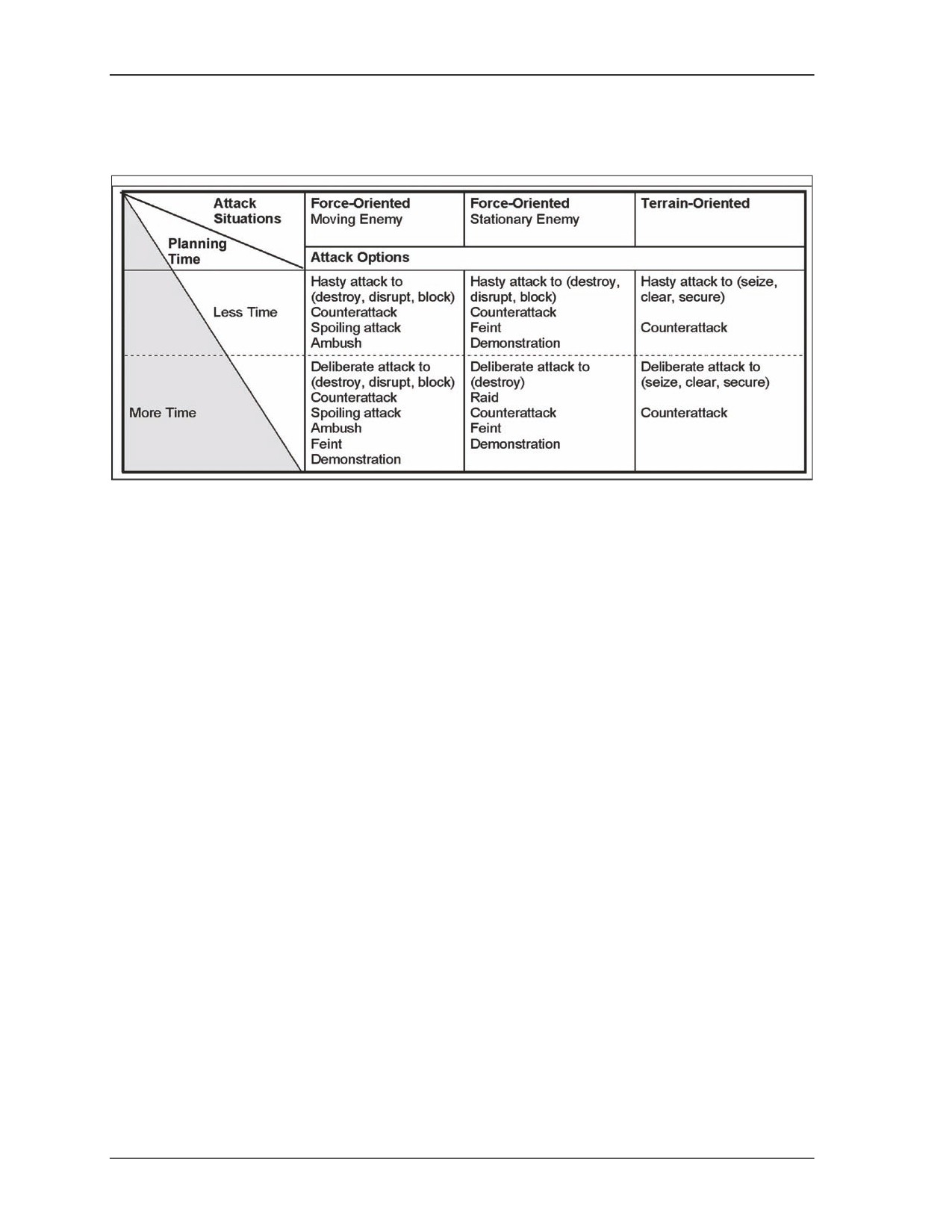
element. The two basic types of attack are the hasty attack and the deliberate attack. Figure 4-6 shows the
situations under which a company conducts an attack, compares them to the amount of planning and
27 July 2006
FM 3-21.10
4-15
Chapter 4
preparation time required, and provides options for the commander to accomplish his purpose and support
the higher commander's intent. All attacks, whether hasty or deliberate, depend on synchronization for
success. They require planning, coordination, and time to prepare.
Figure 4-6. Spectrum of attacks.
4-65.
The company commanders translate the mission assigned by the battalion, through analyzing the
task and purpose, into specific missions for subordinate platoons and squads. To facilitate parallel
planning, they immediately forward these missions, along with the appropriate portions of the battalion's
plans orders, to subordinate platoons and squads. Commanders and platoon leaders must work together to
develop the best plans; this requires sharing information freely between the command posts. The goal is to
not simply reduce the time required to produce and distribute the plans, but, more importantly, to produce a
better plan by including input from adjacent, higher, and lower elements. Also, this collaboration promotes
understanding of the plan, thereby enhancing preparation and execution.
4-66.
As the company plans, the enemy also has time to improve his defenses, disengage, or conduct
spoiling attacks of his own. Clearly, planning must be accomplished in the shortest time possible and must
accommodate the changes driven by what the enemy does.
TYPES
4-67.
No clear distinction exists between deliberate and hasty attacks, because they are similar.
However, the main difference between the two is the extent of planning and preparation conducted by the
attacking force. Attacks range along a continuum defined at one end by FRAGOs, which direct the rapid
execution of battle drills by forces immediately available. At the other end of the continuum, the company
moves into a deliberate attack from a reserve position or assembly area with detailed knowledge of the
enemy (a task organization designed specifically for the attack) and a fully rehearsed plan. Most attacks fall
somewhere between these two ends of the continuum.
HASTY ATTACK
4-68.
The commander may conduct a hasty attack during MTC, as part of a defense, or whenever he
determines that the enemy is in a vulnerable position and can be quickly defeated by immediate offensive
action. A hasty attack is used to--
y Exploit a tactical opportunity.
y Maintain the momentum.
y Regain the initiative.
4-16
FM 3-21.10
27 July 2006
Offensive Operations
y Prevent the enemy from regaining organization or balance.
y Gain a favorable position that might be lost with time.
4-69.
Because its primary purpose is to maintain momentum or take advantage of the enemy situation,
the hasty attack is normally conducted with available resources. Maintaining unrelenting pressure through
hasty attacks keeps the enemy off balance and makes it difficult for him to react effectively. Attacking
before the enemy can act often results in success even when the combat power ratio is not as favorable as
desired. With its emphasis on agility and surprise, however, this type of attack may cause the attacking
force to lose a degree of synchronization. To minimize this risk, the commander should maximize use of
standard formations; well-rehearsed, thoroughly understood battle drills and SOPs; and digital tools that
facilitate rapid planning and preparation. By assigning on-order and be-prepared missions to subordinate
companies, as the situation warrants, the company is better able to transition into hasty attacks. The hasty
attack is often the preferred option during continuous operations. It allows the commander to maintain the
momentum of friendly operations while denying the enemy time to prepare his defenses and to recover
from losses suffered during previous action. Hasty attacks normally result from a MTC, successful defense,
or continuation of a previous attack.
Task Organization
4-70.
The hasty attack is conducted using the principles of fire and movement. The controlling
headquarters normally designates a base of fire force and a maneuver force. The Infantry company may
also be task organized with one or more assault platoons from the Infantry battalion's Weapons company.
An assault platoon has the ability to provide mobile overwatching fires with its organic M2. 50 cal heavy
machine guns, Mark 19 automatic grenade launchers and TOW Improved Target Acquisition Systems
(ITAS). The ITAS (and the Javelin) is also considered a close combat missile system.
Conduct
4-71.
The company must first conduct actions on contact, allowing the commander to gather the
information he needs to make an informed decision. The term "hasty" refers to limits on planning and
preparation time, not to any acceleration in the conduct of actions on contact. Because the intelligence
picture is vague, the commander normally needs more time, rather than less, during this process to gain
adequate information about the enemy force. Execution begins with establishment of a base of fire, which
then suppresses the enemy force. The maneuver force uses a combination of techniques to maintain its
security as it advances in contact to a position of advantage. These techniques include, among others, the
following.
y Use of internal base of fire and bounding elements.
y Use of covered and concealed routes.
y Use of indirect fires to suppress or obscure the enemy or to screen friendly movement.
y Execution of bold maneuver that initially takes the maneuver force out of enemy direct
fire range.
y Once the maneuver force has gained the positional advantage, it can execute a tactical task to
destroy the remaining enemy.
DELIBERATE ATTACK
4-72.
The Infantry company normally conducts a deliberate attack against a strong enemy defense. As
the company prepares for the attack, the enemy also continues to strengthen his position. Deliberate attacks
follow a distinct period of preparation, which is used for extensive reconnaissance and intelligence
collection, detailed planning, task organization of forces, preparation of troops and equipment,
coordination, rehearsals, and plan refinement. The deliberate attack is a fully synchronized operation that
employs every available asset against the enemy defense. It is characterized by a high volume of planned
fires, use of major supporting attacks, forward positioning of resources needed to maintain momentum, and
operations throughout the depth of enemy positions. Thorough preparation allows the attacking force to
27 July 2006
FM 3-21.10
4-17
Chapter 4
stage a combined arms and fully integrated attack. Likewise, however, the enemy will have more time to
prepare his defensive positions and integrate fires and obstacles. The METT-TC factors dictate how
thoroughly these activities are accomplished. The commander normally conducts a deliberate attack when
enemy positions are too strong to be overcome by a hasty attack. In weighing his decision to take the time
needed to prepare for and conduct the deliberate attack, the commander must consider the advantages that
might be gained by both friendly and enemy forces.
Task Organization
4-73.
The company commander normally task-organizes the company into support and assault forces
for conduct of a deliberate attack. He also designates a breach force if the company may conduct a breach
as part of the attack. Specific duties of these elements are covered in the discussion of a company-level
assault of a strongpoint and tactical tasks.
Conduct
4-74.
The Infantry company's deliberate attack normally is broken into the following steps.
Attack in Zone
4-75.
The attacking company advances within assault distance of the enemy position under supporting
fires and uses any combination of movement techniques. Platoons advance to successive positions using
available cover and concealment. The company commander may designate support by fire positions to
protect friendly forces with suppressive direct fires. As the company maneuvers in zone, it employs lethal
and nonlethal fires to suppress and obscure enemy positions.
Actions at Probable Line of Deployment
4-76.
The probable line of deployment (PLD) is normally a phase line or CP where elements of the
attacking company transition to secure movement techniques in preparation for contact with the enemy.
Platoons may maneuver from the PLD to designated support-by-fire positions, assault positions, or breach
or bypass sites. The PLD might be collocated with the assault position.
Actions on Objective
4-77.
The assault combines the effects of overwhelming suppressive fires with the use of maneuver to
gain positional advantage over the defending enemy. Fires from support forces and from indirect fire assets
isolate the objective area and suppress the enemy. These fires protect the assault force as it closes with the
enemy. Other measures the Infantry company may use to set the conditions for the assault include, among
others, the following.
y Employment of mortar, artillery, direct fires, or a combination of these, from support-by-fire
positions to destroy or isolate enemy forces on the objective and create favorable force ratios.
y Use of obscuring smoke.
y Once the conditions are set, the assault forces maneuver to close with and destroy the enemy.
Other Infantry company elements continue to provide support as necessary throughout
the assault.
SPECIAL PURPOSE ATTACKS
4-78.
The company conducts a special purpose attack at the direction of the battalion commander. The
commander's decision is based on the METT-TC factors. Special purpose attacks are subordinate forms of
an attack and they include the following. As forms of attack, these share many planning, preparing, and
4-18
FM 3-21.10
27 July 2006
Offensive Operations
executing considerations of the offense. Feints and demonstrations are associated with military deception
operations.
y Ambush.
y Raid.
y Spoiling attack.
y Counterattack.
y Feint.
y Demonstration.
AMBUSH
4-79.
An ambush is a surprise attack from concealed positions on a moving or temporarily halted
enemy. It may take the form of an assault to close with and destroy the enemy, or it might be an attack by
fire only, executed from concealed positions. An ambush does not require that ground be seized or held.
Infantry forces normally conduct ambushes.
Purposes
4-80.
Ambushes are generally executed to reduce the enemy force's overall combat effectiveness.
Destruction is the primary reason for conducting an ambush. Other reasons to conduct ambushes are to
harass and capture the enemy or capture enemy equipment and supplies.
Operational Considerations
4-81.
The execution of an ambush is offensive in nature. However, the company might be directed to
conduct an ambush in a wide variety of situations. For example, the company may stage the ambush during
offensive or defensive operations
(as part of battalion rear area operations), or during retrograde
operations. OPSEC is critical to the success of an ambush and is a major reason the operation is normally
conducted only by Infantry forces. The company must take all necessary precautions to avoid detection
during movement and during the preparation of the ambush site. The company must also have a secure
route of withdrawal after the ambush.
Actions
4-82.
An ambush normally consists of the following steps.
y Tactical movement to the ORP.
y Reconnaissance of the ambush site.
y Establishment of ambush site security.
y Preparation of the ambush site.
y Execution of the ambush.
y Withdrawal.
Task Organization
4-83.
The company normally is task-organized into assault, support, and security forces for the
execution of the ambush.
27 July 2006
FM 3-21.10
4-19
Chapter 4
Support Force
4-84.
The support force fixes the enemy force and prevents it from moving out of the kill zone, allowing
the assault force to conduct the ambush. The support force generally uses direct fires in this role, but it can
also call for indirect fires to further fix the ambushed force.
Assault Force
4-85.
The assault force executes the ambush. It may employ an attack by fire, an assault, or a
combination of those techniques to destroy the ambushed force.
Security Force
4-86.
The security force provides protection and early warning to the ambush patrol and secures the
ORP. It isolates the ambush area both to prevent the ambushed enemy force from moving out of the
ambush site and to keep enemy rescue elements from reaching the site. The security force also might be
responsible for securing the company's withdrawal route.
Types of Ambushes
4-87.
Once the company receives an order to conduct an ambush, the commander must determine which
of the two types of ambush operations is best suited to the situation and the capabilities of his company.
Point
4-88.
In a point ambush, the patrol deploys to attack an enemy force in a single kill zone.
Area
4-89.
In an area ambush, the patrol is deployed to conduct several related point ambushes throughout an
ambush area.
RAID
4-90.
A raid is a limited-objective form of attack entailing swift entry into hostile terrain. A raid
operation always ends with a planned withdrawal to a friendly location upon the completion of the
assigned mission. It is not intended to hold terrain. The company can conduct an independent point raid or
it can participate in a battalion area raid. A point raid attacks the enemy force on a single objective; an area
raid encompasses several related point raids or other related operations. Rarely will a company conduct an
area raid alone.
Company Role
4-91.
The company conducts raids to accomplish a number of missions, including any or all
the following.
y Capture prisoners.
y Capture or destroy specific command and control locations.
y Destroy logistical areas.
y Obtain information concerning enemy locations, dispositions, strength, intentions, or methods
of operation.
y Confuse the enemy or disrupt his plans.
4-20
FM 3-21.10
27 July 2006
Offensive Operations
Task Organization
4-92.
Task organization of a raiding force is based on the purpose of the operation. It normally consists
of the following elements.
y Support force.
y Assault force.
y Breach force.
y Security force.
Conduct of Raid
4-93.
The main differences between a raid and other attack forms are the limited objectives of the raid
and the associated withdrawal following completion. Raids might be conducted in daylight or darkness,
within or beyond supporting distance of the parent unit. When the area to be raided is beyond supporting
distance of friendly lines, the raiding party operates as a separate force. A specific objective is normally
assigned to orient the raiding unit. During the withdrawal, the attacking force should use a route or axis
different from that used to conduct the raid itself.
SPOILING ATTACK
4-94.
A spoiling attack is a limited-objective attack to delay, disrupt, or destroy the enemy's capability
to attack. Infantry commanders mount spoiling attacks from defensive postures to disrupt expected enemy
attacks. A spoiling attack tries to strike the enemy when he is most vulnerable: during preparations for
attack in assembly areas and attack positions, or while he is on the move prior to crossing his line of
departure. In most respects, commanders conduct spoiling attacks like any other attack. They might be
either hasty (when time is short) or deliberate (when the command has adequate forewarning). When the
situation permits, commanders exploit a spoiling attack like any other attack.
COUNTERATTACK
4-95.
A counterattack is an attack by defensive forces to exploit the success of a defense, regain the
initiative, or to deny the enemy success with his attack. Commanders conduct counterattacks either with a
reserve or with lightly committed forward elements. They counterattack after the enemy launches his
attack, reveals his decisive operation, or creates an assailable flank. Infantry commanders conduct
counterattacks much like other attacks. However, synchronizing counterattacks within the overall
defensive effort requires careful timing.
4-96.
Remember that timing is critical. To be decisive, the counterattack must occur when the enemy is
overextended, dispersed, and disorganized during his attack. All counterattacks should be rehearsed in the
same conditions that they would be conducted. Careful consideration must be given to the event that will
trigger the counterattack. Once committed, the counterattack force conducts the decisive operation.
4-97.
As in spoiling attacks, commanders prepare to seize the opportunity to exploit success by the
entire force. However, counterattacks might be limited to movement to better terrain in order to bring fires
on the enemy. Given the same forces on both sides, counterattacks can achieve greater effects than other
attacks because the defender can create better conditions by rehearsing and by controlling timing.
FEINT
4-98.
A feint is a form of attack used to deceive the enemy of the location or time of the actual decisive
operations or main attack. Its purpose is to deceive the enemy and cause him to react in a particular way;
such as by repositioning forces, committing its reserve, or shifting fires. The feint seeks direct fire contact
with the enemy but avoids decisive engagement. The feint, in many ways, is identical to other attack forms.
The feint is much more limited in scope than other attack forms, in part due to its extremely specific
objective. The scale of the operation, however, is usually apparent only to the controlling headquarters. For
27 July 2006
FM 3-21.10
4-21
Chapter 4
the element actually conducting the feint, such as an Infantry company or battalion, execution is just as
rapid and violent as in a full-scale attack.
Planning Considerations
4-99.
The company normally participates in a feint as part of a larger element. Among the planning
considerations for the company commander are the following.
y The higher commander's intent regarding force preservation.
y Disengagement criteria and plans.
y Assignment of limited depth and attainable objectives.
y Clear follow-on orders that ensure the feinting force is prepared to exploit the success of the
main attack if necessary.
Credibility
4-100. Feints are successful only if the enemy believes that a full-scale attack operation is underway. To
be believable, they must be conducted with the same violence and the same level of precision as any attack.
The controlling headquarters must issue a clear task and purpose to the unit conducting the feint. This
should include identification of the specific enemy action the feint is supposed to trigger (or deny), such as
forcing the commitment of an enemy reserve force or preventing an enemy element from repositioning
against the decisive attack. Feints are most effective under the following conditions.
y When they reinforce the enemy's expectations.
y When the attack appears to present a definite threat to the enemy.
y When the enemy has a large reserve that he has consistently committed early in the battle.
y When the attacker has several feasible COAs, any of which the enemy could mistake for the
decisive operation.
DEMONSTRATION
4-101. The demonstration is an attack to deceive the enemy about the location of the decisive operation
or main attack. This purpose is very similar to that of a feint, but the friendly force does not seek to make
contact with the enemy. For example, the Infantry company's role might entail establishing an
attack-by-fire position beyond the enemy's direct fire engagement range; the purpose would be to cause the
enemy to commit a specific element simply by virtue of the positioning of the demonstration force. In
preparing to participate in a demonstration as part of a larger force, the company commander should keep
in mind the following planning considerations.
Limit of Advance
4-102. The limit of advance must be carefully planned so the enemy can "see" the demonstration force
but cannot effectively engage it with direct fires. The force must also take any other security measures
necessary to prevent engagement by the enemy.
Contingency Plans
4-103. The demonstration force must make contingency plans so it can respond effectively to enemy
direct or indirect fires while avoiding decisive engagement.
Follow-On Orders
4-104. Clear, specific follow-on orders must ensure that the demonstration force is prepared to exploit the
success of the main attack, if necessary.
4-22
FM 3-21.10
27 July 2006
Offensive Operations
OTHER ATTACK TECHNIQUES
4-105. The assault on an enemy strongpoint and a limited visibility attack are the two most demanding
attacks a company conducts. The fundamentals and techniques discussed in this paragraph will help the
Infantry commander plan, prepare, and conduct all attacks. The commander should try to identify and
exploit enemy weakness in all attacks.
ASSAULT OF A STRONGPOINT
4-106. The most difficult objective for an Infantry force is to seize or clear an enemy strongpoint
complete with obstacles and fortifications. The commander employs techniques that avoid attacking the
enemy's main strength or into the enemy's main obstacle belt. Instead, he tries to identify and attack a
weakness in the defense. (Most of the information contained in this section also applies to assaulting an
urban strong point; however, the commander should refer to Chapter
12, Urban Operations, and
FM 3-06.11 to ensure he considers all factors involved in urban operations. ).
DECEIT OF THE ENEMY
4-107. The Infantry commander deceives the enemy to the point of the main attack; he uses surprise to
take advantage of his initiative in determining the time and place for the attack. He tries to strike the enemy
on exposed flanks or the rear. He tries to identify and bypass enemy obstacles. He usually conducts a
deliberate attack of a strongpoint as follows.
y Reconnoiter the objective and develop the concept.
y Move to the objective.
y Isolate the objective and the selected breach site.
y Attack to seize a foothold.
y Exploit the penetration and clear the objective.
RECONNOITER AND DEVELOP THE CONCEPT
4-108. The commander reconnoiters the objective himself or has someone else do it. The reconnaissance
should identify the positions on the objective (crew-served weapons, C2 locations, and vehicles), the level
of preparation, the gaps in the defense, and other potential strengths or weaknesses. The Infantry
commander may conduct reconnaissance of the objective to determine any changes from previous
information.
4-109. The reconnaissance might be done many different ways. An effective technique is to
task-organize a reconnaissance patrol with leaders from the assault, support, and breach elements. There
should be sufficient personnel to establish surveillance on the objective and to secure the ORP but the party
must be small enough to move undetected. The reconnaissance patrol either returns to the company's
location or meets the company at a designated linkup point and guides it into the ORP, which then becomes
the company's assault position. At times, the scout platoon or other battalion assets might be tasked to
conduct reconnaissance in support of the company's mission.
4-110. After the commander develops his concept, he often task-organizes his unit into a breach element,
a support element, an assault element, and possibly a reserve. The reserve is normally under his control and
is positioned where it can best exploit the success of the attack. The reserve should not be so close that it
loses flexibility during the assault. The reserve leader must know where he will locate throughout the
attack.
4-111. The breach force is usually formed around an Infantry unit. Engineers, if available, are also part of
the breaching element. Any mechanical or explosive breaching assets are attached to this element. The
breach force makes the initial breach and passes the assault element through. It might have to organize its
own assault element (to secure the breach), support element (to provide close-in suppression), and breach
element (to actually breach the obstacles).
4-112. The support element is organized to provide supporting (indirect or direct) fires initially to the
breach element, then to the assault element. The support element may consist of any combination of
27 July 2006
FM 3-21.10
4-23
Chapter 4
Infantry squads, the mortar section, the machine-gun teams, or M203 gunners. Their primary
responsibilities are to isolate the breach point and suppress enemy forces in order to protect the
assault force.
4-113. The assault element is usually one or more Infantry platoons, depending on the enemy situation
(number of personnel, level of preparation, and complexity of fortifications) and the size and composition
of the breach and support elements. Often, a small assault element supported by a large volume of accurate
suppressive fires is effective in clearing the objective. The assault element may also need to breach enemy
protective obstacles on the objective.
4-114. The commander determines the best task organization for the entire mission. It should be simple
and maintain unit integrity whenever possible. Task organization should be accomplished prior to crossing
the LD.
MOVE TO THE OBJECTIVE
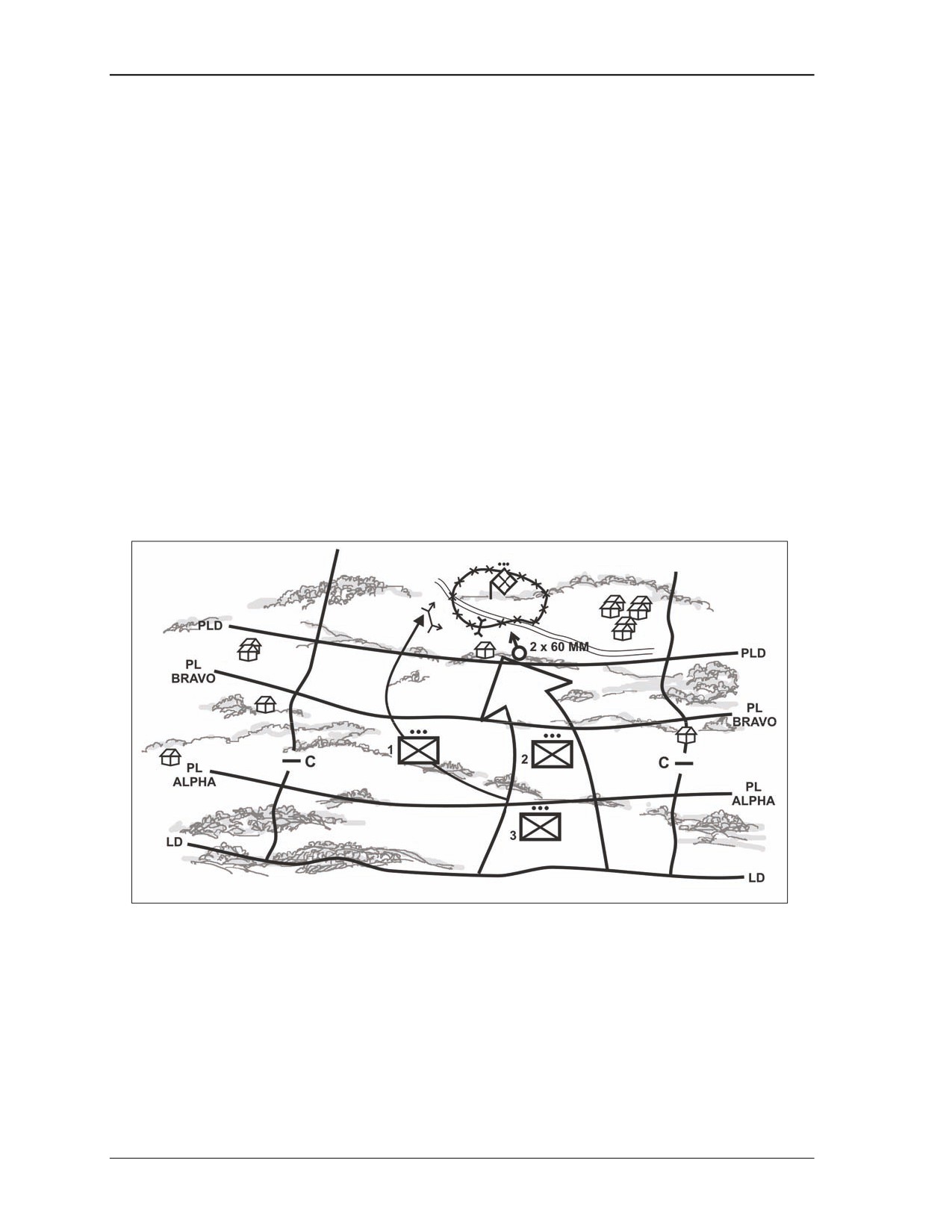
4-115. The company approaches the objective in a manner that supports its deployment prior to the
assault
(Figure 4-7, page
4-26). The company may cross the LD (or depart the perimeter defense)
supported by heavy suppressive direct and indirect fires, or wait until the appropriate time to initiate fires.
The commander must consider the time of the movement and the ammunition available. The commander
should also consider the effect of fires on his ability to achieve surprise. If so employed these fires may
continue until the company reaches its assault position or final coordination line (FCL); they then shift to
allow the assault on the objective. The commander can initiate indirect fires whenever he decides based on
his COA. In either case, the following fundamentals should be part of this step of the attack.
Figure 4-7. Movement to objective.
y The movement from the assembly area to the LD is timed so that movement to and across the
LD is continuous. The lead element of the company starts crossing the LD at the attack time
specified in the battalion OPORD. Before the company's movement, a patrol might be sent to
reconnoiter and mark the route and check the time it takes to move to the LD.
y The support element may precede the assault and breach elements to the LD in order to be in an
overwatch position ready to fire when the assault and breach elements cross the LD. Company
mortars move forward to a firing position near the LD to provide support during movement and
on the objective area. Mortars might have to displace as the operation progresses in order to
4-24
FM 3-21.10
27 July 2006
Offensive Operations
provide support in the objective area. The displacement is executed in such a manner to provide
continuous indirect fire support throughout the operation.
y
The commander normally avoids stopping in the attack position. However, if the company is
ahead of schedule or told to hold in the attack position, it occupies the attack position, posts
security, and waits until time to move (or until told to move).
y
During movement from the LD to the assault position, the company makes the best use of
cover, concealment, smoke, and supporting fire.
y
If the company is engaged by indirect fire en route, it moves quickly out of the impact area. If it
meets enemy resistance short of the objective, it returns fire at once. The leader of the platoon
in contact calls for and adjusts indirect fire on the enemy. Depending on the company plan and
the location and type of resistance, the platoon may bypass an enemy position that cannot affect
the mission.
y
If the company cannot bypass an enemy position, the company commander and the platoon
leader in contact must take prompt and aggressive action. The platoon leader tries to conduct
the platoon attack drill and destroy the enemy position. The commander quickly conducts an
estimate of the situation and issues FRAGOs as needed to carry out his plan. He coordinates
actions and fires so the company can attack the enemy with its full combat power. The
commander should maneuver to assault the flank or rear of the enemy position. When it has
destroyed or suppressed the enemy, the company continues toward its objective.
y
The company either bypasses or breaches obstacles along the route. The company should
bypass when feasible and when the terrain allows. The commander must decide the best way to
overcome the obstacle without losing momentum. In selecting the scheme of maneuver, the
commander normally tries to avoid COAs that require breaching of enemy obstacles. Enemy
obstacles are likely to be covered by direct and indirect fires; common sense would indicate
that the commander should avoid these areas. Because all forces construct defensive obstacles
around their positions, however, the attacking unit must be prepared to conduct a breach if a
bypass is not possible. In a battalion deliberate attack, the company might be the breach force;
it may conduct breaches with its organic equipment or with attached engineer assets. The
commander should consider avoiding the most obvious overwatch positions around the
obstacles and enemy strongpoint since these locations will likely be covered by enemy direct
and indirect fires. The company commander informs the battalion commander of obstacles that
may affect units following the company. The company commander positions engineers forward
to provide a rapid assessment of the obstacle.
y
The support force (if any) should be in position before the company's assault force reaches the
assault position. The support element initiates its fire on the objective based on a specific event,
on order, or at a specified time. The commander considers stealth and surprise when deciding
when to initiate direct and indirect fires. Supporting indirect fires are synchronized to impact at
the same time.
ISOLATE THE OBJECTIVE AND THE SELECTED BREACH SITE
4-116. Normally, the battalion isolates the objective area to allow the company (or companies) to
concentrate on the enemy strongpoint (Figure 4-8).
27 July 2006
FM 3-21.10
4-25
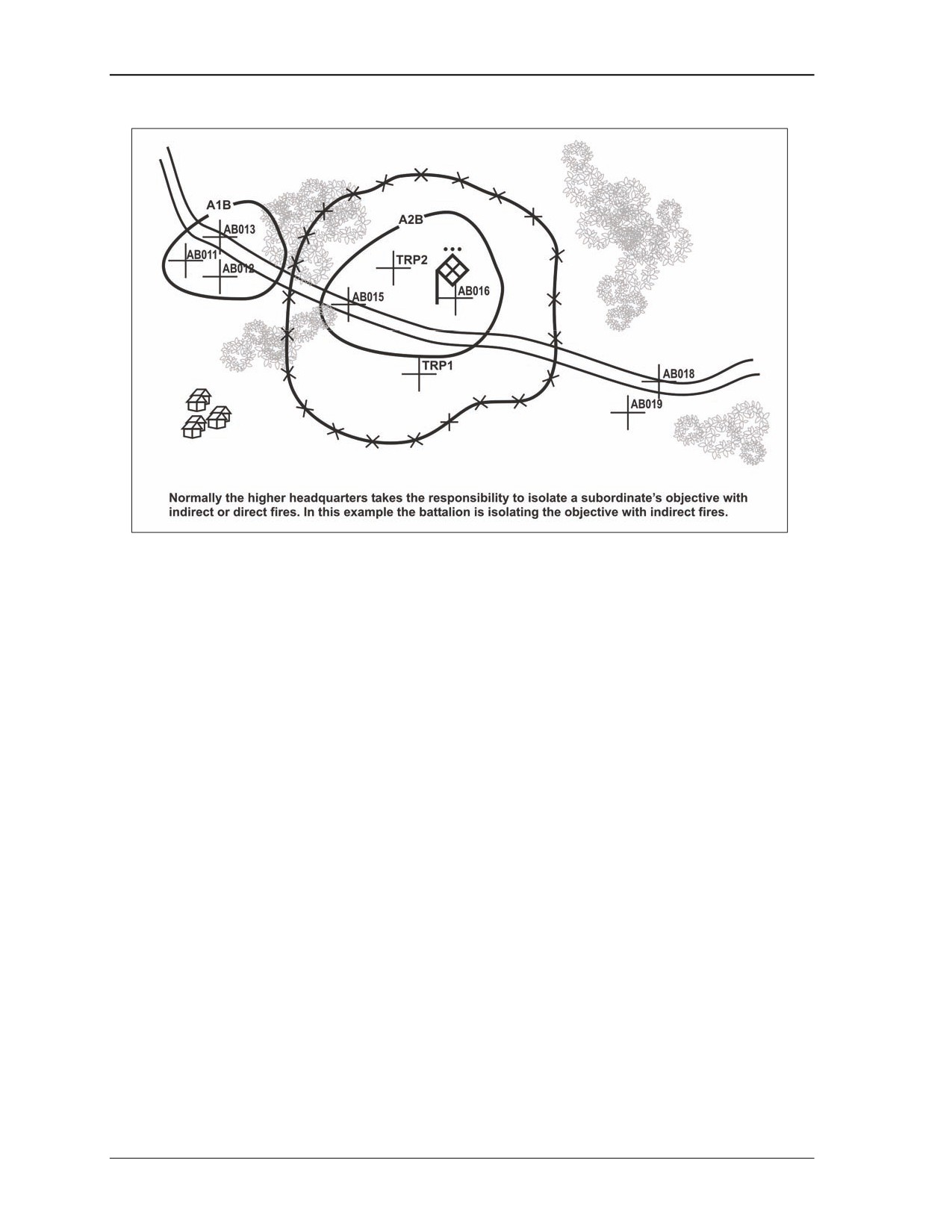
Chapter 4
Figure 4-8. Isolation of objective.
4-117. The company may begin the isolation during the leader's reconnaissance by positioning security
elements to prevent enemy movement into or out of the objective area. The commander must ensure that
these units understand what actions to take in the event of enemy contact. Initially, they may only observe
and report until the company deploys for the assault. At a designated time or signal, they begin active
measures to isolate the objective.
4-118. Once the objective area is isolated, the commander focuses on isolation at the point of attack or
breach point (if the company must breach) The commander always seeks at attack on the enemy's flank or
rear, and seeks to avoid a frontal attack into enemy obstacles (this is most likely the enemy's strength. )
This isolation helps prevent enemy reinforcement or repositioning at the point of attack (or breach site). It
also helps in suppressing enemy weapons and positions that have observation and fire on the point of
attack (or breach site. ) If the precise locations of enemy weapons have not been determined, but the
commander has still decided to breach, the support force concentrates on the terrain that dominates the
obstacle and breach site. The support force is assigned the main responsibility for this isolation. Figure 4-9
shows the planned general area to establish a breach.
4-119. The commander masses the majority of available combat power effects at the initial penetration or
breach point. He uses indirect fires to suppress or obscure adjacent enemy positions.
ATTACK TO SEIZE A FOOTHOLD
4-120. The initial penetration (or breach if necessary) of the enemy position is normally the Infantry
company's initial focus. The initial assault force (or breach force) bypasses or penetrates the enemy's
protective obstacles to gain a foothold and create a gap large enough for the assault element to pass through
(A and B, Figure 4-9).
4-26
FM 3-21.10
27 July 2006
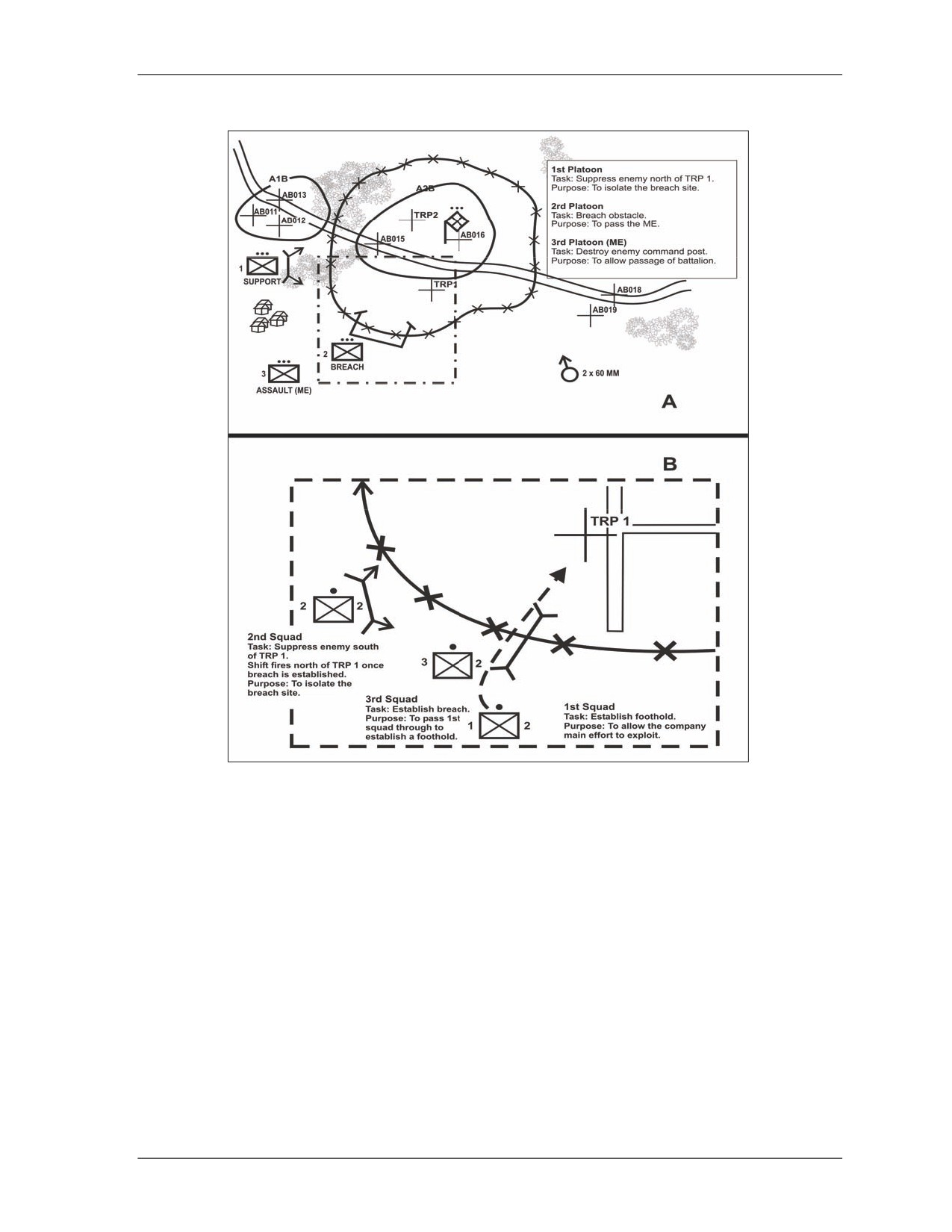
Offensive Operations
Figure 4-9. Breaching and securing of a foothold.
PREPARE
4-121. Suppress, obscure, secure, reduce, and assault (SOSRA) are the breaching fundamentals that must
be applied to ensure success when breaching against a defending enemy. These fundamentals will always
apply, but they may vary based on the specific battle-space situation (METT-TC). These fundamentals, and
the applicable task organization, should be planned for even if a breach is not actually necessary or
conducted. If the breach force can bypass obstacles and still seize the initial foothold then it will do so but
the force should still be prepared to breach.
SUPPRESS
4-122. Suppression is a tactical task used to employ direct or indirect fires on enemy personnel, weapons,
or equipment to prevent or degrade enemy fires and observation of friendly forces. The purpose of
suppression during breaching operations is to protect forces reducing and maneuvering through an
obstacle. Effective suppression is a mission-critical task performed during any breaching operation.
Suppressive fires prevent the enemy from emplacing effective fire on the breach site. Successful
suppression generally triggers the rest of the actions at the obstacle. Fire control measures ensure that all
fires are synchronized with other actions at the obstacle. Although suppressing the enemy overwatching the
27 July 2006
FM 3-21.10
4-27
Chapter 4
obstacle is the mission of the support force, the breach force should be able to provide additional
suppression against an enemy that the support force cannot effectively suppress.
OBSCURE
4-123. Obscuration must be employed to protect forces conducting obstacle reduction and the passage of
assault forces. Obscuration degrades enemy observation and target acquisition and conceals friendly
activities and movement. Obscuration smoke deployed on or near the enemy's position minimizes its
vision. Screening smoke employed between the reduction area and the enemy conceals movement and
reduction activities. It also degrades enemy ground and aerial observations. Obscuration must be carefully
planned to provide maximum degradation of enemy observation and fires, but it must not significantly
degrade friendly fires and control.
SECURE
4-124. Friendly forces secure the reduction area to prevent the enemy from interfering with obstacle
reduction and the passage of the assault force through the lanes created during the reduction. Security must
be effective against outposts and fighting positions near the obstacle and against overwatching units, as
necessary. Fires must secure the far side of the obstacle, or the terrain dominating the breach site must be
occupied before trying any effort to reduce the obstacle. The attacking unit's higher HQ has the
responsibility to isolate the breach area by fixing adjacent units, attacking enemy reserves in depth, and
providing counterfire support. Identifying the extent of the enemy's defenses is critical before selecting the
appropriate technique to secure the point of breach. If the enemy controls the point of breach and cannot be
adequately suppressed, the force must secure the point of breach before it can reduce the obstacle. The
breach force must be resourced with enough maneuver assets to provide local security against the forces
that the support force cannot sufficiently engage. Elements within the breach force that secure the
reduction area may also be used to suppress the enemy once reduction is complete.
REDUCE
4-125. Reduction is the creation of lanes through or over an obstacle to allow an attacking force to pass.
The number and width of lanes created varies with the enemy situation, the assault force's size and
composition, and the scheme of maneuver. The lanes must allow the assault force to pass through the
obstacle unimpeded. The breach force will reduce, proof (if required), mark, and report lane locations and
the lane-marking method to higher HQ. Follow-on units will further reduce or clear the obstacle when
required. Reduction cannot be accomplished until effective suppression and obscuration are in place, the
obstacle has been identified, and the point of breach is secure.
ASSAULT
4-126. A breaching operation is not complete until--
y Friendly forces have assaulted to destroy the enemy on the far side of the obstacle that can
place or observe direct and indirect fires on the reduction area.
y Battle handover with follow-on forces has occurred, unless no battle handover is planned.
PLANNING CONSIDERATIONS
4-127. In planning the breach operation, consider the following.
y The breach force moves forward by covered and concealed routes. If possible, the breach
should be covert to reduce the time the breach and assault forces are exposed to enemy fire. If
this is not possible or if the breaching try is compromised, the breach force moves under the
suppressive fires of the support force.
y The penetration of the enemy position is made on a narrow front. The concept is to make a
narrow penetration into the enemy defenses and then expand it enough to allow rapid passage
of the assault force. Normally, the company concentrates all combat power at one breach point.
However, it may use two breach sites if they are mutually supporting and do not result in a lack
of concentration or a piecemeal assault. When using only one breach site, the company should
plan an alternate site as a contingency in case the primary breach is unsuccessful.
4-28
FM 3-21.10
27 July 2006
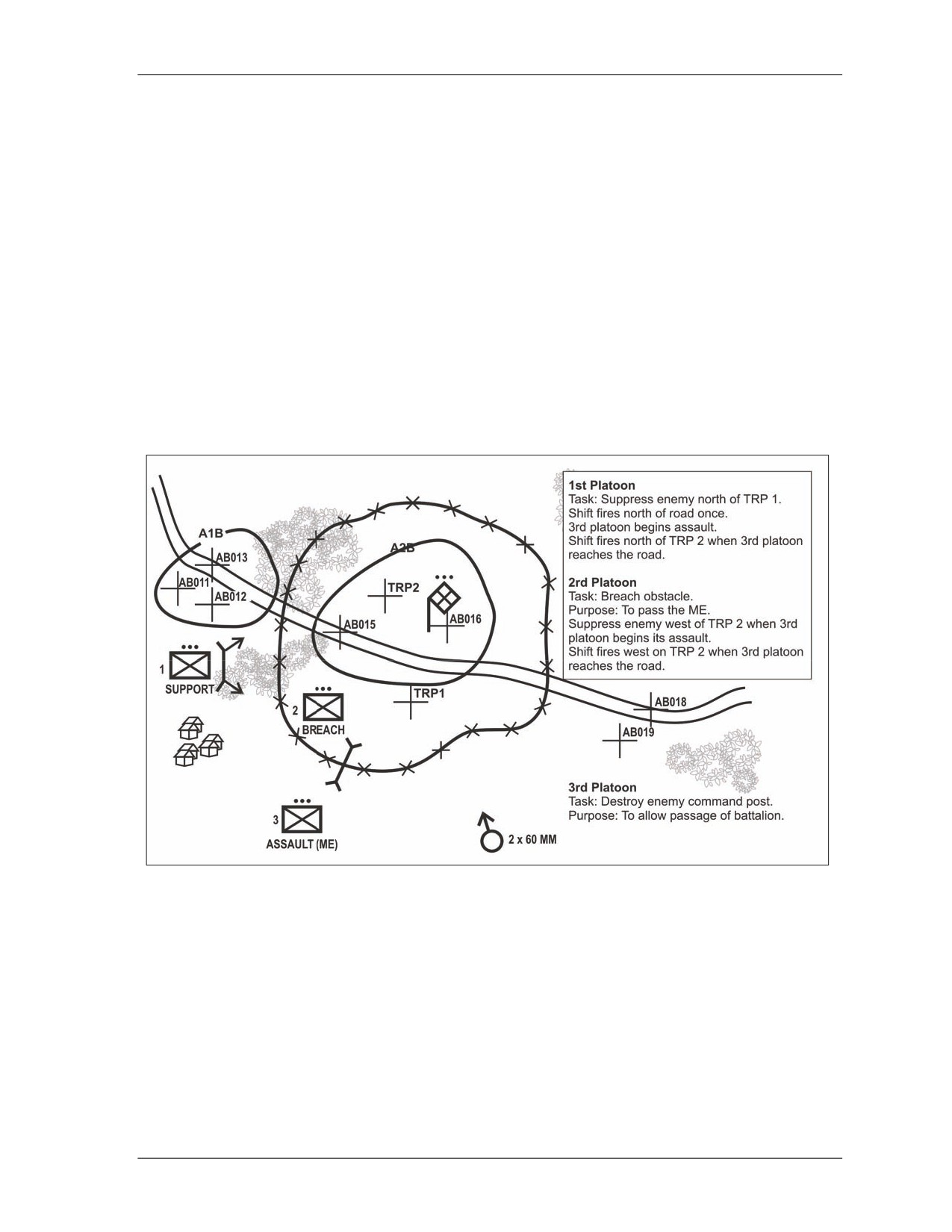
Offensive Operations
y The support force provides effective suppression for the breach and assault force(s) to cross the
killing ground. Each weapon in the support element has a specific enemy position or sector of
responsibility assigned. Initially, the support force establishes fire superiority with a maximum
volume of fire; then they maintain fire superiority throughout the attack. When indirect fires
shift, the support force increases the rate of direct fire to maintain the suppression.
y The support force normally occupies one position to simplify control. However, at times, the
support force must occupy several positions to provide effective suppression of the enemy. This
might be required to prevent the masking of fires by the breach or assault force or because of
the characteristics of the supporting weapons (120-mm/81-mm/60-mm mortars). The support
force also often needs to reposition once the assault force begins clearing the objective. They
may follow the assault force through the breach or reposition outside the enemy position.
EXPLOIT THE PENETRATION AND SEIZE THE DECISIVE POINT
4-128. After the successful breach, the assault force conducts the main attack (Figure 4-10, page 4-32).
Supported by the fires of the support force and the breach force, the assault force passes through the
breach. In planning the assault, consider the following points.
Figure 4-10. Exploitation of penetration.
4-129. The assault force must clear the enemy position as quickly as possible. If the assault force can
capture or destroy the enemy's command and control facilities or other key positions and weapons, the
enemy may surrender or abandon the position. If there is key terrain that allows control of the objective,
this might be the decisive point for the assault force. Normally, the assault force moves within the enemy's
trenches to avoid exposure to enemy fire.
4-130. The assault force must also organize into support, assault, and breach elements. As it encounters
subsequent positions or bunkers, it might have to repeat the breaching operations. As in the initial breach,
the breach element establishes a support-by-fire position and conducts the same sequence of breaching and
assaulting to reduce the position.
27 July 2006
FM 3-21.10
4-29
Chapter 4
4-131. The designation of a reserve allows the Infantry commander to retain flexibility during the attack.
The commander should be prepared to commit his reserve to exploit success and to continue the attack.
The reserve may also repulse counterattacks during consolidation and reorganization.
4-132. Once an assault starts, the company maneuvers aggressively to allow the enemy less time to react.
The commander monitors the situation and adjusts the plan to exploit any weakness found during the
attack. If a situation develops that is beyond the capability of his company, he notifies the battalion
commander. He might have to retain his position until other companies can maneuver to support him.
4-133. In moving from their assault positions, platoons advance in the formation most suitable to the
terrain and situation. When the assault element must move through a narrow lane in the obstacles, it
maintains dispersion and assaults through the lane by fire commands; signals should be coordinated to
support this. The commander moves where he can best control his platoons and supporting fire. Indirect
and direct fires of the support force shift when they endanger the advancing Soldiers.
4-134. The assaulting Soldiers clear enemy positions, secure and search prisoners, and move quickly
across the objective. When they reach the far side, they take up hasty fighting positions and continue to fire
at the withdrawing enemy. When the objective is secured and cleared (seized), the supporting elements and
company trains are called forward.
4-135. Once it seizes the objective, the company consolidates. Reorganization, if required, is normally
conducted concurrently with consolidation and consists of actions taken to prepare for follow-on
operations. As with consolidation, the Infantry company commander must plan and prepare for
reorganization as he conducts his TLP. He ensures that the company is prepared to take the
following actions.
y Provide essential medical treatment and evacuate casualties as necessary.
y Cross-level personnel and adjust task organization as required.
y Conduct resupply operations, including rearming and refueling.
y Redistribute ammunition.
y Conduct required maintenance.
ATTACK DURING LIMITED VISIBILITY
4-136. Successful attacks in limited visibility depend on leadership, reconnaissance, training, planning,
and surprise. Although these fundamentals are also key to daylight attacks, attacks in limited visibility
require certain considerations and the proper application of the techniques discussed in this chapter to
ensure control in the attack. Darkness, fog, heavy rain, and falling snow limit visibility. Smoke and dust
from high-explosive (HE) fires also limit visibility, but their effects don't last as long. Infantry companies
attack in limited visibility to--
y Achieve surprise.
y Avoid heavy losses.
y Cause panic in a weak or disorganized enemy.
y Exploit success and maintain momentum.
y Keep pressure on the enemy.
FUNDAMENTALS
4-137. The Infantry company conducts limited visibility attacks very much like daylight attacks). The
fundamentals for a daylight attack, discussed earlier in this chapter, still apply for night attacks.
Conducting attacks in this manner requires--
y A company that is well trained in limited visibility attacks.
y Enough natural light to employ the unit's NVDs.
y A simple, effective concept that takes advantage of the enemy's surprise and confusion.
y A successful reconnaissance of the objective area.
y Additional control measures and techniques, as needed.
4-30
FM 3-21.10
27 July 2006
Offensive Operations
CHALLENGES
4-138. When planning attacks at night, the Infantry commander must consider the increased
difficulty of--
y Controlling units, Soldiers, and fires.
y Identifying and engaging targets.
y Navigating and moving.
y Distinguishing friendly and enemy Soldiers.
y Locating, treating, and evacuating casualties.
y Locating and bypassing or breaching enemy obstacles.
PLANNING CONSIDERATIONS
4-139. In planning limited visibility attacks, the Infantry commander should also consider the following.
y Feints and other deceptions might be more effective. This is true for the enemy also.
y If a small element can infiltrate the enemy position, it can be extremely effective in supporting
the main attack. A small element can also covertly breach obstacles or neutralize key positions
and weapons to allow the main attack to seize a foothold quickly.
y It might be possible to infiltrate the main attack inside the enemy's positions and then fight from
the inside to the outside. In this case, the unit inside the position might be able to occupy
defensive positions and force the enemy to attack him.
ILLUMINATION AND INDIRECT FIRE
4-140. Two basic decisions must be made for conducting limited visibility attacks: illumination on the
objective and indirect fire support for the attack.
4-141. The Infantry company normally conducts nonilluminated attacks to exploit its technological and
training advantage. For all night attacks, however, illumination should be readily available in case the
enemy detects the attack and uses illumination, or if he possesses NVDs. Illumination may also be effective
to support reorganization and consolidation after the objective is secure, particularly for casualty
evacuation.
4-142. The Infantry company conducts illuminated night attacks like daylight attacks. Illumination is
available from artillery, mortars, M203s, and hand-fired and aircraft flares. Permission to fire illumination
is often retained by battalion because the light may affect adjacent unit operations.
4-143. Nonilluminated, nonsupported attacks offer the best chance of gaining surprise. These attacks are
conducted like daylight attacks.
4-144. Illuminated, supported attacks are almost identical to daylight attacks. These attacks can be most
effective when speed is essential, when there is limited time for reconnaissance, or when the enemy is
weak or disorganized. When conducting these types of attacks, the attacking unit still tries to use stealth
and the concealment of limited visibility to gain surprise. They then initiate fires and illumination to
support the assault.
RECONNAISSANCE
4-145. Reconnaissance is critical in every attack, but especially for attacks at night. It should be
conducted during daylight and down to the lowest level possible. Each unit should reconnoiter the routes
on which they will move, the positions they will occupy, and the objective they are assigned. The company
must balance the need for detailed information about the enemy against the risk of detection and loss
of surprise.
4-146. The reconnaissance plan should establish surveillance on the objective in case the enemy
repositions units and weapons, or prepares additional obstacles. Surveillance and security elements should
secure critical locations, such as assault and support positions, the LD or PLD, and key routes to protect the
company from enemy ambushes and spoiling attacks. These security elements assist in isolating the
27 July 2006
FM 3-21.10
4-31
Chapter 4
objective. Personnel who remain as surveillance serve as guides for the main body’s movement into the
assault position or PLD.
4-147. When reconnaissance is not successful due to lack of time, failure to identify critical aspects of the
enemy's position, detection by the enemy, or any other reason, the commander should request a delay in the
attack time to allow for further reconnaissance. If this is not possible, he should consider an illuminated or
supported attack. A night attack with marginal information on the enemy's defense is very risky and
difficult to conduct successfully.
4-148. The commander should also consider using SUASs for ground reconnaissance. Most SUASs have
both a daylight and limited visibility (infrared) capability and significantly aid in providing the commander
with needed information on the terrain and enemy. The Raven, for example, has the following
characteristics:
Weight
Just over 4 pounds
Flight endurance
About 80 minutes
Effective operational radius
About 10 kilometers
Flight speed
30 to 60 miles per hour
Operating altitude
100 to 1,000 feet
4-149. When beneficial to the tactical situation, SUASs may operate where they cannot be heard or
where the noise signature is discernable. Even if detected, they are difficult to shoot down.
SIMPLICITY
4-150. A simple concept, particularly for the actions on the objective, also supports control during the
assault. If possible, platoon and squad objectives should be small and easily identified.
4-151. Avoid developing a concept that requires the company to fight for each enemy fighting position.
As in a daylight attack, identify a decisive point and focus combat power at this location. Once the decisive
action is accomplished, the plan must also address any remaining enemy. If required by the higher
commander's concept or for an effective consolidation, the company might have to clear all enemy forces
from the objective area.
4-152. A smaller assault force maneuvering on the objective is easier to control and less likely to suffer
casualties from enemy or friendly fires. The assault force must have clear signals to ensure control of all
supporting fires, both direct and indirect.
4-153. The concept for a nonilluminated attack should be flexible to allow for adjustment to a daylight
attack if illumination becomes appropriate due to detection by the enemy or the use of illumination by an
adjacent unit. This is especially critical for a unit that plans a modified linear assault attack but might be
forced to conduct an illuminated attack. A contingency plan that reorients for illumination should be
prepared and issued, and every Soldier should know under what conditions to execute this plan. In some
cases, such as when the unit is already deployed through the PLD and advancing on the enemy, the
company might have to continue the attack as planned or try to disengage.
FIRE-CONTROL TECHNIQUES
4-154. Rehearsals are very important for achieving good fire control in limited visibility attacks.
Fire-control techniques for limited visibility include--
TRACER FIRE
4-155. Leaders in the assault force fire all tracers; their men fire where the leader's tracers impact. The
support force positions an automatic weapon on a tripod on the flank nearest the assault element. This
weapon fires a burst of tracers every 15 seconds to indicate the near limit of the supporting fires. All other
weapons in the support force keep their fires on the side of this tracer away from the assault force. The
assault force signals to shift fires to the next position or to a set distance. If required, these rounds can be
adjusted well over the head of the assault force to preclude casualties.
4-32
FM 3-21.10
27 July 2006
Offensive Operations
LUMINOUS TAPE OR CHEMICAL LIGHTS
4-156. Mark assault personnel to prevent fratricide. Do this in a way that avoids enemy detection. You
could put luminous tape on the back of the helmet or use small infrared chemical lights (if the enemy has
no NVDs). The support force should know where the lead assault force is. If individual Soldier markings
do not suffice, use large chemical lights (infrared or visible). Place these on the ground or throw them in
front of the assault force. When clearing a trench line, put the lights on a stick and move them with the lead
element.
WEAPONS CONTROL RESTRICTIONS
4-157. Assign weapons control restrictions to reduce the risk to the assault force.
y The platoon on the right in the assault might be given weapons free to the right flank, because
there are no friendly Soldiers there, but weapons tight or hold on the left because another
friendly unit is located there.
y The assault force might be restricted to using only shotguns and pistols.
y The assault force might be restricted to no automatic weapons fire on the objective. This
ensures that all automatic weapons in use are enemy.
OTHER TECHNIQUES
4-158. Use the following techniques to increase control during the assault.
y Not allowing flares, grenades, or smoke on the objective.
y Allowing only certain personnel with NVDs to engage targets on the objective.
y Using a magnetic azimuth for maintaining direction.
y Using mortar or artillery rounds to orient attacking units.
y Using guides.
y Reducing intervals between Soldiers and units.
SUPPORTING FIRES
4-159. Mortar, artillery, and anti-armor fires are planned for a night attack much like in a daylight attack.
However, they sometimes do not fire unless the Infantry company is detected or until the company is ready
to assault (based on METT-TC and the commander's scheme of maneuver. ) Some weapons may fire
before the attack and maintain a pattern to deceive the enemy or to help cover noise made by the company's
movement. This is avoided if it will disclose the attack.
4-160. Indirect fire is difficult to adjust when visibility is poor. If doubt exists as to exact friendly
locations, indirect fire is directed first at enemy positions beyond the objective and then walked onto the
objective. The illumination rounds might be fired to impact on the ground, providing both light and
markings on the objective. They may also be placed behind the objective and in the air, causing the enemy
to be silhouetted. Once illumination begins, it should continue until the objective is secure. Sufficient
ammunition must be available.
4-161. Smoke is planned to further reduce the enemy's visibility, particularly if he has night vision
devices. The smoke is laid close to or on enemy positions to avoid restricting friendly movement or
hindering the breaching of obstacles. Employing smoke on the objective during the assault may make it
hard for assaulting Soldiers to find enemy fighting positions, but if sufficient thermal sights are available,
using smoke on the objective may provide a decisive advantage for a well-trained unit.
4-162. Illumination is always planned for attacks to be conducted in limited visibility. This gives the
company commander the option of calling for it and ensuring it is coordinated. The battalion commander
normally controls illumination but may authorize the company commander to call for it when needed. If
the company commander decides to use illumination, he should not call for it until the assault is initiated or
the attack is detected. It should be placed on several locations over a wide area to confuse the enemy as to
the exact location of the attack. It should also be placed beyond the objective to help assaulting Soldiers
see and fire at withdrawing or counterattacking enemy Soldiers.
27 July 2006
FM 3-21.10
4-33
Chapter 4
4-163. Illumination may also be required if the enemy uses illumination to disrupt the effectiveness of the
company's NVDs. Once used, illumination must be continuous because attacking Soldiers will temporarily
lose their normal night vision. Any break in illumination may also reduce the effectiveness of suppressive
fire when the attackers need it most. Care must be taken to ensure that the squad and platoon leaders do not
use hand flares before the commander has decided to illuminate the objective.
4-164. The thermal sights of weapons such as the ITAS and Javelin might be employed strictly for
observation, if there are no targets for these weapons to engage. Positioned outside the objective area, these
sights can provide critical current information. They can also assist the support force in controlling their
fires or provide the assault force with reports of enemy movements on the objective.
4-165. When limited NVDs are available, they must be prioritized and employed at the most critical
locations. Priorities to consider include key Soldiers in the breach force, key leaders in the assault force,
other members of the assault force, and key leaders and weapons in the support force.
CONSOLIDATION AND REORGANIZATION
4-166. When it has seized the objective, the Infantry company consolidates and reorganizes.
Consolidation and reorganization are the same as for a daylight attack with the following exceptions.
y Guides lead trains and support elements forward to their positions.
y The consolidation plan should be as simple as possible. Avoid changes in task organization.
y Locating and evacuating casualties and enemy prisoners of war (EPWs) takes longer. They
might have to be moved to the rear of the objective and kept there until visibility improves.
y Platoon positions are closer together to ease control and improve mutual support. Position
distances are adjusted as visibility improves.
MODIFIED LINEAR ASSAULT
4-167. If the company is unable to conduct a limited visibility attack, such as a daylight attack, the
commander can choose from several simplified techniques. However, he should only employ these if the
company is unable to fight effectively in limited visibility. The modified linear assault is a technique for
conducting a nonilluminated attack. This technique is effective in controlling the fires of the assault force
by maintaining a linear formation. Each Soldier assaults using individual movement techniques while
remaining generally "on line" with the Soldier on his right and left. Each Soldier is able to engage or
suppress targets to his front with fewer restrictions because there is less chance of fratricide. This technique
provides extremely poor security and firepower to the flanks and poor flexibility once the assault
is initiated.
MODIFICATIONS
4-168. In the true linear assault, the company deploys through its respective squad RPs, and the entire
company conducts a linear assault across the objective
(Figure 4-11, page
4-38). To reduce the
vulnerability of the assault force, this technique is normally modified, which can be done in a number of
ways depending on the situation.
4-34
FM 3-21.10
27 July 2006
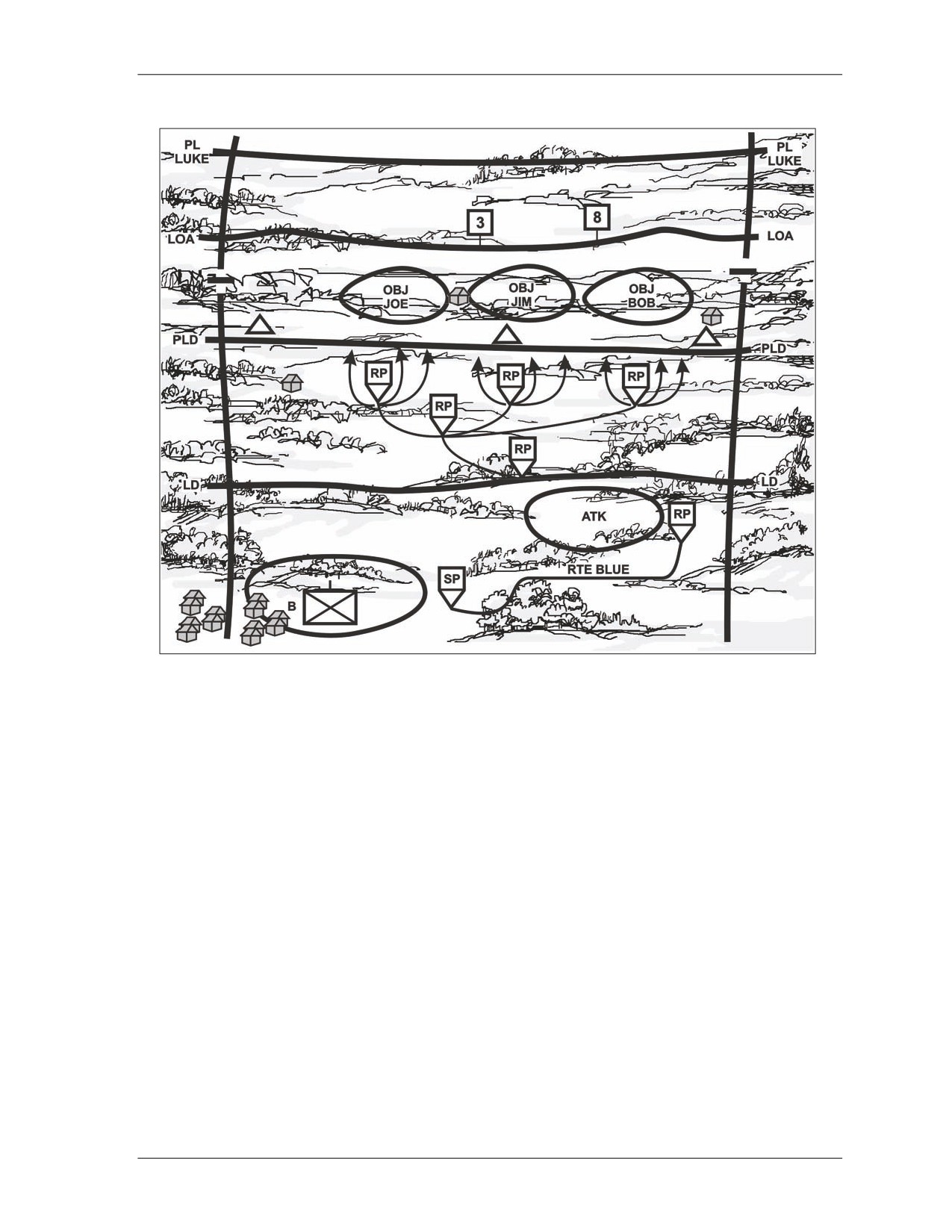
Offensive Operations
Figure 4-11. Linear assault.
4-169. The most effective modification is to establish part of the company in a support-by-fire position.
The remainder of the company deploys at the PLD and conducts the assault (Figure 4-12). Machine guns,
mortars, and Javelins are normally most effective in this role. M203s also might be effective if visibility is
sufficient for their employment. The flank of the assault force nearest the support force must be visible to
the support forwce. The fire team on this flank may mark themselves with chemical lights or glint tape to
ensure visibility. If task organized with an assault platoon from the weapons company, their heavy
weapons and close combat missiles can provide excellent supporting fires (see Appendix B).
27 July 2006
FM 3-21.10
4-35
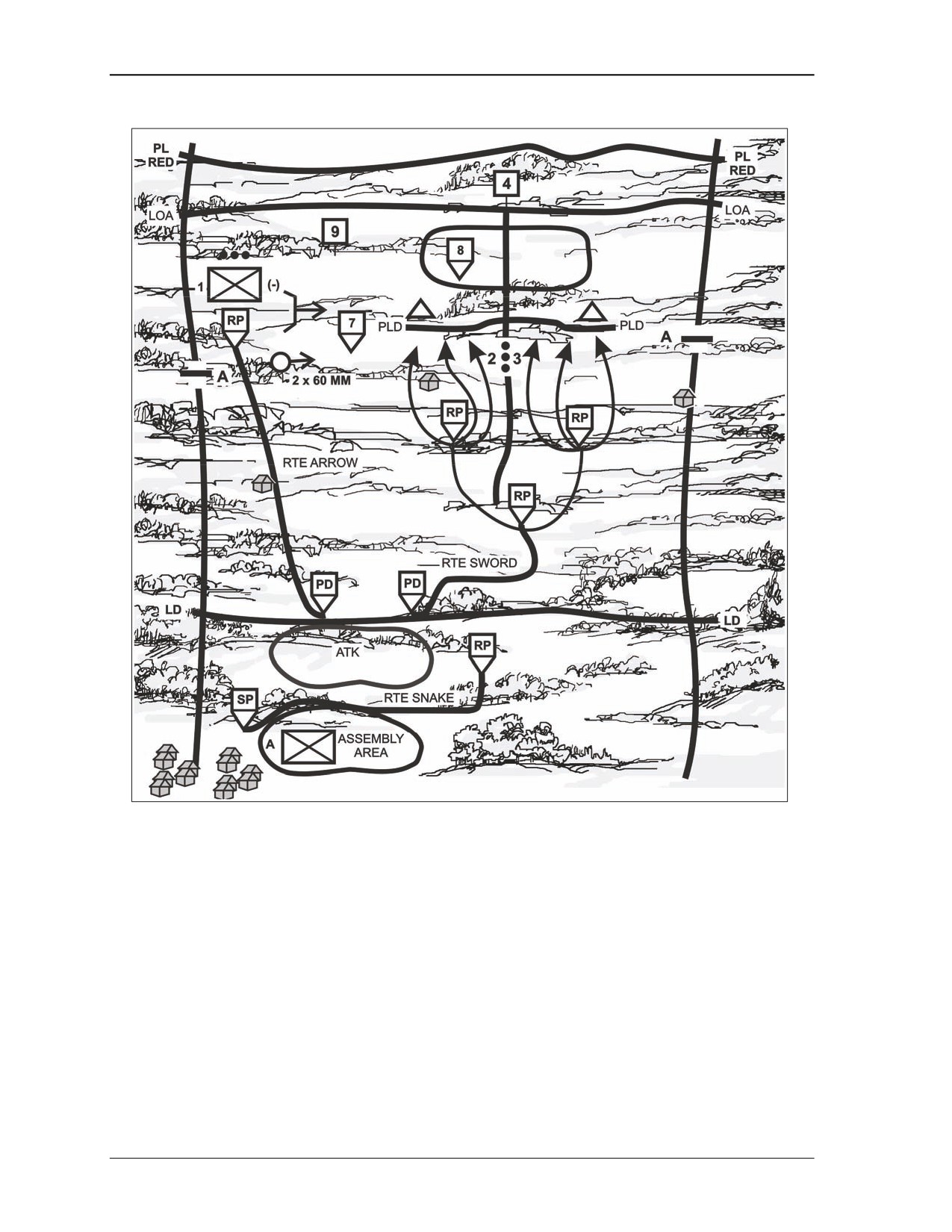
Chapter 4
Figure 4-12. Linear assault with support element.
4-170. Other variations of this technique may include attacking on a much narrower front with a smaller
assault force and having a large follow-and-support force. For example, instead of two platoons deploying
at the PLD, a platoon (-) could deploy against an identified enemy weak point (Figure 4-13, page 4-37).
This platoon could be tasked to bypass enemy positions to seize or destroy a critical location or facility,
with the follow-and-support force reducing bypassed positions. Another variation is to assign the assault
force a shallow objective to support the forward passage of the trailing unit, or to deploy through the
platoon release points and then to attack in squad files. The latter is most effective when the situation
supports an infiltration through the enemy defenses to seize decisive terrain or positions to the rear.
4-36
FM 3-21.10
27 July 2006
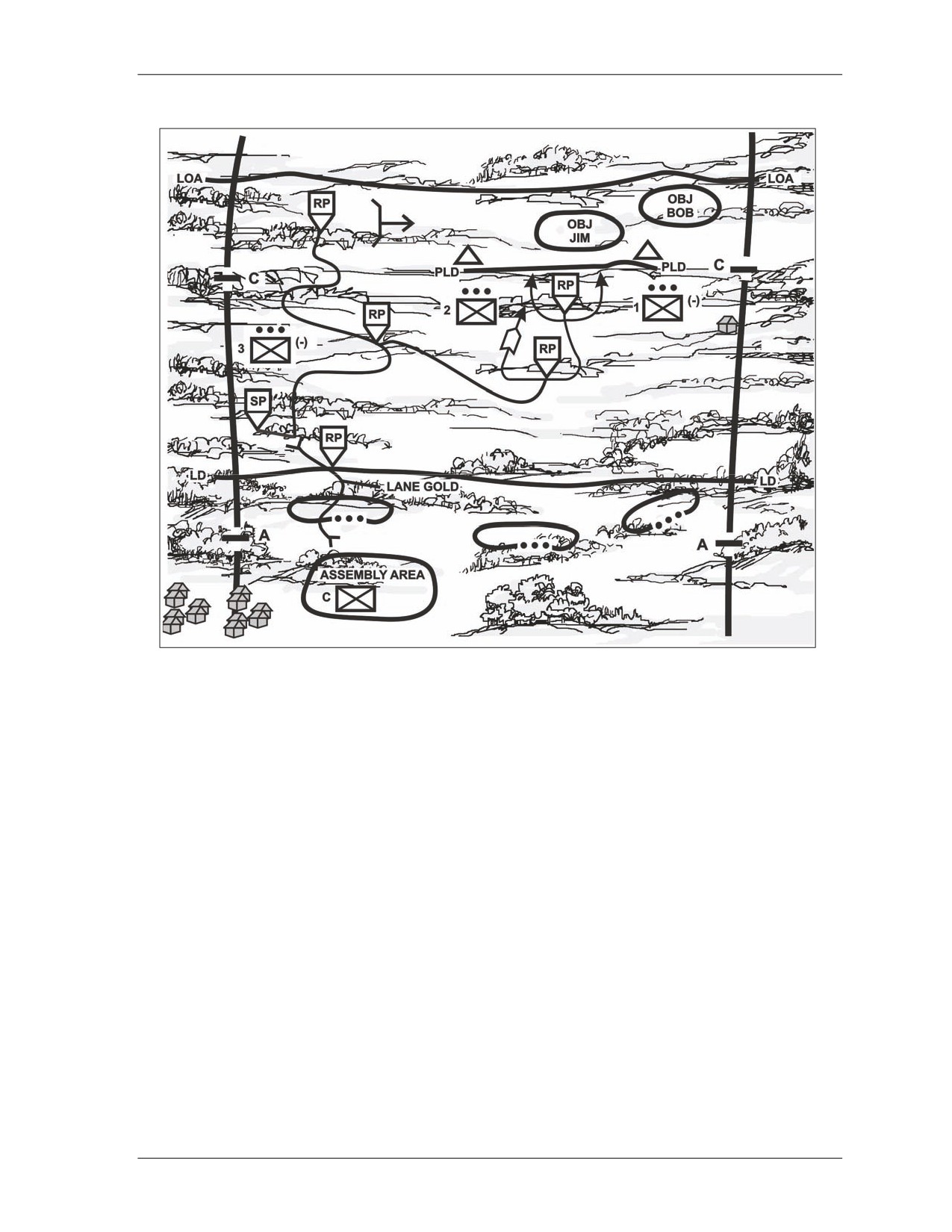
Offensive Operations
Figure 4-13. Linear assault with follow and support.
ADVANTAGES
4-171. The modified linear assault simplifies the control of supporting fires from outside the objective.
By establishing support positions perpendicular to the direction of assault, the supporting fires can be
employed next to the assault force and then shifted in front of them as they advance.
DISADVANTAGES
4-172. The linear formation is the biggest weakness with the modified linear assault. If the enemy is in
well-prepared defensive positions, the linear formation ensures at least part of the assault force attacks
through the enemy's kill zones. Also, to assault while using this technique makes it very difficult for the
leader to concentrate combat power against an identified enemy weakness. Finally, if the enemy has NVDs
or the assault force runs into unidentified obstacles after deploying at the PLD, fire superiority may not be
achieved and the assault will rapidly come to a halt. This may result in the majority of the company being
decisively engaged in the enemy killing ground.
CONDUCT OF THE ASSAULT
4-173. Although there are significant difficulties with the modified linear attack, it remains a viable
technique for attack in limited visibility. It is most effective against a weak or disorganized enemy. If the
enemy has NVDs or a well-prepared defense with protective obstacles, this technique should not be used.
An illuminated, supported attack that is conducted as a daylight attack might be the most effective option in
that situation.
27 July 2006
FM 3-21.10
4-37
Chapter 4
4-174. Before attacking in this manner, the Infantry company should secure the PLD and provide
personnel to guide the company from the LD to the PLD. Each platoon provides personnel to secure their
portion of the PLD and to guide the platoon from the platoon RP. These Soldiers are briefed on the routes
from the LD to the platoon RP, actions on enemy contact, time of departure, and other information needed
by the patrol units to conduct their mission. They move forward to the platoon RP; then they move forward
to reconnoiter and mark the platoon routes, secure their respective parts of the PLD, and observe the
objective. The platoon guides go back to the platoon RP to guide their platoons to the squad RP and to
the PLD.
4-175. Once the company crosses the LD, movement to the PLD is continuous. They move slowly to
maintain stealth. Platoons are released at the platoon RP so they can deploy before reaching the PLD. Once
their units are deployed, the platoon leaders and the support element leader notify the commander. When
the company is fully deployed, the commander informs the battalion commander. On the battalion
commander's order, the company moves silently forward from the PLD. The platoons guide on the
base platoon.
4-176. When the attack is discovered, or on the commander's order, the support element opens fire and
the platoons assault. Leaders must recognize that this technique for conducting a limited visibility attack
results in a linear assault. To be successful, the assault must achieve surprise and rapidly overwhelm the
defender. If the initial assault fails, control is difficult to regain. Scattered enemy fire must not be taken as a
loss of surprise, and it should not be cause to start the assault.
4-177. Soldiers assault using individual movement techniques to maneuver. The support force must
immediately gain fire superiority with a heavy volume of fire. Tracers are used to improve accuracy, to
control fires, and to allow the assault force to see where its supporting fires are impacting. The FIST calls
for indirect fire around and beyond the objective to disrupt enemy reinforcement. As the assault closes on
the objective, fires are shifted beyond the limit of advance or lifted entirely. Soldiers must not go beyond
the limit of advance. If the enemy discovers the attack before the company reaches the PLD, the
commander may--
y Call for planned, supporting fire to suppress the enemy.
y Call for illumination (if authorized by the battalion commander) to ease control and movement.
y Continue as if it were a daylight attack by modifying the attack plan to a daylight attack.
Note: A linear assault, even a modified variation, is very risky when conducted under
illumination.
Section VI. MOVEMENT TO CONTACT
This section discusses planning considerations and techniques for movements to contact; conduct of a search
and attack, and conduct of an approach march.
DEFINITION
4-178. A movement to contact is an offensive operation used to develop the situation and establish and
regain contact with the enemy. It is normally used when the tactical or enemy situation is vague, when the
enemy has broken contact, or there is no time to reconnoiter extensively to locate the enemy. Contact
results in initiation of another operation such as attack against a stationary or moving enemy force, defense,
delay, or withdrawal. The fundamentals and techniques discussed here also apply to the approach phase of
a hasty or deliberate attack; the main difference is the amount of enemy intelligence. In the approach phase
of an attack, the enemy situation is more clear. Therefore, the company moves toward the objective in a
way that avoids enemy detection and supports its deployment in the assault.
4-38
FM 3-21.10
27 July 2006
Offensive Operations
PLANNING CONSIDERATIONS
4-179. The Infantry company normally conducts MTC as part of a battalion or larger element; however,
based on the METT-TC factors, it can conduct the operation independently. As an example, the company
may conduct MTC prior to occupation of a screen line. Because the enemy situation is not clear, the
company moves in a way that provides security and supports a rapid buildup of combat power against
enemy units once they are identified. Two techniques for conducting a MTC are the search-and-attack
technique and the approach-march technique. If no contact occurs, the company might be directed to
conduct consolidation on the objective. The Infantry company commander analyzes the situation and
selects the proper tactics to conduct the mission. He reports all information rapidly and accurately and
strives to gain and maintain contact with the enemy. He retains freedom of maneuver by moving the
company in a manner that--
y Ensures adequate force protection measures are always in effect.
y Makes enemy contact (ideally visual contact) with the smallest element possible (ideally, a
reconnaissance and surveillance [R&S] element). The commander plans for any forms of
contact to identify enemy locations.
y Rapidly develops combat power upon enemy contact.
y Provides all-round security for the unit.
y Supports the battalion concept.
SEARCH AND ATTACK
4-180. Search and attack is a technique for conducting a MTC; this technique shares many of the same
characteristics of an area security mission (FM 3-0). Conducted primarily by Infantry forces and often
supported by heavy forces, a commander employs this form of a MTC when the enemy is operating as
small, dispersed element, or when the task is to deny the enemy the ability to move within a given area.
The battalion is the echelon that normally conducts a search and attack. A brigade will assist its
subordinate battalions by ensuring the availability of indirect fires and other support.
PURPOSE
4-181. A commander conducts a search and attack for one or more of the following purposes.
y Protect the force--prevent the enemy from massing to disrupt or destroy friendly military or
civilian operations, equipment, property, and key facilities.
y Collect information--gain information about the enemy and the terrain to confirm the enemy
COA predicted by the IPB process. Help generate SA for the company and higher
headquarters.
y Destroy the enemy and render enemy units in the AO combat ineffective.
y Deny the area--prevent the enemy from operating unhindered in a given area such as in any
area he is using for a base camp or for logistics support.
EXECUTION
4-182. An Infantry company is normally tasked to accomplish reconnaissance, finding, fixing, or
finishing the enemy. The company normally acts within the context of the battalion concept of operation.
The commander establishes control measures and communications means between any closing elements to
prevent fratricide. The reconnaissance force conducts a zone reconnaissance to reconnoiter identified
named areas of interest (NAIs).
4-183. Once the reconnaissance force identifies and locates the enemy force, the fixing force develops
the situation, then executes one of two options based on the commander's guidance and the METT-TC
factors. The first option is to block identified routes that the detected enemy can use to escape or reinforce
itself. The fixing force maintains contact with the enemy and positions its forces to isolate and fix him
before the finishing force attacks. The second option is to conduct an attack to fix the enemy in his current
27 July 2006
FM 3-21.10
4-39