FM 3-21.10 (FM 7-10) The Infantry Rifle Company (July 2006) - page 2
Chapter 1
y Monitors the tactical situation, and anticipates and coordinates health service support (HSS)
requirement and Class VIII resupply as necessary.
y Advises the company commander and 1SG on mass casualty operations.
y Keeps the 1SG informed on the status of casualties, and coordinates with him for additional
HSS requirements.
Section V. COMBAT POWER, LEADERSHIP, AND WARFIGHTING FUNCTIONS
Combat power is the ability to fight. It is the aggregate of a unit’s disruptive or destructive force. It is made up
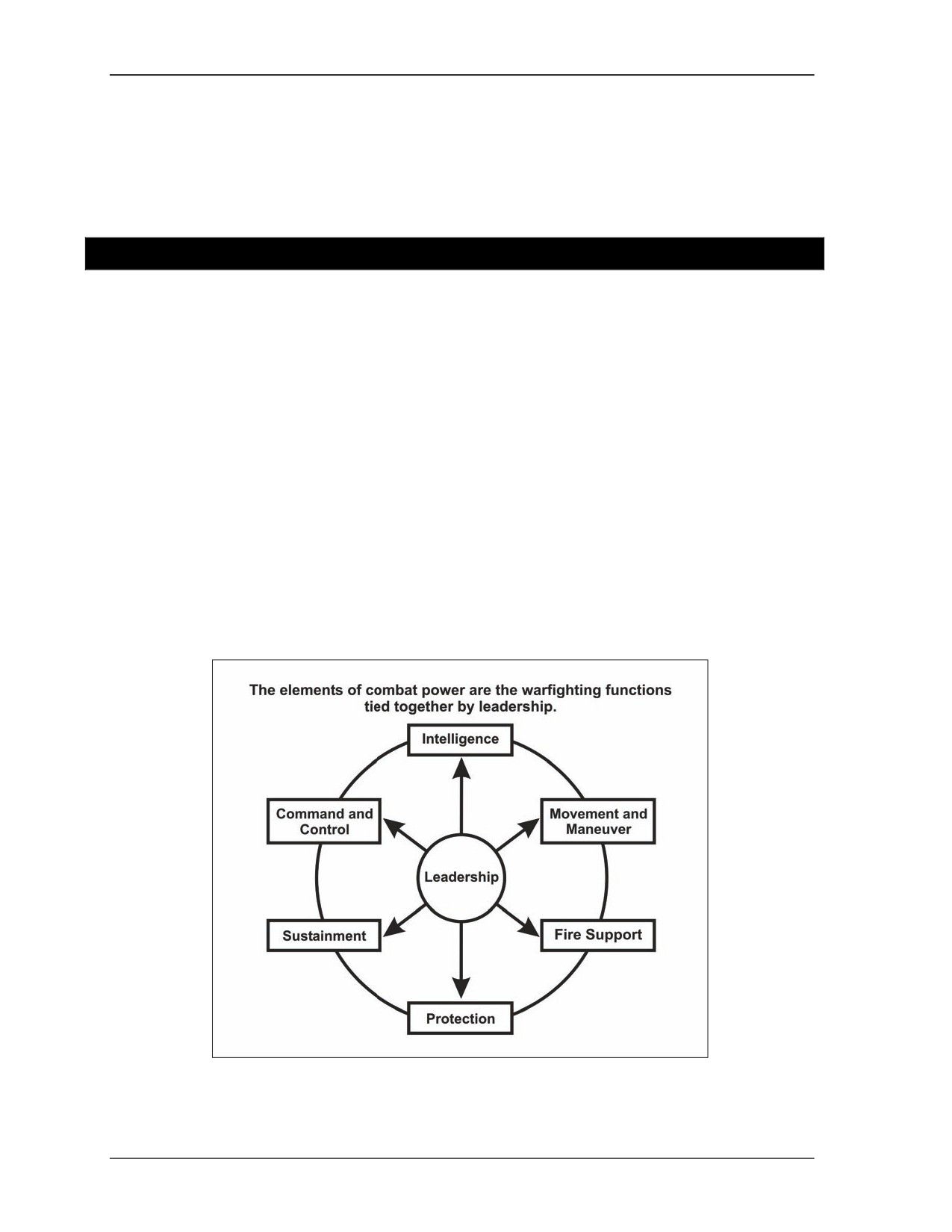
of six warfighting functions (WFF) tied together by leadership (Figure 1-8, page 1-18).
LEADERSHIP
1-53.
Leadership is the least tangible and most dynamic element of combat power. Confident,
audacious, and competent leadership focuses the other elements of combat power. It serves as the catalyst
that creates conditions for success. Leaders inspire Soldiers to succeed. They provide purpose, direction,
and motivation in all operations. Leadership is crucial. It often makes the difference between success and
failure, particularly in small units.
1-54.
A warfighting function is a group of tasks and systems (people, organization, information, and
processes) united by a common purpose that commanders use to accomplish missions and training
objectives. The warfighting functions are intelligence, movement and maneuver, fire support, protection,
sustainment, and command and control. These warfighting functions replace the battlefield
operating systems.
1-55.
Commanders visualize, describe, direct, and lead operations and training in terms of the
warfighting functions. Decisive, shaping, and sustaining operations combine all the warfighting functions.
No function is exclusively decisive, shaping, or sustaining.
Figure 1-8. Elements of combat power.
1-18
FM 3-21.10
27 July 2006
Introduction
INTELLIGENCE
1-56.
The intelligence warfighting function is the related tasks and systems that facilitate understanding
of the enemy, terrain, weather, and civil considerations. It includes those tasks associated with intelligence,
surveillance, and reconnaissance. The intelligence warfighting function is a flexible and adjustable
architecture of procedures, personnel, organizations, and equipment that provide relevant information and
products relating to the threat, civil populace, and environment to commanders.
MOVEMENT AND MANEUVER
1-57.
The movement and maneuver warfighting function is the related tasks and systems that move
forces to achieve a position of advantage in relation to the enemy. It includes those tasks associated with
employing forces in combination with direct fire or fire potential (maneuver), force projection (movement),
and mobility and countermobility. Movement and maneuver are the means by which commanders
concentrate combat power to achieve surprise, shock, momentum, and dominance.
FIRE SUPPORT
1-58.
The fire support warfighting function is the related tasks and systems that provide collective and
coordinated use of Army indirect fires, joint fires, and offensive information operations. It includes those
tasks associated with integrating and synchronizing the effects of these types of fires with the other
war-fighting functions to accomplish operational and tactical objectives.
PROTECTION
1-59.
The protection warfighting function is the related tasks and systems that preserve the force so the
commander can apply maximum combat power. Preserving the force includes protecting personnel
(combatant and noncombatant), physical assets, and information of the United States and multinational
partners. It includes the following task areas:
y Safety.
y Fratricide avoidance.
y Survivability.
y Air and missile defense.
y Antiterrorism.
y Counterproliferation and consequence management actions associated with chemical,
biological, radiological, nuclear, and high-yield explosive weapons.
y Defensive information operations.
y Force health protection.
SUSTAINMENT
1-60.
The sustainment warfighting function is the related tasks and systems that provide support and
services to ensure freedom of action, extend operational reach, and prolong endurance. It includes those
tasks associated with—.
y Maintenance.
y Transportation.
y Supply.
y Field services.
y Explosive ordnance disposal.
27 July 2006
FM 3-21.10
1-19
Chapter 1
y Human resources support.
y Financial management.
y Health service support.
y Religious support.
y Band support.
y Related general engineering.
1-61.
Sustainment allows uninterrupted operations through adequate and continuous logistical support
such as supply systems, maintenance, and other services.
COMMAND AND CONTROL
1-62.
The command and control warfighting function includes the related tasks and systems that support
commanders in exercising authority and direction. It includes the tasks of acquiring friendly information,
managing relevant information, and directing and leading subordinates.
1-63.
Command and control has two parts: the commander and the command and control (C2) system.
Information systems—including communications systems, intelligence-support systems, and computer
networks—back the command and control systems. They let the commander lead from anywhere in their
AO. Through command and control, the commander initiates and integrates all warfighting functions.
1-20
FM 3-21.10
27 July 2006
Chapter 2
Troop-Leading Procedures
The methods described in this chapter are guides for the commander to apply based
on his situation, his experience, the experience of his subordinate leaders, and key
planning concepts. The tasks involved in some steps, such as issuing the warning
order, initiating movement, and reconnoitering, can recur several times. The last
steps, supervising and refining the plan, occur throughout the ttroop-leading
procedures.
The planning steps in the TLP reflect, but do not duplicate, those in the military
decision-making process (MDMP) (FM 5-0). Some steps in the MDMP help the
battalion or higher commander coordinate staff and commander responsibilities of
units with staffs. However, leaders from company level down have no staff officers,
so they must conduct their own planning. The TLP reflect this reality, yet they
manage to incorporate the spirit, language, and general process of the MDMP. These
help the commander prepare orders
(WARNOs, OPORDs, and FRAGOs). The
sections in this chapter discuss the steps of the TLP.
This edition expands the discussion of battle command and the TLP to address
analysis of mission, enemy, terrain (and weather), troops (and support) available,
time available, and civil considerations (METT-TC), key planning concepts, common
pitfalls, and its integration into the military decision making process.
Section I. OVERVIEW
Battle command is the application of leadership to combat power. It is an art that relies on command skills.
These skills are developed over time through study, practice, and judgment. The commander visualizes the
operation, describing it in his intent and concept of the operation, and he directs the actions of subordinates
within his intent. He directly influences operations by his personal presence and his command and control (C2)
system. He uses the WFF to organize, prepare, coordinate, integrate, synchronize, and execute his plan. That is,
he considers everything he has or knows for or about an operation for each WFF.
BATTLE COMMAND
2-1.
Visualizing, describing, and directing are aspects of leadership common to every commander.
Technology, the fluid nature of operations, the increased volume of information that commanders must
process, and today’s battlefield underline the importance of the commander's ability to visualize, describe,
and direct operations. Assessment is also an integral part battle command. Commanders must continually
assess the threat, friendly forces, and effects throughout all three aspects battle command.
VISUALIZE
2-2.
On receipt of a mission, the Infantry company commander considers his battlespace and conducts
a mission analysis. He uses the following to develop his initial vision, which he continually confirms
or adapts.
27 July 2006
FM 3-21.10
2-1
Chapter 2
y The factors of METT-TC.
y Elements of the operational framework.
y Staff estimates from higher headquarters.
y Input from other subordinates.
y His own experiences and judgment.
DESCRIBE
2-3.
The commander uses the operational framework to relate decisive, shaping, and sustaining
operations to time and space. For all operations, purpose and time determine the allocation of space. The
commander clarifies his description as circumstances develop. He emphasizes how the combination of
decisive, shaping, and sustaining operations relates to accomplishing the purpose of the overall operation.
The commander describes his vision in the statement of his (commander's) intent and concept of the
operation. He chooses terms and graphics that suit the nature of the mission and his experience.
DIRECT
2-4.
The commander directs throughout the operations process. His directions take different forms
during planning, preparation, and execution. Throughout the operation, he makes decisions and directs
actions based on his understanding of the situation. He stays current on the situation by continuously
assessing it.
ARMY PLANNING PROCESS
2-5.
The standard Army planning process has five interrelated subprocesses: mission analysis, course
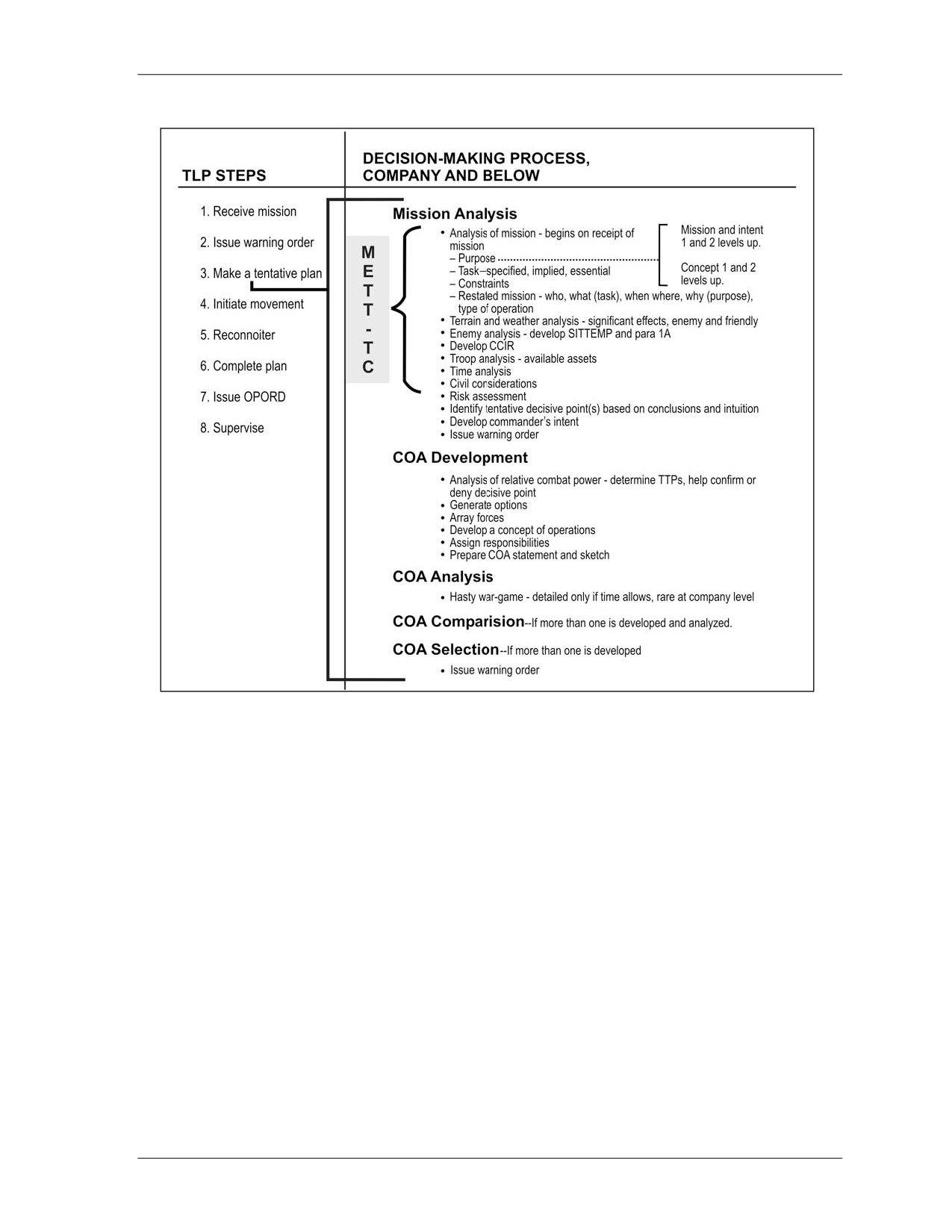
of action (COA) development, COA analysis, COA comparison, and COA selection. Figure 2-1 shows this
process within the TLPs. The goal of Army planning is to develop unique solutions to unique tactical
problems. By tailoring solutions, leaders avoid setting patterns. This prevents the enemy from predicting
friendly actions.
2-2
FM 3-21.10
27 July 2006
Troop-Leading Procedures
Figure 2-1. Army planning process within TLP.
KEY PLANNING CONCEPTS
2-6.
Planning at the small Infantry unit level is seldom very detailed. Small-unit leaders rely more on
thoroughly rehearsing unit SOPs, techniques, procedures, and drills. However, based on the mission and on
the next higher commanders' concepts of the operations, company commanders might plan in detail. They
use the acrostic "PLANNING" to remember these key planning concepts (Figure 2-2, page 2-4).
27 July 2006
FM 3-21.10
2-3

Chapter 2
Figure 2-2. Key planning concepts.
Parallel Plans
2-7.
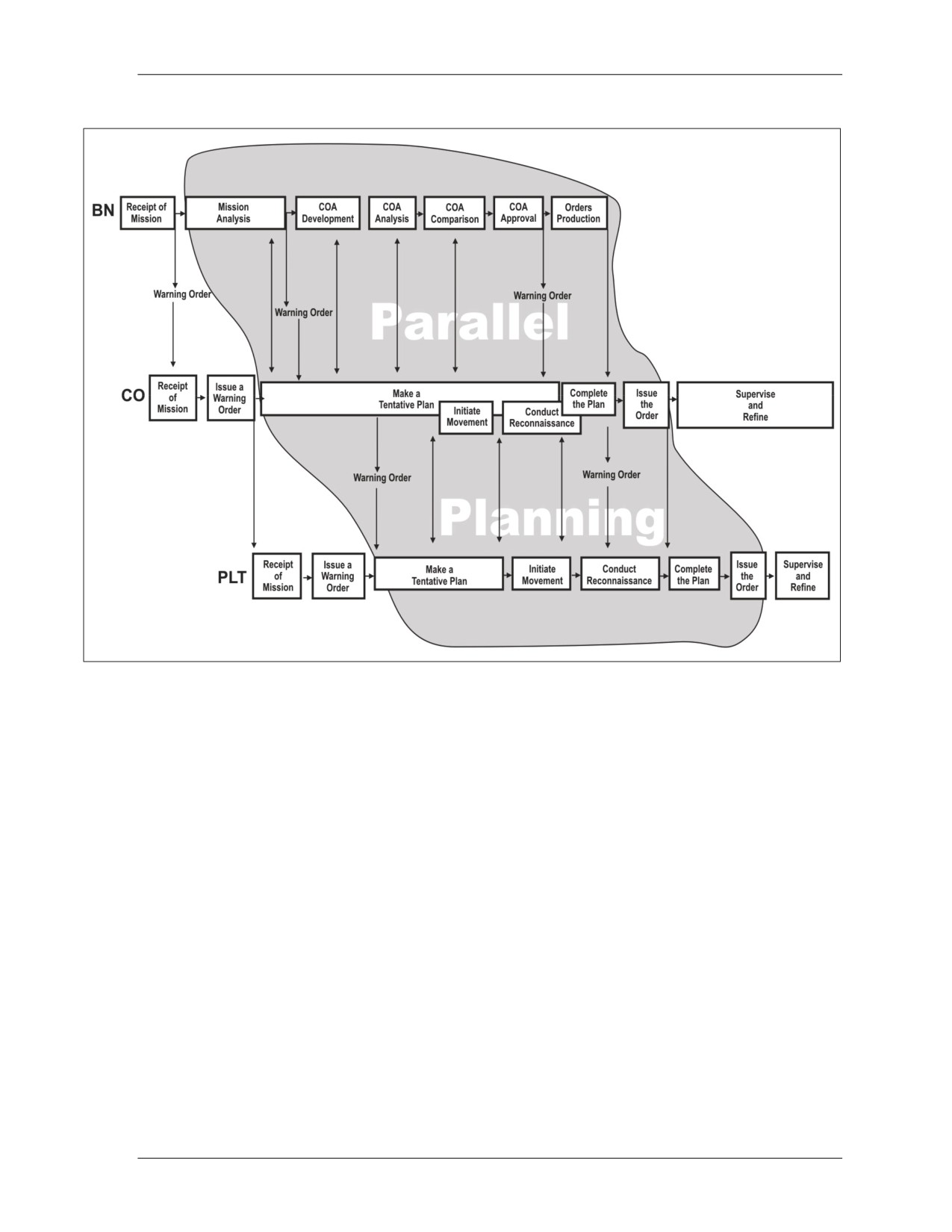
Parallel planning occurs when two or more echelons plan for the same operation at about the same
time. Parallel planning is easiest when higher headquarters continuously shares information on future
operations with subordinate units (FM 5-0 and Figure 2-3). Rather than waiting until higher finishes
planning, effective leaders start developing their units' missions as they receive information. They flesh out
their missions as they learn more. They start by identifying their units' missions, stating their intents, and
ensuring that they reflect the operational concepts of their higher and second higher headquarters. They
choose the tasks most likely to be assigned to their units, and then they develop mission statements based
on the information they have received. At all levels, developing and describing the vision of Infantry
leaders requires time, explanation, and ongoing clarification. All leaders understand that their next higher
commander's concept of operations (CONOP) will continue to mature, and that they must continue parallel
planning as it does so, up until execution.
2-4
FM 3-21.10
27 July 2006
Troop-Leading Procedures
Figure 2-3. Parallel planning.
Risk Assessment
2-8.
This starts during planning and is an inherent aspect of the operation process. On the battlefield,
risk assessment (Appendix A, Risk Management, Fratricide Avoidance, and the Effects of Continuous
Operations) is the leaders' best tool for identifying tactical hazards, and for reducing the risks to both their
units and to the mission itself. While this tool helps control the accidental hazards present in all operations,
its real value lies in helping the leaders identify and control tactical risks.
Approach-Sequencing Operations
2-9.
Part of the art of planning is to determine the sequence of activities that will accomplish the
mission most efficiently (FM 5-0).
Sequential Approach
2-10.
This approach accomplishes tasks step-by-step. Conventional, sequential operations are easy to
predict because they establish patterns.
27 July 2006
FM 3-21.10
2-5
Chapter 2
Simultaneous Approach
2-11.
This approach accomplishes many things at once. Simultaneous operations are difficult to predict
due to their suddenness. For the same reason, they are difficult to control.
Battlefield Organization
2-12.
As part of the troop-leading procedures, commanders visualize their battlespace and determine
how to arrange their forces. The battlefield organization is the allocation of forces in the AO by purpose. It
consists of three all-encompassing categories of operations: decisive, shaping, and sustaining. Purpose
unifies all elements of the battlefield organization by providing the common focus for all actions.
Decisive Operations
2-13.
Decisive operations are those that directly accomplish the mission assigned by the higher
headquarters. Decisive operations conclusively determine the outcome of major operations, battles, and
engagements. There is only one decisive operation for any major operation, battle, or engagement for any
given echelon. The main effort and the decisive operation are not always the same. Commanders anticipate
shifts of main efforts throughout an operation and include those associated shifts in priorities, assets, and
resources to them
(subordinates) in the plan. In contrast, changing the decisive operation requires
execution of a branch, sequel, or new plan. A shaping operation may be the main effort before execution of
the decisive operation. However, the decisive operation becomes the main effort upon execution.
Shaping Operations
2-14.
Shaping operations at any echelon create and preserve conditions for the success of the decisive
operation. Shaping operations include lethal and nonlethal activities conducted throughout the AO. They
support the decisive operation by affecting the enemy capabilities and forces, or by influencing enemy
decisions.
Sustaining Operations
2-15.
Sustaining operations are operations at any echelon that enable shaping and decisive operations by
providing sustainment, rear area and base security, movement control, terrain management, and
infrastructure development.
Nested Concepts
2-16.
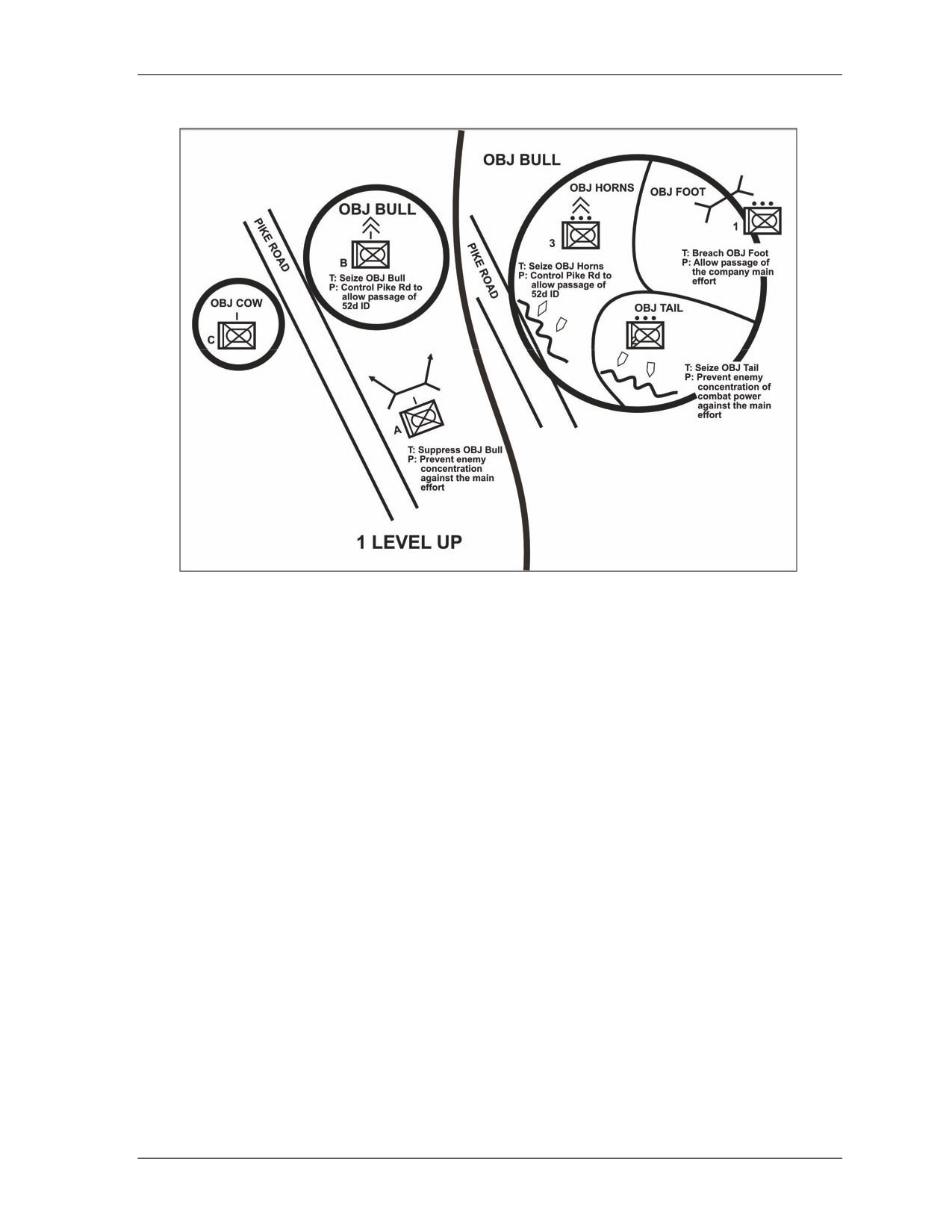
A nested concept is a planning technique to achieve unity of purpose. Each subsequent echelon’s
concept of operations is embedded in the other (Figure 2-4). When developing their concepts of the
operation, leaders ensure that their concepts are nested within those of their higher headquarters. They also
ensure that subordinate unit missions are unified by task and purpose to accomplish the mission.
2-6
FM 3-21.10
27 July 2006
Troop-Leading Procedures
Figure 2-4 Nesting of concepts
Control Measures
2-17.
Control measures are directives communicated graphically or orally by leaders to their
subordinates. Commanders use them to assign responsibilities, coordinate fires and maneuver, and control
operations. Each control measure can be shown graphically. In general, all control measures should be
easily identifiable on the ground.
Intelligence, Surveillance, and Reconnaissance
2-18.
Intelligence, surveillance, and reconnaissance (ISR) is an enabling operation that integrates and
synchronizes all warfighting functions to collect and produce relevant information to help the commander
make decisions (FM 1-02). Unit staffs use ISR operations to find the enemy. Although small Infantry units
certainly conduct this critical function, conducting an ISR operation is beyond their scope and abilities.
However, larger units can assign surveillance and reconnaissance missions to small Infantry units in
support of the larger ISR operations.
One-Third/Two-Thirds Rule
2-19.
Leaders follow the "one-third/two-thirds" rule to allocate time available for planning and
preparation. This means leaders use no more than one-third of usable, available planning time. They leave
the remaining two-thirds for their subordinates. This rule requires efficiency and discipline by Infantry
leaders. However, they use the remaining two-thirds available time to further elaborate, refine, and
strengthen their vision of the upcoming operation.
27 July 2006
FM 3-21.10
2-7
Chapter 2
End State
2-20.
End state is what the commander wants the situation to be when operations conclude—both
military operations, as well as those where the military is in support of other instruments of national power.
Reverse Planning
2-21.
Reverse planning involves starting with the operation’s end state and working backward in time.
Leaders begin by identifying the last step, the next-to-last step, and so on. They continue until they reach
the step that begins the operation. It answers the question--
Where do we eventually want to be?
Forward Planning
2-22.
However, there are times when forward planning is the best technique for the situation. Forward
planning involves starting with the present conditions and laying out potential decisions and actions
forward in time, identifying the next feasible step, the next after that, and so on. In forward planning, the
envisioned end state serves as a distant and general aiming point rather than as a specific objective.
Forward planning answers the question--
Where can we go next?
COMMON PITFALLS
2-23.
Some common planning pitfalls for leaders to avoid are—.
y Attempting to forecast and dictate events too far into the future.
y Delaying planning to gain more detailed information.
y Planning in too much detail.
y Using planning as a scripting process.
y Applying planning techniques inflexibly.
Section II. STEPS 1 AND 2--RECEIVE MISSION, ISSUE WARNING ORDER
In Step 1 of the TLP, the leaders determine their units' missions and assess the time available to accomplish
them. They can conduct an initial (light) analysis of the order using the factors of METT-TC. They conduct
detailed METT-TC analyses only after they issue the first warning order (Step 2). Rarely will they receive their
missions until after higher headquarters issues the third warning orders or the OPORDs themselves. However,
in the course of parallel planning, small-unit leaders will have already deduced their tentative missions.
STEP 1--RECEIVE MISSION
2-24.
Leaders can receive their missions in several ways. They can get them in the form of warning
orders (WARNOs) or, if higher chooses to wait for more information, an actual operation order (OPORD).
Sometimes higher chooses not to send WARNOs, opting instead to wait and send a full OPORD. Worst
case, leaders receive new missions due to situational changes that occur during the execution of a prior
mission. In addition to receiving (or deducing) their missions during this step, the leaders must also--
y Assess the time available to prepare for and execute the mission.
y Prepare an initial timeline for planning and executing the mission.
y Conduct an initial planning-time analysis.
y Determine the total amount of time to plan and prepare.
2-8
FM 3-21.10
27 July 2006
Troop-Leading Procedures
y As planning continues, use the initial planning-time analysis to conduct a detailed time
analysis.
y Analyze the time his unit has available.
y Prepare an initial timeline.
2-25.
The most important element of the leaders' warning orders is the initial timeline for planning.
They may also convey any other instructions or information that they think will help their subordinates
prepare for the upcoming mission.
STEP 2--ISSUE WARNING ORDER
2-26.
A warning order is a preliminary notice of an order or action that is to follow (FM 1-02). Though
less detailed than a complete OPORD, a warning order aids in parallel planning. After the leaders receive
new missions and assess the time available for planning, preparing, and executing the mission, they
immediately issue warning orders to their subordinates. By issuing the initial warning orders as quickly as
possible, they enable subordinates to begin their own planning and preparation (parallel planning) while he
begins to develop the OPORD. When he obtains more information, he issues updated warning orders,
giving subordinates as much as he knows.
2-27.
Leaders can issue warning orders to their subordinates right after they receive higher headquarters'
initial warning orders. In their own initial warning orders, they include the same elements given in their
higher headquarters’ initial warning orders. If practical, leaders brief their subordinate leaders face-to-face,
on the ground. Otherwise, they use a terrain model, sketch, or map.
FIRST WARNING ORDER
2-28.
The first warning order follows the five-paragraph OPORD format and includes the following
items, at a minimum.
y Type of operation.
y General location of operation.
y Initial operational timeline.
y Reconnaissance to initiate.
y Movement to initiate.
y Planning and preparation instructions (to include planning timeline).
y Information requirements.
y Commander's critical information requirements.
SECOND WARNING ORDER
2-29.
Infantry company commanders second warning orders include essential information from their
mission analyses and additional guidance from battalion. They must understand the information from their
highers' second warning orders. They assess the situation as best they can, but can probably complete
detailed mission analyses only after they receive the actual OPORDs. Their second warning orders contain
the following information from their own mission analyses.
y Terrain analysis.
y Enemy forces (para 1a of higher's OPORD, including enemy SITEMP).
y Higher headquarters’ restated mission.
y Higher commander's intent.
y Areas of operation and interest.
y CCIR and EEFI.
y Risk guidance.
y Surveillance and reconnaissance to initiate.
27 July 2006
FM 3-21.10
2-9
Chapter 2
y Security measures.
y Deception guidance.
y Mobility and countermobility.
y Specific priorities.
y Updated operational timeline.
y Guidance on rehearsals.
2-30.
Higher headquarters can issue additional information in the second warning order. For example,
they can add a friendly forces paragraph (1b). Company commanders might also determine that they need
to issue a second warning order, either after they receive the battalions' second warning order, or after they
receive other pertinent information. Normally, they have received neither their battalion commanders'
concepts of the operation nor their companies' missions. Depending on their situation, they might wait to
issue their second company warning orders until after they receive the higher headquarters’ third one.
THIRD WARNING ORDER
2-31.
The third warning order is normally issued after the COA is finalized. For battalion level and up,
that is, units with staffs, this occurs after COA approval. For company level and below, this normally
occurs earlier, after COA development or analysis. This warning order contains the--
y Mission.
y Commander's intent.
y Updated CCIR and EEFI.
y Concept of operation.
y Areas of operation and interest.
y Principle tasks assigned to subordinates.
y Preparation and rehearsal instructions not covered in SOPs.
y Finalized operational timeline.
Section III. STEP 3--MAKE A TENTATIVE PLAN
Making a tentative plan is TLP Step 3. In a time-constrained environment, an Infantry company commander
typically develops only one course of action (COA). However, as time permits, he can develop as many COAs,
for comparison purposes, as time allows. He begins TLP Step 3 after he issues his own warning order, and after
he has received higher headquarters’ third warning order, or until he has enough information to proceed. He
need not wait for a complete OPORD before starting to develop his own tentative plan. TLP Step 3 mirrors the
five steps of the Army planning process.
MISSION ANALYSIS
2-32.
The Infantry company commander begins his mission analysis when he receives the mission.
During his mission analysis, he—.
y Restates the mission.
y Conducts an initial risk assessment.
y Identifies a tentative decisive point.
y Defines his own (commander's) intent.
2-33.
He conducts the mission analysis to help him start developing his vision, and to confirm what he
must do to accomplish his mission. At the lower levels, leaders conduct their mission analyses by
evaluating the factors of METT-TC. They make significant deductions about the terrain, enemy, and own
forces that most affect tactical operations. These significant deductions drive the planning process and the
execution of operations. Leaders must convey to their subordinates the importance of these deductions, and
2-10
FM 3-21.10
27 July 2006
Troop-Leading Procedures
the effect they will have on the units operations. In the end, the usefulness of mission analysis lies in
recognizing and capitalizing on opportunities. The answers to the following questions become inputs into
developing a COA. Mission analysis has no time standard. Leaders may take as much time as needed,
while still adhering to the one-third/two-thirds rule. Mission analysis answers the four questions of the
leader's battlefield vision.
y What is my mission?
y What is the current situation?
y How do we accomplish the mission?
y What are the risks?
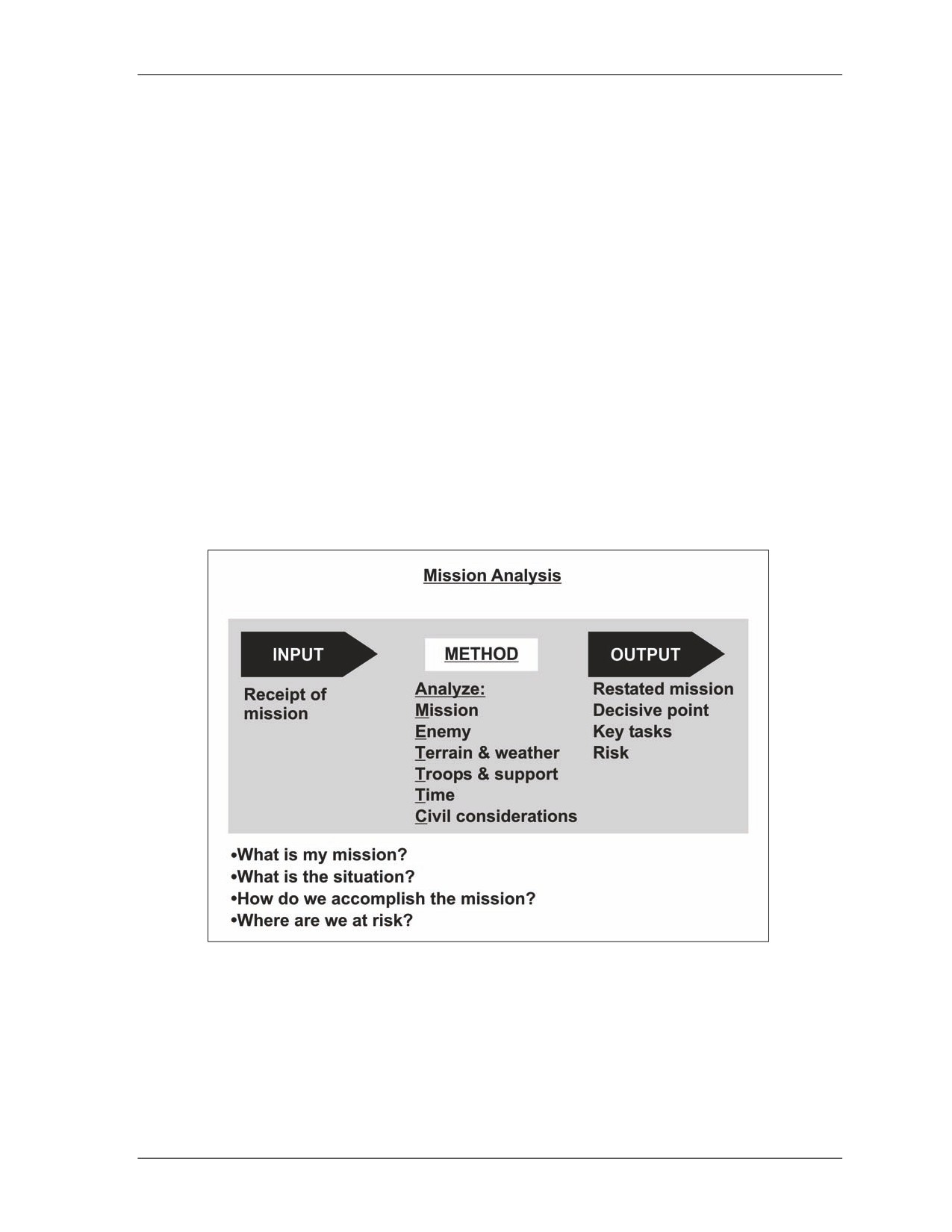
METT-TC
2-34.
Analyzing the factors of METT-TC is a continuous process (Figure 2-5). Leaders constantly
receive information, from the time that they begin planning through execution. During execution, their
continuous analyses enable them to issue well-developed fragmentary orders. They must assess if the new
information affects their missions and plans. If so, then they must decide how to adjust their plans to meet
these new situations. They need not analyze the factors of METT-TC in a particular order. How and when
they do so depends on when they receive information as well as on their experience and preferences. One
technique is to parallel the TLP based on the products received from the higher headquarters’ MDMP.
Using this technique, he would, but need not, analyze mission first; followed by terrain and weather;
enemy; troops and support available; time available; and finally civil considerations.
Figure 2-5. Analysis of mission using METT-TC.
Analysis of Mission
2-35.
A mission is the task and purpose that clearly indicate the action to be taken and the reason for the
action. In common usage, especially when applied to lower military units, a mission is a duty or task
assigned to an individual or unit (FM 1-02). The mission is always the first factor leaders consider and the
27 July 2006
FM 3-21.10
2-11
Chapter 2
lens through which they view all the aspects of the operation. To analyze the mission, leaders answer the
most basic question: What have I been told to do, and why?
2-36.
Leaders at every echelon must understand the mission, intent, and operational concept one and
two levels higher. This understanding makes it possible to exercise disciplined initiative. Leaders capture
their understanding of what their units are to accomplish in their revised mission statements. They take five
steps to fully analyze their assigned mission as directed from the higher headquarters.
y Higher headquarters’ (two levels up) mission, intent, and concept.
y Immediate higher headquarters’ (one level up) mission, intent, and concept.
y Unit’s purpose.
y Constraints.
y Specified, implied, and the essential task(s).
y Restated mission.
Higher Headquarters’ (Two Levels Up) Mission, Intent, and Concept
2-37.
Leaders understand their second highers' concepts of the operation. They identify the tasks and
purposes, and how their immediate highers are contributing to the fight. They must also understand the
leaders' intent (two levels up).
Immediate Higher Headquarters’ (One Level Up) Mission, Intent, and Concept
2-38.
Leaders understand their immediate headquarters’ concept of the operation. They identify their
headquarters’ tasks and purposes as well as their own contributions to this fight. They must clearly
understand their immediate highers' intent from the OPORD. Also, they identify the tasks, purposes, and
dispositions for all adjacent maneuver elements under that headquarters’ control.
Unit’s Purpose
2-39.
Leaders find their units' purposes in the concepts of the operation in the immediate higher
headquarters’ OPORDs. The purpose of the decisive operation usually matches or achieves the purpose of
the immediate higher headquarters. Similarly, shaping operation purposes must relate directly to those of
the decisive operation. Sustaining operation purposes relate directly to those of the decisive and shaping
operations. Leaders must understand how their units' purposes relate to higher's. They must understand
why their leaders one level up assigned their units' particular purposes. Then, they determine how those fit
into their commanders' concepts of the operation.
Constraints
2-40.
Constraints either prohibit or require an action. Leaders identify all constraints the OPORD places
on their units' ability to execute their missions. The two types of constraints are proscriptive (required;
mandates action) and prohibitive (not allowed; limits action).
Tasks
2-41.
Leaders must identify and understand the tasks required to accomplish a given mission. The three
types of tasks are specified, implied, and essential.
Specified Tasks
2-42.
Specified tasks are specifically assigned to a unit by a higher headquarters and are found
throughout the OPORD. Specified tasks may also be found in annexes and overlays, for example--
y "Seize OBJ FOX."
2-12
FM 3-21.10
27 July 2006
Troop-Leading Procedures
y "Reconnoiter route BLUE."
y "Assist the forward passage of B Company."
y "Send two Soldiers to assist in the loading of ammunition."
Implied Tasks
2-43.
Implied tasks are those that must be performed to accomplish a specified task, but that are not
stated in a higher headquarters’ order. Implied tasks derive from a detailed analysis of higher's order, from
the enemy situation and COAs, from the terrain, and from a knowledge of doctrine and history. Analyzing
the unit's current location in relation to future areas of operation as well as the doctrinal requirements for
each specified task might reveal the implied tasks. Only those that require resources should be used. For
example, if the specified task is "Seize Objective Fox," and new intelligence has OBJ FOX surrounded by
reinforcing obstacles, this intelligence would drive the implied task of "Breach reinforcing obstacles vic
Objecive Fox."
Essential Task
2-44.
The essential task is the tactical mission task--it accomplishes the assigned purpose. It, along with
the company's purpose, is usually assigned by the higher headquarters' OPORD in Concept of Operations
or Tasks to Maneuver Units. For the decisive operation, since the purposes are the same (nested concept),
the essential task also accomplishes the higher headquarters’ purpose. For shaping operations, it
accomplishes the assigned purpose, which shapes the decisive operation. For sustaining operations, it
accomplishes the assigned purpose, which enables both the shaping and decisive operation
(again,
nested concept).
Restated Mission
2-45.
Leaders conclude their mission analyses by restating their missions. To do this, they answer
the five Ws:
y Who (the company).
y What (the unit's essential task and type of operation).
y When (this is the time given in the battalion OPORD).
y Where (the objective or location stated in higher's OPORD), and.
y Why (the company purpose, taken from higher's concept of the operation).
27 July 2006
FM 3-21.10
2-13
Chapter 2
EXAMPLE
C Company/1-87 IN (who)
Attacks to seize (what)
OBJ FOX (NB123456) (where)
NLT 010200 October ___ (when)
To prevent enemy forces from counterattacking into the battalion's decisive operation (why)
C Company/1-87 IN
Essential task: seize, type of operation-attack
OBJ Fox (NB123456)
010200 October ___ (attack time)
To prevent enemy forces from counterattacking into the battalion's decisive operation
Analysis of Terrain and Weather
2-46.
When they analyze terrain, leaders consider man-made features and their effects on natural terrain
features and climate. Leaders also consider the effects of man-made and natural terrain in conjunction with
the weather on friendly and enemy operations. In general, terrain and weather do not favor one side over
the other unless one is better prepared to operate in the environment or is more familiar with it. The terrain,
however, may favor defending or attacking. Analysis of terrain answers the question: What is the terrain’s
effect on the operation? Leaders analyze terrain using the categories of observation and fields of fire,
avenues of approach, key terrain, observation, and cover and concealment (OAKOC).
2-47.
From the modified combined obstacle overlay (MCOO) developed by higher headquarters,
leaders already appreciate the general nature of the ground and the effects of weather. However, they must
conduct their own detailed analyses to determine how terrain and weather uniquely affects their units'
missions and the enemy. They must go beyond merely passing along the MCOO to their subordinate
leaders and making general observations of the terrain such as "This is high ground," or "This is a stream."
They must Figure out how the terrain and weather will affect the enemy and their units. Even more, they
apply these conclusions when they develop COAs for both enemy forces and their units. At company level
and below, leaders develop a graphic terrain analysis overlay (GTAO). This product is very similar to the
MCOO in that it shows the critical military aspects of terrain. Not only does it facilitate planning, but it
also aids in briefing subordinates.
Definition of Battlefield
2-48.
For leaders to have starting points for terrain analysis, they must first define their battlefields.
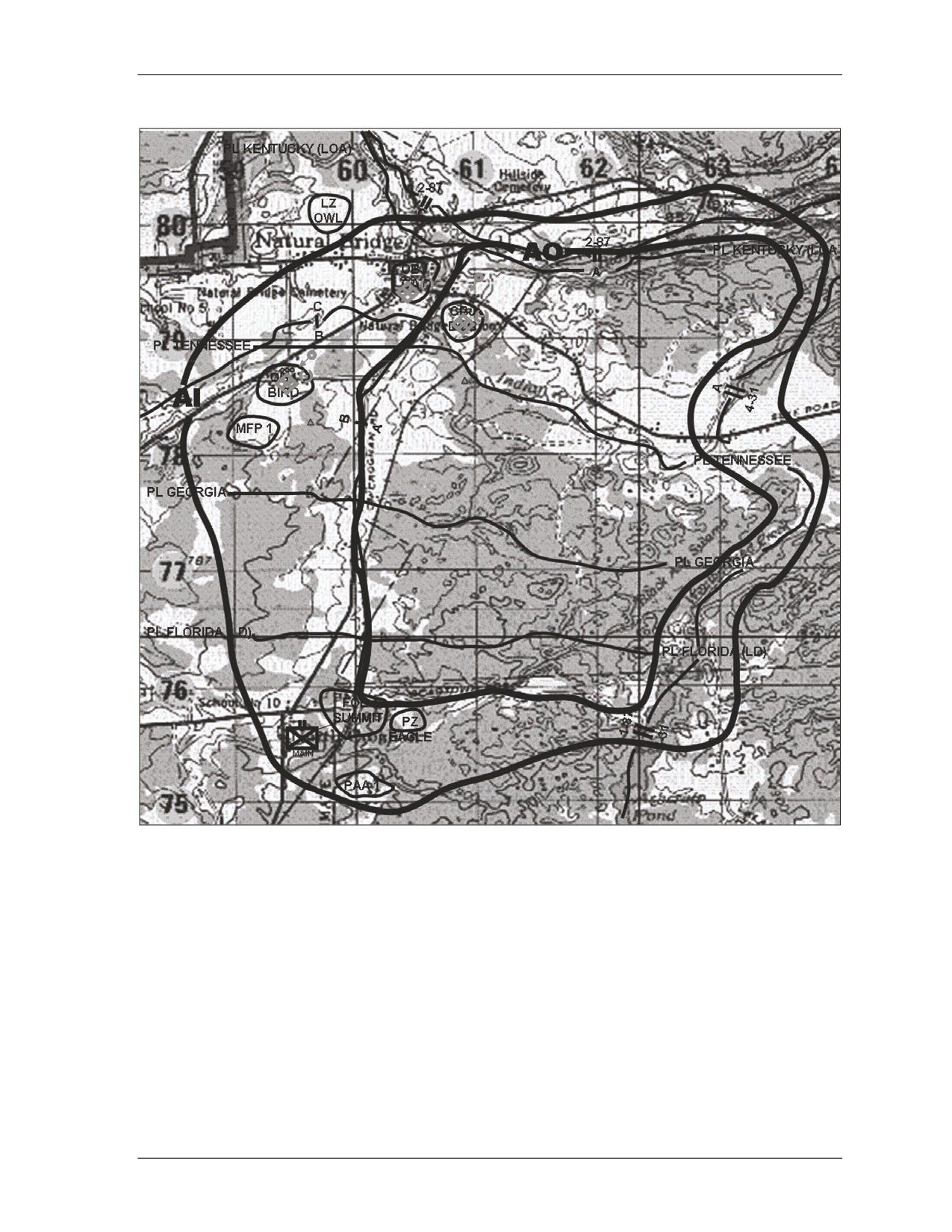
They must know their areas of operations and interest (AO and AI, Figure 2-6).
2-14
FM 3-21.10
27 July 2006
Troop-Leading Procedures
Figure 2-6. Areas of operation and interest.
Area of Operations
2-49.
Higher commanders use boundaries to define their Infantry companies' AOs. Assigning AOs to
subordinates lets the subordinates use their initiative and supports decentralized execution.
Area of Interest
2-50.
An AI is a geographical area, usually larger than the leader's AO. The AI includes any threat
forces or other elements that characterize the battlefield environment and that greatly influence the
accomplishment of the mission.
27 July 2006
FM 3-21.10
2-15
Chapter 2
Prioritization of Terrain Analysis
2-51.
Limited planning time forces leaders to prioritize their terrain analyses. For example, in the
conduct of attacks, leaders might prioritize the areas immediately around their objective for analysis,
followed by the company's specific axis leading to the objective. Given more time, they might analyze the
remainder of their companies' AOs and AIs.
Visual Aids
2-52.
Leaders prepare a graphic depiction of terrain (GDOT) to help explain their findings about the
effects of terrain and weather on the mission. The GDOT can be a photograph, overlay for a map sheet, or
a terrain model. In it, leaders show terrain mobility classifications, key terrain, intervisibility lines, known
obstacles, avenues of approach, and mobility corridors.
OAKOC
2-53.
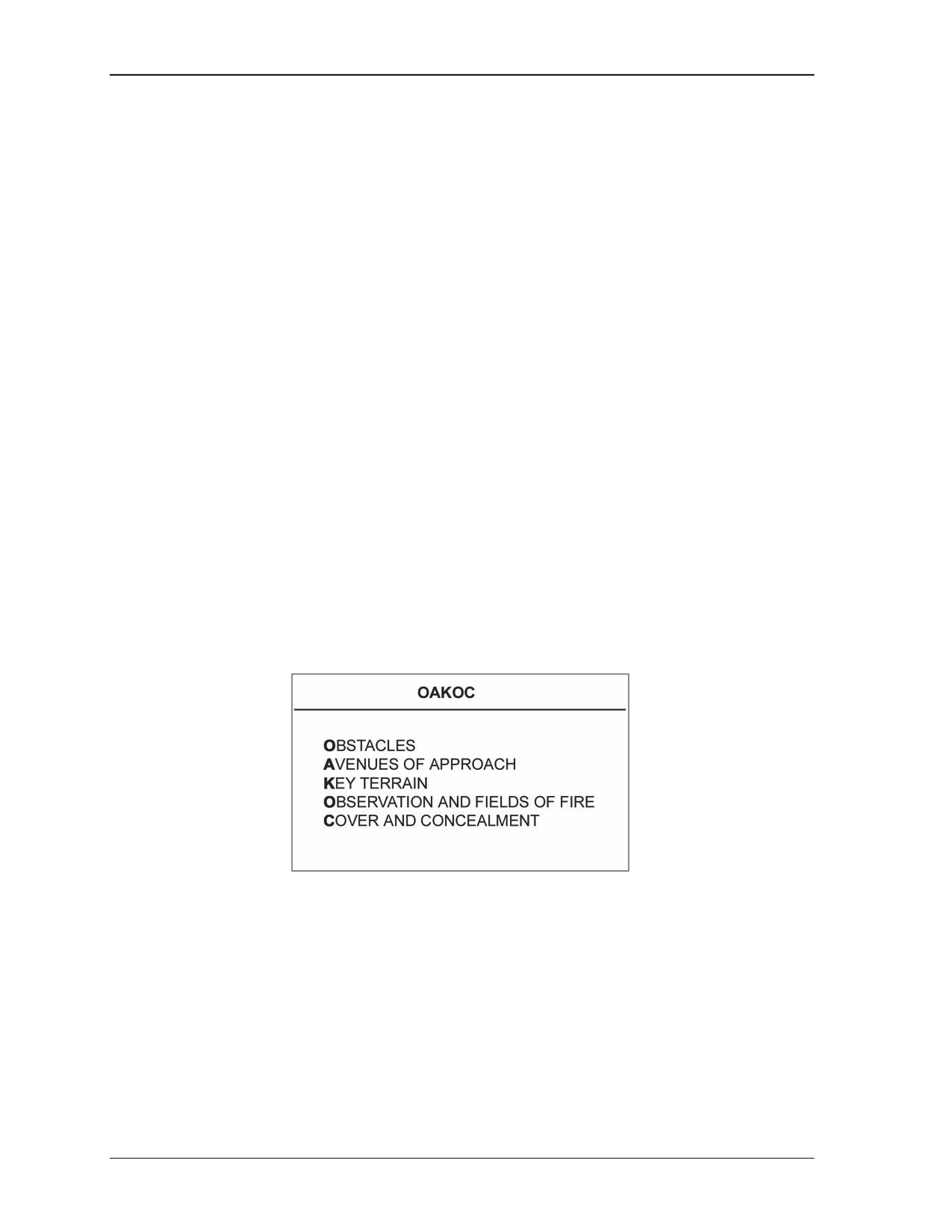
The military aspects of terrain (OAKOC) are used to analyze the ground. The sequence can vary
(Figure 2-7). The leader determines the effects of each aspect of terrain on both friendly and enemy forces.
These effects translate directly into conclusions that can apply to friendly or enemy COAs. Even if time is
tight, the leader should allocate as much time as possible to factor, starting at the objective area, and then
analyzing other aspects of key terrain. Terrain and weather are the most important aspects. Conclusions
include at least the following.
y Effective templating of enemy forces and key weapon systems.
y Effective positioning of own assets.
y Understanding of time and space relationships of events, leading to thorough
contingency plans.
y Effective echeloning and identifying of enemy observation and indirect fires.
y Effective selecting of movement techniques and formations, to include when to transition to
tactical maneuver.
Figure 2-7. Military aspects of terrain.
Obstacles
2-54.
The leader identifies existing (inherent to terrain and either natural or man-made) and reinforcing
(tactical or protective) obstacles that limit mobility in his AO. Reinforcing obstacles are constructed,
emplaced, or detonated by military force.
Existing Obstacles, Natural
2-55.
Natural obstacles include--
2-16
FM 3-21.10
27 July 2006
Troop-Leading Procedures
y Rivers.
y Forests.
y Mountains.
y Ravines.
y Gaps and ditches over 3 meters wide.
y Tree stumps and large rocks over 18 inches high.
y Forests with trees 8 inches or more in diameter, with less than 4 meters between trees.
Existing Obstacles, Man-Made
2-56.
The types of man-made obstacles include--
y Towns.
y Canals.
y Railroad embankments.
y Buildings.
y Power lines.
y Telephone lines.
Reinforcing Obstacles, Tactical
2-57.
Tactical (reinforcing) obstacles inhibit the ability of the opposing force to move, mass, and
reinforce. Examples include--
y Mine fields (conventional and situational).
y Antitank ditches.
y Wire obstacles.
Reinforcing Obstacles, Protective
2-58.
Protective (reinforcing) obstacles offer close-in protection and are key to survivability.
Offensive and Defensive Considerations
2-59.
Table 2-1 shows several offensive and defensive factors the leader can consider when analyzing
obstacles and restricted terrain.
27 July 2006
FM 3-21.10
2-17
Chapter 2
OFFENSIVE CONSIDERATIONS
y How is the enemy using obstacles and restricted terrain features?
y What is the composition of the enemy's reinforcing obstacles?
y How will obstacles and terrain affect the movement or maneuver of the Infantry company?
y If necessary, how can I avoid such features?
y How do I detect and, if desired, bypass the obstacles?
y Where has the enemy positioned weapons to cover the obstacles, and what type of weapons is he
using?
y If I must support a breach, where is the expected breach site, and where will the enemy overwatch
the obstacle?
y How will the terrain affect the employment of mortars, machine guns, and Javelin missiles?
DEFENSIVE CONSIDERATIONS
y Where does the enemy want to go? Where can I kill him? How do I get him to go there?
y How will existing obstacles and restricted terrain affect the enemy?
y How can I use these features to force the enemy into its engagement area, deny him an avenue, or
disrupt his movement?
y How will the terrain affect the employment of mortars, machine guns, and Javelin missiles?
Table 2-1. Factors to consider in analyzing obstacles and restricted terrain.
Identified Obstacles
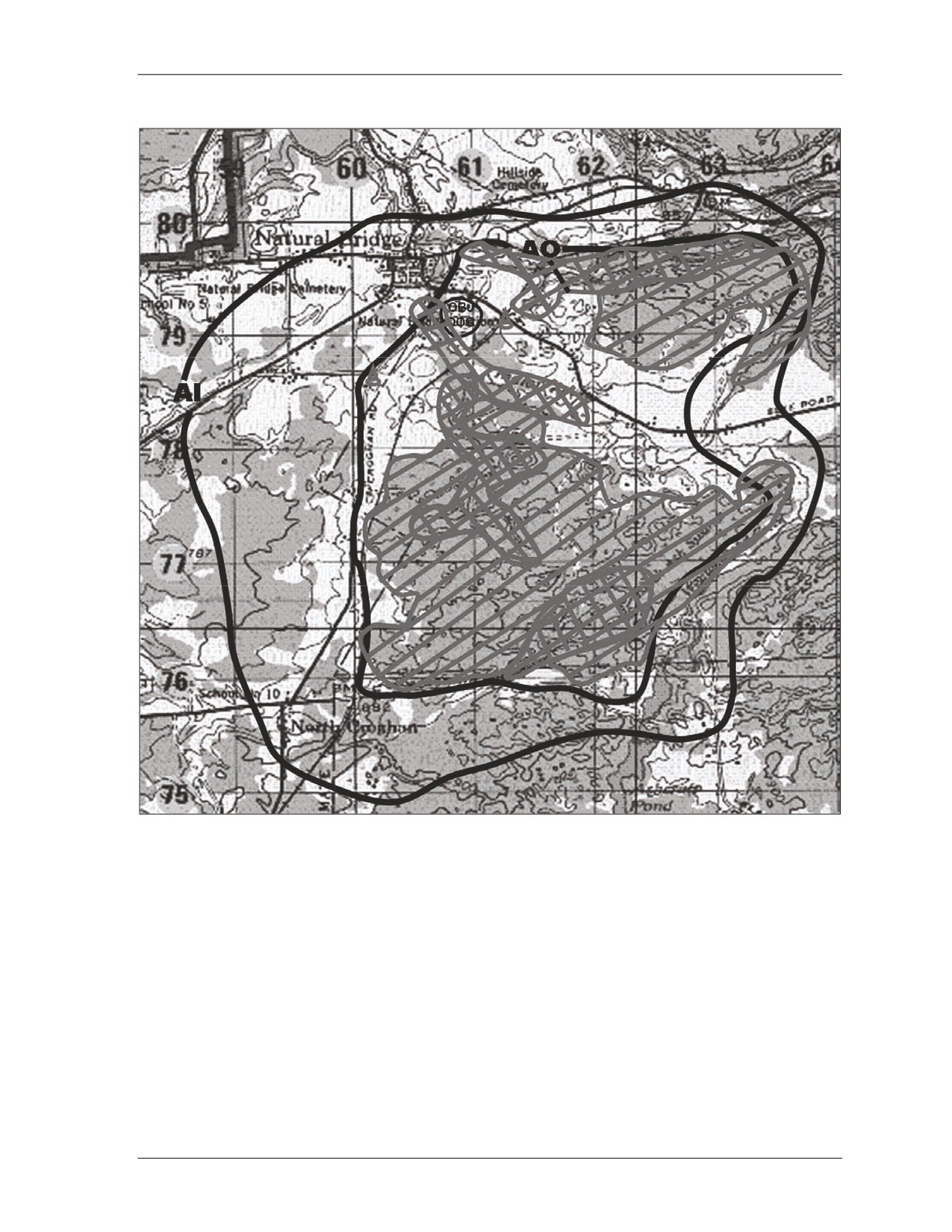
2-60.
Figure 2-8 shows identified obstacles.
2-18
FM 3-21.10
27 July 2006
Troop-Leading Procedures
Figure 2-8. Analysis of obstacles and restricted terrain.
Categories of Terrain
2-61.
Terrain is further classified in one of the following categories.
Unrestricted Terrain
2-62.
This terrain is free of any restrictions to movement, so no actions are needed to enhance mobility.
For armored and mechanized forces, unrestricted terrain is typically flat or moderately sloped, with
scattered or widely spaced obstacles such as trees or rocks. This terrain generally allows wide maneuver
and offers unlimited travel over well-developed road networks. It allows the Infantry company to move
with little hindrance.
27 July 2006
FM 3-21.10
2-19
Chapter 2
Restricted Terrain
2-63.
This terrain hinders movement somewhat. Little effort is needed to enhance mobility, but units
might have to zigzag or make frequent detours. They could have a hard time maintaining optimum speed,
moving in some types of combat formations, or transitioning from one formation to another. For armor and
mechanized forces, restricted terrain typically means moderate to steep slopes or moderate to dense spacing
of obstacles such as trees, rocks, or buildings. Swamps and rugged ground are two examples of restricted
terrain for Infantry forces. Poorly developed road systems may hamper logistical or rear area movement.
Severely Restricted Terrain
2-64.
This terrain severely hinders or slows movement in combat formations unless some effort is made
to enhance mobility. Engineer forces might be needed to improve mobility. Or, Infantry companies might
have to deviate from doctrinal tactics. For example, they might have to move in columns rather than in
lines. Or, they might have to move much more slowly than they would like. For armor and mechanized
forces, steep slopes, densely spaced obstacles, and the absence of a developed road system characterize
severely restricted terrain.
Avenues of Approach
2-65.
An avenue of approach is an air or ground route of an attacking force leading to an objective or
key terrain. Avenues of approach are classified by type (mounted, dismounted, air, or subterranean),
formation, and speed of the largest unit that can travel on it. First, the leader must identify mobility
corridors, if not provided by the higher headquarters. These are areas where a force can move in a doctrinal
formation at a doctrinal rate of march (FM 34-130). Mobility corridors are classified by type and size of the
force and formation employed, for example--
y A motorized rifle platoon (MRP) moving in column (MRP column).
y An enemy squad moving in a wedge (dismounted squad wedge).
2-66.
The leader groups mutually supporting mobility corridors to form an avenue of approach. If he
has no mutually supporting mobility corridors, then a single mobility corridor might become an avenue of
approach. Avenues of approach are classified the same as mobility corridors. After identifying these
avenues, the leader evaluates each and determines its importance. Table 2-2 shows several offensive and
defensive considerations that the Infantry rifle leader can include in his evaluation of avenues of approach.
2-20
FM 3-21.10
27 July 2006
Troop-Leading Procedures
Offensive Considerations
y How can I use each avenue of approach to support my movement and maneuver?
y How will each avenue support movement techniques, formations and, once we make enemy
contact, maneuver?
y Will variations in trafficability force changes in formations or movement techniques, or require
clearance of restricted terrain?
y What are the advantages and disadvantages of each avenue?
y What are the enemy's likely counterattack routes?
y What lateral routes could we use to shift to other axes, and which could the enemy use to threaten
our flanks?
y How will each avenue of approach affect the rate of movement of each type force?
Defensive Considerations
y What are all likely enemy avenues into my sector?
y How can the enemy use each avenue of approach?
y What lateral routes could the enemy use to threaten our flanks?
y What avenues would support a friendly counterattack or repositioning of forces?
Table 2-2. Factors to consider in analyzing mobility corridors and avenues of approach.
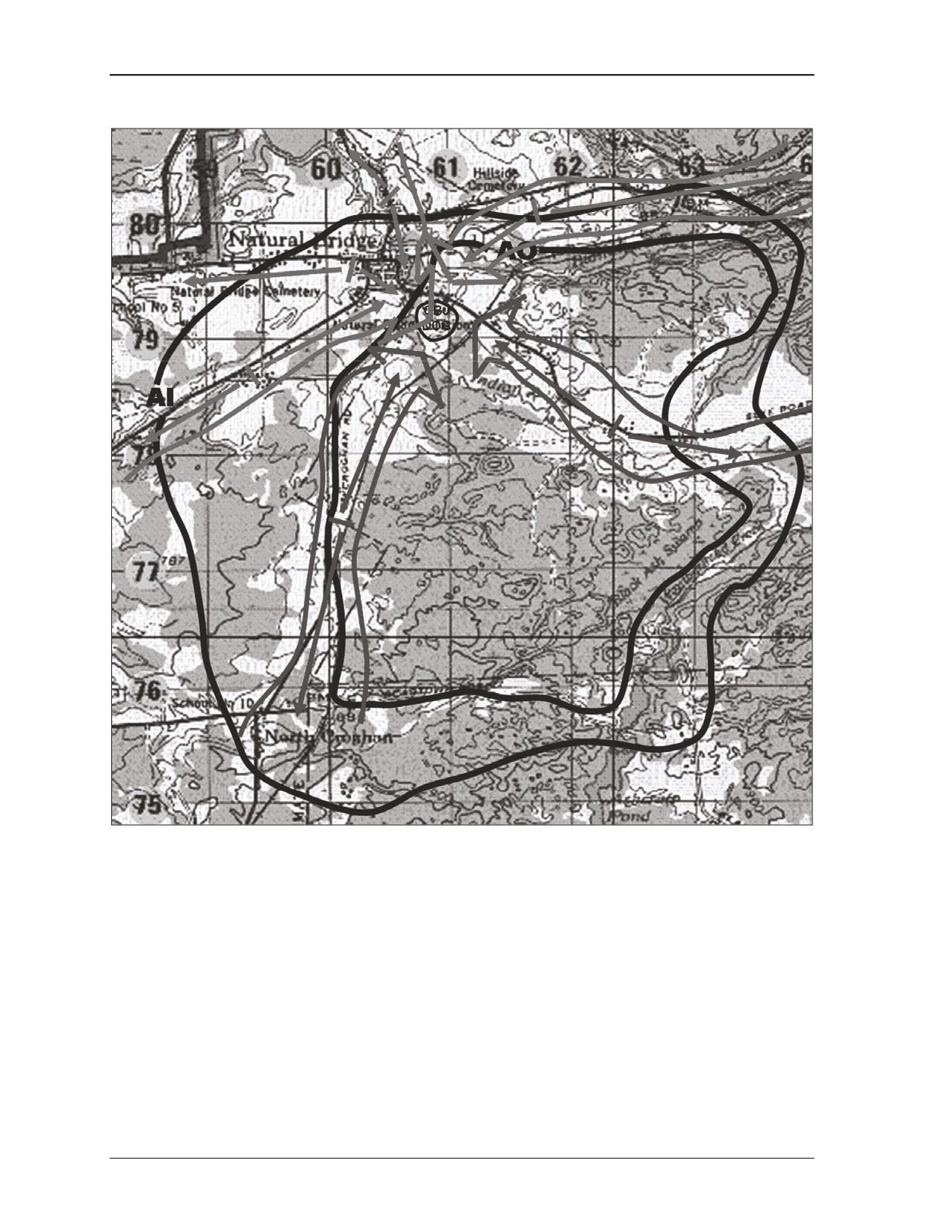
2-67.
Figure 2-9 shows mobility corridors and a map analysis of an avenue of approach.
(See
Appendix K for more information.)
27 July 2006
FM 3-21.10
2-21
Chapter 2
Figure 2-9. Analysis of mobility corridors and avenues of approach.
Key Terrain
2-68.
Key terrain is any location or area whose seizure, retention, or control gives a marked advantage
to either combatant. It is a conclusion, usually arrived at after enemy analysis and COA development,
rather than an observation. For example, a prominent hilltop overlooking an avenue of approach might or
might not be key terrain. Even if it offers clear observation and fields of fire, it offers nothing if the enemy
can easily bypass it, or if the selected COA involves maneuver on a different avenue of approach.
However, if it offers cover and concealment, observation, and good fields of fire on multiple avenues of
approach, or on the only avenue of approach, then it offers a definite advantage to whomever controls it.
The Infantry company commander must assess what terrain is key to mission accomplishment. Another
example of key terrain for an Infantry rifle company in the attack is high ground overlooking the enemy's
2-22
FM 3-21.10
27 July 2006
Troop-Leading Procedures
reverse slope defense. Controlling this area could prove critical in establishing a support-by-fire position to
protect a breach force.
Decisive Terrain
2-69.
The leader must also determine if any terrain is decisive. This is key terrain whose seizure,
retention, or control is necessary for mission accomplishment. Some situations have no decisive terrain. If
a leader identifies terrain as decisive, this means he recognizes that seizing or retaining it is necessary to
accomplish the mission. Table 2-3 lists several factors the leader must consider in determining whether
terrain is key.
Tactical Considerations
y What terrain is important for friendly observation, both for commanding and controlling and for
calling for fire?
y What terrain is important to the enemy and why? Is it important to me?
y What terrain has higher headquarters named as key? Is this terrain also important to the enemy?
y Is the enemy controlling this key terrain?
y How do I gain or maintain control of key terrain?
y What terrain is key for communications nodes that could dictate the employment of digital
communications equipment?
Table 2-3. Factors to consider in analyzing key terrain.
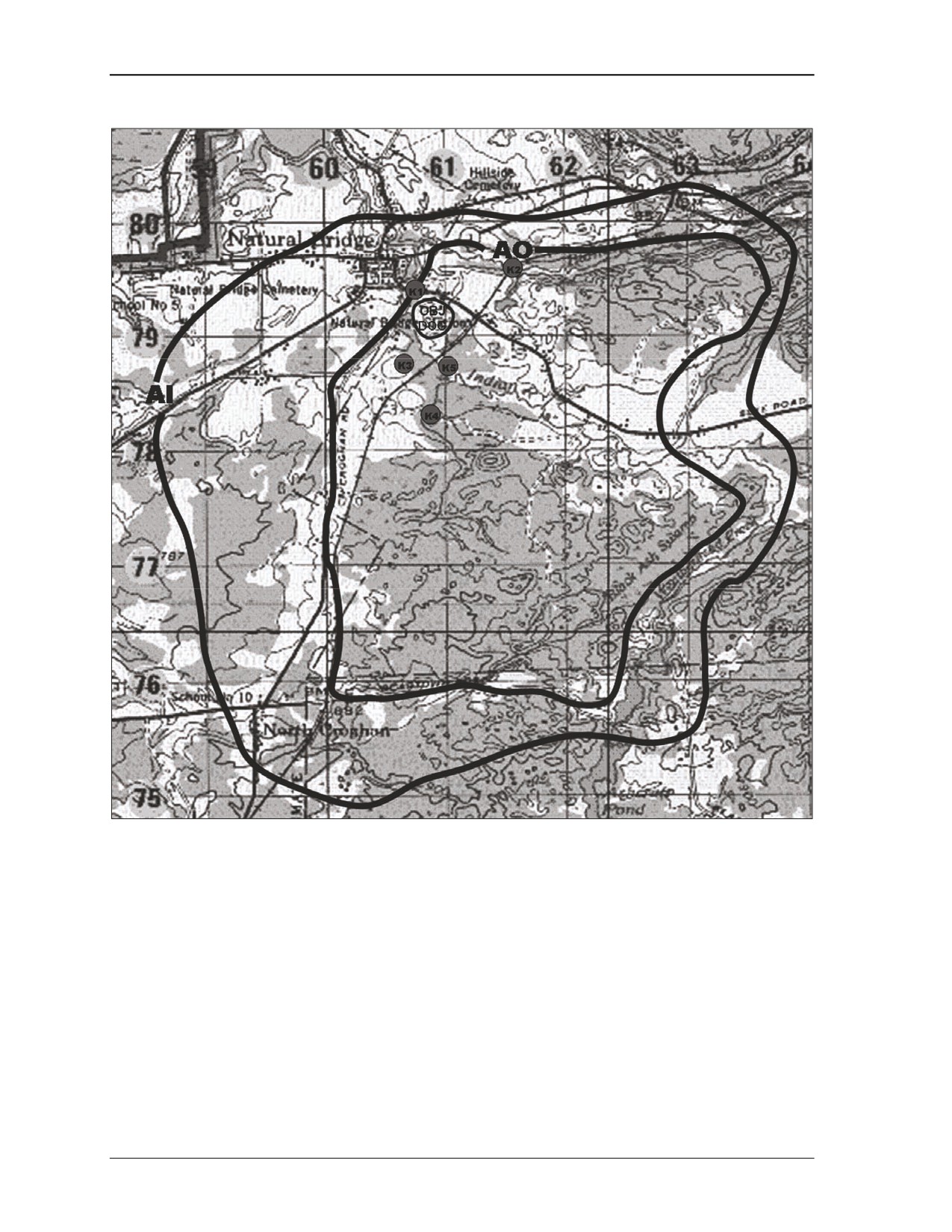
2-70.
Figure 2-10 shows an analysis of key terrain using a map.
27 July 2006
FM 3-21.10
2-23
Chapter 2
Figure 2-10. Analysis of key terrain.
Observation and Fields of Fire
2-71.
The Infantry company commander identifies locations along each avenue of approach that provide
clear observation and fields of fire for both the attacker and the defender. He analyzes the area surrounding
key terrain, objectives, engagement areas (EAs), and obstacles. He locates intervisibility (IV) lines (ridges
or horizons that can hide equipment or personnel from observation). He assesses the ability of the attacking
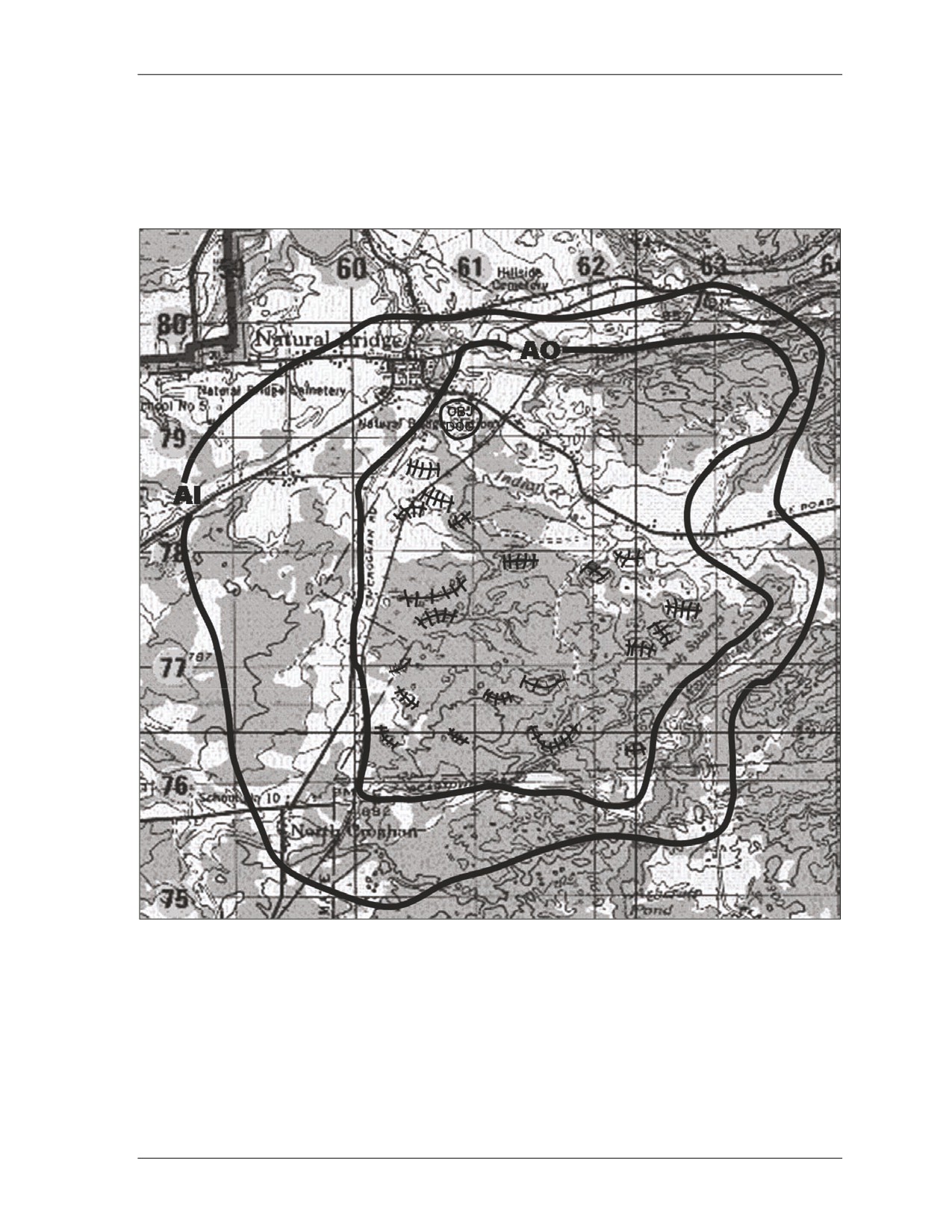
force to overwatch or support movement (with direct fire). Intervisibility line analysis enables the leader to
visualize the profile view of terrain when only a topographic product (map) is provided. Figure 2-11, page
2-25, shows intervisibility line analysis. In analyzing fields of fire, he considers the friendly and enemy
potential to cover avenues of approach and key terrain, in particular, with direct fires. He also identifies
positions where artillery observers can call for indirect fire. The observer must observe both the impact and
2-24
FM 3-21.10
27 July 2006
Troop-Leading Procedures
effects of indirect fires. He analyzes whether or not vegetation will affect the employment or trajectory of
the Javelin, or 60-mm mortars. It can do this by masking the target or by reducing overhead clearance.
When possible, the observer conducts a ground reconnaissance from both enemy and friendly perspectives.
He might do it personally, by map, or with his subordinate units, or he can use the assets and information
provided by the Infantry battalion reconnaissance platoon.
Figure 2-11. Analysis of "IV" line.
2-72.
This reconnaissance helps him to see the ground objectively and to see how it will affect both
forces (Table 2-4).
27 July 2006
FM 3-21.10
2-25
Chapter 2
OFFENSIVE CONSIDERATIONS
y Are clear observation and fields of fire available on or near the objective for enemy observers and
weapon systems?
y Where can the enemy concentrate fires?
y Where will the enemy be unable to concentrate fires?
y Where is the enemy vulnerable?
y Where can I support the movement of a friendly force with mortar, machine gun, or Javelin?
y Where can friendly forces conduct support by fire or attack by fire?
y Where are the natural TRPs?
y Where do I position indirect fire observers?
DEFENSIVE CONSIDERATIONS
y What locations have clear observation and fields of fire along enemy avenues of approach?
y Where will the enemy establish firing lines or support-by-fire positions?
y Where will I be unable to mass fires?
y Where is the dead space in my sector? Where am I vulnerable?
y Where are the natural TRPs?
y Where can I destroy the enemy? Can I observe and fire on that location with at least 2/3 of my
combat power?
y How obvious are these positions to the enemy?
y Where do I position indirect fire observers?
Table 2-4. Factors to consider in analyzing observation and fields of fire.
Cover and Concealment
2-73.
The leader looks at the terrain, foliage, structures, and other features along avenues of approach
(and on objectives or key terrain) to identify sites that offer cover (protection from the effects of direct and
indirect fire) and concealment (protection from observation). In the defense, weapon positions must be
both lethal to the enemy and survivable for the Soldier. Effective cover and concealment is just as vital as
clear fields of fire (Table 2-5, page 2-26). Cover and concealment can be either part of the environment or
something brought in by the unit to create the desired effect.
2-26
FM 3-21.10
27 July 2006
Troop-Leading Procedures
OFFENSIVE CONSIDERATIONS
y What axes afford both clear fields of fire and effective cover and concealment?
y Which terrain provides bounding elements with cover and concealment while increasing lethality?
DEFENSIVE CONSIDERATIONS
y What locations afford effective cover and concealment as well as good observation and fields
of fire?
y How can friendly and enemy forces use the available cover and concealment?
Table 2-5. Considerations in cover and concealment.
Conclusions from Terrain Analysis
2-74.
A terrain analysis should produce several specific conclusions:
y Battle, support-by-fire, and attack-by-fire positions.
y Engagement areas and ambush sites.
y Immediate and intermediate objectives.
y Asset locations such as enemy command posts or ammunition caches.
y Assembly areas.
y Observation posts.
y Artillery firing positions.
y Air defense artillery system positions.
y Reconnaissance, surveillance, and target-acquisition positions.
y Forward area arming and refueling points.
y Landing and drop zones.
y Breach locations.
y Infiltration lanes.
Five Military Aspects of Weather
2-75.
The five military aspects of weather are visibility; winds; precipitation;
cloud
cover;
and
temperature and humidity. Consideration of the weather's effects is an essential part of the leader's mission
analysis. The leader goes past observing to application. That is, he determines how the weather will affect
the visibility, mobility, and survivability of his unit and that of the enemy. He reviews his commander's
conclusions and identifies his own. He applies the results to the friendly and enemy COAs he develops.
Visibility
2-76.
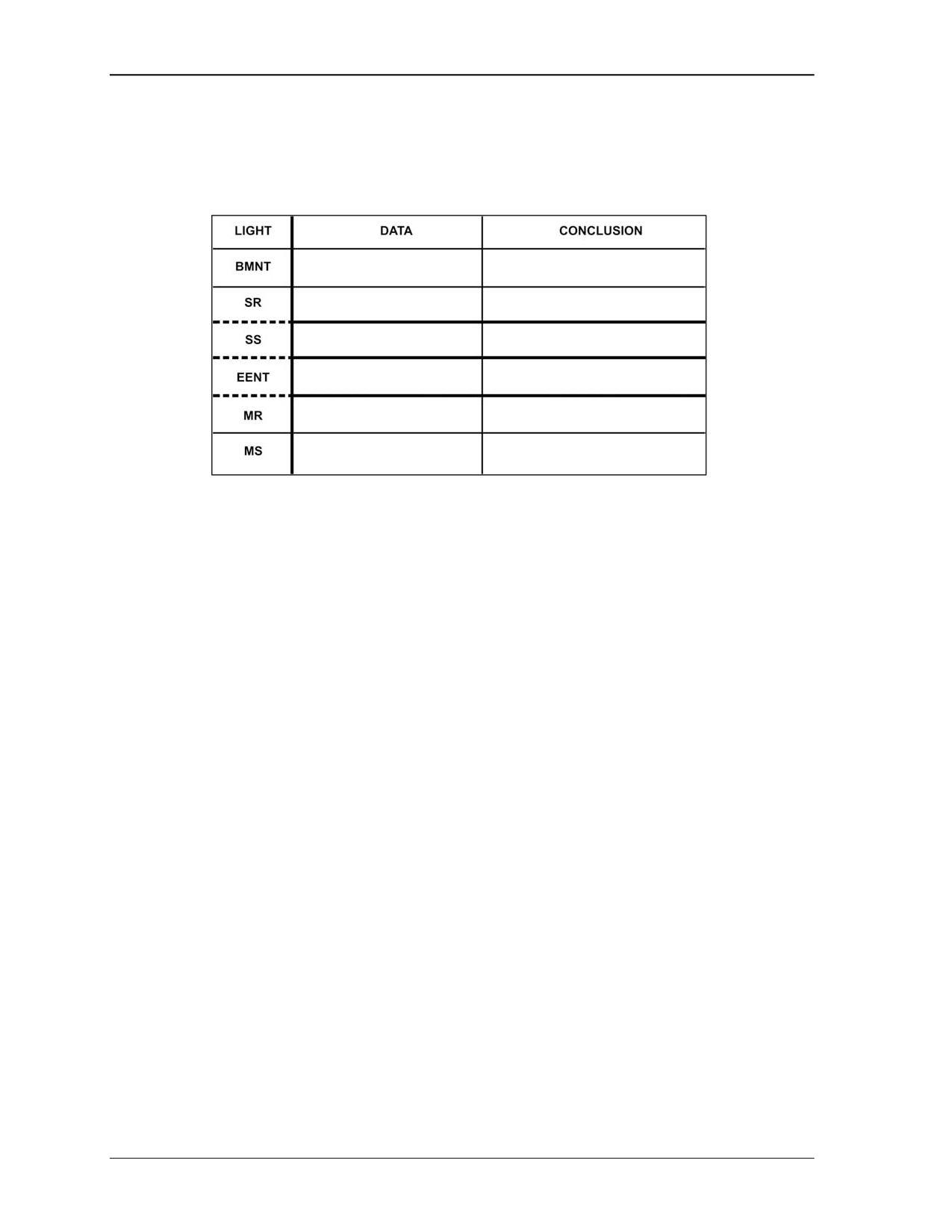
The leader identifies critical conclusions about visibility factors such as light data, fog, and smog;
and about battlefield obscurants such as smoke and dust. He considers light data and identifies critical
conclusions about begin morning nautical twilight
(BMNT), sunrise (SR), sunset (SS), end evening
nautical twilight (EENT), moonrise (MR), moonset (MS), and percentage of illumination (Figure 2-12).
Some additional visibility considerations include--
y Will the sun rise behind my attack or in my eyes? Will I attack toward the sunrise?
y How can I take advantage of the limited illumination?
y How will this affect friendly and enemy target acquisition?
27 July 2006
FM 3-21.10
2-27
Chapter 2
y Will the current weather favor the use of smoke to obscure during breaching?
y When are night vision devices effective?
Figure 2-12. Light matrix.
Winds
2-77.
Winds of sufficient speed can reduce the combat effectiveness of a force downwind as the result
of blowing dust, smoke, sand, or precipitation. The upwind force usually has better visibility. CBRN
operations usually favor the upwind force (see more in Appendix H). Windblown sand, dust, rain, or snow
can reduce the effectiveness of radar and other communication systems. Strong winds can also hamper the
efficiency of directional antenna systems by inducing antenna wobble. Strong winds and wind turbulence
limit airborne, air assault, and aviation operations. Evaluation of weather in support of these operations
requires information on the wind at the surface as well as at varying altitudes. Near the ground, high winds
increase turbulence and may inhibit maneuver. At greater altitudes, it can increase or reduce fuel
consumption. Wind is always described as "from…to" as in "winds are from the east moving to the west."
The leader must answer these questions:
y Will wind speed cause smoke to dissipate quickly?
y Will wind speed and direction favor enemy use of smoke?
y Will wind speed and direction affect the employment of available mortars?
y What is the potential for CRBN contamination?
Precipitation
2-78.
Precipitation affects soil trafficability, visibility, and the functioning of many electro-optical
systems. Heavy precipitation can reduce the quality of supplies in storage. Heavy snow cover can reduce
the efficiency of many communication systems as well as degrade the effects of many munitions and air
operations. The leader identifies critical factors such as type, amount, and duration of precipitation. Some
precipitation questions to answer include--
y How will precipitation (or lack of it) affect the mobility of the unit or of enemy forces?
y How can precipitation (or lack of it) add to the unit achieving surprise?
2-28
FM 3-21.10
27 July 2006
Troop-Leading Procedures
Cloud Cover
2-79.
Cloud cover affects ground operations by limiting illumination and the solar heating of targets.
Heavy cloud cover can degrade many target acquisition systems, infrared-guided munitions, and general
aviation operations. Heavy cloud cover often canalizes aircraft within air avenues of approach and on the
final approach to the target. Partial cloud cover can cause glare, a condition that attacking aircraft might
use to conceal their approach to the target. Some types of clouds reduce the effectiveness of radar systems.
The leader identifies critical factors about cloud cover, including limits on illumination and solar heating of
targets. Some cloud cover questions follow:
y How will cloud cover affect unit operations at night? How will it affect the enemy?
y How will cloud cover affect the target acquisition of the command launch unit?
y How will cloud cover affect helicopter and close air support?
Temperature and Humidity
2-80.
Extremes of temperature and humidity reduce personnel and equipment capabilities and may
require the use of special shelter or equipment. Air density decreases as temperature and humidity increase.
This can require reduced aircraft payloads. Temperature crossovers, which occur when target and
background temperatures are nearly equal, degrade thermal target acquisition systems. The length of
crossover time depends on air temperature, soil and vegetation types, amount of cloud cover, and other
factors. The leader identifies critical factors about temperature, including high and low temperatures,
infrared crossover times, and the effects of smoke and chemicals. Some temperature considerations
include—.
y How will temperature and humidity affect the unit's rate of march?
y How will temperature and humidity affect the Soldiers and equipment?
y Will temperatures and humidity favor the use of nonpersistent chemicals?
Analysis of Enemy
2-81.
The second factor to consider is the enemy. Leaders analyze the enemy's dispositions,
compositions, strengths, doctrine, equipment, capabilities, vulnerabilities, and probable courses of action.
On the modern battlefield, the line between enemy combatants and civilian noncombatants is sometimes
unclear. This requires the leader to understand the Laws of War, the ROE, and the local situation.
Questions
2-82.
Analyzing the enemy answers the question, "What is the enemy doing and why?" Leaders
also answer—.
y What is the composition and strength of the enemy force?
y What are the capabilities of his weapons? Other systems?
y What is the location of current and probable enemy positions?
y What is the enemy's most probable COA? (DRAW-D [defend, reinforce, attack,
withdraw, delay]).
Phase
2-83.
An important result of analyzing and templating the enemy is identification of his phase
in the COE. Infantry company commanders must understand that the behavior of an enemy force operating
in the regional phase of a conflict can differ greatly from that of an enemy in the adaptive phase.
Commanders consider enemy trends, activities, and capabilities. They try to fully appreciate the thinking
and will of the enemy. They must avoid ignoring enemy capabilities to save time or effort. An adaptive and
capable enemy will fight to the best of his abilities. Commanders use (small-unit-level) situation templates
27 July 2006
FM 3-21.10
2-29
Chapter 2
(SITEMPs) and initial priority intelligence requirements (PIR) to add to their knowledge of the enemy.
They need to know his doctrine, composition, disposition, strengths, and plan. Effective analysis helps
commanders decide when, how, and where to apply overwhelming combat power. However, they must
distinguish between what they know and what they template. Otherwise, they could base their plans on
dangerous and unreliable assumptions.
Contemporary Operational Environment
2-84.
Although COE doctrine is most closely associated with training doctrine, its constructs are useful
in analyzing and understanding enemy forces in real world operations.
Assumptions
2-85.
The leader must understand the assumptions the battalion intelligence staff officer (S-2) uses to
portray the enemy's COA. Furthermore, his own assumptions about the enemy must be consistent with
those of his higher commander. The leader must continually improve his situational understanding (SU) of
the enemy and update his enemy templates as new information or trends become available. Any deviation
or significant conclusions reached during his enemy analysis that could positively or negatively affect the
battalion's plan should immediately be shared with the battalion commander and S-2.
2-86.
In analyzing the enemy, the leader must understand the intelligence preparation of the battlefield
(IPB). Although he does not usually prepare IPB products for his subordinates, he must be able to use the
products of the higher headquarters’ IPB effectively.
Doctrinal Analysis (How Enemy Will Fight)
2-87.
The leader must know more than just the number and types of vehicles, Soldiers, and weapons the
enemy has. The leader must thoroughly understand when, where, and how the enemy prefers or tends to
use his assets. A doctrinal template is a visual illustration of how the enemy force might look and act
without the effects of weather and terrain. The leader looks at specific enemy actions during a given
operation and uses the appropriate doctrinal template to gain insights into how the enemy may fight.
Likewise, he must understand enemy doctrinal objectives. In doctrinal terms, he asks--
Is the enemy oriented on the terrain, for example, a reconnaissance force, his own force (assault force,
terrorists, or insurgent forces), civilian forces or critical infrastructure (terrorist or insurgent forces,
sabotage), or other supporting or adjacent friendly forces (as in a disruption zone)? What effect will this
have on the way the enemy fights?
2-88.
However, as the global situation changes, the possibility of fighting adversaries who lack a
structured doctrine increases. In such a situation, a leader must rely on information provided by battalion or
higher echelon reconnaissance and surveillance assets and, most importantly, his and his higher
headquarters’ pattern analysis and deductions about the enemy in his AO (see Appendix J). He may also
make sound assumptions about the enemy, human nature, and local culture.
Composition
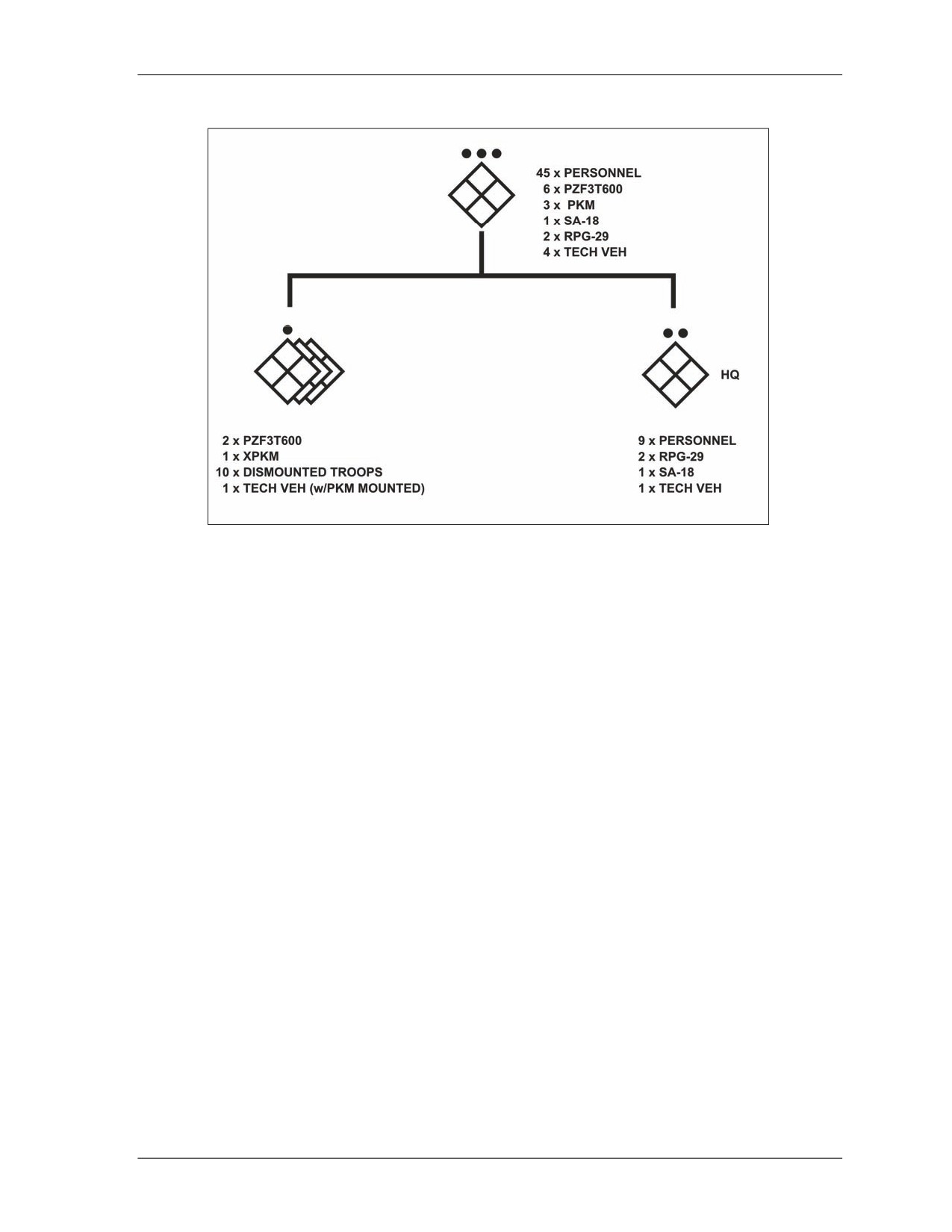
2-89.
The leaders analysis must determine the types of vehicles, Soldiers, and equipment the enemy
could use against his unit (Figure 2-13, page 2-30). He should be familiar with the basic characteristics of
the units and platforms identified.
2-30
FM 3-21.10
27 July 2006
Troop-Leading Procedures
Figure 2-13. Example enemy composition.
Disposition
2-90.
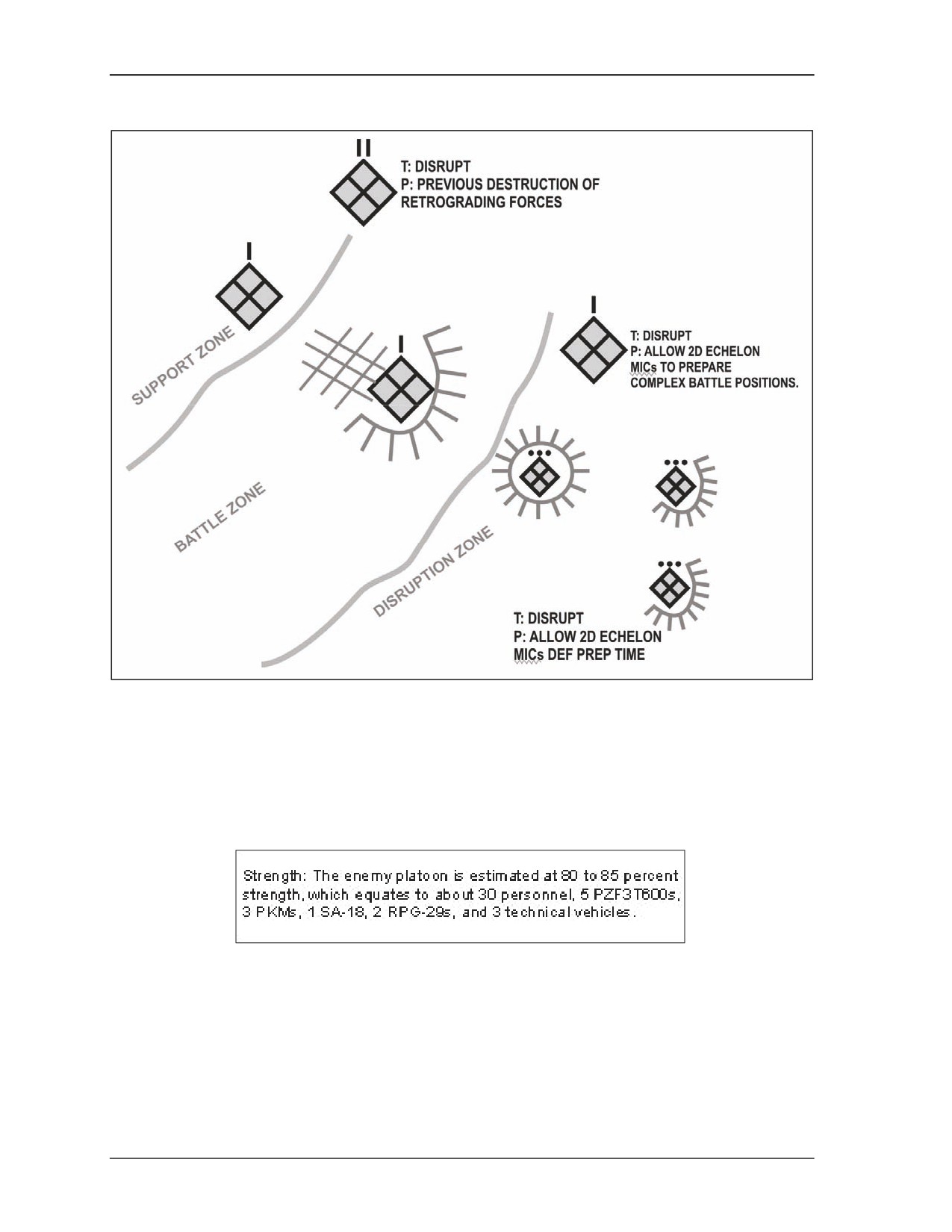
From higher headquarters’ information, he determines how the enemy is (or might be) arrayed. If
the information is available, he determines the echelon force where the enemy originated. He determines
the disposition for the next two higher enemy elements (Figure 2-14). From this analysis, he might be able
to determine patterns in the enemy's employment or troops and equipment.
27 July 2006
FM 3-21.10
2-31
Chapter 2
Figure 2-14. Example enemy disposition.
Strength
2-91.
He identifies the enemy's strength by unit (Figure 2-15). He can obtain this information by
translating percentages given from higher headquarters to the actual numbers in each enemy element or
from information provided by the common operational picture (COP).
Figure 2-15. Example enemy strength.
Capabilities
2-92.
Based on the S-2’s assessment and the enemy's doctrine and current location, the leader must
determine the enemy's capabilities. This includes studying the maximum effective range for each weapon
2-32
FM 3-21.10
27 July 2006
Troop-Leading Procedures
system, the doctrinal rates of march, and the timelines associated with the performance of certain tasks.
One technique is to use the WFF as a checklist to address every significant element the enemy brings to the
fight. The leader also determines the capabilities of the next higher enemy element. These capabilities
should include reasonable assets the next higher element, or other higher enemy headquarters, may
provide. This should include at least the employment of reserves, chemical weapons, artillery or mortar
locations and ranges, and reconnaissance assets (Table 2-6).
Capabilities
INTELLIGENCE
Some commando and Kazarian militia are already in our AO and we can expect local,
unconventional forces to execute disruption attacks using RPGs and IED ambushes against our C2
and log capabilities immediately.
MOVEMENT AND MANEUVER
The commander believes the MIB weapons platoon to be positioned near APOD Fullerton at WQ
045423. This unit can reinforce any MIP position within 25 to 45 minutes and Jetertown within 50
minutes. The trigger for their commitment is the loss of one MIP or two squads of commandos.
Expect rubbling effects within towns and villages as well as the commando's historical burning of
large piles of tires to obscure our optics and deny routes within villas.
FIRE SUPPORT
The 1/54th 1st MIB has been reinforced with a battery of 2S3M in DS role. This artillery is
believed to range as far South as our assault positions.
PROTECTION
Commandos have multiple RPG systems and small arms, which have shot down two ARFOR
rotary aircraft within the past 72 hours.
SUSTAINMENT
Enemy's last LOGPAC believed to have occurred this morning. We do not expect the enemy to
resupply until after his successful defense.
COMMAND AND CONTROL
The MIP leader is believed to be with his decisive operation on OBJ Fox. Most C2 is through FM
and cell phones.
Table 2-6. Example enemy capabilities.
Recent Activities
2-93.
Gaining complete understanding of the enemy's intentions can be difficult when his doctrinal
templates, composition, and disposition are unclear. In all cases, the enemy's recent activities must be
understood, because they can provide insight into his future activities and intentions (Table 2-7). If time
permits, the leader might be able to conduct a pattern analysis of the enemy's actions to predict future
actions. In the COE, this might be the most important analysis the leader conducts and is likely to yield the
most useful information to the leader.
27 July 2006
FM 3-21.10
2-33
Chapter 2
041800NOV05
Evidence of ethnic cleansing observed by discovery of mass grave vic grid
WQ 058402
042200NOV05
Local arms dealer in town of Pitkin is molested He reports to the Kazarian Police
Force the theft of 80 pounds of dynamite
052300NOV05
Arms cache suspected at location WQ 081385
060600NOV05
Local Kazarians report multiple murders, rapes, and thefts of POVs vic Jetertown
and Huffton
161200Nov05
Two T-72Bs and multiple BMPs observed moving from Fullerton FLS to vic grid
WQ 083408
161800NOV05
Enemy indirect fire splash vic grid WQ 099329
070600nov05
Unarmed protest involving 50 to 60 Kazarians vic TAA Bird
Table 2-7. Example enemy recent activities.
Enemy Situation Template
2-94.
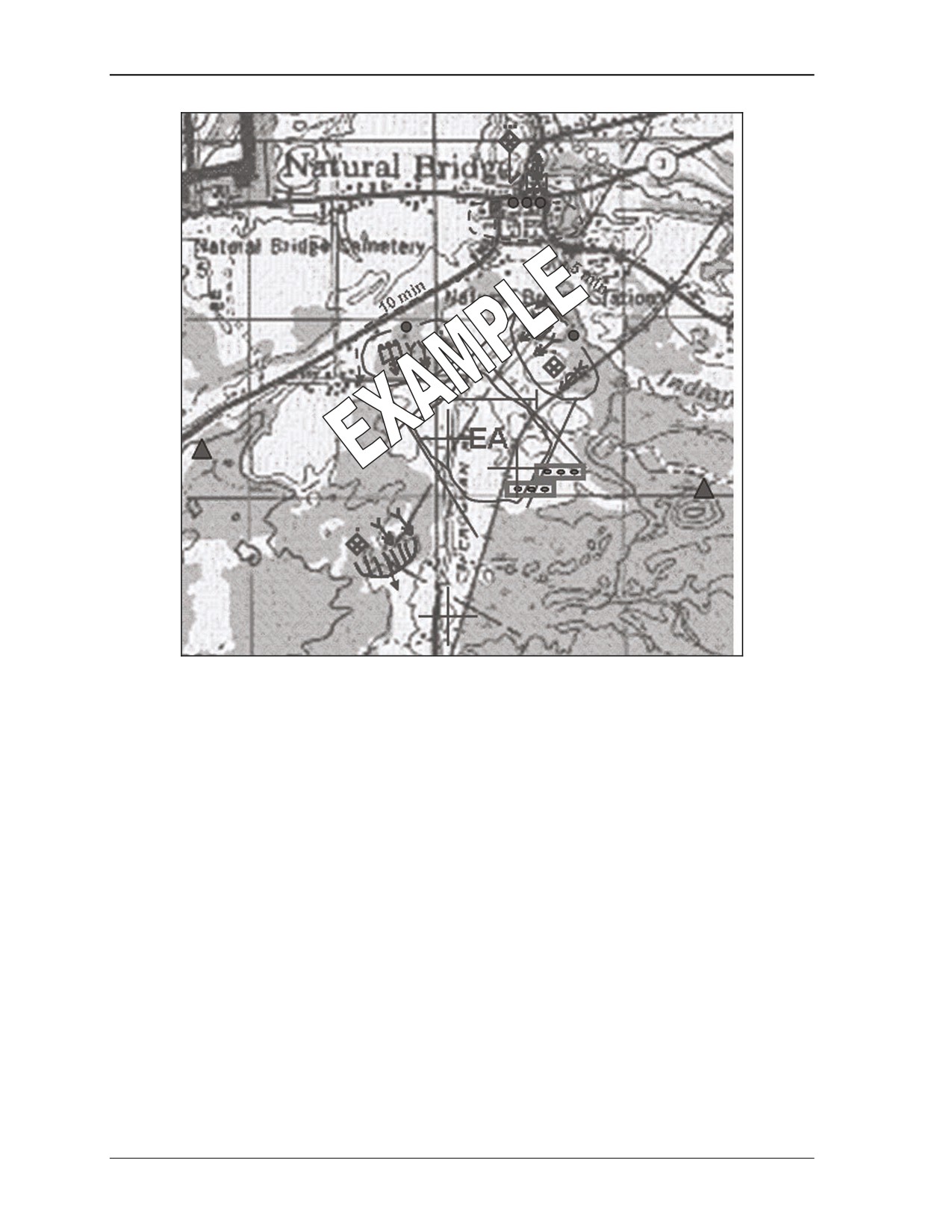
To identify how the enemy may potentially fight, the leader weighs the result of his analysis of
terrain and weather against the higher headquarters’ SITEMP. The refined product is a company SITEMP,
a graphic showing how he believes the enemy will fight under specific battlefield conditions. This SITEMP
is portrayed one echelon lower than that developed by the higher headquarters’ S-2. For example, if a
battalion SITEMP identifies a platoon-size enemy element on the company's objective, the leader, using his
knowledge of both the enemy's doctrine and the terrain, develops a SITEMP that positions squad-size
battle positions, crew-served weapons positions, or defensive trenches. He includes in this SITEMP the
likely sectors of fire of the enemy's weapons and any tactical and protective obstacles, either identified or
merely templated, which support the defense. Table 2-8, page 2-35, shows recommended SITEMP items.
(For a more detailed list of items that must be situationally templated, see Appendix B, FM 34-13.) The
leader must avoid developing his SITEMP independently of the higher commander's guidance and the S-2's
product. The product must reflect the results of reconnaissance and shared information. Differences
between the SITEMPs must be resolved before the leader can continue analyzing the enemy. Finally, given
the scale with which the leader often develops his SITEMP, on a 1:50,000 map (Figure 2-16, page 2-36),
the SITEMP should be transferred to a GDOT for briefing purposes, as the situation allows. This is not for
analysis, but just to show subordinates the details of the anticipated enemy course of action (ECOA). Once
he briefs the enemy analysis to his subordinates, he must ensure that they understand the differences
between what he knows, what he suspects, and what he just templates (estimates). Unless given the benefit
of reconnaissance or other intelligence, his SITEMP is only an estimate of how the enemy might be
disposed. He must not take these as facts. This is why the leader must develop a tactically sound and
flexible plan. It is also why he must clearly explain his intent to his subordinates. This allows them to
exercise initiative and judgment to accomplish the unit's purpose. Reconnaissance is critical in developing
the best possible enemy scenario.
2-34
FM 3-21.10
27 July 2006
Troop-Leading Procedures
Defense
Offense
y Primary, alternate, subsequent positions.
y Attack formations.
y Engagement areas.
y Axes of advance.
y Individual vehicles.
y Firing lines.
y Crew-served weapons.
y Objectives.
y Tactical and protective obstacles.
y Reserve force commitment.
y Trenches.
y Planned indirect-fire targets.
y Planned indirect-fire targets.
y Situational obstacles.
y Observation posts.
y Reconnaissance objectives.
y Command and control positions.
y Reconnaissance force routes.
y FPF and FPL.
y Phase lines.
y Locations of reserves.
y Planned point of penetration
y Routes for reserve commitment.
y Travel time for reserve commitment.
y Battle position, strongpoints, sectors.
y Sectors of fire.
Table 2-8. Recommended SITEMP items.
27 July 2006
FM 3-21.10
2-35
Chapter 2
Figure 2-16. Example enemy situation template.
Initial Priority Intelligence Requirements
2-95.
A leader defines PIR as information about the enemy that leads to a critical decision, and he
develops specific PIR for each situation. Answering the PIR questions lets him confirm or deny
assumptions he made during planning. Although doing this helps him clarify the enemy situation, it also
usually leads to answering the PIR of the next level higher.
Analysis of Troops and Support Available
2-96.
Leaders study their task organization to determine the number, type, capabilities, and condition of
available friendly troops and other support. Analysis of troops follows the same logic as that of analyzing
the enemy by identifying capabilities, and vulnerabilities and strengths. Leaders should know the
disposition, composition, strength, and capabilities of their forces one and two levels down. This
information can be maintained in a checkbook-style matrix for use during COA development (specifically
array forces). They maintain understanding of subordinates’ readiness, including maintenance, training,
strengths and weaknesses, leaders, and logistic status. Analysis of troops and support answers the question:
What assets are available to accomplish the mission? Leaders also answer these questions:
y What are the strengths and weaknesses of subordinate leaders?
y What is the supply status of ammunition, water, fuel (if required), and other necessary items?
y What is the present physical condition of Soldiers (morale, sleep)?
y What is the condition of equipment?
2-36
FM 3-21.10
27 July 2006
Troop-Leading Procedures
y What is the unit's training status and experience relative to the mission?
y What additional Soldiers or units will accompany?
y What additional assets are required to accomplish the mission?
2-97.
Perhaps the most critical aspect of mission analysis is determining the combat potential of one’s
own force. The leader must realistically and unemotionally determine all available resources and any new
limitations based on level of training or recent fighting. This includes troops who are either attached to or
in direct support of his unit. It also includes understanding the full array of assets that are in support of the
unit. He must know, for example, how much indirect fire, by type, is available and when it will become
available.
2-98.
Because of the uncertainty always present in operations at the small unit level, leaders cannot be
expected to think of everything during their analysis. This fact forces leaders to determine how to get
assistance when the situation exceeds their capabilities. Therefore, a secondary product of analysis of
troops and support available should be an answer to the question: How do I get help?
Analysis of Time Available
2-99.
The fifth factor of METT-TC is time available. Time refers to many factors during the operations
process (plan, prepare, execute, and assess). The four categories for the leader to consider include---
y Planning and preparation.
y Operations.
y Next higher echelon’s timeline.
y Enemy timeline.
2-100. During all phases, leaders consider critical times, unusable time, the time it takes to accomplish
activities, the time it takes to move, priorities of work, and the tempo of operations. Other critical
conditions to consider include visibility and weather data, and events such as higher headquarters tasks and
required rehearsals. Implied in the analysis of time is leader prioritization of events and sequencing of
activities.
2-101. As addressed in the first step of the TLP, time analysis is a critical aspect to planning, preparation,
and execution. Time analysis is often the first thing a leader does. The leader must not only appreciate how
much time is available, but he must also be able to appreciate the time/space aspects of preparing, moving,
fighting, and sustaining. He must be able to see his own tasks and enemy actions in relation to time. Most
importantly, as events occur, he must adjust the time available to him and assess its impact on what he
wants to accomplish. Finally, he must update previous timelines for his subordinates, listing all events that
affect the company and its subordinate elements. Figure 2-17 shows an example company timeline.
27 July 2006
FM 3-21.10
2-37